US9508357B1 - System and method of optimizing a beamformer for echo control - Google Patents
System and method of optimizing a beamformer for echo control Download PDFInfo
- Publication number
- US9508357B1 US9508357B1 US14/550,868 US201414550868A US9508357B1 US 9508357 B1 US9508357 B1 US 9508357B1 US 201414550868 A US201414550868 A US 201414550868A US 9508357 B1 US9508357 B1 US 9508357B1
- Authority
- US
- United States
- Prior art keywords
- environmental noise
- acoustic signals
- fixed beamformer
- echo
- noise source
- Prior art date
- Legal status (The legal status is an assumption and is not a legal conclusion. Google has not performed a legal analysis and makes no representation as to the accuracy of the status listed.)
- Expired - Fee Related, expires
Links
- 238000000034 method Methods 0.000 title claims description 38
- 230000007613 environmental effect Effects 0.000 claims abstract description 92
- 238000012360 testing method Methods 0.000 claims abstract description 26
- 230000001629 suppression Effects 0.000 claims abstract description 10
- 230000005236 sound signal Effects 0.000 claims description 8
- 230000011664 signaling Effects 0.000 claims 1
- 230000009021 linear effect Effects 0.000 description 47
- 230000003044 adaptive effect Effects 0.000 description 45
- 238000010586 diagram Methods 0.000 description 16
- 238000004891 communication Methods 0.000 description 8
- 230000008569 process Effects 0.000 description 7
- 230000008878 coupling Effects 0.000 description 4
- 238000010168 coupling process Methods 0.000 description 4
- 238000005859 coupling reaction Methods 0.000 description 4
- 230000006870 function Effects 0.000 description 3
- 230000001413 cellular effect Effects 0.000 description 2
- 230000004807 localization Effects 0.000 description 2
- 230000004075 alteration Effects 0.000 description 1
- 238000000354 decomposition reaction Methods 0.000 description 1
- 230000001934 delay Effects 0.000 description 1
- 230000001419 dependent effect Effects 0.000 description 1
- 210000005069 ears Anatomy 0.000 description 1
- 230000007246 mechanism Effects 0.000 description 1
- 230000004048 modification Effects 0.000 description 1
- 238000012986 modification Methods 0.000 description 1
- 230000009022 nonlinear effect Effects 0.000 description 1
- 238000012549 training Methods 0.000 description 1
Images


Classifications
-
- G—PHYSICS
- G10—MUSICAL INSTRUMENTS; ACOUSTICS
- G10L—SPEECH ANALYSIS TECHNIQUES OR SPEECH SYNTHESIS; SPEECH RECOGNITION; SPEECH OR VOICE PROCESSING TECHNIQUES; SPEECH OR AUDIO CODING OR DECODING
- G10L21/00—Speech or voice signal processing techniques to produce another audible or non-audible signal, e.g. visual or tactile, in order to modify its quality or its intelligibility
- G10L21/02—Speech enhancement, e.g. noise reduction or echo cancellation
-
- G—PHYSICS
- G10—MUSICAL INSTRUMENTS; ACOUSTICS
- G10L—SPEECH ANALYSIS TECHNIQUES OR SPEECH SYNTHESIS; SPEECH RECOGNITION; SPEECH OR VOICE PROCESSING TECHNIQUES; SPEECH OR AUDIO CODING OR DECODING
- G10L21/00—Speech or voice signal processing techniques to produce another audible or non-audible signal, e.g. visual or tactile, in order to modify its quality or its intelligibility
- G10L21/02—Speech enhancement, e.g. noise reduction or echo cancellation
- G10L21/0208—Noise filtering
- G10L21/0216—Noise filtering characterised by the method used for estimating noise
-
- G—PHYSICS
- G10—MUSICAL INSTRUMENTS; ACOUSTICS
- G10L—SPEECH ANALYSIS TECHNIQUES OR SPEECH SYNTHESIS; SPEECH RECOGNITION; SPEECH OR VOICE PROCESSING TECHNIQUES; SPEECH OR AUDIO CODING OR DECODING
- G10L21/00—Speech or voice signal processing techniques to produce another audible or non-audible signal, e.g. visual or tactile, in order to modify its quality or its intelligibility
- G10L21/02—Speech enhancement, e.g. noise reduction or echo cancellation
- G10L21/0208—Noise filtering
- G10L21/0216—Noise filtering characterised by the method used for estimating noise
- G10L2021/02161—Number of inputs available containing the signal or the noise to be suppressed
- G10L2021/02166—Microphone arrays; Beamforming
Definitions
- An embodiment of the invention relate generally to an electronic device including a beamformer that is optimized for echo control with non-linearities and multiple non-linear coupling paths.
- the beamformer is fixed to have its nulls steered towards the significant locations of environmental noises, which are identified and located using offline training.
- a number of consumer electronic devices are adapted to receive speech from a near-end talker (or environment) via microphone ports, transmit this signal to a far-end device, and concurrently output audio signals, including a far-end talker, that are received from a far-end device.
- a near-end talker or environment
- VoIP Voice over IP
- desktop computers, laptop computers and tablet computers may also be used to perform voice communications.
- the downlink signal that is output from the loudspeaker may be captured or acquired by the microphone. Accordingly, the downlink signal sent back to the far-end device as echo.
- This echo occurs due to the natural coupling between the microphone and the loudspeaker in electronic devices.
- the natural coupling may occur, for instance, when the microphone and the loudspeakers are in close proximity, when loud playback levels are being used, and when the microphones in the electronic devices are highly sensitive.
- the invention relates to an apparatus and a method of optimizing beamformers for echo control by determining offline the environmental noise source(s) and using at least one fixed beamformer that has a null being steered in the direction of at least one environmental noise source, respectively.
- the environmental noise sources may be noise sources that occur statistically most frequently and/or the noise sources that generate the loudest noise.
- an apparatus for optimizing beamformers for echo control comprises a plurality of microphones to receive acoustic signals, a plurality of echo cancellers (ECs) coupled to the plurality of microphones, respectively, to converge and adaptively cancel echo in the acoustic signals and to generate EC-acoustic signals, and a first fixed beamformer coupled to the plurality of ECs to receive the EC-acoustic signals.
- ECs echo cancellers
- the null of the first beamformer is steered in a direction of a first environmental noise source that is determined offline by exciting the ECs with normal speech signals and audio playback signals to cause the ECs to generate test EC-acoustic signals, and selecting the first environmental noise source based on loudness weighted centroids of noise in the test EC-acoustic signals.
- the apparatus may also include a residual echo suppressor coupled to the first fixed beamformer to perform echo suppression on an output of the first fixed beamformer and to generate a clean signal.
- a method of optimizing beamformers for echo control starts by setting a null for a first fixed beamformer offline.
- Setting the null may include determining a first environmental noise source offline by: (i) exciting a plurality of echo cancellers (ECs) coupled to a plurality of microphones, respectively, with normal speech signals and audio playback signals to cause the ECs to generate test EC-acoustic signals, and (ii) selecting the first environmental noise source based on loudness weighted centroids of noise in the test EC-acoustic signals.
- the null of the first fixed beamformer is then set in a direction of the first environmental noise source.
- the ECs then converge and adaptively cancel echo in the acoustic signals received from the plurality of microphones to generate EC-acoustic signals.
- the first fixed beamformer then receives the EC-acoustic signals and the null of the first fixed beamformer is steered in the direction of the first environmental noise.
- a non-transitory computer-readable storage medium having stored thereon instructions, which when executed by a processor, causes the processor to perform the method of optimizing a beamformer for echo control in an electronic device.
- FIG. 1 illustrates an example of an electronic device in which an embodiment of the invention may be implemented.
- FIGS. 2A-2B illustrate block diagrams of prior art systems for echo control.
- FIG. 3 illustrates a block diagram of a system for optimizing a beamformer for echo control according to one embodiment of the invention.
- FIG. 4 illustrates a top view of an example of locating of environmental noise sources offline according to one embodiment of the invention.
- FIG. 5 illustrates an example of a scatter plot used to locate of environmental noise sources offline according to one embodiment of the invention.
- FIG. 6 illustrates a block diagram of a system for optimizing beamformers for echo control according to another embodiment of the invention.
- FIG. 7 illustrates a flow diagram of an example method of optimizing a beamformer for echo control according to one embodiment of the invention.
- FIG. 8 illustrates a flow diagram of the details of setting a null of a fixed beamformer from FIG. 7 according to one embodiment of the invention.
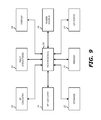
- FIG. 9 is a block diagram of exemplary components of an electronic device for optimizing a beamformer for echo control in accordance with aspects of the present disclosure.
- FIG. 1 illustrates an instance of an electronic device 10 in which an embodiment of the invention may be implemented.
- the electronic device 10 may be a mobile telephone communications device (or mobile device) or a smartphone.
- the electronic device 10 may also be, for instance, a desktop computer, a tablet computer, a personal digital media player, a notebook computer, and laptop computer.
- the near-end user is in the process of a call with a far-end user who is using another communications device 4 .
- the term “call” is used here generically to refer to any two-way real-time or live audio communications session with a far-end user (including a video call which allows simultaneous audio).
- the electronic device 10 communicates with a wireless base station 5 in the initial segment of its communication link.
- the call may be conducted through multiple segments over one or more communication networks 3 , e.g. a wireless cellular network, a wireless local area network, a wide area network such as the Internet, and a public switch telephone network such as the plain old telephone system (POTS).
- POTS plain old telephone system
- the far-end user need not be using a mobile device, but instead may be using a landline based POTS or Internet telephony station.
- the device 10 may include a housing that includes a display screen 16 on the front face of the device 10 .
- the display screen 16 may be a touch screen.
- the device 10 may also include input-output components such as ports and jacks.
- the device 10 may include a first opening to form the microphone port and a second opening to form a speaker port. The sound during a telephone call is emitted through a third opening which forms a speaker port for a telephone receiver that is placed adjacent to the user's ear during a call. Further, when the device is used in speakerphone mode, for example, the openings may be used as speaker ports to output the audio signals.
- the user may use a headset that includes a pair of earbuds and a headset wire.
- the user may place one or both the earbuds into his ears to receive the audio content.
- the headset wire may also include a plurality of microphones. As the user is using the headset to transmit his speech, environmental noise may also be present. Additionally, embodiments of the invention may also use other types of headsets.
- the housing of the device 10 may include therein components such as a loudspeaker and at least one microphone.
- the loudspeaker is driven by an output downlink signal that includes the far-end acoustic signal components.
- the microphones may be air interface sound pickup devices that convert sound into an electrical signal.
- ambient noise may also be present.
- the downlink signal that is output from a loudspeaker may also environmental noise that is captured by the microphone, and if so, the downlink signal that is output from the loudspeaker could get fed back in the near-end device's uplink signal to the far-end device's downlink signal.
- This downlink signal would in part drive the far-end device's loudspeaker, and thus, components of this downlink signal would be included in the near-end device's uplink signal to the far-end device's downlink signal as echo.
- each of the physical components in the electronic component may form a non-linear component that varies based on frequency of the outputted content.
- the physical components may include, for example, the SIM card tray, the camera spring, the vibration component, etc. Accordingly, the convergence of linear adaptive filters is dependent on the frequency of the outputted content as well as the physical components in the electronic component itself.
- FIGS. 2A-2B illustrate block diagrams of prior art systems that have difficulties providing effective echo control in certain situations.
- the prior art system 200 A includes a pair of microphones 210 1 , 210 2 , a first and second linear adaptive echo cancellers (ECs) 220 1 , 220 2 , and a linear adaptive beamformer 230 .
- the microphones 210 1 , 210 2 receive acoustic signals that include the near-end user's voice as well as the downlink signal that is output from the near-end device's loudspeaker (e.g., the echo in the far-end device's downlink signal).
- the microphones 210 1 , 210 2 are coupled to a first and second linear adaptive ECs 220 1 , 220 2 , respectively, which are adaptive filters that converge in order to cancel the downlink signal that is output from the near-end device's loudspeaker.
- the output of the linear adaptive ECs 220 1 , 220 2 is received by the linear adaptive beamformer 230 that also includes an adaptive filter that is adaptively steered to set the null of the beamformer 230 to further reduce the echo in the uplink signal being transmitted to the far-end device (e.g., the echo in the far-end device's downlink signal).
- the linear adaptive beamformer 230 processes the linear adaptive ECs 220 1 , 220 2 outputs in order to output an echo-reduced signal.
- the null of the linear adaptive beamformer 230 is adaptively steered in the directions of the echo in order to deemphasize the echo using the null.
- the linear adaptive ECs 220 1 , 220 2 are very sensitive and converge quickly such that the linear adaptive ECs 220 1 , 220 2 will be greatly affected by changes to its inputs.
- the linear adaptive beamformer 230 is coupled to the outputs of the linear adaptive ECs 220 1 , 220 2 such that it does not cause convergence issues to the linear adaptive ECs 220 1 , 220 2 .
- the linear adaptive ECs 220 1 , 220 2 when the linear adaptive ECs 220 1 , 220 2 receive acoustic signals from the microphones 210 1 , 210 2 that include significant amounts of residual echo, the linear adaptive ECs 220 1 , 220 2 will continue to adapt and converge to cancel the residual echo (e.g., echo path changes). Accordingly, the changing input to the linear adaptive beamformer 230 will cause the linear adaptive beamformer 230 to continuously adapt to the echo path changes. In other words, since the linear adaptive ECs 220 1 , 220 2 do not fully converge when the residual echo is significant, the linear adaptive beamformer 230 is unable to set its null to remove the echo (e.g., environmental noise).
- the system 200 A may be effective when the acoustic signals from the microphones 210 1 , 210 2 include minimal amounts of residual echo since the linear adaptive ECs 220 1 , 220 2 are able to fully converge.
- the prior art system 200 B also includes a pair of microphones 210 1 , 210 2 , a first linear adaptive EC 220 1 , and a linear adaptive beamformer 230 .
- the linear adaptive beamformer 230 is coupled to the microphones 210 1 , 210 2 to receive the acoustic signals that include the near-end user's voice as well as the downlink signal that is output from the near-end device's loudspeaker (e.g., the echo in the far-end device's downlink signal).
- the linear adaptive beamformer 230 adapts its beamforming pattern to remove the location of downlink signal that is output from the near-end device's loudspeaker (e.g., the echo). However, given the non-linearities of the loudspeaker and the echo in the audio signals received, the linear adaptive beamformer 230 may constantly be adapting its beamforming patterns and thus its outputs may constantly be changing. In other words, the linear adaptive beamformer 230 may not fully converge. In contrast to the system 200 A, the linear adaptive ECs 220 1 , 220 2 receive as inputs the output of the linear adaptive beamformer 230 .
- linear adaptive ECs 220 1 , 220 2 are very sensitive and converge quickly, the linear adaptive ECs 220 1 , 220 2 will be greatly affected by constant changes to its inputs from the linear adaptive beamformer 230 . Accordingly, the linear adaptive EC 220 1 in system 200 B will constantly be converging quickly and not be able to cancel the echo in the linear adaptive beamformer 230 's output.
- FIG. 3 illustrates a block diagram of a system 300 for optimizing a beamformer for echo control according to one embodiment of the invention, which addresses the shortcomings of the prior art systems 200 A and 200 B.
- the system 300 may be included in electronic device 10 .
- the system 300 includes a plurality of microphones 310 1 - 310 n (n>1), a plurality of linear adaptive ECs 320 1 - 320 n , a fixed beamformer 330 , and a residual echo suppressor (ES) 340 .
- ES residual echo suppressor
- the microphones 310 1 - 310 n receive the acoustic signals
- the linear adaptive ECs 320 1 - 320 n are coupled to the microphones 310 1 - 310 n , respectively, to adaptively cancel echo in the acoustic signals to generate EC-acoustic signals.
- the linear adaptive ECs 320 1 - 320 n may converge to cancel the echo in the acoustic signals.
- the system 300 in FIG. 3 includes a fixed beamformer 330 which is coupled to the ECs to receive the EC-acoustic signals.
- the fixed beamformer 330 is set and not adaptively beamforming. Instead, the fixed beamformer 330 is set such that the null of the fixed beamformer is steered in a direction of an environmental noise source (e.g., the echo from the downlink signal being output from the near-end device's loudspeaker). Accordingly, the fixed beamformer 330 may deemphasize the location of the echo using the nulls. In some embodiments, the fixed beamformer 330 may form a cardioid pattern. To determine the location of the environmental noise source and direct the null of the fixed beamformer 330 requires offline determinations and tests.
- the outputs of the linear adaptive ECs 320 1 - 320 n may be tapped to assess and determine the space where statistically it is most likely that there is the most significant echo energy on a per frequency basis or on a per loudness basis.
- FIG. 5 illustrates an example of a scatter plot that is used to locate of environmental noise sources offline according to one embodiment of the invention. Based on where the clusters of echo energy are located, the most significant environmental noise sources may be identified offline.
- the environmental noise source is determined offline by exciting the ECs with normal speech signals and audio playback signals to cause the ECs to generate test EC-acoustic signals. Accordingly, the normal speech signals and audio playback signals are received by the ECs, the ECs adaptively converge and perform echo cancellation on the received signals and generate the test EC-acoustic signals.
- a source direction detector or a processor may tap the output of the linear adaptive ECs to receive these test EC-acoustic signals and may select the environmental noise source based on loudness weighted centroids of noise in the test EC-acoustic signals.
- the environmental noise source that is selected is the environmental noise source having the highest power.
- a source direction detector may tap the output of the ECs 320 1 - 320 n and may perform acoustic source localization based on time-delay estimates in which pairs of microphones included in the plurality of microphones 310 1 - 310 n , are used to estimate the delay for the sound signal between the two of the microphones.
- the delays from the pairs of microphones may also be combined and used to estimate the source location using methods such as the generalized cross-correlation (GCC) or adaptive eigenvalue decomposition (AED).
- GCC generalized cross-correlation
- AED adaptive eigenvalue decomposition
- the source direction detector and the fixed beamformer 330 may work in conjunction offline to perform the source localization based on steered beamforming (SBF).
- the fixed beamformer 330 is steered over a range of directions and for each direction the power of the beamforming output is calculated.
- the power of the fixed beamformer 330 for each direction in the range of directions is calculated and the environmental noise source is detected as the direction that has the highest power.
- FIG. 4 illustrates a top view of an example of locating of environmental noise sources offline according to one embodiment of the invention.
- FIG. 4 illustrates the location of a plurality of noise sources (marked as squares) and two of the microphones 310 1 , 310 2 (marked as circles).
- the noise sources on the x-axis are equal in distance to microphones 310 1 , 310 2 .
- the distances R 1 between the sound sources and the first microphone 310 1 are equal and the distances R 2 between the sound sources and the second microphone 310 2 , respectively, are equal.
- the time of arrival to each of the microphones 310 1 , 310 2 of the sound from the noise sources on the x-axis that are respectively equal since the distances travelled are equal (e.g., R 1 is equal to R 1 and R 2 is equal to R 2 ).
- the sound sources that are above the x-axis are also equal in distance to microphones 310 1 , 310 2 (e.g., R 1 ′ is equal to R 1 ′ and R 2 ′ is equal to R 2 ′). As shown in FIG.
- a circle may be drawn to connect the sound sources that are equal distances to the microphones 310 1 , 310 2 (e.g., R 1 ′ is equal to R 1 ′ and R 2 ′ is equal to R 2 ′). Therefore, the times of arrival to each of the microphones 310 1 , 310 2 , respectively, are equal for any sound source located on the circle. Accordingly, by using the difference of time of arrival to the first microphone 310 1 and time of arrival to the second microphone 310 2 (e.g., relative phase), the angle at which the noise source is located may be identified (e.g., in the cone in FIG. 4 ). In some embodiments, the fixed beamformer 330 is then set offline to null out the angle at which the noise source is located.
- the energy loss of the noise received at the microphones 310 1 , 310 2 is used. If the noise source is far from the microphones 310 1 , 310 2 , the 1/R 2 energy loss is small, whereas if the noise source is close to the microphones 310 1 , 310 2 , the 1/R 2 energy loss is larger.
- the fixed beamformer 330 may be optimized by fixing the beamformer to null out the angle and the distance at which the noise source is located. As shown in FIG.
- the test EC-acoustic signals per frequency bin are generated by the converged ECs 320 1 , 320 2 and are used to generate a scatter plot or heat map of combined relative magnitude and relative phase of the noise source location in real space.
- the ECs 320 1 , 320 2 are fully converged and generate the test-acoustic signals.
- the ECs 320 1 , 320 2 adaptively converge and generate the test-acoustic signals. Loudness weighted centroids may be used to tune the fixed beamformer 330 offline.
- the fixed beamformer 330 may be set to target the location of the most significant part of the residual echo, including all the ECs and other non-linear effects due to the loudspeaker and the echo path.
- the most significant part of the echo may be a most significant noise source location.
- the most significant noise source location may be the location where it is determined offline statistically the noise occurs more frequently or where the noise source is the loudest (e.g., having the highest power).
- the perceptual impact of each of the noise sources may also be determined in order to select the noise source to which the fixed beamformer should be directed.
- the system 300 also includes a residual echo suppressor 340 coupled to the first fixed beamformer to perform echo suppression on an output of the fixed beamformer to generate a clean signal.
- the system 300 also includes the loudspeaker (not shown) to output a loudspeaker signal that includes a downlink audio signal from a far-end talker.
- the first environmental noise is the output from the loudspeaker.
- FIG. 6 illustrates a block diagram of a system 600 for optimizing beamformers for echo control according to another embodiment of the invention.
- the system 600 may be included in electronic device 10 .
- the system 600 includes a plurality of fixed beamformers 630 1 - 630 m (m>1) and a selector 650 instead of the single fixed beamformer 330 .
- the system 600 as shown in FIG. 6 , also includes a plurality of microphones 310 1 - 310 n (n>1), a plurality of linear adaptive ECs 320 1 - 320 n , and a residual echo suppressor (ES) 340 .
- ES residual echo suppressor
- the microphones 310 1 - 310 n receive the acoustic signals
- the linear adaptive ECs 320 1 - 320 n are coupled to the microphones 310 1 - 310 n , respectively, to converge and adaptively cancel echo in the acoustic signals to generate EC-acoustic signals.
- the plurality of fixed beamformers 630 1 - 630 m are coupled to the ECs 320 1 - 320 n to receive the EC-acoustic signals.
- Each of the fixed beamformers 630 1 - 630 m may be directed to a different environmental noise source. For instance, referring to FIG.
- each of the clusters in the scatter plot represents a noise source that is significant based on the loudness weighted centroids and/or based on whether the noise (e.g., echo) from that noise source is statistically likely to occur.
- Each of the fixed beamformers 630 1 - 630 m may be set such that their respective nulls are directed to each of the noise sources in FIG. 5 , respectively (e.g., locations of each of the clusters).
- Each of the fixed beamformers 630 1 - 630 m process the EC-acoustic signals, respectively, to further remove the noise (e.g., echo) from the EC-acoustic signals and the outputs of the fixed beamformers 630 1 - 630 m are received by a selector 650 .
- the selector 650 may select and output one of the outputs from the fixed beamformers 630 1 - 630 m .
- the selector 650 may determine and select the output that includes the least amount of noise (e.g., echo).
- the selector 650 combines the outputs from the beamformers 630 1 - 630 m to generate a selector output.
- the selector output may be an EC-acoustic signal having had the noise from each of the significant noise sources removed.
- the residual echo suppressor 340 receives the output of the selector 650 and performs echo suppression to remove the residual noise (e.g., echo) from the signal output from the selector 650 to generate a cleaned signal.
- a process which is usually depicted as a flowchart, a flow diagram, a structure diagram, or a block diagram.
- a flowchart may describe the operations as a sequential process, many of the operations can be performed in parallel or concurrently.
- the order of the operations may be re-arranged.
- a process is terminated when its operations are completed.
- a process may correspond to a method, a procedure, etc.
- FIG. 7 illustrates a flow diagram of an example method 700 of optimizing a beamformer for echo control according to one embodiment of the invention.
- the method 700 starts by setting the null of a first fixed beamformer offline at Block 701 .
- ECs may converge and adaptively cancel echo in acoustic signals that are received from a plurality of microphones to generate EC-acoustic signals.
- the first fixed beamformer receives the EC-acoustic signals and the null of the first beamformer is steered in the direction of the first environmental noise.
- a residual echo suppressor then receives the output of the first fixed beamformer and performs echo suppression on the output of the first fixed beamformer to generate a clean signal.
- the first environmental noise source is determine offline by exciting the ECs that are coupled to the plurality of microphones, respectively, with normal speech signals and audio playback signals to cause the ECs to generate test EC-signals.
- the first environmental noise source is then selected based on loudness weighted centroid of noise in the test EC-acoustic signals.
- selecting the first environmental noise source includes determining a statistical occurrence of each of the environmental noise sources, determining the loudness of each of the environmental noise sources, and/or determining the perceptual impact of each of the environmental noise sources.
- the first environmental noise may be an output from a loudspeaker.
- the loudspeaker may output a loudspeaker signal that includes a downlink audio signal from a far-end talker (e.g., echo).
- the first environmental noise source is the location of the output from the loudspeaker.
- the first environmental noise source is selected from the plurality of environmental noise sources and the first environmental noise source is the environmental noise source having a highest power in the EC-acoustic signals.
- the null of the first fixed beamformer is set in the direction of the selected first environmental noise source.
- method 700 in FIG. 7 further includes setting a null of a second fixed beamformer offline in a direction of a second environmental noise source similar to the setting of the null offline for the first fixed beamformer as described above.
- the second environmental noise source may be another environmental noise source that is significant in that it may also create an echo in the far-end device's downstream signal.
- the second environmental noise source may also be selected based on its loudness, statistical occurrence, or perceptual impact.
- a method may further include selecting and outputting by a selector one of an output of the first fixed beamformer or an output of the second fixed beamformer.
- the selector may combine the outputs of the first and second fixed beamformers to generate a selector output.
- FIG. 9 is a block diagram depicting various components that may be present in electronic devices suitable for use with the present techniques.
- the electronic device may be in the form of a computer, a handheld portable electronic device, and/or a computing device having a tablet-style form factor. These types of electronic devices, as well as other electronic devices providing comparable speech recognition capabilities may be used in conjunction with the present techniques.
- FIG. 9 is a block diagram illustrating components that may be present in one such electronic device 10 , and which may allow the device 10 to function in accordance with the techniques discussed herein.
- the various functional blocks shown in FIG. 9 may include hardware elements (including circuitry), software elements (including computer code stored on a computer-readable medium, such as a hard drive or system memory), or a combination of both hardware and software elements.
- FIG. 9 is merely one example of a particular implementation and is merely intended to illustrate the types of components that may be present in the electronic device 10 .
- these components may include a display 16 , input/output (I/O) ports 14 , input structures 12 , one or more processors 18 , memory device(s) 20 , non-volatile storage 22 , expansion card(s) 24 , RF circuitry 26 , and power source 28 .
- the embodiment include computers that are generally portable (such as laptop, notebook, tablet, and handheld computers), as well as computers that are generally used in one place (such as conventional desktop computers, workstations, and servers).
- the electronic device 10 may also take the form of other types of devices, such as mobile telephones, media players, personal data organizers, handheld game platforms, cameras, and/or combinations of such devices.
- the device 10 may be provided in the form of a handheld electronic device that includes various functionalities (such as the ability to take pictures, make telephone calls, access the Internet, communicate via email, record audio and/or video, listen to music, play games, connect to wireless networks, and so forth).
- the electronic device 10 may also be provided in the form of a portable multi-function tablet computing device.
- the tablet computing device may provide the functionality of media player, a web browser, a cellular phone, a gaming platform, a personal data organizer, and so forth.
- An embodiment of the invention may be a machine-readable medium having stored thereon instructions which program a processor to perform some or all of the operations described above.
- a machine-readable medium may include any mechanism for storing or transmitting information in a form readable by a machine (e.g., a computer), such as Compact Disc Read-Only Memory (CD-ROMs), Read-Only Memory (ROMs), Random Access Memory (RAM), and Erasable Programmable Read-Only Memory (EPROM).
- CD-ROMs Compact Disc Read-Only Memory
- ROMs Read-Only Memory
- RAM Random Access Memory
- EPROM Erasable Programmable Read-Only Memory
- some of these operations might be performed by specific hardware components that contain hardwired logic. Those operations might alternatively be performed by any combination of programmable computer components and fixed hardware circuit components.
- the machine-readable medium includes instructions stored thereon, which when executed by a processor, causes the processor to perform the method of optimizing beamformers for echo control on an electronic device as described above.
- the terms “component,” “unit,” “module,” and “logic” are representative of hardware and/or software configured to perform one or more functions.
- examples of “hardware” include, but are not limited or restricted to an integrated circuit such as a processor (e.g., a digital signal processor, microprocessor, application specific integrated circuit, a micro-controller, etc.).
- the hardware may be alternatively implemented as a finite state machine or even combinatorial logic.
- An example of “software” includes executable code in the form of an application, an applet, a routine or even a series of instructions. The software may be stored in any type of machine-readable medium.
Landscapes
- Engineering & Computer Science (AREA)
- Computational Linguistics (AREA)
- Quality & Reliability (AREA)
- Signal Processing (AREA)
- Health & Medical Sciences (AREA)
- Audiology, Speech & Language Pathology (AREA)
- Human Computer Interaction (AREA)
- Physics & Mathematics (AREA)
- Acoustics & Sound (AREA)
- Multimedia (AREA)
- Circuit For Audible Band Transducer (AREA)
Abstract
Description
Claims (23)
Priority Applications (1)
| Application Number | Priority Date | Filing Date | Title |
|---|---|---|---|
| US14/550,868 US9508357B1 (en) | 2014-11-21 | 2014-11-21 | System and method of optimizing a beamformer for echo control |
Applications Claiming Priority (1)
| Application Number | Priority Date | Filing Date | Title |
|---|---|---|---|
| US14/550,868 US9508357B1 (en) | 2014-11-21 | 2014-11-21 | System and method of optimizing a beamformer for echo control |
Publications (1)
| Publication Number | Publication Date |
|---|---|
| US9508357B1 true US9508357B1 (en) | 2016-11-29 |
Family
ID=57351574
Family Applications (1)
| Application Number | Title | Priority Date | Filing Date |
|---|---|---|---|
| US14/550,868 Expired - Fee Related US9508357B1 (en) | 2014-11-21 | 2014-11-21 | System and method of optimizing a beamformer for echo control |
Country Status (1)
| Country | Link |
|---|---|
| US (1) | US9508357B1 (en) |
Cited By (7)
| Publication number | Priority date | Publication date | Assignee | Title |
|---|---|---|---|---|
| US20160150315A1 (en) * | 2014-11-20 | 2016-05-26 | GM Global Technology Operations LLC | System and method for echo cancellation |
| US10089998B1 (en) * | 2018-01-15 | 2018-10-02 | Advanced Micro Devices, Inc. | Method and apparatus for processing audio signals in a multi-microphone system |
| CN108694957A (en) * | 2018-04-08 | 2018-10-23 | 湖北工业大学 | The echo cancelltion design method formed based on circular microphone array beams |
| CN109545237A (en) * | 2018-10-24 | 2019-03-29 | 广东思派康电子科技有限公司 | Computer readable storage medium and voice interaction sound box applying same |
| US11232794B2 (en) * | 2020-05-08 | 2022-01-25 | Nuance Communications, Inc. | System and method for multi-microphone automated clinical documentation |
| WO2022170541A1 (en) * | 2021-02-10 | 2022-08-18 | Northwestern Polytechnical University | First-order differential microphone array with steerable beamformer |
| US20240348855A1 (en) * | 2021-07-30 | 2024-10-17 | Lg Electronics Inc. | Wireless display device, wireless set-top box, and wireless display system |
Citations (5)
| Publication number | Priority date | Publication date | Assignee | Title |
|---|---|---|---|---|
| US20140023199A1 (en) | 2012-07-23 | 2014-01-23 | Qsound Labs, Inc. | Noise reduction using direction-of-arrival information |
| US20140056435A1 (en) | 2012-08-24 | 2014-02-27 | Retune DSP ApS | Noise estimation for use with noise reduction and echo cancellation in personal communication |
| US20140093093A1 (en) * | 2012-09-28 | 2014-04-03 | Apple Inc. | System and method of detecting a user's voice activity using an accelerometer |
| US20140112487A1 (en) | 2012-10-19 | 2014-04-24 | Research In Motion Limited | Using an auxiliary device sensor to facilitate disambiguation of detected acoustic environment changes |
| US20150371657A1 (en) * | 2014-06-19 | 2015-12-24 | Yang Gao | Energy Adjustment of Acoustic Echo Replica Signal for Speech Enhancement |
-
2014
- 2014-11-21 US US14/550,868 patent/US9508357B1/en not_active Expired - Fee Related
Patent Citations (5)
| Publication number | Priority date | Publication date | Assignee | Title |
|---|---|---|---|---|
| US20140023199A1 (en) | 2012-07-23 | 2014-01-23 | Qsound Labs, Inc. | Noise reduction using direction-of-arrival information |
| US20140056435A1 (en) | 2012-08-24 | 2014-02-27 | Retune DSP ApS | Noise estimation for use with noise reduction and echo cancellation in personal communication |
| US20140093093A1 (en) * | 2012-09-28 | 2014-04-03 | Apple Inc. | System and method of detecting a user's voice activity using an accelerometer |
| US20140112487A1 (en) | 2012-10-19 | 2014-04-24 | Research In Motion Limited | Using an auxiliary device sensor to facilitate disambiguation of detected acoustic environment changes |
| US20150371657A1 (en) * | 2014-06-19 | 2015-12-24 | Yang Gao | Energy Adjustment of Acoustic Echo Replica Signal for Speech Enhancement |
Cited By (16)
| Publication number | Priority date | Publication date | Assignee | Title |
|---|---|---|---|---|
| US20160150315A1 (en) * | 2014-11-20 | 2016-05-26 | GM Global Technology Operations LLC | System and method for echo cancellation |
| US10089998B1 (en) * | 2018-01-15 | 2018-10-02 | Advanced Micro Devices, Inc. | Method and apparatus for processing audio signals in a multi-microphone system |
| CN108694957A (en) * | 2018-04-08 | 2018-10-23 | 湖北工业大学 | The echo cancelltion design method formed based on circular microphone array beams |
| CN108694957B (en) * | 2018-04-08 | 2021-08-31 | 湖北工业大学 | Echo Cancellation Design Method Based on Circular Microphone Array Beamforming |
| CN109545237B (en) * | 2018-10-24 | 2022-01-28 | 广东思派康电子科技有限公司 | Computer readable storage medium and voice interaction sound box applying same |
| CN109545237A (en) * | 2018-10-24 | 2019-03-29 | 广东思派康电子科技有限公司 | Computer readable storage medium and voice interaction sound box applying same |
| US11699440B2 (en) | 2020-05-08 | 2023-07-11 | Nuance Communications, Inc. | System and method for data augmentation for multi-microphone signal processing |
| US11335344B2 (en) | 2020-05-08 | 2022-05-17 | Nuance Communications, Inc. | System and method for multi-microphone automated clinical documentation |
| US11631411B2 (en) | 2020-05-08 | 2023-04-18 | Nuance Communications, Inc. | System and method for multi-microphone automated clinical documentation |
| US11670298B2 (en) | 2020-05-08 | 2023-06-06 | Nuance Communications, Inc. | System and method for data augmentation for multi-microphone signal processing |
| US11676598B2 (en) | 2020-05-08 | 2023-06-13 | Nuance Communications, Inc. | System and method for data augmentation for multi-microphone signal processing |
| US11232794B2 (en) * | 2020-05-08 | 2022-01-25 | Nuance Communications, Inc. | System and method for multi-microphone automated clinical documentation |
| US11837228B2 (en) | 2020-05-08 | 2023-12-05 | Nuance Communications, Inc. | System and method for data augmentation for multi-microphone signal processing |
| WO2022170541A1 (en) * | 2021-02-10 | 2022-08-18 | Northwestern Polytechnical University | First-order differential microphone array with steerable beamformer |
| US12212923B2 (en) | 2021-02-10 | 2025-01-28 | Northwestern Polytechnical University | First-order differential microphone array with steerable beamformer |
| US20240348855A1 (en) * | 2021-07-30 | 2024-10-17 | Lg Electronics Inc. | Wireless display device, wireless set-top box, and wireless display system |
Similar Documents
| Publication | Publication Date | Title |
|---|---|---|
| US9508357B1 (en) | System and method of optimizing a beamformer for echo control | |
| US10074380B2 (en) | System and method for performing speech enhancement using a deep neural network-based signal | |
| US9525938B2 (en) | User voice location estimation for adjusting portable device beamforming settings | |
| US10269369B2 (en) | System and method of noise reduction for a mobile device | |
| US9129586B2 (en) | Prevention of ANC instability in the presence of low frequency noise | |
| US8600454B2 (en) | Decisions on ambient noise suppression in a mobile communications handset device | |
| EP2772070B1 (en) | Processing audio signals | |
| US9516159B2 (en) | System and method of double talk detection with acoustic echo and noise control | |
| US8644517B2 (en) | System and method for automatic disabling and enabling of an acoustic beamformer | |
| US10176823B2 (en) | System and method for audio noise processing and noise reduction | |
| CA3047918C (en) | Doppler microphone processing for conference calls | |
| CN106663447B (en) | Audio system with noise interference suppression | |
| US10978086B2 (en) | Echo cancellation using a subset of multiple microphones as reference channels | |
| US8885815B1 (en) | Null-forming techniques to improve acoustic echo cancellation | |
| US20160006880A1 (en) | Variable step size echo cancellation with accounting for instantaneous interference | |
| US20180343514A1 (en) | System and method of wind and noise reduction for a headphone | |
| EP2761617A1 (en) | Processing signals | |
| US11523215B2 (en) | Method and system for using single adaptive filter for echo and point noise cancellation | |
| US9491306B2 (en) | Signal processing control in an audio device | |
| US11804237B2 (en) | Conference terminal and echo cancellation method for conference | |
| US10540984B1 (en) | System and method for echo control using adaptive polynomial filters in a sub-band domain | |
| US9858944B1 (en) | Apparatus and method for linear and nonlinear acoustic echo control using additional microphones collocated with a loudspeaker | |
| JP6945158B2 (en) | Calling devices, programs and calling systems | |
| CN111292760A (en) | Sounding state detection method and user equipment | |
| CN102970638A (en) | Signal processing |
Legal Events
| Date | Code | Title | Description |
|---|---|---|---|
| AS | Assignment |
Owner name: APPLE INC., CALIFORNIA Free format text: ASSIGNMENT OF ASSIGNORS INTEREST;ASSIGNOR:KRISHNASWAMY, ARVINDH;REEL/FRAME:034236/0349 Effective date: 20141118 |
|
| FEPP | Fee payment procedure |
Free format text: PAYOR NUMBER ASSIGNED (ORIGINAL EVENT CODE: ASPN); ENTITY STATUS OF PATENT OWNER: LARGE ENTITY |
|
| STCF | Information on status: patent grant |
Free format text: PATENTED CASE |
|
| MAFP | Maintenance fee payment |
Free format text: PAYMENT OF MAINTENANCE FEE, 4TH YEAR, LARGE ENTITY (ORIGINAL EVENT CODE: M1551); ENTITY STATUS OF PATENT OWNER: LARGE ENTITY Year of fee payment: 4 |
|
| FEPP | Fee payment procedure |
Free format text: MAINTENANCE FEE REMINDER MAILED (ORIGINAL EVENT CODE: REM.); ENTITY STATUS OF PATENT OWNER: LARGE ENTITY |
|
| LAPS | Lapse for failure to pay maintenance fees |
Free format text: PATENT EXPIRED FOR FAILURE TO PAY MAINTENANCE FEES (ORIGINAL EVENT CODE: EXP.); ENTITY STATUS OF PATENT OWNER: LARGE ENTITY |
|
| STCH | Information on status: patent discontinuation |
Free format text: PATENT EXPIRED DUE TO NONPAYMENT OF MAINTENANCE FEES UNDER 37 CFR 1.362 |
|
| FP | Lapsed due to failure to pay maintenance fee |
Effective date: 20241129 |