US9505976B2 - Excitation-dependent fluorescent organic nanoparticles - Google Patents
Excitation-dependent fluorescent organic nanoparticles Download PDFInfo
- Publication number
- US9505976B2 US9505976B2 US14/016,037 US201314016037A US9505976B2 US 9505976 B2 US9505976 B2 US 9505976B2 US 201314016037 A US201314016037 A US 201314016037A US 9505976 B2 US9505976 B2 US 9505976B2
- Authority
- US
- United States
- Prior art keywords
- btba
- edf
- edfonp
- nmr
- excitation
- Prior art date
- Legal status (The legal status is an assumption and is not a legal conclusion. Google has not performed a legal analysis and makes no representation as to the accuracy of the status listed.)
- Expired - Fee Related, expires
Links
- 0 [1*]OCC(CO)OC([2*])=O.[1*]OCC(O)COC([2*])=O Chemical compound [1*]OCC(CO)OC([2*])=O.[1*]OCC(O)COC([2*])=O 0.000 description 8
- GWSVOLKXGZZZLE-UHFFFAOYSA-N C.C1CC1.CC(C)(C1=CC=C(OCC2CO2)C=C1)C1=CC=C(OCC2CO2)C=C1.O=C(O)COCCOCC(=O)O Chemical compound C.C1CC1.CC(C)(C1=CC=C(OCC2CO2)C=C1)C1=CC=C(OCC2CO2)C=C1.O=C(O)COCCOCC(=O)O GWSVOLKXGZZZLE-UHFFFAOYSA-N 0.000 description 1
- KCOZRDDFVVMJCR-UHFFFAOYSA-N C.CC(=O)COCCOCC(C)(C)C.CC1=CC(C(C)(C)C)=CC(C)=C1C Chemical compound C.CC(=O)COCCOCC(C)(C)C.CC1=CC(C(C)(C)C)=CC(C)=C1C KCOZRDDFVVMJCR-UHFFFAOYSA-N 0.000 description 1
- GCRRMWSRZKYYIX-UHFFFAOYSA-N C.CC1=CC(C(C)(C)C)=CC(C)=C1C Chemical compound C.CC1=CC(C(C)(C)C)=CC(C)=C1C GCRRMWSRZKYYIX-UHFFFAOYSA-N 0.000 description 1
- KWQLYPMQOTXSNM-UHFFFAOYSA-N CC(=O)COCCOCC(C)(C)C Chemical compound CC(=O)COCCOCC(C)(C)C KWQLYPMQOTXSNM-UHFFFAOYSA-N 0.000 description 1
- FFXBVCSRIOQGNR-UHFFFAOYSA-N CC(C)(C1=CC=C(OCC2CO2)C=C1)C1=CC=C(OCC2CO2)C=C1.CCCCCCCCCCCCCCCCCC(=O)O Chemical compound CC(C)(C1=CC=C(OCC2CO2)C=C1)C1=CC=C(OCC2CO2)C=C1.CCCCCCCCCCCCCCCCCC(=O)O FFXBVCSRIOQGNR-UHFFFAOYSA-N 0.000 description 1
- PDUJAXKYELLKQN-UHFFFAOYSA-N CC1=CC(C(=O)O)=CC(C)=C1C.CCCCCCCCCCCCCCCCOC1=CC(C(=O)OCC(O)COCCCC)=CC(C)=C1C.CCCCOCC1CO1 Chemical compound CC1=CC(C(=O)O)=CC(C)=C1C.CCCCCCCCCCCCCCCCOC1=CC(C(=O)OCC(O)COCCCC)=CC(C)=C1C.CCCCOCC1CO1 PDUJAXKYELLKQN-UHFFFAOYSA-N 0.000 description 1
- CEMBVULKIZKNHP-UHFFFAOYSA-N CC1=CC(C(=O)OC(CO)COC2=CC=C(C(C)(C)C3=CC=C(OCC(CO)OC(=O)C4=CC(C)=C(C)C(C)=C4)C=C3)C=C2)=CC(C)=C1C Chemical compound CC1=CC(C(=O)OC(CO)COC2=CC=C(C(C)(C)C3=CC=C(OCC(CO)OC(=O)C4=CC(C)=C(C)C(C)=C4)C=C3)C=C2)=CC(C)=C1C CEMBVULKIZKNHP-UHFFFAOYSA-N 0.000 description 1
- CQZDVVNVVCGCID-UHFFFAOYSA-N CC1=CC(C(=O)OCC(O)COC2=CC=C(C(C)(C)C3=CC=C(OCC(CO)OC(=O)C4=CC(C)=C(C)C(C)=C4)C=C3)C=C2)=CC(C)=C1C Chemical compound CC1=CC(C(=O)OCC(O)COC2=CC=C(C(C)(C)C3=CC=C(OCC(CO)OC(=O)C4=CC(C)=C(C)C(C)=C4)C=C3)C=C2)=CC(C)=C1C CQZDVVNVVCGCID-UHFFFAOYSA-N 0.000 description 1
- ZQVJKYPEIPJEIP-UHFFFAOYSA-N CC1=CC(C(C)(C)C)=CC(C)=C1C Chemical compound CC1=CC(C(C)(C)C)=CC(C)=C1C ZQVJKYPEIPJEIP-UHFFFAOYSA-N 0.000 description 1
Images


Classifications
-
- C—CHEMISTRY; METALLURGY
- C09—DYES; PAINTS; POLISHES; NATURAL RESINS; ADHESIVES; COMPOSITIONS NOT OTHERWISE PROVIDED FOR; APPLICATIONS OF MATERIALS NOT OTHERWISE PROVIDED FOR
- C09K—MATERIALS FOR MISCELLANEOUS APPLICATIONS, NOT PROVIDED FOR ELSEWHERE
- C09K11/00—Luminescent materials, e.g. electroluminescent or chemiluminescent
- C09K11/06—Luminescent materials, e.g. electroluminescent or chemiluminescent containing organic luminescent materials
-
- B—PERFORMING OPERATIONS; TRANSPORTING
- B82—NANOTECHNOLOGY
- B82Y—SPECIFIC USES OR APPLICATIONS OF NANOSTRUCTURES; MEASUREMENT OR ANALYSIS OF NANOSTRUCTURES; MANUFACTURE OR TREATMENT OF NANOSTRUCTURES
- B82Y15/00—Nanotechnology for interacting, sensing or actuating, e.g. quantum dots as markers in protein assays or molecular motors
Definitions
- the disclosure relates to a fluorescent material. More particularly, the disclosure relates to a fluorescent organic nanoparticle.
- Organic fluorescent nanoparticles, excitation-dependent photoluminescence (or excitation-dependent fluorescent; EDF), hydrogenbonded clusters and lysobisphosphatidic acid are four interesting individual topics in materials and biological sciences. They have attracted much attention not only because of their unique properties and important applications, but also because the nature of their interesting phenomena remained unclear.
- the present invention is directed to an excitation-dependent fluorescent organic nanoparticles.
- Each of the excitation-dependent fluorescent organic nanoparticles comprises a cluster of aggregated molecules of 2-monoacylglycerol and 3-monoacylglycerol having the chemical structures shown below:
- R 1 is an aliphatic group with no more than 30 carbons or an aromatic group with no more than 30 carbons
- R 2 is an aliphatic group with no more than 30 carbons or an aromatic group with no more than 30 carbons.
- the R 1 comprises
- R 3 is an aliphatic group or an aromatic group.
- the R 2 comprises
- R 2 comprises
- this invention directs to a method of forming an excitation-dependent fluorescent nanoparticles.
- the method comprises performing a ring-opening reaction and a radical catalyzed 3,2-acyl migration reaction.
- the ring-opening reaction is performed by reacting an epoxy glycidyl ether and an carboxylic acid to form a first mixture of the 3-monoacylglycerol and the 2-monoacylglycerol, wherein the 3-monoacylglycerol is the major component.
- the radical catalyzed 3,2-acyl migration reaction is performed by adding a catalyst to the first mixture of the 3-monoacylglycerol and the 2-monoacylglycerol to form the excitation-dependent fluorescent nanoparticles above.
- FIG. 1A is a diagram of the chemical structure of 2,2′-12-BTBA and the 3,3′-12-BTBA, and the marks for H and C atoms are also shown.
- FIGS. 1B and 1C are the 1 H and DEPT-135 NMR spectra of 12-No-EDF, respectively.
- FIGS. 2A and 2B are the 1 H and DEPT-135 NMR spectra of 12-EDFONP, respectively.
- FIG. 2C shows the chemical structures of 2,2′-12-BTBA, 2,3-12-BTBA, 3,3′-12-BTBA, and 2,3-diacylglycerol bisphenol A.
- FIG. 2D is a part of two-dimensional 1 H- 13 C HSQC spectrum of 12-EDFONP in CDCl 3 at room temperature.
- FIG. 3A shows the chemical structures of 2,2′-12-BTBA, 2,3-12-BTBA, 3,3′-12-BTBA and free 2,3-12-diacylglycerol-bisphenol-glycerol isomer.
- FIG. 3B is the 1 H NMR spectra of 12-No-EDF (spectrum 3a), product obtained by treating 12-No-EDF with (NH 4 ) 2 S 2 O 8 (spectrum 3b), and product obtained by treating 12-No-EDF with K 2 CO 3 (spectrum 3c).
- FIG. 4A shows the chemical structures of 2,2′-17-BS, 2,3-17-BS, 3,3′-17-BS and 2,3-17-diacylglycerol-bisphenol-glycerol.
- FIG. 4B is the 1 H NMR spectra of 17-No-EDF (spectrum 4a) and 17-EDFONP (spectrum 4b).
- FIG. 5A shows the chemical structures of the components of the 16-BGE-EDFONP.
- FIG. 5B is the 1 H NMR spectra of 16-BGE-No-EDF (spectrum 5a) and 16-BGE-EDFONP (spectrum 5b).
- FIG. 6A shows the chemical structures of the EDF-polymer.
- FIG. 6B is the 1 H NMR spectrum of the EDF-polymer in CDCl 3 at room temperature.
- FIG. 7A is the high resolution transmission electron microscopy (HRTEM) image of 18-EDFONP.
- FIG. 7B is a diagram showing mean diameters, measured by dynamic light scattering, of 12-EDFONP to 18-EDFONP in CH 2 Cl 2 .
- FIG. 7C is a HRTEM image of the EDF-polymer.
- FIG. 8A is excitation and emission spectra of 12-EDFONP at a concentration of 10 mM with a excitation-dependent visible fluorescence from 410-620 nm.
- FIG. 8B is a fluorescent photograph of 12-EDFONP in a CH 2 Cl 2 solution.
- FIG. 9A is excitation and emission spectra of 12-No-EDF at concentrations of 0.01 and 10 mM.
- FIGS. 9B and 9C are excitation and emission spectra of 12-EDFONP at an initial concentration of 10 mM (red line), then diluted to 0.01 mM (blue line) and reconcentrated back to 10 mM (green line), respectively.
- FIG. 10 is emission spectrum of 17-EDFONP based on stearic acid at a concentration of 10 mM with a visible EDF phenomena.
- FIG. 11 is emission spectrum of 16-BGE-EDFONP at a concentration of 10 mM with a visible EDF phenomena.
- FIG. 12 is emission spectrum of the EDF-Polymer.
- FIG. 13 is DOSY 1 H NMR 2D spectrum of 18-EDFONP in a solution.
- FIG. 14 is a diagram showing the formation of Great Stellated Dodecahedral decamers by the self-assembly of five 2,2′-n-BTBA and five 2,3-n-BTBA.
- FIG. 15 is a cartoon model of nanoparticle with bisphenol A aggregates and poly(ethylene glycol) moieties serving as core and shell compartments respectively.
- composition of excitation-dependent fluorescent organic nanoparticles comprises at least a cluster of aggregated molecules of 2-monoacylglycerol and 3-monoacylglycerol having the chemical structures shown below:
- R 1 above can be an aliphatic group with no more than 30 carbons or an aromatic group with no more than 30 carbon, such as an alkyl chain, or
- R 3 is an aliphatic group with no more than 30 carbons or an aromatic group with no more than 30 carbons.
- R 2 above can be an aliphatic group or an aromatic group, such as an alkyl chain,
- the 2-monoacylglycerol is the major component.
- EDFONPs are prepared by two sequential reactions.
- the first reaction is a ring-opening reaction, and the second reaction is a radical-catalyzed 3,2-acyl migration reaction.
- the reaction formula is shown in Scheme 1.
- the R 1 of epoxy glycidyl ether can be an aliphatic group or an aromatic group
- the R 2 of the carboxylic acid can be an aliphatic group or an aromatic group, as described above.
- the R 1 of the epoxy glycidyl ether can be butyl, octyl, decyl, benzyl, or bisphenol A groups
- the carboxylic acid can be dodecanoic acid, heptadecanoic acid, 3,4,5-tris(n-alkoxyl)benzoic acid, or polyethylene glycol diacid.
- the initial products containing a mixture of a 2-positional isomer as the minor component and a 3-positional isomer as the major component are obtained via a ring-opening reaction by treating the glycidyl ether epoxy with the carboxylic acid.
- the initial products are abbreviated as No-EDF because no EDF behavior was observed.
- the radical catalyzed 3,2-acyl migration reaction is conducted by treating the initial products with ammonium persulfate ((NH 4 ) 2 S 2 O 8 ) as a catalyst under a neat condition.
- the second products resulting from the migration of the 3,2-acyl contains a mixture of the 2-positional isomer as the major component and the 3-positional isomer as the minor component.
- the second products are abbreviated as EDFONP because EDF behavior was observed.
- Embodiment 1 Synthesis of n-No-EDF and n-EDFONP
- n was 12, 14, 16, and 18, respectively.
- the initial products were a mixture of 2,2′-n-bis(3,4,5-tris(n-alkyloxy)monobenzoylglyceride)bisphenol A (abbreviated as 2,2′-n-BTBA) and the 3,3′-n-BTBA, which were identified by 1 H, 13 C, heteronuclear single quantum correlation (HSQC) and heteronuclear multiple bond correlation (HMBC) NMR experiments.
- 2,2′-n-BTBA 2,2′-n-bis(3,4,5-tris(n-alkyloxy)monobenzoylglyceride)bisphenol A
- HSQC heteronuclear single quantum correlation
- HMBC heteronuclear multiple bond correlation
- FIG. 1A is a diagram of the chemical structure of 2,2′-12-BTBA and the 3,3′-12-BTBA, and the marks for H and C atoms are also shown.
- FIGS. 1B and 1C are the 1 H and DEPT-135 NMR spectra of 12-No-EDF, respectively. From FIGS. 1B and 1C , it can been seen that the molar ratio of the 2,2′-12-BTBA (red e, d and f) and 3,3′-12-BTBA (blue e, d and f) isomers is approximately 17:83. The molar ratio is typical for kinetically controlled reactions because the 3-position of DGEBA contains less steric hindrance than the 2-position.
- 12-EDFONP 12-No-EDF (0.7402 g, 0.44 mmol) and ammonium persulfate ((NH 4 ) 2 S 2 O 8 ) (0.013 g, 0.057 mmol) were heated and stirred under N 2 at 150° C. for 38 h in a neat condition. The crude product was then dissolved in CH 2 Cl 2 and filtered. The filtrate was dried under vacuum to give a brown product with a yield of 97% (0.72 g, 0.43 mmol).
- the brown product is composed of 2,2′-12-BTBA, 2,3-12-BTBA, 3,3′-12-BTBA and 2,3-12-diacylglycerol-bisphenol-glycerol isomers (a phosphatidylglycerol (PG)-like compound), and no non-acyl migrated side product is found.
- 2,2′-12-BTBA, 2,3-12-BTBA, 3,3′-12-BTBA and 2,3-12-diacylglycerol-bisphenol-glycerol isomers a phosphatidylglycerol (PG)-like compound
- FIGS. 2A and 2B are the 1 H and DEPT-135 NMR spectra of 12-EDFONP, respectively.
- the 1 H signals of the 12-EDFONP in CDCl 3 at 10 mM are composed of approximately 80% broad and 20% sharp signals.
- the dominant broad NMR signals are assigned to 2,2′-12-BTBA (40%) and 2,3-12-BTBA (40%), and they have significant upfield or downfield shifts compared with that of the initial 12-No-EDF.
- the remaining 20% sharp signals correspond to free 2,2′-12-BTBA (1%), free 3,3′-12-BTBA (15%) and free 2,3-12-diacylglycerol-bisphenol-glycerol isomer (4%), and the chemical structures thereof are shown in FIG. 2C .
- FIG. 2D is a part of two-dimensional 1 H- 13 C HSQC spectrum of 12-EDFONP in CDCl 3 at room temperature.
- the 13 C signals of the hydroxyl-bearing carbon of 2,2′-12-BTBA and 2,3-12-BTBA respectively undergo a significant downfield shift of approximately 7.0 and 7.5 ppm relative to the signals of both BTBAs without dense aggregation in 12-No-EDF.
- the ⁇ 7.0 and 7.5 ppm downfield shifts are typical for the hydroxyl-bearing carbons of polyvinyl alcohol and are characteristic of the formation of oligomeric alcohol clusters through continuous alcohol O—H—O—H hydrogen bonding (Ohgi, H., Sato, T., Hu, S.
- FIG. 3A shows the marks of hydrogen atoms of 2,2′-12-BTBA, 2,3-12-BTBA, free 2,2′-12-BTBA, free 3,3′-12-BTBA, and free 2,3-12-diacylglycerol-bisphenol-glycerol.
- 12-No-EDF is composed of 2,2′-12-BTBA (peak b2) and 3,3′-12-BTBA (peak b1).
- the 12-EDFONP contains 2,2′-12-BTBA (peak b5) and 2,3′-12-BTBA (peak b3 and b4) with collective proton motion.
- Embodiment 2 Synthesis of 17-No-EDF and 17-EDFONP
- 17-No-EDF A solution of bisphenol A diglycidyl ether (2.34 g, 6.87 mmol) and octadecanoic acid (3.91 g, 13.74 mmol) in mix-solvent of acetonitrile (40 ml) and xylene (20 ml) was reflux at 85° C. for 24 h. In this step, 0.5 equivalent of tetra-n-butylammonium bromide (TBAB) was added to increase the reactivity of epoxy ring opening reaction. The solvent was removed under reduced pressure. The crude product was recrystallized twice from acetonitrile, and a white solid of 17-No-EDF was obtained (4.81 g, 77%).
- TBAB tetra-n-butylammonium bromide
- the 17-No-EDF was composed of 2,2′-17-BS and 3,3′-17-BS positional isomers.
- the chemical structures of 2,2′-17-BS and 3,3′-17-BS are shown in FIG. 4A
- the 1 H NMR spectrum of 17-No-EDF is shown in spectrum 4a of FIG. 4B .
- 17-EDFONP The 17-No-EDF (2.21 g, 0.32 mmol) and ammonium persulfate (0.07 g, 0.32 mmol) were heated and stirred under N 2 atmosphere at 140° C. for 38 h. The crude product was then dissolved in CH 2 Cl 2 and filtered. The filtrate was dried under vacuum to give a brown product of 17-EDFONP with a yield of 64% (4.00 g).
- the 17-EDFONP was composed of 2,2′-17-BS, 2,3-17-BS, 3,3′-17-BS and 2,3-17-diacylglycerol-bisphenol-glycerol isomers, and no any non-acyl migrated side product is found.
- Embodiment 3 Synthesis of 16-BGE-No-EDF and 16-BGE-EDFONP
- 16-BGE-No-EDF in 55% combined yield (2.13 g).
- the steric hinderance is too large, only 3-monoacyl glycerol was obtained.
- the 1 H NMR spectra of 16-BGE-No-EDF (spectrum 5a) is shown in FIG. 5B . Other spectrum data are described below.
- 16-BGE-EDFONP The previous 16-BGE-No-EDF product (0.64 g, 0.65 mmol) and ammonium persulfate (0.02 g, 0.09 mmol) were heated and stirred under N 2 at 140° C. for 38 h. The crude product was then dissolved in CH 2 Cl 2 and filtered. The filtrate was dried under vacuum to give a brown solid with a yield of 96% (0.61 g) which is composed of 3-butoxy-2-hydroxypropyl-3,4,5-tris(hexadecyloxy)benzoate (i.e.
- Embodiment 4 Synthesis of EDF-Polymer
- the molecular weight of the EDF-Polymer was estimated by gel permeation chromatography and the number average molecular weight (M n ) of the EDF-Polymer was approximately 12,000 Da.
- the EDF-polymer contained 2-monoacylglycerol, 3-monoacylglycerol and diacylglycerol moieties, and no any non-acyl migrated side product was found.
- the chemical structures of the EDF-polymer is shown in FIG. 6A .
- the 1 H NMR spectrum of the EDF-polymer in CDCl 3 at room temperature is shown in FIG. 6B .
- the HRTEM image of 18-EDFONP with a diameter of approximately 7.6 nm is shown in FIG. 7A .
- the HRTEM images were taken with a JEM-2100F (JEOL, Japan) operated at 200 kV, and the sample was prepared by drop-casting a suspension of CH 2 Cl 2 onto a quantifoil holey carbon grid.
- the mean diameters, measured by dynamic light scattering, of 12-EDFONP to 18-EDFONP in CH 2 Cl 2 are shown in FIG. 7B .
- the hydrodynamic particle size is measured with dynamic light scattering (Brookhaven 90 Plus, USA).
- the obtained mean diameters of 12-EDFONP to 18-EDFONP are 4.8, 6.0, 8.6 and 9.5 nm, respectively.
- FIG. 7C is a HRTEM image of the EDF-polymer above shows aggregated nanoparticles with a scale bar of 10 nm. It shows that the diameter of the nanoparticles of the EDF-polymer is about 5 nm.
- FIG. 8A is excitation and emission spectra of 12-EDFONP at a concentration of 10 mM.
- the excitation spectrum of 12-EDFONP exhibits a broad peak at 330 nm with a shoulder that extends to approximately 650 nm.
- the excitation of 12-EDFONP from 360 to 600 nm results in an excitation-dependent fluorescence from 415 to 660 nm, where the intensity remarkably decreases.
- FIG. 8B is a fluorescent photograph of 12-EDFONP in a CH 2 Cl 2 solution, which was simultaneously excited at 404 and 510 nm and exhibits intense blue and yellow fluorescence in the same quartz cuvette.
- FIG. 9A is excitation and emission spectra of 12-No-EDF at concentrations of 0.01 and 10 mM. It can be clearly seen that no excitation dependent fluorescence occurred.
- the excitation spectrum of 12-No-EDF at a concentration of 0.01 mM and 10 mM displays only one excitation peak at 274 nm and 329 nm, respectively.
- the emission spectra of 12-No-EDF at a concentration of 0.01 mM and 10 mM were the same, and had a relatively shaper UV fluorescence peak at 353 nm when both were excited at 274 nm and 329 nm, respectively.
- FIGS. 9B and 9C are excitation and emission spectra of 12-EDFONP at an initial concentration of 10 mM (red line), then diluted to 0.01 mM (blue line) and reconcentrated back to 10 mM (green line), respectively. Comparing FIGS. 9A to 9C , when the concentrations of 12-EDFONP and 12-No-EDF are subsequently decreased from 10 to 0.01 mM by dilution, both exhibit similar excitation and emission spectra.
- EDFONPs 17-EDFONP and 16-BGE-EDFONP above.
- FIG. 10 is emission spectrum of 17-EDFONP based on stearic acid at a concentration of 10 mM with a visible EDF phenomena.
- FIG. 11 is emission spectrum of 16-BGE-EDFONP at a concentration of 10 mM with a visible EDF phenomena. From FIGS. 10 and 11 , it can be known that both of the modified compounds also exhibited the EDF behavior, which clearly indicates that the 2-monoacylglycerol group is responsible for the EDF behavior. In addition, this result also indicates that the EDF behavior is a common phenomenon for the 2-monoacylglycerol-dominated mixture. Note that the bis(monoacyl glycerol) clusters serve as chromophores here without any extended conjugated system.
- FIG. 12 is emission spectrum of the EDF-Polymer.
- the emission spectrum of EDF-Polymer in CHCl 3 also exhibited an excitation-dependent fluorescence behavior which is similar to that of the n-EDFONPs.
- Quantum Yields are calculated using the equation (1) below, where I is integrated fluorescence intensity, E is extinction coefficient, n is refractive index, and the subscript index R indicates the standard.
- Q ( Q R ⁇ I ⁇ E R ⁇ n 2 )/( I R ⁇ E ⁇ n R 2 ) (1)
- the fluorescence lifetime measurement of the excitations of 12-No-EDF at 329 nm and 12-EDFONP at 360 nm are determined to be 0.98 and 1.54 ns, respectively.
- decamers for n-BTBA.
- the decamer contains five 2,2′-n-BTBA and five 2,3-n-BTBA
- the diffusion coefficient is measured using the NMR DOSY technique for solutions of 18-EDFONP, and the result is shown FIG. 13 .
- the spectrum shows only one diffusion species that is characterized by the diffusion coefficient (D) of 0.95 ⁇ 10 ⁇ 10 m 2 s ⁇ 1 .
- the molecular weight of 18-EDFONP is estimated to be approximately 24,000 from the Mark-Houwink-Sakaruda (MHS) equation (3) below, which is determined by the phenolphthalein poly(ether sulfone) in chloroform solution.
- D (2.45 ⁇ 0.04) ⁇ 10 ⁇ 4 MW ⁇ (0.55 ⁇ 0.05) (3)
- the nanoparticles of 18-EDFONP contain clusters having about ten 18-BTBA.
- the components of the decamaer was determined by 1 H NMR. From the 1 H NMR of 12-EDFONP (see FIG. 2A ), the ratio of 2,2′-12-BTBA and 2,3-12-BTBA determined using 1 H NMR is approximately 1:1. Therefore, the decamer should be composed of five 2,2′-n-BTBA and five 2,3-n-BTBA, i.e. there were fifteen 2-monoacylglycerol and five 2-monoacylglycerol. These 20 monoacylglycerol moieties could construct a Great Stellated Dodecahedral, in which every three neighboring monoacylglycerol groups form a triangular unit.
- FIG. 14 The formation of Great Stellated Dodecahedral decamers by the self-assembly of five 2,2′-n-BTBA and five 2,3-n-BTBA is shown in FIG. 14 .
- the 2-positional isomers are represented by red rods
- the 3-positional isomers are represented by blue rods.
- FIG. 15 is a cartoon model of nanoparticle of EDF-polymer.
- a nanoparticle of EDF-Polymer are constructed through a self-assemble process with that the bisphenol A aggregates to serve as a core (blue parts), and the poly(ethylene glycol) moieties serves as a shell (red parts).
- the EDFONPs can be formed through a ring opening reaction and a radical-catalyzed 3,2-acyl migration between an epoxy glycidyl ether and a carboxylic acid.
Landscapes
- Chemical & Material Sciences (AREA)
- Engineering & Computer Science (AREA)
- Nanotechnology (AREA)
- Health & Medical Sciences (AREA)
- Life Sciences & Earth Sciences (AREA)
- General Health & Medical Sciences (AREA)
- Molecular Biology (AREA)
- Materials Engineering (AREA)
- Crystallography & Structural Chemistry (AREA)
- Organic Chemistry (AREA)
- Organic Low-Molecular-Weight Compounds And Preparation Thereof (AREA)
- Biomedical Technology (AREA)
- Nuclear Medicine, Radiotherapy & Molecular Imaging (AREA)
- Physics & Mathematics (AREA)
- Analytical Chemistry (AREA)
- Biochemistry (AREA)
- General Physics & Mathematics (AREA)
- Immunology (AREA)
- Pathology (AREA)
Abstract
Description

wherein the 2-monoacylglycerol is the major component. According to an embodiment, R1 is an aliphatic group with no more than 30 carbons or an aromatic group with no more than 30 carbons, and R2 is an aliphatic group with no more than 30 carbons or an aromatic group with no more than 30 carbons.

and R3 is an aliphatic group or an aromatic group.
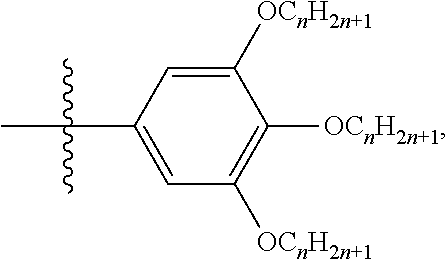
and n=10-20.

and m is 10-14.

R1 above can be an aliphatic group with no more than 30 carbons or an aromatic group with no more than 30 carbon, such as an alkyl chain, or

and R3 is an aliphatic group with no more than 30 carbons or an aromatic group with no more than 30 carbons. R2 above can be an aliphatic group or an aromatic group, such as an alkyl chain,

In this cluster, the 2-monoacylglycerol is the major component.


and the carbon number of the alkoxyl group, n, was 12, 14, 16, and 18, respectively.


Q=(Q R ·I·E R ·n 2)/(I R ·E·n R 2) (1)
r H =kbT/6πηD (2)
D=(2.45±0.04)×10−4 MW−(0.55±0.05) (3)
Claims (1)


Priority Applications (1)
| Application Number | Priority Date | Filing Date | Title |
|---|---|---|---|
| US14/016,037 US9505976B2 (en) | 2013-08-30 | 2013-08-30 | Excitation-dependent fluorescent organic nanoparticles |
Applications Claiming Priority (1)
| Application Number | Priority Date | Filing Date | Title |
|---|---|---|---|
| US14/016,037 US9505976B2 (en) | 2013-08-30 | 2013-08-30 | Excitation-dependent fluorescent organic nanoparticles |
Publications (2)
| Publication Number | Publication Date |
|---|---|
| US20150064799A1 US20150064799A1 (en) | 2015-03-05 |
| US9505976B2 true US9505976B2 (en) | 2016-11-29 |
Family
ID=52583780
Family Applications (1)
| Application Number | Title | Priority Date | Filing Date |
|---|---|---|---|
| US14/016,037 Expired - Fee Related US9505976B2 (en) | 2013-08-30 | 2013-08-30 | Excitation-dependent fluorescent organic nanoparticles |
Country Status (1)
| Country | Link |
|---|---|
| US (1) | US9505976B2 (en) |
Families Citing this family (1)
| Publication number | Priority date | Publication date | Assignee | Title |
|---|---|---|---|---|
| JP6372887B2 (en) * | 2015-05-14 | 2018-08-15 | 信越化学工業株式会社 | Organic film material, organic film forming method, pattern forming method, and compound |
Citations (3)
| Publication number | Priority date | Publication date | Assignee | Title |
|---|---|---|---|---|
| WO2012109755A1 (en) | 2011-02-16 | 2012-08-23 | The Governing Council Of The University Of Toronto | Fatty ester-based particles and methods of preparation and use thereof |
| CN102818790A (en) | 2011-06-09 | 2012-12-12 | 哈尔滨工业大学 | Method for detecting copper ions with lipid bilayer-containing organic/inorganic composite fluorescent nanoparticles |
| CN103044581A (en) | 2012-04-05 | 2013-04-17 | 常州强力电子新材料股份有限公司 | Macromolecular photoinitiator as well as preparation method and application thereof |
-
2013
- 2013-08-30 US US14/016,037 patent/US9505976B2/en not_active Expired - Fee Related
Patent Citations (3)
| Publication number | Priority date | Publication date | Assignee | Title |
|---|---|---|---|---|
| WO2012109755A1 (en) | 2011-02-16 | 2012-08-23 | The Governing Council Of The University Of Toronto | Fatty ester-based particles and methods of preparation and use thereof |
| CN102818790A (en) | 2011-06-09 | 2012-12-12 | 哈尔滨工业大学 | Method for detecting copper ions with lipid bilayer-containing organic/inorganic composite fluorescent nanoparticles |
| CN103044581A (en) | 2012-04-05 | 2013-04-17 | 常州强力电子新材料股份有限公司 | Macromolecular photoinitiator as well as preparation method and application thereof |
Non-Patent Citations (4)
| Title |
|---|
| H. Ohgi, et al., "Highly Isotactic Poly(Vinyl Alcohol) Derived From tert-Butyl Vinyl Ether," Part IV. Some Physical Properties, Structure and Hydrogen Bonding of Highly Isotactic Poly (Vinyl Alcohol) Films. Polymer 47, pp. 1324-1332 (2006). |
| Lee et al., Excitation-dependent visible fluorescence in decameric nanoparticles with monoacylglycerol cluster chromophores, Nature Communications 4, 2013, Article No. 1544, pp. 1-8. * |
| Marek Józefowicz et al, Excitation-wavelength Dependent Fluorescence of Ethyl 5-(4-aminophenyl)-3-amino-2,4-dicyanobenzoate, J. Floresc, 2011, 21:239-245. |
| Weng et al., Conformational dynamics and excitation wavelength dependent photoluminescence of decameric organic nanoparticles. Phys. CHem. Chem. Phys. 2013, vol. 15, pp. 16935-16940. * |
Also Published As
| Publication number | Publication date |
|---|---|
| US20150064799A1 (en) | 2015-03-05 |
Similar Documents
| Publication | Publication Date | Title |
|---|---|---|
| Santos et al. | Novel hybrids based on graphene quantum dots covalently linked to glycol corroles for multiphoton bioimaging | |
| CN109722237B (en) | Fluorescent probe based on fused ring thiophene oxide and application of fluorescent probe in cell imaging | |
| Huang et al. | Large cyano-and triazine-substituted D–π–A–π–D structures as efficient AIEE solid emitters with large two-photon absorption cross sections | |
| BR112018007564B1 (en) | Process, polymer, process for producing polymer materials, conversion product and its use, use of polymers and radiation-curing coating materials | |
| İbişoğlu et al. | Synthesis, characterization, photophysical and intramolecular energy transfer properties of oxy-naphthylchalcone appended cyclotriphosphazene cores | |
| Huo et al. | A fluorinated ionizable lipid improves the mRNA delivery efficiency of lipid nanoparticles | |
| Sun et al. | Understanding relationship between stacking modes and optical properties of organic charge transfer cocrystals involving anthracyl chalcones and TCNB | |
| Deng et al. | Regulating excited state of sulfone-locked triphenylamine heteroaromatics for high-efficiency ultralong room-temperature phosphorescence | |
| JP5745616B2 (en) | Water-soluble fluorescent fullerene derivative and method for producing the same | |
| CN1906149A (en) | Higher fullerenes useful as radical scavengers | |
| CN110256413A (en) | A kind of preparation method of new A IE fluorescent probe molecule and the probe molecule, nano-micelle and vesica | |
| CN105440277A (en) | Amphipathic AIE (aggregation-induced emission) molecule, synthetic method thereof, autofluorescence nano-micelle and application | |
| US20150064799A1 (en) | Excitation-dependent fluorescent organic nanoparticles | |
| Wei et al. | A strained π-extended [10] cycloparaphenylene carbon nanoring | |
| CN109180715B (en) | A kind of boron-dipyrrole methylene derivative, nanoparticle, preparation method and application | |
| Ma et al. | Long-wavelength absorbing photoinitiators based phenothiazine acyldiphenylphosphine oxides for free radical photopolymerization | |
| Lei et al. | Unusual aggregation arrangement of Eu-containing polyoxometalate hybrid in a protic ionic liquid with improved luminescence property | |
| Ranathunge et al. | Heteroacene-based amphiphile as a molecular scaffold for bioimaging probes | |
| KR20090104622A (en) | Bilic acid derivatives and their applications | |
| Yin et al. | Oligo (p-phenyleneethynylene) embedded amphiphiles: Synthesis, photophysical properties and self-assembled nanoparticles with high structural stability and photostability for cell imaging | |
| Dai et al. | In Situ Nanoreactors: Controllable Photoluminescent Carbon‐Rich Polymer Nanodots Derived from Fatty Acid under Photoirradiation | |
| Wang et al. | Color-tunable organic composite nanoparticles based on perylene tetracarboxylic-diimides and a silicon-cored fluoranthene derivate | |
| TWI473763B (en) | Fluorescent hybrid of dendrimer and graphene oxide | |
| Liang et al. | Ultraviolet light absorber with low surface energy: synthesis and characterization | |
| TWI479009B (en) | Excitation-dependent fluorescent organic nanoparticles |
Legal Events
| Date | Code | Title | Description |
|---|---|---|---|
| AS | Assignment |
Owner name: NATIONAL KAOHSIUNG NORMAL UNIVERSITY, TAIWAN Free format text: ASSIGNMENT OF ASSIGNORS INTEREST;ASSIGNORS:LEE, KWANG-MING;SHYUE, JING-JONG;CHANG, SARAH Y.;AND OTHERS;REEL/FRAME:031257/0461 Effective date: 20130717 |
|
| ZAAA | Notice of allowance and fees due |
Free format text: ORIGINAL CODE: NOA |
|
| ZAAB | Notice of allowance mailed |
Free format text: ORIGINAL CODE: MN/=. |
|
| STCF | Information on status: patent grant |
Free format text: PATENTED CASE |
|
| MAFP | Maintenance fee payment |
Free format text: PAYMENT OF MAINTENANCE FEE, 4TH YR, SMALL ENTITY (ORIGINAL EVENT CODE: M2551); ENTITY STATUS OF PATENT OWNER: SMALL ENTITY Year of fee payment: 4 |
|
| FEPP | Fee payment procedure |
Free format text: MAINTENANCE FEE REMINDER MAILED (ORIGINAL EVENT CODE: REM.); ENTITY STATUS OF PATENT OWNER: SMALL ENTITY |
|
| LAPS | Lapse for failure to pay maintenance fees |
Free format text: PATENT EXPIRED FOR FAILURE TO PAY MAINTENANCE FEES (ORIGINAL EVENT CODE: EXP.); ENTITY STATUS OF PATENT OWNER: SMALL ENTITY |
|
| STCH | Information on status: patent discontinuation |
Free format text: PATENT EXPIRED DUE TO NONPAYMENT OF MAINTENANCE FEES UNDER 37 CFR 1.362 |
|
| FP | Lapsed due to failure to pay maintenance fee |
Effective date: 20241129 |