US9505010B2 - Flow channel device and sorting apparatus - Google Patents
Flow channel device and sorting apparatus Download PDFInfo
- Publication number
- US9505010B2 US9505010B2 US14/189,261 US201414189261A US9505010B2 US 9505010 B2 US9505010 B2 US 9505010B2 US 201414189261 A US201414189261 A US 201414189261A US 9505010 B2 US9505010 B2 US 9505010B2
- Authority
- US
- United States
- Prior art keywords
- flow channel
- measurement
- guard
- electrode
- particles
- Prior art date
- Legal status (The legal status is an assumption and is not a legal conclusion. Google has not performed a legal analysis and makes no representation as to the accuracy of the status listed.)
- Expired - Fee Related, expires
Links
Images




Classifications
-
- B—PERFORMING OPERATIONS; TRANSPORTING
- B03—SEPARATION OF SOLID MATERIALS USING LIQUIDS OR USING PNEUMATIC TABLES OR JIGS; MAGNETIC OR ELECTROSTATIC SEPARATION OF SOLID MATERIALS FROM SOLID MATERIALS OR FLUIDS; SEPARATION BY HIGH-VOLTAGE ELECTRIC FIELDS
- B03C—MAGNETIC OR ELECTROSTATIC SEPARATION OF SOLID MATERIALS FROM SOLID MATERIALS OR FLUIDS; SEPARATION BY HIGH-VOLTAGE ELECTRIC FIELDS
- B03C5/00—Separating dispersed particles from liquids by electrostatic effect
- B03C5/005—Dielectrophoresis, i.e. dielectric particles migrating towards the region of highest field strength
-
- B—PERFORMING OPERATIONS; TRANSPORTING
- B03—SEPARATION OF SOLID MATERIALS USING LIQUIDS OR USING PNEUMATIC TABLES OR JIGS; MAGNETIC OR ELECTROSTATIC SEPARATION OF SOLID MATERIALS FROM SOLID MATERIALS OR FLUIDS; SEPARATION BY HIGH-VOLTAGE ELECTRIC FIELDS
- B03C—MAGNETIC OR ELECTROSTATIC SEPARATION OF SOLID MATERIALS FROM SOLID MATERIALS OR FLUIDS; SEPARATION BY HIGH-VOLTAGE ELECTRIC FIELDS
- B03C5/00—Separating dispersed particles from liquids by electrostatic effect
- B03C5/02—Separators
- B03C5/022—Non-uniform field separators
- B03C5/026—Non-uniform field separators using open-gradient differential dielectric separation, i.e. using electrodes of special shapes for non-uniform field creation, e.g. Fluid Integrated Circuit [FIC]
-
- G—PHYSICS
- G01—MEASURING; TESTING
- G01N—INVESTIGATING OR ANALYSING MATERIALS BY DETERMINING THEIR CHEMICAL OR PHYSICAL PROPERTIES
- G01N15/00—Investigating characteristics of particles; Investigating permeability, pore-volume or surface-area of porous materials
- G01N15/10—Investigating individual particles
- G01N15/1031—Investigating individual particles by measuring electrical or magnetic effects
-
- G—PHYSICS
- G01—MEASURING; TESTING
- G01N—INVESTIGATING OR ANALYSING MATERIALS BY DETERMINING THEIR CHEMICAL OR PHYSICAL PROPERTIES
- G01N15/00—Investigating characteristics of particles; Investigating permeability, pore-volume or surface-area of porous materials
- G01N15/10—Investigating individual particles
- G01N2015/1028—Sorting particles
-
- G01N2015/1081—
Definitions
- the present disclosure relates to a flow channel device that causes particles of cells and the like to flow and a sorting apparatus including the flow channel device.
- Patent Document 1 discloses a cell sorting apparatus (cell analysis/sorting system) that uses the dielectrophoretic method.
- the cell sorting apparatus includes a cell sorting chip that includes a micro flow channel. This apparatus measures, when a fluid including cells flows through predetermined flow channels in the chip, a complex impedance and a complex permittivity among the flow channels and sorts the cells based on the measurement result.
- the chip includes a signal detection electrode (measurement portion) for measuring a complex impedance and a complex permittivity of cells and detecting signals.
- the chip also includes as a cell sorting means, on a downstream side of the signal detection electrode, an operation electrode (electric field application portion) having a predetermined shape, that is provided for forming an electric field for imparting an appropriate dielectrophoretic force to the cells.
- an operation electrode electric field application portion
- one of two branch channels provided downstream from the operation electrode is selected so as to cause the cells to flow through (see, for example, paragraphs (0025), (0028), etc. in specification of Patent Document 1).
- a flow channel device including a flow channel, a plurality of branch channels, a measurement portion, an operation portion, and an electrical first guard portion.
- the plurality of branch channels branch from the flow channel.
- the measurement portion is provided at a predetermined position in the flow channel and configured to measure electrical characteristics when the particles pass the predetermined position.
- the operation portion is provided on a downstream side of the measurement portion and on an upstream side of the plurality of branch channels and configured to apply a dielectrophoretic force to the particles by forming an electric field.
- the first guard portion is provided between the measurement portion and the operation portion.
- the operation portion receives an operation signal generated based on a signal obtained by the measurement portion and forms an electric field corresponding to the operation signal.
- the first guard portion may include a guard electrode facing an inside of the flow channel.
- the guard electrode may be provided on at least one of two opposing sides of the flow channel.
- the guard electrode may include a common potential. With this structure, an effect of capturing charges from the operation portion is promoted.
- the flow channel device may further include an electrical second guard portion provided in the measurement portion.
- the measurement portion may include a measurement electrode pair
- the second guard portion may include a guard electrode pair intersecting the measurement electrode pair
- the flow channel device may be structured by laminating a plurality of resin films.
- the guard electrode may be formed of at least one of the plurality of resin films. With this structure, the guard electrode can be formed in the film in advance when producing the flow channel device, and thus productions of the guard electrode and the flow channel device become easy.
- At least two of the plurality of resin films may be formed of the same material.
- the guard electrode may be a guard electrode pair opposing the two resin films. Since at least two resin films are formed of the same material and the guard electrode pair is formed in the resin films, this structure is suited for a mass production of resin films and can improve productivity of the flow channel device.
- a sorting apparatus including the flow channel device and a controller
- the controller is electrically connected to the measurement portion and the operation portion and configured to generate an operation signal based on a signal obtained by the measurement portion and output the operation signal.
- FIG. 1 is a block diagram showing a structure of a sorting apparatus according to a first embodiment of the present disclosure
- FIG. 2 is a schematic cross-sectional diagram of a flow channel device taken along a direction of a flow channel
- FIG. 3 is a plan view of a second flow channel and a branch portion branching from the second flow channel;
- FIG. 4 is a cross-sectional diagram taken along the line A-A of FIG. 2 ;
- FIG. 5 is a cross-sectional diagram taken along the line B-B of FIG. 2 ;
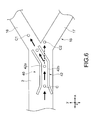
- FIG. 6 shows a traveling direction of particles when an operation voltage is applied to a guide electrode portion and when the operation voltage is not applied to the guide electrode portion;
- FIG. 7 shows measurement results of an SN ratio of a capacitance obtained by a measurement portion in a flow channel in which a guard portion is provided and a flow channel in which a guard portion is not provided;
- FIG. 8 shows measurement results of an SN ratio of a conductance obtained by the measurement portion in the flow channel in which a guard portion is provided and the flow channel in which a guard portion is not provided;
- FIG. 9 is a cross-sectional diagram taken along a flow channel of a flow channel device according to a second embodiment of the present disclosure.
- FIG. 10 is a perspective view showing a more-specific example of the flow channel device.
- FIG. 1 is a block diagram showing a structure of a sorting apparatus according to a first embodiment of the present disclosure.
- the sorting apparatus 100 includes a flow channel device 50 and a controller 70 .
- the flow channel device 50 is formed in, for example, a chip shape and includes a flow channel 10 . Through the flow channel 10 , a fluid including particles as a sample flows.
- the flow channel 10 is a micro flow channel having a small width of about 30 to 200 ⁇ m, for example.
- the flow channel device 50 includes, from an upstream side on the left-hand side of the figure, a measurement portion 20 , a guard portion 30 (first guard portion), an operation portion 40 , and a branch portion 15 along the flow channel 10 .
- the particles as a sample are, for example, biological cells, that is, leucocytes and erythrocytes.
- biological cells that is, leucocytes and erythrocytes.
- a normal saline solution or the like is selected as the fluid.
- FIG. 2 is a schematic cross-sectional diagram of the flow channel device 50 taken along a direction of the flow channel 10 .
- the flow channel device 50 includes the 2-stage flow channel 10 in a thickness direction of the flow channel device 50 .
- a first flow channel 11 provided on an upstream side includes a first inlet 11 a , and a fluid including particles is caused to flow through the first flow channel 11 via the first inlet 11 a using a pipette, a pump, and the like (not shown). Since the particles are aligned along a flowing direction in the first flow channel 11 , it is favorable to cause the fluid to flow through the first inlet 11 a at a constant flow rate using a syringe pump or the like.
- a second flow channel 12 provided on a downstream side includes a second inlet 12 a , and a fluid not including particles is caused to flow through the second flow channel 12 via the second inlet 12 a using a pump or other apparatuses (not shown). It is favorable for the pressure of the fluid that flows into the second flow channel 12 via the second inlet 12 a to be constant.
- FIG. 3 is a plan view of the second flow channel 12 and the branch portion 15 branching from the second flow channel 12 .
- the second flow channel 12 is formed practically in a Y shape.
- the portion formed in the Y shape is the branch portion 15 , which includes a plurality of (e.g., two) branch channels 16 and 17 .
- outlets 16 a and 17 a are provided as shown in FIG. 1 .
- a pool (not shown) for pooling sorted particles may be provided on the upstream side of the outlets 16 a and 17 a.
- the first flow channel 11 and the second flow channel 12 are in communication with each other via a narrowed channel 13 .
- the narrowed channel 13 is provided on, for example, a line K in FIG. 3 at a position deviated from a center of the second flow channel 12 (position of branch reference line J) in a y direction as a width direction.
- a guide electrode portion 42 of the operation portion 40 is provided as will be described later.
- an alignment of the particles can be promoted by a constant flow rate in the first flow channel 11 and the narrowed channel 13 , and a pressure gradient of the fluid in the second flow channel 12 can be determined dominantly in the second flow channel 12 . Accordingly, since a stability of a fluid pressure at an outlet portion of the narrowed channel 13 can be enhanced, a flow rate of the fluid that passes the narrowed channel 13 can be stabilized.
- the first flow channel 11 on the upstream side and the second flow channel 12 on the downstream side are parallel in the x direction and overlap each other in a plan view.
- the structure is not limited to such a structure, and the direction of the flow channels 10 does not need to be parallel and/or the flow channels do not need to overlap each other in a plan view.
- the flow channels 10 may be formed in any direction. In this case, a drainage channel or a drainage outlet may be connected to only the first flow channel 11 .
- the narrowed channel 13 described above is provided at a predetermined position between the first flow channel 11 and the second flow channel 12 .
- the narrowed channel 13 has a flow channel size enough for a single particle to flow through, for example, and the particles that flow through the first flow channel 11 flow into the second flow channel 12 via the narrowed channel 13 .
- the measurement portion 20 includes an area of the narrowed channel 13 .
- the measurement portion 20 includes measurement electrodes 21 and 22 sandwiching the narrowed channel 13 .
- the measurement electrodes 21 and 22 are electrodes for measuring electrical characteristics when the particles pass through the narrowed channel 13 .
- the measurement electrodes 21 and 22 are provided on upper and lower surfaces of a center resin film 5 out of resin films 3 to 7 laminated as shown in FIG. 2 , for example, and constitute a parallel plate capacitor.
- An AC power supply 25 is connected to the measurement electrodes 21 and 22 so that a predetermined AC voltage of an mV order can be applied.
- the measurement electrode 22 is a common electrode.
- the operation portion 40 is provided on the upstream side of the branch portion 15 , specifically, right before the branch portion 15 , and forms a guide electric field having a predetermined electric field intensity gradient so as to apply a dielectrophoretic force to the particles flowing through the flow channel 10 .
- the operation portion 40 includes an operation electrode 410 therefor.
- FIG. 4 is a cross-sectional diagram taken along the line A-A of FIG. 2 .
- the operation electrode 410 includes a common electrode 41 provided at an upper portion of the second flow channel 12 and a guide electrode portion 42 provided on a lower portion thereof.
- An AC power supply 45 is connected to the operation electrode 410 , and an AC operation voltage is applied between the common electrode 41 and the guide electrode portion 42 .
- the common electrode 41 functions as a ground electrode and is maintained at a ground potential (common potential).
- the guide electrode portion 42 typically includes a plurality of (e.g., two) elongated line electrodes 42 a and 42 b .
- the branch portion 15 is branched into the branch channels 16 and 17 at a position on the branch reference line J set at substantially the center of the second flow channel 12 in the width direction (y direction).
- the guide electrode portion 42 is provided at a position deviated from the branch reference line J in the y direction so that the line K described above is positioned between the line electrodes 42 a and 42 b . Accordingly, particles that has flown into the second flow channel 12 via the narrowed channel 13 flow along the x direction as they are with the fluid to be introduced into the line electrodes 42 a and 42 b.
- the guide electrode portion 42 includes an introduction portion 421 , a straight portion 422 , and a direction change portion 423 .
- the introduction portion 421 is formed such that the line electrodes 42 a and 42 b approach each other from the upstream side to the downstream side.
- the straight portion 422 is formed along the second flow channel 12 , that is, formed to be parallel to the x direction.
- the direction change portion 423 is formed such that the direction is changed from the straight portion 422 so as to be directed toward the branch channel 16 as one of the branch channels.
- a voltage is applied to the line electrodes 42 a and 42 b so that the line electrodes 42 a and 42 b have the same potential.
- an AC operation voltage is applied to the operation electrode 410 , a guide electric field is formed between the common electrode 41 and the guide electrode portion 42 .
- the guide electric field imparts a dielectrophoretic force such that the particles travel between the line electrodes 42 a and 42 b .
- an amplitude of the AC voltage applied to the operation electrode 410 is 1 V to 30 V, and a frequency thereof is 1 kHz to 100 kHz. Accordingly, the channel of the particles can be changed between a time a voltage is applied to the operation electrode 410 and a time a voltage is not applied, and the particles can be selectively caused to flow into either the branch channel 16 or 17 .
- the guide electric field as follows is basically formed by the guide electrode portion 42 (two line electrodes 42 a and 42 b ) and one common electrode 41 opposing it.
- an electric field intensity gradient in the z direction is caused between the guide electrode portion 42 and the common electrode 41
- an electric field intensity gradient in the y direction is caused between the two line electrodes 42 a and 42 b.
- the dielectrophoretic force is controlled by the electric field intensity gradient, that is, a density change of an electric force line. This point differs from an electrophoretic force that is generated in a direction along the electric force line. In other words, the dielectrophoretic force is not always generated in the direction along the electric force line.
- the line electrodes 42 a and 42 b since the two line electrodes 42 a and 42 b have substantially the same potential, the line electrodes 42 a and 42 b generate an electric field intensity gradient directed toward the center thereof (position of line K), that is, an electric field intensity gradient in the y direction. In this embodiment, it has been confirmed that the electric field intensity gradient in the y direction is more precipitous than that in the z direction.
- FIG. 5 is a cross-sectional diagram taken along the line B-B of FIG. 2 showing the guard portion 30 .
- the guard portion 30 includes a plurality of (e.g., two) guard electrodes 36 and 37 facing an inside of the second flow channel 12 .
- the guard electrodes 36 and 37 are provided substantially in parallel with each other while opposing each other on an upper portion side and lower portion side of the second flow channel 12 and constitute an electrode pair.
- the guard electrodes 36 and 37 are grounded.
- the size, area, shape, and the like of the guard electrodes 36 and 37 are substantially the same but may also differ. Since the guard portion 30 is positioned between the measurement portion 20 and the operation portion 40 , the guard portion 30 exerts an electrical guard function between them. Specifically, the guard portion 30 is capable of suppressing noise incorporations in the measurement portion 20 due to voltage signals applied to the operation portion 40 .
- the controller 70 is electrically connected to the measurement portion 20 and the operation portion 40 , generates an operation signal based on a measurement signal obtained by the measurement portion 20 , and outputs an operation voltage corresponding to the signal to the operation portion 40 .
- the controller 70 includes a measurement device 71 , a measurement data generation portion 72 , a judgment portion 73 , an operation signal generation portion 74 , and an operation voltage output portion 75 .
- the controller 70 is typically constituted of a computer.
- the measurement device 71 applies an AC voltage of an arbitrary frequency within a predetermined frequency range to the measurement electrodes 21 and 22 .
- a resistance value between the measurement electrodes 21 and 22 changes.
- the measurement device 71 detects a current flowing between the measurement electrodes 21 and 22 .
- the measurement data generation portion 72 calculates a complex impedance from the current value. Specifically, the measurement data generation portion 72 calculates, with respect to individual cells flowing through the narrowed channel 13 , across multipoint frequencies (3 points or more, typically about 10 to 20 points or more) within an AC voltage frequency range (e.g., 0.1 MHz to 50 MHz) at which a dielectric relaxation phenomenon occurs, a complex permittivity that depends on those cells.
- the measurement data generation portion 72 calculates a complex permittivity by a known electric conversion expression based on the complex impedance calculated as described above, and obtains data including the complex permittivity as measurement data.
- the measurement of a complex impedance or a complex permittivity includes a measurement of only a real part or imaginary part.
- the judgment portion 73 acquires the measurement data output from the measurement data generation portion 72 and judges whether the particles are to be sorted based on the measurement data, that is, whether the particles are to be guided to a predetermined one of the branch channels (branch channel 16 in this embodiment) of the branch portion 15 . Specifically, the judgment portion 73 carries out the judgment processing by collating a judgment condition of data on a complex permittivity that has been arbitrarily set in advance in a memory for sorting desired particles with the measurement data.
- the operation signal generation portion 74 generates an operation signal when the measurement target particles are to be sorted (here, particles to be guided to branch channel 16 ), and does not generate an operation signal otherwise. It is also possible for the operation signal generation portion 74 to not generate an operation signal when the measurement target particles are to be sorted and generate an operation signal otherwise.
- the operation voltage output portion 75 outputs the AC operation voltage based on the operation signal obtained from the operation signal generation portion 74 .
- a plurality of resin films for example, 5 resin films 3 , 4 , 5 , 6 , and 7 (see
- FIG. 2 are prepared.
- the electrodes including the measurement electrodes 21 and 22 , the operation electrode 410 , and the guard electrodes 36 and 37 are formed on, for example, 2 of the 5 resin films 3 to 7 .
- the branch channels 16 and 17 , the narrowed channel 13 , and the inlets and outlets on the resin films for example, grooves and holes are formed at predetermined positions as necessary.
- the electrodes, grooves, holes, and the like may be formed by photolithography and photo-etching, or may be formed by laser processing.
- the 5 resin films 3 to 7 on which the electrodes, grooves, and holes have been formed are positioned, laminated, and subjected to heat pressure bonding, with the result that the flow channel device 50 as shown in FIG. 2 is formed.
- the resin films 3 , 5 , and 7 are formed of the same material, and the resin films 4 and 6 are formed of the same material (material different from that of resin films 3 , 5 , and 7 ).
- the guard electrodes 36 and 37 become an opposing guard electrode pair provided on the resin films 3 and 5 .
- this structure is suited for a mass production of the resin films, and thus a productivity of the flow channel device 50 can be improved.
- the guard electrodes 36 and 37 and other electrodes can be formed on the resin films in advance before laminating the resin films 3 to 7 , with the result that productions of the guard electrodes 36 and 37 and the flow channel device 50 become easy.
- the guard electrodes 36 and 37 may be formed of, for example, copper, silver, gold, platinum, nickel, zinc, titanium, or stainless steel, or may be formed by carrying out various types of plating processing on them.
- the same material as the guard electrodes 36 and 37 can be used.
- a polyimide film, a thermoplastic polyimide film, PDMS (polydimethylsiloxane or dimethylpolysiloxane), acryl, PES (polyethersulfone), polycarbonate, polypropylene, polystyrene, polyimide, COP (cyclic olefin polymer), COC (cyclic olefin copolymer), and the like are used.
- one of the materials above is selected as the common material for forming the resin films 3 , 5 , and 7
- a material different from that of the resin films 3 , 5 , and 7 is selected as the common material for forming the resin films 4 and 6 .
- a fluid including particles flows into the first flow channel 11 via the first inlet 11 a and flows through the first flow channel 11 .
- a fluid not including particles flows through the second flow channel 12 .
- the particles that flow through the first flow channel 11 join the flow of the second flow channel 12 via the narrowed channel 13 .
- a predetermined AC voltage is applied to the measurement electrodes 21 and 22 while the sorting apparatus 100 is being operated, and the measurement data generation portion 72 calculates a complex permittivity as described above and outputs it as measurement data when the particles pass the narrowed channel 13 .
- the judgment portion 73 judges whether the particles are to be guided to the branch channel 16 based on the acquired measurement data.
- the operation signal generation portion 74 When judged that the particles are to be guided to the branch channel 16 , the operation signal generation portion 74 generates a predetermined operation voltage and applies the operation voltage to the operation electrode 410 right before the particles flowing through the second flow channel 12 reach the guide electrode portion 42 . As a result, as shown in FIG. 6 , a guide electric field is formed in the operation portion 40 , and particles C move along the line electrodes 42 a and 42 b by a dielectrophoretic force corresponding to the guide electric field to flow into the branch channel 16 as indicated by the symbol C 1 .
- the controller 70 can detect a timing right before the particles reach the guide electrode portion 42 .
- the operation signal generation portion 74 When judged that the particles are to be guided to the branch channel 17 , the operation signal generation portion 74 does not generate an operation voltage. Therefore, a dielectrophoretic force caused by a guide electric field is not generated, and the particles move in the x direction as they are above the guide electrode portion 42 to pass and flow into the branch channel 17 as indicated by the symbol C 2 .
- the sorting apparatus 100 By the operation of the sorting apparatus 100 as described above, it is possible to distinguish normal cells and dead cells from each other or normal cells and cancer cells from each other, for example.
- the voltage applied to the operation electrode 410 in the operation portion 40 is 1 V to 30 V
- the voltage applied to the measurement electrodes 21 and 22 in the measurement portion 20 is of a mV order.
- the fluid is a conductive fluid and causes an electrical bonding. Therefore, when no countermeasure is taken, charges are generated from the operation portion 40 mainly as an ion current and flow into the measurement portion 20 , with the result that measurement values of the measurement portion 20 are adversely affected.
- the electrical guard portion 30 since the electrical guard portion 30 is provided, the charges are captured by the guard portion 30 . As a result, noises in the measurement values of the measurement portion 20 are reduced, and measurement accuracy is improved.
- FIG. 7 shows measurement results of an SN ratio of a capacitance obtained by the measurement portion 20 in a flow channel in which the guard portion 30 is provided and a flow channel in which the guard portion 30 is not provided.
- FIG. 8 shows measurement results of an SN ratio of a conductance in the flow channel in which the guard portion 30 is provided and the flow channel in which the guard portion 30 is not provided.
- the abscissa axis represents a frequency.
- an equivalent circuit constituted of a parallel circuit of a capacitance and a conductance is provided between the measurement electrodes 21 and 22 .
- Other measurement conditions are as follows.
- Size of flow channel 10 Width of 200 ⁇ m (y-direction size), height of 50 ⁇ m (z-direction size)
- Guard portion 30 Parallel plate electrode 2 mm in direction along flow of fluid (x direction)
- the SN ratio in the wide frequency area of 400 kHz or more is improved more in the device in which the guard portion 30 is not provided than the device in which the guard portion 30 is provided. In the frequency area smaller than 400 kHz, the effect of the operation voltage does not appear even when the guard portion 30 is not provided.
- a ⁇ relaxation in which features appear in the cells is present between 100 kHz and 30 MHz in general, so it can be seen that the effect is obtained in the necessary band.
- FIG. 9 is a cross-sectional diagram taken along a flow channel 10 of a flow channel device according to a second embodiment of the present disclosure.
- descriptions below descriptions on members, functions, and the like that are the same as those of the sorting apparatus 100 and flow channel device 50 according to the first embodiment will be simplified or omitted, and different points will mainly be described.
- the flow channel device 150 includes an electrical guard portion 80 (second guard portion) provided in the measurement portion 20 .
- the guard portion 80 includes a guard electrode pair 86 and 87 intersecting the measurement electrodes 21 and 22 of the measurement portion 20 .
- the measurement electrode 21 and the guard electrode 86 are provided while the resin film 5 is interposed therebetween, and the measurement electrode 22 and the guard electrode 87 are provided while the resin film 5 is interposed therebetween.
- a surface area of the common electrode of the measurement portion 20 according to the second embodiment is almost twice the surface area of the measurement electrode 22 according to the first embodiment.
- the flow channel device 150 includes the guard portion 30 (first guard portion) between the measurement portion 20 and the operation portion 40 as in the first embodiment.
- the guard portion 80 closer to the measurement electrodes 21 and 22 than the guard portion 30 , noises in measurement values obtained by the measurement portion 20 can be additionally reduced, and measurement accuracy can be improved.
- the guard electrode 36 on the upper side of the guard portion 30 and the guard electrode 86 of the guard portion 80 on the right-hand side of the figure may be constituted of a single electrode.
- FIG. 10 is a perspective view showing a more-specific example of the flow channel device.
- the lateral direction corresponds to the x direction.
- the first flow channel 11 , the second flow channel 12 , the branch portion 15 , the measurement portion 20 , the guard portion 30 , the operation portion 40 , an electrode pad 18 , and the like are provided.
- the first flow channel 11 and the second flow channel 12 are provided while intersecting each other near the measurement portion 20 instead of being parallel and are mutually connected by a narrowed channel (not shown).
- the drainage outlet 11 b of the first flow channel 11 is also provided.
- the electrode of the operation portion 40 is divided into a plurality of parts along the flow channel 10 as will be described later, and the number of electrode pads 18 is increased that much.
- the guard electrodes 36 and 37 are provided while opposing each other on the upper portion side and lower portion side of the flow channel, but a single electrode may be provided on one of the upper portion side and the lower portion side. Alternatively, the guard electrodes 36 and 37 may be provided on at least one of the side walls in addition to the upper portion side and the lower portion side.
- the shape of the guard electrodes 36 and 37 is rectangular as shown in FIG. 3 , but the guard electrodes 36 and 37 may be a circle, an oval, a shape obtained by combining a circle and a rectangle, or other arbitrary shapes.
- the shape of the line electrodes 42 a and 42 b of the guide electrode portion 42 is not limited to the shape shown in FIG. 3 , and the line electrodes 42 a and 42 b may take other shapes.
- the line electrode may be divided into a plurality of parts along the flow of the flow channel.
- the straight portion and the direction change portion may be separated.
- a hole or a slit may be provided in the guard electrodes 36 and 37 .
- the inside of the flow channel 10 can be observed by an observer from outside the flow channel device via the hole or slit using a microscope or the like.
- the voltage to be applied to the operation electrode 410 may be a DC voltage instead of the AC voltage.
- the present disclosure may also take the following structures.
Landscapes
- Chemical & Material Sciences (AREA)
- Health & Medical Sciences (AREA)
- Life Sciences & Earth Sciences (AREA)
- General Health & Medical Sciences (AREA)
- Chemical Kinetics & Catalysis (AREA)
- Electrochemistry (AREA)
- Molecular Biology (AREA)
- Microelectronics & Electronic Packaging (AREA)
- Engineering & Computer Science (AREA)
- Dispersion Chemistry (AREA)
- Physics & Mathematics (AREA)
- Analytical Chemistry (AREA)
- Biochemistry (AREA)
- General Physics & Mathematics (AREA)
- Immunology (AREA)
- Pathology (AREA)
- Investigating Or Analyzing Materials By The Use Of Electric Means (AREA)
- Apparatus Associated With Microorganisms And Enzymes (AREA)
Abstract
Description
- (1) A flow channel device, including:
- a flow channel through which a fluid including particles flow;
- a plurality of branch channels branching from the flow channel;
- a measurement portion that is provided at a predetermined position in the flow channel and configured to measure electrical characteristics when the particles pass the predetermined position;
- an operation portion that is provided on a downstream side of the measurement portion and on an upstream side of the plurality of branch channels and configured to apply a dielectrophoretic force to the particles by forming an electric field; and
- an electrical first guard portion provided between the measurement portion and the operation portion.
- (2) The flow channel device according to (1),
- in which the first guard portion includes a guard electrode facing an inside of the flow channel.
- (3) The flow channel device according to (2),
- in which the guard electrode is provided on at least one of two opposing sides of the flow channel.
- (4) The flow channel device according to (2) or (3),
- in which the guard electrode includes a common potential.
- (5) The flow channel device according to any one of (2) to (4), further including
- an electrical second guard portion provided in the measurement portion.
- (6) The flow channel device according to (5),
- in which the measurement portion includes a measurement electrode pair, and
- in which the second guard portion includes a guard electrode pair intersecting the measurement electrode pair.
- (7) The flow channel device according to any one of (2) to (6),
- in which the flow channel device is structured by laminating a plurality of resin films, and
- in which the guard electrode is formed of at least one of the plurality of resin films.
- (8) The flow channel device according to (7),
- in which at least two of the plurality of resin films are formed of the same material, and
- in which the guard electrode is a guard electrode pair opposing the two resin films.
- (9) A sorting apparatus, including:
- a flow channel device including
- a flow channel through which a fluid including particles flow,
- a plurality of branch channels branching from the flow channel,
- a measurement portion that is provided at a predetermined position in the flow channel and measures electrical characteristics when the particles pass the predetermined position,
- an operation portion that is provided on a downstream side of the measurement portion and on an upstream side of the plurality of branch channels and applies a dielectrophoretic force to the particles by forming an electric field, and
- an electrical first guard portion provided between the measurement portion and the operation portion; and
- a controller that is electrically connected to the measurement portion and the operation portion and configured to generate an operation signal based on a signal obtained by the measurement portion and output the operation signal.
- a flow channel device including
Claims (9)
Applications Claiming Priority (2)
| Application Number | Priority Date | Filing Date | Title |
|---|---|---|---|
| JP2013-041900 | 2013-03-04 | ||
| JP2013041900A JP2014169925A (en) | 2013-03-04 | 2013-03-04 | Flow passage device and sorter |
Publications (2)
| Publication Number | Publication Date |
|---|---|
| US20140246322A1 US20140246322A1 (en) | 2014-09-04 |
| US9505010B2 true US9505010B2 (en) | 2016-11-29 |
Family
ID=51420398
Family Applications (1)
| Application Number | Title | Priority Date | Filing Date |
|---|---|---|---|
| US14/189,261 Expired - Fee Related US9505010B2 (en) | 2013-03-04 | 2014-02-25 | Flow channel device and sorting apparatus |
Country Status (3)
| Country | Link |
|---|---|
| US (1) | US9505010B2 (en) |
| JP (1) | JP2014169925A (en) |
| CN (1) | CN104031819A (en) |
Families Citing this family (8)
| Publication number | Priority date | Publication date | Assignee | Title |
|---|---|---|---|---|
| JP6436955B2 (en) * | 2016-02-02 | 2018-12-12 | 国立研究開発法人科学技術振興機構 | Particle sorting apparatus and particle sorting method |
| US10386324B2 (en) * | 2016-02-22 | 2019-08-20 | Analog Devices Global | Susceptance measurement for identifying biochemical sensors |
| WO2018063784A1 (en) * | 2016-09-27 | 2018-04-05 | Illumina, Inc. | Imprinted substrates |
| US20200376499A1 (en) * | 2017-01-26 | 2020-12-03 | Delee Corp. | Dielectrophoresis Separation Object Sorting |
| JP6834696B2 (en) * | 2017-03-30 | 2021-02-24 | コニカミノルタ株式会社 | A resin composition and a method for producing a molded product using the resin composition. |
| EP3601522A4 (en) * | 2017-03-31 | 2021-04-28 | Massachusetts Institute of Technology | SYSTEMS, ARTICLES AND METHODS FOR FLOWING PARTICLES |
| WO2018218542A1 (en) * | 2017-05-31 | 2018-12-06 | 清华大学 | Micro-electrospark cavitation-based cell sorting device and method |
| US11754486B2 (en) | 2017-06-19 | 2023-09-12 | Massachusetts Institute Of Technology | Systems and methods for measuring properties of particles |
Citations (5)
| Publication number | Priority date | Publication date | Assignee | Title |
|---|---|---|---|---|
| US20060177815A1 (en) * | 2004-11-29 | 2006-08-10 | The Regents Of The University Of California | Dielectrophoretic particle sorter |
| US20070125941A1 (en) * | 2005-11-07 | 2007-06-07 | The Regents Of The University Of California | Microfluidic device for cell and particle separation |
| US20100006441A1 (en) * | 2006-02-01 | 2010-01-14 | Ecole Polytechnique Federale De Lausanne | Apparatus for manipulating, modifying and characterizing particles in a micro channel |
| US20120103817A1 (en) * | 2010-10-29 | 2012-05-03 | Sony Corporation | Dielectric cytometric apparatus and dielectric-cytometric cell sorting method |
| JP2012098075A (en) | 2010-10-29 | 2012-05-24 | Sony Corp | Cell collector, cell collection chip, and cell collection method |
-
2013
- 2013-03-04 JP JP2013041900A patent/JP2014169925A/en active Pending
-
2014
- 2014-01-28 CN CN201410042266.2A patent/CN104031819A/en active Pending
- 2014-02-25 US US14/189,261 patent/US9505010B2/en not_active Expired - Fee Related
Patent Citations (5)
| Publication number | Priority date | Publication date | Assignee | Title |
|---|---|---|---|---|
| US20060177815A1 (en) * | 2004-11-29 | 2006-08-10 | The Regents Of The University Of California | Dielectrophoretic particle sorter |
| US20070125941A1 (en) * | 2005-11-07 | 2007-06-07 | The Regents Of The University Of California | Microfluidic device for cell and particle separation |
| US20100006441A1 (en) * | 2006-02-01 | 2010-01-14 | Ecole Polytechnique Federale De Lausanne | Apparatus for manipulating, modifying and characterizing particles in a micro channel |
| US20120103817A1 (en) * | 2010-10-29 | 2012-05-03 | Sony Corporation | Dielectric cytometric apparatus and dielectric-cytometric cell sorting method |
| JP2012098075A (en) | 2010-10-29 | 2012-05-24 | Sony Corp | Cell collector, cell collection chip, and cell collection method |
Also Published As
| Publication number | Publication date |
|---|---|
| JP2014169925A (en) | 2014-09-18 |
| CN104031819A (en) | 2014-09-10 |
| US20140246322A1 (en) | 2014-09-04 |
Similar Documents
| Publication | Publication Date | Title |
|---|---|---|
| US20140246322A1 (en) | Flow channel device and sorting apparatus | |
| US9555421B2 (en) | Sorting apparatus and sorting method | |
| JP6299749B2 (en) | measuring device | |
| JP5924276B2 (en) | Channel device, particle sorting apparatus, and particle sorting method | |
| US7294249B2 (en) | Microfluidic component and method for sorting particles in a fluid | |
| CN102564920B (en) | cell sorter and cell sorting method | |
| CA2999683A1 (en) | Microfluidic device for selection of semen | |
| WO2013156081A1 (en) | Microfluidic impedance flow cytometer | |
| JP2010181399A (en) | Flow path device, complex dielectric constant measuring device, and dielectric cytometry device | |
| US10493446B2 (en) | Flow channel device, analysis apparatus, and fluid apparatus | |
| JP2012098075A (en) | Cell collector, cell collection chip, and cell collection method | |
| CN114345428B (en) | A microfluidic chip for sorting single cells and its detection method | |
| CN104096608A (en) | Separated type automatic micron-size particle assembling and sorting device and manufacturing method thereof | |
| WO2022036891A1 (en) | Device for sorting and testing cancer cells | |
| Buyong et al. | Design, fabrication and characterization of dielectrophoretic microelectrode array for particle capture | |
| US20060243594A1 (en) | Impedance measurement in a fluidic microsystem | |
| CN106554909A (en) | Micro fluidic device | |
| CN107213930B (en) | Microfluidic chip for particle analysis and particle analysis method | |
| Shen et al. | A simple 3-D microelectrode fabrication process and its application in microfluidic impedance cytometry | |
| US20080067059A1 (en) | Fluid particle separating device | |
| KR101109013B1 (en) | Device and Method for Electric Measurement of Cell Deformability | |
| Mei et al. | Counting leukocytes from whole blood using a lab-on-a-chip Coulter counter | |
| JP7003640B2 (en) | Particle detector and particle detection method | |
| Hu et al. | Comparative Study and Simulation of Capacitive Sensors in Microfluidic Channels for Sensitive Red Blood Cell Detection. Micromachines 2022, 13, 1654 | |
| Raji et al. | Effect of Channel Geometry and Flow Rates in Hydrodynamic Focusing on Impedance Detection of Circulating Tumor Cells |
Legal Events
| Date | Code | Title | Description |
|---|---|---|---|
| AS | Assignment |
Owner name: SONY CORPORATION, JAPAN Free format text: ASSIGNMENT OF ASSIGNORS INTEREST;ASSIGNORS:KATSUMOTO, YOICHI;SATO, KAZUMASA;SAKAI, KEIWA;SIGNING DATES FROM 20140115 TO 20140318;REEL/FRAME:032531/0906 |
|
| STCF | Information on status: patent grant |
Free format text: PATENTED CASE |
|
| FEPP | Fee payment procedure |
Free format text: PAYOR NUMBER ASSIGNED (ORIGINAL EVENT CODE: ASPN); ENTITY STATUS OF PATENT OWNER: LARGE ENTITY |
|
| MAFP | Maintenance fee payment |
Free format text: PAYMENT OF MAINTENANCE FEE, 4TH YEAR, LARGE ENTITY (ORIGINAL EVENT CODE: M1551); ENTITY STATUS OF PATENT OWNER: LARGE ENTITY Year of fee payment: 4 |
|
| FEPP | Fee payment procedure |
Free format text: MAINTENANCE FEE REMINDER MAILED (ORIGINAL EVENT CODE: REM.); ENTITY STATUS OF PATENT OWNER: LARGE ENTITY |
|
| LAPS | Lapse for failure to pay maintenance fees |
Free format text: PATENT EXPIRED FOR FAILURE TO PAY MAINTENANCE FEES (ORIGINAL EVENT CODE: EXP.); ENTITY STATUS OF PATENT OWNER: LARGE ENTITY |
|
| STCH | Information on status: patent discontinuation |
Free format text: PATENT EXPIRED DUE TO NONPAYMENT OF MAINTENANCE FEES UNDER 37 CFR 1.362 |
|
| FP | Lapsed due to failure to pay maintenance fee |
Effective date: 20241129 |