US9502426B1 - One time programming non-volatile memory cell - Google Patents

One time programming non-volatile memory cell Download PDF

Info

Publication number
US9502426B1
US9502426B1 US15/044,876 US201615044876A US9502426B1 US 9502426 B1 US9502426 B1 US 9502426B1 US 201615044876 A US201615044876 A US 201615044876A US 9502426 B1 US9502426 B1 US 9502426B1
Authority
US
United States
Prior art keywords
transistor
oxide layer
memory cell
gate
gate oxide
Prior art date
Legal status (The legal status is an assumption and is not a legal conclusion. Google has not performed a legal analysis and makes no representation as to the accuracy of the status listed.)
Active
Application number
US15/044,876
Inventor
Ping-Yu KUO
Kuan-Hsun Chen
Chun-Hung Lin
Current Assignee (The listed assignees may be inaccurate. Google has not performed a legal analysis and makes no representation or warranty as to the accuracy of the list.)
eMemory Technology Inc
Original Assignee
eMemory Technology Inc
Priority date (The priority date is an assumption and is not a legal conclusion. Google has not performed a legal analysis and makes no representation as to the accuracy of the date listed.)
Filing date
Publication date
Application filed by eMemory Technology Inc filed Critical eMemory Technology Inc
Priority to US15/044,876 priority Critical patent/US9502426B1/en
Assigned to EMEMORY TECHNOLOGY INC. reassignment EMEMORY TECHNOLOGY INC. ASSIGNMENT OF ASSIGNORS INTEREST (SEE DOCUMENT FOR DETAILS). Assignors: KUO, PING-YU, LIN, CHUN-HUNG, CHEN, KUAN-HSUN
Priority to CN201610309728.1A priority patent/CN106340517B/en
Application granted granted Critical
Publication of US9502426B1 publication Critical patent/US9502426B1/en
Active legal-status Critical Current
Anticipated expiration legal-status Critical

Links

Images

Classifications

    • H01L27/11521
    • HELECTRICITY
    • H10SEMICONDUCTOR DEVICES; ELECTRIC SOLID-STATE DEVICES NOT OTHERWISE PROVIDED FOR
    • H10DINORGANIC ELECTRIC SEMICONDUCTOR DEVICES
    • H10D30/00Field-effect transistors [FET]
    • H10D30/60Insulated-gate field-effect transistors [IGFET]
    • H10D30/68Floating-gate IGFETs
    • H10D30/6891Floating-gate IGFETs characterised by the shapes, relative sizes or dispositions of the floating gate electrode
    • HELECTRICITY
    • H10SEMICONDUCTOR DEVICES; ELECTRIC SOLID-STATE DEVICES NOT OTHERWISE PROVIDED FOR
    • H10BELECTRONIC MEMORY DEVICES
    • H10B20/00Read-only memory [ROM] devices
    • H10B20/20Programmable ROM [PROM] devices comprising field-effect components
    • H10B20/25One-time programmable ROM [OTPROM] devices, e.g. using electrically-fusible links
    • HELECTRICITY
    • H10SEMICONDUCTOR DEVICES; ELECTRIC SOLID-STATE DEVICES NOT OTHERWISE PROVIDED FOR
    • H10DINORGANIC ELECTRIC SEMICONDUCTOR DEVICES
    • H10D30/00Field-effect transistors [FET]
    • H10D30/01Manufacture or treatment
    • H10D30/021Manufacture or treatment of FETs having insulated gates [IGFET]
    • H10D30/0411Manufacture or treatment of FETs having insulated gates [IGFET] of FETs having floating gates
    • HELECTRICITY
    • H10SEMICONDUCTOR DEVICES; ELECTRIC SOLID-STATE DEVICES NOT OTHERWISE PROVIDED FOR
    • H10DINORGANIC ELECTRIC SEMICONDUCTOR DEVICES
    • H10D64/00Electrodes of devices having potential barriers
    • H10D64/20Electrodes characterised by their shapes, relative sizes or dispositions 
    • H10D64/27Electrodes not carrying the current to be rectified, amplified, oscillated or switched, e.g. gates
    • H10D64/311Gate electrodes for field-effect devices
    • H10D64/411Gate electrodes for field-effect devices for FETs
    • H10D64/511Gate electrodes for field-effect devices for FETs for IGFETs
    • H10D64/514Gate electrodes for field-effect devices for FETs for IGFETs characterised by the insulating layers
    • HELECTRICITY
    • H10SEMICONDUCTOR DEVICES; ELECTRIC SOLID-STATE DEVICES NOT OTHERWISE PROVIDED FOR
    • H10DINORGANIC ELECTRIC SEMICONDUCTOR DEVICES
    • H10D84/00Integrated devices formed in or on semiconductor substrates that comprise only semiconducting layers, e.g. on Si wafers or on GaAs-on-Si wafers
    • H10D84/01Manufacture or treatment
    • H10D84/0123Integrating together multiple components covered by H10D12/00 or H10D30/00, e.g. integrating multiple IGBTs
    • H10D84/0126Integrating together multiple components covered by H10D12/00 or H10D30/00, e.g. integrating multiple IGBTs the components including insulated gates, e.g. IGFETs
    • H10D84/0144Manufacturing their gate insulating layers
    • HELECTRICITY
    • H10SEMICONDUCTOR DEVICES; ELECTRIC SOLID-STATE DEVICES NOT OTHERWISE PROVIDED FOR
    • H10DINORGANIC ELECTRIC SEMICONDUCTOR DEVICES
    • H10D84/00Integrated devices formed in or on semiconductor substrates that comprise only semiconducting layers, e.g. on Si wafers or on GaAs-on-Si wafers
    • H10D84/01Manufacture or treatment
    • H10D84/02Manufacture or treatment characterised by using material-based technologies
    • H10D84/03Manufacture or treatment characterised by using material-based technologies using Group IV technology, e.g. silicon technology or silicon-carbide [SiC] technology
    • H10D84/038Manufacture or treatment characterised by using material-based technologies using Group IV technology, e.g. silicon technology or silicon-carbide [SiC] technology using silicon technology, e.g. SiGe

Definitions

  • the present invention relates to a memory cell, and more particularly to a one time programming non-volatile memory cell.
  • a non-volatile memory is able to continuously retain data after the supplied power is interrupted.
  • the user may program the non-volatile memory in order to record data into the non-volatile memory.
  • the non-volatile memory may be classified into a multi-time programming memory (also referred as a MTP memory) and a one time programming memory (also referred as an OTP memory).
  • MTP memory multi-time programming memory
  • OTP memory also referred as an OTP memory
  • FIG. 1A is a schematic top view of a conventional OTP memory cell.
  • FIG. 1B is a schematic cross-sectional view of the conventional OTP memory cell of FIG. 1A .
  • FIG. 10 is a schematic equivalent circuit diagram of the conventional OTP memory cell of FIG. 1A .
  • the conventional OTP memory cell 20 comprises two serially-connected p-type metal-oxide semiconductor (PMOS) transistors.
  • the two PMOS transistors are constructed in an N-well region (NW).
  • the N-well region NW is connected to an N-well voltage V NW .
  • the first PMOS transistor is used as a floating gate transistor.
  • the second PMOS transistor is used as a select transistor.
  • a gate oxide layer 27 is formed over the N-well region NW, and a floating gate 26 is formed over the gate oxide layer 27 .
  • a p-type source/drain region 21 receives a bit line voltage V BL .
  • a p-type source/drain region 22 may be considered as a combination of a p-type source region of the first PMOS transistor and a p-type drain region of the second PMOS transistor.
  • a gate oxide layer 25 is formed over the N-well region NW, and a select gate 24 is formed over the gate oxide layer 25 .
  • the select gate 24 receives a select gate voltage V SG .
  • a p-type source/drain region 23 receives a source line voltage V SL .
  • the p-type source/drain region 21 is connected with a bit line for receiving the bit line voltage V BL
  • the select gate 24 of the second PMOS transistor is connected with a word line for receiving the select gate voltage V SG
  • the p-type source/drain region 23 is connected with a source line for receiving a source line voltage V SL .
  • the floating gate transistor with two gate structure in the early stage is modified as the floating gate transistor with single gate structure. That is, the floating gate transistor in the early stage has the floating gate and the control gate. Whereas, the conventional OTP memory cell 20 has a single floating gate but does not have the control gate. Since the two PMOS transistors of the conventional OTP memory cell 20 have respective gates 24 and 26 , the process of fabricating the conventional OTP memory cell 20 is compatible with the standard CMOS manufacturing process.
  • the CMOS manufacturing process is selected according to the operating voltage range of the semiconductor device.
  • the CMOS manufacturing process for a medium voltage device (MV device) is used to fabricate a transistor with higher voltage stress, and this transistor is suitable for the medium voltage operation.
  • the CMOS manufacturing process for a low voltage device is used to fabricate a transistor with fast computing speed and lower voltage stress, and this transistor is suitable for the low voltage operation.
  • the voltage stress that can be withstood by the region between the gate terminal and the source terminal of the transistor is in the range between 3.0V and 6.5V.
  • the voltage stress that can be withstood by the region between the gate terminal and the source terminal of the transistor is in the range between 1.8V and 2.0V.
  • an integrated circuit comprises an input/output device (I/O device) and a core device.
  • the I/O device can withstand high voltage stress.
  • the core device is operated at a high speed. That is, in the manufacturing process of an integrated circuit, the medium voltage device manufacturing process is needed to fabricate the I/O device and the low voltage device manufacturing process is needed to fabricate the core device.
  • the voltage difference between the gate terminal and the source terminal is about 6V.
  • the two PMOS transistors of the OTP memory cell 20 as shown in FIG. 1B are medium voltage devices. For operating the OTP memory cell 20 in a low voltage condition, it is necessary to modify the structure of the OTP memory cell 20 .
  • FIG. 2 is a schematic equivalent circuit diagram of another conventional OTP memory cell.
  • the OTP memory cell 30 comprises a word line driver 32 and a storage unit 34 .
  • both of the two serially-connected PMOS transistors of the storage unit 34 are medium voltage devices.
  • the structures of the storage unit 34 is identical to the OTP memory cell 20 of FIG. 10 , and are not redundantly described herein.
  • the OTP memory cell 30 is in the low voltage operation.
  • the OTP memory cell 30 uses the word line driver 32 to increase the lower word line voltage V WL to the select gate voltage V SG . Consequently, the second PMOS transistor (i.e., the select transistor), the OTP memory cell 30 can be normally operated.
  • An example of the word line driver 32 is a level shifter.
  • the OTP memory cell 30 is additionally equipped with the word line driver 32 , a great amount of electric energy is consumed during the read cycle or the program cycle.
  • An embodiment of the present invention provides a one time programming non-volatile memory cell.
  • the one time programming non-volatile memory cell is connected between a first control line and a second control line.
  • the one time programming non-volatile memory cell includes a first floating gate transistor with a single gate structure, an isolation transistor, and a select transistor.
  • a first terminal of the first floating gate transistor is connected with the second control line.
  • a floating gate of the first floating gate transistor is in a floating state.
  • a first terminal of the isolation transistor is connected with a second terminal of the first floating gate transistor.
  • An isolation gate of the isolation transistor is connected with an isolation line.
  • a first terminal of the select transistor is connected with a second terminal of the isolation transistor.
  • a second terminal of the select transistor is connected with the first control line.
  • a select transistor of the select transistor is connected with a word line.
  • An embodiment of the present invention provides a one time programming non-volatile memory cell.
  • the one time programming non-volatile memory cell includes a P-type substrate, a first gate oxide layer, a second gate oxide layer, a third gate oxide layer, a first p-type source/drain region, a second p-type source/drain region, a third p-type source/drain region, a fourth p-type source/drain region, a floating gate, an isolation gate, and a select gate.
  • An N-well region is disposed under a first surface of the P-type substrate.
  • the first p-type source/drain region is connected with a bit line.
  • the first p-type source/drain region and the second p-type source/drain region are disposed under the first surface of the P-type substrate, and respectively located at two opposed sides of the first gate oxide layer.
  • the second p-type source/drain region and the third p-type source/drain region are disposed under the first surface of the P-type substrate, and respectively located at two opposed sides of the second gate oxide layer.
  • the fourth p-type source/drain region is connected with a source line.
  • the third p-type source/drain region and the fourth p-type source/drain region are disposed under the first surface of the P-type substrate, and respectively located at two opposed sides of the third gate oxide layer.
  • the floating gate is disposed over the first gate oxide layer.
  • the isolation gate is disposed over the second gate oxide layer, and connected with an isolation line.
  • the select gate is disposed over the third gate oxide layer, and connected with a word line.
  • the first gate oxide layer is thicker than the second gate oxide layer.
  • the first gate oxide layer is thicker than the third gate oxide layer.
  • FIG. 1A (prior art) is a schematic top view of a conventional OTP memory cell
  • FIG. 1B (prior art) is a schematic cross-sectional view of the conventional OTP memory cell of FIG. 1A ;
  • FIG. 10 (prior art) is a schematic equivalent circuit diagram of the conventional OTP memory cell of FIG. 1A ;
  • FIG. 2 (prior art) is a schematic equivalent circuit diagram of another conventional OTP memory cell
  • FIGS. 3A ⁇ 3 C schematically illustrate an OTP memory cell according to a first embodiment of the present invention
  • FIGS. 4A ⁇ 4 C schematically illustrate an OTP memory cell according to a second embodiment of the present invention
  • FIGS. 5A and 5B schematically illustrate associated voltage signals for programming and reading the OTP memory cell according to the second embodiment of the present invention
  • FIG. 6A is a schematic circuit diagram illustrating an OTP memory circuit composed of plural OTP memory cells according to the second embodiment of the present invention.
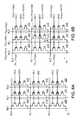
  • FIG. 6B schematically illustrate associated voltage signals for programming the OTP memory cell c 11 of the OTP memory circuit of FIG. 6A ;
  • FIG. 6C schematically illustrate associated voltage signals for reading the OTP memory cell c 11 of the OTP memory circuit of FIG. 6A ;
  • FIG. 7 is a schematic cross-sectional view illustrating an OTP memory cell according to a third embodiment of the present invention.
  • FIG. 8 is a schematic cross-sectional view illustrating an OTP memory cell according to a fourth embodiment of the present invention.
  • FIG. 9 is a schematic equivalent circuit diagram of an OTP memory cell according to a fifth embodiment of the present invention.
  • FIGS. 3A ⁇ 3 C schematically illustrate an OTP memory cell according to a first embodiment of the present invention.
  • FIG. 3A is a schematic top view illustrating the OTP memory cell according to the first embodiment of the present invention.
  • FIG. 3B is a schematic cross-sectional view illustrating the OTP memory cell of FIG. 3A and taken along a line a 1 -a 2 .
  • FIG. 3C is a schematic equivalent circuit diagram of the OTP memory cell according to the first embodiment of the present invention.
  • the OTP memory cell 40 comprises two p-type metal-oxide semiconductor (PMOS) transistors.
  • a medium voltage device manufacturing process is used for fabricating the first PMOS transistor in a first zone A 1 .
  • a low voltage device manufacturing process is used for fabricating the second PMOS transistor in a second zone A 2 .
  • the medium voltage device manufacturing process will be described as follows. Firstly, a medium voltage N-well region (MV NW) is formed in a surface of a P-type substrate (P-substrate) corresponding to the first zone A 1 . Then, a gate oxide layer 47 and a floating gate 46 are formed over the medium voltage N-well region (MV NW). Then, a p-type source/drain region 41 and a p-type source/drain region 42 a are formed in the P-type substrate. The p-type source/drain region 41 and the p-type source/drain region 42 a are located at bilateral sides of the gate oxide layer 47 . The p-type source/drain region 41 receives a bit line voltage V BL . After the medium voltage device manufacturing process is completed, the first PMOS transistor is fabricated. In this embodiment, the first PMOS transistor is a floating gate transistor.
  • the low voltage device manufacturing process will be described as follows. Firstly, a low voltage N-well region (LV NW) is formed in the surface of the P-type substrate corresponding to the second zone A 2 . Then, a gate oxide layer 45 and a select gate 44 are formed over the low voltage N-well region (LV NW). Then, a p-type source/drain region 43 and a p-type source/drain region 42 b are formed in the P-type substrate. The p-type source/drain region 43 and the p-type source/drain region 42 b are located at bilateral sides of the gate oxide layer 45 . The p-type source/drain region 43 receives a source line voltage V SL . The select gate 44 receives a select gate voltage V SG . After the low voltage device manufacturing process is completed, the second PMOS transistor is fabricated. In this embodiment, the second PMOS transistor is a select transistor.
  • the medium voltage N-well region (MV NW) and the low voltage N-well region (LV NW) are in contact with each other. Consequently, the medium voltage N-well region (MV NW) and the low voltage N-well region (LV NW) may be considered as an N-well region that receives an N-well voltage V NW .
  • the p-type source/drain region 42 a and the p-type source/drain region 42 b are in contact with each other. Consequently, the p-type source/drain region 42 a and the p-type source/drain region 42 b may be considered as a combined p-type source/drain region.
  • the gate oxide layer 47 of the first PMOS transistor is thicker than the gate oxide layer 45 of the second PMOS transistor, the low voltage N-well region (LV NW) is shallower than the medium voltage N-well region (MV NW), and the p-type source/drain region 42 b is shallower than the p-type source/drain region 42 a.
  • the gate oxide layer 47 of the first PMOS transistor is thicker than the gate oxide layer 45 of the second PMOS transistor, the low voltage N-well region (LV NW) and the medium voltage N-well region (MV NW) maybe have the same depth, and the p-type source/drain region 42 b and the p-type source/drain region 42 a maybe have the same depth.
  • the OTP memory cell 40 comprises two serially-connected PMOS transistors.
  • the two PMOS transistors are constructed in the medium voltage N-well region (MV NW) and the low voltage N-well region (LV NW), respectively. Since the gate oxide layer 45 of the second PMOS transistor is thinner, the threshold voltage of the second PMOS transistor is lower. Consequently, by controlling the voltage difference between the select gate voltage V SG and the source line voltage V SL to be in the range between 1.8V and 2.0V, the second PMOS transistor is suitable for the low voltage operation.
  • the second PMOS transistor i.e., the select transistor. If the voltage is improperly biased, the source-drain voltage of the second PMOS transistor is too high. Under this circumstance, the source-drain voltage of the second PMOS transistor is possibly higher than the voltage stress that can be withstood by the second PMOS transistor. Because of the overstressing phenomenon, the second PMOS transistor is possibly burnt out.
  • FIGS. 4A ⁇ 4 C schematically illustrate an OTP memory cell according to a second embodiment of the present invention.
  • FIG. 4A is a schematic top view illustrating the OTP memory cell according to the second embodiment of the present invention.
  • FIG. 4B is a schematic cross-sectional view illustrating the OTP memory cell of FIG. 4A and taken along a line b 1 -b 2 .
  • FIG. 4C is a schematic equivalent circuit diagram of the OTP memory cell according to the second embodiment of the present invention.
  • the OTP memory cell 50 comprises three p-type metal-oxide semiconductor (PMOS) transistors.
  • a medium voltage device manufacturing process is used for fabricating the first PMOS transistor in a first zone B 1 .
  • a low voltage device manufacturing process is used for fabricating the second PMOS transistor and the third PMOS transistor in a second zone B 2 .
  • the medium voltage device manufacturing process will be described as follows. Firstly, a medium voltage N-well region (MV NW) is formed in a surface of a P-type substrate (P-substrate) corresponding to the first zone B 1 . Then, a gate oxide layer 55 and a floating gate 56 are formed over the medium voltage N-well region (MV NW). Then, a p-type source/drain region 51 and a p-type source/drain region 52 a are formed in the P-type substrate. The p-type source/drain region 51 and the p-type source/drain region 52 a are located at bilateral sides of the gate oxide layer 55 . The p-type source/drain region 51 receives a bit line voltage V BL . After the medium voltage device manufacturing process is completed, the first PMOS transistor is fabricated. In this embodiment, the first PMOS transistor is a floating gate transistor.
  • a low voltage N-well region (LV NW) is formed in the surface of the P-type substrate corresponding to the second zone B 2 .
  • a gate oxide layer 57 and a gate oxide layer 59 are formed over the low voltage N-well region (LV NW).
  • an isolation gate 58 and a select gate 60 are formed over the gate oxide layer 57 and the gate oxide layer 59 , respectively.
  • three p-type source/drain regions 52 b , 53 and 54 are formed in the P-type substrate.
  • the p-type source/drain region 52 b is located at a right side of the gate oxide layer 57 .
  • the p-type source/drain region 53 is arranged between the gate oxide layer 57 and the gate oxide layer 59 .
  • the p-type source/drain region 54 is located at a left side of the gate oxide layer 59 .
  • the p-type source/drain region 54 receives a source line voltage V SL .
  • the isolation gate 58 receives an isolation gate voltage V ISO .
  • the select gate 60 receives a select gate voltage V SG .
  • the medium voltage N-well region (MV NW) and the low voltage N-well region (LV NW) are in contact with each other. Consequently, the medium voltage N-well region (MV NW) and the low voltage N-well region (LV NW) may be considered as an N-well region that receives an N-well voltage V NW .
  • the p-type source/drain region 52 a and the p-type source/drain region 52 b are in contact with each other. Consequently, the p-type source/drain region 52 a and the p-type source/drain region 52 b may be considered as a combined p-type source/drain region.
  • the gate oxide layer 55 of the first PMOS transistor is thicker than the gate oxide layer 57 of the second PMOS transistor, and the gate oxide layer 55 of the first PMOS transistor is thicker than the gate oxide layer 59 of the third PMOS transistor, the low voltage N-well region (LV NW) is shallower than the medium voltage N-well region (MV NW), and the p-type source/drain region 52 b is shallower than the p-type source/drain region 52 a.
  • LV NW low voltage N-well region
  • MV NW medium voltage N-well region
  • the p-type source/drain region 52 b is shallower than the p-type source/drain region 52 a.
  • the gate oxide layer 55 of the first PMOS transistor is thicker than the gate oxide layer 57 of the second PMOS transistor, and the gate oxide layer 55 of the first PMOS transistor is thicker than the gate oxide layer 59 of the third PMOS transistor, the low voltage N-well region (LV NW) and the medium voltage N-well region (MV NW) maybe have the same depth, and the p-type source/drain region 42 b and the p-type source/drain region 42 a maybe have the same depth.
  • the OTP memory cell 50 comprises three serially-connected PMOS transistors.
  • the first PMOS transistor is constructed in the medium voltage N-well region (MV NW)
  • the second PMOS transistor and the third PMOS transistor are constructed in the low voltage N-well region (LV NW). Since the gate oxide layer 57 of the second PMOS transistor and the gate oxide layer 59 of the third PMOS transistor are thinner, the threshold voltages of the second PMOS transistor and the third PMOS transistor are lower. Consequently, the second PMOS transistor and the third PMOS transistor are suitable for the low voltage operation.
  • the p-type source/drain region 51 of the first PMOS transistor is connected with a bit line to receive a bit line voltage V BL
  • the isolation gate 58 of the second PMOS transistor is connected with an isolation line to receive an isolation gate voltage V ISO
  • the select gate 60 of the third PMOS transistor is connected with a word line to receive a select gate voltage V SG
  • the p-type source/drain region 54 of the third PMOS transistor is connected with a source line to receive a source line voltage V SL .
  • the conventional OTP memory cell 50 may be operated in a program cycle or a read cycle.
  • FIGS. 5A and 5B schematically illustrate associated voltage signals for programming and reading the OTP memory cell according to the second embodiment of the present invention.
  • the bit line voltage V BL is 0V
  • the isolation gate voltage V ISO is equal to Vpp/2
  • the select gate voltage V SG is equal to (Vpp ⁇ Vdd)
  • the N-well voltage V NW is equal to Vpp
  • the source line voltage V SL is equal to Vpp.
  • the magnitude of the first voltage Vpp is in the range between 6.5V and 7.5V
  • the magnitude of the second voltage Vdd is in the range between 0.7V and 0.8V.
  • both of the select transistor and the isolation transistor are turned on. Consequently, a program current Ip flows through a channel region of the floating gate transistor, and hot carriers are injected into the floating gate 56 .
  • the bit line voltage V BL is 0V
  • the isolation gate voltage V ISO is 0V
  • the select gate voltage V SG is 0V
  • the N-well voltage V NW is equal to Vdd
  • the source line voltage V SL is equal to Vdd.
  • the magnitude of the second voltage Vdd is in the range between 0.7V and 0.8V.
  • both of the select transistor and the isolation transistor are turned on. According to the result of judging whether hot carriers are stored in the floating gate 56 , the magnitude of a read current Ir is determined. That is, the magnitude of the read current Ir can be used to judge whether the OTP memory cell is programmed or not.
  • FIG. 6A is a schematic circuit diagram illustrating an OTP memory circuit composed of plural OTP memory cells according to the second embodiment of the present invention.
  • the OTP memory circuit 70 comprises OTP memory cells c 00 ⁇ c 22 in a 3 ⁇ 3 array.
  • Each of the OTP memory cells c 00 ⁇ c 22 has the same structure as the OTP memory cell of the second embodiment.
  • the OTP memory cell c 00 comprises three serially-connected PMOS transistors.
  • the three PMOS transistors include a floating gate transistor, an isolation transistor and a select transistor.
  • a first terminal of the floating gate transistor is connected with a bit line BL 0 .
  • a floating gate of the floating gate transistor is in a floating state.
  • a first terminal of the isolation transistor is connected with a second terminal of the floating gate transistor.
  • An isolation gate of the isolation transistor is connected with an isolation line ISO 0 .
  • a first terminal of the select transistor is connected with a second terminal of the isolation transistor.
  • a second terminal of the select transistor is connected with a source line SL 0 .
  • a select gate of the select transistor is connected with a word line WL 0 .
  • the structures of the OTP memory cells c 01 ⁇ c 22 are similar to the structures of the OTP memory cell c 00 , and are not redundantly described herein.
  • FIG. 6B schematically illustrate associated voltage signals for programming the OTP memory cell c 11 of the OTP memory circuit of FIG. 6A .
  • the OTP memory cell c 11 is a selected OTP memory cell.
  • the source line voltage V SL0 provided to the source line SL 0 , the source line voltage V SL2 provided to the source line SL 2 , and the source line voltage V SL1 provided to the source line SL 1 are all equal to Vpp.
  • the bit line voltage V BL0 provided to the bit line BL 0 is equal to Vpp
  • the bit line voltage V BL2 provided to the bit line BL 2 is equal to Vpp
  • the bit line voltage V BL1 provided to the bit line BL 1 is 0V.
  • the select gate voltage V SG0 provided to the word line WL 0 is equal to Vpp
  • the select gate voltage V SG2 provided to the word line WL 2 is equal to Vpp
  • the select gate voltage V SG1 provided to the word line WL 1 is equal to (Vpp ⁇ Vdd).
  • the isolation gate voltage V ISO0 provided to the isolation line ISO 0 , the isolation gate voltage V ISO1 provided to the isolation line ISO 1 and the isolation gate voltage V ISO2 provided to the isolation line ISO 2 are all equal to Vpp/2.
  • the N-well voltage V NW is equal to Vpp.
  • a program current Ip generated by the OTP memory cell c 11 flows from the source line SL 1 to the bit line BL 1 .
  • the other OTP memory cells are not programmed.
  • FIG. 6C schematically illustrate associated voltage signals for reading the OTP memory cell c 11 of the OTP memory circuit of FIG. 6A .
  • the OTP memory cell c 11 is a selected OTP memory cell.
  • the source line voltage V SL0 provided to the source line SL 0 , the source line voltage V SL1 provided to the source line SL 1 and the source line voltage V SL2 provided to the source line SL 2 are all equal to Vdd.
  • the bit line voltage V BL0 provided to the bit line BL 0 is equal to Vdd
  • the bit line voltage V BL2 provided to the bit line BL 2 is equal to Vdd
  • the bit line voltage V BL1 provided to the bit line BL 1 is 0V.
  • the select gate voltage V SG0 provided to the word line WL 0 is equal to Vdd
  • the select gate voltage V SG2 provided to the word line WL 2 is equal to Vdd
  • the select gate voltage V SG1 provided to the word line WL 1 is 0V.
  • the isolation gate voltage V ISO0 provided to the isolation line ISO 0 , the isolation gate voltage V ISO1 provided to the isolation line ISO 1 and the isolation gate voltage V ISO2 provided to the isolation line ISO 2 are all equal to 0V.
  • the N-well voltage V NW is equal to Vdd.
  • a read current Ir generated by the OTP memory cell c 11 flows from the source line SL 1 to the bit line BL 1 .
  • the other OTP memory cells are not read.
  • bias voltages applied to the OTP memory circuit 70 are not restricted. That is, the bias voltages applied to the OTP memory circuit 70 may be modified according to the practical requirements.
  • FIG. 7 is a schematic cross-sectional view illustrating an OTP memory cell according to a third embodiment of the present invention. In comparison with the second embodiment, the N-well region NW of the OTP memory cell 75 of this embodiment is distinguished.
  • the N-well region NW has been previously formed in the surface of the P-type substrate.
  • the first PMOS transistor is directly formed on the N-well region NW and used as a floating gate transistor.
  • the second PMOS transistor and the third PMOS transistor are directly formed on the N-well region NW.
  • the second PMOS transistor and the third PMOS transistor are used as an isolation transistor and a select transistor, respectively.
  • FIG. 8 is a schematic cross-sectional view illustrating an OTP memory cell according to a fourth embodiment of the present invention.
  • the OTP memory cell 85 of this embodiment further comprises a deep N-well region (DNW) or an N-buried layer (NBL) under the N-well region NW.
  • DGW deep N-well region
  • NBL N-buried layer
  • the medium voltage device manufacturing process and the low voltage device manufacturing process are performed.
  • the concepts of the fourth embodiment may be modified.
  • the deep N-well region (DNW) or the N-buried layer (NBL) is previously formed in the surface of the P-type substrate.
  • a medium voltage N-well region (MV NW) is formed in the P-type substrate.
  • a low voltage N-well region (LV NW) is formed in the P-type substrate.
  • FIG. 9 is a schematic equivalent circuit diagram of an OTP memory cell according to a fifth embodiment of the present invention.
  • the OTP memory cell 90 of this embodiment comprises plural floating gate transistors.
  • the plural floating gate transistors are connected with each other in parallel.
  • the plural floating gate transistors e.g., two floating gate transistors
  • the plural floating gate transistors are used to store one bit of data. Consequently, the data accuracy of the OTP memory cell 90 is enhanced.
  • the present invention provides an OTP memory cell and a memory circuit thereof.
  • the OTP memory cell comprises a select transistor, an isolation transistor and a floating gate transistor, which are connected with each other in series. Since the select transistor and the isolation transistor are fabricated by the low voltage device manufacturing process, the select transistor and the isolation transistor are suitable for the low voltage operation.
  • a silicide blocking layer (not shown) is formed over the floating gate to completely cover the floating gate. Consequently, the floating gate transistor of the OTP memory cell can be protected. Since the floating gate is effectively protected, the data retention time of the OTP memory cell is extended.
  • the transistors of the OTP memory cell are PMOS transistors.
  • the transistors of the OTP memory cell are p-type metal-oxide semiconductor (NMOS) transistors.

Landscapes

  • Semiconductor Memories (AREA)
  • Non-Volatile Memory (AREA)

Abstract

A one time programming non-volatile memory cell includes a first floating gate transistor with a single gate structure, an isolation transistor, and a select transistor. A first terminal of the first floating gate transistor is connected with a second control line. A floating gate of the first floating gate transistor is in a floating state. A first terminal of the isolation transistor is connected with a second terminal of the first floating gate transistor. An isolation gate of the isolation transistor is connected with an isolation line. A first terminal of the select transistor is connected with a second terminal of the isolation transistor. A second terminal of the select transistor is connected with a first control line. A select transistor of the select transistor is connected with a word line.

Description

This application claims the benefit of U.S. provisional application Ser. No. 62/188,751, filed Jul. 6, 2015, the subject matter of which is incorporated herein by reference.
FIELD OF THE INVENTION
The present invention relates to a memory cell, and more particularly to a one time programming non-volatile memory cell.
BACKGROUND OF THE INVENTION
As is well known, a non-volatile memory is able to continuously retain data after the supplied power is interrupted. Generally, after the non-volatile memory leaves the factory, the user may program the non-volatile memory in order to record data into the non-volatile memory. According to the number of times the non-volatile memory is programmed, the non-volatile memory may be classified into a multi-time programming memory (also referred as a MTP memory) and a one time programming memory (also referred as an OTP memory). Basically, the stored data of the MTP memory can be modified many times. On the contrary, the OTP memory can be programmed once. After the OTP memory is programmed, the stored data fails to be modified.
For example, an OTP memory cell is disclosed in U.S. Pat. No. 6,920,067, which is entitled “Integrated circuit embedded with single-poly non-volatile memory”. FIG. 1A is a schematic top view of a conventional OTP memory cell. FIG. 1B is a schematic cross-sectional view of the conventional OTP memory cell of FIG. 1A. FIG. 10 is a schematic equivalent circuit diagram of the conventional OTP memory cell of FIG. 1A.
Please refer to FIGS. 1A˜1C. The conventional OTP memory cell 20 comprises two serially-connected p-type metal-oxide semiconductor (PMOS) transistors. The two PMOS transistors are constructed in an N-well region (NW). The N-well region NW is connected to an N-well voltage VNW. The first PMOS transistor is used as a floating gate transistor. The second PMOS transistor is used as a select transistor.
In the first PMOS transistor, a gate oxide layer 27 is formed over the N-well region NW, and a floating gate 26 is formed over the gate oxide layer 27. A p-type source/drain region 21 receives a bit line voltage VBL. Moreover, a p-type source/drain region 22 may be considered as a combination of a p-type source region of the first PMOS transistor and a p-type drain region of the second PMOS transistor.
In the second PMOS transistor, a gate oxide layer 25 is formed over the N-well region NW, and a select gate 24 is formed over the gate oxide layer 25. The select gate 24 receives a select gate voltage VSG. Moreover, a p-type source/drain region 23 receives a source line voltage VSL.
Generally, the p-type source/drain region 21 is connected with a bit line for receiving the bit line voltage VBL, the select gate 24 of the second PMOS transistor is connected with a word line for receiving the select gate voltage VSG, and the p-type source/drain region 23 is connected with a source line for receiving a source line voltage VSL. By properly controlling the select gate voltage VSG, the source line voltage VSL, the bit line voltage VBL and the N-well voltage VNW, the conventional OTP memory cell 20 may be operated in a program cycle or a read cycle.
In the conventional OTP memory cell 20, the floating gate transistor with two gate structure in the early stage is modified as the floating gate transistor with single gate structure. That is, the floating gate transistor in the early stage has the floating gate and the control gate. Whereas, the conventional OTP memory cell 20 has a single floating gate but does not have the control gate. Since the two PMOS transistors of the conventional OTP memory cell 20 have respective gates 24 and 26, the process of fabricating the conventional OTP memory cell 20 is compatible with the standard CMOS manufacturing process.
Nowadays, the CMOS manufacturing process is selected according to the operating voltage range of the semiconductor device. For example, the CMOS manufacturing process for a medium voltage device (MV device) is used to fabricate a transistor with higher voltage stress, and this transistor is suitable for the medium voltage operation. In addition, the CMOS manufacturing process for a low voltage device is used to fabricate a transistor with fast computing speed and lower voltage stress, and this transistor is suitable for the low voltage operation. For example, in the medium voltage operation, the voltage stress that can be withstood by the region between the gate terminal and the source terminal of the transistor is in the range between 3.0V and 6.5V. Moreover, in the low voltage operation, the voltage stress that can be withstood by the region between the gate terminal and the source terminal of the transistor is in the range between 1.8V and 2.0V.
Generally, an integrated circuit comprises an input/output device (I/O device) and a core device. The I/O device can withstand high voltage stress. The core device is operated at a high speed. That is, in the manufacturing process of an integrated circuit, the medium voltage device manufacturing process is needed to fabricate the I/O device and the low voltage device manufacturing process is needed to fabricate the core device.
Moreover, during the program cycle of the conventional OTP memory cell, the voltage difference between the gate terminal and the source terminal is about 6V. In other words, the two PMOS transistors of the OTP memory cell 20 as shown in FIG. 1B are medium voltage devices. For operating the OTP memory cell 20 in a low voltage condition, it is necessary to modify the structure of the OTP memory cell 20.
FIG. 2 is a schematic equivalent circuit diagram of another conventional OTP memory cell. As shown in FIG. 2, the OTP memory cell 30 comprises a word line driver 32 and a storage unit 34. Similarly, both of the two serially-connected PMOS transistors of the storage unit 34 are medium voltage devices. The structures of the storage unit 34 is identical to the OTP memory cell 20 of FIG. 10, and are not redundantly described herein.
The OTP memory cell 30 is in the low voltage operation. For controlling the second PMOS transistor (i.e., the select transistor), the OTP memory cell 30 uses the word line driver 32 to increase the lower word line voltage VWL to the select gate voltage VSG. Consequently, the second PMOS transistor (i.e., the select transistor), the OTP memory cell 30 can be normally operated. An example of the word line driver 32 is a level shifter.
Since the OTP memory cell 30 is additionally equipped with the word line driver 32, a great amount of electric energy is consumed during the read cycle or the program cycle.
SUMMARY OF THE INVENTION
An embodiment of the present invention provides a one time programming non-volatile memory cell. The one time programming non-volatile memory cell is connected between a first control line and a second control line. The one time programming non-volatile memory cell includes a first floating gate transistor with a single gate structure, an isolation transistor, and a select transistor. A first terminal of the first floating gate transistor is connected with the second control line. A floating gate of the first floating gate transistor is in a floating state. A first terminal of the isolation transistor is connected with a second terminal of the first floating gate transistor. An isolation gate of the isolation transistor is connected with an isolation line. A first terminal of the select transistor is connected with a second terminal of the isolation transistor. A second terminal of the select transistor is connected with the first control line. A select transistor of the select transistor is connected with a word line.
An embodiment of the present invention provides a one time programming non-volatile memory cell. The one time programming non-volatile memory cell includes a P-type substrate, a first gate oxide layer, a second gate oxide layer, a third gate oxide layer, a first p-type source/drain region, a second p-type source/drain region, a third p-type source/drain region, a fourth p-type source/drain region, a floating gate, an isolation gate, and a select gate. An N-well region is disposed under a first surface of the P-type substrate. The first p-type source/drain region is connected with a bit line. The first p-type source/drain region and the second p-type source/drain region are disposed under the first surface of the P-type substrate, and respectively located at two opposed sides of the first gate oxide layer. The second p-type source/drain region and the third p-type source/drain region are disposed under the first surface of the P-type substrate, and respectively located at two opposed sides of the second gate oxide layer. The fourth p-type source/drain region is connected with a source line. The third p-type source/drain region and the fourth p-type source/drain region are disposed under the first surface of the P-type substrate, and respectively located at two opposed sides of the third gate oxide layer. The floating gate is disposed over the first gate oxide layer. The isolation gate is disposed over the second gate oxide layer, and connected with an isolation line. The select gate is disposed over the third gate oxide layer, and connected with a word line. The first gate oxide layer is thicker than the second gate oxide layer. The first gate oxide layer is thicker than the third gate oxide layer.
Numerous objects, features and advantages of the present invention will be readily apparent upon a reading of the following detailed description of embodiments of the present invention when taken in conjunction with the accompanying drawings. However, the drawings employed herein are for the purpose of descriptions and should not be regarded as limiting.
BRIEF DESCRIPTION OF THE DRAWINGS
The above objects and advantages of the present invention will become more readily apparent to those ordinarily skilled in the art after reviewing the following detailed description and accompanying drawings, in which:
FIG. 1A (prior art) is a schematic top view of a conventional OTP memory cell;
FIG. 1B (prior art) is a schematic cross-sectional view of the conventional OTP memory cell of FIG. 1A;
FIG. 10 (prior art) is a schematic equivalent circuit diagram of the conventional OTP memory cell of FIG. 1A;
FIG. 2 (prior art) is a schematic equivalent circuit diagram of another conventional OTP memory cell;
FIGS. 3A˜3C schematically illustrate an OTP memory cell according to a first embodiment of the present invention;
FIGS. 4A˜4C schematically illustrate an OTP memory cell according to a second embodiment of the present invention;
FIGS. 5A and 5B schematically illustrate associated voltage signals for programming and reading the OTP memory cell according to the second embodiment of the present invention;
FIG. 6A is a schematic circuit diagram illustrating an OTP memory circuit composed of plural OTP memory cells according to the second embodiment of the present invention;
FIG. 6B schematically illustrate associated voltage signals for programming the OTP memory cell c11 of the OTP memory circuit of FIG. 6A;
FIG. 6C schematically illustrate associated voltage signals for reading the OTP memory cell c11 of the OTP memory circuit of FIG. 6A;
FIG. 7 is a schematic cross-sectional view illustrating an OTP memory cell according to a third embodiment of the present invention;
FIG. 8 is a schematic cross-sectional view illustrating an OTP memory cell according to a fourth embodiment of the present invention; and
FIG. 9 is a schematic equivalent circuit diagram of an OTP memory cell according to a fifth embodiment of the present invention.
DETAILED DESCRIPTION OF PREFERRED EMBODIMENTS
FIGS. 3A˜3C schematically illustrate an OTP memory cell according to a first embodiment of the present invention. FIG. 3A is a schematic top view illustrating the OTP memory cell according to the first embodiment of the present invention. FIG. 3B is a schematic cross-sectional view illustrating the OTP memory cell of FIG. 3A and taken along a line a1-a2. FIG. 3C is a schematic equivalent circuit diagram of the OTP memory cell according to the first embodiment of the present invention.
As shown in FIGS. 3A˜3C, the OTP memory cell 40 comprises two p-type metal-oxide semiconductor (PMOS) transistors. A medium voltage device manufacturing process is used for fabricating the first PMOS transistor in a first zone A1. A low voltage device manufacturing process is used for fabricating the second PMOS transistor in a second zone A2.
The medium voltage device manufacturing process will be described as follows. Firstly, a medium voltage N-well region (MV NW) is formed in a surface of a P-type substrate (P-substrate) corresponding to the first zone A1. Then, a gate oxide layer 47 and a floating gate 46 are formed over the medium voltage N-well region (MV NW). Then, a p-type source/drain region 41 and a p-type source/drain region 42 a are formed in the P-type substrate. The p-type source/drain region 41 and the p-type source/drain region 42 a are located at bilateral sides of the gate oxide layer 47. The p-type source/drain region 41 receives a bit line voltage VBL. After the medium voltage device manufacturing process is completed, the first PMOS transistor is fabricated. In this embodiment, the first PMOS transistor is a floating gate transistor.
The low voltage device manufacturing process will be described as follows. Firstly, a low voltage N-well region (LV NW) is formed in the surface of the P-type substrate corresponding to the second zone A2. Then, a gate oxide layer 45 and a select gate 44 are formed over the low voltage N-well region (LV NW). Then, a p-type source/drain region 43 and a p-type source/drain region 42 b are formed in the P-type substrate. The p-type source/drain region 43 and the p-type source/drain region 42 b are located at bilateral sides of the gate oxide layer 45. The p-type source/drain region 43 receives a source line voltage VSL. The select gate 44 receives a select gate voltage VSG. After the low voltage device manufacturing process is completed, the second PMOS transistor is fabricated. In this embodiment, the second PMOS transistor is a select transistor.
As shown in FIG. 3B, the medium voltage N-well region (MV NW) and the low voltage N-well region (LV NW) are in contact with each other. Consequently, the medium voltage N-well region (MV NW) and the low voltage N-well region (LV NW) may be considered as an N-well region that receives an N-well voltage VNW. Moreover, the p-type source/drain region 42 a and the p-type source/drain region 42 b are in contact with each other. Consequently, the p-type source/drain region 42 a and the p-type source/drain region 42 b may be considered as a combined p-type source/drain region. In this embodiment, the gate oxide layer 47 of the first PMOS transistor is thicker than the gate oxide layer 45 of the second PMOS transistor, the low voltage N-well region (LV NW) is shallower than the medium voltage N-well region (MV NW), and the p-type source/drain region 42 b is shallower than the p-type source/drain region 42 a.
In another embodiment, the gate oxide layer 47 of the first PMOS transistor is thicker than the gate oxide layer 45 of the second PMOS transistor, the low voltage N-well region (LV NW) and the medium voltage N-well region (MV NW) maybe have the same depth, and the p-type source/drain region 42 b and the p-type source/drain region 42 a maybe have the same depth.
From the above descriptions, the OTP memory cell 40 comprises two serially-connected PMOS transistors. The two PMOS transistors are constructed in the medium voltage N-well region (MV NW) and the low voltage N-well region (LV NW), respectively. Since the gate oxide layer 45 of the second PMOS transistor is thinner, the threshold voltage of the second PMOS transistor is lower. Consequently, by controlling the voltage difference between the select gate voltage VSG and the source line voltage VSL to be in the range between 1.8V and 2.0V, the second PMOS transistor is suitable for the low voltage operation.
However, during the program cycle of the OTP memory cell 40, a large program current flows through the second PMOS transistor (i.e., the select transistor). If the voltage is improperly biased, the source-drain voltage of the second PMOS transistor is too high. Under this circumstance, the source-drain voltage of the second PMOS transistor is possibly higher than the voltage stress that can be withstood by the second PMOS transistor. Because of the overstressing phenomenon, the second PMOS transistor is possibly burnt out.
FIGS. 4A˜4C schematically illustrate an OTP memory cell according to a second embodiment of the present invention. FIG. 4A is a schematic top view illustrating the OTP memory cell according to the second embodiment of the present invention. FIG. 4B is a schematic cross-sectional view illustrating the OTP memory cell of FIG. 4A and taken along a line b1-b2. FIG. 4C is a schematic equivalent circuit diagram of the OTP memory cell according to the second embodiment of the present invention.
As shown in FIGS. 4A˜4C, the OTP memory cell 50 comprises three p-type metal-oxide semiconductor (PMOS) transistors. A medium voltage device manufacturing process is used for fabricating the first PMOS transistor in a first zone B1. A low voltage device manufacturing process is used for fabricating the second PMOS transistor and the third PMOS transistor in a second zone B2.
The medium voltage device manufacturing process will be described as follows. Firstly, a medium voltage N-well region (MV NW) is formed in a surface of a P-type substrate (P-substrate) corresponding to the first zone B1. Then, a gate oxide layer 55 and a floating gate 56 are formed over the medium voltage N-well region (MV NW). Then, a p-type source/drain region 51 and a p-type source/drain region 52 a are formed in the P-type substrate. The p-type source/drain region 51 and the p-type source/drain region 52 a are located at bilateral sides of the gate oxide layer 55. The p-type source/drain region 51 receives a bit line voltage VBL. After the medium voltage device manufacturing process is completed, the first PMOS transistor is fabricated. In this embodiment, the first PMOS transistor is a floating gate transistor.
The low voltage device manufacturing process will be described as follows. Firstly, a low voltage N-well region (LV NW) is formed in the surface of the P-type substrate corresponding to the second zone B2. Then, a gate oxide layer 57 and a gate oxide layer 59 are formed over the low voltage N-well region (LV NW). Then, an isolation gate 58 and a select gate 60 are formed over the gate oxide layer 57 and the gate oxide layer 59, respectively. Then, three p-type source/ drain regions 52 b, 53 and 54 are formed in the P-type substrate. The p-type source/drain region 52 b is located at a right side of the gate oxide layer 57. The p-type source/drain region 53 is arranged between the gate oxide layer 57 and the gate oxide layer 59. The p-type source/drain region 54 is located at a left side of the gate oxide layer 59. The p-type source/drain region 54 receives a source line voltage VSL. The isolation gate 58 receives an isolation gate voltage VISO. The select gate 60 receives a select gate voltage VSG. After the low voltage device manufacturing process is completed, the second PMOS transistor and the third PMOS transistor are fabricated. In this embodiment, the second PMOS transistor is an isolation transistor, and the third PMOS transistor is a select transistor.
As shown in FIG. 4B, the medium voltage N-well region (MV NW) and the low voltage N-well region (LV NW) are in contact with each other. Consequently, the medium voltage N-well region (MV NW) and the low voltage N-well region (LV NW) may be considered as an N-well region that receives an N-well voltage VNW. Moreover, the p-type source/drain region 52 a and the p-type source/drain region 52 b are in contact with each other. Consequently, the p-type source/drain region 52 a and the p-type source/drain region 52 b may be considered as a combined p-type source/drain region. In this embodiment, the gate oxide layer 55 of the first PMOS transistor is thicker than the gate oxide layer 57 of the second PMOS transistor, and the gate oxide layer 55 of the first PMOS transistor is thicker than the gate oxide layer 59 of the third PMOS transistor, the low voltage N-well region (LV NW) is shallower than the medium voltage N-well region (MV NW), and the p-type source/drain region 52 b is shallower than the p-type source/drain region 52 a.
In another embodiment, the gate oxide layer 55 of the first PMOS transistor is thicker than the gate oxide layer 57 of the second PMOS transistor, and the gate oxide layer 55 of the first PMOS transistor is thicker than the gate oxide layer 59 of the third PMOS transistor, the low voltage N-well region (LV NW) and the medium voltage N-well region (MV NW) maybe have the same depth, and the p-type source/drain region 42 b and the p-type source/drain region 42 a maybe have the same depth.
From the above descriptions, the OTP memory cell 50 comprises three serially-connected PMOS transistors. The first PMOS transistor is constructed in the medium voltage N-well region (MV NW), and the second PMOS transistor and the third PMOS transistor are constructed in the low voltage N-well region (LV NW). Since the gate oxide layer 57 of the second PMOS transistor and the gate oxide layer 59 of the third PMOS transistor are thinner, the threshold voltages of the second PMOS transistor and the third PMOS transistor are lower. Consequently, the second PMOS transistor and the third PMOS transistor are suitable for the low voltage operation.
During the program cycle of the OTP memory cell 50, a program current flows through the second PMOS transistor and the third PMOS transistor. Under this circumstance, the source-drain voltages of the second PMOS transistor and the third PMOS transistor are not higher than the withstanding voltage stress. Consequently, the second PMOS transistor and the third PMOS transistor are normally operated and not burnt out.
In this embodiment, the p-type source/drain region 51 of the first PMOS transistor is connected with a bit line to receive a bit line voltage VBL, the isolation gate 58 of the second PMOS transistor is connected with an isolation line to receive an isolation gate voltage VISO, the select gate 60 of the third PMOS transistor is connected with a word line to receive a select gate voltage VSG, and the p-type source/drain region 54 of the third PMOS transistor is connected with a source line to receive a source line voltage VSL. By properly controlling the select gate voltage VSG, the source line voltage VSL, the isolation gate voltage VISO, the bit line voltage VBL and the N-well voltage VNW, the conventional OTP memory cell 50 may be operated in a program cycle or a read cycle.
FIGS. 5A and 5B schematically illustrate associated voltage signals for programming and reading the OTP memory cell according to the second embodiment of the present invention.
Please refer to FIG. 5A. During the program cycle, the bit line voltage VBL is 0V, the isolation gate voltage VISO is equal to Vpp/2, the select gate voltage VSG is equal to (Vpp−Vdd), the N-well voltage VNW is equal to Vpp, and the source line voltage VSL is equal to Vpp. In an embodiment, the magnitude of the first voltage Vpp is in the range between 6.5V and 7.5V, and the magnitude of the second voltage Vdd is in the range between 0.7V and 0.8V.
During the program cycle, both of the select transistor and the isolation transistor are turned on. Consequently, a program current Ip flows through a channel region of the floating gate transistor, and hot carriers are injected into the floating gate 56.
Please refer to FIG. 5B. During the read cycle, the bit line voltage VBL is 0V, the isolation gate voltage VISO is 0V, the select gate voltage VSG is 0V, the N-well voltage VNW is equal to Vdd, and the source line voltage VSL is equal to Vdd. In an embodiment, the magnitude of the second voltage Vdd is in the range between 0.7V and 0.8V.
During the read cycle, both of the select transistor and the isolation transistor are turned on. According to the result of judging whether hot carriers are stored in the floating gate 56, the magnitude of a read current Ir is determined. That is, the magnitude of the read current Ir can be used to judge whether the OTP memory cell is programmed or not.
FIG. 6A is a schematic circuit diagram illustrating an OTP memory circuit composed of plural OTP memory cells according to the second embodiment of the present invention. As shown in FIG. 6A, the OTP memory circuit 70 comprises OTP memory cells c00˜c22 in a 3×3 array. Each of the OTP memory cells c00˜c22 has the same structure as the OTP memory cell of the second embodiment.
For example, the OTP memory cell c00 comprises three serially-connected PMOS transistors. The three PMOS transistors include a floating gate transistor, an isolation transistor and a select transistor. A first terminal of the floating gate transistor is connected with a bit line BL0. A floating gate of the floating gate transistor is in a floating state. A first terminal of the isolation transistor is connected with a second terminal of the floating gate transistor. An isolation gate of the isolation transistor is connected with an isolation line ISO0. A first terminal of the select transistor is connected with a second terminal of the isolation transistor. A second terminal of the select transistor is connected with a source line SL0. A select gate of the select transistor is connected with a word line WL0. The structures of the OTP memory cells c01˜c22 are similar to the structures of the OTP memory cell c00, and are not redundantly described herein.
FIG. 6B schematically illustrate associated voltage signals for programming the OTP memory cell c11 of the OTP memory circuit of FIG. 6A. For example, the OTP memory cell c11 is a selected OTP memory cell. The source line voltage VSL0 provided to the source line SL0, the source line voltage VSL2 provided to the source line SL2, and the source line voltage VSL1 provided to the source line SL1 are all equal to Vpp. The bit line voltage VBL0 provided to the bit line BL0 is equal to Vpp, the bit line voltage VBL2 provided to the bit line BL2 is equal to Vpp, and the bit line voltage VBL1 provided to the bit line BL1 is 0V. The select gate voltage VSG0 provided to the word line WL0 is equal to Vpp, the select gate voltage VSG2 provided to the word line WL2 is equal to Vpp, and the select gate voltage VSG1 provided to the word line WL1 is equal to (Vpp−Vdd). The isolation gate voltage VISO0 provided to the isolation line ISO0, the isolation gate voltage VISO1 provided to the isolation line ISO1 and the isolation gate voltage VISO2 provided to the isolation line ISO2 are all equal to Vpp/2. Moreover, the N-well voltage VNW is equal to Vpp.
Consequently, only the OTP memory cell c11 is programmed. A program current Ip generated by the OTP memory cell c11 flows from the source line SL1 to the bit line BL1. The other OTP memory cells are not programmed.
FIG. 6C schematically illustrate associated voltage signals for reading the OTP memory cell c11 of the OTP memory circuit of FIG. 6A. For example, the OTP memory cell c11 is a selected OTP memory cell. The source line voltage VSL0 provided to the source line SL0, the source line voltage VSL1 provided to the source line SL1 and the source line voltage VSL2 provided to the source line SL2 are all equal to Vdd. The bit line voltage VBL0 provided to the bit line BL0 is equal to Vdd, the bit line voltage VBL2 provided to the bit line BL2 is equal to Vdd, and the bit line voltage VBL1 provided to the bit line BL1 is 0V. The select gate voltage VSG0 provided to the word line WL0 is equal to Vdd, the select gate voltage VSG2 provided to the word line WL2 is equal to Vdd, and the select gate voltage VSG1 provided to the word line WL1 is 0V. The isolation gate voltage VISO0 provided to the isolation line ISO0, the isolation gate voltage VISO1 provided to the isolation line ISO1 and the isolation gate voltage VISO2 provided to the isolation line ISO2 are all equal to 0V. Moreover, the N-well voltage VNW is equal to Vdd.
Consequently, only the OTP memory cell c11 is read. A read current Ir generated by the OTP memory cell c11 flows from the source line SL1 to the bit line BL1. The other OTP memory cells are not read.
It is noted that the bias voltages applied to the OTP memory circuit 70 are not restricted. That is, the bias voltages applied to the OTP memory circuit 70 may be modified according to the practical requirements.
FIG. 7 is a schematic cross-sectional view illustrating an OTP memory cell according to a third embodiment of the present invention. In comparison with the second embodiment, the N-well region NW of the OTP memory cell 75 of this embodiment is distinguished.
In this embodiment, the N-well region NW has been previously formed in the surface of the P-type substrate. In a medium voltage device manufacturing process, the first PMOS transistor is directly formed on the N-well region NW and used as a floating gate transistor.
In a low voltage device manufacturing process, the second PMOS transistor and the third PMOS transistor are directly formed on the N-well region NW. In addition, the second PMOS transistor and the third PMOS transistor are used as an isolation transistor and a select transistor, respectively.
FIG. 8 is a schematic cross-sectional view illustrating an OTP memory cell according to a fourth embodiment of the present invention. In comparison with the third embodiment, the OTP memory cell 85 of this embodiment further comprises a deep N-well region (DNW) or an N-buried layer (NBL) under the N-well region NW.
In this embodiment, after the deep N-well region (DNW) or the N-buried layer (NBL) is formed in the surface of the P-type substrate and the N-well region NW is formed over the deep N-well region (DNW) or the N-buried layer (NBL), the medium voltage device manufacturing process and the low voltage device manufacturing process are performed.
It is noted that the concepts of the fourth embodiment may be modified. For example, in another embodiment, the deep N-well region (DNW) or the N-buried layer (NBL) is previously formed in the surface of the P-type substrate. In a medium voltage device manufacturing process, a medium voltage N-well region (MV NW) is formed in the P-type substrate. In a low voltage device manufacturing process, a low voltage N-well region (LV NW) is formed in the P-type substrate.
FIG. 9 is a schematic equivalent circuit diagram of an OTP memory cell according to a fifth embodiment of the present invention. In comparison with the second embodiment, the OTP memory cell 90 of this embodiment comprises plural floating gate transistors. The plural floating gate transistors are connected with each other in parallel.
In the medium voltage device manufacturing process, the plural floating gate transistors (e.g., two floating gate transistors) are fabricated. After the OTP memory cell 90 is produced, the plural floating gate transistors are used to store one bit of data. Consequently, the data accuracy of the OTP memory cell 90 is enhanced.
From the above descriptions, the present invention provides an OTP memory cell and a memory circuit thereof. The OTP memory cell comprises a select transistor, an isolation transistor and a floating gate transistor, which are connected with each other in series. Since the select transistor and the isolation transistor are fabricated by the low voltage device manufacturing process, the select transistor and the isolation transistor are suitable for the low voltage operation.
In some embodiment, after the floating gate is formed, a silicide blocking layer (not shown) is formed over the floating gate to completely cover the floating gate. Consequently, the floating gate transistor of the OTP memory cell can be protected. Since the floating gate is effectively protected, the data retention time of the OTP memory cell is extended.
In the above embodiments, the transistors of the OTP memory cell are PMOS transistors. However, those skilled in the art will readily observe that numerous modifications and alterations may be made while retaining the teachings of the invention. For example, in some other embodiments, the transistors of the OTP memory cell are p-type metal-oxide semiconductor (NMOS) transistors.
While the invention has been described in terms of what is presently considered to be the most practical and preferred embodiments, it is to be understood that the invention needs not be limited to the disclosed embodiment. On the contrary, it is intended to cover various modifications and similar arrangements included within the spirit and scope of the appended claims which are to be accorded with the broadest interpretation so as to encompass all such modifications and similar structures.

Claims (10)

What is claimed is:
1. A one time programming non-volatile memory cell connected between a first control line and a second control line, the one time programming non-volatile memory cell comprising:
a first floating gate transistor with a single gate structure, wherein a first terminal of the first floating gate transistor is connected with the second control line, and a floating gate of the first floating gate transistor is in a floating state;
an isolation transistor, wherein a first terminal of the isolation transistor is connected with a second terminal of the first floating gate transistor, and an isolation gate of the isolation transistor is connected with an isolation line; and
a select transistor, wherein a first terminal of the select transistor is connected with a second terminal of the isolation transistor, a second terminal of the select transistor is connected with the first control line, and a select transistor of the select transistor is connected with a word line.
2. The one time programming non-volatile memory cell as claimed in claim 1, wherein the first floating gate transistor, the isolation transistor and the select transistor are PMOS transistors, the first control line is a source line, and the second control line is a bit line.
3. The one time programming non-volatile memory cell as claimed in claim 2, wherein a gate oxide layer of the first floating gate transistor is thicker than a gate oxide layer of the isolation transistor and a gate oxide layer of the select transistor.
4. The one time programming non-volatile memory cell as claimed in claim 3, wherein the first floating gate transistor is fabricated by a medium voltage device manufacturing process, and the select transistor and the isolation transistor are fabricated by a low voltage device manufacturing process.
5. The one time programming non-volatile memory cell as claimed in claim 3, further comprising a second floating gate transistor with a single gate structure, wherein a first terminal of the second floating gate transistor is connected with the first terminal of the first floating gate transistor, a second terminal of the second floating gate transistor is connected with the second terminal of the first floating gate transistor, and a floating gate of the second floating gate transistor is in a floating state.
6. A one time programming non-volatile memory cell, comprising:
a P-type substrate, wherein an N-well region is disposed under a first surface of the P-type substrate;
a first gate oxide layer;
a second gate oxide layer;
a third gate oxide layer;
a first p-type source/drain region connected with a bit line;
a second p-type source/drain region, wherein the first p-type source/drain region and the second p-type source/drain region are disposed under the first surface of the P-type substrate, and respectively located at two opposed sides of the first gate oxide layer;
a third p-type source/drain region, wherein the second p-type source/drain region and the third p-type source/drain region are disposed under the first surface of the P-type substrate, and respectively located at two opposed sides of the second gate oxide layer;
a fourth p-type source/drain region connected with a source line, wherein the third p-type source/drain region and the fourth p-type source/drain region are disposed under the first surface of the P-type substrate, and respectively located at two opposed sides of the third gate oxide layer;
a floating gate disposed over the first gate oxide layer;
an isolation gate disposed over the second gate oxide layer, and connected with an isolation line;
a select gate disposed over the third gate oxide layer, and connected with a word line,
wherein the first gate oxide layer is thicker than the second gate oxide layer, and the first gate oxide layer is thicker than the third gate oxide layer.
7. The one time programming non-volatile memory cell as claimed in claim 6, wherein the N-well region comprises:
a medium voltage N-well region disposed under the first gate oxide layer;
a low voltage N-well region disposed under the second gate oxide layer and the third gate oxide layer, wherein the medium voltage N-well region and the low voltage N-well region are in contact with each other,
wherein the medium voltage N-well region is formed by a medium voltage device manufacturing process, and the low voltage N-well region is formed by a low voltage device manufacturing process.
8. The one time programming non-volatile memory cell as claimed in claim 6, wherein the second p-type source/drain region comprises:
a first sub-region disposed under the first surface of the P-type substrate, and located beside the first gate oxide layer;
a second sub-region disposed under the first surface of the P-type substrate, and located beside the second gate oxide layer, wherein the first sub-region and the second sub-region are in contact with each other,
wherein the first sub-region is formed by a medium voltage device manufacturing process, and the second sub-region is formed by a low voltage device manufacturing process.
9. The one time programming non-volatile memory cell as claimed in claim 6, further comprising a deep N-well region or an N-buried layer, wherein the deep N-well region or the N-buried layer are disposed within the P-type substrate and under the N-well region.
10. The one time programming non-volatile memory cell as claimed in claim 6, further comprising a silicide blocking layer, wherein the silicide blocking layer is formed over the floating gate to cover the floating gate.
US15/044,876 2015-07-06 2016-02-16 One time programming non-volatile memory cell Active US9502426B1 (en)

Priority Applications (2)

Application Number Priority Date Filing Date Title
US15/044,876 US9502426B1 (en) 2015-07-06 2016-02-16 One time programming non-volatile memory cell
CN201610309728.1A CN106340517B (en) 2015-07-06 2016-05-11 One-time programming non-volatile memory cell

Applications Claiming Priority (2)

Application Number Priority Date Filing Date Title
US201562188751P 2015-07-06 2015-07-06
US15/044,876 US9502426B1 (en) 2015-07-06 2016-02-16 One time programming non-volatile memory cell

Publications (1)

Publication Number Publication Date
US9502426B1 true US9502426B1 (en) 2016-11-22

Family

ID=57287285

Family Applications (1)

Application Number Title Priority Date Filing Date
US15/044,876 Active US9502426B1 (en) 2015-07-06 2016-02-16 One time programming non-volatile memory cell

Country Status (3)

Country Link
US (1) US9502426B1 (en)
CN (1) CN106340517B (en)
TW (1) TWI588829B (en)

Cited By (7)

* Cited by examiner, † Cited by third party
Publication number Priority date Publication date Assignee Title
US20170040330A1 (en) * 2014-10-14 2017-02-09 Ememory Technology Inc. Non-volatile memory
US10276253B2 (en) * 2017-08-04 2019-04-30 Micron Technology, Inc. Apparatuses and methods including anti-fuses and for reading and programming of same
US10685968B2 (en) * 2016-01-08 2020-06-16 Samsung Electronics Co., Ltd. Anti-fuse one-time programmable (OTP) device
US10783960B2 (en) 2018-11-16 2020-09-22 Ememory Technology Inc. Non-volatile memory cell and non-volatile cell array
US10885997B2 (en) * 2019-01-04 2021-01-05 Samsung Electronics Co., Ltd. One time programmable memory cell (OTP) including main OTP cell transistor, redundant OTP transistor, and access transistor
US11257419B2 (en) * 2018-09-14 2022-02-22 Novatek Microelectronics Corp. Current driving digital pixel apparatus for micro light emitting device array
US20220383934A1 (en) * 2021-05-26 2022-12-01 Taiwan Semiconductor Manufacturing Company, Ltd. Second word line combined with y-mux signal in high voltage memory program

Families Citing this family (2)

* Cited by examiner, † Cited by third party
Publication number Priority date Publication date Assignee Title
US11282844B2 (en) * 2018-06-27 2022-03-22 Ememory Technology Inc. Erasable programmable non-volatile memory including two floating gate transistors with the same floating gate
US10991430B2 (en) * 2018-12-19 2021-04-27 Ememory Technology Inc. Non-volatile memory cell compliant to a near memory computation system

Citations (6)

* Cited by examiner, † Cited by third party
Publication number Priority date Publication date Assignee Title
US20010040256A1 (en) * 1999-08-30 2001-11-15 Jigish D. Trivedi P-type fet in a cmos with nitrogen atoms in the gate dielectric
US6636442B2 (en) 2002-01-29 2003-10-21 Lattice Semiconductor Corporation Non-volatile memory element having a cascoded transistor scheme to reduce oxide field stress
US6920067B2 (en) 2002-12-25 2005-07-19 Ememory Technology Inc. Integrated circuit embedded with single-poly non-volatile memory
US6927997B2 (en) 2003-06-28 2005-08-09 Korea Advance Institute Of Science And Technology 3-transistor OTP ROM using CMOS gate oxide antifuse
US6972446B1 (en) * 1997-02-26 2005-12-06 Kabushiki Kaisha Toshiba Semiconductor integrated circuit device and flash EEPROM
US7609539B2 (en) 2006-01-27 2009-10-27 Kilopass Technology, Inc. Electrically programmable fuse bit

Family Cites Families (1)

* Cited by examiner, † Cited by third party
Publication number Priority date Publication date Assignee Title
US20100006924A1 (en) * 2008-07-11 2010-01-14 Ememory Technology Inc. One-time programmable read-only memory

Patent Citations (6)

* Cited by examiner, † Cited by third party
Publication number Priority date Publication date Assignee Title
US6972446B1 (en) * 1997-02-26 2005-12-06 Kabushiki Kaisha Toshiba Semiconductor integrated circuit device and flash EEPROM
US20010040256A1 (en) * 1999-08-30 2001-11-15 Jigish D. Trivedi P-type fet in a cmos with nitrogen atoms in the gate dielectric
US6636442B2 (en) 2002-01-29 2003-10-21 Lattice Semiconductor Corporation Non-volatile memory element having a cascoded transistor scheme to reduce oxide field stress
US6920067B2 (en) 2002-12-25 2005-07-19 Ememory Technology Inc. Integrated circuit embedded with single-poly non-volatile memory
US6927997B2 (en) 2003-06-28 2005-08-09 Korea Advance Institute Of Science And Technology 3-transistor OTP ROM using CMOS gate oxide antifuse
US7609539B2 (en) 2006-01-27 2009-10-27 Kilopass Technology, Inc. Electrically programmable fuse bit

Cited By (13)

* Cited by examiner, † Cited by third party
Publication number Priority date Publication date Assignee Title
US20170040330A1 (en) * 2014-10-14 2017-02-09 Ememory Technology Inc. Non-volatile memory
US10192875B2 (en) * 2014-10-14 2019-01-29 Ememory Technology Inc. Non-volatile memory with protective stress gate
US10685968B2 (en) * 2016-01-08 2020-06-16 Samsung Electronics Co., Ltd. Anti-fuse one-time programmable (OTP) device
US10276253B2 (en) * 2017-08-04 2019-04-30 Micron Technology, Inc. Apparatuses and methods including anti-fuses and for reading and programming of same
US10665311B2 (en) 2017-08-04 2020-05-26 Micron Technology, Inc. Apparatuses and methods including anti-fuses and for reading and programming of same
US11257419B2 (en) * 2018-09-14 2022-02-22 Novatek Microelectronics Corp. Current driving digital pixel apparatus for micro light emitting device array
TWI706412B (en) * 2018-11-16 2020-10-01 力旺電子股份有限公司 Nonvolatile memory cell and associated nonvolatile memory cell array
US10783960B2 (en) 2018-11-16 2020-09-22 Ememory Technology Inc. Non-volatile memory cell and non-volatile cell array
US10885997B2 (en) * 2019-01-04 2021-01-05 Samsung Electronics Co., Ltd. One time programmable memory cell (OTP) including main OTP cell transistor, redundant OTP transistor, and access transistor
US20220383934A1 (en) * 2021-05-26 2022-12-01 Taiwan Semiconductor Manufacturing Company, Ltd. Second word line combined with y-mux signal in high voltage memory program
US11763875B2 (en) * 2021-05-26 2023-09-19 Taiwan Semiconductor Manufacturing Company, Ltd. Second word line combined with Y-MUX signal in high voltage memory program
US20230377629A1 (en) * 2021-05-26 2023-11-23 Taiwan Semiconductor Manufacturing Company, Ltd. Second word line combined with y-mux signal in high voltage memory program
US12412620B2 (en) * 2021-05-26 2025-09-09 Taiwan Semiconductor Manufacturing Company, Ltd. Second word line combined with y-mux signal in high voltage memory program

Also Published As

Publication number Publication date
TWI588829B (en) 2017-06-21
CN106340517B (en) 2019-08-16
TW201703051A (en) 2017-01-16
CN106340517A (en) 2017-01-18

Similar Documents

Publication Publication Date Title
US9502426B1 (en) One time programming non-volatile memory cell
US9613663B2 (en) Array structure of single-ploy nonvolatile memory
US11164880B2 (en) Multi-time programming non-volatile memory
US8592886B2 (en) Erasable programmable single-ploy nonvolatile memory
US9805806B2 (en) Non-volatile memory cell and method of operating the same
US8941167B2 (en) Erasable programmable single-ploy nonvolatile memory
US10783960B2 (en) Non-volatile memory cell and non-volatile cell array
US9601499B2 (en) One-time programmable memory cell capable of reducing leakage current and preventing slow bit response, and method for programming a memory array comprising the same
US9799662B2 (en) Antifuse-type one time programming memory cell and array structure with same
US11398259B2 (en) Memory cell array of multi-time programmable non-volatile memory
US9659951B1 (en) Single poly nonvolatile memory cells, arrays thereof, and methods of operating the same
TWI705440B (en) Single-poly nonvolatile memory cells
US8363475B2 (en) Non-volatile memory unit cell with improved sensing margin and reliability
EP3232442B1 (en) Erasable programmable non-volatile memory
US9147690B2 (en) Erasable programmable single-ploy nonvolatile memory
US8779520B2 (en) Erasable programmable single-ploy nonvolatile memory
US10008267B2 (en) Method for operating flash memory
US11521980B2 (en) Read-only memory cell and associated memory cell array

Legal Events

Date Code Title Description
FEPP Fee payment procedure

Free format text: PAYOR NUMBER ASSIGNED (ORIGINAL EVENT CODE: ASPN); ENTITY STATUS OF PATENT OWNER: SMALL ENTITY

AS Assignment

Owner name: EMEMORY TECHNOLOGY INC., TAIWAN

Free format text: ASSIGNMENT OF ASSIGNORS INTEREST;ASSIGNORS:KUO, PING-YU;CHEN, KUAN-HSUN;LIN, CHUN-HUNG;SIGNING DATES FROM 20160104 TO 20160105;REEL/FRAME:037745/0081

STCF Information on status: patent grant

Free format text: PATENTED CASE

MAFP Maintenance fee payment

Free format text: PAYMENT OF MAINTENANCE FEE, 4TH YR, SMALL ENTITY (ORIGINAL EVENT CODE: M2551); ENTITY STATUS OF PATENT OWNER: SMALL ENTITY

Year of fee payment: 4

MAFP Maintenance fee payment

Free format text: PAYMENT OF MAINTENANCE FEE, 8TH YR, SMALL ENTITY (ORIGINAL EVENT CODE: M2552); ENTITY STATUS OF PATENT OWNER: SMALL ENTITY

Year of fee payment: 8