US9500636B2 - Multiscale platform for coordinating cellular activity using synthetic biology - Google Patents
Multiscale platform for coordinating cellular activity using synthetic biology Download PDFInfo
- Publication number
- US9500636B2 US9500636B2 US14/364,207 US201214364207A US9500636B2 US 9500636 B2 US9500636 B2 US 9500636B2 US 201214364207 A US201214364207 A US 201214364207A US 9500636 B2 US9500636 B2 US 9500636B2
- Authority
- US
- United States
- Prior art keywords
- cells
- nucleic acid
- sequence identity
- response element
- luxi
- Prior art date
- Legal status (The legal status is an assumption and is not a legal conclusion. Google has not performed a legal analysis and makes no representation as to the accuracy of the status listed.)
- Active, expires
Links
Images




Classifications
-
- G—PHYSICS
- G01—MEASURING; TESTING
- G01N—INVESTIGATING OR ANALYSING MATERIALS BY DETERMINING THEIR CHEMICAL OR PHYSICAL PROPERTIES
- G01N33/00—Investigating or analysing materials by specific methods not covered by groups G01N1/00 - G01N31/00
- G01N33/18—Water
- G01N33/186—Water using one or more living organisms, e.g. a fish
- G01N33/1866—Water using one or more living organisms, e.g. a fish using microorganisms
-
- C—CHEMISTRY; METALLURGY
- C12—BIOCHEMISTRY; BEER; SPIRITS; WINE; VINEGAR; MICROBIOLOGY; ENZYMOLOGY; MUTATION OR GENETIC ENGINEERING
- C12N—MICROORGANISMS OR ENZYMES; COMPOSITIONS THEREOF; PROPAGATING, PRESERVING, OR MAINTAINING MICROORGANISMS; MUTATION OR GENETIC ENGINEERING; CULTURE MEDIA
- C12N15/00—Mutation or genetic engineering; DNA or RNA concerning genetic engineering, vectors, e.g. plasmids, or their isolation, preparation or purification; Use of hosts therefor
- C12N15/09—Recombinant DNA-technology
- C12N15/63—Introduction of foreign genetic material using vectors; Vectors; Use of hosts therefor; Regulation of expression
- C12N15/70—Vectors or expression systems specially adapted for E. coli
-
- C—CHEMISTRY; METALLURGY
- C12—BIOCHEMISTRY; BEER; SPIRITS; WINE; VINEGAR; MICROBIOLOGY; ENZYMOLOGY; MUTATION OR GENETIC ENGINEERING
- C12Q—MEASURING OR TESTING PROCESSES INVOLVING ENZYMES, NUCLEIC ACIDS OR MICROORGANISMS; COMPOSITIONS OR TEST PAPERS THEREFOR; PROCESSES OF PREPARING SUCH COMPOSITIONS; CONDITION-RESPONSIVE CONTROL IN MICROBIOLOGICAL OR ENZYMOLOGICAL PROCESSES
- C12Q1/00—Measuring or testing processes involving enzymes, nucleic acids or microorganisms; Compositions therefor; Processes of preparing such compositions
- C12Q1/02—Measuring or testing processes involving enzymes, nucleic acids or microorganisms; Compositions therefor; Processes of preparing such compositions involving viable microorganisms
-
- C—CHEMISTRY; METALLURGY
- C12—BIOCHEMISTRY; BEER; SPIRITS; WINE; VINEGAR; MICROBIOLOGY; ENZYMOLOGY; MUTATION OR GENETIC ENGINEERING
- C12Q—MEASURING OR TESTING PROCESSES INVOLVING ENZYMES, NUCLEIC ACIDS OR MICROORGANISMS; COMPOSITIONS OR TEST PAPERS THEREFOR; PROCESSES OF PREPARING SUCH COMPOSITIONS; CONDITION-RESPONSIVE CONTROL IN MICROBIOLOGICAL OR ENZYMOLOGICAL PROCESSES
- C12Q1/00—Measuring or testing processes involving enzymes, nucleic acids or microorganisms; Compositions therefor; Processes of preparing such compositions
- C12Q1/68—Measuring or testing processes involving enzymes, nucleic acids or microorganisms; Compositions therefor; Processes of preparing such compositions involving nucleic acids
- C12Q1/6897—Measuring or testing processes involving enzymes, nucleic acids or microorganisms; Compositions therefor; Processes of preparing such compositions involving nucleic acids involving reporter genes operably linked to promoters
Definitions
- the present invention relates to a multiscale platform for coordinating behavior using synthetic biology.
- the platform reduces the impact of underlying noise, making outputs more coherent and reliable at the macroscopic level.
- Synthetic biology can be broadly broken down into the ‘top-down’ synthesis of genomes (Gibson, et al., Science (2010) 329:52-56) and the ‘bottom-up’ engineering of relatively small genetic circuits (Hasty, et al., Nature (2001) 420:224-230 (2002); SRocak, et al., Nature 438:443-448 (2005); Endy, Nature (2005) 438:449-453; Ellis, et al., Nature Biotechnol . (2009) 27:465-471; Kobayashi, et al. Proc. Natl Acad. Sci.
- the invention provides a frequency-modulated biosensor, comprising a microfluidic array comprising two or more separate colonies or populations of sensing cells to grow and communicate by gas exchange, wherein the colonies or populations of sensing cells output synchronized oscillating signals.
- the colonies or populations of sensing cells are selected from the group consisting of microbial cells, bacterial cells, yeast cells, mammalian cells, insect cells, photosynthetic cells, and plant cells.
- thousands of small oscillating cell colonies or populations are operatively coupled in a microfluidic array.
- the degree to which neighboring colonies or populations are able to influence each other via fluid diffusion is negligible owing to the high media channel flow rates.
- the colonies or populations of sensing cells output synchronized oscillations of approximately 2.5 million cells across a distance of about 5 mm.
- the colonies or populations of sensing cells are in two or more devices that share no common fluid sources or channels.
- the two or more devices comprise oxygen-permeable polydimethylsiloxane (PDMS) walls.
- the colonies or populations of sensing cells are bacterial cells and the operative or intercellular coupling or communication of the cell colonies or populations involves redox signaling by hydrogen peroxide (H 2 O 2 ).
- the biosensor comprises a detector that detects oscillating bursts of H 2 O 2 released from the colonies of cells.
- the colonies or populations of sensing cells are bacterial cells and the synchronized oscillations are coordinated by hydrogen peroxide (H 2 O 2 ).
- the bacterial cells are E. coli cells.
- the cells comprise a gene coding for NADH dehydrogenase II (ndh) under the control of a second lux promoter.
- the cells comprise a gene coding for green fluorescent protein (GFP) under the control of a second lux promoter.
- the cells comprise an of acyl-homoserine lactone (AHL) synthase LuxI, under the control of a native arsenite-responsive promoter that is repressed by ArsR in the absence of arsenite.
- AHL acyl-homoserine lactone
- the cells comprise a luxR gene or an acyl-homoserine lactone (AHL) synthase LuxI gene controlled by an response element selected from the group consisting of an arsenite response element (pArsR), a cadmium response element (yodA/cadA/cadR), a copper response element (copA/cueR), a mercury response element (merR), a cobalt response element, a lead response element, a zinc response element, a cyanide response element (CNO), a microcystin response element (mlrABCD), and an organophosphorus (OP) neurotoxin response element.
- an arsenite response element pArsR
- yodA/cadA/cadR cadmium response element
- a copper response element copA/cueR
- merR mercury response element
- cobalt response element a lead response element
- a zinc response element a zinc response element
- the colonies or populations of cells comprise the following expression cassettes:
- a nucleic acid encoding a protein that produces free radicals or oxygen reactive species (e.g., H 2 O 2 ) under the control of the luxI promoter, wherein the colonies or populations of cells comprise a thresholding sensor that produces an oscillating signal in the presence of concentrations of an analyte above a threshold concentration, wherein the analyte binds to the response element promoter.
- free radicals or oxygen reactive species e.g., H 2 O 2
- the colonies or populations of cells comprise a first expression cassette comprising at least 90% sequence identity, e.g., at least 91%, 92%, 93%, 94%, 95%, 96%, 97%, 98%, 99% or 100% sequence identity, to nucleic acid residues 27-756 of SEQ ID NO:1, a second expression cassette comprising at least 90% sequence identity, e.g., at least 91%, 92%, 93%, 94%, 95%, 96%, 97%, 98%, 99% or 100% sequence identity, to nucleic acid residues 901-1744 of SEQ ID NO:1, a third expression cassette comprising at least 90% sequence identity, e.g., at least 91%, 92%, 93%, 94%, 95%, 96%, 97%, 98%, 99% or 100% sequence identity, to nucleic acid residues 10-913 of SEQ ID NO:2, and a fourth expression cassette comprising at least 90% sequence identity, e.g., at least 91%, 92%, 93%, 94%, 9
- the colonies or populations of cells comprise a first plasmid comprising at least 90% sequence identity, e.g., at least 91%, 92%, 93%, 94%, 95%, 96%, 97%, 98%, 99% or 100% sequence identity, to SEQ ID NO:1, a second plasmid comprising at least 90% sequence identity, e.g., at least 91%, 92%, 93%, 94%, 95%, 96%, 97%, 98%, 99% or 100% sequence identity, to SEQ ID NO:2, and a third plasmid comprising at least 90% sequence identity, e.g., at least 91%, 92%, 93%, 94%, 95%, 96%, 97%, 98%, 99% or 100% sequence identity, to SEQ ID NO:3.
- the colonies or populations of cells comprise the following expression cassettes:
- acyl-homoserine lactone (AHL) synthase LuxI gene under the control of a response element promoter
- a LuxR gene under the control of a luxR promoter and a nucleic acid encoding a protein that produces free radicals or oxygen reactive species (e.g., H 2 O 2 ) under the control of a luxI promoter;
- the colonies or populations of cells comprise a period modulation sensor that produces a changed oscillating signal in the presence of concentrations of an analyte above a threshold concentration, wherein the analyte binds to the response element promoter.
- the changed oscillating signal comprises increased oscillatory amplitude and period.
- the colonies or populations of cells comprise a first expression cassette comprising at least 90% sequence identity, e.g., at least 91%, 92%, 93%, 94%, 95%, 96%, 97%, 98%, 99% or 100% sequence identity, to nucleic acid residues 7-1795 of SEQ ID NO:4, a second expression cassette comprising at least 90% sequence identity, e.g., at least 91%, 92%, 93%, 94%, 95%, 96%, 97%, 98%, 99% or 100% sequence identity, to nucleic acid residues 1895-3488 of SEQ ID NO:4, a third expression cassette comprising at least 90% sequence identity, e.g., at least 91%, 92%, 93%, 94%, 95%, 96%, 97%, 98%, 99% or 100% sequence identity, to nucleic acid residues 10-1771 of SEQ ID NO:5, and a fourth expression cassette comprising at least 90% sequence identity, e.g., at least 91%, 92%, 93%, 94%,
- the colonies or populations of cells comprise a first plasmid comprising at least 90% sequence identity, e.g., at least 91%, 92%, 93%, 94%, 95%, 96%, 97%, 98%, 99% or 100% sequence identity, to SEQ ID NO:4, a second plasmid comprising at least 90% sequence identity, e.g., at least 91%, 92%, 93%, 94%, 95%, 96%, 97%, 98%, 99% or 100% sequence identity, to SEQ ID NO:5, and a third plasmid comprising at least 90% sequence identity, e.g., at least 91%, 92%, 93%, 94%, 95%, 96%, 97%, 98%, 99% or 100% sequence identity, to SEQ ID NO:6.
- the expression cassettes are on one or multiple plasmids.
- the response element promoter is selected from the group consisting of an arsenite response element (pArsR), a cadmium response element (yodA/cadA/cadR), a copper response element (copA/cueR), a mercury response element (merR), a cobalt response element, a lead response element, a zinc response element, a cyanide response element (CNO), a microcystin response element (mlrABCD), and an organophosphorus (OP) neurotoxin response element.
- the nucleic acid encoding a detectable protein encodes a fluorescent protein.
- the fluorescent protein is selected from the group consisting of green fluorescent protein, a yellow fluorescent protein, a cyan fluorescent protein, a red-shifted green fluorescent protein (rs-GFP), and miniSOG.
- the measurable output is detected optically.
- the optical detection is selected from Luminescence, Fluorescence, and/or Colorimetry.
- the measurable output is electrochemical.
- the electrochemical detection is selected from Amperometric, Potentiometric, and/or Conductimetric signals.
- the cellular biosensor is directly linked to an electronic system to convert the output. In some embodiments, the biosensor is a continuous monitoring system.
- the microfluidic array comprises trapping chambers outside the flow of fluid for growing and housing the colonies of cells. In some embodiments, the trapping chambers are of a size of about 100 ⁇ (80-100) ⁇ m 2 . In some embodiments, the microfluidic array is 24 mm ⁇ 12 mm and comprises over 12,000 communicating colonies of cells. In some embodiments, the microfluidic array comprises ports for infusing nutrient media and test compounds or solutions. In varying embodiments, the microfluidic array comprises a configuration as depicted in FIG. 3 . In varying embodiments, the microfluidic array comprises multiple devices and comprises a configuration as depicted in FIG. 7 . In some embodiments, the biosensor does not need to be calibrated.
- the cells are in a fresh, frozen or dehydrated form.
- the biosensor is implantable in a human.
- cameras and/or microscopes and/or computers are used to monitor output.
- wireless transmitters are used to monitor output.
- the invention comprises a kit comprising a biosensor as described herein.
- the invention comprises methods of measuring and/or detecting the levels of an analyte, comprising contacting a test sample suspected of comprising the analyte with the biosensor as described herein, e.g., under conditions that allow the analyte to bind to a response element for the analyte, and measuring an oscillating signal output from the biosensor, thereby measuring the levels of the analyte.
- the analyte is a small molecule.
- the small molecule is selected from the group consisting of a small organic molecule, a small inorganic molecule, an element, a heavy metal, a peptide, a carbohydrate or a nucleic acid.
- the analyte is selected from the group consisting of arsenic (arsenite), cadmium, copper, mercury, cobalt, lead, zinc, cyanide, a cyanobacterial microcystin, and an organophosphorus (OP) neurotoxin.
- arsenic arsenite
- cadmium copper, mercury, cobalt, lead, zinc, cyanide, a cyanobacterial microcystin, and an organophosphorus (OP) neurotoxin.
- OP organophosphorus
- the presence of the oscillating signal output indicates the detection of the analyte.
- the increased frequency and amplitude of the oscillating signal output indicates the detection of the analyte.
- the test sample is blood, water or air.
- the invention is also directed to sets of expression cassettes, as described above and herein.
- the sets of expression cassettes when expressed in a population of host cells (e.g., E. coli ) produce colonies of cells that can communicate via gas or vapor phase and output synchronized oscillating signals.
- Further aspects include, plasmid, cells, colonies of cell and biosensors comprising the sets of expression cassettes, as described above and herein.
- the invention provides methods of reducing background signal noise in biosensors and/or improving or augmenting biosensor signal detection.
- the methods comprise synchronizing signaling from colonies or populations of reporter cells.
- the invention provides methods comprising using frequency modulation as a mode of detection in biosensors.
- the methods employ a biosensor as described herein.
- the cells are synchronized by production of a diffusible signal.
- the signal is a redox reactant.
- the redox reactant is H 2 O 2 .
- the biosensor comprises microbial, mammalian, and/or photosynthetic cells.
- the measurable output or reporter is a fluorescent probe.
- the fluorescent probe is GFP.
- the reporter is detected optically.
- the optical detection is selected from Luminescence, Fluorescence, and/or Colorimetry.
- the measurable output is electrochemical.
- the electrochemical detection is selected from Amperometric, Potentiometric, and/or Conductimetric signals.
- the cellular biosensor is directly linked to an electronic system to convert the output.
- the invention provides methods of assaying water quality, comprising synchronizing signaling from colonies or populations of reporter cells or using frequency modulation as a mode of detection in biosensors.
- the methods employ a biosensor as described herein.
- the levels of a heavy metal or a toxic metal e.g., iron, manganese, aluminum, mercury, cadmium, beryllium, arsenic (arsenite), plutonium, lead, cadmium, chromium, cobalt, copper, manganese, nickel, tin, thallium, zinc
- the levels of one or more of arsenic (arsenite), cadmium, mercury, lead, and iron in the water are determined.
- the water is potable water.
- the invention provides methods of assaying biomolecules, comprising synchronizing signaling from colonies or populations of reporter cells or using frequency modulation as a mode of detection in biosensors.
- the methods employ a biosensor as described herein.
- the analyte or biomolecule is selected from proteins, peptides (e.g., cytokines, hormones, antigens), carbohydrates, nucleic acids (e.g., DNA, RNA, micro RNA) and small organic compounds (e.g., metabolites, vitamins, hormones).
- the levels of the biomolecules in a blood sample are assayed.
- the invention provides methods of assaying small organic and/or inorganic compounds, comprising synchronizing signaling from colonies or populations of reporter cells or using frequency modulation as a mode of detection in biosensors.
- the methods employ a biosensor as described herein.
- the small organic and/or inorganic compounds are assayed in samples of water, blood or air.
- the invention provides methods for spatial and temporal coordination of cellular behavior across two or more populations of cells utilizing a diffusible signal.
- the diffusible signal is a vapor or a gas.
- the diffusible signal is vapor phase H 2 O 2 .
- the diffusible signal is a small molecule.
- the small molecule is in a gas phase or a liquid phase.
- the small molecule is selected from the group consisting of redox reactants, quorum sensing molecules, and cytokines.
- the diffusible signal is produced internally by individual cells.
- the diffusible signal is generated from a photosensitizer, mediated by external energy source. In some embodiments, the diffusible signal is introduced systematically across a population of cells.
- the coordinated cellular behavior comprises natural phenotypes, synthetic phenotypes, and combinations thereof. In some embodiments, the phenotype of the coordinated cellular behavior is modulated by light signals. In some embodiments, the lines of spatial communication are directed by light cues. In some embodiments, the methods comprise coordinating cellular behavior of a cell selected from the group consisting of a microbial cell, a bacterial cell, a yeast cell, a mammalian cell, an insect cell, a photosynthetic cell, and a plant cell.
- the cellular behavior is coordinated between cells in one or multiple devices.
- the cells are set in one or multiple devices within a biofilm, microfluidic (2D/3D), or bioreactor culture.
- the two or more populations of cells are used to produce synthetic drugs, biologics, and/or advanced biofuels.
- the two or more populations of cells integrate a signal from a set of input stimuli.
- the integrated signal is used as a diagnostic.
- the integrated signal is a diagnostic indicator of a clinical pathology or environmental safety.
- the two or more populations of cells direct stem cell differentiation.
- the biosensor is a continuous monitoring system.
- the cells are housed in microscopic chambers.
- the cells are in a fresh, frozen or dehydrated form.
- the microscopic chambers are implantable in a human.
- the microscopic chambers have ports for infusing nutrient media and test compounds or solutions.
- the cells are in a fresh, frozen or dehydrated form.
- the microscopic chambers are implantable in a human.
- cameras and/or microscopes and/or computers are used to monitor reporting.
- wireless transmitters are used to monitor reporting.
- the cells are selected from the group consisting of a microbial cell, a bacterial cell, a yeast cell, a mammalian cell, an insect cell, a photosynthetic cell, and a plant cell.
- response element refers to sequences of DNA that are able to bind specific transcription factors or analytes and regulate transcription of genes.
- analyte refers to any compound of agent of interest for detection.
- the analyte can be an element, a nucleic acid, a protein, a carbohydrate, a lipid or a small organic compound.
- the analyte can be organic or inorganic.
- sequences or subsequences refer to two or more sequences or subsequences that are the same. Sequences are “substantially identical” if they have a specified percentage of nucleic acid residues or nucleotides that are the same (e.g., at least 60% identity, optionally at least 65%, 70%, 75%, 80%, 85%, 91%, 92%, 93%, 94%, 95%, 96%, 97%, 98%, or 99% identity over a specified region (or the whole reference sequence when not specified)), when compared to a reference sequence (e.g., SEQ ID NOs: 1-6) and aligned for maximum correspondence over a comparison window, or designated region as measured using one of the following sequence comparison algorithms or by manual alignment and visual inspection.
- a reference sequence e.g., SEQ ID NOs: 1-6
- the present invention provides polynucleotides improved for expression in host cells that are substantially identical to the polynucleotides of described herein.
- the identity exists over a region that is at least about 50 nucleic acid bases or residues in length, or more preferably over a region that is 100, 200, 300, 400, 500, 600, 800, 1000, 1500, 2000, 2500, 3000, or more, nucleic acids in length, or over the full-length of the sequence.
- sequence comparison typically one sequence acts as a reference sequence, to which test sequences are compared.
- test and reference sequences are entered into a computer, subsequence coordinates are designated, if necessary, and sequence algorithm program parameters are designated. Default program parameters can be used, or alternative parameters can be designated.
- sequence comparison algorithm then calculates the percent sequence identities for the test sequences relative to the reference sequence, based on the program parameters.
- comparison window includes reference to a segment of any one of the number of contiguous positions selected from the group consisting of from 20 to 600, usually about 50 to about 200, more usually about 100 to about 150 in which a sequence may be compared to a reference sequence of the same number of contiguous positions after the two sequences are optimally aligned.
- Methods of alignment of sequences for comparison are well known in the art.
- Optimal alignment of sequences for comparison can also be conducted by the local homology algorithm of Smith and Waterman Add. APL. Math. 2:482 (1981), by the homology alignment algorithm of Needle man and Wunsch J. Mol. Biol. 48:443 (1970), by the search for similarity method of Pearson and Lipman Proc. Natl.
- substantially identical of polynucleotide sequences means that a polynucleotide comprises a sequence that has at least 80% sequence identity, e.g., at least about 85%, 90%, 91%, 92%, 93%, 94%, 95%, 96%, 97%, 98%, 99%, or higher, compared to a reference sequence (e.g., SEQ ID NOs: 1-6), using sequence alignment/comparison algorithms set to standard parameters.
- a reference sequence e.g., SEQ ID NOs: 1-6
- sequence alignment/comparison algorithms set to standard parameters.
- “Substantial identity” of amino acid sequences for these purposes means sequence identity of at least 80% sequence identity, e.g., at least about 85%, 90%, 91%, 92%, 93%, 94%, 95%, 96%, 97%, 98%, 99%, or higher, using sequence alignment/comparison algorithms set to standard parameters.
- Polypeptides which are “substantially similar” share sequences as noted above except that residue positions which are not identical may differ by conservative amino acid changes. Conservative amino acid substitutions refer to the interchangeability of residues having similar side chains.
- a group of amino acids having aliphatic side chains is glycine, alanine, valine, leucine, and isoleucine; a group of amino acids having aliphatic-hydroxyl side chains is serine and threonine; a group of amino acids having amide-containing side chains is asparagine and glutamine; a group of amino acids having aromatic side chains is phenylalanine, tyrosine, and tryptophan; a group of amino acids having basic side chains is lysine, arginine, and histidine; and a group of amino acids having sulfur-containing side chains is cysteine and methionine.
- Preferred conservative amino acids substitution groups are: valine-leucine-isoleucine, phenylalanine-tyrosine, lysine-arginine, alanine-valine, asp artic acid-glutamic acid, and asparagine-glutamine. Determination of “substantial identity” can be focused over defined subsequences, such as known structural domains.
- nucleotide sequences are substantially identical if two molecules hybridize to each other, or a third nucleic acid, under stringent conditions.
- Stringent conditions are sequence dependent and will be different in different circumstances.
- stringent conditions are selected to be about 5° C. lower than the thermal melting point (Tm) for the specific sequence at a defined ionic strength and pH.
- Tm is the temperature (under defined ionic strength and pH) at which 50% of the target sequence hybridizes to a perfectly matched probe.
- stringent conditions will be those in which the salt concentration is about 1 molar at pH 7 and the temperature is at least about 60° C.
- An “expression cassette” refers to a nucleic acid construct, which when introduced into a host cell, results in transcription and/or translation of a RNA or polypeptide, respectively.
- promoter refers to a region or sequence determinants located upstream or downstream from the start of transcription that direct transcription.
- a promoter includes necessary nucleic acid sequences near the start site of transcription, such as, in the case of a polymerase II type promoter, a TATA element.
- a promoter also optionally includes distal elements, which can be located as much as several thousand base pairs from the start site of transcription.
- a “constitutive” promoter is a promoter that is active under most environmental and developmental conditions.
- An “inducible” promoter is a promoter that is active under environmental or developmental regulation.
- operably linked refers to a functional linkage between a nucleic acid expression control sequence (such as a promoter) and a second nucleic acid sequence, such as a nucleic acid encoding an antigen, wherein the expression control sequence directs transcription of the nucleic acid corresponding to the second sequence.
- the promoters used in the present expression cassettes are active in the host cells, but need not originate from that organism. It is understood that limited modifications can be made without destroying the biological function of a regulatory element and that such limited modifications can result in regulatory elements that have substantially equivalent or enhanced function as compared to a wild type regulatory element. These modifications can be deliberate, as through site-directed mutagenesis, or can be accidental such as through mutation in hosts harboring the regulatory element. All such modified nucleotide sequences are included in the definition of a regulatory element as long as the ability to confer expression in the host cell is substantially retained.
- FIGS. 1A-D illustrate a sensing array of radically coupled genetic biopixels.
- a Network diagram.
- the luxI promoter drives expression of luxI, aiiA, ndh and sfGFP (superfolder variant of GFP) in four identical transcription modules.
- the quorum-sensing genes luxI and aiiA generate synchronized oscillations within a colony via AHL.
- the ndh gene codes for NDH-2, an enzyme that generates H 2 O 2 vapor, which is an additional activator of the luxI promoter.
- H 2 O 2 is capable of migrating between colonies and synchronizing them.
- b Conceptual design of the sensing array.
- AHL diffuses within colonies while H 2 O 2 migrates between adjacent colonies through the PDMS.
- Arsenite-containing media is passed in through the parallel feeding channels.
- c Fluorescent image of an array of 500 E. coli biopixels containing about 2.5 million cells. Inset, bright-field and fluorescent images display a biopixel of 5,000 cells.
- d Heat map and trajectories depicting time-lapse output of 500 individual biopixels undergoing rapid synchronization. Sampling time is 2 min.
- FIG. 2A-C illustrate the plasmids used to create biosensor circuits with frequency modulated output.
- Top row is the thresholding sensor: 2 oscillator plasmids with luxR genes removed and a plasmid containing pArs::luxR.
- Middle row is the period modulator: 2 oscillator plasmids and a plasmid containing pArs::luxI-laa.
- Bottom row contains 2 plasmids used to study H 2 O 2 production and synchronization: pLux::ndh and pLux::sodA.
- NDH-2 synchronization strain is the oscillator plasmids with pZSm45 ndhII.
- FIG. 3A-B illustrate a microfluidic device used for this study.
- A Media containing variable analyte (e.g., arsenite) concentration is fed through the cell port, flowing past the biopixel array into the cell and waste ports. During loading, pressure is increased at the cell port and decreased at the waste ports to reverse the flow, allowing cells to pass by the trapping regions.
- Other microfluidic devices used have the same layout with trap number, separation, and size varied.
- B An illustrative trapping chamber populated with cell colonies and showing the fluid flow path.
- FIG. 4 illustrates biopixels with NDH-2 engineered synchronization observed at ultra-low fluorescence (4 ⁇ , 20 ms exposure, 3% power) using an EMCCD camera to ensure no fluorescence interaction. Synchronized oscillations are maintained across the array for the length of the experiment (14 hours).
- FIG. 5 illustrates that catalase degrades external H 2 O 2 and prevents communication between colonies.
- FIG. 6 illustrates that SodA produces H 2 O 2 internal to the cell, permanently switching the cellular redox state (oxidizing) thereby activating lux-controlled genes.
- Biopixels rapidly fire and lock on in a spatial wave, far earlier than is typical for colonies of this size. The propagation of ON biopixels suggests that colonies are capable of activating those nearby via migrating H 2 O 2 species.
- FIG. 7 illustrates that synchronized oscillations occur across 2 fluidically isolated devices held in close proximity.
- the devices were started at different times yet become synchronized. Since these devices share no common fluid sources or sinks, this confirms that synchronization is mediated by vapor species.
- FIG. 8 illustrates a heatmap of trajectories extracted from low fluorescence intensity control when NDH-2 plasmid is not present. Biopixels oscillate individually but fail to synchronize.
- FIG. 9 illustrates that the introduction of thiourea, a potent radical quencher, produces decaying synchronized oscillations across a population of biopixels. Because radical species are precursors for H 2 O 2 , eliminating them lowers the production of H 2 O 2 and therefore dampens the oscillations. Colonies are still able to synchronize because, while thiourea eliminates radicals within cells, it does not prevent H 2 O 2 from diffusing between cells.
- FIG. 10 illustrates that synchronization is prevented when 100 ⁇ g/ml Ampicillin is used in the media.
- the constructs, strains, and experimental conditions are otherwise identical.
- FIGS. 11A-D illustrate a frequency-modulated genetic biosensor.
- a Network diagrams depicting two constructed sensing modules.
- the luxR gene is removed from the oscillator network and supplemented by a new copy driven by an arsenite-responsive promoter.
- period modulation (2) a supplementary luxI gene tagged for increased degradation is driven by the arsenic-responsive promoter, which affects the period of oscillation.
- b A sample period modulation sensor output following a step increase of 0.8 mM arsenite. Oscillatory period increases from 69 min to 79 min.
- c Top, period versus arsenite concentration for the sensor array.
- Error bars indicate 6 1 standard deviation averaged over 500 biopixel trajectories. Dotted line represents model-predicted curve. Bottom, sensor calibration curve generated from experimental data. Points indicate the maximum arsenite level with 95% certainty for a given measured period as determined statistically from experimental data. d, Thresholder output following a step increase of 0.25 mM arsenite. A marked shift from rest to oscillatory behavior is observed within 20 min after the addition of arsenite.
- FIGS. 12A-D illustrate computational modelling of radical synchronization and biosensing.
- a Time series of a population of biopixels producing varying amounts of H 2 O 2 vapor. Synchronization occurs only for moderate levels whereas high levels lock ON and low levels oscillate asynchronously.
- b A typical time series for our period modulation sensor undergoing a step increase of arsenite. Oscillations increase in both amplitude and period.
- c A typical time series output for the thresholding sensor. Oscillations arise after the addition of arsenite.
- d Experimental and computational output depicting complex dynamic behaviors between neighboring traps.
- FIG. 13 illustrates oscillations of alternating large and small amplitude when LuxR is limited in experiments and simulations.
- the alternating oscillations vanish when LuxR is restored to its normal level in the model.
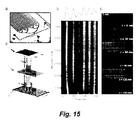
- FIGS. 15A-D illustrate radical synchronization on a macroscopic scale.
- a The scaled-up array is 24 mm ⁇ 12 mm and houses over 12,000 biopixels that contain approximately 50 million total cells when filled.
- b Global synchronization is maintained across the array. Heat map of individual trajectories of all 12,224 oscillating biopixels.
- c Image series depicting global synchronization and oscillation for the macroscopic array. Each image is produced by stitching 72 fields of view imaged at 34 magnification.
- d Schematic diagram illustrating our design for a handheld device using the sensing array. An LED (1) excites the array (2) and emitted light is collected by a photodetector (3), analysed by an onboard processor (4), and displayed graphically (5).
- FIG. 16 illustrates computational results depicting biopixel synchronicity as a function of trap separation distance. As biopixels are moved farther apart, the entropy increases due to decreased effective migration of H 2 O 2 between colonies.
- FIG. 17 illustrates a biosensor on a microscope slide connected to an output detection device.
- LCD liquid crystal display
- analyte of interest e.g., biomolecules, small organic and/or inorganic compounds, heavy metals, e.g., arsenic (arsenite), cadmium, mercury, lead
- an analyte of interest e.g., biomolecules, small organic and/or inorganic compounds, heavy metals, e.g., arsenic (arsenite), cadmium, mercury, lead
- analyte of interest e.g., biomolecules, small organic and/or inorganic compounds, heavy metals, e.g., arsenic (arsenite), cadmium, mercury, lead
- an analyte of interest e.g., biomolecules, small organic and/or inorganic compounds, heavy metals, e.g., arsenic (arsenite), cadmium, mercury, lead
- the amplitude and period of the oscillations both depend on the concentrations of the toxin.
- Our model predicts a marked transition from rest to oscillations upon addition of arsenite, consistent with experimental observations ( FIG. 12 c ).
- the present oscillating biosensors can coordinate more cells faster and over greater length scales than quorum sensing.
- Cell-cell communication solely by quorum sensing cannot coordinate isolated colonies.
- Quorum sensing is slower and operates on shorter distances than the present methods and biosensors.
- the present oscillating biosensors can coordinate between isolated colonies by gas-phase communication. Whereas quorum sensing coordinates cells locally, redox signaling, described herein, coordinates over long distances between colonies. These properties allow one to precisely and synergistically synchronize the behavior of millions of cells.
- biosensors include specicity, low cost, ease of use, and portability.
- field kits for arsenic cannot accurately measure concentrations at low enough concentrations, and they are also prone to false negative results (Rahman, et al., Environ. Sci. Technol , (2002) 36(24), 5385-5394).
- Conventional methods for heavy metal detection are precise but suffer from the disadvantages of high cost and lack of portability.
- the biosensors comprise colonies of cells capable of expressing the proteins encoded in the expression cassettes described herein, non-fluid (e.g., vapor phase) communication and producing oscillating output signals.
- the colonies of cells are substantially genetically identical, e.g., are of the same species and/or of the same strain.
- the colonies of host cells are microbial cells, bacterial cells, yeast cells, mammalian cells, insect cells, photosynthetic cells, or plant cells.
- the colonies of cells are bacterial cells, e.g., E. coli cells.
- the synchronized oscillator design is based on elements of the quorum sensing machineries in Vibrio fisheri and Bacillus Thurigensis .
- the luxI gene from V. fischeri
- aiiA gene from B. Thurigensis
- a fluorescent protein gene e.g., yemGFP
- the LuxI synthase enzymatically produces an acyl-homoserine lactone (AHL), which is a small molecule that can diffuse across the cell membrane and mediates intercellular coupling.
- AHL acyl-homoserine lactone
- the LuxR-AHL complex is a transcriptional activator for the luxI promoter (Waters and Bassler, Annu Rev Cell Dev Biol . (2005) 21:319-46).
- AiiA negatively regulates the promoter by catalyzing the degradation of AHL (Liu et al., Biochemistry , (2008) 47(29):7706-7714).
- TDQS1 synchronized oscillator cells
- microfluidic devices Cookson et al., Mol. Syst. Biol ., (2006) 1, msb4100032-E1-6
- the device used for monitoring the bulk oscillations comprises a main nutrient-delivery channel that feeds a rectangular trapping chamber. Once seeded, a monolayer of E. coli cells grow in the chamber and are eventually pushed into the channel where they then flow to the waste port.
- the biosensor devices described herein allow for a constant supply of nutrients or inducers and the maintenance of an exponentially growing colony of cells for more than four days.
- chamber sizes of 100 ⁇ (80-100) ⁇ m 2 are useful for monitoring the intercellular oscillator, because such chamber sizes allowed for sufficient nutrient distribution and increased cell and AHL densities.
- the flow rate can be modulated in order to change the local concentration of AHL.
- the synchronized oscillator cells exhibit stable synchronized oscillations which are easily discernible at the colony level.
- the dynamics of the oscillations can be understood as follows. Since AHL is swept away by the fluid flow and is degraded by AiiA internally, a small colony of individual cells cannot produce enough inducer to activate expression from the luxI promoter. However, once the population reaches a critical density, there is a “burst” of transcription of the luxI promoters, resulting in increased levels of LuxI, AiiA, and GFP. As AiiA accumulates, it begins to degrade AHL, and after a sufficient time, the promoters return to their inactivated state. The production of AiiA is then attenuated, which permits another round of AHL accumulation and another burst of the promoters.
- the colonies of cells in the biosensors comprise multiple expression cassettes, e.g., contained on one or multiple plasmids, or incorporated into the host cells's genome that allow for the production of an oscillating output signal in the presence of an analyte of interest above above a threshold or detection level.
- the expression cassettes expressed by the colonies of host cells in the biosensors will vary depending on whether one or multiple analytes are being detected, and whether signal output is turned on or changes in the presence of detectable analyte or analyte concentrations above the threshold concentration.
- one or more of the expression cassettes comprise one or more arcA binding sites positioned within about 150 bp, e.g., within about 140 bp, 130 bp, 120 bp, 115 bp, 110 bp, 100 bp, 95 bp, 90 bp, 85 bp, 80 bp, 75 bp, 70 bp, 65 bp, 60 bp, 55 bp, 50 bp, 45 bp, 40 bp, 35 bp, 30 bp, 25 bp, 20 bp, 15 bp, 10 bp, or 5 bp of a target gene or abutted to a target gene, e.g., a LuxR gene, a LuxI gene, and/or a nucleic acid encoding a protein that produces free radicals or oxygen reactive species (e.g., a fluorescent protein, e.g., GFP, YFP, CFP, rs-
- the one or more ArcA or ArcAB binding sites are positioned upstream or 5′ and within about 150 bp, e.g., within about 140 bp, 130 bp, 120 bp, 115 bp, 110 bp, 100 bp, 95 bp, 90 bp, 85 bp, 80 bp, 75 bp, 70 bp, 65 bp, 60 bp, 55 bp, 50 bp, 45 bp, 40 bp, 35 bp, 30 bp, 25 bp, 20 bp, 15 bp, 10 bp, or 5 bp of the target gene or abutted to the target gene
- An arcA site binds arcA, which is released by arcB in the presence of oxidative conditions (H 2 O 2 ).
- an arcA binding site is about 15-20 bp in length, e.g., about 15 bp, 16 bp, 17 bp, 18 bp, 19 bp or 20 bp in length, and comprises a nucleic acid sequence having substantial sequence identity, e.g., at least 90%, 91%, 92%, 93%, 94%, 95%, 96%, 97%, 98%, 99% or 100% sequence identity, to the nucleic acid sequence CAATTACTTAACATAAGC (SEQ ID NO:9).
- the expression cassettes are on one or multiple plasmids, e.g., 1, 2, 3, 4, or more plasmids.
- the expression cassettes are incorporated into the genome of the host cells.
- the response element promoter is selected from the group consisting of an arsenite response element (pArsR), a cadmium response element (yodA/cadA/cadR), a copper response element (copA/cueR), a mercury response element (merR), a cobalt response element, a lead response element, a zinc response element, a cyanide response element (CNO), a microcystin response element (mlrABCD), and an organophosphorus (OP) neurotoxin response element.
- pArsR arsenite response element
- yodA/cadA/cadR cadmium response element
- a copper response element copA/cueR
- merR mercury response element
- cobalt response element a lead response element
- a zinc response element a zinc response element
- CNO cyanide response element
- mlrABCD microcystin response element
- OP organophosphorus
- the arsenite response element (pArsR) or cadmium response element used in the illustrative examples can be replaced with another response element known in the art for detecting an analyte of interest, including the above listed response elements for detecting heavy metals and toxins.
- Response elements for detecting hormones and vitamins are also known in the art.
- the nucleic acid encoding a protein that produces free radicals or oxygen reactive species encodes a fluorescent protein.
- fluorescent proteins and their coding sequences are known in the art.
- Illustrative fluorescent proteins include, e.g., a green fluorescent protein, a yellow fluorescent protein, a cyan fluorescent protein, a red-shifted green fluorescent protein (rs-GFP), and miniSOG.
- the colonies of cells comprise expression cassettes designed to produce a threshold biosensor. Under this design, synchronized oscillating output signals are produced in the presence of analyte above a threshold concentration or above a concentration detected by the response element.
- colonies of cells in a threshold biosensor comprise the following expression cassettes:
- a nucleic acid encoding a protein that produces free radicals or oxygen reactive species (e.g., H 2 O 2 ) under the control of the luxI promoter, wherein the colonies of cells comprise a threshold sensor that produces an oscillating signal in the presence of concentrations of an analyte above a threshold concentration, wherein the analyte binds to the response element promoter.
- free radicals or oxygen reactive species e.g., H 2 O 2
- the colonies of cells comprise a set of expression cassettes comprising:
- nucleic acid encoding a protein that produces free radicals or oxygen reactive species under the control of the luxI promoter, wherein the biosensor detects arsenic.
- the colonies of cells comprise a set of expression cassettes comprising:
- a LuxR gene under the control of a cadmium response element (yodA/cadA/cadR);
- nucleic acid encoding a protein that produces free radicals or oxygen reactive species under the control of the luxI promoter, wherein the biosensor detects cadmium.
- the colonies of cells comprise a set of expression cassettes comprising:
- a LuxR gene under the control of a cadmium response element (yodA/cadA/cadR);
- the colonies of cells comprise a first expression cassette comprising at least 90% sequence identity, e.g., at least 91%, 92%, 93%, 94%, 95%, 96%, 97%, 98%, 99% or 100% sequence identity, to nucleic acid residues 27-756 of SEQ ID NO:1, a second expression cassette comprising at least 90% sequence identity, e.g., at least 91%, 92%, 93%, 94%, 95%, 96%, 97%, 98%, 99% or 100% sequence identity, to nucleic acid residues 901-1744 of SEQ ID NO:1, a third expression cassette comprising at least 90% sequence identity, e.g., at least 91%, 92%, 93%, 94%, 95%, 96%, 97%, 98%, 99% or 100% sequence identity, to nucleic acid residues 10-913 of SEQ ID NO:2, and a fourth expression cassette comprising at least 90% sequence identity, e.g., at least 91%, 92%, 93%
- the colonies of cells comprise a first plasmid comprising at least 90% sequence identity, e.g., at least 91%, 92%, 93%, 94%, 95%, 96%, 97%, 98%, 99% or 100% sequence identity, to SEQ ID NO:1, a second plasmid comprising at least 90% sequence identity, e.g., at least 91%, 92%, 93%, 94%, 95%, 96%, 97%, 98%, 99% or 100% sequence identity, to SEQ ID NO:2, and a third plasmid comprising at least 90% sequence identity, e.g., at least 91%, 92%, 93%, 94%, 95%, 96%, 97%, 98%, 99% or 100% sequence identity, to SEQ ID NO:3, wherein the biosensor detect arsenic.
- the colonies of cells comprise a first expression cassette comprising at least 90% sequence identity, e.g., at least 91%, 92%, 93%, 94%, 95%, 96%, 97%, 98%, 99% or 100% sequence identity, to nucleic acid residues 27-756 of SEQ ID NO:1, a second expression cassette comprising at least 90% sequence identity, e.g., at least 91%, 92%, 93%, 94%, 95%, 96%, 97%, 98%, 99% or 100% sequence identity, to nucleic acid residues 901-1744 of SEQ ID NO:1, a third expression cassette comprising at least 90% sequence identity, e.g., at least 91%, 92%, 93%, 94%, 95%, 96%, 97%, 98%, 99% or 100% sequence identity, to nucleic acid residues 10-913 of SEQ ID NO:2, and a fourth expression cassette comprising at least 90% sequence identity, e.g., at least 91%, 92%, 93%
- the colonies of cells comprise a first plasmid comprising at least 90% sequence identity, e.g., at least 91%, 92%, 93%, 94%, 95%, 96%, 97%, 98%, 99% or 100% sequence identity, to SEQ ID NO:1, a second plasmid comprising at least 90% sequence identity, e.g., at least 91%, 92%, 93%, 94%, 95%, 96%, 97%, 98%, 99% or 100% sequence identity, to SEQ ID NO:2, and a third plasmid comprising at least 90% sequence identity, e.g., at least 91%, 92%, 93%, 94%, 95%, 96%, 97%, 98%, 99% or 100% sequence identity, to SEQ ID NO:7, wherein the biosensor detects cadmium.
- a first plasmid comprising at least 90% sequence identity, e.g., at least 91%, 92%, 93%, 94%, 95%, 96%, 97%, 98%, 99% or
- the colonies of cells comprise a first expression cassette comprising at least 90% sequence identity, e.g., at least 91%, 92%, 93%, 94%, 95%, 96%, 97%, 98%, 99% or 100% sequence identity, to nucleic acid residues 27-756 of SEQ ID NO:1, a second expression cassette comprising at least 90% sequence identity, e.g., at least 91%, 92%, 93%, 94%, 95%, 96%, 97%, 98%, 99% or 100% sequence identity, to nucleic acid residues 901-1744 of SEQ ID NO:1, a third expression cassette comprising at least 90% sequence identity, e.g., at least 91%, 92%, 93%, 94%, 95%, 96%, 97%, 98%, 99% or 100% sequence identity, to nucleic acid residues 10-913 of SEQ ID NO:2, and a fourth expression cassette comprising at least 90% sequence identity, e.g., at least 91%, 92%, 93%
- the colonies of cells comprise a first plasmid comprising at least 90% sequence identity, e.g., at least 91%, 92%, 93%, 94%, 95%, 96%, 97%, 98%, 99% or 100% sequence identity, to SEQ ID NO:1, a second plasmid comprising at least 90% sequence identity, e.g., at least 91%, 92%, 93%, 94%, 95%, 96%, 97%, 98%, 99% or 100% sequence identity, to SEQ ID NO:2, and a third plasmid comprising at least 90% sequence identity, e.g., at least 91%, 92%, 93%, 94%, 95%, 96%, 97%, 98%, 99% or 100% sequence identity, to SEQ ID NO:8, wherein the biosensor detects cadmium, zinc and mercury.
- the colonies of cells comprise a first expression cassette comprising at least 90% sequence identity to nucleic acid residues 27-756 of SEQ ID NO:1, a second expression cassette comprising at least 90% sequence identity to nucleic acid residues 901-1744 of SEQ ID NO:1, a third expression cassette comprising at least 90% sequence identity to nucleic acid residues 10 913 of SEQ ID NO:2, a fourth expression cassette comprising at least 90% sequence identity to nucleic acid residues 7-1366 of SEQ ID NO:3, and a fifth expression cassette comprising at least 90% sequence identity to nucleic acid residues 7-788 of SEQ ID NO:7, wherein the biosensor detects arsenic and cadmium.
- the colonies of cells comprise a first plasmid comprising at least 90% sequence identity to SEQ ID NO:1, a second plasmid comprising at least 90% sequence identity to SEQ ID NO:2, a third plasmid comprising at least 90% sequence identity to SEQ ID NO:3, and a fourth plasmid comprising at least 90% sequence identity to SEQ ID NO:7, wherein the biosensor detects arsenic and cadmium.
- the colonies of cells comprise a first expression cassette comprising at least 90% sequence identity, e.g., at least 91%, 92%, 93%, 94%, 95%, 96%, 97%, 98%, 99% or 100% sequence identity, to nucleic acid residues 27-756 of SEQ ID NO:1, a second expression cassette comprising at least 90% sequence identity, e.g., at least 91%, 92%, 93%, 94%, 95%, 96%, 97%, 98%, 99% or 100% sequence identity, to nucleic acid residues 901-1744 of SEQ ID NO:1, a third expression cassette comprising at least 90% sequence identity, e.g., at least 91%, 92%, 93%, 94%, 95%, 96%, 97%, 98%, 99% or 100% sequence identity, to nucleic acid residues 10-913 of SEQ ID NO:2, a fourth expression cassette comprising at least 90% sequence identity, e.g., at least 91%, 92%, 93%,
- the colonies of cells comprise a first plasmid comprising at least 90% sequence identity, e.g., at least 91%, 92%, 93%, 94%, 95%, 96%, 97%, 98%, 99% or 100% sequence identity, to SEQ ID NO:1, a second plasmid comprising at least 90% sequence identity, e.g., at least 91%, 92%, 93%, 94%, 95%, 96%, 97%, 98%, 99% or 100% sequence identity, to SEQ ID NO:2, a third plasmid comprising at least 90% sequence identity, e.g., at least 91%, 92%, 93%, 94%, 95%, 96%, 97%, 98%, 99% or 100% sequence identity, to SEQ ID NO:3, and a fourth plasmid comprising at least 90% sequence identity, e.g., at least 91%, 92%, 93%, 94%, 95%, 96%, 97%, 98%, 99% or 100% sequence identity, to SEQ ID NO:1,
- the colonies of cells comprise expression cassettes designed to produce a period modulation biosensor.
- changed synchronized oscillating output signals e.g., increased amplitude and period
- colonies of cells in a period modulation biosensor comprise the following expression cassettes:
- acyl-homoserine lactone (AHL) synthase LuxI gene under the control of a response element promoter
- a LuxR gene under the control of a luxR promoter and a nucleic acid encoding a protein that produces free radicals or oxygen reactive species (e.g., H 2 O 2 ) under the control of a luxI promoter;
- the colonies of cells comprise a period modulation sensor that produces a changed oscillating signal in the presence of concentrations of an analyte above a threshold concentration, wherein the analyte binds to the response element promoter.
- the changed oscillating signal comprises increased oscillatory amplitude and period.
- the cells comprise a set of expression cassettes comprising:
- acyl-homoserine lactone AHL
- pArsR arsenite response element
- a LuxR gene under the control of a luxR promoter and a nucleic acid encoding a protein that produces free radicals or oxygen reactive species under the control of a luxI promoter;
- the cells comprise a set of expression cassettes comprising:
- acyl-homoserine lactone AHL synthase LuxI gene under the control of a cadmium response element (yodA/cadA/cadR);
- a LuxR gene under the control of a luxR promoter and a nucleic acid encoding a protein that produces free radicals or oxygen reactive species under the control of a luxI promoter;
- the cells comprise a set of expression cassettes comprising:
- acyl-homoserine lactone AHL
- pArsR arsenite response element
- acyl-homoserine lactone AHL synthase LuxI gene under the control of a cadmium response element (yodA/cadA/cadR);
- a LuxR gene under the control of a luxR promoter and a nucleic acid encoding a protein that produces free radicals or oxygen reactive species under the control of a luxI promoter;
- the colonies of cells comprise a first expression cassette comprising at least 90% sequence identity, e.g., at least 91%, 92%, 93%, 94%, 95%, 96%, 97%, 98%, 99% or 100% sequence identity, to nucleic acid residues 7-1795 of SEQ ID NO:4, a second expression cassette comprising at least 90% sequence identity, e.g., at least 91%, 92%, 93%, 94%, 95%, 96%, 97%, 98%, 99% or 100% sequence identity, to nucleic acid residues 1895-3488 of SEQ ID NO:4, a third expression cassette comprising at least 90% sequence identity, e.g., at least 91%, 92%, 93%, 94%, 95%, 96%, 97%, 98%, 99% or 100% sequence identity, to nucleic acid residues 10-1771 of SEQ ID NO:5, and a fourth expression cassette comprising at least 90% sequence identity, e.g., at least 91%, 92%, 9
- the colonies of cells comprise a first plasmid comprising at least 90% sequence identity, e.g., at least 91%, 92%, 93%, 94%, 95%, 96%, 97%, 98%, 99% or 100% sequence identity, to SEQ ID NO:4, a second plasmid comprising at least 90% sequence identity, e.g., at least 91%, 92%, 93%, 94%, 95%, 96%, 97%, 98%, 99% or 100% sequence identity, to SEQ ID NO:5, and a third plasmid comprising at least 90% sequence identity, e.g., at least 91%, 92%, 93%, 94%, 95%, 96%, 97%, 98%, 99% or 100% sequence identity, to SEQ ID NO:6.
- the colonies of cells further comprise an expression cassette comprising at least 90% sequence identity, e.g., at least 91%, 92%, 93%, 94%, 95%, 96%, 97%, 98%, 99% or 100% sequence identity, to nucleic acid residues 1-641 of SEQ ID NO:10, wherein the biosensor further detects arsenic and cadmium.
- the colonies of cells further comprise comprising an expression cassette comprising at least 90% sequence identity, e.g., at least 91%, 92%, 93%, 94%, 95%, 96%, 97%, 98%, 99% or 100% sequence identity, to nucleic acid residues 1-643 of SEQ ID NO:11, wherein the biosensor further detects arsenic, cadmium, zinc and mercury.
- the colonies of cells further comprise a plasmid comprising at least 90% sequence identity, e.g., at least 91%, 92%, 93%, 94%, 95%, 96%, 97%, 98%, 99% or 100% sequence identity, to SEQ ID NO:10, wherein the biosensor further detects arsenic and cadmium.
- the colonies of cells further comprise a plasmid comprising at least 90% sequence identity, e.g., at least 91%, 92%, 93%, 94%, 95%, 96%, 97%, 98%, 99% or 100% sequence identity, to SEQ ID NO:11, wherein the biosensor further detects arsenic, cadmium, zinc and mercury.
- the colonies of cells comprise a first expression cassette comprising at least 90% sequence identity, e.g., at least 91%, 92%, 93%, 94%, 95%, 96%, 97%, 98%, 99% or 100% sequence identity, to nucleic acid residues 7-1795 of SEQ ID NO:4, a second expression cassette comprising at least 90% sequence identity, e.g., at least 91%, 92%, 93%, 94%, 95%, 96%, 97%, 98%, 99% or 100% sequence identity, to nucleic acid residues 1895-3488 of SEQ ID NO:4, a third expression cassette comprising at least 90% sequence identity, e.g., at least 91%, 92%, 93%, 94%, 95%, 96%, 97%, 98%, 99% or 100% sequence identity, to nucleic acid residues 10-1771 of SEQ ID NO:5, and a fourth expression cassette comprising at least 90% sequence identity, e.g., at least 91%, 92%, 9
- the colonies of cells comprise a first plasmid comprising at least 90% sequence identity, e.g., at least 91%, 92%, 93%, 94%, 95%, 96%, 97%, 98%, 99% or 100% sequence identity, to SEQ ID NO:4, a second plasmid comprising at least 90% sequence identity, e.g., at least 91%, 92%, 93%, 94%, 95%, 96%, 97%, 98%, 99% or 100% sequence identity, to SEQ ID NO:5, and a third plasmid comprising at least 90% sequence identity, e.g., at least 91%, 92%, 93%, 94%, 95%, 96%, 97%, 98%, 99% or 100% sequence identity, to SEQ ID NO:10 or at least 91%, 92%, 93%, 94%, 95%, 96%, 97%, 98%, 99% or 100% sequence identity, to SEQ ID NO:11.
- the expression cassettes can also include termination sequences appropriate to the host cells.
- the expression cassettes can be inserted into a vector (e.g., a plasmid, a viral vector) for expression in an appropriate host cell.
- the expression cassettes can be incorporated into the genome of the host cells.
- sequences for replication, copy number and selection e.g., antiobiotic resistance genes
- Components of plasmid expression vectors are known in the art and plasmid expression vectors for a variety of host cells, including bacterial cells, yeast cells, algae cells, plant cells, mammalian cells, and insect cells, are commercially available.
- the expression cassettes are incorporated into a plasmid vector for expression in bacterial cells, e.g., E. coli cells.
- the biosensor circuits created by different assemblies and configurations of the expression cassettes can be readily configured according to the analyte intended to be detected.
- One or multiple plasmids comprising a set of expression cassettes that create a biological circuit with frequency modulated output can be readily designed and assemble to a desired purpose, e.g., using the modular plasmid system described in Lutz and Bujard (Nucleic Acids Res., (1997) 25(6), 1203-10).
- known response elements and response element promoters can be used in the biosensors to detect an analyte of interest.
- the arsR promoter of E. coli fused to a reporter gene can be used to detect arsenic (Stocker, et al., Environmental Science & Technology, (2003) 37(20):4743-4750).
- the E. coli merR gene can be employed and a truncated version of the merT gene fused to a reporter (Lyngberg, et al., J Ind Microbiol Biotechnol , (1999) 23(1):668-676).
- the pSLzntR/pDNPzntA—reporter system can be used (Ivask, et al., BMC Biotech (2009) 9:41).
- organophosphorus (OP) neurotoxins a group which includes both common pesticides and nerve agents such as VX and sarin (Mulchandani and Rajesh., Appl Biochem Biotechnol , (2011) 165(2):687-699; Rainina, et al., Biosens Bioelectron , (1996) 11(10):991-1000). Due to their wide distribution throughout the world as industrial and agricultural chemicals, they have long been viewed as potential weapons by terrorist groups [Gleick. Water Policy , (2006) 8(6):481-503; Hickman, Technical report, Air University Press Maxwell AFB, AL 36112-6615, 1999]. An E.
- coli strain expressing the organophosphorus hydrolase (OPH) gene of Flavobacterium sp. ATCC 27551 e.g., as described in [Rainina, et al., Biosens Bioelectron , (1996) 11(10):991-1000], can be used.
- This enzyme hydrolyzes a large group of OP compounds including sarin, VX and pesticides such as paraoxon [Rainina, et al., supra].
- RNA-seq can be employed to find genes induced upon OP hydrolysis to generate signaling inputs for the classifier.
- toxins arise from cyanobacteria blooms which are becoming more common across the globe. Cyanobacteria of various genera, especially Microcystis, can produce cyclic heptapeptide toxins known as microcystins [States, et al., Journal American Water Works Association , (2003) 95(4):103-115]. These toxins promote tumors and can cause death by liver haemorrhage and respiratory arrest [Codd, Ecological Engineering , (2000) 16(1):51-60, 2000; Pouria, et al., Lancet , (1998) 352(9121):21-26]. To detect microcystins, the mlrABCD genes of Sphingomonas sp.
- cyanide oxygenase gene of the bacterium Pseudomonas fluorescens NCIMB 11764 can be expressed (e.g., in E. coli ), and genes differentially expressed in response to cyanide exposure can be detected.
- Novel genetic outputs responding to toxin exposure can be readily discovered, e.g., using RNA-seq technology.
- E. coli cells can be exposed to a toxin of interest and the expression profiles of induced genes to control cultures can be compared.
- Total RNA is extracted from the cell cultures and enrich for mRNA (van Vliet, FEMS Microbiol Lett , (2010) 302(1):1-7).
- Random hexamer primers can be used to produce cDNA.
- cDNA can be sequenced using any method known in the art, e.g., an Illumina MySeq machine and the data set can be analyzed using any appropriate available analytical software, e.g., the EDENA program [Croucher and Thomson., Curr Opin Microbiol , (2010) 13(5):619-624). Genes differentially expressed in response to toxin exposure are determined and used as signals for the classifier. Since the whole transcriptome is being scanned with this technique multiple potential outputs for each toxin can be identified, facilitating the selectivity of the sensor. RNA-seq technology can be combined with known response promoters to detect heavy metals.
- Any analyte which E. coli responds to can be detected using the presently designed biosensors (e.g., by switching the response element promoter).
- suites of promoters can be identified that make up a vector-based “promoter signature” using next-gen sequencing.
- Such analytes include without limitation heavy metals, bacterially metabolizable compounds, and other compounds, depending on the response.
- Pathogenic bacteria can also be readily detected since they use quorum-sensing as well, by switching the quorum-sensing response element in the presently described circuits.
- Biosensors offer a convenient, rapid, specific and sensitive means of monitoring analytes and of reporting the presence of specific toxins, generally producing a signal which proportional to concentration (Morris, Cell Biochemistry and Biophysics , (2010) 56(1), 19-37).
- Several whole-cell bacterial biosensors for arsenic have been described in the literature (Tauriainen, et al., Applied and Environmental Microbiology , (1997) 63(11):4456; Scott, et al., Anal. Chem , (1997) 69(1), 16-20; Ramanathan, et al., Anal. Chem , (1997) 69(16), 3380-3384.), which typically employ nonpathogenic laboratory strains of E. coli , the natural resistance mechanism of E. coli against arsenite and arsenate, and reporter proteins (Stocker, et al., Environ. Sci. Technol, (2003) 37(20):4743-4750).
- biosensors typically employ the natural resistance mechanism of bacteria against arsenic, encoded by the ars operon (Kaur and Rosen, Plasmid , (1992) 27(1):29-40).
- the ArsR repressor binds to its operator/promotor site within the ars operon and prevents further expression of itself and the downstream genes (Rosen, Journal Of Basic And Clinical Physiology And Pharmacology , (1995) 6(3-4):251).
- arsenite enters the cell, it interacts with ArsR, causing a conformational change, dissociation of the ArsR protein from its operator, and expression of the ars genes. Therefore, one approach is to perform arsenite measurements using genetically engineered bacterial cells, which produce a fluorescent protein under control of the ArsR regulatable promoter.
- Some bacteria have natural metal resistance operons, such as the cadmium resistance system, CadA, of Pseudomonas putida , which is regulated by cadR (Lee, et al., Applied and Environmental Microbiology , (2001) 67(4):1437).
- CadA cadmium resistance system
- cadR Lee, et al., Applied and Environmental Microbiology , (2001) 67(4):1437.
- the precise regulation of these genes has been used to engineer sensor bacteria, in which the regulatory element controls the expression of a reporter gene.
- an E. coli strain was engineered to express red-shifted green fluorescent protein (rs-GFP) under control of CadC, the regulatory protein of the cad operon in Staphylococcus aureus (Shetty, et al., Analytical And Bioanalytical Chemistry , (2003) 376(1):11-17).
- the reporter protein was produced proportionally to the amount of cadmium and lead used to induce the bacteria, and the bacterial sensing systems were found to respond to cadmium, lead, and zinc ions but had no significant response to other metals.
- a similar system was constructed by another group, which used the regulation unit from the CadA system to control the expression of firefly luciferase. The response to extracellular heavy metals was studied in several bacteria, and specificity was generally an issue (Tauriainen et al., Biosensors and Bioelectronics , (1998) 13(9):931-938).
- the biosensors described herein can be used for the development of a genetic classifier integrated with a frequency modulated (FM) output circuit.
- a classifier is a system that uses multiple inputs to successfully discriminate between at least two possible outcomes; analyte levels that are above or below a predetermined threshold level (e.g. dangerous vs. acceptable levels of toxins).
- a predetermined threshold level e.g. dangerous vs. acceptable levels of toxins.
- One feature of a classifier is the ability to train based on presented examples. In designs described herein, during training and operation, the levels of chemical inducers that shift the dynamic range and the output threshold of the classifier can be continuously computed and altered within the microfluidic device in an iterative feedback fashion.
- the synthetic classifier can be tightly integrated with the synthetic gene oscillator as a frequency-modulated output element [Danino, et al., Nature , (2010) 463(7279):326-330; Prindle, et al., Nature , (2011) 481(7379):39-44, both of which are hereby incorporated herein by reference in their entirety for all purposes].
- the system can be trained so that the biopixels will produce periodic pulses of H 2 O 2 for the levels of toxins above a pre-defined threshold and remain silent below it.
- concentrations of chemical inducers that directly affect the input oscillator sensitivity to toxin-reporting proteins can be shifted.
- the devices generally comprise cell colonies capable of synchronized communication (e.g., via gas phase) within a microfluidic array.
- the colonies or populations of cells within the biosensors allow for synchronization of 2.5 million or more cells, e.g., 3, 3.5, 4, 4.5 or 5 million cells, across a distance of at least 5 mm, e.g., 5.5 mm, 6.0 mm, 6.5 mm, 7.0 mm, 7.5 mm, or longer.
- microfluidic-based biosensors which have the capability to detect analytes of interest, including, e.g., sub-lethal quantities of heavy metals (e.g., mercury, arsenic, cadmium, zinc, lead and others listed herein), organophosphate based nerve agents and pesticides, cyanobacterial toxins (e.g., microcystin and cyanide).
- the biosensor device can be readily designed and configured to detect other analytes of interest, e.g., using next generation sequencing technologies.
- E. coli can be used as the cellular platform. While E. coli is not generally found in unpolluted natural waters, the design of the present microfluidic devices ensures that the E.
- the mass transfer from the influent sample stream to the cell chambers is substantially completely or solely due to diffusion, preventing these cells from contacting viruses, bacteria and protozoa that are responsible for eliminating E. coli in natural waters.
- the device described herein can be designed to be contained in a small, temperature controlled enclosure, preventing exposure to damaging UV radiation.
- the sensor design can incorporate miniaturized redox electrodes patterned directly on-chip in the biopixel array.
- the resulting “bacto-electronic” sensor converts environmental stimuli to electrical current via a programmable biological intermediate.
- Electronic detection of H 2 O 2 has previously been performed in microfluidic devices [Yan, et al., Biomicrofluidics , (2011) 5(3):032008; Ikariyama, et al., Journal of Electroanalytical Chemistry and Interfacial Electrochemistry , (1988) 251(2):267-274; Ino, et al., Biosensors and Bioelectronics , (2010) 25(7):1723-1728], usually with an enzyme catalyst such as horseradish peroxidase (HRP), to detect concentrations as low as 1 ⁇ M H 2 O 2 .
- HRP horseradish peroxidase
- the composition of the working electrode can comprise designs including micropatterned gold [Yan, et al., supra], platinum black [Ikariyama, et al., supra], or indium-tin-oxide coated with conductive polymer [Lei, et al., Analytica Chimica Acta , (2006) 568(1):200-210]. Platinum [Jones. Applications of hydrogen peroxide and derivatives, Volume 2 of Rsc Clean Technology Monographs. Royal Society of Chemistry, 1999] and palladium electrodes are electrocatalytic, meaning HRP is not needed; however, oxide formation decreases electrode performance over time [Gilroy and Conway, Canadian Journal of Chemistry , (1968) 46(6):875-890, 1968].
- Evaporative deposition and etching can be employed to deposit platinum black electrodes on a silicon substrate. This process employs similar equipment to the photolithography method used in constructing a variety of microfluidic devices, and can be performed simultaneously.
- H 2 O 2 in bulk solution can be detected using an off-the-shelf oxidation-reduction potential (ORP) probe system.
- ORP off-the-shelf oxidation-reduction potential
- H 2 O 2 was detected at concentrations as low as 100 nM, which is improved over a previously described bacterial H 2 O 2 output in excess of 1 mM with the spxB gene [Pericone, et al., Journal of Bacteriology , (2003) 185(23):6815-6825].
- the microfluidic arrays fit on a chip the size of a standard microscope slide or smaller.
- the slower quorum sensing can be used to synchronize small local colonies, provided there is a second level of design that involves faster communication for coordination between the colonies. Therefore, rather than attempting to engineer a sensor from a single large-colony oscillator, we wired together thousands of small oscillating colonies, or ‘biopixels’, in a microfluidic array. Coupling between biopixels involves redox signalling by hydrogen peroxide (H 2 O 2 ) and the native redox sensing machineries of E. coli . The two coupling mechanisms act synergistically in the sense that the stronger, yet short-range, quorum sensing is necessary to coherently synchronize the weaker, yet long-range, redox signalling.
- H 2 O 2 hydrogen peroxide
- the global synchronization mechanism is comprised of two modes of communication that work on different scales.
- the quorum-sensing machinery (LuxI, AiiA) uses an acyl-homoserine lactone (AHL) to mediate intracolony synchronization.
- AHL acyl-homoserine lactone
- our degree to which neighboring colonies are able to influence each other via AHL diffusion is negligible owing to the high media channel flow rates.
- NDH-2 is a membrane-bound respiratory enzyme that produces low levels of H 2 O 2 and superoxide (O 2 2 ) (Messner, et al., J. Biol. Chem . (1999) 274:10119-10128).
- O 2 2 superoxide
- PDMS polydimethylsiloxane
- periodic production of NDH-2 yields periodic exchange of H 2 O 2 between biopixels.
- H 2 O 2 enters the cell it transiently changes its redox state, interacting with our synthetic circuit through the native aerobic response control systems, including ArcAB, which has a binding site in the lux promoter region (Bose, et al., Mol.
- the GFP molecule acts as a photosensitizer, releasing free radicals upon exposure that produce reactive oxygen species (ROS) including H 2 O 2 (Remington, et al., Curr. Opin. Struct. Biol . (2006) 16:714-721).
- ROS reactive oxygen species
- H 2 O 2 reactive oxygen species
- Bursts of light thus generate bursts of H 2 O 2 vapor whose concentration depends on the oscillating GFP level, just as periodic production of NDH-2 did previously. Indeed, this strategy was similarly able to synchronize our sensor array ( FIG. 1 d ). Numerous controls were performed to ensure that synchronized oscillations did not occur at low fluorescence intensities ( FIG. 8 ).
- the sensing array is also capable of producing complex behaviors arising from the dynamic interaction of cellular colonies.
- By making modifications to the size, number and arrangement of biopixels in the device we are able to markedly alter the output waveforms. For example, when we constructed a device in which trap separation distance is increased (45 mm versus 25 mm), we observed local anti-phase synchronization between neighboring colonies ( FIG. 12 d , top right). To explore this phenomenon on a larger scale, we constructed a device that contains an array of 416 traps constructed according to the specifications above. In these experiments, we observe initial global synchronization that gradually falls into local anti-phase synchronization across the array ( FIG. 12 d , middle).
- Phase alignment is maintained over at least 48 h, with patches of synchronization typically 3-6 colonies in size.
- patches of synchronization typically 3-6 colonies in size.
- FIG. 12 d top left.
- FIG. 13 synchronized oscillations of alternating large and small peaks in both experiment and model.
- Our computational model captures these effects ( FIG. 12 d , bottom, and FIGS. 14 and 13 ) and indicates that further array manipulation will yield new, richer dynamics that could not be produced directly by changing circuit structure.
- oscillations produced at the colony level effectively decouple the signal from the growth state of individual cells, which can also affect fluorescence intensity.
- a dynamic readout that depends on communication between biopixels, we scan and tune potential output signals by changing device parameters rather than redesigning the underlying circuit.
- a new sensing scheme could be designed in which oscillations synchronize with the addition of some toxin and shift to anti-phase or resonant synchronization when critical toxin levels are present.
- the plasmids were constructed using a PCR-based cloning strategy (Quan, et al., PLoS ONE (2009) 4:e6441) in which the origin of replication, antibiotic resistance, and circuit genes were assembled in different combinations.
- the ndh and sodA genes were amplified directly from the native E. coli genome by PCR.
- Various arsenite-responsive promoters were tested, including a recently reported synthetic version (Stocker, et al., Environ. Sci. Technol. (2003) 37:4743-4750), but the final design uses the native E. coli version. Promoter output was tuned by changing the RBS sequence and quantified using flow cytometry.
- Image acquisition was performed on a Nikon Eclipse TI epifluorescent inverted microscope outfitted with fluorescence filter cubes optimized for GFP imaging and a phase-contrast-based autofocus algorithm. Images were acquired using an Andor Clara cooled CCD camera or Andor DU-897 EMCCD camera, both controlled by Nikon Elements software. Images were acquired every 2 min in phase contrast and fluorescence. The cells were imaged inside a microfluidic device with an upstream switch, with the ability to mix or switch between two different media sources. A custom application written in LabVIEW (National Instruments) controlled linear actuators, to which two reservoirs of arsenite-containing and pure medium were attached. Using this algorithm, arsenite concentration was dynamically varied to probe sensor output.
- the oscillator plasmids were constructed by modifying the constructs used in a previous study (Danino, et al., Nature (2010) 463, 326-330).
- the antibiotic resistance genes of pTD103AiiA was switched to chloramphenicol.
- the reporter protein on pTD103LuxI/GFP was switched to a recently reported superfolding green fluorescent protein, sfGFP (Pedelacq, et al., Nature Biotechnology (2006) 24, 79-88).
- the ndh and sodA genes were amplified directly from the native E. coli genome by PCR. Promoter output was tuned by changing the RBS sequence and quantified using flow cytometry.
- Modular pieces were assembled using a PCR-based cloning scheme named CPEC (Quan, J. and Tian, J., PloS one (2009) 4, e6441).
- Fluorescence data was obtained by importing fluorescent images into ImageJ and subtracting cell signal from background signal. Oscillatory period was taken to be the average of peak-to-peak and trough-to-trough distance, calculated using a MATLAB script.
- the data represented in FIGS. 1 d and 11 b - d were collected by stitching 4 images taken at 4 ⁇ magnification. The mean trajectory in FIG. 1 d was found by averaging 373 individual biopixel trajectories, of which 20 are shown. Biopixel trajectories were extracted from image series using a MATLAB script, where a bright field image of the corresponding array was used to generate a mask.
- the data shown in FIG. 11 c was measured over 4 separate experiments using 10-30 oscillatory periods per data point.
- E. coli cells are loaded from the cell port while keeping the media port at sufficiently higher pressure than the waste port below to prevent contamination ( FIG. 10 ).
- Cells were loaded into the cell traps by manually applying pressure pulses to the lines to induce a momentary flow change. The flow was then reversed and allowed for cells to receive fresh media with 0.075% Tween which prevented cells from adhering to the main channels and waste ports.
- Tween 0.075% Tween which prevented cells from adhering to the main channels and waste ports.
- the trap dimensions were 100 ⁇ m ⁇ 85 ⁇ m ⁇ 1.65 ⁇ m high, which we previously found to be useful for oscillator function, except when size was varied to study dynamic interactions. Spacing between traps was 25 ⁇ m, except in devices designed to study the effects of increasing separation distance between traps.
- For sensor array devices we constructed 500 and 12,000 trap arrays as well as a tandem device which holds two 150 trap arrays in close proximity (25 ⁇ m) without sharing fluid sources or sinks.
- I . C I ⁇ [ 1 - ( d / d 0 ) 4 ] ⁇ G ⁇ ( ⁇ , ⁇ ) + ⁇ c ⁇ A ( A 0 + A ) - ⁇ I ⁇ I ( 1 + f ⁇ ( A + I ) ( 7 )
- Arsenic levels were swept across the dynamic range of the arsenic promoter to produce the curve in FIG. 11 c .
- the period for each arsenic level was calculated from the peak-to-peak average of 15 oscillatory periods.
- X . i , j ⁇ ⁇ ( 1 + v ⁇ ⁇ P i , j , ⁇ 2 ) ( 1 + x i , j , ⁇ 1 C 0 ) 2 - ⁇ ⁇ ⁇ X i , j k + X i , j ( 8 ) describes oscillations of individual biopixel (i,j) as a combined effect of production and delayed autorepression (first term in the r.h.s.) of the colon-averaged LuxI concentration X i,j and its enzymatic degradation by ClpXP (second term). Unlike (6), the first (production) term is Eq.
- the last term models the spatial coupling of neighboring biopixels via the H 2 O 2 exchange.
- ⁇ ( p i,j ) D ⁇ ⁇ 2 [P i ⁇ 1,j +P i+1,j +P i,j ⁇ 1 +P i,j+ ⁇ 4 P i,j ] (10)
- Each colony is affected by the H 2 O 2 produced in for neighboring colonies, two in each dimension of the array, separated by the equal distance ⁇ .
- the diffusion operator above can be generalized if the row spacing differs from the column spacing, or for other spatial arrangements of colonies within the biosensor.
- the model was also able to capture the alternating large and small amplitude oscillations observed in the ON/OFF biosensor ( FIG. 14 ). This behavior was seen when C 0 was increased 2-fold, capturing the decreased level of LuxR in ON/OFF experiments where it was the limiting factor for oscillations.
Landscapes
- Life Sciences & Earth Sciences (AREA)
- Chemical & Material Sciences (AREA)
- Health & Medical Sciences (AREA)
- Engineering & Computer Science (AREA)
- Organic Chemistry (AREA)
- Genetics & Genomics (AREA)
- Zoology (AREA)
- Wood Science & Technology (AREA)
- General Health & Medical Sciences (AREA)
- Microbiology (AREA)
- Physics & Mathematics (AREA)
- Biochemistry (AREA)
- Biotechnology (AREA)
- Proteomics, Peptides & Aminoacids (AREA)
- Bioinformatics & Cheminformatics (AREA)
- General Engineering & Computer Science (AREA)
- Immunology (AREA)
- Analytical Chemistry (AREA)
- Biophysics (AREA)
- Molecular Biology (AREA)
- Biomedical Technology (AREA)
- Food Science & Technology (AREA)
- Medicinal Chemistry (AREA)
- General Physics & Mathematics (AREA)
- Pathology (AREA)
- Plant Pathology (AREA)
- Micro-Organisms Or Cultivation Processes Thereof (AREA)
- Measuring Or Testing Involving Enzymes Or Micro-Organisms (AREA)
Abstract
Description
in which the LuxR expression from the arsenic promoter follows a standard saturating function of the arsenic concentration A. Accordingly, we modified the Hill function for Lux promoter to include the explicit dependence on R:
describes oscillations of individual biopixel (i,j) as a combined effect of production and delayed autorepression (first term in the r.h.s.) of the colon-averaged LuxI concentration Xi,j and its enzymatic degradation by ClpXP (second term). Unlike (6), the first (production) term is Eq. 8 describes both delayed auto-repression of LuxI and its delayed activation by H2O2 proportional to its local concentration Pi,j. Subscripts r1 and r2 indicate the delayed concentrations, Xi,j,r
P i,j=μ+αp X i,j−γp P i,j +S(P i,j) (9)
where the first three terms describe the basal and induced production and degradation of H2O2. The last term models the spatial coupling of neighboring biopixels via the H2O2 exchange. For a square N×N array of traps, we used for the following discrete diffusion form of the spatial operator,
Ŝ(p i,j)=DΔ −2 [P i−1,j +P i+1,j +P i,j−1 +P i,j+−4P i,j] (10)
Each colony is affected by the H2O2 produced in for neighboring colonies, two in each dimension of the array, separated by the equal distance Δ. We used the boundary condition Pi,j=0 for the edge of the array i,j=0, N+1. This represents the infinite external sink of H2O2 diffusing out of the microfluidic chip. The diffusion operator above can be generalized if the row spacing differs from the column spacing, or for other spatial arrangements of colonies within the biosensor.
Claims (45)
Priority Applications (1)
| Application Number | Priority Date | Filing Date | Title |
|---|---|---|---|
| US14/364,207 US9500636B2 (en) | 2011-12-16 | 2012-12-14 | Multiscale platform for coordinating cellular activity using synthetic biology |
Applications Claiming Priority (3)
| Application Number | Priority Date | Filing Date | Title |
|---|---|---|---|
| US201161576976P | 2011-12-16 | 2011-12-16 | |
| PCT/US2012/069914 WO2013090818A1 (en) | 2011-12-16 | 2012-12-14 | Multiscale platform for coordinating cellular activity using synthetic biology |
| US14/364,207 US9500636B2 (en) | 2011-12-16 | 2012-12-14 | Multiscale platform for coordinating cellular activity using synthetic biology |
Publications (2)
| Publication Number | Publication Date |
|---|---|
| US20150133339A1 US20150133339A1 (en) | 2015-05-14 |
| US9500636B2 true US9500636B2 (en) | 2016-11-22 |
Family
ID=48613241
Family Applications (1)
| Application Number | Title | Priority Date | Filing Date |
|---|---|---|---|
| US14/364,207 Active 2033-06-22 US9500636B2 (en) | 2011-12-16 | 2012-12-14 | Multiscale platform for coordinating cellular activity using synthetic biology |
Country Status (2)
| Country | Link |
|---|---|
| US (1) | US9500636B2 (en) |
| WO (1) | WO2013090818A1 (en) |
Cited By (2)
| Publication number | Priority date | Publication date | Assignee | Title |
|---|---|---|---|---|
| CN109696430A (en) * | 2019-03-01 | 2019-04-30 | 长江师范学院 | A method of measurement Microcystins Concentration |
| SE2350003A1 (en) * | 2023-01-04 | 2024-07-05 | Biocell Analytica Uppsala Ab | Effect-based biosensor comprising reporter cells for water analysis |
Families Citing this family (20)
| Publication number | Priority date | Publication date | Assignee | Title |
|---|---|---|---|---|
| US9500636B2 (en) | 2011-12-16 | 2016-11-22 | The Regents Of The University Of California | Multiscale platform for coordinating cellular activity using synthetic biology |
| US11209412B2 (en) | 2015-02-16 | 2021-12-28 | The Regents Of The University Of California | Microbial microfluidic biosensor |
| US10368788B2 (en) * | 2015-07-23 | 2019-08-06 | California Institute Of Technology | System and methods for wireless drug delivery on command |
| CN106405080A (en) * | 2016-03-07 | 2017-02-15 | 天津科技大学 | Intelligent detection system for microcystins |
| CN106950212B (en) * | 2017-04-30 | 2019-12-27 | 海南大学 | Star-shaped cyclodextrin-based fluorescence sensor for rapidly detecting microorganisms |
| US10527011B2 (en) * | 2017-06-06 | 2020-01-07 | Hamilton Sundstrand Corporation | Sonication-assisted fuel deoxygenation |
| JP7379833B2 (en) | 2019-03-04 | 2023-11-15 | 富士通株式会社 | Reinforcement learning methods, reinforcement learning programs, and reinforcement learning systems |
| JP7225923B2 (en) * | 2019-03-04 | 2023-02-21 | 富士通株式会社 | Reinforcement learning method, reinforcement learning program, and reinforcement learning system |
| CN110243790B (en) * | 2019-04-02 | 2021-06-22 | 华东理工大学 | Gene-encoded fluorescent biological probe specifically responsive to hydrogen peroxide and its construction method and use |
| CN110241019B (en) * | 2019-05-17 | 2020-08-04 | 华中农业大学 | Light-operated steady gene oscillation system |
| CN110363276A (en) * | 2019-06-21 | 2019-10-22 | 石致宇 | A kind of gene circuit simulating artificial neural network and its construction method |
| CN112213289A (en) * | 2019-07-09 | 2021-01-12 | 苏州复氧环保科技有限公司 | Quick-response and completely reversible optical hydrogen peroxide sensor and preparation method thereof |
| EP4005091A4 (en) | 2019-07-31 | 2023-08-30 | Qxonix Inc. | ACOUSTIC DEVICE STRUCTURES, FILTERS AND SYSTEMS |
| US12445109B2 (en) | 2019-07-31 | 2025-10-14 | QXONIX Inc. | Structures, acoustic wave resonators, layers, devices and systems |
| US12451860B2 (en) | 2019-07-31 | 2025-10-21 | QXONIX Inc. | Structures, acoustic wave resonators, devices and systems |
| US12431861B2 (en) | 2019-07-31 | 2025-09-30 | Qxoniix Inc. | Layers, structures, acoustic wave resonators, devices and systems |
| CN112481177B (en) * | 2020-11-30 | 2023-10-13 | 深圳市职业病防治院 | Construction and application of cadmium ion microorganism whole-cell biosensing-adsorber |
| WO2025166196A1 (en) | 2024-01-31 | 2025-08-07 | Switch Bioworks, Inc. | Irreversible condition sensitive microbial gene switches |
| WO2025174810A2 (en) | 2024-02-12 | 2025-08-21 | Switch Bioworks, Inc. | Density-dependent microbial gene switch |
| EP4711442A1 (en) * | 2024-09-15 | 2026-03-18 | Quantitative Biosciences, Inc. | Microfluidic chip for the parallel culture of microbial biosensor strains |
Citations (2)
| Publication number | Priority date | Publication date | Assignee | Title |
|---|---|---|---|---|
| US20060057607A1 (en) | 2004-04-12 | 2006-03-16 | Lenz Derrick H | Small RNAs and bacterial strains involved in quorum sensing |
| WO2013090818A1 (en) | 2011-12-16 | 2013-06-20 | The Regents Of The University Of California | Multiscale platform for coordinating cellular activity using synthetic biology |
-
2012
- 2012-12-14 US US14/364,207 patent/US9500636B2/en active Active
- 2012-12-14 WO PCT/US2012/069914 patent/WO2013090818A1/en not_active Ceased
Patent Citations (2)
| Publication number | Priority date | Publication date | Assignee | Title |
|---|---|---|---|---|
| US20060057607A1 (en) | 2004-04-12 | 2006-03-16 | Lenz Derrick H | Small RNAs and bacterial strains involved in quorum sensing |
| WO2013090818A1 (en) | 2011-12-16 | 2013-06-20 | The Regents Of The University Of California | Multiscale platform for coordinating cellular activity using synthetic biology |
Non-Patent Citations (7)
| Title |
|---|
| Danino et al. (2010) "A synchronized quorum of genetic clocks" Nature 463(7279):326-330. * |
| Danino, Tal et al., "A synchronized quorum of genetic clocks," Nature; 463(7279): 326-330, Jan. 21, 2010. |
| Garcia-Ojalvo, Jordi et al., "Modeling a synthetic multicellular clock: Repressilators coupled by quorum sensing," PNAS, Jul. 27, 2004, vol. 101, No. 30, 10955-10960. |
| Prindle, Arthur et al., "Sensing array of radically coupled genetic biopixels," Nature; 481(7379): 39-44, Dec. 18, 2011. |
| Saeidi, Nazanin et al., "Engineering microbes to sense and eradicate Pseudomonas aeruginosa, a human pathogen," Molecular Systems Biology, vol. 7, No. 521, pp. 1-11, Aug. 16, 2011. |
| WO patent application No. PCT/US2012/069914, International Preliminary Report on Patentability mailed Jun. 26, 2014. |
| WO patent application No. PCT/US2012/069914, International Search Report and Written Opinion mailed Apr. 19, 2013. |
Cited By (4)
| Publication number | Priority date | Publication date | Assignee | Title |
|---|---|---|---|---|
| CN109696430A (en) * | 2019-03-01 | 2019-04-30 | 长江师范学院 | A method of measurement Microcystins Concentration |
| CN109696430B (en) * | 2019-03-01 | 2021-07-27 | 长江师范学院 | A kind of method for measuring the concentration of microcystin |
| SE2350003A1 (en) * | 2023-01-04 | 2024-07-05 | Biocell Analytica Uppsala Ab | Effect-based biosensor comprising reporter cells for water analysis |
| SE546454C2 (en) * | 2023-01-04 | 2024-11-05 | Biocell Analytica Uppsala Ab | Effect-based biosensor comprising reporter cells for water analysis |
Also Published As
| Publication number | Publication date |
|---|---|
| WO2013090818A1 (en) | 2013-06-20 |
| US20150133339A1 (en) | 2015-05-14 |
Similar Documents
| Publication | Publication Date | Title |
|---|---|---|
| US20150133339A1 (en) | Multiscale platform for coordinating cellular activity using synthetic biology | |
| Fdez-Sanromán et al. | Biosensor technologies for water quality: Detection of emerging contaminants and pathogens | |
| Elad et al. | Online monitoring of water toxicity by use of bioluminescent reporter bacterial biochips | |
| US20220057378A1 (en) | Microbial microfluidic biosensor | |
| Prindle et al. | A sensing array of radically coupled genetic ‘biopixels’ | |
| Xu et al. | Microbial biosensors for environmental monitoring and food analysis | |
| Wlodkowic et al. | Live-cell systems in real-time biomonitoring of water pollution: practical considerations and future perspectives | |
| Zhang et al. | Detection of inorganic ions and organic molecules with cell-free biosensing systems | |
| Bittihn et al. | Genetically engineered control of phenotypic structure in microbial colonies | |
| Pujol-Vila et al. | Portable and miniaturized optofluidic analysis system with ambient light correction for fast in situ determination of environmental pollution | |
| Huang et al. | Fluorescent and opt-electric recording bacterial identification device for ultrasensitive and specific detection of microbials | |
| Woldu | Biosensors and its applications in Water Quality Monitoring | |
| Julyantoro | Sensing techniques for microbial pathogens | |
| Chakraborty et al. | Development of biosensors for application in industrial biotechnology | |
| Czajkowska et al. | Turbidimetric flow analysis system for the investigation of microbial growth | |
| Funfak et al. | Highly resolved dose–response functions for drug-modulated bacteria cultivation obtained by fluorometric and photometric flow-through sensing in microsegmented flow | |
| Mehta et al. | Biotechnological advances in detection of contaminants from wastewater | |
| Wu et al. | μMET: a novel reusable microfluidic chip for precision microbial enumeration tests | |
| Perry et al. | Wiring together synthetic bacterial consortia to create a biological integrated circuit | |
| Gellert et al. | Nanobiotechnology for the environment: Innovative solutions for the management of harmful algal blooms | |
| Jing et al. | Engineered bacteria-enabled biosensing: integration with artificial intelligence for enhanced diagnostic precision | |
| Chu et al. | Environmental sensing in dynamic quorum responses | |
| Srivastava et al. | Insight into microbial biosensors: Design, types and applications | |
| Goel et al. | An emergent biotechnology hierarchy: biosensors | |
| US20230294097A1 (en) | Electrochemical cellular circuits |
Legal Events
| Date | Code | Title | Description |
|---|---|---|---|
| AS | Assignment |
Owner name: NATIONAL INSTITUTES OF HEALTH (NIH), U.S. DEPT. OF Free format text: CONFIRMATORY LICENSE;ASSIGNOR:UNIVERSITY OF CALIFORNIA SAN DIEGO;REEL/FRAME:038927/0117 Effective date: 20140620 |
|
| STCF | Information on status: patent grant |
Free format text: PATENTED CASE |
|
| MAFP | Maintenance fee payment |
Free format text: PAYMENT OF MAINTENANCE FEE, 4TH YR, SMALL ENTITY (ORIGINAL EVENT CODE: M2551); ENTITY STATUS OF PATENT OWNER: SMALL ENTITY Year of fee payment: 4 |
|
| MAFP | Maintenance fee payment |
Free format text: PAYMENT OF MAINTENANCE FEE, 8TH YR, SMALL ENTITY (ORIGINAL EVENT CODE: M2552); ENTITY STATUS OF PATENT OWNER: SMALL ENTITY Year of fee payment: 8 |