US9499459B2 - Materials for organic electroluminescent devices - Google Patents
Materials for organic electroluminescent devices Download PDFInfo
- Publication number
- US9499459B2 US9499459B2 US13/387,429 US201013387429A US9499459B2 US 9499459 B2 US9499459 B2 US 9499459B2 US 201013387429 A US201013387429 A US 201013387429A US 9499459 B2 US9499459 B2 US 9499459B2
- Authority
- US
- United States
- Prior art keywords
- aromatic
- formula
- benz
- group
- compounds
- Prior art date
- Legal status (The legal status is an assumption and is not a legal conclusion. Google has not performed a legal analysis and makes no representation as to the accuracy of the status listed.)
- Active, expires
Links
- 0 *C1=C(*)C2=C(*)C(*)=C3C(=C2C(*)=C1*)/C(*)=C1/C(*)=C(*)C(*)=C(*)/C1=C/3*.*C1=C(*)C2=C(*)C(*)=C3C(=C2C(*)=C1*)/C(*)=C1/C(*)=C(*)C(*)=C(*)/C1=C/3*.*C1=C(*)C2=C(*)C(*)=C3C(=C2C(*)=C1*)/C(*)=C1/C(*)=C(*)C(*)=C(*)/C1=C/3*.*C1=C(*)C2=C(*)C(*)=C3C(=C2C(*)=C1*)/C(*)=C1/C(*)=C(*)C(*)=C(*)/C1=C/3*.*C1=C(*)C2=C3C(=C(*)C(*)=C2C([Ar][Y][Ar]C)=C1*)/C(*)=C1/C(*)=C(*)C(*)=C(*)/C1=C/3*.C.C.C.C.C.C.C.C.C.C.C.C.C[Ar]C[Ar]C.C[Ar]C[Ar]C Chemical compound *C1=C(*)C2=C(*)C(*)=C3C(=C2C(*)=C1*)/C(*)=C1/C(*)=C(*)C(*)=C(*)/C1=C/3*.*C1=C(*)C2=C(*)C(*)=C3C(=C2C(*)=C1*)/C(*)=C1/C(*)=C(*)C(*)=C(*)/C1=C/3*.*C1=C(*)C2=C(*)C(*)=C3C(=C2C(*)=C1*)/C(*)=C1/C(*)=C(*)C(*)=C(*)/C1=C/3*.*C1=C(*)C2=C(*)C(*)=C3C(=C2C(*)=C1*)/C(*)=C1/C(*)=C(*)C(*)=C(*)/C1=C/3*.*C1=C(*)C2=C3C(=C(*)C(*)=C2C([Ar][Y][Ar]C)=C1*)/C(*)=C1/C(*)=C(*)C(*)=C(*)/C1=C/3*.C.C.C.C.C.C.C.C.C.C.C.C.C[Ar]C[Ar]C.C[Ar]C[Ar]C 0.000 description 13
- KBNGQLMNWZASBX-UHFFFAOYSA-N OB(O)C1=C2C=C3C=CC4=CC=CC=C4C3=CC2=CC=C1 Chemical compound OB(O)C1=C2C=C3C=CC4=CC=CC=C4C3=CC2=CC=C1 KBNGQLMNWZASBX-UHFFFAOYSA-N 0.000 description 5
- WHGGVVHVBFMGSG-UHFFFAOYSA-N BrC1=C2C=CC=CC2=C(C2=CC=CC=C2)C2=CC=CC=C21 Chemical compound BrC1=C2C=CC=CC2=C(C2=CC=CC=C2)C2=CC=CC=C21 WHGGVVHVBFMGSG-UHFFFAOYSA-N 0.000 description 3
- JSXHSLMWEPZTFC-UHFFFAOYSA-N O=C(c1cccc(Br)c11)c(c2c(cc3)c(Br)ccc2)c3C1=O Chemical compound O=C(c1cccc(Br)c11)c(c2c(cc3)c(Br)ccc2)c3C1=O JSXHSLMWEPZTFC-UHFFFAOYSA-N 0.000 description 3
- QWZUBWONYCDCRA-UHFFFAOYSA-N OB(O)C1=C2C=C3C(=CC2=CC=C1)C=CC1=CC=CC=C13 Chemical compound OB(O)C1=C2C=C3C(=CC2=CC=C1)C=CC1=CC=CC=C13 QWZUBWONYCDCRA-UHFFFAOYSA-N 0.000 description 3
- GLNLFUOMWOMCFA-UHFFFAOYSA-N OB(O)C1=CC=C2C=C3C(=CC2=C1)C=CC1=CC=CC=C13 Chemical compound OB(O)C1=CC=C2C=C3C(=CC2=C1)C=CC1=CC=CC=C13 GLNLFUOMWOMCFA-UHFFFAOYSA-N 0.000 description 3
- HJJPQCDLZFQUSQ-UHFFFAOYSA-N Brc1c(ccc(c2cc3ccc4)cc3c4Br)c2ccc1 Chemical compound Brc1c(ccc(c2cc3ccc4)cc3c4Br)c2ccc1 HJJPQCDLZFQUSQ-UHFFFAOYSA-N 0.000 description 2
- NJCWJDFNMIGBRH-UHFFFAOYSA-N C1=CC=C(C2=C3C=CC=CC3=C(C3=C4C=C5C(=CC4=CC=C3)C=CC3=CC=CC=C35)C3=CC=CC=C32)C=C1 Chemical compound C1=CC=C(C2=C3C=CC=CC3=C(C3=C4C=C5C(=CC4=CC=C3)C=CC3=CC=CC=C35)C3=CC=CC=C32)C=C1 NJCWJDFNMIGBRH-UHFFFAOYSA-N 0.000 description 2
- BRAZLLCRLSVYQR-UHFFFAOYSA-N C1=CC=C(C2=C3C=CC=CC3=C(C3=C4C=C5C=CC6=CC=CC=C6C5=CC4=CC=C3)C3=CC=CC=C32)C=C1 Chemical compound C1=CC=C(C2=C3C=CC=CC3=C(C3=C4C=C5C=CC6=CC=CC=C6C5=CC4=CC=C3)C3=CC=CC=C32)C=C1 BRAZLLCRLSVYQR-UHFFFAOYSA-N 0.000 description 2
- YFJYZNAVOCIQLN-UHFFFAOYSA-N C1=CC=C(C2=CC=C(C3=C4C=CC=CC4=C(C4=C5C=C6C=CC7=CC=CC=C7C6=CC5=CC=C4)C4=CC=CC=C43)C=C2)C=C1 Chemical compound C1=CC=C(C2=CC=C(C3=C4C=CC=CC4=C(C4=C5C=C6C=CC7=CC=CC=C7C6=CC5=CC=C4)C4=CC=CC=C43)C=C2)C=C1 YFJYZNAVOCIQLN-UHFFFAOYSA-N 0.000 description 2
- RPQCNDGFYXBMFU-UHFFFAOYSA-N C1=CC=C(N2C3=C(C=CC=C3)/N=C\2C2=CC=C(C3=C4C=C5C=CC6=CC=CC=C6C5=CC4=CC=C3)C=C2)C=C1 Chemical compound C1=CC=C(N2C3=C(C=CC=C3)/N=C\2C2=CC=C(C3=C4C=C5C=CC6=CC=CC=C6C5=CC4=CC=C3)C=C2)C=C1 RPQCNDGFYXBMFU-UHFFFAOYSA-N 0.000 description 2
- FKCZTJVVNYDCFX-UHFFFAOYSA-N C1=CC=C2C(=C1)C=CC1=CC3=C(C4=C5C=CC=CC5=C(C5=CC=C6C=CC=CC6=C5)C5=CC=CC=C54)C=CC=C3C=C12 Chemical compound C1=CC=C2C(=C1)C=CC1=CC3=C(C4=C5C=CC=CC5=C(C5=CC=C6C=CC=CC6=C5)C5=CC=CC=C54)C=CC=C3C=C12 FKCZTJVVNYDCFX-UHFFFAOYSA-N 0.000 description 2
- NSWBTPWKOXTKLZ-UHFFFAOYSA-N CC(C)(C)C1=CC=C(N(C2=CC=C(C(C)(C)C)C=C2)C2=CC3=C(C4=CC=CC=C42)C2=C(C=C4C(=C2)C(C)(C)C2=C4C=CC=C2)C3(C)C)C=C1 Chemical compound CC(C)(C)C1=CC=C(N(C2=CC=C(C(C)(C)C)C=C2)C2=CC3=C(C4=CC=CC=C42)C2=C(C=C4C(=C2)C(C)(C)C2=C4C=CC=C2)C3(C)C)C=C1 NSWBTPWKOXTKLZ-UHFFFAOYSA-N 0.000 description 2
- OBRORFHFAFUGCA-UHFFFAOYSA-N BrC1=C2C(=CC=C1)C(CI)=C1C3=CC=CC=C3C=CC1=C2CI.BrC1=CC=C2C=C3C(=CC2=C1)C=CC1=CC=CC=C13.CC(=O)OC1=C2C=CC3=CC=CC=C3C2=CC2=CC=CC(Br)=C21.CC1=C2C=CC3=CC=CC=C3C2=C(C)C2=C(F)C(Cl)=C(F)C(Cl)=C12.CC1=C2C=CC3=CC=CC=C3C2=C(C)C2=CC=C(Br)C=C21.CC1=C2C=CC3=CC=CC=C3C2=C(C)C2=CC=CC(Br)=C21.CC1=C2C=CC3=CC=CC=C3C2=CC2=CC=CC(Cl)=C21.FC1=C(Cl)C(F)=C2C=C3C(=CC2=C1Cl)C=CC1=CC=CC=C13 Chemical compound BrC1=C2C(=CC=C1)C(CI)=C1C3=CC=CC=C3C=CC1=C2CI.BrC1=CC=C2C=C3C(=CC2=C1)C=CC1=CC=CC=C13.CC(=O)OC1=C2C=CC3=CC=CC=C3C2=CC2=CC=CC(Br)=C21.CC1=C2C=CC3=CC=CC=C3C2=C(C)C2=C(F)C(Cl)=C(F)C(Cl)=C12.CC1=C2C=CC3=CC=CC=C3C2=C(C)C2=CC=C(Br)C=C21.CC1=C2C=CC3=CC=CC=C3C2=C(C)C2=CC=CC(Br)=C21.CC1=C2C=CC3=CC=CC=C3C2=CC2=CC=CC(Cl)=C21.FC1=C(Cl)C(F)=C2C=C3C(=CC2=C1Cl)C=CC1=CC=CC=C13 OBRORFHFAFUGCA-UHFFFAOYSA-N 0.000 description 1
- PBXPHPPHRQYGIJ-UHFFFAOYSA-N BrC1=C2C=C3C(=CC2=CC=C1)C=CC1=CC=CC=C13 Chemical compound BrC1=C2C=C3C(=CC2=CC=C1)C=CC1=CC=CC=C13 PBXPHPPHRQYGIJ-UHFFFAOYSA-N 0.000 description 1
- PVTNERLDIVSKPR-UHFFFAOYSA-N BrC1=C2C=C3C(=CC2=CC=C1)C=CC1=CC=CC=C13.BrC1=C2C=C3C=CC4=CC=CC=C4C3=CC2=CC=C1.C1=CC=C2C(=C1)C=CC1=CC3=C(C4=C5C=C6C=CC7=CC=CC=C7C6=CC5=CC=C4)C=CC=C3C=C12.C1=CC=C2C(=C1)C=CC1=CC3=C(C4=C5C=CC=CC5=C(C5=CC=C(C6=C7C=CC=CC7=C(C7=CC=CC8=CC9=C%10C=CC=CC%10=CC=C9C=C87)C7=CC=CC=C76)C=C5)C5=CC=CC=C54)C=CC=C3C=C12.OB(O)C1=C2C=C3C=CC4=CC=CC=C4C3=CC2=CC=C1.OB(O)C1=C2C=C3C=CC4=CC=CC=C4C3=CC2=CC=C1 Chemical compound BrC1=C2C=C3C(=CC2=CC=C1)C=CC1=CC=CC=C13.BrC1=C2C=C3C=CC4=CC=CC=C4C3=CC2=CC=C1.C1=CC=C2C(=C1)C=CC1=CC3=C(C4=C5C=C6C=CC7=CC=CC=C7C6=CC5=CC=C4)C=CC=C3C=C12.C1=CC=C2C(=C1)C=CC1=CC3=C(C4=C5C=CC=CC5=C(C5=CC=C(C6=C7C=CC=CC7=C(C7=CC=CC8=CC9=C%10C=CC=CC%10=CC=C9C=C87)C7=CC=CC=C76)C=C5)C5=CC=CC=C54)C=CC=C3C=C12.OB(O)C1=C2C=C3C=CC4=CC=CC=C4C3=CC2=CC=C1.OB(O)C1=C2C=C3C=CC4=CC=CC=C4C3=CC2=CC=C1 PVTNERLDIVSKPR-UHFFFAOYSA-N 0.000 description 1
- VDBWVDZPHGXUST-UHFFFAOYSA-N BrC1=C2C=C3C4=CC=CC=C4C=CC3=C(Br)C2=CC=C1.CC(=O)OC1=C2C(=CC3=CC=CC(Br)=C31)C=CC1=CC=CC=C12.CC1=C2C=CC3=CC=CC=C3C2=C(C)C2=C(Cl)C(F)=C(Cl)C(F)=C12.CC1=C2C=CC3=CC=CC=C3C2=CC2=C(Br)C=CC=C12.CC1=C2C=CC3=CC=CC=C3C2=CC2=CC=C(Cl)C=C21.ClC1=CC(Cl)=C2C=C3C(=CC2=C1)C=CC1=CC=CC=C13.ClC1=CC=C2C=C3C(=CC2=C1)C=CC1=CC=CC=C13.FC1=C(Cl)C(F)=C2C=C3C=CC4=CC=CC=C4C3=CC2=C1Cl Chemical compound BrC1=C2C=C3C4=CC=CC=C4C=CC3=C(Br)C2=CC=C1.CC(=O)OC1=C2C(=CC3=CC=CC(Br)=C31)C=CC1=CC=CC=C12.CC1=C2C=CC3=CC=CC=C3C2=C(C)C2=C(Cl)C(F)=C(Cl)C(F)=C12.CC1=C2C=CC3=CC=CC=C3C2=CC2=C(Br)C=CC=C12.CC1=C2C=CC3=CC=CC=C3C2=CC2=CC=C(Cl)C=C21.ClC1=CC(Cl)=C2C=C3C(=CC2=C1)C=CC1=CC=CC=C13.ClC1=CC=C2C=C3C(=CC2=C1)C=CC1=CC=CC=C13.FC1=C(Cl)C(F)=C2C=C3C=CC4=CC=CC=C4C3=CC2=C1Cl VDBWVDZPHGXUST-UHFFFAOYSA-N 0.000 description 1
- QBWMOHBYMOHJSO-UHFFFAOYSA-N BrC1=C2C=C3C=CC4=C(Br)C=CC=C4C3=CC2=CC=C1.OB(O)C1=C2C=C3C=CC4=C(B(O)O)C=CC=C4C3=CC2=CC=C1 Chemical compound BrC1=C2C=C3C=CC4=C(Br)C=CC=C4C3=CC2=CC=C1.OB(O)C1=C2C=C3C=CC4=C(B(O)O)C=CC=C4C3=CC2=CC=C1 QBWMOHBYMOHJSO-UHFFFAOYSA-N 0.000 description 1
- GRKSASOHZUCCPB-UHFFFAOYSA-N BrC1=C2C=C3C=CC4=CC=CC=C4C3=CC2=CC=C1 Chemical compound BrC1=C2C=C3C=CC4=CC=CC=C4C3=CC2=CC=C1 GRKSASOHZUCCPB-UHFFFAOYSA-N 0.000 description 1
- HXWXPOIQAOVDMS-UHFFFAOYSA-N BrC1=C2C=C3C=CC4=CC=CC=C4C3=CC2=CC=C1.C1=CC=C(N(C2=CC=CC=C2)C2=C3C=C4C=CC5=CC=CC=C5C4=CC3=CC=C2)C=C1.[H]N(C1=CC=CC=C1)C1=CC=CC=C1 Chemical compound BrC1=C2C=C3C=CC4=CC=CC=C4C3=CC2=CC=C1.C1=CC=C(N(C2=CC=CC=C2)C2=C3C=C4C=CC5=CC=CC=C5C4=CC3=CC=C2)C=C1.[H]N(C1=CC=CC=C1)C1=CC=CC=C1 HXWXPOIQAOVDMS-UHFFFAOYSA-N 0.000 description 1
- CXBGMWCDNDANNE-UHFFFAOYSA-N BrC1=C2C=C3C=CC4=CC=CC=C4C3=CC2=CC=C1.OB(O)C1=C2C=C3C=CC4=CC=CC=C4C3=CC2=CC=C1 Chemical compound BrC1=C2C=C3C=CC4=CC=CC=C4C3=CC2=CC=C1.OB(O)C1=C2C=C3C=CC4=CC=CC=C4C3=CC2=CC=C1 CXBGMWCDNDANNE-UHFFFAOYSA-N 0.000 description 1
- SYACRXBYRNYMLN-UHFFFAOYSA-N BrC1=C2C=CC=CC2=C(C2=C3C=CC=CC3=CC=C2)C2=CC=CC=C21 Chemical compound BrC1=C2C=CC=CC2=C(C2=C3C=CC=CC3=CC=C2)C2=CC=CC=C21 SYACRXBYRNYMLN-UHFFFAOYSA-N 0.000 description 1
- FKIFDWYMWOJKTQ-UHFFFAOYSA-N BrC1=C2C=CC=CC2=C(C2=CC3=CC=CC=C3C=C2)C2=CC=CC=C21 Chemical compound BrC1=C2C=CC=CC2=C(C2=CC3=CC=CC=C3C=C2)C2=CC=CC=C21 FKIFDWYMWOJKTQ-UHFFFAOYSA-N 0.000 description 1
- GYJJIXRDRYMDDY-UHFFFAOYSA-N BrC1=C2C=CC=CC2=C(C2=CC=C(C3=C4C=CC=CC4=C(Br)C4=CC=CC=C43)C=C2)C2=CC=CC=C21.BrC1=C2C=CC=CC2=C(C2=CC=CC=C2)C2=CC=CC=C21.C1=CC=C(C2=C3C=CC=CC3=C(C3=CC=CC4=CC5=C6C=CC=CC6=CC=C5C=C43)C3=CC=CC=C32)C=C1.OB(O)C1=C2C=C3C=CC4=CC=CC=C4C3=CC2=CC=C1.OB(O)C1=C2C=C3C=CC4=CC=CC=C4C3=CC2=CC=C1 Chemical compound BrC1=C2C=CC=CC2=C(C2=CC=C(C3=C4C=CC=CC4=C(Br)C4=CC=CC=C43)C=C2)C2=CC=CC=C21.BrC1=C2C=CC=CC2=C(C2=CC=CC=C2)C2=CC=CC=C21.C1=CC=C(C2=C3C=CC=CC3=C(C3=CC=CC4=CC5=C6C=CC=CC6=CC=C5C=C43)C3=CC=CC=C32)C=C1.OB(O)C1=C2C=C3C=CC4=CC=CC=C4C3=CC2=CC=C1.OB(O)C1=C2C=C3C=CC4=CC=CC=C4C3=CC2=CC=C1 GYJJIXRDRYMDDY-UHFFFAOYSA-N 0.000 description 1
- VCJIOUBBOCVHPE-UHFFFAOYSA-N BrC1=C2C=CC=CC2=C(C2=CC=C(C3=CC=CC=C3)C=C2)C2=CC=CC=C21 Chemical compound BrC1=C2C=CC=CC2=C(C2=CC=C(C3=CC=CC=C3)C=C2)C2=CC=CC=C21 VCJIOUBBOCVHPE-UHFFFAOYSA-N 0.000 description 1
- USHPNFBNYZIRGX-UHFFFAOYSA-N BrC1=CC=C(C2=NC3=CC=CC=C3N2C2=CC=CC=C2)C=C1.C1=CC=C(N2C(C3=CC=C(C4=CC=CC5=CC6=C7C=CC=CC7=CC=C6C=C54)C=C3)=NC3=C2C=CC=C3)C=C1.C1=CC=C2C(=C1)C=CC1=CC3=C(C4=C5C=C6C(=CC5=CC=C4)C=CC4=C6C=CC=C4)C=CC=C3C=C12.OB(O)C1=C2C=C3C=CC4=CC=CC=C4C3=CC2=CC=C1 Chemical compound BrC1=CC=C(C2=NC3=CC=CC=C3N2C2=CC=CC=C2)C=C1.C1=CC=C(N2C(C3=CC=C(C4=CC=CC5=CC6=C7C=CC=CC7=CC=C6C=C54)C=C3)=NC3=C2C=CC=C3)C=C1.C1=CC=C2C(=C1)C=CC1=CC3=C(C4=C5C=C6C(=CC5=CC=C4)C=CC4=C6C=CC=C4)C=CC=C3C=C12.OB(O)C1=C2C=C3C=CC4=CC=CC=C4C3=CC2=CC=C1 USHPNFBNYZIRGX-UHFFFAOYSA-N 0.000 description 1
- IPGJOUWWPSKXTF-UHFFFAOYSA-N BrC1=CC=C2C=C3C(=CC2=C1)C=CC1=CC=CC=C13 Chemical compound BrC1=CC=C2C=C3C(=CC2=C1)C=CC1=CC=CC=C13 IPGJOUWWPSKXTF-UHFFFAOYSA-N 0.000 description 1
- LASOWUHWGGVEFH-UHFFFAOYSA-N BrC1=CC=CC2=CC3=C4C=CC=C(Br)C4=CC=C3C=C12.O=C1C2=CC=C3C(Br)=CC=CC3=C2C(=O)C2=C1C(Br)=CC=C2 Chemical compound BrC1=CC=CC2=CC3=C4C=CC=C(Br)C4=CC=C3C=C12.O=C1C2=CC=C3C(Br)=CC=CC3=C2C(=O)C2=C1C(Br)=CC=C2 LASOWUHWGGVEFH-UHFFFAOYSA-N 0.000 description 1
- ZQDGYGAOVXSEIX-UHFFFAOYSA-N BrC1=CC=CC2=CC3=C4C=CC=CC4=CC=C3C=C12.O=C1C2=CC=C3C=CC=CC3=C2C(=O)C2=C1C(Br)=CC=C2 Chemical compound BrC1=CC=CC2=CC3=C4C=CC=CC4=CC=C3C=C12.O=C1C2=CC=C3C=CC=CC3=C2C(=O)C2=C1C(Br)=CC=C2 ZQDGYGAOVXSEIX-UHFFFAOYSA-N 0.000 description 1
- MDVBONDUKOJKOG-UHFFFAOYSA-N C1=CC(C2=CC=C(C3=CC4=CC5=CC=C6C=CC=CC6=C5C=C4C=C3)C=C2)=CN=C1.C1=CC2=CC=C3C=C4C=C(C5=CC=C(C6=CN=CN=C6)C=C5)C=CC4=CC3=C2C=C1.C1=CC=C(C2=C(C3=CC=C4C=C5C(=CC4=C3)C=CC3=CC=CC=C35)SC3=C2C=CC=C3)C=C1.C1=CC=C(C2=CC(C3=CN=CC=C3)=C(C3=CC=CC=C3)C=C2C2=CC3=CC4=CC=C5C=CC=CC5=C4C=C3C=C2)C=C1.C1=CC=C(C2=CC=C(C3=CC=C(C4=CC=C5C=C6C(=CC5=C4)C=CC4=CC=CC=C46)S3)S2)C=C1.C1=CC=C(C2=NC3=C(C=CC=C3)N2C2=CC=C(C3=C4C=CC=CC4=C(C4=C/C5=C/C6=CC=C7C=CC=CC7=C6\C=C5/C=C\4)C4=CC=CC=C43)C=C2)C=C1.C1=CC=C(C2=NC3=C(C=CC=C3)N2C2=CC=C(C3=CC4=CC5=CC=C6C=CC=CC6=C5C=C4C=C3)C=C2)C=C1.C1=CC=C2C(=C1)C=CC1=CC3=CC(C4=CC=C(C5=CC=C(C6=CC=C7C=C8C(=CC7=C6)C=CC6=CC=CC=C68)S5)S4)=CC=C3C=C12.C1=CC=C2C(=C1)C=CC1=CC3=CC(C4=CC=C(C5=CC=C(C6=CC=CC7=CC=CC=C76)S5)S4)=CC=C3C=C12.C1=CC=C2C(=C1)C=CC=C2C1=NC=C(C2=C3C=CC=CC3=C(C3=CC4=CC5=CC=C6C=CC=CC6=C5C=C4C=C3)C3=CC=CC=C32)C=C1.C1=CC=C2C(=C1)C=CC=C2C1=NC=C(C2=C3C=CC=CC3=C(C3=CC4=CC5=CC=C6C=CC=CC6=C5C=C4C=C3)C=C2)C=C1.C1=CN=C(C2=NC=C(C3=CC=C(C4=CC5=CC6=CC=C7C=CC=CC7=C6C=C5C=C4)C=C3)C=C2)C=C1 Chemical compound C1=CC(C2=CC=C(C3=CC4=CC5=CC=C6C=CC=CC6=C5C=C4C=C3)C=C2)=CN=C1.C1=CC2=CC=C3C=C4C=C(C5=CC=C(C6=CN=CN=C6)C=C5)C=CC4=CC3=C2C=C1.C1=CC=C(C2=C(C3=CC=C4C=C5C(=CC4=C3)C=CC3=CC=CC=C35)SC3=C2C=CC=C3)C=C1.C1=CC=C(C2=CC(C3=CN=CC=C3)=C(C3=CC=CC=C3)C=C2C2=CC3=CC4=CC=C5C=CC=CC5=C4C=C3C=C2)C=C1.C1=CC=C(C2=CC=C(C3=CC=C(C4=CC=C5C=C6C(=CC5=C4)C=CC4=CC=CC=C46)S3)S2)C=C1.C1=CC=C(C2=NC3=C(C=CC=C3)N2C2=CC=C(C3=C4C=CC=CC4=C(C4=C/C5=C/C6=CC=C7C=CC=CC7=C6\C=C5/C=C\4)C4=CC=CC=C43)C=C2)C=C1.C1=CC=C(C2=NC3=C(C=CC=C3)N2C2=CC=C(C3=CC4=CC5=CC=C6C=CC=CC6=C5C=C4C=C3)C=C2)C=C1.C1=CC=C2C(=C1)C=CC1=CC3=CC(C4=CC=C(C5=CC=C(C6=CC=C7C=C8C(=CC7=C6)C=CC6=CC=CC=C68)S5)S4)=CC=C3C=C12.C1=CC=C2C(=C1)C=CC1=CC3=CC(C4=CC=C(C5=CC=C(C6=CC=CC7=CC=CC=C76)S5)S4)=CC=C3C=C12.C1=CC=C2C(=C1)C=CC=C2C1=NC=C(C2=C3C=CC=CC3=C(C3=CC4=CC5=CC=C6C=CC=CC6=C5C=C4C=C3)C3=CC=CC=C32)C=C1.C1=CC=C2C(=C1)C=CC=C2C1=NC=C(C2=C3C=CC=CC3=C(C3=CC4=CC5=CC=C6C=CC=CC6=C5C=C4C=C3)C=C2)C=C1.C1=CN=C(C2=NC=C(C3=CC=C(C4=CC5=CC6=CC=C7C=CC=CC7=C6C=C5C=C4)C=C3)C=C2)C=C1 MDVBONDUKOJKOG-UHFFFAOYSA-N 0.000 description 1
- SDOXPCGISMDEIX-UHFFFAOYSA-N C1=CC2=CC3=C4C=CC=CC4=CC=C3C=C2C(C2=C3C=C4C=CC5=C(C6=CC=CC7=CC8=C9C=CC=C(C%10=C%11C=CC%12=CC%13=C(C%14=C%15C=CC%16=CC%17=C(C%18=CC=CC%19=CC%20=C%21C=CC=CC%21=CC=C%20C=C%19%18)C=CC=C%17C=C%16C%15=CC=C%14)C=CC=C%13C=C%12C%11=CC=C%10)C9=CC=C8C=C76)C=CC=C5C4=CC3=CC=C2)=C1.C1=CC=C2C(=C1)C(C1=C3C=CC=CC3=CC=C1)=C1C=CC=CC1=C2C1=C2C=C3C=CC4=C(C5=CC=CC6=CC7=C8C=CC=C(C9=C%10C=CC%11=CC%12=C(C%13=C%14C=CC%15=CC%16=C(C%17=C%18C=CC=CC%18=C(C%18=C%19C=CC=CC%19=CC=C%18)C%18=CC=CC=C%18%17)C=CC=C%16C=C%15C%14=CC=C%13)C=CC=C%12C=C%11C%10=CC=C9)C8=CC=C7C=C65)C=CC=C4C3=CC2=CC=C1.C1=CC=C2C(=C1)C=CC=C2C1=C2C=CC(C3=C4C=C5C=CC6=C(C7=CC=CC8=CC9=C%10C=CC=C(C%11=C%12C=CC%13=CC%14=C(C%15=C%16C=CC%17=CC%18=C(C%19=CC%20=C(C%21=CC=CC%22=CC=CC=C%22%21)C%21=CC=CC=C%21C(C%21=CC=CC%22=CC=CC=C%22%21)=C%20C=C%19)C=CC=C%18C=C%17C%16=CC=C%15)C=CC=C%14C=C%13C%12=CC=C%11)C%10=CC=C9C=C87)C=CC=C6C5=CC4=CC=C3)=CC2=C(C2=CC=CC3=CC=CC=C32)C2=CC=CC=C21.C1=CC=C2C=C3C=C(C4=C5C=C6C=CC7=C(C8=CC=CC9=CC%10=C%11C=CC=C(C%12=C%13C=CC%14=CC%15=C(C%16=C%17C=CC%18=CC%19=C(C%20=CC%21=CC%22=CC=CC=C%22C=C%21C=C%20)C=CC=C%19C=C%18C%17=CC=C%16)C=CC=C%15C=C%14C%13=CC=C%12)C%11=CC=C%10C=C98)C=CC=C7C6=CC5=CC=C4)C=CC3=CC2=C1 Chemical compound C1=CC2=CC3=C4C=CC=CC4=CC=C3C=C2C(C2=C3C=C4C=CC5=C(C6=CC=CC7=CC8=C9C=CC=C(C%10=C%11C=CC%12=CC%13=C(C%14=C%15C=CC%16=CC%17=C(C%18=CC=CC%19=CC%20=C%21C=CC=CC%21=CC=C%20C=C%19%18)C=CC=C%17C=C%16C%15=CC=C%14)C=CC=C%13C=C%12C%11=CC=C%10)C9=CC=C8C=C76)C=CC=C5C4=CC3=CC=C2)=C1.C1=CC=C2C(=C1)C(C1=C3C=CC=CC3=CC=C1)=C1C=CC=CC1=C2C1=C2C=C3C=CC4=C(C5=CC=CC6=CC7=C8C=CC=C(C9=C%10C=CC%11=CC%12=C(C%13=C%14C=CC%15=CC%16=C(C%17=C%18C=CC=CC%18=C(C%18=C%19C=CC=CC%19=CC=C%18)C%18=CC=CC=C%18%17)C=CC=C%16C=C%15C%14=CC=C%13)C=CC=C%12C=C%11C%10=CC=C9)C8=CC=C7C=C65)C=CC=C4C3=CC2=CC=C1.C1=CC=C2C(=C1)C=CC=C2C1=C2C=CC(C3=C4C=C5C=CC6=C(C7=CC=CC8=CC9=C%10C=CC=C(C%11=C%12C=CC%13=CC%14=C(C%15=C%16C=CC%17=CC%18=C(C%19=CC%20=C(C%21=CC=CC%22=CC=CC=C%22%21)C%21=CC=CC=C%21C(C%21=CC=CC%22=CC=CC=C%22%21)=C%20C=C%19)C=CC=C%18C=C%17C%16=CC=C%15)C=CC=C%14C=C%13C%12=CC=C%11)C%10=CC=C9C=C87)C=CC=C6C5=CC4=CC=C3)=CC2=C(C2=CC=CC3=CC=CC=C32)C2=CC=CC=C21.C1=CC=C2C=C3C=C(C4=C5C=C6C=CC7=C(C8=CC=CC9=CC%10=C%11C=CC=C(C%12=C%13C=CC%14=CC%15=C(C%16=C%17C=CC%18=CC%19=C(C%20=CC%21=CC%22=CC=CC=C%22C=C%21C=C%20)C=CC=C%19C=C%18C%17=CC=C%16)C=CC=C%15C=C%14C%13=CC=C%12)C%11=CC=C%10C=C98)C=CC=C7C6=CC5=CC=C4)C=CC3=CC2=C1 SDOXPCGISMDEIX-UHFFFAOYSA-N 0.000 description 1
- NCHJBRYDTQDJLZ-UHFFFAOYSA-N C1=CC2=CC3=C4C=CC=CC4=CC=C3C=C2C(C2=C3C=CC=CC3=C(C3=C4C=CC=CC4=C4C=CC=CC4=C3)C=C2)=C1.C1=CC2=CC3=C4C=CC=CC4=CC=C3C=C2C(C2=C3C=CC=CC3=C(C3=C4C=CC=CC4=CC=C3)C=C2)=C1.C1=CC2=CC3=C4C=CC=CC4=CC=C3C=C2C(C2=C3C=CC=CC3=C(C3=CC=CC4=CC5=C6C=CC=CC6=CC=C5C=C43)C=C2)=C1.C1=CC2=CC3=C4C=CC=CC4=CC=C3C=C2C(C2=CC=C3/C=C\C4=C(C5=CC=CC6=CC7=C8C=CC=CC8=CC=C7C=C65)C=CC5=CC=C2C3=C54)=C1.C1=CC=C(C2=C(C3=C4C=CC=CC4=C(C4=C5C=C6C=CC7=CC=CC=C7C6=CC5=CC=C4)C4=CC=CC=C43)C=CC=C2)C=C1.C1=CC=C(C2=CC(C3=C4C=CC=CC4=C(C4=C5C=C6C=CC7=CC=CC=C7C6=CC5=CC=C4)C4=CC=CC=C43)=C(C3=CC=CC=C3)C=C2)C=C1.C1=CC=C(C2=CC(C3=CC=CC=C3)=CC(C3=C4C=CC=CC4=C(C4=C5C=C6C=CC7=CC=CC=C7C6=CC5=CC=C4)C4=CC=CC=C43)=C2)C=C1.CC1=CC(C)=C(C2=C3C=CC=CC3=C(C3=C4C=CC5=CC=CC=C5C4=CC4=CC=CC=C43)C3=CC=CC=C32)C(C)=C1 Chemical compound C1=CC2=CC3=C4C=CC=CC4=CC=C3C=C2C(C2=C3C=CC=CC3=C(C3=C4C=CC=CC4=C4C=CC=CC4=C3)C=C2)=C1.C1=CC2=CC3=C4C=CC=CC4=CC=C3C=C2C(C2=C3C=CC=CC3=C(C3=C4C=CC=CC4=CC=C3)C=C2)=C1.C1=CC2=CC3=C4C=CC=CC4=CC=C3C=C2C(C2=C3C=CC=CC3=C(C3=CC=CC4=CC5=C6C=CC=CC6=CC=C5C=C43)C=C2)=C1.C1=CC2=CC3=C4C=CC=CC4=CC=C3C=C2C(C2=CC=C3/C=C\C4=C(C5=CC=CC6=CC7=C8C=CC=CC8=CC=C7C=C65)C=CC5=CC=C2C3=C54)=C1.C1=CC=C(C2=C(C3=C4C=CC=CC4=C(C4=C5C=C6C=CC7=CC=CC=C7C6=CC5=CC=C4)C4=CC=CC=C43)C=CC=C2)C=C1.C1=CC=C(C2=CC(C3=C4C=CC=CC4=C(C4=C5C=C6C=CC7=CC=CC=C7C6=CC5=CC=C4)C4=CC=CC=C43)=C(C3=CC=CC=C3)C=C2)C=C1.C1=CC=C(C2=CC(C3=CC=CC=C3)=CC(C3=C4C=CC=CC4=C(C4=C5C=C6C=CC7=CC=CC=C7C6=CC5=CC=C4)C4=CC=CC=C43)=C2)C=C1.CC1=CC(C)=C(C2=C3C=CC=CC3=C(C3=C4C=CC5=CC=CC=C5C4=CC4=CC=CC=C43)C3=CC=CC=C32)C(C)=C1 NCHJBRYDTQDJLZ-UHFFFAOYSA-N 0.000 description 1
- CSIGKOVMVGSHGC-UHFFFAOYSA-N C1=CC2=CC3=C4C=CC=CC4=CC=C3C=C2C(C2=CC3=C(C=C2)C2=C(C=CC=C2)C32C3=C(C=CC=C3)C3=C2C=C(C2=CC=CC4=CC5=C6C=CC=CC6=CC=C5C=C42)C=C3)=C1.C1=CC=C(C2=C3C=CC=CC3=C(C3=CC=CC4=CC5=C6C=CC=CC6=CC=C5C=C43)C3=CC=C(C4=CC=C(N5C6=C(C=CC=C6)/N=C\5C5=CC=CC=C5)C=C4)C=C32)C=C1.C1=CC=C(C2=NC3=C(C=CC=C3)N2C2=C3C=CC=CC3=C(C3=CC=CC4=CC5=C6C=CC=CC6=CC=C5C=C43)C=C2)C=C1.C1=CC=C(C2=NC3=C(C=CC=C3)N2C2=CC=C(C3=CC=CC4=CC5=C6C=CC=CC6=CC=C5C=C43)C=C2)C=C1.C1=CC=C2C(=C1)C=CC1=CC3=C(C4=C5C=CC=CC5=C(C5=CC=C6/C=C\C7=C6C5=CC=C7)C5=CC=CC=C54)C=CC=C3C=C12.C1=CC=C2C(=C1)C=CC1=CC3=C(C4=C5C=CC=CC5=C(C5=CC=C6C7=C(C=CC=C7)C7=C6C5=CC=C7)C5=CC=CC=C54)C=CC=C3C=C12.C1=CC=C2C(=C1)C=CC1=CC3=C(C4=CC5=C(C=C4)C4=C(C=C(C6=CC=CC7=CC8=C9C=CC=CC9=CC=C8C=C76)C=C4)O5)C=CC=C3C=C12.C1=CC=C2C(=C1)C=CC1=CC3=C(C4=CC5=C(C=C4)C4=C(C=C(C6=CC=CC7=CC8=C9C=CC=CC9=CC=C8C=C76)C=C4)S5)C=CC=C3C=C12 Chemical compound C1=CC2=CC3=C4C=CC=CC4=CC=C3C=C2C(C2=CC3=C(C=C2)C2=C(C=CC=C2)C32C3=C(C=CC=C3)C3=C2C=C(C2=CC=CC4=CC5=C6C=CC=CC6=CC=C5C=C42)C=C3)=C1.C1=CC=C(C2=C3C=CC=CC3=C(C3=CC=CC4=CC5=C6C=CC=CC6=CC=C5C=C43)C3=CC=C(C4=CC=C(N5C6=C(C=CC=C6)/N=C\5C5=CC=CC=C5)C=C4)C=C32)C=C1.C1=CC=C(C2=NC3=C(C=CC=C3)N2C2=C3C=CC=CC3=C(C3=CC=CC4=CC5=C6C=CC=CC6=CC=C5C=C43)C=C2)C=C1.C1=CC=C(C2=NC3=C(C=CC=C3)N2C2=CC=C(C3=CC=CC4=CC5=C6C=CC=CC6=CC=C5C=C43)C=C2)C=C1.C1=CC=C2C(=C1)C=CC1=CC3=C(C4=C5C=CC=CC5=C(C5=CC=C6/C=C\C7=C6C5=CC=C7)C5=CC=CC=C54)C=CC=C3C=C12.C1=CC=C2C(=C1)C=CC1=CC3=C(C4=C5C=CC=CC5=C(C5=CC=C6C7=C(C=CC=C7)C7=C6C5=CC=C7)C5=CC=CC=C54)C=CC=C3C=C12.C1=CC=C2C(=C1)C=CC1=CC3=C(C4=CC5=C(C=C4)C4=C(C=C(C6=CC=CC7=CC8=C9C=CC=CC9=CC=C8C=C76)C=C4)O5)C=CC=C3C=C12.C1=CC=C2C(=C1)C=CC1=CC3=C(C4=CC5=C(C=C4)C4=C(C=C(C6=CC=CC7=CC8=C9C=CC=CC9=CC=C8C=C76)C=C4)S5)C=CC=C3C=C12 CSIGKOVMVGSHGC-UHFFFAOYSA-N 0.000 description 1
- KNRXIHRHRSHDGI-UHFFFAOYSA-N C1=CC2=CC3=C4C=CC=CC4=CC=C3C=C2C(C2=CC=C(C3=C4C=CC=CC4=C4C=CC=CC4=C3)C=C2)=C1.C1=CC2=CC3=C4C=CC=CC4=CC=C3C=C2C(C2=CC=CC3=CC4=C5C=CC=CC5=CC=C4C=C32)=C1.C1=CC=C(C2=CC=C(C3=C4C=CC(C5=CC=CC=C5)=CC4=C(C4=C5C=C6C=CC7=CC=CC=C7C6=CC5=CC=C4)C4=CC=CC=C43)C=C2)C=C1.C1=CC=C2C(=C1)C(C1=CC=CC3=CC4=C5C=CC=CC5=CC=C4C=C31)=C1C=CC=CC1=C2C1=C2C=CC=CC2=C(C2=C3C=CC=CC3=C(C3=CC=CC4=CC5=C6C=CC=CC6=CC=C5C=C43)C3=CC=CC=C32)C=C1.C1=CC=C2C(=C1)C=CC1=CC3=C(C4=C5C=CC=CC5=C(C5=CC(C6=C7C=CC=CC7=C(C7=C8C=C9C=CC%10=C(C=CC=C%10)C9=CC8=CC=C7)C7=CC=CC=C76)=CC(C6=C7C=CC=CC7=C(C7=CC=CC8=CC9=C%10C=CC=CC%10=CC=C9C=C87)C7=CC=CC=C76)=C5)C5=CC=CC=C54)C=CC=C3C=C12.C1=CC=C2C(=C1)C=CC=C2C1=CC=C(C2=CC=CC3=CC4=C5C=CC=CC5=CC=C4C=C32)C=C1 Chemical compound C1=CC2=CC3=C4C=CC=CC4=CC=C3C=C2C(C2=CC=C(C3=C4C=CC=CC4=C4C=CC=CC4=C3)C=C2)=C1.C1=CC2=CC3=C4C=CC=CC4=CC=C3C=C2C(C2=CC=CC3=CC4=C5C=CC=CC5=CC=C4C=C32)=C1.C1=CC=C(C2=CC=C(C3=C4C=CC(C5=CC=CC=C5)=CC4=C(C4=C5C=C6C=CC7=CC=CC=C7C6=CC5=CC=C4)C4=CC=CC=C43)C=C2)C=C1.C1=CC=C2C(=C1)C(C1=CC=CC3=CC4=C5C=CC=CC5=CC=C4C=C31)=C1C=CC=CC1=C2C1=C2C=CC=CC2=C(C2=C3C=CC=CC3=C(C3=CC=CC4=CC5=C6C=CC=CC6=CC=C5C=C43)C3=CC=CC=C32)C=C1.C1=CC=C2C(=C1)C=CC1=CC3=C(C4=C5C=CC=CC5=C(C5=CC(C6=C7C=CC=CC7=C(C7=C8C=C9C=CC%10=C(C=CC=C%10)C9=CC8=CC=C7)C7=CC=CC=C76)=CC(C6=C7C=CC=CC7=C(C7=CC=CC8=CC9=C%10C=CC=CC%10=CC=C9C=C87)C7=CC=CC=C76)=C5)C5=CC=CC=C54)C=CC=C3C=C12.C1=CC=C2C(=C1)C=CC=C2C1=CC=C(C2=CC=CC3=CC4=C5C=CC=CC5=CC=C4C=C32)C=C1 KNRXIHRHRSHDGI-UHFFFAOYSA-N 0.000 description 1
- DJNHGCSKYAVVAU-UHFFFAOYSA-N C1=CC2=CC3=C4\C=CC=C(/C5=C/C6=C(C=CC=C6)S5)\C4=C\C=C\3C=C2C(C2=CC3=C(C=CC=C3)S2)=C1.C1=CC2=CC3=C4\C=CC=C(N5C6=C(C=CC=C6)C6=C5C=CC=C6)\C4=C\C=C\3C=C2C(N2C3=C(C=CC=C3)C3=C2C=CC=C3)=C1.C1=CC2=CC3=C4\C=CC=C\C4=C\C=C\3C=C2C(C2=CC3=C(C=CC=C3)S2)=C1.C1=CC=C(N(C2=CC=CC=C2)C2=CC=CC3=CC4=C5\C=CC=C(N(C6=CC=CC=C6)C6=CC=CC=C6)\C5=C\C=C\4C=C32)C=C1.C1=CC=C(N2C3=C(C=CC=C3)C3=C2C=CC(C2=CC=C(C4=CC=CC5=CC6=C7\C=CC=C\C7=C\C=C\6C=C54)C=C2)=C3)C=C1.C1=CC=C(N2C3=C(C=CC=C3)C3=C2C=CC(C2=CC=CC4=CC5=C6\C=CC=C\C6=C/C=C\5C=C42)=C3)C=C1 Chemical compound C1=CC2=CC3=C4\C=CC=C(/C5=C/C6=C(C=CC=C6)S5)\C4=C\C=C\3C=C2C(C2=CC3=C(C=CC=C3)S2)=C1.C1=CC2=CC3=C4\C=CC=C(N5C6=C(C=CC=C6)C6=C5C=CC=C6)\C4=C\C=C\3C=C2C(N2C3=C(C=CC=C3)C3=C2C=CC=C3)=C1.C1=CC2=CC3=C4\C=CC=C\C4=C\C=C\3C=C2C(C2=CC3=C(C=CC=C3)S2)=C1.C1=CC=C(N(C2=CC=CC=C2)C2=CC=CC3=CC4=C5\C=CC=C(N(C6=CC=CC=C6)C6=CC=CC=C6)\C5=C\C=C\4C=C32)C=C1.C1=CC=C(N2C3=C(C=CC=C3)C3=C2C=CC(C2=CC=C(C4=CC=CC5=CC6=C7\C=CC=C\C7=C\C=C\6C=C54)C=C2)=C3)C=C1.C1=CC=C(N2C3=C(C=CC=C3)C3=C2C=CC(C2=CC=CC4=CC5=C6\C=CC=C\C6=C/C=C\5C=C42)=C3)C=C1 DJNHGCSKYAVVAU-UHFFFAOYSA-N 0.000 description 1
- JPRWGDGHYJWXMB-UHFFFAOYSA-N C1=CC2=CC3=C4\C=CC=C\C4=C\C=C\3C=C2C(C2=CC=C(N3C4=C(C=CC=C4)C4=C3C=CC=C4)C=C2)=C1.C1=CC2=CC3=C4\C=CC=C\C4=C\C=C\3C=C2C(N2C3=C(C=CC=C3)C3=C2C=CC=C3)=C1.C1=CC=C(C2=NC(C3=CC=CC=C3)=NC(C3=CC=CC4=CC5=C6\C=CC=C\C6=C\C=C\5C=C43)=N2)C=C1.C1=CC=C(N(C2=CC=CC=C2)C2=CC=C(C3=CC=CC4=CC5=C6\C=CC=C\C6=C\C=C\5C=C43)C=C2)C=C1.C1=CC=C(N(C2=CC=CC=C2)C2=CC=C(N(C3=CC=CC=C3)C3=CC=CC4=CC5=C6\C=CC=C\C6=C\C=C\5C=C43)C=C2)C=C1.C1=CC=C(N(C2=CC=CC=C2)C2=CC=CC3=CC4=C5\C=CC=C\C5=C\C=C\4C=C32)C=C1.C1=CC=C2C(=C1)C=CC1=CC3=C(C4=CN=C(C5=NC=C(C6=CC=CC7=CC8=C9C=CC=CC9=CC=C8C=C76)C=N5)N=C4)C=CC=C3C=C12.CC1(C)C2=C(C=CC(C3=CC=CC4=CC5=C6C=CC=CC6=CC=C5C=C43)=C2)C2=C1C=C(C1=C3C=C4C=CC5=CC=CC=C5C4=CC3=CC=C1)C=C2 Chemical compound C1=CC2=CC3=C4\C=CC=C\C4=C\C=C\3C=C2C(C2=CC=C(N3C4=C(C=CC=C4)C4=C3C=CC=C4)C=C2)=C1.C1=CC2=CC3=C4\C=CC=C\C4=C\C=C\3C=C2C(N2C3=C(C=CC=C3)C3=C2C=CC=C3)=C1.C1=CC=C(C2=NC(C3=CC=CC=C3)=NC(C3=CC=CC4=CC5=C6\C=CC=C\C6=C\C=C\5C=C43)=N2)C=C1.C1=CC=C(N(C2=CC=CC=C2)C2=CC=C(C3=CC=CC4=CC5=C6\C=CC=C\C6=C\C=C\5C=C43)C=C2)C=C1.C1=CC=C(N(C2=CC=CC=C2)C2=CC=C(N(C3=CC=CC=C3)C3=CC=CC4=CC5=C6\C=CC=C\C6=C\C=C\5C=C43)C=C2)C=C1.C1=CC=C(N(C2=CC=CC=C2)C2=CC=CC3=CC4=C5\C=CC=C\C5=C\C=C\4C=C32)C=C1.C1=CC=C2C(=C1)C=CC1=CC3=C(C4=CN=C(C5=NC=C(C6=CC=CC7=CC8=C9C=CC=CC9=CC=C8C=C76)C=N5)N=C4)C=CC=C3C=C12.CC1(C)C2=C(C=CC(C3=CC=CC4=CC5=C6C=CC=CC6=CC=C5C=C43)=C2)C2=C1C=C(C1=C3C=C4C=CC5=CC=CC=C5C4=CC3=CC=C1)C=C2 JPRWGDGHYJWXMB-UHFFFAOYSA-N 0.000 description 1
- JEHNXBBFHUGSLJ-UHFFFAOYSA-N C1=CC2=CC3=CC=C4C(/C5=C/C6=C(C=CC=C6)S5)=CC=CC4=C3C=C2C(C2=CC3=C(C=CC=C3)S2)=C1.C1=CC2=CC3=CC=C4C(N5C6=C(C=CC=C6)C6=C5C=CC=C6)=CC=CC4=C3C=C2C(N2C3=C(C=CC=C3)C3=C2/C=C\C=C/3)=C1.C1=CC=C(C2=CC=CC3=CC4=CC=C5C(C6=CC=CC=C6)=CC=CC5=C4C=C32)C=C1.C1=CC=C(N(C2=CC=CC=C2)C2=CC=CC3=CC4=CC=C5C(N(C6=CC=CC=C6)C6=CC=CC=C6)=CC=CC5=C4C=C32)C=C1.C1=CC=C2C(=C1)C=CC=C2C1=CC=CC2=CC3=CC=C4C(C5=C6C=CC=CC6=CC=C5)=CC=CC4=C3C=C21.C1=CC=C2C=C(C3=CC=CC4=C5C=C6C(=CC5=CC=C34)C=CC=C6C3=CC4=C(C=CC=C4)C=C3)C=CC2=C1 Chemical compound C1=CC2=CC3=CC=C4C(/C5=C/C6=C(C=CC=C6)S5)=CC=CC4=C3C=C2C(C2=CC3=C(C=CC=C3)S2)=C1.C1=CC2=CC3=CC=C4C(N5C6=C(C=CC=C6)C6=C5C=CC=C6)=CC=CC4=C3C=C2C(N2C3=C(C=CC=C3)C3=C2/C=C\C=C/3)=C1.C1=CC=C(C2=CC=CC3=CC4=CC=C5C(C6=CC=CC=C6)=CC=CC5=C4C=C32)C=C1.C1=CC=C(N(C2=CC=CC=C2)C2=CC=CC3=CC4=CC=C5C(N(C6=CC=CC=C6)C6=CC=CC=C6)=CC=CC5=C4C=C32)C=C1.C1=CC=C2C(=C1)C=CC=C2C1=CC=CC2=CC3=CC=C4C(C5=C6C=CC=CC6=CC=C5)=CC=CC4=C3C=C21.C1=CC=C2C=C(C3=CC=CC4=C5C=C6C(=CC5=CC=C34)C=CC=C6C3=CC4=C(C=CC=C4)C=C3)C=CC2=C1 JEHNXBBFHUGSLJ-UHFFFAOYSA-N 0.000 description 1
- NHXSUIFTQVYTCX-UHFFFAOYSA-N C1=CC2=CC3=CC=C4C(C5=CC=CC6=CC7=CC=C8C(C9=CC=CC%10=CC%11=CC=C%12C(C%13=C%14C=CC=CC%14=CC=C%13)=CC=CC%12=C%11C=C%109)=CC=CC8=C7C=C65)=CC=CC4=C3C=C2C(C2=CC=CC3=CC4=CC=C5C(C6=C7C=CC=CC7=CC=C6)=CC=CC5=C4C=C32)=C1.C1=CC2=CC3=CC=C4C=CC=CC4=C3C=C2C(C2=CC=CC3=CC4=CC=C5C(C6=CC=CC7=CC8=CC=C9C(C%10=CC=CC%11=CC%12=CC=C%13C=CC=CC%13=C%12C=C%11%10)=CC=CC9=C8C=C76)=CC=CC5=C4C=C32)=C1.C1=CC=C(C2=CC=CC3=C4C=C5C(=CC4=CC=C23)C=CC=C5C2=CC=CC3=CC4=CC=C5C(C6=CC=CC7=CC8=CC=C9C(C%10=CC=CC%11=CC%12=CC=C%13C(C%14=CC=CC=C%14)=CC=CC%13=C%12C=C%11%10)=CC=CC9=C8C=C76)=CC=CC5=C4C=C32)C=C1 Chemical compound C1=CC2=CC3=CC=C4C(C5=CC=CC6=CC7=CC=C8C(C9=CC=CC%10=CC%11=CC=C%12C(C%13=C%14C=CC=CC%14=CC=C%13)=CC=CC%12=C%11C=C%109)=CC=CC8=C7C=C65)=CC=CC4=C3C=C2C(C2=CC=CC3=CC4=CC=C5C(C6=C7C=CC=CC7=CC=C6)=CC=CC5=C4C=C32)=C1.C1=CC2=CC3=CC=C4C=CC=CC4=C3C=C2C(C2=CC=CC3=CC4=CC=C5C(C6=CC=CC7=CC8=CC=C9C(C%10=CC=CC%11=CC%12=CC=C%13C=CC=CC%13=C%12C=C%11%10)=CC=CC9=C8C=C76)=CC=CC5=C4C=C32)=C1.C1=CC=C(C2=CC=CC3=C4C=C5C(=CC4=CC=C23)C=CC=C5C2=CC=CC3=CC4=CC=C5C(C6=CC=CC7=CC8=CC=C9C(C%10=CC=CC%11=CC%12=CC=C%13C(C%14=CC=CC=C%14)=CC=CC%13=C%12C=C%11%10)=CC=CC9=C8C=C76)=CC=CC5=C4C=C32)C=C1 NHXSUIFTQVYTCX-UHFFFAOYSA-N 0.000 description 1
- WHRXPUAXFRLVRM-UHFFFAOYSA-N C1=CC2=CC3=CC=C4C(N5C6=C(C=CC=C6)/N=C\5C5=CC=C(C6=C7C=C8C=CC9=C(C%10=CC=CC%11=CC%12=C%13C=CC=C(C%14=C%15C=CC%16=CC%17=C(C%18=C%19C=CC%20=CC%21=C(C%22=CC=C(/C%23=N/C%24=C(C=CC=C%24)N%23C%23=CC=CC%24=C%25C=C%26C=CC=CC%26=CC%25=CC=C%23%24)C=C%22)C=CC=C%21C=C%20C%19=CC=C%18)C=CC=C%17C=C%16C%15=CC=C%14)C%13=CC=C%12C=C%11%10)C=CC=C9C8=CC7=CC=C6)C=C5)=CC=CC4=C3C=C2C=C1.C1=CC=C(N2C3=C(C=CC=C3)/N=C\2C2=CC=C(C3=C4C=C5C=CC6=C(C7=CC=CC8=CC9=C%10C=CC=C(C%11=C%12C=CC%13=CC%14=C(C%15=C%16C=CC%17=CC%18=C(C%19=CC=C(/C%20=N/C%21=C(C=CC=C%21)N%20C%20=CC=CC=C%20)C=C%19)C=CC=C%18C=C%17C%16=CC=C%15)C=CC=C%14C=C%13C%12=CC=C%11)C%10=CC=C9C=C87)C=CC=C6C5=CC4=CC=C3)C=C2)C=C1.CC1=C2C=CC3=CC4=C(C5=CC=CC6=C7C=C8C=CC=C(C9=C%10C=CC=CC%10=CC=C9)C8=CC7=CC=C56)C=CC=C4C=C3C2=CC=C1.CC1=CC=CC2=CC3=C4C=CC=C(C5=C6C=CC7=CC8=C(C9=C%10C=CC%11=CC%12=C(C%13=CC=CC%14=C%15C=C%16C=CC=C(C%17=C%18\C=CC=C\C%18=C/C=C\%17)C%16=CC%15=CC=C%13%14)C=CC=C%12C=C%11C%10=CC=C9)C=CC=C8C=C7C6=CC=C5)C4=CC=C3C=C12 Chemical compound C1=CC2=CC3=CC=C4C(N5C6=C(C=CC=C6)/N=C\5C5=CC=C(C6=C7C=C8C=CC9=C(C%10=CC=CC%11=CC%12=C%13C=CC=C(C%14=C%15C=CC%16=CC%17=C(C%18=C%19C=CC%20=CC%21=C(C%22=CC=C(/C%23=N/C%24=C(C=CC=C%24)N%23C%23=CC=CC%24=C%25C=C%26C=CC=CC%26=CC%25=CC=C%23%24)C=C%22)C=CC=C%21C=C%20C%19=CC=C%18)C=CC=C%17C=C%16C%15=CC=C%14)C%13=CC=C%12C=C%11%10)C=CC=C9C8=CC7=CC=C6)C=C5)=CC=CC4=C3C=C2C=C1.C1=CC=C(N2C3=C(C=CC=C3)/N=C\2C2=CC=C(C3=C4C=C5C=CC6=C(C7=CC=CC8=CC9=C%10C=CC=C(C%11=C%12C=CC%13=CC%14=C(C%15=C%16C=CC%17=CC%18=C(C%19=CC=C(/C%20=N/C%21=C(C=CC=C%21)N%20C%20=CC=CC=C%20)C=C%19)C=CC=C%18C=C%17C%16=CC=C%15)C=CC=C%14C=C%13C%12=CC=C%11)C%10=CC=C9C=C87)C=CC=C6C5=CC4=CC=C3)C=C2)C=C1.CC1=C2C=CC3=CC4=C(C5=CC=CC6=C7C=C8C=CC=C(C9=C%10C=CC=CC%10=CC=C9)C8=CC7=CC=C56)C=CC=C4C=C3C2=CC=C1.CC1=CC=CC2=CC3=C4C=CC=C(C5=C6C=CC7=CC8=C(C9=C%10C=CC%11=CC%12=C(C%13=CC=CC%14=C%15C=C%16C=CC=C(C%17=C%18\C=CC=C\C%18=C/C=C\%17)C%16=CC%15=CC=C%13%14)C=CC=C%12C=C%11C%10=CC=C9)C=CC=C8C=C7C6=CC=C5)C4=CC=C3C=C12 WHRXPUAXFRLVRM-UHFFFAOYSA-N 0.000 description 1
- TVRIHJBOQXVIBB-UHFFFAOYSA-N C1=CC2=CC3=CC=C4C=CC=CC4=C3C=C2C(C2=C3C=CC=CC3=C(C3=C4C=CC=CC4=C4/C=C\C=C/C4=C3)C=C2)=C1.C1=CC2=CC3=CC=C4C=CC=CC4=C3C=C2C(C2=C3C=CC=CC3=C(C3=C4C=CC=CC4=CC=C3)C=C2)=C1.C1=CC2=CC3=CC=C4C=CC=CC4=C3C=C2C(C2=CC=C(C3=C4C=CC=CC4=C4/C=C\C=C/C4=C3)C=C2)=C1.C1=CC2=CC3=CC=C4C=CC=CC4=C3C=C2C(C2=CC=C(C3=C4C=CC=CC4=CC=C3)C=C2)=C1.C1=CC=C2C(=C1)C(C1=CC=CC3=CC4=CC=C5C=CC=CC5=C4C=C31)=C1C=CC=CC1=C2C1=C2C=CC=CC2=C(C2=C3C=CC=CC3=C(C3=CC=CC4=CC5=CC=C6C=CC=CC6=C5C=C43)C3=CC=CC=C32)C=C1.C1=CC=C2C(=C1)C=CC1=CC3=CC=CC(C4=C5C=CC=CC5=C(C5=CC=CC6=CC7=CC=C8C=CC=CC8=C7C=C65)C=C4)=C3C=C12.C1=CC=C2C(=C1)C=CC1=CC3=CC=CC(C4=CC=C(C5=CC=CC6=CC7=CC=C8C=CC=CC8=C7C=C65)C=C4)=C3C=C12.C1=CC=C2C(=C1)C=CC1=CC3=CC=CC(C4=CC=CC5=CC6=CC=C7C=CC=CC7=C6C=C54)=C3C=C12 Chemical compound C1=CC2=CC3=CC=C4C=CC=CC4=C3C=C2C(C2=C3C=CC=CC3=C(C3=C4C=CC=CC4=C4/C=C\C=C/C4=C3)C=C2)=C1.C1=CC2=CC3=CC=C4C=CC=CC4=C3C=C2C(C2=C3C=CC=CC3=C(C3=C4C=CC=CC4=CC=C3)C=C2)=C1.C1=CC2=CC3=CC=C4C=CC=CC4=C3C=C2C(C2=CC=C(C3=C4C=CC=CC4=C4/C=C\C=C/C4=C3)C=C2)=C1.C1=CC2=CC3=CC=C4C=CC=CC4=C3C=C2C(C2=CC=C(C3=C4C=CC=CC4=CC=C3)C=C2)=C1.C1=CC=C2C(=C1)C(C1=CC=CC3=CC4=CC=C5C=CC=CC5=C4C=C31)=C1C=CC=CC1=C2C1=C2C=CC=CC2=C(C2=C3C=CC=CC3=C(C3=CC=CC4=CC5=CC=C6C=CC=CC6=C5C=C43)C3=CC=CC=C32)C=C1.C1=CC=C2C(=C1)C=CC1=CC3=CC=CC(C4=C5C=CC=CC5=C(C5=CC=CC6=CC7=CC=C8C=CC=CC8=C7C=C65)C=C4)=C3C=C12.C1=CC=C2C(=C1)C=CC1=CC3=CC=CC(C4=CC=C(C5=CC=CC6=CC7=CC=C8C=CC=CC8=C7C=C65)C=C4)=C3C=C12.C1=CC=C2C(=C1)C=CC1=CC3=CC=CC(C4=CC=CC5=CC6=CC=C7C=CC=CC7=C6C=C54)=C3C=C12 TVRIHJBOQXVIBB-UHFFFAOYSA-N 0.000 description 1
- YMBFZZNMHOXZTA-UHFFFAOYSA-N C1=CC2=CC3=CC=C4C=CC=CC4=C3C=C2C(C2=CC3=C(C=CC=C3)S2)=C1.C1=CC2=CC3=CC=C4C=CC=CC4=C3C=C2C(C2=CC=C(N3C4=C(C=CC=C4)C4=C3C=CC=C4)C=C2)=C1.C1=CC2=CC3=CC=C4C=CC=CC4=C3C=C2C(N2C3=C(C=CC=C3)C3=C2C=CC=C3)=C1.C1=CC=C(N(C2=CC=CC=C2)C2=CC=C(C3=CC=CC4=CC5=CC=C6C=CC=CC6=C5C=C43)C=C2)C=C1.C1=CC=C(N(C2=CC=CC=C2)C2=CC=C(N(C3=CC=CC=C3)C3=CC=CC4=CC5=CC=C6C=CC=CC6=C5C=C43)C=C2)C=C1.C1=CC=C(N(C2=CC=CC=C2)C2=CC=CC3=CC4=CC=C5C=CC=CC5=C4C=C32)C=C1.C1=CC=C(N2C3=C(C=CC=C3)C3=C2C=CC(C2=CC=C(C4=CC=CC5=CC6=CC=C7C=CC=CC7=C6C=C54)C=C2)=C3)C=C1.C1=CC=C(N2C3=C(C=CC=C3)C3=C2C=CC(C2=CC=CC4=CC5=CC=C6C=CC=CC6=C5C=C42)=C3)C=C1 Chemical compound C1=CC2=CC3=CC=C4C=CC=CC4=C3C=C2C(C2=CC3=C(C=CC=C3)S2)=C1.C1=CC2=CC3=CC=C4C=CC=CC4=C3C=C2C(C2=CC=C(N3C4=C(C=CC=C4)C4=C3C=CC=C4)C=C2)=C1.C1=CC2=CC3=CC=C4C=CC=CC4=C3C=C2C(N2C3=C(C=CC=C3)C3=C2C=CC=C3)=C1.C1=CC=C(N(C2=CC=CC=C2)C2=CC=C(C3=CC=CC4=CC5=CC=C6C=CC=CC6=C5C=C43)C=C2)C=C1.C1=CC=C(N(C2=CC=CC=C2)C2=CC=C(N(C3=CC=CC=C3)C3=CC=CC4=CC5=CC=C6C=CC=CC6=C5C=C43)C=C2)C=C1.C1=CC=C(N(C2=CC=CC=C2)C2=CC=CC3=CC4=CC=C5C=CC=CC5=C4C=C32)C=C1.C1=CC=C(N2C3=C(C=CC=C3)C3=C2C=CC(C2=CC=C(C4=CC=CC5=CC6=CC=C7C=CC=CC7=C6C=C54)C=C2)=C3)C=C1.C1=CC=C(N2C3=C(C=CC=C3)C3=C2C=CC(C2=CC=CC4=CC5=CC=C6C=CC=CC6=C5C=C42)=C3)C=C1 YMBFZZNMHOXZTA-UHFFFAOYSA-N 0.000 description 1
- CDNSBLAVVLHRFL-UHFFFAOYSA-N C1=CC2=CC=C(C3=C4C=C5C=CC6=C(C7=CC=C8C=CC=CC8=C7)C=CC=C6C5=CC4=CC=C3)C=C2C=C1 Chemical compound C1=CC2=CC=C(C3=C4C=C5C=CC6=C(C7=CC=C8C=CC=CC8=C7)C=CC=C6C5=CC4=CC=C3)C=C2C=C1 CDNSBLAVVLHRFL-UHFFFAOYSA-N 0.000 description 1
- HTUPHFFPOBKXCZ-UHFFFAOYSA-N C1=CC2=CC=C3C=C4C=C(C5=CC6=CC7=CC=C8C=CC=CC8=C7C=C6C=C5)C=CC4=CC3=C2C=C1.C1=CC=C2C(=C1)C(C1=CC3=CC4=CC=C5C=CC=CC5=C4C=C3C=C1)=C1C=CC=CC1=C2C1=CC(C2=C3C=CC=CC3=C(C3=CC4=CC5=CC=C6C=CC=CC6=C5C=C4C=C3)C3=CC=CC=C32)=CC(/C2=C3\C=CC=C\C3=C(/C3=CC4=CC5=CC=C6C=CC=CC6=C5C=C4C=C3)C3=CC=CC=C32)=C1.C1=CC=C2C(=C1)C=CC1=CC3=CC(C4=C5C=CC=CC5=C(C5=CC=C(C6=C7C=CC=CC7=C(C7=CC8=CC9=CC=C%10C=CC=CC%10=C9C=C8C=C7)C7=CC=CC=C76)C6=CC=CC=C65)C5=CC=CC=C54)=CC=C3C=C12.C1=CC=C2C(=C1)C=CC1=CC3=CC(C4=CC=C(C5=CC=CC6=CC=CC=C65)C5=CC=CC=C45)=CC=C3C=C12 Chemical compound C1=CC2=CC=C3C=C4C=C(C5=CC6=CC7=CC=C8C=CC=CC8=C7C=C6C=C5)C=CC4=CC3=C2C=C1.C1=CC=C2C(=C1)C(C1=CC3=CC4=CC=C5C=CC=CC5=C4C=C3C=C1)=C1C=CC=CC1=C2C1=CC(C2=C3C=CC=CC3=C(C3=CC4=CC5=CC=C6C=CC=CC6=C5C=C4C=C3)C3=CC=CC=C32)=CC(/C2=C3\C=CC=C\C3=C(/C3=CC4=CC5=CC=C6C=CC=CC6=C5C=C4C=C3)C3=CC=CC=C32)=C1.C1=CC=C2C(=C1)C=CC1=CC3=CC(C4=C5C=CC=CC5=C(C5=CC=C(C6=C7C=CC=CC7=C(C7=CC8=CC9=CC=C%10C=CC=CC%10=C9C=C8C=C7)C7=CC=CC=C76)C6=CC=CC=C65)C5=CC=CC=C54)=CC=C3C=C12.C1=CC=C2C(=C1)C=CC1=CC3=CC(C4=CC=C(C5=CC=CC6=CC=CC=C65)C5=CC=CC=C45)=CC=C3C=C12 HTUPHFFPOBKXCZ-UHFFFAOYSA-N 0.000 description 1
- JHHSJLLNVMIUGR-UHFFFAOYSA-N C1=CC2=CC=C3C=C4C=C(C5=CC=C(C6=CC7=CC8=CC=C9C=CC=CC9=C8C=C7C=C6)C=C5)C=CC4=CC3=C2C=C1.C1=CC2=CC=C3C=C4C=C(C5=CC=C(C6=CC7=CC=C8C=CC=NC8=C7N=C6)C=C5)C=CC4=CC3=C2C=C1.C1=CC2=CC=C3C=C4C=C(C5=CC=C6/C=C(/C7=CC8=CC9=CC=C%10C=CC=CC%10=C9C=C8C=C7)C7=CC=CC8=CC=C5C6=C87)C=CC4=CC3=C2C=C1.C1=CC2=CC=C3C=C4C=C(N5C6=C(C=CC=C6)C6=C5C=CC=C6)C=CC4=CC3=C2C=C1.C1=CC=C(C2=NC(C3=CC=CC=C3)=NC(C3=CC4=CC5=CC=C6C=CC=CC6=C5C=C4C=C3)=N2)C=C1.C1=CC=C2C(=C1)C=CC1=CC3=CC(C4=CC=C(C5=CC6=C/C=C\C=C\6C6=CC=CC=C56)C5=CC=CC=C45)=CC=C3C=C12.C1=CC=C2C(=C1)C=CC1=CC3=CC(C4=NC(C5=CC=C6C=C7C(=CC6=C5)C=CC5=CC=CC=C57)=NC(C5=CC=C6/C=C7/C8=CC=CC=C8C=C/C7=C/C6=C5)=N4)=CC=C3C=C12.C1=CC=C2C(C3=CC4=CC5=CC=C6C=CC=CC6=C5C=C4C=C3)=CC=C(C3=CC4=CC5=CC=C6C=CC=CC6=C5C=C4C=C3)C2=C1 Chemical compound C1=CC2=CC=C3C=C4C=C(C5=CC=C(C6=CC7=CC8=CC=C9C=CC=CC9=C8C=C7C=C6)C=C5)C=CC4=CC3=C2C=C1.C1=CC2=CC=C3C=C4C=C(C5=CC=C(C6=CC7=CC=C8C=CC=NC8=C7N=C6)C=C5)C=CC4=CC3=C2C=C1.C1=CC2=CC=C3C=C4C=C(C5=CC=C6/C=C(/C7=CC8=CC9=CC=C%10C=CC=CC%10=C9C=C8C=C7)C7=CC=CC8=CC=C5C6=C87)C=CC4=CC3=C2C=C1.C1=CC2=CC=C3C=C4C=C(N5C6=C(C=CC=C6)C6=C5C=CC=C6)C=CC4=CC3=C2C=C1.C1=CC=C(C2=NC(C3=CC=CC=C3)=NC(C3=CC4=CC5=CC=C6C=CC=CC6=C5C=C4C=C3)=N2)C=C1.C1=CC=C2C(=C1)C=CC1=CC3=CC(C4=CC=C(C5=CC6=C/C=C\C=C\6C6=CC=CC=C56)C5=CC=CC=C45)=CC=C3C=C12.C1=CC=C2C(=C1)C=CC1=CC3=CC(C4=NC(C5=CC=C6C=C7C(=CC6=C5)C=CC5=CC=CC=C57)=NC(C5=CC=C6/C=C7/C8=CC=CC=C8C=C/C7=C/C6=C5)=N4)=CC=C3C=C12.C1=CC=C2C(C3=CC4=CC5=CC=C6C=CC=CC6=C5C=C4C=C3)=CC=C(C3=CC4=CC5=CC=C6C=CC=CC6=C5C=C4C=C3)C2=C1 JHHSJLLNVMIUGR-UHFFFAOYSA-N 0.000 description 1
- PFBNTUJQJGBGDV-UHFFFAOYSA-N C1=CC=C(C2=C(C3=C4C=CC=CC4=C(C4=C5C=C6C(=CC5=CC=C4)C=CC4=CC=CC=C46)C4=CC=CC=C43)C=CC=C2)C=C1.C1=CC=C(C2=C3C=CC=CC3=C(C3=CC=CC4=CC5=CC=C6C=CC=CC6=C5C=C43)C3=CC=C(C4=CC=C(N5C6=C(C=CC=C6)/N=C\5C5=CC=CC=C5)C=C4)C=C32)C=C1.C1=CC=C(C2=CC(C3=C4C=CC=CC4=C(C4=C5C=C6C(=CC5=CC=C4)C=CC4=CC=CC=C46)C4=CC=CC=C43)=C(C3=CC=CC=C3)C=C2)C=C1.C1=CC=C(C2=NC3=C(C=CC=C3)N2C2=C3C=CC=CC3=C(C3=CC=CC4=CC5=CC=C6C=CC=CC6=C5C=C43)C3=CC=CC=C32)C=C1.C1=CC=C(C2=NC3=C(C=CC=C3)N2C2=C3C=CC=CC3=C(C3=CC=CC4=CC5=CC=C6C=CC=CC6=C5C=C43)C=C2)C=C1.C1=CC=C(C2=NC3=C(C=CC=C3)N2C2=CC=C(C3=C4C=CC=CC4=C(C4=CC=CC5=CC6=CC=C7C=CC=CC7=C6C=C54)C4=CC=CC=C43)C=C2)C=C1.C1=CC=C(C2=NC3=C(C=CC=C3)N2C2=CC=C(C3=CC=CC4=CC5=CC=C6C=CC=CC6=C5C=C43)C=C2)C=C1.CC1=CC(C)=C(C2=C3C=CC=CC3=C(C3=C4C=C5C(=CC4=CC=C3)C=CC3=CC=CC=C35)C3=CC=CC=C32)C(C)=C1 Chemical compound C1=CC=C(C2=C(C3=C4C=CC=CC4=C(C4=C5C=C6C(=CC5=CC=C4)C=CC4=CC=CC=C46)C4=CC=CC=C43)C=CC=C2)C=C1.C1=CC=C(C2=C3C=CC=CC3=C(C3=CC=CC4=CC5=CC=C6C=CC=CC6=C5C=C43)C3=CC=C(C4=CC=C(N5C6=C(C=CC=C6)/N=C\5C5=CC=CC=C5)C=C4)C=C32)C=C1.C1=CC=C(C2=CC(C3=C4C=CC=CC4=C(C4=C5C=C6C(=CC5=CC=C4)C=CC4=CC=CC=C46)C4=CC=CC=C43)=C(C3=CC=CC=C3)C=C2)C=C1.C1=CC=C(C2=NC3=C(C=CC=C3)N2C2=C3C=CC=CC3=C(C3=CC=CC4=CC5=CC=C6C=CC=CC6=C5C=C43)C3=CC=CC=C32)C=C1.C1=CC=C(C2=NC3=C(C=CC=C3)N2C2=C3C=CC=CC3=C(C3=CC=CC4=CC5=CC=C6C=CC=CC6=C5C=C43)C=C2)C=C1.C1=CC=C(C2=NC3=C(C=CC=C3)N2C2=CC=C(C3=C4C=CC=CC4=C(C4=CC=CC5=CC6=CC=C7C=CC=CC7=C6C=C54)C4=CC=CC=C43)C=C2)C=C1.C1=CC=C(C2=NC3=C(C=CC=C3)N2C2=CC=C(C3=CC=CC4=CC5=CC=C6C=CC=CC6=C5C=C43)C=C2)C=C1.CC1=CC(C)=C(C2=C3C=CC=CC3=C(C3=C4C=C5C(=CC4=CC=C3)C=CC3=CC=CC=C35)C3=CC=CC=C32)C(C)=C1 PFBNTUJQJGBGDV-UHFFFAOYSA-N 0.000 description 1
- FWOCSWIIKJLLFJ-UHFFFAOYSA-N C1=CC=C(C2=C(C3=C4C=CC=CC4=C(C4=CC5=CC6=CC=C7C=CC=CC7=C6C=C5C=C4)C4=CC=CC=C43)C=CC=C2)C=C1.C1=CC=C(C2=C3C=CC=CC3=C(C3=CC4=CC5=CC=C6C=CC=CC6=C5C=C4C=C3)C3=CC=C(C4=CC=C(N5C6=C(C=CC=C6)/N=C\5C5=CC=CC=C5)C=C4)C=C32)C=C1.C1=CC=C(C2=CC(C3=C4C=CC=CC4=C(C4=CC5=CC6=CC=C7C=CC=CC7=C6C=C5C=C4)C4=CC=CC=C43)=C(C3=CC=CC=C3)C=C2)C=C1.C1=CC=C(C2=CC(C3=CC=CC=C3)=CC(C3=C4C=CC=CC4=C(C4=CC5=CC6=CC=C7C=CC=CC7=C6C=C5C=C4)C4=CC=CC=C43)=C2)C=C1.C1=CC=C(C2=NC3=C(C=CC=C3)N2C2=C3C=CC=CC3=C(C3=CC4=CC5=CC=C6C=CC=CC6=C5C=C4C=C3)C3=CC=CC=C32)C=C1.C1=CC=C(C2=NC3=C(C=CC=C3)N2C2=C3C=CC=CC3=C(C3=CC4=CC5=CC=C6C=CC=CC6=C5C=C4C=C3)C=C2)C=C1.C1=CC=C(C2=NC3=C(C=CC=C3)N2C2=CC=C(C3=C4C=CC=CC4=C(C4=CC5=CC6=CC=C7C=CC=CC7=C6C=C5C=C4)C4=CC=CC=C43)C=C2)C=C1.C1=CC=C(C2=NC3=C(C=CC=C3)N2C2=CC=C(C3=CC4=CC5=CC=C6C=CC=CC6=C5C=C4C=C3)C=C2)C=C1.C1=CC=C2C(=C1)C=CC1=CC3=CC(C4=CC=C(C5=CC=C(C6=CC=CC7=CC8=C9C=CC=CC9=CC=C8C=C76)S5)S4)=CC=C3C=C12.CC1=CC(C)=C(C2=C3C=CC=CC3=C(C3=CC4=CC5=CC=C6C=CC=CC6=C5C=C4C=C3)C3=CC=CC=C32)C(C)=C1 Chemical compound C1=CC=C(C2=C(C3=C4C=CC=CC4=C(C4=CC5=CC6=CC=C7C=CC=CC7=C6C=C5C=C4)C4=CC=CC=C43)C=CC=C2)C=C1.C1=CC=C(C2=C3C=CC=CC3=C(C3=CC4=CC5=CC=C6C=CC=CC6=C5C=C4C=C3)C3=CC=C(C4=CC=C(N5C6=C(C=CC=C6)/N=C\5C5=CC=CC=C5)C=C4)C=C32)C=C1.C1=CC=C(C2=CC(C3=C4C=CC=CC4=C(C4=CC5=CC6=CC=C7C=CC=CC7=C6C=C5C=C4)C4=CC=CC=C43)=C(C3=CC=CC=C3)C=C2)C=C1.C1=CC=C(C2=CC(C3=CC=CC=C3)=CC(C3=C4C=CC=CC4=C(C4=CC5=CC6=CC=C7C=CC=CC7=C6C=C5C=C4)C4=CC=CC=C43)=C2)C=C1.C1=CC=C(C2=NC3=C(C=CC=C3)N2C2=C3C=CC=CC3=C(C3=CC4=CC5=CC=C6C=CC=CC6=C5C=C4C=C3)C3=CC=CC=C32)C=C1.C1=CC=C(C2=NC3=C(C=CC=C3)N2C2=C3C=CC=CC3=C(C3=CC4=CC5=CC=C6C=CC=CC6=C5C=C4C=C3)C=C2)C=C1.C1=CC=C(C2=NC3=C(C=CC=C3)N2C2=CC=C(C3=C4C=CC=CC4=C(C4=CC5=CC6=CC=C7C=CC=CC7=C6C=C5C=C4)C4=CC=CC=C43)C=C2)C=C1.C1=CC=C(C2=NC3=C(C=CC=C3)N2C2=CC=C(C3=CC4=CC5=CC=C6C=CC=CC6=C5C=C4C=C3)C=C2)C=C1.C1=CC=C2C(=C1)C=CC1=CC3=CC(C4=CC=C(C5=CC=C(C6=CC=CC7=CC8=C9C=CC=CC9=CC=C8C=C76)S5)S4)=CC=C3C=C12.CC1=CC(C)=C(C2=C3C=CC=CC3=C(C3=CC4=CC5=CC=C6C=CC=CC6=C5C=C4C=C3)C3=CC=CC=C32)C(C)=C1 FWOCSWIIKJLLFJ-UHFFFAOYSA-N 0.000 description 1
- QURCSXZSQCBJLL-UHFFFAOYSA-N C1=CC=C(C2=C(C3=CC=CC=C3)C3=CC=C(C4=C5C=C6C=CC7=CC=CC=C7C6=CC5=CC=C4)N=C3C3=NC(C4=CC=CC5=CC6=C7\C=CC=C\C7=C/C=C\6C=C54)=CC=C32)C=C1.C1=CC=C2C(=C1)C=CC1=CC3=C(C4=CC=C5C=CC6=CC=C(C7=CC=CC8=CC9=C%10\C=CC=C\C%10=C/C=C\9C=C87)N=C6C5=N4)C=CC=C3C=C12.C1=CC=C2C(=C1)C=CC1=CC3=C(C4=CN=C(C5=CC=CC6=CC7=C8C=CC=CC8=CC=C7C=C65)C=N4)C=CC=C3C=C12.C1=CC=C2C(=C1)C=CC=C2C1=C2C=C3C=CC4=C(C5=CC6=C(C=CC=C6)S5)C=CC=C4C3=CC2=CC=C1.C1=CC=C2C(=C1)C=CC=C2C1=CC=C(C2=C3C=C4C=CC5=C(C6=CC7=C(C=CC=C7)S6)C=CC=C5C4=CC3=CC=C2)C=C1.C1=CC=C2C=C(C3=C4C=CC=CC4=C(C4=C5C=C6C=CC7=C(C8=CC9=C(C=CC=C9)S8)C=CC=C7C6=CC5=CC=C4)C4=CC=CC=C43)C=CC2=C1.CC1=CC2=C(C=C1)N=C(C1=CC=C(C3=CC=CC4=CC5=C6C=CC=CC6=CC=C5C=C43)C=C1)S2.N#CC1=CC(C2=C(F)C(F)=C(C3=CC=CC4=CC5=C6C=CC=CC6=CC=C5C=C43)C(F)=C2F)=CC(C#N)=C1C#N Chemical compound C1=CC=C(C2=C(C3=CC=CC=C3)C3=CC=C(C4=C5C=C6C=CC7=CC=CC=C7C6=CC5=CC=C4)N=C3C3=NC(C4=CC=CC5=CC6=C7\C=CC=C\C7=C/C=C\6C=C54)=CC=C32)C=C1.C1=CC=C2C(=C1)C=CC1=CC3=C(C4=CC=C5C=CC6=CC=C(C7=CC=CC8=CC9=C%10\C=CC=C\C%10=C/C=C\9C=C87)N=C6C5=N4)C=CC=C3C=C12.C1=CC=C2C(=C1)C=CC1=CC3=C(C4=CN=C(C5=CC=CC6=CC7=C8C=CC=CC8=CC=C7C=C65)C=N4)C=CC=C3C=C12.C1=CC=C2C(=C1)C=CC=C2C1=C2C=C3C=CC4=C(C5=CC6=C(C=CC=C6)S5)C=CC=C4C3=CC2=CC=C1.C1=CC=C2C(=C1)C=CC=C2C1=CC=C(C2=C3C=C4C=CC5=C(C6=CC7=C(C=CC=C7)S6)C=CC=C5C4=CC3=CC=C2)C=C1.C1=CC=C2C=C(C3=C4C=CC=CC4=C(C4=C5C=C6C=CC7=C(C8=CC9=C(C=CC=C9)S8)C=CC=C7C6=CC5=CC=C4)C4=CC=CC=C43)C=CC2=C1.CC1=CC2=C(C=C1)N=C(C1=CC=C(C3=CC=CC4=CC5=C6C=CC=CC6=CC=C5C=C43)C=C1)S2.N#CC1=CC(C2=C(F)C(F)=C(C3=CC=CC4=CC5=C6C=CC=CC6=CC=C5C=C43)C(F)=C2F)=CC(C#N)=C1C#N QURCSXZSQCBJLL-UHFFFAOYSA-N 0.000 description 1
- RVUWJQAHXKODAY-UHFFFAOYSA-N C1=CC=C(C2=C(C3=CC=CC=C3)C3=C\C(C4=C5C=C6C(=CC5=CC=C4)C=CC4=CC=CC=C46)=C/N=C\3C3=NC=C(C4=CC=CC5=CC6=CC=C7C=CC=CC7=C6C=C54)C=C32)C=C1.C1=CC=C(C2=C3C=CC=CC3=C(C3=CC=CC(C4=CC(C5=C6C=CC=CC6=C(C6=C7C=C8C(=CC7=CC=C6)C=CC6=CC=CC=C68)C6=CC=CC=C65)=CC=C4)=C3)C3=CC=CC=C32)C=C1.C1=CC=C(C2=CC(C3=CC=CC=C3)=CC(C3=C4C=CC=CC4=C(C4=C5C=C6C(=CC5=CC=C4)C=CC4=CC=CC=C46)C4=CC=CC=C43)=C2)C=C1.C1=CC=C(C2=CC3=C(C4=CC=CC5=CC6=CC=C7C=CC=CC7=C6C=C54)C4=CC=CC=C4C(C4=CC=CC=C4)=C3C=C2)C=C1.C1=CC=C2C(=C1)C(C1=CC=C(C3=C4C=CC=CC4=CC=C3)C=C1)=C1C=CC=CC1=C2C1=CC=CC2=CC3=CC=C4C=CC=CC4=C3C=C21.C1=CC=C2C(=C1)C=CC1=CC3=CC=CC(C4=C5C=CC=CC5=C(C5=CC=CC(C6=CC(C7=C8C=CC=CC8=C(C8=CC=CC9=CC%10=CC=C%11C=CC=CC%11=C%10C=C98)C8=CC=CC=C87)=CC=C6)=C5)C5=CC=CC=C54)=C3C=C12.C1=CC=C2C(=C1)C=CC1=CC3=CC=CC(C4=C5C=CC=CC5=C(C5=CC=CC6=CC7=CC=C8C=CC=CC8=C7C=C65)C5=CC=CC=C54)=C3C=C12.C1=CC=C2C(=C1)C=CC1=CC3=CC=CC(C4=CC=C5/C=C\C6=C(C7=CC=CC8=CC9=CC=C%10C=CC=CC%10=C9C=C87)C=CC7=CC=C4C5=C76)=C3C=C12 Chemical compound C1=CC=C(C2=C(C3=CC=CC=C3)C3=C\C(C4=C5C=C6C(=CC5=CC=C4)C=CC4=CC=CC=C46)=C/N=C\3C3=NC=C(C4=CC=CC5=CC6=CC=C7C=CC=CC7=C6C=C54)C=C32)C=C1.C1=CC=C(C2=C3C=CC=CC3=C(C3=CC=CC(C4=CC(C5=C6C=CC=CC6=C(C6=C7C=C8C(=CC7=CC=C6)C=CC6=CC=CC=C68)C6=CC=CC=C65)=CC=C4)=C3)C3=CC=CC=C32)C=C1.C1=CC=C(C2=CC(C3=CC=CC=C3)=CC(C3=C4C=CC=CC4=C(C4=C5C=C6C(=CC5=CC=C4)C=CC4=CC=CC=C46)C4=CC=CC=C43)=C2)C=C1.C1=CC=C(C2=CC3=C(C4=CC=CC5=CC6=CC=C7C=CC=CC7=C6C=C54)C4=CC=CC=C4C(C4=CC=CC=C4)=C3C=C2)C=C1.C1=CC=C2C(=C1)C(C1=CC=C(C3=C4C=CC=CC4=CC=C3)C=C1)=C1C=CC=CC1=C2C1=CC=CC2=CC3=CC=C4C=CC=CC4=C3C=C21.C1=CC=C2C(=C1)C=CC1=CC3=CC=CC(C4=C5C=CC=CC5=C(C5=CC=CC(C6=CC(C7=C8C=CC=CC8=C(C8=CC=CC9=CC%10=CC=C%11C=CC=CC%11=C%10C=C98)C8=CC=CC=C87)=CC=C6)=C5)C5=CC=CC=C54)=C3C=C12.C1=CC=C2C(=C1)C=CC1=CC3=CC=CC(C4=C5C=CC=CC5=C(C5=CC=CC6=CC7=CC=C8C=CC=CC8=C7C=C65)C5=CC=CC=C54)=C3C=C12.C1=CC=C2C(=C1)C=CC1=CC3=CC=CC(C4=CC=C5/C=C\C6=C(C7=CC=CC8=CC9=CC=C%10C=CC=CC%10=C9C=C87)C=CC7=CC=C4C5=C76)=C3C=C12 RVUWJQAHXKODAY-UHFFFAOYSA-N 0.000 description 1
- QFPUVQGHMHVQON-UHFFFAOYSA-N C1=CC=C(C2=C3C=C4C(=CC3=CC=C2)C=CC2=CC=CC=C24)C=C1.C1=CC=C(C2=C3C=CC4=CC=CC=C4C3=C(C3=CC=CC=C3)C3=CC=C(C4=C5C=CC=CC5=C(C5=CC6=CC=CC=C6C=C5)C5=CC=CC=C54)C=C32)C=C1.C1=CC=C(C2=C3C=CC4=CC=CC=C4C3=C(C3=CC=CC=C3)C3=CC=C(C4=C5C=CC=CC5=C(C5=CC=CC6=CC=CC=C65)C5=CC=CC=C54)C=C32)C=C1.C1=CC=C(C2=C3C=CC=CC3=C(C3=CC=C4C(=C3)C(C3=CC=C5C=CC=CC5=C3)=C3C=CC5=CC=CC=C5C3=C4C3=CC=C4C=CC=CC4=C3)C3=CC=CC=C32)C=C1.C1=CC=C(C2=C3C=CC=CC3=C(C3=CC=C4C(=C3)C(C3=CC=CC5=CC=CC=C53)=C3C=CC5=CC=CC=C5C3=C4C3=CC=CC4=CC=CC=C43)C3=CC=CC=C32)C=C1.C1=CC=C(C2=C3C=CC=CC3=C(C3=CC=C4C(=C3)C(C3=CC=CC=C3)=C3C=CC5=CC=CC=C5C3=C4C3=CC=CC=C3)C3=CC=CC=C32)C=C1.C1=CC=C2C(=C1)C=CC1=C(C3=CC=C4C=CC=CC4=C3)C3=CC(C4=C5C=CC=CC5=C(C5=C6C=CC=CC6=CC=C5)C5=CC=CC=C54)=CC=C3C(C3=CC=C4C=CC=CC4=C3)=C21.C1=CC=C2C(=C1)C=CC1=CC3=CC=CC(C4=CC=CC5=CC=CC=C54)=C3C=C12 Chemical compound C1=CC=C(C2=C3C=C4C(=CC3=CC=C2)C=CC2=CC=CC=C24)C=C1.C1=CC=C(C2=C3C=CC4=CC=CC=C4C3=C(C3=CC=CC=C3)C3=CC=C(C4=C5C=CC=CC5=C(C5=CC6=CC=CC=C6C=C5)C5=CC=CC=C54)C=C32)C=C1.C1=CC=C(C2=C3C=CC4=CC=CC=C4C3=C(C3=CC=CC=C3)C3=CC=C(C4=C5C=CC=CC5=C(C5=CC=CC6=CC=CC=C65)C5=CC=CC=C54)C=C32)C=C1.C1=CC=C(C2=C3C=CC=CC3=C(C3=CC=C4C(=C3)C(C3=CC=C5C=CC=CC5=C3)=C3C=CC5=CC=CC=C5C3=C4C3=CC=C4C=CC=CC4=C3)C3=CC=CC=C32)C=C1.C1=CC=C(C2=C3C=CC=CC3=C(C3=CC=C4C(=C3)C(C3=CC=CC5=CC=CC=C53)=C3C=CC5=CC=CC=C5C3=C4C3=CC=CC4=CC=CC=C43)C3=CC=CC=C32)C=C1.C1=CC=C(C2=C3C=CC=CC3=C(C3=CC=C4C(=C3)C(C3=CC=CC=C3)=C3C=CC5=CC=CC=C5C3=C4C3=CC=CC=C3)C3=CC=CC=C32)C=C1.C1=CC=C2C(=C1)C=CC1=C(C3=CC=C4C=CC=CC4=C3)C3=CC(C4=C5C=CC=CC5=C(C5=C6C=CC=CC6=CC=C5)C5=CC=CC=C54)=CC=C3C(C3=CC=C4C=CC=CC4=C3)=C21.C1=CC=C2C(=C1)C=CC1=CC3=CC=CC(C4=CC=CC5=CC=CC=C54)=C3C=C12 QFPUVQGHMHVQON-UHFFFAOYSA-N 0.000 description 1
- JYOASDXSSABDHN-RIHMHPJMSA-N C1=CC=C(C2=C3C=C4C=CC5=C(C6=CC=CC7=CC8=C9C=CC=C(C%10=C%11C=CC%12=CC%13=C(C%14=C%15C=CC%16=CC%17=C(C%18=CC=CC=C%18)C=CC=C%17C=C%16C%15=CC=C%14)C=CC=C%13C=C%12C%11=CC=C%10)C9=CC=C8C=C76)C=CC=C5C4=CC3=CC=C2)C=C1.C1=CC=C(N(C2=CC=CC=C2)C2=CC=CC3=C4C=C5C(=CC4=CC=C23)C=CC=C5C2=C3C=CC=CC3=CC=C2)C=C1.C1=CC=C2C(=C1)C=CC=C2C1=C2C=C3C=CC4=C(C5=CC=CC6=CC7=C8C=CC=C(C9=C%10C=CC%11=CC%12=C(C%13=C%14C=CC%15=CC%16=C(C%17=CC=CC%18=CC=CC=C%18%17)C=CC=C%16C=C%15C%14=CC=C%13)C=CC=C%12C=C%11C%10=CC=C9)C8=CC=C7C=C65)C=CC=C4C3=CC2=CC=C1.C1=CC=C2C=C3C(=CC2=C1)C=CC1=C(C2=CC=CC4=CC5=C6C=CC=C(C7=C8C=CC9=CC%10=C(C%11=C%12C=CC%13=CC%14=CC=CC=C%14C=C%13C%12=CC=C%11)C=CC=C%10C=C9C8=CC=C7)C6=CC=C5C=C42)C=CC=C31.CC1=CC=C(N(C2=CC=C(C)C=C2)C2=CC=C(N(C3=CC=C(C)C=C3)C3=CC=CC4=C5C=C6C(=CC5=CC=C34)C=CC=C6N(C3=CC=C(C(C)(C)C)C=C3)C3=CC=C(C(C)(C)C)C=C3)C=C2)C=C1.[2H]C1=C2C=CC=C(C3=C4C=CC5=C([2H])C6=CC=CC=C6C([2H])=C5C4=CC=C3)C2=CC2=CC=C3C(C4=C5C=CC6=CC7=C(C8=C9C=CC%10=C([2H])C%11=CC=CC=C%11C([2H])=C%10C9=CC=C8)C=CC=C7C([2H])=C6C5=CC=C4)=CC=CC3=C21 Chemical compound C1=CC=C(C2=C3C=C4C=CC5=C(C6=CC=CC7=CC8=C9C=CC=C(C%10=C%11C=CC%12=CC%13=C(C%14=C%15C=CC%16=CC%17=C(C%18=CC=CC=C%18)C=CC=C%17C=C%16C%15=CC=C%14)C=CC=C%13C=C%12C%11=CC=C%10)C9=CC=C8C=C76)C=CC=C5C4=CC3=CC=C2)C=C1.C1=CC=C(N(C2=CC=CC=C2)C2=CC=CC3=C4C=C5C(=CC4=CC=C23)C=CC=C5C2=C3C=CC=CC3=CC=C2)C=C1.C1=CC=C2C(=C1)C=CC=C2C1=C2C=C3C=CC4=C(C5=CC=CC6=CC7=C8C=CC=C(C9=C%10C=CC%11=CC%12=C(C%13=C%14C=CC%15=CC%16=C(C%17=CC=CC%18=CC=CC=C%18%17)C=CC=C%16C=C%15C%14=CC=C%13)C=CC=C%12C=C%11C%10=CC=C9)C8=CC=C7C=C65)C=CC=C4C3=CC2=CC=C1.C1=CC=C2C=C3C(=CC2=C1)C=CC1=C(C2=CC=CC4=CC5=C6C=CC=C(C7=C8C=CC9=CC%10=C(C%11=C%12C=CC%13=CC%14=CC=CC=C%14C=C%13C%12=CC=C%11)C=CC=C%10C=C9C8=CC=C7)C6=CC=C5C=C42)C=CC=C31.CC1=CC=C(N(C2=CC=C(C)C=C2)C2=CC=C(N(C3=CC=C(C)C=C3)C3=CC=CC4=C5C=C6C(=CC5=CC=C34)C=CC=C6N(C3=CC=C(C(C)(C)C)C=C3)C3=CC=C(C(C)(C)C)C=C3)C=C2)C=C1.[2H]C1=C2C=CC=C(C3=C4C=CC5=C([2H])C6=CC=CC=C6C([2H])=C5C4=CC=C3)C2=CC2=CC=C3C(C4=C5C=CC6=CC7=C(C8=C9C=CC%10=C([2H])C%11=CC=CC=C%11C([2H])=C%10C9=CC=C8)C=CC=C7C([2H])=C6C5=CC=C4)=CC=CC3=C21 JYOASDXSSABDHN-RIHMHPJMSA-N 0.000 description 1
- KMMAVAPUFRUOQV-UHFFFAOYSA-N C1=CC=C(C2=C3C=C4C=CC5=CC=CC=C5C4=CC3=CC=C2)C=C1.C1=CC=C(C2=C3C=CC=CC3=C(C3=C4C=C5C=CC6=CC=CC=C6C5=CC4=CC=C3)C3=CC=CC=C32)C=C1.C1=CC=C2C(=C1)C=CC1=CC3=C(C4=C5C=CC=CC5=C(C5=CC=C6C=CC=CC6=C5)C5=CC=CC=C54)C=CC=C3C=C12.C1=CC=C2C(=C1)C=CC1=CC3=C(C4=C5C=CC=CC5=C(C5=CC=CC6=CC=CC=C65)C5=CC=CC=C54)C=CC=C3C=C12.C1=CC=C2C(=C1)C=CC1=CC3=C(C4=C5C=CC=CC5=C5C=CC=CC5=C4)C=CC=C3C=C12.C1=CC=C2C(=C1)C=CC1=CC3=C(C4=CC5=CC=C6C=CC=CC6=C5C=C4)C=CC=C3C=C12.C1=CC=C2C(=C1)C=CC1=CC3=C(C4=CC=C5C=CC=CC5=C4)C=CC=C3C=C12.C1=CC=C2C(=C1)C=CC1=CC3=C(C4=CC=CC5=CC=CC=C54)C=CC=C3C=C12 Chemical compound C1=CC=C(C2=C3C=C4C=CC5=CC=CC=C5C4=CC3=CC=C2)C=C1.C1=CC=C(C2=C3C=CC=CC3=C(C3=C4C=C5C=CC6=CC=CC=C6C5=CC4=CC=C3)C3=CC=CC=C32)C=C1.C1=CC=C2C(=C1)C=CC1=CC3=C(C4=C5C=CC=CC5=C(C5=CC=C6C=CC=CC6=C5)C5=CC=CC=C54)C=CC=C3C=C12.C1=CC=C2C(=C1)C=CC1=CC3=C(C4=C5C=CC=CC5=C(C5=CC=CC6=CC=CC=C65)C5=CC=CC=C54)C=CC=C3C=C12.C1=CC=C2C(=C1)C=CC1=CC3=C(C4=C5C=CC=CC5=C5C=CC=CC5=C4)C=CC=C3C=C12.C1=CC=C2C(=C1)C=CC1=CC3=C(C4=CC5=CC=C6C=CC=CC6=C5C=C4)C=CC=C3C=C12.C1=CC=C2C(=C1)C=CC1=CC3=C(C4=CC=C5C=CC=CC5=C4)C=CC=C3C=C12.C1=CC=C2C(=C1)C=CC1=CC3=C(C4=CC=CC5=CC=CC=C54)C=CC=C3C=C12 KMMAVAPUFRUOQV-UHFFFAOYSA-N 0.000 description 1
- WSPMXCLSYLUUGS-UHFFFAOYSA-N C1=CC=C(C2=C3C=C4C=CC5=CC=CC=C5C4=CC3=CC=C2)C=C1.C1=CC=C(C2=CC=C3C=C4C(=CC3=C2)C=CC2=CC=CC=C24)C=C1.C1=CC=C2C(=C1)C=CC1=C(/C3=C/C=C\C4=CC=CC=C43)C3=C(/C4=C/C=C\C5=CC=CC=C54)C=CC=C3C=C21.C1=CC=C2C(=C1)C=CC1=C(C3=C4C=CC=CC4=CC=C3)C3=CC=CC(/C4=C/C=C\C5=CC=CC=C54)=C3C=C21.C1=CC=C2C(=C1)C=CC1=CC3=C(C4=C5C=CC=CC5=CC=C4)C=CC=C3C=C12 Chemical compound C1=CC=C(C2=C3C=C4C=CC5=CC=CC=C5C4=CC3=CC=C2)C=C1.C1=CC=C(C2=CC=C3C=C4C(=CC3=C2)C=CC2=CC=CC=C24)C=C1.C1=CC=C2C(=C1)C=CC1=C(/C3=C/C=C\C4=CC=CC=C43)C3=C(/C4=C/C=C\C5=CC=CC=C54)C=CC=C3C=C21.C1=CC=C2C(=C1)C=CC1=C(C3=C4C=CC=CC4=CC=C3)C3=CC=CC(/C4=C/C=C\C5=CC=CC=C54)=C3C=C21.C1=CC=C2C(=C1)C=CC1=CC3=C(C4=C5C=CC=CC5=CC=C4)C=CC=C3C=C12 WSPMXCLSYLUUGS-UHFFFAOYSA-N 0.000 description 1
- KCRKWRKHEDTDKN-UHFFFAOYSA-N C1=CC=C(C2=C3C=CC4=CC=CC=C4C3=C(C3=CC=CC=C3)C3=CC=C(C4=C5C=CC=CC5=C(C5=CC=C6/C=C\C7=C6C5=CC=C7)C5=CC=CC=C54)C=C32)C=C1.C1=CC=C2C(=C1)C(C1=CC3=CC4=CC=C5C=CC=CC5=C4C=C3C=C1)=C1C=CC=CC1=C2C1=CC=C2/C=C\C3=C2C1=CC=C3.C1=CC=C2C(=C1)C(C1=CC3=CC4=CC=C5C=CC=CC5=C4C=C3C=C1)=C1C=CC=CC1=C2C1=CC=C2C3=C(C=CC=C3)C3=C2C1=CC=C3.C1=CC=C2C(=C1)C=CC1=CC3=CC(C4=CC5=C(C=C4)C4=C(C=C(C6=CC7=CC8=CC=C9C=CC=CC9=C8C=C7C=C6)C=C4)O5)=CC=C3C=C12.C1=CC=C2C(=C1)C=CC1=CC3=CC(C4=CC5=C(C=C4)C4=C(C=C(C6=CC7=CC8=CC=C9C=CC=CC9=C8C=C7C=C6)C=C4)S5)=CC=C3C=C12.C1=CC=C2C(=C1)C=CC1=CC3=CC(C4=CC5=C(C=C4)C4=C(C=CC=C4)C54C5=C(C=CC=C5)C5=C4C=C(C4=CC=C6C=C7C=C8C=CC=CC8=CC7=CC6=C4)C=C5)=CC=C3C=C12.C1=CC=C2C(=C1)C=CC1=CC3=CC(C4=CN=C(C5=NC=C(C6=CC7=CC8=CC=C9C=CC=CC9=C8C=C7C=C6)C=N5)N=C4)=CC=C3C=C12.CC1(C)C2=C(C=CC(C3=CC=C4C=C5C=CC6=CC=CC=C6C5=CC4=C3)=C2)C2=C1C=C(C1=CC3=CC4=C5C=CC=CC5=CC=C4C=C3C=C1)C=C2 Chemical compound C1=CC=C(C2=C3C=CC4=CC=CC=C4C3=C(C3=CC=CC=C3)C3=CC=C(C4=C5C=CC=CC5=C(C5=CC=C6/C=C\C7=C6C5=CC=C7)C5=CC=CC=C54)C=C32)C=C1.C1=CC=C2C(=C1)C(C1=CC3=CC4=CC=C5C=CC=CC5=C4C=C3C=C1)=C1C=CC=CC1=C2C1=CC=C2/C=C\C3=C2C1=CC=C3.C1=CC=C2C(=C1)C(C1=CC3=CC4=CC=C5C=CC=CC5=C4C=C3C=C1)=C1C=CC=CC1=C2C1=CC=C2C3=C(C=CC=C3)C3=C2C1=CC=C3.C1=CC=C2C(=C1)C=CC1=CC3=CC(C4=CC5=C(C=C4)C4=C(C=C(C6=CC7=CC8=CC=C9C=CC=CC9=C8C=C7C=C6)C=C4)O5)=CC=C3C=C12.C1=CC=C2C(=C1)C=CC1=CC3=CC(C4=CC5=C(C=C4)C4=C(C=C(C6=CC7=CC8=CC=C9C=CC=CC9=C8C=C7C=C6)C=C4)S5)=CC=C3C=C12.C1=CC=C2C(=C1)C=CC1=CC3=CC(C4=CC5=C(C=C4)C4=C(C=CC=C4)C54C5=C(C=CC=C5)C5=C4C=C(C4=CC=C6C=C7C=C8C=CC=CC8=CC7=CC6=C4)C=C5)=CC=C3C=C12.C1=CC=C2C(=C1)C=CC1=CC3=CC(C4=CN=C(C5=NC=C(C6=CC7=CC8=CC=C9C=CC=CC9=C8C=C7C=C6)C=N5)N=C4)=CC=C3C=C12.CC1(C)C2=C(C=CC(C3=CC=C4C=C5C=CC6=CC=CC=C6C5=CC4=C3)=C2)C2=C1C=C(C1=CC3=CC4=C5C=CC=CC5=CC=C4C=C3C=C1)C=C2 KCRKWRKHEDTDKN-UHFFFAOYSA-N 0.000 description 1
- CTYJJRFTYBEEHF-UHFFFAOYSA-N C1=CC=C(C2=C3C=CC=CC3=C(C3=C4C=C5C(=CC4=CC=C3)C=CC3=CC=CC=C35)C3=CC=CC=C32)C=C1.C1=CC=C(C2=CC(C3=C4C=CC=CC4=C(C4=C5C=C6C(=CC5=CC=C4)C=CC4=CC=CC=C46)C4=CC=CC=C43)=CC=C2)C=C1.C1=CC=C(C2=CC=C(C3=C4C=CC=CC4=C(C4=C5C=C6C(=CC5=CC=C4)C=CC4=CC=CC=C46)C4=CC=CC=C43)C=C2)C=C1.C1=CC=C2C(=C1)C=CC1=CC(C3=C4C=C5C(=CC4=CC=C3)C=CC3=CC=CC=C35)=CC=C12.C1=CC=C2C(=C1)C=CC1=CC3=CC=CC(C4=C5C=CC=CC5=C(C5=CC=C6C=CC=CC6=C5)C5=CC=CC=C54)=C3C=C12.C1=CC=C2C(=C1)C=CC1=CC3=CC=CC(C4=C5C=CC=CC5=C(C5=CC=CC6=CC=CC=C65)C5=CC=CC=C54)=C3C=C12.C1=CC=C2C(=C1)C=CC1=CC3=CC=CC(C4=C5C=CC=CC5=C5C=CC=CC5=C4)=C3C=C12.C1=CC=C2C=C(C3=C4C=C5C(=CC4=CC=C3)C=CC3=CC=CC=C35)C=CC2=C1 Chemical compound C1=CC=C(C2=C3C=CC=CC3=C(C3=C4C=C5C(=CC4=CC=C3)C=CC3=CC=CC=C35)C3=CC=CC=C32)C=C1.C1=CC=C(C2=CC(C3=C4C=CC=CC4=C(C4=C5C=C6C(=CC5=CC=C4)C=CC4=CC=CC=C46)C4=CC=CC=C43)=CC=C2)C=C1.C1=CC=C(C2=CC=C(C3=C4C=CC=CC4=C(C4=C5C=C6C(=CC5=CC=C4)C=CC4=CC=CC=C46)C4=CC=CC=C43)C=C2)C=C1.C1=CC=C2C(=C1)C=CC1=CC(C3=C4C=C5C(=CC4=CC=C3)C=CC3=CC=CC=C35)=CC=C12.C1=CC=C2C(=C1)C=CC1=CC3=CC=CC(C4=C5C=CC=CC5=C(C5=CC=C6C=CC=CC6=C5)C5=CC=CC=C54)=C3C=C12.C1=CC=C2C(=C1)C=CC1=CC3=CC=CC(C4=C5C=CC=CC5=C(C5=CC=CC6=CC=CC=C65)C5=CC=CC=C54)=C3C=C12.C1=CC=C2C(=C1)C=CC1=CC3=CC=CC(C4=C5C=CC=CC5=C5C=CC=CC5=C4)=C3C=C12.C1=CC=C2C=C(C3=C4C=C5C(=CC4=CC=C3)C=CC3=CC=CC=C35)C=CC2=C1 CTYJJRFTYBEEHF-UHFFFAOYSA-N 0.000 description 1
- AWIYABVZFLBDGO-UHFFFAOYSA-N C1=CC=C(C2=C3C=CC=CC3=C(C3=C4C=C5C=CC6=C(C7=NC8=C(C=CC=C8)S7)C=CC=C6C5=CC4=CC=C3)C3=CC=CC=C32)C=C1.C1=CC=C(C2=C3C=CC=CC3=C(C3=CC=CC4=CC5=C6\C=CC=C(C7=C8C=CC=CC8=C(C8=CC=CC=C8)C8=CC=CC=C87)\C6=C\C=C\5C=C43)C3=CC=CC=C32)C=C1.C1=CC=C(C2=CC=CC3=CC4=C5\C=CC=C(C6=CC=CC=C6)\C5=C\C=C\4C=C32)C=C1.C1=CC=C2C(=C1)C=CC=C2C1=CC=CC2=CC3=C4\C=CC=C(C5=C6/C=C\C7=CC=CC8=CC=C(C=C5)C6=C87)\C4=C\C=C\3C=C21.C1=CC=C2C(=C1)C=CC=C2C1=CC=CC2=CC3=C4\C=CC=C(C5=C6C=CC=CC6=CC=C5)\C4=C\C=C\3C=C21.C1=CC=C2C=C(C3=CC=C/C4=C5\C=C6C=CC=C(C7=CC8=C(C=CC=C8)C=C7)C6=C\C5=C\C=C\34)C=CC2=C1 Chemical compound C1=CC=C(C2=C3C=CC=CC3=C(C3=C4C=C5C=CC6=C(C7=NC8=C(C=CC=C8)S7)C=CC=C6C5=CC4=CC=C3)C3=CC=CC=C32)C=C1.C1=CC=C(C2=C3C=CC=CC3=C(C3=CC=CC4=CC5=C6\C=CC=C(C7=C8C=CC=CC8=C(C8=CC=CC=C8)C8=CC=CC=C87)\C6=C\C=C\5C=C43)C3=CC=CC=C32)C=C1.C1=CC=C(C2=CC=CC3=CC4=C5\C=CC=C(C6=CC=CC=C6)\C5=C\C=C\4C=C32)C=C1.C1=CC=C2C(=C1)C=CC=C2C1=CC=CC2=CC3=C4\C=CC=C(C5=C6/C=C\C7=CC=CC8=CC=C(C=C5)C6=C87)\C4=C\C=C\3C=C21.C1=CC=C2C(=C1)C=CC=C2C1=CC=CC2=CC3=C4\C=CC=C(C5=C6C=CC=CC6=CC=C5)\C4=C\C=C\3C=C21.C1=CC=C2C=C(C3=CC=C/C4=C5\C=C6C=CC=C(C7=CC8=C(C=CC=C8)C=C7)C6=C\C5=C\C=C\34)C=CC2=C1 AWIYABVZFLBDGO-UHFFFAOYSA-N 0.000 description 1
- JUALVROISVUSCO-UHFFFAOYSA-N C1=CC=C(C2=C3C=CC=CC3=C(C3=CC4=CC5=CC=C6C=CC=CC6=C5C=C4C=C3)C3=CC=CC=C32)C=C1.C1=CC=C(C2=CC(C3=C4C=CC=CC4=C(C4=CC5=CC6=CC=C7C=CC=CC7=C6C=C5C=C4)C4=CC=CC=C43)=CC=C2)C=C1.C1=CC=C(C2=CC=C(C3=C4C=CC=CC4=C(C4=CC5=CC6=CC=C7C=CC=CC7=C6C=C5C=C4)C4=CC=CC=C43)C=C2)C=C1.C1=CC=C2C(=C1)C(C1=CC=C3C=CC=CC3=C1)=C1C=CC=CC1=C2C1=CC2=CC3=CC=C4C=CC=CC4=C3C=C2C=C1.C1=CC=C2C(=C1)C=CC1=CC(C3=CC=C4C=C5C(=CC4=C3)C=CC3=CC=CC=C35)=CC=C12.C1=CC=C2C(=C1)C=CC1=CC3=CC(C4=C5C=CC=CC5=C(C5=C6C=CC=CC6=C(C6=CC7=CC8=CC=C9C=CC=CC9=C8C=C7C=C6)C6=CC=CC=C65)C5=CC=CC=C54)=CC=C3C=C12.C1=CC=C2C(=C1)C=CC1=CC3=CC(C4=C5C=CC=CC5=C(C5=CC=C(/C6=C7\C=CC=C\C7=C(/C7=CC8=CC9=CC=C%10C=CC=CC%10=C9C=C8C=C7)C7=CC=CC=C76)C=C5)C5=CC=CC=C54)=CC=C3C=C12.C1=CC=C2C(=C1)C=CC=C2C1=C2C=CC=CC2=C(C2=CC3=CC4=CC=C5C=CC=CC5=C4C=C3C=C2)C2=CC=CC=C21 Chemical compound C1=CC=C(C2=C3C=CC=CC3=C(C3=CC4=CC5=CC=C6C=CC=CC6=C5C=C4C=C3)C3=CC=CC=C32)C=C1.C1=CC=C(C2=CC(C3=C4C=CC=CC4=C(C4=CC5=CC6=CC=C7C=CC=CC7=C6C=C5C=C4)C4=CC=CC=C43)=CC=C2)C=C1.C1=CC=C(C2=CC=C(C3=C4C=CC=CC4=C(C4=CC5=CC6=CC=C7C=CC=CC7=C6C=C5C=C4)C4=CC=CC=C43)C=C2)C=C1.C1=CC=C2C(=C1)C(C1=CC=C3C=CC=CC3=C1)=C1C=CC=CC1=C2C1=CC2=CC3=CC=C4C=CC=CC4=C3C=C2C=C1.C1=CC=C2C(=C1)C=CC1=CC(C3=CC=C4C=C5C(=CC4=C3)C=CC3=CC=CC=C35)=CC=C12.C1=CC=C2C(=C1)C=CC1=CC3=CC(C4=C5C=CC=CC5=C(C5=C6C=CC=CC6=C(C6=CC7=CC8=CC=C9C=CC=CC9=C8C=C7C=C6)C6=CC=CC=C65)C5=CC=CC=C54)=CC=C3C=C12.C1=CC=C2C(=C1)C=CC1=CC3=CC(C4=C5C=CC=CC5=C(C5=CC=C(/C6=C7\C=CC=C\C7=C(/C7=CC8=CC9=CC=C%10C=CC=CC%10=C9C=C8C=C7)C7=CC=CC=C76)C=C5)C5=CC=CC=C54)=CC=C3C=C12.C1=CC=C2C(=C1)C=CC=C2C1=C2C=CC=CC2=C(C2=CC3=CC4=CC=C5C=CC=CC5=C4C=C3C=C2)C2=CC=CC=C21 JUALVROISVUSCO-UHFFFAOYSA-N 0.000 description 1
- BADRECUOTZLTIY-UHFFFAOYSA-N C1=CC=C(C2=C3C=CC=CC3=C(C3=CC=C4C=C5C(=CC4=C3)C=CC3=CC=CC=C35)C3=CC=CC=C32)C=C1 Chemical compound C1=CC=C(C2=C3C=CC=CC3=C(C3=CC=C4C=C5C(=CC4=C3)C=CC3=CC=CC=C35)C3=CC=CC=C32)C=C1 BADRECUOTZLTIY-UHFFFAOYSA-N 0.000 description 1
- FAMBCRZAYNUVSY-UHFFFAOYSA-N C1=CC=C(C2=C3C=CC=CC3=C(C3=CC=CC4=CC5=CC=C6C(C7=C8C=CC=CC8=C(C8=CC=CC=C8)C8=CC=CC=C87)=CC=CC6=C5C=C43)C3=CC=CC=C32)C=C1.C1=CC=C(N(C2=CC=CC=C2)C2=CC=CC3=C4C=C5C(=CC4=CC=C23)C=CC=C5C2=CC3=C(C=CC=C3)S2)C=C1.C1=CC=C2C(=C1)C=CC1=CC3=C(C4=C5C=CC=CC5=C(C5=C6C=C7C(=CC6=CC=C5)C=CC5=CC=CC=C57)C5=CC=CC=C54)C=CC=C3C=C12.C1=CC=C2C(=C1)C=CC1=CC3=C(C4=C5C=CC=CC5=C(C5=CC6=CC7=CC=C8C=CC=CC8=C7C=C6C=C5)C5=CC=CC=C54)C=CC=C3C=C12.C1=CC=C2C(=C1)C=CC1=CC3=C(C4=CC5=C(C=C4)C4=C(C=C(C6=CC=CC7=CC8=CC=C9C=CC=CC9=C8C=C76)C=C4)O5)C=CC=C3C=C12.C1=CC=C2C(=C1)C=CC1=CC3=C(C4=CC=C(C5=CC=C(C6=CC=CC7=CC8=CC=C9C=CC=CC9=C8C=C76)C=N5)N=C4)C=CC=C3C=C12.C1=CC=C2C(=C1)C=CC1=CC3=CC=CC(C4=CC5=C(C=C4)C4=C(C=C(C6=CC=CC7=CC8=C9C=CC=CC9=CC=C8C=C76)C=C4)C54C5=C(C=CC=C5)C5=C4C=CC=C5)=C3C=C12.C1=CC=C2C(=C1)C=CC=C2C1=CC=CC2=CC3=CC=C4C(C5=C6/C=C\C7=CC=CC8=CC=C(C=C5)C6=C87)=CC=CC4=C3C=C21 Chemical compound C1=CC=C(C2=C3C=CC=CC3=C(C3=CC=CC4=CC5=CC=C6C(C7=C8C=CC=CC8=C(C8=CC=CC=C8)C8=CC=CC=C87)=CC=CC6=C5C=C43)C3=CC=CC=C32)C=C1.C1=CC=C(N(C2=CC=CC=C2)C2=CC=CC3=C4C=C5C(=CC4=CC=C23)C=CC=C5C2=CC3=C(C=CC=C3)S2)C=C1.C1=CC=C2C(=C1)C=CC1=CC3=C(C4=C5C=CC=CC5=C(C5=C6C=C7C(=CC6=CC=C5)C=CC5=CC=CC=C57)C5=CC=CC=C54)C=CC=C3C=C12.C1=CC=C2C(=C1)C=CC1=CC3=C(C4=C5C=CC=CC5=C(C5=CC6=CC7=CC=C8C=CC=CC8=C7C=C6C=C5)C5=CC=CC=C54)C=CC=C3C=C12.C1=CC=C2C(=C1)C=CC1=CC3=C(C4=CC5=C(C=C4)C4=C(C=C(C6=CC=CC7=CC8=CC=C9C=CC=CC9=C8C=C76)C=C4)O5)C=CC=C3C=C12.C1=CC=C2C(=C1)C=CC1=CC3=C(C4=CC=C(C5=CC=C(C6=CC=CC7=CC8=CC=C9C=CC=CC9=C8C=C76)C=N5)N=C4)C=CC=C3C=C12.C1=CC=C2C(=C1)C=CC1=CC3=CC=CC(C4=CC5=C(C=C4)C4=C(C=C(C6=CC=CC7=CC8=C9C=CC=CC9=CC=C8C=C76)C=C4)C54C5=C(C=CC=C5)C5=C4C=CC=C5)=C3C=C12.C1=CC=C2C(=C1)C=CC=C2C1=CC=CC2=CC3=CC=C4C(C5=C6/C=C\C7=CC=CC8=CC=C(C=C5)C6=C87)=CC=CC4=C3C=C21 FAMBCRZAYNUVSY-UHFFFAOYSA-N 0.000 description 1
- DHOHTGXCSXTPNE-UHFFFAOYSA-N C1=CC=C(C2=CC(C3=C4C=CC=CC4=C(C4=C5C=C6C=CC7=CC=CC=C7C6=CC5=CC=C4)C4=CC=CC=C43)=CC=C2)C=C1.C1=CC=C(C2=CC=C(C3=C4C=CC=CC4=C(C4=C5C=C6C=CC7=CC=CC=C7C6=CC5=CC=C4)C4=CC=CC=C43)C=C2)C=C1.C1=CC=C(C2=CC=C3C(=C2)C(C2=CC=C4C=CC=CC4=C2)=C2C=CC(C4=CC=CC=C4)=CC2=C3C2=C3C=C4C=CC5=CC=CC=C5C4=CC3=CC=C2)C=C1.C1=CC=C2C(=C1)C(C1=CC=C(C3=C4C=CC=CC4=C(C4=CC=CC5=CC6=C7C=CC=CC7=CC=C6C=C54)C4=CC=CC=C43)C=C1)=C1C=CC=CC1=C2C1=CC=CC2=CC3=C4C=CC=CC4=CC=C3C=C21.C1=CC=C2C(=C1)C(C1=CC=CC3=CC4=C5C=CC=CC5=CC=C4C=C31)=C1C=CC=CC1=C2C1=C2C=CC=CC2=C(C2=CC=CC3=CC4=C5C=CC=CC5=CC=C4C=C32)C2=CC=CC=C21.C1=CC=C2C(=C1)C=CC1=CC3=C(C4=C5C=CC=CC5=C(C5=CC=CC6=C7C=C8C=CC=CC8=CC7=CC=C56)C5=CC=CC=C54)C=CC=C3C=C12 Chemical compound C1=CC=C(C2=CC(C3=C4C=CC=CC4=C(C4=C5C=C6C=CC7=CC=CC=C7C6=CC5=CC=C4)C4=CC=CC=C43)=CC=C2)C=C1.C1=CC=C(C2=CC=C(C3=C4C=CC=CC4=C(C4=C5C=C6C=CC7=CC=CC=C7C6=CC5=CC=C4)C4=CC=CC=C43)C=C2)C=C1.C1=CC=C(C2=CC=C3C(=C2)C(C2=CC=C4C=CC=CC4=C2)=C2C=CC(C4=CC=CC=C4)=CC2=C3C2=C3C=C4C=CC5=CC=CC=C5C4=CC3=CC=C2)C=C1.C1=CC=C2C(=C1)C(C1=CC=C(C3=C4C=CC=CC4=C(C4=CC=CC5=CC6=C7C=CC=CC7=CC=C6C=C54)C4=CC=CC=C43)C=C1)=C1C=CC=CC1=C2C1=CC=CC2=CC3=C4C=CC=CC4=CC=C3C=C21.C1=CC=C2C(=C1)C(C1=CC=CC3=CC4=C5C=CC=CC5=CC=C4C=C31)=C1C=CC=CC1=C2C1=C2C=CC=CC2=C(C2=CC=CC3=CC4=C5C=CC=CC5=CC=C4C=C32)C2=CC=CC=C21.C1=CC=C2C(=C1)C=CC1=CC3=C(C4=C5C=CC=CC5=C(C5=CC=CC6=C7C=C8C=CC=CC8=CC7=CC=C56)C5=CC=CC=C54)C=CC=C3C=C12 DHOHTGXCSXTPNE-UHFFFAOYSA-N 0.000 description 1
- MTTAPFNJPWRDSS-UHFFFAOYSA-N C1=CC=C(C2=CC=C3C(=C2)C(C2=CC4=CC5=CC=C6C=CC=CC6=C5C=C4C=C2)=C2C=CC(C4=CC=CC=C4)=CC2=C3C2=CC=C3C=CC=CC3=C2)C=C1.C1=CC=C(C2=CC=C3C=C4C(=CC3=C2)C=CC2=CC=CC=C24)C=C1.C1=CC=C2C(=C1)/C=C\C1=CC3=C(C4=CC=C(C5=C6C=CC=CC6=C(C6=CC=C7C=CC=CC7=C6)C6=CC=CC=C65)C=C4)C=CC=C3C=C12.C1=CC=C2C(=C1)C=CC1=CC3=CC(C4=C5/C=C\C=C/C5=C5C=CC=CC5=C4)=CC=C3C=C12.C1=CC=C2C(=C1)C=CC1=CC3=CC(C4=C5C=CC=CC5=C(C5=CC6=CC7=CC=C8C=CC=CC8=C7C=C6C=C5)C5=CC=CC=C54)=CC=C3C=C12.C1=CC=C2C(=C1)C=CC=C2C1=CC=C(C2=C3C=CC=CC3=C(C3=CC4=CC5=CC=C6C=CC=CC6=C5C=C4C=C3)C3=CC=CC=C32)C=C1.C1=CC=C2C(=C1)C=CC=C2C1=CC=C2C=C3C(=CC2=C1)C=CC1=CC=CC=C13.C1=CC=C2C=C(C3=CC=C4C=C5C(=CC4=C3)C=CC3=CC=CC=C35)C=CC2=C1.FC1=CC(C2=C(F)C(F)=C(C3=C4C=C5/C=C\C6=CC=CC=C6C5=CC4=CC=C3)C(F)=C2F)=CC(F)=C1F Chemical compound C1=CC=C(C2=CC=C3C(=C2)C(C2=CC4=CC5=CC=C6C=CC=CC6=C5C=C4C=C2)=C2C=CC(C4=CC=CC=C4)=CC2=C3C2=CC=C3C=CC=CC3=C2)C=C1.C1=CC=C(C2=CC=C3C=C4C(=CC3=C2)C=CC2=CC=CC=C24)C=C1.C1=CC=C2C(=C1)/C=C\C1=CC3=C(C4=CC=C(C5=C6C=CC=CC6=C(C6=CC=C7C=CC=CC7=C6)C6=CC=CC=C65)C=C4)C=CC=C3C=C12.C1=CC=C2C(=C1)C=CC1=CC3=CC(C4=C5/C=C\C=C/C5=C5C=CC=CC5=C4)=CC=C3C=C12.C1=CC=C2C(=C1)C=CC1=CC3=CC(C4=C5C=CC=CC5=C(C5=CC6=CC7=CC=C8C=CC=CC8=C7C=C6C=C5)C5=CC=CC=C54)=CC=C3C=C12.C1=CC=C2C(=C1)C=CC=C2C1=CC=C(C2=C3C=CC=CC3=C(C3=CC4=CC5=CC=C6C=CC=CC6=C5C=C4C=C3)C3=CC=CC=C32)C=C1.C1=CC=C2C(=C1)C=CC=C2C1=CC=C2C=C3C(=CC2=C1)C=CC1=CC=CC=C13.C1=CC=C2C=C(C3=CC=C4C=C5C(=CC4=C3)C=CC3=CC=CC=C35)C=CC2=C1.FC1=CC(C2=C(F)C(F)=C(C3=C4C=C5/C=C\C6=CC=CC=C6C5=CC4=CC=C3)C(F)=C2F)=CC(F)=C1F MTTAPFNJPWRDSS-UHFFFAOYSA-N 0.000 description 1
- RPNVRPPFOCQSEA-UHFFFAOYSA-N C1=CC=C(C2=CC=C3C(=C2)C(C2=CC=C4C=CC=CC4=C2)=C2C=CC(C4=CC=CC=C4)=CC2=C3C2=C3C=C4C(=CC3=CC=C2)C=CC2=CC=CC=C24)C=C1.C1=CC=C2C(=C1)C(C1=CC=C(C3=C4C=CC=CC4=C(C4=CC=CC5=CC6=CC=C7C=CC=CC7=C6C=C54)C4=CC=CC=C43)C=C1)=C1C=CC=CC1=C2C1=CC=CC2=CC3=CC=C4C=CC=CC4=C3C=C21.C1=CC=C2C(=C1)C=CC1=CC3=CC=CC(C4=C5C=CC=CC5=C(C5=C6C=CC=CC6=C(C6=CC=CC7=CC8=CC=C9C=CC=CC9=C8C=C76)C6=CC=CC=C65)C5=CC=CC=C54)=C3C=C12.C1=CC=C2C(=C1)C=CC1=CC3=CC=CC(C4=C5C=CC=CC5=C(C5=CC(C6=C7C=CC=CC7=C(C7=C8C=C9C(=CC8=CC=C7)C=CC7=CC=CC=C79)C7=CC=CC=C76)=CC(C6=C7C=CC=CC7=C(C7=C8C=C9C(=CC8=CC=C7)C=CC7=C9C=CC=C7)C7=CC=CC=C76)=C5)C5=CC=CC=C54)=C3C=C12.C1=CC=C2C(=C1)C=CC1=CC3=CC=CC(C4=C5C=CC=CC5=C(C5=CC=CC6=CC7=CC=C8C=CC=CC8=C7C=C65)C5=CC=CC=C54)=C3C=C12.C1=CC=C2C(C3=CC=CC4=CC5=CC=C6C=CC=CC6=C5C=C43)=CC=C(C3=CC=CC4=CC5=CC=C6C=CC=CC6=C5C=C43)C2=C1 Chemical compound C1=CC=C(C2=CC=C3C(=C2)C(C2=CC=C4C=CC=CC4=C2)=C2C=CC(C4=CC=CC=C4)=CC2=C3C2=C3C=C4C(=CC3=CC=C2)C=CC2=CC=CC=C24)C=C1.C1=CC=C2C(=C1)C(C1=CC=C(C3=C4C=CC=CC4=C(C4=CC=CC5=CC6=CC=C7C=CC=CC7=C6C=C54)C4=CC=CC=C43)C=C1)=C1C=CC=CC1=C2C1=CC=CC2=CC3=CC=C4C=CC=CC4=C3C=C21.C1=CC=C2C(=C1)C=CC1=CC3=CC=CC(C4=C5C=CC=CC5=C(C5=C6C=CC=CC6=C(C6=CC=CC7=CC8=CC=C9C=CC=CC9=C8C=C76)C6=CC=CC=C65)C5=CC=CC=C54)=C3C=C12.C1=CC=C2C(=C1)C=CC1=CC3=CC=CC(C4=C5C=CC=CC5=C(C5=CC(C6=C7C=CC=CC7=C(C7=C8C=C9C(=CC8=CC=C7)C=CC7=CC=CC=C79)C7=CC=CC=C76)=CC(C6=C7C=CC=CC7=C(C7=C8C=C9C(=CC8=CC=C7)C=CC7=C9C=CC=C7)C7=CC=CC=C76)=C5)C5=CC=CC=C54)=C3C=C12.C1=CC=C2C(=C1)C=CC1=CC3=CC=CC(C4=C5C=CC=CC5=C(C5=CC=CC6=CC7=CC=C8C=CC=CC8=C7C=C65)C5=CC=CC=C54)=C3C=C12.C1=CC=C2C(C3=CC=CC4=CC5=CC=C6C=CC=CC6=C5C=C43)=CC=C(C3=CC=CC4=CC5=CC=C6C=CC=CC6=C5C=C43)C2=C1 RPNVRPPFOCQSEA-UHFFFAOYSA-N 0.000 description 1
- FTEGWTWNYNQSNO-UHFFFAOYSA-N C1=CC=C(C2=NC(C3=CC=CC=C3)=NC(C3=CC=CC4=CC5=CC=C6C=CC=CC6=C5C=C43)=N2)C=C1.C1=CC=C2C(=C1)C=CC1=CC3=CC=CC(C4=C5C=CC=CC5=C(C5=CC=C6/C=C\C7=C6C5=CC=C7)C5=CC=CC=C54)=C3C=C12.C1=CC=C2C(=C1)C=CC1=CC3=CC=CC(C4=C5C=CC=CC5=C(C5=CC=C6C7=C(C=CC=C7)C7=C6C5=CC=C7)C5=CC=CC=C54)=C3C=C12.C1=CC=C2C(=C1)C=CC1=CC3=CC=CC(C4=CC5=C(C=C4)C4=C(C=C(C6=CC=CC7=CC8=CC=C9C=CC=CC9=C8C=C76)C=C4)O5)=C3C=C12.C1=CC=C2C(=C1)C=CC1=CC3=CC=CC(C4=CC5=C(C=C4)C4=C(C=C(C6=CC=CC7=CC8=CC=C9C=CC=CC9=C8C=C76)C=C4)S5)=C3C=C12.C1=CC=C2C(=C1)C=CC1=CC3=CC=CC(C4=CC5=C(C=C4)C4=C(C=CC=C4)C54C5=C(C=CC=C5)C5=C4C=C(C4=C6C=C7C(=CC6=CC=C4)C=CC4=CC=CC=C47)C=C5)=C3C=C12.C1=CC=C2C(=C1)C=CC1=CC3=CC=CC(C4=CN=C(C5=NC=C(C6=CC=CC7=CC8=CC=C9C=CC=CC9=C8C=C76)C=N5)N=C4)=C3C=C12.CC1(C)C2=C(C=CC(C3=CC=CC4=CC5=CC=C6C=CC=CC6=C5C=C43)=C2)C2=C1C=C(C1=C3C=C4C(=CC3=CC=C1)C=CC1=CC=CC=C14)C=C2 Chemical compound C1=CC=C(C2=NC(C3=CC=CC=C3)=NC(C3=CC=CC4=CC5=CC=C6C=CC=CC6=C5C=C43)=N2)C=C1.C1=CC=C2C(=C1)C=CC1=CC3=CC=CC(C4=C5C=CC=CC5=C(C5=CC=C6/C=C\C7=C6C5=CC=C7)C5=CC=CC=C54)=C3C=C12.C1=CC=C2C(=C1)C=CC1=CC3=CC=CC(C4=C5C=CC=CC5=C(C5=CC=C6C7=C(C=CC=C7)C7=C6C5=CC=C7)C5=CC=CC=C54)=C3C=C12.C1=CC=C2C(=C1)C=CC1=CC3=CC=CC(C4=CC5=C(C=C4)C4=C(C=C(C6=CC=CC7=CC8=CC=C9C=CC=CC9=C8C=C76)C=C4)O5)=C3C=C12.C1=CC=C2C(=C1)C=CC1=CC3=CC=CC(C4=CC5=C(C=C4)C4=C(C=C(C6=CC=CC7=CC8=CC=C9C=CC=CC9=C8C=C76)C=C4)S5)=C3C=C12.C1=CC=C2C(=C1)C=CC1=CC3=CC=CC(C4=CC5=C(C=C4)C4=C(C=CC=C4)C54C5=C(C=CC=C5)C5=C4C=C(C4=C6C=C7C(=CC6=CC=C4)C=CC4=CC=CC=C47)C=C5)=C3C=C12.C1=CC=C2C(=C1)C=CC1=CC3=CC=CC(C4=CN=C(C5=NC=C(C6=CC=CC7=CC8=CC=C9C=CC=CC9=C8C=C76)C=N5)N=C4)=C3C=C12.CC1(C)C2=C(C=CC(C3=CC=CC4=CC5=CC=C6C=CC=CC6=C5C=C43)=C2)C2=C1C=C(C1=C3C=C4C(=CC3=CC=C1)C=CC1=CC=CC=C14)C=C2 FTEGWTWNYNQSNO-UHFFFAOYSA-N 0.000 description 1
- IBHBKWKFFTZAHE-UHFFFAOYSA-N C1=CC=C(N(C2=CC=C(C3=CC=C(N(C4=CC=CC=C4)C4=C5C=CC=CC5=CC=C4)C=C3)C=C2)C2=CC=CC3=CC=CC=C32)C=C1 Chemical compound C1=CC=C(N(C2=CC=C(C3=CC=C(N(C4=CC=CC=C4)C4=C5C=CC=CC5=CC=C4)C=C3)C=C2)C2=CC=CC3=CC=CC=C32)C=C1 IBHBKWKFFTZAHE-UHFFFAOYSA-N 0.000 description 1
- ZEJVAXGDCRLIHE-UHFFFAOYSA-N C1=CC=C2C(=C1)/C(C1=CC=C3C=CC=CC3=C1)=C1/C=CC=C/C1=C/2C1=CC=CC2=CC3=C4C=CC=CC4=CC=C3C=C21.O=C1C2=C(C(=O)C3=CC=C4C=CC=CC4=C13)C(/C1=C3\C=CC=C\C3=C(/C3=CC4=C(C=CC=C4)C=C3)C3=CC=CC=C31)=CC=C2.O=C1C2=C(C(=O)C3=CC=CC(Br)=C13)C1=CC=CC=C1C=C2.OB(O)C1=C2C=CC=CC2=C(C2=CC3=C(C=CC=C3)C=C2)C2=CC=CC=C21 Chemical compound C1=CC=C2C(=C1)/C(C1=CC=C3C=CC=CC3=C1)=C1/C=CC=C/C1=C/2C1=CC=CC2=CC3=C4C=CC=CC4=CC=C3C=C21.O=C1C2=C(C(=O)C3=CC=C4C=CC=CC4=C13)C(/C1=C3\C=CC=C\C3=C(/C3=CC4=C(C=CC=C4)C=C3)C3=CC=CC=C31)=CC=C2.O=C1C2=C(C(=O)C3=CC=CC(Br)=C13)C1=CC=CC=C1C=C2.OB(O)C1=C2C=CC=CC2=C(C2=CC3=C(C=CC=C3)C=C2)C2=CC=CC=C21 ZEJVAXGDCRLIHE-UHFFFAOYSA-N 0.000 description 1
- RUQICFLRSLDXDP-UHFFFAOYSA-N C1=CC=C2C(=C1)C(C1=CC=C(C3=C4C=CC=CC4=CC=C3)C=C1)=C1C=CC=CC1=C2C1=CC=C2C=CC=CC2=C1 Chemical compound C1=CC=C2C(=C1)C(C1=CC=C(C3=C4C=CC=CC4=CC=C3)C=C1)=C1C=CC=CC1=C2C1=CC=C2C=CC=CC2=C1 RUQICFLRSLDXDP-UHFFFAOYSA-N 0.000 description 1
- PGZKLFYFSLWAMO-UHFFFAOYSA-N C1=CC=C2C(=C1)C=CC1=CC3=C(B4OB(C5=CC=CC6=CC7=C8C=CC=CC8=CC=C7C=C65)OB(C5=CC=CC6=CC7=C8C=CC=CC8=CC=C7C=C65)O4)C=CC=C3C=C12.OB(O)C1=C2C=C3C=CC4=CC=CC=C4C3=CC2=CC=C1 Chemical compound C1=CC=C2C(=C1)C=CC1=CC3=C(B4OB(C5=CC=CC6=CC7=C8C=CC=CC8=CC=C7C=C65)OB(C5=CC=CC6=CC7=C8C=CC=CC8=CC=C7C=C65)O4)C=CC=C3C=C12.OB(O)C1=C2C=C3C=CC4=CC=CC=C4C3=CC2=CC=C1 PGZKLFYFSLWAMO-UHFFFAOYSA-N 0.000 description 1
- MBRNXCJTUBIHJM-UHFFFAOYSA-N C1=CC=C2C(=C1)C=CC1=CC3=C(C4=C5C=CC=CC5=C(C5=CC=CC6=CC=CC=C65)C5=CC=CC=C54)C=CC=C3C=C12 Chemical compound C1=CC=C2C(=C1)C=CC1=CC3=C(C4=C5C=CC=CC5=C(C5=CC=CC6=CC=CC=C65)C5=CC=CC=C54)C=CC=C3C=C12 MBRNXCJTUBIHJM-UHFFFAOYSA-N 0.000 description 1
- GDBWNPKOJGRWPV-UHFFFAOYSA-N C1=CC=C2C(=C1)C=CC1=CC3=CC=CC(/C4=C/C=C\C5=CC=CC=C54)=C3C=C12.CC1=CC(C2=CC=C3C=C4C(=CC3=C2)C=CC2=CC=CC=C24)=C(C)C=C1.CC1=CC=CC(C)=C1C1=CC=C2C=C3C(=CC2=C1)C=CC1=CC=CC=C13.CC1=CC=CC(C2=CC=C3C=C4C(=CC3=C2)C=CC2=CC=CC=C24)=C1C Chemical compound C1=CC=C2C(=C1)C=CC1=CC3=CC=CC(/C4=C/C=C\C5=CC=CC=C54)=C3C=C12.CC1=CC(C2=CC=C3C=C4C(=CC3=C2)C=CC2=CC=CC=C24)=C(C)C=C1.CC1=CC=CC(C)=C1C1=CC=C2C=C3C(=CC2=C1)C=CC1=CC=CC=C13.CC1=CC=CC(C2=CC=C3C=C4C(=CC3=C2)C=CC2=CC=CC=C24)=C1C GDBWNPKOJGRWPV-UHFFFAOYSA-N 0.000 description 1
- SIHPRFNKHLETRN-UHFFFAOYSA-N C1=CC=C2C(=C1)C=CC1=CC3=CC=CC(C4=C5C=CC6=CC7=CC=CC(C8=CC=CC9=C%10C=C%11C(=CC%10=CC=C89)C=CC=C%11C8=CC=CC9=C%10C=C%11C(=CC%10=CC=C89)C=CC=C%11C8=CC=CC9=C%10C=C%11C(=CC%10=CC=C89)C=CC=C%11C8=CC=CC9=CC%10=CC=C%11C(C%12=CC=CC%13=CC%14=CC=C%15C(C%16=CC=CC%17=CC%18=CC=C%19C=CC=CC%19=C%18C=C%17%16)=CC=CC%15=C%14C=C%13%12)=CC=CC%11=C%10C=C98)=C7C=C6C5=CC=C4)=C3C=C12.C1=CC=C2C(=C1)C=CC1=CC3=CC=CC(C4=CC=CC5=C6C=C7C(=CC6=CC=C45)C=CC=C7C4=CC=CC5=CC6=CC=C7C(C8=CC=CC9=CC%10=CC=C%11C(C%12=CC=CC%13=CC%14=CC=C%15C(C%16=C%17C=C%18C(=CC%17=CC=C%16)C=CC%16=CC=CC=C%16%18)=CC=CC%15=C%14C=C%13%12)=CC=CC%11=C%10C=C98)=CC=CC7=C6C=C54)=C3C=C12 Chemical compound C1=CC=C2C(=C1)C=CC1=CC3=CC=CC(C4=C5C=CC6=CC7=CC=CC(C8=CC=CC9=C%10C=C%11C(=CC%10=CC=C89)C=CC=C%11C8=CC=CC9=C%10C=C%11C(=CC%10=CC=C89)C=CC=C%11C8=CC=CC9=C%10C=C%11C(=CC%10=CC=C89)C=CC=C%11C8=CC=CC9=CC%10=CC=C%11C(C%12=CC=CC%13=CC%14=CC=C%15C(C%16=CC=CC%17=CC%18=CC=C%19C=CC=CC%19=C%18C=C%17%16)=CC=CC%15=C%14C=C%13%12)=CC=CC%11=C%10C=C98)=C7C=C6C5=CC=C4)=C3C=C12.C1=CC=C2C(=C1)C=CC1=CC3=CC=CC(C4=CC=CC5=C6C=C7C(=CC6=CC=C45)C=CC=C7C4=CC=CC5=CC6=CC=C7C(C8=CC=CC9=CC%10=CC=C%11C(C%12=CC=CC%13=CC%14=CC=C%15C(C%16=C%17C=C%18C(=CC%17=CC=C%16)C=CC%16=CC=CC=C%16%18)=CC=CC%15=C%14C=C%13%12)=CC=CC%11=C%10C=C98)=CC=CC7=C6C=C54)=C3C=C12 SIHPRFNKHLETRN-UHFFFAOYSA-N 0.000 description 1
- SBSCJJUMRFMYFG-UHFFFAOYSA-N C1=CC=C2C=C(C3=C4C=CC=CC4=C(C4=CC=C5C=C6C(=CC5=C4)C=CC4=CC=CC=C46)C4=CC=CC=C43)C=CC2=C1 Chemical compound C1=CC=C2C=C(C3=C4C=CC=CC4=C(C4=CC=C5C=C6C(=CC5=C4)C=CC4=CC=CC=C46)C4=CC=CC=C43)C=CC2=C1 SBSCJJUMRFMYFG-UHFFFAOYSA-N 0.000 description 1
- DXBHBZVCASKNBY-UHFFFAOYSA-N C1=CC=C2C=C3C(=CC2=C1)C=CC1=CC=CC=C13 Chemical compound C1=CC=C2C=C3C(=CC2=C1)C=CC1=CC=CC=C13 DXBHBZVCASKNBY-UHFFFAOYSA-N 0.000 description 1
- SDEFDICGRVDKPH-UHFFFAOYSA-M C1=CN2=C3C(=C1)/C=C\C=C/3O[AlH]2 Chemical compound C1=CN2=C3C(=C1)/C=C\C=C/3O[AlH]2 SDEFDICGRVDKPH-UHFFFAOYSA-M 0.000 description 1
- SSDURYLFNAMKFH-UHFFFAOYSA-N CC1(C)C2=CC3=C(C=C2C2=C1C=C(N(C1=CC=CC=C1)C1=CC=CC=C1)C=C2)C(C)(C)C1=C3C2=CC=CC=C2C(N(C2=CC=CC=C2)C2=CC=CC=C2)=C1 Chemical compound CC1(C)C2=CC3=C(C=C2C2=C1C=C(N(C1=CC=CC=C1)C1=CC=CC=C1)C=C2)C(C)(C)C1=C3C2=CC=CC=C2C(N(C2=CC=CC=C2)C2=CC=CC=C2)=C1 SSDURYLFNAMKFH-UHFFFAOYSA-N 0.000 description 1
- QZFAOCPNHXHPLH-UHFFFAOYSA-N CC1=C2C=CC3=CC4=C(C5=CC=CC6=C7C=C8C=CC=C(C9=C%10C=CC%11=CC%12=CC=CC=C%12C=C%11C%10=CC=C9)C8=CC7=CC=C56)C=CC=C4C=C3C2=CC=C1.CC1=C2C=CC3=CC4=C(C5=CC=CC6=C7C=C8C=CC=C(C9=C%10C=CC=CC%10=C(C%10=CC=CC(C%11=CC=CC=C%11)=C%10)C%10=CC=CC=C%109)C8=CC7=CC=C56)C=CC=C4C=C3C2=CC=C1.CC1=CC=CC2=CC3=C4C=CC=C(C5=C6C=CC7=CC8=C(C9=C%10C=CC%11=CC%12=C(C%13=CC=CC%14=C%15C=C%16C=CC=C(C%17=C%18C=CC=CC%18=C(C%18=CC=CC(C%19=CC=CC=C%19)=C%18)/C%18=C/C=C/C=C\%17%18)C%16=CC%15=CC=C%13%14)C=CC=C%12C=C%11C%10=CC=C9)C=CC=C8C=C7C6=CC=C5)C4=CC=C3C=C12.CC1=CC=CC2=CC3=C4C=CC=C(C5=C6C=CC7=CC8=C(C9=C%10C=CC%11=CC%12=C(C%13=CC=CC%14=C%15C=C%16C=CC=C(C%17=CC=C/C%18=C%19\C=C%20C=CC=CC%20=C\C%19=C/C=C\%17%18)C%16=CC%15=CC=C%13%14)C=CC=C%12C=C%11C%10=CC=C9)C=CC=C8C=C7C6=CC=C5)C4=CC=C3C=C12 Chemical compound CC1=C2C=CC3=CC4=C(C5=CC=CC6=C7C=C8C=CC=C(C9=C%10C=CC%11=CC%12=CC=CC=C%12C=C%11C%10=CC=C9)C8=CC7=CC=C56)C=CC=C4C=C3C2=CC=C1.CC1=C2C=CC3=CC4=C(C5=CC=CC6=C7C=C8C=CC=C(C9=C%10C=CC=CC%10=C(C%10=CC=CC(C%11=CC=CC=C%11)=C%10)C%10=CC=CC=C%109)C8=CC7=CC=C56)C=CC=C4C=C3C2=CC=C1.CC1=CC=CC2=CC3=C4C=CC=C(C5=C6C=CC7=CC8=C(C9=C%10C=CC%11=CC%12=C(C%13=CC=CC%14=C%15C=C%16C=CC=C(C%17=C%18C=CC=CC%18=C(C%18=CC=CC(C%19=CC=CC=C%19)=C%18)/C%18=C/C=C/C=C\%17%18)C%16=CC%15=CC=C%13%14)C=CC=C%12C=C%11C%10=CC=C9)C=CC=C8C=C7C6=CC=C5)C4=CC=C3C=C12.CC1=CC=CC2=CC3=C4C=CC=C(C5=C6C=CC7=CC8=C(C9=C%10C=CC%11=CC%12=C(C%13=CC=CC%14=C%15C=C%16C=CC=C(C%17=CC=C/C%18=C%19\C=C%20C=CC=CC%20=C\C%19=C/C=C\%17%18)C%16=CC%15=CC=C%13%14)C=CC=C%12C=C%11C%10=CC=C9)C=CC=C8C=C7C6=CC=C5)C4=CC=C3C=C12 QZFAOCPNHXHPLH-UHFFFAOYSA-N 0.000 description 1
- SIEYGCOROKCHEO-UHFFFAOYSA-N CC1=CC=C(N(C2=CC(C)=C(C)C=C2)C2=C3C=CC=CC3=C3C=C(N(C4=CC(C)=C(C)C=C4)C4=CC(C)=C(C)C=C4)C4=CC=CC=C4C3=C2)C=C1C Chemical compound CC1=CC=C(N(C2=CC(C)=C(C)C=C2)C2=C3C=CC=CC3=C3C=C(N(C4=CC(C)=C(C)C=C4)C4=CC(C)=C(C)C=C4)C4=CC=CC=C4C3=C2)C=C1C SIEYGCOROKCHEO-UHFFFAOYSA-N 0.000 description 1
- FSCSEVHCAGBXTP-UHFFFAOYSA-N CC1=CC=C(N(C2=CC=C(C)C=C2)C2=C3C=C4C=CC5=CC=CC=C5C4=CC3=CC=C2)C=C1 Chemical compound CC1=CC=C(N(C2=CC=C(C)C=C2)C2=C3C=C4C=CC5=CC=CC=C5C4=CC3=CC=C2)C=C1 FSCSEVHCAGBXTP-UHFFFAOYSA-N 0.000 description 1
- RVYDVVJPZWFUTG-UHFFFAOYSA-N O=C1C2=CC=C3C(Br)=CC=CC3=C2C(=O)C2=C1C(Br)=CC=C2.O=C1C2=CC=C3C=CC=CC3=C2C(=O)C2=C1C(Br)=CC=C2 Chemical compound O=C1C2=CC=C3C(Br)=CC=CC3=C2C(=O)C2=C1C(Br)=CC=C2.O=C1C2=CC=C3C=CC=CC3=C2C(=O)C2=C1C(Br)=CC=C2 RVYDVVJPZWFUTG-UHFFFAOYSA-N 0.000 description 1
- VERJMKSCOLFGFX-UHFFFAOYSA-N OB(O)C1=C2C=C3C=CC4=C(B(O)O)C=CC=C4C3=CC2=CC=C1 Chemical compound OB(O)C1=C2C=C3C=CC4=C(B(O)O)C=CC=C4C3=CC2=CC=C1 VERJMKSCOLFGFX-UHFFFAOYSA-N 0.000 description 1
Classifications
-
- C—CHEMISTRY; METALLURGY
- C07—ORGANIC CHEMISTRY
- C07C—ACYCLIC OR CARBOCYCLIC COMPOUNDS
- C07C15/00—Cyclic hydrocarbons containing only six-membered aromatic rings as cyclic parts
- C07C15/20—Polycyclic condensed hydrocarbons
- C07C15/27—Polycyclic condensed hydrocarbons containing three rings
- C07C15/28—Anthracenes
-
- C—CHEMISTRY; METALLURGY
- C07—ORGANIC CHEMISTRY
- C07C—ACYCLIC OR CARBOCYCLIC COMPOUNDS
- C07C15/00—Cyclic hydrocarbons containing only six-membered aromatic rings as cyclic parts
- C07C15/40—Cyclic hydrocarbons containing only six-membered aromatic rings as cyclic parts substituted by unsaturated carbon radicals
- C07C15/56—Cyclic hydrocarbons containing only six-membered aromatic rings as cyclic parts substituted by unsaturated carbon radicals polycyclic condensed
- C07C15/62—Cyclic hydrocarbons containing only six-membered aromatic rings as cyclic parts substituted by unsaturated carbon radicals polycyclic condensed containing four rings
-
- C—CHEMISTRY; METALLURGY
- C07—ORGANIC CHEMISTRY
- C07C—ACYCLIC OR CARBOCYCLIC COMPOUNDS
- C07C211/00—Compounds containing amino groups bound to a carbon skeleton
- C07C211/43—Compounds containing amino groups bound to a carbon skeleton having amino groups bound to carbon atoms of six-membered aromatic rings of the carbon skeleton
- C07C211/57—Compounds containing amino groups bound to a carbon skeleton having amino groups bound to carbon atoms of six-membered aromatic rings of the carbon skeleton having amino groups bound to carbon atoms of six-membered aromatic rings being part of condensed ring systems of the carbon skeleton
- C07C211/60—Compounds containing amino groups bound to a carbon skeleton having amino groups bound to carbon atoms of six-membered aromatic rings of the carbon skeleton having amino groups bound to carbon atoms of six-membered aromatic rings being part of condensed ring systems of the carbon skeleton containing a ring other than a six-membered aromatic ring forming part of at least one of the condensed ring systems
-
- C—CHEMISTRY; METALLURGY
- C07—ORGANIC CHEMISTRY
- C07C—ACYCLIC OR CARBOCYCLIC COMPOUNDS
- C07C211/00—Compounds containing amino groups bound to a carbon skeleton
- C07C211/43—Compounds containing amino groups bound to a carbon skeleton having amino groups bound to carbon atoms of six-membered aromatic rings of the carbon skeleton
- C07C211/57—Compounds containing amino groups bound to a carbon skeleton having amino groups bound to carbon atoms of six-membered aromatic rings of the carbon skeleton having amino groups bound to carbon atoms of six-membered aromatic rings being part of condensed ring systems of the carbon skeleton
- C07C211/61—Compounds containing amino groups bound to a carbon skeleton having amino groups bound to carbon atoms of six-membered aromatic rings of the carbon skeleton having amino groups bound to carbon atoms of six-membered aromatic rings being part of condensed ring systems of the carbon skeleton with at least one of the condensed ring systems formed by three or more rings
-
- C—CHEMISTRY; METALLURGY
- C09—DYES; PAINTS; POLISHES; NATURAL RESINS; ADHESIVES; COMPOSITIONS NOT OTHERWISE PROVIDED FOR; APPLICATIONS OF MATERIALS NOT OTHERWISE PROVIDED FOR
- C09B—ORGANIC DYES OR CLOSELY-RELATED COMPOUNDS FOR PRODUCING DYES, e.g. PIGMENTS; MORDANTS; LAKES
- C09B1/00—Dyes with anthracene nucleus not condensed with any other ring
-
- C—CHEMISTRY; METALLURGY
- C09—DYES; PAINTS; POLISHES; NATURAL RESINS; ADHESIVES; COMPOSITIONS NOT OTHERWISE PROVIDED FOR; APPLICATIONS OF MATERIALS NOT OTHERWISE PROVIDED FOR
- C09B—ORGANIC DYES OR CLOSELY-RELATED COMPOUNDS FOR PRODUCING DYES, e.g. PIGMENTS; MORDANTS; LAKES
- C09B3/00—Dyes with an anthracene nucleus condensed with one or more carbocyclic rings
- C09B3/78—Other dyes in which the anthracene nucleus is condensed with one or more carbocyclic rings
-
- C—CHEMISTRY; METALLURGY
- C09—DYES; PAINTS; POLISHES; NATURAL RESINS; ADHESIVES; COMPOSITIONS NOT OTHERWISE PROVIDED FOR; APPLICATIONS OF MATERIALS NOT OTHERWISE PROVIDED FOR
- C09B—ORGANIC DYES OR CLOSELY-RELATED COMPOUNDS FOR PRODUCING DYES, e.g. PIGMENTS; MORDANTS; LAKES
- C09B57/00—Other synthetic dyes of known constitution
-
- C—CHEMISTRY; METALLURGY
- C09—DYES; PAINTS; POLISHES; NATURAL RESINS; ADHESIVES; COMPOSITIONS NOT OTHERWISE PROVIDED FOR; APPLICATIONS OF MATERIALS NOT OTHERWISE PROVIDED FOR
- C09B—ORGANIC DYES OR CLOSELY-RELATED COMPOUNDS FOR PRODUCING DYES, e.g. PIGMENTS; MORDANTS; LAKES
- C09B57/00—Other synthetic dyes of known constitution
- C09B57/008—Triarylamine dyes containing no other chromophores
-
- C—CHEMISTRY; METALLURGY
- C09—DYES; PAINTS; POLISHES; NATURAL RESINS; ADHESIVES; COMPOSITIONS NOT OTHERWISE PROVIDED FOR; APPLICATIONS OF MATERIALS NOT OTHERWISE PROVIDED FOR
- C09B—ORGANIC DYES OR CLOSELY-RELATED COMPOUNDS FOR PRODUCING DYES, e.g. PIGMENTS; MORDANTS; LAKES
- C09B6/00—Anthracene dyes not provided for above
-
- C—CHEMISTRY; METALLURGY
- C09—DYES; PAINTS; POLISHES; NATURAL RESINS; ADHESIVES; COMPOSITIONS NOT OTHERWISE PROVIDED FOR; APPLICATIONS OF MATERIALS NOT OTHERWISE PROVIDED FOR
- C09K—MATERIALS FOR MISCELLANEOUS APPLICATIONS, NOT PROVIDED FOR ELSEWHERE
- C09K11/00—Luminescent materials, e.g. electroluminescent or chemiluminescent
- C09K11/06—Luminescent materials, e.g. electroluminescent or chemiluminescent containing organic luminescent materials
-
- H01L51/0054—
-
- H01L51/0058—
-
- H01L51/0067—
-
- H—ELECTRICITY
- H05—ELECTRIC TECHNIQUES NOT OTHERWISE PROVIDED FOR
- H05B—ELECTRIC HEATING; ELECTRIC LIGHT SOURCES NOT OTHERWISE PROVIDED FOR; CIRCUIT ARRANGEMENTS FOR ELECTRIC LIGHT SOURCES, IN GENERAL
- H05B33/00—Electroluminescent light sources
- H05B33/12—Light sources with substantially two-dimensional [2D] radiating surfaces
- H05B33/14—Light sources with substantially two-dimensional [2D] radiating surfaces characterised by the chemical or physical composition or the arrangement of the electroluminescent material, or by the simultaneous addition of the electroluminescent material in or onto the light source
-
- H—ELECTRICITY
- H10—SEMICONDUCTOR DEVICES; ELECTRIC SOLID-STATE DEVICES NOT OTHERWISE PROVIDED FOR
- H10K—ORGANIC ELECTRIC SOLID-STATE DEVICES
- H10K85/00—Organic materials used in the body or electrodes of devices covered by this subclass
- H10K85/60—Organic compounds having low molecular weight
- H10K85/615—Polycyclic condensed aromatic hydrocarbons, e.g. anthracene
- H10K85/622—Polycyclic condensed aromatic hydrocarbons, e.g. anthracene containing four rings, e.g. pyrene
-
- H—ELECTRICITY
- H10—SEMICONDUCTOR DEVICES; ELECTRIC SOLID-STATE DEVICES NOT OTHERWISE PROVIDED FOR
- H10K—ORGANIC ELECTRIC SOLID-STATE DEVICES
- H10K85/00—Organic materials used in the body or electrodes of devices covered by this subclass
- H10K85/60—Organic compounds having low molecular weight
- H10K85/615—Polycyclic condensed aromatic hydrocarbons, e.g. anthracene
- H10K85/626—Polycyclic condensed aromatic hydrocarbons, e.g. anthracene containing more than one polycyclic condensed aromatic rings, e.g. bis-anthracene
-
- H—ELECTRICITY
- H10—SEMICONDUCTOR DEVICES; ELECTRIC SOLID-STATE DEVICES NOT OTHERWISE PROVIDED FOR
- H10K—ORGANIC ELECTRIC SOLID-STATE DEVICES
- H10K85/00—Organic materials used in the body or electrodes of devices covered by this subclass
- H10K85/60—Organic compounds having low molecular weight
- H10K85/649—Aromatic compounds comprising a hetero atom
- H10K85/654—Aromatic compounds comprising a hetero atom comprising only nitrogen as heteroatom
-
- C07C2103/40—
-
- C—CHEMISTRY; METALLURGY
- C07—ORGANIC CHEMISTRY
- C07C—ACYCLIC OR CARBOCYCLIC COMPOUNDS
- C07C2603/00—Systems containing at least three condensed rings
- C07C2603/02—Ortho- or ortho- and peri-condensed systems
- C07C2603/40—Ortho- or ortho- and peri-condensed systems containing four condensed rings
-
- C—CHEMISTRY; METALLURGY
- C09—DYES; PAINTS; POLISHES; NATURAL RESINS; ADHESIVES; COMPOSITIONS NOT OTHERWISE PROVIDED FOR; APPLICATIONS OF MATERIALS NOT OTHERWISE PROVIDED FOR
- C09K—MATERIALS FOR MISCELLANEOUS APPLICATIONS, NOT PROVIDED FOR ELSEWHERE
- C09K2211/00—Chemical nature of organic luminescent or tenebrescent compounds
- C09K2211/10—Non-macromolecular compounds
- C09K2211/1003—Carbocyclic compounds
- C09K2211/1011—Condensed systems
-
- H01L51/5012—
-
- H01L51/5048—
-
- H—ELECTRICITY
- H10—SEMICONDUCTOR DEVICES; ELECTRIC SOLID-STATE DEVICES NOT OTHERWISE PROVIDED FOR
- H10K—ORGANIC ELECTRIC SOLID-STATE DEVICES
- H10K50/00—Organic light-emitting devices
- H10K50/10—OLEDs or polymer light-emitting diodes [PLED]
- H10K50/11—OLEDs or polymer light-emitting diodes [PLED] characterised by the electroluminescent [EL] layers
-
- H—ELECTRICITY
- H10—SEMICONDUCTOR DEVICES; ELECTRIC SOLID-STATE DEVICES NOT OTHERWISE PROVIDED FOR
- H10K—ORGANIC ELECTRIC SOLID-STATE DEVICES
- H10K50/00—Organic light-emitting devices
- H10K50/10—OLEDs or polymer light-emitting diodes [PLED]
- H10K50/14—Carrier transporting layers
-
- Y—GENERAL TAGGING OF NEW TECHNOLOGICAL DEVELOPMENTS; GENERAL TAGGING OF CROSS-SECTIONAL TECHNOLOGIES SPANNING OVER SEVERAL SECTIONS OF THE IPC; TECHNICAL SUBJECTS COVERED BY FORMER USPC CROSS-REFERENCE ART COLLECTIONS [XRACs] AND DIGESTS
- Y02—TECHNOLOGIES OR APPLICATIONS FOR MITIGATION OR ADAPTATION AGAINST CLIMATE CHANGE
- Y02E—REDUCTION OF GREENHOUSE GAS [GHG] EMISSIONS, RELATED TO ENERGY GENERATION, TRANSMISSION OR DISTRIBUTION
- Y02E10/00—Energy generation through renewable energy sources
- Y02E10/50—Photovoltaic [PV] energy
- Y02E10/549—Organic PV cells
Definitions
- the present invention relates to substituted benz[a]anthracene derivatives, to the preparation and use thereof in electronic devices, and to electronic devices, in particular blue-emitting organic electroluminescent devices, in which these compounds are used as matrix material or dopant in the emitting layer and/or as hole-transport material and/or as electron-transport material.
- Organic semiconductors are being developed for a number of electronic applications of different types.
- OLEDs organic electroluminescent devices
- the structure of organic electroluminescent devices (OLEDs) in which these organic semiconductors are employed as functional materials is described, for example, in U.S. Pat. No. 4,539,507, U.S. Pat. No. 5,151,629, EP 0676461 and WO 98/27136.
- further improvements are still necessary before these devices can be used for high-quality and long-lived displays.
- the inadequate lifetime and the inadequate efficiency of blue-emitting organic electroluminescent devices currently still represent a problem which has not yet been satisfactorily solved.
- it is necessary for the compounds to have high thermal stability and a high glass-transition temperature and to be sublimable without decomposition. In particular for use at elevated temperature, a high glass-transition temperature is essential in order to achieve long lifetimes.
- anthracene derivatives are disclosed in WO 01/076323, in WO 01/021729, in WO 04/013073, in WO 04/018588, in WO 03/087023, in WO 04/01858, in WO 07/021117, WO 08/145239 and in WO 07/114358.
- Matrix materials based on aryl-substituted pyrenes and chrysenes are disclosed in WO 04/016575. For high-quality applications, it is necessary to provide improved matrix materials.
- benz[a]anthracene derivatives which are substituted in at least one of positions 8, 9 or 11, in particular 8 or 11, by an aromatic or heteroaromatic group, by a diarylamino group or by one of the other groups defined below are very highly suitable for use in organic electroluminescent devices.
- These compounds enable an increase in the efficiency and especially the lifetime of the device compared with materials in accordance with the prior art. This applies, in particular, to blue-fluorescent devices.
- these compounds have high thermal stability.
- these materials are very highly suitable for use in in electronic devices, in particular in organic electroluminescent devices, since they have a high glass-transition temperature.
- the present invention therefore relates to these materials and to the use thereof in electronic devices.
- WO 05/090365 has disclosed a multiplicity of organosilane compounds containing polycyclic aromatic groups, inter alia also for use in organic electroluminescent devices, also including, besides numerous other compounds, a compound which is an aryl-substituted benzanthracene.
- the particular effect of these compounds is attributed here to the presence of the organosilyl group and not to the substituted benzanthracene skeleton.
- the invention relates to compounds of the following formula (1) or formula (2):
- the compounds of the formulae (1) and (2) are uncharged.
- the compounds of the formula (1) or formula (2) preferably have a glass-transition temperature T g of greater than 70° C., particularly preferably greater than 100° C., very particularly preferably greater than 130° C.
- a mono-, bi-, tri-, tetra- or pentavalent mono- or polycyclic aromatic or heteroaromatic ring system preferably contains 5 to 60, particularly preferably 5 to 40, more preferably 5 to 30, even more preferably 5 to 20, even more preferably 6 to 14 and most preferably 6 to 10 aromatic ring atoms.
- An aromatic ring system in the sense of this invention contains 6 to 60 C atoms in the ring system.
- a heteroaromatic ring system in the sense of this invention contains 2 to 60 C atoms and at least one heteroatom in the ring system, with the proviso that the sum of C atoms and heteroatoms is at least 5.
- the heteroatoms are preferably selected from N, O and/or S.
- An aromatic or heteroaromatic ring system in the sense of this invention is intended to be taken to mean a system which does not necessarily contain only aryl or heteroaryl groups, but instead in which a plurality of aryl or heteroaryl groups may also be interrupted by a short non-aromatic unit (preferably less than 10% of the atoms other than H), such as, for example, an sp 3 -hybridised C, N or O atom.
- a short non-aromatic unit preferably less than 10% of the atoms other than H
- systems such as 9,9′-spirobifluorene, 9,9-diarylfluorene, triarylamine, diaryl ether, stilbene, benzophenone, etc., are also intended to be taken to mean aromatic ring systems for the purposes of this invention.
- an aromatic or heteroaromatic ring system is taken to mean systems in which a plurality of aryl or heteroaryl groups are linked to one another by single bonds, for example biphenyl, terphenyl or bipyridine.
- the aromatic or heteroaromatic ring systems are most preferably fully condensed systems.
- aromatic or heteroaromatic ring systems which may in each case also be substituted by the above-mentioned radicals R, preferably the non-aromatic representatives of the radical R, and which may be linked via any desired positions on the aromatic or heteroaromatic ring system, include the following: benzene, naphthalene, anthracene, phenanthrene, pyrene, chrysene, perylene, fluoranthene, naphthacene, pentacene, benzanthracene, benzophenanthrene, dibenzanthracene, benzopyrene, biphenyl, biphenylene, terphenyl, terphenylene, fluorene, spirobifluorene, dihydrophenanthrene, dihydropyrene, tetrahydropyrene, cis- or trans-indenofluorene, truxene, isotruxene,
- a straight-chain, branched or cyclic alkyl group is taken to mean an alkyl, alkenyl or alkynyl group, preferably having 1 to 40 C atoms, more preferably 1 to 20 C atoms, or 3 to 40 C atoms, more preferably 3 to 20 C atoms, respectively.
- Cyclic alkyl groups can be mono-, bi- or polycyclic alkyl groups. Individual —CH— or —CH 2 — groups may be replaced by N, NH, O or S.
- a straight-chain, branched or cyclic alkoxy or thioalkoxy group is taken to mean an alkyl group as defined above which is bonded to the remainder of the compound via an O or S atom.
- Preferred alkoxy groups are methoxy, trifluoromethoxy, ethoxy, n-propoxy, i-propoxy, n-butoxy, i-butoxy, s-butoxy, t-butoxy, n-pentoxy, s-pentoxy, 2-methylbutoxy, n-hexoxy, cyclohexyloxy, n-heptoxy, cycloheptyloxy, n-octyloxy, cyclooctyloxy, 2-ethylhexyloxy, pentafluoroethoxy and 2,2,2-trifluoroethoxy.
- Preferred thioalkoxy groups are methylthio, ethylthio, n-propylthio, i-propylthio, n-butylthio, i-butylthio, s-butylthio, t-butylthio, n-pentylthio, s-pentylthio, n-hexylthio, cyclohexylthio, n-heptylthio, cycloheptylthio, n-octylthio, cyclooctylthio, 2-ethylhexylthio, trifluoromethylthio, pentafluoroethylthio, 2,2,2-trifluoroethylthio, ethenylthio, propenylthio, butenylthio, pentenylthio, cyclopentenylthio, hexenylthio,
- An aryloxy or heteroaryloxy group having 5 to 60, preferably 5 to 40, particularly preferably 5 to 20, most preferably 6 to 14, aromatic ring atoms is taken to mean a group which carries a mono- or polycyclic aromatic or heteroaromatic group as defined above via an O atom.
- An alkylene group is taken to mean a saturated or unsaturated aliphatic hydrocarbon, which may be linear, branched or cyclic and preferably contains 1 to 20 or 3 to 20 carbon atoms, more preferably 1 to 6 or 3 to 6 carbon atoms respectively, where, in addition, one or more CH 2 groups may be replaced by NH, NR 1 , O or S, and, in addition, one or more H atoms may be replaced by F. Greater preference is given here to linear saturated hydrocarbons having 1 to 6 carbon atoms.
- Examples of aliphatic hydrocarbons having 1 to 10 carbon atoms include the following: methylene, ethylene, n-propylene, isopropylene, n-butylene, isobutylene, sec-butylene (1-methylpropylene), tert-butylene, isopentylene, n-pentylene, tert-pentylene (1,1-dimethylpropyl), 1,2-dimethylpropylene, 2,2-dimethylpropylene (neopentyl), 1-ethylpropylene, 2-methylbutylene, n-hexylene, isohexylene, 1,2-dimethylbutylene, 1-ethyl-1-methylpropylene, 1-ethyl-2-methylpropylene, 1,1,2-trimethylpropylene, 1,2,2-trimethylpropylene, 1-ethylbutylene, 1-methylbutylene, 1,1-dimethylbutylene, 2,2-dimethylbutylene, 1,3-dimethylbut
- Aliphatic hydrocarbons having 1 to 20 carbon atoms according to the invention are preferably linear, branched or cyclic alkyl groups, alkenyl groups or alkynyl groups, in which one or more carbon atoms may be replaced by O, N or S.
- one or more hydrogen atoms may be replaced by fluorine.
- Examples of aliphatic hydrocarbons having 1 to 20 carbon atoms include the following: methyl, ethyl, n-propyl, isopropyl, n-butyl, isobutyl, sec-butyl (1-methylpropyl), tert-butyl, isopentyl, n-pentyl, tert-pentyl (1,1-dimethylpropyl), 1,2-dimethylpropyl, 2,2-dimethylpropyl (neopentyl), 1-ethylpropyl, 2-methylbutyl, n-hexyl, isohexyl, 1,2-dimethylbutyl, 1-ethyl-1-methylpropyl, 1-ethyl-2-methylpropyl, 1,1,2-trimethylpropyl, 1,2,2-trimethylpropyl, 1-ethylbutyl, 1-methylbutyl, 1,1-dimethylbutyl, 2,2-dimethylbutyl, 1,3-di
- An aromatic or heteroaromatic hydrocarbon preferably contains 5 to 20, more preferably 5 to 10 and most preferably 5 or 6, aromatic ring atoms. If the unit is an aromatic unit, it preferably contains 6 to 20, more preferably 6 to 10 and most preferably 6, carbon atoms as ring atoms. If the unit is a heteroaromatic unit, it contains 5 to 20, more preferably 5 to 10 and most preferably 5 or 6, aromatic ring atoms, at least one of which is a heteroatom. The heteroatoms are preferably selected from N, O and/or S.
- An aromatic or heteroaromatic unit here is taken to mean either a simple aromatic ring, i.e.
- benzene or a simple heteroaromatic ring, for example pyridine, pyrimidine, thiophene, etc., or a condensed aryl or heteroaryl group, for example naphthalene, anthracene, phenanthrene, quinoline, isoquinoline, benzothiophene, benzofuran and indole, etc.
- Examples according to the invention of the aromatic or heteroaromatic unit are accordingly: benzene, naphthalene, anthracene, phenanthrene, pyrene, chrysene, benzanthracene, benzophenanthrene, perylene, naphthacene, pentacene, benzopyrene, furan, benzofuran, isobenzofuran, dibenzofuran, thiophene, benzothiophene, isobenzothiophene, dibenzothiophene, pyrrole, indole, isoindole, pyridine, quinoline, isoquinoline, acridine, phenanthridine, benzo-5,6-quinoline, benzo-6,7-quinoline, benzo-7,8-quinoline, phenothiazine, phenoxazine, pyrazole, indazole, imidazole, benzimidazole, naphthimid
- a divalent or polyvalent aliphatic unit is preferably a —CH 2 —(CH 2 ) h —CH 2 — group, where h is equal to 0, 1, 2 or 3, in the case of the divalent unit and an aliphatic group having 4 to 10 carbon atoms in the case of the polyvalent, preferably trivalent or tetravalent, unit.
- One or more, preferably one, CH 2 groups in these units may be replaced by NH, O or S, and one or more, preferably one, CH groups may be replaced by N.
- one or more H atoms may be substituted by R 1 .
- the group Ar or X or Y is bonded to the benz[a]anthracene via position 8, 9 or 11.
- the compound of the formula (1) or (2) contains a plurality of benz[a]anthracene units, i.e. if the indices p and/or q are equal to or greater than 1, each of these units may be bonded via the same position of the benz[a]anthracene or via different positions of the benz[a]anthracene. Bonding via the same position of the benz[a]anthracene has the advantage that the compounds are more readily accessible synthetically.
- the group Ar, X or Y in formula (1) or formula (2) is preferably in each case bonded, independently of one another, via one of positions 8 and 11 of the benz[a]anthracene and correspondingly no radical R is bonded in this position.
- the respective radicals R in positions 1, 2, 3, 4, 5 and 6 of the benz[a]anthracene in the compounds of the formula (1) or (2) are preferably equal to H.
- this is only the case in one of a plurality of benzanthracene groups present.
- two or more or all benzanthracene groups occurring to have such a substitution it is also possible for two or more or all benzanthracene groups occurring to have such a substitution.
- the compound of the formula (1) or (2) preferably contains a radical R other than hydrogen in precisely one of positions 2, 3, 4, 5 or 6, preferably in position 4 or 5.
- This radical R is preferably an aromatic or heteroaromatic ring system, as defined above.
- the respective two radicals R in positions 7 and 12 of a benz[a]anthracene or, where appropriate, a plurality of or all benz[a]anthracenes in the compounds of the formula (1) or (2) are preferably either both equal to H or not equal to H. If the radical in positions 7 and 12 are not equal to H, they are preferably identical radicals, in particular methyl, phenyl, naphthyl or biphenyl, each of which may be substituted by one or more non-aromatic radicals R.
- the compounds of the formula (1) or (2) are selected from the following formulae (3) to (8):
- the substituent R in the 1-position on the benzanthracene or on a plurality of or all benzanthracenes is preferably hydrogen. It is likewise particularly preferred for all substituents R to be equal to hydrogen.
- the compounds of the above embodiments are preferably selected from the formulae (9) to (21),
- R and R 1 have the meanings indicated in the above embodiments, and furthermore:
- Ar 3 in formula (32) particularly preferably stands, identically or differently, for phenyl, 1-naphthyl, 2-naphthyl, 2-, 3- or 4-triphenylamine, 1- or 2-naphthyldiphenylamine, which may in each case be bonded via the naphthyl or phenyl group, or 1- or 2-dinaphthylphenylamine, each of which may be bonded via the naphthyl or phenyl group.
- These groups may each be substituted by one or more alkyl groups having 1 to 4 C atoms or by one or more cyclic or bicyclic alkyl groups having 3 to 8 C atoms or by fluorine or cyano.
- indices m and n may be selected identically, which results in symmetrical compounds, or they may be selected differently, which results in asymmetrical compounds.
- symmetrical compounds have the advantage of easier synthetic accessibility and asymmetrical compounds have the advantage of frequently more suitable physical properties.
- radical R stands for an N(Ar 1 ) 2 group, this group is preferably selected from the groups of the formula (31) or of the formula (32) depicted above.
- the compounds of the formula (1) or formula (2) according to the invention can be prepared by synthetic steps which are generally known to the person skilled in the art.
- the starting compounds used can be, for example, the corresponding bromobenz[a]anthraquinones, the synthesis of which is known (8-bromobenz[a]anthraquinone: J. L. Wood et al., J. Am. Chem. Soc. 1951, 73(9), 4494-4495, 9-bromobenz[a]anthraquinone: M. C. Kloetzel et al., J. Org. Chem. 1961, 26(6), 1748-1754, 8- and 11-bromobenz[a]-anthraquinone: V.
- the compounds in Scheme 1 may also be substituted by one or more radicals R, where R has the same meaning as described above under formula (1) or formula (2).
- anthraquinone derivatives can be coupled and then reduced to the corresponding hydrocarbons, as shown in Scheme 2 by way of example for 8-bromobenz[a]anthraquinone.
- the corresponding 7,12-substituted benz[a]anthracene derivatives can also be synthesised here by the addition reaction of an organometallic reagent, for example an organolithium compound or a Grignard compound, followed by aromatisation.
- the compounds in Scheme 2 may also be substituted by one or more radicals R, where R has the same meaning as described above under formula (1) or formula (2).
- the boronic acids or boronic acid derivatives derived from these compounds can be obtained by transmetallation, for example using n-butyl-lithium in THF at ⁇ 78° C., followed by reaction of the lithiobenz[a]anthracene formed as an intermediate with trimethyl borate, as shown by way of example in Scheme 3 with reference to the example of 4-bromobenz[a]-anthracene, optionally followed by esterification.
- the lithiated compounds can furthermore be converted into ketones by reaction with electrophiles, such as benzonitrile, followed by acidic hydrolysis or into phosphine oxides using chlorodiarylphosphines followed by oxidation. Reaction of the lithiated compound with other electrophiles is also possible.
- the compounds in Scheme 3 may also be substituted by one or more radicals R, where R has the same meaning as described above under formula (1) or formula (2).
- boronic acids can be reacted with diols, oligools and polyols to give boronic acid esters or to give anhydrides by refluxing in toluene on a water separator (Scheme 6).
- the reaction for positions 9 and 11 on the benz[a]anthracene proceeds correspondingly.
- the compounds in Scheme 6 may also be substituted by one or more radicals R, where R has the same meaning as described above under formula (1) or formula (2).
- the invention still furthermore relates to a process for the preparation of compounds of the formula (1) or formula (2) by coupling a benz[a]anthracene which is substituted by a reactive leaving group, in particular chlorine, bromine, iodine, triflate, tosylate, boronic acid or boronic acid ester, to a functionalised aromatic compound or to a mono- or disubstituted amine.
- a reactive leaving group in particular chlorine, bromine, iodine, triflate, tosylate, boronic acid or boronic acid ester
- the reactive leaving group is preferably bromine.
- Suitable coupling reactions between the skeleton of the formula (1) or formula (2) and the aryl substituent are, in particular, transition-metal-catalysed coupling reactions, in particular Suzuki coupling with palladium catalysis, so that coupling of a boronic acid derivative to a halogen derivative is particularly suitable here.
- a suitable coupling reaction to a mono- or disubstituted amine is, in particular, palladium-catalysed coupling by the Hartwig-Buchwald method.
- the Ullmann coupling is furthermore suitable for this purpose.
- the reaction conditions for such reactions are known in general terms to the person skilled in the art of organic synthesis.
- the benz[a]anthraquinone derivatives described above may additionally be brominated, giving difunctionalised benz[a]anthraquinones. This is shown in Scheme 7 by way of example for the bromination of 8-bromobenz[a]-anthraquinone.
- the benz[a]anthraquinones substituted by corresponding leaving groups, such as chlorine, iodine, triflate or tosylate, can likewise serve as starting compounds, giving benz[a]anthraquinone derivatives having two different leaving groups.
- the compounds in Scheme 7 may also be substituted by one or more radicals R, where R has the same meaning as described above under formula (1) or formula (2).
- the difunctionalised benz[a]anthraquinone derivatives can then be reduced to the corresponding benz[a]anthracenes, as shown in Scheme 8 by way of example for 4,8-dibromobenz[a]anthracene.
- the compounds in Scheme 8 may also be substituted by one or more radicals R, where R has the same meaning as described above under formula (1) or formula (2).
- anthraquinone derivatives can be coupled analogously to Scheme 2 and then reduced to the corresponding hydrocarbons, giving disubstituted benz[a]anthracenes.
- the corresponding 7,12-substituted benz[a]anthracene derivatives can also be synthesised here by the addition reaction of an organometallic reagent, for example an organolithium compound or a Grignard compound, followed by aromatisation.
- the boronic acids or boronic acid derivatives derived from these compounds can be obtained by transmetallation, for example using n-butyl-lithium in THF at ⁇ 78° C., and subsequent reaction of the lithiobenz[a]-anthracene formed as intermediate with trimethyl borate, as shown in Scheme 9 by way of example for 4,8-dibromobenz[a]anthracene, optionally followed by esterification.
- the lithiated compounds can be converted into ketones by reaction with electrophiles, such as benzonitrile, and subsequent acidic hydrolysis or into phosphine oxides by reaction with diarylphosphine chlorides and subsequent oxidation.
- electrophiles such as benzonitrile
- phosphine oxides by reaction with diarylphosphine chlorides and subsequent oxidation.
- the reaction of the lithiated compound with other electrophiles is also possible. Depending on the reaction conditions, monolithiation or dilithiation is possible here.
- the compounds in Scheme 9 may also be substituted by one or more radicals R, where R has the same meaning as described above under formula (1) or formula (2).
- a multiplicity of different aromatic and heteroaromatic compounds can also be obtained from the difunctionalised benz[a]anthracenes analogously to the syntheses described in Scheme 4 and 5 for monofunctionalised benz[a]anthracenes.
- the invention therefore furthermore relates to a process for the preparation of compounds of the formula (1) or formula (2) by coupling a difunctionalised benz[a]anthracene which is substituted by two reactive leaving groups, in particular chlorine, bromine, iodine, triflate, tosylate, boronic acid or boronic acid ester, to a functionalised aromatic compound or to a mono- or disubstituted amine.
- the reactive leaving group is preferably bromine.
- Suitable coupling reactions between the skeleton of the formula (1) or formula (2) and the aryl substituent or the amine are the reaction types already mentioned above.
- the invention therefore furthermore relates to compounds of the following formula (37) or (37a), which represent an important intermediate in the synthesis of compounds of the formula (1) or formula (2)
- R, R 1 and Ar 1 have the same meaning as described above for compounds of the formula (1) or formula (2), and R 3 is bonded in position 8, 9 or 11 of the benz[a]anthracene and correspondingly no group R is bonded at this position, and furthermore: R 3 , R 4 stand for Cl, Br, I, B(OR 1 ) 2 or B(OAr 1 ) 2 ;
- the present invention furthermore relates to the use of a compound of the formula (37) or (37a) for the preparation of a compound of the formula (1) or formula (2).
- the compounds according to the invention described above in particular compounds which are substituted by reactive leaving groups, such as bromine, iodine, boronic acid or boronic acid ester, can be used as monomers for the preparation of corresponding oligomers, dendrimers or polymers.
- the oligomerisation or polymerisation here preferably takes place via the halogen functionality or the boronic acid functionality.
- the invention therefore furthermore relates to oligomers, polymers or dendrimers containing one or more compounds of the formula (1) or formula (2), where one or more radicals R or R 2 or Ar or X or Y represent bonds from the compound of the formula (1) or formula (2) to the polymer, oligomer or dendrimer.
- the benz[a]anthracene unit therefore forms a side chain of the oligomer or polymer or is linked in the main chain.
- an oligomer is taken to mean a compound which contains at least three benz[a]anthracene units.
- the polymers, oligomers or dendrimers may be conjugated, partially conjugated or non-conjugated.
- the oligomers or polymers may be linear, branched or dendritic.
- the units of the formula (1) or formula (2) may be linked directly to one another or linked to one another via a divalent group, for example via a substituted or unsubstituted alkylene group, via a heteroatom or via a divalent aromatic or heteroaromatic group.
- three or more units of the formula (1) or formula (2) may, for example, be linked via a trivalent or polyvalent group, for example via a trivalent or polyvalent aromatic or heteroaromatic group, to give a branched or dendritic oligomer or polymer.
- the units of the formula (1) or formula (2) are preferably linked into the oligomer, dendrimer or polymer via positions 4 and 8, 4 and 9 or 4 and 11 of the benz[a]-anthracene. Linking via two positions to the group R or to the group X or to the group Y is furthermore preferred.
- the monomers according to the invention are homopolymerised or copolymerised with further monomers.
- Suitable and preferred comonomers are selected from fluorenes (for example in accordance with EP 842208 or WO 00/22026), spirobifluorenes (for example in accordance with EP 707020, EP 894107 or WO 06/061181), para-phenylenes (for example in accordance with WO 92/18552), carbazoles (for example in accordance with WO 04/070772 or WO 04/113468), thiophenes (for example in accordance with EP 1028136), dihydrophenanthrenes (for example in accordance with WO 05/014689 or WO 07/006,383), cis- and trans-indenofluorenes (for example in accordance with WO 04/041901 or WO 04/113412), ketones (for example in accordance with WO 05/041901 or WO 04/113412),
- the polymers, oligomers and dendrimers usually also contain further units, for example emitting (fluorescent or phosphorescent) units, such as, for example, vinyltriarylamines (for example in accordance with WO 07/068325) or phosphorescent metal complexes (for example in accordance with WO 06/003000), and/or charge-transport units, in particular those based on triarylamines.
- emitting fluorescent or phosphorescent
- vinyltriarylamines for example in accordance with WO 07/068325
- phosphorescent metal complexes for example in accordance with WO 06/003000
- charge-transport units in particular those based on triarylamines.
- a further embodiment of the present invention is the use of a compound of the following formula (38) or formula (39) or a compound of the formula (37) or an oligomer, dendrimer or polymer comprising one or more compounds of the formula (1) or formula (2), where one or more radicals R or R 2 or Ar or X or Y represent bonds from the compound of the formula (1) or formula (2) to the polymer, oligomer or dendrimer, in electronic devices, in particular in organic electroluminescent devices:
- the compounds of the formula (1) or formula (2) and corresponding oligomers, dendrimers and polymers are suitable for use in electronic devices, in particular in organic electroluminescent devices (OLEDs, PLEDs). Depending on the substitution, the compounds are employed in different functions and layers.
- the invention therefore furthermore relates to the use of compounds of the formula (1) or formula (2) and corresponding oligomers, dendrimers or polymers in electronic devices, in particular in organic electroluminescent devices.
- the preferred compounds of the formulae (3) to (21) mentioned above are particularly suitable for this purpose.
- the invention furthermore relates to electronic devices comprising at least one compound of the formula (1) or formula (2) or at least one corresponding oligomer, dendrimer or polymer, in particular organic electroluminescent devices comprising anode, cathode and at least one emitting layer, characterised in that at least one organic layer, which may be an emitting layer or another layer, comprises at least one compound of the formula (1) or formula (2) or at least one corresponding oligomer, dendrimer or polymer.
- organic electroluminescent devices comprising anode, cathode and at least one emitting layer, characterised in that at least one organic layer, which may be an emitting layer or another layer, comprises at least one compound of the formula (1) or formula (2) or at least one corresponding oligomer, dendrimer or polymer.
- the preferred compounds of the formulae (3) to (21) mentioned above are particularly suitable for this purpose.
- the organic electroluminescent device may also contain further layers. These are selected, for example, from in each case one or more hole-injection layers, hole-transport layers, electron-transport layers, electron-injection layers, organic or inorganic p/n junctions and/or charge-generation layers (IDMC 2003, Taiwan; Session 21 OLED (5), T. Matsumoto, T. Nakada, J. Endo, K. Mori, N. Kawamura, A. Yokoi, J. Kido, Multiphoton Organic EL Device Having Charge Generation Layer ).
- IDMC 2003 Taiwan
- Session 21 OLED (5) T. Matsumoto, T. Nakada, J. Endo, K. Mori, N. Kawamura, A. Yokoi, J. Kido, Multiphoton Organic EL Device Having Charge Generation Layer ).
- each of these layers does not necessarily have to be present.
- Examples of preferred hole-transport materials which can be used in a hole-transport or hole-injection layer in the electroluminescent device according to the invention are indenofluorenamines and related derivatives (for example in accordance with WO 06/122630 or WO 06/100896), the amine derivatives disclosed in EP 1661888, hexaazatriphenylene derivatives (for example in accordance with WO 01/049806), amine derivatives with condensed aromatic rings (for example in accordance with U.S. Pat. No.
- the organic electroluminescent device comprises two or more emitting layers, where at least one organic layer comprises at least one compound of the formula (1) or formula (2).
- These emission layers particularly preferably have in total a plurality of emission maxima between 380 nm and 750 nm, resulting overall in white emission, i.e. various emitting compounds which are able to fluoresce or phosphoresce and emit blue and yellow and orange or red light are used in the emitting layers.
- the compound of the formula (1) or formula (2) is preferably used here in a blue-emitting layer. Particular preference is given to three-layer systems, i.e.
- the green and orange or red emitters employed here are preferably phosphorescent compounds. Emitters which have broad-band emission and thus exhibit white emission are likewise suitable for white emission.
- the compounds of the formulae (1) to (21) are employed as matrix material for fluorescent dopants, in particular for blue-fluorescent dopants.
- one or more groups Ar and/or X and/or Y in formulae (1) to (10) and (14) to (17) are preferably selected from simple or condensed aryl or heteroaryl groups, in particular phenylanthryl or 1- or 2-naphthylanthryl.
- One or more groups Ar and/or X and/or Y in formulae (1) to (8) and (11) to (21) are furthermore preferably selected from condensed arylene groups, in particular 9,10-anthracene.
- a matrix material in a system comprising matrix and dopant is taken to mean the component which is present in the higher proportion in the system.
- the matrix is taken to mean the component which has the highest proportion in the mixture. It is furthermore also possible to use a mixture of a plurality of matrix materials.
- the proportion of the matrix material of the formula (1) or formula (2) in the emitting layer is between 50.0 and 99.9% by weight, preferably between 80.0 and 99.5% by weight and particularly preferably between 90.0 and 99.0% by weight.
- the proportion of the dopant is between 0.01 and 50.0% by weight, preferably between 0.5 and 20.0% by weight and particularly preferably between 1 and 10% by weight, in each case based on 100% of the entire emitting layer.
- Suitable further matrix materials with which the compounds according to the invention can be combined are selected from arylamines, anthracene derivatives, in particular anthracene derivatives substituted by at least one condensed aryl group, aromatic hydrocarbons or electron-conducting compounds, in particular compounds which contain at least one electron-deficient heteroaromatic ring system.
- Preferred dopants which can be employed in combination with the above-mentioned matrix material, are selected from the class of the monostyrylamines, the distyrylamines, the tristyrylamines, the tetrastyrylamines, the styrylphosphines, the styryl ethers and the arylamines.
- a monostyrylamine is taken to mean a compound which contains one substituted or unsubstituted styryl group and at least one, preferably aromatic amine.
- a distyryl-amine is taken to mean a compound which contains two substituted or unsubstituted styryl groups and at least one, preferably aromatic amine.
- a tristyrylamine is taken to mean a compound which contains three substituted or unsubstituted styryl groups and at least one, preferably aromatic amine.
- a tetrastyrylamine is taken to mean a compound which contains four substituted or unsubstituted styryl groups and at least one, preferably aromatic amine.
- the styryl groups are particularly preferably stilbenes, which may also be further substituted.
- Corresponding phosphines and ethers are defined analogously to the amines.
- an arylamine or an aromatic amine is taken to mean a compound which contains three substituted or unsubstituted aromatic or heteroaromatic ring systems bonded directly to the nitrogen.
- At least one of these aromatic or heteroaromatic ring systems is preferably a condensed ring system, particularly preferably having at least 14 aromatic ring atoms.
- Preferred examples thereof are aromatic anthracenamines, aromatic anthracenediamines, aromatic pyrenamines, aromatic pyrenediamines, aromatic chrysenamines or aromatic chrysenediamines.
- An aromatic anthracenamine is taken to mean a compound in which one diarylamino group is bonded directly to an anthracene group, preferably in the 9-position.
- An aromatic anthracenediamine is taken to mean a compound in which two diarylamino groups are bonded directly to an anthracene group, preferably in the 9,10-position.
- Aromatic pyrenamines, pyrenediamines, chrysenamines and chrysenediamines are defined analogously thereto, where the diarylamino groups are preferably bonded to the pyrene in the 1-position or in the 1,6-position.
- Further preferred dopants are selected from indenofluorenamines or indenofluorenediamines, for example in accordance with WO 06/122630, benzoeindenofluorenamines or benzoeindenofluorenediamines, for example in accordance with WO 08/006449, and dibenzoindenofluorenamines or dibenzoindenofluorenediamines, for example in accordance with WO 07/140847.
- Examples of dopants from the class of the styrylamines are substituted or unsubstituted tristilbenamines or the dopants described in WO 06/000388, WO 06/058737, WO 06/000389, WO 07/065549 and WO 07/115610. Preference is again furthermore given to the dopants according to the invention described below.
- Preferred fluorescent dopants are furthermore condensed aromatic hydrocarbons, such as, for example, the compounds disclosed in DE 102008035413.
- the compounds of the formula (1) or formula (2) are employed as emitting materials.
- the compounds are particularly suitable as emitting compounds If at least one Ar and/or X and/or Y group in compounds of the formulae (1) to (21) contains at least one arylamino unit.
- Preferred arylamino units are the groups of the formulae (31) and (32) depicted above.
- the compounds are furthermore suitable as emitting compounds If the group X or the group Y in compounds of the formulae (1) to (21) stands for N or NAr 1 .
- compounds which do not contain an amino group can also be employed as emitting compounds.
- the proportion of the compound of the formula (1) or formula (2) in the mixture of the emitting layer is between 0.1 and 50.0% by weight, preferably between 0.5 and 20.0% by weight, particularly preferably between 1.0 and 10.0% by weight.
- the proportion of the matrix material is between 50.0 and 99.9% by weight, preferably between 80.0 and 99.5% by weight, particularly preferably between 90.0 and 99.0% by weight, in each case base on 100% of the mixture as a whole.
- Suitable matrix materials in this case are materials from various classes of substance.
- Preferred matrix materials are selected from the classes of the oligoarylenes (for example 2,2′,7,7′-tetraphenylspirobifluorene as described in EP 676461 or dinaphthylanthracene), in particular the oligoarylenes containing condensed aromatic groups, the oligoarylenevinylenes (for example DPVBi or spiro-DPVBi in accordance with EP 676461), the benzanthracene derivatives (for example in accordance with WO 08/145239), the benzophenanthrene derivatives (for example in accordance with WO 09/069566 or the unpublished application DE 102009005746.3), the polypodal metal complexes (for example in accordance with WO 04/081017), the hole-conducting compounds (for example in accordance with WO 04/058911), the electron-conducting compounds, in particular ketones,
- Suitable matrix materials are furthermore also the benz[a]anthracene compounds according to the invention described above.
- particularly preferred matrix materials are selected from the classes of the oligoarylenes containing naphthalene, anthracene and/or pyrene, or atropisomers of these compounds, the oligoarylenevinylenes, the ketones, the phosphine oxides and the sulfoxides.
- oligoarylenes containing anthracene and/or pyrene or atropisomers of these compounds, the phosphine oxides and the sulfoxides.
- an oligoarylene is intended to be taken to mean a compound in which at least three aryl or arylene groups are bonded to one another.
- the compounds of the formula (1) or formula (2) are employed as hole-transport material or hole-injection material.
- the compounds are then preferably substituted by at least one N(Ar 1 ) 2 group; at least one radical R particularly preferably represents an N(Ar 1 ) 2 group.
- the N(Ar 1 ) 2 groups are preferably selected from the formulae (31) and (32) described above.
- the compounds are furthermore preferred if the group X or the group Y in compounds of the formulae (1) to (21) stands for N or NAr 1 .
- the compound is preferably employed in a hole-transport or hole-injection layer.
- a hole-injection layer is a layer which is directly adjacent to the anode.
- a hole-transport layer is a layer which is located between a hole-injection layer and an emission layer or an electron-blocking layer. If the compounds of the formula (1) or formula (2) are used as hole-transport material or hole-injection material, it may be preferred for them to be doped with electron-acceptor compounds, for example with F 4 -TCNQ or with compounds as described in EP 1476881 or EP 1596445.
- the compounds of the formula (1) or formula (2) are employed as electron-transport material. It is preferred here for one or more substituents R and/or R 1 to contain at least one C ⁇ O, P( ⁇ O) and/or SO 2 unit, which is preferably bonded directly to the benz[a]anthracene.
- substituents R and/or R 1 it is likewise preferred here for one or more substituents R and/or R 1 to contain an electron-poor heterocycle, such as, for example, imidazole, triazine, pyrimidine, pyrazine, pyridazine, pyrazole, thiazole, benzimidazole, benzothiazole, triazole, oxadiazole, benzothiadiazole, phenanthroline, etc.
- an electron-poor heterocycle such as, for example, imidazole, triazine, pyrimidine, pyrazine, pyridazine, pyrazole, thiazole, benzimidazole, benzothiazole, triazole, oxadiazole, benzothiadiazole, phenanthroline, etc.
- Ar 1 groups in compounds of the formulae (1) to (21) to stand for an electron-poor heterocycle, such as, for example, imidazole, triazine, pyrimidine, pyrazine, pyridazine, pyrazole, thiazole, benzimidazole, benzothiazole, triazole, oxadiazole, benzothiadiazole, phenanthroline, etc., and/or for the group Y to stand for an electron-poor heterocycle of this type or for C ⁇ O, POAr 1 , SO or SO 2 . It may furthermore be preferred for the compound to be doped with electron-donor compounds.
- an electron-poor heterocycle such as, for example, imidazole, triazine, pyrimidine, pyrazine, pyridazine, pyrazole, thiazole, benzimidazole, benzothiazole, triazole, oxadiazole, benzothiadiazole,
- Recurring units of the formula (1) or formula (2) can also be employed in polymers either as polymer backbone, as emitting unit, as hole-transporting unit and/or as electron-transporting unit.
- the preferred substitution patterns here correspond to those described above.
- an organic electroluminescent device characterised in that one or more layers are applied by means of a sublimation process, in which the materials are vapour-deposited in vacuum sublimation units at an initial pressure of less than 10 ⁇ 5 mbar, preferably less than 10 ⁇ 6 mbar.
- the initial pressure it is also possible for the initial pressure to be even lower, for example less than 10 ⁇ 7 mbar.
- an organic electroluminescent device characterised in that one or more layers are applied by means of the OVPD (organic vapour phase deposition) process or with the aid of carrier-gas sublimation, where the materials are applied at a pressure between 10 ⁇ 5 mbar and 1 bar.
- OVPD organic vapour phase deposition
- an organic electroluminescent device characterised in that one or more layers are produced from solution, such as, for example, by spin coating, or by means of any desired printing process, such as, for example, screen printing, flexographic printing or offset printing, but particularly preferably LITI (light induced thermal imaging, thermal transfer printing) or ink-jet printing.
- Soluble compounds are necessary for this purpose. High solubility can be achieved through suitable substitution of the compounds.
- Solutions or formulations of the compounds according to the invention are necessary for application from solution.
- the present invention therefore furthermore relates to a solution or formulation comprising at least one compound of the formula (1) or (2) and at least one solvent, preferably an organic solvent.
- the compounds according to the invention have increased efficiency and a significantly longer lifetime on use in organic electroluminescent devices, making the organic electroluminescent devices according to the invention more suitable for use in high-quality and long-lived displays than those which comprise materials in accordance with the prior art. Furthermore, the compounds according to the invention have high thermal stability and a high glass-transition temperature and can be sublimed without decomposition.
- the present application text is directed to the use of the compounds according to the invention in relation to OLEDs and PLEDs and the corresponding displays.
- O-FETs organic field-effect transistors
- O-TFTs organic thin-film transistors
- O-LETs organic light-emitting transistors
- O-ICs organic integrated circuits
- O-SCs organic solar cells
- O-FQDs organic field-quench devices
- LECs organic laser diodes
- O-lasers organic photo receptors.
- the present invention likewise relates to the use of the compounds according to the invention in the corresponding devices and to these devices themselves.
- hypophosphorous acid 50%) are added to a suspension of 75 g (200.2 mmol) of 8-bromobenz[a]anthracene-7,12-dione in 900 ml of glacial acetic acid, and 400 ml of hydroiodic acid (57%) are added dropwise.
- the reaction mixture is heated under reflux for 16 h. After cooling, the precipitated solid is filtered off with suction and washed with 500 ml of each of water, ethanol/water (1:1, v/v) and ethanol.
- the crude product is washed by boiling in ethanol and subsequently recrystallised from toluene/glacial acetic acid (1:1, v/v, about 15 ml/g). Drying gives 35.8 g (115.4 mmol) 57.6% of product, purity 99%.
- the organic phase is separated off and evaporated to dryness in vacuo.
- the solid is taken up in 100 ml of n-hexane, filtered off with suction, washed once with 100 ml of hexane and dried in vacuo. Yield: 23.7 g (87 mmol), 87%, purity about 90% (NMR) of boronic acid, with varying amounts of boronic anhydride and borinic acid.
- the boronic acid can be used in this form without further purification.
- the organic phase is separated off and evaporated to dryness in vacuo.
- the solid is taken up in 100 ml of n-hexane, filtered off with suction, washed once with 100 ml of hexane and dried in vacuo. Yield: 26.5 g (84 mmol), 84%, purity about 90% (NMR) of diboronic acid, with varying amounts of boronic anhydride and borinic acid.
- the diboronic acid can be used in this form without further purification.
- OLEDs are produced by a general process as described in WO 04/058911, which is adapted in individual cases to the particular circumstances (for example layer-thickness variation in order to achieve optimum efficiency or colour).
- Examples 19 to 32 below show the results for various OLEDs.
- Glass plates coated with structured ITO indium tin oxide form the substrates of the OLEDs.
- 20 nm of PEDOT spin-coated from water; purchased from H.C. Starck, Goslar, Germany; poly(3,4-ethylenedioxy-2,5-thiophene)
- HTM substrate/PEDOT/hole-transport layer
- EML emission layer
- ETM nm/electron-transport layer 20 nm and finally a cathode.
- the materials apart from the PEDOT are thermally vapour-deposited in a vacuum chamber.
- the emission layer here always consists of a matrix material (host) and a dopant with which the matrix material is admixed by co-evaporation.
- the cathode is formed by an LiF layer with a thickness of 1 nm and a 100 nm Al layer deposited thereon.
- Table 1 shows the chemical structures of the materials used to build up the OLEDs.
- OLEDs are characterised by standard methods; for this purpose, the electroluminescence spectra, the efficiency (measured in cd/A), the power efficiency (measured in lm/W) as a function of the luminance, calculated from current/voltage/luminance characteristic lines (IUL characteristic lines), and the lifetime are determined.
- the lifetime is defined as the time after which the initial luminance has dropped from 6000 cd/m 2 to half.
- Table 2 shows the results for some OLEDs (Examples 19 to 30).
- the compounds of Examples 5, 6 and 11 are used as matrix materials according to the invention.
- Matrix material H1 in accordance with the prior art is used as comparison.
- Table 3 shows the results for OLEDs (Examples 31 and 32) which comprise the compound from Example 12 as electron-transport material according to the invention. As comparison, AlQ 3 is used as electron-transport material in accordance with the prior art.
- the organic electroluminescent devices according to the invention which comprise the compounds according to the invention as matrix materials have higher efficiencies and longer lifetimes than devices in accordance with the prior art. If, in addition, a material according to the invention is used instead of AlQ 3 as electron-transport material, as in Example 84 above, the efficiency of the device can be improved further and the voltage reduced.
Landscapes
- Chemical & Material Sciences (AREA)
- Organic Chemistry (AREA)
- Engineering & Computer Science (AREA)
- Materials Engineering (AREA)
- Physics & Mathematics (AREA)
- Spectroscopy & Molecular Physics (AREA)
- Electroluminescent Light Sources (AREA)
- Organic Low-Molecular-Weight Compounds And Preparation Thereof (AREA)
- Polyoxymethylene Polymers And Polymers With Carbon-To-Carbon Bonds (AREA)
Abstract
Description


where the dashes drawn as nonspecific bonds are intended to denote that the group Ar, X or Y is bonded, in each case independently of one another, via one of positions 8, 9 or 11 of the respective benz[a]anthracene and correspondingly no radical R is bonded at this position, where the following applies to the symbols and indices:
- Ar is on each occurrence, identically or differently, a divalent mono- or polycyclic aromatic or heteroaromatic ring system having 5 to 60 aromatic ring atoms, which may be substituted by one or more radicals R;
- X, Y are on each occurrence, identically or differently, depending on the indices p and q, a mono-, di-, tri-, tetra-, penta- or hexavalent mono- or polycyclic aromatic or heteroaromatic ring system having 5 to 60 aromatic ring atoms, which may be substituted by one or more radicals R; or X and/or Y is, if p=0 and/or q=0, an N(Ar1)2, group; or X and/or Y is, if p=1 and/or q=1, a single bond, C═O, O, S, SO, SO2, NR1, NAr1, P(═O)Ar1, O—B(Ar1)—O, O—BR1—O or an alkylene group having 1 to 20 C atoms, which may in each case also be substituted by one or more radicals R1, where one or more non-adjacent CH2 groups may be replaced by R1C═CR1, C≡C, Si(R1)2, Ge(R1)2, Sn(R1)2, C═O, C═S, C═Se, C═NR1, P(═O)(R1), SO, SO2, NR1, O, S or CONR1 and where one or more H atoms may be replaced by D, F, CI, Br, I, CN or NO2; or X and/or Y is, if p=2 and/or q=2, equal to N or P═O;
- R is, identically or differently on each occurrence, H, D, F, Cl, Br, I, CHO, N(R1)2, N(Ar1)2, C(═O)Ar1, P(═O)(Ar1)2, S(═O)Ar1, S(═O)2Ar1, CR1═CR1Ar1, CN, NO2, Si(R1)3, B(OAr1)2, B(OR1)2, OSO2R1, OH, a straight-chain alkyl, alkoxy or thioalkyl group having 1 to 40 C atoms or a branched or cyclic alkyl, alkoxy or thioalkyl group having 3 to 40 C atoms or an alkenyl group having 2 to 40 C atoms, each of which may be substituted by one or more radicals R1, where one or more non-adjacent CH2 groups may be replaced by R1C═CR1, C≡C, Si(R1)2, Ge(R1)2, Sn(R1)2, C═O, C═S, C═Se, C═NR1, P(═O)(R1), SO, SO2, NR1, O, S or CONR1 and where one or more H atoms may be replaced by D, F, Cl, Br, I, CN or NO2, or a mono- or polycyclic aromatic or heteroaromatic ring system having 5 to 60 aromatic ring atoms, which may in each case be substituted by one or more non-aromatic radicals R, or an aryloxy or heteroaryloxy group having 5 to 60 aromatic ring atoms, which may be substituted by one or more non-aromatic radicals R, or a combination of these systems; two or more adjacent substituents R here may also be linked to one another and form a mono- or polycyclic aliphatic ring system;
- Ar1 is on each occurrence, identically or differently, a mono- or polycyclic aromatic or heteroaromatic ring system having 5 to 30 aromatic ring atoms, which may be substituted by one or more non-aromatic radicals R; two radicals Ar1 which are bonded to the same nitrogen or phosphorus atom may also be linked to one another here by a single bond or by a bridge selected from B(R1), C(R1)2, Si(R1)2, C═O, C═NR1, C═C(R1)2, O, S, S═O, SO2, N(R1), P(R1) and P(═O)R1;
- R1 is on each occurrence, identically or differently, H, D or an aliphatic, aromatic and/or heteroaromatic hydrocarbon radical having 1 to 20 C atoms, in which, in addition, one or more H atoms may be replaced by F; two or more adjacent substituents R1 here may also form a mono- or polycyclic aliphatic or aromatic ring system with one another;
- k, l, m, n are on each occurrence, identically or differently, 0 or 1;
- p, q are on each occurrence, identically or differently, 0, 1, 2, 3 or 4;
with the proviso that the following compounds of formula (1) or (2) are excluded:


where the group Ar or X or Y is bonded via one of positions 8, 9 or 11, preferably 8 or 11, of the benz[a]anthracene or, where appropriate, the benz[a]anthracenes and where the symbols and indices have the same meanings as described in the above embodiments,
where R2 has the same meaning as R, with the proviso that both R2 in a benz[a]anthracene are either equal to H or D or that both R2 are not equal to H and D.


where the symbols and indices have the same meanings as described in the above embodiments, where the group X in the formulae (9) and (10) and the group Y in the formulae (14) to (17) in each case stands for a monovalent aromatic or heteroaromatic ring system or a group N(Ar1)2,
where R2 has the same meaning as R, with the proviso that both R2 in a benz[a]anthracene are either equal to H or not equal to H, and where W is a group of the following formula (22) or (23):

where the dashed line in formula (22) or (23) denotes the position in which this group is bonded to Ar or Y.


where R and R1 have the meanings indicated in the above embodiments, and furthermore:
- Ar2 is an aryl or heteroaryl group having 5 to 16 aromatic ring atoms, preferably phenyl, 1-naphthyl, 2-naphthyl, 9-anthryl, chrysenyl, 1-pyrenyl, 2-pyrenyl, 2-phenanthrenyl, 3-phenanthrenyl, 9-phenanthrenyl, 2-benzimidazole, 2-fluorenyl, 2-spirobifluorenyl, fluoranthenyl, 2-benz[a]-anthracenyl, 3-benz[a]anthracenyl, 4-benz[a]anthracenyl, 5-benz[a]-anthracenyl or 6-benz[a]anthracenyl, each of which may be substituted by one or more radicals R1, or, in formula (24), a group of the formula (31) or (32);
- Ar3 is, identically or differently on each occurrence, an aryl or heteroaryl group having 5 to 20 aromatic ring atoms or a triarylamine group having 15 to 30 aromatic ring atoms, each of which may be substituted by one or more radicals R1, preferably an aryl or heteroaryl group having 6 to 14 aromatic ring atoms or a triarylamine group having 18 to 30 aromatic ring atoms, preferably having 18 to 22 aromatic ring atoms, each of which may be substituted by one or more radicals R1; two groups Ar3 here may also be bridged by a group E;
- E stands for a single bond, O, S, N(R1) or C(R1)2, where the two radicals R1 on a group C(R1)2 may also form a spiro system through ring formation;
- t is 1, 2 or 3;
- s is on each occurrence, identically or differently, 0 or 1,
where t is intended to denote how many groups Ar2 occur successively, i.e. in the case where t is equal to 1, Ar2 is a terminal monovalent group, in the case where t is equal to 2, a group Ar2 is a divalent group to which the second group Ar1 is bonded as a monovalent terminal group, or in the case where t is equal to 3, the first and second units Ar2 connected to one another are each a divalent unit and the third group Ar2, which is bonded to the second group Ar2, is a terminal monovalent unit. Particularly preferred systems for t=2 are ortho-biphenyl, meta-biphenyl, para-biphenyl, phenylene-1-naphthyl, phenylene-2-naphthyl, N-phenyl-2-benzimidazole, 2-fluorenyl and 2-spirobifluorenyl.
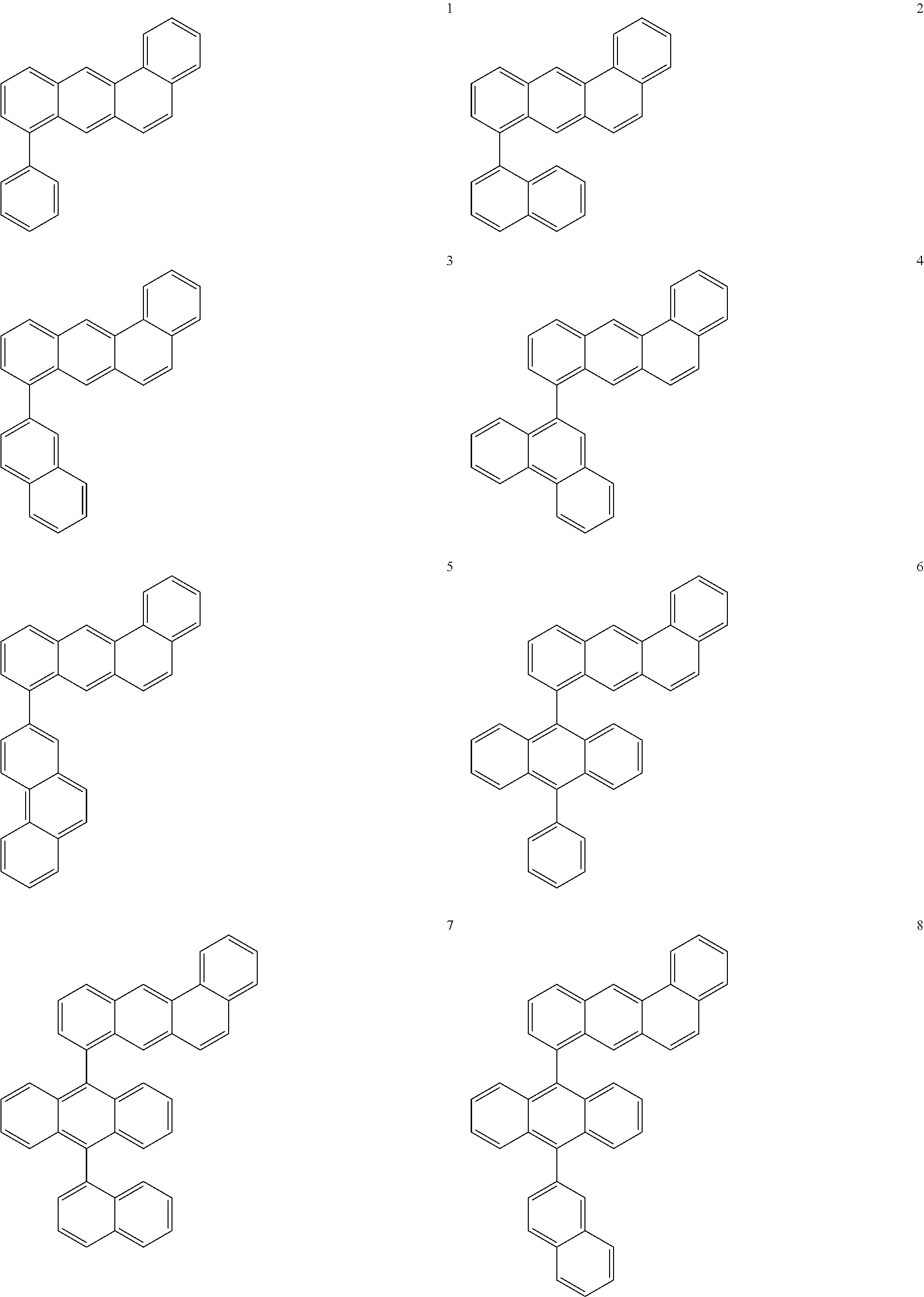


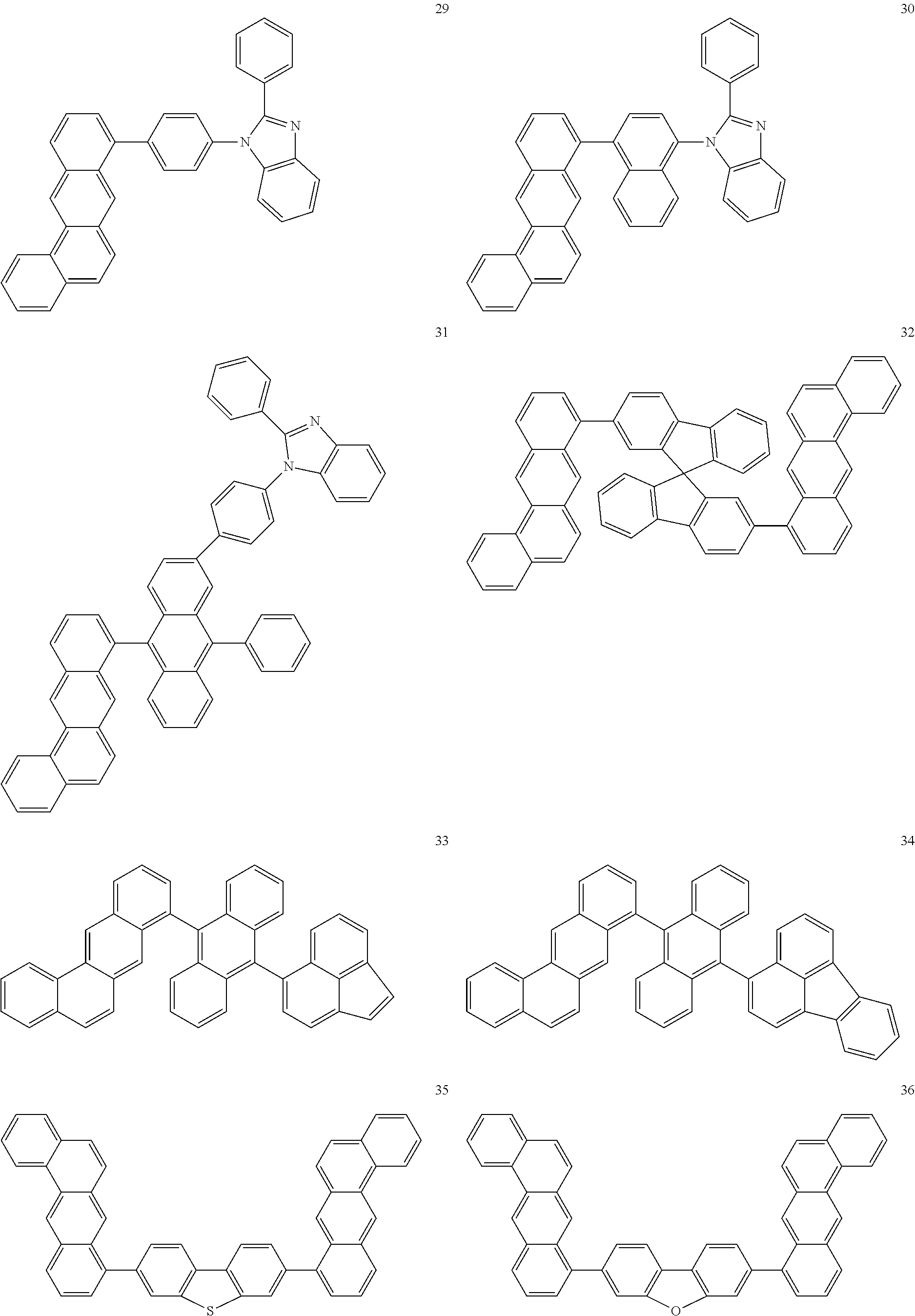


where R, R1 and Ar1 have the same meaning as described above for compounds of the formula (1) or formula (2), and R3 is bonded in position 8, 9 or 11 of the benz[a]anthracene and correspondingly no group R is bonded at this position, and furthermore:
R3, R4 stand for Cl, Br, I, B(OR1)2 or B(OAr1)2;


where the symbols and indices used are intended to have the same meanings as in the above embodiments.


| Ex. | Bromide | Boronic acid | Yield |
| 3 |
 |
 |
77.1% |
| 4 |
 |
 |
72.7% |

| Ex. | Boronic acid | Bromide | Product | Yield |
| 6 |
 |
 |
 |
63.8% |
| 7 |
 |
 |
 |
61.2% |
| 8 |
 |
 |
 |
48.9% |
| 9 |
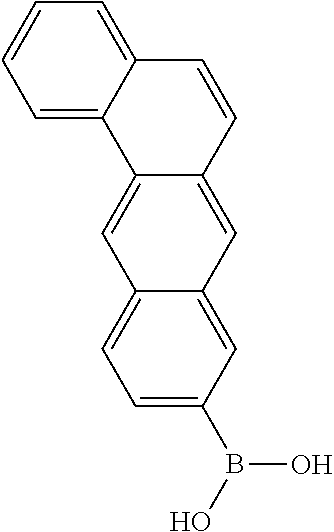 |
 |
 |
68.5% |
| 10 |
 |
 |
 |
64.2% |
| 11 |
 |
 |
 |
45.2% |


| TABLE 1 | |
 |
HTM1 |
 |
AlQ3 |
 |
H1 |
 |
D1 |
 |
D2 |
 |
D3 |
 |
Ex. 5 |
 |
Ex.6 |
 |
Ex. 11 |
 |
Ex. 12 |
| TABLE 2 | |||||
| Voltage | |||||
| Max. | (V) | Lifetime | |||
| efficiency | at 1000 | (h) at | |||
| Example | EML | (cd/A) | cd/m2 | CIE | 6000 cd/m2 |
| 19 | H1 + | 6.8 | 5.8 | x = 0.14/ | 210 |
| (comparison) | 5% of D1 | y = 0.19 | |||
| 20 | H1 + | 7.0 | 5.9 | x = 0.14/ | 240 |
| (comparison) | 5% of D2 | y = 0.18 | |||
| 21 | H1 + | 6.9 | 5.7 | x = 0.14/ | 280 |
| (comparison) | 5% of D3 | y = 0.21 | |||
| 22 | Ex. 5 + | 7.0 | 5.8 | x = 0.14/ | 260 |
| 5% of D1 | y = 0.19 | ||||
| 23 | Ex. 5 + | 7.2 | 5.7 | x = 0.14/ | 270 |
| 5% of D2 | y = 0.17 | ||||
| 24 | Ex. 5 + | 7.5 | 5.9 | x = 0.14/ | 350 |
| 5 of D3 | y = 0.21 | ||||
| 25 | Ex. 11 + | 7.2 | 5.9 | x = 0.14/ | 250 |
| 5% of D1 | y = 0.19 | ||||
| 26 | Ex. 11 + | 7.4 | 5.6 | x = 0.14/ | 290 |
| 5% of D2 | y = 0.17 | ||||
| 27 | Ex. 11 + | 7.8 | 5.7 | x = 0.14/ | 440 |
| 5% of D3 | y = 0.22 | ||||
| 28 | Ex. 6 + | 6.9 | 5.8 | x = 0.14/ | 240 |
| 5% of D1 | y = 0.19 | ||||
| 29 | Ex. 6 + | 7.2 | 5.5 | x = 0.14/ | 310 |
| 5 of D2 | y = 0.17 | ||||
| 30 | Ex. 6 + | 7.3 | 5.4 | x = 0.14/ | 460 |
| 5% of D3 | y = 0.20 | ||||
| TABLE 3 | |||||
| Voltage | |||||
| Max. | (V) | ||||
| efficiency | at 1000 | ||||
| Example | EML | ETM | (cd/A) | cd/m2 | CIE |
| 31 | Ex. 5 + | AlQ3 | 7.2 | 5.7 | x = 0.14/y = 0.17 |
| (comparison) | 5% of D2 | ||||
| 32 | Ex. 5 + | Ex. | 7.8 | 5.0 | x = 0.14/y = 0.17 |
| 5% of D2 | 12 | ||||
Claims (10)


Applications Claiming Priority (4)
| Application Number | Priority Date | Filing Date | Title |
|---|---|---|---|
| DE102009034625.2 | 2009-07-27 | ||
| DE102009034625 | 2009-07-27 | ||
| DE102009034625A DE102009034625A1 (en) | 2009-07-27 | 2009-07-27 | New materials for organic electroluminescent devices |
| PCT/EP2010/004054 WO2011012212A1 (en) | 2009-07-27 | 2010-07-05 | Novel materials for organic electroluminescent devices |
Publications (2)
| Publication Number | Publication Date |
|---|---|
| US20120126180A1 US20120126180A1 (en) | 2012-05-24 |
| US9499459B2 true US9499459B2 (en) | 2016-11-22 |
Family
ID=42732172
Family Applications (1)
| Application Number | Title | Priority Date | Filing Date |
|---|---|---|---|
| US13/387,429 Active 2032-02-26 US9499459B2 (en) | 2009-07-27 | 2010-07-05 | Materials for organic electroluminescent devices |
Country Status (7)
| Country | Link |
|---|---|
| US (1) | US9499459B2 (en) |
| JP (1) | JP5763066B2 (en) |
| KR (1) | KR101748455B1 (en) |
| CN (1) | CN102471191B (en) |
| DE (2) | DE102009034625A1 (en) |
| TW (1) | TW201127783A (en) |
| WO (1) | WO2011012212A1 (en) |
Cited By (2)
| Publication number | Priority date | Publication date | Assignee | Title |
|---|---|---|---|---|
| US11081679B2 (en) * | 2017-01-30 | 2021-08-03 | Merck Patent Gmbh | Method for forming an organic electroluminescence (EL) element with annealing temperatures for different pixels |
| US11937498B2 (en) | 2018-05-31 | 2024-03-19 | Semiconductor Energy Laboratory Co., Ltd. | Organic compound, light-emitting device, light-emitting apparatus, electronic apparatus, and lighting apparatus |
Families Citing this family (31)
| Publication number | Priority date | Publication date | Assignee | Title |
|---|---|---|---|---|
| DE102009041289A1 (en) | 2009-09-16 | 2011-03-17 | Merck Patent Gmbh | Organic electroluminescent device |
| DE102010010481A1 (en) | 2010-03-06 | 2011-09-08 | Merck Patent Gmbh | Organic electroluminescent device |
| DE102010020044A1 (en) | 2010-05-11 | 2011-11-17 | Merck Patent Gmbh | Organic electroluminescent device |
| DE102010048608A1 (en) | 2010-10-15 | 2012-04-19 | Merck Patent Gmbh | Materials for organic electroluminescent devices |
| TWI465441B (en) * | 2011-08-12 | 2014-12-21 | Ind Tech Res Inst | Imidazole derivatives having vinyl group and its use in electroluminescent element |
| KR101914951B1 (en) | 2011-08-22 | 2018-11-05 | 메르크 파텐트 게엠베하 | Organic electroluminescence device |
| EP2764558B1 (en) | 2011-10-06 | 2019-02-27 | Merck Patent GmbH | Organic electroluminescent device |
| US11063221B2 (en) * | 2014-04-16 | 2021-07-13 | Merck Patent Gmbh | Materials for electronic devices |
| KR102269132B1 (en) | 2014-06-10 | 2021-06-25 | 삼성디스플레이 주식회사 | Antiaromatic compounds and organic light-emitting device comprising the same |
| US10084141B2 (en) | 2014-06-13 | 2018-09-25 | Samsung Display Co., Ltd. | Antiaromatic compound and organic light-emitting device including the same |
| US10270033B2 (en) | 2015-10-26 | 2019-04-23 | Oti Lumionics Inc. | Method for patterning a coating on a surface and device including a patterned coating |
| WO2017170313A1 (en) | 2016-03-29 | 2017-10-05 | 住友化学株式会社 | Light-emitting element |
| JP6943241B2 (en) | 2016-06-24 | 2021-09-29 | 住友化学株式会社 | Light emitting element |
| CN110301053B (en) | 2016-12-02 | 2024-05-10 | Oti照明公司 | Device comprising a conductive coating disposed over an emission region and method thereof |
| CN116583131A (en) | 2017-04-26 | 2023-08-11 | Oti照明公司 | Method for patterning a coating on a surface and apparatus comprising the patterned coating |
| JP7264488B2 (en) | 2017-05-17 | 2023-04-25 | オーティーアイ ルミオニクス インコーポレーテッド | Methods and devices containing conductive coatings for selectively depositing conductive coatings over patterned coatings |
| US11751415B2 (en) | 2018-02-02 | 2023-09-05 | Oti Lumionics Inc. | Materials for forming a nucleation-inhibiting coating and devices incorporating same |
| JP7320851B2 (en) | 2018-05-07 | 2023-08-04 | オーティーアイ ルミオニクス インコーポレーテッド | Methods for providing auxiliary electrodes and devices containing auxiliary electrodes |
| JP7325731B2 (en) | 2018-08-23 | 2023-08-15 | 国立大学法人九州大学 | organic electroluminescence element |
| JP2022508040A (en) | 2018-11-23 | 2022-01-19 | オーティーアイ ルミオニクス インコーポレーテッド | Optoelectronic device containing light transmission region |
| JP7390739B2 (en) | 2019-03-07 | 2023-12-04 | オーティーアイ ルミオニクス インコーポレーテッド | Materials for forming nucleation-inhibiting coatings and devices incorporating the same |
| CN110256195A (en) * | 2019-04-03 | 2019-09-20 | 武汉理工大学 | A kind of preparation method of condensed ring aromatic hydrocarbon of naphthacene structure |
| KR102831863B1 (en) | 2019-04-18 | 2025-07-10 | 오티아이 루미오닉스 인크. | Material for forming a nucleation-inhibiting coating and device comprising the same |
| JP7576337B2 (en) | 2019-05-08 | 2024-11-01 | オーティーアイ ルミオニクス インコーポレーテッド | Materials for forming nucleation-inhibiting coatings and devices incorporating same - Patents.com |
| CN114097102B (en) | 2019-06-26 | 2023-11-03 | Oti照明公司 | Optoelectronic device comprising a light transmissive region having light diffraction features |
| US11832473B2 (en) | 2019-06-26 | 2023-11-28 | Oti Lumionics Inc. | Optoelectronic device including light transmissive regions, with light diffraction characteristics |
| CN114342068A (en) | 2019-08-09 | 2022-04-12 | Oti照明公司 | Optoelectronic device comprising auxiliary electrodes and partitions |
| KR20260036028A (en) | 2019-12-24 | 2026-03-13 | 오티아이 루미오닉스 인크. | A light emitting device including a capping layer and a method for manufacturing the same |
| US12113279B2 (en) | 2020-09-22 | 2024-10-08 | Oti Lumionics Inc. | Device incorporating an IR signal transmissive region |
| WO2022123431A1 (en) | 2020-12-07 | 2022-06-16 | Oti Lumionics Inc. | Patterning a conductive deposited layer using a nucleation inhibiting coating and an underlying metallic coating |
| WO2024204261A1 (en) * | 2023-03-31 | 2024-10-03 | 出光興産株式会社 | Compound, material for organic electroluminescent elements, organic electroluminescent element and electronic device |
Citations (11)
| Publication number | Priority date | Publication date | Assignee | Title |
|---|---|---|---|---|
| JPH02242879A (en) | 1989-03-16 | 1990-09-27 | Asahi Chem Ind Co Ltd | Organic el element |
| US5281489A (en) * | 1990-03-16 | 1994-01-25 | Asashi Kasei Kogyo Kabushiki Kaisha | Electroluminescent element |
| EP0728828A2 (en) | 1995-02-24 | 1996-08-28 | SANYO ELECTRIC Co., Ltd. | Organic electroluminescent device |
| US20040076853A1 (en) * | 2002-04-24 | 2004-04-22 | Eastman Kodak Company | Organic light-emitting diode devices with improved operational stability |
| KR20070021043A (en) * | 2005-08-16 | 2007-02-22 | (주)그라쎌 | Green light emitting compound and light emitting device employing the same as light emitting material |
| US20080241592A1 (en) * | 2007-03-27 | 2008-10-02 | Seiko Epson Corporation | Organic electroluminescent device |
| US20080284322A1 (en) * | 2005-08-05 | 2008-11-20 | Idemitsu Kosan Co., Ltd. | Nitrogenous Heterocyclic Derivative and Organic Electroluminescence Device Making Use of the Same |
| WO2008145239A2 (en) | 2007-05-29 | 2008-12-04 | Merck Patent Gmbh | Benzanthracene derivatives for organic electroluminescent devices |
| WO2009084543A1 (en) * | 2007-12-27 | 2009-07-09 | Idemitsu Kosan Co., Ltd. | Nitrogen-containing heterocyclic derivative and organic electroluminescent device using the same |
| US20100181560A1 (en) * | 2009-01-19 | 2010-07-22 | Sony Corporation | Organic electroluminescent element, display, and electronic apparatus |
| US20110297923A1 (en) * | 2009-12-16 | 2011-12-08 | Idemitsu Kosan Co., Ltd. | Aromatic amine derivative and organic electroluminescent element using same |
Family Cites Families (61)
| Publication number | Priority date | Publication date | Assignee | Title |
|---|---|---|---|---|
| US4539507A (en) | 1983-03-25 | 1985-09-03 | Eastman Kodak Company | Organic electroluminescent devices having improved power conversion efficiencies |
| US5061569A (en) | 1990-07-26 | 1991-10-29 | Eastman Kodak Company | Electroluminescent device with organic electroluminescent medium |
| DE4111878A1 (en) | 1991-04-11 | 1992-10-15 | Wacker Chemie Gmbh | LADDER POLYMERS WITH CONJUGATED DOUBLE BINDINGS |
| US5151629A (en) | 1991-08-01 | 1992-09-29 | Eastman Kodak Company | Blue emitting internal junction organic electroluminescent device (I) |
| JP3295088B2 (en) | 1993-09-29 | 2002-06-24 | 出光興産株式会社 | Organic electroluminescence device |
| EP0676461B1 (en) | 1994-04-07 | 2002-08-14 | Covion Organic Semiconductors GmbH | Spiro compounds and their application as electroluminescence materials |
| DE4436773A1 (en) | 1994-10-14 | 1996-04-18 | Hoechst Ag | Conjugated polymers with spirocenters and their use as electroluminescent materials |
| JP3865406B2 (en) | 1995-07-28 | 2007-01-10 | 住友化学株式会社 | 2,7-Aryl-9-substituted fluorene and 9-substituted fluorene oligomers and polymers |
| DE19614971A1 (en) | 1996-04-17 | 1997-10-23 | Hoechst Ag | Polymers with spiro atoms and their use as electroluminescent materials |
| DE19652261A1 (en) | 1996-12-16 | 1998-06-18 | Hoechst Ag | Aryl-substituted poly (p-arylenevinylenes), process for their preparation and their use in electroluminescent devices |
| US5935721A (en) | 1998-03-20 | 1999-08-10 | Eastman Kodak Company | Organic electroluminescent elements for stable electroluminescent |
| DE19846766A1 (en) | 1998-10-10 | 2000-04-20 | Aventis Res & Tech Gmbh & Co | A conjugated fluorene-based polymer useful as an organic semiconductor, electroluminescence material, and for display elements |
| US6166172A (en) | 1999-02-10 | 2000-12-26 | Carnegie Mellon University | Method of forming poly-(3-substituted) thiophenes |
| KR100738762B1 (en) | 1999-09-21 | 2007-07-12 | 이데미쓰 고산 가부시키가이샤 | Organic electroluminescence and organic luminous medium |
| KR100377321B1 (en) | 1999-12-31 | 2003-03-26 | 주식회사 엘지화학 | Electronic device comprising organic compound having p-type semiconducting characteristics |
| JP4094203B2 (en) | 2000-03-30 | 2008-06-04 | 出光興産株式会社 | Organic electroluminescence device and organic light emitting medium |
| CN1239447C (en) | 2002-01-15 | 2006-02-01 | 清华大学 | Organic electroluminescent material |
| DE10207859A1 (en) | 2002-02-20 | 2003-09-04 | Univ Dresden Tech | Doped organic semiconductor material and process for its production |
| JP4170655B2 (en) | 2002-04-17 | 2008-10-22 | 出光興産株式会社 | Novel aromatic compound and organic electroluminescence device using the same |
| AU2003230308A1 (en) | 2002-05-07 | 2003-11-11 | Lg Chem, Ltd. | New organic compounds for electroluminescence and organic electroluminescent devices using the same |
| ATE417364T1 (en) | 2002-06-21 | 2008-12-15 | Kyosemi Corp | LIGHT RECEIVING OR LIGHT EMITTING DEVICE AND METHOD FOR PRODUCING THE SAME |
| ATE529494T1 (en) | 2002-07-19 | 2011-11-15 | Idemitsu Kosan Co | ORGANIC ELECTROLUMINescent DEVICES AND ORGANIC LIGHT EMITTING MEDIUM |
| JP4025137B2 (en) | 2002-08-02 | 2007-12-19 | 出光興産株式会社 | Anthracene derivative and organic electroluminescence device using the same |
| JP2004075567A (en) | 2002-08-12 | 2004-03-11 | Idemitsu Kosan Co Ltd | Oligoarylene derivatives and organic electroluminescent devices using the same |
| US7839074B2 (en) | 2002-08-23 | 2010-11-23 | Idemitsu Kosan Co., Ltd. | Organic electroluminescence device and anthracene derivative |
| GB0226010D0 (en) | 2002-11-08 | 2002-12-18 | Cambridge Display Tech Ltd | Polymers for use in organic electroluminescent devices |
| US20060063027A1 (en) | 2002-12-23 | 2006-03-23 | Covion Organic Semiconductors Gmbh | Organic electroluminescent element |
| DE10304819A1 (en) | 2003-02-06 | 2004-08-19 | Covion Organic Semiconductors Gmbh | Carbazole-containing conjugated polymers and blends, their preparation and use |
| DE10310887A1 (en) | 2003-03-11 | 2004-09-30 | Covion Organic Semiconductors Gmbh | Matallkomplexe |
| EP1491568A1 (en) | 2003-06-23 | 2004-12-29 | Covion Organic Semiconductors GmbH | Semiconductive Polymers |
| DE10328627A1 (en) | 2003-06-26 | 2005-02-17 | Covion Organic Semiconductors Gmbh | New materials for electroluminescence |
| DE10333232A1 (en) | 2003-07-21 | 2007-10-11 | Merck Patent Gmbh | Organic electroluminescent element |
| DE10337346A1 (en) | 2003-08-12 | 2005-03-31 | Covion Organic Semiconductors Gmbh | Conjugated polymers containing dihydrophenanthrene units and their use |
| JP2007517079A (en) | 2003-10-22 | 2007-06-28 | メルク パテント ゲーエムベーハー | Novel materials for electroluminescence and their use |
| DE10357044A1 (en) | 2003-12-04 | 2005-07-14 | Novaled Gmbh | Process for doping organic semiconductors with quinonediimine derivatives |
| DE102004008304A1 (en) | 2004-02-20 | 2005-09-08 | Covion Organic Semiconductors Gmbh | Organic electronic devices |
| WO2005090365A1 (en) | 2004-03-18 | 2005-09-29 | Sharp Kabushiki Kaisha | Organosilanes, process for production of the same, and use thereof |
| KR100787425B1 (en) | 2004-11-29 | 2007-12-26 | 삼성에스디아이 주식회사 | Phenylcarbazole compound and organic electroluminescent device using same |
| JP2005302667A (en) * | 2004-04-15 | 2005-10-27 | Idemitsu Kosan Co Ltd | Organic electroluminescence device |
| DE102004020298A1 (en) | 2004-04-26 | 2005-11-10 | Covion Organic Semiconductors Gmbh | Electroluminescent polymers and their use |
| TW200613515A (en) | 2004-06-26 | 2006-05-01 | Merck Patent Gmbh | Compounds for organic electronic devices |
| DE102004031000A1 (en) | 2004-06-26 | 2006-01-12 | Covion Organic Semiconductors Gmbh | Organic electroluminescent devices |
| DE102004032527A1 (en) | 2004-07-06 | 2006-02-02 | Covion Organic Semiconductors Gmbh | Electroluminescent polymers |
| EP1655359A1 (en) | 2004-11-06 | 2006-05-10 | Covion Organic Semiconductors GmbH | Organic electroluminescent device |
| TW200639140A (en) | 2004-12-01 | 2006-11-16 | Merck Patent Gmbh | Compounds for organic electronic devices |
| EP1669386A1 (en) | 2004-12-06 | 2006-06-14 | Covion Organic Semiconductors GmbH | Conjugated polymers, representation thereof, and use |
| KR100949214B1 (en) | 2005-03-18 | 2010-03-24 | 이데미쓰 고산 가부시키가이샤 | Aromatic Amine Derivatives and Organic Electroluminescent Devices Using The Same |
| EP1888706B1 (en) | 2005-05-03 | 2017-03-01 | Merck Patent GmbH | Organic electroluminescent device and boric acid and borinic acid derivatives used therein |
| DE102005023437A1 (en) | 2005-05-20 | 2006-11-30 | Merck Patent Gmbh | Connections for organic electronic devices |
| BRPI0613785A2 (en) | 2005-07-08 | 2011-02-01 | Unilever Nv | starch-containing food product, process for preparing intact starch-containing plant cells and process for preparing starch-containing food product |
| DE102005037734B4 (en) | 2005-08-10 | 2018-02-08 | Merck Patent Gmbh | Electroluminescent polymers, their use and bifunctional monomeric compounds |
| DE102005058543A1 (en) | 2005-12-08 | 2007-06-14 | Merck Patent Gmbh | Organic electroluminescent devices |
| DE102005060473A1 (en) | 2005-12-17 | 2007-06-28 | Merck Patent Gmbh | Conjugated polymers, their preparation and use |
| DE102006015183A1 (en) | 2006-04-01 | 2007-10-04 | Merck Patent Gmbh | Materials for organic electroluminescent devices |
| JP4995475B2 (en) * | 2006-04-03 | 2012-08-08 | 出光興産株式会社 | Benzanthracene derivative and organic electroluminescence device using the same |
| DE102006025846A1 (en) | 2006-06-02 | 2007-12-06 | Merck Patent Gmbh | New materials for organic electroluminescent devices |
| DE102006031990A1 (en) | 2006-07-11 | 2008-01-17 | Merck Patent Gmbh | New materials for organic electroluminescent devices |
| KR100933229B1 (en) * | 2007-11-12 | 2009-12-22 | 다우어드밴스드디스플레이머티리얼 유한회사 | Novel red phosphorescent compound and organic light emitting device employing it as light emitting material |
| WO2009069566A1 (en) | 2007-11-29 | 2009-06-04 | Idemitsu Kosan Co., Ltd. | Benzophenanthrene derivative and organic electroluminescent device employing the same |
| DE102008035413A1 (en) | 2008-07-29 | 2010-02-04 | Merck Patent Gmbh | Connections for organic electronic devices |
| DE102009005746A1 (en) | 2009-01-23 | 2010-07-29 | Merck Patent Gmbh | Materials for organic electroluminescent devices |
-
2009
- 2009-07-27 DE DE102009034625A patent/DE102009034625A1/en active Pending
-
2010
- 2010-07-05 CN CN201080033578.7A patent/CN102471191B/en active Active
- 2010-07-05 DE DE112010003082.0T patent/DE112010003082B4/en active Active
- 2010-07-05 US US13/387,429 patent/US9499459B2/en active Active
- 2010-07-05 JP JP2012521992A patent/JP5763066B2/en active Active
- 2010-07-05 WO PCT/EP2010/004054 patent/WO2011012212A1/en not_active Ceased
- 2010-07-05 KR KR1020127004968A patent/KR101748455B1/en active Active
- 2010-07-22 TW TW099124162A patent/TW201127783A/en unknown
Patent Citations (13)
| Publication number | Priority date | Publication date | Assignee | Title |
|---|---|---|---|---|
| JPH02242879A (en) | 1989-03-16 | 1990-09-27 | Asahi Chem Ind Co Ltd | Organic el element |
| US5281489A (en) * | 1990-03-16 | 1994-01-25 | Asashi Kasei Kogyo Kabushiki Kaisha | Electroluminescent element |
| EP0728828A2 (en) | 1995-02-24 | 1996-08-28 | SANYO ELECTRIC Co., Ltd. | Organic electroluminescent device |
| US20040076853A1 (en) * | 2002-04-24 | 2004-04-22 | Eastman Kodak Company | Organic light-emitting diode devices with improved operational stability |
| US20080284322A1 (en) * | 2005-08-05 | 2008-11-20 | Idemitsu Kosan Co., Ltd. | Nitrogenous Heterocyclic Derivative and Organic Electroluminescence Device Making Use of the Same |
| KR20070021043A (en) * | 2005-08-16 | 2007-02-22 | (주)그라쎌 | Green light emitting compound and light emitting device employing the same as light emitting material |
| US20080241592A1 (en) * | 2007-03-27 | 2008-10-02 | Seiko Epson Corporation | Organic electroluminescent device |
| WO2008145239A2 (en) | 2007-05-29 | 2008-12-04 | Merck Patent Gmbh | Benzanthracene derivatives for organic electroluminescent devices |
| US20100187505A1 (en) | 2007-05-29 | 2010-07-29 | Philipp Stoessel | Benzanthracene derivatives for organic electroluminescent devices |
| WO2009084543A1 (en) * | 2007-12-27 | 2009-07-09 | Idemitsu Kosan Co., Ltd. | Nitrogen-containing heterocyclic derivative and organic electroluminescent device using the same |
| US20110012092A1 (en) * | 2007-12-27 | 2011-01-20 | Idemitsu Kosan Co., Ltd. | Nitrogen-containing heterocyclic derivative and organic electroluminescent device using the same |
| US20100181560A1 (en) * | 2009-01-19 | 2010-07-22 | Sony Corporation | Organic electroluminescent element, display, and electronic apparatus |
| US20110297923A1 (en) * | 2009-12-16 | 2011-12-08 | Idemitsu Kosan Co., Ltd. | Aromatic amine derivative and organic electroluminescent element using same |
Non-Patent Citations (5)
| Title |
|---|
| International Search Report for PCT/EP2010/004054 mailed Sep. 29, 2010. |
| Translation for Publication No. KR 10-2007-0021043 (publication date Feb. 2007). * |
| Translation for WO 2009/084543 (publication date: Jul. 2009). * |
| Yang et al., "Synthesis and separation of the atropisomers of 2-(5-benzo[b]fluorenyl)-2′-hydroxy-1,1′-binaphthyl and related compounds", Tetrahedron, vol. 62, No. 34, pp. 8133-8141 (2006). |
| Yang et al., "Synthesis and separation of the atropisomers of 2-(5-benzo[b]fluorenyl)-2'-hydroxy-1,1'-binaphthyl and related compounds", Tetrahedron, vol. 62, No. 34, pp. 8133-8141 (2006). |
Cited By (2)
| Publication number | Priority date | Publication date | Assignee | Title |
|---|---|---|---|---|
| US11081679B2 (en) * | 2017-01-30 | 2021-08-03 | Merck Patent Gmbh | Method for forming an organic electroluminescence (EL) element with annealing temperatures for different pixels |
| US11937498B2 (en) | 2018-05-31 | 2024-03-19 | Semiconductor Energy Laboratory Co., Ltd. | Organic compound, light-emitting device, light-emitting apparatus, electronic apparatus, and lighting apparatus |
Also Published As
| Publication number | Publication date |
|---|---|
| JP5763066B2 (en) | 2015-08-12 |
| KR20120038530A (en) | 2012-04-23 |
| WO2011012212A1 (en) | 2011-02-03 |
| US20120126180A1 (en) | 2012-05-24 |
| CN102471191B (en) | 2015-05-20 |
| DE112010003082B4 (en) | 2018-09-20 |
| KR101748455B1 (en) | 2017-06-16 |
| CN102471191A (en) | 2012-05-23 |
| DE112010003082A5 (en) | 2012-08-23 |
| TW201127783A (en) | 2011-08-16 |
| DE102009034625A1 (en) | 2011-02-03 |
| JP2013500281A (en) | 2013-01-07 |
Similar Documents
| Publication | Publication Date | Title |
|---|---|---|
| US9499459B2 (en) | Materials for organic electroluminescent devices | |
| US10971689B2 (en) | Triphenylene-based materials for organic electroluminescent devices | |
| US8986852B2 (en) | Benzanthracene derivatives for organic electroluminescent devices | |
| US8710284B2 (en) | Materials for organic electroluminescent devices containing substituted 10-benzo[c]phenanthrenes | |
| US8993123B2 (en) | Materials for organic electroluminescent devices | |
| US8114531B2 (en) | Materials for organic electroluminescent devices | |
| US8241763B2 (en) | Materials for organic electroluminescent devices | |
| US8748010B2 (en) | Materials for organic electroluminescent devices | |
| US9627626B2 (en) | Compounds for organic electroluminescent devices | |
| US8927117B2 (en) | Materials for organic electroluminescence device | |
| US8901298B2 (en) | Materials for organic electroluminescence devices | |
| US10074807B2 (en) | Compounds for electronic devices | |
| US8932732B2 (en) | Materials for organic electroluminescent devices | |
| US8999521B2 (en) | Materials for organic electroluminescent devices | |
| US9893292B2 (en) | Materials for organic electroluminescence devices | |
| US9133119B2 (en) | Compounds for electronic devices | |
| US9090590B2 (en) | Organic compounds for electroluminescent devices | |
| US20120217449A1 (en) | Materials for electronic devices | |
| US20110037027A1 (en) | Fluorine derivatives for organic electroluminescence devices | |
| US10381575B2 (en) | Materials for electronic devices | |
| US20110108823A1 (en) | Materials for organic electroluminescence devices |
Legal Events
| Date | Code | Title | Description |
|---|---|---|---|
| AS | Assignment |
Owner name: MERCK PATENT GMBH, GERMANY Free format text: ASSIGNMENT OF ASSIGNORS INTEREST;ASSIGNORS:PARHAM, AMIR HOSSAIN;BUESING, ARNE;HEIL, HOLGER;AND OTHERS;REEL/FRAME:027634/0699 Effective date: 20111104 |
|
| STCF | Information on status: patent grant |
Free format text: PATENTED CASE |
|
| MAFP | Maintenance fee payment |
Free format text: PAYMENT OF MAINTENANCE FEE, 4TH YEAR, LARGE ENTITY (ORIGINAL EVENT CODE: M1551); ENTITY STATUS OF PATENT OWNER: LARGE ENTITY Year of fee payment: 4 |
|
| MAFP | Maintenance fee payment |
Free format text: PAYMENT OF MAINTENANCE FEE, 8TH YEAR, LARGE ENTITY (ORIGINAL EVENT CODE: M1552); ENTITY STATUS OF PATENT OWNER: LARGE ENTITY Year of fee payment: 8 |
|
| AS | Assignment |
Owner name: IDEMITSU KOSAN CO., LTD., JAPAN Free format text: ASSIGNMENT OF ASSIGNORS INTEREST;ASSIGNOR:MERCK PATENT GMBH;REEL/FRAME:071617/0882 Effective date: 20250213 |