US9499414B1 - Method of dye removal from wastewater - Google Patents
Method of dye removal from wastewater Download PDFInfo
- Publication number
- US9499414B1 US9499414B1 US14/701,135 US201514701135A US9499414B1 US 9499414 B1 US9499414 B1 US 9499414B1 US 201514701135 A US201514701135 A US 201514701135A US 9499414 B1 US9499414 B1 US 9499414B1
- Authority
- US
- United States
- Prior art keywords
- wastewater
- activated carbon
- dye
- fly ash
- powdered activated
- Prior art date
- Legal status (The legal status is an assumption and is not a legal conclusion. Google has not performed a legal analysis and makes no representation as to the accuracy of the status listed.)
- Expired - Fee Related
Links
- 239000002351 wastewater Substances 0.000 title claims abstract description 47
- 238000000034 method Methods 0.000 title claims abstract description 18
- OKTJSMMVPCPJKN-UHFFFAOYSA-N Carbon Chemical compound [C] OKTJSMMVPCPJKN-UHFFFAOYSA-N 0.000 claims abstract description 106
- NBIIXXVUZAFLBC-UHFFFAOYSA-N Phosphoric acid Chemical compound OP(O)(O)=O NBIIXXVUZAFLBC-UHFFFAOYSA-N 0.000 claims abstract description 22
- 239000010881 fly ash Substances 0.000 claims abstract description 22
- 239000000295 fuel oil Substances 0.000 claims abstract description 16
- 229910000147 aluminium phosphate Inorganic materials 0.000 claims abstract description 11
- PYWVYCXTNDRMGF-UHFFFAOYSA-N rhodamine B Chemical compound [Cl-].C=12C=CC(=[N+](CC)CC)C=C2OC2=CC(N(CC)CC)=CC=C2C=1C1=CC=CC=C1C(O)=O PYWVYCXTNDRMGF-UHFFFAOYSA-N 0.000 claims description 22
- 229940043267 rhodamine b Drugs 0.000 claims description 20
- STZCRXQWRGQSJD-GEEYTBSJSA-M methyl orange Chemical compound [Na+].C1=CC(N(C)C)=CC=C1\N=N\C1=CC=C(S([O-])(=O)=O)C=C1 STZCRXQWRGQSJD-GEEYTBSJSA-M 0.000 claims description 10
- 229940012189 methyl orange Drugs 0.000 claims description 10
- 238000005470 impregnation Methods 0.000 claims description 4
- 239000000463 material Substances 0.000 claims description 4
- 238000001914 filtration Methods 0.000 claims description 3
- 238000010438 heat treatment Methods 0.000 claims description 2
- 239000012528 membrane Substances 0.000 claims description 2
- 239000000203 mixture Substances 0.000 claims 1
- 239000000126 substance Substances 0.000 abstract description 10
- 230000004913 activation Effects 0.000 abstract description 9
- 239000000975 dye Substances 0.000 description 24
- 238000001994 activation Methods 0.000 description 9
- 238000001179 sorption measurement Methods 0.000 description 9
- 230000000694 effects Effects 0.000 description 6
- 239000000243 solution Substances 0.000 description 6
- 239000002699 waste material Substances 0.000 description 6
- IJGRMHOSHXDMSA-UHFFFAOYSA-N Atomic nitrogen Chemical compound N#N IJGRMHOSHXDMSA-UHFFFAOYSA-N 0.000 description 4
- 239000000523 sample Substances 0.000 description 4
- HEMHJVSKTPXQMS-UHFFFAOYSA-M Sodium hydroxide Chemical compound [OH-].[Na+] HEMHJVSKTPXQMS-UHFFFAOYSA-M 0.000 description 3
- 238000002474 experimental method Methods 0.000 description 3
- 239000003921 oil Substances 0.000 description 3
- 238000000926 separation method Methods 0.000 description 3
- 239000008346 aqueous phase Substances 0.000 description 2
- 238000005516 engineering process Methods 0.000 description 2
- 239000007788 liquid Substances 0.000 description 2
- 229910052757 nitrogen Inorganic materials 0.000 description 2
- 239000011550 stock solution Substances 0.000 description 2
- 239000012085 test solution Substances 0.000 description 2
- 239000012498 ultrapure water Substances 0.000 description 2
- 238000004065 wastewater treatment Methods 0.000 description 2
- RZVAJINKPMORJF-UHFFFAOYSA-N Acetaminophen Chemical compound CC(=O)NC1=CC=C(O)C=C1 RZVAJINKPMORJF-UHFFFAOYSA-N 0.000 description 1
- CVAVMIODJQHEEH-UHFFFAOYSA-O CCN(CC)C1=CC=C2C(=C1)OC1=CC(=[N+](CC)CC)C=CC1=C2C1=CC=CC=C1C(=O)O.[Cl-] Chemical compound CCN(CC)C1=CC=C2C(=C1)OC1=CC(=[N+](CC)CC)C=CC1=C2C1=CC=CC=C1C(=O)O.[Cl-] CVAVMIODJQHEEH-UHFFFAOYSA-O 0.000 description 1
- IETWCRRCPURZOC-FOCLMDBBSA-M CN(C)C1=CC=C(/N=N/C2=CC=C(S(=O)(=O)[O-])C=C2)C=C1.[Na+] Chemical compound CN(C)C1=CC=C(/N=N/C2=CC=C(S(=O)(=O)[O-])C=C2)C=C1.[Na+] IETWCRRCPURZOC-FOCLMDBBSA-M 0.000 description 1
- DGAQECJNVWCQMB-PUAWFVPOSA-M Ilexoside XXIX Chemical group C[C@@H]1CC[C@@]2(CC[C@@]3(C(=CC[C@H]4[C@]3(CC[C@@H]5[C@@]4(CC[C@@H](C5(C)C)OS(=O)(=O)[O-])C)C)[C@@H]2[C@]1(C)O)C)C(=O)O[C@H]6[C@@H]([C@H]([C@@H]([C@H](O6)CO)O)O)O.[Na+] DGAQECJNVWCQMB-PUAWFVPOSA-M 0.000 description 1
- 239000002253 acid Substances 0.000 description 1
- 239000003929 acidic solution Substances 0.000 description 1
- 230000000274 adsorptive effect Effects 0.000 description 1
- 229940077388 benzenesulfonate Drugs 0.000 description 1
- SRSXLGNVWSONIS-UHFFFAOYSA-M benzenesulfonate Chemical compound [O-]S(=O)(=O)C1=CC=CC=C1 SRSXLGNVWSONIS-UHFFFAOYSA-M 0.000 description 1
- 239000012496 blank sample Substances 0.000 description 1
- 238000006243 chemical reaction Methods 0.000 description 1
- 239000007795 chemical reaction product Substances 0.000 description 1
- 239000003153 chemical reaction reagent Substances 0.000 description 1
- 150000001875 compounds Chemical class 0.000 description 1
- 230000009977 dual effect Effects 0.000 description 1
- 238000004043 dyeing Methods 0.000 description 1
- 230000007613 environmental effect Effects 0.000 description 1
- 239000003344 environmental pollutant Substances 0.000 description 1
- 239000011521 glass Substances 0.000 description 1
- 239000010842 industrial wastewater Substances 0.000 description 1
- 238000010979 pH adjustment Methods 0.000 description 1
- 231100000719 pollutant Toxicity 0.000 description 1
- 238000002360 preparation method Methods 0.000 description 1
- 239000000047 product Substances 0.000 description 1
- 239000005297 pyrex Substances 0.000 description 1
- 239000000700 radioactive tracer Substances 0.000 description 1
- 229910052708 sodium Inorganic materials 0.000 description 1
- 239000011734 sodium Substances 0.000 description 1
- 238000003756 stirring Methods 0.000 description 1
- 239000000725 suspension Substances 0.000 description 1
- 239000004753 textile Substances 0.000 description 1
- XLYOFNOQVPJJNP-UHFFFAOYSA-N water Substances O XLYOFNOQVPJJNP-UHFFFAOYSA-N 0.000 description 1
- 238000003911 water pollution Methods 0.000 description 1
Images


Classifications
-
- C—CHEMISTRY; METALLURGY
- C02—TREATMENT OF WATER, WASTE WATER, SEWAGE, OR SLUDGE
- C02F—TREATMENT OF WATER, WASTE WATER, SEWAGE, OR SLUDGE
- C02F1/00—Treatment of water, waste water, or sewage
- C02F1/28—Treatment of water, waste water, or sewage by sorption
- C02F1/283—Treatment of water, waste water, or sewage by sorption using coal, charred products, or inorganic mixtures containing them
-
- C—CHEMISTRY; METALLURGY
- C02—TREATMENT OF WATER, WASTE WATER, SEWAGE, OR SLUDGE
- C02F—TREATMENT OF WATER, WASTE WATER, SEWAGE, OR SLUDGE
- C02F1/00—Treatment of water, waste water, or sewage
- C02F1/28—Treatment of water, waste water, or sewage by sorption
- C02F1/288—Treatment of water, waste water, or sewage by sorption using composite sorbents, e.g. coated, impregnated, multi-layered
-
- C—CHEMISTRY; METALLURGY
- C02—TREATMENT OF WATER, WASTE WATER, SEWAGE, OR SLUDGE
- C02F—TREATMENT OF WATER, WASTE WATER, SEWAGE, OR SLUDGE
- C02F1/00—Treatment of water, waste water, or sewage
- C02F1/44—Treatment of water, waste water, or sewage by dialysis, osmosis or reverse osmosis
- C02F1/444—Treatment of water, waste water, or sewage by dialysis, osmosis or reverse osmosis by ultrafiltration or microfiltration
-
- C—CHEMISTRY; METALLURGY
- C02—TREATMENT OF WATER, WASTE WATER, SEWAGE, OR SLUDGE
- C02F—TREATMENT OF WATER, WASTE WATER, SEWAGE, OR SLUDGE
- C02F2101/00—Nature of the contaminant
- C02F2101/30—Organic compounds
- C02F2101/308—Dyes; Colorants; Fluorescent agents
Definitions
- the present invention was developed with financial support from the National Plan for Science, Technology and Innovation (MAARIFAH)—King Abdulaziz City for Science and Technology—the Kingdom of Saudi Arabia.
- MAARIFAH National Plan for Science, Technology and Innovation
- the present invention relates to a method of dye removal from wastewater, and particularly to a method of dye removal from wastewater using activated carbon produced from heavy oil fly ash.
- Oil fly ash is generally disposed in landfills. Recently, however, some progress has been made to find ways to utilize, rather than simply dispose, oil fly ash. For example, oil fly ash has been used for the preparation of activated carbon. Caramuscio et al. describe pyrolyzing raw fly ash at 900° C. followed by CO 2 initiated physical activation process at a temperature range of 800-900° C. for different times. The highest specific surface area value (SSA BET ) achieved using nitrogen adsorption isotherm was 156 m 2 /g. Davini studied treatment of the heavy oil fly ash with acidic solutions and physical activation. The resulting activated carbon sample showed high specific surface area values (BET nitrogen adsorption isotherm) and surface basic characteristics.
- SSA BET specific surface area value
- a method of dye removal from wastewater includes producing activated carbon from heavy oil fly ash using chemical activation and using the activated carbon to adsorb dye in the wastewater.
- Heavy oil fly ash (OFA) based activated carbon can be produced using phosphoric acid based chemical activation.
- the SSA BET values of the activated carbon can be about 59 m 2 /g.
- the dye can be one or more aqueous dyes, including Rhodamine B and/or Methyl Orange, for example.
- the dye can be removed from wastewater by contacting the wastewater with the activated carbon.
- the activated carbon can then be separated from the wastewater to remove the dye, and thereby, purify the wastewater.
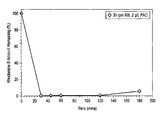
- FIG. 1 is a graph showing the effect of contact time on the removal of Rhodamine B from synthetic wastewater using powdered activated carbon (PAC).
- PAC powdered activated carbon
- FIG. 2 is a graph showing the effect of the powdered activated carbon (PAC) dosage on the adsorption based removal of Rhodamine B from a synthetic wastewater sample.
- PAC powdered activated carbon
- a method of dye removal from wastewater includes producing activated carbon from heavy oil fly ash and using the activated carbon to adsorb dye in the wastewater.
- the present inventor has discovered that heavy oil fly ash (OFA) based activated carbon that is produced using phosphoric acid based chemical activation can be used for the removal of aqueous phase dyes, such as Rhodamine B and Methyl Orange.
- the dyes can be removed from wastewater by contacting the wastewater with the activated carbon.
- the activated carbon can then be separated from the wastewater to purify the wastewater.
- Producing the activated carbon includes phosphoric acid based chemical activation of heavy oil fly ash waste.
- the heavy oil fly ash waste can be impregnated with phosphoric acid to form an impregnated material.
- the phosphoric acid strength can be about 40 w/w %.
- the impregnation ratio can be about 0.8.
- the impregnated material can then be heated under an inert atmosphere to produce the activated carbon.
- the furnace temperature for heating the impregnated fly ash can be about 450° C. to about 900° C. Preferably, the furnace temperature is about 500° C.
- the SSA BET values of the activated carbon can be about 59 m 2 /g.
- the activated carbon can be powdered activated carbon (PAC).
- Separating the PAC from the wastewater can be accomplished by passing the wastewater through a solid-liquid separation device for removal of the powdered activated carbon.
- the solid-liquid separation device can be a filter paper such as a Whatman filter paper or any other filtration means.
- the dyes that can be removed from the wastewater can be Rhodamine B, Methyl Orange or any other aqueous dye.
- the PAC is allowed to adsorb for a period of time, e.g., at least 20 minutes, before separation and filtration.
- the concentration of the powdered activated carbon can be in the range of 250 mg/L to 4,000 mg/L and preferably it is 2,500 mg/L.
- Rhodamine B is a chemical dye with IUPAC name [9-(2-carboxyphenyl)-6-diethylamino-3-xanthenylidene]-diethylammonium chloride. It is often used as a tracer dye within water because it strongly fluoresces and can thus be detected easily with fluorometers. It has the molecular structure as follows:
- Methyl orange is an intensely colored compound used in dyeing and printing textiles. Its IUPAC name is Sodium 4-[(4-dimethylamino)phenyldiazenyl]benzenesulfonate and has a molecular structure as follows:
- AC samples were produced using the chemical activation method described herein.
- the variables included phosphoric acid strength (w/w %), impregnation ratio (R; volume of acid to weight of fly ash) and furnace temperature.
- the AC samples produced showed different SSA BET values with an optimum value equal to 59 m 2 /g.
- the conversion of OFA into powdered activated carbon offers the dual advantage of providing an environmentally sound OFA waste treatment and an industrial grade product (activated carbon) that can be used for a variety of pollution control applications.
- the PAC produced from OFA waste material offers an excellent end product to treat industrial wastewaters containing dye based pollutants (e.g., Rhodamine B and methyl orange) even at relatively high concentrations.
- the present methods provide a green technology solution to handling wastewater containing dyes.
- Adsorption experiments were conducted using 250 ml Pyrex glass bottles. 1000 ppm stock solutions were prepared for Rhodamine B (RB) and Methyl Orange (MO) using reagent grade chemicals and high-purity water. 100 ml test solutions were then prepared using high-purity water and respective stock solution. A blank sample was taken before the addition of the required powdered activated carbon (PAC) amount. This was followed by pH adjustment to the desired value using HCl or NaOH solutions. The test solution was then kept in suspension using IKA multi-position magnetic stirrer set-up. Kinetic studies were achieved by withdrawing samples at different time intervals for three hours. The effects of pH, PAC dosage and initial dye concentration were determined by running experiments until adsorption reached equilibrium. All samples collected were filtered with 0.2 ⁇ m membrane filters (Whatman, Germany) and the concentrations of RB and MO were analyzed using Shimadzu UV-Spectrophotometer at 599 and 278 nm respectively.
- PAC powdered activated carbon
- FIG. 1 shows the sample kinetic study findings for Rhodamine B from synthetic wastewater using the 2 g/L concentration. As shown in FIG. 1 , most of the dye is removed from the aqueous phase within 30 minutes of adsorption time. After about three hours of contact time, the synthetic wastewater solution was very clear compared to the solution at the beginning of the experiment.
- Powdered activated carbon (PAC) obtained from phosphoric acid based chemical activation of heavy oil fly ash was added to synthetic wastewater containing 100 ppm of Rhodamine B (pH4).
- the concentration of the Rhodamine B was monitored by successively increasing the concentration of the powdered activated carbon (PAC).
- the findings clearly show that even a relatively high concentration of Rhodamine B (about 100 ppm) is efficiently removed from synthetic wastewater using powdered activated carbon (PAC) produced from heavy oil fly ash (OFA) waste material using chemical activation method as described herein.
Landscapes
- Life Sciences & Earth Sciences (AREA)
- Hydrology & Water Resources (AREA)
- Engineering & Computer Science (AREA)
- Environmental & Geological Engineering (AREA)
- Water Supply & Treatment (AREA)
- Chemical & Material Sciences (AREA)
- Organic Chemistry (AREA)
- Water Treatment By Sorption (AREA)
- Solid-Sorbent Or Filter-Aiding Compositions (AREA)
Abstract
Description


Claims (6)
Priority Applications (1)
| Application Number | Priority Date | Filing Date | Title |
|---|---|---|---|
| US14/701,135 US9499414B1 (en) | 2015-04-30 | 2015-04-30 | Method of dye removal from wastewater |
Applications Claiming Priority (1)
| Application Number | Priority Date | Filing Date | Title |
|---|---|---|---|
| US14/701,135 US9499414B1 (en) | 2015-04-30 | 2015-04-30 | Method of dye removal from wastewater |
Publications (2)
| Publication Number | Publication Date |
|---|---|
| US20160318772A1 US20160318772A1 (en) | 2016-11-03 |
| US9499414B1 true US9499414B1 (en) | 2016-11-22 |
Family
ID=57204614
Family Applications (1)
| Application Number | Title | Priority Date | Filing Date |
|---|---|---|---|
| US14/701,135 Expired - Fee Related US9499414B1 (en) | 2015-04-30 | 2015-04-30 | Method of dye removal from wastewater |
Country Status (1)
| Country | Link |
|---|---|
| US (1) | US9499414B1 (en) |
Cited By (2)
| Publication number | Priority date | Publication date | Assignee | Title |
|---|---|---|---|---|
| CN107055731A (en) * | 2017-05-19 | 2017-08-18 | 宝鸡市金得利新材料有限公司 | A kind of ternary compound oxides of efficient process Methyl Orange in Wastewater and its preparation method and application |
| CN109574835A (en) * | 2018-11-20 | 2019-04-05 | 江南大学 | A kind of method of ion modification activity carbon decoloring polyesterols solution product BHET |
Families Citing this family (4)
| Publication number | Priority date | Publication date | Assignee | Title |
|---|---|---|---|---|
| US10882022B2 (en) | 2018-08-07 | 2021-01-05 | King Abdulaziz University | Method of removing organic pollutants from water using ball milled and sonicated oil fly ash powder |
| CN113578269A (en) * | 2021-08-30 | 2021-11-02 | 南通大学 | Waste paperboard biochar for treating rhodamine B dye wastewater and preparation method and application thereof |
| CN116162793B (en) * | 2021-11-24 | 2024-07-26 | 西藏矿业发展股份有限公司 | Method and device for removing dissolved organic matter and calcium and magnesium from carbonate salt lake brine |
| US12577129B2 (en) | 2022-04-21 | 2026-03-17 | University Of Central Florida Research Foundation, Inc. | Color removal with zipgem filtration media for water and wastewater treatment |
Citations (5)
| Publication number | Priority date | Publication date | Assignee | Title |
|---|---|---|---|---|
| US2029966A (en) * | 1935-05-18 | 1936-02-04 | Charles H Lewis | Reagent for water purification and process for producing same |
| US5429747A (en) * | 1994-06-07 | 1995-07-04 | University Of Maryland, College Park | Method for treatment and decolorization of waste water from cosmetic manufacturing processes |
| US6379555B1 (en) | 2000-08-07 | 2002-04-30 | Eugene F. Targosz | Wastewater treatment process using an admixed paste of activated carbon and magnesium hydroxide |
| CN102951696A (en) | 2012-11-16 | 2013-03-06 | 内蒙古民族大学 | Application of modified activated carbon in sewage treatment |
| US20140208945A1 (en) * | 2013-01-25 | 2014-07-31 | Cabot Corporation | Phosphoric acid treatment of carbonaceous material prior to activation |
-
2015
- 2015-04-30 US US14/701,135 patent/US9499414B1/en not_active Expired - Fee Related
Patent Citations (5)
| Publication number | Priority date | Publication date | Assignee | Title |
|---|---|---|---|---|
| US2029966A (en) * | 1935-05-18 | 1936-02-04 | Charles H Lewis | Reagent for water purification and process for producing same |
| US5429747A (en) * | 1994-06-07 | 1995-07-04 | University Of Maryland, College Park | Method for treatment and decolorization of waste water from cosmetic manufacturing processes |
| US6379555B1 (en) | 2000-08-07 | 2002-04-30 | Eugene F. Targosz | Wastewater treatment process using an admixed paste of activated carbon and magnesium hydroxide |
| CN102951696A (en) | 2012-11-16 | 2013-03-06 | 内蒙古民族大学 | Application of modified activated carbon in sewage treatment |
| US20140208945A1 (en) * | 2013-01-25 | 2014-07-31 | Cabot Corporation | Phosphoric acid treatment of carbonaceous material prior to activation |
Non-Patent Citations (7)
| Title |
|---|
| Alqaragully, Removal of Textile Dyes (Maxion Blue, and Methyl Orange) by Date Stones Activated Carbon, Mar. 2014, International Journal of Advanced Research in Chemical Sciences, vol. 1, Issue 1, pp. 48-59. * |
| Caramuscio P. et al., "Preparation of activated carbons from heavy-oil fly ashes." Waste Management, 2003, 23, pp. 345-351. |
| Davini P. "Flue gas treatment by activated carbon obtained from oil fired fly ash." Carbon 2002, 40, 1973-1979. |
| Davini, Flue gas treatment by activated carbon obtained from oi-fired fly ash, Jan. 2002, Carbon, vol. 40, pp. 1973-1979. * |
| Geetha et al., "Removal of Heavy Metals and Dyes Using Low Cost Adsorbents From Aqueous Medium, a Review," IOSR Journal of Environmental Science, Toxicology and Food Technology (IOSR-JESTFT), 2013, vol. 4, pp. 56-68. |
| Mofarrah et al, Characterization of activated carbon obtained from Saudi Arabian Fly ash, Sep. 2013, International Journal of Environmental Science and Technology, vol. 11, pp. 159-168. * |
| Vohra, Production and Use of Heavy Oil Fly Ash Based Activated Carbon: Surface Properties and Affect of Surface Charge Properties on Mass Transfer of Cationic Dyes, May 2014, Proceedings of the International Conference on New Trends in Transport Phenomenon, Ottawa, Canada, May 1-2 2014, Paper No. 88, one page. * |
Cited By (3)
| Publication number | Priority date | Publication date | Assignee | Title |
|---|---|---|---|---|
| CN107055731A (en) * | 2017-05-19 | 2017-08-18 | 宝鸡市金得利新材料有限公司 | A kind of ternary compound oxides of efficient process Methyl Orange in Wastewater and its preparation method and application |
| CN107055731B (en) * | 2017-05-19 | 2019-04-30 | 宝鸡文理学院 | Ternary composite oxide for efficiently treating methyl orange wastewater and preparation method and application thereof |
| CN109574835A (en) * | 2018-11-20 | 2019-04-05 | 江南大学 | A kind of method of ion modification activity carbon decoloring polyesterols solution product BHET |
Also Published As
| Publication number | Publication date |
|---|---|
| US20160318772A1 (en) | 2016-11-03 |
Similar Documents
| Publication | Publication Date | Title |
|---|---|---|
| US9499414B1 (en) | Method of dye removal from wastewater | |
| Al-Ghouti et al. | Optimizing textile dye removal by activated carbon prepared from olive stones | |
| ALOthman et al. | Facile synthesis and characterization of multi walled carbon nanotubes for fast and effective removal of 4‑tert‑octylphenol endocrine disruptor in water | |
| Sharma et al. | Fabrication, characterization and antimicrobial activity of polyaniline Th (IV) tungstomolybdophosphate nanocomposite material: efficient removal of toxic metal ions from water | |
| Duman et al. | Determination of adsorptive properties of expanded vermiculite for the removal of CI Basic Red 9 from aqueous solution: kinetic, isotherm and thermodynamic studies | |
| Sejie et al. | Removal of methyl orange (MO) from water by adsorption onto modified local clay (kaolinite) | |
| Rahman et al. | Removal of methylene blue from waste water using activated carbon prepared from rice husk | |
| Akgül | Enhancement of the anionic dye adsorption capacity of clinoptilolite by Fe3+-grafting | |
| Dubey et al. | Adsorption—; desorption process using wood‐based activated carbon for recovery of biosurfactant from fermented distillery wastewater | |
| Baheri et al. | Dye removal using 4A-zeolite/polyvinyl alcohol mixed matrix membrane adsorbents: preparation, characterization, adsorption, kinetics, and thermodynamics | |
| Gomez-Suarez et al. | Porous organic polymers as a promising platform for efficient capture of heavy metal pollutants in wastewater | |
| Devi et al. | Preparation and characterization of CNSR functionalized Fe3O4 magnetic nanoparticles: an efficient adsorbent for the removal of cadmium ion from water | |
| Amodu et al. | Rapid adsorption of crystal violet onto magnetic zeolite synthesized from fly ash and magnetite nanoparticles | |
| Hoang et al. | Coconut shell activated carbon/CoFe2O4 composite for the removal of rhodamine B from aqueous solution | |
| Sun et al. | Performance and mechanism of As (III/Ⅴ) removal from aqueous solution by novel positively charged animal-derived biochar | |
| Luziana et al. | Production of adsorbent from activated carbon of palm oil shells coated by Fe3O4 particle to remove crystal violet in water | |
| Saif et al. | Removal of heavy metals by adsorption onto activated carbon derived from pine cones of Pinus roxburghii | |
| Muir et al. | The removal of organic compounds by natural and synthetic surface-functionalized zeolites: A mini-review | |
| Shaba et al. | Adsorptive potential of ZnO/SiO2 nanorods prepared via the sol–gel method for the removal of Pb (II) and Cd (II) from petroleum refinery wastewater | |
| Ngouateu et al. | Kinetics and equilibrium studies of the adsorption of phenol and methylene blue onto cola nut shell based activated carbon | |
| de Moraes et al. | Black-wattle tannin/kraft lignin H3PO4-activated carbon xerogels as excellent and sustainable adsorbents | |
| BR102014015139B1 (en) | Process for obtaining nanocomposite, nanocomposite, methods of capture and recovery and purification of a material solubilized and/or dispersed in organic or inorganic media and kits | |
| Bessaha et al. | Characterization and spectroscopic study of a heat-treated and acid-leached halloysite used in Congo red adsorption | |
| Gad et al. | Modification of silica nanoparticles by 2, 4-dihydroxybenzaldehyde and 5-bromosalicylaldehyde as new nanocomposites for efficient removal and preconcentration of Cu (II) and Cd (II) ions from water, blood, and fish muscles | |
| Zhang et al. | Regeneration of 4-chlorophenol from spent powdered activated carbon by ultrasound |
Legal Events
| Date | Code | Title | Description |
|---|---|---|---|
| AS | Assignment |
Owner name: KING FAHD UNIVERSITY OF PETROLEUM AND MINERALS, SA Free format text: ASSIGNMENT OF ASSIGNORS INTEREST;ASSIGNOR:VOHRA, MUHAMMAD SHARIQ, DR.;REEL/FRAME:035540/0750 Effective date: 20150427 |
|
| STCF | Information on status: patent grant |
Free format text: PATENTED CASE |
|
| FEPP | Fee payment procedure |
Free format text: MAINTENANCE FEE REMINDER MAILED (ORIGINAL EVENT CODE: REM.); ENTITY STATUS OF PATENT OWNER: SMALL ENTITY |
|
| LAPS | Lapse for failure to pay maintenance fees |
Free format text: PATENT EXPIRED FOR FAILURE TO PAY MAINTENANCE FEES (ORIGINAL EVENT CODE: EXP.); ENTITY STATUS OF PATENT OWNER: SMALL ENTITY |
|
| STCH | Information on status: patent discontinuation |
Free format text: PATENT EXPIRED DUE TO NONPAYMENT OF MAINTENANCE FEES UNDER 37 CFR 1.362 |
|
| FP | Lapsed due to failure to pay maintenance fee |
Effective date: 20201122 |