US9498769B2 - Catalysts for carbon dioxide reforming of hydrocarbons - Google Patents
Catalysts for carbon dioxide reforming of hydrocarbons Download PDFInfo
- Publication number
- US9498769B2 US9498769B2 US14/173,914 US201414173914A US9498769B2 US 9498769 B2 US9498769 B2 US 9498769B2 US 201414173914 A US201414173914 A US 201414173914A US 9498769 B2 US9498769 B2 US 9498769B2
- Authority
- US
- United States
- Prior art keywords
- catalyst
- metal
- inorganic oxide
- solid
- supported
- Prior art date
- Legal status (The legal status is an assumption and is not a legal conclusion. Google has not performed a legal analysis and makes no representation as to the accuracy of the status listed.)
- Active
Links
Images



Classifications
-
- B—PERFORMING OPERATIONS; TRANSPORTING
- B01—PHYSICAL OR CHEMICAL PROCESSES OR APPARATUS IN GENERAL
- B01J—CHEMICAL OR PHYSICAL PROCESSES, e.g. CATALYSIS OR COLLOID CHEMISTRY; THEIR RELEVANT APPARATUS
- B01J23/00—Catalysts comprising metals or metal oxides or hydroxides, not provided for in group B01J21/00
- B01J23/70—Catalysts comprising metals or metal oxides or hydroxides, not provided for in group B01J21/00 of the iron group metals or copper
- B01J23/74—Iron group metals
- B01J23/75—Cobalt
-
- B—PERFORMING OPERATIONS; TRANSPORTING
- B01—PHYSICAL OR CHEMICAL PROCESSES OR APPARATUS IN GENERAL
- B01J—CHEMICAL OR PHYSICAL PROCESSES, e.g. CATALYSIS OR COLLOID CHEMISTRY; THEIR RELEVANT APPARATUS
- B01J23/00—Catalysts comprising metals or metal oxides or hydroxides, not provided for in group B01J21/00
- B01J23/70—Catalysts comprising metals or metal oxides or hydroxides, not provided for in group B01J21/00 of the iron group metals or copper
- B01J23/76—Catalysts comprising metals or metal oxides or hydroxides, not provided for in group B01J21/00 of the iron group metals or copper combined with metals, oxides or hydroxides provided for in groups B01J23/02 - B01J23/36
- B01J23/78—Catalysts comprising metals or metal oxides or hydroxides, not provided for in group B01J21/00 of the iron group metals or copper combined with metals, oxides or hydroxides provided for in groups B01J23/02 - B01J23/36 with alkali- or alkaline earth metals
-
- B—PERFORMING OPERATIONS; TRANSPORTING
- B01—PHYSICAL OR CHEMICAL PROCESSES OR APPARATUS IN GENERAL
- B01J—CHEMICAL OR PHYSICAL PROCESSES, e.g. CATALYSIS OR COLLOID CHEMISTRY; THEIR RELEVANT APPARATUS
- B01J21/00—Catalysts comprising the elements, oxides, or hydroxides of magnesium, boron, aluminium, carbon, silicon, titanium, zirconium, or hafnium
- B01J21/02—Boron or aluminium; Oxides or hydroxides thereof
- B01J21/04—Alumina
-
- B—PERFORMING OPERATIONS; TRANSPORTING
- B01—PHYSICAL OR CHEMICAL PROCESSES OR APPARATUS IN GENERAL
- B01J—CHEMICAL OR PHYSICAL PROCESSES, e.g. CATALYSIS OR COLLOID CHEMISTRY; THEIR RELEVANT APPARATUS
- B01J23/00—Catalysts comprising metals or metal oxides or hydroxides, not provided for in group B01J21/00
- B01J23/16—Catalysts comprising metals or metal oxides or hydroxides, not provided for in group B01J21/00 of arsenic, antimony, bismuth, vanadium, niobium, tantalum, polonium, chromium, molybdenum, tungsten, manganese, technetium or rhenium
- B01J23/32—Manganese, technetium or rhenium
- B01J23/34—Manganese
-
- B01J35/0013—
-
- B01J35/002—
-
- B01J35/006—
-
- B01J35/1019—
-
- B—PERFORMING OPERATIONS; TRANSPORTING
- B01—PHYSICAL OR CHEMICAL PROCESSES OR APPARATUS IN GENERAL
- B01J—CHEMICAL OR PHYSICAL PROCESSES, e.g. CATALYSIS OR COLLOID CHEMISTRY; THEIR RELEVANT APPARATUS
- B01J35/00—Catalysts, in general, characterised by their form or physical properties
- B01J35/30—Catalysts, in general, characterised by their form or physical properties characterised by their physical properties
- B01J35/391—Physical properties of the active metal ingredient
- B01J35/393—Metal or metal oxide crystallite size
-
- B—PERFORMING OPERATIONS; TRANSPORTING
- B01—PHYSICAL OR CHEMICAL PROCESSES OR APPARATUS IN GENERAL
- B01J—CHEMICAL OR PHYSICAL PROCESSES, e.g. CATALYSIS OR COLLOID CHEMISTRY; THEIR RELEVANT APPARATUS
- B01J35/00—Catalysts, in general, characterised by their form or physical properties
- B01J35/40—Catalysts, in general, characterised by their form or physical properties characterised by dimensions, e.g. grain size
- B01J35/45—Nanoparticles
-
- B—PERFORMING OPERATIONS; TRANSPORTING
- B01—PHYSICAL OR CHEMICAL PROCESSES OR APPARATUS IN GENERAL
- B01J—CHEMICAL OR PHYSICAL PROCESSES, e.g. CATALYSIS OR COLLOID CHEMISTRY; THEIR RELEVANT APPARATUS
- B01J35/00—Catalysts, in general, characterised by their form or physical properties
- B01J35/60—Catalysts, in general, characterised by their form or physical properties characterised by their surface properties or porosity
- B01J35/61—Surface area
- B01J35/615—100-500 m2/g
-
- B—PERFORMING OPERATIONS; TRANSPORTING
- B01—PHYSICAL OR CHEMICAL PROCESSES OR APPARATUS IN GENERAL
- B01J—CHEMICAL OR PHYSICAL PROCESSES, e.g. CATALYSIS OR COLLOID CHEMISTRY; THEIR RELEVANT APPARATUS
- B01J37/00—Processes, in general, for preparing catalysts; Processes, in general, for activation of catalysts
- B01J37/08—Heat treatment
-
- B—PERFORMING OPERATIONS; TRANSPORTING
- B01—PHYSICAL OR CHEMICAL PROCESSES OR APPARATUS IN GENERAL
- B01J—CHEMICAL OR PHYSICAL PROCESSES, e.g. CATALYSIS OR COLLOID CHEMISTRY; THEIR RELEVANT APPARATUS
- B01J37/00—Processes, in general, for preparing catalysts; Processes, in general, for activation of catalysts
- B01J37/16—Reducing
- B01J37/18—Reducing with gases containing free hydrogen
-
- B—PERFORMING OPERATIONS; TRANSPORTING
- B01—PHYSICAL OR CHEMICAL PROCESSES OR APPARATUS IN GENERAL
- B01J—CHEMICAL OR PHYSICAL PROCESSES, e.g. CATALYSIS OR COLLOID CHEMISTRY; THEIR RELEVANT APPARATUS
- B01J6/00—Heat treatments such as Calcining; Fusing ; Pyrolysis
-
- C—CHEMISTRY; METALLURGY
- C01—INORGANIC CHEMISTRY
- C01B—NON-METALLIC ELEMENTS; COMPOUNDS THEREOF; METALLOIDS OR COMPOUNDS THEREOF NOT COVERED BY SUBCLASS C01C
- C01B3/00—Hydrogen; Gaseous mixtures containing hydrogen; Separation of hydrogen from mixtures containing it; Purification of hydrogen
- C01B3/02—Production of hydrogen or of gaseous mixtures containing a substantial proportion of hydrogen
- C01B3/32—Production of hydrogen or of gaseous mixtures containing a substantial proportion of hydrogen by reaction of gaseous or liquid organic compounds with gasifying agents, e.g. water, carbon dioxide, air
- C01B3/34—Production of hydrogen or of gaseous mixtures containing a substantial proportion of hydrogen by reaction of gaseous or liquid organic compounds with gasifying agents, e.g. water, carbon dioxide, air by reaction of hydrocarbons with gasifying agents
- C01B3/38—Production of hydrogen or of gaseous mixtures containing a substantial proportion of hydrogen by reaction of gaseous or liquid organic compounds with gasifying agents, e.g. water, carbon dioxide, air by reaction of hydrocarbons with gasifying agents using catalysts
- C01B3/40—Production of hydrogen or of gaseous mixtures containing a substantial proportion of hydrogen by reaction of gaseous or liquid organic compounds with gasifying agents, e.g. water, carbon dioxide, air by reaction of hydrocarbons with gasifying agents using catalysts characterised by the catalyst
-
- B—PERFORMING OPERATIONS; TRANSPORTING
- B01—PHYSICAL OR CHEMICAL PROCESSES OR APPARATUS IN GENERAL
- B01J—CHEMICAL OR PHYSICAL PROCESSES, e.g. CATALYSIS OR COLLOID CHEMISTRY; THEIR RELEVANT APPARATUS
- B01J2235/00—Indexing scheme associated with group B01J35/00, related to the analysis techniques used to determine the catalysts form or properties
-
- B—PERFORMING OPERATIONS; TRANSPORTING
- B01—PHYSICAL OR CHEMICAL PROCESSES OR APPARATUS IN GENERAL
- B01J—CHEMICAL OR PHYSICAL PROCESSES, e.g. CATALYSIS OR COLLOID CHEMISTRY; THEIR RELEVANT APPARATUS
- B01J2235/00—Indexing scheme associated with group B01J35/00, related to the analysis techniques used to determine the catalysts form or properties
- B01J2235/10—Infrared [IR]
-
- B—PERFORMING OPERATIONS; TRANSPORTING
- B01—PHYSICAL OR CHEMICAL PROCESSES OR APPARATUS IN GENERAL
- B01J—CHEMICAL OR PHYSICAL PROCESSES, e.g. CATALYSIS OR COLLOID CHEMISTRY; THEIR RELEVANT APPARATUS
- B01J2235/00—Indexing scheme associated with group B01J35/00, related to the analysis techniques used to determine the catalysts form or properties
- B01J2235/15—X-ray diffraction
-
- B—PERFORMING OPERATIONS; TRANSPORTING
- B01—PHYSICAL OR CHEMICAL PROCESSES OR APPARATUS IN GENERAL
- B01J—CHEMICAL OR PHYSICAL PROCESSES, e.g. CATALYSIS OR COLLOID CHEMISTRY; THEIR RELEVANT APPARATUS
- B01J2235/00—Indexing scheme associated with group B01J35/00, related to the analysis techniques used to determine the catalysts form or properties
- B01J2235/30—Scanning electron microscopy; Transmission electron microscopy
-
- C—CHEMISTRY; METALLURGY
- C01—INORGANIC CHEMISTRY
- C01B—NON-METALLIC ELEMENTS; COMPOUNDS THEREOF; METALLOIDS OR COMPOUNDS THEREOF NOT COVERED BY SUBCLASS C01C
- C01B2203/00—Integrated processes for the production of hydrogen or synthesis gas
- C01B2203/02—Processes for making hydrogen or synthesis gas
- C01B2203/0205—Processes for making hydrogen or synthesis gas containing a reforming step
- C01B2203/0227—Processes for making hydrogen or synthesis gas containing a reforming step containing a catalytic reforming step
- C01B2203/0238—Processes for making hydrogen or synthesis gas containing a reforming step containing a catalytic reforming step the reforming step being a carbon dioxide reforming step
-
- C—CHEMISTRY; METALLURGY
- C01—INORGANIC CHEMISTRY
- C01B—NON-METALLIC ELEMENTS; COMPOUNDS THEREOF; METALLOIDS OR COMPOUNDS THEREOF NOT COVERED BY SUBCLASS C01C
- C01B2203/00—Integrated processes for the production of hydrogen or synthesis gas
- C01B2203/10—Catalysts for performing the hydrogen forming reactions
- C01B2203/1041—Composition of the catalyst
- C01B2203/1047—Group VIII metal catalysts
-
- C—CHEMISTRY; METALLURGY
- C01—INORGANIC CHEMISTRY
- C01B—NON-METALLIC ELEMENTS; COMPOUNDS THEREOF; METALLOIDS OR COMPOUNDS THEREOF NOT COVERED BY SUBCLASS C01C
- C01B2203/00—Integrated processes for the production of hydrogen or synthesis gas
- C01B2203/10—Catalysts for performing the hydrogen forming reactions
- C01B2203/1041—Composition of the catalyst
- C01B2203/1047—Group VIII metal catalysts
- C01B2203/1052—Nickel or cobalt catalysts
-
- C—CHEMISTRY; METALLURGY
- C01—INORGANIC CHEMISTRY
- C01B—NON-METALLIC ELEMENTS; COMPOUNDS THEREOF; METALLOIDS OR COMPOUNDS THEREOF NOT COVERED BY SUBCLASS C01C
- C01B2203/00—Integrated processes for the production of hydrogen or synthesis gas
- C01B2203/10—Catalysts for performing the hydrogen forming reactions
- C01B2203/1041—Composition of the catalyst
- C01B2203/1047—Group VIII metal catalysts
- C01B2203/1052—Nickel or cobalt catalysts
- C01B2203/1058—Nickel catalysts
-
- C—CHEMISTRY; METALLURGY
- C01—INORGANIC CHEMISTRY
- C01B—NON-METALLIC ELEMENTS; COMPOUNDS THEREOF; METALLOIDS OR COMPOUNDS THEREOF NOT COVERED BY SUBCLASS C01C
- C01B2203/00—Integrated processes for the production of hydrogen or synthesis gas
- C01B2203/10—Catalysts for performing the hydrogen forming reactions
- C01B2203/1041—Composition of the catalyst
- C01B2203/1076—Copper or zinc-based catalysts
-
- C—CHEMISTRY; METALLURGY
- C01—INORGANIC CHEMISTRY
- C01B—NON-METALLIC ELEMENTS; COMPOUNDS THEREOF; METALLOIDS OR COMPOUNDS THEREOF NOT COVERED BY SUBCLASS C01C
- C01B2203/00—Integrated processes for the production of hydrogen or synthesis gas
- C01B2203/10—Catalysts for performing the hydrogen forming reactions
- C01B2203/1041—Composition of the catalyst
- C01B2203/1082—Composition of support materials
-
- C—CHEMISTRY; METALLURGY
- C01—INORGANIC CHEMISTRY
- C01B—NON-METALLIC ELEMENTS; COMPOUNDS THEREOF; METALLOIDS OR COMPOUNDS THEREOF NOT COVERED BY SUBCLASS C01C
- C01B2203/00—Integrated processes for the production of hydrogen or synthesis gas
- C01B2203/10—Catalysts for performing the hydrogen forming reactions
- C01B2203/1041—Composition of the catalyst
- C01B2203/1094—Promotors or activators
-
- C—CHEMISTRY; METALLURGY
- C01—INORGANIC CHEMISTRY
- C01B—NON-METALLIC ELEMENTS; COMPOUNDS THEREOF; METALLOIDS OR COMPOUNDS THEREOF NOT COVERED BY SUBCLASS C01C
- C01B2203/00—Integrated processes for the production of hydrogen or synthesis gas
- C01B2203/12—Feeding the process for making hydrogen or synthesis gas
- C01B2203/1205—Composition of the feed
- C01B2203/1211—Organic compounds or organic mixtures used in the process for making hydrogen or synthesis gas
- C01B2203/1235—Hydrocarbons
- C01B2203/1241—Natural gas or methane
-
- Y—GENERAL TAGGING OF NEW TECHNOLOGICAL DEVELOPMENTS; GENERAL TAGGING OF CROSS-SECTIONAL TECHNOLOGIES SPANNING OVER SEVERAL SECTIONS OF THE IPC; TECHNICAL SUBJECTS COVERED BY FORMER USPC CROSS-REFERENCE ART COLLECTIONS [XRACs] AND DIGESTS
- Y02—TECHNOLOGIES OR APPLICATIONS FOR MITIGATION OR ADAPTATION AGAINST CLIMATE CHANGE
- Y02P—CLIMATE CHANGE MITIGATION TECHNOLOGIES IN THE PRODUCTION OR PROCESSING OF GOODS
- Y02P20/00—Technologies relating to chemical industry
- Y02P20/50—Improvements relating to the production of bulk chemicals
- Y02P20/52—Improvements relating to the production of bulk chemicals using catalysts, e.g. selective catalysts
Definitions
- the present disclosure relates to a catalyst for CO 2 reforming of hydrocarbons, a method of manufacturing the same, and a hydrocarbon reforming process using the same.
- Hydrocarbons such as natural gas and petroleum gas
- a reforming material e.g., carbon dioxide, water vapor, and oxygen
- methane in natural gas may produce gases such as hydrogen and carbon monoxide via a carbon dioxide reforming (CDR) reaction represented by the following Reaction Schemes.
- CDR carbon dioxide reforming
- Reaction (3) represents CH 4 cracking, which is a primary cause for deactivation.
- Reaction (4) also known as a Boudouard reaction, does not really occur at a high temperature.
- Such reactions cause the generation of carbon, which is then deposited onto the catalyst, leading to a decrease in a reaction surface area, clogging of the pores in the catalyst, and acceleration of the support degradation.
- the catalyst eventually loses its activity.
- a sintering phenomenon is also one of major concerns that may cause a decrease in the number of active sites of the catalyst when it undergoes a relatively high temperature reaction. Due to the sintering phenomenon, a thermally unstable catalyst tends to aggregate to grow into a relatively large particle when it is subjected to a relatively high temperature reaction.
- the sintering phenomenon may result in a decrease in the number or the size of support pores, and a decrease in the interface area of a catalyst/support. Accordingly, the sintering may lead to a smaller area of the catalytically active surface and make it more difficult for the reaction gas to diffuse into the catalytically active site. Moreover, the sintering may cause a decreased interface between the catalyst and the support and thus may weaken the bonding strength therebetween. As a result, the conversion rate of the reaction gas becomes lower, the internal pressure of a reactor increases, and the durability of the catalyst/support is deteriorated.
- Some example embodiments relate to a catalyst for CO 2 reforming of hydrocarbons, thereby making it possible to reduce or avoid catalyst degradation by carbon deposition and to suppress sintering of the catalyst.
- Some example embodiments relate to a method of manufacturing the catalyst.
- Some example embodiments relate to a method of reforming hydrocarbons using the aforementioned catalyst.
- a catalyst for CO 2 reforming of hydrocarbons may include an inorganic oxide and a catalyst metal supported on the inorganic metal oxide, wherein at least a portion of the catalyst metal is supported in the form of a solid-solution particle, and the catalyst metal includes at least one first metal (selected from cobalt, iron, copper, and manganese); nickel; and magnesium.
- the solid-solution particle may have a plurality of particles (e.g., islands) including the inorganic oxide, the plurality of particles being supported on the surface of the solid-solution particle and being spaced apart from each other.
- the solid-solution particle may have an average value of the longest diameter ranging from about 2 nm to about 20 nm.
- the catalyst may include magnesium in an amount of about 0.01 wt % to about 5 wt %, based on the total weight of the catalyst.
- the catalyst metal may be supported in an amount of about 1 wt % to about 15 wt % based on the total weight of the catalyst.
- a weight ratio between nickel and the first metal may be about 1:20 to about 20:1.
- the inorganic oxide may be at least one selected from an aluminum oxide, a titanium oxide, a cerium oxide, and a silicon oxide.
- the inorganic oxide may have a specific surface area of about 20 m 2 /g to about 500 m 2 /g.
- a method of manufacturing a catalyst for CO 2 reforming of hydrocarbons may include providing an inorganic oxide; dissolving a water-soluble salt of at least one first metal (selected from cobalt, iron, copper, and manganese), a water-soluble salt of nickel, and a water-soluble salt of magnesium in water to provide an aqueous solution of metal salts; mixing the aqueous solution of metal salts with the inorganic oxide to obtain a homogeneous slurry mixture; drying the homogeneous slurry mixture to obtain a dried mixture; and calcining the dried mixture to obtain a catalyst.
- the catalyst may include magnesium in an amount of about 0.01 wt % to about 5 wt % based on a total weight of the catalyst, and the catalyst may include a solid solution particle including the first metal, nickel, and magnesium, the solid solution particle being supported on the inorganic oxide.
- the catalyst may have a weight ratio between nickel and the first metal ranging from about 1:20 to about 20:1.
- the catalyst may include a plurality of particles including the inorganic oxide, the particles being supported on the surface of the solid solution particle and being spaced apart from each other.
- the calcination may be carried out in a nitrogen atmosphere, in a hydrogen atmosphere, or in the presence of a gas of C x H y O z (wherein x is an integer of 0 to 3, y is an integer of 0 to 3, and z is an integer of 0 to 3) at a temperature of about 400° C. to about 900° C.
- the method may further include reducing the catalyst in a nitrogen atmosphere, in a hydrogen atmosphere, or in a nitrogen atmosphere and in a hydrogen atmosphere, wherein the reducing of the catalyst is carried out at a temperature of about 600° C. to about 900° C.
- the method may further include adding water to the catalyst and heat-treating the catalyst in a hydrogen atmosphere, wherein the heat-treating of the catalyst may be carried out in the presence of hydrogen and water vapor at a temperature of about 500° C. to about 900° C.
- the inorganic oxide may be at least one selected from an aluminum oxide, a titanium oxide, a cerium oxide, and a silicon oxide.
- the water soluble salt may be at least one selected from an acetate salt, a nitrate salt, a sulfate salt, an oxalate salt, a halide, a chloride, and a hydrate thereof.
- the first metal, nickel, and magnesium may be supported on the inorganic oxide in an amount of about 1 wt % to about 15 wt % based on a total amount of the catalyst.
- a method of reforming hydrocarbons may include bringing an input gas stream including a hydrocarbon and a reforming material into contact with a catalyst that includes an inorganic oxide and a catalyst metal supported on the inorganic metal oxide, wherein at least a portion of the catalyst metal is supported in the form of a solid-solution particle, and the catalyst metal includes at least one first metal (selected from cobalt, iron, copper, and manganese); nickel; and magnesium.
- the solid-solution particle may include a plurality of particles including the inorganic oxide supported on the surface of the solid-solution particle and spaced apart from each other.
- the catalyst may include magnesium in an amount of about 0.01 wt % to about 5 wt %, based on the total weight of the catalyst, and may have a weight ratio between nickel and the first metal ranging from about 1:20 to 20:1.
- the inorganic oxide may be at least one selected from an aluminum oxide, a titanium oxide, a cerium oxide, and a silicon oxide.
- the input gas stream may further include water.
- the input gas stream may further include an inert gas selected from nitrogen, helium, argon, and a combination thereof.
- the contacting may be carried out at a reaction temperature of about 500° C. to about 1000° C. under a gas pressure of about 0.5 atm to 50 atm.
- the catalyst When it is used in a reforming reaction of hydrocarbons even at a relatively high temperature, the catalyst is less likely to undergo sintering, the amount of deposited carbon is relatively small, and the catalyst may exhibit increased reaction efficiency.
- FIG. 1 shows an X-ray diffraction (XRD) spectrum for the catalysts obtained from Examples 1 and 2 and Comparative Examples 1 and 2.
- FIG. 2 is a graph showing the results of temperature programmed desorption (TPD) tests carried out in Experimental Example 2 for the catalysts obtained from Examples 1 and 2 and Comparative Examples 1 and 2.
- TPD temperature programmed desorption
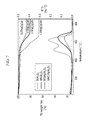
- FIG. 3 is a graph showing the results of DRIFT spectroscopy analysis carried out in Experimental Example 3 for the catalysts obtained from Examples 1 and 2 and Comparative Examples 1 and 2.
- FIG. 4 is a view illustrating a SEM image, a TEM image, and EDX results for the catalyst of Example 1.
- FIG. 5 is a view illustrating a SEM image, a TEM image, and EDX results for the catalyst of Example 2.
- FIG. 6 shows curves plotting a methane conversion rate over time for the catalysts of Examples 1 and 2 and Comparative Example 1.
- FIG. 7 shows the results of a thermogravimetric analysis for each of the catalysts of Examples 1 and 2 and Comparative Examples 1 and 2 after being used in carbon dioxide reforming of methane.
- FIG. 8 is a graph showing the increasing rate of the particle size of the catalysts of Examples 1 and 2 and Comparative Examples 1 and 2 prior to and after being used in carbon dioxide reforming of methane.
- input gas stream refers to a gas stream prior to passing through a catalyst region or prior to initial contact with a catalyst composition.
- a catalyst for reforming hydrocarbons may include an inorganic oxide and a catalyst metal supported on the inorganic metal oxide, wherein at least a portion of the catalyst metal is supported in the form of a solid-solution particle, and the catalyst metal includes at least one first metal (selected from cobalt, iron, copper, and manganese); nickel; and magnesium.
- the catalyst metal including the first metal (e.g., cobalt and the like), nickel, and magnesium is supported on the inorganic oxide support in the form of a solid-solution particle.
- the catalyst metal is structurally stable as it is present in the form of a solid-solution particle.
- magnesium included in the catalyst metal particle may increase the basicity of the catalyst metal so that a carbon dioxide gas (which is an acidic gas) may be readily adsorbed onto the catalyst metal particle, making it possible to enhance the efficiency of the reforming reaction, suppressing side reactions, and thereby the deposited amount of carbon may decrease and the disassociation rate of the reforming reaction product may increase.
- the catalyst may exhibit such a high level of thermal stability that the catalyst metal may avoid the sintering phenomenon and the durability of the catalyst may be enhanced.
- the presence of the solid-solution particle of the catalyst metal may be confirmed by an X-ray diffraction spectroscopy analysis and an energy dispersive X-ray spectroscopy analysis.
- XRD spectrums of the catalyst thus obtained allow confirmation of the formation of the solid solution particle.
- the peaks for the magnesium-support oxide are identified at a position near the peaks for the support oxide—the alloy of the first metal and the nickel metal (e.g., a NiCo alloy-support oxide).
- the EDX analysis of the catalyst may also confirm that the first metal, nickel, and magnesium are uniformly distributed in the catalyst metal particle supported on the support.
- the solid solution particle may have an average maximum diameter of about 2 nm to about 20 nm, but it is not limited thereto.
- the catalyst may exhibit a high level of reaction efficiency due to the inclusion of the magnesium component in the solid particle.
- the number of carbon-growth sites may decrease, while the interface area between the metal and support may increase. Therefore, even when the particle of the catalyst metal has a relatively large size, the catalyst may exhibit a high level of reaction efficiency and the amount of carbon deposited thereon may be maintained at a relatively low level.
- the catalyst may include magnesium in an amount of about 0.01 wt % to about 5 wt %, based on the total weight thereof.
- the catalyst metal may be supported on the support in an amount of about 1 to about 15 wt %, for example, about 2 to about 14 wt %, or about 3 to about 13 wt %, or about 4 to about 13 wt %, or about 5 to about 10 wt % based on the total weight of the catalyst (including the support).
- the weight ratio between nickel and the first metal may range from about 1:20 to 20:1 (i.e., the amount of the first metal being about 0.05 g to about 20 g per 1 g of nickel), for example from about 1:10 to 10:1 (i.e., the amount of the first metal being about 0.1 g to about 10 g per 1 g of nickel), or from about 1:5 to 5:1 (i.e., the amount of the first metal being about 0.2 g to about 5 g per 1 g of nickel), or from about 1:3 to 3:1.
- the solid solution particle may include a support island [i.e., plurality of particles including the inorganic oxide (for example, being supported thereon), which are spaced each other and supported on the surface of the solid solution particle]. That is, the inorganic oxide (i.e., the support) may also exist on the surface of the solid-solution particle in the form of an island. Without wishing to be bound by any theory, such a support island on the surface of the solid solution particle thus formed may result in an increase in the metal-support interface site, leading to more sites and higher efficiency for the reforming reaction.
- the area of sites susceptible to the carbon deposition or the carbon growth decreases so that the number of the nickel metal particles having a size over 10 nm (i.e., that may cause a significant level of sintering) decreases and thereby the durability of the catalyst may be further enhanced.
- Types of the inorganic oxide support may include, but are not limited to, an aluminum oxide, a titanium oxide, a cerium oxide, and a silicon oxide.
- the inorganic oxide support may be used alone or in a mixture of at least two compounds.
- the inorganic oxide may have a specific surface area of about 20 to 500 m 2 /g, for example about 100 to 500 m 2 /g, but it is not limited thereto.
- the catalyst for carbon dioxide reforming of hydrocarbons may exhibit a higher level of efficiency, and even after the relatively high temperature reaction, it may control the growth rate of the particle size or the amount of carbon deposition so as to keep it at a relatively low level.
- the catalyst for reforming hydrocarbons may have a carbon deposition rate of less than about 0.1 wt %, for example, less than about 0.06%.
- a method of manufacturing a catalyst for CO 2 reforming of hydrocarbons may include providing an inorganic oxide; dissolving a water-soluble salt of at least one first metal selected from cobalt, iron, copper, and manganese, a water-soluble salt of nickel, and a water-soluble salt of magnesium in water to provide an aqueous solution of metal salts; mixing the aqueous solution of metal salts with the inorganic oxide to obtain a homogeneous slurry mixture; drying the homogeneous slurry mixture to obtain a dried mixture; and calcining the dried mixture to obtain a catalyst, wherein the catalyst may include magnesium in an amount of about 0.01 wt % to about 5 wt %, based on the total weight of the catalyst, and the catalyst may include a solid solution particle including the first metal, nickel, and magnesium, the solid solution particle being supported on the inorganic oxide.
- the catalyst may include a plurality of particles including the inorganic oxide, the plurality of particles being supported on the surface of the solid solution particle and being spaced apart from each other.
- the catalyst may have a weight ratio between nickel and the first metal ranging from about 1:20 to about 20:1.
- the inorganic oxide may be prepared using any known methods, and it is possible to use a commercially available one.
- the amounts of the water soluble salt of the first metal, the amount of the water soluble salt of nickel, and the amount of the water soluble salt of magnesium may be controlled so that the resulting catalyst may have a desired amount of each metal component being supported thereon.
- the types of the water soluble salt may include, but are not limited to, an acetate salt, a nitrate salt, a sulfate salt, an oxalate salt, a halide, a chloride, and a hydrate thereof.
- the aqueous solution of the metal salt is mixed with the inorganic oxide to prepare a homogeneous slurry mixture.
- the homogeneous slurry mixture may be obtained by controlling the amount of the inorganic oxide and the amount of the aqueous solution of the metal salts.
- the amount of the aqueous solution of the metal salts may vary with the inorganic oxide, e.g., its type, its specific surface area, its pore volume, and the like, and may be determined with ease.
- the amount of the aqueous solution of the metal salts may be substantially the same as the pore volume of the inorganic oxide, and when the hydrate of the metal salt is used, the amount of the water being included as a hydrate is taken into account for determining the amount of the aqueous solution of the metal salts.
- the “homogeneous slurry” refers to a homogeneous mixture being formed without any noticeable separation of a water phase and a solid phase.
- preparing the homogeneous slurry may include co-impregnating the inorganic oxide (support) with the aqueous solution of the metal salt via incipient wetness impregnation.
- the inorganic oxide support in the homogeneous slurry mixture, may be co-impregnated with the aqueous solution of the metal salts via the incipient wetness impregnation. If desired, the homogeneous slurry thus obtained may be stirred at a temperature ranging from an ambient temperature to about 50° C. for about 60 minutes to about 24 hours.
- the homogeneous slurry mixture e.g., the inorganic oxide slurry co-impregnated with the aqueous solution of metal salts
- the conditions for the drying are not particularly limited, but they may be properly chosen. In a non-limiting example, the drying may be carried out under an inert gas (e.g., nitrogen) atmosphere at a temperature of 100° C. or higher.
- the dried slurry mixture is calcinated to produce the catalyst.
- the catalyst includes a solid-solution particle of the first metal, nickel, and magnesium, which is supported on the inorganic oxide. Details of the catalyst are the same as set forth above.
- the calcination may be carried out under a nitrogen atmosphere, a hydrogen atmosphere, and/or in the presence of a gas represented by C x H y O z (wherein x is an integer of 0 to 3, y is an integer of 0 to 3, and z is an integer of 0 to 3) at a temperature of about 450° C. to 900° C.
- the gas represented by C x H y O z may be, for example, air, oxygen, carbon dioxide, CO, H 2 , or a mixture thereof.
- the calcination time is not particularly limited, but it may be, for example, greater than or equal to about 10 minutes, or greater than or equal to about one hour.
- the catalyst being calcined may be further subjected to a reducing process under a nitrogen atmosphere and/or under a hydrogen atmosphere.
- the reducing process may be carried out at a temperature of about 600° C. to about 900° C.
- the reducing time is not particularly limited, but may be properly chosen.
- the method may further include adding water to the calcined and optionally reduced catalyst and heat-treating the catalyst under a hydrogen atmosphere (i.e., subjecting the catalyst to the water pretreatment).
- the amount of water is not particularly limited but may be properly adjusted. In non-limiting examples, water is used in such an amount that it may impregnate the catalyst.
- the heat-treating may be carried out in the presence of hydrogen and water vapor at a temperature of about 500° C. to 900° C. When water is added to the catalyst and the resulting catalyst is heat-treated under a hydrogen atmosphere, water being added is evaporated and the heat-treating may be conducted in the presence of hydrogen and water vapors.
- Such a water pretreatment makes it possible for the solid-solution particle to have the inorganic oxide (i.e., the support oxide) islands being spaced from each other and supported on the surface of the solid solution particle. Details for the structure regarding the inorganic oxide (i.e., the support oxide) islands are the same as set forth above.
- the water pre-treatment may cause an increase in the average particle size, but the resulting catalyst may exhibit a decreased change rate (i.e., growth rate) of the particle size after the carbon dioxide reforming reaction.
- a method of CO 2 reforming of hydrocarbons may include bringing an input gas stream (including hydrocarbons and carbon dioxide) into contact with a catalyst, the catalyst including an inorganic oxide and a catalyst metal supported on the inorganic metal oxide, wherein at least a portion of the catalyst metal is supported in the form of a solid-solution particle, and the catalyst metal includes at least one first metal (selected from cobalt, iron, copper, and manganese); nickel; and magnesium.
- the sources of hydrocarbons included in the input gas stream are not particularly limited, but may include fossil fuels such as natural gas, petroleum gas, naphtha, heavy oil, crude oil, coal, or the like; and a non-fossil fuel such as mixed biomass including crude ethanol, wood waste, and agricultural waste residue; municipal solid waste, pulp sludge, and grass straw.
- the hydrocarbon comprises methane.
- the ratio of hydrocarbon and reforming material may be adjusted in light of a H 2 /CO ratio, a CH 4 conversion rate, a CO 2 conversion rate, a yield, or the like, but it is not particularly limited.
- the ratio of the hydrocarbon and the reforming material may range from about 1:1 to about 1:3, based on the mole ratio.
- the input gas stream may further include a dilution inert gas such as nitrogen or the like in addition to the hydrocarbons and reforming materials.
- the input gas stream may further include water.
- the contact conditions between the input gas stream and the catalyst for reforming hydrocarbons are not particularly limited as long as a gas including hydrogen is produced by the reforming reaction triggered by the contact.
- the contact may be performed at a temperature of about 500 to about 1100° C., and specifically at about 600 to about 1000° C., under a pressure of about 0.5 to about 50 atm, and more specifically about 1 to about 20 atm.
- the gas hourly space velocity (GHSV) of the input gas stream is not particularly limited, and may be properly selected in light of a CH 4 conversion rate and a CO 2 conversion rate.
- the space velocity (GHSV) of the input gas stream may range from about 500 to 400,000 h ⁇ 1 , and more specifically from about 1000 to 380,000 h ⁇ 1 .
- the reaction efficiency and the stability of the catalyst may be enhanced so that the agglomeration of the catalyst particles (e.g., a sintering phenomenon) may be significantly suppressed and the amount of the deposited carbon may also be greatly reduced.
- Ni(NO 3 ) 2 -6H 2 O, Mg(NO 3 ) 2 -6H 2 O, and Co(NO 3 ) 2 -6H 2 O are put into 5 ml of deionized water while stirring and completely dissolved therein to produce an aqueous solution of the metal salts.
- 10 g of gamma alumina (from Aldrich, specific surface area: 150 m 2 /g, granule diameter: about 3 mm ⁇ , pore volume: 3 to 5 (cm 3 /g)m) is co-impregnated with Ni(NO 3 ) 2 -6H 2 O, Mg(NO 3 ) 2 -6H 2 O, and Co(NO 3 ) 2 -6H 2 O.
- the obtained product is dried in an oven at 120° C. for 24 hours, and calcined in air (300 ml/minute) at 500° C. for 5 hours.
- the calcined product (i.e., the catalyst) is subjected to a reducing process in a pure H 2 atmosphere by increasing a temperature at a rate of 10° C./min and maintaining the temperature at 850° C. for 2 hours to prepare a catalyst including NiCoMg solid solution particles supported on the alumina support (NiCoMg/Al 2 O 3 ).
- the amount of Ni, the amount of Co, and the amount of Mg are 3 wt %, 3 wt %, and 3 wt %, respectively, based on the total weight of the catalyst.
- the temperature of the reactor having the catalyst obtained in accordance with Example 1 is decreased to 30° C., and 5 ml of water is added thereto. Then, the reactor is heated at a rate of 10° C./min to evaporate water in a hydrogen atmosphere, and the catalyst contained therein is heat-treated at 850° C. for one hour to prepare a catalyst wherein the NiCoMg solid solution particle is supported on the alumina support and the solid solution particle includes alumina islands on its surface (hereinafter referred to as WNiCoMg/Al 2 O 3 ).
- the amount of Ni, the amount of Co, and the amount of Mg are 3 wt %, 3 wt %, and 3 wt %, respectively, based on the total weight of the catalyst.
- a catalyst including Ni particles supported on Al 2 O 3 is prepared in the same manner as set forth in Example 1, except for using an aqueous solution of Ni(NO 3 ) 2 -6H 2 O instead of the aqueous solution of Ni(NO 3 ) 2 -6H 2 O, Mg(NO 3 ) 2 -6H 2 O, and Co(NO 3 ) 2 -6H 2 O.
- the amount of Ni is 3 wt %, based on the total weight of the catalyst.
- a water-pretreated catalyst (hereinafter, WNi/Al 2 O 3 ) is prepared by conducting a water pretreatment in the same manner as set forth in Example 2.
- the amount of Ni is 3 wt %, based on the total weight of the catalyst.
- a catalyst is prepared in the same manner as set forth in Example 1, except that Mg(NO 3 ) 2 -6H 2 O is used in such an amount that the amount of Mg is 6% in the resulting catalyst.
- the amount of Ni, the amount of Co, and the amount of Mg are 3 wt %, 3 wt %, and 6 wt %, respectively, based on the total weight of the catalyst.
- a XRD spectrum analysis and a SEM/TEM/EDX analysis confirm that in the catalyst particle, nickel, cobalt and magnesium are not present in the same catalyst metal particle and thus no solid-solution particle is formed.
- BET surface areas of the catalysts prepared in Examples 1 and 2 are measured using a nitrogen adsorption technology at ⁇ 196° C. with BELsorp (BEL, Japan) before and after the catalysts are subjected to the reforming reaction.
- the results are summarized in Table 1.
- the average particle sizes of the catalyst metal are measured using XRD, TEM, and H 2 chemisorption, and the results are compiled in Table 1.
- the samples Prior to the adsorption measurement, the samples are degassed at a temperature of 200° C. for 24 hours.
- the results of Table 1 confirm that the catalyst of Example 1 exhibits a relatively small change in the BET surface area (39.2%) and an average particle size prior to and after the reaction.
- the catalyst of Example 2 shows a very small change in the BET surface area (i.e., only 11.76%), which is about 3.33 times smaller than the catalyst of Example 1, and the catalyst of Example 2 shows a very small change in the average particle size.
- a powder X-ray diffraction (XRD) analysis is made for the catalysts obtained from Examples 1 and 2 and Comparative Examples 1 and 2.
- XRD X-ray diffraction
- a Philips Xpert Pro X-ray diffractometer equipped with Cu—K ⁇ radioactive ray is used at 40 KV and 40 mA.
- FIG. 1 the results are shown in FIG. 1 .
- the peaks for MgAl 2 O 4 are identified at a 2 theta of 32 degrees and 60.5 degrees, respectively.
- a small shift of the peaks is identified due to the formation of a nickel-cobalt alloy.
- Such results hint that a solid-solution particle of Ni, Co, and Mg is formed in the catalyst of Examples 1 and 2.
- TPD temperature programmed desorption
- FIG. 2 shows that at 300° C., the catalysts of Examples 1 and 2 have a CO 2 desorption amount that is significantly greater than that of the catalyst of Example 2.
- Such results confirm that a greater amount of carbon dioxide may be adsorbed to the catalysts of Examples 1 and 2 than those of the comparative examples, and thereby, the catalysts of Examples 1 and 2 may exhibit a far higher rate of methane decomposition than those of the comparative examples.
- a diffuse reflectance infrared Fourier transform (DRIFT) spectroscopy analysis is made for the catalysts of Examples 1 and 2 and the catalysts of the comparative examples using a Nicolet 5700 FTIR spectrometer equipped with an MCT detector. The results are shown in FIG. 3 .
- DRIFT diffuse reflectance infrared Fourier transform
- the catalysts of Examples 1 and 2 have a peak for HCO 3 ⁇ 1 and a peak for CO which are much higher than those of the catalyst of the comparative examples, and a peak for CO 2 —, which is lower than those of the catalyst of the comparative examples.
- Such results confirm that the catalysts of the examples exhibit higher efficiency of decomposing CO 2 and methane than those of the comparative examples.
- SEM Scanning Electron Microscopy
- TEM Transmission Electron Microscopy
- EDX Energy Dispersive X-Ray Spectroscopy
- FIG. 4 confirms that in the catalyst of Example 1, the NiCoMg catalyst metals, form a solid solution particle.
- FIG. 5 confirms that in the catalyst of Example 2, the WNiCoMg catalyst metals, form a solid solution particle, and the support oxide (Al 2 O 3 ) islands are present on the surface of the solid solution particle.
- Example 1 and 2 have higher initial methane conversion efficiency than Comparative Examples 1 and 2, and their long-term efficiency is much higher than the comparative examples.
Landscapes
- Chemical & Material Sciences (AREA)
- Chemical Kinetics & Catalysis (AREA)
- Organic Chemistry (AREA)
- Engineering & Computer Science (AREA)
- Materials Engineering (AREA)
- Physics & Mathematics (AREA)
- Thermal Sciences (AREA)
- General Health & Medical Sciences (AREA)
- Combustion & Propulsion (AREA)
- Inorganic Chemistry (AREA)
- Health & Medical Sciences (AREA)
- Catalysts (AREA)
- Hydrogen, Water And Hydrids (AREA)
- Dispersion Chemistry (AREA)
- Crystallography & Structural Chemistry (AREA)
Abstract
Description
CH4+CO2→2CO+2H2 [ΔHo=247.3 kJ/mol] (1)
CO2+H2→CO+2H2O [ΔHo=41 kJ/mol] (2)
CH4

2CO
T=850° C., CH4:CO2:N2=1.0:1.0:1.0, 200 hr, GHSV=10 k h−1
| TABLE 1 | ||
| BET surface area | Average particle size | |
| Catalyst | (m2/g) | (nm) |
| Fresh NiCoMg/Al2O3 | 167.30 | 11 |
| Used NiCoMg/Al2O | 101.77 | 15 |
| Fresh WNiCoMg/Al2O3 | 111.76 | 14 |
| Used WNiCoMg/Al2O3 | 98.62 | 16 |
Temperature=850° C., CH4:CO2:N2=1.0:1.0:1.0, 200 hr, GHSV=10,000 h−1
Claims (17)
Applications Claiming Priority (2)
| Application Number | Priority Date | Filing Date | Title |
|---|---|---|---|
| KR1020130038803A KR20140122117A (en) | 2013-04-09 | 2013-04-09 | Catalysts for carbon dioxide reforming of hydrocarbons |
| KR10-2013-0038803 | 2013-04-09 |
Publications (2)
| Publication Number | Publication Date |
|---|---|
| US20140299816A1 US20140299816A1 (en) | 2014-10-09 |
| US9498769B2 true US9498769B2 (en) | 2016-11-22 |
Family
ID=51653821
Family Applications (1)
| Application Number | Title | Priority Date | Filing Date |
|---|---|---|---|
| US14/173,914 Active US9498769B2 (en) | 2013-04-09 | 2014-02-06 | Catalysts for carbon dioxide reforming of hydrocarbons |
Country Status (2)
| Country | Link |
|---|---|
| US (1) | US9498769B2 (en) |
| KR (1) | KR20140122117A (en) |
Cited By (1)
| Publication number | Priority date | Publication date | Assignee | Title |
|---|---|---|---|---|
| US20160121305A1 (en) * | 2013-06-06 | 2016-05-05 | Saudi Basic Industries Corporation | Catalyst composition for the production of syngas from methane, process therefore and process for co2 reforming therewith |
Families Citing this family (5)
| Publication number | Priority date | Publication date | Assignee | Title |
|---|---|---|---|---|
| KR101933014B1 (en) * | 2017-05-18 | 2018-12-27 | 한국화학연구원 | Catalyst for Methane Reformation Using Carbon dioxide and Preparing Method of the Same |
| CN112237926B (en) * | 2019-07-18 | 2023-10-31 | 中国石油化工股份有限公司 | Metal supported catalyst and preparation method thereof |
| US20220009774A1 (en) * | 2020-07-13 | 2022-01-13 | Saudi Arabian Oil Company | Dry reforming of hydrocarbons |
| US12258272B2 (en) * | 2021-08-12 | 2025-03-25 | Saudi Arabian Oil Company | Dry reforming of methane using a nickel-based bi-metallic catalyst |
| KR20250032141A (en) * | 2023-08-30 | 2025-03-07 | 한국화학연구원 | Catalyst for producing syngas by reforming reaction of a reducing gas using carbon dioxide |
Citations (26)
| Publication number | Priority date | Publication date | Assignee | Title |
|---|---|---|---|---|
| US3857901A (en) * | 1971-04-27 | 1974-12-31 | Ici Ltd | Treating hydrocarbons |
| US4663103A (en) | 1983-08-09 | 1987-05-05 | Collins & Aikman Corporation | Apparatus and method of extrusion |
| JPH1179705A (en) | 1997-09-05 | 1999-03-23 | Agency Of Ind Science & Technol | Method for reforming methane with co2 and production of metallic catalyst carried by highly heat resistant alumina aerogel and used in same |
| KR20000030023A (en) | 1998-03-17 | 2000-05-25 | 박호군 | Alumina aerogel carrier for carbon dioxide reforming of methane and prepartion method for nickel-alumina aerogel catalysts |
| US20010050354A1 (en) | 1998-03-17 | 2001-12-13 | Korea Institute Of Technology | Nickel-alumina aerogel catalyst for carbon dioxide reforming of methane and the preparation method thereof |
| KR20020041346A (en) | 2002-02-26 | 2002-06-01 | 김문찬 | Water and gas treatment for increasing activity and decreasing deactivation of catalyst |
| US20030045423A1 (en) | 2001-06-04 | 2003-03-06 | Conoco Inc. | Supported rhodium-lanthanide based catalysts and process for producing synthesis gas |
| KR20030082762A (en) | 2002-04-18 | 2003-10-23 | 한국과학기술연구원 | POX reforming catalysts of gasoline for fuel-cell powered vehicles applications and methods for preparing catalysts |
| KR20040027888A (en) | 2001-08-08 | 2004-04-01 | 존슨 맛쎄이 퍼블릭 리미티드 컴파니 | Catalyst |
| US20040067848A1 (en) * | 2002-10-04 | 2004-04-08 | Japan National Oil Corporation | Hydrocarbon-reforming catalyst and a method of manufacturing thereof |
| US20040077496A1 (en) | 2002-07-26 | 2004-04-22 | Shizhong Zhao | Catalyst |
| US20050169835A1 (en) | 2003-12-31 | 2005-08-04 | Total France | Process for the treatment of methane/carbon dioxide mixtures |
| WO2005092497A1 (en) | 2004-03-22 | 2005-10-06 | Sud-Chemie Inc. | Nickel supported on titanium stabilized promoted calcium aluminate carrier |
| JP2006035172A (en) | 2004-07-29 | 2006-02-09 | Nippon Steel Corp | Hydrocarbon reforming catalyst reduction method, hydrocarbon reforming catalyst, and hydrocarbon reforming method using the same |
| US20060093550A1 (en) * | 2004-11-01 | 2006-05-04 | Choudhary Vasant R | High temperature stable non-noble metal catalyst, process for production of syngas using said catalyst |
| US20080069741A1 (en) | 2006-09-20 | 2008-03-20 | Gerald Stephen Koermer | Catalysts to Reduce NOx in an Exhaust Gas Stream and Methods of Preparation |
| US20080293989A1 (en) * | 2007-05-24 | 2008-11-27 | Saudi Basic Industries Corporation | Catalyst for Conversion of Hydrocarbons, Process of Making and Process of Using Thereof - Incorporation-1 |
| US20080319093A1 (en) | 2007-06-21 | 2008-12-25 | Olah George A | Conversion of carbon dioxide to methanol and/or dimethyl ether using bi-reforming of methane or natural gas |
| KR20100014012A (en) | 2008-08-01 | 2010-02-10 | 한국화학연구원 | Catalyst for the preparation of synthesis gas from natural gas with carbon dioxide and the preparation method there of |
| US20100254892A1 (en) * | 2007-07-19 | 2010-10-07 | Shinji Takahashi | Hydrocarbon-decomposing catalyst, process for decomposing hydrocarbons and process for producing hydrogen using the catalyst, and power generation system |
| US7824656B2 (en) | 2005-03-24 | 2010-11-02 | University Of Regina | Catalysts for hydrogen production |
| US7888282B2 (en) | 2003-12-18 | 2011-02-15 | Chiyoda Corporation | Catalyst for manufacturing synthesis gas and method of manufacturing synthesis gas using the same |
| US7985710B2 (en) | 2008-06-19 | 2011-07-26 | University Of Saskatchewan | Catalyst for production of synthesis gas |
| KR20120039173A (en) | 2010-10-15 | 2012-04-25 | 주식회사 씨엔엘에너지 | Mesoporous nickel-m-alumina aerogel catalyst and preparation method thereof |
| US20120237432A1 (en) | 2011-03-14 | 2012-09-20 | Samsung Electronics Co., Ltd. | Co2 reforming catalyst, method of preparing the same, and method of reforming co2 using the catalyst |
| US8614161B2 (en) | 2011-01-14 | 2013-12-24 | Samsung Electronics Co., Ltd. | CO2 reforming catalyst composition |
-
2013
- 2013-04-09 KR KR1020130038803A patent/KR20140122117A/en not_active Ceased
-
2014
- 2014-02-06 US US14/173,914 patent/US9498769B2/en active Active
Patent Citations (47)
| Publication number | Priority date | Publication date | Assignee | Title |
|---|---|---|---|---|
| US3857901A (en) * | 1971-04-27 | 1974-12-31 | Ici Ltd | Treating hydrocarbons |
| US4663103A (en) | 1983-08-09 | 1987-05-05 | Collins & Aikman Corporation | Apparatus and method of extrusion |
| JPH1179705A (en) | 1997-09-05 | 1999-03-23 | Agency Of Ind Science & Technol | Method for reforming methane with co2 and production of metallic catalyst carried by highly heat resistant alumina aerogel and used in same |
| US6355219B2 (en) | 1998-03-17 | 2002-03-12 | Korea Institute Of Science And Technology | Nickel-alumina aerogel catalyst for carbon dioxide reforming of methane and the preparation method thereof |
| US6271170B1 (en) | 1998-03-17 | 2001-08-07 | Korea Institute Of Science And Technology | Nickel-alumina aerogel catalyst for carbon dioxide reforming of methane and the preparation method thereof |
| US20010050354A1 (en) | 1998-03-17 | 2001-12-13 | Korea Institute Of Technology | Nickel-alumina aerogel catalyst for carbon dioxide reforming of methane and the preparation method thereof |
| KR20000030023A (en) | 1998-03-17 | 2000-05-25 | 박호군 | Alumina aerogel carrier for carbon dioxide reforming of methane and prepartion method for nickel-alumina aerogel catalysts |
| US20030045423A1 (en) | 2001-06-04 | 2003-03-06 | Conoco Inc. | Supported rhodium-lanthanide based catalysts and process for producing synthesis gas |
| US20040266612A1 (en) | 2001-08-08 | 2004-12-30 | Hayes Martin John | Catalyst |
| KR20040027888A (en) | 2001-08-08 | 2004-04-01 | 존슨 맛쎄이 퍼블릭 리미티드 컴파니 | Catalyst |
| US7375049B2 (en) | 2001-08-08 | 2008-05-20 | Johnson Matthey Plc | Catalyst |
| KR20020041346A (en) | 2002-02-26 | 2002-06-01 | 김문찬 | Water and gas treatment for increasing activity and decreasing deactivation of catalyst |
| KR20030082762A (en) | 2002-04-18 | 2003-10-23 | 한국과학기술연구원 | POX reforming catalysts of gasoline for fuel-cell powered vehicles applications and methods for preparing catalysts |
| US20040077496A1 (en) | 2002-07-26 | 2004-04-22 | Shizhong Zhao | Catalyst |
| US20050058594A1 (en) | 2002-07-26 | 2005-03-17 | Shizhong Zhao | Process for catalytic reforming |
| US6984371B2 (en) | 2002-07-26 | 2006-01-10 | Sud-Chemie Inc. | Process for catalytic reforming |
| US7378369B2 (en) | 2002-07-26 | 2008-05-27 | Sud-Chemie Inc. | Nickel supported on titanium stabilized promoted calcium aluminate carrier |
| JP2004141860A (en) | 2002-10-04 | 2004-05-20 | Japan National Oil Corp | Hydrocarbon reforming catalyst and method for producing the same |
| US20040067848A1 (en) * | 2002-10-04 | 2004-04-08 | Japan National Oil Corporation | Hydrocarbon-reforming catalyst and a method of manufacturing thereof |
| US7452842B2 (en) | 2002-10-04 | 2008-11-18 | Japan Oil, Gas And Metals National Corporation | Hydrocarbon-reforming catalyst and a method of manufacturing thereof |
| US7888282B2 (en) | 2003-12-18 | 2011-02-15 | Chiyoda Corporation | Catalyst for manufacturing synthesis gas and method of manufacturing synthesis gas using the same |
| US20050169835A1 (en) | 2003-12-31 | 2005-08-04 | Total France | Process for the treatment of methane/carbon dioxide mixtures |
| JP2007516924A (en) | 2003-12-31 | 2007-06-28 | トタル・フランス | Process for treating methane-carbon dioxide mixtures |
| WO2005092497A1 (en) | 2004-03-22 | 2005-10-06 | Sud-Chemie Inc. | Nickel supported on titanium stabilized promoted calcium aluminate carrier |
| JP2006035172A (en) | 2004-07-29 | 2006-02-09 | Nippon Steel Corp | Hydrocarbon reforming catalyst reduction method, hydrocarbon reforming catalyst, and hydrocarbon reforming method using the same |
| US20060093550A1 (en) * | 2004-11-01 | 2006-05-04 | Choudhary Vasant R | High temperature stable non-noble metal catalyst, process for production of syngas using said catalyst |
| US7824656B2 (en) | 2005-03-24 | 2010-11-02 | University Of Regina | Catalysts for hydrogen production |
| KR20090057127A (en) | 2006-09-20 | 2009-06-03 | 바스프 카탈리스트 엘엘씨 | Catalyst and process for reducing NOx in exhaust gas stream |
| US20080069741A1 (en) | 2006-09-20 | 2008-03-20 | Gerald Stephen Koermer | Catalysts to Reduce NOx in an Exhaust Gas Stream and Methods of Preparation |
| US8173574B2 (en) | 2006-09-20 | 2012-05-08 | Basf Corporation | Catalysts to reduce NOx in an exhaust gas stream and methods of preparation |
| US20080293989A1 (en) * | 2007-05-24 | 2008-11-27 | Saudi Basic Industries Corporation | Catalyst for Conversion of Hydrocarbons, Process of Making and Process of Using Thereof - Incorporation-1 |
| US8133926B2 (en) | 2007-06-21 | 2012-03-13 | University Of Southern California | Conversion of carbon dioxide to dimethyl ether using bi-reforming of methane or natural gas |
| US20090030240A1 (en) | 2007-06-21 | 2009-01-29 | Olah George A | Conversion of carbon dioxide to dimethyl ether using bi-reforming of methane or natural gas |
| US20120115965A1 (en) | 2007-06-21 | 2012-05-10 | University Of Southern California | Conversion of carbon dioxide to methanol using bi-reforming of methane or natural gas |
| KR20100036254A (en) | 2007-06-21 | 2010-04-07 | 유니버시티 오브 써던 캘리포니아 | Conversion of carbon dioxide to methanol using bi-reforming of methane or natural gas |
| US20080319093A1 (en) | 2007-06-21 | 2008-12-25 | Olah George A | Conversion of carbon dioxide to methanol and/or dimethyl ether using bi-reforming of methane or natural gas |
| US20110054045A1 (en) | 2007-06-21 | 2011-03-03 | University Of Southern California | Conversion of carbon dioxide to methanol using bi-reforming of methane or natural gas |
| US7906559B2 (en) | 2007-06-21 | 2011-03-15 | University Of Southern California | Conversion of carbon dioxide to methanol and/or dimethyl ether using bi-reforming of methane or natural gas |
| US20100254892A1 (en) * | 2007-07-19 | 2010-10-07 | Shinji Takahashi | Hydrocarbon-decomposing catalyst, process for decomposing hydrocarbons and process for producing hydrogen using the catalyst, and power generation system |
| US7985710B2 (en) | 2008-06-19 | 2011-07-26 | University Of Saskatchewan | Catalyst for production of synthesis gas |
| US20110114892A1 (en) | 2008-08-01 | 2011-05-19 | Ki Won Jun | Catalyst for preparing synthesis gas from natural gas and carbon dioxide, and preparation method thereof |
| KR20100014012A (en) | 2008-08-01 | 2010-02-10 | 한국화학연구원 | Catalyst for the preparation of synthesis gas from natural gas with carbon dioxide and the preparation method there of |
| US8524119B2 (en) | 2008-08-01 | 2013-09-03 | Hyundai Heavy Industries Co., Ltd. | Catalyst for preparing synthesis gas from natural gas and carbon dioxide, and preparation method thereof |
| KR20120039173A (en) | 2010-10-15 | 2012-04-25 | 주식회사 씨엔엘에너지 | Mesoporous nickel-m-alumina aerogel catalyst and preparation method thereof |
| US8614161B2 (en) | 2011-01-14 | 2013-12-24 | Samsung Electronics Co., Ltd. | CO2 reforming catalyst composition |
| US20120237432A1 (en) | 2011-03-14 | 2012-09-20 | Samsung Electronics Co., Ltd. | Co2 reforming catalyst, method of preparing the same, and method of reforming co2 using the catalyst |
| KR20120104722A (en) | 2011-03-14 | 2012-09-24 | 삼성전자주식회사 | Co2 reforming catalyst, method preparing the same and method reforming co2 |
Non-Patent Citations (5)
| Title |
|---|
| Jianguo Zhang, et al. "Development of stable bimetallic catalusts for carbon dioxcide reforming of methane", Journal of Catalysis 249 (2007), pp. 300-310. |
| Jianguo Zhang, et al. "Effects of metal content on activity and stability of Ni-Co bimetallic catalysts for CO2 reforming of CH4", Applied Catalysis A: General 339 (2008) pp. 121-129. |
| Jianguo Zhang, et al.; "Design and Preparation of Ni-Co Bimetallic Nanocatalyst for Carbon Dioxide Reforming of Methane", Nanocatalysis for Fuels and Chemicals, Chapter 12, pp. 195-221, Jan. 20, 2012. |
| Machine translation of JP 2006-035172 (2006). * |
| Sang-Sik Lee, et al. "Partial Oxidation of Methane for Hydrogen Production over Co and Ni Catalysts", Korean Chem. Eng. Res., vol. 48, No. 6, Dec. 2010, pp. 776-783. |
Cited By (2)
| Publication number | Priority date | Publication date | Assignee | Title |
|---|---|---|---|---|
| US20160121305A1 (en) * | 2013-06-06 | 2016-05-05 | Saudi Basic Industries Corporation | Catalyst composition for the production of syngas from methane, process therefore and process for co2 reforming therewith |
| US9770706B2 (en) * | 2013-06-06 | 2017-09-26 | Saudi Basic Industries Corporation | Catalyst composition for the production of syngas from methane, process therefore and process for CO2 reforming therewith |
Also Published As
| Publication number | Publication date |
|---|---|
| US20140299816A1 (en) | 2014-10-09 |
| KR20140122117A (en) | 2014-10-17 |
Similar Documents
| Publication | Publication Date | Title |
|---|---|---|
| Tan et al. | Highly dispersed and stable Ni nanoparticles confined by MgO on ZrO2 for CO2 methanation | |
| Horváth et al. | Strong impact of indium promoter on Ni/Al2O3 and Ni/CeO2-Al2O3 catalysts used in dry reforming of methane | |
| Mo et al. | The optimization of Ni–Al2O3 catalyst with the addition of La2O3 for CO2–CH4 reforming to produce syngas | |
| US7985710B2 (en) | Catalyst for production of synthesis gas | |
| Wang et al. | Synthesis, characterization and catalytic performance of MgO-coated Ni/SBA-15 catalysts for methane dry reforming to syngas and hydrogen | |
| Calgaro et al. | Biogas dry reforming for hydrogen production over Ni-M-Al catalysts (M= Mg, Li, Ca, La, Cu, Co, Zn) | |
| Das et al. | Facile synthesis of highly disperse Ni–Co nanoparticles over mesoporous silica for enhanced methane dry reforming | |
| Min et al. | Carbon dioxide reforming of methane on Ni–MgO–Al2O3 catalysts prepared by sol–gel method: Effects of Mg/Al ratios | |
| Oemar et al. | Perovskite LaxM1− xNi0. 8Fe0. 2O3 catalyst for steam reforming of toluene: Crucial role of alkaline earth metal at low steam condition | |
| US9498769B2 (en) | Catalysts for carbon dioxide reforming of hydrocarbons | |
| US8475684B2 (en) | Composite oxide for hydrocarbon reforming catalyst, process for producing the same, and process for producing syngas using the same | |
| US9168511B2 (en) | Catalyst for hydrogen production | |
| Zanganeh et al. | Preparation of nanocrystalline NiO–MgO solid solution powders as catalyst for methane reforming with carbon dioxide: Effect of preparation conditions | |
| Lorenzut et al. | Hydrogen production through alcohol steam reforming on Cu/ZnO-based catalysts | |
| Naeem et al. | Hydrogen production from methane dry reforming over nickel-based nanocatalysts using surfactant-assisted or polyol method | |
| Zeng et al. | Ni–Ce–Al composite oxide catalysts synthesized by solution combustion method: Enhanced catalytic activity for CO methanation | |
| Ahmad et al. | Design of Ni/La2O3 catalysts for dry reforming of methane: Understanding the impact of synthesis methods | |
| Sun et al. | Production of syngas via CO2 methane reforming process: effect of cerium and calcium promoters on the performance of Ni-MSC catalysts | |
| Akansu et al. | Nickel-based alumina supported catalysts for dry reforming of biogas in the absence and the presence of H2S: Effect of manganese incorporation | |
| Yan et al. | The role of Zr in NiZrAl oxides catalyst and the evaluation on steam reforming of glycerol for hydrogen product | |
| US9168510B2 (en) | Nickel catalysts for reforming hydrocarbons | |
| Heo et al. | Efficient hydrogen production by low-temperature steam reforming of propane using catalysts with very small amounts of Pt loaded on NiMn2O4 particles | |
| Ding et al. | Revisiting the syngas conversion to olefins over Fe-Mn bimetallic catalysts: Insights from the proximity effects | |
| Yuan et al. | Highly efficient semi-hydrogenation of acetylene over Ni supported mesoporous MgAl2O4 spinel derived from aluminate-intercalated layered double hydroxide | |
| Jo et al. | Synergies between Ni, Co, and Mn ions in trimetallic Ni1-xCoxMnO4 catalysts for effective hydrogen production from propane steam reforming |
Legal Events
| Date | Code | Title | Description |
|---|---|---|---|
| AS | Assignment |
Owner name: SAMSUNG ELECTRONICS CO., LTD., KOREA, REPUBLIC OF Free format text: ASSIGNMENT OF ASSIGNORS INTEREST;ASSIGNORS:SON, IN HYUK;LEE, SEUNG JAE;REEL/FRAME:032160/0020 Effective date: 20140120 |
|
| STCF | Information on status: patent grant |
Free format text: PATENTED CASE |
|
| FEPP | Fee payment procedure |
Free format text: PAYOR NUMBER ASSIGNED (ORIGINAL EVENT CODE: ASPN); ENTITY STATUS OF PATENT OWNER: LARGE ENTITY |
|
| MAFP | Maintenance fee payment |
Free format text: PAYMENT OF MAINTENANCE FEE, 4TH YEAR, LARGE ENTITY (ORIGINAL EVENT CODE: M1551); ENTITY STATUS OF PATENT OWNER: LARGE ENTITY Year of fee payment: 4 |
|
| MAFP | Maintenance fee payment |
Free format text: PAYMENT OF MAINTENANCE FEE, 8TH YEAR, LARGE ENTITY (ORIGINAL EVENT CODE: M1552); ENTITY STATUS OF PATENT OWNER: LARGE ENTITY Year of fee payment: 8 |