US9496311B2 - Solid-state imaging device, method of manufacturing the same, and electronic apparatus - Google Patents

Solid-state imaging device, method of manufacturing the same, and electronic apparatus Download PDF

Info

Publication number
US9496311B2
US9496311B2 US14/524,540 US201414524540A US9496311B2 US 9496311 B2 US9496311 B2 US 9496311B2 US 201414524540 A US201414524540 A US 201414524540A US 9496311 B2 US9496311 B2 US 9496311B2
Authority
US
United States
Prior art keywords
transistor
pixel
substrate
photoelectric conversion
film
Prior art date
Legal status (The legal status is an assumption and is not a legal conclusion. Google has not performed a legal analysis and makes no representation as to the accuracy of the status listed.)
Expired - Fee Related
Application number
US14/524,540
Other versions
US20150123179A1 (en
Inventor
Yoshiaki Kikuchi
Current Assignee (The listed assignees may be inaccurate. Google has not performed a legal analysis and makes no representation or warranty as to the accuracy of the list.)
Sony Corp
Original Assignee
Sony Corp
Priority date (The priority date is an assumption and is not a legal conclusion. Google has not performed a legal analysis and makes no representation as to the accuracy of the date listed.)
Filing date
Publication date
Application filed by Sony Corp filed Critical Sony Corp
Assigned to SONY CORPORATION reassignment SONY CORPORATION ASSIGNMENT OF ASSIGNORS INTEREST (SEE DOCUMENT FOR DETAILS). Assignors: KIKUCHI, YOSHIAKI
Publication of US20150123179A1 publication Critical patent/US20150123179A1/en
Application granted granted Critical
Publication of US9496311B2 publication Critical patent/US9496311B2/en
Expired - Fee Related legal-status Critical Current
Anticipated expiration legal-status Critical

Links

Images

Classifications

    • HELECTRICITY
    • H10SEMICONDUCTOR DEVICES; ELECTRIC SOLID-STATE DEVICES NOT OTHERWISE PROVIDED FOR
    • H10FINORGANIC SEMICONDUCTOR DEVICES SENSITIVE TO INFRARED RADIATION, LIGHT, ELECTROMAGNETIC RADIATION OF SHORTER WAVELENGTH OR CORPUSCULAR RADIATION
    • H10F39/00Integrated devices, or assemblies of multiple devices, comprising at least one element covered by group H10F30/00, e.g. radiation detectors comprising photodiode arrays
    • H10F39/011Manufacture or treatment of image sensors covered by group H10F39/12
    • H10F39/026Wafer-level processing
    • H01L27/14687
    • H01L27/14603
    • H01L27/14609
    • H01L27/14612
    • H01L27/14614
    • H01L27/14616
    • H01L27/14623
    • H01L27/14638
    • H01L27/1464
    • H01L27/14641
    • H01L27/14689
    • H01L29/42392
    • HELECTRICITY
    • H10SEMICONDUCTOR DEVICES; ELECTRIC SOLID-STATE DEVICES NOT OTHERWISE PROVIDED FOR
    • H10DINORGANIC ELECTRIC SEMICONDUCTOR DEVICES
    • H10D30/00Field-effect transistors [FET]
    • H10D30/60Insulated-gate field-effect transistors [IGFET]
    • H10D30/67Thin-film transistors [TFT]
    • H10D30/6729Thin-film transistors [TFT] characterised by the electrodes
    • H10D30/673Thin-film transistors [TFT] characterised by the electrodes characterised by the shapes, relative sizes or dispositions of the gate electrodes
    • H10D30/6735Thin-film transistors [TFT] characterised by the electrodes characterised by the shapes, relative sizes or dispositions of the gate electrodes having gates fully surrounding the channels, e.g. gate-all-around
    • HELECTRICITY
    • H10SEMICONDUCTOR DEVICES; ELECTRIC SOLID-STATE DEVICES NOT OTHERWISE PROVIDED FOR
    • H10FINORGANIC SEMICONDUCTOR DEVICES SENSITIVE TO INFRARED RADIATION, LIGHT, ELECTROMAGNETIC RADIATION OF SHORTER WAVELENGTH OR CORPUSCULAR RADIATION
    • H10F39/00Integrated devices, or assemblies of multiple devices, comprising at least one element covered by group H10F30/00, e.g. radiation detectors comprising photodiode arrays
    • H10F39/011Manufacture or treatment of image sensors covered by group H10F39/12
    • H10F39/014Manufacture or treatment of image sensors covered by group H10F39/12 of CMOS image sensors
    • HELECTRICITY
    • H10SEMICONDUCTOR DEVICES; ELECTRIC SOLID-STATE DEVICES NOT OTHERWISE PROVIDED FOR
    • H10FINORGANIC SEMICONDUCTOR DEVICES SENSITIVE TO INFRARED RADIATION, LIGHT, ELECTROMAGNETIC RADIATION OF SHORTER WAVELENGTH OR CORPUSCULAR RADIATION
    • H10F39/00Integrated devices, or assemblies of multiple devices, comprising at least one element covered by group H10F30/00, e.g. radiation detectors comprising photodiode arrays
    • H10F39/10Integrated devices
    • H10F39/12Image sensors
    • H10F39/199Back-illuminated image sensors
    • HELECTRICITY
    • H10SEMICONDUCTOR DEVICES; ELECTRIC SOLID-STATE DEVICES NOT OTHERWISE PROVIDED FOR
    • H10FINORGANIC SEMICONDUCTOR DEVICES SENSITIVE TO INFRARED RADIATION, LIGHT, ELECTROMAGNETIC RADIATION OF SHORTER WAVELENGTH OR CORPUSCULAR RADIATION
    • H10F39/00Integrated devices, or assemblies of multiple devices, comprising at least one element covered by group H10F30/00, e.g. radiation detectors comprising photodiode arrays
    • H10F39/80Constructional details of image sensors
    • H10F39/802Geometry or disposition of elements in pixels, e.g. address-lines or gate electrodes
    • HELECTRICITY
    • H10SEMICONDUCTOR DEVICES; ELECTRIC SOLID-STATE DEVICES NOT OTHERWISE PROVIDED FOR
    • H10FINORGANIC SEMICONDUCTOR DEVICES SENSITIVE TO INFRARED RADIATION, LIGHT, ELECTROMAGNETIC RADIATION OF SHORTER WAVELENGTH OR CORPUSCULAR RADIATION
    • H10F39/00Integrated devices, or assemblies of multiple devices, comprising at least one element covered by group H10F30/00, e.g. radiation detectors comprising photodiode arrays
    • H10F39/80Constructional details of image sensors
    • H10F39/803Pixels having integrated switching, control, storage or amplification elements
    • HELECTRICITY
    • H10SEMICONDUCTOR DEVICES; ELECTRIC SOLID-STATE DEVICES NOT OTHERWISE PROVIDED FOR
    • H10FINORGANIC SEMICONDUCTOR DEVICES SENSITIVE TO INFRARED RADIATION, LIGHT, ELECTROMAGNETIC RADIATION OF SHORTER WAVELENGTH OR CORPUSCULAR RADIATION
    • H10F39/00Integrated devices, or assemblies of multiple devices, comprising at least one element covered by group H10F30/00, e.g. radiation detectors comprising photodiode arrays
    • H10F39/80Constructional details of image sensors
    • H10F39/803Pixels having integrated switching, control, storage or amplification elements
    • H10F39/8037Pixels having integrated switching, control, storage or amplification elements the integrated elements comprising a transistor
    • HELECTRICITY
    • H10SEMICONDUCTOR DEVICES; ELECTRIC SOLID-STATE DEVICES NOT OTHERWISE PROVIDED FOR
    • H10FINORGANIC SEMICONDUCTOR DEVICES SENSITIVE TO INFRARED RADIATION, LIGHT, ELECTROMAGNETIC RADIATION OF SHORTER WAVELENGTH OR CORPUSCULAR RADIATION
    • H10F39/00Integrated devices, or assemblies of multiple devices, comprising at least one element covered by group H10F30/00, e.g. radiation detectors comprising photodiode arrays
    • H10F39/80Constructional details of image sensors
    • H10F39/803Pixels having integrated switching, control, storage or amplification elements
    • H10F39/8037Pixels having integrated switching, control, storage or amplification elements the integrated elements comprising a transistor
    • H10F39/80373Pixels having integrated switching, control, storage or amplification elements the integrated elements comprising a transistor characterised by the gate of the transistor
    • HELECTRICITY
    • H10SEMICONDUCTOR DEVICES; ELECTRIC SOLID-STATE DEVICES NOT OTHERWISE PROVIDED FOR
    • H10FINORGANIC SEMICONDUCTOR DEVICES SENSITIVE TO INFRARED RADIATION, LIGHT, ELECTROMAGNETIC RADIATION OF SHORTER WAVELENGTH OR CORPUSCULAR RADIATION
    • H10F39/00Integrated devices, or assemblies of multiple devices, comprising at least one element covered by group H10F30/00, e.g. radiation detectors comprising photodiode arrays
    • H10F39/80Constructional details of image sensors
    • H10F39/803Pixels having integrated switching, control, storage or amplification elements
    • H10F39/8037Pixels having integrated switching, control, storage or amplification elements the integrated elements comprising a transistor
    • H10F39/80377Pixels having integrated switching, control, storage or amplification elements the integrated elements comprising a transistor characterised by the channel of the transistor, e.g. channel having a doping gradient
    • HELECTRICITY
    • H10SEMICONDUCTOR DEVICES; ELECTRIC SOLID-STATE DEVICES NOT OTHERWISE PROVIDED FOR
    • H10FINORGANIC SEMICONDUCTOR DEVICES SENSITIVE TO INFRARED RADIATION, LIGHT, ELECTROMAGNETIC RADIATION OF SHORTER WAVELENGTH OR CORPUSCULAR RADIATION
    • H10F39/00Integrated devices, or assemblies of multiple devices, comprising at least one element covered by group H10F30/00, e.g. radiation detectors comprising photodiode arrays
    • H10F39/80Constructional details of image sensors
    • H10F39/805Coatings
    • H10F39/8057Optical shielding
    • HELECTRICITY
    • H10SEMICONDUCTOR DEVICES; ELECTRIC SOLID-STATE DEVICES NOT OTHERWISE PROVIDED FOR
    • H10FINORGANIC SEMICONDUCTOR DEVICES SENSITIVE TO INFRARED RADIATION, LIGHT, ELECTROMAGNETIC RADIATION OF SHORTER WAVELENGTH OR CORPUSCULAR RADIATION
    • H10F39/00Integrated devices, or assemblies of multiple devices, comprising at least one element covered by group H10F30/00, e.g. radiation detectors comprising photodiode arrays
    • H10F39/80Constructional details of image sensors
    • H10F39/812Arrangements for transferring the charges in the image sensor perpendicular to the imaging plane, e.g. buried regions used to transfer generated charges to circuitry under the photosensitive region
    • HELECTRICITY
    • H10SEMICONDUCTOR DEVICES; ELECTRIC SOLID-STATE DEVICES NOT OTHERWISE PROVIDED FOR
    • H10FINORGANIC SEMICONDUCTOR DEVICES SENSITIVE TO INFRARED RADIATION, LIGHT, ELECTROMAGNETIC RADIATION OF SHORTER WAVELENGTH OR CORPUSCULAR RADIATION
    • H10F39/00Integrated devices, or assemblies of multiple devices, comprising at least one element covered by group H10F30/00, e.g. radiation detectors comprising photodiode arrays
    • H10F39/80Constructional details of image sensors
    • H10F39/813Electronic components shared by multiple pixels, e.g. one amplifier shared by two pixels

Definitions

  • the present disclosure relates to a solid-state imaging device, a method of manufacturing the same, and an electronic apparatus, and more particularly, to a solid-state imaging device, a method of manufacturing the same, and an electronic apparatus capable of reducing noise by increasing an area of a channel region in at least one of an amplification transistor, a readout transistor, and a reset transistor of a pixel.
  • a random telegraph signal (RTS) noise in an amplification transistor has formed a blinking point and has deteriorated pixel characteristics.
  • a method of applying a fully depleted metal-oxide-semiconductor field-effect transistor (MOSFET) with no impurities in a channel region to an amplification transistor has been proposed as an example of a method of reducing an RTS noise of an amplification transistor (for example, see Japanese Unexamined Patent Application Publication No. 2006-24787).
  • MOSFET metal-oxide-semiconductor field-effect transistor
  • amplification transistor such as an amplification transistor, a readout transistor, and a reset transistor.
  • a solid-state imaging device including two-dimensionally arranged pixels, each pixel including: a photoelectric conversion element configured to generate charge according to a light amount of incident light and accumulate the charges therein; and at least one of an amplification transistor configured to amplify a voltage corresponding to the charges accumulated in the photoelectric conversion element, a readout transistor configured to read a signal of the voltage amplified by the amplification transistor, and a reset transistor configured to reset the charges accumulated in the photoelectric conversion element, a channel region of each transistor being formed in a direction perpendicular to a substrate.
  • the two-dimensionally arranged pixels each including a photoelectric conversion element configured to generate charges according to a light amount of incident light and accumulate the charges therein; and at least one of an amplification transistor configured to amplify a voltage corresponding to the charges accumulated in the photoelectric conversion element, a readout transistor configured to read a signal of the voltage amplified by the amplification transistor, and a reset transistor configured to reset the charges accumulated in the photoelectric conversion element, a channel region of each transistor being formed in a direction perpendicular to a substrate are included.
  • a method of manufacturing a solid-state imaging device including forming two-dimensionally arranged pixels, each pixel including: a photoelectric conversion element configured to generate charges according to a light amount of incident light and accumulate the charges therein; and at least one of an amplification transistor configured to amplify a voltage corresponding to the charges accumulated in the photoelectric conversion element, a readout transistor configured to read a signal of the voltage amplified by the amplification transistor, and a reset transistor configured to reset the charges accumulated in the photoelectric conversion element, a channel region of each transistor being formed in a direction perpendicular to a substrate.
  • the two-dimensionally arranged pixels each including a photoelectric conversion element configured to generate charges according to a light amount of incident light and accumulate the charges therein; and at least one of an amplification transistor configured to amplify a voltage corresponding to the charges accumulated in the photoelectric conversion element, a readout transistor configured to read a signal of the voltage amplified by the amplification transistor, and a reset transistor configured to reset the charges accumulated in the photoelectric conversion element, a channel region of each transistor being formed in a direction perpendicular to a substrate are formed.
  • an electronic apparatus including two-dimensionally arranged pixels, each pixel includes: a photoelectric conversion element configured to generate charges according to a light amount of incident light and accumulate the charges therein; and at least one of an amplification transistor configured to amplify a voltage corresponding to the charges accumulated in the photoelectric conversion element, a readout transistor configured to read a signal of the voltage amplified by the amplification transistor, and a reset transistor configured to reset the charges accumulated in the photoelectric conversion element, a channel region of each transistor being formed in a direction perpendicular to a substrate.
  • the two-dimensionally arranged pixels each including a photoelectric conversion element configured to generate charges according to a light amount of incident light and accumulate the charges therein; and at least one of an amplification transistor configured to amplify a voltage corresponding to the charges accumulated in the photoelectric conversion element, a readout transistor configured to read a signal of the voltage amplified by the amplification transistor, and a reset transistor configured to reset the charges accumulated in the photoelectric conversion element, a channel region of each transistor being formed in a direction perpendicular to a substrate are included.
  • the first to third embodiments of the present disclosure it is possible to reduce a noise in the transistors of the pixel. According to the first to third embodiments of the present disclosure, it is also possible to reduce noise by increasing the area of the channel region in at least one of the amplification transistor, the readout transistor, and the reset transistor of the pixel.
  • FIG. 1 is a block diagram illustrating an example of a configuration of a CMOS image sensor according to a first embodiment as a solid-state imaging device to which the present disclosure is applied;
  • FIG. 2 is a cross-sectional view illustrating an example of a configuration of pixels arranged two-dimensionally in a pixel array unit of FIG. 1 ;
  • FIG. 3 is a diagram illustrating a method of manufacturing the pixel of FIG. 2 ;
  • FIG. 4 is a diagram illustrating a method of manufacturing the pixel of FIG. 2 ;
  • FIG. 5 is a diagram illustrating a method of manufacturing the pixel of FIG. 2 ;
  • FIG. 6 is a diagram illustrating a method of manufacturing the pixel of FIG. 2 ;
  • FIG. 7 is a diagram illustrating a method of manufacturing the pixel of FIG. 2 ;
  • FIGS. 8A and 8B are diagrams illustrating a method of manufacturing the pixel of FIG. 2 ;
  • FIG. 9 is a diagram illustrating a method of manufacturing the pixel of FIG. 2 ;
  • FIG. 10 is a diagram illustrating a method of manufacturing the pixel of FIG. 2 ;
  • FIG. 11 is a diagram illustrating a method of manufacturing the pixel of FIG. 2 ;
  • FIG. 12 is a diagram illustrating a method of manufacturing the pixel of FIG. 2 ;
  • FIG. 13 is a diagram illustrating a method of manufacturing the pixel of FIG. 2 ;
  • FIG. 14 is a diagram illustrating a method of manufacturing the pixel of FIG. 2 ;
  • FIG. 15 is a diagram illustrating a method of manufacturing the pixel of FIG. 2 ;
  • FIGS. 16A and 16B are diagrams illustrating a method of manufacturing the pixel of FIG. 2 ;
  • FIGS. 17A and 17B are diagrams illustrating a method of manufacturing the pixel of FIG. 2 ;
  • FIGS. 18A and 18B are diagrams illustrating a method of manufacturing the pixel of FIG. 2 ;
  • FIG. 19 is a diagram illustrating a method of manufacturing the pixel of FIG. 2 ;
  • FIG. 20 is a diagram illustrating a method of manufacturing the pixel of FIG. 2 ;
  • FIG. 21 is a diagram illustrating a method of manufacturing the pixel of FIG. 2 ;
  • FIG. 22 is a diagram illustrating a method of manufacturing the pixel of FIG. 2 ;
  • FIG. 23 is a diagram illustrating a method of manufacturing the pixel of FIG. 2 ;
  • FIG. 24 is a diagram illustrating a method of manufacturing the pixel of FIG. 2 ;
  • FIG. 25 is a diagram illustrating a method of manufacturing the pixel of FIG. 2 ;
  • FIG. 26 is a diagram illustrating a method of manufacturing the pixel of FIG. 2 ;
  • FIG. 27 is a diagram illustrating a method of manufacturing the pixel of FIG. 2 ;
  • FIG. 28 is a cross-sectional view illustrating an example of a configuration of a pixel of a CMOS image sensor according to a second embodiment as the solid-state imaging device to which the present disclosure is applied;
  • FIG. 29 is a diagram illustrating a method of manufacturing the pixel of FIG. 28 ;
  • FIGS. 30A and 30B are diagrams illustrating a method of manufacturing the pixel of FIG. 28 ;
  • FIG. 31 is a diagram illustrating a method of manufacturing the pixel of FIG. 28 ;
  • FIG. 32 is a diagram illustrating a method of manufacturing the pixel of FIG. 28 ;
  • FIG. 33 is a diagram illustrating a method of manufacturing the pixel of FIG. 28 ;
  • FIG. 34 is a diagram illustrating a method of manufacturing the pixel of FIG. 28 ;
  • FIG. 35 is a diagram illustrating a method of manufacturing the pixel of FIG. 28 ;
  • FIG. 36 is a diagram illustrating a method of manufacturing the pixel of FIG. 28 ;
  • FIG. 37 is a diagram illustrating a method of manufacturing the pixel of FIG. 28 ;
  • FIGS. 38A and 38B are diagrams illustrating a method of manufacturing the pixel of FIG. 28 ;
  • FIGS. 39A and 39B are diagrams illustrating a method of manufacturing the pixel of FIG. 28 ;
  • FIGS. 40A and 40B are diagrams illustrating a method of manufacturing the pixel of FIG. 28 ;
  • FIG. 41 is a diagram illustrating a method of manufacturing the pixel of FIG. 28 ;
  • FIG. 42 is a diagram illustrating a method of manufacturing the pixel of FIG. 28 ;
  • FIG. 43 is a diagram illustrating a method of manufacturing the pixel of FIG. 28 ;
  • FIG. 44 is a diagram illustrating a method of manufacturing the pixel of FIG. 28 ;
  • FIG. 45 is a diagram illustrating a method of manufacturing the pixel of FIG. 28 ;
  • FIG. 46 is a diagram illustrating a method of manufacturing the pixel of FIG. 28 ;
  • FIG. 47 is a diagram illustrating a method of manufacturing the pixel of FIG. 28 ;
  • FIG. 48 is a diagram illustrating a method of manufacturing the pixel of FIG. 28 ;
  • FIG. 49 is a cross-sectional view illustrating an example of a configuration of a pixel of a CMOS image sensor according to a third embodiment as the solid-state imaging device to which the present disclosure is applied;
  • FIG. 50 is a cross-sectional view illustrating an example of a configuration of a CMOS circuit in a CMOS image sensor according to a fourth embodiment as the solid-state imaging device to which the present disclosure is applied;
  • FIG. 51 is a cross-sectional view illustrating an example of a configuration of a pixel of a CMOS image sensor according to a fifth embodiment as the solid-state imaging device to which the present disclosure is applied;
  • FIG. 52 is a diagram illustrating the method of manufacturing a pixel of FIG. 51 ;
  • FIG. 53 is a diagram illustrating the method of manufacturing a pixel of FIG. 51 ;
  • FIG. 54 is a diagram illustrating the method of manufacturing a pixel of FIG. 51 ;
  • FIG. 55 is a diagram illustrating the method of manufacturing a pixel of FIG. 51 ;
  • FIG. 56 is a diagram illustrating the method of manufacturing a pixel of FIG. 51 ;
  • FIG. 57 is a diagram illustrating the method of manufacturing a pixel of FIG. 51 ;
  • FIG. 58 is a diagram illustrating the method of manufacturing a pixel of FIG. 51 ;
  • FIG. 59 is a diagram illustrating the method of manufacturing a pixel of FIG. 51 ;
  • FIG. 60 is a cross-sectional view illustrating an example of a configuration of a pixel of a CMOS image sensor according to a sixth embodiment as the solid-state imaging device to which the present disclosure is applied;
  • FIG. 61 is a diagram illustrating a method of manufacturing the pixel of FIG. 60 ;
  • FIG. 62 is a diagram illustrating a method of manufacturing the pixel of FIG. 60 ;
  • FIG. 63 is a diagram illustrating a method of manufacturing the pixel of FIG. 60 ;
  • FIG. 64 is a diagram illustrating a method of manufacturing the pixel of FIG. 60 ;
  • FIG. 65 is a diagram illustrating a method of manufacturing the pixel of FIG. 60 ;
  • FIG. 66 is a diagram illustrating a method of manufacturing the pixel of FIG. 60 ;
  • FIG. 67 is a diagram illustrating a method of manufacturing the pixel of FIG. 60 ;
  • FIG. 68 is a diagram illustrating a method of manufacturing the pixel of FIG. 60 ;
  • FIG. 69 is a cross-sectional view illustrating an example of a configuration of a pixel of a CMOS image sensor according to a seventh embodiment as the solid-state imaging device to which the present disclosure is applied;
  • FIG. 70 is a cross-sectional view illustrating an example of a configuration of a pixel of a CMOS image sensor according to an eighth embodiment as the solid-state imaging device to which the present disclosure is applied;
  • FIG. 71 is a block diagram illustrating an example of a configuration of an imaging device as an electronic apparatus to which the present disclosure is applied.
  • FIG. 1 is a block diagram illustrating an example of a configuration of a complementary metal-oxide semiconductor (CMOS) image sensor according to a first embodiment as a solid-state imaging device to which the present disclosure is applied.
  • CMOS complementary metal-oxide semiconductor
  • the CMOS image sensor 100 includes a pixel array unit 111 , a vertical driving unit 112 , a column processing unit 113 , a horizontal driving unit 114 , a system control unit 115 , a pixel driving line 116 , a vertical signal line 117 , a signal processing unit 118 , and a data storage unit 119 .
  • the pixel array unit 111 , the vertical driving unit 112 , the column processing unit 113 , the horizontal driving unit 114 , the system control unit 115 , the pixel driving line 116 , the vertical signal line 117 , the signal processing unit 118 , and the data storage unit 119 are formed in a silicon substrate (chip) (not illustrated).
  • the CMOS image sensor 100 may not include the signal processing unit 118 and the data storage unit 119 .
  • the signal processing unit 118 and data storage unit 119 may be provided as an external signal processing unit such as a digital signal processor (DSP) on a substrate different from the substrate for the CMOS image sensor 100 .
  • DSP digital signal processor
  • the CMOS image sensor 100 captures an image of a subject and outputs a pixel signal of each pixel of the image.
  • pixels each including a photoelectric conversion element that generates an amount of charges according to a light amount of incident light and accumulates the charges therein are arranged two-dimensionally in a matrix form in the pixel array unit 111 .
  • the pixel driving line 116 is formed in a horizontal direction (row direction) of FIG. 1 in each row for pixels in the matrix form, and the vertical signal line 117 is formed in a vertical direction (column direction) of FIG. 1 in each column.
  • One end of the pixel driving line 116 is connected to an output terminal (not illustrated) corresponding to each row of the vertical driving unit 112 .
  • the vertical driving unit 112 is a pixel driving unit that includes, for example, a shift register or an address decoder and drives each pixel of the pixel array unit 111 , for example, in units of rows. While illustration of a specific configuration of this vertical driving unit 112 is omitted, the vertical driving unit 112 has a configuration in which two scanning systems of a readout scanning system and a sweep scanning system are included.
  • the readout scanning system sequentially selects the respective rows to sequentially read pixel signals from the respective pixels in units of rows, and outputs, for example, a selection pulse from the output terminal connected to the pixel driving line 116 of the selected row.
  • the sweep scanning system outputs a control pulse from the output terminal connected to the pixel driving line 116 of each row a time of shutter speed earlier than the scanning of the readout scanning system, in order to sweep (reset) unnecessary charges from the photoelectric conversion element. Due to scanning by this sweep scanning system, a so-called electronic shutter operation is performed sequentially in each row.
  • the electronic shutter operation refers to an operation of discarding the charges of the photoelectric conversion element, and newly starting exposure (starting accumulation of charges).
  • the pixel signal output from each pixel of the row selected by the readout scanning system of the vertical driving unit 112 is supplied to the column processing unit 113 through each of the vertical signal lines 117 .
  • the column processing unit 113 includes a signal processing circuit for each column of the pixel array unit 111 .
  • Each signal processing circuit of the column processing unit 113 performs a noise removal process such as a correlated double sampling (CDS) process and signal processing such as an A/D conversion process on the pixel signal output through the vertical signal line 117 from each pixel of the selected row.
  • a fixed pattern noise specific to the pixel such as a reset noise or a threshold variation of an amplification transistor, is removed through the CDS process.
  • the column processing unit 113 temporarily holds the pixel signal after the signal processing.
  • the horizontal driving unit 114 includes, for example, a shift register or an address decoder, and sequentially selects the signal processing circuits of the column processing unit 113 .
  • the pixel signals subjected to signal processing by the respective signal processing circuits of the column processing unit 113 are sequentially output to the signal processing unit 118 through selection scanning by this horizontal driving unit 114 .
  • the system control unit 115 includes, for example, a timing generator that generates various timing signals, and controls the vertical driving unit 112 , the column processing unit 113 , and the horizontal driving unit 114 based on the various timing signals generated by the timing generator.
  • the signal processing unit 118 has at least an addition processing function.
  • the signal processing unit 118 performs various signal processing such as an addition process on the pixel signal output from the column processing unit 113 .
  • the signal processing unit 118 stores a result during signal processing in the data storage unit 119 , as necessary, and refers to the result at a necessary timing.
  • the signal processing unit 118 outputs the pixel signal after the signal processing.
  • FIG. 2 is a cross-sectional view illustrating an example of a configuration of pixels arranged two-dimensionally in the pixel array unit 111 of FIG. 1 .
  • the pixel 130 is formed in a silicon substrate 131 , as illustrated in FIG. 2 .
  • a back surface of the silicon substrate 131 is covered with a SiO 2 film 131 a , and a surface thereof is covered with a SiO 2 film 131 b .
  • the CMOS image sensor 100 is an image sensor of a backside illumination type, and an on-chip lens 132 and a color filter 133 are provided sequentially from an outer side on a back surface of the SiO 2 film 131 a.
  • the on-chip lens 132 condenses light incident from the back surface of the silicon substrate 131 .
  • the condensed light is color-separated through the color filter 133 and is incident on a photodiode 134 within the silicon substrate 131 .
  • a light shielding film 135 is formed in a region that does not correspond to the on-chip lens 132 and the color filter 133 within the SiO 2 film 131 a . Accordingly, light that does not pass through the on-chip lens 132 and the color filter 133 can be prevented from being incident on the photodiode 134 or the like.
  • the photodiode (PD) 134 is a photoelectric conversion element which generates an amount of charges according to an amount of the light incident through the color filter 133 , and accumulates the charges therein.
  • Hole accumulation diodes (HADs) 136 are formed on the back surface side and the surface side of the photodiode 134 and on the right side of FIG. 2 . Thus, it is possible to prevent generation of a dark current.
  • a charge-voltage conversion unit (FD) 137 is formed on the left side of the photodiode 134 in FIG. 2 .
  • a transfer transistor (TG) 138 is formed on the surface of the silicon substrate 131 between the photodiode 134 and the charge-voltage conversion unit 137 .
  • the transfer transistor 138 includes a gate electrode 138 a and a sidewall 138 b .
  • the gate electrode 138 a is connected to the pixel driving line 116 of FIG. 1 via a contact plug 142 .
  • the transfer transistor 138 transfers the charges accumulated in the photodiode 134 to the charge-voltage conversion unit 137 .
  • the charge-voltage conversion unit 137 converts the charges transferred from the photodiode 134 into a voltage.
  • a readout transistor (SEL) 139 , an amplification transistor 140 , and a reset transistor 141 are formed in an order of proximity to the charge-voltage conversion unit 137 on the left side of the charge-voltage conversion unit 137 in FIG. 2 .
  • the readout transistor 139 , the amplification transistor 140 and the reset transistor 141 are fully-depleted vertical MOSFETs.
  • two source and drain regions 139 a of the readout transistor 139 are formed on the surface side and the back surface side of the silicon substrate 131 . Therefore, a channel region 139 b interposed between the two source and drain regions 139 a is formed in a direction perpendicular to the silicon substrate 131 .
  • a gate electrode 139 c is formed to cover the channel region 139 b.
  • Source and drain regions 140 a , a channel region 140 b and a gate electrode 140 c of the amplification transistor 140 , and source and drain regions 141 a , a channel region 141 b and a gate electrode 141 c of the reset transistor 141 are formed similarly.
  • the gate electrode 140 c of the amplification transistor 140 is connected to the charge-voltage conversion unit 137 via the contact plug 142 and a wiring 143 .
  • a power supply is connected to the source and drain region 140 a on the surface side via the contact plug 142 .
  • the source and drain region 140 a on the back surface side is connected to the source and drain region 139 a on the back surface side of the readout transistor 139 .
  • the amplification transistor 140 amplifies a signal of the voltage input from the charge-voltage conversion unit 137 to the gate electrode 140 c , and inputs the resultant signal as a pixel signal to the source and drain region 139 a.
  • the gate electrode 139 c of the readout transistor 139 is connected to the pixel driving line 116 via the contact plug 142 . Further, the source and drain region 139 a on the surface side is connected to the vertical signal line 117 of FIG. 1 via the contact plug 142 .
  • the readout transistor 139 outputs the pixel signal which is input to the source and drain region 139 a on the back surface side, to the vertical signal line 117 via the source and drain region 139 a on the surface side.
  • the reset transistor 141 is connected to the charge-voltage conversion unit 137 via the contact plug 142 and the wiring 143 .
  • connection portion 144 is provided between the amplification transistor 140 and the reset transistor 141 .
  • the charge-voltage conversion unit 137 is connected to the source and drain region 141 a on the back surface side of the reset transistor 141 via the contact plug 142 inserted into the connection portion 144 .
  • a SiN film 144 a is formed on a sidewall of the connection portion 144 . Accordingly, it is possible to prevent conduction between the contact plug 142 and the connection portion 144 .
  • the gate electrode 141 c of the reset transistor 141 is connected to the pixel driving line 116 via the contact plug 142 . Further, the source and drain region 141 a on the surface side is connected to a power supply via the contact plug 142 .
  • the reset transistor 141 resets the charges of the photodiode 134 via the charge-voltage conversion unit 137 .
  • a gate insulating film 145 is formed on a sidewall of the gate electrodes 139 c to 141 c.
  • each pixel 130 includes the amplification transistor 140 which is a vertical MOSFET, in which the channel region 140 b is formed in the direction perpendicular to the silicon substrate 131 . Therefore, it is possible to increase an area of the channel region 140 b of the amplification transistor 140 without increasing a footprint. As a result, it is possible to reduce an RTS noise in the amplification transistor 140 . Accordingly, it is possible to improve image quality characteristics.
  • the amplification transistor 140 which is a vertical MOSFET, in which the channel region 140 b is formed in the direction perpendicular to the silicon substrate 131 . Therefore, it is possible to increase an area of the channel region 140 b of the amplification transistor 140 without increasing a footprint. As a result, it is possible to reduce an RTS noise in the amplification transistor 140 . Accordingly, it is possible to improve image quality characteristics.
  • the amplification transistor 140 can be a fully-depleted MOSFET since a length in a horizontal direction of the channel region 140 b can be shortened due to the amplification transistor 140 being a vertical MOSFET. Therefore, it is possible to reduce impurities of the channel region 140 b and to further reduce the RST noise. It is also possible to reduce junction capacitance. It is also possible to reduce a size of the gate electrode 140 c since a short channel effect is suppressed. As a result, it is possible to reduce a power supply voltage. The same effects as those of the amplification transistor 140 are provided even in the readout transistor 139 and the reset transistor 141 .
  • the photodiode 134 the charge-voltage conversion unit 137 , the transfer transistor 138 , the readout transistor 139 , and the amplification transistor 140 , the reset transistor 141 , and the connection portion 144 are illustrated on the same cross-section for convenience of description in the present specification, in practice, these do not exist on the same cross-section.
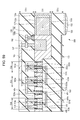
  • FIGS. 3 to 27 are diagrams illustrating a method of manufacturing the pixel 130 of FIG. 2 .
  • a SiO 2 film 161 and a SiN film 162 of about 10 nm to about 20 nm are formed on a surface of the silicon substrate 131 , as illustrated in FIG. 3 .
  • a trench having a depth ranging from about 1 ⁇ m to about 2 ⁇ m is formed as the connection portion 144 , as illustrated in FIG. 4 .
  • a SiN film 144 a is formed on the sidewall of the connection portion 144 , as illustrated in FIG. 5 .
  • a SiO 2 film 163 is buried in the connection portion 144 , as illustrated in FIG. 6 .
  • the unnecessary SiO 2 film 163 on the SiN film 162 is then removed by Chemical Mechanical Planarization (CMP) or the like, as illustrated in FIG. 7 .
  • CMP Chemical Mechanical Planarization
  • a trench 164 in a donut-cylindrical shape for the reset transistor 141 is formed on the left side of the connection portion 144 in FIG. 8B , as illustrated in FIG. 8B .
  • a trench 165 in a donut-cylindrical shape for the amplification transistor 140 and a trench 166 in a donut-cylindrical shape for the readout transistor 139 are formed on the right side of the connection portion 144 in FIG. 8B .
  • Depths of the trenches 164 to 166 are about 1 ⁇ m to about 2 ⁇ m, and an inner diameter of the donut cylinder is about 10 nm to about 100 nm. Using this inner diameter, an area of the cylindrical channel regions 139 b to 141 b can be controlled.
  • Regions around the reset transistor 141 , the connection portion 144 , the amplification transistor 140 and the readout transistor 139 viewed from the surface side of the silicon substrate 131 are as illustrated in FIG. 8A .
  • an imaging region 167 including, for example, the photodiode 134 , the charge-voltage conversion unit 137 , and the transfer transistor 138 of each pixel 130 is collectively arranged in every four pixels 130 , as illustrated in FIG. 8A .
  • imaging region 167 is illustrated in an upper portion of a region around the reset transistor 141 , the connection portion 144 , the amplification transistor 140 , and the readout transistor 139 in FIG. 8A for convenience of the description, an actual positional relationship between both the regions is not such a relationship. This is similar in FIGS. 16A to 18A, 30A, and 38A to 40A to be described below.
  • a SiO 2 film 168 is anisotropically buried not to be formed on sidewalls of the trenches 164 to 166 , as illustrated in FIG. 9 .
  • a film thickness of the SiO 2 film 168 is about 50 nm to about 100 nm, but is not limited thereto.
  • channel lengths of the channel regions 139 b to 141 b can be controlled.
  • a high permittivity gate insulating film (Hf or Al-based insulating film) of about 3 nm to about 5 nm is formed as the gate insulating film 145 , as illustrated in FIG. 10 .
  • the film formation is performed using a pre-cursor and an ozone gas at ambient temperature of about 300° C. by atomic layer deposition (ALD).
  • Post deposition annealing is performed at 500° C. to 700° C. for about 10 min to about 60 min, as necessary.
  • metal materials 169 are anisotropically buried in the trenches 164 to 166 as the gate electrodes 139 c to 141 c , as illustrated in FIG. 11 . It is necessary to select metal materials having a work function suitable for Vth of the readout transistor 139 , the amplification transistor 140 , and the reset transistor 141 as the metal materials 169 of the gate electrodes 139 c to 141 c . Therefore, the metal materials 169 buried in the respective trenches 164 to 166 may be different.
  • the metal material 169 includes, for example, HfSi or TiN, another element such as Al may be added thereto.
  • HfSi or TiN another element such as Al may be added thereto.
  • the channel length can be controlled according to the length in the direction perpendicular to the silicon substrate 131 of the gate electrodes 139 c to 141 c.
  • a SiN film 170 is formed on the sidewalls of the trenches 164 to 166 , as illustrated in FIG. 12 .
  • a SiO 2 film 171 is buried in the trenches 164 to 166 , as illustrated in FIG. 13 .
  • the SiO 2 film 168 is removed by CMP or the like, as illustrated in FIG. 14 .
  • an n-type semiconductor is ion-implanted as the photodiode 134 into the surface of the silicon substrate 131 , as illustrated in FIG. 15 .
  • This ion implantation is performed with energy ranging from 400 keV to 3 MeV several times, as necessary. An amount of implantation is about 1 ⁇ 10 12 (cm ⁇ 2 ).
  • a p-type semiconductor is ion-implanted, as the HAD 136 a on the right side of FIG. 15 of the photodiode 134 , which has been provided for separation from a photodiode of an adjacent pixel among the HADs 136 , into the surface of the silicon substrate 131 .
  • This ion implantation is performed with energy ranging from 100 keV to 2 MeV several times, as necessary.
  • the SiN film 162 is removed through CMP, wet etching using hot phosphoric acid or the like, and the SiO 2 film 161 is removed through DHF or the like, as illustrated in FIGS. 16A and 16B .
  • the transfer transistor 138 is formed, as illustrated in FIGS. 17A and 17B .
  • a gate insulating film having a film thickness of about 6 nm is formed, a Poly-Si film is formed to about 150 nm, and dry etching is performed using lithographic patterning to form the gate electrode 138 a .
  • the sidewall 138 b is formed using the SiO 2 film and the SiN film.
  • a film thickness of the SiO 2 film of the sidewall 138 b is about 20 nm, and a film thickness of the SiN film is about 50 nm.
  • an n-type semiconductor is ion-implanted into the surface of the silicon substrate 131 with energy ranging from about 10 keV to about 30 keV to form the source and drain regions 139 a to 141 a , as illustrated in FIG. 18A .
  • An amount of implantation is about 1 ⁇ 10 15 (cm ⁇ 2 ).
  • the charge-voltage conversion unit 137 is formed through ion implantation under the same conditions, as illustrated in FIGS. 18A and 18B .
  • Spike RTA Rapid Thermal Anneal
  • the HAD 136 b on the surface side of the photodiode 134 among the HADs 136 is formed by ion-implanting a p-type semiconductor with energy ranging from 10 keV to 100 keV, as illustrated in FIGS. 18A and 18B .
  • An amount of implantation is about 1 ⁇ 10 13 (cm ⁇ 2 ).
  • heat treatment having small heat history such as laser spike anneal (LSA)
  • LSA laser spike anneal
  • This activation annealing may be Spike RTA for a preceding stage.
  • the HAD 136 b is not illustrated in FIG. 18B so as to illustrate the arrangement of the transfer transistor 138 or the charge-voltage conversion unit 137 . This is similar in FIG. 40B to be described later.
  • a SiO 2 film 131 b of about 500 nm is formed as an interlayer film as illustrated in FIG. 19 , and planarization by CMP is performed.
  • a deep trench 172 is formed in the SiO 2 film 131 b of the connection portion 144 through lithography, as illustrated in FIG. 20 .
  • shallow trenches 173 are formed in the SiO 2 film 131 b of the trenches 164 to 166 through lithography, as illustrated in FIG. 21 .
  • a shallower trench 174 is formed in the SiO 2 film 131 b on the surface side of the charge-voltage conversion unit 137 and the transfer transistor 138 through lithography, as illustrated in FIG. 22 .
  • the contact plug 142 is buried in the deep trench 172 , the shallow trench 173 and the shallower trench 174 , and an unnecessary material such as W is removed, as illustrated in FIG. 23 . Also, the wiring 143 is formed to be connected to the contact plug 142 , as illustrated in FIG. 24 .
  • the surface of the silicon substrate 131 is affixed on a support substrate (not illustrated), and the back surface side of the silicon substrate 131 is polished, as illustrated in FIG. 25 .
  • an n-type semiconductor is ion-implanted into the back surface of the silicon substrate 131 with energy ranging from about 10 keV to about 30 keV to form the source and drain regions 139 a to 141 a , as illustrated in FIG. 26 .
  • the channel regions 139 b to 141 b interposed between the source and drain regions 139 a to 141 a on the surface side and the back surface side of the silicon substrate 131 are formed.
  • An amount of implantation is about 1 ⁇ 10 15 (cm ⁇ 2 ).
  • the HAD 136 c on the back surface side of the photodiode 134 among the HADs 136 is formed through ion implantation of a p-type semiconductor with energy ranging from 10 keV to 100 keV. An amount of implantation is about 1 ⁇ 10 13 (cm ⁇ 2 ). Heat treatment of small heat history such as LSA is used as activation annealing.
  • the SiO 2 film 131 a , the light shielding film 135 , the color filter 133 , and the on-chip lens 132 are formed using a normal method, as illustrated in FIG. 27 , and the manufacture of the pixel 130 is completed.
  • a configuration of a CMOS image sensor according to a second embodiment as the solid-state imaging device to which the present disclosure is applied is the same as that of the CMOS image sensor 100 of FIG. 1 except for a pixel. Therefore, hereinafter, only a configuration of the pixel will be described.
  • FIG. 28 is a cross-sectional view illustrating an example of a configuration of the pixel of the CMOS image sensor according to the second embodiment as the solid-state imaging device to which the present disclosure is applied.
  • a configuration of a pixel 200 of FIG. 28 differs from the configuration of the pixel 130 of FIG. 2 in that a reset transistor 201 is provided in place of the reset transistor 141 and that the connection portion 144 is not provided.
  • the reset transistor includes a horizontal MOSFET.
  • two source and drain regions 201 a of the reset transistor 201 are formed on a surface side of a silicon substrate 131 . Therefore, a channel region 201 b interposed between the two source and drain regions 201 a is formed in a direction that is horizontal with respect to the silicon substrate 131 .
  • a gate electrode 201 c is formed on the silicon substrate 131 to face the channel region 201 b and is covered by a sidewall 201 d.
  • the source and drain region 201 a on the right side of the reset transistor 201 in FIG. 28 is connected to a charge-voltage conversion unit 137 via a contact plug 142 and a wiring 143 .
  • the pixel driving line 116 of FIG. 1 is connected to the gate electrode 201 c via the contact plug 142 .
  • the source and drain region 201 a on the left side of the reset transistor 201 in FIG. 28 is connected to a power supply via the contact plug 142 .
  • FIGS. 29 to 48 are diagrams illustrating a method of manufacturing the pixel 200 of FIG. 28 .
  • FIGS. 29 to 48 the same portions as those in FIGS. 3 to 27 are denoted with the same reference signs. Repeated description is appropriately omitted.
  • a SiO 2 film 161 and a SiN film 162 are formed on the surface of a silicon substrate 131 , as illustrated in FIG. 29 .
  • a trench 165 in a donut-cylindrical shape for an amplification transistor 140 and a trench 166 in a donut-cylindrical shape for a readout transistor 139 are formed, as illustrated in FIG. 30B .
  • FIG. 30A A region around the reset transistor 201 , the amplification transistor 140 and the readout transistor 139 viewed from the surface side of the silicon substrate 131 is as illustrated in FIG. 30A .
  • An imaging region 167 is collectively arranged in every four pixels 200 , as illustrated in FIG. 30A .
  • a SiO 2 film 168 is anisotropically buried similar to the case of FIG. 9 , as illustrated in FIG. 31 .
  • a gate insulating film 145 is formed similar to the case of FIG. 10 , as illustrated in FIG. 32 .
  • a metal material 169 is buried as a gate electrode 139 c and a gate electrode 140 c in the trench 165 and the trench 166 similar to the case of FIG. 11 , as illustrated in FIG. 33 .
  • a SiN film 170 is formed on sidewalls of the trench 165 and the trench 166 , as illustrated in FIG. 34 .
  • a SiO 2 film 171 is buried in the trench 165 and the trench 166 , as illustrated in FIG. 35 .
  • the SiO 2 film 168 is removed similar to FIG. 14 , as illustrated in FIG. 36 .
  • a photodiode 134 and a HAD 136 a are formed through an ion implantation similar to the case of FIG. 15 , as illustrated in FIG. 37 .
  • the SiN film 162 is removed and the SiO 2 film 161 is removed similar to the case of FIGS. 16A and 16B , as illustrated in FIGS. 38A and 38B .
  • a transfer transistor 138 , and a gate electrode 201 c and a sidewall 201 d of the reset transistor 201 are formed, as illustrated in FIGS. 39A and 39B .
  • the gate electrode 138 a and the gate electrode 201 c are formed by forming a gate insulating film having a film thickness of about 6 nm, forming a Poly-Si film to about 150 nm, and performing dry etching using lithographic patterning. Then, the sidewall 138 b and the sidewall 201 d are formed using a SiO 2 film and a SiN film. A film thickness of the SiO 2 film of the sidewall 138 b and the sidewall 201 d is about 20 nm, and a film thickness of the SiN film is about 50 nm.
  • the source and drain regions 139 a , 140 a and 201 a are formed on the surface of the silicon substrate 131 by performing ion implantation of an n-type semiconductor with energy ranging from about 10 keV to about 30 keV, as illustrated in FIG. 40B .
  • An amount of implantation is about 1 ⁇ 10 15 (cm ⁇ 2 ).
  • a charge-voltage conversion unit 137 is formed through ion implantation under the same conditions, as illustrated in FIGS. 40A and 40B .
  • Spike RTA 1000° C. to 1100° C. is performed.
  • a HAD 136 b is formed similar to the case of FIGS. 18A and 18B .
  • a SiO 2 film 131 b is formed similar to the case of FIG. 19 , as illustrated in FIG. 41 .
  • shallow trenches 173 are formed in the SiO 2 film 131 b of the trench 165 and the trench 166 similar to the case of FIG. 21 , as illustrated in FIG. 42 .
  • a shallower trench 174 is formed in the SiO 2 film 131 b on the surface side of the charge-voltage conversion unit 137 and the transfer transistor 138 similar to the case of FIG. 22 , as illustrated in FIG. 43 .
  • a contact plug 142 is buried in the shallow trench 173 and the shallower trench 174 similar to the case of FIG. 23 , as illustrated in FIG. 44 . Also, a wiring 143 is formed to be connected with the contact plug 142 , as illustrated in FIG. 45 .
  • a back surface side of the silicon substrate 131 is polished similar to the case of FIG. 25 , as illustrated in FIG. 46 .
  • a source and drain region 139 a and a source and drain region 140 a on the back surface side of the silicon substrate 131 are formed similar to the case of FIG. 26 , as illustrated in FIG. 47 .
  • a HAD 136 c is formed similar to the case of FIG. 26 .
  • a SiO 2 film 131 a a SiO 2 film 131 a , a light shielding film 135 , a color filter 133 , and an on-chip lens 132 are formed using a normal method as illustrated in FIG. 48 , and the manufacture of the pixel 200 is completed.
  • a configuration of a CMOS image sensor according to a third embodiment as the solid-state imaging device to which the present disclosure is applied is the same as the configuration of the CMOS image sensor 100 of FIG. 1 except for a pixel. Therefore, hereinafter, only a configuration of the pixel will be described.
  • FIG. 49 is a cross-sectional view illustrating an example of a configuration of a pixel in the CMOS image sensor according to the third embodiment as the solid-state imaging device to which the present disclosure is applied.
  • a configuration of a pixel 300 of FIG. 49 differs from that of the pixel 130 of FIG. 2 in that a trench type capacitor (capacitive element) 301 is newly provided.
  • a gate electrode 301 a of the capacitor 301 is connected to a circuit (not illustrated) via a contact plug 142 , and holds charges that are supplied from this circuit.
  • CMOS image sensor Since a configuration of the CMOS image sensor according to a fourth embodiment as the solid-state imaging device to which the present disclosure is applied is the same as that of the CMOS image sensor 100 of FIG. 2 except for a configuration of a CMOS circuit included in each unit other than a pixel array unit 111 , only the CMOS circuit will be described.
  • FIG. 50 is a cross-sectional view illustrating an example of a configuration of the CMOS circuit included in each unit other than the pixel array unit 111 in the CMOS image sensor according to the fourth embodiment as the solid-state imaging device to which the present disclosure is applied.
  • a CMOS circuit 401 of FIG. 50 includes a vertical MOSFET 401 - 1 of which a channel region 401 - 1 b is formed in a direction perpendicular to a silicon substrate 131 , and a vertical MOSFET 401 - 2 of which a channel region 401 - 2 b is formed in a direction perpendicular to the silicon substrate 131 .
  • a source and drain region 401 - la on the back surface side of the MOSFET 401 - 1 and a source and drain region 401 - 2 a on the back surface side of the MOSFET 401 - 2 are connected.
  • CMOS circuit 401 includes the two vertical MOSFETs in the example of FIG. 50 , the number of vertical MOSFETs constituting the CMOS circuit 401 is not limited thereto.
  • a configuration of a CMOS image sensor according to a fifth embodiment as the solid-state imaging device to which the present disclosure is applied is the same as that of the CMOS image sensor 100 of FIG. 1 except for a pixel. Therefore, hereinafter, only a configuration of the pixel will be described.
  • FIG. 51 is a cross-sectional view illustrating an example of a configuration of a pixel of the CMOS image sensor according to the fifth embodiment as the solid-state imaging device to which the present disclosure is applied.
  • a configuration of a pixel 500 of FIG. 51 differs from that of the pixel 130 of FIG. 2 in that a silicon substrate 501 , a SiO 2 film 501 a , a readout transistor 502 , an amplification transistor 503 , a reset transistor 504 , a connection portion 505 , a SiN film 505 a , and a gate insulating film 508 are provided in place of the silicon substrate 131 , the SiO 2 film 131 a , the readout transistor 139 , the amplification transistor 140 , the reset transistor 141 , the connection portion 144 , the SiN film 144 a , and the gate insulating film 145 , and that a contact plug 506 and a wiring 507 are newly provided.
  • a thickness of the silicon substrate 501 is reduced so as to shorten channel lengths of the readout transistor 502 , the amplification transistor 503 , and the reset transistor 504 .
  • the silicon substrate 501 is formed so that a thickness of a region in which the readout transistor 502 , the amplification transistor 503 , the reset transistor 504 , and the connection portion 505 are arranged is smaller than a region in which a photodiode 134 , a charge-voltage conversion unit 137 and a transfer transistor 138 are arranged (a length in a direction perpendicular to the silicon substrate 501 is shorter).
  • a SiO 2 film 501 a is formed on a back surface of the silicon substrate 501 so that a back surface becomes flat.
  • the readout transistor 502 , the amplification transistor 503 , and the reset transistor 504 are formed in an order of proximity to the charge-voltage conversion unit 137 on the left side of the charge-voltage conversion unit 137 in FIG. 51 .
  • the readout transistor 502 , the amplification transistor 503 and the reset transistor 504 are fully-depleted vertical MOSFETs.
  • two source and drain regions 502 a of the readout transistor 502 are formed on the surface side and the back surface side of the silicon substrate 501 . Therefore, a channel region 502 b interposed between the two source and drain regions 502 a is formed in a direction perpendicular to the silicon substrate 501 .
  • a gate electrode 502 c is formed to cover the channel region 502 b.
  • Source and drain regions 503 a , a channel region 503 b and a gate electrode 503 c of the amplification transistor 503 , and source and drain regions 504 a , a channel region 504 b and a gate electrode 504 c of the reset transistor 504 are similarly formed.
  • the gate electrode 503 c of the amplification transistor 503 is connected to the charge-voltage conversion unit 137 via a contact plug 142 and a wiring 143 .
  • a power supply is connected to the source and drain region 503 a on the surface side via the contact plug 142 .
  • the source and drain region 503 a on the back surface side is connected to the source and drain region 502 a on the back surface side of the readout transistor 502 via a contact plug 506 and a wiring 507 on the back surface side.
  • the amplification transistor 503 amplifies a signal of a voltage input from the charge-voltage conversion unit 137 to the gate electrode 503 c , and inputs the resultant signal as a pixel signal to the source and drain region 502 a.
  • the gate electrode 502 c of the readout transistor 502 is connected to the pixel driving line 116 via the contact plug 142 . Further, the source and drain region 502 a on the surface side is connected to the vertical signal line 117 of FIG. 1 via the contact plug 142 .
  • the readout transistor 502 outputs a pixel signal input to the source and drain region 502 a on the back surface side to the vertical signal line 117 via the source and drain region 502 a on the surface side.
  • the reset transistor 504 is connected to the charge-voltage conversion unit 137 via the contact plug 142 and the wiring 143 .
  • connection portion 505 is provided between the amplification transistor 503 and the reset transistor 504 .
  • the charge-voltage conversion unit 137 is connected to the source and drain region 504 a on the back surface side of the reset transistor 504 via the contact plug 142 inserted into the connection portion 505 .
  • a SiN film 505 a is formed on the sidewall of the connection portion 505 . Accordingly, it is possible to prevent conduction between the contact plug 142 and the connection portion 505 .
  • the gate electrode 504 c of the reset transistor 504 is connected to the pixel driving line 116 via the contact plug 142 . Further, the source and drain region 504 a on the surface side is connected to the power supply via the contact plug 142 .
  • the reset transistor 504 resets charges of the charge-voltage conversion unit 137 .
  • a gate insulating film 508 is formed in sidewalls of the gate electrodes 502 c to 504 c.
  • FIGS. 52 to 59 are diagrams illustrating a method of manufacturing the pixel 500 of FIG. 51 .
  • connection portion 505 may be formed in place of the connection portion 144 by reducing the depth of the trench that is formed in FIG. 4 .
  • the surface of the silicon substrate 131 is affixed to a support substrate (not illustrated) as illustrated in FIG. 52 , and the back surface side of the silicon substrate 131 is polished.
  • regions of the readout transistor 502 , the amplification transistor 503 , the reset transistor 504 , and the connection portion 505 in the back surface of the silicon substrate 131 are covered with a resist as illustrated in FIG. 53 , and etching by lithography is performed.
  • the silicon substrate 131 becomes the silicon substrate 501 in which a thickness of the region of the readout transistor 502 , the amplification transistor 503 , the reset transistor 504 , and the connection portion 505 is smaller than that of a region of the photodiode 134 , the charge-voltage conversion unit 137 , and the transfer transistor 138 .
  • the gate electrodes 139 c to 141 c become gate electrodes 502 c to 504 c
  • the SiN film 144 a becomes a SiN film 505 a
  • the gate insulating film 145 becomes a gate insulating film 508 .
  • the source and drain regions 139 a to 141 a on the surface side become source and drain regions 502 a to 504 a.
  • the source and drain regions 502 a to 504 a are formed on the back surface of the silicon substrate 501 similar to FIG. 26 , as illustrated in FIG. 54 .
  • a HAD 136 c is formed similar to FIG. 26 .
  • a SiO 2 film 511 is formed as an interlayer film on the back surface of the silicon substrate 501 , as illustrated in FIG. 55 .
  • contact plugs 506 are connected to the source and drain regions 502 a to 504 a on the back surface side of the silicon substrate 501 as illustrated in FIG. 56 , and the contact plugs 506 are connected to each other by a wiring 507 , as illustrated in FIG. 57 .
  • a SiO 2 film is formed on the outer side of the SiO 2 film 511 and thus a SiO 2 film 501 a is formed, as illustrated in FIG. 58 .
  • a light shielding film 135 , a color filter 133 , and an on-chip lens 132 are formed using a normal method, as illustrated in FIG. 59 .
  • the manufacture of the pixel 500 is completed.
  • a configuration of a CMOS image sensor according to a sixth embodiment as the solid-state imaging device to which the present disclosure is applied is the same as that of the CMOS image sensor 100 of FIG. 1 except for a pixel. Therefore, hereinafter, only a configuration of the pixel will be described.
  • FIG. 60 is a cross-sectional view illustrating an example of a configuration of a pixel of the CMOS image sensor according to the sixth embodiment as the solid-state imaging device to which the present disclosure is applied.
  • a configuration of the pixel 600 of FIG. 60 differs from that of the pixel 500 of FIG. 51 in that a reset transistor 201 is provided in place of the reset transistor 504 and that the connection portion 505 is not provided. That is, in the pixel 600 , channel lengths of a readout transistor and an amplification transistor are shortened, and a reset transistor includes a horizontal MOSFET.
  • FIGS. 61 to 68 are diagrams illustrating a method of manufacturing the pixel 600 of FIG. 60 .
  • FIGS. 29 to 45 the operation described in FIGS. 29 to 45 is performed on a silicon substrate 131 . Then, a back surface side of the silicon substrate 131 is polished similar to the case of FIG. 46 , as illustrated in FIG. 61 .
  • regions of the readout transistor 502 , the amplification transistor 503 and the reset transistor 201 of the back surface of the silicon substrate 131 are covered with a resist, and etching by lithography is performed.
  • the silicon substrate 131 is a silicon substrate 501 in which a thickness of the regions of the readout transistor 502 , the amplification transistor 503 and the reset transistor 201 is smaller than that of the region in which a photodiode 134 , a charge-voltage conversion unit 137 , and a transfer transistor 138 are arranged.
  • the gate electrodes 139 c and 140 c become gate electrodes 502 c and 503 c
  • the SiN film 144 a becomes a SiN film 505 a
  • the gate insulating film 145 becomes a gate insulating film 508 .
  • the source and drain regions 139 a and 140 a on the surface side become source and drain regions 502 a and 503 a.
  • the source and drain regions 502 a and 503 a on the back surface side of the silicon substrate 501 are formed similar to the case of FIG. 26 , as illustrated in FIG. 63 .
  • a HAD 136 c is formed similar to FIG. 26 .
  • a SiO 2 film 511 is formed as an interlayer film on the back surface of the silicon substrate 501 , as illustrated in FIG. 64 .
  • contact plugs 506 are connected to the source and drain regions 502 a and 503 a on the back surface side of the silicon substrate 501 as illustrated in FIG. 65 , and the contact plugs 506 are connected to each other by a wiring 507 , as illustrated in FIG. 66 .
  • a SiO 2 film is formed on an outer side of the SiO 2 film 511 to form a SiO 2 film 501 a , as illustrated in FIG. 67 .
  • a light shielding film 135 , a color filter 133 , and an on-chip lens 132 are formed using a normal method, as illustrated in FIG. 68 .
  • the manufacture of the pixel 600 is completed.
  • a configuration of a CMOS image sensor according to a seventh embodiment as the solid-state imaging device to which the present disclosure is applied is the same as that of the CMOS image sensor 100 of FIG. 1 except for a pixel. Therefore, hereinafter, only a configuration of the pixel will be described.
  • FIG. 69 is a cross-sectional view illustrating an example of a configuration of a pixel of the CMOS image sensor according to the seventh embodiment as the solid-state imaging device to which the present disclosure is applied.
  • a configuration of a pixel 700 of FIG. 69 differs from that of the pixel 130 of FIG. 2 in that a pinning film 701 is provided in place of the HAD 136 c.
  • a configuration of a CMOS image sensor according to an eighth embodiment as the solid-state imaging device to which the present disclosure is applied is the same as that of the CMOS image sensor 100 of FIG. 1 except for a pixel. Therefore, hereinafter, only a configuration of the pixel will be described.
  • FIG. 70 is a cross-sectional view illustrating an example of a configuration of a pixel of the CMOS image sensor according to the eighth embodiment as the solid-state imaging device to which the present disclosure is applied.
  • a configuration of a pixel 800 of FIG. 70 differs from that of the pixel 130 of FIG. 2 in that a readout transistor 801 , an amplification transistor 802 , a reset transistor 803 , and a connection portion 804 are provided in place of the readout transistor 139 , the amplification transistor 140 , the reset transistor 141 , and the connection portion 144 .
  • a depth of the readout transistor 801 , the amplification transistor 802 and the reset transistor 803 is reduced to shorten a channel length.
  • a length in a direction perpendicular to the silicon substrate 131 of the readout transistor 801 is smaller than that of the readout transistor 139 . Accordingly, lengths in the direction perpendicular to the silicon substrate 131 of a gate electrode 801 c and a channel region 801 b of the readout transistor 801 are smaller than those of the gate electrode 139 c and the channel region 139 b.
  • lengths in the direction perpendicular to the silicon substrate 131 of a gate electrode 802 c and a channel region 802 b of the amplification transistor 802 are smaller than those of the gate electrode 140 c and the channel region 140 b .
  • Lengths in the direction perpendicular to the silicon substrate 131 of a gate electrode 803 c and a channel region 803 b of the reset transistor 803 are smaller than those of the gate electrode 141 c and the channel region 141 b.
  • connection portion 804 is smaller than that of the connection portion 144 .
  • a SiN film 804 a is formed on a sidewall of the connection portion 804 .
  • FIG. 71 is a block diagram illustrating an example of a configuration of an imaging device as an electronic apparatus to which the present disclosure is applied.
  • An imaging device 900 of FIG. 71 is, for example, a video camera or a digital still camera.
  • the imaging device 900 includes a lens group 901 , a solid-state imaging element 902 , a DSP circuit 903 , a frame memory 904 , a display unit 905 , a recording unit 906 , a manipulation unit 907 , and a power supply unit 908 .
  • the DSP circuit 903 , the frame memory 904 , the display unit 905 , the recording unit 906 , the manipulation unit 907 , and the power supply unit 908 are connected to one another via a bus line 909 .
  • the lens group 901 acquires incident light (image light) from a subject and forms an image on an imaging surface of the solid-state imaging element 902 .
  • the solid-state imaging element 902 includes the CMOS image sensor of the first to eighth embodiments described above.
  • the solid-state imaging element 902 converts a light amount of incident light of the image formed on the imaging surface by the lens group 901 into an electrical signal by units of pixels, and supplies the electrical signal as a pixel signal to the DSP circuit 903 .
  • the DSP circuit 903 performs predetermined image processing on the pixel signal supplied from the solid-state imaging element 902 , and supplies the image signal after the image processing to the frame memory 904 in units of frames to temporarily store the image signal.
  • the display unit 905 includes, for example, a display device of a panel type such as a liquid crystal panel or an organic electro luminescence (EL) panel, and displays an image based on the pixel signal in units of frames temporarily stored in the frame memory 904 .
  • a display device of a panel type such as a liquid crystal panel or an organic electro luminescence (EL) panel
  • EL organic electro luminescence
  • the recording unit 906 includes, for example, a digital versatile disk (DVD) or a flash memory, and reads and records the pixel signal in units of frames stored temporarily in the frame memory 904 .
  • DVD digital versatile disk
  • flash memory volatile and non-volatile memory
  • the manipulation unit 907 issues manipulation instructions for various functions of the imaging device 900 under a manipulation by a user.
  • the power supply unit 908 appropriately supplies a power supply voltage to the DSP circuit 903 , the frame memory 904 , the display unit 905 , the recording unit 906 , and the manipulation unit 907 .
  • the electronic apparatus to which the present technology is applied may be an electronic apparatus in which a solid-state imaging device is used in an image acquisition unit (photoelectric conversion unit), and includes, for example, a portable terminal device having an imaging function or a copier in which a solid-state imaging device is used in an image reading unit, as well as the imaging device 900 .
  • CMOS image sensor may have a form that is formed as a one-chip, and may have a module-shaped form having an imaging function packaged with an optical unit and the like.
  • the capacitor 301 may be provided as in the third embodiment.
  • the CMOS circuit 401 may be provided as in the fourth embodiment.
  • the transfer transistor 138 may include a fully-depleted vertical MOSFET. Further, at least one of the amplification transistor, the readout transistor, and the reset transistor may include a fully-depleted vertical MOSFET.
  • a solid-state imaging device including two-dimensionally arranged pixels, each pixel including: a photoelectric conversion element configured to generate charges according to a light amount of incident light and accumulate the charges therein; and at least one of an amplification transistor configured to amplify a voltage corresponding to the charges accumulated in the photoelectric conversion element, a readout transistor configured to read a signal of the voltage amplified by the amplification transistor, and a reset transistor configured to reset the charges accumulated in the photoelectric conversion element, a channel region of each transistor being formed in a direction perpendicular to a substrate.
  • the solid-state imaging device according to any one of (1) to (7), further including: a circuit including a transistor of which the channel region is formed in a direction perpendicular to the substrate.
  • a method of manufacturing a solid-state imaging device including forming two-dimensionally arranged pixels, each pixel including: a photoelectric conversion element configured to generate charges according to a light amount of incident light and accumulate the charges therein; and at least one of an amplification transistor configured to amplify a voltage corresponding to the charges accumulated in the photoelectric conversion element, a readout transistor configured to read a signal of the voltage amplified by the amplification transistor, and a reset transistor configured to reset the charges accumulated in the photoelectric conversion element, a channel region of each transistor being formed in a direction perpendicular to a substrate.
  • An electronic apparatus including two-dimensionally arranged pixels, each pixel includes: a photoelectric conversion element configured to generate charges according to a light amount of incident light and accumulate the charges therein; and at least one of an amplification transistor configured to amplify a voltage corresponding to the charges accumulated in the photoelectric conversion element, a readout transistor configured to read a signal of the voltage amplified by the amplification transistor, and a reset transistor configured to reset the charges accumulated in the photoelectric conversion element, a channel region of each transistor being formed in a direction perpendicular to a substrate.
  • the electronic apparatus according to any one of (12) to (18), further including: a circuit including a transistor of which the channel region is formed in a direction perpendicular to the substrate.

Landscapes

  • Solid State Image Pick-Up Elements (AREA)
  • Semiconductor Integrated Circuits (AREA)
  • Metal-Oxide And Bipolar Metal-Oxide Semiconductor Integrated Circuits (AREA)
  • Insulated Gate Type Field-Effect Transistor (AREA)
  • Electrodes Of Semiconductors (AREA)
  • Transforming Light Signals Into Electric Signals (AREA)

Abstract

A solid-state imaging device includes two-dimensionally arranged pixels, and each pixel includes a photoelectric conversion element configured to generate charges according to a light amount of incident light and accumulate the charges therein; and at least one of an amplification transistor configured to amplify a voltage corresponding to the charges accumulated in the photoelectric conversion element, a readout transistor configured to read a signal of the voltage amplified by the amplification transistor, and a reset transistor configured to reset the charges accumulated in the photoelectric conversion element, a channel region of each transistor being formed in a direction perpendicular to a substrate.

Description

CROSS REFERENCE TO RELATED APPLICATIONS
This application claims the benefit of Japanese Priority Patent Application JP 2013-228355 filed on Nov. 1, 2013, the entire contents of which are incorporated herein by reference.
BACKGROUND
The present disclosure relates to a solid-state imaging device, a method of manufacturing the same, and an electronic apparatus, and more particularly, to a solid-state imaging device, a method of manufacturing the same, and an electronic apparatus capable of reducing noise by increasing an area of a channel region in at least one of an amplification transistor, a readout transistor, and a reset transistor of a pixel.
In recent years, with the miniaturization of a solid-state imaging device, a random telegraph signal (RTS) noise in an amplification transistor has formed a blinking point and has deteriorated pixel characteristics.
A method of applying a fully depleted metal-oxide-semiconductor field-effect transistor (MOSFET) with no impurities in a channel region to an amplification transistor has been proposed as an example of a method of reducing an RTS noise of an amplification transistor (for example, see Japanese Unexamined Patent Application Publication No. 2006-24787).
However, in the method described in Japanese Unexamined Patent Application Publication No. 2006-24787, a manufacturing cost increases since a silicon on insulator (SOI) substrate is used. Further, it is necessary to perform control of film thickness which is difficult.
SUMMARY
Therefore, it is desired to reduce noise by increasing an area of a channel region in a transistor of a pixel, such as an amplification transistor, a readout transistor, and a reset transistor.
It is desirable to reduce a noise by increasing an area of a channel region in at least one of an amplification transistor, a readout transistor, and a reset transistor of a pixel.
According to a first embodiment of the present disclosure, there is provided a solid-state imaging device including two-dimensionally arranged pixels, each pixel including: a photoelectric conversion element configured to generate charge according to a light amount of incident light and accumulate the charges therein; and at least one of an amplification transistor configured to amplify a voltage corresponding to the charges accumulated in the photoelectric conversion element, a readout transistor configured to read a signal of the voltage amplified by the amplification transistor, and a reset transistor configured to reset the charges accumulated in the photoelectric conversion element, a channel region of each transistor being formed in a direction perpendicular to a substrate.
In the first embodiment of the present disclosure, the two-dimensionally arranged pixels each including a photoelectric conversion element configured to generate charges according to a light amount of incident light and accumulate the charges therein; and at least one of an amplification transistor configured to amplify a voltage corresponding to the charges accumulated in the photoelectric conversion element, a readout transistor configured to read a signal of the voltage amplified by the amplification transistor, and a reset transistor configured to reset the charges accumulated in the photoelectric conversion element, a channel region of each transistor being formed in a direction perpendicular to a substrate are included.
According to a second embodiment of the present disclosure, there is provided a method of manufacturing a solid-state imaging device, the method including forming two-dimensionally arranged pixels, each pixel including: a photoelectric conversion element configured to generate charges according to a light amount of incident light and accumulate the charges therein; and at least one of an amplification transistor configured to amplify a voltage corresponding to the charges accumulated in the photoelectric conversion element, a readout transistor configured to read a signal of the voltage amplified by the amplification transistor, and a reset transistor configured to reset the charges accumulated in the photoelectric conversion element, a channel region of each transistor being formed in a direction perpendicular to a substrate.
In the second embodiment of the present disclosure, the two-dimensionally arranged pixels each including a photoelectric conversion element configured to generate charges according to a light amount of incident light and accumulate the charges therein; and at least one of an amplification transistor configured to amplify a voltage corresponding to the charges accumulated in the photoelectric conversion element, a readout transistor configured to read a signal of the voltage amplified by the amplification transistor, and a reset transistor configured to reset the charges accumulated in the photoelectric conversion element, a channel region of each transistor being formed in a direction perpendicular to a substrate are formed.
According to a third embodiment of the present disclosure, there is provided an electronic apparatus including two-dimensionally arranged pixels, each pixel includes: a photoelectric conversion element configured to generate charges according to a light amount of incident light and accumulate the charges therein; and at least one of an amplification transistor configured to amplify a voltage corresponding to the charges accumulated in the photoelectric conversion element, a readout transistor configured to read a signal of the voltage amplified by the amplification transistor, and a reset transistor configured to reset the charges accumulated in the photoelectric conversion element, a channel region of each transistor being formed in a direction perpendicular to a substrate.
In the third embodiment of the present disclosure, the two-dimensionally arranged pixels each including a photoelectric conversion element configured to generate charges according to a light amount of incident light and accumulate the charges therein; and at least one of an amplification transistor configured to amplify a voltage corresponding to the charges accumulated in the photoelectric conversion element, a readout transistor configured to read a signal of the voltage amplified by the amplification transistor, and a reset transistor configured to reset the charges accumulated in the photoelectric conversion element, a channel region of each transistor being formed in a direction perpendicular to a substrate are included.
According to the first to third embodiments of the present disclosure, it is possible to reduce a noise in the transistors of the pixel. According to the first to third embodiments of the present disclosure, it is also possible to reduce noise by increasing the area of the channel region in at least one of the amplification transistor, the readout transistor, and the reset transistor of the pixel.
Further, the effects described herein are not necessarily limited and may be any effects described in the present disclosure.
BRIEF DESCRIPTION OF THE DRAWINGS
FIG. 1 is a block diagram illustrating an example of a configuration of a CMOS image sensor according to a first embodiment as a solid-state imaging device to which the present disclosure is applied;
FIG. 2 is a cross-sectional view illustrating an example of a configuration of pixels arranged two-dimensionally in a pixel array unit of FIG. 1;
FIG. 3 is a diagram illustrating a method of manufacturing the pixel of FIG. 2;
FIG. 4 is a diagram illustrating a method of manufacturing the pixel of FIG. 2;
FIG. 5 is a diagram illustrating a method of manufacturing the pixel of FIG. 2;
FIG. 6 is a diagram illustrating a method of manufacturing the pixel of FIG. 2;
FIG. 7 is a diagram illustrating a method of manufacturing the pixel of FIG. 2;
FIGS. 8A and 8B are diagrams illustrating a method of manufacturing the pixel of FIG. 2;
FIG. 9 is a diagram illustrating a method of manufacturing the pixel of FIG. 2;
FIG. 10 is a diagram illustrating a method of manufacturing the pixel of FIG. 2;
FIG. 11 is a diagram illustrating a method of manufacturing the pixel of FIG. 2;
FIG. 12 is a diagram illustrating a method of manufacturing the pixel of FIG. 2;
FIG. 13 is a diagram illustrating a method of manufacturing the pixel of FIG. 2;
FIG. 14 is a diagram illustrating a method of manufacturing the pixel of FIG. 2;
FIG. 15 is a diagram illustrating a method of manufacturing the pixel of FIG. 2;
FIGS. 16A and 16B are diagrams illustrating a method of manufacturing the pixel of FIG. 2;
FIGS. 17A and 17B are diagrams illustrating a method of manufacturing the pixel of FIG. 2;
FIGS. 18A and 18B are diagrams illustrating a method of manufacturing the pixel of FIG. 2;
FIG. 19 is a diagram illustrating a method of manufacturing the pixel of FIG. 2;
FIG. 20 is a diagram illustrating a method of manufacturing the pixel of FIG. 2;
FIG. 21 is a diagram illustrating a method of manufacturing the pixel of FIG. 2;
FIG. 22 is a diagram illustrating a method of manufacturing the pixel of FIG. 2;
FIG. 23 is a diagram illustrating a method of manufacturing the pixel of FIG. 2;
FIG. 24 is a diagram illustrating a method of manufacturing the pixel of FIG. 2;
FIG. 25 is a diagram illustrating a method of manufacturing the pixel of FIG. 2;
FIG. 26 is a diagram illustrating a method of manufacturing the pixel of FIG. 2;
FIG. 27 is a diagram illustrating a method of manufacturing the pixel of FIG. 2;
FIG. 28 is a cross-sectional view illustrating an example of a configuration of a pixel of a CMOS image sensor according to a second embodiment as the solid-state imaging device to which the present disclosure is applied;
FIG. 29 is a diagram illustrating a method of manufacturing the pixel of FIG. 28;
FIGS. 30A and 30B are diagrams illustrating a method of manufacturing the pixel of FIG. 28;
FIG. 31 is a diagram illustrating a method of manufacturing the pixel of FIG. 28;
FIG. 32 is a diagram illustrating a method of manufacturing the pixel of FIG. 28;
FIG. 33 is a diagram illustrating a method of manufacturing the pixel of FIG. 28;
FIG. 34 is a diagram illustrating a method of manufacturing the pixel of FIG. 28;
FIG. 35 is a diagram illustrating a method of manufacturing the pixel of FIG. 28;
FIG. 36 is a diagram illustrating a method of manufacturing the pixel of FIG. 28;
FIG. 37 is a diagram illustrating a method of manufacturing the pixel of FIG. 28;
FIGS. 38A and 38B are diagrams illustrating a method of manufacturing the pixel of FIG. 28;
FIGS. 39A and 39B are diagrams illustrating a method of manufacturing the pixel of FIG. 28;
FIGS. 40A and 40B are diagrams illustrating a method of manufacturing the pixel of FIG. 28;
FIG. 41 is a diagram illustrating a method of manufacturing the pixel of FIG. 28;
FIG. 42 is a diagram illustrating a method of manufacturing the pixel of FIG. 28;
FIG. 43 is a diagram illustrating a method of manufacturing the pixel of FIG. 28;
FIG. 44 is a diagram illustrating a method of manufacturing the pixel of FIG. 28;
FIG. 45 is a diagram illustrating a method of manufacturing the pixel of FIG. 28;
FIG. 46 is a diagram illustrating a method of manufacturing the pixel of FIG. 28;
FIG. 47 is a diagram illustrating a method of manufacturing the pixel of FIG. 28;
FIG. 48 is a diagram illustrating a method of manufacturing the pixel of FIG. 28;
FIG. 49 is a cross-sectional view illustrating an example of a configuration of a pixel of a CMOS image sensor according to a third embodiment as the solid-state imaging device to which the present disclosure is applied;
FIG. 50 is a cross-sectional view illustrating an example of a configuration of a CMOS circuit in a CMOS image sensor according to a fourth embodiment as the solid-state imaging device to which the present disclosure is applied;
FIG. 51 is a cross-sectional view illustrating an example of a configuration of a pixel of a CMOS image sensor according to a fifth embodiment as the solid-state imaging device to which the present disclosure is applied;
FIG. 52 is a diagram illustrating the method of manufacturing a pixel of FIG. 51;
FIG. 53 is a diagram illustrating the method of manufacturing a pixel of FIG. 51;
FIG. 54 is a diagram illustrating the method of manufacturing a pixel of FIG. 51;
FIG. 55 is a diagram illustrating the method of manufacturing a pixel of FIG. 51;
FIG. 56 is a diagram illustrating the method of manufacturing a pixel of FIG. 51;
FIG. 57 is a diagram illustrating the method of manufacturing a pixel of FIG. 51;
FIG. 58 is a diagram illustrating the method of manufacturing a pixel of FIG. 51;
FIG. 59 is a diagram illustrating the method of manufacturing a pixel of FIG. 51;
FIG. 60 is a cross-sectional view illustrating an example of a configuration of a pixel of a CMOS image sensor according to a sixth embodiment as the solid-state imaging device to which the present disclosure is applied;
FIG. 61 is a diagram illustrating a method of manufacturing the pixel of FIG. 60;
FIG. 62 is a diagram illustrating a method of manufacturing the pixel of FIG. 60;
FIG. 63 is a diagram illustrating a method of manufacturing the pixel of FIG. 60;
FIG. 64 is a diagram illustrating a method of manufacturing the pixel of FIG. 60;
FIG. 65 is a diagram illustrating a method of manufacturing the pixel of FIG. 60;
FIG. 66 is a diagram illustrating a method of manufacturing the pixel of FIG. 60;
FIG. 67 is a diagram illustrating a method of manufacturing the pixel of FIG. 60;
FIG. 68 is a diagram illustrating a method of manufacturing the pixel of FIG. 60;
FIG. 69 is a cross-sectional view illustrating an example of a configuration of a pixel of a CMOS image sensor according to a seventh embodiment as the solid-state imaging device to which the present disclosure is applied;
FIG. 70 is a cross-sectional view illustrating an example of a configuration of a pixel of a CMOS image sensor according to an eighth embodiment as the solid-state imaging device to which the present disclosure is applied; and
FIG. 71 is a block diagram illustrating an example of a configuration of an imaging device as an electronic apparatus to which the present disclosure is applied.
DETAILED DESCRIPTION OF EMBODIMENTS
First Embodiment
Example of Configuration of Solid-State Imaging Device According to First Embodiment
FIG. 1 is a block diagram illustrating an example of a configuration of a complementary metal-oxide semiconductor (CMOS) image sensor according to a first embodiment as a solid-state imaging device to which the present disclosure is applied.
The CMOS image sensor 100 includes a pixel array unit 111, a vertical driving unit 112, a column processing unit 113, a horizontal driving unit 114, a system control unit 115, a pixel driving line 116, a vertical signal line 117, a signal processing unit 118, and a data storage unit 119.
The pixel array unit 111, the vertical driving unit 112, the column processing unit 113, the horizontal driving unit 114, the system control unit 115, the pixel driving line 116, the vertical signal line 117, the signal processing unit 118, and the data storage unit 119 are formed in a silicon substrate (chip) (not illustrated).
Further, the CMOS image sensor 100 may not include the signal processing unit 118 and the data storage unit 119. The signal processing unit 118 and data storage unit 119, for example, may be provided as an external signal processing unit such as a digital signal processor (DSP) on a substrate different from the substrate for the CMOS image sensor 100.
The CMOS image sensor 100 captures an image of a subject and outputs a pixel signal of each pixel of the image.
Specifically, pixels each including a photoelectric conversion element that generates an amount of charges according to a light amount of incident light and accumulates the charges therein are arranged two-dimensionally in a matrix form in the pixel array unit 111.
Further, in the pixel array unit 111, the pixel driving line 116 is formed in a horizontal direction (row direction) of FIG. 1 in each row for pixels in the matrix form, and the vertical signal line 117 is formed in a vertical direction (column direction) of FIG. 1 in each column. One end of the pixel driving line 116 is connected to an output terminal (not illustrated) corresponding to each row of the vertical driving unit 112.
The vertical driving unit 112 is a pixel driving unit that includes, for example, a shift register or an address decoder and drives each pixel of the pixel array unit 111, for example, in units of rows. While illustration of a specific configuration of this vertical driving unit 112 is omitted, the vertical driving unit 112 has a configuration in which two scanning systems of a readout scanning system and a sweep scanning system are included.
The readout scanning system sequentially selects the respective rows to sequentially read pixel signals from the respective pixels in units of rows, and outputs, for example, a selection pulse from the output terminal connected to the pixel driving line 116 of the selected row.
The sweep scanning system outputs a control pulse from the output terminal connected to the pixel driving line 116 of each row a time of shutter speed earlier than the scanning of the readout scanning system, in order to sweep (reset) unnecessary charges from the photoelectric conversion element. Due to scanning by this sweep scanning system, a so-called electronic shutter operation is performed sequentially in each row. Here, the electronic shutter operation refers to an operation of discarding the charges of the photoelectric conversion element, and newly starting exposure (starting accumulation of charges).
The pixel signal output from each pixel of the row selected by the readout scanning system of the vertical driving unit 112 is supplied to the column processing unit 113 through each of the vertical signal lines 117.
The column processing unit 113 includes a signal processing circuit for each column of the pixel array unit 111. Each signal processing circuit of the column processing unit 113 performs a noise removal process such as a correlated double sampling (CDS) process and signal processing such as an A/D conversion process on the pixel signal output through the vertical signal line 117 from each pixel of the selected row. A fixed pattern noise specific to the pixel, such as a reset noise or a threshold variation of an amplification transistor, is removed through the CDS process. The column processing unit 113 temporarily holds the pixel signal after the signal processing.
The horizontal driving unit 114 includes, for example, a shift register or an address decoder, and sequentially selects the signal processing circuits of the column processing unit 113. The pixel signals subjected to signal processing by the respective signal processing circuits of the column processing unit 113 are sequentially output to the signal processing unit 118 through selection scanning by this horizontal driving unit 114.
The system control unit 115 includes, for example, a timing generator that generates various timing signals, and controls the vertical driving unit 112, the column processing unit 113, and the horizontal driving unit 114 based on the various timing signals generated by the timing generator.
The signal processing unit 118 has at least an addition processing function. The signal processing unit 118 performs various signal processing such as an addition process on the pixel signal output from the column processing unit 113. In this case, the signal processing unit 118 stores a result during signal processing in the data storage unit 119, as necessary, and refers to the result at a necessary timing. The signal processing unit 118 outputs the pixel signal after the signal processing.
Example of Configuration of Pixel
FIG. 2 is a cross-sectional view illustrating an example of a configuration of pixels arranged two-dimensionally in the pixel array unit 111 of FIG. 1.
The pixel 130 is formed in a silicon substrate 131, as illustrated in FIG. 2. A back surface of the silicon substrate 131 is covered with a SiO2 film 131 a, and a surface thereof is covered with a SiO2 film 131 b. The CMOS image sensor 100 is an image sensor of a backside illumination type, and an on-chip lens 132 and a color filter 133 are provided sequentially from an outer side on a back surface of the SiO2 film 131 a.
The on-chip lens 132 condenses light incident from the back surface of the silicon substrate 131. The condensed light is color-separated through the color filter 133 and is incident on a photodiode 134 within the silicon substrate 131.
A light shielding film 135 is formed in a region that does not correspond to the on-chip lens 132 and the color filter 133 within the SiO2 film 131 a. Accordingly, light that does not pass through the on-chip lens 132 and the color filter 133 can be prevented from being incident on the photodiode 134 or the like.
The photodiode (PD) 134 is a photoelectric conversion element which generates an amount of charges according to an amount of the light incident through the color filter 133, and accumulates the charges therein. Hole accumulation diodes (HADs) 136 are formed on the back surface side and the surface side of the photodiode 134 and on the right side of FIG. 2. Thus, it is possible to prevent generation of a dark current.
A charge-voltage conversion unit (FD) 137 is formed on the left side of the photodiode 134 in FIG. 2. A transfer transistor (TG) 138 is formed on the surface of the silicon substrate 131 between the photodiode 134 and the charge-voltage conversion unit 137. The transfer transistor 138 includes a gate electrode 138 a and a sidewall 138 b. The gate electrode 138 a is connected to the pixel driving line 116 of FIG. 1 via a contact plug 142.
When a predetermined pulse is input to the gate electrode 138 a via the pixel driving line 116, the transfer transistor 138 transfers the charges accumulated in the photodiode 134 to the charge-voltage conversion unit 137. The charge-voltage conversion unit 137 converts the charges transferred from the photodiode 134 into a voltage.
A readout transistor (SEL) 139, an amplification transistor 140, and a reset transistor 141 are formed in an order of proximity to the charge-voltage conversion unit 137 on the left side of the charge-voltage conversion unit 137 in FIG. 2. The readout transistor 139, the amplification transistor 140 and the reset transistor 141 are fully-depleted vertical MOSFETs.
Specifically, two source and drain regions 139 a of the readout transistor 139 are formed on the surface side and the back surface side of the silicon substrate 131. Therefore, a channel region 139 b interposed between the two source and drain regions 139 a is formed in a direction perpendicular to the silicon substrate 131. A gate electrode 139 c is formed to cover the channel region 139 b.
Source and drain regions 140 a, a channel region 140 b and a gate electrode 140 c of the amplification transistor 140, and source and drain regions 141 a, a channel region 141 b and a gate electrode 141 c of the reset transistor 141 are formed similarly.
The gate electrode 140 c of the amplification transistor 140 is connected to the charge-voltage conversion unit 137 via the contact plug 142 and a wiring 143. A power supply is connected to the source and drain region 140 a on the surface side via the contact plug 142. The source and drain region 140 a on the back surface side is connected to the source and drain region 139 a on the back surface side of the readout transistor 139. The amplification transistor 140 amplifies a signal of the voltage input from the charge-voltage conversion unit 137 to the gate electrode 140 c, and inputs the resultant signal as a pixel signal to the source and drain region 139 a.
The gate electrode 139 c of the readout transistor 139 is connected to the pixel driving line 116 via the contact plug 142. Further, the source and drain region 139 a on the surface side is connected to the vertical signal line 117 of FIG. 1 via the contact plug 142. When the selection pulse is input to the gate electrode 139 c via the pixel driving line 116 and the contact plug 142, the readout transistor 139 outputs the pixel signal which is input to the source and drain region 139 a on the back surface side, to the vertical signal line 117 via the source and drain region 139 a on the surface side.
The reset transistor 141 is connected to the charge-voltage conversion unit 137 via the contact plug 142 and the wiring 143.
Specifically, a connection portion 144 is provided between the amplification transistor 140 and the reset transistor 141. Also, the charge-voltage conversion unit 137 is connected to the source and drain region 141 a on the back surface side of the reset transistor 141 via the contact plug 142 inserted into the connection portion 144. A SiN film 144 a is formed on a sidewall of the connection portion 144. Accordingly, it is possible to prevent conduction between the contact plug 142 and the connection portion 144.
The gate electrode 141 c of the reset transistor 141 is connected to the pixel driving line 116 via the contact plug 142. Further, the source and drain region 141 a on the surface side is connected to a power supply via the contact plug 142. When the control pulse is input to the gate electrode 141 c via the pixel driving line 116 and the contact plug 142, the reset transistor 141 resets the charges of the photodiode 134 via the charge-voltage conversion unit 137.
A gate insulating film 145 is formed on a sidewall of the gate electrodes 139 c to 141 c.
As described above, in the CMOS image sensor 100, each pixel 130 includes the amplification transistor 140 which is a vertical MOSFET, in which the channel region 140 b is formed in the direction perpendicular to the silicon substrate 131. Therefore, it is possible to increase an area of the channel region 140 b of the amplification transistor 140 without increasing a footprint. As a result, it is possible to reduce an RTS noise in the amplification transistor 140. Accordingly, it is possible to improve image quality characteristics.
Further, the amplification transistor 140 can be a fully-depleted MOSFET since a length in a horizontal direction of the channel region 140 b can be shortened due to the amplification transistor 140 being a vertical MOSFET. Therefore, it is possible to reduce impurities of the channel region 140 b and to further reduce the RST noise. It is also possible to reduce junction capacitance. It is also possible to reduce a size of the gate electrode 140 c since a short channel effect is suppressed. As a result, it is possible to reduce a power supply voltage. The same effects as those of the amplification transistor 140 are provided even in the readout transistor 139 and the reset transistor 141.
Further, while the photodiode 134, the charge-voltage conversion unit 137, the transfer transistor 138, the readout transistor 139, and the amplification transistor 140, the reset transistor 141, and the connection portion 144 are illustrated on the same cross-section for convenience of description in the present specification, in practice, these do not exist on the same cross-section.
Method of Manufacturing Pixel
FIGS. 3 to 27 are diagrams illustrating a method of manufacturing the pixel 130 of FIG. 2.
First, a SiO2 film 161 and a SiN film 162 of about 10 nm to about 20 nm are formed on a surface of the silicon substrate 131, as illustrated in FIG. 3. Then, a trench having a depth ranging from about 1 μm to about 2 μm is formed as the connection portion 144, as illustrated in FIG. 4. Also, a SiN film 144 a is formed on the sidewall of the connection portion 144, as illustrated in FIG. 5.
Then, a SiO2 film 163 is buried in the connection portion 144, as illustrated in FIG. 6. The unnecessary SiO2 film 163 on the SiN film 162 is then removed by Chemical Mechanical Planarization (CMP) or the like, as illustrated in FIG. 7.
Then, a trench 164 in a donut-cylindrical shape for the reset transistor 141 is formed on the left side of the connection portion 144 in FIG. 8B, as illustrated in FIG. 8B. Further, a trench 165 in a donut-cylindrical shape for the amplification transistor 140 and a trench 166 in a donut-cylindrical shape for the readout transistor 139 are formed on the right side of the connection portion 144 in FIG. 8B. Depths of the trenches 164 to 166 are about 1 μm to about 2 μm, and an inner diameter of the donut cylinder is about 10 nm to about 100 nm. Using this inner diameter, an area of the cylindrical channel regions 139 b to 141 b can be controlled.
Regions around the reset transistor 141, the connection portion 144, the amplification transistor 140 and the readout transistor 139 viewed from the surface side of the silicon substrate 131 are as illustrated in FIG. 8A. Further, an imaging region 167 including, for example, the photodiode 134, the charge-voltage conversion unit 137, and the transfer transistor 138 of each pixel 130 is collectively arranged in every four pixels 130, as illustrated in FIG. 8A.
Further, while the imaging region 167 is illustrated in an upper portion of a region around the reset transistor 141, the connection portion 144, the amplification transistor 140, and the readout transistor 139 in FIG. 8A for convenience of the description, an actual positional relationship between both the regions is not such a relationship. This is similar in FIGS. 16A to 18A, 30A, and 38A to 40A to be described below.
After the formation of the trenches 164 to 166, a SiO2 film 168 is anisotropically buried not to be formed on sidewalls of the trenches 164 to 166, as illustrated in FIG. 9. Here, a film thickness of the SiO2 film 168 is about 50 nm to about 100 nm, but is not limited thereto. Using the film thickness of the SiO2 film 168, channel lengths of the channel regions 139 b to 141 b can be controlled. When the SiO2 film 168 is formed on the sidewall of the trenches 164 to 166, the SiO2 film 168 on the sidewalls is removed using wet etching or the like.
Also, a high permittivity gate insulating film (Hf or Al-based insulating film) of about 3 nm to about 5 nm is formed as the gate insulating film 145, as illustrated in FIG. 10. The film formation is performed using a pre-cursor and an ozone gas at ambient temperature of about 300° C. by atomic layer deposition (ALD). Post deposition annealing is performed at 500° C. to 700° C. for about 10 min to about 60 min, as necessary.
Then, metal materials 169 are anisotropically buried in the trenches 164 to 166 as the gate electrodes 139 c to 141 c, as illustrated in FIG. 11. It is necessary to select metal materials having a work function suitable for Vth of the readout transistor 139, the amplification transistor 140, and the reset transistor 141 as the metal materials 169 of the gate electrodes 139 c to 141 c. Therefore, the metal materials 169 buried in the respective trenches 164 to 166 may be different.
While the metal material 169 includes, for example, HfSi or TiN, another element such as Al may be added thereto. When different metal materials are buried in the respective trenches 164 to 166, regions of the trenches in which different metal materials are to be buried are opened by lithography, and unnecessary metal materials already buried are removed by fluoric acid. Then, a new metal material is buried in the trench.
The channel length can be controlled according to the length in the direction perpendicular to the silicon substrate 131 of the gate electrodes 139 c to 141 c.
Then, a SiN film 170 is formed on the sidewalls of the trenches 164 to 166, as illustrated in FIG. 12. Then, a SiO2 film 171 is buried in the trenches 164 to 166, as illustrated in FIG. 13. Also, the SiO2 film 168 is removed by CMP or the like, as illustrated in FIG. 14.
Then, an n-type semiconductor is ion-implanted as the photodiode 134 into the surface of the silicon substrate 131, as illustrated in FIG. 15. This ion implantation is performed with energy ranging from 400 keV to 3 MeV several times, as necessary. An amount of implantation is about 1×10¹² (cm−2). Further, a p-type semiconductor is ion-implanted, as the HAD 136 a on the right side of FIG. 15 of the photodiode 134, which has been provided for separation from a photodiode of an adjacent pixel among the HADs 136, into the surface of the silicon substrate 131. This ion implantation is performed with energy ranging from 100 keV to 2 MeV several times, as necessary.
Then, the SiN film 162 is removed through CMP, wet etching using hot phosphoric acid or the like, and the SiO2 film 161 is removed through DHF or the like, as illustrated in FIGS. 16A and 16B. Also, the transfer transistor 138 is formed, as illustrated in FIGS. 17A and 17B.
Specifically, a gate insulating film having a film thickness of about 6 nm is formed, a Poly-Si film is formed to about 150 nm, and dry etching is performed using lithographic patterning to form the gate electrode 138 a. Then, the sidewall 138 b is formed using the SiO2 film and the SiN film. A film thickness of the SiO2 film of the sidewall 138 b is about 20 nm, and a film thickness of the SiN film is about 50 nm.
Then, an n-type semiconductor is ion-implanted into the surface of the silicon substrate 131 with energy ranging from about 10 keV to about 30 keV to form the source and drain regions 139 a to 141 a, as illustrated in FIG. 18A. An amount of implantation is about 1×10¹⁵ (cm−2). The charge-voltage conversion unit 137 is formed through ion implantation under the same conditions, as illustrated in FIGS. 18A and 18B. Further, Spike RTA (Rapid Thermal Anneal) of 1000° C. to 1100° C. is performed as activation annealing.
Also, the HAD 136 b on the surface side of the photodiode 134 among the HADs 136 is formed by ion-implanting a p-type semiconductor with energy ranging from 10 keV to 100 keV, as illustrated in FIGS. 18A and 18B. An amount of implantation is about 1×10¹³ (cm−2). For example, heat treatment having small heat history, such as laser spike anneal (LSA), is used as the activation annealing. This activation annealing may be Spike RTA for a preceding stage. Further, the HAD 136 b is not illustrated in FIG. 18B so as to illustrate the arrangement of the transfer transistor 138 or the charge-voltage conversion unit 137. This is similar in FIG. 40B to be described later.
Then, a SiO2 film 131 b of about 500 nm is formed as an interlayer film as illustrated in FIG. 19, and planarization by CMP is performed. Also, a deep trench 172 is formed in the SiO2 film 131 b of the connection portion 144 through lithography, as illustrated in FIG. 20. Further, shallow trenches 173 are formed in the SiO2 film 131 b of the trenches 164 to 166 through lithography, as illustrated in FIG. 21. Further, a shallower trench 174 is formed in the SiO2 film 131 b on the surface side of the charge-voltage conversion unit 137 and the transfer transistor 138 through lithography, as illustrated in FIG. 22.
Then, the contact plug 142 is buried in the deep trench 172, the shallow trench 173 and the shallower trench 174, and an unnecessary material such as W is removed, as illustrated in FIG. 23. Also, the wiring 143 is formed to be connected to the contact plug 142, as illustrated in FIG. 24.
Then, the surface of the silicon substrate 131 is affixed on a support substrate (not illustrated), and the back surface side of the silicon substrate 131 is polished, as illustrated in FIG. 25. Also, an n-type semiconductor is ion-implanted into the back surface of the silicon substrate 131 with energy ranging from about 10 keV to about 30 keV to form the source and drain regions 139 a to 141 a, as illustrated in FIG. 26. Accordingly, the channel regions 139 b to 141 b interposed between the source and drain regions 139 a to 141 a on the surface side and the back surface side of the silicon substrate 131 are formed. An amount of implantation is about 1×10¹⁵ (cm−2).
Further, the HAD 136 c on the back surface side of the photodiode 134 among the HADs 136 is formed through ion implantation of a p-type semiconductor with energy ranging from 10 keV to 100 keV. An amount of implantation is about 1×10¹³ (cm−2). Heat treatment of small heat history such as LSA is used as activation annealing.
Finally, the SiO2 film 131 a, the light shielding film 135, the color filter 133, and the on-chip lens 132 are formed using a normal method, as illustrated in FIG. 27, and the manufacture of the pixel 130 is completed.
Second Embodiment
Example of Configuration of Pixel of Solid-State Imaging Device According to Second Embodiment
A configuration of a CMOS image sensor according to a second embodiment as the solid-state imaging device to which the present disclosure is applied is the same as that of the CMOS image sensor 100 of FIG. 1 except for a pixel. Therefore, hereinafter, only a configuration of the pixel will be described.
FIG. 28 is a cross-sectional view illustrating an example of a configuration of the pixel of the CMOS image sensor according to the second embodiment as the solid-state imaging device to which the present disclosure is applied.
Among configurations illustrated in FIG. 28, the same configurations as those in FIG. 2 are denoted with the same reference signs. Repeated description is appropriately omitted.
A configuration of a pixel 200 of FIG. 28 differs from the configuration of the pixel 130 of FIG. 2 in that a reset transistor 201 is provided in place of the reset transistor 141 and that the connection portion 144 is not provided. In the pixel 200, the reset transistor includes a horizontal MOSFET.
Specifically, two source and drain regions 201 a of the reset transistor 201 are formed on a surface side of a silicon substrate 131. Therefore, a channel region 201 b interposed between the two source and drain regions 201 a is formed in a direction that is horizontal with respect to the silicon substrate 131. A gate electrode 201 c is formed on the silicon substrate 131 to face the channel region 201 b and is covered by a sidewall 201 d.
The source and drain region 201 a on the right side of the reset transistor 201 in FIG. 28 is connected to a charge-voltage conversion unit 137 via a contact plug 142 and a wiring 143. Further, the pixel driving line 116 of FIG. 1 is connected to the gate electrode 201 c via the contact plug 142. Further, the source and drain region 201 a on the left side of the reset transistor 201 in FIG. 28 is connected to a power supply via the contact plug 142. When a control pulse is input to the gate electrode 201 c via the pixel driving line 116 and the contact plug 142, the reset transistor 201 resets charges of the charge-voltage conversion unit 137.
Method of Manufacturing Pixel
FIGS. 29 to 48 are diagrams illustrating a method of manufacturing the pixel 200 of FIG. 28.
In FIGS. 29 to 48, the same portions as those in FIGS. 3 to 27 are denoted with the same reference signs. Repeated description is appropriately omitted.
First, a SiO2 film 161 and a SiN film 162 are formed on the surface of a silicon substrate 131, as illustrated in FIG. 29. Then, a trench 165 in a donut-cylindrical shape for an amplification transistor 140 and a trench 166 in a donut-cylindrical shape for a readout transistor 139 are formed, as illustrated in FIG. 30B.
A region around the reset transistor 201, the amplification transistor 140 and the readout transistor 139 viewed from the surface side of the silicon substrate 131 is as illustrated in FIG. 30A. An imaging region 167 is collectively arranged in every four pixels 200, as illustrated in FIG. 30A.
After the formation of the trench 165 and the trench 166, a SiO2 film 168 is anisotropically buried similar to the case of FIG. 9, as illustrated in FIG. 31. Also, a gate insulating film 145 is formed similar to the case of FIG. 10, as illustrated in FIG. 32.
A metal material 169 is buried as a gate electrode 139 c and a gate electrode 140 c in the trench 165 and the trench 166 similar to the case of FIG. 11, as illustrated in FIG. 33. Then, a SiN film 170 is formed on sidewalls of the trench 165 and the trench 166, as illustrated in FIG. 34. Then, a SiO2 film 171 is buried in the trench 165 and the trench 166, as illustrated in FIG. 35. Also, the SiO2 film 168 is removed similar to FIG. 14, as illustrated in FIG. 36.
Then, a photodiode 134 and a HAD 136 a are formed through an ion implantation similar to the case of FIG. 15, as illustrated in FIG. 37. Also, the SiN film 162 is removed and the SiO2 film 161 is removed similar to the case of FIGS. 16A and 16B, as illustrated in FIGS. 38A and 38B. Also, a transfer transistor 138, and a gate electrode 201 c and a sidewall 201 d of the reset transistor 201 are formed, as illustrated in FIGS. 39A and 39B.
Specifically, the gate electrode 138 a and the gate electrode 201 c are formed by forming a gate insulating film having a film thickness of about 6 nm, forming a Poly-Si film to about 150 nm, and performing dry etching using lithographic patterning. Then, the sidewall 138 b and the sidewall 201 d are formed using a SiO2 film and a SiN film. A film thickness of the SiO2 film of the sidewall 138 b and the sidewall 201 d is about 20 nm, and a film thickness of the SiN film is about 50 nm.
Then, the source and drain regions 139 a, 140 a and 201 a are formed on the surface of the silicon substrate 131 by performing ion implantation of an n-type semiconductor with energy ranging from about 10 keV to about 30 keV, as illustrated in FIG. 40B. An amount of implantation is about 1×10¹⁵ (cm−2). A charge-voltage conversion unit 137 is formed through ion implantation under the same conditions, as illustrated in FIGS. 40A and 40B. As activation annealing, Spike RTA of 1000° C. to 1100° C. is performed. Further, a HAD 136 b is formed similar to the case of FIGS. 18A and 18B.
Then, a SiO2 film 131 b is formed similar to the case of FIG. 19, as illustrated in FIG. 41. Also, shallow trenches 173 are formed in the SiO2 film 131 b of the trench 165 and the trench 166 similar to the case of FIG. 21, as illustrated in FIG. 42. Further, a shallower trench 174 is formed in the SiO2 film 131 b on the surface side of the charge-voltage conversion unit 137 and the transfer transistor 138 similar to the case of FIG. 22, as illustrated in FIG. 43.
Then, a contact plug 142 is buried in the shallow trench 173 and the shallower trench 174 similar to the case of FIG. 23, as illustrated in FIG. 44. Also, a wiring 143 is formed to be connected with the contact plug 142, as illustrated in FIG. 45.
Then, a back surface side of the silicon substrate 131 is polished similar to the case of FIG. 25, as illustrated in FIG. 46. Also, a source and drain region 139 a and a source and drain region 140 a on the back surface side of the silicon substrate 131 are formed similar to the case of FIG. 26, as illustrated in FIG. 47. Further, a HAD 136 c is formed similar to the case of FIG. 26.
Finally, a SiO2 film 131 a, a light shielding film 135, a color filter 133, and an on-chip lens 132 are formed using a normal method as illustrated in FIG. 48, and the manufacture of the pixel 200 is completed.
Third Embodiment
Example of Configuration of Pixel of Solid-State Imaging Device According to Third Embodiment
A configuration of a CMOS image sensor according to a third embodiment as the solid-state imaging device to which the present disclosure is applied is the same as the configuration of the CMOS image sensor 100 of FIG. 1 except for a pixel. Therefore, hereinafter, only a configuration of the pixel will be described.
FIG. 49 is a cross-sectional view illustrating an example of a configuration of a pixel in the CMOS image sensor according to the third embodiment as the solid-state imaging device to which the present disclosure is applied.
Among configurations illustrated in FIG. 49, the same configurations as those in FIG. 2 are denoted with the same reference signs. Repeated description is appropriately omitted.
A configuration of a pixel 300 of FIG. 49 differs from that of the pixel 130 of FIG. 2 in that a trench type capacitor (capacitive element) 301 is newly provided.
A gate electrode 301 a of the capacitor 301 is connected to a circuit (not illustrated) via a contact plug 142, and holds charges that are supplied from this circuit.
Fourth Embodiment
Example of configuration of CMOS circuit of solid-state imaging device according to fourth embodiment
Since a configuration of the CMOS image sensor according to a fourth embodiment as the solid-state imaging device to which the present disclosure is applied is the same as that of the CMOS image sensor 100 of FIG. 2 except for a configuration of a CMOS circuit included in each unit other than a pixel array unit 111, only the CMOS circuit will be described.
FIG. 50 is a cross-sectional view illustrating an example of a configuration of the CMOS circuit included in each unit other than the pixel array unit 111 in the CMOS image sensor according to the fourth embodiment as the solid-state imaging device to which the present disclosure is applied.
A CMOS circuit 401 of FIG. 50 includes a vertical MOSFET 401-1 of which a channel region 401-1 b is formed in a direction perpendicular to a silicon substrate 131, and a vertical MOSFET 401-2 of which a channel region 401-2 b is formed in a direction perpendicular to the silicon substrate 131. A source and drain region 401-la on the back surface side of the MOSFET 401-1 and a source and drain region 401-2 a on the back surface side of the MOSFET 401-2 are connected.
Further, while the CMOS circuit 401 includes the two vertical MOSFETs in the example of FIG. 50, the number of vertical MOSFETs constituting the CMOS circuit 401 is not limited thereto.
Fifth Embodiment
Example of configuration of pixel of solid-state imaging device according to fifth embodiment
A configuration of a CMOS image sensor according to a fifth embodiment as the solid-state imaging device to which the present disclosure is applied is the same as that of the CMOS image sensor 100 of FIG. 1 except for a pixel. Therefore, hereinafter, only a configuration of the pixel will be described.
FIG. 51 is a cross-sectional view illustrating an example of a configuration of a pixel of the CMOS image sensor according to the fifth embodiment as the solid-state imaging device to which the present disclosure is applied.
Among configurations illustrated in FIG. 51, the same configurations as those in FIG. 2 are denoted with the same reference signs. Repeated description is appropriately omitted.
A configuration of a pixel 500 of FIG. 51 differs from that of the pixel 130 of FIG. 2 in that a silicon substrate 501, a SiO2 film 501 a, a readout transistor 502, an amplification transistor 503, a reset transistor 504, a connection portion 505, a SiN film 505 a, and a gate insulating film 508 are provided in place of the silicon substrate 131, the SiO2 film 131 a, the readout transistor 139, the amplification transistor 140, the reset transistor 141, the connection portion 144, the SiN film 144 a, and the gate insulating film 145, and that a contact plug 506 and a wiring 507 are newly provided.
In the pixel 500, a thickness of the silicon substrate 501 is reduced so as to shorten channel lengths of the readout transistor 502, the amplification transistor 503, and the reset transistor 504.
Specifically, the silicon substrate 501 is formed so that a thickness of a region in which the readout transistor 502, the amplification transistor 503, the reset transistor 504, and the connection portion 505 are arranged is smaller than a region in which a photodiode 134, a charge-voltage conversion unit 137 and a transfer transistor 138 are arranged (a length in a direction perpendicular to the silicon substrate 501 is shorter). A SiO2 film 501 a is formed on a back surface of the silicon substrate 501 so that a back surface becomes flat.
The readout transistor 502, the amplification transistor 503, and the reset transistor 504 are formed in an order of proximity to the charge-voltage conversion unit 137 on the left side of the charge-voltage conversion unit 137 in FIG. 51. The readout transistor 502, the amplification transistor 503 and the reset transistor 504 are fully-depleted vertical MOSFETs.
Specifically, two source and drain regions 502 a of the readout transistor 502 are formed on the surface side and the back surface side of the silicon substrate 501. Therefore, a channel region 502 b interposed between the two source and drain regions 502 a is formed in a direction perpendicular to the silicon substrate 501. A gate electrode 502 c is formed to cover the channel region 502 b.
Source and drain regions 503 a, a channel region 503 b and a gate electrode 503 c of the amplification transistor 503, and source and drain regions 504 a, a channel region 504 b and a gate electrode 504 c of the reset transistor 504 are similarly formed.
The gate electrode 503 c of the amplification transistor 503 is connected to the charge-voltage conversion unit 137 via a contact plug 142 and a wiring 143. A power supply is connected to the source and drain region 503 a on the surface side via the contact plug 142. The source and drain region 503 a on the back surface side is connected to the source and drain region 502 a on the back surface side of the readout transistor 502 via a contact plug 506 and a wiring 507 on the back surface side. The amplification transistor 503 amplifies a signal of a voltage input from the charge-voltage conversion unit 137 to the gate electrode 503 c, and inputs the resultant signal as a pixel signal to the source and drain region 502 a.
The gate electrode 502 c of the readout transistor 502 is connected to the pixel driving line 116 via the contact plug 142. Further, the source and drain region 502 a on the surface side is connected to the vertical signal line 117 of FIG. 1 via the contact plug 142. When a selection pulse is input to the gate electrode 502 c via the pixel driving line 116 and the contact plug 142, the readout transistor 502 outputs a pixel signal input to the source and drain region 502 a on the back surface side to the vertical signal line 117 via the source and drain region 502 a on the surface side.
The reset transistor 504 is connected to the charge-voltage conversion unit 137 via the contact plug 142 and the wiring 143.
Specifically, the connection portion 505 is provided between the amplification transistor 503 and the reset transistor 504. Also, the charge-voltage conversion unit 137 is connected to the source and drain region 504 a on the back surface side of the reset transistor 504 via the contact plug 142 inserted into the connection portion 505. A SiN film 505 a is formed on the sidewall of the connection portion 505. Accordingly, it is possible to prevent conduction between the contact plug 142 and the connection portion 505.
The gate electrode 504 c of the reset transistor 504 is connected to the pixel driving line 116 via the contact plug 142. Further, the source and drain region 504 a on the surface side is connected to the power supply via the contact plug 142. When a control pulse is input to the gate electrode 504 c via the pixel driving line 116 and the contact plug 142, the reset transistor 504 resets charges of the charge-voltage conversion unit 137.
A gate insulating film 508 is formed in sidewalls of the gate electrodes 502 c to 504 c.
Method of Manufacturing Pixel
FIGS. 52 to 59 are diagrams illustrating a method of manufacturing the pixel 500 of FIG. 51.
First, the operation described in FIGS. 3 to 24 is performed on the silicon substrate 131. Further, the connection portion 505 may be formed in place of the connection portion 144 by reducing the depth of the trench that is formed in FIG. 4.
After the operation of FIG. 24 is performed, the surface of the silicon substrate 131 is affixed to a support substrate (not illustrated) as illustrated in FIG. 52, and the back surface side of the silicon substrate 131 is polished.
Also, regions of the readout transistor 502, the amplification transistor 503, the reset transistor 504, and the connection portion 505 in the back surface of the silicon substrate 131 are covered with a resist as illustrated in FIG. 53, and etching by lithography is performed.
Accordingly, the silicon substrate 131 becomes the silicon substrate 501 in which a thickness of the region of the readout transistor 502, the amplification transistor 503, the reset transistor 504, and the connection portion 505 is smaller than that of a region of the photodiode 134, the charge-voltage conversion unit 137, and the transfer transistor 138. Further, the gate electrodes 139 c to 141 c become gate electrodes 502 c to 504 c, the SiN film 144 a becomes a SiN film 505 a, and the gate insulating film 145 becomes a gate insulating film 508. The source and drain regions 139 a to 141 a on the surface side become source and drain regions 502 a to 504 a.
Then, the source and drain regions 502 a to 504 a are formed on the back surface of the silicon substrate 501 similar to FIG. 26, as illustrated in FIG. 54. Further, a HAD 136 c is formed similar to FIG. 26. Also, a SiO2 film 511 is formed as an interlayer film on the back surface of the silicon substrate 501, as illustrated in FIG. 55. Then, contact plugs 506 are connected to the source and drain regions 502 a to 504 a on the back surface side of the silicon substrate 501 as illustrated in FIG. 56, and the contact plugs 506 are connected to each other by a wiring 507, as illustrated in FIG. 57.
Then, a SiO2 film is formed on the outer side of the SiO2 film 511 and thus a SiO2 film 501 a is formed, as illustrated in FIG. 58. Finally, a light shielding film 135, a color filter 133, and an on-chip lens 132 are formed using a normal method, as illustrated in FIG. 59. The manufacture of the pixel 500 is completed.
Sixth Embodiment
Example of configuration of pixel of solid-state imaging device according to sixth embodiment
A configuration of a CMOS image sensor according to a sixth embodiment as the solid-state imaging device to which the present disclosure is applied is the same as that of the CMOS image sensor 100 of FIG. 1 except for a pixel. Therefore, hereinafter, only a configuration of the pixel will be described.
FIG. 60 is a cross-sectional view illustrating an example of a configuration of a pixel of the CMOS image sensor according to the sixth embodiment as the solid-state imaging device to which the present disclosure is applied.
Among configurations illustrated in FIG. 60, the same configurations as those in FIG. 28 or 51 are denoted with the same reference signs. Repeated description is appropriately omitted.
A configuration of the pixel 600 of FIG. 60 differs from that of the pixel 500 of FIG. 51 in that a reset transistor 201 is provided in place of the reset transistor 504 and that the connection portion 505 is not provided. That is, in the pixel 600, channel lengths of a readout transistor and an amplification transistor are shortened, and a reset transistor includes a horizontal MOSFET.
Method of Manufacturing Pixel
FIGS. 61 to 68 are diagrams illustrating a method of manufacturing the pixel 600 of FIG. 60.
First, the operation described in FIGS. 29 to 45 is performed on a silicon substrate 131. Then, a back surface side of the silicon substrate 131 is polished similar to the case of FIG. 46, as illustrated in FIG. 61.
Also, as illustrated in FIG. 62, regions of the readout transistor 502, the amplification transistor 503 and the reset transistor 201 of the back surface of the silicon substrate 131 are covered with a resist, and etching by lithography is performed.
Accordingly, the silicon substrate 131 is a silicon substrate 501 in which a thickness of the regions of the readout transistor 502, the amplification transistor 503 and the reset transistor 201 is smaller than that of the region in which a photodiode 134, a charge-voltage conversion unit 137, and a transfer transistor 138 are arranged. Further, the gate electrodes 139 c and 140 c become gate electrodes 502 c and 503 c, the SiN film 144 a becomes a SiN film 505 a, and the gate insulating film 145 becomes a gate insulating film 508. The source and drain regions 139 a and 140 a on the surface side become source and drain regions 502 a and 503 a.
Then, the source and drain regions 502 a and 503 a on the back surface side of the silicon substrate 501 are formed similar to the case of FIG. 26, as illustrated in FIG. 63. Further, a HAD 136 c is formed similar to FIG. 26. Also, a SiO2 film 511 is formed as an interlayer film on the back surface of the silicon substrate 501, as illustrated in FIG. 64. Then, contact plugs 506 are connected to the source and drain regions 502 a and 503 a on the back surface side of the silicon substrate 501 as illustrated in FIG. 65, and the contact plugs 506 are connected to each other by a wiring 507, as illustrated in FIG. 66.
Then, a SiO2 film is formed on an outer side of the SiO2 film 511 to form a SiO2 film 501 a, as illustrated in FIG. 67. Finally, a light shielding film 135, a color filter 133, and an on-chip lens 132 are formed using a normal method, as illustrated in FIG. 68. The manufacture of the pixel 600 is completed.
Seventh Embodiment
Example of configuration of pixel of solid-state imaging device according to seventh embodiment
A configuration of a CMOS image sensor according to a seventh embodiment as the solid-state imaging device to which the present disclosure is applied is the same as that of the CMOS image sensor 100 of FIG. 1 except for a pixel. Therefore, hereinafter, only a configuration of the pixel will be described.
FIG. 69 is a cross-sectional view illustrating an example of a configuration of a pixel of the CMOS image sensor according to the seventh embodiment as the solid-state imaging device to which the present disclosure is applied.
Among configurations illustrated in FIG. 69, the same configurations as those in FIG. 2 are denoted with the same reference signs. Repeated description is appropriately omitted.
A configuration of a pixel 700 of FIG. 69 differs from that of the pixel 130 of FIG. 2 in that a pinning film 701 is provided in place of the HAD 136 c.
Eighth Embodiment
Example of Configuration of Pixel of Solid-State Imaging Device According to Eighth Embodiment
A configuration of a CMOS image sensor according to an eighth embodiment as the solid-state imaging device to which the present disclosure is applied is the same as that of the CMOS image sensor 100 of FIG. 1 except for a pixel. Therefore, hereinafter, only a configuration of the pixel will be described.
FIG. 70 is a cross-sectional view illustrating an example of a configuration of a pixel of the CMOS image sensor according to the eighth embodiment as the solid-state imaging device to which the present disclosure is applied.
Among configurations illustrated in FIG. 70, the same configurations as those in FIG. 2 are denoted with the same reference signs. Repeated description is appropriately omitted.
A configuration of a pixel 800 of FIG. 70 differs from that of the pixel 130 of FIG. 2 in that a readout transistor 801, an amplification transistor 802, a reset transistor 803, and a connection portion 804 are provided in place of the readout transistor 139, the amplification transistor 140, the reset transistor 141, and the connection portion 144. In the pixel 800, a depth of the readout transistor 801, the amplification transistor 802 and the reset transistor 803 is reduced to shorten a channel length.
Specifically, a length in a direction perpendicular to the silicon substrate 131 of the readout transistor 801 is smaller than that of the readout transistor 139. Accordingly, lengths in the direction perpendicular to the silicon substrate 131 of a gate electrode 801 c and a channel region 801 b of the readout transistor 801 are smaller than those of the gate electrode 139 c and the channel region 139 b.
Similarly, lengths in the direction perpendicular to the silicon substrate 131 of a gate electrode 802 c and a channel region 802 b of the amplification transistor 802 are smaller than those of the gate electrode 140 c and the channel region 140 b. Lengths in the direction perpendicular to the silicon substrate 131 of a gate electrode 803 c and a channel region 803 b of the reset transistor 803 are smaller than those of the gate electrode 141 c and the channel region 141 b.
Further, the length in the direction perpendicular to the silicon substrate 131 of the connection portion 804 is smaller than that of the connection portion 144. A SiN film 804 a is formed on a sidewall of the connection portion 804.
Example of Configuration of Ninth Embodiment
Example of Configuration of Electronic Apparatus According to Embodiment
FIG. 71 is a block diagram illustrating an example of a configuration of an imaging device as an electronic apparatus to which the present disclosure is applied.
An imaging device 900 of FIG. 71 is, for example, a video camera or a digital still camera. The imaging device 900 includes a lens group 901, a solid-state imaging element 902, a DSP circuit 903, a frame memory 904, a display unit 905, a recording unit 906, a manipulation unit 907, and a power supply unit 908. The DSP circuit 903, the frame memory 904, the display unit 905, the recording unit 906, the manipulation unit 907, and the power supply unit 908 are connected to one another via a bus line 909.
The lens group 901 acquires incident light (image light) from a subject and forms an image on an imaging surface of the solid-state imaging element 902. The solid-state imaging element 902 includes the CMOS image sensor of the first to eighth embodiments described above. The solid-state imaging element 902 converts a light amount of incident light of the image formed on the imaging surface by the lens group 901 into an electrical signal by units of pixels, and supplies the electrical signal as a pixel signal to the DSP circuit 903.
The DSP circuit 903 performs predetermined image processing on the pixel signal supplied from the solid-state imaging element 902, and supplies the image signal after the image processing to the frame memory 904 in units of frames to temporarily store the image signal.
The display unit 905 includes, for example, a display device of a panel type such as a liquid crystal panel or an organic electro luminescence (EL) panel, and displays an image based on the pixel signal in units of frames temporarily stored in the frame memory 904.
The recording unit 906 includes, for example, a digital versatile disk (DVD) or a flash memory, and reads and records the pixel signal in units of frames stored temporarily in the frame memory 904.
The manipulation unit 907 issues manipulation instructions for various functions of the imaging device 900 under a manipulation by a user. The power supply unit 908 appropriately supplies a power supply voltage to the DSP circuit 903, the frame memory 904, the display unit 905, the recording unit 906, and the manipulation unit 907.
The electronic apparatus to which the present technology is applied may be an electronic apparatus in which a solid-state imaging device is used in an image acquisition unit (photoelectric conversion unit), and includes, for example, a portable terminal device having an imaging function or a copier in which a solid-state imaging device is used in an image reading unit, as well as the imaging device 900.
Further, the CMOS image sensor may have a form that is formed as a one-chip, and may have a module-shaped form having an imaging function packaged with an optical unit and the like.
Further, embodiments of the present disclosure are not limited to the embodiments described above and various changes can be made without departing from the gist of the present disclosure.
For example, in the second embodiment and the fourth to eighth embodiments, the capacitor 301 may be provided as in the third embodiment. Further, in the second embodiment, the third embodiment, and the fifth to the eighth embodiments, the CMOS circuit 401 may be provided as in the fourth embodiment.
Further, the transfer transistor 138 may include a fully-depleted vertical MOSFET. Further, at least one of the amplification transistor, the readout transistor, and the reset transistor may include a fully-depleted vertical MOSFET.
Further, the present disclosure can take the following configurations.
(1) A solid-state imaging device including two-dimensionally arranged pixels, each pixel including: a photoelectric conversion element configured to generate charges according to a light amount of incident light and accumulate the charges therein; and at least one of an amplification transistor configured to amplify a voltage corresponding to the charges accumulated in the photoelectric conversion element, a readout transistor configured to read a signal of the voltage amplified by the amplification transistor, and a reset transistor configured to reset the charges accumulated in the photoelectric conversion element, a channel region of each transistor being formed in a direction perpendicular to a substrate.
(2) The solid-state imaging device according to (1), wherein the transistor is a fully-depleted metal-oxide-semiconductor field-effect transistor (MOSFET).
(3) The solid-state imaging device according to (1) or (2), wherein the channel region is formed in a cylindrical shape, and a gate electrode of the transistor is formed in a donut-cylindrical shape that covers the channel region.
(4) The solid-state imaging device according to any one of (1) to (3), wherein the photoelectric conversion element is formed in the substrate, and a length of the substrate in which the channel region is formed in a direction perpendicular to the substrate is smaller than that of the substrate in which the photoelectric conversion element is formed in a direction perpendicular to the substrate.
(5) The solid-state imaging device according to any one of (1) to (4), wherein a hole accumulation diode (HAD) is formed on a surface of the photoelectric conversion element.
(6) The solid-state imaging device according to any one of (1) to (5), wherein the incident light is incident from a back surface of the substrate.
(7) The solid-state imaging device according to any one of (1) to (6), wherein the pixel further includes a capacitive element.
(8) The solid-state imaging device according to any one of (1) to (7), further including: a circuit including a transistor of which the channel region is formed in a direction perpendicular to the substrate.
(9) A method of manufacturing a solid-state imaging device, the method including forming two-dimensionally arranged pixels, each pixel including: a photoelectric conversion element configured to generate charges according to a light amount of incident light and accumulate the charges therein; and at least one of an amplification transistor configured to amplify a voltage corresponding to the charges accumulated in the photoelectric conversion element, a readout transistor configured to read a signal of the voltage amplified by the amplification transistor, and a reset transistor configured to reset the charges accumulated in the photoelectric conversion element, a channel region of each transistor being formed in a direction perpendicular to a substrate.
(10) The method of manufacturing a solid-state imaging device according to (9), further including: forming a gate electrode of the transistor by forming a trench in a donut-cylindrical shape in the substrate and burying a metal in the trench; and forming the channel region in a cylindrical shape by forming source and drain regions of the transistor in a surface and a back surface of the cylinder inside the donut cylinder.
(11) The method of manufacturing a solid-state imaging device according to (10), further including: forming the gate electrode by forming a film inside the trench and burying the metal on the film.
(12) An electronic apparatus including two-dimensionally arranged pixels, each pixel includes: a photoelectric conversion element configured to generate charges according to a light amount of incident light and accumulate the charges therein; and at least one of an amplification transistor configured to amplify a voltage corresponding to the charges accumulated in the photoelectric conversion element, a readout transistor configured to read a signal of the voltage amplified by the amplification transistor, and a reset transistor configured to reset the charges accumulated in the photoelectric conversion element, a channel region of each transistor being formed in a direction perpendicular to a substrate.
(13) The electronic apparatus according to (12), wherein the transistor is a fully-depleted metal-oxide-semiconductor field-effect transistor (MOSFET).
(14) The electronic apparatus according to (12) or (13), wherein the channel region is formed in a cylindrical shape, and a gate electrode of the transistor is formed in a donut-cylindrical shape that covers the channel region.
(15) The electronic apparatus according to any one of (12) to (14), wherein the photoelectric conversion element is formed in the substrate, and a length of the substrate in which the channel region is formed in a direction perpendicular to the substrate is smaller than that of the substrate in which the photoelectric conversion element is formed in a direction perpendicular to the substrate.
(16) The electronic apparatus according to any one of (12) to (15), wherein a hole accumulation diode (HAD) is formed on a surface of the photoelectric conversion element.
(17) The electronic apparatus according to any one of (12) to (16), wherein the incident light is incident from a back surface of the substrate.
(18) The electronic apparatus according to any one of (12) to (17), wherein the pixel further includes a capacitive element.
(19) The electronic apparatus according to any one of (12) to (18), further including: a circuit including a transistor of which the channel region is formed in a direction perpendicular to the substrate.
It should be understood by those skilled in the art that various modifications, combinations, sub-combinations and alterations may occur depending on design requirements and other factors insofar as they are within the scope of the appended claims or the equivalents thereof.

Claims (19)

What is claimed is:
1. An imaging device comprising two-dimensionally arranged pixels, each pixel including:
a photoelectric conversion element configured to generate charges according to an amount of incident light and accumulate the charges therein; and
at least one of an amplification transistor configured to amplify a voltage corresponding to the charges accumulated in the photoelectric conversion element, a readout transistor configured to read a signal of the voltage amplified by the amplification transistor, and a reset transistor configured to reset the charges accumulated in the photoelectric conversion element,
wherein,
a channel region of each transistor is located between source and drain regions in a direction perpendicular to a substrate such that the source and drain regions form top and bottom surfaces of the channel region,
side portions of the source region are located between a first film, and
side portions of the drain region are located between a second film that is different from the first film.
2. The imaging device according to claim 1, wherein at least one of the amplification transistor, readout transistor, or reset transistor is a fully-depleted metal-oxide-semiconductor field-effect transistor (MOSFET).
3. The imaging device according to claim 1, wherein the channel region is formed in a cylindrical shape, and
a gate electrode of the transistor is formed in a donut-cylindrical shape that covers the channel region.
4. The imaging device according to claim 1, wherein the photoelectric conversion element is formed in the substrate, and
a length of the substrate in which the channel region is formed in a direction perpendicular to the substrate is smaller than that of the substrate in which the photoelectric conversion element is formed in a direction perpendicular to the substrate.
5. The imaging device according to claim 1, wherein a hole accumulation diode (HAD) is formed on a surface of the photoelectric conversion element.
6. The imaging device according to claim 1, wherein the incident light is incident from a back surface of the substrate.
7. The imaging device according to claim 1, wherein the pixel further includes a capacitive element.
8. The imaging device according to claim 1, further comprising:
a circuit including a transistor of which the channel region is formed in a direction perpendicular to the substrate.
9. A method of manufacturing a an imaging device, the method comprising forming two-dimensionally arranged pixels, each pixel including:
a photoelectric conversion element configured to generate charges according to an amount of incident light and accumulate the charges therein; and
at least one of an amplification transistor configured to amplify a voltage corresponding to the charges accumulated in the photoelectric conversion element, a readout transistor configured to read a signal of the voltage amplified by the amplification transistor, and a reset transistor configured to reset the charges accumulated in the photoelectric conversion element, wherein a channel region of each transistor is formed between source and drain regions in a direction perpendicular to a substrate such that the source and drain regions form top and bottom surfaces of the channel region, wherein side portions of the source region are located between a first film, and wherein side portions of the drain region are located between a second film that is different from the first film.
10. The method of manufacturing the imaging device according to claim 9, further comprising:
forming a gate electrode of the at least one of the amplification transistor, readout transistor, and reset transistor by forming a trench in a donut-cylindrical shape in the substrate and burying a metal in the trench; and
forming the channel region in a cylindrical shape by forming source and drain regions of the transistor in a surface and a back surface of the cylinder inside the donut cylinder.
11. The method of manufacturing a solid-state imaging device according to claim 10, further comprising:
forming the gate electrode by forming a film inside the trench and burying the metal on the film.
12. An electronic apparatus comprising two-dimensionally arranged pixels, each pixel including:
a photoelectric conversion element configured to generate charges according to an amount of incident light and accumulate the charges therein; and
at least one of an amplification transistor configured to amplify a voltage corresponding to the charges accumulated in the photoelectric conversion element, a readout transistor configured to read a signal of the voltage amplified by the amplification transistor, and a reset transistor configured to reset the charges accumulated in the photoelectric conversion element, wherein a channel region of each transistor is located between source and drain regions in a direction perpendicular to a substrate such that the source and drain regions form top and bottom surfaces of the channel region, wherein side portions of the source region are located between a first film, and wherein side portions of the drain region are located between a second film that is different from the first film.
13. The electronic apparatus according to claim 12, wherein at least one of the amplification transistor, readout transistor, or reset transistor is a fully-depleted metal-oxide-semiconductor field-effect transistor (MOSFET).
14. The electronic apparatus according to claim 12, wherein the channel region is formed in a cylindrical shape, and
a gate electrode of the transistor is formed in a donut-cylindrical shape that covers the channel region.
15. The electronic apparatus according to claim 12,
wherein the photoelectric conversion element is formed in the substrate, and
a length of the substrate in which the channel region is formed in a direction perpendicular to the substrate is smaller than that of the substrate in which the photoelectric conversion element is formed in a direction perpendicular to the substrate.
16. The electronic apparatus according to claim 12,
wherein a hole accumulation diode (HAD) is formed on a surface of the photoelectric conversion element.
17. The electronic apparatus according to claim 12,
wherein the incident light is incident from a back surface of the substrate.
18. The electronic apparatus according to claim 12, wherein the pixel further includes a capacitive element.
19. The electronic apparatus according to claim 12, further comprising:
a circuit including a transistor of which the channel region is formed in a direction perpendicular to the substrate.
US14/524,540 2013-11-01 2014-10-27 Solid-state imaging device, method of manufacturing the same, and electronic apparatus Expired - Fee Related US9496311B2 (en)

Applications Claiming Priority (2)

Application Number Priority Date Filing Date Title
JP2013228355A JP2015088693A (en) 2013-11-01 2013-11-01 Solid-state imaging device, manufacturing method thereof, and electronic apparatus
JP2013-228355 2013-11-01

Publications (2)

Publication Number Publication Date
US20150123179A1 US20150123179A1 (en) 2015-05-07
US9496311B2 true US9496311B2 (en) 2016-11-15

Family

ID=53006395

Family Applications (1)

Application Number Title Priority Date Filing Date
US14/524,540 Expired - Fee Related US9496311B2 (en) 2013-11-01 2014-10-27 Solid-state imaging device, method of manufacturing the same, and electronic apparatus

Country Status (3)

Country Link
US (1) US9496311B2 (en)
JP (1) JP2015088693A (en)
CN (1) CN104617117B (en)

Cited By (1)

* Cited by examiner, † Cited by third party
Publication number Priority date Publication date Assignee Title
US12021095B2 (en) 2020-11-12 2024-06-25 Samsung Electronics Co., Ltd. Image sensor and electronic system including the same

Families Citing this family (9)

* Cited by examiner, † Cited by third party
Publication number Priority date Publication date Assignee Title
KR102629831B1 (en) 2016-08-03 2024-01-26 삼성전자주식회사 Image sensor and image processing device including the same
JP2018174231A (en) * 2017-03-31 2018-11-08 ソニーセミコンダクタソリューションズ株式会社 Solid-state imaging device and electronic device
TWI675467B (en) * 2018-08-29 2019-10-21 力晶積成電子製造股份有限公司 Image sensor and manufacturing method thereof
JP7153521B2 (en) * 2018-10-05 2022-10-14 東京エレクトロン株式会社 SUBSTRATE PROCESSING APPARATUS AND INSPECTION METHOD
JP2021035015A (en) * 2019-08-29 2021-03-01 株式会社東芝 Solid state image pickup device
TWI857128B (en) 2019-09-06 2024-10-01 日商索尼股份有限公司 Imaging element and imaging device
CN114600244A (en) * 2019-10-29 2022-06-07 索尼半导体解决方案公司 Imaging equipment and electronic equipment
US20220387786A1 (en) * 2021-06-04 2022-12-08 Nanovision Biosciences, Inc. High visual acuity, high sensitivity light switchable neural stimulator array for implantable retinal prosthesis
WO2025150446A1 (en) * 2024-01-12 2025-07-17 ソニーセミコンダクタソリューションズ株式会社 Light detection device and electronic apparatus

Citations (4)

* Cited by examiner, † Cited by third party
Publication number Priority date Publication date Assignee Title
JP2006024787A (en) 2004-07-08 2006-01-26 Sony Corp Solid-state imaging device and manufacturing method thereof
US20090190016A1 (en) * 2008-01-29 2009-07-30 Kabushiki Kaisha Toshiba Solid-state image pickup element and solid-state image pickup device
US20100213539A1 (en) * 2008-01-29 2010-08-26 Unisantis Electronics (Japan) Ltd. Semiconductor device and production method therefor
US20120241895A1 (en) * 2011-03-25 2012-09-27 Sony Corporation Solid-state imaging device, manufacturing method of the same and electronic apparatus

Family Cites Families (1)

* Cited by examiner, † Cited by third party
Publication number Priority date Publication date Assignee Title
JP2012199489A (en) * 2011-03-23 2012-10-18 Sony Corp Solid state image pickup device, solid state image pickup device manufacturing method and electronic apparatus

Patent Citations (4)

* Cited by examiner, † Cited by third party
Publication number Priority date Publication date Assignee Title
JP2006024787A (en) 2004-07-08 2006-01-26 Sony Corp Solid-state imaging device and manufacturing method thereof
US20090190016A1 (en) * 2008-01-29 2009-07-30 Kabushiki Kaisha Toshiba Solid-state image pickup element and solid-state image pickup device
US20100213539A1 (en) * 2008-01-29 2010-08-26 Unisantis Electronics (Japan) Ltd. Semiconductor device and production method therefor
US20120241895A1 (en) * 2011-03-25 2012-09-27 Sony Corporation Solid-state imaging device, manufacturing method of the same and electronic apparatus

Non-Patent Citations (2)

* Cited by examiner, † Cited by third party
Title
S. Venugopalan, Y. S. Chauhan, D. D. Lu, M. A. Karim, A. M. Niknejad and C. Hu, "Modeling intrinsic and extrinsic asymmetry of 3D cylindrical gate/gate-all-around FETs for circuit simulations," Non-Volatile Memory Technology Symposium (NVMTS), 2011 11th Annual, Shanghai, 2011, pp. 1-4. *
Takato et al., "Impact of Surrounding Gate Transistor (SGT) for Ultra-High-Density LSI's", Mar. 1991, Transactions on Electron Devices, vol. 38, No. 3, pp. 573-578. *

Cited By (1)

* Cited by examiner, † Cited by third party
Publication number Priority date Publication date Assignee Title
US12021095B2 (en) 2020-11-12 2024-06-25 Samsung Electronics Co., Ltd. Image sensor and electronic system including the same

Also Published As

Publication number Publication date
CN104617117B (en) 2019-04-05
JP2015088693A (en) 2015-05-07
US20150123179A1 (en) 2015-05-07
CN104617117A (en) 2015-05-13

Similar Documents

Publication Publication Date Title
US9496311B2 (en) Solid-state imaging device, method of manufacturing the same, and electronic apparatus
US10257454B2 (en) Solid-state imaging device, method of driving solid-state imaging device, method of manufacturing solid-state imaging device, and electronic apparatus
US10332928B2 (en) Solid-state imaging device, method for manufacturing solid-state imaging device, and electronic apparatus
US8692303B2 (en) Solid-state imaging device, electronic device, and manufacturing method for solid-state imaging device
KR102706012B1 (en) Solid-state imaging element and electronic device
US8716719B2 (en) Solid-state imaging device, method of manufacturing solid-state imaging device, and electronic apparatus
US8426287B2 (en) Method of manufacturing semiconductor device, solid-state imaging device, and solid-state imaging apparatus
JP5505709B2 (en) Solid-state imaging device, manufacturing method thereof, and electronic device
JP6967530B2 (en) Solid-state image sensor, manufacturing method of solid-state image sensor, and image pickup device
US11462582B2 (en) Solid-state image pickup device, manufacturing method, and electronic apparatus
KR102162123B1 (en) Solid-state image-pickup element, method for producing same, and electronic equipment
US10854660B2 (en) Solid-state image capturing element to suppress dark current, manufacturing method thereof, and electronic device
KR20110011541A (en) Solid-state image sensor and manufacturing method of a solid-state image sensor
US9538104B2 (en) Imaging apparatus, imaging method, manufacturing apparatus, manufacturing method, and electronic apparatus
US9602746B2 (en) Image pickup device and electronic apparatus
JP2015037155A5 (en)
US20140175521A1 (en) Solid-state image pickup device, method of manufacturing solid-state image pickup device, and electronic apparatus
US20140097476A1 (en) Solid-state imaging apparatus and electronic apparatus
JP2006080476A (en) CMOS image sensor and manufacturing method thereof

Legal Events

Date Code Title Description
AS Assignment

Owner name: SONY CORPORATION, JAPAN

Free format text: ASSIGNMENT OF ASSIGNORS INTEREST;ASSIGNOR:KIKUCHI, YOSHIAKI;REEL/FRAME:034066/0747

Effective date: 20140916

ZAAA Notice of allowance and fees due

Free format text: ORIGINAL CODE: NOA

ZAAB Notice of allowance mailed

Free format text: ORIGINAL CODE: MN/=.

STCF Information on status: patent grant

Free format text: PATENTED CASE

FEPP Fee payment procedure

Free format text: PAYOR NUMBER ASSIGNED (ORIGINAL EVENT CODE: ASPN); ENTITY STATUS OF PATENT OWNER: LARGE ENTITY

MAFP Maintenance fee payment

Free format text: PAYMENT OF MAINTENANCE FEE, 4TH YEAR, LARGE ENTITY (ORIGINAL EVENT CODE: M1551); ENTITY STATUS OF PATENT OWNER: LARGE ENTITY

Year of fee payment: 4

LAPS Lapse for failure to pay maintenance fees

Free format text: PATENT EXPIRED FOR FAILURE TO PAY MAINTENANCE FEES (ORIGINAL EVENT CODE: EXP.); ENTITY STATUS OF PATENT OWNER: LARGE ENTITY

STCH Information on status: patent discontinuation

Free format text: PATENT EXPIRED DUE TO NONPAYMENT OF MAINTENANCE FEES UNDER 37 CFR 1.362

FP Lapsed due to failure to pay maintenance fee

Effective date: 20241115