US9493703B2 - Liquid crystal medium and high-frequency components comprising same - Google Patents
Liquid crystal medium and high-frequency components comprising same Download PDFInfo
- Publication number
- US9493703B2 US9493703B2 US14/347,784 US201214347784A US9493703B2 US 9493703 B2 US9493703 B2 US 9493703B2 US 201214347784 A US201214347784 A US 201214347784A US 9493703 B2 US9493703 B2 US 9493703B2
- Authority
- US
- United States
- Prior art keywords
- compounds
- unfluorinated
- formula
- liquid crystal
- atoms
- Prior art date
- Legal status (The legal status is an assumption and is not a legal conclusion. Google has not performed a legal analysis and makes no representation as to the accuracy of the status listed.)
- Active
Links
- 239000004973 liquid crystal related substance Substances 0.000 title claims abstract description 93
- 150000001875 compounds Chemical class 0.000 claims description 126
- 125000004432 carbon atom Chemical group C* 0.000 claims description 59
- 125000000217 alkyl group Chemical group 0.000 claims description 40
- 125000003342 alkenyl group Chemical group 0.000 claims description 25
- 125000003545 alkoxy group Chemical group 0.000 claims description 21
- 229910052731 fluorine Inorganic materials 0.000 claims description 19
- 125000003302 alkenyloxy group Chemical group 0.000 claims description 16
- 125000004183 alkoxy alkyl group Chemical group 0.000 claims description 16
- 229910052801 chlorine Inorganic materials 0.000 claims description 16
- 238000005516 engineering process Methods 0.000 claims description 11
- -1 alkylcycloalkenyl Chemical group 0.000 claims description 9
- 125000000753 cycloalkyl group Chemical group 0.000 claims description 6
- 125000000391 vinyl group Chemical group [H]C([*])=C([H])[H] 0.000 claims description 6
- 229910052739 hydrogen Inorganic materials 0.000 claims description 4
- 125000000392 cycloalkenyl group Chemical group 0.000 claims description 3
- 125000005120 alkyl cycloalkyl alkyl group Chemical group 0.000 claims description 2
- 125000005119 alkyl cycloalkyl group Chemical group 0.000 claims description 2
- 239000000203 mixture Substances 0.000 description 38
- 0 [11*]C1=CC=C(C2=CC=C(C#CC3=C(F)C=C([12*])C=C3F)C=C2)C=C1 Chemical compound [11*]C1=CC=C(C2=CC=C(C#CC3=C(F)C=C([12*])C=C3F)C=C2)C=C1 0.000 description 21
- 239000000463 material Substances 0.000 description 12
- 230000000875 corresponding effect Effects 0.000 description 6
- 238000005259 measurement Methods 0.000 description 6
- 230000003287 optical effect Effects 0.000 description 6
- 238000000034 method Methods 0.000 description 5
- 238000012360 testing method Methods 0.000 description 5
- 125000000876 trifluoromethoxy group Chemical group FC(F)(F)O* 0.000 description 5
- RHOOLJLEYYXKTK-UHFFFAOYSA-N CC1=CN=C(C)N=C1 Chemical compound CC1=CN=C(C)N=C1 RHOOLJLEYYXKTK-UHFFFAOYSA-N 0.000 description 4
- CIEXAPMBBJEHOR-UHFFFAOYSA-N CCCC1=CC=C(C2=CC=C(C#CC3=C(F)C=C(C)C=C3F)C=C2)C=C1 Chemical compound CCCC1=CC=C(C2=CC=C(C#CC3=C(F)C=C(C)C=C3F)C=C2)C=C1 CIEXAPMBBJEHOR-UHFFFAOYSA-N 0.000 description 4
- 238000003491 array Methods 0.000 description 4
- 125000001559 cyclopropyl group Chemical group [H]C1([H])C([H])([H])C1([H])* 0.000 description 4
- 230000000704 physical effect Effects 0.000 description 4
- 239000000126 substance Substances 0.000 description 4
- 125000001424 substituent group Chemical group 0.000 description 4
- CROKKJCBPVRHHF-UHFFFAOYSA-N CC1=C(F)CC(C)CC1 Chemical compound CC1=C(F)CC(C)CC1 CROKKJCBPVRHHF-UHFFFAOYSA-N 0.000 description 3
- DXRBFZCGSZKZTL-UHFFFAOYSA-N CC1=CC2=C(C=C1)CC(C)CC2 Chemical compound CC1=CC2=C(C=C1)CC(C)CC2 DXRBFZCGSZKZTL-UHFFFAOYSA-N 0.000 description 3
- URLKBWYHVLBVBO-UHFFFAOYSA-N CC1=CC=C(C)C=C1 Chemical compound CC1=CC=C(C)C=C1 URLKBWYHVLBVBO-UHFFFAOYSA-N 0.000 description 3
- YEJCHVFCLNKZPU-UHFFFAOYSA-N CC1CCC(C)OC1 Chemical compound CC1CCC(C)OC1 YEJCHVFCLNKZPU-UHFFFAOYSA-N 0.000 description 3
- 239000000654 additive Substances 0.000 description 3
- 238000012512 characterization method Methods 0.000 description 3
- 239000000470 constituent Substances 0.000 description 3
- 125000000113 cyclohexyl group Chemical group [H]C1([H])C([H])([H])C([H])([H])C([H])(*)C([H])([H])C1([H])[H] 0.000 description 3
- 125000002496 methyl group Chemical group [H]C([H])([H])* 0.000 description 3
- 229910052757 nitrogen Inorganic materials 0.000 description 3
- WNQQYDVWIURCMA-UHFFFAOYSA-N CC1=C(F)C(F)=C2C(=C1)C=CC(C)=C2F Chemical compound CC1=C(F)C(F)=C2C(=C1)C=CC(C)=C2F WNQQYDVWIURCMA-UHFFFAOYSA-N 0.000 description 2
- FIJHVABMDQDNEH-UHFFFAOYSA-N CC1=C(F)C2=C(C=C1)CC(C)C2(F)F Chemical compound CC1=C(F)C2=C(C=C1)CC(C)C2(F)F FIJHVABMDQDNEH-UHFFFAOYSA-N 0.000 description 2
- HBXFIXSFKULBOG-UHFFFAOYSA-N CC1=CC(F)=C(C)C(F)=C1 Chemical compound CC1=CC(F)=C(C)C(F)=C1 HBXFIXSFKULBOG-UHFFFAOYSA-N 0.000 description 2
- WJAVYWPXOXAOBS-UHFFFAOYSA-N CC1=CC(F)=C(C)C=C1 Chemical compound CC1=CC(F)=C(C)C=C1 WJAVYWPXOXAOBS-UHFFFAOYSA-N 0.000 description 2
- GZSQAYLWWKUZSG-UHFFFAOYSA-N CC1=CC(F)=C(C2=CC(F)=C(C3=CC=C(F)C=C3)C=C2)C=C1 Chemical compound CC1=CC(F)=C(C2=CC(F)=C(C3=CC=C(F)C=C3)C=C2)C=C1 GZSQAYLWWKUZSG-UHFFFAOYSA-N 0.000 description 2
- CUJZEZUKSJKTOB-UHFFFAOYSA-N CC1=CC2=C(CC(C)CC2)C(F)=C1F Chemical compound CC1=CC2=C(CC(C)CC2)C(F)=C1F CUJZEZUKSJKTOB-UHFFFAOYSA-N 0.000 description 2
- HQAKXLREVDCHMQ-UHFFFAOYSA-N CC1=CC=C(C#CC2=CC(C)=C(C#CC3=CC=C(C)C=C3)C=C2)C=C1 Chemical compound CC1=CC=C(C#CC2=CC(C)=C(C#CC3=CC=C(C)C=C3)C=C2)C=C1 HQAKXLREVDCHMQ-UHFFFAOYSA-N 0.000 description 2
- QHSYDKVZCXQNFY-UHFFFAOYSA-N CC1=CC=C(C2=CC=C(C#CC3=C(F)C=C(C)C=C3F)C=C2)C=C1 Chemical compound CC1=CC=C(C2=CC=C(C#CC3=C(F)C=C(C)C=C3F)C=C2)C=C1 QHSYDKVZCXQNFY-UHFFFAOYSA-N 0.000 description 2
- KMGDYKOGDOVDCW-UHFFFAOYSA-N CC1=CCC(C)CC1 Chemical compound CC1=CCC(C)CC1 KMGDYKOGDOVDCW-UHFFFAOYSA-N 0.000 description 2
- XWKFPIODWVPXLX-UHFFFAOYSA-N CC1=CN=C(C)C=C1 Chemical compound CC1=CN=C(C)C=C1 XWKFPIODWVPXLX-UHFFFAOYSA-N 0.000 description 2
- RPMUDXVQHUECRE-UHFFFAOYSA-N CC1COC(C)OC1 Chemical compound CC1COC(C)OC1 RPMUDXVQHUECRE-UHFFFAOYSA-N 0.000 description 2
- FJTKLKYXSCOTTL-UHFFFAOYSA-N CCCCC1=CC=C(C2=CC=C(C#CC3=C(F)C=C(CCCC)C=C3F)C=C2)C=C1 Chemical compound CCCCC1=CC=C(C2=CC=C(C#CC3=C(F)C=C(CCCC)C=C3F)C=C2)C=C1 FJTKLKYXSCOTTL-UHFFFAOYSA-N 0.000 description 2
- OJUYVHVPJUWWTE-BYYHNAKLSA-N COC1=CC=C(/C(F)=C(\F)C2=CC=C(C#CC3=CC=C(C)C=C3)C3=CC=CC=C32)C=C1 Chemical compound COC1=CC=C(/C(F)=C(\F)C2=CC=C(C#CC3=CC=C(C)C=C3)C3=CC=CC=C32)C=C1 OJUYVHVPJUWWTE-BYYHNAKLSA-N 0.000 description 2
- 239000004988 Nematic liquid crystal Substances 0.000 description 2
- 239000004990 Smectic liquid crystal Substances 0.000 description 2
- 230000008859 change Effects 0.000 description 2
- 238000004891 communication Methods 0.000 description 2
- 125000001995 cyclobutyl group Chemical group [H]C1([H])C([H])([H])C([H])(*)C1([H])[H] 0.000 description 2
- 239000003989 dielectric material Substances 0.000 description 2
- 239000002019 doping agent Substances 0.000 description 2
- 230000005684 electric field Effects 0.000 description 2
- 125000001495 ethyl group Chemical group [H]C([H])([H])C([H])([H])* 0.000 description 2
- 239000011737 fluorine Substances 0.000 description 2
- 125000001153 fluoro group Chemical group F* 0.000 description 2
- 125000004216 fluoromethyl group Chemical group [H]C([H])(F)* 0.000 description 2
- 229910052736 halogen Inorganic materials 0.000 description 2
- 150000002367 halogens Chemical class 0.000 description 2
- 230000006872 improvement Effects 0.000 description 2
- 238000011835 investigation Methods 0.000 description 2
- 229910052740 iodine Inorganic materials 0.000 description 2
- 125000005647 linker group Chemical group 0.000 description 2
- 230000007935 neutral effect Effects 0.000 description 2
- 229920001343 polytetrafluoroethylene Polymers 0.000 description 2
- 239000004810 polytetrafluoroethylene Substances 0.000 description 2
- 230000004044 response Effects 0.000 description 2
- 238000004088 simulation Methods 0.000 description 2
- HNEGJTWNOOWEMH-UHFFFAOYSA-N 1-fluoropropane Chemical group [CH2]CCF HNEGJTWNOOWEMH-UHFFFAOYSA-N 0.000 description 1
- 125000004777 2-fluoroethyl group Chemical group [H]C([H])(F)C([H])([H])* 0.000 description 1
- 125000004975 3-butenyl group Chemical group C(CC=C)* 0.000 description 1
- 125000006043 5-hexenyl group Chemical group 0.000 description 1
- VKVKOZMAOLBBBA-UHFFFAOYSA-N C.C.C.C.CC1CCC(C)CC1.CC1CCC(C)CC1 Chemical compound C.C.C.C.CC1CCC(C)CC1.CC1CCC(C)CC1 VKVKOZMAOLBBBA-UHFFFAOYSA-N 0.000 description 1
- JGRCJZHTBARRJT-UHFFFAOYSA-N C.C.C.C.CC1CCC(CC2CCC(CC3CCC(CC4CCC(C)CC4)CC3)CC2)CC1 Chemical compound C.C.C.C.CC1CCC(CC2CCC(CC3CCC(CC4CCC(C)CC4)CC3)CC2)CC1 JGRCJZHTBARRJT-UHFFFAOYSA-N 0.000 description 1
- TVUJZFNGHUWQCN-UHFFFAOYSA-N C.C.C.CC1CCC(C2=C(F)C=C(C3CCC(C4CCC(C)CC4)CC3)C=C2)CC1 Chemical compound C.C.C.CC1CCC(C2=C(F)C=C(C3CCC(C4CCC(C)CC4)CC3)C=C2)CC1 TVUJZFNGHUWQCN-UHFFFAOYSA-N 0.000 description 1
- OUDNVXNAEIIEFC-UHFFFAOYSA-N C.C.C.CC1CCC(C2CCC(C3CCC(C)CC3)CC2)CC1 Chemical compound C.C.C.CC1CCC(C2CCC(C3CCC(C)CC3)CC2)CC1 OUDNVXNAEIIEFC-UHFFFAOYSA-N 0.000 description 1
- AZCVKNFBOGEJKY-UHFFFAOYSA-N C.C.CC1=CC(F)=C(C)C=C1.CC1=CC(F)=C(C)C=C1.CC1=CC=C(C)C=C1.CC1CCC(C)CC1.CC1CCC(C)CC1 Chemical compound C.C.CC1=CC(F)=C(C)C=C1.CC1=CC(F)=C(C)C=C1.CC1=CC=C(C)C=C1.CC1CCC(C)CC1.CC1CCC(C)CC1 AZCVKNFBOGEJKY-UHFFFAOYSA-N 0.000 description 1
- DYSJQUQJVBYIOT-UHFFFAOYSA-N CC1=C(F)C(F)=C(C)C=C1 Chemical compound CC1=C(F)C(F)=C(C)C=C1 DYSJQUQJVBYIOT-UHFFFAOYSA-N 0.000 description 1
- FDXTUTALIAWADJ-UHFFFAOYSA-N CC1=C(F)C(F)=C(C)C=C1.CC1=C(F)C(F)=C(C)C=C1.CC1=CC(F)=C(C)C(F)=C1.CC1=CC(F)=C(C)C(F)=C1.CC1=CC(F)=C(C)C=C1.CC1=CC(F)=C(C)C=C1.CC1=CC(F)=C(C)C=C1.CC1=CC(F)=C(C)C=C1.CC1=CC(F)=C(C)C=C1F.CC1=CC=C(C)C=C1.CC1=CC=C(C)C=C1 Chemical compound CC1=C(F)C(F)=C(C)C=C1.CC1=C(F)C(F)=C(C)C=C1.CC1=CC(F)=C(C)C(F)=C1.CC1=CC(F)=C(C)C(F)=C1.CC1=CC(F)=C(C)C=C1.CC1=CC(F)=C(C)C=C1.CC1=CC(F)=C(C)C=C1.CC1=CC(F)=C(C)C=C1.CC1=CC(F)=C(C)C=C1F.CC1=CC=C(C)C=C1.CC1=CC=C(C)C=C1 FDXTUTALIAWADJ-UHFFFAOYSA-N 0.000 description 1
- BSVQJWCHGKYISE-UHFFFAOYSA-N CC1=C(F)C(F)=C(C)C=C1.CC1=CC(F)=C(C)C(F)=C1.CC1=CC(F)=C(C)C(F)=C1.CC1=CC(F)=C(C)C=C1.CC1=CC(F)=C(C)C=C1.CC1=CC(F)=C(C)C=C1F.CC1=CC=C(C)C=C1.CCC1=C(C)C=C(F)C(C)=C1F Chemical compound CC1=C(F)C(F)=C(C)C=C1.CC1=CC(F)=C(C)C(F)=C1.CC1=CC(F)=C(C)C(F)=C1.CC1=CC(F)=C(C)C=C1.CC1=CC(F)=C(C)C=C1.CC1=CC(F)=C(C)C=C1F.CC1=CC=C(C)C=C1.CCC1=C(C)C=C(F)C(C)=C1F BSVQJWCHGKYISE-UHFFFAOYSA-N 0.000 description 1
- OQKJTSLXIXWHBU-UHFFFAOYSA-N CC1=CC(F)=C(C2=CC(F)=C(C3=CC=C(Cl)C=C3)C=C2)C=C1 Chemical compound CC1=CC(F)=C(C2=CC(F)=C(C3=CC=C(Cl)C=C3)C=C2)C=C1 OQKJTSLXIXWHBU-UHFFFAOYSA-N 0.000 description 1
- FGLJOGQQDNPVAT-UHFFFAOYSA-N CC1=CC=C(C#CC2=CC(C(C)C)=C(C#CC3=CC=C(C)C=C3)C=C2)C=C1 Chemical compound CC1=CC=C(C#CC2=CC(C(C)C)=C(C#CC3=CC=C(C)C=C3)C=C2)C=C1 FGLJOGQQDNPVAT-UHFFFAOYSA-N 0.000 description 1
- CWYIHTHPTOYVGF-UHFFFAOYSA-N CC1=CC=C(C#CC2=CC(C)=C(C#CC3=CC=C(N=C=S)C=C3)C=C2)C=C1 Chemical compound CC1=CC=C(C#CC2=CC(C)=C(C#CC3=CC=C(N=C=S)C=C3)C=C2)C=C1 CWYIHTHPTOYVGF-UHFFFAOYSA-N 0.000 description 1
- LHBJQWIDFQFTDN-UHFFFAOYSA-N CC1=CC=C(C#CC2=CC(C3CC3)=C(C#CC3=CC=C(C)C=C3)C=C2)C=C1 Chemical compound CC1=CC=C(C#CC2=CC(C3CC3)=C(C#CC3=CC=C(C)C=C3)C=C2)C=C1 LHBJQWIDFQFTDN-UHFFFAOYSA-N 0.000 description 1
- ANMAEIRNQRKTAN-UHFFFAOYSA-N CC1=CC=C(C#CC2=CC(C3CCC3)=C(C#CC3=CC=C(C)C=C3)C=C2)C=C1 Chemical compound CC1=CC=C(C#CC2=CC(C3CCC3)=C(C#CC3=CC=C(C)C=C3)C=C2)C=C1 ANMAEIRNQRKTAN-UHFFFAOYSA-N 0.000 description 1
- CMKPQZADLPFADX-UHFFFAOYSA-N CC1=CC=C(C#CC2=CC(C3CCCC3)=C(C#CC3=CC=C(C)C=C3)C=C2)C=C1 Chemical compound CC1=CC=C(C#CC2=CC(C3CCCC3)=C(C#CC3=CC=C(C)C=C3)C=C2)C=C1 CMKPQZADLPFADX-UHFFFAOYSA-N 0.000 description 1
- RGMYYOCDMKGZQY-UHFFFAOYSA-N CC1=CC=C(C#CC2=CC(C3CCCCC3)=C(C#CC3=CC=C(C)C=C3)C=C2)C=C1 Chemical compound CC1=CC=C(C#CC2=CC(C3CCCCC3)=C(C#CC3=CC=C(C)C=C3)C=C2)C=C1 RGMYYOCDMKGZQY-UHFFFAOYSA-N 0.000 description 1
- DPWHQTPCBNTYLE-BYYHNAKLSA-N CC1=CC=C(C#CC2=CC=C(/C(F)=C(\F)C3=CC=C(C)C=C3)C3=CC=CC=C23)C=C1 Chemical compound CC1=CC=C(C#CC2=CC=C(/C(F)=C(\F)C3=CC=C(C)C=C3)C3=CC=CC=C23)C=C1 DPWHQTPCBNTYLE-BYYHNAKLSA-N 0.000 description 1
- FQCJTFSHQVYNTG-UHFFFAOYSA-N CC1=CC=C(C2=C(C)C=C(C3=CC=C(C4=CC(C)=C(C5=CC=C(C)C=C5)C=C4)C=C3)C=C2)C=C1.CC1=CC=C(C2=CC(C)=C(C3=CC=C(C4=CC(C)=C(C5=CC=C(C)C=C5)C=C4C)C=C3)C=C2C)C=C1 Chemical compound CC1=CC=C(C2=C(C)C=C(C3=CC=C(C4=CC(C)=C(C5=CC=C(C)C=C5)C=C4)C=C3)C=C2)C=C1.CC1=CC=C(C2=CC(C)=C(C3=CC=C(C4=CC(C)=C(C5=CC=C(C)C=C5)C=C4C)C=C3)C=C2C)C=C1 FQCJTFSHQVYNTG-UHFFFAOYSA-N 0.000 description 1
- LQLATXLOWKMXQX-UHFFFAOYSA-N CC1=CC=C(C2=C(F)C=C(C3=C(F)C=C(C)C=C3)C=C2)C=C1 Chemical compound CC1=CC=C(C2=C(F)C=C(C3=C(F)C=C(C)C=C3)C=C2)C=C1 LQLATXLOWKMXQX-UHFFFAOYSA-N 0.000 description 1
- VUADOGVHBCRJKO-UHFFFAOYSA-N CC1=CC=C(C2=CC=C(C#CC3=C(F)C=C(C)C=C3F)C=C2)C=C1.CCC1=CC=C(C2=CC=C(C#CC3=C(F)C=C(C)C=C3F)C=C2)C=C1.CCCC1=CC=C(C2=CC=C(C#CC3=C(F)C=C(C)C=C3F)C=C2)C=C1.CCCC1=CC=C(C2=CC=C(C#CC3=C(F)C=C(CCC)C=C3F)C=C2)C=C1.CCCCCC1=CC(F)=C(C#CC2=CC=C(C3=CC=C(CCC)C=C3)C=C2)C(F)=C1 Chemical compound CC1=CC=C(C2=CC=C(C#CC3=C(F)C=C(C)C=C3F)C=C2)C=C1.CCC1=CC=C(C2=CC=C(C#CC3=C(F)C=C(C)C=C3F)C=C2)C=C1.CCCC1=CC=C(C2=CC=C(C#CC3=C(F)C=C(C)C=C3F)C=C2)C=C1.CCCC1=CC=C(C2=CC=C(C#CC3=C(F)C=C(CCC)C=C3F)C=C2)C=C1.CCCCCC1=CC(F)=C(C#CC2=CC=C(C3=CC=C(CCC)C=C3)C=C2)C(F)=C1 VUADOGVHBCRJKO-UHFFFAOYSA-N 0.000 description 1
- YGYNBBAUIYTWBF-UHFFFAOYSA-N CC1=CC=C2C=C(C)C=CC2=C1 Chemical compound CC1=CC=C2C=C(C)C=CC2=C1 YGYNBBAUIYTWBF-UHFFFAOYSA-N 0.000 description 1
- XNOHNIPVHGINQP-UHFFFAOYSA-N CC1CCC2CC(C)CCC2C1 Chemical compound CC1CCC2CC(C)CCC2C1 XNOHNIPVHGINQP-UHFFFAOYSA-N 0.000 description 1
- OHKQJFVELVZSIK-UHFFFAOYSA-N CCCCC1=CC=C(C2=CC=C(C#CC3=C(F)C=C(C)C=C3F)C=C2)C=C1.CCCCC1=CC=C(C2=CC=C(C#CC3=C(F)C=C(CC)C=C3F)C=C2)C=C1.CCCCC1=CC=C(C2=CC=C(C#CC3=C(F)C=C(CCC)C=C3F)C=C2)C=C1.CCCCCC1=CC(F)=C(C#CC2=CC=C(C3=CC=C(CCCC)C=C3)C=C2)C(F)=C1.CCCCCC1=CC=C(C2=CC=C(C#CC3=C(F)C=C(C)C=C3F)C=C2)C=C1 Chemical compound CCCCC1=CC=C(C2=CC=C(C#CC3=C(F)C=C(C)C=C3F)C=C2)C=C1.CCCCC1=CC=C(C2=CC=C(C#CC3=C(F)C=C(CC)C=C3F)C=C2)C=C1.CCCCC1=CC=C(C2=CC=C(C#CC3=C(F)C=C(CCC)C=C3F)C=C2)C=C1.CCCCCC1=CC(F)=C(C#CC2=CC=C(C3=CC=C(CCCC)C=C3)C=C2)C(F)=C1.CCCCCC1=CC=C(C2=CC=C(C#CC3=C(F)C=C(C)C=C3F)C=C2)C=C1 OHKQJFVELVZSIK-UHFFFAOYSA-N 0.000 description 1
- UDEDGHPMTCCEFQ-UHFFFAOYSA-N CCCCC1=CC=C(C2=CC=C(C3=CC=C(C4=CC=C(C5=CC(CC)=C(C6=CC=C(CCCC)C=C6)C=C5)C=C4)C=C3)C=C2CC)C=C1 Chemical compound CCCCC1=CC=C(C2=CC=C(C3=CC=C(C4=CC=C(C5=CC(CC)=C(C6=CC=C(CCCC)C=C6)C=C5)C=C4)C=C3)C=C2CC)C=C1 UDEDGHPMTCCEFQ-UHFFFAOYSA-N 0.000 description 1
- RKPUCPUWPOYJAV-UHFFFAOYSA-N CCCCC1=CC=C(C2=CC=C(C3=CC=C(C4=CC=C(C5=CC(CC)=C(C6=CC=C(CCCC)C=C6)C=C5)C=C4)C=C3)C=C2CC)C=C1.CCCCC1=CC=C(C2=CC=C(C3=CC=C(C4=CC=C(C5=CC(CCC)=C(C6=CC=C(CCCC)C=C6)C=C5)C=C4)C=C3)C=C2CCC)C=C1 Chemical compound CCCCC1=CC=C(C2=CC=C(C3=CC=C(C4=CC=C(C5=CC(CC)=C(C6=CC=C(CCCC)C=C6)C=C5)C=C4)C=C3)C=C2CC)C=C1.CCCCC1=CC=C(C2=CC=C(C3=CC=C(C4=CC=C(C5=CC(CCC)=C(C6=CC=C(CCCC)C=C6)C=C5)C=C4)C=C3)C=C2CCC)C=C1 RKPUCPUWPOYJAV-UHFFFAOYSA-N 0.000 description 1
- AKXDUCSKBRTQDD-UHFFFAOYSA-N CCCCC1=CC=C(C2=CC=C(C3=CC=C(C4=CC=C(C5=CC(CCC)=C(C6=CC=C(CCCC)C=C6)C=C5)C=C4)C=C3)C=C2CCC)C=C1 Chemical compound CCCCC1=CC=C(C2=CC=C(C3=CC=C(C4=CC=C(C5=CC(CCC)=C(C6=CC=C(CCCC)C=C6)C=C5)C=C4)C=C3)C=C2CCC)C=C1 AKXDUCSKBRTQDD-UHFFFAOYSA-N 0.000 description 1
- POWUZVTXBUVDMI-UHFFFAOYSA-N CCCCCCC1=CC(C2=CC=C(C3=CC=C(C)C=C3)C=C2)=C(CCCCCC)C=C1C1=CC=C(C2=CC=C(CCCCC)C=C2)C=C1 Chemical compound CCCCCCC1=CC(C2=CC=C(C3=CC=C(C)C=C3)C=C2)=C(CCCCCC)C=C1C1=CC=C(C2=CC=C(CCCCC)C=C2)C=C1 POWUZVTXBUVDMI-UHFFFAOYSA-N 0.000 description 1
- WJHGGNSHZMSQBJ-UHFFFAOYSA-N CCCCCCC1=CC(C2=CC=C(C3=CC=C(C)C=C3)C=C2)=C(CCCCCC)C=C1C1=CC=C(C2=CC=C(CCCCC)C=C2)C=C1.CCCCCCCC1=CC=C(C2=CC=C(C3=CC(CCCCCC)=C(C4=CC=C(C5=CC=C(C)C=C5)C=C4)C=C3CCCCCC)C=C2)C=C1.CCCCCCCCCCCCC1=C(C2=CC=C(C3=CC=C(C)C=C3)C=C2)C=C(C(C)CCCCCCCCCC)C(C2=CC=C(C3=CC=C(CCCCC)C=C3)C=C2)=C1 Chemical compound CCCCCCC1=CC(C2=CC=C(C3=CC=C(C)C=C3)C=C2)=C(CCCCCC)C=C1C1=CC=C(C2=CC=C(CCCCC)C=C2)C=C1.CCCCCCCC1=CC=C(C2=CC=C(C3=CC(CCCCCC)=C(C4=CC=C(C5=CC=C(C)C=C5)C=C4)C=C3CCCCCC)C=C2)C=C1.CCCCCCCCCCCCC1=C(C2=CC=C(C3=CC=C(C)C=C3)C=C2)C=C(C(C)CCCCCCCCCC)C(C2=CC=C(C3=CC=C(CCCCC)C=C3)C=C2)=C1 WJHGGNSHZMSQBJ-UHFFFAOYSA-N 0.000 description 1
- MVNUXTBIZXCRLQ-UHFFFAOYSA-N CCCCCCCC1=CC=C(C2=CC=C(C3=CC(CCCCCC)=C(C4=CC=C(C5=CC=C(C)C=C5)C=C4)C=C3CCCCCC)C=C2)C=C1 Chemical compound CCCCCCCC1=CC=C(C2=CC=C(C3=CC(CCCCCC)=C(C4=CC=C(C5=CC=C(C)C=C5)C=C4)C=C3CCCCCC)C=C2)C=C1 MVNUXTBIZXCRLQ-UHFFFAOYSA-N 0.000 description 1
- KZDLPTOEAXQXHW-UHFFFAOYSA-N CCCCCCCCCCCCC1=C(C2=CC=C(C3=CC=C(C)C=C3)C=C2)C=C(C(C)CCCCCCCCCC)C(C2=CC=C(C3=CC=C(CCCCC)C=C3)C=C2)=C1 Chemical compound CCCCCCCCCCCCC1=C(C2=CC=C(C3=CC=C(C)C=C3)C=C2)C=C(C(C)CCCCCCCCCC)C(C2=CC=C(C3=CC=C(CCCCC)C=C3)C=C2)=C1 KZDLPTOEAXQXHW-UHFFFAOYSA-N 0.000 description 1
- QOVKXVSPTOVNBM-UHFFFAOYSA-N CCc(cc1)ccc1-c(ccc(-c(ccc(C#CC)c1)c1F)c1)c1F Chemical compound CCc(cc1)ccc1-c(ccc(-c(ccc(C#CC)c1)c1F)c1)c1F QOVKXVSPTOVNBM-UHFFFAOYSA-N 0.000 description 1
- CGIGCAKWXIVWHI-UHFFFAOYSA-N COC1=CC=C(C#CC2=C(C(C)C)C=C(C#CC3=CC=C(C)C=C3)C=C2)C=C1 Chemical compound COC1=CC=C(C#CC2=C(C(C)C)C=C(C#CC3=CC=C(C)C=C3)C=C2)C=C1 CGIGCAKWXIVWHI-UHFFFAOYSA-N 0.000 description 1
- IUVBYNUNQYYWEC-UHFFFAOYSA-N COC1=CC=C(C#CC2=C(C)C=C(C#CC3=CC=C(C)C=C3)C=C2)C=C1 Chemical compound COC1=CC=C(C#CC2=C(C)C=C(C#CC3=CC=C(C)C=C3)C=C2)C=C1 IUVBYNUNQYYWEC-UHFFFAOYSA-N 0.000 description 1
- RDXXEFLHZMYCAZ-UHFFFAOYSA-N COC1=CC=C(C#CC2=C(C3CC3)C=C(C#CC3=CC=C(C)C=C3)C=C2)C=C1 Chemical compound COC1=CC=C(C#CC2=C(C3CC3)C=C(C#CC3=CC=C(C)C=C3)C=C2)C=C1 RDXXEFLHZMYCAZ-UHFFFAOYSA-N 0.000 description 1
- UJTBGQBAOSGRND-UHFFFAOYSA-N COC1=CC=C(C#CC2=C(C3CCC3)C=C(C#CC3=CC=C(C)C=C3)C=C2)C=C1 Chemical compound COC1=CC=C(C#CC2=C(C3CCC3)C=C(C#CC3=CC=C(C)C=C3)C=C2)C=C1 UJTBGQBAOSGRND-UHFFFAOYSA-N 0.000 description 1
- KEVOHHISPYTHHX-UHFFFAOYSA-N COC1=CC=C(C#CC2=C(C3CCCC3)C=C(C#CC3=CC=C(C)C=C3)C=C2)C=C1 Chemical compound COC1=CC=C(C#CC2=C(C3CCCC3)C=C(C#CC3=CC=C(C)C=C3)C=C2)C=C1 KEVOHHISPYTHHX-UHFFFAOYSA-N 0.000 description 1
- CJBOSLNXJWMCDX-UHFFFAOYSA-N COC1=CC=C(C#CC2=C(C3CCCCC3)C=C(C#CC3=CC=C(C)C=C3)C=C2)C=C1 Chemical compound COC1=CC=C(C#CC2=C(C3CCCCC3)C=C(C#CC3=CC=C(C)C=C3)C=C2)C=C1 CJBOSLNXJWMCDX-UHFFFAOYSA-N 0.000 description 1
- GWHJZXXIDMPWGX-UHFFFAOYSA-N Cc1cc(C)c(C)cc1 Chemical compound Cc1cc(C)c(C)cc1 GWHJZXXIDMPWGX-UHFFFAOYSA-N 0.000 description 1
- 239000004642 Polyimide Substances 0.000 description 1
- VYPSYNLAJGMNEJ-UHFFFAOYSA-N Silicium dioxide Chemical compound O=[Si]=O VYPSYNLAJGMNEJ-UHFFFAOYSA-N 0.000 description 1
- 239000012963 UV stabilizer Substances 0.000 description 1
- QRMPKOFEUHIBNM-UHFFFAOYSA-N [H]C1(C)CCC(C)CC1 Chemical compound [H]C1(C)CCC(C)CC1 QRMPKOFEUHIBNM-UHFFFAOYSA-N 0.000 description 1
- MDFVVLTYTSEVLK-UHFFFAOYSA-N [H]C1(C2=CC=C(C3=CC=C(C4=CC=C(C)C=C4)C(F)=C3)C=C2)CCC(C)CC1 Chemical compound [H]C1(C2=CC=C(C3=CC=C(C4=CC=C(C)C=C4)C(F)=C3)C=C2)CCC(C)CC1 MDFVVLTYTSEVLK-UHFFFAOYSA-N 0.000 description 1
- AKWRPBCQZQZTJE-UHFFFAOYSA-N [H]C1(C2=CC=C(C3=CC=C(C4=CC=C(CC=C)C=C4)C(F)=C3)C=C2)CCC(C)CC1 Chemical compound [H]C1(C2=CC=C(C3=CC=C(C4=CC=C(CC=C)C=C4)C(F)=C3)C=C2)CCC(C)CC1 AKWRPBCQZQZTJE-UHFFFAOYSA-N 0.000 description 1
- WIVUMVHFRZJNSX-UHFFFAOYSA-N [H]C1(C2=CC=C(C3=CC=C(C4=CC=C(CC=CC)C=C4)C(F)=C3)C=C2)CCC(C)CC1 Chemical compound [H]C1(C2=CC=C(C3=CC=C(C4=CC=C(CC=CC)C=C4)C(F)=C3)C=C2)CCC(C)CC1 WIVUMVHFRZJNSX-UHFFFAOYSA-N 0.000 description 1
- 230000003044 adaptive effect Effects 0.000 description 1
- 125000005672 alkyl ethenyl alkyl group Chemical group 0.000 description 1
- 125000005742 alkyl ethenyl group Chemical group 0.000 description 1
- 239000003963 antioxidant agent Substances 0.000 description 1
- 238000013459 approach Methods 0.000 description 1
- 125000000484 butyl group Chemical group [H]C([*])([H])C([H])([H])C([H])([H])C([H])([H])[H] 0.000 description 1
- 238000010276 construction Methods 0.000 description 1
- 238000007796 conventional method Methods 0.000 description 1
- 238000002425 crystallisation Methods 0.000 description 1
- 230000007812 deficiency Effects 0.000 description 1
- 125000005675 difluoroethenyl group Chemical group [H]C(*)=C(F)F 0.000 description 1
- 125000004786 difluoromethoxy group Chemical group [H]C(F)(F)O* 0.000 description 1
- 125000001028 difluoromethyl group Chemical group [H]C(F)(F)* 0.000 description 1
- 238000004090 dissolution Methods 0.000 description 1
- 239000000975 dye Substances 0.000 description 1
- 125000005670 ethenylalkyl group Chemical group 0.000 description 1
- 125000002534 ethynyl group Chemical group [H]C#C* 0.000 description 1
- 239000000374 eutectic mixture Substances 0.000 description 1
- 125000003709 fluoroalkyl group Chemical group 0.000 description 1
- 125000004785 fluoromethoxy group Chemical group [H]C([H])(F)O* 0.000 description 1
- 238000009472 formulation Methods 0.000 description 1
- 239000005350 fused silica glass Substances 0.000 description 1
- 238000010438 heat treatment Methods 0.000 description 1
- 125000003187 heptyl group Chemical group [H]C([*])([H])C([H])([H])C([H])([H])C([H])([H])C([H])([H])C([H])([H])C([H])([H])[H] 0.000 description 1
- 125000004051 hexyl group Chemical group [H]C([H])([H])C([H])([H])C([H])([H])C([H])([H])C([H])([H])C([H])([H])* 0.000 description 1
- 238000003780 insertion Methods 0.000 description 1
- 230000037431 insertion Effects 0.000 description 1
- 239000007788 liquid Substances 0.000 description 1
- 238000004519 manufacturing process Methods 0.000 description 1
- 238000000691 measurement method Methods 0.000 description 1
- 238000002844 melting Methods 0.000 description 1
- 230000008018 melting Effects 0.000 description 1
- 239000012528 membrane Substances 0.000 description 1
- 125000004123 n-propyl group Chemical group [H]C([H])([H])C([H])([H])C([H])([H])* 0.000 description 1
- 125000001147 pentyl group Chemical group C(CCCC)* 0.000 description 1
- 230000010363 phase shift Effects 0.000 description 1
- 125000000843 phenylene group Chemical group C1(=C(C=CC=C1)*)* 0.000 description 1
- 229920001721 polyimide Polymers 0.000 description 1
- 238000002360 preparation method Methods 0.000 description 1
- 230000008569 process Effects 0.000 description 1
- 125000001436 propyl group Chemical group [H]C([*])([H])C([H])([H])C([H])([H])[H] 0.000 description 1
- 150000003254 radicals Chemical class 0.000 description 1
- 238000003860 storage Methods 0.000 description 1
- 229910052717 sulfur Inorganic materials 0.000 description 1
- 229920003051 synthetic elastomer Polymers 0.000 description 1
- 239000005061 synthetic rubber Substances 0.000 description 1
- 230000007704 transition Effects 0.000 description 1
- 229920002554 vinyl polymer Polymers 0.000 description 1
Classifications
-
- C—CHEMISTRY; METALLURGY
- C09—DYES; PAINTS; POLISHES; NATURAL RESINS; ADHESIVES; COMPOSITIONS NOT OTHERWISE PROVIDED FOR; APPLICATIONS OF MATERIALS NOT OTHERWISE PROVIDED FOR
- C09K—MATERIALS FOR MISCELLANEOUS APPLICATIONS, NOT PROVIDED FOR ELSEWHERE
- C09K19/00—Liquid crystal materials
- C09K19/04—Liquid crystal materials characterised by the chemical structure of the liquid crystal components, e.g. by a specific unit
- C09K19/06—Non-steroidal liquid crystal compounds
- C09K19/08—Non-steroidal liquid crystal compounds containing at least two non-condensed rings
- C09K19/10—Non-steroidal liquid crystal compounds containing at least two non-condensed rings containing at least two benzene rings
- C09K19/14—Non-steroidal liquid crystal compounds containing at least two non-condensed rings containing at least two benzene rings linked by a carbon chain
- C09K19/18—Non-steroidal liquid crystal compounds containing at least two non-condensed rings containing at least two benzene rings linked by a carbon chain the chain containing carbon-to-carbon triple bonds, e.g. tolans
-
- C—CHEMISTRY; METALLURGY
- C09—DYES; PAINTS; POLISHES; NATURAL RESINS; ADHESIVES; COMPOSITIONS NOT OTHERWISE PROVIDED FOR; APPLICATIONS OF MATERIALS NOT OTHERWISE PROVIDED FOR
- C09K—MATERIALS FOR MISCELLANEOUS APPLICATIONS, NOT PROVIDED FOR ELSEWHERE
- C09K19/00—Liquid crystal materials
- C09K19/04—Liquid crystal materials characterised by the chemical structure of the liquid crystal components, e.g. by a specific unit
- C09K19/42—Mixtures of liquid crystal compounds covered by two or more of the preceding groups C09K19/06 - C09K19/40
- C09K19/44—Mixtures of liquid crystal compounds covered by two or more of the preceding groups C09K19/06 - C09K19/40 containing compounds with benzene rings directly linked
-
- C—CHEMISTRY; METALLURGY
- C09—DYES; PAINTS; POLISHES; NATURAL RESINS; ADHESIVES; COMPOSITIONS NOT OTHERWISE PROVIDED FOR; APPLICATIONS OF MATERIALS NOT OTHERWISE PROVIDED FOR
- C09K—MATERIALS FOR MISCELLANEOUS APPLICATIONS, NOT PROVIDED FOR ELSEWHERE
- C09K19/00—Liquid crystal materials
- C09K19/04—Liquid crystal materials characterised by the chemical structure of the liquid crystal components, e.g. by a specific unit
- C09K19/06—Non-steroidal liquid crystal compounds
- C09K19/08—Non-steroidal liquid crystal compounds containing at least two non-condensed rings
- C09K19/10—Non-steroidal liquid crystal compounds containing at least two non-condensed rings containing at least two benzene rings
- C09K19/12—Non-steroidal liquid crystal compounds containing at least two non-condensed rings containing at least two benzene rings at least two benzene rings directly linked, e.g. biphenyls
- C09K2019/121—Compounds containing phenylene-1,4-diyl (-Ph-)
- C09K2019/123—Ph-Ph-Ph
-
- C—CHEMISTRY; METALLURGY
- C09—DYES; PAINTS; POLISHES; NATURAL RESINS; ADHESIVES; COMPOSITIONS NOT OTHERWISE PROVIDED FOR; APPLICATIONS OF MATERIALS NOT OTHERWISE PROVIDED FOR
- C09K—MATERIALS FOR MISCELLANEOUS APPLICATIONS, NOT PROVIDED FOR ELSEWHERE
- C09K19/00—Liquid crystal materials
- C09K19/04—Liquid crystal materials characterised by the chemical structure of the liquid crystal components, e.g. by a specific unit
- C09K19/06—Non-steroidal liquid crystal compounds
- C09K19/08—Non-steroidal liquid crystal compounds containing at least two non-condensed rings
- C09K19/10—Non-steroidal liquid crystal compounds containing at least two non-condensed rings containing at least two benzene rings
- C09K19/14—Non-steroidal liquid crystal compounds containing at least two non-condensed rings containing at least two benzene rings linked by a carbon chain
- C09K19/18—Non-steroidal liquid crystal compounds containing at least two non-condensed rings containing at least two benzene rings linked by a carbon chain the chain containing carbon-to-carbon triple bonds, e.g. tolans
- C09K2019/183—Ph-Ph-C≡C-Ph
-
- C—CHEMISTRY; METALLURGY
- C09—DYES; PAINTS; POLISHES; NATURAL RESINS; ADHESIVES; COMPOSITIONS NOT OTHERWISE PROVIDED FOR; APPLICATIONS OF MATERIALS NOT OTHERWISE PROVIDED FOR
- C09K—MATERIALS FOR MISCELLANEOUS APPLICATIONS, NOT PROVIDED FOR ELSEWHERE
- C09K19/00—Liquid crystal materials
- C09K19/04—Liquid crystal materials characterised by the chemical structure of the liquid crystal components, e.g. by a specific unit
- C09K19/06—Non-steroidal liquid crystal compounds
- C09K19/08—Non-steroidal liquid crystal compounds containing at least two non-condensed rings
- C09K19/10—Non-steroidal liquid crystal compounds containing at least two non-condensed rings containing at least two benzene rings
- C09K19/14—Non-steroidal liquid crystal compounds containing at least two non-condensed rings containing at least two benzene rings linked by a carbon chain
- C09K19/18—Non-steroidal liquid crystal compounds containing at least two non-condensed rings containing at least two benzene rings linked by a carbon chain the chain containing carbon-to-carbon triple bonds, e.g. tolans
- C09K2019/188—Ph-C≡C-Ph-C≡C-Ph
-
- C—CHEMISTRY; METALLURGY
- C09—DYES; PAINTS; POLISHES; NATURAL RESINS; ADHESIVES; COMPOSITIONS NOT OTHERWISE PROVIDED FOR; APPLICATIONS OF MATERIALS NOT OTHERWISE PROVIDED FOR
- C09K—MATERIALS FOR MISCELLANEOUS APPLICATIONS, NOT PROVIDED FOR ELSEWHERE
- C09K19/00—Liquid crystal materials
- C09K19/04—Liquid crystal materials characterised by the chemical structure of the liquid crystal components, e.g. by a specific unit
- C09K19/06—Non-steroidal liquid crystal compounds
- C09K19/08—Non-steroidal liquid crystal compounds containing at least two non-condensed rings
- C09K19/30—Non-steroidal liquid crystal compounds containing at least two non-condensed rings containing saturated or unsaturated non-aromatic rings, e.g. cyclohexane rings
- C09K19/3001—Cyclohexane rings
- C09K19/3003—Compounds containing at least two rings in which the different rings are directly linked (covalent bond)
- C09K2019/3025—Cy-Ph-Ph-Ph
-
- C—CHEMISTRY; METALLURGY
- C09—DYES; PAINTS; POLISHES; NATURAL RESINS; ADHESIVES; COMPOSITIONS NOT OTHERWISE PROVIDED FOR; APPLICATIONS OF MATERIALS NOT OTHERWISE PROVIDED FOR
- C09K—MATERIALS FOR MISCELLANEOUS APPLICATIONS, NOT PROVIDED FOR ELSEWHERE
- C09K2219/00—Aspects relating to the form of the liquid crystal [LC] material, or by the technical area in which LC material are used
- C09K2219/11—Aspects relating to the form of the liquid crystal [LC] material, or by the technical area in which LC material are used used in the High Frequency technical field
Definitions
- the present invention relates to liquid crystal media and to high-frequency components comprising same, especially microwave components for high-frequency devices, such as devices for shifting the phase of microwaves, in particular for microwave phased-array antennas.
- Liquid crystal media have been used for some time in electro-optical displays (liquid crystal displays—LCDs) in order to display information.
- LCDs liquid crystal displays
- liquid crystal media have also been proposed for use in components for microwave technology, such as, for example, in WO 2011/009524 A8, DE 10 2004 029 429 A and in JP 2005-120208 (A).
- DE 10 2004 029 429 A describes the use of liquid crystal media in microwave technology, inter alia in phase shifters.
- DE 10 2004 029 429 A has already investigated liquid crystal media with respect to their properties in the corresponding frequency range.
- Liquid crystal media comprising for example compounds of the formula below,
- compositions are afflicted with serious disadvantages. Most of them result, besides other deficiencies, in disadvantageously high losses and/or inadequate phase shifts or inadequate material quality.
- liquid crystal media having particular, hitherto rather unusual, uncommon properties, or combinations of properties, are required.
- Novel liquid crystal media having improved properties are thus necessary.
- the loss in the microwave region must be reduced and the material quality ( ⁇ ) must be improved.
- the dielectric anisotropy in the microwave region is defined as ⁇ r ⁇ ( ⁇ r, ⁇ ⁇ r, ⁇ ).
- the tuneability ( ⁇ ) is defined as ⁇ ( ⁇ r / ⁇ r, ⁇ ).
- the material quality ( ⁇ ) is defined as ⁇ ( ⁇ /tan ⁇ ⁇ r,max. ), where the maximum dielectric loss is tan ⁇ ⁇ r,max. ⁇ max. ⁇ tan ⁇ ⁇ r, ⁇ , ;tan ⁇ ⁇ r, ⁇ ⁇ .
- liquid crystal media having a suitably high ⁇ , a suitable, broad nematic phase range ⁇ 140° C. and high ⁇ n ⁇ 0.340 that do not have the disadvantages of the prior-art materials, or at least only do so to a considerably reduced extent.
- the invention further relates to a component for high-frequency technology comprising a liquid crystal medium as described above and below.
- a component for high-frequency technology comprising a liquid crystal medium as described above and below.
- both high-frequency technology and hyper-frequency technology denote applications having frequencies in the range from 1 MHz to 1 THz, preferably from 1 GHz to 500 GHz, more preferably 2 GHz to 300 GHz, particularly preferably from about 5 to 150 GHz comprising a component for high-frequency technology comprising a liquid crystal medium as described above and below, suitable for operation in the microwave range.
- the invention further relates to the use of liquid crystal media as described above and below in a component for high-frequency technology.
- the invention further relates to a microwave device, comprising a component as described above and below.
- Said devices and components include, without limitation, phase shifters, varactors, wireless and radio wave antenna arrays, matching circuit adaptive filters and others.
- liquid crystal media of this invention show the following advantageous properties.
- liquid crystal media of this invention are formulated to meet the above criteria.
- the media are also especially suitable for mass production and can be processed using industry standard equipment.
- the liquid crystal media can comprise one or more homologue compounds of formula I are selected from the group of formulae Id to In
- terminal straight alkyl chain groups of compounds of formula I are substituted by preferably halogen, -alkoxy, -alkenyl, -alkinyl, —NCS and SF 6 , which are not explicitly mentioned above and can optionally and advantageously also be used in the media in accordance with the present invention.
- liquid crystal media comprising additionally one or more compounds of formula II.
- Compounds of formula II are characterized by an acceptable optical anisotropy, high positive dielectrical anisotropy, therefore good steerability and broad nematic phases.
- the compounds of the formula II-1 are preferably selected from the group of the compounds of the formulae II-1a and very preferably completely consist thereof:
- the compounds of the formula II-1a are preferably selected from the group of the compounds of the formulae II-1a-1 and II-1a-4, preferably selected from the group of the compounds of the formulae II-1a-1 and II-1a-2, more preferably these compounds of the formula II-1a predominantly consist, even more preferably essentially consist and very particularly preferably completely consist thereof:
- the liquid crystal media in accordance with the present invention can comprise additionally one or more compounds of the formula III.
- Compounds of formula III are characterized by an acceptable optical anisotropy, high positive dielectrical anisotropy, therefore good steerability and broad nematic phases.
- the compounds of the formula III are preferably selected from the group of the compounds of formulae III-1, preferably these compounds of the formula III predominantly consist, more preferably essentially consist and even more preferably completely consist thereof:
- (R 31 and R 32 ) are, in particular, (C n H 2n+1 and C m H 2m+1 ) and (C n H 2n+1 and O—C m H 2m+1 ).
- the compounds of the formula III-1 are preferably selected from the group of the compounds of the formulae III-1a, more preferably these compounds of the formula III-1 predominantly consist, even more preferably essentially consist and very particularly preferably completely consist thereof:
- liquid crystal media according to present invention can additionally comprise one or more compounds of the formula IV.
- Compounds of formula IV are characterized by high optical anisotropy, excellent microwave characteristics and broad nematic phases.
- the compounds of the formula IV are particularly preferably selected from the group of the compounds of the formulae IV-1 to IV-3, preferably of the formulae IV-1 and/or IV-2 and/or IV-3, preferably of the formulae IV-1 and IV-2, these compounds more preferably predominantly consist thereof, even more preferably essentially consist thereof and very particularly preferably completely consist thereof:
- the liquid crystal media can additionally comprise one or more compounds having 5 to 15 five-, six- or seven-membered rings, preferably 1,4-linked phenylene rings, which may optionally be substituted, preferably of the formula V.
- Compounds of formula IV are characterized by high optical anisotropy and excellent microwave characteristics.
- the present invention likewise relates to the compounds of the formula V in which R 51 and R 52 both have a meaning other than H.
- the compounds of the formula V are preferably selected from the group of the compounds of the formulae VA and VB.
- the compounds of formula V preferably predominantly consist thereof, more preferably essentially consist thereof and even more preferably completely consist thereof:
- Preferred compounds of the formula VB are selected from the group of the compounds of the formulae VB-1 and VB-2:
- the compounds of formulae I to V can be synthesized according to or in analogy to methods which are known per se and which are described in standard works of organic chemistry such as, for example, Houben-Weyl, Methoden der organischen Chemie, Thieme-Verlag, Stuttgart.
- the liquid crystal media according to the invention consist of a plurality of compounds, preferably 3 to 15, more preferably 3 to 10 and very preferably 3 to 5 compounds. These compounds are mixed in a conventional manner. In general, the desired amount of the compound used in the smaller amount is dissolved in the compound used in the larger amount. If the temperature is above the clearing point of the compound used in the higher concentration, it is particularly easy to observe completion of the dissolution process. It is, however, also possible to prepare the media in other conventional ways, for example using so-called pre-mixes, which can be, for example, homologous or eutectic mixtures of compounds, or using so-called “multibottle” systems, the constituents of which are themselves ready-to-use mixtures.
- pre-mixes which can be, for example, homologous or eutectic mixtures of compounds, or using so-called “multibottle” systems, the constituents of which are themselves ready-to-use mixtures.
- the liquid crystal media comprise three or more compounds of the formula I and one or more compounds of the formula II.
- the liquid crystal media comprise three or more compounds of the formula I and one or more compounds of the formula III.
- the liquid crystal media comprise three or more compounds of the formula I and one or more compounds of the formula IV.
- the liquid crystal media comprise three or more compounds of the formula I and one or more compounds of the formula V.
- liquid crystal media which comprise three or more compounds of the formula I and/or one or more compounds of the formula II, and/or one or more compounds of the formula III, and/or one or more compounds of the formula IV and/or one or more compounds of the formula V.
- the liquid crystal media in accordance with the present application preferably comprise in total ⁇ 90%, preferably ⁇ 95% and more preferably the liquid crystal media consists exclusively of compounds of the formulae Ia, Ib and Ic.
- the liquid crystal media comprises four, five or more compounds of formula I.
- the liquid crystal media in accordance with the present application preferably comprise in total 45 to 73%, preferably 48 to 65% and particularly preferably 50 to 55% of compounds of the formula Ia.
- the liquid crystal media in accordance with the present application preferably comprise in total 1 to 30%, preferably 10 to 27% and particularly preferably 15 to 26% of compounds of the formula Ib.
- the liquid crystal media in accordance with the present application preferably comprise in total 26 to 50%, preferably 26 to 40% and particularly preferably 26 to 30% of compounds of the formula Ic.
- the concentration of the compounds of the formula I is preferably 90 to 95%
- the concentration of the compounds of the formula II to V is preferably 0 to 10%, more preferably 2 to 10% and particularly preferably 5 to 10%.
- liquid crystal media comprising,
- liquid crystal media according to the present invention consist exclusively of the above-mentioned compounds.
- compositions in connection with compositions means that the entity in question, i.e. the medium comprises the compound or compounds indicated, preferably in a total concentration of 3% or more and very preferably 5% or more. Additionally, “consists exclusively” means that the entity in question comprises preferably 99% or more and very preferably 100.0% of the compound or compounds indicated.
- the liquid-crystalline media according to the present invention may contain further additives, like dyes, antioxidants, chiral dopants, UV stabilizers, in usual concentrations.
- the total concentration of these further constituents is in the range of 50 ppm to 10%, preferably 100 ppm to 6%, based on the total mixture.
- the concentrations of the individual compounds used each are preferably in the range of 0.1% to 3%.
- the liquid crystal media in accordance with the present invention preferably have a clearing point of 140° C. or more, more preferably 150° C. or more, still more preferably 160° C. or more, particularly preferably 170° C. or more and very particularly preferably 180° C. or more.
- the liquid crystal media according to the invention preferably have nematic phases of in each case at least from ⁇ 20° C. to 140° C., preferably from ⁇ 30° C. to 150° C. and very particularly preferably from ⁇ 40° C. to 160° C.
- the phase particularly preferably extends to 170° C. or more, preferably to 180° C. or more.
- the expression have a nematic phase here means on the one hand that no smectic phase and no crystallisation are observed at low temperatures at the corresponding temperature and on the other hand that no clearing occurs on heating from the nematic phase. Components having a nematic phase at the measurement temperature of 20° C. are measured as such, all others are treated like compounds.
- the investigation at low temperatures is carried out in a flow viscometer at the corresponding temperature and checked by storage in test cells having a layer thickness of 5 ⁇ m for at least 100 hours. At high temperatures, the clearing point is measured in capillaries by conventional methods.
- the ⁇ of the liquid crystal media in accordance with the invention are preferably 1 or more, more preferably 2 or more and very preferably 3 or more.
- dielectrically positive describes compounds or components where ⁇ >3.0
- dielectrically neutral describes those where ⁇ 1.5 ⁇ 3.0
- dielectrically negative describes those where ⁇ 1.5.
- ⁇ is determined at a frequency of 1 kHz and at 20° C.
- the dielectric anisotropy of the respective compound is determined from the results of a solution of 10% of the respective individual compound in a nematic host mixture. If the solubility of the respective compound in the host mixture is less than 10%, the concentration is reduced to 5%.
- the capacitances of the test mixtures are determined both in a cell having homeotropic alignment and in a cell having homogeneous alignment. The cell thickness of both types of cells is approximately 20 ⁇ m.
- the voltage applied is a rectangular wave having a frequency of 1 kHz and an effective value of typically 0.5 V to 1.0 V, but it is always selected to be below the capacitive threshold of the respective test mixture.
- ⁇ is defined as ( ⁇ ⁇ ⁇ ⁇ ), while ⁇ ave. is ( ⁇ ⁇ +2 ⁇ ⁇ )/3.
- the host mixture used for dielectrically positive compounds is mixture ZLI-4792 and that used for dielectrically neutral and dielectrically negative compounds is mixture ZLI-3086, both from Merck KGaA, Germany.
- the absolute values of the dielectric constants of the compounds are determined from the change in the respective values of the host mixture on addition of the compounds of interest. The values are extrapolated to a concentration of the compounds of interest of 100%.
- the ⁇ n of the liquid crystal media in accordance with the present invention is preferably in the range from 0.340 or more to 0.90 or less, more preferably in the range from 0.350 or more to 0.90 or less, even more preferably in the range from 0.400 or more to 0.85 or less and very particularly preferably in the range from 0.450 or more to 0.800 or less.
- the liquid crystal media are investigated with respect to their properties in the microwave frequency range as described in A. Penirschke, S. Müller, P. Scheele, C. Weil, M. Wittek, C. Hock and R. Jakoby: “Cavity Perturbation Method for Characterization of Liquid Crystals up to 35 GHz”, 34 th European Microwave Conference—Amsterdam, pp. 545-548.
- the liquid crystal is introduced into a polytetrafluoroethylene (PTFE) or fused silica capillary.
- the capillary has an internal radius of 180 ⁇ m and an external radius of 350 ⁇ m.
- the effective length is 2.0 cm.
- the filled capillary is introduced into the centre of the cavity with a resonance frequency of 30 GHz.
- This cavity has a length of 6.6 mm, a width of 7.1 mm and a height of 3.6 mm.
- the input signal (source) is then applied, and the result of the output signal is recorded using a commercial vector network analyser. For other frequencies (e.g. 19 GHz), the dimensions of the cavity can be adjusted accordingly.
- the values for the components of the properties perpendicular and parallel to the director of the liquid crystal are obtained by alignment of the liquid crystal in a magnetic field.
- the magnetic field of a permanent magnet is used.
- the strength of the magnetic field is 0.35 tesla.
- the alignment of the magnets is set correspondingly and then rotated correspondingly through 90°.
- the liquid crystalline media according to the present invention are very well suited for the preparation of microwave components, such as tunable phase shifters. These may be tuned by the application of magnetic and/or electric fields. Tuning by electric fields is generally preferred. These phase shifters are operable in the UHF-band (0.3-1 GHz), L-band (1-2 GHz), S-band (2-4 GHz), C-band (4-8 GHz), X-band (8-12 GHz), Ku-band (12-18 GHz), K-band (18-27 GHz), Ka-band (27-40 GHz), V-band (50-75 GHz), W-band (75-110 GHz) and up to 1 THz.
- Preferable frequencies for operation are C-band, X-band, Ku-band, K-band, Ka-band, V-band, W-band, and up to 1 THz.
- Particularly preferable frequencies for operation are Ku-band, K-band, Ka-band, V-band, W-band, and up to 1 THz.
- the preferred liquid crystal materials have phase shifter qualities of 15°/dB or more, preferably 20°/dB or more, preferably 30°/dB or more, preferably 40°/dB or more, preferably 50°/dB or more, particularly preferably 80°/dB or more and very particularly preferably 100°/dB or more.
- phase shifters typically loaded line phase shifters, “inverted microstrip lines” (short IMSL), Finline phase shifters, preferably Antipodal Finline phase shifters, slotline phase shifters, microstrip line phase shifters or coplanar waveguides (CPW) phase shifters are used.
- IMSL inverted microstrip lines
- Finline phase shifters preferably Antipodal Finline phase shifters, slotline phase shifters, microstrip line phase shifters or coplanar waveguides (CPW) phase shifters are used.
- CPW coplanar waveguides
- Another preferred embodiment is waveguide partially filled with the liquid crystals according to the present invention, as described in WO 2011/036243 A1, which is encompassed herein by reference herewith.
- inventive phase shifters are combined into array antennas, preferably into phased array antennas, reflectarray antennas, and arrays consisting of Vivaldi antennas.
- tunable antenna arrays are satellite communication systems, for operation e.g. between satellites, from satellites to ground stations, from mobile ground stations via satellite to stationary ground stations or to other mobile ground stations, e.g. for receiving and sending communication, television or video to vehicles like ships, planes, trains and cars.
- Other preferred applications are short-distance antennas of the wireless routers to the laptop PCs, tablet computers and mobile devices.
- mesogenic group means a group with the ability to induce liquid crystal (LC) phase behaviour.
- the compounds comprising mesogenic groups do not necessarily have to exhibit an LC phase themselves. It is also possible that they show LC phase behaviour only in mixtures with other compounds (e.g. liquid crystal host mixture), or when the mesogenic compounds or the mixtures thereof are polymerised.
- liquid crystal is used hereinafter for both mesogenic and LC materials.
- the liquid crystals employed are either individual substances or mixtures. They preferably have a nematic phase.
- the threshold voltages are determined using test cells produced at Merck KGaA, Germany.
- the test cells for the determination of ⁇ have a cell thickness of approximately 20 ⁇ m.
- the electrode is a circular ITO electrode having an area of 1.13 cm 2 and a guard ring.
- the orientation layers are SE-1211 from Nissan Chemicals, Japan, for homeotropic orientation ( ⁇ ⁇ ) and polyimide AL-1054 from Japan Synthetic Rubber, Japan, for homogeneous orientation ( ⁇ ⁇ ).
- the capacitances are determined using a Solatron 1260 frequency response analyser using a sine wave with a voltage of 0.3 V rms .
- the light used in the electro-optical measurements is white light.
- alkyl preferably encompasses straight chain and branched alkyl groups having 1 to 15 carbon atoms, in particular the straight chain groups methyl, ethyl, propyl, butyl, pentyl, hexyl and heptyl. Groups having 2 to 10 carbon atoms are generally preferred.
- alkenyl preferably encompasses straight chain and branched alkenyl groups having 2 to 15 carbon atoms, in particular the straight-chain groups.
- Particularly preferred alkenyl groups are C 2 - to C 7 -1E-alkenyl, C 4 - to C 7 -3E-alkenyl, C 5 - to C 7 -4-alkenyl, C 6 - to C 7 -5-alkenyl and C 7 -6-alkenyl, in particular C 2 - to C 7 -1E-alkenyl, C 4 - to C 7 -3E-alkenyl and C 5 - to C 7 -4-alkenyl.
- alkenyl groups are vinyl, 1E-propenyl, 1E-butenyl, 1E-pentenyl, 1E-hexenyl, 1E-heptenyl, 3-butenyl, 3E-pentenyl, 3E-hexenyl, 3E-heptenyl, 4-pentenyl, 4Z-hexenyl, 4E-hexenyl, 4Z-heptenyl, 5-hexenyl, 6-heptenyl and the like. Groups having up to 5 carbon atoms are generally preferred.
- fluoroalkyl preferably encompasses straight-chain groups having terminal fluorine, i.e. fluoromethyl, 2-fluoroethyl, 3-fluoropropyl, 4-fluorobutyl, 5-fluoropentyl, 6-fluorohexyl and 7-fluoroheptyl.
- fluorine i.e. fluoromethyl, 2-fluoroethyl, 3-fluoropropyl, 4-fluorobutyl, 5-fluoropentyl, 6-fluorohexyl and 7-fluoroheptyl.
- other positions of the fluorine are not excluded.
- oxaalkyl or “alkoxyalkyl” preferably encompasses straight-chain radicals of the formula C n H 2n+1 —O—(CH 2 ) m , in which n and m each, independently of one another, denote 1 to 10.
- n is 1 and m is 1 to 6.
- the liquid crystal media in accordance with the present invention may comprise further additives and chiral dopants in the usual concentrations.
- the total concentration of these further constituents is in the range from 0% to 10%, preferably 0.1% to 6%, based on the mixture as a whole.
- the concentrations of the individual compounds used are each preferably in the range from 0.1% to 3%. The concentration of these and similar additives is not taken into consideration when quoting the values and concentration ranges of the liquid crystal components and liquid crystal compounds of the liquid crystal media in this application.
- a liquid crystal mixture M-1 having the composition and properties as indicated in the following table is prepared.
- This mixture is very highly suitable for applications in the microwave range, in particular for phase shifters.
Landscapes
- Chemical & Material Sciences (AREA)
- Crystallography & Structural Chemistry (AREA)
- Engineering & Computer Science (AREA)
- Materials Engineering (AREA)
- Organic Chemistry (AREA)
- Liquid Crystal Substances (AREA)
- Organic Low-Molecular-Weight Compounds And Preparation Thereof (AREA)
Abstract
Description

are used as a host mixture for the investigation of compounds, which are suggested for the usage in components for microwave applications and are described in F. Gölden, “Liquid Crystal Based Microwave Components with Fast Response Times: Materials, Technology, Power Handling Capability”, Dissertation, Technische Universität Darmstadt, 2009, (D17), A. Lapanik, “Single compounds and mixtures for microwave applications, Dielectric, microwave studies on selected systems”, Dissertation, Technische Universität Darmstadt, 2009, (D17),
Δ∈r≡(∈r,∥−∈r,⊥).
τ≡(Δ∈r/∈r,∥).
η≡(τ/tan δ∈r,max.), where
the maximum dielectric loss is
tan δ∈r,max.≡max.{tan δ∈r,⊥,;tan δ∈r,∥}.

wherein
- R11 denotes CnH2n+1 or CH2═CH—(CH2)Z, preferably CnH2n+1,
- R12 denotes CmH2m+1 or O—CmH2m+1 or (CH2)Z—CH═CH2, preferably CmH2m+1,
- n and m independently of one another, denote an integer in the range from 1 to 9 and
- z denotes 0, 1, 2, 3 or 4,
in a total concentration of ≧90% and wherein the medium comprises
the compound of formula Ia

in a total concentration of ≧45%,
the compound of formula Ib

and
the compound of formula Ic

-
- a high birefringence Δn, usually an Δn 0.340 or more and/or
- broad nematic phase ranges usually up to 140° C. or more and/or
- a high dielectric anisotropy Δ∈, usually 1.0 or more and/or
- phase shifter qualities of 15°/dB or more and/or
- high values for the material quality (η) of 5 or more.


wherein
m has the meanings as given in formula I.

wherein
- L21 denotes R21 or X21,
- L22 denotes R22 or X22,
- R21 and R22, independently of one another, denote H, unfluorinated alkyl or unfluorinated alkoxy having 1 to 17, preferably having 3 to 10, C atoms or unfluorinated alkenyl, unfluorinated alkenyloxy or unfluorinated alkoxyalkyl having 2 to 15, preferably 3 to 10, C atoms, preferably alkyl or unfluorinated alkenyl,
- X21 and X22, independently of one another, denote H, F, Cl, —CN, —NCS, —SF5, fluorinated alkyl or fluorinated alkoxy having 1 to 7 C atoms or fluorinated alkenyl, unfluorinated or fluorinated alkenyloxy or unfluorinated or fluorinated alkoxyalkyl having 2 to 7 C atoms, preferably fluorinated alkoxy, fluorinated alkenyloxy, F or Cl, and

-
- independently of one another, denote


in which the parameters have the respective meanings indicated above for formula II and preferably
- R21 denotes unfluorinated alkyl having 1 to 7 C atoms or unfluorinated alkenyl having 2 to 7 C atoms,
- R22 denotes unfluorinated alkyl having 1 to 7 C atoms or unfluorinated alkenyl having 2 to 7 C atoms or unfluorinated alkoxy having 1 to 7 C atoms,
- X21 and X22, independently of one another, denote F, Cl, —OCF3, —CF3, —CN, —NCS or —SF5, preferably F, Cl, —OCF3 or —CN.

wherein the parameters have the respective meanings indicated above for formula II-1 and in which
- Y21 and Y22 each, independently of one another, denote H or F, and preferably
- R21 denotes alkyl or alkenyl, and
- X21 denotes F, Cl or —OCF3.

wherein
- R21 has the meaning indicated above and preferably denotes CoH2o+1, in which
- o denotes an integer in the range from 1 to 15, preferably in the range from 1 to 7 and particularly preferably 1 to 5.

wherein
- L31 denotes R31 or X31,
- L32 denotes R32 or X32,
- R31 and R32, independently of one another, denote H, unfluorinated alkyl or alkoxy having 1 to 15, preferably 3 to 10, C atoms or unfluorinated alkenyl, alkenyloxy or alkoxyalkyl having 2 to 15, preferably 3 to 10, C atoms, preferably unfluorinated alkyl or alkenyl,
- X31 and X32, independently of one another, denote H, F, Cl, —CN, —NCS, —SF5, fluorinated alkyl or fluorinated alkoxy having 1 to 7 C atoms or fluorinated alkenyl, unfluorinated or fluorinated alkenyloxy or unfluorinated or fluorinated alkoxyalkyl having 2 to 7 C atoms, preferably fluorinated alkoxy, fluorinated alkenyloxy, F or Cl, and
- Z31 to Z33, independently of one another, denote trans-CH═CH—, trans-CF═CF—, —C≡C— or a single bond, preferably one or more of them denotes a single bond, and particularly preferably all denote a single bond,

-
- independently of one another, denote


wherein the parameters have the respective meanings indicated above under formula III and preferably
one of

and
wherein
- L31 denotes R31 or X31,
- L32 denotes R32 or X32,
- R31 has the meaning indicated above and preferably denotes CnH2n+1
- R32 has the meaning indicated above and preferably denotes CmH2m+1 or O—CmH2m+1
- X31 and X32 has the meaning indicated above and preferably denotes fluorinated alkoxy, fluorinated alkenyloxy, F or Cl, and
- n and m independently of one another, denotes an integer in the range from 1 to 15, preferably in the range from 1 to 7 and particularly preferably 1 to 5.

wherein the parameters have the meaning given above and preferably
- R31 has the meaning indicated above and preferably denotes CnH2n+1, and
- n denotes an integer in the range from 1 to 15, preferably in the range from 1 to 7 and particularly preferably 1 to 5, and
- X32 has the meaning indicated above preferably denotes F, OCF3 or Cl.

wherein
- R41 to R43, independently of one another, denote unfluorinated alkyl or unfluorinated alkoxy, each having 1 to 15 C atoms, unfluorinated alkenyl, unfluorinated alkenyloxy or unfluorinated alkoxyalkyl, each having 2 to 15 C atoms, or cycloalkyl, alkylcycloalkyl, cycloalkenyl, alkylcycloalkenyl, alkylcycloalkylalkyl or alkylcycloalkenylalkyl, each having up to 15 C atoms,
- preferably R41 and R42, independently of one another, denote unfluorinated alkyl or unfluorinated alkoxy, each having 1 to 7 C atoms, or unfluorinated alkenyl, unfluorinated alkenyloxy or unfluorinated alkoxyalkyl, each having 2 to 7 C atoms,
- particularly preferably R41 denotes unfluorinated alkyl having 1 to 7 C atoms or unfluorinated alkenyl, unfluorinated alkenyloxy or unfluorinated alkoxyalkyl, each having 2 to 7 C atoms, and
- particularly preferably R42 denotes unfluorinated alkyl or unfluorinated alkoxy, each having 1 to 7 C atoms, and
- preferably R43 denotes unfluorinated alkyl having 1 to 5 C atoms, unfluorinated cycloalkyl or cycloalkenyl having 3 to 7 C atoms, unfluorinated alkylcyclohexyl or unfluorinated cyclohexylalkyl, each having 4 to 12 C atoms, or unfluorinated alkylcyclohexylalkyl having 5 to 15 C atoms, particularly preferably cyclopropyl, cyclobutyl or cyclohexyl and very particularly preferably n-alkyl, particularly preferably methyl, ethyl or n-propyl.

wherein
- A4 denotes cycloalkyl having 3 to 6 C atoms, preferably cyclopropyl, cyclobutyl or cyclohexyl, particularly preferably cyclopropyl or cyclohexyl and very particularly preferably cyclopropyl,
and the other parameters have the respective meanings indicated above for formula I and preferably - R41 denotes unfluorinated alkyl having 1 to 7 C atoms, and
- R42 denotes unfluorinated alkyl having 1 to 7 C atoms or unfluorinated alkoxy having 1 to 7 C atoms.

wherein
- R51 and R52, independently of one another, denote halogen, preferably F or Cl, unfluorinated alkyl or fluorinated alkyl or unfluorinated alkoxy or fluorinated alkoxy, each having 1 to 15 C atoms, or unfluorinated alkenyl or fluorinated alkenyl, unfluorinated alkenyloxy or unfluorinated alkoxyalkyl or fluorinated alkoxyalkyl, each having 2 to 15 C atoms, in which, in addition, one or more “—CH2—” groups may be replaced, independently of one another, by cycloalkyl having 3 to 6 C atoms, preferably having 4 or 6 C atoms, and alternatively, in addition, one of R11 and R12 or both R11 and R12 denote H,
preferably - R51 and R52, independently of one another, denote unfluorinated alkyl or unfluorinated alkoxy, each having 1 to 7 C atoms, or unfluorinated alkenyl, unfluorinated alkenyloxy or unfluorinated alkoxyalkyl, each having 2 to 7 C atoms,
particularly preferably - R51 denotes unfluorinated alkyl having 1 to 7 C atoms or unfluorinated alkenyl, unfluorinated alkenyloxy or unfluorinated alkoxyalkyl, each having 2 to 7 C atoms, and
particularly preferably - R52 denotes unfluorinated alkyl or unfluorinated alkoxy, each having 1 to 7 C atoms, and
- L51 to L54 on each appearance, in each case independently of one another, denote H, alkyl having 1 to 15 C atoms, F or Cl, and
- i denotes an integer in the range from 5 to 15, preferably from 5 or 8 to 12 and particularly preferably from 5 or 9 to 10,
and preferably
at least two of the substituents present - L51 to L54 have a meaning other than H, and they preferably denote alkyl, and
- R51 denotes CnH2n+1 or CH2═CH—(CH2)Z, and
- R52 denotes CmH2m+1 or O—CmH2m+1 or (CH2)Z—CH═CH2,
and wherein - n and m, independently of one another, denote an integer in the range from 1 to 15, preferably in the range from 1 to 7 and particularly preferably 1 to 5, and
- z denotes 0, 1, 2, 3 or 4, preferably 0 or 2.
- L51 to L54 on each appearance, in each case independently of one another, denote H, alkyl having 1 to 8 C atoms, particularly preferably having 2 to 5 C atoms, F or Cl, and
preferably at least two of the substituents L51 to L54 present denote alkyl,
in the case where i is equal to 9 to 12, - L51 to L54 on each appearance, in each case independently of one another, denote H, alkyl having 3 to 10 C atoms, particularly preferably having 4 to 8 C atoms, F or Cl, and
preferably at least three, particularly preferably at least four, of the substituents L51 to L54 present denote alkyl,
in the case where i is equal to 13 to 15, - L51 to L54 on each appearance, in each case independently of one another, denote H, alkyl having 5 to 15 C atoms, particularly preferably having 6 to 12 C atoms, F or Cl, and
- i denotes an integer in the range from 5 to 15, preferably from 5 or 8 to 12 and particularly preferably from 5 or 9 to 10, and
preferably at least four, particularly preferably at least six, of the substituents L51 to L54 present denote alkyl.

wherein
- n and m, independently of one another, denote an integer from 1 to 15, preferably 3 to 12,
- p denotes an integer from 1 to 4, preferably 2,
- q denotes an integer from 1 to 6, preferably 1 or 4, and
- (p+q) denotes an integer from 4 to 12, preferably 4, 6 or 8.

wherein
k denotes 2.

-
- 90 to 100%, preferably 95 to 100% of compounds of subformulae Ia, Ib and Ic, in the concentrations of:
- 45 to 73%, preferably 48 to 65% and particularly preferably 50 to 55% of the total mixture of the compound of formula Ia,
- and/or
- 1 to 30%, preferably 10 to 27% and particularly preferably 15 to 26% of the total mixture of the compound of formula Ib,
- and/or
- 26 to 50%, preferably 26 to 40% and particularly preferably 26 to 30% of the total mixture of the compound of formula Ic,
- and/or
- 1 to 18%, preferably 3 to 15%, more preferably 5 to 10% of the total mixture of one or more homologue compounds of formula I, preferably selected from formula Id to In,
- and/or
- 0 to 10%, preferably 2 to 10%, very preferably 5 to 10% of the total mixture of one or more compounds of formula II to V,
- but in a total amount ≦100%.
- 90 to 100%, preferably 95 to 100% of compounds of subformulae Ia, Ib and Ic, in the concentrations of:
-
- 0 to 10%, preferably 2 to 10%, more preferably 5 to 10% of the total mixture of one or more compounds of formula II, especially of formula II-1a, in particular of formulae II-1a-1 to II-1a-4,
- and/or
- 0 to 10%, preferably 2 to 10%, more preferably 5 to 10% of the total mixture of one or more compounds of formula II, especially of formula IIIa,
- and/or
- 0 to 10%, preferably 2 to 10%, more preferably 5 to 10% of the total mixture of one or more compounds of formula IV, especially of formulae IV-1 to IV-a,
- and/or
- 0 to 10%, preferably 1 to 10%, more preferably 5 to 10% of the total mixture of one or more compounds of formula V, especially of formula VA and VB, in particular of formulae VA-1 to VA-3 and VB-1 to VB-2.
but in a total amount of the total mixture ≦100%.
- 0 to 10%, preferably 1 to 10%, more preferably 5 to 10% of the total mixture of one or more compounds of formula V, especially of formula VA and VB, in particular of formulae VA-1 to VA-3 and VB-1 to VB-2.
| TABLE A |
| Ring elements |
| C |
 |
||
| D |
 |
DI |
 |
| A |
 |
AI |
 |
| P |
 |
||
| G |
 |
GI |
 |
| U |
 |
UI |
 |
| Y |
 |
||
| M |
 |
MI |
 |
| N |
 |
NI |
 |
| Np |
 |
||
| N3f |
 |
N3fI |
 |
| tH |
 |
tHI |
 |
| tH2f |
 |
tH2fI |
 |
| dH |
 |
||
| K |
 |
KI |
 |
| L |
 |
LI |
 |
| F |
 |
FI |
 |
| TABLE B |
| Linking groups |
| E | —CH2CH2— | Z | —CO—O— | ||
| V | —CH═CH— | ZI | —O—CO— | ||
| X | —CF═CH— | O | —CH2—O— | ||
| XI | —CH═CF— | OI | —O—CH2— | ||
| B | —CF═CF— | Q | —CF2—O— | ||
| T | —C≡C— | QI | —O—CF2— | ||
| W | —CF2CF2— | ||||
| TABLE C |
| End groups |
| Left-hand side | Right-hand side |
| Use alone |
| -n- | CnH2n+1— | -n | —CnH2n+1 |
| -nO- | CnH2n+1—O— | -nO | —O—CnH2n+1 |
| -V- | CH2═CH— | -V | —CH═CH2 |
| -nV- | CnH2n+1—CH═CH— | -nV | —CnH2n—CH═CH2 |
| -Vn- | CH2═CH—CnH2n+1— | -Vn | —CH═CH—CnH2n+1 |
| -nVm- | CnH2n+1—CH═CH—CmH2m— | -nVm | —CnH2n—CH═CH—CmH2m+1 |
| -N- | N≡C— | -N | —C≡N |
| -S- | S═C═N— | -S | —N═C═S |
| -F- | F— | F | —F |
| -CL- | Cl— | -CL | —Cl |
| -M- | CFH2— | -M | —CFH2 |
| -D- | CF2H— | -D | —CF2H |
| -T- | CF3— | -T | —CF3 |
| -MO- | CFH2O— | -OM | —OCFH2 |
| -DO- | CF2HO— | -OD | —OCF2H |
| -TO- | CF3O— | -OT | —OCF3 |
| -OXF- | CF2═CH—O— | OXF | —O—CH═CF2 |
| -A- | H—C≡C— | -A | —C≡C—H |
| -nA- | CnH2n+1—C≡C— | -An | —C≡C—CnH2n+1 |
| -NA- | N≡C—C≡C— | -AN | —C≡C—C≡N |
| Use together with others |
| -...A...- | —C≡C— | -...A... | —C≡C— |
| -...V...- | CH═CH— | -...V... | —CH═CH— |
| -...Z...- | —CO—O— | -...Z... | —CO—O— |
| -...ZI...- | —O—CO— | -...ZI... | —O—CO— |
| -...K...- | —CO— | -...K... | —CO— |
| -...W...- | —CF═CF— | -...W... | —CF═CF— |
wherein n and m each denote integers, and the three dots “ . . . ” are placeholders for other abbreviations from this table.
| TABLE D |
| Illustrative structures |
 |
 |
 |
 |
 |
 |
 |
 |
 |
 |
 |
 |
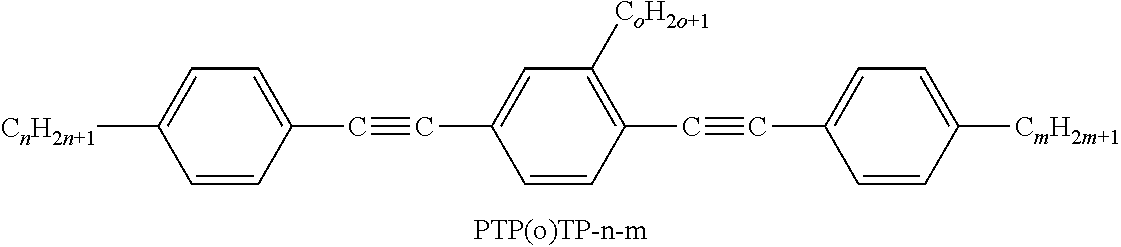 |
 |
 |
 |
 |
 |
 |
 |
 |
 |
 |
 |
 |
 |
 |
 |
| Composition |
| Compound |
| No. | Abbreviation | |
| 1 | PPTUI-3-4 | 25.1 |
| 2 | PPTUI-4-4 | 48.5 |
| 3 | PPTUI-3-2 | 26.4 |
| Σ | 100.0 | |
| Physical properties |
| T (N, I) = 163.5° C. | ||
| no (20° C., 589.3 nm) = 1.47 | ||
| Δn (20° C., 589.3 nm) = 0.40 | ||
| ε|| (20° C., 1 kHz) = 3.8 | ||
| Δε (20° C., 1 kHz) = 1.0 | ||
| γ1 (20° C.) = 310 mPa · s | ||
| εr,|| (20° C., 19 GHz) = 2.48 | ||
| Δεr (20° C., 19 GHz) = 0.87 | ||
| tan δε r,⊥ (20° C., 19 GHz) = 0.0123 | ||
| tan δε r,|| (20° C., 19 GHz) = 0.0034 | ||
| τ (20° C., 19 GHz) 0.26 | ||
| η (20° C., 19 GHz) 21.1 | ||
Claims (10)


Applications Claiming Priority (4)
| Application Number | Priority Date | Filing Date | Title |
|---|---|---|---|
| EP11007826 | 2011-09-27 | ||
| EP11007826 | 2011-09-27 | ||
| EP11007826.8 | 2011-09-27 | ||
| PCT/EP2012/003772 WO2013045029A1 (en) | 2011-09-27 | 2012-09-07 | Liquid crystal medium and high-frequency components comprising same |
Publications (2)
| Publication Number | Publication Date |
|---|---|
| US20140239227A1 US20140239227A1 (en) | 2014-08-28 |
| US9493703B2 true US9493703B2 (en) | 2016-11-15 |
Family
ID=46826433
Family Applications (1)
| Application Number | Title | Priority Date | Filing Date |
|---|---|---|---|
| US14/347,784 Active US9493703B2 (en) | 2011-09-27 | 2012-09-07 | Liquid crystal medium and high-frequency components comprising same |
Country Status (7)
| Country | Link |
|---|---|
| US (1) | US9493703B2 (en) |
| EP (1) | EP2760971B1 (en) |
| JP (1) | JP6100787B2 (en) |
| KR (1) | KR102018402B1 (en) |
| CN (1) | CN103842474B (en) |
| TW (1) | TWI567174B (en) |
| WO (1) | WO2013045029A1 (en) |
Cited By (2)
| Publication number | Priority date | Publication date | Assignee | Title |
|---|---|---|---|---|
| US10711195B2 (en) | 2016-03-24 | 2020-07-14 | Merck Patent Gmbh | Liquid-crystalline medium |
| US10975308B2 (en) | 2015-05-22 | 2021-04-13 | Merck Patent Gmbh | Liquid-crystalline medium |
Families Citing this family (11)
| Publication number | Priority date | Publication date | Assignee | Title |
|---|---|---|---|---|
| KR20140107530A (en) * | 2011-12-21 | 2014-09-04 | 메르크 파텐트 게엠베하 | Liquid crystal medium and high frequency components comprising same |
| KR102069008B1 (en) * | 2012-09-21 | 2020-02-11 | 메르크 파텐트 게엠베하 | Compounds having a c-c triple bond and use thereof in liquid-crystal mixtures |
| WO2016066242A1 (en) * | 2014-10-31 | 2016-05-06 | Merck Patent Gmbh | Liquid-crystalline medium and high-frequency components comprising same |
| KR102534329B1 (en) * | 2014-12-29 | 2023-05-22 | 메르크 파텐트 게엠베하 | Liquid-crystalline medium and high-frequency components comprising same |
| CN104593009A (en) * | 2015-02-15 | 2015-05-06 | 石家庄诚志永华显示材料有限公司 | Liquid crystal composition and application thereof in liquid crystal display |
| EP3433236B1 (en) | 2016-03-24 | 2021-10-27 | Merck Patent GmbH | Cyanopyrimidine derivatives suitable as components in liquid crystal media |
| CN109415630A (en) | 2016-04-13 | 2019-03-01 | 日东电工株式会社 | Liquid-crystal composition, mixture, element and tunable light device |
| WO2018031410A2 (en) | 2016-08-04 | 2018-02-15 | Nitto Denko Corporation | Heterocyclic liquid crystal composition, reverse-mode polymer dispersed liquid crystal element, and associated selectively dimmable device |
| WO2019028439A1 (en) | 2017-08-04 | 2019-02-07 | Nitto Denko Corporation | Heterocyclic liquid crystal composition, reverse-mode polymer dispersed liquid crystal element, and selectively dimmable device |
| CN108753312B (en) * | 2018-07-05 | 2021-07-27 | 西安近代化学研究所 | Liquid crystal compound, preparation method, composition containing the compound, and high frequency component containing the liquid crystal medium |
| CN109825307B (en) * | 2019-01-29 | 2021-04-30 | 武汉轻工大学 | Low-melting-point, high-dielectric-constant and low-consumption liquid crystal composition and high-frequency assembly comprising same |
Citations (4)
| Publication number | Priority date | Publication date | Assignee | Title |
|---|---|---|---|---|
| DE102004029429A1 (en) | 2003-07-11 | 2005-02-03 | Merck Patent Gmbh | Control element for use in high frequency applications such as the microwave range has a liquid crystal structure |
| JP2005120208A (en) | 2003-10-16 | 2005-05-12 | Dainippon Ink & Chem Inc | Variable function device |
| WO2011009524A1 (en) | 2009-07-21 | 2011-01-27 | Merck Patent Gmbh | Liquid crystal medium and high-frequency components containing the same |
| DE102010045370A1 (en) | 2009-09-25 | 2011-04-14 | Merck Patent Gmbh | Components for high-frequency technology and liquid-crystalline media |
Family Cites Families (8)
| Publication number | Priority date | Publication date | Assignee | Title |
|---|---|---|---|---|
| DE19844321B4 (en) * | 1997-10-06 | 2008-02-28 | Merck Patent Gmbh | Nematic liquid crystal mixture and use in an STN liquid crystal display |
| DE10027066A1 (en) * | 1999-06-30 | 2001-01-11 | Merck Patent Gmbh | Twisted pneumatic or supertwisted pneumatic liquid crystal display contains a pneumatic liquid crystal mixture comprising compounds of different dielectric anisotropy and an optically active component |
| EP1126006B1 (en) * | 2000-02-14 | 2009-03-04 | MERCK PATENT GmbH | Liquid crystal compounds, liquid crystal medium and liquid crystal display |
| EP1213337B1 (en) * | 2000-12-06 | 2005-11-02 | MERCK PATENT GmbH | Liquid crystalline medium and liquid crystal display |
| KR20160118375A (en) * | 2008-08-29 | 2016-10-11 | 메르크 파텐트 게엠베하 | Liquid crystalline medium and liquid crystal display |
| CN102575165B (en) * | 2009-09-25 | 2014-03-12 | 默克专利股份有限公司 | Compounds for liquid crystal medium and high-frequency components containing said liquid crystal medium |
| EP2309585A1 (en) | 2009-09-25 | 2011-04-13 | Technische Universität Darmstadt | Phase shifter for high frequency signals |
| US9193905B2 (en) | 2009-12-03 | 2015-11-24 | Merck Patent Gmbh | Devices for high-frequency technology, liquid-crystalline media and compounds |
-
2012
- 2012-09-07 US US14/347,784 patent/US9493703B2/en active Active
- 2012-09-07 CN CN201280047064.6A patent/CN103842474B/en active Active
- 2012-09-07 JP JP2014532260A patent/JP6100787B2/en active Active
- 2012-09-07 KR KR1020147010997A patent/KR102018402B1/en active Active
- 2012-09-07 EP EP12756382.3A patent/EP2760971B1/en active Active
- 2012-09-07 WO PCT/EP2012/003772 patent/WO2013045029A1/en not_active Ceased
- 2012-09-26 TW TW101135416A patent/TWI567174B/en active
Patent Citations (8)
| Publication number | Priority date | Publication date | Assignee | Title |
|---|---|---|---|---|
| DE102004029429A1 (en) | 2003-07-11 | 2005-02-03 | Merck Patent Gmbh | Control element for use in high frequency applications such as the microwave range has a liquid crystal structure |
| US20050067605A1 (en) | 2003-07-11 | 2005-03-31 | Georg Lussem | Components for high-frequency technology |
| US7361288B2 (en) | 2003-07-11 | 2008-04-22 | Merck Patent Gesellschaft Mit Besschrankter Haftung | Components for high-frequency technology |
| JP2005120208A (en) | 2003-10-16 | 2005-05-12 | Dainippon Ink & Chem Inc | Variable function device |
| WO2011009524A1 (en) | 2009-07-21 | 2011-01-27 | Merck Patent Gmbh | Liquid crystal medium and high-frequency components containing the same |
| US20120119141A1 (en) | 2009-07-21 | 2012-05-17 | Merck Patent Gmbh | Liquid crystal medium and high-frequency components containing the same |
| DE102010045370A1 (en) | 2009-09-25 | 2011-04-14 | Merck Patent Gmbh | Components for high-frequency technology and liquid-crystalline media |
| US20120182200A1 (en) | 2009-09-25 | 2012-07-19 | Merck Patent Gesellschaft Mit Beschrankter Haftung | Components for high-frequency technology, and liquid-crystalline media |
Non-Patent Citations (6)
| Title |
|---|
| English Abstract of JP-2005 120208, Publication Date: May 12, 2005. |
| International Search Report for PCT/EP2012/003772 dated Dec. 12, 2012. |
| Lapanik, A et al., "Liquid crystal systems for microwave applications," Dissertation by Artsiom Lapanik, Darmstadt, Germany, 2009. |
| Lapanik, A. et al., "Nematic LCs mixture with high birefringence in the microwave region," Frequenze, Jan. 2011, vol. 65, No. 1-2, pp. 15-19, released Apr. 11, 2011. |
| Lapanik, A. et al., "Room temperature nematic LCs mixtures with high birefringence for Microwave Applications," 38th Topical Meeting on Liquid Crystals, Mar. 10-12, 2010. |
| Yang, F. et al., "Microwave liquid crystal wavelength selector," Applied Physics Letters, Nov. 26, 2011, vol. 79, No. 22, pp. 3717-3719. |
Cited By (2)
| Publication number | Priority date | Publication date | Assignee | Title |
|---|---|---|---|---|
| US10975308B2 (en) | 2015-05-22 | 2021-04-13 | Merck Patent Gmbh | Liquid-crystalline medium |
| US10711195B2 (en) | 2016-03-24 | 2020-07-14 | Merck Patent Gmbh | Liquid-crystalline medium |
Also Published As
| Publication number | Publication date |
|---|---|
| WO2013045029A1 (en) | 2013-04-04 |
| JP6100787B2 (en) | 2017-03-22 |
| CN103842474A (en) | 2014-06-04 |
| KR102018402B1 (en) | 2019-09-04 |
| TW201319224A (en) | 2013-05-16 |
| TWI567174B (en) | 2017-01-21 |
| EP2760971A1 (en) | 2014-08-06 |
| US20140239227A1 (en) | 2014-08-28 |
| JP2014534281A (en) | 2014-12-18 |
| KR20140070623A (en) | 2014-06-10 |
| CN103842474B (en) | 2016-01-13 |
| EP2760971B1 (en) | 2015-11-25 |
Similar Documents
| Publication | Publication Date | Title |
|---|---|---|
| US9493703B2 (en) | Liquid crystal medium and high-frequency components comprising same | |
| US9605204B2 (en) | Liquid crystal medium and high frequency components comprising same | |
| EP2753676B1 (en) | Liquid-crystalline medium and high-frequency components comprising same | |
| US9657231B2 (en) | Liquid crystal medium and high-frequency components containing the same | |
| US9790426B2 (en) | Components for high-frequency technology, and liquid-crystalline media | |
| US9938462B2 (en) | Liquid-crystalline media, components for high-frequency technology, and mesogenic compounds | |
| US8557142B2 (en) | Compounds for a liquid crystal medium and high-frequency components containing said liquid crystal medium | |
| US10099975B2 (en) | Alkynyl-tolanes, liquid-crystal mixtures containing them and components for high-frequency technology | |
| US10711195B2 (en) | Liquid-crystalline medium | |
| US10662377B2 (en) | Liquid-crystalline medium | |
| US10975308B2 (en) | Liquid-crystalline medium | |
| EP3504293B1 (en) | Liquid-crystalline medium |
Legal Events
| Date | Code | Title | Description |
|---|---|---|---|
| AS | Assignment |
Owner name: MERCK PATENT GMBH, GERMANY Free format text: ASSIGNMENT OF ASSIGNORS INTEREST;ASSIGNORS:MANABE, ATSUTAKA;JASPER, CHRISTIAN;REIFFENRATH, VOLKER;AND OTHERS;REEL/FRAME:032541/0882 Effective date: 20140128 |
|
| STCF | Information on status: patent grant |
Free format text: PATENTED CASE |
|
| FEPP | Fee payment procedure |
Free format text: PAYOR NUMBER ASSIGNED (ORIGINAL EVENT CODE: ASPN); ENTITY STATUS OF PATENT OWNER: LARGE ENTITY |
|
| MAFP | Maintenance fee payment |
Free format text: PAYMENT OF MAINTENANCE FEE, 4TH YEAR, LARGE ENTITY (ORIGINAL EVENT CODE: M1551); ENTITY STATUS OF PATENT OWNER: LARGE ENTITY Year of fee payment: 4 |
|
| MAFP | Maintenance fee payment |
Free format text: PAYMENT OF MAINTENANCE FEE, 8TH YEAR, LARGE ENTITY (ORIGINAL EVENT CODE: M1552); ENTITY STATUS OF PATENT OWNER: LARGE ENTITY Year of fee payment: 8 |