US9493473B2 - Processes for making ponatinib and intermediates thereof - Google Patents
Processes for making ponatinib and intermediates thereof Download PDFInfo
- Publication number
- US9493473B2 US9493473B2 US14/984,446 US201514984446A US9493473B2 US 9493473 B2 US9493473 B2 US 9493473B2 US 201514984446 A US201514984446 A US 201514984446A US 9493473 B2 US9493473 B2 US 9493473B2
- Authority
- US
- United States
- Prior art keywords
- formula
- trifluoromethyl
- phenyl
- methyl
- compound
- Prior art date
- Legal status (The legal status is an assumption and is not a legal conclusion. Google has not performed a legal analysis and makes no representation as to the accuracy of the status listed.)
- Active
Links
- VRVAMRHGDPKADJ-UHFFFAOYSA-N C#CC1=C(C)C=CC(C(=O)CC2=CC(C(F)(F)F)=C(C)C=C2)=C1 Chemical compound C#CC1=C(C)C=CC(C(=O)CC2=CC(C(F)(F)F)=C(C)C=C2)=C1 VRVAMRHGDPKADJ-UHFFFAOYSA-N 0.000 description 5
- SXCVQTMZLPYSMK-UHFFFAOYSA-N CC1=C(C#CC2=CN=C3C=CC=NN23)C=C(C(=O)CC2=CC(C(F)(F)F)=C(C)C=C2)C=C1 Chemical compound CC1=C(C#CC2=CN=C3C=CC=NN23)C=C(C(=O)CC2=CC(C(F)(F)F)=C(C)C=C2)C=C1 SXCVQTMZLPYSMK-UHFFFAOYSA-N 0.000 description 5
- CLUVPFDOKIOXDZ-UHFFFAOYSA-N CC1=C(C#CC2=CN=C3C=CC=NN23)C=C(C(=O)CC2=CC(C(F)(F)F)=C(CN3CCN(C)CC3)C=C2)C=C1.Cl Chemical compound CC1=C(C#CC2=CN=C3C=CC=NN23)C=C(C(=O)CC2=CC(C(F)(F)F)=C(CN3CCN(C)CC3)C=C2)C=C1.Cl CLUVPFDOKIOXDZ-UHFFFAOYSA-N 0.000 description 4
- FXLGXUBFIWFPJA-UHFFFAOYSA-N C#CC1=C(C)C=CC(C(=O)O)=C1 Chemical compound C#CC1=C(C)C=CC(C(=O)O)=C1 FXLGXUBFIWFPJA-UHFFFAOYSA-N 0.000 description 3
- VYOHSFQVMLAURO-UHFFFAOYSA-N C#CC1=CN=C2C=CC=NN12 Chemical compound C#CC1=CN=C2C=CC=NN12 VYOHSFQVMLAURO-UHFFFAOYSA-N 0.000 description 3
- JBCDCYFEJQHTTA-UHFFFAOYSA-N CC1=C(C(F)(F)F)C=C(N)C=C1 Chemical compound CC1=C(C(F)(F)F)C=C(N)C=C1 JBCDCYFEJQHTTA-UHFFFAOYSA-N 0.000 description 3
- GXMSCVMSXHGPFB-UHFFFAOYSA-N CC1=C(I)C=C(C(=O)CC2=CC(C(F)(F)F)=C(CN3C(=O)C4=C(C=CC=C4)C3=O)C=C2)C=C1 Chemical compound CC1=C(I)C=C(C(=O)CC2=CC(C(F)(F)F)=C(CN3C(=O)C4=C(C=CC=C4)C3=O)C=C2)C=C1 GXMSCVMSXHGPFB-UHFFFAOYSA-N 0.000 description 3
- GOIQSOFZJFUOML-UHFFFAOYSA-N PN(CCCl)CCCl Chemical compound PN(CCCl)CCCl GOIQSOFZJFUOML-UHFFFAOYSA-N 0.000 description 3
- 0 *N(CCCl)CCCl.C#CC1=C(C)C=CC(C(=O)O)=C1.C#CC1=CN=C2C=CC=NN12.CC1=C(I)C=C(C(=O)O)C=C1.CCC1=C(C(F)(F)F)C=C([N+](=O)[O-])C=C1.O=C1C2=CC=CC=C2C(=O)N1[K] Chemical compound *N(CCCl)CCCl.C#CC1=C(C)C=CC(C(=O)O)=C1.C#CC1=CN=C2C=CC=NN12.CC1=C(I)C=C(C(=O)O)C=C1.CCC1=C(C(F)(F)F)C=C([N+](=O)[O-])C=C1.O=C1C2=CC=CC=C2C(=O)N1[K] 0.000 description 2
- WNVAYUAPLBQIIX-UHFFFAOYSA-N CC1=C(C#CC2=CN=C3C=CC=NN23)C=C(C(=O)CC2=CC(C(F)(F)F)=C(CN3C(=O)C4=C(C=CC=C4)C3=O)C=C2)C=C1 Chemical compound CC1=C(C#CC2=CN=C3C=CC=NN23)C=C(C(=O)CC2=CC(C(F)(F)F)=C(CN3C(=O)C4=C(C=CC=C4)C3=O)C=C2)C=C1 WNVAYUAPLBQIIX-UHFFFAOYSA-N 0.000 description 2
- VGASNZSUIFRKAC-UHFFFAOYSA-N CC1=C(C#CC2=CN=C3C=CC=NN23)C=C(C(=O)CC2=CC(C(F)(F)F)=C(CN3CCN(C)CC3)C=C2)C=C1.CC1=C(C#CC2=CN=C3C=CC=NN23)C=C(C(=O)CC2=CC(C(F)(F)F)=C(CN3CCN(C)CC3)C=C2)C=C1.CC1=C(C#CC2=CN=C3C=CC=NN23)C=C(C(=O)CC2=CC(C(F)(F)F)=C(CN3CCNCC3)C=C2)C=C1.CI.Cl.Cl Chemical compound CC1=C(C#CC2=CN=C3C=CC=NN23)C=C(C(=O)CC2=CC(C(F)(F)F)=C(CN3CCN(C)CC3)C=C2)C=C1.CC1=C(C#CC2=CN=C3C=CC=NN23)C=C(C(=O)CC2=CC(C(F)(F)F)=C(CN3CCN(C)CC3)C=C2)C=C1.CC1=C(C#CC2=CN=C3C=CC=NN23)C=C(C(=O)CC2=CC(C(F)(F)F)=C(CN3CCNCC3)C=C2)C=C1.CI.Cl.Cl VGASNZSUIFRKAC-UHFFFAOYSA-N 0.000 description 2
- CMVFTBXXSJBPLY-UHFFFAOYSA-N CC1=C(C#CC2=CN=C3C=CC=NN23)C=C(C(=O)CC2=CC(C(F)(F)F)=C(CN3CCN(C)CC3)C=C2)C=C1.CC1=C(C#CC2=CN=C3C=CC=NN23)C=C(C(=O)CC2=CC(C(F)(F)F)=C(CN3CCN(C)CC3)C=C2)C=C1.Cl.Cl Chemical compound CC1=C(C#CC2=CN=C3C=CC=NN23)C=C(C(=O)CC2=CC(C(F)(F)F)=C(CN3CCN(C)CC3)C=C2)C=C1.CC1=C(C#CC2=CN=C3C=CC=NN23)C=C(C(=O)CC2=CC(C(F)(F)F)=C(CN3CCN(C)CC3)C=C2)C=C1.Cl.Cl CMVFTBXXSJBPLY-UHFFFAOYSA-N 0.000 description 2
- RQHJRVIRJWWUQF-UHFFFAOYSA-N CC1=C(I)C=C(C(=O)CC2=CC(C(F)(F)F)=C(C)C=C2)C=C1 Chemical compound CC1=C(I)C=C(C(=O)CC2=CC(C(F)(F)F)=C(C)C=C2)C=C1 RQHJRVIRJWWUQF-UHFFFAOYSA-N 0.000 description 2
- WLTFQDSHWYLNBE-UHFFFAOYSA-N CCC1=C(C(F)(F)F)C=C([N+](=O)[O-])C=C1 Chemical compound CCC1=C(C(F)(F)F)C=C([N+](=O)[O-])C=C1 WLTFQDSHWYLNBE-UHFFFAOYSA-N 0.000 description 2
- GAVVLGXVZCHXCC-UHFFFAOYSA-N NC1=CC(C(F)(F)F)=C(C=O)C=C1 Chemical compound NC1=CC(C(F)(F)F)=C(C=O)C=C1 GAVVLGXVZCHXCC-UHFFFAOYSA-N 0.000 description 2
- FYRHIOVKTDQVFC-UHFFFAOYSA-M O=C1C2=CC=CC=C2C(=O)N1[K] Chemical compound O=C1C2=CC=CC=C2C(=O)N1[K] FYRHIOVKTDQVFC-UHFFFAOYSA-M 0.000 description 2
- ARBCIVZMHLXILQ-UHFFFAOYSA-M B=NS.C#CC1=CN=C2C=CC=NN12.CC1=C(C#CC2=CN=C3C=CC=NN23)C=C(C(=O)CC2=CC(C(F)(F)F)=C(CN)C=C2)C=C1.CC1=C(C#CC2=CN=C3C=CC=NN23)C=C(C(=O)CC2=CC(C(F)(F)F)=C(CN3C(=O)C4=C(C=CC=C4)C3=O)C=C2)C=C1.CC1=C(C#CC2=CN=C3C=CC=NN23)C=C(C(=O)CC2=CC(C(F)(F)F)=C(CN3CCN(P)CC3)C=C2)C=C1.CC1=C(C(F)(F)F)C=C([N+](=O)[O-])C=C1.CC1=C(I)C=C(C(=O)CC2=CC(C(F)(F)F)=C(CN3C(=O)C4=C(C=CC=C4)C3=O)C=C2)C=C1.CC1=C(I)C=C(C(=O)Cl)C=C1.CN(CCCl)CCCl.NC1=CC(C(F)(F)F)=C(CN2C(=O)C3=C(C=CC=C3)C2=O)C=C1.NN.O=C1C2=C(C=CC=C2)C(=O)N1CC1=C(C(F)(F)F)C=C([N+](=O)[O-])C=C1.O=C1C2=CC=CC=C2C(=O)N1[K].O=[N+]([O-])C1=CC(C(F)(F)F)=C(CBr)C=C1.PN(CCCl)CCCl Chemical compound B=NS.C#CC1=CN=C2C=CC=NN12.CC1=C(C#CC2=CN=C3C=CC=NN23)C=C(C(=O)CC2=CC(C(F)(F)F)=C(CN)C=C2)C=C1.CC1=C(C#CC2=CN=C3C=CC=NN23)C=C(C(=O)CC2=CC(C(F)(F)F)=C(CN3C(=O)C4=C(C=CC=C4)C3=O)C=C2)C=C1.CC1=C(C#CC2=CN=C3C=CC=NN23)C=C(C(=O)CC2=CC(C(F)(F)F)=C(CN3CCN(P)CC3)C=C2)C=C1.CC1=C(C(F)(F)F)C=C([N+](=O)[O-])C=C1.CC1=C(I)C=C(C(=O)CC2=CC(C(F)(F)F)=C(CN3C(=O)C4=C(C=CC=C4)C3=O)C=C2)C=C1.CC1=C(I)C=C(C(=O)Cl)C=C1.CN(CCCl)CCCl.NC1=CC(C(F)(F)F)=C(CN2C(=O)C3=C(C=CC=C3)C2=O)C=C1.NN.O=C1C2=C(C=CC=C2)C(=O)N1CC1=C(C(F)(F)F)C=C([N+](=O)[O-])C=C1.O=C1C2=CC=CC=C2C(=O)N1[K].O=[N+]([O-])C1=CC(C(F)(F)F)=C(CBr)C=C1.PN(CCCl)CCCl ARBCIVZMHLXILQ-UHFFFAOYSA-M 0.000 description 1
- IDGUHSDZBWKXGK-UHFFFAOYSA-M B=NS.C.C#CC1=CN=C2C=CC=NN12.CB(Cl)(Cl)(Cl)(Cl)[Al]=N.CC1=C(C#CC2=CN=C3C=CC=NN23)C=C(C(=O)CC2=CC(C(F)(F)F)=C(CN)C=C2)C=C1.CC1=C(C#CC2=CN=C3C=CC=NN23)C=C(C(=O)CC2=CC(C(F)(F)F)=C(CN3C(=O)C4=C(C=CC=C4)C3=O)C=C2)C=C1.CC1=C(C#CC2=CN=C3C=CC=NN23)C=C(C(=O)CC2=CC(C(F)(F)F)=C(CN3CCN(P)CC3)C=C2)C=C1.CC1=C(C(F)(F)F)C=C([N+](=O)[O-])C=C1.CC1=C(I)C=C(C(=O)CC2=CC(C(F)(F)F)=C(CN3C(=O)C4=C(C=CC=C4)C3=O)C=C2)C=C1.CC1=C(I)C=C(C(=O)Cl)C=C1.CN(CCCl)CCCl.NC1=CC(C(F)(F)F)=C(CN2C(=O)C3=C(C=CC=C3)C2=O)C=C1.O=C1C2=C(C=CC=C2)C(=O)N1CC1=C(C(F)(F)F)C=C([N+](=O)[O-])C=C1.O=C1C2=CC=CC=C2C(=O)N1[K].O=[N+]([O-])C1=CC(C(F)(F)F)=C(CBr)C=C1.PN(CCCl)CCCl Chemical compound B=NS.C.C#CC1=CN=C2C=CC=NN12.CB(Cl)(Cl)(Cl)(Cl)[Al]=N.CC1=C(C#CC2=CN=C3C=CC=NN23)C=C(C(=O)CC2=CC(C(F)(F)F)=C(CN)C=C2)C=C1.CC1=C(C#CC2=CN=C3C=CC=NN23)C=C(C(=O)CC2=CC(C(F)(F)F)=C(CN3C(=O)C4=C(C=CC=C4)C3=O)C=C2)C=C1.CC1=C(C#CC2=CN=C3C=CC=NN23)C=C(C(=O)CC2=CC(C(F)(F)F)=C(CN3CCN(P)CC3)C=C2)C=C1.CC1=C(C(F)(F)F)C=C([N+](=O)[O-])C=C1.CC1=C(I)C=C(C(=O)CC2=CC(C(F)(F)F)=C(CN3C(=O)C4=C(C=CC=C4)C3=O)C=C2)C=C1.CC1=C(I)C=C(C(=O)Cl)C=C1.CN(CCCl)CCCl.NC1=CC(C(F)(F)F)=C(CN2C(=O)C3=C(C=CC=C3)C2=O)C=C1.O=C1C2=C(C=CC=C2)C(=O)N1CC1=C(C(F)(F)F)C=C([N+](=O)[O-])C=C1.O=C1C2=CC=CC=C2C(=O)N1[K].O=[N+]([O-])C1=CC(C(F)(F)F)=C(CBr)C=C1.PN(CCCl)CCCl IDGUHSDZBWKXGK-UHFFFAOYSA-M 0.000 description 1
- PISGLMIUKSWGJP-UHFFFAOYSA-N BrC1=CN=C2C=CC=NN12.BrC1=CN=C2C=CC=NN12.C.C#CC1=C(C)C=CC(C(=O)CC2=CC(C(F)(F)F)=C(C)C=C2)=C1.C#CC1=C(C)C=CC(C(=O)CC2=CC(C(F)(F)F)=C(C)C=C2)=C1.C#CC1=C(C)C=CC(C(=O)CC2=CC(C(F)(F)F)=C(CN3CCN(C)CC3)C=C2)=C1.C#CC1=C(C)C=CC(C(=O)CC2=CC(C(F)(F)F)=C(CN3CCN(P)CC3)C=C2)=C1.C#CC1=C(C)C=CC(C(=O)CC2=CC(C(F)(F)F)=C(CN3CCN(P)CC3)C=C2)=C1.C#CC1=C(C)C=CC(C(=O)CC2=CC(C(F)(F)F)=C(CN3CCNCC3)C=C2)=C1.CC1=C(C#CC2=CN=C3C=CC=NN23)C=C(C(=O)CC2=CC(C(F)(F)F)=C(CN3CCN(C)CC3)C=C2)C=C1.CC1=C(C(F)(F)F)C=C(N)C=C1.CC1=C(I)C=C(C(=O)Cl)C=C1.CI.CN(CCCl)CCCl.Cl.PN(CCCl)CCCl Chemical compound BrC1=CN=C2C=CC=NN12.BrC1=CN=C2C=CC=NN12.C.C#CC1=C(C)C=CC(C(=O)CC2=CC(C(F)(F)F)=C(C)C=C2)=C1.C#CC1=C(C)C=CC(C(=O)CC2=CC(C(F)(F)F)=C(C)C=C2)=C1.C#CC1=C(C)C=CC(C(=O)CC2=CC(C(F)(F)F)=C(CN3CCN(C)CC3)C=C2)=C1.C#CC1=C(C)C=CC(C(=O)CC2=CC(C(F)(F)F)=C(CN3CCN(P)CC3)C=C2)=C1.C#CC1=C(C)C=CC(C(=O)CC2=CC(C(F)(F)F)=C(CN3CCN(P)CC3)C=C2)=C1.C#CC1=C(C)C=CC(C(=O)CC2=CC(C(F)(F)F)=C(CN3CCNCC3)C=C2)=C1.CC1=C(C#CC2=CN=C3C=CC=NN23)C=C(C(=O)CC2=CC(C(F)(F)F)=C(CN3CCN(C)CC3)C=C2)C=C1.CC1=C(C(F)(F)F)C=C(N)C=C1.CC1=C(I)C=C(C(=O)Cl)C=C1.CI.CN(CCCl)CCCl.Cl.PN(CCCl)CCCl PISGLMIUKSWGJP-UHFFFAOYSA-N 0.000 description 1
- UTERCDZJCDBSRE-UHFFFAOYSA-N BrC1=CN=C2C=CC=NN12.BrC1=CN=C2C=CC=NN12.C.C.C.C.C#CC1=C(C)C=CC(C(=O)CC2=CC(C(F)(F)F)=C(C)C=C2)=C1.C#CC1=C(C)C=CC(C(=O)CC2=CC(C(F)(F)F)=C(C)C=C2)=C1.C#CC1=C(C)C=CC(C(=O)CC2=CC(C(F)(F)F)=C(CN3CCN(C)CC3)C=C2)=C1.C#CC1=C(C)C=CC(C(=O)CC2=CC(C(F)(F)F)=C(CN3CCN(P)CC3)C=C2)=C1.C#CC1=C(C)C=CC(C(=O)CC2=CC(C(F)(F)F)=C(CN3CCN(P)CC3)C=C2)=C1.C#CC1=C(C)C=CC(C(=O)CC2=CC(C(F)(F)F)=C(CN3CCNCC3)C=C2)=C1.CC1=C(C#CC2=CN=C3C=CC=NN23)C=C(C(=O)CC2=CC(C(F)(F)F)=C(CN3CCN(C)CC3)C=C2)C=C1.CC1=C(C(F)(F)F)C=C(N)C=C1.CC1=C(I)C=C(C(=O)O)C=C1.CN(CCCl)CCCl.Cl.I.PN(CCCl)CCCl Chemical compound BrC1=CN=C2C=CC=NN12.BrC1=CN=C2C=CC=NN12.C.C.C.C.C#CC1=C(C)C=CC(C(=O)CC2=CC(C(F)(F)F)=C(C)C=C2)=C1.C#CC1=C(C)C=CC(C(=O)CC2=CC(C(F)(F)F)=C(C)C=C2)=C1.C#CC1=C(C)C=CC(C(=O)CC2=CC(C(F)(F)F)=C(CN3CCN(C)CC3)C=C2)=C1.C#CC1=C(C)C=CC(C(=O)CC2=CC(C(F)(F)F)=C(CN3CCN(P)CC3)C=C2)=C1.C#CC1=C(C)C=CC(C(=O)CC2=CC(C(F)(F)F)=C(CN3CCN(P)CC3)C=C2)=C1.C#CC1=C(C)C=CC(C(=O)CC2=CC(C(F)(F)F)=C(CN3CCNCC3)C=C2)=C1.CC1=C(C#CC2=CN=C3C=CC=NN23)C=C(C(=O)CC2=CC(C(F)(F)F)=C(CN3CCN(C)CC3)C=C2)C=C1.CC1=C(C(F)(F)F)C=C(N)C=C1.CC1=C(I)C=C(C(=O)O)C=C1.CN(CCCl)CCCl.Cl.I.PN(CCCl)CCCl UTERCDZJCDBSRE-UHFFFAOYSA-N 0.000 description 1
- GZQIWKNBRFXXDB-UHFFFAOYSA-N BrC1=CN=C2C=CC=NN12.C#CC1=C(C)C=CC(C(=O)CC2=CC(C(F)(F)F)=C(C=O)C=C2)=C1.C#CC1=C(C)C=CC(C(=O)CC2=CC(C(F)(F)F)=C(CN3CCN(C)CC3)C=C2)=C1.C#CC1=C(C)C=CC(C(=O)O)=C1.CC(=O)OC1(C)OO1.CC1(B[Na])OO1.CC1=C(C#CC2=CN=C3C=CC=NN23)C=C(C(=O)CC2=CC(C(F)(F)F)=C(CN3CCN(C)CC3)C=C2)C=C1.CC1=C(C#CC2=CN=C3C=CC=NN23)C=C(C(=O)CC2=CC(C(F)(F)F)=C(CN3CCN(C)CC3)C=C2)C=C1.CN1CCCCC1.Cl.Cl.NC1=CC(C(F)(F)F)=C(C=O)C=C1 Chemical compound BrC1=CN=C2C=CC=NN12.C#CC1=C(C)C=CC(C(=O)CC2=CC(C(F)(F)F)=C(C=O)C=C2)=C1.C#CC1=C(C)C=CC(C(=O)CC2=CC(C(F)(F)F)=C(CN3CCN(C)CC3)C=C2)=C1.C#CC1=C(C)C=CC(C(=O)O)=C1.CC(=O)OC1(C)OO1.CC1(B[Na])OO1.CC1=C(C#CC2=CN=C3C=CC=NN23)C=C(C(=O)CC2=CC(C(F)(F)F)=C(CN3CCN(C)CC3)C=C2)C=C1.CC1=C(C#CC2=CN=C3C=CC=NN23)C=C(C(=O)CC2=CC(C(F)(F)F)=C(CN3CCN(C)CC3)C=C2)C=C1.CN1CCCCC1.Cl.Cl.NC1=CC(C(F)(F)F)=C(C=O)C=C1 GZQIWKNBRFXXDB-UHFFFAOYSA-N 0.000 description 1
- PTLUUVQWZMAACI-UHFFFAOYSA-N BrC1=CN=C2C=CC=NN12.C.C.C#CC1=C(C)C=CC(C(=O)CC2=CC(C(F)(F)F)=C(C=O)C=C2)=C1.C#CC1=C(C)C=CC(C(=O)CC2=CC(C(F)(F)F)=C(CN3CCN(C)CC3)C=C2)=C1.C#CC1=C(C)C=CC(C(=O)O)=C1.CC1=C(C#CC2=CN=C3C=CC=NN23)C=C(C(=O)CC2=CC(C(F)(F)F)=C(CN3CCN(C)CC3)C=C2)C=C1.CC1=C(C#CC2=CN=C3C=CC=NN23)C=C(C(=O)CC2=CC(C(F)(F)F)=C(CN3CCN(C)CC3)C=C2)C=C1.CN1CCCCC1.Cl.Cl.NC1=CC(C(F)(F)F)=C(C=O)C=C1 Chemical compound BrC1=CN=C2C=CC=NN12.C.C.C#CC1=C(C)C=CC(C(=O)CC2=CC(C(F)(F)F)=C(C=O)C=C2)=C1.C#CC1=C(C)C=CC(C(=O)CC2=CC(C(F)(F)F)=C(CN3CCN(C)CC3)C=C2)=C1.C#CC1=C(C)C=CC(C(=O)O)=C1.CC1=C(C#CC2=CN=C3C=CC=NN23)C=C(C(=O)CC2=CC(C(F)(F)F)=C(CN3CCN(C)CC3)C=C2)C=C1.CC1=C(C#CC2=CN=C3C=CC=NN23)C=C(C(=O)CC2=CC(C(F)(F)F)=C(CN3CCN(C)CC3)C=C2)C=C1.CN1CCCCC1.Cl.Cl.NC1=CC(C(F)(F)F)=C(C=O)C=C1 PTLUUVQWZMAACI-UHFFFAOYSA-N 0.000 description 1
- LBMBDQJLMBZPNQ-UHFFFAOYSA-N C#CC1=C(C)C=CC(C(=O)CC2=CC(C(F)(F)F)=C(CN3CCN(C)CC3)C=C2)=C1 Chemical compound C#CC1=C(C)C=CC(C(=O)CC2=CC(C(F)(F)F)=C(CN3CCN(C)CC3)C=C2)=C1 LBMBDQJLMBZPNQ-UHFFFAOYSA-N 0.000 description 1
- QMCUTZXZTZWRMZ-UHFFFAOYSA-N C#CC1=CN=C2C=CC=NN12.CC(=O)OC1(C)OO1.CC1(B[Na])OO1.CC1=C(C#CC2=CN=C3C=CC=NN23)C=C(C(=O)CC2=CC(C(F)(F)F)=C(C(=O)O)C=C2)C=C1.CC1=C(C#CC2=CN=C3C=CC=NN23)C=C(C(=O)CC2=CC(C(F)(F)F)=C(CN3CCN(C)CC3)C=C2)C=C1.CC1=C(C#CC2=CN=C3C=CC=NN23)C=C(C(=O)CC2=CC(C(F)(F)F)=C(CN3CCN(C)CC3)C=C2)C=C1.CC1=C(I)C=C(C(=O)CC2=CC(C(F)(F)F)=C(C(=O)O)C=C2)C=C1.CC1=C(I)C=C(C(=O)O)C=C1.CN1CCCCC1.Cl.Cl.NC1=CC(C(F)(F)F)=C(C(=O)O)C=C1 Chemical compound C#CC1=CN=C2C=CC=NN12.CC(=O)OC1(C)OO1.CC1(B[Na])OO1.CC1=C(C#CC2=CN=C3C=CC=NN23)C=C(C(=O)CC2=CC(C(F)(F)F)=C(C(=O)O)C=C2)C=C1.CC1=C(C#CC2=CN=C3C=CC=NN23)C=C(C(=O)CC2=CC(C(F)(F)F)=C(CN3CCN(C)CC3)C=C2)C=C1.CC1=C(C#CC2=CN=C3C=CC=NN23)C=C(C(=O)CC2=CC(C(F)(F)F)=C(CN3CCN(C)CC3)C=C2)C=C1.CC1=C(I)C=C(C(=O)CC2=CC(C(F)(F)F)=C(C(=O)O)C=C2)C=C1.CC1=C(I)C=C(C(=O)O)C=C1.CN1CCCCC1.Cl.Cl.NC1=CC(C(F)(F)F)=C(C(=O)O)C=C1 QMCUTZXZTZWRMZ-UHFFFAOYSA-N 0.000 description 1
- RXFIFYSGVLLOHD-UHFFFAOYSA-N C#CC1=CN=C2C=CC=NN12.CC(=O)OC1(C)OO1.CC1(B[Na])OO1.CC1=C(C#CC2=CN=C3C=CC=NN23)C=C(C(=O)CC2=CC(C(F)(F)F)=C(C(=O)O)C=C2)C=C1.CC1=C(C#CC2=CN=C3C=CC=NN23)C=C(C(=O)CC2=CC(C(F)(F)F)=C(CN3CCN(C)CC3)C=C2)C=C1.CC1=C(C#CC2=CN=C3C=CC=NN23)C=C(C(=O)CC2=CC(C(F)(F)F)=C(CN3CCN(C)CC3)C=C2)C=C1.CC1=C(I)C=C(C(=O)CC2=CC(C(F)(F)F)=C(C(=O)O)C=C2)C=C1.CC1=C(I)C=C(C(=O)O)C=C1.CN1CCCCC1.Cl.Cl.NC1=CC(C(F)(F)F)=C(C=O)C=C1 Chemical compound C#CC1=CN=C2C=CC=NN12.CC(=O)OC1(C)OO1.CC1(B[Na])OO1.CC1=C(C#CC2=CN=C3C=CC=NN23)C=C(C(=O)CC2=CC(C(F)(F)F)=C(C(=O)O)C=C2)C=C1.CC1=C(C#CC2=CN=C3C=CC=NN23)C=C(C(=O)CC2=CC(C(F)(F)F)=C(CN3CCN(C)CC3)C=C2)C=C1.CC1=C(C#CC2=CN=C3C=CC=NN23)C=C(C(=O)CC2=CC(C(F)(F)F)=C(CN3CCN(C)CC3)C=C2)C=C1.CC1=C(I)C=C(C(=O)CC2=CC(C(F)(F)F)=C(C(=O)O)C=C2)C=C1.CC1=C(I)C=C(C(=O)O)C=C1.CN1CCCCC1.Cl.Cl.NC1=CC(C(F)(F)F)=C(C=O)C=C1 RXFIFYSGVLLOHD-UHFFFAOYSA-N 0.000 description 1
- VMMJSNQNWCZGNB-UHFFFAOYSA-N C.C#CC1=CN=C2C=CC=NN12.CC1=C(C#CC2=CN=C3C=CC=NN23)C=C(C(=O)CC2=CC(C(F)(F)F)=C(C)C=C2)C=C1.CC1=C(C#CC2=CN=C3C=CC=NN23)C=C(C(=O)CC2=CC(C(F)(F)F)=C(C)C=C2)C=C1.CC1=C(C#CC2=CN=C3C=CC=NN23)C=C(C(=O)CC2=CC(C(F)(F)F)=C(CN3CCN(C)CC3)C=C2)C=C1.CC1=C(C#CC2=CN=C3C=CC=NN23)C=C(C(=O)CC2=CC(C(F)(F)F)=C(CN3CCN(P)CC3)C=C2)C=C1.CC1=C(C(F)(F)F)C=C(N)C=C1.CC1=C(I)C=C(C(=O)CC2=CC(C(F)(F)F)=C(C)C=C2)C=C1.CC1=C(I)C=C(C(=O)O)C=C1.CN(CCCl)CCCl.Cl.PN(CCCl)CCCl Chemical compound C.C#CC1=CN=C2C=CC=NN12.CC1=C(C#CC2=CN=C3C=CC=NN23)C=C(C(=O)CC2=CC(C(F)(F)F)=C(C)C=C2)C=C1.CC1=C(C#CC2=CN=C3C=CC=NN23)C=C(C(=O)CC2=CC(C(F)(F)F)=C(C)C=C2)C=C1.CC1=C(C#CC2=CN=C3C=CC=NN23)C=C(C(=O)CC2=CC(C(F)(F)F)=C(CN3CCN(C)CC3)C=C2)C=C1.CC1=C(C#CC2=CN=C3C=CC=NN23)C=C(C(=O)CC2=CC(C(F)(F)F)=C(CN3CCN(P)CC3)C=C2)C=C1.CC1=C(C(F)(F)F)C=C(N)C=C1.CC1=C(I)C=C(C(=O)CC2=CC(C(F)(F)F)=C(C)C=C2)C=C1.CC1=C(I)C=C(C(=O)O)C=C1.CN(CCCl)CCCl.Cl.PN(CCCl)CCCl VMMJSNQNWCZGNB-UHFFFAOYSA-N 0.000 description 1
- DOFLOARCJNDKCG-UHFFFAOYSA-N C.C.CC1=C(C#CC2=CN=C3C=CC=NN23)C=C(C(=O)CC2=CC(C(F)(F)F)=C(CN3CCN(C)CC3)C=C2)C=C1.CC1=C(C#CC2=CN=C3C=CC=NN23)C=C(C(=O)CC2=CC(C(F)(F)F)=C(CN3CCN(C)CC3)C=C2)C=C1.CC1=C(C#CC2=CN=C3C=CC=NN23)C=C(C(=O)CC2=CC(C(F)(F)F)=C(CN3CCNCC3)C=C2)C=C1.CI(=O)(O)([K])([K])C=O.Cl.Cl Chemical compound C.C.CC1=C(C#CC2=CN=C3C=CC=NN23)C=C(C(=O)CC2=CC(C(F)(F)F)=C(CN3CCN(C)CC3)C=C2)C=C1.CC1=C(C#CC2=CN=C3C=CC=NN23)C=C(C(=O)CC2=CC(C(F)(F)F)=C(CN3CCN(C)CC3)C=C2)C=C1.CC1=C(C#CC2=CN=C3C=CC=NN23)C=C(C(=O)CC2=CC(C(F)(F)F)=C(CN3CCNCC3)C=C2)C=C1.CI(=O)(O)([K])([K])C=O.Cl.Cl DOFLOARCJNDKCG-UHFFFAOYSA-N 0.000 description 1
- WKFXYDQSHHLQTO-UHFFFAOYSA-N C.CC1=C(C#CC2=CN=C3C=CC=NN23)C=C(C(=O)CC2=CC(C(F)(F)F)=C(CN3CCN(C)CC3)C=C2)C=C1.CC1=C(C#CC2=CN=C3C=CC=NN23)C=C(C(=O)CC2=CC(C(F)(F)F)=C(CN3CCN(C)CC3)C=C2)C=C1.CC1=C(C#CC2=CN=C3C=CC=NN23)C=C(C(=O)CC2=CC(C(F)(F)F)=C(CN3CCNCC3)C=C2)C=C1.CI.Cl.Cl Chemical compound C.CC1=C(C#CC2=CN=C3C=CC=NN23)C=C(C(=O)CC2=CC(C(F)(F)F)=C(CN3CCN(C)CC3)C=C2)C=C1.CC1=C(C#CC2=CN=C3C=CC=NN23)C=C(C(=O)CC2=CC(C(F)(F)F)=C(CN3CCN(C)CC3)C=C2)C=C1.CC1=C(C#CC2=CN=C3C=CC=NN23)C=C(C(=O)CC2=CC(C(F)(F)F)=C(CN3CCNCC3)C=C2)C=C1.CI.Cl.Cl WKFXYDQSHHLQTO-UHFFFAOYSA-N 0.000 description 1
- PYTPODWZRQRUDB-UHFFFAOYSA-N CC1=C(C#CC2=CN=C3C=CC=NN23)C=C(C(=O)CC2=CC(C(F)(F)F)=C(CN3CCCCC3)C=C2)C=C1 Chemical compound CC1=C(C#CC2=CN=C3C=CC=NN23)C=C(C(=O)CC2=CC(C(F)(F)F)=C(CN3CCCCC3)C=C2)C=C1 PYTPODWZRQRUDB-UHFFFAOYSA-N 0.000 description 1
- JCOQBCLTGOENLA-UHFFFAOYSA-N CC1=C(I)C=C(C(=O)Cl)C=C1 Chemical compound CC1=C(I)C=C(C(=O)Cl)C=C1 JCOQBCLTGOENLA-UHFFFAOYSA-N 0.000 description 1
- LDDHMKANNXWUAK-UHFFFAOYSA-N CC1=C(I)C=C(C(=O)O)C=C1 Chemical compound CC1=C(I)C=C(C(=O)O)C=C1 LDDHMKANNXWUAK-UHFFFAOYSA-N 0.000 description 1
- XTVKJKRBKVSTAM-UHFFFAOYSA-N CCCN(P)CCCl Chemical compound CCCN(P)CCCl XTVKJKRBKVSTAM-UHFFFAOYSA-N 0.000 description 1
- RKZPASPXSGETME-UHFFFAOYSA-N Cc(ccc(C(Nc1ccc(C=O)c(C(F)(F)F)c1)=O)c1)c1C#C Chemical compound Cc(ccc(C(Nc1ccc(C=O)c(C(F)(F)F)c1)=O)c1)c1C#C RKZPASPXSGETME-UHFFFAOYSA-N 0.000 description 1
- GUBQJXDURQERHN-UHFFFAOYSA-N NC1=CC(C(F)(F)F)=C(CN2C(=O)C3=C(C=CC=C3)C2=O)C=C1 Chemical compound NC1=CC(C(F)(F)F)=C(CN2C(=O)C3=C(C=CC=C3)C2=O)C=C1 GUBQJXDURQERHN-UHFFFAOYSA-N 0.000 description 1
- NCMJRKCNYGJPCF-UHFFFAOYSA-N O=C1C2=C(C=CC=C2)C(=O)N1CC1=C(C(F)(F)F)C=C([N+](=O)[O-])C=C1 Chemical compound O=C1C2=C(C=CC=C2)C(=O)N1CC1=C(C(F)(F)F)C=C([N+](=O)[O-])C=C1 NCMJRKCNYGJPCF-UHFFFAOYSA-N 0.000 description 1
Classifications
-
- C—CHEMISTRY; METALLURGY
- C07—ORGANIC CHEMISTRY
- C07D—HETEROCYCLIC COMPOUNDS
- C07D487/00—Heterocyclic compounds containing nitrogen atoms as the only ring hetero atoms in the condensed system, not provided for by groups C07D451/00 - C07D477/00
- C07D487/02—Heterocyclic compounds containing nitrogen atoms as the only ring hetero atoms in the condensed system, not provided for by groups C07D451/00 - C07D477/00 in which the condensed system contains two hetero rings
- C07D487/04—Ortho-condensed systems
-
- C—CHEMISTRY; METALLURGY
- C07—ORGANIC CHEMISTRY
- C07C—ACYCLIC OR CARBOCYCLIC COMPOUNDS
- C07C233/00—Carboxylic acid amides
- C07C233/64—Carboxylic acid amides having carbon atoms of carboxamide groups bound to carbon atoms of six-membered aromatic rings
- C07C233/67—Carboxylic acid amides having carbon atoms of carboxamide groups bound to carbon atoms of six-membered aromatic rings having the nitrogen atom of at least one of the carboxamide groups bound to a carbon atom of a hydrocarbon radical substituted by singly-bound oxygen atoms
- C07C233/75—Carboxylic acid amides having carbon atoms of carboxamide groups bound to carbon atoms of six-membered aromatic rings having the nitrogen atom of at least one of the carboxamide groups bound to a carbon atom of a hydrocarbon radical substituted by singly-bound oxygen atoms with the substituted hydrocarbon radical bound to the nitrogen atom of the carboxamide group by a carbon atom of a six-membered aromatic ring
-
- C—CHEMISTRY; METALLURGY
- C07—ORGANIC CHEMISTRY
- C07C—ACYCLIC OR CARBOCYCLIC COMPOUNDS
- C07C233/00—Carboxylic acid amides
- C07C233/64—Carboxylic acid amides having carbon atoms of carboxamide groups bound to carbon atoms of six-membered aromatic rings
- C07C233/76—Carboxylic acid amides having carbon atoms of carboxamide groups bound to carbon atoms of six-membered aromatic rings having the nitrogen atom of at least one of the carboxamide groups bound to a carbon atom of a hydrocarbon radical substituted by doubly-bound oxygen atoms
-
- C—CHEMISTRY; METALLURGY
- C07—ORGANIC CHEMISTRY
- C07C—ACYCLIC OR CARBOCYCLIC COMPOUNDS
- C07C233/00—Carboxylic acid amides
- C07C233/64—Carboxylic acid amides having carbon atoms of carboxamide groups bound to carbon atoms of six-membered aromatic rings
- C07C233/77—Carboxylic acid amides having carbon atoms of carboxamide groups bound to carbon atoms of six-membered aromatic rings having the nitrogen atom of at least one of the carboxamide groups bound to a carbon atom of a hydrocarbon radical substituted by amino groups
- C07C233/80—Carboxylic acid amides having carbon atoms of carboxamide groups bound to carbon atoms of six-membered aromatic rings having the nitrogen atom of at least one of the carboxamide groups bound to a carbon atom of a hydrocarbon radical substituted by amino groups with the substituted hydrocarbon radical bound to the nitrogen atom of the carboxamide group by a carbon atom of a six-membered aromatic ring
-
- C—CHEMISTRY; METALLURGY
- C07—ORGANIC CHEMISTRY
- C07D—HETEROCYCLIC COMPOUNDS
- C07D209/00—Heterocyclic compounds containing five-membered rings, condensed with other rings, with one nitrogen atom as the only ring hetero atom
- C07D209/02—Heterocyclic compounds containing five-membered rings, condensed with other rings, with one nitrogen atom as the only ring hetero atom condensed with one carbocyclic ring
- C07D209/44—Iso-indoles; Hydrogenated iso-indoles
- C07D209/48—Iso-indoles; Hydrogenated iso-indoles with oxygen atoms in positions 1 and 3, e.g. phthalimide
Definitions
- the presently disclosed subject matter provides novel synthetic approaches to make 3-(imidazo[1,2-b]pyridazin-3-ylethynyl)-4-methyl-N-[4-[(4-methylpiperazin-1-yl)methyl]-3-(trifluoromethyl)phenyl]benzamide, intermediates and pharmaceutically acceptable salts thereof.
- 3-(imidazo[1,2-b]pyridazin-3-ylethynyl)-4-methyl-N-[4-[(4-methylpiperazin-1-yl)methyl]-3-(trifluoromethyl)phenyl]benzamide also known as ponatinib, is a multi-targeted tyrosine-kinase inhibitor used in the treatment of chronic myeloid leukemia (CML) and Philadelphia chromosome positive (Ph+) acute lymphoblastic leukemia (ALL).
- CML chronic myeloid leukemia
- Ph+ Philadelphia chromosome positive
- ALL acute lymphoblastic leukemia
- the presently disclosed processes involve a novel synthetic approach to make ponatinib in a simple and easily scalable process, overcoming the drawbacks of prior art processes.
- P is a protecting group and subsequently deprotecting the piperazine ring; and forming the ponatinib hydrochloride using hydrogen chloride.
- X may be bromine.
- P may be CH 3 , tosyl, mesyl, carboxybenzyl, benzyl or amino.
- the step of deprotecting the piperazine ring may include N-methylation with methyl iodide.
- the step of deprotection of the piperazine ring may be carried out in an acid, base and under hydrogenation conditions.
- the acid may be for example concentrated sulfuric acid, HBr in acetic acid, HBr in water and trifluoroacetic acid.
- Hydrogenation may be carried out using hydrogen pressure and a catalyst.
- the catalyst may be for example palladium and/or Raney nickel.
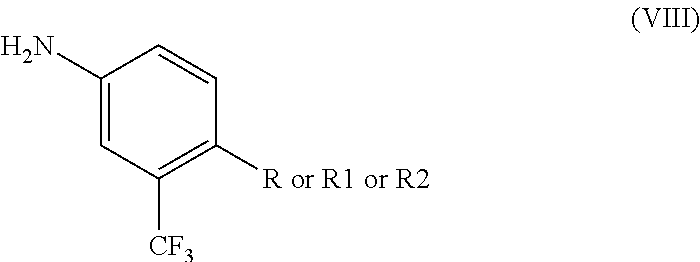
- a method of making ponatinib hydrochloride having the formula (I) includes reacting a 4-substituted-3-(trifluoromethyl) analogue having the formula (VIII)
- R is CN, R1 is COOR′′, R2 is CH 2 N 3 and R′′ is CH 3 , C 2 H 5 or a higher homologue, with 3-iodo-4-methylbenzoic acid of formula (IV)
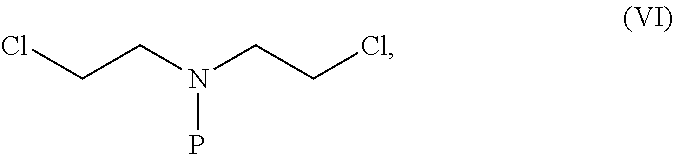
- R′ is CH 2 NH 2 or CH 2 OH, forming a piperazine ring via reaction of the compound of formula (IIf) with a) 2-chloro-N-(2-chloroethyl)-N-methylethanamine; or b) 2-chloro-N-(2-chloroethyl)-N-substituted derivative of the formula (VI)
- P is a protecting group and subsequently deprotecting the piperazine ring; and forming the ponatinib hydrochloride using hydrogen chloride.
- P may be CH 3 , tosyl, mesyl, carboxybenzyl, benzyl or amino.
- the step of deprotecting the piperazine ring may includes N-methylation with methyl iodide.
- esterification may be carried out using sodium borohydride and lithium aluminium hydride.
- Halogenation may be carried out using thionyl chloride, phosphorous oxychloride, or phosphorous trichloride.
- Azide formation may be carried out using a metal azide such as sodium azide.
- Azide reduction may be carried out using palladium and hydrogen.
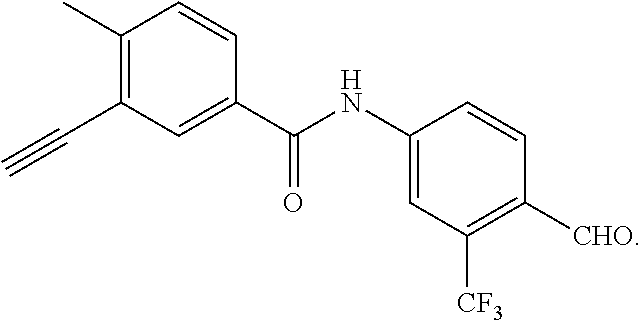
- a method of making ponatinib hydrochloride having the formula (I) includes reacting 4-amino-2-(trifluoromethyl)benzaldehyde having the formula (IX)
- the reductive amination may be carried out using a base and an organic solvent.
- the base may be selected for example from sodium cyanoborohydride and sodium triacetoxyborohydride.
- the solvent may be selected for example from acetic acid, isopropyl alcohol, methanol, ethanol and n-butanol.
- a method of making ponatinib hydrochloride having the formula (I) includes reacting a 4-substituted-3-(trifluoromethyl) analogue having the formula (VIII)
- R is CN, R1 is COOR′′, R2 is CH 2 N 3 and R′′ is CH 3 , C 2 H 5 or a higher homologue thereof, with 3-ethynyl-4-methylbenzoic acid of formula (VII)
- R′ is CH 2 NH 2 or CH 2 OH, forming a piperazine ring by reacting the compound of formula (IVb) with either
- P is a protecting group and subsequently deprotecting the piperazine ring; and forming the ponatinib hydrochloride using hydrogen chloride.
- P may be CH 3 , mesyl, tosyl, carboxybenzyl, benzyl or nitrobenzyl.
- the step of forming the piperazine ring may include using substituted a 2-chloro-N-(2-chloroethyl)-N-substituted (VII) derivative in an organic solvent and a base. Deprotection of the piperazine ring may be carried out in an acid, base and under hydrogenation conditions.
- the acid may be selected for example from concentrated sulfuric acid, HBr in acetic acid and HBr in water.
- Hydrogenation may be carried out with hydrogen pressure and a catalyst. Examples of suitable catalysts include palladium and/or Raney Nickel.
- a method of making ponatinib hydrochloride having the formula (I) includes reacting 4-amino-2-(trifluoromethyl)benzaldehyde having the formula (IX)
- novel intermediates are provided.
- R′ is CH 2 NH 2 or CH 2 OH.
- R′ is CH 2 NH 2 or CH 2 OH.
- methyl-4-nitro-2-(trifluoromethyl)benzene is converted to 1-(chloromethyl) or 1-(bromomethyl)-3-(trifluoromethyl) aniline with N-bromo succinimide or with N-chloro succinimide.
- the product is then reduced with palladium carbon under hydrogenation conditions to 4-(bromomethyl)-3-(trifluoromethyl) aniline or 4-(chloromethyl)-3-(trifluoromethyl) aniline.
- This aniline derivative is protected with a phthalimide derivative and the subsequent amide formation subjected to Sonogarshira reactions. This method of phthalimide protection helps improve yield of further reactions by controlling side reactions which are prone to take place when using conventional methods. Protection of the phthalimide group helps in introducing the required amine moiety of the molecule by a simple deprotection mechanism.
- the formation of the piperazine ring of ponatinib may be achieved by the novel method of coupling the amino group with 2-chloro-N-(2-chloroethyl)-N-methylethanamine or by coupling with N-protected 2-chloro-N-(2-chloroethyl)amine followed by deprotection and N-methylation with methyl iodide.
- the above method of coupling helps in improving the quality of the final product with an improved yield.
- another method of making ponatinib employs the commercially inexpensive raw material 4-amino-2-(trifluoromethyl)benzonitrile.
- the nitrile group can be converted to amine by simple reduction/hydrogenation methods with an inexpensive catalyst such as Raney® nickel.
- the resultant amine can be easily cyclized to a piperazine derivative by the above methods.
- methyl 3-iodo-4-methylbenzoate and ethyl 3-iodo-4-methyl benzoate can be converted to their corresponding alcohols which, which may then be converted to their corresponding alkyl chlorides.
- the alkyl chlorides may then be cyclized to the required piperazine moiety by 2-chloro-N-(2-chloroethyl)-N-protected amines or with 2-chloro-N-(2-chloroethyl)-N-methylethanamine.
- ponatinib hydrochloride (I) may be prepared by the formation of an amide such as N-(4-cyano-3-(trifluoromethyl)phenyl)-3-iodo-4-methylbenzamide by reaction of 4-substituted-3-(trifluoromethyl) analogues (VIII)
- a further method of making ponatinib wherein 3-iodo-4-methylbenzoic acid is condensed with 4-amino-2-(trifluoromethyl)benzaldehyde to form an amide which is further condensed with 3-ethynylimidazo[1,2-b]pyridazine and the coupled product is directly condensed with N-methylpiperazine by a reductive amination process.
- This method of making the piperazine moiety is simple, reproducible and novel.
- ponatinib another method of making ponatinib wherein the 3-ethynyl-4-methylbenzoic acid is condensed with trifluoro substituted aniline derivatives and the resultant amide is cyclized with the 2-chloro-N-(2-chloroethyl)-N-protected amines or with 2-chloro-N-(2-chloroethyl)-N-methylethanamine to form the piperazine ring.
- scheme (V) involves a novel method of making ponatinib hydrochloride by condensing 3-ethynyl-4-methylbenzoic acid 4-amino-2-(trifluoromethyl)benzaldehyde reductively aminating the resultant amide with N-methyl piperazine using sodium cyanoborohydride or sodium triacetoxy borohydride.
- the formed piperazine moiety is condensed with the 3-bromoimidazo[1,2-b]pyridazine to obtain ponatinib free base which may be converted to hydrochloride by any known process of making hydrochlorides.
- reaction mixture was concentrated and the crude product was purified by silica gel flash chromatography to provide 0.081 g of product (N-(4-((1,3-dioxoisoindolin-2-yl)methyl)-3-(trifluoromethyl)phenyl)-3-(imidazo[1,2-b]pyridazin-3-ylethynyl)-4-methylbenzamide)(Ie).
- the reaction mixture was transferred into a mixture of deionized water (6 mL), ice (20 g), potassium carbonate (7 g), and dichloromethane (25 mL). The layers were separated and the aqueous layer extracted with dichloromethane (3 ⁇ 5 mL). The combined organic layers were treated with activated charcoal, dried over magnesium sulfate, and then evaporated to dryness under vacuum to give the product 3-(imidazo[1,2-b]pyridazin-3-ylethynyl)-4-methyl-N-(4-((4-tosylpiperazin-1-yl)methyl)-3-(trifluoromethyl)phenyl)benzamide (Ig) (2.2 g).
- Trifluoroacetic acid (8.4 mL) was charged to a glass-lined reactor, efficient stirring was established, and the reaction mixture was cooled to 5° C.
- 3-(imidazo[1,2-b]pyridazin-3-ylethynyl)-4-methyl-N-(4-((4-tosylpiperazin-1-yl)methyl)-3-(trifluoromethyl)phenyl)benzamide (Ig) (7.73 g, 11.5 mmol) was charged in portions to the reactor, while keeping the internal temperature ⁇ 20° C. Concentrated sulfuric acid (4.18 mL) was added slowly, controlling the exothermic acid-base reaction. The reaction mixture was heated to 75° C. and the reaction progress was monitored by TLC.
- reaction mixture was concentrated and the crude product was purified by silica gel flash chromatography to provide 0.090 g of product (N-(4-cyano-3-(trifluoromethyl)phenyl)-3-(imidazo[1,2-b]pyridazin-3-ylethynyl)-4-methylbenzamide (IIe)).
- N-(4-cyano-3-(trifluoromethyl)phenyl)-3-(imidazo[1,2-b]pyridazin-3-ylethynyl)-4-methylbenzamide intermediate (IIe) (43.6 g, 98 mmol) was dissolved in anhydrous THF (940 mL), and the solution was purged with argon for 2-3 minutes, followed by the addition of 11 mL of the uniformly suspended catalyst (Raney® nickel 2400 catalyst suspension in water). After addition of a small amount of methanol to the suspension, the reactor was pressurized at 55 psi of H 2 while stirring vigorously. TLC monitoring of the reaction indicated a complete conversion of the starting material to the corresponding amine within 2.5 hours.
- reaction mixture was filtered over a bed of Celite® filter agent and washed with 3 ⁇ 100 mL portions of anhydrous THF.
- the combined filtrates were evaporated to dryness, and further dried under high vacuum to afford product (N-(4-(aminomethyl)-3-(trifluoromethyl)phenyl)-3-(imidazo[1,2-b]pyridazin-3-ylethynyl)-4-methylbenzamide (IIf)).
- Methyl 3-iodo-4-methylbenzoate (0.2 g, 0.724 mmol) was added with bis-triphenylphosphine-palladium dichloride (25.424 mg, 0.036 mmol) and copper (I) iodide in absolute THF (3 mL) and triethylamine (1 mL) under inert gas. Thereafter, trimethylsilyl-ethyne was added at RT and the mixture was stirred overnight. For working up, the mixture was diluted with ethyl acetate, poured onto 0.5M ammonia solution and the aqueous phase was extracted with ethyl acetate.
- N-(4-cyano-3-(trifluoromethyl)phenyl)-3-ethynyl-4-methylbenzamide intermediate (IVa) (32.1 g, 98 mmol) was dissolved in methanol (963 mL), and the solution was purged with argon for 2-3 minutes, followed by the addition of 15 mL of the uniformly suspended catalyst (Raney® nickel 2400, suspension in water). After addition of a small amount of methanol to the suspension, the reactor was pressurized at 50 psi of H 2 while stirring vigorously. TLC monitoring of the reaction indicated a complete conversion of the starting material to the corresponding amine within 3 hours.
- reaction mixture was filtered over a bed of Celite® filter agent and washed with 3 ⁇ 100 mL portions of methanol. The combined filtrates were evaporated to dryness, and further dried under high vacuum to afford product (N-(4-(aminomethyl)-3-(trifluoromethyl)phenyl)-3-ethynyl-4-methylbenzamide (IVb).
- compositions and methods of the present disclosure have been described with reference to exemplary embodiments thereof, the present disclosure is not limited thereby. Indeed, the exemplary embodiments are implementations of the disclosed compositions and methods are provided for illustrative and non-limitative purposes. Changes, modifications, enhancements and/or refinements to the disclosed systems and methods may be made without departing from the spirit or scope of the present disclosure. Accordingly, such changes, modifications, enhancements and/or refinements are encompassed within the scope of the present invention.
Landscapes
- Chemical & Material Sciences (AREA)
- Organic Chemistry (AREA)
- Pharmaceuticals Containing Other Organic And Inorganic Compounds (AREA)
- Nitrogen Condensed Heterocyclic Rings (AREA)
Abstract
Description


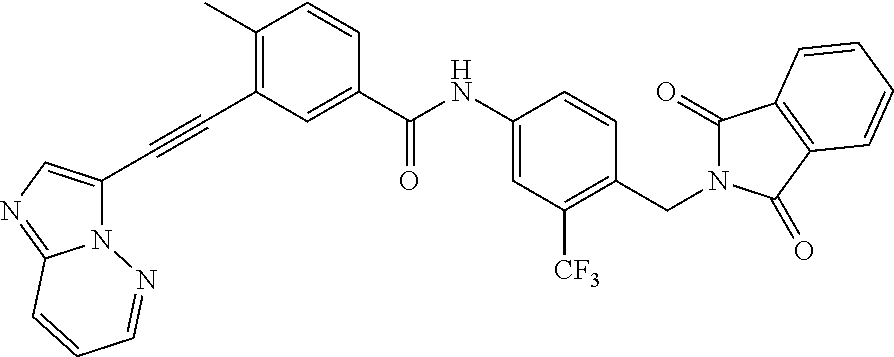

wherein P is a protecting group and subsequently deprotecting the piperazine ring; and forming the ponatinib hydrochloride using hydrogen chloride.
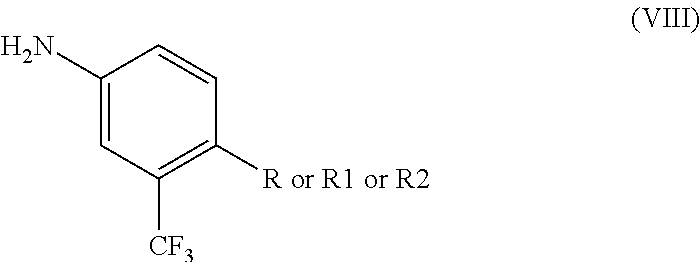

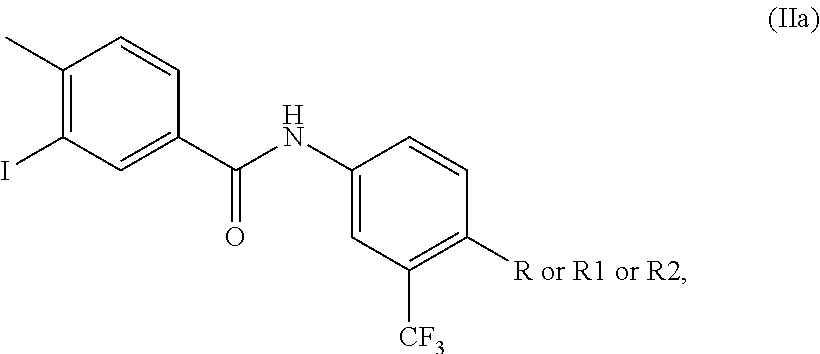


wherein R′ is CH2NH2 or CH2OH, forming a piperazine ring via reaction of the compound of formula (IIf) with
a) 2-chloro-N-(2-chloroethyl)-N-methylethanamine; or
b) 2-chloro-N-(2-chloroethyl)-N-substituted derivative of the formula (VI)




and subjecting the compound of formula (IIIc) to hydrogen chloride to obtain the ponatinib hydrochloride.


wherein R′ is CH2NH2 or CH2OH, forming a piperazine ring by reacting the compound of formula (IVb) with either
-
- a) 2-chloro-N-(2-chloroethyl)-N-methylethanamine; or
- b) 2-chloro-N-(2-chloroethyl)-N-substituted derivative having the formula (VI)

wherein P is a protecting group and subsequently deprotecting the piperazine ring; and forming the ponatinib hydrochloride using hydrogen chloride.


wherein R′ is CH2NH2 or CH2OH.

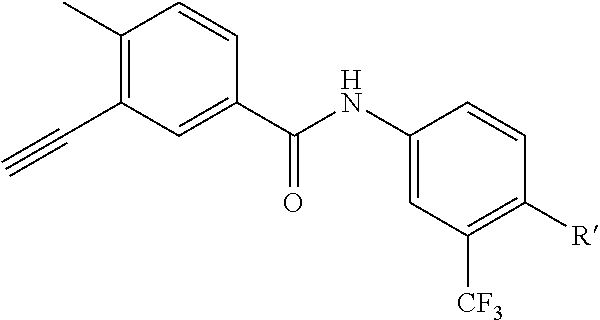
wherein R′ is CH2NH2 or CH2OH.


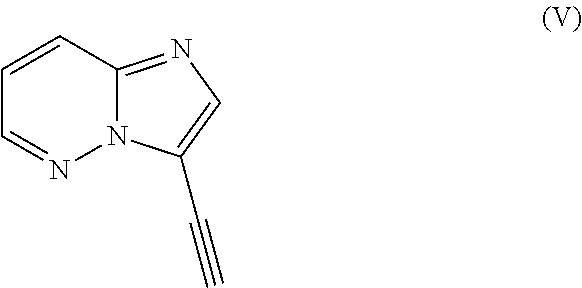
includes reacting 1-(halo methyl)-4-nitro-2-(trifluoromethyl)benzene (II) with potassium phthalimide (III) to obtain a phthalimide derivative, reducing the phthalimide derivative, reacting the phthalimide derivative with 3-iodo-4-methylbenzoyl chloride (IV) to form an amide, reacting the amide with 3-ethynylimidazo[1,2-b]pyridazine (V) in a coupling reaction, subjecting the product of the coupling reaction to hydrolysis to obtain N-(4-(aminomethyl)-3-(trifluoromethyl)phenyl)-3-(imidazo[1,2-b]pyridazin-3-ylethynyl)-4-methylbenzamide, subsequently forming a piperazine ring by treatment of the N-(4-(aminomethyl)-3-(trifluoromethyl)phenyl)-3-(imidazo[1,2-b]pyridazin-3-ylethynyl)-4-methylbenzamide with a) 2-chloro-N-(2-chloroethyl)-N-methylethanamine or b) with a 2-chloro-N-(2-chloroethyl)-N-substituted derivative (VI), deprotecting the piperazine ring, and forming the ponatinib hydrochloride using hydrochloric acid.


with compound (IV), subsequent coupling of the amide via reaction with compound (V), subsequent reduction (if R═CN in compound VIII), esterification (if R═COOH), or reduction, halogenation and azide formation and reduction of the azide (if R═COOR), forming a piperazine ring via reaction with a) 2-chloro-N-(2-chloroethyl)-N-methylethanamine or b) with 2-chloro-N-(2-chloroethyl)-N-substituted (VI) derivatives, followed by deprotection, and hydrochloride formation via reaction with hydrochloric acid.


Claims (8)


Priority Applications (1)
| Application Number | Priority Date | Filing Date | Title |
|---|---|---|---|
| US14/984,446 US9493473B2 (en) | 2013-05-16 | 2015-12-30 | Processes for making ponatinib and intermediates thereof |
Applications Claiming Priority (3)
| Application Number | Priority Date | Filing Date | Title |
|---|---|---|---|
| US201361824070P | 2013-05-16 | 2013-05-16 | |
| US14/279,607 US20140343282A1 (en) | 2013-05-16 | 2014-05-16 | Processes for making ponatinib and intermediates thereof |
| US14/984,446 US9493473B2 (en) | 2013-05-16 | 2015-12-30 | Processes for making ponatinib and intermediates thereof |
Related Parent Applications (1)
| Application Number | Title | Priority Date | Filing Date |
|---|---|---|---|
| US14/279,607 Continuation US20140343282A1 (en) | 2013-05-16 | 2014-05-16 | Processes for making ponatinib and intermediates thereof |
Publications (2)
| Publication Number | Publication Date |
|---|---|
| US20160108053A1 US20160108053A1 (en) | 2016-04-21 |
| US9493473B2 true US9493473B2 (en) | 2016-11-15 |
Family
ID=51896281
Family Applications (2)
| Application Number | Title | Priority Date | Filing Date |
|---|---|---|---|
| US14/279,607 Abandoned US20140343282A1 (en) | 2013-05-16 | 2014-05-16 | Processes for making ponatinib and intermediates thereof |
| US14/984,446 Active US9493473B2 (en) | 2013-05-16 | 2015-12-30 | Processes for making ponatinib and intermediates thereof |
Family Applications Before (1)
| Application Number | Title | Priority Date | Filing Date |
|---|---|---|---|
| US14/279,607 Abandoned US20140343282A1 (en) | 2013-05-16 | 2014-05-16 | Processes for making ponatinib and intermediates thereof |
Country Status (1)
| Country | Link |
|---|---|
| US (2) | US20140343282A1 (en) |
Cited By (1)
| Publication number | Priority date | Publication date | Assignee | Title |
|---|---|---|---|---|
| WO2019246479A1 (en) | 2018-06-22 | 2019-12-26 | Johnson Matthey Public Limited Company | Form of ponatinib |
Families Citing this family (4)
| Publication number | Priority date | Publication date | Assignee | Title |
|---|---|---|---|---|
| US20140343282A1 (en) | 2013-05-16 | 2014-11-20 | Apicore, Llc | Processes for making ponatinib and intermediates thereof |
| WO2016201203A1 (en) * | 2015-06-11 | 2016-12-15 | Apicore Us Llc | Processes for making ponatinib and intermediates thereof |
| CN114181145B (en) * | 2021-12-29 | 2024-03-29 | 湖南省湘中制药有限公司 | Preparation method of epinastine intermediate |
| CN116444525B (en) * | 2023-03-27 | 2024-11-12 | 四川青木制药有限公司 | A preparation method of ponatinib hydrochloride crystal form A |
Citations (7)
| Publication number | Priority date | Publication date | Assignee | Title |
|---|---|---|---|---|
| WO2004108699A1 (en) | 2003-06-06 | 2004-12-16 | Natco Pharma Limited | Process for the preparation of the anti-cancer drug imatinib and its analogues |
| WO2007075869A2 (en) | 2005-12-23 | 2007-07-05 | Ariad Pharmaceuticals, Inc. | Bicyclic heteroaryl compounds |
| WO2011053938A1 (en) | 2009-10-30 | 2011-05-05 | Ariad Pharmaceuticals, Inc. | Methods and compositions for treating cancer |
| US8278307B2 (en) | 2006-05-08 | 2012-10-02 | Ariad Pharmaceuticals, Inc. | Monocyclic Heteroaryl compounds |
| WO2012139027A1 (en) | 2011-04-07 | 2012-10-11 | Ariad Pharmaceuticals, Inc. | Methods and compositions for treating neurodegenerative diseases |
| US20130053370A1 (en) | 2010-01-29 | 2013-02-28 | Hanmi Science Co., Ltd. | THIENO[3,2-d]PYRIMIDINE DERIVATIVES HAVING INHIBITORY ACTIVITY ON PROTEIN KINASES |
| US20140343282A1 (en) | 2013-05-16 | 2014-11-20 | Apicore, Llc | Processes for making ponatinib and intermediates thereof |
-
2014
- 2014-05-16 US US14/279,607 patent/US20140343282A1/en not_active Abandoned
-
2015
- 2015-12-30 US US14/984,446 patent/US9493473B2/en active Active
Patent Citations (9)
| Publication number | Priority date | Publication date | Assignee | Title |
|---|---|---|---|---|
| WO2004108699A1 (en) | 2003-06-06 | 2004-12-16 | Natco Pharma Limited | Process for the preparation of the anti-cancer drug imatinib and its analogues |
| WO2007075869A2 (en) | 2005-12-23 | 2007-07-05 | Ariad Pharmaceuticals, Inc. | Bicyclic heteroaryl compounds |
| US20070191376A1 (en) | 2005-12-23 | 2007-08-16 | ZOU Dong | Bicyclic heteroaryl compounds |
| US8114874B2 (en) | 2005-12-23 | 2012-02-14 | Ariad Pharmaceuticals, Inc. | Substituted acetylenic imidazo[1,2-B]pyridazine compounds as kinase inhibitors |
| US8278307B2 (en) | 2006-05-08 | 2012-10-02 | Ariad Pharmaceuticals, Inc. | Monocyclic Heteroaryl compounds |
| WO2011053938A1 (en) | 2009-10-30 | 2011-05-05 | Ariad Pharmaceuticals, Inc. | Methods and compositions for treating cancer |
| US20130053370A1 (en) | 2010-01-29 | 2013-02-28 | Hanmi Science Co., Ltd. | THIENO[3,2-d]PYRIMIDINE DERIVATIVES HAVING INHIBITORY ACTIVITY ON PROTEIN KINASES |
| WO2012139027A1 (en) | 2011-04-07 | 2012-10-11 | Ariad Pharmaceuticals, Inc. | Methods and compositions for treating neurodegenerative diseases |
| US20140343282A1 (en) | 2013-05-16 | 2014-11-20 | Apicore, Llc | Processes for making ponatinib and intermediates thereof |
Non-Patent Citations (3)
| Title |
|---|
| Gamble, et al. "Aryl Nitro Reduction with Iron Powder or Stannous Chloride under Ultrasonic Irradiation", Synthetic communications, 37,2007, 2777-2786; University of Wollongong-Research Online, pp. 1-12 (2007). |
| International Search Report and Written Opinion for corresponding PCT application No. PCT/2016/36857, 9 pages, dated Sep. 7, 2016. |
| Office Action for related U.S. Appl. No. 14/279,607, dated May 16, 2014. |
Cited By (2)
| Publication number | Priority date | Publication date | Assignee | Title |
|---|---|---|---|---|
| WO2019246479A1 (en) | 2018-06-22 | 2019-12-26 | Johnson Matthey Public Limited Company | Form of ponatinib |
| US12030886B2 (en) | 2018-06-22 | 2024-07-09 | Macfarlan Smith Limited | Form of ponatinib |
Also Published As
| Publication number | Publication date |
|---|---|
| US20160108053A1 (en) | 2016-04-21 |
| US20140343282A1 (en) | 2014-11-20 |
Similar Documents
| Publication | Publication Date | Title |
|---|---|---|
| US9493473B2 (en) | Processes for making ponatinib and intermediates thereof | |
| US8058432B2 (en) | Method for preparing phenylalanine derivatives having quinazoline-dione skeleton and intermediates for use in the preparation of derivatives | |
| US8420829B2 (en) | Processes for the preparation of bendamustine | |
| US8664389B2 (en) | Process for the preparation of lapatinib and it's pharmaceutically acceptable salts | |
| US11246862B2 (en) | Process for the preparation of lifitegrast | |
| US20070219370A1 (en) | Process for preparing n-(2-chloro-6-methylphenyl)-2-[[6-[4-(2-hydroxyethyl)-1-piperazinyl]-2-methyl-4-pyrimidinyl]amino] -5-thiazolecarboxamide and related metabolites thereof | |
| US20120245351A1 (en) | Process for the preparation of lapatinib and its pharmaceutically acceptable salts | |
| US7674901B2 (en) | Process for preparation of imatinib base | |
| JP2009007273A (en) | Method for producing diaminopyrimidine compound | |
| WO2008035380A2 (en) | An improved process for the preparation of high purity formoterol and its pharmaceutically acceptable salts | |
| US20180237386A1 (en) | Process For Preparation Of Vortioxetine Hydrobromide | |
| CN104918912B (en) | Processes for the synthesis of 2-amino-4,6-dimethoxybenzamide and other benzamide compounds | |
| US20230374011A1 (en) | Substituted tricyclic compounds | |
| US20130116441A1 (en) | Intermediates and process for preparing a thrombin specific inhibitor | |
| US10934251B2 (en) | Process for the preparation of lomitapide | |
| US20240182493A1 (en) | Process | |
| US20090043111A1 (en) | Novel process for ropinirole preparation | |
| WO2025210581A1 (en) | A novel process for the preparation of (6r)-6-(2-(n-(4-(2-(ethylamino) ethyl) benzyl)-n-ethylamino)-4-methoxyphenyl)-5,6,7,8-tetrahydronaphthalen-2-ol dihydrochloride and it's intemediates | |
| US8716476B2 (en) | Process for the preparation of alfuzosin hydrochloride | |
| EP2608791A1 (en) | A process for the preparation of imatinib base | |
| US12473292B2 (en) | Polymorphs of 7-cyclopentyl-N,N-dimethyl-2-{[5-(piperazin-1-yl) pyridin-2-yl]-amino}-7H-pyrrolo[2,3-d]pyrimidine-6-carboxamide and its pharmaceutically acceptable salts and process for the preparation thereof | |
| US8288561B2 (en) | Process for preparing valsartan | |
| CN101128419A (en) | Process for preparing protected amidines | |
| US6979683B2 (en) | Benzimidazole derivatives, preparation and therapeutic use thereof | |
| US20180044345A1 (en) | Processes for making ponatinib and intermediates thereof |
Legal Events
| Date | Code | Title | Description |
|---|---|---|---|
| STCF | Information on status: patent grant |
Free format text: PATENTED CASE |
|
| AS | Assignment |
Owner name: MEDICURE INC., CANADA Free format text: SECURITY INTEREST;ASSIGNOR:APICORE US LLC;REEL/FRAME:041577/0821 Effective date: 20170106 |
|
| AS | Assignment |
Owner name: APICORE US LLC, NEW JERSEY Free format text: RELEASE BY SECURED PARTY;ASSIGNOR:MEDICURE INC.;REEL/FRAME:043022/0696 Effective date: 20170710 |
|
| AS | Assignment |
Owner name: APICORE US LLC, NEW JERSEY Free format text: ASSIGNMENT OF ASSIGNORS INTEREST;ASSIGNORS:KOVI, RAVISHANKER;KANNAPAN, JAYARAMAN;THAKOR, SANJAY F;AND OTHERS;SIGNING DATES FROM 20140918 TO 20140923;REEL/FRAME:043740/0143 |
|
| MAFP | Maintenance fee payment |
Free format text: PAYMENT OF MAINTENANCE FEE, 4TH YR, SMALL ENTITY (ORIGINAL EVENT CODE: M2551); ENTITY STATUS OF PATENT OWNER: SMALL ENTITY Year of fee payment: 4 |
|
| AS | Assignment |
Owner name: MYLAN PHARMACEUTICALS INC., WEST VIRGINIA Free format text: ASSIGNMENT OF ASSIGNORS INTEREST;ASSIGNOR:MYLAN API US LLC;REEL/FRAME:057686/0024 Effective date: 20210924 Owner name: MYLAN API US LLC, DELAWARE Free format text: CHANGE OF NAME;ASSIGNOR:APICORE US LLC;REEL/FRAME:057697/0758 Effective date: 20190711 |
|
| FEPP | Fee payment procedure |
Free format text: ENTITY STATUS SET TO UNDISCOUNTED (ORIGINAL EVENT CODE: BIG.); ENTITY STATUS OF PATENT OWNER: LARGE ENTITY |
|
| MAFP | Maintenance fee payment |
Free format text: PAYMENT OF MAINTENANCE FEE UNDER 1.28(C) (ORIGINAL EVENT CODE: M1559); ENTITY STATUS OF PATENT OWNER: LARGE ENTITY |
|
| FEPP | Fee payment procedure |
Free format text: PETITION RELATED TO MAINTENANCE FEES GRANTED (ORIGINAL EVENT CODE: PTGR); ENTITY STATUS OF PATENT OWNER: LARGE ENTITY |
|
| MAFP | Maintenance fee payment |
Free format text: PAYMENT OF MAINTENANCE FEE, 8TH YEAR, LARGE ENTITY (ORIGINAL EVENT CODE: M1552); ENTITY STATUS OF PATENT OWNER: LARGE ENTITY Year of fee payment: 8 |