US9488744B2 - System and method for estimating seismic anisotropy with high resolution - Google Patents

System and method for estimating seismic anisotropy with high resolution Download PDF

Info

Publication number
US9488744B2
US9488744B2 US14/476,315 US201414476315A US9488744B2 US 9488744 B2 US9488744 B2 US 9488744B2 US 201414476315 A US201414476315 A US 201414476315A US 9488744 B2 US9488744 B2 US 9488744B2
Authority
US
United States
Prior art keywords
gather
seismic
anisotropy
synthetic
processor
Prior art date
Legal status (The legal status is an assumption and is not a legal conclusion. Google has not performed a legal analysis and makes no representation as to the accuracy of the status listed.)
Active, expires
Application number
US14/476,315
Other versions
US20150063067A1 (en
Inventor
Leon Thomsen
Rongrong Lin
Current Assignee (The listed assignees may be inaccurate. Google has not performed a legal analysis and makes no representation or warranty as to the accuracy of the list.)
University of Houston System
Original Assignee
University of Houston System
Priority date (The priority date is an assumption and is not a legal conclusion. Google has not performed a legal analysis and makes no representation as to the accuracy of the date listed.)
Filing date
Publication date
Application filed by University of Houston System filed Critical University of Houston System
Priority to US14/476,315 priority Critical patent/US9488744B2/en
Assigned to UNIVERSITY OF HOUSTON SYSTEM reassignment UNIVERSITY OF HOUSTON SYSTEM ASSIGNMENT OF ASSIGNORS INTEREST (SEE DOCUMENT FOR DETAILS). Assignors: THOMSEN, LEON, LIN, RONGRONG
Publication of US20150063067A1 publication Critical patent/US20150063067A1/en
Application granted granted Critical
Publication of US9488744B2 publication Critical patent/US9488744B2/en
Active legal-status Critical Current
Adjusted expiration legal-status Critical

Links

Images

Classifications

    • GPHYSICS
    • G01MEASURING; TESTING
    • G01VGEOPHYSICS; GRAVITATIONAL MEASUREMENTS; DETECTING MASSES OR OBJECTS; TAGS
    • G01V1/00Seismology; Seismic or acoustic prospecting or detecting
    • G01V1/28Processing seismic data, e.g. for interpretation or for event detection
    • G01V1/282Application of seismic models, synthetic seismograms
    • GPHYSICS
    • G01MEASURING; TESTING
    • G01VGEOPHYSICS; GRAVITATIONAL MEASUREMENTS; DETECTING MASSES OR OBJECTS; TAGS
    • G01V1/00Seismology; Seismic or acoustic prospecting or detecting
    • G01V1/28Processing seismic data, e.g. for interpretation or for event detection
    • G01V1/30Analysis
    • GPHYSICS
    • G01MEASURING; TESTING
    • G01VGEOPHYSICS; GRAVITATIONAL MEASUREMENTS; DETECTING MASSES OR OBJECTS; TAGS
    • G01V1/00Seismology; Seismic or acoustic prospecting or detecting
    • G01V1/40Seismology; Seismic or acoustic prospecting or detecting specially adapted for well-logging
    • G01V1/44Seismology; Seismic or acoustic prospecting or detecting specially adapted for well-logging using generators and receivers in the same well
    • G01V1/48Processing data
    • G01V1/50Analysing data

Definitions

  • Anisotropy is the variation of a physical property depending on the direction in which the property is measured.
  • Anisotropy is a common phenomenon in various scientific fields, such as medical science, physics, and engineering. In the field of geophysics, anisotropy most often refers to seismic anisotropy.
  • Seismic anisotropy is the dependence of seismic velocity upon angle, and can arise from intrinsic anisotropy of the rock itself, or from stress-induced anisotropy caused by a difference of directional stresses in formation layers.
  • the application of seismic anisotropy has substantially improved the exploration of hydrocarbons, by modifying the velocity model from simple isotropic to more realistic anisotropic.
  • Seismic anisotropy has played a role in applications such as long offset seismic data with greater angles of incidence (the angle-dependence of velocity is more evident), AVO (Amplitude versus offset) quantitative analysis, and anisotropic imaging (migration).
  • a method for determining anisotropy parameters of subsurface formations includes generating a synthetic reflectivity gather from a vertical well log. Times of a surface seismic gather are adjusted to those of the synthetic gather. Low-cut filtering is applied to the surface seismic gather. Anisotropy parameters are generated as a difference of the filtered seismic gather and the synthetic gather. An anisotropy value is assigned to each of plurality of layers of a formation based on the generated anisotropy parameters.
  • a non-transitory computer-readable medium is encoded with instructions that are executable to cause a processor to generate a synthetic reflectivity gather from a vertical well log, and to adjust times of a surface seismic gather to those of the synthetic gather.
  • the instructions also cause the processor to low-cut filter the surface seismic gather, and generate anisotropy parameters as a difference of the filtered seismic gather and the synthetic gather.
  • the instructions further cause the processor to assign an anisotropy value to each of plurality of layers of a formation based on the generated anisotropy parameters.
  • a system for determining anisotropy parameters of subsurface formations includes a processor and anisotropy extraction instructions.
  • the anisotropy extraction instructions configure the processor to generate a synthetic reflectivity gather from a vertical well log, and to adjust the times of a surface seismic gather to those of the synthetic gather.
  • the anisotropy extraction instructions also configure the processor to low-cut filter the surface seismic gather, and to generate anisotropy parameters as the difference of the filtered seismic gather and the synthetic gather.
  • the anisotropy extraction instructions further configure the processor to assign an anisotropy value to each of plurality of layers of a formation based on the generated anisotropy parameters.
  • FIG. 1 shows results of application of extraction of anisotropy parameters from an exemplary dataset in accordance with principles disclosed herein;
  • FIG. 2 shows a comparison of a gamma ray log to values of an anisotropy parameter produced in accordance with principles disclosed herein;
  • FIG. 3 shows a flow diagram for a method for determining anisotropy parameters in accordance with principles disclosed herein;
  • FIG. 4 shows a block diagram of a system for determining anisotropy parameters in accordance with principles disclosed herein.
  • anisotropy is herein used to mean “seismic anisotropy.” Except where otherwise noted, “anisotropy” is further specified to mean “polar anisotropy”, also known as “Transverse Isotropy.” Except where otherwise noted, “anisotropy” is further specified to mean P-wave anisotropy. Except where otherwise noted, “anisotropy” is yet further specified to be measured by the parameters ⁇ and ⁇ , as defined in Leon Thomsen, Weak Elastic Anisotropy, 51 G EOPHYSICS 1954 (1986).
  • shale is commonly the lithology with the most significant anisotropy.
  • a method of directly obtaining anisotropy parameters of shale involves measuring the shale sample in a laboratory, using, for example, acoustic travel time measurements in various directions.
  • the frequencies applied (ultrasonic) are different from those of seismic waves, and the state of stress may be different from that in the subsurface, so the rocks may not exhibit the same anisotropy as when underground.
  • the sample necessarily constitutes only a small portion of the subsurface formation, and so any measurement on the sample may or may not be representative of a larger volume.
  • An in-situ measurement, at appropriate scale, is preferable.
  • VSP Vertical Seismic Profiling
  • V NMO ( t 0 ) V P0Seis ( t 0 )(1+ ⁇ ( t 0 )) (1)
  • V NMO ( t 0 ) V P0Seis ( t 0 )(1+ ⁇ ( t 0 )) (1)
  • Anisotropy logging or cross-dipole logging, is another known technique for measuring anisotropy.
  • This type of log uses two dipole transmitters perpendicular to each other, and arrays of two dipole receivers, similarly oriented, and measures fast and slow shear-slowness and fast-shear azimuth.
  • This method is disadvantageous in that it is highly dependent on the borehole environment, and has dispersion characteristic of dipole flexural waves. More fundamentally, it measures azimuthal shear-wave velocity, whereas the present disclosure estimates polar P-wave anisotropy.
  • shear waves are polarized mainly perpendicular to their direction of propagation
  • P-waves are polarized mainly parallel to their direction of propagation
  • azimuthal anisotropy refers to variation of velocity with respect to the azimuthal angle
  • polar anisotropy refers to variation of velocity with respect to the polar angle (e.g. from the vertical).
  • Embodiments of the present disclosure extract seismic polar anisotropy parameters, with the vertical resolution of the seismic wavelet, from prestack surface seismic data and vertical well logs.
  • the method uses sonic V P0 , V S0 , and ⁇ (from logs), convolved with the (zero-phase) seismic wavelet from a co-located surface CDP gather) to construct an isotropic synthetic reflectivity gather.
  • This synthetic gather contains only those propagation effects which are encoded in that seismic wavelet.
  • the seismic data is adjusted, in ways known to those skilled in the art, and described further below.
  • the jump in anisotropy parameters ⁇ and ⁇ at each major reflector in the logged interval is derived from the arithmetic difference between the adjusted seismic amplitudes and the isotropic synthetic amplitudes. Integration of these differences, starting at a sandstone layer (with anisotropy assumed zero), yields a profile of the anisotropy.
  • Embodiments begin by processing log data, for vertical velocities V P0 , V S0 , and density ⁇ , recorded and quality-controlled in ways familiar to those skilled in the art, in a vertical borehole penetrating horizontal formations with assumed polar anisotropic symmetry. If the borehole is not vertical, or if the formations are not horizontal, the present embodiment may be modified accordingly, by one skilled in the art. If V S0 is not measured, it may be estimated, with corresponding reduction in confidence of the resulting computation. The depths are converted to vertical travel times using methods known in the art. At every logged point, and for a variety of assumed polar angles of incidence ⁇ , a linearized isotropic reflection coefficient may be computed. (E.g. L EON T HOMSEN , U NDERSTANDING S EISMIC A NISOTROPY IN E XPLORATION AND E XPLOITATION (Soc'y. of Exploration. Geophysicists, 2002).
  • R iso ⁇ ( t 0 , ⁇ ) ⁇ A iso + B iso ⁇ sin 2 ⁇ ⁇ + C iso ⁇ sin 2 ⁇ ⁇ tan 2 ⁇ ⁇ ⁇ , ⁇ with ( 2 )
  • a iso ⁇ ( t 0 ) ⁇ ⁇ ⁇ Z P ⁇ ⁇ 0 2 ⁇ Z _ P ⁇ ⁇ 0 ⁇
  • B iso ⁇ ( t 0 ) 1 2 ⁇ [ ⁇ ⁇ ⁇ V P ⁇ ⁇ 0 V _ P ⁇ ⁇ 0 - ( 2 ⁇ V _ S ⁇ ⁇ 0 V _ P ⁇ ⁇ 0 ) 2 ⁇ ⁇ 0 ⁇ _ 0 ]
  • C iso ⁇ ( t 0 ) 1 2 ⁇ [ ⁇ ⁇ ⁇ V P ⁇ ⁇ 0 V _ P ⁇ ⁇ 0 ] ⁇ ( 3 )
  • Z P0 ⁇ V P0 is vertical
  • Embodiments apply a co-located CDP gather of surface seismic data, using methods known in the art.
  • the gather may be processed (pre-stack) to eliminate multiples and other noise, and converted to the angle domain.
  • the gather should not be migrated, unless the migration algorithm which is applied preserves relative amplitudes well.
  • a super-gather may be used to increase signal/noise.
  • the gather may be time-shifted and stretched/compressed in time to tie the synthetic gather (equation (3)).
  • the gather may be transformed to zero phase, and a wavelet w(t 0 ) may be extracted.
  • the gather may be filtered so that this wavelet is independent of incidence angle.
  • the wavelet is convolved with the reflectivity (equation (1)) to yield a flattened synthetic isotropic reflectivity gather:
  • s seis ( t , ⁇ ) C ( t , ⁇ )* I ( t , ⁇ )* P ⁇ ( t , ⁇ )* r ( t , ⁇ )* P ⁇ ( t , ⁇ )* w 0 ( t )* S 0 ( ⁇ ), (6) which recounts the history of the wave, right-to-left.
  • the operators shown above show an explicit dependence on the incidence wavefront-angle ⁇ at the eventual reflector, with an implicit dependence on the local ray-angle along the raypath. Since the operators depend upon frequency, and the frequency components combine linearly, the operations combine as convolutions.
  • the source-strength S 0 ( ⁇ ) includes the intrinsic source directivity, and also the interaction with the free surface (ghost, etc.).
  • the time-signature of the source is given by the initial wavelet w 0 (t).
  • the downward-propagating operator P ⁇ ( ⁇ ,t) includes the effects of geometric spreading, attenuation, transmission coefficients, “friendly multiples”, focusing/defocussing, etc.
  • the reflectivity series r( ⁇ ,t) is discussed below.
  • the upward-propagating operator P ⁇ ( ⁇ ,t) includes the same effects as P ⁇ ( ⁇ ,t) but driven by the properties of the local medium on the upward leg of the ray.
  • the instrumental operator I( ⁇ ,t) includes the instrumental impulse response, including coupling effects, as well as the interaction with the free surface at the receiver location.
  • the computational operator C( ⁇ ,t) includes any processing that may have been done on the data.
  • Embodiments augment C( ⁇ ,t) to include time-flattening of the gather, and since convolution commutes, re-arrange equation (6) as
  • Embodiments may proceed with the analysis either in terms of band-limited (“wiggle”) traces, or as discrete (“sparse-spike”) reflectivity impulses.
  • wiggle band-limited
  • sparse-spike discrete reflectivity impulses
  • seis (t 0 ), seis (t 0 ), seis (t 0 ) may be found manually or by sparse-spike inversion; and occur only at times t 0 for which a correlative event occurs in the isotropic synthetic gather of equation (4).
  • the spikes represent the central peaks (or troughs) of each major event in the zero-phase data, over the logged interval, as a function of angle ⁇ , seis (t 0 ), seis (t 0 ), seis (t 0 ) are found as best fits to these data, of the Aki-Richards form: [ seis + seis sin 2 ⁇ + seis sin 2 ⁇ tan 2 ⁇ ]. (12)
  • Embodiments apply standard statistical measures to test the confidence with which the low-order terms seis (t 0 ), seis (t 0 ) are determined. If the seismic data is too noisy, then either or both is poorly determined, and the analysis of such terms should not proceed.
  • s ⁇ seis ⁇ ( t 0 , ⁇ ) ⁇ t 0 ⁇ [ A ⁇ seis ⁇ ( t 0 ) + B ⁇ seis ⁇ ( t 0 ) ⁇ sin 2 ⁇ ⁇ + C ⁇ seis ⁇ ( t 0 ) ⁇ sin 2 ⁇ ⁇ tan 2 ⁇ ⁇ ] ( 13 ) where only the selected events are included in the sum, and ⁇ seis (t 0 ), ⁇ circumflex over (B) ⁇ seis (t 0 ), ⁇ seis (t 0 ) are defined in equations (11).
  • the seismic gather of equation (13) has the same form as the isotropic synthetic gather of equation (14), with the exception of inclusion in the seismic gather of the (unknown) propagation operator P(t 0 , ⁇ ), and including the presence of the anisotropy reflectivity terms in equation (9). Also included in P are the instrumental and computational operators (I and C), which impose large gain factors on the data.
  • the seismic data (equation 13) usually have an absolute maximum value ⁇ 10 4 (called “seismic units”, with unknown physical dimensions), whereas the synthetic data (equation 15) usually have an absolute maximum value ⁇ 1 (nondimensional “reflectivity units”).
  • Embodiments may augment the computational operator C with a multiplicative divisor, to make the amplitudes (of synthetic and seismic) comparable, in order to display them on the same plot. Accordingly, embodiments may multiply all the seismic amplitudes by the factor: N 0 ⁇
  • the adjusted-seismic and synthetic amplitudes will show significant differences from each other, since the seismic data contain the effects of both propagation and of anisotropy, whereas the synthetic data do not.
  • the normalizing functions N A ( t 0 ) ⁇ syn ( t 0 )/ N 0 seis ( t 0 ) N B ( t 0 ) ⁇ syn ( t 0 )/ N 0 seis ( t 0 ) N C ( t 0 ) ⁇ syn ( t 0 )/ N 0 seis ( t 0 ) (17) are defined only at the selected values of t 0 .
  • N A (t 0 ), N B (t 0 ), N C (t 0 ) are time-series, each with a Fourier spectrum. Examining the propagation operator P(t 0 , ⁇ ) in equation (7), it is observed that all of the propagation effects included therein accumulate progressively as the wave propagates, hence they contribute to the low-frequency parts of these spectra. By contrast, the reflectivity operator r(t 0 , ⁇ ) in equations (7) and (8) fluctuates rapidly in time, contributing only to the high-frequency parts of these spectra.
  • embodiments low-cut filter the data time-series, retaining only the high-frequency parts, which are due to the rapidly fluctuating reflectivity r(t 0 , ⁇ ).
  • One way to do this is to low-pass filter the normalization functions, obtaining N Alow (t 0 ), N Blow (t 0 ), N Clow (t 0 ), and multiply the seismic amplitudes seis (t 0 ), seis (t 0 ), seis (t 0 ) by the low-pass normalization functions.
  • the resulting amplitudes may be identical to the isotropic amplitudes syn (t 0 ), syn (t 0 ), syn (t 0 ) except for the additive effects of anisotropic reflectivity (cf.
  • the amplitudes aeis (t 0 ) may be poorly determined, since it is common for this curvature parameter to be strongly affected by seismic noise. If the parameters ⁇ (t 0 ) determined in accordance with embodiments are not reasonable (e.g. ⁇ 0 or >0.2), this is the most likely cause.
  • FIG. 1 shows results of application of an embodiment to an exemplary dataset.
  • FIG. 1 shows the amplitudes syn (t 0 ) (15), N 0 seis (t 0 ) (equations (12), (16)), and N Blow N 0 seis (t 0 ) (equation (18)), for the six major events in the logged interval. (The determination of the seismic parameter seis (t 0 ) was not statistically reliable.) As expected, the anisotropic contributions (N Blow N 0 seis ⁇ syn ) are significant.
  • FIG. 2 shows values for the anisotropy parameter ⁇ produced by an embodiment for the exemplary data dataset, compared with the gamma-ray log, and plotted at the same scale. As shown; the correlation is good.
  • FIG. 3 shows a flow diagram for a method 300 for determining anisotropy parameters of a formation in accordance with principles disclosed herein. Though depicted sequentially as a matter of convenience, at least some of the actions shown may be performed in a different order and/or performed in parallel. Additionally, some embodiments may perform only some of the actions shown. In some embodiments, at least some of the method 300 , as well as other operations described herein, can be implemented as instructions stored in a computer readable medium and executed by one or more processors.
  • a seismic data set is acquired using seismic data acquisition instruments known in the art.
  • a vertical well log is acquired using well logging instruments known in the art.
  • An isotropic synthetic reflectivity gather is constructed using sonic V P0 , V S0 , and ⁇ from the well log and a seismic wavelet from a CDP gather of the seismic data.
  • the intercept A, gradient B, and curvature C are determined for each major horizon of the seismic data, and of the synthetic data.
  • Embodiments may determine intercept A, gradient B, and curvature C in accordance with the Aki-Richards equation.
  • a seismic normalization factor N 0 is determined by dividing the average of the synthetic intercept A by the average of the seismic intercept A.
  • the normalization factor N 0 is applied to the seismic data to scale the seismic data to the synthetic data.
  • the synthetic data is divided by the scaled seismic data to generated normalization factors N A , N B , and N C .
  • the normalization factors N A , N B , and N C are low pass filtered to eliminate propagation influence.
  • the seismic data is scaled using the low pass filtered normalization factors.
  • the difference of the scaled seismic data and synthetic data is determined to produce the anisotropy parameters ⁇ and ⁇ convolved with the seismic wavelet.
  • the anisotropy parameters ⁇ and ⁇ are determined for the layers of the formation.
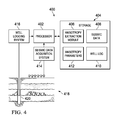
  • FIG. 4 shows a block diagram for a system 400 for determining anisotropy parameters of formations 418 in accordance with principles disclosed herein.
  • the system 400 includes a processor 402 and storage 404 .
  • the system 400 may also include various other components that have been omitted from FIG. 4 in the interest of clarity.
  • embodiments of the system 400 may include a display device, user input devices, network adapters, etc.
  • Some embodiments of the system 400 may be implemented as a computer, such as a desktop computer, a laptop computer, as server computer, a mainframe computer, or other suitable computing device.
  • the processor 402 may include, for example, a general-purpose microprocessor, a digital signal processor, a microcontroller or other device capable of executing instructions retrieved from a computer-readable storage medium.
  • Processor architectures generally include execution units (e.g., fixed point, floating point, integer, etc.), storage (e.g., registers, memory, etc.), instruction decoding, peripherals (e.g., interrupt controllers, timers, direct memory access controllers, etc.), input/output systems (e.g., serial ports, parallel ports, etc.) and various other components and sub-systems.
  • the storage 404 is a non-transitory computer-readable storage medium suitable for storing instructions executed by the processor 402 and data processed by the processor 404 .
  • the storage 404 may include volatile storage such as random access memory, non-volatile storage (e.g., a hard drive, an optical storage device (e.g., CD or DVD), FLASH storage, read-only-memory), or combinations thereof.
  • the storage 404 includes anisotropy extraction module 406 .
  • the anisotropy extraction module 406 include instructions that when executed cause the processor 402 to perform the operations disclosed herein for extracting anisotropy parameters.
  • Software instructions alone are incapable of performing a function. Therefore, in the present disclosure, any reference to a function performed by software instructions, or to software instructions performing a function is simply a shorthand means for stating that the function is performed via execution of the instructions by the processor 402 .
  • the storage 404 also includes seismic data 408 provided by the seismic data acquisition system 414 , and well log 410 of well 420 provided by the well logging system 416 for processing by the anisotropy extraction module 406 .
  • Results of execution of the anisotropy extraction module 406 may be stored in the storage 404 as anisotropy parameters 412 .

Landscapes

  • Physics & Mathematics (AREA)
  • Life Sciences & Earth Sciences (AREA)
  • Engineering & Computer Science (AREA)
  • Remote Sensing (AREA)
  • Acoustics & Sound (AREA)
  • Environmental & Geological Engineering (AREA)
  • Geology (AREA)
  • General Life Sciences & Earth Sciences (AREA)
  • General Physics & Mathematics (AREA)
  • Geophysics (AREA)
  • Geophysics And Detection Of Objects (AREA)

Abstract

A system and method for estimating seismic anisotropy of subsurface formations with high resolution. A method for determining anisotropy parameters of subsurface formations includes generating a synthetic reflectivity gather from a vertical well log. Times of a surface seismic gather are adjusted to those of the synthetic gather. Low-cut filtering is applied to the surface seismic gather. Anisotropy parameters are generated as a difference of the filtered seismic gather and the synthetic gather. An anisotropy value is assigned to each of plurality of layers of a formation based on the generated anisotropy parameters.

Description

CROSS-REFERENCE TO RELATED APPLICATIONS
This application claims the benefit of U.S. provisional patent application Ser. No. 61/873,101 filed Sep. 3, 2013, and entitled “System and Method for Estimating Seismic Anisotropy with High Resolution,” which is hereby incorporated by reference in its entirety for all purposes.
BACKGROUND
Anisotropy is the variation of a physical property depending on the direction in which the property is measured. Anisotropy is a common phenomenon in various scientific fields, such as medical science, physics, and engineering. In the field of geophysics, anisotropy most often refers to seismic anisotropy. Seismic anisotropy is the dependence of seismic velocity upon angle, and can arise from intrinsic anisotropy of the rock itself, or from stress-induced anisotropy caused by a difference of directional stresses in formation layers. The application of seismic anisotropy has substantially improved the exploration of hydrocarbons, by modifying the velocity model from simple isotropic to more realistic anisotropic. Seismic anisotropy has played a role in applications such as long offset seismic data with greater angles of incidence (the angle-dependence of velocity is more evident), AVO (Amplitude versus offset) quantitative analysis, and anisotropic imaging (migration).
SUMMARY
A system and method for high resolution estimation of seismic anisotropy are disclosed herein. In one embodiment, a method for determining anisotropy parameters of subsurface formations includes generating a synthetic reflectivity gather from a vertical well log. Times of a surface seismic gather are adjusted to those of the synthetic gather. Low-cut filtering is applied to the surface seismic gather. Anisotropy parameters are generated as a difference of the filtered seismic gather and the synthetic gather. An anisotropy value is assigned to each of plurality of layers of a formation based on the generated anisotropy parameters.
In another embodiment, a non-transitory computer-readable medium is encoded with instructions that are executable to cause a processor to generate a synthetic reflectivity gather from a vertical well log, and to adjust times of a surface seismic gather to those of the synthetic gather. The instructions also cause the processor to low-cut filter the surface seismic gather, and generate anisotropy parameters as a difference of the filtered seismic gather and the synthetic gather. The instructions further cause the processor to assign an anisotropy value to each of plurality of layers of a formation based on the generated anisotropy parameters.
In a further embodiment, a system for determining anisotropy parameters of subsurface formations includes a processor and anisotropy extraction instructions. The anisotropy extraction instructions configure the processor to generate a synthetic reflectivity gather from a vertical well log, and to adjust the times of a surface seismic gather to those of the synthetic gather. The anisotropy extraction instructions also configure the processor to low-cut filter the surface seismic gather, and to generate anisotropy parameters as the difference of the filtered seismic gather and the synthetic gather. The anisotropy extraction instructions further configure the processor to assign an anisotropy value to each of plurality of layers of a formation based on the generated anisotropy parameters.
BRIEF DESCRIPTION OF THE DRAWINGS
For a detailed description of various examples, reference will now be made to the accompanying drawings in which:
FIG. 1 shows results of application of extraction of anisotropy parameters from an exemplary dataset in accordance with principles disclosed herein;
FIG. 2 shows a comparison of a gamma ray log to values of an anisotropy parameter produced in accordance with principles disclosed herein;
FIG. 3 shows a flow diagram for a method for determining anisotropy parameters in accordance with principles disclosed herein; and
FIG. 4 shows a block diagram of a system for determining anisotropy parameters in accordance with principles disclosed herein.
NOTATION AND NOMENCLATURE
Certain terms are used throughout the following description and claims to refer to particular system components. As one skilled in the art will appreciate, different organizations may refer to a component by different names. In the following discussion and in the claims, the terms “including” and “comprising” are used in an open-ended fashion, and thus should be interpreted to mean “including, but not limited to . . . .”
The term “anisotropy” is herein used to mean “seismic anisotropy.” Except where otherwise noted, “anisotropy” is further specified to mean “polar anisotropy”, also known as “Transverse Isotropy.” Except where otherwise noted, “anisotropy” is further specified to mean P-wave anisotropy. Except where otherwise noted, “anisotropy” is yet further specified to be measured by the parameters δ and ε, as defined in Leon Thomsen, Weak Elastic Anisotropy, 51 GEOPHYSICS 1954 (1986).
The recitation “based on” is intended to mean “based at least in part on.” Therefore, if X is based on Y, X may be based on Y and any number of other factors.
DETAILED DESCRIPTION
The following discussion is directed to various embodiments of the invention. One skilled in the art will understand that the following description has broad application, and the discussion of any embodiment is meant only to be exemplary of that embodiment, and not intended to intimate that the scope of the disclosure, including the claims, is limited to that embodiment.
In oil and gas contexts, shale is commonly the lithology with the most significant anisotropy. A method of directly obtaining anisotropy parameters of shale involves measuring the shale sample in a laboratory, using, for example, acoustic travel time measurements in various directions. However, under lab conditions, the frequencies applied (ultrasonic) are different from those of seismic waves, and the state of stress may be different from that in the subsurface, so the rocks may not exhibit the same anisotropy as when underground. More fundamentally, the sample necessarily constitutes only a small portion of the subsurface formation, and so any measurement on the sample may or may not be representative of a larger volume. An in-situ measurement, at appropriate scale, is preferable.
Other conventional methods to measure anisotropy use surface seismic data and Vertical Seismic Profiling (VSP) data, using in particular the arrival times of various identifiable reflections. These seismic arrival-time methods, such as those which measure vertical, hyperbolic, and non-hyperbolic “moveout”, produce estimates of anisotropy which have low spatial resolution, and therefore cannot be used in AVO studies, which can have much higher spatial resolution. Given a borehole of sufficient depth, and a co-located Common Depth Point (“CDP”) gather of surface seismic data, the anisotropy parameter δ may be determined, with low resolution in vertical time t0, by comparison of the (seismic band) vertical velocity VP0seis (e.g. from a VSP) with the moveout velocity VNMO (from the CDP gather):
V NMO(t 0)=V P0Seis(t 0)(1+δ(t 0))  (1)
However, if performed with excessively fine resolution in t0, this calculation becomes numerically unstable. The method and system disclosed herein remedy this situation by using seismic and sonic amplitudes.
Anisotropy logging, or cross-dipole logging, is another known technique for measuring anisotropy. This type of log uses two dipole transmitters perpendicular to each other, and arrays of two dipole receivers, similarly oriented, and measures fast and slow shear-slowness and fast-shear azimuth. This method is disadvantageous in that it is highly dependent on the borehole environment, and has dispersion characteristic of dipole flexural waves. More fundamentally, it measures azimuthal shear-wave velocity, whereas the present disclosure estimates polar P-wave anisotropy. Those skilled in the art will understand that shear waves are polarized mainly perpendicular to their direction of propagation, whereas P-waves are polarized mainly parallel to their direction of propagation, and that “azimuthal anisotropy” refers to variation of velocity with respect to the azimuthal angle, whereas “polar anisotropy” refers to variation of velocity with respect to the polar angle (e.g. from the vertical).
Embodiments of the present disclosure extract seismic polar anisotropy parameters, with the vertical resolution of the seismic wavelet, from prestack surface seismic data and vertical well logs. The method uses sonic VP0, VS0, and ρ (from logs), convolved with the (zero-phase) seismic wavelet from a co-located surface CDP gather) to construct an isotropic synthetic reflectivity gather. This synthetic gather contains only those propagation effects which are encoded in that seismic wavelet. The seismic data is adjusted, in ways known to those skilled in the art, and described further below. The jump in anisotropy parameters δ and ε at each major reflector in the logged interval is derived from the arithmetic difference between the adjusted seismic amplitudes and the isotropic synthetic amplitudes. Integration of these differences, starting at a sandstone layer (with anisotropy assumed zero), yields a profile of the anisotropy.
Embodiments begin by processing log data, for vertical velocities VP0, VS0, and density ρ, recorded and quality-controlled in ways familiar to those skilled in the art, in a vertical borehole penetrating horizontal formations with assumed polar anisotropic symmetry. If the borehole is not vertical, or if the formations are not horizontal, the present embodiment may be modified accordingly, by one skilled in the art. If VS0 is not measured, it may be estimated, with corresponding reduction in confidence of the resulting computation. The depths are converted to vertical travel times using methods known in the art. At every logged point, and for a variety of assumed polar angles of incidence θ, a linearized isotropic reflection coefficient may be computed. (E.g. LEON THOMSEN, UNDERSTANDING SEISMIC ANISOTROPY IN EXPLORATION AND EXPLOITATION (Soc'y. of Exploration. Geophysicists, 2002).
R iso ( t 0 , θ ) A iso + B iso sin 2 θ + C iso sin 2 θtan 2 θ , with ( 2 ) A iso ( t 0 ) = Δ Z P 0 2 Z _ P 0 B iso ( t 0 ) = 1 2 [ Δ V P 0 V _ P 0 - ( 2 V _ S 0 V _ P 0 ) 2 Δμ 0 μ _ 0 ] C iso ( t 0 ) = 1 2 [ Δ V P 0 V _ P 0 ] ( 3 )
where ZP0=ρVP0 is vertical impedance, μ0=ρVS0 2 is vertical shear modulus, Δ indicates a jump in properties between adjacent logged intervals (lower-upper), and the bar indicates an average of these interval values.
Embodiments apply a co-located CDP gather of surface seismic data, using methods known in the art. The gather may be processed (pre-stack) to eliminate multiples and other noise, and converted to the angle domain. The gather should not be migrated, unless the migration algorithm which is applied preserves relative amplitudes well. A super-gather may be used to increase signal/noise. The gather may be time-shifted and stretched/compressed in time to tie the synthetic gather (equation (3)). The gather may be transformed to zero phase, and a wavelet w(t0) may be extracted. The gather may be filtered so that this wavelet is independent of incidence angle.
The wavelet is convolved with the reflectivity (equation (1)) to yield a flattened synthetic isotropic reflectivity gather:
S syn ( t 0 , θ ) w ( t 0 ) * R iso ( t 0 , θ ) = A syn ( t 0 ) + B syn ( t 0 ) sin 2 θ + C syn ( t 0 ) sin 2 θtan 2 θ , where ( 4 ) A syn ( t 0 ) w ( t 0 ) * A iso ( t 0 ) B syn ( t 0 ) w ( t 0 ) * B iso ( t 0 ) C syn ( t 0 ) w ( t 0 ) * C iso ( t 0 ) ( 5 )
are computed quantities. Apart from propagation effects expressed by the seismic wavelet, there are no other propagation effects in ssyn.
The “convolutional model” of scalar seismic wave propagation describes this gather as:
s seis(t,θ)=C(t,θ)*I(t,θ)*P (t,θ)*r(t,θ)*P (t,θ)*w 0(t)*S 0(θ),  (6)
which recounts the history of the wave, right-to-left. The operators shown above (discussed below) show an explicit dependence on the incidence wavefront-angle θ at the eventual reflector, with an implicit dependence on the local ray-angle along the raypath. Since the operators depend upon frequency, and the frequency components combine linearly, the operations combine as convolutions.
The source-strength S0(θ) includes the intrinsic source directivity, and also the interaction with the free surface (ghost, etc.). The time-signature of the source is given by the initial wavelet w0(t). The downward-propagating operator P(θ,t) includes the effects of geometric spreading, attenuation, transmission coefficients, “friendly multiples”, focusing/defocussing, etc. The reflectivity series r(θ,t) is discussed below.
The upward-propagating operator P(θ,t) includes the same effects as P(θ,t) but driven by the properties of the local medium on the upward leg of the ray. The instrumental operator I(θ,t) includes the instrumental impulse response, including coupling effects, as well as the interaction with the free surface at the receiver location. The computational operator C(θ,t) includes any processing that may have been done on the data.
Embodiments augment C(θ,t) to include time-flattening of the gather, and since convolution commutes, re-arrange equation (6) as
S seis ( t 0 , θ ) = [ C ( t 0 , θ ) * I ( t 0 , θ ) * P ( t 0 , θ ) * P ( t 0 , θ ) * S 0 ( θ ) * w 0 ( t 0 ) ] * r ( t 0 , θ ) = [ P ( t 0 , θ ) * w ( t 0 ) ] * r ( t 0 , θ ) ( 7 )
where the propagation operator P(t0,θ) is compact notation for all the operators included in the square bracket above, and where w(t0) is the observed seismic wavelet.
Embodiments assume that the reflectivity series r(t0,θ) is the linearized plane-wave P-reflectivity for polar anisotropic media:
r(t 0,θ)≡R aniso(t 0,θ)≅A aniso +B aniso sin2 θ+C aniso sin2 θ tan2 θ,  (8)
with
A anis(t 0)=A iso(t 0)
B aniso(t 0)=B iso(t 0)+Δδ(t 0)/2
C aniso(t 0)=C iso(t 0)+Δε(t 0)/2.  (9)
In analogy with equations (4) and (8), embodiments parameterize the angular variation of the seismic data (equation (7)) with
s seis(t 0,θ)=[A seis(t 0)+B seis(t 0)sin2 θ+C seis(t 0)sin2 θ tan2 θ].  (10)
Embodiments may proceed with the analysis either in terms of band-limited (“wiggle”) traces, or as discrete (“sparse-spike”) reflectivity impulses. Considering now, an embodiment using discrete reflectivity impulses:
 seis(t 0)≡w*
Figure US09488744-20161108-P00001
seis(t 0)
{circumflex over (B)} seis(t 0)≡w*
Figure US09488744-20161108-P00002
seis(t 0)
Ĉ seis(t 0)≡w*
Figure US09488744-20161108-P00003
seis(t 0).  (11)
The impulse functions
Figure US09488744-20161108-P00001
seis(t0),
Figure US09488744-20161108-P00002
seis(t0),
Figure US09488744-20161108-P00003
seis(t0) may be found manually or by sparse-spike inversion; and occur only at times t0 for which a correlative event occurs in the isotropic synthetic gather of equation (4). The spikes represent the central peaks (or troughs) of each major event in the zero-phase data, over the logged interval, as a function of angle θ,
Figure US09488744-20161108-P00001
seis(t0),
Figure US09488744-20161108-P00002
seis(t0),
Figure US09488744-20161108-P00003
seis(t0) are found as best fits to these data, of the Aki-Richards form:
[
Figure US09488744-20161108-P00001
seis+
Figure US09488744-20161108-P00002
seis sin2 θ+
Figure US09488744-20161108-P00003
seis sin2 θ tan2 θ].  (12)
Embodiments apply standard statistical measures to test the confidence with which the low-order terms
Figure US09488744-20161108-P00002
seis(t0),
Figure US09488744-20161108-P00003
seis(t0) are determined. If the seismic data is too noisy, then either or both is poorly determined, and the analysis of such terms should not proceed.
With this subset of events, the resulting reduced seismic gather is written as:
s ^ seis ( t 0 , θ ) = Σ t 0 [ A ^ seis ( t 0 ) + B ^ seis ( t 0 ) sin 2 θ + C ^ seis ( t 0 ) sin 2 θtan 2 θ ] ( 13 )
where only the selected events are included in the sum, and Âseis(t0), {circumflex over (B)}seis(t0), Ĉseis(t0) are defined in equations (11).
In equations (8)-(13) (unlike in equation (4)), the angles θ are computed from the offsets in the original data, and the estimated velocity function in the overburden. Hence, there exists the possibility of error, from an incorrect velocity profile. In addition, the angles computed from offsets in the conventional manner are ray-angles, and must be converted to wavefront angles θ, using the anisotropy profile in the overburden. Errors made in this computation translate directly into corresponding errors in the coefficients of equation (12). Embodiments compensate for such errors as shown below.
In analogy with the analysis of the seismic data (13), a series of reflectivity spikes are selected (either by manual picking, or by sparse spike inversion) to represent major events in the synthetic data (equation (4)) which correlate with the selected events in equation (11). These spikes are termed
Figure US09488744-20161108-P00001
syn(t0),
Figure US09488744-20161108-P00002
syn(t0),
Figure US09488744-20161108-P00003
syn(t0) and are found from the synthetic data equation (4)) as best-fits of the Aki-Richards form (12). Convolving these spikes with the zero-phase seismic wavelet:
 syn(t 0)≡w*
Figure US09488744-20161108-P00001
syn(t 0)
{circumflex over (B)} syn(t 0)≡w*
Figure US09488744-20161108-P00002
syn(t 0)
Ĉ syn(t 0)≡w*
Figure US09488744-20161108-P00003
syn(t 0)  (14)
the reduced isotropic synthetic data is formed as:
s ^ syn ( t 0 , θ ) = Σ t 0 [ A ^ syn ( t 0 ) + B ^ syn ( t 0 ) sin 2 θ + C ^ syn ( t 0 ) sin 2 θtan 2 θ ] ( 15 )
The seismic gather of equation (13) has the same form as the isotropic synthetic gather of equation (14), with the exception of inclusion in the seismic gather of the (unknown) propagation operator P(t0,θ), and including the presence of the anisotropy reflectivity terms in equation (9). Also included in P are the instrumental and computational operators (I and C), which impose large gain factors on the data. The seismic data (equation 13) usually have an absolute maximum value <104 (called “seismic units”, with unknown physical dimensions), whereas the synthetic data (equation 15) usually have an absolute maximum value <1 (nondimensional “reflectivity units”). Embodiments may augment the computational operator C with a multiplicative divisor, to make the amplitudes (of synthetic and seismic) comparable, in order to display them on the same plot. Accordingly, embodiments may multiply all the seismic amplitudes by the factor:
N 0
Figure US09488744-20161108-P00004
|
Figure US09488744-20161108-P00001
syn|
Figure US09488744-20161108-P00004
/
Figure US09488744-20161108-P00005
|
Figure US09488744-20161108-P00001
seis|
Figure US09488744-20161108-P00005
  (16)
(c.f. equations (11) and (14) where the angle brackets represent an arithmetic average over the selected events in the logged interval, and the vertical bars represent absolute values).
Normally, the adjusted-seismic and synthetic amplitudes will show significant differences from each other, since the seismic data contain the effects of both propagation and of anisotropy, whereas the synthetic data do not.
In the present embodiment (discrete reflectivity impulses), the normalizing functions:
N A(t 0)≡
Figure US09488744-20161108-P00001
syn(t 0)/N 0
Figure US09488744-20161108-P00001
seis(t 0)
N B(t 0)≡
Figure US09488744-20161108-P00002
syn(t 0)/N 0
Figure US09488744-20161108-P00002
seis(t 0)
N C(t 0)≡
Figure US09488744-20161108-P00003
syn(t 0)/N 0
Figure US09488744-20161108-P00003
seis(t 0)  (17)
are defined only at the selected values of t0. If the seismic data
Figure US09488744-20161108-P00001
aeis(t0),
Figure US09488744-20161108-P00002
aeis(t0),
Figure US09488744-20161108-P00003
aeis(t0) were to be multiplied by these normalizing functions, the seismic data would be forced to match the isotropic synthetic data, as parameterized in equations (4 and 13).
Instead, embodiments recognize that NA(t0), NB(t0), NC(t0) are time-series, each with a Fourier spectrum. Examining the propagation operator P(t0,θ) in equation (7), it is observed that all of the propagation effects included therein accumulate progressively as the wave propagates, hence they contribute to the low-frequency parts of these spectra. By contrast, the reflectivity operator r(t0,θ) in equations (7) and (8) fluctuates rapidly in time, contributing only to the high-frequency parts of these spectra.
Hence, embodiments low-cut filter the data time-series, retaining only the high-frequency parts, which are due to the rapidly fluctuating reflectivity r(t0,θ). One way to do this is to low-pass filter the normalization functions, obtaining NAlow(t0), NBlow(t0), NClow(t0), and multiply the seismic amplitudes
Figure US09488744-20161108-P00001
seis(t0),
Figure US09488744-20161108-P00002
seis(t0),
Figure US09488744-20161108-P00003
seis(t0) by the low-pass normalization functions. The resulting amplitudes may be identical to the isotropic amplitudes
Figure US09488744-20161108-P00001
syn(t0),
Figure US09488744-20161108-P00002
syn(t0),
Figure US09488744-20161108-P00003
syn(t0) except for the additive effects of anisotropic reflectivity (cf. equation (8)):
N Alow(t 0)N 0
Figure US09488744-20161108-P00001
seis(t 0)−
Figure US09488744-20161108-P00001
syn(t 0)=0  (18a)
N Blow(t 0)N 0
Figure US09488744-20161108-P00002
seis(t 0)−
Figure US09488744-20161108-P00002
syn(t 0)=Δδ/2  (18b)
N Clow(t 0)N 0
Figure US09488744-20161108-P00003
seis(t 0)−
Figure US09488744-20161108-P00003
syn(t 0)=Δε/2  (18c)
If equation (18a) is not fulfilled by the data, this is not consistent with the present assumptions, and not interpretable in terms of anisotropy. There are two possible explanations:
    • a) The computational operator C has not removed all multiples, and/or
    • b) The reflectivity operator r(t0,θ) is not a plane-wave/planar reflector operator, such as is given in equation (8).
      In the first case, embodiments may remove the multiples, e.g. by an f-k filtering operation, and the analysis repeated. The second case is more fundamental, as it requires a re-assessment of the reflection process. In the following, it is assumed that equation (18a) is respected by the data, with sufficient accuracy.
To convert the computed jumps Δδ, Δε in equations (18b)-(18c) to absolute values δ, ε, embodiments identify, from the gamma-ray log, an interval of sandstone, and assign δ, ε=0 to that sandstone layer. Then embodiments directly find the parameters in the other layers, e.g.:
δ21+Δδ  (19)
The amplitudes
Figure US09488744-20161108-P00003
aeis(t0) may be poorly determined, since it is common for this curvature parameter to be strongly affected by seismic noise. If the parameters ε(t0) determined in accordance with embodiments are not reasonable (e.g. <0 or >0.2), this is the most likely cause.
FIG. 1 shows results of application of an embodiment to an exemplary dataset. FIG. 1 shows the amplitudes
Figure US09488744-20161108-P00002
syn(t0) (15), N0
Figure US09488744-20161108-P00002
seis(t0) (equations (12), (16)), and NBlowN0
Figure US09488744-20161108-P00002
seis(t0) (equation (18)), for the six major events in the logged interval. (The determination of the seismic parameter
Figure US09488744-20161108-P00003
seis(t0) was not statistically reliable.) As expected, the anisotropic contributions (NBlowN0
Figure US09488744-20161108-P00002
seis
Figure US09488744-20161108-P00002
syn) are significant.
FIG. 2 shows values for the anisotropy parameter δ produced by an embodiment for the exemplary data dataset, compared with the gamma-ray log, and plotted at the same scale. As shown; the correlation is good.
FIG. 3 shows a flow diagram for a method 300 for determining anisotropy parameters of a formation in accordance with principles disclosed herein. Though depicted sequentially as a matter of convenience, at least some of the actions shown may be performed in a different order and/or performed in parallel. Additionally, some embodiments may perform only some of the actions shown. In some embodiments, at least some of the method 300, as well as other operations described herein, can be implemented as instructions stored in a computer readable medium and executed by one or more processors.
A seismic data set is acquired using seismic data acquisition instruments known in the art. Similarly, a vertical well log is acquired using well logging instruments known in the art. An isotropic synthetic reflectivity gather is constructed using sonic VP0, VS0, and ρ from the well log and a seismic wavelet from a CDP gather of the seismic data. In block 302, the intercept A, gradient B, and curvature C are determined for each major horizon of the seismic data, and of the synthetic data. Embodiments may determine intercept A, gradient B, and curvature C in accordance with the Aki-Richards equation.
In block 304, a seismic normalization factor N0 is determined by dividing the average of the synthetic intercept A by the average of the seismic intercept A.
In block 306, the normalization factor N0 is applied to the seismic data to scale the seismic data to the synthetic data.
In block 308, the synthetic data is divided by the scaled seismic data to generated normalization factors NA, NB, and NC.
In block 310, the normalization factors NA, NB, and NC are low pass filtered to eliminate propagation influence.
In block 312, the seismic data is scaled using the low pass filtered normalization factors.
In block 314, the difference of the scaled seismic data and synthetic data is determined to produce the anisotropy parameters δ and ε convolved with the seismic wavelet.
In block 316, the anisotropy parameters δ and ε are determined for the layers of the formation.
FIG. 4 shows a block diagram for a system 400 for determining anisotropy parameters of formations 418 in accordance with principles disclosed herein. The system 400 includes a processor 402 and storage 404. The system 400 may also include various other components that have been omitted from FIG. 4 in the interest of clarity. For example, embodiments of the system 400 may include a display device, user input devices, network adapters, etc. Some embodiments of the system 400 may be implemented as a computer, such as a desktop computer, a laptop computer, as server computer, a mainframe computer, or other suitable computing device.
The processor 402 may include, for example, a general-purpose microprocessor, a digital signal processor, a microcontroller or other device capable of executing instructions retrieved from a computer-readable storage medium. Processor architectures generally include execution units (e.g., fixed point, floating point, integer, etc.), storage (e.g., registers, memory, etc.), instruction decoding, peripherals (e.g., interrupt controllers, timers, direct memory access controllers, etc.), input/output systems (e.g., serial ports, parallel ports, etc.) and various other components and sub-systems.
The storage 404 is a non-transitory computer-readable storage medium suitable for storing instructions executed by the processor 402 and data processed by the processor 404. The storage 404 may include volatile storage such as random access memory, non-volatile storage (e.g., a hard drive, an optical storage device (e.g., CD or DVD), FLASH storage, read-only-memory), or combinations thereof.
The storage 404 includes anisotropy extraction module 406. The anisotropy extraction module 406 include instructions that when executed cause the processor 402 to perform the operations disclosed herein for extracting anisotropy parameters. Software instructions alone are incapable of performing a function. Therefore, in the present disclosure, any reference to a function performed by software instructions, or to software instructions performing a function is simply a shorthand means for stating that the function is performed via execution of the instructions by the processor 402.
The storage 404 also includes seismic data 408 provided by the seismic data acquisition system 414, and well log 410 of well 420 provided by the well logging system 416 for processing by the anisotropy extraction module 406. Results of execution of the anisotropy extraction module 406 may be stored in the storage 404 as anisotropy parameters 412.
The above discussion is meant to be illustrative of the principles and various implementations of the present disclosure. Numerous variations and modifications will become apparent to those skilled in the art once the above disclosure is fully appreciated. It is intended that the following claims be interpreted to embrace all such variations and modifications.

Claims (20)

What is claimed is:
1. A method for determining anisotropy parameters of subsurface formations, comprising:
generating a synthetic reflectivity gather from a vertical well log;
adjusting times of a surface seismic gather to those of the synthetic gather;
low-cut filtering the surface seismic gather;
generating anisotropy parameters as a difference of the filtered seismic gather and the synthetic gather; and
assigning an anisotropy value to each of a plurality of layers of a formation based on the generated anisotropy parameters.
2. The method of claim 1, further comprising determining an intercept, a gradient, and a curvature for each major horizon of the seismic gather and of the synthetic gather.
3. The method of claim 1, further comprising generating a seismic normalization factor as a ratio of the average of the synthetic gather intercept to the average of the synthetic gather intercept.
4. The method of claim 3, further comprising applying the seismic normalization factor to scale the seismic gather to the synthetic gather.
5. The method of claim 4, further comprising generating normalization functions for an intercept, a gradient, and a curvature as a quotient of the synthetic gather and the scaled seismic gather.
6. The method of claim 5, further comprising:
low-cut filtering the normalization functions; and
scaling the seismic gather by the low-cut filtered normalization factors.
7. The method of claim 6, wherein generating anisotropy parameters comprises determining a difference of the scaled seismic gather and the synthetic gather to produce the anisotropy parameter convolved with a wavelet of the seismic gather.
8. The method of claim 1, wherein the assigning comprises:
identifying a sand layer in the formations; and
determining the anisotropy value for each of the plurality of layers of the formation relative to the sand layer.
9. A non-transitory computer-readable medium encoded with instructions that are executable to cause a processor to:
generate a synthetic reflectivity gather from a vertical well log;
adjust times of a surface seismic gather to those of the synthetic gather;
low-cut filter the surface seismic gather;
generate anisotropy parameters as a difference of the filtered seismic gather and the synthetic gather; and
assign an anisotropy value to each of plurality of layers of a formation based on the generated anisotropy parameters.
10. The computer-readable medium of claim 9, further comprising instructions that are executable to cause the processor to determine an intercept, a gradient, and a curvature for each major horizon of the seismic gather and of the synthetic gather.
11. The computer-readable medium of claim 9, further comprising instructions that are executable to cause the processor to:
generate a seismic normalization factor as a ratio of the average of the synthetic gather intercept to the average of the synthetic gather intercept; and
apply the seismic normalization factor to scale the seismic gather to the synthetic gather.
12. The computer-readable medium of claim 11, further comprising instructions that are executable to cause the processor to generate normalization functions for an intercept, a gradient, and a curvature as a quotient of the synthetic gather and the scaled seismic gather.
13. The computer-readable medium of claim 12, further comprising instructions that are executable to cause the processor to:
low-cut filter the normalization functions; and
scale the seismic gather by the low-cut filtered normalization factors.
14. The computer-readable medium of claim 12, further comprising instructions that are executable to cause the processor to generate the anisotropy parameters by determining a difference of the scaled seismic gather and the synthetic gather to produce the anisotropy parameter convolved with a wavelet of the seismic gather.
15. The computer-readable medium of claim 13, further comprising instructions that are executable to cause the processor to determine the anisotropy value for each of the plurality of layers of the formation relative to a sand layer of the formation.
16. A system for determining anisotropy parameters of subsurface formations, comprising:
a processor; and
anisotropy extraction instructions that configure the processor to:
generate a synthetic reflectivity gather from a vertical well log;
adjust times of a surface seismic gather to those of the synthetic gather;
low-cut filter the surface seismic gather;
generate anisotropy parameters as a difference of the filtered seismic gather and the synthetic gather; and
assign an anisotropy value to each of plurality of layers of a formation based on the generated anisotropy parameters.
17. The system of claim 16, wherein the anisotropy extraction instructions configure the processor to determine an intercept, a gradient, and a curvature for each major horizon of the seismic gather and of the synthetic gather.
18. The system of claim 16, wherein the anisotropy extraction instructions configure the processor to:
generate a seismic normalization factor as a ratio of the average of the synthetic gather intercept to the average of the synthetic gather intercept; and
apply the seismic normalization factor to scale the seismic gather to the synthetic gather.
19. The system of claim 18, wherein the anisotropy extraction instructions configure the processor to:
generate normalization functions for an intercept, a gradient, and a curvature as a quotient of the synthetic gather and the scaled seismic gather;
low-cut filter the normalization functions; and
scale the seismic gather by the low-cut filtered normalization factors.
20. The system of claim 18, wherein the anisotropy extraction instructions configure the processor to:
generate the anisotropy parameters by determining a difference of the scaled seismic gather and the synthetic gather to produce the anisotropy parameter convolved with a wavelet of the seismic gather; and
determine the anisotropy value for each of the plurality of layers of the formation relative to a sand layer of the formation.
US14/476,315 2013-09-03 2014-09-03 System and method for estimating seismic anisotropy with high resolution Active 2035-01-31 US9488744B2 (en)

Priority Applications (1)

Application Number Priority Date Filing Date Title
US14/476,315 US9488744B2 (en) 2013-09-03 2014-09-03 System and method for estimating seismic anisotropy with high resolution

Applications Claiming Priority (2)

Application Number Priority Date Filing Date Title
US201361873101P 2013-09-03 2013-09-03
US14/476,315 US9488744B2 (en) 2013-09-03 2014-09-03 System and method for estimating seismic anisotropy with high resolution

Publications (2)

Publication Number Publication Date
US20150063067A1 US20150063067A1 (en) 2015-03-05
US9488744B2 true US9488744B2 (en) 2016-11-08

Family

ID=52583092

Family Applications (1)

Application Number Title Priority Date Filing Date
US14/476,315 Active 2035-01-31 US9488744B2 (en) 2013-09-03 2014-09-03 System and method for estimating seismic anisotropy with high resolution

Country Status (4)

Country Link
US (1) US9488744B2 (en)
EP (1) EP3042223A4 (en)
CA (1) CA2922148A1 (en)
WO (1) WO2015034913A1 (en)

Families Citing this family (5)

* Cited by examiner, † Cited by third party
Publication number Priority date Publication date Assignee Title
CN105116447B (en) * 2015-08-14 2017-08-25 中国海洋石油总公司 A kind of geology river course discriminating direction method based on curvature anomalies band
US11243318B2 (en) * 2017-01-13 2022-02-08 Cgg Services Sas Method and apparatus for unambiguously estimating seismic anisotropy parameters
CN110320573B (en) * 2018-03-29 2021-05-25 中国石油化工股份有限公司 Logging parameter construction method and system reflecting reservoir productivity
CN110320572B (en) * 2018-03-29 2021-04-23 中国石油化工股份有限公司 Method and system for identifying sedimentary facies
CN115808712B (en) * 2021-09-13 2025-10-21 中国石油化工股份有限公司 A method for evaluating the preservation of AVO characteristics in pre-stack seismic gathers

Citations (6)

* Cited by examiner, † Cited by third party
Publication number Priority date Publication date Assignee Title
WO2000055647A1 (en) 1999-03-15 2000-09-21 Pgs Data Processing, Inc. High fidelity rotation method and system
KR20040110299A (en) 2003-06-18 2004-12-31 학교법인 울산공업학원 Density measuring system and its method by supersonic sensor using deconvolution
US6944094B1 (en) * 1997-06-20 2005-09-13 Bp Corporation North America Inc. High resolution determination of seismic polar anisotropy
US20110069581A1 (en) 2008-08-11 2011-03-24 Christine E Krohn Removal of Surface-Wave Noise In Seismic Data
US20120046871A1 (en) 2009-02-12 2012-02-23 Charles Naville Method for time picking and orientation of three-component seismic signals in wells
CN103149588A (en) * 2013-02-20 2013-06-12 中国石油天然气股份有限公司 A Method and System for Calculating VTI Anisotropy Parameters Using Well Seismic Calibration

Family Cites Families (1)

* Cited by examiner, † Cited by third party
Publication number Priority date Publication date Assignee Title
CN101681394B (en) * 2006-09-28 2012-11-21 埃克森美孚上游研究公司 Iterative inversion of data from concurrent geophysical sources

Patent Citations (6)

* Cited by examiner, † Cited by third party
Publication number Priority date Publication date Assignee Title
US6944094B1 (en) * 1997-06-20 2005-09-13 Bp Corporation North America Inc. High resolution determination of seismic polar anisotropy
WO2000055647A1 (en) 1999-03-15 2000-09-21 Pgs Data Processing, Inc. High fidelity rotation method and system
KR20040110299A (en) 2003-06-18 2004-12-31 학교법인 울산공업학원 Density measuring system and its method by supersonic sensor using deconvolution
US20110069581A1 (en) 2008-08-11 2011-03-24 Christine E Krohn Removal of Surface-Wave Noise In Seismic Data
US20120046871A1 (en) 2009-02-12 2012-02-23 Charles Naville Method for time picking and orientation of three-component seismic signals in wells
CN103149588A (en) * 2013-02-20 2013-06-12 中国石油天然气股份有限公司 A Method and System for Calculating VTI Anisotropy Parameters Using Well Seismic Calibration

Non-Patent Citations (1)

* Cited by examiner, † Cited by third party
Title
International Patent Application No. PCT/US2014/053886, International Search Report and Written Opinion dated Nov. 28, 2014, 9 pages.

Also Published As

Publication number Publication date
CA2922148A1 (en) 2015-03-12
US20150063067A1 (en) 2015-03-05
EP3042223A1 (en) 2016-07-13
EP3042223A4 (en) 2017-03-15
WO2015034913A1 (en) 2015-03-12

Similar Documents

Publication Publication Date Title
US11092707B2 (en) Determining a component of a wave field
US9442204B2 (en) Seismic inversion for formation properties and attenuation effects
US11294087B2 (en) Directional Q compensation with sparsity constraints and preconditioning
US11243318B2 (en) Method and apparatus for unambiguously estimating seismic anisotropy parameters
US10228476B2 (en) Method for survey data processing compensating for visco-acoustic effects in tilted transverse isotropy reverse time migration
US11828895B2 (en) Methods and devices using effective elastic parameter values for anisotropic media
Lin et al. Extracting polar anisotropy parameters from seismic data and well logs
CN105452903B (en) For the multi-frequency reversion for the modal dispersion for estimating formation anisotropy constant
US10401523B2 (en) Systems and methods for estimating time of flight for an acoustic wave
US10534101B2 (en) Seismic adaptive focusing
US9488744B2 (en) System and method for estimating seismic anisotropy with high resolution
CN101910871A (en) Spectral shaping inversion and migration of seismic data
US10895654B2 (en) Method for generating optimized seismic target spectrum
US10838092B2 (en) Estimating multiple subsurface parameters by cascaded inversion of wavefield components
Behura et al. Estimation of interval anisotropic attenuation from reflection data
Kamei et al. Misfit functionals in Laplace‐Fourier domain waveform inversion, with application to wide‐angle ocean bottom seismograph data
Zhang et al. Horizon-based semiautomated nonhyperbolic velocity analysis
Wang et al. Frequency-domain wave-equation traveltime inversion with a monofrequency component
Liu et al. The separation of P-and S-wave components from three-component crosswell seismic data
US20220137248A1 (en) Computing program product and method for prospecting and eliminating surface-related multiples in the beam domain with deghost operator
Lin et al. University of Houston, 2Delta Geophysics
US20160370483A1 (en) System and method for correcting data after component replacement in permanent seismic monitoring with continuous seismic recording
Liu et al. Accurate Decomposition of Full Waveform Sonic Data
Araya et al. Evaluation of dispersion estimation methods for borehole acoustic data
Droujinine Sub‐basalt decoupled walkaway VSP imaging

Legal Events

Date Code Title Description
AS Assignment

Owner name: UNIVERSITY OF HOUSTON SYSTEM, TEXAS

Free format text: ASSIGNMENT OF ASSIGNORS INTEREST;ASSIGNORS:THOMSEN, LEON;LIN, RONGRONG;SIGNING DATES FROM 20140923 TO 20140928;REEL/FRAME:033893/0580

STCF Information on status: patent grant

Free format text: PATENTED CASE

MAFP Maintenance fee payment

Free format text: PAYMENT OF MAINTENANCE FEE, 4TH YR, SMALL ENTITY (ORIGINAL EVENT CODE: M2551); ENTITY STATUS OF PATENT OWNER: SMALL ENTITY

Year of fee payment: 4

MAFP Maintenance fee payment

Free format text: PAYMENT OF MAINTENANCE FEE, 8TH YR, SMALL ENTITY (ORIGINAL EVENT CODE: M2552); ENTITY STATUS OF PATENT OWNER: SMALL ENTITY

Year of fee payment: 8