US9485029B2 - Multinary signaling based coded modulation for ultra-high-speed optical transport - Google Patents
Multinary signaling based coded modulation for ultra-high-speed optical transport Download PDFInfo
- Publication number
- US9485029B2 US9485029B2 US14/747,743 US201514747743A US9485029B2 US 9485029 B2 US9485029 B2 US 9485029B2 US 201514747743 A US201514747743 A US 201514747743A US 9485029 B2 US9485029 B2 US 9485029B2
- Authority
- US
- United States
- Prior art keywords
- ary
- optical
- constellation
- signaling
- multinary
- Prior art date
- Legal status (The legal status is an assumption and is not a legal conclusion. Google has not performed a legal analysis and makes no representation as to the accuracy of the status listed.)
- Active
Links
- 230000003287 optical effect Effects 0.000 title claims abstract description 46
- 230000011664 signaling Effects 0.000 title claims abstract description 45
- 238000000034 method Methods 0.000 claims abstract description 25
- 230000005540 biological transmission Effects 0.000 claims abstract description 14
- 230000010287 polarization Effects 0.000 claims abstract description 12
- 230000003321 amplification Effects 0.000 claims abstract description 6
- 238000004891 communication Methods 0.000 claims abstract description 6
- 238000003199 nucleic acid amplification method Methods 0.000 claims abstract description 6
- 238000005070 sampling Methods 0.000 claims abstract description 6
- 230000003595 spectral effect Effects 0.000 claims description 20
- 230000004044 response Effects 0.000 claims description 8
- 230000001427 coherent effect Effects 0.000 claims description 4
- 230000006870 function Effects 0.000 claims description 3
- 230000003044 adaptive effect Effects 0.000 claims description 2
- 239000000835 fiber Substances 0.000 claims description 2
- 230000009022 nonlinear effect Effects 0.000 claims description 2
- 238000012549 training Methods 0.000 claims description 2
- 238000013461 design Methods 0.000 description 5
- 230000033590 base-excision repair Effects 0.000 description 4
- 238000012986 modification Methods 0.000 description 3
- 230000004048 modification Effects 0.000 description 3
- 238000004088 simulation Methods 0.000 description 3
- 238000013459 approach Methods 0.000 description 2
- 238000006243 chemical reaction Methods 0.000 description 2
- 238000001514 detection method Methods 0.000 description 2
- 238000010586 diagram Methods 0.000 description 2
- 230000006872 improvement Effects 0.000 description 2
- 238000012935 Averaging Methods 0.000 description 1
- 238000000342 Monte Carlo simulation Methods 0.000 description 1
- 239000003153 chemical reaction reagent Substances 0.000 description 1
- 150000001875 compounds Chemical class 0.000 description 1
- 238000010276 construction Methods 0.000 description 1
- 229920005994 diacetyl cellulose Polymers 0.000 description 1
- 238000005265 energy consumption Methods 0.000 description 1
- 238000005516 engineering process Methods 0.000 description 1
- 239000000203 mixture Substances 0.000 description 1
- 239000003607 modifier Substances 0.000 description 1
- 230000006855 networking Effects 0.000 description 1
Images



Classifications
-
- H—ELECTRICITY
- H04—ELECTRIC COMMUNICATION TECHNIQUE
- H04B—TRANSMISSION
- H04B10/00—Transmission systems employing electromagnetic waves other than radio-waves, e.g. infrared, visible or ultraviolet light, or employing corpuscular radiation, e.g. quantum communication
- H04B10/50—Transmitters
- H04B10/516—Details of coding or modulation
- H04B10/532—Polarisation modulation
-
- H—ELECTRICITY
- H03—ELECTRONIC CIRCUITRY
- H03M—CODING; DECODING; CODE CONVERSION IN GENERAL
- H03M13/00—Coding, decoding or code conversion, for error detection or error correction; Coding theory basic assumptions; Coding bounds; Error probability evaluation methods; Channel models; Simulation or testing of codes
- H03M13/25—Error detection or forward error correction by signal space coding, i.e. adding redundancy in the signal constellation, e.g. Trellis Coded Modulation [TCM]
- H03M13/255—Error detection or forward error correction by signal space coding, i.e. adding redundancy in the signal constellation, e.g. Trellis Coded Modulation [TCM] with Low Density Parity Check [LDPC] codes
-
- H—ELECTRICITY
- H03—ELECTRONIC CIRCUITRY
- H03M—CODING; DECODING; CODE CONVERSION IN GENERAL
- H03M13/00—Coding, decoding or code conversion, for error detection or error correction; Coding theory basic assumptions; Coding bounds; Error probability evaluation methods; Channel models; Simulation or testing of codes
- H03M13/63—Joint error correction and other techniques
- H03M13/6325—Error control coding in combination with demodulation
-
- H—ELECTRICITY
- H04—ELECTRIC COMMUNICATION TECHNIQUE
- H04B—TRANSMISSION
- H04B10/00—Transmission systems employing electromagnetic waves other than radio-waves, e.g. infrared, visible or ultraviolet light, or employing corpuscular radiation, e.g. quantum communication
- H04B10/50—Transmitters
- H04B10/501—Structural aspects
- H04B10/503—Laser transmitters
- H04B10/505—Laser transmitters using external modulation
- H04B10/5053—Laser transmitters using external modulation using a parallel, i.e. shunt, combination of modulators
-
- H—ELECTRICITY
- H04—ELECTRIC COMMUNICATION TECHNIQUE
- H04B—TRANSMISSION
- H04B10/00—Transmission systems employing electromagnetic waves other than radio-waves, e.g. infrared, visible or ultraviolet light, or employing corpuscular radiation, e.g. quantum communication
- H04B10/50—Transmitters
- H04B10/501—Structural aspects
- H04B10/503—Laser transmitters
- H04B10/505—Laser transmitters using external modulation
- H04B10/5055—Laser transmitters using external modulation using a pre-coder
-
- H—ELECTRICITY
- H04—ELECTRIC COMMUNICATION TECHNIQUE
- H04B—TRANSMISSION
- H04B10/00—Transmission systems employing electromagnetic waves other than radio-waves, e.g. infrared, visible or ultraviolet light, or employing corpuscular radiation, e.g. quantum communication
- H04B10/50—Transmitters
- H04B10/516—Details of coding or modulation
-
- H—ELECTRICITY
- H04—ELECTRIC COMMUNICATION TECHNIQUE
- H04B—TRANSMISSION
- H04B10/00—Transmission systems employing electromagnetic waves other than radio-waves, e.g. infrared, visible or ultraviolet light, or employing corpuscular radiation, e.g. quantum communication
- H04B10/50—Transmitters
- H04B10/516—Details of coding or modulation
- H04B10/548—Phase or frequency modulation
-
- H—ELECTRICITY
- H04—ELECTRIC COMMUNICATION TECHNIQUE
- H04B—TRANSMISSION
- H04B10/00—Transmission systems employing electromagnetic waves other than radio-waves, e.g. infrared, visible or ultraviolet light, or employing corpuscular radiation, e.g. quantum communication
- H04B10/60—Receivers
- H04B10/61—Coherent receivers
- H04B10/614—Coherent receivers comprising one or more polarization beam splitters, e.g. polarization multiplexed [PolMux] X-PSK coherent receivers, polarization diversity heterodyne coherent receivers
-
- H—ELECTRICITY
- H04—ELECTRIC COMMUNICATION TECHNIQUE
- H04B—TRANSMISSION
- H04B10/00—Transmission systems employing electromagnetic waves other than radio-waves, e.g. infrared, visible or ultraviolet light, or employing corpuscular radiation, e.g. quantum communication
- H04B10/60—Receivers
- H04B10/61—Coherent receivers
- H04B10/616—Details of the electronic signal processing in coherent optical receivers
Definitions
- the present invention relates to optical transport systems.
- a method for Multinary Signaling based Coded Modulation for Ultra-High-Speed Optical Transport covers communication using an optical transmission system having optical transmitters and receivers and further includes performing a low-density parity-check (LDPC) encoding; performing nonbinary p m -ary signaling, where p is a prime larger than 2; taking m p-ary symbols at a time and selecting a point from pm-ary signal constellation; after up-sampling and driving amplification, using coordinates of the p m -ary constellation as input of I/Q modulator x (y); combining two independent p m -ary streams corresponding to x and y-polarization states by a polarization beam combiner (PBS) and transmitting data over the optical transmission system.
- LDPC low-density parity-check
- Implementation of the above aspect can include one or more of the following.
- m is an integer larger than or equal to 1
- p is a prime larger than 2.
- p m -ary signaling we can improve the spectral efficiency of conventional 2 m -ary schemes by at least log 2 p times for the same bandwidth occupancy.
- the energy-efficiency of p m -ary signaling scheme is much better than that of 2 m -ary signaling scheme based on binary representation of data.
- the energy-efficient signal constellation design for p m -ary signaling has been proposed as well.
- spectral-multiplexing, polarization-division multiplexing, and orthogonal division multiplexing we can achieve multi-Pb/s serial optical transport without a need for introduction of spatial-division multiplexing.
- ODM orthogonal division multiplexing
- the spatial modes in tandem with multinary signaling based coded modulation, beyond 10 Pb/s serial optical transport is achievable. Since the Slepian sequences are mutually orthogonal regardless of the sequence order, while occupying the fixed bandwidth they have been used to provide an additional degree of freedom with a help of properly designed fiber Bragg gratings (FBGs).
- FBGs fiber Bragg gratings
- the Slepian sequences based FBGs are also used to provide all optical encryption.
- the target impulse responses of FBGs belong to the class of Slepian sequences, which are mutually orthogonal regardless of the sequence order, while occupying the fixed bandwidth.
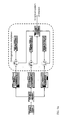
- FIGS. 1A-1B shows exemplary transmitter and receiver configurations using multinary signaling based coded modulation compatible with PDM.
- FIGS. 2A-2E show exemplary multinary signaling based constellations.
- FIGS. 2A-2C corresponds to two-dimensional (2D) constellations, while FIGS. 2D and 2F to three-dimensional signal (3-D) constellations.
- FIG. 3 shows exemplary information capacities of multinary signaling based schemes.
- FIG. 4A shows exemplary block diagram of transmitter configuration while FIG. 4B shows an exemplary receiver configuration.
- FIGS. 5A-5B shows exemplary transmitter and receiver architectures for orthogonal division multiplexing (ODM).
- ODM orthogonal division multiplexing
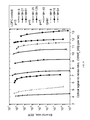
- FIG. 6 shows exemplary BERs performance of LDPC coded multinary schemes with spectral- and orthogonal-division multiplexing.
- FIGS. 1A-1B shows exemplary transmitter and receiver configurations using multinary signaling based coded modulation compatible with PDM.
- PBS(C) represents a polarization beam splitter (combiner)
- LOL represents a local oscillator laser
- APP stands for a posteriori probability.
- the multinary signaling based coded modulation scheme is described in the context of polarization-division multiplexing (PDM). Since multinary LDPC coding over GF(p), where p is the prime larger than 2, has potentially high decoding complexity, we use two binary (BI) LDPC encoders corresponding to both polarization states. After LDPC encoding, as illustrated in FIG. 1A , we perform binary-to-multinary (p-ary) conversion. Mapper x (y) takes m p-ary symbols at a time and selects a point from p m -ary signal constellation.
- PDM polarization-division multiplexing
- the coordinates of the p m -ary constellation are used as input of I/Q modulator x (y).
- Two independent p m -ary streams (corresponding to x- and y-polarization states) are then combined by polarization beam combiner (PBC) and transmitted over optical transmission system of interest.
- PBC polarization beam combiner
- multiple BI LDPC encoders might be used whose outputs are multiplexed together before binary-to-multinary conversion takes place.
- ⁇ ⁇ ( s i ( x , y ) ) log ⁇ ⁇ P ⁇ ( s i ( x , y )
- r ( x , y ) ) ⁇ , r ( x , y ) I x , y ′ + jQ x , y ′ ( 1 )
- r (x,y) ) is determined by using the Bayes' rule:
- r ( x , y ) ) P ⁇ ( r ( x , y )
- P(s i (x,y ) is the prior probability, equal to 1/p m for uniform signaling.
- s i (x,y ) can be determined by estimation of histograms in the presence of uncompensated nonlinear effects. After the compensation of nonlinear phase noise the Gaussian approximation can be used.
- the j-th bit corresponding to the i-th symbol (s i (x,y) ) in binary representation be denoted as s ij (x,y) , where j ⁇ [0, b ⁇ 1].
- the j-th bit LLR of symbol s i (x,y) is determined from symbol LLRs (1) by
- the summation is done over all symbols s i (x,y) having 0 at the position j, while in the denominator over all symbols s i (x,y) having 1 at the position j.
- the j-th position LLRs are forwarded to corresponding binary LDPC decoder.
- L(s (t) ij ) denotes the LDPC decoder output in current iteration (iteration t). The iteration between the p m -ary APP demapper and BI LDPC decoder is performed until the maximum number of iterations is reached, or the valid codewords are obtained.
- the aggregate data rate of this scheme for information symbol rate of 25 Giga symbols/s (25 GS/s), is 348.285 Gb/s.
- the aggregate data rate of 1044.855 Gb/s can be achieved, and this scheme can be used to enable beyond 1 Tb/s serial optical transport for moderate OSNR-values.
- the multinary scheme can be used to improve the energy-efficiency, defined as the improvement in OSNR (per bit) at target BER when multinary signaling is used compared to the case when binary signaling based optical transmission is used instead.
- the first stage is also to use conventional Arimoto-Blahut algorithm to determine the optimum source distribution for a given optical channel.
- the second stage we first initialize the algorithm with a set of initial constellation points obtained from conventional QAM. After the initialization stage, we generate the training sequences from optimum source distribution and split them into the clusters of points according to the LLRs from constellation obtained in previous iteration. New constellation points are obtained as the center of mass of such obtained clusters. As an illustration, in FIG.
- Multinary signaling based constellations closely approach Shannon capacity for low and medium OSNR-values, as shown in FIG. 3 for information capacities of multinary 2D signaling based schemes.
- the schemes allow for finer granularity in spectral efficiency compared to conventional constellations (with signal constellation size being power of 2) indicating that the scheme are suitable for adaptive modulation and coding.
- FIG. 4 The software-defined LDPC-coded p m -ary signaling with spectral multiplexing and ODM that we have is shown in FIG. 4 .
- FIG. 4A shows a block diagram of transmitter configuration while FIG. 4B shows details of receiver.
- the notation is as follows. N 1 : number of superchannels within the spectral band group; N 2 : number of spectral band groups; N 3 : number of ODM streams. Only single polarization is fully shown to facilitate explanations.
- the LDPC-coded p m -ary data streams are obtained as described in FIG. 1 .
- the corresponding in-phase and quadrature signals are used as inputs to I/Q modulator.
- the spectral multiplexing is then performed by using the all optical OFDM approach.
- the corresponding spectral band-group signals are then coupled into the orthogonal-division multiplexer, as shown in FIG. 4A .
- the configurations of Slepian-FBG based orthogonal division multiplexer (ODM) and demultiplexer can be determined. Namely, the Slepian sequences, are mutually orthogonal regardless of the sequence order, while occupying the fixed bandwidth.
- Slepian sequences Given the orthogonality of impulse response of Slepian sequences, they can be used to provide an additional degree of freedom with a help of properly designed FBGs.
- the Slepian sequences based FBGs are also used to provide all optical encryption.
- every ODM projection is forwarded to all-optical OFDM receiver followed by the conventional polarization-diversity receiver, which provides the projections along both polarizations and in-phase/quadrature channels. Notice that all-optical OFDM has been used here for multiplexing of independent optical signals over orthogonal optical OFDM supercarriers rather than for modulation.
- the re-sampled outputs represent projections along the corresponding basis functions.
- the configuration of transmitter and receiver for orthogonal division multiplexing are shown in FIGS. 5A and 5B , respectively.
- the FBGs can be used to obtain target Slepian-like impulse responses.
- the pulse laser output is split into K branches (see FIG. 5A ). Every branch is used as input of an electro-optical (E/O) modulator such as Mach-Zehnder (MZ), phase, I/Q modulator, or 4-D modulator.
- E/O electro-optical
- MZ Mach-Zehnder
- phase phase
- I/Q modulator or 4-D modulator.
- the outputs of corresponding Slepian-FBGs are combined by K:1 star coupler and transmitted to remote destination over either fiber-optics of free-space optical (FSO) system of interest.
- FSO free-space optical
- the independent data streams are separated by corresponding conjugate Slepian-FBGs, whose outputs are used as inputs of corresponding coherent detectors.
- This scheme is applicable to any modulation format. Since the orthogonal-division demultiplexing is performed in optical domain, both coherent and direct detections can be used. Finally, the system is compatible with both SMF and spatial division multiplexing (SDM) applications.
- the LDPC (16935, 13550) code of rate 0.8 and column-weight 3 is used in simulations for 20 LDPC iterations. It is interesting to notice that LDPC-coded 9-ary scheme of higher spectral efficiency outperforms LDPC-coded 8-QAM by almost 1 dB at BER of 10 ⁇ 8 .
- the signal frame is organized into 10 band-groups with center frequencies being orthogonal to each other.
- Each spectral component carries 1 TbE, while each spectral band group carries 10 TbE traffic.
- 1 TbE spectral slots are arranged in spectral band-groups to enable up to 10 TbE.
- the scheme can enable 20 TbE (40 TbE).
- the second layer is related to spectral-division multiplexing, resulting in 100 Tb/s aggregate data rate per orthogonal-division multiplexer input, corresponding to 100 TbE.
- the scheme is compatible with future 200 TbE/400 TbE/1 PbE.
- FIG. 6 shows BERs performance of LDPC coded multinary schemes with spectral- and orthogonal-division multiplexing.
Landscapes
- Physics & Mathematics (AREA)
- Engineering & Computer Science (AREA)
- Electromagnetism (AREA)
- Computer Networks & Wireless Communication (AREA)
- Signal Processing (AREA)
- Probability & Statistics with Applications (AREA)
- Theoretical Computer Science (AREA)
- Optics & Photonics (AREA)
- Optical Communication System (AREA)
Abstract
Description
where si (x,y) is the transmitted pm-ary signal constellation point at time instance i in either x- or y-polarization, while s0 is the reference constellation point (such as s0=(0 . . . 0)). In (1), P(si (x,y|r(x,y)) is determined by using the Bayes' rule:
where P(si (x,y) is the prior probability, equal to 1/pm for uniform signaling. The conditional probability P(r(x,y)|si (x,y) can be determined by estimation of histograms in the presence of uncompensated nonlinear effects. After the compensation of nonlinear phase noise the Gaussian approximation can be used. The number of bits required to represent a single pm-ary symbol is b=┌log2(pm)┐, where ┌z┐ is the smallest integer larger than or equal to the enclosed quantity z. Let the j-th bit corresponding to the i-th symbol (si (x,y)) in binary representation be denoted as sij (x,y), where jε[0, b−1]. The j-th bit LLR of symbol si (x,y) is determined from symbol LLRs (1) by
where with La(sik (x,y)) we denoted the prior (extrinsic) information determined from the pm-ary APP demapper. Therefore, the j-th position reliability in (3) is calculated as the logarithm of the ratio of a probability that sij (x,y)=0 and probability that sij (x,y)=1. In the nominator, the summation is done over all symbols si (x,y) having 0 at the position j, while in the denominator over all symbols si (x,y) having 1 at the position j. The inner summation in (3) is performed over all positions of symbol si (x,y), selected in the outer summation, for which sik (x,y)=0, k≠j. The j-th position LLRs are forwarded to corresponding binary LDPC decoder. To facilitate the implementation in FPGA/ASIC hardware, multiple BI LDPC decoders might be used in parallel whose outputs are multiplexed together before extrinsic information for the next global (APP-LDPC decoder) iteration is calculated. Finally, the prior pm-ary symbol estimate can be obtained from
where L(s(t) ij) denotes the LDPC decoder output in current iteration (iteration t). The iteration between the pm-ary APP demapper and BI LDPC decoder is performed until the maximum number of iterations is reached, or the valid codewords are obtained.
R D=2R S R log2(p m). (5)
Claims (20)
Priority Applications (1)
| Application Number | Priority Date | Filing Date | Title |
|---|---|---|---|
| US14/747,743 US9485029B2 (en) | 2014-10-13 | 2015-06-23 | Multinary signaling based coded modulation for ultra-high-speed optical transport |
Applications Claiming Priority (2)
| Application Number | Priority Date | Filing Date | Title |
|---|---|---|---|
| US201462063112P | 2014-10-13 | 2014-10-13 | |
| US14/747,743 US9485029B2 (en) | 2014-10-13 | 2015-06-23 | Multinary signaling based coded modulation for ultra-high-speed optical transport |
Publications (2)
| Publication Number | Publication Date |
|---|---|
| US20160105243A1 US20160105243A1 (en) | 2016-04-14 |
| US9485029B2 true US9485029B2 (en) | 2016-11-01 |
Family
ID=55656187
Family Applications (1)
| Application Number | Title | Priority Date | Filing Date |
|---|---|---|---|
| US14/747,743 Active US9485029B2 (en) | 2014-10-13 | 2015-06-23 | Multinary signaling based coded modulation for ultra-high-speed optical transport |
Country Status (1)
| Country | Link |
|---|---|
| US (1) | US9485029B2 (en) |
Families Citing this family (5)
| Publication number | Priority date | Publication date | Assignee | Title |
|---|---|---|---|---|
| US9742526B2 (en) * | 2013-10-14 | 2017-08-22 | Nec Corporation | Optimal signal constellation design for ultra-high-speed optical transport in the presence of phase noise |
| JP2017073729A (en) * | 2015-10-09 | 2017-04-13 | 富士通株式会社 | Optical remodulation device and optical remodulation method |
| CN108512800A (en) * | 2018-03-30 | 2018-09-07 | 烽火通信科技股份有限公司 | A kind of method and system for extracting planisphere on optical module |
| CN112257795B (en) * | 2020-10-28 | 2022-10-18 | 重庆邮电大学 | Spatial light communication system nonlinear compensation method based on naive Bayes |
| CN112383354B (en) * | 2020-10-29 | 2022-07-08 | 深圳大学 | Space-polarization mixed diversity free space optical communication system based on optical coding |
Citations (4)
| Publication number | Priority date | Publication date | Assignee | Title |
|---|---|---|---|---|
| US8234538B2 (en) * | 2007-04-26 | 2012-07-31 | Nec Laboratories America, Inc. | Ultra high-speed optical transmission based on LDPC-coded modulation and coherent detection for all-optical network |
| US20120257895A1 (en) * | 2010-10-01 | 2012-10-11 | Nec Laboratories America, Inc. | Four-dimensional optical multiband-ofdm for beyond 1.4tb/s serial optical transmission |
| US20130089326A1 (en) * | 2011-10-06 | 2013-04-11 | Nec Laboratories America, Inc. | Nonbinary ldpc coded modulation without bandwidth expansion for high-speed optical transmission |
| US20150071640A1 (en) * | 2013-09-08 | 2015-03-12 | Tyco Electronics Subsea Communications Llc | Coded Modulation for Small Step-Size Variable Spectral Efficiency |
-
2015
- 2015-06-23 US US14/747,743 patent/US9485029B2/en active Active
Patent Citations (4)
| Publication number | Priority date | Publication date | Assignee | Title |
|---|---|---|---|---|
| US8234538B2 (en) * | 2007-04-26 | 2012-07-31 | Nec Laboratories America, Inc. | Ultra high-speed optical transmission based on LDPC-coded modulation and coherent detection for all-optical network |
| US20120257895A1 (en) * | 2010-10-01 | 2012-10-11 | Nec Laboratories America, Inc. | Four-dimensional optical multiband-ofdm for beyond 1.4tb/s serial optical transmission |
| US20130089326A1 (en) * | 2011-10-06 | 2013-04-11 | Nec Laboratories America, Inc. | Nonbinary ldpc coded modulation without bandwidth expansion for high-speed optical transmission |
| US20150071640A1 (en) * | 2013-09-08 | 2015-03-12 | Tyco Electronics Subsea Communications Llc | Coded Modulation for Small Step-Size Variable Spectral Efficiency |
Non-Patent Citations (3)
| Title |
|---|
| Djordjevic et al, Multidimensional Signaling and Coding Enabling Multi-Tb/s Optical Transport and Networking, IEEE Signal Processing Magazine Mar. 2014. |
| Djordjevic et al, On the Irregular Nonbinary QC-LDPC-Coded Hybrid Multidimensional OSCD-Modulation Enabling Beyond 100 Tb/s Optical Transport, Journal of Lightwave Technology, vol. 31, No. 16, Aug. 15, 2013. |
| Liu et al, Digital coherent superposition for performance improvement of spatially multiplexed coherent optical OFDM superchannels, Dec. 10, 2012 / vol. 20, No. 26 / Optics Express B595. |
Also Published As
| Publication number | Publication date |
|---|---|
| US20160105243A1 (en) | 2016-04-14 |
Similar Documents
| Publication | Publication Date | Title |
|---|---|---|
| JP5378679B2 (en) | Bit-interleaved LDPC coded modulation for high-speed optical transmission | |
| US9184873B2 (en) | Ultra-high-speed optical transport based on adaptive LDPC-coded multidimensional spatial-spectral scheme and orthogonal prolate spheroidal wave functions | |
| US8699625B2 (en) | Generalized OFDM (GOFDM) for ultra-high-speed serial optical transport networks | |
| US8184993B2 (en) | Polarization mode dispersion (PMD) compensation in polarization multiplexed coded orthogonal frequency division multiplexing (OFDM) systems | |
| US9485029B2 (en) | Multinary signaling based coded modulation for ultra-high-speed optical transport | |
| US9197249B2 (en) | Adaptive LDPC-coded multidimensional spatial-MIMO multiband generalized OFDM | |
| Djordjevic | On the irregular nonbinary QC-LDPC-coded hybrid multidimensional OSCD-modulation enabling beyond 100 Tb/s optical transport | |
| US20090282314A1 (en) | Multidimensional turbo product codes and generalized low-density parity-check codes with component reed-solomon codes for optical transmission | |
| Djordjevic | Spatial-domain-based hybrid multidimensional coded-modulation schemes enabling multi-Tb/s optical transport | |
| US20140099103A1 (en) | Ldpc-coded modulation for ultra-high-speed optical transport in the presence of phase noise | |
| US9479285B2 (en) | Non-binary LDPC coded mode-multiplexed four-dimensional signaling based on orthogonal frequency division multiplexing | |
| US8768175B2 (en) | Four-dimensional optical multiband-OFDM for beyond 1.4Tb/s serial optical transmission | |
| Djordjevic et al. | Multidimensional Signaling and Coding Enabling Multi-Tb\/s Optical Transport and Networking: Multidimensional aspects of coded modulation | |
| Djordjevic et al. | Multidimensional vector quantization-based signal constellation design enabling beyond 1 Pb/s serial optical transport networks | |
| US9071383B2 (en) | Modified orthogonal polynomials based hybrid coded-modulation for multi-Tb/second optical transport | |
| Yoshida et al. | Post-FEC BER benchmarking for bit-interleaved coded modulation with probabilistic shaping | |
| Nakamura et al. | Coded eight-dimensional QAM technique using iterative soft-output decoding and its demonstration in high baud-rate transmission | |
| Djordjevic et al. | On the LDPC-coded modulation for ultra-high-speed optical transport in the presence of phase noise | |
| Djordjevic et al. | Multinary-signaling-based coded modulation for ultrahigh-speed optical transport | |
| Liu et al. | Non-uniform signaling based LDPC coded modulation for high-speed optical transport networks | |
| Djordjevic | On the energy-efficient multidimensional coded modulation for optical transport networks | |
| He et al. | Flexible multi-dimensional modulation method for elastic optical networks | |
| Arnould | Ultra-wideband and high symbol rate transmission systems for next-generation optical fiber communications | |
| Djordjevic et al. | Optical transport exceeding 10 Tb/s based on adaptive LDPC-coded multidimensional spatial-spectral scheme and orthogonal prolate spheroidal wave functions | |
| Djordjevic | Coded orbital angular momentum (OAM) modulation based heterogeneous optical networking |
Legal Events
| Date | Code | Title | Description |
|---|---|---|---|
| AS | Assignment |
Owner name: NEC LABORATORIES AMERICA, INC., NEW JERSEY Free format text: ASSIGNMENT OF ASSIGNORS INTEREST;ASSIGNORS:WANG, TING;DJORDJEVIC, IVAN B;SIGNING DATES FROM 20150622 TO 20150623;REEL/FRAME:035886/0567 |
|
| AS | Assignment |
Owner name: NEC CORPORATION, JAPAN Free format text: ASSIGNMENT OF ASSIGNORS INTEREST;ASSIGNOR:NEC LABORATORIES AMERICA, INC.;REEL/FRAME:039756/0376 Effective date: 20160915 |
|
| STCF | Information on status: patent grant |
Free format text: PATENTED CASE |
|
| MAFP | Maintenance fee payment |
Free format text: PAYMENT OF MAINTENANCE FEE, 4TH YEAR, LARGE ENTITY (ORIGINAL EVENT CODE: M1551); ENTITY STATUS OF PATENT OWNER: LARGE ENTITY Year of fee payment: 4 |
|
| MAFP | Maintenance fee payment |
Free format text: PAYMENT OF MAINTENANCE FEE, 8TH YEAR, LARGE ENTITY (ORIGINAL EVENT CODE: M1552); ENTITY STATUS OF PATENT OWNER: LARGE ENTITY Year of fee payment: 8 |