US9481202B2 - Plug for a tubeless bicycle wheel - Google Patents

Plug for a tubeless bicycle wheel Download PDF

Info

Publication number
US9481202B2
US9481202B2 US14/170,105 US201414170105A US9481202B2 US 9481202 B2 US9481202 B2 US 9481202B2 US 201414170105 A US201414170105 A US 201414170105A US 9481202 B2 US9481202 B2 US 9481202B2
Authority
US
United States
Prior art keywords
cap
plug
annular panel
bicycle wheel
legs
Prior art date
Legal status (The legal status is an assumption and is not a legal conclusion. Google has not performed a legal analysis and makes no representation as to the accuracy of the status listed.)
Active, expires
Application number
US14/170,105
Other versions
US20150217597A1 (en
Inventor
Marshall Ellison Poland
Douglas Graham Russell
Joseph Edward Buckley
Jeremy Thompson
Current Assignee (The listed assignees may be inaccurate. Google has not performed a legal analysis and makes no representation or warranty as to the accuracy of the list.)
Specialized Bicycle Components Holding Co Inc
Original Assignee
Specialized Bicycle Components Inc
Priority date (The priority date is an assumption and is not a legal conclusion. Google has not performed a legal analysis and makes no representation as to the accuracy of the date listed.)
Filing date
Publication date
Application filed by Specialized Bicycle Components Inc filed Critical Specialized Bicycle Components Inc
Priority to US14/170,105 priority Critical patent/US9481202B2/en
Assigned to SPECIALIZED BICYCLE COMPONENTS, INC. reassignment SPECIALIZED BICYCLE COMPONENTS, INC. ASSIGNMENT OF ASSIGNORS INTEREST (SEE DOCUMENT FOR DETAILS). Assignors: BUCKLEY, JOSEPH EDWARD, POLAND, MARSHALL ELLISON, RUSSELL, DOUGLAS GRAHAM, THOMPSON, JEREMY
Priority to GB1420474.7A priority patent/GB2522746B/en
Priority to TW103140502A priority patent/TWI546208B/en
Priority to DE102014227011.1A priority patent/DE102014227011A1/en
Publication of US20150217597A1 publication Critical patent/US20150217597A1/en
Application granted granted Critical
Publication of US9481202B2 publication Critical patent/US9481202B2/en
Active legal-status Critical Current
Adjusted expiration legal-status Critical

Links

Images

Classifications

    • BPERFORMING OPERATIONS; TRANSPORTING
    • B60VEHICLES IN GENERAL
    • B60BVEHICLE WHEELS; CASTORS; AXLES FOR WHEELS OR CASTORS; INCREASING WHEEL ADHESION
    • B60B1/00Spoked wheels; Spokes thereof
    • B60B1/02Wheels with wire or other tension spokes
    • B60B1/04Attaching spokes to rim or hub
    • B60B1/041Attaching spokes to rim or hub of bicycle wheels
    • BPERFORMING OPERATIONS; TRANSPORTING
    • B60VEHICLES IN GENERAL
    • B60BVEHICLE WHEELS; CASTORS; AXLES FOR WHEELS OR CASTORS; INCREASING WHEEL ADHESION
    • B60B1/00Spoked wheels; Spokes thereof
    • B60B1/02Wheels with wire or other tension spokes
    • B60B1/04Attaching spokes to rim or hub
    • BPERFORMING OPERATIONS; TRANSPORTING
    • B60VEHICLES IN GENERAL
    • B60BVEHICLE WHEELS; CASTORS; AXLES FOR WHEELS OR CASTORS; INCREASING WHEEL ADHESION
    • B60B1/00Spoked wheels; Spokes thereof
    • B60B1/02Wheels with wire or other tension spokes
    • B60B1/04Attaching spokes to rim or hub
    • B60B1/043Attaching spokes to rim
    • BPERFORMING OPERATIONS; TRANSPORTING
    • B60VEHICLES IN GENERAL
    • B60BVEHICLE WHEELS; CASTORS; AXLES FOR WHEELS OR CASTORS; INCREASING WHEEL ADHESION
    • B60B21/00Rims
    • B60B21/06Rims characterised by means for attaching spokes, i.e. spoke seats
    • BPERFORMING OPERATIONS; TRANSPORTING
    • B60VEHICLES IN GENERAL
    • B60BVEHICLE WHEELS; CASTORS; AXLES FOR WHEELS OR CASTORS; INCREASING WHEEL ADHESION
    • B60B21/00Rims
    • B60B21/06Rims characterised by means for attaching spokes, i.e. spoke seats
    • B60B21/062Rims characterised by means for attaching spokes, i.e. spoke seats for bicycles
    • BPERFORMING OPERATIONS; TRANSPORTING
    • B60VEHICLES IN GENERAL
    • B60BVEHICLE WHEELS; CASTORS; AXLES FOR WHEELS OR CASTORS; INCREASING WHEEL ADHESION
    • B60B21/00Rims
    • B60B21/12Appurtenances, e.g. lining bands
    • BPERFORMING OPERATIONS; TRANSPORTING
    • B60VEHICLES IN GENERAL
    • B60BVEHICLE WHEELS; CASTORS; AXLES FOR WHEELS OR CASTORS; INCREASING WHEEL ADHESION
    • B60B21/00Rims
    • B60B21/06Rims characterised by means for attaching spokes, i.e. spoke seats
    • B60B21/068Rims characterised by means for attaching spokes, i.e. spoke seats the spoke seat comprising sealing means, e.g. for tubeless racing bike tyres

Definitions

  • the present invention relates generally to the field of bicycles and specifically to parts for tubeless bicycle wheels.
  • Bicycle wheels commonly include an axle, a hub rotatable on the axle, spokes extending radially from the hub, a rim supported by the spokes, a tire, and a pneumatic tube positioned inside the tire to facilitate inflation of the tire.
  • the rim typically includes spoke holes that facilitate insertion of and access to spoke nipples that connect the rim to the spokes.
  • Some wheels are called “tubeless” because they eliminate the pneumatic tube.
  • the tire and rim are designed to hold air to thereby allow the tire to be inflated without the need for a tube.
  • any holes in the rim e.g., spoke holes
  • any holes in the rim must be pneumatically sealed to prevent the loss of air.
  • the present invention provides a bicycle wheel having a spoke, a nipple coupled to the spoke, and a rim coupled to the nipple and having an annular panel with inner and outer surfaces.
  • the annular panel includes an access hole defining inner and outer edges corresponding with the inner and outer surfaces, the access hole having a hole area sized to facilitate passage of the nipple.
  • a plug is positioned over the access hole and includes a cap having a cap area larger than the hole area, a leg (e.g., a plurality of legs) extending from the cap and through the access hole, and a barb (e.g., a plurality of barbs) protruding radially from the leg to at least partially engage the inner edge of the annular panel.
  • the plug further includes a resilient member (e.g., an O-ring made of a softer material than the cap) compressed between the cap and the outer surface of the annular panel.
  • the resilient member has a stressed thickness when compressed between the cap and the outer surface, and the stressed thickness is 50 to 95 percent (preferably 70 to 85 percent, and most preferably about 80 percent) of the unstressed thickness.
  • the annular panel has a non-planar contour.
  • the resilient member and/or the cap can be shaped to match the non-planar contour of the annular panel.
  • the cap has a cap width and the leg has a circumferential width that is less than half the cap width.
  • the barb can include a contact surface (that engages the inner edge of the annular panel) that is at an obtuse angle relative to the leg.
  • the cap can include a center that has a thickness greater than an edge of the cap and/or the plug can include a reinforcement rib.
  • the plug can include an alignment feature.
  • the plug can include an engagement feature.
  • FIG. 1 is a side view of a bicycle including tubeless wheels embodying the invention.
  • FIG. 2 is a section view of a rim, a tire, and a plug of one tubeless wheel of FIG. 1 .
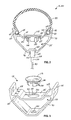
  • FIG. 3 is an exploded perspective view of a portion of the rim and the plug of FIG. 2 .
  • FIG. 4 is an exploded perspective view of the plug and a seal for the wheel of FIG. 1 .
  • FIG. 5 is a section view of the plug of FIG. 4 taken along line 5 - 5 .
  • FIG. 6 is a perspective view of another exemplary plug and a seal for a tubeless wheel.
  • FIG. 7 is a section view of the plug of FIG. 6 , without the seal, taken along line 7 - 7 .
  • FIG. 8 is a section view of another exemplary plug for a tubeless wheel.
  • FIG. 9 is a perspective view of another exemplary plug for a tubeless wheel.
  • FIG. 10 is a perspective view of another exemplary plug for a tubeless wheel.
  • FIG. 11 is a perspective view of another exemplary plug for a tubeless wheel.
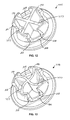
  • FIG. 12 is a perspective view of another exemplary plug for a tubeless wheel.
  • FIG. 13 is a perspective view of another exemplary plug for a tubeless wheel.
  • FIG. 14 is a perspective view of another exemplary plug for a tubeless wheel.
  • FIG. 15 is a side view of the plug of FIG. 14 .
  • FIG. 16 is a perspective view of another exemplary plug and a seal for a tubeless wheel.
  • FIG. 17 is a perspective view of the seal of FIG. 16 .
  • FIG. 18 is a perspective view of another exemplary plug for a tubeless wheel.
  • FIG. 19 is a side view of the plug of FIG. 18 .
  • FIG. 1 shows a bicycle 10 that includes a front wheel 15 , a rear wheel 20 , and a frame 25 .
  • the frame 25 has a head tube 30 , a front fork 35 rotationally supported by the head tube 30 , a top tube 40 connected to and extending rearward from the head tube 30 , and a down tube 45 connected to the head tube 30 below the top tube 40 and extending generally downward toward a bottom bracket (not shown) of the frame 25 .
  • a seat tube 50 extends upward from the bottom bracket and is connected to the top tube 40 , and a seat 55 is supported by the seat tube 50 .
  • the bicycle 10 also includes a handlebar 60 for turning the front wheel 15 via the fork 35 , and a rear frame triangle 65 that supports the rear wheel 20 .
  • each illustrated wheel 15 , 20 includes a hub 70 , a reinforced rim 75 supported by the hub 70 via spokes 80 (or other reinforcement members), and a tire 85 that is attached to the rim 75 .
  • the rim 75 is annular and can be formed of metallic, composite, or other material.
  • the illustrated rim 75 has an annular inner wall 90 , annular outer walls 95 , and an annular outer panel 100 .
  • the annular panel 100 extends between and is connected to the inner wall 90 and the outer walls 95 .
  • the panel 100 defines bead seats 105 that support tire beads 110 , and the outer walls 95 and the panel 100 cooperatively define tire 85 engaging portions that support and retain the tire 85 on the rim 75 when the tire 85 is inflated.
  • FIGS. 2 and 3 illustrate that the outer walls 95 extend substantially (e.g. almost completely) radially outward and that the panel 100 has planar bead seats 105 , it will be appreciated that the rim 75 can have other profiles.
  • the inner wall 90 and the panel 100 cooperatively define a cavity 115 .
  • the inner wall 90 has a plurality of openings 120 spaced circumferentially along the periphery of the wall, and distal ends of the spokes 80 extend nearly to or into the cavity 115 through the openings 120 .
  • the panel 100 has an annular recessed section or drop-center 125 with an annular inner surface 130 , an annular outer surface 135 , and circumferentially spaced holes 140 through which the spokes 80 can be accessed.
  • the holes 140 are radially aligned with the openings 120 in the inner wall 90 and are defined by an inner edge 145 and an outer edge 150 .
  • the drop-center 125 illustrated in FIGS. 2 and 3 has a planar contour in cross-section, the drop-center 125 can have other profiles or contours (e.g., curved, angled, etc.).
  • the illustrated spokes 80 are secured to the rim 75 by nipples 155 (e.g., threaded to the spokes 80 ).
  • Each nipple 155 has a head 160 and a body 165 engageable with the distal end of the spoke 80 to secure the spoke 80 to the rim 75 .
  • the nipple head 160 has a diameter or width that is less than the diameter of the access hole 140 to facilitate passage of the nipple 155 through the hole.
  • the body 165 has flattened surfaces 170 for engagement by a tool (e.g., a spoke wrench) to facilitate tightening the spoke.
  • a tool e.g., a spoke wrench
  • each wheel 15 , 20 includes a plug 175 (e.g., formed of plastic or composite material) and a resilient member or seal 180 that are positioned over the access holes 140 to prevent or minimize air leakage through the holes 140 and the openings 120 .
  • a plug 175 e.g., formed of plastic or composite material
  • a resilient member or seal 180 that are positioned over the access holes 140 to prevent or minimize air leakage through the holes 140 and the openings 120 .
  • the illustrated plug 175 includes a cap 185 and legs 190 extending from the cap 185 circumferentially around the cap 185 .
  • the cap 185 illustrated in FIGS. 2-5 has a planar upper surface 195 and a planar lower surface 200 , and is defined by a circular top profile with a cap width W 1 (e.g., the diameter of the cap 185 ).
  • the cap width W 1 is larger than a width of the holes 140 .
  • only the legs 190 extend into and through the hole 140 . That is, the cap 185 extends across the hole 140 and does not extend into the hole 140 .
  • the legs 190 extend from the lower surface 200 , have a circumferential width W 2 , and are spaced apart from each other around the periphery of the cap 185 such that gaps 205 are defined between the legs 190 .
  • the illustrated leg width W 2 is approximately less than half of the cap width W 1 , although the cap 185 and the leg 190 can have other relational width values.
  • the illustrated plug 175 includes four legs 190 , although fewer or more legs 190 are possible.
  • FIGS. 2-5 show that the legs 190 cooperatively define a snap-feature that is engageable with the inner surface 130 to secure the plug 175 and the seal 180 onto the annular panel 100 .
  • each leg 190 has a thin section 210 and a barb 215 radially protruding from the thin section 210 to engage the inner edge 225 145 of the annular panel 100 when the plug 175 is inserted through the hole.
  • the thin sections 210 cooperatively define a diameter or width W 3 that substantially conforms to (e.g., is the same or slightly smaller than) the diameter or width of the holes 140
  • the barbs 215 cooperatively define a diameter or width W 4 that is larger than the diameter of width of the holes 140 .
  • the cap width W 1 is larger than the cooperative width W 3 of the legs 190 and larger than the cooperative width W 4 of the barbs 215 .
  • Each barb 215 has a contact surface 220 that is spaced from the lower surface 200 by a distance D 1 , which corresponds to the thickness of the annular panel 100 and a stressed thickness of the seal 180 , as described in detail below.
  • the illustrated contact surface 220 has a sloped edge 225 and is oriented at an obtuse angle relative to the exterior surface of the thin section 210 (illustrated as vertical in FIG. 5 ) extending along the leg.
  • the contact surface 220 is also oriented at the same obtuse angle relative to an axis A extending axially through the plug 175 . That is, the contact surface 220 is sloped (planar or curved) slightly downward as viewed in FIG.
  • the barb 215 is thicker than the remainder of the leg 190 such that the leg, with the barb, flexes at the thin section 210 of the leg 190 (i.e. along the portion of the leg 190 defining the distance D 1 ) as the plug 175 is being inserted into the hole 140 .
  • Each barb 215 also is illustrated as having an outer circumferential surface 230 that slopes downward and toward the axis A.
  • the illustrated seal 180 is a resilient O-ring that has an inner diameter conforming to the diameter W 3 of the thin sections 210 of the legs 190 .
  • the seal 180 is made of material that is softer than the plug 175 and is compressible.
  • the seal 180 has an unstressed thickness corresponding to a state when the plug 175 is not engaged with the panel 100 , and a stressed thickness when the seal 180 is compressed between the cap 185 and the outer surface 135 .
  • the stressed thickness can be 50 to 95 percent of the unstressed thickness.
  • the stressed thickness is approximately 70 to 85 percent of the unstressed thickness, and more preferably, about 80 percent of the unstressed thickness.
  • each plug 175 is secured to the hole 140 in the rim 75 by assembling the seal 180 onto the plug 175 and then inserting the legs 190 through the hole 140 .
  • the shape or contour of the legs 190 flex inward so that the barbs 215 can fit through the hole 140 .
  • the cap 185 is pressed downward so that the contact surface 220 is engaged with the inner edge 145 .
  • the seal 180 is compressed to the stressed thickness by the cap 185 and the upper surface 195 so that the plug 175 tightly fits into and seals the hole 140 .
  • the top of the cap 185 is below or approximately no higher (or radially outward) than the bead seats 105 (e.g., to avoid interfering with the tire beads 110 ).
  • the plug 175 illustrated in FIGS. 2-5 is removable and re-usable.
  • the edge 225 or lip of the cap 185 is grasped to pull the plug 175 radially outward (upward as viewed in FIG. 2 ). Because the contact surface 220 is oriented at an obtuse angle and the edge 225 is rounded, the force pulling on the legs 190 resiliently biases the barbs 215 inward until the barbs 215 fit through the hole 140 .
  • FIGS. 6 and 7 illustrate another plug 275 that can be used with the front and rear wheels 15 , 20 , or another tubeless wheel. Except as described below, the plug 275 is the same as the plug 175 described with regard to FIGS. 2-5 and common elements are given the same reference numerals.
  • the illustrated plug 275 includes a cap 285 that has an annular recess 286 disposed in the lower surface 200 .
  • the recess 286 is defined by a curved surface 288 that conforms to the rounded cross-sectional shape of the seal.
  • the illustrated seal is partially embedded in the recess to sealingly engage the outer surface.
  • the illustrated seal 180 can be separably coupled to the plug, or integrally formed with the plug 275 within the recess 286 (e.g., co-formed, co-molded, adhered, etc.).
  • FIG. 8 illustrates another plug 375 that can be used with the front and rear wheels 15 , 20 , or another tubeless wheel. Except as described below, the plug 375 is the same as the plug 175 described with regard to FIGS. 2-5 and common elements are given the same reference numerals.
  • the illustrated plug 375 includes a domed or non-planar cap 385 to resist breakage or failure of the plug 375 , for example, due to high tire air pressures (e.g., high operating air pressures or blowout air pressures).
  • the non-planar cap 385 has a center thickness that is greater than the thickness of the edge.
  • the domed cap 385 supports the center of the plug 375 to avoid collapse within the hole 140 due to higher air pressures.
  • FIG. 9 illustrates another plug 475 that can be used with the front and rear wheels 15 , 20 , or another tubeless wheel. Except as described below, the plug 475 is the same as the plug 175 described with regard to FIGS. 2-5 and common elements are given the same reference numerals.
  • the illustrated plug 475 includes reinforcement ribs 477 that crisscross the lower surface 200 of the cap 185 . As illustrated, the ribs 477 intersect each other at or adjacent the center of the cap 185 and are aligned between the barbs 215 to avoid increasing the stiffness of the barbs 215 . That is, the ends of the ribs 477 are terminate on the underside of the cap 185 between the legs 190 (i.e. at the gaps 205 ). The ribs 477 stiffen the plug 475 to resist failure if subjected to higher air pressure.
  • FIG. 10 illustrates another plug 575 that can be used with the front and rear wheels 15 , 20 , or another tubeless wheel. Except as described below, the plug 575 is the same as the plug 175 described with regard to FIGS. 2-5 and common elements are given the same reference numerals.
  • the illustrated plug 575 has an alignment feature 577 to indicate the direction in which the plug 575 should be installed on the rim 75 (e.g., for rims with non-planar drop-centers).
  • the alignment feature 577 is a rib that defines a raised line with ends terminating directly above opposed gaps 205 , although the alignment feature 577 can be a recess or another feature that facilitates alignment of the plug 575 relative to the rim 75 .
  • FIG. 11 illustrates another plug 675 that can be used with the front and rear wheels 15 , 20 , or another tubeless wheel. Except as described below, the plug 675 is the same as the plug 175 described with regard to FIGS. 2-5 and common elements are given the same reference numerals.
  • the illustrated plug 675 includes an engagement feature 677 to facilitate removal of the plug 675 from the rim 75 while avoiding damage to the edge of the cap 185 .
  • the engagement feature 677 can also be used as an alignment feature (e.g., similar to feature 577 ) to orient the plug 675 relative to the rim 75 .
  • the engagement feature 677 is illustrated as a tab in FIG. 11 , the engagement feature 677 can take other forms.
  • FIGS. 12 and 13 illustrate another plug 775 that can be used with the front and rear wheels 15 , 20 , or another tubeless wheel. Except as described below, the plug 775 is the same as the plug 175 described with regard to FIGS. 2-5 and common elements are given the same reference numerals.
  • the illustrated plug 775 includes cross-braces or reinforcement ribs 777 (referred to as “reinforcement ribs for purposes of description only) that are coupled between opposite barbs 215 .
  • the reinforcement ribs 777 act like springs to assist with flexing or resiliently pushing the barbs 215 back into place and to limit flexure of the barb 215 itself.
  • the reinforcement ribs 777 help maintain the overall shape of the plug 775 , and more specifically, the profile of the barbs 215 , when the plug 775 is installed in the hole 140 .
  • the reinforcement ribs 777 can be straight and intersect with each other at the center of the cap 185 .
  • the reinforcement ribs 777 can instead be curved (e.g., sinusoidal) between the barbs 215 (e.g., to promote flexure of the legs 190 when the plug 775 is installed or removed).
  • the reinforcement ribs 777 are illustrated as being formed with the remainder of the plug 775 , the reinforcement ribs can be co-formed or co-molded onto the plug 775 .
  • FIGS. 14 and 15 illustrate another plug 875 that can be used with the front and rear wheels 15 , 20 , or another tubeless wheel. Except as described below, the plug 875 is the same as the plug 175 described with regard to FIGS. 2-5 and common elements are given the same reference numerals.
  • the illustrated plug 875 can be used on rims 75 that have a narrower (e.g., curved) drop-center. More specifically, the plug 875 includes a non-planar cap 885 and legs 890 a , 890 b .
  • the non-planar cap 885 conforms to the shape of rims with a curved drop-center.
  • the cap 885 is illustrated as having a curvature with the bottom-most part of the curve located at the center of the cap 885 . That is, upper and lower surfaces 895 , 900 follow the same arcuate contour to define a cap 885 with a substantially constant thickness.
  • the outermost edges of the cap 885 curve upward to conform to the corresponding upwardly-sloped drop-center (not shown).
  • the legs 890 a have contact surfaces 220 that are on one plane, and the legs 890 b have contact surfaces 220 that are on another, different plane to accommodate the narrower drop-center.
  • the seal 180 is engaged with the plug 875 so that the seal 180 follows the curvature of the lower surface 900 .
  • FIGS. 16 and 17 illustrate another plug 975 and seal 980 that can be used with the front and rear wheels 15 , 20 , or another tubeless wheel. Except as described below, the plug 975 is the same as the plug described with regard to FIGS. 2-5 and common elements are given the same reference numerals.
  • the illustrated plug 975 can be used on rims that have a narrower drop-center.
  • the illustrated plug 975 has two sets of legs 990 a , 990 b and planar upper and lower surfaces 995 , 1000 .
  • the seal 980 has an upper planar surface 1002 and a lower curved surface 1004 that follows or conforms to the profile of the drop-center.
  • One set of legs 990 a is longer than the other set of legs 990 b to accommodate the curvature of the drop-center 125 .
  • the seal 980 wraps around the legs 990 a , 990 b such that the distance between the curved surface 1004 and the contact surface 220 is the same or approximately the same for each leg 990 a , 990 b .
  • the plug 975 and the seal 980 are attached to the rim within the drop-center so that the lowermost part 1006 of the seal 980 is positioned in engagement with the lowermost part of the drop-center.
  • FIGS. 18 and 19 illustrate another plug 1075 that can be used with the front and rear wheels 15 , 20 , or another tubeless wheel. Except as described below, the plug 1075 is the same as the plug 175 described with regard to FIGS. 2-5 and common elements are given the same reference numerals.
  • the illustrated plug 1075 includes a cap 1085 , a post 1087 extending from the cap 1085 at or adjacent the center of the cap 1085 , and legs 1090 .
  • the cap 1085 illustrated in FIGS. 18 and 19 has a frusto-conical profile or contour with a planar upper surface 1095 and a planar lower surface 1100 .
  • the cap 1085 also has a cylindrical wall 1102 with a width or diameter that is larger than the post 1087 and that is smaller than the width of the cap 1085 .
  • the seal 180 is coupled to the plug 1075 such that the inner side of the seal 180 is engaged with the cylindrical wall 1102 .
  • the illustrated cylindrical wall 1102 defines a surface that limits further inward movement of the seal 180 when the seal 180 is compressed.
  • the post 1087 terminates at a central head 1104 on the distal end, and legs 1090 extend upward and outward from the central head 1104 .
  • the legs 1090 are spaced apart from each other around the central head 1104 such that gaps 1105 are formed between the legs 1090 .
  • the legs 1090 taper wider in width with increasing distance from the central head 1104 along the legs 1090 .
  • the barbs 1115 are integrally defined on the distal ends of the legs 1090 to engage the inner surface 130 and hold the plug 1075 in place on the rim 75 .
  • the illustrated plug 1075 includes four legs 1090 and barbs 1115 , although fewer or more 1090 and barbs 1115 are possible.
  • Installation and removal of the plugs 275 , 375 , 475 , 575 , 675 , 775 , 875 , 975 , 1075 described with regard to FIGS. 6-19 is substantially the same as installation and removal of the plug 175 described with regard to FIGS. 2-5 .
  • each plug 275 , 375 , 475 , 575 , 675 , 775 , 875 , 975 , 1075 is secured to the hole 140 in the rim by attaching the appropriate seal 180 , 980 to the plug 275 , 375 , 475 , 575 , 675 , 775 , 875 , 975 , 1075 (either as a co-formed, co-molded, or separate element) and then inserting the legs 190 , 990 a , 990 b , 1090 through the hole 140 .
  • the legs 190 , 990 a , 990 b , 1090 bias inward so that the barbs 215 , 1115 can fit through the hole 140 .
  • the cap 185 , 285 385 , 885 , 985 , 1085 is pressed downward so that the contact surface 220 is engaged with the inner edge 145 .
  • the seal 180 , 980 is compressed between the cap 185 , 285 385 , 885 , 985 , 1085 and the outer surface 135 so that the plug 275 , 375 , 475 , 575 , 675 , 775 , 875 , 975 , 1075 tightly fits into and seals the hole 140 .
  • the edge or lip of the cap 185 , 285 385 , 885 , 985 , 1085 , or another engagement feature 677 is grasped to pull the plug 185 , 285 385 , 885 , 985 , 1085 radially outward (upward as viewed in FIG. 2 ).
  • any or all of the plugs 175 , 185 , 285 385 , 885 , 985 , 1085 can include a seal 180 , 980 provided separate from or integrated into (e.g., co-molded, co-formed, etc.) the plug 175 , 185 , 285 385 , 885 , 985 , 1085 .

Landscapes

  • Engineering & Computer Science (AREA)
  • Mechanical Engineering (AREA)
  • Tires In General (AREA)

Abstract

A bicycle wheel is disclosed having a spoke, a nipple coupled to the spoke, and a rim coupled to the nipple and having an annular panel with inner and outer surfaces and an access hole. A plug is positioned over the access hole and includes a cap that is larger than the access hole, a leg extending from the cap and through the access hole, and a barb protruding radially from the leg to at least partially engage the inner surface of the annular panel. The plug can further include a resilient member compressed between the cap and the outer surface of the annular panel. On some rims, the annular panel has a non-planar contour. For these rims, the resilient member and/or the cap can be shaped to match the non-planar contour of the annular panel.

Description

BACKGROUND
The present invention relates generally to the field of bicycles and specifically to parts for tubeless bicycle wheels.
Bicycle wheels commonly include an axle, a hub rotatable on the axle, spokes extending radially from the hub, a rim supported by the spokes, a tire, and a pneumatic tube positioned inside the tire to facilitate inflation of the tire. The rim typically includes spoke holes that facilitate insertion of and access to spoke nipples that connect the rim to the spokes.
Some wheels are called “tubeless” because they eliminate the pneumatic tube. In these wheels, the tire and rim are designed to hold air to thereby allow the tire to be inflated without the need for a tube. In tubeless wheels, any holes in the rim (e.g., spoke holes) must be pneumatically sealed to prevent the loss of air.
SUMMARY
The present invention provides a bicycle wheel having a spoke, a nipple coupled to the spoke, and a rim coupled to the nipple and having an annular panel with inner and outer surfaces. The annular panel includes an access hole defining inner and outer edges corresponding with the inner and outer surfaces, the access hole having a hole area sized to facilitate passage of the nipple. A plug is positioned over the access hole and includes a cap having a cap area larger than the hole area, a leg (e.g., a plurality of legs) extending from the cap and through the access hole, and a barb (e.g., a plurality of barbs) protruding radially from the leg to at least partially engage the inner edge of the annular panel.
In one embodiment, the plug further includes a resilient member (e.g., an O-ring made of a softer material than the cap) compressed between the cap and the outer surface of the annular panel. The resilient member has a stressed thickness when compressed between the cap and the outer surface, and the stressed thickness is 50 to 95 percent (preferably 70 to 85 percent, and most preferably about 80 percent) of the unstressed thickness. On some rims, the annular panel has a non-planar contour. For these rims, the resilient member and/or the cap can be shaped to match the non-planar contour of the annular panel.
Preferably, the cap has a cap width and the leg has a circumferential width that is less than half the cap width. In addition, the barb can include a contact surface (that engages the inner edge of the annular panel) that is at an obtuse angle relative to the leg. To provide strength, the cap can include a center that has a thickness greater than an edge of the cap and/or the plug can include a reinforcement rib. In order to align the plug relative to the rim, the plug can include an alignment feature. In order to facilitate removal of the plug from the rim, the plug can include an engagement feature.
Other aspects of the invention will become apparent by consideration of the detailed description and accompanying drawings.
BRIEF DESCRIPTION OF THE DRAWINGS
FIG. 1 is a side view of a bicycle including tubeless wheels embodying the invention.
FIG. 2 is a section view of a rim, a tire, and a plug of one tubeless wheel of FIG. 1.
FIG. 3 is an exploded perspective view of a portion of the rim and the plug of FIG. 2.
FIG. 4 is an exploded perspective view of the plug and a seal for the wheel of FIG. 1.
FIG. 5 is a section view of the plug of FIG. 4 taken along line 5-5.
FIG. 6 is a perspective view of another exemplary plug and a seal for a tubeless wheel.
FIG. 7 is a section view of the plug of FIG. 6, without the seal, taken along line 7-7.
FIG. 8 is a section view of another exemplary plug for a tubeless wheel.
FIG. 9 is a perspective view of another exemplary plug for a tubeless wheel.
FIG. 10 is a perspective view of another exemplary plug for a tubeless wheel.
FIG. 11 is a perspective view of another exemplary plug for a tubeless wheel.
FIG. 12 is a perspective view of another exemplary plug for a tubeless wheel.
FIG. 13 is a perspective view of another exemplary plug for a tubeless wheel.
FIG. 14 is a perspective view of another exemplary plug for a tubeless wheel.
FIG. 15 is a side view of the plug of FIG. 14.
FIG. 16 is a perspective view of another exemplary plug and a seal for a tubeless wheel.
FIG. 17 is a perspective view of the seal of FIG. 16.
FIG. 18 is a perspective view of another exemplary plug for a tubeless wheel.
FIG. 19 is a side view of the plug of FIG. 18.
DETAILED DESCRIPTION
Before any embodiments of the invention are explained in detail, it is to be understood that the invention is not limited in its application to the details of construction and the arrangement of components set forth in the following description or illustrated in the following drawings. The invention is capable of other embodiments and of being practiced or of being carried out in various ways.
FIG. 1 shows a bicycle 10 that includes a front wheel 15, a rear wheel 20, and a frame 25. The frame 25 has a head tube 30, a front fork 35 rotationally supported by the head tube 30, a top tube 40 connected to and extending rearward from the head tube 30, and a down tube 45 connected to the head tube 30 below the top tube 40 and extending generally downward toward a bottom bracket (not shown) of the frame 25. A seat tube 50 extends upward from the bottom bracket and is connected to the top tube 40, and a seat 55 is supported by the seat tube 50. The bicycle 10 also includes a handlebar 60 for turning the front wheel 15 via the fork 35, and a rear frame triangle 65 that supports the rear wheel 20.
Referring to FIGS. 1-3, each illustrated wheel 15, 20 includes a hub 70, a reinforced rim 75 supported by the hub 70 via spokes 80 (or other reinforcement members), and a tire 85 that is attached to the rim 75. The rim 75 is annular and can be formed of metallic, composite, or other material. The illustrated rim 75 has an annular inner wall 90, annular outer walls 95, and an annular outer panel 100. The annular panel 100 extends between and is connected to the inner wall 90 and the outer walls 95. As shown, the panel 100 defines bead seats 105 that support tire beads 110, and the outer walls 95 and the panel 100 cooperatively define tire 85 engaging portions that support and retain the tire 85 on the rim 75 when the tire 85 is inflated. Although FIGS. 2 and 3 illustrate that the outer walls 95 extend substantially (e.g. almost completely) radially outward and that the panel 100 has planar bead seats 105, it will be appreciated that the rim 75 can have other profiles.
As illustrated, the inner wall 90 and the panel 100 cooperatively define a cavity 115. The inner wall 90 has a plurality of openings 120 spaced circumferentially along the periphery of the wall, and distal ends of the spokes 80 extend nearly to or into the cavity 115 through the openings 120. The panel 100 has an annular recessed section or drop-center 125 with an annular inner surface 130, an annular outer surface 135, and circumferentially spaced holes 140 through which the spokes 80 can be accessed. The holes 140 are radially aligned with the openings 120 in the inner wall 90 and are defined by an inner edge 145 and an outer edge 150. Although the drop-center 125 illustrated in FIGS. 2 and 3 has a planar contour in cross-section, the drop-center 125 can have other profiles or contours (e.g., curved, angled, etc.).
The illustrated spokes 80 are secured to the rim 75 by nipples 155 (e.g., threaded to the spokes 80). Each nipple 155 has a head 160 and a body 165 engageable with the distal end of the spoke 80 to secure the spoke 80 to the rim 75. The nipple head 160 has a diameter or width that is less than the diameter of the access hole 140 to facilitate passage of the nipple 155 through the hole. As shown, the body 165 has flattened surfaces 170 for engagement by a tool (e.g., a spoke wrench) to facilitate tightening the spoke. Although the illustrated spokes 80 are attached to the rim 75 by the nipples 155, the spokes 80 can be secured to the inner wall 90 by any suitable arrangement.
The illustrated rim 75 is a tubeless rim that seals to the tire 85 without a separate pneumatic inner-tube. In order to accomplish this, the holes 140 must be sealed (e.g., hermetically) to substantially prevent air leakage when the tire 85 is inflated. With reference to FIGS. 2-5, each wheel 15, 20 includes a plug 175 (e.g., formed of plastic or composite material) and a resilient member or seal 180 that are positioned over the access holes 140 to prevent or minimize air leakage through the holes 140 and the openings 120.
The illustrated plug 175 includes a cap 185 and legs 190 extending from the cap 185 circumferentially around the cap 185. The cap 185 illustrated in FIGS. 2-5 has a planar upper surface 195 and a planar lower surface 200, and is defined by a circular top profile with a cap width W1 (e.g., the diameter of the cap 185). The cap width W1 is larger than a width of the holes 140. As shown in FIG. 2, only the legs 190 extend into and through the hole 140. That is, the cap 185 extends across the hole 140 and does not extend into the hole 140.
With continued reference to FIGS. 2-5, the legs 190 extend from the lower surface 200, have a circumferential width W2, and are spaced apart from each other around the periphery of the cap 185 such that gaps 205 are defined between the legs 190. The illustrated leg width W2 is approximately less than half of the cap width W1, although the cap 185 and the leg 190 can have other relational width values. The illustrated plug 175 includes four legs 190, although fewer or more legs 190 are possible.
FIGS. 2-5 show that the legs 190 cooperatively define a snap-feature that is engageable with the inner surface 130 to secure the plug 175 and the seal 180 onto the annular panel 100. In particular, each leg 190 has a thin section 210 and a barb 215 radially protruding from the thin section 210 to engage the inner edge 225 145 of the annular panel 100 when the plug 175 is inserted through the hole. With reference to FIG. 5, the thin sections 210 cooperatively define a diameter or width W3 that substantially conforms to (e.g., is the same or slightly smaller than) the diameter or width of the holes 140, and the barbs 215 cooperatively define a diameter or width W4 that is larger than the diameter of width of the holes 140. As illustrated, the cap width W1 is larger than the cooperative width W3 of the legs 190 and larger than the cooperative width W4 of the barbs 215.
Each barb 215 has a contact surface 220 that is spaced from the lower surface 200 by a distance D1, which corresponds to the thickness of the annular panel 100 and a stressed thickness of the seal 180, as described in detail below. Referring to FIG. 5, the illustrated contact surface 220 has a sloped edge 225 and is oriented at an obtuse angle relative to the exterior surface of the thin section 210 (illustrated as vertical in FIG. 5) extending along the leg. The contact surface 220 is also oriented at the same obtuse angle relative to an axis A extending axially through the plug 175. That is, the contact surface 220 is sloped (planar or curved) slightly downward as viewed in FIG. 5 and can also have a rounded or sloped edge 225. The barb 215 is thicker than the remainder of the leg 190 such that the leg, with the barb, flexes at the thin section 210 of the leg 190 (i.e. along the portion of the leg 190 defining the distance D1) as the plug 175 is being inserted into the hole 140. Each barb 215 also is illustrated as having an outer circumferential surface 230 that slopes downward and toward the axis A.
As shown, the illustrated seal 180 is a resilient O-ring that has an inner diameter conforming to the diameter W3 of the thin sections 210 of the legs 190. The seal 180 is made of material that is softer than the plug 175 and is compressible. The seal 180 has an unstressed thickness corresponding to a state when the plug 175 is not engaged with the panel 100, and a stressed thickness when the seal 180 is compressed between the cap 185 and the outer surface 135. For example, the stressed thickness can be 50 to 95 percent of the unstressed thickness. Preferably, the stressed thickness is approximately 70 to 85 percent of the unstressed thickness, and more preferably, about 80 percent of the unstressed thickness.
Referring to FIGS. 2-4, each plug 175 is secured to the hole 140 in the rim 75 by assembling the seal 180 onto the plug 175 and then inserting the legs 190 through the hole 140. The shape or contour of the legs 190 flex inward so that the barbs 215 can fit through the hole 140. The cap 185 is pressed downward so that the contact surface 220 is engaged with the inner edge 145. During and upon engagement, the seal 180 is compressed to the stressed thickness by the cap 185 and the upper surface 195 so that the plug 175 tightly fits into and seals the hole 140. As shown in FIG. 2, the top of the cap 185 is below or approximately no higher (or radially outward) than the bead seats 105 (e.g., to avoid interfering with the tire beads 110).
The plug 175 illustrated in FIGS. 2-5 is removable and re-usable. To remove the plug 175, the edge 225 or lip of the cap 185 is grasped to pull the plug 175 radially outward (upward as viewed in FIG. 2). Because the contact surface 220 is oriented at an obtuse angle and the edge 225 is rounded, the force pulling on the legs 190 resiliently biases the barbs 215 inward until the barbs 215 fit through the hole 140.
FIGS. 6 and 7 illustrate another plug 275 that can be used with the front and rear wheels 15, 20, or another tubeless wheel. Except as described below, the plug 275 is the same as the plug 175 described with regard to FIGS. 2-5 and common elements are given the same reference numerals. The illustrated plug 275 includes a cap 285 that has an annular recess 286 disposed in the lower surface 200. The recess 286 is defined by a curved surface 288 that conforms to the rounded cross-sectional shape of the seal. The illustrated seal is partially embedded in the recess to sealingly engage the outer surface. For example, the illustrated seal 180 can be separably coupled to the plug, or integrally formed with the plug 275 within the recess 286 (e.g., co-formed, co-molded, adhered, etc.).
FIG. 8 illustrates another plug 375 that can be used with the front and rear wheels 15, 20, or another tubeless wheel. Except as described below, the plug 375 is the same as the plug 175 described with regard to FIGS. 2-5 and common elements are given the same reference numerals. The illustrated plug 375 includes a domed or non-planar cap 385 to resist breakage or failure of the plug 375, for example, due to high tire air pressures (e.g., high operating air pressures or blowout air pressures). The non-planar cap 385 has a center thickness that is greater than the thickness of the edge. The domed cap 385 supports the center of the plug 375 to avoid collapse within the hole 140 due to higher air pressures.
FIG. 9 illustrates another plug 475 that can be used with the front and rear wheels 15, 20, or another tubeless wheel. Except as described below, the plug 475 is the same as the plug 175 described with regard to FIGS. 2-5 and common elements are given the same reference numerals. The illustrated plug 475 includes reinforcement ribs 477 that crisscross the lower surface 200 of the cap 185. As illustrated, the ribs 477 intersect each other at or adjacent the center of the cap 185 and are aligned between the barbs 215 to avoid increasing the stiffness of the barbs 215. That is, the ends of the ribs 477 are terminate on the underside of the cap 185 between the legs 190 (i.e. at the gaps 205). The ribs 477 stiffen the plug 475 to resist failure if subjected to higher air pressure.
FIG. 10 illustrates another plug 575 that can be used with the front and rear wheels 15, 20, or another tubeless wheel. Except as described below, the plug 575 is the same as the plug 175 described with regard to FIGS. 2-5 and common elements are given the same reference numerals. The illustrated plug 575 has an alignment feature 577 to indicate the direction in which the plug 575 should be installed on the rim 75 (e.g., for rims with non-planar drop-centers). As illustrated, the alignment feature 577 is a rib that defines a raised line with ends terminating directly above opposed gaps 205, although the alignment feature 577 can be a recess or another feature that facilitates alignment of the plug 575 relative to the rim 75.
FIG. 11 illustrates another plug 675 that can be used with the front and rear wheels 15, 20, or another tubeless wheel. Except as described below, the plug 675 is the same as the plug 175 described with regard to FIGS. 2-5 and common elements are given the same reference numerals. The illustrated plug 675 includes an engagement feature 677 to facilitate removal of the plug 675 from the rim 75 while avoiding damage to the edge of the cap 185. The engagement feature 677 can also be used as an alignment feature (e.g., similar to feature 577) to orient the plug 675 relative to the rim 75. Although the engagement feature 677 is illustrated as a tab in FIG. 11, the engagement feature 677 can take other forms.
FIGS. 12 and 13 illustrate another plug 775 that can be used with the front and rear wheels 15, 20, or another tubeless wheel. Except as described below, the plug 775 is the same as the plug 175 described with regard to FIGS. 2-5 and common elements are given the same reference numerals. The illustrated plug 775 includes cross-braces or reinforcement ribs 777 (referred to as “reinforcement ribs for purposes of description only) that are coupled between opposite barbs 215. The reinforcement ribs 777 act like springs to assist with flexing or resiliently pushing the barbs 215 back into place and to limit flexure of the barb 215 itself. In other words, the reinforcement ribs 777 help maintain the overall shape of the plug 775, and more specifically, the profile of the barbs 215, when the plug 775 is installed in the hole 140. As shown in FIG. 12, the reinforcement ribs 777 can be straight and intersect with each other at the center of the cap 185. As shown in FIG. 13, the reinforcement ribs 777 can instead be curved (e.g., sinusoidal) between the barbs 215 (e.g., to promote flexure of the legs 190 when the plug 775 is installed or removed). Although the reinforcement ribs 777 are illustrated as being formed with the remainder of the plug 775, the reinforcement ribs can be co-formed or co-molded onto the plug 775.
FIGS. 14 and 15 illustrate another plug 875 that can be used with the front and rear wheels 15, 20, or another tubeless wheel. Except as described below, the plug 875 is the same as the plug 175 described with regard to FIGS. 2-5 and common elements are given the same reference numerals. The illustrated plug 875 can be used on rims 75 that have a narrower (e.g., curved) drop-center. More specifically, the plug 875 includes a non-planar cap 885 and legs 890 a, 890 b. The non-planar cap 885 conforms to the shape of rims with a curved drop-center. The cap 885 is illustrated as having a curvature with the bottom-most part of the curve located at the center of the cap 885. That is, upper and lower surfaces 895, 900 follow the same arcuate contour to define a cap 885 with a substantially constant thickness. The outermost edges of the cap 885 curve upward to conform to the corresponding upwardly-sloped drop-center (not shown). The legs 890 a have contact surfaces 220 that are on one plane, and the legs 890 b have contact surfaces 220 that are on another, different plane to accommodate the narrower drop-center. The seal 180 is engaged with the plug 875 so that the seal 180 follows the curvature of the lower surface 900.
FIGS. 16 and 17 illustrate another plug 975 and seal 980 that can be used with the front and rear wheels 15, 20, or another tubeless wheel. Except as described below, the plug 975 is the same as the plug described with regard to FIGS. 2-5 and common elements are given the same reference numerals. The illustrated plug 975 can be used on rims that have a narrower drop-center. The illustrated plug 975 has two sets of legs 990 a, 990 b and planar upper and lower surfaces 995, 1000. The seal 980 has an upper planar surface 1002 and a lower curved surface 1004 that follows or conforms to the profile of the drop-center. One set of legs 990 a is longer than the other set of legs 990 b to accommodate the curvature of the drop-center 125. As shown, the seal 980 wraps around the legs 990 a, 990 b such that the distance between the curved surface 1004 and the contact surface 220 is the same or approximately the same for each leg 990 a, 990 b. As will be appreciated, the plug 975 and the seal 980 are attached to the rim within the drop-center so that the lowermost part 1006 of the seal 980 is positioned in engagement with the lowermost part of the drop-center.
FIGS. 18 and 19 illustrate another plug 1075 that can be used with the front and rear wheels 15, 20, or another tubeless wheel. Except as described below, the plug 1075 is the same as the plug 175 described with regard to FIGS. 2-5 and common elements are given the same reference numerals. The illustrated plug 1075 includes a cap 1085, a post 1087 extending from the cap 1085 at or adjacent the center of the cap 1085, and legs 1090. The cap 1085 illustrated in FIGS. 18 and 19 has a frusto-conical profile or contour with a planar upper surface 1095 and a planar lower surface 1100. The cap 1085 also has a cylindrical wall 1102 with a width or diameter that is larger than the post 1087 and that is smaller than the width of the cap 1085. The seal 180 is coupled to the plug 1075 such that the inner side of the seal 180 is engaged with the cylindrical wall 1102. The illustrated cylindrical wall 1102 defines a surface that limits further inward movement of the seal 180 when the seal 180 is compressed.
The post 1087 terminates at a central head 1104 on the distal end, and legs 1090 extend upward and outward from the central head 1104. The legs 1090 are spaced apart from each other around the central head 1104 such that gaps 1105 are formed between the legs 1090. As illustrated, the legs 1090 taper wider in width with increasing distance from the central head 1104 along the legs 1090. The barbs 1115 are integrally defined on the distal ends of the legs 1090 to engage the inner surface 130 and hold the plug 1075 in place on the rim 75. The illustrated plug 1075 includes four legs 1090 and barbs 1115, although fewer or more 1090 and barbs 1115 are possible.
Installation and removal of the plugs 275, 375, 475, 575, 675, 775, 875, 975, 1075 described with regard to FIGS. 6-19 is substantially the same as installation and removal of the plug 175 described with regard to FIGS. 2-5. More specifically, each plug 275, 375, 475, 575, 675, 775, 875, 975, 1075 is secured to the hole 140 in the rim by attaching the appropriate seal 180, 980 to the plug 275, 375, 475, 575, 675, 775, 875, 975, 1075 (either as a co-formed, co-molded, or separate element) and then inserting the legs 190, 990 a, 990 b, 1090 through the hole 140. The legs 190, 990 a, 990 b, 1090 bias inward so that the barbs 215, 1115 can fit through the hole 140. The cap 185, 285 385, 885, 985, 1085 is pressed downward so that the contact surface 220 is engaged with the inner edge 145. During and upon engagement, the seal 180, 980 is compressed between the cap 185, 285 385, 885, 985, 1085 and the outer surface 135 so that the plug 275, 375, 475, 575, 675, 775, 875, 975, 1075 tightly fits into and seals the hole 140. To remove the plug 275, 375, 475, 575, 675, 775, 875, 975, 1075, the edge or lip of the cap 185, 285 385, 885, 985, 1085, or another engagement feature 677, is grasped to pull the plug 185, 285 385, 885, 985, 1085 radially outward (upward as viewed in FIG. 2).
Although the plugs 175, 185, 285 385, 885, 985, 1085 illustrated in FIGS. 2-19 are described with regard to the seals 180, 980 being separately attached to the plugs 175, 185, 285 385, 885, 985, 1085 or co-formed with the plug 175, 185, 285 385, 885, 985, 1085, any or all of the plugs 175, 185, 285 385, 885, 985, 1085 can include a seal 180, 980 provided separate from or integrated into (e.g., co-molded, co-formed, etc.) the plug 175, 185, 285 385, 885, 985, 1085.
Various features of the invention are set forth in the following claims.

Claims (8)

The invention claimed is:
1. A bicycle wheel comprising:
a hub;
a rim coupled to the hub and having an annular panel with inner and outer surfaces, the annular panel including an access hole defining inner and outer edges corresponding with the inner and outer surfaces, the access hole having a hole area sized to facilitate passage of a nipple; and
a plug positioned over the access hole, the plug including:
a cap having an upper surface and a lower surface, and a cap area larger than the hole area;
a plurality of legs extending from the cap and through the access hole, the legs spaced apart from each other around the periphery of the cap such that gaps are defined between the legs; and
a barb protruding radially from one or more of the legs to at least partially engage the inner edge of the annular panel,
wherein each of the gaps extends from distal ends of adjacent legs toward the cap and terminates short of a plane defined by the lower surface; wherein the plug further includes a resilient member compressed between the cap and the outer surface of the annular panel; wherein the resilient member has an unstressed thickness, wherein the resilient member has a stressed thickness when compressed between the cap and the outer surface, and wherein the stressed thickness is 50 to 95 percent of the unstressed thickness; wherein each barb has a contact surface spaced from a lower surface of the cap by a distance, and wherein the distance corresponds to a thickness of the annular panel and the stressed thickness of the resilient member.
2. The bicycle wheel of claim 1, wherein the annular panel has a non-planar contour, and wherein the resilient member is shaped to match the non-planar contour of the annular panel.
3. The bicycle wheel of claim 1, wherein the cap has a cap width and the leg has a circumferential width that is less than half the cap width.
4. The bicycle wheel of claim 1, wherein a center of the cap has a thickness greater than an edge of the cap.
5. The bicycle wheel of claim 1, wherein the plug further includes a reinforcement rib.
6. The bicycle wheel of claim 1, wherein the plug further includes an alignment feature to orient the plug relative to the rim.
7. The bicycle wheel of claim 1, wherein the plug further includes an engagement feature that facilitates removal of the plug from the rim.
8. The bicycle wheel of claim 1, wherein the annular panel has a non-planar contour, and wherein the cap is shaped to match the non-planar contour of the annular panel.
US14/170,105 2014-01-31 2014-01-31 Plug for a tubeless bicycle wheel Active 2034-10-10 US9481202B2 (en)

Priority Applications (4)

Application Number Priority Date Filing Date Title
US14/170,105 US9481202B2 (en) 2014-01-31 2014-01-31 Plug for a tubeless bicycle wheel
GB1420474.7A GB2522746B (en) 2014-01-31 2014-11-18 Plug for a tubeless bicycle wheel
TW103140502A TWI546208B (en) 2014-01-31 2014-11-21 Plug for a tubeless bicycle wheel
DE102014227011.1A DE102014227011A1 (en) 2014-01-31 2014-12-29 Plug for a tubeless bicycle wheel

Applications Claiming Priority (1)

Application Number Priority Date Filing Date Title
US14/170,105 US9481202B2 (en) 2014-01-31 2014-01-31 Plug for a tubeless bicycle wheel

Publications (2)

Publication Number Publication Date
US20150217597A1 US20150217597A1 (en) 2015-08-06
US9481202B2 true US9481202B2 (en) 2016-11-01

Family

ID=52248528

Family Applications (1)

Application Number Title Priority Date Filing Date
US14/170,105 Active 2034-10-10 US9481202B2 (en) 2014-01-31 2014-01-31 Plug for a tubeless bicycle wheel

Country Status (4)

Country Link
US (1) US9481202B2 (en)
DE (1) DE102014227011A1 (en)
GB (1) GB2522746B (en)
TW (1) TWI546208B (en)

Cited By (1)

* Cited by examiner, † Cited by third party
Publication number Priority date Publication date Assignee Title
US20200063458A1 (en) * 2018-08-22 2020-02-27 Sheila FENNESSY Monument cap device comprising a circular lid and an adhering structure

Families Citing this family (1)

* Cited by examiner, † Cited by third party
Publication number Priority date Publication date Assignee Title
US20150054333A1 (en) * 2013-08-26 2015-02-26 Han-Tsung Chen Wheel with Tubeless Tire

Citations (24)

* Cited by examiner, † Cited by third party
Publication number Priority date Publication date Assignee Title
US4334632A (en) * 1980-03-03 1982-06-15 Nifco Inc. Stopper for opening
US4998642A (en) * 1988-09-15 1991-03-12 Trw United Carr Gmbh & Co. Plastic sealing cover
US5578491A (en) 1995-09-08 1996-11-26 Becton, Dickinson And Company Reusable vented flask cap cover
US6073327A (en) 1995-03-14 2000-06-13 Yamaha Corporation Plug unit and method of installation thereof
US6145937A (en) * 1999-07-13 2000-11-14 Alex Machine Industrial Co., Ltd. Bicycle wheel rim
US6155651A (en) * 1998-08-08 2000-12-05 Inoac Elastomer Co. Ltd. Bicycle spoke rim wheel for tubeless tire
WO2002032695A1 (en) 2000-10-17 2002-04-25 Vuelta International S.P.A. Rim for mounting tubeless tires, particularly for bicycles, motorcycles and mopeds
WO2003026905A1 (en) 2001-09-27 2003-04-03 Ravina Holdings Pty Ltd Stopper for spoked-wheel rims
US6736462B1 (en) * 2002-12-16 2004-05-18 Shimano, Inc. Bicycle rim
US20040095014A1 (en) * 2002-11-20 2004-05-20 Mavic S.A. Base for a rim of a wheel and a rim having such a base
US6848752B1 (en) * 2002-04-30 2005-02-01 Tseng-Ping Tien Structure for fastening spokes to a bicycle wheel rim
US20050023883A1 (en) * 2003-08-01 2005-02-03 Shimano Inc. Bicycle rim
US20050189813A1 (en) * 2004-01-26 2005-09-01 Dt Swiss Inc. Wheel with tubeless tire
EP1619043A2 (en) 2004-07-19 2006-01-25 Fa-Ba S.r.l. Spoked wheel with rim for use with a tubeless tyre, particularly for motorcycles and automobiles
US20060108041A1 (en) * 2004-11-19 2006-05-25 Ktm Sportmotorcycle Ag Spoke wheel rim for tubeless tires
WO2006070415A1 (en) 2004-12-30 2006-07-06 Alpina Raggi S.P.A. Wheel for mounting tires of the tubeless type
US20070029869A1 (en) * 2005-08-05 2007-02-08 Shimano, Inc. Bicycle rim
DE202007010082U1 (en) 2007-07-19 2008-02-07 Shimano, Inc., Sakai City Spoke hole cap
US20120073544A1 (en) * 2003-08-12 2012-03-29 Cameron International Corporation Seal assembly for a pressurized fuel feed system for an internal combustion engine
US8371789B2 (en) * 2008-10-08 2013-02-12 Nifco Inc. Hole plug
US20130099556A1 (en) * 2011-10-20 2013-04-25 Shimano Inc. Bicycle wheel rim structure
US20130219798A1 (en) * 2010-09-03 2013-08-29 Nifco Inc. Hole plug
CN104108280A (en) 2013-04-21 2014-10-22 张峰 Tubeless bicycle wheel set rim
US9045932B2 (en) * 2012-04-05 2015-06-02 Allied Moulded Products, Inc. Hole seal

Patent Citations (31)

* Cited by examiner, † Cited by third party
Publication number Priority date Publication date Assignee Title
US4334632A (en) * 1980-03-03 1982-06-15 Nifco Inc. Stopper for opening
US4998642A (en) * 1988-09-15 1991-03-12 Trw United Carr Gmbh & Co. Plastic sealing cover
US6073327A (en) 1995-03-14 2000-06-13 Yamaha Corporation Plug unit and method of installation thereof
US5578491A (en) 1995-09-08 1996-11-26 Becton, Dickinson And Company Reusable vented flask cap cover
US6155651A (en) * 1998-08-08 2000-12-05 Inoac Elastomer Co. Ltd. Bicycle spoke rim wheel for tubeless tire
US6145937A (en) * 1999-07-13 2000-11-14 Alex Machine Industrial Co., Ltd. Bicycle wheel rim
WO2002032695A1 (en) 2000-10-17 2002-04-25 Vuelta International S.P.A. Rim for mounting tubeless tires, particularly for bicycles, motorcycles and mopeds
US7374250B2 (en) * 2000-10-17 2008-05-20 Alpina Raggi S.P.A. Rim for mounting tubeless tires, particularly for bicycles, motorcycles and mopeds
WO2003026905A1 (en) 2001-09-27 2003-04-03 Ravina Holdings Pty Ltd Stopper for spoked-wheel rims
US20040262982A1 (en) * 2001-09-27 2004-12-30 Antonio Varrone Stopper
US6848752B1 (en) * 2002-04-30 2005-02-01 Tseng-Ping Tien Structure for fastening spokes to a bicycle wheel rim
US7104300B2 (en) * 2002-11-20 2006-09-12 Salomon S.A. Sealing strip for a rim of a wheel and a rim having a sealing strip
US20040095014A1 (en) * 2002-11-20 2004-05-20 Mavic S.A. Base for a rim of a wheel and a rim having such a base
US6736462B1 (en) * 2002-12-16 2004-05-18 Shimano, Inc. Bicycle rim
US20050023883A1 (en) * 2003-08-01 2005-02-03 Shimano Inc. Bicycle rim
US20120073544A1 (en) * 2003-08-12 2012-03-29 Cameron International Corporation Seal assembly for a pressurized fuel feed system for an internal combustion engine
US20050189813A1 (en) * 2004-01-26 2005-09-01 Dt Swiss Inc. Wheel with tubeless tire
EP1619043A2 (en) 2004-07-19 2006-01-25 Fa-Ba S.r.l. Spoked wheel with rim for use with a tubeless tyre, particularly for motorcycles and automobiles
US7487811B2 (en) * 2004-11-19 2009-02-10 Ktm Sportmotorcycle Ag Spoke wheel rim for tubeless tires
US20060108041A1 (en) * 2004-11-19 2006-05-25 Ktm Sportmotorcycle Ag Spoke wheel rim for tubeless tires
WO2006070415A1 (en) 2004-12-30 2006-07-06 Alpina Raggi S.P.A. Wheel for mounting tires of the tubeless type
US20070029869A1 (en) * 2005-08-05 2007-02-08 Shimano, Inc. Bicycle rim
US7431404B2 (en) * 2005-08-05 2008-10-07 Shimano Inc. Bicycle having annular sealing member
DE202007010082U1 (en) 2007-07-19 2008-02-07 Shimano, Inc., Sakai City Spoke hole cap
US8371789B2 (en) * 2008-10-08 2013-02-12 Nifco Inc. Hole plug
US20130219798A1 (en) * 2010-09-03 2013-08-29 Nifco Inc. Hole plug
US8919606B2 (en) * 2010-09-03 2014-12-30 Nifco Inc. Hole plug
US20130099556A1 (en) * 2011-10-20 2013-04-25 Shimano Inc. Bicycle wheel rim structure
US8978725B2 (en) * 2011-10-20 2015-03-17 Shimano Inc. Bicycle wheel rim structure
US9045932B2 (en) * 2012-04-05 2015-06-02 Allied Moulded Products, Inc. Hole seal
CN104108280A (en) 2013-04-21 2014-10-22 张峰 Tubeless bicycle wheel set rim

Cited By (4)

* Cited by examiner, † Cited by third party
Publication number Priority date Publication date Assignee Title
US20200063458A1 (en) * 2018-08-22 2020-02-27 Sheila FENNESSY Monument cap device comprising a circular lid and an adhering structure
US11028612B2 (en) * 2018-08-22 2021-06-08 Sheila FENNESSY Monument cap device comprising a circular lid and an adhering structure
US20220298824A1 (en) * 2018-08-22 2022-09-22 Sheila FENNESSY Monument cap device comprising a circular lid and an adhering structure
US12077976B2 (en) * 2018-08-22 2024-09-03 Sheila FENNESSY Monument cap device comprising a circular lid and an adhering structure

Also Published As

Publication number Publication date
GB2522746B (en) 2020-02-05
TWI546208B (en) 2016-08-21
US20150217597A1 (en) 2015-08-06
TW201529360A (en) 2015-08-01
GB201420474D0 (en) 2014-12-31
GB2522746A (en) 2015-08-05
DE102014227011A1 (en) 2015-08-06

Similar Documents

Publication Publication Date Title
US7748790B2 (en) Rim and spoke connection on a spoked wheel for a bicycle
US9844978B2 (en) Reinforced bicycle rim
US20040021368A1 (en) Rim for a bicycle wheel with tubeless tire
CN103057350B (en) Bicycle wheel rim structure
TW201924958A (en) Spoked wheel for bicycle and spoke attachment element for such a wheel
US12172475B2 (en) Tubeless valve assembly
US20180154688A1 (en) Tubeless bicycle wheel bead lock
US8544514B2 (en) Spoked wheel rim, mounted assembly incorporating it and its method of assembly
US9283815B2 (en) Bicycle wheel
US6070948A (en) Bicycle wheel rim
AU646969B2 (en) Wheel assembly with flange securing and pressure relieving means
US10137729B2 (en) Reinforced bicycle rim
US9481202B2 (en) Plug for a tubeless bicycle wheel
US7077480B2 (en) Nuts for securing spokes to rims
JPS62227801A (en) Wheel for motorcycle
US10647152B2 (en) Bicycle wheel rim for tubeless wheel
US11135872B2 (en) Reinforced bicycle rim
CN108688402A (en) Bicycle rim structure without inner tube
TWI696559B (en) Bicycle tire structure without inner tube
US10906360B2 (en) Tire for bicycle tubeless wheel
TWM474650U (en) Wheel ring for bicycle and wheel for bicycle

Legal Events

Date Code Title Description
AS Assignment

Owner name: SPECIALIZED BICYCLE COMPONENTS, INC., CALIFORNIA

Free format text: ASSIGNMENT OF ASSIGNORS INTEREST;ASSIGNORS:POLAND, MARSHALL ELLISON;RUSSELL, DOUGLAS GRAHAM;BUCKLEY, JOSEPH EDWARD;AND OTHERS;SIGNING DATES FROM 20140122 TO 20140130;REEL/FRAME:032109/0480

STCF Information on status: patent grant

Free format text: PATENTED CASE

MAFP Maintenance fee payment

Free format text: PAYMENT OF MAINTENANCE FEE, 4TH YEAR, LARGE ENTITY (ORIGINAL EVENT CODE: M1551); ENTITY STATUS OF PATENT OWNER: LARGE ENTITY

Year of fee payment: 4

MAFP Maintenance fee payment

Free format text: PAYMENT OF MAINTENANCE FEE, 8TH YEAR, LARGE ENTITY (ORIGINAL EVENT CODE: M1552); ENTITY STATUS OF PATENT OWNER: LARGE ENTITY

Year of fee payment: 8