US9475016B2 - Fluid mixing structure - Google Patents

Fluid mixing structure Download PDF

Info

Publication number
US9475016B2
US9475016B2 US14/555,689 US201414555689A US9475016B2 US 9475016 B2 US9475016 B2 US 9475016B2 US 201414555689 A US201414555689 A US 201414555689A US 9475016 B2 US9475016 B2 US 9475016B2
Authority
US
United States
Prior art keywords
mixing
channel
liquid
recess
blocks
Prior art date
Legal status (The legal status is an assumption and is not a legal conclusion. Google has not performed a legal analysis and makes no representation as to the accuracy of the status listed.)
Active, expires
Application number
US14/555,689
Other versions
US20160151750A1 (en
Inventor
Sheng-Chieh Lin
Pin-Chung Sun
Yao-Ting Tseng
Shih-Jen Lu
Chung-Ju Wu
Chien-Lung Huang
Current Assignee (The listed assignees may be inaccurate. Google has not performed a legal analysis and makes no representation or warranty as to the accuracy of the list.)
HTC Corp
Original Assignee
HTC Corp
Priority date (The priority date is an assumption and is not a legal conclusion. Google has not performed a legal analysis and makes no representation as to the accuracy of the date listed.)
Filing date
Publication date
Application filed by HTC Corp filed Critical HTC Corp
Priority to US14/555,689 priority Critical patent/US9475016B2/en
Assigned to HTC CORPORATION reassignment HTC CORPORATION ASSIGNMENT OF ASSIGNORS INTEREST (SEE DOCUMENT FOR DETAILS). Assignors: SUN, PIN-CHUNG, HUANG, CHIEN-LUNG, LIN, SHENG-CHIEH, LU, SHIH-JEN, TSENG, YAO-TING, WU, CHUNG-JU
Publication of US20160151750A1 publication Critical patent/US20160151750A1/en
Application granted granted Critical
Publication of US9475016B2 publication Critical patent/US9475016B2/en
Active legal-status Critical Current
Adjusted expiration legal-status Critical

Links

Images

Classifications

    • B01F3/0861
    • BPERFORMING OPERATIONS; TRANSPORTING
    • B01PHYSICAL OR CHEMICAL PROCESSES OR APPARATUS IN GENERAL
    • B01FMIXING, e.g. DISSOLVING, EMULSIFYING OR DISPERSING
    • B01F23/00Mixing according to the phases to be mixed, e.g. dispersing or emulsifying
    • B01F23/40Mixing liquids with liquids; Emulsifying
    • B01F23/45Mixing liquids with liquids; Emulsifying using flow mixing
    • B01F5/061
    • BPERFORMING OPERATIONS; TRANSPORTING
    • B01PHYSICAL OR CHEMICAL PROCESSES OR APPARATUS IN GENERAL
    • B01LCHEMICAL OR PHYSICAL LABORATORY APPARATUS FOR GENERAL USE
    • B01L3/00Containers or dishes for laboratory use, e.g. laboratory glassware; Droppers
    • B01L3/50Containers for the purpose of retaining a material to be analysed, e.g. test tubes
    • B01L3/502Containers for the purpose of retaining a material to be analysed, e.g. test tubes with fluid transport, e.g. in multi-compartment structures
    • B01L3/5027Containers for the purpose of retaining a material to be analysed, e.g. test tubes with fluid transport, e.g. in multi-compartment structures by integrated microfluidic structures, i.e. dimensions of channels and chambers are such that surface tension forces are important, e.g. lab-on-a-chip
    • GPHYSICS
    • G01MEASURING; TESTING
    • G01NINVESTIGATING OR ANALYSING MATERIALS BY DETERMINING THEIR CHEMICAL OR PHYSICAL PROPERTIES
    • G01N1/00Sampling; Preparing specimens for investigation
    • G01N1/28Preparing specimens for investigation including physical details of (bio-)chemical methods covered elsewhere, e.g. G01N33/50, C12Q
    • G01N1/38Diluting, dispersing or mixing samples
    • B01F2005/0631
    • B01F2005/0636
    • BPERFORMING OPERATIONS; TRANSPORTING
    • B01PHYSICAL OR CHEMICAL PROCESSES OR APPARATUS IN GENERAL
    • B01FMIXING, e.g. DISSOLVING, EMULSIFYING OR DISPERSING
    • B01F2101/00Mixing characterised by the nature of the mixed materials or by the application field
    • B01F2101/23Mixing of laboratory samples e.g. in preparation of analysing or testing properties of materials
    • B01F2215/0037
    • BPERFORMING OPERATIONS; TRANSPORTING
    • B01PHYSICAL OR CHEMICAL PROCESSES OR APPARATUS IN GENERAL
    • B01FMIXING, e.g. DISSOLVING, EMULSIFYING OR DISPERSING
    • B01F25/00Flow mixers; Mixers for falling materials, e.g. solid particles
    • B01F25/40Static mixers
    • B01F25/42Static mixers in which the mixing is affected by moving the components jointly in changing directions, e.g. in tubes provided with baffles or obstructions
    • B01F25/43Mixing tubes, e.g. wherein the material is moved in a radial or partly reversed direction
    • B01F25/431Straight mixing tubes with baffles or obstructions that do not cause substantial pressure drop; Baffles therefor
    • B01F25/4319Tubular elements
    • BPERFORMING OPERATIONS; TRANSPORTING
    • B01PHYSICAL OR CHEMICAL PROCESSES OR APPARATUS IN GENERAL
    • B01FMIXING, e.g. DISSOLVING, EMULSIFYING OR DISPERSING
    • B01F25/00Flow mixers; Mixers for falling materials, e.g. solid particles
    • B01F25/40Static mixers
    • B01F25/42Static mixers in which the mixing is affected by moving the components jointly in changing directions, e.g. in tubes provided with baffles or obstructions
    • B01F25/43Mixing tubes, e.g. wherein the material is moved in a radial or partly reversed direction
    • B01F25/431Straight mixing tubes with baffles or obstructions that do not cause substantial pressure drop; Baffles therefor
    • B01F25/43197Straight mixing tubes with baffles or obstructions that do not cause substantial pressure drop; Baffles therefor characterised by the mounting of the baffles or obstructions
    • B01F25/431971Mounted on the wall
    • BPERFORMING OPERATIONS; TRANSPORTING
    • B01PHYSICAL OR CHEMICAL PROCESSES OR APPARATUS IN GENERAL
    • B01LCHEMICAL OR PHYSICAL LABORATORY APPARATUS FOR GENERAL USE
    • B01L2300/00Additional constructional details
    • B01L2300/06Auxiliary integrated devices, integrated components
    • B01L2300/0627Sensor or part of a sensor is integrated
    • B01L2300/0636Integrated biosensor, microarrays
    • BPERFORMING OPERATIONS; TRANSPORTING
    • B01PHYSICAL OR CHEMICAL PROCESSES OR APPARATUS IN GENERAL
    • B01LCHEMICAL OR PHYSICAL LABORATORY APPARATUS FOR GENERAL USE
    • B01L2300/00Additional constructional details
    • B01L2300/08Geometry, shape and general structure
    • B01L2300/0809Geometry, shape and general structure rectangular shaped
    • BPERFORMING OPERATIONS; TRANSPORTING
    • B01PHYSICAL OR CHEMICAL PROCESSES OR APPARATUS IN GENERAL
    • B01LCHEMICAL OR PHYSICAL LABORATORY APPARATUS FOR GENERAL USE
    • B01L2300/00Additional constructional details
    • B01L2300/08Geometry, shape and general structure
    • B01L2300/0861Configuration of multiple channels and/or chambers in a single devices
    • B01L2300/0874Three dimensional network
    • BPERFORMING OPERATIONS; TRANSPORTING
    • B01PHYSICAL OR CHEMICAL PROCESSES OR APPARATUS IN GENERAL
    • B01LCHEMICAL OR PHYSICAL LABORATORY APPARATUS FOR GENERAL USE
    • B01L2300/00Additional constructional details
    • B01L2300/08Geometry, shape and general structure
    • B01L2300/0861Configuration of multiple channels and/or chambers in a single devices
    • B01L2300/088Channel loops

Definitions

  • the present application relates to a fluid mixing structure; and more particularly, to a fluid mixing structure for mixing liquids.
  • miniaturized biochemical analysis systems have been developed. Many miniaturized inspection devices have also been applied in various kinds of analysis systems. Advantages of miniaturizing biochemical analysis systems include fast analyses, accurate quantification, low amount requirement of sample and space-saving, and the like. Therefore, many inspection devices have been developed to become miniaturized, or are even integrated to a single module.
  • a sample liquid and a reagent liquid may be mixed in a micro-channel structure, and then flow through a biochip, such that a biological property thereof is inspected.
  • the micro-channel structure may be designed based on needs, such that the sample liquid with slight volume and the reagent liquid are mixed or separate out partial ingredients thereof when passing through the micro-channel structure.
  • the sample liquid and the reagent liquid have low Reynolds numbers, it is difficult for the sample liquid and the reagent liquid to be mixed evenly during flowing in the micro-channel due to a limited size of the micro-channel. Such situation causes inaccurate inspection results which are obtained by the biochip which subsequently inspects the mixing liquid.
  • the present application provides a fluid mixing structure, which is adapted to mix a reagent liquid and a sample liquid evenly.
  • a fluid mixing structure of the present application is adapted to mix a reagent liquid and a sample liquid.
  • the fluid mixing structure includes a first channel, a mixing recess, a first block, a plurality of second blocks, and a second channel.
  • the mixing recess is communicated with the first channel.
  • the reagent liquid and the sample liquid flow into the mixing recess through the first channel.
  • the first block is disposed in the mixing recess, so that the mixing recess becomes a ring-shaped channel by the first block.
  • the second blocks are disposed in the ring-shaped channel.
  • the reagent liquid and the sample liquid are mixed into a mixing liquid in the ring-shaped channel.
  • the second channel is communicated with the mixing recess.
  • the mixing liquid flows out of the mixing recess through the second channel.
  • the first channel, the mixing recess, and the second channel are communicated with each other, wherein the first block is disposed in the mixing recess, such that the mixing recess becomes a ring-shaped channel through the first block, and the second blocks are disposed in the ring-shaped channel. Accordingly, the reagent liquid and the sample liquid flow into the mixing recess through the first channel, and are mixed into the mixing liquid in the mixing recess, and then flow out of the mixing recess through the second channel. Accordingly, the reagent liquid and the sample liquid are disturbed by the second blocks in the ring-shaped channel, so that mixing evenness is increased. Therefore, the fluid mixing structure of the present application is adapted to mix the reagent liquid and the sample liquid evenly.
  • FIG. 1 is a schematic top view illustrating a fluid mixing structure according to an embodiment of the present invention.
  • FIG. 2 is a schematic cross-sectional view illustrating the fluid mixing structure depicted in FIG. 1 along line A-A′.
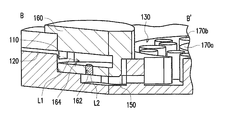
  • FIG. 3 is a partial cross-sectional view illustrating the fluid mixing structure depicted in FIG. 1 along line B-B′.
  • FIG. 4 is a schematic cross-sectional view illustrating the fluid mixing structure depicted in FIG. 1 along line C-C′.
  • FIG. 1 is a schematic top view illustrating a fluid mixing structure according to an embodiment of the present invention.
  • FIG. 2 is a schematic cross-sectional view illustrating the fluid mixing structure depicted in FIG. 1 along line A-A′.
  • a fluid mixing structure 100 includes an accommodating recess 110 , a third channel 120 , a mixing recess 130 , and a second channel 140 , wherein the third channel 120 is communicated with the accommodating recess 110 , the mixing recess 130 is communicated with the accommodating recess 110 , and the second channel 140 is communicated with the mixing recess 130 .
  • the fluid mixing structure 100 of the present embodiment may be fabricated by adopting two plates 102 and 104 .
  • the accommodating recess 110 , the third channel 120 , the mixing recess 130 , and the second channel 140 are recesses or trenches which are disposed on either the plate 102 or the plate 104 , and located between the plates 102 and 104 after the plates 102 and 104 are bonded by adopting a double-sided adhesive tape or other suitable manners.
  • the plates 102 and 104 may be disposed in a housing, such that the fluid mixing structure 100 is deemed as one part of an inspecting module. Accordingly, in FIG.
  • the fluid mixing structure 100 further includes a first channel 150 .
  • the first channel 150 is communicated with the accommodating recess 110
  • the mixing recess 130 is communicated with the first fluid 150 .
  • the accommodating recess 110 is adapted to accommodate a sample liquid which is not illustrated herein, and a reagent liquid which is not illustrated herein is adapted to flow into the accommodating recess 110 through the third channel 120 .
  • the reagent liquid entrains the sample liquid in the accommodating recess 110 . Then, the reagent liquid and the sample liquid flow into the mixing recess 130 through the first channel 150 , and are further mixed into a mixing liquid in the mixing recess 130 . In other words, two different liquids (the reagent liquid and the sample liquid) may be mixed in the mixing recess 130 . In addition, the mixing liquid which is a mixture of the reagent liquid and the sample liquid in the mixing recess 130 may flow out of the mixing recess 130 through the second channel 140 .
  • the detailed description is given as follows.
  • the inspecting module further includes a liquid collector 160 which is disposed in the accommodating recess 110 .
  • the accommodating recess 110 may be deemed as a recess structure which is located on the plates 102 and 104 and communicated with an exterior, while the liquid collector 160 is adapted to collect the sample liquid and be assembled in the accommodating recess 110 after collecting sample liquid.
  • the reagent liquid flows into the accommodating recess 110 through the third channel 120 , the reagent liquid flows into the liquid collector 160 which is disposed on the accommodating recess 110 , and then entrains the sample liquid in the liquid collector 160 , so as to flow into the mixing recess 130 through the first channel 150 thereafter.
  • the liquid collector 160 has a through hole 162 and a passage 164 which are communicated with each other.
  • the passage 164 and the through hole 162 are communicated with the third channel 120 and the first channel 150 , respectively.
  • the third channel 120 , the passage 164 , the through hole 162 , the first channel 150 , and the mixing recess 130 form a continuous flowing path.
  • the reagent liquid and the sample liquid are arranged at different locations of the flowing path, respectively. For example, an initial location of the reagent liquid is at the third channel 120 , and an initial location of the sample liquid is at the through hole 162 .
  • the reagent liquid may flows from the third channel 120 into the passage 164 of the liquid collector 160 (which is located in the accommodating recess 110 ). Then, after the reagent liquid entrains the sample liquid in the through hole 162 , the reagent liquid and the sample liquid flow into the mixing recess 130 through the first channel 150 .
  • the liquid collector 160 is only an implementation of the present application which is configured for collecting the sample liquid.
  • the sample liquid may also be dripped directly into the accommodating recess 110 , or be placed in the accommodating recess 110 after being loaded in other containers. The present application does not limit ways of arranging the sample liquid.
  • FIG. 3 is a partial cross-sectional view illustrating the fluid mixing structure depicted in FIG. 1 along line B-B′.
  • the fluid mixing structure 100 further includes a first block 170 a .
  • the first block 170 a is disposed in the mixing recess 130 , so that the mixing recess 130 becomes a ring-shaped channel by the first block 170 a .
  • the mixing recess 130 is substantially a circle, and a volume thereof is preferably bigger than volumes of the accommodating recess 110 , the third channel 120 , the second channel 140 , and the first channel 150 .
  • the first block 170 a is a cylinder, and is preferably disposed in a middle portion of the mixing recess 130 , so that the other portion of the mixing recess 130 which is not occupied by the first block 170 a becomes a ring-shaped channel.
  • the mixing recess 130 may be configured for mixing the reagent liquid and the sample liquid which flow in from the accommodating recess 110 through the first channel 150 , and the ring-shaped channel formed in the mixing recess 130 by the first block 170 a facilitates mixing of the reagent liquid and the sample liquid. More specifically, when a reagent liquid L 1 (shown as an arrow in FIG.
  • the reagent liquid L 1 and the sample liquid L 2 may mix with each other when flowing in the ring-shaped channel formed in the mixing recess 130 .
  • the fluid mixing structure 100 further includes a plurality of second blocks 170 b .
  • the second blocks 170 b are disposed in the ring-shaped channel of the mixing recess 130 .
  • the reagent liquid L 1 and the sample liquid L 2 are mixed into a mixing liquid in the ring-shaped channel of the mixing recess 130 by the second blocks 170 b .
  • the fluid mixing structure 100 of the present embodiment is provided with not only the first block 170 a to form the ring-shaped channel in the mixing recess 130 , but also the second block 170 b to increases mixing effects, wherein, the second blocks 170 b are distributed in the ring-shaped channel, and sizes of the second blocks 170 b are inconsistent.
  • the second blocks 170 b may be cylinders, but the present application does not limit shapes of the second blocks 170 b .
  • a diameter D 1 of the first block 170 a is greater than diameters D 21 and D 22 of the second blocks 170 b .
  • the first block 170 a is configured for forming the ring-shaped channel
  • the second blocks 170 b is configured for forming a turbulence structure in the ring-shaped channel, such that the reagent liquid L 1 and the sample liquid L 2 which flow into the ring-shaped channel are disturbed by the second blocks 170 b and mixed evenly.
  • the diameters D 21 and D 22 of the second blocks 170 b are inconsistent.
  • a width W 1 of the ring-shaped channel ranges between twice and triple the diameters D 21 and D 22 of the second blocks 170 b , which means that, with respect to the ring-shaped channel, the sizes of the second blocks 170 b are smaller, so as to be deemed as the turbulence structure, and distribution density of the second blocks 170 b in the ring-shaped channel may be adjusted as desired.
  • the reagent liquid L 1 and the sample liquid L 2 flow into the mixing recess 130 , the reagent liquid L 1 and the sample liquid L 2 flow in the ring-shaped channel which is formed in the mixing recess 130 , and generate vortex due to turbulence of the second blocks 170 b which are arranged in an asymmetric manner.
  • the reagent liquid L 1 and the sample liquid L 2 after converging in the liquid collector 160 of the accommodating recess 110 , flow into the mixing recess 130 , and mix with each other by turbulence generated by the second blocks 170 b when flowing in the mixing recess 130 .
  • the fluid mixing structure 100 of the present embodiment is adapted to mix the reagent liquid L 1 and the sample liquid L 2 evenly. That is to say, even when the reagent liquid L 1 and the sample liquid L 2 have lower flowability because the reagent liquid L 1 and the sample liquid L 2 have low Reynolds numbers, the reagent liquid L 1 and the sample liquid L 2 may also flow in the ring-shaped channel which is formed by the mixing recess 130 and the first block 170 a , and be mixed evenly by turbulence of the second blocks 170 b .
  • the implementation is merely used to illustrate advantages of the present application. The present application is not limited to use liquids having low Reynolds numbers as the reagent liquid L 1 and the sample liquid L 2 . After the reagent liquid L 1 and the sample liquid L 2 are mixed evenly into a mixing liquid which is not illustrated, the mixing liquid then flows out of the mixing recess 130 through the second channel 140 .
  • FIG. 4 is a schematic cross-sectional view illustrating the fluid mixing structure depicted in FIG. 1 along line C-C′.
  • the fluid mixing structure 100 may be formed by the plates 102 and 104 .
  • the aforesaid channels and recesses may be trenches or recesses which are disposed between the plates 102 and 104 . Accordingly, when channels or recesses are located at different level heights due to the trenches or recess have different depths, the reagent liquid and the sample liquid may flow therebetween, or deposition or separation thereof may happen.
  • a height hl of the third channel 120 relative to a datum plane is higher than a height h 2 of the accommodating recess 110 relative to the datum plane, such that a height drop exists between the third channel 120 and the accommodating recess 110 , as shown in FIG. 2 and FIG. 3 .
  • the reagent liquid L 1 illustrated in FIG. 3 ) may flow to the accommodating recess 110 located in a lower position through the third channel 120 located in a higher position.
  • the height h 2 of the accommodating recess 110 relative to the datum plane is higher than a height h 3 of the first channel 150 relative to the datum plane, such that a height drop exists between the accommodating recess 110 and the first channel 150 , as shown in FIG. 2 and FIG. 3 . Accordingly, the reagent liquid L 1 and the sample liquid L 2 (illustrated in FIG. 3 ) may flow to the first channel 150 located in a lower position from the accommodating recess 110 located in a higher position.
  • a depth dl of the mixing recess 130 is deeper than a depth d 2 of the second channel 140 , i.e., a bottom of the mixing recess 130 is lower than a bottom of the second channel 140 , such that a height drop exists between the mixing recess 130 and the second channel 140 , as shown in FIG. 4 .
  • the inspecting module further includes a plurality of settling recess 180 and a fourth channel 190 .
  • the settling recesses 180 are communicated with the second channel 140 and the fourth channel 190 , so that the mixing liquid may flow into the settling recesses 180 from the mixing recess 130 through the second channel 140 .
  • a depth d 3 of the settling recesses 180 is deeper than a depth of the fourth channel 190 (not marked), i.e., a bottom of the settling recesses 180 is lower than a bottom of the fourth channel 190 , such that a height drop exists between the settling recesses 180 and the fourth channel 190 .
  • quantities of the settling recess 180 and whether to provide the settling recesses 180 and the fourth channel 190 or not may be adjusted as desired, and the present application is not limited thereto.
  • the partial ingredients which are separated from the mixing liquid through the mixing recess 130 and the settling recesses 180 , or the mixing liquid without the separated partial ingredients may be used for inspecting.
  • the inspecting module further includes a measurement area R, and the measurement area R is communicated with the second channel 140 .
  • the fluid mixing structure 100 of the present embodiment adopts the settling recesses 180 and the fourth channel 190
  • a substantive implementation of the measurement area R of the present embodiment in communication with the second channel 140 is to allow the fourth channel 190 to pass through the measurement area R.
  • a biochip which is not illustrated is adapted to be disposed in the measurement area R, and the mixing liquid is adapted to flow through the biochip which is located at the measurement area R through the second channel 140 , the settling recesses 180 and the fourth channel 190 , so that the biochip may inspect biological properties of the mixing liquid which does not contain the separated partial ingredients.
  • the sample liquid is, for example, blood
  • the reagent liquid is, for example, phosphate buffered saline (PBS), but the present application does not limit varieties of the sample liquid and the reagent liquid. Varieties of the reagent liquid may also be correspondingly adjusted based on varieties of the sample liquid and items to be inspected.
  • PBS phosphate buffered saline
  • the mixing liquid is deposited in the mixing recess 130 and the settling recesses 180 sequentially for partial ingredients (e.g., red blood cells) to be separated therefrom, and then biological properties of the mixing liquid from which partial ingredients are separated are inspected by the biochip which is located at the measurement area R.
  • the biochip located in the measurement area 190 may be electrically connected to an inspection system which is not illustrated herein.
  • the biochip may inspect the mixing liquid and generate an electrical signal containing a biological property to the inspection system, such that the biological property of the mixing liquid may be acquired through the inspection system.
  • the fluid mixing structure 100 of the present embodiment is adapted to mix the reagent liquid and the sample liquid evenly before inspecting the biological property of the mixing liquid by the biochip, so as to acquire a more accurate inspecting result.
  • the inspecting module may further be provided with a waste liquid recess which is not illustrated based on needs. The waste liquid recess is communicated with the fourth channel 190 , and the measurement area R is located between the second channel 140 and the waste liquid recess.
  • the mixing liquid which flows through the fourth channel 190 flows through the measurement area R and then flows into and is collected in the waste liquid recess.
  • the waste liquid recess may be configured for collecting used mixing liquid (after being inspected by the biochip). Therefore, after the used mixing liquid flows into and is collected in the waste liquid recess through the fourth channel 190 , the inspecting module which includes the fluid mixing structure 100 may be discarded, and it is not necessary to take out the used mixing liquid.
  • the present application does not limit to whether to arrange the waste liquid recess or not, as the arrangement may become an option based on needs.
  • the first channel, the mixing recess, and the second channel are communicated with each other, wherein the ring-shaped channel is formed in the mixing recess through the first block, and the second blocks are disposed in the ring-shaped channel.
  • the reagent liquid and the sample liquid are adapted to be mixed into the mixing liquid in the ring-shaped channel of the mixing recess, and the mixing liquid then flows out of the mixing recess through the second channel.
  • a vortex is generated by the reagent liquid and the sample liquid in the ring-shaped channel of the mixing recess due to turbulence of the second blocks, so as to achieve a function of be mixed evenly in the flowing process.
  • the fluid mixing structure of the present application is adapted to mix the reagent liquid and the sample liquid evenly, and the fluid mixing structure may be applied to the inspecting module which adopts the biochip, so as to acquire a more accurate inspecting result when a biological property of the mixing liquid is subsequently inspected by the biochip.

Landscapes

  • Chemical & Material Sciences (AREA)
  • Health & Medical Sciences (AREA)
  • General Health & Medical Sciences (AREA)
  • Analytical Chemistry (AREA)
  • Chemical Kinetics & Catalysis (AREA)
  • Life Sciences & Earth Sciences (AREA)
  • Biochemistry (AREA)
  • Physics & Mathematics (AREA)
  • General Physics & Mathematics (AREA)
  • Immunology (AREA)
  • Pathology (AREA)
  • Dispersion Chemistry (AREA)
  • Hematology (AREA)
  • Clinical Laboratory Science (AREA)
  • Automatic Analysis And Handling Materials Therefor (AREA)

Abstract

A fluid mixing structure adapted to mix a reagent liquid and a sample liquid is provided. The fluid mixing structure includes a first channel, a mixing recess, a first block, a plurality of second blocks, and a second channel. The mixing recess is communicated with the first channel. The first block is disposed in the mixing recess, so that the mixing recess becomes a ring-shaped channel. The second blocks are disposed in the ring-shaped channel. The reagent liquid and the sample liquid are mixed into a mixing liquid in the ring-shaped channel. The second channel is communicated with the mixing recess. The mixing liquid flows out of the mixing recess through the second channel.

Description

FIELD OF THE PRESENT INVENTION
The present application relates to a fluid mixing structure; and more particularly, to a fluid mixing structure for mixing liquids.
DESCRIPTION OF RELATED ART
In recent years, miniaturized biochemical analysis systems have been developed. Many miniaturized inspection devices have also been applied in various kinds of analysis systems. Advantages of miniaturizing biochemical analysis systems include fast analyses, accurate quantification, low amount requirement of sample and space-saving, and the like. Therefore, many inspection devices have been developed to become miniaturized, or are even integrated to a single module.
In the existing biochemical analysis systems, a sample liquid and a reagent liquid may be mixed in a micro-channel structure, and then flow through a biochip, such that a biological property thereof is inspected. The micro-channel structure may be designed based on needs, such that the sample liquid with slight volume and the reagent liquid are mixed or separate out partial ingredients thereof when passing through the micro-channel structure. However, when the sample liquid and the reagent liquid have low Reynolds numbers, it is difficult for the sample liquid and the reagent liquid to be mixed evenly during flowing in the micro-channel due to a limited size of the micro-channel. Such situation causes inaccurate inspection results which are obtained by the biochip which subsequently inspects the mixing liquid.
SUMMARY OF THE PRESENT INVENTION
The present application provides a fluid mixing structure, which is adapted to mix a reagent liquid and a sample liquid evenly.
A fluid mixing structure of the present application is adapted to mix a reagent liquid and a sample liquid. The fluid mixing structure includes a first channel, a mixing recess, a first block, a plurality of second blocks, and a second channel. The mixing recess is communicated with the first channel. The reagent liquid and the sample liquid flow into the mixing recess through the first channel. The first block is disposed in the mixing recess, so that the mixing recess becomes a ring-shaped channel by the first block. The second blocks are disposed in the ring-shaped channel. The reagent liquid and the sample liquid are mixed into a mixing liquid in the ring-shaped channel. The second channel is communicated with the mixing recess. The mixing liquid flows out of the mixing recess through the second channel.
In view of the above, in the fluid mixing structure of the present application, the first channel, the mixing recess, and the second channel are communicated with each other, wherein the first block is disposed in the mixing recess, such that the mixing recess becomes a ring-shaped channel through the first block, and the second blocks are disposed in the ring-shaped channel. Accordingly, the reagent liquid and the sample liquid flow into the mixing recess through the first channel, and are mixed into the mixing liquid in the mixing recess, and then flow out of the mixing recess through the second channel. Accordingly, the reagent liquid and the sample liquid are disturbed by the second blocks in the ring-shaped channel, so that mixing evenness is increased. Therefore, the fluid mixing structure of the present application is adapted to mix the reagent liquid and the sample liquid evenly.
Several exemplary embodiments accompanied with figures are described in detail below to further describe the present application in details.
BRIEF DESCRIPTION OF THE DRAWINGS
The accompanying drawings are included to provide a further understanding of the present application, and are incorporated in and constitute a part of this specification. The drawings illustrate embodiments of the present application and, together with the description, serve to explain the principles of the present application.
FIG. 1 is a schematic top view illustrating a fluid mixing structure according to an embodiment of the present invention.
FIG. 2 is a schematic cross-sectional view illustrating the fluid mixing structure depicted in FIG. 1 along line A-A′.
FIG. 3 is a partial cross-sectional view illustrating the fluid mixing structure depicted in FIG. 1 along line B-B′.
FIG. 4 is a schematic cross-sectional view illustrating the fluid mixing structure depicted in FIG. 1 along line C-C′.
DETAILED DESCRIPTION OF DISCLOSED EMBODIMENTS
Reference will now be made in detail to the present preferred embodiments of the present application, examples of which are illustrated in the accompanying drawings. Wherever possible, the same reference numbers are used in the drawings and the description to refer to the same or like parts.
FIG. 1 is a schematic top view illustrating a fluid mixing structure according to an embodiment of the present invention. FIG. 2 is a schematic cross-sectional view illustrating the fluid mixing structure depicted in FIG. 1 along line A-A′. With reference to FIG. 1 and FIG. 2, in the present embodiment, a fluid mixing structure 100 includes an accommodating recess 110, a third channel 120, a mixing recess 130, and a second channel 140, wherein the third channel 120 is communicated with the accommodating recess 110, the mixing recess 130 is communicated with the accommodating recess 110, and the second channel 140 is communicated with the mixing recess 130. The fluid mixing structure 100 of the present embodiment may be fabricated by adopting two plates 102 and 104. In addition, the accommodating recess 110, the third channel 120, the mixing recess 130, and the second channel 140 are recesses or trenches which are disposed on either the plate 102 or the plate 104, and located between the plates 102 and 104 after the plates 102 and 104 are bonded by adopting a double-sided adhesive tape or other suitable manners. Furthermore, after the plates 102 and 104 are fabricated, they may be disposed in a housing, such that the fluid mixing structure 100 is deemed as one part of an inspecting module. Accordingly, in FIG. 1, the plates 102 and 104, and structures which are located between the plates 102 and 104 (e.g., the accommodating recess 110, the third channel 120, the mixing recess 130, and the second channel 140) are illustrated in dashed line. Moreover, the fluid mixing structure 100 further includes a first channel 150. The first channel 150 is communicated with the accommodating recess 110, and the mixing recess 130 is communicated with the first fluid 150. Accordingly, the accommodating recess 110 is adapted to accommodate a sample liquid which is not illustrated herein, and a reagent liquid which is not illustrated herein is adapted to flow into the accommodating recess 110 through the third channel 120. Afterwards, the reagent liquid entrains the sample liquid in the accommodating recess 110. Then, the reagent liquid and the sample liquid flow into the mixing recess 130 through the first channel 150, and are further mixed into a mixing liquid in the mixing recess 130. In other words, two different liquids (the reagent liquid and the sample liquid) may be mixed in the mixing recess 130. In addition, the mixing liquid which is a mixture of the reagent liquid and the sample liquid in the mixing recess 130 may flow out of the mixing recess 130 through the second channel 140. The detailed description is given as follows.
Specifically, in the present embodiment, the inspecting module further includes a liquid collector 160 which is disposed in the accommodating recess 110. In other words, the accommodating recess 110 may be deemed as a recess structure which is located on the plates 102 and 104 and communicated with an exterior, while the liquid collector 160 is adapted to collect the sample liquid and be assembled in the accommodating recess 110 after collecting sample liquid. Thus, after the reagent liquid flows into the accommodating recess 110 through the third channel 120, the reagent liquid flows into the liquid collector 160 which is disposed on the accommodating recess 110, and then entrains the sample liquid in the liquid collector 160, so as to flow into the mixing recess 130 through the first channel 150 thereafter. To be more specific, the liquid collector 160 has a through hole 162 and a passage 164 which are communicated with each other. When the liquid collector 160 is disposed in the accommodating recess 110, the passage 164 and the through hole 162 are communicated with the third channel 120 and the first channel 150, respectively. Accordingly, the third channel 120, the passage 164, the through hole 162, the first channel 150, and the mixing recess 130 form a continuous flowing path. The reagent liquid and the sample liquid are arranged at different locations of the flowing path, respectively. For example, an initial location of the reagent liquid is at the third channel 120, and an initial location of the sample liquid is at the through hole 162. Accordingly, the reagent liquid may flows from the third channel 120 into the passage 164 of the liquid collector 160 (which is located in the accommodating recess 110). Then, after the reagent liquid entrains the sample liquid in the through hole 162, the reagent liquid and the sample liquid flow into the mixing recess 130 through the first channel 150. However, the liquid collector 160 is only an implementation of the present application which is configured for collecting the sample liquid. For example, the sample liquid may also be dripped directly into the accommodating recess 110, or be placed in the accommodating recess 110 after being loaded in other containers. The present application does not limit ways of arranging the sample liquid.
FIG. 3 is a partial cross-sectional view illustrating the fluid mixing structure depicted in FIG. 1 along line B-B′. With reference to FIG. 1 to FIG. 3, in the present embodiment, the fluid mixing structure 100 further includes a first block 170 a. The first block 170 a is disposed in the mixing recess 130, so that the mixing recess 130 becomes a ring-shaped channel by the first block 170 a. Specifically speaking, the mixing recess 130 is substantially a circle, and a volume thereof is preferably bigger than volumes of the accommodating recess 110, the third channel 120, the second channel 140, and the first channel 150. In addition, the first block 170 a is a cylinder, and is preferably disposed in a middle portion of the mixing recess 130, so that the other portion of the mixing recess 130 which is not occupied by the first block 170 a becomes a ring-shaped channel. Accordingly, the mixing recess 130 may be configured for mixing the reagent liquid and the sample liquid which flow in from the accommodating recess 110 through the first channel 150, and the ring-shaped channel formed in the mixing recess 130 by the first block 170 a facilitates mixing of the reagent liquid and the sample liquid. More specifically, when a reagent liquid L1 (shown as an arrow in FIG. 3) entrains a sample liquid L2 (shown as oblique lines filled in the through hole 162 in FIG. 3) in the liquid collector 160, the sample liquid L2 is entrained by the reagent liquid L1 and flows, together with the reagent liquid L1, out of the liquid collector 160, and then flow into the mixing recess 130 through the first channel 150. In other words, before the reagent liquid L1 and the sample liquid L2 flow into the mixing recess 130, both liquids are not completely mixed. Since the mixing recess 130 has larger volume and the mixing recess 130 becomes the ring-shaped channel by the first block 170 a (as shown in FIG. 1), after the reagent liquid L1 and the sample liquid L2 flow together into the mixing recess 130, the reagent liquid L1 and the sample liquid L2 may mix with each other when flowing in the ring-shaped channel formed in the mixing recess 130.
In addition, in the present embodiment, the fluid mixing structure 100 further includes a plurality of second blocks 170 b. The second blocks 170 b are disposed in the ring-shaped channel of the mixing recess 130. The reagent liquid L1 and the sample liquid L2 are mixed into a mixing liquid in the ring-shaped channel of the mixing recess 130 by the second blocks 170 b. In other words, the fluid mixing structure 100 of the present embodiment is provided with not only the first block 170 a to form the ring-shaped channel in the mixing recess 130, but also the second block 170 b to increases mixing effects, wherein, the second blocks 170 b are distributed in the ring-shaped channel, and sizes of the second blocks 170 b are inconsistent. For example, the second blocks 170 b may be cylinders, but the present application does not limit shapes of the second blocks 170 b. Herein, a diameter D1 of the first block 170 a is greater than diameters D21 and D22 of the second blocks 170 b. Thus, the first block 170 a is configured for forming the ring-shaped channel, while the second blocks 170 b is configured for forming a turbulence structure in the ring-shaped channel, such that the reagent liquid L1 and the sample liquid L2 which flow into the ring-shaped channel are disturbed by the second blocks 170 b and mixed evenly. Preferably, the diameters D21 and D22 of the second blocks 170 b are inconsistent. In addition, distances D3 and D4 from centers of the second blocks 170 b to a center of the first block 170 a are inconsistent. Namely, locations of the second blocks 170 b relative to the first block 170 a are inconsistent. Furthermore, in the present embodiment, a width W1 of the ring-shaped channel ranges between twice and triple the diameters D21 and D22 of the second blocks 170 b, which means that, with respect to the ring-shaped channel, the sizes of the second blocks 170 b are smaller, so as to be deemed as the turbulence structure, and distribution density of the second blocks 170 b in the ring-shaped channel may be adjusted as desired.
Accordingly, after the reagent liquid L1 and the sample liquid L2 flow into the mixing recess 130, the reagent liquid L1 and the sample liquid L2 flow in the ring-shaped channel which is formed in the mixing recess 130, and generate vortex due to turbulence of the second blocks 170 b which are arranged in an asymmetric manner. In other words, the reagent liquid L1 and the sample liquid L2, after converging in the liquid collector 160 of the accommodating recess 110, flow into the mixing recess 130, and mix with each other by turbulence generated by the second blocks 170 b when flowing in the mixing recess 130. Accordingly, the fluid mixing structure 100 of the present embodiment is adapted to mix the reagent liquid L1 and the sample liquid L2 evenly. That is to say, even when the reagent liquid L1 and the sample liquid L2 have lower flowability because the reagent liquid L1 and the sample liquid L2 have low Reynolds numbers, the reagent liquid L1 and the sample liquid L2 may also flow in the ring-shaped channel which is formed by the mixing recess 130 and the first block 170 a, and be mixed evenly by turbulence of the second blocks 170 b. However, the implementation is merely used to illustrate advantages of the present application. The present application is not limited to use liquids having low Reynolds numbers as the reagent liquid L1 and the sample liquid L2. After the reagent liquid L1 and the sample liquid L2 are mixed evenly into a mixing liquid which is not illustrated, the mixing liquid then flows out of the mixing recess 130 through the second channel 140.
FIG. 4 is a schematic cross-sectional view illustrating the fluid mixing structure depicted in FIG. 1 along line C-C′. With reference to FIG. 1 to FIG. 4, in the present embodiment, the fluid mixing structure 100, as described previously, may be formed by the plates 102 and 104. Thus, the aforesaid channels and recesses may be trenches or recesses which are disposed between the plates 102 and 104. Accordingly, when channels or recesses are located at different level heights due to the trenches or recess have different depths, the reagent liquid and the sample liquid may flow therebetween, or deposition or separation thereof may happen. For example, in the present embodiment, a height hl of the third channel 120 relative to a datum plane (e.g., a bottom surface of the plate 104) is higher than a height h2 of the accommodating recess 110 relative to the datum plane, such that a height drop exists between the third channel 120 and the accommodating recess 110, as shown in FIG. 2 and FIG. 3. Accordingly, the reagent liquid L1 (illustrated in FIG. 3) may flow to the accommodating recess 110 located in a lower position through the third channel 120 located in a higher position. In addition, in the present embodiment, the height h2 of the accommodating recess 110 relative to the datum plane is higher than a height h3 of the first channel 150 relative to the datum plane, such that a height drop exists between the accommodating recess 110 and the first channel 150, as shown in FIG. 2 and FIG. 3. Accordingly, the reagent liquid L1 and the sample liquid L2 (illustrated in FIG. 3) may flow to the first channel 150 located in a lower position from the accommodating recess 110 located in a higher position. Furthermore, in the present embodiment, a depth dl of the mixing recess 130 is deeper than a depth d2 of the second channel 140, i.e., a bottom of the mixing recess 130 is lower than a bottom of the second channel 140, such that a height drop exists between the mixing recess 130 and the second channel 140, as shown in FIG. 4. Accordingly, after the sample liquid and the reagent liquid are mixed into a mixing liquid in the mixing recess 130, partial ingredients of the mixing liquid are separated through deposition in the mixing recess 130, wherein, since the height drop exists between the mixing recess 130 and the second channel 140, the partial ingredients which are separated from the mixing liquid are deposited in the bottom of the mixing recess 130, and the mixing liquid without the separated partial ingredients flows out of the mixing recess 130 through the second channel 140 due to the height drop.
Moreover, the inspecting module further includes a plurality of settling recess 180 and a fourth channel 190. The settling recesses 180 are communicated with the second channel 140 and the fourth channel 190, so that the mixing liquid may flow into the settling recesses 180 from the mixing recess 130 through the second channel 140. Similarly, a depth d3 of the settling recesses 180 is deeper than a depth of the fourth channel 190 (not marked), i.e., a bottom of the settling recesses 180 is lower than a bottom of the fourth channel 190, such that a height drop exists between the settling recesses 180 and the fourth channel 190. Accordingly, after the mixing liquid flows into the settling recesses 180 from the mixing recess 130 through the second channel 140, partial ingredients of the mixing liquid are separated through deposition in the settling recesses 180. In other words, partial ingredients in the mixing liquid from which the partial ingredients are separated in the mixing recess 130 may again be separated through deposition in the settling recesses 180, and the mixing liquid without the separated partial ingredients flows out of the settling recesses 180 from the fourth channel 190 due to the height drop. Thus, it is concluded that different components may be sequentially separated from the mixing liquid through deposition during a flowing process by arranging settling recesses 180 in different quantities and depths. Accordingly, quantities of the settling recess 180 and whether to provide the settling recesses 180 and the fourth channel 190 or not may be adjusted as desired, and the present application is not limited thereto. Afterwards, the partial ingredients which are separated from the mixing liquid through the mixing recess 130 and the settling recesses 180, or the mixing liquid without the separated partial ingredients may be used for inspecting.
With reference to FIG. 1 again, the inspecting module further includes a measurement area R, and the measurement area R is communicated with the second channel 140. Specifically speaking, since the fluid mixing structure 100 of the present embodiment adopts the settling recesses 180 and the fourth channel 190, a substantive implementation of the measurement area R of the present embodiment in communication with the second channel 140 is to allow the fourth channel 190 to pass through the measurement area R. Accordingly, a biochip which is not illustrated is adapted to be disposed in the measurement area R, and the mixing liquid is adapted to flow through the biochip which is located at the measurement area R through the second channel 140, the settling recesses 180 and the fourth channel 190, so that the biochip may inspect biological properties of the mixing liquid which does not contain the separated partial ingredients. More specifically, in the present embodiment, the sample liquid is, for example, blood, and the reagent liquid is, for example, phosphate buffered saline (PBS), but the present application does not limit varieties of the sample liquid and the reagent liquid. Varieties of the reagent liquid may also be correspondingly adjusted based on varieties of the sample liquid and items to be inspected. After the sample liquid and the reagent liquid start biochemical reactions and are mixed into a mixing liquid in the mixing recess 130, the mixing liquid is deposited in the mixing recess 130 and the settling recesses 180 sequentially for partial ingredients (e.g., red blood cells) to be separated therefrom, and then biological properties of the mixing liquid from which partial ingredients are separated are inspected by the biochip which is located at the measurement area R. In addition, in the present embodiment, the biochip located in the measurement area 190 may be electrically connected to an inspection system which is not illustrated herein. When the mixing liquid from which the partial ingredients are separated flows through the biochip, the biochip may inspect the mixing liquid and generate an electrical signal containing a biological property to the inspection system, such that the biological property of the mixing liquid may be acquired through the inspection system.
In other words, since the sample liquid and the reagent liquid of the present embodiment have been completely mixed in the mixing recess 130 before being inspected by the biochip, accuracy of inspecting the biological property of the mixing liquid by the biochip may be improved. Accordingly, the fluid mixing structure 100 of the present embodiment is adapted to mix the reagent liquid and the sample liquid evenly before inspecting the biological property of the mixing liquid by the biochip, so as to acquire a more accurate inspecting result. Furthermore, the inspecting module may further be provided with a waste liquid recess which is not illustrated based on needs. The waste liquid recess is communicated with the fourth channel 190, and the measurement area R is located between the second channel 140 and the waste liquid recess. Namely, the mixing liquid which flows through the fourth channel 190 flows through the measurement area R and then flows into and is collected in the waste liquid recess. Accordingly, the waste liquid recess may be configured for collecting used mixing liquid (after being inspected by the biochip). Therefore, after the used mixing liquid flows into and is collected in the waste liquid recess through the fourth channel 190, the inspecting module which includes the fluid mixing structure 100 may be discarded, and it is not necessary to take out the used mixing liquid. However, the present application does not limit to whether to arrange the waste liquid recess or not, as the arrangement may become an option based on needs.
In summary, in the fluid mixing structure of the present application, the first channel, the mixing recess, and the second channel are communicated with each other, wherein the ring-shaped channel is formed in the mixing recess through the first block, and the second blocks are disposed in the ring-shaped channel. Accordingly, the reagent liquid and the sample liquid are adapted to be mixed into the mixing liquid in the ring-shaped channel of the mixing recess, and the mixing liquid then flows out of the mixing recess through the second channel. In this way, a vortex is generated by the reagent liquid and the sample liquid in the ring-shaped channel of the mixing recess due to turbulence of the second blocks, so as to achieve a function of be mixed evenly in the flowing process. In view of the above, the fluid mixing structure of the present application is adapted to mix the reagent liquid and the sample liquid evenly, and the fluid mixing structure may be applied to the inspecting module which adopts the biochip, so as to acquire a more accurate inspecting result when a biological property of the mixing liquid is subsequently inspected by the biochip.
Although the present application has been disclosed with reference to the aforesaid embodiments, they are not intended to limit the present application. It will be apparent to those skilled in the art that various modifications and variations can be made to the structure of the disclosed embodiments without departing from the scope or spirit of the present application. In view of the foregoing, it is intended that the disclosure cover modifications and variations of the specification provided they fall within the scope of the following claims and their equivalents.
Claims (6)

What is claimed is:
1. A fluid mixing structure, adapted to mix a reagent liquid and a sample liquid, the fluid mixing structure comprising:
a first channel;
a mixing recess, communicating with the first channel, the reagent liquid and the sample liquid flowing into the mixing recess through the first channel;
a first block, disposed in the mixing recess, so that the mixing recess becomes a ring-shaped channel by the first block;
a plurality of second blocks, disposed in the ring-shaped channel, the reagent liquid and the sample liquid being mixed into a mixing liquid in the ring-shaped channel;
a second channel, communicating with the mixing recess, the mixing liquid flowing out of the mixing recess through the second channel; and
two plates, bonded together, wherein the mixing recess and the second channel are disposed on the plates and located between the plates after the plates are bonded.
2. The fluid mixing structure as claimed in claim 1, wherein the first block and the second blocks are a cylinder, and diameters of the second blocks are inconsistent.
3. The fluid mixing structure as claimed in claim 2, wherein a diameter of the first block is larger than the diameters of the second blocks.
4. The fluid mixing structure as claimed in claim 2, wherein distances from centers of the second blocks to a center of the first block are inconsistent.
5. The fluid mixing structure as claimed in claim 2, wherein a width of the ring-shaped channel ranges between twice and triple the diameters of the second blocks.
6. The fluid mixing structure as claimed in claim 1, wherein a depth of the mixing recess is deeper than a depth of the second channel.
US14/555,689 2014-11-28 2014-11-28 Fluid mixing structure Active 2035-01-30 US9475016B2 (en)

Priority Applications (1)

Application Number Priority Date Filing Date Title
US14/555,689 US9475016B2 (en) 2014-11-28 2014-11-28 Fluid mixing structure

Applications Claiming Priority (1)

Application Number Priority Date Filing Date Title
US14/555,689 US9475016B2 (en) 2014-11-28 2014-11-28 Fluid mixing structure

Publications (2)

Publication Number Publication Date
US20160151750A1 US20160151750A1 (en) 2016-06-02
US9475016B2 true US9475016B2 (en) 2016-10-25

Family

ID=56078555

Family Applications (1)

Application Number Title Priority Date Filing Date
US14/555,689 Active 2035-01-30 US9475016B2 (en) 2014-11-28 2014-11-28 Fluid mixing structure

Country Status (1)

Country Link
US (1) US9475016B2 (en)

Citations (15)

* Cited by examiner, † Cited by third party
Publication number Priority date Publication date Assignee Title
US3361413A (en) * 1966-11-10 1968-01-02 Young Machinery Company Inc Apparatus for blending particulate solids
US3860129A (en) * 1972-06-23 1975-01-14 Ciotat La Apparatus for homogenizing particulate material
US4285602A (en) * 1979-05-14 1981-08-25 Union Carbide Corporation Method and apparatus for the blending of granular materials
US4518260A (en) * 1983-08-26 1985-05-21 Phillips Petroleum Company Apparatus for blending solids or the like
US4724754A (en) * 1985-08-08 1988-02-16 Bertrand Crozat Apparatus for making molded confections
JPH02144136A (en) 1988-11-25 1990-06-01 Ebara Corp Emulsifying disperser
JPH08332364A (en) 1995-03-29 1996-12-17 Eastman Kodak Co Solution mixing device
TW429288B (en) 2000-08-17 2001-04-11 Ind Tech Res Inst Micro-fluid order-changing mixer
US20030235111A1 (en) * 2002-06-19 2003-12-25 Bishop Jerry C. Noise reducing silo
US20090251989A1 (en) * 2007-06-26 2009-10-08 Pfefferle William C Streamlined flow mixer
US20100103769A1 (en) * 2007-03-15 2010-04-29 Bachman Gene W Mixer for a continous flow reactor, continuos flow reactor, mehtod of forming such a mixer, and method of operating such a reactor
US20120014209A1 (en) * 2010-07-15 2012-01-19 Smith Robert S Enhanced static mixing device
US20120300577A1 (en) * 2011-04-18 2012-11-29 Buttridge Ian G Method and system for improved reactant mixing and distribution
US20130215705A1 (en) * 2010-11-12 2013-08-22 Dental Care Innovation Gmbh Dissolution Chamber for Cleaning Tablets
US20140038209A1 (en) 2012-08-01 2014-02-06 Feng Chia University Apparatus and Methodology to Carry Out Biochemical Testing on a Centrifugal Platform Using Flow Splitting Technique

Patent Citations (15)

* Cited by examiner, † Cited by third party
Publication number Priority date Publication date Assignee Title
US3361413A (en) * 1966-11-10 1968-01-02 Young Machinery Company Inc Apparatus for blending particulate solids
US3860129A (en) * 1972-06-23 1975-01-14 Ciotat La Apparatus for homogenizing particulate material
US4285602A (en) * 1979-05-14 1981-08-25 Union Carbide Corporation Method and apparatus for the blending of granular materials
US4518260A (en) * 1983-08-26 1985-05-21 Phillips Petroleum Company Apparatus for blending solids or the like
US4724754A (en) * 1985-08-08 1988-02-16 Bertrand Crozat Apparatus for making molded confections
JPH02144136A (en) 1988-11-25 1990-06-01 Ebara Corp Emulsifying disperser
JPH08332364A (en) 1995-03-29 1996-12-17 Eastman Kodak Co Solution mixing device
TW429288B (en) 2000-08-17 2001-04-11 Ind Tech Res Inst Micro-fluid order-changing mixer
US20030235111A1 (en) * 2002-06-19 2003-12-25 Bishop Jerry C. Noise reducing silo
US20100103769A1 (en) * 2007-03-15 2010-04-29 Bachman Gene W Mixer for a continous flow reactor, continuos flow reactor, mehtod of forming such a mixer, and method of operating such a reactor
US20090251989A1 (en) * 2007-06-26 2009-10-08 Pfefferle William C Streamlined flow mixer
US20120014209A1 (en) * 2010-07-15 2012-01-19 Smith Robert S Enhanced static mixing device
US20130215705A1 (en) * 2010-11-12 2013-08-22 Dental Care Innovation Gmbh Dissolution Chamber for Cleaning Tablets
US20120300577A1 (en) * 2011-04-18 2012-11-29 Buttridge Ian G Method and system for improved reactant mixing and distribution
US20140038209A1 (en) 2012-08-01 2014-02-06 Feng Chia University Apparatus and Methodology to Carry Out Biochemical Testing on a Centrifugal Platform Using Flow Splitting Technique

Non-Patent Citations (1)

* Cited by examiner, † Cited by third party
Title
"Office Action of Taiwan Counterpart Application", issued on Mar. 22, 2016, p. 1-4.

Also Published As

Publication number Publication date
US20160151750A1 (en) 2016-06-02

Similar Documents

Publication Publication Date Title
US10092902B2 (en) Fluid interface cartridge for a microfluidic chip
US7731901B2 (en) Apparatus and method for performing counts within a biologic fluid sample
US10894973B2 (en) Nucleic acid introduction method, nucleic acid detection method, biomolecule analysis method, array device for biomolecule quantification, and biomolecule analysis kit
CN103282123B (en) Biological Fluid Analysis Cartridge with Sample Processing Area and Analysis Chamber Area
US9366606B1 (en) Fluid processing micro-feature devices and methods
US20200033239A1 (en) Fluid processing micro-feature devices and methods
EP4040164A1 (en) Cell screening device and cell screening kit
US8562911B2 (en) Centrifugal rotor and method for using the same for delivering biological sample
JP2009139369A (en) Microchip
US9475016B2 (en) Fluid mixing structure
CN113996361A (en) Multi-channel micro-fluidic chip for blood sample detection
US20180149582A1 (en) Channel structure, measurement unit, method of measuring liquid to be measured, and measurement device for liquid to be measured
US20160067709A1 (en) Micro-channel module
TWI551344B (en) Fluid mixing structure
US11071982B2 (en) Fluid holding and dispensing micro-feature
US20200230600A1 (en) Apparatus and methods for handling liquid
CN105699162B (en) fluid mixing structure
JP2006132990A (en) Reaction container with dispenser
JP4880419B2 (en) Chip having measuring unit and method for measuring liquid sample using the same
TWI541495B (en) Slight volume collector
JP2008101984A (en) Chip having measurement section and method of measuring liquid sample using the chip
KR101635510B1 (en) In-line lab-on-a-chip system for measuring a difference in speed according to slip of red blood cell membrane and there of optical detection system
JP2006132991A (en) Dispenser and dispensing method
US9669408B2 (en) Slight volume collector
KR20250002303A (en) Microfluidic Urine Albumin/Creatinine Chip (UACR-CHIP) for Assessment of Chronic Kidney Disease

Legal Events

Date Code Title Description
AS Assignment

Owner name: HTC CORPORATION, TAIWAN

Free format text: ASSIGNMENT OF ASSIGNORS INTEREST;ASSIGNORS:LIN, SHENG-CHIEH;SUN, PIN-CHUNG;TSENG, YAO-TING;AND OTHERS;SIGNING DATES FROM 20141125 TO 20141203;REEL/FRAME:034933/0628

STCF Information on status: patent grant

Free format text: PATENTED CASE

MAFP Maintenance fee payment

Free format text: PAYMENT OF MAINTENANCE FEE, 4TH YEAR, LARGE ENTITY (ORIGINAL EVENT CODE: M1551); ENTITY STATUS OF PATENT OWNER: LARGE ENTITY

Year of fee payment: 4

MAFP Maintenance fee payment

Free format text: PAYMENT OF MAINTENANCE FEE, 8TH YEAR, LARGE ENTITY (ORIGINAL EVENT CODE: M1552); ENTITY STATUS OF PATENT OWNER: LARGE ENTITY

Year of fee payment: 8