US9471886B2 - Class discriminative feature transformation - Google Patents
Class discriminative feature transformation Download PDFInfo
- Publication number
- US9471886B2 US9471886B2 US14/459,242 US201414459242A US9471886B2 US 9471886 B2 US9471886 B2 US 9471886B2 US 201414459242 A US201414459242 A US 201414459242A US 9471886 B2 US9471886 B2 US 9471886B2
- Authority
- US
- United States
- Prior art keywords
- face
- class
- feature samples
- image
- speech
- Prior art date
- Legal status (The legal status is an assumption and is not a legal conclusion. Google has not performed a legal analysis and makes no representation as to the accuracy of the status listed.)
- Active, expires
Links
Images


Classifications
-
- G06N99/005—
-
- G—PHYSICS
- G06—COMPUTING OR CALCULATING; COUNTING
- G06N—COMPUTING ARRANGEMENTS BASED ON SPECIFIC COMPUTATIONAL MODELS
- G06N20/00—Machine learning
-
- G—PHYSICS
- G06—COMPUTING OR CALCULATING; COUNTING
- G06F—ELECTRIC DIGITAL DATA PROCESSING
- G06F18/00—Pattern recognition
- G06F18/20—Analysing
- G06F18/21—Design or setup of recognition systems or techniques; Extraction of features in feature space; Blind source separation
- G06F18/213—Feature extraction, e.g. by transforming the feature space; Summarisation; Mappings, e.g. subspace methods
- G06F18/2132—Feature extraction, e.g. by transforming the feature space; Summarisation; Mappings, e.g. subspace methods based on discrimination criteria, e.g. discriminant analysis
- G06F18/21322—Rendering the within-class scatter matrix non-singular
-
- G06K9/6235—
-
- G—PHYSICS
- G06—COMPUTING OR CALCULATING; COUNTING
- G06N—COMPUTING ARRANGEMENTS BASED ON SPECIFIC COMPUTATIONAL MODELS
- G06N20/00—Machine learning
- G06N20/10—Machine learning using kernel methods, e.g. support vector machines [SVM]
-
- G—PHYSICS
- G06—COMPUTING OR CALCULATING; COUNTING
- G06V—IMAGE OR VIDEO RECOGNITION OR UNDERSTANDING
- G06V10/00—Arrangements for image or video recognition or understanding
- G06V10/70—Arrangements for image or video recognition or understanding using pattern recognition or machine learning
- G06V10/77—Processing image or video features in feature spaces; using data integration or data reduction, e.g. principal component analysis [PCA] or independent component analysis [ICA] or self-organising maps [SOM]; Blind source separation
- G06V10/7715—Feature extraction, e.g. by transforming the feature space, e.g. multi-dimensional scaling [MDS]; Mappings, e.g. subspace methods
-
- G—PHYSICS
- G06—COMPUTING OR CALCULATING; COUNTING
- G06F—ELECTRIC DIGITAL DATA PROCESSING
- G06F18/00—Pattern recognition
- G06F18/20—Analysing
- G06F18/21—Design or setup of recognition systems or techniques; Extraction of features in feature space; Blind source separation
- G06F18/213—Feature extraction, e.g. by transforming the feature space; Summarisation; Mappings, e.g. subspace methods
- G06F18/2132—Feature extraction, e.g. by transforming the feature space; Summarisation; Mappings, e.g. subspace methods based on discrimination criteria, e.g. discriminant analysis
- G06F18/21322—Rendering the within-class scatter matrix non-singular
- G06F18/21324—Rendering the within-class scatter matrix non-singular involving projections, e.g. Fisherface techniques
-
- G06K2009/6236—
Definitions
- the present invention relates generally to data processing and feature extraction; and more particularly to a system and method for feature transformation of data sets.
- feature extraction is a special form of dimensionality reduction that effectively represents the interest points in a feature vector.
- the input data to a process is too large to be processed and it includes some redundancy
- the input data may be transformed into a reduced representation set of features, i.e., a feature vector. If done properly, the features set includes the relevant information from the input data to perform the desired task using the reduced representation by the feature vectors.
- Feature extraction techniques simplify the amount of data required to describe a large set of data accurately.
- Feature extraction has been widely used in image processing and optical character recognition which use different algorithms to detect and isolate various features of a dataset, for example, digitized image, video stream, speech, or text.
- feature extraction is followed by classification which is a method of identifying to which of a set of categories (classes) a new observation belongs, on the basis of a training set of data containing observations (or instances) for which their category is already known.
- supervised classification is considered an instance of learning, where a training set of correctly identified observations (features) is available (training set).
- the unsupervised procedures such as clustering, comprise of grouping data into categories based on some measure of inherent similarity. For example, the distance between instances, considered as vectors in a multi-dimensional vector space.
- the observations are often known as instances, the explanatory variables are termed features and the possible categories to be predicted are classes.
- a common subclass of classification is probabilistic classification. Algorithms of this nature use statistical inference to find the best class for a given instance. Unlike other algorithms, which simply output a best class, probabilistic algorithms output a probability of the instance being a member of each of the possible classes. Typically, the best class is then selected as the one with the highest probability.
- Classification and clustering are examples of the more general problem of pattern recognition, which is the assignment of an output value to a given input value.
- Other examples are regression, which assigns a real-valued output to each input; or sequence labeling, which assigns a class to each member of a sequence of values, for example, part of speech tagging, which assigns a part of speech to each word in an input sentence.
- a training set is a set of data used to discover potentially predictive relationships.
- a training set includes an input feature vector and a corresponding label vector, which are used together with a supervised learning method to train a knowledge database.
- a training set is used to fit a model that can be used to predict a “response value” from one or more “predictors.” The fitting can include both variable selection and parameter estimation.
- Statistical models used for prediction are often called regression models, of which linear regression and logistic regression are two examples.
- a training set is often used in conjunction with a test set, which is a set of data used to assess the strength and utility of a predictive relationship that is using the learned parameters to predict and compare the accuracy.
- the present invention is a method for feature normalization with a computationally efficient class discriminative feature transformation for highly accurate classification results.
- the invention provides an efficient class discriminative feature transformation system that provides an improved feature transform that maximizes inter-class separability and minimizes the intra-class variance.
- the present invention operates independently of the data type and data dimension and is capable of exploiting the limited amounts of training data while preserving full feature dimensionality.
- the present invention scales linearly with the dimension of the given high-dimensional feature vector.
- the present invention is a computer implemented method for feature transformation of a data set.
- the computer implemented method includes: receiving a data set including original feature samples with corresponding class labels; splitting the data set into a direction optimization set and a training set; using the direction optimization set to calculate an optimum transformation vector that maximizes inter-class separability and minimizes intra-class variance of the feature samples with respect to corresponding class labels; using the optimum transformation vector to transform the rest of the original feature samples of the data set to new feature samples with enhanced discriminative characteristics; and training a classifier using the new feature samples, wherein the method is performed by one or more processors.
- a conjugate gradient descent based least square method is used to calculate the optimum transformation vector.
- the optimum transformation vector is used to transform the original feature samples of the data set while maintaining the same dimensionality.
- the optimum transformation vector is calculated by: learning a class discriminative projection vector using a Fisher Linear Discriminant Analysis (FLDA) criterion; projecting the original feature samples such that the feature directions along the projection vector are maximized while other directions are minimized while maintain the dimensionality to obtain new discriminative features; and learning a Support Vector Machine (SVM) based classifier on said new discriminative features.
- FLDA Fisher Linear Discriminant Analysis
- SVM Support Vector Machine
- FIG. 1 is an exemplary process flow, according to some embodiments of the present invention.
- FIG. 2 is an exemplary pipeline flow, executed by one or more processors, according to some embodiments of the present invention.
- the present invention takes a novel data-driven approach to automatically learn a (dis)similarity distance metric.
- a novel supervised feature transformation technique hereby called Class Discriminative Feature Transform (CDFT) is developed.
- CDFT Class Discriminative Feature Transform
- the principle behind CDFT is to maximize the between-class separability and suppress the variance of the data in the directions that are not discriminative.
- a subset of training data is used to compute the direction vector that simultaneously maximizes the between-class mean distance and minimizes the intra-class variance using the Fisher's Linear Discriminant Analysis (FLDA) criterion. This vector is then used for transforming the features in their original space to enhance their discriminative power.
- FLDA Linear Discriminant Analysis
- LDA Linear Discriminant Analysis
- the processes according to the present invention may be executed by one or more processors, such as a general purpose, special purpose computer or one or more server computers, using software, firmware or a combination thereof.
- the present invention performs unconstrained face verification in four main steps. First, low level features are extracted. Next, a transform that maximizes inter-class separability and minimizes intra-class variance. Then this transform is used to transform the original feature vectors enhancing the discriminative power along the class discriminative transformation vector while maintaining full dimensionality. Finally, a binary Support Vector Machine (SVM) classifier is learned at the training stage.
- SVM Support Vector Machine
- FIG. 1 is an exemplary process flow, executed by one or more processors, according to some embodiments of the present invention.
- a data set is received.
- the data set may be ground-truth labelled image, speech, text, etc. samples represented in turn by corresponding feature vectors.
- the data set at hand is then randomly split into a direction optimization set and a training set, in block 104 , typically in a 1:10 ratio respectively.
- the invention uses the direction optimization set to calculate an optimum transformation vector that maximizes inter-class separability and minimizes intra-class variance of the feature samples with respect to corresponding class labels by the FLDA criterion.
- the present invention uses it to transform the data at hand (Eq. 9) enhancing their discriminative power, while maintaining their original dimensionality.
- the invention trains a classifier using the new feature samples.
- the invention produces significant gains in face recognition performance over state-of-the-art and can be leveraged for building solutions based on face verification of interest to various end users. Further, since this a generalized feature transformation technique, it can be used in other machine learning applications, including but not limited to, speech, text and object classification problems. The feature transformation technique of the invention can also be applied to any classification task.
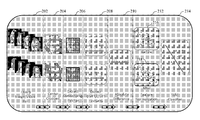
- FIG. 2 is an exemplary pipeline flow, executed by one or more processors, according to some embodiments of the present invention.
- Blocks 202 - 210 are related to receiving a data set and extracting features from the data set.
- a data set for example, including images or video is received.
- the query could be a pair of images/videos.
- Labelled Faces in the Wild (LFW) and YOU Faces in the Wild (YFW) are publically available datasets to address the problem of unconstrained face verification (with Aging, Pose, Illumination and Expression, A-PIE variations) in the wild.
- LFW contains a total of 13, 233 web images of 5,479 subjects, where the number of images per subject varies from 1 to 530.
- the set of 6000 randomly selected image pairs is divided into 10 different partitions such that each partition contains 300 matched and 300 mismatched pairs.
- YFD on the other hand, consists of 3,425 videos if 1, 595 different individuals, with an average of 2.15 videos per individual where the average length of a video clip is 181.3 frames (@24 fps).
- Each of the 10 folds contains 250 matched and 250 mismatched pair of face videos. Further, the train and test pairs are mutually exclusive across all the folds.
- the invention uses the roughly aligned images from the datasets and resizes the images/videos to, for example, 250 ⁇ 250 and then center-crops to, for example, 150 ⁇ 150.
- the invention extracts low-level features such as Scale Invariant Feature Transform (SIFT) features represented by corresponding Fisher Vectors.
- SIFT Scale Invariant Feature Transform
- the invention uses VLFeat encoding scheme for feature extraction, which trains a Gaussian Mixture Model (GMM) to model the probability density of the words/clusters in the vocabulary.
- GMM Gaussian Mixture Model
- each pair of face image/video representations is used to obtain an absolute difference vector, which is in turn used to train a Support Vector Machine (SVM) classifier in block 214 .
- SVM Support Vector Machine
- the SVM classifier learns a hyperplane discriminating the two classes (matched and mismatched pair) in a max-margin framework.
- feature transformation is performed on the original features 216 to obtain new discriminative feature samples 218 .
- the training set is split to learn the projection ( ⁇ * in eq. 6) and projects only the rest of the training set, a substantial amount of floating point computations (O(n 2 )) are saved at both training and testing stages. (Eq. 6).
- each x i ⁇ D is a D-dimensional data vector (for example, a high-dimensional Fisher Vectors used as the baseline data vector) and y i ⁇ 1,1 ⁇ is its corresponding binary label.
- the goal is to find a direction in the feature space which maximizes the between class (inter-class) separability and suppresses the variance of the given data in the other directions. This serves two purposes. First, the noise in the data is suppressed. Second, not completely omitting the other directions prevents loss of information. Given this goal, Fisher's Linear Discriminant Analysis (FLDA) is a well-known approach that aims at achieving this criteria. The objective function of FLDA implicitly finds a projection vector along which data vectors of the same class have similar scores.
- S is the data covariance matrix and ⁇ 1 and ⁇ ⁇ 1 are mean vectors for class 1 and ⁇ 1 respectively.
- ⁇ * arg ⁇ ⁇ min ⁇ ⁇ ⁇ t - X ⁇ ⁇ ⁇ ⁇ 2 ⁇ , ( 3 )
- X ⁇ N ⁇ D is the data matrix, with each row as one sample, and t ⁇ N is the corresponding signed target vector, whose components are given by
- N and N ⁇ 1 are the number of positive and negative class samples respectively.
- ⁇ ⁇ * arg ⁇ ⁇ min ⁇ ⁇ ⁇ ⁇ t - X ⁇ ⁇ ⁇ ⁇ ⁇ 2 + ⁇ ⁇ ⁇ ⁇ ⁇ ⁇ 2 ( 6 )
- the invention uses this optimal direction for normalizing the data at hand. Since ⁇ * represents the class discriminative direction, the relative variance of the data needs to be increased along this direction while suppressing other directions in the original feature space. To achieve this, consider any unitary matrix V ⁇ D ⁇ D with ⁇ * fixed as its first column vector (without any loss of generality).
- ⁇ is a diagonal matrix whose elements are given by:
- the transformation vector (matrix) of the present invention enhances those directions in the feature space that would increase the separation between inter-class quality mean vectors which in turn is used to project the initial feature vectors enhancing their discriminativity (Eq. 9).
- the conventional Fisher LDA process entails the following steps:
- the Least Squares LDA approach entails the following steps:
- This approach can be used for extending the LDA approach to high dimensional datasets where taking the inverse of the covariance matrix might be very computationally expensive.
Landscapes
- Engineering & Computer Science (AREA)
- Theoretical Computer Science (AREA)
- Computer Vision & Pattern Recognition (AREA)
- Software Systems (AREA)
- Physics & Mathematics (AREA)
- Artificial Intelligence (AREA)
- Data Mining & Analysis (AREA)
- General Physics & Mathematics (AREA)
- Evolutionary Computation (AREA)
- General Engineering & Computer Science (AREA)
- Medical Informatics (AREA)
- Computing Systems (AREA)
- Mathematical Physics (AREA)
- General Health & Medical Sciences (AREA)
- Databases & Information Systems (AREA)
- Multimedia (AREA)
- Health & Medical Sciences (AREA)
- Life Sciences & Earth Sciences (AREA)
- Bioinformatics & Cheminformatics (AREA)
- Bioinformatics & Computational Biology (AREA)
- Evolutionary Biology (AREA)
- Image Analysis (AREA)
Abstract
Description
D={x i ,y i}i=1 N (1)

ω*∝S −1(μ1−μ−1) (2)
which gives the same direction as the original FLDA optimization. Hence, Eqs. (3) and (4) can be combined to find the optimal direction that meets the FLDA criterion. In some embodiments, this alternate optimization method is used, because of the computational efficiency of the quadratic program.
x norm=(VΣV T)x (7)
| Algorithm 1 Conjugate Gradient method for Solving (6) |
| INPUT: y, {tilde over (X)}, λ = 0.001 | ||
| INITIALIZE: | ||
| {tilde over (w)} = 0, p = r1 = 2 ({tilde over (X)}T t − {tilde over (X)}T {tilde over (X)} {tilde over (w)} + λ{tilde over (w)}), | ||
| while not converged or max iteration reached do | ||
| 1. a1 ← (r1 T r1)/(2({tilde over (X)}p)T ({tilde over (X)}p) + 2λpT p) | ||
| 2. {tilde over (w)} ← {tilde over (w)} + a1p | ||
| 3. r2 ← r1 − 2a1 ({tilde over (X)}T ({tilde over (X)}p) + λp) | ||
| 4. a2 ← (r2 T r2)/(r1 T r1) | ||
| 5. p ← r2 + a2p | ||
| 6. r1 ← r2 | ||
| end while | ||
| w ← {tilde over (w)}1:D | ||
| OUTPUT: w ← w/||w||2 | ||
Thus, for an RBF kernel, the proposed metric learning scales the original kernel with another kernel which depends on the estimated signed label values of the two data vectors. This can then be used for training kernel support vector machines (SVM).
-
- Given a dataset
-
- the objective is to suppress those directions in the feature space which are not discriminative
- FLDA Solution: The transformation matrix obtained is:
-
- where c(1) and c(2) are respectively the mean vectors of class 1 and 2. S is the data covariance matrix
- For Fisher Vector (d≈10), taking the data invariance is not computationally feasible
- Solution: Linear Regression with class label as the output is equivalent to Fisher LDA
-
- Assume that both {xi} and {yi} are mean centered, it follows that yiε{−2n/n, 2n1/n} where n1 and n2 denote number of samples from each class respectively
- Objective function:
-
- Solution: w=(XXT)−1Xy
- It can be shown that
-
- Hence, ‘w’ learned by optimizing least square error can instead be used for the FLDA criterion
Claims (6)
Priority Applications (1)
| Application Number | Priority Date | Filing Date | Title |
|---|---|---|---|
| US14/459,242 US9471886B2 (en) | 2013-10-29 | 2014-08-13 | Class discriminative feature transformation |
Applications Claiming Priority (2)
| Application Number | Priority Date | Filing Date | Title |
|---|---|---|---|
| US201361897148P | 2013-10-29 | 2013-10-29 | |
| US14/459,242 US9471886B2 (en) | 2013-10-29 | 2014-08-13 | Class discriminative feature transformation |
Publications (2)
| Publication Number | Publication Date |
|---|---|
| US20150117766A1 US20150117766A1 (en) | 2015-04-30 |
| US9471886B2 true US9471886B2 (en) | 2016-10-18 |
Family
ID=52995546
Family Applications (1)
| Application Number | Title | Priority Date | Filing Date |
|---|---|---|---|
| US14/459,242 Active 2034-09-26 US9471886B2 (en) | 2013-10-29 | 2014-08-13 | Class discriminative feature transformation |
Country Status (1)
| Country | Link |
|---|---|
| US (1) | US9471886B2 (en) |
Cited By (3)
| Publication number | Priority date | Publication date | Assignee | Title |
|---|---|---|---|---|
| WO2019229524A3 (en) * | 2018-05-31 | 2020-05-22 | 赛灵思公司 | Neural network calculation method and system, and corresponding dual neural network implementation |
| CN111311434A (en) * | 2020-02-14 | 2020-06-19 | 广州水沐青华科技有限公司 | Method and device for separating loads of electric equipment, computer equipment and storage medium |
| US11741398B2 (en) | 2018-08-03 | 2023-08-29 | Samsung Electronics Co., Ltd. | Multi-layered machine learning system to support ensemble learning |
Families Citing this family (9)
| Publication number | Priority date | Publication date | Assignee | Title |
|---|---|---|---|---|
| US10699213B2 (en) * | 2016-03-07 | 2020-06-30 | Micron Technology, Inc. | Space efficient random decision forest models implementation utilizing automata processors |
| CN106128466B (en) * | 2016-07-15 | 2019-07-05 | 腾讯科技(深圳)有限公司 | Identity vector processing method and device |
| US10755198B2 (en) * | 2016-12-29 | 2020-08-25 | Intel Corporation | Data class analysis method and apparatus |
| CN108959312B (en) * | 2017-05-23 | 2021-01-29 | 华为技术有限公司 | Method, device and terminal for generating multi-document abstract |
| CN109815971B (en) * | 2017-11-20 | 2023-03-10 | 富士通株式会社 | Information processing method and information processing device |
| CN113295673B (en) * | 2021-04-29 | 2022-10-11 | 中国科学院沈阳自动化研究所 | Laser-induced breakdown spectroscopy weak supervision feature extraction method |
| CN113762353B (en) * | 2021-08-13 | 2024-08-06 | 小能科技(北京)有限公司 | Multi-label classification method based on multi-output residual error coding |
| CN114997266B (en) * | 2022-04-22 | 2023-07-11 | 苏州大学 | Feature transfer learning method and system for voice recognition |
| US20240346322A1 (en) * | 2023-04-17 | 2024-10-17 | Paypal, Inc. | Semi-supervised machine learning model framework for unlabeled learning |
Citations (2)
| Publication number | Priority date | Publication date | Assignee | Title |
|---|---|---|---|---|
| US20060161403A1 (en) * | 2002-12-10 | 2006-07-20 | Jiang Eric P | Method and system for analyzing data and creating predictive models |
| US20130325759A1 (en) * | 2012-05-29 | 2013-12-05 | Nuance Communications, Inc. | Methods and apparatus for performing transformation techniques for data clustering and/or classification |
-
2014
- 2014-08-13 US US14/459,242 patent/US9471886B2/en active Active
Patent Citations (2)
| Publication number | Priority date | Publication date | Assignee | Title |
|---|---|---|---|---|
| US20060161403A1 (en) * | 2002-12-10 | 2006-07-20 | Jiang Eric P | Method and system for analyzing data and creating predictive models |
| US20130325759A1 (en) * | 2012-05-29 | 2013-12-05 | Nuance Communications, Inc. | Methods and apparatus for performing transformation techniques for data clustering and/or classification |
Non-Patent Citations (7)
| Title |
|---|
| Huang, Gary B. et al.; "Labeled Faces in the Wild: A Database for Studying Face Recognition in Unconstrained Environments"; University of Massachusetts; Amherst; Technical Report 07-49; Oct. 2007; 11pp. |
| Li, Haoxiang et al.; "Probabilistic Elastic Matching for Pose Variant Face Verification"; Computer Vision and Pattern Recognition (CVPR); 2013; 8pp. |
| Mendez-Vazquez, Heydi et al.; "Volume Structured Ordinal Features with Background Similarity Measure for Video Face Recognition"; International Conference on Biometrics (ICB); 2013; 6pp. |
| Shewchuk, Jonathan Richard et al.; "An Introduction to the Conjugate Gradient Method Without the Agonizing Pain"; Technical Report CMU-CS-TR-94-125; Carnegie Mellon University; 1994; 64pp. |
| Vedaldi, Andrea et al.; "VLFeat-An open and portable library of computer vision algorithms"; MM '10; Oct. 25-29, 2010; Firenze, Italy; 4pp. |
| Wolf, Lior et al.; "Face Recognition in Unconstrained Videos with Matched Background Similarity"; IEEE Conf. on Computer Vision and Pattern Recognition (CVPR); 2011; 6pp. |
| Ye, Jieping; "Least Squares Linear Discriminant Analysis"; Proceedings of International Conference on Machine Learning; 2007; 8pp. |
Cited By (3)
| Publication number | Priority date | Publication date | Assignee | Title |
|---|---|---|---|---|
| WO2019229524A3 (en) * | 2018-05-31 | 2020-05-22 | 赛灵思公司 | Neural network calculation method and system, and corresponding dual neural network implementation |
| US11741398B2 (en) | 2018-08-03 | 2023-08-29 | Samsung Electronics Co., Ltd. | Multi-layered machine learning system to support ensemble learning |
| CN111311434A (en) * | 2020-02-14 | 2020-06-19 | 广州水沐青华科技有限公司 | Method and device for separating loads of electric equipment, computer equipment and storage medium |
Also Published As
| Publication number | Publication date |
|---|---|
| US20150117766A1 (en) | 2015-04-30 |
Similar Documents
| Publication | Publication Date | Title |
|---|---|---|
| US9471886B2 (en) | Class discriminative feature transformation | |
| US11816888B2 (en) | Accurate tag relevance prediction for image search | |
| Christlein et al. | Writer identification using GMM supervectors and exemplar-SVMs | |
| US10235623B2 (en) | Accurate tag relevance prediction for image search | |
| US10430649B2 (en) | Text region detection in digital images using image tag filtering | |
| US11282295B2 (en) | Image feature acquisition | |
| Wolf et al. | The svm-minus similarity score for video face recognition | |
| CN109784405B (en) | Cross-modal retrieval method and system based on pseudo-tag learning and semantic consistency | |
| US9275306B2 (en) | Devices, systems, and methods for learning a discriminant image representation | |
| CN105894050A (en) | Multi-task learning based method for recognizing race and gender through human face image | |
| US20260024336A1 (en) | Text-conditioned video representation | |
| Ouamane et al. | Multi scale multi descriptor local binary features and exponential discriminant analysis for robust face authentication. | |
| Wan et al. | Cost-sensitive label propagation for semi-supervised face recognition | |
| Wilber et al. | Exemplar codes for facial attributes and tattoo recognition | |
| Chen et al. | A robust SVM classification framework using PSM for multi-class recognition | |
| CN111488840A (en) | Human behavior classification method based on multi-task learning model | |
| Abbaspoor et al. | Face recognition in a large dataset using a hierarchical classifier | |
| Su et al. | Order-preserving wasserstein discriminant analysis | |
| Singhal et al. | Image classification using bag of visual words model with FAST and FREAK | |
| Kozakaya et al. | Random ensemble metrics for object recognition | |
| CN112069948A (en) | A face recognition method based on improved two-dimensional dimension reduction | |
| US20230350973A1 (en) | Methods and Systems for Multilinear Discriminant Analysis Via Invariant Theory for Data Classification | |
| Khalifa et al. | A survey on loss functions for deep face recognition network | |
| Huang et al. | Learning to pool high-level features for face representation | |
| Seidenari et al. | Real-time demographic profiling from face imagery with Fisher vectors: L. Seidenari et al. |
Legal Events
| Date | Code | Title | Description |
|---|---|---|---|
| AS | Assignment |
Owner name: MENTOR GRAPHICS CORPORATION, OREGON Free format text: ASSIGNMENT OF ASSIGNORS INTEREST;ASSIGNOR:VERMA, GAURAV KUMAR;REEL/FRAME:034229/0670 Effective date: 20141112 |
|
| AS | Assignment |
Owner name: RAYTHEON BBN TECHNOLOGIES CORP., MASSACHUSETTS Free format text: ASSIGNMENT OF ASSIGNORS INTEREST;ASSIGNORS:TICKOO, MANASVI;ARPIT, DEVANSH;ZHUANG, XIAODAN;AND OTHERS;SIGNING DATES FROM 20140820 TO 20150204;REEL/FRAME:034917/0298 |
|
| FEPP | Fee payment procedure |
Free format text: PAYOR NUMBER ASSIGNED (ORIGINAL EVENT CODE: ASPN); ENTITY STATUS OF PATENT OWNER: LARGE ENTITY |
|
| STCF | Information on status: patent grant |
Free format text: PATENTED CASE |
|
| MAFP | Maintenance fee payment |
Free format text: PAYMENT OF MAINTENANCE FEE, 4TH YEAR, LARGE ENTITY (ORIGINAL EVENT CODE: M1551); ENTITY STATUS OF PATENT OWNER: LARGE ENTITY Year of fee payment: 4 |
|
| MAFP | Maintenance fee payment |
Free format text: PAYMENT OF MAINTENANCE FEE, 8TH YEAR, LARGE ENTITY (ORIGINAL EVENT CODE: M1552); ENTITY STATUS OF PATENT OWNER: LARGE ENTITY Year of fee payment: 8 |
|
| AS | Assignment |
Owner name: RTX BBN TECHNOLOGIES, INC., MASSACHUSETTS Free format text: CHANGE OF NAME;ASSIGNOR:RAYTHEON BBN TECHNOLOGIES CORP.;REEL/FRAME:068748/0419 Effective date: 20240126 |