US9470672B2 - Method for testing self drying effect of cement-based material - Google Patents
Method for testing self drying effect of cement-based material Download PDFInfo
- Publication number
- US9470672B2 US9470672B2 US14/131,816 US201114131816A US9470672B2 US 9470672 B2 US9470672 B2 US 9470672B2 US 201114131816 A US201114131816 A US 201114131816A US 9470672 B2 US9470672 B2 US 9470672B2
- Authority
- US
- United States
- Prior art keywords
- cement
- based material
- refers
- dew
- water
- Prior art date
- Legal status (The legal status is an assumption and is not a legal conclusion. Google has not performed a legal analysis and makes no representation as to the accuracy of the status listed.)
- Active, expires
Links
- 239000004568 cement Substances 0.000 title claims abstract description 83
- 239000000463 material Substances 0.000 title claims abstract description 78
- 238000012360 testing method Methods 0.000 title claims abstract description 48
- 230000000694 effects Effects 0.000 title claims abstract description 13
- 238000000034 method Methods 0.000 title abstract description 16
- 238000001035 drying Methods 0.000 title abstract description 6
- XLYOFNOQVPJJNP-UHFFFAOYSA-N water Substances O XLYOFNOQVPJJNP-UHFFFAOYSA-N 0.000 claims abstract description 43
- 239000011148 porous material Substances 0.000 claims description 32
- 239000000523 sample Substances 0.000 claims description 25
- 229920006395 saturated elastomer Polymers 0.000 claims description 11
- 230000003247 decreasing effect Effects 0.000 claims description 9
- 239000000919 ceramic Substances 0.000 claims description 6
- 239000007791 liquid phase Substances 0.000 claims description 6
- 229910001006 Constantan Inorganic materials 0.000 claims description 4
- 229910001120 nichrome Inorganic materials 0.000 claims description 4
- 239000007788 liquid Substances 0.000 claims description 3
- 239000002352 surface water Substances 0.000 claims description 3
- 230000035945 sensitivity Effects 0.000 claims description 2
- 238000010998 test method Methods 0.000 abstract description 3
- 230000015572 biosynthetic process Effects 0.000 abstract description 2
- 230000036571 hydration Effects 0.000 description 7
- 238000006703 hydration reaction Methods 0.000 description 7
- 239000000126 substance Substances 0.000 description 5
- 239000011398 Portland cement Substances 0.000 description 2
- 238000011161 development Methods 0.000 description 2
- 238000011067 equilibration Methods 0.000 description 2
- 238000001704 evaporation Methods 0.000 description 2
- 230000008020 evaporation Effects 0.000 description 2
- 229910001220 stainless steel Inorganic materials 0.000 description 2
- 239000010935 stainless steel Substances 0.000 description 2
- 229920000742 Cotton Polymers 0.000 description 1
- 229910010293 ceramic material Inorganic materials 0.000 description 1
- 238000007796 conventional method Methods 0.000 description 1
- 238000005259 measurement Methods 0.000 description 1
- 229920005646 polycarboxylate Polymers 0.000 description 1
- 239000007787 solid Substances 0.000 description 1
- 239000008030 superplasticizer Substances 0.000 description 1
Images


Classifications
-
- G—PHYSICS
- G01—MEASURING; TESTING
- G01N—INVESTIGATING OR ANALYSING MATERIALS BY DETERMINING THEIR CHEMICAL OR PHYSICAL PROPERTIES
- G01N33/00—Investigating or analysing materials by specific methods not covered by groups G01N1/00 - G01N31/00
- G01N33/38—Concrete; Lime; Mortar; Gypsum; Bricks; Ceramics; Glass
- G01N33/383—Concrete or cement
Definitions
- the present invention relates to a testing method for self-desiccation effect on cement-based material.
- Self-desiccation of cement-based material refers to the decreasing of relative humidity caused by internal hydration and chemical shrinkage of the cement-based material under enclosed conditions and exchanges with external substances after it is shaped. Under enclosed conditions, the internal relative humidity of the cement-based material will become unsaturated ( ⁇ 100%) from saturated (100%) because of hydration. It is therefore called self-desiccation. Self-desiccation effect is a drive for autogenous shrinkage of the cement-based material. The self-desiccation degree is the basis to calculate autogenous shrinkage of the cement-based material. Autogenous shrinkage is an important reason cause cement-based material to crack in the early stage.
- the researcher of this invention has tried to use the principle of tensiometer to test the self-desiccation process (the corresponding relative humidity range is 100%-99.98%) from the cement-based material being shaped after addition of water to the pore's negative pressure becoming about 80 kPa. However, it is found out that 80 kPa is only when the cement-based material is finally set. It is unnecessary to test the water consumption and self-desiccation process (pore's negative pressure is at 80 kPa-2000 kPa and corresponding relative humidity range is at 99.98%-99.5%) when the cement-based material is from final set to water being added for 1 day by using the principle of tensiometer.
- the invention is based on the following principles:
- thermodynamic process of the porous material whose internal negative pressure is continuously increasing and whose relative humidity is continuously decreasing. It can be represented by the following two classical equations used in thermodynamics:
- ⁇ refers to the gas-liquid interfacial tension
- ⁇ refers to the contact angle
- r refers to the critical pore radius
- ⁇ P refers to the negative pressure of capillary
- RH refers to the internal relative humidity of the cement-based material
- p g refers to the saturated vapor pressure of the curved surface water inside pore
- p sat refers to the saturated vapor pressure of the plane water
- M 1 refers to the molar mass of liquid phase
- R is an ideal gas constant
- T is the absolute temperature
- ⁇ 1 is the density of liquid phase.
- the variable to determine the thermodynamic state of the internal moisture of cement-based material is the critical pore radius r when other parameters are given.
- r the critical pore radius
- moisture evaporation and consumption always take place from large pores to small pores.
- the given critical pore radius determines the negative pressure and relative humidity of the pores.
- RH refers to the internal relative humidity of the cement-based material
- t d refers to the dew-point temperature when the pore is of the critical pore radius
- t refers to the ambient temperature
- the probe to test the dew-point temperature is the thermocouple probe that is protected either with a porous ceramic cover or a stainless wire mesh.
- the thermocouple is formed by electrically connected constantan and nichrome.
- the pore diameter of the porous ceramic cover or the stainless wire mesh is 2-5 ⁇ m.
- the dew-point thermometer is formed by a thermocouple probe and a dew-point microvoltmeter.
- the dew-point microvoltmeter contains an electronic system and is especially used to test the dew-point temperature via the thermocouple probe.
- the dew-point thermometer using the dew-point method, also consists of a sensing circuit and a control circuit, which can automatically maintain the crunodal temperature of the thermocouple.
- the testing method for self-desiccation effect on cement-based material uses the dew-point thermometer to test the internal dew-point temperature of the cement-based material from final set to being shaped after addition of water for 1 day and afterwards the relative humidity is calculated according to the equation (3):
- t d refers to the dew-point temperature when the pore is of the critical pore radius
- t refers to the ambient temperature
- the dew-point thermometer is formed by a thermocouple probe and a dew-point microvoltmeter, in which the thermocouple probe is protected either with a porous ceramic cover or a stainless wire mesh and the thermocouple is formed by electrically connected constantan and nichrome.
- the pore diameter of the porous ceramic cover or the stainless wire mesh is 2-5 ⁇ m.
- ⁇ ⁇ ⁇ p 2 ⁇ ⁇ ⁇ ⁇ cos ⁇ ⁇ ⁇ r ( 1 )
- ⁇ refers to the gas-liquid interfacial tension
- ⁇ refers to the contact angle
- r refers to the critical pore radius
- ⁇ P refers to the negative pressure of capillary
- RH refers to the internal relative humidity of the cement-based material
- p g refers to the saturated vapor pressure of the curved surface water inside pore
- p sat refers to the saturated vapor pressure of the plane water
- M 1 refers to the molar mass of liquid phase
- R is an ideal gas constant
- T is the absolute temperature
- ⁇ 1 is the density of liquid phase.
- the hygrometer can be used to test the initial relative humidity of the hardened cement-based material.
- the testing method provided by the invention no matter the internal relative humidity of the cement-based material is obtained by testing the dew-point temperature or by testing the negative pressure of the capillary, is based on the following premise: carrying out the test under certain ambient temperature and assuming the internal temperature of the cement-based material is the same as the ambient temperature.
- ⁇ 1 is 1.0 ⁇ 10 3 kg/m 3
- saturated vapor pressure p sat of the plane water is the saturated vapor pressure (17.54 mm Hg under 20° C.) under the ambient temperature
- p g is the saturated vapor pressure inside the pore with critical pore radius r.
- the dew-point thermometer probe is protected with either stainless steel or ceramic material. It is embedded at least 1 cm depth and the disposable probe directly contacts with the cement-based material so as to ensure the accuracy of the reading.
- the hygrometer probe can be used with a pre-embedded sleeve to avoid being damaged by the cement-based material and the probe can be repeatedly used.
- the outer tube is empty and the inner tube is solid and they are both made by stainless steel.
- the inner tube and the outer tube can be spirally connected together.
- the inner diameter of the sleeve should be slightly bigger than the outer diameter of the hygrometer probe and the length should be slightly bigger than that of the hygrometer probe, but the difference should not be greater than 5%.
- the size of the inner tube must be consistent with that of the probe and the wall thickness of the outer tube should not be smaller than 2 mm.
- the inner tube must be put into the outer tube to be embedded into the cement-based material together. The depth that the tube is embedded is just equal to the length of the sleeve. Remove the inner tube within 2 h after the cement-based material is finally set and put the hygrometer probe with the same size into the outer tube. The end exposed outside can be sealed with cotton.
- the upper surfaces of the containers with pre-embedded testing probes also need to be sealed to prevent evaporation of water, and meanwhile they have to be placed in a place with constant temperature of 20° C. and the fluctuation range is no more than ⁇ 2° C.
- the setting time mentioned in this invention is obtained according to GB 1346—Test Methods for Water Requirement of Normal Consistency, Setting Time and Soundness of the Portland Cement.
- the invention can be used to test the humidity change after the cement-based material is from final set to water being added for 1 day so as to show the water consumption and self-desiccation process inside the cement-based material.
- a testing method with different stages and covering the whole process is further provided to test the whole process of the continuous increasing (from 0 kPa) of the pore's negative pressure and continuous decreasing (from 100%) of the relative humidity caused by hydration and chemical shrinkage when the cement-based material is shaped after addition of water under an enclosed condition. Consequently, it provides a theoretical basis for quantitative calculation of self-desiccation of the cement-based material.
- FIG. 1 is a relative humidity change curve of the cement-based material from being shaped after addition of water to final set according to the example 1;
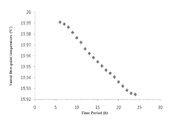
- FIG. 2 is a dew-point temperature change curve of the cement-based material from final set to water being added for 1 day according to the example 1;
- FIG. 3 is a relative humidity change curve of the cement-based material from final set to water being added for 1 day according to the example 1;
- FIG. 4 is a relative humidity change curve of the cement-based material with long time period after water being added for 1 day according to the example 1.
- the measuring range of the dew-point thermometer is 0-40° C. with precision not less than ⁇ 0.005° C. and sensitivity not less than 0.001° C.
- the probe is the thermocouple probe protected by stainless wire mesh.
- the thermocouple is formed by electrically connected constantan and nichrome.
- the pore diameter of the stainless wire mesh is 2 ⁇ m.
- the thermocouple probe is coupled with the dew-point microvoltmeter to form the dew-point thermometer using the dew-point method.
- HygroClip S humidity sensor made by Rotronic, Switzerland with measuring range of 0-100% RH and precision of ⁇ 1.5% RH.
- Stage 1 0 h-6 h. Use the negative pressure tester for capillary to test the initial negative pressure change rules of the capillary and then calculate the decreasing rules of the relative humidity in this stage according to the equations (1) and (2);
- Stage 2 6 h-24 h. Use the dew-point thermometer to test the dew-point temperature change rules and calculate the decreasing rules of the relative humidity in this stage according to the equation (3);
- Stage 3 after 24 h. Use the relative hygrometer to directly test the decreasing rules of the relative humidity.
- the internal relative humidity of the cement-based material (6 h) calculated via the dew-point thermometer is basically consistent with that calculated via the negative pressure tester for capillary in stage 1.
- the internal relative humidity of the cement-based material (24 h) calculated via the dew-point thermometer is basically consistent with that calculated via the relative hygrometer in stage 3.
- the relative humidity change curve obtained from those three stages conforms to the internal humidity change rules of the cement-based material.
Landscapes
- Chemical & Material Sciences (AREA)
- Engineering & Computer Science (AREA)
- Health & Medical Sciences (AREA)
- Life Sciences & Earth Sciences (AREA)
- Analytical Chemistry (AREA)
- Food Science & Technology (AREA)
- Medicinal Chemistry (AREA)
- Physics & Mathematics (AREA)
- Ceramic Engineering (AREA)
- Biochemistry (AREA)
- General Health & Medical Sciences (AREA)
- General Physics & Mathematics (AREA)
- Immunology (AREA)
- Pathology (AREA)
- Investigating Or Analyzing Materials Using Thermal Means (AREA)
- Testing Resistance To Weather, Investigating Materials By Mechanical Methods (AREA)
Abstract
Description
In the equations (1) and (2), γ refers to the gas-liquid interfacial tension, θ refers to the contact angle, r refers to the critical pore radius, ΔP refers to the negative pressure of capillary, RH refers to the internal relative humidity of the cement-based material, pg refers to the saturated vapor pressure of the curved surface water inside pore, psat refers to the saturated vapor pressure of the plane water, M1 refers to the molar mass of liquid phase, R is an ideal gas constant, T is the absolute temperature and ρ1 is the density of liquid phase.
Wherein,
RH refers to the internal relative humidity of the cement-based material;
td refers to the dew-point temperature when the pore is of the critical pore radius; and t refers to the ambient temperature.
In the equations (1) and (2), γ refers to the gas-liquid interfacial tension, θ refers to the contact angle, r refers to the critical pore radius, ΔP refers to the negative pressure of capillary, RH refers to the internal relative humidity of the cement-based material, pg refers to the saturated vapor pressure of the curved surface water inside pore, psat refers to the saturated vapor pressure of the plane water, M1 refers to the molar mass of liquid phase, R is an ideal gas constant, T is the absolute temperature and ρ1 is the density of liquid phase.
Claims (3)
Applications Claiming Priority (1)
| Application Number | Priority Date | Filing Date | Title |
|---|---|---|---|
| PCT/CN2011/085048 WO2013097189A1 (en) | 2011-12-30 | 2011-12-30 | Method for testing self-drying effect of cement-based material |
Publications (2)
| Publication Number | Publication Date |
|---|---|
| US20140144217A1 US20140144217A1 (en) | 2014-05-29 |
| US9470672B2 true US9470672B2 (en) | 2016-10-18 |
Family
ID=48696255
Family Applications (1)
| Application Number | Title | Priority Date | Filing Date |
|---|---|---|---|
| US14/131,816 Active 2032-12-21 US9470672B2 (en) | 2011-12-30 | 2011-12-30 | Method for testing self drying effect of cement-based material |
Country Status (4)
| Country | Link |
|---|---|
| US (1) | US9470672B2 (en) |
| EP (1) | EP2746765B1 (en) |
| JP (1) | JP5856304B2 (en) |
| WO (1) | WO2013097189A1 (en) |
Families Citing this family (4)
| Publication number | Priority date | Publication date | Assignee | Title |
|---|---|---|---|---|
| CN105445419A (en) * | 2015-01-21 | 2016-03-30 | 长沙理工大学 | Accelerated drying shrinkage testing method of semi-rigid base material of inorganic binding material |
| US9670762B2 (en) | 2015-02-20 | 2017-06-06 | Halliburton Energy Services, Inc. | Fracturing tight subterranean formations with a cement composition |
| ES2991173T3 (en) | 2019-03-12 | 2024-12-02 | Mato Eng Oy | Measuring device and procedure |
| CN113341113B (en) * | 2021-04-30 | 2023-09-19 | 东南大学 | Method for matching corresponding drying shrinkage under humidity gradient in cement-based material |
Citations (11)
| Publication number | Priority date | Publication date | Assignee | Title |
|---|---|---|---|---|
| US2423447A (en) * | 1945-01-30 | 1947-07-08 | Henry H Grimm | High-frequency ammeter and power meter |
| US4746534A (en) * | 1985-09-12 | 1988-05-24 | System Planning Corporation | Method of making a thermocouple |
| US4822979A (en) * | 1987-01-02 | 1989-04-18 | Dekam Cornelius T | Temperature controlled soldering iron with a unitary electrically heated soldering tip and thermocouple |
| US5069726A (en) * | 1989-04-11 | 1991-12-03 | Industrial Pyrometers (Aust.) Pty. Ltd. | Ceramic coated wires and thermocouples |
| US5310575A (en) * | 1987-11-03 | 1994-05-10 | Robert Bosch Gmbh | Method of making a porous ceramic protective layer on an electrode of an electrochemical sensor for exposure to hot gas |
| US20050152431A1 (en) * | 2001-11-20 | 2005-07-14 | Jensen Ole M. | Dynamic dew point analysis method and a device for determining the dew point temperature and relative humidity |
| KR100515116B1 (en) * | 2003-06-12 | 2005-09-13 | 삼성물산 주식회사 | Concrete composition for pavement of bridge surface and bridge pavement method using the same |
| CN101029881A (en) | 2007-03-23 | 2007-09-05 | 浙江大学 | Method for measuring and controlling assembled air-conditioner dew point |
| US20070246857A1 (en) * | 2006-04-21 | 2007-10-25 | Georgia Tech Research Corporation | Methods for internally curing cement-based materials and products made therefrom |
| CN101539566A (en) | 2006-03-14 | 2009-09-23 | 江苏博特新材料有限公司 | Method for testing early capillary negative pressure of concrete |
| CN102539475A (en) | 2011-12-30 | 2012-07-04 | 江苏博特新材料有限公司 | Self-drying effect test method of cement substrate material |
Family Cites Families (5)
| Publication number | Priority date | Publication date | Assignee | Title |
|---|---|---|---|---|
| US4242906A (en) * | 1979-09-04 | 1981-01-06 | Wescor, Inc. | Thermocouple-equipped, soil probe with removable protective shield |
| JPH0431584Y2 (en) * | 1986-10-02 | 1992-07-29 | ||
| JP2001013013A (en) * | 1999-07-02 | 2001-01-19 | Nittaku Kensetsu Kk | Temperature and humidity measurement devices for curing concrete and/or measurement method using these device |
| JP4623481B2 (en) * | 2000-12-21 | 2011-02-02 | いすゞ自動車株式会社 | thermocouple |
| JP4806392B2 (en) * | 2007-12-11 | 2011-11-02 | 飛島建設株式会社 | Wet curing management system and wet curing management method |
-
2011
- 2011-12-30 EP EP11878943.7A patent/EP2746765B1/en active Active
- 2011-12-30 WO PCT/CN2011/085048 patent/WO2013097189A1/en not_active Ceased
- 2011-12-30 US US14/131,816 patent/US9470672B2/en active Active
- 2011-12-30 JP JP2014533755A patent/JP5856304B2/en active Active
Patent Citations (12)
| Publication number | Priority date | Publication date | Assignee | Title |
|---|---|---|---|---|
| US2423447A (en) * | 1945-01-30 | 1947-07-08 | Henry H Grimm | High-frequency ammeter and power meter |
| US4746534A (en) * | 1985-09-12 | 1988-05-24 | System Planning Corporation | Method of making a thermocouple |
| US4822979A (en) * | 1987-01-02 | 1989-04-18 | Dekam Cornelius T | Temperature controlled soldering iron with a unitary electrically heated soldering tip and thermocouple |
| US5310575A (en) * | 1987-11-03 | 1994-05-10 | Robert Bosch Gmbh | Method of making a porous ceramic protective layer on an electrode of an electrochemical sensor for exposure to hot gas |
| US5069726A (en) * | 1989-04-11 | 1991-12-03 | Industrial Pyrometers (Aust.) Pty. Ltd. | Ceramic coated wires and thermocouples |
| US20050152431A1 (en) * | 2001-11-20 | 2005-07-14 | Jensen Ole M. | Dynamic dew point analysis method and a device for determining the dew point temperature and relative humidity |
| US7234860B2 (en) | 2001-11-20 | 2007-06-26 | Aalborg Universitetet | Dynamic dew point analysis method and a device for determining the dew point temperature and relative humidity |
| KR100515116B1 (en) * | 2003-06-12 | 2005-09-13 | 삼성물산 주식회사 | Concrete composition for pavement of bridge surface and bridge pavement method using the same |
| CN101539566A (en) | 2006-03-14 | 2009-09-23 | 江苏博特新材料有限公司 | Method for testing early capillary negative pressure of concrete |
| US20070246857A1 (en) * | 2006-04-21 | 2007-10-25 | Georgia Tech Research Corporation | Methods for internally curing cement-based materials and products made therefrom |
| CN101029881A (en) | 2007-03-23 | 2007-09-05 | 浙江大学 | Method for measuring and controlling assembled air-conditioner dew point |
| CN102539475A (en) | 2011-12-30 | 2012-07-04 | 江苏博特新材料有限公司 | Self-drying effect test method of cement substrate material |
Non-Patent Citations (2)
| Title |
|---|
| Grasley et al., Relative Humidity in Concrete, 2016, Concrete International, pp. 51-57. * |
| Jiang, Zhengwu, et al, Autogenous relative humidity change and autogenous shrinkage high-performance cenment pastes, cement and concrete research, Aug. 2005, vol. 35, No. 8, pp. 1539-1545. |
Also Published As
| Publication number | Publication date |
|---|---|
| EP2746765B1 (en) | 2017-09-27 |
| WO2013097189A1 (en) | 2013-07-04 |
| EP2746765A4 (en) | 2015-04-08 |
| US20140144217A1 (en) | 2014-05-29 |
| JP2014531599A (en) | 2014-11-27 |
| JP5856304B2 (en) | 2016-02-09 |
| EP2746765A1 (en) | 2014-06-25 |
Similar Documents
| Publication | Publication Date | Title |
|---|---|---|
| Huang et al. | Examining the “time-zero” of autogenous shrinkage in high/ultra-high performance cement pastes | |
| Shen et al. | Effect of internal curing with super absorbent polymers on the relative humidity of early-age concrete | |
| CN104007135B (en) | Earth working material change in volume method of testing | |
| US9470672B2 (en) | Method for testing self drying effect of cement-based material | |
| Ryu et al. | Effects of simulated environmental conditions on the internal relative humidity and relative moisture content distribution of exposed concrete | |
| Cusson et al. | Measuring early-age coefficient of thermal expansion in high-performance concrete | |
| Tao et al. | Comparison of non-contact autogenous shrinkage measurements and the stress ratio of capillary stress to compressive strength | |
| Multon et al. | Non-destructive measurements for the evaluation of the air permeability of concrete structures | |
| CN102539475B (en) | Self-drying effect test method of cement substrate material | |
| Huang et al. | Modeling moisture transport at the surface layer of fatigue-damaged concrete | |
| CN1963503A (en) | Measuring apparatus for rate of self-contraction of cement concrete | |
| CN104792974B (en) | A method for testing the chemical shrinkage of cement paste by using a full-automatic true density meter | |
| Pour-Ghaz et al. | Moisture profiles and diffusion coefficients in mortars containing shrinkage reducing admixtures | |
| Kucharczyková et al. | Determination and evaluation of the air permeability coefficient using Torrent Permeability Tester | |
| Tian et al. | The investigation of shrinkage cracking of paste and mortar based on the eccentric ring test and multiphysics simulation | |
| CN115266519B (en) | Testing device and method for representing water vapor steady-state permeation of cement-based material | |
| CN201837602U (en) | Non-contact testing device for early coefficient of thermal expansion of dam concrete | |
| Zhou et al. | Internal relative humidity distribution in concrete considering self-desiccation at early ages | |
| Grasley et al. | A new system for measuring the internal relative humidity in concrete | |
| Grasley | Internal relative humidity, drying stress gradients, and hygrothermal dilation of concrete | |
| CN113203654A (en) | Detection method for self-shrinkage of cement-based material | |
| Abbasnia et al. | Prediction of free shrinkage strain related to internal moisture loss | |
| Bouasker et al. | Improved measurement methods for autogenous shrinkage of cement mortars at very early age | |
| CN200979544Y (en) | A cement concrete autogenous-shrinkage ratio detector | |
| RU2859882C1 (en) | Method for determining swelling pressure of materials using le chatelier rings |
Legal Events
| Date | Code | Title | Description |
|---|---|---|---|
| AS | Assignment |
Owner name: JIANGSU BOTE NEW MATERIALS CO., LTD,, CHINA Free format text: ASSIGNMENT OF ASSIGNORS INTEREST;ASSIGNORS:LIU, JIAPING;TIAN, QIAN;YAO, TING;AND OTHERS;REEL/FRAME:031944/0784 Effective date: 20131216 Owner name: JIANGSU RESEARCH INSTITUTE OF BUILDING SCIENCE CO. Free format text: ASSIGNMENT OF ASSIGNORS INTEREST;ASSIGNORS:LIU, JIAPING;TIAN, QIAN;YAO, TING;AND OTHERS;REEL/FRAME:031944/0784 Effective date: 20131216 Owner name: JIANGSU SOBUTE NEW MATERIALS CO, LTD, CHINA Free format text: ASSIGNMENT OF ASSIGNORS INTEREST;ASSIGNORS:LIU, JIAPING;TIAN, QIAN;YAO, TING;AND OTHERS;REEL/FRAME:031944/0784 Effective date: 20131216 |
|
| AS | Assignment |
Owner name: SOBUTE NEW MATERIALS CO., LTD., CHINA Free format text: ASSIGNMENT OF ASSIGNORS INTEREST;ASSIGNORS:JIANGSU BOTE NEW MATERIALS CO., LTD;JIANGSU SOBUTE NEW MATERIALS CO., LTD;JIANGSU RESEARCH INSTITUTE OF BUILDING SCIENCE CO., LTD;REEL/FRAME:035646/0062 Effective date: 20150512 |
|
| STCF | Information on status: patent grant |
Free format text: PATENTED CASE |
|
| MAFP | Maintenance fee payment |
Free format text: PAYMENT OF MAINTENANCE FEE, 4TH YEAR, LARGE ENTITY (ORIGINAL EVENT CODE: M1551); ENTITY STATUS OF PATENT OWNER: LARGE ENTITY Year of fee payment: 4 |
|
| MAFP | Maintenance fee payment |
Free format text: PAYMENT OF MAINTENANCE FEE, 8TH YEAR, LARGE ENTITY (ORIGINAL EVENT CODE: M1552); ENTITY STATUS OF PATENT OWNER: LARGE ENTITY Year of fee payment: 8 |