US9469908B2 - Synergistic oxygen evolving activity of non-stoichiometric surfaces - Google Patents
Synergistic oxygen evolving activity of non-stoichiometric surfaces Download PDFInfo
- Publication number
- US9469908B2 US9469908B2 US14/454,824 US201414454824A US9469908B2 US 9469908 B2 US9469908 B2 US 9469908B2 US 201414454824 A US201414454824 A US 201414454824A US 9469908 B2 US9469908 B2 US 9469908B2
- Authority
- US
- United States
- Prior art keywords
- catalytic material
- tio
- srtio
- oxygen
- water
- Prior art date
- Legal status (The legal status is an assumption and is not a legal conclusion. Google has not performed a legal analysis and makes no representation as to the accuracy of the status listed.)
- Active, expires
Links
Images


Classifications
-
- C—CHEMISTRY; METALLURGY
- C25—ELECTROLYTIC OR ELECTROPHORETIC PROCESSES; APPARATUS THEREFOR
- C25B—ELECTROLYTIC OR ELECTROPHORETIC PROCESSES FOR THE PRODUCTION OF COMPOUNDS OR NON-METALS; APPARATUS THEREFOR
- C25B1/00—Electrolytic production of inorganic compounds or non-metals
- C25B1/01—Products
- C25B1/02—Hydrogen or oxygen
- C25B1/04—Hydrogen or oxygen by electrolysis of water
-
- C25B1/003—
-
- C—CHEMISTRY; METALLURGY
- C25—ELECTROLYTIC OR ELECTROPHORETIC PROCESSES; APPARATUS THEREFOR
- C25B—ELECTROLYTIC OR ELECTROPHORETIC PROCESSES FOR THE PRODUCTION OF COMPOUNDS OR NON-METALS; APPARATUS THEREFOR
- C25B1/00—Electrolytic production of inorganic compounds or non-metals
- C25B1/50—Processes
- C25B1/55—Photoelectrolysis
-
- C25B11/0442—
-
- C25B11/0452—
-
- C—CHEMISTRY; METALLURGY
- C25—ELECTROLYTIC OR ELECTROPHORETIC PROCESSES; APPARATUS THEREFOR
- C25B—ELECTROLYTIC OR ELECTROPHORETIC PROCESSES FOR THE PRODUCTION OF COMPOUNDS OR NON-METALS; APPARATUS THEREFOR
- C25B11/00—Electrodes; Manufacture thereof not otherwise provided for
- C25B11/04—Electrodes; Manufacture thereof not otherwise provided for characterised by the material
- C25B11/051—Electrodes formed of electrocatalysts on a substrate or carrier
- C25B11/073—Electrodes formed of electrocatalysts on a substrate or carrier characterised by the electrocatalyst material
-
- C—CHEMISTRY; METALLURGY
- C25—ELECTROLYTIC OR ELECTROPHORETIC PROCESSES; APPARATUS THEREFOR
- C25B—ELECTROLYTIC OR ELECTROPHORETIC PROCESSES FOR THE PRODUCTION OF COMPOUNDS OR NON-METALS; APPARATUS THEREFOR
- C25B11/00—Electrodes; Manufacture thereof not otherwise provided for
- C25B11/04—Electrodes; Manufacture thereof not otherwise provided for characterised by the material
- C25B11/051—Electrodes formed of electrocatalysts on a substrate or carrier
- C25B11/073—Electrodes formed of electrocatalysts on a substrate or carrier characterised by the electrocatalyst material
- C25B11/075—Electrodes formed of electrocatalysts on a substrate or carrier characterised by the electrocatalyst material consisting of a single catalytic element or catalytic compound
- C25B11/077—Electrodes formed of electrocatalysts on a substrate or carrier characterised by the electrocatalyst material consisting of a single catalytic element or catalytic compound the compound being a non-noble metal oxide
-
- H—ELECTRICITY
- H01—ELECTRIC ELEMENTS
- H01M—PROCESSES OR MEANS, e.g. BATTERIES, FOR THE DIRECT CONVERSION OF CHEMICAL ENERGY INTO ELECTRICAL ENERGY
- H01M14/00—Electrochemical current or voltage generators not provided for in groups H01M6/00 - H01M12/00; Manufacture thereof
- H01M14/005—Photoelectrochemical storage cells
-
- Y—GENERAL TAGGING OF NEW TECHNOLOGICAL DEVELOPMENTS; GENERAL TAGGING OF CROSS-SECTIONAL TECHNOLOGIES SPANNING OVER SEVERAL SECTIONS OF THE IPC; TECHNICAL SUBJECTS COVERED BY FORMER USPC CROSS-REFERENCE ART COLLECTIONS [XRACs] AND DIGESTS
- Y02—TECHNOLOGIES OR APPLICATIONS FOR MITIGATION OR ADAPTATION AGAINST CLIMATE CHANGE
- Y02E—REDUCTION OF GREENHOUSE GAS [GHG] EMISSIONS, RELATED TO ENERGY GENERATION, TRANSMISSION OR DISTRIBUTION
- Y02E60/00—Enabling technologies; Technologies with a potential or indirect contribution to GHG emissions mitigation
- Y02E60/30—Hydrogen technology
- Y02E60/36—Hydrogen production from non-carbon containing sources, e.g. by water electrolysis
-
- Y02E60/366—
Definitions
- the present disclosure is directed to the fields of electrocatalytic and photocatalytic materials.
- the kinetics of oxygen evolution show the following trend in catalytic activity: RuO 2 >IrO 2 >Co ⁇ Ni containing oxides >Fe ⁇ Mn ⁇ Pb containing oxides. Remarkably, this trend is almost completely the reverse of their abundance in the Earth's crust: Fe(56.3 g/kg)>Mn(0.95 g/kg)>Ni(0.08 g/kg)>Co(0.03 g/kg)>Pb(0.01 g/kg)>Ir, Ru(10 ⁇ 6 g/kg). It is thus highly desirable to find forms of the more abundant elements that would be comparable to, if not surpass, the Ir or Ru-containing compounds. Ti is one of the most abundant transition metals in the Earth's crust (5.65 g/kg), but Ti oxides suffer from very low electrocatalytic oxygen evolving activity.
- SrTiO 3 is known to decompose water into H 2 and O 2 upon illumination with light. However due to its high band gap energy (3.2 eV), its application is limited to UV irradiation, the same as TiO 2 -rutile.
- the present disclosure provides 2 ⁇ 1 double layer (“DL”) reconstruction of SrTiO 3 and enhanced oxygen evolution activity.
- This double layer reconstruction comprises a double layer of TiO 2 deposited on a SrTiO 3 structure.
- the enhanced oxygen evolution of the reconstruction of the SrTiO 3 can be comparable to the activity of IrO 2 .
- the 2 ⁇ 1 TiO 2 double layer is constructed via an annealing process. As such, SrTiO 3 with a TiO 2 double layer can be used as an electrocatalyst with suitable processing.
- reconstructed surfaces of titanium-based perovskites produce unusual TiO 2 structures on their surfaces. These structures give rise to different modes of oxygen binding, which modes in turn lead to different oxidative chemistry.
- the TiO 2 -rich surfaces presented herein provide an enhancement of activity.
- the enhancement can be seen by examining chemical reaction pathways on the TiO 2 -rich surface reconstructions of SrTiO 3 , and comparing them with the (110) surface of the rutile phase TiO 2 .
- providing an anodic bias to SrTiO 3 with a reconstructed double layer of TiO 2 reconstructed on the surface can allow for enhanced oxygen evolution.
- the positive voltage (anodic bias) can be provided via a direct current source with a counter electrode (hydrogen evolving electrode) attached to the negative end of the source.
- the SrTiO 3 acts as the anode at which oxygen is evolved.
- the energy can be provided through another means, such as, for example, via photoexcitation of a photoexcitable n-type semiconductor attached to and with a proper band alignment with a p-type doped SrTiO 3 .
- the present disclosure provides crystal structures having a formula of ABO 3 , where B is Ti can have a 2 ⁇ 1 double layer reconstruction of TiO 2 on the surface.
- B is Ti
- BaTiO 3 , CaTiO 3 , ZrTiO 3 , MnTiO 3 , PbTiO 3 , PbTiO 3 with nickel doping, or any other (A,A′)TiO 3 composition can feature such a structure.
- a double layer of TiO 2 can be associated with the surface of the bulk material. These materials can be catalysts, electrocatalysts, or photocatalysts.
- ilmenite structures and Ruddlesden-Popper phase materials are also suitable.
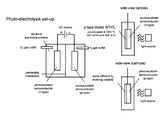
- FIG. 1 illustrates an exemplary photoelectrolysis system
- FIG. 2 illustrates an exemplary photoanode band diagram
- FIG. 3 represents ball-and-stick representations of different forms of the catalytically active nonstoichiometric SrTiO 3 reconstructed surface.
- the bulk-like TiO 2 termination and the TiO 2 -rich 2 ⁇ 1 double layer (2 ⁇ 1-DL) surface reconstruction of (001) SrTiO 3 (S0) are shown.
- the surface unit cell of 2 ⁇ 1-DL is marked by a dashed line.
- S0 has the surface TiO 5 units arranged in a zig-zag pattern (traced by the dot-dashed line).
- the hydrated (51) and some of the oxidized (S3 and S5) forms of the 2 ⁇ 1-DL with 2 ⁇ 2 supercell size.
- the 51 and S3 surfaces exhibit Ti—OH, while S3 and S5 have side-on Ti—O 2 ( ⁇ 2 -O 2 ).
- Structures S2 and S4 (not shown) show the same adsorption motif at the a Ti sites as in S3 and S5, respectively.
- FIG. 4 presents stable surfaces and their relative energies as a function of applied potential.
- Left The reaction scheme leading to the hydrated (S1) and oxidized forms (S2-S5) of the TiO 2 -rich 2 ⁇ 1-DL (S0) surface. Subsurface layers are removed for clarity.
- Right: Surface phase diagram of the 2 ⁇ 1-DL as a function of applied potential against the standard hydrogen electrode at pH 0. Energy of each surface is plotted relative to that of 2 ⁇ 1-DL (S0)+4H 2 O.
- S1, S3, and S5 are shown to be the stable surfaces; S5 is the most stable at higher potential, making it the most relevant surface for electrochemical water splitting.
- FIG. 5 presents a mechanism for the oxygen evolving catalytic cycle on the S5 reconstructed surface of SrTiO 3 .
- For a complete cycle two water molecules are consumed, and an O 2 molecule and 4H+ ions are produced.
- Production of the intermediates and products at each step involve proton abstraction and a loss of electron.
- the Gibbs free energy changes for each step are also given (in eV). Subsurface layers are removed for clarity.
- FIG. 6 presents LEED images for an Nb-doped SrTiO 3 (001) 1 ⁇ 1 unreconstructed (top) and 2 ⁇ 1 reconstructed (bottom) catalytic surfaces used in the present invention.
- Solid blue line (e) marks the standard reduction potential of O 2 to H 2 O at pH 14 vs.
- FIG. 7 presents an example of an SrTiO 3 electrode used in the present invention.
- Left schematic of the SrTiO 3 —Cu contact (not to scale).
- Right electrode configuration (top: front, bottom: back).
- Ti IV -based oxides are poor catalysts for water splitting primarily because titanium(IV) binds O adsorbates weakly (due to its inability to be further oxidized), and binds the lattice O very strongly (showing its low tendency towards reduction).
- some reconstructed surfaces of Ti IV -based perovskites present diverse Ti—O bonding environments, where some bonds are more covalent and electron-rich than others.
- Ti atoms with different bonding environments on a non-stoichiometric surface show novel catalytic behavior, as they can interact differently with adsorbates and function as a single catalytic unit by playing complementary roles in the reaction.
- a (001)-surface-terminated SrTiO 3 can be heated to 950-1,000° C. and exposed to a continuous flow of high purity O 2 .
- the surface has an over-layer of TiO 2 on top of a bulk-like (001) TiO 2 termination.
- the over-layer and some of the sub-layer O form edge-shared TiO 5 polyhedra distributed in a zig-zag pattern, as shown in FIG. 3 (S0).
- the mechanism, the barriers of the elementary reactions, and the value of ⁇ i e are highly dependent on the nature of catalyst.
- the relative stability of the 2 ⁇ 1-DL (S0) surface with respect to its hydrated and more oxidized forms can be determined Stability has been evaluated under realistic electrochemical conditions (298 K, equilibrium with an aqueous environment, and subjected to an anodic (oxidizing) potential).
- FIG. 4 shows schematics of the most stable structures found for each surface oxygen and hydrogen content.
- S1 is the maximally hydrated form beyond which addition of more H 2 O becomes unfavorable, while S2 to S5 show the resulting surfaces after progressive oxidation.
- FIG. 3 provides three-dimensional ball and stick representations of S1, S3, and S5.
- the surfaces show various combinations of Ti—OH and side-on Ti—O 2 ( ⁇ 2 -O 2 ) structures.
- the ⁇ 2 -O 2 could either be a peroxo (single-bonded O atoms) or a superoxo (bond order 1.5) depending on the extent of oxidation of the surfaces. These can be described by their charge, bond length and stretching frequencies, as shown in Table 1 below:
- the high-charge and low-charge species show the lengths and vibrational frequencies of peroxo and superoxo ligands.
- ⁇ G N ⁇ G o SHE + ⁇ G o N ⁇ n e N e ⁇ n N H+ ⁇ pH
- ⁇ G N the standard Gibbs free energy change of the oxidation reaction: S0 +n H2O [H 2 O( l )] ⁇ SN+ n N H+ +n e N e ⁇ , calculated using energies from density functional theory (DFT) simulation and experimental entropies
- DFT density functional theory
- the plot in FIG. 4 suggests that only surfaces S1, S3, and S5 are thermodynamically stable in the range of interest of applied potential.
- S1 is the dominant form of the surface until 1.29 V, where S3 coexists.
- S3 is stable until 1.46 V, where S5 will become equally favorable.
- S5 is the most stable form of the 2 ⁇ 1-DL. Because the oxygen evolution reactions on S1 and S3 require applied potentials that are higher than the maximum potentials at which they are stable, this study focuses on oxygen evolution on S5.
- FIG. 5 shows the four oxidation steps in the catalytic cycle involving surface S5.
- a Ti ⁇ O is oxidized by adding H 2 O and losing a proton.
- Further oxidation of the a Ti site generates a peroxo-type O 2 ligand.
- S5 is generated.
- an oxygen molecule is released from the a Ti site and subsequently replaced via OH deprotonation and O 2 ⁇ transfer from a b Ti site, regenerating P1.
- the first water oxidation happens at a site where Ti is partially reduced.
- the Löwdin charge of the active a Ti in structure P1 is +1.96e, which then changes to +2.10e in P2 (bulk Ti charge is ⁇ +2.16e).
- the barrier found for the first water oxidation step to P2 is 1.74 eV, which is significantly lower than on typical Ti IV oxides; for example, it is 2.01 eV on the rutile-type (110) TiO 2 surface.
- Further oxidation creates an O 2 moiety that has the properties of a peroxo ligand.
- step 3 can be represented as the sum of two reactions: a Ti( ⁇ 2 -O 2 ) ⁇ a Ti( ⁇ 2 -O 2 ) + +e ⁇ b Ti+H 2 O ⁇ b Ti(OH) ⁇ +H +
- the superoxo releases an electron to become O 2 , and desorbs.
- the final deprotonation process at the b Ti site then creates an O 2 ⁇ that moves to a Ti and replaces the desorbed dioxygen molecule.
- This mechanistic step is suggested by DFT relaxation studies; when an O atom is on the b Ti site and an O 2 is present on the a Ti site, the O 2 spontaneously desorbs.
- the disclosed mechanism is of the Mars-van Krevelen type, but with H 2 O as the O source.
- a lattice oxygen ( a O) participates directly as a reactant, which is then replenished by a fully deprotonated water.
- Mars-van Krevelen-type mechanisms often operate in catalytic oxidation reactions, but the lattice O is usually replenished through dissociative adsorption of O 2 .
- a Ti serves as excellent binding site for electrophilic radicals such as .OH and .O., where they react with the a Ti ⁇ a O.
- electrophilic radicals such as .OH and .O.
- a nucleophile such as OH— and O 2 ⁇
- Comparable DFT evaluations of the overpotential for water splitting on the (110) terminated rutile-type oxides (RuO 2 , IrO 2 , and TiO 2 ) and (100) terminated perovskite-type oxides have been reported. In these studies, the barriers to forming OH, O, OOH, and O 2 as assisted by those oxide surfaces have been calculated. These studies found an overpotential min ox trend that is consistent with the experimental overpotential trends (e.g.
- the undercoordinated Ti ions on the reconstructed surface of STO increases the range of O-bonding affinity, making it a great improvement over the (110) termination of the rutile-type TiO 2 and the (100) TiO 2 -termination of SrTiO 3 , with catalytic performance comparable to IrO 2 .
- a maximum of ⁇ 70% energy storage efficiency [ ⁇ n e e ⁇ e / ⁇ n e e( ⁇ e + ) ⁇ 100%] could be achieved using this surface as an oxygen evolving catalyst if running alongside surfaces offering barrierless H 2 electrochemical evolution at the cathode.
- a vacuum separation of ⁇ 16 ⁇ in the direction normal to the slab has been included, with a dipole correction in the same direction to eliminate artificial electrostatic interactions.
- the Brillouin zone was sampled via the Monkhorst-Pack method with a 3 ⁇ 3 ⁇ 1 mesh.
- the molecules H 2 and H 2 O
- the total energy of a gas phase molecule was approximated by calculating the energy of an isolated molecule that is separated from its repeat image by ⁇ 12 ⁇ along three orthogonal directions.
- a dipole correction was also employed along the direction of the molecule's dipole. Spin-unrestricted calculations when warranted were performed. Structure relaxation has been carried out until the force on each atom is below 0.01 eV/ ⁇ .
- the degrees of freedom were reduced by keeping the whole slab, except for the topmost TiO 2 layer and adsorbates, fixed. This was done because the zero point energy contribution of the bottom layers cancels each other out in the Gibbs free energy change calculations.
- Bockris electrochemical oxide path was used as an initial guess for the mechanism (J. Chem. Phys. 1956). Modifications in the reaction mechanism and intermediate states were introduced guided by the results in the DFT relaxation studies. The validity of the mechanism was confirmed through various structure searches to find energetically favored intermediates.
- G o (H++e ⁇ ) 1 ⁇ 2 G o H2 .
- G o H2 is calculated from DFT and tabulated standard entropy data.
- the present disclosure provides systems. These systems can suitably include (a) a catalytic material (suitably, e.g., a material according to the present disclosure) comprising oxygen and one or more metal atoms, the catalytic material further comprising a bulk portion and a surface portion, the surface portion forming a non-stoichiometric region under set conditions in contact with water, (b) an electrode in electronic communication with the catalytic material; and (c) a second electrode.
- a catalytic material suitable, e.g., a material according to the present disclosure
- the catalytic material can include, for example, a perovskite structure.
- the catalytic material can also include titanium.
- a surface portion of the catalytic material suitably comprises an overlayer and a sub-layer.
- the catalytic material can comprise, for example, SrTiO 3 .
- the overlayer of the catalytic material can include edge-shared TiO 5 polyhedra, and the sub-layer can include corner-shared TiO 6 octahedra. Suitable such materials are described elsewhere herein in further detail
- the surface portion of the catalytic material is capable of featuring two or more coordination motifs for oxygen.
- These coordination motifs e.g., in SrTiO 3 —suitably effect complementary chemistry among the metal atoms.
- different motifs give rise to different chemical behavior for surface Ti atoms.
- the catalytically active metal can act in a uniform manner.
- other systems such as some of the exemplary systems described herein—complementary behavior is observed between Ti atoms due to an inhomogeneous bonding motif.
- water splitting H 2 O to H 2 and O 2
- Other reactions can include different numbers of steps.
- the overlayer of the catalytic material can include titanium atoms arranged in an alternating pattern, in a zig-zag pattern, or both.
- the first type can be coordinated to one one-fold, two three-fold and two four-fold oxygen atoms while the second type is coordinated to one two-fold, three three-fold and one four-fold oxygen atoms.
- the sub-layer can likewise be composed of two different types of Ti atoms wherein one is coordinated to a two-fold overlayer oxygen atom while the other is bound to a four-fold overlayer oxygen atom.
- the sublayer can include titanium atoms in corner-shared six-fold coordination spheres.
- the surface portion of the catalytic material can include at least two metal atoms having different electron affinities.
- the surface of the catalytic material is suitably selected such that it oxidizes water at a lower barrier than the bulk termination.
- the catalytic material accomplishes this by synergistic actions of the two types of titanium atoms.
- the oxygen repository site can be capable of supporting oxo radical, peroxo and superoxo moieties that eventually transform to an oxygen molecule, which desorbs leaving the surface oxygen deficient.
- the other site serves as deprotonation site for water, which then produces an oxide that would restore the surface stoichiometry after the release of an oxygen molecule described above.
- the barriers associated with each elementary step suitably does not exceed the standard potential except for one where an excess (e.g., about 0.51 V) is needed to approach an equilibrium in standard conditions.
- a system can, as disclosed herein, include a first electrode; TiO 2 -rich surface reconstructed bulk SrTiO 3 , that can be attached to a photoexcitable semiconductor; and a second electrode that serves as a counter electrode, that can also be attached to another photoexcitable semiconductor.
- the layers of TiO 2 can be—as described herein—be configured to act as an electrocatalyst.
- the present disclosure also provides methods. These methods include contacting water and a catalytic material (such as those materials described herein) under such conditions so as to evolve molecular hydrogen, molecular oxygen, or both.
- the methods can further include applying an electrical potential to the catalytic material. This potential can be only about 0.51 V above the standard potential in the absence of illumination of a suitable wavelength.
- the electrical potential can be effected by illuminating the catalytic material.
- the electrical potential can also be effected by illuminating a photoactive material in electronic communication with the catalytic material such that the illumination gives rise to an electronic potential applied to the catalytic material.
- the method can include thermally annealing an amount (which can be in bulk form) of SrTiO 3 such that one or more layers of TiO 2 form on the surface of the bulk of SrTiO 3 .
- the disclosed methods can also include providing a voltage across a bulk of SrTiO 3 with the one or more layers of TiO 2 on the surface of the bulk of SrTiO 3 .
- a user can also hydrate the TiO 2 .
- other materials aside from SrTiO 3 can be used in the disclosed systems and methods. As one example, a user can use LiNbO 3 ; at equilibrium, the surface can become Li 2 NbO 3 .
- a system e.g., FIG. 5
- the catalytic material is suitably disposed at the anode (i.e., so as to take electrons away from water, producing O 2 and protons).
- the electrons are returned at a higher energy where they combine with protons to make H 2 .
- the steps of the methods can be performed separately such that H 2 and O 2 do not comingle.
- the system can be arranged so as to operate photochemically, wherein illumination excites electrons in the catalytic material, in a semiconductor attached to it, or in both. These electrons migrate and the resultant holes are filled with electrons from water. This is shown in FIG. 3 , in which a O in FIG. 3 is not as tightly bound as other oxygen atoms in the structure; water can combine with a O to make oxygen and then refill the holes.
- Catalytic materials can be processed by application of thermal energy.
- the surface's top layer (containing a top layer of molecules having fewer neighbors than molecules elsewhere within the material) will melt.
- Barium titanate, strontium titanate, and other materials are suitable.
- Enhanced or reconstructed double layer TiO 2 can be described with 2 ⁇ 1, c(4 ⁇ 2), and c(6 ⁇ 2) symmetries. These surfaces can be characterized as having one or more over-layers of stoichiometric TiO 2 on top of a bulk like TiO 2 termination.
- SrTiO 3 can be reconstructed such that a TiO 2 layers are created on the surface of the bulk of SrTiO 3 .
- the SrTiO 3 with the TiO 2 layers can have an electrical potential placed across it, by means of electrodes or any other means known in the art.
- the SrTiO 3 can be hydrated, that is, it can be placed in, or associated with H 2 O.
- reconstructed TiO 2 on ABO 3 materials where B ⁇ Ti that act as catalysts can be associated with H 2 O.
- This TiO 2 reconstruction can result in electrocatalysts or photocatalysts.
- electromagnetic radiation can be emitted from an emitter aiding the spontaneous decomposition of water.
- the electromagnetic radiation can be of a wavelength greater than 400 nm, greater than 425 nm, greater than 450 nm, greater than 475 nm, greater than 500 nm, greater than 525 nm, greater than 550 nm, greater than 575 nm, greater than 600 nm, or even greater than 625 nm.
- the electromagnetic radiation used as a catalyst can be in the visible portion of the spectrum.
- the electromagnetic radiation can be in the visible and near infrared portion of the spectrum.
- double layer reconstructed TiO 2 on SrTiO 3 can be used in association with water.
- a voltage can be applied to the SrTiO 3 .
- the oxygen and hydrogen making up the molecule can be used for any purpose.
- the hydrogen could be used as a combustible material, as fuel for a vehicle, or in any other product, chemical composition, process or the like involving either hydrogen or oxygen.
- decomposed hydrogen and oxygen could be stored.
- 2 ⁇ 1, 4 ⁇ 1, and 6 ⁇ 1 can be made of SrTiO 3 , or even from other ABO 3 material where B ⁇ Ti using an annealing process.
- Such a process can provide for an inexpensive method of creating a good catalyst, electrocatalyst or photocatalyst.
- these materials can be made by any other means known in the art including but not limited to vacuum deposition, sputtering, wet chemistry, photolithography, etching, annealing, stripping etc.
- DFT Density functional theory in the PBE GGA framework norm-conserving pseudopotentials
- Slab geometry with three-unit-cell thick bulk substrate can be used to simulate the surface.
- reaction S0 to S1 Based on the negative AG of hydration of the surface, reaction S0 to S1, the 2 ⁇ 1 DL would be highly saturated with water. Furthermore, the hydration process proceed with the water molecules completely dissociated, leaving hydroxlys on the surface.
- S0-S1 is a potential independent process and therefore is invariant with the applied potential.
- the surface undergo phase change with one a Ti forms O—O ⁇ moiety and a b Ti site loses a proton.
- the most oxidized form of the surface is the most active form of the surface with the deprotonation of OH* to form O* as the rate limiting step. 0.28 V above the potential at which this surface is stable, this step becomes favorable thus making all the steps energetically down hill. Consequently the minimum potential required for maximum efficiency for this surface is 1.74 V.
- the TiO 2 rich reconstruction of SrTiO 3 exhibit enhanced oxygen evolving activity, the most oxidized form of which exhibits the greatest activity. This exemplifies the role of structure in the chemical reactivity of catalysts.
- the latter crystal also showed 1 ⁇ 1 LEED pattern even after being annealed at a temperature as high as 1070° C.
- the crystals were attached to copper wires using silver (Ag) paste.
- Gallium-Indium (Ga—In) (99.99%) eutectic was painted on the back of the crystals (unpolished side) to serve as the ohmic contact.
- Heat-shrink tubes were used to insulate the entire lengths of the copper (Cu) wires while epoxy was used to insulate the back of the crystals. See FIG. 7 .
- a three-electrode system was set up to assess the photoelectrochemical water-splitting performance of reconstructed and native Nb-doped SrTiO 3 crystals.
- Nb-doped SrTiO 3 electrode serving as the working electrode
- a platinum (Pt) coil was used as a counter electrode
- a silver-silver chloride electrode in saturated AgCl and 4M KCl solution was used as the reference.
- Electrolysis was done in 1M NaOH solutions with constant stirring. Electrolysis were done with and without UV-Vis light illumination from a 200 W Hg(Xe) lamp, shining directly on the polished surface of the crystal.
Landscapes
- Chemical & Material Sciences (AREA)
- Chemical Kinetics & Catalysis (AREA)
- Electrochemistry (AREA)
- Engineering & Computer Science (AREA)
- Materials Engineering (AREA)
- Metallurgy (AREA)
- Organic Chemistry (AREA)
- Inorganic Chemistry (AREA)
- General Chemical & Material Sciences (AREA)
- Catalysts (AREA)
Abstract
Description

| η2-O2 properties | ||
| Löwdin charge | bond length | stretch ν | ||
| Structure | orientation | (e/molecule) | (Å) | (cm−1) |
| S2 | horizontal | −0.75 | 1.40 | 971 |
| S3 | horizontal | −0.35 | 1.29 | 1174 |
| S4 | vertical | −0.72 | 1.41 | 961 |
| horizontal | −0.36 | 1.30 | 1133 | |
| S5 | vertical | −0.37 | 1.30 | 1156 |
| horizontal | −0.33 | 1.29 | 1179 | |
| P1 | horizontal | −0.32 | 1.29 | 1173 |
| P2 | horizontal | −0.34 | 1.29 | 1173 |
ΔG N =ΔG o SHE +ΔG o N −n e N eε−n N H+·pH
where ΔGo SHE=0.00 eV is the Gibbs free energy change of the standard hydrogen electrode (SHE), which serves as the reference, ΔGN is the standard Gibbs free energy change of the oxidation reaction:
S0+n H2O[H2O(l)]→SN+n N H+ +n e N e −,
calculated using energies from density functional theory (DFT) simulation and experimental entropies, ε is the applied potential against SHE, and e is the electron charge. Without being bound to any particular theory, the plot in
aTi(η2-O2)→aTi(η2-O2)+ +e −
bTi+H2O→bTi(OH)−+H+
H+(aq)+e −→½H2(g),ΔGo red=0.00 eV
G o (H++e−)=½G o H2.
G o H2O(l)(298 K,a=1)=G H2O(g)(298K,0.035 bar)=G o H2O(g) +kT ln(0.035 bar)
The O2 energy, whose binding energy is severely overestimated by DFT, was calculated from experimental standard Gibbs free energy of the reaction: 2H2O(l)→O2(g)+2H2(g) (ΔGo=4.92 eV), and the calculated Gibbs free energies of H2O(l) and H2(g).
G o O2=4.92 eV+2[EDFT H2O−EDFT H2+ΔZPE(H2O—H2)−T(So H2O(g)−So H2)+kT ln(0.035 bar)].
Binding energy overestimation was checked when dealing with peroxo and superoxo ligands by calculating the formation energies of hydrogen peroxide and hydroperoxy radical. It was found that the errors do not change the identity of the rate-limiting step nor the overpotential.
H+(aq)+e −→½H2(g)εo=0.0V
2H2O(l)→O2(g)+2H2(g)ΔGo=4.92 eV
is used as a reference. Any reaction involving O2 would then avoid the use of the O2 DFT energy via the virtue of the Hess' law.
Claims (17)
Priority Applications (1)
| Application Number | Priority Date | Filing Date | Title |
|---|---|---|---|
| US14/454,824 US9469908B2 (en) | 2014-05-12 | 2014-08-08 | Synergistic oxygen evolving activity of non-stoichiometric surfaces |
Applications Claiming Priority (2)
| Application Number | Priority Date | Filing Date | Title |
|---|---|---|---|
| US201461991862P | 2014-05-12 | 2014-05-12 | |
| US14/454,824 US9469908B2 (en) | 2014-05-12 | 2014-08-08 | Synergistic oxygen evolving activity of non-stoichiometric surfaces |
Publications (2)
| Publication Number | Publication Date |
|---|---|
| US20150322579A1 US20150322579A1 (en) | 2015-11-12 |
| US9469908B2 true US9469908B2 (en) | 2016-10-18 |
Family
ID=54367309
Family Applications (1)
| Application Number | Title | Priority Date | Filing Date |
|---|---|---|---|
| US14/454,824 Active 2034-10-18 US9469908B2 (en) | 2014-05-12 | 2014-08-08 | Synergistic oxygen evolving activity of non-stoichiometric surfaces |
Country Status (1)
| Country | Link |
|---|---|
| US (1) | US9469908B2 (en) |
Cited By (1)
| Publication number | Priority date | Publication date | Assignee | Title |
|---|---|---|---|---|
| US11519086B2 (en) | 2019-05-02 | 2022-12-06 | King Fahd University Of Petroleum And Minerals | Fabrication of photoactive CaTiO3—TiO2 composite thin film electrodes via single step AACVD |
Families Citing this family (1)
| Publication number | Priority date | Publication date | Assignee | Title |
|---|---|---|---|---|
| CN112951338B (en) * | 2021-03-05 | 2024-05-14 | 沈阳大学 | Method for designing high-elastic modulus binary magnesium alloy precipitated phase |
Citations (5)
| Publication number | Priority date | Publication date | Assignee | Title |
|---|---|---|---|---|
| US20100133111A1 (en) * | 2008-10-08 | 2010-06-03 | Massachusetts Institute Of Technology | Catalytic materials, photoanodes, and photoelectrochemical cells for water electrolysis and other electrochemical techniques |
| US20110220484A1 (en) * | 2007-10-31 | 2011-09-15 | Sigrid Obenland | Monolithic catalyst system for the photolysis of water |
| US20130168228A1 (en) * | 2011-04-12 | 2013-07-04 | Geoffrey A. Ozin | Photoactive Material Comprising Nanoparticles of at Least Two Photoactive Constituents |
| US20140287342A1 (en) * | 2011-10-24 | 2014-09-25 | Technical University Of Denmark | High performance fuel electrode for a solid oxide electrochemical cell |
| US20140374270A1 (en) * | 2012-03-08 | 2014-12-25 | The University Of Tokyo | Electrode for water-splitting reaction and method for producing the same |
-
2014
- 2014-08-08 US US14/454,824 patent/US9469908B2/en active Active
Patent Citations (5)
| Publication number | Priority date | Publication date | Assignee | Title |
|---|---|---|---|---|
| US20110220484A1 (en) * | 2007-10-31 | 2011-09-15 | Sigrid Obenland | Monolithic catalyst system for the photolysis of water |
| US20100133111A1 (en) * | 2008-10-08 | 2010-06-03 | Massachusetts Institute Of Technology | Catalytic materials, photoanodes, and photoelectrochemical cells for water electrolysis and other electrochemical techniques |
| US20130168228A1 (en) * | 2011-04-12 | 2013-07-04 | Geoffrey A. Ozin | Photoactive Material Comprising Nanoparticles of at Least Two Photoactive Constituents |
| US20140287342A1 (en) * | 2011-10-24 | 2014-09-25 | Technical University Of Denmark | High performance fuel electrode for a solid oxide electrochemical cell |
| US20140374270A1 (en) * | 2012-03-08 | 2014-12-25 | The University Of Tokyo | Electrode for water-splitting reaction and method for producing the same |
Non-Patent Citations (2)
| Title |
|---|
| Kato et al, "Effect of amorphous TiO2 buffer layer on the phase formation of CaBi4Ti4O15 ferroelectric thin films," Appl. Phys. A vol. 81, pp. 861-864 (2005). * |
| Rong et al, "Hole-Conductor-Free Mesoscopic TiO2/CH3NH3Pbl3 Heterojunction Solar Cells Based on Anatase Nanosheets and Carbon Counter Electrodes," J. Phys. Chem. Lett. 2014, vol. 5,pp. 2160-2164. * |
Cited By (3)
| Publication number | Priority date | Publication date | Assignee | Title |
|---|---|---|---|---|
| US11519086B2 (en) | 2019-05-02 | 2022-12-06 | King Fahd University Of Petroleum And Minerals | Fabrication of photoactive CaTiO3—TiO2 composite thin film electrodes via single step AACVD |
| US11761102B2 (en) | 2019-05-02 | 2023-09-19 | King Fahd University Of Petroleum And Minerals | Electrochemical water splitting cell |
| US11761101B2 (en) | 2019-05-02 | 2023-09-19 | King Fahd University Of Petroleum And Minerals | Method for making a CaTiO composite thin film electrode for water splitting |
Also Published As
| Publication number | Publication date |
|---|---|
| US20150322579A1 (en) | 2015-11-12 |
Similar Documents
| Publication | Publication Date | Title |
|---|---|---|
| Govind Rajan et al. | Why do we use the materials and operating conditions we use for heterogeneous (photo) electrochemical water splitting? | |
| Baek et al. | Selective and efficient Gd-doped BiVO4 photoanode for two-electron water oxidation to H2O2 | |
| Mondschein et al. | Crystalline cobalt oxide films for sustained electrocatalytic oxygen evolution under strongly acidic conditions | |
| Deng et al. | Strategic design for high-efficiency oxygen evolution reaction (OER) catalysts by triggering lattice oxygen oxidation in cobalt spinel oxides | |
| Yang et al. | Phosphate ion functionalization of perovskite surfaces for enhanced oxygen evolution reaction | |
| Valdés et al. | Oxidation and photo-oxidation of water on TiO2 surface | |
| Wang et al. | Synthesis of nanostructured BaTaO2N thin films as photoanodes for solar water splitting | |
| Phuoc Toan et al. | Simultaneously Utilizing Excited Holes and Electrons for Piezoelectric-Enhanced Photoproduction of H2O2 from S-Scheme 2D S-Doped VO x/g-C3N4 Nanostructures | |
| Ghadge et al. | Computational and experimental study of fluorine doped (Mn1–x Nb x) O2 nanorod electrocatalysts for acid-mediated oxygen evolution reaction | |
| US20080131762A1 (en) | Photoelectrochemical system for hydrogen production from water | |
| DE69033828T2 (en) | electrolysis cell | |
| KR20080024988A (en) | Electrolytic electrode, electrolytic method using same and electrolytic device using same | |
| US20200353448A1 (en) | Hydrogen peroxide selective catalysts, methods of using thereof, and methods of making thereof | |
| US11807948B2 (en) | Method of producing hydrogen peroxide using nanostructured bismuth oxide | |
| JP4476759B2 (en) | Method for producing electrode for electrolysis, and method for producing aqueous quaternary ammonium hydroxide solution using this electrode for electrolysis | |
| Dileep et al. | Electrostatically coupled nanostructured Co (OH) 2–MoS2 heterostructures for enhanced alkaline hydrogen evolution | |
| Xie et al. | Enhancing H2 evolution by adjusting oxygen species at perovskite SrTiO3 | |
| Chen et al. | Nano-polycrystalline Cu layer interlaced with Ti3+-self-doped TiO2 nanotube arrays as an electrocatalyst for reduction of nitrate to ammonia | |
| Li et al. | Thermodynamic Investigation of proton/electron interplay on the pourbaix diagram at the TiO2/electrolyte interface | |
| US9469908B2 (en) | Synergistic oxygen evolving activity of non-stoichiometric surfaces | |
| CN105813985A (en) | Electrolysis electrode | |
| Yu et al. | Unraveling the role of F in electrochemical ozone generation on the F-doped PbO2 electrode | |
| KR20170093039A (en) | Double-layer oxidizing electrode with metal ion concentration gradient and method for fabricating the same | |
| KR102295733B1 (en) | Photoelectrochemical structure and fabricating method of the same, and Photoelectrochemical Device | |
| Su et al. | A wireless and redox mediator-free Z-scheme twin reactor for the separate evolution of hydrogen and oxygen |
Legal Events
| Date | Code | Title | Description |
|---|---|---|---|
| AS | Assignment |
Owner name: THE TRUSTEES OF THE UNIVERSITY OF PENNSYLVANIA, PE Free format text: ASSIGNMENT OF ASSIGNORS INTEREST;ASSIGNORS:RAPPE, ANDREW MARSHALL;MARTIREZ, JOHN MARK;KIM, SEUNGCHUL;SIGNING DATES FROM 20141121 TO 20150210;REEL/FRAME:034935/0710 |
|
| FEPP | Fee payment procedure |
Free format text: PAYOR NUMBER ASSIGNED (ORIGINAL EVENT CODE: ASPN); ENTITY STATUS OF PATENT OWNER: SMALL ENTITY |
|
| STCF | Information on status: patent grant |
Free format text: PATENTED CASE |
|
| AS | Assignment |
Owner name: NAVY, SECRETARY OF THE UNITED STATES OF AMERICA, V Free format text: CONFIRMATORY LICENSE;ASSIGNOR:PENNSYLVANIA, UNIVERSITY OF;REEL/FRAME:045556/0968 Effective date: 20141001 |
|
| MAFP | Maintenance fee payment |
Free format text: PAYMENT OF MAINTENANCE FEE, 4TH YR, SMALL ENTITY (ORIGINAL EVENT CODE: M2551); ENTITY STATUS OF PATENT OWNER: SMALL ENTITY Year of fee payment: 4 |
|
| MAFP | Maintenance fee payment |
Free format text: PAYMENT OF MAINTENANCE FEE, 8TH YR, SMALL ENTITY (ORIGINAL EVENT CODE: M2552); ENTITY STATUS OF PATENT OWNER: SMALL ENTITY Year of fee payment: 8 |