US9469648B2 - Reversal of drug-induced neuromuscular block using novel molecular containers - Google Patents
Reversal of drug-induced neuromuscular block using novel molecular containers Download PDFInfo
- Publication number
- US9469648B2 US9469648B2 US13/878,612 US201113878612A US9469648B2 US 9469648 B2 US9469648 B2 US 9469648B2 US 201113878612 A US201113878612 A US 201113878612A US 9469648 B2 US9469648 B2 US 9469648B2
- Authority
- US
- United States
- Prior art keywords
- group
- motor
- reversal
- groups
- compound
- Prior art date
- Legal status (The legal status is an assumption and is not a legal conclusion. Google has not performed a legal analysis and makes no representation as to the accuracy of the status listed.)
- Active, expires
Links
- 0 *.*.*[C@]12N(CC)C(=O)N3CN4C(=O)N5CN6C(=O)N(CC)[C@]7(*)N(CC)C(=O)N(CN8C(=O)N(CN(C(=O)N1CC)[C@@]32*)[C@@]4(*)[C@@]85*)[C@]67* Chemical compound *.*.*[C@]12N(CC)C(=O)N3CN4C(=O)N5CN6C(=O)N(CC)[C@]7(*)N(CC)C(=O)N(CN8C(=O)N(CN(C(=O)N1CC)[C@@]32*)[C@@]4(*)[C@@]85*)[C@]67* 0.000 description 25
- BNASHXXLSULNNI-UHFFFAOYSA-N *.CC(C)(C)C.CC(C)(C)C Chemical compound *.CC(C)(C)C.CC(C)(C)C BNASHXXLSULNNI-UHFFFAOYSA-N 0.000 description 12
- QWTDNUCVQCZILF-UHFFFAOYSA-N CCC(C)C Chemical compound CCC(C)C QWTDNUCVQCZILF-UHFFFAOYSA-N 0.000 description 8
- XSJVWZAETSBXKU-UHFFFAOYSA-N CCOC(C)C Chemical compound CCOC(C)C XSJVWZAETSBXKU-UHFFFAOYSA-N 0.000 description 3
- GXTCZBVSTQRALL-IZNYCJDASA-N CC[N+](CC)(CC)CCOC1=CC=CC(OCC[N+](CC)(CC)CC)=C1OCC[N+](CC)(CC)CC.COC1=CC2=C3C=C1OC1=C(OC)C=CC(=C1)C[C@@H]1C4=C(OC5=CC=C(C=C5)C[C@@H]3[N+](C)(C)CC2)C(OC)=C(OC)C=C4CC[N+]1(C)C.[H][C@@]12CC[C@@]3([H])[C@]4([H])C[C@H]([N+]5(C)CCCCC5)[C@H](OC(C)=O)[C@@]4(C)CC[C@]3([H])[C@@]1(C)C[C@H](N1CCCCC1)[C@@H](OC(C)=O)C2.[H][C@@]12CC[C@@]3([H])[C@]4([H])C[C@H]([N+]5(C)CCCCC5)[C@H](OC(C)=O)[C@@]4(C)CC[C@]3([H])[C@@]1(C)C[C@H]([N+]1(C)CCCCC1)[C@@H](OC(C)=O)C2 Chemical compound CC[N+](CC)(CC)CCOC1=CC=CC(OCC[N+](CC)(CC)CC)=C1OCC[N+](CC)(CC)CC.COC1=CC2=C3C=C1OC1=C(OC)C=CC(=C1)C[C@@H]1C4=C(OC5=CC=C(C=C5)C[C@@H]3[N+](C)(C)CC2)C(OC)=C(OC)C=C4CC[N+]1(C)C.[H][C@@]12CC[C@@]3([H])[C@]4([H])C[C@H]([N+]5(C)CCCCC5)[C@H](OC(C)=O)[C@@]4(C)CC[C@]3([H])[C@@]1(C)C[C@H](N1CCCCC1)[C@@H](OC(C)=O)C2.[H][C@@]12CC[C@@]3([H])[C@]4([H])C[C@H]([N+]5(C)CCCCC5)[C@H](OC(C)=O)[C@@]4(C)CC[C@]3([H])[C@@]1(C)C[C@H]([N+]1(C)CCCCC1)[C@@H](OC(C)=O)C2 GXTCZBVSTQRALL-IZNYCJDASA-N 0.000 description 1
- XVZXZFADKYSTHX-YGVMAIQGSA-N COC1=CC(CC2C3=C(OC)C(OC)=C(OC)C=C3CC[N+]2(C)CCCOC(=O)CCC(=O)OCCC[N+]2(C)CCC3=CC(OC)=C(OC)C(OC)=C3C2CC2=CC(OC)=C(OC)C(OC)=C2)=CC(OC)=C1OC.[Br-].[H][C@@]12CC[C@@]3([H])[C@]4([H])C[C@H]([N+]5(CC=C)CCCCC5)[C@H](OC(=O)CC)[C@@]4(C)CC[C@]3([H])[C@@]1(C)C[C@H](N1CCCCC1)[C@@H](OC(C)=O)C2 Chemical compound COC1=CC(CC2C3=C(OC)C(OC)=C(OC)C=C3CC[N+]2(C)CCCOC(=O)CCC(=O)OCCC[N+]2(C)CCC3=CC(OC)=C(OC)C(OC)=C3C2CC2=CC(OC)=C(OC)C(OC)=C2)=CC(OC)=C1OC.[Br-].[H][C@@]12CC[C@@]3([H])[C@]4([H])C[C@H]([N+]5(CC=C)CCCCC5)[C@H](OC(=O)CC)[C@@]4(C)CC[C@]3([H])[C@@]1(C)C[C@H](N1CCCCC1)[C@@H](OC(C)=O)C2 XVZXZFADKYSTHX-YGVMAIQGSA-N 0.000 description 1
- XGMUSWVZADOYDT-VMJMPHIISA-P COC1=CC2=C(C=C1OC)[C@@H](CC1=CC(OC)=C(OC)C(OC)=C1)[N-](C)(CCCOC(=O)CC/C=C/CCC(=O)OCCC[N+]1(C)CCC3=C(C=C(CO)C(CO)=C3)[C@H]1CC1=CC(OC)=C(CO)C(CO)=C1)CC2.COC1=CC=C(CC2C3=CC(OC)=C(OC)C=C3CC[N+]2(C)CCC(=O)OCCCCCOC(=O)CC[N+]2(C)CCC3=CC(OC)=C(OC)C=C3C2CC2=CC=C(OC)C(OC)=C2)C=C1OC.[H][C@@]12CC[C@@]3([H])[C@]4([H])C[C@H]([N+]5(CC=C)CCCC5)[C@H](OC(C)=O)[C@@]4(C)CC[C@]3([H])[C@@]1(C)C[C@H](N1CCOCC1)[C@@H](O)C2.[H][N+]1(C)CCC2=C/C(OC)=C3\C=C\2[C@@H]1CC1=CC=C(C=C1)O/C1=C(O)/C(OC)=C\C2=C1[C@@H](CC1=CC(=C(O)C=C1)O3)[N+](C)(C)CC2 Chemical compound COC1=CC2=C(C=C1OC)[C@@H](CC1=CC(OC)=C(OC)C(OC)=C1)[N-](C)(CCCOC(=O)CC/C=C/CCC(=O)OCCC[N+]1(C)CCC3=C(C=C(CO)C(CO)=C3)[C@H]1CC1=CC(OC)=C(CO)C(CO)=C1)CC2.COC1=CC=C(CC2C3=CC(OC)=C(OC)C=C3CC[N+]2(C)CCC(=O)OCCCCCOC(=O)CC[N+]2(C)CCC3=CC(OC)=C(OC)C=C3C2CC2=CC=C(OC)C(OC)=C2)C=C1OC.[H][C@@]12CC[C@@]3([H])[C@]4([H])C[C@H]([N+]5(CC=C)CCCC5)[C@H](OC(C)=O)[C@@]4(C)CC[C@]3([H])[C@@]1(C)C[C@H](N1CCOCC1)[C@@H](O)C2.[H][N+]1(C)CCC2=C/C(OC)=C3\C=C\2[C@@H]1CC1=CC=C(C=C1)O/C1=C(O)/C(OC)=C\C2=C1[C@@H](CC1=CC(=C(O)C=C1)O3)[N+](C)(C)CC2 XGMUSWVZADOYDT-VMJMPHIISA-P 0.000 description 1
- ZIOMBWZJMQCSKR-VFYXYLQMSA-N [H][C@]12N3CN4C(=O)N5CC6=C(CN7C(=O)N(CN1C(=O)N1CN8C(=O)N9CN%10C(=O)N%11CC%12=C(OCCO)C=CC(OCCO)=C%12CN%12C(=O)N(CN%13C(=O)N(CN(C3=O)[C@]12[H])[C@]8([H])[C@]%139[H])[C@]%10(C)[C@]%12%11C)[C@]4(C)[C@@]57C)C(OCCO)=CC=C6OCCC.[H][C@]12N3CN4C(=O)N5CC6=C(OCCC)C=CC(OCCOC(C)=O)=C6CN6C(=O)N(CN1C(=O)N1CN7C(=O)N8CN9C(=O)N%10CC%11=C(CN%12C(=O)N(CN%13C(=O)N(CN(C3=O)[C@]12[H])[C@]7([H])[C@]%138[H])[C@]9(C)[C@]%12%10C)C(OCCC)=CC=C%11OCCC)[C@]4(C)[C@@]56C Chemical compound [H][C@]12N3CN4C(=O)N5CC6=C(CN7C(=O)N(CN1C(=O)N1CN8C(=O)N9CN%10C(=O)N%11CC%12=C(OCCO)C=CC(OCCO)=C%12CN%12C(=O)N(CN%13C(=O)N(CN(C3=O)[C@]12[H])[C@]8([H])[C@]%139[H])[C@]%10(C)[C@]%12%11C)[C@]4(C)[C@@]57C)C(OCCO)=CC=C6OCCC.[H][C@]12N3CN4C(=O)N5CC6=C(OCCC)C=CC(OCCOC(C)=O)=C6CN6C(=O)N(CN1C(=O)N1CN7C(=O)N8CN9C(=O)N%10CC%11=C(CN%12C(=O)N(CN%13C(=O)N(CN(C3=O)[C@]12[H])[C@]7([H])[C@]%138[H])[C@]9(C)[C@]%12%10C)C(OCCC)=CC=C%11OCCC)[C@]4(C)[C@@]56C ZIOMBWZJMQCSKR-VFYXYLQMSA-N 0.000 description 1
- MCAKCBDBJLLCSA-FBQWPLGRSA-N [H][C@]12N3CN4C(=O)N5CN6C(=O)N7CC8=C(CN9C(=O)N(CN%10C(=O)N(CN1C(=O)N1CN%11C(=O)N%12CC%13=C(OCCC)C=CC(OCCC)=C%13CN%13C(=O)N(CN(C3=O)[C@]12[H])[C@]%11(C)[C@@]%12%13C)[C@]4([H])[C@@]5%10[H])[C@]6(C)[C@@]79C)C(OCCC)=CC=C8OCCC Chemical compound [H][C@]12N3CN4C(=O)N5CN6C(=O)N7CC8=C(CN9C(=O)N(CN%10C(=O)N(CN1C(=O)N1CN%11C(=O)N%12CC%13=C(OCCC)C=CC(OCCC)=C%13CN%13C(=O)N(CN(C3=O)[C@]12[H])[C@]%11(C)[C@@]%12%13C)[C@]4([H])[C@@]5%10[H])[C@]6(C)[C@@]79C)C(OCCC)=CC=C8OCCC MCAKCBDBJLLCSA-FBQWPLGRSA-N 0.000 description 1
Images


Classifications
-
- C—CHEMISTRY; METALLURGY
- C07—ORGANIC CHEMISTRY
- C07D—HETEROCYCLIC COMPOUNDS
- C07D487/00—Heterocyclic compounds containing nitrogen atoms as the only ring hetero atoms in the condensed system, not provided for by groups C07D451/00 - C07D477/00
- C07D487/22—Heterocyclic compounds containing nitrogen atoms as the only ring hetero atoms in the condensed system, not provided for by groups C07D451/00 - C07D477/00 in which the condensed system contains four or more hetero rings
-
- A—HUMAN NECESSITIES
- A61—MEDICAL OR VETERINARY SCIENCE; HYGIENE
- A61K—PREPARATIONS FOR MEDICAL, DENTAL OR TOILETRY PURPOSES
- A61K31/00—Medicinal preparations containing organic active ingredients
- A61K31/12—Ketones
- A61K31/122—Ketones having the oxygen directly attached to a ring, e.g. quinones, vitamin K1, anthralin
-
- A—HUMAN NECESSITIES
- A61—MEDICAL OR VETERINARY SCIENCE; HYGIENE
- A61K—PREPARATIONS FOR MEDICAL, DENTAL OR TOILETRY PURPOSES
- A61K31/00—Medicinal preparations containing organic active ingredients
- A61K31/74—Synthetic polymeric materials
- A61K31/785—Polymers containing nitrogen
- A61K31/787—Polymers containing nitrogen containing heterocyclic rings having nitrogen as a ring hetero atom
-
- A—HUMAN NECESSITIES
- A61—MEDICAL OR VETERINARY SCIENCE; HYGIENE
- A61K—PREPARATIONS FOR MEDICAL, DENTAL OR TOILETRY PURPOSES
- A61K47/00—Medicinal preparations characterised by the non-active ingredients used, e.g. carriers or inert additives; Targeting or modifying agents chemically bound to the active ingredient
- A61K47/06—Organic compounds, e.g. natural or synthetic hydrocarbons, polyolefins, mineral oil, petrolatum or ozokerite
- A61K47/22—Heterocyclic compounds, e.g. ascorbic acid, tocopherol or pyrrolidones
-
- A—HUMAN NECESSITIES
- A61—MEDICAL OR VETERINARY SCIENCE; HYGIENE
- A61P—SPECIFIC THERAPEUTIC ACTIVITY OF CHEMICAL COMPOUNDS OR MEDICINAL PREPARATIONS
- A61P35/00—Antineoplastic agents
Definitions
- the present invention relates generally to reversal of the effects of agents used to immobilize and anesthetize patients during medical interventions. More particularly, the invention relates to reversal of both, drug-induced neuromuscular block, and anesthesia by administering novel acyclic CB[n]-type container compounds to individuals in need of such
- NMBAs Neuromuscular blocking agents
- NMBAs neuromuscular blocking agents
- NMBAs are also used to facilitate access of surgeons to body cavities without the risk of voluntary or reflex muscle movements which if left unchecked can compromise the precision required for such interventions.
- NMBAs can also be used in the care of patients for whom mechanical ventilation is necessary, but sedation and analgesia alone are inadequate to render the patient amenable to insertion and/or ongoing operation of a suitable ventilation apparatus.
- NMBAs Pharmacological reversal of the effects of NMBAs is typically used at the end of surgery.
- all approved reversal agents are acetylcholinesterase inhibitors which inhibit metabolism of acetylcholine.
- these inhibitors have many side effects, such as bradycardia, hypersalivation, hypotension, and bronchospasm. While some of these undesirable effects can be alleviated by co-administration of muscarinergic acetylcholine receptor agonists, such as atropine, the co-administered agents themselves can also trigger unwanted effects, such as blurred vision, dry mouth and tachydardia.
- acetylcholinesterase inhibitors can only be used when neuromuscular activity has already recovered to 10% of normal activity, but deeper muscle blocks cannot be reversed by acetylcholinesterase inhibitors.
- sugammadex a cyclodextrin molecule that encapsulates an inactivates steroidal NMBAs has been used in some countries for reversal of rocuronium and vecuronium induced neuromuscular block, use of this agent in the U.S. was curtailed by the Food and Drug Administration because of severe allergic reactions and coagulation abnormalities induced by it.
- benzylisoquinoline-type NMBA compounds which represent about 30% of the current market volume for NMBA, cannot be reversed by sugammadex. Moreover, it is not possible with any available drug to reverse benzylisoquinoline-type NMBA (e.g., atracurium or cisatracurium). Additionally, although the actions of many drugs used in anesthesiology are reversed pharmacologically when no longer desired (e.g., NMBAs, opioids, benzodiazepines), this is not the case for general anesthetic induced loss of consciousness. Thus, there is an ongoing and unmet need for improvements in reversal of drug-induced neuromuscular block.
- the present invention provides a method for reversal of the effects of agents used for muscular immobilization and/or loss of consciousness and/or loss of pain perception.
- the method comprises administering a composition comprising a compound of the invention to an individual in need of reversal of the effects of NMBAs and/or anesthesia such that the effects of the agent(s) are partially or fully reduced.
- the compositions used in the present invention contain compound(s) having the following structure:
- each R is independently hydrogen, C 1 to C 20 alkyl group, C 3 to C 20 carbocyclic group, C 1 to C 20 heterocyclic group, carboxylic acid group, ester group, amide group, hydroxy, or ether group.
- adjacent R groups form a C 3 to C 20 carbocyclic ring or heterocyclic ring.
- n is 1 to 5.
- FIG. 1 Example of a Synthesis of Motor 1
- FIG. 2 Example of a Synthesis of Motor 2
- FIG. 3 Example of a Synthesis of Propargyl Host
- FIG. 4 Example of a Synthesis of Ethanesulfonate Wall
- FIG. 5 Example of a Synthesis of Butanesulfonate Wall
- FIG. 6 Example of a Synthesis of 2,7-naphthalene sulfonate Wall
- FIG. 7 Example of a Syntheses of Ethanesulfonate Host and Butanesulfonate Host
- FIG. 8 Example of a Synthesis Napthalene Propanesulfonate Host
- FIG. 9 Example of a Synthesis of Tetrabromo Host
- FIG. 10 Example of a Synthesis of Tetrathiophenyl Host
- FIG. 11 Example of a Synthesis of Tetraoctanethioether Host
- FIG. 12 Example of a Syntheses of PEG350, PEG750, PEG1900, PEG5000 Hosts
- FIG. 13 Example of a Synthesis of Dibromo Dipropanesulfonate Host
- FIG. 14 Example of a Synthesis of Tetraester Host
- FIG. 15 Example of a Synthesis of Tetrahydroxy Host
- FIG. 16 Example of a Synthesis of Tetrathioacetate Host
- FIG. 17 Example of a Synthesis of Tetratriazole Host
- FIG. 18 An example of a Job plot of Motor 1 and Rocuronium bromide (total concentration 10 mM, 20 mM NaH 2 PO 4 buffer, pH 7.4): (A) Stack plot of 1 H NMR spectra; (B) Job plot of Rocuronium bromide (constructed using the chemical shift of the acetate singlet).
- FIG. 19 An example of a Job plot of Motor 1 and Vecuronium bromide (total concentration 5 mM, 20 mM NaH 2 PO 4 buffer, pH 7.4): (A) Stack plot of 1 H NMR spectra; (B) Job plot of Motor 1 (constructed using the chemical shift of the downfield singlet).
- FIG. 20 An example of a Job plot of Motor 1 and Pancuronium bromide (total concentration 5 mM, 20 mM NaH 2 PO 4 buffer, pH 7.4): (A) Stack plot of 1 H NMR spectra; (B) Job plot of Motor 1 (constructed using the chemical shift of the aromatic proton on Motor 1 ).
- FIG. 22 An example of a plot of chemical shift of Motor 1 versus [Motor 1 ].
- FIG. 24 An example of a plot of chemical shift of Motor 2 versus [Motor 2 ].
- FIG. 25 An example of a Job plot of Motor 1 and Gallamine (total concentration 5 mM, 20 mM NaH 2 PO 4 buffer, pH 7.4): (A) Stack plot of 1 H NMR spectra; (B) Job plot of Motor 1 (constructed using the chemical shift of the aromatic proton peak on Motor1).
- FIG. 27 Toxicology of Motor 1 using the human kidney cell line HEK293.
- FIG. 28 Toxicology of Motor 1 using the human liver cell line HepG2.
- FIG. 29 Percent hemolysis at 3 h caused by increasing concentrations of the compound Motor 1 . Phosphate Buffer Saline (PBS), Distilled water (D).
- PBS Phosphate Buffer Saline
- D Distilled water
- FIG. 30 Motor 1 is well tolerated in mice. Indicated amounts of Motor 1 were injected into the tail vein of outbred Swiss Webster mice at day 0, 4 and 8. The weight of each mouse was monitored over time and there were 5 mice per experimental group.
- FIG. 31 An example of a plot of concentration (mM) of Motor 1 in plasma versus time (min) plot for Rat 17.
- FIG. 32 An example of a plot of concentration (mM) of Motor 1 in plasma versus time (min) plot for Rat 10.
- FIG. 33 An example of a plot of concentration (mM) of Motor 1 in plasma versus time (min) plot for Rat 11.
- FIG. 34 An example of a plot of concentration (mM) of Motor 1 in plasma versus time (min) plot for Rat 21.
- FIG. 35 Varying concentrations of Motor 2 incubated with THP-1 (A) and HEK 293 (B) cells over a 48 hr period resulted in high cell survival up to 5 mM.
- Two complementary assays were used to analyze toxicology an MTS and an AK release assay for the THP-1 cells.
- the AK release assay was conducted using 20 ul of supernatant from each sample studied using the MTS assay.
- FIG. 36 Time to complete recovery of muscle strength following Motor 1 injection. Dose-response relationship of Motor 1 to reverse rocuronium. A: time to recovery of muscle strength to baseline as a function of Motor 1 dose. B: Probit-transformed dose, line: linear regression. The data show a predictable dose-response relationship.
- FIG. 37 Time to recovery of twitch height (A) and train-of-four ratio (B) following complete rocuronium-induced neuromuscular block. Recovery profile is shown in response to different Motor 1 doses and placebo. Mean time to recovery of the twitch height to 90% following Motor 2 (90 mg) versus placebo amounted to 2.5 versus 19 minutes.
- FIG. 38 Time to recovery of spontaneous breathing following complete rocuronium-induced neuromuscular block. Recovery time is given in response to different Motor 1 doses and placebo. Mean recovery of spontaneous breathing amounted to 10 seconds after Motor 1 versus 723 seconds following Motor 1 90 mg.
- FIG. 39 Arterial Blood Gas Parameters before and after application of Motor 1 : Safety of Motor 1 given during steady state isoflurane anesthesia (which cannot be reversed by Motor 1 )—respiratory: pH, pCO 2 , and pO 2 did not change following Motor 1 injection
- FIG. 40 Blood Pressure and Heartrate during and After Application of Motor1: Safety of Motor 1 during steady state isoflurane anesthesia—cardiovascular: heart rate and mean arterial blood pressure did not change.
- FIG. 41 Elimination of Motor 1 : Motor 1 is eliminated in urine. Two hours after Motor 1 injection, Motor 1 concentration in the urine equals concentration in the plasma.
- FIG. 42 Time to recovery of twitch height following complete cisatracurium-induced neuromuscular block. Recovery profile is shown in response to different Motor 1 and Motor 2 doses. Note that low-dose Motor 2 reverses the benzylisoquinolinum cisatracurium faster than high-dose 1.
- FIG. 43 Effects of ketamine and its reversal on respiratory and cardiovascular function.
- FIG. 44 Electroencephalogram (EEG) during ketamine anesthesia.
- FIG. 45 EEG following Motor 2 reversal of ketamine anesthesia.
- the present invention is related to the use of compositions that are further described herein for reversal of the effects of agents used for muscular immobilization and/or loss of consciousness and/or loss of pain perception.
- the present invention is based at least in part on the surprising aqueous solubility of the acyclic CB[n]-type compounds described herein.
- the compounds can exhibit greater than or equal to 100 mM solubility in aqueous solvents (e.g., water), which is an unexpected improvement over previously available compounds.
- the invention is suitable for use in reversal of drug-induced neuromuscular block, or for reversal of anesthesia, or for combinations thereof.
- the invention provides for partial or full reversal of the effects of the agents.
- the degree of reversal of the effect of any particular agent can be determined, for instance, for any particular dosage or time point using techniques known to the skilled artisan.
- NMBAs the effects of which can be reversed by the invention, can be divided into two categories that relate to their mechanism of action on certain cellular receptors. These categories are depolarizing NMBA and non-depolarizing NMBAs.
- depolarizing NMBAs are considered to act by binding to nicotinic acetylcholine receptors (nAChRs) at the neuromuscular junction, which results in an initial opening of the ion channel associated with the particular nAChR.
- nAChRs nicotinic acetylcholine receptors
- depolarizing NMBAs mimic the activity of acetylcholine, which is an endogenously produced neurotransmitter.
- depolarizing NMBAs are metabolized relatively slowly by cholinesterase enzymes, which stands in contrast to the rapid hydrolysis of endogenous acetylcholine by acetylcholinesterases.
- depolarizing NMBAs bind to nAChRs for a much longer time period than acetylcholine. Consequently they effect a persistent depolarization of the plasma membrane of skeletal muscle fiber, which makes the muscle fiber resistant to further stimulation by acetylcholine, which in turn results in a neuromuscular block.
- non-depolarizing NMBAs are competitive inhibitors of nAChRs which do not activate the ion channel when bound to the nAChR. Instead, they block the activation of the channel by acetylcholine and thereby prevent cell membrane depolarization. This results in flaccid muscle tissue.
- the invention facilitates reversal of neuromuscular block induced by an NMBA that is a competitive inhibitor of nAChRs (which prevents the physiological agonist, acetylcholine, from depolarizing the skeletal muscles). Consequently, the invention will restore the skeletal muscle function in various embodiments within a few seconds.
- NMBAs Most clinically-used NMBAs belong to the non-depolarizing category. These include but are not necessarily limited to steroidal and benzylisoquinoline-type neuromuscular blocking agents. Those skilled in the art will readily recognize the structures of commercially available non-depolarizing NMBAs, the effects of any of which can be reversed by performing the method of the invention.
- Such NMBAs include but are not necessarily limited to those agents which are generally referred to in the art as rocuronium, tubocurarine, atracurium, atracurium besylate, cisatracurium, mivacurium, gallamine, pancuronium, vecuronium, doxacurium, metocurine, and rapacuronium. Therefore, the invention is suitable for reversing the effects of each of the compounds individually, or the effects of combinations of these compounds. Illustrative structures of each of these compounds are as follows:
- the compound for which the effects are reversed according to the method of the invention is provided in a form according to the foregoing structures, and includes salts, partial salts, hydrates, polymorphs, stereoisomers or a mixtures thereof.
- Each compound can be provided as a racemic mixture, a single enantiomer, a single diastereomer, mixture of enantiomers, or mixture of diastereomers.
- the present invention comprises administering a composition comprising a compound of the invention to an individual who is in need of reversal of a chemically induced muscular block.
- the compounds of the invention can be considered to be NMBA reversal agents, or NMBA sequestrants.
- the present invention also includes a method for reversing the activity of certain anesthetic agents.
- anesthesia-related patient injuries are death or permanent brain damage, which frequently results from adverse effects of anesthetics on breathing.
- anesthetics decrease respiratory drive and place the upper airway at risk for collapse.
- skilled anesthesiologists can artificially ventilate the patient in a situation where the patient is unable to breathe because of adverse effects of anesthetics and neuromuscular blocking agents.
- artificial ventilation is difficult or impossible because the patient has an airway anatomy that does not allow inflation of the lung.
- NMDA N-methyl D-aspartate
- ketamine N-methyl D-aspartate
- NMDA N-methyl D-aspartate
- ketamine is primarily used for the induction and maintenance of general anesthesia. It is also used for monitored anesthesia care, also known as conscious sedation, and as an analgesic, both in humans and in veterinary medicine.
- conscious sedation also known as conscious sedation
- an analgesic both in humans and in veterinary medicine.
- the effects of Motor 2 induced reversal of ketamine anesthesia are striking: the rat woke up within 2 minutes following injection of Motor 2 (200 mg).
- the individual in which a reversal of the effects of an NMBA or an anesthetic agent can be a human or a non-human animal, and includes but is not necessarily limited to any mammal.
- the animal in need of a composition of the invention is a human, a feline, a canine, an equine or a bovine animal.
- the invention has broad applicability in a variety of medical interventions and across various species.
- the invention is also useful for reversing the effects of short acting anesthetics, such as etomidate.
- Etomidate similar to ketamine, is a short acting anesthetic agent which is typically administered intravenously for the induction of general anesthesia for medical procedures which can be performed in relatively short time frames, such as for correction of dislocated joints.
- Extracorporal application of the compositions of the invention is also contemplated.
- compounds of the invention could be used by mixing the compositions with a biological fluid from an individual, such as during dialysis or during plasmapheresis. Therefore, in various embodiments, the invention provides an extracorporal composition comprising a compound of the invention.
- the extracorporal composition to the extent it contains a biological fluid that has been transiently separated from the body, can be considered an isolated composition according to the invention.
- the extracorporal composition can in various embodiments can comprise or consist of blood, urine or plasma (in addition to a compound provided by the invention).
- the invention provides for formation of a guest-host complex comprising a non-covalently associated complex of a compound of the invention and an NMBA.
- the guest-host complex can therefore be considered to be an organized chemical entity resulting from the association of two or more components of the NMBA and the host held together by non-covalent intermolecular forces.
- This unique pharmacokinetic-pharmakodynamic constellation has important implications for clinical anesthesia, critical care medicine and emergency medicine where respiratory side effects of anesthetics and neuromuscular blocking agents need to be reversed in due time in order to restore breathing and cardiovascular function.
- compositions described herein can be administered as pharmaceutical preparations.
- they can be provided in a variety of solutions of various compositions, and can be combined with one or more standard pharmaceutically acceptable carriers.
- pharmaceutically acceptable carriers can be found in: Remington: The Science and Practice of Pharmacy (2005) 21st Edition, Philadelphia, Pa. Lippincott Williams & Wilkins
- compositions of the invention may be used to introduce the compositions of the invention to an individual. These methods include but are not limited to intravenous, intramuscular, intracranial, intrathecal, intradermal, subcutaneous, and oral routes. In one embodiment, the composition is administered intravenously.
- the composition can be provided as a liquid, a solution, or a solid, and may be provided in combination with any suitable delivery form or vehicle, examples of which include but are not limited to caplets, capsules, tablets, an inhalant or aerosol, etc.
- the dose of the composition to be used will necessarily be dependent upon the needs of the individual to whom the composition of the invention is to be administered. These factors include but are not necessarily limited to the weight, age, sex, medical history, muscular composition of the individual, and the degree of muscular activity and/or level of consciousness to be restored. In this regard, our data show high in-vitro binding affinity of compounds of the invention to NMBAs and anesthetics translates to higher speed of reversal for these drugs.
- composition comprising a compound of the invention is administered to the individual as detailed above.
- the compounds used in the method are acyclic CB[n]-type compounds.
- rats were anesthetized (isoflurane 5% induction, 1,5% maintenance, in 70% N 2 O/30% O 2 ) and tracheotomized. Spontaneous breathing was maintained during surgery and if possible according to normal protocol. Rats lay in the supine position with the head supported in a neutral position in the midline on a soft piece of tissue. The left femoral vein and artery were cannulated for drug infusion and blood sampling. Arterial blood gases and pH were measured every 10 or 30 minutes (Corning 178; Corning, N.Y., USA) and continuous measurement of blood pressure (PowerLab; ADInstruments, Colorado Springs, Mo.) and heart rate were performed.
- the right leg was shaved and the femoral nerve was stimulated supramaximally with subcutaneous needle electrodes, and the evoked response of the quadriceps femoris muscle was measured by accelerometry, with the TOF-Watch SX Monitor (Organon Ireland Ltd, a part of Schering-Plough Corporation, Dublin, Ireland), as described previously (Fassbender et al, Anesthesiology 2007).
- the transducer was fixed to the skin ventromedially at the proximal end of the thigh, next to the tibial tuberosity (insertion point of the patellar ligament).
- Endpoints included time to recovery of spontaneous breathing, twitch height as well as TOF-ratio.
- Arterial pressure and heart rate were measured continuously, and arterial blood gas was measured directly before application of Motor 1 and 30 minutes later.
- Arterial blood samples were collected at baseline, 2, 5, 10, 15, 20 and 60 minutes and subsequently processed for plasma samples which were stored at ⁇ 80° C. until analyzed. At 60 min after the injection of Motor 1 urine was collected and stored at ⁇ 80° C. until analysis.
- Two two screw electrodes (Plastics One Inc., Roanoke, Va.) were inserted into holes drilled into the skull, one approximately 1.0 mm anterior and one approximately 3 mm posterior to the bregma and approximately 1 mm lateral to the midline.
- the free ends of the leads were connected to an amplifier and EEG activity was filtered by a low-pass (100 Hz) filter.
- EEG activity was filtered by a low-pass (100 Hz) filter.
- Motor 1 and Motor 1 as used herein are interchangeable.
- Motor 2 and Motor 2 and used herein are also interchangeable.
- alkyl group refers to branched or unbranched hydrocarbons. Examples of such alkyl groups include methyl groups, ethyl groups, butyl groups, nonyl groups, neopentyl groups, and the like.
- the alkyl group can be a C 1 to C 20 alkyl group, including all integer numbers of carbons and ranges of numbers of carbons therebetween.
- carbocyclic group refers to a cyclic compound having a ring or multiple rings in which all of the atoms forming the ring(s) are carbon atoms.
- the rings of the carbocyclic group can be aromatic or nonaromatic, and include compounds that are saturated and partially unsaturated, and fully unsaturated. Examples of such groups include benzene, naphthalene, 1,2-dihydronaphthalene, cyclohexane, cyclopentene, and the like.
- the carbocyclic group can be a C 3 to C 20 carbocyclic group, including all integer numbers of carbons and ranges of numbers of carbons therebetween.
- heterocyclic group refers to a cyclic compound having a ring or multiple rings where at least one of the atoms forming the ring(s) is a heteroatom (e.g., oxygen, nitrogen, sulfur, etc.).
- the rings of the heterocyclic group can be aromatic or nonaromatic, and include compounds that are saturated, partially unsaturated, and fully unsaturated. Examples of such groups include imidazolidin-2-one, pyridine, quinoline, decahydroquinoline, tetrahydrofuran, pyrrolidine, pyrrolidone, and the like.
- the heterocyclic group can be a C 1 to C 20 heterocyclic group, including all integer numbers of carbons and ranges of numbers of carbons therebetween.
- “carbocyclic ring system” refers to a cyclic compound having a ring or multiple rings in which all of the atoms forming the ring(s) are carbon atoms. Examples of such groups include benzene, naphthalene, 1,2-dihydronaphthalene, cyclohexane, cyclopentene, and the like.
- the rings of the carbocyclic ring system or heterocyclic ring system can be aromatic or nonaromatic, and include compounds that are saturated, partially unsaturated, and fully unsaturated.
- the carbocyclic ring system can be a C 3 to C 20 carbocyclic group, including all integer numbers of carbons and ranges of numbers of carbons therebetween.
- the carbocyclic ring system can be a phenyl group or naphthyl group.
- the phenyl group or naphthyl group is attached to the compound via adjacent carbons of the phenyl group or naphthyl group.
- heterocyclic ring system refers to a cyclic compound having a ring or multiple rings in which at least one of the atoms forming the ring(s) is a heteroatom (e.g., oxygen, nitrogen, sulfur, etc.).
- the rings of the carbocyclic ring system or heterocyclic ring system can be aromatic or nonaromatic, and include compounds that are saturated, and fully unsaturated.
- Examples of the heterocyclic ring system include imidazolidin-2-one, pyridine, quinoline, decahydroquinoline, tetrahydrofuran, pyrrolidine, pyrrolidone, and the like.
- the heterocyclic ring system can be a C 1 to C 20 heterocyclic group, including all integer numbers of carbons and ranges of numbers of carbons therebetween.
- any of these groups and/or rings may each be substituted with alkyl groups and other substituents such as, for example, nitro, cyano, keto, carboxy, alkoxy, hydroxyl, amine, amide, halide (e.g., bromide, chloride, fluoride, and iodide), and alkoxy groups.
- the alkyl groups or aryl groups may be further substitituted.
- the alkyl group can be halide substituted (e.g., a 2-chloroethyl group).
- a carbocyclic group can be cyano substituted (e.g., 3-cyano naphthalene).
- the present invention provides acyclic CB[n]-type compounds having the following structure:
- Each R is independently hydrogen, C 1 to C 20 alkyl group, C 3 to C 20 carbocyclic group, C 1 to C 20 heterocyclic group, carboxylic acid group, ester group, amide group, hydroxyl, or ether group.
- the carboxylic acid, ester, amide, and ether groups can have from 1 to 20 carbons, including all integer values and ranges therebetween.
- adjacent R groups form a C 3 to C 20 carbocyclic ring or heterocyclic ring, where the carbocyclic ring is a ring in which all of the atoms forming the ring(s) are carbon atoms and the heterocyclic ring is a ring where at least one of the atoms forming the ring(s) is a heteroatom (e.g., oxygen, nitrogen, sulfur, etc.).
- These rings may each be substituted with alkyl groups and other substituents such as, for example, nitro, cyano, keto, carboxy, alkoxy, hydroxyl, amine, amide, halide (e.g., bromide, chloride, fluoride, and iodide), and alkoxy groups.
- both ends of the compound has at least one solubilizing group.
- both ends of the compound has at least one solubilizing group.
- s of the compound have at least one solubilizing group.
- one solubilizing group one
- the compound has at least one solubilizing group.
- the ring system has 1, 2, 3, 4, 5, or 6 solubilizing groups.
- the ring system has a targeting group.
- the value of n is 1 to 5, including all integer values therebetween. In an embodiment, the
- the compound is a salt, a partial salt, a hydrate, a polymorph, a stereoisomer or a mixture thereof.
- the compounds can have stereoisomers.
- the compound can be present as a racemic mixture, a single enantiomer, a single diastereomer, mixture of enantiomers, or mixture of diastereomers.
- the solubilizing group (or groups) increase (or impart) solubility of compounds in water or aqueous solvent systems.
- the solubilizing group can be a functional group that can be deprotonated over a broad pH range.
- the solubilizing group can have a cationic (e.g., ammonium and sulfonium groups), anionic (e.g., sulfate, sulfonate, phosphate, and phosphonate groups) or neutral group (e.g., sulfonic acids, phosphonic acids, polyethylene glycol (PEG) ethers (including PEG ether oligomers), crown ethers, and cyclam groups).
- PEG polyethylene glycol
- a neutral solubilizing group is a zwitterionic group (e.g., a group with both an ammonium group and a sulfonate group), where both ionic groups are covalently bonded to the compound. It is desirable that cationic solubilizing groups not interact with cavity of the compound.
- the compound can have mixtures of solubilizing groups.
- the solubilizing group selected from sulfonic acid, sulfonate salt, phosphonic acid, phosphonate salt, and polyethylene glycol.
- the solubilizing group can be connected to the linking group though a heteroatom, such as oxygen or sulfur.
- the PEG group can be connected to the compound through a sulfur atom forming a thioether moiety.
- the polyethylene glycol group can have a molecular weight of from 107 to 100,000, including all integer values and ranges therebetween.
- the solubilizing group or groups are not carboxylic acids or carboxylic acid salts. In one embodiment, at least one of the solubilizing groups is not a carboxylic acid or carboxylic acid salt.
- the targeting group is a moiety that interacts with, for example, a cell.
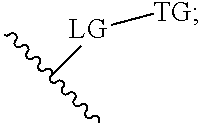
- a targeting group (TG) is a moiety that targets, for example, tumor cells by either passive or active targeting by methods known in the art. Examples of targeting groups include dendrons, dendrimers, PEG groups, peptides, polypeptides, folates, amidines, antibodies, proteins, steroids, mono or oligosaccharides, and the like.
- each leg has a first and a second fenoyl-N-phenyl-N-phenyl-N-phenyl-N-phenyl-N-phenyl-N-phenyl-N-phenyl-N-phenyl-N-phenyl-N-phenyl-N-phenyl-N-phenyl-N-phenyl-N-phenyl-N-phenyl-N-phenyl
- R 1 to R 16 is independently hydrogen, C 1 to C 20 alkyl group, halo group, hydroxyl group, nitro group, carboxylic acid group, ester group, amide group, ether group, C 3 to C 20 carbocyclic group, or C 1 to C 20 heterocyclic group.
- the carboxylic acid group, ester group, amide group, and ether groups can have from 1 to 20 carbons, including all integer values and ranges therebetween.
- At least one of R 1 to R 16 in the compound has the following structure:
- LG is a linking group and X is the solubilizing group.
- one or more adjacent R 1 to R 16 groups are connected forming a carbocyclic or heterocyclic ring, and the ring can be substituted or unsubstituted.
- adjacent refers to groups attached through 2 or 3 carbons as depicted by, for example,
- groups can be attached through any two adjacent carbons.
- a linking group (LG) is a group that connects
- the linking group can be, for example, an alkoxy moiety or an alkyl moiety.
- the linking group can have independently at each occurrence a thioether linkage, ether linkage, amino linkage, amide linkage, ester linkage, triazole ring linkage, or a combination thereof. For example, these linkages can join the linking group and solubilizing group or targeting group.
- the linking group, LG is a 1-substituted triazole.
- each i is independently 1 to 20, including all integer values therebetween.
- At least one of the R 1 to R 16 groups in the compound has the following structure:
- LG is a linking group and TG is a targeting group.
- the compound has one of the following structures:
- the PEG group has a molecular weight of 200 to 10,000, including all integers and ranges therebetween. In an embodiment, the PEG group has a molecular weight of 350 (PEG350), 750 (PEG750), 1900 (PEG1900), or 5000 (PEG5000).
- the compounds have the following structures:
- j is, for example, 1 to 2250, including all integer values and ranges therebetween, and R in this example is hydrogen or an alkyl group,
- a + can be H + , Na + , K + , Ca 2+ , Mg 2+ , Zn 2+ , H 4 N + , Et 3 NH + , Me 4 N + , (HOCH 2 CH 2 ) 3 NH + , or a cationic form of ethylenediamine, piperazine, and trishydroxymethyl aminomethane (TRIS).
- reaction mixture comprising compound (1), an acid (e.g., MeSO 3 H, HCl, CF 3 CO 2 H, H 2 SO 4 , or TsOH) and a compound (2) having the following structure:
- an acid e.g., MeSO 3 H, HCl, CF 3 CO 2 H, H 2 SO 4 , or TsOH
- each R is independently hydrogen, C 1 to C 20 alkyl group, C 3 to C 20 carbocyclic group, C 1 to C 20 heterocyclic group, carboxylic acid group, ester group, amide group, hydroxyl group or ether group.
- adjacent R groups form a C 3 to C 20 carbocyclic ring or heterocyclic ring, where the carbocyclic ring is a ring in which all of the atoms forming the ring(s) are carbon atoms and the heterocyclic ring is a ring where at least one of the atoms forming the ring(s) is a heteroatom (e.g., oxygen, nitrogen, sulfur, etc.).
- These rings may each be substituted with alkyl groups and other substituents such as, for example, nitro, cyano, keto, carboxy, alkoxy, hydroxyl, amine, amide, halide (e.g., bromide, chloride, fluoride, and iodide), and alkoxy groups.
- Y is oxygen or nitrogen substituted with a C 1 to C 20 alkyl group.
- ring system which can be a C 5 to C 20 carbocyclic ring system or C 2 to C 20 heterocyclic ring system, where the ring system comprises one or more rings.
- the ring system optionally, has at least one solubilizing group.
- the ring system has a targeting group.
- one of the building block compounds can be derivatized to form a compound of the present invention.
- an alkyl bromide component of one of the building block compounds can be reacted with a PEGylated thiol to make a compound with a PEG solubilizing group.
- each R 1 to R 16 is independently hydrogen, C 1 to C 20 alkyl group, halo group, hydroxyl group, nitro group, carboxylic acid group, ester group, amide group, ether group, C 3 to C 20 carbocyclic group, or C 1 to C 20 heterocyclic group.
- the carboxylic acid group, ester group, amide group, and ether groups can have from 1 to 20 carbons, including all integer values and ranges therebetween.
- At least one of the R 1 to R 16 groups in the structure has the following structure:
- LG is the linking group and wherein X is the solubilizing group.
- LG can have the formula:
- each i is 1 to 20.
- one or more adjacent R 1 to R 16 groups are connected forming a carbocyclic or heterocyclic ring, and the ring can be substituted or unsubstituted.
- at least one of the R 1 to R 16 groups in the structure has the following structure:
- LG is a linking group and wherein TG is the targeting group.
- reaction conditions e.g., solvent, reaction time and reaction temperature
- solvent e.g., TFA, HCl, H 2 SO 4 , TsOH, HBr, MeSO 3 H, and mixtures thereof.
- acetic anhydride it may be desirable to add acetic anhydride as a co-solvent.
- Reaction time can vary. Generally, a reaction time of 3 hours is sufficient to provide a desired extent of reaction.
- reaction temperatures can be used. For example, reaction temperatures of 25° C. to 100° C. can be used.
- the compounds can be made from building block compounds (i.e., intermediates).
- the building block compounds have functional groups (e.g., halogen (e.g., fluoro, chloro, bromo, or iodo), hydroxy, carboxylic acid, alkenyl, alkynyl, nitro, cyano, keto, amino, amido, thioether, thioate and triazole groups) that can be reacted to form solubilizing groups or targeting groups.
- functional groups e.g., halogen (e.g., fluoro, chloro, bromo, or iodo)
- hydroxy carboxylic acid
- alkenyl alkynyl
- nitro, cyano keto
- amino, amido, thioether, thioate and triazole groups e.g., amino, amido, thioether, thioate and triazole groups
- the tetra propargyl compound can be reacted with azides to form for example a triazole compound.
- Glycoluril Dimer A mixture of glycoluril (500 g, 3.51 mol) and paraformaldehyde (105 g, 3.51 mol) in HCl (8 M, 70 mL) was heated at 50° C. for 48 h. The reaction mixture was cooled and filtered. The solid was washed with water (500 mL) and then recrystallized with TFA (1.5 L) to yield Glycoluril Dimer as a white solid (334 g, 62%).
- Dimethyl glycoluril Into a solution of urea (1140 g, 19.0 mol) in HCl (0.3 M, 2.8 L), 2,3-butanedione (500 g, 5.8 mol) was added. The solution was stirred at RT for 12 h. The reaction mixture was filtered and the solid was washed with water (2.0 L ⁇ 2) and then ethanol (2.0 L) to yield Dimethyl glycoluril as a white solid (749 g, 76%).
- Dimethyl glycoluril bis(cyclic ether) Dimethyl glycoluril bis(cyclic ether).
- a mixture of Dimethyl glycoluril (749 g, 4.4 mol) and paraformaldehyde (650 g, 21.7 mol) in HCl (9 M, 3.8 L) was stirred for 24 h.
- Water (14.0 L) was added and the mixture was stirred for an additional 12 h.
- the mixture was then filtered and washed with water (2 L) and ethanol (2 L) to yield Dimethyl glycoluril bis(cyclic ether) as a white solid (719 g, 65%).
- 1,4-Naphthalene propanesulfonate wall ( FIG. 2 ).
- a solution of 1,4-dihydroxynaphathelene (2.0 g, 12.5 mmol) in NaOH (10 wt %, 16 mL) a solution of propanesultone (3.8 g, 31.2 mmol) in 1,4-dioxane (24 mL) was added. This solution was stirred at RT for 12 h. After filtration, the solid was dissolved in H2O (10 mL) and then precipitated with MeCN (60 mL) to yield a blue solid (1.5 g, 3.3 mmol, 27%). M.p.>227° C. (dec.).
- Ethanesulfonate Wall ( FIG. 4 ). 1,4-bis(2-bromoethoxy)benzene (2.00 g, 6.13 mmol) and sodium sulfite (3.10 g, 24.5 mmol) were mixed and dissolved in DMF (20 mL). The mixture was stirred at 100° C. under N 2 for 12 h and then water (20 mL) was added. The mixture was allowed to cool to RT and the product precipitated as white crystals. The solid was collected by filtration and then purified by recrystallization from water. Drying under high vacuum gave Sodium 2,2′-(1,4-phenylenebis(oxy))diethanesulfonate as a white solid (2.01 g, 88%).
- Butanesulfonate Wall ( FIG. 5 ). A solution of butanesultone (24.5 g, 200 mmol) in 1,4-dioxane (160 mL) was added into a solution of hydroquinone (8.80 g, 80.0 mmol) in aqueous NaOH solution (10 wt %, 120 mL). The mixture was stirred at RT for 12 h then filtered to collect the crude solid. The solid was stirred with acetone (200 mL) then dried under high vacuum to yield Sodium 4,4′-(1,4-phenylenebis(oxy))dibutane-1-sulfonate as a white solid (25.1 g, 80%).
- 2,7-Naphthalenesulfonate Wall ( FIG. 6 ).
- a solution of propanesultone (38.0 g, 300 mmol) in 1,4-dioxane (240 mL) was added into a solution of naphthalene-2,7-diol (20.0 g, 124 mmol) in NaOH (10 wt %, 160 mL). This solution was stirred at RT for 12 h. After filtration, the solid was collected and then dissolved in H 2 O (100 mL) and then was precipitated by the addition of CH 3 CN (600 mL). The solid was collected by filtration and then dried under high vacuum to yield a pale green solid (23.2 g, 41%).
- Ethanesulfonate Host a ( FIG. 7 ).
- Sodium 2,2′-(1,4-phenylenebis(oxy))diethanesulfonate (1.81 g, 0.23 mmol) was added into a solution of methyl tetramer (0.64 g, 0.77 mmol) in TFA (2 mL).
- the mixture was stirred and heated at 70° C. for 4 h.
- the solvent was removed with under reduced pressure and the solid was further dried under high vacuum.
- Butanesulfonate Host b ( FIG. 7 ).
- Sodium 4,4′-(1,4-phenylenebis(oxy))bis(butane-1-sulfonate) (6.50 g, 15.4 mmol) was added into a solution of methyl tetramer (3.00 g, 3.84 mmol) in TFA (30 mL).
- the mixture was stirred and heated at 70° C. for 4 h.
- the solvent was removed under reduced pressure and the solid was further dried under high vacuum.
- Naphthalene propanesulfonate Host ( FIG. 8 ).
- Sodium 3,3′-(naphthalene-2,7-diylbis(oxy))dipropane-1-sulfonate (229 mg, 0.152 mmol) was added into a solution of methyl tetramer (100 mg, 0.128 mmol) in a mixture of TFA/Ac 2 O (1:1, 2 mL). The mixture was stirred and heated at 70° C. for 3 h and then was poured into acetone (30 mL). The solid was collected with filtration. The crude solid was dissolved in H 2 O (10 mL), and then precipitated by the addition of acetone (30 mL).
- Tetrathiophenyl Host ( FIG. 10 ). Sodium benzenethiolate (48 mg, 0.36 mmol) was dissolved in EtOH (2 mL). Tetrabromohost (100 mg, 0.072 mmol) was added and the reaction mixture was stirred at RT for 12 h. The reaction mixture was centrifuged to collect the crude product. The solid was washed with EtOH (10 mL) and then H 2 O (10 mL). A pale yellow solid was obtained after drying under high vacuum (63 mg, 58%).
- Tetra Octanethioether Host ( FIG. 11 ). Octane-1-thiol (53 mg, 0.36 mmol) was dissolved in EtOH (2 mL). Tetrabromohost (100 mg, 0.072 mmol) was added and the reaction mixture was stirred at RT for 3 h. The reaction mixture was centrifuged to collect crude solid. The solid was washed with EtOH (10 mL) and then H 2 O (10 mL). A white solid was obtained after drying under high vacuum (103 mg, 72%).
- PEG 350 Host ( FIG. 12 ).
- PEG 350 (176 mg, 0.43 mmol) and NaOEt (29 mg, 0.43 mmol) was dissolved in ethylene glycol (2 mL).
- Tetrabromo Host 100 mg, 0.072 mmol was added and the reaction mixture was stirred and heated at 50° C. for 12 h. The reaction mixture was centrifuged to remove insoluble material and the clear solution was concentrated and poured into diethyl ether (10 mL). The white precipitate was collected by centrifugation. A dark yellow gel was obtained after drying under high vacuum (150 mg, 82%).
- PEG 750 Host ( FIG. 12 ).
- PEG 750 (349 mg, 0.43 mmol) and NaOEt (29 mg, 0.43 mmol) was dissolved in ethylene glycol (2 mL).
- Tetrabromo Host 100 mg, 0.072 mmol was added and the reaction mixture was stirred and heated at 70° C. for 12 h.
- the reaction mixture was centrifuged to remove insoluble material and a mixture of CH 2 Cl 2 and MeOH (5 mL, 4:1) was added to the supernatant.
- Diethyl ether (10 mL) was added and then the mixture was centrifuged to isolate a white precipitate. A pale yellow solid was obtained after drying under high vacuum (172 mg, 58%).
- PEG 1900 Host ( FIG. 12 ).
- PEG 1900 (823 mg, 0.43 mmol) and NaOEt (29 mg, 0.43 mmol) was dissolved in ethylene glycol (2 mL).
- Tetrabromo Host 100 mg, 0.072 mmol was added and the reaction mixture was stirred and heated at 70° C. for 12 h.
- the reaction mixture was centrifuged to remove insoluble material and a mixture of CH 2 Cl 2 and MeOH (5 mL, 4:1) was added to the supernatant.
- Diethyl ether (10 mL) was added and then the mixture was centrifuged to isolate a white precipitate.
- the product was further purified by GPC using Sephadex-G25.
- PEG 5000 Host ( FIG. 12 ).
- Tetrabromo Host (100 mg, 0.072 mmol) was added and the reaction mixture was stirred and heated at 70° C. for 12 h.
- the reaction mixture was centrifuged to remove insoluble material and a mixture of CH 2 Cl 2 and MeOH (5 mL, 4:1) was added to the supernatant. Diethyl ether (10 mL) was added and then the mixture was centrifuged to isolate a white precipitate.
- the product was further purified by GPC using Sephadex-G25.
- Dibromo dipropanesulfonate Host ( FIG. 13 ). 1,4-bis(2-bromoethoxy)benzene (250 mg, 0.768 mmol) and sodium 3,3′-(1,4-phenylenebis(oxy))bis(propane-1-sulfonate) (102 mg, 0.256 mmol) were added into a solution of methyl tetramer (200 mg, 0.256 mmol) in TFA (2.5 mL). The mixture was stirred and heated at 70° C. for 3 h and then was poured into acetone (150 mL). The solid was collected by filtration. The crude solid was stirred with water (30 mL ⁇ 3) at RT for 4 hr.
- Tetra Hydroxy Host ( FIG. 15 ). Tetra Ester Host (0.400 g, 0.305 mmol) was added into an aqueous solution of LiOH (2.5 M, 7.5 mL). The mixture was stirred at 50° C. for 0.5 h and then the solid was collected by filtration. The solid was wash with 0.1M HCl to neutral and then stirred with EtOH (30 mL), and water (30 mL). After drying under high vacuum, a white solid was obtained (0.234 g, 67%).
- Tetrathioacetate Host ( FIG. 16 ). K 2 CO 3 (99 mg, 0.43 mmol) and thiolacetic acid (55 mg, 0.43 mmol) was added into DMF (2 mL) and was stirred at RT for 15 min under N 2 . Tetrabromo Host (100 mg, 0.072 mmol) was added as a solid. The mixture was stirred at 50° C. for 12 h and then was poured into H 2 O (6 mL). The solid was collected by filtration and was then washed with H 2 O (5 mL) and acetone (5 mL). A beige solid was obtained after drying under high vacuum (73 mg, 74%).
- Tetra Triazole Host ( FIG. 17 ). Ascorbic acid (7 mg, 0.04 mmol), NaOH (2 mg, 0.04 mmol) and CuSO 4 (2 mg, 0.01 mmol) was mixed and then dissolved in a mixture of H 2 O and EtOH (1 mL, 1:1). Alkyne Host (26 mg, 0.024 mmol) and (R)-2-azidopropanoic acid (22 mg, 0.19 mmol) was added as solid. The mixture was heated with microwave at 80° C. for 30 min, and then solvent was removed under reduced pressure. The crude solid was washed with MeOH (2 mL). A yellowish solid was obtained after drying under high vacuum (15 mg, 40%).
- Rhodamine 6G was used as an indicator to perform a competition experiment to determine the binding constant.
- the absorbances of the solution at 550 nm were monitored by UV-VIS spectroscopy, and then used to calculate the binding constant.
- Erythromycin is a commercially available drug widely used to treat bacterial infections. Erythromycin estolate, however, is a derivative with high toxicity. Erythromycin, with an EC50 value of 594 ( ⁇ 194) ⁇ M is significantly less toxic compared to erythromycin estolate, which has an EC50 of 109 ( ⁇ 7) ⁇ M. These two drugs were chosen specifically to serve as a point of comparison for the levels of cytotoxicity resulting from Motor 1 .
- the MTS assay conducted on the HEK293 ( FIG. 27A ) cell line showed high cell survival in the all concentrations of Motor 1 at 92, 96, 89 and 79% cell viability. However, cell populations treated with distilled water (0.2%), 1 mM of erythromycin (47%) and erythromycin estolate (11%) showed significant decrease in cell viability.
- the AK assay ( FIG. 27B ) performed on this cell line reflected these results. Percent cell death observed in the cells treated with 1 mM erythromycin and erythromycin estolate were 25 and 49% respectively. However, cell death in the untreated population and all concentrations of Motor 1 was below 5%.
- a hemolysis assay ( FIG. 29 ) was conducted to assess any toxic effects of Motor 1 on human erythrocytes. These assays used pooled blood from two healthy donors from which red blood cells were isolated through centrifugation. Erythrocytes were exposed to phosphate buffered saline (PBS), distilled water, and increasing concentrations of Motor 1 (1) (0.01, 0.1, 1 and 10 mM). The erythrocytes were incubated shaking at 37° C. for 3 h following treatment. The release of hemoglobin from damaged red blood cells was quantified by measuring the relative absorbance of the samples at 405 nm. Data collected was converted to percent hemolysis by setting the cell population treated with distilled water at a 100% hemolysis.
- PBS phosphate buffered saline
- Motor 1 (1) 0.01, 0.1, 1 and 10 mM
- FIG. 30 shows Motor 1 is well tolerated in mice. Indicated amounts of Motor 1 were injected into the tail vein of outbred Swiss Webster mice at day 0, 4 and 8. The weight of each mouse was monitored over time and there were 5 mice per experimental group.
- Rat 10 For Plasma samples, four rats in total have been tested: Rat 10, Rat 17, Rat 11, Rat 21.
- 10 ⁇ L of plasma was taken and dried under high vacuum. Excess amount of probe solution was added (495 ⁇ L of 38 ⁇ M p-xylenediamine) to dissolve the residue and then the reference (5 ⁇ L of 600 ⁇ M benzene-1,3,5-tricarboxylic acid) was added.
- NMR spectra was taken with water suppression and the concentration of Motor 1 was calculated from the ratio between the integrations of the peaks for the reference (8.2 ppm, 3H) and Motor 1 (6.5 ppm, 4H).
- benzene-1,3,5-tricarboxylic acid was not used, but p-xylenediamine was used as the reference ( FIGS. 31-34 ).
- FIG. 35 shows toxicology using Motor 2 . Varying concentrations of Motor 2 were incubated with THP-1 (A) and HEK 293 (B) cells over a 48 hr period resulted in high cell survival up to 5 mM.
- Two complementary assays were used to analyze toxicology: an MTS and an AK release assay for the THP-1 cells.
- the AK release assay was conducted using 20 ul of supernatant from each sample studied using the MTS assay.
Landscapes
- Health & Medical Sciences (AREA)
- Chemical & Material Sciences (AREA)
- Organic Chemistry (AREA)
- Life Sciences & Earth Sciences (AREA)
- Pharmacology & Pharmacy (AREA)
- Animal Behavior & Ethology (AREA)
- General Health & Medical Sciences (AREA)
- Public Health (AREA)
- Veterinary Medicine (AREA)
- Medicinal Chemistry (AREA)
- Epidemiology (AREA)
- Chemical Kinetics & Catalysis (AREA)
- General Chemical & Material Sciences (AREA)
- Engineering & Computer Science (AREA)
- Oil, Petroleum & Natural Gas (AREA)
- Nuclear Medicine, Radiotherapy & Molecular Imaging (AREA)
- Pharmaceuticals Containing Other Organic And Inorganic Compounds (AREA)
- Acyclic And Carbocyclic Compounds In Medicinal Compositions (AREA)
- Medicinal Preparation (AREA)
- Polysaccharides And Polysaccharide Derivatives (AREA)
- Nitrogen Condensed Heterocyclic Rings (AREA)
- Medicines Containing Antibodies Or Antigens For Use As Internal Diagnostic Agents (AREA)
Abstract
Description

where each R is independently hydrogen, C1 to C20 alkyl group, C3 to C20 carbocyclic group, C1 to C20 heterocyclic group, carboxylic acid group, ester group, amide group, hydroxy, or ether group. Optionally, adjacent R groups form a C3 to C20 carbocyclic ring or heterocyclic ring. Each

is independently a C5 to C20 carbocyclic ring system or C2 to C20 heterocyclic ring system, where the ring system comprises one or more rings. At least one of the ring systems has at least one solubilizing group selected from sulfonic acid, sulfonate salt, phosphonic acid, phosphonate salt, and polyethylene glycol. Optionally, the ring system has a targeting group. The value of n is 1 to 5.


Each R is independently hydrogen, C1 to C20 alkyl group, C3 to C20 carbocyclic group, C1 to C20 heterocyclic group, carboxylic acid group, ester group, amide group, hydroxyl, or ether group. The carboxylic acid, ester, amide, and ether groups can have from 1 to 20 carbons, including all integer values and ranges therebetween. Optionally, adjacent R groups form a C3 to C20 carbocyclic ring or heterocyclic ring, where the carbocyclic ring is a ring in which all of the atoms forming the ring(s) are carbon atoms and the heterocyclic ring is a ring where at least one of the atoms forming the ring(s) is a heteroatom (e.g., oxygen, nitrogen, sulfur, etc.). These rings may each be substituted with alkyl groups and other substituents such as, for example, nitro, cyano, keto, carboxy, alkoxy, hydroxyl, amine, amide, halide (e.g., bromide, chloride, fluoride, and iodide), and alkoxy groups.

is independently a C5 to C20 carbocyclic ring system or C2 to C20 heterocyclic ring system. At least one

of the compound has at least one solubilizing group. In an embodiment, both

s of the compound have at least one solubilizing group. In an embodiment, one

of the compound has at least one solubilizing group. In various embodiments, the ring system has 1, 2, 3, 4, 5, or 6 solubilizing groups. Optionally, the ring system has a targeting group. The value of n is 1 to 5, including all integer values therebetween. In an embodiment, the

groups are the same.

of the compound is independently a C5 to C20 carbocyclic ring system having one of the following structures:


R1 to R16 is independently hydrogen, C1 to C20 alkyl group, halo group, hydroxyl group, nitro group, carboxylic acid group, ester group, amide group, ether group, C3 to C20 carbocyclic group, or C1 to C20 heterocyclic group. For example, the carboxylic acid group, ester group, amide group, and ether groups can have from 1 to 20 carbons, including all integer values and ranges therebetween. At least one of R1 to R16 in the compound has the following structure:

LG is a linking group and X is the solubilizing group. Optionally, one or more adjacent R1 to R16 groups are connected forming a carbocyclic or heterocyclic ring, and the ring can be substituted or unsubstituted.

in the structures:

It is contemplated that groups can be attached through any two adjacent carbons.

with a solubilizing group (X) or a targeting group (TG). The linking group can be, for example, an alkoxy moiety or an alkyl moiety. The linking group can have independently at each occurrence a thioether linkage, ether linkage, amino linkage, amide linkage, ester linkage, triazole ring linkage, or a combination thereof. For example, these linkages can join the linking group and solubilizing group or targeting group. In an embodiment, the linking group, LG, is a 1-substituted triazole.

has the following structure:


LG is a linking group and TG is a targeting group.

wherein Z is PEG group. In an embodiment, the PEG group has a molecular weight of 200 to 10,000, including all integers and ranges therebetween. In an embodiment, the PEG group has a molecular weight of 350 (PEG350), 750 (PEG750), 1900 (PEG1900), or 5000 (PEG5000).


where j is, for example, 1 to 2250, including all integer values and ranges therebetween, and R in this example is hydrogen or an alkyl group,


where A+ can be H+, Na+, K+, Ca2+, Mg2+, Zn2+, H4N+, Et3NH+, Me4N+, (HOCH2CH2)3NH+, or a cationic form of ethylenediamine, piperazine, and trishydroxymethyl aminomethane (TRIS).

where m is from 0 to 4,

where each R is independently hydrogen, C1 to C20 alkyl group, C3 to C20 carbocyclic group, C1 to C20 heterocyclic group, carboxylic acid group, ester group, amide group, hydroxyl group or ether group. Optionally, adjacent R groups form a C3 to C20 carbocyclic ring or heterocyclic ring, where the carbocyclic ring is a ring in which all of the atoms forming the ring(s) are carbon atoms and the heterocyclic ring is a ring where at least one of the atoms forming the ring(s) is a heteroatom (e.g., oxygen, nitrogen, sulfur, etc.). These rings may each be substituted with alkyl groups and other substituents such as, for example, nitro, cyano, keto, carboxy, alkoxy, hydroxyl, amine, amide, halide (e.g., bromide, chloride, fluoride, and iodide), and alkoxy groups. Y is oxygen or nitrogen substituted with a C1 to C20 alkyl group. (2) is added to the reaction mixture such that a compound (3), of the following structure is formed:


which can be a C5 to C20 carbocyclic ring system or C2 to C20 heterocyclic ring system, where the ring system comprises one or more rings. The ring system, optionally, has at least one solubilizing group. Optionally, the ring system has a targeting group. Compound (3), a solvent, and

are combined such that the following structure is formed:


can be derivatized with the solubilizing group and/or targeting group after step 3). For example, one of the building block compounds can be derivatized to form a compound of the present invention. For example, an alkyl bromide component of one of the building block compounds can be reacted with a PEGylated thiol to make a compound with a PEG solubilizing group.

include but are not limited to:

where each R1 to R16 is independently hydrogen, C1 to C20 alkyl group, halo group, hydroxyl group, nitro group, carboxylic acid group, ester group, amide group, ether group, C3 to C20 carbocyclic group, or C1 to C20 heterocyclic group. For example, the carboxylic acid group, ester group, amide group, and ether groups can have from 1 to 20 carbons, including all integer values and ranges therebetween. At least one of the R1 to R16 groups in the structure has the following structure:

where LG is the linking group and wherein X is the solubilizing group. In an embodiment, LG can have the formula:

where each i is 1 to 20. Optionally one or more adjacent R1 to R16 groups are connected forming a carbocyclic or heterocyclic ring, and the ring can be substituted or unsubstituted. In an embodiment, at least one of the R1 to R16 groups in the structure has the following structure:

where LG is a linking group and wherein TG is the targeting group.

group to be reactive in electrophilic aromatic substitution reactions. Thus, in an embodiment, the

group is an aromatic ring having at least one alkyl ether moiety.


For example, the tetra propargyl compound can be reacted with azides to form for example a triazole compound.
| TABLE 1 |
| Binding constants of Motor1 towards guests: |
| Guest | Ka | ||
| vecuronium | 5.8 ± 0.9 × 10⁶ | ||
| pancuronium | 4.5 ± 0.1 × 10⁵ | ||
| atracurium | 1.4 ± 0.1 × 10⁶ | ||
| tubocurarine | 4.7 ± 0.2 × 10⁵ | ||
| gallamine | 6.2 ± 0.5 × 10⁶ | ||
| acetylcholine | 2.4 ± 0.1 × 10⁴ | ||
| TABLE 2 |
| Compounds used and their binding affinities towards Motor2. |
| Compound Name | Ka (M−1) with Motor2 | ||
| Rhodamine 6G | 2.3 ± 0.2 × 10⁸ | ||
| Cyclohexanediamine | 2.1 ± 0.2 × 10⁸ | ||
| Proflavin | 7.8 ± 0.8 × 10⁸ | ||
| Bacuronium | 3.4 ± 0.6 × 10⁹ | ||
| Vecuronium | 1.6 ± 0.2 × 10⁹ | ||
| Pancuronium | 5.3 ± 0.5 × 10⁸ | ||
| Atracurium besilate | 1.0 ± 0.1 × 10⁹ | ||
| Gallamine | 3.2 ± 0.4 × 10⁸ | ||
| Turbocurium | 2.2 ± 0.3 × 10⁹ | ||
| Acetylcholine | 1.8 ± 0.2 × 10⁸ | ||
| TABLE 3 | |||
| Ketamine | Etomidate | ||
| Motor1 | 39020M−1 | 35318M−1 |
| Motor2 | 193490M−1 | 36812M−1 |
| TABLE 4 | ||||||
| Urine | Mass | |||||
| volume | [Motor1] | [Motor1] | (Motor1) | |||
| Sample No. | (μL) | Integral* | (mM ) | (mg/mL) | (mg) | Notes |
| R1U | 930 | 3.34 | 6.958 | 10.723 | 9.972 | |
| R2U | 530 | 0.06 | 0.125 | 0.193 | 0.102 | Blood in urine |
| R3U | 580 | 0.25 | 21.354 | 32.907 | 19.086 | |
| |
240 | 8.88 | 18.500 | 28.509 | 6.842 | Precipitate in |
| urine | ||||||
| R5U | 1350 | 0.00 | 0.000 | 0.000 | 0.000 | |
| R6U | 415 | 0.00 | 0.000 | 0.000 | 0.000 | |
| R7U | 725 | 5.72 | 11.917 | 18.364 | 13.314 | |
| R8U | 610 | 13.78 | 28.708 | 44.240 | 26.986 | |
| R9U | 950 | 4.21 | 8.771 | 13.516 | 12.840 | |
| R10U | 315 | 8.70 | 18.125 | 27.931 | 8.798 | |
| R11U | 560 | 1.03 | 2.146 | 3.307 | 1.852 | |
| R12U | N/A | |||||
| R13U | 815 | 0.00 | 0.000 | 0.000 | 0.000 | |
| R14U | 355 | 10.62 | 22.125 | 34.095 | 12.104 | |
| R15U | 305 | 6.88 | 14.333 | 22.088 | 6.737 | Blood in urine |
| R16U | 455 | 12.28 | 25.583 | 39.424 | 17.938 | |
| R17U | 255 | 10.74 | 22.375 | 34.480 | 8.792 | |
| R18U | 610 | 0.00 | 0.000 | 0.000 | 0.000 | |
| R19U | 615 | 1.27 | 2.646 | 4.077 | 2.507 | Precipitate in |
| urine | ||||||
| R20U | 190 | 5.39 | 11.229 | 17.304 | 3.288 | Precipitate in |
| urine | ||||||
| R21U | 585 | 2.40 | 5.000 | 7.705 | 4.507 | |
| R22U | 390 | 0.00 | 0.000 | 0.000 | 0.000 | Precipitate in |
| urine | ||||||
| *Peak from 1.65-1.9 ppm, with reference peak integral for benzene-1,3,5-tricarboxylic acid (5 mM) at 8.3 ppm set to 3 | ||||||
Claims (12)




Priority Applications (1)
| Application Number | Priority Date | Filing Date | Title |
|---|---|---|---|
| US13/878,612 US9469648B2 (en) | 2010-10-13 | 2011-10-13 | Reversal of drug-induced neuromuscular block using novel molecular containers |
Applications Claiming Priority (4)
| Application Number | Priority Date | Filing Date | Title |
|---|---|---|---|
| US39272210P | 2010-10-13 | 2010-10-13 | |
| US39272910P | 2010-10-13 | 2010-10-13 | |
| US13/878,612 US9469648B2 (en) | 2010-10-13 | 2011-10-13 | Reversal of drug-induced neuromuscular block using novel molecular containers |
| PCT/US2011/056140 WO2012051413A1 (en) | 2010-10-13 | 2011-10-13 | Reversal of drug-induced neuromuscular block using novel molecular containers |
Publications (2)
| Publication Number | Publication Date |
|---|---|
| US20130345273A1 US20130345273A1 (en) | 2013-12-26 |
| US9469648B2 true US9469648B2 (en) | 2016-10-18 |
Family
ID=45938713
Family Applications (5)
| Application Number | Title | Priority Date | Filing Date |
|---|---|---|---|
| US13/878,612 Active 2032-11-22 US9469648B2 (en) | 2010-10-13 | 2011-10-13 | Reversal of drug-induced neuromuscular block using novel molecular containers |
| US13/878,613 Active US9567344B2 (en) | 2010-10-13 | 2011-10-13 | Molecular containers and methods of making and using same |
| US15/417,785 Abandoned US20170137431A1 (en) | 2010-10-13 | 2017-01-27 | Molecular containers and methods of making and using same |
| US17/121,241 Active US11897893B2 (en) | 2010-10-13 | 2020-12-14 | Molecular containers and methods of making and using same |
| US18/396,432 Pending US20240124476A1 (en) | 2010-10-13 | 2023-12-26 | Molecular containers and methods of making and using same |
Family Applications After (4)
| Application Number | Title | Priority Date | Filing Date |
|---|---|---|---|
| US13/878,613 Active US9567344B2 (en) | 2010-10-13 | 2011-10-13 | Molecular containers and methods of making and using same |
| US15/417,785 Abandoned US20170137431A1 (en) | 2010-10-13 | 2017-01-27 | Molecular containers and methods of making and using same |
| US17/121,241 Active US11897893B2 (en) | 2010-10-13 | 2020-12-14 | Molecular containers and methods of making and using same |
| US18/396,432 Pending US20240124476A1 (en) | 2010-10-13 | 2023-12-26 | Molecular containers and methods of making and using same |
Country Status (4)
| Country | Link |
|---|---|
| US (5) | US9469648B2 (en) |
| EP (2) | EP2627657B1 (en) |
| ES (2) | ES2573494T3 (en) |
| WO (2) | WO2012051407A2 (en) |
Cited By (1)
| Publication number | Priority date | Publication date | Assignee | Title |
|---|---|---|---|---|
| US20170137431A1 (en) * | 2010-10-13 | 2017-05-18 | University Of Maryland, College Park | Molecular containers and methods of making and using same |
Families Citing this family (12)
| Publication number | Priority date | Publication date | Assignee | Title |
|---|---|---|---|---|
| WO2016061571A1 (en) | 2014-10-18 | 2016-04-21 | University Of Maryland, College Park | Acyclic cucurbit(n)uril type molecular containers to treat intoxication and decrease relapse rate in substance abuse disorders |
| WO2019034945A1 (en) * | 2017-08-17 | 2019-02-21 | Jawaharlal Nehru Centre For Advanced Scientific Research | Dynamic host-guest interactive system |
| CN108101915B (en) * | 2017-11-15 | 2020-07-10 | 昆明理工大学 | Polyamine-derivatized ring-opening cucurbiturils and application thereof |
| CN108084194B (en) * | 2017-11-15 | 2020-07-31 | 昆明理工大学 | A kind of alkali-sensitive ring-opening cucurbituril and application thereof |
| CN110724273A (en) * | 2019-10-12 | 2020-01-24 | 昆明理工大学 | A kind of asymmetric ring-opening cucurbituril and preparation method thereof |
| EP4139311A4 (en) | 2020-04-21 | 2023-10-25 | University of Maryland, College Park | ACYCLIC CUCURBITURILS, METHOD FOR THE PRODUCTION THEREOF AND USES THEREOF |
| CN114539318B (en) * | 2022-03-14 | 2024-05-24 | 武汉工程大学 | Open-ring cucurbituril phosphate compound and its preparation and application in drug solubilization |
| AU2023378470A1 (en) | 2022-11-11 | 2025-06-05 | Jiangsu Hengrui Pharmaceuticals Co., Ltd. | Cucurbituril compound and medical use thereof |
| CN119613419A (en) * | 2023-09-13 | 2025-03-14 | 中国科学院上海有机化学研究所 | Deuterated diaryl glycoluril tetramer compound and application thereof |
| WO2025237335A1 (en) * | 2024-05-14 | 2025-11-20 | 江苏恒瑞医药股份有限公司 | Pharmaceutically acceptable salt of cucurbituril derivative, crystal form thereof and use thereof |
| CN119798267B (en) * | 2025-01-06 | 2025-09-26 | 昆明理工大学 | High-water-solubility taste masking agent and preparation method and application thereof |
| CN121045193B (en) * | 2025-10-29 | 2026-02-13 | 川北医学院 | Cucurbituril derivative for drug detection and preparation method and application thereof |
Citations (4)
| Publication number | Priority date | Publication date | Assignee | Title |
|---|---|---|---|---|
| US20050080068A1 (en) | 2003-09-04 | 2005-04-14 | Lyle Isaacs | Cucurbit [n] uril compounds and analogs, and methods of making and using the same |
| US20060182795A1 (en) | 2000-12-19 | 2006-08-17 | California Institute Of Technology | Compositions containing inclusion complexes |
| US20090072191A1 (en) | 2006-02-28 | 2009-03-19 | Lyle David Isaacs | Nor-Seco-Bis-Nor-Seco, Tris-Nor-Seco, and Higher Nor-Seco-Cucurbit[n]Uril Compounds |
| US20100010215A1 (en) | 2005-07-22 | 2010-01-14 | The University Of Maryland | Introverted CB[N] Compounds |
Family Cites Families (5)
| Publication number | Priority date | Publication date | Assignee | Title |
|---|---|---|---|---|
| AUPQ023299A0 (en) | 1999-05-07 | 1999-06-03 | Unisearch Limited | Cucurbiturils and method for synthesis |
| US9566351B2 (en) * | 2010-10-13 | 2017-02-14 | University Of Maryland, College Park | Molecular containers and methods of making and using same |
| EP2627657B1 (en) * | 2010-10-13 | 2016-02-03 | University of Maryland, College Park | CUCURBIT[n]URIL-TYPE MOLECULAR CONTAINERS AND METHODS OF MAKING AND USING SAME |
| WO2016061571A1 (en) * | 2014-10-18 | 2016-04-21 | University Of Maryland, College Park | Acyclic cucurbit(n)uril type molecular containers to treat intoxication and decrease relapse rate in substance abuse disorders |
| EP4139311A4 (en) * | 2020-04-21 | 2023-10-25 | University of Maryland, College Park | ACYCLIC CUCURBITURILS, METHOD FOR THE PRODUCTION THEREOF AND USES THEREOF |
-
2011
- 2011-10-13 EP EP11833400.2A patent/EP2627657B1/en active Active
- 2011-10-13 US US13/878,612 patent/US9469648B2/en active Active
- 2011-10-13 US US13/878,613 patent/US9567344B2/en active Active
- 2011-10-13 WO PCT/US2011/056127 patent/WO2012051407A2/en not_active Ceased
- 2011-10-13 ES ES11833400.2T patent/ES2573494T3/en active Active
- 2011-10-13 ES ES11833403.6T patent/ES2568878T3/en active Active
- 2011-10-13 WO PCT/US2011/056140 patent/WO2012051413A1/en not_active Ceased
- 2011-10-13 EP EP11833403.6A patent/EP2627641B1/en active Active
-
2017
- 2017-01-27 US US15/417,785 patent/US20170137431A1/en not_active Abandoned
-
2020
- 2020-12-14 US US17/121,241 patent/US11897893B2/en active Active
-
2023
- 2023-12-26 US US18/396,432 patent/US20240124476A1/en active Pending
Patent Citations (4)
| Publication number | Priority date | Publication date | Assignee | Title |
|---|---|---|---|---|
| US20060182795A1 (en) | 2000-12-19 | 2006-08-17 | California Institute Of Technology | Compositions containing inclusion complexes |
| US20050080068A1 (en) | 2003-09-04 | 2005-04-14 | Lyle Isaacs | Cucurbit [n] uril compounds and analogs, and methods of making and using the same |
| US20100010215A1 (en) | 2005-07-22 | 2010-01-14 | The University Of Maryland | Introverted CB[N] Compounds |
| US20090072191A1 (en) | 2006-02-28 | 2009-03-19 | Lyle David Isaacs | Nor-Seco-Bis-Nor-Seco, Tris-Nor-Seco, and Higher Nor-Seco-Cucurbit[n]Uril Compounds |
Non-Patent Citations (6)
| Title |
|---|
| Brull, S. et al., Residual Neuromuscular Block: Lessons Unlearned. Part II: Methods to Reduce the Risk of Residual Weakness; Anesthesia and Analgesia [online] May 2010, vol. 111, No. 1, pp. 129-140. May 4, 2010. |
| Hettiarachchi, G., et al., Toxicology and Drug Delivery by Cucurbit[n]uril Type Molecular Containers, PLoS One, May 6, 2010, vol. 5, No. 5, pp. 1-10. May 6, 2010. |
| Kim K., et al., Functionalized curcurbiturils and their applications, Chem. Soc. Rev. [online] Nov. 7, 2006, vol. 36, Issu. 2, pp. 1-31. Nov. 7, 2006. |
| Lagona, J. et al. The Cucurbit[n]uril family, Angewandte Chemie Int. Ed. Aug. 5, 2005, vol. 44, pp. 4844-4870. |
| Ma, D., et al. "Acyclic Cucurbit[n]uril Congeners Are High Affinity Hosts." J. Org. Chem. (2010), vol. 75, pp. 4786-4795. * |
| Ma, Da et al. Acyclic Cucurbit[n]uril congeners are high affinity hosts, Journal of Organic Chemistry, Jun. 14, 2010, vol. 75, pp. 4786-4795. |
Cited By (4)
| Publication number | Priority date | Publication date | Assignee | Title |
|---|---|---|---|---|
| US20170137431A1 (en) * | 2010-10-13 | 2017-05-18 | University Of Maryland, College Park | Molecular containers and methods of making and using same |
| US20210206774A1 (en) * | 2010-10-13 | 2021-07-08 | University Of Maryland, College Park | Molecular containers and methods of making and using same |
| US11897893B2 (en) * | 2010-10-13 | 2024-02-13 | University Of Maryland, College Park | Molecular containers and methods of making and using same |
| US20240124476A1 (en) * | 2010-10-13 | 2024-04-18 | University Of Maryland, College Park | Molecular containers and methods of making and using same |
Also Published As
| Publication number | Publication date |
|---|---|
| ES2573494T3 (en) | 2016-06-08 |
| EP2627641A1 (en) | 2013-08-21 |
| EP2627657A4 (en) | 2014-02-19 |
| US20170137431A1 (en) | 2017-05-18 |
| EP2627657B1 (en) | 2016-02-03 |
| WO2012051413A1 (en) | 2012-04-19 |
| EP2627641A4 (en) | 2014-02-19 |
| US20140094529A1 (en) | 2014-04-03 |
| US9567344B2 (en) | 2017-02-14 |
| EP2627657A2 (en) | 2013-08-21 |
| US20210206774A1 (en) | 2021-07-08 |
| US20240124476A1 (en) | 2024-04-18 |
| EP2627641B1 (en) | 2016-01-20 |
| US20130345273A1 (en) | 2013-12-26 |
| ES2568878T3 (en) | 2016-05-05 |
| US11897893B2 (en) | 2024-02-13 |
| WO2012051407A2 (en) | 2012-04-19 |
| WO2012051407A3 (en) | 2012-07-26 |
Similar Documents
| Publication | Publication Date | Title |
|---|---|---|
| EP2627641B1 (en) | REVERSAL OF DRUG-INDUCED NEUROMUSCULAR BLOCK USING NOVEL CUCURBIT[n]URIL MOLECULAR CONTAINERS | |
| EP3207046B1 (en) | Acyclic cucurbit(n)uril type molecular containers to treat intoxication and decrease relapse rate in substance abuse disorders | |
| RU2260013C2 (en) | Derivatives of 6-mercaptocyclodextrin: reversing agents for drug- induced neuromuscular blockade | |
| JP5995984B2 (en) | Polyethylene glycol-based adrenomedullin prodrug and use thereof | |
| WO2012038058A1 (en) | Treatment of conditions by toll-like receptor modulators | |
| US20090061024A1 (en) | Compositions and methods employing nmda antagonists for achieving an anesthetic-sparing effect | |
| WO2016202341A1 (en) | Compounds for use in treating neuromuscular disorders | |
| US20190345142A1 (en) | Dimeric contrast agents | |
| WO2012054813A1 (en) | Novel methods for treating breathing disorders or diseases | |
| US11007283B2 (en) | Contrast agents | |
| TW201441225A (en) | Inhibiting the transient receptor potential A1 ion channel | |
| JPS61263917A (en) | Cerebral function normalizing agent | |
| CN116925087A (en) | Diaryl tetraglycoluril carboxylate and application thereof | |
| RU2659220C2 (en) | Prodrugs of multifunctional nitroxide derivatives and uses thereof | |
| CN101361740A (en) | Application of 2,5-dimethylol-3,6-dimethylpyrazine and its derivatives in pharmaceuticals | |
| CN108250143A (en) | A kind of benzyl isoquinoline compounds, preparation method and purposes | |
| WO2018068429A1 (en) | Deuterated derivative of l-tetrahydropalmatine and medical use thereof | |
| US20220110916A1 (en) | Antioxidant and Use Thereof | |
| US20120301403A1 (en) | Polyethylene glycolated superoxide dismutase mimetics | |
| US20110195972A1 (en) | Application of 2,5 -dihydroxymethyl -3,6 - dimethyl pyrazine and its derivates in pharmacy | |
| JP3571114B2 (en) | Narcotic antagonists | |
| WO2026056035A1 (en) | Novel amidino-containing inos inhibitor having neuroprotective function, and preparation method therefor and use thereof | |
| US20200123183A1 (en) | Mn(ii)-based sensors to detect zinc in vivo with mri | |
| TW202144379A (en) | Cyclophilin inhibitors and uses thereof | |
| WO2006069326A2 (en) | Polyethylene glycolated superoxide dismutase mimetics |
Legal Events
| Date | Code | Title | Description |
|---|---|---|---|
| AS | Assignment |
Owner name: NATIONAL SCIENCE FOUNDATION, VIRGINIA Free format text: CONFIRMATORY LICENSE;ASSIGNOR:UNIVERSITY OF MARYLAND, COLLEGE PARK;REEL/FRAME:036092/0719 Effective date: 20150708 |
|
| AS | Assignment |
Owner name: UNIVERSITY OF MARYLAND, COLLEGE PARK, MARYLAND Free format text: ASSIGNMENT OF ASSIGNORS INTEREST;ASSIGNORS:ISAACS, LYLE;MA, DA;SIGNING DATES FROM 20160716 TO 20160717;REEL/FRAME:039176/0362 |
|
| AS | Assignment |
Owner name: GENERAL HOSPITAL CORPORATION, MASSACHUSETTS Free format text: ASSIGNMENT OF ASSIGNORS INTEREST;ASSIGNOR:EIKERMANN, MATTHIAS;REEL/FRAME:039521/0909 Effective date: 20160824 |
|
| STCF | Information on status: patent grant |
Free format text: PATENTED CASE |
|
| MAFP | Maintenance fee payment |
Free format text: PAYMENT OF MAINTENANCE FEE, 4TH YR, SMALL ENTITY (ORIGINAL EVENT CODE: M2551); ENTITY STATUS OF PATENT OWNER: SMALL ENTITY Year of fee payment: 4 |
|
| MAFP | Maintenance fee payment |
Free format text: PAYMENT OF MAINTENANCE FEE, 8TH YR, SMALL ENTITY (ORIGINAL EVENT CODE: M2552); ENTITY STATUS OF PATENT OWNER: SMALL ENTITY Year of fee payment: 8 |