US9469633B2 - Processes for the preparation of pyrrolidine intermediates - Google Patents
Processes for the preparation of pyrrolidine intermediates Download PDFInfo
- Publication number
- US9469633B2 US9469633B2 US14/346,773 US201214346773A US9469633B2 US 9469633 B2 US9469633 B2 US 9469633B2 US 201214346773 A US201214346773 A US 201214346773A US 9469633 B2 US9469633 B2 US 9469633B2
- Authority
- US
- United States
- Prior art keywords
- formula
- compound
- heteroaryl
- optionally substituted
- aryl
- Prior art date
- Legal status (The legal status is an assumption and is not a legal conclusion. Google has not performed a legal analysis and makes no representation as to the accuracy of the status listed.)
- Expired - Fee Related
Links
- 0 [1*]C([2*])=CC(=O)P Chemical compound [1*]C([2*])=CC(=O)P 0.000 description 172
- CTQNGGLPUBDAKN-UHFFFAOYSA-N CC1=C(C)C=CC=C1 Chemical compound CC1=C(C)C=CC=C1 CTQNGGLPUBDAKN-UHFFFAOYSA-N 0.000 description 2
- QQIPJUYOQIFRSI-KPJAUUSMSA-N C.C.C1=CC=C(C2C[C@H](C3=CC=CC=C3)[C@@H](C3=CC=CC=C3)N2)C=C1.C1=CC=C([C@H]2NCC[C@@H]2C2=CC=CC=C2)C=C1.CC1(C)C[C@H](C2=CC=CC=C2)[C@@H](C2=CC=CC=C2)N1.CCOC(=O)C1(C(=O)OCC)C[C@H](C2=CC=CC=C2)[C@@H](C2=CC=CC=C2)N1.O=C(O)C1C[C@H](C2=CC=CC=C2)[C@@H](C2=CC=CC=C2)N1.O=C(O)C1NC[C@@H](CC2=CC=CC=C2)N1.OC1NC[C@@H](C2=CC=CC=C2)N1 Chemical compound C.C.C1=CC=C(C2C[C@H](C3=CC=CC=C3)[C@@H](C3=CC=CC=C3)N2)C=C1.C1=CC=C([C@H]2NCC[C@@H]2C2=CC=CC=C2)C=C1.CC1(C)C[C@H](C2=CC=CC=C2)[C@@H](C2=CC=CC=C2)N1.CCOC(=O)C1(C(=O)OCC)C[C@H](C2=CC=CC=C2)[C@@H](C2=CC=CC=C2)N1.O=C(O)C1C[C@H](C2=CC=CC=C2)[C@@H](C2=CC=CC=C2)N1.O=C(O)C1NC[C@@H](CC2=CC=CC=C2)N1.OC1NC[C@@H](C2=CC=CC=C2)N1 QQIPJUYOQIFRSI-KPJAUUSMSA-N 0.000 description 1
- ZCCXIQSITAYOPB-UHFFFAOYSA-N C1=CC2=C(C=C1)OCO2.CC Chemical compound C1=CC2=C(C=C1)OCO2.CC ZCCXIQSITAYOPB-UHFFFAOYSA-N 0.000 description 1
- MGFJLLUXCOHAKW-IOAMHLHNSA-N C1=CC2=C(C=C1)[C@H]1N=C(CC3=N[C@@H]4C5=C(C=CC=C5)C[C@@H]4O3)O[C@H]1C2.C1=CC=C([C@@H]2COC(CC3=N[C@H](C4=CC=CC=C4)CO3)=N2)C=C1 Chemical compound C1=CC2=C(C=C1)[C@H]1N=C(CC3=N[C@@H]4C5=C(C=CC=C5)C[C@@H]4O3)O[C@H]1C2.C1=CC=C([C@@H]2COC(CC3=N[C@H](C4=CC=CC=C4)CO3)=N2)C=C1 MGFJLLUXCOHAKW-IOAMHLHNSA-N 0.000 description 1
- GCSIIAQHFHXSCJ-SECBINFHSA-N C1=CC=C(OC[C@H]2CCCN2)N=C1 Chemical compound C1=CC=C(OC[C@H]2CCCN2)N=C1 GCSIIAQHFHXSCJ-SECBINFHSA-N 0.000 description 1
- BTUJFFHWTJKQMU-OWRDKGHOSA-N C1=CC=C([C@H]2CC[C@H](C3=CC=CC=C3)N2)C=C1.C1CN[C@@H](CN2CCCC2)C1 Chemical compound C1=CC=C([C@H]2CC[C@H](C3=CC=CC=C3)N2)C=C1.C1CN[C@@H](CN2CCCC2)C1 BTUJFFHWTJKQMU-OWRDKGHOSA-N 0.000 description 1
- SIPDNGABPLZSKV-UHFFFAOYSA-N CC(=O)P Chemical compound CC(=O)P SIPDNGABPLZSKV-UHFFFAOYSA-N 0.000 description 1
- GWJJSVKKSBCHJD-UHFFFAOYSA-N CC(C)(C)C1=C2C=CC=CC2=CC2=C1C=CC=C2 Chemical compound CC(C)(C)C1=C2C=CC=CC2=CC2=C1C=CC=C2 GWJJSVKKSBCHJD-UHFFFAOYSA-N 0.000 description 1
- SPLGZANLVHBDCC-UHFFFAOYSA-N CC(C)(C)C1=C2C=CC=CC2=CC=C1 Chemical compound CC(C)(C)C1=C2C=CC=CC2=CC=C1 SPLGZANLVHBDCC-UHFFFAOYSA-N 0.000 description 1
- ZFHLUUHAMWNEJI-UHFFFAOYSA-N CC(C)(C)C1=CC(Cl)=CC(Cl)=C1 Chemical compound CC(C)(C)C1=CC(Cl)=CC(Cl)=C1 ZFHLUUHAMWNEJI-UHFFFAOYSA-N 0.000 description 1
- FWPAJQLFQDRKME-CITKKJEGSA-L CC(C)(C)C1=CC2=C(O[AlH2]34OC5=C(C(C)(C)C)C=C(C(C)(C)C)C=C5/C=N\3[C@@H]3CCCC[C@H]3/N4=C/2)C(C(C)(C)C)=C1 Chemical compound CC(C)(C)C1=CC2=C(O[AlH2]34OC5=C(C(C)(C)C)C=C(C(C)(C)C)C=C5/C=N\3[C@@H]3CCCC[C@H]3/N4=C/2)C(C(C)(C)C)=C1 FWPAJQLFQDRKME-CITKKJEGSA-L 0.000 description 1
- XRTANKYQJQXSFP-UHFFFAOYSA-N CC(C)(C)C1=CC=C(Cl)C=C1 Chemical compound CC(C)(C)C1=CC=C(Cl)C=C1 XRTANKYQJQXSFP-UHFFFAOYSA-N 0.000 description 1
- XSCPVQNNFLHGHY-UHFFFAOYSA-N CC(C)(C)C1=CC=C([N+](=O)[O-])C=C1 Chemical compound CC(C)(C)C1=CC=C([N+](=O)[O-])C=C1 XSCPVQNNFLHGHY-UHFFFAOYSA-N 0.000 description 1
- BGQBONSBNSNYIO-UHFFFAOYSA-N CC(C)(C)C1=CC=CO1 Chemical compound CC(C)(C)C1=CC=CO1 BGQBONSBNSNYIO-UHFFFAOYSA-N 0.000 description 1
- ZTQQTMRZVYOSPB-UHFFFAOYSA-N CC(C)(C)C1=CN=CO1 Chemical compound CC(C)(C)C1=CN=CO1 ZTQQTMRZVYOSPB-UHFFFAOYSA-N 0.000 description 1
- GJIRIQBRSTYPSF-UHFFFAOYSA-N CC(C)(C)N1C=CC=C1 Chemical compound CC(C)(C)N1C=CC=C1 GJIRIQBRSTYPSF-UHFFFAOYSA-N 0.000 description 1
- AMQKPABOPFXDQM-UHFFFAOYSA-N CC(C)(C)N1C=CN=C1 Chemical compound CC(C)(C)N1C=CN=C1 AMQKPABOPFXDQM-UHFFFAOYSA-N 0.000 description 1
- RMEWUNSSPFOXLH-UHFFFAOYSA-N CC(C)(C)N1C=NC=N1 Chemical compound CC(C)(C)N1C=NC=N1 RMEWUNSSPFOXLH-UHFFFAOYSA-N 0.000 description 1
- LIPNKVIYXXBICY-UHFFFAOYSA-N CC(C)(C)N1C=NN=N1 Chemical compound CC(C)(C)N1C=NN=N1 LIPNKVIYXXBICY-UHFFFAOYSA-N 0.000 description 1
- WNMQSIGDRWCJMO-UHFFFAOYSA-N CC(C)(C)N1CCCC1 Chemical compound CC(C)(C)N1CCCC1 WNMQSIGDRWCJMO-UHFFFAOYSA-N 0.000 description 1
- OILJIEKQCVHNMM-UHFFFAOYSA-N CC(C)(C)N1CCOCC1 Chemical compound CC(C)(C)N1CCOCC1 OILJIEKQCVHNMM-UHFFFAOYSA-N 0.000 description 1
- JJURVEXNBGCLID-YWUPOIEISA-N CC(C)(C)OC(=O)C[C@@H](CC(=S)C[C@H](C1=CC=CC=C1)[C@H](N)C1=CC=CC=C1)C(=O)OC(C)(C)C.CC(C)CC[C@@H](CC(=S)CC1=CC(C(F)(F)F)=CC(C(F)(F)F)=C1)CN(C)C.CC(C)[C@@H](CC(=S)CC1=CC(C(F)(F)F)=CC(C(F)(F)F)=C1)CN(C)C.CN(C)C[C@H](CC(=S)CC1=CC(C(F)(F)F)=CC(C(F)(F)F)=C1)C(C)(C)C.CN(C)[C@@H]1CCCC[C@H]1CC(=S)CC1=CC=CC=C1.N[C@@H]1CCCC[C@H]1CC(=S)CC1=CC(C(F)(F)F)=CC(C(F)(F)F)=C1.N[C@@H]1CCCC[C@H]1CC(=S)CC1=CC=CC=C1.N[C@H](C1=CC=CC=C1)[C@H](CC(=S)CC1=CC(C(F)(F)F)=CC(C(F)(F)F)=C1)C1=CC=CC=C1 Chemical compound CC(C)(C)OC(=O)C[C@@H](CC(=S)C[C@H](C1=CC=CC=C1)[C@H](N)C1=CC=CC=C1)C(=O)OC(C)(C)C.CC(C)CC[C@@H](CC(=S)CC1=CC(C(F)(F)F)=CC(C(F)(F)F)=C1)CN(C)C.CC(C)[C@@H](CC(=S)CC1=CC(C(F)(F)F)=CC(C(F)(F)F)=C1)CN(C)C.CN(C)C[C@H](CC(=S)CC1=CC(C(F)(F)F)=CC(C(F)(F)F)=C1)C(C)(C)C.CN(C)[C@@H]1CCCC[C@H]1CC(=S)CC1=CC=CC=C1.N[C@@H]1CCCC[C@H]1CC(=S)CC1=CC(C(F)(F)F)=CC(C(F)(F)F)=C1.N[C@@H]1CCCC[C@H]1CC(=S)CC1=CC=CC=C1.N[C@H](C1=CC=CC=C1)[C@H](CC(=S)CC1=CC(C(F)(F)F)=CC(C(F)(F)F)=C1)C1=CC=CC=C1 JJURVEXNBGCLID-YWUPOIEISA-N 0.000 description 1
- BNYPMOKOVJUJNL-UHFFFAOYSA-N CC.CC.CC.CC.CC.CC.CC.CC(C)(C)N1C=CC=C1.CC(C)(C)N1C=CC=N1.CC(C)(C)N1C=CN=C1.CC(C)(C)N1C=CN=N1.CC(C)(C)N1C=NC=N1.CC(C)(C)N1C=NN=C1.CC(C)(C)N1N=CC=N1.CC1=NN(C(C)(C)C)N=N1.CC1=NN=NN1C(C)(C)C Chemical compound CC.CC.CC.CC.CC.CC.CC.CC(C)(C)N1C=CC=C1.CC(C)(C)N1C=CC=N1.CC(C)(C)N1C=CN=C1.CC(C)(C)N1C=CN=N1.CC(C)(C)N1C=NC=N1.CC(C)(C)N1C=NN=C1.CC(C)(C)N1N=CC=N1.CC1=NN(C(C)(C)C)N=N1.CC1=NN=NN1C(C)(C)C BNYPMOKOVJUJNL-UHFFFAOYSA-N 0.000 description 1
- OQJKSMYVIUUMRH-UHFFFAOYSA-N CC1=C(C)C(C)=C(C)C(C)=C1C.CC1=CC(C)=C(C)C(C)=C1C Chemical compound CC1=C(C)C(C)=C(C)C(C)=C1C.CC1=CC(C)=C(C)C(C)=C1C OQJKSMYVIUUMRH-UHFFFAOYSA-N 0.000 description 1
- APUYMHMBYZHNAY-JOCHJYFZSA-N CC1=CC(C(=O)C[C@@](C#N)(C2=CC(Cl)=CC(Cl)=C2)C(F)(F)F)=CC=C1C(=O)OC(C)(C)C Chemical compound CC1=CC(C(=O)C[C@@](C#N)(C2=CC(Cl)=CC(Cl)=C2)C(F)(F)F)=CC=C1C(=O)OC(C)(C)C APUYMHMBYZHNAY-JOCHJYFZSA-N 0.000 description 1
- APUYMHMBYZHNAY-QFIPXVFZSA-N CC1=CC(C(=O)C[C@](C#N)(C2=CC(Cl)=CC(Cl)=C2)C(F)(F)F)=CC=C1C(=O)OC(C)(C)C Chemical compound CC1=CC(C(=O)C[C@](C#N)(C2=CC(Cl)=CC(Cl)=C2)C(F)(F)F)=CC=C1C(=O)OC(C)(C)C APUYMHMBYZHNAY-QFIPXVFZSA-N 0.000 description 1
- ZQVJKYPEIPJEIP-UHFFFAOYSA-N CC1=CC(C(C)(C)C)=CC(C)=C1C Chemical compound CC1=CC(C(C)(C)C)=CC(C)=C1C ZQVJKYPEIPJEIP-UHFFFAOYSA-N 0.000 description 1
- LCIBWJGEZVKMTF-UHFFFAOYSA-N CC1=CC(C(C)(C)C)=CC=C1C(=O)OC(C)(C)C Chemical compound CC1=CC(C(C)(C)C)=CC=C1C(=O)OC(C)(C)C LCIBWJGEZVKMTF-UHFFFAOYSA-N 0.000 description 1
- OXLDXDHRUCORFR-UHFFFAOYSA-N CC1=CC(C)=C(C)C(C)=C1.CC1=CC(C)=CC(C)=C1 Chemical compound CC1=CC(C)=C(C)C(C)=C1.CC1=CC(C)=CC(C)=C1 OXLDXDHRUCORFR-UHFFFAOYSA-N 0.000 description 1
- QATWTHONKQUWKD-UHFFFAOYSA-N CC1=CC(C)=CC(C(=CC(=O)P)C(F)(F)F)=C1 Chemical compound CC1=CC(C)=CC(C(=CC(=O)P)C(F)(F)F)=C1 QATWTHONKQUWKD-UHFFFAOYSA-N 0.000 description 1
- AYHZKBZJWDPXLV-UHFFFAOYSA-N CC1=CC(C)=CC(C(=C[N+](=O)[O-])C(F)(F)F)=C1 Chemical compound CC1=CC(C)=CC(C(=C[N+](=O)[O-])C(F)(F)F)=C1 AYHZKBZJWDPXLV-UHFFFAOYSA-N 0.000 description 1
- ZXSDFOSKDQHWMW-UHFFFAOYSA-N CC1=CC(C)=CC(C(C#N)(CC(=O)P)C(F)(F)F)=C1 Chemical compound CC1=CC(C)=CC(C(C#N)(CC(=O)P)C(F)(F)F)=C1 ZXSDFOSKDQHWMW-UHFFFAOYSA-N 0.000 description 1
- MUPPWJDLUMNZLF-UHFFFAOYSA-N CC1=CC(C)=CC(C(CC(=O)P)(C(N)=O)C(F)(F)F)=C1 Chemical compound CC1=CC(C)=CC(C(CC(=O)P)(C(N)=O)C(F)(F)F)=C1 MUPPWJDLUMNZLF-UHFFFAOYSA-N 0.000 description 1
- HSZSKJATWRVXTD-UHFFFAOYSA-N CC1=CC(C)=CC(C(CC(=O)P)(C[N+](=O)[O-])C(F)(F)F)=C1 Chemical compound CC1=CC(C)=CC(C(CC(=O)P)(C[N+](=O)[O-])C(F)(F)F)=C1 HSZSKJATWRVXTD-UHFFFAOYSA-N 0.000 description 1
- GNKLJCDMMHAGTJ-UHFFFAOYSA-N CC1=CC(C)=CC(C(CN)(CC(=O)P)C(F)(F)F)=C1 Chemical compound CC1=CC(C)=CC(C(CN)(CC(=O)P)C(F)(F)F)=C1 GNKLJCDMMHAGTJ-UHFFFAOYSA-N 0.000 description 1
- SEJHPAIJNBWJPS-UHFFFAOYSA-N CC1=CC(C)=CC(C(CN)(CCO)C(F)(F)F)=C1 Chemical compound CC1=CC(C)=CC(C(CN)(CCO)C(F)(F)F)=C1 SEJHPAIJNBWJPS-UHFFFAOYSA-N 0.000 description 1
- KVOBGJNQVKDOAQ-JOCHJYFZSA-N CC1=CC(N2CC[C@@](C3=CC(Cl)=CC(Cl)=C3)(C(F)(F)F)C2)=CC=C1C(=O)CC1CS(=O)(=O)C1 Chemical compound CC1=CC(N2CC[C@@](C3=CC(Cl)=CC(Cl)=C3)(C(F)(F)F)C2)=CC=C1C(=O)CC1CS(=O)(=O)C1 KVOBGJNQVKDOAQ-JOCHJYFZSA-N 0.000 description 1
- AMTTWJSZHIXPGA-GOSISDBHSA-N CC1=CC(N2CC[C@@](C3=CC(Cl)=CC(Cl)=C3)(C(F)(F)F)C2)=CC=C1C(=O)O Chemical compound CC1=CC(N2CC[C@@](C3=CC(Cl)=CC(Cl)=C3)(C(F)(F)F)C2)=CC=C1C(=O)O AMTTWJSZHIXPGA-GOSISDBHSA-N 0.000 description 1
- QCWXDVFBZVHKLV-UHFFFAOYSA-N CC1=CC=C(C(C)(C)C)C=C1 Chemical compound CC1=CC=C(C(C)(C)C)C=C1 QCWXDVFBZVHKLV-UHFFFAOYSA-N 0.000 description 1
- AXHVNJGQOJFMHT-UHFFFAOYSA-N CC1=CC=CC=C1C(C)(C)C Chemical compound CC1=CC=CC=C1C(C)(C)C AXHVNJGQOJFMHT-UHFFFAOYSA-N 0.000 description 1
- SKKQHWWLPAZUII-UHFFFAOYSA-N CCOC(=O)C1C(=O)CCC1(C1=CC(C)=CC(C)=C1)C(F)(F)F Chemical compound CCOC(=O)C1C(=O)CCC1(C1=CC(C)=CC(C)=C1)C(F)(F)F SKKQHWWLPAZUII-UHFFFAOYSA-N 0.000 description 1
- CRYCDUCNKJTPNO-IBORYYEMSA-N CN1C(=NC2=[N+](C)[C@H](C3=CC=CC=C3)[C@@H](C3=CC=CC=C3)N2C)N(C)[C@H](C2=CC=CC=C2)[C@H]1C1=CC=CC=C1.[CH3-] Chemical compound CN1C(=NC2=[N+](C)[C@H](C3=CC=CC=C3)[C@@H](C3=CC=CC=C3)N2C)N(C)[C@H](C2=CC=CC=C2)[C@H]1C1=CC=CC=C1.[CH3-] CRYCDUCNKJTPNO-IBORYYEMSA-N 0.000 description 1
- RAFFEHDNCQXIQG-ISJGIBHGSA-N CN1C(=N[C@H](CO)CC2=CC=CC=C2)N(C)[C@H](C2=CC=CC=C2)[C@H]1C1=CC=CC=C1 Chemical compound CN1C(=N[C@H](CO)CC2=CC=CC=C2)N(C)[C@H](C2=CC=CC=C2)[C@H]1C1=CC=CC=C1 RAFFEHDNCQXIQG-ISJGIBHGSA-N 0.000 description 1
- DZUNSXISMPBIQP-LLVKDONJSA-N CN1C(=O)C[C@](C2=CC(Cl)=CC(Cl)=C2)(C(F)(F)F)C1=O Chemical compound CN1C(=O)C[C@](C2=CC(Cl)=CC(Cl)=C2)(C(F)(F)F)C1=O DZUNSXISMPBIQP-LLVKDONJSA-N 0.000 description 1
- RGBKMVNRNXIKQR-NSHDSACASA-N CN1CC[C@](C2=CC(Cl)=CC(Cl)=C2)(C(F)(F)F)C1 Chemical compound CN1CC[C@](C2=CC(Cl)=CC(Cl)=C2)(C(F)(F)F)C1 RGBKMVNRNXIKQR-NSHDSACASA-N 0.000 description 1
- NQHRDPMJNWQISK-RWANSRKNSA-N CN1C[C@@H](CC2=CC=CC=C2)NC1C1=NN=NN1 Chemical compound CN1C[C@@H](CC2=CC=CC=C2)NC1C1=NN=NN1 NQHRDPMJNWQISK-RWANSRKNSA-N 0.000 description 1
- JQCGMXMLXUWOGI-LJQANCHMSA-N COC(=O)C1=CC=C(N2CC[C@@](C3=CC(Cl)=CC(Cl)=C3)(C(F)(F)F)C2)C=C1C Chemical compound COC(=O)C1=CC=C(N2CC[C@@](C3=CC(Cl)=CC(Cl)=C3)(C(F)(F)F)C2)C=C1C JQCGMXMLXUWOGI-LJQANCHMSA-N 0.000 description 1
- OPEAWDNOUBDWCN-UHFFFAOYSA-N COC(=O)C1C(=O)CCC1(C1=CC(C)=CC(C)=C1)C(F)(F)F Chemical compound COC(=O)C1C(=O)CCC1(C1=CC(C)=CC(C)=C1)C(F)(F)F OPEAWDNOUBDWCN-UHFFFAOYSA-N 0.000 description 1
- SOCBMGNERCPFLX-UHFFFAOYSA-N COC(=O)CC(C#N)(C1=CC(Cl)=CC(Cl)=C1)C(F)(F)F Chemical compound COC(=O)CC(C#N)(C1=CC(Cl)=CC(Cl)=C1)C(F)(F)F SOCBMGNERCPFLX-UHFFFAOYSA-N 0.000 description 1
- XJCPZQIOMFXSNR-UHFFFAOYSA-N COC1=CC(C(C)(C)C)=CC(OC)=C1OC Chemical compound COC1=CC(C(C)(C)C)=CC(OC)=C1OC XJCPZQIOMFXSNR-UHFFFAOYSA-N 0.000 description 1
- TZEMCKKEAKLDFI-UHFFFAOYSA-N COC1=CC(OC)=CC(C(C)(C)C)=C1 Chemical compound COC1=CC(OC)=CC(C(C)(C)C)=C1 TZEMCKKEAKLDFI-UHFFFAOYSA-N 0.000 description 1
- MCUPBIBNSTXCPQ-UHFFFAOYSA-N COC1=CC=C(C(C)(C)C)C=C1 Chemical compound COC1=CC=C(C(C)(C)C)C=C1 MCUPBIBNSTXCPQ-UHFFFAOYSA-N 0.000 description 1
- MOHRGTBNEJKFMB-UHFFFAOYSA-N C[Si](C)(C)OC(C1=CC(C(F)(F)F)=CC(C(F)(F)F)=C1)(C1=CC(C(F)(F)F)=CC(C(F)(F)F)=C1)C1CCCN1 Chemical compound C[Si](C)(C)OC(C1=CC(C(F)(F)F)=CC(C(F)(F)F)=C1)(C1=CC(C(F)(F)F)=CC(C(F)(F)F)=C1)C1CCCN1 MOHRGTBNEJKFMB-UHFFFAOYSA-N 0.000 description 1
- ZFRYZAJXAIFFIV-JTQLQIEISA-N FC(F)(F)[C@@]1(C2=CC(Cl)=CC(Cl)=C2)CCNC1 Chemical compound FC(F)(F)[C@@]1(C2=CC(Cl)=CC(Cl)=C2)CCNC1 ZFRYZAJXAIFFIV-JTQLQIEISA-N 0.000 description 1
- JXGWKJROAZLXPN-FTYBWHBYSA-N FC(F)(F)[C@@]1(C2=CC(Cl)=CC(Cl)=C2)CCNC1.FC(F)(F)[C@]1(C2=CC(Cl)=CC(Cl)=C2)CCNC1 Chemical compound FC(F)(F)[C@@]1(C2=CC(Cl)=CC(Cl)=C2)CCNC1.FC(F)(F)[C@]1(C2=CC(Cl)=CC(Cl)=C2)CCNC1 JXGWKJROAZLXPN-FTYBWHBYSA-N 0.000 description 1
- CJPLUOOOKPIGLQ-UHFFFAOYSA-N N#CC(CC(=O)C1=CC=CO1)(C1=CC(Cl)=CC(Cl)=C1)C(F)(F)F Chemical compound N#CC(CC(=O)C1=CC=CO1)(C1=CC(Cl)=CC(Cl)=C1)C(F)(F)F CJPLUOOOKPIGLQ-UHFFFAOYSA-N 0.000 description 1
- AJACTDGROHYNNE-UHFFFAOYSA-N N#CC(CC(=O)N1C=CC=C1)(C1=CC(Cl)=CC(Cl)=C1)C(F)(F)F Chemical compound N#CC(CC(=O)N1C=CC=C1)(C1=CC(Cl)=CC(Cl)=C1)C(F)(F)F AJACTDGROHYNNE-UHFFFAOYSA-N 0.000 description 1
- LTGRGWZJZVMPTH-UHFFFAOYSA-N N#CC(CC(=O)O)(C1=CC(Cl)=CC(Cl)=C1)C(F)(F)F Chemical compound N#CC(CC(=O)O)(C1=CC(Cl)=CC(Cl)=C1)C(F)(F)F LTGRGWZJZVMPTH-UHFFFAOYSA-N 0.000 description 1
- CGGCAFYFEGCQSH-ZPDHUDNGSA-N N=N/N=C(\N)C[C@@H]1CCCN1.N=NNC(=N)[C@@H]1CCCN1.O=C(O)[C@@H]1CCCN1 Chemical compound N=N/N=C(\N)C[C@@H]1CCCN1.N=NNC(=N)[C@@H]1CCCN1.O=C(O)[C@@H]1CCCN1 CGGCAFYFEGCQSH-ZPDHUDNGSA-N 0.000 description 1
- LEILFPWBYNXRHX-YRNVUSSQSA-N O=C(/C=C(\C1=CC(Cl)=CC(Cl)=C1)C(F)(F)F)C1=CC=CO1 Chemical compound O=C(/C=C(\C1=CC(Cl)=CC(Cl)=C1)C(F)(F)F)C1=CC=CO1 LEILFPWBYNXRHX-YRNVUSSQSA-N 0.000 description 1
- QIXXXDJLQFNNBF-XYOKQWHBSA-N O=C(/C=C(\C1=CC(Cl)=CC(Cl)=C1)C(F)(F)F)N1C=CC=C1 Chemical compound O=C(/C=C(\C1=CC(Cl)=CC(Cl)=C1)C(F)(F)F)N1C=CC=C1 QIXXXDJLQFNNBF-XYOKQWHBSA-N 0.000 description 1
- QXQIQMVFZQKAOR-UHFFFAOYSA-N O=C1CCC(C2=CC(Cl)=CC(Cl)=C2)(C(F)(F)F)C1 Chemical compound O=C1CCC(C2=CC(Cl)=CC(Cl)=C2)(C(F)(F)F)C1 QXQIQMVFZQKAOR-UHFFFAOYSA-N 0.000 description 1
- TYMFRLFDSCQIFL-SNVBAGLBSA-N O=C1C[C@](C2=CC(Cl)=CC(Cl)=C2)(C(F)(F)F)C(=O)N1 Chemical compound O=C1C[C@](C2=CC(Cl)=CC(Cl)=C2)(C(F)(F)F)C(=O)N1 TYMFRLFDSCQIFL-SNVBAGLBSA-N 0.000 description 1
- IZSPPDGANIPWBL-CJFPYDDJSA-N O=C1O[Ru]23(N[C@@H]1C1=CC=CC=C1)(N[C@H](C1=CC=CC=C1)C(=O)O2)[PH]([Ar])([Ar])C1=CC=C2C=CC=CC2=C1C1=C(C=CC2=CC=CC=C21)[PH]3([Ar])[Ar] Chemical compound O=C1O[Ru]23(N[C@@H]1C1=CC=CC=C1)(N[C@H](C1=CC=CC=C1)C(=O)O2)[PH]([Ar])([Ar])C1=CC=C2C=CC=CC2=C1C1=C(C=CC2=CC=CC=C21)[PH]3([Ar])[Ar] IZSPPDGANIPWBL-CJFPYDDJSA-N 0.000 description 1
- ONIBWKKTOPOVIA-BYPYZUCNSA-N OC([C@H]1NCCC1)=O Chemical compound OC([C@H]1NCCC1)=O ONIBWKKTOPOVIA-BYPYZUCNSA-N 0.000 description 1
- VYWCQMXADCPXBO-WJLSSHBSSA-N [CH3-].[CH3-].[CH3-].[CH3-].[CH3-].[CH3-].[H]C1([C@@H](O)C2=C3C=C(OC)C=C(C)C3=NC=C2)CC2CC[N+]1(CC1=CC=C(C(F)(F)F)C=C1)CC2C=C.[H]C1([C@@H](O)C2=C3C=C(OC)C=CC3=NC=C2)CC2CC[N+]1(CC1=C(F)C=CC=C1)CC2C=C.[H]C1([C@@H](O)C2=C3C=C(OC)C=CC3=NC=C2)CC2CC[N+]1(CC1=C3C=CC=CC3=CC3=C1C=CC=C3)CC2C=C.[H]C1([C@@H](O)C2=C3C=C(OC)C=CC3=NC=C2)CC2CC[N+]1(CC1=CC=C(C)C=C1)CC2C=C.[H]C1([C@@H](O)C2=C3C=CC=CC3=NC=C2)CC2CC[N+]1(CC1=CC3=C(C=CC=C3)C=C1)CC2C=C.[H]C1([C@@H](O)C2=C3C=CC=CC3=NC=C2)CC2CC[N+]1(CC1=CC=CC=C1)CC2C=C Chemical compound [CH3-].[CH3-].[CH3-].[CH3-].[CH3-].[CH3-].[H]C1([C@@H](O)C2=C3C=C(OC)C=C(C)C3=NC=C2)CC2CC[N+]1(CC1=CC=C(C(F)(F)F)C=C1)CC2C=C.[H]C1([C@@H](O)C2=C3C=C(OC)C=CC3=NC=C2)CC2CC[N+]1(CC1=C(F)C=CC=C1)CC2C=C.[H]C1([C@@H](O)C2=C3C=C(OC)C=CC3=NC=C2)CC2CC[N+]1(CC1=C3C=CC=CC3=CC3=C1C=CC=C3)CC2C=C.[H]C1([C@@H](O)C2=C3C=C(OC)C=CC3=NC=C2)CC2CC[N+]1(CC1=CC=C(C)C=C1)CC2C=C.[H]C1([C@@H](O)C2=C3C=CC=CC3=NC=C2)CC2CC[N+]1(CC1=CC3=C(C=CC=C3)C=C1)CC2C=C.[H]C1([C@@H](O)C2=C3C=CC=CC3=NC=C2)CC2CC[N+]1(CC1=CC=CC=C1)CC2C=C VYWCQMXADCPXBO-WJLSSHBSSA-N 0.000 description 1
- NXXHODZAICBVHM-NDLFHVSTSA-N [CH3-].[CH3-].[CH3-].[CH3-].[CH3-].[CH3-].[H]C1([C@@H](O)C2=C3C=C(OC)C=CC3=NC=C2)CC2CC[N+]1(CC1=C(Cl)C(Cl)=C(OC)C=C1)CC2C=C.[H]C1([C@@H](O)C2=C3C=C(OC)C=CC3=NC=C2)CC2CC[N+]1(CC1=C(F)C(F)=C(F)C(F)=C1F)CC2C=C.[H]C1([C@@H](O)C2=C3C=C(OC)C=CC3=NC=C2)CC2CC[N+]1(CC1=C(F)C(F)=C(F)C=C1)CC2C=C.[H]C1([C@@H](O)C2=C3C=C(OC)C=CC3=NC=C2)CC2CC[N+]1(CC1=C3C=CC=CC3=C3C=CC=CC3=C1C)CC2C=C.[H]C1([C@@H](O)C2=C3C=C(OC)C=CC3=NC=C2)CC2CC[N+]1(CC1=CC([N+](=O)[O-])=CC=C1)CC2C=C.[H]C1([C@@H](O)C2=C3C=C(OC)C=CC3=NC=C2)CC2CC[N+]1(CC1=CC=C(C(C)(C)C)C=C1)CC2C=C Chemical compound [CH3-].[CH3-].[CH3-].[CH3-].[CH3-].[CH3-].[H]C1([C@@H](O)C2=C3C=C(OC)C=CC3=NC=C2)CC2CC[N+]1(CC1=C(Cl)C(Cl)=C(OC)C=C1)CC2C=C.[H]C1([C@@H](O)C2=C3C=C(OC)C=CC3=NC=C2)CC2CC[N+]1(CC1=C(F)C(F)=C(F)C(F)=C1F)CC2C=C.[H]C1([C@@H](O)C2=C3C=C(OC)C=CC3=NC=C2)CC2CC[N+]1(CC1=C(F)C(F)=C(F)C=C1)CC2C=C.[H]C1([C@@H](O)C2=C3C=C(OC)C=CC3=NC=C2)CC2CC[N+]1(CC1=C3C=CC=CC3=C3C=CC=CC3=C1C)CC2C=C.[H]C1([C@@H](O)C2=C3C=C(OC)C=CC3=NC=C2)CC2CC[N+]1(CC1=CC([N+](=O)[O-])=CC=C1)CC2C=C.[H]C1([C@@H](O)C2=C3C=C(OC)C=CC3=NC=C2)CC2CC[N+]1(CC1=CC=C(C(C)(C)C)C=C1)CC2C=C NXXHODZAICBVHM-NDLFHVSTSA-N 0.000 description 1
- HJOLZCYJAZZVTK-NFBKISFRSA-N [CH3-].[CH3-].[CH3-].[CH3-].[CH3-].[H]C1([C@@H](O)C2=C3C=C(OC)C=CC3=NC=C2)CC2CC[N+]1(CC1=C(Cl)C=C3OCOC3=C1)CC2C=C.[H]C1([C@@H](O)C2=C3C=C(OC)C=CC3=NC=C2)CC2CC[N+]1(CC1=C(F)C=C(F)C=C1F)CC2C=C.[H]C1([C@@H](O)C2=C3C=C(OC)C=CC3=NC=C2)CC2CC[N+]1(CC1=CC(F)=CC(F)=C1)CC2C=C.[H]C1([C@@H](O)C2=C3C=C(OC)C=CC3=NC=C2)CC2CC[N+]1(CC1=CC=C(C3=CC=CC=C3)C=C1)CC2C=C.[H]C1([C@@H](O)C2=C3C=C(OC)C=CC3=NC=C2)CC2CC[N+]1(CC1=CC=NC=C1)CC2C=C Chemical compound [CH3-].[CH3-].[CH3-].[CH3-].[CH3-].[H]C1([C@@H](O)C2=C3C=C(OC)C=CC3=NC=C2)CC2CC[N+]1(CC1=C(Cl)C=C3OCOC3=C1)CC2C=C.[H]C1([C@@H](O)C2=C3C=C(OC)C=CC3=NC=C2)CC2CC[N+]1(CC1=C(F)C=C(F)C=C1F)CC2C=C.[H]C1([C@@H](O)C2=C3C=C(OC)C=CC3=NC=C2)CC2CC[N+]1(CC1=CC(F)=CC(F)=C1)CC2C=C.[H]C1([C@@H](O)C2=C3C=C(OC)C=CC3=NC=C2)CC2CC[N+]1(CC1=CC=C(C3=CC=CC=C3)C=C1)CC2C=C.[H]C1([C@@H](O)C2=C3C=C(OC)C=CC3=NC=C2)CC2CC[N+]1(CC1=CC=NC=C1)CC2C=C HJOLZCYJAZZVTK-NFBKISFRSA-N 0.000 description 1
- RXUBADGKCJECPA-PTGHQHCASA-N [CH3-].[CH3-].[CH3-].[CH3-].[CH3-].[H]C1([C@@H](O)C2=C3C=C(OC)C=CC3=NC=C2)CC2CC[N+]1(CC1=C(F)C(F)=C(F)C(F)=C1F)CC2CC.[H]C1([C@@H](O)C2=C3C=C(OC)C=CC3=NC=C2)CC2CC[N+]1(CC1=C(F)C=CC=C1F)CC2C=C.[H]C1([C@@H](O)C2=C3C=C(OC)C=CC3=NC=C2)CC2CC[N+]1(CC1=C([N+](=O)[O-])C=C(OC)C(OC)=C1)CC2C=C.[H]C1([C@@H](O)C2=C3C=C(OC)C=CC3=NC=C2)CC2CC[N+]1(CC1=CC=C(OC(F)(F)F)C=C1)CC2C=C.[H]C1([C@@H](O)C2=C3C=C(OC)C=CC3=NC=C2)CC2CC[N+]1(CC1=CN=CC=C1)CC2C=C Chemical compound [CH3-].[CH3-].[CH3-].[CH3-].[CH3-].[H]C1([C@@H](O)C2=C3C=C(OC)C=CC3=NC=C2)CC2CC[N+]1(CC1=C(F)C(F)=C(F)C(F)=C1F)CC2CC.[H]C1([C@@H](O)C2=C3C=C(OC)C=CC3=NC=C2)CC2CC[N+]1(CC1=C(F)C=CC=C1F)CC2C=C.[H]C1([C@@H](O)C2=C3C=C(OC)C=CC3=NC=C2)CC2CC[N+]1(CC1=C([N+](=O)[O-])C=C(OC)C(OC)=C1)CC2C=C.[H]C1([C@@H](O)C2=C3C=C(OC)C=CC3=NC=C2)CC2CC[N+]1(CC1=CC=C(OC(F)(F)F)C=C1)CC2C=C.[H]C1([C@@H](O)C2=C3C=C(OC)C=CC3=NC=C2)CC2CC[N+]1(CC1=CN=CC=C1)CC2C=C RXUBADGKCJECPA-PTGHQHCASA-N 0.000 description 1
- KPAPFKYEQWDTRB-WROLHWNZSA-N [CH3-].[CH3-].[CH3-].[CH3-].[CH3-].[H]C1([C@@H](O)C2=C3C=C(OC)C=CC3=NC=C2)CC2CC[N+]1(CC1=C(F)C=C(F)C=C1)CC2C=C.[H]C1([C@@H](O)C2=C3C=C(OC)C=CC3=NC=C2)CC2CC[N+]1(CC1=CC(OC)=C(OC)C(OC)=C1)CC2C=C.[H]C1([C@@H](O)C2=C3C=C(OC)C=CC3=NC=C2)CC2CC[N+]1(CC1=CC(OC)=CC=C1)CC2C=C.[H]C1([C@@H](O)C2=C3C=C(OC)C=CC3=NC=C2)CC2CC[N+]1(CC1=NC(C)=NC(Cl)=C1)CC2C=C.[H]C1([C@@H](O)C2=C3C=C(OC)C=CC3=NC=C2)CC2CC[N+]1(CC1=NC(OCC)=NC(OCC)=C1)CC2C=C Chemical compound [CH3-].[CH3-].[CH3-].[CH3-].[CH3-].[H]C1([C@@H](O)C2=C3C=C(OC)C=CC3=NC=C2)CC2CC[N+]1(CC1=C(F)C=C(F)C=C1)CC2C=C.[H]C1([C@@H](O)C2=C3C=C(OC)C=CC3=NC=C2)CC2CC[N+]1(CC1=CC(OC)=C(OC)C(OC)=C1)CC2C=C.[H]C1([C@@H](O)C2=C3C=C(OC)C=CC3=NC=C2)CC2CC[N+]1(CC1=CC(OC)=CC=C1)CC2C=C.[H]C1([C@@H](O)C2=C3C=C(OC)C=CC3=NC=C2)CC2CC[N+]1(CC1=NC(C)=NC(Cl)=C1)CC2C=C.[H]C1([C@@H](O)C2=C3C=C(OC)C=CC3=NC=C2)CC2CC[N+]1(CC1=NC(OCC)=NC(OCC)=C1)CC2C=C KPAPFKYEQWDTRB-WROLHWNZSA-N 0.000 description 1
- JGVXUCPGCUWHCH-LWLOKRPVSA-N [CH3-].[CH3-].[CH3-].[CH3-].[CH3-].[H]C1([C@@H](O)C2=C3C=C(OC)C=CC3=NC=C2)CC2CC[N+]1(CC1=C3C=CC=CC3=CC3=C1C=CC=C3)CC2CC.[H]C1([C@@H](O)C2=C3C=C(OC)C=CC3=NC=C2)CC2CC[N+]1(CC1=CC(C(F)(F)F)=CC=C1)CC2C=C.[H]C1([C@@H](O)C2=C3C=C(OC)C=CC3=NC=C2)CC2CC[N+]1(CC1=CC=C(OC)C=C1)CC2C=C.[H]C1([C@@H](OCC2=CC=CC=C2)C2=C3C=CC=CC3=NC=C2)CC2CC[N+]1(CC1=C3C=CC=CC3=CC3=C1C=CC=C3)CC2C=C.[H]C1([C@@H](OCC2=CC=CC=C2)C2=C3C=CC=CC3=NC=C2)CC2CC[N+]1(CC1=C3C=CC=CC3=CC3=C1C=CC=C3)CC2CC Chemical compound [CH3-].[CH3-].[CH3-].[CH3-].[CH3-].[H]C1([C@@H](O)C2=C3C=C(OC)C=CC3=NC=C2)CC2CC[N+]1(CC1=C3C=CC=CC3=CC3=C1C=CC=C3)CC2CC.[H]C1([C@@H](O)C2=C3C=C(OC)C=CC3=NC=C2)CC2CC[N+]1(CC1=CC(C(F)(F)F)=CC=C1)CC2C=C.[H]C1([C@@H](O)C2=C3C=C(OC)C=CC3=NC=C2)CC2CC[N+]1(CC1=CC=C(OC)C=C1)CC2C=C.[H]C1([C@@H](OCC2=CC=CC=C2)C2=C3C=CC=CC3=NC=C2)CC2CC[N+]1(CC1=C3C=CC=CC3=CC3=C1C=CC=C3)CC2C=C.[H]C1([C@@H](OCC2=CC=CC=C2)C2=C3C=CC=CC3=NC=C2)CC2CC[N+]1(CC1=C3C=CC=CC3=CC3=C1C=CC=C3)CC2CC JGVXUCPGCUWHCH-LWLOKRPVSA-N 0.000 description 1
- NKHKIWDCUZXLPJ-YXZOYDPSSA-P [CH3-].[CH3-].[CH3-].[CH3-].[H]C1([C@@H](O)C2=C3C=C(OC)C=CC3=NC=C2)CC2CC[N+]1(CC1=CC(Cl)=NC(Cl)=C1)CC2C=C.[H]C1([C@@H](O)C2=C3C=C(OC)C=CC3=NC=C2)CC2CC[N+]1(CC1=NC(C3CC3)=NC(OCC)=C1)CC2C=C.[H]C1([C@@H](OC2=CC(C3=CC=CC=C3)=CC(Cl)=C2C2=CC=CC=C2)C2=CC=NC3=C2C=C(O)C=C3)CC2CC[N+]1(CC1=C(C3=CC=CC=C3)C=CC(C3=CC=CC=C3)=C1)CC2CC.[H]C1([C@@H](OC2=NC(C3=CC=CC=C3)=NC(Cl)=C2C2=CC=CC=C2)C2=CC=NC3=C2C=C(O)C=C3)CC2CC[N+]1(CC1=C(C3=CC=CC=C3)C=CC(C3=CC=CC=C3)=C1)CC2CC Chemical compound [CH3-].[CH3-].[CH3-].[CH3-].[H]C1([C@@H](O)C2=C3C=C(OC)C=CC3=NC=C2)CC2CC[N+]1(CC1=CC(Cl)=NC(Cl)=C1)CC2C=C.[H]C1([C@@H](O)C2=C3C=C(OC)C=CC3=NC=C2)CC2CC[N+]1(CC1=NC(C3CC3)=NC(OCC)=C1)CC2C=C.[H]C1([C@@H](OC2=CC(C3=CC=CC=C3)=CC(Cl)=C2C2=CC=CC=C2)C2=CC=NC3=C2C=C(O)C=C3)CC2CC[N+]1(CC1=C(C3=CC=CC=C3)C=CC(C3=CC=CC=C3)=C1)CC2CC.[H]C1([C@@H](OC2=NC(C3=CC=CC=C3)=NC(Cl)=C2C2=CC=CC=C2)C2=CC=NC3=C2C=C(O)C=C3)CC2CC[N+]1(CC1=C(C3=CC=CC=C3)C=CC(C3=CC=CC=C3)=C1)CC2CC NKHKIWDCUZXLPJ-YXZOYDPSSA-P 0.000 description 1
- CMHNBSDJELOYDX-AXMGWPOJSA-N [CH3-].[CH3-].[CH3-].[H]C1([C@@H](O)C2=C3C=CC=CC3=NC=C2)CC2CC[N+]1(CC1=CC3=C(C=CC=C3)C=C1)CC2CC.[H]C1([C@@H](OC)C2=C3C=C(OC)C=CC3=NC=C2)CC2CC[N+]1(CC1=C3C=CC=CC3=CC3=C1C=CC=C3)CC2C=C.[H]C1([C@@H](OCC2=CC=CC=C2)C2=C3C=C(OC)C=CC3=NC=C2)CC2CC[N+]1(CC1=C3C=CC=CC3=CC3=C1C=CC=C3)CC2C=C Chemical compound [CH3-].[CH3-].[CH3-].[H]C1([C@@H](O)C2=C3C=CC=CC3=NC=C2)CC2CC[N+]1(CC1=CC3=C(C=CC=C3)C=C1)CC2CC.[H]C1([C@@H](OC)C2=C3C=C(OC)C=CC3=NC=C2)CC2CC[N+]1(CC1=C3C=CC=CC3=CC3=C1C=CC=C3)CC2C=C.[H]C1([C@@H](OCC2=CC=CC=C2)C2=C3C=C(OC)C=CC3=NC=C2)CC2CC[N+]1(CC1=C3C=CC=CC3=CC3=C1C=CC=C3)CC2C=C CMHNBSDJELOYDX-AXMGWPOJSA-N 0.000 description 1
- PBZLFMZOWHNBSA-WATRQLSGSA-P [CH3-].[CH3-].[H]C1(C(OC2=NC(C3=CC=CC=C3)=NC(Cl)=C2C2=CC=CC=C2)C2=CC=NC3=C2C=C(O)C=C3)CC2CC[N+]1(CC1=C(C3=CC=CC=C3)C=CC(C3=CC=CC=C3)=C1)CC2CCO.[H]C1([C@@H](OC2=C3C=CC=CC3=C3C=CC=CC3=C2)C2=CC=NC3=C2C=C(O)C=C3)CC2CC[N+]1(CC1=C(C3=CC=CC=C3)C=CC(C3=CC=CC=C3)=C1)CC2CC Chemical compound [CH3-].[CH3-].[H]C1(C(OC2=NC(C3=CC=CC=C3)=NC(Cl)=C2C2=CC=CC=C2)C2=CC=NC3=C2C=C(O)C=C3)CC2CC[N+]1(CC1=C(C3=CC=CC=C3)C=CC(C3=CC=CC=C3)=C1)CC2CCO.[H]C1([C@@H](OC2=C3C=CC=CC3=C3C=CC=CC3=C2)C2=CC=NC3=C2C=C(O)C=C3)CC2CC[N+]1(CC1=C(C3=CC=CC=C3)C=CC(C3=CC=CC=C3)=C1)CC2CC PBZLFMZOWHNBSA-WATRQLSGSA-P 0.000 description 1
- YGTRLBKHIZAVEL-CCSLBZLJSA-N [H]C1([C@@H](O)C2=CC=CC3=C2C=C(OC)C=C3)CC2CCN1CC2C=C Chemical compound [H]C1([C@@H](O)C2=CC=CC3=C2C=C(OC)C=C3)CC2CCN1CC2C=C YGTRLBKHIZAVEL-CCSLBZLJSA-N 0.000 description 1
- VGYOFBTZSZBVQP-UHFFFAOYSA-N [H]N1C(=O)CC(C2=CC(C)=CC(C)=C2)(C(F)(F)F)C1=O Chemical compound [H]N1C(=O)CC(C2=CC(C)=CC(C)=C2)(C(F)(F)F)C1=O VGYOFBTZSZBVQP-UHFFFAOYSA-N 0.000 description 1
- JUXZEHHPHSQHKG-UHFFFAOYSA-N [H]N1CC(C2=CC(C)=CC(C)=C2)(C(F)(F)F)CC1=O Chemical compound [H]N1CC(C2=CC(C)=CC(C)=C2)(C(F)(F)F)CC1=O JUXZEHHPHSQHKG-UHFFFAOYSA-N 0.000 description 1
- KDISMMXOWNSESX-UHFFFAOYSA-N [H]N1CCC(C2=CC(C)=CC(C)=C2)(C(F)(F)F)C1 Chemical compound [H]N1CCC(C2=CC(C)=CC(C)=C2)(C(F)(F)F)C1 KDISMMXOWNSESX-UHFFFAOYSA-N 0.000 description 1
- FDEUVXSTDMHGBJ-ZOOUEABQSA-N [H][C@]1([C@H](CC(=S)CC2=CC(C(F)(F)F)=CC(C(F)(F)F)=C2)C2=C3C=C(OC)C=CC3=NC=C2)CC2CCN1CC2C=C.[H][C@]1([C@H](CC(=S)CC2=CC(C(F)(F)F)=CC(C(F)(F)F)=C2)C2=C3C=C(OC)C=CC3=NC=C2)CC2CCN1CC2CC.[H][C@]1([C@H](CC(=S)CC2CCCCC2)C2=C3C=C(OC)C=CC3=NC=C2)CC2CCN1CC2C=C.[H][C@]1([C@H](CC(=S)CC2CCCCC2)C2=C3C=C(OC)C=CC3=NC=C2)CC2CCN1CC2CC.[H][C@]1([C@H](CC(=S)C[C@@H]2CCCC[C@H]2N)C2=C3C=C(OC)C=CC3=NC=C2)CC2CCN1CC2C=C.[H][C@]1([C@H](CC(=S)C[C@@H]2CCCC[C@H]2N)C2=C3C=C(OC)C=CC3=NC=C2)CC2CCN1CC2CC Chemical compound [H][C@]1([C@H](CC(=S)CC2=CC(C(F)(F)F)=CC(C(F)(F)F)=C2)C2=C3C=C(OC)C=CC3=NC=C2)CC2CCN1CC2C=C.[H][C@]1([C@H](CC(=S)CC2=CC(C(F)(F)F)=CC(C(F)(F)F)=C2)C2=C3C=C(OC)C=CC3=NC=C2)CC2CCN1CC2CC.[H][C@]1([C@H](CC(=S)CC2CCCCC2)C2=C3C=C(OC)C=CC3=NC=C2)CC2CCN1CC2C=C.[H][C@]1([C@H](CC(=S)CC2CCCCC2)C2=C3C=C(OC)C=CC3=NC=C2)CC2CCN1CC2CC.[H][C@]1([C@H](CC(=S)C[C@@H]2CCCC[C@H]2N)C2=C3C=C(OC)C=CC3=NC=C2)CC2CCN1CC2C=C.[H][C@]1([C@H](CC(=S)C[C@@H]2CCCC[C@H]2N)C2=C3C=C(OC)C=CC3=NC=C2)CC2CCN1CC2CC FDEUVXSTDMHGBJ-ZOOUEABQSA-N 0.000 description 1
- QNELLYDRXMFVRX-UHFFFAOYSA-K [Li]O1C2=C(C3=CC=CC=C3C=C2)C2=C3C=CC=CC3=CC=C2O[AlH2]12OC1=CC=C3C=CC=CC3=C1/C1=C(/C=C\C3=CC=CC=C31)O2 Chemical compound [Li]O1C2=C(C3=CC=CC=C3C=C2)C2=C3C=CC=CC3=CC=C2O[AlH2]12OC1=CC=C3C=CC=CC3=C1/C1=C(/C=C\C3=CC=CC=C31)O2 QNELLYDRXMFVRX-UHFFFAOYSA-K 0.000 description 1
- XPGWKWSVYGXDAG-RDZXZRSHSA-N [W]N12([W])([W])N3=C(OC[C@H]3C3=CC=CC=C3)C3=CC=CC4=C3O1C1=C(C=CC=C41)C1=N2[C@H](C2=CC=CC=C2)CO1 Chemical compound [W]N12([W])([W])N3=C(OC[C@H]3C3=CC=CC=C3)C3=CC=CC4=C3O1C1=C(C=CC=C41)C1=N2[C@H](C2=CC=CC=C2)CO1 XPGWKWSVYGXDAG-RDZXZRSHSA-N 0.000 description 1
Classifications
-
- C—CHEMISTRY; METALLURGY
- C07—ORGANIC CHEMISTRY
- C07D—HETEROCYCLIC COMPOUNDS
- C07D453/00—Heterocyclic compounds containing quinuclidine or iso-quinuclidine ring systems, e.g. quinine alkaloids
- C07D453/02—Heterocyclic compounds containing quinuclidine or iso-quinuclidine ring systems, e.g. quinine alkaloids containing not further condensed quinuclidine ring systems
- C07D453/04—Heterocyclic compounds containing quinuclidine or iso-quinuclidine ring systems, e.g. quinine alkaloids containing not further condensed quinuclidine ring systems having a quinolyl-4, a substituted quinolyl-4 or a alkylenedioxy-quinolyl-4 radical linked through only one carbon atom, attached in position 2, e.g. quinine
-
- C—CHEMISTRY; METALLURGY
- C07—ORGANIC CHEMISTRY
- C07C—ACYCLIC OR CARBOCYCLIC COMPOUNDS
- C07C205/00—Compounds containing nitro groups bound to a carbon skeleton
- C07C205/45—Compounds containing nitro groups bound to a carbon skeleton the carbon skeleton being further substituted by at least one doubly—bound oxygen atom, not being part of a —CHO group
-
- C—CHEMISTRY; METALLURGY
- C07—ORGANIC CHEMISTRY
- C07C—ACYCLIC OR CARBOCYCLIC COMPOUNDS
- C07C253/00—Preparation of carboxylic acid nitriles
- C07C253/08—Preparation of carboxylic acid nitriles by addition of hydrogen cyanide or salts thereof to unsaturated compounds
- C07C253/10—Preparation of carboxylic acid nitriles by addition of hydrogen cyanide or salts thereof to unsaturated compounds to compounds containing carbon-to-carbon double bonds
-
- C—CHEMISTRY; METALLURGY
- C07—ORGANIC CHEMISTRY
- C07C—ACYCLIC OR CARBOCYCLIC COMPOUNDS
- C07C253/00—Preparation of carboxylic acid nitriles
- C07C253/30—Preparation of carboxylic acid nitriles by reactions not involving the formation of cyano groups
-
- C—CHEMISTRY; METALLURGY
- C07—ORGANIC CHEMISTRY
- C07C—ACYCLIC OR CARBOCYCLIC COMPOUNDS
- C07C255/00—Carboxylic acid nitriles
- C07C255/01—Carboxylic acid nitriles having cyano groups bound to acyclic carbon atoms
- C07C255/32—Carboxylic acid nitriles having cyano groups bound to acyclic carbon atoms having cyano groups bound to acyclic carbon atoms of a carbon skeleton containing at least one six-membered aromatic ring
- C07C255/40—Carboxylic acid nitriles having cyano groups bound to acyclic carbon atoms having cyano groups bound to acyclic carbon atoms of a carbon skeleton containing at least one six-membered aromatic ring the carbon skeleton being further substituted by doubly-bound oxygen atoms
-
- C—CHEMISTRY; METALLURGY
- C07—ORGANIC CHEMISTRY
- C07C—ACYCLIC OR CARBOCYCLIC COMPOUNDS
- C07C255/00—Carboxylic acid nitriles
- C07C255/01—Carboxylic acid nitriles having cyano groups bound to acyclic carbon atoms
- C07C255/32—Carboxylic acid nitriles having cyano groups bound to acyclic carbon atoms having cyano groups bound to acyclic carbon atoms of a carbon skeleton containing at least one six-membered aromatic ring
- C07C255/41—Carboxylic acid nitriles having cyano groups bound to acyclic carbon atoms having cyano groups bound to acyclic carbon atoms of a carbon skeleton containing at least one six-membered aromatic ring the carbon skeleton being further substituted by carboxyl groups, other than cyano groups
-
- C—CHEMISTRY; METALLURGY
- C07—ORGANIC CHEMISTRY
- C07D—HETEROCYCLIC COMPOUNDS
- C07D207/00—Heterocyclic compounds containing five-membered rings not condensed with other rings, with one nitrogen atom as the only ring hetero atom
- C07D207/02—Heterocyclic compounds containing five-membered rings not condensed with other rings, with one nitrogen atom as the only ring hetero atom with only hydrogen or carbon atoms directly attached to the ring nitrogen atom
- C07D207/04—Heterocyclic compounds containing five-membered rings not condensed with other rings, with one nitrogen atom as the only ring hetero atom with only hydrogen or carbon atoms directly attached to the ring nitrogen atom having no double bonds between ring members or between ring members and non-ring members
- C07D207/08—Heterocyclic compounds containing five-membered rings not condensed with other rings, with one nitrogen atom as the only ring hetero atom with only hydrogen or carbon atoms directly attached to the ring nitrogen atom having no double bonds between ring members or between ring members and non-ring members with hydrocarbon radicals, substituted by hetero atoms, attached to ring carbon atoms
-
- C—CHEMISTRY; METALLURGY
- C07—ORGANIC CHEMISTRY
- C07D—HETEROCYCLIC COMPOUNDS
- C07D207/00—Heterocyclic compounds containing five-membered rings not condensed with other rings, with one nitrogen atom as the only ring hetero atom
- C07D207/02—Heterocyclic compounds containing five-membered rings not condensed with other rings, with one nitrogen atom as the only ring hetero atom with only hydrogen or carbon atoms directly attached to the ring nitrogen atom
- C07D207/04—Heterocyclic compounds containing five-membered rings not condensed with other rings, with one nitrogen atom as the only ring hetero atom with only hydrogen or carbon atoms directly attached to the ring nitrogen atom having no double bonds between ring members or between ring members and non-ring members
- C07D207/10—Heterocyclic compounds containing five-membered rings not condensed with other rings, with one nitrogen atom as the only ring hetero atom with only hydrogen or carbon atoms directly attached to the ring nitrogen atom having no double bonds between ring members or between ring members and non-ring members with hetero atoms or with carbon atoms having three bonds to hetero atoms with at the most one bond to halogen, e.g. ester or nitrile radicals, directly attached to ring carbon atoms
- C07D207/12—Oxygen or sulfur atoms
-
- C—CHEMISTRY; METALLURGY
- C07—ORGANIC CHEMISTRY
- C07D—HETEROCYCLIC COMPOUNDS
- C07D207/00—Heterocyclic compounds containing five-membered rings not condensed with other rings, with one nitrogen atom as the only ring hetero atom
- C07D207/02—Heterocyclic compounds containing five-membered rings not condensed with other rings, with one nitrogen atom as the only ring hetero atom with only hydrogen or carbon atoms directly attached to the ring nitrogen atom
- C07D207/18—Heterocyclic compounds containing five-membered rings not condensed with other rings, with one nitrogen atom as the only ring hetero atom with only hydrogen or carbon atoms directly attached to the ring nitrogen atom having one double bond between ring members or between a ring member and a non-ring member
- C07D207/22—Heterocyclic compounds containing five-membered rings not condensed with other rings, with one nitrogen atom as the only ring hetero atom with only hydrogen or carbon atoms directly attached to the ring nitrogen atom having one double bond between ring members or between a ring member and a non-ring member with hetero atoms or with carbon atoms having three bonds to hetero atoms with at the most one bond to halogen, e.g. ester or nitrile radicals, directly attached to ring carbon atoms
- C07D207/24—Oxygen or sulfur atoms
- C07D207/26—2-Pyrrolidones
- C07D207/263—2-Pyrrolidones with only hydrogen atoms or radicals containing only hydrogen and carbon atoms directly attached to other ring carbon atoms
- C07D207/267—2-Pyrrolidones with only hydrogen atoms or radicals containing only hydrogen and carbon atoms directly attached to other ring carbon atoms with only hydrogen atoms or radicals containing only hydrogen and carbon atoms directly attached to the ring nitrogen atom
-
- C—CHEMISTRY; METALLURGY
- C07—ORGANIC CHEMISTRY
- C07D—HETEROCYCLIC COMPOUNDS
- C07D207/00—Heterocyclic compounds containing five-membered rings not condensed with other rings, with one nitrogen atom as the only ring hetero atom
- C07D207/02—Heterocyclic compounds containing five-membered rings not condensed with other rings, with one nitrogen atom as the only ring hetero atom with only hydrogen or carbon atoms directly attached to the ring nitrogen atom
- C07D207/30—Heterocyclic compounds containing five-membered rings not condensed with other rings, with one nitrogen atom as the only ring hetero atom with only hydrogen or carbon atoms directly attached to the ring nitrogen atom having two double bonds between ring members or between ring members and non-ring members
- C07D207/32—Heterocyclic compounds containing five-membered rings not condensed with other rings, with one nitrogen atom as the only ring hetero atom with only hydrogen or carbon atoms directly attached to the ring nitrogen atom having two double bonds between ring members or between ring members and non-ring members with only hydrogen atoms, hydrocarbon or substituted hydrocarbon radicals, directly attached to ring carbon atoms
- C07D207/325—Heterocyclic compounds containing five-membered rings not condensed with other rings, with one nitrogen atom as the only ring hetero atom with only hydrogen or carbon atoms directly attached to the ring nitrogen atom having two double bonds between ring members or between ring members and non-ring members with only hydrogen atoms, hydrocarbon or substituted hydrocarbon radicals, directly attached to ring carbon atoms with substituted hydrocarbon radicals directly attached to the ring nitrogen atom
-
- C—CHEMISTRY; METALLURGY
- C07—ORGANIC CHEMISTRY
- C07D—HETEROCYCLIC COMPOUNDS
- C07D207/00—Heterocyclic compounds containing five-membered rings not condensed with other rings, with one nitrogen atom as the only ring hetero atom
- C07D207/02—Heterocyclic compounds containing five-membered rings not condensed with other rings, with one nitrogen atom as the only ring hetero atom with only hydrogen or carbon atoms directly attached to the ring nitrogen atom
- C07D207/30—Heterocyclic compounds containing five-membered rings not condensed with other rings, with one nitrogen atom as the only ring hetero atom with only hydrogen or carbon atoms directly attached to the ring nitrogen atom having two double bonds between ring members or between ring members and non-ring members
- C07D207/32—Heterocyclic compounds containing five-membered rings not condensed with other rings, with one nitrogen atom as the only ring hetero atom with only hydrogen or carbon atoms directly attached to the ring nitrogen atom having two double bonds between ring members or between ring members and non-ring members with only hydrogen atoms, hydrocarbon or substituted hydrocarbon radicals, directly attached to ring carbon atoms
- C07D207/33—Heterocyclic compounds containing five-membered rings not condensed with other rings, with one nitrogen atom as the only ring hetero atom with only hydrogen or carbon atoms directly attached to the ring nitrogen atom having two double bonds between ring members or between ring members and non-ring members with only hydrogen atoms, hydrocarbon or substituted hydrocarbon radicals, directly attached to ring carbon atoms with substituted hydrocarbon radicals, directly attached to ring carbon atoms
- C07D207/333—Radicals substituted by oxygen or sulfur atoms
-
- C—CHEMISTRY; METALLURGY
- C07—ORGANIC CHEMISTRY
- C07D—HETEROCYCLIC COMPOUNDS
- C07D207/00—Heterocyclic compounds containing five-membered rings not condensed with other rings, with one nitrogen atom as the only ring hetero atom
- C07D207/02—Heterocyclic compounds containing five-membered rings not condensed with other rings, with one nitrogen atom as the only ring hetero atom with only hydrogen or carbon atoms directly attached to the ring nitrogen atom
- C07D207/30—Heterocyclic compounds containing five-membered rings not condensed with other rings, with one nitrogen atom as the only ring hetero atom with only hydrogen or carbon atoms directly attached to the ring nitrogen atom having two double bonds between ring members or between ring members and non-ring members
- C07D207/34—Heterocyclic compounds containing five-membered rings not condensed with other rings, with one nitrogen atom as the only ring hetero atom with only hydrogen or carbon atoms directly attached to the ring nitrogen atom having two double bonds between ring members or between ring members and non-ring members with hetero atoms or with carbon atoms having three bonds to hetero atoms with at the most one bond to halogen, e.g. ester or nitrile radicals, directly attached to ring carbon atoms
- C07D207/36—Oxygen or sulfur atoms
- C07D207/40—2,5-Pyrrolidine-diones
-
- C—CHEMISTRY; METALLURGY
- C07—ORGANIC CHEMISTRY
- C07D—HETEROCYCLIC COMPOUNDS
- C07D307/00—Heterocyclic compounds containing five-membered rings having one oxygen atom as the only ring hetero atom
- C07D307/02—Heterocyclic compounds containing five-membered rings having one oxygen atom as the only ring hetero atom not condensed with other rings
- C07D307/34—Heterocyclic compounds containing five-membered rings having one oxygen atom as the only ring hetero atom not condensed with other rings having two or three double bonds between ring members or between ring members and non-ring members
- C07D307/38—Heterocyclic compounds containing five-membered rings having one oxygen atom as the only ring hetero atom not condensed with other rings having two or three double bonds between ring members or between ring members and non-ring members with substituted hydrocarbon radicals attached to ring carbon atoms
- C07D307/40—Radicals substituted by oxygen atoms
- C07D307/46—Doubly bound oxygen atoms, or two oxygen atoms singly bound to the same carbon atom
-
- C—CHEMISTRY; METALLURGY
- C07—ORGANIC CHEMISTRY
- C07D—HETEROCYCLIC COMPOUNDS
- C07D307/00—Heterocyclic compounds containing five-membered rings having one oxygen atom as the only ring hetero atom
- C07D307/02—Heterocyclic compounds containing five-membered rings having one oxygen atom as the only ring hetero atom not condensed with other rings
- C07D307/34—Heterocyclic compounds containing five-membered rings having one oxygen atom as the only ring hetero atom not condensed with other rings having two or three double bonds between ring members or between ring members and non-ring members
- C07D307/38—Heterocyclic compounds containing five-membered rings having one oxygen atom as the only ring hetero atom not condensed with other rings having two or three double bonds between ring members or between ring members and non-ring members with substituted hydrocarbon radicals attached to ring carbon atoms
- C07D307/54—Radicals substituted by carbon atoms having three bonds to hetero atoms with at the most one bond to halogen, e.g. ester or nitrile radicals
-
- C—CHEMISTRY; METALLURGY
- C07—ORGANIC CHEMISTRY
- C07D—HETEROCYCLIC COMPOUNDS
- C07D409/00—Heterocyclic compounds containing two or more hetero rings, at least one ring having sulfur atoms as the only ring hetero atoms
- C07D409/02—Heterocyclic compounds containing two or more hetero rings, at least one ring having sulfur atoms as the only ring hetero atoms containing two hetero rings
- C07D409/12—Heterocyclic compounds containing two or more hetero rings, at least one ring having sulfur atoms as the only ring hetero atoms containing two hetero rings linked by a chain containing hetero atoms as chain links
-
- C—CHEMISTRY; METALLURGY
- C07—ORGANIC CHEMISTRY
- C07B—GENERAL METHODS OF ORGANIC CHEMISTRY; APPARATUS THEREFOR
- C07B2200/00—Indexing scheme relating to specific properties of organic compounds
- C07B2200/07—Optical isomers
Definitions
- the present invention relates to the synthesis of intermediates useful for the preparation of substituted pyrrolidine derivatives, including those having pesticidal activity.
- the invention relates more particularly to the stereoselective syntheses of these intermediates
- pyrrolidine derivatives with insecticidal properties are disclosed in, for example WO2008/128711, WO2010043315, WO2011/080211.
- Such pyrrolidine derivatives include at least one chiral centre at one of the ring members of the pyrrolidine moiety.
- the present invention provides a process for selectively synthesizing enantiomers of such compounds as well as intermediates that can be used in the synthesis of such compounds.
- a route to enantio-enriched intermediates is desirable in view of the differential biological activity of the enantiomers.
- Use of enantio-enriched intermediates can therefore reduce the amount of active ingredient needed to control key pests, thereby reducing costs and impact on the environment.
- the invention provides a process for the enantio-selective preparation of a pyrrolidine derivative comprising
- P is alkyl, aryl or heteroaryl, each optionally substituted, wherein the heteroaryl is connected at P via a ring carbon atom;
- R 1 is chlorodifluoromethyl or trifluoromethyl;
- R 2 is aryl or heteroaryl, each optionally substituted; with a source of cyanide in the presence a chiral catalyst to give a compound of formula IIa
- step (a-ii) comprises oxidising the compound of formula IIa with a peroxide in the presence of a strong acid to give a compound of formula VI.
- the reaction optionally comprises (a-iii-1) reducing the compound of formula VI with a suitable reducing agent to give a compound of formula IX
- R 1 and R 2 are as defined for the compound of formula Ia. and optionally (a-iv-1) reacting the compound of formula IX with a compound of formula (XIII) X B -A′ (XIII) wherein X B is a leaving group such as halogen, and A′ is optionally substituted aryl or optionally substituted heteroaryl to give a compound of formula XVI
- R 1 and R 2 are as defined for the compound of formula Ia and A′ is as defined for the compound of formula XIII; or the reaction optionally comprises (a-iii-2) reacting the compound of formula VI with a compound of formula XIII to give a compound of formula XII
- R 1 and R 2 are as defined for the compound of formula Ia and A′ is as defined for the compound of formula XIII; and optionally (a-iv-2) reducing the compound of formula XII with a suitable reducing agent to give a compound of formula XVI.
- the invention provides a process for the enantio-selective preparation of a pyrrolidine derivative comprising (a-1) reacting a compound of formula Ia
- P is alkyl, aryl or heteroaryl, each optionally substituted, wherein the heteroaryl is connected at P via a ring carbon atom;
- R 1 is chlorodifluoromethyl or trifluoromethyl;
- R 2 is aryl or heteroaryl, each optionally substituted; with a source of cyanide in the presence a chiral catalyst to give a compound of formula IIa
- R 1 and R 2 are as defined for the compound of formula Ia; and and wherein the reaction optionally comprises (a-4-1) reducing the compound of formula III with a suitable reducing agent to give a compound of formula IX
- R 1 and R 2 are as defined for the compound of formula Ia; and optionally (a-5-1) reacting the compound of formula IX with a compound of formula (XIII) X B -A′ (XIII) wherein X B is a leaving group such as halogen, and A′ is optionally substituted aryl or optionally substituted heteroaryl to give a compound of formula XVI
- R 1 and R 2 are as defined for the compound of formula Ia and A′ is as defined for the compound of formula XIII; or the reaction optionally comprises (a-4-2) reacting the compound of formula III with a compound of formula (XIII) to give a compound of formula XVII
- R 1 and R 2 are as defined for the compound of formula Ia and A′ is as defined for the compound of formula XIII; and optionally (a-5-2) reducing the compound of formula XVII with a suitable reducing agent to give a compound of formula XVI.
- the invention provides a process for the enantio-selective preparation of a pyrrolidine derivative comprising (b-i) reacting a compound of formula Ib
- P is optionally substituted heteroaryl, and wherein the heteroaryl contains at least one ring nitrogen or oxygen atom, wherein the heteroaryl is connected at P via a ring carbon atom;
- R 1 is chlorodifluoromethyl or trifluoromethyl;
- R 2 is aryl or heteroaryl, each optionally substituted; with a source of cyanide in the presence a chiral catalyst to give a compound of formula IIb
- R 1 and R 2 are as defined for the compound of formula Ib; wherein dehydration is performed in the presence of acid; or (b-ii) reductively cyclising the compound of formula IIb with a suitable reducing agent to give a compound of formula III
- the invention provides a process for the enantio-selective preparation of a pyrrolidine derivative comprising (c-ii) reductively cyclising the compound of formula IIb with a suitable reducing agent to give a compound of formula III
- R 1 is chlorodifluoromethyl or trifluoromethyl
- R 2 is aryl or heteroaryl, each optionally substituted; with a source of cyanide in the presence a chiral catalyst to give a compound of formula II
- R 1 and R 2 are as defined for the compound of formula I; or (c-iii-1) partially hydrolysing the compound of formula II to give a compound of formula V
- R 1 and R 2 are as defined for the compound of formula I; or (c-v-1) reducing the compound of formula II with a suitable reducing agent to give a compound of formula VIII
- R 1 and R 2 are as defined for the compound of formula I; or (c-vi-1) hydrolysing the compound of formula II to give a compound of formula X
- R 1 and R 2 are as defined for the compound of formula I; and (c-vi-2) reacting the compound of formula X with a compound of formula XI H 2 N-A′ (XI) wherein A′ is optionally substituted aryl or optionally substituted heteroaryl to give a compound of formula XII
- R 1 and R 2 are as defined for the compound of formula I and A′ is as defined for the compound of formula XI; or (c-vii-1) reducing the compound of formula I with a suitable reducing agent to give a compound of formula IV
- R 1 and R 2 are as defined for the compound of formula I and A′ is as defined for the compound of formula XII; or (c-viii-1) preparing a compound of formula XIV as described in a-vii-2; (c-viii-2) cyclising the compound of formula XIV, e.g. by heating, to give a compound of formula XVII
- the invention provides a process for the enantio-selective preparation of a pyrrolidine derivative comprising (d-i) reacting a compound of formula II
- P is hydroxy, alkoxy, alkylsulfinyl, arylsulfinyl, aryl or heteroaryl, each optionally substituted, and wherein the heteroaryl contains at least one ring nitrogen atom, and the heteroaryl is connected at P via a ring nitrogen atom, R 1 is chlorodifluoromethyl or trifluoromethyl; R 2 is aryl or heteroaryl, each optionally substituted; with a nitromethane in the presence a chiral catalyst to give a compound of formula XX.
- R 1 and R 2 are as defined for the compound of formula I; or (d-iii-1) reducing the compound of formula XX with a suitable reducing agent to give a compound of formula VIII
- the invention provides a process for the enantio-selective preparation of a pyrrolidine derivative comprising (e-i) reacting a compound of formula XXI
- R 1 is chlorodifluoromethyl or trifluoromethyl
- R 2 is aryl or heteroaryl, each optionally substituted; with a compound of formula XXII
- P is hydroxy, alkoxy, alkylsulfinyl, arylsulfinyl, aryl or heteroaryl, each optionally substituted, and wherein the heteroaryl contains at least one ring nitrogen atom, and the heteroaryl is connected at P via a ring nitrogen atom; and (e-ii-1) reducing the compound of formula XX with a suitable reducing agent to give a compound of formula IV
- R 1 and R 2 are as defined for the compound of formula I; or (e-iii-1) reducing the compound of formula XX with a suitable reducing agent to give a compound of formula VIII
- R 1 and R 2 are as defined for the compound of formula I; and (e-iii-2) treating the compound of formula VIII with an activating agent, such as SOCl 2 to give a compound of formula IX
- R 1 and R 2 are as defined for the compound of formula I.
- the invention provides a process for the enantio-selective preparation of a pyrrolidine derivative comprising
- R 1 is chlorodifluoromethyl or trifluoromethyl
- R 2 is aryl or heteroaryl, each optionally substituted; with a compound of formula XXIII
- R 100 is alkyl, aryl or heteroaryl, each optionally substituted; in the presence of a chiral catalyst to give a compound of formula XXIV
- R 1 , R 2 are as defined for the compound of formula XXI and R 100 is as defined for the compound of formula XXIII; and (f-ii) reductively cyclising the compound of formula XXIV with a suitable reducing agent to give a compound of formula XXV
- R 1 , R 2 are as defined for the compound of formula XXI and R 100 is as defined for the compound of formula XXIII; and (f-iii) treating the compound of formula XXV with base followed by treatment with acid to give a compound of formula III
- R 1 and R 2 are as defined for the compound of formula XXI.
- the processes of the invention may also comprise one or more of the following:
- R 1 is chlorodifluoromethyl or trifluoromethyl
- R 2 is aryl or heteroaryl, each optionally substituted. Preferred substituent definitions are given below.
- the invention provides a compound of formula IV
- R 1 is chlorodifluoromethyl or trifluoromethyl
- R 2 is aryl or heteroaryl, each optionally substituted. Preferred substituent definitions are given below.
- the invention provides a compound of formula VII
- R 1 is chlorodifluoromethyl or trifluoromethyl
- R 2 is aryl or heteroaryl, each optionally substituted. Preferred substituent definitions are given below.
- the invention provides a compound of formula VIII
- R 1 is chlorodifluoromethyl or trifluoromethyl
- R 2 is aryl or heteroaryl, each optionally substituted. Preferred substituent definitions are given below.
- the invention provides a compound of formula IX
- R 1 is chlorodifluoromethyl or trifluoromethyl
- R 2 is aryl or heteroaryl, each optionally substituted. Preferred substituent definitions are given below.
- the invention provides a compound of formula X
- R 1 is chlorodifluoromethyl or trifluoromethyl
- R 2 is aryl or heteroaryl, each optionally substituted. Preferred substituent definitions are given below.
- the invention provides a compound of formula XII
- R 1 is chlorodifluoromethyl or trifluoromethyl
- R 2 is aryl or heteroaryl, each optionally substituted
- A′ is optionally substituted aryl or optionally substituted heteroaryl.
- R 1 is chlorodifluoromethyl or trifluoromethyl
- R 2 is aryl or heteroaryl, each optionally substituted
- A′ is optionally substituted aryl or optionally substituted heteroaryl.
- R 1 is chlorodifluoromethyl or trifluoromethyl
- R 2 is aryl or heteroaryl, each optionally substituted
- A′ is optionally substituted aryl or optionally substituted heteroaryl.
- R 1 is chlorodifluoromethyl or trifluoromethyl
- R 2 is aryl or heteroaryl, each optionally substituted
- A′ is optionally substituted aryl or optionally substituted heteroaryl.
- P is alkyl, aryl or heteroaryl, each optionally substituted, wherein the heteroaryl is connected at P via a ring carbon atom;
- R 1 is chlorodifluoromethyl or trifluoromethyl;
- R 2 is aryl or heteroaryl, each optionally substituted.
- Preferred substituent definitions are given below.
- the invention provides a mixture comprising a compound of IIc and a compound of formula IIIA
- R 1 is chlorodifluoromethyl or trifluoromethyl
- R 2 is aryl or heteroaryl, each optionally substituted; wherein the mixture is enriched for the compound of formula III.
- Preferred substituent definitions are given below.
- the invention provides a mixture comprising a compound of formula IV and a compound of formula WA
- P is hydroxy, alkoxy, aryloxy, alkylsulfinyl, arylsulfinyl, aryl or heteroaryl, each optionally substituted, and wherein the heteroaryl contains at least one ring nitrogen atom, and the heteroaryl is connected at P via a ring nitrogen atom, R 1 is chlorodifluoromethyl or trifluoromethyl; R 2 is aryl or heteroaryl, each optionally substituted.
- Preferred substituent definitions are given below.
- the invention provides a mixture comprising a compound of formula V and a compound of formula VA
- R 1 is chlorodifluoromethyl or trifluoromethyl
- R 2 is aryl or heteroaryl, each optionally substituted; wherein the mixture is enriched for the compound of formula VI.
- the invention provides a mixture comprising a compound of formula VII and a compound of formula VIIA
- R 1 is chlorodifluoromethyl or trifluoromethyl
- R 2 is aryl or heteroaryl, each optionally substituted; wherein the mixture is enriched for the compound of formula VII.
- Preferred substituent definitions are given below.
- the invention provides a mixture comprising a compound of formula VIII and a compound of formula VIIIA
- R 1 is chlorodifluoromethyl or trifluoromethyl
- R 2 is aryl or heteroaryl, each optionally substituted; wherein the mixture is enriched for the compound of formula VIII.
- Preferred substituent definitions are given below.
- the invention provides a mixture comprising a compound of formula IX and a compound of formula IXA
- R 1 is chlorodifluoromethyl or trifluoromethyl
- R 2 is aryl or heteroaryl, each optionally substituted; wherein the mixture is enriched for the compound of formula IX.
- Preferred substituent definitions are given below.
- the invention provides a mixture comprising a compound of formula X and a compound of formula XA
- R 1 is chlorodifluoromethyl or trifluoromethyl
- R 2 is aryl or heteroaryl, each optionally substituted; wherein the mixture is enriched for the compound of formula X.
- Preferred substituent definitions are given below.
- the invention provides a mixture comprising a compound of formula XII and a compound of formula XIIA
- R 1 is chlorodifluoromethyl or trifluoromethyl
- R 2 is aryl or heteroaryl, each optionally substituted
- A′ is optionally substituted aryl or optionally substituted heteroaryl; wherein the mixture is enriched for the compound of formula XII.
- Preferred substituent definitions are given below.
- the invention provides a mixture comprising a compound of formula XIV and a compound of formula XIVA
- R 1 is chlorodifluoromethyl or trifluoromethyl
- R 2 is aryl or heteroaryl, each optionally substituted
- A′ is optionally substituted aryl or optionally substituted heteroaryl; wherein the mixture is enriched for the compound of formula XV.
- Preferred substituent definitions are given below.
- the invention provides a mixture comprising a compound of formula XVI and a compound of formula XVIA
- R 1 is chlorodifluoromethyl or trifluoromethyl
- R 2 is aryl or heteroaryl, each optionally substituted
- A′ is optionally substituted aryl or optionally substituted heteroaryl; wherein the mixture is enriched for the compound of formula XVI.
- Preferred substituent definitions are given below.
- the invention provides a mixture comprising a compound of formula XVII and a compound of formula XVIIA
- R 1 is chlorodifluoromethyl or trifluoromethyl
- R 2 is aryl or heteroaryl, each optionally substituted
- A′ is optionally substituted aryl or optionally substituted heteroaryl; wherein the mixture is enriched for the compound of formula XVII.
- Preferred substituent definitions are given below.
- the invention provides a mixture comprising a compound of formula XVIII and a compound of formula XVIIIA
- the invention provides a compound of formula XXIX. In a further aspect the invention provides a compound of formula XXX. In a further aspect the invention provides a compound of formula XXXI. In a further aspect the invention provides a compound of formula XXXII. In a further aspect the invention provides a compound of formula XXXIII.
- R 1 and R 2 are as defined for the compound of formula IIa.
- the invention provides a mixture comprising a compound of formula XXIX and a compound of formula XXIXA, wherein the mixture is enriched for the compound of formula XXIX.
- the invention provides a compound of formula XXX and a compound of formula XXXA wherein the mixture is enriched for the compound of formula XXX.
- the invention provides a compound of formula XXI and a compound of formula XXXIA wherein the mixture is enriched for the compound of formula XXI.
- the invention provides a compound of formula XXXII and a compound of formula XXXIIA wherein the mixture is enriched for the compound of formula XXXII.
- the invention provides a compound of formula XXXIII and a compound of formula XXXIIA wherein the mixture is enriched for the compound of formula XXXII.
- the compound of formula XXIXA, XXXA, XXXIA, XXIIA and XXIIIA have the opposite stereochemistry to XXIX, XX, XXXI, XXII and XXXIII at the carbon bonded to R 1 and R 2 .
- the invention provides a process for preparing pyrrolidine derivatives comprising (a-i) reacting a compound of formula Ia
- P is alkyl, aryl or heteroaryl, each optionally substituted, wherein the heteroaryl is connected at P via a ring carbon atom;
- R 1 is chlorodifluoromethyl or trifluoromethyl;
- R 2 is aryl or heteroaryl, each optionally substituted; with a source of cyanide to give a compound of formula IIa
- R 1 and R 2 are as defined for the compound of formula Ia.
- the cyanide addition can be done in presence of a base and/or a catalyst.
- bases include triethyl amine, sodium carbonate, potassium carbonate, sodium hydroxide, potassium hydroxide.
- chiral catalysts include crown ethers and phase transfer catalysts such as tetrabutylammonium bromide.
- the reaction optionally comprises (a-iii-1) reducing the compound of formula VI-1 with a suitable reducing agent to give a compound of formula IX-1
- R 1 and R 2 are as defined for the compound of formula Ia. and optionally (a-iv-1) reacting the compound of formula IX with a compound of formula (XIII) X B -A′ (XIII) wherein X B is a leaving group such as halogen, and A′ is optionally substituted aryl or optionally substituted heteroaryl to give a compound of formula XVI-1
- R 1 and R 2 are as defined for the compound of formula Ia and A′ is as defined for the compound of formula XIII; or the reaction optionally comprises (a-iii-2) reacting the compound of formula VI-1 with a compound of formula XIII-1 to give a compound of formula XII-1
- R 1 and R 2 are as defined for the compound of formula Ia and A′ is as defined for the compound of formula XIII; and optionally (a-iv-2) reducing the compound of formula XII-1 with a suitable reducing agent to give a compound of formula XVI-1.
- the invention provides a compound of formula VI-1.
- the invention provides a compound of formula XXIX-1.
- the invention provides a compound of formula XXX-1.
- the invention provides a compound of formula XXXI-1.
- the invention provides a compound of formula XXXII-1.
- the invention provides a compound of formula XXII-1.
- the invention provides a compound of formula XXIII-1.
- R 1 and R 2 are as defined for the compound of formula Ia.
- the molar proportion of the enriched compound in the mixture compared to the total amount of both enantiomers is for example greater than 50%, e.g. at least 55, 60, 65, 70, 75, 80, 85, 90, 95, 96, 97, 98, or at least 99%.
- Alkyl groups can be in the form of a straight or branched chain and are, for example, methyl, ethyl, propyl, prop-2-yl, butyl, but-2-yl, 2-methyl-prop-1-yl or 2-methyl-prop-2-yl.
- the alkyl groups are, unless indicated to the contrary, preferably C 1 -C 6 , more preferably C 1 -C 4 , most preferably C 1 -C 3 alkyl groups.
- Alkylene groups can be in the form of a straight or branched chain and are, for example, —CH 2 —, —CH 2 —CH 2 —, —CH(CH 3 )—, —CH 2 —CH 2 —CH 2 —, —CH(CH 3 )—CH 2 —, or —CH(CH 2 CH 3 )—.
- the alkylene groups are, unless indicated to the contrary, preferably C 1 -C 6 , more preferably C 1 -C 3 , more preferably C 1 -C 2 , most preferably C 1 alkylene groups.
- Alkenyl groups can be in the form of straight or branched chains, and can be, where appropriate, of either the (E)- or (Z)-configuration. Examples are vinyl and allyl.
- the alkenyl groups are, unless indicated to the contrary, preferably C 2 -C 6 , more preferably C 2 -C 4 , most preferably C 2 -C 3 alkenyl groups.
- Alkynyl groups can be in the form of straight or branched chains. Examples are ethynyl and propargyl.
- the alkynyl groups are, unless indicated to the contrary, preferably C 2 -C 6 , more preferably C 2 -C 4 , most preferably C 2 -C 3 alkynyl groups.
- Halogen is fluorine, chlorine, bromine or iodine.
- Haloalkyl groups are alkyl groups which are substituted by one or more of the same or different halogen atoms and are, for example, difluoromethyl, trifluoromethyl, chlorodifluoromethyl or 2,2,2-trifluoro-ethyl.
- Haloalkenyl groups are alkenyl groups which are substituted by one or more of the same or different halogen atoms and are, for example, 2,2-difluoro-vinyl or 1,2-dichloro-2-fluoro-vinyl.
- Haloalkynyl groups are alkynyl groups which are substituted by one or more of the same or different halogen atoms and are, for example, 1-chloro-prop-2-ynyl.
- Cycloalkyl groups can be in mono- or bi-cyclic form and are, for example, cyclopropyl, cyclobutyl, cyclohexyl and bicyclo[2.2.1]heptan-2-yl.
- the cycloalkyl groups are, unless indicated to the contrary, preferably C 3 -C 8 , more preferably C 3 -C 6 cycloalkyl groups.
- Aryl groups are aromatic ring systems which can be in mono-, bi- or tricyclic form. Examples of such rings include phenyl, naphthyl, anthracenyl, indenyl or phenanthrenyl. Preferred aryl groups are phenyl and naphthyl, phenyl being most preferred. Where an aryl moiety is said to be substituted, the aryl moiety is, unless indicated to the contrary, preferably substituted by one to four substituents, most preferably by one to three substituents.
- Heteroaryl groups are aromatic ring system containing at least one heteroatom and consisting either of a single ring or of two or more fused rings.
- single rings will contain up to three heteroatoms and bicyclic systems up to four heteroatoms which will preferably be chosen from nitrogen, oxygen and sulfur.
- monocyclic groups include pyridyl, pyridazinyl, pyrimidinyl, pyrazinyl, pyrrolyl, pyrazolyl, imidazolyl, triazolyl, furanyl, thiophenyl, oxazolyl, isoxazolyl, oxadiazolyl, thiazolyl, isothiazolyl and thiadiazolyl.
- bicyclic groups include quinolinyl, cinnolinyl, quinoxalinyl, indolyl, indazolyl, benzimidazolyl, benzothiophenyl, benzothiazolyl and benzotriazolyl.
- Monocyclic heteroaryl groups are preferred, pyridyl being most preferred.
- the heteroaryl moiety is, unless indicated to the contrary, preferably substituted by one to four substituents, most preferably by one to three substituents.
- Heterocyclyl groups are defined to include heteroaryl groups and in addition their unsaturated or partially unsaturated analogues.
- monocyclic groups include thietanyl, pyrrolidinyl, tetrahydrofuranyl, [1,3]dioxolanyl, piperidinyl, piperazinyl, [1,4]dioxanyl, and morpholinyl or their oxidised versions such as 1-oxo-thietanyl and 1,1-dioxo-thietanyl.
- bicyclic groups examples include 2,3-dihydro-benzofuranyl, benzo[1,3]dioxolanyl, and 2,3-dihydro-benzo[1,4]dioxinyl.
- a heterocyclyl moiety is said to be substituted, the heterocyclyl moiety is, unless indicated to the contrary, preferably substituted by one to four substituents, most preferably by one to three substituents.
- groups may be substituted e.g. by one to five groups, e.g. by one to three groups, preferably independently selected from nitro, cyano, hydroxy, halogen, mercapto, isocyano, cyanate, isothiocyanate, carboxy, carbamoyl, aminosulfonyl, monoalkylamino, dialkylamino, N-alkylcarbonylamino, alkyl, alkenyl, alkynyl, cycloalkyl, cycloalkenyl, SF 5 , alkoxy, alkenyloxy, alkynyloxy, cycloalkyloxy, cycloalkenyloxy, alkoxy-carbonyl, alkenyloxycarbonyl, alkynyloxycarbonyl, aryloxycarbonyl, alkylcarbonyl, alkenylcarbonyl, alkynylcarbonyl, aryloxycarbonyl, alkylcarbonyl, alkeny
- the invention otherwise includes all isomers of compounds of formula I, salts and N-oxides thereof, including enantiomers, diastereomers and tautomers.
- Tautomers of the compounds of formula I include the enamine form, for example. These are covered by the invention.
- Preferred substituent values in compounds of formula I are as follows, which may be combined in any order. These preferred substituent values also apply to other compounds of the invention in which the same substituents are present.
- R 1 is trifluoromethyl.
- R 2 is aryl or aryl substituted by one to five Q 1 , or heteroaryl or heteroaryl substituted by one to five Q 1 .
- R 2 is group A
- R 2 is group A1 or A2
- R 2 is group A3 or A4
- B 1 , B 2 , B 3 , B 4 are independently C-Q 1 or nitrogen.
- Q 1 , Q 2 , Q 3 , Q 4 , and Q 5 are independently hydrogen, halogen, cyano, nitro, C 1 -C 8 alkyl, C 1 -C 8 haloalkyl, C 2 -C 8 alkenyl, C 2 -C 8 haloalkenyl, C 2 -C 8 alkynyl, C 2 -C 8 haloalkynyl, hydroxy, C 1 -Cgalkylamino, C 1 -C 8 alkoxy, C 1 -C 8 haloalkoxy, mercapto, C 1 -C 8 alkylthio, C 1 -C 8 haloalkylthio, C 1 -C 8 alkylsulfinyl, C 1 -C 8 haloalkylsulfinyl, C 1 -C 8 alkylsulfonyl, C 1 -C 8 haloalkylsulfonyl, C 1 -C 8
- Q 1 , Q 2 , Q 3 , Q 4 , and Q 5 are each independently hydrogen, halogen, cyano, C 1 -C 8 alkyl, C 1 -C 8 haloalkyl, C 1 -C 8 alkoxy or C 1 -C 8 haloalkoxy, more preferably bromo, chloro, fluoro, cyano, methyl, trifluoromethyl, methoxy or trifluoromethoxy, preferably bromo, chloro or trifluoromethyl.
- at least two of Q 1 , Q 2 , Q 3 , Q 4 , and Q 5 are not hydrogen.
- P is defined as hydroxy, alkoxy, aryloxy, alkylsulfinyl, arylsulfinyl or heteroaryl, each optionally substituted, and wherein the heteroaryl contains at least one ring nitrogen atom, and the heteroaryl is connected at P via a ring nitrogen atom
- P is preferably hydroxy, C 1 -C 12 alkoxy, C 1 -C 12 haloalkoxy phenyloxy, C 1 -C 12 sulfinyl, phenylsulfinyl or heteroaryl, wherein phenyl (including phenyloxy) and heteroaryl are optionally substituted by one to five groups independently selected from cyano, halogen, C 1 -C 4 alkyl, C 1 -C 4 haloalkyl, C 1 -C 4 alkoxy, and C 1 -C 4 haloalkoxy, and heteroaryl is pyridyl, pyridazinyl,
- P is defined as alkyl, aryl or heteroaryl, each optionally substituted (and e.g. wherein the heteroaryl is connected to at P via a ring carbon atom), then preferably P is C 1 -C 12 alkyl, C 1 -C 12 haloalkyl, phenyl or heteroaryl, and heteroaryl is pyridyl, pyridazinyl, pyrimidinyl, pyrazinyl, pyrrolyl, pyrazolyl, imidazolyl, triazolyl, furanyl, thiophenyl, oxazolyl, isoxazolyl, oxadiazolyl, thiazolyl, isothiazolyl and thiadiazolyl, quinolinyl, cinnolinyl, quinoxalinyl, indolyl, indazolyl, benzimidazolyl, benzothiophenyl, benzothiazolyl or benzo
- phenyl and heteroaryl are each optionally substituted by one to five groups independently selected from cyano, halogen, C 1 -C 4 alkyl, C 1 -C 4 haloalkyl, C 1 -C 4 alkoxy and C 1 -C 4 haloalkoxy.
- P is defined as optionally substituted heteroaryl, and wherein the heteroaryl contains at least one ring nitrogen or oxygen atom, wherein the heteroaryl is connected at P via a ring carbon atom
- P is pyridyl, pyridazinyl, pyrimidinyl, pyrazinyl, pyrrolyl, pyrazolyl, imidazolyl, triazolyl, furanyl, thiophenyl, oxazolyl, isoxazolyl, oxadiazolyl, thiazolyl, isothiazolyl and thiadiazolyl, quinolinyl, cinnolinyl, quinoxalinyl, indolyl, indazolyl, benzimidazolyl, benzothiophenyl, benzothiazolyl or benzotriazolyl, each optionally substituted by one to five groups independently selected from cyano, halogen, C 1 -C 4 alkyl
- P is alkyl, hydroxy, alkoxy, aryloxy, alkylsulfinyl, or arylsulfinyl, each optionally substituted, then preferably P is C 1 -C 12 alkyl, C 1 -C 12 haloalkyl, hydroxy, C 1 -C 12 alkoxy, C 1 -C 12 haloalkoxy, phenyloxy, C 1 -C 12 sulfinyl, phenylsulfinyl, wherein phenyl is optionally substituted by one to five groups independently selected from cyano, halogen, C 1 -C 4 alkyl, C 1 -C 4 haloalkyl, C 1 -C 4 alkoxy, and C 1 -C 4 haloalkoxy.
- A′ is selected from P1 to P6
- A′ is P1. In another group of compounds A′ is P2. In another group of compounds A′ is P3. In another group of compounds A′ is P4. In another group of compounds A′ is P5. In another group of compounds A′ is P6. In another group of compounds A′ is selected from P3 to P5. When P is P2 to P5, P is preferably P7 to P22
- a 1 , A 2 and A 3 are independently of each other C—H, C—R 5 , or nitrogen. Preferably no more than two of A 1 , A 2 and A 3 are nitrogen. In one group of compounds A 1 , A 2 and A 3 are each C—R 5 . In one group of compounds A 1 is nitrogen and A 2 and A 3 are both C—R 5 . In another group of compounds A 2 is nitrogen and A 1 and A 3 are both C—R 5 . In another group of compounds A 1 and A 2 are both nitrogen and A 3 is C—R 5 . In one group of compounds A 1 , A 2 and A 3 are each C—H. In one group of compounds A 1 is nitrogen and A 2 and A 3 are both C—H. In another group of compounds A 2 is nitrogen and A 1 and A 3 are both C—H. In another group of compounds A 1 and A 2 are both nitrogen and A 3 is C—H. Preferably A 1 , A 2 and A 3 are each C—H.
- a 1′ , A 2′ , A 3′ , A 4′ , A 5′ and A 6′ are independently of each other C—H, C—R 5 or nitrogen provided that no more than two of A 1′ , A 2′ , A 3′ , A 4′ , A 5′ and A 6′ are nitrogen.
- a 1′ , A 2′ , A 3′ , A 4′ , A 5′ and A 6′ are C—H.
- the ring formed by A 1 , A 2 , and A 3 , or A 1′ , A 2′ , A 3′ , A 4′ , A 5′ and A 6′ may, for example, be phenyl, pyridyl, pyrimidine, pyrazine, pyridazine, naphthyl or quinoline.
- Each R 5 is independently halogen, cyano, nitro, C 1 -C 8 alkyl, C 1 -C 8 haloalkyl, C 2 -C 8 alkenyl, C 2 -C 8 haloalkenyl, C 2 -C 8 alkynyl, C 2 -C 8 haloalkynyl, C 3 -C 10 cycloalkyl, C 1 -C 8 alkoxy, C 1 -C 8 haloalkoxy, C 1 -C 8 alkylthio, C 1 -C 8 haloalkylthio, C 1 -C 8 alkylsulfinyl, C 1 -C 8 haloalkylsulfinyl, C 1 -C 8 alkylsulfonyl or C 1 -C 8 haloalkylsulfonyl.
- each R 5 is independently halogen, C 1 -C 8 alkyl, C 1 -C 8 haloalkyl or C 2 -C 8 alkenyl. More preferably, each R 5 is independently bromo, chloro, fluoro, methyl, trifluoromethyl or vinyl, most preferably each R 5 is methyl.
- Q is hydrogen, halogen, nitro, NH 2 , cyano, C 1 -C 8 alkyl, C 1 -C 8 haloalkyl, C 2 -C 8 alkenyl, C 2 -C 8 haloalkenyl, C 2 -C 8 alkynyl, C 3 -C 8 haloalkynyl, C 3 -C 10 cycloalkyl, C 1 -C 8 alkylthio, C 1 -C 8 haloalkylthio, C 1 -C 8 alkylsulfinyl, C 1 -C 8 haloalkylsulfinyl, C 1 -C 8 alkylsulfonyl, C 1 -C 8 haloalkylsulfonyl, arylsulfonyl or arylsulfonyl substituted by one to five groups independently selected from C 1 -C 4 alkyl and nitro, —N(R 6
- Q is cyano, halogen, nitro, NH 2 , arylsulfonyl or arylsulfonyl substituted by one to five groups independently selected from C 1 -C 4 alkyl and nitro, heterocyclyl or heterocyclyl substituted by one to five Z 1 , —OR 14 , —C( ⁇ O)N(R 6 )R 7 , —CO( ⁇ O)R 7a , —C( ⁇ O)R 13 , or —C(R 15 )(R 16 )N(R 17 )R 18 .
- Q is cyano, halogen, nitro, NH 2 , phenylsulfonyl or phenylsulfonyl substituted by one to five groups independently selected from C 1 -C 4 alkyl and nitro, —OR 14 , —C( ⁇ O)N(R 6 )R 7 , —CO( ⁇ O)R 7a , —C( ⁇ O)R 13 , —C(R 15 )(R 16 )N(R 17 )R 18 , or a heterocycle selected from H1 to H9
- Q is cyano, halogen, nitro, NH 2 , C 1 -C 8 alkoxy, phenylsulfonyl or phenylsulfonyl substituted by one to five groups independently selected from C 1 -C 4 alkyl and nitro, —C( ⁇ O)N(R 6 )R 7 , —CO( ⁇ O)R 7a , —C( ⁇ O)R 13 , —C(R 15 )(R 16 )N(R 17 )R 18 , or a heterocycle selected from H1 to H9.
- k is 0, 1, or 2, preferably 0.
- R 6 is hydrogen, C 1 -C 8 alkyl, C 1 -C 8 alkoxy, C 2 -C 8 alkenyl, C 2 -C 8 alkynyl, C 3 -C 10 cycloalkyl, C 3 -C 10 cycloalkyl-C 1 -C 4 alkylene, C 1 -C 8 alkylcarbonyl or C 1 -C 8 alkoxycarbonyl.
- R 6 is hydrogen, C 1 -C 8 alkyl, C 1 -C 8 alkoxy, C 1 -C 8 alkylcarbonyl, or C 1 -C 8 alkoxycarbonyl. More preferably, R 6 is hydrogen, methyl, ethyl, methylcarbonyl or methoxycarbonyl, more preferably hydrogen, methyl or ethyl, most preferably hydrogen.
- R 7 is hydrogen, alkyl or alkyl substituted by one to five R 8 , alkenyl or alkenyl substituted by one to five R 8 , alkynyl or alkynyl substituted by one to five R 8 , C 3 -C 10 cycloalkyl or C 3 -C 10 cycloalkyl substituted by one to five R 9 , C 3 -C 10 cycloalkyl-C 1 -C 4 alkylene or C 3 -C 10 cycloalkyl-C 1 -C 4 alkylene wherein the cycloalkyl moiety is substituted by one to five R 9 , C 1 -C 8 alkyl-N(R 6 )—C( ⁇ O)—C 1 -C 4 alkylene, C 1 -C 8 haloalkyl-N(R 6 )—C( ⁇ O)—C 1 -C 4 alkylene, C 3 -C 8 cycloalkyl-aminocarbonyl-C
- R 7 is hydrogen, C 1 -C 5 alkyl or C 1 -C 5 alkyl substituted by one to five R 8 , C 3 -C 10 cycloalkyl or C 3 -C 10 cycloalkyl substituted by one to five R 9 , aryl-C 1 -C 6 alkylene or aryl-C 1 -C 6 alkylene wherein the aryl moiety is substituted by one to five R 10 , heterocyclyl-C 1 -C 6 alkylene or heterocyclyl-C 1 -C 6 alkylene wherein the heterocyclyl moiety is substituted by one to five R 10 and wherein each heterocyclyl moiety contains one or more ring members independently selected from O, N, C ⁇ O, C ⁇ N—OR 12 , N—R 12 , S, SO, SO 2 , S ⁇ N—R 12 and SO ⁇ N—R 12 , aryl or aryl substituted by one to five R 10 , heterocyclyl or heterocycl
- R 7 is hydrogen, C 1 -C 8 alkyl, C 1 -C 8 haloalkyl, phenyl-C 1 -C 6 alkylene or phenyl-C 1 -C 6 alkylene wherein the phenyl moiety is substituted by one to five R 10 , pyridyl-C 1 -C 6 alkylene or pyridyl-C 1 -C 6 alkylene wherein the pyridyl moiety is substituted by one to four R 10 , thiazolyl-C 1 -C 6 alkylene or thiazolyl-C 1 -C 6 alkylene wherein the thiazolyl moiety is substituted by one or two R 10 , phenyl or phenyl substituted by one to five R 10 , pyridyl or pyridyl substituted by one to four R 10 , thiazolyl or thiazolyl substituted by one or two R 10 , C 3 -
- R 7 is not a group of formula (Y)
- L is a single bond or C 1 -C 6 alkylene
- Y 1 , Y 2 and Y 3 are independently of another O, CR 21 R 22 , C ⁇ O, C ⁇ N—OR 12 , N—R 12 , S, SO, SO 2 , S ⁇ N—R 12 or SO ⁇ N—R 12 , provided that at least one of Y 1 , Y 2 or Y 3 is not CR 21 R 22 , C ⁇ O or C ⁇ N—OR 12 .
- Y 1 , Y 2 and Y 3 are CR 21-22 , x and the other is O, N—R 12 , S, SO, SO 2 , S ⁇ N—R 12 or SO ⁇ N—R 12 , more preferably two of Y 1 , Y 2 and Y 3 are CH 2 and the other is S, SO or SO 2 .
- L is a bond
- Y 1 and Y 3 are preferably CH 2 and Y 2 is S, SO, SO 2 , S ⁇ N—R 12 or SO ⁇ N—R 12 .
- Y 1 is preferably S, SO, SO 2 , S ⁇ N—R 12 or SO ⁇ N—R 12 and Y 2 and Y 3 are CH 2 .
- R 7a is hydrogen, alkyl or alkyl substituted by one to five R 8 , alkenyl or alkenyl substituted by one to five R 8 , alkynyl or alkynyl substituted by one to five R 8 , cycloalkyl or cycloalkyl substituted by one to five R 9 , aryl-alkylene or aryl-alkylene wherein the aryl moiety is substituted by one to five R 10 , heteroaryl-alkylene or heteroaryl-alkylene wherein the heteroaryl moiety is substituted by one to five R 10 , aryl or aryl substituted by one to five R 10 , or heteroaryl or heteroaryl substituted by one to five R 10 .
- R 7a is hydrogen, C 1 -C 15 alkyl or C 1 -C 15 alkyl substituted by one to five R 8 , C 2 -C 15 alkenyl or C 2 -C 15 alkenyl substituted by one to five R 8 , C 2 -C 15 alkynyl or C 2 -C 15 alkynyl substituted by one to five R 8 , C 3 -C 10 cycloalkyl or C 3 -C 10 cycloalkyl substituted by one to five R 9 , aryl-C 1 - C 6 alkylene or aryl-C 1 -C 6 alkylene wherein the aryl moiety is substituted by one to five R 10 , heteroaryl-C 1 -C 6 alkylene or heteroaryl-C 1 -C 6 alkylene wherein the heteroaryl moiety is substituted by one to five R 10 , or heteroaryl or heteroaryl substituted by one to five R 10 .
- R 7a is hydrogen, C 1 -C 15 alkyl, C 1 -C 15 haloalkyl C 2 -C 15 alkenyl, C 2 -C 15 haloalkenyl, C 2 -C 15 alkynyl, C 2 -C 15 haloalkynyl, phenyl-C 1 -C 4 alkylene or phenyl-C 1 -C 4 alkylene wherein the phenyl moiety is substituted by one to five halogen, pyridyl-C 1 -C 4 alkyl or pyridyl-C 1 -C 4 alkyl wherein the pyridyl moiety is substituted by one to four halogen, pyridyl or pyridyl substituted by one to four R 10 , most preferably R 7a is C 1 -C 15 alkyl, C 1 -C 15 haloalkyl, C 2 -C 15 alkenyl, C 2 -
- R 7b is hydrogen, alkyl, haloalkyl, alkenyl, haloalkenyl, alkynyl, haloalkynyl cycloalkyl, halocycloalkyl, alkylcarbonyl, haloalkylcarbonyl, alkoxycarbonyl, haloalkoxycarbonyl, or benzyl, more preferably R 7b is hydrogen, C 1 -C 15 alkyl, C 1 -C 15 haloalkyl, C 2 -C 15 alkenyl, C 2 -C 15 haloalkenyl, C 2 -C 15 alkynyl, C 2 -C 15 haloalkynyl, C 3 -C 10 cycloalkyl, C 1 -C 15 alkylcarbonyl or C 1 -C 15 alkoxycarbonyl; most preferably R 7b is C 1 -C 15 alkyl, C 1 -C 15 haloalkyl, C
- Each R 8 is independently halogen, cyano, nitro, hydroxy, NH 2 , mercapto, C 1 -C 8 alkyl, C 1 -C 8 haloalkyl, C 1 -C 8 alkoxy, C 1 -C 8 haloalkoxy, C 1 -C 8 alkylthio, C 1 -C 8 haloalkylthio, C 1 -C 8 alkylsulfinyl, C 1 -C 8 haloalkylsulfinyl, C 1 -C 8 alkylsulfonyl, C 1 -C 8 haloalkylsulfonyl, C 1 -C 8 alkylamino, C 2 -C 8 dialkylamino, C 3 -C 8 cycloalkylamino, C 1 -C 8 alkylcarbonyl, C 1 -C 8 alkoxycarbonyl, C 1 -C 8 alkylaminocarbonyl, C 1
- each R 8 is independently halogen, cyano, nitro, hydroxy, C 1 -C 8 alkoxy, C 1 -C 8 haloalkoxy, C 1 -C 8 alkylcarbonyl, C 1 -C 8 alkoxycarbonyl, mercapto, C 1 -C 8 alkylthio, C 1 -C 8 haloalkylthio, C 1 -C 8 alkylsulfinyl, C 1 -C 8 haloalkylsulfinyl, C 1 -C 8 alkylsulfonyl.
- each R 8 is independently halogen, cyano, nitro, hydroxy, C 1 -C 8 alkoxy, C 1 -C 8 haloalkoxy, mercapto, C 1 -C 8 alkylthio, C 1 -C 8 haloalkylthio, more preferably bromo, chloro, fluoro, methoxy, or methylthio, most preferably chloro, fluoro, or methoxy.
- Each R 9 is independently halogen or C 1 -C 8 alkyl. Preferably, each R 9 is independently chloro, fluoro or methyl, most preferably each R 9 methyl.
- Each R 10 is independently halogen, cyano, nitro, C 1 -C 8 alkyl, C 1 -C 8 haloalkyl, C 2 -C 8 alkenyl, C 2 -C 8 haloalkenyl, C 2 -C 8 alkynyl, C 2 -C 8 haloalkynyl, hydroxy, C 1 -C 8 alkoxy, C 1 -C 8 haloalkoxy, mercapto, C 1 -C 8 alkylthio, C 1 -C 8 haloalkylthio, C 1 -C 8 alkylsulfinyl, C 1 -C 8 haloalkylsulfinyl, C 1 -C 8 alkylsulfonyl, C 1 -C 8 haloalkylsulfonyl, C 1 -C 8 alkylcarbonyl, C 1 -C 8 alkoxycarbonyl, aryl or aryl substituted
- each R 10 is independently halogen, cyano, nitro, C 1 -C 8 alkyl, C 1 -C 8 haloalkyl, C 1 -C 8 alkoxy, C 1 -C 8 haloalkoxy, more preferably bromo, chloro, fluoro, cyano, nitro, methyl, ethyl, trifluoromethyl, methoxy, difluoromethoxy, or trifluoromethoxy, most preferably bromo, chloro, fluoro, cyano or methyl.
- Each R 4 and R 11 is independently halogen, cyano, nitro, C 1 -C 8 alkyl, C 1 -C 8 haloalkyl, C 1 -C 8 alkoxy, C 1 -C 8 haloalkoxy or C 1 -C 8 alkoxycarbonyl; more preferably each R 4 and R 11 is independently bromo, chloro, fluoro, cyano, nitro, methyl, ethyl, trifluoromethyl, methoxy, difluoromethoxy or trifluoromethoxy, more preferably bromo, chloro, fluoro, nitro or methyl, most preferably each R 4 and R 11 is independently chloro, fluoro or methyl.
- Each R 12 is independently hydrogen, cyano, cyano-C 1 -C 8 alkyl, C 1 -C 8 alkyl, C 1 -C 8 haloalkyl, C 3 -C 8 cycloalkyl, C 3 -C 8 cycloalkyl where one carbon atom is replaced by O, S, S(O) or SO 2 , or C 3 -C 8 cycloalkyl-C 1 -C 8 alkylene, C 3 -C 8 cycloalkyl-C 1 -C 8 alkylene where one carbon atom in the cycloalkyl group is replaced by O, S, S(O) or SO 2 , or C 3 -C 8 cycloalkyl-C 1 -C 8 haloalkylene, C 1 -C 8 hydroxyalkyl, C 1 -C 8 alkoxy-C 1 -C 8 alkylene, C 2 -C 8 alkenyl, C 2 -C 8 haloalkenyl,
- each R 12 is independently hydrogen, cyano, C 1 -C 8 alkyl, C 1 -C 8 haloalkyl, C 1 -C 8 alkylcarbonyl, C 1 -C 8 haloalkylcarbonyl, C 1 -C 8 alkoxycarbonyl, C 1 -C 8 haloalkoxycarbonyl, C 1 -C 8 alkylsulfonyl, C 1 -C 8 haloalkylsulfonyl, aryl-C 1 -C 4 alkylene or aryl-C 1 -C 4 alkylene where the aryl moiety is substituted by one to three R 11 , or heteroaryl-C 1 -C 4 alkylene or heteroaryl-C 1 -C 4 alkylene where the heteroaryl moiety is substituted by one to three R 11 .
- each R 12 is independently hydrogen, cyano, C 1 -C 8 alkyl, C 1 -C 8 haloalkyl, C 1 -C 8 alkylcarbonyl, C 1 -C 8 haloalkylcarbonyl, C 1 -C 8 alkoxycarbonyl, C 1 -C 8 haloalkoxycarbonyl, C 1 -C 8 alkylsulfonyl, C 1 -C 8 haloalkylsulfonyl, phenyl-C 1 -C 4 alkylene or phenyl-C 1 -C 4 alkylene where the phenyl moiety is substituted by one to three R 11 , or pyridyl-C 1 -C 4 alkylene or pyridyl-C 1 -C 4 alkylene where the pyridyl moiety is substituted by one to three R 11 .
- R 13 is halogen or imidazole, preferably chloro, fluoro or bromo.
- Each R 14 is independently hydrogen, C 1 -C 8 alkyl, C 2 -C 8 alkenyl, C 2 -C 8 alkynyl, C 3 -C 10 cycloalkyl, C 1 -C 6 alkyl-C 3 -C 8 cycloalkyl, C 3 -C 8 cycloalkyl-C 1 -C 6 alkylene, C 1 -C 10 alkylcarbonyl, C 1 -C 8 alkoxycarbonyl, C 1 -C 8 alkylsulfonyl, C 1 -C 8 haloalkylsulfonyl, or arylsulfonyl or arylsulfonyl substituted by one to five groups independently selected from C 1 -C 4 alkyl and nitro; more preferably each R 14 is independently hydrogen, C 1 -C 8 alkyl, phenylsulfonyl or phenylsulfonyl substituted by one to five groups independently selected from
- R 15 and R 16 are each independently hydrogen, C 1 -C 12 alkyl or C 1 -C 12 alkyl substituted by one to five R 8 , C 3 -C 8 cycloalkyl or C 3 -C 8 cycloalkyl substituted by one to five R 9 , C 2 -C 12 alkenyl or C 2 -C 12 alkenyl substituted by one to five R 8 , C 2 -C 12 alkynyl or C 2 -C 12 alkynyl substituted by one to five R 8 , cyano, C 1 -C 12 alkoxycarbonyl or C 1 -C 12 alkoxycarbonyl substituted by one to five R 8 , C 1 -C 12 alkoxythiocarbonyl or C 1 -C 12 alkoxythiocarbonyl substituted by one to five R 8 , or R 15 and R 16 together with the carbon atom to which they are attached may form a 3 to 6-membered carbocyclic ring.
- R 15 and R 16 are each independently hydrogen, C 1 -C 1 alkyl, C 1 -C 12 haloalkyl, C 3 -C 8 cycloalkyl, C 3 -C 8 halocycloalkyl, C 2 -C 12 alkenyl or C 2 -C 12 haloalkenyl, C 2 -C 12 alkynyl, C 2 -C 12 haloalkynyl cyano, C 1 -C 12 alkoxycarbonyl, C 1 -C 12 haloalkoxycarbonyl, C 1 -C 12 alkoxythiocarbonyl, C 1 -C 12 haloalkoxythiocarbonyl, or R 15 and R 16 together with the carbon atom to which they are attached may form a 3 to 6-membered carbocyclic ring.
- R 15 and R 16 are each independently hydrogen, halogen, cyano, C 1 -C 4 alkyl or C 1 -C 4
- R 17 is hydrogen, NH 2 , hydroxyl, C 1 -C 12 alkoxy or C 1 -C 12 alkoxy substituted by one to five R 8 , C 1 -C 12 alkylcarbonylamino or C 1 -C 12 alkylcarbonylamino wherein the alkyl is substituted by one to five R 8 , C 1 -C 12 alkylamino or C 1 -C 12 alkylamino wherein the alkyl is substituted by one to five R 8 , C 1 -C 12 alkyl or C 1 -C 12 alkyl substituted by one to five R 8 , C 3 -C 8 cycloalkyl or C 3 -C 8 cycloalkyl substituted by one to five R 9 , cyano, C 2 -C 12 alkenyl or C 2 -C 12 alkenyl substituted by one to five R 8 , C 2 -C 12 alkynyl or C 2 -C 12 alkynyl substituted by
- R 17 is hydrogen, NH 2 , hydroxyl, C 1 -C 12 alkoxy, C 1 -C 12 haloalkoxy, C 1 -C 12 alkylcarbonylamino, C 1 -C 12 haloalkylcarbonylamino, C 1 -C 12 alkylamino, C 1 -C 12 haloalkylamino, C 1 -C 12 alkyl, C 1 -C 12 haloalkyl, C 3 - C 8 cycloalkyl, C 3 -C 8 halocycloalkyl, cyano, C 1 -C 12 alkenyl, C 1 -C 12 haloalkenyl, C 2 -C 12 alkynyl, C 2 -C 12 haloalkynyl, C 1 -C 12 alkylcarbonyl, C 1 -C 12 haloalkylcarbonyl, C 1 -C 8 alkoxycarbonyl, or C 1 -
- R 18 is hydrogen, cyano, carbonyl, thiocarbonyl, C 1 -C 12 alkylcarbonyl or C 1 -C 12 alkylcarbonyl substituted by one to five R 8 , C 1 -C 12 alkylthiocarbonyl or C 1 -C 12 alkylthiocarbonyl substituted by one to five R 8 , C 1 -C 12 alkylaminocarbonyl or C 1 -C 12 alkylaminocarbonyl wherein the alkyl is substituted by one to five R 8 , C 1 -C 12 alkylaminothiocarbonyl or C 1 -C 12 alkylaminothiocarbonyl wherein the alkyl is substituted by one to five R 8 , C 2 -C 24 (total carbon number) dialkylaminocarbonyl or C 2 -C 24 (total carbon number) dialkylaminocarbonyl wherein one or both alkyl is substituted by one to five R 8 , C 2 -
- R 18 is hydrogen, cyano, carbonyl, thiocarbonyl, C 1 -C 12 alkylcarbonyl, C 1 -C 12 haloalkylcarbonyl, C 1 -C 12 alkylthiocarbonyl, C 1 -C 12 haloalkylthiocarbonyl, C 1 -C 12 alkylaminocarbonyl, C 1 -C 12 alkylaminothiocarbonyl, C 2 -C 24 (total carbon number) dialkylaminocarbonyl, C 2 -C 24 (total carbon number) dialkylaminothiocarbonyl, C 1 -C 12 alkoxyaminocarbonyl, C 1 -C 12 alkoxyaminothiocarbonyl, C 1 -C 12 alkoxycarbonyl, C 1 -C 12 haloalkoxycarbonyl, C 1 -C 12 alkoxythiocarbonyl, C 1 -C 12 haloalkoxythiocarbonyl,
- R 18 is C 1 -C 4 alkylcarbonyl or C 1 -C 4 alkylcarbonyl substituted by one to five R 8 , C 3 -C 6 cycloalkylcarbonyl or C 3 -C 6 cycloalkylcarbonyl wherein the cycloalkyl is substituted by one to five R 9 ; even more Preferably, R 18 is C 1 -C 4 alkylcarbonyl, C 1 -C 4 haloalkylcarbonyl, C 3 -C 6 cycloalkylcarbonyl or C 3 -C 6 halocycloalkylcarbonyl.
- R 17 and R 18 together with the nitrogen atom to which they are bound may form a 3- to 6-membered heterocyclic ring which may be substituted by one to five R 11 , or may be substituted with a keto, thioketo or nitroimino group.
- R 19 is aryl or aryl substituted by one to five R 11 , heterocyclyl or heterocyclyl substituted by one to five R 11 .
- the aryl is preferably phenyl and the heterocyclyl is preferably pyridyl.
- R 20 is hydrogen or C 1 -C 5 alkyl.
- Each R 21 and R 22 is independently hydrogen, halogen, C 1 -C 5 alkyl or C 1 -C 8 haloalkyl.
- Each Z 1 is independently halogen, C 1 -C 12 alkyl or C 1 -C 12 alkyl substituted by one to five R 8 , nitro, C 1 -C 12 alkoxy or C 1 -C 12 alkoxy substituted by one to five R 8 , cyano, C 1 -C 12 alkylsulfinyl, C 1 -C 12 alkylsulfonyl, C 1 -C 12 haloalkylsulfinyl, C 1 -C 12 haloalkylsulfonyl, hydroxyl or thiol.
- each Z 1 is independently halogen, cyano, C 1 -C 4 alkyl, C 1 -C 4 haloalkyl, C 1 -C 4 alkoxy, or C 1 -C 4 haloalkoxy, more preferably each Z 1 is independently hydrogen, halogen, methyl, halomethyl, methoxy or halomethoxy.
- R 26 is hydrogen, azido, halogen, hydroxy, optionally substituted amino, optionally substituted alkoxy, optionally substituted alkoxycarbonyl or —CO 2 H, more preferably —N(R 28 )(R 29 ), halogen, hydroxy, C 1 -C 8 alkoxy, C 1 -C 8 haloalkoxy, C 1 -C 8 alkoxycarbonyl, C 1 -C 8 haloalkoxycarbonyl, or —CO 2 H.
- R 27 is hydrogen, halogen, hydroxy, optionally substituted amino, optionally substituted alkyl, optionally substituted alkoxy, optionally substituted aloxycarbonyl, more preferably hydrogen, halogen, hydroxy, hydrogen, C 1 -C 8 alkyl, C 1 -C 8 alkoxy, C 1 -C 8 haloalkoxy, more preferably hydrogen, C 1 -C 8 alkyl, C 1 -C 8 alkoxy, or C 1 -C 8 haloalkoxy.
- R 26 and R 27 may together be oxo, optionally substituted oxime, optionally substituted imine and optionally substituted hydrazone
- R 28 is hydrogen, cyano, formyl, thioformyl, alkylcarbonyl, haloalkylcarbonyl, alkyl-thiocarbonyl, haloalkyl-thiocarbonyl, mono- or di-alkylaminocarbonyl, mono- or di-alkylamino-thiocarbonyl, alkoxyaminocarbonyl, alkoxyamino-thiocarbonyl, alkoxycarbonyl, alkoxyalkylcarbonyl, alkoxy-thiocarbonyl, alkylthio-carbonyl, alkylthio-thiocarbonyl, alkylsulfonyl, haloalkylsulfonyl, cycloalkylcarbonyl, alkenylcarbonyl, alkynylcarbonyl, alkynylalkylcarbonyl, cycloalkyl-alkylcarbonyl, alkylthioalkyl-carbonyl, alky
- R 8 is C 1 -C 6 alkyl-carbonyl, C 1 -C 6 haloalkyl-carbonyl, C 3 -C 6 cycloalkyl-C 1 -C 2 alkyl-carbonyl or C 3 -C 6 cycloalkyl-carbonyl.
- R 29 is hydrogen, amino, hydroxy, cyano, alkyl, haloalkyl, cycloalkyl, alkenyl, alkynyl, alkylimino, alkoxy, alkylcarbonyl, alkylcarbonylamino, alkoxyalkyl, cyanoalkyl, alkoxycarbonylalkyl, —CH 2 —R 30 , —C(O)R 30 or —C(S)R 30 , and each group from alkyl to alkylcarbonylamino among the definitions of R 9 may be substituted;
- R 29 is hydrogen, amino, hydroxy, cyano, C 1 -C 12 alkyl, C 1 -C 12 haloalkyl, C 3 -C 8 cycloalkyl, C 2 -C 6 alkenyl, C 2 -C 6 alkynyl, C 1 -C 12 alkylimino, C 1 -C 12 alkoxy, C 1 -C 12 alkyl-carbonyl, C 1 -C 12 alkyl-carbonylamino, C 1 -C 12 alkoxy-C 1 -C 12 alkyl, C 1 -C 12 cyanoalkyl, C 1 -C 12 alkoxycarbonyl-C 1 -C 12 alkyl, —CH 2 —R 30 , —C(O)R 30 , or —C(S)R 30 and each group from C 1 -C 12 alkyl alkyl to C 1 -C 12 alkoxycarbonyl-C 1 -C 12 alkyl among the definitions
- R 28 and R 29 together with the N atom to which they are bound, may form a 3- to 6-membered heterocyclic ring which may be substituted and may further comprise N, O or S.
- R 30 is phenyl which may be substituted, a 5- to 6-membered heterocyclic group which may be substituted and comprises at least one of N, O and S, optionally substituted C 1 -C 12 alkyl, amino, mono-C 1 -C 12 or di(C 2 -C 24 )alkylamino; preferably optionally substituted phenyl, pyridyl, pyrimidinyl, or a group (H1) to (H9), or an optionally substituted C 1 -C 6 alkyl, amino, mono-C 1 -C 6 or di(C 1 -C 12 )alkylamino group.
- R 100 is C 1 -C 12 alkyl, phenyl or heteroaryl as defined above, optionally substituted with one to five groups independently selected from cyano, halogen, C 1 -C 4 alkyl, C 1 -C 4 haloalkyl, C 1 -C 4 alkoxy, and C 1 -C 4 haloalkoxy, more preferably C 1 -C 6 alkyl, most preferably ethyl.
- group A1 (applicable to all compounds of the invention bearing a group R 1 and R 2 ):
- R 1 is trifluoromethyl.
- R 2 is group A
- B 1 , B 2 , B 3 , B 4 are independently C-Q 1 or nitrogen;
- each Q 1 is independently hydrogen, halogen, cyano, C 1 -C 8 alkyl, C 1 -C 8 haloalkyl, C 1 -C 8 alkoxy or C 1 -C 8 haloalkoxy.
- group A2 (applicable to all compounds bearing the group A′) A′ is selected from P1 to P6;
- a 1 , A 2 , A 3 , and A 4 are independently of each other C—H, C—R 5 , or nitrogen;
- a 1′ , A 2′ , A 3′ , A 4′ , A 5′ and A 6′ are independently of each other C—H, C—R 5 or nitrogen provided that no more than two of A 1′ , A 2′ , A 3′ , A 4′ , A 5′ and A 6′ are nitrogen;
- each R 5 is independently hydrogen, halogen, C 1 -C 8 alkyl, C 1 -C 8 haloalkyl or C 2 -C 8 alkenyl;
- Q is cyano, halogen, nitro, NH 2 , arylsulfonyl or arylsulfonyl substituted by one to five groups independently selected from C 1 -C 4 alkyl and nitro, heterocyclyl or heterocyclyl substituted by one to five Z 1 , —OR 14 , —C( ⁇ O)N(R 6 )R 7 , —CO( ⁇ O)R 7a , —C( ⁇ O)R 13 , or —C(R 15 )(R 16 )N(R 17 )R 18 ;
- k 0, 1, or 2;
- R 6 is hydrogen, methyl, ethyl, methylcarbonyl or methoxycarbonyl
- R 7 is hydrogen, C 1 -C 8 alkyl or C 1 -C 8 alkyl substituted by one to five R 8 , C 3 -C 10 cycloalkyl or C 3 -C 10 cycloalkyl substituted by one to five R 9 , aryl-C 1 -C 6 alkylene or aryl-C 1 -C 6 alkylene wherein the aryl moiety is substituted by one to five R 10 , heterocyclyl-C 1 -C 6 alkylene or heterocyclyl-C 1 -C 6 alkylene wherein the heterocyclyl moiety is substituted by one to five R 10 and wherein each heterocyclyl moiety contains one or more ring members independently selected from O, N, C ⁇ O, C ⁇ N—OR 12 , N—R 12 , S, SO, SO 2 , S ⁇ N—R 12 and SO ⁇ N—R 12 , aryl or aryl substituted by one to five R 10 , heterocyclyl or heterocyclyl substitute
- R 7a is hydrogen, C 1 -C 15 alkyl or C 1 -C 15 alkyl substituted by one to five R 8 , C 2 -C 15 alkenyl or C 2 -C 15 alkenyl substituted by one to five R 8 , C 2 -C 15 alkynyl or C 2 -C 15 alkynyl substituted by one to five R 8 , C 3 -C 10 cycloalkyl or C 3 -C 10 cycloalkyl substituted by one to five R 9 , aryl-C 1 -C 6 alkylene or aryl-C 1 -C 6 alkylene wherein the aryl moiety is substituted by one to five R 10 , heteroaryl-C 1 -C 6 alkylene or heteroaryl-C 1 -C 6 alkylene wherein the heteroaryl moiety is substituted by one to five R 10 , or heteroaryl or heteroaryl substituted by one to five R 10 ;
- R 7b is hydrogen, C 1 -C 15 alkyl, C 1 -C 15 haloalkyl, C 2 -C 15 alkenyl, C 2 -C 15 haloalkenyl, C 2 -C 15 alkynyl, C 2 -C 15 haloalkynyl, C 3 -C 10 cycloalkyl, C 1 -C 15 alkylcarbonyl or C 1 -C 15 alkoxycarbonyl;
- each R 8 is independently halogen, cyano, nitro, hydroxy, C 1 -C 8 alkoxy, C 1 -C 8 haloalkoxy, C 1 -C 8 alkylcarbonyl, C 1 -C 8 alkoxycarbonyl, mercapto, C 1 -C 8 alkylthio, C 1 -C 8 haloalkylthio, C 1 -C 8 alkylsulfinyl, C 1 -C 8 haloalkylsulfinyl, C 1 -C 8 alkylsulfonyl;
- each R 9 is independently halogen or C 1 -C 8 alkyl. Preferably, each R 9 is independently chloro, fluoro or methyl;
- each R 10 is independently halogen, cyano, nitro, C 1 -C 8 alkyl, C 1 -C 8 haloalkyl, C 1 -C 8 alkoxy, C 1 -C 8 haloalkoxy;
- each R 11 is independently halogen, cyano, nitro, C 1 -C 8 alkyl, C 1 -C 8 haloalkyl, C 1 -C 8 alkoxy, C 1 -C 8 haloalkoxy or C 1 -C 8 alkoxycarbonyl;
- each R 12 is independently hydrogen, cyano, C 1 -C 8 alkyl, C 1 -C 8 haloalkyl, C 1 -C 8 alkylcarbonyl, C 1 -C 8 haloalkylcarbonyl, C 1 -C 8 alkoxycarbonyl, C 1 -C 8 haloalkoxycarbonyl, C 1 -C 8 alkylsulfonyl, C 1 -C 8 haloalkylsulfonyl, aryl-C 1 -C 4 alkylene or aryl-C 1 -C 4 alkylene where the aryl moiety is substituted by one to three R 11 , or heteroaryl-C 1 -C 4 alkylene or heteroaryl-C 1 -C 4 alkylene where the heteroaryl moiety is substituted by one to three R 11 ;
- R 13 is halogen or imidazole
- each R 14 is independently hydrogen, C 1 -C 8 alkyl, phenylsulfonyl or phenylsulfonyl substituted by one to five groups independently selected from C 1 -C 4 alkyl and nitro;
- R 15 and R 16 are each independently hydrogen, C 1 -C 12 alkyl, C 1 -C 12 haloalkyl, C 3 -C 8 cycloalkyl, C 3 -C 8 halocycloalkyl, C 2 -C 12 alkenyl or C 2 -C 12 haloalkenyl, C 2 -C 12 alkynyl, C 2 -C 12 haloalkynyl cyano, C 1 -C 12 alkoxycarbonyl, C 1 -C 12 haloalkoxycarbonyl, C 1 -C 12 alkoxythiocarbonyl, C 1 -C 12 haloalkoxythiocarbonyl, or R 15 and R 16 together with the carbon atom to which they are attached may form a 3 to 6-membered carbocyclic ring;
- R 17 is hydrogen, NH 2 , hydroxyl, C 1 -C 12 alkoxy, C 1 -C 12 haloalkoxy, C 1 -C 12 alkylcarbonylamino, C 1 -C 12 haloalkylcarbonylamino, C 1 -C 12 alkylamino, C 1 -C 12 haloalkylamino, C 1 -C 12 alkyl, C 1 -C 12 haloalkyl, C 3 -C 8 cycloalkyl, C 3 -C 8 halocycloalkyl, cyano, C 1 -C 12 alkenyl, C 1 - C 12 haloalkenyl, C 2 -C 12 alkynyl, C 2 -C 12 haloalkynyl, C 1 -C 12 alkylcarbonyl, C 1 -C 12 haloalkylcarbonyl, C 1 -C 8 alkoxycarbonyl, or C 1 -C 8
- R 18 is hydrogen, cyano, carbonyl, thiocarbonyl, C 1 -C 12 alkylcarbonyl, C 1 -C 12 haloalkylcarbonyl, C 1 -C 12 alkylthiocarbonyl, C 1 -C 12 haloalkylthiocarbonyl, C 1 -C 12 alkylaminocarbonyl, C 1 -C 12 alkylaminothiocarbonyl, C 2 -C 24 (total carbon number) dialkylaminocarbonyl, C 2 -C 24 (total carbon number) dialkylaminothiocarbonyl, C 1 -C 12 alkoxyaminocarbonyl, C 1 -C 12 alkoxyaminothiocarbonyl, C 1 -C 12 alkoxycarbonyl, C 1 -C 12 haloalkoxycarbonyl, C 1 -C 12 alkoxythiocarbonyl, C 1 -C 12 haloalkoxythiocarbonyl,
- R 18 is C 1 -C 4 alkylcarbonyl or C 1 -C 4 alkylcarbonyl substituted by one to five R 8 , C 3 -C 6 cycloalkylcarbonyl or C 3 -C 6 cycloalkylcarbonyl wherein the cycloalkyl is substituted by one to five R 9 ; even more Preferably, R 18 is C 1 -C 4 alkylcarbonyl, C 1 -C 4 haloalkylcarbonyl, C 3 -C 6 cycloalkylcarbonyl or C 3 -C 6 halocycloalkylcarbonyl;
- R 17 and R 18 together with the nitrogen atom to which they are bound may form a 3- to 6-membered heterocyclic ring which may be substituted by one to five R 11 , or may be substituted with a keto, thioketo or nitroimino group;
- R 19 is aryl or aryl substituted by one to five R 11 , heterocyclyl or heterocyclyl substituted by one to five R 11 wherein aryl is phenyl and the heterocyclyl is preferably pyridyl;
- R 20 is hydrogen or C 1 -C 8 alkyl
- each R 21 and R 22 is independently hydrogen, halogen, C 1 -C 8 alkyl or C 1 -C 8 haloalkyl;
- each Z 1 is independently halogen, cyano, C 1 -C 4 alkyl, C 1 -C 4 haloalkyl, C 1 -C 4 alkoxy, or C 1 -C 4 haloalkoxy;
- R 26 is —N(R 28 )(R 29 ), halogen, hydroxy, C 1 -C 8 alkoxy, C 1 -C 8 haloalkoxy, C 1 -C 8 alkoxycarbonyl, C 1 -C 8 haloalkoxycarbonyl, or —CO 2 H;
- R 27 is hydrogen, halogen, hydroxy, hydrogen, C 1 -C 8 alkyl, C 1 -C 8 alkoxy, C 1 -C 8 haloalkoxy, more preferably hydrogen, C 1 -C 8 alkyl, C 1 -C 8 alkoxy, or C 1 -C 8 haloalkoxy;
- R 26 and R 27 may together be oxo, optionally substituted oxime, optionally substituted imine and optionally substituted hydrazone;
- R 28 is hydrogen, cyano, formyl, thioformyl, C 1 -C 12 alkylcarbonyl, C 1 -C 12 haloalkyl-carbonyl, C 1 -C 12 alkyl-thiocarbonyl, C 1 -C 12 haloalkyl-thiocarbonyl, mono- C 1 -C 12 or di-C 2 -C 24 alkyl-aminocarbonyl, mono-C 1 -C 12 or di-C 2 -C 24 alkylamino-thiocarbonyl, C 1 -C 12 alkoxy-aminocarbonyl, C 1 -C 12 alkoxyamino-thiocarbonyl, C 1 -C 12 alkoxy-carbonyl, C 1 -C 12 alkoxy-carbonyl, C 1 -C 12 alkoxy-C 1 -C 12 alkyl-carbonyl, C 1 -C 12 alkoxy-thiocarbonyl, C 1 -C 12 alk
- R 29 is hydrogen, amino, hydroxy, cyano, C 1 -C 12 alkyl, C 1 -C 12 haloalkyl, C 3 -C 8 cycloalkyl, C 2 -C 6 alkenyl, C 2 -C 6 alkynyl, C 1 -C 12 alkylimino, C 1 -C 12 alkoxy, C 1 -C 12 alkyl-carbonyl, C 1 -C 12 alkyl-carbonylamino, C 1 -C 12 alkoxy-C 1 -C 12 alkyl, C 1 -C 12 cyanoalkyl, C 1 -C 12 alkoxycarbonyl-C 1 -C 12 alkyl, —CH 2 —R 30 , —C(O)R 30 , or —C(S)R 30 and each group from C 1 -C 12 alkyl alkyl to C 1 -C 12 alkoxycarbonyl-C 1 -C 12 alkyl among the definitions of
- R 28 and R 29 together with the N atom to which they are bound, may form a 3- to 6-membered heterocyclic ring which may be substituted and may further comprise N, O or S;
- phenyl optionally substituted phenyl, pyridyl, pyrimidinyl, or a group (H1) to (H9), or an optionally substituted C 1 -C 6 alkyl, amino, mono-C 1 -C 6 or di(C 1 -C 12 )alkylamino group;
- substituents are independently selected from cyano, halogen, C 1 -C 4 alkyl, C 1 -C 4 haloalkyl, C 1 -C 4 alkoxy, and C 1 -C 4 haloalkoxy.
- group A3 (applicable to all compounds of the invention bearing group A′)
- A′ is P1 or P2;
- a 1 , A 2 and A 3 are C—H;
- Q is cyano, halogen, nitro, NH 2 , C 1 -C 8 alkoxy, phenylsulfonyl or phenylsulfonyl substituted by one to five groups independently selected from C 1 -C 4 alkyl and nitro, —C( ⁇ O)N(R 6 )R 7 , —CO( ⁇ O)R 7a , —C( ⁇ O)R 13 , —C(R 15 )(R 16 )N(R 17 )R 18 , or a heterocycle selected from H1 to H9;
- k is 0, 1 or 2, preferably 0;
- each R 5 is independently halogen, C 1 -C 8 alkyl, C 1 -C 8 haloalkyl or C 2 -C 8 alkenyl;
- R 6 is hydrogen
- R 7 is hydrogen, C 1 -C 8 alkyl, C 1 -C 8 haloalkyl, phenyl-C 1 -C 6 alkylene or phenyl-C 1 -C 6 alkylene wherein the phenyl moiety is substituted by one to five R 10 , pyridyl-C 1 -C 6 alkylene or pyridyl-C 1 -C 6 alkylene wherein the pyridyl moiety is substituted by one to four R 10 , thiazolyl-C 1 -C 6 alkylene or thiazolyl-C 1 -C 6 alkylene wherein the thiazolyl moiety is substituted by one or two R 10 , phenyl or phenyl substituted by one to five R 10 , pyridyl or pyridyl substituted by one to four R 10 , thiazolyl or thiazolyl substituted by one or two R 10 , C 3 -C 6
- L is a single bond or C 1 -C 6 alkylene, preferably a bond
- Y 1 , Y 2 and Y 3 are independently of another O, CR 21 R 22 , C ⁇ O, C ⁇ N—OR 12 , N—R 12 , S, SO, SO 2 , S ⁇ N—R 12 or SO ⁇ N—R 12 , provided that at least one of Y 1 , Y 2 or Y 3 is not CR 21 R 22 , C ⁇ O or C ⁇ N—OR 12 , preferably two of Y 1 , Y 2 and Y 3 are CH 2 and the other is S, SO or SO;
- R 7a is C 1 -C 15 alkyl, C 1 -C 15 haloalkyl, C 2 -C 15 alkenyl, C 2 -C 15 haloalkenyl, pyridyl or benzyl;
- each R 8 is independently halogen, cyano, nitro, hydroxy, C 1 -C 8 alkoxy, C 1 -C 8 haloalkoxy, mercapto, C 1 -C 8 alkylthio, C 1 -C 8 haloalkylthio;
- each R 9 is independently halogen or C 1 -C 8 alkyl
- each R 10 is independently halogen, cyano, nitro, C 1 -C 8 alkyl, C 1 -C 8 haloalkyl, C 1 -C 8 alkoxy, C 1 -C 8 haloalkoxy;
- each R 11 is independently halogen, cyano, nitro, C 1 -C 8 alkyl, C 1 -C 8 haloalkyl, C 1 -C 8 alkoxy, C 1 -C 8 haloalkoxy or C 1 -C 8 alkoxycarbonyl;
- each R 12 is independently hydrogen, cyano, C 1 -C 8 alkyl, C 1 -C 8 haloalkyl, C 1 -C 8 alkylcarbonyl, C 1 -C 8 haloalkylcarbonyl, C 1 -C 8 alkoxycarbonyl, C 1 -C 8 haloalkoxycarbonyl, C 1 -C 8 alkylsulfonyl, C 1 -C 8 haloalkylsulfonyl, phenyl-C 1 -C 4 alkylene or phenyl-C 1 -C 4 alkylene where the phenyl moiety is substituted by one to three R 11 , or pyridyl-C 1 -C 4 alkylene or pyridyl-C 1 -C 4 alkylene where the pyridyl moiety is substituted by one to three R 11 ;
- R 13 is halogen or imidazole, preferably chloro, fluoro or bromo;
- R 15 and R 16 are each independently hydrogen, halogen, cyano, C 1 -C 4 alkyl or C 1 -C 4 haloalkyl;
- R 17 is hydrogen, C 1 -C 5 alkyl, C 1 -C 5 alkoxy, C 1 -C 5 alkylcarbonyl, or C 1 -C 5 alkoxycarbonyl;
- R 18 is C 1 -C 4 alkylcarbonyl or C 1 -C 4 alkylcarbonyl substituted by one to five R 8 , C 3 -C 6 cycloalkylcarbonyl or C 3 -C 6 cycloalkylcarbonyl wherein the cycloalkyl is substituted by one to five R 9 ;
- R 20 is hydrogen or C 1 -C 5 alkyl, preferably hydrogen
- each Z 1 is independently hydrogen, halogen, methyl, halomethyl, methoxy or halomethoxy;
- R 26 is —N(R 28 )(R 29 ), halogen, hydroxy, C 1 -C 5 alkoxy, C 1 -C 8 haloalkoxy, C 1 -C 5 alkoxycarbonyl, C 1 -C 5 haloalkoxycarbonyl, or —CO 2 H;
- R 27 is hydrogen, C 1 -C 5 alkyl, C 1 -C 5 alkoxy, or C 1 -C 8 haloalkoxy.
- R 28 is C 1 -C 6 alkyl-carbonyl, C 1 -C 6 haloalkyl-carbonyl, C 3 -C 6 cycloalkyl-C 1 -C 2 alkyl-carbonyl or C 3 -C 6 cycloalkyl-carbonyl;
- R 29 is hydrogen, C 1 -C 6 alkoxy or benzyl.
- group A4 applicable to all compounds of the invention bearing a group R 1 , R 2 and A′, R 1 and R 2 are as defined in group A1 and A′ is as defined in group A2.
- group A5 applicable to all compounds of the invention bearing a group R 1 , R 2 and A′, R 1 and R 2 are as defined in group A1 and A′ is as defined in group A3.
- group A6 applicable to all compounds of the invention bearing a group P, P is C 1 -C 6 alkoxy, N-pyrrolyl, N-imidazolyl, N-1,2,4-triazolyl, N-benzotriazolyl, or C 1 -C 6 alkylsulfinyl.
- group A7 applicable to all compounds of the invention bearing a group P, optionally P is not C 1 -C 6 alkoxy, N-pyrrolyl, N-imidazolyl, N-1,2,4-triazolyl, N-benzotriazolyl, or C 1 -C 6 alkylsulfinyl.
- R 2 is aryl or aryl substituted by one to five R 70 , or heteroaryl or heteroaryl substituted by one to five R 70 , preferably phenyl or phenyl substituted by one to five R 70 , more preferably phenyl substituted by one to three R 70 , even more preferably R 2 is 3-chloro-5-trifluoromethyl-phenyl-, 3,5-dichloro-phenyl-, 3,5-bis-(trifluoromethyl)-phenyl-, 3,5-dichloro-4-fluoro-phenyl-, 3,4,5-trichloro-phenyl- or 3-trifluoromethyl-phenyl-, most preferably 3,5-dichloro-phenyl; each R 70 is independently halogen, cyano, nitro, C 1 -C 8 alkyl, C 1 -C 8 haloalkyl, C 2 -C 8 al
- R 2 is not aryl or aryl substituted by one to five R 70 , or heteroaryl or heteroaryl substituted by one to five R 70 , each R 70 is independently halogen, cyano, nitro, C 1 -C 8 alkyl, C 1 -C 8 haloalkyl, C 2 -C 8 alkenyl, C 2 -C 8 haloalkenyl, C 2 - C 8 alkynyl, C 2 -C 8 haloalkynyl, hydroxy, C 1 -C 8 alkoxy-, C 1 -C 8 haloalkoxy-, mercapto, C 1 -C 8 alkylthio-, C 1 -C 8 haloalkylthio-, C 1 -C 8 alkylsulfinyl-, C 1 -C 8 haloalkylsulfinyl--
- group A10 applicable to all compounds of the invention bearing a group R 2 , R 2 is phenyl substituted by one to three R 7 ; each R 7 is independently halogen, cyano, C 1 -C 8 alkyl, C 1 -C 8 haloalkyl or C 1 -C 8 alkoxy-;
- group A11 applicable to all compounds of the invention bearing a group R 2 , optionally R 2 is not phenyl substituted by one to three R 70 ; each R 70 is independently halogen, cyano, C 1 -C 8 alkyl, C 1 -C 8 haloalkyl or C 1 -C 8 alkoxy-;
- R 2 is 3-chloro-5-trifluoromethyl-phenyl-, 3,5-dichloro-phenyl-, 3,5-bis-(trifluoromethyl)-phenyl-, 3,5-dichloro-4-fluoro-phenyl-, 3,4,5-trichloro-phenyl- or 3-trifluoromethyl-phenyl-.
- R 2 is not 3-chloro-5-trifluoromethyl-phenyl-, 3,5-dichloro-phenyl-, 3,5-bis-(trifluoromethyl)-phenyl-, 3,5-dichloro-4-fluoro-phenyl-, 3,4,5-trichloro-phenyl- or 3-trifluoromethyl-phenyl-.
- R 2 is aryl or aryl substituted by one to five R 70 , or heteroaryl or heteroaryl substituted by one to five R 70 , preferably phenyl or phenyl substituted by one to five R 7 ; each R 70 is independently halogen, cyano, nitro, C 1 -C 8 alkyl, C 1 -C 8 haloalkyl, C 2 -C 8 alkenyl, C 2 -C 8 haloalkenyl, C 2 -C 8 alkynyl, C 2 -C 8 haloalkynyl, hydroxy, C 1 -C 8 alkoxy-, C 1 -C 8 haloalkoxy-, mercapto, C 1 -C 8 alkylthio-, C 1 -C 8 haloalkylthio-, C 1 -C 8 alkylsulfinyl-, C
- R 2 is not aryl or aryl substituted by one to five R 70 , or heteroaryl or heteroaryl substituted by one to five R 70 , preferably phenyl or phenyl substituted by one to five R 7 ; each R 70 is independently halogen, cyano, nitro, C 1 -C 8 alkyl, C 1 -C 8 haloalkyl, C 2 -C 8 alkenyl, C 2 -C 8 haloalkenyl, C 2 -C 8 alkynyl, C 2 -C 8 haloalkynyl, hydroxy, C 1 -C 8 alkoxy-, C 1 -C 8 haloalkoxy-, mercapto, C 1 -C 8 alkylthio-, C 1 -C 8 haloalkylthio-, C 1 -C 8 alkylsulfinyl
- group A16 applicable to all compounds of the invention bearing a group A′, A′ may be group C
- a 1a , A 2a , A 3a and A 4a are independently of each other C—H, C—R 5a or nitrogen;
- G 1a is oxygen or sulfur;
- R 1a is hydrogen, C 1 -C 8 alkyl, C 1 -C 8 alkoxy-, C 1 -C 8 alkylcarbonyl-, C 1 -C 8 alkoxycarbonyl- or C 1 -C 8 haloalkoxycarbonyl-;
- R 2a is a group of formula D
- La is a single bond or C 1 -C 6 alkylene
- Y 1a , Y 2a and Y 3a are independently of another CR 8a R 9a , C ⁇ O, C ⁇ N—OR 10a , N—R 10a , S, SO, SO 2 , S ⁇ N—R 10a or SO ⁇ N—R 10a , provided that at least one of Y 1a , Y 2a or Y 3a is not CR 8a R 9a , C ⁇ O or CN—OR 10a , preferably thietan-3-yl-, 1-oxo-thietan-3-yl-, 1,1-dioxo-thietan-3-yl- or 3-methyl-thietan-3-yl-, more preferably thietan-3-yl-, 1-oxo-thietan-3-yl-, or 1,1-dioxo-thietan-3-yl-;
- each R 5a is independently halogen, cyano, nitro, C 1 -C 8 alkyl, C 1 -C 8 haloalkyl, C 2 -C 8 alkenyl, C 2 -C 8 haloalkenyl, C 2 -C 8 alkynyl, C 2 -C 8 haloalkynyl, C 3 -C 10 cycloalkyl, C 1 -C 8 alkoxy-, C 1 -C 8 haloalkoxy-, C 1 -C 8 alkylthio-, C 1 -C 8 haloalkylthio-, C 1 -C 8 alkylsulfinyl-, C 1 -C 8 haloalkylsulfinyl-, C 1 -C 8 alkylsulfonyl- or C 1 -C 8 haloalkylsulfonyl-, or
- R 6a is hydrogen, C 1 -C 8 haloalkyl or C 1 -C 8 alkyl
- each R 8a and R 9a is independently hydrogen, halogen, C 1 -C 8 alkyl or C 1 -C 8 haloalkyl;
- each R 10a is independently hydrogen, cyano, C 1 -C 8 alkyl, C 1 -C 8 haloalkyl, C 1 -C 8 alkylcarbonyl-, C 1 -C 8 haloalkylcarbonyl-, C 1 -C 8 alkoxycarbonyl-, C 1 -C 8 haloalkoxycarbonyl-, C 1 -C 8 alkylsulfonyl-, C 1 -C 8 haloalkylsulfonyl-, aryl-C 1 -C 4 alkylene- or aryl-C 1 -C 4 alkylene where the aryl moiety is substituted by one to three R 12a , or heteroaryl-C 1 -C 4 alkylene- or heteroaryl-C 1 -C 4 alkylene- where the heteroaryl moiety is substituted by one to three R 12a ;
- each R 11a and R 12a is independently halogen, cyano, nitro, C 1 -C 5 alkyl, C 1 -C 8 haloalkyl, C 1 -C 8 alkoxy-, C 1 -C 8 haloalkoxy- or C 1 -C 5 alkoxycarbonyl-.
- group A17 applicable to all compounds of the invention bearing a group A′, optionally A′ is not A′ as defined in group A16.
- chiral catalysts include chiral cinchona alkaloid derivatives, chiral thiourea derivatives, chiral urea derivatives, chiral aza-crown ether derivatives, chiral metal complexes, chiral amidine and guanidine derivatives, chiral pyrrolidine and imidazolidine derivatives, chiral scandium III complexes, chiral naphthyl phase transfer catalysts, chiral galodinium or strontium catalysts, chiral crown ether derivatives and chiral ligands for alkaline earth metals.
- Chiral cinchona alkaloid derivatives are preferred and include alkaloid derivatives of the quaternary ammonium salts, tertiary amine derivatives, urea derivatives, thiourea derivatives and squaramide derivatives.
- chiral cinchona alkaloid derivatives may overlap with the terms “chiral thiourea derivative” and “chiral urea derivative”. Accordingly, the term “Chiral cinchona alkaloid derivatives” may in some embodiments exclude chiral thiourea derivatives and chiral urea derivatives. However, unless explicitly indicated the term “Chiral cinchona alkaloid derivatives” will include the relevant chiral thiourea derivatives and chiral urea derivatives.
- the chiral catalysts are thiourea derivatives and chiral urea derivatives, in particular those that contain in the molecule a basic nitrogen atom in addition to the two nitrogen atoms of the urea or thiourea moiety, e.g. a primary, secondary or tertiary amine
- a basic nitrogen atom in addition to the two nitrogen atoms of the urea or thiourea moiety
- examples include chiral cinchona alkaloid thiourea derivatives, chiral cinchona alkaloid urea derivatives, thiourea derivatives of cyclohexanediamine and urea derivatives of cyclohexanediamine Chiral cinchona alkaloid thiourea derivatives and thiourea derivatives of cyclohexanediamine are preferred.
- the preferred chiral catalysts are cinchona alkaloid derivatives, chiral thiourea derivatives and chiral metal complexes. These catalysts include those from groups 1, 2, 3, 4, 5, 7 and 11 below. Particularly preferred catalysts for are chiral cinchona alkaloid derivatives, particularly cinchona alkaloid derivatives of quaternary ammonium salts, cinchona alkaloid urea derivatives, cinchona alkaloid thiourea derivatives, and cinchona alkaloid squaramide derivatives. Even more preferred are cinchona alkaloid urea derivatives, cinchona alkaloid thiourea derivatives, most preferred being cinchona alkaloid thiourea derivatives.
- the preferred catalysts are cinchona alkaloid derivatives, chiral ruthenium catalysts as well as gadolinium and strontium catalysts. These catalysts include those from groups 1, 2, 3, 4, 7 and 13. Most preferred catalysts are derivatives of cinchona alkaloid quaternary ammonium salts.
- Examples of cinchona alkaloid quaternary ammonium salt derivatives include compounds of formula 1 (group 1)
- W 1 is ethyl or vinyl;
- R 30 is hydrogen or C 1 -C 4 alkoxy;
- R 31 is hydroxyl, C 1 -C 4 alkoxy, C 2 -C 4 alkenyloxy, optionally substituted aryloxy, optionally substituted heteroaryloxy or optionally substituted benzyloxy;
- R 32 is optionally substituted aryl or optionally substituted heteroaryl;
- X is an anion.
- W 1 is vinyl
- R 30 is methoxy
- R 31 is hydroxyl, C 1 -C 4 alkoxy, C 2 -C 4 alkenyloxy, optionally substituted heteroaryloxy or benzyloxy, more preferably hydroxyl, optionally substituted pyrimidinyloxy or benzyloxy, most preferably hydroxyl.
- X is a halogen, more preferably chloride or bromide.
- R 32 is phenyl or phenyl substituted by one to five R 33 , naphthyl or naphthyl substituted by one to five R 33 , anthracenyl or anthracenyl substituted by one to five R 33 , or heteroaryl or heteroaryl substituted by one to four R 33 ; more preferably R 32 is phenyl or phenyl substituted by one to five R 33 , naphthyl or naphthyl substituted by one to five R 33 , anthracenyl or anthracenyl substituted by one to five R 33 , pyrimidinyl or pyrimidinyl substituted by one to three R 33 , or pyridyl or pyridyl substituted by one to four R 33 ; more preferably phenyl or phenyl substituted by one to five R 33 , naphthyl or naph
- Each R 33 is independently halogen, cyano, nitro, C 1 -C 8 alkyl, C 1 -C 8 haloalkyl, C 1 -C 8 alkoxy, C 1 -C 8 haloalkoxy, C 3 -C 8 cycloalkyl, phenyl or phenyl substituted by one to five halogen, and wherein two R 33 substituents on adjacent carbon atoms may together form a partially saturated 5-7 membered ring containing one or two heteroatoms independently selected from O, N(R 34 ) and S; and each R 34 is independently hydrogen or C 1 -C 4 alkyl.
- each R 33 is independently halogen, cyano, nitro, C 1 -C 4 alkyl, C 1 -C 4 haloalkyl, C 1 -C 4 alkoxy, aryl or C 1 -C 4 haloalkoxy, and wherein any two R 33 substituents on adjacent carbon atoms may together form a partially saturated 5 membered ring containing one or two O atoms, more preferably each R 33 is independently halogen, methyl, halomethyl, methoxy, phenyl or halomethoxy, and wherein any two R 33 substituents on adjacent carbon atoms may together form a partially saturated 5 membered ring containing one or two O atoms, more preferably each R 33 is independently halogen, methyl, phenyl or methoxy, most preferably each R 33 is independently fluorine, methyl, phenyl or methoxy.
- X is an anion, preferably halogen, more preferably chloride or bromide.
- Examples of cinchona alkaloid tertiary amine derivatives include compounds of formula 2 (group 2)
- W 2 is ethyl or vinyl;
- R 35 is hydrogen or C 1 -C 4 alkoxy;
- R 36 is hydroxyl, C 1 -C 4 alkoxy, C 2 -C 4 alkenyloxy or optionally substituted benzyloxy.
- W 2 is vinyl
- R 35 is methoxy
- R 36 is hydroxyl, C 1 -C 4 alkoxy, C 2 -C 4 alkenyloxy or benzyloxy, most preferably hydroxyl.
- Examples include:
- Examples of cinchona alkaloid urea and thiourea derivatives include compounds of formula 3 (group 3)
- Y is S or O, W 3 is ethyl or vinyl; R 37 is hydrogen or C 1 -C 4 alkoxy; R 38 is optionally substituted aryl or optionally substituted C 3 -C 10 cycloalkyl.
- Y is S.
- W 3 is vinyl or ethyl.
- R 37 is methoxy
- R 38 is phenyl optionally substituted by one to five R 39 or C 5 -C 6 cycloalkyl optionally substituted by R 40 , more preferably phenyl optionally substituted by one to five R 39 .
- R 39 is halogen, cyano, C 1 -C 4 alkyl, C 1 -C 4 haloalkyl, C 1 -C 4 alkoxy, C 1 -C 4 haloalkoxy, preferably C 1 -C 4 haloalkyl, more preferably C 1 -C 4 haloalkyl.
- R 40 is NH 2 , halogen, cyano, C 1 -C 4 alkyl, C 1 -C 4 haloalkyl, C 1 -C 4 alkoxy, C 1 -C 4 haloalkoxy, preferably NH 2 .
- squaramide catalysts examples include compound of formula 4 (group 4)
- W 4 is ethyl or vinyl; R 54 is hydrogen or C 1 -C 4 alkoxy; R 55 is optionally substituted aryl.
- W 4 is vinyl
- R 54 is methoxy
- R 55 is phenyl optionally substituted by one to five R 56 or C 5 -C 6 cycloalkyl optionally substituted by R 40 .
- R 56 is halogen, cyano, C 1 -C 4 alkyl, C 1 -C 4 haloalkyl, C 1 -C 4 alkoxy, C 1 -C 4 haloalkoxy, preferably C 1 -C 4 haloalkyl.
- R 54 is H or OMe and R 55 is 4-CF 3 —C 6 H 4 or 3,5-(CF 3 ) 2 —C 6 H 3 as described in Yang, W.; Du, D. Org. Lett., 2010, 12 (23), 5450-5453.
- thiourea derivatives of cyclohexanediamine or diamines include the following
- thiourea derivatives of diamines are described in He, Tianxiong; Qian, Jing-Ying; Song, Hong-Liang; Wu, Xin-Yan Synlett 2009, 19, 3195-319 and Kokotos, C. G.; Kokotos, G., Advanced Synthesis & Catalysis 2009, 351(9), 1355-1362 and Manzano, R.; Andres, J. M.; Alvarez, R.; Muruzabal, M. D.; de Lera, A. R.; Pedrosa, R. Chem. Eur. J. 2011, 17, 5931.
- Examples of aza-crown ethers include compound of formula 5
- R 41 is hydrogen, C 1 -C 10 alkyl, C 1 -C 10 hydroxyalkyl C 1 -C 5 alkoxy-C 1 -C 5 alkyl, C 1 -C 8 alkoxycarbonyl, C 1 -C 8 alkyl optionally substituted aryl, aryl-C 1 -C 4 alkyl wherein the aryl is optionally substituted, (aryl) 2 P(O)C 1 -C 4 alkyl wherein each aryl is optionally substituted.
- R 41 is hydrogen, C 1 -C 10 alkyl, C 1 -C 10 hydroxyalkyl, C 1 -C 5 alkoxy-C 1 -C 5 alkyl, C 1 -C 8 alkoxycarbonyl-C 1 -C 5 alkyl, phenyl, phenyl-C 1 -C 4 alkyl, (phenyl) 2 P(O)C 1 -C 4 alkyl.
- aza crown ethers include those wherein R 41 is C 6 H 5 , CH 2 C 6 H 5 , CH 3 — (CH 2 ) 3 , CH 3 —(CH 2 ) 9 , CH 2 CH 2 OH, C 6 H 11 , CH 2 CO 2 CH 3 , hydrogen, CH 2 CH 2 OCH 3 , (CH 2 ) 4 P(O)Ph 2 .
- chiral metal complexes include the following
- Examples of chiral amidines and guanidines include compounds of formula 6
- each R 42 is C(H)Ph 2 , or CH 2 OR 43 , wherein R 43 is t-BuPh 2 Si, H or benzyl, e.g. as described in A. P. Davis, K. J. Dempsey, Tetrahedron: Asymmetry 1995, 6, 2829;
- X is a halogen or BF 4 of PF 6 , most preferably chloride as described in Ma, T.; Fu, X.; Kee, C. W.; Zong, L.; Pan, Y.; Huang, K.; Tan, C. J. Am. Chem. Soc. 2011, 133, 2828 and
- R 44 and R 45 are independently C 1 -C 4 alkyl, C 1 -C 4 alkoxy-C 1 -C 4 alkyl, TBDMS-C 1 -C 4 alkyl or TBDPS-C 1 -C 4 alkyl, preferably both R 44 and R 45 are either hydroxymethyl, TMDMS-methyl or TBDPS-methyl, and wherein X is an anion, preferably halogen or BF 4 —, more preferably chloride or BF 4 —, e.g. as described in M. T. Allingham, A. Howard-Jones, P. J. Murphy, D. A. Thomas, P. W. R. Caulkett, Tetrahedron Lett. 2003, 44, 8677.
- Examples of the pyrrolidine derivatives as chiral catalysts (group 9) include proline, e.g. in combination with trans-2,5-dimethylpiperazine as described in S. Hanessian, V. Pham, Org. Lett. 2000, 2, 2975;
- chiral imidazoline catalysts (group 10) include
- Examples of chiral N,N′-dioxide-scandium III complexes include ligand-Sc(OTf) 3 complexes wherein the ligand is a compound of formula 7 or 8
- R 46 and R 47 are phenyl optionally substituted by one to five halogen, C 1 -C 4 alkyl, C 1 -C 4 haloalkyl, C 1 -C 4 alkoxy, C 1 -C 4 haloalkoxy and wherein n is 1 or 2; Examples include those wherein n is 1 and R 46 is 2,6-iPr 2 C 6 H 3 ; n is 1 and R 46 is C 6 H 5 ; n is 1 and R 46 is 2-MeC 6 H 4 ; n is 2 and R 46 is 2,6-iPr 2 C 6 H 3 ; R 47 is 2,6-iPr 2 -C 6 H 3 ; as described in L. Wang, Q. Zhang, X. Zhou, X. Liu, L. Lin, B. Qin, X. Feng, Chemistry - A European Journal, 2010, 16, (26), 7696-7699,
- Chiral binaphthyl phase transfer catalysts include compounds of formula 11, 12, 13 and 14
- R 48 , R 29 , R 50 and R 52 are each independently phenyl or naphthyl optionally substituted by one to five halogen, C 1 -C 4 alkyl, C 1 -C 4 haloalkyl, C 1 -C 4 alkoxy, C 1 -C 4 haloalkoxy; each R 51 is C 1 -C 5 alkyl or C 1 -C 8 haloalkyl, R 53 is a bond or C 1 -C 8 alkylene and X is an anion, e.g.
- each R 48 is 3,5-(CF 3 ) 2 (C 6 H 3 ); each R 48 is 3,4,5-F 3 C 6 H 2 ; each R 49 is 3,5-(CF 3 ) 2 (C 6 H 3 ); each R 49 is 3,4,5-F 3 C 6 H 2 ; each R 50 is 3,5-(CF 3 ) 2 (C 6 H 3 ); each R 50 is 3,4,5-F 3 C 6 H 2 ; each R 51 is n-butyl; each R 52 is H and R 53 is a bond; each R 52 is H and R 53 is ethylene; each R 52 is H and R 53 is propylene; each R 52 is phenyl and R 53 is a bond; each R 52 is phenyl and R 53 is ethylene; each R 52 is phenyl and R 53 is propylene; each R 52 is 3,4,5-F 3 C 6 H 2 and R 53 is a bond; each R 52 is 3,4,5-F 3 C 6 H 2 and R 53 is ethylene
- Examples of ligands for galodinium or strontium catalysis include compounds of formula 15 and 16
- R 57 is CN or F
- R 58 is H or F
- each R 59 is phenyl or p-tolyl
- R 60 is OH, OMe or Oi-Bu as described in Tanaka, Y.; Kanai, M.; Shibasaki, M. J. Am. Chem. Soc. 2008, 130, 6072; Tanaka, Y.; Kanai, M.; Shibasaki, M. J. Am. Chem. Soc. 2010, 132, 8862.
- crown ether phase transfer catalysis examples include compounds of formula XXI
- each R 61 is is H or benzyl as described in Dehmlow, D. E.; Sauerbier, C. Liebigs Ann. Chem. 1989, 181-185.
- ligands for alkaline earth metal catalysis include
- Enantioenriched compounds of formula (II) can be prepared by reacting a compound of formula (I) with a suitable cyanide source in the presence of a chiral catalyst.
- suitable cyanide sources include, but are not limited to alkali metal cyanides, trimethylsilyl and tert-butyldimethylsilyl cyanides, hydrogen cyanide, CNCO 2 Et and acetone cyanohydrin.
- suitable solvents include dioxane, tetrahydrofuran, dichloromethane, t-butylmethyl ether, 1,2-dichloroethane, dimethoxyethane, xylenes and toluene.
- additives such as cesium fluoride, cesium chloride, lithium phenolate or 2,6-dimethylphenol are often required.
- the reaction temperature could be from ⁇ 40° C. to 100° C., preferably between ⁇ 20° C. and 50° C.
- the reaction time is usually between 1 hour and 96 hours, preferably between 6 hours and 24 hours.
- the amount of catalyst is usually between 0.02 and 0.2 molar equivalents, preferably between 0.05 and 0.1 molar equivalents.
- Certain catalysts require a presence of a Lewis acid, such as galodinium trifluoromethansulfonate or strontium trifluoromethanesulfonate. If chiral phase transfer catalysts of group I are used the addition of small amounts of water (between one and four molar equivalents) is often beneficial. Conducting the reaction in a biphasic system (water/suitable organic solvent) is, however, usually detrimental to chemical reactivity. Suitable conditions for this asymmetric reaction are disclosed in the literature: (a) Sammis, G. M.; Jacobsen, E. N. J. Am. Chem. Soc. 2003, 125, 4442. (b) Sammis, G. M.; Danjo, H.; Jacobsen, E. N.
- Enantioenriched compounds of formula (V) can be prepared by cyclization of enantioenriched compounds of formula (IV) wherein P is hydroxyl, C 1 -C 6 alkoxy, N-pyrrolyl, N-azolyl, N-imidazolyl, N-1,2-4-triazolyl, N-benzotriazolyl, C 1 -C 6 alkylsulfinyl under standard acidic or basic conditions.
- Enantioenriched compounds of formula (IV) wherein P is e.g. hydroxyl, C 1 -C 6 alkoxy, N-pyrrolyl, N-imidazolyl, N-1,2-4-triazolyl, N-benzotriazolyl, C 1 -C 6 alkylsulfinyl can be prepared by selective reduction of enantioenriched compounds of formula (II) wherein P is e.g. hydroxyl, C 1 -C 6 alkoxy, N-pyrrolyl, N-imidazolyl, N-1,2-4-triazolyl, N-benzotriazolyl, C 1 -C 6 alkylsulfinyl.
- Suitable reducing agents include iron and zinc in the presence of a strong acid, Raney nickel under the atmosphere of hydrogen, a mixture of titanium (IV) chloride with zinc or titanium (III) chloride and a mixture of cobalt (II) or nickel (II) chloride with sodium borohydride.
- a reduction with Raney nickel is performed in a suitable alcoholic solvents, such as methanol or ethanol at dilution between 0.1 M to 1 M and in most cases it is advantageous to conduct the reaction between 0.3 M to 0.5 M, at temperatures from 20° C. to 60° C.
- Hydrogen pressure used is from 1 bar to 20 bars and the amount of catalyst used is between 5 and weight percent.
- the reaction time is usually between 10 min and 6 hours, preferably between 30 min and 2 hours.
- a reduction with zinc and acid is carried out in suitable polar solvents, such as dimethylformamide, which are miscible with water.
- suitable polar solvents such as dimethylformamide, which are miscible with water.
- the pH of a solution is kept at 1-2 and the amount of zinc powder used is between 2 and 10 molar equivalents, preferably between 2 and 4 molar equivalents.
- the reaction time is usually between 30 min and 4 hours, preferably between 30 min and 1 hour.
- the reduction with cobalt (II) chloride and sodium borohydride is carried out in a suitable alcoholic solvent and the amount of sodium borohydride used is between 2 and 10 molar equivalents, preferably between 2 and 4 molar equivalents, amount of cobalt (II) chloride hexahydrate used is between 1 and 10 molar equivalents.
- the reaction time is usually between 30 min and 6 hours, preferably between 30 min and 2 hours.
- enantioenriched compounds of formula (V) can be directly obtained by a reductive cyclization of enantioenriched compound of formula (II) under the conditions described above.
- Enantioenriched Compounds of formula (VI) can be obtained by a cyclization of enantioenriched compound of formula (V) wherein P is e.g. C 1 -C 6 alkoxy, N-pyrrolyl, N-imidazolyl, N-1,2-4-triazolyl, N-benzotriazolyl, C 1 -C 6 alkylsulfinyl under basic conditions such as those described in Tetrahedron, 39(19), 3055-7; 1983.
- P is e.g. C 1 -C 6 alkoxy, N-pyrrolyl, N-imidazolyl, N-1,2-4-triazolyl, N-benzotriazolyl, C 1 -C 6 alkylsulfinyl under basic conditions such as those described in Tetrahedron, 39(19), 3055-7; 1983.
- Enantioenriched Compounds of formula (V) can be obtained by a selective hydrolysis of the nitrile function in Enantioenriched compounds of formula (II) by acidic or basic hydrolysis.
- Enantioenriched compounds of formula (VI) can be obtained by a cyclization of enantioenriched compounds of formula (VII) by a dehydrating reaction such as those described in Chemistry—A European Journal, 9(14), 3270-3281; 2003.
- Enantioenriched Compounds of formula (VII) can be obtained by complete hydrolysis of enantioenriched compound of formula (II) under basic aqueous conditions.
- Enantioenriched Compounds of formula (IX) can be obtained by treating an enantioenriched compound of formula (II) with an activating agent under the conditions described in J. Org. Chem. 2008, 73, 312-315.
- Suitable activating agents include sulfonyl molecules e.g. SOCl 2 and HCl, trichlorophosphate, triphenylphosphine and diethylazodicarboxylate, 1H-imidazole and bromine and triphenylphosphine, phosphoric acid or catalysts such as dihydridotetrakis(triphenylphosphine)ruthenium(II).
- Enantioenriched Compounds of formula (VIII) can be obtained by complete reduction of enantioenriched compounds of formula (II) wherein P is e.g. C 1 -C 6 alkoxy, N-pyrrolyl, N-imidazolyl, N-1,2-4-triazolyl, N-benzotriazolyl or C 1 -C 6 alkylsulfinyl for example with a metal hydride such as lithium aluminum hydride (LiAlH 4 ).
- a metal hydride such as lithium aluminum hydride (LiAlH 4 ).
- suitable conditions involve the treatment of Enantioenriched compounds of formula (II) under an atmosphere of hydrogen gas in the presence of a metal catalyst, such as those described in the literature in Bioorganic Chemistry, 36(5), 241-251; 2008.
- Enantioenriched Compounds of formula (XII) can be obtained by reacting a enantioenriched compound of formula (X) and an enantioenriched compound of formula (II) in the presence of a suitable dehydrating agent such as thionyl chloride (SOCl 2 ). For instance according to a method described in Asian Journal of Chemistry, 19(6), 4939-4941; 2007.
- a suitable dehydrating agent such as thionyl chloride (SOCl 2 ).
- Enantioenriched Compounds of formula (X) can be obtained by hydrolysis of a enantioenriched compound of formula (II) wherein P is e.g. C 1 -C 6 alkoxy, N-pyrrolyl, N-imidazolyl, N-1,2-4-triazolyl, N-benzotriazolyl or C 1 -C 6 alkylsulfinyl in the presence of aqueous mineral acid, such as aqueous sulphuric acid between 1% and 100% weight/weight, or hydrochloric acid between 1% and 100% weight/weight between 0.1 M to 5 M. In most cases it is advantageous to conduct the reaction preferably 0.3 M to 0.5 M, at temperatures from 20° C. to 120° C.
- Enantioenriched Compounds of formula (XVI) can be obtained by treating a enantioenriched compound of formula (XV) with a suitable activating agent under the conditions described in the literature, such as in J. Org. Chem. 2008, 73, 312-315.
- suitable activating agents include sulfonyl molecules e.g. SOCl 2 , mesylate, tosylate, triflate etc
- Enantioenriched compounds of formula (XV) can be obtained by reducing an enantioenriched compound of formula (XIV) wherein P is e.g. C 1 -C 6 alkoxy, N-pyrrolyl, N-imidazolyl, N-1,2-4-triazolyl, N-benzotriazolyl or C 1 -C 6 alkylsulfinyl with a suitable metal hydride such as Lithium aluminum hydride, for instance according to a method described in the literature in Journal of Medicinal Chemistry, 49(1), 399-406; 2006.
- a suitable metal hydride such as Lithium aluminum hydride
- Enantioenriched Compounds of formula (XIV) can be obtained by reacting a enantioenriched compound of formula (IV) wherein P is e.g. C 1 -C 6 alkoxy, N-pyrrolyl, N-imidazolyl, N-1,2-4-triazolyl, N-benzotriazolyl or C 1 -C 6 alkylsulfinyl and a compound of formula (XIII) in the presence of a metal catalyst and a base. Suitable conditions can be found in the literature in Organic Letters, 11(6), 1449-1452; 2009 and in Journal of the American Chemical Society, 132(1), 413-426; 2010.
- Enantioenriched compounds of formula (XVII) can be obtained by cyclising an enantioenriched compound of formula (XIV) wherein P is e.g. C 1 -C 6 alkoxy, N-pyrrolyl, N-imidazolyl, N-1,2-4-triazolyl, N-benzotriazolyl or C 1 -C 6 alkylsulfinyl under neutral conditions, such as those described in the literature in Bioorganic & Medicinal Chemistry Letters, 19(16), 4733-4739; 2009, or under basic conditions such as those described in Synlett, (4), 591-594; 2006.
- P is e.g. C 1 -C 6 alkoxy, N-pyrrolyl, N-imidazolyl, N-1,2-4-triazolyl, N-benzotriazolyl or C 1 -C 6 alkylsulfinyl under neutral conditions, such as those described in the literature in Bioorganic & Medicinal Chemistry Letters, 19(16),
- Enantioenriched compounds of formula (XVIII) can be obtained by carrying out a Baeyer-Villiger reactions (M. B. Smith, J. March: March's advanced organic chemistry . Wiley, New York 2001.) on compounds (IIa) wherein P is e.g. an optionally substituted aryl or an optionally substituted heteroaryl or optionally substituted alkyl.
- Suitable reagents for the reaction include, but are not limited to m-chloro peroxybenzoic acid and trifluoro peroxyacetic acid.
- the reaction can be conducted neat or in a suitable solvent such as dichloromethane, chloroform, 1,2-dichloroethane, acetic acid, acetonitrile, methanol, trifluoroacetic acid, 1,4-dioxane, benzene, tert-butyl alcohol.
- the reaction temperature could be from ⁇ 50° C. to 150° C., preferably between ⁇ 20° C. and 100° C.
- the reaction time is usually between 1 hour and 96 hours, preferably between 1 hour and 24 hours.
- Enantioenriched compounds of formula (III) could be obtained by reductive cyclization of compounds of formula (XVIII) wherein P is as defined for compounds of formula (Ha).
- Suitable reducing agents include iron a late transition metal selected from Pd, Pt, Ni and Co and a source of hydride such as hydrogen gas, a borohydride salt or borane.
- a reduction with Raney nickel is performed in suitable alcoholic solvents, such as methanol or ethanol, at temperatures from 20° C. to 60° C.
- Hydrogen pressure used is from 1bar to 20 bar and the amount of catalyst used is between 5 and 20 weight percent.
- the reaction time is usually between 10 min and 6 hours, preferably between 30 min and 2 hours.
- the reductive cyclization can be carried out in the presence of a borohydride salt, such as sodium borohydride, in the presence of a cobalt salt, such as cobalt(II) dichloride, in a suitable alcoholic solvent, such as methanol or ethanol, according to the conditions described in the literature Bioorganic & Medicinal Chemistry Letters, 20(2), 704-708; 2010
- a borohydride salt such as sodium borohydride
- a cobalt salt such as cobalt(II) dichloride
- suitable alcoholic solvent such as methanol or ethanol
- the reductive cyclization can be carried out by reacting compounds of formula (XVIII) with borane complexed with a suitable acceptor such as dimethylsulfide or tetrahydrofuran. Suitable solvents induce tetrahydrofuran and 1,4-dioxane and the reaction temperature can range between 25 C and 100 C. Appropriate conditions are described in the literature Journal of the American Chemical Society (1988), 110(6), 1679-90.
- Enantioenriched Compounds of formula (VI) can be obtained by carrying out a Baeyer-Villiger oxidation reaction on enantioenriched compounds of formula (IIc) wherein P is e.g. an optionally substituted aryl or an optionally substituted heteroaryl.
- Suitable reagents for the reaction include, but are not limited to m-chloro peroxybenzoic acid, trifluoro peroxyacetic acid and peroxy sulfuric acid. Particularly preferred reagent is peroxysulfuric acid. Between 1 and 100 equivalents of the reagent is typically used (e.g. at least 1 equivalent, e.g. up to 100 equivalents).
- a suitable reagent is peroxide in the presence of acid, preferably a strong acid.
- Peroxides include, but are not limited to hydrogen peroxide, sodium peroxide, sodium perborate, sodium percarbonate, sodium persulfate, potassium persulfate. Particularly preferred is hydrogen peroxide.
- the concentration of hydrogen peroxide can be between 5% and 90%, preferably between 20-40% (e.g. at least 5%, at least 20%, e.g. up to 90%, up to 40%). (% refers to v/v.). Between 1 and 100 molar equivalents of the reagent is typically used (e.g. at least 1 molar equivalent, e.g. up to 100 molar equivalents).
- Strong acids are e.g. any acid with pKa lower then acetic acid. Strong acids include, but are not limited to trifluoroacetic acid, nitrobenzoic acid, methanesulfonic acid, benzenesulfonic acid, p-toluenesulfonic acid, sulfuric acid, Nafion-H. Particularly preferred is sulphuric acid.
- the concentration of acid, which is preferably sulphuric acid can be between 10% and 99%, preferably between 50-97% (e.g. at least 10%, at least 50%, e.g. up to 99%, up to 97%) (% refers to v/v.) Between 1 and 100 molar equivalents of the reagent is typically used (e.g. at least 1 molar equivalent, e.g. up to 100 molar equivalents).
- the reaction can be conducted neat or in a suitable solvent. Suitable reagents for the reaction include, but are not limited to dichloromethane, dichloroethane, chloroform, carbon tetrachloride, acetic acid.
- the reaction temperature could be from ⁇ 50° C. to 150° C., preferably between ⁇ 20° C. and 100° C. (e.g. at least ⁇ 50° C., at least ⁇ 20° C., e.g. up to 150° C., up to 100° C.).
- the reaction time is usually between 1 hour and 96 hours, preferably between 1 hour and 24 hours (e.g. at least 1 hour, e.g. up to 96 hours, up to 24 hours).
- Enantioenriched Compounds of formula (VI) can be obtained by hydrolysis of the nitrile function in Enantioenriched compounds of formula (XIX) by acidic or basic hydrolysis followed by a dehydration reaction.
- Enantioenriched Compounds of formula (XIX) can be obtained by hydrolysis of Enantioenriched compound of formula (II) under basic aqueous conditions.
- Enantioenriched Compounds of formula (III) can be prepared by cyclization of a enantioenriched compound of formula (IV) under basic, acidic or neutral conditions.
- Enantioenriched Compounds of formula (IV) can be prepared by reducing a enantioenriched compound of formula (XX).
- Suitable reducing agents include iron and zinc in the presence of a strong acid, a mixture of titanium (IV) chloride with zinc or titanium (III) chloride, or a late transition metal selected from Pd, Pt, Ni and Co and a source of hydride such as hydrogen gas, a silane, formic acid, a formate salt, or a borohydride salt.
- a reduction with Raney nickel is performed in suitable alcoholic solvents, such as methanol or ethanol, at temperatures from 20° C. to 60° C. Hydrogen pressure used is from 1bar to 20 bar and the amount of catalyst used is between 5 and 20 weight percent.
- the reaction time is usually between 10 min and 6 hours, preferably between 30 min and 2 hours.
- the extent of reduction could potentially be controlled by varying temperature and pressure of hydrogen.
- a reduction with zinc and acid is carried out in suitable polar solvents, such as dimethylformamide, which are miscible with water.
- suitable polar solvents such as dimethylformamide, which are miscible with water.
- the pH of a solution is kept at 1-2 and the amount of zinc powder used is between 2 and 10 molar equivalents, preferably between 2 and 4 molar equivalents.
- the reaction time is usually between 30 min and 4 hours, preferably between 30 min and 2 hours.
- the reduction can be carried out in the presence of a silane, such as triethylsilane, in the presence of a source of palladium, such as palladium supported on charcoal, in a suitable alcoholic solvent, such as methanol or ethanol, according to the conditions described in the literature in Journal of Organic Chemistry, 72(17), 6599-6601; 2007.
- a silane such as triethylsilane
- a source of palladium such as palladium supported on charcoal
- a suitable alcoholic solvent such as methanol or ethanol
- the reduction can be carried out in the presence of formic acid or a formate salt, such as ammonium formate, in the presence of a source of palladium, such as palladium supported on charcoal, in a suitable alcoholic solvent, such as methanol or ethanol, according to the conditions described in the literature in Synthesis (1986), (2), 133-5 and in Organic Letters, 3, 3153-3155; (2001).
- a formate salt such as ammonium formate
- a source of palladium such as palladium supported on charcoal
- a suitable alcoholic solvent such as methanol or ethanol
- the reduction can be carried out in the presence of a borohydride salt, such as sodium borohydride, in the presence of a nickel salt, such as nickel(II) dichloride hexahydrate, in a suitable alcoholic solvent, such as methanol or ethanol, according to the conditions described in the literature in Organic Letters, 3, 1825-1827; (2001).
- a borohydride salt such as sodium borohydride
- a nickel salt such as nickel(II) dichloride hexahydrate
- a suitable alcoholic solvent such as methanol or ethanol
- the reduction can be carried out in the presence of a borohydride salt, such as sodium borohydride, in the presence of a cobalt salt, such as cobalt(II) dichloride, in a suitable alcoholic solvent, such as methanol or ethanol, according to the conditions described in the literature in Journal of Organic Chemistry, 62(24), 8565-8568; 1997.
- a borohydride salt such as sodium borohydride
- a cobalt salt such as cobalt(II) dichloride
- suitable alcoholic solvent such as methanol or ethanol
- enantioenriched compounds of formula (III) can be prepared by reducing and cyclizing enantioenriched compounds of formula (XX) under the reduction conditions described above.
- Enantioenriched compounds of formula (XX) can be prepared by reacting a compound of formula (I) with nitromethane in an asymmetric fashion, in the presence of a chiral catalyst. Reaction with some chiral catalysts, notably bifunctional thiourea or urea catalysts, do not require any additives.
- the amount of catalyst is usually between 0.02 and 0.2 molar equivalents, preferably between 0.05 and 0.1 molar equivalents. In some instances an additional proton source such as 4-nitrophenol or t-butanol is needed or useful.
- Suitable bases include amines, such as triethylamine, 2,5-dimethylpiperazine, tetramethylpiperidine, 4-dimethylamino pyridine, 1,8-diazabicyclo[5.4.0]undeca-7-ene, metal alkoxides, such as sodium t-butoxide, metal carbonates, such as potassium carbonate or metal fluorides, such as cesium fluoride or cesium chloride and tetrabutylammonium fluoride.
- nitromethane as a solvent at dilution between 0.1 M to 1 M, preferably 0.3 M to 0.5 M.
- suitable organic solvents could be used, for example toluene, 1,2-dichloroethane, dichloromethane, tetrahydrofuran, methanol or ethyl acetate at a temperature from 0° C. to 100° C., preferably between 40 and 100° C., and at dilution of e.g. between 0.1 M to 1 M.
- the reaction time is usually between 12 and 96 hours, preferably between 24 and 72 hours.
- the amount of nitromethane added is between 1.5 and 20 molar equivalents, preferably between 1.5 and 5 molar equivalents.
- Enantioenriched compounds of formula (IV) can be prepared by reacting a compound of formula (XXI) with an acetophenone of formula (XXII) in the presence of a chiral catalyst.
- Compounds of formula (XXII) are known in the literature or can be prepared using methods known to a person skilled in the art (see for example Journal of the American Chemical Society (2008), 130(42), 13862-13863) and compounds of formula (XXI) are known in the literature or can be prepared using methods known to a person skilled in the art (see for example WO2009/080250).
- the temperature is usually between 0° C. and 100° C., preferably between 40 and 100° C. Where a solvent is used the reactants are usually at a dilution of e.g. between 0.1 M to 1 M.
- the reaction time is usually between 1 and 96 hours, preferably between 1 and 24 hours.
- the amount of catalyst is usually between 0.02 and 0.2 molar equivalents, preferably between 0.05 and 0.1 molar equivalents.
- Reaction with some chiral catalysts do not require any additives. In some cases, however, it is necessary or useful to add an acid to the reaction media. Suitable acids are benzoic acids. In some instances an additional proton source such as 4-nitrophenol, phenols, naphthalenol or t-butanol is needed or useful.
- Enantioenriched compounds of formula (III) can be prepared by reacting compounds of formula (XXV) with an aqueous base followed by acidification.
- Suitable bases include but are not limited to alkali metal hydroxides.
- the reaction temperature could be between 25 C and 100 C, preferably between 40 C and 80 C. Between 1 and 5 equivalents of alkali metal hydroxide are used.
- Suitable solvents include, but are not limited to alcohols (such as ethanol), water and tetrahydrofuran.
- Suitable acids include sulphuric acid, hydrochloric acid, phosphoric acid and p-toluene sulfonic acid. In some cases heating in a nonpolar solvent such as toluene is sufficient for decarboxylation.
- Enantioenriched compounds of formula (XXV) can be prepared by a reductive cyclization of compounds of formula (XXIV).
- Suitable reducing agents include iron and zinc in the presence of a strong acid, a mixture of titanium (IV) chloride with zinc or titanium (III) chloride, or a late transition metal selected from Pd, Pt, Ni and Co and a source of hydride such as hydrogen gas, a silane, formic acid, a formate salt, or a borohydride salt.
- a reduction with Raney nickel is performed in suitable alcoholic solvents, such as methanol or ethanol, at temperatures from 20° C. to 60° C. Hydrogen pressure used is from 1bar to 20 bar and the amount of catalyst used is between 5 and 20 weight percent.
- the reaction time is usually between 10 min and 6 hours, preferably between 30 min and 2 hours.
- the extent of reduction could potentially be controlled by varying temperature and pressure of hydrogen.
- a reduction with zinc and acid is carried out in suitable polar solvents, such as dimethylformamide, which are miscible with water.
- suitable polar solvents such as dimethylformamide, which are miscible with water.
- the pH of a solution is kept at 1-2 and the amount of zinc powder used is between 2 and 10 molar equivalents, preferably between 2 and 4 molar equivalents.
- the reaction time is usually between 30 min and 4 hours, preferably between 30 min and 2 hours.
- Enantioenriched compounds of formula XXIV can be prepared can be prepared by reacting compounds of formula XXI with compounds of formula XXII in the presence of a chiral catalyst.
- suitable solvents include dioxane, tetrahydrofuran, dichloromethane, acetonitrile, t-butylmethyl ether, 1,2-dichloromethane, xylenes and toluene. In most cases it is advantageous to conduct the reaction in a suitable solvent at dilution between 0.1 M to 1 M, preferably 0.3 M to 0.5 M.
- the reaction temperature could be from ⁇ 40° C. to 100° C., preferably between ⁇ 20° C. and 50° C.
- the reaction time is usually between 1 hour and 96 hours, preferably between 6 hours and 24 hours.
- the amount of catalyst is usually between 0.02 and 0.2 molar equivalents, preferably between 0.05 and 0.1 molar equivalents.
- Suitable catalysts and conditions for this asymmetric step are well described in the literature. Representative examples include: (a) Ji, Jianguo; Barnes, David M.; Zhang, Ji; King, Steven A.; Wittenberger, Steven J.; Morton, Howard E. Journal of the American Chemical Society (1999), 121(43), 10215-10216. (b) Cooey, S. H.; Conno, S. J. Angew. Chem. Int. Ed. 2005, 6367. (c) Ye, J.; Dixon, J.; Hynes, P. Chem. Comm 2005, 448
- Enantioenriched compounds of formula (XVI) can be prepared by reduction of Enantioenriched compounds of formula (XVII) with a metal hydride, for instance according to a method developed in the literature: Journal of Pharmaceutical Sciences (1978), 67(7), 953-6.
- Enantioenriched Compounds of formula (XVII) can be prepared by reaction of Enantioenriched compound of formula (III) with a compound of formula (Va) wherein X B is a leaving group, for example a halogen, such as bromo, as described above).
- Enantioenriched Compounds of formula (XVI) can be prepared by reduction of enantioenriched compounds of formula (XII) with a metal hydride, for instance according to a method developed in the literature (ARKIVOC, 2003, 5, And U.S. Pat. No. 4,524,206).
- Suitable reagents for the reaction include, but are not limited to . . . metal hydride
- the reaction can be conducted neat or in a suitable solvent
- the reaction temperature could be from ⁇ 50° C. to 150° C., preferably between ⁇ 20° C. and 100° C.
- the reaction time is usually between 1 hour and 96 hours, preferably between 1 hour and 24 hours.
- the reduction of such succinimides are known to proceed through one or several intermediates of formula (XXVI), (XXVII), and (XXVIII), which may be optionally isolated.
- Enantioenriched compounds of formula (XI) can be prepared by reaction of enantioenriched compound of formula (XIII) wherein X B is a leaving group, for example a halogen, such as bromo, with a compound of formula (III) in the absence or the presence of a catalyst, such as palladium(II) acetate or bis(triphenylphosphine)palladium(II) dichloride, optionally in the presence of a ligand, such as triphenylphosphine, and a base, such as sodium carbonate, pyridine, triethylamine, 4-(dimethylamino)-pyridine (“DMAP”) or diisopropylethylamine (Hunig's base), in a solvent, such as water, N,N-dimethylformamide or tetrahydrofuran.
- a catalyst such as palladium(II) acetate or bis(triphenylphosphine)palladium(II) dichlor
- Enantioenriched Compounds of formula (VIII) can be obtained by reduction of Enantioenriched compound of formula (XX) wherein P is e.g. C 1 -C 6 alkoxy, N-pyrrolyl, N-imidazolyl, N-1,2-4-triazolyl, N-benzotriazolyl or C 1 -C 6 alkylsulfinyl using conditions described above.
- P is e.g. C 1 -C 6 alkoxy, N-pyrrolyl, N-imidazolyl, N-1,2-4-triazolyl, N-benzotriazolyl or C 1 -C 6 alkylsulfinyl using conditions described above.
- Enantioenriched compounds of formula (IX) can be prepared by reduction of Enantioenriched compounds of formula (III) or (VI).
- Suitable reagents for the reaction include, but are not limited to metal hydride
- the reaction can be conducted neat or in a suitable solvent.
- the reaction temperature could be from ⁇ 50° C. to 150° C., preferably between ⁇ 20° C. and 100° C.
- the reaction time is usually between 1 hour and 96 hours, preferably between 1 hour and 24 hours.
- the reduction of such succinimides are known to proceed through one or several intermediates of formula (XXIX), (XXX), (XXXI), (XXXIII) and ($$), which may be optionally isolated.
- Enantioenriched Compounds of formula (I′′) wherein P is hydroxyl, C 1 -C 6 alkoxy, N-pyrrolyl, N-imidazolyl, N-1,2-4-triazolyl, N-benzotriazolyl or C 1 -C 6 alkylsulfinyl can be obtained by carrying out a Baeyer-Villiger oxidation reaction on enantioenriched compounds of formula (I′) wherein P is an optionally substituted aryl or an optionally substituted heteroaryl.
- Suitable reagents for the reaction include, but are not limited to m-chloro peroxybenzoic acid, trifluoro peroxyacetic acid and peroxy sulfuric acid.
- the reaction can be conducted neat or in a suitable solvent.
- the reaction temperature could be from ⁇ 50° C. to 150° C., preferably between ⁇ 20° C. and 100° C.
- the reaction time is usually between 1 hour and 96 hours, preferably between 1 hour and 24 hours.
- a leaving group may before example a halogen, C 1 -C 8 alkoxy, C 1 -C 8 alkylsulfonyloxy, C 1 -C 8 haloalkylsulfonyloxy, C 1 -C 5 arylsulfonyloxy, optionally substituted C 1 -C 8 arylsulfonyloxy (aryl is preferably phenyl), diazonium salts (e.g. X B is —N 2 +Cl ⁇ , —N 2 + BF 4 ⁇ , —N 2 + Br ⁇ , —N 2 + PF 6 ⁇ ), phosphonate esters (e.g.
- a reaction condition e.g. temperature, time, concentration
- a range e.g. value X to value Y
- these values serve as guidelines and that it may be possible to perform the reactions outside the given values.
- these ranges include separate disclosures of “at least X”, and “Y or less”.
- a range of 50° C. to 150° C. includes s disclosure of “at least 50° C.” and a disclosure of “150° C. or less”.
- Table H discloses 630 compounds of formula H, wherein Q 2 , B 2 , Q 4 and P have the values as defined in Table X.
- Table J discloses 630 compounds of formula J, wherein Q 2 , B 2 , Q 4 and P have the values as defined in Table X.
- Table K discloses 630 compounds of formula K, wherein Q 2 , B 2 , Q 4 and P have the values as defined in Table X.
- Table L discloses 630 compounds of formula L, wherein Q 2 , B 2 , Q 4 and P have the values as defined in Table X.
- Table M discloses 630 compounds of formula M, wherein Q 2 , B 2 , Q 4 and P have the values as defined in Table X.
- MS ZQ Mass Spectrometer from Waters single quadrupole mass spectrometer
- ionization method electrospray, polarity: positive ionization, capillary (kV) 3.00, cone (V) 30.00, extractor (V) 3.00, source temperature (° C.) 100, desolvation temperature (° C.) 200, cone gas flow (L/Hr) 200, desolvation gas flow (L/Hr) 250, mass range: 150 to 800 Da.
- MS ZMD Mass Spectrometer from Waters single quadrupole mass spectrometer
- ionization method electrospray, polarity: positive ionization, capillary (kV) 3.00, cone (V) 30.00, extractor (V) 3.00, source temperature (° C.) 150, desolvation temperature (° C.) 320, cone gas flow (L/Hr) 50, desolvation gas flow (L/Hr) 400, mass range: 150 to 800 Da.
- MS ZQ Mass Spectrometer from Waters single quadrupole mass spectrometer
- ionization method electrospray, polarity: negative ionization, capillary (kV) 3.00, cone (V) 45.00, source temperature (° C.) 100, desolvation temperature (° C.) 250, cone gas flow (L/Hr) 50, desolvation gas flow (L/Hr) 400, mass range: 150 to 1000 Da.
- the aqueous phase was basified to pH ⁇ 10 with NaOH and extracted with ethyl acetate (3 ⁇ ).
- the combined ethyl acetate extracts were dried (Na 2 SO 4 ) and evaporated giving the desired product 10 mg (21%).
- reaction mixture was quenched by cautious addition of saturated NH 4 Cl(10 ml) solution over ice and extracted with ethyl acetate (3 ⁇ 15 ml).
- the combined organics were passed through a PTFE membrane and concentrated in vacuo to give a turbid orange oil, which was taken up in toluene and purified by column-chromatography on a pre-packed silica column eluting with heptanes/ethyl acetate to give the title compound as a pale yellow oil (0.313 g)
- reaction mixture was heated to 45° C. overnight before potassium cyanide (0.077 g), a drop of water and a further aliquot of the 2-hydroxy-2-methyl-propanenitrile (100 ⁇ l) were added and the reaction mixture heated to 60° C. for a further 4 h.
- the reaction was poured onto saturated NH 4 Cl solution and extracted with dichloromethane (3 ⁇ 25 ml). The combined organics were washed with brine, dried over Na 2 SO 4 and concentrated in vacuo to give a dark amber gum, which was purified by column-chromatography on a pre-packed silica column eluting with heptanes/ethyl acetate to give the title compound as a pale yellow oil (0.084 g).
Landscapes
- Chemical & Material Sciences (AREA)
- Organic Chemistry (AREA)
- Health & Medical Sciences (AREA)
- Toxicology (AREA)
- Chemical Kinetics & Catalysis (AREA)
- Pyrrole Compounds (AREA)
- Plural Heterocyclic Compounds (AREA)
- Organic Low-Molecular-Weight Compounds And Preparation Thereof (AREA)
- Pharmaceuticals Containing Other Organic And Inorganic Compounds (AREA)
Abstract

wherein
P is alkyl, aryl or heteroaryl, each optionally substituted, wherein the heteroaryl is connected at P via a ring carbon atom;
R1 is chlorodifluoromethyl or trifluoromethyl;
R2 is aryl or heteroaryl, each optionally substituted;
with a source of cyanide in the presence a chiral catalyst to give a compound of formula IIa

wherein P, R1 and R2 are as defined for the compound of formula Ia; and
(a-ii) oxidizing the compound of formula IIa with a peroxy acid, or peroxide in the presence of an acid to give a compound of formula VI

wherein R1 and R2 are as defined for the compound of formula Ia.
Description

wherein
P is alkyl, aryl or heteroaryl, each optionally substituted, wherein the heteroaryl is connected at P via a ring carbon atom;
R1 is chlorodifluoromethyl or trifluoromethyl;
R2 is aryl or heteroaryl, each optionally substituted;
with a source of cyanide in the presence a chiral catalyst to give a compound of formula IIa

wherein P, R1 and R2 are as defined for the compound of formula Ia; and
(a-ii) oxidising the compound of formula IIa with a peroxy acid, or peroxide in the presence of an acid, preferably a strong acid, to give a compound of formula VI

wherein R1 and R2 are as defined for the compound of formula Ia.
The ability to prepare compounds of formula VI from compounds of formula IIa via the Baeyer-Villiger oxidation reaction was unexpected and provides an efficient route to enantio-enriched pyrrolidine derivatives, and can also be applied to reactions with racemic mixtures.
In one embodiment step (a-ii) comprises oxidising the compound of formula IIa with a peroxide in the presence of a strong acid to give a compound of formula VI.
In addition, the reaction optionally comprises
(a-iii-1) reducing the compound of formula VI with a suitable reducing agent to give a compound of formula IX

wherein R1 and R2 are as defined for the compound of formula Ia.
and optionally
(a-iv-1) reacting the compound of formula IX with a compound of formula (XIII)
XB-A′ (XIII)
wherein XB is a leaving group such as halogen, and A′ is optionally substituted aryl or optionally substituted heteroaryl to give a compound of formula XVI

wherein R1 and R2 are as defined for the compound of formula Ia and A′ is as defined for the compound of formula XIII;
or the reaction optionally comprises
(a-iii-2) reacting the compound of formula VI with a compound of formula XIII to give a compound of formula XII

wherein R1 and R2 are as defined for the compound of formula Ia and A′ is as defined for the compound of formula XIII;
and optionally
(a-iv-2) reducing the compound of formula XII with a suitable reducing agent to give a compound of formula XVI.
In a further aspect the invention provides a process for the enantio-selective preparation of a pyrrolidine derivative comprising
(a-1) reacting a compound of formula Ia

wherein
P is alkyl, aryl or heteroaryl, each optionally substituted, wherein the heteroaryl is connected at P via a ring carbon atom;
R1 is chlorodifluoromethyl or trifluoromethyl;
R2 is aryl or heteroaryl, each optionally substituted;
with a source of cyanide in the presence a chiral catalyst to give a compound of formula IIa

wherein P, R1 and R2 are as defined for the compound of formula Ia; and
(a-2) oxidizing the compound of formula II a with a peroxide to give a compound of formula XVIII

wherein P, R1 and R2 are as defined for the compound of formula Ia; and
(a-3) reducing the compound of formula XVIII with a suitable reducing agent to give a compound of formula III

wherein R1 and R2 are as defined for the compound of formula Ia; and
and wherein the reaction optionally comprises
(a-4-1) reducing the compound of formula III with a suitable reducing agent
to give a compound of formula IX

wherein R1 and R2 are as defined for the compound of formula Ia;
and optionally
(a-5-1) reacting the compound of formula IX with a compound of formula (XIII)
XB-A′ (XIII)
wherein XB is a leaving group such as halogen, and A′ is optionally substituted aryl or optionally substituted heteroaryl to give a compound of formula XVI

wherein R1 and R2 are as defined for the compound of formula Ia and A′ is as defined for the compound of formula XIII;
or the reaction optionally comprises
(a-4-2) reacting the compound of formula III with a compound of formula (XIII) to give a compound of formula XVII

wherein R1 and R2 are as defined for the compound of formula Ia and A′ is as defined for the compound of formula XIII;
and optionally
(a-5-2) reducing the compound of formula XVII with a suitable reducing agent to give a compound of formula XVI.
In a further aspect the invention provides a process for the enantio-selective preparation of a pyrrolidine derivative comprising
(b-i) reacting a compound of formula Ib

wherein
P is optionally substituted heteroaryl, and wherein the heteroaryl contains at least one ring nitrogen or oxygen atom, wherein the heteroaryl is connected at P via a ring carbon atom;
R1 is chlorodifluoromethyl or trifluoromethyl;
R2 is aryl or heteroaryl, each optionally substituted;
with a source of cyanide in the presence a chiral catalyst to give a compound of formula IIb

wherein P, R1 and R2 are as defined for the compound of formula Ib; and
(b-ii-1) oxidatively cleaving the compound of formula IIb to give a compound of formula XIX

wherein R1 and R2 are as defined for the compound of formula Ib; and
(b-ii-2) hydrolysing and dehydrating the compound of formula XIX to give a compound of formula VI

wherein R1 and R2 are as defined for the compound of formula Ib;
wherein dehydration is performed in the presence of acid; or
(b-ii) reductively cyclising the compound of formula IIb with a suitable reducing agent to give a compound of formula III

wherein R1 and R2 are as defined for the compound of formula I.
In a further aspect the invention provides a process for the enantio-selective preparation of a pyrrolidine derivative comprising
(c-ii) reductively cyclising the compound of formula IIb with a suitable reducing agent to give a compound of formula III

wherein R1 and R2 are as defined for the compound of formula I;
(c-i) reacting a compound of formula I

wherein
P is hydroxy, alkoxy, aryloxy, alkylsulfinyl, arylsulfinyl or heteroaryl, each optionally substituted, and wherein the heteroaryl contains at least one ring nitrogen atom, and the heteroaryl is connected at P via a ring nitrogen atom,
R1 is chlorodifluoromethyl or trifluoromethyl;
R2 is aryl or heteroaryl, each optionally substituted;
with a source of cyanide in the presence a chiral catalyst to give a compound of formula II

wherein P, R1 and R2 are as defined for the compound of formula I; and
(c-ii) reductively cyclising the compound of formula II with a suitable reducing agent to give a compound of formula III

wherein R1 and R2 are as defined for the compound of formula I; or
(c-iii-1) partially hydrolysing the compound of formula II to give a compound of formula V

wherein P, R1 and R2 are as defined for the compound of formula I; and
(c-iii-2) cyclising the compound of formula V, e.g. by heating, to give a compound of formula VI

wherein R1 and R2 are as defined for the compound of formula I; or
(c-iv-1) hydrolysing the compound of formula II to give a compound of formula VII

wherein R1 and R2 are as defined for the compound of formula I; and
(c-iv-2) cyclising the compound of formula VII, e.g. by heating, to give a compound of formula VI

wherein R1 and R2 are as defined for the compound of formula I; or
(c-v-1) reducing the compound of formula II with a suitable reducing agent to give a compound of formula VIII

wherein R1 and R2 are as defined for the compound of formula I; and
(c-v-2) treating the compound of formula VIII with a suitable activating agent to give a compound of formula IX

wherein R1 and R2 are as defined for the compound of formula I; or
(c-vi-1) hydrolysing the compound of formula II to give a compound of formula X

wherein R1 and R2 are as defined for the compound of formula I; and
(c-vi-2) reacting the compound of formula X with a compound of formula XI
H2N-A′ (XI)
wherein A′ is optionally substituted aryl or optionally substituted heteroaryl to give a compound of formula XII

wherein R1 and R2 are as defined for the compound of formula I and A′ is as defined for the compound of formula XI; or
(c-vii-1) reducing the compound of formula I with a suitable reducing agent to give a compound of formula IV

wherein P, R1 and R2 are as defined for the compound of formula I; and
(c-vii-2) reacting the compound of formula IV with a compound of formula XIII
XB-A′ (XIII)
wherein A′ is as defined for the compound of formula XII and XB is a leaving group, e.g. halogen such as bromo, to give a compound of formula XIV

wherein P, R1 and R2 are as defined for the compound of formula I and A′ is as defined for the compound of formula XII; and
(c-vii-3) reducing the compound of formula XIV with a suitable reducing agent to give a compound of formula XV

wherein R1 and R2 are as defined for the compound of formula I and A′ is as defined for the compound of formula XII; and
(c-vii-4) treating the compound of formula XV with a suitable activating agent to give a compound of formula XVI

wherein R1 and R2 are as defined for the compound of formula I and A′ is as defined for the compound of formula XII; or
(c-viii-1) preparing a compound of formula XIV as described in a-vii-2;
(c-viii-2) cyclising the compound of formula XIV, e.g. by heating, to give a compound of formula XVII

wherein R1 and R2 are as defined for the compound of formula I and A′ is as defined for the compound of formula XII.
In a further aspect the invention provides a process for the enantio-selective preparation of a pyrrolidine derivative comprising
(d-i) reacting a compound of formula II

wherein
P is hydroxy, alkoxy, alkylsulfinyl, arylsulfinyl, aryl or heteroaryl, each optionally substituted, and wherein the heteroaryl contains at least one ring nitrogen atom, and the heteroaryl is connected at P via a ring nitrogen atom,
R1 is chlorodifluoromethyl or trifluoromethyl;
R2 is aryl or heteroaryl, each optionally substituted;
with a nitromethane in the presence a chiral catalyst to give a compound of formula XX.

wherein P, R1 and R2 are as defined for the compound of formula I; and
(d-ii-1) reducing the compound of formula XX with a suitable reducing agent to give a compound of formula IV

wherein P, R1 and R2 are as defined for the compound of formula I; and
(d-ii-2) cyclising the compound of formula IV, e.g. by heating, to give a compound of formula III

wherein R1 and R2 are as defined for the compound of formula I; or
(d-iii-1) reducing the compound of formula XX with a suitable reducing agent to give a compound of formula VIII

wherein R1 and R2 are as defined for the compound of formula I; and
(d-iii-2) treating the compound of formula VIII with an activating agent to give a compound of formula IX

wherein R1 and R2 are as defined for the compound of formula I.
In a further aspect the invention provides a process for the enantio-selective preparation of a pyrrolidine derivative comprising
(e-i) reacting a compound of formula XXI

wherein
R1 is chlorodifluoromethyl or trifluoromethyl;
R2 is aryl or heteroaryl, each optionally substituted;
with a compound of formula XXII

P is hydroxy, alkoxy, alkylsulfinyl, arylsulfinyl, aryl or heteroaryl, each optionally substituted, and wherein the heteroaryl contains at least one ring nitrogen atom, and the heteroaryl is connected at P via a ring nitrogen atom; and
(e-ii-1) reducing the compound of formula XX with a suitable reducing agent to give a compound of formula IV

wherein P, R1 and R2 are as defined for the compound of formula I; and
(e-ii-2) cyclising the compound of formula IV, e.g. by heating, to give a compound of formula III

wherein R1 and R2 are as defined for the compound of formula I; or
(e-iii-1) reducing the compound of formula XX with a suitable reducing agent to give a compound of formula VIII

wherein R1 and R2 are as defined for the compound of formula I; and
(e-iii-2) treating the compound of formula VIII with an activating agent, such as SOCl2 to give a compound of formula IX

wherein R1 and R2 are as defined for the compound of formula I.

wherein
R1 is chlorodifluoromethyl or trifluoromethyl;
R2 is aryl or heteroaryl, each optionally substituted;
with a compound of formula XXIII

wherein R100 is alkyl, aryl or heteroaryl, each optionally substituted;
in the presence of a chiral catalyst to give a compound of formula XXIV

wherein R1, R2 are as defined for the compound of formula XXI and R100 is as defined for the compound of formula XXIII; and
(f-ii) reductively cyclising the compound of formula XXIV with a suitable reducing agent to give a compound of formula XXV

wherein R1, R2 are as defined for the compound of formula XXI and R100 is as defined for the compound of formula XXIII; and
(f-iii) treating the compound of formula XXV with base followed by treatment with acid to give a compound of formula III

wherein R1 and R2 are as defined for the compound of formula XXI.
The processes of the invention may also comprise one or more of the following:
-
- reducing a compound of formula III to a compound of formula IX with a suitable reducing agent;
- reducing a compound of formula IV to a compound of formula III with a suitable reducing agent;
- reducing a compound of formula IV to a compound of formula IX with a suitable reducing agent;
- reducing a compound of formula XII to a compound of formula XVII with a suitable reducing agent;
- reducing a compound of formula XII to a compound of formula XVI with a suitable reducing agent;
- reducing a compound of formula XVII to a compound of formula XVI with a suitable reducing agent.

wherein
P is alkyl, hydroxy, alkoxy, aryloxy, alkylsulfinyl, or arylsulfinyl, each optionally substituted;
R1 is chlorodifluoromethyl or trifluoromethyl;
R2 is aryl or heteroaryl, each optionally substituted.
Preferred substituent definitions are given below.
In a further aspect the invention provides a compound of formula III

wherein
R1 is chlorodifluoromethyl or trifluoromethyl;
R2 is aryl or heteroaryl, each optionally substituted.
Preferred substituent definitions are given below.
In a further aspect the invention provides a compound of formula IV

wherein
P is hydroxy, alkoxy, aryloxy, alkylsulfinyl, arylsulfinyl, aryl or heteroaryl, each optionally substituted, and wherein the heteroaryl contains at least one ring nitrogen atom, and the heteroaryl is connected at P via a ring nitrogen atom,
R1 is chlorodifluoromethyl or trifluoromethyl;
R2 is aryl or heteroaryl, each optionally substituted.
Preferred substituent definitions are given below.
In a further aspect the invention provides a compound of formula V

wherein
P is hydroxy, alkoxy, aryloxy, alkylsulfinyl, arylsulfinyl, aryl or heteroaryl, each optionally substituted, and wherein the heteroaryl contains at least one ring nitrogen atom, and the heteroaryl is connected at P via a ring nitrogen atom,
R1 is chlorodifluoromethyl or trifluoromethyl;
R2 is aryl or heteroaryl, each optionally substituted.
Preferred substituent definitions are given below.
In a further aspect the invention provides a compound of formula VI

wherein
R1 is chlorodifluoromethyl or trifluoromethyl;
R2 is aryl or heteroaryl, each optionally substituted.
Preferred substituent definitions are given below.
In a further aspect the invention provides a compound of formula VII

wherein
R1 is chlorodifluoromethyl or trifluoromethyl;
R2 is aryl or heteroaryl, each optionally substituted.
Preferred substituent definitions are given below.
In a further aspect the invention provides a compound of formula VIII

wherein
R1 is chlorodifluoromethyl or trifluoromethyl;
R2 is aryl or heteroaryl, each optionally substituted.
Preferred substituent definitions are given below.
In a further aspect the invention provides a compound of formula IX

wherein
R1 is chlorodifluoromethyl or trifluoromethyl;
R2 is aryl or heteroaryl, each optionally substituted.
Preferred substituent definitions are given below.
In a further aspect the invention provides a compound of formula X

wherein
R1 is chlorodifluoromethyl or trifluoromethyl;
R2 is aryl or heteroaryl, each optionally substituted.
Preferred substituent definitions are given below.
In a further aspect the invention provides a compound of formula XII

wherein
R1 is chlorodifluoromethyl or trifluoromethyl;
R2 is aryl or heteroaryl, each optionally substituted;
A′ is optionally substituted aryl or optionally substituted heteroaryl.
Preferred substituent definitions are given below.
In a further aspect the invention provides a compound of formula XIV

wherein
P is hydroxy, alkoxy, aryloxy, alkylsulfinyl, arylsulfinyl, aryl or heteroaryl, each optionally substituted, and wherein the heteroaryl contains at least one ring nitrogen atom, and the heteroaryl is connected at P via a ring nitrogen atom,
R1 is chlorodifluoromethyl or trifluoromethyl;
R2 is aryl or heteroaryl, each optionally substituted;
A′ is optionally substituted aryl or optionally substituted heteroaryl.
Preferred substituent definitions are given below.
In a further aspect the invention provides a compound of formula XV

wherein
R1 is chlorodifluoromethyl or trifluoromethyl;
R2 is aryl or heteroaryl, each optionally substituted;
A′ is optionally substituted aryl or optionally substituted heteroaryl.
Preferred substituent definitions are given below.
In a further aspect the invention provides a compound of formula XVI

wherein
R1 is chlorodifluoromethyl or trifluoromethyl;
R2 is aryl or heteroaryl, each optionally substituted;
A′ is optionally substituted aryl or optionally substituted heteroaryl.
Preferred substituent definitions are given below.
In a further aspect the invention provides a compound of formula XVII

wherein
R1 is chlorodifluoromethyl or trifluoromethyl;
R2 is aryl or heteroaryl, each optionally substituted;
A′ is optionally substituted aryl or optionally substituted heteroaryl.
Preferred substituent definitions are given below.
In a further aspect the invention provides a compound of formula XVIII

wherein
P is alkyl, aryl or heteroaryl, each optionally substituted, wherein the heteroaryl is connected at P via a ring carbon atom;
R1 is chlorodifluoromethyl or trifluoromethyl;
R2 is aryl or heteroaryl, each optionally substituted.
Preferred substituent definitions are given below.
In a further aspect the invention provides a mixture comprising a compound of IIc and a compound of formula IIIA

wherein
P is alkyl, hydroxy, alkoxy, aryloxy, alkylsulfinyl, or arylsulfinyl, each optionally substituted;
R1 is chlorodifluoromethyl or trifluoromethyl;
R2 is aryl or heteroaryl, each optionally substituted;
wherein the mixture is enriched for the compound of formula IIc.
Preferred substituent definitions are given below.
In a further aspect the invention provides a mixture comprising a compound of formula III and a compound of formula IIIA

wherein
R1 is chlorodifluoromethyl or trifluoromethyl;
R2 is aryl or heteroaryl, each optionally substituted;
wherein the mixture is enriched for the compound of formula III.
Preferred substituent definitions are given below.
In a further aspect the invention provides a mixture comprising a compound of formula IV and a compound of formula WA

P is hydroxy, alkoxy, aryloxy, alkylsulfinyl, arylsulfinyl, aryl or heteroaryl, each optionally substituted, and wherein the heteroaryl contains at least one ring nitrogen atom, and the heteroaryl is connected at P via a ring nitrogen atom,
R1 is chlorodifluoromethyl or trifluoromethyl;
R2 is aryl or heteroaryl, each optionally substituted.
Preferred substituent definitions are given below.
In a further aspect the invention provides a mixture comprising a compound of formula V and a compound of formula VA

wherein
P is hydroxy, alkoxy, aryloxy, alkylsulfinyl, arylsulfinyl, aryl or heteroaryl, each optionally substituted, and wherein the heteroaryl contains at least one ring nitrogen atom, and the heteroaryl is connected at P via a ring nitrogen atom,
R1 is chlorodifluoromethyl or trifluoromethyl;
R2 is aryl or heteroaryl, each optionally substituted wherein the mixture is enriched for the compound of formula V.
Preferred substituent definitions are given below.
In a further aspect the invention provides a mixture comprising a compound of formula VI and a compound of formula VIA

wherein
R1 is chlorodifluoromethyl or trifluoromethyl;
R2 is aryl or heteroaryl, each optionally substituted;
wherein the mixture is enriched for the compound of formula VI.
In a further aspect the invention provides a mixture comprising a compound of formula VII and a compound of formula VIIA

wherein
R1 is chlorodifluoromethyl or trifluoromethyl;
R2 is aryl or heteroaryl, each optionally substituted;
wherein the mixture is enriched for the compound of formula VII.
Preferred substituent definitions are given below.
In a further aspect the invention provides a mixture comprising a compound of formula VIII and a compound of formula VIIIA

wherein
R1 is chlorodifluoromethyl or trifluoromethyl;
R2 is aryl or heteroaryl, each optionally substituted;
wherein the mixture is enriched for the compound of formula VIII.
Preferred substituent definitions are given below.
In a further aspect the invention provides a mixture comprising a compound of formula IX and a compound of formula IXA

wherein
R1 is chlorodifluoromethyl or trifluoromethyl;
R2 is aryl or heteroaryl, each optionally substituted;
wherein the mixture is enriched for the compound of formula IX.
Preferred substituent definitions are given below.
In a further aspect the invention provides a mixture comprising a compound of formula X and a compound of formula XA
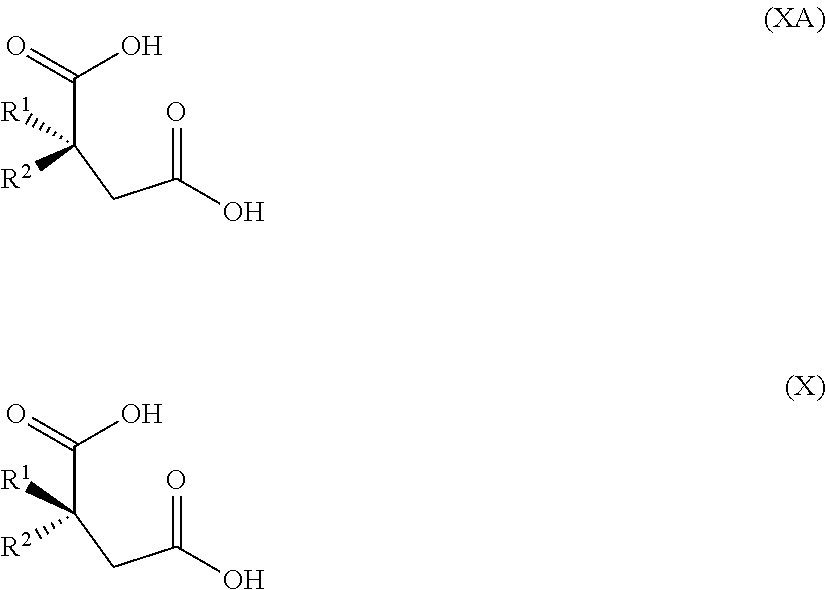
R1 is chlorodifluoromethyl or trifluoromethyl;
R2 is aryl or heteroaryl, each optionally substituted;
wherein the mixture is enriched for the compound of formula X.
Preferred substituent definitions are given below.
In a further aspect the invention provides a mixture comprising a compound of formula XII and a compound of formula XIIA

wherein
R1 is chlorodifluoromethyl or trifluoromethyl;
R2 is aryl or heteroaryl, each optionally substituted;
A′ is optionally substituted aryl or optionally substituted heteroaryl; wherein the mixture is enriched for the compound of formula XII.
Preferred substituent definitions are given below.
In a further aspect the invention provides a mixture comprising a compound of formula XIV and a compound of formula XIVA

wherein
P is hydroxy, alkoxy, aryloxy, alkylsulfinyl, arylsulfinyl, aryl or heteroaryl, each optionally substituted, and wherein the heteroaryl contains at least one ring nitrogen atom, and the heteroaryl is connected at P via a ring nitrogen atom,
R1 is chlorodifluoromethyl or trifluoromethyl;
R2 is aryl or heteroaryl, each optionally substituted;
A′ is optionally substituted aryl or optionally substituted heteroaryl;
wherein the mixture is enriched for the compound of formula XIV.
Preferred substituent definitions are given below.
In a further aspect the invention provides a mixture comprising a compound of formula XV and a compound of formula XVA

wherein
R1 is chlorodifluoromethyl or trifluoromethyl;
R2 is aryl or heteroaryl, each optionally substituted;
A′ is optionally substituted aryl or optionally substituted heteroaryl;
wherein the mixture is enriched for the compound of formula XV.
Preferred substituent definitions are given below.
In a further aspect the invention provides a mixture comprising a compound of formula XVI and a compound of formula XVIA

wherein
R1 is chlorodifluoromethyl or trifluoromethyl;
R2 is aryl or heteroaryl, each optionally substituted;
A′ is optionally substituted aryl or optionally substituted heteroaryl;
wherein the mixture is enriched for the compound of formula XVI.
Preferred substituent definitions are given below.
In a further aspect the invention provides a mixture comprising a compound of formula XVII and a compound of formula XVIIA

R1 is chlorodifluoromethyl or trifluoromethyl;
R2 is aryl or heteroaryl, each optionally substituted;
A′ is optionally substituted aryl or optionally substituted heteroaryl;
wherein the mixture is enriched for the compound of formula XVII.
Preferred substituent definitions are given below.
In a further aspect the invention provides a mixture comprising a compound of formula XVIII and a compound of formula XVIIIA

wherein
P is alkyl, aryl or heteroaryl, each optionally substituted, wherein the heteroaryl is connected at P via a ring carbon atom;
R1 is chlorodifluoromethyl or trifluoromethyl;
R2 is aryl or heteroaryl, each optionally substituted;
wherein the mixture is enriched for the compound of formula XVIII.
Preferred substituent definitions are given below.
In a further aspect the invention provides a compound of formula XXIX.
In a further aspect the invention provides a compound of formula XXX.
In a further aspect the invention provides a compound of formula XXXI.
In a further aspect the invention provides a compound of formula XXXII.
In a further aspect the invention provides a compound of formula XXXIII.

In the above compounds R1 and R2 are as defined for the compound of formula IIa.
In a further aspect the invention provides a mixture comprising a compound of formula XXIX and a compound of formula XXIXA, wherein the mixture is enriched for the compound of formula XXIX.
In a further aspect the invention provides a compound of formula XXX and a compound of formula XXXA wherein the mixture is enriched for the compound of formula XXX.
In a further aspect the invention provides a compound of formula XXXI and a compound of formula XXXIA wherein the mixture is enriched for the compound of formula XXXI.
In a further aspect the invention provides a compound of formula XXXII and a compound of formula XXXIIA wherein the mixture is enriched for the compound of formula XXXII.
In a further aspect the invention provides a compound of formula XXXIII and a compound of formula XXXIIA wherein the mixture is enriched for the compound of formula XXXII.
The compound of formula XXIXA, XXXA, XXXIA, XXXIIA and XXXIIIA have the opposite stereochemistry to XXIX, XXX, XXXI, XXXII and XXXIII at the carbon bonded to R1 and R2.
In a further aspect the invention provides a process for preparing pyrrolidine derivatives comprising
(a-i) reacting a compound of formula Ia

wherein
P is alkyl, aryl or heteroaryl, each optionally substituted, wherein the heteroaryl is connected at P via a ring carbon atom;
R1 is chlorodifluoromethyl or trifluoromethyl;
R2 is aryl or heteroaryl, each optionally substituted;
with a source of cyanide to give a compound of formula IIa

wherein P, R1 and R2 are as defined for the compound of formula Ia; and
(a-ii) oxidising the compound of formula IIa with a peroxide in the presence of strong acid to give a compound of formula VI-1

wherein R1 and R2 are as defined for the compound of formula Ia.
The cyanide addition can be done in presence of a base and/or a catalyst. Examples of bases include triethyl amine, sodium carbonate, potassium carbonate, sodium hydroxide, potassium hydroxide.
Examples of chiral catalysts include crown ethers and phase transfer catalysts such as tetrabutylammonium bromide.
In addition, the reaction optionally comprises
(a-iii-1) reducing the compound of formula VI-1 with a suitable reducing agent to give a compound of formula IX-1

wherein R1 and R2 are as defined for the compound of formula Ia.
and optionally
(a-iv-1) reacting the compound of formula IX with a compound of formula (XIII)
XB-A′ (XIII)
wherein XB is a leaving group such as halogen, and A′ is optionally substituted aryl or optionally substituted heteroaryl to give a compound of formula XVI-1

wherein R1 and R2 are as defined for the compound of formula Ia and A′ is as defined for the compound of formula XIII;
or the reaction optionally comprises
(a-iii-2) reacting the compound of formula VI-1 with a compound of formula XIII-1 to give a compound of formula XII-1

wherein R1 and R2 are as defined for the compound of formula Ia and A′ is as defined for the compound of formula XIII;
and optionally
(a-iv-2) reducing the compound of formula XII-1 with a suitable reducing agent to give a compound of formula XVI-1.
In a further aspect the invention provides a compound of formula VI-1.
In a further aspect the invention provides a compound of formula XXIX-1.
In a further aspect the invention provides a compound of formula XXX-1.
In a further aspect the invention provides a compound of formula XXXI-1.
In a further aspect the invention provides a compound of formula XXXII-1.
In a further aspect the invention provides a compound of formula XXXIII-1.

In the compounds above R1 and R2 are as defined for the compound of formula Ia.

wherein B1, B2, B3, B4 and Q1 are as defined below. More preferably R2 is group A1 or A2


A1a, A2a, A3a and A4a are independently of each other C—H, C—R5a or nitrogen;
G1a is oxygen or sulfur;
R1a is hydrogen, C1-C8alkyl, C1-C8alkoxy-, C1-C8alkylcarbonyl-, C1-C8alkoxycarbonyl- or C1-C8haloalkoxycarbonyl-;

where
La is a single bond or C1-C6alkylene; and

wherein

or group B substituted by one to four substituents independently selected from halogen, methyl and methoxy, even more preferably phenyl substituted by one to five substituents independently selected from halogen methyl and methoxy, anthracenyl or anthracenyl substituted by one to five substituents independently selected from halogen, methyl and methoxy or pyridyl or pyridyl substituted by one to four halogen atoms, even more preferably phenyl substituted by one to five substituents independently selected from halogen methyl and methoxy or anthracenyl. Each R33 is independently halogen, cyano, nitro, C1-C8alkyl, C1-C8haloalkyl, C1-C8alkoxy, C1-C8haloalkoxy, C3-C8cycloalkyl, phenyl or phenyl substituted by one to five halogen, and wherein two R33 substituents on adjacent carbon atoms may together form a partially saturated 5-7 membered ring containing one or two heteroatoms independently selected from O, N(R34) and S; and each R34 is independently hydrogen or C1-C4 alkyl. Preferably each R33 is independently halogen, cyano, nitro, C1-C4alkyl, C1-C4haloalkyl, C1-C4alkoxy, aryl or C1-C4haloalkoxy, and wherein any two R33 substituents on adjacent carbon atoms may together form a partially saturated 5 membered ring containing one or two O atoms, more preferably each R33 is independently halogen, methyl, halomethyl, methoxy, phenyl or halomethoxy, and wherein any two R33 substituents on adjacent carbon atoms may together form a partially saturated 5 membered ring containing one or two O atoms, more preferably each R33 is independently halogen, methyl, phenyl or methoxy, most preferably each R33 is independently fluorine, methyl, phenyl or methoxy.


wherein X is an anion, preferably halogen, more preferably chloride or bromide.

W2 is ethyl or vinyl; R35 is hydrogen or C1-C4alkoxy; R36 is hydroxyl, C1-C4alkoxy, C2-C4alkenyloxy or optionally substituted benzyloxy.
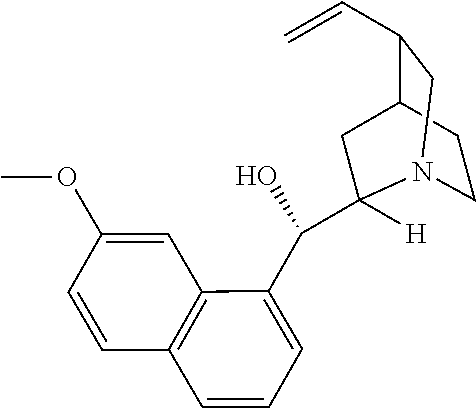
as described in A. Latvala, S. Stanchev, A. Linden, M. Hesse, Tet. Asym. 1993, 2, 173.

Y is S or O, W3 is ethyl or vinyl; R37 is hydrogen or C1-C4alkoxy; R38 is optionally substituted aryl or optionally substituted C3-C10cycloalkyl.

as described in B. Vakulya, S. Varga, A. Csampai, T. Soós, Org. Lett. 2005, 7, 1967; B. Vakulya, S. Varga, T. Soós, J. Org. Chem. 2008, 73, 3475; P. Li, Y. Wang, X. Liang, J. Ye, Chem. Commun. 2008, 3302; and C. Oliva, A. Silva, F. Paz, J. Calvaleiro, Synlett, 2010, 7, 1123-1127.

wherein W4 is ethyl or vinyl; R54 is hydrogen or C1-C4alkoxy; R55 is optionally substituted aryl.


R41 is hydrogen, C1-C10alkyl, C1-C10hydroxyalkyl C1-C5alkoxy-C1-C5alkyl, C1-C8alkoxycarbonyl, C1-C8alkyl optionally substituted aryl, aryl-C1-C4alkyl wherein the aryl is optionally substituted, (aryl)2P(O)C1-C4 alkyl wherein each aryl is optionally substituted.

as described in G. Sundararajan, N. Prabagaran, Org. Lett. 2001, 3, 389;

as described in Kurono, N.; Nii, N.; Sakaguchi, Y.; Uemura, M.; Ohkuma, T. Angew. Chem. Int. Ed. 2011, 50, DOI: 10.1002/anie.201100939

as described in. Keller, N. Veldman, A. L. Spek, B. L. Feringa, Tetrahedron: Asymmetry 1997, 8, 3403; LaK3tris((R)-binaphthoxide)) as described in K. Funabashi, Y. Saida, M. Kanai, T. Arai, H. Sasai, M. Shibasaki, Tetrahedron Lett. 1998, 39, 7557; and


in combination with an achiral amine, e.g. 2,2,6,6-tetramethylpiperidine, as described in K. Itoh, S. Kanemasa, J. Am. Chem. Soc. 2002, 124, 13394.

wherein each R42 is C(H)Ph2, or CH2OR43, wherein R43 is t-BuPh2Si, H or benzyl, e.g. as described in A. P. Davis, K. J. Dempsey, Tetrahedron: Asymmetry 1995, 6, 2829;

as described in Zhang, G.; Kumamoto, T.; Heima, T.; Ishikawa, T. Tetrahedron Lett. 2010, 51, 3927.

Where X is a halogen or BF4 of PF6, most preferably chloride as described in Ma, T.; Fu, X.; Kee, C. W.; Zong, L.; Pan, Y.; Huang, K.; Tan, C. J. Am. Chem. Soc. 2011, 133, 2828 and

wherein R44 and R45 are independently C1-C4 alkyl, C1-C4 alkoxy-C1-C4 alkyl, TBDMS-C1-C4 alkyl or TBDPS-C1-C4 alkyl, preferably both R44 and R45 are either hydroxymethyl, TMDMS-methyl or TBDPS-methyl, and wherein X is an anion, preferably halogen or BF4—, more preferably chloride or BF4—, e.g. as described in M. T. Allingham, A. Howard-Jones, P. J. Murphy, D. A. Thomas, P. W. R. Caulkett, Tetrahedron Lett. 2003, 44, 8677.

as described in C. E. T. Mitchell, S. E. Brenner and S. V. Ley, Chem. Commun., 2005, 5346 and C. E. T. Mitchell, S. E. Brenner, J. Garcia-Fortanet and S. V. Ley, Org. Biomol. Chem., 2006, 4, 2039;

as described in N. Halland, R. G. Hazell, K. A. Jorgensen, J. Org. Chem. 2002, 67, 8331;

as described in C. Oliva, A. Silva, F. Paz, J. Calvaleiro, Synlett, 2010, 7, 1123-1127; and

as described in Xu, D.; Shi, S.; Wang, Y. European Journal of Organic Chemistry 2009, (28), 4848-4853.

as described in N. Halland, R. G. Hazell, K. A. Jorgensen, J. Org. Chem. 2002, 67, 8331; and

as described in A. Prieto, N. Halland, K. A. Jøorgensen, Org. Lett. 2005, 7, 3897.

wherein R46 and R47 are phenyl optionally substituted by one to five halogen, C1-C4 alkyl, C1-C4 haloalkyl, C1-C4 alkoxy, C1-C4 haloalkoxy and wherein n is 1 or 2;
Examples include those wherein n is 1 and R46 is 2,6-iPr2C6H3; n is 1 and R46 is C6H5; n is 1 and R46 is 2-MeC6H4; n is 2 and R46 is 2,6-iPr2C6H3; R47 is 2,6-iPr2-C6H3; as described in L. Wang, Q. Zhang, X. Zhou, X. Liu, L. Lin, B. Qin, X. Feng, Chemistry-A European Journal, 2010, 16, (26), 7696-7699,

wherein R48, R29, R50 and R52 are each independently phenyl or naphthyl optionally substituted by one to five halogen, C1-C4 alkyl, C1-C4 haloalkyl, C1-C4 alkoxy, C1-C4 haloalkoxy; each R51 is C1-C5 alkyl or C1-C8haloalkyl, R53 is a bond or C1-C8 alkylene and X is an anion, e.g. a halogen, preferably chlorine or bromine Examples include those wherein each R48 is 3,5-(CF3)2(C6H3); each R48 is 3,4,5-F3C6H2; each R49 is 3,5-(CF3)2(C6H3); each R49 is 3,4,5-F3C6H2; each R50 is 3,5-(CF3)2(C6H3); each R50 is 3,4,5-F3C6H2; each R51 is n-butyl; each R52 is H and R53 is a bond; each R52 is H and R53 is ethylene; each R52 is H and R53 is propylene; each R52 is phenyl and R53 is a bond; each R52 is phenyl and R53 is ethylene; each R52 is phenyl and R53 is propylene; each R52 is 3,4,5-F3C6H2 and R53 is a bond; each R52 is 3,4,5-F3C6H2 and R53 is ethylene; each R52 is 3,4,5-F3C6H2 and R53 is propylene; each R52 is, 5-(CF3)2C6H2 and R53 is a bond; each R52 is, 5-(CF3)2C6H2 and R53 is ethylene; each R52 is 3,5-(CF3)2C6H2 and R53 is propylene; each R48 is 2-naphthyl as described in M. Hua, H. Cui, L. Wang, J. Nie, J. Ma, Angew. Chem. 2010, 122, 2832 and T. Ooi, K. Maruoka, Acc. Chem. Res. 2004, 37, 526.

wherein R57 is CN or F, R58 is H or F; each R59 is phenyl or p-tolyl; R60 is OH, OMe or Oi-Bu as described in Tanaka, Y.; Kanai, M.; Shibasaki, M. J. Am. Chem. Soc. 2008, 130, 6072; Tanaka, Y.; Kanai, M.; Shibasaki, M. J. Am. Chem. Soc. 2010, 132, 8862.

wherein each R61 is is H or benzyl as described in Dehmlow, D. E.; Sauerbier, C. Liebigs Ann. Chem. 1989, 181-185.

as described in Saito, S.; Tsubogo, T.; Kobayashi, S. J. Am. Chem. Soc. 2007, 129, 5364; Tsubogo, T.; Saibo, S.; Seki, K.; Yamashita, Y.; Kobayashi, S. J. Am. Chem. Soc. 2008, 130, 13321; Kobayashi, S.; Tsubogo, T.; Saito, S.; Yamashita, Y. Org. Lett. 2008, 10, 807

The following schemes describe the processes of the invention in more detail. In the schemes below the stereochemistry at * corresponds to the stereochemistry in the claims. The substituent definitions are as defined herein.


| TABLE A |
| Compounds of formula A |
| (A) |
 |
| Comp | |||||
| No. | Q2 | B2 | Q4 | ||
| 1 | Cl | C—Cl | Cl | ||
| 2 | Cl | C—H | Cl | ||
| 3 | CF3 | C—H | CF3 | ||
| 4 | Cl | C—H | CF3 | ||
| 5 | Br | C—H | CF3 | ||
| 6 | Cl | C—F | H | ||
| 7 | F | C—Cl | H | ||
| 8 | Cl | C—Cl | H | ||
| 9 | Cl | C—F | Cl | ||
| 10 | Cl | C—Br | Cl | ||
| 11 | Cl | C—I | Cl | ||
| 12 | F | C—F | F | ||
| 13 | Cl | C—H | Br | ||
| 14 | Cl | C—H | F | ||
| 15 | Cl | C—Cl | CF3 | ||
| 16 | CF3 | C—Cl | CF3 | ||
| 17 | CF3 | C—H | H | ||
| 18 | Cl | N | Cl | ||
| 19 | Cl | N | H | ||
| 20 | CF3 | N | CF3 | ||
| 21 | CF3 | N | H | ||
| TABLE B |
| Compounds of formula B |
| (B) |
 |
| Comp | |||||
| No. | Q2 | B2 | Q4 | ||
| 1 | Cl | C—Cl | Cl | ||
| 2 | Cl | C—H | Cl | ||
| 3 | CF3 | C—H | CF3 | ||
| 4 | Cl | C—H | CF3 | ||
| 5 | Br | C—H | CF3 | ||
| 6 | Cl | C—F | H | ||
| 7 | F | C—Cl | H | ||
| 8 | Cl | C—Cl | H | ||
| 9 | Cl | C—F | Cl | ||
| 10 | Cl | C—Br | Cl | ||
| 11 | Cl | C—I | Cl | ||
| 12 | F | C—F | F | ||
| 13 | Cl | C—H | Br | ||
| 14 | Cl | C—H | F | ||
| 15 | Cl | C—Cl | CF3 | ||
| 16 | CF3 | C—Cl | CF3 | ||
| 17 | CF3 | C—H | H | ||
| 18 | Cl | N | Cl | ||
| 19 | Cl | N | H | ||
| 20 | CF3 | N | CF3 | ||
| 21 | CF3 | N | H | ||
| TABLE C |
| Compounds of formula C |
| (C) |
 |
| Comp | |||||
| No. | Q2 | B2 | Q4 | ||
| 1 | Cl | C—Cl | Cl | ||
| 2 | Cl | C—H | Cl | ||
| 3 | CF3 | C—H | CF3 | ||
| 4 | Cl | C—H | CF3 | ||
| 5 | Br | C—H | CF3 | ||
| 6 | Cl | C—F | H | ||
| 7 | F | C—Cl | H | ||
| 8 | Cl | C—Cl | H | ||
| 9 | Cl | C—F | Cl | ||
| 10 | Cl | C—Br | Cl | ||
| 11 | Cl | C—I | Cl | ||
| 12 | F | C—F | F | ||
| 13 | Cl | C—H | Br | ||
| 14 | Cl | C—H | F | ||
| 15 | Cl | C—Cl | CF3 | ||
| 16 | CF3 | C—Cl | CF3 | ||
| 17 | CF3 | C—H | H | ||
| 18 | Cl | N | Cl | ||
| 19 | Cl | N | H | ||
| 20 | CF3 | N | CF3 | ||
| 21 | CF3 | N | H | ||
| TABLE D |
| Compounds of formula D |
| (D) |
 |
| Comp | |||||
| No. | Q2 | B2 | Q4 | ||
| 1 | Cl | C—Cl | Cl | ||
| 2 | Cl | C—H | Cl | ||
| 3 | CF3 | C—H | CF3 | ||
| 4 | Cl | C—H | CF3 | ||
| 5 | Br | C—H | CF3 | ||
| 6 | Cl | C—F | H | ||
| 7 | F | C—Cl | H | ||
| 8 | Cl | C—Cl | H | ||
| 9 | Cl | C—F | Cl | ||
| 10 | Cl | C—Br | Cl | ||
| 11 | Cl | C—I | Cl | ||
| 12 | F | C—F | F | ||
| 13 | Cl | C—H | Br | ||
| 14 | Cl | C—H | F | ||
| 15 | Cl | C—Cl | CF3 | ||
| 16 | CF3 | C—Cl | CF3 | ||
| 17 | CF3 | C—H | H | ||
| 18 | Cl | N | Cl | ||
| 19 | Cl | N | H | ||
| 20 | CF3 | N | CF3 | ||
| 21 | CF3 | N | H | ||
| TABLE E |
| Compounds of formula E |
| (E) |
 |
| Comp | |||||
| No. | Q2 | B2 | Q4 | ||
| 1 | Cl | C—Cl | Cl | ||
| 2 | Cl | C—H | Cl | ||
| 3 | CF3 | C—H | CF3 | ||
| 4 | Cl | C—H | CF3 | ||
| 5 | Br | C—H | CF3 | ||
| 6 | Cl | C—F | H | ||
| 7 | F | C—Cl | H | ||
| 8 | Cl | C—Cl | H | ||
| 9 | Cl | C—F | Cl | ||
| 10 | Cl | C—Br | Cl | ||
| 11 | Cl | C—I | Cl | ||
| 12 | F | C—F | F | ||
| 13 | Cl | C—H | Br | ||
| 14 | Cl | C—H | F | ||
| 15 | Cl | C—Cl | CF3 | ||
| 16 | CF3 | C—Cl | CF3 | ||
| 17 | CF3 | C—H | H | ||
| 18 | Cl | N | Cl | ||
| 19 | Cl | N | H | ||
| 20 | CF3 | N | CF3 | ||
| 21 | CF3 | N | H | ||
| TABLE F |
| Compounds of formula F |
| (F) |
 |
| Comp | |||||
| No. | Q2 | B2 | Q4 | ||
| 1 | Cl | C—Cl | Cl | ||
| 2 | Cl | C—H | Cl | ||
| 3 | CF3 | C—H | CF3 | ||
| 4 | Cl | C—H | CF3 | ||
| 5 | Br | C—H | CF3 | ||
| 6 | Cl | C—F | H | ||
| 7 | F | C—Cl | H | ||
| 8 | Cl | C—Cl | H | ||
| 9 | Cl | C—F | Cl | ||
| 10 | Cl | C—Br | Cl | ||
| 11 | Cl | C—I | Cl | ||
| 12 | F | C—F | F | ||
| 13 | Cl | C—H | Br | ||
| 14 | Cl | C—H | F | ||
| 15 | Cl | C—Cl | CF3 | ||
| 16 | CF3 | C—Cl | CF3 | ||
| 17 | CF3 | C—H | H | ||
| 18 | Cl | N | Cl | ||
| 19 | Cl | N | H | ||
| 20 | CF3 | N | CF3 | ||
| 21 | CF3 | N | H | ||
| TABLE G |
| Compounds of formula G |
| (G) |
 |
| Comp | |||||
| No. | Q2 | B2 | Q4 | ||
| 1 | Cl | C—Cl | Cl | ||
| 2 | Cl | C—H | Cl | ||
| 3 | CF3 | C—H | CF3 | ||
| 4 | Cl | C—H | CF3 | ||
| 5 | Br | C—H | CF3 | ||
| 6 | Cl | C—F | H | ||
| 7 | F | C—Cl | H | ||
| 8 | Cl | C—Cl | H | ||
| 9 | Cl | C—F | Cl | ||
| 10 | Cl | C—Br | Cl | ||
| 11 | Cl | C—I | Cl | ||
| 12 | F | C—F | F | ||
| 13 | Cl | C—H | Br | ||
| 14 | Cl | C—H | F | ||
| 15 | Cl | C—Cl | CF3 | ||
| 16 | CF3 | C—Cl | CF3 | ||
| 17 | CF3 | C—H | H | ||
| 18 | Cl | N | Cl | ||
| 19 | Cl | N | H | ||
| 20 | CF3 | N | CF3 | ||
| 21 | CF3 | N | H | ||
| TABLE H |
| Compounds of formula H |
 | (H) | ||
Table H discloses 630 compounds of formula H, wherein Q2, B2, Q4 and P have the values as defined in Table X.
| TABLE J |
| Compounds of formula J |
 | (J) | ||
Table J discloses 630 compounds of formula J, wherein Q2, B2, Q4 and P have the values as defined in Table X.
| TABLE K |
| Compounds of formula K |
 | (K) | ||
Table K discloses 630 compounds of formula K, wherein Q2, B2, Q4 and P have the values as defined in Table X.
| TABLE L |
| Compounds of formula L |
 | (L) | ||
Table L discloses 630 compounds of formula L, wherein Q2, B2, Q4 and P have the values as defined in Table X.
| TABLE M |
| Compounds of formula M |
 | (M) | ||
Table M discloses 630 compounds of formula M, wherein Q2, B2, Q4 and P have the values as defined in Table X.
| TABLE X | ||||
| Q2 | B2 | Q4 | P | |
| X.1 | Cl | C—Cl | Cl | P1 | |
| X.2 | Cl | C—H | Cl | P1 | |
| X.3 | CF3 | C—H | CF3 | P1 | |
| X.4 | Cl | C—H | CF3 | P1 | |
| X.5 | Br | C—H | CF3 | P1 | |
| X.6 | Cl | C—F | H | P1 | |
| X.7 | F | C—Cl | H | P1 | |
| X.8 | Cl | C—Cl | H | P1 | |
| X.9 | Cl | C—F | Cl | P1 | |
| X.10 | Cl | C—Br | Cl | P1 | |
| X.11 | Cl | C—I | Cl | P1 | |
| X.12 | F | C—F | F | P1 | |
| X.13 | Cl | C—H | Br | P1 | |
| X.14 | Cl | C—H | F | P1 | |
| X.15 | Cl | C—Cl | CF3 | P1 | |
| X.16 | CF3 | C—Cl | CF3 | P1 | |
| X.17 | CF3 | C—H | H | P1 | |
| X.18 | Cl | C—Cl | Cl | P2 | |
| X.19 | Cl | C—H | Cl | P2 | |
| X.20 | CF3 | C—H | CF3 | P2 | |
| X.21 | Cl | C—H | CF3 | P2 | |
| X.22 | Br | C—H | CF3 | P2 | |
| X.23 | Cl | C—F | H | P2 | |
| X.24 | F | C—Cl | H | P2 | |
| X.25 | Cl | C—Cl | H | P2 | |
| X.26 | Cl | C—F | Cl | P2 | |
| X.27 | Cl | C—Br | Cl | P2 | |
| X.28 | Cl | C—I | Cl | P2 | |
| X.29 | F | C—F | F | P2 | |
| X.30 | Cl | C—H | Br | P2 | |
| X.31 | Cl | C—H | F | P2 | |
| X.32 | Cl | C—Cl | CF3 | P2 | |
| X.33 | CF3 | C—Cl | CF3 | P2 | |
| X.34 | CF3 | C—H | H | P2 | |
| X.35 | Cl | C—Cl | Cl | P3 | |
| X.36 | Cl | C—H | Cl | P3 | |
| X.37 | CF3 | C—H | CF3 | P3 | |
| X.38 | Cl | C—H | CF3 | P3 | |
| X.39 | Br | C—H | CF3 | P3 | |
| X.40 | Cl | C—F | H | P3 | |
| X.41 | F | C—Cl | H | P3 | |
| X.42 | Cl | C—Cl | H | P3 | |
| X.43 | Cl | C—F | Cl | P3 | |
| X.44 | Cl | C—Br | Cl | P3 | |
| X.45 | Cl | C—I | Cl | P3 | |
| X.46 | F | C—F | F | P3 | |
| X.47 | Cl | C—H | Br | P3 | |
| X.48 | Cl | C—H | F | P3 | |
| X.49 | Cl | C—Cl | CF3 | P3 | |
| X.50 | CF3 | C—Cl | CF3 | P3 | |
| X.51 | CF3 | C—H | H | P3 | |
| X.52 | Cl | C—Cl | Cl | P4 | |
| X.53 | Cl | C—H | Cl | P4 | |
| X.54 | CF3 | C—H | CF3 | P4 | |
| X.55 | Cl | C—H | CF3 | P4 | |
| X.56 | Br | C—H | CF3 | P4 | |
| X.57 | Cl | C—F | H | P4 | |
| X.58 | F | C—Cl | H | P4 | |
| X.59 | Cl | C—Cl | H | P4 | |
| X.60 | Cl | C—F | Cl | P4 | |
| X.61 | Cl | C—Br | Cl | P4 | |
| X.62 | Cl | C—I | Cl | P4 | |
| X.63 | F | C—F | F | P4 | |
| X.64 | Cl | C—H | Br | P4 | |
| X.65 | Cl | C—H | F | P4 | |
| X.66 | Cl | C—Cl | CF3 | P4 | |
| X.67 | CF3 | C—Cl | CF3 | P4 | |
| X.68 | CF3 | C—H | H | P4 | |
| X.69 | Cl | C—Cl | Cl | P5 | |
| X.70 | Cl | C—H | Cl | P5 | |
| X.71 | CF3 | C—H | CF3 | P5 | |
| X.72 | Cl | C—H | CF3 | P5 | |
| X.73 | Br | C—H | CF3 | P5 | |
| X.74 | Cl | C—F | H | P5 | |
| X.75 | F | C—Cl | H | P5 | |
| X.76 | Cl | C—Cl | H | P5 | |
| X.77 | Cl | C—F | Cl | P5 | |
| X.78 | Cl | C—Br | Cl | P5 | |
| X.79 | Cl | C—I | Cl | P5 | |
| X.80 | F | C—F | F | P5 | |
| X.81 | Cl | C—H | Br | P5 | |
| X.82 | Cl | C—H | F | P5 | |
| X.83 | Cl | C—Cl | CF3 | P5 | |
| X.84 | CF3 | C—Cl | CF3 | P5 | |
| X.85 | CF3 | C—H | H | P5 | |
| X.86 | Cl | C—Cl | Cl | P6 | |
| X.87 | Cl | C—H | Cl | P6 | |
| X.88 | CF3 | C—H | CF3 | P6 | |
| X.89 | Cl | C—H | CF3 | P6 | |
| X.90 | Br | C—H | CF3 | P6 | |
| X.91 | Cl | C—F | H | P6 | |
| X.92 | F | C—Cl | H | P6 | |
| X.93 | Cl | C—Cl | H | P6 | |
| X.94 | Cl | C—F | Cl | P6 | |
| X.95 | Cl | C—Br | Cl | P6 | |
| X.96 | Cl | C—I | Cl | P6 | |
| X.97 | F | C—F | F | P6 | |
| X.98 | Cl | C—H | Br | P6 | |
| X.99 | Cl | C—H | F | P6 | |
| X.100 | Cl | C—Cl | CF3 | P6 | |
| X.101 | CF3 | C—Cl | CF3 | P6 | |
| X.102 | CF3 | C—H | H | P6 | |
| X.103 | Cl | C—Cl | Cl | P7 | |
| X.104 | Cl | C—H | Cl | P7 | |
| X.105 | CF3 | C—H | CF3 | P7 | |
| X.106 | Cl | C—H | CF3 | P7 | |
| X.107 | Br | C—H | CF3 | P7 | |
| X.108 | Cl | C—F | H | P7 | |
| X.109 | F | C—Cl | H | P7 | |
| X.110 | Cl | C—Cl | H | P7 | |
| X.111 | Cl | C—F | Cl | P7 | |
| X.112 | Cl | C—Br | Cl | P7 | |
| X.113 | Cl | C—I | Cl | P7 | |
| X.114 | F | C—F | F | P7 | |
| X.115 | Cl | C—H | Br | P7 | |
| X.116 | Cl | C—H | F | P7 | |
| X.117 | Cl | C—Cl | CF3 | P7 | |
| X.118 | CF3 | C—Cl | CF3 | P7 | |
| X.119 | CF3 | C—H | H | P7 | |
| X.120 | Cl | C—Cl | Cl | P8 | |
| X.121 | Cl | C—H | Cl | P8 | |
| X.122 | CF3 | C—H | CF3 | P8 | |
| X.123 | Cl | C—H | CF3 | P8 | |
| X.124 | Br | C—H | CF3 | P8 | |
| X.125 | Cl | C—F | H | P8 | |
| X.126 | F | C—Cl | H | P8 | |
| X.127 | Cl | C—Cl | H | P8 | |
| X.128 | Cl | C—F | Cl | P8 | |
| X.129 | Cl | C—Br | Cl | P8 | |
| X.130 | Cl | C—I | Cl | P8 | |
| X.131 | F | C—F | F | P8 | |
| X.132 | Cl | C—H | Br | P8 | |
| X.133 | Cl | C—H | F | P8 | |
| X.134 | Cl | C—Cl | CF3 | P8 | |
| X.135 | CF3 | C—Cl | CF3 | P8 | |
| X.136 | CF3 | C—H | H | P8 | |
| X.137 | Cl | C—Cl | Cl | P9 | |
| X.138 | Cl | C—H | Cl | P9 | |
| X.139 | CF3 | C—H | CF3 | P9 | |
| X.140 | Cl | C—H | CF3 | P9 | |
| X.141 | Br | C—H | CF3 | P9 | |
| X.142 | Cl | C—F | H | P9 | |
| X.143 | F | C—Cl | H | P9 | |
| X.144 | Cl | C—Cl | H | P9 | |
| X.145 | Cl | C—F | Cl | P9 | |
| X.146 | Cl | C—Br | Cl | P9 | |
| X.147 | Cl | C—I | Cl | P9 | |
| X.148 | F | C—F | F | P9 | |
| X.149 | Cl | C—H | Br | P9 | |
| X.150 | Cl | C—H | F | P9 | |
| X.151 | Cl | C—Cl | CF3 | P9 | |
| X.152 | CF3 | C—Cl | CF3 | P9 | |
| X.153 | CF3 | C—H | H | P9 | |
| X.154 | Cl | C—Cl | Cl | P10 | |
| X.155 | Cl | C—H | Cl | P10 | |
| X.156 | CF3 | C—H | CF3 | P10 | |
| X.157 | Cl | C—H | CF3 | P10 | |
| X.158 | Br | C—H | CF3 | P10 | |
| X.159 | Cl | C—F | H | P10 | |
| X.160 | F | C—Cl | H | P10 | |
| X.161 | Cl | C—Cl | H | P10 | |
| X.162 | Cl | C—F | Cl | P10 | |
| X.163 | Cl | C—Br | Cl | P10 | |
| X.164 | Cl | C—I | Cl | P10 | |
| X.165 | F | C—F | F | P10 | |
| X.166 | Cl | C—H | Br | P10 | |
| X.167 | Cl | C—H | F | P10 | |
| X.168 | Cl | C—Cl | CF3 | P10 | |
| X.169 | CF3 | C—Cl | CF3 | P10 | |
| X.170 | CF3 | C—H | H | P10 | |
| X.171 | Cl | C—Cl | Cl | P11 | |
| X.172 | Cl | C—H | Cl | P11 | |
| X.173 | CF3 | C—H | CF3 | P11 | |
| X.174 | Cl | C—H | CF3 | P11 | |
| X.175 | Br | C—H | CF3 | P11 | |
| X.176 | Cl | C—F | H | P11 | |
| X.177 | F | C—Cl | H | P11 | |
| X.178 | Cl | C—Cl | H | P11 | |
| X.179 | Cl | C—F | Cl | P11 | |
| X.180 | Cl | C—Br | Cl | P11 | |
| X.181 | Cl | C—I | Cl | P11 | |
| X.182 | F | C—F | F | P11 | |
| X.183 | Cl | C—H | Br | P11 | |
| X.184 | Cl | C—H | F | P11 | |
| X.185 | Cl | C—Cl | CF3 | P11 | |
| X.186 | CF3 | C—Cl | CF3 | P11 | |
| X.187 | CF3 | C—H | H | P11 | |
| X.188 | Cl | C—Cl | Cl | P12 | |
| X.187 | Cl | C—H | Cl | P12 | |
| X.190 | CF3 | C—H | CF3 | P12 | |
| X.191 | Cl | C—H | CF3 | P12 | |
| X.192 | Br | C—H | CF3 | P12 | |
| X.193 | Cl | C—F | H | P12 | |
| X.194 | F | C—Cl | H | P12 | |
| X.195 | Cl | C—Cl | H | P12 | |
| X.196 | Cl | C—F | Cl | P12 | |
| X.197 | Cl | C—Br | Cl | P12 | |
| X.198 | Cl | C—I | Cl | P12 | |
| X.199 | F | C—F | F | P12 | |
| X.200 | Cl | C—H | Br | P12 | |
| X.201 | Cl | C—H | F | P12 | |
| X.202 | Cl | C—Cl | CF3 | P12 | |
| X.203 | CF3 | C—Cl | CF3 | P12 | |
| X.204 | CF3 | C—H | H | P12 | |
| X.205 | Cl | C—Cl | Cl | P13 | |
| X.206 | Cl | C—H | Cl | P13 | |
| X.207 | CF3 | C—H | CF3 | P13 | |
| X.208 | Cl | C—H | CF3 | P13 | |
| X.209 | Br | C—H | CF3 | P13 | |
| X.210 | Cl | C—F | H | P13 | |
| X.211 | F | C—Cl | H | P13 | |
| X.212 | Cl | C—Cl | H | P13 | |
| X.213 | Cl | C—F | Cl | P13 | |
| X.214 | Cl | C—Br | Cl | P13 | |
| X.215 | Cl | C—I | Cl | P13 | |
| X.216 | F | C—F | F | P13 | |
| X.217 | Cl | C—H | Br | P13 | |
| X.218 | Cl | C—H | F | P13 | |
| X.219 | Cl | C—Cl | CF3 | P13 | |
| X.220 | CF3 | C—Cl | CF3 | P13 | |
| X.221 | CF3 | C—H | H | P13 | |
| X.222 | Cl | C—Cl | Cl | P14 | |
| X.223 | Cl | C—H | Cl | P14 | |
| X.224 | CF3 | C—H | CF3 | P14 | |
| X.225 | Cl | C—H | CF3 | P14 | |
| X.226 | Br | C—H | CF3 | P14 | |
| X.227 | Cl | C—F | H | P14 | |
| X.228 | F | C—Cl | H | P14 | |
| X.229 | Cl | C—Cl | H | P14 | |
| X.230 | Cl | C—F | Cl | P14 | |
| X.231 | Cl | C—Br | Cl | P14 | |
| X.232 | Cl | C—I | Cl | P14 | |
| X.233 | F | C—F | F | P14 | |
| X.234 | Cl | C—H | Br | P14 | |
| X.235 | Cl | C—H | F | P14 | |
| X.236 | Cl | C—Cl | CF3 | P14 | |
| X.237 | CF3 | C—Cl | CF3 | P14 | |
| X.238 | CF3 | C—H | H | P14 | |
| X.239 | Cl | C—Cl | Cl | P15 | |
| X.240 | Cl | C—H | Cl | P15 | |
| X.241 | CF3 | C—H | CF3 | P15 | |
| X.242 | Cl | C—H | CF3 | P15 | |
| X.243 | Br | C—H | CF3 | P15 | |
| X.244 | Cl | C—F | H | P15 | |
| X.245 | F | C—Cl | H | P15 | |
| X.246 | Cl | C—Cl | H | P15 | |
| X.247 | Cl | C—F | Cl | P15 | |
| X.248 | Cl | C—Br | Cl | P15 | |
| X.249 | Cl | C—I | Cl | P15 | |
| X.250 | F | C—F | F | P15 | |
| X.251 | Cl | C—H | Br | P15 | |
| X.252 | Cl | C—H | F | P15 | |
| X.253 | Cl | C—Cl | CF3 | P15 | |
| X.254 | CF3 | C—Cl | CF3 | P15 | |
| X.255 | CF3 | C—H | H | P15 | |
| X.256 | Cl | C—Cl | Cl | P16 | |
| X.257 | Cl | C—H | Cl | P16 | |
| X.258 | CF3 | C—H | CF3 | P16 | |
| X.259 | Cl | C—H | CF3 | P16 | |
| X.260 | Br | C—H | CF3 | P16 | |
| X.261 | Cl | C—F | H | P16 | |
| X.262 | F | C—Cl | H | P16 | |
| X.263 | Cl | C—Cl | H | P16 | |
| X.264 | Cl | C—F | Cl | P16 | |
| X.265 | Cl | C—Br | Cl | P16 | |
| X.266 | Cl | C—I | Cl | P16 | |
| X.267 | F | C—F | F | P16 | |
| X.268 | Cl | C—H | Br | P16 | |
| X.269 | Cl | C—H | F | P16 | |
| X.270 | Cl | C—Cl | CF3 | P16 | |
| X.271 | CF3 | C—Cl | CF3 | P16 | |
| X.272 | CF3 | C—H | H | P16 | |
| X.273 | Cl | C—Cl | Cl | P17 | |
| X.274 | Cl | C—H | Cl | P17 | |
| X.275 | CF3 | C—H | CF3 | P17 | |
| X.276 | Cl | C—H | CF3 | P17 | |
| X.277 | Br | C—H | CF3 | P17 | |
| X.278 | Cl | C—F | H | P17 | |
| X.279 | F | C—Cl | H | P17 | |
| X.280 | Cl | C—Cl | H | P17 | |
| X.281 | Cl | C—F | Cl | P17 | |
| X.282 | Cl | C—Br | Cl | P17 | |
| X.283 | Cl | C—I | Cl | P17 | |
| X.284 | F | C—F | F | P17 | |
| X.285 | Cl | C—H | Br | P17 | |
| X.286 | Cl | C—H | F | P17 | |
| X.287 | Cl | C—Cl | CF3 | P17 | |
| X.288 | CF3 | C—Cl | CF3 | P17 | |
| X.289 | CF3 | C—H | H | P17 | |
| X.290 | Cl | C—Cl | Cl | P18 | |
| X.291 | Cl | C—H | Cl | P18 | |
| X.292 | CF3 | C—H | CF3 | P18 | |
| X.293 | Cl | C—H | CF3 | P18 | |
| X.294 | Br | C—H | CF3 | P18 | |
| X.295 | Cl | C—F | H | P18 | |
| X.296 | F | C—Cl | H | P18 | |
| X.297 | Cl | C—Cl | H | P18 | |
| X.298 | Cl | C—F | Cl | P18 | |
| X.299 | Cl | C—Br | Cl | P18 | |
| X.300 | Cl | C—I | Cl | P18 | |
| X.301 | F | C—F | F | P18 | |
| X.302 | Cl | C—H | Br | P18 | |
| X.303 | Cl | C—H | F | P18 | |
| X.304 | Cl | C—Cl | CF3 | P18 | |
| X.305 | CF3 | C—Cl | CF3 | P18 | |
| X.306 | CF3 | C—H | H | P18 | |
| X.307 | Cl | C—Cl | Cl | P19 | |
| X.308 | Cl | C—H | Cl | P19 | |
| X.309 | CF3 | C—H | CF3 | P19 | |
| X.310 | Cl | C—H | CF3 | P19 | |
| X.311 | Br | C—H | CF3 | P19 | |
| X.312 | Cl | C—F | H | P19 | |
| X.313 | F | C—Cl | H | P19 | |
| X.314 | Cl | C—Cl | H | P19 | |
| X.315 | Cl | C—F | Cl | P19 | |
| X.316 | Cl | C—Br | Cl | P19 | |
| X.317 | Cl | C—I | Cl | P19 | |
| X.318 | F | C—F | F | P19 | |
| X.319 | Cl | C—H | Br | P19 | |
| X.320 | Cl | C—H | F | P19 | |
| X.321 | Cl | C—Cl | CF3 | P19 | |
| X.322 | CF3 | C—Cl | CF3 | P19 | |
| X.323 | CF3 | C—H | H | P19 | |
| X.324 | Cl | C—Cl | Cl | P20 | |
| X.325 | Cl | C—H | Cl | P20 | |
| X.326 | CF3 | C—H | CF3 | P20 | |
| X.327 | Cl | C—H | CF3 | P20 | |
| X.328 | Br | C—H | CF3 | P20 | |
| X.329 | Cl | C—F | H | P20 | |
| X.330 | F | C—Cl | H | P20 | |
| X.331 | Cl | C—Cl | H | P20 | |
| X.332 | Cl | C—F | Cl | P20 | |
| X.333 | Cl | C—Br | Cl | P20 | |
| X.334 | Cl | C—I | Cl | P20 | |
| X.335 | F | C—F | F | P20 | |
| X.336 | Cl | C—H | Br | P20 | |
| X.337 | Cl | C—H | F | P20 | |
| X.338 | Cl | C—Cl | CF3 | P20 | |
| X.339 | CF3 | C—Cl | CF3 | P20 | |
| X.340 | CF3 | C—H | H | P20 | |
| X.341 | Cl | C—Cl | Cl | P21 | |
| X.342 | Cl | C—H | Cl | P21 | |
| X.343 | CF3 | C—H | CF3 | P21 | |
| X.344 | Cl | C—H | CF3 | P21 | |
| X.345 | Br | C—H | CF3 | P21 | |
| X.346 | Cl | C—F | H | P21 | |
| X.347 | F | C—Cl | H | P21 | |
| X.348 | Cl | C—Cl | H | P21 | |
| X.349 | Cl | C—F | Cl | P21 | |
| X.350 | Cl | C—Br | Cl | P21 | |
| X.351 | Cl | C—I | Cl | P21 | |
| X.352 | F | C—F | F | P21 | |
| X.353 | Cl | C—H | Br | P21 | |
| X.354 | Cl | C—H | F | P21 | |
| X.355 | Cl | C—Cl | CF3 | P21 | |
| X.356 | CF3 | C—Cl | CF3 | P21 | |
| X.357 | CF3 | C—H | H | P21 | |
| X.358 | Cl | C—Cl | Cl | P22 | |
| X.359 | Cl | C—H | Cl | P22 | |
| X.360 | CF3 | C—H | CF3 | P22 | |
| X.361 | Cl | C—H | CF3 | P22 | |
| X.362 | Br | C—H | CF3 | P22 | |
| X.363 | Cl | C—F | H | P22 | |
| X.364 | F | C—Cl | H | P22 | |
| X.365 | Cl | C—Cl | H | P22 | |
| X.366 | Cl | C—F | Cl | P22 | |
| X.367 | Cl | C—Br | Cl | P22 | |
| X.368 | Cl | C—I | Cl | P22 | |
| X.369 | F | C—F | F | P22 | |
| X.370 | Cl | C—H | Br | P22 | |
| X.371 | Cl | C—H | F | P22 | |
| X.372 | Cl | C—Cl | CF3 | P22 | |
| X.373 | CF3 | C—Cl | CF3 | P22 | |
| X.374 | CF3 | C—H | H | P22 | |
| X.375 | Cl | C—Cl | Cl | P23 | |
| X.376 | Cl | C—H | Cl | P23 | |
| X.377 | CF3 | C—H | CF3 | P23 | |
| X.378 | Cl | C—H | CF3 | P23 | |
| X.379 | Br | C—H | CF3 | P23 | |
| X.380 | Cl | C—F | H | P23 | |
| X.381 | F | C—Cl | H | P23 | |
| X.382 | Cl | C—Cl | H | P23 | |
| X.383 | Cl | C—F | Cl | P23 | |
| X.384 | Cl | C—Br | Cl | P23 | |
| X.385 | Cl | C—I | Cl | P23 | |
| X.386 | F | C—F | F | P23 | |
| X.387 | Cl | C—H | Br | P23 | |
| X.388 | Cl | C—H | F | P23 | |
| X.389 | Cl | C—Cl | CF3 | P23 | |
| X.390 | CF3 | C—Cl | CF3 | P23 | |
| X.391 | CF3 | C—H | H | P23 | |
| X.392 | Cl | C—Cl | Cl | P24 | |
| X.393 | Cl | C—H | Cl | P24 | |
| X.394 | CF3 | C—H | CF3 | P24 | |
| X.395 | Cl | C—H | CF3 | P24 | |
| X.396 | Br | C—H | CF3 | P24 | |
| X.397 | Cl | C—F | H | P24 | |
| X.398 | F | C—Cl | H | P24 | |
| X.399 | Cl | C—Cl | H | P24 | |
| X.400 | Cl | C—F | Cl | P24 | |
| X.401 | Cl | C—Br | Cl | P24 | |
| X.402 | Cl | C—I | Cl | P24 | |
| X.403 | F | C—F | F | P24 | |
| X.404 | Cl | C—H | Br | P24 | |
| X.405 | Cl | C—H | F | P24 | |
| X.406 | Cl | C—Cl | CF3 | P24 | |
| X.407 | CF3 | C—Cl | CF3 | P24 | |
| X.408 | CF3 | C—H | H | P24 | |
| X.409 | Cl | C—Cl | Cl | P25 | |
| X.410 | Cl | C—H | Cl | P25 | |
| X.411 | CF3 | C—H | CF3 | P25 | |
| X.412 | Cl | C—H | CF3 | P25 | |
| X.413 | Br | C—H | CF3 | P25 | |
| X.414 | Cl | C—F | H | P25 | |
| X.415 | F | C—Cl | H | P25 | |
| X.416 | Cl | C—Cl | H | P25 | |
| X.417 | Cl | C—F | Cl | P25 | |
| X.418 | Cl | C—Br | Cl | P25 | |
| X.419 | Cl | C—I | Cl | P25 | |
| X.420 | F | C—F | F | P25 | |
| X.421 | Cl | C—H | Br | P25 | |
| X.422 | Cl | C—H | F | P25 | |
| X.423 | Cl | C—Cl | CF3 | P25 | |
| X.424 | CF3 | C—Cl | CF3 | P25 | |
| X.425 | CF3 | C—H | H | P25 | |
| X.426 | Cl | C—Cl | Cl | P26 | |
| X.427 | Cl | C—H | Cl | P26 | |
| X.428 | CF3 | C—H | CF3 | P26 | |
| X.429 | Cl | C—H | CF3 | P26 | |
| X.430 | Br | C—H | CF3 | P26 | |
| X.431 | Cl | C—F | H | P26 | |
| X.432 | F | C—Cl | H | P26 | |
| X.433 | Cl | C—Cl | H | P26 | |
| X.434 | Cl | C—F | Cl | P26 | |
| X.435 | Cl | C—Br | Cl | P26 | |
| X.436 | Cl | C—I | Cl | P26 | |
| X.437 | F | C—F | F | P26 | |
| X.438 | Cl | C—H | Br | P26 | |
| X.439 | Cl | C—H | F | P26 | |
| X.440 | Cl | C—Cl | CF3 | P26 | |
| X.441 | CF3 | C—Cl | CF3 | P26 | |
| X.442 | CF3 | C—H | H | P26 | |
| X.443 | Cl | C—Cl | Cl | P27 | |
| X.444 | Cl | C—H | Cl | P27 | |
| X.445 | CF3 | C—H | CF3 | P27 | |
| X.446 | Cl | C—H | CF3 | P27 | |
| X.447 | Br | C—H | CF3 | P27 | |
| X.448 | Cl | C—F | H | P27 | |
| X.449 | F | C—Cl | H | P27 | |
| X.450 | Cl | C—Cl | H | P27 | |
| X.451 | Cl | C—F | Cl | P27 | |
| X.452 | Cl | C—Br | Cl | P27 | |
| X.453 | Cl | C—I | Cl | P27 | |
| X.454 | F | C—F | F | P27 | |
| X.455 | Cl | C—H | Br | P27 | |
| X.456 | Cl | C—H | F | P27 | |
| X.457 | Cl | C—Cl | CF3 | P27 | |
| X.458 | CF3 | C—Cl | CF3 | P27 | |
| X.459 | CF3 | C—H | H | P27 | |
| X.460 | Cl | C—Cl | Cl | P28 | |
| X.461 | Cl | C—H | Cl | P28 | |
| X.462 | CF3 | C—H | CF3 | P28 | |
| X.463 | Cl | C—H | CF3 | P28 | |
| X.464 | Br | C—H | CF3 | P28 | |
| X.465 | Cl | C—F | H | P28 | |
| X.466 | F | C—Cl | H | P28 | |
| X.467 | Cl | C—Cl | H | P28 | |
| X.468 | Cl | C—F | Cl | P28 | |
| X.469 | Cl | C—Br | Cl | P28 | |
| X.470 | Cl | C—I | Cl | P28 | |
| X.471 | F | C—F | F | P28 | |
| X.472 | Cl | C—H | Br | P28 | |
| X.473 | Cl | C—H | F | P28 | |
| X.474 | Cl | C—Cl | CF3 | P28 | |
| X.475 | CF3 | C—Cl | CF3 | P28 | |
| X.476 | CF3 | C—H | H | P28 | |
| X.477 | Cl | C—Cl | Cl | P29 | |
| X.478 | Cl | C—H | Cl | P29 | |
| X.479 | CF3 | C—H | CF3 | P29 | |
| X.480 | Cl | C—H | CF3 | P29 | |
| X.481 | Br | C—H | CF3 | P29 | |
| X.482 | Cl | C—F | H | P29 | |
| X.483 | F | C—Cl | H | P29 | |
| X.484 | Cl | C—Cl | H | P29 | |
| X.485 | Cl | C—F | Cl | P29 | |
| X.486 | Cl | C—Br | Cl | P29 | |
| X.487 | Cl | C—I | Cl | P29 | |
| X.488 | F | C—F | F | P29 | |
| X.489 | Cl | C—H | Br | P29 | |
| X.490 | Cl | C—H | F | P29 | |
| X.491 | Cl | C—Cl | CF3 | P29 | |
| X.492 | CF3 | C—Cl | CF3 | P29 | |
| X.493 | CF3 | C—H | H | P29 | |
| X.494 | Cl | C—Cl | Cl | P30 | |
| X.495 | Cl | C—H | Cl | P30 | |
| X.496 | CF3 | C—H | CF3 | P30 | |
| X.497 | Cl | C—H | CF3 | P30 | |
| X.498 | Br | C—H | CF3 | P30 | |
| X.499 | Cl | C—F | H | P30 | |
| X.500 | F | C—Cl | H | P30 | |
| X.501 | Cl | C—Cl | H | P30 | |
| X.502 | Cl | C—F | Cl | P30 | |
| X.503 | Cl | C—Br | Cl | P30 | |
| X.504 | Cl | C—I | Cl | P30 | |
| X.505 | F | C—F | F | P30 | |
| X.506 | Cl | C—H | Br | P30 | |
| X.507 | Cl | C—H | F | P30 | |
| X.508 | Cl | C—Cl | CF3 | P30 | |
| X.509 | CF3 | C—Cl | CF3 | P30 | |
| X.510 | CF3 | C—H | H | P30 | |
| X.511 | Cl | N | Cl | P1 | |
| X.512 | Cl | N | H | P1 | |
| X.513 | CF3 | N | CF3 | P1 | |
| X.514 | CF3 | N | H | P1 | |
| X.515 | Cl | N | Cl | P2 | |
| X.516 | Cl | N | H | P2 | |
| X.517 | CF3 | N | CF3 | P2 | |
| X.518 | CF3 | N | H | P2 | |
| X.519 | Cl | N | Cl | P3 | |
| X.520 | Cl | N | H | P3 | |
| X.521 | CF3 | N | CF3 | P3 | |
| X.522 | CF3 | N | H | P3 | |
| X.523 | Cl | N | Cl | P4 | |
| X.524 | Cl | N | H | P4 | |
| X.525 | CF3 | N | CF3 | P4 | |
| X.526 | CF3 | N | H | P4 | |
| X.527 | Cl | N | Cl | P5 | |
| X.528 | Cl | N | H | P5 | |
| X.529 | CF3 | N | CF3 | P5 | |
| X.530 | CF3 | N | H | P5 | |
| X.531 | Cl | N | Cl | P6 | |
| X.532 | Cl | N | H | P6 | |
| X.533 | CF3 | N | CF3 | P6 | |
| X.534 | CF3 | N | H | P6 | |
| X.535 | Cl | N | Cl | P7 | |
| X.536 | Cl | N | H | P7 | |
| X.537 | CF3 | N | CF3 | P7 | |
| X.538 | CF3 | N | H | P7 | |
| X.539 | Cl | N | Cl | P8 | |
| X.540 | Cl | N | H | P8 | |
| X.541 | CF3 | N | CF3 | P8 | |
| X.542 | CF3 | N | H | P8 | |
| X.543 | Cl | N | Cl | P9 | |
| X.544 | Cl | N | H | P9 | |
| X.545 | CF3 | N | CF3 | P9 | |
| X.546 | CF3 | N | H | P9 | |
| X.547 | Cl | N | Cl | P10 | |
| X.548 | Cl | N | H | P10 | |
| X.549 | CF3 | N | CF3 | P10 | |
| X.550 | CF3 | N | H | P10 | |
| X.551 | Cl | N | Cl | P11 | |
| X.552 | Cl | N | H | P11 | |
| X.553 | CF3 | N | CF3 | P11 | |
| X.554 | CF3 | N | H | P11 | |
| X.555 | Cl | N | Cl | P12 | |
| X.556 | Cl | N | H | P12 | |
| X.557 | CF3 | N | CF3 | P12 | |
| X.558 | CF3 | N | H | P12 | |
| X.559 | Cl | N | Cl | P13 | |
| X.560 | Cl | N | H | P13 | |
| X.561 | CF3 | N | CF3 | P13 | |
| X.562 | CF3 | N | H | P13 | |
| X.563 | Cl | N | Cl | P14 | |
| X.564 | Cl | N | H | P14 | |
| X.565 | CF3 | N | CF3 | P14 | |
| X.566 | CF3 | N | H | P14 | |
| X.567 | Cl | N | Cl | P15 | |
| X.568 | Cl | N | H | P15 | |
| X.569 | CF3 | N | CF3 | P15 | |
| X.570 | CF3 | N | H | P15 | |
| X.571 | Cl | N | Cl | P16 | |
| X.572 | Cl | N | H | P16 | |
| X.573 | CF3 | N | CF3 | P16 | |
| X.574 | CF3 | N | H | P16 | |
| X.575 | Cl | N | Cl | P17 | |
| X.576 | Cl | N | H | P17 | |
| X.577 | CF3 | N | CF3 | P17 | |
| X.578 | CF3 | N | H | P17 | |
| X.579 | Cl | N | Cl | P18 | |
| X.580 | Cl | N | H | P18 | |
| X.581 | CF3 | N | CF3 | P18 | |
| X.582 | CF3 | N | H | P18 | |
| X.583 | Cl | N | Cl | P19 | |
| X.584 | Cl | N | H | P19 | |
| X.585 | CF3 | N | CF3 | P19 | |
| X.586 | CF3 | N | H | P19 | |
| X.587 | Cl | N | Cl | P20 | |
| X.588 | Cl | N | H | P20 | |
| X.589 | CF3 | N | CF3 | P20 | |
| X.590 | CF3 | N | H | P20 | |
| X.591 | Cl | N | Cl | P21 | |
| X.592 | Cl | N | H | P21 | |
| X.593 | CF3 | N | CF3 | P21 | |
| X.594 | CF3 | N | H | P21 | |
| X.595 | Cl | N | Cl | P22 | |
| X.596 | Cl | N | H | P22 | |
| X.597 | CF3 | N | CF3 | P22 | |
| X.598 | CF3 | N | H | P22 | |
| X.599 | Cl | N | Cl | P23 | |
| X.600 | Cl | N | H | P23 | |
| X.601 | CF3 | N | CF3 | P23 | |
| X.602 | CF3 | N | H | P23 | |
| X.603 | Cl | N | Cl | P24 | |
| X.604 | Cl | N | H | P24 | |
| X.605 | CF3 | N | CF3 | P24 | |
| X.606 | CF3 | N | H | P24 | |
| X.607 | Cl | N | Cl | P25 | |
| X.608 | Cl | N | H | P25 | |
| X.609 | CF3 | N | CF3 | P25 | |
| X.610 | CF3 | N | H | P25 | |
| X.611 | Cl | N | Cl | P26 | |
| X.612 | Cl | N | H | P26 | |
| X.613 | CF3 | N | CF3 | P26 | |
| X.614 | CF3 | N | H | P26 | |
| X.615 | Cl | N | Cl | P27 | |
| X.616 | Cl | N | H | P27 | |
| X.617 | CF3 | N | CF3 | P27 | |
| X.618 | CF3 | N | H | P27 | |
| X.619 | Cl | N | Cl | P28 | |
| X.620 | Cl | N | H | P28 | |
| X.621 | CF3 | N | CF3 | P28 | |
| X.622 | CF3 | N | H | P28 | |
| X.623 | Cl | N | Cl | P29 | |
| X.624 | Cl | N | H | P29 | |
| X.625 | CF3 | N | CF3 | P29 | |
| X.626 | CF3 | N | H | P29 | |
| X.627 | Cl | N | Cl | P30 | |
| X.628 | Cl | N | H | P30 | |
| X.629 | CF3 | N | CF3 | P30 | |
| X.630 | CF3 | N | H | P30 | |
The values of P1 to P30 in Table X are shown in Table P.
| TABLE P | |||
| P1 | —OCH3 | ||
| P2 | —OCH2CH3 | ||
| P3 | —OtBu | ||
| P4 | —NMe2 | ||
| P5 |
 |
||
| P6 |
 |
||
| P7 |
 |
||
| P8 |
 |
||
| P9 |
 |
||
| P10 | OPh | ||
| P11 | Ph | ||
| P12 |
 |
||
| P13 |
 |
||
| P14 |
 |
||
| P15 | tBu | ||
| P16 |
 |
||
| P17 |
 |
||
| P18 |
 |
||
| P19 |
 |
||
| P20 |
 |
||
| P21 |
 |
||
| P22 |
 |
||
| P23 |
 |
||
| P24 |
 |
||
| P25 | —CH(CH3)2 | ||
| P26 |
 |
||
| P27 |
 |
||
| P28 |
 |
||
| P29 | OCH2Ph | ||
| P30 | OH | ||
| Method C |
| MS | ZQ Mass Spectrometer from Waters (single quadrupole mass |
| spectrometer), ionization method: electrospray, polarity: positive | |
| ionization, capillary (kV) 3.00, cone (V) 30.00, extractor (V) | |
| 3.00, source temperature (° C.) 100, desolvation temperature | |
| (° C.) 200, cone gas flow (L/Hr) 200, desolvation gas flow (L/Hr) | |
| 250, mass range: 150 to 800 Da. | |
| LC | 1100er Series HPLC from Agilent: quaternary pump, heated |
| column compartment and diode-array detector. | |
| Column: Waters Atlantis dc18, length (mm) 20, internal | |
| diameter (mm) 3, particle size (μm) 3, temperature (° C.) | |
| 40, DAD wavelength range (nm): 200 to 500, solvent gradient: | |
| A = 0.1% v/v formic acid in water and B = 0.1% v/v formic | |
| acid in acetonitrile. |
| Time (min) | A % | B % | Flow (ml/min) | |
| 0.0 | 90 | 10 | 1.7 | |
| 5.5 | 0.0 | 100 | 1.7 | |
| 5.8 | 0.0 | 100 | 1.7 | |
| 5.9 | 90 | 10 | 1.7 | |
| Method D |
| MS | ZMD Mass Spectrometer from Waters (single quadrupole mass |
| spectrometer), ionization method: electrospray, polarity: positive | |
| ionization, capillary (kV) 3.00, cone (V) 30.00, extractor (V) | |
| 3.00, source temperature (° C.) 150, desolvation temperature | |
| (° C.) 320, cone gas flow (L/Hr) 50, desolvation gas flow (L/Hr) | |
| 400, mass range: 150 to 800 Da. | |
| LC | Alliance 2795 LC HPLC from Waters: quaternary pump, heated |
| column compartment and diode-array detector. | |
| Column: Waters Atlantis dc18, length (mm) 20, internal | |
| diameter (mm) 3, particle size (μm) 3, temperature (° C.) | |
| 40, DAD wavelength range (nm): 200 to 500, solvent gradient: | |
| A = 0.1% v/v formic acid in water and B = 0.1% v/v formic | |
| acid in acetonitrile. |
| Time (min) | A % | B % | Flow (ml/min) | |
| 0.0 | 80 | 20 | 1.7 | |
| 2.5 | 0.0 | 100 | 1.7 | |
| 2.8 | 0.0 | 100 | 1.7 | |
| 2.9 | 80 | 20 | 1.7 | |
| Method F |
| MS | ZQ Mass Spectrometer from Waters (single quadrupole mass |
| spectrometer), ionization method: electrospray, polarity: negative | |
| ionization, capillary (kV) 3.00, cone (V) 45.00, source | |
| temperature (° C.) 100, desolvation temperature (° C.) 250, | |
| cone gas flow (L/Hr) 50, desolvation gas flow (L/Hr) 400, mass | |
| range: 150 to 1000 Da. | |
| LC | HP 1100 HPLC from Agilent: solvent degasser, binary pump, |
| heated column compartment and diode-array detector. | |
| Column: Phenomenex Gemini C18, length (mm) 30, internal | |
| diameter (mm) 3, particle size (μm) 3, temperature (° C.) | |
| 60, DAD wavelength range (nm): 200 to 500, solvent gradient: | |
| A = 0.05% v/v formic acid in water and B = 0.04% v/v formic | |
| acid in acetonitrile/methanol (4:1). |
| Time (min) | A % | B % | Flow (ml/min) | |
| 0.0 | 95 | 5.0 | 1.7 | |
| 2.0 | 0.0 | 100 | 1.7 | |
| 2.8 | 0.0 | 100 | 1.7 | |
| 2.9 | 95 | 5.0 | 1.7 | |
| 3.1 | 95 | 5 | 1.7 | |

Potassium cyanide (6.465 g, 99.283 mmol) and acetone cyanohydrin (23.9 ml, 261.272 mmol) were added to a solution of 4-[(E)-3-(3,5-Dichloro-phenyl)-4,4,4-trifluoro-but-2-enoyl]-2-methyl-benzoic acid tert-butyl ester (40.000 g, 87.091 mmol) in toluene (600.0 ml). To this vigorously stirred suspension was added 9-anthrylmethyl quininium chloride (7.200 g, 13.064 mmol). The reaction mixture was stirred at 60° C. for 2 hours and at room temperature during 63 hours. At this time water was added and the reaction mixture was extracted with dichloromethane (3×). The crude product was purified by flash chromatography (0% to 5% ethyl acetate in cyclohexane) to afford 4-[(R)-3-Cyano-3-(3,5-dichloro-phenyl)-4,4,4-trifluoro-butyryl]-2-methyl-benzoic acid tert-butyl ester (35.80 g, 67.6%) as a white amorphous solid. Chiral HPLC analysis (Chiralpack IB, Heptane:2-propanol=98:2 1 ml/min): retention time 8.11 minutes (minor enantiomer, 5%), 9.95 minutes (major enantiomer, 95%)

Potassium cyanide (0.021 g, 0.32 mmol) and acetone cyanohydrin (0.086 mg, 1.01 mmol) were added to a solution tert-butyl 4-[(E)-3-(3,5-dichlorophenyl)-4,4,4-trifluoro-but-2-enoyl]-2-methyl-benzo (0.150 mg, 0.326 mmol) in toluene (1.0 ml). To this vigorously stirred suspension was added 9-anthrylmethyl quinidinium chloride (0.054 g, 0.098 mmol). The reaction mixture was stirred at 45° C. for 18 hours. At this time water was added and the reaction mixture was extracted with toluene (3×). The crude product was purified by flash chromatography (0% to 5% ethyl acetate in cyclohexane) to afford tert-butyl 4-[(3S)-3-cyano-3-(3,5-dichlorophenyl)-4,4,4-trifluoro-butanoyl]-2-methyl-benzoate (0.080 g, 50%) as a white foam.
Chiral HPLC analysis (Chiralpack IB, Heptane:2-propanol=98:2 1 ml/min): retention time 7.64 minutes (major enantiomer, 78.5%), 9.53 minutes (minor enantiomer, 21.5%). 1H NMR (400 MHz, CDCl3) δ 7.89 (d, 1H), 7.78-7.72 (m, 2H), 7.48 (s, 2H), 7.46-7.42 (m, 1H), 4.17 (d, 1H), 4.02 (d, 2H), 2.62 (s, 3H), 1.62 (s, 9H)

Hydrogen peroxide (aq. 30%, 2.0 mL) was added to sulfuric acid (96%, 15.0 mL) slowly at <0° C. followed by tert-butyl 4-[(3R)-3-cyano-3-(3,5-dichlorophenyl)-4,4,4-trifluoro-butanoyl]-2-methyl-benzoate (600 mg) in dichloromethane (6.0 mL). The reaction mixture was stirred for 30 min. at 0° C. The reaction mixture was added on ice, treated with saturated aq. Na2SO3 and extracted with dichloromethane (3×). The combined organic phase were dried (Na2SO4), evaporated giving 1.03 g of yellowish foam. It was dissolved in methanol (8 mL) and treated with 8M sodium hydroxide (3 mL). The reaction mixture was stirred at 30 min at RT, acidified with conc. HCl and extracted with dichloromethane. The organic phase was washed with water, NaHCO3 (aq., sat.), water. It was dried (Na2SO4) and evaporated giving the title compound as a white solid 450 mg (70%).

To a solution of 3-(3,5-dichlorophenyl)-3-(trifluoromethyl)pyrrolidine-2,5-dione (0.02 g) in dry THF (0.5 ml) were added sequentially BF3 etherate (0.109 g, 6 equiv.) and borane-THF complex 1M in THF (1.4 g, 24 equiv.) The reaction stirred at 40° C. for 18 h. After cooling to room temperature, HCl (aq. 4M solution, 1 ml) was added to the mixture and heated for additional 30 minutes at 40° C. After cooling to room temperature, the reaction mixture was washed with Et2O. The aqueous phase was basified to pH-10 with NaOH and extracted with ethyl acetate (3×). The combined ethyl acetate extracts were dried (Na2SO4) and evaporated. The crude product was purified by column chromatography (silica, eluent: AcOEt with 1% Et3N and 1% MeOH) giving 3.5 mg (19%) of the title compound as a colorless solid.
Chiral HPLC analysis (Chiralpack IA, Heptane:2-propanol:diethylamine=70:30:0.1, 1 ml/min): retention time 5.15 minutes (minor enantiomer, <15%), 6.96 minutes (major enantiomer, >75%).

In a dried flask, under argon, to a solution of (3R)-3-(3,5-dichlorophenyl)-3-(trifluoromethyl)pyrrolidine-2,5-dione (99 mg) in dry DMF, was added potassium carbonate (0.117 g, 0.84 mmol), followed by iodomethane (0.1213 g, 0.84 mmol). The reaction mixture was stirred for 2 hours at from temperature. Water was added to the reaction mixture and it was extracted with Et2O. The organic phase was washed one time with HCl solution (0.5N), dried over Na2SO4 and evaporated in vacuum to give 62 mg (60%) as a yellow oil

To a solution of (3R)-3-(3,5-dichlorophenyl)-1-methyl-3-(trifluoromethyl)pyrrolidine-2,5-dione (0.05 g) in dry THF (1 ml) were added sequentially BF3 etherate (0.271 g, 0.975 mmol, 6 equiv.) and borane-THF complex 1M in THF (3.4 g, 24 equiv.) The reaction stirred at 40° C. for 18 h. After cooling to room temperature, HCl (aq. 4M solution, 1 ml) was added to the mixture and heated for additional 30 minutes at 40° C. After cooling to room temperature, the reaction mixture was washed with Et2O. The aqueous phase was basified to pH˜10 with NaOH and extracted with ethyl acetate (3×). The combined ethyl acetate extracts were dried (Na2SO4) and evaporated giving the desired product 10 mg (21%).

A flask was charged with starting material 1-(2-furyl)ethanone (5.00 g), 1-(3,5-dichlorophenyl)-2,2,2-trifluoro-ethanone (12.39 g), potassium carbonate (7.00 g), triethylamine (0.46 g) and 1,2-dichloroethane (50 mL). The reaction mixture was stirred and heated to reflux for 12 hours. Then potassium carbonate (6.00 g) was added and heating was continued for another 12 hours. The reaction mixture was diluted with dichloromethane, washed with water (2×) and the organic phase was dried over Na2SO4 and evaporated. Purification of the crude product via column chromatography (silica, n-heptane/ethyl acetate gradient) gave 10.8 g (71%) of the desired product.

To a solution of (E)-3-(3,5-dichlorophenyl)-4,4,4-trifluoro-1-(2-furyl)but-2-en-1-one (0.200 g, 0.597 mmol) in toluene (3 mL) were added (R)-[1-(9-anthrylmethyl)-5-vinyl-quinuclidin-1-ium-2-yl]-(6-methoxy-4-quinolyl)methanol chloride (0.066 g, 0.119 mmol), acetone cyanohydrin (0.165 mL, 1.802 mmol) and potassium carbonate (0.09206 g, 0.657 mmol) sequentially. The reaction mixture was vigorously stirred at room temperature for 2 h. At this time aqueous solution of NH4Cl was added and the reaction mixture was extracted with AcOEt, dried (Na2SO4) and evaporated. Purification of the crude product via column chromatography (silica, n-heptane/ethyl acetate gradient) gave 165 mg (76%) of the desired product as white semisolid.
Chiral HPLC analysis (Chiralpack AS-R3, Acetonitrile:MeOH:Water=45:5:50, 1 ml/min): retention time 56.73 minutes (minor enantiomer, 13.4%), 59.31 minutes (major enantiomer, 86.6%). (The identity of the stereochemistry was not determined. It is expected that the alternative isomer could be produced in enantiomeric excess with use an appropriate catalyst with reversed stereochemistry.)

2-(3,5-dichlorophenyl)-4-(2-furyl)-4-oxo-2-(trifluoromethyl)butanenitrile (0.150 g, 0.414 mmol) was dissolved in a mixture of dichloromethane, acetonitrile and water (1:1:2). Sodium periodate (0.627 g, 2.900 mmol) was added, followed by ruthenium chloride hydrate (0.003 g, 0.035 mmol). The reaction mixture was stirred at room temperature overnight. The reaction was diluted with CH2Cl2; the organic phase was washed with H2O and dried over Na2SO4 giving 53 mg of violet solid.

A suspension of sodium hydride (0.117 g) in 1,2-dimethoxyethane (5 ml) was cooled to 0° C. and a solution of 2-diethoxyphosphoryl-1-pyrrol-1-yl-ethanone (0.754 g) in 1,2-dimethoxyethane (2 ml) was added drop-wise and stirred for 20 min. To the reaction mixture was added drop-wise a solution of 1-(3,5-dichlorophenyl)-2,2,2-trifluoro-ethanone (0.503 g) in 1,2-dimethoxyethane (2 ml). The reaction was stirred for a further 30 min at 0° C., then allowed to warm to RT and stirred for a further 2 h. The reaction mixture was quenched by cautious addition of saturated NH4Cl(10 ml) solution over ice and extracted with ethyl acetate (3×15 ml). The combined organics were passed through a PTFE membrane and concentrated in vacuo to give a turbid orange oil, which was taken up in toluene and purified by column-chromatography on a pre-packed silica column eluting with heptanes/ethyl acetate to give the title compound as a pale yellow oil (0.313 g)

To a suspension of potassium carbonate (0.144 g) and (R)-(6-methoxy-4-quinolyl)-[(2S,4S,5R)-1-[(2,3,4,5,6-pentafluorophenyl)methyl]-5-vinyl-quinuclidin-1-ium-2-yl]methanol bromide (0.126 g) in toluene (4 ml) was added a solution of (E)-3-(3,5-dichlorophenyl)-4,4,4-trifluoro-1-pyrrol-1-yl-but-2-en-1-one (0.313 g) in toluene (2 ml) followed by 2-hydroxy-2-methyl-propanenitrile (100 μl) in toluene (2 ml). The reaction mixture was heated to 45° C. overnight before potassium cyanide (0.077 g), a drop of water and a further aliquot of the 2-hydroxy-2-methyl-propanenitrile (100 μl) were added and the reaction mixture heated to 60° C. for a further 4 h. The reaction was poured onto saturated NH4Cl solution and extracted with dichloromethane (3×25 ml). The combined organics were washed with brine, dried over Na2SO4 and concentrated in vacuo to give a dark amber gum, which was purified by column-chromatography on a pre-packed silica column eluting with heptanes/ethyl acetate to give the title compound as a pale yellow oil (0.084 g). Chiral HPLC analysis (Chiralpack IA, Heptane:isopropanol=95:5, 1 ml/min): retention time 6.09 minutes (minor enantiomer, 34%), 6.96 minutes (major enantiomer, 66%). (The identity of the stereochemistry was not determined. It is expected that the alternative isomer could be produced in enantiomeric excess with use of an appropriate catalyst with reversed stereochemistry)

Enantioenritched 2-(3,5-Dichlorophenyl)-4-oxo-4-pyrrol-1-yl-2-(trifluoromethyl)butanenitrile (22 mg) was taken up in methanol (2 ml) and sodium methoxide (33 mg) was added. The reaction was stirred at ambient temperature for 1 h before saturated NH4Cl solution (4 ml) was added and the mixture extracted with EtOAc (3×8 ml). The organic portions were combined, passed through a PTFE membrane and concentrated in vacuo to give a colourless semi-solid, which was then taken up in toluene and purified by column-chromatography on silica, eluting with cyclohexane/EtOAc to give the title compound as a colourless oil (7 mg).

To a solution of methyl enantioenritched 3-cyano-3-(3,5-dichlorophenyl)-4,4,4-trifluoro-butanoate (7 mg) in methanol (0.75 ml) was added cobalt (II) chloride hexahydrate (17 mg) followed by sodium borohydride (12 mg). The reaction mixture was stirred for 2 h at ambient temperature before it was concentrated in vacuo and the residue was taken up in dichloromethane (2 ml) and filtered through Celite. The filter cake washed with further dichloromethane (3×2 ml) and the combined filtrates were concentrated in vacuo to give a black film, which was purified by column-chromatography on silica, eluting with 5-10% methanol/dichloromethane to give the title compound as a colourless oil (6 mg)

To a degassed solution of (3S)-3-(3,5-dichlorophenyl)-3-(trifluoromethyl)pyrrolidine (100.0 mg) and methyl 4-bromo-2-methyl-benzoate (88.7 mg) in dry toluene (1.8 mL) were added sequentially sodium tert-butoxide (34.9 mg), Xantphos (12.6 mg) and Pd2(dba)3.CHCl3 (6.6 mg). The reaction mixture was stirred under argon at 80° C. overnight. The reaction mixture was diluted with AcOEt and washed two times with water and brine. The organic phase was dried (Na2SO4), filtered and evaporated to give 150 mg of red orange oil. The crude product was purified by silica gel column chromatography (Heptane in 0-100% of AcOEt) giving 51 mg (33%) of a white solid.

Methyl 4-[(3S)-3-(3,5-dichlorophenyl)-3-(trifluoromethyl)pyrrolidin-1-yl]-2-methyl-benzoate (31.0 mg) was dissolved in tetrahydrofuran (0.36 mL). Potassium hydroxide (300 mg) in MeOH/H2O (0.36 ml/0.36 ml) was added at RT. The reaction was stirred at 40° C. for 72 h. The aqueous layer was extracted with ether, then it was acidified until pH=1 with aq. HCl and extracted with dichloromethane. The organic phase was dried (Na2SO4), filtered and evaporated in vacuum to give 26 mg (85%) of the desired product as a white solid.

To a suspension of 4-[(3S)-3-(3,5-dichlorophenyl)-3-(trifluoromethyl)pyrrolidin-1-yl]-2-methyl-benzoic acid (20.0 mg) in dry dichloromethane (1 mL) were added sequentially 3-hydroxytriazolo[4,5-b]pyridine (7.2 mg, 1.100), 3-(ethyliminomethyleneamino)-N,N-dimethyl-propan-1-amine hydrochloride (10.1 mg) and a solution of 1,1-dioxothietan-3-amine hydrochloride (9.1 mg) and triethylamine (14.5 mg) in dichloromethane. The yellow solution stirred under argon for 20 h at RT. The reaction mixture was diluted with DCM, washed with a saturated solution of NH4Cl and brine. The organic phase was dried (Na2SO4), filtered and evaporated in vacuum to give 16 mg (65%) of white solid.

Preparative Method:
Column: 250×30 mm CHIRALPAK® ID 5 μm
Mobil phase: Carbon dioxide (Methanol+1% Diethylamine) 95/5
Flow rate: 120 mL/min
Detection: UV 220 nm
Outlet Pressure: 130 bar
Temperature: 25° C.
Analytical Method:
Column: 250×4.6 mm CHIRALPAK® IA 5 μm
Mobil phase: Heptane:2-propanol: diethylamine=70:30:0.1
Flow rate: 1 mL/min
Detection: UV 270 nm
Temperature: 25° C.
Retention time 5.15 minutes (S-enantiomer), 6.96 minutes (R-enantiomer)
391 mg of (3S)-3-(3,5-dichlorophenyl)-3-(trifluoromethyl)pyrrolidine (first eluting enantiomer, >99% enantiomeric excess) and 400 mg of (3R)-3-(3,5-dichlorophenyl)-3-(trifluoromethyl)pyrrolidine (second eluting enantiomer, >98% enantiomeric excess were prepared from 958 mg of racemic 3-(3,5-dichlorophenyl)-3-(trifluoromethyl)pyrrolidine.
(Enantiomeric excess is defined as the absolute difference between the mole fraction of each enantiomer.)
Claims (3)


Priority Applications (1)
| Application Number | Priority Date | Filing Date | Title |
|---|---|---|---|
| US14/346,773 US9469633B2 (en) | 2011-10-03 | 2012-09-28 | Processes for the preparation of pyrrolidine intermediates |
Applications Claiming Priority (6)
| Application Number | Priority Date | Filing Date | Title |
|---|---|---|---|
| PCT/EP2011/067224 WO2012045700A1 (en) | 2010-10-05 | 2011-10-03 | Insecticidal pyrrolidin-yl-aryl-carboxamides |
| WOPCT/EP2011/067224 | 2011-10-03 | ||
| EPPCT/EP2011/067224 | 2011-10-03 | ||
| US201161576135P | 2011-12-15 | 2011-12-15 | |
| US14/346,773 US9469633B2 (en) | 2011-10-03 | 2012-09-28 | Processes for the preparation of pyrrolidine intermediates |
| PCT/EP2012/069171 WO2013050301A1 (en) | 2011-10-03 | 2012-09-28 | Enantionselective processes to insecticidal 3-aryl-3-trifluoromethyl-substituted pyrrolidines |
Publications (2)
| Publication Number | Publication Date |
|---|---|
| US20140296527A1 US20140296527A1 (en) | 2014-10-02 |
| US9469633B2 true US9469633B2 (en) | 2016-10-18 |
Family
ID=48043177
Family Applications (1)
| Application Number | Title | Priority Date | Filing Date |
|---|---|---|---|
| US14/346,773 Expired - Fee Related US9469633B2 (en) | 2011-10-03 | 2012-09-28 | Processes for the preparation of pyrrolidine intermediates |
Country Status (4)
| Country | Link |
|---|---|
| US (1) | US9469633B2 (en) |
| CN (3) | CN103857656B (en) |
| BR (1) | BR112014007460A2 (en) |
| WO (1) | WO2013050301A1 (en) |
Cited By (1)
| Publication number | Priority date | Publication date | Assignee | Title |
|---|---|---|---|---|
| WO2018191270A1 (en) * | 2017-04-14 | 2018-10-18 | Brandeis University | Catalysts for olefin isomerization |
Families Citing this family (3)
| Publication number | Priority date | Publication date | Assignee | Title |
|---|---|---|---|---|
| CN103601666B (en) * | 2013-11-28 | 2015-09-02 | 遵义医学院 | The preparation method of octahydro pentamethylene [C] pyrroles |
| CN107835803A (en) | 2015-05-13 | 2018-03-23 | 拜耳作物科学股份公司 | Insecticidal arylpyrrolidines, their preparation and their use as reagents for controlling animal pests |
| US10836761B2 (en) | 2015-12-16 | 2020-11-17 | Brandeis University | Cinchonine-derived catalysts and methods of using same |
Citations (9)
| Publication number | Priority date | Publication date | Assignee | Title |
|---|---|---|---|---|
| JP2008110971A (en) * | 2006-10-06 | 2008-05-15 | Nippon Soda Co Ltd | Nitrogen-containing heterocyclic compound and pest-controlling agent |
| WO2008128711A1 (en) * | 2007-04-23 | 2008-10-30 | Bayer Cropscience Ag | Insecticidal aryl pyrrolidines |
| WO2010043315A1 (en) * | 2008-10-17 | 2010-04-22 | Bayer Cropscience Ag | Pesticidal (hetero) arylpyrrolidines |
| WO2010090344A1 (en) * | 2009-02-06 | 2010-08-12 | Sumitomo Chemical Company, Limited | Hydrazide compound and use of the same in pest control |
| EP2230230A1 (en) | 2007-12-07 | 2010-09-22 | Nissan Chemical Industries, Ltd. | Substituted dihydroazole compound and pest control agent |
| WO2011080211A1 (en) | 2009-12-28 | 2011-07-07 | Bayer Cropscience Ag | Pesticidal arylpyrrolidines |
| WO2011128299A1 (en) | 2010-04-13 | 2011-10-20 | Bayer Cropscience Ag | Process for the preparation of pyrrolines from gamma-nitroketones. use of the gamma-nitroketones as pesticidal agents |
| WO2011154555A1 (en) | 2010-06-11 | 2011-12-15 | Syngenta Participations Ag | Process for the preparation of dihydropyrrole derivatives |
| WO2012045700A1 (en) | 2010-10-05 | 2012-04-12 | Syngenta Participations Ag | Insecticidal pyrrolidin-yl-aryl-carboxamides |
Family Cites Families (4)
| Publication number | Priority date | Publication date | Assignee | Title |
|---|---|---|---|---|
| US4524206A (en) | 1983-09-12 | 1985-06-18 | Mead Johnson & Company | 1-Heteroaryl-4-(2,5-pyrrolidinedion-1-yl)alkyl)piperazine derivatives |
| JP2004103404A (en) * | 2002-09-10 | 2004-04-02 | Tokuyama Corp | Ion conductive composition |
| TWI411395B (en) | 2007-12-24 | 2013-10-11 | Syngenta Participations Ag | Insecticidal compounds |
| GB0811451D0 (en) * | 2008-06-20 | 2008-07-30 | Syngenta Participations Ag | Novel microbiocides |
-
2012
- 2012-09-28 CN CN201280048352.3A patent/CN103857656B/en not_active Expired - Fee Related
- 2012-09-28 WO PCT/EP2012/069171 patent/WO2013050301A1/en not_active Ceased
- 2012-09-28 BR BR112014007460A patent/BR112014007460A2/en not_active IP Right Cessation
- 2012-09-28 CN CN201510313408.9A patent/CN105017125B/en not_active Expired - Fee Related
- 2012-09-28 US US14/346,773 patent/US9469633B2/en not_active Expired - Fee Related
- 2012-09-28 CN CN201811294617.3A patent/CN109438316A/en active Pending
Patent Citations (9)
| Publication number | Priority date | Publication date | Assignee | Title |
|---|---|---|---|---|
| JP2008110971A (en) * | 2006-10-06 | 2008-05-15 | Nippon Soda Co Ltd | Nitrogen-containing heterocyclic compound and pest-controlling agent |
| WO2008128711A1 (en) * | 2007-04-23 | 2008-10-30 | Bayer Cropscience Ag | Insecticidal aryl pyrrolidines |
| EP2230230A1 (en) | 2007-12-07 | 2010-09-22 | Nissan Chemical Industries, Ltd. | Substituted dihydroazole compound and pest control agent |
| WO2010043315A1 (en) * | 2008-10-17 | 2010-04-22 | Bayer Cropscience Ag | Pesticidal (hetero) arylpyrrolidines |
| WO2010090344A1 (en) * | 2009-02-06 | 2010-08-12 | Sumitomo Chemical Company, Limited | Hydrazide compound and use of the same in pest control |
| WO2011080211A1 (en) | 2009-12-28 | 2011-07-07 | Bayer Cropscience Ag | Pesticidal arylpyrrolidines |
| WO2011128299A1 (en) | 2010-04-13 | 2011-10-20 | Bayer Cropscience Ag | Process for the preparation of pyrrolines from gamma-nitroketones. use of the gamma-nitroketones as pesticidal agents |
| WO2011154555A1 (en) | 2010-06-11 | 2011-12-15 | Syngenta Participations Ag | Process for the preparation of dihydropyrrole derivatives |
| WO2012045700A1 (en) | 2010-10-05 | 2012-04-12 | Syngenta Participations Ag | Insecticidal pyrrolidin-yl-aryl-carboxamides |
Non-Patent Citations (5)
| Title |
|---|
| International Search Report for International Application No. PCT/EP2012/069171. |
| Kawai et al., Angewandte Chemie International Edition, vol. 51, No. 20, May 14, 2012, 4959-4962. |
| Li et al., Tetrahedron, vol. 67, No. 52, Aug. 27, 2011, 10186-10194. |
| Matoba et al., Angew. Chem. Int. Ed., 2010, 49, 5762-5766. |
| Tanaka et al., Journal of the American Chemical Society, vol. 132, No. 26, Jul. 7, 2010, 8862-8863. |
Cited By (2)
| Publication number | Priority date | Publication date | Assignee | Title |
|---|---|---|---|---|
| WO2018191270A1 (en) * | 2017-04-14 | 2018-10-18 | Brandeis University | Catalysts for olefin isomerization |
| US11148125B2 (en) | 2017-04-14 | 2021-10-19 | Brandeis University | Catalysts for olefin isomerization |
Also Published As
| Publication number | Publication date |
|---|---|
| CN105017125A (en) | 2015-11-04 |
| CN103857656B (en) | 2016-09-14 |
| CN103857656A (en) | 2014-06-11 |
| CN105017125B (en) | 2018-12-11 |
| BR112014007460A2 (en) | 2017-04-04 |
| WO2013050301A1 (en) | 2013-04-11 |
| CN109438316A (en) | 2019-03-08 |
| US20140296527A1 (en) | 2014-10-02 |
Similar Documents
| Publication | Publication Date | Title |
|---|---|---|
| Baxendale et al. | Synthesis of nornicotine, nicotine and other functionalised derivatives using solid-supported reagents and scavengers | |
| US20140296527A1 (en) | Processes for the preparation of pyrrolidine intermediates | |
| Dekeukeleire et al. | Asymmetric synthesis of 4-formyl-1-(ω-haloalkyl)-β-lactams and their transformation to functionalized piperazines and 1, 4-diazepanes | |
| KR20230024886A (en) | Antiviral 1,3-di-oxo-indene compounds | |
| WO2004087647A2 (en) | 4-substituted quinolein derivatives with antimicrobial activity | |
| JPH11507322A (en) | 5-lipoxygenase inhibitor | |
| Langlois et al. | Diastereoselective synthesis of (2S, 3S, 4S)-3-Hydroxy-4-Methylproline, a Common constituent of several antifungal cyclopeptides | |
| Demir et al. | An effective new synthesis of 2-aminopyrrole-4-carboxylates | |
| Uchida et al. | Asymmetric synthesis of 3-substituted 8-hydroxy-3, 4-dihydroisocoumarins from (S)-4-isopropyl-2-(2-methoxy-6-methylphenyl) oxazoline | |
| Liu et al. | Divergent syntheses of L-733, 060 and CP-122721 from functionalized pieridinones made by one-pot tandem cyclization | |
| Ruxer et al. | Synthesis of 1, 4‐dihydro‐4‐oxopyrrolo [1, 2‐b] pyridazine‐3‐carboxylic acids and 1, 4‐dihydro‐4‐oxoimidazo [1, 5‐b] pyridazine‐3‐carboxylic acids as potential antibacterial agents | |
| Gondal et al. | A facile approach to α, β-unsaturated lactams by ring-closing metathesis | |
| EP3896058A2 (en) | Enantionselective processes to insecticidal 3-aryl-3-trifluoromethyl-substituted pyrrolidines | |
| US11512075B2 (en) | Synthesis of 20-nor-salvinorin A | |
| NAITO et al. | Radical Cyclization in Heterocycle Synthesis. II. Total Synthesis of (±)-Anantine and (±)-Isoanatine | |
| EP2763963B1 (en) | Enantionselective processes to insecticidal 3-aryl-3-trifluoromethyl-substituted pyrrolidines | |
| Burtoloso et al. | Asymmetric synthesis of cis-2, 4-disubstituted azetidin-3-ones from metal carbene chemistry | |
| Frisch et al. | Organocatalytic asymmetric destruction of 1-benzylated Reissert compounds catalysed by quaternary cinchona alkaloids | |
| Löfstedt et al. | Stereoselective Route towards 2, 5-Disubstituted Piperidine Alkaloids. Synthesis of (+)-Pseudoconhydrine and (±)-epi-Pseudoconhydrine | |
| Buchlovič et al. | Allenyloxime—a new source of heterocyclizations to stable cyclic nitrones | |
| FR2912404A1 (en) | New azabicycloalkyl pyridine derivatives useful as nicotinic receptor ligands, e.g. for treating cognitive dysfunction, attention deficit disorders and functional disorders associated with Alzheimer's disease | |
| Ruano et al. | Synthesis of chiral ortho-(p-tolylsulfinyl) benzyl ketones | |
| US20240166642A1 (en) | Inhibitors of myeloperoxidase | |
| Zimmermann et al. | Synthesis of L‐Furanomycin and Its Analogues via Furoisoxazolines | |
| US9050586B2 (en) | Enantioselective organic anhydride reactions |
Legal Events
| Date | Code | Title | Description |
|---|---|---|---|
| AS | Assignment |
Owner name: SYNGENTA PARTICIPATIONS AG, SWITZERLAND Free format text: ASSIGNMENT OF ASSIGNORS INTEREST;ASSIGNORS:SMEJKAL, TOMAS;SMITS, HELMARS;VOLKER, SEBASTIAN;AND OTHERS;REEL/FRAME:033533/0097 Effective date: 20140225 |
|
| STCF | Information on status: patent grant |
Free format text: PATENTED CASE |
|
| MAFP | Maintenance fee payment |
Free format text: PAYMENT OF MAINTENANCE FEE, 4TH YEAR, LARGE ENTITY (ORIGINAL EVENT CODE: M1551); ENTITY STATUS OF PATENT OWNER: LARGE ENTITY Year of fee payment: 4 |
|
| FEPP | Fee payment procedure |
Free format text: MAINTENANCE FEE REMINDER MAILED (ORIGINAL EVENT CODE: REM.); ENTITY STATUS OF PATENT OWNER: LARGE ENTITY |
|
| LAPS | Lapse for failure to pay maintenance fees |
Free format text: PATENT EXPIRED FOR FAILURE TO PAY MAINTENANCE FEES (ORIGINAL EVENT CODE: EXP.); ENTITY STATUS OF PATENT OWNER: LARGE ENTITY |
|
| STCH | Information on status: patent discontinuation |
Free format text: PATENT EXPIRED DUE TO NONPAYMENT OF MAINTENANCE FEES UNDER 37 CFR 1.362 |
|
| FP | Lapsed due to failure to pay maintenance fee |
Effective date: 20241018 |