US9468224B2 - Removable polymer compositions - Google Patents
Removable polymer compositions Download PDFInfo
- Publication number
- US9468224B2 US9468224B2 US14/241,592 US201214241592A US9468224B2 US 9468224 B2 US9468224 B2 US 9468224B2 US 201214241592 A US201214241592 A US 201214241592A US 9468224 B2 US9468224 B2 US 9468224B2
- Authority
- US
- United States
- Prior art keywords
- weight percent
- polymerization
- polymer composition
- glycol
- acrylate
- Prior art date
- Legal status (The legal status is an assumption and is not a legal conclusion. Google has not performed a legal analysis and makes no representation as to the accuracy of the status listed.)
- Expired - Fee Related
Links
- 229920000642 polymer Polymers 0.000 title claims abstract description 60
- 239000000203 mixture Substances 0.000 title claims abstract description 44
- 235000015218 chewing gum Nutrition 0.000 claims abstract description 23
- 229940112822 chewing gum Drugs 0.000 claims abstract description 22
- 229910052739 hydrogen Inorganic materials 0.000 claims description 37
- 239000001257 hydrogen Substances 0.000 claims description 37
- 239000000178 monomer Substances 0.000 claims description 26
- 150000001298 alcohols Chemical class 0.000 claims description 20
- 238000006116 polymerization reaction Methods 0.000 claims description 18
- 125000005396 acrylic acid ester group Chemical group 0.000 claims description 13
- 125000004432 carbon atom Chemical group C* 0.000 claims description 13
- 125000005397 methacrylic acid ester group Chemical group 0.000 claims description 13
- -1 hydroxypropyl Chemical group 0.000 claims description 12
- 238000007720 emulsion polymerization reaction Methods 0.000 claims description 8
- 229920001223 polyethylene glycol Polymers 0.000 claims description 6
- 238000010526 radical polymerization reaction Methods 0.000 claims description 6
- 238000010528 free radical solution polymerization reaction Methods 0.000 claims description 5
- 238000010539 anionic addition polymerization reaction Methods 0.000 claims description 4
- 238000010538 cationic polymerization reaction Methods 0.000 claims description 4
- 239000003995 emulsifying agent Substances 0.000 claims description 4
- 239000012943 hotmelt Substances 0.000 claims description 4
- 238000012673 precipitation polymerization Methods 0.000 claims description 4
- NIXOWILDQLNWCW-UHFFFAOYSA-M Acrylate Chemical compound [O-]C(=O)C=C NIXOWILDQLNWCW-UHFFFAOYSA-M 0.000 claims description 3
- NIXOWILDQLNWCW-UHFFFAOYSA-N acrylic acid group Chemical group C(C=C)(=O)O NIXOWILDQLNWCW-UHFFFAOYSA-N 0.000 claims description 3
- 229960000212 aminophenazone Drugs 0.000 claims description 2
- LFQSCWFLJHTTHZ-UHFFFAOYSA-N Ethanol Chemical compound CCO LFQSCWFLJHTTHZ-UHFFFAOYSA-N 0.000 claims 6
- LYCAIKOWRPUZTN-UHFFFAOYSA-N Ethylene glycol Chemical compound OCCO LYCAIKOWRPUZTN-UHFFFAOYSA-N 0.000 claims 6
- 150000001252 acrylic acid derivatives Chemical class 0.000 claims 5
- 229920001451 polypropylene glycol Polymers 0.000 claims 5
- BAPJBEWLBFYGME-UHFFFAOYSA-N Methyl acrylate Chemical compound COC(=O)C=C BAPJBEWLBFYGME-UHFFFAOYSA-N 0.000 claims 4
- 239000002202 Polyethylene glycol Substances 0.000 claims 4
- 229920001577 copolymer Polymers 0.000 claims 4
- DNIAPMSPPWPWGF-UHFFFAOYSA-N Propylene glycol Chemical compound CC(O)CO DNIAPMSPPWPWGF-UHFFFAOYSA-N 0.000 claims 3
- WGCNASOHLSPBMP-UHFFFAOYSA-N hydroxyacetaldehyde Natural products OCC=O WGCNASOHLSPBMP-UHFFFAOYSA-N 0.000 claims 3
- GOXQRTZXKQZDDN-UHFFFAOYSA-N 2-Ethylhexyl acrylate Chemical compound CCCCC(CC)COC(=O)C=C GOXQRTZXKQZDDN-UHFFFAOYSA-N 0.000 claims 2
- DXPPIEDUBFUSEZ-UHFFFAOYSA-N 6-methylheptyl prop-2-enoate Chemical compound CC(C)CCCCCOC(=O)C=C DXPPIEDUBFUSEZ-UHFFFAOYSA-N 0.000 claims 2
- JIGUQPWFLRLWPJ-UHFFFAOYSA-N Ethyl acrylate Chemical compound CCOC(=O)C=C JIGUQPWFLRLWPJ-UHFFFAOYSA-N 0.000 claims 2
- WOBHKFSMXKNTIM-UHFFFAOYSA-N Hydroxyethyl methacrylate Chemical compound CC(=C)C(=O)OCCO WOBHKFSMXKNTIM-UHFFFAOYSA-N 0.000 claims 2
- 239000004698 Polyethylene Substances 0.000 claims 2
- CQEYYJKEWSMYFG-UHFFFAOYSA-N butyl acrylate Chemical compound CCCCOC(=O)C=C CQEYYJKEWSMYFG-UHFFFAOYSA-N 0.000 claims 2
- SUPCQIBBMFXVTL-UHFFFAOYSA-N ethyl 2-methylprop-2-enoate Chemical compound CCOC(=O)C(C)=C SUPCQIBBMFXVTL-UHFFFAOYSA-N 0.000 claims 2
- PNJWIWWMYCMZRO-UHFFFAOYSA-N pent‐4‐en‐2‐one Natural products CC(=O)CC=C PNJWIWWMYCMZRO-UHFFFAOYSA-N 0.000 claims 2
- 229920000573 polyethylene Polymers 0.000 claims 2
- PNXMTCDJUBJHQJ-UHFFFAOYSA-N propyl prop-2-enoate Chemical compound CCCOC(=O)C=C PNXMTCDJUBJHQJ-UHFFFAOYSA-N 0.000 claims 2
- PSGCQDPCAWOCSH-UHFFFAOYSA-N (4,7,7-trimethyl-3-bicyclo[2.2.1]heptanyl) prop-2-enoate Chemical compound C1CC2(C)C(OC(=O)C=C)CC1C2(C)C PSGCQDPCAWOCSH-UHFFFAOYSA-N 0.000 claims 1
- 229920002818 (Hydroxyethyl)methacrylate Polymers 0.000 claims 1
- 125000003903 2-propenyl group Chemical group [H]C([*])([H])C([H])=C([H])[H] 0.000 claims 1
- HRPVXLWXLXDGHG-UHFFFAOYSA-N Acrylamide Chemical compound NC(=O)C=C HRPVXLWXLXDGHG-UHFFFAOYSA-N 0.000 claims 1
- RMMXTBMQSGEXHJ-UHFFFAOYSA-N Aminophenazone Chemical compound O=C1C(N(C)C)=C(C)N(C)N1C1=CC=CC=C1 RMMXTBMQSGEXHJ-UHFFFAOYSA-N 0.000 claims 1
- GAWIXWVDTYZWAW-UHFFFAOYSA-N C[CH]O Chemical group C[CH]O GAWIXWVDTYZWAW-UHFFFAOYSA-N 0.000 claims 1
- CERQOIWHTDAKMF-UHFFFAOYSA-N Methacrylic acid Chemical group CC(=C)C(O)=O CERQOIWHTDAKMF-UHFFFAOYSA-N 0.000 claims 1
- VVQNEPGJFQJSBK-UHFFFAOYSA-N Methyl methacrylate Chemical compound COC(=O)C(C)=C VVQNEPGJFQJSBK-UHFFFAOYSA-N 0.000 claims 1
- WHNWPMSKXPGLAX-UHFFFAOYSA-N N-Vinyl-2-pyrrolidone Chemical compound C=CN1CCCC1=O WHNWPMSKXPGLAX-UHFFFAOYSA-N 0.000 claims 1
- 239000004743 Polypropylene Substances 0.000 claims 1
- 125000001951 carbamoylamino group Chemical group C(N)(=O)N* 0.000 claims 1
- PBOSTUDLECTMNL-UHFFFAOYSA-N lauryl acrylate Chemical compound CCCCCCCCCCCCOC(=O)C=C PBOSTUDLECTMNL-UHFFFAOYSA-N 0.000 claims 1
- 125000005395 methacrylic acid group Chemical group 0.000 claims 1
- 229920001155 polypropylene Polymers 0.000 claims 1
- 238000010557 suspension polymerization reaction Methods 0.000 claims 1
- 238000000034 method Methods 0.000 abstract description 22
- 150000001875 compounds Chemical class 0.000 abstract description 11
- 238000009472 formulation Methods 0.000 abstract description 9
- 230000015572 biosynthetic process Effects 0.000 abstract description 5
- 238000003786 synthesis reaction Methods 0.000 abstract description 4
- XLYOFNOQVPJJNP-UHFFFAOYSA-N water Substances O XLYOFNOQVPJJNP-UHFFFAOYSA-N 0.000 description 6
- 0 *[2H].*[2H].*[2H] Chemical compound *[2H].*[2H].*[2H] 0.000 description 5
- 125000004435 hydrogen atom Chemical group [H]* 0.000 description 4
- 239000000126 substance Substances 0.000 description 4
- 230000008901 benefit Effects 0.000 description 3
- 239000000463 material Substances 0.000 description 3
- 238000012986 modification Methods 0.000 description 3
- 230000004048 modification Effects 0.000 description 3
- BNCPSJBACSAPHV-UHFFFAOYSA-N (2-oxo-1h-pyrimidin-6-yl)urea Chemical group NC(=O)NC=1C=CNC(=O)N=1 BNCPSJBACSAPHV-UHFFFAOYSA-N 0.000 description 2
- KUDUQBURMYMBIJ-UHFFFAOYSA-N 2-prop-2-enoyloxyethyl prop-2-enoate Chemical compound C=CC(=O)OCCOC(=O)C=C KUDUQBURMYMBIJ-UHFFFAOYSA-N 0.000 description 2
- 125000004386 diacrylate group Chemical group 0.000 description 2
- 230000000694 effects Effects 0.000 description 2
- JHPBZFOKBAGZBL-UHFFFAOYSA-N (3-hydroxy-2,2,4-trimethylpentyl) 2-methylprop-2-enoate Chemical compound CC(C)C(O)C(C)(C)COC(=O)C(C)=C JHPBZFOKBAGZBL-UHFFFAOYSA-N 0.000 description 1
- OVSKIKFHRZPJSS-UHFFFAOYSA-N 2,4-D Chemical compound OC(=O)COC1=CC=C(Cl)C=C1Cl OVSKIKFHRZPJSS-UHFFFAOYSA-N 0.000 description 1
- FQMIAEWUVYWVNB-UHFFFAOYSA-N 3-prop-2-enoyloxybutyl prop-2-enoate Chemical compound C=CC(=O)OC(C)CCOC(=O)C=C FQMIAEWUVYWVNB-UHFFFAOYSA-N 0.000 description 1
- JHWGFJBTMHEZME-UHFFFAOYSA-N 4-prop-2-enoyloxybutyl prop-2-enoate Chemical compound C=CC(=O)OCCCCOC(=O)C=C JHWGFJBTMHEZME-UHFFFAOYSA-N 0.000 description 1
- FIHBHSQYSYVZQE-UHFFFAOYSA-N 6-prop-2-enoyloxyhexyl prop-2-enoate Chemical compound C=CC(=O)OCCCCCCOC(=O)C=C FIHBHSQYSYVZQE-UHFFFAOYSA-N 0.000 description 1
- NOECJQAHDGQKQR-UHFFFAOYSA-N C.C.[H]N1[H]/O=C2/N(C)C=CC3=N2[H]N2C1=NC1=C(N=CN1CC)/C2=O/[H]N3[H] Chemical compound C.C.[H]N1[H]/O=C2/N(C)C=CC3=N2[H]N2C1=NC1=C(N=CN1CC)/C2=O/[H]N3[H] NOECJQAHDGQKQR-UHFFFAOYSA-N 0.000 description 1
- CYKOUZOUKXNQHK-UHFFFAOYSA-N C.C.[H]N1[H]/O=C2/N(CCCC)C=C(C)C3O[H]N([H])C4=N([H]N23)C1=NC1=C4N=CN1CC Chemical compound C.C.[H]N1[H]/O=C2/N(CCCC)C=C(C)C3O[H]N([H])C4=N([H]N23)C1=NC1=C4N=CN1CC CYKOUZOUKXNQHK-UHFFFAOYSA-N 0.000 description 1
- OTMSDBZUPAUEDD-UHFFFAOYSA-N CC Chemical compound CC OTMSDBZUPAUEDD-UHFFFAOYSA-N 0.000 description 1
- ISAKRJDGNUQOIC-UHFFFAOYSA-N Uracil Chemical class O=C1C=CNC(=O)N1 ISAKRJDGNUQOIC-UHFFFAOYSA-N 0.000 description 1
- 238000010521 absorption reaction Methods 0.000 description 1
- 230000036760 body temperature Effects 0.000 description 1
- 238000012662 bulk polymerization Methods 0.000 description 1
- 150000001735 carboxylic acids Chemical class 0.000 description 1
- 239000003795 chemical substances by application Substances 0.000 description 1
- 230000001010 compromised effect Effects 0.000 description 1
- 239000000839 emulsion Substances 0.000 description 1
- 230000007613 environmental effect Effects 0.000 description 1
- 230000003993 interaction Effects 0.000 description 1
- 239000004014 plasticizer Substances 0.000 description 1
- 229920000193 polymethacrylate Polymers 0.000 description 1
- ZZYXNRREDYWPLN-UHFFFAOYSA-N pyridine-2,3-diamine Chemical compound NC1=CC=CN=C1N ZZYXNRREDYWPLN-UHFFFAOYSA-N 0.000 description 1
- 125000004076 pyridyl group Chemical group 0.000 description 1
- 210000003296 saliva Anatomy 0.000 description 1
- 230000001953 sensory effect Effects 0.000 description 1
- 239000000243 solution Substances 0.000 description 1
- 239000000725 suspension Substances 0.000 description 1
- 229920006250 telechelic polymer Polymers 0.000 description 1
Classifications
-
- A—HUMAN NECESSITIES
- A23—FOODS OR FOODSTUFFS; TREATMENT THEREOF, NOT COVERED BY OTHER CLASSES
- A23G—COCOA; COCOA PRODUCTS, e.g. CHOCOLATE; SUBSTITUTES FOR COCOA OR COCOA PRODUCTS; CONFECTIONERY; CHEWING GUM; ICE-CREAM; PREPARATION THEREOF
- A23G4/00—Chewing gum
- A23G4/06—Chewing gum characterised by the composition containing organic or inorganic compounds
- A23G4/08—Chewing gum characterised by the composition containing organic or inorganic compounds of the chewing gum base
-
- A—HUMAN NECESSITIES
- A23—FOODS OR FOODSTUFFS; TREATMENT THEREOF, NOT COVERED BY OTHER CLASSES
- A23G—COCOA; COCOA PRODUCTS, e.g. CHOCOLATE; SUBSTITUTES FOR COCOA OR COCOA PRODUCTS; CONFECTIONERY; CHEWING GUM; ICE-CREAM; PREPARATION THEREOF
- A23G4/00—Chewing gum
- A23G4/06—Chewing gum characterised by the composition containing organic or inorganic compounds
-
- C—CHEMISTRY; METALLURGY
- C08—ORGANIC MACROMOLECULAR COMPOUNDS; THEIR PREPARATION OR CHEMICAL WORKING-UP; COMPOSITIONS BASED THEREON
- C08F—MACROMOLECULAR COMPOUNDS OBTAINED BY REACTIONS ONLY INVOLVING CARBON-TO-CARBON UNSATURATED BONDS
- C08F26/00—Homopolymers and copolymers of compounds having one or more unsaturated aliphatic radicals, each having only one carbon-to-carbon double bond, and at least one being terminated by a single or double bond to nitrogen or by a heterocyclic ring containing nitrogen
- C08F26/06—Homopolymers and copolymers of compounds having one or more unsaturated aliphatic radicals, each having only one carbon-to-carbon double bond, and at least one being terminated by a single or double bond to nitrogen or by a heterocyclic ring containing nitrogen by a heterocyclic ring containing nitrogen
-
- C—CHEMISTRY; METALLURGY
- C08—ORGANIC MACROMOLECULAR COMPOUNDS; THEIR PREPARATION OR CHEMICAL WORKING-UP; COMPOSITIONS BASED THEREON
- C08F—MACROMOLECULAR COMPOUNDS OBTAINED BY REACTIONS ONLY INVOLVING CARBON-TO-CARBON UNSATURATED BONDS
- C08F26/00—Homopolymers and copolymers of compounds having one or more unsaturated aliphatic radicals, each having only one carbon-to-carbon double bond, and at least one being terminated by a single or double bond to nitrogen or by a heterocyclic ring containing nitrogen
- C08F26/06—Homopolymers and copolymers of compounds having one or more unsaturated aliphatic radicals, each having only one carbon-to-carbon double bond, and at least one being terminated by a single or double bond to nitrogen or by a heterocyclic ring containing nitrogen by a heterocyclic ring containing nitrogen
- C08F26/08—N-Vinyl-pyrrolidine
-
- C—CHEMISTRY; METALLURGY
- C08—ORGANIC MACROMOLECULAR COMPOUNDS; THEIR PREPARATION OR CHEMICAL WORKING-UP; COMPOSITIONS BASED THEREON
- C08L—COMPOSITIONS OF MACROMOLECULAR COMPOUNDS
- C08L33/00—Compositions of homopolymers or copolymers of compounds having one or more unsaturated aliphatic radicals, each having only one carbon-to-carbon double bond, and only one being terminated by only one carboxyl radical, or of salts, anhydrides, esters, amides, imides or nitriles thereof; Compositions of derivatives of such polymers
- C08L33/04—Homopolymers or copolymers of esters
- C08L33/14—Homopolymers or copolymers of esters of esters containing halogen, nitrogen, sulfur, or oxygen atoms in addition to the carboxy oxygen
-
- C—CHEMISTRY; METALLURGY
- C08—ORGANIC MACROMOLECULAR COMPOUNDS; THEIR PREPARATION OR CHEMICAL WORKING-UP; COMPOSITIONS BASED THEREON
- C08L—COMPOSITIONS OF MACROMOLECULAR COMPOUNDS
- C08L39/00—Compositions of homopolymers or copolymers of compounds having one or more unsaturated aliphatic radicals, each having only one carbon-to-carbon double bond, and at least one being terminated by a single or double bond to nitrogen or by a heterocyclic ring containing nitrogen; Compositions of derivatives of such polymers
- C08L39/04—Homopolymers or copolymers of monomers containing heterocyclic rings having nitrogen as ring member
-
- C—CHEMISTRY; METALLURGY
- C08—ORGANIC MACROMOLECULAR COMPOUNDS; THEIR PREPARATION OR CHEMICAL WORKING-UP; COMPOSITIONS BASED THEREON
- C08F—MACROMOLECULAR COMPOUNDS OBTAINED BY REACTIONS ONLY INVOLVING CARBON-TO-CARBON UNSATURATED BONDS
- C08F216/00—Copolymers of compounds having one or more unsaturated aliphatic radicals, each having only one carbon-to-carbon double bond, and at least one being terminated by an alcohol, ether, aldehydo, ketonic, acetal or ketal radical
- C08F216/12—Copolymers of compounds having one or more unsaturated aliphatic radicals, each having only one carbon-to-carbon double bond, and at least one being terminated by an alcohol, ether, aldehydo, ketonic, acetal or ketal radical by an ether radical
- C08F216/14—Monomers containing only one unsaturated aliphatic radical
- C08F216/1458—Monomers containing nitrogen
-
- C—CHEMISTRY; METALLURGY
- C08—ORGANIC MACROMOLECULAR COMPOUNDS; THEIR PREPARATION OR CHEMICAL WORKING-UP; COMPOSITIONS BASED THEREON
- C08F—MACROMOLECULAR COMPOUNDS OBTAINED BY REACTIONS ONLY INVOLVING CARBON-TO-CARBON UNSATURATED BONDS
- C08F220/00—Copolymers of compounds having one or more unsaturated aliphatic radicals, each having only one carbon-to-carbon double bond, and only one being terminated by only one carboxyl radical or a salt, anhydride ester, amide, imide or nitrile thereof
- C08F220/02—Monocarboxylic acids having less than ten carbon atoms; Derivatives thereof
- C08F220/10—Esters
- C08F220/12—Esters of monohydric alcohols or phenols
- C08F220/16—Esters of monohydric alcohols or phenols of phenols or of alcohols containing two or more carbon atoms
- C08F220/18—Esters of monohydric alcohols or phenols of phenols or of alcohols containing two or more carbon atoms with acrylic or methacrylic acids
-
- C—CHEMISTRY; METALLURGY
- C08—ORGANIC MACROMOLECULAR COMPOUNDS; THEIR PREPARATION OR CHEMICAL WORKING-UP; COMPOSITIONS BASED THEREON
- C08F—MACROMOLECULAR COMPOUNDS OBTAINED BY REACTIONS ONLY INVOLVING CARBON-TO-CARBON UNSATURATED BONDS
- C08F220/00—Copolymers of compounds having one or more unsaturated aliphatic radicals, each having only one carbon-to-carbon double bond, and only one being terminated by only one carboxyl radical or a salt, anhydride ester, amide, imide or nitrile thereof
- C08F220/02—Monocarboxylic acids having less than ten carbon atoms; Derivatives thereof
- C08F220/10—Esters
- C08F220/34—Esters containing nitrogen, e.g. N,N-dimethylaminoethyl (meth)acrylate
- C08F220/36—Esters containing nitrogen, e.g. N,N-dimethylaminoethyl (meth)acrylate containing oxygen in addition to the carboxy oxygen, e.g. 2-N-morpholinoethyl (meth)acrylate or 2-isocyanatoethyl (meth)acrylate
Definitions
- the present invention relates to various polymer compounds and/or formulations and to methods for the synthesis of same.
- the present invention is related to polymer compounds and/or formulations that enable one to more easily remove sticky articles (e.g., chewing gum) from various surfaces.
- Chewing gum is an example of such an article. After being chewed and without proper disposal, the gum is typically found sticking to sidewalks, building structures, or furniture, for example. Removal of chewed gum (also referred to as gum cud) is often difficult as the gum typically strings and breaks upon peeling off a surface, thereby leaving a portion of the gum on the surface. As a result, the surface must either be cleaned or other efforts undertaken to remove the gum. Improper disposal of used chewing gum has become such a significant environmental issue that certain public places such as schools, and even entire countries, such as Singapore, have banned chewing gum.
- the present invention relates to various polymer compounds and/or formulations and to methods for the synthesis of same.
- the present invention is related to polymer compounds and/or formulations that enable one to more easily remove sticky articles (e.g., chewing gum) from various surfaces.
- the present invention is directed to various polymer compositions that are removable.
- the present invention is also directed to a removable article, such as chewing gum or gum base including the polymer compositions.
- the present invention is also directed to methods of improving the removability of chewing gum and gum bases.
- the present invention is additionally directed to various methods of producing gum bases and chewing gums including the polymer compositions.
- the present invention relates to a removable polymer composition
- a removable polymer composition comprising a polymerization product of: (i) from about 10 weight percent to about 70 weight percent of one or more acrylic acid esters of alcohols or methacrylic acid esters of alcohols having from about 4 to about 14 carbon atoms; (ii) from about 0 weight percent to about 70 weight percent of one or more acrylic acid esters of alcohols or methacrylic acid esters of alcohols having from 1 to about 3 carbon atoms; (iii) from about 0 weight percent to about 70 weight percent of one or more polar monomers that can be copolymerized with at least one of (i) and (ii); and (iv) at least one hydrogen bonding monomer, wherein the polymerization process used to form the polymerization product is selected from emulsion polymerization, solution polymerization, hot melt polymerization, precipitation polymerization, anionic polymerization, cationic polymerization, controlled free radical polymerization or emulsifier free
- the present invention relates to a removable polymer composition
- a removable polymer composition comprising a polymerization product of: (i) from about 10 weight percent to about 70 weight percent of one or more acrylic acid esters of alcohols or methacrylic acid esters of alcohols having from about 4 to about 14 carbon atoms; (ii) from about 0 weight percent to about 70 weight percent of one or more acrylic acid esters of alcohols or methacrylic acid esters of alcohols having from 1 to about 3 carbon atoms; (iii) from about 0 weight percent to about 70 weight percent of one or more polar monomers that can be copolymerized with at least one of (i) and (ii); and (iv) at least one telechelic hydrogen bonding polymer, wherein the polymerization process used to form the polymerization product is selected from emulsion polymerization, solution polymerization, hot melt polymerization, precipitation polymerization, anionic polymerization, cationic polymerization, controlled free radical polymerization or emul
- the present invention relates to a method of producing a chewing gum base which when incorporated into chewing gum renders the gum more easily removable, the method comprising the steps of: (A) providing a rubber component; (B) providing a removable polymer composition, where the removable polymer composition is in accordance with any of the composition disclosed herein; and (C) mixing the polymer composition and the rubber component to thereby produce a chewing gum base.
- the present invention relates to a method of improving the removability of chewing gum, the method comprising the steps of: providing a chewing gum base; and incorporating an effective amount of at least one of the removable polymer compositions disclosed herein into the chewing gum base.
- a chewing gum produced by the above method is disclosed.
- the present invention relates to various polymer compounds and/or formulations and to methods for the synthesis of same.
- the present invention is related to polymer compounds and/or formulations that enable one to more easily remove sticky articles (e.g., chewing gum) from various surfaces.
- compositions and methods disclosed in this document are described in detail by way of examples and with reference to the discussion herein. It will be appreciated that modifications to disclosed and described examples, arrangements, configurations, components, elements, apparatuses, methods, materials, etc. can be made and may be desired for a specific application.
- any identification of specific shapes, materials, techniques, arrangements, etc. are either related to a specific example presented or are merely a general description of such a shape, material, technique, arrangement, etc. Identifications of specific details or examples are not intended to be, and should not be, construed as mandatory or limiting unless specifically designated as such. Selected examples of compositions and methods are hereinafter disclosed and described in detail.
- di(meth)acrylate monomers and poly(meth)acrylate monomers can be used in combination with other monomers.
- Suitable examples of such compounds include, but are not limited to, ethylene glycol diacrylate, 1,3-butanediol diacrylate, 1,4-butanediol diacrylate, 1,6-hexanediol diacrylate, poly(ethylene glycol) diacrylate and similar systems.
- One or more compounds from this group can be incorporated at various percentage of the composition. While not wishing to be bound to any one theory and/or embodiment, the diacrylates will increase the gel content of the polymers system and will impart the right sensory and removability properties.
- removable polymers are synthesized from hydrogen bonding monomers.
- the hydrogen bonding monomers form strong bonds among them and can be easily switchable by addition of a third component which also has a hydrogen bonding tendency.
- the bonding strength changes with temperature as well.
- Directional bonds such as hydrogen bonds are usually weaker than ordinary chemical bonds.
- Hydrogen bond strength varies between 3 and 32 kJ/mol and is usually defined as the amount of energy required to separate a hydrogen bond pair. It is reported that there is a linear dependence of apparent hydrogen bond strength on temperature. (Dougherty, Journal of Chemical Physics, vol 109, 1998). Polymer chains associated with hydrogen bonds will have higher modulus at lower temperatures. In the presence of water, two major effects can take place for hydrogen bonded polymers.
- Polymers can be swollen by absorption of water through formation of hydrogen bonds with water and it could potentially act as a plasticizer and make the polymer soft. Water could also potentially reduce hydrogen bond strength between the moieties present in the polymer chain and make the polymer more pliable Since human saliva contains 99.5% water at body temperature, it could potentially soften the hydrogen bonded polymer and makes it easily chewable. Once the chewed gum is exposed to natural weathering conditions after spit out, the water present in the gum base will evaporate and potentially will increase the modulus of the polymer chain and will be easy to remove from the pavements. The increase in modulus can be attributed to tighter hydrogen bonding between the chains and it will in turn make the polymer easily removable. Due to the higher modulus of the polymer chain, its tendency of the polymer chains to flow will be hampered and will reduce the adhesion to the pavements and other surfaces and will enable easy removal.
- SIPOMER WAM SIPOMER WAM II from Rhodia are other hydrogen bonding monomers that can be used. These monomers and similar monomers can be copolymerized with other acrylic or methacrylic ester monomers to form the polymer chains which will show these properties associated with hydrogen bonding.
- the polymerization can be done using various techniques such as solution polymerization, bulk polymerization, controlled free radical polymerization and similar techniques.
- telechelic polymers can be synthesized using hydrogen bonding monomer as the telechelic part. Telechelic polyethylene glycols were synthesized and shown to have these properties.
- the strength of hydrogen bond will hold together the smaller chains to form the bigger chains and these can be switched easily by varying the temperature or by adding an external agent which interacts with the hydrogen bonding moieties. In many ways these polymers behave similar to conventional polymers, but their strong dependence of mechanical properties with temperature makes them very useful in various applications.
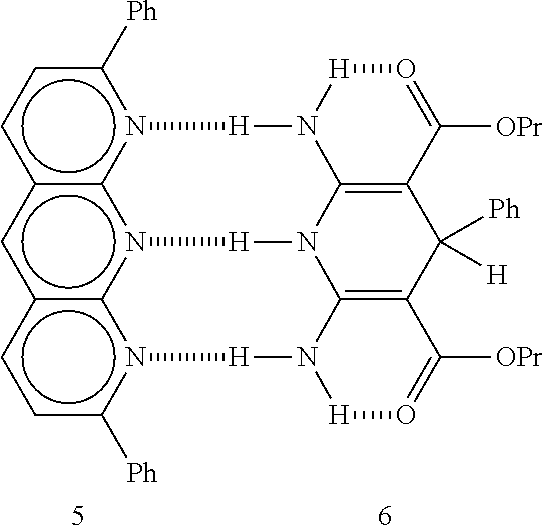
- the strength of the hydrogen bonding with various hydrogen bonding moieties is listed in Table 1 (see, Brusweld et. Al; Chem. Rev. 2001; 101; pp. 4071 to 4097).
- K a 10 2 -10 3 M ⁇ 1
- K a 10 4 -10 5 M ⁇ 1
- ureidopirimidinone polymers One suitable type of hydrogen bonding chemical is ureidopirimidinone polymers. Table 2 shows the chemical structure of 2 such polymers bonded together (see, Angew. Chem.; Int. Ed. Engl. 1998; 37; pp. 1726 to 1729).
- the acrylated ureidopirimidone and similar monomers can be copolymerized with other (meth)acrylic or ethylenenic monomers in the polymer chain to form hydrogen bonded structure.
- telechelic ureidopyrimidinone chains also incorporate hydrogen bonding into the system.
- Ureidopyrimidinone chains can be grafted into the system which also incorporates hydrogen bonding into the system which helps the polymer chain to respond to stimuli.
- Other hydrogen bonding monomers can also be used for this approach. Different polymerization methods could be used to synthesize this polymer which includes bulk, solution, suspension, emulsion, controlled free radical polymerization methods and other polymerization methods available. These hydrogen bonding monomers can be polymerized and blended with these polymer systems also to get to the same effect.
- the extent of hydrogen bonding can vary in the polymer compositions in accordance with the present invention.
- the single hydrogen bonded systems can be the H bonding between pyridyl units and carboxylic acids.
- Difunctional diamino pyridine with difunctional uracil derivatives are examples of triple hydrogen bonding and so on.
- the hydrogen bonding can also be facilitated using acid-base interactions as well.
- the present invention relates to a removable polymer composition
- a removable polymer composition comprising a polymerization product of: (i) from about 10 weight percent to about 70 weight percent of one or more acrylic acid esters of alcohols or methacrylic acid esters of alcohols having from about 4 to about 14 carbon atoms; (ii) from about 0 weight percent to about 70 weight percent of one or more acrylic acid esters of alcohols or methacrylic acid esters of alcohols having from 1 to about 3 carbon atoms; (iii) from about 0 weight percent to about 70 weight percent of one or more polar monomers that can be copolymerized with at least one of (i) and (ii); and (iv) at least one hydrogen bonding monomer, wherein the polymerization process used to form the polymerization product is selected from emulsion polymerization, solution polymerization, hot melt polymerization, precipitation polymerization, anionic polymerization, cationic polymerization, controlled free radical polymerization or emulsifier free
- the amount of component (i) is in the range of about from about 20 weight percent to about 60 weight percent, or from about 25 weight percent to about 50 weight percent, or even from about 30 weight percent to about 40 weight percent of the one or more acrylic acid esters of alcohols or methacrylic acid esters of alcohols having from about 4 to about 14 carbon atoms.
- the amount of component (ii) is in the range of about 5 weight percent to about 60 weight percent, or from about 7.5 weight percent to about 55 weight percent, or from about 10 weight percent to about 50 weight percent, or from about 20 weight percent to about 40 weight percent, or even from about 25 weight percent to about 35 weight percent of the one or more acrylic acid esters of alcohols or methacrylic acid esters of alcohols having from 1 to about 3 carbon atoms.
- the amount of component (iii) is in the range of about 5 weight percent to about 60 weight percent, or from about 7.5 weight percent to about 55 weight percent, or from about 10 weight percent to about 50 weight percent, or from about 20 weight percent to about 40 weight percent, or even from about 25 weight percent to about 35 weight percent of the one or more polar monomers that can be copolymerized with at least one of (i) and (ii).
- individual numerical values, or limits, from one or more embodiments and/or different ranges can be combined to form additional non-disclosed and/or non-stated ranges.
- each compound or component of a various removable polymer composition may individually total more than 100 weight percent when each component is taken individually and totaled using the broadest amounts disclosed herein, one of skill in the art will realize that this is not the case. Rather, each individual component (i.e., components (i) through (iv) inclusive and, if present, components (v)) of a various removable polymer composition of the present invention can be varied within any stated range as desired in order to achieve a total weight percent of 100.
Landscapes
- Chemical & Material Sciences (AREA)
- Polymers & Plastics (AREA)
- Health & Medical Sciences (AREA)
- Chemical Kinetics & Catalysis (AREA)
- Medicinal Chemistry (AREA)
- Organic Chemistry (AREA)
- Inorganic Chemistry (AREA)
- Life Sciences & Earth Sciences (AREA)
- Engineering & Computer Science (AREA)
- Food Science & Technology (AREA)
- Compositions Of Macromolecular Compounds (AREA)
- Confectionery (AREA)
Abstract
Description
| TABLE 1 | |||
| (a) |
 |
Ka = 102-103 M−1 |
 |
| (b) |
 |
Ka = 104-105 M−1 |
 |
| (c) |
 |
Ka > 105 M−1 |
 |
  |
|||
| TABLE 2 |
 |
 |
Claims (11)
Priority Applications (1)
| Application Number | Priority Date | Filing Date | Title |
|---|---|---|---|
| US14/241,592 US9468224B2 (en) | 2011-08-31 | 2012-08-31 | Removable polymer compositions |
Applications Claiming Priority (3)
| Application Number | Priority Date | Filing Date | Title |
|---|---|---|---|
| US201161529881P | 2011-08-31 | 2011-08-31 | |
| PCT/US2012/053311 WO2013033516A1 (en) | 2011-08-31 | 2012-08-31 | Removable polymer compositions |
| US14/241,592 US9468224B2 (en) | 2011-08-31 | 2012-08-31 | Removable polymer compositions |
Publications (2)
| Publication Number | Publication Date |
|---|---|
| US20140205714A1 US20140205714A1 (en) | 2014-07-24 |
| US9468224B2 true US9468224B2 (en) | 2016-10-18 |
Family
ID=46875971
Family Applications (1)
| Application Number | Title | Priority Date | Filing Date |
|---|---|---|---|
| US14/241,592 Expired - Fee Related US9468224B2 (en) | 2011-08-31 | 2012-08-31 | Removable polymer compositions |
Country Status (3)
| Country | Link |
|---|---|
| US (1) | US9468224B2 (en) |
| EP (1) | EP2750514B1 (en) |
| WO (1) | WO2013033516A1 (en) |
Citations (19)
| Publication number | Priority date | Publication date | Assignee | Title |
|---|---|---|---|---|
| US2740772A (en) * | 1949-12-08 | 1956-04-03 | L A Dreyfus Company | Side-chain crystalline copolymers from polymerizable monomers having a substituent crystallizable organic group and having no substituent crystallizable group respectively |
| US3285750A (en) | 1964-03-09 | 1966-11-15 | Daiwa Chemical Ind Ltd | Chewing gum compositions having low adherence when discarded and methods of preparation thereof |
| US4208432A (en) | 1977-06-13 | 1980-06-17 | Kanebo Foods, Ltd. | Powdery anti-stick agent for keeping the sticky surface of candy or chewing gum non-adhesive |
| US4259355A (en) | 1979-03-05 | 1981-03-31 | International Flavors & Fragrances Inc. | Chewing gum containing flavor composition and flavor composition therefor |
| US4423031A (en) * | 1979-11-08 | 1983-12-27 | Shiseido Company, Ltd. | Eye makeup preparation |
| US4518615A (en) | 1983-08-23 | 1985-05-21 | Warner-Lambert Company | Non-adhesive chewing gum base composition |
| US4810763A (en) * | 1987-12-23 | 1989-03-07 | Avery International Corporation | Suspension polymerization in an organic medium |
| US5601858A (en) | 1994-12-29 | 1997-02-11 | Warner-Lambert Company | Non-stick chewing gum |
| US5656705A (en) | 1994-11-02 | 1997-08-12 | Avery Dennison Corporation | Suspension polymerization |
| WO2005118660A1 (en) | 2004-06-01 | 2005-12-15 | Wacker Polymer Systems Gmbh & Co. Kg | Non-blocking solid resins of vinyl ester mixed polymers |
| WO2006016179A1 (en) | 2004-08-12 | 2006-02-16 | The University Of Bristol | Polymeric materials having reduced tack, methods of making the materials and chewing gum compositions containing such materials |
| US20060153949A1 (en) | 2005-01-11 | 2006-07-13 | Cadbury Adams Usa Llc. | Edible compositions containing swellable polymers |
| US20070042078A1 (en) | 2005-08-22 | 2007-02-22 | Cadbury Adams Usa Llc | Biodegradable chewing gum |
| CN1931917A (en) | 2002-10-17 | 2007-03-21 | 株式会社日本触媒 | Aqueous resin dispersion, aqueous resin composition and method for producing aqueous resin composition |
| EP1496753B1 (en) | 2002-04-19 | 2007-06-13 | Wm. Wrigley Jr. Company | Chewing gum base and chewing gum with ultra high molecular weight polyvinylacetate |
| WO2008145120A1 (en) | 2007-05-31 | 2008-12-04 | Gumlink A/S | Environmental chewing gum |
| CN101698965A (en) | 2009-10-30 | 2010-04-28 | 天津工业大学 | Absorbing fiber and manufacturing method thereof |
| WO2011057882A1 (en) | 2009-11-16 | 2011-05-19 | Dsm Ip Assets B.V. | Acrylic polymer |
| US20110123672A1 (en) | 2009-11-23 | 2011-05-26 | Xiaohu Xia | Gum bases, chewing gums based thereupon, and methods for making the same |
-
2012
- 2012-08-31 US US14/241,592 patent/US9468224B2/en not_active Expired - Fee Related
- 2012-08-31 EP EP12759865.4A patent/EP2750514B1/en not_active Not-in-force
- 2012-08-31 WO PCT/US2012/053311 patent/WO2013033516A1/en not_active Ceased
Patent Citations (20)
| Publication number | Priority date | Publication date | Assignee | Title |
|---|---|---|---|---|
| US2740772A (en) * | 1949-12-08 | 1956-04-03 | L A Dreyfus Company | Side-chain crystalline copolymers from polymerizable monomers having a substituent crystallizable organic group and having no substituent crystallizable group respectively |
| US3285750A (en) | 1964-03-09 | 1966-11-15 | Daiwa Chemical Ind Ltd | Chewing gum compositions having low adherence when discarded and methods of preparation thereof |
| US4208432A (en) | 1977-06-13 | 1980-06-17 | Kanebo Foods, Ltd. | Powdery anti-stick agent for keeping the sticky surface of candy or chewing gum non-adhesive |
| US4259355A (en) | 1979-03-05 | 1981-03-31 | International Flavors & Fragrances Inc. | Chewing gum containing flavor composition and flavor composition therefor |
| US4423031A (en) * | 1979-11-08 | 1983-12-27 | Shiseido Company, Ltd. | Eye makeup preparation |
| US4518615A (en) | 1983-08-23 | 1985-05-21 | Warner-Lambert Company | Non-adhesive chewing gum base composition |
| US4810763A (en) * | 1987-12-23 | 1989-03-07 | Avery International Corporation | Suspension polymerization in an organic medium |
| US5656705A (en) | 1994-11-02 | 1997-08-12 | Avery Dennison Corporation | Suspension polymerization |
| US5601858A (en) | 1994-12-29 | 1997-02-11 | Warner-Lambert Company | Non-stick chewing gum |
| EP1496753B1 (en) | 2002-04-19 | 2007-06-13 | Wm. Wrigley Jr. Company | Chewing gum base and chewing gum with ultra high molecular weight polyvinylacetate |
| CN1931917A (en) | 2002-10-17 | 2007-03-21 | 株式会社日本触媒 | Aqueous resin dispersion, aqueous resin composition and method for producing aqueous resin composition |
| WO2005118660A1 (en) | 2004-06-01 | 2005-12-15 | Wacker Polymer Systems Gmbh & Co. Kg | Non-blocking solid resins of vinyl ester mixed polymers |
| WO2006016179A1 (en) | 2004-08-12 | 2006-02-16 | The University Of Bristol | Polymeric materials having reduced tack, methods of making the materials and chewing gum compositions containing such materials |
| US20060153949A1 (en) | 2005-01-11 | 2006-07-13 | Cadbury Adams Usa Llc. | Edible compositions containing swellable polymers |
| US20070042078A1 (en) | 2005-08-22 | 2007-02-22 | Cadbury Adams Usa Llc | Biodegradable chewing gum |
| WO2008145120A1 (en) | 2007-05-31 | 2008-12-04 | Gumlink A/S | Environmental chewing gum |
| US20100074987A1 (en) * | 2007-05-31 | 2010-03-25 | Jesper Neergaard | Environmental Chewing Gum |
| CN101698965A (en) | 2009-10-30 | 2010-04-28 | 天津工业大学 | Absorbing fiber and manufacturing method thereof |
| WO2011057882A1 (en) | 2009-11-16 | 2011-05-19 | Dsm Ip Assets B.V. | Acrylic polymer |
| US20110123672A1 (en) | 2009-11-23 | 2011-05-26 | Xiaohu Xia | Gum bases, chewing gums based thereupon, and methods for making the same |
Non-Patent Citations (8)
| Title |
|---|
| Goh et al. "Cross-linked Poly(methacrylic acid-co-polyethylene oxide) methyl ether methacrylate) Microspheres and Microgels Prepared by Precipitation Polymerization: Morphology Study", Macromolecules, 2002, 35(27), 9983-9989 (STIC Search, pp. 173-175). * |
| International Preliminary Report on Patentability issued in corresponding IA No. PCT/US2012/021244 dated Jul. 25, 2013. |
| International Preliminary Report on Patentability issued in corresponding IA No. PCT/US2012/053311 dated Mar. 4, 2014. |
| International Search Report and Written Opinion issued in corresponding IA No. PCT/US2012/021244 dated May 2, 2012. |
| International Search Report and Written Opinion issued in corresponding IA No. PCT/US2012/053311 dated Jan. 31, 2013. |
| Office Action issued in corresponding EP Application No. 12 759 865.4 dated Mar. 13, 2015. |
| Response to IPRP filed in corresponding EP Application No. 12 759 865.4 dated Oct. 20, 2014. |
| Yamauchi et al. "Synthesis and characterization of telechelic multiple hydrogen bonded (MHB) macromolecules via living anionic polymerization", Polymer Preprints (American Chemical Society, Division of Polymer Chemistry) (2002), 43(1), 698-699 (STIC Search, pp. 25-27). * |
Also Published As
| Publication number | Publication date |
|---|---|
| EP2750514A1 (en) | 2014-07-09 |
| WO2013033516A1 (en) | 2013-03-07 |
| EP2750514B1 (en) | 2016-08-10 |
| US20140205714A1 (en) | 2014-07-24 |
Similar Documents
| Publication | Publication Date | Title |
|---|---|---|
| CN103547663B (en) | Detergent compositions | |
| EP3177703B1 (en) | Use in detergent compositions of polymers obtained by low-concentration, inverse emulsion polymerization with a low content of neutralized monomers | |
| CN110305265A (en) | Anti-settling and thickener composition and the method for using it | |
| US20120142823A1 (en) | Translucent and opaque impact modifiers for polylactic acid | |
| CN103649194A (en) | Low-odour (meth)acrylic reaction resins | |
| CN103314051A (en) | Impact-modified reaction resin | |
| US20150335565A1 (en) | Irritation mitigating polymers and uses therefor | |
| KR20160130812A (en) | Acrylic resin composition, acrylic resin film, and molded body | |
| US9468224B2 (en) | Removable polymer compositions | |
| US9783627B2 (en) | Removable composition with polymer microspheres | |
| JP3889430B2 (en) | Aqueous dispersion for nail enamel and aqueous nail enamel composition | |
| CN105408374B (en) | Hydrophobic base soluble emulsion thickener | |
| KR100694861B1 (en) | Thickeners for High-HH Aqueous Systems | |
| JPH11514699A (en) | Aqueous compositions thickened with acrylate-based polymer rheology modifiers | |
| EP2909267B1 (en) | Impact resistant transparent thermoplastic compositions | |
| JP2006083302A (en) | Water-based adhesive | |
| JP3291624B2 (en) | Vinyl acetate / (meth) acrylate copolymer emulsion, method for producing the same, and adhesive composition using the emulsion | |
| JP2000026691A (en) | Acrylic silicone emulsion composition | |
| JP4675068B2 (en) | Resin composition for foundation floor | |
| JP2004057103A (en) | Agricultural vinyl chloride resin film | |
| CN1086241A (en) | Quick-set non-cementitious adhesive | |
| MX337015B (en) | Room temperature self-crosslinkable adhesives for wood. |
Legal Events
| Date | Code | Title | Description |
|---|---|---|---|
| AS | Assignment |
Owner name: AVERY DENNISON CORPORATION, CALIFORNIA Free format text: ASSIGNMENT OF ASSIGNORS INTEREST;ASSIGNORS:CHACKO, SUJITH;MALLYA, PRAKASH;LI, XIANG-YA;SIGNING DATES FROM 20120904 TO 20120914;REEL/FRAME:029081/0247 |
|
| STCF | Information on status: patent grant |
Free format text: PATENTED CASE |
|
| FEPP | Fee payment procedure |
Free format text: MAINTENANCE FEE REMINDER MAILED (ORIGINAL EVENT CODE: REM.); ENTITY STATUS OF PATENT OWNER: LARGE ENTITY |
|
| LAPS | Lapse for failure to pay maintenance fees |
Free format text: PATENT EXPIRED FOR FAILURE TO PAY MAINTENANCE FEES (ORIGINAL EVENT CODE: EXP.); ENTITY STATUS OF PATENT OWNER: LARGE ENTITY |
|
| STCH | Information on status: patent discontinuation |
Free format text: PATENT EXPIRED DUE TO NONPAYMENT OF MAINTENANCE FEES UNDER 37 CFR 1.362 |
|
| FP | Expired due to failure to pay maintenance fee |
Effective date: 20201018 |