US9465874B1 - Authenticated hierarchical set operations and applications - Google Patents
Authenticated hierarchical set operations and applications Download PDFInfo
- Publication number
- US9465874B1 US9465874B1 US14/696,606 US201514696606A US9465874B1 US 9465874 B1 US9465874 B1 US 9465874B1 US 201514696606 A US201514696606 A US 201514696606A US 9465874 B1 US9465874 B1 US 9465874B1
- Authority
- US
- United States
- Prior art keywords
- query
- tree
- data sets
- union
- answer
- Prior art date
- Legal status (The legal status is an assumption and is not a legal conclusion. Google has not performed a legal analysis and makes no representation as to the accuracy of the status listed.)
- Active
Links
Images




Classifications
-
- G06F17/30864—
-
- G—PHYSICS
- G06—COMPUTING OR CALCULATING; COUNTING
- G06F—ELECTRIC DIGITAL DATA PROCESSING
- G06F21/00—Security arrangements for protecting computers, components thereof, programs or data against unauthorised activity
- G06F21/60—Protecting data
- G06F21/62—Protecting access to data via a platform, e.g. using keys or access control rules
- G06F21/6218—Protecting access to data via a platform, e.g. using keys or access control rules to a system of files or objects, e.g. local or distributed file system or database
- G06F21/6227—Protecting access to data via a platform, e.g. using keys or access control rules to a system of files or objects, e.g. local or distributed file system or database where protection concerns the structure of data, e.g. records, types, queries
-
- G—PHYSICS
- G06—COMPUTING OR CALCULATING; COUNTING
- G06F—ELECTRIC DIGITAL DATA PROCESSING
- G06F16/00—Information retrieval; Database structures therefor; File system structures therefor
- G06F16/20—Information retrieval; Database structures therefor; File system structures therefor of structured data, e.g. relational data
- G06F16/24—Querying
-
- G—PHYSICS
- G06—COMPUTING OR CALCULATING; COUNTING
- G06F—ELECTRIC DIGITAL DATA PROCESSING
- G06F16/00—Information retrieval; Database structures therefor; File system structures therefor
- G06F16/90—Details of database functions independent of the retrieved data types
- G06F16/95—Retrieval from the web
- G06F16/951—Indexing; Web crawling techniques
-
- H—ELECTRICITY
- H04—ELECTRIC COMMUNICATION TECHNIQUE
- H04L—TRANSMISSION OF DIGITAL INFORMATION, e.g. TELEGRAPHIC COMMUNICATION
- H04L63/00—Network architectures or network communication protocols for network security
- H04L63/12—Applying verification of the received information
- H04L63/123—Applying verification of the received information received data contents, e.g. message integrity
Definitions
- the present invention relates generally to techniques for verifying data processing on outsourced data sets and, more particularly, to techniques for authenticated hierarchical set operations.
- An immediate by-product of outsourcing of data and computation is the need for verification of the correctness of a computation.
- Such integrity protection is a core security goal in cloud computing. Ensuring that data contents remain intact in the lifetime of an outsourced data set and that query processing is handled correctly, producing accurate and up-to-date answers, lies at the foundation of secure cloud services.
- Authenticated data structures provide cryptographically hardened integrity guarantees in distributed or cloud-based data management settings. They support authenticated queries on a data set that is outsourced to a third party and generally untrusted server, by allowing the server to return—along with the answer to a query—a proof that can validate the correct query execution.
- a third party server processes a query on a plurality of data sets S 1 , . . . ,S n outsourced by a source of the data.
- the query comprises a hierarchical set operation between at least two of the data sets S 1 , . . . ,S n .
- At least one level of a hierarchy of the hierarchical set operation of the query comprises at least a first one of an intersection operation, a union operation and a set difference operation and at least a second level that is different than the first level of the hierarchy comprises at least a second distinct one of the intersection operation, the union operation and the set difference operation.
- the server method comprises obtaining from the source the data sets S 1 , . . . ,S n , corresponding encodings a 1 , . . . ,a n of the data sets S 1 , . . . ,S n , and a verification of the encodings a 1 , . . . ,a n ; generating an answer to the query using the data sets S 1 , . . .
- leaf nodes in the tree correspond to at least two of the data sets relevant to the query and non-leaf nodes in the tree correspond to at least one of the intersection operation, the union operation and the set difference operation; for each leaf node in the tree corresponding to a data set S i , computing a verification for encoding a i that is based on the obtained encodings a 1 , . . . ,a n and the obtained verification of the encodings a 1 , . . .
- a client verifies a query on a plurality of data sets S 1 , . . . ,S n outsourced by a source of the data.
- the client method comprises receiving from the server an encoding of an answer to the query and a proof-of-correctness, wherein the proof-of-correctness comprises a verification for at least two encodings of one or more of the data sets relevant to the query and at least one argument for at least one of the intersection operation, the union operation and the set difference operation; parsing the received proof-of-correctness as a tree, wherein leaf nodes in the tree correspond to at least two of the data sets relevant to the query and non-leaf nodes in the tree correspond to at least one of the intersection operation, the union operation and the set difference operation; for each leaf node in the tree corresponding to data set S i , deriving and verifying a corresponding encoding a i using the corresponding received verification; for each non-leaf
- the encodings a 1 , . . . ,a n of the data sets S 1 , . . . ,S n comprise accumulation values a 1 , . . . ,a n and the encoding of the answer comprises one or more of the answer and coefficients b i of a characteristic polynomial of the answer.
- the at least one argument comprises one or more of an intersection argument comprising one or more of subset witnesses, completeness witnesses, and accumulation values and a union argument comprising one or more of subset witnesses, completeness witnesses, and accumulation values.
- Various aspects of the invention may be employed by one or more of an authenticated keyword search, an authenticated SQL query answer, and a construction for verifying an evaluation of a function computable by polynomial size circuits.
- the source of the data performs the following steps prior to the third party server processing the query: generating a public key and a secret key; computing encodings a 1 , . . . ,a n of the data sets S 1 , . . . ,S n ; obtaining a verification of the encodings; providing the data sets S 1 , . . . ,S n , the corresponding computed encodings a 1 , . . . ,a n and the obtained verification of the encodings to the third party server; and publishing the public key and a digest of the verification.
- FIG. 1 illustrates an exemplary three party scenario, where a source owns data sets S 1 . . . ,S n and multiple clients ask queries of elaborate set operations over a given set S i ;
- FIG. 2 illustrates an exemplary two party scenario where a source owns data sets S 1 . . . ,S n that are authenticated by the source and outsourced to the server with the corresponding authentication information;
- FIG. 3A illustrates exemplary pseudo code for an exemplary implementation of a conventional query algorithm
- FIG. 3B illustrates exemplary pseudo code for an exemplary implementation of a conventional verify algorithm
- FIG. 4 illustrates an exemplary tree T for representing a hierarchical set operation
- FIG. 5 illustrates an exemplary tree representing the union of the result of two intersection operations I 1 and I 2 and a set J;
- FIG. 6 illustrates the application of the extractable accumulation scheme to an exemplary tree comprised of a query involving a hierarchical intersection set operation
- FIG. 7 illustrates the application of the extractable accumulation scheme to the exemplary tree comprised of a query involving a hierarchical union set operation having two sets;
- FIG. 8 illustrates the application of the extractable accumulation scheme to the exemplary tree comprised of a query involving a hierarchical union set operation having multiple sets;
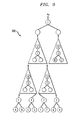
- FIG. 9 illustrates the application of the extractable accumulation scheme to the exemplary original tree comprised of a query involving hierarchical set operations having multiple sets
- FIG. 10 is a flow chart describing an exemplary implementation of a data set outsourcing process that may be implemented by the source of FIG. 1 or 2 ;
- FIG. 11 is a flow chart describing an exemplary implementation of a query answering process that may be implemented by the server of FIG. 1 or 2 ;
- FIG. 12 is a flow chart describing an exemplary implementation of an answer verification process that may be implemented by the client of FIG. 1 .
- aspects of the present invention provide verifiable hierarchical set operations (e.g., intersection and union) in an outsourced setting. Further aspects of the invention provide cryptographic protocols for securely verifying the correctness of the produced results.
- the disclosed exemplary verification techniques support: (1) efficient verification of the computation result in time that is asymptotically less than the time spent at the server to compute the result itself; and (2) operation-sensitive verification of the computation result in time that depends only on (the size of) the answer and (the parameters) of the query.
- verifiable hierarchical set operations described herein build upon the Authenticated Set Operation schemes by modifying and expanding them to include an extractable accumulator.
- aspects of the present invention may be employed in both a 3-party and a 2-party model of outsourced computation.
- an owner of a data set often referred to as the source, that wants to answer queries over the data set issued by one or more clients or users and, for reasons of scalability and efficiency, chooses to do so by employing a possibly untrusted server on the cloud.
- the source first performs some finger-printing signing operations on the data set, issues some publicly accessible digest information for its customers (clients) and then outsources the data set to the server. Following that, all query processing is handled by the server which produces query answers accompanied by cryptographic proofs that can be verified by the receiving user with respect to their consistency with digest of the data set.
- the exemplary cryptographic proofs are constructed such that their successful verification with respect to the published digest corresponds (with overwhelming probability) to the query answer being correct, as if the query was answered locally by the trusted data owner and despite the fact that the server may act maliciously by trying to subvert the verification protocol so that incorrect answers and their proofs are forged to pass the answer verification check.
- the above is a generalization of the 2-party model, where a single client owns a data set and outsources it at a cloud server for storage and query processing.
- the source owning the data set and the clients querying the data set are in fact the same entity. Observe that the client does not need to maintain a local copy of the data set for reasons of answer verification.
- FIG. 1 illustrates an exemplary three party scenario, where a source 110 owns data sets S 1 . . . ,S n and multiple clients, such as client 130 , ask queries of elaborate set operations (such as intersection and union) over one or more given sets S i .
- the source 110 provides the data sets S 1 . . . ,S n and corresponding authentication information to an untrusted server 120 .
- the server 120 processes the queries q from the clients 130 and provides an answer ⁇ with accompanying proof-of-validity ⁇ .
- FIG. 2 illustrates an exemplary two party scenario where a source 210 owns data sets S 1 . . . ,S n that are authenticated by the source 210 and outsourced to the server 220 with the corresponding authentication information.
- the source 210 later asks the server 220 to process queries, q, and the source 210 receives an answer ⁇ with accompanying proof-of-validity ⁇ from the server 220 .
- Exemplary aspects of the invention provide efficient and operation-sensitive authentication schemes, i.e., schemes where the verification time and proof size are more efficient than the corresponding verification times and proof sizes that would be obtained if the entire query-answering process was verified step-by-step and, respectively, schemes where the verification time and proof size are independent of the size of the computation and only depend on the output size and the query parameters.
- One important aspect of the exemplary constructions is that they accommodate dynamic data sets that change over time under insertions, deletions and modifications in a way that maintains low upkeep efficiency on behalf of the server.
- the exemplary constructions can be used for instantiating general set operation queries over sets of data (such as shared documents and public files) as well as for the implementation of secure SQL-type queries over general outsourced relational databases.
- a first exemplary construction supports queries that include hierarchical intersections and union operations, but lacks the efficiency or operation-sensitivity property, namely, the proof size and the verification time are related to the total size of intermediate sets. For instance, for a query that demands the intersection of two unions, the proof size will be linear to the sum of the sizes of the two unions, whereas the final answer may be much smaller, or be even empty.
- the second exemplary construction is efficient and operation-sensitive and produces short proofs that can be verified in time only linear to the final proof size with an additional overhead equal to the number of sets involved in the query.
- aspects of the present invention are directed to a wider class of computations, namely hierarchical set operations consisting of an arbitrarily large combination of intersections and unions, but also set differences and negations.
- hierarchical set operations consisting of an arbitrarily large combination of intersections and unions, but also set differences and negations.
- the problem of hierarchical set operations is inherently more difficult, since at some points along the path of the computation, authenticated results must be provided over non-authenticated sets (that have been produced as intermediate, partial, results up to that point in the computation).
- Applications of authenticated hierarchical set operations include authenticated SQL queries over relational databases, authenticated keyword searches over texts and authenticated computations via Boolean circuit evaluation.
- l denotes the security parameter and v(l) denotes a negligible function.
- a function ⁇ (l) is negligible if for each polynomial function poly(l) and all large enough values of l, ⁇ (l) ⁇ 1/(poly(l).
- An event can occur with negligible probability if its occurence probability is upper bounded by a negligible function. Respectively, an event takes place with overwhelming probability if its complement takes place with negligible probability.
- G be a cyclic multiplicative group of prime order p, generated by g.
- G T be a cyclic multiplicative group with the same order p and e:
- the Bilinear Accumulator represents each set S i by one group element a i referred to as an accumulation value.
- the values (g r , . . . ,g s y ) also become publicly available.
- An authenticated data structure scheme A is a collection of the following six polynomial-time algorithms: ⁇ genkey; setup; update; refresh; query; verify ⁇ :
- check( ) is not part of the ADS scheme and is only introduced for ease of notation. There are two properties that an authenticated data structure scheme should satisfy, i.e., correctness and security:
- A be an authenticated data structure scheme ⁇ genkey; setup; update; refresh; query; verify ⁇ .
- the authenticated data structure scheme A is correct if, for all k ⁇ N, for all (sk,pk) output by algorithm genkey( ), for all (D h ;auth(D h );d h ) output by one invocation of setup( ) followed by polynomially-many invocations of refresh( ), where h ⁇ 0, for all queries q and for all a(q); ⁇ (q) output by query(q;D h ;auth(D h );pk), with all but negligible probability, whenever algorithm check(q;a(q),D h ) accepts, so does algorithm verify(q;a(q); ⁇ (q);d h ;pk).
- A be an authenticated data structure scheme ⁇ genkey; setup; update; refresh; query; verify ⁇ , k be the security parameter, v(k) be a negligible function and (sk,pk) ⁇ genkey(1 k ).
- the verification time (and consequently the proof size) should be asymptotically less than the time needed for a user to compute a(q) by itself or asymptotically the same as the answer computation size.
- a scheme that satisfies the above property is said to be an efficient scheme.
- a source 110 (or owner) O maintaining a data set D 0 comprising of sets S 1 , . . . ,S T ;
- an intermediate server S (server 120 ) in charge of handling queries, computing answers and issuing answer-proof pairs for the users.
- the scheme is based on the bilinear accumulator presented above.
- Another construction used is an accumulation tree which is used to verify the correctness of accumulation values for the sets involved in a particular query.
- an accumulation tree primitive see, for example, C. Papamanthou et al., “Authenticated Hash Tables,” CCS, 437-448 (2008) and/or United States Patent Publication No. 2011/0225429, entitled “Cryptographic Accumulators for Authenticated Hash Tables,” each incorporated by reference herein.
- Source 110 picks security parameter k and acquires ⁇ pk,sk ⁇ genkey(1 k ). Consequently, by running algorithm setup, source 110 constructs an authenticated version of D 0 , namely auth(D 0 ) as well as a digest d 0 .
- Source 110 communicates ⁇ D 0 ,auth(D 0 ),d 0 ,pk ⁇ to the server S ( 120 ), and publishes ⁇ d 0 ,pk ⁇ that serve as the public key information for the scheme. It should be noted here that this scheme has the property of being publicly verifiable.
- a user 130 that wants a query q answered sends q to the server S ( 120 ).
- the server 120 computes an answer a(q) and proof ⁇ (q) using algorithm query which will be explained in more detail below.
- ASO also includes algorithms update, refresh that are used to accommodate updates on the original data set without the source having to recompute the new authenticated version of the data set from scratch.
- source 110 runs update and produces new tuple ⁇ D i+1 ,auth(D i+1 ,d i+1 ) ⁇ in constant time (independent of the size of D i ) as well as update digest upd. Consequently the server 120 receives upd and by running refresh produces ⁇ D i+1 ,auth(D i+1 ,d i+1 ) ⁇ also in constant time.
- the exemplary algorithms query and verify come with two modes of operation, e.g., one for the case of union and one for intersection.
- the operation can be described in both cases in three steps. Firstly, the accumulation values of all t sets involved in the query q are returned, accompanied by corresponding proofs ⁇ 1 , . . . , ⁇ t that can be verified by the use of public information d h with use of algorithms queryTree, verifyTree related with the accumulation tree primitive. This step can be distinguished by the rest of the query answering procedure. Secondly, polynomial coefficients of the accumulation value of the answer set a(q) are computed.
- FIG. 3A illustrates exemplary pseudo code 300 for an exemplary implementation of the query algorithm and FIG. 3B illustrates exemplary pseudo code 350 for an exemplary implementation of the verify algorithm.
- Scheme 1 ADS Scheme for Hierarchical Set Operations
- a first exemplary approach to hierarchical set operations extends ASO in order to accommodate hierarchical set operations.
- FIG. 4 illustrates an exemplary tree T ( 400 ) for representing a hierarchical set operation.
- the exemplary hierarchical set operation comprises:
- FIG. 5 illustrates an exemplary tree 500 representing the union (node 510 ) of the result of two intersection operations I 1 and I 2 (nodes 520 , 530 ) and a set J (node 540 ).
- the intersection operations I 1 and I 2 (nodes 520 , 530 ) are applied to a plurality of sets A-D and E-H, respectively.
- intersection operations I 1 and I 2 can be processed separately as “flat” operations to obtain the corresponding Intersection proof for each intersection operation and intermediate results for I 1 and I 2 .
- the Intersection proof for each intersection operation comprises values W S , F S for each set S involved in the respective intersection operation.
- the union operation U can be processed as a “flat” operation to obtain the corresponding Union proof for the union operation and the final result (answer element) for U.
- the Union proof for the union operation comprises values W S for each set S involved in the union operation (here, W I1 , W I2 and W J ), as well as a value w i for each answer element w i .
- the accumulation values of sets A, . . . ,H and J in FIG. 5 are verified by an accumulation tree and the accumulation values of sets I 1 and I 2 are verified because the corresponding sets (intermediate results) are explicitly given.
- the verification procedure can be separated into two subroutines, one for the verification of the correctness of the returned accumulation values of the involved sets (using only ⁇ 2 (q)) and one for the verification of the correctness of a(q).
- Run algorithm verify ( FIG. 3B ) skipping step (1) and use the provided acc(S i ) as the accumulated values for step (3).
- S 1 , . . . ,S t are the t sets involved in the computation. Observe that it is assumed that the verifying client 130 already has access to the accumulation values of the original (not intermediate) sets that are involved in the computation.
- a query answering and verification procedure is constructed for an ADS scheme for hierarchical set operations incorporating aspects of the present invention.
- the above verification algorithm verifies the correctness of all the intermediate results using the original verification algorithm which runs in time linear to the size of each set and also to the number of sets participating in the computation. Since each partial result on level j contributes to only one partial result on level j+1, it follows that the total running time of the verification algorithm (as well as the total proof size) is
- An extractable accumulation scheme is defined herein as an extension of the one-way accumulator by adding the following two algorithms:
- ka is a knowledge accumulation for set X and, in a sense, serves as a short argument of knowledge for set X.
- the security definition for this extended accumulation scheme is the same as for the bilinear accumulator of the ASO. The additional following property is provided:
- extractability forces the server 120 to produce accumulation values only for allowed sets without providing these sets. This is achieved with an additional element ⁇ hacek over (a) ⁇ i . In this manner, hierarchical queries can be processed without processing (possibly huge) intermediate results.
- two bilinear accumulators i.e., a primary bilinear accumulator and a secondary bilinear accumulator
- the public key of the secondary accumulator is created by raising each element in the public key of the primary bilinear accumulator to an element x that remains hidden from adversaries and becomes part of the secret key of the scheme.
- a i denotes the accumulation value of set S i created by the primary accumulator
- ⁇ hacek over (a) ⁇ i denotes the accumulation value of the same set S i created by the secondary accumulator.
- the (provable) claim is that any adversary that produces (given both public keys) any two elements such that one of them raised to x equals the other one, knows a particular corresponding set such that the first element is the accumulation value of this set with respect to the primary accumulator and the second set is the accumulation of the same set with respect to the secondary accumulator.
- the bilinear accumulator is enhanced with a second accumulation function for a different exponentiation base h, the discrete log of which with respect to the exponentiation base of the original accumulation base g is part of the secret key.
- the accumulators defined by these two accumulation functions are referred to as primary accumulator and secondary accumulator, respectively. All algorithms of the exemplary extractable accumulation scheme make use only of the primary accumulator and in the following discussion, whenever the accumulation value acc( ⁇ ) of a set is referenced, it refers to the accumulation value computed using the primary accumulator. That is, set accumulation, witness computation and verification essentially ignore the second part of the public key.
- g b i ⁇ s i can be directly computed using the pk and then multiplied to form d, ⁇ tilde over (d) ⁇ . Also,
- a further aspect of the invention provides a method for verifying that an intersection operation is performed correctly.
- This construction is a natural extension of ASO but mainly using an extractable accumulation scheme.
- proveIntersection and verifyIntersection are the two methods described above to construct the necessary elements for the intersection argument and to verify the relations (1)-(3).
- FIG. 6 illustrates the application of the extractable accumulation scheme to the exemplary tree 600 comprised of a query involving the following exemplary hierarchical intersection set operation, in accordance with aspects of the present invention:
- the proof of the query answer generated by the exemplary extractable accumulation scheme comprises the following accumulation values and witness values:
- Another aspect of the invention provides a method for proving the correctness of a union method.
- set U S 1 ⁇ , . . . , ⁇ S t and let a i be the corresponding accumulation values as above.
- the union set U is uniquely characterized by the following two properties: (a) S i ⁇ U for all S i and (b) For each element x j ⁇ U, x j ⁇ S i for some i between 1 and t.
- the verifier gets a proof of validity for the accumulation of set I and correspondingly can verify the correctness of the accumulation value of U (once again, except for the case of soft cheating).
- U i corresponding to sets U i and, following that, apply repeatedly until set U is reached. Semantically this corresponds to a binary tree T of height k with the original sets S i at the t leafs (level 0), sets U i as defined above at level 1, and so on, with set U at the root at level k. Each internal node of the tree corresponds to the set resulting from the union operation over the sets of its children nodes.
- U 1 (j) , . . . ,U t/2 j (j) denotes the sets appearing at level j.
- Each internal node of T has exactly two kids and I i (j) denotes the intersection of the sets corresponding to its children nodes.
- I i (j) denotes the intersection of the sets corresponding to its children nodes. The following proves the validity of the accumulation value of a union set operation that can be constructed with access to the public key of an extractable accumulation scheme and accumulation values a i corresponding to original sets S i .
- Each internal node of the binary tree T corresponding to the union operation is as described above.
- A,B denotes the two sets corresponding to its children nodes, U,I their union and intersection respectively.
- the proof contains:
- any verifier can, by checking the above equalities, gain confidence that a U indeed refers to the correctly computed intersection (or a soft cheating).
- Both proof size and verification time of the above construction are independent of intermediate set sizes and only linear to the number of involved original sets. This follows easily from the semantic representation of the union operation as a binary tree with the t original input sets to the union. It follows that the total number of internal nodes in this tree is O(t) (technically t ⁇ 1) and checking each equality above can be done in constant time (all pairing inputs are pre-computed) thus both proof size and verification time are O(t).
- FIG. 7 illustrates the application of the extractable accumulation scheme to the exemplary tree 700 comprised of a query involving the following exemplary hierarchical union set operation having two sets, in accordance with aspects of the present invention:
- the proof of the query answer generated by the exemplary extractable accumulation scheme comprises the following accumulation values and witness values:
- FIG. 8 illustrates the application of the extractable accumulation scheme to the exemplary original tree 800 comprised of a query involving the following exemplary hierarchical union set operations having multiple sets, in accordance with aspects of the present invention:
- the exemplary original tree 800 is transformed into a transformed tree 850 , as shown in FIG. 8 using a combination of two-set unions.
- the proof of the query answer generated by the exemplary extractable accumulation scheme comprises the following:
- FIG. 9 illustrates the application of the extractable accumulation scheme to the exemplary original tree 900 comprised of a query involving the following exemplary hierarchical set operations having multiple sets, in accordance with aspects of the present invention:
- the proof of the query answer generated by the exemplary extractable accumulation scheme comprises the following:
- This cryptographic primitive can be seen as an analog of Merkle trees for proving set membership with respect to a digest value h with the additional benefit that it provides constant size proofs that are also verifiable in constant time for the set membership problem, while at the same time, maintaining efficient updates.
- the authenticated data structure consists of ⁇ a 1 , . . . ,a T ,AT ⁇ and h 0 is the digest of the accumulation tree.
- Algorithms update and refresh are similar to ASO.
- the size of the proof ⁇ is O(t+ ⁇ ). This follows from the fact that the values a i , ⁇ i are of constant size and each of P(v) is of size linear to the number of children on v. Since each node of T has a unique parent and there are at most t ⁇ 1 internal nodes at T, the combined size of all proofs P(v) taken together is O(t). Also, there are exactly ⁇ coefficients b i therefore the total size of ⁇ is O(t+ ⁇ ).
- the runtime of the above verification algorithm is O(t+ ⁇ ) as steps 1 & 2 take time O(t) from a similar argument as above and steps 3 & 4 take time O( ⁇ ).
- the scheme AHSO 2 ⁇ genkey, setup, hquery, hverify, update, refresh ⁇ is a dynamic ADS scheme for queries q from the class of hierarchical set operations queries with proof size and verification time O(t+ ⁇ ), where t is the number of sets appearing in q and ⁇ is the size of the query answer ⁇ .
- FIG. 10 is a flow chart describing an exemplary implementation of a data set outsourcing process 1000 that may be implemented by the source 110 , 210 of FIG. 1 or 2 .
- the source 110 , 210 initially generates public and secret keys (pk,sk) during step 1010 . Thereafter, the source 110 , 210 computes accumulation values a 1 , . . . ,a n for corresponding sets S 1 , . . . ,S n during step 1020 .
- the source 110 , 210 then computes a verification over values a 1 , . . . ,a n during step 1030 .
- the verification may comprise an accumulation tree (AT) or any other public key authentication scheme, such as digital signatures, Merkle Trees and publishing the accumulation values at a (secure) public access repository that is authenticated by the source.
- AT accumulation tree
- any other public key authentication scheme such as digital signatures, Merkle Trees and publishing the accumulation values at a (secure) public access repository that is authenticated by the source.
- the source 110 , 210 then sends the server 120 , 220 sets S i , corresponding values a i and the verification during step 1040 .
- the source 110 , 210 publishes the public key pk and a verification digest during step 1050 .
- the verification comprises an accumulation tree (AT)
- the source 110 computes the AT and corresponding digest, sends them to the server 120 and publishes the digest.
- the server 120 includes in each proof, accumulation tree proofs-of-membership for each of the accumulation values of the sets involved in the query with respect to AT.
- the client 130 verifies validity of accumulation values using the public key, the digest and the verification algorithm of AT.
- the verification comprises a Merkle Tree
- it is processed in a similar manner by the parties as an AT. There is no need to send the Merkle tree to the server 120 , however; since it is a deterministic construction for a chosen hash function and can be re-constructed by the server 120 .
- the source 110 computes signatures Sig i and sends them to the server 120 .
- the source also publishes the public key to the digital signature scheme. For each set involved in a query, the corresponding signature for its accumulation value is included by the server 120 in the proof.
- the client 130 using the public verification key, verifies the integrity of each accumulation value.
- the source 110 sets up some authentication information for the repository and populates it with accumulation values a i .
- the source 110 also publishes its certificate. No authentication information is included by the server 120 in the proof regarding accumulation values a i .
- the client 130 accesses the repository and using the certificate of the source 110 verifies the integrity of values a i used in the proof.
- FIG. 11 is a flow chart describing an exemplary implementation of a query answering process 1100 that may be implemented by the server 120 , 220 of FIG. 1 or 2 .
- the server 120 , 220 initially uses the sets S 1 , . . . ,S n to produce an answer ⁇ during step 1110 , in a conventional manner.
- the server 120 , 220 then parses the query q as a tree T during step 1120 .
- the server 120 , 220 computes the verification proof-of-correctness for a i during step 1130 (i.e., for each a i relevant to the query).
- the server 120 , 220 For each internal node of T, the server 120 , 220 computes the Union/Intersection argument during step 1140 , as discussed above in conjunction with FIGS. 6-9 .
- the server 120 , 220 then outputs the verification proofs (step 1130 ), arguments (step 1140 ) and coefficients b i of the characteristic polynomial of set ⁇ during step 1150 .
- FIG. 12 is a flow chart describing an exemplary implementation of an answer verification process 1200 that may be implemented by the client 130 of FIG. 1 .
- the client 130 verifies the validity of accumulation value a i using provided verification proof during step 1210 .
- the client 130 validates the provided Union/Intersection arguments during step 1220 , using the verified accumulation value a i .
- the client 130 uses an FFT interpolation to verify the validity of the coefficients b i of the characteristic polynomial during step 1230 .
- a test is performed during step 1240 to determine if all checks hold. If it is determined during step 1240 that all checks hold, then an acceptance is output during step 1250 . If, however, it is determined during step 1240 that all checks do not hold, then a rejection is output during step 1260 .
- step 3 in the verification algorithm by: polynomial interpolation with FFT compute coefficients b for the characteristic polynomial of set ⁇ .
- the public key pk is of size linear to the parameter q where q is an upper bound on the size of the sets that can be accumulated. This holds not only for the original sets S 1 , . . . ,S T but for any set that can result from hierarchical set operations among them.
- a natural lower bound for q is
- a client 130 that needs to verify the correctness of query Q with corresponding answer ⁇ of size ⁇ , only needs values g, . . . , g s ⁇ and h, . . . ,h s ⁇ in order to run algorithm hverify.
- Algorithm hprove runs an additional step, including in the proof values g, . . . ,g ⁇ and corresponding proofs p i for proof membership with respect to up to date digest value h′ of tree AT′.
- Algorithm hverify runs an additional step, validating the correctness of values g, . . . ,g ⁇ with respect to h′.
- the exemplary construction can be extended to accommodate set differences as well as unions and intersections.
- the above technique can be used in order to provide proofs for the case of set negation in a manner that is, at least theoretically, feasible.
- the source 110 simply needs to incorporate in the data structure a set S* corresponding to set S 1 ⁇ . . . ⁇ S T and its corresponding accumulation value that must be inserted in the accumulation tree AT.
- the client 130 can verify that a set A′ is the negation of A (with respect to all elements present at data structure D) by using the above technique for set difference and substituting S* for B.
- Set S* and its corresponding accumulation value may potentially need to be updated for every element addition or removal at one of the sets S i (while at all times
- the additional overhead of algorithms update and refresh is only constant hence such a modification is not prohibitive.
- the element domain of sets S 1 , . . . ,S T as E with E ⁇ Z* p and
- is of order poly(l) where l is the security parameter of the scheme. This has the advantage that S* ⁇ x
- the disclosed constructions can be employed in a wide range of applications and environments where computation related to query answering is performed by an untrusted party.
- the prominent application where the exemplary authentication scheme can find use is keyword-search queries implemented by an inverted index data structure.
- the general flexibility of the exemplary construction allows for elaborate queries consisting of nested set operations while maintaining efficiency thus making it ideal for use in such an environment. Namely, assuming keywords k 1 , . . . ,k n and corresponding sets S 1 , . . . ,S n , the exemplary scheme can accommodate queries of the form “Return all documents containing keywords from q” where q can be an elaborate (hierarchical) number of set operations over S i such as “keyword k i and/or k j . . . and/or k l ” including even set difference or set negation terms such as “Return all documents with keyword k 5 and not k 10 .”
- the expressive nature of the exemplary construction can accommodate even an extension of the keyword-search problem, namely timestamped keyword-search where an additional dimension is introduced to the problem, namely each document is accompanied by some time period attribute (i.e., time of creation or date of addition to the dataset etc.).
- clients are interested not only in particular keywords, but also in receiving documents that are related with certain time-periods. Assuming time periods t 1 , . . . ,t m in the system, we can define related sets T 1 , . . . ,T m .
- Any elaborate query such as the previous ones, can now be extended to include set operations involving sets T i yielding a very expressive query language very closely related to real-world query answering problems, including queries such as “Return all documents with keywords k 4 and k 9 created at days t 2 , t 4 or t 5 without keyword k 6 .”
- queries such as “Return all documents with keywords k 4 and k 9 created at days t 2 , t 4 or t 5 without keyword k 6 .”
- the verification of the above query answer would only depend on the answer of the final size (plus the number of involved sets which in this case is 6) and would be entirely independent of the sizes of the original and intermediate sets.
- a projection query (that may span multiple tables) can be seen as a union of an arbitrary number of sets S i1 , . . . ,S mn resulting in a new table R*. This can be combined with any other meaningful set operation to accommodate queries of the form “Return a table with columns r ia ,r kl except for values contained in r pa .”
- the disclosed authentication scheme finds applications in the authentication of general SQL queries, including sophisticated join queries and nested queries of the form SELECT-FROM-WHERE.
- the disclosed construction for hierarchical set operations can be generalized if an appropriate encoding is considered from binary functions to set operations. Namely, it is shown how to encode boolean circuits including AND, OR and NOT operations, to tree circuits similar to the ones discussed above so that, if a function ⁇ is computable by a boolean circuit C, there exists an efficiently constructible circuit TC similar to tree T defined for hierarchical set operations but with potentially multiple output wires, at the output wires of which lies a sequence of accumulation values of 1's or 0's that can be securely mapped to the output of ⁇ ( ⁇ ) for any input x.
- the source 110 simply outputs values acc(A),acc(B).
- a query will generally be of the form ⁇ ( ⁇ ) for a polynomial time computable function and x where x comes from the appropriate domain for ⁇ ( ⁇ ). For ease of notation, it is assumed that x i (the i-th bit of x) is the corresponding input to a gate of circuit C and correspondingly a leaf node of TC.
- the illustrative embodiments do not require changes to existing communication protocols. It is therefore transparent to both existing applications and communication protocols.
- the functions of the present invention can be embodied in the form of methods and apparatuses for practicing those methods.
- One or more aspects of the present invention can be embodied in the form of program code, for example, whether stored in a storage medium, loaded into and/or executed by a machine, or transmitted over some transmission medium, wherein, when the program code is loaded into and executed by a machine, such as a computer, the machine becomes an apparatus for practicing the invention.
- the program code segments combine with the processor to provide a device that operates analogously to specific logic circuits.
- the invention can also be implemented in one or more of an integrated circuit, a digital signal processor, a microprocessor, and a micro-controller.
- the methods and apparatus discussed herein may be distributed as an article of manufacture that itself comprises a computer readable medium having computer readable code means embodied thereon.
- the computer readable program code means is operable, in conjunction with a computer system, to carry out all or some of the steps to perform the methods or create the apparatuses discussed herein.
- the computer readable medium may be a recordable medium (e.g., floppy disks, hard drives, compact disks, memory cards, semiconductor devices, chips, application specific integrated circuits (ASICs)) or may be a transmission medium (e.g., a network comprising fiber-optics, the world-wide web, cables, or a wireless channel using time-division multiple access, code-division multiple access, or other radio-frequency channel). Any medium known or developed that can store information suitable for use with a computer system may be used.
- the computer-readable code means is any mechanism for allowing a computer to read instructions and data, such as magnetic variations on a magnetic media or height variations on the surface of a compact disk.
- the computer systems and servers described herein each contain a memory that will configure associated processors to implement the methods, steps, and functions disclosed herein.
- the memories could be distributed or local and the processors could be distributed or singular.
- the memories could be implemented as an electrical, magnetic or optical memory, or any combination of these or other types of storage devices.
- the term “memory” should be construed broadly enough to encompass any information able to be read from or written to an address in the addressable space accessed by an associated processor. With this definition, information on a network is still within a memory because the associated processor can retrieve the information from the network.
Landscapes
- Engineering & Computer Science (AREA)
- Computer Security & Cryptography (AREA)
- Theoretical Computer Science (AREA)
- General Engineering & Computer Science (AREA)
- Computer Hardware Design (AREA)
- Databases & Information Systems (AREA)
- General Physics & Mathematics (AREA)
- Physics & Mathematics (AREA)
- Software Systems (AREA)
- Bioethics (AREA)
- General Health & Medical Sciences (AREA)
- Health & Medical Sciences (AREA)
- Computing Systems (AREA)
- Computer Networks & Wireless Communication (AREA)
- Signal Processing (AREA)
- Data Mining & Analysis (AREA)
- Computational Linguistics (AREA)
- Storage Device Security (AREA)
- Information Retrieval, Db Structures And Fs Structures Therefor (AREA)
Abstract
Description
where sεZ*p is the secret value of the disclosed exemplary scheme. The above is a bilinear map accumulator introduced in L. Nguyen, “Accumulators from Bilinear Pairings and Applications,” CT-RSA 2005, Lecture Notes in Computer Science Volume 3376, 275-292 (2005), incorporated by reference herein. Subject to the above accumulation function, a set S⊂X has a subset witness WS,X calculated as
Now a user that wishes to verify that a provided set S is a subset of set X can check the equality:
e(acc(S),W S,X)

-
- q→((A ∩ B) U (C ∩ D) U (E ∩ F) U (G ∩ H) ∩(K U L)).
As shown inFIG. 4 , a set operation query can be parsed as a tree T (400) with original sets (A, B, C, D, E, F, G, H, K, L) at the leaf nodes, set operations (e.g., U and I) at internal nodes and output aa set at the root node.
- q→((A ∩ B) U (C ∩ D) U (E ∩ F) U (G ∩ H) ∩(K U L)).
where δi is the cardinality of the i-th intermediate result and ti is the number of sets involved in the computation. Since a tree having t leafs can contain at most t−1 internal nodes (this happens for a full binary tree) the above can be written as
The values
can be directly computed using the pk and then multiplied to form d,{tilde over (d)}. Also,
e(a I ,W i)=e(a i ,g) ∀i=1, . . . ,t (1)
e(ã I ,g a)=e(a I ,g), (3)
the verifier can gain confidence that aI indeed refers to the correctly computed intersection (or a soft cheating).
-
- q→A ∩ B ∩ C ∩ D.
-
- ΠI={(aI,{hacek over (a)}I),WA,WB,WC,WD,FA,FB,FC,FD},
where aI denotes the accumulation value created by the primary accumulator, {hacek over (a)}I denotes the accumulation value created by the secondary accumulator, Wn denotes subset witnesses and Fn denotes completeness witnesses, as more fully described in C. Papamanthou et al., “Optimal Verification of Operations on Dynamic Sets,” Proc. CRYPTO 2011, 91-110 (2011) and/or United States Patent Publication No. 2012/0030468, entitled “System and Method for Optimal Verification of Operations on Dynamic Sets.”
- ΠI={(aI,{hacek over (a)}I),WA,WB,WC,WD,FA,FB,FC,FD},
e(a i ,W i)=e(a U ,g) ∀i=1, . . . ,t
e(g x
and
e(WA ,F A)e(W B ,F B)=1 (6)
e(W A ,F A)e(W B ,F B)=1 (12)
-
- q→A U B
-
- ΠU={(aI,{hacek over (a)}I),(aU,{hacek over (a)}U),WA,WBWC,WD,FA,FB,FC,FD}
where aI and aU denote the accumulation values created by the primary accumulator, {hacek over (a)}I and {hacek over (a)}U denote the accumulation value created by the secondary accumulator, Wn denotes subset witnesses and Fn denotes completeness witnesses, as more fully described in C. Papamanthou et al., “Optimal Verification of Operations on Dynamic Sets,” Proc. CRYPTO 2011, 91-110 (2011) and/or United States Patent Publication No. 2012/0030468, entitled “System and Method for Optimal Verification of Operations on Dynamic Sets.”
- ΠU={(aI,{hacek over (a)}I),(aU,{hacek over (a)}U),WA,WBWC,WD,FA,FB,FC,FD}
-
- q→A U B U C U D U E U F U G U H
-
- Π=concatenation of union argument proofs for two elements (
FIG. 7 ).
- Π=concatenation of union argument proofs for two elements (
-
- q→(( A ∩ B) U (C ∩ D) U (E ∩ F) U (G ∩ H) ∩ (K U L)
-
- Π=concatenation of union/intersection argument proofs (
FIGS. 6-8 ).
- Π=concatenation of union/intersection argument proofs (
The values b={b1, . . . ,bδ} are the coefficients of the characteristic polynomial of set α.
e(a C ,a B)=e(a A ,g) (16)
e(ã C ,g)=e(a C ,g a). (17)
| X |  |
||
| A | B | ||
| B | A | ||
| X | Y | X ∪ Y |
| A | A | A |
| A | B | A |
| B | A | A |
| B | B | B |
| A | A | A |
| A | B | B |
| B | A | B |
| B | B | B |
Claims (26)
Priority Applications (1)
| Application Number | Priority Date | Filing Date | Title |
|---|---|---|---|
| US14/696,606 US9465874B1 (en) | 2013-03-14 | 2015-04-27 | Authenticated hierarchical set operations and applications |
Applications Claiming Priority (2)
| Application Number | Priority Date | Filing Date | Title |
|---|---|---|---|
| US13/829,374 US9049185B1 (en) | 2013-03-14 | 2013-03-14 | Authenticated hierarchical set operations and applications |
| US14/696,606 US9465874B1 (en) | 2013-03-14 | 2015-04-27 | Authenticated hierarchical set operations and applications |
Related Parent Applications (1)
| Application Number | Title | Priority Date | Filing Date |
|---|---|---|---|
| US13/829,374 Division US9049185B1 (en) | 2013-03-14 | 2013-03-14 | Authenticated hierarchical set operations and applications |
Publications (1)
| Publication Number | Publication Date |
|---|---|
| US9465874B1 true US9465874B1 (en) | 2016-10-11 |
Family
ID=53190788
Family Applications (2)
| Application Number | Title | Priority Date | Filing Date |
|---|---|---|---|
| US13/829,374 Active 2033-05-14 US9049185B1 (en) | 2013-03-14 | 2013-03-14 | Authenticated hierarchical set operations and applications |
| US14/696,606 Active US9465874B1 (en) | 2013-03-14 | 2015-04-27 | Authenticated hierarchical set operations and applications |
Family Applications Before (1)
| Application Number | Title | Priority Date | Filing Date |
|---|---|---|---|
| US13/829,374 Active 2033-05-14 US9049185B1 (en) | 2013-03-14 | 2013-03-14 | Authenticated hierarchical set operations and applications |
Country Status (1)
| Country | Link |
|---|---|
| US (2) | US9049185B1 (en) |
Cited By (1)
| Publication number | Priority date | Publication date | Assignee | Title |
|---|---|---|---|---|
| CN110113320A (en) * | 2019-04-18 | 2019-08-09 | 南京信息工程大学 | A cloud storage data integrity verification method based on bilinear pair accumulator |
Families Citing this family (10)
| Publication number | Priority date | Publication date | Assignee | Title |
|---|---|---|---|---|
| WO2016155804A1 (en) | 2015-03-31 | 2016-10-06 | Nec Europe Ltd. | Method for verifying information |
| US10229270B2 (en) | 2016-12-23 | 2019-03-12 | Amazon Technologies, Inc. | Host attestation |
| US10243939B2 (en) | 2016-12-23 | 2019-03-26 | Amazon Technologies, Inc. | Key distribution in a distributed computing environment |
| US10218511B2 (en) * | 2016-12-23 | 2019-02-26 | Amazon Technologies, Inc. | Signature delegation |
| US10237249B2 (en) | 2016-12-23 | 2019-03-19 | Amazon Technologies, Inc. | Key revocation |
| US10230525B2 (en) | 2016-12-23 | 2019-03-12 | Amazon Technologies, Inc. | Public key rollup for merkle tree signature scheme |
| US10848481B1 (en) * | 2019-05-17 | 2020-11-24 | The Florida International University Board Of Trustees | Systems and methods for revocation management in an AMI network |
| KR102139180B1 (en) * | 2019-07-11 | 2020-07-29 | (주)레몬헬스케어 | Method and system for providing insurance requesting system based on cloud computing |
| CN115426117B (en) * | 2022-08-26 | 2024-04-26 | 湖南大学 | Multisource aggregation query verification method |
| US12400019B1 (en) * | 2024-09-09 | 2025-08-26 | Lagrange Labs Inc. | Systems and methods for cryptographically verifying queries |
Citations (3)
| Publication number | Priority date | Publication date | Assignee | Title |
|---|---|---|---|---|
| US20090041253A1 (en) * | 2007-08-08 | 2009-02-12 | International Business Machines Corporation | System and method for privacy preserving query verification |
| US20110225429A1 (en) | 2008-08-29 | 2011-09-15 | Charalampos Papamanthou | Cryptographic accumulators for authenticated hash tables |
| US20120030468A1 (en) | 2010-07-29 | 2012-02-02 | Charalampos Papamanthou | System and method for optimal verification of operations on dynamic sets |
-
2013
- 2013-03-14 US US13/829,374 patent/US9049185B1/en active Active
-
2015
- 2015-04-27 US US14/696,606 patent/US9465874B1/en active Active
Patent Citations (3)
| Publication number | Priority date | Publication date | Assignee | Title |
|---|---|---|---|---|
| US20090041253A1 (en) * | 2007-08-08 | 2009-02-12 | International Business Machines Corporation | System and method for privacy preserving query verification |
| US20110225429A1 (en) | 2008-08-29 | 2011-09-15 | Charalampos Papamanthou | Cryptographic accumulators for authenticated hash tables |
| US20120030468A1 (en) | 2010-07-29 | 2012-02-02 | Charalampos Papamanthou | System and method for optimal verification of operations on dynamic sets |
Non-Patent Citations (3)
| Title |
|---|
| Goodrich et al., Efficient Verification of Web-Content Searching Through Authenticated Web Crawlers, Proceedings of the VLDB Endowment, vol. 5, No. 10, pp. 920-931 (2012). |
| Papamanthou et al., Authenticated Hash Tables, Proceedings of the 15th ACM Conference on Computer and Communications Security. pp. 437-448 (2008). |
| Papamanthou et al., Optimal Verification of Operations on Dynamic Sets, Advances in Cryptology-CRYPTO 2011, Lecture Notes in Computer Science, 6841:91-110 (2011). |
Cited By (2)
| Publication number | Priority date | Publication date | Assignee | Title |
|---|---|---|---|---|
| CN110113320A (en) * | 2019-04-18 | 2019-08-09 | 南京信息工程大学 | A cloud storage data integrity verification method based on bilinear pair accumulator |
| CN110113320B (en) * | 2019-04-18 | 2021-11-16 | 南京信息工程大学 | Cloud storage data integrity verification method based on bilinear pair accumulator |
Also Published As
| Publication number | Publication date |
|---|---|
| US9049185B1 (en) | 2015-06-02 |
Similar Documents
| Publication | Publication Date | Title |
|---|---|---|
| US9049185B1 (en) | Authenticated hierarchical set operations and applications | |
| US20200322159A1 (en) | Method for index-based and integrity-assured search in a blockchain | |
| Devanbu et al. | Authentic third-party data publication | |
| US8572385B2 (en) | System and method for optimal verification of operations on dynamic sets | |
| US9098725B2 (en) | Cryptographic accumulators for authenticated hash tables | |
| Papadopoulos et al. | Taking authenticated range queries to arbitrary dimensions | |
| Ostrovsky et al. | Efficient consistency proofs for generalized queries on a committed database | |
| Papadopoulos et al. | Practical authenticated pattern matching with optimal proof size | |
| CN115438230A (en) | A safe and efficient multi-dimensional range query method for dynamically encrypted cloud data | |
| Aranha et al. | The simplest multi-key linearly homomorphic signature scheme | |
| Zhang et al. | Integrity authentication for SQL query evaluation on outsourced databases: A survey | |
| Gritti et al. | Efficient dynamic provable data possession with public verifiability and data privacy | |
| Goodrich et al. | Efficient Verification of Web-Content Searching Through Authenticated Web Crawlers. | |
| Zhou et al. | EVSS: An efficient verifiable search scheme over encrypted cloud data | |
| Zhang et al. | New efficient constructions of verifiable data streaming with accountability | |
| Catalano et al. | On the impossibility of algebraic vector commitments in pairing-free groups | |
| Wang et al. | Verifiable arbitrary queries with zero knowledge confidentiality in decentralized storage | |
| Gu et al. | PoneglyphDB: Efficient non-interactive zero-knowledge proofs for arbitrary sql-query verification | |
| CN107451281A (en) | Outsourced database SQL query integrity verification system and method based on ADS | |
| US10409845B1 (en) | Authenticated pattern matching and exact path queries | |
| Ghosh et al. | Zero-knowledge authenticated order queries and order statistics on a list | |
| Tamassia et al. | Certification and Authentication of Data Structures. | |
| Hong et al. | Privacy protection and integrity verification of aggregate queries in cloud computing | |
| Ma et al. | Authenticating query results in data publishing | |
| Ghosh et al. | Fully-dynamic verifiable zero-knowledge order queries for network data |
Legal Events
| Date | Code | Title | Description |
|---|---|---|---|
| STCF | Information on status: patent grant |
Free format text: PATENTED CASE |
|
| CC | Certificate of correction | ||
| AS | Assignment |
Owner name: THE BANK OF NEW YORK MELLON TRUST COMPANY, N.A., T Free format text: SECURITY AGREEMENT;ASSIGNORS:CREDANT TECHNOLOGIES, INC.;DELL INTERNATIONAL L.L.C.;DELL MARKETING L.P.;AND OTHERS;REEL/FRAME:049452/0223 Effective date: 20190320 Owner name: THE BANK OF NEW YORK MELLON TRUST COMPANY, N.A., TEXAS Free format text: SECURITY AGREEMENT;ASSIGNORS:CREDANT TECHNOLOGIES, INC.;DELL INTERNATIONAL L.L.C.;DELL MARKETING L.P.;AND OTHERS;REEL/FRAME:049452/0223 Effective date: 20190320 |
|
| MAFP | Maintenance fee payment |
Free format text: PAYMENT OF MAINTENANCE FEE, 4TH YEAR, LARGE ENTITY (ORIGINAL EVENT CODE: M1551); ENTITY STATUS OF PATENT OWNER: LARGE ENTITY Year of fee payment: 4 |
|
| AS | Assignment |
Owner name: THE BANK OF NEW YORK MELLON TRUST COMPANY, N.A., TEXAS Free format text: SECURITY AGREEMENT;ASSIGNORS:CREDANT TECHNOLOGIES INC.;DELL INTERNATIONAL L.L.C.;DELL MARKETING L.P.;AND OTHERS;REEL/FRAME:053546/0001 Effective date: 20200409 |
|
| AS | Assignment |
Owner name: DELL MARKETING L.P. (ON BEHALF OF ITSELF AND AS SUCCESSOR-IN-INTEREST TO CREDANT TECHNOLOGIES, INC.), TEXAS Free format text: RELEASE OF SECURITY INTEREST IN PATENTS PREVIOUSLY RECORDED AT REEL/FRAME (053546/0001);ASSIGNOR:THE BANK OF NEW YORK MELLON TRUST COMPANY, N.A., AS NOTES COLLATERAL AGENT;REEL/FRAME:071642/0001 Effective date: 20220329 Owner name: DELL INTERNATIONAL L.L.C., TEXAS Free format text: RELEASE OF SECURITY INTEREST IN PATENTS PREVIOUSLY RECORDED AT REEL/FRAME (053546/0001);ASSIGNOR:THE BANK OF NEW YORK MELLON TRUST COMPANY, N.A., AS NOTES COLLATERAL AGENT;REEL/FRAME:071642/0001 Effective date: 20220329 Owner name: DELL PRODUCTS L.P., TEXAS Free format text: RELEASE OF SECURITY INTEREST IN PATENTS PREVIOUSLY RECORDED AT REEL/FRAME (053546/0001);ASSIGNOR:THE BANK OF NEW YORK MELLON TRUST COMPANY, N.A., AS NOTES COLLATERAL AGENT;REEL/FRAME:071642/0001 Effective date: 20220329 Owner name: DELL USA L.P., TEXAS Free format text: RELEASE OF SECURITY INTEREST IN PATENTS PREVIOUSLY RECORDED AT REEL/FRAME (053546/0001);ASSIGNOR:THE BANK OF NEW YORK MELLON TRUST COMPANY, N.A., AS NOTES COLLATERAL AGENT;REEL/FRAME:071642/0001 Effective date: 20220329 Owner name: EMC CORPORATION, MASSACHUSETTS Free format text: RELEASE OF SECURITY INTEREST IN PATENTS PREVIOUSLY RECORDED AT REEL/FRAME (053546/0001);ASSIGNOR:THE BANK OF NEW YORK MELLON TRUST COMPANY, N.A., AS NOTES COLLATERAL AGENT;REEL/FRAME:071642/0001 Effective date: 20220329 Owner name: DELL MARKETING CORPORATION (SUCCESSOR-IN-INTEREST TO FORCE10 NETWORKS, INC. AND WYSE TECHNOLOGY L.L.C.), TEXAS Free format text: RELEASE OF SECURITY INTEREST IN PATENTS PREVIOUSLY RECORDED AT REEL/FRAME (053546/0001);ASSIGNOR:THE BANK OF NEW YORK MELLON TRUST COMPANY, N.A., AS NOTES COLLATERAL AGENT;REEL/FRAME:071642/0001 Effective date: 20220329 Owner name: EMC IP HOLDING COMPANY LLC, TEXAS Free format text: RELEASE OF SECURITY INTEREST IN PATENTS PREVIOUSLY RECORDED AT REEL/FRAME (053546/0001);ASSIGNOR:THE BANK OF NEW YORK MELLON TRUST COMPANY, N.A., AS NOTES COLLATERAL AGENT;REEL/FRAME:071642/0001 Effective date: 20220329 |
|
| MAFP | Maintenance fee payment |
Free format text: PAYMENT OF MAINTENANCE FEE, 8TH YEAR, LARGE ENTITY (ORIGINAL EVENT CODE: M1552); ENTITY STATUS OF PATENT OWNER: LARGE ENTITY Year of fee payment: 8 |