US9464058B2 - Imidazolylketone derivatives - Google Patents
Imidazolylketone derivatives Download PDFInfo
- Publication number
- US9464058B2 US9464058B2 US13/766,010 US201313766010A US9464058B2 US 9464058 B2 US9464058 B2 US 9464058B2 US 201313766010 A US201313766010 A US 201313766010A US 9464058 B2 US9464058 B2 US 9464058B2
- Authority
- US
- United States
- Prior art keywords
- imidazol
- methanone
- methyl
- phenyl
- imidazole
- Prior art date
- Legal status (The legal status is an assumption and is not a legal conclusion. Google has not performed a legal analysis and makes no representation as to the accuracy of the status listed.)
- Active
Links
- 0 [1*]N1C=NC=C1C(=O)C1=C([2*])C([3*])=C([4*])C=C1 Chemical compound [1*]N1C=NC=C1C(=O)C1=C([2*])C([3*])=C([4*])C=C1 0.000 description 12
- JUTDBEZZOZNNQN-UHFFFAOYSA-N C#CC1=CC=C(C(=O)C2=CN=CN2C(C)C)C=C1 Chemical compound C#CC1=CC=C(C(=O)C2=CN=CN2C(C)C)C=C1 JUTDBEZZOZNNQN-UHFFFAOYSA-N 0.000 description 2
- CCLYEKDTBIHXBI-UHFFFAOYSA-N CC(C)N1C=NC=C1C(=O)C1=CC(Cl)=C(C#N)C=C1 Chemical compound CC(C)N1C=NC=C1C(=O)C1=CC(Cl)=C(C#N)C=C1 CCLYEKDTBIHXBI-UHFFFAOYSA-N 0.000 description 2
- AGUKDSHGZSTKQM-UHFFFAOYSA-N CCC(CC)N1C=NC=C1Br Chemical compound CCC(CC)N1C=NC=C1Br AGUKDSHGZSTKQM-UHFFFAOYSA-N 0.000 description 2
- ZLPAUPFDFHKZBR-UHFFFAOYSA-N CCN1C=NC=C1C(=O)C1=CC=C(C(F)(F)F)C=C1 Chemical compound CCN1C=NC=C1C(=O)C1=CC=C(C(F)(F)F)C=C1 ZLPAUPFDFHKZBR-UHFFFAOYSA-N 0.000 description 2
- HDSCNBIQAJDKEY-UHFFFAOYSA-N CCN1C=NC=C1C(=O)C1=CC=C(N(C)C(C)=O)C=C1 Chemical compound CCN1C=NC=C1C(=O)C1=CC=C(N(C)C(C)=O)C=C1 HDSCNBIQAJDKEY-UHFFFAOYSA-N 0.000 description 2
- SMWJFEJUOJEETP-UHFFFAOYSA-N CN1C=NC=C1C(=O)C1=C(Cl)C=C(Cl)C=C1 Chemical compound CN1C=NC=C1C(=O)C1=C(Cl)C=C(Cl)C=C1 SMWJFEJUOJEETP-UHFFFAOYSA-N 0.000 description 2
- AFOKLDKBXDBKTL-UHFFFAOYSA-N CN1C=NC=C1C(=O)C1=CC(F)=CC=C1 Chemical compound CN1C=NC=C1C(=O)C1=CC(F)=CC=C1 AFOKLDKBXDBKTL-UHFFFAOYSA-N 0.000 description 2
- DIVGUSNRODTHQX-UHFFFAOYSA-N CN1C=NC=C1C(=O)C1=CC2=C(C=C1)N(C)C(=O)CC2 Chemical compound CN1C=NC=C1C(=O)C1=CC2=C(C=C1)N(C)C(=O)CC2 DIVGUSNRODTHQX-UHFFFAOYSA-N 0.000 description 2
- VIYCBFXGFQRMRG-UHFFFAOYSA-N CN1C=NC=C1C(=O)C1=CC=C(NC(=O)OC(C)(C)C)C=C1 Chemical compound CN1C=NC=C1C(=O)C1=CC=C(NC(=O)OC(C)(C)C)C=C1 VIYCBFXGFQRMRG-UHFFFAOYSA-N 0.000 description 2
- QJFSLEFOPCDYBA-UHFFFAOYSA-N COC1=C(SC)C=CC(C(=O)C2=CN=CN2C(C)C)=C1 Chemical compound COC1=C(SC)C=CC(C(=O)C2=CN=CN2C(C)C)=C1 QJFSLEFOPCDYBA-UHFFFAOYSA-N 0.000 description 2
- GNESIVKLALBDQY-UHFFFAOYSA-N COC1=CC=C(C(=O)C2=CN=CN2C)C=C1 Chemical compound COC1=CC=C(C(=O)C2=CN=CN2C)C=C1 GNESIVKLALBDQY-UHFFFAOYSA-N 0.000 description 2
- QFSXGRUIXQDPHK-UHFFFAOYSA-N N#CC1=CC=C(C(=O)C2=CN=CN2C2CC2)C=C1 Chemical compound N#CC1=CC=C(C(=O)C2=CN=CN2C2CC2)C=C1 QFSXGRUIXQDPHK-UHFFFAOYSA-N 0.000 description 2
- YIXZAZVJTMUAKO-UHFFFAOYSA-N BrC1=CN=CN1C1CC1 Chemical compound BrC1=CN=CN1C1CC1 YIXZAZVJTMUAKO-UHFFFAOYSA-N 0.000 description 1
- LIFSRCZCTJUGDK-UHFFFAOYSA-N C#CC1=CC=C(C(=O)C2=CN=CN2C)C=C1 Chemical compound C#CC1=CC=C(C(=O)C2=CN=CN2C)C=C1 LIFSRCZCTJUGDK-UHFFFAOYSA-N 0.000 description 1
- XJGUAZZLQRWJLE-UHFFFAOYSA-N C#CC1=CC=C(C(=O)C2=CN=CN2CC)C=C1 Chemical compound C#CC1=CC=C(C(=O)C2=CN=CN2CC)C=C1 XJGUAZZLQRWJLE-UHFFFAOYSA-N 0.000 description 1
- VMNPCNDDCNNSMY-UHFFFAOYSA-N C#CC1=CC=C(C(O)C2=CN=CN2C(C)C)C=C1 Chemical compound C#CC1=CC=C(C(O)C2=CN=CN2C(C)C)C=C1 VMNPCNDDCNNSMY-UHFFFAOYSA-N 0.000 description 1
- SDSBFNHIMCVUSA-UHFFFAOYSA-N CC(=O)N(C)C1=CC=C(C(=O)C2=CN=CN2C(C)C)C=C1 Chemical compound CC(=O)N(C)C1=CC=C(C(=O)C2=CN=CN2C(C)C)C=C1 SDSBFNHIMCVUSA-UHFFFAOYSA-N 0.000 description 1
- WRXWKHHTTLRVQZ-UHFFFAOYSA-N CC(=O)N(C)C1=CC=C(C(=O)C2=CN=CN2C)C=C1 Chemical compound CC(=O)N(C)C1=CC=C(C(=O)C2=CN=CN2C)C=C1 WRXWKHHTTLRVQZ-UHFFFAOYSA-N 0.000 description 1
- DEPIVEKSFICIMI-UHFFFAOYSA-N CC(C)N1C=NC=C1Br Chemical compound CC(C)N1C=NC=C1Br DEPIVEKSFICIMI-UHFFFAOYSA-N 0.000 description 1
- GBTBZCDXGMQIAT-UHFFFAOYSA-N CC(C)N1C=NC=C1C(=O)C1=C(F)C=C(C#N)C=C1 Chemical compound CC(C)N1C=NC=C1C(=O)C1=C(F)C=C(C#N)C=C1 GBTBZCDXGMQIAT-UHFFFAOYSA-N 0.000 description 1
- RJCDROVELGDAIR-UHFFFAOYSA-N CC(C)N1C=NC=C1C(=O)C1=CC(C#N)=C(F)C=C1 Chemical compound CC(C)N1C=NC=C1C(=O)C1=CC(C#N)=C(F)C=C1 RJCDROVELGDAIR-UHFFFAOYSA-N 0.000 description 1
- TVPDTKGLSKLSKT-UHFFFAOYSA-N CC(C)N1C=NC=C1C(=O)C1=CC(C#N)=CC=C1 Chemical compound CC(C)N1C=NC=C1C(=O)C1=CC(C#N)=CC=C1 TVPDTKGLSKLSKT-UHFFFAOYSA-N 0.000 description 1
- IELHRMFDDZAMTR-UHFFFAOYSA-N CC(C)N1C=NC=C1C(=O)C1=CC(Cl)=C(Cl)C=C1 Chemical compound CC(C)N1C=NC=C1C(=O)C1=CC(Cl)=C(Cl)C=C1 IELHRMFDDZAMTR-UHFFFAOYSA-N 0.000 description 1
- AYMKATBTVOFCDQ-UHFFFAOYSA-N CC(C)N1C=NC=C1C(=O)C1=CC(Cl)=C(F)C=C1 Chemical compound CC(C)N1C=NC=C1C(=O)C1=CC(Cl)=C(F)C=C1 AYMKATBTVOFCDQ-UHFFFAOYSA-N 0.000 description 1
- QSQRZWIHRWFMDG-UHFFFAOYSA-N CC(C)N1C=NC=C1C(=O)C1=CC(Cl)=CC=C1 Chemical compound CC(C)N1C=NC=C1C(=O)C1=CC(Cl)=CC=C1 QSQRZWIHRWFMDG-UHFFFAOYSA-N 0.000 description 1
- NEVNJAHLOIVBKB-UHFFFAOYSA-N CC(C)N1C=NC=C1C(=O)C1=CC(F)=C(Cl)C=C1 Chemical compound CC(C)N1C=NC=C1C(=O)C1=CC(F)=C(Cl)C=C1 NEVNJAHLOIVBKB-UHFFFAOYSA-N 0.000 description 1
- BVJBEAPTRJYZDJ-UHFFFAOYSA-N CC(C)N1C=NC=C1C(=O)C1=CC2=C(C=C1)N(C)C(=O)CC2 Chemical compound CC(C)N1C=NC=C1C(=O)C1=CC2=C(C=C1)N(C)C(=O)CC2 BVJBEAPTRJYZDJ-UHFFFAOYSA-N 0.000 description 1
- AUFOMCYZXRDTFR-UHFFFAOYSA-N CC(C)N1C=NC=C1C(=O)C1=CC=C(Br)C=C1 Chemical compound CC(C)N1C=NC=C1C(=O)C1=CC=C(Br)C=C1 AUFOMCYZXRDTFR-UHFFFAOYSA-N 0.000 description 1
- WLSXDMWZTUBBEN-UHFFFAOYSA-N CC(C)N1C=NC=C1C(=O)C1=CC=C(C#N)C=C1 Chemical compound CC(C)N1C=NC=C1C(=O)C1=CC=C(C#N)C=C1 WLSXDMWZTUBBEN-UHFFFAOYSA-N 0.000 description 1
- GUXIPCUODIEKOY-UHFFFAOYSA-N CC(C)N1C=NC=C1C(=O)C1=CC=C(Cl)C=C1 Chemical compound CC(C)N1C=NC=C1C(=O)C1=CC=C(Cl)C=C1 GUXIPCUODIEKOY-UHFFFAOYSA-N 0.000 description 1
- VYPLHACLTRQMMC-UHFFFAOYSA-N CC(C)N1C=NC=C1C(=O)C1=CC=C(N(C)C=O)C=C1 Chemical compound CC(C)N1C=NC=C1C(=O)C1=CC=C(N(C)C=O)C=C1 VYPLHACLTRQMMC-UHFFFAOYSA-N 0.000 description 1
- HQEQNERQGCFIOQ-UHFFFAOYSA-N CC(C)N1C=NC=C1C(=O)C1=CC=C(SC(F)(F)F)C=C1 Chemical compound CC(C)N1C=NC=C1C(=O)C1=CC=C(SC(F)(F)F)C=C1 HQEQNERQGCFIOQ-UHFFFAOYSA-N 0.000 description 1
- KLIQWNJZFQUYKT-UHFFFAOYSA-N CC(C)N1C=NC=C1I Chemical compound CC(C)N1C=NC=C1I KLIQWNJZFQUYKT-UHFFFAOYSA-N 0.000 description 1
- NGAUGCHALGBXFE-UHFFFAOYSA-N CCC(C)N1C=NC=C1Br Chemical compound CCC(C)N1C=NC=C1Br NGAUGCHALGBXFE-UHFFFAOYSA-N 0.000 description 1
- BCWXVBWJRVDHGV-UHFFFAOYSA-N CCC(C)N1C=NC=C1C(=O)C1=CC(C#N)=C(F)C=C1 Chemical compound CCC(C)N1C=NC=C1C(=O)C1=CC(C#N)=C(F)C=C1 BCWXVBWJRVDHGV-UHFFFAOYSA-N 0.000 description 1
- IUBGOFAOERARJD-UHFFFAOYSA-N CCC(C)N1C=NC=C1C(=O)C1=CC(C#N)=CC=C1 Chemical compound CCC(C)N1C=NC=C1C(=O)C1=CC(C#N)=CC=C1 IUBGOFAOERARJD-UHFFFAOYSA-N 0.000 description 1
- FBOQESUGEXOUNF-UHFFFAOYSA-N CCC(C)N1C=NC=C1C(=O)C1=CC(Cl)=CC=C1 Chemical compound CCC(C)N1C=NC=C1C(=O)C1=CC(Cl)=CC=C1 FBOQESUGEXOUNF-UHFFFAOYSA-N 0.000 description 1
- JCOBINHDUOBPEK-UHFFFAOYSA-N CCC(C)N1C=NC=C1C(=O)C1=CC=C(C#N)C=C1 Chemical compound CCC(C)N1C=NC=C1C(=O)C1=CC=C(C#N)C=C1 JCOBINHDUOBPEK-UHFFFAOYSA-N 0.000 description 1
- UMBGLUHPHJOHFP-UHFFFAOYSA-N CCC(C)N1C=NC=C1C(=O)C1=CC=C(Cl)C=C1 Chemical compound CCC(C)N1C=NC=C1C(=O)C1=CC=C(Cl)C=C1 UMBGLUHPHJOHFP-UHFFFAOYSA-N 0.000 description 1
- DEOYMCLTQGDLDB-UHFFFAOYSA-N CCC(C)N1C=NC=C1I Chemical compound CCC(C)N1C=NC=C1I DEOYMCLTQGDLDB-UHFFFAOYSA-N 0.000 description 1
- BLZWHRQLCSSHJX-UHFFFAOYSA-N CCC(CC)N1C=NC=C1C(=O)C1=CC(C#N)=CC=C1 Chemical compound CCC(CC)N1C=NC=C1C(=O)C1=CC(C#N)=CC=C1 BLZWHRQLCSSHJX-UHFFFAOYSA-N 0.000 description 1
- RCSXUDGRVOMMCH-UHFFFAOYSA-N CCC(CC)N1C=NC=C1C(=O)C1=CC=C(C#N)C=C1 Chemical compound CCC(CC)N1C=NC=C1C(=O)C1=CC=C(C#N)C=C1 RCSXUDGRVOMMCH-UHFFFAOYSA-N 0.000 description 1
- ZBTJSMXTUHLBLK-UHFFFAOYSA-N CCC(CC)N1C=NC=C1C(=O)C1=CC=C(SC(F)(F)F)C=C1 Chemical compound CCC(CC)N1C=NC=C1C(=O)C1=CC=C(SC(F)(F)F)C=C1 ZBTJSMXTUHLBLK-UHFFFAOYSA-N 0.000 description 1
- CTBFJAOANZNOQL-UHFFFAOYSA-N CCN1C=NC=C1Br Chemical compound CCN1C=NC=C1Br CTBFJAOANZNOQL-UHFFFAOYSA-N 0.000 description 1
- CYIXAKCNTMNDSN-UHFFFAOYSA-N CCN1C=NC=C1C(=O)C1=CC(C#N)=C(F)C=C1 Chemical compound CCN1C=NC=C1C(=O)C1=CC(C#N)=C(F)C=C1 CYIXAKCNTMNDSN-UHFFFAOYSA-N 0.000 description 1
- XOHYFBADISKLGB-UHFFFAOYSA-N CCN1C=NC=C1C(=O)C1=CC(C#N)=CC=C1 Chemical compound CCN1C=NC=C1C(=O)C1=CC(C#N)=CC=C1 XOHYFBADISKLGB-UHFFFAOYSA-N 0.000 description 1
- VIRBGARKLCEBNA-UHFFFAOYSA-N CCN1C=NC=C1C(=O)C1=CC(Cl)=C(C#N)C=C1 Chemical compound CCN1C=NC=C1C(=O)C1=CC(Cl)=C(C#N)C=C1 VIRBGARKLCEBNA-UHFFFAOYSA-N 0.000 description 1
- GFLGPTLZHFVHGS-UHFFFAOYSA-N CCN1C=NC=C1C(=O)C1=CC(Cl)=C(Cl)C=C1 Chemical compound CCN1C=NC=C1C(=O)C1=CC(Cl)=C(Cl)C=C1 GFLGPTLZHFVHGS-UHFFFAOYSA-N 0.000 description 1
- CJIIPNYHIAVZBD-UHFFFAOYSA-N CCN1C=NC=C1C(=O)C1=CC(OC)=C(SC)C=C1 Chemical compound CCN1C=NC=C1C(=O)C1=CC(OC)=C(SC)C=C1 CJIIPNYHIAVZBD-UHFFFAOYSA-N 0.000 description 1
- YBZLDUXFXUVKPT-UHFFFAOYSA-N CCN1C=NC=C1C(=O)C1=CC2=C(C=C1)N(C)C(=O)CC2 Chemical compound CCN1C=NC=C1C(=O)C1=CC2=C(C=C1)N(C)C(=O)CC2 YBZLDUXFXUVKPT-UHFFFAOYSA-N 0.000 description 1
- OAUXCKWCRUKTJF-UHFFFAOYSA-N CCN1C=NC=C1C(=O)C1=CC=C(C#N)C=C1 Chemical compound CCN1C=NC=C1C(=O)C1=CC=C(C#N)C=C1 OAUXCKWCRUKTJF-UHFFFAOYSA-N 0.000 description 1
- XPUCVTCWMGDFPX-UHFFFAOYSA-N CCN1C=NC=C1C(=O)C1=CC=C(C(C)(C)C)C=C1 Chemical compound CCN1C=NC=C1C(=O)C1=CC=C(C(C)(C)C)C=C1 XPUCVTCWMGDFPX-UHFFFAOYSA-N 0.000 description 1
- KXVXDTQDBJPZKC-UHFFFAOYSA-N CCN1C=NC=C1C(=O)C1=CC=C(Cl)C(F)=C1 Chemical compound CCN1C=NC=C1C(=O)C1=CC=C(Cl)C(F)=C1 KXVXDTQDBJPZKC-UHFFFAOYSA-N 0.000 description 1
- CAJFHOXLMOGYBG-UHFFFAOYSA-N CCN1C=NC=C1C(=O)C1=CC=C(Cl)C=C1 Chemical compound CCN1C=NC=C1C(=O)C1=CC=C(Cl)C=C1 CAJFHOXLMOGYBG-UHFFFAOYSA-N 0.000 description 1
- YGWXWEJRQLXGJM-UHFFFAOYSA-N CCN1C=NC=C1C(=O)C1=CC=C(F)C(Cl)=C1 Chemical compound CCN1C=NC=C1C(=O)C1=CC=C(F)C(Cl)=C1 YGWXWEJRQLXGJM-UHFFFAOYSA-N 0.000 description 1
- SOJKEMOCLMIFAY-UHFFFAOYSA-N CCN1C=NC=C1C(=O)C1=CC=C(N(C)C(=O)OC(C)(C)C)C=C1 Chemical compound CCN1C=NC=C1C(=O)C1=CC=C(N(C)C(=O)OC(C)(C)C)C=C1 SOJKEMOCLMIFAY-UHFFFAOYSA-N 0.000 description 1
- DMTGSTATXCPZGR-UHFFFAOYSA-N CCN1C=NC=C1C(=O)C1=CC=C(N(C)C=O)C=C1 Chemical compound CCN1C=NC=C1C(=O)C1=CC=C(N(C)C=O)C=C1 DMTGSTATXCPZGR-UHFFFAOYSA-N 0.000 description 1
- SOVASPDIZSFCEH-UHFFFAOYSA-N CCN1C=NC=C1C(=O)C1=CC=C(SC(F)(F)F)C(OC)=C1 Chemical compound CCN1C=NC=C1C(=O)C1=CC=C(SC(F)(F)F)C(OC)=C1 SOVASPDIZSFCEH-UHFFFAOYSA-N 0.000 description 1
- VVZJLQMWVMZMPU-UHFFFAOYSA-N CCN1C=NC=C1C(=O)C1=CC=C(SC(F)(F)F)C=C1 Chemical compound CCN1C=NC=C1C(=O)C1=CC=C(SC(F)(F)F)C=C1 VVZJLQMWVMZMPU-UHFFFAOYSA-N 0.000 description 1
- FEXQQXPRSVDBQF-UHFFFAOYSA-N CCN1C=NC=C1C(O)C1=CC(C#N)=CC=C1 Chemical compound CCN1C=NC=C1C(O)C1=CC(C#N)=CC=C1 FEXQQXPRSVDBQF-UHFFFAOYSA-N 0.000 description 1
- LLVANSIXQRXBMO-UHFFFAOYSA-N CCN1C=NC=C1I Chemical compound CCN1C=NC=C1I LLVANSIXQRXBMO-UHFFFAOYSA-N 0.000 description 1
- WFPSLMRNPCCEFW-UHFFFAOYSA-N CCOC(=O)C1=CN=CN1C1=CC(Cl)=C(C#N)C=C1 Chemical compound CCOC(=O)C1=CN=CN1C1=CC(Cl)=C(C#N)C=C1 WFPSLMRNPCCEFW-UHFFFAOYSA-N 0.000 description 1
- PFZMALHKJQFMSG-UHFFFAOYSA-N CCS(=O)(=O)C1=CC=C(C(=O)C2=CN=CN2C)C=C1 Chemical compound CCS(=O)(=O)C1=CC=C(C(=O)C2=CN=CN2C)C=C1 PFZMALHKJQFMSG-UHFFFAOYSA-N 0.000 description 1
- DOJVMCHGLDTOCK-UHFFFAOYSA-N CCSC1=CC=C(C(=O)C2=CN=CN2C(C)C)C=C1 Chemical compound CCSC1=CC=C(C(=O)C2=CN=CN2C(C)C)C=C1 DOJVMCHGLDTOCK-UHFFFAOYSA-N 0.000 description 1
- UGQXBEXUJANQCT-UHFFFAOYSA-N CCSC1=CC=C(C(=O)C2=CN=CN2C)C=C1 Chemical compound CCSC1=CC=C(C(=O)C2=CN=CN2C)C=C1 UGQXBEXUJANQCT-UHFFFAOYSA-N 0.000 description 1
- QPGOFGPINIRMDE-UHFFFAOYSA-N CCSC1=CC=C(C(=O)C2=CN=CN2C2CC2)C=C1 Chemical compound CCSC1=CC=C(C(=O)C2=CN=CN2C2CC2)C=C1 QPGOFGPINIRMDE-UHFFFAOYSA-N 0.000 description 1
- NMGDOQZMAKSGIF-UHFFFAOYSA-N CCSC1=CC=C(C(=O)C2=CN=CN2CC)C=C1 Chemical compound CCSC1=CC=C(C(=O)C2=CN=CN2CC)C=C1 NMGDOQZMAKSGIF-UHFFFAOYSA-N 0.000 description 1
- FMYVVCIQOONZJG-UHFFFAOYSA-N CN(C=O)C1=CC=C(C(=O)C2=CN=CN2C)C=C1 Chemical compound CN(C=O)C1=CC=C(C(=O)C2=CN=CN2C)C=C1 FMYVVCIQOONZJG-UHFFFAOYSA-N 0.000 description 1
- CWISRZZNBDVBIW-UHFFFAOYSA-N CN1C(=O)CCC2=C1C=CC(C=O)=C2 Chemical compound CN1C(=O)CCC2=C1C=CC(C=O)=C2 CWISRZZNBDVBIW-UHFFFAOYSA-N 0.000 description 1
- UPYCDHRKOHYYMC-UHFFFAOYSA-N CN1C=NC=C1C(=O)C1=C(F)C=C(C#N)C=C1 Chemical compound CN1C=NC=C1C(=O)C1=C(F)C=C(C#N)C=C1 UPYCDHRKOHYYMC-UHFFFAOYSA-N 0.000 description 1
- XIASMRAUQIQEET-UHFFFAOYSA-N CN1C=NC=C1C(=O)C1=CC(C#N)=CC=C1 Chemical compound CN1C=NC=C1C(=O)C1=CC(C#N)=CC=C1 XIASMRAUQIQEET-UHFFFAOYSA-N 0.000 description 1
- NHXVSJCOUCIJEC-UHFFFAOYSA-N CN1C=NC=C1C(=O)C1=CC(Cl)=C(C#N)C=C1 Chemical compound CN1C=NC=C1C(=O)C1=CC(Cl)=C(C#N)C=C1 NHXVSJCOUCIJEC-UHFFFAOYSA-N 0.000 description 1
- OLEGINBETAWOKE-UHFFFAOYSA-N CN1C=NC=C1C(=O)C1=CC(Cl)=CC=C1 Chemical compound CN1C=NC=C1C(=O)C1=CC(Cl)=CC=C1 OLEGINBETAWOKE-UHFFFAOYSA-N 0.000 description 1
- QOMJKJWJMRIAMF-UHFFFAOYSA-N CN1C=NC=C1C(=O)C1=CC2=C(C=C1)SC=C2 Chemical compound CN1C=NC=C1C(=O)C1=CC2=C(C=C1)SC=C2 QOMJKJWJMRIAMF-UHFFFAOYSA-N 0.000 description 1
- GLRNTICDBDKHEN-UHFFFAOYSA-N CN1C=NC=C1C(=O)C1=CC=C(Br)C=C1 Chemical compound CN1C=NC=C1C(=O)C1=CC=C(Br)C=C1 GLRNTICDBDKHEN-UHFFFAOYSA-N 0.000 description 1
- YYLHZLOUPLZTDX-UHFFFAOYSA-N CN1C=NC=C1C(=O)C1=CC=C(C#N)C=C1 Chemical compound CN1C=NC=C1C(=O)C1=CC=C(C#N)C=C1 YYLHZLOUPLZTDX-UHFFFAOYSA-N 0.000 description 1
- PUDCUVRZGCCOTK-UHFFFAOYSA-N CN1C=NC=C1C(=O)C1=CC=C(C(C)(C)C)C=C1 Chemical compound CN1C=NC=C1C(=O)C1=CC=C(C(C)(C)C)C=C1 PUDCUVRZGCCOTK-UHFFFAOYSA-N 0.000 description 1
- HTDSEUFGUDKKNP-UHFFFAOYSA-N CN1C=NC=C1C(=O)C1=CC=C(C(F)(F)F)C=C1 Chemical compound CN1C=NC=C1C(=O)C1=CC=C(C(F)(F)F)C=C1 HTDSEUFGUDKKNP-UHFFFAOYSA-N 0.000 description 1
- FMIBLQXRXDJFRP-UHFFFAOYSA-N CN1C=NC=C1C(=O)C1=CC=C(Cl)C(Cl)=C1 Chemical compound CN1C=NC=C1C(=O)C1=CC=C(Cl)C(Cl)=C1 FMIBLQXRXDJFRP-UHFFFAOYSA-N 0.000 description 1
- RYRQGULLEZLZNY-UHFFFAOYSA-N CN1C=NC=C1C(=O)C1=CC=C(Cl)C(F)=C1 Chemical compound CN1C=NC=C1C(=O)C1=CC=C(Cl)C(F)=C1 RYRQGULLEZLZNY-UHFFFAOYSA-N 0.000 description 1
- HQKZWNZEXOIUKW-UHFFFAOYSA-N CN1C=NC=C1C(=O)C1=CC=C(Cl)C=C1 Chemical compound CN1C=NC=C1C(=O)C1=CC=C(Cl)C=C1 HQKZWNZEXOIUKW-UHFFFAOYSA-N 0.000 description 1
- OPQBSCURSKNTHS-UHFFFAOYSA-N CN1C=NC=C1C(=O)C1=CC=C(F)C(C#N)=C1 Chemical compound CN1C=NC=C1C(=O)C1=CC=C(F)C(C#N)=C1 OPQBSCURSKNTHS-UHFFFAOYSA-N 0.000 description 1
- WUEMFZKKPQAGQR-UHFFFAOYSA-N CN1C=NC=C1C(=O)C1=CC=C(F)C(Cl)=C1 Chemical compound CN1C=NC=C1C(=O)C1=CC=C(F)C(Cl)=C1 WUEMFZKKPQAGQR-UHFFFAOYSA-N 0.000 description 1
- FYDNXGOTVUJIKV-UHFFFAOYSA-N CN1C=NC=C1C(=O)C1=CC=C(F)C=C1 Chemical compound CN1C=NC=C1C(=O)C1=CC=C(F)C=C1 FYDNXGOTVUJIKV-UHFFFAOYSA-N 0.000 description 1
- IYILRBBZJKZLHO-UHFFFAOYSA-N CN1C=NC=C1C(=O)C1=CC=C(N(C)C(=O)OC(C)(C)C)C=C1 Chemical compound CN1C=NC=C1C(=O)C1=CC=C(N(C)C(=O)OC(C)(C)C)C=C1 IYILRBBZJKZLHO-UHFFFAOYSA-N 0.000 description 1
- WHDYAFGDNWPCMM-UHFFFAOYSA-N CN1C=NC=C1C(=O)C1=CC=C(S(C)(=O)=O)C=C1 Chemical compound CN1C=NC=C1C(=O)C1=CC=C(S(C)(=O)=O)C=C1 WHDYAFGDNWPCMM-UHFFFAOYSA-N 0.000 description 1
- QGNGAZWGDMPUFM-UHFFFAOYSA-N CN1C=NC=C1C(=O)C1=CC=C(SC(F)(F)F)C=C1 Chemical compound CN1C=NC=C1C(=O)C1=CC=C(SC(F)(F)F)C=C1 QGNGAZWGDMPUFM-UHFFFAOYSA-N 0.000 description 1
- CEBZBXWVXSWSDQ-UHFFFAOYSA-N CN1C=NC=C1C(O)C1=CC=C(Cl)C=C1 Chemical compound CN1C=NC=C1C(O)C1=CC=C(Cl)C=C1 CEBZBXWVXSWSDQ-UHFFFAOYSA-N 0.000 description 1
- DQQHLEIPIOWPAD-UHFFFAOYSA-N CNC1=CC=C(C(=O)C2=CN=CN2C)C=C1 Chemical compound CNC1=CC=C(C(=O)C2=CN=CN2C)C=C1 DQQHLEIPIOWPAD-UHFFFAOYSA-N 0.000 description 1
- VCTFONBGOCTOJT-UHFFFAOYSA-N COC1=C(S(C)(=O)=O)C=CC(C(=O)C2=CN=CN2C)=C1 Chemical compound COC1=C(S(C)(=O)=O)C=CC(C(=O)C2=CN=CN2C)=C1 VCTFONBGOCTOJT-UHFFFAOYSA-N 0.000 description 1
- ZHKBDEXWRUCKLG-UHFFFAOYSA-N COC1=C(SC)C=CC(C(=O)C2=CN=CN2C)=C1 Chemical compound COC1=C(SC)C=CC(C(=O)C2=CN=CN2C)=C1 ZHKBDEXWRUCKLG-UHFFFAOYSA-N 0.000 description 1
- XTEYTWAUVDBFBB-UHFFFAOYSA-N COC1=C(SC)C=CC(C(=O)C2=CN=CN2C2CC2)=C1 Chemical compound COC1=C(SC)C=CC(C(=O)C2=CN=CN2C2CC2)=C1 XTEYTWAUVDBFBB-UHFFFAOYSA-N 0.000 description 1
- PHLGBBCPAFNNOP-UHFFFAOYSA-N COC1=CC(C(=O)C2=CN=CN2C(C)C)=CC=C1SC(F)(F)F Chemical compound COC1=CC(C(=O)C2=CN=CN2C(C)C)=CC=C1SC(F)(F)F PHLGBBCPAFNNOP-UHFFFAOYSA-N 0.000 description 1
- QTCHSJRUDMJVHZ-UHFFFAOYSA-N COC1=CC(C(=O)C2=CN=CN2C)=CC=C1SC(F)(F)F Chemical compound COC1=CC(C(=O)C2=CN=CN2C)=CC=C1SC(F)(F)F QTCHSJRUDMJVHZ-UHFFFAOYSA-N 0.000 description 1
- OIBLLPCEDOTORN-UHFFFAOYSA-N CON(C)C(=O)C1=CN=CN1C Chemical compound CON(C)C(=O)C1=CN=CN1C OIBLLPCEDOTORN-UHFFFAOYSA-N 0.000 description 1
- VXOZIZLNBUGGHJ-UHFFFAOYSA-N CON(C)C(=O)C1=CN=CN1C1=CC(Cl)=C(C#N)C=C1 Chemical compound CON(C)C(=O)C1=CN=CN1C1=CC(Cl)=C(C#N)C=C1 VXOZIZLNBUGGHJ-UHFFFAOYSA-N 0.000 description 1
- VPABTKGDOXXAFO-UHFFFAOYSA-N CSC1=CC=C(C(=O)C2=CN=CN2C)C=C1 Chemical compound CSC1=CC=C(C(=O)C2=CN=CN2C)C=C1 VPABTKGDOXXAFO-UHFFFAOYSA-N 0.000 description 1
- LTTQWHNCUZFDQV-UHFFFAOYSA-N FC(F)(F)CN1C=NC=C1I Chemical compound FC(F)(F)CN1C=NC=C1I LTTQWHNCUZFDQV-UHFFFAOYSA-N 0.000 description 1
- KGBATFUGFMYUBT-UHFFFAOYSA-N IC1=CN=CN1C1CC1 Chemical compound IC1=CN=CN1C1CC1 KGBATFUGFMYUBT-UHFFFAOYSA-N 0.000 description 1
- GZELPDCDUYPUTD-UHFFFAOYSA-N N#CC1=C(Cl)C=C(C=O)C=C1 Chemical compound N#CC1=C(Cl)C=C(C=O)C=C1 GZELPDCDUYPUTD-UHFFFAOYSA-N 0.000 description 1
- FHSHNPFAFVOBRI-UHFFFAOYSA-N N#CC1=C(Cl)C=C(N2C=NC=C2C(=O)C2=CC=C(Cl)C(Cl)=C2)C=C1 Chemical compound N#CC1=C(Cl)C=C(N2C=NC=C2C(=O)C2=CC=C(Cl)C(Cl)=C2)C=C1 FHSHNPFAFVOBRI-UHFFFAOYSA-N 0.000 description 1
- WXFBRVCQSUIFKI-UHFFFAOYSA-N N#CC1=C(Cl)C=C(N2C=NC=C2C(=O)C2=CC=C(Cl)C=C2)C=C1 Chemical compound N#CC1=C(Cl)C=C(N2C=NC=C2C(=O)C2=CC=C(Cl)C=C2)C=C1 WXFBRVCQSUIFKI-UHFFFAOYSA-N 0.000 description 1
- WYOOHNAYAVEJDT-UHFFFAOYSA-N N#CC1=C(F)C=CC(C(=O)C2=CN=CN2C2CC2)=C1 Chemical compound N#CC1=C(F)C=CC(C(=O)C2=CN=CN2C2CC2)=C1 WYOOHNAYAVEJDT-UHFFFAOYSA-N 0.000 description 1
- BTOUYSMGWVVUHA-UHFFFAOYSA-N N#CC1=CC=C(C(=O)C2=CN=CN2CC(F)(F)F)C=C1 Chemical compound N#CC1=CC=C(C(=O)C2=CN=CN2CC(F)(F)F)C=C1 BTOUYSMGWVVUHA-UHFFFAOYSA-N 0.000 description 1
- ZBRODCXFAUEUOI-UHFFFAOYSA-N N#CC1=CC=C(C(O)C2=CN=CN2C2CC2)C=C1 Chemical compound N#CC1=CC=C(C(O)C2=CN=CN2C2CC2)C=C1 ZBRODCXFAUEUOI-UHFFFAOYSA-N 0.000 description 1
- GYZWGYAFGROHNB-UHFFFAOYSA-N N#CC1=CC=C(N2C=NC=C2C(=O)C2=CC(Cl)=C(Cl)C=C2)C=C1 Chemical compound N#CC1=CC=C(N2C=NC=C2C(=O)C2=CC(Cl)=C(Cl)C=C2)C=C1 GYZWGYAFGROHNB-UHFFFAOYSA-N 0.000 description 1
- RCBUBIVFESZNSA-UHFFFAOYSA-N N#CC1=CC=C(N2C=NC=C2C(=O)C2=CC(F)=C(Cl)C=C2)C=C1 Chemical compound N#CC1=CC=C(N2C=NC=C2C(=O)C2=CC(F)=C(Cl)C=C2)C=C1 RCBUBIVFESZNSA-UHFFFAOYSA-N 0.000 description 1
- FORMTELEWPTOMH-UHFFFAOYSA-N N#CC1=CC=C(N2C=NC=C2C(=O)C2=CC=C(Cl)C=C2)C=C1 Chemical compound N#CC1=CC=C(N2C=NC=C2C(=O)C2=CC=C(Cl)C=C2)C=C1 FORMTELEWPTOMH-UHFFFAOYSA-N 0.000 description 1
- AEKACKORUXLIEE-UHFFFAOYSA-N N#CC1=CC=CC(C(=O)C2=CN=CN2C2CC2)=C1 Chemical compound N#CC1=CC=CC(C(=O)C2=CN=CN2C2CC2)=C1 AEKACKORUXLIEE-UHFFFAOYSA-N 0.000 description 1
- JKDWYZTZOPYLQJ-UHFFFAOYSA-N O=C(C1=CC(Cl)=C(Cl)C=C1)C1=CN=CN1C1=CC=C(Cl)C=C1 Chemical compound O=C(C1=CC(Cl)=C(Cl)C=C1)C1=CN=CN1C1=CC=C(Cl)C=C1 JKDWYZTZOPYLQJ-UHFFFAOYSA-N 0.000 description 1
- RMRKKWAZXKLBHH-UHFFFAOYSA-N O=C(C1=CC(Cl)=C(F)C=C1)C1=CN=CN1C1CC1 Chemical compound O=C(C1=CC(Cl)=C(F)C=C1)C1=CN=CN1C1CC1 RMRKKWAZXKLBHH-UHFFFAOYSA-N 0.000 description 1
- AICUXIIPTNIRGE-UHFFFAOYSA-N O=C(C1=CC(F)=C(Cl)C=C1)C1=CN=CN1C1CC1 Chemical compound O=C(C1=CC(F)=C(Cl)C=C1)C1=CN=CN1C1CC1 AICUXIIPTNIRGE-UHFFFAOYSA-N 0.000 description 1
- OWVLKQKGKDZWCA-UHFFFAOYSA-N O=C(C1=CC(F)=C(F)C=C1)C1=CN=CN1C1=CC=C(Cl)C=C1 Chemical compound O=C(C1=CC(F)=C(F)C=C1)C1=CN=CN1C1=CC=C(Cl)C=C1 OWVLKQKGKDZWCA-UHFFFAOYSA-N 0.000 description 1
- CVUNSTGFANWHFR-UHFFFAOYSA-N O=C(C1=CC=C(Cl)C(F)=C1)C1=CN=CN1C1=CC=C(Cl)C=C1 Chemical compound O=C(C1=CC=C(Cl)C(F)=C1)C1=CN=CN1C1=CC=C(Cl)C=C1 CVUNSTGFANWHFR-UHFFFAOYSA-N 0.000 description 1
- CDZRHSLXSSTYAC-UHFFFAOYSA-N O=C(C1=CC=C(Cl)C=C1)C1=CN=CN1C1=CC=C(Cl)C=C1 Chemical compound O=C(C1=CC=C(Cl)C=C1)C1=CN=CN1C1=CC=C(Cl)C=C1 CDZRHSLXSSTYAC-UHFFFAOYSA-N 0.000 description 1
- SUBFEDZPVLCXNU-UHFFFAOYSA-N O=C(C1=CC=C(Cl)C=C1)C1=CN=CN1C1CC1 Chemical compound O=C(C1=CC=C(Cl)C=C1)C1=CN=CN1C1CC1 SUBFEDZPVLCXNU-UHFFFAOYSA-N 0.000 description 1
Classifications
-
- C—CHEMISTRY; METALLURGY
- C07—ORGANIC CHEMISTRY
- C07D—HETEROCYCLIC COMPOUNDS
- C07D233/00—Heterocyclic compounds containing 1,3-diazole or hydrogenated 1,3-diazole rings, not condensed with other rings
- C07D233/54—Heterocyclic compounds containing 1,3-diazole or hydrogenated 1,3-diazole rings, not condensed with other rings having two double bonds between ring members or between ring members and non-ring members
- C07D233/64—Heterocyclic compounds containing 1,3-diazole or hydrogenated 1,3-diazole rings, not condensed with other rings having two double bonds between ring members or between ring members and non-ring members with substituted hydrocarbon radicals attached to ring carbon atoms, e.g. histidine
-
- A—HUMAN NECESSITIES
- A61—MEDICAL OR VETERINARY SCIENCE; HYGIENE
- A61P—SPECIFIC THERAPEUTIC ACTIVITY OF CHEMICAL COMPOUNDS OR MEDICINAL PREPARATIONS
- A61P13/00—Drugs for disorders of the urinary system
-
- A—HUMAN NECESSITIES
- A61—MEDICAL OR VETERINARY SCIENCE; HYGIENE
- A61P—SPECIFIC THERAPEUTIC ACTIVITY OF CHEMICAL COMPOUNDS OR MEDICINAL PREPARATIONS
- A61P13/00—Drugs for disorders of the urinary system
- A61P13/12—Drugs for disorders of the urinary system of the kidneys
-
- A—HUMAN NECESSITIES
- A61—MEDICAL OR VETERINARY SCIENCE; HYGIENE
- A61P—SPECIFIC THERAPEUTIC ACTIVITY OF CHEMICAL COMPOUNDS OR MEDICINAL PREPARATIONS
- A61P5/00—Drugs for disorders of the endocrine system
-
- A—HUMAN NECESSITIES
- A61—MEDICAL OR VETERINARY SCIENCE; HYGIENE
- A61P—SPECIFIC THERAPEUTIC ACTIVITY OF CHEMICAL COMPOUNDS OR MEDICINAL PREPARATIONS
- A61P9/00—Drugs for disorders of the cardiovascular system
-
- A—HUMAN NECESSITIES
- A61—MEDICAL OR VETERINARY SCIENCE; HYGIENE
- A61P—SPECIFIC THERAPEUTIC ACTIVITY OF CHEMICAL COMPOUNDS OR MEDICINAL PREPARATIONS
- A61P9/00—Drugs for disorders of the cardiovascular system
- A61P9/04—Inotropic agents, i.e. stimulants of cardiac contraction; Drugs for heart failure
-
- A—HUMAN NECESSITIES
- A61—MEDICAL OR VETERINARY SCIENCE; HYGIENE
- A61P—SPECIFIC THERAPEUTIC ACTIVITY OF CHEMICAL COMPOUNDS OR MEDICINAL PREPARATIONS
- A61P9/00—Drugs for disorders of the cardiovascular system
- A61P9/12—Antihypertensives
-
- C—CHEMISTRY; METALLURGY
- C07—ORGANIC CHEMISTRY
- C07D—HETEROCYCLIC COMPOUNDS
- C07D401/00—Heterocyclic compounds containing two or more hetero rings, having nitrogen atoms as the only ring hetero atoms, at least one ring being a six-membered ring with only one nitrogen atom
- C07D401/02—Heterocyclic compounds containing two or more hetero rings, having nitrogen atoms as the only ring hetero atoms, at least one ring being a six-membered ring with only one nitrogen atom containing two hetero rings
- C07D401/06—Heterocyclic compounds containing two or more hetero rings, having nitrogen atoms as the only ring hetero atoms, at least one ring being a six-membered ring with only one nitrogen atom containing two hetero rings linked by a carbon chain containing only aliphatic carbon atoms
-
- C—CHEMISTRY; METALLURGY
- C07—ORGANIC CHEMISTRY
- C07D—HETEROCYCLIC COMPOUNDS
- C07D409/00—Heterocyclic compounds containing two or more hetero rings, at least one ring having sulfur atoms as the only ring hetero atoms
- C07D409/02—Heterocyclic compounds containing two or more hetero rings, at least one ring having sulfur atoms as the only ring hetero atoms containing two hetero rings
- C07D409/06—Heterocyclic compounds containing two or more hetero rings, at least one ring having sulfur atoms as the only ring hetero atoms containing two hetero rings linked by a carbon chain containing only aliphatic carbon atoms
Definitions
- the present invention relates to organic compounds useful for therapy or prophylaxis in a mammal, and in particular to aldosterone synthase (CYP11B2 or CYP11B1) inhibitors for the treatment or prophylaxis of chronic kidney disease, congestive heart failure, hypertension, primary aldosteronism and Cushing syndrome.
- aldosterone synthase CYP11B2 or CYP11B1
- Hypertension affects about 20% of the adult population in developed countries. In persons 60 years and older, this percentage increases to above 60%. Hypertensive subjects display an increased risk of other physiological complications including stroke, myocardial infarction, atrial fibrillation, heart failure, peripheral vascular disease and renal impairment.
- the renin angiotensin aldosterone system is a pathway that has been linked to hypertension, volume and salt balance and more recently to contribute directly to end organ damage in advanced stages of heart failure or kidney disease.
- ACE inhibitors and angiotensin receptor blockers (ARBs) are successfully used to improve duration and quality of life of patients. These drugs are not yielding maximum protection.
- aldosterone breakthrough a phenomenon where aldosterone levels, after a first initial decline, return to pathological levels. It has been demonstrated that the deleterious consequences of inappropriately increased aldosterone levels (in relation to salt intake/levels) can be minimized by aldosterone blockade with mineralocorticoid receptor antagonists. A direct inhibition of aldosterone synthesis is expected to provide even better protection as it will reduce non-genomic effects of aldosterone as well.
- aldosterone The effects of aldosterone on Na/K transport lead to increased re-absorption of sodium and water and the secretion of potassium in the kidneys. Overall this results in increased blood volume and, therefore, increased blood pressure. Beyond its role in the regulation of renal sodium re-absorption aldosterone can exert deleterious effects on the kidney, the heart and the vascular system especially in a “high sodium” context. It has been shown that under such conditions aldosterone leads to increased oxidative stress which ultimately may contribute to organ damage.
- aldosterone Infusion of aldosterone into renally compromised rats (either by high salt treatment or by unilaterally nephrectomy) induces a wide array of injuries to the kidney including glomerular expansion, podocyte injury, interstitial inflammation, mesangial cell proliferation and fibrosis reflected by proteinuria. More specifically, aldosterone was shown to increase the expression of the adhesion molecule ICAM-1 in the kidney. ICAM-1 is critically involved in glomerular inflammation. Similarly, aldosterone was shown to increase the expression of inflammatory cytokines, such as interleukin IL-1b and IL-6, MCP-1 and osteopontin.
- inflammatory cytokines such as interleukin IL-1b and IL-6, MCP-1 and osteopontin.
- aldosterone On a cellular level it was demonstrated that in vascular fibroblasts aldosterone increased the expression of type I collagen mRNA, a mediator of fibrosis. Aldosterone also stimulates type IV collagen accumulation in rat mesangial cells and induces plasminogen activator inhibitor-1 (PAI-1) expression in smooth muscle cells. In summary aldosterone has emerged as a key hormone involved in renal damage. Aldosterone plays an equally important role in mediating cardiovascular risk.
- PAI-1 plasminogen activator inhibitor-1
- MR-antagonists spironolactone and eplerenone
- CYP11B2 inhibitor FAD286 and the MR antagonist spironolactone were evaluated in a rat model of chronic kidney disease (high angiotensin II exposure; high salt diet and uni-nephrectomy).
- Angiotensin II and high salt treatment caused albuminuria, azotemia, renovascular hypertrophy, glomerular injury, increased PAI-1, and osteopontin mRNA expression, as well as tubulointerstitial fibrosis. Both drugs prevented these renal effects and attenuated cardiac and aortic medial hypertrophy.
- the present invention provides novel compounds of formula (I)
- Objects of the present invention are the compounds of formula (I) and their aforementioned salts and esters and their use as therapeutically active substances, a process for the manufacture of the said compounds, intermediates, pharmaceutical compositions, medicaments containing the said compounds, their pharmaceutically acceptable salts or esters, the use of the said compounds, salts or esters for the treatment or prophylaxis of illnesses, especially in the treatment or prophylaxis of chronic kidney disease, congestive heart failure, hypertension, primary aldosteronism and Cushing syndrome, and the use of the said compounds, salts or esters for the production of medicaments for the treatment or prophylaxis of chronic kidney disease, congestive heart failure, hypertension, primary aldosteronism and Cushing syndrome.
- alkoxy denotes a group of the formula —O—R′, wherein R′ is an alkyl group.
- alkoxy group include methoxy, ethoxy, n-propoxy, isopropoxy, n-butoxy, isobutoxy and tert-butoxy.
- Particular alkoxy group include methoxy.
- alkoxyalkyl denotes an alkyl group wherein at least one of the hydrogen atoms of the alkyl group has been replaced by an alkoxy group.
- alkoxyalkyl groups include methoxymethyl, ethoxymethyl, methoxyethyl, ethoxyethyl, methoxypropyl, ethoxypropyl and isopropoxymethyl.
- Particular alkoxyalkyl group include methoxymethyl, methoxyethyl and isopropoxymethyl.
- alkoxycarbonyl denotes a group of the formula —C(O)—R′, wherein R′ is an alkoxy group.
- alkoxycarbonyl groups include groups of the formula —C(O)—R′, wherein R′ is methoxy, ethoxy, n-propoxy, isopropoxy, n-butoxy, isobutoxy and tert-butoxy.
- Particular alkoxycarbonyl group is a group of the formula —C(O)—R′, wherein R′ is tert-butoxy.
- alkyl denotes a monovalent linear or branched saturated hydrocarbon group of 1 to 12 carbon atoms. In particular embodiments, alkyl has 1 to 7 carbon atoms, and in more particular embodiments 1 to 4 carbon atoms.
- alkyl include methyl, ethyl, propyl, isopropyl, n-butyl, iso-butyl and sec-butyl, pentanyl.
- Particular alkyl groups include methyl, ethyl, propyl, isopropyl, sec-butyl and pentan-3-yl. More particular alkyl groups are methyl, ethyl, isopropyl and pentan-3-yl.
- alkylcarbonyl denotes a group of the formula —C(O)—R′, wherein R′ is an alkyl group.
- alkylcarbonyl groups include groups of the formula —C(O)—R′, wherein R′ is methyl or ethyl.
- Particular alkylcarbonyl groups include groups of the formula —C(O)—R′, wherein R′ is methyl.
- alkylsulfanyl denotes a group of the formula —S—R′, wherein R′ is an alkyl group.
- alkylsulfanyl groups include groups of the formula
- —S—R′ wherein R′ is methyl, ethyl, n-propyl, isopropyl, n-butyl, isobutyl or tert-butyl.
- Particular alkylsulfanyl groups include groups of the formula —S—R′, wherein R′ is methyl or ethyl.
- alkylsulfonyl denotes a group of the formula —S(O) 2 —R′, wherein R′ is an alkyl group.
- alkylsulfonyl groups include groups of the formula
- alkylsulfonyl groups include groups of the formula —S(O) 2 —R′, wherein R′ is methyl or ethyl.
- alkynyl denotes a monovalent linear or branched saturated hydrocarbon group of 2 to 7 carbon atoms comprising one, two or three triple bonds. In particular embodiments, alkynyl has from 2 to 4 carbon atoms comprising one or two triple bonds. Examples of alkynyl include ethynyl, propynyl, prop-2-ynyl, isopropynyl, n-butynyl, and iso-butynyl. Particular alkynyl is ethynyl.
- amino denotes a —NH 2 group.
- aryl denotes a monovalent aromatic carbocyclic mono- or bicyclic ring system comprising 6 to 10 carbon ring atoms.
- aryl group include phenyl and naphthyl. Particular aryl group is phenyl.
- bicyclic ring system denotes two rings which are fused to each other via a common single or double bond (annelated bicyclic ring system), via a sequence of three or more common atoms (bridged bicyclic ring system) or via a common single atom (spiro bicyclic ring system).
- Bicyclic ring systems can be saturated, partially unsaturated, unsaturated or aromatic.
- Bicyclic ring systems can comprise heteroatoms selected from N, O and S.
- carbonyl denotes a —C(O)— group.
- cyano denotes a —C ⁇ N group.
- cycloalkoxy denotes a group of the formula —O—R′, wherein R′ is a cycloalkyl group.
- examples of cycloalkoxy group include cyclopropoxy, cyclobutoxy, cyclopentyloxy, cyclohexyloxy, cycloheptyloxy and cyclooctyloxy.
- Particular cycloalkoxy group is cyclopropoxy.
- cycloalkyl denotes a monovalent saturated monocyclic or bicyclic hydrocarbon group of 3 to 10 ring carbon atoms.
- cycloalkyl denotes a monovalent saturated monocyclic hydrocarbon group of 3 to 8 ring carbon atoms.
- Bicyclic means consisting of two saturated carbocycles having two carbon atoms in common Particular cycloalkyl groups are monocyclic. Examples for monocyclic cycloalkyl are cyclopropyl, cyclobutanyl, cyclopentyl, cyclohexyl or cycloheptyl.
- bicyclic cycloalkyl examples include bicyclo[2.2.1]heptanyl or bicyclo[2.2.2]octanyl.
- Particular monocyclic cycloalkyl groups are cyclopropyl, cyclobutanyl, cyclopentyl and cyclohexyl. More particular monocyclic cycloalkyl group is cyclopropyl.
- cycloalkylalkyl denotes an alkyl group wherein at least one of the hydrogen atoms of the alkyl group is replaced by a cycloalkyl group.
- examples of cycloalkylalkyl include cyclopropylmethyl, cyclopropylethyl, cyclopropylbutyl, cyclobutylpropyl, 2-cyclopropylbutyl and cyclopentylbutyl.
- Particular examples of cycloalkylalkyl groups are cyclopropylmethyl, cyclopropylbutyl and 2-cyclopropylbutyl.
- cycloalkylsulfanyl denotes a group of the formula —S—R′, wherein R′ is a cycloalkyl group.
- examples of cycloalkylsulfanyl groups include groups of the formula —S—R′, wherein R′ is cyclopropyl.
- cycloalkylsulfonyl denotes a group of the formula —S(O) 2 —R′, wherein R′ is a cycloalkyl group.
- examples of cycloalkylsulfonyl groups include groups of the formula —S(O) 2 —R′, wherein R′ is cyclopropyl.
- haloalkoxy denotes an alkoxy group wherein at least one of the hydrogen atoms of the alkoxy group has been replaced by the same or different halogen atoms.
- perhaloalkoxy denotes an alkoxy group where all hydrogen atoms of the alkoxy group have been replaced by the same or different halogen atoms.
- haloalkoxy include fluoromethoxy, difluoromethoxy, trifluoromethoxy, trifluoroethoxy, trifluoromethylethoxy, trifluorodimethylethoxy and pentafluoroethoxy.
- Particular haloalkoxy groups are trifluoromethoxy and 2,2,2-trifluoroethoxy.
- haloalkoxyalkyl denotes an alkyl group wherein at least one of the hydrogen atoms of the alkyl group has been replaced by a haloalkoxy group.
- haloalkoxyalkyl include fluoromethoxymethyl, difluoromethoxymethyl, trifluoromethoxymethyl, fluoroethoxymethyl, difluoroethoxymethyl, trifluoroethoxymethyl, fluoromethoxyethyl, difluoromethoxyethyl, trifluoromethoxyethyl, fluoroethoxyethyl, difluoroethoxyethyl, trifluoroethoxyethyl, fluoromethoxypropyl, difluoromethoxypropyl, trifluoromethoxypropyl, fluoroethoxypropyl, difluoroethoxypropyl and trifluoroethoxypropyl.
- Particular haloalkoxyalkyl is 2,2,2-tri
- haloalkyl denotes an alkyl group wherein at least one of the hydrogen atoms of the alkyl group has been replaced by the same or different halogen atoms.
- perhaloalkyl denotes an alkyl group where all hydrogen atoms of the alkyl group have been replaced by the same or different halogen atoms. Examples of haloalkyl include fluoromethyl, difluoromethyl, trifluoromethyl, trifluoroethyl, trifluoromethylethyl and pentafluoroethyl. Particular haloalkyl groups are trifluoromethyl and trifluoroethyl.
- haloalkylsulfanyl denotes a group of the formula —S—R′, wherein R′ is a haloalkyl group.
- haloalkylsulfanyl groups include groups of the formula —S—R′, wherein R′ is fluoromethyl, difluoromethyl, trifluoromethyl, trifluoroethyl, trifluoromethylethyl or pentafluoroethyl.
- Particular haloalkylsulfanyl groups include groups of the formula —S—R′, wherein R′ is trifluoromethyl.
- haloalkylsulfonyl denotes a group of the formula —S(O) 2 —R′, wherein R′ is a haloalkyl group.
- haloalkylsulfonyl groups include groups of the formula —S(O) 2 —R′, wherein R′ is fluoromethyl, difluoromethyl, trifluoromethyl, trifluoroethyl, trifluoromethylethyl or pentafluoroethyl.
- Particulars haloalkylsulfonyl groups include groups of the formula —S(O) 2 —R′, wherein R′ is trifluoromethyl.
- halocycloalkoxy denotes a cycloalkoxy group wherein at least one of the hydrogen atoms of the cycloalkoxy group has been replaced by the same or different halogen atoms, particularly fluoro atoms.
- halocycloalkoxy groups include fluorocyclopropoxy, difluorocyclopropoxy, fluorocyclobutoxy and difluorocyclobutoxy.
- halocycloalkyl denotes a cycloalkyl group wherein at least one of the hydrogen atoms of the cycloalkyl group has been replaced by same or different halogen atoms, particularly fluoro atoms.
- halocycloalkyl groups include fluorocyclopropyl, difluorocyclopropyl, fluorocyclobutyl and difluorocyclobutyl.
- halocycloalkylalkyl denotes an alkyl group wherein at least one of the hydrogen atoms of the alkyl group has been replaced by a halocycloalkyl.
- halocycloalkylalkyl groups include fluorocyclopropylmethyl, fluorocyclopropylethyl, difluorocyclopropylmethyl, difluorocyclopropylethyl, fluorocyclobutylmethyl, fluorocyclobutylethyl, difluorocyclobutylmethyl and difluorocyclobutylethyl.
- halogen and “halo” are used interchangeably herein and denote fluoro, chloro, bromo, or iodo. Particular halogens are chloro and fluoro.
- heteroaryl denotes a monovalent aromatic heterocyclic mono- or bicyclic ring system of 5 to 12 ring atoms, comprising 1, 2, 3 or 4 heteroatoms selected from N, O and S, the remaining ring atoms being carbon.
- heteroaryl group examples include pyrrolyl, furanyl, thienyl, imidazolyl, oxazolyl, thiazolyl, triazolyl, oxadiazolyl, thiadiazolyl, tetrazolyl, pyridinyl, pyrazinyl, pyrazolyl, pyridazinyl, pyrimidinyl, triazinyl, azepinyl, diazepinyl, isoxazolyl, benzofuranyl, isothiazolyl, benzothienyl, indolyl, isoindolyl, isobenzofuranyl, benzimidazolyl, benzoxazolyl, benzoisoxazolyl, benzothiazolyl, benzoisothiazolyl, benzooxadiazolyl, benzothiadiazolyl, benzotriazolyl, purinyl, quinolinyl, isoquinolin
- heteroaryl groups include pyrrolyl, pyrazolyl, imidazolyl, triazolyl, benzoimidazolyl, indazolyl, indolyl, pyridinyl, isooxazolyl and oxazolyl.
- hydroxy denotes a —OH group.
- hydroxyalkyl denotes an alkyl group wherein at least one of the hydrogen atoms of the alkyl group has been replaced by a hydroxy group.
- examples of hydroxyalkyl include hydroxymethyl, hydroxyethyl, hydroxy-1-methyl-ethyl, hydroxypropyl, hydroxymethylpropyl and dihydroxypropyl. Particular examples are hydroxymethyl and hydroxyethyl.
- nitro denotes a —NO 2 group.
- CAS 213389-81-2 is (4-chlorophenyl)(1-methyl-1H-imidazol-5-yl)-methanone.
- CAS 222978-28-1 is 2-fluoro-4-[(1-methyl-1H-imidazol-5-yl)carbonyl]-methanone.
- CAS 443920-37-4 is 4-[(1-methyl-1H-imidazol-5-yl)carbonyl]-benzonitrile.
- CAS 371765-82-1 is 2-bromo-4-[(1-methyl-1H-imidazol-5-yl)carbonyl]-benzonitrile.
- CAS 280143-24-0 is (4-chlorophenyl)[1-(1-methylethyl)-1H-imidazol-5-yl]-methanone.
- CAS 192187-41-0 is (1-butyl-1H-imidazol-5-yl)(4-chlorophenyl)-methanone.
- CAS 1227383-33-6 is [4-(1-methylethyl)phenyl](1-methyl-1H-imidazol-5-yl)-methanone.
- CAS 1227383-32-5 is (4-ethylphenyl)(1-methyl-1H-imidazol-5-yl)-methanone.
- CAS 1227383-30-3 is (1-methyl-1H-imidazol-5-yl)(4-methylphenyl)-methanone.
- CAS 1227383-28-9 is (4-chlorophenyl)(1-ethyl-1H-imidazol-5-yl)-methanone.
- CAS 1118761-69-5 is (4-chloro-3-methylphenyl) (1-methyl-1H-imidazol-5-yl)methanone.
- CAS 1050749-75-1 is (1-methyl-1H-imidazol-5-yl)[3-(trifluoromethyl)phenyl]-methanone.
- CAS 1283718-66-0 is (4-chloro-2-fluoro-5-methoxyphenyl)(1-methyl-1H-imidazol-5-yl)-methanone.
- CAS 491867-48-2 is (2-fluorophenyl)(1-methyl-1H-imidazol-5-yl)-methanone.
- CAS 942836-16-0 is (3-bromophenyl)(1-methyl-1H-imidazol-5-yl)-methanone.
- salts refers to those salts which retain the biological effectiveness and properties of the free bases or free acids, which are not biologically or otherwise undesirable.
- the salts are formed with inorganic acids such as hydrochloric acid, hydrobromic acid, sulfuric acid, nitric acid, phosphoric acid and the like, in particular hydrochloric acid, and organic acids such as acetic acid, propionic acid, glycolic acid, pyruvic acid, oxalic acid, maleic acid, malonic acid, succinic acid, fumaric acid, tartaric acid, citric acid, benzoic acid, cinnamic acid, mandelic acid, methanesulfonic acid, ethanesulfonic acid, p-toluenesulfonic acid, salicylic acid, N-acetylcystein and the like.
- salts derived from an inorganic base include, but are not limited to, the sodium, potassium, lithium, ammonium, calcium, magnesium salts and the like.
- Salts derived from organic bases include, but are not limited to salts of primary, secondary, and tertiary amines, substituted amines including naturally occurring substituted amines, cyclic amines and basic ion exchange resins, such as isopropylamine, trimethylamine, diethylamine, triethylamine, tripropylamine, ethanolamine, lysine, arginine, N-ethylpiperidine, piperidine, polyimine resins and the like.
- Particular pharmaceutically acceptable salts of compounds of formula (I) are the hydrochloride salts, methanesulfonic acid salts and citric acid salts.
- “Pharmaceutically acceptable esters” means that compounds of general formula (I) may be derivatised at functional groups to provide derivatives which are capable of conversion back to the parent compounds in vivo. Examples of such compounds include physiologically acceptable and metabolically labile ester derivatives, such as methoxymethyl esters, methylthiomethyl esters and pivaloyloxymethyl esters. Additionally, any physiologically acceptable equivalents of the compounds of general formula (I), similar to the metabolically labile esters, which are capable of producing the parent compounds of general formula (I) in vivo, are within the scope of this invention.
- protecting group denotes a group which selectively blocks a reactive site in a multifunctional compound such that a chemical reaction can be carried out selectively at another unprotected reactive site in the meaning conventionally associated with it in synthetic chemistry.
- Protecting groups can be removed at the appropriate point.
- Exemplary protecting groups are amino-protecting groups, carboxy-protecting groups or hydroxy-protecting groups.
- Particular protecting groups are the tert-butoxycarbonyl (Boc), benzyloxycarbonyl (Cbz), fluorenylmethoxycarbonyl (Fmoc) and benzyl (Bn).
- Further particular protecting groups are the tert-butoxycarbonyl (Boc) and the fluorenylmethoxycarbonyl (Fmoc). More particular protecting group is the tert-butoxycarbonyl (Boc).
- uM means microMolar and is equivalent to the symbol ⁇ M.
- the compounds of formula (I) can contain several asymmetric centers and can be present in the form of optically pure enantiomers, mixtures of enantiomers such as, for example, racemates, optically pure diastereoisomers, mixtures of diastereoisomers, diastereoisomeric racemates or mixtures of diastereoisomeric racemates.
- the asymmetric carbon atom can be of the “R” or “S” configuration.
- the present invention provides a compound of formula (I)
- an embodiment of the present invention are compounds according to formula (I) as described herein and pharmaceutically acceptable salts or esters thereof, in particular compounds according to formula (I) as described herein and pharmaceutically acceptable salts thereof, more particularly compounds according to formula (I) as described herein.
- a further embodiment of the present invention are compounds according to formula (I) as described herein, wherein R 1 is alkyl, haloalkyl, cycloalkyl or substituted aryl, wherein substituted aryl is substituted with R 5 , R 6 and R 7 .
- a particular embodiment of the present invention are compounds according to formula (I) as described herein, wherein R 1 is alkyl, haloalkyl, cycloalkyl or substituted phenyl, wherein substituted phenyl is substituted with R 5 , R 6 and R 7 .
- R 1 is alkyl, haloalkyl, cycloalkyl or substituted phenyl, wherein substituted phenyl is substituted with one to three substituents independently selected from halogen and cyano.
- R 1 is alkyl, haloalkyl, cycloalkyl, chlorophenyl, cyanophenyl or chlorocyanophenyl.
- Another embodiment of the present invention are compounds according to formula (I) as described herein, wherein R 1 is alkyl or substituted aryl, wherein substituted aryl is substituted with R 5 , R 6 and R 7 .
- the present invention also relates to compounds according to formula (I) as described herein, wherein R 1 is methyl, ethyl, isopropyl, pentan-3-yl or cyanophenyl.
- a further particular embodiment of the present invention are compounds according to formula (I) as described herein, wherein R 2 is H or halogen.
- a more particular embodiment of the present invention are compounds according to formula (I) as described herein, wherein R 2 is H, chloro or fluoro.
- the present invention also relates to compounds according to formula (I) as described herein, wherein R 3 is H, halogen, cyano or alkoxy.
- R 3 is H, chloro, fluoro, cyano or methoxy.
- a further particular embodiment of the present invention are compounds according to formula (I) as described herein, wherein is R 3 is H, chloro or methoxy.
- a particular embodiment of the present invention are compounds according to formula (I) as described herein, wherein R 4 is H, halogen, cyano, substituted amino, alkyl, alkynyl, alkoxy, alkylsulfanyl, haloalkylsulfanyl or alkylsulfonyl, wherein substituted amino is substituted with R 8 and R 9 .
- R 4 is halogen, cyano, substituted amino or alkylsulfanyl, wherein substituted amino is substituted with formyl and alkyl.
- the present invention also relates to compounds according to formula (I) as described herein, wherein R 3 and R 4 together form —CH 2 —CH 2 —C(O)—N(CH 3 )— or —CH ⁇ CH—S—.
- Another embodiment of the present invention are compounds according to formula (I) as described herein, wherein R 3 and R 4 together form —CH 2 —CH 2 —C(O)—N(CH 3 )—.
- the present invention also relates to compounds according to formula (I) as described herein, wherein R 5 , R 6 and R 7 are independently selected from H, halogen or cyano.
- R 5 , R 6 and R 7 are independently selected from H, halogen or cyano.
- Another embodiment of the present invention are compounds according to formula (I) as described herein, wherein R 5 , R 6 and R 7 are independently selected from H or cyano.
- R 8 is alkyl, formyl, alkylcarbonyl or alkoxycarbonyl.
- a particular embodiment of the present invention are compounds according to formula (I) as described herein, wherein R 8 is formyl.
- a further particular embodiment of the present invention are compounds according to formula (I) as described herein, wherein R 9 is H or alkyl.
- a more particular embodiment of the present invention are compounds according to formula (I) as described herein, wherein R 9 is alkyl.
- the preparation of compounds of formula (I) of the present invention may be carried out in sequential or convergent synthetic routes. Syntheses of the invention are shown in the following general schemes. The skills required for carrying out the reaction and purification of the resulting products are known to those persons skilled in the art. In case a mixture of enantiomers or diastereoisomers is produced during a reaction, these enantiomers or diastereoisomers can be separated by methods described herein or known to the man skilled in the art such as e.g. chiral chromatography or crystallization. The substituents and indices used in the following description of the processes have the significance given herein.
- V. in vacuo
- mCPBA m-chloroperbenzoic acid
- NMR nuclear magnetic resonance
- MS mass spectrum
- rt room temperature
- TBTU O-(benzotriazol-1-yl)-N,N,N′,N′-tetramethyluronium tetrafluoroborate
- THF tetrahydrofuran
- TMEDA N,N,N′,N′-tetramethylethylenediamine
- TOSMIC toluenesulfonylmethyl isocyanide.
- Imidazoles 3 wherein R 1 is alkyl, haloalkyl, cycloalkyl, halocycloalkyl, cycloalkylalkyl, halocycloalkylalkyl, alkoxyalkyl, haloalkoxyalkyl or hydroxyalkyl, if not commercially available, can be synthesized by alkylation of free imidazole with the appropriate substituted or unsubstituted alkyl iodide or bromide and a base like Cs 2 CO 3 in a polar solvent like acetonitrile at a temperature between RT and 80° C. (Scheme 1, step a).
- Iodination can then be achieved according to methods known by the man skilled in the art, by treatment with 2.4 equivalents of nBuLi, 2.4 equivalents of N,N,N′,N′-tetramethylethylenediamine, and 1.4 equivalents of iodine in a mixture of THF and pentane to afford compound 4 (Scheme 1, step b).
- Transmetallation with, e.g., ethylmagnesium bromide or isopropylmagnesium chloride sets then the stage for the coupling with the appropriate benzaldehyde 5 which is preferably performed in dichloromethane at ambient temperature (Scheme 1, step c).
- Oxidation to the target molecules of formula (I) is most conveniently done by stirring over a large excess of MnO 2 (Schem 1, step d).
- the key intermediates 4a or 4b were obtained by electrophilic bromination of 3 with 1,3dibromo-5,5-dimethylhydantoin or the respective diiodo-hydantoin in dichloromethane. (Scheme 2, a).
- arylamines or heteroarylamines 10 are condensed with oxo-acetic acid ethyl ester 11 by heating in methanol under reflux yielding intermediates 12 which are further reacted with 1-isocyanomethanesulfonyl-4-methyl-benzene 13 in the presence of a base like K 2 CO 3 in a polar solvent like methanol to provide key building blocks 3-aryl-3H-imidazole-4-carboxylic acid ethyl esters 14.
- esters are then processed into Weinreb amides 15, either directly by treating them with O,N-dimethyl-hydroxylamine in the presence of dimethylaluminum chloride in a solvent like CH 2 Cl 2 , or indirectly by hydrolyzing them first to the corresponding carboxylic acids, e.g., by treatment with LiOH or NaOH in a mixture of methanol, THF, and water, followed by coupling those again with O,N-dimethyl-hydroxylamine in the presence of a condensing agent like TBTU and a base like triethylamine or Huenig's base in a mixture of DMF and tetrahydrofuran.
- a condensing agent like TBTU and a base like triethylamine or Huenig's base in a mixture of DMF and tetrahydrofuran.
- a condensing agent like TBTU and a base like triethylamine or Huenig's base in a mixture of DMF and
- an embodiment of the present invention is a process to prepare a compound of formula (I) as defined above comprising the reaction of a compound of formula (II) in the presence of a compound of formula (III);
- R 1 , R 2 , R 3 and R 4 are as defined above and wherein Met is MgX or Li and X is halogen;
- a temperature comprised between ⁇ 78° C. and RT, particularly between ⁇ 10 and RT.
- An object of the present invention is a compound according to formula (I) as described herein or selected from (4-chlorophenyl)[1-(1-methylethyl)-1H-imidazol-5-yl]-methanone, (1-butyl-1H-imidazol-5-yl)(4-chlorophenyl)-methanone, [4-(1-methylethyl)phenyl](1-methyl-1H-imidazol-5-yl)-methanone, (4-ethylphenyl)(1-methyl-1H-imidazol-5-yl)-methanone, (1-methyl-1H-imidazol-5-yl)(4-methylphenyl)-methanone, (4-chlorophenyl)(1-ethyl-1H-imidazol-5-yl)-methanone, (4-chloro-3-methylphenyl)(1-methyl-1H-imidazol-5-yl)methanone,
- an object of the present invention is a compound according to formula (I) as described herein for use as therapeutically active substance.
- an object of the present invention is a pharmaceutical composition
- a pharmaceutical composition comprising a compound according to formula (I) as described herein or selected from (4-chlorophenyl)[1-(1-methylethyl)-1H-imidazol-5-yl]-methanone, (1-butyl-1H-imidazol-5-yl)(4-chlorophenyl)-methanone, [4-(1-methylethyl)phenyl](1-methyl-1H-imidazol-5-yl)-methanone, (4-ethylphenyl)(1-methyl-1H-imidazol-5-yl)-methanone, (1-methyl-1H-imidazol-5-yl)(4-methylphenyl)-methanone, (4-chlorophenyl)(1-ethyl-1H-imidazol-5-yl)-methanone, (4-chloro-3-methylphenyl)(1-methyl-1H-imi
- an object of the present invention is a pharmaceutical composition
- a pharmaceutical composition comprising a compound according to formula (I) as described herein and a therapeutically inert carrier.
- the present invention also relates to the use of a compound according to formula (I) as described herein or selected from (4-chlorophenyl)[1-(1-methylethyl)-1H-imidazol-5-yl]-methanone, (1-butyl-1H-imidazol-5-yl)(4-chlorophenyl)-methanone, [4-(1-methylethyl)phenyl](1-methyl-1H-imidazol-5-yl)-methanone, (4-ethylphenyl)(1-methyl-1H-imidazol-5-yl)-methanone, (1-methyl-1H-imidazol-5-yl)(4-methylphenyl)-methanone, (4-chlorophenyl)(1-ethyl-1H-imidazol-5-yl)-methanone, (4-chloro-3-methylphenyl)(1-methyl-1H-imidazol-5-yl)me
- the present invention also relates to the use of a compound according to formula (I) as described herein for the treatment or prophylaxis of chronic kidney disease, congestive heart failure, hypertension, primary aldosteronism and Cushing syndrome.
- the present invention also relates to the use of a compound according to formula (I) as described herein for the treatment or prophylaxis of chronic kidney disease.
- the present invention also relates to the use of a compound according to formula (I) as described herein or selected from (4-chlorophenyl)[1-(1-methylethyl)-1H-imidazol-5-yl]-methanone, (1-butyl-1H-imidazol-5-yl)(4-chlorophenyl)-methanone, [4-(1-methylethyl)phenyl](1-methyl-1H-imidazol-5-yl)-methanone, (4-ethylphenyl)(1-methyl-1H-imidazol-5-yl)-methanone, (1-methyl-1H-imidazol-5-yl)(4-methylphenyl)-methanone, (4-chlorophenyl)(1-ethyl-1H-imidazol-5-yl)-methanone, (4-chloro-3-methylphenyl)(1-methyl-1H-imidazol-5-yl)me
- the present invention also relates to the use of a compound according to formula (I) as described herein or selected from (4-chlorophenyl)[1-(1-methylethyl)-1H-imidazol-5-yl]-methanone, (1-butyl-1H-imidazol-5-yl)(4-chlorophenyl)-methanone, [4-(1-methylethyl)phenyl](1-methyl-1H-imidazol-5-yl)-methanone, (4-ethylphenyl)(1-methyl-1H-imidazol-5-yl)-methanone, (1-methyl-1H-imidazol-5-yl)(4-methylphenyl)-methanone, (4-chlorophenyl)(1-ethyl-1H-imidazol-5-yl)-methanone, (4-chloro-3-methylphenyl)(1-methyl-1H-imidazol-5-yl)me
- the present invention also relates to the use of a compound according to formula (I) as described herein for the treatment or prophylaxis of congestive heart failure.
- the present invention also relates to the use of a compound according to formula (I) as described herein or selected from (4-chlorophenyl)[1-(1-methylethyl)-1H-imidazol-5-yl]-methanone, (1-butyl-1H-imidazol-5-yl)(4-chlorophenyl)-methanone, [4-(1-methylethyl)phenyl](1-methyl-1H-imidazol-5-yl)-methanone, (4-ethylphenyl)(1-methyl-1H-imidazol-5-yl)-methanone, (1-methyl-1H-imidazol-5-yl)(4-methylphenyl)-methanone, (4-chlorophenyl)(1-ethyl-1H-imidazol-5-yl)-methanone, (4-chloro-3-methylphenyl)(1-methyl-1H-imidazol-5-yl)me
- the present invention also relates to the use of a compound according to formula (I) as described herein or selected from (4-chlorophenyl)[1-(1-methylethyl)-1H-imidazol-5-yl]-methanone, (1-butyl-1H-imidazol-5-yl)(4-chlorophenyl)-methanone, [4-(1-methylethyl)phenyl](1-methyl-1H-imidazol-5-yl)-methanone, (4-ethylphenyl)(1-methyl-1H-imidazol-5-yl)-methanone, (1-methyl-1H-imidazol-5-yl)(4-methylphenyl)-methanone, (4-chlorophenyl)(1-ethyl-1H-imidazol-5-yl)-methanone, (4-chloro-3-methylphenyl)(1-methyl-1H-imidazol-5-yl)me
- the present invention also relates to the use of a compound according to formula (I) as described herein for the treatment or prophylaxis of hypertension.
- the present invention also relates to the use of a compound according to formula (I) as described herein or selected from (4-chlorophenyl)[1-(1-methylethyl)-1H-imidazol-5-yl]-methanone, (1-butyl-1H-imidazol-5-yl)(4-chlorophenyl)-methanone, [4-(1-methylethyl)phenyl](1-methyl-1H-imidazol-5-yl)-methanone, (4-ethylphenyl)(1-methyl-1H-imidazol-5-yl)-methanone, (1-methyl-1H-imidazol-5-yl)(4-methylphenyl)-methanone, (4-chlorophenyl)(1-ethyl-1H-imidazol-5-yl)-methanone, (4-chloro-3-methylphenyl)(1-methyl-1H-imidazol-5-yl)me
- the present invention also relates to the use of a compound according to formula (I) as described herein for the treatment or prophylaxis of primary aldosteronism.
- the present invention also relates to the use of a compound according to formula (I) as described herein or selected from (4-chlorophenyl)[1-(1-methylethyl)-1H-imidazol-5-yl]-methanone, (1-butyl-1H-imidazol-5-yl)(4-chlorophenyl)-methanone, [4-(1-methylethyl)phenyl](1-methyl-1H-imidazol-5-yl)-methanone, (4-ethylphenyl)(1-methyl-1H-imidazol-5-yl)-methanone, (1-methyl-1H-imidazol-5-yl)(4-methylphenyl)-methanone, (4-chlorophenyl)(1-ethyl-1H-imidazol-5-yl)-methanone, (4-chloro-3-methylphenyl)(1-methyl-1H-imidazol-5-yl)me
- a particular embodiment of the present invention is a compound according to formula (I) as described herein or selected from (4-chlorophenyl)[1-(1-methylethyl)-1H-imidazol-5-yl]-methanone, (1-butyl-1H-imidazol-5-yl)(4-chlorophenyl)-methanone, [4-(1-methylethyl)phenyl](1-methyl-1H-imidazol-5-yl)-methanone, (4-ethylphenyl)(1-methyl-1H-imidazol-5-yl)-methanone, (1-methyl-1H-imidazol-5-yl)(4-methylphenyl)-methanone, (4-chlorophenyl)(1-ethyl-1H-imidazol-5-yl)-methanone, (4-chloro-3-methylphenyl)(1-methyl-1H-imidazol-5-yl)methanone
- a particular embodiment of the present invention is a compound according to formula (I) as described herein for the treatment or prophylaxis of chronic kidney disease, congestive heart failure, hypertension, primary aldosteronism and Cushing syndrome.
- a particular embodiment of the present invention is a compound according to formula (I) as described herein for the treatment or prophylaxis of chronic kidney disease.
- a particular embodiment of the present invention is a compound according to formula (I) as described herein or selected from (4-chlorophenyl)[1-(1-methylethyl)-1H-imidazol-5-yl]-methanone, (1-butyl-1H-imidazol-5-yl)(4-chlorophenyl)-methanone, [4-(1-methylethyl)phenyl](1-methyl-1H-imidazol-5-yl)-methanone, (4-ethylphenyl)(1-methyl-1H-imidazol-5-yl)-methanone, (1-methyl-1H-imidazol-5-yl)(4-methylphenyl)-methanone, (4-chlorophenyl)(1-ethyl-1H-imidazol-5-yl)-methanone, (4-chloro-3-methylphenyl)(1-methyl-1H-imidazol-5-yl)methan
- a particular embodiment of the present invention is a compound according to formula (I) as described herein for the treatment or prophylaxis of congestive heart failure.
- a particular embodiment of the present invention is a compound according to formula (I) as described herein or selected from (4-chlorophenyl)[1-(1-methylethyl)-1H-imidazol-5-yl]-methanone, (1-butyl-1H-imidazol-5-yl)(4-chlorophenyl)-methanone, [4-(1-methylethyl)phenyl](1-methyl-1H-imidazol-5-yl)-methanone, (4-ethylphenyl)(1-methyl-1H-imidazol-5-yl)-methanone, (1-methyl-1H-imidazol-5-yl)(4-methylphenyl)-methanone, (4-chlorophenyl)(1-ethyl-1H-imidazol-5-yl)-methanone, (4-chloro-3-methylphenyl)(1-methyl-1H-imidazol-5-yl)methan
- a particular embodiment of the present invention is a compound according to formula (I) as described herein for the treatment or prophylaxis of hypertension.
- a particular embodiment of the present invention is a compound according to formula (I) as described herein or selected from (4-chlorophenyl)[1-(1-methylethyl)-1H-imidazol-5-yl]-methanone, (1-butyl-1H-imidazol-5-yl)(4-chlorophenyl)-methanone, [4-(1-methylethyl)phenyl](1-methyl-1H-imidazol-5-yl)-methanone, (4-ethylphenyl)(1-methyl-1H-imidazol-5-yl)-methanone, (1-methyl-1H-imidazol-5-yl)(4-methylphenyl)-methanone, (4-chlorophenyl)(1-ethyl-1H-imidazol-5-yl)-methanone, (4-chloro-3-methylphenyl)(1-methyl-1H-imidazol-5-yl)methan
- a particular embodiment of the present invention is a compound according to formula (I) as described herein for the treatment or prophylaxis of primary aldosteronism.
- the present invention also relates to the use of a compound according to formula (I) as described herein or selected from (4-chlorophenyl)[1-(1-methylethyl)-1H-imidazol-5-yl]-methanone, (1-butyl-1H-imidazol-5-yl)(4-chlorophenyl)-methanone, [4-(1-methylethyl)phenyl](1-methyl-1H-imidazol-5-yl)-methanone, (4-ethylphenyl)(1-methyl-1H-imidazol-5-yl)-methanone, (1-methyl-1H-imidazol-5-yl)(4-methylphenyl)-methanone, (4-chlorophenyl)(1-ethyl-1H-imidazol-5-yl)-methanone, (4-chloro-3-methylphenyl)(1-methyl-1H-imidazol-5-yl)me
- the present invention also relates to the use of a compound according to formula (I) as described herein for the preparation of a medicament for the treatment or prophylaxis of chronic kidney disease, congestive heart failure, hypertension, primary aldosteronism and Cushing syndrome.
- an embodiment of the present invention is the use of a compound according to formula (I) as described herein or selected from (4-chlorophenyl)[1-(1-methylethyl)-1H-imidazol-5-yl]-methanone, (1-butyl-1H-imidazol-5-yl)(4-chlorophenyl)-methanone, [4-(1-methylethyl)phenyl](1-methyl-1H-imidazol-5-yl)-methanone, (4-ethylphenyl)(1-methyl-1H-imidazol-5-yl)-methanone, (1-methyl-1H-imidazol-5-yl)(4-methylphenyl)-methanone, (4-chlorophenyl)(1-ethyl-1H-imidazol-5-yl)-methanone, (4-chloro-3-methylphenyl)(1-methyl-1H-imidazol-5-yl)me
- an embodiment of the present invention is the use of a compound according to formula (I) as described herein for the preparation of a medicament for the treatment or prophylaxis of chronic kidney disease.
- an embodiment of the present invention is the use of a compound according to formula (I) as described herein or selected from (4-chlorophenyl)[1-(1-methylethyl)-1H-imidazol-5-yl]-methanone, (1-butyl-1H-imidazol-5-yl)(4-chlorophenyl)-methanone, [4-(1-methylethyl)phenyl](1-methyl-1H-imidazol-5-yl)-methanone, (4-ethylphenyl)(1-methyl-1H-imidazol-5-yl)-methanone, (1-methyl-1H-imidazol-5-yl)(4-methylphenyl)-methanone, (4-chlorophenyl)(1-ethyl-1H-imidazol-5-yl)-methanone, (4-chloro-3-methylphenyl)(1-methyl-1H-imidazol-5-yl)me
- an embodiment of the present invention is the use of a compound according to formula (I) as described herein or selected from (4-chlorophenyl)[1-(1-methylethyl)-1H-imidazol-5-yl]-methanone, (1-butyl-1H-imidazol-5-yl)(4-chlorophenyl)-methanone, [4-(1-methylethyl)phenyl](1-methyl-1H-imidazol-5-yl)-methanone, (4-ethylphenyl)(1-methyl-1H-imidazol-5-yl)-methanone, (1-methyl-1H-imidazol-5-yl)(4-methylphenyl)-methanone, (4-chlorophenyl)(1-ethyl-1H-imidazol-5-yl)-methanone, (4-chloro-3-methylphenyl)(1-methyl-1H-imidazol-5-yl)me
- an embodiment of the present invention is the use of a compound according to formula (I) as described herein or selected from (4-chlorophenyl)[1-(1-methylethyl)-1H-imidazol-5-yl]-methanone, (1-butyl-1H-imidazol-5-yl)(4-chlorophenyl)-methanone, [4-(1-methylethyl)phenyl](1-methyl-1H-imidazol-5-yl)-methanone, (4-ethylphenyl)(1-methyl-1H-imidazol-5-yl)-methanone, (1-methyl-1H-imidazol-5-yl)(4-methylphenyl)-methanone, (4-chlorophenyl)(1-ethyl-1H-imidazol-5-yl)-methanone, (4-chloro-3-methylphenyl)(1-methyl-1H-imidazol-5-yl)me
- an embodiment of the present invention is the use of a compound according to formula (I) as described herein or selected from (4-chlorophenyl)[1-(1-methylethyl)-1H-imidazol-5-yl]-methanone, (1-butyl-1H-imidazol-5-yl)(4-chlorophenyl)-methanone, [4-(1-methylethyl)phenyl](1-methyl-1H-imidazol-5-yl)-methanone, (4-ethylphenyl)(1-methyl-1H-imidazol-5-yl)-methanone, (1-methyl-1H-imidazol-5-yl)(4-methylphenyl)-methanone, (4-chlorophenyl)(1-ethyl-1H-imidazol-5-yl)-methanone, (4-chloro-3-methylphenyl)(1-methyl-1H-imidazol-5-yl)me
- an embodiment of the present invention is the use of a compound according to formula (I) as described herein or selected from (4-chlorophenyl)[1-(1-methylethyl)-1H-imidazol-5-yl]-methanone, (1-butyl-1H-imidazol-5-yl)(4-chlorophenyl)-methanone, [4-(1-methylethyl)phenyl](1-methyl-1H-imidazol-5-yl)-methanone, (4-ethylphenyl)(1-methyl-1H-imidazol-5-yl)-methanone, (1-methyl-1H-imidazol-5-yl)(4-methylphenyl)-methanone, (4-chlorophenyl)(1-ethyl-1H-imidazol-5-yl)-methanone, (4-chloro-3-methylphenyl)(1-methyl-1H-imidazol-5-yl)me
- an embodiment of the present invention is the use of a compound according to formula (I) as described herein for the preparation of a medicament for the treatment or prophylaxis of primary aldosteronism.
- an object of the invention is a method for the treatment or prophylaxis of chronic kidney disease, congestive heart failure, hypertension, primary aldosteronism and Cushing syndrome, which method comprises administering an effective amount of a compound according to formula (I) as described herein or selected from (4-chlorophenyl)[1-(1-methylethyl)-1H-imidazol-5-yl]-methanone, (1-butyl-1H-imidazol-5-yl)(4-chlorophenyl)-methanone, [4-(1-methylethyl)phenyl](1-methyl-1H-imidazol-5-yl)-methanone, (4-ethylphenyl)(1-methyl-1H-imidazol-5-yl)-methanone, (1-methyl-1H-imidazol-5-yl)(4-methylphenyl)-methanone, (4-chlorophenyl)(1-ethyl-1H-
- an object of the invention is a method for the treatment or prophylaxis of chronic kidney disease, congestive heart failure, hypertension, primary aldosteronism and Cushing syndrome, which method comprises administering an effective amount of a compound according to formula (I) as described herein.
- an embodiment of the present invention is a method for the treatment or prophylaxis of chronic kidney disease, which method comprises administering an effective amount of a compound according to formula (I) as described herein or selected from (4-chlorophenyl)[1-(1-methylethyl)-1H-imidazol-5-yl]-methanone, (1-butyl-1H-imidazol-5-yl)(4-chlorophenyl)-methanone, [4-(1-methylethyl)phenyl](1-methyl-1H-imidazol-5-yl)-methanone, (4-ethylphenyl)(1-methyl-1H-imidazol-5-yl)-methanone, (1-methyl-1H-imidazol-5-yl)(4-methylphenyl)-methanone, (4-chlorophenyl)(1-ethyl-1H-imidazol-5-yl)-methanone, (4-chloro-3
- an embodiment of the present invention is a method for the treatment or prophylaxis of chronic kidney disease, which method comprises administering an effective amount of a compound according to formula (I) as described herein.
- an embodiment of the present invention is a method for the treatment or prophylaxis of congestive heart failure, which method comprises administering an effective amount of a compound according to formula (I) as described herein or selected from (4-chlorophenyl)[1-(1-methylethyl)-1H-imidazol-5-yl]-methanone, (1-butyl-1H-imidazol-5-yl)(4-chlorophenyl)-methanone, [4-(1-methylethyl)phenyl](1-methyl-1H-imidazol-5-yl)-methanone, (4-ethylphenyl)(1-methyl-1H-imidazol-5-yl)-methanone, (1-methyl-1H-imidazol-5-yl)(4-methylphenyl)-methanone, (4-chlorophenyl)(1-ethyl-1H-imidazol-5-yl)-methanone, (4-chlor
- an embodiment of the present invention is a method for the treatment or prophylaxis of congestive heart failure, which method comprises administering an effective amount of a compound according to formula (I) as described herein.
- an embodiment of the present invention is a method for the treatment or prophylaxis of hypertension, which method comprises administering an effective amount of a compound according to formula (I) as described herein or selected from (4-chlorophenyl)[1-(1-methylethyl)-1H-imidazol-5-yl]-methanone, (1-butyl-1H-imidazol-5-yl)(4-chlorophenyl)-methanone, [4-(1-methylethyl)phenyl](1-methyl-1H-imidazol-5-yl)-methanone, (4-ethylphenyl)(1-methyl-1H-imidazol-5-yl)-methanone, (1-methyl-1H-imidazol-5-yl)(4-methylphenyl)-methanone, (4-chlorophenyl)(1-ethyl-1H-imidazol-5-yl)-methanone, (4-chloro-3-
- an embodiment of the present invention is a method for the treatment or prophylaxis of hypertension, which method comprises administering an effective amount of a compound according to formula (I) as described herein.
- an embodiment of the present invention is a method for the treatment or prophylaxis of primary aldosteronism, which method comprises administering an effective amount of a compound according to formula (I) as described herein or selected from (4-chlorophenyl)[1-(1-methylethyl)-1H-imidazol-5-yl]-methanone, (1-butyl-1H-imidazol-5-yl)(4-chlorophenyl)-methanone, [4-(1-methylethyl)phenyl](1-methyl-1H-imidazol-5-yl)-methanone, (4-ethylphenyl)(1-methyl-1H-imidazol-5-yl)-methanone, (1-methyl-1H-imidazol-5-yl)(4-methylphenyl)-methanone, (4-chlorophenyl)(1-ethyl-1H-imidazol-5-yl)-methanone, (4-
- an embodiment of the present invention is a method for the treatment or prophylaxis of primary aldosteronism, which method comprises administering an effective amount of a compound according to formula (I) as described herein.
- the G-402 cell line as a host cell to ectopically express (transiently or stably) enzymes of the CYP11 family.
- stable G-402 cells expressing ectopically human CYP11B1, human CYP11B2, human CYP11A1, cynomolgus CYP11B1 or cynomolgus CYP11B2 enzyme activity.
- the identified cell line G-402 expresses co-factors (adrenodoxin and adrenodoxin reductase) important for the activity of the CYP11 family, and no relevant enzyme activity of the CYP11 family (in comparison to H295R cells) was detected in these cells. Therefore the G-402 cell line is uniquely suited as a host cell for the ectopic expression of enzymes from the CYP11 family.
- G-402 cells can be obtained from ATCC(CRL-1440) and were originally derived from a renal leiomyoblastoma.
- the expression plasmids contains the ORF for either human/cyno CYP11B1 or CYP11B2 under the control of a suitable promoter (CMV-promoter) and a suitable resistance marker (neomycin). Using standard techniques the expression plasmid is transfected into G-402 cells and these cells are then selected for expressing the given resistance markers. Individual cell-clones are then selected and assessed for displaying the desired enzymatic activity using 11-Deoxycorticosterone (Cyp11B2) or 11-Deoxycortisol (Cyp11B1) as a substrate.
- CMV-promoter a suitable promoter
- neomycin neomycin
- G-402 cells expressing CYP11 constructs were established as described above and maintained in McCoy's 5a Medium Modified, ATCC Catalog No. 30-2007 containing 10% FCS and 400 ⁇ g/ml G418 (Geneticin) at 37° C. under an atmosphere of 5% CO2/95% air.
- Cellular enzyme assays were performed in DMEM/F12 medium containing 2.5% charcoal treated FCS and appropriate concentration of substrate (0.3-10 uM 11-Deoxycorticosterone, 11-Deoxycortisol or Corticosterone). For assaying enzymatic activity, cells were plated onto 96 well plates and incubated for 16 h.
- Inhibition of the release of produced steroids can be used as a measure of the respective enzyme inhibition by test compounds added during the cellular enzyme assay.
- the dose dependent inhibition of enzymatic activity by a compound is calculated by means of plotting added inhibitor concentrations (x-axes) vs. measured steroid/product level (y-axes).
- the inhibition is then calculated by fitting the following 4-parameter sigmoidal function (Morgan-Mercer-Flodin (MMF) model) to the raw data points using the least squares method:
- y AB + Cx D B + x D
- A is the maximum y value
- B is the EC50 factor determined using XLFit
- C is the minimum y value
- D is the slope value
- the maximum value A corresponds to the amount of steroid produced in the absence of an inhibitor
- the value C corresponds to the amount of steroid detected when the enzyme is fully inhibited.
- Cyp11B2 enzyme activity was tested in presence of 1 ⁇ M Deoxycorticosterone and variable amounts of inhibitors; Cyp11B1 enzyme activity was tested in presence of 1 ⁇ M Deoxycortisol and variable amounts of inhibitors.
- Compounds of formula (I) and their pharmaceutically acceptable salts or esters thereof as described herein have EC 50 (CYP11B2) values between 0.000001 uM and 1000 uM, particular compounds have EC 50 (CYP11B2) values between 0.00005 uM and 500 uM, further particular compounds have EC 50 (CYP11B2) values between 0.0005 uM and 50 uM, more particular compounds have EC 50 (CYP11B2) values between 0.0005 uM and 5 uM. These results have been obtained by using the described enzymatic assay.
- the compounds of formula (I) and their pharmaceutically acceptable salts can be used as medicaments (e.g. in the form of pharmaceutical preparations).
- the pharmaceutical preparations can be administered internally, such as orally (e.g. in the form of tablets, coated tablets, dragées, hard and soft gelatin capsules, solutions, emulsions or suspensions), nasally (e.g. in the form of nasal sprays) or rectally (e.g. in the form of suppositories).
- the administration can also be effected parentally, such as intramuscularly or intravenously (e.g. in the form of injection solutions).
- the compounds of formula (I) and their pharmaceutically acceptable salts can be processed with pharmaceutically inert, inorganic or organic adjuvants for the production of tablets, coated tablets, dragées and hard gelatin capsules.
- Lactose, corn starch or derivatives thereof, talc, stearic acid or its salts etc. can be used, for example, as such adjuvants for tablets, dragées and hard gelatin capsules.
- Suitable adjuvants for soft gelatin capsules are, for example, vegetable oils, waxes, fats, semi-solid substances and liquid polyols, etc.
- Suitable adjuvants for the production of solutions and syrups are, for example, water, polyols, saccharose, invert sugar, glucose, etc.
- Suitable adjuvants for injection solutions are, for example, water, alcohols, polyols, glycerol, vegetable oils, etc.
- Suitable adjuvants for suppositories are, for example, natural or hardened oils, waxes, fats, semi-solid or liquid polyols, etc.
- the pharmaceutical preparations can contain preservatives, solubilizers, viscosity-increasing substances, stabilizers, wetting agents, emulsifiers, sweeteners, colorants, flavorants, salts for varying the osmotic pressure, buffers, masking agents or antioxidants. They can also contain still other therapeutically valuable substances.
- the dosage can vary in wide limits and will, of course, be fitted to the individual requirements in each particular case.
- the compounds of formula (I) or their pharmaceutically acceptable salts and esters can be used for the treatment or prophylaxis of aldosterone mediated diseases.
- the compounds of formula (I) or their pharmaceutically acceptable salts and esters herein display also variable inhibition of CYP11B1. These compounds may be used for the inhibition of CYP11B1 in combination with variable inhibition of CYP11B2. Such compounds may be used for treatment or prophylaxis of conditions displaying excessive cortisol production/levels or both excessive cortisol and aldosterone levels (for ex. Cushing syndrome, burn trauma patients, depression, post-traumatic stress disorders, chronic stress, corticotrophic adenomas, Morbus Cushing).
- the compounds of formula (I) or their pharmaceutically acceptable salts and esters can be used for the treatment or prophylaxis of cardiovascular conditions (including hypertension and heart failure), renal conditions, liver conditions, vascular conditions, inflammatory conditions, pain, retinopathy, neuropathy (such as peripheral neuropathy), insulinopathy, edema, endothelial dysfunction, baroreceptor dysfunction; fibrotic diseases, depression and the like.
- cardiovascular conditions including hypertension and heart failure
- renal conditions including liver conditions, vascular conditions, inflammatory conditions, pain, retinopathy, neuropathy (such as peripheral neuropathy), insulinopathy, edema, endothelial dysfunction, baroreceptor dysfunction; fibrotic diseases, depression and the like.
- cardiovascular conditions including hypertension and heart failure
- renal conditions including liver conditions, vascular conditions, inflammatory conditions, pain, retinopathy, neuropathy (such as peripheral neuropathy), insulinopathy, edema, endothelial dysfunction, baroreceptor dysfunction; fibrotic diseases, depression and the like.
- neuropathy
- Cardiovascular conditions include congestive heart failure, coronary heart disease, arrhythmia, arterial fibrillation, cardiac lesions, decreased ejection fraction, diastolic and systolic heart dysfunction, fibrinoid necrosis of coronary arteries, heart failure, hypertrophic cardiomyopathy, impaired arterial compliance, impaired diastolic filling, ischemia, left ventricular hypertrophy, myocardial and vascular fibrosis, myocardial infarction, myocardial necrotic lesions, myocardial necrotic lesions cardiac arrhythmias, prevention of sudden cardiac death, restenosis, stroke, vascular damage.
- Renal conditions include acute and chronic renal failure, end-stage renal disease, decreased creatinine clearance, decreased glomerular filtration rate, diabetic nephropathy, expansion of reticulated mesangial matrix with or without significant hypercellularity, focal thrombosis of glomerular capillaries, global fibrinoid necrosis, glomerulosclerosis, ischemic lesions, malignant nephrosclerosis (such as ischemic retraction, microalbuminuria, nephropathy, proteinuria, reduced renal blood flow, renal arteriopathy, swelling and proliferation of intracapillary (endothelial and mesangial) and/or extracapillary cells (crescents)).
- Liver conditions include, but are not limited to, liver cirrhosis, liver ascites, hepatic congestion, nonalcoholic steatohepatitis and the like.
- vascular conditions include, but are not limited to, thrombotic vascular disease (such as mural fibrinoid necrosis, extravasation and fragmentation of red blood cells, and luminal and/or mural thrombosis), proliferative arteriopathy (such as swollen myointimal cells surrounded by mucinous extracellular matrix and nodular thickening), atherosclerosis, decreased vascular compliance (such as stiffness, reduced ventricular compliance and reduced vascular compliance), endothelial dysfunction, and the like.
- thrombotic vascular disease such as mural fibrinoid necrosis, extravasation and fragmentation of red blood cells, and luminal and/or mural thrombosis
- proliferative arteriopathy such as swollen myointimal cells surrounded by mucinous extracellular matrix and nodular thickening
- atherosclerosis decreased vascular compliance (such as stiffness, reduced ventricular compliance and reduced vascular compliance), endothelial dysfunction, and the like.
- Inflammatory conditions include, but are not limited to, arthritis (for example, osteoarthritis), inflammatory airways diseases (for example, chronic obstructive pulmonary disease (COPD)), and the like.
- arthritis for example, osteoarthritis
- COPD chronic obstructive pulmonary disease
- Pain includes, but is not limited to, acute pain, chronic pain (for example, arthralgia), and the like.
- Edema includes, but is not limited to, peripheral tissue edema, hepatic congestion, splenic congestion, liver ascites, respiratory or lung congestion, and the like.
- Insulinopathies include, but are not limited to, insulin resistance, Type I diabetes mellitus, Type II diabetes mellitus, glucose sensitivity, pre-diabetic state, syndrome X, and the like.
- Fibrotic diseases include, but are not limited to myocardial and intrarenal fibrosis, renal interstitial fibrosis and liver fibrosis.
- the compounds of formula (I) or their pharmaceutically acceptable salts and esters as described herein can also be used for the treatment or prophylaxis of cardiovascular condition selected from the group consisting of hypertension, heart failure (particularly heart failure post myocardial infarction), left ventricular hypertrophy, and stroke.
- the cardiovascular condition is hypertension.
- the cardiovascular condition is heart failure.
- the cardiovascular condition is left ventricular hypertrophy.
- the cardiovascular condition is stroke.
- the compounds of formula (I) or their pharmaceutically acceptable salts and esters can be used for the treatment or prophylaxis of renal condition.
- the renal condition is nephropathy.
- the compounds of formula (I) or their pharmaceutically acceptable salts and esters can be used for the treatment or prophylaxis of Type II diabetes mellitus.
- the compounds of formula (I) or their pharmaceutically acceptable salts and esters can be used for the treatment or prophylaxis of Type I diabetes mellitus.
- the pure enantiomers can be separated by methods described herein or by methods known to the man skilled in the art, such as e.g. chiral chromatography or crystallization.
- reaction can equally well be performed in THF or a mixture of THF and DCM.
- N,O-dimethylhydroxylamine hydrochloride 159 mg, 1.63 mmol, Eq: 3 was combined with DCM (10 ml) to give a white suspension.
- Dimethylaluminum chloride (1M in hexane, 1.63 ml, 1.63 mmol, Eq: 3) was added at 2-4° C. within 5 min, and the mixture was stirred for 1 h allowing the temperature to rise to rt.
- step 1 (4-formyl-phenyl)-methyl-carbamic acid tert-butyl ester instead of (4-formyl-phenyl)-carbamic acid tert-butyl ester, as yellow oil.
- the former aldehyde was prepared from the latter by alkylation with MeI in acetonitrile in the presence of Cs 2 CO 3 at ambient temperature.
- a compound of formula (I) can be used in a manner known per se as the active ingredient for the production of tablets of the following composition:
- a compound of formula (I) can be used in a manner known per se as the active ingredient for the production of capsules of the following composition:
Landscapes
- Chemical & Material Sciences (AREA)
- Organic Chemistry (AREA)
- Health & Medical Sciences (AREA)
- Engineering & Computer Science (AREA)
- Bioinformatics & Cheminformatics (AREA)
- Chemical Kinetics & Catalysis (AREA)
- Veterinary Medicine (AREA)
- General Chemical & Material Sciences (AREA)
- Medicinal Chemistry (AREA)
- Nuclear Medicine, Radiotherapy & Molecular Imaging (AREA)
- Pharmacology & Pharmacy (AREA)
- Life Sciences & Earth Sciences (AREA)
- Animal Behavior & Ethology (AREA)
- General Health & Medical Sciences (AREA)
- Public Health (AREA)
- Cardiology (AREA)
- Heart & Thoracic Surgery (AREA)
- Urology & Nephrology (AREA)
- Hospice & Palliative Care (AREA)
- Diabetes (AREA)
- Endocrinology (AREA)
- Pharmaceuticals Containing Other Organic And Inorganic Compounds (AREA)
- Plural Heterocyclic Compounds (AREA)
- Paints Or Removers (AREA)
Abstract
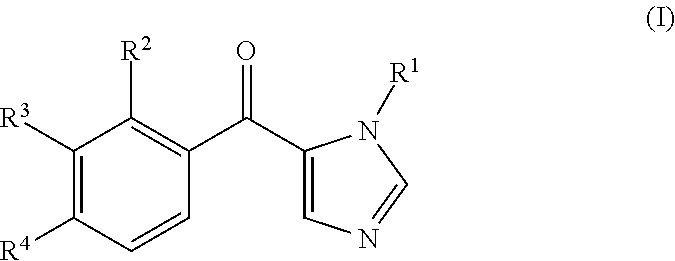
wherein R1, R2, R3 and R4 n are as described herein, compositions including the compounds and methods of using the compounds.
Description

-
- wherein
- R1 is alkyl, haloalkyl, cycloalkyl, halocycloalkyl, cycloalkylalkyl, halocycloalkylalkyl, alkoxyalkyl, haloalkoxyalkyl, hydroxyalkyl, substituted aryl or substituted heteroaryl, wherein substituted aryl and substituted heteroaryl are substituted with R5, R6 and R7;
- R2 is H, halogen, cyano, nitro, alkyl, haloalkyl, cycloalkyl, halocycloalkyl, cycloalkylalkyl, halocycloalkylalkyl, alkoxy, haloalkoxy, alkoxyalkyl, haloalkoxyalkyl, cycloalkoxy, halocycloalkoxy or hydroxyalkyl;
- R3 is H, halogen, cyano, nitro, alkyl, haloalkyl, cycloalkyl, halocycloalkyl, cycloalkylalkyl, halocycloalkylalkyl, alkoxy, haloalkoxy, alkoxyalkyl, haloalkoxyalkyl, cycloalkoxy, halocycloalkoxy or hydroxyalkyl;
- R4 is H, halogen, cyano, nitro, substituted amino, alkyl, cycloalkyl, halocycloalkyl, cycloalkylalkyl, halocycloalkylalkyl, alkynyl, alkoxy, haloalkoxy, alkylsulfanyl, cycloalkylsulfanyl, haloalkylsulfanyl, alkylsulfonyl, cycloalkylsulfonyl, haloalkylsulfonyl, alkoxyalkyl, haloalkoxyalkyl, cycloalkoxy, halocycloalkoxy or hydroxyalkyl, wherein substituted amino is substituted with R8 and R9;
- or R3 and R4 together form —CH2—CH2—C(O)—N(CH3)— or —CH═CH—S—
- R5, R6 and R7 are independently selected from H, halogen, cyano, alkyl, haloalkyl, cycloalkyl, halocycloalkyl, cycloalkylalkyl, halocycloalkylalkyl, alkoxy, haloalkoxy, alkoxyalkyl, haloalkoxyalkyl, cycloalkoxy, halocycloalkoxy and hydroxyalkyl;
- R8 is alkyl, cycloalkyl, formyl, alkylcarbonyl or alkoxycarbonyl;
- R9 is H, alkyl or cycloalkyl;
- or pharmaceutically acceptable salts;
- with the proviso that at least one of R2, R3 and R4 is different from H and that CAS 213389-81-2; CAS 222978-28-1; CAS 443920-37-4; CAS 371765-82-1; CAS 280143-24-0; CAS 192187-41-0; CAS 1227383-33-6; CAS 1227383-32-5; CAS 1227383-30-3; CAS 1227383-28-9; CAS 1118761-69-5; CAS 1050749-75-1; CAS 1283718-66-0; CAS 491867-48-2 and CAS 942836-16-0 are excluded.

-
- wherein
- R1 is alkyl, haloalkyl, cycloalkyl, halocycloalkyl, cycloalkylalkyl, halocycloalkylalkyl, alkoxyalkyl, haloalkoxyalkyl, hydroxyalkyl, substituted aryl or substituted heteroaryl, wherein substituted aryl and substituted heteroaryl are substituted with R5, R6 and R7;
- R2 is H, halogen, cyano, nitro, alkyl, haloalkyl, cycloalkyl, halocycloalkyl, cycloalkylalkyl, halocycloalkylalkyl, alkoxy, haloalkoxy, alkoxyalkyl, haloalkoxyalkyl, cycloalkoxy, halocycloalkoxy or hydroxyalkyl;
- R3 is H, halogen, cyano, nitro, alkyl, haloalkyl, cycloalkyl, halocycloalkyl, cycloalkylalkyl, halocycloalkylalkyl, alkoxy, haloalkoxy, alkoxyalkyl, haloalkoxyalkyl, cycloalkoxy, halocycloalkoxy or hydroxyalkyl;
- R4 is H, halogen, cyano, nitro, substituted amino, alkyl, cycloalkyl, halocycloalkyl, cycloalkylalkyl, halocycloalkylalkyl, alkynyl, alkoxy, haloalkoxy, alkylsulfanyl, cycloalkylsulfanyl, haloalkylsulfanyl, alkylsulfonyl, cycloalkylsulfonyl, haloalkylsulfonyl, alkoxyalkyl, haloalkoxyalkyl, cycloalkoxy, halocycloalkoxy or hydroxyalkyl, wherein substituted amino is substituted with R8 and R9;
- or R3 and R4 together form —CH2—CH2—C(O)—N(CH3)— or —CH═CH—S—
- R5, R6 and R7 are independently selected from H, halogen, cyano, alkyl, haloalkyl, cycloalkyl, halocycloalkyl, cycloalkylalkyl, halocycloalkylalkyl, alkoxy, haloalkoxy, alkoxyalkyl, haloalkoxyalkyl, cycloalkoxy, halocycloalkoxy and hydroxyalkyl;
- R8 is alkyl, cycloalkyl, formyl, alkylcarbonyl or alkoxycarbonyl;
- R9 is H, alkyl or cycloalkyl;
- or pharmaceutically acceptable salts;
- with the proviso that at least one of R2, R3 and R4 is different from H, and that the compound is not CAS 213389-81-2; CAS 222978-28-1; CAS 443920-37-4; CAS 371765-82-1; CAS 280143-24-0; CAS 192187-41-0; CAS 1227383-33-6; CAS 1227383-32-5; CAS 1227383-30-3; CAS 1227383-28-9; CAS 1118761-69-5; CAS 1050749-75-1; CAS 1283718-66-0; CAS 491867-48-2 or CAS 942836-16-0.
- (3,4-dichlorophenyl)(1-methyl-1H-imidazol-5-yl)methanone;
- (4-methoxyphenyl)(1-methyl-1H-imidazol-5-yl)methanone;
- 4-(1-ethyl-1H-imidazole-5-carbonyl)benzonitrile;
- 4-(1-isopropyl-1H-imidazole-5-carbonyl)benzonitrile;
- 3-fluoro-4-(1-methyl-1H-imidazole-5-carbonyl)benzonitrile;
- (4-chloro-3-fluorophenyl)(1-methyl-1H-imidazol-5-yl)methanone;
- 3-fluoro-4-(1-isopropyl-1H-imidazole-5-carbonyl)benzonitrile;
- (2,4-dichlorophenyl)(1-methyl-1H-imidazol-5-yl)methanone;
- (3-chlorophenyl)(1-isopropyl-1H-imidazol-5-yl)methanone;
- (3,4-dichlorophenyl)(1-isopropyl-1H-imidazol-5-yl)methanone;
- (3,4-dichlorophenyl)(1-ethyl-1H-imidazol-5-yl)methanone;
- 4-(1-sec-butyl-1H-imidazole-5-carbonyl)benzonitrile;
- (1-sec-butyl-1H-imidazol-5-yl)(4-chlorophenyl)methanone;
- 4-(1-cyclopropyl-1H-imidazole-5-carbonyl)benzonitrile;
- (4-chlorophenyl)(1-cyclopropyl-1H-imidazol-5-yl)methanone;
- 4-(1-(2,2,2-trifluoro ethyl)-1H-imidazole-5-carbonyl)benzonitrile;
- 3-(1-methyl-1H-imidazole-5-carbonyl)benzonitrile;
- (3-chlorophenyl)(1-methyl-1H-imidazol-5-yl)methanone;
- (4-fluorophenyl)(1-methyl-1H-imidazol-5-yl)methanone;
- (3-fluorophenyl)(1-methyl-1H-imidazol-5-yl)methanone;
- 1-methyl-6-(1-methyl-1H-imidazole-5-carbonyl)-3,4-dihydroquinolin-2(1H)-one;
- 6-(1-ethyl-1H-imidazole-5-carbonyl)-1-methyl-3,4-dihydroquinolin-2(1H)-one;
- 6-(1-isopropyl-1H-imidazole-5-carbonyl)-1-methyl-3,4-dihydroquinolin-2(1H)-one;
- (1-sec-butyl-1H-imidazol-5-yl)(3-chlorophenyl)methanone;
- (4-ethynylphenyl)(1-methyl-1H-imidazol-5-yl)methanone;
- (4-tert-butylphenyl)(1-methyl-1H-imidazol-5-yl)methanone;
- (3-chloro-4-fluorophenyl)(1-methyl-1H-imidazol-5-yl)methanone;
- (3-chloro-4-fluorophenyl)(1-ethyl-1H-imidazol-5-yl)methanone;
- (4-chloro-3-fluorophenyl)(1-ethyl-1H-imidazol-5-yl)methanone;
- (4-tert-butylphenyl)(1-ethyl-1H-imidazol-5-yl)methanone;
- 3-(1-sec-butyl-1H-imidazole-5-carbonyl)benzonitrile;
- (3-chloro-4-fluorophenyl)(1-isopropyl-1H-imidazol-5-yl)methanone;
- (4-chloro-3-fluorophenyl)(1-isopropyl-1H-imidazol-5-yl)methanone;
- (4-chloro-3-fluorophenyl)(1-cyclopropyl-1H-imidazol-5-yl)methanone;
- (3-chloro-4-fluorophenyl)(1-cyclopropyl-1H-imidazol-5-yl)methanone;
- 2-chloro-4-(1-methyl-1H-imidazole-5-carbonyl)benzonitrile;
- (1-methyl-1H-imidazol-5-yl)(4-(methylthio)phenyl)methanone;
- benzo[b]thiophen-5-yl(1-methyl-1H-imidazol-5-yl)methanone;
- 2-fluoro-5-(1-methyl-1H-imidazole-5-carbonyl)benzonitrile;
- 2-chloro-4-(1-ethyl-1H-imidazole-5-carbonyl)benzonitrile;
- (1-methyl-1H-imidazol-5-yl)(4-(methylsulfonyl)phenyl)methanone;
- (1-ethyl-1H-imidazol-5-yl)(4-ethynylphenyl)methanone;
- 2-chloro-4-(1-isopropyl-1H-imidazole-5-carbonyl)benzonitrile;
- (3-methoxy-4-(methylthio)phenyl)(1-methyl-1H-imidazol-5-yl)methanone;
- (4-(ethylthio)phenyl)(1-methyl-1H-imidazol-5-yl)methanone;
- (3-methoxy-4-(methylsulfonyl)phenyl)(1-methyl-1H-imidazol-5-yl)methanone;
- (4-(ethylsulfonyl)phenyl)(1-methyl-1H-imidazol-5-yl)methanone;
- (4-ethynylphenyl)(1-isopropyl-1H-imidazol-5-yl)methanone;
- N-methyl-N-(4-(1-methyl-1H-imidazole-5-carbonyl)phenyl)acetamide;
- 3-(1-ethyl-1H-imidazole-5-carbonyl)benzonitrile;
- 3-(1-isopropyl-1H-imidazole-5-carbonyl)benzonitrile;
- 3-(1-cyclopropyl-1H-imidazole-5-carbonyl)benzonitrile;
- N-(4-(1-isopropyl-1H-imidazole-5-carbonyl)phenyl)-N-methylacetamide;
- (1-ethyl-1H-imidazol-5-yl)(3-methoxy-4-(methylthio)phenyl)methanone;
- (1-isopropyl-1H-imidazol-5-yl)(3-methoxy-4-(methylthio)phenyl)methanone;
- (1-cyclopropyl-1H-imidazol-5-yl)(3-methoxy-4-(methylthio)phenyl)methanone;
- 5-(1-ethyl-1H-imidazole-5-carbonyl)-2-fluorobenzonitrile;
- 2-fluoro-5-(1-isopropyl-1H-imidazole-5-carbonyl)benzonitrile;
- 5-(1-sec-butyl-1H-imidazole-5-carbonyl)-2-fluorobenzonitrile;
- 5-(1-cyclopropyl-1H-imidazole-5-carbonyl)-2-fluorobenzonitrile;
- N-(4-(1-ethyl-1H-imidazole-5-carbonyl)phenyl)-N-methylacetamide;
- (4-bromophenyl)(1-methyl-1H-imidazol-5-yl)methanone;
- (1-ethyl-1H-imidazol-5-yl)(4-(ethylthio)phenyl)methanone;
- (1-cyclopropyl-1H-imidazol-5-yl)(4-(ethylthio)phenyl)methanone;
- (4-Ethylsulfanyl-phenyl)-(3-isopropyl-3#H!-imidazol-4-yl)-methanone;
- (4-bromophenyl)(1-isopropyl-1H-imidazol-5-yl)methanone;
- (1-methyl-1H-imidazol-5-yl)(4-(trifluoromethylthio)phenyl)methanone;
- (1-ethyl-1H-imidazol-5-yl)(4-(trifluoromethylthio)phenyl)methanone;
- (1-isopropyl-1H-imidazol-5-yl)(4-(trifluoromethylthio)phenyl)methanone;
- (1-(pentan-3-yl)-1H-imidazol-5-yl)(4-(trifluoromethylthio)phenyl)methanone;
- 2-chloro-4-(5-(4-chlorobenzoyl)-1H-imidazol-1-yl)benzonitrile;
- 2-chloro-4-(5-(3,4-dichlorobenzoyl)-1H-imidazol-1-yl)benzonitrile;
- (3-methoxy-4-(trifluoromethylthio)phenyl)(1-methyl-1H-imidazol-5-yl)methanone;
- (1-ethyl-1H-imidazol-5-yl)(3-methoxy-4-(trifluoromethylthio)phenyl)methanone;
- 4-(1-(pentan-3-yl)-1H-imidazole-5-carbonyl)benzonitrile;
- 3-(1-(pentan-3-yl)-1H-imidazole-5-carbonyl)benzonitrile;
- tert-butyl 4-(1-methyl-1H-imidazole-5-carbonyl)phenylcarbamate;
- tert-butyl methyl(4-(1-methyl-1H-imidazole-5-carbonyl)phenyl)carbamate;
- (1-methyl-1H-imidazol-5-yl)(4-(methylamino)phenyl)methanone;
- N-methyl-N-(4-(1-methyl-1H-imidazole-5-carbonyl)phenyl)formamide;
- tert-butyl 4-(1-ethyl-1H-imidazole-5-carbonyl)phenyl(methyl)carbamate;
- N-(4-(1-ethyl-1H-imidazole-5-carbonyl)phenyl)-N-methylformamide;
- (4-chlorophenyl)(1-(4-chlorophenyl)-1H-imidazol-5-yl)methanone;
- (1-(4-chlorophenyl)-1H-imidazol-5-yl)(3,4-dichlorophenyl)methanone;
- (4-chloro-3-fluorophenyl)(1-(4-chlorophenyl)-1H-imidazol-5-yl)methanone;
- N-(4-(1-isopropyl-1H-imidazole-5-carbonyl)phenyl)-N-methylformamide;
- 4-(5-(4-chloro-3-fluorobenzoyl)-1H-imidazol-1-yl)benzonitrile;
- 4-(5-(4-chlorobenzoyl)-1H-imidazol-1-yl)benzonitrile;
- 4-(5-(3,4-dichlorobenzoyl)-1H-imidazol-1-yl)benzonitrile;
- [3-(4-Chloro-phenyl)-3H-imidazol-4-yl]-(3,4-difluoro-phenyl)-methanone;
- (3,4-dichlorophenyl)(1-methyl-1H-imidazol-5-yl)methanone;
- 4-(1-ethyl-1H-imidazole-5-carbonyl)benzonitrile;
- 1-methyl-6-(1-methyl-1H-imidazole-5-carbonyl)-3,4-dihydroquinolin-2 (1H)-one;
- 6-(1-ethyl-1H-imidazole-5-carbonyl)-1-methyl-3,4-dihydroquinolin-2 (1H)-one;
- (1-methyl-1H-imidazol-5-yl)(4-(methylthio)phenyl)methanone;
- 2-chloro-4-(1-isopropyl-1H-imidazole-5-carbonyl)benzonitrile;
- (3-methoxy-4-(trifluoromethylthio)phenyl)(1-methyl-1H-imidazol-5-yl)methanone;
- 4-(1-(pentan-3-yl)-1H-imidazole-5-carbonyl)benzonitrile;
- N-(4-(1-ethyl-1H-imidazole-5-carbonyl)phenyl)-N-methylformamide;
- 4-(5-(4-chlorobenzoyl)-1H-imidazol-1-yl)benzonitrile;


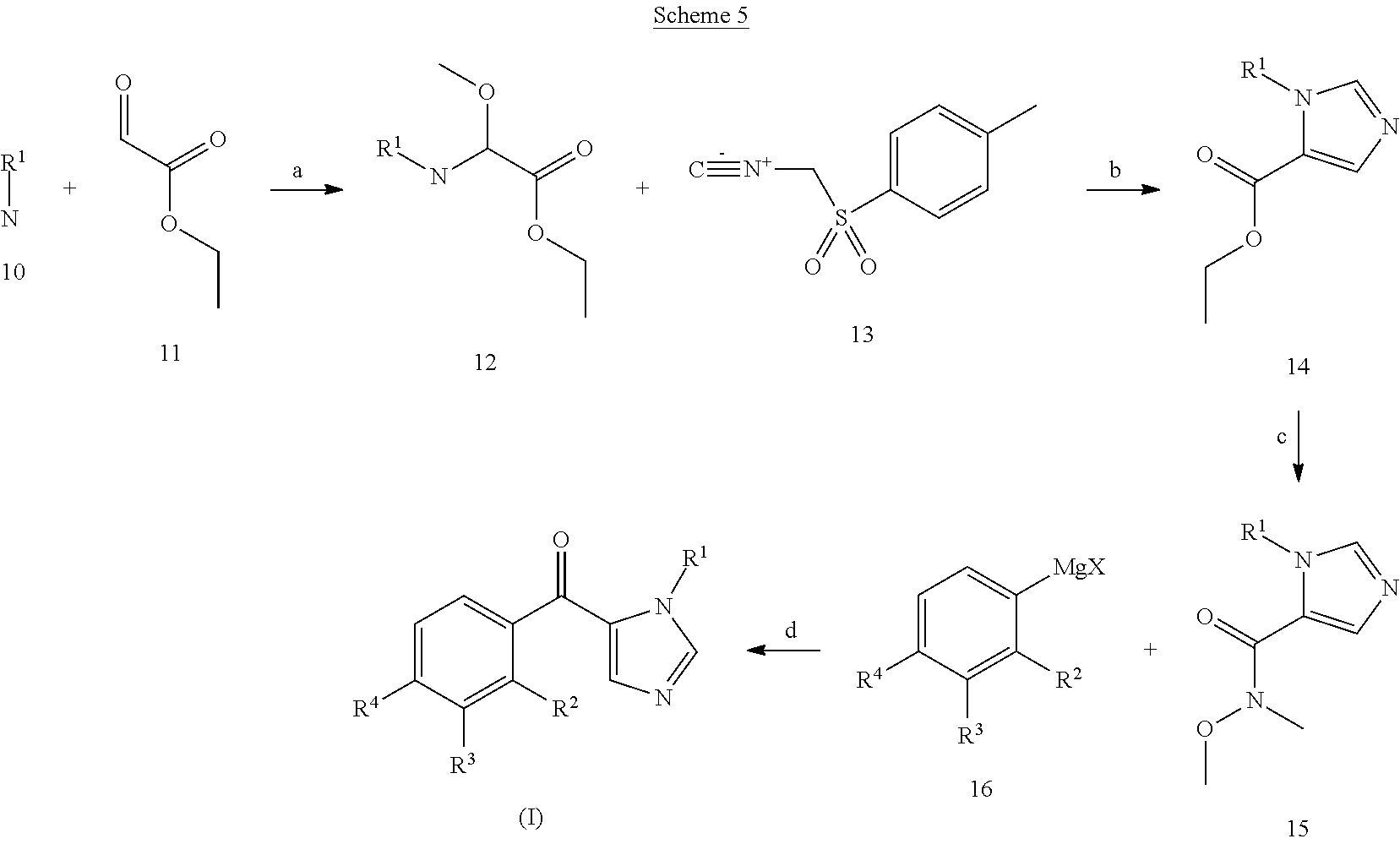

wherein R1, R2, R3 and R4 are as defined above and wherein Met is MgX or Li and X is halogen;
wherein A is the maximum y value, B is the EC50 factor determined using XLFit, C is the minimum y value and D is the slope value.
| EC50 human | EC50 human | |
| CYP11B1 | CYP11B2 | |
| Example | μM | μM |
| 1 | 0.1954 | 0.0623 |
| 2 | 0.3684 | 0.0116 |
| 3 | 0.1674 | 0.0049 |
| 4 | 3.5002 | 0.1178 |
| 5 | 0.0468 | 0.0026 |
| 6 | 0.0045 | 0.0008 |
| 7 | 0.0659 | 0.0044 |
| 8 | 2.4972 | 0.0986 |
| 9 | 0.187 | 0.0077 |
| 10 | 0.0703 | 0.0108 |
| 11 | 1.8009 | 0.2157 |
| 12 | 0.0053 | 0.0013 |
| 13 | 0.0056 | 0.0021 |
| 14 | 0.0018 | 0.0005 |
| 15 | 0.02 | 0.0018 |
| 16 | 0.001 | 0.0007 |
| 17 | 0.0035 | 0.0003 |
| 18 | 0.0287 | 0.0023 |
| 19 | 0.0529 | 0.0061 |
| 20 | 0.1904 | 0.0235 |
| 21 | 8.7124 | 0.5827 |
| 22 | 0.543 | 0.0326 |
| 23 | 0.1509 | 0.0493 |
| 24 | 0.6726 | 0.0652 |
| 25 | 7.8811 | 0.077 |
| 26 | 1.1171 | 0.0197 |
| 27 | 0.1527 | 0.0069 |
| 28 | 0.0227 | 0.0141 |
| 29 | 0.259 | 0.0203 |
| 30 | 9.8786 | |
| 31 | 7.8354 | 0.1967 |
| 32 | 0.3036 | 0.0117 |
| 33 | 0.0317 | 0.0037 |
| 34 | 0.033 | 0.0027 |
| 35 | 1.6856 | 3.6691 |
| 36 | 1.7517 | 0.0587 |
| 37 | 0.0782 | 0.0063 |
| 38 | 0.0039 | 0.0039 |
| 39 | 0.0033 | 0.0007 |
| 40 | 0.0148 | 0.0023 |
| 41 | 0.021 | 0.0035 |
| 42 | 0.0893 | 0.0074 |
| 43 | 1.5325 | 0.0284 |
| 44 | 1.0746 | 0.0409 |
| 45 | 11.2508 | 0.5754 |
| 46 | 0.0254 | 0.0023 |
| 47 | 3.5332 | |
| 48 | 0.033 | 0.0043 |
| 49 | 0.001 | 0.0002 |
| 50 | 0.6867 | 0.0148 |
| 51 | 3.2482 | 0.102 |
| 54 | 0.0068 | 0.0005 |
| 55 | 0.923 | |
| 56 | 1.208 | 0.1087 |
| 57 | 0.2026 | 0.026 |
| 58 | 0.8897 | 0.0872 |
| 59 | 5.044 | 0.0513 |
| 60 | 0.0843 | 0.004 |
| 61 | 0.0087 | 0.0002 |
| 62 | 0.0461 | 0.0028 |
| 63 | 3.438 | 0.335 |
| 64 | 0.4484 | 0.323 |
| 65 | 0.0882 | 0.0215 |
| 66 | 2.2131 | 0.4472 |
| 67 | 9.9138 | 0.2914 |
| 68 | 0.4876 | 0.0186 |
| 69 | 0.3292 | 0.0844 |
| 70 | 0.3639 | 0.0228 |
| 71 | 0.2526 | 0.0053 |
| 72 | 0.0101 | 0.0052 |
| 73 | 0.3902 | |
| 74 | 1.3248 | 0.2354 |
| 75 | 0.7595 | 0.0899 |
| 76 | 0.2642 | 0.0427 |
| 77 | 0.0098 | 0.0019 |
| 78 | 0.1449 | 0.0037 |
| 79 | 1.5764 | 0.0148 |
| 80 | 0.6338 | 0.0129 |
| 81 | 0.199 | 0.0159 |
| 82 | 0.0033 | 0.0002 |
| 83 | 0.057 | 0.0057 |
| 85 | 12.549 | |
| 86 | 3.7466 | 1.6247 |
| 87 | 30.3613 | 0.1863 |
| 88 | 1.2855 | 2.2019 |
| 89 | 0.7436 | 0.0294 |
| 90 | 3.6212 | 0.0026 |
| 91 | 0.4392 | 0.0042 |
| 92 | 0.1321 | 0.0032 |
| 93 | 0.3488 | 0.0117 |
| 94 | 0.0846 | 0.0144 |
| 95 | 0.0718 | 0.0022 |
| 96 | 0.199 | 0.0056 |
| 97 | 0.0746 | 0.0034 |


was synthesized in analogy to example 1, but using in step 1 4-formyl-benzonitrile instead of 4-chlorobenzaldehyde, as white foam. MS (ESI): 214.1 [M+H]+.


was prepared in analogy to example 2, but starting the sequence with 1-ethyl-5-iodo-1H-imidazole (intermediate 1a) as white solid. MS (ESI): 226.1 [M+H]+.

was prepared in analogy to example 2, but starting the sequence with 5-iodo-1-isopropyl-1H-imidazole (intermediate 1b) as white semisolid. MS (ESI): 242.3 [M+H]+.

was prepared in analogy to example 1, but starting the sequence with 1-ethyl-5-iodo-1H-imidazole (intermediate 1a) as light yellow oil. MS (ESI): 235.0/237.0 [M+H]+.

was synthesized in analogy to example 1, but using in step 1 3-fluoro-4-formylbenzonitrile instead of 4-chlorobenzaldehyde, as white solid. MS (ESI): 230.1 [M+H]+.

was synthesized in analogy to example 3, but using in step 2 (4-chloro-3-fluorophenyl)magnesium bromide (THF) instead of (3,4-dichlorophenyl)magnesium bromide, as white powder. MS (ESI): 238.9 [M+H]+.

was synthesized in analogy to example 6, but using in step 1 3-fluoro-4-formyl-benzonitrile instead of 4-chlorobenzaldehyde, as white semisolid. MS (ESI): 258.0 [M+H]+.

was prepared in analogy to example 1, but using in step 1 2,4-dichloro-benzaldehyde instead of 4-chlorobenzaldehyde, as light-yellow solid. MS (ESI): 255.0, 257.0, 259.0 [M+H]+.

was synthesized in analogy to example 6, but using in step 1 3-chloro-benzaldehyde instead of 4-formyl-benzonitrile, as colorless oil. MS (ESI): 249.1, 251.0 [M+H]+.

was synthesized in analogy to example 6, but using in step 1 4-chloro-benzaldehyde instead of 4-formyl-benzonitrile, as colorless oil. MS (ESI): 249.1, 250.8 [M+H]+.

was synthesized in analogy to example 6, but using in step 1 3,4-dichloro-benzaldehyde instead of 4-formyl-benzonitrile, as colorless oil. MS (ESI): 283.0, 285.0, 287.0 [M+H]+.

was synthesized in analogy to example 14, but using in step 1 1-ethyl-5-iodo-1H-imidazole (intermediate 1a) instead of 5-iodo-1-isopropyl-1H-imidazole (intermediate 1b), as white solid. MS (ESI): 269.1, 271.1, 273.1 [M+H]+.

was prepared in analogy to example 2, but starting the sequence with 1-sec-butyl-5-iodo-1H-imidazole (intermediate 1d) as white solid. MS (ESI): 254.1 [M+H]+.

was synthesized in analogy to example 16, but using in step 1 4-chloro-benzaldehyde instead of 4-formyl-benzonitrile, as yellow oil. MS (ESI): 263.1, 265.0 [M+H]+.


was synthesized in analogy to example 18, but using in step 1 4-chloro-benzaldehyde instead of 4-formyl-benzonitrile, as colorless oil. MS (ESI): 247.1, 249.0 [M+H]+.

was prepared in analogy to example 2, but starting the sequence with 5-iodo-1-(2,2,2-trifluoroethyl)-1H-imidazole (intermediate 1e) as colorless oil. MS (ESI): 280.0 [M+H]+.

was synthesized in analogy to example 1, but using in step 1 3-formyl-benzonitrile instead of 4-chlorobenzaldehyde, as white semisolid. MS (ESI): 212.0 [M+H]+.

was synthesized in analogy to example 1, but using in step 1 3-chlorobenzaldehyde instead of 4-chlorobenzaldehyde, as white semisolid. MS (ESI): 221.1, 223.1 [M+H]+.

was synthesized in analogy to example 1, but using in step 1 4-fluorobenzaldehyde instead of 4-chlorobenzaldehyde, as white semisolid. MS (ESI): 205.1 [M+H]+.

was synthesized in analogy to example 1, but using in step 1 3-fluorobenzaldehyde instead of 4-chlorobenzaldehyde, as white semisolid. MS (ESI): 205.1 [M+H]+.

was synthesized in analogy to example 1, but using in step 1 1-methyl-2-oxo-1,2,3,4-tetrahydro-quinoline-6-carbaldehyde (intermediate 2a) instead of 4-chlorobenzaldehyde, as white solid. MS (ESI): 270.2 [M+H]+.

was prepared in analogy to example 25, but starting the sequence with 1-ethyl-5-iodo-1H-imidazole (intermediate 1a) instead of 5-iodo-1-methyl-1H-imidazole, as white solid. MS (ESI): 284.1 [M+H]+.

was prepared in analogy to example 25, but starting the sequence with 5-iodo-1-isopropyl-1H-imidazole (intermediate 1b) instead of 5-iodo-1-methyl-1H-imidazole, as colorless oil. MS (ESI): 298.3 [M+H]+.

was prepared in analogy to example 22, but starting the sequence with 1-sec-butyl-5-iodo-1H-imidazole (intermediate 1d) instead of 5-iodo-1-methyl-1H-imidazole, as colorless oil. MS (ESI): 263.1, 265.1 [M+H]+.

was synthesized in analogy to example 1, but using in step 1 4-ethynyl-benzaldehyde instead of 4-chlorobenzaldehyde, as off-white powder. MS (ESI): 211.0 [M+H]+.

was synthesized in analogy to example 1, but using in step 1 4-tert-butyl-benzaldehyde instead of 4-chlorobenzaldehyde, as off-white powder. MS (ESI): 243.2 [M+H]+.

was synthesized in analogy to example 1, but using in step 1 4-trifluoromethyl-benzaldehyde instead of 4-chlorobenzaldehyde, as light yellow powder. MS (ESI): 255.0 [M+H]+.

was synthesized in analogy to example 1, but using in step 1 3-chloro-4-fluoro-benzaldehyde instead of 4-chlorobenzaldehyde, as white solid. MS (ESI): 239.0, 241.2 [M+H]+.

was prepared in analogy to example 32, but starting the sequence with 1-ethyl-5-iodo-1H-imidazole (intermediate 1a) instead of 5-iodo-1-methyl-1H-imidazole, as white solid. MS (ESI): 253.1, 255.2 [M+H]+.

was synthesized in analogy to example 33, but using in step 1 4-chloro-3-fluoro-benzaldehyde instead of 3-chloro-4-fluoro-benzaldehyde, as white solid. MS (ESI): 253.1, 255.2 [M+H]+.

was synthesized in analogy to example 30, but starting the sequence with 1-ethyl-5-iodo-1H-imidazole (intermediate 1a) instead of 5-iodo-1-methyl-1H-imidazole, as colorless oil. MS (ESI): 257.2 [M+H]+.

was synthesized in analogy to example 35, but using in step 1 4-trifluoromethyl-benzaldehyde instead of 4-tert-butyl-benzaldehyde, as off-white semisolid. MS (ESI): 269.1 [M+H]+.

was synthesized in analogy to example 28, but using in step 3-formyl-benzonitrile instead of 3-chlorobenzaldehyde, as colorless oil. MS (ESI): 254.1 [M+H]+.

was prepared in analogy to example 32, but starting the sequence with 5-iodo-1-isopropyl-1H-imidazole (intermediate 1b) instead of 5-iodo-1-methyl-1H-imidazole, as colorless oil. MS (ESI): 267.0, 269.1 [M+H]+.

was prepared in analogy to example 38, but using in step 1 4-chloro-3-fluoro-benzaldehyde instead of 3-chloro-4-fluoro-benzaldehyde, as colorless oil. MS (ESI): 267.0, 269.1 [M+H]+.

was prepared in analogy to example 18, but using in step 1 4-chloro-3-fluoro-benzaldehyde instead of 4-formylbenzonitrile, as light yellow oil. MS (ESI): 265.0, 266.8 [M+H]+.

was prepared in analogy to example 40, but using in step 1 3-chloro-4-fluoro-benzaldehyde instead of 4-chloro-3-fluoro-benzaldehyde, as light yellow oil. MS (ESI): 265.0, 266.9 [M+H]+.

was prepared in analogy to example 1, but using in step 1 2-chloro-4-formylbenzonitrile (intermediate 2b) instead of 4-chlorobenzaldehyde, as white solid. MS (ESI): 246.1, 248.1 [M+H]+.

was prepared in analogy to example 1, but using in step 1 4-methylsulfanyl-benzaldehyde instead of 4-chlorobenzaldehyde, as white semisolid. MS (ESI): 233.0 [M+H]+.

was prepared in analogy to example 1, but using in step 1 benzo[b]thiophene-5-carbaldehyde instead of 4-chlorobenzaldehyde, as white solid. MS (ESI): 243.1 [M+H]+.

was prepared in analogy to example 1, but using in step 1 2-fluoro-5-formyl-benzonitrile instead of 4-chlorobenzaldehyde, as white solid. MS (ESI): 230.2 [M+H]+.

was synthesized in analogy to example 42, but starting the sequence with 1-ethyl-5-iodo-1H-imidazole (intermediate 1a) instead of 5-iodo-1-methyl-1H-imidazole, as white solid. MS (ESI): 260.0, 262.0 [M+H]+.


was synthesized in analogy to example 29, but starting the sequence with 1-ethyl-5-iodo-1H-imidazole (intermediate 1a) instead of 5-iodo-1-methyl-1H-imidazole, as light yellow oil. MS (ESI): 225.1 [M+H]+.

was synthesized in analogy to example 42, but starting the sequence with 5-iodo-1-isopropyl-1H-imidazole (intermediate 1b) instead of 5-iodo-1-methyl-1H-imidazole, as white foam. MS (ESI): 274.1, 276.1 [M+H]+.

was prepared in analogy to example 1, but using in step 1 3-methoxy-4-methylsulfanyl-benzaldehyde instead of 4-chlorobenzaldehyde, as white solid. MS (ESI): 263.1 [M+H]+.

was prepared in analogy to example 1, but using in step 1 4-ethylsulfanyl-benzaldehyde instead of 4-chlorobenzaldehyde, as white solid. MS (ESI): 247.2 [M+H]+.
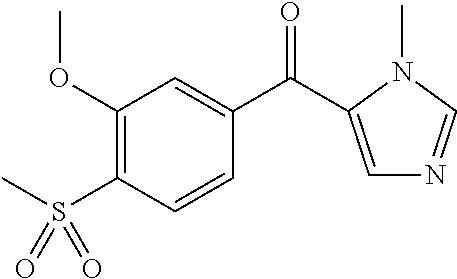
was synthesized an analogy to example 47, but using (3-methoxy-4-methylsulfanyl-phenyl)-(3-methyl-3H-imidazol-4-yl)-methanone (example 50) as starting material, as white foam. MS (ESI): 295.1 [M+H]+.

was synthesized an analogy to example 47, but using (4-ethylsulfanyl-phenyl)-(3-methyl-3H-imidazol-4-yl)-methanone (example 51) as starting material, as white semisolid. MS (ESI): 279.0 [M+H]+.


was prepared in analogy to example 1, but using in step 1 N-(4-formyl-phenyl)-N-methyl-acetamide instead of 4-chlorobenzaldehyde, as white solid. MS (ESI): 258.2 [M+H]+.


was prepared in analogy to example 54, but using in step 1 3-formyl-benzonitrile instead of 4-ethynylbenzaldehyde, as colorless oil. MS (ESI): 240.1 [M+H]+.

was prepared in analogy to example 18, but using in step 1 3-formyl-benzonitrile instead of 4-formylbenzonitrile, as white semisolid. MS (ESI): 238.1 [M+H]+.

was synthesized in analogy to example 6, but using in step 1 N-(4-formyl-phenyl)-N-methyl-acetamide instead of 4-formyl-benzonitrile, as light yellow solid. MS (ESI): 286.0 [M+H]+.

was synthesized in analogy to example 56, but using in step 1 3-methoxy-4-methylsulfanyl-benzaldehyde instead of 3-formylbenzonitrile, as white foam. MS (ESI): 277.1 [M+H]+.

was synthesized in analogy to example 54, but using in step 1 3-methoxy-4-methylsulfanyl-benzaldehyde instead of 4-ethynylbenzaldehyde, as colorless oil. MS (ESI): 291.1 [M+H]+.

was synthesized in analogy to example 18, but using in step 1 3-methoxy-4-methylsulfanyl-benzaldehyde instead of 4-formylbenzonitrile, as white foam. MS (ESI): 289.0 [M+H]+.

was synthesized in analogy to example 56, but using in step 1 2-fluoro-5-formyl-benzonitrile instead of 3-formylbenzonitrile, as white solid. MS (ESI): 244.2 [M+H]+.

was synthesized in analogy to example 54, but using in step 1 2-fluoro-5-formyl-benzonitrile instead of 4-ethynylbenzaldehyde, as colorless oil. MS (ESI): 258.1 [M+H]+.

was synthesized in analogy to example 64, but starting the sequence with 5-bromo-1-sec-butyl-1H-imidazole (intermediate 1d′) instead of 5-bromo-1-isopropyl-1H-imidazole, as colorless oil. MS (ESI): 272.1 [M+H]+.

was prepared in analogy to example 64, but starting the sequence with 5-bromo-1-cyclopropyl-1H-imidazole (intermediate 1c′) instead of 5-bromo-1-isopropyl-1H-imidazole, as off-white solid. MS (ESI): 256.1 [M+H]+.

was synthesized in analogy to example 55, but starting the sequence 5-bromo-1-ethyl-1H-imidazole (intermediate 1a′) instead of 5-iodo-1-methyl-1H-imidazole, as white solid. MS (ESI): 272.3 [M+H]+.

was prepared in analogy to example 1, but using in step 1 4-bromobenzaldehyde instead of 4-chlorobenzaldehyde, as white solid. MS (ESI): 265.0, 266.9 [M+H]+.

was prepared in analogy to example 56, but using in step 1 4-ethylsulfanyl-benzaldehyde instead of 3-formylbenzonitrile, as white semisolid. MS (ESI): 261.2 [M+H]+.

was prepared in analogy to example 18, but using in step 1 4-ethylsulfanyl-benzaldehyde instead of 4-formylbenzonitrile, as white semisolid. MS (ESI): 273.3 [M+H]+.

was prepared in analogy to example 54, but using in step 1 4-ethylsulfanyl-benzaldehyde instead of 4-ethynylbenzaldehyde, as white semisolid. MS (ESI): 275.1 [M+H]+.

was prepared in analogy to example 54, but using in step 1 4-bromobenzaldehyde instead of 4-ethynylbenzaldehyde, as colorless oil. MS (ESI): 292.9, 295.0 [M+H]+.

was prepared in analogy to example 1, but using in step 1 4-trifluoromethylsulfanyl-benzaldehyde instead of 4-chlorobenzaldehyde, as white semisolid. MS (ESI): 287.0 [M+H]+.

was synthesized in analogy to example 56, but using in step 1 4-trifluoromethylsulfanyl-benzaldehyde instead of 3-formylbenzonitrile, as colorless oil. MS (ESI): 301.1 [M+H]+.

was prepared in analogy to example 54, but using in step 1 4-trifluoromethylsulfanyl-benzaldehyde instead of 4-ethynylbenzaldehyde, as colorless oil. MS (ESI): 315.0 [M+H]+.

was prepared in analogy to example 75, but starting the sequence with 5-bromo-1-(1-ethyl-propyl)-1H-imidazole (intermediate 1f′) instead of 5-bromo-1-isopropyl-1H-imidazole, as colorless oil. MS (ESI): 343.1 [M+H]+.


was prepared in analogy to example 77, but using in step 3 (3,4-dichlorophenyl)magnesium bromide instead of (4-chlorophenyl)magnesium bromide, as white solid. MS (ESI): 375.9, 378.1, 379.9 [M+H]+.

was prepared in analogy to example 73, but using in step 1 3-methoxy-4-trifluoromethylsulfanyl-benzaldehyde instead of 4-trifluoromethylsulfanyl-benzaldehyde, as colorless oil. MS (ESI): 317.1 [M+H]+.

was prepared in analogy to example 79, but using in step 1 5-bromo-1-ethyl-1H-imidazole (intermediate 1a′) instead of 5-iodo-1-methyl-1H-imidazole, as colorless oil. MS (ESI): 331.1 [M+H]+.

was prepared in analogy to example 79, but using in step 1 5-Bromo-1-isopropyl-1H-imidazole (intermediate 1b′) instead of 5-iodo-1-methyl-1H-imidazole, as colorless oil. MS (ESI): 345.1 [M+H]+.

was prepared in analogy to example 2, but starting the sequence with 5-bromo-1-(1-ethyl-propyl)-1H-imidazole (intermediate 1f′) instead of 5-iodo-1-methyl-1H-imidazole, as white semisolid. MS (ESI): 268.2 [M+H]+.

was prepared in analogy to example 82, but using in step 1 3-formyl-benzonitrile instead of 4-formyl-benzonitrile, as colorless oil. MS (ESI): 268.2 [M+H]+.

was synthesized in analogy to example 1, but using in step 1 (4-formyl-phenyl)-carbamic acid tert-butyl ester instead of 4-chlorobenzaldehyde, as yellow oil. MS (ESI): 302.2 [M+H]+.

was synthesized in analogy to example 84, but using in step 1 (4-formyl-phenyl)-methyl-carbamic acid tert-butyl ester instead of (4-formyl-phenyl)-carbamic acid tert-butyl ester, as yellow oil. The former aldehyde was prepared from the latter by alkylation with MeI in acetonitrile in the presence of Cs2CO3 at ambient temperature. MS (ESI): 316.1 [M+H]+.


was synthesized in analogy to example 85, but using as starting component 5-bromo-1-ethyl-1H-imidazole (intermediate 1a′) instead of 5-iodo-1-methyl-1H-imidazole, as yellow oil. MS (ESI): 330.2 [M+H]+.

was synthesized in analogy to example 87, but using as starting component 5-bromo-1-ethyl-1H-imidazole (intermediate 1a′) instead of 5-iodo-1-methyl-1H-imidazole, as white solid. MS (ESI): 258.2 [M+H]+.

was prepared in analogy to example 77, but starting the reaction sequence with 4-chloro-phenylamine instead of 4-amino-2-chlorobenzonitrile, as white semisolid. MS (ESI): 317.0, 319.0 [M+H]+.

was prepared in analogy to example 90, but using in step 3 (3,4-dichlorophenyl)magnesium bromide instead of (4-chlorophenyl)magnesium bromide, as white solid. MS (ESI): 351.0, 353.1, 355.0 [M+H]+.

was prepared in analogy to example 90, but using in step 3 (4-chloro-3-fluorophenyl)magnesium bromide instead of (4-chlorophenyl)magnesium bromide, as white semisolid. MS (ESI): 335.0, 337.0 [M+H]+.

was synthesized in analogy to example 87, but using as starting component 5-bromo-1-isopropyl-1H-imidazole (intermediate 1b′) instead of 5-iodo-1-methyl-1H-imidazole, as yellow oil. MS (ESI): 272.3 [M+H]+.

was prepared in analogy to example 92, but starting the reaction sequence with 4-amino-benzonitrile instead of 4-chloro-phenylamine, as white solid. MS (ESI): 326.2, 328.0 [M+H]+.

was prepared in analogy to example 94, but using in step 3 (4-chlorophenyl)magnesium bromide instead of (4-chloro-3-fluorophenyl)magnesium bromide, as white solid. MS (ESI): 308.1, 310.2 [M+H]+.

was prepared in analogy to example 94, but using in step 3 (3,4-dichlorophenyl)-magnesium bromide instead of (4-chloro-3-fluorophenyl)magnesium bromide, as white solid. MS (ESI): 342.0, 344.0 [M+H]+.

was prepared in analogy to example 92, but using in step 3 (3,4-difluorophenyl)magnesium bromide instead of (4-chloro-3-fluorophenyl)magnesium bromide, as white semisolid. MS (ESI): 319.0, 321.1 [M+H]+.
| Per tablet | ||
| Active ingredient | 200 mg | ||
| Microcrystalline cellulose | 155 mg | ||
| Corn starch | 25 mg | ||
| Talc | 25 mg | ||
| Hydroxypropylmethylcellulose | 20 mg | ||
| 425 mg | |||
| Per capsule | ||
| Active ingredient | 100.0 mg | ||
| Corn starch | 20.0 mg | ||
| Lactose | 95.0 mg | ||
| Talc | 4.5 mg | ||
| Magnesium stearate | 0.5 mg | ||
| 220.0 mg | |||
Claims (17)

Applications Claiming Priority (1)
| Application Number | Priority Date | Filing Date | Title |
|---|---|---|---|
| CNPCT/CN2012/071064 | 2012-02-13 |
Related Parent Applications (1)
| Application Number | Title | Priority Date | Filing Date |
|---|---|---|---|
| CNPCT/CN2012/071064 Continuation | 2012-02-13 | 2012-02-13 |
Publications (2)
| Publication Number | Publication Date |
|---|---|
| US20140128429A1 US20140128429A1 (en) | 2014-05-08 |
| US9464058B2 true US9464058B2 (en) | 2016-10-11 |
Family
ID=47678840
Family Applications (1)
| Application Number | Title | Priority Date | Filing Date |
|---|---|---|---|
| US13/766,010 Active US9464058B2 (en) | 2012-02-13 | 2013-02-13 | Imidazolylketone derivatives |
Country Status (10)
| Country | Link |
|---|---|
| US (1) | US9464058B2 (en) |
| EP (1) | EP2814814B1 (en) |
| JP (1) | JP6199902B2 (en) |
| KR (1) | KR20140129012A (en) |
| CN (1) | CN104093709B (en) |
| BR (1) | BR112014019476A8 (en) |
| CA (1) | CA2860099A1 (en) |
| MX (1) | MX2014008856A (en) |
| RU (1) | RU2014136226A (en) |
| WO (1) | WO2013120771A1 (en) |
Families Citing this family (2)
| Publication number | Priority date | Publication date | Assignee | Title |
|---|---|---|---|---|
| WO2016066597A1 (en) * | 2014-10-31 | 2016-05-06 | F. Hoffmann-La Roche Ag | New dihydroquinoline pyrazolyl compounds |
| WO2025162115A1 (en) * | 2024-02-04 | 2025-08-07 | 成都麻沸散医药科技有限公司 | Heterocyclic compound and pharmaceutical use thereof |
Citations (3)
| Publication number | Priority date | Publication date | Assignee | Title |
|---|---|---|---|---|
| JPS63239273A (en) * | 1986-11-28 | 1988-10-05 | Mitsui Petrochem Ind Ltd | Phenylimidazole derivative |
| US20030087940A1 (en) * | 2000-11-30 | 2003-05-08 | Claiborne Akiyo K. | Farnesyltransferase inhibitors |
| US7253183B2 (en) * | 1997-06-02 | 2007-08-07 | Janssen Pharmaceutica N.V. | Method of use of (imidazol-5-yl)methyl-2-quinolinone derivatives to inhibit smooth muscle cell proliferation |
Family Cites Families (7)
| Publication number | Priority date | Publication date | Assignee | Title |
|---|---|---|---|---|
| AU518569B2 (en) * | 1979-08-07 | 1981-10-08 | Farmos-Yhtyma Oy | 4-benzyl- and 4-benzoyl imidazole derivatives |
| CZ302374B6 (en) * | 1998-12-23 | 2011-04-20 | Janssen Pharmaceutica N.V. | 1,2-Anellated quinoline derivative, process and intermediate product for preparation thereof and pharmaceutical composition containing thereof |
| EP1937649A1 (en) * | 2005-10-14 | 2008-07-02 | Neurosearch A/S | Imidazole derivatives for the treatment of anxiety and related diseases |
| EA200802007A1 (en) * | 2006-03-20 | 2009-02-27 | Глэксо Груп Лимитед | COMPOUNDS POTENTIATING AMPA RECEPTOR AND APPLICATION OF THE SPECIFIED COMPOUNDS IN MEDICINE |
| TW200808812A (en) * | 2006-04-12 | 2008-02-16 | Speedel Experimenta Ag | Imidazo compounds |
| EP2095819A1 (en) * | 2008-02-28 | 2009-09-02 | Maastricht University | N-benzyl imidazole derivatives and their use as aldosterone synthase inhibitors |
| TWI606045B (en) * | 2012-10-16 | 2017-11-21 | 健生藥品公司 | RORγt methylene-linked quinolyl group regulator |
-
2013
- 2013-02-08 MX MX2014008856A patent/MX2014008856A/en unknown
- 2013-02-08 WO PCT/EP2013/052494 patent/WO2013120771A1/en not_active Ceased
- 2013-02-08 CN CN201380007988.8A patent/CN104093709B/en active Active
- 2013-02-08 RU RU2014136226A patent/RU2014136226A/en not_active Application Discontinuation
- 2013-02-08 BR BR112014019476A patent/BR112014019476A8/en active Search and Examination
- 2013-02-08 CA CA2860099A patent/CA2860099A1/en not_active Abandoned
- 2013-02-08 KR KR20147022516A patent/KR20140129012A/en not_active Withdrawn
- 2013-02-08 JP JP2014556058A patent/JP6199902B2/en active Active
- 2013-02-08 EP EP13703073.0A patent/EP2814814B1/en active Active
- 2013-02-13 US US13/766,010 patent/US9464058B2/en active Active
Patent Citations (4)
| Publication number | Priority date | Publication date | Assignee | Title |
|---|---|---|---|---|
| JPS63239273A (en) * | 1986-11-28 | 1988-10-05 | Mitsui Petrochem Ind Ltd | Phenylimidazole derivative |
| JPH0733374B2 (en) * | 1986-11-28 | 1995-04-12 | 三井石油化学工業株式会社 | Phenyl imidazole derivative |
| US7253183B2 (en) * | 1997-06-02 | 2007-08-07 | Janssen Pharmaceutica N.V. | Method of use of (imidazol-5-yl)methyl-2-quinolinone derivatives to inhibit smooth muscle cell proliferation |
| US20030087940A1 (en) * | 2000-11-30 | 2003-05-08 | Claiborne Akiyo K. | Farnesyltransferase inhibitors |
Non-Patent Citations (1)
| Title |
|---|
| Kihara et al. "Phenylimidazoles for treatment of cerebral disorders, amnesia, and senile dementia." JP 07-033374 B Apr. 12, 1995 (equivalent of 63239273A), English machine translation. * |
Also Published As
| Publication number | Publication date |
|---|---|
| EP2814814B1 (en) | 2019-05-08 |
| KR20140129012A (en) | 2014-11-06 |
| BR112014019476A2 (en) | 2017-06-20 |
| BR112014019476A8 (en) | 2017-07-11 |
| CA2860099A1 (en) | 2013-08-22 |
| CN104093709A (en) | 2014-10-08 |
| WO2013120771A1 (en) | 2013-08-22 |
| MX2014008856A (en) | 2014-12-15 |
| RU2014136226A (en) | 2016-04-10 |
| CN104093709B (en) | 2017-09-22 |
| JP2015506967A (en) | 2015-03-05 |
| EP2814814A1 (en) | 2014-12-24 |
| US20140128429A1 (en) | 2014-05-08 |
| JP6199902B2 (en) | 2017-09-20 |
Similar Documents
| Publication | Publication Date | Title |
|---|---|---|
| US20100324084A1 (en) | Urea derivatives of tropane, their preparation and their therapeutic application | |
| US9453014B2 (en) | Cyclic amide derivatives as inhibitors of 11-β-hydroxysteroid dehydrogenase and uses thereof | |
| US20140235641A1 (en) | Pyrazole carboxamides as janus kinase inhibitors | |
| FR2850652A1 (en) | NOVEL CYCLIC UREA DERIVATIVES, THEIR PREPARATION AND THEIR PHARMACEUTICAL USE AS INHIBITORS OF KINASES | |
| US20130274287A1 (en) | Phenyl-tetrahydroisoquinoline derivatives | |
| US9505742B2 (en) | 3,4-dihydro-2H-isoquinoline-1-one and 2,3-dihydro-isoindol-1-one compounds | |
| US9636339B2 (en) | Phenyl-dihydropyridine derivatives as aldosterone synthase inhibitors | |
| US9464058B2 (en) | Imidazolylketone derivatives | |
| US9695152B2 (en) | 3,4-dihydro-2H-isoquinoline-1-one and 2,3-dihydro-isoindol-1-one compounds | |
| JP4595938B2 (en) | Propane-1,3-dione derivative or salt thereof | |
| US20150376180A1 (en) | Dihydroquinoline-2-one derivatives | |
| JP3622882B2 (en) | Medicine containing triazole derivative | |
| US6908926B1 (en) | Substituted imidazoles, their preparation and use | |
| US20240336591A1 (en) | Organic pyridine-pyrazole compounds and their uses | |
| US9796726B2 (en) | Dihydroquinoline pyrazolyl compounds | |
| US9636338B2 (en) | Phenyl-dihydropyridine derivatives as inhibitors of aldosterone synthase | |
| US9790217B2 (en) | Pyridinyloxy- and phenyloxy-pyrazolyl compounds | |
| US9796702B2 (en) | Dihydroquinoline pyrazolyl compounds | |
| US7829586B2 (en) | Aryl-substituted nitrogen-containing heterocyclic compounds | |
| US9790200B2 (en) | Dihydroquinoline pyrazolyl compounds | |
| HK1197674B (en) | Imidazolylketone derivatives asd aldosterone synthase inhibitors | |
| HK1197674A (en) | Imidazolylketone derivatives asd aldosterone synthase inhibitors | |
| CN101001844A (en) | Mercaptoimidazoles as CCR2 receptor antagonists | |
| HK1232215B (en) | New dihydroquinoline pyrazolyl compounds as aldosterone synthase inhibitors |
Legal Events
| Date | Code | Title | Description |
|---|---|---|---|
| AS | Assignment |
Owner name: F. HOFFMANN-LA ROCHE AG, SWITZERLAND Free format text: ASSIGNMENT OF ASSIGNORS INTEREST;ASSIGNORS:AEBI, JOHANNES;AMREIN, KURT;HORNSPERGER, BENOIT;AND OTHERS;SIGNING DATES FROM 20120523 TO 20120607;REEL/FRAME:030837/0962 Owner name: HOFFMANN-LA ROCHE INC., NEW JERSEY Free format text: ASSIGNMENT OF ASSIGNORS INTEREST;ASSIGNOR:F. HOFFMANN-LA ROCHE AG;REEL/FRAME:030837/0982 Effective date: 20121115 |
|
| STCF | Information on status: patent grant |
Free format text: PATENTED CASE |
|
| MAFP | Maintenance fee payment |
Free format text: PAYMENT OF MAINTENANCE FEE, 4TH YEAR, LARGE ENTITY (ORIGINAL EVENT CODE: M1551); ENTITY STATUS OF PATENT OWNER: LARGE ENTITY Year of fee payment: 4 |
|
| MAFP | Maintenance fee payment |
Free format text: PAYMENT OF MAINTENANCE FEE, 8TH YEAR, LARGE ENTITY (ORIGINAL EVENT CODE: M1552); ENTITY STATUS OF PATENT OWNER: LARGE ENTITY Year of fee payment: 8 |
|
| AS | Assignment |
Owner name: CINCOR PHARMA, INC., DELAWARE Free format text: ASSIGNMENT OF ASSIGNORS INTEREST;ASSIGNOR:HOFFMANN-LA ROCHE INC.;REEL/FRAME:071166/0614 Effective date: 20241203 |