US9462597B2 - Method and apparatus for providing uplink control signalling in a multi-radio access environment - Google Patents
Method and apparatus for providing uplink control signalling in a multi-radio access environment Download PDFInfo
- Publication number
- US9462597B2 US9462597B2 US13/522,946 US201013522946A US9462597B2 US 9462597 B2 US9462597 B2 US 9462597B2 US 201013522946 A US201013522946 A US 201013522946A US 9462597 B2 US9462597 B2 US 9462597B2
- Authority
- US
- United States
- Prior art keywords
- radio access
- access technology
- acknowledgements
- control signaling
- radio
- Prior art date
- Legal status (The legal status is an assumption and is not a legal conclusion. Google has not performed a legal analysis and makes no representation as to the accuracy of the status listed.)
- Expired - Fee Related, expires
Links
Images




Classifications
-
- H—ELECTRICITY
- H04—ELECTRIC COMMUNICATION TECHNIQUE
- H04B—TRANSMISSION
- H04B7/00—Radio transmission systems, i.e. using radiation field
- H04B7/02—Diversity systems; Multi-antenna system, i.e. transmission or reception using multiple antennas
-
- H04W72/085—
-
- H—ELECTRICITY
- H04—ELECTRIC COMMUNICATION TECHNIQUE
- H04W—WIRELESS COMMUNICATION NETWORKS
- H04W72/00—Local resource management
- H04W72/50—Allocation or scheduling criteria for wireless resources
- H04W72/54—Allocation or scheduling criteria for wireless resources based on quality criteria
- H04W72/542—Allocation or scheduling criteria for wireless resources based on quality criteria using measured or perceived quality
-
- H—ELECTRICITY
- H04—ELECTRIC COMMUNICATION TECHNIQUE
- H04L—TRANSMISSION OF DIGITAL INFORMATION, e.g. TELEGRAPHIC COMMUNICATION
- H04L1/00—Arrangements for detecting or preventing errors in the information received
- H04L1/12—Arrangements for detecting or preventing errors in the information received by using return channel
- H04L1/16—Arrangements for detecting or preventing errors in the information received by using return channel in which the return channel carries supervisory signals, e.g. repetition request signals
- H04L1/18—Automatic repetition systems, e.g. Van Duuren systems
- H04L1/1829—Arrangements specially adapted for the receiver end
- H04L1/1854—Scheduling and prioritising arrangements
-
- H—ELECTRICITY
- H04—ELECTRIC COMMUNICATION TECHNIQUE
- H04L—TRANSMISSION OF DIGITAL INFORMATION, e.g. TELEGRAPHIC COMMUNICATION
- H04L1/00—Arrangements for detecting or preventing errors in the information received
- H04L1/12—Arrangements for detecting or preventing errors in the information received by using return channel
- H04L1/16—Arrangements for detecting or preventing errors in the information received by using return channel in which the return channel carries supervisory signals, e.g. repetition request signals
- H04L1/18—Automatic repetition systems, e.g. Van Duuren systems
- H04L1/1812—Hybrid protocols; Hybrid automatic repeat request [HARQ]
- H04L1/1819—Hybrid protocols; Hybrid automatic repeat request [HARQ] with retransmission of additional or different redundancy
-
- H—ELECTRICITY
- H04—ELECTRIC COMMUNICATION TECHNIQUE
- H04W—WIRELESS COMMUNICATION NETWORKS
- H04W48/00—Access restriction; Network selection; Access point selection
- H04W48/18—Selecting a network or a communication service
-
- H04W72/0413—
-
- H—ELECTRICITY
- H04—ELECTRIC COMMUNICATION TECHNIQUE
- H04W—WIRELESS COMMUNICATION NETWORKS
- H04W72/00—Local resource management
- H04W72/20—Control channels or signalling for resource management
- H04W72/21—Control channels or signalling for resource management in the uplink direction of a wireless link, i.e. towards the network
-
- H—ELECTRICITY
- H04—ELECTRIC COMMUNICATION TECHNIQUE
- H04W—WIRELESS COMMUNICATION NETWORKS
- H04W88/00—Devices specially adapted for wireless communication networks, e.g. terminals, base stations or access point devices
- H04W88/08—Access point devices
- H04W88/10—Access point devices adapted for operation in multiple networks, e.g. multi-mode access points
-
- H—ELECTRICITY
- H04—ELECTRIC COMMUNICATION TECHNIQUE
- H04W—WIRELESS COMMUNICATION NETWORKS
- H04W92/00—Interfaces specially adapted for wireless communication networks
- H04W92/16—Interfaces between hierarchically similar devices
Definitions
- the present invention relates to multi-radio solutions and more particularly, but not exclusively, to providing uplink control signaling in a multi-radio access environment.
- Radio access networks are based on different radio access technologies (RATs).
- RATs radio access technologies
- the availability of multiple access alternatives offers the flexibility of using different RATs and the capability of increasing the overall transmission capacity, providing better service quality, and reducing the deployment costs for wireless access.
- a mixture of heterogeneous radio technologies may be available.
- mobile terminals have the capability for versatile usage of radio communication resources, such as Extended GSM (Global System for Mobile communications) (EGSM), High Speed Packet Access (HSPA), Wireless Local Area Network (WEAN), BlueTooth (BT), and the like.
- EGSM Global System for Mobile communications
- HSPA High Speed Packet Access
- WEAN Wireless Local Area Network
- BT BlueTooth
- Multi-radio access technologies have been given substantial attention recently.
- a modern base station platform can expand its supported technologies to cover GSM/Enhanced Data Rates for GSM Evolution (EDGE), wideband code division multiple access (WCDMA)/high speed packet access (HSPA) and long term evolution (LTE), all running concurrently in a single unit.
- Base stations may support a multi-radio access technology in order to meet the needs of new and existing 2 nd generation and 3 rd generation operators, who can use their existing infrastructure to deploy new network-wide technologies via simple software upgrades to 3 rd generation or LTE.
- a device such as a mobile terminal or a base station, may couple multi-radio resource management and a general link layer across multiple radio access technology modules. Additionally, a selection of a radio access technology module may be performed based on, for example, the link quality with respect to each of the radio access technology modules and associated connections. Due to the selection of a single radio access technology module for control signaling, various modifications to communications performance may be realized.
- One example method includes implementing radio resource management and a general link layer jointly across at least two radio access technology modules, and selecting one of the radio access technology modules to perform control signaling in a multi-radio environment.
- An additional example embodiment is an apparatus configured for implementing control signaling in multi-radio access environments.
- the example apparatus comprises at least one processor and at least one memory including computer program code, the at least one memory and the computer program code configured to, with the at least one processor, cause the apparatus to perform various functionality.
- the example apparatus may be caused to perform implementing radio resource management and a general link layer jointly across at least two radio access technology modules, and selecting one of the radio access technology modules to perform control signaling in a multi-radio environment.
- Another example embodiment is computer program product comprising a computer-readable storage medium having computer program code stored thereon, wherein execution of the computer program code causes an apparatus to perform various functionalities. Execution of the computer program code may cause an apparatus to perform implementing radio resource management and a general link layer jointly across at least two radio access technology modules, and selecting one of the radio access technology modules to perform control signaling in a multi-radio environment.
- Another example apparatus includes means for implementing radio resource management and a general link layer jointly across at least two radio access technology modules, and means for selecting one of the radio access technology modules to perform control signaling in a multi-radio environment.
- FIGS. 1 a -1 d depict examples of coupling options between RATs according to various example embodiments of the present invention
- FIGS. 2 a -2 c depict multi-radio transmission diversity schemes in accordance with certain example embodiments
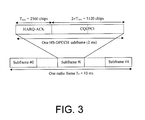
- FIG. 3 depicts a frame structure in accordance with certain example embodiments
- FIG. 4 a -4 c depicts RAT configurations for control signaling according to certain example embodiments
- FIG. 5 depicts a block diagram of an apparatus for performing control signaling in multi-radio access environments.
- FIG. 6 depicts a flowchart for performing control signaling in multi-radio access environments
- circuitry refers to all of the following: (a) hardware-only circuit implementations (such as implementations in only analog and/or digital circuitry); (b) to combinations of circuits and software (and/or firmware), such as (as applicable): (i) to a combination of processor(s) or (ii) to portions of processor(s)/software (including digital signal processor(s)), software, and memory(ies) that work together to cause an apparatus, such as a mobile phone or server, to perform various functions); and (c) to circuits, such as a microprocessor(s) or a portion of a microprocessor(s), that require software or firmware for operation, even if the software or firmware is not physically present.
- circuitry applies to all uses of this term in this application, including in any claims.
- circuitry would also cover an implementation of merely a processor (or multiple processors) or portion of a processor and its (or their) accompanying software and/or firmware.
- circuitry would also cover, for example and if applicable to the particular claim element, a baseband integrated circuit or applications processor integrated circuit for a mobile phone or a similar integrated circuit in server, a cellular network device, or other network device.
- a wireless communications device may support the use of two or more radio-access technologies (RATs), and the RATs may be partnered or coupled in a manner that supports communications and potentially increases throughput and user experience, given specific quality of service (QoS) requirements and constraints for each of the RATs.
- FIGS. 1 a -1 d depict four different examples of coupling options between multiple RATs.
- the radio-access technologies (RAT 1 and RAT 2 ) in FIGS. 1 a -1 d may be the same or different RATs.
- the RATs may be based, for example, on mobile 2 nd generation, 3 rd generation, long term evolution (LTE) technologies, or any other wired or wireless communications technologies, for example, wireless local area networking (WLAN), Bluetooth (BT), or the like.
- LTE long term evolution
- the device may have access to network infrastructure that supports multiple radio access technologies including the ability to support transmission and reception to and from a device via multiple RATs.
- FIGS. 1 a -1 d depict example multi-radio architectures that include protocol stacks configured to support various types of coupling.
- the protocol layers for each RAT may include a radio resource management (RRM) layer, a general link layer (GLL), a RAT-specific data link layer (L2), and a physical layer (PHY).
- RRM radio resource management
- GLL general link layer
- L2 RAT-specific data link layer
- PHY physical layer
- an RRM may be RAT-specific or coupled between RATs (e.g., RAT 1 and RAT 2 ).
- the RRM may be referred to as a multi-radio resource management (MRRM or M-RRM) layer.
- the MRRM layer may handle access to radio resources of each RAT.
- the MRRM may comprise RAT coordination and network-complementing RRM functions.
- RAT coordination includes the principal coordination abilities, such as local/congestion control and radio-access (RA) selection.
- Network complementing RRM functions may be RAT-specific functions and may, for example, provide missing RRM functions to legacy or future networks or act as a translation layer between certain RA functions and RA intrinsic RRM functions.
- the general link layer may be separated or coupled to RAT 1 and RAT 2 , and the GLL, may reside on top of the RAT-specific parts of the data link layer (L2).
- the GLL may be considered a toolbox of functions that would allow for the control and configuration of L2 functionality of different RATs for user data transmission.
- PHY physical layer
- FIG. 1 a depicts protocols of an example multi-radio architecture in an example multi-radio protocol stack having “no coupling.”
- no collaborative radio resource management (RRM) exists across the RATs, and no collaborative layer 2 functionality exists across the RATs.
- FIG. 1 b depicts protocols of an example multi-radio architecture in an example multi-radio protocol stack having “loose coupling.”
- multi-radio resource management MRRM (or M-RRM)
- M-RRM multi-radio resource management
- Each RAT may be associated with an optional GLL entity on top of the RAT-specific parts of the data link layer (L2).
- L2 data link layer
- PHY physical layer
- FIG. 1 c depicts protocols of an example multi-radio architecture in an example multi-radio protocol stack having “tight coupling.”
- the MRRM may be performed jointly across the RATs.
- Some, but not necessarily all, of the RRM functionality for the different RATs may be integrated into the MRRM.
- the GLL provides a unified interface to the upper layers, acting as a multi-RAT convergence layer. In that way, the GLL function facilitates the co-operation among different access technologies.
- FIG. 1 d depicts protocols of an example multi-radio architecture in an example multi-radio protocol stack having “very tight coupling.”
- the MRRM is performed jointly across the RATs, and some, but not necessarily all, of the RRM functionality for the different RATs may be integrated into the MRRM.
- the GLL may not only control, but also complement certain layer 2 functionalities in order to more fully exploit the potential benefits of multi-radio accesses.
- certain L1/L2 function splitting mechanisms in multi-RAT operation are provided.
- the splitting mechanisms can be applied, for example, in the “tight coupling” and “very tight coupling” examples to produce more tight coupling options.
- a device comprising multiple RATs may be configured for simultaneous transmission and/or simultaneous reception over multiple RATs or selection of a particular RAT for a certain types of communications.
- the multi-radio architecture of a device may comprise a multi-radio resource management (MRRM) and a generic link layer (GLL), or similar protocols or functions common for the RATs concerned.
- the MRRM may responsible for joint management of radio resource between the different RATs in a coordinated manner, and the GLL provides unified link level processing, offering a generic interface towards high layers and adaptation of the underlying RATs.
- the MRRM may manage, in certain example embodiments, all the available radio access resources, enabling an overall coordination through the selection of the most appropriate RAT or RATs to serve each particular communications session.
- a device having multiple RATs may also support a number of transmission diversity schemes as depicted in FIGS. 2 a -2 c .
- the transmission diversity schemes may include switching between RATs as depicted in FIG. 2 a , parallel transmission without redundancy as depicted in FIG. 2 b , and parallel with redundancy as depicted in FIG. 2 c.
- FIG. 2 a illustrates a switched multi-radio transmission diversity (MRTD) or “switched” scheme with no redundancy and no parallelism.
- one RAT is used to transmit an atomic data unit.
- the scheme, and the device implementing the scheme relies upon feedback information from the network to choose a RAT by employing an adaptive mechanism based on chosen criteria.
- FIG. 2 b illustrates a “parallel without redundancy” scheme, where alternating packets are transmitted over a multiplicity of RATs.
- the “parallel without redundancy” scheme distributes data units over available accesses, and does not require any RAT selection specific feedback.
- FIG. 2 c depicts the “parallel with redundancy” scheme which involves the transmission of duplicate copies of packets over two or more RATs, and therefore poses maximum overhead while combining gain.
- various example embodiments of the present invention support control signaling, including uplink control signaling, in multi-RAT environments.
- Some example embodiments utilize multi-radio resource management and general link layers that are shared between RATs, such as those described with respect to the tightly coupled and very tightly coupled architectures.
- Some example embodiments of the present invention perform uplink control signaling transmission in a multi-radio environment to fully utilize the available resources in each RAT simultaneously via MRRM and GLL functions as described above and otherwise herein.
- uplink control signaling may be transmitted through one selected RAT of a multi-RAT device to increase the control signaling reliability by, for example, utilizing the RAT that is associated with the best link quality.
- compatibility with the currently existing systems can be maximized through the selection of a RAT for control signaling.
- uplink feedback signaling over a selected RAT based on link quality may be performed.
- joint configuration of the downlink channel quality indication (CQI) from some or all of the RATs may be implemented, as well as, encoding options for the downlink CQIs.
- CQI downlink channel quality indication
- Joint processing of acknowledgements and negative acknowledgements may also be performed via a selected RAT. Further, expectation time setting of an ACK/NACK in the hybrid automatic repeat request (HARQ) transmission side may be performed. Selection of a RAT for these and other purposes, may be performed between RATs configured to support, for example, high speed downlink packet access (HSDPA) or LTE. According to some example embodiments, WLAN uplink control signaling transmissions may also be provided via RAT selection as described herein. While some example embodiments using HSDPA WCDMA and LTE is provided herein, it is contemplated that any communications techniques could be utilized in accordance with various embodiments of the present invention.
- HSDPA high speed downlink packet access
- LTE Long Term Evolution
- WLAN uplink control signaling transmissions may also be provided via RAT selection as described herein. While some example embodiments using HSDPA WCDMA and LTE is provided herein, it is contemplated that any communications techniques could be utilized in accordance with various embodiments of the present invention.
- the combination of the high speed dedicated physical control channel (HS-DPCCH) signaling in WCDMA HSDPA and the physical uplink control channel (PUCCH) in LTE may be considered as one example in a multi-RAT environment.
- HS-DPCCH high speed dedicated physical control channel
- PUCCH physical uplink control channel
- the high speed dedicated physical control channel may carry uplink feedback signaling related to downlink high speed downlink shared channel (HS-DSCH) transmission and to high speed shared control channel (HS-SCCH) orders.
- the feedback signaling may include HARQ acknowledgement (HARQ-ACK) and CQI.
- HARQ-ACK HARQ acknowledgement
- each sub frame of length 2 milliseconds (3′2560 chips) includes 3 slots, each of length 2560 chips.
- the HARQ-ACK may be carried in the first slot of the HS-DPCCH sub-frame.
- the CQI and, in the case where the user equipment (UE) (e.g., a mobile terminal) is configured in MIMO (multiple in multiple out) mode, also the priority class identifier (PCI), may be carried in the second and third slot of a HS-DPCCH sub-frame. This configuration is illustrated in FIG. 3 .
- the CQI may be coded using, for example, a (20,5) code.
- the HARQ acknowledgement message to be transmitted may be coded to 10 bits.
- the uplink control signal may be transmitted either on the physical uplink control channel (PUCCH) or physical uplink shared channel (PUSCH).
- the control signaling may be multiplexed together with the uplink shared channel (UL-SCH) data.
- the uplink control information may be transmitted on the PUSCH.
- the PUCCH is not transmitted simultaneously with the PUSCH from the same UE.
- the PUCCH may support multiple formats, ACK/NACK, CQI, scheduling requests, and the combinations thereof.
- Each positive acknowledgement (ACK) may be encoded as a binary ‘0’ and each negative acknowledgement (NACK) may be encoded as a binary ‘1’.
- the binary bit may be mapped on a binary phase shift keyed (BPSK) symbol and the BPSK symbol may be multiplied with a cyclically shifted sequence of length equal to, for example, 12.
- BPSK binary phase shift keyed
- the channel quality bits input to the channel coding block may be denoted by a 0 , a 1 , a 2 , a 3 , . . . , a A-1 where A is the number of bits.
- the number of channel quality bits may depend on the transmission format.
- the CQI may be coded using a (20, A) code.
- the uplink control signaling for the HSDPA and LTE is similar. Both HSDPA and LTE take the form of CQI+ACK/NACK.
- one way to implement control signaling may be to transmit the HS-DPCCH via the HSDPA air interface and the PUCCH via the LTE interface, as illustrated in FIG. 4 a .
- the WCDMA PHY receives and decodes the HS-DPCCH
- the LTE PHY layer receives and decodes the PUCCH
- the PHY layers may send the received information elements to the RAT-specific L2 and the GLL.
- GLL may make a joint scheduling decision and a retransmission decision.
- RAT-specific L2 and PHY may send a downlink data packet to a corresponding RAT air interface according to the multi-radio transmission diversity modes as described above.
- link quality, resource saving, implementation complexity in the multi-radio communication systems may be considered to optimize signaling transmission and reception via a selected air interface and associated RAT.
- uplink control information since uplink control information is important for the system performance and uplink control information may be associated with costly overhead, reliable link quality and overhead efficiency are desirable attributes.
- Some example embodiments that consider these attributes may provide for transmission of the uplink control signaling via one selected air interface and associated RAT.
- the selection criteria may be based on, for example, link quality as well as other factors.
- link quality on each RAT may be determined.
- FIG. 4 b depicts an example configuration where an LTE RAT has been selected for control signaling.
- FIG. 4 c depicts an example configuration where an WCDMA/HSDPA RAT has been selected for control signaling.
- the frequency of the CQI information generation and reception may be configured in the higher layers and encoded for example, to 20 bits for both HSDPA and LTE systems.
- the ACK/NACK feedback structure may also depend on the multi-radio transmission mode, and the interfaces between the GLL and RAT specific L2 may be simplified through the use of a single selected air interface and associated RAT.
- CQI transmissions may be performed via a single, selected RAT.
- the base station e.g., e-node B
- HS-CQI may be configured by the CQI feedback cycle and CQI repetition factor.
- the CQI feedback cycle (e.g., [0, 1, 5, 20, 20, 20, 40, 80 transmission time interval (TTI)]), which is signaled to the UE, may control how often the UE transmits new CQI information on the uplink. A value of zero may mean that the UE does not transmit any CQI information.
- a CQI repetition factor (e.g., [1, 2, 3, 4]), which is also signaled to the UE, may control how often the UE repeats CQI information in the consecutive HS-DPCCH sub-frames.
- LTE-CQI may be configured by the same parameters as those of the HS-CQI. However, according to some example embodiments, since the number of the CQI bits for HSDPA and LTE are 5 and 4, respectively, different options for the CQI encoding may be used.
- LTE-CQI may be configured by [0, 2, 5, 10, 16, 20, 32, 40, 64, 80, 160] milliseconds. Additionally, the HS-CQI may be configured by the same parameters as those of LTE-CQI.
- the frequency of the HS-CQI and LTE-CQI may be configured by the higher layers, such as the GLL.
- the minimum CQI cycle may be 4 milliseconds for both HS-CQI and LTE-CQI.
- the HS-CQI and LTE-CQI may be transmitted, for example, in turn in every 2 milliseconds.
- the 1st TTI may be for HS-CQI and 2nd TTI may be for LTE-CQI or vice versa.
- the frequency of the uplink CQI may be doubled for each HS-CQI and LTE-CQI. Accordingly, as the HS-CQI and LTE-CQI is transmitted on a selected RAT, more frequent CQI transmission may be configured for other UE at home system in a needed base.
- coding options for CQIs may also be available through utilization of a single, selected RAT.
- LTE-CQI and HS-CQI may be coded separately according to respective RATs, since the encoding and decoding rules for the HSPDA and LTE are not the same. However, the coded bits may be mapped according to the rules of the selected RAT. Accordingly, this option may require one RAT to have two CQI encoding and decoding units.
- the HS-CQI may alternatively be coded with an HS specific (20, 5) encoder.
- a new encoder common for both LTE-CQI and HS-CQI may be designed.
- the common encoder may have a length of 40. The longer coding length may provide an improved coding gain.
- a UE may need to measure the CQI for each link.
- a CQI may be transmitted in the selected RAT according to the configuration rule from the higher layers.
- the CQIs may be decoded in the selected RAT's PHY and forwarded to the layer 2 and GLL as the input information for packet scheduling in the GLL.
- the downlink control information may be forwarded from the GLL to the RAT specific L2 and the PHY to format the downlink packet transmission.
- example embodiments of the present invention may also perform HARQ acknowledgement transmission via a single, selected RAT.
- a base station e.g., e-Node B
- the switched mode for example as depicted in FIG. 2 a , at a given instant in time, only one HARQ packet may be received, and as such, one HARQ acknowledgement may be needed in uplink.
- the transmission mechanism for the HARQ acknowledgment may be based on the mechanism employed by the selected RAT.
- the HARQ acknowledgement may be packet/RAT dependent. If the HSDPA RAT is selected as the transmission RAT for uplink control signaling, the ACK/NACK corresponding to each RAT may be coded as illustrated in Table 1, for example. A different coding scheme may also be considered.
- HARQ-ACK may consist of 2-bits of information, corresponding to the ACK/NACK bit for RAT 1 and a corresponding ACK/NACK bit for RAT 2 , and the bits may be mapped to quadrature phase-shift keying (QPSK) modulation as illustrated in Table 2, for example.
- QPSK quadrature phase-shift keying
- the same packet may be transmitted from each RAT.
- the HARQ acknowledgement may therefore be common to each RAT, and there may be only one HARQ feedback required from a resource efficiency point of view.
- the ACK/NACK transmission mechanism may be based on the selected RAT's mechanism.
- the uplink ACK/NACK may correspond to whether the downlink packet is correctly received at the UE side, and the downlink HARQ may be asynchronous in LTE and HSDPA. Since the frame structure for HSDPA and LTE is different, a synchronization issue may arise for uplink ACK/NACK. However, the synchronization issue may be avoided and rectified via the following.
- the reception and processing of the ACK/NACK may be assumed to be allocated in the GLL.
- the ACK/NACK expectation time may be set according to the frame structure and receiving node processing time.
- the UE may decode the data packet from one RAT within the pre-defined time interval of UE processing time. According to the decoded result, the UE may transmit the uplink ACK/NACK in the selected RAT.
- the base station PHY may decode the uplink control signal and forward the result to the GLL.
- the downlink packet and the corresponding uplink control signal may be transmitted via the same RAT, and therefore, the synchronization problem may be avoided. If the downlink packet and the corresponding uplink control signal are not transmitted in the same RAT, then the ACK/NACK expectation time at the base station side may be modified according to the selected RAT and the timing difference between the two RATs.
- the UE may decode the data packet from both RATs within the pre-defined time interval of the UE processing time in each RAT. According to the decoding result, the UE may transmit the packet dependent uplink ACK/NACK in a selected RAT.
- the base station PHY may decode the uplink control signal and forward the result to the GLL.
- the ACK/NACK expectation time in the base station side may be set according to the selected RAT and the timing difference between two RATs.
- UE may decode the data packet from both RATs, if needed, within the pre-defined time interval of the UE processing time in each RAT. Once the data packet is correctly decoded, or both packets are decoded if the 1st arriving packet fails, the decoding process may stop at UE side. According to the decoding result, the UE may transmit the uplink ACK/NACK in the selected RAT. The base station PHY may decode the uplink control signal and forward the result to the GLL. The ACK/NACK expectation time in the base station side may be set according to the selected RAT, and the timing difference between two RATs, which may be larger than or equal to the larger expectation time of the two RATs.
- Apparatus 200 may, be embodied as, or included as a component of, a communications device with wired or wireless communications capabilities.
- the apparatus 200 may be part of a communications device, such as a stationary or a mobile communications terminal.
- a stationary communications terminal such as an infrastructure node (e.g., access point, base station, or the like)
- the apparatus 200 may be part of, or embodied as, a server, a computer, communications switching device, or the like.
- the apparatus 200 may be a mobile and/or wireless communications node such as, for example, a mobile and/or wireless server, computer, access point, communications switching device, handheld device (e.g., telephone, portable digital assistant (PDA), mobile television, gaming device, camera, video recorder, audio/video player, radio, and/or a global positioning system (GPS) device), any combination of the aforementioned, or the like.
- a mobile and/or wireless server such as, for example, a mobile and/or wireless server, computer, access point, communications switching device, handheld device (e.g., telephone, portable digital assistant (PDA), mobile television, gaming device, camera, video recorder, audio/video player, radio, and/or a global positioning system (GPS) device), any combination of the aforementioned, or the like.
- PDA portable digital assistant
- GPS global positioning system
- the example apparatus 200 includes or is otherwise in communication with a processor 205 , a memory device 210 , an Input/Output (I/O) interface 206 , a communications interface 215 , and a RAT selector and signal processor 230 .
- the processor 205 may be embodied as various means for implementing the various functionalities of example embodiments of the present invention including, for example, a microprocessor, a coprocessor, a controller, a special-purpose integrated circuit such as, for example, an ASIC (application specific integrated circuit), an FPGA (field programmable gate array), or a hardware accelerator, processing circuitry or the like.
- processor 205 may be representative of a plurality of processors, or one or more multiple core processors, operating in concert.
- the processor 205 may be comprised of a plurality of transistors, logic gates, a clock (e.g., oscillator), other circuitry, and the like to facilitate performance of the functionality described herein.
- the processor 205 may, but need not, include one or more accompanying digital signal processors.
- the processor 205 is configured to execute instructions stored in the memory device 210 or instructions otherwise accessible to the processor 205 .
- the processor 205 may be configured to operate such that the processor causes the apparatus 200 to perform various functionalities described herein.
- the processor 205 may be an entity capable of performing operations according to embodiments of the present invention while configured accordingly.
- the processor 205 is specifically configured hardware for conducting the operations described herein.
- the instructions specifically configure the processor 205 to perform the algorithms and operations described herein.
- the processor 205 is a processor of a specific device (e.g., mobile terminal) configured for employing example embodiments of the present invention by further configuration of the processor 205 via executed instructions for performing the algorithms, methods, and operations described herein.
- the memory device 210 may be one or more computer-readable storage media that may include volatile and/or non-volatile memory.
- the memory device 210 includes Random Access Memory (RAM) including dynamic and/or static RAM, on-chip or off-chip cache memory, and/or the like.
- RAM Random Access Memory
- memory device 210 may include non-volatile memory, which may be embedded and/or removable, and may include, for example, read-only memory, flash memory, magnetic storage devices (e.g., hard disks, floppy disk drives, magnetic tape, etc.), optical disc drives and/or media, non-volatile random access memory (NVRAM), and/or the like.
- Memory device 210 may include a cache area for temporary storage of data. In this regard, some or all of memory device 210 may be included within the processor 205 .
- the memory device 210 may be configured to store information, data, applications, computer-readable program code instructions, and/or the like for enabling the processor 205 and the example apparatus 200 to carry out various functions in accordance with example embodiments of the present invention described herein.
- the memory device 210 could be configured to buffer input data for processing by the processor 205 .
- the memory device 210 may be configured to store instructions for execution by the processor 205 .
- the I/O interface 206 may be any device, circuitry, or means embodied in hardware, software, or a combination of hardware and software that is configured to interface the processor 205 with other circuitry or devices, such as the communications interface 215 .
- the processor 205 may interface with the memory 210 via the I/O interface 206 .
- the I/O interface 206 may be configured to convert signals and data into a form that may be interpreted by the processor 205 .
- the I/O interface 206 may also perform buffering of inputs and outputs to support the operation of the processor 205 .
- the processor 205 and the I/O interface 206 may be combined onto a single chip or integrated circuit configured to perform, or cause the apparatus 200 to perform, various functionalities of the present invention.
- the communication interface 215 may be any device or means embodied in either hardware, a computer program product, or a combination of hardware and a computer program product that is configured to receive and/or transmit data from/to a network 225 and/or any other device or module in communication with the example apparatus 200 .
- the communications interface may be configured to communicate information via any type of wired or wireless connection, and via any type of communications protocol.
- the communications interface 215 may be configured to support the operation of a number of RAT modules (e.g., a HSDPA RAT module, an LTE RAT module, and the like) and communications via the RATs (E.g., RAT 1 and RAT 2 ).
- a RAT module may include all of the hardware and software for implementing the a protocol stack as described herein.
- Processor 205 may also be configured to facilitate communications via the communications interface by, for example, controlling hardware included within the communications interface 215 .
- the communication interface 215 may include, for example, communications driver circuitry (e.g., circuitry that supports wired communications via, for example, fiber optic connections), one or more antennas, a transmitter, a receiver, a transceiver and/or supporting hardware, including, for example, a processor for enabling communications.
- the example apparatus 200 may communicate with various other network entities in a device-to-device fashion and/or via indirect communications via a base station, access point, server, gateway, router, or the like.
- the RAT selector and signal processor 230 of example apparatus 200 may be any means or device embodied, partially or wholly, in hardware, a computer program product, or a combination of hardware and a computer program product, such as processor 205 implementing stored instructions to configure the example apparatus 200 , memory device 210 storing executable program code instructions configured to carry out the functions described herein, or a hardware configured processor 205 that is configured to carry out the functions of the RAT selector and signal processor 230 as described herein.
- the processor 205 includes, or controls, the RAT selector and signal processor 230 .
- the RAT selector and signal processor 230 may be, partially or wholly, embodied as processors similar to, but separate from processor 205 .
- the RAT selector and signal processor 230 may be in communication with the processor 205 .
- the RAT selector and signal processor 230 may, partially or wholly, reside on differing apparatuses such that some or all of the functionality of the RAT selector and signal processor 230 may be performed by a first apparatus, and the remainder of the functionality of the RAT selector and signal processor 230 may be performed by one or more other apparatuses.
- the apparatus 200 and the processor 205 may be configured to perform the following functionality via the RAT selector and signal processor 230 .
- the RAT selector and signal processor 230 may be configured to cause the processor 205 and/or the apparatus 200 to perform various functionalities, such as those depicted in the flowchart of FIG. 6 and as generally described herein.
- the RAT selector and signal processor 230 may be configured to implement radio resource management and a general link layer jointly across at least two radio access technology modules at 300 , and select one of the radio access technology modules to perform control signaling in a multi-radio environment at 310 .
- selecting one of the radio access technology modules to perform control signaling includes selecting one of the radio access technology modules to perform control signaling, where the control signaling is uplink feedback control signaling. Further, according to some example embodiments, selecting one the radio access technology modules includes selecting one the radio access technology modules based on radio specific channel quality indications.
- the RAT selector and signal processor 230 may also be configured to generate channel quality indication transmissions based on a configuration of the selected radio access technology module at 320 , and encode channel quality indications based on a configuration of the selected radio access technology module at 330 .
- a configuration of a radio access technology module may be WCDMA HSDPA, LTE, or the like.
- the RAT selector and signal processor 230 may be configured to perform joint processing of acknowledgments and negative acknowledgements via the selected radio access technology module based on a configuration of the selected radio assess technology module and a multi-radio transmission diversity scheme at 340 .
- the RAT selector and signal processor 230 is configured to implement an expectation time for acknowledgements and negative acknowledgements based on based on a configuration of the selected radio assess technology module and a multi-radio transmission diversity scheme at 350 .
- the RAT selector and signal processor 230 may be configured to perform parallel operations in accordance with various embodiments.
- the RAT selector and signal processor 230 may be configured to generate the channel quality indication transmissions at 320 and encode the channel quality indications at 330 , in parallel with performing joint processing of acknowledgments and negative acknowledgments at 340 and implementing the expectation time for acknowledgments and negative acknowledgments at 350 .
- FIG. 6 illustrates flowcharts of example systems, methods, and/or computer program products according to example embodiments of the invention. It will be understood that each operation of the flowcharts, and/or combinations of operations in the flowcharts, can be implemented by various means. Means for implementing the operations of the flowcharts, combinations of the operations in the flowchart, or other functionality of example embodiments of the present invention described herein may include hardware, and/or a computer program product including a computer-readable storage medium (as opposed to a computer-readable transmission medium which describes a propagating signal) having one or more computer program code instructions, program instructions, or executable computer-readable program code instructions stored therein.
- a computer-readable storage medium as opposed to a computer-readable transmission medium which describes a propagating signal
- program code instructions may be stored on a memory device, such as memory device 210 , of an example apparatus, such as example apparatus 200 , and executed by a processor, such as the processor 205 .
- any such program code instructions may be loaded onto a computer or other programmable apparatus (e.g., processor 205 , memory device 210 , or the like) from a computer-readable storage medium to produce a particular machine, such that the particular machine becomes a means for implementing the functions specified in the flowcharts' operations.
- These program code instructions may also be stored in a computer-readable storage medium that can direct a computer, a processor, or other programmable apparatus to function in a particular manner to thereby generate a particular machine or particular article of manufacture.
- the instructions stored in the computer-readable storage medium may produce an article of manufacture, where the article of manufacture becomes a means for implementing the functions specified in the flowcharts' operations.
- the program code instructions may be retrieved from a computer-readable storage medium and loaded into a computer, processor, or other programmable apparatus to configure the computer, processor, or other programmable apparatus to execute operations to be performed on or by the computer, processor, or other programmable apparatus.
- Retrieval, loading, and execution of the program code instructions may be performed sequentially such that one instruction is retrieved, loaded, and executed at a time.
- retrieval, loading and/or execution may be performed in parallel such that multiple instructions are retrieved, loaded, and/or executed together.
- Execution of the program code instructions may produce a computer-implemented process such that the instructions executed by the computer, processor, or other programmable apparatus provide operations for implementing the functions specified in the flowcharts' operations.
- execution of instructions associated with the operations of the flowchart by a processor, or storage of instructions associated with the blocks or operations of the flowcharts in a computer-readable storage medium support combinations of operations for performing the specified functions. It will also be understood that one or more operations of the flowcharts, and combinations of blocks or operations in the flowcharts, may be implemented by special purpose hardware-based computer systems and/or processors which perform the specified functions, or combinations of special purpose hardware and program code instructions.
Landscapes
- Engineering & Computer Science (AREA)
- Computer Networks & Wireless Communication (AREA)
- Signal Processing (AREA)
- Quality & Reliability (AREA)
- Mobile Radio Communication Systems (AREA)
Abstract
Description
| TABLE 1 |
| Channel coding of HARQ-ACK in multi- |
| radio transmission mode (HSDPA) |
| HARQ-ACK | |
| message to be | |
| transmitted |
| RAT1 | RAT2 | w0 | w1 | w2 | w3 | w4 | w5 | w6 | w7 | w8 | w9 | |
| ACK | ACK | 1 | 0 | 1 | 0 | 1 | 1 | 1 | 1 | 0 | 1 | |
| | NACK | 1 | 1 | 0 | 1 | 0 | 1 | 0 | 1 | 1 | 1 | |
| | ACK | 0 | 1 | 1 | 1 | 1 | 0 | 1 | 0 | 1 | 1 | |
| | NACK | 1 | 0 | 0 | 1 | 0 | 0 | 1 | 0 | 0 | 0 | |
| TABLE 2 |
| Channel coding and mapping of HARQ-ACK in multi-radio |
| transmission mode (LTE) |
| HARQ-ACK | b(0), . . . , b(Mbit − 1) | d(0) | ||
| (RAT1, RAT2) | 00 | −1 | ||
| 01 | |
|||
| 10 | −j | |||
| 11 | 1 | |||
Claims (13)
Applications Claiming Priority (1)
| Application Number | Priority Date | Filing Date | Title |
|---|---|---|---|
| PCT/CN2010/070287 WO2011088612A1 (en) | 2010-01-20 | 2010-01-20 | Method and apparatus for providing uplink control signalling in a multi-radio access environment |
Publications (2)
| Publication Number | Publication Date |
|---|---|
| US20120289170A1 US20120289170A1 (en) | 2012-11-15 |
| US9462597B2 true US9462597B2 (en) | 2016-10-04 |
Family
ID=44306376
Family Applications (1)
| Application Number | Title | Priority Date | Filing Date |
|---|---|---|---|
| US13/522,946 Expired - Fee Related US9462597B2 (en) | 2010-01-20 | 2010-01-20 | Method and apparatus for providing uplink control signalling in a multi-radio access environment |
Country Status (4)
| Country | Link |
|---|---|
| US (1) | US9462597B2 (en) |
| EP (1) | EP2526712A4 (en) |
| CN (1) | CN102792727B (en) |
| WO (1) | WO2011088612A1 (en) |
Cited By (1)
| Publication number | Priority date | Publication date | Assignee | Title |
|---|---|---|---|---|
| US11146481B2 (en) | 2014-09-18 | 2021-10-12 | Qualcomm Incorporated | Base station initiated control mechanism for supporting supplemental link |
Families Citing this family (39)
| Publication number | Priority date | Publication date | Assignee | Title |
|---|---|---|---|---|
| JP5521739B2 (en) * | 2010-04-26 | 2014-06-18 | 富士通株式会社 | Communication system, carrier side communication apparatus, base station apparatus, and communication method |
| US8837358B2 (en) | 2010-10-18 | 2014-09-16 | Nokia Siemens Networks Oy | UL ACK/NACK for inter-radio access technology carrier aggregation |
| US9204460B2 (en) * | 2011-06-06 | 2015-12-01 | Telefonaktiebolaget L M Ericsson (Publ) | Methods and systems for a generic multi-radio access technology |
| US9642026B2 (en) * | 2011-06-08 | 2017-05-02 | Telefonaktiebolaget Lm Ericsson (Publ) | Methods and devices for reporting a downlink channel quality |
| CA2843538C (en) | 2011-08-04 | 2019-08-27 | Blackberry Limited | Methods to enable efficient use of multiple radio access technologies |
| EP2740319A4 (en) * | 2011-08-04 | 2016-01-20 | Blackberry Ltd | Methods to enable efficient use of multiple radio access technologies |
| CN102882588B (en) * | 2011-09-07 | 2016-04-27 | 开曼群岛威睿电通股份有限公司 | Method for communication transmission and system |
| CN103782651A (en) * | 2011-09-20 | 2014-05-07 | 华为技术有限公司 | Method for transmission of control signals in a wireless communication system |
| EP2613592B1 (en) | 2012-01-09 | 2019-04-17 | Telefonaktiebolaget LM Ericsson (publ) | Method and device for selecting radio access technology |
| JP5822765B2 (en) * | 2012-03-19 | 2015-11-24 | シャープ株式会社 | Wireless communication system, communication method, terminal device, and base station device |
| CN103378954B (en) | 2012-04-20 | 2019-03-15 | 北京三星通信技术研究有限公司 | Method for allocating HARQ-ACK channel resources supporting transmit diversity and channel selection |
| US9277589B2 (en) * | 2012-05-15 | 2016-03-01 | Telefonaktiebolaget L M Ericsson (Publ) | Wireless access point connected to two communication networks |
| US9264972B2 (en) | 2012-06-11 | 2016-02-16 | Qualcomm Incorporated | Home networking with integrated cellular communication |
| EP2894916B1 (en) * | 2012-09-28 | 2020-04-22 | Huawei Technologies Co., Ltd. | Correct/incorrect response feedback method, user equipment and system |
| EP2723144B1 (en) * | 2012-10-19 | 2016-03-30 | Fujitsu Limited | Uplink buffer status report in Multi-RAT System |
| WO2014109559A1 (en) | 2013-01-11 | 2014-07-17 | Lg Electronics Inc. | Method for reporting a power headroom and communication device thereof |
| US9949214B2 (en) | 2013-01-11 | 2018-04-17 | Lg Electronics Inc. | Method for reporting buffer status and communication device thereof |
| KR102141389B1 (en) * | 2013-01-29 | 2020-08-05 | 삼성전자주식회사 | Method and apparatus for sending radio link control status report for sending in a communication system based on a multi-radio access technologies |
| US10716097B2 (en) * | 2013-08-09 | 2020-07-14 | Qualcomm Incorporated | Disjoint bearer routing |
| US9729283B2 (en) * | 2014-05-08 | 2017-08-08 | Intel IP Corporation | Systems, methods and devices for flexible retransmissions |
| TWI526106B (en) | 2014-06-06 | 2016-03-11 | 財團法人工業技術研究院 | Base station and scheduling method for wireless network |
| US20160128045A1 (en) * | 2014-10-31 | 2016-05-05 | Qualcomm Incorporated | Reliable transmission of information on control channels |
| US10020910B2 (en) | 2015-01-30 | 2018-07-10 | Huawei Technologies., Ltd. | Systems, devices and methods for network communication |
| US10499351B2 (en) | 2015-03-17 | 2019-12-03 | Huawei Technologies Co., Ltd. | Controller directives to enable multipoint reception via MCS and power constraints masks |
| US9781736B2 (en) | 2015-03-25 | 2017-10-03 | Huawei Technologies Co., Ltd. | Offloading of controlling across access nodes |
| CN106332184B (en) * | 2015-06-19 | 2021-11-02 | 中兴通讯股份有限公司 | Data transmission method and device |
| CN106455070B (en) * | 2015-08-12 | 2022-03-15 | 中兴通讯股份有限公司 | Transmission method and system for downlink signaling of control plane |
| CN106455104B (en) * | 2015-08-12 | 2020-11-24 | 中兴通讯股份有限公司 | A method and system for transmitting uplink signaling on a control plane |
| EP3411970B1 (en) * | 2016-02-26 | 2020-01-01 | Huawei Technologies Co., Ltd. | Network node and method thereof |
| WO2017171912A1 (en) * | 2016-03-30 | 2017-10-05 | Intel Corporation | Quality of service handling for uplink transmissions |
| US10736125B2 (en) * | 2016-05-06 | 2020-08-04 | Qualcomm Incorporated | Radio access technology (RAT) aggregation on a shared communication medium |
| WO2018076225A1 (en) * | 2016-10-27 | 2018-05-03 | Qualcomm Incorporated | Coexistence between wireless communication circuitries |
| EP3535910A1 (en) * | 2016-11-04 | 2019-09-11 | Telefonaktiebolaget LM Ericsson (publ) | Wireless device and a network node for a wireless communication system and methods thereof |
| BR112019019804A2 (en) | 2017-03-23 | 2020-04-22 | Fraunhofer-Gesellschaft zur Förderung der angewandten Forschung e. V. | transmission of reliable data packet between entities in a radio access network of a mobile communication network |
| US10973071B2 (en) | 2017-05-02 | 2021-04-06 | Nokia Solutions And Networks Oy | Improving communication reliability |
| US10512002B2 (en) * | 2017-06-23 | 2019-12-17 | Apple Inc. | Lossless split data bearer for inter-RAT dual connectivity wireless device |
| CN111165068B (en) * | 2017-09-29 | 2023-11-17 | 索尼集团公司 | User equipment, network nodes and methods used therein |
| WO2019139691A1 (en) * | 2018-01-10 | 2019-07-18 | Kyocera Corporation | Transmission of wake-up signal to mobile devices at alternate carrier frequency |
| US20220116325A1 (en) * | 2021-12-22 | 2022-04-14 | Intel Corporation | Packet format adjustment technologies |
Citations (6)
| Publication number | Priority date | Publication date | Assignee | Title |
|---|---|---|---|---|
| US20050135311A1 (en) | 2003-12-22 | 2005-06-23 | Alcatel | Mobile terminal and telecommunication method |
| US20080045262A1 (en) | 2006-08-16 | 2008-02-21 | Vanvinh Phan | Method and Apparatus for Providing Service-Based Cell Reselection |
| CN101228805A (en) | 2005-05-30 | 2008-07-23 | 艾利森电话股份有限公司 | Techniques for controlling handover in a multiradio wireless communication system |
| WO2009007217A1 (en) | 2007-07-09 | 2009-01-15 | Infineon Technologies Ag | Data transmission in multi radio access technology |
| CN101473680A (en) | 2006-06-30 | 2009-07-01 | 诺基亚公司 | Neighbor cell measurement and reporting in a multiple Radio Access Technology (RAT) environment |
| US20120300692A1 (en) * | 2009-10-22 | 2012-11-29 | Interdigital Patent Holdings, Inc. | Method and apparatus for a two-way relaying scheme with physical layer network coding |
-
2010
- 2010-01-20 CN CN201080065160.4A patent/CN102792727B/en not_active Expired - Fee Related
- 2010-01-20 EP EP10843655.1A patent/EP2526712A4/en not_active Withdrawn
- 2010-01-20 WO PCT/CN2010/070287 patent/WO2011088612A1/en not_active Ceased
- 2010-01-20 US US13/522,946 patent/US9462597B2/en not_active Expired - Fee Related
Patent Citations (7)
| Publication number | Priority date | Publication date | Assignee | Title |
|---|---|---|---|---|
| US20050135311A1 (en) | 2003-12-22 | 2005-06-23 | Alcatel | Mobile terminal and telecommunication method |
| CN1638511A (en) | 2003-12-22 | 2005-07-13 | 阿尔卡特公司 | Mobile terminal and telecommunication method |
| CN101228805A (en) | 2005-05-30 | 2008-07-23 | 艾利森电话股份有限公司 | Techniques for controlling handover in a multiradio wireless communication system |
| CN101473680A (en) | 2006-06-30 | 2009-07-01 | 诺基亚公司 | Neighbor cell measurement and reporting in a multiple Radio Access Technology (RAT) environment |
| US20080045262A1 (en) | 2006-08-16 | 2008-02-21 | Vanvinh Phan | Method and Apparatus for Providing Service-Based Cell Reselection |
| WO2009007217A1 (en) | 2007-07-09 | 2009-01-15 | Infineon Technologies Ag | Data transmission in multi radio access technology |
| US20120300692A1 (en) * | 2009-10-22 | 2012-11-29 | Interdigital Patent Holdings, Inc. | Method and apparatus for a two-way relaying scheme with physical layer network coding |
Non-Patent Citations (18)
| Title |
|---|
| "3rd Generation Partnership Project; Technical Specification Group Radio Access Network; Evolved Universal Terrestrial Radio Access (E-UTRA); Multiplexing and Channel Coding (Release 8)", 3GPP TS 36.212, V8.7.0, May 2009, pp. 1-60. |
| "3rd Generation Partnership Project; Technical Specification Group Radio Access Network; Evolved Universal Terrestrial Radio Access (E-UTRA); Physical Layer Procedures (Release 8)", 3GPP TS 36.213, V8.3.0, May 2008, pp. 1-45. |
| "3rd Generation Partnership Project; Technical Specification Group Radio Access Network; Multiplexing and Channel Coding (FDD) (Release 8)", 3GPP TS 25.212, V8.5.0, Mar. 2009, pp. 1-107. |
| "3rd Generation Partnership Project; Technical Specification Group Radio Access Network; Physical Channels and Mapping of Transport Channels onto Physical Channels (FDD) (Release 8)", 3GPP TS 25.211, V8.4.0, Mar. 2009, pp. 1-56. |
| "3rd Generation Partnership Project; Technical Specification Group Services and System Aspects; Feasibility Study on 3GPP System to Wireless Local Area Network (WLAN) Interworking (Release 6)", 3GPP TR 22.934, V6.2.0, Sep. 2003, pp. 1-30. |
| Extended European Search Report for corresponding European Application No. 10843655.1 dated Jul. 14, 2016, 9 pages. |
| International Search Report and Written Opinion received for corresponding International Patent Application No. PCT/CN2010/070287, dated Nov. 4, 2010, 10 pages. |
| Koudouridis et al., "Multi-Radio Access in Ambient Network", IEEE INFOCOM, 2006, 5 pages. |
| Koudouridis, G. P. et al., Generic Link Layer Functionality for Multi-Radio Access Networks, Retrieved from the Internet . (retrieved Jul. 1, 2008) 5 pages. |
| Koudouridis, G. P. et al., Generic Link Layer Functionality for Multi-Radio Access Networks, Retrieved from the Internet <URL: http://www.eurasip.org/Proceedings/Ext/IST05/papers/359.pdf>. (retrieved Jul. 1, 2008) 5 pages. |
| Magnusson, P. et al., Radio Resource Management Distribution in a Beyond 3G Multi-Radio Access Architecture, IEEE Communications Society, Globecom (2004), 3472-3477. |
| Office Action for Chinese Application No. 201080065160.4 dated Feb. 15, 2015. |
| Office Action for Chinese Application No. 201080065160.4 dated Jul. 28, 2014. |
| Office Action from corresponding Chinese Patent Application No. 2010800651604, dated Sep. 22, 2015. |
| Sachs et al., "Assessment of the Access Selection Gain in Multi-Radio Access Networks", European Transactions on Telecommunications, vol. 20, Issue 3, Nov. 1, 2007, pp. 265-279. |
| Sachs et al., "Future Wireless Communication Based on Multi-Radio Access Networks", European Transactions on Telecommunications, vol. 20, Issue 3, Nov. 1, 2007, pp. 1-10. * |
| Sachs et al., "Future Wireless Communication Based on Multi-Radio Access", Wireless World Research Forum, 2004, pp. 1-10. |
| Yaver et al., "Performance Evaluation of Multi-Radio Transmission Diversity: QoS Support for Delay Sensitive Services", IEEE 69th Vehicular Technology Conference, Apr. 26-29, 2009, pp. 1-5. |
Cited By (1)
| Publication number | Priority date | Publication date | Assignee | Title |
|---|---|---|---|---|
| US11146481B2 (en) | 2014-09-18 | 2021-10-12 | Qualcomm Incorporated | Base station initiated control mechanism for supporting supplemental link |
Also Published As
| Publication number | Publication date |
|---|---|
| EP2526712A4 (en) | 2016-08-17 |
| CN102792727B (en) | 2016-05-25 |
| EP2526712A1 (en) | 2012-11-28 |
| WO2011088612A1 (en) | 2011-07-28 |
| WO2011088612A8 (en) | 2011-12-22 |
| CN102792727A (en) | 2012-11-21 |
| US20120289170A1 (en) | 2012-11-15 |
Similar Documents
| Publication | Publication Date | Title |
|---|---|---|
| US9462597B2 (en) | Method and apparatus for providing uplink control signalling in a multi-radio access environment | |
| US12088416B2 (en) | Method and user equipment (UE) for managing HARQ procedure for multiple numerologies | |
| US11588585B2 (en) | Methods and apparatus for transmitting information on two PDSCHs | |
| CN108809534B (en) | Scheduling method, HARQ-ACK feedback method and corresponding equipment | |
| US8483156B2 (en) | Feedback for inter-radio access technology carrier aggregation | |
| US11765761B2 (en) | Transmission method and device | |
| US20180034597A1 (en) | User apparatus and transmittal acknowledgement information transmission method | |
| US20130242860A1 (en) | Physical layer feedback for in-device coexistence interference mitigation | |
| US20200304248A1 (en) | Feedback timing | |
| JP2011527843A (en) | Selection between normal and virtual double layer ACK / NACK | |
| JP2018504053A (en) | Soft buffer management for extended carrier aggregation | |
| KR20110060951A (en) | Apparatus and method for reducing overhead for communication | |
| US9838161B2 (en) | Bundling HARQ feedback in a time division duplexing communication system | |
| US20100023835A1 (en) | Method and Apparatus for Improving HARQ Operation | |
| CN100461912C (en) | Wireless Base Stations and Mobile Stations | |
| US7272396B2 (en) | Wireless base station and mobile station | |
| WO2012058823A1 (en) | Resource scheduling among multiple radio access technologies | |
| TWI870758B (en) | Uplink control information transmission method, terminal, network equipment, device and storage medium | |
| WO2022117103A1 (en) | Uplink control information transmission method, uplink control information receiving method, terminal and network device | |
| KR20240143951A (en) | Method and system for scheduling transmission in multi-sim user equipment |
Legal Events
| Date | Code | Title | Description |
|---|---|---|---|
| AS | Assignment |
Owner name: NOKIA CORPORATION, FINLAND Free format text: ASSIGNMENT OF ASSIGNORS INTEREST;ASSIGNORS:LI, ZHENHONG;WANG, HAIFENG;ZOU, WEI;AND OTHERS;SIGNING DATES FROM 20140716 TO 20140728;REEL/FRAME:034215/0538 |
|
| AS | Assignment |
Owner name: NOKIA TECHNOLOGIES OY, FINLAND Free format text: ASSIGNMENT OF ASSIGNORS INTEREST;ASSIGNOR:NOKIA CORPORATION;REEL/FRAME:035501/0518 Effective date: 20150116 |
|
| STCF | Information on status: patent grant |
Free format text: PATENTED CASE |
|
| FEPP | Fee payment procedure |
Free format text: PAYOR NUMBER ASSIGNED (ORIGINAL EVENT CODE: ASPN); ENTITY STATUS OF PATENT OWNER: LARGE ENTITY |
|
| AS | Assignment |
Owner name: PROVENANCE ASSET GROUP LLC, CONNECTICUT Free format text: ASSIGNMENT OF ASSIGNORS INTEREST;ASSIGNORS:NOKIA TECHNOLOGIES OY;NOKIA SOLUTIONS AND NETWORKS BV;ALCATEL LUCENT SAS;REEL/FRAME:043877/0001 Effective date: 20170912 Owner name: NOKIA USA INC., CALIFORNIA Free format text: SECURITY INTEREST;ASSIGNORS:PROVENANCE ASSET GROUP HOLDINGS, LLC;PROVENANCE ASSET GROUP LLC;REEL/FRAME:043879/0001 Effective date: 20170913 Owner name: CORTLAND CAPITAL MARKET SERVICES, LLC, ILLINOIS Free format text: SECURITY INTEREST;ASSIGNORS:PROVENANCE ASSET GROUP HOLDINGS, LLC;PROVENANCE ASSET GROUP, LLC;REEL/FRAME:043967/0001 Effective date: 20170913 |
|
| AS | Assignment |
Owner name: NOKIA US HOLDINGS INC., NEW JERSEY Free format text: ASSIGNMENT AND ASSUMPTION AGREEMENT;ASSIGNOR:NOKIA USA INC.;REEL/FRAME:048370/0682 Effective date: 20181220 |
|
| MAFP | Maintenance fee payment |
Free format text: PAYMENT OF MAINTENANCE FEE, 4TH YEAR, LARGE ENTITY (ORIGINAL EVENT CODE: M1551); ENTITY STATUS OF PATENT OWNER: LARGE ENTITY Year of fee payment: 4 |
|
| AS | Assignment |
Owner name: PROVENANCE ASSET GROUP LLC, CONNECTICUT Free format text: RELEASE BY SECURED PARTY;ASSIGNOR:CORTLAND CAPITAL MARKETS SERVICES LLC;REEL/FRAME:058983/0104 Effective date: 20211101 Owner name: PROVENANCE ASSET GROUP HOLDINGS LLC, CONNECTICUT Free format text: RELEASE BY SECURED PARTY;ASSIGNOR:CORTLAND CAPITAL MARKETS SERVICES LLC;REEL/FRAME:058983/0104 Effective date: 20211101 Owner name: PROVENANCE ASSET GROUP LLC, CONNECTICUT Free format text: RELEASE BY SECURED PARTY;ASSIGNOR:NOKIA US HOLDINGS INC.;REEL/FRAME:058363/0723 Effective date: 20211129 Owner name: PROVENANCE ASSET GROUP HOLDINGS LLC, CONNECTICUT Free format text: RELEASE BY SECURED PARTY;ASSIGNOR:NOKIA US HOLDINGS INC.;REEL/FRAME:058363/0723 Effective date: 20211129 Owner name: PROVENANCE ASSET GROUP HOLDINGS LLC, CONNECTICUT Free format text: RELEASE OF SECURITY INTEREST;ASSIGNOR:CORTLAND CAPITAL MARKETS SERVICES LLC;REEL/FRAME:058983/0104 Effective date: 20211101 Owner name: PROVENANCE ASSET GROUP LLC, CONNECTICUT Free format text: RELEASE OF SECURITY INTEREST;ASSIGNOR:CORTLAND CAPITAL MARKETS SERVICES LLC;REEL/FRAME:058983/0104 Effective date: 20211101 Owner name: PROVENANCE ASSET GROUP HOLDINGS LLC, CONNECTICUT Free format text: RELEASE OF SECURITY INTEREST;ASSIGNOR:NOKIA US HOLDINGS INC.;REEL/FRAME:058363/0723 Effective date: 20211129 Owner name: PROVENANCE ASSET GROUP LLC, CONNECTICUT Free format text: RELEASE OF SECURITY INTEREST;ASSIGNOR:NOKIA US HOLDINGS INC.;REEL/FRAME:058363/0723 Effective date: 20211129 |
|
| AS | Assignment |
Owner name: RPX CORPORATION, CALIFORNIA Free format text: ASSIGNMENT OF ASSIGNORS INTEREST;ASSIGNOR:PROVENANCE ASSET GROUP LLC;REEL/FRAME:059352/0001 Effective date: 20211129 Owner name: RPX CORPORATION, CALIFORNIA Free format text: ASSIGNMENT OF ASSIGNOR'S INTEREST;ASSIGNOR:PROVENANCE ASSET GROUP LLC;REEL/FRAME:059352/0001 Effective date: 20211129 |
|
| AS | Assignment |
Owner name: BARINGS FINANCE LLC, AS COLLATERAL AGENT, NORTH CAROLINA Free format text: PATENT SECURITY AGREEMENT;ASSIGNOR:RPX CORPORATION;REEL/FRAME:063429/0001 Effective date: 20220107 |
|
| FEPP | Fee payment procedure |
Free format text: MAINTENANCE FEE REMINDER MAILED (ORIGINAL EVENT CODE: REM.); ENTITY STATUS OF PATENT OWNER: LARGE ENTITY |
|
| AS | Assignment |
Owner name: RPX CORPORATION, CALIFORNIA Free format text: RELEASE OF LIEN ON PATENTS;ASSIGNOR:BARINGS FINANCE LLC;REEL/FRAME:068328/0278 Effective date: 20240802 |
|
| AS | Assignment |
Owner name: BARINGS FINANCE LLC, AS COLLATERAL AGENT, NORTH CAROLINA Free format text: PATENT SECURITY AGREEMENT;ASSIGNORS:RPX CORPORATION;RPX CLEARINGHOUSE LLC;REEL/FRAME:068328/0674 Effective date: 20240802 |
|
| LAPS | Lapse for failure to pay maintenance fees |
Free format text: PATENT EXPIRED FOR FAILURE TO PAY MAINTENANCE FEES (ORIGINAL EVENT CODE: EXP.); ENTITY STATUS OF PATENT OWNER: LARGE ENTITY |
|
| STCH | Information on status: patent discontinuation |
Free format text: PATENT EXPIRED DUE TO NONPAYMENT OF MAINTENANCE FEES UNDER 37 CFR 1.362 |
|
| FP | Lapsed due to failure to pay maintenance fee |
Effective date: 20241004 |