US9458315B2 - Flame retardant thermoplastic polycarbonate compositions and films made therefrom - Google Patents
Flame retardant thermoplastic polycarbonate compositions and films made therefrom Download PDFInfo
- Publication number
- US9458315B2 US9458315B2 US12/546,874 US54687409A US9458315B2 US 9458315 B2 US9458315 B2 US 9458315B2 US 54687409 A US54687409 A US 54687409A US 9458315 B2 US9458315 B2 US 9458315B2
- Authority
- US
- United States
- Prior art keywords
- acid
- thermoplastic composition
- weight percent
- bis
- polycarbonate
- Prior art date
- Legal status (The legal status is an assumption and is not a legal conclusion. Google has not performed a legal analysis and makes no representation as to the accuracy of the status listed.)
- Active, expires
Links
- 0 C[1*]OC(=O)OC Chemical compound C[1*]OC(=O)OC 0.000 description 7
- KGTBMIJUEZFUOA-UHFFFAOYSA-N C1=CC=C(CC2=CC=CC=C2)C=C1.CC.CC.CC.COP(C)(C)=O.COP(C)(C)=O.COP(C)(C)=O.CP(C)(=O)OC1=CC(OP(C)(C)=O)=CC(OP(C)(C)=O)=C1.CP(C)(=O)OC1=CC=CC=C1 Chemical compound C1=CC=C(CC2=CC=CC=C2)C=C1.CC.CC.CC.COP(C)(C)=O.COP(C)(C)=O.COP(C)(C)=O.CP(C)(=O)OC1=CC(OP(C)(C)=O)=CC(OP(C)(C)=O)=C1.CP(C)(=O)OC1=CC=CC=C1 KGTBMIJUEZFUOA-UHFFFAOYSA-N 0.000 description 1
- CRLUNDWXIPWWAK-UHFFFAOYSA-N C=C(C)C.CC(C)(C)C Chemical compound C=C(C)C.CC(C)(C)C CRLUNDWXIPWWAK-UHFFFAOYSA-N 0.000 description 1
- IQOALSQSZWVOHL-UHFFFAOYSA-N CC.CC.OC1=CC=C(CC2=CC=C(O)C=C2)C=C1 Chemical compound CC.CC.OC1=CC=C(CC2=CC=C(O)C=C2)C=C1 IQOALSQSZWVOHL-UHFFFAOYSA-N 0.000 description 1
- ZASGSNBMVHANRG-UHFFFAOYSA-N CC.COO.c1ccccc1 Chemical compound CC.COO.c1ccccc1 ZASGSNBMVHANRG-UHFFFAOYSA-N 0.000 description 1
- OFBQJSOFQDEBGM-UHFFFAOYSA-N CCCCC Chemical compound CCCCC OFBQJSOFQDEBGM-UHFFFAOYSA-N 0.000 description 1
- IWAHQNGLUFJSCK-VPHIFKJOSA-N CO[2H]OC(=O)[3H]C(C)=O Chemical compound CO[2H]OC(=O)[3H]C(C)=O IWAHQNGLUFJSCK-VPHIFKJOSA-N 0.000 description 1
- YPFDHNVEDLHUCE-UHFFFAOYSA-N OCCCO Chemical compound OCCCO YPFDHNVEDLHUCE-UHFFFAOYSA-N 0.000 description 1
Classifications
-
- C—CHEMISTRY; METALLURGY
- C08—ORGANIC MACROMOLECULAR COMPOUNDS; THEIR PREPARATION OR CHEMICAL WORKING-UP; COMPOSITIONS BASED THEREON
- C08J—WORKING-UP; GENERAL PROCESSES OF COMPOUNDING; AFTER-TREATMENT NOT COVERED BY SUBCLASSES C08B, C08C, C08F, C08G or C08H
- C08J5/00—Manufacture of articles or shaped materials containing macromolecular substances
- C08J5/18—Manufacture of films or sheets
-
- C—CHEMISTRY; METALLURGY
- C08—ORGANIC MACROMOLECULAR COMPOUNDS; THEIR PREPARATION OR CHEMICAL WORKING-UP; COMPOSITIONS BASED THEREON
- C08K—Use of inorganic or non-macromolecular organic substances as compounding ingredients
- C08K3/00—Use of inorganic substances as compounding ingredients
- C08K3/01—Use of inorganic substances as compounding ingredients characterized by their specific function
- C08K3/013—Fillers, pigments or reinforcing additives
-
- C—CHEMISTRY; METALLURGY
- C08—ORGANIC MACROMOLECULAR COMPOUNDS; THEIR PREPARATION OR CHEMICAL WORKING-UP; COMPOSITIONS BASED THEREON
- C08K—Use of inorganic or non-macromolecular organic substances as compounding ingredients
- C08K5/00—Use of organic ingredients
-
- C—CHEMISTRY; METALLURGY
- C08—ORGANIC MACROMOLECULAR COMPOUNDS; THEIR PREPARATION OR CHEMICAL WORKING-UP; COMPOSITIONS BASED THEREON
- C08L—COMPOSITIONS OF MACROMOLECULAR COMPOUNDS
- C08L69/00—Compositions of polycarbonates; Compositions of derivatives of polycarbonates
-
- C—CHEMISTRY; METALLURGY
- C08—ORGANIC MACROMOLECULAR COMPOUNDS; THEIR PREPARATION OR CHEMICAL WORKING-UP; COMPOSITIONS BASED THEREON
- C08L—COMPOSITIONS OF MACROMOLECULAR COMPOUNDS
- C08L83/00—Compositions of macromolecular compounds obtained by reactions forming in the main chain of the macromolecule a linkage containing silicon with or without sulfur, nitrogen, oxygen or carbon only; Compositions of derivatives of such polymers
- C08L83/04—Polysiloxanes
-
- C—CHEMISTRY; METALLURGY
- C08—ORGANIC MACROMOLECULAR COMPOUNDS; THEIR PREPARATION OR CHEMICAL WORKING-UP; COMPOSITIONS BASED THEREON
- C08K—Use of inorganic or non-macromolecular organic substances as compounding ingredients
- C08K3/00—Use of inorganic substances as compounding ingredients
- C08K3/18—Oxygen-containing compounds, e.g. metal carbonyls
- C08K3/24—Acids; Salts thereof
-
- C—CHEMISTRY; METALLURGY
- C08—ORGANIC MACROMOLECULAR COMPOUNDS; THEIR PREPARATION OR CHEMICAL WORKING-UP; COMPOSITIONS BASED THEREON
- C08K—Use of inorganic or non-macromolecular organic substances as compounding ingredients
- C08K3/00—Use of inorganic substances as compounding ingredients
- C08K3/34—Silicon-containing compounds
- C08K3/346—Clay
-
- C—CHEMISTRY; METALLURGY
- C08—ORGANIC MACROMOLECULAR COMPOUNDS; THEIR PREPARATION OR CHEMICAL WORKING-UP; COMPOSITIONS BASED THEREON
- C08K—Use of inorganic or non-macromolecular organic substances as compounding ingredients
- C08K5/00—Use of organic ingredients
- C08K5/36—Sulfur-, selenium-, or tellurium-containing compounds
- C08K5/41—Compounds containing sulfur bound to oxygen
- C08K5/42—Sulfonic acids; Derivatives thereof
-
- C—CHEMISTRY; METALLURGY
- C08—ORGANIC MACROMOLECULAR COMPOUNDS; THEIR PREPARATION OR CHEMICAL WORKING-UP; COMPOSITIONS BASED THEREON
- C08K—Use of inorganic or non-macromolecular organic substances as compounding ingredients
- C08K5/00—Use of organic ingredients
- C08K5/49—Phosphorus-containing compounds
- C08K5/51—Phosphorus bound to oxygen
- C08K5/52—Phosphorus bound to oxygen only
- C08K5/524—Esters of phosphorous acids, e.g. of H3PO3
- C08K5/526—Esters of phosphorous acids, e.g. of H3PO3 with hydroxyaryl compounds
-
- C—CHEMISTRY; METALLURGY
- C08—ORGANIC MACROMOLECULAR COMPOUNDS; THEIR PREPARATION OR CHEMICAL WORKING-UP; COMPOSITIONS BASED THEREON
- C08L—COMPOSITIONS OF MACROMOLECULAR COMPOUNDS
- C08L2666/00—Composition of polymers characterized by a further compound in the blend, being organic macromolecular compounds, natural resins, waxes or and bituminous materials, non-macromolecular organic substances, inorganic substances or characterized by their function in the composition
- C08L2666/02—Organic macromolecular compounds, natural resins, waxes or and bituminous materials
-
- C—CHEMISTRY; METALLURGY
- C08—ORGANIC MACROMOLECULAR COMPOUNDS; THEIR PREPARATION OR CHEMICAL WORKING-UP; COMPOSITIONS BASED THEREON
- C08L—COMPOSITIONS OF MACROMOLECULAR COMPOUNDS
- C08L27/00—Compositions of homopolymers or copolymers of compounds having one or more unsaturated aliphatic radicals, each having only one carbon-to-carbon double bond, and at least one being terminated by a halogen; Compositions of derivatives of such polymers
- C08L27/02—Compositions of homopolymers or copolymers of compounds having one or more unsaturated aliphatic radicals, each having only one carbon-to-carbon double bond, and at least one being terminated by a halogen; Compositions of derivatives of such polymers not modified by chemical after-treatment
- C08L27/12—Compositions of homopolymers or copolymers of compounds having one or more unsaturated aliphatic radicals, each having only one carbon-to-carbon double bond, and at least one being terminated by a halogen; Compositions of derivatives of such polymers not modified by chemical after-treatment containing fluorine atoms
- C08L27/18—Homopolymers or copolymers or tetrafluoroethene
-
- C—CHEMISTRY; METALLURGY
- C08—ORGANIC MACROMOLECULAR COMPOUNDS; THEIR PREPARATION OR CHEMICAL WORKING-UP; COMPOSITIONS BASED THEREON
- C08L—COMPOSITIONS OF MACROMOLECULAR COMPOUNDS
- C08L83/00—Compositions of macromolecular compounds obtained by reactions forming in the main chain of the macromolecule a linkage containing silicon with or without sulfur, nitrogen, oxygen or carbon only; Compositions of derivatives of such polymers
- C08L83/10—Block- or graft-copolymers containing polysiloxane sequences
Definitions
- Polycarbonate (PC) is widely used in film extrusion for electrical and electronic (EE) insulation applications.
- This film shows excellent mechanical properties, high temperature resistance, and offers ease of thermoforming, die cutting, folding and bending.
- high flame retardant properties are required.
- current EE marketing trend demands chlorine and bromine free EE film.
- the flame retardant polycarbonate is demanded to have similar performance with previous brominated PC, especially in FR performance: V0/VTM0 at 2 mil-20 mil (0.05 millimeters (mm) to 0.5 mm).
- thermoplastic composition comprising a polycarbonate, a mineral filler, inorganic acid or acid salt, an anti-drip agent and a flame retardant comprising a perfluoroalkyl sulfonate salt or a combination of an aromatic phosphate ester and a polycarbonate-siloxane block copolymer.
- thermoplastic composition comprising a polycarbonate resin, a mineral filler, an inorganic acid or an acid salt, an anti-drip agent and a flame retardant comprising a perfluoroalkyl sulfonate salt or a combination of an aromatic phosphate ester and a polycarbonate-siloxane block copolymer has been found to exhibit improved flame retardance, mechanical properties and other characteristics and less degradation than thermoplastic compositions without the acid or acid salt, thermoplastic compositions without the mineral filler, and thermoplastic compositions which use other flame retardants.
- the thermoplastic composition can have a flame retardance rating of V0 at a thickness of 0.43 millimeters according to UL94.
- the thermoplastic composition can also have a flame retardance rating of V0 at a thickness of 0.38 millimeters according to UL94.
- the thermoplastic composition can have a flame retardance rating of VTM0 at a thickness of 0.17 millimeters according to UL94.
- thermoplastic composition can have a notched Izod impact strength greater than or equal to 1000 Joules/meter according to ASTM D256 at 23 degrees Celsius.
- thermoplastic composition can have a heat distortion temperature greater than or equal to 130 degrees Celsius according to ASTM D648.
- polycarbonate and “polycarbonate resin” mean compositions having repeating structural carbonate units of the formula (1):
- each R 1 is an aromatic organic radical, for example a radical of the formula (2):
- each of A 1 and A 2 is a monocyclic divalent aryl radical and Y 1 is a bridging radical having one or two atoms that separate A 1 from A 2 .
- one atom separates A 1 from A 2 .
- radicals of this type are —O—, —S—, —S(O)—, —S(O 2 )—, —C(O)—, methylene, cyclohexylmethylene, 2-[2.2.1]-bicycloheptylidene, ethylidene, isopropylidene, neopentylidene, cyclohexylidene, cyclopentadecylidene, cyclododecylidene, and adamantylidene.
- the bridging radical Y 1 may be a hydrocarbon group or a saturated hydrocarbon group such as methylene, cyclohexylidene, or isopropylidene.
- Polycarbonates may be produced by the interfacial reaction or melt reaction of dihydroxy compounds having the formula HO—R 1 —OH, which includes dihydroxy compounds of formula (3)
- R a and R b each represent a halogen atom or a monovalent hydrocarbon group and may be the same or different; p and q are each independently integers of 0 to 4; and X a represents one of the groups of formula (5):
- R c and R d each independently represent a hydrogen atom or a monovalent linear or cyclic hydrocarbon group and R e is a divalent hydrocarbon group.
- suitable dihydroxy compounds include the following: resorcinol, hydroquinone, 4,4′-dihydroxybiphenyl, 1,6-dihydroxynaphthalene, 2,6-dihydroxynaphthalene, bis(4-hydroxyphenyl)methane, bis(4-hydroxyphenyl)diphenylmethane, bis(4-hydroxyphenyl)-1-naphthylmethane, 1,2-bis(4-hydroxyphenyl)ethane, 1,1-bis(4-hydroxyphenyl)-1-phenylethane, 2-(4-hydroxyphenyl)-2-(3-hydroxyphenyl)propane, bis(4-hydroxyphenyl)phenylmethane, 1,1-bis(hydroxyphenyl)cyclopentane, 1,1-bis(4-hydroxyphenyl)cyclohexane, 1,1-bis(4-hydroxyphenyl)isobutene, 1,1-bis(4-(4-)
- bisphenol compounds that may be represented by formula (3) include 1,1-bis(4-hydroxyphenyl)methane, 1,1-bis(4-hydroxyphenyl)ethane, 2,2-bis(4-hydroxyphenyl) propane (hereinafter “bisphenol A” or “BPA”), 2,2-bis(4-hydroxyphenyl) butane, 2,2-bis(4-hydroxyphenyl) octane, 1,1-bis(4-hydroxyphenyl) propane, 1,1-bis(4-hydroxyphenyl) n-butane, 2,2-bis(4-hydroxy-1-methylphenyl) propane, and 1,1-bis(4-hydroxy-t-butylphenyl) propane. Combinations comprising at least one of the foregoing dihydroxy compounds may also be used.
- Branched polycarbonates are also useful, as well as blends of a linear polycarbonate and a branched polycarbonate.
- the branched polycarbonates may be prepared by adding a branching agent during polymerization.
- branching agents include polyfunctional organic compounds containing at least three functional groups selected from hydroxyl, carboxyl, carboxylic anhydride, haloformyl, and mixtures of the foregoing functional groups.
- trimellitic acid trimellitic anhydride
- trimellitic trichloride tris-p-hydroxy phenyl ethane (THPE)
- isatin-bisphenol tris-phenol TC (1,3,5-tris((p-hydroxyphenyl)isopropyl)benzene)
- tris-phenol PA (4(4(1,1-bis(p-hydroxyphenyl)-ethyl) alpha,alpha-dimethyl benzyl)phenol), 4-chloroformyl phthalic anhydride, trimesic acid, and benzophenone tetracarboxylic acid.
- the branching agents may be added at a level of about 0.05 wt. % to about 2.0 wt. %. All types of polycarbonate end groups are contemplated as being useful in the polycarbonate composition, provided that such end groups do not significantly affect desired properties of the thermoplastic compositions.
- Polycarbonates and “polycarbonate resins” as used herein further includes blends of polycarbonates with other copolymers comprising carbonate chain units.
- a specific suitable copolymer is a polyester carbonate, also known as a copolyester-polycarbonate.
- Such copolymers further contain, in addition to recurring carbonate chain units of the formula (1), repeating units of formula (6)
- D is a divalent radical derived from a dihydroxy compound, and may be, for example, a C 2-10 alkylene radical, a C 6-20 alicyclic radical, a C 6-20 aromatic radical or a polyoxyalkylene radical in which the alkylene groups contain 2 to about 6 carbon atoms, specifically 2, 3, or 4 carbon atoms; and T is a divalent radical derived from a dicarboxylic acid, and may be, for example, a C 2-10 alkylene radical, a C 6-20 alicyclic radical, a C 6-20 alkyl aromatic radical, or a C 6-20 aromatic radical.
- D is a C 2-6 alkylene radical. In another embodiment, D is derived from an aromatic dihydroxy compound of formula (7):
- each R f is independently a C 1-10 hydrocarbon group and n is 0 to 4.
- the halogen is usually bromine.
- compounds that may be represented by the formula (7) include resorcinol, substituted resorcinol compounds such as 5-methyl resorcinol, 5-ethyl resorcinol, 5-propyl resorcinol, 5-butyl resorcinol, 5-t-butyl resorcinol, 5-phenyl resorcinol, 5-cumyl resorcinol; catechol; hydroquinone; substituted hydroquinones such as 2-methyl hydroquinone, 2-ethyl hydroquinone, 2-propyl hydroquinone, 2-butyl hydroquinone, 2-t-butyl hydroquinone, 2-phenyl hydroquinone, 2-cumyl hydroquinone, 2,3,5,6-tetramethyl hydroquinone, 2,3,5,6-tetra-t-butyl hydroquinone;
- aromatic dicarboxylic acids that may be used to prepare the polyesters include isophthalic or terephthalic acid, 1,2-di(p-carboxyphenyl)ethane, 4,4′-dicarboxydiphenyl ether, 4,4′-bisbenzoic acid, and mixtures comprising at least one of the foregoing acids. Acids containing fused rings can also be present, such as in 1,4-, 1,5-, or 2,6-naphthalenedicarboxylic acids. Specific dicarboxylic acids are terephthalic acid, isophthalic acid, naphthalene dicarboxylic acid, cyclohexane dicarboxylic acid, or mixtures thereof.
- a specific dicarboxylic acid comprises a mixture of isophthalic acid and terephthalic acid wherein the weight ratio of terephthalic acid to isophthalic acid is about 10:1 to about 0.2:9.8.
- D is a C 2-6 alkylene radical and T is p-phenylene, m-phenylene, naphthalene, a divalent cycloaliphatic radical, or a mixture thereof.
- This class of polyester includes the poly(alkylene terephthalates).
- the polycarbonate is a linear homopolymer derived from bisphenol A, in which each of A 1 and A 2 is p-phenylene and Y 1 is isopropylidene.
- Suitable polycarbonates can be manufactured by processes such as interfacial polymerization and melt polymerization.
- reaction conditions for interfacial polymerization may vary, an exemplary process generally involves dissolving or dispersing a dihydric phenol reactant in aqueous caustic soda or potash, adding the resulting mixture to a suitable water-immiscible solvent medium, and contacting the reactants with a carbonate precursor in the presence of a suitable catalyst such as triethylamine or a phase transfer catalyst, under controlled pH conditions, e.g., about 8 to about 10.
- a suitable catalyst such as triethylamine or a phase transfer catalyst
- Suitable carbonate precursors include, for example, a carbonyl halide such as carbonyl bromide or carbonyl chloride, or a haloformate such as a bishaloformate of a dihydric phenol (e.g., the bischloroformates of bisphenol A, hydroquinone, or the like) or a glycol (e.g., the bishaloformate of ethylene glycol, neopentyl glycol, polyethylene glycol, or the like). Combinations comprising at least one of the foregoing types of carbonate precursors may also be used.
- a carbonyl halide such as carbonyl bromide or carbonyl chloride
- a haloformate such as a bishaloformate of a dihydric phenol (e.g., the bischloroformates of bisphenol A, hydroquinone, or the like) or a glycol (e.g., the bishaloformate of ethylene glycol,
- phase transfer catalysts that may be used are catalysts of the formula (R 3 ) 4 Q + X, wherein each R 3 is the same or different, and is a C 1-10 alkyl group; Q is a nitrogen or phosphorus atom; and X is a halogen atom or a C 1-8 alkoxy group or C 6-188 aryloxy group.
- Suitable phase transfer catalysts include, for example, [CH 3 (CH 2 ) 3 ] 4 NX, [CH 3 (CH 2 ) 3 ] 4 PX, [CH 3 (CH 2 ) 5 ] 4 NX, [CH 3 (CH 2 ) 6 ] 4 NX, [CH 3 (CH 2 ) 4 ] 4 NX, CH 3 [CH 3 (CH 2 ) 3 ] 3 NX, and CH 3 [CH 3 (CH 2 ) 2 ] 3 NX, wherein X is Cl ⁇ , Br ⁇ , a C 1-8 alkoxy group or a C 6-188 aryloxy group.
- An effective amount of a phase transfer catalyst may be about 0.1 to about 10 wt. % based on the weight of bisphenol in the phosgenation mixture. In another embodiment an effective amount of phase transfer catalyst may be about 0.5 to about 2 wt. % based on the weight of bisphenol in the phosgenation mixture.
- melt processes may be used to make the polycarbonates.
- polycarbonates may be prepared by co-reacting, in a molten state, the dihydroxy reactant(s) and a diaryl carbonate ester, such as diphenyl carbonate, in the presence of a transesterification catalyst in a Banbury® mixer, twin screw extruder, or the like to form a uniform dispersion. Volatile monohydric phenol is removed from the molten reactants by distillation and the polymer is isolated as a molten residue.
- the polycarbonate resins may also be prepared by interfacial polymerization.
- the reactive derivatives of the acid such as the corresponding acid halides, in particular the acid dichlorides and the acid dibromides.
- isophthalic acid, terephthalic acid, or mixtures thereof it is possible to employ isophthaloyl dichloride, terephthaloyl dichloride, and mixtures thereof.
- Blends and/or mixtures of more than one polycarbonate may also be used.
- a high flow and a low flow polycarbonate may be blended together.
- Polycarbonate can be present in an amount of 80 to 95 weight percent, based on the total weight of the composition.
- the composition also includes at least one mineral filler.
- mineral fillers suitable for use in the composition include talc including fibrous, modular, needle shaped, lamellar talc, or the like; mica; wollastonite; silicates and silica powders such as aluminum silicate (mullite), synthetic calcium silicate, zirconium silicate, crystalline silica graphite, natural silica sand, or the like; boron powders such as boron-nitride powder, boron-silicate powders, or the like; oxides such as TiO 2 , aluminum oxide, magnesium oxide, or the like; calcium sulfate (as its anhydride, dihydrate or trihydrate); calcium carbonates such as chalk, limestone, marble, synthetic precipitated calcium carbonates, or the like; glass spheres such as hollow and solid glass spheres, silicate spheres, cenospheres, aluminosilicate (armospheres), or the like; single crystal fibers or
- mineral filler is talc.
- mineral filler includes any synthetic and naturally occurring reinforcing agents for polycarbonates and polycarbonate blends that can be combined with an acid or acid salt for a synergistic effect that produces balanced physical properties and does not degrade the polycarbonate or polycarbonate blend.
- the mineral filler can have an average particle size of less than or equal to 5.0 micrometer, or, more specifically less than or equal to 3.0 micrometers, or, even more specifically, less than or equal to 2.0 micrometers. More specifically, the mineral filler can be talc having an average particle size of less than or equal to 5.0 micrometer, or, more specifically less than or equal to 3.0 micrometers, or, even more specifically, less than or equal to 2.0 micrometers.
- the mineral filler can be present in an amount of 3 to 7 weight percent, based on the total weight of the composition. Within this range the amount of mineral filler can be greater than or equal to 4 weight percent. Also within this range the amount of mineral filler can be less than or equal to 6 weight percent.
- the composition also includes an acid or an acid salt.
- the acid or acid salt is an inorganic acid or inorganic acid salt.
- the acid can be an acid comprising a phosphorous containing oxy-acid.
- a phosphorous containing oxy-acid is a multi-protic phosphorus containing oxy-acid having the general formula (8): H m P t O n (8)
- acids of formula (8) include, but are not limited to, acids represented by the following formulas: H 3 PO 4 , H 3 PO 3 , and H 3 PO 2 .
- the acid will include one of the following: phosphoric acid, phosphorous acid, hypophosphorous acid, hypophosphoric acid, phosphinic acid, phosphonic acid, metaphosphoric acid, hexametaphosphoric acid, thiophosphoric acid, fluorophosphoric acid, difluorophosphoric acid, fluorophosphorous acid, difluorophosphorous acid, fluorohypophosphorous acid, or fluorohypophosphoric acid.
- acids and acid salts such as, for example, sulphuric acid, sulphites, mono zinc phosphate, mono calcium phosphate, mono natrium phosphate, and the like, may be used.
- the acid or acid salt is preferably selected so that it can be effectively combined with the mineral filler to produce a synergistic effect and a balance of properties, such as flow and impact, in the polycarbonate or polycarbonate blend.
- the weight ratio of acid or acid salt to mineral filler can be 0.01 to 0.04.
- the weight ratio of acid or acid salt to mineral filler can be 0 to 0.03, or, more specifically, 0.0001 to 0.03.
- Anti-drip agents include a fibril forming or non-fibril forming fluoropolymer such as polytetrafluoroethylene (PTFE).
- the anti-drip agent may be encapsulated by a rigid copolymer as described above, for example SAN.
- PTFE encapsulated in SAN is known as TSAN.
- Encapsulated fluoropolymers may be made by polymerizing the encapsulating polymer in the presence of the fluoropolymer, for example, in an aqueous dispersion.
- TSAN may provide significant advantages over PTFE, in that TSAN may be more readily dispersed in the composition.
- a suitable TSAN may comprise, for example, about 50 wt. % PTFE and about 50 wt.
- the SAN may comprise, for example, about 75 wt. % styrene and about 25 wt. % acrylonitrile based on the total weight of the copolymer.
- the fluoropolymer may be pre-blended in some manner with a second polymer, such as for, example, an aromatic polycarbonate resin or SAN to form an agglomerated material for use as an anti-drip agent. Either method may be used to produce an encapsulated fluoropolymer.
- the anti-drip agent is present in an amount of 0.10 to 0.50 weight percent, based on the total weight of the composition. Within this range the anti-drip agent can be present in an amount greater than or equal to 0.20, or, more specifically, greater than or equal to 0.30. Also within this range the anti-drip agent can be present in an amount less than or equal to 0.45.
- the flame retardant comprises a perfluoroalkyl sulfonate salt or a combination of an aromatic phosphate ester and a polycarbonate-polysiloxance copolymer.
- Perfluoroalkyl sulfonate salts include salts of C 2-16 alkyl sulfonate salts such as potassium perfluorobutane sulfonate (Rimar salt), potassium perfluoroctane sulfonate, and tetraethylammonium perfluorohexane sulfonate.
- the perfluoroalkyl sulfonate salt can be present in an amount of 0.30 to 1.00 weight percent, based on the total weight of the composition. Within this range the perfluoroalkyl sulfonate salt can be present in an amount greater than or equal to 0.40, or, more specifically, greater than or equal to 0.45 weight percent. Also within this range the perfluoroalkyl sulfonate salt can be present in an amount less than or equal to 0.80, or, more specifically, less than or equal to 0.70.
- Aromatic phosphate esters include esters of the formula (GO) 3 P ⁇ O, wherein each G is independently an alkyl, cycloalkyl, aryl, alkaryl, or aralkyl group, provided that at least one G is an aromatic group. Two of the G groups may be joined together to provide a cyclic group, for example, diphenyl pentaerythritol diphosphate, which is described by Axelrod in U.S. Pat. No. 4,154,775.
- aromatic phosphates may be, for example, phenyl bis(dodecyl) phosphate, phenyl bis(neopentyl) phosphate, phenyl bis(3,5,5′-trimethylhexyl) phosphate, ethyl diphenyl phosphate, 2-ethylhexyl di(p-tolyl) phosphate, bis(2-ethylhexyl) p-tolyl phosphate, tritolyl phosphate, bis(2-ethylhexyl)phenyl phosphate, tri(nonylphenyl) phosphate, bis(dodecyl) p-tolyl phosphate, dibutyl phenyl phosphate, p-tolyl bis(2,5,5′-trimethylhexyl) phosphate, 2-ethylhexyl diphenyl phosphate, or the like.
- a specific aromatic phosphate is one in which each G
- Di- or polyfunctional aromatic phosphorus-containing compounds are also useful, for example, compounds of the formulas below:
- suitable di- or polyfunctional aromatic phosphorus-containing compounds include resorcinol tetraphenyl diphosphate (RDP), the bis(diphenyl) phosphate of hydroquinone and the bis(diphenyl) phosphate of bisphenol-A, respectively, their oligomeric and polymeric counterparts, and the like.
- the aromatic phosphate ester can be present in an amount of 6 to 12 weight percent, based on the total weight of the composition. Within this range the aromatic phosphate ester can be present in an amount greater than or equal to 8, Also within this range the aromatic phosphate ester can be present in an amount less than or equal to 10.
- a polycarbonate-polysiloxane copolymer comprises polycarbonate blocks and polydiorganosiloxane blocks.
- the polycarbonate blocks in the copolymer comprise repeating structural units of formula (1) as described above, for example wherein R 1 is of formula (2) as described above. These units may be derived from reaction of dihydroxy compounds of formula (3) as described above.
- the dihydroxy compound is bisphenol A, in which each of A 1 and A 2 is p-phenylene and Y 1 is isopropylidene.
- polydiorganosiloxane blocks comprise repeating structural units of formula (17) (sometimes referred to herein as ‘siloxane’):
- R is a C 1-13 monovalent organic radical.
- R may be a C 1 -C 13 alkyl group, C 1 -C 13 alkoxy group, C 2 -C 13 alkenyl group, C 2 -C 13 alkenyloxy group, C 3 -C 6 cycloalkyl group, C 3 -C 6 cycloalkoxy group, C 6 -C 10 aryl group, C 6 -C 10 aryloxy group, C 7 -C 13 aralkyl group, C 7 -C 13 aralkoxy group, C 7 -C 13 alkaryl group, or C 7 -C 13 alkaryloxy group. Combinations of the foregoing R groups may be used in the same copolymer.
- D in formula (17) may vary widely depending on the type and relative amount of each component in the thermoplastic composition, the desired properties of the composition, and like considerations. Generally, D may have an average value of 2 to about 1000, specifically about 2 to about 500, more specifically about 5 to about 100. In one embodiment, D has an average value of about 10 to about 75, and in still another embodiment, D has an average value of about 40 to about 60. Where D is of a lower value, e.g., less than about 40, it may be desirable to use a relatively larger amount of the polycarbonate-polysiloxane copolymer. Conversely, where D is of a higher value, e.g., greater than about 40, it may be necessary to use a relatively lower amount of the polycarbonate-polysiloxane copolymer.
- a combination of a first and a second (or more) polycarbonate-polysiloxane copolymers may be used, wherein the average value of D of the first copolymer is less than the average value of D of the second copolymer.
- polydiorganosiloxane blocks are provided by repeating structural units of formula (18):
- each R may be the same or different, and is as defined above; and Ar may be the same or different, and is a substituted or unsubstituted C 6 -C 30 arylene radical, wherein the bonds are directly connected to an aromatic moiety.
- Suitable Ar groups in formula (9) may be derived from a C 6 -C 30 dihydroxyarylene compound, for example a dihydroxyarylene compound of formula (3), (4), or (7) above. Combinations comprising at least one of the foregoing dihydroxyarylene compounds may also be used.
- suitable dihydroxyarlyene compounds are 1,1-bis(4-hydroxyphenyl)methane, 1,1-bis(4-hydroxyphenyl)ethane, 2,2-bis(4-hydroxyphenyl) propane, 2,2-bis(4-hydroxyphenyl) butane, 2,2-bis(4-hydroxyphenyl) octane, 1,1-bis(4-hydroxyphenyl) propane, 1,1-bis(4-hydroxyphenyl) n-butane, 2,2-bis(4-hydroxy-1-methylphenyl) propane, 1,1-bis(4-hydroxyphenyl)cyclohexane, bis(4-hydroxyphenyl sulphide), and 1,1-bis(4-hydroxy-t-butylphenyl) propane.
- Combinations comprising at least one of the foregoing dihydroxy compounds may also be used.
- Such units may be derived from the corresponding dihydroxy compound of the following formula (19):
- polydiorganosiloxane blocks comprise repeating structural units of formula (20):
- R 2 in formula (20) is a divalent C 2 -C 8 aliphatic group.
- Each M in formula (20) may be the same or different, and may be a halogen, cyano, nitro, C 1 -C 8 alkylthio, C 1 -C 8 alkyl, C 1 -C 8 alkoxy, C 2 -C 8 alkenyl, C 2 -C 8 alkenyloxy group, C 3 -C 8 cycloalkyl, C 3 -C 8 cycloalkoxy, C 6 -C 10 aryl, C 6 -C 10 aryloxy, C 7 -C 12 aralkyl, C 7 -C 12 aralkoxy, C 7 -C 12 alkaryl, or C 7 -C 12 alkaryloxy, wherein each n is independently 0, 1, 2, 3, or 4.
- M is hydrogen, an alkyl group such as methyl, ethyl, or propyl, an alkoxy group such as methoxy, ethoxy, or propoxy, or an aryl group such as phenyl or tolyl;
- R 2 is a dimethylene, trimethylene or tetramethylene group; and
- R is a C 1-8 alkyl, cyanoalkyl, or aryl such as phenyl.
- R is methyl, or a mixture of methyl and or a mixture of methyl and phenyl.
- M is methoxy, n is one, R 2 is a divalent C 1 -C 3 aliphatic group, and R is methyl.
- R, D, M, R 2 , and n are as described above.
- Such dihydroxy polysiloxanes can be made by effecting a platinum catalyzed addition between a siloxane hydride of the formula (22),
- R and D are as previously defined, and an aliphatically unsaturated monohydric phenol.
- Suitable aliphatically unsaturated monohydric phenols included, for example, eugenol, 2-alkylphenol, 4-allyl-2-methylphenol, 4-allyl-2-phenylphenol, 4-allyl-2-t-butoxyphenol, 4-phenyl-2-phenylphenol, 2-methyl-4-propylphenol, 2-allyl-4,6-dimethylphenol, 2-allyl-6-methoxy-4-methylphenol and 2-allyl-4,6-dimethylphenol. Mixtures comprising at least one of the foregoing may also be used.
- the polycarbonate-polysiloxane copolymer may be manufactured by reaction of diphenolic polysiloxane (21) with a carbonate source and a dihydroxy aromatic compound of formula (3), optionally in the presence of a phase transfer catalyst as described above. Suitable conditions are similar to those useful in forming polycarbonates.
- the copolymers are prepared by phosgenation, at temperatures from below 0° C. to about 100° C., preferably about 25° C. to about 50° C. Since the reaction is exothermic, the rate of phosgene addition may be used to control the reaction temperature. The amount of phosgene required will generally depend upon the amount of the dihydric reactants.
- the polycarbonate-polysiloxane copolymers may be prepared by co-reacting in a molten state, the dihydroxy monomers and a diaryl carbonate ester, such as diphenyl carbonate, in the presence of a transesterification catalyst as described above.
- the amount of dihydroxy polydiorganosiloxane is selected so as to provide the desired amount of polydiorganosiloxane units in the copolymer.
- the amount of polydiorganosiloxane units may vary widely, i.e., may be about 1 wt. % to about 99 wt. % of polydimethylsiloxane, or an equivalent molar amount of another polydiorganosiloxane, with the balance being carbonate units.
- thermoplastic composition the value of D (within the range of 2 to about 1000), and the type and relative amount of each component in the thermoplastic composition, including the type and amount of polycarbonate, type and amount of impact modifier, type and amount of polycarbonate-polysiloxane copolymer, and type and amount of any other additives.
- Suitable amounts of dihydroxy polydiorganosiloxane can be determined by one of ordinary skill in the art without undue experimentation using the guidelines taught herein.
- the amount of dihydroxy polydiorganosiloxane may be selected so as to produce a copolymer comprising about 1 wt. % to about 75 wt.
- the copolymer comprises about 5 wt. % to about 40 wt. %, optionally about 5 wt. % to about 25 wt. % polydimethylsiloxane, or an equivalent molar amount of another polydiorganosiloxane, with the balance being polycarbonate.
- the copolymer may comprise about 20 wt. % siloxane.
- the polycarbonate-polysiloxane copolymer can be present in an amount of 5 to 20 weight percent, based on the total weight of the composition. Within this range the polycarbonate-polysiloxane copolymer can be present in an amount greater than or equal to 7. Also within this range the polycarbonate-polysiloxane copolymer can be present in an amount less than or equal to 15.
- fillers and/or reinforcing agents may be used if desired, as long as they do not further degrade the composition.
- optional fillers and reinforcing agents include reinforcing organic fibrous fillers formed from organic polymers capable of forming fibers such as poly(ether ketone), polyimide, polybenzoxazole, poly(phenylene sulfide), polyesters, polyethylene, aromatic polyamides, aromatic polyimides, polyetherimides, polytetrafluoroethylene, acrylic resins, poly(vinyl alcohol) or the like.
- compositions described herein may comprise a primary antioxidant or “stabilizer” (e.g., a hindered phenol and/or secondary aryl amine) and, optionally, a secondary antioxidant (e.g., a phosphate and/or thioester).
- a primary antioxidant or “stabilizer” e.g., a hindered phenol and/or secondary aryl amine
- a secondary antioxidant e.g., a phosphate and/or thioester
- Suitable antioxidant additives include, for example, organophosphites such as tris(nonyl phenyl)phosphite, tris(2,4-di-t-butylphenyl)phosphite, bis(2,4-di-t-butylphenyl)pentaerythritol diphosphite, distearyl pentaerythritol diphosphite or the like; alkylated monophenols or polyphenols; alkylated reaction products of polyphenols with dienes, such as tetrakis[methylene(3,5-di-tert-butyl-4-hydroxyhydrocinnamate)] methane, or the like; butylated reaction products of para-cresol or dicyclopentadiene; alkylated hydroquinones; hydroxylated thiodiphenyl ethers; alkylidene-bisphenols; benzyl compounds; esters of beta-(3,5-di-
- Suitable heat stabilizer additives include, for example, organophosphites such as triphenyl phosphite, tris-(2,6-dimethylphenyl)phosphite, tris-(mixed mono- and di-nonylphenyl)phosphite or the like; phosphonates such as dimethylbenzene phosphonate or the like, phosphates such as trimethyl phosphate, or the like, or combinations comprising at least one of the foregoing heat stabilizers.
- Heat stabilizers are generally used in amounts of about 0.01 to about 5 parts by weight, optionally about 0.05 to about 0.3 parts by weight, based on 100 parts by weight of polycarbonate resin, and any optional aromatic vinyl copolymer and/or impact modifier.
- Light stabilizers and/or ultraviolet light (UV) absorbing additives may also be used.
- Suitable light stabilizer additives include, for example, benzotriazoles such as 2-(2-hydroxy-5-methylphenyl)benzotriazole, 2-(2-hydroxy-5-tert-octylphenyl)-benzotriazole and 2-hydroxy-4-n-octoxy benzophenone, or the like, or combinations comprising at least one of the foregoing light stabilizers.
- Light stabilizers are generally used in amounts of about 0.01 to about 10 parts by weight, optionally about 0.1 to about 1 parts by weight, based on 100 parts by weight of polycarbonate resin, aromatic vinyl copolymer and/or impact modifier.
- Suitable UV absorbing additives include for example, hydroxybenzophenones; hydroxybenzotriazoles; hydroxybenzotriazines; cyanoacrylates; oxanilides; benzoxazinones; 2-(2H-benzotriazol-2-yl)-4-(1,1,3,3-tetramethylbutyl)-phenol (CYASORBTM 5411); 2-hydroxy-4-n-octyloxybenzophenone (CYASORBTM 531); 2-[4,6-bis(2,4-dimethylphenyl)-1,3,5-triazin-2-yl]-5-(octyloxy)-phenol (CYASORBTM 1164); 2,2′-(1,4-phenylene)bis(4H-3,1-benzoxazin-4-one) (CYASORBTM UV-3638); 1,3-bis[(2-cyano-3,3-diphenylacryloyl)oxy]-2,2-bis[[(2-cyano-3,3-dip
- Plasticizers, lubricants, and/or mold release agents additives may also be used.
- phthalic acid esters such as dioctyl-4,5-epoxy-hexahydrophthalate; tris-(octoxycarbonylethyl)isocyanurate; tristearin; di- or polyfunctional aromatic phosphates such as resorcinol tetraphenyl diphosphate (RDP), the bis(diphenyl) phosphate of hydroquinone and the bis(diphenyl) phosphate of bisphenol-A; poly-alpha-olefins; epoxidized soybean oil; silicones, including silicone oils; esters, for example, fatty acid esters such as alkyl stearyl esters, e.g., methyl stearate; stearyl stearate, pentaerythritol tetrastearate, and the like; mixtures of methyl
- antistatic agent refers to monomeric, oligomeric, or polymeric materials that can be processed into polymer resins and/or sprayed onto materials or articles to improve conductive properties and overall physical performance.
- monomeric antistatic agents include glycerol monostearate, glycerol distearate, glycerol tristearate, ethoxylated amines, primary, secondary and tertiary amines, ethoxylated alcohols, alkyl sulfates, alkylarylsulfates, alkylphosphates, alkylaminesulfates, alkyl sulfonate salts such as sodium stearyl sulfonate, sodium dodecylbenzenesulfonate or the like, quaternary ammonium salts, quaternary ammonium resins, imidazoline derivatives, sorbitan esters, ethanolamides, betaines, or the like, or combinations comprising at least one of the fore
- Exemplary polymeric antistatic agents include certain polyesteramides, polyether-polyamide (polyetheramide) block copolymers, polyetheresteramide block copolymers, polyetheresters, or polyurethanes, each containing polyalkylene glycol moieties such as polyethylene glycol, polypropylene glycol, polytetramethylene glycol, and the like.
- Such polymeric antistatic agents are commercially available, such as, for example, PelestatTM 6321 (Sanyo), PebaxTM MH1657 (Atofina), and IrgastatTM P18 and P22 (Ciba-Geigy).
- polymeric materials that may be used as antistatic agents are inherently conducting polymers such as polyaniline (commercially available as PANIPOL®EB from Panipol), polypyrrole and polythiophene (commercially available from Bayer), which retain some of their intrinsic conductivity after melt processing at elevated temperatures.
- carbon fibers, carbon nanofibers, carbon nanotubes, carbon black, or any combination of the foregoing may be used in a polymeric resin containing chemical antistatic agents to render the composition electrostatically dissipative.
- Antistatic agents are generally used in amounts of about 0.1 to about 10 parts by weight, based on 100 parts by weight of polycarbonate resin, and any optional aromatic vinyl copolymer and/or impact modifier.
- Colorants such as pigment and/or dye additives may also be present.
- Suitable pigments include for example, inorganic pigments such as metal oxides and mixed metal oxides such as zinc oxide, titanium dioxides, iron oxides or the like; sulfides such as zinc sulfides, or the like; aluminates; sodium sulfo-silicates sulfates, chromates, or the like; carbon blacks; zinc ferrites; ultramarine blue; Pigment Brown 24; Pigment Red 101; Pigment Yellow 119; organic pigments such as azos, di-azos, quinacridones, perylenes, naphthalene tetracarboxylic acids, flavanthrones, isoindolinones, tetrachloroisoindolinones, anthraquinones, anthanthrones, dioxazines, phthalocyanines, and azo lakes; Pigment Blue 60, Pigment Red 122, Pigment Red 149, Pigment Red
- Suitable dyes are generally organic materials and include, for example, coumarin dyes such as coumarin 460 (blue), coumarin 6 (green), nile red or the like; lanthanide complexes; hydrocarbon and substituted hydrocarbon dyes; polycyclic aromatic hydrocarbon dyes; scintillation dyes such as oxazole or oxadiazole dyes; aryl- or heteroaryl-substituted poly (C 2-8 ) olefin dyes; carbocyanine dyes; indanthrone dyes; phthalocyanine dyes; oxazine dyes; carbostyryl dyes; napthalenetetracarboxylic acid dyes; porphyrin dyes; bis(styryl)biphenyl dyes; acridine dyes; anthraquinone dyes; cyanine dyes; methine dyes; arylmethane dyes; azo dyes; indigoid dyes, thi
- suitable blowing agents include, for example, low boiling halohydrocarbons and those that generate carbon dioxide; blowing agents that are solid at room temperature and when heated to temperatures higher than their decomposition temperature, generate gases such as nitrogen, carbon dioxide or ammonia gas, such as azodicarbonamide, metal salts of azodicarbonamide, 4,4′oxybis(benzenesulfonylhydrazide), sodium bicarbonate, ammonium carbonate, or the like; or combinations comprising at least one of the foregoing blowing agents.
- gases such as nitrogen, carbon dioxide or ammonia gas, such as azodicarbonamide, metal salts of azodicarbonamide, 4,4′oxybis(benzenesulfonylhydrazide), sodium bicarbonate, ammonium carbonate, or the like.
- thermoplastic compositions may be manufactured by methods generally available in the art, for example, powdered polycarbonate resin, mineral filler, acid or acid salt, are first blended, optionally with other fillers in a HenschelTM high speed mixer or other suitable mixer/blender. Other low shear processes including but not limited to hand mixing may also accomplish this blending. The blend is then fed into the throat of a twin-screw extruder via a hopper. Alternatively, one or more of the components may be incorporated into the composition by feeding directly into the extruder at the throat and/or downstream through a sidestuffer. Such additives may also be compounded into a masterbatch with a desired polymeric resin and fed into the extruder.
- the extruder is generally operated at a temperature higher than that necessary to cause the composition to flow.
- the extrudate is immediately quenched in a water batch and pelletized.
- the pellets, so prepared, when cutting the extrudate may be one-fourth inch long or less as desired. Such pellets may be used for subsequent molding, shaping, or forming.
- the thermoplastic composition may be converted to articles using common thermoplastic processes such as film and sheet extrusion, injection molding, gas-assist injection molding, extrusion molding, compression molding and blow molding.
- Film and sheet extrusion processes may include and are not limited to melt casting, blown film extrusion and calendering.
- Co-extrusion and lamination processes may be employed to form composite multi-layer films or sheets.
- Single or multiple layers of coatings may further be applied to the single or multi-layer substrates to impart additional properties such as scratch resistance, ultra violet light resistance, aesthetic appeal, etc. Coatings may be applied through standard application techniques such as rolling, spraying, dipping, brushing, or flow-coating.
- Film and sheet may alternatively be prepared by casting a solution or suspension of the composition in a suitable solvent onto a substrate, belt or roll followed by removal of the solvent.
- the film may have a thickness of 0.1 to 0.5 millimeters.
- the thermoplastic composition may be converted to multiwall sheet comprising a first sheet having a first side and a second side, wherein the first sheet comprises a thermoplastic polymer, and wherein the first side of the first sheet is disposed upon a first side of a plurality of ribs; and a second sheet having a first side and a second side, wherein the second sheet comprises a thermoplastic polymer, wherein the first side of the second sheet is disposed upon a second side of the plurality of ribs, and wherein the first side of the plurality of ribs is opposed to the second side of the plurality of ribs.
- the films and sheets described above may further be thermoplastically processed into shaped articles via forming and molding processes including but not limited to thermoforming, vacuum forming, pressure forming, injection molding and compression molding.
- Multi-layered shaped articles may also be formed by injection molding a thermoplastic resin onto a single or multi-layer film or sheet substrate.
- Another embodiment of the invention relates to articles, sheets and films prepared from the compositions above.
- compositions are further illustrated by the following non-limiting examples, which were prepared from the components set forth in Table 1.
- sample compositions were prepared according to amounts shown in the respective tables.
- the polycarbonate(s) was dry blended with the talc, acid, Rimar salt and additional components as indicated.
- the dry blend was melt mixed using a twin screw extruder.
- the extrudate was pelletized and molded into the desired form. Films of varying thicknesses were extruded on a film extrusion line. The films ranged in thicknesses from 7 mil (0.18 mm) to 20 mil (0.5 mm).
- Melt Volume Rate was determined at 300° C. using a 1.2-kilogram weight, in accordance with ASTM 1238.
- Izod Notched Impact Strength is used to compare the impact resistances of plastic materials. Izod Impact was determined using a 3.2 mm thick, molded Izod notched impact (INI) bar per ASTM D 256.
- Vicat Softening Temperature is a measure of the temperature at which a plastic starts to soften rapidly. Results were obtained according to ASTM D 1525.
- Heat Deflection Temperature is also used to compare heat resistance of plastic materials. Results were determined using a 3.2 mm thick, molded bar per ASTM D648.
- Tensile properties such as Tensile Strength and Tensile Elongation to break were determined according to ASTM D 638.
- Examples 1-7 had the compositions shown in Table 2. Amounts shown are based on 100 parts by weight polycarbonate. The compositions also contained 1.1 parts by weight of a color concentrate and 0.06 parts by weight of a stabilizer. The compositions were extruded to form films having a thickness of 0.43 mm and tested for flame retardancy according to UL94.
- Example 1 shows that a V0 rating at 0.43 mm thickness cannot be obtained in the absence of talc.
- Example 3 by comparison, contains talc and the composition achieves a V0 rating although this example is comparative because it lacks acid. The acid is not essential to flame retardance but is important to maintaining the melt volume rate of the composition as will be shown below.
- Example 6 also achieves a V0 rating with both acid and talc.
- Examples 2 and 5 shows that the amount of Rimar salt is important to achieving a V0 rating—even in the presence of talc.
- Examples 4 and 7 show that Rimar salt cannot be replaced by KSS and NaTS. The amount of KSS and NaTs used in the Examples 4 and 7 is the amount of these flame retardants that is comparable to the amount of Rimar salt used in Example 6.
- Examples 8-16 had the composition shown in Table 3. Amounts shown are based on 100 parts by weight of polycarbonate. The compositions also contained 0.30 parts by weight of a coloring agent and 0.06 parts by weight of a stabilizer.
- Examples 17-19 had the composition shown in Table 4. Amounts shown are based on 100 parts by weight of the composition. The compositions also contained 0.30 parts by weight of a coloring agent and 0.06 parts by weight of a stabilizer.
- Ductility % 100 Modulus of Elasticity MPa 2704 — — Stress at Yield MPa 62 — — Stress at Break MPa 67 — — Elongation at Yield % 6 — — Elongation at Break % 95 — — HDT, 1.82 MPa, 3.2 mm ° C. 131 VST, 50N, 120 C./h ° C. 151 — — *Comparative Example
- Example 17 when compared to Examples 18 and 19, shows the surprising and dramatic impact of a small amount of Rimar salt.
- a difference of 0.1 weight percent makes the difference between a composition which has a V0 or VTM0 rating at 0.17 mm to 0.5 mm and a composition which is not even reliably V0 at 0.5 mm thickness.
- Examples 20-23 had the composition shown in Table 5. Amounts shown are based on 100 parts by weight of polycarbonate. The compositions also contained 1.10 parts by weight of a coloring agent and 0.06 parts by weight of a stabilizer.
- Examples 20-23 demonstrate the effect of the amount of Rimar salt on the composition.
- Examples 24-29 had the composition shown in Table 6. Amounts shown are based on 100 parts by weight of the composition. The compositions also contained 0.30 parts by weight of a coloring agent and 0.06 parts by weight of a stabilizer.
- Example 24 which contains no acid, shows a dramatic increase in the melt volume rate after thermo-aging (aging in an oven). Incorporation of acid minimizes the change in melt volume rate, particularly after thermo-aging.
- Examples 30-33 had the composition shown in Table 7. Amounts shown are based on 100 parts by weight of polycarbonate. The compositions also contained 1.10 parts by weight of a coloring agent and 0.06 parts by weight of a stabilizer.
- Examples 34-37 had the composition shown in Table 8. Amounts shown are based on 100 parts by weight of polycarbonate.
- Examples 34-37 show that the combination of polycarbonate-siloxane block copolymer and other sulfonate salts do not achieve a V0 flame retardant rating at a thickness of 0.43 mm.
- Examples 38-40 had the composition shown in Table 9. Amounts shown are in weight percent based on the total weight of the composition. These compositions also contained 0.06 weight percent of a stabilizer.
- Examples 39-40 p-toluenesulfonic acid was used as an organic acid replacement for the inorganic acid.
- Examples 39 and 40 have a higher melt volume rate than Example 38, indicating a greater degradation of the polycarbonate as a result of poor neutralization of compositional impurities.
Landscapes
- Chemical & Material Sciences (AREA)
- Health & Medical Sciences (AREA)
- Chemical Kinetics & Catalysis (AREA)
- Medicinal Chemistry (AREA)
- Polymers & Plastics (AREA)
- Organic Chemistry (AREA)
- Engineering & Computer Science (AREA)
- Manufacturing & Machinery (AREA)
- Materials Engineering (AREA)
- Compositions Of Macromolecular Compounds (AREA)
- Dispersion Chemistry (AREA)
- Manufacture Of Macromolecular Shaped Articles (AREA)
Abstract
Description

in which at least about 60 percent of the total number of R1 groups are aromatic organic radicals and the balance thereof are aliphatic, alicyclic, or aromatic radicals. In one embodiment, each R1 is an aromatic organic radical, for example a radical of the formula (2):

wherein each of A1 and A2 is a monocyclic divalent aryl radical and Y1 is a bridging radical having one or two atoms that separate A1 from A2. In an exemplary embodiment, one atom separates A1 from A2. Illustrative non-limiting examples of radicals of this type are —O—, —S—, —S(O)—, —S(O2)—, —C(O)—, methylene, cyclohexylmethylene, 2-[2.2.1]-bicycloheptylidene, ethylidene, isopropylidene, neopentylidene, cyclohexylidene, cyclopentadecylidene, cyclododecylidene, and adamantylidene. The bridging radical Y1 may be a hydrocarbon group or a saturated hydrocarbon group such as methylene, cyclohexylidene, or isopropylidene.

wherein Y1, A1 and A2 are as described above. Also included are bisphenol compounds of general formula (4):

wherein Ra and Rb each represent a halogen atom or a monovalent hydrocarbon group and may be the same or different; p and q are each independently integers of 0 to 4; and Xa represents one of the groups of formula (5):
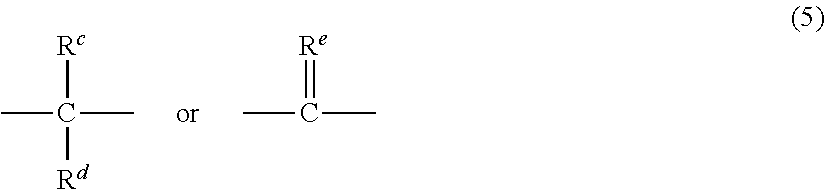
wherein Rc and Rd each independently represent a hydrogen atom or a monovalent linear or cyclic hydrocarbon group and Re is a divalent hydrocarbon group.

wherein D is a divalent radical derived from a dihydroxy compound, and may be, for example, a C2-10 alkylene radical, a C6-20 alicyclic radical, a C6-20 aromatic radical or a polyoxyalkylene radical in which the alkylene groups contain 2 to about 6 carbon atoms, specifically 2, 3, or 4 carbon atoms; and T is a divalent radical derived from a dicarboxylic acid, and may be, for example, a C2-10 alkylene radical, a C6-20 alicyclic radical, a C6-20 alkyl aromatic radical, or a C6-20 aromatic radical.

wherein each Rf is independently a C1-10 hydrocarbon group and n is 0 to 4. The halogen is usually bromine. Examples of compounds that may be represented by the formula (7) include resorcinol, substituted resorcinol compounds such as 5-methyl resorcinol, 5-ethyl resorcinol, 5-propyl resorcinol, 5-butyl resorcinol, 5-t-butyl resorcinol, 5-phenyl resorcinol, 5-cumyl resorcinol; catechol; hydroquinone; substituted hydroquinones such as 2-methyl hydroquinone, 2-ethyl hydroquinone, 2-propyl hydroquinone, 2-butyl hydroquinone, 2-t-butyl hydroquinone, 2-phenyl hydroquinone, 2-cumyl hydroquinone, 2,3,5,6-tetramethyl hydroquinone, 2,3,5,6-tetra-t-butyl hydroquinone; or combinations comprising at least one of the foregoing compounds.
HmPtOn (8)

wherein each G1 is independently a hydrocarbon having 1 to about 30 carbon atoms; each G2 is independently a hydrocarbon or hydrocarbonoxy having 1 to about 30 carbon atoms; each Xa is as defined above; each X is independently a hydrogen; m is 0 to 4, and n is 1 to about 30. Examples of suitable di- or polyfunctional aromatic phosphorus-containing compounds include resorcinol tetraphenyl diphosphate (RDP), the bis(diphenyl) phosphate of hydroquinone and the bis(diphenyl) phosphate of bisphenol-A, respectively, their oligomeric and polymeric counterparts, and the like.

wherein each occurrence of R is same or different, and is a C1-13 monovalent organic radical. For example, R may be a C1-C13 alkyl group, C1-C13 alkoxy group, C2-C13 alkenyl group, C2-C13 alkenyloxy group, C3-C6 cycloalkyl group, C3-C6 cycloalkoxy group, C6-C10 aryl group, C6-C10 aryloxy group, C7-C13 aralkyl group, C7-C13 aralkoxy group, C7-C13 alkaryl group, or C7-C13 alkaryloxy group. Combinations of the foregoing R groups may be used in the same copolymer.

wherein D is as defined above; each R may be the same or different, and is as defined above; and Ar may be the same or different, and is a substituted or unsubstituted C6-C30 arylene radical, wherein the bonds are directly connected to an aromatic moiety. Suitable Ar groups in formula (9) may be derived from a C6-C30 dihydroxyarylene compound, for example a dihydroxyarylene compound of formula (3), (4), or (7) above. Combinations comprising at least one of the foregoing dihydroxyarylene compounds may also be used. Specific examples of suitable dihydroxyarlyene compounds are 1,1-bis(4-hydroxyphenyl)methane, 1,1-bis(4-hydroxyphenyl)ethane, 2,2-bis(4-hydroxyphenyl) propane, 2,2-bis(4-hydroxyphenyl) butane, 2,2-bis(4-hydroxyphenyl) octane, 1,1-bis(4-hydroxyphenyl) propane, 1,1-bis(4-hydroxyphenyl) n-butane, 2,2-bis(4-hydroxy-1-methylphenyl) propane, 1,1-bis(4-hydroxyphenyl)cyclohexane, bis(4-hydroxyphenyl sulphide), and 1,1-bis(4-hydroxy-t-butylphenyl) propane. Combinations comprising at least one of the foregoing dihydroxy compounds may also be used.

wherein Ar and D are as described above. Such compounds are further described in U.S. Pat. No. 4,746,701 to Kress et al. Compounds of this formula may be obtained by the reaction of a dihydroxyarylene compound with, for example, an alpha, omega-bisacetoxypolydiorangonosiloxane under phase transfer conditions.

wherein R and D are as defined above. R2 in formula (20) is a divalent C2-C8 aliphatic group. Each M in formula (20) may be the same or different, and may be a halogen, cyano, nitro, C1-C8 alkylthio, C1-C8 alkyl, C1-C8 alkoxy, C2-C8 alkenyl, C2-C8 alkenyloxy group, C3-C8 cycloalkyl, C3-C8 cycloalkoxy, C6-C10 aryl, C6-C10 aryloxy, C7-C12 aralkyl, C7-C12 aralkoxy, C7-C12 alkaryl, or C7-C12 alkaryloxy, wherein each n is independently 0, 1, 2, 3, or 4.

wherein R, D, M, R2, and n are as described above.

wherein R and D are as previously defined, and an aliphatically unsaturated monohydric phenol. Suitable aliphatically unsaturated monohydric phenols included, for example, eugenol, 2-alkylphenol, 4-allyl-2-methylphenol, 4-allyl-2-phenylphenol, 4-allyl-2-t-butoxyphenol, 4-phenyl-2-phenylphenol, 2-methyl-4-propylphenol, 2-allyl-4,6-dimethylphenol, 2-allyl-6-methoxy-4-methylphenol and 2-allyl-4,6-dimethylphenol. Mixtures comprising at least one of the foregoing may also be used.
| TABLE 1 | ||
| Material | Description | Source |
| PC-1 | BPA polycarbonate resin having a weight | SABIC |
| average molecular weight (Mw) of 36,500 as | Innovative | |
| determined by gel permeation chromatography | Plastics | |
| (GPC) using polycarbonate standards | ||
| PC-2 | BPA polycarbonate resin having a weight | SABIC |
| average molecular weight (Mw) of 30,500 as | Innovative | |
| determined by GPC using polycarbonate | Plastics | |
| standards | ||
| PC-3 | A branched BPA polycarbonate resin made | SABIC |
| using THPE as the branching agent | Innovative | |
| Plastics | ||
| PC-4 | BPA polycarbonate resin having a weight | SABIC |
| average molecular weight (Mw) of 22.000 as | Innovative | |
| determined by GPC using polycarbonate | Plastics | |
| standards | ||
| PC-Si | A BPA polycarbonate-polysiloxane copolymer | SABIC |
| comprising about 20% by weight of siloxane, | Innovative | |
| 80% by weight BPA and encapped with paracumyl | Plastics | |
| phenol | ||
| Cyclic siloxane | Octaphenylcyclo tetrasiloxane | |
| Talc 1 | Talc having a median particle size of 2.0 | Specialty |
| micrometers and commercially available as | Materials, Inc. | |
| Talcron, grade MP 15-38 | ||
| Talc 2 | Talc having an average particle size of 1.1 | Luzenac |
| microns and commercially available as Jetfine | ||
| 3CA | ||
| TSAN | PTFE (polytetrafluoroethylene) encapsulated in | SABIC |
| SAN (50% fluoropolymer) | Innovative | |
| Plastics | ||
| Rimar salt | Potassium perfluorobutane sulfonate | LANXESS |
| (Shanghai) | ||
| Trading Co., | ||
| Ltd | ||
| KSS | Potassium diphenylsulfone sulfonate | SLOSS |
| INDUSTRIES | ||
| CORPORATION | ||
| NaTS | p-toluenesulfonic acid sodium salt | Arichem |
| Acid 1 | Phosphorous Acid (H3PO3) 45% acid in water | Quaron |
| Acid 2 | Mono Zinc Phosphate (Trade name Z21-82) | CFB |
| Budenheim | ||
| TABLE 2 | |||||||
| 1* | 2* | 3* | 4* | 5* | 6 | 7* | |
| PC-1 | 50.00 | 50.00 | 50.00 | 50.00 | 50.00 | 50.00 | 500.0 |
| PC-2 | 50.00 | 50.00 | 50.00 | 50.00 | 50.00 | 50.00 | 50.00 |
| Rimar salt | 0.52 | 0.10 | 0.52 | — | 0.10 | 0.52 | — |
| TSAN | 0.35 | 0.35 | 0.35 | 0.35 | 0.35 | 0.35 | 0.35 |
| Talc 1 | — | 5.00 | 5.00 | 5.00 | — | — | — |
| Talc 2 (fine talc) | — | — | — | — | 5.00 | 5.00 | 5.00 |
| Acid 1 | — | — | — | — | 0.12 | 0.12 | 0.12 |
| KSS | — | — | — | 0.05 | — | — | 0.05 |
| NaTS | — | — | — | 0.02 | — | — | 0.02 |
| UL94 FR Rating at 0.43 mm | V1 | F | V0 | F | F | V0 | F |
| *Comparative Example | |||||||
| TABLE 3 | |||||||||
| 8* | 9* | 10* | 11* | 12* | 13* | 14* | 15* | 16* | |
| PC-1 | 50.00 | 50.00 | 50.00 | 50.00 | 50.00 | 50.00 | 50.00 | 50.00 | 50.00 |
| PC-2 | 50.00 | 50.00 | 50.00 | 50.00 | 50.00 | 50.00 | 50.00 | 50.00 | 50.00 |
| TSAN | 0.35 | 0.35 | 0.35 | 0.35 | 0.35 | 0.35 | 0.35 | 0.35 | 0.35 |
| Talc 2 | 5.00 | 5.00 | 5.00 | 5.00 | 5.00 | 5.00 | 5.00 | 5.00 | 5.00 |
| Rimar salt | 0.40 | 0.30 | 0.30 | 0.20 | 0.20 | 0.30 | 0.30 | 0.20 | 0.20 |
| NaTS | 0.30 | 0.45 | 0.30 | 0.40 | — | — | — | — | |
| Acid 1 | 0.12 | 0.12 | 0.12 | 0.12 | 0.12 | 0.12 | 0.12 | 0.12 | 0.12 |
| KSS | — | — | — | — | — | 0.30 | 0.45 | 0.30 | 0.40 |
| UL94 FR Rating at 0.43 mm | V1 | F | F | F | F | F | F | F | F |
| *Comparative Example | |||||||||
| TABLE 4 | |||||
| Unit | 17 | 18* | 19* | ||
| PC-1 | 47.00 | 47.00 | 47.00 | |
| PC-2 | 47.00 | 47.00 | 47.00 | |
| Rimar salt | 0.50 | 0.40 | 0.30 | |
| TSAN | 0.35 | 0.35 | 0.35 | |
| Talc 2 | 5.00 | 5.00 | 5.00 | |
| Acid 1 | 0.12 | 0.12 | 0.12 | |
| Properties/Methods | ||||
| UL 94 Rating @ 0.5 mm | — | V0 | V0-V1 | V0-V1 |
| UL 94 Rating @ 0.43 mm | V0 | — | — | |
| UL 94 Rating @ 0.38 mm | V0 | — | — | |
| UL 94 Rating @ 0.25 mm | VTM0 | — | — | |
| UL 94 Rating @ 0.17 mm | VTM0 | — | — | |
| Notched Impact Strength, | J/m | 1090 | — | — |
| 23 C. | ||||
| Ductility | % | 100 | — | — |
| Modulus of Elasticity | MPa | 2704 | — | — |
| Stress at Yield | MPa | 62 | — | — |
| Stress at Break | MPa | 67 | — | — |
| Elongation at Yield | % | 6 | — | — |
| Elongation at Break | % | 95 | — | — |
| HDT, 1.82 MPa, 3.2 mm | ° C. | 131 | ||
| VST, 50N, 120 C./h | ° C. | 151 | — | — |
| *Comparative Example | ||||
| TABLE 5 | |||||
| Units | 20* | 21* | 22* | 23 | |
| PC-1 | 50.00 | 50.00 | 50.00 | 50.00 | |
| PC-2 | 50.00 | 50.00 | 50.00 | 50.00 | |
| Rimar salt | 0.10 | 0.52 | 0.10 | 0.52 | |
| TSAN | 0.35 | 0.35 | 0.35 | 0.35 | |
| Talc 1 | 5.00 | 5.00 | — | — | |
| Talc 2 | — | — | 5.00 | 5.00 | |
| Acid 1 | — | — | 0.12 | 0.12 | |
| MVR, 300° C., 1.2 Kg, 360 s | cm3/10 min | 10.9 | 9.9 | 4.69 | 4.74 |
| UL94 Rating @ 0.43 mm | F | V0 | F | V0 | |
| *Comparative Examples | |||||
| TABLE 6 | |||||||
| Item Description | Unit | 24* | 25 | 26 | 27 | 28 | 29 |
| PC-1 | 47.00 | 47.00 | 47.00 | 47.00 | 47.00 | 47.00 | |
| PC-2 | 47.00 | 47.00 | 47.00 | 47.00 | 47.00 | 47.00 | |
| Rimar salt | 0.50 | 0.50 | 0.50 | 0.50 | 0.50 | 0.50 | |
| TSAN | 0.35 | 0.35 | 0.35 | 0.35 | 0.35 | 0.35 | |
| Talc 2 | 5.00 | 5.00 | 5.00 | 5.00 | 5.00 | 5.00 | |
| Acid 1 | 0 | 0.06 | 0.09 | 0.12 | 0.15 | 0.18 |
| Before aging |
| MVR, 300° C., 1.2 Kg, 360 | scm3/10 min | 27.3 | 7.2 | 5.0 | 5.0 | 5.3 | 5.4 |
| Mw | Daltons | 45205 | 58438 | 61741 | 61838 | 61275 | 61110 |
| Modulus of Elasticity | MPa | 2784 | 2728 | 2700 | 2704 | 2737 | 2723 |
| Stress at Yield | MPa | 63 | 61 | 61 | 62 | 61 | 61 |
| Thermo-aging at 120° C. for 1000 hours |
| MVR, 300° C., 1.2 Kg, 360 | scm3/10 min | 47.6 | 7.3 | 5.5 | 5.1 | 5.3 | 5.4 |
| Mw | Daltons | 44805 | 57783 | 60643 | 61412 | 60687 | 60236 |
| Modulus of Elasticity | MPa | 2923 | 2814 | 2804 | 2819 | 2809 | 2825 |
| Stress at Yield | MPa | 77 | 73 | 73 | 73 | 73 | 73 |
| Hydro-aging at 80° C., 85% Relative Humidity for 1000 hours |
| MVR, 300° C., 1.2 Kg, 360 | scm3/10 min | 24.0 | 8.3 | 6.7 | 6.8 | 6.7 | 7.4 |
| Mw | Daltons | 44056 | 55971 | 57279 | 57147 | 56610 | 56363 |
| Modulus of Elasticity | MPa | 2942 | 2844 | 2827 | 2850 | 2864 | 2857 |
| Stress at Yield | MPa | 68 | 65 | 65 | 65 | 65 | 65 |
| *Comparative Example | |||||||
| TABLE 7 | |||||
| 30* | 31* | 32* | 33* | ||
| PC-Si | — | — | 5.00 | 5.00 | ||
| Cyclic siloxance | 0.25 | 0.25 | — | — | ||
| PC-1 | 50.00 | — | 50.00 | — | ||
| PC-3 | — | 50.00 | — | 50.00 | ||
| PC-2 | 50.00 | — | 45.00 | — | ||
| PC-4 | — | 50.00 | — | 45.00 | ||
| Rimar salt | 0.52 | 0.52 | 0.52 | 0.52 | ||
| TSAN | 0.35 | 0.35 | 0.35 | 0.35 | ||
| UL94 FR Rating at 0.5 mm | F | F | F | F | ||
| *Comparative Example | ||||||
| TABLE 8 | ||||||
| 34* | 35* | 36* | 37* | |||
| PC-Si | 83.00 | 83.00 | 83.00 | 83.00 | ||
| PC-4 | 17.00 | 17.00 | 17.00 | 17.00 | ||
| stabilizer | 0.06 | 0.06 | 0.06 | 0.06 | ||
| TSAN | 0.50 | 0.50 | 0.35 | 0.35 | ||
| Talc 1 | 5.00 | — | 5.00 | — | ||
| Talc 2 | — | 5.00 | — | 5.00 | ||
| Acid 1 | — | 0.12 | — | 0.12 | ||
| KSS | 0.05 | 0.05 | 0.05 | 0.05 | ||
| NaTS | 0.02 | 0.02 | 0.02 | 0.02 | ||
| UL94 FR Rating | F | F | F | F | ||
| @ 0.43 mm | ||||||
| *Comparative Example | ||||||
| TABLE 9 | ||||
| 38 | 39* | 40* | ||
| PC-1 | 47 | 47 | 47 | ||
| PC-2 | 47 | 47 | 47 | ||
| TSAN | 0.35 | 0.35 | 0.35 | ||
| Talc 2 | 5 | 5 | 5 | ||
| Acid 1 | 0.12 | — | — | ||
| p-toluenesulfonic acid | — | 0.12 | 0.15 | ||
| Rimar salt | 0.5 | 0.5 | 0.5 | ||
| MVR, 300 C., 1.2 Kg, 360 s | 5.7 | 14.7 | 9.9 | ||
| *Comparative example | |||||
Claims (16)
Priority Applications (8)
| Application Number | Priority Date | Filing Date | Title |
|---|---|---|---|
| US12/546,874 US9458315B2 (en) | 2009-08-25 | 2009-08-25 | Flame retardant thermoplastic polycarbonate compositions and films made therefrom |
| TW099128101A TWI476247B (en) | 2009-08-25 | 2010-08-23 | Flame retardant thermoplastic polycarbonate compositions and films made therefrom |
| KR1020127004965A KR20120060208A (en) | 2009-08-25 | 2010-08-24 | Flame retardant thermoplastic polycarbonate compositions and films made therefrom |
| KR1020167006436A KR101751870B1 (en) | 2009-08-25 | 2010-08-24 | Flame retardant thermoplastic polycarbonate compositions and films made therefrom |
| PCT/US2010/046445 WO2011028511A1 (en) | 2009-08-25 | 2010-08-24 | Flame retardant thermoplastic polycarbonate compositions and films made therefrom |
| JP2012526901A JP5788881B2 (en) | 2009-08-25 | 2010-08-24 | Flame retardant thermoplastic polycarbonate compositions and films made therefrom |
| EP10747555.0A EP2470594B1 (en) | 2009-08-25 | 2010-08-24 | Flame retardant thermoplastic polycarbonate compositions and films made therefrom |
| CN201080035969.2A CN102471528B (en) | 2009-08-25 | 2010-08-24 | Flame retardant thermoplastic polycarbonate compositions and films made therefrom |
Applications Claiming Priority (1)
| Application Number | Priority Date | Filing Date | Title |
|---|---|---|---|
| US12/546,874 US9458315B2 (en) | 2009-08-25 | 2009-08-25 | Flame retardant thermoplastic polycarbonate compositions and films made therefrom |
Publications (2)
| Publication Number | Publication Date |
|---|---|
| US20110052895A1 US20110052895A1 (en) | 2011-03-03 |
| US9458315B2 true US9458315B2 (en) | 2016-10-04 |
Family
ID=43127432
Family Applications (1)
| Application Number | Title | Priority Date | Filing Date |
|---|---|---|---|
| US12/546,874 Active 2029-09-15 US9458315B2 (en) | 2009-08-25 | 2009-08-25 | Flame retardant thermoplastic polycarbonate compositions and films made therefrom |
Country Status (7)
| Country | Link |
|---|---|
| US (1) | US9458315B2 (en) |
| EP (1) | EP2470594B1 (en) |
| JP (1) | JP5788881B2 (en) |
| KR (2) | KR20120060208A (en) |
| CN (1) | CN102471528B (en) |
| TW (1) | TWI476247B (en) |
| WO (1) | WO2011028511A1 (en) |
Cited By (1)
| Publication number | Priority date | Publication date | Assignee | Title |
|---|---|---|---|---|
| US11732128B2 (en) | 2017-12-29 | 2023-08-22 | Lotte Chemical Corporation | Thermoplastic polycarbonate resin composition and molded product formed therefrom |
Families Citing this family (17)
| Publication number | Priority date | Publication date | Assignee | Title |
|---|---|---|---|---|
| KR20140054061A (en) * | 2011-07-14 | 2014-05-08 | 폴리원 코포레이션 | Non-halogenated flame retardant polycarbonate compounds |
| CN107254155A (en) * | 2011-11-21 | 2017-10-17 | 沙特基础全球技术有限公司 | Flame retardant thermoplastic polycarbonate compositions |
| KR101946671B1 (en) * | 2011-12-02 | 2019-04-22 | 데이진 가부시키가이샤 | Flame-resistant resin composition containing polycarbonate-polydiorganosiloxane copolymer resin and article molded therefrom |
| CN103421289A (en) * | 2012-05-22 | 2013-12-04 | 奇菱科技股份有限公司 | Fire Composite |
| CN104487512B (en) * | 2012-07-25 | 2016-10-12 | 普立万公司 | Non-halogenated fire retardant polycarbonate compound |
| CN105026459B (en) | 2012-12-20 | 2018-11-06 | 沙特基础全球技术有限公司 | Cross-linked polycarbonate resin with improved chemical resistance and anti-flammability |
| JP6196072B2 (en) * | 2013-05-29 | 2017-09-13 | 帝人株式会社 | Resin composition for decorative molding |
| CN103333478A (en) * | 2013-06-26 | 2013-10-02 | 江苏启蓝新材料有限公司 | Halogen-free flame-retardant polycarbonate and preparation method thereof |
| JP6150945B2 (en) | 2013-07-01 | 2017-06-21 | エルジー・ケム・リミテッド | Polyorganosiloxane compound, production method and copolycarbonate resin containing the same |
| TWI508994B (en) * | 2013-12-27 | 2015-11-21 | Chi Mei Corp | Polycarbonate composition |
| WO2015188084A1 (en) * | 2014-06-06 | 2015-12-10 | General Cable Technologies Corporation | Foamed polycarbonate separators and cables thereof |
| KR101729747B1 (en) | 2015-04-06 | 2017-04-24 | 한국신발피혁연구원 | Primer composition for flameretardant film |
| KR101950062B1 (en) * | 2015-12-30 | 2019-02-19 | 롯데첨단소재(주) | Thermoplastic resin composition and article comprising the same |
| JP6789510B2 (en) * | 2017-02-08 | 2020-11-25 | 東洋製罐グループホールディングス株式会社 | Bio-related molecule immobilization carrier |
| KR20190054015A (en) | 2017-11-11 | 2019-05-21 | 강은비 | A curling iron and a blow dryer |
| KR102946596B1 (en) | 2018-08-24 | 2026-03-31 | 사빅 글로벌 테크놀러지스 비.브이. | Flame-retardant composition containing polysiloxane |
| CN114450348B (en) * | 2019-09-30 | 2024-11-12 | 高新特殊工程塑料全球技术有限公司 | Flame retardant polycarbonate composition and thin-walled products made therefrom |
Citations (24)
| Publication number | Priority date | Publication date | Assignee | Title |
|---|---|---|---|---|
| US4154775A (en) | 1977-09-06 | 1979-05-15 | General Electric Company | Flame retardant composition of polyphenylene ether, styrene resin and cyclic phosphate |
| EP0174752A2 (en) | 1984-09-12 | 1986-03-19 | Samuel J. Hepko | Internal combustion engines |
| US4746701A (en) | 1985-02-26 | 1988-05-24 | Bayer Aktiengesellschaft | Thermoplastics moulding compositions based on polysiloxane/polycarbonate block copolymers |
| US5449710A (en) * | 1993-05-18 | 1995-09-12 | Idemitsu Petrochemical Co., Ltd. | Flame retardative polycarbonate resin composition |
| US5608027A (en) | 1994-05-19 | 1997-03-04 | General Electric Company | Complex stabilizer composition to improve the melt stability and color stability of polycarbonates |
| JP2005105206A (en) | 2003-10-01 | 2005-04-21 | Asahi Kasei Chemicals Corp | Aromatic polycarbonate flame retardant resin composition |
| US20050182165A1 (en) | 2004-02-03 | 2005-08-18 | Shiping Ma | Polycarbonate compositions with thin-wall flame retardance |
| US7019059B2 (en) * | 2002-12-16 | 2006-03-28 | General Electric Company | Method for making fire-retarded glass-filled polycarbonate and related compositions |
| US7060780B2 (en) | 2002-03-18 | 2006-06-13 | Asahi Kasei Chemicals Corporation | Moldings of flame-retardant aromatic polycarbonate resin compositions |
| JP2006316149A (en) | 2005-05-11 | 2006-11-24 | Sumitomo Dow Ltd | Flame-retardant polycarbonate resin film |
| US20060287422A1 (en) * | 2005-06-16 | 2006-12-21 | General Electric Company | Thermoplastic polycarbonate compositions with improved mechanical properties, articles made therefrom and method of manufacture |
| US7160937B2 (en) | 2002-12-26 | 2007-01-09 | Asahi Kasei Chemicals Corporation | Flame retardant aromatic polycarbonate resin composition |
| US7223804B2 (en) * | 2003-12-30 | 2007-05-29 | General Electric Company | Polycarbonate composition |
| JP2007153983A (en) | 2005-12-02 | 2007-06-21 | Asahi Kasei Chemicals Corp | Bending product of flame retardant resin composition |
| US20070232739A1 (en) | 2006-03-30 | 2007-10-04 | General Electric Company | Thermoplastic polycarbonate compositions with improved mechanical properties, articles made therefrom and method of manufacture |
| US20070231576A1 (en) * | 2005-09-30 | 2007-10-04 | Davis M S | Multilayer films comprising tie layer compositions, articles prepared therefrom, and method of making |
| US20070232744A1 (en) | 2006-03-30 | 2007-10-04 | General Electric Company | Thermoplastic polycarbonate compositions with improved mechanical properties, articles made therefrom and method of manufacture |
| US20070257401A1 (en) | 2004-11-01 | 2007-11-08 | Hidenori Nakagawa | Resin Composition and Flat Panel Display Fixing Frame |
| US20080063861A1 (en) * | 2004-04-27 | 2008-03-13 | Kazuhiro Shibuya | Aromatic Polycarbonate Molded Article and Resin Composition |
| US7462662B2 (en) | 2003-07-10 | 2008-12-09 | Sabic Innovative Plastics Ip B.V. | Fire-retarded polycarbonate resin composition |
| US7652083B2 (en) * | 2006-09-29 | 2010-01-26 | Sabic Innovative Plastics Ip B.V. | Thermoplastic compostions, methods of making, and articles formed therefrom |
| US7709562B2 (en) * | 2006-09-29 | 2010-05-04 | Sabic Innovative Plastics Ip B.V. | Thermoplastic compositions, methods of making, and articles formed therefrom |
| US20100168295A1 (en) * | 2005-08-16 | 2010-07-01 | Christine Breiner | Polycarbonate Flame Retardant Compositions |
| US7799855B2 (en) * | 2001-11-12 | 2010-09-21 | Sabic Innovative Plastics Ip B.V. | Flame retardant thermoplastic polycarbonate compositions, use and method thereof |
-
2009
- 2009-08-25 US US12/546,874 patent/US9458315B2/en active Active
-
2010
- 2010-08-23 TW TW099128101A patent/TWI476247B/en not_active IP Right Cessation
- 2010-08-24 KR KR1020127004965A patent/KR20120060208A/en not_active Ceased
- 2010-08-24 CN CN201080035969.2A patent/CN102471528B/en active Active
- 2010-08-24 KR KR1020167006436A patent/KR101751870B1/en active Active
- 2010-08-24 WO PCT/US2010/046445 patent/WO2011028511A1/en not_active Ceased
- 2010-08-24 JP JP2012526901A patent/JP5788881B2/en not_active Expired - Fee Related
- 2010-08-24 EP EP10747555.0A patent/EP2470594B1/en active Active
Patent Citations (25)
| Publication number | Priority date | Publication date | Assignee | Title |
|---|---|---|---|---|
| US4154775A (en) | 1977-09-06 | 1979-05-15 | General Electric Company | Flame retardant composition of polyphenylene ether, styrene resin and cyclic phosphate |
| EP0174752A2 (en) | 1984-09-12 | 1986-03-19 | Samuel J. Hepko | Internal combustion engines |
| US4746701A (en) | 1985-02-26 | 1988-05-24 | Bayer Aktiengesellschaft | Thermoplastics moulding compositions based on polysiloxane/polycarbonate block copolymers |
| US5449710A (en) * | 1993-05-18 | 1995-09-12 | Idemitsu Petrochemical Co., Ltd. | Flame retardative polycarbonate resin composition |
| US5608027A (en) | 1994-05-19 | 1997-03-04 | General Electric Company | Complex stabilizer composition to improve the melt stability and color stability of polycarbonates |
| US7799855B2 (en) * | 2001-11-12 | 2010-09-21 | Sabic Innovative Plastics Ip B.V. | Flame retardant thermoplastic polycarbonate compositions, use and method thereof |
| US7060780B2 (en) | 2002-03-18 | 2006-06-13 | Asahi Kasei Chemicals Corporation | Moldings of flame-retardant aromatic polycarbonate resin compositions |
| US7183342B2 (en) | 2002-03-18 | 2007-02-27 | Asahi Kasei Chemicals Corporation | Flame-retardant aromatic polycarbonate resin composition |
| US7019059B2 (en) * | 2002-12-16 | 2006-03-28 | General Electric Company | Method for making fire-retarded glass-filled polycarbonate and related compositions |
| US7160937B2 (en) | 2002-12-26 | 2007-01-09 | Asahi Kasei Chemicals Corporation | Flame retardant aromatic polycarbonate resin composition |
| US7462662B2 (en) | 2003-07-10 | 2008-12-09 | Sabic Innovative Plastics Ip B.V. | Fire-retarded polycarbonate resin composition |
| JP2005105206A (en) | 2003-10-01 | 2005-04-21 | Asahi Kasei Chemicals Corp | Aromatic polycarbonate flame retardant resin composition |
| US7223804B2 (en) * | 2003-12-30 | 2007-05-29 | General Electric Company | Polycarbonate composition |
| US20050182165A1 (en) | 2004-02-03 | 2005-08-18 | Shiping Ma | Polycarbonate compositions with thin-wall flame retardance |
| US20080063861A1 (en) * | 2004-04-27 | 2008-03-13 | Kazuhiro Shibuya | Aromatic Polycarbonate Molded Article and Resin Composition |
| US20070257401A1 (en) | 2004-11-01 | 2007-11-08 | Hidenori Nakagawa | Resin Composition and Flat Panel Display Fixing Frame |
| JP2006316149A (en) | 2005-05-11 | 2006-11-24 | Sumitomo Dow Ltd | Flame-retardant polycarbonate resin film |
| US20060287422A1 (en) * | 2005-06-16 | 2006-12-21 | General Electric Company | Thermoplastic polycarbonate compositions with improved mechanical properties, articles made therefrom and method of manufacture |
| US20100168295A1 (en) * | 2005-08-16 | 2010-07-01 | Christine Breiner | Polycarbonate Flame Retardant Compositions |
| US20070231576A1 (en) * | 2005-09-30 | 2007-10-04 | Davis M S | Multilayer films comprising tie layer compositions, articles prepared therefrom, and method of making |
| JP2007153983A (en) | 2005-12-02 | 2007-06-21 | Asahi Kasei Chemicals Corp | Bending product of flame retardant resin composition |
| US20070232739A1 (en) | 2006-03-30 | 2007-10-04 | General Electric Company | Thermoplastic polycarbonate compositions with improved mechanical properties, articles made therefrom and method of manufacture |
| US20070232744A1 (en) | 2006-03-30 | 2007-10-04 | General Electric Company | Thermoplastic polycarbonate compositions with improved mechanical properties, articles made therefrom and method of manufacture |
| US7652083B2 (en) * | 2006-09-29 | 2010-01-26 | Sabic Innovative Plastics Ip B.V. | Thermoplastic compostions, methods of making, and articles formed therefrom |
| US7709562B2 (en) * | 2006-09-29 | 2010-05-04 | Sabic Innovative Plastics Ip B.V. | Thermoplastic compositions, methods of making, and articles formed therefrom |
Non-Patent Citations (8)
| Title |
|---|
| International Search Report; International Application No. PCT/US2010/046445; International Filing Date: Aug. 24, 2010; Date of Mailing: Dec. 6, 2010; 4 Pages. |
| Japanese Publication No. 2005048048, published Feb. 24, 2005, Abstract Only, 1 page. |
| Japanese Publication No. 2005068272, published Mar. 17, 2005, Abstract Only, 1 page. |
| Japanese Publication No. 2005105206, published Apr. 21, 2005, Abstract Only, 1 page. |
| Japanese Publication No. 2006008744, published Jan. 12, 2006, Abstract Only, 1 page. |
| Japanese Publication No. 2008222852, Published Sep. 25, 2008, Abstract Only , 1 page. |
| UL94, Tests for Flammability of Plastic Materials for Parts in Devices and Appliances, revised Dec. 12, 2003, 52 pages. |
| Written Opinion of the International Searching Authority; International Application No. PCT/US2010/046445; International Filing Date: Aug. 24, 2010; Date of Mailing: Dec. 6, 2010; 5 Pages. |
Cited By (1)
| Publication number | Priority date | Publication date | Assignee | Title |
|---|---|---|---|---|
| US11732128B2 (en) | 2017-12-29 | 2023-08-22 | Lotte Chemical Corporation | Thermoplastic polycarbonate resin composition and molded product formed therefrom |
Also Published As
| Publication number | Publication date |
|---|---|
| TWI476247B (en) | 2015-03-11 |
| EP2470594B1 (en) | 2015-05-27 |
| KR20160033244A (en) | 2016-03-25 |
| CN102471528A (en) | 2012-05-23 |
| KR20120060208A (en) | 2012-06-11 |
| KR101751870B1 (en) | 2017-06-28 |
| TW201124468A (en) | 2011-07-16 |
| EP2470594A1 (en) | 2012-07-04 |
| JP2013503247A (en) | 2013-01-31 |
| US20110052895A1 (en) | 2011-03-03 |
| CN102471528B (en) | 2014-08-13 |
| JP5788881B2 (en) | 2015-10-07 |
| WO2011028511A1 (en) | 2011-03-10 |
Similar Documents
| Publication | Publication Date | Title |
|---|---|---|
| US9458315B2 (en) | Flame retardant thermoplastic polycarbonate compositions and films made therefrom | |
| US8552096B2 (en) | Flame-retardant reinforced polycarbonate compositions | |
| US7695815B2 (en) | Low smoke polycarbonate composition and laminates, method of manufacture and product made therefrom | |
| AU2005100612B4 (en) | Thermoplastic polycarbonate compositions with improved mechanical properties, articles made therefrom and method of manufacture | |
| US7365125B2 (en) | Polycarbonate compositions, articles, and method of manufacture | |
| EP2203520B1 (en) | Polycarbonate composition having improved impact, flammability and surface appearance, method of making, and articles prepared therefrom | |
| US8883878B2 (en) | Thermoplastic polycarbonate compositions | |
| US7994248B2 (en) | Flame retardant thermoplastic polycarbonate compositions | |
| US8871858B2 (en) | Thermoplastic polycarbonate compositions | |
| US20090306258A1 (en) | Low smoke polycarbonate composition, method of manufacture and product made therefrom | |
| US20070049706A1 (en) | Low smoke polycarbonate composition, method of manufacture and product made therefrom | |
| US20080015289A1 (en) | Flame retardant and chemical resistant thermoplastic polycarbonate compositions | |
| US20080015291A1 (en) | Flame retardant and scratch resistant thermoplastic polycarbonate compositions | |
| US20080015292A1 (en) | Flame retardant and scratch resistant thermoplastic polycarbonate compositions | |
| WO2007114990A1 (en) | Thermoplastic polycarbonate compositions with improved mechanical properties, articles made therefrom and method of manufacture | |
| WO2007117847A1 (en) | Thermoplastic polycarbonate compositions with improved mechanical properties, articles made therefrom and method of manufacture | |
| US20250051572A1 (en) | Flame retardant thermoplastic polycarbonate compositions and films made therefrom |
Legal Events
| Date | Code | Title | Description |
|---|---|---|---|
| AS | Assignment |
Owner name: SABIC INNOVATIVE PLASTICS, IP B.V., NETHERLANDS Free format text: ASSIGNMENT OF ASSIGNORS INTEREST;ASSIGNORS:LI, YING;XU, YUZHEN;ROSENQUIST, NILES;AND OTHERS;REEL/FRAME:023162/0336 Effective date: 20090825 |
|
| AS | Assignment |
Owner name: CITIBANK, N.A., AS COLLATERAL AGENT, NEW YORK Free format text: SECURITY AGREEMENT;ASSIGNOR:SABIC INNOVATIVE PLASTICS IP B.V.;REEL/FRAME:024005/0462 Effective date: 20100209 |
|
| AS | Assignment |
Owner name: SABIC INNOVATIVE PLASTICS IP B.V., NETHERLANDS Free format text: RELEASE BY SECURED PARTY;ASSIGNOR:CITIBANK, N.A.;REEL/FRAME:032459/0798 Effective date: 20140312 |
|
| AS | Assignment |
Owner name: SABIC GLOBAL TECHNOLOGIES B.V., NETHERLANDS Free format text: CHANGE OF NAME;ASSIGNOR:SABIC INNOVATIVE PLASTICS IP B.V.;REEL/FRAME:033591/0673 Effective date: 20140402 |
|
| AS | Assignment |
Owner name: SABIC GLOBAL TECHNOLOGIES B.V., NETHERLANDS Free format text: CORRECTIVE ASSIGNMENT TO CORRECT REMOVE 10 APPL. NUMBERS PREVIOUSLY RECORDED AT REEL: 033591 FRAME: 0673. ASSIGNOR(S) HEREBY CONFIRMS THE CHANGE OF NAME;ASSIGNOR:SABIC INNOVATIVE PLASTICS IP B.V.;REEL/FRAME:033649/0529 Effective date: 20140402 |
|
| AS | Assignment |
Owner name: SABIC GLOBAL TECHNOLOGIES B.V., NETHERLANDS Free format text: CORRECTIVE ASSIGNMENT TO CORRECT THE 12/116841, 12/123274, 12/345155, 13/177651, 13/234682, 13/259855, 13/355684, 13/904372, 13/956615, 14/146802, 62/011336 PREVIOUSLY RECORDED ON REEL 033591 FRAME 0673. ASSIGNOR(S) HEREBY CONFIRMS THE CHANGE OF NAME;ASSIGNOR:SABIC INNOVATIVE PLASTICS IP B.V.;REEL/FRAME:033663/0427 Effective date: 20140402 |
|
| FEPP | Fee payment procedure |
Free format text: PAYOR NUMBER ASSIGNED (ORIGINAL EVENT CODE: ASPN); ENTITY STATUS OF PATENT OWNER: LARGE ENTITY |
|
| STCF | Information on status: patent grant |
Free format text: PATENTED CASE |
|
| MAFP | Maintenance fee payment |
Free format text: PAYMENT OF MAINTENANCE FEE, 4TH YEAR, LARGE ENTITY (ORIGINAL EVENT CODE: M1551); ENTITY STATUS OF PATENT OWNER: LARGE ENTITY Year of fee payment: 4 |
|
| MAFP | Maintenance fee payment |
Free format text: PAYMENT OF MAINTENANCE FEE, 8TH YEAR, LARGE ENTITY (ORIGINAL EVENT CODE: M1552); ENTITY STATUS OF PATENT OWNER: LARGE ENTITY Year of fee payment: 8 |