US9458303B1 - Recycling of styrene butadiene rubber and like materials - Google Patents
Recycling of styrene butadiene rubber and like materials Download PDFInfo
- Publication number
- US9458303B1 US9458303B1 US14/560,614 US201414560614A US9458303B1 US 9458303 B1 US9458303 B1 US 9458303B1 US 201414560614 A US201414560614 A US 201414560614A US 9458303 B1 US9458303 B1 US 9458303B1
- Authority
- US
- United States
- Prior art keywords
- chloramine
- reactor
- monochloramine
- solution
- sbr
- Prior art date
- Legal status (The legal status is an assumption and is not a legal conclusion. Google has not performed a legal analysis and makes no representation as to the accuracy of the status listed.)
- Active, expires
Links
Images




Classifications
-
- C—CHEMISTRY; METALLURGY
- C08—ORGANIC MACROMOLECULAR COMPOUNDS; THEIR PREPARATION OR CHEMICAL WORKING-UP; COMPOSITIONS BASED THEREON
- C08J—WORKING-UP; GENERAL PROCESSES OF COMPOUNDING; AFTER-TREATMENT NOT COVERED BY SUBCLASSES C08B, C08C, C08F, C08G or C08H
- C08J11/00—Recovery or working-up of waste materials
- C08J11/04—Recovery or working-up of waste materials of polymers
- C08J11/10—Recovery or working-up of waste materials of polymers by chemically breaking down the molecular chains of polymers or breaking of crosslinks, e.g. devulcanisation
- C08J11/16—Recovery or working-up of waste materials of polymers by chemically breaking down the molecular chains of polymers or breaking of crosslinks, e.g. devulcanisation by treatment with inorganic material
-
- C—CHEMISTRY; METALLURGY
- C08—ORGANIC MACROMOLECULAR COMPOUNDS; THEIR PREPARATION OR CHEMICAL WORKING-UP; COMPOSITIONS BASED THEREON
- C08J—WORKING-UP; GENERAL PROCESSES OF COMPOUNDING; AFTER-TREATMENT NOT COVERED BY SUBCLASSES C08B, C08C, C08F, C08G or C08H
- C08J11/00—Recovery or working-up of waste materials
- C08J11/04—Recovery or working-up of waste materials of polymers
- C08J11/10—Recovery or working-up of waste materials of polymers by chemically breaking down the molecular chains of polymers or breaking of crosslinks, e.g. devulcanisation
- C08J11/18—Recovery or working-up of waste materials of polymers by chemically breaking down the molecular chains of polymers or breaking of crosslinks, e.g. devulcanisation by treatment with organic material
- C08J11/28—Recovery or working-up of waste materials of polymers by chemically breaking down the molecular chains of polymers or breaking of crosslinks, e.g. devulcanisation by treatment with organic material by treatment with organic compounds containing nitrogen, sulfur or phosphorus
-
- B—PERFORMING OPERATIONS; TRANSPORTING
- B01—PHYSICAL OR CHEMICAL PROCESSES OR APPARATUS IN GENERAL
- B01J—CHEMICAL OR PHYSICAL PROCESSES, e.g. CATALYSIS OR COLLOID CHEMISTRY; THEIR RELEVANT APPARATUS
- B01J8/00—Chemical or physical processes in general, conducted in the presence of fluids and solid particles; Apparatus for such processes
- B01J8/08—Chemical or physical processes in general, conducted in the presence of fluids and solid particles; Apparatus for such processes with moving particles
- B01J8/082—Controlling processes
-
- B—PERFORMING OPERATIONS; TRANSPORTING
- B01—PHYSICAL OR CHEMICAL PROCESSES OR APPARATUS IN GENERAL
- B01J—CHEMICAL OR PHYSICAL PROCESSES, e.g. CATALYSIS OR COLLOID CHEMISTRY; THEIR RELEVANT APPARATUS
- B01J2208/00—Processes carried out in the presence of solid particles; Reactors therefor
- B01J2208/00008—Controlling the process
- B01J2208/00548—Flow
-
- B—PERFORMING OPERATIONS; TRANSPORTING
- B01—PHYSICAL OR CHEMICAL PROCESSES OR APPARATUS IN GENERAL
- B01J—CHEMICAL OR PHYSICAL PROCESSES, e.g. CATALYSIS OR COLLOID CHEMISTRY; THEIR RELEVANT APPARATUS
- B01J2208/00—Processes carried out in the presence of solid particles; Reactors therefor
- B01J2208/00796—Details of the reactor or of the particulate material
- B01J2208/00893—Feeding means for the reactants
-
- C—CHEMISTRY; METALLURGY
- C08—ORGANIC MACROMOLECULAR COMPOUNDS; THEIR PREPARATION OR CHEMICAL WORKING-UP; COMPOSITIONS BASED THEREON
- C08J—WORKING-UP; GENERAL PROCESSES OF COMPOUNDING; AFTER-TREATMENT NOT COVERED BY SUBCLASSES C08B, C08C, C08F, C08G or C08H
- C08J2309/00—Characterised by the use of homopolymers or copolymers of conjugated diene hydrocarbons
- C08J2309/06—Copolymers with styrene
-
- Y—GENERAL TAGGING OF NEW TECHNOLOGICAL DEVELOPMENTS; GENERAL TAGGING OF CROSS-SECTIONAL TECHNOLOGIES SPANNING OVER SEVERAL SECTIONS OF THE IPC; TECHNICAL SUBJECTS COVERED BY FORMER USPC CROSS-REFERENCE ART COLLECTIONS [XRACs] AND DIGESTS
- Y02—TECHNOLOGIES OR APPLICATIONS FOR MITIGATION OR ADAPTATION AGAINST CLIMATE CHANGE
- Y02W—CLIMATE CHANGE MITIGATION TECHNOLOGIES RELATED TO WASTEWATER TREATMENT OR WASTE MANAGEMENT
- Y02W30/00—Technologies for solid waste management
- Y02W30/50—Reuse, recycling or recovery technologies
- Y02W30/62—Plastics recycling; Rubber recycling
Definitions
- the embodiments described herein relate to degrading vulcanized styrene butadiene rubber as a step in the recycling process.
- Styrene butadiene rubber having a structural formula as shown in FIG. 1 , has the highest volume production in this country of any synthetic rubber. It is used extensively in the manufacture of automobile tires and tire-related products, as well as other products, including but not limited to sporting goods, hoses, footwear, flooring, wire and cable, raincoats, and rain boots. There is a significant need for effective recycling methods for SBR. The number of spent automobile tires discarded annually is estimated in the hundreds of millions. Hundreds of millions of tires from used automobiles are discarded annually, while the number of new automobile tires put into service each year, from new car production only, is estimated to exceed three hundred million.
- SBR is synthesized by a process known as emulsion polymerization, which is known in the art. Polymerization of the styrene and butadiene copolymers is initialized in the aqueous phase to form a latex material at an approximate ratio of butadiene to styrene of about 3:1. The synthesized polymer then undergoes vulcanization to form sulfur cross-links, represented in FIG. 2 , which help to impart upon the styrene butadiene base polymer the properties that are generally associated with rubber.
- the rubber After vulcanization, the rubber is compounded with additives which are also known in the art, to enhance properties of the rubber such as tensile strength, elongation resilience, hardness, and abrasion resistance.
- additives which are also known in the art, to enhance properties of the rubber such as tensile strength, elongation resilience, hardness, and abrasion resistance.
- Table I presents typical compositions of SBR used for tire tread, in which PHR refers to parts per 100 parts of SBR base polymer.
- SBR and virtually all other vulcanized rubbers, are distinguishable from thermoplastic polymers such as polyethylene or polypropylene in that thermoplastic polymers can be melted and reused in other products, but vulcanized rubber cannot because of the interconnected network of polymer chains and sulfur cross-links formed during vulcanization. Consequently, SBR recycling is largely limited to macroscopic, non-chemical processing of the material so it can be used in other products, such as floor mats, blasting mats, traffic cone bases or soft pavement used in athletic tracks. However, these uses only account for less than 10% of all tires discarded annually. While there are still other isolated uses for spent tires, the substantial majority of tires consumed is sent to landfills, which are not an ideal solution for such large-scale disposal. Unquestionably, with the large and continuously growing market for SBR, and the inherent challenges associated with its disposal, there is a significant need for improved methods for tire recycling.
- Chloramine forms by reacting ammonia and chlorine, and is present as monochloramine (NH 2 Cl), dichloramine (NHCl 2 ), and nitrogen trichloride (NCl 3 ).
- SBR is an amorphous polymer having a tightly packed sulfur cross-linked matrix of styrene-butadiene polymer strands, which impairs the diffusion of fluids through such a dense network.
- diffusion refers to the ability of a chloramine compound to penetrate the rubber matrix of SBR or like materials and react with the sulfur cross-links. Reaction kinetics (the rate at which reactants form products) governs the reaction between these compounds and the sulfur cross-links once the diffusion has occurred.
- Present embodiments provide efficient and cost-effective use of monochloramine to degrade SBR and like materials, with such degradation potentially serving as a precursor step for recycling.
- the pertinent reactions are (1) the formation of monochloramine, which can be accomplished by combining aqueous sodium hypochlorite, NaOCl, and ammonium hydroxide (aqueous ammonia), NH 4 OH, producing the chloramine species (mono-, di-, and tri-chloramine); and (2) the subsequent reactions between monochloramine and SBR by which the latter is degraded.
- present embodiments provide a continuous flow of newly-formed monochloramine, thus maintaining a suitable concentration.
- temperature is important to reaction kinetics, and to diffusion rates, the present embodiments recognize that controlling the concentration of monochloramine is likely to have a greater effect on the degradation process than controlling temperature.
- SBR surface area of the SBR exposed to monochloramine
- inventions and alternatives are provided, which are useful to achieve a steady flow of fresh monochloramine into the reactor to maintain adequate concentration, to otherwise provide favorable conditions in the reactor including but not limited to temperature in order to maintain adequate concentration and activity of monochloramine, and to monitor concentration and determine when to add fresh monochloramine to the reactor.
- the material for the reactor can be any suitable container that is inert to the chloramines.
- what is disclosed and claimed herein relates to overcoming the thermodynamic instability of monochloramine, which otherwise acts as a key constraint on any attempts to degrade SBR for recycling using such compounds. By doing so, monochloramine penetrates the rubber matrix of SBR through diffusion, without entirely decomposing, so it can degrade the SBR by reacting with the sulfur cross-links between polymer strands.
- D AB diffusivity of component A through component B, cm 2 /s
- T temperature, ° C.
- ⁇ change in property, i.e. ⁇ S, ⁇ H, etc.
- FIG. 1 is a structural formula for styrene butadiene rubber.
- FIG. 2 shows sulfur cross-linkages of SBR polymer, with the sulfur atoms denoted by “S”.
- FIG. 3 is a graphical representation showing how the concentration of chloramine falls over time.
- FIG. 4 provides a trendline plotting concentration against time as monochloramine decomposes.
- FIG. 5 is a graphical representation of the reaction order and rate constant for the decomposition of monochloramine.
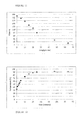
- FIG. 6A is a graphical representation of the rate constant for monochloramine decomposition at 45° C. in the presence of Styrene Butadiene Rubber, based upon experimental results.
- FIG. 6B is a graphical representation of the rate constant for monochloramine decomposition at 70° C. in the presence of Styrene Butadiene Rubber, based upon experimental results.
- FIG. 6C is a graphical representation of the rate constant for monochloramine decomposition at 70° C., absent Styrene Butadiene Rubber, based upon experimental results.
- FIG. 6D is a graphical representation of the rate constant for monochloramine decomposition at 92° C. in the presence of Styrene Butadiene Rubber, based upon experimental results.
- FIG. 6E is a graphical representation of the reaction rate for the decomposition of monochloramine as a function of concentration at 45° C., in the presence of Styrene Butadiene Rubber, based upon experimental results.
- FIG. 6F is a graphical representation of the reaction rate for the decomposition of monochloramine as a function of concentration at 70° C. in the presence of Styrene Butadiene Rubber, based upon experimental results.
- FIG. 6G is a graphical representation of the reaction rate for the decomposition of monochloramine as a function of concentration at 70° C., absent Styrene Butadiene Rubber, based upon experimental results.
- FIG. 6H is a graphical representation of the reaction rate for the decomposition of monochloramine as a function of concentration at 92° C., in the presence of Styrene Butadiene Rubber, based upon experimental results.
- FIG. 7 depicts a center point of a particle of SBR corresponding to a steady state equilibrium concentration of a solution of aqueous chloramine across a cross-sectional slice of SBR.
- FIG. 8 provides a concentration profile of a monochloramine solution over a 30-day period at the center of a SBR cube.
- FIG. 9 is a graphical representation of monochloramine concentration plotted against time for a series of single run experiments that were conducted involving monochloramine solutions.
- FIG. 10 is a graphical representation of temperature of the monochloramine solution plotted against time for an experiment.
- FIG. 11 is a graphical representation of concentration of the monochloramine solution plotted against time for an experiment.
- FIG. 12 is a graphical representation of temperature of the monochloramine solution plotted against time for an experiment.
- FIG. 13 is a graphical representation of concentration of the monochloramine solution plotted against time for an experiment.
- FIG. 14 is a graphical representation of temperature of the monochloramine solution plotted against time for an experiment.
- FIG. 15 is a graphical representation of concentration of the monochloramine solution plotted against time for an experiment.
- FIG. 16 is a graphical representation of pH of the monochloramine solution plotted against time for an experiment.
- FIG. 17 is a graphical representation of temperature of concentration of the monochloramine solution plotted against time for an experiment.
- FIG. 18 is a proton NMR characterization of a polymeric substance recovered from multi-day experiments, according to multiple embodiments and alternatives.
- FIG. 19 is a published proton NMR characterization of SBR copolymer for comparison to the previous figure, illustrative of multiple embodiments and alternatives.
- FIG. 20 is a Fourier Transform Infrared spectroscopy comparison of a polymeric substance recovered from multi-day experiments against known SBR spectra, according to multiple embodiments and alternatives.
- FIG. 21 is a carbon nuclear magnetic resonance (NMR) characterization of a polymeric substance recovered from multi-day experiments, according to multiple embodiments and alternatives.
- NMR carbon nuclear magnetic resonance
- the degrading of SBR in a reactor comprises contacting particles of styrene butadiene rubber with monochloramine in aqueous solution under stirring to initiate the degradation process, and continuously providing fresh chloramine to the reactor to maintain a consistent supply of monochloramine at sufficient concentrations to degrade SBR over the course of hours as opposed to weeks or months, making it more practical at a larger industrial scale.
- continuously refers to repeating the step of providing fresh chloramine at intervals of time while undegraded SBR remains in the reactor, in which the intervals can be regularly spaced apart or irregularly spaced.
- providing fresh chloramine involves determining a decomposition rate whereby chloramine undergoes a reverse reaction back to hypochlorite and ammonia species, and then determining a feed rate of fresh chloramine that is proportional to the decomposition rate.
- the step of providing fresh chloramine to the reactor comprises adding hypochlorite and ammonia species in aqueous solution to the reactor.
- a flow regulator is provided and configured to control the flow of chloramine compound from the chloramine makeup supply vessel to the reaction vessel.
- a flow regulator may include one or more of a flow meter, e.g., a Venturi flow meter, and open/closable flow control valves positioned between a chloramine compound makeup vessel and the reactor.
- Ammonium hydroxide NH 4 OH
- NH 4 OH is the other reactant in the reaction to monochloramine, and itself is generally considered in terms of the equilibrium reaction: NH 2 +H 2 O ⁇ NH 4 + +OH ⁇ (4)
- nitrogen trichloride is produced from dichloramine according to the following reaction: H + +3NH 2 Cl ⁇ ⁇ 2NCl 2 +NH 4 + +H 2 O (7)
- pH is maintained at alkaline levels to react with excess protons in the solution.
- a pH in a range of about 8-9 is suitable for these purposes, and in some embodiments pH is kept at about 8.3.
- a solution containing a basic salt of an alkali metal e.g., sodium hydroxide and potassium hydroxide is added to the reactor to maintain a desired pH.
- a feed line communicates between a vessel storing solution containing a basic salt of an alkali metal and a reactor where the SBR is degraded in aqueous solution of monochloramine.
- a pH meter is used to gauge when the pH comes near, or even drops below the stated range of 8-9, and at such time the solution from the vessel is added to the reactor by way of a feedline or similar conduit for delivery of a solution from one vessel to another.
- monochloramine itself is very reactive and eager to form new products with any other species present in the solution, not just protons. This reactivity is both the essential element of the ability of monochloramine to degrade SBR, as well as the factor that increases the difficulty of maintaining a stable system, and the reason why it becomes desirable to provide fresh monochloramine to the system to make up for decomposition or side reactions that reduce its concentration.
- the rate of decomposition can be considered in order to maintain sufficient concentrations of monochloramine. If the tendency toward decomposition is quantified, then by correlation it becomes possible to either quantify an amount of monochloramine that must be formed and otherwise provided to the reactor in order to maintain suitable concentrations in the reactor or adjust the amount of monochloramine formed proportionally with the quantity that decomposes over time.
- the rate of formation of products or decomposition back to reactants is a function of the concentration of the reactants of that system. Accordingly, a rate law for a given reaction aA+bB ⁇ cC+dD can be written of the form:
- trendline is differentiated with respect to time to determine the reaction rates at times corresponding to measured concentrations.
- the reaction rate is then plotted versus the measured concentration values and a trendline is fitted to determine the reaction rate constant and the order of reaction as seen in FIG. 5 .
- Equation 18 is useful for giving a reasonable approximation as to the diffusion of monochloramine through SBR and for designing a suitable reactor:
- the benefits of increasing the monochloramine concentration also affect the degradation of SBR, in that a higher concentration increases the diffusion rate.
- the degradation process of SBR is diffusion limited, which is affected by the concentration gradient, which is a change in concentration with respect to distance.
- the rate of diffusion of monochloramine through SBR must be adequate enough to support the degradation process within the tightly packed sulfur cross-linked matrix of SBR, and to do so within the time constraints dictated by the rapid rate of monochloramine decomposition. Again, depending on the temperature range, temperature may have less of an effect on diffusion than does concentration. Rather, rates of diffusion are increased by increasing the concentration gradient, which can be achieved by raising the concentration of monochloramine in the bulk liquid phase that surrounds each rubber particle immersed in solution.
- Diffusivity through non-porous polymers is dependent on the type of polymer and, in the case of amorphous polymers such as SBR, whether it is glassy or rubbery.
- a diffusion coefficient or diffusivity, D is a measure of the ability of the component of interest to diffuse through the other component.
- the diffusion coefficient of monochloramine into SBR is about 1.26 ⁇ 10 ⁇ 9 cm 2 /s for a solution of 30 mg/L (30 ppm) SBR at 45° C.
- FIGS. 7 and 8 a small cube of SBR with 0.05 mm sides has been exposed to a solution of monochloramine for a period of 30 days.
- FIG. 7 depicts the equilibrium concentration across a cross-sectional slice made at the midpoint of the cube
- FIG. 8 is the concentration profile over the 30 day period for the point directly in the center of the cube.
- the model indicates that due to the decomposition of monochloramine, the rubber sample never attains the concentration of the bulk liquid phase, except at the very edge, even though the equilibrium point is reached at an early point of the test.
- the center point stays at a very low concentration during the entire run, as does most of the interior of the sample. Accordingly, the effect of cube size on diffusion time is presented in Table V, where the equilibrium concentration is shown at the center point of the sample with the time it takes to reach that point:
- Table V concerns the SBR particle size, and shows that for a particle size of about 1 millimeter (mm) in diameter or width, it takes 3.6 days for the center of that sample to reach a very low equilibrium concentration of 0.15 ppm. However, at a tenth the size, it takes 4.8 hours for the center point to reach a 26 ppm concentration, which is nearly equal to the bulk solution concentration.
- particle size of SBR is reduced by mechanical force (e.g., sniping, grating, grinding), increasing the number of particles.
- a grater was used, but more sophisticated tools are available, and the embodiments are not limited by the implement which is used to reduce the size of SBR particles.
- shape of the particles following reduction can be non-uniform and asymmetric, and will typically comprise spherical, elliptical, or cube-like structures.
- the solution is stirred manually or automatically with a stirring implement, in ways which are known in the art.
- stirring can be performed on a continuous basis, or at regular intervals.
- Non-limiting examples of a stirring implement include, but are not limited to, a magnetic stir bar or a blade configured to rotate in a magnetic field as well as single- or multi-blade stirrers.
- SBR was obtained from Lehigh Technologies Inc. with its corporate headquarters in Tucker, Ga. Approximately 50 grams of Polydyne-140 was obtained, which is derived from end-of-life truck tire tread and whole tire rubber, and has a 140 mesh powder with a surface area to volume ratio of 0.751 m2/g.
- Monochloramine was synthesized using the ASTM D 6284 method. Sodium hypochlorite was diluted with water and reacted with aqueous ammonia to form chloramine and the pH was adjusted with phosphoric acid to achieve a pH in the range of 8-9. A boric acid pH 9 buffer was then added to stabilize the solution in desired pH range. The initial concentration of each solution was about 5000 ppm monochloramine.
- the synthesized monochloramine was added to the 50 grams of Polydyne-140 rubber powder in a stainless steel container.
- the solution was reacted in the stainless steel container immersed in a hot water bath for periods ranging from 8-24 hours at a temperature of 50° C.
- the degraded monochloramine solution i.e., containing degraded SBR at high enough levels to reduce the activity of the monochloramine
- Fresh monochloramine was then added to the stainless steel container containing the rubber and the process was repeated. For the span of 30 days, solutions were changed from between one and four times daily.
- Filtered solutions from the process above were stored with open lids in a hot water bath at 50° C. to promote evaporation of the water from the samples. Once 50-70% evaporation was achieved across single containers, multiple evaporated solutions were combined together to form a solution of greater concentration. This more concentrated solution was then evaporated and the overall process repeated until the evaporated solution had a more viscous, wax-like, and yellowish appearance, consistent with a loss of properties that would be otherwise associated with vulcanized SBR.
- Acetone was used to extract the SBR and to separate it from sodium chloride, a by-product of monochloramine decomposition.
- a suitable amount of acetone was added to the degraded, concentrated SBR solution until extraction equilibrium was reached and no more degraded SBR solution (degraded SBR mixed with water) could be absorbed by the acetone.
- the solutions water and acetone
- the top liquid phase containing acetone, water, and degraded SBR was carefully removed from the container, and it was boiled at approximately 60° C.
- the pure rubber sample that was recovered via the procedure above was characterized using Fourier Transform Infrared Spectroscopy (FTIR), Carbon NMR (C 13 NMR), and Proton NMR (H 1 NMR, or HNMR), in consideration of functional groups that one would expect to find in a styrene butadiene co-polymer chain, e.g., alkane, alkene, and aromatic shown in FIG. 1 .
- FTIR Fourier Transform Infrared Spectroscopy
- C 13 NMR Carbon NMR
- Proton NMR H 1 NMR, or HNMR
- NMR is useful for characterizing functional groups and whole molecular structures by analyzing nuclear spin on atoms in a given sample, and works by exposing the sample to a magnetic field and measuring the frequency at which the atoms respond to the stimulation.
- the frequency and attendant chemical shift are dependent upon the electron environment surrounding the characterized atoms (hydrogen atoms for proton, or HNMR, and carbon atoms for carbon, or CNMR).
- the chemical shift of the sample is measured against the frequency of a reference compound, Tetramethylsilane, where the magnitude of the shift is determined by the electron affinity of the atoms surrounding the characterized atom.
- the degraded rubber sample was characterized by HNMR in a deuterated acetone solvent, and the resulting spectra are shown in FIG. 18 , which are comparable to the proton NMR characterization of SBR copolymer shown in FIG. 19 .
- various generally accepted authorities including Spectral Data for Structure Determination of Organic Compounds by Pretsch, et al. (Berlin: Springer-Verlag, 1989), Nuclear Magnetic Resonance Spectroscopy by Nelson, et al. (Upper Saddle River, N.J.: Prentice Hall, 2003), and Proton and Carbon -13 NMR Spectroscopy by Abraham, et al.
- alkanes can be found over a range from 4.8 ppm to ⁇ 2.1 ppm. More specifically, alkanes with the structure R—CH 2 —R (where R is alkyl) are found from 1.1-1.8 ppm. This corresponds to the large peaks in FIG. 18 at 0.8-1.0 ppm (beginning of peak to end of peak), 1.25-1.5 ppm, and 1.6-1.8 ppm. The high area-under-curve values for these peaks (6.04, 9.67, and 1.09 respectively) represent the high number of alkane bonds in the backbone of the polymer repeat unit as seen in FIG. 5 .
- Alkene groups can be found in different ranges depending on the specific functional groups surrounding the carbon-carbon double bond.
- a hydrogen atom bounded to one of the carbons in the double bond can be found in the 3.8-7.8 ppm range (Pretsch, et al. lists a tighter 4.5-6 ppm range). This range corresponds to the peak from ⁇ 4.15-4.35 ppm in FIG. 18 .
- hydrogen atoms bonded to a carbon atom adjacent to a double bond (CH 2 —(C ⁇ C)) are found at ⁇ 2 ppm (Pretsch, et al.), with possible overlap to peaks at 2.0 ppm and 1.6-1.8 ppm, respectively, as previously discussed in connection with the alkane groups.
- Aromatic groups can be found in the 6.5-9 ppm range per Abraham, et al. and Nelson et al., whereas Pretsch et al. lists a tighter range of 6.8-7.5. This corresponds to the peaks at 7.6 and 7.8 ppm in FIG. 7 .
- Prestch, et al. also indicates that an alkyl group bonded to an aromatic (CH-(ArC)), which is typical of the styrene bond, may be found at ⁇ 2.9 ppm (Pretsch, et al.)., as further support that aromatic groups (i.e., styrene) are present within the compound.
- FIG. 20 shows a FTIR spectroscopy comparison of the aforementioned degraded SBR sample against known SBR spectra.
- Various texts including Pretsch, et al. state that a C ⁇ CH 2 stretch from a vinyl group occurs at generally in the 3100-3000 cm ⁇ 1 range and more typically in the 3095-3075 cm ⁇ 1 range. This is depicted in FIG. 20 as a peak at 3071 cm ⁇ 1 .
- Spectra for aromatics can be found in similar regions as the cis- and trans-groups and in many cases the exact location depends on the overall functional arrangement of the polymer.
- Various texts and literature report styrene peaks at 1600, 1580, 1490, 727-761, and 695 cm ⁇ 1 . (Roeges, et al. (1994); ISO WD 21561-2 (2013); Determination of Styrene - Butadiene Rubber Composition By Attenuated Total Internal Reflection Infrared Spectroscopy , Orlov A. S., Journal of Applied Spectroscopy, 2013.-1: Vol. Vol. 80 (2013)).
- the findings associated with these characterizations are consistent with a mechanism whereby monochloramine attacks the sulfur crosslinks in the vulcanized SBR matrix, but does not attack nor degrade the stronger carbon backbone, leaving the alkane, alkene (cis/trans and vinyl), and aromatic functional groups intact.
- These findings added to the visual observation of high viscosity in the degraded SBR (a marker of high molecular weight), support the conclusion that the degraded SBR is intact and likely capable of being re-vulcanized and recycled.
Landscapes
- Chemical & Material Sciences (AREA)
- Chemical Kinetics & Catalysis (AREA)
- Organic Chemistry (AREA)
- Life Sciences & Earth Sciences (AREA)
- Sustainable Development (AREA)
- Health & Medical Sciences (AREA)
- Medicinal Chemistry (AREA)
- Polymers & Plastics (AREA)
- Organic Low-Molecular-Weight Compounds And Preparation Thereof (AREA)
Abstract
Description
| TABLE I |
| EXAMPLE COMPOSITION OF SBR |
| Ingredients | | ||
| SBR Rubber |
| 100 | ||
| Carbon Black | 60 | |
| Highly |
20 | |
| Antiozonant | 1 | |
| Antioxidant | 1.5 | |
| |
3 | |
| |
1 | |
| |
1 | |
| Sulfur | 1.75 | |
| |
1 | |
| Secondary Accelerator | 0.2 | |
| TABLE II |
| MONOCHLORAMINE EQUILIBRIUM CONDITIONS |
| Property | Value | ||
| ΔGrxn @ 25° C. | 115.29 kJ/mol | ||
| Keq | 6.18 × 10⁻²¹ | ||
ΔS total =ΔS system +ΔS surroundings>0 (1)
ΔG=ΔH−TΔS (2)
H2O(l)←→H+(aq)+OH−(aq)
H+(aq)+OCl−(aq)←→HOCl(aq)
Na+(aq)+OH−(aq)←→NaOH(aq)
Na+(aq)+H2O(l)+OCl−(aq)←→HOCl(aq)+NaOH(aq) (3)
NH2+H2O→←NH4 ++OH− (4)
NH2+OCl−NH2Cl+OH− (5)
H++2NH2Cl−←→NHCl2+NH4 ++H2O (6)
H++3NH2Cl−←→2NCl2+NH4 ++H2O (7)
where
α+β=overall reaction order (10)
trendline equation=CNH
trendline equation=−r NH
| TABLE III |
| RATE CONSTANT TEMPERATURE DEPENDENCE |
| T (° C.) | k (min−1) | ||
| 45 | 0.001748 | ||
| 70 | 0.009632 | ||
| 92 | 0.061912 | ||
| TABLE IV | |||
| Factor | Value | ||
| Ea | 72745 J/mol | ||
| A | 1.405 × 10⁹ min−1 | ||
Diffusivity of Monochloramine
| TABLE V | ||||
| Equilibrium | ||||
| Concentration | ||||
| Width (cm) | (mol/L) | PPM | Time (days) | |
| 0.01 | 5.1 × 10⁻⁴ | 26 | 0.2 | |
| 0.05 | 6.4 × 10⁻⁵ | 3.3 | 2.4 | |
| 0.10 | 3.1 × 10⁻⁶ | 0.15 | 3.6 | |
Claims (20)
Priority Applications (1)
| Application Number | Priority Date | Filing Date | Title |
|---|---|---|---|
| US14/560,614 US9458303B1 (en) | 2013-12-04 | 2014-12-04 | Recycling of styrene butadiene rubber and like materials |
Applications Claiming Priority (2)
| Application Number | Priority Date | Filing Date | Title |
|---|---|---|---|
| US201361911546P | 2013-12-04 | 2013-12-04 | |
| US14/560,614 US9458303B1 (en) | 2013-12-04 | 2014-12-04 | Recycling of styrene butadiene rubber and like materials |
Publications (1)
| Publication Number | Publication Date |
|---|---|
| US9458303B1 true US9458303B1 (en) | 2016-10-04 |
Family
ID=56995094
Family Applications (1)
| Application Number | Title | Priority Date | Filing Date |
|---|---|---|---|
| US14/560,614 Active 2035-06-05 US9458303B1 (en) | 2013-12-04 | 2014-12-04 | Recycling of styrene butadiene rubber and like materials |
Country Status (1)
| Country | Link |
|---|---|
| US (1) | US9458303B1 (en) |
Cited By (4)
| Publication number | Priority date | Publication date | Assignee | Title |
|---|---|---|---|---|
| WO2022212632A1 (en) * | 2021-03-31 | 2022-10-06 | Patrick Kroeger | Carbon black recovery methods and compositions comprising same |
| TWI784386B (en) * | 2020-12-28 | 2022-11-21 | 財團法人工業技術研究院 | Depolymerizer and recycled rubber |
| CN117177939A (en) * | 2021-03-31 | 2023-12-05 | 帕特里克·克勒格尔 | Carbon black recovery methods and compositions containing the same |
| CN119751973A (en) * | 2024-12-11 | 2025-04-04 | 内蒙古鄂尔多斯电力冶金集团股份有限公司 | Low-temperature desulfurization and raw material recovery method for waste rubber |
-
2014
- 2014-12-04 US US14/560,614 patent/US9458303B1/en active Active
Non-Patent Citations (3)
| Title |
|---|
| American Water Works Association; Investigating the Effects of Chloramines on Elastomer Degradation; Journal; Aug. 1993; pp. 101-111; vol. 85; No. 8; American Water Works Association; http://www.jstor.org/stable/41294784. |
| AWWA Research Foundation; Performance of Elastomeric Components in Contact with Potable Water; Public Report; 2007; pp. 1-336; www.awwarf.org; Colorado, USA. [NPL is broken into 3 PDF's for size]. |
| Park et al. Depolymerization of Styrene-Butadiene Copolymer in Near-Critical and Supercritical Water; Ind. Eng. Chem. Res. 2001, 40, 756-767. * |
Cited By (6)
| Publication number | Priority date | Publication date | Assignee | Title |
|---|---|---|---|---|
| TWI784386B (en) * | 2020-12-28 | 2022-11-21 | 財團法人工業技術研究院 | Depolymerizer and recycled rubber |
| US11713362B2 (en) | 2020-12-28 | 2023-08-01 | Industrial Technology Research Institute | Depolymerizer and recycled rubber |
| WO2022212632A1 (en) * | 2021-03-31 | 2022-10-06 | Patrick Kroeger | Carbon black recovery methods and compositions comprising same |
| CN117177939A (en) * | 2021-03-31 | 2023-12-05 | 帕特里克·克勒格尔 | Carbon black recovery methods and compositions containing the same |
| EP4313858A4 (en) * | 2021-03-31 | 2025-06-11 | KROEGER, Patrick | METHODS FOR RECOVERING CARBON BLACK AND COMPOSITIONS COMPRISING SAME |
| CN119751973A (en) * | 2024-12-11 | 2025-04-04 | 内蒙古鄂尔多斯电力冶金集团股份有限公司 | Low-temperature desulfurization and raw material recovery method for waste rubber |
Similar Documents
| Publication | Publication Date | Title |
|---|---|---|
| US9458303B1 (en) | Recycling of styrene butadiene rubber and like materials | |
| Ye et al. | Degradation of polyvinyl alcohol (PVA) by UV/chlorine oxidation: Radical roles, influencing factors, and degradation pathway | |
| Panampilly et al. | Nano ZnO as cure activator and reinforcing filler in natural rubber | |
| Park et al. | Preparation of anion exchanger by amination of acrylic acid grafted polypropylene nonwoven fiber and its ion-exchange property | |
| Boonkerd et al. | Effect of sulfur to accelerator ratio on crosslink structure, reversion, and strength in natural rubber | |
| Nihmath et al. | Synthesis, characterization, processability, mechanical properties, flame retardant, and oil resistance of chlorinated acrylonitrile butadiene rubber | |
| WO2014062043A1 (en) | Devulcanizing agent for production of reclaim rubber powder | |
| Guzmán et al. | Zinc oxide versus magnesium oxide revisited. Part 1 | |
| BRPI1013296B1 (en) | process for the production of polydienes | |
| Moradi et al. | Photocatalytic decolorization of reactive yellow 84 from aqueous solutions using ZnO nanoparticles supported on mineral LECA | |
| Khedr et al. | Photodegradation of 4-aminoantipyrine over nano-titania heterojunctions using solar and LED irradiation sources | |
| WO2017025172A1 (en) | Rubber compositions with low content of zinc oxide | |
| CN102378782A (en) | Process for producing polymer solids | |
| Pajarito et al. | Effect of Ingredient Loading on Surface Migration Kinetics of Additives in Vulcanized Natural Rubber Compounds. | |
| Guzmán et al. | Synthesis of Zn/Mg oxide nanoparticles and its influence on sulfur vulcanization | |
| JP2020079421A (en) | Butyl rubber with novel sequence distribution | |
| Jiang et al. | Kinetic study on the ring-opening polymerization of octamethylcyclotetrasiloxane (D4) in miniemulsion | |
| Chanroj et al. | Chlorohydrination of NR latex by using sodium hypochlorite for fuel-resistant materials | |
| MX2009001038A (en) | Lithium reduction in styrenic polymers. | |
| Kroeger | The feasibility of using monochloramine in recycling vulcanized styrene butadiene rubber | |
| WO2023119123A1 (en) | Process of dehalogenation of plastic materials including recycled ones, and use of one or more chemical compounds containing nitrogen as a dehalogenating agent of plastic materials including recycled ones | |
| Su et al. | Degradation and kinetic modeling of polyvinyl alcohol in aqueous solutions by a H2O2/Mn (II) system | |
| Yan et al. | Spatial distribution of planktonic archaeal community in the coastal waters around Meishan Island in spring | |
| Tikhova et al. | Oxidative degradation of polyglycols by the Ruff’s system in the aqueous solutions | |
| Lu et al. | Complex of cross-linked polyvinylamine with Cu (II) as catalyst for vinyl polymerization |
Legal Events
| Date | Code | Title | Description |
|---|---|---|---|
| AS | Assignment |
Owner name: UNIVERSITY OF LOUISVILLE RESEARCH FOUNDATION, INC. Free format text: ASSIGNMENT OF ASSIGNORS INTEREST;ASSIGNORS:WILLING, GEROLD A.;KROEGER, PATRICK;SIGNING DATES FROM 20141203 TO 20141204;REEL/FRAME:034378/0789 |
|
| STCF | Information on status: patent grant |
Free format text: PATENTED CASE |
|
| MAFP | Maintenance fee payment |
Free format text: PAYMENT OF MAINTENANCE FEE, 4TH YR, SMALL ENTITY (ORIGINAL EVENT CODE: M2551); ENTITY STATUS OF PATENT OWNER: SMALL ENTITY Year of fee payment: 4 |
|
| FEPP | Fee payment procedure |
Free format text: MAINTENANCE FEE REMINDER MAILED (ORIGINAL EVENT CODE: REM.); ENTITY STATUS OF PATENT OWNER: SMALL ENTITY |
|
| FEPP | Fee payment procedure |
Free format text: 7.5 YR SURCHARGE - LATE PMT W/IN 6 MO, SMALL ENTITY (ORIGINAL EVENT CODE: M2555); ENTITY STATUS OF PATENT OWNER: SMALL ENTITY |
|
| MAFP | Maintenance fee payment |
Free format text: PAYMENT OF MAINTENANCE FEE, 8TH YR, SMALL ENTITY (ORIGINAL EVENT CODE: M2552); ENTITY STATUS OF PATENT OWNER: SMALL ENTITY Year of fee payment: 8 |