US9458124B2 - Substituted pyran derivatives - Google Patents
Substituted pyran derivatives Download PDFInfo
- Publication number
- US9458124B2 US9458124B2 US14/173,997 US201414173997A US9458124B2 US 9458124 B2 US9458124 B2 US 9458124B2 US 201414173997 A US201414173997 A US 201414173997A US 9458124 B2 US9458124 B2 US 9458124B2
- Authority
- US
- United States
- Prior art keywords
- mmol
- nmr
- cdcl
- mhz
- mixture
- Prior art date
- Legal status (The legal status is an assumption and is not a legal conclusion. Google has not performed a legal analysis and makes no representation as to the accuracy of the status listed.)
- Active
Links
- 0 *C.*C.CCNC1COC(C(C2=CC=CC=C2)C2=CC=CC=C2)CC1[W] Chemical compound *C.*C.CCNC1COC(C(C2=CC=CC=C2)C2=CC=CC=C2)CC1[W] 0.000 description 12
- HBUMWGKJLDZPHK-UHFFFAOYSA-N COC1=CC2=C(C=C1)N(C(=O)OC(C)(C)C)C=C2CNC1COC(C(C2=CC=C(F)C=C2)C2=CC=C(F)C=C2)CC1O Chemical compound COC1=CC2=C(C=C1)N(C(=O)OC(C)(C)C)C=C2CNC1COC(C(C2=CC=C(F)C=C2)C2=CC=C(F)C=C2)CC1O HBUMWGKJLDZPHK-UHFFFAOYSA-N 0.000 description 2
- BEJMRCNDXXJWEL-UHFFFAOYSA-N COC1=CC=C(CNC2COC(C(C3=CC=C(F)C=C3)C3=CC=C(F)C=C3)CC2O)C=C1 Chemical compound COC1=CC=C(CNC2COC(C(C3=CC=C(F)C=C3)C3=CC=C(F)C=C3)CC2O)C=C1 BEJMRCNDXXJWEL-UHFFFAOYSA-N 0.000 description 2
- GQELUCHQRPUJCV-UHFFFAOYSA-N OC1CC(C(C2=CC=C(F)C=C2)C2=CC=C(F)C=C2)OCC1NCC1=CC=C2NN=NC2=C1 Chemical compound OC1CC(C(C2=CC=C(F)C=C2)C2=CC=C(F)C=C2)OCC1NCC1=CC=C2NN=NC2=C1 GQELUCHQRPUJCV-UHFFFAOYSA-N 0.000 description 2
- MMUIVAANVGQCME-UHFFFAOYSA-N *.B.COC1=CC=C2OC=CC2=C1.COC1=CC=C2OCCC2=C1 Chemical compound *.B.COC1=CC=C2OC=CC2=C1.COC1=CC=C2OCCC2=C1 MMUIVAANVGQCME-UHFFFAOYSA-N 0.000 description 1
- COHPMBGZIFLXCN-UHFFFAOYSA-N *.C.CCOC(=O)CC1=CC2=C(C=C1)NN=N2.N.O=C(O)CC1=CC2=C(C=C1)NN=N2.O=CC1=CC2=C(C=C1)NN=N2.OCC1=CC2=C(C=C1)NN=N2.[KH] Chemical compound *.C.CCOC(=O)CC1=CC2=C(C=C1)NN=N2.N.O=C(O)CC1=CC2=C(C=C1)NN=N2.O=CC1=CC2=C(C=C1)NN=N2.OCC1=CC2=C(C=C1)NN=N2.[KH] COHPMBGZIFLXCN-UHFFFAOYSA-N 0.000 description 1
- LSXPTOYHGVGAIF-UHFFFAOYSA-N *.COC1=CC=C2NC(=O)OC2=C1.O=C1NC2=CC=C(Br)C=C2O1.S Chemical compound *.COC1=CC=C2NC(=O)OC2=C1.O=C1NC2=CC=C(Br)C=C2O1.S LSXPTOYHGVGAIF-UHFFFAOYSA-N 0.000 description 1
- QILMSTOFNNYWRG-UHFFFAOYSA-N C.C=C1NC2=CC=C(CNC3COC(C(C4=CC=C(F)C=C4)C4=CC=C(F)C=C4)CC3O)C=C2O1.C=C1NC2=CC=C(CNC3COC(C(C4=CC=CC=C4)C4=CC=CC=C4)CC3O)C=C2O1.C=C1NC2=CC=C(CNC3COC(C(C4=CC=CC=C4)C4=CC=CC=C4)CC3O)C=C2O1.C=C1OC2=CC(CNC3COC(C(C4=CC=C(F)C=C4)C4=CC=C(F)C=C4)CC3O)=CC=C2N1C.C=C1OC2=CC(CNC3COC(C(C4=CC=CC=C4)C4=CC=CC=C4)CC3O)=CC=C2N1C.CC1=NC2=CC(CNC3COC(C(C4=CC=C(F)C=C4)C4=CC=C(F)C=C4)CC3O)=CC=C2O1.CC1=NC2=CC=C(CNC3COC(C(C4=CC=C(F)C=C4)C4=CC=C(F)C=C4)CC3O)C=C2O1 Chemical compound C.C=C1NC2=CC=C(CNC3COC(C(C4=CC=C(F)C=C4)C4=CC=C(F)C=C4)CC3O)C=C2O1.C=C1NC2=CC=C(CNC3COC(C(C4=CC=CC=C4)C4=CC=CC=C4)CC3O)C=C2O1.C=C1NC2=CC=C(CNC3COC(C(C4=CC=CC=C4)C4=CC=CC=C4)CC3O)C=C2O1.C=C1OC2=CC(CNC3COC(C(C4=CC=C(F)C=C4)C4=CC=C(F)C=C4)CC3O)=CC=C2N1C.C=C1OC2=CC(CNC3COC(C(C4=CC=CC=C4)C4=CC=CC=C4)CC3O)=CC=C2N1C.CC1=NC2=CC(CNC3COC(C(C4=CC=C(F)C=C4)C4=CC=C(F)C=C4)CC3O)=CC=C2O1.CC1=NC2=CC=C(CNC3COC(C(C4=CC=C(F)C=C4)C4=CC=C(F)C=C4)CC3O)C=C2O1 QILMSTOFNNYWRG-UHFFFAOYSA-N 0.000 description 1
- RNTKAUKZBWUQRQ-UHFFFAOYSA-N C.CCC1=CC=C2N=C(N)SC2=C1.COC1=CC=C2N=C(N)SC2=C1.NC1=NC2=CC=C(CO)C=C2S1.O.O=C=O.P Chemical compound C.CCC1=CC=C2N=C(N)SC2=C1.COC1=CC=C2N=C(N)SC2=C1.NC1=NC2=CC=C(CO)C=C2S1.O.O=C=O.P RNTKAUKZBWUQRQ-UHFFFAOYSA-N 0.000 description 1
- HHMSKSSGDQNIDV-UHFFFAOYSA-N C.CCOC(=O)CC1=CC2=C(C=C1)NC=N2.O=C(O)CC1=CC2=C(C=C1)NC=N2.O=CC1=CC2=C(C=C1)NC=N2.OCC1=CC2=C(C=C1)NC=N2.[V].[W].[Y] Chemical compound C.CCOC(=O)CC1=CC2=C(C=C1)NC=N2.O=C(O)CC1=CC2=C(C=C1)NC=N2.O=CC1=CC2=C(C=C1)NC=N2.OCC1=CC2=C(C=C1)NC=N2.[V].[W].[Y] HHMSKSSGDQNIDV-UHFFFAOYSA-N 0.000 description 1
- QDPRGCUHOMNCBA-UHFFFAOYSA-N C.CN(C(=O)OC(C)(C)C)C1=CC=C(C(=O)O)C=C1.CN(C(=O)OC(C)(C)C)C1=CC=C(C=O)C=C1.CN(C(=O)OC(C)(C)C)C1=CC=C(CO)C=C1.CNC1=CC=C(C(=O)O)C=C1.I.[HH] Chemical compound C.CN(C(=O)OC(C)(C)C)C1=CC=C(C(=O)O)C=C1.CN(C(=O)OC(C)(C)C)C1=CC=C(C=O)C=C1.CN(C(=O)OC(C)(C)C)C1=CC=C(CO)C=C1.CNC1=CC=C(C(=O)O)C=C1.I.[HH] QDPRGCUHOMNCBA-UHFFFAOYSA-N 0.000 description 1
- UIQNELCOMDVYEB-SGNQUONSSA-N C.CN1C(=O)OC2=CC(C=O)=CC=C21.CN1C(=O)OC2=CC=CC=C21.[2HH] Chemical compound C.CN1C(=O)OC2=CC(C=O)=CC=C21.CN1C(=O)OC2=CC=CC=C21.[2HH] UIQNELCOMDVYEB-SGNQUONSSA-N 0.000 description 1
- DCNGBZBDOKHIGV-UHFFFAOYSA-N C=C1NC2=CC=C(CNC3COC(C(C4=CC=C(F)C=C4)C4=CC=C(F)C=C4)CC3O)C=C2O1.C=C1OC2=CC(CNC3COC(C(C4=CC=C(F)C=C4)C4=CC=C(F)C=C4)CC3O)=CC=C2N1C.CC1=NC2=CC(CNC3COC(C(C4=CC=C(F)C=C4)C4=CC=C(F)C=C4)CC3O)=CC=C2O1.CC1=NC2=CC=C(CNC3COC(C(C4=CC=C(F)C=C4)C4=CC=C(F)C=C4)CC3O)C=C2O1.CC1=NC2=CC=C(CNC3COC(C(C4=CC=C(F)C=C4)C4=CC=C(F)C=C4)CC3O)C=C2S1.O=C1CC2=C(O1)C(CNC1COC(C(C3=CC=C(F)C=C3)C3=CC=C(F)C=C3)CC1O)=CC=C2 Chemical compound C=C1NC2=CC=C(CNC3COC(C(C4=CC=C(F)C=C4)C4=CC=C(F)C=C4)CC3O)C=C2O1.C=C1OC2=CC(CNC3COC(C(C4=CC=C(F)C=C4)C4=CC=C(F)C=C4)CC3O)=CC=C2N1C.CC1=NC2=CC(CNC3COC(C(C4=CC=C(F)C=C4)C4=CC=C(F)C=C4)CC3O)=CC=C2O1.CC1=NC2=CC=C(CNC3COC(C(C4=CC=C(F)C=C4)C4=CC=C(F)C=C4)CC3O)C=C2O1.CC1=NC2=CC=C(CNC3COC(C(C4=CC=C(F)C=C4)C4=CC=C(F)C=C4)CC3O)C=C2S1.O=C1CC2=C(O1)C(CNC1COC(C(C3=CC=C(F)C=C3)C3=CC=C(F)C=C3)CC1O)=CC=C2 DCNGBZBDOKHIGV-UHFFFAOYSA-N 0.000 description 1
- LOGQENXZTOMTIL-UHFFFAOYSA-N C=C1NC2=CC=C(CNC3COC(C(C4=CC=C(F)C=C4)C4=CC=C(F)C=C4)CC3O)C=C2O1.O=C1CC2=C(O1)C(CNC1COC(C(C3=CC=C(F)C=C3)C3=CC=C(F)C=C3)CC1O)=CC=C2 Chemical compound C=C1NC2=CC=C(CNC3COC(C(C4=CC=C(F)C=C4)C4=CC=C(F)C=C4)CC3O)C=C2O1.O=C1CC2=C(O1)C(CNC1COC(C(C3=CC=C(F)C=C3)C3=CC=C(F)C=C3)CC1O)=CC=C2 LOGQENXZTOMTIL-UHFFFAOYSA-N 0.000 description 1
- JLVCKDUDLNJMIT-UHFFFAOYSA-N CC(=O)N(C)C1=CC=C(C(C)(C)C)C=C1.CC(C)(C)C1=CC=C2/N=C(/N)SC2=C1.CC(C)(C)C1=CC=C2N/C=N\C2=C1.CC(C)(C)C1=CC=C2N/N=N\C2=C1.CC(C)(C)C1=CC=C2NC(=O)OC2=C1.CC(C)(C)C1=CC=CC2=C1OC(=O)N2.CC1=CC2=C(C=C1)NC=C2C(C)(C)C.CN1C(=O)CC2=CC(C(C)(C)C)=CC=C21.COC1=CC=C(C(C)(C)C)C(O)=C1.COC1=CC=C(C(C)(C)C)C=N1.COC1=CN=CC(C(C)(C)C)=C1 Chemical compound CC(=O)N(C)C1=CC=C(C(C)(C)C)C=C1.CC(C)(C)C1=CC=C2/N=C(/N)SC2=C1.CC(C)(C)C1=CC=C2N/C=N\C2=C1.CC(C)(C)C1=CC=C2N/N=N\C2=C1.CC(C)(C)C1=CC=C2NC(=O)OC2=C1.CC(C)(C)C1=CC=CC2=C1OC(=O)N2.CC1=CC2=C(C=C1)NC=C2C(C)(C)C.CN1C(=O)CC2=CC(C(C)(C)C)=CC=C21.COC1=CC=C(C(C)(C)C)C(O)=C1.COC1=CC=C(C(C)(C)C)C=N1.COC1=CN=CC(C(C)(C)C)=C1 JLVCKDUDLNJMIT-UHFFFAOYSA-N 0.000 description 1
- UODGCZKCJNKTCD-UHFFFAOYSA-N CC(=O)NC1=CC=C(CNC2COC(C(C3=CC=C(F)C=C3)C3=CC=C(F)C=C3)CC2O)C=C1 Chemical compound CC(=O)NC1=CC=C(CNC2COC(C(C3=CC=C(F)C=C3)C3=CC=C(F)C=C3)CC2O)C=C1 UODGCZKCJNKTCD-UHFFFAOYSA-N 0.000 description 1
- LYTUYGGMTYUKDU-UHFFFAOYSA-N CC1=CC(O)=CC(C=O)=C1.COC1=CC(C=O)=CC(C)=C1.F Chemical compound CC1=CC(O)=CC(C=O)=C1.COC1=CC(C=O)=CC(C)=C1.F LYTUYGGMTYUKDU-UHFFFAOYSA-N 0.000 description 1
- LDBUAGMPZDNMKR-UHFFFAOYSA-N CC1=CC=C(Cl)C([N+](=O)[O-])=C1.CC1=CC=C2C(=C1)CC(=O)N2C.CN1C(=O)CC2=CC(CO)=CC=C21.CNC1=CC=C(C)C=C1N.CNC1=CC=C(C)C=C1[N+](=O)[O-].COC1=CC=C2C(=C1)CC(=O)N2C.O=C(N1C=CN=C1)N1C=CN=C1.O=C=O.O=C=O.O=C=O.O=C=O Chemical compound CC1=CC=C(Cl)C([N+](=O)[O-])=C1.CC1=CC=C2C(=C1)CC(=O)N2C.CN1C(=O)CC2=CC(CO)=CC=C21.CNC1=CC=C(C)C=C1N.CNC1=CC=C(C)C=C1[N+](=O)[O-].COC1=CC=C2C(=C1)CC(=O)N2C.O=C(N1C=CN=C1)N1C=CN=C1.O=C=O.O=C=O.O=C=O.O=C=O LDBUAGMPZDNMKR-UHFFFAOYSA-N 0.000 description 1
- WQQXUEIIRXLHBC-UHFFFAOYSA-N CC1=CC=CC(N)=C1O.CC1=CC=CC([N+](=O)[O-])=C1O.CC1=CC=CC2=C1OC(=O)N2.COC1=CC=CC2=C1OC(=O)N2.O=C(N1C=CN=C1)N1C=CN=C1.O=C1NC2=C(O1)C(CO)=CC=C2.O=C=O.O=C=O.O=C=O Chemical compound CC1=CC=CC(N)=C1O.CC1=CC=CC([N+](=O)[O-])=C1O.CC1=CC=CC2=C1OC(=O)N2.COC1=CC=CC2=C1OC(=O)N2.O=C(N1C=CN=C1)N1C=CN=C1.O=C1NC2=C(O1)C(CO)=CC=C2.O=C=O.O=C=O.O=C=O WQQXUEIIRXLHBC-UHFFFAOYSA-N 0.000 description 1
- YRBRXKOTCOIAFW-UHFFFAOYSA-N CCNC1=CC=C(CNC2COC(C(C3=CC=C(F)C=C3)C3=CC=C(F)C=C3)CC2O)C=C1 Chemical compound CCNC1=CC=C(CNC2COC(C(C3=CC=C(F)C=C3)C3=CC=C(F)C=C3)CC2O)C=C1 YRBRXKOTCOIAFW-UHFFFAOYSA-N 0.000 description 1
- LYQGBMWGWGBIEH-UHFFFAOYSA-N CN(C(=O)OC(C)(C)C)C1=CC=C(CNC2COC(C(C3=CC=C(F)C=C3)C3=CC=C(F)C=C3)CC2O)C=C1 Chemical compound CN(C(=O)OC(C)(C)C)C1=CC=C(CNC2COC(C(C3=CC=C(F)C=C3)C3=CC=C(F)C=C3)CC2O)C=C1 LYQGBMWGWGBIEH-UHFFFAOYSA-N 0.000 description 1
- DGIQXJUNWRNPPE-UHFFFAOYSA-N CN(C)C1=CC=C(CNC2COC(C(C3=CC=C(F)C=C3)C3=CC=C(F)C=C3)CC2O)C=C1 Chemical compound CN(C)C1=CC=C(CNC2COC(C(C3=CC=C(F)C=C3)C3=CC=C(F)C=C3)CC2O)C=C1 DGIQXJUNWRNPPE-UHFFFAOYSA-N 0.000 description 1
- VNHQFRPZBXFNTO-UHFFFAOYSA-N CN(c(ccc(C=O)c1)c1O1)C1=O Chemical compound CN(c(ccc(C=O)c1)c1O1)C1=O VNHQFRPZBXFNTO-UHFFFAOYSA-N 0.000 description 1
- MPACTWZMNPKBTG-UHFFFAOYSA-N CN(c(ccc(C=O)c1)c1O1)C1=S Chemical compound CN(c(ccc(C=O)c1)c1O1)C1=S MPACTWZMNPKBTG-UHFFFAOYSA-N 0.000 description 1
- QRMRRLXXFHXMBC-UHFFFAOYSA-N CN(c(cccc1)c1O1)C1=O Chemical compound CN(c(cccc1)c1O1)C1=O QRMRRLXXFHXMBC-UHFFFAOYSA-N 0.000 description 1
- VMOIPIVQHVFUFO-UHFFFAOYSA-N CN(c(cccc1)c1O1)C1=S Chemical compound CN(c(cccc1)c1O1)C1=S VMOIPIVQHVFUFO-UHFFFAOYSA-N 0.000 description 1
- QTYGPQJNMYNRIN-UHFFFAOYSA-N CN1C(=O)CC2=CC(CNC3COC(C(C4=CC=C(F)C=C4)C4=CC=C(F)C=C4)CC3O)=CC=C21 Chemical compound CN1C(=O)CC2=CC(CNC3COC(C(C4=CC=C(F)C=C4)C4=CC=C(F)C=C4)CC3O)=CC=C21 QTYGPQJNMYNRIN-UHFFFAOYSA-N 0.000 description 1
- CEUJBEIPUWPRID-UHFFFAOYSA-N CN1C(=O)OC2=CC(CNC3COC(C(C4=CC=C(F)C=C4)C4=CC=C(F)C=C4)CC3O)=CC=C21 Chemical compound CN1C(=O)OC2=CC(CNC3COC(C(C4=CC=C(F)C=C4)C4=CC=C(F)C=C4)CC3O)=CC=C21 CEUJBEIPUWPRID-UHFFFAOYSA-N 0.000 description 1
- UOGZZUGPZKWNOC-UHFFFAOYSA-N CN1C(=S)OC2=CC(C=O)=CC=C21.CN1C(=S)OC2=CC=CC=C21 Chemical compound CN1C(=S)OC2=CC(C=O)=CC=C21.CN1C(=S)OC2=CC=CC=C21 UOGZZUGPZKWNOC-UHFFFAOYSA-N 0.000 description 1
- REANEOZSIZVWQP-UHFFFAOYSA-N CN1C(=S)OC2=CC(CNC3COC(C(C4=CC=CC=C4)C4=CC=CC=C4)CC3O)=CC=C21 Chemical compound CN1C(=S)OC2=CC(CNC3COC(C(C4=CC=CC=C4)C4=CC=CC=C4)CC3O)=CC=C21 REANEOZSIZVWQP-UHFFFAOYSA-N 0.000 description 1
- DYEKBEVOKIMFQI-UHFFFAOYSA-N COC1=CC(CNC2COC(C(C3=CC=C(F)C=C3)C3=CC=C(F)C=C3)CC2O)=CC(O)=C1 Chemical compound COC1=CC(CNC2COC(C(C3=CC=C(F)C=C3)C3=CC=C(F)C=C3)CC2O)=CC(O)=C1 DYEKBEVOKIMFQI-UHFFFAOYSA-N 0.000 description 1
- BIQOFWGXBWHBCJ-UHFFFAOYSA-N COC1=CC(CNC2COC(C(C3=CC=C(F)C=C3)C3=CC=C(F)C=C3)CC2O)=CC=C1O Chemical compound COC1=CC(CNC2COC(C(C3=CC=C(F)C=C3)C3=CC=C(F)C=C3)CC2O)=CC=C1O BIQOFWGXBWHBCJ-UHFFFAOYSA-N 0.000 description 1
- SDQOAZNVJPEEBL-UHFFFAOYSA-N COC1=CC2=C(C=C1)N(C(=O)OC(C)(C)C)C=C2CNC1COC(C(C2=CC=CC=C2)C2=CC=CC=C2)CC1O Chemical compound COC1=CC2=C(C=C1)N(C(=O)OC(C)(C)C)C=C2CNC1COC(C(C2=CC=CC=C2)C2=CC=CC=C2)CC1O SDQOAZNVJPEEBL-UHFFFAOYSA-N 0.000 description 1
- UEARVBHAHUSHLY-UHFFFAOYSA-N COC1=CC2=C(C=C1)NC=C2CNC1COC(C(C2=CC=CC=C2)C2=CC=CC=C2)CC1O Chemical compound COC1=CC2=C(C=C1)NC=C2CNC1COC(C(C2=CC=CC=C2)C2=CC=CC=C2)CC1O UEARVBHAHUSHLY-UHFFFAOYSA-N 0.000 description 1
- OFIBZXOAXGNTHO-UHFFFAOYSA-N COC1=CC=C(CNC2COC(C(C3=CC=C(F)C=C3)C3=CC=C(F)C=C3)CC2O)C(O)=C1 Chemical compound COC1=CC=C(CNC2COC(C(C3=CC=C(F)C=C3)C3=CC=C(F)C=C3)CC2O)C(O)=C1 OFIBZXOAXGNTHO-UHFFFAOYSA-N 0.000 description 1
- YRHDAVRJWWPJIW-UHFFFAOYSA-N COC1=CC=C(CNC2COC(C(C3=CC=C(F)C=C3)C3=CC=C(F)C=C3)CC2O)C=C1O Chemical compound COC1=CC=C(CNC2COC(C(C3=CC=C(F)C=C3)C3=CC=C(F)C=C3)CC2O)C=C1O YRHDAVRJWWPJIW-UHFFFAOYSA-N 0.000 description 1
- VIJSZNHDABMWGG-UHFFFAOYSA-N COC1=CC=C(CNC2COC(C(C3=CC=C(F)C=C3)C3=CC=C(F)C=C3)CC2O)C=N1 Chemical compound COC1=CC=C(CNC2COC(C(C3=CC=C(F)C=C3)C3=CC=C(F)C=C3)CC2O)C=N1 VIJSZNHDABMWGG-UHFFFAOYSA-N 0.000 description 1
- DYLBGGZZZOJTJF-UHFFFAOYSA-N COC1=CC=C(CNC2COC(C(C3=CC=CC=C3)C3=CC=CC=C3)CC2O)C(F)=C1 Chemical compound COC1=CC=C(CNC2COC(C(C3=CC=CC=C3)C3=CC=CC=C3)CC2O)C(F)=C1 DYLBGGZZZOJTJF-UHFFFAOYSA-N 0.000 description 1
- MLXSCWIRJLXWPG-UHFFFAOYSA-N COC1=CC=C(CNC2COC(C(C3=CC=CC=C3)C3=CC=CC=C3)CC2O)C=C1F Chemical compound COC1=CC=C(CNC2COC(C(C3=CC=CC=C3)C3=CC=CC=C3)CC2O)C=C1F MLXSCWIRJLXWPG-UHFFFAOYSA-N 0.000 description 1
- PFPGUFXETGAGAH-UHFFFAOYSA-N COC1=CC=C(CNC2COC(C(C3=CC=CC=C3)C3=CC=CC=C3)CC2O)C=N1 Chemical compound COC1=CC=C(CNC2COC(C(C3=CC=CC=C3)C3=CC=CC=C3)CC2O)C=N1 PFPGUFXETGAGAH-UHFFFAOYSA-N 0.000 description 1
- IPZFIUIUIOMROJ-SUNKFXMWSA-N COC1=CN=CC(Br)=C1.COC1=CN=CC(OC)=C1.[3HH].[U] Chemical compound COC1=CN=CC(Br)=C1.COC1=CN=CC(OC)=C1.[3HH].[U] IPZFIUIUIOMROJ-SUNKFXMWSA-N 0.000 description 1
- UMPDAECPMXZQSQ-UHFFFAOYSA-N COC1=CN=CC(CNC2COC(C(C3=CC=C(F)C=C3)C3=CC=C(F)C=C3)CC2O)=C1 Chemical compound COC1=CN=CC(CNC2COC(C(C3=CC=C(F)C=C3)C3=CC=C(F)C=C3)CC2O)=C1 UMPDAECPMXZQSQ-UHFFFAOYSA-N 0.000 description 1
- KCZQNAOFWQGLCN-UHFFFAOYSA-N Cc(cc1)cc2c1[o]cc2 Chemical compound Cc(cc1)cc2c1[o]cc2 KCZQNAOFWQGLCN-UHFFFAOYSA-N 0.000 description 1
- ONYNOPPOVKYGRS-UHFFFAOYSA-N Cc1cc([nH]cc2)c2cc1 Chemical compound Cc1cc([nH]cc2)c2cc1 ONYNOPPOVKYGRS-UHFFFAOYSA-N 0.000 description 1
- JQROFEBWPPLHKQ-UHFFFAOYSA-N NC1=CC=C(CNC2COC(C(C3=CC=C(F)C=C3)C3=CC=C(F)C=C3)CC2O)C=C1 Chemical compound NC1=CC=C(CNC2COC(C(C3=CC=C(F)C=C3)C3=CC=C(F)C=C3)CC2O)C=C1 JQROFEBWPPLHKQ-UHFFFAOYSA-N 0.000 description 1
- RNMDBOPAODULAZ-UHFFFAOYSA-N NC1=NC2=CC=C(CNC3COC(C(C4=CC=C(F)C=C4)C4=CC=C(F)C=C4)CC3O)C=C2S1 Chemical compound NC1=NC2=CC=C(CNC3COC(C(C4=CC=C(F)C=C4)C4=CC=C(F)C=C4)CC3O)C=C2S1 RNMDBOPAODULAZ-UHFFFAOYSA-N 0.000 description 1
- SEBPPJXVWXFLAG-UHFFFAOYSA-N NC1COC(C(C2=CC=C(F)C=C2)C2=CC=C(F)C=C2)CC1O Chemical compound NC1COC(C(C2=CC=C(F)C=C2)C2=CC=C(F)C=C2)CC1O SEBPPJXVWXFLAG-UHFFFAOYSA-N 0.000 description 1
- SSCOVUXNYODDQG-UHFFFAOYSA-N O=C1NC2=C(O1)C(CNC1COC(C(C3=CC=C(F)C=C3)C3=CC=C(F)C=C3)CC1O)=CC=C2 Chemical compound O=C1NC2=C(O1)C(CNC1COC(C(C3=CC=C(F)C=C3)C3=CC=C(F)C=C3)CC1O)=CC=C2 SSCOVUXNYODDQG-UHFFFAOYSA-N 0.000 description 1
- LYMZNQKFEQLTSC-UHFFFAOYSA-N O=C1NC2=CC=C(CNC3COC(C(C4=CC=C(F)C=C4)C4=CC=C(F)C=C4)CC3O)C=C2O1 Chemical compound O=C1NC2=CC=C(CNC3COC(C(C4=CC=C(F)C=C4)C4=CC=C(F)C=C4)CC3O)C=C2O1 LYMZNQKFEQLTSC-UHFFFAOYSA-N 0.000 description 1
- VZHSHKKITHYSEO-UHFFFAOYSA-N O=[N+]([O-])C1=CC=C(CNC2COC(C(C3=CC=C(F)C=C3)C3=CC=C(F)C=C3)CC2O)C=C1 Chemical compound O=[N+]([O-])C1=CC=C(CNC2COC(C(C3=CC=C(F)C=C3)C3=CC=C(F)C=C3)CC2O)C=C1 VZHSHKKITHYSEO-UHFFFAOYSA-N 0.000 description 1
- IPRLBMOCVKOGPV-UHFFFAOYSA-N OC1=CC=C(CNC2COC(C(C3=CC=C(F)C=C3)C3=CC=C(F)C=C3)CC2O)C=C1F Chemical compound OC1=CC=C(CNC2COC(C(C3=CC=C(F)C=C3)C3=CC=C(F)C=C3)CC2O)C=C1F IPRLBMOCVKOGPV-UHFFFAOYSA-N 0.000 description 1
- KNZSIFPUJJGEAU-UHFFFAOYSA-N OC1CC(C(C2=CC=C(F)C=C2)C2=CC=C(F)C=C2)OCC1NCC1=CC=C2NC=NC2=C1 Chemical compound OC1CC(C(C2=CC=C(F)C=C2)C2=CC=C(F)C=C2)OCC1NCC1=CC=C2NC=NC2=C1 KNZSIFPUJJGEAU-UHFFFAOYSA-N 0.000 description 1
- GDMBCKPJRQVABL-UHFFFAOYSA-N OC1CC(C(C2=CC=C(F)C=C2)C2=CC=C(F)C=C2)OCC1NCC1=CC=C2OC=CC2=C1 Chemical compound OC1CC(C(C2=CC=C(F)C=C2)C2=CC=C(F)C=C2)OCC1NCC1=CC=C2OC=CC2=C1 GDMBCKPJRQVABL-UHFFFAOYSA-N 0.000 description 1
- BSUTYFIOYWGZAN-UHFFFAOYSA-N OC1CC(C(C2=CC=C(F)C=C2)C2=CC=C(F)C=C2)OCC1NCC1=CC=C2OCCC2=C1 Chemical compound OC1CC(C(C2=CC=C(F)C=C2)C2=CC=C(F)C=C2)OCC1NCC1=CC=C2OCCC2=C1 BSUTYFIOYWGZAN-UHFFFAOYSA-N 0.000 description 1
- WZJTUSKNBWEOJQ-UHFFFAOYSA-N OC1CC(C(C2=CC=C(F)C=C2)C2=CC=C(F)C=C2)OCC1NCC1=CC=C2OCOC2=C1 Chemical compound OC1CC(C(C2=CC=C(F)C=C2)C2=CC=C(F)C=C2)OCC1NCC1=CC=C2OCOC2=C1 WZJTUSKNBWEOJQ-UHFFFAOYSA-N 0.000 description 1
- BWOIWUPGSQFPON-UHFFFAOYSA-N [N-]=[N+]=NC1COC(C(C2=CC=C(F)C=C2)C2=CC=C(F)C=C2)CC1O Chemical compound [N-]=[N+]=NC1COC(C(C2=CC=C(F)C=C2)C2=CC=C(F)C=C2)CC1O BWOIWUPGSQFPON-UHFFFAOYSA-N 0.000 description 1
Images


Classifications
-
- C—CHEMISTRY; METALLURGY
- C07—ORGANIC CHEMISTRY
- C07D—HETEROCYCLIC COMPOUNDS
- C07D309/00—Heterocyclic compounds containing six-membered rings having one oxygen atom as the only ring hetero atom, not condensed with other rings
- C07D309/02—Heterocyclic compounds containing six-membered rings having one oxygen atom as the only ring hetero atom, not condensed with other rings having no double bonds between ring members or between ring members and non-ring members
- C07D309/08—Heterocyclic compounds containing six-membered rings having one oxygen atom as the only ring hetero atom, not condensed with other rings having no double bonds between ring members or between ring members and non-ring members with hetero atoms or with carbon atoms having three bonds to hetero atoms with at the most one bond to halogen, e.g. ester or nitrile radicals, directly attached to ring carbon atoms
- C07D309/14—Nitrogen atoms not forming part of a nitro radical
-
- C—CHEMISTRY; METALLURGY
- C07—ORGANIC CHEMISTRY
- C07D—HETEROCYCLIC COMPOUNDS
- C07D405/00—Heterocyclic compounds containing both one or more hetero rings having oxygen atoms as the only ring hetero atoms, and one or more rings having nitrogen as the only ring hetero atom
- C07D405/02—Heterocyclic compounds containing both one or more hetero rings having oxygen atoms as the only ring hetero atoms, and one or more rings having nitrogen as the only ring hetero atom containing two hetero rings
- C07D405/12—Heterocyclic compounds containing both one or more hetero rings having oxygen atoms as the only ring hetero atoms, and one or more rings having nitrogen as the only ring hetero atom containing two hetero rings linked by a chain containing hetero atoms as chain links
-
- C—CHEMISTRY; METALLURGY
- C07—ORGANIC CHEMISTRY
- C07D—HETEROCYCLIC COMPOUNDS
- C07D407/00—Heterocyclic compounds containing two or more hetero rings, at least one ring having oxygen atoms as the only ring hetero atoms, not provided for by group C07D405/00
- C07D407/02—Heterocyclic compounds containing two or more hetero rings, at least one ring having oxygen atoms as the only ring hetero atoms, not provided for by group C07D405/00 containing two hetero rings
- C07D407/12—Heterocyclic compounds containing two or more hetero rings, at least one ring having oxygen atoms as the only ring hetero atoms, not provided for by group C07D405/00 containing two hetero rings linked by a chain containing hetero atoms as chain links
-
- C—CHEMISTRY; METALLURGY
- C07—ORGANIC CHEMISTRY
- C07D—HETEROCYCLIC COMPOUNDS
- C07D413/00—Heterocyclic compounds containing two or more hetero rings, at least one ring having nitrogen and oxygen atoms as the only ring hetero atoms
- C07D413/02—Heterocyclic compounds containing two or more hetero rings, at least one ring having nitrogen and oxygen atoms as the only ring hetero atoms containing two hetero rings
- C07D413/12—Heterocyclic compounds containing two or more hetero rings, at least one ring having nitrogen and oxygen atoms as the only ring hetero atoms containing two hetero rings linked by a chain containing hetero atoms as chain links
-
- C—CHEMISTRY; METALLURGY
- C07—ORGANIC CHEMISTRY
- C07D—HETEROCYCLIC COMPOUNDS
- C07D417/00—Heterocyclic compounds containing two or more hetero rings, at least one ring having nitrogen and sulfur atoms as the only ring hetero atoms, not provided for by group C07D415/00
- C07D417/02—Heterocyclic compounds containing two or more hetero rings, at least one ring having nitrogen and sulfur atoms as the only ring hetero atoms, not provided for by group C07D415/00 containing two hetero rings
- C07D417/12—Heterocyclic compounds containing two or more hetero rings, at least one ring having nitrogen and sulfur atoms as the only ring hetero atoms, not provided for by group C07D415/00 containing two hetero rings linked by a chain containing hetero atoms as chain links
Definitions
- the invention pertains to pharmacologically active 3,6-disubstituted pyran compounds and similar compounds having additional substitution on the pyran ring.
- the compounds show high activity at monoamine transporters, and thus can be used to alter reuptake of monoamines in treatment of numerous diseases in mammalian species for which alteration of the monoamine transport system is indicated.
- the monoamine transporters terminate the action of released biogenic amines such as dopamine (DA), norepinephrine (NE) and serotonin (5-HT) in the central nervous system (CNS) and are known as dopamine transporter (DAT), norepinephrine transporter (NET) and serotonin transporter (SERT), respectively. These transporters play a vital role in maintaining the extracellular concentration of biogenic amine neurotransmitters.
- Drugs binding to the DAT are typically regarded as stimulants.
- Cocaine- and amphetamine-related compounds are known to produce their action by binding to both DAT and SERT with cocaine acting as a blocker and amphetamine as a substrate.
- drugs binding to the SERT and NET are known to produce, among other effects, potent antidepressant activity.
- depression Major depression disorder is a significant health problem, and behind cardiovascular disease, depression is considered as the second most debilitating disease in the world. Unipolar depression is ranked number 1 before all other somatic and psychiatric illness. It is believed that more than 20% of individuals suffer from a depressive episode at least once in their lifetime. Depression is potentially fatal since many people suffering from depression contemplate suicide and other life threatening acts.
- SSRI serotonin reuptake inhibitors
- W is H, OH, or NHR o ;
- R 0 is H or C 1-18 alkyl;
- R 1 is C 1-4 alkyl, C 2-6 alkenyl, C 2-6 optionally halogenated alkynyl, C 2-6 hydroxyalkynyl, halo, —CN, —COOR 2 , C 5-10 cycloalkyl, C 2-18 alkenyl, —OH, —NO 2 , —NHR 2 , or —OR 2 ;
- R 2 is C 1-8 alkyl, C 5-6 cycloalkyl, or C 2-8 alkenyl;
- R 3 is F, Cl, Br, OR 4 , NO 2 , NHR 4 , NH(CO)R 4 , N(CO)OR 4 , SO 2 NH 2 , or N(R 4 ) 2 ; the dashed line is an optional bond;
- T is CH or N;
- r is 0 to 5;
- the compounds of the present embodiment exhibit potent activity on monoamine transport systems, and are thus useful in probing the effects of binding to monoamine transport systems and the corresponding relationships to various afflictions affecting the CNS, or as a treatment for various CNS-related disorders in which the monoamine transport system is implicated. Moreover, these compounds operate as powerful blockers for monoamine transporters.
- FIGS. 1A and 1B provide examples of functional groups attached to the pyran ring of the compound having formula I;
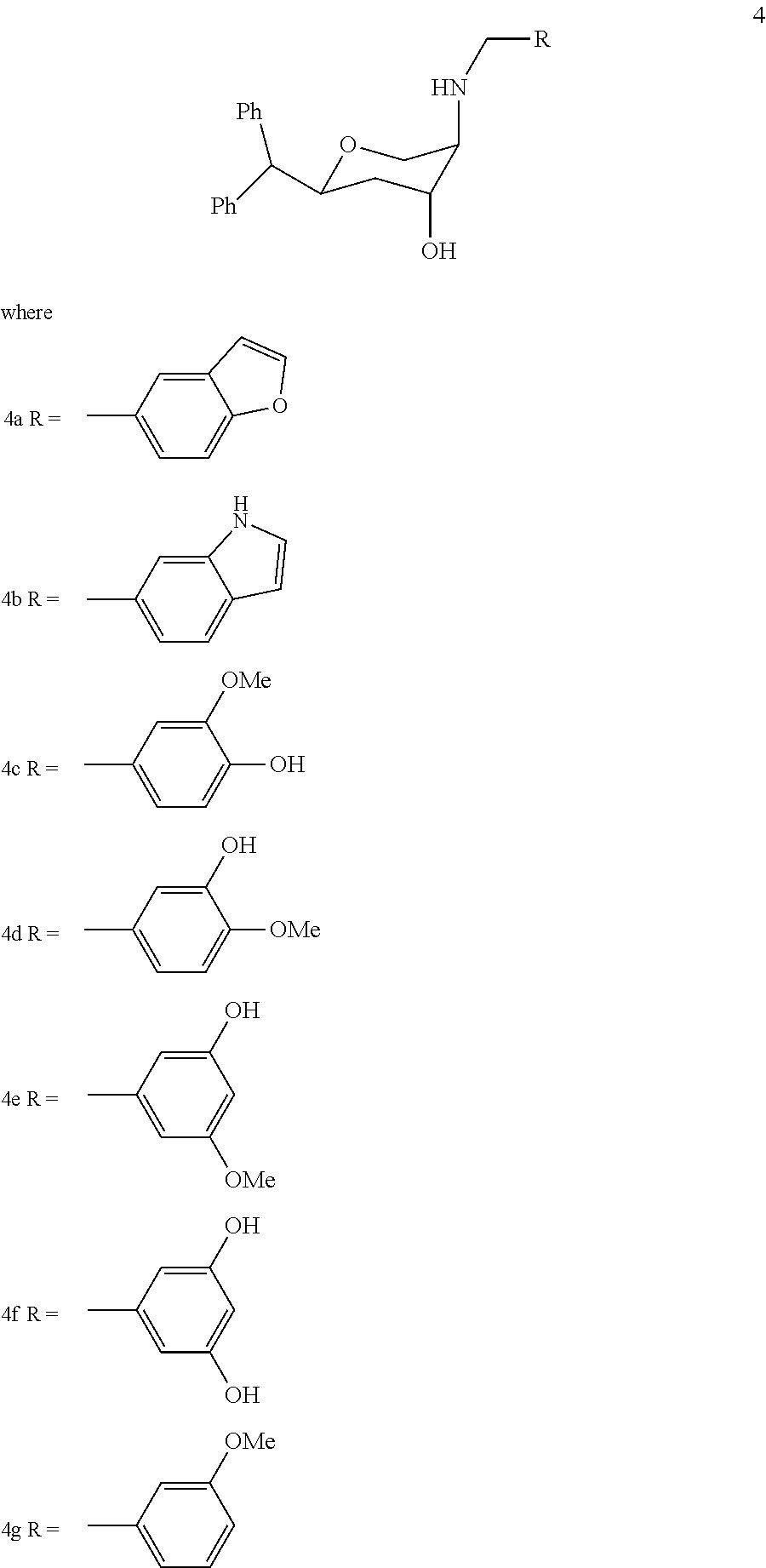
- FIG. 2 provides examples of chemical structures of pyran derivatives
- FIG. 3 provides examples of chemical structures of pyran derivatives
- FIG. 4 provides examples of chemical structures of pyran derivatives
- FIG. 5 provides examples of chemical structures of pyran derivatives
- FIG. 6 provides synthetic Scheme 1
- FIG. 7 provides synthetic Scheme 2
- FIG. 8 provides synthetic Scheme 3
- FIG. 9 provides synthetic Scheme 4.
- FIG. 10 provides synthetic Scheme 5
- FIG. 11 provides a bar chart showing the effect of sub-chronic oral administration of vehicle and D-525 on the duration of immobility in the forced swimming test in rats.
- F 9.5
- P 8.12
- Dunnett's analysis showed that the effect of D-525 at two doses (12 and 25 mg/kg) immobility was statistically significant different compared to vehicle (P ⁇ 0.01).
- Asterisks indicate a statistically significant difference toward control group that received saline p.o. **P ⁇ 0.01.
- Each treatment group contained four to seven rats.
- percent, “parts of,” and ratio values are by weight; the description of a group or class of materials as suitable or preferred for a given purpose in connection with the invention implies that mixtures of any two or more of the members of the group or class are equally suitable or preferred; description of constituents in chemical terms refers to the constituents at the time of addition to any combination specified in the description, and does not necessarily preclude chemical interactions among the constituents of a mixture once mixed; the first definition of an acronym or other abbreviation applies to all subsequent uses herein of the same abbreviation and applies mutatis mutandis to normal grammatical variations of the initially defined abbreviation; and, unless expressly stated to the contrary, measurement of a property is determined by the same technique as previously or later referenced for the same property.
- certain 3,6-disubstituted and 2,4,5-trisubstituted pyran derivatives that exhibit potent activity on monoamine transport systems are provided.
- the 3,6 and 2,4,5 pyrans are useful in probing the effects of their binding to monoamine transporter systems and the corresponding relationships to various afflictions affecting the CNS, or as a treatment for various CNS-related disorders in which the monoamine transport and related systems are implicated.
- the present embodiment is an extension of the compounds set forth in U.S. Pat. No. 7,915,433, the entire disclosure of which is hereby incorporated by reference.
- R is an optionally substituted C 6 -C 14 aryl or C 4 -C 14 heteroaryl wherein heteroatoms of heteroaryl B are selected from the group consisting of O, N, and S.
- R is:
- r is 0 to 5; T is CH or N; R 3 is F, Cl, Br, OR 4 , NO 2 , NHR 4 , NH(CO)R 4 , N(CO)OR 4 , SO 2 NH 2 , or N(R 4 ) 2 ; and R 4 is H or C 1-8 alkyl.
- R is:
- X, Y, and Z are each independently CR 4 , CR 4 2 , C—NHR 4 , C ⁇ O, S, N, or NR 4 ; and R 4 is H or C 1-8 alkyl. Additional examples for R are set forth in FIG. 1 .
- Examples of compounds having formula I include, but are not limited to, the compounds set forth in FIGS. 2-5 .
- the subject invention compounds may be used as such or in the form of their pharmaceutically acceptable derivatives and/or salts.
- derivative is meant a chemically modified form of the “base compound” which will liberate an active form of the base compound or metabolite thereof following administration, and does not include salts of the base compound.
- derivatives may also, when appropriate, also be used in the form of salts.
- the particular type of derivative is dependent, in most cases, on the nature of functional group(s) present on the base compound or its salt, and selection of a suitable derivative is within the skill of the art. For example, when hydroxyl groups are present, ethers or esters are common derivatives, especially the latter, as are also carbamates.
- the derivative is hydrolyzable to the base compound in vivo or is enzymatically converted, in one or more steps, to the base compound (or a salt thereof).
- common derivatives include amides, imides, ureas, and the like. Preparation of all these derivatives may take place by standard methods of organic chemistry. Simple esters may be produced from hydroxyl groups by esterification with a carboxylic acid, sulfonic acid, etc., a carboxylic acid anhydride, a carboxylic acid chloride, etc. Carbamates may be prepared by reaction with an organic isocyanate.
- Further derivatives include inclusion compounds and clathrates, for example inclusion complexes formed from the contact of host molecules such as ⁇ , ⁇ , and ⁇ -cyclodextrins, or chemically modified cyclodextrins well known to the art.
- Urea inclusion compounds are also derivatives.
- the gurst molecules (base compounds) are not chemically bound, but are present due to molecular attraction, hydrogen bonding, surface energy effects, etc.
- such complexes are stoichiometric, but non-stoichiometric complexes may also be used.
- Such complexes are easily prepared by one skilled in the art.
- cyclodextrin complexes may be prepared by kneading together cyclodextrin and base compound in water followed by removal of free water.
- Salts are most useful forms of the subject invention compounds, and are formed by the neutralization of basic nitrogen atoms in the base compound by an organic or inorganic acid.
- Useful organic acids are in particular carboxylic acids and sulfonic acids.
- Examples of mono-, di-, and polycarboxylic acids which are useful include formic acid, acetic acid, propionic acid, methane sulfonic acid, butyric acid, maleic acid, fumaric acid, malic acid, tartaric acid, citric acid, succinic acid, sulfosuccinic acid, tannic acid, and the like.
- An example of a sulfonic acid is toluene sulfonic acid.
- inorganic acids examples include hydrochloric acid, sulfuric acid, nitric acid, phosphoric acid, polyphosphoric acid, molybdic acid, nitrous acid, sulfurous acid, and the like.
- the salts are prepared by simply neutralizing the base compound all or in part, generally in aqueous solution. In such cases, water of hydration may be a part of the salt thus produced.
- the compounds may be administered by any suitable technique, including intravenous administration, but are preferably administered in solid form, for example as a tablet or capsule, optionally in conjunction with conventional pharmaceutical additives such as tableting aids, lubricants, fillers, pH-adjusting substances, pH-regulating substances (buffers), emulsifiers, dispersing aids, antioxidants, UV-stabilizers, etc. Such ingredients are well known.
- the compositions may also be administered in other forms, such as syrups, dispersions, etc.
- the dosage to be administered to a mammalian species is dependent on numerous factors such as the particular species, its weight, the type of disorder, the desired degree of treatment, and the individual itself. Dosages can be readily determined by one skilled in the art by routine tests, for example time/serum level measurements, dose/response curves, etc.
- the dosages are in particular easy to range, as numerous monoamine transport-affecting drugs are commercially available, have extensive in vitro and in vivo results presented in the literature, or are in clinical trials. This is true for both human and non-human subjects, anti-anxiety medication being common for use in domestic dogs and cats, for example.
- Dosage ranges which are useful also vary with respect to the activity of the individual compounds, for example the binding data set forth below in Table 1, as well as whether the compound is administered in a fast or slow release formulation, its solubility, its rate of transfer into the plasma or into the extracellular space, etc.
- human doses are expected to be based on this data from 20 mg to 200 mg. However, activity is expected at doses as low as 2 mg or lower.
- FIGS. 6-10 provides synthetic schemes for the compounds of the present invention.
- the reaction mixture was then cooled and quenched by the addition of saturated aqueous NaCl (750 mL), 26% formaline (75 mL), and acetic acid (140 mL).
- the reaction mixture was then thoroughly extracted with ethyl acetate, the organic layer was dried over Na 2 SO 4 and concentrated under vacuum to obtain a crude dark syrup.
- the crude syrup was purified by gradient column chromatography using hexanes and ethyl acetate (100:1 to 1:1) to afford the desired aldehyde F as a yellow solid (70%).
- Amide 61 (63 mg, 0.16 mmol) was dissolved in anhydrous THF (5 mL) under a continuous flow of N 2 and the colution was cooled to 0° C. Then LiAlH 4 (10 mg, 0.20 mmol) was added in portions and the reaction mixture was allowed to reach room temperature slowly and stirred for 24 h. Next, the reaction was quenched by slow addition of methanol followed by a solution of saturated NH 4 Cl at 0° C. The product was extracted with ethyl acetate and concentrated on a rotary evaporator.
- Boc protected acid was dissolved in anhydrous THF (8 mL) and cooled to 0° C. Then LiAlH 4 (0.122 g, 3.23 mmol) was added in portions and the reaction was allowed to stir at room temperature overnight. The reaction mixture was then cooled to 0° C. and quenched with slow addition of methanol (5 mL) followed by saturated NH 4 Cl (5 mL). The mixture was then repeatedly extracted with ethyl acetate (10 mL ⁇ 3). The organic layer was dried on Na 2 SO 4 and concentrated under reduced pressure on a rotary evaporator. The crude product was purified via gradient column chromatography using dichloromethane and methanol (100:1 to 10:1) to afford the desired product I as white solid.
- the acid K (5 g, 30.65 mmol) was dissolved in EtOH (50 mL) and concentrated H 2 SO 4 (1.92 mL) was added. The mixture was then refluxed for 24 h., cooled to room temperature and neutralized of saturated NaHCO 3 . The solution was then repeatedly extracted with ethyl acetate (20 mL ⁇ 3). The organic layer was dried over Na 2 SO 4 and concentrated under reduced pressure on a rotary evaporator. The crude product L was sufficiently pure and used directly in the next step without further purification.
- the ester L (3.4 g, 17.78 mmol) was dissolved in anhydrous THF (38 mL) and cooled to 0° C. Then, LiALH 4 (1.0 g, 26.67 mmol) was added in portions and the mixture was allowed to stir at room temperature for 24 h. The reaction mixture was then cooled to 0° C. and quenched with slow addition of methanol (10 mL) followed by saturated NH 4 Cl (10 mL). The mixture was then repeatedly extracted with ethyl acetate (10 mL ⁇ 3). The organic layer was dried on Na 2 SO 4 and concentrated under reduced pressure on a rotary evaporator.
- the ester (1.0 g, 4.5 mmol) was dissolved in anhydrous THF and the RB flask was cooled to 0° C. Then LiAlH 4 was added slowly and the flask was stirred at 0° C. for additional 10 min. The flask was then stirred at room temperature for 24 h. The reaction was then cooled, quenched with methanol, NH 4 Cl Rochelle's salt and diluted with ethyl acetate (10 mL). The organic layer was separated and the aqueous layer was extracted with additional ethyl acetate (3 ⁇ 10 mL). The organic layers were combined, dried over Na 2 SO 4 and concentrated under vacuo on a rotary evaporator to obtain a yellow solid.
- the crude product was purified via gradient silica gel column chromatography using a mixture of CH 2 Cl 2 and methanol (100:1 to 5:1) to obtain the desired alcohol as yellow solid (420 mg, 52%).
- the alcohol (420 mg, 2.33 mmol) was dissolved in a mixture of CH 2 Cl 2 and methanol (5:1) and MnO 2 (81 mg, 9.32 mmol). The mixture was then stirred at room temperature for 48 h following which additional amount of MnO 2 (40 mg) was added after TLC showed incompletion of the reaction.
- the bromo compound R (1.0 g, 4.67 mmol) was taken in an oven-dried RB equipped with magnetic stir-bar and dissolved in anhydrous THF (9 mL). The solution was cooled to ⁇ 78° C. and MeMgBr (1.8 mL) was added slowly. The mixture was stirred for 45 min and anhydrous THF (37.5 mL) was added slowly to maintain the internal temperature at ⁇ 50° C. After the solution was cooled back to ⁇ 78° C., t-BuLi (10.6 mL, 9.8 mmol, 1.6 M in pentane) was added dropwise. Next, DMF (2.2 mL, 28.1 mmol) was added slowly to the yellow solution and the dry-ice bath was removed after 15 min.
- the bromo compound T (100 mg, 0.53 mmol) was taken in an oven-dried RB equipped with magnetic stir-bar and dissolved in anhydrous THF (1 mL). Then, i PrMgCl (0.3 mL) was added at 0° C. and the resulting mixture was stirred at room temperature for 2 h (the solution turned into light brown beer color). Next, DMF (0.1 mL) in anhydrous THF (0.1 mL) was added slowly. Initially formed solid was slowly dissolved and the solution color turned from light brown to light yellow. After 1 h, the reaction was cooled to 0° C. and quenched with water (2 mL).
- the carboxylic acid V (10.0 g, 56.8 mmol) was dissolved in ethanol (100 mL) and catalytic amount of H 2 SO 4 was added. The solution was then refluxed for 24 h, cooled to room temperature and neutralized with saturated NaHCO 3 solution. The organic layer was separated and the aqueous layer was extracted with ethyl acetate (3 ⁇ 20 mL). The organic layers were combined, dried over Na 2 SO 4 and concentrated under vacuo on a rotary evaporator to obtain the ester W as a yellowish solid (11.43 g, 99%).
- the ester (11.43 g, 56.0 mmol) was dissolved in anhydrous THF (100 mL) and cooled to 0° C. under a steady flow of N 2 .
- LiAlH 4 (3.4 g, 90.2 mmol) was added to the solution and stirred at room temperature for 24 h.
- the reaction was quenched by the addition of methanol, NH 4 Cl, Rochelle's salt and filtered through a whatman filter paper (grade 8). The filtrate was concentrated under vacuo on a rotary evaporator to obtain the desired product as a light brown solid (7.99 g, 96%).
- the alcohol (7.99 g, 53.9 mmol) was dissolved in CH 2 Cl 2 (200 mL) and MnO 2 (19.8 g, 227.6 mmol). The mixture was then stirred at room temperature for 72 h and filtered through a whatman filter paper (grade 8). The filtrate was concentrated under vacuo on a rotary evaporator to obtain the desired aldehyde as a light brown solid (7.5 g, 95%).
- the chloro compound Z (5.0 g, 23.2 mmol) was dissolved in anhydrous CH 3 CN (25 mL) and NaOEt (4.6 g, 56.08 mmol) followed by methylamine hydrochloride (3.14 g, 46.5 mmol) were added. The mixture was refluxed for 48 h, cooled to room temperature and quenched by dropwise addition of methanol (5 mL) at 0° C. The reaction was diluted with water and the organic layer was separated. The aqueous layer was washed with additional amount of ethyl acetate (3 ⁇ 30 mL). The organic layers were combined, dried over Na 2 SO 4 and concentrated under vacuo on a rotary evaporator to obtain a yellow solid.
- the nitro compound ZF (1.37 g, 6.35 mmol) was dissolved in a 3:1 mixture of ethanol and water (83 mL). Fe(0) (3.88 g, 6.25 mmol) and NH 4 Cl (0.37 g, 6.95 mmol) were added and the mixture was refluxed for 5 h. After cooling the reaction mixture to room temperature, it was filtered through a whatman filter paper (grade 8) to obtain the desired amine as brown solid (1.16 g, 100%) which was used in the next step without further purification. Compound ZG was dissolved in anhydrous CH 2 Cl 2 (17 mL) and Et 3 N (7.03 mL, 69.5 mmol) was added.
- the azido compound 9 (196 mg, 0.57 mmol) was dissolved in anhydrous CH 2 Cl 2 (4 mL) under a steady flow of N 2 and cooled to ⁇ 10° C. Then anhydrous pyridine (0.28 mL, 3.43 mmol) was added dropwise. After stirring the solution for 5 minutes, Tf 2 O was added very slowly and the resulting mixture was stirred at the same temperature until the reaction was complete ( ⁇ 3-4 h). Water (0.22 mL, 12.22 mmol) was added to the reaction mixture and the resulting solution was refluxed at 90° C. for 2 h. TLC showed that the reaction was incomplete after 2 h.
- the azide 11 (100 mg, 0.29 mmol) was dissolved in MeOH and Pd/C was added (40 mg). The resulting mixture was stirred under a steady flow of H 2 (1 atm) for overnight. The solution was then filtered through whatman filter paper (grade 8) and the filtrate was concentrated under vacuo on a rotary evaporator to obtain the desired amine 12 as a colorless syrup (90 mg, 98%).
- Compound D-525 was evaluated in Force Swim test which is a well-known animal model of depression.
- the test procedure consisted of a pretest and test session separated by 24 h. Drugs or vehicle were administered orally (p.o) by following the timeline as described in the standard protocol. Each rat underwent a 5-min swim session following drug administration, which was videotaped and scored later.
- FIG. 11 provides a bar chart showing the effect of sub-chronic oral administration of vehicle and D-525 on the duration of immobility in the forced swimming test in rats.
- F 9.5
- P 8.12
- Dunnett's analysis showed that the effect of D-525 at two doses (12 and 25 mg/kg) immobility was statistically significant different compared to vehicle (P ⁇ 0.01).
- Asterisks indicate a statistically significant difference toward control group that received saline p.o. **P ⁇ 0.01.
- Each treatment group contained four to seven rats.
Landscapes
- Chemical & Material Sciences (AREA)
- Organic Chemistry (AREA)
- Pharmaceuticals Containing Other Organic And Inorganic Compounds (AREA)
Abstract
Description

or a pharmaceutically acceptable derivative or salt thereof;
wherein;
p is 0 to 5;
R is

W is H, OH, or NHRo;
R0 is H or C1-18 alkyl;
R1 is C1-4 alkyl, C2-6 alkenyl, C2-6 optionally halogenated alkynyl, C2-6 hydroxyalkynyl, halo, —CN, —COOR2, C5-10 cycloalkyl, C2-18 alkenyl, —OH, —NO2, —NHR2, or —OR2;
R2 is C1-8 alkyl, C5-6 cycloalkyl, or C2-8 alkenyl;
R3 is F, Cl, Br, OR4, NO2, NHR4, NH(CO)R4, N(CO)OR4, SO2NH2, or N(R4)2; the dashed line is an optional bond;
T is CH or N;
r is 0 to 5;
X, Y, and Z are each independently CR4, CR4 2, C—NHR4, C═O, S, N, or NR4; and
R4 is H or C1-8 alkyl. The compounds of the present embodiment exhibit potent activity on monoamine transport systems, and are thus useful in probing the effects of binding to monoamine transport systems and the corresponding relationships to various afflictions affecting the CNS, or as a treatment for various CNS-related disorders in which the monoamine transport system is implicated. Moreover, these compounds operate as powerful blockers for monoamine transporters.

or a pharmaceutically acceptable derivative or salt thereof;
wherein p=0 to 5;
R is an optionally substituted C6-C14 aryl or C4-C14 heteroaryl wherein heteroatoms of heteroaryl B are selected from the group consisting of O, N, and S. In a refinement, R is an C6-C14 aryl or C4-C14 heteroaryl having a substituent that includes O, N, and S;
p=0 to 5;
W is H, OH, or NHRo;
R0 is H or C1-18 alkyl;
R1 is C1-4 alkyl, C2-6 alkenyl, C2-6 optionally halogenated alkynyl, C2-6 hydroxyalkynyl, halo, —CN, —COOR2, C5-10 cycloalkyl, C2-18 alkenyl, —OH, —NO2, —NHR2, or —OR2; and
R2 is C1-8 alkyl, C5-6 cycloalkyl, or C2-8 alkenyl;

wherein:
r is 0 to 5;
T is CH or N;
R3 is F, Cl, Br, OR4, NO2, NHR4, NH(CO)R4, N(CO)OR4, SO2NH2, or N(R4)2; and
R4 is H or C1-8 alkyl.

where the dashed line is an optional bond forming a double bond therein;
X, Y, and Z are each independently CR4, CR4 2, C—NHR4, C═O, S, N, or NR4; and
R4 is H or C1-8 alkyl. Additional examples for R are set forth in



| TABLE 1 |
| Affinity of drugs at DAT, SERT, and NET in rat brain. |
| DAT uptake, | SERT uptake, | NET uptake, | |
| Ki, nM, | Ki, nM, | Ki, nM | |
| Compound | [3H]DAa | [3H]-5-HTa | [3H]DAa |
| 4c, D-501 | 167 ± 36 | 223 (5) ± 34 | 33.7 (5) ± 7.9 |
| 4d, D-502 | 58.6 ± 11.8 | 281 ± 37 | 30.2 (7) ± 7.6 |
| 4e, D-503 | 209 ± 25 | 385 ± 42 | 44.2 (6) ± 9.4 |
| 4g, D-523 | 376 ± 68 | 27.2 ± 3.0 | 5.85 ± 1.27 |
| 2b, D-543 | 56.3 ± 1.1 | 13.6 ± 1.6 | 20.8 ± 4.6 |
| 4b, D-544 | 64.0 ± 6.1 | 9.60 ± 2.57 | 10.0 ± 3.5 |
| 4f, D-542 | 259 ± 44 | 3,017 ± 341 | 152 ± 29 |
| 4a, D-485 | 234 ± 11 | 2.68 ± 0.094 | 33.6 ± 18.7 |
| 2a, D-484 | 81.9 ± 17.9 | 0.71 ± 0.085 | 25.2 ± 5.3 |
| 6c, D-507 | 17 ± 1.7 | 54.0 ± 7.8 | 25.8 ± 5 |
| 6d, D-508 | 29.3 ± 2.4 | 68.4 ± 11.4 | 26.5 ± 6.6 |
| 6a, D-473 | 13.3 ± 2.0 | 46.7 ± 17.0 | 13.2 ± 3.5 |
| 6b, D-506 | 37.0 ± 7.5 | 400 (6) ± 80 | 10.2 (4) ± 0.6 |
| 6e, D-524 | 56.8 ± 7.6 | 129 ± 25 | 28.8 (5) ± 4.3 |
| 6f, D-525 | 25.3 ± 6.2 | 26.9 ± 2.6 | 25.8 ± 7.7 |
| 6g, D-526 | 25.6 ± 5.8 | 577 ± 94 | 4.91 (5) ± 0.63 |
| 6h, D-527 | 8.94 ± 2.20 | 107 ± 11 | 4.76 (4) ± 1.72 |
| 6i, D-528 | 7.94 ± 0.66 | 367 ± 52 | 14.6 (6) ± 2.9 |
| 6k, D-529 | 24.5 ± 1.2 | 339 ± 39 | 3.92 (5) ± 0.71 |
| 6m, D-530 | 15.3 (4) ± 3.3 | 320 ± 40 | 25.9 (5) ± 6.7 |
| 6n, D-531 | 13.1 (4) ± 5.0 | 334 ± 54 | 7.37 (6) ± 2.11 |
| 6o, D-536 | 41.3 ± 9.7 | 144 ± 26 | 56.6 ± 5.2 |
| 6p, D-537 | 20.1 ± 5.3 | 258 ± 26 | 28.4 ± 4.0 |
Claims (4)


Priority Applications (2)
| Application Number | Priority Date | Filing Date | Title |
|---|---|---|---|
| US14/173,997 US9458124B2 (en) | 2013-02-06 | 2014-02-06 | Substituted pyran derivatives |
| US15/282,246 US20170015645A1 (en) | 2013-02-06 | 2016-09-30 | Substituted pyran derivatives |
Applications Claiming Priority (2)
| Application Number | Priority Date | Filing Date | Title |
|---|---|---|---|
| US201361761310P | 2013-02-06 | 2013-02-06 | |
| US14/173,997 US9458124B2 (en) | 2013-02-06 | 2014-02-06 | Substituted pyran derivatives |
Related Child Applications (1)
| Application Number | Title | Priority Date | Filing Date |
|---|---|---|---|
| US15/282,246 Division US20170015645A1 (en) | 2013-02-06 | 2016-09-30 | Substituted pyran derivatives |
Publications (2)
| Publication Number | Publication Date |
|---|---|
| US20140309427A1 US20140309427A1 (en) | 2014-10-16 |
| US9458124B2 true US9458124B2 (en) | 2016-10-04 |
Family
ID=51687222
Family Applications (2)
| Application Number | Title | Priority Date | Filing Date |
|---|---|---|---|
| US14/173,997 Active US9458124B2 (en) | 2013-02-06 | 2014-02-06 | Substituted pyran derivatives |
| US15/282,246 Abandoned US20170015645A1 (en) | 2013-02-06 | 2016-09-30 | Substituted pyran derivatives |
Family Applications After (1)
| Application Number | Title | Priority Date | Filing Date |
|---|---|---|---|
| US15/282,246 Abandoned US20170015645A1 (en) | 2013-02-06 | 2016-09-30 | Substituted pyran derivatives |
Country Status (1)
| Country | Link |
|---|---|
| US (2) | US9458124B2 (en) |
Cited By (1)
| Publication number | Priority date | Publication date | Assignee | Title |
|---|---|---|---|---|
| US20170015645A1 (en) * | 2013-02-06 | 2017-01-19 | Wayne State University | Substituted pyran derivatives |
Families Citing this family (4)
| Publication number | Priority date | Publication date | Assignee | Title |
|---|---|---|---|---|
| ES2831084T3 (en) * | 2016-06-10 | 2021-06-07 | Vitae Pharmaceuticals Inc | Inhibitors of the menin-MLL interaction |
| EP3632908A1 (en) | 2018-10-02 | 2020-04-08 | Inventiva | Inhibitors of the yap/taz-tead interaction and their use in the treatment of cancer |
| GB201910608D0 (en) * | 2019-07-24 | 2019-09-04 | Enterprise Therapeutics Ltd | Compounds |
| IL297039A (en) | 2020-04-07 | 2022-12-01 | Syndax Pharmaceuticals Inc | Combinations of menin inhibitors and cyp3a4 inhibitors and methods of using them |
Citations (2)
| Publication number | Priority date | Publication date | Assignee | Title |
|---|---|---|---|---|
| US7915433B2 (en) * | 2004-04-16 | 2011-03-29 | Wayne State University | Tri-substituted 2-benzhydryl 5-benzlamino-tetrahydro-pyran-4-OL and 6-benzhydryl-4-benzylamino-tetrahydro-pyran-3-OL analogues, and novel 3,6 disubstituted pyran derivatives |
| US8017791B2 (en) * | 2003-03-28 | 2011-09-13 | Wayne State University | Tri-substituted 2-benzhydryl-5-benzylamino-tetrahydro-pyran-4-ol and 6-benzhydryl-4-benzylamino-tetrahydro-pyran-3-ol analogues, and novel, 3,6-disubstituted pyran derivatives |
Family Cites Families (1)
| Publication number | Priority date | Publication date | Assignee | Title |
|---|---|---|---|---|
| US9458124B2 (en) * | 2013-02-06 | 2016-10-04 | Wayne State University | Substituted pyran derivatives |
-
2014
- 2014-02-06 US US14/173,997 patent/US9458124B2/en active Active
-
2016
- 2016-09-30 US US15/282,246 patent/US20170015645A1/en not_active Abandoned
Patent Citations (5)
| Publication number | Priority date | Publication date | Assignee | Title |
|---|---|---|---|---|
| US8017791B2 (en) * | 2003-03-28 | 2011-09-13 | Wayne State University | Tri-substituted 2-benzhydryl-5-benzylamino-tetrahydro-pyran-4-ol and 6-benzhydryl-4-benzylamino-tetrahydro-pyran-3-ol analogues, and novel, 3,6-disubstituted pyran derivatives |
| US7915433B2 (en) * | 2004-04-16 | 2011-03-29 | Wayne State University | Tri-substituted 2-benzhydryl 5-benzlamino-tetrahydro-pyran-4-OL and 6-benzhydryl-4-benzylamino-tetrahydro-pyran-3-OL analogues, and novel 3,6 disubstituted pyran derivatives |
| US8519159B2 (en) * | 2004-04-16 | 2013-08-27 | Wayne State University | Tri-substituted 2-benzhydryl-5-benzylamino-tetrahydro-pyran-4-OL and 6-benzhydryl-4-benzylamino-tetrahydro-pyran-3-OL analogues, and novel 3,6-disubstituted pyran derivatives |
| US8841464B2 (en) * | 2004-04-16 | 2014-09-23 | Wayne State University | Tri-substituted 2-benzhydryl-5-benzylamino-tetrahydro-pyran-4-ol and 6-benzhydryl-4-benzylamino-tetrahydro-pyran-3-ol analogues, and novel 3,6-disubstituted pyran derivatives |
| US8937189B2 (en) * | 2004-04-16 | 2015-01-20 | Wayne State University | Tri-substituted 2-benzhydryl-5-benzylamino-tetrahydro-pyran-4-ol and 6-benzhydryl-4-benzylamino-tetrahydro-pyran-3-ol analogues, and novel 3,6-disubstituted pyran derivatives |
Non-Patent Citations (4)
| Title |
|---|
| MacDougall, Journal of Molecular Graphics & Modelling (2008), 26(7), 1113-1124. * |
| Santra et al. ChemMedChem (2012), 7(12), 2093-2100. * |
| Venkatesh et al., J. Pharm. Sci. 89, 145-54 (2000). * |
| Zhang et al. Bioorganic & Medicinal Chemistry (2004), 12(23), 6301-6315. * |
Cited By (1)
| Publication number | Priority date | Publication date | Assignee | Title |
|---|---|---|---|---|
| US20170015645A1 (en) * | 2013-02-06 | 2017-01-19 | Wayne State University | Substituted pyran derivatives |
Also Published As
| Publication number | Publication date |
|---|---|
| US20140309427A1 (en) | 2014-10-16 |
| US20170015645A1 (en) | 2017-01-19 |
Similar Documents
| Publication | Publication Date | Title |
|---|---|---|
| US20230122909A1 (en) | Compounds, pharmaceutical compositions, and methods of preparing compounds and of their use | |
| US20170015645A1 (en) | Substituted pyran derivatives | |
| US7928244B2 (en) | Compounds and methods for inhibiting the interaction of BCL proteins with binding partners | |
| EP2531501B1 (en) | Apoptosis signal-regulating kinase 1 inhibitors | |
| US9434695B2 (en) | Nitrogenous heterocyclic derivatives and their application in drugs | |
| US9670166B2 (en) | Substituted bicyclic dihydropyrimidinones and their use as inhibitors of neutrophil elastase activity | |
| US11897887B2 (en) | sGC stimulators | |
| US20120283249A1 (en) | Novel compounds which have a protective activity with respect to the action of toxins and of viruses with an intracellular mode of action | |
| US20080090847A1 (en) | Heterocyclic compounds and uses thereof as d-alanyl-d-alanine ligase inhibitors | |
| US20180155345A1 (en) | sGC STIMULATORS | |
| CN103038229A (en) | Heteroaryl compounds and methods of use thereof | |
| WO2011041293A1 (en) | Pyrazolo [1, 5-a] pyrimidine derivatives as apoptosis signal-regulating kinase 1 inhibitors | |
| US20160244429A1 (en) | Substituted Piperazine Compounds And Methods Of Use Thereof | |
| JP2022062115A (en) | Phosphorus prodrug of sGC stimulant | |
| US12459957B2 (en) | Therapeutic compounds and methods | |
| JP2018048191A (en) | Methods and compositions for treating bacterial infections | |
| US9475779B2 (en) | Substituted bicyclic dihydropyrimidinones and their use as inhibitors of neutrophil elastase activity | |
| US8841464B2 (en) | Tri-substituted 2-benzhydryl-5-benzylamino-tetrahydro-pyran-4-ol and 6-benzhydryl-4-benzylamino-tetrahydro-pyran-3-ol analogues, and novel 3,6-disubstituted pyran derivatives | |
| US20250282784A1 (en) | Cytochrome bd oxidase inhibitors and uses thereof | |
| WO2024050434A1 (en) | ISOQUINOLINE COMPOUNDS AND THEIR USE IN TREATING AhR MEDIATED DISEASES | |
| US8017791B2 (en) | Tri-substituted 2-benzhydryl-5-benzylamino-tetrahydro-pyran-4-ol and 6-benzhydryl-4-benzylamino-tetrahydro-pyran-3-ol analogues, and novel, 3,6-disubstituted pyran derivatives | |
| US20240208939A1 (en) | Treatment of autoimmune and inflammatory disorders with inhibitors of bet family bdii bromodomain | |
| WO2025237171A1 (en) | Pyrimidine-fused five-membered azacyclic phenol compound and use thereof | |
| HK40130359A (en) | Inhibitors of canine janus kinase and uses thereof |
Legal Events
| Date | Code | Title | Description |
|---|---|---|---|
| AS | Assignment |
Owner name: WAYNE STATE UNIVERSITY, MICHIGAN Free format text: ASSIGNMENT OF ASSIGNORS INTEREST;ASSIGNOR:DUTTA, ALOKE K.;REEL/FRAME:032451/0661 Effective date: 20140303 |
|
| AS | Assignment |
Owner name: NATIONAL INSTITUTES OF HEALTH (NIH), U.S. DEPT. OF Free format text: CONFIRMATORY LICENSE;ASSIGNOR:WAYNE STATE UNIVERSITY;REEL/FRAME:040026/0059 Effective date: 20160912 |
|
| STCF | Information on status: patent grant |
Free format text: PATENTED CASE |
|
| MAFP | Maintenance fee payment |
Free format text: PAYMENT OF MAINTENANCE FEE, 4TH YR, SMALL ENTITY (ORIGINAL EVENT CODE: M2551); ENTITY STATUS OF PATENT OWNER: SMALL ENTITY Year of fee payment: 4 |
|
| MAFP | Maintenance fee payment |
Free format text: PAYMENT OF MAINTENANCE FEE, 8TH YR, SMALL ENTITY (ORIGINAL EVENT CODE: M2552); ENTITY STATUS OF PATENT OWNER: SMALL ENTITY Year of fee payment: 8 |