US9454654B1 - Multi-server one-time passcode verification on respective high order and low order passcode portions - Google Patents
Multi-server one-time passcode verification on respective high order and low order passcode portions Download PDFInfo
- Publication number
- US9454654B1 US9454654B1 US14/144,707 US201314144707A US9454654B1 US 9454654 B1 US9454654 B1 US 9454654B1 US 201314144707 A US201314144707 A US 201314144707A US 9454654 B1 US9454654 B1 US 9454654B1
- Authority
- US
- United States
- Prior art keywords
- passcode
- codeword
- authentication
- order
- authentication server
- Prior art date
- Legal status (The legal status is an assumption and is not a legal conclusion. Google has not performed a legal analysis and makes no representation as to the accuracy of the status listed.)
- Active, expires
Links
Images




Classifications
-
- G—PHYSICS
- G06—COMPUTING OR CALCULATING; COUNTING
- G06F—ELECTRIC DIGITAL DATA PROCESSING
- G06F21/00—Security arrangements for protecting computers, components thereof, programs or data against unauthorised activity
- G06F21/30—Authentication, i.e. establishing the identity or authorisation of security principals
- G06F21/31—User authentication
-
- H—ELECTRICITY
- H04—ELECTRIC COMMUNICATION TECHNIQUE
- H04L—TRANSMISSION OF DIGITAL INFORMATION, e.g. TELEGRAPHIC COMMUNICATION
- H04L25/00—Baseband systems
- H04L25/02—Details ; arrangements for supplying electrical power along data transmission lines
- H04L25/03—Shaping networks in transmitter or receiver, e.g. adaptive shaping networks
- H04L25/03891—Spatial equalizers
- H04L25/03898—Spatial equalizers codebook-based design
- H04L25/03929—Spatial equalizers codebook-based design with layer mapping, e.g. codeword-to layer design
-
- H—ELECTRICITY
- H04—ELECTRIC COMMUNICATION TECHNIQUE
- H04L—TRANSMISSION OF DIGITAL INFORMATION, e.g. TELEGRAPHIC COMMUNICATION
- H04L63/00—Network architectures or network communication protocols for network security
- H04L63/08—Network architectures or network communication protocols for network security for authentication of entities
- H04L63/083—Network architectures or network communication protocols for network security for authentication of entities using passwords
- H04L63/0838—Network architectures or network communication protocols for network security for authentication of entities using passwords using one-time-passwords
-
- H—ELECTRICITY
- H04—ELECTRIC COMMUNICATION TECHNIQUE
- H04L—TRANSMISSION OF DIGITAL INFORMATION, e.g. TELEGRAPHIC COMMUNICATION
- H04L63/00—Network architectures or network communication protocols for network security
- H04L63/08—Network architectures or network communication protocols for network security for authentication of entities
- H04L63/0853—Network architectures or network communication protocols for network security for authentication of entities using an additional device, e.g. smartcard, SIM or a different communication terminal
Definitions
- the field relates generally to authentication, and more particularly to multi-server authentication.
- One-time authentication tokens produce a series of unpredictable one-time passcodes (OTPs) as second authentication factors for the authentication of users to remote servers.
- One-time authentication tokens implement the general solution concept of second factor authentication, thus offering stronger user authentication.
- Passcodes are typically generated in an unpredictable manner by extracting pseudorandomness from an initial seed, that is stored at the token and shared with the server.
- the security of one-time authentication tokens is based on the secrecy and protection of the token's seed, in particular, against an attacker that directly compromises the server, either ephemerally to get the secret seed or permanently to tamper with the verification process.
- Split-server verification employs at least two verification servers, each keeping a distinct secret state, as well as distributed cryptography to implement a joint user-authentication protocol that tolerates certain compromise of one or more servers. See, for example, U.S. Pat. No. 7,725,730. Similar split-server OTP verification protocols have been proposed to make one-time authentication tokens resilient to certain type of server-side attacks.
- Illustrative embodiments of the present invention provide multi-server one-time passcode verification of respective high order and low order passcode portions.
- a user is authenticated by receiving an authentication passcode generated by a token associated with the user; and authenticating the user based on the received authentication passcode using at least a first authentication server and a second authentication server, wherein the first authentication server verifies a high-order portion of the received authentication passcode and wherein the second authentication server verifies a low-order portion of the received authentication passcode.
- the received authentication passcode is based on, for example, at least two protocodes P R,t and P B,t generated by the token and/or pseudorandom information R A,t .
- a codebook C t based on the pseudorandom information R A,t , can be used to embed additional auxiliary information into the authentication passcode.
- the first authentication server and the second authentication server return a verification to a relying party RP indicating whether a respective portion of the received authentication passcode has been partially verified.
- the relying party RP authenticates the user if both the first authentication server and the second authentication server verify a respective portion of the received authentication passcode.
- the first authentication server computes high order auxiliary information comprising a high order candidate codeword embedded in the received authentication passcode and determines one or more high order matching indices between the high order embedded codeword and a high order portion of a codeword of a corresponding codebook and wherein the second authentication server computes low order auxiliary information comprising a low order candidate codeword embedded in the received authentication passcode and determines one or more low order matching indices between the low order embedded codeword and a low order portion of a codeword of a corresponding codebook.
- the relying party RP accepts the received authentication passcode if the high order matching indices and low order matching indices have a non-empty intersection.
- Embodiments of the invention can be implemented in a wide variety of different authentication applications, including, for example, verification of one-time passcodes (OTPs).
- OTPs one-time passcodes
- FIG. 1 illustrates an exemplary client-side generation of passcodes that are enriched by auxiliary information by a token
- FIG. 2 illustrates an exemplary vertical split-server passcode verification scheme incorporating aspects of the present invention, where each server verifies a high-order portion or a low-order portion, respectively, and optionally extracts a portion of an embedded auxiliary information by processing a corresponding high-order codebook or low-order codebook, respectively;
- FIG. 3 illustrates an exemplary split-server passcode verification process incorporating aspects of the invention with reference to the verification scheme of FIG. 2 ;
- FIG. 4 illustrates an exemplary preprocessing portion of the disclosed split-server passcode verification scheme of FIG. 3 ;
- FIG. 5 illustrates an exemplary first phase portion of the disclosed split-server passcode verification scheme of FIG. 3 ;
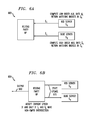
- FIG. 6A and FIG. 6B illustrate an exemplary second phase portion and a verification phase portion of the disclosed split-server passcode verification scheme of FIG. 3 , respectively;
- FIG. 7 illustrates an exemplary alternate first phase portion of an alternate implementation of the disclosed split-server passcode verification scheme of FIG. 3 ;
- FIGS. 8A and 8B collectively, illustrate an exemplary alternate second phase portion of the disclosed split-server passcode verification scheme of FIG. 3 ;
- FIG. 9 illustrates an exemplary alternate verification portion of the disclosed split-server passcode verification scheme of FIG. 3 ;
- FIGS. 10, 11 and 12 illustrate alternative exemplary split-server passcode verification processes incorporating aspects of the invention related to auxiliary channel support
- FIG. 13 illustrates an exemplary processing platform that may be used to implement at least a portion of one or more embodiments of the invention comprising a cloud infrastructure
- FIG. 14 illustrates another exemplary processing platform that may be used to implement at least a portion of one or more embodiments of the invention.
- communication system as used herein is intended to be broadly construed, so as to encompass, for example, systems in which multiple processing devices communicate with one another but not necessarily in a manner characterized by a client-server model.
- the present invention in one or more illustrative embodiments provides efficient split-server OTP verification protocols that are compatible with the existence of an auxiliary channel, while providing high levels of server-side security.
- a “vertical-split” verification protocol is provided where different servers are responsible for verifying different portions (substrings) of the submitted passcode.
- a method is provided for extending any general split-server OTP verification protocol without auxiliary-channel support to one that supports an auxiliary channel.
- passcodes are typically generated on a regular time basis, i.e., in specified time intervals often called epochs (e.g., the widely used SecurIDTM token produces a new OTP every minute).
- epochs e.g., the widely used SecurIDTM token produces a new OTP every minute.
- Passcodes are derived by using a secret state, called a seed, that is stored at the token and also shared with the server. Tokens can either be based on software or hardware.
- Software tokens produce passcodes on-demand, whenever the token's application is launched in the host device, where a series of passcodes is generated for the epochs following the launching of the application.
- Hardware tokens produce passcodes on a permanent basis, one passcode per epoch, for the entire lifetime of their battery (e.g., for five years from the time of manufacture). Overall, such tokens produce a time-based series of unpredictable OTPs by extracting pseudorandom bits from their seed which are converted to passcodes.
- a passcode P t′ is produced in time epoch t′ through a one-way cryptographic function ⁇ applied on the current epoch t′, and the seed ⁇ of the token.
- Software tokens specify their current epoch based on the current time of the host device, whereas hardware tokens specify their epoch implicitly using a counter.
- a passcode P t′ may then be transmitted to an authentication server to authenticate a user to the server.
- the transmission of the passcode P t ′ to the server may happen either by typing performed by the user or automatically by a software token that is directly communicating to the server through a communication channel offered by the host device.
- Passcode P t is computed by the server by applying the same function ⁇ on the current epoch t′ specified by the server's current time and the seed ⁇ of the token stored at the server.
- P t′ is also contrasted against another 2s passcodes that are defined by epochs that are neighboring epochs to the server's epoch t, that is, to passcodes ⁇ P t ⁇ s , . . . ,P t ⁇ 1 ,P t ,P t+1 , . . . ,P t+s ⁇ .
- Passcodes are produced by applying a one way function ⁇ on the token's seed. As long as the seed remains a secret, protected against leakage to an attacker, future passcodes remain unpredictable even if an attacker has observed an arbitrarily long history of passcodes produced in the past.
- any one-time authentication token collapses if an attacker gets access to the secret seed of the token. Using the seed, the attacker can clone the token and thus reconstruct the series of passcodes that the token will ever produce. In turn, the attacker can increase its chances for impersonating the corresponding user, by either performing a brute-force attack on the user's PIN or by launching a more sophisticated man-in-the-middle attack for harvesting the user's PIN.
- the fact that the security of the token is based on a secret seed will motivate the attacker to go after this secret seed by following one of the following three attack patterns:
- the attacker may compromise the authentication server and get the secret seed of the token of one or more users.
- the attacker may compromise the server ephemerally by instantly stealing the seed(s) and then terminating the attack, or permanently by remaining in control of the server for a long period of time, thus directly being able to impersonate one or more users.
- Token Tampering or Compromise The attacker may compromise the token and get its secret seed either by performing a direct attack against the host device of a software token (using some malware, trojan, or virus installed on the device or through some network-based attack), thus fully bypassing any protection mechanisms being in place by the token application for restricting access to the token's seed, or by physically tampering with a hardware token to directly read its seed, e.g., by opening the case of the token and reading the full internal state of the token at the time of compromise.
- Seed-Record Capturing The attacker may get the secret seed of the token indirectly by attacking a storage or communication unit used to store or transfer the token's seed, or through side-channel attacks performed against the token or the server.
- High layer protection optionally employs one or more of the following intrusion-detection, and intrusion-resilience techniques: split-server passcode verification (U.S. patent application Ser. No. 13/404,737, filed Feb. 24, 2012, entitled “Method and Apparatus for Authenticating a User Using Multi-Server One-Time Passcode Verification,” (now U.S. Pat. No. 9,118,661)), silent alarms (U.S. patent application Ser. No. 13/404,788, filed Feb. 24, 2012, entitled “Methods and Apparatus for Silent Alarm Channels Using One-Time Passcode Authentication Tokens”) and drifting keys (U.S. patent application Ser. No. 13/250,225, filed Sep. 30, 2011, entitled “Key Update With Compromise Detection”).
- split-server passcode verification U.S. patent application Ser. No. 13/404,737, filed Feb. 24, 2012, entitled “Method and Apparatus for Authenticating a User Using
- Low layer protection optionally employs one or more of the following tamper-resistance techniques: forward-secure pseudorandom number generators (U.S. patent application Ser. No. 13/334,709, filed Dec. 23, 2011, entitled “Methods and Apparatus for Generating Forward Secure Pseudorandom Numbers” (now U.S. Pat. No. 9,008,303)), use of a source of randomness at the token, and randomized state transitions (U.S. patent application Ser. No. 13/828,588, filed Mar. 14, 2013, entitled “Randomizing State Transitions for One-Time Authentication Tokens”).
- forward-secure pseudorandom number generators U.S. patent application Ser. No. 13/334,709, filed Dec. 23, 2011, entitled “Methods and Apparatus for Generating Forward Secure Pseudorandom Numbers” (now U.S. Pat. No. 9,008,303)
- use of a source of randomness at the token and randomized
- Intermediate layer protection optionally employs one or more of the following token-visibility techniques: data-transaction signing (U.S. patent application Ser. No. 13/826,924, filed Mar. 14, 2013, entitled “Event-Based Data-Signing Via Time-Based One-Time Authentication Passcodes,” (now U.S. Pat. No. 9,225,717), incorporated by reference herein), auxiliary channels (U.S. patent application Ser. No. 13/404,780, filed Feb. 24, 2012, entitled “Method and Apparatus for Embedding Auxiliary Information in One-Time Passcode Authentication Tokens” (now U.S. Pat. No. 8,984,609)) and time synchronization (U.S. patent application Ser. No.
- Forward security can be applied to management of the internal state of one-time authentication tokens. Instead of using a fixed global secret state, e.g., a seed, for the entire lifetime of the token, the secret state can evolve over time in a one-way cryptographic manner so that older states cannot be computed from newer states (e.g., new seeds may be computed using a one-way hash chain). More elaborate hierarchical hashing schemes are possible that improve the server-side performance with respect to management of time-evolving seeds. See, for example, U.S. patent application Ser. No. 13/334,709, filed Dec. 23, 2011, entitled “Methods and Apparatus for Generating Forward Secure Pseudorandom Numbers,” (now U.S. Pat. No. 9,008,303).
- Split-Server Passcode Verification is a solution concept for tolerating server compromise(s) in systems that employ one-time authentication tokens.
- Split-server passcode verification involves employing distributed cryptographic techniques for dispersing the task of verifying a candidate passcode (provided by a user or token) among two or more verification servers so that each such participating server S t stores only a partial secret state ⁇ t .
- the token's seed a is split or shared into two or more pieces each managed by a separate server.
- One security property is that verification is securely implemented in a distributed manner, yet leakage of one or more, but up to a specified threshold, partial secret states does not compromise the security of the token. See, for example, U.S. patent application Ser. No. 13/404,737, filed Feb. 24, 2012, entitled “Method and Apparatus for Authenticating a User Using Multi-Server One-Time Passcode Verification,” (now U.S. Pat. No. 9,118,661).
- the seed is split into two pieces, often called the red and the blue partial seeds, produced respectively by two distinct FS-PRNGs, the red FS-PRNG FSP R and the blue FS-PRNG FSP B .
- the red server stores the red seed that evolves through FSP R and the blue server stores the blue seed that evolves through FSP B .
- the two servers Upon receiving a candidate passcode P t′ , the two servers interact through a secure protocol to jointly compute the passcode P t against which the candidate passcode is contrasted, and accordingly P t′ is rejected if any of the two servers output “reject.”
- This decision is typically made by a so-called relying server that is stateless and responsible for the final decision about the acceptance of P t′ based on the individual outputs of the red and the blue servers.
- the additional feature of proactivization can be used according to which the partial states of the (e.g., two) servers evolve over time and where the servers periodically exchange secure descriptions (e.g., hashes) of their partial secret states, which are then used to create their new partial secret states.
- secure descriptions e.g., hashes
- Auxiliary Channel A small (e.g., 4) number of auxiliary information bits can be embedded into the produced passcodes of a token that, in turn, can be reconstructed by the server, thus implementing a low-bandwidth auxiliary channel between the token and the server.
- Such channels are designed so that they are resilient to small-digit typographical errors performed by the user transcribing a passcode: An error correction code coming from a randomly selected, secret and passcode-specific codebook C t is used to encode the auxiliary word that is to be embedded into the passcode, and this embedding corresponds to adding the resulted codeword to the initial passcode using some associative binary operation (e.g., digit-wise addition modulo 10).
- some associative binary operation e.g., digit-wise addition modulo 10
- chaff sets provide a natural trade-off between security and performance:
- a server compromise reveals the chaff set and the attacker has 1/l success probability towards user impersonation, but passcode verification now involves only two independent (and therefore non-interactive) easy-to-perform set-inclusion checks, namely, that P t ′ ⁇ K t,B and P t ′ ⁇ K t,R .
- P t ′ ⁇ K t,B and P t ′ ⁇ K t,R Applying this idea to tokens is slightly more involved, as sets K t,B and K t,R cannot be precomputed in advance, but rather must be produced on demand, this time jointly (with interaction) between the red and blue servers. It has been shown that it is possible to have these chaff sets computed implicitly using chaff-set hints sent by each other server.
- chaff sets are constructed on the fly as follows.
- the red and blue servers, S R and S B exchange share “hints”—share values that define chaff sets of optimal (maximum) size ⁇ square root over (p) ⁇ , where p is the size of the passcode space.
- the set ⁇ R is a fixed sequence of offsets that serves to construct S R 's chaff set K t,R .
- the general idea behind construction of K t,R is for server S B to construct a sequence of values that includes P B,t . This sequence is centered on a random element ⁇ R,j in ⁇ R ; other elements of ⁇ R serve as offsets defining chaff values.
- P R,t By adding P R,t to each element of this set, S R obtains a chaff set K t,R .
- Within K t,R is embedded the full, valid passcode P t , along with chaff values.
- P t chaff
- regular addition operator + can be alternatively replaced by digit-wise modulo 10 addition operator ⁇ .
- ⁇ B ⁇ B,0 , . . . , ⁇ B,l ⁇ 1 ⁇ .
- the disclosed non-cryptographic split-server passcode verification scheme is not compatible with the existence of an auxiliary channel.
- the disclosed scheme operates only in the case where no auxiliary channel exists. It is therefore important to design a new split-server passcode verification scheme that is both lightweight and supports an auxiliary channel in the token.
- a split-server passcode verification scheme is provided that is lightweight and fully compatible with the existence of an auxiliary channel between the token and the authentication servers.
- FIG. 1 illustrates an exemplary client-side generation of passcodes by a token 100 .
- the exemplary token 100 comprises a red and a blue FS-PRNG, FSP R and FSP B , respectively, that produce protocodes P R,t and P B,t , respectively, for each epoch t.
- the blue FS-PRNG FSP B produces pseudorandom information R A,t that is used for the passcode-specific pseudorandom generation of a codebook C t which, in turn, is optionally used by the auxiliary channel to embed additional information into the two produced protocodes, finally producing the transmitted passcode P t .
- the exemplary auxiliary channel operates as follows.
- the embedded message m consists of a small number of k bits.
- B can take the form of a [8, 4, 4] or [6, 4, 2] error correcting code (specifically, the [8, 4, 4] extended Hamming code or a corresponding [6, 4, 2] Hamming code).
- mapping C t can be itself considered a Hamming code (over zero and non-zero digits).
- the final exemplary passcode P t is computed using digit-wise modulo 10 addition of P R,t , P B,t and c t , denoted here using operator ⁇ as P R,t ⁇ P B,t ⁇ c t .
- the final exemplary passcode P t optionally embeds the auxiliary information from the k-bit message m that has been mapped into the codeword c t .
- codebooks B and C t are seen as 2 k ⁇ l matrices then, similarly, the high-order (or most significant) portion B , C t and the low-order (or least significant) portion B , C t can be considered parts of them, which are 2 k ⁇ l/2 matrices.
- the disclosed exemplary split-server passcode verification scheme splits the verification process across the two servers according to the high-order versus low-order partition of the passcode into two equally size parts in the exemplary embodiment.
- the passcode may be an auxiliary-information enriched passcode. That is, in the case of such auxiliary-information enriched passcodes, unlike some existing split verification methods that divide the passcode “horizontally,” where each server possesses a secret share of the protocode P R,t ⁇ P B,t and where both servers need to reconstruct and verify passcode P R,t ⁇ P B,t ⁇ c t , the disclosed split-server passcode verification scheme, shown in FIG.
- each server still possesses a secret share of the protocode P R,t ⁇ B B,t but now each server is responsible for reconstructing and verifying only the high-order portion P R,t ⁇ P B,t ⁇ c t and, respectively, the low-order portion P R,t ⁇ P B,t ⁇ c t .
- This idea is effective in yielding efficient split-server verification protocols.
- the existence of an auxiliary channel that is maintained by only one of the two servers introduces some additional challenges.
- the disclosed protocols consider the interaction between the two authentication servers, the blue S B and the red S R server, with one trusted relying party, a server RP to which the final access-control/authentication decision is handed and which interacts with the high-level application that the end user of the token is interested in accessing.
- FIG. 3 illustrates an exemplary split-server passcode verification process 300 incorporating aspects of the invention with reference to the verification scheme of FIG. 2 .
- the exemplary split-server passcode verification process 300 is initiated during step 310 when an auxiliary-information enriched candidate passcode P t is presented to a relying party RP. It is noted that the exemplary relying party RP does not store the secret seed of the user.
- the candidate passcode P t is provided to each server S B and S R during step 320 .
- the candidate passcode P t supports the auxiliary channel.
- the candidate passcode P t is thus a passcode that optionally embeds auxiliary information.
- the two servers S B and S R exchange information during step 330 , as discussed further below in conjunction with FIG. 5 .
- the servers S B and S R return a verification-related output to the relying party RP during step 340 indicating whether their respective portion has been verified. The final verification performed by the relying party RP is discussed further below in conjunction with FIG. 9 .
- the relying party RP authenticates the user if and only if both servers S B and S R verify their respective portion of the candidate passcode P t .
- These individual verifications of respective portions of the passcode may be implicit: The final verification may actually be performed at the relying party RP based on verification-related information outputted by the two servers.
- the verification protocol can comprise, for example, the vertical splitting techniques described herein.
- one server here by exemplary convention, the blue server, is responsible for verifying the high-order portion of the passcode
- the second server here by exemplary convention, the red server
- the two servers each have the following inputs for any given epoch t (within a certain search window, such as an exemplary duration of 70 epochs):
- the exemplary verification protocol ⁇ t then runs as follows for a given epoch t:
- FIG. 4 illustrates an exemplary preprocessing portion 400 of the disclosed split-server passcode verification scheme 300 .
- FIG. 5 illustrates an exemplary first phase portion 500 of the disclosed split-server passcode verification scheme 300 .
- the two servers exchange information as follows:
- S B sends ⁇ C t , P B,t ⁇ to S R .
- S R sends P R,t to S B .
- FIGS. 6A and 6B illustrate an exemplary second phase portion 600 and a verification phase portion 650 of the disclosed split-server passcode verification scheme 300 , respectively.
- each server verifies the respective high-order or low-order portion of the passcode:
- the blue server S B performs the following steps:
- the red server S R performs the following steps:
- protocol ⁇ t ( ⁇ t , I t ) ⁇ t ( P′,R A,t ,P B,t ,P R,t ).
- Relying Party RP initializes A ⁇ and ans ⁇ reject
- Server S B sends ⁇ t to Relying Party RP and Server S R sends I t to Relying Party RP, as shown in FIG. 6A ;
- Relying Party RP accepts the passcode P′ and set ans ⁇ accept if and only if A ⁇ .
- the relying party RP will search the entire search window and will accept the passcode only if the passcode has been accepted with respect to at least one epoch in the search window.
- Any ordering D can be used in principle; two practical orderings are the left-to-right ordering (t′ ⁇ s, . . . ,t′ ⁇ 1,t′,1, . . . ,t′+s) or the alternating ordering (t′,t′+1,t′ ⁇ 1,t′+2,t′ ⁇ 2, . . . ,t′+s,t′ ⁇ s).
- i t can either be the empty set or a singleton.
- Output item ⁇ t*,i t* ⁇ 660 corresponds to the updated information about the most recent (last) epoch t* that a successful authentication was performed for the token, along with the corresponding auxiliary information i t* (a k-bit message), and it can be selected from set A in any arbitrary way; four practical exemplary selection policies may be selected to choose the epoch-auxiliary information pair corresponding to the minimum, maximum, median or closest epoch t* to the current Relying Party RP time t′.
- Output item state 670 corresponds to secondary decision elements that may take into consideration the auxiliary information ⁇ i t 1 ,i t 2 , . . . ,i t c ⁇ that is contained in A. For instance, if silent alarms are used, then state 670 may encode the new silent alarm state of the token, and its semantic interpretation according to a given policy.
- the information sent back to server S B can be different than the one sent back to S R , i.e., the feedback sent back by RP can be asymmetric.
- the auxiliary information i t* must be an output that reaches server S B so that server S B is able to appropriately process the auxiliary channel information and possibly update its local state, which in turn can be communicated back to the relying party RP.
- the basic protocol ⁇ t can be simplified as follows, under the condition that the binary codebook B is known to both server S B and server S R (a standard assumption as B is public information), but also at the minor cost of introducing an additional round of communication between S B and S R . There is no pre-processing phase at the blue server S B .
- FIG. 7 illustrates an exemplary alternate first phase portion 700 of an alternate implementation of the disclosed split-server passcode verification scheme 300 .
- the two servers exchange information as follows:
- S R sends P R,t to S B and S B sends R R,t to S R .
- FIGS. 8A and 8B collectively, illustrate an exemplary alternate second phase portion 800 , 850 of the disclosed split-server passcode verification scheme 300 .
- the alternate second phase 800 augments Steps iii and iv relative to the embodiment shown in FIG. 6A in each server's protocol.
- each server first computes high or low order auxiliary information d t or d t , as discussed above in conjunction with FIG. 6A , and then maps the high or low order candidate digital codeword d t or d t to a corresponding high or low order binary candidate codeword q or q as follows: Every non-zero digit of d t or d t is changed to a 1 in q or q respectively.
- Step 3 runs as discussed above in conjunction with FIG. 6A , but now for each q j ⁇ B or respectively for each q j ⁇ B , 1 ⁇ j ⁇ 2 k to generate output ⁇ t and I t , respectively.
- both servers S B and S R output ⁇ t and I t , respectively (and terminate).
- R A,t (I′) ⁇ R A,t (I′), R A,t (I′) ⁇ be the pseudorandom bits R A,t (I′) from R A,t that are associated with mapping binary codeword q r ⁇ B to digital codeword c I′ .
- Server S B sends to Server S R the pseudorandom bits R A,t (I′), and using R A,t (I′) the Server S B computes c I′ .
- An advantage of this first alternate protocol is the reduction of the communication cost, as the precomputed codebook C t is no longer communicated to the server S R , at the cost of slightly increasing the interaction between the two servers.
- both the basic protocol ⁇ t and its simplification above can be adapted to operate in a single-server setting (where the red and blue servers may collapse to one server).
- the (single- or) two-server basic and simplified protocols strictly improve the security of the (single- or) two-server one-time passcode token system of U.S.
- the final step is omitted, that is, no additional information exchange is performed between S B and S R .
- the high and low order d t and d t of the candidate digital codeword are included in the outputs ⁇ t and respectively I t of the basic protocol.
- the general verification protocol is slightly modified to perform the additional test with respect to the digital codeword c I′ as follows:
- FIG. 9 illustrates this exemplary alternate verification portion 900 of the disclosed split-server passcode verification scheme 300 .
- the servers S B and S R send the Relying Party RP their outputs ⁇ t and d t and I t and d t , respectively, during Step 1.
- the exemplary basic protocol ⁇ t can be extended to allow incorporation with the recent chaff-based split-server verification protocol disclosed in U.S. patent application Ser. No. 13/795,801, filed Mar. 12, 2013, entitled “Distributed Cryptography Using Distinct Value Sets Each Comprising at Least One Obscured Secret Value,” thus extending this protocol to be compatible with the existence of an auxiliary channel, as follows.
- l.
- regular addition operator + can be alternatively replaced by digit-wise modulo 10 addition operator ⁇ .
- Step ii of the second phase is changed so that for each passcode P ⁇ K t,B (resp.
- l codewords computed in Step ii.
- ⁇ t (respectively I t ) to be the set of pairs (j, P j ) of matching indices j computed by Server S B (respectively by Server S R ) and its corresponding protocode P j in set K t,B (respectively set K t,R ) that produced the corresponding digital codeword d matching the codebook in position j, or ⁇ if no such matching index was found.
- the general verification protocol acceptance test ⁇ t ⁇ I t ⁇ in Step 2 is augmented to further test that this non-empty intersection is a singleton set (j, P i ), and then accordingly i t is set to j.
- split-server verification protocols described above all maintain a minimum desired level of security in the event of an ephemeral or permanent server being compromised:
- the search space of the attacker is reduced only to half, e.g., for 8-digit passcodes, the OTP system still maintains a desired 4-digit security.
- auxiliary-information enriched passcodes require shared knowledge of the underlying codebook C t used to map auxiliary messages into offsets of the protocode for formation of the final produced passcodes.
- an asymmetric auxiliary-channel model of U.S. patent application Ser. No. 13/837,259, filed Mar. 15, 2013, entitled “Configurable One-Time Authentication Tokens with Improved Resilience to Attacks” now U.S. Pat. No.
- any given split-server verification protocol of non-enriched passcodes that is appropriately augmented to support verification of also auxiliary-information enriched passcodes in the asymmetric auxiliary channel model discussed above will necessarily need to provide one or more of the three involved parties (the red and blue servers and the relying party) with access to underlying secret codebook C t .
- This necessary task can be realized using the techniques presented above.
- FIG. 10 illustrates an exemplary split-server passcode verification process 1000 incorporating auxiliary channel support aspects of the invention.
- the exemplary split-server passcode verification process 1000 is initiated during step 1010 when an auxiliary-information enriched candidate passcode P t is presented to a relying party RP.
- the candidate passcode P t is provided to each server S B and S R during step 1020 . As indicated above in conjunction with FIG. 1 , the candidate passcode P t supports the auxiliary channel. The candidate passcode P t is thus a passcode that optionally embeds auxiliary information.
- the two servers S B and S R exchange information during step 1030 .
- the codebook C t is at least partially explicitly transmitted to server S R during step 1030 .
- the servers S B and S R return a verification to the relying party RP during step 1040 indicating whether passcode P t or their respective portion of passcode P t has been verified with respect to a valid codeword of codebook C t that consistently encodes a unique auxiliary-channel message.
- the final verification is performed by the relying party RP in a similar (but not necessarily the same) process with the one discussed above in conjunction with FIG. 6B .
- the relying party RP authenticates the user during step 1050 if and only if both servers S B and S R verify the auxiliary-information enriched candidate passcode P t or their respective portion of P t .
- Implicit Codebook Computation and Codeword Checking In this case, the non-deterministic computation of codebook C t is enabled by transmitting the pseudorandom information R A,t as a whole or partially to some party; then, computation is performed implicitly on a codeword basis. That is, an appropriate codeword in B is first selected, for deriving the auxiliary-information message, and only then this binary codeword is non-deterministically mapped to its equivalent digital codeword for verification. Depending on which party performs the above process, the following are further distinguished:
- FIG. 11 illustrates an exemplary split-server passcode verification process 1100 incorporating server-side auxiliary channel support aspects of the invention. As shown in FIG. 11 , the exemplary split-server passcode verification process 1100 is initiated during step 1110 when an auxiliary-information enriched candidate passcode P t is presented to a relying party RP.
- the auxiliary-information enriched candidate passcode P t is provided to each server S B and S R during step 1120 .
- the two servers S B and S R exchange information during step 1130 .
- the pseudorandom information R A,t is transmitted to server S R during step 1130 .
- An appropriate codeword from codebook B is selected for deriving the auxiliary-information message, and only then this binary codeword is mapped to its equivalent digital codeword for verification.
- the servers S B and S R return a verification to the relying party RP during step 1140 indicating whether passcode P t or their respective portion of passcode P t has been verified first with respect to a valid binary codeword of codebook B that consistently encodes a unique auxiliary-channel message and second with respect to the digital codeword (in codebook C t ) corresponding to the first binary codeword in B.
- the final verification is performed by the relying party RP in a similar (but not necessarily the same) process with the one discussed above in conjunction with FIG. 8B .
- the relying party RP authenticates the user during step 1150 if and only if both servers S B and S R verify the auxiliary-information enriched candidate passcode P t or their respective portion of P t .
- FIG. 12 illustrates an exemplary split-server passcode verification process 1200 incorporating relying party processing of the auxiliary channel information. As shown in FIG. 12 , the exemplary split-server passcode verification process 1200 is initiated during step 1210 when an auxiliary-information enriched candidate passcode P t is presented to a relying party RP.
- the auxiliary-information enriched candidate passcode P t is provided to each server S B and S R during step 1220 .
- the two servers S B and S R exchange information during step 1230 .
- the servers S B and S R return a verification to the relying party RP during step 1240 indicating whether passcode P t or their respective portion of passcode P t has been verified with respect to a valid binary codeword of codebook B that consistently encodes a unique auxiliary-channel message.
- the final verification is performed by the relying party RP in a similar (but not necessarily the same) process with the one discussed above in conjunction with FIG. 9 .
- the relying party RP authenticates the user during step 1250 if and only if both servers S B and S R verify the auxiliary-information enriched candidate passcode P t or their respective portion of P t and RP further verifies P t with respect to a valid digital codeword in codebook C t .
- the latter step is performed as follows. An appropriate codeword from codebook B is selected by the relying party RP for deriving the auxiliary-information message, and only then this binary codeword is mapped to its equivalent digital codeword for verification, using the pseudorandom information R A,t .
- a candidate passcode P t ′ is provided as input to servers S R and S B , the two servers exchange information and compute a local output (possibly in multiple rounds) that is finally sent to the relying party RP which accepts or rejects P t ′.
- the relying party RP which accepts or rejects P t ′.
- any split-server verification protocol of non-enriched passcodes e.g., like the one in U.S. patent application Ser. No. 13/795,801, filed Mar. 12, 2013, entitled “Distributed Cryptography Using Distinct Value Sets Each Comprising at Least One Obscured Secret Value”
- the exemplary framework proposes three ways to extend this protocol to the verification of enriched passcodes.
- the codebook is composed by red and blue portions locally available to S R and S B (e.g., like the ones in U.S. patent application Ser. No. 13/404,737, filed Feb.
- both the vertical splitting and the auxiliary-channel handling methods described herein can be extended in the case of more than two servers, assuming a token-side design that supports such extensions. For instance, if a passcode comprises of three protocode parts, say red, blue and green, then vertical splitting can be considered into three corresponding parts. Splitting into more parts than the number of protocodes is also possible if the appropriate pseudorandom information is appropriately disseminated among the servers. Similarly, auxiliary-channel handling can be supported in multi-server settings.
- the present invention is illustrated herein using a high-order (or most significant) half and a low-order (or least significant) half of the protocode, the invention can be applied using high-order (or most significant) portions and low-order (or least significant) portions of the protocode that have an unequal length and/or more than two portions.
- split-server verification can be implemented at least in part in the form of one or more software programs stored in memory and executed by a processor of a processing device such as a computer.
- a memory or other storage device having such program code embodied therein is an example of what is more generally referred to herein as a “computer program product.”
- inventions described herein can provide a number of significant advantages relative to conventional practice. For example, these embodiments can advantageously provide improved scalability and support of auxiliary channels. Also, a wide variety of different OTP verification protocols can be implemented using the disclosed techniques.
- Authentication processes in other embodiments may make use of one or more operations commonly used in the context of conventional authentication processes.
- Examples of conventional authentication processes are disclosed in A. J. Menezes et al., Handbook of Applied Cryptography, CRC Press, 1997, which is incorporated by reference herein. These conventional processes, being well known to those skilled in the art, will not be described in further detail herein, although embodiments of the present invention may incorporate aspects of such processes.
- the communication system may be implemented using one or more processing platforms.
- One or more of the processing modules or other components may therefore each run on a computer, storage device or other processing platform element.
- a given such element may be viewed as an example of what is more generally referred to herein as a “processing device.”
- the cloud infrastructure 1300 in this exemplary processing platform comprises virtual machines (VMs) 1302 - 1 , 1302 - 2 , . . . 1302 -M implemented using a hypervisor 1304 .
- the hypervisor 1304 runs on physical infrastructure 1305 .
- the cloud infrastructure 1300 further comprises sets of applications 1310 - 1 , 1310 - 2 , . . . 1310 -M running on respective ones of the virtual machines 1302 - 1 , 1302 - 2 , . . . 1302 -M under the control of the hypervisor 1304 .
- the cloud infrastructure 1300 may encompass the entire given system or only portions of that given system, such as one or more of client, servers, controller, authentication server or relying server in the system.
- hypervisor 1304 may of course include multiple hypervisors each providing a set of virtual machines using at least one underlying physical machine.
- hypervisor platform An example of a commercially available hypervisor platform that may be used to implement hypervisor 1304 and possibly other portions of the system in one or more embodiments of the invention is the VMware® vSphereTM which may have an associated virtual infrastructure management system such as the VMware® vCenterTM.
- the underlying physical machines may comprise one or more distributed processing platforms that include storage products, such as VNX® and Symmetrix VMAX®, both commercially available from EMC Corporation of Hopkinton, Mass. A variety of other storage products may be utilized to implement at least a portion of the system.
- the processing platform 1400 in this embodiment comprises at least a portion of the given system and includes a plurality of processing devices, denoted 1402 - 1 , 1402 - 2 , 1402 - 3 . . . 1402 -D, which communicate with one another over a network 1404 .
- the network 1404 may comprise any type of network, such as a WAN, a LAN, a satellite network, a telephone or cable network, a cellular network, a wireless network such as WiFi or WiMAX, or various portions or combinations of these and other types of networks.
- the processing device 1402 - 1 in the processing platform 1400 comprises a processor 1410 coupled to a memory 1412 .
- the processor 1410 may comprise as microprocessor, a microcontroller, an ASIC, an FPGA or other type of processing circuitry, as well as portions or combinations of such circuitry elements, and the memory 1412 , which may be viewed as an example of a “computer program product” having executable computer program code embodied therein, may comprise RAM, ROM or other types of memory, in any combination.
- network interface circuitry 1414 which is used to interface the processing device with the network 1404 and other system components, and may comprise conventional transceivers.
- the other processing devices 1402 of the processing platform 1400 are assumed to be configured in a manner similar to that shown for processing device 1402 - 1 in the figure.
- processing platform 1400 shown in the figure is presented by way of example only, and the given system may include additional or alternative processing platforms, as well as numerous distinct processing platforms in any combination, with each such platform comprising one or more computers, storage devices or other processing devices.
- Multiple elements of system may be collectively implemented on a common processing platform of the type shown in FIG. 13 or 14 , or each such element may be implemented on a separate processing platform.
- the methods and apparatus discussed herein may be distributed as an article of manufacture that itself comprises a machine readable recordable storage medium containing one or more programs.
- the one or more programs are operable, in conjunction with a computer system, to carry out all or some of the steps to perform the methods or create the apparatuses discussed herein.
Landscapes
- Engineering & Computer Science (AREA)
- Computer Security & Cryptography (AREA)
- General Engineering & Computer Science (AREA)
- Computer Hardware Design (AREA)
- Computer Networks & Wireless Communication (AREA)
- Signal Processing (AREA)
- Theoretical Computer Science (AREA)
- Physics & Mathematics (AREA)
- Computing Systems (AREA)
- Software Systems (AREA)
- General Physics & Mathematics (AREA)
- Power Engineering (AREA)
- Mathematical Physics (AREA)
- Storage Device Security (AREA)
Abstract
Description

K t,R={σR,i +s R +P R,i}

Above, regular addition operator + can be alternatively replaced by digit-wise modulo 10 addition operator ⊕.
Server SB generates its chaff set by operating analogously using a fixed sequence of offsets ΣB={σB,0, . . . ,σB,l−1}. The above protocol guarantees that PtεKt,R and PtεKt,B. By choosing
ΣR=

ΣB ={l,2l, . . . ,l 2},
as the two public offsets sets, for l=√{square root over (p)}, one can guarantee that Pt=Kt,R∩Kt,B and that the chaff set size is maximized. Maximizing the chaff set size is important, because an adversary compromising one of the two servers can at best guess a valid passcode from its locally computed chaff set, an event happening with
p i,t =r i,t +b i,t +c i,t mod10.
Similarly, operator ⊖ denotes digit-wise modulo 10 subtraction, used to appropriately solve the above equation to one of two protocodes PR,t and PB,t or the codeword ct.
s=
or simply
s=
It is noted that while the present invention is illustrated herein using a high-order (or most significant) half and a low-order (or least significant) half of the protocode, the invention can be applied using high-order (or most significant) portions and low-order (or least significant) portions of the protocode that have an unequal length.
(Ī t, I t)←Πt(P′,R A,t ,P B,t ,P R,t).
P t =P R,t ⊕P B,t ⊕c t,
which do support the use of an auxiliary channel, referred to herein as auxiliary-information enriched passcodes.
Claims (24)
Priority Applications (1)
| Application Number | Priority Date | Filing Date | Title |
|---|---|---|---|
| US14/144,707 US9454654B1 (en) | 2013-12-31 | 2013-12-31 | Multi-server one-time passcode verification on respective high order and low order passcode portions |
Applications Claiming Priority (1)
| Application Number | Priority Date | Filing Date | Title |
|---|---|---|---|
| US14/144,707 US9454654B1 (en) | 2013-12-31 | 2013-12-31 | Multi-server one-time passcode verification on respective high order and low order passcode portions |
Publications (1)
| Publication Number | Publication Date |
|---|---|
| US9454654B1 true US9454654B1 (en) | 2016-09-27 |
Family
ID=56939639
Family Applications (1)
| Application Number | Title | Priority Date | Filing Date |
|---|---|---|---|
| US14/144,707 Active 2034-04-27 US9454654B1 (en) | 2013-12-31 | 2013-12-31 | Multi-server one-time passcode verification on respective high order and low order passcode portions |
Country Status (1)
| Country | Link |
|---|---|
| US (1) | US9454654B1 (en) |
Cited By (9)
| Publication number | Priority date | Publication date | Assignee | Title |
|---|---|---|---|---|
| US20150043668A1 (en) * | 2013-08-06 | 2015-02-12 | OptCTS, Inc. | Authentication of a subscribed code table user utilizing optimized code table signaling |
| US9774349B2 (en) | 2013-08-06 | 2017-09-26 | Agilepq, Inc. | Optimized code table signaling for authentication to a network and information system |
| US9967251B1 (en) | 2013-12-31 | 2018-05-08 | EMC IP Holding Company LLC | Security-aware single-server passcode verification for one-time authentication tokens |
| US10056919B2 (en) | 2014-07-02 | 2018-08-21 | Agilepq, Inc. | Data recovery utilizing optimized code table signaling |
| US10091204B1 (en) | 2013-12-31 | 2018-10-02 | EMC IP Holding Company LLC | Controlling user access to protected resource based on outcome of one-time passcode authentication token and predefined access policy |
| CN110708337A (en) * | 2019-10-30 | 2020-01-17 | 山东浪潮商用系统有限公司 | Big data security framework system based on identity authentication |
| US10587399B2 (en) | 2016-06-06 | 2020-03-10 | Agilepq, Inc. | Data conversion systems and methods |
| US10673832B2 (en) | 2013-12-31 | 2020-06-02 | EMC IP Holding Company LLC | Predefined access policy implementation based on auxiliary information embedded in one-time authentication passcodes |
| CN116260603A (en) * | 2022-09-07 | 2023-06-13 | 中国电信股份有限公司 | An identity authentication method, device, electronic equipment and storage medium |
Citations (3)
| Publication number | Priority date | Publication date | Assignee | Title |
|---|---|---|---|---|
| US20040023677A1 (en) * | 2000-11-27 | 2004-02-05 | Kazunori Mano | Method, device and program for coding and decoding acoustic parameter, and method, device and program for coding and decoding sound |
| US20040073787A1 (en) * | 2002-03-13 | 2004-04-15 | Amir Ban | Personal portable storage medium |
| US7725730B2 (en) * | 2002-08-09 | 2010-05-25 | Emc Corporation | Cryptographic methods and apparatus for secure authentication |
-
2013
- 2013-12-31 US US14/144,707 patent/US9454654B1/en active Active
Patent Citations (3)
| Publication number | Priority date | Publication date | Assignee | Title |
|---|---|---|---|---|
| US20040023677A1 (en) * | 2000-11-27 | 2004-02-05 | Kazunori Mano | Method, device and program for coding and decoding acoustic parameter, and method, device and program for coding and decoding sound |
| US20040073787A1 (en) * | 2002-03-13 | 2004-04-15 | Amir Ban | Personal portable storage medium |
| US7725730B2 (en) * | 2002-08-09 | 2010-05-25 | Emc Corporation | Cryptographic methods and apparatus for secure authentication |
Cited By (16)
| Publication number | Priority date | Publication date | Assignee | Title |
|---|---|---|---|---|
| US10523490B2 (en) * | 2013-08-06 | 2019-12-31 | Agilepq, Inc. | Authentication of a subscribed code table user utilizing optimized code table signaling |
| US9774349B2 (en) | 2013-08-06 | 2017-09-26 | Agilepq, Inc. | Optimized code table signaling for authentication to a network and information system |
| US9900126B2 (en) | 2013-08-06 | 2018-02-20 | Agilepq, Inc. | Optimized code table signaling for authentication to a network and information system |
| US20150043668A1 (en) * | 2013-08-06 | 2015-02-12 | OptCTS, Inc. | Authentication of a subscribed code table user utilizing optimized code table signaling |
| US10200062B2 (en) | 2013-08-06 | 2019-02-05 | Agilepq, Inc. | Optimized code table signaling for authentication to a network and information system |
| US9967251B1 (en) | 2013-12-31 | 2018-05-08 | EMC IP Holding Company LLC | Security-aware single-server passcode verification for one-time authentication tokens |
| US10091204B1 (en) | 2013-12-31 | 2018-10-02 | EMC IP Holding Company LLC | Controlling user access to protected resource based on outcome of one-time passcode authentication token and predefined access policy |
| US10673832B2 (en) | 2013-12-31 | 2020-06-02 | EMC IP Holding Company LLC | Predefined access policy implementation based on auxiliary information embedded in one-time authentication passcodes |
| US10056919B2 (en) | 2014-07-02 | 2018-08-21 | Agilepq, Inc. | Data recovery utilizing optimized code table signaling |
| US10361716B2 (en) | 2014-07-02 | 2019-07-23 | Agilepq, Inc. | Data recovery utilizing optimized code table signaling |
| US10587399B2 (en) | 2016-06-06 | 2020-03-10 | Agilepq, Inc. | Data conversion systems and methods |
| US11018854B2 (en) | 2016-06-06 | 2021-05-25 | Agilepq, Inc. | Data conversion systems and methods |
| CN110708337A (en) * | 2019-10-30 | 2020-01-17 | 山东浪潮商用系统有限公司 | Big data security framework system based on identity authentication |
| CN110708337B (en) * | 2019-10-30 | 2022-06-28 | 浪潮软件科技有限公司 | Big data security framework system based on identity authentication |
| CN116260603A (en) * | 2022-09-07 | 2023-06-13 | 中国电信股份有限公司 | An identity authentication method, device, electronic equipment and storage medium |
| CN116260603B (en) * | 2022-09-07 | 2025-11-18 | 中国电信股份有限公司 | An authentication method, apparatus, electronic device, and storage medium |
Similar Documents
| Publication | Publication Date | Title |
|---|---|---|
| US9454654B1 (en) | Multi-server one-time passcode verification on respective high order and low order passcode portions | |
| US9407631B1 (en) | Multi-server passcode verification for one-time authentication tokens with auxiliary channel compatibility | |
| US9432360B1 (en) | Security-aware split-server passcode verification for one-time authentication tokens | |
| US11303462B2 (en) | Unequally powered cryptography using physical unclonable functions | |
| US9118661B1 (en) | Methods and apparatus for authenticating a user using multi-server one-time passcode verification | |
| US9294473B1 (en) | Server methods and apparatus for processing passcodes generated by configurable one-time authentication tokens | |
| US8966276B2 (en) | System and method providing disconnected authentication | |
| KR101095239B1 (en) | Secure communication | |
| US6959394B1 (en) | Splitting knowledge of a password | |
| US8984609B1 (en) | Methods and apparatus for embedding auxiliary information in one-time passcodes | |
| US9325499B1 (en) | Message encryption and decryption utilizing low-entropy keys | |
| BR112020007781A2 (en) | system and method for generating and depositing keys for multipoint authentication | |
| KR20070050504A (en) | One-time password | |
| EP3532972A1 (en) | Authentication method and system | |
| Wang et al. | A lightweight password‐based authentication protocol using smart card | |
| US9749314B1 (en) | Recovery mechanism for fault-tolerant split-server passcode verification of one-time authentication tokens | |
| Zahednejad et al. | A Lightweight, Secure Big Data‐Based Authentication and Key‐Agreement Scheme for IoT with Revocability | |
| Zeng et al. | A security-enhanced ultra-lightweight and anonymous user authentication protocol for telehealthcare information systems | |
| Nair et al. | Multi-factor credential hashing for asymmetric brute-force attack resistance | |
| Wang et al. | Lightweight and fast authentication protocol for digital healthcare services | |
| US10091204B1 (en) | Controlling user access to protected resource based on outcome of one-time passcode authentication token and predefined access policy | |
| Tran et al. | A lightweight ECC-compatible end-to-end security protocol using CRP-PUF and TRNG for IoT devices | |
| Ding et al. | Htotp: Honey time-based one-time passwords | |
| CN110945832B (en) | Method and system for symmetric group authentication | |
| Luo et al. | Provably Secure ECC‐Based Three‐Factor Authentication Scheme for Mobile Cloud Computing with Offline Registration Centre |
Legal Events
| Date | Code | Title | Description |
|---|---|---|---|
| AS | Assignment |
Owner name: EMC CORPORATION, MASSACHUSETTS Free format text: ASSIGNMENT OF ASSIGNORS INTEREST;ASSIGNORS:TRIANDOPOULOS, NIKOLAOS;JUELS, ARI;RIVEST, RONALD L.;AND OTHERS;SIGNING DATES FROM 20140218 TO 20140918;REEL/FRAME:033770/0855 |
|
| STCF | Information on status: patent grant |
Free format text: PATENTED CASE |
|
| CC | Certificate of correction | ||
| AS | Assignment |
Owner name: THE BANK OF NEW YORK MELLON TRUST COMPANY, N.A., T Free format text: SECURITY AGREEMENT;ASSIGNORS:CREDANT TECHNOLOGIES, INC.;DELL INTERNATIONAL L.L.C.;DELL MARKETING L.P.;AND OTHERS;REEL/FRAME:049452/0223 Effective date: 20190320 Owner name: THE BANK OF NEW YORK MELLON TRUST COMPANY, N.A., TEXAS Free format text: SECURITY AGREEMENT;ASSIGNORS:CREDANT TECHNOLOGIES, INC.;DELL INTERNATIONAL L.L.C.;DELL MARKETING L.P.;AND OTHERS;REEL/FRAME:049452/0223 Effective date: 20190320 |
|
| MAFP | Maintenance fee payment |
Free format text: PAYMENT OF MAINTENANCE FEE, 4TH YEAR, LARGE ENTITY (ORIGINAL EVENT CODE: M1551); ENTITY STATUS OF PATENT OWNER: LARGE ENTITY Year of fee payment: 4 |
|
| AS | Assignment |
Owner name: THE BANK OF NEW YORK MELLON TRUST COMPANY, N.A., TEXAS Free format text: SECURITY AGREEMENT;ASSIGNORS:CREDANT TECHNOLOGIES INC.;DELL INTERNATIONAL L.L.C.;DELL MARKETING L.P.;AND OTHERS;REEL/FRAME:053546/0001 Effective date: 20200409 |
|
| AS | Assignment |
Owner name: DELL MARKETING L.P. (ON BEHALF OF ITSELF AND AS SUCCESSOR-IN-INTEREST TO CREDANT TECHNOLOGIES, INC.), TEXAS Free format text: RELEASE OF SECURITY INTEREST IN PATENTS PREVIOUSLY RECORDED AT REEL/FRAME (053546/0001);ASSIGNOR:THE BANK OF NEW YORK MELLON TRUST COMPANY, N.A., AS NOTES COLLATERAL AGENT;REEL/FRAME:071642/0001 Effective date: 20220329 Owner name: DELL INTERNATIONAL L.L.C., TEXAS Free format text: RELEASE OF SECURITY INTEREST IN PATENTS PREVIOUSLY RECORDED AT REEL/FRAME (053546/0001);ASSIGNOR:THE BANK OF NEW YORK MELLON TRUST COMPANY, N.A., AS NOTES COLLATERAL AGENT;REEL/FRAME:071642/0001 Effective date: 20220329 Owner name: DELL PRODUCTS L.P., TEXAS Free format text: RELEASE OF SECURITY INTEREST IN PATENTS PREVIOUSLY RECORDED AT REEL/FRAME (053546/0001);ASSIGNOR:THE BANK OF NEW YORK MELLON TRUST COMPANY, N.A., AS NOTES COLLATERAL AGENT;REEL/FRAME:071642/0001 Effective date: 20220329 Owner name: DELL USA L.P., TEXAS Free format text: RELEASE OF SECURITY INTEREST IN PATENTS PREVIOUSLY RECORDED AT REEL/FRAME (053546/0001);ASSIGNOR:THE BANK OF NEW YORK MELLON TRUST COMPANY, N.A., AS NOTES COLLATERAL AGENT;REEL/FRAME:071642/0001 Effective date: 20220329 Owner name: EMC CORPORATION, MASSACHUSETTS Free format text: RELEASE OF SECURITY INTEREST IN PATENTS PREVIOUSLY RECORDED AT REEL/FRAME (053546/0001);ASSIGNOR:THE BANK OF NEW YORK MELLON TRUST COMPANY, N.A., AS NOTES COLLATERAL AGENT;REEL/FRAME:071642/0001 Effective date: 20220329 Owner name: DELL MARKETING CORPORATION (SUCCESSOR-IN-INTEREST TO FORCE10 NETWORKS, INC. AND WYSE TECHNOLOGY L.L.C.), TEXAS Free format text: RELEASE OF SECURITY INTEREST IN PATENTS PREVIOUSLY RECORDED AT REEL/FRAME (053546/0001);ASSIGNOR:THE BANK OF NEW YORK MELLON TRUST COMPANY, N.A., AS NOTES COLLATERAL AGENT;REEL/FRAME:071642/0001 Effective date: 20220329 Owner name: EMC IP HOLDING COMPANY LLC, TEXAS Free format text: RELEASE OF SECURITY INTEREST IN PATENTS PREVIOUSLY RECORDED AT REEL/FRAME (053546/0001);ASSIGNOR:THE BANK OF NEW YORK MELLON TRUST COMPANY, N.A., AS NOTES COLLATERAL AGENT;REEL/FRAME:071642/0001 Effective date: 20220329 |
|
| MAFP | Maintenance fee payment |
Free format text: PAYMENT OF MAINTENANCE FEE, 8TH YEAR, LARGE ENTITY (ORIGINAL EVENT CODE: M1552); ENTITY STATUS OF PATENT OWNER: LARGE ENTITY Year of fee payment: 8 |