US9451562B2 - Matching subcarrier power in a broadband network collocated with a narrowband network - Google Patents
Matching subcarrier power in a broadband network collocated with a narrowband network Download PDFInfo
- Publication number
- US9451562B2 US9451562B2 US14/004,162 US201214004162A US9451562B2 US 9451562 B2 US9451562 B2 US 9451562B2 US 201214004162 A US201214004162 A US 201214004162A US 9451562 B2 US9451562 B2 US 9451562B2
- Authority
- US
- United States
- Prior art keywords
- network
- base stations
- given cell
- carriers
- subcarriers
- Prior art date
- Legal status (The legal status is an assumption and is not a legal conclusion. Google has not performed a legal analysis and makes no representation as to the accuracy of the status listed.)
- Expired - Fee Related, expires
Links
Images




Classifications
-
- H—ELECTRICITY
- H04—ELECTRIC COMMUNICATION TECHNIQUE
- H04W—WIRELESS COMMUNICATION NETWORKS
- H04W52/00—Power management, e.g. Transmission Power Control [TPC] or power classes
- H04W52/04—Transmission power control [TPC]
- H04W52/30—Transmission power control [TPC] using constraints in the total amount of available transmission power
- H04W52/34—TPC management, i.e. sharing limited amount of power among users or channels or data types, e.g. cell loading
-
- H—ELECTRICITY
- H04—ELECTRIC COMMUNICATION TECHNIQUE
- H04W—WIRELESS COMMUNICATION NETWORKS
- H04W52/00—Power management, e.g. Transmission Power Control [TPC] or power classes
- H04W52/04—Transmission power control [TPC]
- H04W52/18—TPC being performed according to specific parameters
- H04W52/24—TPC being performed according to specific parameters using SIR [Signal to Interference Ratio] or other wireless path parameters
- H04W52/243—TPC being performed according to specific parameters using SIR [Signal to Interference Ratio] or other wireless path parameters taking into account interferences
-
- H—ELECTRICITY
- H04—ELECTRIC COMMUNICATION TECHNIQUE
- H04W—WIRELESS COMMUNICATION NETWORKS
- H04W52/00—Power management, e.g. Transmission Power Control [TPC] or power classes
- H04W52/04—Transmission power control [TPC]
- H04W52/18—TPC being performed according to specific parameters
- H04W52/24—TPC being performed according to specific parameters using SIR [Signal to Interference Ratio] or other wireless path parameters
- H04W52/243—TPC being performed according to specific parameters using SIR [Signal to Interference Ratio] or other wireless path parameters taking into account interferences
- H04W52/244—Interferences in heterogeneous networks, e.g. among macro and femto or pico cells or other sector / system interference [OSI]
-
- H—ELECTRICITY
- H04—ELECTRIC COMMUNICATION TECHNIQUE
- H04W—WIRELESS COMMUNICATION NETWORKS
- H04W28/00—Network traffic management; Network resource management
- H04W28/02—Traffic management, e.g. flow control or congestion control
- H04W28/04—Error control
-
- H04W28/048—
-
- H—ELECTRICITY
- H04—ELECTRIC COMMUNICATION TECHNIQUE
- H04W—WIRELESS COMMUNICATION NETWORKS
- H04W28/00—Network traffic management; Network resource management
- H04W28/16—Central resource management; Negotiation of resources or communication parameters, e.g. negotiating bandwidth or QoS [Quality of Service]
-
- H—ELECTRICITY
- H04—ELECTRIC COMMUNICATION TECHNIQUE
- H04W—WIRELESS COMMUNICATION NETWORKS
- H04W28/00—Network traffic management; Network resource management
- H04W28/16—Central resource management; Negotiation of resources or communication parameters, e.g. negotiating bandwidth or QoS [Quality of Service]
- H04W28/18—Negotiating wireless communication parameters
Definitions
- the present invention relates to a method for adapting subcarrier powers transmitted in a predetermined transmission direction in a broadband cellular wireless communication network as a function of the carrier powers transmitted in the broad band in the predetermined transmission direction in a narrowband cellular wireless communication network collocated with the broadband network.
- the predetermined transmission direction in the networks can be according to downlinks from base stations to mobiles, or also according to uplinks from mobiles to base stations.
- mobiles are also known as “mobile stations”, “user equipment”, or “mobile terminals”.
- the broadband network is a network for third generation 3GPP (Third Generation Partnership Project) mobiles based for example on the E-UTRA (Evolved-UMTS Terrestrial Radio Access) technology, sometimes also known as LTE (Long Term Evolution), or on the mobile WiMAX (Worldwide Interoperability for Microwave Access) technology.
- E-UTRA Evolved-UMTS Terrestrial Radio Access
- LTE Long Term Evolution
- WiMAX Worldwide Interoperability for Microwave Access
- the narrowband network is for example a narrowband professional private terrestrial wireless communication network PMR (Professional Mobile Radio) for example of the DMR (Digital Mobile Radio), TETRA (Terrestrial Trunked Radio), TETRAPOL or P25 type.
- PMR Professional Mobile Radio
- TETRA Transmission Control Trunked Radio
- P25 P25 type.
- the narrow band network is structured in a cellular pattern of re-use of several cells each having an omnidirectional base station. Interlaced groups of carriers distributed in the frequency band reserved for the downlinks are allocated respectively to the cells of a pattern. Moreover, other interlaced groups of carriers distributed in the frequency band reserved for the uplinks are allocated respectively to the cells of a pattern.
- each cell comprises a base station of the broadband network and a base station of the narrowband network.
- the proximity of the subcarriers and carriers in the broadband reserved for the downlinks or uplinks allocated to the two networks, and on the other hand the collocation of the base stations of the two networks in the cells produce interference detrimental to the reception in the mobiles and the base stations and on the quality of service of the wireless communications in the networks.
- High interference in the cells of the narrowband network cannot be allowed because of the high quality of service required for the communications in the narrowband network. Consequently the transmissions in the broadband network must be adapted to the conditions of exploitation of the narrowband network.
- a simple solution would be to prevent, in a base station of the broadband network, the transmission of subcarriers interfering substantially with carriers transmitted by base stations of the narrow band network situated in the proximity of the base station of the broadband network, and to prevent, in a mobile of the broadband network, the transmission of subcarriers interfering substantially with carriers transmitted by mobiles of the narrowband network situated in the proximity of the mobile of the broadband network.
- Such a solution considerably reduces the useful band of the broadband network.
- the object of the invention is to reduce the interference produced by a broadband network divided into sectors on a narrowband network collocated with the broadband network for an allowable carrier to interference ratio threshold with reception in a cell of the narrowband network.
- a method for adapting subcarrier powers in a first cellular wireless communication network having first base stations with several directional sectors as a function of the powers of carriers in a second cellular wireless communication network having second omnidirectional base stations, the first and second networks having in common cells each having first and second collocated base stations and a wide frequency band including the subcarriers allocated to the sectors of the first base stations and groups of carriers allocated respectively to the second base stations in a cellular pattern of re-use of the second network having several concentric levels of cell location, is characterised in that it comprises an attenuation by an attenuation parameter of a predetermined power for each subcarrier which is to be transmitted by a transmitter/receiver (of the first network located in a given cell and in) a specified sector of the given cell and which is adjacent to a carrier belonging to one of the groups allocated to second base stations in preselected cells in the specified sector and on levels starting from the given cell below a predetermined high level, the attenuation parameter being all the more low as
- a subcarrier to be transmitted is considered as adjacent to a carrier when the carrier is comprised in a sub-band of predetermined width centred on the subcarrier.
- the second base stations of the second network of the narrowband type respectively transmit carriers comprised in the sub-band of predetermined width, with one carrier per second base station.
- a subcarrier to be transmitted may be considered as adjacent to a carrier when the subcarrier is comprised in the useful frequency band centred on the subcarrier.
- at least two first base stations of the first network of the broadband type respectively transmit subcarriers comprised in the useful frequency band of a carrier allocated to a second base station.
- the transmitter/receiver of the first network may be a network base station when the wide frequency band is relative to a direction of transmission for downlinks from the base station to mobiles attached to the base station, or also a mobile when the wide frequency band is relative to a direction of transmission for uplinks from the mobiles to the base station.
- the transmitter/receiver itself decides on the transmission power of each of the subcarriers. Because of the attenuation of the transmission powers of the subcarriers in the transmitter/receiver of the first network which is selective as a function of the location of the second base stations with respect to the specified sector of the given cell containing the transmitter/receiver, the interference produced by the first broadband network on the second network of the narrowband type are reduced, whilst admitting as many subcarriers as possible with the predetermined transmission power in the first network.
- the division of cells in the first network into sectors makes it possible to increase the carrier to interference ratio in the cells of the second network and hence to reduce the interference caused by the first network in the second network.
- the groups of subcarriers allocated to the second base stations may be associated with the attenuation parameters in a fixed manner independently of the range of transmitter/receivers in a chosen direction of transmission in the cells and of the traffic in these transmitter/receivers.
- the groups of carriers allocated to the second base stations are associated in a dynamic manner with the attenuation parameters in order to adapt the powers of the subcarriers to the range of transmitter/receivers of the second network in a chosen direction of transmission in the cells.
- the method can comprise a measurement of reception powers of the carriers of the groups allocated to the second base stations of preselected cells in the specified sector of the given cell at a point situated in the given cell and in the specified sector, and a classification of the carriers into classes associated respectively with the levels, with the attenuation parameters and with thresholds which are all the more low as the associated levels are distanced from the given cell, the carriers in a class having reception powers comprised between the threshold associated with the class and the preceding threshold, the predetermined power for a subcarrier which is to be transmitted by the transmitter/receiver being attenuated by an attenuation parameter when the subcarrier is adjacent to a carrier belonging to the class associated with the attenuation parameter.
- the measured reception power of a carrier may be the average reception power of active traffic routes supported by the second carrier in order to adapt the transmission powers of the subcarriers to the traffic load of the second network.
- the measured reception power of each carrier of a group allocated to a second base station of a preselected cell in the specified sector can be the average of the measured reception powers for all the carriers belonging to the group.
- the measured reception power of each carrier of such a group may be the reception power of a control channel supported by one of the carriers of the group.
- a target attenuation parameter of the carrier to interference ratio at the reception of carriers in a transmitter/receiver located in a cell of the second network is defined.
- the attenuation parameters depend upon the target attenuation parameter.
- D i designates an average distance between a first base station and points of preselected cells on the respective level which are furthest from the given cell.
- D NB designates the distance of re-use of the cellular pattern of the second network.
- ⁇ designates a propagation constant in the networks.
- the numbers of preselected cells in the specified sector on the levels starting from the given cell are respectively equal at most to the ranks of levels counted from the given cell to the level lower than the predetermined high level, all of the preselected cells on a level being symmetrical relative to the bisector of the specified sector.
- the transmissions of subcarriers in the given cell and in the preselected cells adjacent to the given cell may be considered as very interfering to the carriers transmitted in these cells.
- the attenuation parameters may be zero for subcarriers adjacent to carriers belonging to groups allocated to second base stations in preselected cells in the specified sector which are situated on at least one of the two first levels, i.e. on the first level including the given cell in which the transmitter is located, or this first level and the second level surrounding the given cell. Consequently, the adjacent subcarriers previously defined are not transmitted by the first base station included in the given cell.
- the invention also relates to a transmitter/receiver such as a base station or a mobile capable of being located in a given cell of a first cellular wireless communication network in order to adapt transmission powers of subcarriers as a function of the transmission powers of carriers in a second cellular wireless communication network, the first and second networks having in common cells each having, collocated, a first base station with several directional sectors of the first network and a second omnidirectional base station of the second network and a wide frequency band including the subcarriers allocated to the sectors of the first base stations and the groups of carriers allocated respectively to the second base stations in a cellular pattern of re-use of the second network having several concentric levels of cell location.
- a transmitter/receiver such as a base station or a mobile capable of being located in a given cell of a first cellular wireless communication network in order to adapt transmission powers of subcarriers as a function of the transmission powers of carriers in a second cellular wireless communication network
- the first and second networks having in common cells each having
- the transmitter/receiver is characterised in that it comprises a means for attenuation by an attenuation parameter of a predetermined power of each subcarrier which is to be transmitted in a specified sector of the given cell and which is adjacent to a carrier belonging to one of the groups allocated to second base stations in preselected cells in the specified sector and on levels starting from the given cell below a predetermined high level, the attenuation parameter being all the more low as the respective level is close to the given cell, and a means for transmitting the subcarriers in the specified sector with the predetermined transmission power other than said adjacent subcarriers.
- the transmitter/receiver is characterised in that it comprises a means for classifying carriers of groups allocated to second base stations of preselected cells in a specified sector of the given cell and on levels starting from the given cell below a predetermined high level, into classes associated respectively with the levels, with attenuation parameters and with thresholds which are all the more low as the associated levels are distanced from the given cell, the carriers in a class having reception powers at a point situated in the given cell and in the specified sector comprised between the threshold associated with the class and the preceding threshold, a means for attenuation by an attenuation parameter of a predetermined power for each subcarrier when the subcarrier is adjacent to a carrier belonging to the class associated with the attenuation parameter, and a means for transmitting the subcarriers in the specified sector with the predetermined transmission power in the specified sector other than said adjacent subcarriers.
- the invention also relates to a broadband wireless communication network comprising, as first network, base stations with several directional sectors as transmitter/receivers according to the invention in order to transmit subcarriers comprised in a frequency band dedicated to downlinks and having transmission powers to adapt to the transmission powers of carriers included in the frequency band dedicated to the downlinks and capable of being transmitted by omnidirectional base stations in a narrowband wireless communication network as second network collocated with the broadband network, and mobiles as transmitter/receivers according to the invention in order to transmit other subcarriers comprised in a frequency band dedicated to uplinks and having transmission powers to adapt to the transmission power of other carriers included in the frequency band dedicated to the uplinks and capable of being transmitted by mobiles in the narrowband network.
- the invention also relates to a computer program suitable for implementation in a transmitter/receiver.
- the program is characterised in that it comprises instructions which, when the program is executed in the transmitter/receiver, carry out the method according to the invention.
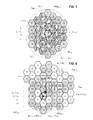
- FIG. 1 shows a diagram of several patterns of a narrowband cellular wireless communication network
- FIG. 2 shows a diagram of a pattern of the narrowband network
- FIG. 3 shows a diagram in time and frequency of groups of carriers in a wide frequency band reserved for downlinks, allocated to base stations in cells of a pattern of the narrowband network, a wide frequency band reserved for uplinks being likewise shown;
- FIG. 4 shows a diagram of a part of a cellular broadband wireless communication network which can be superimposed on the patterns of the narrowband network shown in FIG. 1 ;
- FIG. 5 shows a diagram of a cell with three directional sectors of the broadband network
- FIG. 6 shows a diagram in time and frequency similar to FIG. 3 , showing sub-bands of sub-carriers in the wide frequency band reserved for downlinks and available for each sector of the base stations of the broadband network;
- FIG. 7 shows schematically transmissions in sectors of cells of the broadband network disrupting the reception in a mobile included in a cell of the narrowband network
- FIG. 8 shows schematically transmissions from a sector of a cell of the broadband network interfering with the reception in cells of the narrowband network
- FIG. 9 shows an algorithm of the method for adapting transmission powers of subcarriers in a base station of the broadband network as a function of the carrier transmission power in the base stations of the narrowband network, according to a first embodiment
- FIG. 10 shows a schematic block diagram of a base station of the broadband network according to the invention for the implementation of the first embodiment of the method
- FIG. 11 shows a diagram in cellular level and power of the transmission powers from a sector of a base station of the broadband network as a function of the reception powers in the cell including this base station, for groups of carriers allocated to base stations in preselected cells of the narrowband network on cellular levels in the sector;
- FIG. 12 shows an algorithm of the method for adapting transmission powers of subcarriers in a base station of the broadband network as a function of the reception powers in the cell including the base station, according to a second embodiment
- FIG. 13 shows a schematic block diagram of a base station of the broadband network according to the invention for the implementation of the second embodiment of the method.
- FIGS. 1 and 4 show in the form of regular theoretical hexagons the radio cells C NB of a narrowband cellular wireless communication network R NB and the radio cells C BB of a broadband cellular wireless communication network R BB .
- the networks R NB and R BB are collocated, which means that each cell C NB can be superimposed on a cell C BB and a cell C NB -C BB common to the networks comprises centrally a base station BS NB of the network R NB and a base station BS BB of the network R BB which are collocated.
- the networks R NB and R BB function in frequency division duplex mode FDD in a common wide frequency band ⁇ F DL reserved for the downlinks and a common wide frequency band ⁇ F UL reserved for the uplinks, separated by a small frequency duplex interval ⁇ F d , as shown in FIGS. 3 and 6 .
- the band total ( ⁇ F DL , ⁇ F UL ) is of the order of 1.4 MHz to 20 MHz.
- the invention is described in the following description according to a predetermined transmission direction corresponding to the frequency band ⁇ F DL relating to downlinks from the base stations BS NB towards mobiles MS NB in the network R NB and from the base stations BS BB towards mobiles MS BB in the network R BB .
- the narrowband network R NB is for example a professional private network PMR for example of the DMR, TETRA, TETRAPOL or P25 type. It is used for public security services.
- the security constraints of the narrowband network R NB require that the communications in this network must be established quickly and maintained and thus must take priority relative to communications in the broadband network R BB .
- Each base station BS NB of the narrowband network R NB has an omnidirectional antenna and transmits carriers f NB in the frequency band ⁇ F DL which may interfere a priori with subcarriers f BB transmitted in the frequency band ⁇ F DL by the base stations BS BB of the broadband network R BB situated in the proximity of the base station BS NB .
- the invention is based on the principle that the radio frequency signals transmitted in the broadband network R BB must be adapted in terms of power and of frequency to the radio frequency signals transmitted from the narrowband network R NB in order to disrupt them as little as possible, i.e. to reduce as much as possible the interference between carriers f NB and adjacent subcarriers f BB allocated respectively to the networks R NB and R BB .
- R is the length of one side of a hexagonal cell.
- the numbering of cells in FIGS. 1 and 2 is organised according to concentric levels of location of cell L 0 to L 2 from the centre towards the periphery of a pattern MC NB .
- the level L 0 comprises the cell C NB,1 central to the pattern.
- the level L 1 comprises the cells C NB,2 to C NB,7 of the pattern.
- the level L 3 shown in FIGS. 7 and 8 surrounds the pattern MC NB and comprises cells C BB of the broadband network R BB belonging to patterns adjacent to the pattern MC NB .
- the radio frequency signals transmitted by the base stations BS NB of the cells in the pattern MC NB are supported by carriers f NB regularly distributed with a pitch ⁇ f NB for example of 10 kHz or 12.5 kHz in the wide band ⁇ F DL and a useful narrow band by carrier less than ⁇ f NB .
- the band ⁇ F DL is shared in NC groups Gf NB,1 to Gf NB,NC of carriers f NB respectively allocated to the NC cells in the pattern of the narrowband network R NB .
- the broadband network R BB is a network for third generation 3GPP (Third Generation Partnership Project) mobiles based for example on the LTE technology with a frequency band of 1.4 MHz to 20 MHz.
- the network R BB supports radio downlinks with mobiles of the orthogonal frequency division multiple access OFDMA type and radio uplinks with mobiles of the single carrier frequency division multiple access SC-FDMA type.
- Each cell C BB of the broadband network R BB uses subcarriers f BB uniformly distributed in the wide frequency band ⁇ F DL and includes a base station BS BB with directional and separate NS circular sectors S 1 to S NS .
- the sub-cell is theoretically limited by the sides of the sector at the top of which the radio interface is substantially situated. All the base stations BS BB are identical and consequently the cellular pattern of re-use in the network R BB is reduced to one cell C BB and therefore the re-use factor of the network R BB is equal to 1.
- the wide frequency band ⁇ F DL is allocated indiscriminately to each of the sectors S 1 to S NS of a cell C BB and that the radio interface of each sector S ns is likely to transmit on any subcarriers f BB in the band ⁇ F DL .
- a base station BS BB of the network R BB is of the LTE type and can transmit towards each sector in any of the separate sub-bands of the wide band ⁇ F DL .
- Each of these separate sub-bands supports for example 20 blocks of resources or time slots of 0.5 ms during a frame of 10 ms. For example as shown in FIG.
- the broadband network R BB is based on the mobile WiMAX technology.
- the network R BB supports radio downlinks and uplinks with mobiles of the orthogonal frequency division multiple access OFDMA type.
- the number NC of cells in the pattern of re-use of the network R NB is greater than 2, the number NS of sectors per base station BS BB is at least equal to 2, and the number of levels relative to any given cell C NB,nc in the network R NB is at least equal to 2, wherein a level can comprise both cells of one pattern and cells of at least one other adjacent pattern.
- the second level comprises 3 cells of the pattern containing the given cell and 3 cells respectively in 3 patterns adjacent to the pattern.
- FIGS. 3 and 6 shows that as a function of the ratio of the frequency steps ⁇ f NB / ⁇ f BB , the useful band of a subcarrier f BB of the broadband network overlaps at least the useful band of a carrier f NB of the narrowband network, or even two or more useful bands of carriers f NB . Consequently for a carrier f NB of the group allocated to a base station BS NB , signals supported in useful bands of subcarriers f BB at least partially covering the useful band of the carrier f NB and transmitted in sectors of adjacent base stations BS BB oriented towards the base station BS NB interfere with the signals supported by the carrier f NB of the base station BS NB .
- the interference caused by a subcarrier f BB is all the more substantial as the power thereof received in the cell C NB of the base station BS NB is high and consequently that the distance between the sites where an adjacent base station BS BB transmitting the subcarrier f BB and the base station BS NB are situated is small.
- the power received at a given measurement point at a distance D of a base station transmitting a transmission power P NB is proportional to P NB /D ⁇ where ⁇ designates a propagation constant in the networks comprised between about 3 and about 4 and dependent upon the radio propagation conditions between the base station and the measurement point.
- P NB designates a predetermined transmission power for each carrier f NB to be transmitted by a base station BS NB or for each subcarrier f BB to be transmitted by a base station BS BB when the subcarrier transmitted f BB is considered as not disrupting the reception in the narrowband network R NB .
- the invention is based on the evaluation of interference of the signals transmitted by base stations BS BB of the broadband network R BB on signals received by a mobile, referred to as a power measurement mobile MM NB,nc , in a cell C NB,nc of the narrowband network R NB and in particular on each of the carriers f NB of the group Gf NB,nc allocated to the base station BS NB,nc of the cell C NB,nc in order to deduce therefrom the powers which the base stations BS BB must transmit for the subcarriers f BB interfering with the carrier f NB .
- the measurement mobile MM NB,nc is assumed to be positioned at the edge of a given cell C NB,nc , for example the central cell C NB,1 of the pattern MC NB , on the bisector of one of the three sectors S 1 to S NS of the cell C BB,1 , for example on the bisector B 1 of the upper right sector S 1 shown on an enlarged scale in FIG. 5 .
- the measurement mobile is located at a measurement point furthest from the centre of the cell C BB,1 where the interference with the adjacent cells C NB,7 and C NB,2 is maximum, for at a distance R from the base station BS NB,1 to the centre of the cell C NB,1 .
- the deterioration of the reception in the measurement mobile MM NB,nc due to the transmissions in the broadband network R BB is evaluated for a selection of sectors of the cells C BB of the network R BB of which the transmission powers are considered as sufficiently high to interfere with the received signals and which therefore have orientations of their radiation patterns which are predominant towards the mobile MM NB,nc and distances of several cellular levels to the mobile MM NB,nc .
- the sectors of the cells C BB of the network R BB interfering with the reception of the mobile MM NB,nc are selected on the levels L 0 to L 3 .
- the measurement mobile is insensitive to the transmission powers of the remote base stations BS BB beyond the level L 3 .
- the measurement mobile MM NB,nc is sensitive to the transmission powers of the base stations BS NB in the central cells C NB,1 of the narrowband network R NB belonging to the six adjacent patterns included in the remote global level L 4 .
- ⁇ i is an attenuation parameter of the transmission power of the base station BS BB for the selected sector of the cells C BB on the level L i , ⁇ i being comprised between 0 and 1.
- D i is the average distance between the measurement mobile MM NB,nc and one of the base stations BS NB in the cells on the level L i of which NS, sectors are selected, the measurement mobile MM NB,nc being thus located at a measurement point in the cell C NB furthest on average from the centres of the cells having a selected sector of the same orientation S nc on the respective level L i .
- P NB /D i ⁇ is the power of the radio interface in a selected sector of one of the preceding base stations BS NB for an adjacent subcarrier f BB of the given carrier f NB and interfering with the reception of the given carrier f NB in the measurement mobile MM NB,nc .
- the attenuation parameters are ⁇ 0 ⁇ 50 dB, ⁇ 1 ⁇ 40 dB, ⁇ 2 ⁇ 30 dB and ⁇ 3 ⁇ 20 dB.
- the attenuation parameter ⁇ i is all the more low as the power of the interfering base station BS BB is close to the given cell C NB,nc and therefore that the distance D i is short, i.e. ⁇ 0 ⁇ 1 ⁇ 2 ⁇ 3 .
- the selected sectors in the cells C BB on the levels L 0 and L 1 produce a very high deterioration upon reception in the given cell C NB,nc and consequently the parameters ⁇ 0 and ⁇ 1 are equal to 0.
- the transmission power P NB initially provided for the subcarrier f BB should be attenuated by the attenuation parameter ⁇ i so as not to significantly interfere with the reception in the cells C NB,i on the level L i in order to maintain the predetermined attenuation ⁇ target in the cells of the narrowband network.
- the measurement mobile MM BB,nc is thus located in the sector S ns and in the cell C BB,nc at a measurement point closest on average to the centres of the preselected cells C NB,i on a level L i .
- the fourth level L 3 only the 2 interfering cells C NB,14 and C NB,15 close to the bisector B 1 of the specified sector S 1 may be preselected, the cells C NB,13 and C NB,11 being considered as too remote from the cell C BB,1 to interfere with the reception of subcarriers f BB in the measurement mobile MM BB,nc .
- ⁇ i k D i ⁇ /D NB ⁇ for the transmission power attenuation parameter of the base station BS BB,nc relative to the preselected cells C NB,i on the level L i .
- the parameters of deterioration ⁇ BB,i for the levels L 0 to L 3 are ⁇ BB,0 ⁇ 45 dB, ⁇ BB,1 ⁇ 30 dB, ⁇ BB,2 ⁇ 10 dB, et ⁇ BB,3 ⁇ 4 dB. Beyond these levels, the deterioration is negligible, i.e. ⁇ BB,4 ⁇ 0 dB.
- the deterioration parameters ⁇ BB,0 and ⁇ BB,1 being lower than 10 ⁇ 3 , the attenuation parameters ⁇ 0 and ⁇ 1 which must be applied to the transmission powers of the subcarriers f BB close to carriers of the groups Gf NB,0 and Gf NB,1 are therefore very low and consequently these subcarriers f BB become unusable in the base station BS BB,nc of the given cell C BB,nc .
- the subcarriers f BB adjacent to the carriers of the groups Gf NB,0 and Gf NB,1 are not transmitted by the base station BS BB,nc and no reception power is measured in the measurement mobile MM BB,nc for these adjacent subcarriers f BB .
- the groups Gf NB,0 and Gf NB,1 only represent (1+2)/NC ⁇ 15.8% of the groups of frequencies of the network R NB .
- the subcarriers f BB adjacent to the carriers of the other groups Gf NB,2 and Gf NB,3 and all the other subcarriers f BB for which no deterioration is perceptible upon the reception in the given cell C BB,nc can be used in the base station BS BB,nc and represent (NC ⁇ 3)/NC ⁇ 84.2% of the groups of frequencies of the network R NB .
- the 9 available subcarriers f BB are classified into three classes CP 2 , CP 3 and CP 4 .
- the overall carrier to interference ratio in a base station of the broadband network R BB collocated with the narrowband network R NB is of the order of ⁇ 6 dB to ⁇ 8 dB.
- the method for adapting subcarrier powers comprises prior steps E1 to E3 and a repetitive step E4 which are shown in FIG. 9 . These steps are executed in a base station BS BB,nc of a given cell C BB,nc of the broadband network R BB and for a specified sector S ns of the base station BS BB,nc . The method is likewise executed in a similar manner for each of the sectors of each of the base stations of the broadband network.
- a base station BS BB,nc of the broadband network R BB comprises in particular NS radio interfaces IR ns for the sectors S ns each having a transmitter/receiver in particular in order to transmit subcarriers f BB in the wide frequency band ⁇ F DL for downlinks and to receive subcarriers in the wide frequency band ⁇ F UL for uplinks, a programmable memory ME, and a unit for association of carriers and subcarriers UA, as shown in FIG. 10 .
- the base station BS BB,nc shown in FIG. 10 or in FIG. 13 described below, only functional blocks which ensure functions having a link with the invention are shown. Some of these functional blocks may correspond to computer program modules implemented in at least one processor and/or on dedicated or programmable hardware modules.
- groups Gf NB,i of transmission carriers f NB allocated to base stations BS NB in preselected cells C NB,i located on the cellular levels L i , with 0 ⁇ i ⁇ I ⁇ 1 3, considering the levels according to their rank increasing from the cell C BB including the base station BS BB,nc to the first level L 0 .
- the carriers f NB of the groups Gf NB,i allocated to the preselected cells C NB,i are likely to interfere with carriers f BB transmitted by the base station BS BB,nc in the sector S ns .
- the recording of the transmission carriers f NB makes it possible to pair them automatically with transmission subcarriers f BB of the base station BS BB,nc in the following step E2 and thus to adapt the transmission in the sectors of the broadband network to the transmission in the cells of the narrowband network when the carriers of the narrowband network are modified.
- the unit for association of carriers and subcarriers UA in the base station BS BB,nc associates each carrier f NB allocated to a preselected cell C NB,i with a transmission subcarrier f BB of the base station BS BB,nc , when it exists, which is close to the carrier f NB , in order to form a pair of carrier and subcarrier (f NB , f BB ) which is recorded in the memory ME.
- a transmission subcarrier f BB is said to be close to a carrier f NB for example if the bandwidth ⁇ f BB of the transmission subcarrier f BB contains at least the carrier f NB and therefore at least the useful half-band of the carrier f NB .
- the useful band of a carrier f NB is 8 kHz
- a subcarrier f BB is associated with the carrier f NB if the band (f BB ⁇ f BB /2, f BB + ⁇ f BB /2) contains at least the useful half-band (f NB ⁇ 4 kHz, f NB ) or (f NB , f NB +4 kHz).
- the transmission subcarriers f BB paired with transmission carriers f NB of preselected base stations BS NB,i located on the level L i are arranged in a respective group Gf NB,i .
- the attenuation parameters ⁇ i satisfy the relationship (1) for a predetermined attenuation in the base stations BS NB of the narrowband network.
- the relationship of proportionality (2) is preferably satisfied for all the parameters ⁇ 0 to ⁇ 3 .
- the radio interface IR ns for the specified sector S ns of the base station BS BB,nc should transmit a transmission subcarrier f BB paired with a carrier f NB of the group Gf NB,i for the cellular level L i in the memory ME, the subcarrier transmission power P NB , which is provided initially for each subcarrier f BB not interfering with the narrowband network, is attenuated by the predetermined attenuation parameter ⁇ i .
- the predetermined attenuation parameter ⁇ i has a fixed value and is used in order to attenuate the transmission powers P NB of all the subcarriers f BB belonging to the group Gf NB,i .
- FIG. 11 shows schematically power transmitted for subcarriers f BB belonging to the various groups Gf NB,0 to Gf NB,4 .
- step E4 is reiterated each time that a subcarrier f BB is to be transmitted towards mobiles MS BB tied to the base station BS BB .
- the method for adapting subcarrier powers according to a second embodiment of the invention comprises prior steps E 10 to E 12 and repetitive steps E 13 to E 16 in particular for dynamically classifying the carriers f NB .
- These steps are executed in a base station BS BB,nc of a given cell C BB,nc of the broadband network R BB and for a specified sector S ns of the base station BS BB,nc , and in a measurement mobile MM BB,nc situated substantially at the periphery and on the bisector B ns of the sector S ns of the given cell C BB,nc , as shown in FIGS. 5 and 8 .
- the method is likewise executed in a similar manner for each of the sectors of each of the base stations of the broadband network.
- a base station BS BB of the broadband network R BB comprises in particular NS radio interfaces IR ns for the sectors S ns each having a transmitter/receiver in particular in order to transmit subcarriers f BB in the wide frequency band ⁇ F DL for downlinks and to receive subcarriers in the wide frequency band ⁇ F UL for uplinks, a memory ME, and a unit for classification of reception power UCP, as shown in FIG. 13 .
- the radio interface in the measurement mobile MM BB,nc has stored the frequencies of the carriers f NB and is capable of detecting the carriers f NB in the wide frequency band ⁇ F DL and transmitting measurements of reception power of the detected carriers f NB in the wide frequency band ⁇ F UL .
- the unit for association of carriers and subcarriers UA in the base station BS BB,nc forms pairs (f NB , f BB ) which associate the carriers f NB of groups allocated to the preselected cells C NB,i respectively with adjacent transmission subcarriers f BB of the base station BS BB,nc , as in the step E 2 .
- the bandwidth ⁇ f NB of the carrier f NB of a pair contains for example at least the subcarrier f BB of the pair and therefore at least the useful half-band of the carrier f BB .
- the useful band of a carrier f NB is 22 kHz, and two subcarriers f BB are paired with the carrier f NB if the useful band (f NB ⁇ 11 kHz, f NB +11 kHz) contains at least the half-band (f BB ⁇ f BB /2, f BB ) ou (f BB , f BB + ⁇ f BB /2) of each of the two sub-carriers f BB .
- the useful band f NB ⁇ 11 kHz, f NB +11 kHz
- f BB half-band
- one or several subcarriers f BB are associated with the carrier f NB .
- Each predetermined power threshold TH i is intended to be associated with measured reception powers PR NB comprised between this threshold TH i and the preceding threshold TH i-1 and must correspond to carriers f NB transmitted by base stations BS NB on the level L i .
- the threshold TH 0 is associated with high measured reception powers which must correspond to carriers f NB transmitted by the base station BS NB,nc on the level L 0 .
- the measured reception power of each carrier detected can result from an average of reception powers measured during a predetermined period in such a way as to smooth the powers measured as a function of the variation of the propagation environment in the networks due in particular to various mobilities and in particular fading and the effects of shadowing.
- the measurement mobile MM BB,nc detects the carrier of this group supporting a time division multiplex control channel with traffic routes and transmitted permanently by the base station BS NB,i of the preselected cell C NB , and measures the reception power PR NB of the control channel as reception power for any carrier f NB transmitted by the base station BS NB,i .
- the measurement mobile MM BB nc transmits the measured reception powers PR NB in association respectively with the detected carriers f NB to the base station BS BB,nc .
- the pairs of measured power and carrier (PR NB ; f NB ) are transmitted in a reliable manner, for example according to an automatic request repetition procedure HARQ (Hybrid Automatic Repeat reQuest) and through spatio-temporal converters to several MIMO (multiple input multiple output) antenna ports, from the measurement mobile MM BB,nc towards the base station BS BB,nc .
- HARQ Hybrid Automatic Repeat reQuest
- the measured reception powers PR NB received by the base station BS BB,nc are compared with the reception power thresholds TH 0 to TH I-1 in the power classification unit UCP.
- the UCP unit classifies the measured reception powers PR NB in association respectively with the carriers f NB detected by classes of power CP i .
- a detected carrier f NB belongs to the class CP i if the measured power PR NB thereof is such that THi ⁇ 1 >PR NB ⁇ TH i .
- the carriers f NB of which the measured powers are higher than the threshold TH 0 are classified in the class CP 0 corresponding to the level L 0 .
- the radio interface IR ns for the specified sector S ns of the base station BS BB,i should transmit a transmission subcarrier f BB associated with a carrier f NB of the power class CP i in the memory ME, the transmission power P NB , which is provided initially for each subcarrier f BB not interfering with the narrowband network, is attenuated by the associated attenuation parameter a read in the memory ME.
- the attenuation parameter ⁇ i has a fixed value and is used in order to attenuate the transmission powers of all the subcarriers f BB belonging to the class CP i .
- the measurement mobile MM BB,nc measures the average reception power of active time division multiplex traffic routes in a frame supported by the detected carrier f NB .
- the transmission powers of the subcarriers f BB in the base station BS BB,nc of the given cell C BB,nc are then adapted automatically in order to minimise the interference on the traffic load of the narrowband network R NB . If the number of active carriers f NB in the base stations BS NB of the preselected cells C NB,i is high, the transmission capacity of the base stations BS BB is reduced. On the other hand, if the traffic in the narrowband network R NB is low, which means that numerous carriers f NB are inactive and numerous measured reception powers PR NB are zero, the transmission capacity of the base stations BS BB is increased.
- the number of powers to be compared with the thresholds TH 0 to TH I-1 is reduced in the step E 15 .
- the power classification unit UCP in the base station BS BB,nc of the given cell establishes in the step E 15 for each unit of carriers allocated to a preselected cell C NB,i , the average of the reception powers PR NB measured for all the carriers f NB belonging to this group.
- the measurement mobile MM BB,nc detects the carrier of this group supporting a time division multiplex control channel with traffic routes and transmitted permanently by the base station in the preselected cell C NB,i , and measures the reception power PR NB of the control channel as average reception power for all the carriers f NB transmitted by the base station in the cell C NB,i .
- the UCP unit compares the average power of the group to the thresholds TH 0 to TH I-1 in order that the transmission powers of all the subcarriers f BB adjacent to the carriers f NB belonging to the group may be attenuated with the same predetermined attenuation parameter ⁇ i .
- the step E 13 of measurement of the reception powers PR NB of detected carriers f NB is carried out at any measurement point situated in the given cell C BB,nc and in the specified sector S ns .
- This point may be on the base station BS BB,nc in the given cell C BB,nc .
- all the steps E 10 to E 16 are executed in the base station BS BB,nc without using a measurement mobile MM BB,nc .
- the specified base station BS BB,nc itself detects carriers f NB transmitted in the preselected cells located in the specified sector S ns and measures the reception powers of these carriers f NB .
- the method is applied in a similar manner in the other direction of transmission relating to uplinks from a mobile MS BB towards a base station BS BB in a given cell for subcarriers included in the frequency band ⁇ F UL for uplinks common to the networks R NB and R BB .
- the steps of the method which were executed in a base station BS BB of the broadband network R BB according to the first embodiment of the invention, are executed at the transmission for uplinks in each mobile MS BB tied to a base station BS BB located in a given cell in such a way as to adapt the transmission powers of the subcarriers to be transmitted by the mobile MS BB to transmission powers of other carriers included in the frequency band ⁇ F UL and capable of being transmitted by mobiles MS NB in the narrowband network which are located in preselected cells associated with the specified sector of the given cell.
- all the steps E 1 to E 4 or E 10 to E 16 of the method according to the invention may be executed in each mobile MS BB .
- the invention described concerns a method and a transmitter/receiver as base station or mobile for adapting the subcarrier powers transmitted in a predetermined transmission direction in a broadband cellular wireless communication network as a function of the carrier powers transmitted in the broad band in the predetermined transmission direction in a narrowband cellular wireless communication network collocated with the broadband network.
- steps of the method according to the invention are specified by the instructions of a computer program incorporated in the transmitter/receiver.
- the program capable of being carried out in the transmitter/receiver according to the invention includes program instructions which, when said program is executed in the transmitter/receiver of which the operation is then controlled by the execution of the program, carry out steps of the method according to the invention.
- the invention likewise applies to a computer program, in particular a computer program recorded on or in a computer-readable recording medium and any data processing device suitable for implementing the invention.
- This program can use any programming language, and may be in the form of a source code, object code or intermediate code between source code and object code such as a partially compiled form, or in any other desirable form in order to implement the method according to the invention.
- the program can be downloaded in the base station via a communication network, such as the internet.
- the recording medium can be any entity or device capable of storing the program.
- the medium can include a storage means on which the computer program according to the invention is recorded, such as a ROM, for example a CD ROM or a ROM of a microelectronic circuit, or also a USB stick, or a magnetic recording mean, for example a diskette (floppy disc) or a hard disk.
Landscapes
- Engineering & Computer Science (AREA)
- Computer Networks & Wireless Communication (AREA)
- Signal Processing (AREA)
- Mobile Radio Communication Systems (AREA)
Abstract
Description
-
- (C/I)NB=(PNB/Rγ)/(6 PNB/DN γ)=DNB γ/(6 Rγ), where
- R is the distance between the base station BSNB,1 at the centre of the cell CNB,1 and the measurement mobile MMNB,nc at a vertex of the cell CNB,1,
- (PNB/Rγ) is the power of the base station BSNB,1 for the given carrier fNB received by the measurement mobile,
- DNB=√{square root over (57)} R is the average distance between the measurement mobile and the base stations in the central cells CNB,1 of six adjacent patterns, and
- (PNB/DNB γ) is the power of one of the preceding six base stations BSNB,1 received by the measurement mobile,
-
- at the level L0, the single sector S1 of the base station BSBB,1 in the cell CNB,1 containing the measurement mobile MMNB,nc and situated at a distance D0=R, i.e. NS0=1;
- at the level L1, the sectors S1 in the cells CNB,4 and CNB,5, the sectors S2 in the cells CNB,6 and CNB,7 and the sectors S3 in the cells CNB,2 and CNB,3 oriented towards the cell CNB,1 and originating from base stations BSBB situated at an average distance D1=√{square root over (3)} R of the measurement mobile MSNB, i.e. NS1=6;
- at the level L2, the sectors S1 of the cells CNB,13, CNB,14 and CNB,15, the sectors S2 of the cells CNB,17, CNB,18 and CNB,19 and the sectors S3 of the cells CNB,9, CNB,10 and CNB,11 covering the cell CNB,1 and originating from base stations BSBB situated at an average distance D2=3R of the measurement mobile MMNB,nc, i.e. NS2=9; and
- at the level L3, the sectors S1 of the cells CNB,8, CNB,9, the sectors S2 of the cells CNB,12 and CNB,13 and the sectors S3 of the cells CNB,16 and CNB,17 having a central half-sector of 60° covering the cell CNB,1 these NS3=6 cells belong to three adjacent patterns at the periphery of the pattern MCNB, as shown in
FIGS. 1, 4 and 7 , and include base stations BSBB situated at an average distance D3=4R of the measurement mobile MMNB,nc.
(C/I)NB _ BB=(P NB /R γ)/(6 P NB /D NB γ+Σi=0 i=I−1 NS iαi P NB /D i γ), with
Σi=0 i=I−1 NS iαi P NB /D i γ=α0 P NB /D 0 γ+6 α1 P NB /D 1 γ+9 α2 P NB /D 2 γ+6 α3 P NB /D 3 γ.
αtarget=1/[1(Σi=0 i=I 31 1(NS iαi /D i γ)D NB γ/6], (1)
and becomes, by indicating the number of cells NSi:
α0 /D 0 γ+6 α1 /D 1 γ+9 α2 /D 2 γ+6 α3 /D 3 γ=6(1−αtarget)/(D NB γαtarget).
αi =k D i γ D NB γ, (2)
wherein k is a factor which is a function of the predetermined attenuation referred to as αtarget:
(1+6+9+6)(k/D NB γ)=6(1−αtarget)/(D NB γαtarget), (3)
i.e. k=3(1−αtarget)/(11 αtarget).
(9+6)(k/D NB γ)=6(1−αtarget)/(D NB γαtarget), i.e.
k=3(1−αtarget)/(5 αtarget)=0.1 for α target=−1 dB.
(C/I)NB _ BB=(P NB /R γ)/(2 P NB /R γ)=1/2, or −3 dB.
(C/I)NB _ BB,i=(P BB,i /R γ)/[(2 P BB,i /R γ)+(i+1)P NB /D I-i γ].
(C/I)NB _ BB,i=(αi /R γ)/[(2 αi /R γ)+(i+1)/D i γ],
or (C/I)NB
with βBB,i=1/[1+(i+1)R γ/(2 αi D i γ)].
βBB,i=1/[1+(i+1)(D NB R)γ/(2 k D i 2γ)].
Claims (12)
Applications Claiming Priority (3)
| Application Number | Priority Date | Filing Date | Title |
|---|---|---|---|
| FR1151994A FR2972590B1 (en) | 2011-03-10 | 2011-03-10 | SUBCARRIER POWER ADAPTATION IN A COLOCALIZED BROADBAND NETWORK WITH A NARROW BAND NETWORK |
| FR1151994 | 2011-03-10 | ||
| PCT/EP2012/054094 WO2012120113A1 (en) | 2011-03-10 | 2012-03-09 | Matching subcarrier power in a broadband network collocated with a narrowband network |
Publications (2)
| Publication Number | Publication Date |
|---|---|
| US20140004845A1 US20140004845A1 (en) | 2014-01-02 |
| US9451562B2 true US9451562B2 (en) | 2016-09-20 |
Family
ID=45811510
Family Applications (1)
| Application Number | Title | Priority Date | Filing Date |
|---|---|---|---|
| US14/004,162 Expired - Fee Related US9451562B2 (en) | 2011-03-10 | 2012-03-09 | Matching subcarrier power in a broadband network collocated with a narrowband network |
Country Status (6)
| Country | Link |
|---|---|
| US (1) | US9451562B2 (en) |
| EP (1) | EP2684400B1 (en) |
| ES (1) | ES2546431T3 (en) |
| FR (1) | FR2972590B1 (en) |
| MX (1) | MX2013010302A (en) |
| WO (1) | WO2012120113A1 (en) |
Families Citing this family (6)
| Publication number | Priority date | Publication date | Assignee | Title |
|---|---|---|---|---|
| US10609711B1 (en) * | 2015-03-05 | 2020-03-31 | Origin Wireless, Inc. | Time-reversal scalability for high network densification |
| US9467827B2 (en) * | 2012-11-28 | 2016-10-11 | At&T Mobility Ii Llc | Digital mobile radio cellular messaging |
| EP3152943A4 (en) * | 2014-06-03 | 2018-01-10 | Telefonaktiebolaget LM Ericsson (publ) | An access node,a communication device,respective method performed thereby for carrier hopping |
| EP3170272B1 (en) * | 2014-07-15 | 2019-03-27 | ARRIS Enterprises LLC | Antenna-radiation-pattern selection for reduced interference |
| EP3481557A2 (en) * | 2016-07-08 | 2019-05-15 | Akzo Nobel Chemicals International B.V. | Process to treat magnetite ore and collector composition |
| DE102020101132A1 (en) | 2020-01-20 | 2021-07-22 | Maschinenfabrik Reinhausen Gmbh | Apparatus and method for the detection of gas |
Family Cites Families (4)
| Publication number | Priority date | Publication date | Assignee | Title |
|---|---|---|---|---|
| TW529313B (en) * | 2000-07-05 | 2003-04-21 | Ericsson Telefon Ab L M | Allocated frequency spectrum sharing between wideband and narrowband radio access technologies |
| US8041380B2 (en) * | 2007-04-26 | 2011-10-18 | Lingna Holdings Pte., Llc | Power control in cognitive radio systems based on spectrum sensing side information |
| FI20075859A0 (en) * | 2007-11-30 | 2007-11-30 | Nokia Corp | Inter-system interference control |
| US9072060B2 (en) * | 2008-06-03 | 2015-06-30 | Nokia Technologies Oy | Method, apparatus and computer program for power control to mitigate interference |
-
2011
- 2011-03-10 FR FR1151994A patent/FR2972590B1/en not_active Expired - Fee Related
-
2012
- 2012-03-09 ES ES12707775.8T patent/ES2546431T3/en active Active
- 2012-03-09 EP EP20120707775 patent/EP2684400B1/en active Active
- 2012-03-09 MX MX2013010302A patent/MX2013010302A/en active IP Right Grant
- 2012-03-09 WO PCT/EP2012/054094 patent/WO2012120113A1/en not_active Ceased
- 2012-03-09 US US14/004,162 patent/US9451562B2/en not_active Expired - Fee Related
Non-Patent Citations (1)
| Title |
|---|
| Hulkkonen WO-2009-068727 A1.pdf. * |
Also Published As
| Publication number | Publication date |
|---|---|
| US20140004845A1 (en) | 2014-01-02 |
| EP2684400B1 (en) | 2015-05-06 |
| MX2013010302A (en) | 2013-12-02 |
| ES2546431T3 (en) | 2015-09-23 |
| EP2684400A1 (en) | 2014-01-15 |
| FR2972590A1 (en) | 2012-09-14 |
| WO2012120113A1 (en) | 2012-09-13 |
| FR2972590B1 (en) | 2013-04-12 |
Similar Documents
| Publication | Publication Date | Title |
|---|---|---|
| US12114298B2 (en) | IEEE 802.11 communication utilizing carrier specific interference mitigation | |
| US8249001B2 (en) | Base station apparatus, mobile station apparatus, and method of assigning subcarriers | |
| US10499381B2 (en) | Systems and methods for distributed open-loop multi-user co-operative multi-point (CoMP) scheduling and transmission | |
| TWI388226B (en) | Dynamic allocation of radio resources | |
| US9370021B2 (en) | Interference reduction for terminals operating on neighboring bands in wireless communication systems | |
| US9451562B2 (en) | Matching subcarrier power in a broadband network collocated with a narrowband network | |
| CN110999142A (en) | Method and apparatus for data communication in a wireless communication system | |
| US9485008B2 (en) | Intra cell interference mitigation in a wireless network employing relay nodes | |
| US10462792B2 (en) | Determining a location of a UE within a coverage area | |
| US11617083B2 (en) | Apparatus and method for managing interference in wireless communication system | |
| KR102375953B1 (en) | Apparatus and method for controlling channel access adaptively in a wireless communication system | |
| CN111385766B (en) | Apparatus and method for resource management in a wireless communication system | |
| KR102168856B1 (en) | Interference cancellation method, system, device and ue | |
| US20200374880A1 (en) | Apparatus and method for using multiple carriers in wireless communication system | |
| EP2816854A1 (en) | Load balancing between antennas and scheduling to improve throughput of cell edge users | |
| Černý et al. | Interference optimization and mitigation for LTE networks | |
| Jänis | Interference management techniques for cellular wireless communication systems |
Legal Events
| Date | Code | Title | Description |
|---|---|---|---|
| AS | Assignment |
Owner name: CASSIDIAN SAS, FRANCE Free format text: ASSIGNMENT OF ASSIGNORS INTEREST;ASSIGNORS:MARQUE-PUCHEU, GERARD;GRUET, CHRISTOPHE;SEGUY, VINCENT;REEL/FRAME:031292/0898 Effective date: 20130827 |
|
| STCF | Information on status: patent grant |
Free format text: PATENTED CASE |
|
| MAFP | Maintenance fee payment |
Free format text: PAYMENT OF MAINTENANCE FEE, 4TH YEAR, LARGE ENTITY (ORIGINAL EVENT CODE: M1551); ENTITY STATUS OF PATENT OWNER: LARGE ENTITY Year of fee payment: 4 |
|
| FEPP | Fee payment procedure |
Free format text: MAINTENANCE FEE REMINDER MAILED (ORIGINAL EVENT CODE: REM.); ENTITY STATUS OF PATENT OWNER: LARGE ENTITY |
|
| LAPS | Lapse for failure to pay maintenance fees |
Free format text: PATENT EXPIRED FOR FAILURE TO PAY MAINTENANCE FEES (ORIGINAL EVENT CODE: EXP.); ENTITY STATUS OF PATENT OWNER: LARGE ENTITY |
|
| STCH | Information on status: patent discontinuation |
Free format text: PATENT EXPIRED DUE TO NONPAYMENT OF MAINTENANCE FEES UNDER 37 CFR 1.362 |
|
| STCH | Information on status: patent discontinuation |
Free format text: PATENT EXPIRED DUE TO NONPAYMENT OF MAINTENANCE FEES UNDER 37 CFR 1.362 |
|
| FP | Lapsed due to failure to pay maintenance fee |
Effective date: 20240920 |