US9448415B2 - Spatially interleaved polarization converter for LCOS display - Google Patents

Spatially interleaved polarization converter for LCOS display Download PDF

Info

Publication number
US9448415B2
US9448415B2 US14/631,513 US201514631513A US9448415B2 US 9448415 B2 US9448415 B2 US 9448415B2 US 201514631513 A US201514631513 A US 201514631513A US 9448415 B2 US9448415 B2 US 9448415B2
Authority
US
United States
Prior art keywords
polarized
output
array
input
beamlet
Prior art date
Legal status (The legal status is an assumption and is not a legal conclusion. Google has not performed a legal analysis and makes no representation as to the accuracy of the status listed.)
Active, expires
Application number
US14/631,513
Other versions
US20160246068A1 (en
Inventor
Yi-Wei Liu
Current Assignee (The listed assignees may be inaccurate. Google has not performed a legal analysis and makes no representation or warranty as to the accuracy of the list.)
Omnivision Technologies Inc
Original Assignee
Omnivision Technologies Inc
Priority date (The priority date is an assumption and is not a legal conclusion. Google has not performed a legal analysis and makes no representation as to the accuracy of the date listed.)
Filing date
Publication date
Application filed by Omnivision Technologies Inc filed Critical Omnivision Technologies Inc
Priority to US14/631,513 priority Critical patent/US9448415B2/en
Assigned to OMNIVISION TECHNOLOGIES, INC. reassignment OMNIVISION TECHNOLOGIES, INC. ASSIGNMENT OF ASSIGNORS INTEREST (SEE DOCUMENT FOR DETAILS). Assignors: LIU, YI-WEI
Priority to TW105105733A priority patent/TWI579596B/en
Priority to CN201610105560.2A priority patent/CN105911804B/en
Publication of US20160246068A1 publication Critical patent/US20160246068A1/en
Application granted granted Critical
Publication of US9448415B2 publication Critical patent/US9448415B2/en
Active legal-status Critical Current
Adjusted expiration legal-status Critical

Links

Images

Classifications

    • GPHYSICS
    • G02OPTICS
    • G02BOPTICAL ELEMENTS, SYSTEMS OR APPARATUS
    • G02B27/00Optical systems or apparatus not provided for by any of the groups G02B1/00 - G02B26/00, G02B30/00
    • G02B27/28Optical systems or apparatus not provided for by any of the groups G02B1/00 - G02B26/00, G02B30/00 for polarising
    • G02B27/283Optical systems or apparatus not provided for by any of the groups G02B1/00 - G02B26/00, G02B30/00 for polarising used for beam splitting or combining
    • G02B27/285Optical systems or apparatus not provided for by any of the groups G02B1/00 - G02B26/00, G02B30/00 for polarising used for beam splitting or combining comprising arrays of elements, e.g. microprisms
    • GPHYSICS
    • G02OPTICS
    • G02BOPTICAL ELEMENTS, SYSTEMS OR APPARATUS
    • G02B27/00Optical systems or apparatus not provided for by any of the groups G02B1/00 - G02B26/00, G02B30/00
    • G02B27/01Head-up displays
    • G02B27/017Head mounted
    • G02B27/0172Head mounted characterised by optical features
    • GPHYSICS
    • G02OPTICS
    • G02BOPTICAL ELEMENTS, SYSTEMS OR APPARATUS
    • G02B3/00Simple or compound lenses
    • G02B3/0006Arrays
    • GPHYSICS
    • G02OPTICS
    • G02BOPTICAL ELEMENTS, SYSTEMS OR APPARATUS
    • G02B5/00Optical elements other than lenses
    • G02B5/30Polarising elements
    • G02B5/3083Birefringent or phase retarding elements
    • GPHYSICS
    • G03PHOTOGRAPHY; CINEMATOGRAPHY; ANALOGOUS TECHNIQUES USING WAVES OTHER THAN OPTICAL WAVES; ELECTROGRAPHY; HOLOGRAPHY
    • G03BAPPARATUS OR ARRANGEMENTS FOR TAKING PHOTOGRAPHS OR FOR PROJECTING OR VIEWING THEM; APPARATUS OR ARRANGEMENTS EMPLOYING ANALOGOUS TECHNIQUES USING WAVES OTHER THAN OPTICAL WAVES; ACCESSORIES THEREFOR
    • G03B21/00Projectors or projection-type viewers; Accessories therefor
    • G03B21/14Details
    • G03B21/20Lamp housings
    • G03B21/2073Polarisers in the lamp house
    • GPHYSICS
    • G03PHOTOGRAPHY; CINEMATOGRAPHY; ANALOGOUS TECHNIQUES USING WAVES OTHER THAN OPTICAL WAVES; ELECTROGRAPHY; HOLOGRAPHY
    • G03BAPPARATUS OR ARRANGEMENTS FOR TAKING PHOTOGRAPHS OR FOR PROJECTING OR VIEWING THEM; APPARATUS OR ARRANGEMENTS EMPLOYING ANALOGOUS TECHNIQUES USING WAVES OTHER THAN OPTICAL WAVES; ACCESSORIES THEREFOR
    • G03B21/00Projectors or projection-type viewers; Accessories therefor
    • G03B21/14Details
    • G03B21/20Lamp housings
    • G03B21/2006Lamp housings characterised by the light source
    • G03B21/2033LED or laser light sources

Definitions

  • This invention relates to liquid-crystal-on-silicon (LCOS) displays, and specifically, polarization converters used in LCOS displays.
  • LCOS liquid-crystal-on-silicon
  • LCOS displays are used in consumer electronics, such as hand-held projectors and near-eye displays, and also have applications in optical communications technologies.
  • LCOS displays include an LCOS panel that reflects source illumination incident thereon that is generated by an illuminator emitting broad-band visible light.
  • a hand-held projector that includes an LCOS panel, light reflected by the LCOS panel is transmitted through a projector assembly and projected onto a surface.
  • the utility of such battery-powered LCOS-based devices depends in part on their small size and efficient use of source illumination.
  • Spatially-interleaved polarization converters disclosed herein enable battery-powered LCOS devices to efficiently use source illumination while maintaining a small size.
  • a spatially-interleaved polarization converter has optical elements including an input lenslet array, a first double-pass quarter-wave retarder, a second double-pass quarter-wave retarder, a polarizing beam splitter (PBS), and a wave-retarder array.
  • the input lenslet array has a plurality of input lenslets with parallel respective lens optical axes.
  • the wave-retarder array has a noncontiguous plurality of half-wave retarders with parallel respective retarder optical axes that are parallel to the lens optical axes.
  • the PBS has a planar beam-splitting element located (a) between the input lenslet array and the wave-retarder array and (b) between the first double-pass quarter-wave retarder and the second double-pass quarter-wave retarder.
  • the optical elements are configured to convert an input light beam to an output light beam having a plurality of first s-polarized beamlets interleaved with a plurality of second s-polarized beamlets.
  • an image projector includes a spatially-interleaved polarization converter having optical elements including an input lenslet array and an output lenslet array.
  • the image projector is capable of transmitting incident light thereon as converted light having a single common polarization state.
  • the image projector also includes a lens unit and a projector assembly having a pixel array and being capable of reflecting the converted light.
  • the output lenslet array, the lens unit, and the projector assembly form an imaging system that images the input lenslet array to a top surface of the pixel array.
  • a method for converting an input light beam having multiple linear polarization states to an output light beam having a single common polarization state includes transmitting the input light beam as a plurality of beamlets each having an s-polarized component and a p-polarized component, splitting each beamlet into a respective transmitted p-polarized beamlet and a respective reflected s-polarized beamlet, converting each transmitted p-polarized beamlet to a respective first s-polarized output beamlet, and spatially interleaving the reflected s-polarized beamlets with the first s-polarized output beamlets, resulting in the output beam.
  • FIG. 1 shows one exemplary use scenario for an illuminator that illuminates a polarization converter and a projector assembly within a hand-held image projector, in an embodiment.
  • FIG. 2 is a detailed view of the illuminator and projector assembly of the LCOS display of FIG. 1 , in an embodiment.
  • FIG. 3 includes a first illustrative example of spatially-interleaved polarization converter operating within an image projector, in an embodiment.
  • FIG. 4 shows an enlarged view of the polarization converter of FIG. 3 .
  • FIG. 5 includes a second illustrative example of spatially-interleaved polarization converter operating within an image projector, in an embodiment.
  • FIG. 6 shows an enlarged view of the polarization converter of FIG. 5 .
  • FIG. 7 is a flowchart illustrating a method for converting an input light beam to an output light beam having a single common polarization state, in an embodiment.
  • FIG. 8 is a cross-sectional view of an exemplary spatially-interleaved polarization converter, in an embodiment.
  • FIG. 9 is a cross-sectional view of a convex lens with surfaces having a same shape as surfaces of lenslets of the polarization converter of FIG. 8 , in an embodiment.
  • FIG. 10 is a cross-sectional view of a convex lens with surfaces having a same shape as surfaces of concave mirrors of the polarization converter of FIG. 8 , in an embodiment.
  • FIG. 11 is a plan view of the input lenslet array of spatially-interleaved polarization converter of FIG. 8 , in an embodiment.
  • FIG. 12 is a plan view of the output lenslet array of spatially-interleaved polarization converter of FIG. 8 , in an embodiment.
  • FIG. 13 is an exemplary ray trace through the spatially-interleaved polarization converter of FIG. 8 .
  • FIG. 14 is an exemplary ray trace through the spatially-interleaved polarization converter of FIG. 8 with reflective planar mirrors replacing selected concave mirrors.
  • FIG. 1 shows one exemplary use of a polarization converter 100 within a hand-held image projector 140 that projects an image 160 onto a screen 150 .
  • An illuminator 110 generates light that is transmitted by polarization converter 100 and projected by a projector assembly 141 .
  • Polarization converter 100 may alternately be employed in a different display device, such as in a see-through head-mounted display system.
  • FIG. 2 is a detailed view of polarization converter 100 , illuminator 110 and projector assembly 141 .
  • s-polarization and p-polarization refer to electric field components normal to the figure plane, and parallel to the figure plane, respectively.
  • Projector assembly 141 includes an LCOS panel 252 , a polarizing beamsplitter (PBS) cube 254 , and a projector lens 256 .
  • Image projector 140 may also include condenser lenses 274 between polarization converter 100 and projector assembly 141 .
  • Illuminator 110 includes a color combiner cube 211 , a blue LED 204 , a green LED 205 , and a red LED 206 .
  • Blue LED 204 , green LED 205 , and red LED 206 emit source illumination 214 , 215 , and 216 respectively that are each collimated by a respective lens 202 .
  • Combiner cube 211 reflects illumination 214 s and 216 s, which are the s-polarized components of illumination 214 and illumination 216 , respectively.
  • Combiner cube 211 transmits illumination 215 p, which is the p-polarized component of illumination 215 .
  • Combiner cube 211 combines illuminations 214 s, 215 p, and 216 s to form a white-light output beam 290 , which may include at least one of an s-polarized component 290 s and a p-polarized component 290 p.
  • Color combiner cube 211 is for example what is known in the art as an “X-cube” or a cross-dichroic prism, commercially available from Nitto Optical Co. Ltd. Different color combiner cubes may be used without departing from the scope hereof.
  • Output beam 290 is incident upon converter 100 located between illuminator 110 and projector assembly 141 .
  • Polarization converter 100 transmits output beam 290 as a converted beam 293 s, which includes two s-polarized beams 291 s and 292 s.
  • Converted beam 293 s propagates through condenser lenses 274 and is incident on PBS cube 254 , which reflects only s-polarized light to LCOS panel 252 .
  • PBS cube 254 reflects converted beam 293 s to LCOS panel 252 , which spatially modulates and reflects converted beam 293 s as p-polarized output illumination 299 that is transmitted through PBS cube 254 and projected by projector lens 256 .
  • Polarization converter 100 enables efficient use of output beam 290 , as without polarization converter 100 , p-polarized component 290 p does not reach LCOS panel 252 (as PBS cube 254 reflects only s-polarized light) and is not part of output illumination 299 .
  • a problem with prior-art polarization converters is that s-polarized beams 291 s and 292 s are spatially separated, as illustrated by a distance 225 , which results in converted beam 293 s being wider than incident beam 290 .
  • the increased beam width increases a minimum size of projector assembly 141 that can accommodate the widened beam.
  • FIG. 3 includes an illustrative example of spatially-interleaved polarization converter 300 in operation within an image projector 340 .
  • FIG. 4 shows an enlarged view of spatially-interleaved polarization converter 300 .
  • Image projector 340 and spatially-interleaved polarization converter 300 are embodiments of image projector 140 and polarization converter 100 , respectively.
  • Image projector 340 may include a lens unit 374 , which may be similar to condenser lenses 274 and may include one or more lenses.
  • FIGS. 3 and 4 are best viewed together in the following description.
  • Spatially-interleaved polarization converter 300 includes a PBS cube 330 , an input lenslet array 321 , an output lenslet array 327 , quarter-wave retarders 323 and 325 , mirror arrays 324 and 326 , and a half-wave retarder array 328 .
  • PBS cube 330 may be formed of two prisms with a beam-splitting element 322 therebetween. Beam-splitting element 322 is for example a thin-film coating.
  • Quarter-wave retarder 323 and mirror array 324 form a double-pass quarter-wave retarder 347 .
  • Quarter-wave retarder 325 and mirror array 326 form a double-pass quarter-wave retarder 351 .
  • mirror array 326 may be replaced by a lenslet array similar to input lenslet array 321 and a planar mirror, with quarter-wave retarder 325 therebetween.
  • each input lenslet 361 is at least one of (a) coaxial and (b) confocal with a corresponding output lenslet 367 .
  • each input lenslet 361 has a free-space focal length such that, when configured within spatially-interleaved polarization converter 300 and given a refractive index of PBS cube 330 , each input lenslet 361 focuses incident light in a region 332 between surface 343 of PBS cube 330 and half-wave retarder array 328 .
  • LCOS panel 252 includes a pixel array 371 with a top surface 372 .
  • output lenslet array 327 , lens unit 374 , and beam-splitting surface 375 are arranged to image input lenslet array 321 on top surface 372 .
  • lens unit 374 is not present, and output lenslet array 327 and beam-splitting surface 375 are arranged to image input lenslet array 321 on top surface 372 .
  • Input lenslet array 321 may be imaged to a plane parallel to top surface 372 that intersects LCOS panel 252 without departing from the scope hereof.
  • Mirror arrays 324 and 326 include a quantity N 1 mirrors 364 and 366 , respectively.
  • Mirrors 364 and 366 each may be concave mirrors.
  • each mirror 364 is at least one of (a) coaxial and (b) confocal with a corresponding mirror 366 .
  • each mirror 364 has a focal length exceeding cube side length 331 and less than a distance 333 between outer surfaces of mirror arrays 324 and 326 .
  • Input lenslet array 321 includes a quantity N 1 mutually parallel optical axes each corresponding to one respective lenslet 361 .
  • lenslet array 327 includes a quantity N 1 mutually parallel optical axes each corresponding to one respective lenslet 367 .
  • the optical axes of input lenslet array 321 are substantially parallel to the optical axes of output lenslet array 327 .
  • substantially parallel denotes that the axes are parallel to within ⁇ 5°.
  • half-wave retarder array 328 includes at least a quantity N y half-wave retarders 329 each corresponding to a row of lenses of output lenslet array 327 .
  • Half-wave retarders 329 have mutually parallel optical axes that are substantially parallel to optical axes of lenslets 367 .
  • Half-wave retarders 329 are noncontiguous, for example, half-wave retarders 329 ( 1 ) and 329 ( 2 ) are separated by a gap 352 .
  • half-wave retarder array 328 may be formed of a continuous optical element with a spatially-varying birefringence profile. Examples include a Pockels cell, a holographic optical element, or a liquid crystal cell configured to have a spatially-varying birefringence profile with that mimics an array of half-wave plates similar to half-wave retarder array 328 .
  • Input lenslet array 321 transmits an incident beam 390 as a plurality of beamlets 395 ( 1 - 7 ) each corresponding to a respective lens of input lenslet array 321 .
  • FIGS. 3 and 4 show one of beamlets 395 ( 1 - 7 ), beamlet 395 ( 4 ), propagating through spatially-interleaved polarization converter 300 .
  • Beamlets 395 are incident on beam-splitting element 322 at an incident angle ⁇ 2 ⁇ 45° with respect to normal, as shown in FIG. 4 .
  • the incident angle of a beamlet with respect to a surface is the incident angle of the beamlet's chief ray with the normal to the surface.
  • Incident angle ⁇ 2 of beamlets 395 results from an incident beam 390 being at non-normal incidence ( ⁇ 1 ⁇ 0°) with respect to a surface 342 of PBS cube 330 .
  • a wedge prism 311 steers and transmits output beam 290 as incident beam 390 having incident angle ⁇ 1 .
  • output beam 290 may be transmitted such that it has incident angle ⁇ 1 with respect to surface 342 by changing the relative orientations of illuminator 110 and spatially-interleaved polarization converter 300 .
  • Beamlets 395 each include both an s-polarization component and a p-polarization component.
  • spatially-interleaved polarization converter 300 outputs respective first s-polarized output beamlets 396 s ( 1 - 7 ) and second s-polarized output beamlets 399 s ( 1 - 7 ), as shown in FIG. 4 .
  • s-polarized beamlets 396 s ( 4 ) and 399 s ( 4 ) are formed from beamlet 395 ( 4 ).
  • beamlets 396 s and 399 s collectively include all of the electromagnetic energy of beamlet 395 .
  • FIG. 4 illustrates one beamlet 395 transmitted through spatially-interleaved polarization converter 300 and converted to beamlets 396 s and 399 s.
  • spatially-interleaved polarization converter 300 converts input beamlets 395 ( 1 - 7 ) to output beamlets 396 s ( 1 - 7 ) and 399 s ( 1 - 7 ), input beamlet 395 ( 4 ) being an illustrative example.
  • Beam-splitting element 322 splits beamlet 395 ( 4 ) into a p-polarized transmitted beamlet 395 p ( 4 ), and an s-polarized reflected beamlet 395 s ( 4 ).
  • P-polarized beamlet 395 p ( 4 ) propagates through output lenslet array 327 and half-wave retarder 329 ( 4 ), which rotates the polarization of p-polarized beamlet 395 p ( 4 ) such that half-wave retarder 329 ( 4 ) transmits an s-polarized beamlet 396 s ( 4 ).
  • S-polarized beamlet 395 s ( 4 ) becomes an intermediate p-polarized beamlet 398 p ( 4 ) after a double-pass through quarter-wave retarder 347 , and a reflection from mirror array 324 .
  • Intermediate p-polarized beamlet 398 p ( 4 ) becomes an s-polarized beamlet 399 s ( 4 ) after a double-pass through quarter-wave retarder 351 , and a reflection from mirror array 326 .
  • Beamlet 399 s ( 4 ) is incident on beam-splitting element 322 , which reflects beamlet 399 s ( 4 ) through output lenslet array 327 and between adjacent half-wave retarders 329 .
  • ⁇ 1 ⁇ 0° such that output beamlets 396 s and 399 s do not co-propagate, and no output beamlet 399 s propagates through any half-wave retarder 329 .
  • FIG. 5 is a cross-sectional view of an exemplary image projector 540 that includes a spatially-interleaved polarization converter 500 between illuminator 110 and a projector assembly 141 .
  • Image projector 540 and spatially-interleaved polarization converter 500 may are embodiments of image projector 140 and polarization converter 100 , respectively.
  • Spatially-interleaved polarization converter 500 is similar to spatially-interleaved polarization converter 300 , except that a planar-mirror array 524 replaces mirror array 324 .
  • Planar-mirror array 524 may include a plurality of prisms with a reflective coating thereon.
  • planar-minor array 524 may include a plurality of prisms 564 each with a reflective surface 574 .
  • Spatially-interleaved polarization converter 500 also includes components of spatially-interleaved polarization converter 300 : PBS cube 330 , lenslet array 321 and 327 , quarter-wave retarders 323 and 325 , mirror array 326 , and a half-wave retarder array 328 .
  • Quarter-wave retarder 323 and planar-mirror array 524 form a double-pass quarter-waveplate 547 .
  • FIG. 5 includes an illustrative example of spatially-interleaved polarization converter 500 operating within image projector 540 .
  • FIG. 6 shows an enlarged view of spatially-interleaved polarization converter 500 .
  • FIGS. 5 and 6 are best viewed together in the following description.
  • Input lenslet array 321 transmits an incident beam 590 as a plurality of beamlets 595 ( 1 - 7 ) corresponding to a respective lens of input lenslet array 321 .
  • FIGS. 5 and 6 show one of beamlets 595 ( 1 - 7 ), beamlet 595 ( 4 ), propagating through spatially-interleaved polarization converter 500 .
  • Beamlets 595 are incident on beam-splitting element 322 at an incident angle ⁇ 2 ⁇ 45° with respect to normal, as shown in FIG. 6 .
  • a wedge prism 311 steers and transmits incident beam 390 as incident beam 590 having incident angle ⁇ 1 .
  • output beam 290 may be steered to have incident angle ⁇ 1 with respect to surface 342 by changing the relative orientations of illuminator 110 and spatially-interleaved polarization converter 500 .
  • Beamlets 595 each include both an s-polarization component and a p-polarization component.
  • spatially-interleaved polarization converter 500 outputs respective first s-polarized output beamlets 596 s ( 1 - 7 ) and second s-polarized output beamlets 599 s ( 1 - 7 ), as shown in FIG. 6 .
  • s-polarized beamlets 596 s ( 4 ) and 599 s ( 4 ) are formed from beamlet 595 ( 4 ).
  • beamlets 596 s and 599 s collectively include all of the electromagnetic energy of beamlet 595 .
  • spatially-interleaved polarization converter 500 converts input beamlets 595 ( 1 - 7 ) to output beamlets 596 s ( 1 - 7 ) and 599 s ( 1 - 7 ), input beamlet 595 ( 4 ) being an illustrative example.
  • Beam-splitting element 322 splits beamlet 595 into a p-polarized transmitted beamlet 595 p, and an s-polarized reflected beamlet 595 s ( 4 ).
  • Beamlet 595 p ( 4 ) propagates through output lenslet array 327 and half-wave retarder 329 ( 4 ), which rotates the polarization of beamlet 595 p ( 4 ) such that half-wave retarder 329 ( 4 ) transmits an s-polarized beamlet 596 s ( 4 ).
  • Beamlet 595 s ( 4 ) becomes a p-polarized beamlet 598 p ( 4 ) after a double-pass through quarter-wave retarder 323 , and a reflection from planar-minor array 524 .
  • Beamlet 598 p ( 4 ) becomes an s-polarized beamlet 599 s ( 4 ) after a double-pass through quarter-wave retarder 325 , and a reflection from mirror array 326 .
  • Beamlet 599 s ( 4 ) is incident on beam-splitting element 322 , which reflects beamlet 599 s ( 4 ) through output lenslet array 327 and between adjacent half-wave retarders 329 .
  • ⁇ 1 ⁇ 0° such that output beamlets 596 s and 599 s do not co-propagate, and output beamlet 596 s does not propagate through any half-wave retarder 329 .
  • spatially-interleaved polarization converters 300 and 500 shown in FIGS. 4, and 6 respectively, double-pass through quarter-wave retarders 347 and 351 are positioned opposite each other, with PBS cube 330 therebetween.
  • embodiments of spatially-interleaved polarization converters 300 and 500 may be configured such that double-pass through quarter-wave retarders 347 and 351 are not positioned opposite each other.
  • FIG. 7 is a flowchart illustrating an exemplary method 700 for converting an input light beam to an output light beam having a single common polarization state.
  • method 700 transmits the input light beam as a plurality of beamlets each having an s-polarized component and a p-polarized component.
  • input lenslet array 321 transmits incident beam 390 as a plurality of beamlets 395 that each have an s-polarized component and a p-polarized component.
  • step 704 method 700 splits each beamlet into a respective transmitted p-polarized beamlet and a respective reflected s-polarized beamlet.
  • beam-splitting element 322 splits each beamlet 395 into one respective transmitted p-polarized beamlet 395 p and one respective reflected s-polarized beamlet 395 s.
  • step 706 method 700 converts each transmitted p-polarized beamlet to a respective first s-polarized output beamlet.
  • half-wave retarder array 328 converts each p-polarized beamlet 395 p to a respective first s-polarized output beamlet 396 s.
  • step 710 method 700 spatially interleaves the reflected s-polarized beamlets with the first s-polarized output beamlets, resulting in the output beam.
  • double-pass quarter-wave retarders 351 and beam-splitting element 322 interleaves s-polarized beamlets 395 s with the first s-polarized output beamlets 396 s.
  • step 710 includes steps 712 , 714 , and 716 .
  • step 712 method 700 converts each reflected s-polarized beamlet to a respective intermediate p-polarized beamlet.
  • step 714 method 700 converts each intermediate p-polarized beamlet to a respective second s-polarized output beamlet.
  • step 716 method 700 reflects each second s-polarized output beamlet in a direction substantially parallel to a first s-polarized output beamlet.
  • double-pass quarter-wave retarder 347 converts each s-polarized beamlet 395 s to a respective intermediate p-polarized beamlet 398 p
  • double-pass quarter-wave retarder 351 converts each intermediate p-polarized beamlet 398 p to a respective second s-polarized output beamlet 399 s
  • beam-splitting element 322 reflects each second s-polarized output beamlet 399 s in a direction substantially parallel to a first s-polarized output beamlet 396 s.
  • FIG. 8 is a cross-sectional view of a spatially-interleaved polarization converter 800 .
  • Spatially-interleaved polarization converter 800 is an exemplary embodiment of spatially-interleaved polarization converter 300 .
  • Spatially-interleaved polarization converter 800 includes a PBS cube 830 , an input lenslet array 821 , an output lenslet array 827 , a decentered-mirror array 824 , a mirror array 826 , and a half-wave retarder array 828 , which are similar to PBS cube 330 , lenslet array 321 , lenslet array 327 , mirror array 324 , and mirror array 326 , and half-wave retarder array 328 of spatially-interleaved polarization converter 300 , respectively.
  • PBS cube 830 includes a beam-splitting element 822 , which is similar to beam-splitting element 322 .
  • Half-wave retarder array 828 includes a plurality of noncontiguous wave retarders 829 . Adjacent half-wave retarders 829 are separated by a gap 893 .
  • Each half-wave retarder 829 has a side length L x in the x direction and a height 892 equal to 0.71 mm in the y direction, where x, y and z are directions of coordinate axes 898 and the x axis is perpendicular to the z-y plane.
  • Lenslet arrays 821 and 827 are each a contiguous array of decentered input lenslets 861 and output lenslets 867 , respectively.
  • Decentered-mirror array 824 and mirror array 826 are each a contiguous array of decentered mirrors 864 and mirrors 866 , respectively.
  • Mirror array 826 may be formed of a lenslet array, formed of PMMA for example, with reflective coating thereon.
  • Decentered-mirror array 824 may be replaced with planar-minor array 524 without departing from the scope hereof.
  • Lenslets 861 and 867 and mirrors 864 and 866 each have a thickness 894 equal to 0.5 mm.
  • Lenslets 861 and 867 have a respective curved surface 871 and 877 that are each portions of a surface 902 of a biconvex shape 900 shown in FIG. 9 .
  • Boxes 971 and 977 include an optical axis 904 of biconvex shape 900 .
  • Box 971 has a height 912 and encloses portions of surface 902 corresponding to curved surfaces 871 .
  • Box 977 has height 912 and encloses portions of surface 902 corresponding to curved surfaces 877 .
  • Mirrors 864 and 866 have a respective curved surface 874 , and 876 that are each portions of a surface 1002 of a biconvex shape 1000 shown in FIG. 10 .
  • Boxes 1074 and 1076 include an optical axis 1004 of biconvex shape 1000 .
  • Box 1074 has a height 1012 and encloses portions of surface 1002 corresponding to curved surfaces 874 .
  • Box 1076 has height 1012 and encloses portions of surface 1002 corresponding to curved surfaces 876 .
  • Height 1012 may equal height 912 .
  • at least one of (a) radius of curvature R 9 equals radius of curvature R 10 and (b) conic constant C 9 equals conic constant C 10 .
  • an optical axis 863 of each decentered input lenslet 861 is offset in the y direction from an optical axis 869 of one corresponding output lenslet 867 by a decenter distance 896 equal to 0.71 mm.
  • optical axes 863 are mutually parallel
  • optical axes 869 are mutually parallel
  • each optical axis 863 is parallel to each optical axis 869 .
  • Optical axes 863 may be orthogonal to a surface 842 of PBS cube 830 .
  • Optical axes 869 may be orthogonal to a surface 848 of PBS cube 830 .
  • FIG. 11 is a plan view of input lenslet array 821 in a plane parallel to the x-y plane of coordinate axes 898 .
  • FIG. 12 is a plan view of output lenslet array 827 in a plane parallel to the x-y plane of coordinate axes 898 .
  • Lenslet arrays 821 and 827 each include ninety-one lenslets 861 and ninety-one lenslets 867 , respectively, arranged in a thirteen by seven array.
  • One or both of mirrors 864 and mirrors 866 may have the same transverse dimensions as lenslets 861 and 867 . These transverse dimensions correspond to an aspect ratio of 16:9. This aspect ratio may correspond to one or both of (a) the aspect ratio of pixels of pixel array 371 , and (b) the aspect ratio of pixel array 371 , in which case pixel array 371 may be a Wide Super Video Graphics Array (WSVGA) display.
  • WSVGA Wide Super Video Graphics Array
  • a sub-array with dimensions M ⁇ M, where M is less than or equal to seven also has an aspect ratio equal to the aspect ratio of pixel array 371 .
  • FIG. 13 includes three sets in input rays, rays 1390 ( 1 ), 1390 ( 4 ), and 1390 ( 7 ), rather than input rays through each input lenslet 861 .
  • Beam-splitting element 822 transmits respective p-polarized components of incident rays 1390 ( 1 ), 1390 ( 4 ), and 1390 ( 7 ) as p-polarized rays 1390 p ( 1 ), 1390 p ( 4 ), and 1390 p ( 7 ) respectively, which propagate through a respective output lenslet 867 and one respective half-wave retarder 829 .
  • Beam-splitting element 822 reflects respective s-polarized rays 1390 ( 1 ), 1390 ( 4 ), and 1390 ( 7 ) as rays 1390 s ( 1 ), 1390 s ( 4 ), and 1390 s ( 7 ) respectively.
  • Each ray 1390 s reflects off of one decentered mirror 864 of decentered-mirror array 824 , toward a mirror 866 , and back toward beam-splitting element 822 which reflects each ray 1390 s toward a respective output lenslet 867 such that no s-polarized ray 1390 s propagates through a half-wave retarder 829 .
  • Input lenslets 861 focus incident rays 1390 such that p-polarized rays 1390 p are converging when propagating through surface 848 of PBS cube 830 and converge to a focus at a surface 877 of an output lenslet 867 .
  • Input lenslets 861 focus incident rays 1390 such that each s-polarized ray 1390 s converges to a focus at a surface 874 of a decentered mirror 864 .
  • Mirrors 866 refocus s-polarized rays 1390 s such that, after reflection from beam-splitting element 822 , each ray 1390 s converges to a focus at a surface 877 of an output lenslet 867 .
  • FIG. 13 does not show quarter-wave retarders 323 and 325 , rays 1390 s propagate through spatially-interleaved polarization converter 800 as though they are present. Rays 1390 that pass through a common lenslet (rays 1390 ( 4 ) for example) may converge to a focus before or after exiting a respective output lenslet 867 without departing from the scope hereof.
  • Spatially-interleaved polarization converter 1400 is that same as spatially-interleaved polarization converter 800 , except that decentered-mirror array 824 is replaced by a planar mirror array 1424 that includes seven reflective prisms 1464 .
  • Planar mirror array 1424 is similar to planar mirror array 524 , FIG. 5 .
  • FIG. 14 shows three of seven decentered input lenslets 861 , output lenslets 867 , and reflective prisms 1464 corresponding to input rays 1490 ( 1 ), 1490 ( 4 ), and 1490 ( 7 ).
  • reflective prisms 1464 may have a length in the x direction, equal to a side length of PBS cube 830 , ten millimeters for example. Rays 1490 s reflect off a respective reflective surface 1474 at a distance 1476 from surface 831 . So long as angle ⁇ 1434 and distance 1476 remains constant, spatially-interleaved polarization converter 1400 may include greater than or fewer than seven reflective prisms 1464 .
  • beam-splitting element 822 reflects rays 1490 s ( 1 ), 1490 s ( 4 ), and 1490 s ( 7 ) respectively.
  • Each ray 1490 s reflects off of one reflective prism 1464 , toward a minor 866 , and back toward beam-splitting element 822 which reflects each ray 1490 s toward a respective output lenslet 867 such that no s-polarized ray 1490 s propagates through a half-wave retarder 829 .
  • FIG. 13 and FIG. 14 Comparing FIG. 13 and FIG. 14 reveals that paths of rays 1390 s and 1490 s through respective spatially-interleaved polarization converters 800 and 1400 are very similar. That is, the paths of rays 1390 s ( 1 ), 1390 s ( 4 ), and 1390 s ( 7 ) are very similar to that of rays 1490 s ( 1 ), 1490 s ( 4 ), and 1490 s ( 7 ), respectively. Referring to FIG. 13 , rays 1390 s ( 4 ) focus and reflect off at a point 1374 ( 4 ) on surface 874 ( 4 ).
  • a spatially-interleaved polarization converter may have optical elements including an input lenslet array, a first double-pass quarter-wave retarder, a second double-pass quarter-wave retarder, a polarizing beam splitter (PBS), and a wave-retarder array.
  • the input lenslet array has a plurality of input lenslets with parallel respective lens optical axes.
  • the wave-retarder array has a noncontiguous plurality of half-wave retarders with parallel respective retarder optical axes that are parallel to the lens optical axes.
  • the PBS has a planar beam-splitting element located (a) between the input lenslet array and the wave-retarder array and (b) between the first double-pass quarter-wave retarder and the second double-pass quarter-wave retarder.
  • the optical elements may be configured to convert an input light beam to an output light beam having a plurality of first s-polarized beamlets interleaved with a plurality of second s-polarized beamlets.
  • the planar beam-splitting element may be the only beam-splitting element of the polarization converter that splits the input light beam.
  • Either or both of the spatially-interleaved polarization converters denoted as (A1) and (A2) may further include an output lenslet array between the PBS and the wave-retarder array, the PBS being between the input lenslet array and the output lenslet array.
  • the input lenslet array and the output lenslet array may oppose one another and may be substantially parallel.
  • the output lenslet array may have a plurality of output lenslets each having an output lenslet surface.
  • Each input lenslet may have an input lenslet surface; wherein the input lenslet surfaces and output lenslet surfaces each have a same radius of curvature and same conic constant
  • the PBS may be a PBS cube
  • the input lenslet may be on a first side of the PBS cube
  • the output lenslet array may be on a second side of the PBS cube opposite the first side.
  • the first double-pass quarter-wave retarder may be on a third side of the PBS cube.
  • the second double-pass quarter-wave retarder may be on a fourth side of the PBS cube opposite the third side.
  • an input lenslet may lack axial symmetry.
  • the planar beam-splitting element may be orientated at angle with respect to the lens optical axes and retarder optical axes, the angle being between 40° and 50°.
  • the first and second double-pass quarter-wave retarders may oppose one another, may be substantially parallel, and may he orthogonal to the input lenslet array.
  • the first and second double-pass quarter-wave retarders may oppose one another and may be substantially parallel, the PBS being positioned therebetween.
  • the optical elements may be configured and arranged to collectively transmit each of the plurality of second s-polarized output beamlets at an angle with respect to a first s-polarized output beamlet not exceeding ten degrees.
  • the optical elements may be configured and arranged to collectively transmit each of the plurality of first s-polarized output beamlets at an angle with respect to the input light beam not exceeding ten degrees.
  • At least one of the first and second double-pass quarter-wave retarders may include at least one of a planar mirror and a concave mirror.
  • An image projector may include (1) a spatially-interleaved polarization converter having optical elements including an input lenslet array and an output lenslet array, and being capable of transmitting incident light thereon as converted light having a single common polarization state, and (2) a projector assembly having a pixel array and being capable of reflecting the converted light.
  • the output lenslet array and the projector assembly may be part of an imaging system that images the input lenslet array to a top surface of the pixel array.
  • the optical elements may further include a first double-pass quarter-wave retarder, a second double-pass quarter-wave retarder, a polarizing beam splitter (PBS), and a wave-retarder array.
  • the input lenslet array has a plurality of input lenslets with parallel respective lens optical axes.
  • the wave-retarder array has a noncontiguous plurality of half-wave retarders with parallel respective retarder optical axes that are parallel to the lens optical axes.
  • the PBS has a planar beam-splitting element located (a) between the input lenslet array and the wave-retarder array and (b) between the first double-pass quarter-wave retarder and the second double-pass quarter-wave retarder.
  • the optical elements may be configured to convert an input light beam to an output light beam having a plurality of first s-polarized beamlets interleaved with a plurality of second s-polarized beamlets.
  • the imaging system may also include a lens unit between the output lenslet array and the projector assembly.
  • Any of the image projectors denoted as (B1) through (B3) may further comprise an illuminator capable of producing the incident light.
  • one or both of the input lenslet array and a sub-array of lenslets therein may have an aspect ratio equal to an aspect ratio of the pixel array.
  • a method for converting an input light beam having multiple linear polarization states to an output light beam having a single common polarization state may include (a) transmitting the input light beam as a plurality of beamlets each having an s-polarized component and a p-polarized component, (b) splitting each beamlet into a respective transmitted p-polarized beamlet and a respective reflected s-polarized beamlet, (c) converting each transmitted p-polarized beamlet to a respective first s-polarized output beamlet, and (d) spatially interleaving the reflected s-polarized beamlets with the first s-polarized output beamlets, resulting in the output beam.
  • the step of spatially interleaving may include converting each reflected s-polarized beamlet to a respective intermediate p-polarized beamlet, converting each intermediate p-polarized beamlet to a respective second s-polarized output beamlet; and reflecting each second s-polarized output beamlet in a direction substantially parallel to at least one first s-polarized output beamlet.

Landscapes

  • Physics & Mathematics (AREA)
  • General Physics & Mathematics (AREA)
  • Optics & Photonics (AREA)
  • Projection Apparatus (AREA)
  • Polarising Elements (AREA)
  • Liquid Crystal (AREA)

Abstract

An image projector includes a spatially-interleaved polarization converter having an input and output lenslet array, and may transmit light thereon as converted linearly-polarized light. The image projector also includes a lens unit and a projector assembly having a pixel array and being capable of reflecting the converted light. The output lenslet array, the lens unit, and the projector assembly form an imaging system that images the input lenslet array to a top surface of the pixel array. A method for converting light to an output light beam having a single common polarization state includes transmitting the light as a plurality of beamlets each having an s-polarized component and a p-polarized component, splitting each beamlet into a transmitted p-polarized beamlet and a reflected s-polarized beamlet, converting each p-polarized beamlet to a first s-polarized output beamlet, and spatially interleaving the s-polarized beamlets with the first s-polarized output beamlets.

Description

BACKGROUND
This invention relates to liquid-crystal-on-silicon (LCOS) displays, and specifically, polarization converters used in LCOS displays.
LCOS displays are used in consumer electronics, such as hand-held projectors and near-eye displays, and also have applications in optical communications technologies. LCOS displays include an LCOS panel that reflects source illumination incident thereon that is generated by an illuminator emitting broad-band visible light. In a hand-held projector that includes an LCOS panel, light reflected by the LCOS panel is transmitted through a projector assembly and projected onto a surface. The utility of such battery-powered LCOS-based devices depends in part on their small size and efficient use of source illumination.
SUMMARY OF THE INVENTION
Spatially-interleaved polarization converters disclosed herein enable battery-powered LCOS devices to efficiently use source illumination while maintaining a small size.
A spatially-interleaved polarization converter has optical elements including an input lenslet array, a first double-pass quarter-wave retarder, a second double-pass quarter-wave retarder, a polarizing beam splitter (PBS), and a wave-retarder array. The input lenslet array has a plurality of input lenslets with parallel respective lens optical axes. The wave-retarder array has a noncontiguous plurality of half-wave retarders with parallel respective retarder optical axes that are parallel to the lens optical axes. The PBS has a planar beam-splitting element located (a) between the input lenslet array and the wave-retarder array and (b) between the first double-pass quarter-wave retarder and the second double-pass quarter-wave retarder. The optical elements are configured to convert an input light beam to an output light beam having a plurality of first s-polarized beamlets interleaved with a plurality of second s-polarized beamlets.
In an embodiment, an image projector includes a spatially-interleaved polarization converter having optical elements including an input lenslet array and an output lenslet array. The image projector is capable of transmitting incident light thereon as converted light having a single common polarization state. The image projector also includes a lens unit and a projector assembly having a pixel array and being capable of reflecting the converted light. The output lenslet array, the lens unit, and the projector assembly form an imaging system that images the input lenslet array to a top surface of the pixel array.
In an embodiment, a method for converting an input light beam having multiple linear polarization states to an output light beam having a single common polarization state. The method includes transmitting the input light beam as a plurality of beamlets each having an s-polarized component and a p-polarized component, splitting each beamlet into a respective transmitted p-polarized beamlet and a respective reflected s-polarized beamlet, converting each transmitted p-polarized beamlet to a respective first s-polarized output beamlet, and spatially interleaving the reflected s-polarized beamlets with the first s-polarized output beamlets, resulting in the output beam.
BRIEF DESCRIPTION OF THE FIGURES
FIG. 1 shows one exemplary use scenario for an illuminator that illuminates a polarization converter and a projector assembly within a hand-held image projector, in an embodiment.
FIG. 2 is a detailed view of the illuminator and projector assembly of the LCOS display of FIG. 1, in an embodiment.
FIG. 3 includes a first illustrative example of spatially-interleaved polarization converter operating within an image projector, in an embodiment.
FIG. 4 shows an enlarged view of the polarization converter of FIG. 3.
FIG. 5 includes a second illustrative example of spatially-interleaved polarization converter operating within an image projector, in an embodiment.
FIG. 6 shows an enlarged view of the polarization converter of FIG. 5.
FIG. 7 is a flowchart illustrating a method for converting an input light beam to an output light beam having a single common polarization state, in an embodiment.
FIG. 8 is a cross-sectional view of an exemplary spatially-interleaved polarization converter, in an embodiment.
FIG. 9 is a cross-sectional view of a convex lens with surfaces having a same shape as surfaces of lenslets of the polarization converter of FIG. 8, in an embodiment.
FIG. 10 is a cross-sectional view of a convex lens with surfaces having a same shape as surfaces of concave mirrors of the polarization converter of FIG. 8, in an embodiment.
FIG. 11 is a plan view of the input lenslet array of spatially-interleaved polarization converter of FIG. 8, in an embodiment.
FIG. 12 is a plan view of the output lenslet array of spatially-interleaved polarization converter of FIG. 8, in an embodiment.
FIG. 13 is an exemplary ray trace through the spatially-interleaved polarization converter of FIG. 8.
FIG. 14 is an exemplary ray trace through the spatially-interleaved polarization converter of FIG. 8 with reflective planar mirrors replacing selected concave mirrors.
DETAILED DESCRIPTION
FIG. 1 shows one exemplary use of a polarization converter 100 within a hand-held image projector 140 that projects an image 160 onto a screen 150. An illuminator 110 generates light that is transmitted by polarization converter 100 and projected by a projector assembly 141. Polarization converter 100 may alternately be employed in a different display device, such as in a see-through head-mounted display system.
FIG. 2 is a detailed view of polarization converter 100, illuminator 110 and projector assembly 141. In FIG. 2, s-polarization and p-polarization refer to electric field components normal to the figure plane, and parallel to the figure plane, respectively. Projector assembly 141 includes an LCOS panel 252, a polarizing beamsplitter (PBS) cube 254, and a projector lens 256. Image projector 140 may also include condenser lenses 274 between polarization converter 100 and projector assembly 141.
Illuminator 110 includes a color combiner cube 211, a blue LED 204, a green LED 205, and a red LED 206. Blue LED 204, green LED 205, and red LED 206 emit source illumination 214, 215, and 216 respectively that are each collimated by a respective lens 202. Combiner cube 211 reflects illumination 214 s and 216 s, which are the s-polarized components of illumination 214 and illumination 216, respectively. Combiner cube 211 transmits illumination 215 p, which is the p-polarized component of illumination 215. Combiner cube 211 combines illuminations 214 s, 215 p, and 216 s to form a white-light output beam 290, which may include at least one of an s-polarized component 290 s and a p-polarized component 290 p. Color combiner cube 211 is for example what is known in the art as an “X-cube” or a cross-dichroic prism, commercially available from Nitto Optical Co. Ltd. Different color combiner cubes may be used without departing from the scope hereof.
Output beam 290 is incident upon converter 100 located between illuminator 110 and projector assembly 141. Polarization converter 100 transmits output beam 290 as a converted beam 293 s, which includes two s-polarized beams 291 s and 292 s.
Converted beam 293 s propagates through condenser lenses 274 and is incident on PBS cube 254, which reflects only s-polarized light to LCOS panel 252. PBS cube 254 reflects converted beam 293 s to LCOS panel 252, which spatially modulates and reflects converted beam 293 s as p-polarized output illumination 299 that is transmitted through PBS cube 254 and projected by projector lens 256.
Polarization converter 100 enables efficient use of output beam 290, as without polarization converter 100, p-polarized component 290 p does not reach LCOS panel 252 (as PBS cube 254 reflects only s-polarized light) and is not part of output illumination 299. A problem with prior-art polarization converters is that s- polarized beams 291 s and 292 s are spatially separated, as illustrated by a distance 225, which results in converted beam 293 s being wider than incident beam 290. The increased beam width increases a minimum size of projector assembly 141 that can accommodate the widened beam.
FIG. 3 includes an illustrative example of spatially-interleaved polarization converter 300 in operation within an image projector 340. FIG. 4 shows an enlarged view of spatially-interleaved polarization converter 300. Image projector 340 and spatially-interleaved polarization converter 300 are embodiments of image projector 140 and polarization converter 100, respectively. Image projector 340 may include a lens unit 374, which may be similar to condenser lenses 274 and may include one or more lenses. FIGS. 3 and 4 are best viewed together in the following description.
Spatially-interleaved polarization converter 300 includes a PBS cube 330, an input lenslet array 321, an output lenslet array 327, quarter- wave retarders 323 and 325, mirror arrays 324 and 326, and a half-wave retarder array 328. PBS cube 330 may be formed of two prisms with a beam-splitting element 322 therebetween. Beam-splitting element 322 is for example a thin-film coating. Quarter-wave retarder 323 and mirror array 324 form a double-pass quarter-wave retarder 347. Quarter-wave retarder 325 and mirror array 326 form a double-pass quarter-wave retarder 351.
The order of optical elements of double-pass quarter-wave retarder 351 may vary without departing from the scope hereof. For example, mirror array 326 may be replaced by a lenslet array similar to input lenslet array 321 and a planar mirror, with quarter-wave retarder 325 therebetween.
Lenslet arrays 321 and 327 are two-dimensional and each include a quantity N1=Nx×Ny lenslets 361 and 367, respectively. Lenslets 361 and 367 are arranged in an array with Ny rows and Nx columns, where x and y are directions of coordinate axes 350. Lenslet arrays 321 and 327 may be similar to those used in a Köhler integrator for spatially homogenizing a light source, as described in “Laser Beam Homogenizing: Limitations and Constraints,” Proc. SPIE 7102, by Voelke and Weible.
In an embodiment, each input lenslet 361 is at least one of (a) coaxial and (b) confocal with a corresponding output lenslet 367. In a different embodiment, each input lenslet 361 has a free-space focal length such that, when configured within spatially-interleaved polarization converter 300 and given a refractive index of PBS cube 330, each input lenslet 361 focuses incident light in a region 332 between surface 343 of PBS cube 330 and half-wave retarder array 328.
LCOS panel 252 includes a pixel array 371 with a top surface 372. In an embodiment of image projector 340, output lenslet array 327, lens unit 374, and beam-splitting surface 375 are arranged to image input lenslet array 321 on top surface 372. In different embodiment of image projector 340, lens unit 374 is not present, and output lenslet array 327 and beam-splitting surface 375 are arranged to image input lenslet array 321 on top surface 372. Input lenslet array 321 may be imaged to a plane parallel to top surface 372 that intersects LCOS panel 252 without departing from the scope hereof.
Mirror arrays 324 and 326 include a quantity N1 mirrors 364 and 366, respectively. Mirrors 364 and 366 each may be concave mirrors. In an embodiment, each mirror 364 is at least one of (a) coaxial and (b) confocal with a corresponding mirror 366. In a different embodiment, each mirror 364 has a focal length exceeding cube side length 331 and less than a distance 333 between outer surfaces of mirror arrays 324 and 326.
Input lenslet array 321 includes a quantity N1 mutually parallel optical axes each corresponding to one respective lenslet 361. Similarly, lenslet array 327 includes a quantity N1 mutually parallel optical axes each corresponding to one respective lenslet 367. The optical axes of input lenslet array 321 are substantially parallel to the optical axes of output lenslet array 327. Herein, “substantially parallel” denotes that the axes are parallel to within ±5°.
In an embodiment, half-wave retarder array 328 includes at least a quantity Ny half-wave retarders 329 each corresponding to a row of lenses of output lenslet array 327. Half-wave retarders 329 have mutually parallel optical axes that are substantially parallel to optical axes of lenslets 367. Half-wave retarders 329 are noncontiguous, for example, half-wave retarders 329(1) and 329(2) are separated by a gap 352.
In a different embodiment, half-wave retarder array 328 may be formed of a continuous optical element with a spatially-varying birefringence profile. Examples include a Pockels cell, a holographic optical element, or a liquid crystal cell configured to have a spatially-varying birefringence profile with that mimics an array of half-wave plates similar to half-wave retarder array 328.
Input lenslet array 321 transmits an incident beam 390 as a plurality of beamlets 395(1-7) each corresponding to a respective lens of input lenslet array 321. For clarity of illustration, FIGS. 3 and 4 show one of beamlets 395(1-7), beamlet 395(4), propagating through spatially-interleaved polarization converter 300. Beamlets 395 are incident on beam-splitting element 322 at an incident angle θ2≠45° with respect to normal, as shown in FIG. 4. Herein, the incident angle of a beamlet with respect to a surface is the incident angle of the beamlet's chief ray with the normal to the surface.
Beam-splitting element 322 intersects surface 342 at an angle θ312=45° (FIG. 4). Incident angle θ2 of beamlets 395 results from an incident beam 390 being at non-normal incidence (θ1≠0°) with respect to a surface 342 of PBS cube 330. In FIG. 3, a wedge prism 311 steers and transmits output beam 290 as incident beam 390 having incident angle θ1. Alternatively, output beam 290 may be transmitted such that it has incident angle θ1 with respect to surface 342 by changing the relative orientations of illuminator 110 and spatially-interleaved polarization converter 300. In a different embodiment of spatially-interleaved polarization converter 300, angle θ322≠45° such that incident angle θ2≠45° when θ1=0°.
Beamlets 395 each include both an s-polarization component and a p-polarization component. In response to beamlets 395(1-7) incident on beam-splitting element 322, spatially-interleaved polarization converter 300 outputs respective first s-polarized output beamlets 396 s(1-7) and second s-polarized output beamlets 399 s(1-7), as shown in FIG. 4. For example, s-polarized beamlets 396 s(4) and 399 s(4) are formed from beamlet 395(4).
Neglecting losses due to absorption and scattering from optical components that constitute spatially-interleaved polarization converter 300, beamlets 396 s and 399 s collectively include all of the electromagnetic energy of beamlet 395. For clarity of illustration, FIG. 4 illustrates one beamlet 395 transmitted through spatially-interleaved polarization converter 300 and converted to beamlets 396 s and 399 s.
The following describes how spatially-interleaved polarization converter 300 converts input beamlets 395(1-7) to output beamlets 396 s(1-7) and 399 s(1-7), input beamlet 395(4) being an illustrative example. Beam-splitting element 322 splits beamlet 395(4) into a p-polarized transmitted beamlet 395 p(4), and an s-polarized reflected beamlet 395 s(4). P-polarized beamlet 395 p(4) propagates through output lenslet array 327 and half-wave retarder 329(4), which rotates the polarization of p-polarized beamlet 395 p(4) such that half-wave retarder 329(4) transmits an s-polarized beamlet 396 s(4). S-polarized beamlet 395 s(4) becomes an intermediate p-polarized beamlet 398 p(4) after a double-pass through quarter-wave retarder 347, and a reflection from mirror array 324. Intermediate p-polarized beamlet 398 p(4) becomes an s-polarized beamlet 399 s(4) after a double-pass through quarter-wave retarder 351, and a reflection from mirror array 326. Beamlet 399 s(4) is incident on beam-splitting element 322, which reflects beamlet 399 s(4) through output lenslet array 327 and between adjacent half-wave retarders 329. In the embodiment of spatially-interleaved polarization converter 300 shown in FIGS. 3 and 4, θ1≠0° such that output beamlets 396 s and 399 s do not co-propagate, and no output beamlet 399 s propagates through any half-wave retarder 329.
FIG. 5 is a cross-sectional view of an exemplary image projector 540 that includes a spatially-interleaved polarization converter 500 between illuminator 110 and a projector assembly 141. Image projector 540 and spatially-interleaved polarization converter 500 may are embodiments of image projector 140 and polarization converter 100, respectively. Spatially-interleaved polarization converter 500 is similar to spatially-interleaved polarization converter 300, except that a planar-mirror array 524 replaces mirror array 324. Planar-mirror array 524 may include a plurality of prisms with a reflective coating thereon. For example, planar-minor array 524 may include a plurality of prisms 564 each with a reflective surface 574.
Spatially-interleaved polarization converter 500 also includes components of spatially-interleaved polarization converter 300: PBS cube 330, lenslet array 321 and 327, quarter- wave retarders 323 and 325, mirror array 326, and a half-wave retarder array 328. Quarter-wave retarder 323 and planar-mirror array 524 form a double-pass quarter-waveplate 547.
FIG. 5 includes an illustrative example of spatially-interleaved polarization converter 500 operating within image projector 540. FIG. 6 shows an enlarged view of spatially-interleaved polarization converter 500. FIGS. 5 and 6 are best viewed together in the following description.
Input lenslet array 321 transmits an incident beam 590 as a plurality of beamlets 595(1-7) corresponding to a respective lens of input lenslet array 321. For clarity of illustration, FIGS. 5 and 6 show one of beamlets 595(1-7), beamlet 595(4), propagating through spatially-interleaved polarization converter 500. Beamlets 595 are incident on beam-splitting element 322 at an incident angle θ2≠45° with respect to normal, as shown in FIG. 6.
In FIGS. 5 and 6, beam-splitting element 322 intersects surface 342 at an angle θ322=45°, and incident angle θ2 of beamlet 595 results from an incident beam 590 being at non-normal incidence (θ1≠0°) with respect to a surface 342 of PBS cube 330. In FIG. 5, a wedge prism 311 steers and transmits incident beam 390 as incident beam 590 having incident angle θ1. Alternatively, output beam 290 may be steered to have incident angle θ1 with respect to surface 342 by changing the relative orientations of illuminator 110 and spatially-interleaved polarization converter 500. In a different embodiment of spatially-interleaved polarization converter 500, angle θ322≠45° such that incident angle θ2≠45° when θ1=0°.
Beamlets 595 each include both an s-polarization component and a p-polarization component. In response to beamlets 595(1-7) incident on beam-splitting element 322, spatially-interleaved polarization converter 500 outputs respective first s-polarized output beamlets 596 s(1-7) and second s-polarized output beamlets 599 s(1-7), as shown in FIG. 6. For example, s-polarized beamlets 596 s(4) and 599 s(4) are formed from beamlet 595(4).
Neglecting losses due to absorption and scattering from optical components that constitute spatially-interleaved polarization converter 500, beamlets 596 s and 599 s collectively include all of the electromagnetic energy of beamlet 595.
The following describes how spatially-interleaved polarization converter 500 converts input beamlets 595(1-7) to output beamlets 596 s(1-7) and 599 s(1-7), input beamlet 595(4) being an illustrative example. Beam-splitting element 322 splits beamlet 595 into a p-polarized transmitted beamlet 595 p, and an s-polarized reflected beamlet 595 s(4). Beamlet 595 p(4) propagates through output lenslet array 327 and half-wave retarder 329(4), which rotates the polarization of beamlet 595 p(4) such that half-wave retarder 329(4) transmits an s-polarized beamlet 596 s(4). Beamlet 595 s(4) becomes a p-polarized beamlet 598 p(4) after a double-pass through quarter-wave retarder 323, and a reflection from planar-minor array 524. Beamlet 598 p(4) becomes an s-polarized beamlet 599 s(4) after a double-pass through quarter-wave retarder 325, and a reflection from mirror array 326. Beamlet 599 s(4) is incident on beam-splitting element 322, which reflects beamlet 599 s(4) through output lenslet array 327 and between adjacent half-wave retarders 329. In the embodiment of spatially-interleaved polarization converter 500 shown in FIGS. 5 and 6, θ1≠0° such that output beamlets 596 s and 599 s do not co-propagate, and output beamlet 596 s does not propagate through any half-wave retarder 329.
In the embodiments of spatially-interleaved polarization converters 300 and 500 shown in FIGS. 4, and 6, respectively, double-pass through quarter- wave retarders 347 and 351 are positioned opposite each other, with PBS cube 330 therebetween. Without departing from the scope hereof, embodiments of spatially-interleaved polarization converters 300 and 500 may be configured such that double-pass through quarter- wave retarders 347 and 351 are not positioned opposite each other.
FIG. 7 is a flowchart illustrating an exemplary method 700 for converting an input light beam to an output light beam having a single common polarization state. In step 702, method 700 transmits the input light beam as a plurality of beamlets each having an s-polarized component and a p-polarized component. In an example of step 702, input lenslet array 321 transmits incident beam 390 as a plurality of beamlets 395 that each have an s-polarized component and a p-polarized component.
In step 704, method 700 splits each beamlet into a respective transmitted p-polarized beamlet and a respective reflected s-polarized beamlet. In an example of step 704, beam-splitting element 322 splits each beamlet 395 into one respective transmitted p-polarized beamlet 395 p and one respective reflected s-polarized beamlet 395 s.
In step 706, method 700 converts each transmitted p-polarized beamlet to a respective first s-polarized output beamlet. In an example of step 706, half-wave retarder array 328 converts each p-polarized beamlet 395 p to a respective first s-polarized output beamlet 396 s.
In step 710, method 700 spatially interleaves the reflected s-polarized beamlets with the first s-polarized output beamlets, resulting in the output beam. In an example of step 710, double-pass quarter-wave retarders 351 and beam-splitting element 322 interleaves s-polarized beamlets 395 s with the first s-polarized output beamlets 396 s.
In an embodiment of method 700, step 710 includes steps 712, 714, and 716. In step 712, method 700 converts each reflected s-polarized beamlet to a respective intermediate p-polarized beamlet. In step 714, method 700 converts each intermediate p-polarized beamlet to a respective second s-polarized output beamlet. In step 716, method 700 reflects each second s-polarized output beamlet in a direction substantially parallel to a first s-polarized output beamlet. In an example of step 710 that includes steps 712, 714, and 716, double-pass quarter-wave retarder 347 converts each s-polarized beamlet 395 s to a respective intermediate p-polarized beamlet 398 p, double-pass quarter-wave retarder 351 converts each intermediate p-polarized beamlet 398 p to a respective second s-polarized output beamlet 399 s, and beam-splitting element 322 reflects each second s-polarized output beamlet 399 s in a direction substantially parallel to a first s-polarized output beamlet 396 s.
FIG. 8 is a cross-sectional view of a spatially-interleaved polarization converter 800. Spatially-interleaved polarization converter 800 is an exemplary embodiment of spatially-interleaved polarization converter 300. Spatially-interleaved polarization converter 800 includes a PBS cube 830, an input lenslet array 821, an output lenslet array 827, a decentered-mirror array 824, a mirror array 826, and a half-wave retarder array 828, which are similar to PBS cube 330, lenslet array 321, lenslet array 327, mirror array 324, and mirror array 326, and half-wave retarder array 328 of spatially-interleaved polarization converter 300, respectively.
Elements of spatially-interleaved polarization converter 800 have the following dimensions and specifications. PBS cube 830 has side lengths Lx=Ly=Lz=10 mm and may be formed of a material, such Schott N-SF57 glass, that has a refractive index of n=1.85 at free-space wavelength λ0=525 nm. PBS cube 830 includes a beam-splitting element 822, which is similar to beam-splitting element 322. Half-wave retarder array 828 includes a plurality of noncontiguous wave retarders 829. Adjacent half-wave retarders 829 are separated by a gap 893. Each half-wave retarder 829 has a side length Lx in the x direction and a height 892 equal to 0.71 mm in the y direction, where x, y and z are directions of coordinate axes 898 and the x axis is perpendicular to the z-y plane.
Lenslet arrays 821 and 827 are each a contiguous array of decentered input lenslets 861 and output lenslets 867, respectively. Decentered-mirror array 824 and mirror array 826 are each a contiguous array of decentered mirrors 864 and mirrors 866, respectively. Lenslet arrays 821 and 827 may be formed of a material, such as polymethyl methacrylate (PMMA), that has a refractive index of n=1.49 at free-space wavelength λ0=525 nm. Mirror array 826 may be formed of a lenslet array, formed of PMMA for example, with reflective coating thereon. Decentered-mirror array 824 may be replaced with planar-minor array 524 without departing from the scope hereof.
Lenslets 861 and 867 and mirrors 864 and 866 each have a thickness 894 equal to 0.5 mm. Each lenslet 861 and lenslet 867 has a 6.5-mm free-space focal length (and a corresponding 6.0-mm back focal length), at free-space wavelength λ0=525 nm. Each mirror 864 and 866 has a 3.0-mm free-space focal length at free-space wavelength λ0=525 nm
Lenslets 861 and 867 have a respective curved surface 871 and 877 that are each portions of a surface 902 of a biconvex shape 900 shown in FIG. 9. Surface 902 has a radius of curvature R9=3.16 mm and a conic constant C9=−0.42. Boxes 971 and 977 include an optical axis 904 of biconvex shape 900. Box 971 has a height 912 and encloses portions of surface 902 corresponding to curved surfaces 871. Box 977 has height 912 and encloses portions of surface 902 corresponding to curved surfaces 877.
Mirrors 864 and 866 have a respective curved surface 874, and 876 that are each portions of a surface 1002 of a biconvex shape 1000 shown in FIG. 10. Surface 1002 has radius of curvature R10=9.0 mm and a conic constant C10=0.30. Boxes 1074 and 1076 include an optical axis 1004 of biconvex shape 1000. Box 1074 has a height 1012 and encloses portions of surface 1002 corresponding to curved surfaces 874. Box 1076 has height 1012 and encloses portions of surface 1002 corresponding to curved surfaces 876. Height 1012 may equal height 912. In an embodiment of spatially-interleaved polarization converter 800, at least one of (a) radius of curvature R9 equals radius of curvature R10 and (b) conic constant C9 equals conic constant C10.
Referring to FIG. 8, an optical axis 863 of each decentered input lenslet 861 is offset in the y direction from an optical axis 869 of one corresponding output lenslet 867 by a decenter distance 896 equal to 0.71 mm. In an embodiment, optical axes 863 are mutually parallel, optical axes 869 are mutually parallel, and each optical axis 863 is parallel to each optical axis 869. Optical axes 863 may be orthogonal to a surface 842 of PBS cube 830. Optical axes 869 may be orthogonal to a surface 848 of PBS cube 830.
FIG. 11 is a plan view of input lenslet array 821 in a plane parallel to the x-y plane of coordinate axes 898. FIG. 12 is a plan view of output lenslet array 827 in a plane parallel to the x-y plane of coordinate axes 898. Lenslet arrays 821 and 827 each include ninety-one lenslets 861 and ninety-one lenslets 867, respectively, arranged in a thirteen by seven array.
Each input lenslet 861 and output lenslet 867 has the following transverse dimensions: height 912=1.42 mm and a width 911=0.8 mm. One or both of mirrors 864 and mirrors 866 may have the same transverse dimensions as lenslets 861 and 867. These transverse dimensions correspond to an aspect ratio of 16:9. This aspect ratio may correspond to one or both of (a) the aspect ratio of pixels of pixel array 371, and (b) the aspect ratio of pixel array 371, in which case pixel array 371 may be a Wide Super Video Graphics Array (WSVGA) display. Within each lenslet array 821 and 827, a sub-array with dimensions M×M, where M is less than or equal to seven, also has an aspect ratio equal to the aspect ratio of pixel array 371.
FIG. 13 is a cross-sectional view of spatially-interleaved polarization converter 800 with rays 1390 traced therethrough with Zemax®. Refraction angles at material interfaces are computed based on respective material refractive indices at free-space wavelength λ0=525 nm. Input rays 1390 are incident on spatially-interleaved polarization converter 800 at an angle θ13=5° with respect to normal incidence on surface 842. It should be appreciated that paths of rays 1390 through spatially-interleaved polarization converter 800 depend on aforementioned geometric and optical properties of spatially-interleaved polarization converter 800, and changes to said properties result in changes to the paths.
For clarity of illustration FIG. 13 includes three sets in input rays, rays 1390(1), 1390(4), and 1390(7), rather than input rays through each input lenslet 861. Beam-splitting element 822 transmits respective p-polarized components of incident rays 1390(1), 1390(4), and 1390(7) as p-polarized rays 1390 p(1), 1390 p(4), and 1390 p(7) respectively, which propagate through a respective output lenslet 867 and one respective half-wave retarder 829.
Beam-splitting element 822 reflects respective s-polarized rays 1390(1), 1390(4), and 1390(7) as rays 1390 s(1), 1390 s(4), and 1390 s(7) respectively. Each ray 1390 s reflects off of one decentered mirror 864 of decentered-mirror array 824, toward a mirror 866, and back toward beam-splitting element 822 which reflects each ray 1390 s toward a respective output lenslet 867 such that no s-polarized ray 1390 s propagates through a half-wave retarder 829.
Input lenslets 861 focus incident rays 1390 such that p-polarized rays 1390 p are converging when propagating through surface 848 of PBS cube 830 and converge to a focus at a surface 877 of an output lenslet 867. Input lenslets 861 focus incident rays 1390 such that each s-polarized ray 1390 s converges to a focus at a surface 874 of a decentered mirror 864. Mirrors 866 refocus s-polarized rays 1390 s such that, after reflection from beam-splitting element 822, each ray 1390 s converges to a focus at a surface 877 of an output lenslet 867.
While FIG. 13 does not show quarter- wave retarders 323 and 325, rays 1390 s propagate through spatially-interleaved polarization converter 800 as though they are present. Rays 1390 that pass through a common lenslet (rays 1390(4) for example) may converge to a focus before or after exiting a respective output lenslet 867 without departing from the scope hereof.
FIG. 14 is a cross-sectional view of a spatially-interleaved polarization converter 1400 with s-polarized rays 1490 s traced therethrough with Zemax®. Refraction angles at material interfaces are computed based on respective material refractive indices at free-space wavelength λ0=525 nm. Spatially-interleaved polarization converter 1400 is that same as spatially-interleaved polarization converter 800, except that decentered-mirror array 824 is replaced by a planar mirror array 1424 that includes seven reflective prisms 1464. Planar mirror array 1424 is similar to planar mirror array 524, FIG. 5. For clarity of illustration, FIG. 14 shows three of seven decentered input lenslets 861, output lenslets 867, and reflective prisms 1464 corresponding to input rays 1490(1), 1490(4), and 1490(7).
In the embodiment of spatially-interleaved polarization converter 1400 of FIG. 14, each reflective prism 1464 has a base width 1435 equal to 1.42 mm and a reflective surface 1474 that may have a reflective coating thereon. Reflective surface 1474 makes an angle θ1434=3.35° with surface 831 of PBS cube 830. Referring to coordinate axes 898, reflective prisms 1464 may have a length in the x direction, equal to a side length of PBS cube 830, ten millimeters for example. Rays 1490 s reflect off a respective reflective surface 1474 at a distance 1476 from surface 831. So long as angle θ1434 and distance 1476 remains constant, spatially-interleaved polarization converter 1400 may include greater than or fewer than seven reflective prisms 1464.
Input rays 1490 are incident on spatially-interleaved polarization converter 1400 at an angle θ14=5° with respect to normal incidence on surface 842. In spatially-interleaved polarization converter 1400, beam-splitting element 822 reflects rays 1490 s(1), 1490 s(4), and 1490 s(7) respectively. Each ray 1490 s reflects off of one reflective prism 1464, toward a minor 866, and back toward beam-splitting element 822 which reflects each ray 1490 s toward a respective output lenslet 867 such that no s-polarized ray 1490 s propagates through a half-wave retarder 829.
Comparing FIG. 13 and FIG. 14 reveals that paths of rays 1390 s and 1490 s through respective spatially-interleaved polarization converters 800 and 1400 are very similar. That is, the paths of rays 1390 s(1), 1390 s(4), and 1390 s(7) are very similar to that of rays 1490 s(1), 1490 s(4), and 1490 s(7), respectively. Referring to FIG. 13, rays 1390 s(4) focus and reflect off at a point 1374(4) on surface 874(4). The similarity of paths taken by rays 1390 s and 1490 s suggests that a tangent to surface 874(4) at point 1374(4) makes an angle equal to θ1434 with surface 831 of PBS cube 830.
Features described above as well as those claimed below may be combined in various ways without departing from the scope hereof. The following examples illustrate some possible, non-limiting combinations:
(A1) A spatially-interleaved polarization converter may have optical elements including an input lenslet array, a first double-pass quarter-wave retarder, a second double-pass quarter-wave retarder, a polarizing beam splitter (PBS), and a wave-retarder array. The input lenslet array has a plurality of input lenslets with parallel respective lens optical axes. The wave-retarder array has a noncontiguous plurality of half-wave retarders with parallel respective retarder optical axes that are parallel to the lens optical axes. The PBS has a planar beam-splitting element located (a) between the input lenslet array and the wave-retarder array and (b) between the first double-pass quarter-wave retarder and the second double-pass quarter-wave retarder. The optical elements may be configured to convert an input light beam to an output light beam having a plurality of first s-polarized beamlets interleaved with a plurality of second s-polarized beamlets.
(A2) In the spatially-interleaved polarization converter denoted as (A1), the planar beam-splitting element may be the only beam-splitting element of the polarization converter that splits the input light beam.
(A3) Either or both of the spatially-interleaved polarization converters denoted as (A1) and (A2) may further include an output lenslet array between the PBS and the wave-retarder array, the PBS being between the input lenslet array and the output lenslet array.
(A4) In the spatially-interleaved polarization converters denoted as (A3), the input lenslet array and the output lenslet array may oppose one another and may be substantially parallel.
(A5) In either or both of the spatially-interleaved polarization converters denoted as (A3) and (A4), the output lenslet array may have a plurality of output lenslets each having an output lenslet surface. Each input lenslet may have an input lenslet surface; wherein the input lenslet surfaces and output lenslet surfaces each have a same radius of curvature and same conic constant
(A6) In any of the spatially-interleaved polarization converters denoted as (A3) through (A5), the PBS may be a PBS cube, the input lenslet may be on a first side of the PBS cube, and the output lenslet array may be on a second side of the PBS cube opposite the first side. The first double-pass quarter-wave retarder may be on a third side of the PBS cube. The second double-pass quarter-wave retarder may be on a fourth side of the PBS cube opposite the third side.
(A7) In any of the spatially-interleaved polarization converters denoted as (A1) through (A6), an input lenslet may lack axial symmetry.
(A8) In any of the spatially-interleaved polarization converters denoted as (A1) through (A7), the planar beam-splitting element may be orientated at angle with respect to the lens optical axes and retarder optical axes, the angle being between 40° and 50°.
(A9) In any of the spatially-interleaved polarization converters denoted as (A1) through (A8), the first and second double-pass quarter-wave retarders may oppose one another, may be substantially parallel, and may he orthogonal to the input lenslet array.
(A10) In any of the spatially-interleaved polarization converters denoted as (A1) through (A9), the first and second double-pass quarter-wave retarders may oppose one another and may be substantially parallel, the PBS being positioned therebetween.
(A11) In any of the spatially-interleaved polarization converters denoted as (A1) through (A10), the optical elements may be configured and arranged to collectively transmit each of the plurality of second s-polarized output beamlets at an angle with respect to a first s-polarized output beamlet not exceeding ten degrees.
(A12) In any of the spatially-interleaved polarization converters denoted as (A1) through (A11), the optical elements may be configured and arranged to collectively transmit each of the plurality of first s-polarized output beamlets at an angle with respect to the input light beam not exceeding ten degrees.
(A13) In any of the spatially-interleaved polarization converters denoted as (A1) through (A11), at least one of the first and second double-pass quarter-wave retarders may include at least one of a planar mirror and a concave mirror.
(B1) An image projector may include (1) a spatially-interleaved polarization converter having optical elements including an input lenslet array and an output lenslet array, and being capable of transmitting incident light thereon as converted light having a single common polarization state, and (2) a projector assembly having a pixel array and being capable of reflecting the converted light. The output lenslet array and the projector assembly may be part of an imaging system that images the input lenslet array to a top surface of the pixel array.
(B2) In the image projector denoted as (B1), the optical elements may further include a first double-pass quarter-wave retarder, a second double-pass quarter-wave retarder, a polarizing beam splitter (PBS), and a wave-retarder array. The input lenslet array has a plurality of input lenslets with parallel respective lens optical axes. The wave-retarder array has a noncontiguous plurality of half-wave retarders with parallel respective retarder optical axes that are parallel to the lens optical axes. The PBS has a planar beam-splitting element located (a) between the input lenslet array and the wave-retarder array and (b) between the first double-pass quarter-wave retarder and the second double-pass quarter-wave retarder. The optical elements may be configured to convert an input light beam to an output light beam having a plurality of first s-polarized beamlets interleaved with a plurality of second s-polarized beamlets.
(B3) In at least one of the image projectors denoted as (B1) and (B2), the imaging system may also include a lens unit between the output lenslet array and the projector assembly.
(B4) Any of the image projectors denoted as (B1) through (B3) may further comprise an illuminator capable of producing the incident light.
(B5) In any of the image projectors denoted as (B1) through (B3), one or both of the input lenslet array and a sub-array of lenslets therein may have an aspect ratio equal to an aspect ratio of the pixel array.
(C1) A method for converting an input light beam having multiple linear polarization states to an output light beam having a single common polarization state may include (a) transmitting the input light beam as a plurality of beamlets each having an s-polarized component and a p-polarized component, (b) splitting each beamlet into a respective transmitted p-polarized beamlet and a respective reflected s-polarized beamlet, (c) converting each transmitted p-polarized beamlet to a respective first s-polarized output beamlet, and (d) spatially interleaving the reflected s-polarized beamlets with the first s-polarized output beamlets, resulting in the output beam.
(C2) In the method denoted as (C1), the step of spatially interleaving may include converting each reflected s-polarized beamlet to a respective intermediate p-polarized beamlet, converting each intermediate p-polarized beamlet to a respective second s-polarized output beamlet; and reflecting each second s-polarized output beamlet in a direction substantially parallel to at least one first s-polarized output beamlet.
Changes may be made in the above methods and systems without departing from the scope hereof. It should thus be noted that the matter contained in the above description or shown in the accompanying drawings should be interpreted as illustrative and not in a limiting sense. The following claims are intended to cover all generic and specific features described herein, as well as all statements of the scope of the present method and system, which, as a matter of language, might be said to fall therebetween.
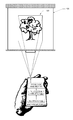
Claims (20)

What is claimed is:
1. A spatially-interleaved polarization converter comprising:
optical elements including an input lenslet array, a first double-pass quarter-wave retarder, a second double-pass quarter-wave retarder, a polarizing beam splitter (PBS), and a wave-retarder array;
the input lenslet array having a plurality of input lenslets with parallel respective lens optical axes, the wave-retarder array having a noncontiguous plurality of half-wave retarders with parallel respective retarder optical axes that are parallel to the lens optical axes;
the PBS having a planar beam-splitting element located (a) between the input lenslet array and the wave-retarder array and (b) between the first double-pass quarter-wave retarder and the second double-pass quarter-wave retarder;
the optical elements being configured to convert an input light beam to an output light beam having a plurality of first s-polarized beamlets interleaved with a plurality of second s-polarized beamlets.
2. The polarization converter of claim 1, the planar beam-splitting element being the only beam-splitting element of the polarization converter that splits the input light beam.
3. The polarization converter of claim 1, further comprising an output lenslet array between the PBS and the wave-retarder array, the PBS being between the input lenslet array and the output lenslet array.
4. The polarization converter of claim 3, the input lenslet array and the output lenslet array opposing one another and being substantially parallel.
5. The polarization converter of claim 3, the output lenslet array having a plurality of output lenslets each having an output lenslet surface; each input lenslet having an input lenslet surface; wherein the input lenslet surfaces and output lenslet surfaces each have a same radius of curvature and same conic constant.
6. The polarization converter of claim 3, the PBS being a PBS cube, the input lenslet array being on a first side of the PBS cube, the output lenslet array being on a second side of the PBS cube opposite the first side, the first double-pass quarter-wave retarder being on a third side of the PBS cube, and the second double-pass quarter-wave retarder being on a fourth side of the PBS cube opposite the third side.
7. The polarization converter of claim 1, an input lenslet lacking axial symmetry.
8. The polarization converter of claim 1, the planar beam-splitting element being orientated at angle with respect to the lens optical axes and retarder optical axes, the angle being between 40°and 50°.
9. The polarization converter of claim 1, the first and second double-pass quarter-wave retarders opposing one another and being substantially parallel, and being orthogonal to the input lenslet array.
10. The polarization converter of claim 1, the first and second double-pass quarter-wave retarders opposing one another and being substantially parallel, the PBS being positioned therebetween.
11. The polarization converter of claim 1, the optical elements being configured and arranged to collectively transmit each of the plurality of second s-polarized output beamlets at an angle with respect to a first s-polarized output beamlet not exceeding ten degrees.
12. The polarization converter of claim 1, the optical elements being configured and arranged to collectively transmit each of the plurality of first s-polarized output beamlets at an angle with respect to the input light beam not exceeding ten degrees.
13. The polarization converter of claim 1, at least one of the first and second double-pass quarter-wave retarders including at least one of a planar mirror and a concave mirror.
14. An image projector comprising:
a spatially-interleaved polarization converter having optical elements including an input lenslet array and an output lenslet array, and being capable of transmitting incident light thereon as converted light having a single common polarization state; and
a projector assembly having a pixel array and being capable of reflecting the converted light;
the output lenslet array and the projector assembly being part of an imaging system that images the input lenslet array to a top surface of the pixel array.
15. The image projector of claim 14:
the optical elements further including a first double-pass quarter-wave retarder, a second double-pass quarter-wave retarder, a polarizing beam splitter (PBS), and a wave-retarder array;
the input lenslet array having a plurality of input lenslets with parallel respective lens optical axes, the wave-retarder array having a noncontiguous plurality of half-wave retarders with parallel respective retarder optical axes that are parallel to the lens optical axes;
the PBS having a planar beam-splitting element located (a) between the input lenslet array and the wave-retarder array and (b) between the first double-pass quarter-wave retarder and the second double-pass quarter-wave retarder; and
the optical elements being configured to convert an input light beam to an output light beam having a plurality of first s-polarized beamlets interleaved with a plurality of second s-polarized beamlets.
16. The image projector of claim 14, the imaging system further comprising a lens unit between the output lenslet array and the projector assembly.
17. The image projector of claim 14, further comprising an illuminator capable of producing the incident light.
18. The image projector of claim 14, one or both of the input lenslet array and a sub-array of lenslets therein having an aspect ratio equal to an aspect ratio of the pixel array.
19. A method for converting an input light beam having multiple linear polarization states to an output light beam having a single common polarization state comprising:
transmitting the input light beam as a plurality of beamlets each having an s-polarized component and a p-polarized component;
splitting each beamlet into a respective transmitted p-polarized beamlet and a respective reflected s-polarized beamlet;
converting each transmitted p-polarized beamlet to a respective first s-polarized output beamlet; and
spatially interleaving the reflected s-polarized beamlets with the first s-polarized output beamlets, resulting in the output beam.
20. The method of claim 19, the step of spatially interleaving comprising:
converting each reflected s-polarized beamlet to a respective intermediate p-polarized beamlet;
converting each intermediate p-polarized beamlet to a respective second s-polarized output beamlet; and
reflecting each second s-polarized output beamlet in a direction substantially parallel to at least one first s-polarized output beamlet.
US14/631,513 2015-02-25 2015-02-25 Spatially interleaved polarization converter for LCOS display Active 2035-05-27 US9448415B2 (en)

Priority Applications (3)

Application Number Priority Date Filing Date Title
US14/631,513 US9448415B2 (en) 2015-02-25 2015-02-25 Spatially interleaved polarization converter for LCOS display
TW105105733A TWI579596B (en) 2015-02-25 2016-02-25 Spatially-interleaved polarization converter for lcos display and method for converting input light beam having multiple linear polarization states to output light beam having single common polarization state
CN201610105560.2A CN105911804B (en) 2015-02-25 2016-02-25 Polarization converter for LCoS projection display device LCOS spatial intersecting

Applications Claiming Priority (1)

Application Number Priority Date Filing Date Title
US14/631,513 US9448415B2 (en) 2015-02-25 2015-02-25 Spatially interleaved polarization converter for LCOS display

Publications (2)

Publication Number Publication Date
US20160246068A1 US20160246068A1 (en) 2016-08-25
US9448415B2 true US9448415B2 (en) 2016-09-20

Family

ID=56693546

Family Applications (1)

Application Number Title Priority Date Filing Date
US14/631,513 Active 2035-05-27 US9448415B2 (en) 2015-02-25 2015-02-25 Spatially interleaved polarization converter for LCOS display

Country Status (3)

Country Link
US (1) US9448415B2 (en)
CN (1) CN105911804B (en)
TW (1) TWI579596B (en)

Cited By (1)

* Cited by examiner, † Cited by third party
Publication number Priority date Publication date Assignee Title
US20220201257A1 (en) * 2020-12-21 2022-06-23 Coretronic Corporation Projection device

Families Citing this family (13)

* Cited by examiner, † Cited by third party
Publication number Priority date Publication date Assignee Title
JP6743811B2 (en) * 2015-04-30 2020-08-19 ソニー株式会社 Projection display device
CN110161789B (en) * 2015-08-04 2021-02-02 深圳光峰科技股份有限公司 Projection system
JP2018072598A (en) * 2016-10-31 2018-05-10 株式会社ジャパンディスプレイ Display device
GB2568021B (en) * 2017-09-08 2021-12-01 Dualitas Ltd Holographic projector
JP7081256B2 (en) * 2018-03-27 2022-06-07 セイコーエプソン株式会社 Optical unit and display device
US20200018962A1 (en) * 2018-07-11 2020-01-16 Facebook Technologies, Llc Adaptive lenses for near-eye displays
KR102707258B1 (en) * 2018-10-15 2024-09-23 삼성디스플레이 주식회사 Display device and fabricating method thereof
CN109188700B (en) * 2018-10-30 2021-05-11 京东方科技集团股份有限公司 Optical display system and AR/VR display device
DE102020114077B4 (en) * 2020-05-26 2026-01-08 Limo Display Gmbh Device for homogenizing laser light and arrangement of a plurality of such devices
CN114114507B (en) * 2020-08-31 2023-07-25 宁波激智科技股份有限公司 Polarization-preserving optical film, interference-relieving polarization-preserving micro-lens film and preparation method thereof
CN114114509B (en) * 2020-08-31 2023-07-25 宁波激智科技股份有限公司 Polarization-preserving optical film, interference-relieving polarization-preserving micro-lens film and preparation method thereof
CN112596332B (en) * 2020-12-23 2022-03-11 广景视睿科技(深圳)有限公司 Projection system and projector
CN116560171A (en) * 2022-01-28 2023-08-08 苏州佳世达光电有限公司 Light source module

Citations (7)

* Cited by examiner, † Cited by third party
Publication number Priority date Publication date Assignee Title
US5757547A (en) 1995-04-24 1998-05-26 Polycom, Inc. High efficiency homogeneous polarization converter
US6166792A (en) 1996-10-18 2000-12-26 Canon Kabushiki Kaisha Reflective LCD having reflectivity characteristics between electrodes and reflector
US6310713B2 (en) * 1997-04-07 2001-10-30 International Business Machines Corporation Optical system for miniature personal displays using reflective light valves
US6411437B1 (en) * 2000-06-28 2002-06-25 Corning Precision Lens, Incorporated Integrating polarization conversion system
US7206132B2 (en) 2004-08-06 2007-04-17 Visx, Incorporated Lenslet array for beam homogenization
US7905600B2 (en) 2004-06-25 2011-03-15 Sony Deutschland Gmbh Imaging unit for color projection engine comprising reflective displays
US20130063701A1 (en) 2010-05-19 2013-03-14 3M Innovative Properties Company Fly eye integrator polarization converter

Family Cites Families (8)

* Cited by examiner, † Cited by third party
Publication number Priority date Publication date Assignee Title
JP3298437B2 (en) * 1996-12-18 2002-07-02 セイコーエプソン株式会社 Optical element, polarized illumination device and projection display device
CN1553232A (en) * 2003-06-05 2004-12-08 台达电子工业股份有限公司 Image projection device and optical polarization module thereof
JP2005195919A (en) * 2004-01-08 2005-07-21 Sumitomo Electric Ind Ltd Polarization integrator
CN101169520A (en) * 2006-11-16 2008-04-30 中国科学院长春光学精密机械与物理研究所 A polarized light conversion device for liquid crystal projection display
US20080225257A1 (en) * 2007-03-13 2008-09-18 Nikon Corporation Optical integrator system, illumination optical apparatus, exposure apparatus, and device manufacturing method
TWI341955B (en) * 2007-10-05 2011-05-11 Hon Hai Prec Ind Co Ltd Transmissive liquid crystal panel and projector using the same
CN202693864U (en) * 2012-05-09 2013-01-23 上海波汇通信科技有限公司 Photoelectric receiving module
CN105136298B (en) * 2014-04-15 2017-03-29 哈尔滨工业大学 A kind of fast illuminated imaging method of difference

Patent Citations (7)

* Cited by examiner, † Cited by third party
Publication number Priority date Publication date Assignee Title
US5757547A (en) 1995-04-24 1998-05-26 Polycom, Inc. High efficiency homogeneous polarization converter
US6166792A (en) 1996-10-18 2000-12-26 Canon Kabushiki Kaisha Reflective LCD having reflectivity characteristics between electrodes and reflector
US6310713B2 (en) * 1997-04-07 2001-10-30 International Business Machines Corporation Optical system for miniature personal displays using reflective light valves
US6411437B1 (en) * 2000-06-28 2002-06-25 Corning Precision Lens, Incorporated Integrating polarization conversion system
US7905600B2 (en) 2004-06-25 2011-03-15 Sony Deutschland Gmbh Imaging unit for color projection engine comprising reflective displays
US7206132B2 (en) 2004-08-06 2007-04-17 Visx, Incorporated Lenslet array for beam homogenization
US20130063701A1 (en) 2010-05-19 2013-03-14 3M Innovative Properties Company Fly eye integrator polarization converter

Non-Patent Citations (6)

* Cited by examiner, † Cited by third party
Title
Imagine Optix PG-PCS Brochure, pulled from http://www.imagineoptix.com/wp-content/themes/imagineoptix/pdfs/GEN3-PG-PCS-Brochure-101211v4.pdf on Jan. 5, 2015, 3 pp.
Liu, et al., "Polarization properties of corner-cube retroreflectors: theory and experiment", Appl. Opt. 36, 1553-1559 (1997), 1553-1559.
McManamon, et al., "Optical Phased Array Technology", Proceedings of the IEEE, vol. 84, No. 2, Feb. 1996, 268-298.
Nicolás, et al., "Programmable Wave Plates Using a Twisted Nematic Liquid Crystal Display", pulled from: http://opticalengineering.spiedigitallibrary.org/ on Nov. 24, 2014 Terms of Use: http://spiedl.org/terms, Optical Engineering, vol. 41 No. 12, Dec. 2002, 3004-3005.
Spilman, et al., "Stress birefringent, space-variant wave plates for vortex illumination", Applied Optics, vol. 46, No. 1, Jan. 2007, 61-66.
Voelkel, et al., "Laser Beam Homogenizing: Limitations and Constraints", Optical Systems Design, SPIE Europe, Sep. 2006, 12 pp.

Cited By (2)

* Cited by examiner, † Cited by third party
Publication number Priority date Publication date Assignee Title
US20220201257A1 (en) * 2020-12-21 2022-06-23 Coretronic Corporation Projection device
US11671569B2 (en) * 2020-12-21 2023-06-06 Coretronic Corporation Projection device

Also Published As

Publication number Publication date
TW201632951A (en) 2016-09-16
TWI579596B (en) 2017-04-21
US20160246068A1 (en) 2016-08-25
CN105911804B (en) 2017-09-01
CN105911804A (en) 2016-08-31

Similar Documents

Publication Publication Date Title
US9448415B2 (en) Spatially interleaved polarization converter for LCOS display
US12181687B2 (en) Optical devices and systems with dichroic beamsplitter color combiner
CN110869839B (en) Liquid crystal on silicon illuminator with light guide optical element
JP7514558B2 (en) Image waveguide with symmetric beam multiplication.
CN111183393B (en) Augmented reality display
CN208953803U (en) Optical system with compact collimated image projector
US12105279B2 (en) Displays employing astigmatic optics and aberration compensation
US9122140B2 (en) Refractive polarization converter and polarized color combiner
US8982463B2 (en) Tilted plate normal incidence color combiner with a polarizing beam splitter
US20130057786A1 (en) Polarized projection illuminator
TWI639795B (en) Reflective fly eye array illuminator
US20130063671A1 (en) Compact illuminator
CN112462564B (en) Laser optical projection module and wearable device comprising same
WO2013062930A1 (en) Tilted dichroic polarized color combiner
US20250231406A1 (en) Compact Projector for Display System
HK1225448B (en) Spatially-interleaved polarization converter for lcos display
HK1225448A1 (en) Spatially-interleaved polarization converter for lcos display
CN116699840A (en) A micro-projection system and a near-eye display device for augmented reality
CN118339823A (en) Compact projectors for display systems

Legal Events

Date Code Title Description
AS Assignment

Owner name: OMNIVISION TECHNOLOGIES, INC., CALIFORNIA

Free format text: ASSIGNMENT OF ASSIGNORS INTEREST;ASSIGNOR:LIU, YI-WEI;REEL/FRAME:035030/0611

Effective date: 20150206

STCF Information on status: patent grant

Free format text: PATENTED CASE

CC Certificate of correction
MAFP Maintenance fee payment

Free format text: PAYMENT OF MAINTENANCE FEE, 4TH YEAR, LARGE ENTITY (ORIGINAL EVENT CODE: M1551); ENTITY STATUS OF PATENT OWNER: LARGE ENTITY

Year of fee payment: 4

MAFP Maintenance fee payment

Free format text: PAYMENT OF MAINTENANCE FEE, 8TH YEAR, LARGE ENTITY (ORIGINAL EVENT CODE: M1552); ENTITY STATUS OF PATENT OWNER: LARGE ENTITY

Year of fee payment: 8