US9447102B2 - Protein kinase inhibitors - Google Patents
Protein kinase inhibitors Download PDFInfo
- Publication number
- US9447102B2 US9447102B2 US14/412,982 US201314412982A US9447102B2 US 9447102 B2 US9447102 B2 US 9447102B2 US 201314412982 A US201314412982 A US 201314412982A US 9447102 B2 US9447102 B2 US 9447102B2
- Authority
- US
- United States
- Prior art keywords
- mmol
- added
- solution
- room temperature
- stirred
- Prior art date
- Legal status (The legal status is an assumption and is not a legal conclusion. Google has not performed a legal analysis and makes no representation as to the accuracy of the status listed.)
- Expired - Fee Related
Links
- 0 *C1=NN([Y]CC[W])C2=C1N=CN=C2N Chemical compound *C1=NN([Y]CC[W])C2=C1N=CN=C2N 0.000 description 8
- FRERGUMMWIFABV-UHFFFAOYSA-N CC(C)C(C)C.CC(C)C1CCCC1.CC(C)C1CCCCC1 Chemical compound CC(C)C(C)C.CC(C)C1CCCC1.CC(C)C1CCCCC1 FRERGUMMWIFABV-UHFFFAOYSA-N 0.000 description 2
- KRIAJUDAPVXEOE-UHFFFAOYSA-N CC(C)C1=CC(F)=CC(C(C)C)=C1.CC(C)C1=CC=CC(C(C)C)=C1 Chemical compound CC(C)C1=CC(F)=CC(C(C)C)=C1.CC(C)C1=CC=CC(C(C)C)=C1 KRIAJUDAPVXEOE-UHFFFAOYSA-N 0.000 description 2
- HVZXZGMOKNJIOQ-UHFFFAOYSA-N CC.CC(C)C1=CC=C(C(C)C)C=C1 Chemical compound CC.CC(C)C1=CC=C(C(C)C)C=C1 HVZXZGMOKNJIOQ-UHFFFAOYSA-N 0.000 description 2
- FADDCTYKWSBVPB-UHFFFAOYSA-N CC.CC(C)C1=CC=CC(C(C)C)=C1 Chemical compound CC.CC(C)C1=CC=CC(C(C)C)=C1 FADDCTYKWSBVPB-UHFFFAOYSA-N 0.000 description 2
- XRMHMQSHLKHVCY-UHFFFAOYSA-N CC.CC.CC(C)C1=CC=C(OC2=CC=CC([W])=C2)C=C1 Chemical compound CC.CC.CC(C)C1=CC=C(OC2=CC=CC([W])=C2)C=C1 XRMHMQSHLKHVCY-UHFFFAOYSA-N 0.000 description 2
- CEVUBRYHRSAUJC-UHFFFAOYSA-N CC1=CC=C(COC(C)C)C=N1.CC1=NC=C(COC(C)C)C=N1.CC1=NC=C(COC(C)C)S1 Chemical compound CC1=CC=C(COC(C)C)C=N1.CC1=NC=C(COC(C)C)C=N1.CC1=NC=C(COC(C)C)S1 CEVUBRYHRSAUJC-UHFFFAOYSA-N 0.000 description 2
- JHQKIMNQLYNUKJ-UHFFFAOYSA-N CC1=NC=C(COC2=CC(F)=CC(OC3=CC=C(N4N=C(C(C)C)C5=C4C(N)=NC=N5)C=C3)=C2)S1 Chemical compound CC1=NC=C(COC2=CC(F)=CC(OC3=CC=C(N4N=C(C(C)C)C5=C4C(N)=NC=N5)C=C3)=C2)S1 JHQKIMNQLYNUKJ-UHFFFAOYSA-N 0.000 description 2
- PCNQDPWXEOEXAL-HHLODIRBSA-M C.CC(C#N)(/N=N/C1=CC=C(OCC2=CC=CC=C2)C=C1)C1CCCC1.CC(C)(C)O[Na].N#C/C(=N\CC1=CC=C(OCC2=CC=CC=C2)C=C1)C1CCCC1.N#CCBr.NC1=CC=C(OCC2=CC=CC=C2)C=C1.O=C=O.O=C=O.O[Na].[C-]#[N+]C(C)C1CCCC1.[C-]#[N+]C1=C(N)C(C2CCCC2)=NN1C1=CC=C(O)C=C1.[C-]#[N+]C1=C(N)C(C2CCCC2)=NN1C1=CC=C(OCC2=CC=CC=C2)C=C1 Chemical compound C.CC(C#N)(/N=N/C1=CC=C(OCC2=CC=CC=C2)C=C1)C1CCCC1.CC(C)(C)O[Na].N#C/C(=N\CC1=CC=C(OCC2=CC=CC=C2)C=C1)C1CCCC1.N#CCBr.NC1=CC=C(OCC2=CC=CC=C2)C=C1.O=C=O.O=C=O.O[Na].[C-]#[N+]C(C)C1CCCC1.[C-]#[N+]C1=C(N)C(C2CCCC2)=NN1C1=CC=C(O)C=C1.[C-]#[N+]C1=C(N)C(C2CCCC2)=NN1C1=CC=C(OCC2=CC=CC=C2)C=C1 PCNQDPWXEOEXAL-HHLODIRBSA-M 0.000 description 1
- VDYSXIKZEJSWFS-BMPSGOSOSA-M C.CC(C#N)(/N=N/C1=CC=C(OCC2=CC=CC=C2)C=C1)C1CCOCC1.CC(C)(C)O[Na].N#CC(=NCC1=CC=C(OCC2=CC=CC=C2)C=C1)C1CCOCC1.N#CCBr.NC1=CC=C(OCC2=CC=CC=C2)C=C1.O=C=O.O=C=O.O[Na].[C-]#[N+]C(C)C1CCOCC1.[C-]#[N+]C1=C(N)C(C2CCOCC2)=NN1C1=CC=C(O)C=C1.[C-]#[N+]C1=C(N)C(C2CCOCC2)=NN1C1=CC=C(OCC2=CC=CC=C2)C=C1 Chemical compound C.CC(C#N)(/N=N/C1=CC=C(OCC2=CC=CC=C2)C=C1)C1CCOCC1.CC(C)(C)O[Na].N#CC(=NCC1=CC=C(OCC2=CC=CC=C2)C=C1)C1CCOCC1.N#CCBr.NC1=CC=C(OCC2=CC=CC=C2)C=C1.O=C=O.O=C=O.O[Na].[C-]#[N+]C(C)C1CCOCC1.[C-]#[N+]C1=C(N)C(C2CCOCC2)=NN1C1=CC=C(O)C=C1.[C-]#[N+]C1=C(N)C(C2CCOCC2)=NN1C1=CC=C(OCC2=CC=CC=C2)C=C1 VDYSXIKZEJSWFS-BMPSGOSOSA-M 0.000 description 1
- LSQDHWFZOLAPEG-BHUUECNCSA-M C.CC(C)(C)O[Na].CC(C)/C(C#N)=N/CC1=CC=C(OCC2=CC=CC=C2)C=C1.CC(C)C(C)(C#N)/N=N/C1=CC=C(OCC2=CC=CC=C2)C=C1.N#CCBr.NC1=CC=C(OCC2=CC=CC=C2)C=C1.O=C=O.O=C=O.O[Na].[C-]#[N+]C(C)C(C)C.[C-]#[N+]C1=C(N)C(C(C)C)=NN1C1=CC=C(O)C=C1.[C-]#[N+]C1=C(N)C(C(C)C)=NN1C1=CC=C(OCC2=CC=CC=C2)C=C1 Chemical compound C.CC(C)(C)O[Na].CC(C)/C(C#N)=N/CC1=CC=C(OCC2=CC=CC=C2)C=C1.CC(C)C(C)(C#N)/N=N/C1=CC=C(OCC2=CC=CC=C2)C=C1.N#CCBr.NC1=CC=C(OCC2=CC=CC=C2)C=C1.O=C=O.O=C=O.O[Na].[C-]#[N+]C(C)C(C)C.[C-]#[N+]C1=C(N)C(C(C)C)=NN1C1=CC=C(O)C=C1.[C-]#[N+]C1=C(N)C(C(C)C)=NN1C1=CC=C(OCC2=CC=CC=C2)C=C1 LSQDHWFZOLAPEG-BHUUECNCSA-M 0.000 description 1
- FPGNBXJPLGPRKQ-JLJQHRAUSA-M C.CC(C)(C)O[Na].CC(C)/C(C#N)=N/CC1=CC=C(OCC2=CC=CC=C2)C=C1F.CC(C)C(C)(C#N)/N=N/C1=CC=C(OCC2=CC=CC=C2)C=C1F.N#CCBr.NC1=C(F)C=C(OCC2=CC=CC=C2)C=C1.O=C=O.O=C=O.O[Na].[C-]#[N+]C(C)C(C)C.[C-]#[N+]C1=C(N)C(C(C)C)=NN1C1=C(F)C=C(O)C=C1.[C-]#[N+]C1=C(N)C(C(C)C)=NN1C1=C(F)C=C(OCC2=CC=CC=C2)C=C1 Chemical compound C.CC(C)(C)O[Na].CC(C)/C(C#N)=N/CC1=CC=C(OCC2=CC=CC=C2)C=C1F.CC(C)C(C)(C#N)/N=N/C1=CC=C(OCC2=CC=CC=C2)C=C1F.N#CCBr.NC1=C(F)C=C(OCC2=CC=CC=C2)C=C1.O=C=O.O=C=O.O[Na].[C-]#[N+]C(C)C(C)C.[C-]#[N+]C1=C(N)C(C(C)C)=NN1C1=C(F)C=C(O)C=C1.[C-]#[N+]C1=C(N)C(C(C)C)=NN1C1=C(F)C=C(OCC2=CC=CC=C2)C=C1 FPGNBXJPLGPRKQ-JLJQHRAUSA-M 0.000 description 1
- SEIZCWUVAKANGH-UHFFFAOYSA-N C.CC1=CC=C(CO)C=N1.CC1=CC=C(COC2=CC(F)=CC(Br)=C2)C=N1.FC1=CC(Br)=CC(I)=C1 Chemical compound C.CC1=CC=C(CO)C=N1.CC1=CC=C(COC2=CC(F)=CC(Br)=C2)C=N1.FC1=CC(Br)=CC(I)=C1 SEIZCWUVAKANGH-UHFFFAOYSA-N 0.000 description 1
- HGWUXBYZCMGEPC-UHFFFAOYSA-N C.CC1=NC=C(CO)S1.CC1=NC=C(COC2=CC(F)=CC(Br)=C2)S1.FC1=CC(Br)=CC(I)=C1 Chemical compound C.CC1=NC=C(CO)S1.CC1=NC=C(COC2=CC(F)=CC(Br)=C2)S1.FC1=CC(Br)=CC(I)=C1 HGWUXBYZCMGEPC-UHFFFAOYSA-N 0.000 description 1
- SRCQKNWYDIHBHO-UHFFFAOYSA-M C.CN1C=NC=C1CO.CN1C=NC=C1COC1=CC(F)=CC(O)=C1.COCCl.COCOC1=CC(F)=CC(F)=C1.COCOC1=CC(OCC2=CN=CN2C)=CC(F)=C1.Cl.O=COO[K].OC1=CC(F)=CC(F)=C1.[KH] Chemical compound C.CN1C=NC=C1CO.CN1C=NC=C1COC1=CC(F)=CC(O)=C1.COCCl.COCOC1=CC(F)=CC(F)=C1.COCOC1=CC(OCC2=CN=CN2C)=CC(F)=C1.Cl.O=COO[K].OC1=CC(F)=CC(F)=C1.[KH] SRCQKNWYDIHBHO-UHFFFAOYSA-M 0.000 description 1
- NUNGXGLQBSGADQ-WVSMTJGLSA-M CC(C#N)(/N=N/C1=CC=C(Br)C=C1)C1CCOCC1.CC(C)(C)O[K].N#CC(=NCC1=CC=C(Br)C=C1)C1CCOCC1.N#CCBr.NC1=CC=C(Br)C=C1.O=C=O.O[Na].[C-]#[N+]C1=C(N)C(C2CCOCC2)=NN1C1=CC=C(Br)C=C1 Chemical compound CC(C#N)(/N=N/C1=CC=C(Br)C=C1)C1CCOCC1.CC(C)(C)O[K].N#CC(=NCC1=CC=C(Br)C=C1)C1CCOCC1.N#CCBr.NC1=CC=C(Br)C=C1.O=C=O.O[Na].[C-]#[N+]C1=C(N)C(C2CCOCC2)=NN1C1=CC=C(Br)C=C1 NUNGXGLQBSGADQ-WVSMTJGLSA-M 0.000 description 1
- DOEZYQMTRKJXPF-WVSMTJGLSA-M CC(C#N)(/N=N/C1=CC=C(I)C=C1)C1CCCC1.CC(C)(C)O[Na].N#CC(=NCC1=CC=C(I)C=C1)C1CCCC1.N#CCBr.NC1=CC=C(I)C=C1.O=C=O.O[Na].[C-]#[N+]C1=C(N)C(C2CCCC2)=NN1C1=CC=C(I)C=C1 Chemical compound CC(C#N)(/N=N/C1=CC=C(I)C=C1)C1CCCC1.CC(C)(C)O[Na].N#CC(=NCC1=CC=C(I)C=C1)C1CCCC1.N#CCBr.NC1=CC=C(I)C=C1.O=C=O.O[Na].[C-]#[N+]C1=C(N)C(C2CCCC2)=NN1C1=CC=C(I)C=C1 DOEZYQMTRKJXPF-WVSMTJGLSA-M 0.000 description 1
- MNPMNYIXUDOYMO-UHFFFAOYSA-N CC(C)C1=CC(F)=C(C(C)C)C=C1.CC(C)C1=CC=C(C(C)C)C=C1 Chemical compound CC(C)C1=CC(F)=C(C(C)C)C=C1.CC(C)C1=CC=C(C(C)C)C=C1 MNPMNYIXUDOYMO-UHFFFAOYSA-N 0.000 description 1
- JDYQVVGYBPLXBE-UHFFFAOYSA-N CC(C)C1=CC(F)=CC(C(C)C)=C1 Chemical compound CC(C)C1=CC(F)=CC(C(C)C)=C1 JDYQVVGYBPLXBE-UHFFFAOYSA-N 0.000 description 1
- IPWUZGNOYQYRKC-UHFFFAOYSA-N CC(C)C1=NN(C2=CC=C(OC3=CC(OCC4=CC=CC=C4)=CC(F)=C3)C=C2)C2=C1N=CN=C2N Chemical compound CC(C)C1=NN(C2=CC=C(OC3=CC(OCC4=CC=CC=C4)=CC(F)=C3)C=C2)C2=C1N=CN=C2N IPWUZGNOYQYRKC-UHFFFAOYSA-N 0.000 description 1
- XCDOPMIBKXZHFE-UHFFFAOYSA-N CC(C)C1=NN(C2=CC=C(OC3=CC(OCC4=CC=CC=C4)=CC(F)=C3)C=C2)C2=C1N=CN=C2N.CC1=NC=C(COC2=CC(F)=CC(OC3=CC=C(N4N=C(C5CCOCC5)C5=C4C(N)=NC=N5)C=C3)=C2)C=C1.NC1=NC=NC2=C1N(C1=CC=C(OC3=CC(OCC4=CC=CC=C4)=CC(F)=C3)C=C1)N=C2C1CCOCC1 Chemical compound CC(C)C1=NN(C2=CC=C(OC3=CC(OCC4=CC=CC=C4)=CC(F)=C3)C=C2)C2=C1N=CN=C2N.CC1=NC=C(COC2=CC(F)=CC(OC3=CC=C(N4N=C(C5CCOCC5)C5=C4C(N)=NC=N5)C=C3)=C2)C=C1.NC1=NC=NC2=C1N(C1=CC=C(OC3=CC(OCC4=CC=CC=C4)=CC(F)=C3)C=C1)N=C2C1CCOCC1 XCDOPMIBKXZHFE-UHFFFAOYSA-N 0.000 description 1
- KPXXKKUWKYQLON-UHFFFAOYSA-N CC(C)C1=NN(C2=CC=C(OC3=CC(OCC4=CC=CC=C4)=CC(F)=C3)C=C2)C2=C1N=CN=C2N.CN(C)CC(=O)O.[C-]#[N+]C1=C(N)C(C(C)C)=NN1C1=CC=C(OC2=CC(OCC3=CC=CC=C3)=CC(F)=C2)C=C1 Chemical compound CC(C)C1=NN(C2=CC=C(OC3=CC(OCC4=CC=CC=C4)=CC(F)=C3)C=C2)C2=C1N=CN=C2N.CN(C)CC(=O)O.[C-]#[N+]C1=C(N)C(C(C)C)=NN1C1=CC=C(OC2=CC(OCC3=CC=CC=C3)=CC(F)=C2)C=C1 KPXXKKUWKYQLON-UHFFFAOYSA-N 0.000 description 1
- KBWHYMASNYXXSP-UHFFFAOYSA-M CC(C)I.CCC#N.COC(=O)C(C#N)C(C)C.O=C=O.O=COO[K].[KH] Chemical compound CC(C)I.CCC#N.COC(=O)C(C#N)C(C)C.O=C=O.O=COO[K].[KH] KBWHYMASNYXXSP-UHFFFAOYSA-M 0.000 description 1
- UKANLVGXRMWCCG-UHFFFAOYSA-N CC(C)OCC1=CC=CC=C1.CC(C)OCC1=CN=CN1C.CC(C)OCC1=CN=CS1.CC1=CC=C(COC(C)C)C=N1.CC1=NC=C(COC(C)C)C=N1.CC1=NC=C(COC(C)C)O1.CC1=NC=C(COC(C)C)S1 Chemical compound CC(C)OCC1=CC=CC=C1.CC(C)OCC1=CN=CN1C.CC(C)OCC1=CN=CS1.CC1=CC=C(COC(C)C)C=N1.CC1=NC=C(COC(C)C)C=N1.CC1=NC=C(COC(C)C)O1.CC1=NC=C(COC(C)C)S1 UKANLVGXRMWCCG-UHFFFAOYSA-N 0.000 description 1
- YMYCDXUNHZTUKY-UHFFFAOYSA-N CC(N)=S.CC1=NC=C(CO)S1.CCOC(=O)C(Cl)C=O.CCOC(=O)C1=CN=C(C)S1.CCOC(=O)CCl.CCOC=O.CC[O-].[AlH3].[LiH].[Na+] Chemical compound CC(N)=S.CC1=NC=C(CO)S1.CCOC(=O)C(Cl)C=O.CCOC(=O)C1=CN=C(C)S1.CCOC(=O)CCl.CCOC=O.CC[O-].[AlH3].[LiH].[Na+] YMYCDXUNHZTUKY-UHFFFAOYSA-N 0.000 description 1
- CZGNYXBXQFNJNJ-UHFFFAOYSA-N CC1=CC=C(COC2=CC(F)=CC(OC3=CC(F)=C(N4N=C(C(C)C)C5=C4C(N)=NC=N5)C=C3)=C2)S1.CC1=NC=C(COC2=CC(F)=CC(OC3=CC(F)=C(N4N=C(C(C)C)C5=C4C(N)=NC=N5)C=C3)=C2)C=N1.CC1=NC=C(COC2=CC(F)=CC(OC3=CC=C(N4N=C(C5CCOCC5)C5=C4C(N)=NC=N5)C=C3)=C2)C=N1 Chemical compound CC1=CC=C(COC2=CC(F)=CC(OC3=CC(F)=C(N4N=C(C(C)C)C5=C4C(N)=NC=N5)C=C3)=C2)S1.CC1=NC=C(COC2=CC(F)=CC(OC3=CC(F)=C(N4N=C(C(C)C)C5=C4C(N)=NC=N5)C=C3)=C2)C=N1.CC1=NC=C(COC2=CC(F)=CC(OC3=CC=C(N4N=C(C5CCOCC5)C5=C4C(N)=NC=N5)C=C3)=C2)C=N1 CZGNYXBXQFNJNJ-UHFFFAOYSA-N 0.000 description 1
- FKFUEXXJECGGEH-UHFFFAOYSA-N CC1=CC=C(COC2=CC(F)=CC(OC3=CC=C(N4N=C(C(C)C)C5=C4C(N)=NC=N5)C=C3)=C2)C=N1 Chemical compound CC1=CC=C(COC2=CC(F)=CC(OC3=CC=C(N4N=C(C(C)C)C5=C4C(N)=NC=N5)C=C3)=C2)C=N1 FKFUEXXJECGGEH-UHFFFAOYSA-N 0.000 description 1
- VMTGSZAVCSQOOK-UHFFFAOYSA-N CC1=CC=C(COC2=CC(F)=CC(OC3=CC=C(N4N=C(C(C)C)C5=C4C(N)=NC=N5)C=C3)=C2)C=N1.CC1=CC=C(COC2=CC(F)=CC(OC3=CC=C(N4N=C(C(C)C)C5=C4C(N)=NC=N5)C=C3)=C2)S1.CC1=NC=C(COC2=CC(F)=CC(OC3=CC=C(N4N=C(C(C)C)C5=C4C(N)=NC=N5)C=C3)=C2)C=N1.CC1=NC=C(COC2=CC(F)=CC(OC3=CC=C(N4N=C(C5CCCC5)C5=C4C(N)=NC=N5)C=C3)=C2)C=N1 Chemical compound CC1=CC=C(COC2=CC(F)=CC(OC3=CC=C(N4N=C(C(C)C)C5=C4C(N)=NC=N5)C=C3)=C2)C=N1.CC1=CC=C(COC2=CC(F)=CC(OC3=CC=C(N4N=C(C(C)C)C5=C4C(N)=NC=N5)C=C3)=C2)S1.CC1=NC=C(COC2=CC(F)=CC(OC3=CC=C(N4N=C(C(C)C)C5=C4C(N)=NC=N5)C=C3)=C2)C=N1.CC1=NC=C(COC2=CC(F)=CC(OC3=CC=C(N4N=C(C5CCCC5)C5=C4C(N)=NC=N5)C=C3)=C2)C=N1 VMTGSZAVCSQOOK-UHFFFAOYSA-N 0.000 description 1
- UPQOPMCVJIFSCL-UHFFFAOYSA-N CC1=CC=C(COC2=CC(F)=CC(OC3=CC=C(N4N=C(C(C)C)C5=C4C(N)=NC=N5)C=C3)=C2)C=N1.CN(C)CC(=O)O.[C-]#[N+]C1=C(N)C(C(C)C)=NN1C1=CC=C(OC2=CC(OCC3=CC=C(C)N=C3)=CC(F)=C2)C=C1 Chemical compound CC1=CC=C(COC2=CC(F)=CC(OC3=CC=C(N4N=C(C(C)C)C5=C4C(N)=NC=N5)C=C3)=C2)C=N1.CN(C)CC(=O)O.[C-]#[N+]C1=C(N)C(C(C)C)=NN1C1=CC=C(OC2=CC(OCC3=CC=C(C)N=C3)=CC(F)=C2)C=C1 UPQOPMCVJIFSCL-UHFFFAOYSA-N 0.000 description 1
- CWLXHUAVLIIPIX-UHFFFAOYSA-N CC1=CC=C(COC2=CC(F)=CC(OC3=CC=C(N4N=C(C5CCCC5)C5=C4C(N)=NC=N5)C=C3)=C2)C=N1 Chemical compound CC1=CC=C(COC2=CC(F)=CC(OC3=CC=C(N4N=C(C5CCCC5)C5=C4C(N)=NC=N5)C=C3)=C2)C=N1 CWLXHUAVLIIPIX-UHFFFAOYSA-N 0.000 description 1
- GCHOPYWZDNKISH-UHFFFAOYSA-N CC1=CC=C(COC2=CC(F)=CC(OC3=CC=C(N4N=C(C5CCCC5)C5=C4C(N)=NC=N5)C=C3)=C2)C=N1.CC1=CC=C(COC2=CC(F)=CC(OC3=CC=C(N4N=C(C5CCCC5)C5=C4C(N)=NC=N5)C=C3)=C2)S1.CC1=CC=C(COC2=CC(F)=CC(OC3=CC=C(N4N=C(C5CCOCC5)C5=C4C(N)=NC=N5)C=C3)=C2)O1 Chemical compound CC1=CC=C(COC2=CC(F)=CC(OC3=CC=C(N4N=C(C5CCCC5)C5=C4C(N)=NC=N5)C=C3)=C2)C=N1.CC1=CC=C(COC2=CC(F)=CC(OC3=CC=C(N4N=C(C5CCCC5)C5=C4C(N)=NC=N5)C=C3)=C2)S1.CC1=CC=C(COC2=CC(F)=CC(OC3=CC=C(N4N=C(C5CCOCC5)C5=C4C(N)=NC=N5)C=C3)=C2)O1 GCHOPYWZDNKISH-UHFFFAOYSA-N 0.000 description 1
- IIVANFBOJCORPE-UHFFFAOYSA-N CC1=CC=C(COC2=CC(F)=CC(OC3=CC=C(N4N=C(C5CCCC5)C5=C4C(N)=NC=N5)C=C3)=C2)C=N1.CN(C)CC(=O)O.[C-]#[N+]C1=C(N)C(C2CCCC2)=NN1C1=CC=C(OC2=CC(OCC3=CC=C(C)N=C3)=CC(F)=C2)C=C1 Chemical compound CC1=CC=C(COC2=CC(F)=CC(OC3=CC=C(N4N=C(C5CCCC5)C5=C4C(N)=NC=N5)C=C3)=C2)C=N1.CN(C)CC(=O)O.[C-]#[N+]C1=C(N)C(C2CCCC2)=NN1C1=CC=C(OC2=CC(OCC3=CC=C(C)N=C3)=CC(F)=C2)C=C1 IIVANFBOJCORPE-UHFFFAOYSA-N 0.000 description 1
- LNWKRAMODYTCTL-UHFFFAOYSA-N CC1=CC=C(COC2=CC(F)=CC(OC3=CC=C(N4N=C(C5CCOCC5)C5=C4C(N)=NC=N5)C=C3)=C2)C=N1.CN(C)CC(=O)O.[C-]#[N+]C1=C(N)C(C2CCOCC2)=NN1C1=CC=C(OC2=CC(OCC3=CC=C(C)N=C3)=CC(F)=C2)C=C1 Chemical compound CC1=CC=C(COC2=CC(F)=CC(OC3=CC=C(N4N=C(C5CCOCC5)C5=C4C(N)=NC=N5)C=C3)=C2)C=N1.CN(C)CC(=O)O.[C-]#[N+]C1=C(N)C(C2CCOCC2)=NN1C1=CC=C(OC2=CC(OCC3=CC=C(C)N=C3)=CC(F)=C2)C=C1 LNWKRAMODYTCTL-UHFFFAOYSA-N 0.000 description 1
- XBDVQMPOMDCEQG-UHFFFAOYSA-N CC1=CC=C(COC2=CC(F)=CC(OC3=CC=C(N4N=C(C5CCOCC5)C5=C4C(N)=NC=N5)C=C3)=C2)S1.CC1=CC=C(COC2=CC=CC(OC3=CC=C(N4N=C(C5CCCC5)C5=C4C(N)=NC=N5)C=C3)=C2)S1.CN1C=CC=C1COC1=CC(F)=CC(OC2=CC=C(N3N=C(C4CCOCC4)C4=C3C(N)=NC=N4)C=C2)=C1.NC1=NC=NC2=C1N(C1=CC=C(OC3=CC(OCC4=CC=CS4)=CC=C3)C=C1)N=C2C1CCCC1 Chemical compound CC1=CC=C(COC2=CC(F)=CC(OC3=CC=C(N4N=C(C5CCOCC5)C5=C4C(N)=NC=N5)C=C3)=C2)S1.CC1=CC=C(COC2=CC=CC(OC3=CC=C(N4N=C(C5CCCC5)C5=C4C(N)=NC=N5)C=C3)=C2)S1.CN1C=CC=C1COC1=CC(F)=CC(OC2=CC=C(N3N=C(C4CCOCC4)C4=C3C(N)=NC=N4)C=C2)=C1.NC1=NC=NC2=C1N(C1=CC=C(OC3=CC(OCC4=CC=CS4)=CC=C3)C=C1)N=C2C1CCCC1 XBDVQMPOMDCEQG-UHFFFAOYSA-N 0.000 description 1
- OXEIRIICRNMXSK-UHFFFAOYSA-N CC1=NC=C(CO)C=N1.CC1=NC=C(COC2=CC(F)=CC(Br)=C2)C=N1.FC1=CC(Br)=CC(I)=C1 Chemical compound CC1=NC=C(CO)C=N1.CC1=NC=C(COC2=CC(F)=CC(Br)=C2)C=N1.FC1=CC(Br)=CC(I)=C1 OXEIRIICRNMXSK-UHFFFAOYSA-N 0.000 description 1
- LUGQTKFLEUPIRA-UHFFFAOYSA-N CC1=NC=C(COC2=CC(F)=CC(OC3=CC(F)=C(N4N=C(C(C)C)C5=C4C(N)=NC=N5)C=C3)=C2)C=N1 Chemical compound CC1=NC=C(COC2=CC(F)=CC(OC3=CC(F)=C(N4N=C(C(C)C)C5=C4C(N)=NC=N5)C=C3)=C2)C=N1 LUGQTKFLEUPIRA-UHFFFAOYSA-N 0.000 description 1
- SMICZWOBUQHTTJ-UHFFFAOYSA-N CC1=NC=C(COC2=CC(F)=CC(OC3=CC(F)=C(N4N=C(C(C)C)C5=C4C(N)=NC=N5)C=C3)=C2)C=N1.CN(C)CC(=O)O.[C-]#[N+]C1=C(N)C(C(C)C)=NN1C1=C(F)C=C(OC2=CC(OCC3=CN=C(C)N=C3)=CC(F)=C2)C=C1 Chemical compound CC1=NC=C(COC2=CC(F)=CC(OC3=CC(F)=C(N4N=C(C(C)C)C5=C4C(N)=NC=N5)C=C3)=C2)C=N1.CN(C)CC(=O)O.[C-]#[N+]C1=C(N)C(C(C)C)=NN1C1=C(F)C=C(OC2=CC(OCC3=CN=C(C)N=C3)=CC(F)=C2)C=C1 SMICZWOBUQHTTJ-UHFFFAOYSA-N 0.000 description 1
- AHWDUKPQEVEWTM-UHFFFAOYSA-N CC1=NC=C(COC2=CC(F)=CC(OC3=CC(F)=C(N4N=C(C(C)C)C5=C4C(N)=NC=N5)C=C3)=C2)S1 Chemical compound CC1=NC=C(COC2=CC(F)=CC(OC3=CC(F)=C(N4N=C(C(C)C)C5=C4C(N)=NC=N5)C=C3)=C2)S1 AHWDUKPQEVEWTM-UHFFFAOYSA-N 0.000 description 1
- GLQKBCBFRJOPNJ-UHFFFAOYSA-N CC1=NC=C(COC2=CC(F)=CC(OC3=CC(F)=C(N4N=C(C(C)C)C5=C4C(N)=NC=N5)C=C3)=C2)S1.CN(C)CC(=O)O.[C-]#[N+]C1=C(N)C(C(C)C)=NN1C1=C(F)C=C(OC2=CC(OCC3=CN=C(C)S3)=CC(F)=C2)C=C1 Chemical compound CC1=NC=C(COC2=CC(F)=CC(OC3=CC(F)=C(N4N=C(C(C)C)C5=C4C(N)=NC=N5)C=C3)=C2)S1.CN(C)CC(=O)O.[C-]#[N+]C1=C(N)C(C(C)C)=NN1C1=C(F)C=C(OC2=CC(OCC3=CN=C(C)S3)=CC(F)=C2)C=C1 GLQKBCBFRJOPNJ-UHFFFAOYSA-N 0.000 description 1
- KSNCJAFEUPOZPF-UHFFFAOYSA-N CC1=NC=C(COC2=CC(F)=CC(OC3=CC=C(N4N=C(C(C)C)C5=C4C(N)=NC=N5)C=C3)=C2)C=N1 Chemical compound CC1=NC=C(COC2=CC(F)=CC(OC3=CC=C(N4N=C(C(C)C)C5=C4C(N)=NC=N5)C=C3)=C2)C=N1 KSNCJAFEUPOZPF-UHFFFAOYSA-N 0.000 description 1
- ICACRHSBSZPQSB-UHFFFAOYSA-N CC1=NC=C(COC2=CC(F)=CC(OC3=CC=C(N4N=C(C(C)C)C5=C4C(N)=NC=N5)C=C3)=C2)C=N1.CN(C)CC(=O)O.[C-]#[N+]C1=C(N)C(C(C)C)=NN1C1=CC=C(OC2=CC(OCC3=CN=C(C)N=C3)=CC(F)=C2)C=C1 Chemical compound CC1=NC=C(COC2=CC(F)=CC(OC3=CC=C(N4N=C(C(C)C)C5=C4C(N)=NC=N5)C=C3)=C2)C=N1.CN(C)CC(=O)O.[C-]#[N+]C1=C(N)C(C(C)C)=NN1C1=CC=C(OC2=CC(OCC3=CN=C(C)N=C3)=CC(F)=C2)C=C1 ICACRHSBSZPQSB-UHFFFAOYSA-N 0.000 description 1
- RFNQRBJHKWDLQR-UHFFFAOYSA-N CC1=NC=C(COC2=CC(F)=CC(OC3=CC=C(N4N=C(C(C)C)C5=C4C(N)=NC=N5)C=C3)=C2)S1.CN(C)CC(=O)O.[C-]#[N+]C1=C(N)C(C(C)C)=NN1C1=CC=C(OC2=CC(OCC3=CN=C(C)S3)=CC(F)=C2)C=C1 Chemical compound CC1=NC=C(COC2=CC(F)=CC(OC3=CC=C(N4N=C(C(C)C)C5=C4C(N)=NC=N5)C=C3)=C2)S1.CN(C)CC(=O)O.[C-]#[N+]C1=C(N)C(C(C)C)=NN1C1=CC=C(OC2=CC(OCC3=CN=C(C)S3)=CC(F)=C2)C=C1 RFNQRBJHKWDLQR-UHFFFAOYSA-N 0.000 description 1
- PBBBXUSXYRAQLS-UHFFFAOYSA-N CC1=NC=C(COC2=CC(F)=CC(OC3=CC=C(N4N=C(C5CCCC5)C5=C4C(N)=NC=N5)C=C3)=C2)C=N1 Chemical compound CC1=NC=C(COC2=CC(F)=CC(OC3=CC=C(N4N=C(C5CCCC5)C5=C4C(N)=NC=N5)C=C3)=C2)C=N1 PBBBXUSXYRAQLS-UHFFFAOYSA-N 0.000 description 1
- WKIGPVKUNGULPG-UHFFFAOYSA-N CC1=NC=C(COC2=CC(F)=CC(OC3=CC=C(N4N=C(C5CCCC5)C5=C4C(N)=NC=N5)C=C3)=C2)C=N1.CN(C)CC(=O)O.[C-]#[N+]C1=C(N)C(C2CCCC2)=NN1C1=CC=C(OC2=CC(OCC3=CN=C(C)N=C3)=CC(F)=C2)C=C1 Chemical compound CC1=NC=C(COC2=CC(F)=CC(OC3=CC=C(N4N=C(C5CCCC5)C5=C4C(N)=NC=N5)C=C3)=C2)C=N1.CN(C)CC(=O)O.[C-]#[N+]C1=C(N)C(C2CCCC2)=NN1C1=CC=C(OC2=CC(OCC3=CN=C(C)N=C3)=CC(F)=C2)C=C1 WKIGPVKUNGULPG-UHFFFAOYSA-N 0.000 description 1
- VGIQZUBHNDDEMV-UHFFFAOYSA-N CC1=NC=C(COC2=CC(F)=CC(OC3=CC=C(N4N=C(C5CCCC5)C5=C4C(N)=NC=N5)C=C3)=C2)S1 Chemical compound CC1=NC=C(COC2=CC(F)=CC(OC3=CC=C(N4N=C(C5CCCC5)C5=C4C(N)=NC=N5)C=C3)=C2)S1 VGIQZUBHNDDEMV-UHFFFAOYSA-N 0.000 description 1
- WGTPZUPHCBIGHR-UHFFFAOYSA-N CC1=NC=C(COC2=CC(F)=CC(OC3=CC=C(N4N=C(C5CCCC5)C5=C4C(N)=NC=N5)C=C3)=C2)S1.CN(C)CC(=O)O.[C-]#[N+]C1=C(N)C(C2CCCC2)=NN1C1=CC=C(OC2=CC(OCC3=CN=C(C)S3)=CC(F)=C2)C=C1 Chemical compound CC1=NC=C(COC2=CC(F)=CC(OC3=CC=C(N4N=C(C5CCCC5)C5=C4C(N)=NC=N5)C=C3)=C2)S1.CN(C)CC(=O)O.[C-]#[N+]C1=C(N)C(C2CCCC2)=NN1C1=CC=C(OC2=CC(OCC3=CN=C(C)S3)=CC(F)=C2)C=C1 WGTPZUPHCBIGHR-UHFFFAOYSA-N 0.000 description 1
- UQXXQRNFBDATRL-UHFFFAOYSA-N CC1=NC=C(COC2=CC(F)=CC(OC3=CC=C(N4N=C(C5CCOCC5)C5=C4C(N)=NC=N5)C=C3)=C2)C=C1 Chemical compound CC1=NC=C(COC2=CC(F)=CC(OC3=CC=C(N4N=C(C5CCOCC5)C5=C4C(N)=NC=N5)C=C3)=C2)C=C1 UQXXQRNFBDATRL-UHFFFAOYSA-N 0.000 description 1
- RMXZVLUUKKCKQB-UHFFFAOYSA-N CC1=NC=C(COC2=CC(F)=CC(OC3=CC=C(N4N=C(C5CCOCC5)C5=C4C(N)=NC=N5)C=C3)=C2)C=N1 Chemical compound CC1=NC=C(COC2=CC(F)=CC(OC3=CC=C(N4N=C(C5CCOCC5)C5=C4C(N)=NC=N5)C=C3)=C2)C=N1 RMXZVLUUKKCKQB-UHFFFAOYSA-N 0.000 description 1
- PAOMZSVAZUGHPA-UHFFFAOYSA-N CC1=NC=C(COC2=CC(F)=CC(OC3=CC=C(N4N=C(C5CCOCC5)C5=C4C(N)=NC=N5)C=C3)=C2)C=N1.CN(C)CC(=O)O.[C-]#[N+]C1=C(N)C(C2CCOCC2)=NN1C1=CC=C(OC2=CC(OCC3=CN=C(C)N=C3)=CC(F)=C2)C=C1 Chemical compound CC1=NC=C(COC2=CC(F)=CC(OC3=CC=C(N4N=C(C5CCOCC5)C5=C4C(N)=NC=N5)C=C3)=C2)C=N1.CN(C)CC(=O)O.[C-]#[N+]C1=C(N)C(C2CCOCC2)=NN1C1=CC=C(OC2=CC(OCC3=CN=C(C)N=C3)=CC(F)=C2)C=C1 PAOMZSVAZUGHPA-UHFFFAOYSA-N 0.000 description 1
- UVRXFUKDEKZTQT-UHFFFAOYSA-N CC1=NC=C(COC2=CC(F)=CC(OC3=CC=C(N4N=C(C5CCOCC5)C5=C4C(N)=NC=N5)C=C3)=C2)O1 Chemical compound CC1=NC=C(COC2=CC(F)=CC(OC3=CC=C(N4N=C(C5CCOCC5)C5=C4C(N)=NC=N5)C=C3)=C2)O1 UVRXFUKDEKZTQT-UHFFFAOYSA-N 0.000 description 1
- BBAMLIOMGVKPBU-UHFFFAOYSA-N CC1=NC=C(COC2=CC(F)=CC(OC3=CC=C(N4N=C(C5CCOCC5)C5=C4C(N)=NC=N5)C=C3)=C2)O1.CN(C)CC(=O)O.[C-]#[N+]C1=C(N)C(C2CCOCC2)=NN1C1=CC=C(OC2=CC(OCC3=CN=C(C)O3)=CC(F)=C2)C=C1 Chemical compound CC1=NC=C(COC2=CC(F)=CC(OC3=CC=C(N4N=C(C5CCOCC5)C5=C4C(N)=NC=N5)C=C3)=C2)O1.CN(C)CC(=O)O.[C-]#[N+]C1=C(N)C(C2CCOCC2)=NN1C1=CC=C(OC2=CC(OCC3=CN=C(C)O3)=CC(F)=C2)C=C1 BBAMLIOMGVKPBU-UHFFFAOYSA-N 0.000 description 1
- NNGGWGNIGOFPNI-UHFFFAOYSA-N CC1=NC=C(COC2=CC(F)=CC(OC3=CC=C(N4N=C(C5CCOCC5)C5=C4C(N)=NC=N5)C=C3)=C2)S1 Chemical compound CC1=NC=C(COC2=CC(F)=CC(OC3=CC=C(N4N=C(C5CCOCC5)C5=C4C(N)=NC=N5)C=C3)=C2)S1 NNGGWGNIGOFPNI-UHFFFAOYSA-N 0.000 description 1
- VTNRXAQXKZLYAZ-UHFFFAOYSA-N CC1=NC=C(COC2=CC(F)=CC(OC3=CC=C(N4N=C(C5CCOCC5)C5=C4C(N)=NC=N5)C=C3)=C2)S1.CN(C)CC(=O)O.[C-]#[N+]C1=C(N)C(C2CCOCC2)=NN1C1=CC=C(OC2=CC(OCC3=CN=C(C)S3)=CC(F)=C2)C=C1 Chemical compound CC1=NC=C(COC2=CC(F)=CC(OC3=CC=C(N4N=C(C5CCOCC5)C5=C4C(N)=NC=N5)C=C3)=C2)S1.CN(C)CC(=O)O.[C-]#[N+]C1=C(N)C(C2CCOCC2)=NN1C1=CC=C(OC2=CC(OCC3=CN=C(C)S3)=CC(F)=C2)C=C1 VTNRXAQXKZLYAZ-UHFFFAOYSA-N 0.000 description 1
- RALNEZBJHBKULZ-UHFFFAOYSA-N CC1=NC=C(COC2=CC=CC(OC3=CC=C(N4N=C(C5CCCC5)C5=C4C(N)=NC=N5)C=C3)=C2)S1 Chemical compound CC1=NC=C(COC2=CC=CC(OC3=CC=C(N4N=C(C5CCCC5)C5=C4C(N)=NC=N5)C=C3)=C2)S1 RALNEZBJHBKULZ-UHFFFAOYSA-N 0.000 description 1
- RHKVZIUSEBOZBC-UHFFFAOYSA-N CCC#N.COC(=O)C(C#N)=C1CCCC1.COC(=O)C(C#N)C1CCCC1.O=C1CCCC1.O=C=O Chemical compound CCC#N.COC(=O)C(C#N)=C1CCCC1.COC(=O)C(C#N)C1CCCC1.O=C1CCCC1.O=C=O RHKVZIUSEBOZBC-UHFFFAOYSA-N 0.000 description 1
- KUTWXEIANJKPDH-UHFFFAOYSA-N CCC#N.COC(=O)C(C#N)=C1CCOCC1.COC(=O)C(C#N)C1CCOCC1.O=C1CCOCC1.O=C=O Chemical compound CCC#N.COC(=O)C(C#N)=C1CCOCC1.COC(=O)C(C#N)C1CCOCC1.O=C1CCOCC1.O=C=O KUTWXEIANJKPDH-UHFFFAOYSA-N 0.000 description 1
- DJXYTFQGHANKRJ-UHFFFAOYSA-N CN(C)CC(=O)O.CN1C=NC=C1COC1=CC(F)=CC(OC2=CC=C(N3N=C(C4CCOCC4)C4=C3C(N)=NC=N4)C=C2)=C1.[C-]#[N+]C1=C(N)C(C2CCOCC2)=NN1C1=CC=C(OC2=CC(OCC3=CN=CN3C)=CC(F)=C2)C=C1 Chemical compound CN(C)CC(=O)O.CN1C=NC=C1COC1=CC(F)=CC(OC2=CC=C(N3N=C(C4CCOCC4)C4=C3C(N)=NC=N4)C=C2)=C1.[C-]#[N+]C1=C(N)C(C2CCOCC2)=NN1C1=CC=C(OC2=CC(OCC3=CN=CN3C)=CC(F)=C2)C=C1 DJXYTFQGHANKRJ-UHFFFAOYSA-N 0.000 description 1
- YXKCCYAXINWCPJ-UHFFFAOYSA-N CN(C)CC(=O)O.NC1=NC=NC2=C1N(C1=CC=C(OC3=CC(OCC4=CN=CS4)=CC=C3)C=C1)N=C2C1CCCC1.[C-]#[N+]C1=C(N)C(C2CCCC2)=NN1C1=CC=C(OC2=CC(OCC3=CN=CS3)=CC=C2)C=C1 Chemical compound CN(C)CC(=O)O.NC1=NC=NC2=C1N(C1=CC=C(OC3=CC(OCC4=CN=CS4)=CC=C3)C=C1)N=C2C1CCCC1.[C-]#[N+]C1=C(N)C(C2CCCC2)=NN1C1=CC=C(OC2=CC(OCC3=CN=CS3)=CC=C2)C=C1 YXKCCYAXINWCPJ-UHFFFAOYSA-N 0.000 description 1
- ZBEZJTQOYVUJJK-UHFFFAOYSA-N CN1C=NC=C1COC1=CC(F)=CC(OC2=CC=C(N3N=C(C4CCOCC4)C4=C3C(N)=NC=N4)C=C2)=C1 Chemical compound CN1C=NC=C1COC1=CC(F)=CC(OC2=CC=C(N3N=C(C4CCOCC4)C4=C3C(N)=NC=N4)C=C2)=C1 ZBEZJTQOYVUJJK-UHFFFAOYSA-N 0.000 description 1
- HOBMGFDJYBEWLS-UHFFFAOYSA-N Cc1ncc(CO)cn1 Chemical compound Cc1ncc(CO)cn1 HOBMGFDJYBEWLS-UHFFFAOYSA-N 0.000 description 1
- NTDUKDXALQFOTM-UHFFFAOYSA-N Cc1ncc(COc2cc(Br)cc(F)c2)cn1 Chemical compound Cc1ncc(COc2cc(Br)cc(F)c2)cn1 NTDUKDXALQFOTM-UHFFFAOYSA-N 0.000 description 1
- VKPMQTGDCLPKQC-UHFFFAOYSA-N FC1=CC(Br)=CC(I)=C1.FC1=CC(Br)=CC(OCC2=CC=CC=C2)=C1.OCC1=CC=CC=C1 Chemical compound FC1=CC(Br)=CC(I)=C1.FC1=CC(Br)=CC(OCC2=CC=CC=C2)=C1.OCC1=CC=CC=C1 VKPMQTGDCLPKQC-UHFFFAOYSA-N 0.000 description 1
- OQUKJSVQMVBUBY-UHFFFAOYSA-N Fc1cc(I)cc(Br)c1 Chemical compound Fc1cc(I)cc(Br)c1 OQUKJSVQMVBUBY-UHFFFAOYSA-N 0.000 description 1
- AXKAOTNHCLJLGS-UHFFFAOYSA-N NC1=NC=NC2=C1N(C1=CC=C(OC3=CC(OCC4=CC=CC=C4)=CC(F)=C3)C=C1)N=C2C1CCOCC1 Chemical compound NC1=NC=NC2=C1N(C1=CC=C(OC3=CC(OCC4=CC=CC=C4)=CC(F)=C3)C=C1)N=C2C1CCOCC1 AXKAOTNHCLJLGS-UHFFFAOYSA-N 0.000 description 1
- PJJZLEQLHQPWIV-UHFFFAOYSA-N NC1=NC=NC2=C1N(C1=CC=C(OC3=CC(OCC4=CN=CS4)=CC=C3)C=C1)N=C2C1CCCC1 Chemical compound NC1=NC=NC2=C1N(C1=CC=C(OC3=CC(OCC4=CN=CS4)=CC=C3)C=C1)N=C2C1CCCC1 PJJZLEQLHQPWIV-UHFFFAOYSA-N 0.000 description 1
Classifications
-
- C—CHEMISTRY; METALLURGY
- C07—ORGANIC CHEMISTRY
- C07D—HETEROCYCLIC COMPOUNDS
- C07D487/00—Heterocyclic compounds containing nitrogen atoms as the only ring hetero atoms in the condensed system, not provided for by groups C07D451/00 - C07D477/00
- C07D487/02—Heterocyclic compounds containing nitrogen atoms as the only ring hetero atoms in the condensed system, not provided for by groups C07D451/00 - C07D477/00 in which the condensed system contains two hetero rings
- C07D487/04—Ortho-condensed systems
-
- A—HUMAN NECESSITIES
- A61—MEDICAL OR VETERINARY SCIENCE; HYGIENE
- A61K—PREPARATIONS FOR MEDICAL, DENTAL OR TOILETRY PURPOSES
- A61K31/00—Medicinal preparations containing organic active ingredients
- A61K31/33—Heterocyclic compounds
- A61K31/395—Heterocyclic compounds having nitrogen as a ring hetero atom, e.g. guanethidine or rifamycins
- A61K31/41—Heterocyclic compounds having nitrogen as a ring hetero atom, e.g. guanethidine or rifamycins having five-membered rings with two or more ring hetero atoms, at least one of which being nitrogen, e.g. tetrazole
- A61K31/415—1,2-Diazoles
- A61K31/4162—1,2-Diazoles condensed with heterocyclic ring systems
-
- A—HUMAN NECESSITIES
- A61—MEDICAL OR VETERINARY SCIENCE; HYGIENE
- A61K—PREPARATIONS FOR MEDICAL, DENTAL OR TOILETRY PURPOSES
- A61K31/00—Medicinal preparations containing organic active ingredients
- A61K31/33—Heterocyclic compounds
- A61K31/395—Heterocyclic compounds having nitrogen as a ring hetero atom, e.g. guanethidine or rifamycins
- A61K31/495—Heterocyclic compounds having nitrogen as a ring hetero atom, e.g. guanethidine or rifamycins having six-membered rings with two or more nitrogen atoms as the only ring heteroatoms, e.g. piperazine or tetrazines
- A61K31/505—Pyrimidines; Hydrogenated pyrimidines, e.g. trimethoprim
- A61K31/519—Pyrimidines; Hydrogenated pyrimidines, e.g. trimethoprim ortho- or peri-condensed with heterocyclic rings
-
- A—HUMAN NECESSITIES
- A61—MEDICAL OR VETERINARY SCIENCE; HYGIENE
- A61P—SPECIFIC THERAPEUTIC ACTIVITY OF CHEMICAL COMPOUNDS OR MEDICINAL PREPARATIONS
- A61P19/00—Drugs for skeletal disorders
- A61P19/02—Drugs for skeletal disorders for joint disorders, e.g. arthritis, arthrosis
-
- A—HUMAN NECESSITIES
- A61—MEDICAL OR VETERINARY SCIENCE; HYGIENE
- A61P—SPECIFIC THERAPEUTIC ACTIVITY OF CHEMICAL COMPOUNDS OR MEDICINAL PREPARATIONS
- A61P29/00—Non-central analgesic, antipyretic or antiinflammatory agents, e.g. antirheumatic agents; Non-steroidal antiinflammatory drugs [NSAID]
-
- A—HUMAN NECESSITIES
- A61—MEDICAL OR VETERINARY SCIENCE; HYGIENE
- A61P—SPECIFIC THERAPEUTIC ACTIVITY OF CHEMICAL COMPOUNDS OR MEDICINAL PREPARATIONS
- A61P35/00—Antineoplastic agents
-
- A—HUMAN NECESSITIES
- A61—MEDICAL OR VETERINARY SCIENCE; HYGIENE
- A61P—SPECIFIC THERAPEUTIC ACTIVITY OF CHEMICAL COMPOUNDS OR MEDICINAL PREPARATIONS
- A61P37/00—Drugs for immunological or allergic disorders
- A61P37/02—Immunomodulators
- A61P37/06—Immunosuppressants, e.g. drugs for graft rejection
-
- A—HUMAN NECESSITIES
- A61—MEDICAL OR VETERINARY SCIENCE; HYGIENE
- A61P—SPECIFIC THERAPEUTIC ACTIVITY OF CHEMICAL COMPOUNDS OR MEDICINAL PREPARATIONS
- A61P43/00—Drugs for specific purposes, not provided for in groups A61P1/00-A61P41/00
-
- C—CHEMISTRY; METALLURGY
- C07—ORGANIC CHEMISTRY
- C07D—HETEROCYCLIC COMPOUNDS
- C07D487/00—Heterocyclic compounds containing nitrogen atoms as the only ring hetero atoms in the condensed system, not provided for by groups C07D451/00 - C07D477/00
- C07D487/02—Heterocyclic compounds containing nitrogen atoms as the only ring hetero atoms in the condensed system, not provided for by groups C07D451/00 - C07D477/00 in which the condensed system contains two hetero rings
Definitions
- the present invention relates to a novel family of inhibitors of protein kinases.
- the present invention relates to inhibitors of the members of the Tec and Src protein kinase families, more particularly Btk.
- Protein kinases are a large group of intracellular and transmembrane signaling proteins in eukaryotic cells. These enzymes are responsible for transfer of the terminal (gamma) phosphate from ATP to specific amino acid residues of target proteins. Phosphorylation of specific tyrosine, serine or threonine amino acid residues in target proteins can modulate their activity leading to profound changes in cellular signaling and metabolism. Protein kinases can be found in the cell membrane, cytosol and organelles such as the nucleus and are responsible for mediating multiple cellular functions including metabolism, cellular growth and division, cellular signaling, modulation of immune responses, and apoptosis.
- the receptor tyrosine kinases are a large family of cell surface receptors with protein tyrosine kinase activity that respond to extracellular cues and activate intracellular signaling cascades (Plowman et al. (1994) DN&P, 7(6):334-339).
- inhibitors of select kinases or kinase families are expected to be useful in the treatment of cancer, autoimmune diseases, and inflammatory conditions including, but not limited to: solid tumors, hematological malignancies, arthritis, graft versus host disease, lupus erythematosus, psoriasis, colitis, illeitis, multiple sclerosis, uveitis, coronary artery vasculopathy, systemic sclerosis, atherosclerosis, asthma, transplant rejection, allergy, dermatomyositis, pemphigus and the like.
- PDGFR platelet-derived growth factor receptor
- VEGFR vascular endothelial growth factor receptor
- intracellular proteins such as members of the Syk, SRC, and Tec families of kinases.
- Tec kinases are non-receptor tyrosine kinases predominantly, but not exclusively, expressed in cells of hematopoietic origin (Bradshaw J M. Cell Signal. 2010, 22:1175-84).
- the Tec family includes Tec, Bruton's tyrosine kinase (Btk), inducible T-cell kinase (Itk), resting lymphocyte kinase (Rlk/Txk), and bone marrow-expressed kinase (Bmx/Etk).
- Btk is a Tec family kinase which is important in B-cell receptor signaling.
- Btk is activated by Src-family kinases and phosphorylates PLC gamma leading to effects on B-cell function and survival. Additionally, Btk is important in signal transduction in response to immune complex recognition by macrophage, mast cells and neutrophils. Btk inhibition is also important in survival of lymphoma cells (Herman, SEM. Blood 2011, 117:6287-6289) suggesting that inhibition of Btk may be useful in the treatment of lymphomas. As such, inhibitors of Btk and related kinases are of great interest as anti-inflammatory as well as anti-cancer agents.
- cSRC is the prototypical member of the SRC family of tyrosine kinases which includes Lyn, Fyn, Lck, Hck, Fgr, Blk, Syk, Yrk, and Yes.
- cSRC is critically involved in signaling pathways involved in cancer and is often over-expressed in human malignancies (Kim L C, Song L, Haura E B. Nat Rev Clin Oncol. 2009 6(10):587-9).
- the role of cSRC in cell adhesion, migration and bone remodeling strongly implicate this kinase in the development and progression of bone metastases.
- cSRC is also involved in signaling downstream of growth factor receptor tyrosine kinases and regulates cell cycle progression suggesting that cSRC inhibition would impact cancer cell proliferation. Additionally, inhibition of SRC family members may be useful in treatments designed to modulate immune function. SRC family members, including Lck, regulate T-cell receptor signal transduction which leads to gene regulation events resulting in cytokine release, survival and proliferation. Thus, inhibitors of Lck have been keenly sought as immunosuppressive agents with potential application in graft rejection and T-cell mediated autoimmune disease (Martin et al. Expert Opin Ther Pat. 2010, 20:1573-93).
- the present invention relates to a novel family of kinase inhibitors.
- Compounds of this class have been found to have inhibitory activity against members of the Tec and Src protein kinase families, more particularly Btk.
- One aspect of the present invention is directed to a compound of Formula 1:
- R is selected from the group consisting of:
- E is selected from oxygen
- Z is selected from:
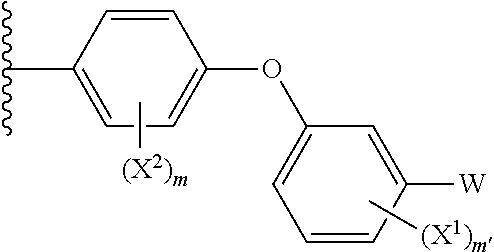
- X 1 and X 2 are independently selected from hydrogen and halogen; n is an integer from 0 to 2; m is an integer from 0 to 2; m′ is an integer from 0 to 2;
- W is independently selected from:
- Preferred embodiments include compounds of Formula 1 where W is selected from —OR 3 and R 3 is selected from substituted or unsubstituted aralkyl, or substituted or unsubstituted heteroaralkyl.
- More preferred embodiments include compounds of Formula 1 where W is selected from the group consisting of:
- Preferred embodiments include compounds of Formula 1 where Z is selected from the group consisting of:
- Preferred embodiment includes compounds of Formula 1 where R is selected from the group consisting of:
- More preferred embodiments include compounds of Formula 1 where W is selected from the group consisting of:
- More preferred embodiments include compounds of Formula 1 where Z is selected from the group consisting of:
- Another aspect of the present invention provides a pharmaceutical composition
- a pharmaceutical composition comprising an effective amount of a compound of Formula 1 and a pharmaceutically acceptable carrier, diluent or excipient.
- Another aspect of the present invention provides a method of modulating kinase function, the method comprising contacting a cell with a compound of the present invention in an amount sufficient to modulate the enzymatic activity of a given kinase or kinases, such as Btk, thereby modulating the kinase function.
- Another aspect of the present invention provides a method of modulating the target kinase function, the method comprising a) contacting a cell with a compound of the present invention in an amount sufficient to modulate the target kinase function, thereby b) modulating the target kinase activity and signaling.
- a probe comprising a compound of Formula 1 labeled with a detectable label or an affinity tag.
- the probe comprises a residue of a compound of Formula 1 covalently conjugated to a detectable label.
- detectable labels include, but are not limited to, a fluorescent moiety, a chemiluminescent moiety, a paramagnetic contrast agent, a metal chelate, a radioactive isotope-containing moiety, or biotin.
- the present invention relates to novel kinase inhibitors. These compounds are found to have activity as inhibitors of protein kinases, including members of the tyrosine kinases Aurora, SRC (more specifically Lck) and Tec (more specifically Btk) kinase families.
- compositions which comprises an effective amount of a compound of Formula 1 with a pharmaceutically acceptable diluent or carrier.
- the pharmaceutical compositions may be in a conventional pharmaceutical form suitable for oral administration (e.g., tablets, capsules, granules, powders and syrups), parenteral administration (e.g., injections (intravenous, intramuscular, or subcutaneous)), drop infusion preparations, inhalation, eye lotion, topical administration (e.g., ointment), or suppositories.
- parenteral administration e.g., injections (intravenous, intramuscular, or subcutaneous)
- drop infusion preparations e.g., inhalation, eye lotion
- topical administration e.g., ointment
- suppositories e.g., ointment
- the compounds may be formulated into pharmaceutically acceptable dosage forms by conventional methods known to those skilled in the art.
- phrases “pharmaceutically acceptable” is employed herein to refer to those ligands, materials, compositions, and/or dosage forms which are, within the scope of sound medical judgment, suitable for use in contact with the tissues of human beings and animals without excessive toxicity, irritation, allergic response, or other problem or complication, commensurate with a reasonable benefit/risk ratio.
- pharmaceutically acceptable carrier means a pharmaceutically acceptable material, composition, or vehicle, such as a liquid or solid filler, diluent, excipient, solvent or encapsulating material.
- a pharmaceutically acceptable material such as a liquid or solid filler, diluent, excipient, solvent or encapsulating material.
- Each carrier must be acceptable in the sense of being compatible with the other ingredients of the formulation, including the active ingredient, and not injurious or harmful to the patient.
- materials which can serve as pharmaceutically acceptable carriers include: (1) sugars, such as lactose, glucose, and sucrose; (2) starches, such as corn starch, potato starch, and substituted or unsubstituted ⁇ -cyclodextrin; (3) cellulose, and its derivatives, such as sodium carboxymethyl cellulose, ethyl cellulose, and cellulose acetate; (4) powdered tragacanth; (5) malt; (6) gelatin; (7) talc; (8) excipients, such as cocoa butter and suppository waxes; (9) oils, such as peanut oil, cottonseed oil, safflower oil, sesame oil, olive oil, corn oil, and soybean oil; (10) glycols, such as propylene glycol; (11) polyols, such as glycerin, sorbitol, mannitol, and polyethylene glycol; (12) esters, such as ethyl oleate and ethyl laurate;
- pharmaceutically acceptable salt refers to the relatively non-toxic, inorganic and organic acid addition salts of the compound(s). These salts can be prepared in situ during the final isolation and purification of the compound(s), or by separately reacting a purified compound(s) in its free base form with a suitable organic or inorganic acid, and isolating the salt thus formed.
- Representative salts include the hydrobromide, hydrochloride, sulfate, bisulfate, phosphate, nitrate, acetate, valerate, oleate, palmitate, stearate, laurate, benzoate, lactate, phosphate, tosylate, citrate, maleate, fumarate, succinate, tartrate, naphthylate, mesylate, glucoheptonate, lactobionate, laurylsulphonate salts, and amino acid salts, and the like (See, for example, Berge et al. (1977) “Pharmaceutical Salts”, J. Pharm. Sci. 66: 1-19).
- the compounds of the present invention may contain one or more acidic functional groups and, thus, are capable of forming pharmaceutically acceptable salts with pharmaceutically acceptable bases.
- pharmaceutically acceptable salts refers to the relatively non-toxic inorganic and organic base addition salts of a compound(s). These salts can likewise be prepared in situ during the final isolation and purification of the compound(s), or by separately reacting the purified compound(s) in its free acid form with a suitable base, such as the hydroxide, carbonate, or bicarbonate of a pharmaceutically acceptable metal cation, with ammonia, or with a pharmaceutically acceptable organic primary, secondary, or tertiary amine.
- Representative alkali or alkaline earth salts include the lithium, sodium, potassium, calcium, magnesium, and aluminum salts, and the like.
- Representative organic amines useful for the formation of base addition salts include ethylamine, diethylamine, ethylenediamine, ethanolamine, diethanolamine, piperazine, and the like (see, for example, Berge et al., supra).
- affinity tag means a ligand or group, linked either to a compound of the present invention or to a protein kinase domain, that allows the conjugate to be extracted from a solution.
- alkyl refers to substituted or unsubstituted saturated hydrocarbon groups, including straight-chain alkyl and branched-chain alkyl groups, including haloalkyl groups such as trifluoromethyl and 2,2,2-trifluoroethyl, etc.
- Representative alkyl groups include methyl, ethyl, n-propyl, isopropyl, n-butyl, t-butyl, isobutyl, sec-butyl, (cyclohexyl)methyl, cyclopropylmethyl, n-pentyl, n-hexyl, n-heptyl, n-octyl, and the like.
- alkenyl and alkynyl refer to substituted or unsubstituted unsaturated aliphatic groups analogous in length and possible substitution to the alkyls described above, but that contain at least one double or triple bond respectively.
- Representative alkenyl groups include vinyl, propen-2-yl, crotyl, isopenten-2-yl, 1,3-butadien-2-yl), 2,4-pentadienyl, and 1,4-pentadien-3-yl.
- Representative alkynyl groups include ethynyl, 1- and 3-propynyl, and 3-butynyl.
- alkyl substituents are lower alkyl groups, e.g., having from 1 to 6 carbon atoms.
- alkenyl and alkynyl preferably refer to lower alkenyl and alkynyl groups, e.g., having from 2 to 6 carbon atoms.
- alkylene refers to an alkyl group with two open valencies (rather than a single valency), such as —(CH 2 ) 1-10 — and substituted variants thereof.
- alkoxy refers to an alkyl group having an oxygen attached thereto. Representative alkoxy groups include methoxy, ethoxy, propoxy, tert-butoxy and the like.
- An “ether” is two hydrocarbons covalently linked by an oxygen. Accordingly, the substituent of an alkyl that renders that alkyl an ether is or resembles an alkoxy.
- alkoxyalkyl refers to an alkyl group substituted with an alkoxy group, thereby forming an ether.
- amide and “amido” are art-recognized as an amino-substituted carbonyl and includes a moiety that can be represented by the general formula:
- R 9 , R 10 are as defined above.
- Preferred embodiments of the amide will not include imides, which may be unstable.
- amine and “amino” are art-recognized and refer to both unsubstituted and substituted amines and salts thereof, e.g., a moiety that can be represented by the general formulae:
- R 9 , R 10 and R 10′ each independently represent a hydrogen, an alkyl, an alkenyl, —(CH 2 ) p —R 8 , or R 9 and R 10 taken together with the N atom to which they are attached complete a heterocycle having from 4 to 8 atoms in the ring structure;
- R 8 represents an aryl, a cycloalkyl, a cycloalkenyl, a heterocyclyl or a polycyclyl; and
- p is zero or an integer from 1 to 8.
- only one of R 9 or R 10 can be a carbonyl, e.g., R 9 , R 10 , and the nitrogen together do not form an imide.
- R 9 and R 10 each independently represent a hydrogen, an alkyl, an alkenyl, or —(CH 2 ) p —R 8 .
- the amino group is basic, meaning the protonated form has a pK a ⁇ 7.00.
- aralkyl refers to an alkyl group substituted with an aryl group, for example —(CH 2 ) p —Ar.
- heteroaryl refers to an alkyl group substituted with a heteroaryl group, for example —(CH 2 ) p -Het.
- aryl as used herein includes 5-, 6-, and 7-membered substituted or unsubstituted single-ring aromatic groups in which each atom of the ring is carbon.
- aryl also includes polycyclic ring systems having two or more cyclic rings in which two or more carbons are common to two adjoining rings wherein at least one of the rings is aromatic, e.g., the other cyclic rings can be cycloalkyls, cycloalkenyls, cycloalkynyls, aryls, heteroaryls, and/or heterocyclyls.
- Aryl groups include benzene, naphthalene, phenanthrene, phenol, aniline, anthracene, and phenanthrene.
- carbocycle and “carbocyclyl”, as used herein, refer to a non-aromatic substituted or unsubstituted ring in which each atom of the ring is carbon.
- the terms “carbocycle” and “carbocyclyl” also include polycyclic ring systems having two or more cyclic rings in which two or more carbons are common to two adjoining rings wherein at least one of the rings is carbocyclic, e.g., the other cyclic rings can be cycloalkyls, cycloalkenyls, cycloalkynyls, aryls, heteroaryls, and/or heterocyclyls.
- Representative carbocyclic groups include cyclopentyl, cyclohexyl, 1-cyclohexenyl, and 3-cyclohexen-1-yl, cycloheptyl.
- carbonyl is art-recognized and includes such moieties as can be represented by the general formula:
- X is a bond or represents an oxygen or a sulfur
- R 11 represents a hydrogen, an alkyl, an alkenyl, —(CH 2 ) p —R 8 or a pharmaceutically acceptable salt.
- X is oxygen and R 11 is not hydrogen
- the formula represents an “ester”.
- X is oxygen, and R 11 is hydrogen, the formula represents a “carboxylic acid”.
- heteroaryl includes substituted or unsubstituted aromatic 5- to 7-membered ring structures, more preferably 5- to 6-membered rings, whose ring structures include one to four heteroatoms.
- heteroaryl also includes polycyclic ring systems having two or more cyclic rings in which two or more carbons are common to two adjoining rings wherein at least one of the rings is heteroaromatic, e.g., the other cyclic rings can be cycloalkyls, cycloalkenyls, cycloalkynyls, aryls, heteroaryls, and/or heterocyclyls.
- Heteroaryl groups include, for example, pyrrole, furan, thiophene, imidazole, isoxazole, oxazole, thiazole, triazole, pyrazole, pyridine, pyrazine, pyridazine and pyrimidine, and the like.
- heteroatom as used herein means an atom of any element other than carbon or hydrogen. Preferred heteroatoms are nitrogen, oxygen, and sulfur.
- heterocyclyl or “heterocyclic group” refer to substituted or unsubstituted non-aromatic 3- to 10-membered ring structures, more preferably 3- to 7-membered rings, whose ring structures include one to four heteroatoms.
- heterocyclyl or “heterocyclic group” also include polycyclic ring systems having two or more cyclic rings in which two or more carbons are common to two adjoining rings wherein at least one of the rings is heterocyclic, e.g., the other cyclic rings can be cycloalkyls, cycloalkenyls, cycloalkynyls, aryls, heteroaryls, and/or heterocyclyls.
- Heterocyclyl groups include, for example, tetrahydrofuran, tetrahydropyran, piperidine, piperazine, pyrrolidine, morpholine, lactones, and lactams.
- hydrocarbon refers to a group that is bonded through a carbon atom that does not have a ⁇ O or ⁇ S substituent, and typically has at least one carbon-hydrogen bond and a primarily carbon backbone, but may optionally include heteroatoms.
- groups like methyl, ethoxyethyl, 2-pyridyl, and trifluoromethyl are considered to be hydrocarbyl for the purposes of this application, but substituents such as acetyl (which has a ⁇ O substituent on the linking carbon) and ethoxy (which is linked through oxygen, not carbon) are not.
- Hydrocarbyl groups include, but are not limited to aryl, heteroaryl, carbocycle, heterocycle, alkyl, alkenyl, alkynyl, and combinations thereof.
- polycyclyl or “polycyclic” refer to two or more rings (e.g., cycloalkyls, cycloalkenyls, cycloalkynyls, aryls, heteroaryls, and/or heterocyclyls) in which two or more carbons are common to two adjoining rings, e.g., the rings are “fused rings”.
- rings e.g., cycloalkyls, cycloalkenyls, cycloalkynyls, aryls, heteroaryls, and/or heterocyclyls
- Each of the rings of the polycycle can be substituted or unsubstituted.
- the term “probe” means a compound of the invention which is labeled with either a detectable label or an affinity tag, and which is capable of binding, either covalently or non-covalently, to a protein kinase domain.
- the probe When, for example, the probe is non-covalently bound, it may be displaced by a test compound.
- the probe When, for example, the probe is bound covalently, it may be used to form cross-linked adducts, which may be quantified and inhibited by a test compound.
- substituted refers to moieties having substituents replacing a hydrogen on one or more carbons of the backbone. It will be understood that “substitution” or “substituted with” includes the implicit proviso that such substitution is in accordance with permitted valence of the substituted atom and the substituent, and that the substitution results in a stable compound, e.g., which does not spontaneously undergo transformation such as by rearrangement, cyclization, elimination, etc. As used herein, the term “substituted” is contemplated to include all permissible substituents of organic compounds.
- the permissible substituents include acyclic and cyclic, branched and unbranched, carbocyclic and heterocyclic, aromatic and non-aromatic substituents of organic compounds.
- the permissible substituents can be one or more and the same or different for appropriate organic compounds.
- the heteroatoms such as nitrogen may have hydrogen substituents and/or any permissible substituents of organic compounds described herein which satisfy the valences of the heteroatoms.
- Substituents can include, for example, a halogen, a hydroxyl, a carbonyl (such as a carboxyl, an alkoxycarbonyl, a formyl, or an acyl), a thiocarbonyl (such as a thioester, a thioacetate, or a thioformate), an alkoxyl, a phosphoryl, a phosphate, a phosphonate, a phosphinate, an amino, an amido, an amidine, an imine, a cyano, a nitro, an azido, a sulfhydryl, an alkylthio, a sulfate, a sulfonate, a sulfamoyl, a sulfonamido, a sulfonyl, a heterocyclyl, an aralkyl, or an aromatic or heteroaromatic moiety. It will be understood by
- Compounds of the invention also include all isotopes of atoms present in the intermediates and/or final compounds.
- Isotopes include those atoms having the same atomic number but different mass numbers.
- isotopes of hydrogen include deuterium and tritium.
- intermediate 4-b 7.0 g, 17.6 mmol
- THF 176 ml
- 10N aqueous NaOH 44.1 ml, 441.0 mmol
- a saturated aqueous solution of ammonium chloride and ethyl acetate were added, the organic layer was separated, washed with 10% citric acid, saturated aqueous NaHCO 3 and brine, dried over MgSO 4 , filtered and concentrated under reduced pressure. Purification by silica gel chromatography provided intermediate 4-c as a yellow solid.
- intermediate 6-a To a solution of intermediate 6-a (5.05 g, 50.5 mmol) in dry benzene (5.0 ml) was added methyl 2-cyanoacetate (5.0 g, 50.5 mmol), ammonium acetate (506 mg, 6.56 mmol) and acetic acid (1.0 ml). The reaction mixture was heated to reflux, using a Dean-Stark apparatus, for 12 hours and then cooled to room temperature. Volatiles were removed in vacuo. Water and ethyl acetate were added to the residue, the organic layer was separated, washed with water, dried over MgSO 4 , filtered and concentrated under reduced pressure to provide intermediate 6-b as a brown oil.
- intermediate 6-b 9.0 g, 49.7 mmol
- 10% Pd/C 1.06 g, 0.49 mmol
- the reaction mixture was purged with H 2 and stirred overnight under 1 atm of hydrogen.
- the reaction was then filtered through celite and the filtrate was concentrated under reduced pressure to provide intermediate 6-c as a yellow oil.
- intermediate 8-b 10.25 g, 80.0 mmol
- DMF 50 ml
- imidazole 5.99 g, 88.0 mmol
- tert-butylchlorodimethylsilane 13.27 g, 88.0 mmol
- the reaction was then stirred at room temperature overnight.
- a saturated aqueous solution of ammonium chloride and ethyl acetate were added; the organic layer was separated, washed 3 times with a saturated aqueous solution of ammonium chloride and brine, dried over MgSO 4 , filtered and concentrated under reduced pressure.
- Purification by silica gel chromatography provided intermediate 8-c as a yellow oil.
- intermediate 9-b (10.0 g, 27.3 mmol) in THF (273 ml), cooled to 0° C., was added 10N aqueous NaOH (68.3 ml, 683.0 mmol) and the reaction was stirred at room temperature for 2 hours. A saturated aqueous solution of ammonium chloride and ethyl acetate were added, the organic layer was separated, washed with 10% citric acid, saturated aqueous NaHCO 3 and brine, dried over MgSO 4 , filtered and concentrated under reduced pressure. Purification by silica gel chromatography provided intermediate 9-c as a yellow solid.
- intermediate 13-b (1.10 g, 3.26 mmol) in THF (32 ml) was added a 1.0 M solution of TBAF in THF (3.59 ml, 3.59 mmol) and the reaction was stirred at room temperature for 1 hour. A saturated aqueous solution of ammonium chloride and ethyl acetate were added, the organic layer was separated, washed with brine, dried over MgSO 4 , filtered and concentrated under reduced pressure. Purification by silica gel chromatography provided intermediate 13-c as a white solid.
- intermediate 19-b (20.3 g, 49.8 mmol) in a 1:1 mixture of 1,4-dioxane/water (249.0 ml) cooled to 0° C. was added NaOH 10N (100.0 ml, 996.0 mmol) and the reaction was stirred at room temperature for 1 hour. A saturated aqueous solution of ammonium chloride and ethyl acetate were added, the organic layer was separated, washed with brine, dried over MgSO 4 , filtered and concentrated under reduced pressure. Purification by silica gel chromatography provided intermediate 19-c as a yellow solid.
- intermediate 20-a (10.0 g, 26.5 mmol) in a 1:1 mixture of 1,4-dioxane/water (265.0 ml) cooled to 0° C. was added NaOH 10N (53.0 ml, 530.0 mmol) and the reaction was stirred at room temperature for 1 hour. A saturated aqueous solution of ammonium chloride and ethyl acetate were added, the organic layer was separated, washed with brine, dried over MgSO 4 , filtered and concentrated under reduced pressure. Purification by silica gel chromatography provided intermediate 20-b as a yellow solid.
- intermediate 20-b (8.3 g, 28.8 mmol) and bromoacetonitrile (4.33 ml, 62.1 mmol) in tert-butanol (141.0 ml) was added a 1.0 M solution of sodium tert-butoxide in tert-butanol (56.4 ml, 56.4 mmol).
- tert-butanol 141.0 ml
- a saturated aqueous solution of ammonium chloride and ethyl acetate were added, the organic layer was separated, washed with brine, dried over MgSO 4 , filtered and concentrated under reduced pressure. Purification by silica gel chromatography provided intermediate 20-c as a beige foam.
- intermediate 21-a (24.0 g, 68.3 mmol) in a 1:1 mixture of 1,4-dioxane/water (341.0 ml) cooled to 0° C. was added NaOH 10N (137.0 ml, 1366.0 mmol) and the reaction was stirred at room temperature for 1 hour. A saturated aqueous solution of ammonium chloride and ethyl acetate were added, the organic layer was separated, washed with brine, dried over MgSO 4 , filtered and concentrated under reduced pressure to provide intermediate 21-b as a yellow solid.
- intermediate 21-b To an ice cooled solution of intermediate 21-b (8.28 g, 28.2 mmol) in tert-butanol (141.0 ml) was added a 1.0 M solution of sodium tert-butoxide in tert-butanol (56.4 ml, 56.4 mmol). After stirring for 15 minutes, bromoacetonitrile (4.33 ml, 62.1 mmol) was added; the reaction was slowly warmed to room temperature and stirred for 2 hours. A saturated aqueous solution of ammonium chloride and ethyl acetate were added, the organic layer was separated, washed with brine, dried over MgSO 4 , filtered and concentrated under reduced pressure. Purification by silica gel chromatography provided intermediate 21-c as a yellow solid.
- intermediate 21-c To a solution of intermediate 21-c (5.84 g, 17.57 mmol) in ethyl acetate and stirred under nitrogen was added 10% Pd/C (1.87 g, 0.87 mmol). The reaction mixture was purged with H 2 and stirred for 1 hour under 1 atm of hydrogen. The reaction was then filtered through celite and the filtrate was concentrated in vacuo. Purification by silica gel chromatography provided intermediate 21-d as a yellow solid.
- intermediate 19-e 375.0 mg, 1.32 mmol
- 1,4-dioxane 1.7 ml
- intermediate 16-b 391 mg, 1.32 mmol
- N,N-dimethylglycine 272 mg, 2.64 mmol
- copper (I) iodide 166 mg, 0.87 mmol
- cesium carbonate 1.72 g, 5.28 mmol
- the reaction was heated in a sealed tube at 110° C. overnight and then cooled to room temperature, diluted with ethyl acetate and filtered over celite. Volatiles were removed under reduced pressure. Purification by silica gel chromatography provided intermediate 22-a as a beige foam.
- intermediate 17-b 392 mg, 1.32 mmol
- N,N-dimethylglycine 272 mg, 2.64 mmol
- copper (I) iodide 166 mg, 0.87 mmol
- cesium carbonate 1.72 g, 5.28 mmol
- the reaction was heated in a sealed tube at 110° C. overnight and then cooled to room temperature, diluted with ethyl acetate and filtered over celite. Volatiles were removed under reduced pressure. Purification by silica gel chromatography provided intermediate 23-a as a beige foam.
- intermediate 20-d (533.0 mg, 1.98 mmol) in 1,4-dioxane (1.0 ml) was added intermediate 15-b (600 mg, 1.98 mmol), N,N-dimethylglycine (410 mg, 3.97 mmol), copper (I) iodide (250 mg, 1.31 mmol) and cesium carbonate (2.59 g, 7.94 mmol).
- intermediate 15-b 600 mg, 1.98 mmol
- N,N-dimethylglycine 410 mg, 3.97 mmol
- copper (I) iodide 250 mg, 1.31 mmol
- cesium carbonate (2.59 g, 7.94 mmol).
- the reaction was heated in a sealed tube at 110° C. overnight and then cooled to room temperature, diluted with ethyl acetate and filtered over celite. Volatiles were removed under reduced pressure. Purification by silica gel chromatography provided intermediate 24-a as a beige oil.
- intermediate 20-d 200 mg, 0.74 mmol
- 1,4-dioxane 1.0 ml
- intermediate 16-b 221 mg, 0.74 mmol
- N,N-dimethylglycine 231 mg, 3.23 mmol
- copper (I) iodide 142 mg, 0.74 mmol
- cesium carbonate 971 mg, 2.98 mmol
- the reaction was heated in a sealed tube at 110° C. overnight and then cooled to room temperature, diluted with ethyl acetate and filtered over celite. Volatiles were removed under reduced pressure. Purification by silica gel chromatography provided intermediate 25-a as beige foam.
- intermediate 17-b 600 mg, 2.02 mmol
- N,N-dimethylglycine 416 mg, 4.04 mmol
- copper (I) iodide 254 mg, 1.33 mmol
- cesium carbonate 1.97 g, 6.06 mmol
- the reaction was heated in a sealed tube at 110° C. overnight and then cooled to room temperature, diluted with ethyl acetate and filtered over celite. Volatiles were removed under reduced pressure. Purification by silica gel chromatography provided intermediate 26-a as a beige foam.
- intermediate 21-d (2.30 g, 9.49 mmol) in 1,4-dioxane (12.7 ml) was added intermediate 15-b (2.87 g, 9.49 mmol), N,N-dimethylglycine (1.95 g, 19.0 mmol), copper (I) iodide (1.19 g, 6.27 mmol) and cesium carbonate (12.37 g, 38.0 mmol).
- intermediate 15-b 2.87 g, 9.49 mmol
- N,N-dimethylglycine (1.95 g, 19.0 mmol
- copper (I) iodide (1.19 g, 6.27 mmol
- cesium carbonate (12.37 g, 38.0 mmol).
- the reaction was heated in a sealed tube at 110° C. overnight and then cooled to room temperature, diluted with ethyl acetate and filtered over celite. Volatiles were removed under reduced pressure. Purification by silica gel chromatography provided
- intermediate 21-d (491 mg, 2.03 mmol) in 1,4-dioxane (2.7 ml) was added intermediate 16-b (600 mg, 2.03 mmol), N,N-dimethylglycine (418 mg, 4.05 mmol), copper (I) iodide (255 mg, 1.33 mmol) and cesium carbonate (2.64 g, 8.10 mmol).
- the reaction was heated in a sealed tube at 110° C. overnight and then cooled to room temperature, diluted with ethyl acetate and filtered over celite. Volatiles were removed under reduced pressure. Purification by silica gel chromatography provided intermediate 28-a as a beige foam.
- intermediate 21-d (2.0 g, 8.26 mmol) in 1,4-dioxane (11.0 ml) was added intermediate 17-b (2.45 g, 8.26 mmol), N,N-dimethylglycine (1.7 g, 16.5 mmol), copper (I) iodide (1.0 g, 5.45 mmol) and cesium carbonate (10.76 g, 33.0 mmol).
- intermediate 17-b 2.45 g, 8.26 mmol
- N,N-dimethylglycine 1.7 g, 16.5 mmol
- copper (I) iodide 1.0 g, 5.45 mmol
- cesium carbonate (10.76 g, 33.0 mmol).
- the reaction was heated in a sealed tube at 110° C. overnight and then cooled to room temperature, diluted with ethyl acetate and filtered over celite. Volatiles were removed under reduced pressure. Purification by silica gel chromatography provided intermediate 29-
- intermediate 21-d 370 mg, 1.52 mmol
- 1,4-dioxane 11.0 ml
- intermediate 30-a (429 mg, 1.52 mmol)
- N,N-dimethylglycine 315 mg, 3.05 mmol
- copper (I) iodide 192 mg, 1.0 mmol
- cesium carbonate 1.99 g, 6.11 mmol
- the reaction was heated in a sealed tube at 110° C. overnight and then cooled to room temperature, diluted with ethyl acetate and filtered over celite. Volatiles were removed under reduced pressure. Purification by silica gel chromatography provided intermediate 31-a as a beige foam.
- intermediate 32-b (15.0 g, 40.6 mmol) in a 1:1 mixture of 1,4-dioxane/water (203.0 ml) cooled to 0° C. was added NaOH 10N (81.0 ml, 812.0 mmol) and the reaction was stirred at room temperature for 1 hour. A saturated aqueous solution of ammonium chloride and ethyl acetate were added, the organic layer was separated, washed with brine, dried over MgSO 4 , filtered and concentrated under reduced pressure to provide intermediate 32-c as a beige oil.
- intermediate 32-d 1.0 g, 14.3 mmol
- 10% Pd/C 607 mg, 0.3 mmol
- the reaction mixture was purged with H 2 and stirred for 3 hours under 1 atm of hydrogen.
- the reaction was then filtered through celite and the filtrate was concentrated in vacuo. Purification by silica gel chromatography provided intermediate 32-e as a yellow solid.
- intermediate 32-e 200 mg, 0.7 mmol
- 1,4-dioxane 1.0 ml
- intermediate 15-b 255 mg, 0.8 mmol
- N,N-dimethylglycine 158 mg, 1.5 mmol
- copper (I) iodide 97 mg, 0.5 mmol
- cesium carbonate 1.0 g, 3.1 mmol
- the reaction was heated in a sealed tube at 110° C. for 2 days and then cooled to room temperature, diluted with ethyl acetate and filtered over celite. Volatiles were removed under reduced pressure. Purification by silica gel chromatography provided intermediate 33-a as a beige foam.
- intermediate 32-e 200 mg, 0.7 mmol
- intermediate 17-b 251 mg, 0.8 mmol
- N,N-dimethylglycine 158 mg, 1.5 mmol
- copper (I) iodide 97 mg, 0.5 mmol
- cesium carbonate 1.0 g, 3.1 mmol
- the reaction was heated in a sealed tube at 110° C. for 2 days and then cooled to room temperature, diluted with ethyl acetate and filtered over celite. Volatiles were removed under reduced pressure. Purification by silica gel chromatography provided intermediate 34-a as a beige foam.
- Fluorescence polarization-based kinase assays were performed in 384 well-plate format using histidine tagged recombinant human full-length Bruton Agammaglobulinemia Tyrosine Kinase (Btk) and a modified protocol of the KinEASETM FP Fluorescein Green Assay supplied from Millipore. Kinase reaction were performed at room temperature for 60 minutes in presence of 250 ⁇ M substrate, 10 ⁇ M ATP and variable test article concentrations. The reaction was stopped with EDTA/kinease detection reagents and the polarization measured on a Tecan 500 instrument. From the dose-response curve obtained, the IC 50 was calculated using Graph Pad Prisms® using a non linear fit curve.
- Splenocytes were obtained from 6 week old male CD1 mice (Charles River Laboratories Inc.). Mouse spleens were manually disrupted in PBS and filtered using a 70 um cell strainer followed by ammonium chloride red blood cell lysis. Cells were washed, resuspended in Splenocyte Medium (HyClone RPMI supplemented with 10% heat-inactivated FBS, 0.5 ⁇ non-essential amino acids, 10 mM HEPES, 50 uM beta mercaptoethanol) and incubated at 37° C., 5% CO 2 for 2 h to remove adherent cells.
- Splenocyte Medium HyClone RPMI supplemented with 10% heat-inactivated FBS, 0.5 ⁇ non-essential amino acids, 10 mM HEPES, 50 uM beta mercaptoethanol
- Suspension cells were seeded in 96 well plates at 50,000 cells per well and incubated at 37° C., 5% CO 2 for 1 h.
- Splenocytes were pre-treated in triplicate with 10,000 nM curves of Formula 1 compounds for 1 h, followed by stimulation of B cell proliferation with 2.5 ug/ml anti-IgM F(ab′) 2 (Jackson ImmunoResearch) for 72 h.
- Cell proliferation was measured by Cell Titer-Glo Luminescent Assay (Promega).
- EC 50 values (50% proliferation in the presence of compound as compared to vehicle treated controls) were calculated from dose response compound curves using GraphPad Prism Software.
- the animals were then returned to their home cage and skin punches (8 mm) were collected from each injection site four hours later.
- the samples were placed in 1 mL formamide overnight at 80 degrees C. (1 skin biopsy per 1 mL formamide in a glass tube).
- the amount of Evan's blue in the formamide solution was then assessed by spectrophotometry (630 nm) as a measure of serum extravasation into the dermis.
Landscapes
- Health & Medical Sciences (AREA)
- Chemical & Material Sciences (AREA)
- Organic Chemistry (AREA)
- Veterinary Medicine (AREA)
- General Health & Medical Sciences (AREA)
- Medicinal Chemistry (AREA)
- Public Health (AREA)
- Pharmacology & Pharmacy (AREA)
- Life Sciences & Earth Sciences (AREA)
- Animal Behavior & Ethology (AREA)
- Epidemiology (AREA)
- Chemical Kinetics & Catalysis (AREA)
- Nuclear Medicine, Radiotherapy & Molecular Imaging (AREA)
- General Chemical & Material Sciences (AREA)
- Engineering & Computer Science (AREA)
- Bioinformatics & Cheminformatics (AREA)
- Immunology (AREA)
- Rheumatology (AREA)
- Pain & Pain Management (AREA)
- Transplantation (AREA)
- Orthopedic Medicine & Surgery (AREA)
- Physical Education & Sports Medicine (AREA)
- Pharmaceuticals Containing Other Organic And Inorganic Compounds (AREA)
- Nitrogen Condensed Heterocyclic Rings (AREA)
Abstract

Description

wherein
-
- 1) hydrogen,
- 2) alkyl,
- 3) heteroalkyl,
- 4) carbocyclyl,
- 5) heterocyclyl;
- wherein the alkyl, heteroalkyl, carbocyclyl and heterocyclyl may be further substituted.


X1 and X2 are independently selected from hydrogen and halogen;
n is an integer from 0 to 2;
m is an integer from 0 to 2;
m′ is an integer from 0 to 2;
-
- 1) alkyl,
- 2) aralkyl,
- 3) heteroaralkyl,
- 4) —OR3,
- 5) —OC(O)R4,
- 6) —OC(O)NR5R6,
- 7) —CH2O—R4,
- 8) —NR5R6,
- 9) —NR2C(O)R4
- 10) —NR2S(O)nR4,
- 11) —NR2C(O)NR5R6;
wherein the alkyl, aralkyl and heteroaralkyl may be further substituted;
R2 is selected from hydrogen or alkyl;
R3 is selected from substituted or unsubstituted alkyl, alkenyl, alkynyl, heteroalkyl, carbocyclyl, heterocyclyl, aryl, heteroaryl, aralkyl or heteroaralkyl;
R4 is selected from substituted or unsubstituted alkyl, alkenyl, alkynyl, heteroalkyl, carbocyclyl, heterocyclyl, aryl or heteroaryl; and
R5 and R6 are independently selected from hydrogen, alkyl, alkenyl, alkynyl, heteroalkyl, carbocyclyl, heterocyclyl, aryl, heteroaryl or R5 and R6 can be fused to form a 3 to 8 membered heterocyclyl ring system.


wherein R9, R10 are as defined above. Preferred embodiments of the amide will not include imides, which may be unstable.
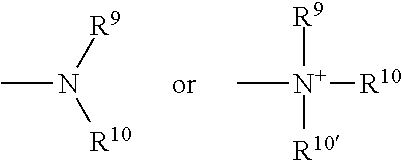
wherein R9, R10 and R10′ each independently represent a hydrogen, an alkyl, an alkenyl, —(CH2)p—R8, or R9 and R10 taken together with the N atom to which they are attached complete a heterocycle having from 4 to 8 atoms in the ring structure; R8 represents an aryl, a cycloalkyl, a cycloalkenyl, a heterocyclyl or a polycyclyl; and p is zero or an integer from 1 to 8. In preferred embodiments, only one of R9 or R10 can be a carbonyl, e.g., R9, R10, and the nitrogen together do not form an imide. In even more preferred embodiments, R9 and R10 (and optionally R10′) each independently represent a hydrogen, an alkyl, an alkenyl, or —(CH2)p—R8. In certain embodiments, the amino group is basic, meaning the protonated form has a pKa≧7.00.

wherein X is a bond or represents an oxygen or a sulfur, and R11 represents a hydrogen, an alkyl, an alkenyl, —(CH2)p—R8 or a pharmaceutically acceptable salt. Where X is oxygen and R11 is not hydrogen, the formula represents an “ester”. Where X is oxygen, and R11 is hydrogen, the formula represents a “carboxylic acid”.


General Synthetic Method B:


| TABLE 1 |
| Example Compounds of Formula 1 |
| Com- | ||
| pound | Structure | MS (m/z) |
| 1 |  | [M + H]+ = 485.2 |
| 2 |  | [M + H]+ = 499.2 |
| 3 |  | [M + H]+ = 533.1 |
| 4 |  | [M + H]+ = 516.2 |
| 5 |  | [M + H]+ = 517.2 |
| 6 |  | [M + H]+ = 511.2 |
| 7 |  | [M + H]+ = 517.2 |
| 8 |  | [M + H]+ = 512.1 |
| 9 |  | [M + H]+ = 491.1 |
| 10 |  | [M + H]+ = 486.2 |
| 11 |  | [M + H]+ = 485.2 |
| 12 |  | [M + H]+ = 470.1 |
| 13 |  | [M + H]+ = 512.1 |
| 14 |  | [M + H]+ = 527.2 |
| 15 |  | [M + H]+ = 528.1 |
| 16 |  | [M + H]+ = 509.1 |
| 17 |  | [M + H]+ = 504.1 |
Kinase Binding
Btk Kinase Inhibition Assay
| TABLE 2 |
| Inhibition of Btk |
| Compound | ki (nM) | |
| 1 | a | |
| 2 | a | |
| 3 | a | |
| 4 | a | |
| 5 | a | |
| 6 | a | |
| 7 | a | |
| 8 | a | |
| 9 | a | |
| 10 | a | |
| 11 | a | |
| 12 | a | |
| 13 | a | |
| 14 | a | |
| 15 | a | |
| 16 | — | |
| 17 | — | |
| a - Ki < 100 nM; | ||
| b - 100 nM < Ki < 1000 nM, | ||
| c - ki > 1000 nM | ||
Splenic Cell Proliferation Assay
| TABLE 3 |
| Inhibition of splenic cell proliferation |
| EC50 | ||
| Compound | (nM) | |
| 1 | a | |
| 2 | a | |
| 3 | a | |
| 4 | a | |
| 5 | a | |
| 6 | a | |
| 7 | a | |
| 8 | a | |
| 9 | a | |
| 10 | a | |
| 11 | a | |
| 12 | a | |
| 13 | a | |
| 14 | a | |
| 15 | — | |
| 16 | — | |
| 17 | — | |
| a - EC50 < 100 nM; | ||
| b - 100 nM < EC50 < 1000 nM, | ||
| c - EC50 > 1000 nM | ||
Methods: Mouse Arthus
Claims (7)




Priority Applications (1)
| Application Number | Priority Date | Filing Date | Title |
|---|---|---|---|
| US15/262,193 US9795608B2 (en) | 2012-07-06 | 2016-09-12 | Protein kinase inhibitors |
Applications Claiming Priority (3)
| Application Number | Priority Date | Filing Date | Title |
|---|---|---|---|
| CA2782774 | 2012-07-06 | ||
| CA2782774A CA2782774A1 (en) | 2012-07-06 | 2012-07-06 | Protein kinase inhibitors |
| PCT/CA2013/000612 WO2014005217A1 (en) | 2012-07-06 | 2013-07-03 | Protein kinase inhibitors |
Publications (2)
| Publication Number | Publication Date |
|---|---|
| US20150344478A1 US20150344478A1 (en) | 2015-12-03 |
| US9447102B2 true US9447102B2 (en) | 2016-09-20 |
Family
ID=49881186
Family Applications (2)
| Application Number | Title | Priority Date | Filing Date |
|---|---|---|---|
| US14/412,982 Expired - Fee Related US9447102B2 (en) | 2012-07-06 | 2013-07-03 | Protein kinase inhibitors |
| US15/262,193 Expired - Fee Related US9795608B2 (en) | 2012-07-06 | 2016-09-12 | Protein kinase inhibitors |
Family Applications After (1)
| Application Number | Title | Priority Date | Filing Date |
|---|---|---|---|
| US15/262,193 Expired - Fee Related US9795608B2 (en) | 2012-07-06 | 2016-09-12 | Protein kinase inhibitors |
Country Status (12)
| Country | Link |
|---|---|
| US (2) | US9447102B2 (en) |
| EP (1) | EP2870158B1 (en) |
| JP (1) | JP6190881B2 (en) |
| KR (2) | KR101903123B1 (en) |
| CN (1) | CN104718207B (en) |
| BR (1) | BR112014033056A2 (en) |
| CA (2) | CA2782774A1 (en) |
| ES (1) | ES2631228T3 (en) |
| HK (1) | HK1209726A1 (en) |
| IN (1) | IN2014MN02554A (en) |
| RU (1) | RU2679122C2 (en) |
| WO (1) | WO2014005217A1 (en) |
Cited By (2)
| Publication number | Priority date | Publication date | Assignee | Title |
|---|---|---|---|---|
| US9795608B2 (en) * | 2012-07-06 | 2017-10-24 | Pharmascience, Inc. | Protein kinase inhibitors |
| US20180179210A1 (en) * | 2015-05-27 | 2018-06-28 | Pharmascience Inc. | Inhibitors of the TEC Kinase Enzyme Family |
Families Citing this family (11)
| Publication number | Priority date | Publication date | Assignee | Title |
|---|---|---|---|---|
| CA2833701A1 (en) * | 2013-11-19 | 2015-05-19 | Pharmascience Inc. | Protein kinase inhibitors |
| CA2833867A1 (en) * | 2013-11-21 | 2015-05-21 | Pharmascience Inc. | Protein kinase inhibitors |
| CA2834528A1 (en) * | 2013-11-26 | 2015-05-26 | Pharmascience Inc. | Protein kinase inhibitors |
| CN103787839B (en) * | 2014-01-21 | 2015-12-02 | 苏州昊帆生物科技有限公司 | The method of synthesis 2,3,4,5,6-Pentafluorophenol |
| CN114685516A (en) * | 2015-09-16 | 2022-07-01 | 洛克索肿瘤学股份有限公司 | Pyrazolopyrimidine derivatives as BTK inhibitors for the treatment of cancer |
| WO2017134685A2 (en) * | 2016-02-02 | 2017-08-10 | Sun Pharma Advanced Research Company Limited | Novel hydrazino compounds as btk inhibitors |
| US11186578B2 (en) | 2016-08-17 | 2021-11-30 | Shenzhen Targetrx, Inc. | Substituted pyrrolo[3,2-d]pyrimidines and pyrazolo[4,3-d]pyrimidines as tyrosine kinase inhibitors |
| BR112021018168B1 (en) | 2019-03-21 | 2023-11-28 | Onxeo | PHARMACEUTICAL COMPOSITION, COMBINATION AND KIT COMPRISING A DBAIT MOLECULE AND A KINASE INHIBITOR FOR THE TREATMENT OF CANCER |
| CA3159348A1 (en) | 2019-11-08 | 2021-05-14 | Inserm (Institut National De La Sante Et De La Recherche Medicale) | Methods for the treatment of cancers that have acquired resistance to kinase inhibitors |
| WO2021148581A1 (en) | 2020-01-22 | 2021-07-29 | Onxeo | Novel dbait molecule and its use |
| CA3193132A1 (en) * | 2020-09-03 | 2022-03-10 | Amgen Inc. | Diol desymmetrization by nucleophilic aromatic substitution |
Citations (1)
| Publication number | Priority date | Publication date | Assignee | Title |
|---|---|---|---|---|
| CA2385769A1 (en) | 1999-09-17 | 2001-03-22 | Gavin C. Hirst | Kinase inhibitors as therapeutic agents |
Family Cites Families (7)
| Publication number | Priority date | Publication date | Assignee | Title |
|---|---|---|---|---|
| DE3736728A1 (en) * | 1987-10-29 | 1989-05-11 | Siemens Ag | PRINTER INK |
| DE59310344D1 (en) * | 1992-09-24 | 2003-07-24 | Hoechst Ag | N1-Substituted 1H-1,2,3-triazolo [4,5-d] pyrimidines, processes for their preparation and their use as antivirals |
| DE10031584A1 (en) * | 2000-06-29 | 2002-01-10 | Merck Patent Gmbh | 5-aminoalkyl-pyrazolo [4,3-d] pyrimidine |
| US20030199525A1 (en) * | 2002-03-21 | 2003-10-23 | Hirst Gavin C. | Kinase inhibitors |
| SG10201508035TA (en) * | 2007-03-28 | 2015-10-29 | Pharmacyclics Inc | Inhibitors of bruton's tyrosine kinase |
| CA2782774A1 (en) * | 2012-07-06 | 2014-01-06 | Pharmascience Inc. | Protein kinase inhibitors |
| IL291945B2 (en) * | 2012-11-01 | 2025-11-01 | Infinity Pharmaceuticals Inc | Cancer treatment using PI3 kinase isoform modulators |
-
2012
- 2012-07-06 CA CA2782774A patent/CA2782774A1/en not_active Abandoned
-
2013
- 2013-07-03 US US14/412,982 patent/US9447102B2/en not_active Expired - Fee Related
- 2013-07-03 ES ES13813932.4T patent/ES2631228T3/en active Active
- 2013-07-03 HK HK15110338.3A patent/HK1209726A1/en unknown
- 2013-07-03 EP EP13813932.4A patent/EP2870158B1/en not_active Not-in-force
- 2013-07-03 CA CA2878332A patent/CA2878332C/en not_active Expired - Fee Related
- 2013-07-03 KR KR1020157003221A patent/KR101903123B1/en not_active Expired - Fee Related
- 2013-07-03 CN CN201380036106.0A patent/CN104718207B/en not_active Expired - Fee Related
- 2013-07-03 RU RU2014151421A patent/RU2679122C2/en not_active IP Right Cessation
- 2013-07-03 BR BR112014033056A patent/BR112014033056A2/en not_active Application Discontinuation
- 2013-07-03 KR KR1020187027447A patent/KR20180107328A/en not_active Abandoned
- 2013-07-03 JP JP2015518741A patent/JP6190881B2/en not_active Expired - Fee Related
- 2013-07-03 WO PCT/CA2013/000612 patent/WO2014005217A1/en not_active Ceased
- 2013-07-03 IN IN2554MUN2014 patent/IN2014MN02554A/en unknown
-
2016
- 2016-09-12 US US15/262,193 patent/US9795608B2/en not_active Expired - Fee Related
Patent Citations (1)
| Publication number | Priority date | Publication date | Assignee | Title |
|---|---|---|---|---|
| CA2385769A1 (en) | 1999-09-17 | 2001-03-22 | Gavin C. Hirst | Kinase inhibitors as therapeutic agents |
Non-Patent Citations (6)
| Title |
|---|
| Gura et al., Systems for identifying new drugs are often faulty, Science, 278:1041-1042, 1997. * |
| GVK BIO Database RN 1347966-28-2, Dec. 2011. * |
| Johnson et al., Relationships between drug activity in NCI preclinical in vitro and in vivo models and early clinical trials, British Journal of Cancer, 84(10):1424-1431,2001. * |
| Pearce et al., Failure modes in anticancer drug discovery and development, Cancer Drug Design and Discovery Edited by Stephen Neidle, Chapter 18, pp. 424-435 (2008). * |
| Simone, Oncology: Introduction, Cecil Textbook of Medicine, 20th Edition, vol. 1, pp. 1004-101 O, 1995. * |
| Ten Hacken et al., Microenvironment dependency in Chronic Lymphocytic Leukemia: The basis for new targeted therapies, 11 pages, Pharmacology & Therapeutics, (2014), http://dx.doi.org/10.1016/j.pharmthera.2014.07.003. * |
Cited By (2)
| Publication number | Priority date | Publication date | Assignee | Title |
|---|---|---|---|---|
| US9795608B2 (en) * | 2012-07-06 | 2017-10-24 | Pharmascience, Inc. | Protein kinase inhibitors |
| US20180179210A1 (en) * | 2015-05-27 | 2018-06-28 | Pharmascience Inc. | Inhibitors of the TEC Kinase Enzyme Family |
Also Published As
| Publication number | Publication date |
|---|---|
| RU2014151421A (en) | 2016-08-27 |
| JP6190881B2 (en) | 2017-08-30 |
| IN2014MN02554A (en) | 2015-07-24 |
| EP2870158B1 (en) | 2017-05-31 |
| BR112014033056A2 (en) | 2017-06-27 |
| CN104718207B (en) | 2017-08-15 |
| KR101903123B1 (en) | 2018-10-01 |
| CN104718207A (en) | 2015-06-17 |
| HK1209726A1 (en) | 2016-04-08 |
| KR20150041784A (en) | 2015-04-17 |
| US9795608B2 (en) | 2017-10-24 |
| KR20180107328A (en) | 2018-10-01 |
| RU2679122C2 (en) | 2019-02-06 |
| JP2015521987A (en) | 2015-08-03 |
| US20150344478A1 (en) | 2015-12-03 |
| ES2631228T3 (en) | 2017-08-29 |
| WO2014005217A1 (en) | 2014-01-09 |
| EP2870158A4 (en) | 2015-12-09 |
| CA2878332A1 (en) | 2014-01-09 |
| EP2870158A1 (en) | 2015-05-13 |
| US20160375027A1 (en) | 2016-12-29 |
| CA2782774A1 (en) | 2014-01-06 |
| CA2878332C (en) | 2019-04-30 |
Similar Documents
| Publication | Publication Date | Title |
|---|---|---|
| US9447102B2 (en) | Protein kinase inhibitors | |
| US9624239B2 (en) | Protein kinase inhibitors | |
| US9284318B2 (en) | Protein kinase inhibitors | |
| US9796716B2 (en) | Selective inhibitors of Tec and Src protein kinase families | |
| US20230277547A1 (en) | Substituted quinoxaline dna-pk inhibitors | |
| CA2833701A1 (en) | Protein kinase inhibitors | |
| CA2779184A1 (en) | Protein kinase inhibitors | |
| CA2834528A1 (en) | Protein kinase inhibitors | |
| CA2833867A1 (en) | Protein kinase inhibitors | |
| WO2014029007A1 (en) | Protein kinase inhibitors |
Legal Events
| Date | Code | Title | Description |
|---|---|---|---|
| AS | Assignment |
Owner name: PHARMASCIENCE, INC., CANADA Free format text: ASSIGNMENT OF ASSIGNORS INTEREST;ASSIGNORS:LAURENT, ALAIN;ROSE, YANNICK;REEL/FRAME:034636/0985 Effective date: 20150105 |
|
| STCF | Information on status: patent grant |
Free format text: PATENTED CASE |
|
| AS | Assignment |
Owner name: GB005, INC., CALIFORNIA Free format text: ASSIGNMENT OF ASSIGNORS INTEREST;ASSIGNOR:PHARMASCIENCE INC.;REEL/FRAME:048250/0595 Effective date: 20180809 |
|
| AS | Assignment |
Owner name: MIDCAP FINANCIAL TRUST, AS AGENT, MARYLAND Free format text: SECURITY INTEREST;ASSIGNORS:GOSSAMER BIO, INC.;GOSSAMER BIO SERVICES, INC.;GB001, INC.;AND OTHERS;REEL/FRAME:049081/0335 Effective date: 20190502 |
|
| MAFP | Maintenance fee payment |
Free format text: PAYMENT OF MAINTENANCE FEE, 4TH YEAR, LARGE ENTITY (ORIGINAL EVENT CODE: M1551); ENTITY STATUS OF PATENT OWNER: LARGE ENTITY Year of fee payment: 4 |
|
| AS | Assignment |
Owner name: GB008, INC., CALIFORNIA Free format text: RELEASE OF SECURITY INTEREST IN INTELLECTUAL PROPERTY COLLATERAL AT REEL/FRAME NO. 49081/0335;ASSIGNOR:MIDCAP FINANCIAL TRUST, AS AGENT;REEL/FRAME:067310/0307 Effective date: 20240503 Owner name: GB007, INC., CALIFORNIA Free format text: RELEASE OF SECURITY INTEREST IN INTELLECTUAL PROPERTY COLLATERAL AT REEL/FRAME NO. 49081/0335;ASSIGNOR:MIDCAP FINANCIAL TRUST, AS AGENT;REEL/FRAME:067310/0307 Effective date: 20240503 Owner name: GB005, INC., CALIFORNIA Free format text: RELEASE OF SECURITY INTEREST IN INTELLECTUAL PROPERTY COLLATERAL AT REEL/FRAME NO. 49081/0335;ASSIGNOR:MIDCAP FINANCIAL TRUST, AS AGENT;REEL/FRAME:067310/0307 Effective date: 20240503 Owner name: GB004, INC., CALIFORNIA Free format text: RELEASE OF SECURITY INTEREST IN INTELLECTUAL PROPERTY COLLATERAL AT REEL/FRAME NO. 49081/0335;ASSIGNOR:MIDCAP FINANCIAL TRUST, AS AGENT;REEL/FRAME:067310/0307 Effective date: 20240503 Owner name: GB003, INC., CALIFORNIA Free format text: RELEASE OF SECURITY INTEREST IN INTELLECTUAL PROPERTY COLLATERAL AT REEL/FRAME NO. 49081/0335;ASSIGNOR:MIDCAP FINANCIAL TRUST, AS AGENT;REEL/FRAME:067310/0307 Effective date: 20240503 Owner name: GB002, INC., CALIFORNIA Free format text: RELEASE OF SECURITY INTEREST IN INTELLECTUAL PROPERTY COLLATERAL AT REEL/FRAME NO. 49081/0335;ASSIGNOR:MIDCAP FINANCIAL TRUST, AS AGENT;REEL/FRAME:067310/0307 Effective date: 20240503 Owner name: GB001, INC., CALIFORNIA Free format text: RELEASE OF SECURITY INTEREST IN INTELLECTUAL PROPERTY COLLATERAL AT REEL/FRAME NO. 49081/0335;ASSIGNOR:MIDCAP FINANCIAL TRUST, AS AGENT;REEL/FRAME:067310/0307 Effective date: 20240503 Owner name: GOSSAMER BIO SERVICES, INC., CALIFORNIA Free format text: RELEASE OF SECURITY INTEREST IN INTELLECTUAL PROPERTY COLLATERAL AT REEL/FRAME NO. 49081/0335;ASSIGNOR:MIDCAP FINANCIAL TRUST, AS AGENT;REEL/FRAME:067310/0307 Effective date: 20240503 Owner name: GOSSAMER BIO, INC., CALIFORNIA Free format text: RELEASE OF SECURITY INTEREST IN INTELLECTUAL PROPERTY COLLATERAL AT REEL/FRAME NO. 49081/0335;ASSIGNOR:MIDCAP FINANCIAL TRUST, AS AGENT;REEL/FRAME:067310/0307 Effective date: 20240503 |
|
| FEPP | Fee payment procedure |
Free format text: MAINTENANCE FEE REMINDER MAILED (ORIGINAL EVENT CODE: REM.); ENTITY STATUS OF PATENT OWNER: LARGE ENTITY |
|
| LAPS | Lapse for failure to pay maintenance fees |
Free format text: PATENT EXPIRED FOR FAILURE TO PAY MAINTENANCE FEES (ORIGINAL EVENT CODE: EXP.); ENTITY STATUS OF PATENT OWNER: LARGE ENTITY |
|
| STCH | Information on status: patent discontinuation |
Free format text: PATENT EXPIRED DUE TO NONPAYMENT OF MAINTENANCE FEES UNDER 37 CFR 1.362 |
|
| STCH | Information on status: patent discontinuation |
Free format text: PATENT EXPIRED DUE TO NONPAYMENT OF MAINTENANCE FEES UNDER 37 CFR 1.362 |
|
| FP | Lapsed due to failure to pay maintenance fee |
Effective date: 20240920 |