US9444058B2 - Preparation of pi-extended naphthalene diimides and their use as semiconductor - Google Patents
Preparation of pi-extended naphthalene diimides and their use as semiconductor Download PDFInfo
- Publication number
- US9444058B2 US9444058B2 US14/786,024 US201414786024A US9444058B2 US 9444058 B2 US9444058 B2 US 9444058B2 US 201414786024 A US201414786024 A US 201414786024A US 9444058 B2 US9444058 B2 US 9444058B2
- Authority
- US
- United States
- Prior art keywords
- alkyl
- compound
- group
- aryl
- atoms
- Prior art date
- Legal status (The legal status is an assumption and is not a legal conclusion. Google has not performed a legal analysis and makes no representation as to the accuracy of the status listed.)
- Expired - Fee Related
Links
- 0 [1*]N1C(=O)C2=C3C([5*])=C([6*])CC3=C3C(=O)N([2*])C(=O)/C4=C5\CC([4*])=C([3*])\C5=C(/C1=O)C2=C34.[7*]N1C(=O)C2=C3C([11*])=C([12*])OC3=C3C(=O)N([8*])C(=O)/C4=C5\C([9*])=C([10*])O\C5=C(/C1=O)C2=C34 Chemical compound [1*]N1C(=O)C2=C3C([5*])=C([6*])CC3=C3C(=O)N([2*])C(=O)/C4=C5\CC([4*])=C([3*])\C5=C(/C1=O)C2=C34.[7*]N1C(=O)C2=C3C([11*])=C([12*])OC3=C3C(=O)N([8*])C(=O)/C4=C5\C([9*])=C([10*])O\C5=C(/C1=O)C2=C34 0.000 description 20
- LMIZORQOLSLQRY-UHFFFAOYSA-N C1=CC=C2C=CC=CC2=C1.C1=CC=CC=C1 Chemical compound C1=CC=C2C=CC=CC2=C1.C1=CC=CC=C1 LMIZORQOLSLQRY-UHFFFAOYSA-N 0.000 description 10
- JCVOMAHIYNTZJD-UHFFFAOYSA-N C1=CC2=C(C=C1)CC=CC2.C1=CC=C2C=CC=CC2=C1.C1=CC=CC=C1.C1=CCCC1.C1=CCCCC1 Chemical compound C1=CC2=C(C=C1)CC=CC2.C1=CC=C2C=CC=CC2=C1.C1=CC=CC=C1.C1=CCCC1.C1=CCCCC1 JCVOMAHIYNTZJD-UHFFFAOYSA-N 0.000 description 2
- DGGAXCMFQWTEMV-UHFFFAOYSA-N CCCCCN1C(=O)C2=CC=C3C(=O)N(CCCC)C(=O)/C4=C5C(=C(/C1=O)C2=C34)/C1=C2N(CCCC1)CCCN2/5 Chemical compound CCCCCN1C(=O)C2=CC=C3C(=O)N(CCCC)C(=O)/C4=C5C(=C(/C1=O)C2=C34)/C1=C2N(CCCC1)CCCN2/5 DGGAXCMFQWTEMV-UHFFFAOYSA-N 0.000 description 2
- ZPRBVKCXYQKUTR-UHFFFAOYSA-N C.C.C.C.CCCCCCCCN1C(=O)C2=C3NC4=C(C(C(F)(F)F)=CC(C(F)(F)F)=C4)C3=C3C(=O)N(CCCCCCCC)C(=O)/C4=C5\C6=C(C=C(C)C=C6C(F)(F)F)N\C5=C(/C1=O)C2=C34.CCCCCCCCN1C(=O)C2=C3NC4=C(C=C(C(C)(C)C)C=C4)C3=C3C(=O)N(CCCCCCCC)C(=O)/C4=C5\C6=C(C=CC(C(C)(C)C)=C6)N\C5=C(/C1=O)C2=C34.CCCN1C(=O)C2=C3NC4=C(C=CC(C(C)(C)C)=C4)C3=C3C(=O)N(CCC)C(=O)/C4=C5\C6=C(C=C(C(C)(C)C)C=C6)N\C5=C(/C1=O)C2=C34 Chemical compound C.C.C.C.CCCCCCCCN1C(=O)C2=C3NC4=C(C(C(F)(F)F)=CC(C(F)(F)F)=C4)C3=C3C(=O)N(CCCCCCCC)C(=O)/C4=C5\C6=C(C=C(C)C=C6C(F)(F)F)N\C5=C(/C1=O)C2=C34.CCCCCCCCN1C(=O)C2=C3NC4=C(C=C(C(C)(C)C)C=C4)C3=C3C(=O)N(CCCCCCCC)C(=O)/C4=C5\C6=C(C=CC(C(C)(C)C)=C6)N\C5=C(/C1=O)C2=C34.CCCN1C(=O)C2=C3NC4=C(C=CC(C(C)(C)C)=C4)C3=C3C(=O)N(CCC)C(=O)/C4=C5\C6=C(C=C(C(C)(C)C)C=C6)N\C5=C(/C1=O)C2=C34 ZPRBVKCXYQKUTR-UHFFFAOYSA-N 0.000 description 1
- LGWXOIUWXNYMMY-UHFFFAOYSA-N C.C.CC(C)C1=CC=CC(C(C)C)=C1N1C(=O)C2=C3NC4=C(C=C(Cl)C=C4Cl)C3=C3C(=O)N(C4=C(C(C)C)C=CC=C4C(C)C)C(=O)/C4=C5\C6=C(N\C5=C(/C1=O)C2=C34)C(Cl)=CC(Cl)=C6.CC(C)C1=CC=CC(C(C)C)=C1N1C(=O)C2=C3NC4=C(C=CC=C4)C3=C3C(=O)N(C4=C(C(C)C)C=CC=C4C(C)C)C(=O)/C4=C5\C6=C(C=CC=C6)N\C5=C(/C1=O)C2=C34.CCCCCCCCN1C(=O)C2=C3NC4=C(C=CC(C(C)(C)C)=C4)C3=C3C(=O)N(CCCCCCCC)C(=O)/C4=C5\C6=C(C=C(C(C)(C)C)C=C6)N\C5=C(/C1=O)C2=C34.CCCCCCCCN1C(=O)C2=C3NC4=C(C=CC=C4)C3=C3C(=O)N(CCCCCCCC)C(=O)/C4=C5\C6=C(C=CC=C6)N\C5=C(/C1=O)C2=C34 Chemical compound C.C.CC(C)C1=CC=CC(C(C)C)=C1N1C(=O)C2=C3NC4=C(C=C(Cl)C=C4Cl)C3=C3C(=O)N(C4=C(C(C)C)C=CC=C4C(C)C)C(=O)/C4=C5\C6=C(N\C5=C(/C1=O)C2=C34)C(Cl)=CC(Cl)=C6.CC(C)C1=CC=CC(C(C)C)=C1N1C(=O)C2=C3NC4=C(C=CC=C4)C3=C3C(=O)N(C4=C(C(C)C)C=CC=C4C(C)C)C(=O)/C4=C5\C6=C(C=CC=C6)N\C5=C(/C1=O)C2=C34.CCCCCCCCN1C(=O)C2=C3NC4=C(C=CC(C(C)(C)C)=C4)C3=C3C(=O)N(CCCCCCCC)C(=O)/C4=C5\C6=C(C=C(C(C)(C)C)C=C6)N\C5=C(/C1=O)C2=C34.CCCCCCCCN1C(=O)C2=C3NC4=C(C=CC=C4)C3=C3C(=O)N(CCCCCCCC)C(=O)/C4=C5\C6=C(C=CC=C6)N\C5=C(/C1=O)C2=C34 LGWXOIUWXNYMMY-UHFFFAOYSA-N 0.000 description 1
- UEYJCFIKGDKLPP-UHFFFAOYSA-N C.CCCCCCCCN1C(=O)C2=C3C4=C(C=CC=C4)OC3=C3C(=O)N(CCCCCCCC)C(=O)/C4=C5\C6=C(C=CC=C6)O\C5=C(/C1=O)C2=C34.CCCCCCCCN1C(=O)C2=C3NC4=C(C(C(F)(F)F)=CC(C)=C4)C3=C3C(=O)N(CCCCCCCC)C(=O)/C4=C5\C6=C(C=C(C)C=C6C(F)(F)F)N\C5=C(/C1=O)C2=C34 Chemical compound C.CCCCCCCCN1C(=O)C2=C3C4=C(C=CC=C4)OC3=C3C(=O)N(CCCCCCCC)C(=O)/C4=C5\C6=C(C=CC=C6)O\C5=C(/C1=O)C2=C34.CCCCCCCCN1C(=O)C2=C3NC4=C(C(C(F)(F)F)=CC(C)=C4)C3=C3C(=O)N(CCCCCCCC)C(=O)/C4=C5\C6=C(C=C(C)C=C6C(F)(F)F)N\C5=C(/C1=O)C2=C34 UEYJCFIKGDKLPP-UHFFFAOYSA-N 0.000 description 1
- GNZAETWDDOLSFX-UHFFFAOYSA-N C.CCCN1C(=O)C2=C(Br)C(Br)=C3C(=O)N(CCC)C(=O)/C4=C(Br)/C(Br)=C(/C1=O)C2=C34.CCCN1C(=O)C2=C(Br)C(NC3=CC=CC(C(C)(C)C)=C3)=C3C(=O)N(CCC)C(=O)/C4=C(NC5=CC=CC(C(C)(C)C)=C5)/C(Br)=C(/C1=O)C2=C34.CCCN1C(=O)C2=C3NC4=C(C=CC(C(C)(C)C)=C4)C3=C3C(=O)N(CCC)C(=O)/C4=C5\C6=C(C=C(C(C)(C)C)C=C6)N\C5=C(/C1=O)C2=C34 Chemical compound C.CCCN1C(=O)C2=C(Br)C(Br)=C3C(=O)N(CCC)C(=O)/C4=C(Br)/C(Br)=C(/C1=O)C2=C34.CCCN1C(=O)C2=C(Br)C(NC3=CC=CC(C(C)(C)C)=C3)=C3C(=O)N(CCC)C(=O)/C4=C(NC5=CC=CC(C(C)(C)C)=C5)/C(Br)=C(/C1=O)C2=C34.CCCN1C(=O)C2=C3NC4=C(C=CC(C(C)(C)C)=C4)C3=C3C(=O)N(CCC)C(=O)/C4=C5\C6=C(C=C(C(C)(C)C)C=C6)N\C5=C(/C1=O)C2=C34 GNZAETWDDOLSFX-UHFFFAOYSA-N 0.000 description 1
- GIBPPIGTRWHJTM-UHFFFAOYSA-N C1=CC=COC=C1.C1=CC=CSC=C1.C1=CCOC=C1.C1=COC=CC1.C1=CON=C1.C1=CON=N1.C1=NSCS1.CC(C)C.CC(C)C.CC(C)C.CC(C)C.CC(C)C.CC(C)C.CC(C)C.CC(C)N1C=CC=CC=C1.CC(C)N1C=CSC=C1.CC(C)N1C=NCC1 Chemical compound C1=CC=COC=C1.C1=CC=CSC=C1.C1=CCOC=C1.C1=COC=CC1.C1=CON=C1.C1=CON=N1.C1=NSCS1.CC(C)C.CC(C)C.CC(C)C.CC(C)C.CC(C)C.CC(C)C.CC(C)C.CC(C)N1C=CC=CC=C1.CC(C)N1C=CSC=C1.CC(C)N1C=NCC1 GIBPPIGTRWHJTM-UHFFFAOYSA-N 0.000 description 1
- CJVYNHKEUIYLCU-UHFFFAOYSA-N C1=CCOC=C1.C1=COC=C1.C1=COC=C1.C1=COC=CC1.C1=COC=N1.C1=COC=N1.C1=CON=N1.C1=CSC=C1.C1=CSC=N1.C1=CSN=C1 Chemical compound C1=CCOC=C1.C1=COC=C1.C1=COC=C1.C1=COC=CC1.C1=COC=N1.C1=COC=N1.C1=CON=N1.C1=CSC=C1.C1=CSC=N1.C1=CSN=C1 CJVYNHKEUIYLCU-UHFFFAOYSA-N 0.000 description 1
- OSIAWQDUIPGKRH-UHFFFAOYSA-N C1=COC=C1.C1=COC=N1.C1=CON=N1.C1=CSC=C1.C1=CSC=N1.C1=CSN=C1.CC(C)C.CC(C)C.CC(C)C.CC(C)C.CC(C)C.CC(C)C.CC(C)N1=C2C=CC=CC2=CC=C1.CC(C)N1=C2C=CC=CC2=CC=C1.CC(C)N1=CC=CC=C1.CC(C)N1=CC=CC=C1.CC(C)N1=CC=NC=C1.CC(C)N1=NC=CC=C1.CC(C)N1C=CC2=C1C=CC=C2.CC(C)N1C=CC=C1.CC(C)N1C=CC=N1 Chemical compound C1=COC=C1.C1=COC=N1.C1=CON=N1.C1=CSC=C1.C1=CSC=N1.C1=CSN=C1.CC(C)C.CC(C)C.CC(C)C.CC(C)C.CC(C)C.CC(C)C.CC(C)N1=C2C=CC=CC2=CC=C1.CC(C)N1=C2C=CC=CC2=CC=C1.CC(C)N1=CC=CC=C1.CC(C)N1=CC=CC=C1.CC(C)N1=CC=NC=C1.CC(C)N1=NC=CC=C1.CC(C)N1C=CC2=C1C=CC=C2.CC(C)N1C=CC=C1.CC(C)N1C=CC=N1 OSIAWQDUIPGKRH-UHFFFAOYSA-N 0.000 description 1
- MRUWJENAYHTDQG-UHFFFAOYSA-N C1C=COC=C1 Chemical compound C1C=COC=C1 MRUWJENAYHTDQG-UHFFFAOYSA-N 0.000 description 1
- LBEKFZDSQPNXTM-UHFFFAOYSA-N C1CCCOCC1.C1CCCSCC1.C1CCOC1.C1CCOCC1.C1CCSC1.C1CCSCC1.C1COCCO1.C1COCO1.C1CSCS1.CC(C)C.CC(C)C.CC(C)C.CC(C)C.CC(C)C.CC(C)C.CC(C)C.CC(C)C.CC(C)C.CC(C)N1CCCC1.CC(C)N1CCCCC1.CC(C)N1CCCCCC1.CC(C)N1CCOCC1 Chemical compound C1CCCOCC1.C1CCCSCC1.C1CCOC1.C1CCOCC1.C1CCSC1.C1CCSCC1.C1COCCO1.C1COCO1.C1CSCS1.CC(C)C.CC(C)C.CC(C)C.CC(C)C.CC(C)C.CC(C)C.CC(C)C.CC(C)C.CC(C)C.CC(C)N1CCCC1.CC(C)N1CCCCC1.CC(C)N1CCCCCC1.CC(C)N1CCOCC1 LBEKFZDSQPNXTM-UHFFFAOYSA-N 0.000 description 1
- MGADZUXDNSDTHW-UHFFFAOYSA-N C1OC=CC=C1 Chemical compound C1OC=CC=C1 MGADZUXDNSDTHW-UHFFFAOYSA-N 0.000 description 1
- YXEUUVURAIAFDZ-UHFFFAOYSA-N CC(C)C1=CC=CC(C(C)C)=C1N1C(=O)C2=C(Br)C(Br)=C3C(=O)N(C4=C(C(C)C)C=CC=C4C(C)C)C(=O)/C4=C(Br)/C(Br)=C(/C1=O)C2=C34.CC(C)C1=CC=CC(C(C)C)=C1N1C(=O)C2=C(Br)C(NC3=CC=CC=C3)=C3C(=O)N(C4=C(C(C)C)C=CC=C4C(C)C)C(=O)/C4=C(NC5=CC=CC=C5)/C(Br)=C(/C1=O)C2=C34.CC(C)C1=CC=CC(C(C)C)=C1N1C(=O)C2=C3NC4=C(C=CC=C4)C3=C3C(=O)N(C4=C(C(C)C)C=CC=C4C(C)C)C(=O)/C4=C5\C6=C(C=CC=C6)N\C5=C(/C1=O)C2=C34 Chemical compound CC(C)C1=CC=CC(C(C)C)=C1N1C(=O)C2=C(Br)C(Br)=C3C(=O)N(C4=C(C(C)C)C=CC=C4C(C)C)C(=O)/C4=C(Br)/C(Br)=C(/C1=O)C2=C34.CC(C)C1=CC=CC(C(C)C)=C1N1C(=O)C2=C(Br)C(NC3=CC=CC=C3)=C3C(=O)N(C4=C(C(C)C)C=CC=C4C(C)C)C(=O)/C4=C(NC5=CC=CC=C5)/C(Br)=C(/C1=O)C2=C34.CC(C)C1=CC=CC(C(C)C)=C1N1C(=O)C2=C3NC4=C(C=CC=C4)C3=C3C(=O)N(C4=C(C(C)C)C=CC=C4C(C)C)C(=O)/C4=C5\C6=C(C=CC=C6)N\C5=C(/C1=O)C2=C34 YXEUUVURAIAFDZ-UHFFFAOYSA-N 0.000 description 1
- PLNBSBMNSLJBSP-UHFFFAOYSA-N CC(C)C1=CC=CC(C(C)C)=C1N1C(=O)C2=C3C4=C(C=CC=C4)OC3=C3C(=O)N(C4=C(C(C)C)C=CC=C4C(C)C)C(=O)/C4=C5\C6=C(C=CC=C6)O\C5=C(/C1=O)C2=C34.CC(C)C1=CC=CC(C(C)C)=C1N1C(=O)C2=C3NC4=C(C=CC=C4)C3=C3C(=O)N(C4=C(C(C)C)C=CC=C4C(C)C)C(=O)/C4=C5\C6=C(C=CC=C6)N\C5=C(/C1=O)C2=C34.CC1=CC(Cl)=CC2=C1N/C1=C3\C(=O)N(C4=C(C(C)C)C=CC=C4C(C)C)C(=O)C4=C5NC6=C(C=C(Cl)C=C6Cl)C5=C5C(=O)N(C6=C(C(C)C)C=CC=C6C(C)C)C(=O)/C(=C/21)C5=C43 Chemical compound CC(C)C1=CC=CC(C(C)C)=C1N1C(=O)C2=C3C4=C(C=CC=C4)OC3=C3C(=O)N(C4=C(C(C)C)C=CC=C4C(C)C)C(=O)/C4=C5\C6=C(C=CC=C6)O\C5=C(/C1=O)C2=C34.CC(C)C1=CC=CC(C(C)C)=C1N1C(=O)C2=C3NC4=C(C=CC=C4)C3=C3C(=O)N(C4=C(C(C)C)C=CC=C4C(C)C)C(=O)/C4=C5\C6=C(C=CC=C6)N\C5=C(/C1=O)C2=C34.CC1=CC(Cl)=CC2=C1N/C1=C3\C(=O)N(C4=C(C(C)C)C=CC=C4C(C)C)C(=O)C4=C5NC6=C(C=C(Cl)C=C6Cl)C5=C5C(=O)N(C6=C(C(C)C)C=CC=C6C(C)C)C(=O)/C(=C/21)C5=C43 PLNBSBMNSLJBSP-UHFFFAOYSA-N 0.000 description 1
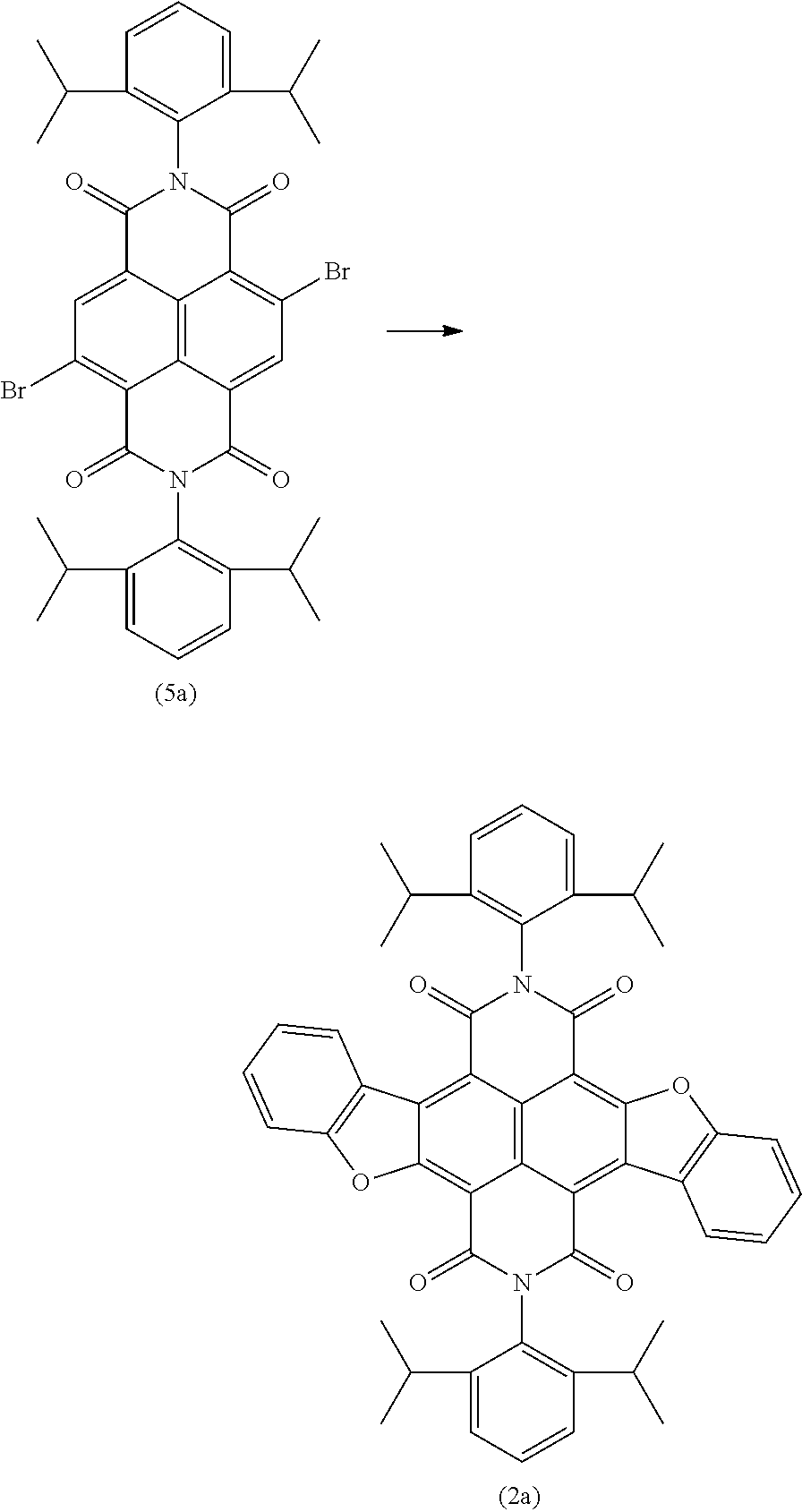
- MPZLPDNBUQLVIR-UHFFFAOYSA-N CC(C)C1=CC=CC(C(C)C)=C1N1C(=O)C2=C3C4=C(C=CC=C4)OC3=C3C(=O)N(C4=C(C(C)C)C=CC=C4C(C)C)C(=O)/C4=C5\C6=C(C=CC=C6)O\C5=C(/C1=O)C2=C34.CC(C)C1=CC=CC(C(C)C)=C1N1C(=O)C2=CC(Br)=C3C(=O)N(C4=C(C(C)C)C=CC=C4C(C)C)C(=O)/C4=C/C(Br)=C(/C1=O)C2=C34 Chemical compound CC(C)C1=CC=CC(C(C)C)=C1N1C(=O)C2=C3C4=C(C=CC=C4)OC3=C3C(=O)N(C4=C(C(C)C)C=CC=C4C(C)C)C(=O)/C4=C5\C6=C(C=CC=C6)O\C5=C(/C1=O)C2=C34.CC(C)C1=CC=CC(C(C)C)=C1N1C(=O)C2=CC(Br)=C3C(=O)N(C4=C(C(C)C)C=CC=C4C(C)C)C(=O)/C4=C/C(Br)=C(/C1=O)C2=C34 MPZLPDNBUQLVIR-UHFFFAOYSA-N 0.000 description 1
- GWYIDYVRDNTWOL-UHFFFAOYSA-N CC(C)C1=CC=CC(C(C)C)=C1N1C(=O)C2=C3C4=C(C=CC=C4)OC3=C3C(=O)N(C4=C(C(C)C)C=CC=C4C(C)C)C(=O)/C4=C5\C6=C(C=CC=C6)O\C5=C(/C1=O)C2=C34.CCCCCCCCN1C(=O)C2=C3C4=C(C=CC=C4)OC3=C3C(=O)N(CCCCCCCC)C(=O)/C4=C5\C6=C(C=CC=C6)O\C5=C(/C1=O)C2=C34 Chemical compound CC(C)C1=CC=CC(C(C)C)=C1N1C(=O)C2=C3C4=C(C=CC=C4)OC3=C3C(=O)N(C4=C(C(C)C)C=CC=C4C(C)C)C(=O)/C4=C5\C6=C(C=CC=C6)O\C5=C(/C1=O)C2=C34.CCCCCCCCN1C(=O)C2=C3C4=C(C=CC=C4)OC3=C3C(=O)N(CCCCCCCC)C(=O)/C4=C5\C6=C(C=CC=C6)O\C5=C(/C1=O)C2=C34 GWYIDYVRDNTWOL-UHFFFAOYSA-N 0.000 description 1
- AAHSUMQCVLDGGL-UHFFFAOYSA-N CC(C)C1=CC=CC(C(C)C)=C1N1C(=O)C2=C3NC4=C(C=C(Cl)C=C4Cl)C3=C3C(=O)N(C4=C(C(C)C)C=CC=C4C(C)C)C(=O)/C4=C5\C6=C(N\C5=C(/C1=O)C2=C34)C(Cl)=CC(Cl)=C6.CC(C)C1=CC=CC(C(C)C)=C1N1C(=O)C2=C3NC4=C(C=CC=C4)C3=C3C(=O)N(C4=C(C(C)C)C=CC=C4C(C)C)C(=O)/C4=C5\C6=C(C=CC=C6)N\C5=C(/C1=O)C2=C34 Chemical compound CC(C)C1=CC=CC(C(C)C)=C1N1C(=O)C2=C3NC4=C(C=C(Cl)C=C4Cl)C3=C3C(=O)N(C4=C(C(C)C)C=CC=C4C(C)C)C(=O)/C4=C5\C6=C(N\C5=C(/C1=O)C2=C34)C(Cl)=CC(Cl)=C6.CC(C)C1=CC=CC(C(C)C)=C1N1C(=O)C2=C3NC4=C(C=CC=C4)C3=C3C(=O)N(C4=C(C(C)C)C=CC=C4C(C)C)C(=O)/C4=C5\C6=C(C=CC=C6)N\C5=C(/C1=O)C2=C34 AAHSUMQCVLDGGL-UHFFFAOYSA-N 0.000 description 1
- ZRMFAPSRVLCYKC-UHFFFAOYSA-N CC(C)C1=CC=CC(C(C)C)=C1N1C(=O)C2=C3NC4=C(C=CC=C4)C3=C3C(=O)N(C4=C(C(C)C)C=CC=C4C(C)C)C(=O)/C4=C5\CC6=C(C=CC=C6)\C5=C(/C1=O)C2=C34 Chemical compound CC(C)C1=CC=CC(C(C)C)=C1N1C(=O)C2=C3NC4=C(C=CC=C4)C3=C3C(=O)N(C4=C(C(C)C)C=CC=C4C(C)C)C(=O)/C4=C5\CC6=C(C=CC=C6)\C5=C(/C1=O)C2=C34 ZRMFAPSRVLCYKC-UHFFFAOYSA-N 0.000 description 1
- IWWBRUAVSONVMA-UHFFFAOYSA-N CC(C)c(cccc1C(C)C)c1N(C(c(c1c2[nH]c3c1cccc3)c(c1c3[nH]c(cccc4)c4c3c3C(N4c5c(C(C)C)cccc5C(C)C)=O)c3c2C4=O)=O)C1=O Chemical compound CC(C)c(cccc1C(C)C)c1N(C(c(c1c2[nH]c3c1cccc3)c(c1c3[nH]c(cccc4)c4c3c3C(N4c5c(C(C)C)cccc5C(C)C)=O)c3c2C4=O)=O)C1=O IWWBRUAVSONVMA-UHFFFAOYSA-N 0.000 description 1
- MZSRZVNRUPOENF-UHFFFAOYSA-N CCCCCCC(CCCCCC)N1C(=O)C2=C3N=C(C4=C(N(C)C)C=CC=C4)NC3=C3C(=O)N(C(CCCCCC)CCCCCC)C(=O)/C4=C/C=C(/C1=O)C2=C34.CCCCCCC(CCCCCC)N1C(=O)C2=C3NC(C4=C(N(C)C)C=CC=C4)=NC3=C3C(=O)N(C(CCCCCC)CCCCCC)C(=O)/C4=C5\CC(C6=C(N(C)C)C=CC=C6)=N\C5=C(/C1=O)C2=C34 Chemical compound CCCCCCC(CCCCCC)N1C(=O)C2=C3N=C(C4=C(N(C)C)C=CC=C4)NC3=C3C(=O)N(C(CCCCCC)CCCCCC)C(=O)/C4=C/C=C(/C1=O)C2=C34.CCCCCCC(CCCCCC)N1C(=O)C2=C3NC(C4=C(N(C)C)C=CC=C4)=NC3=C3C(=O)N(C(CCCCCC)CCCCCC)C(=O)/C4=C5\CC(C6=C(N(C)C)C=CC=C6)=N\C5=C(/C1=O)C2=C34 MZSRZVNRUPOENF-UHFFFAOYSA-N 0.000 description 1
- TUSBGSXUNSESDQ-UHFFFAOYSA-N CCCCCCC(CCCCCC)N1C(=O)C2=C3N=C(C4=CC5=C(C=CC=C5)C=C4)NC3=C3C(=O)N(C(CCCCCC)CCCCCC)C(=O)/C4=C/C=C(/C1=O)C2=C34.CCCCCCC(CCCCCC)N1C(=O)C2=C3N=C(C4=CC=CC=C4)NC3=C3C(=O)N(C(CCCCCC)CCCCCC)C(=O)/C4=C/C=C(/C1=O)C2=C34.CCCCCCC(CCCCCC)N1C(=O)C2=C3NC(C4=CC5=C(C=CC=C5)C=C4)=NC3=C3C(=O)N(C(CCCCCC)CCCCCC)C(=O)/C4=C5\CC(C6=CC7=C(C=CC=C7)C=C6)=N\C5=C(/C1=O)C2=C34.CCCCCCC(CCCCCC)N1C(=O)C2=C3NC(C4=CC=CC=C4)=NC3=C3C(=O)N(C(CCCCCC)CCCCCC)C(=O)/C4=C5\CC(C6=CC=CC=C6)=N\C5=C(/C1=O)C2=C34 Chemical compound CCCCCCC(CCCCCC)N1C(=O)C2=C3N=C(C4=CC5=C(C=CC=C5)C=C4)NC3=C3C(=O)N(C(CCCCCC)CCCCCC)C(=O)/C4=C/C=C(/C1=O)C2=C34.CCCCCCC(CCCCCC)N1C(=O)C2=C3N=C(C4=CC=CC=C4)NC3=C3C(=O)N(C(CCCCCC)CCCCCC)C(=O)/C4=C/C=C(/C1=O)C2=C34.CCCCCCC(CCCCCC)N1C(=O)C2=C3NC(C4=CC5=C(C=CC=C5)C=C4)=NC3=C3C(=O)N(C(CCCCCC)CCCCCC)C(=O)/C4=C5\CC(C6=CC7=C(C=CC=C7)C=C6)=N\C5=C(/C1=O)C2=C34.CCCCCCC(CCCCCC)N1C(=O)C2=C3NC(C4=CC=CC=C4)=NC3=C3C(=O)N(C(CCCCCC)CCCCCC)C(=O)/C4=C5\CC(C6=CC=CC=C6)=N\C5=C(/C1=O)C2=C34 TUSBGSXUNSESDQ-UHFFFAOYSA-N 0.000 description 1
- WLDRRCZGAZPAPZ-UHFFFAOYSA-N CCCCCCCCN(C(c(c1c2c([o]c3c4cccc3)c4c(C(N3CCCCCCCC)=O)c11)c(c(cccc4)c4[o]4)c4c1C3=O)=O)C2=O Chemical compound CCCCCCCCN(C(c(c1c2c([o]c3c4cccc3)c4c(C(N3CCCCCCCC)=O)c11)c(c(cccc4)c4[o]4)c4c1C3=O)=O)C2=O WLDRRCZGAZPAPZ-UHFFFAOYSA-N 0.000 description 1
- FNXQXJHLNNSWEZ-UHFFFAOYSA-N CCCCCCCCN1C(=O)C2=C(Br)C(Br)=C3C(=O)N(CCCCCCCC)C(=O)/C4=C(Br)/C(Br)=C(/C1=O)C2=C34.CCCCCCCCN1C(=O)C2=C(Br)C(NC3=CC(C(F)(F)F)=CC(C(F)(F)F)=C3)=C3C(=O)N(CCCCCCCC)C(=O)/C4=C(NC5=CC(C)=CC(C)=C5)/C(Br)=C(/C1=O)C2=C34.CCCCCCCCN1C(=O)C2=C3NC4=C(C(C(F)(F)F)=CC(C(F)(F)F)=C4)C3=C3C(=O)N(CCCCCCCC)C(=O)/C4=C5\C6=C(C=C(C)C=C6C(F)(F)F)N\C5=C(/C1=O)C2=C34 Chemical compound CCCCCCCCN1C(=O)C2=C(Br)C(Br)=C3C(=O)N(CCCCCCCC)C(=O)/C4=C(Br)/C(Br)=C(/C1=O)C2=C34.CCCCCCCCN1C(=O)C2=C(Br)C(NC3=CC(C(F)(F)F)=CC(C(F)(F)F)=C3)=C3C(=O)N(CCCCCCCC)C(=O)/C4=C(NC5=CC(C)=CC(C)=C5)/C(Br)=C(/C1=O)C2=C34.CCCCCCCCN1C(=O)C2=C3NC4=C(C(C(F)(F)F)=CC(C(F)(F)F)=C4)C3=C3C(=O)N(CCCCCCCC)C(=O)/C4=C5\C6=C(C=C(C)C=C6C(F)(F)F)N\C5=C(/C1=O)C2=C34 FNXQXJHLNNSWEZ-UHFFFAOYSA-N 0.000 description 1
- PIXMXBSOMKDDNV-UHFFFAOYSA-N CCCCCCCCN1C(=O)C2=C(Br)C(Br)=C3C(=O)N(CCCCCCCC)C(=O)/C4=C(Br)/C(Br)=C(/C1=O)C2=C34.CCCCCCCCN1C(=O)C2=C(Br)C(NC3=CC=C(C(C)(C)C)C=C3)=C3C(=O)N(CCCCCCCC)C(=O)/C4=C(NC5=CC=C(C(C)(C)C)C=C5)/C(Br)=C(/C1=O)C2=C34.CCCCCCCCN1C(=O)C2=C3NC4=C(C=C(C(C)(C)C)C=C4)C3=C3C(=O)N(CCCCCCCC)C(=O)/C4=C5\C6=C(C=CC(C(C)(C)C)=C6)N\C5=C(/C1=O)C2=C34 Chemical compound CCCCCCCCN1C(=O)C2=C(Br)C(Br)=C3C(=O)N(CCCCCCCC)C(=O)/C4=C(Br)/C(Br)=C(/C1=O)C2=C34.CCCCCCCCN1C(=O)C2=C(Br)C(NC3=CC=C(C(C)(C)C)C=C3)=C3C(=O)N(CCCCCCCC)C(=O)/C4=C(NC5=CC=C(C(C)(C)C)C=C5)/C(Br)=C(/C1=O)C2=C34.CCCCCCCCN1C(=O)C2=C3NC4=C(C=C(C(C)(C)C)C=C4)C3=C3C(=O)N(CCCCCCCC)C(=O)/C4=C5\C6=C(C=CC(C(C)(C)C)=C6)N\C5=C(/C1=O)C2=C34 PIXMXBSOMKDDNV-UHFFFAOYSA-N 0.000 description 1
- VOSQHWOCCYCLON-UHFFFAOYSA-N CCCCCCCCN1C(=O)C2=C(Br)C(Br)=C3C(=O)N(CCCCCCCC)C(=O)/C4=C(Br)/C(Br)=C(/C1=O)C2=C34.CCCCCCCCN1C(=O)C2=C(Br)C(NC3=CC=CC(C(C)(C)C)=C3)=C3C(=O)N(CCCCCCCC)C(=O)/C4=C(NC5=CC=CC(C(C)(C)C)=C5)/C(Br)=C(/C1=O)C2=C34.CCCCCCCCN1C(=O)C2=C3NC4=C(C=CC(C(C)(C)C)=C4)C3=C3C(=O)N(CCCCCCCC)C(=O)/C4=C5\C6=C(C=C(C(C)(C)C)C=C6)N\C5=C(/C1=O)C2=C34 Chemical compound CCCCCCCCN1C(=O)C2=C(Br)C(Br)=C3C(=O)N(CCCCCCCC)C(=O)/C4=C(Br)/C(Br)=C(/C1=O)C2=C34.CCCCCCCCN1C(=O)C2=C(Br)C(NC3=CC=CC(C(C)(C)C)=C3)=C3C(=O)N(CCCCCCCC)C(=O)/C4=C(NC5=CC=CC(C(C)(C)C)=C5)/C(Br)=C(/C1=O)C2=C34.CCCCCCCCN1C(=O)C2=C3NC4=C(C=CC(C(C)(C)C)=C4)C3=C3C(=O)N(CCCCCCCC)C(=O)/C4=C5\C6=C(C=C(C(C)(C)C)C=C6)N\C5=C(/C1=O)C2=C34 VOSQHWOCCYCLON-UHFFFAOYSA-N 0.000 description 1
- HAXMPFNENCARKK-UHFFFAOYSA-N CCCCCCCCN1C(=O)C2=C(Br)C(Br)=C3C(=O)N(CCCCCCCC)C(=O)/C4=C(Br)/C(Br)=C(/C1=O)C2=C34.CCCCCCCCN1C(=O)C2=C(Br)C(NC3=CC=CC=C3)=C3C(=O)N(CCCCCCCC)C(=O)/C4=C(NC5=CC=CC=C5)/C(Br)=C(/C1=O)C2=C34.CCCCCCCCN1C(=O)C2=C3NC4=C(C=CC=C4)C3=C3C(=O)N(CCCCCCCC)C(=O)/C4=C5\C6=C(C=CC=C6)N\C5=C(/C1=O)C2=C34 Chemical compound CCCCCCCCN1C(=O)C2=C(Br)C(Br)=C3C(=O)N(CCCCCCCC)C(=O)/C4=C(Br)/C(Br)=C(/C1=O)C2=C34.CCCCCCCCN1C(=O)C2=C(Br)C(NC3=CC=CC=C3)=C3C(=O)N(CCCCCCCC)C(=O)/C4=C(NC5=CC=CC=C5)/C(Br)=C(/C1=O)C2=C34.CCCCCCCCN1C(=O)C2=C3NC4=C(C=CC=C4)C3=C3C(=O)N(CCCCCCCC)C(=O)/C4=C5\C6=C(C=CC=C6)N\C5=C(/C1=O)C2=C34 HAXMPFNENCARKK-UHFFFAOYSA-N 0.000 description 1
- RILVWWOFQOWMRV-UHFFFAOYSA-N CCCCCCCCN1C(=O)C2=C3C4=C(C=CC=C4)OC3=C3C(=O)N(CCCCCCCC)C(=O)/C4=C5\C6=C(C=CC=C6)O\C5=C(/C1=O)C2=C34.CCCCCCCCN1C(=O)C2=CC(Br)=C3C(=O)N(CCCCCCCC)C(=O)/C4=C/C(Br)=C(/C1=O)C2=C34 Chemical compound CCCCCCCCN1C(=O)C2=C3C4=C(C=CC=C4)OC3=C3C(=O)N(CCCCCCCC)C(=O)/C4=C5\C6=C(C=CC=C6)O\C5=C(/C1=O)C2=C34.CCCCCCCCN1C(=O)C2=CC(Br)=C3C(=O)N(CCCCCCCC)C(=O)/C4=C/C(Br)=C(/C1=O)C2=C34 RILVWWOFQOWMRV-UHFFFAOYSA-N 0.000 description 1
- JKTYIPVKZKTMAM-UHFFFAOYSA-N CCCCCCCCN1C(=O)C2=C3NC4=C(C=C(C(C)(C)C)C=C4)C3=C3C(=O)N(CCCCCCCC)C(=O)/C4=C5\C6=C(C=CC(C(C)(C)C)=C6)N\C5=C(/C1=O)C2=C34.CCCCCCCCN1C(=O)C2=C3NC4=C(C=CC(C(C)(C)C)=C4)C3=C3C(=O)N(CCCCCCCC)C(=O)/C4=C5\C6=C(C=C(C(C)(C)C)C=C6)N\C5=C(/C1=O)C2=C34.CCCCCCCCN1C(=O)C2=C3NC4=C(C=CC=C4)C3=C3C(=O)N(CCCCCCCC)C(=O)/C4=C5\C6=C(C=CC=C6)N\C5=C(/C1=O)C2=C34.CCCN1C(=O)C2=C3NC4=C(C=CC(C(C)(C)C)=C4)C3=C3C(=O)N(CCC)C(=O)/C4=C5\C6=C(C=C(C(C)(C)C)C=C6)N\C5=C(/C1=O)C2=C34 Chemical compound CCCCCCCCN1C(=O)C2=C3NC4=C(C=C(C(C)(C)C)C=C4)C3=C3C(=O)N(CCCCCCCC)C(=O)/C4=C5\C6=C(C=CC(C(C)(C)C)=C6)N\C5=C(/C1=O)C2=C34.CCCCCCCCN1C(=O)C2=C3NC4=C(C=CC(C(C)(C)C)=C4)C3=C3C(=O)N(CCCCCCCC)C(=O)/C4=C5\C6=C(C=C(C(C)(C)C)C=C6)N\C5=C(/C1=O)C2=C34.CCCCCCCCN1C(=O)C2=C3NC4=C(C=CC=C4)C3=C3C(=O)N(CCCCCCCC)C(=O)/C4=C5\C6=C(C=CC=C6)N\C5=C(/C1=O)C2=C34.CCCN1C(=O)C2=C3NC4=C(C=CC(C(C)(C)C)=C4)C3=C3C(=O)N(CCC)C(=O)/C4=C5\C6=C(C=C(C(C)(C)C)C=C6)N\C5=C(/C1=O)C2=C34 JKTYIPVKZKTMAM-UHFFFAOYSA-N 0.000 description 1
- XFCQXQJCLIVIKQ-UHFFFAOYSA-N [H]CC1=CC=C2C=CC=CC2=C1.[H]CC1=CC=CC=C1 Chemical compound [H]CC1=CC=C2C=CC=CC2=C1.[H]CC1=CC=CC=C1 XFCQXQJCLIVIKQ-UHFFFAOYSA-N 0.000 description 1
- TYQPQDSIIZLSKB-UHFFFAOYSA-N [H]OC1=C(C)C=C2C=CC=CC2=C1.[H]OC1=C(C)C=CC=C1 Chemical compound [H]OC1=C(C)C=C2C=CC=CC2=C1.[H]OC1=C(C)C=CC=C1 TYQPQDSIIZLSKB-UHFFFAOYSA-N 0.000 description 1
Classifications
-
- H01L51/0072—
-
- H—ELECTRICITY
- H10—SEMICONDUCTOR DEVICES; ELECTRIC SOLID-STATE DEVICES NOT OTHERWISE PROVIDED FOR
- H10K—ORGANIC ELECTRIC SOLID-STATE DEVICES
- H10K85/00—Organic materials used in the body or electrodes of devices covered by this subclass
- H10K85/60—Organic compounds having low molecular weight
- H10K85/649—Aromatic compounds comprising a hetero atom
- H10K85/657—Polycyclic condensed heteroaromatic hydrocarbons
- H10K85/6572—Polycyclic condensed heteroaromatic hydrocarbons comprising only nitrogen in the heteroaromatic polycondensed ring system, e.g. phenanthroline or carbazole
-
- C—CHEMISTRY; METALLURGY
- C07—ORGANIC CHEMISTRY
- C07D—HETEROCYCLIC COMPOUNDS
- C07D471/00—Heterocyclic compounds containing nitrogen atoms as the only ring hetero atoms in the condensed system, at least one ring being a six-membered ring with one nitrogen atom, not provided for by groups C07D451/00 - C07D463/00
- C07D471/22—Heterocyclic compounds containing nitrogen atoms as the only ring hetero atoms in the condensed system, at least one ring being a six-membered ring with one nitrogen atom, not provided for by groups C07D451/00 - C07D463/00 in which the condensed systems contains four or more hetero rings
-
- C—CHEMISTRY; METALLURGY
- C07—ORGANIC CHEMISTRY
- C07D—HETEROCYCLIC COMPOUNDS
- C07D491/00—Heterocyclic compounds containing in the condensed ring system both one or more rings having oxygen atoms as the only ring hetero atoms and one or more rings having nitrogen atoms as the only ring hetero atoms, not provided for by groups C07D451/00 - C07D459/00, C07D463/00, C07D477/00 or C07D489/00
- C07D491/22—Heterocyclic compounds containing in the condensed ring system both one or more rings having oxygen atoms as the only ring hetero atoms and one or more rings having nitrogen atoms as the only ring hetero atoms, not provided for by groups C07D451/00 - C07D459/00, C07D463/00, C07D477/00 or C07D489/00 in which the condensed system contains four or more hetero rings
-
- C—CHEMISTRY; METALLURGY
- C09—DYES; PAINTS; POLISHES; NATURAL RESINS; ADHESIVES; COMPOSITIONS NOT OTHERWISE PROVIDED FOR; APPLICATIONS OF MATERIALS NOT OTHERWISE PROVIDED FOR
- C09B—ORGANIC DYES OR CLOSELY-RELATED COMPOUNDS FOR PRODUCING DYES, e.g. PIGMENTS; MORDANTS; LAKES
- C09B23/00—Methine or polymethine dyes, e.g. cyanine dyes
- C09B23/0008—Methine or polymethine dyes, e.g. cyanine dyes substituted on the polymethine chain
- C09B23/005—Methine or polymethine dyes, e.g. cyanine dyes substituted on the polymethine chain the substituent being a COOH and/or a functional derivative thereof
- C09B23/0058—Methine or polymethine dyes, e.g. cyanine dyes substituted on the polymethine chain the substituent being a COOH and/or a functional derivative thereof the substituent being CN
-
- C—CHEMISTRY; METALLURGY
- C09—DYES; PAINTS; POLISHES; NATURAL RESINS; ADHESIVES; COMPOSITIONS NOT OTHERWISE PROVIDED FOR; APPLICATIONS OF MATERIALS NOT OTHERWISE PROVIDED FOR
- C09B—ORGANIC DYES OR CLOSELY-RELATED COMPOUNDS FOR PRODUCING DYES, e.g. PIGMENTS; MORDANTS; LAKES
- C09B23/00—Methine or polymethine dyes, e.g. cyanine dyes
- C09B23/02—Methine or polymethine dyes, e.g. cyanine dyes the polymethine chain containing an odd number of >CH- or >C[alkyl]- groups
- C09B23/04—Methine or polymethine dyes, e.g. cyanine dyes the polymethine chain containing an odd number of >CH- or >C[alkyl]- groups one >CH- group, e.g. cyanines, isocyanines, pseudocyanines
-
- C—CHEMISTRY; METALLURGY
- C09—DYES; PAINTS; POLISHES; NATURAL RESINS; ADHESIVES; COMPOSITIONS NOT OTHERWISE PROVIDED FOR; APPLICATIONS OF MATERIALS NOT OTHERWISE PROVIDED FOR
- C09B—ORGANIC DYES OR CLOSELY-RELATED COMPOUNDS FOR PRODUCING DYES, e.g. PIGMENTS; MORDANTS; LAKES
- C09B5/00—Dyes with an anthracene nucleus condensed with one or more heterocyclic rings with or without carbocyclic rings
- C09B5/62—Cyclic imides or amidines of peri-dicarboxylic acids of the anthracene, benzanthrene, or perylene series
-
- C—CHEMISTRY; METALLURGY
- C09—DYES; PAINTS; POLISHES; NATURAL RESINS; ADHESIVES; COMPOSITIONS NOT OTHERWISE PROVIDED FOR; APPLICATIONS OF MATERIALS NOT OTHERWISE PROVIDED FOR
- C09B—ORGANIC DYES OR CLOSELY-RELATED COMPOUNDS FOR PRODUCING DYES, e.g. PIGMENTS; MORDANTS; LAKES
- C09B57/00—Other synthetic dyes of known constitution
- C09B57/08—Naphthalimide dyes; Phthalimide dyes
-
- H—ELECTRICITY
- H01—ELECTRIC ELEMENTS
- H01G—CAPACITORS; CAPACITORS, RECTIFIERS, DETECTORS, SWITCHING DEVICES, LIGHT-SENSITIVE OR TEMPERATURE-SENSITIVE DEVICES OF THE ELECTROLYTIC TYPE
- H01G9/00—Electrolytic capacitors, rectifiers, detectors, switching devices, light-sensitive or temperature-sensitive devices; Processes of their manufacture
- H01G9/20—Light-sensitive devices
- H01G9/2059—Light-sensitive devices comprising an organic dye as the active light absorbing material, e.g. adsorbed on an electrode or dissolved in solution
-
- H01L51/0053—
-
- H01L51/0071—
-
- H—ELECTRICITY
- H10—SEMICONDUCTOR DEVICES; ELECTRIC SOLID-STATE DEVICES NOT OTHERWISE PROVIDED FOR
- H10K—ORGANIC ELECTRIC SOLID-STATE DEVICES
- H10K85/00—Organic materials used in the body or electrodes of devices covered by this subclass
- H10K85/60—Organic compounds having low molecular weight
- H10K85/615—Polycyclic condensed aromatic hydrocarbons, e.g. anthracene
- H10K85/621—Aromatic anhydride or imide compounds, e.g. perylene tetra-carboxylic dianhydride or perylene tetracarboxylic di-imide
-
- H—ELECTRICITY
- H10—SEMICONDUCTOR DEVICES; ELECTRIC SOLID-STATE DEVICES NOT OTHERWISE PROVIDED FOR
- H10K—ORGANIC ELECTRIC SOLID-STATE DEVICES
- H10K85/00—Organic materials used in the body or electrodes of devices covered by this subclass
- H10K85/60—Organic compounds having low molecular weight
- H10K85/649—Aromatic compounds comprising a hetero atom
- H10K85/657—Polycyclic condensed heteroaromatic hydrocarbons
-
- H01L51/0508—
-
- H—ELECTRICITY
- H10—SEMICONDUCTOR DEVICES; ELECTRIC SOLID-STATE DEVICES NOT OTHERWISE PROVIDED FOR
- H10K—ORGANIC ELECTRIC SOLID-STATE DEVICES
- H10K10/00—Organic devices specially adapted for rectifying, amplifying, oscillating or switching; Organic capacitors or resistors having potential barriers
- H10K10/40—Organic transistors
- H10K10/46—Field-effect transistors, e.g. organic thin-film transistors [OTFT]
-
- Y—GENERAL TAGGING OF NEW TECHNOLOGICAL DEVELOPMENTS; GENERAL TAGGING OF CROSS-SECTIONAL TECHNOLOGIES SPANNING OVER SEVERAL SECTIONS OF THE IPC; TECHNICAL SUBJECTS COVERED BY FORMER USPC CROSS-REFERENCE ART COLLECTIONS [XRACs] AND DIGESTS
- Y02—TECHNOLOGIES OR APPLICATIONS FOR MITIGATION OR ADAPTATION AGAINST CLIMATE CHANGE
- Y02E—REDUCTION OF GREENHOUSE GAS [GHG] EMISSIONS, RELATED TO ENERGY GENERATION, TRANSMISSION OR DISTRIBUTION
- Y02E10/00—Energy generation through renewable energy sources
- Y02E10/50—Photovoltaic [PV] energy
- Y02E10/542—Dye sensitized solar cells
Definitions
- the present invention relates to core-extended naphthalene diimide derivatives, and to electronic devices comprising the core-extended naphthalene diimide derivatives as semiconducting material.
- Naphthalene diimides are a versatile class of chromophores. Naphthalene diimides also gain more and more interest in applications such as in organic field-effect transistors, organic light emitting devices, photovoltaic devices such as dye-sensitized solar cells (DSCs), and xerography.
- DSCs dye-sensitized solar cells
- naphthalene diimides It is known to modify the properties of naphthalene diimides by functionalization of the parent naphthalene diimide core at the 2, 3, 6 and 7 positions. However, lateral core expansion of naphthalene diimides has only been demonstrated recently.
- C 1-10 -alkyl, C 1-30 -alkyl and C 1-20 -alkyl can be branched or unbranched.
- Examples of C 1-10 -alkyl are methyl, ethyl, n-propyl, isopropyl, n-butyl, sec-butyl, isobutyl, tert-butyl, n-pentyl, neopentyl, isopentyl, n-(1-ethyl)propyl, n-hexyl, n-heptyl, n-octyl, n-(2-ethyl)hexyl, n-nonyl and n-decyl.
- C 1-20 -alkyl examples are C 1-10 -alkyl and n-undecyl, n-dodecyl, n-tridecyl, n-tetradecyl, n-pentadecyl, n-hexadecyl, n-heptadecyl, n-octadecyl, n-nonadecyl and n-icosyl (C 20 ).
- C 1-30 -alkyl examples are C 1-20 -alkyl and n-(2-octyl)dodecyl, n-docosyl (C 22 ), n-tetracosyl (C 24 ), n-(2-decyl)tetradecyl, n-hexacosyl (C 26 ), n-octacosyl (C 28 ) and n-triacontyl (C 30 ).
- C 3-8 -cycloalkyl examples are cyclopropyl, cyclobutyl, cyclopentyl, cycloexyl, cycloheptyl and cyclooctyl.
- the 5 to 14 membered heterocyclic system A can be a saturated 5 to 14 membered heterocyclic system A or an unsaturated 5 to 14 membered heterocyclic system A including an aromatic 5 to 14 membered heterocyclic system A.
- the 5 to 14 membered heterocyclic system A includes one or more heteroatoms.
- the heteroatoms are preferably N, O and/or S.
- the 5 to 14 membered heterocyclic system A can be monocyclic or polycyclic such as dicyclic.
- aromatic 5 to 14 membered heterocyclic systems A such as
- C 6-14 -aryl examples are phenyl and naphthyl.
- halogen examples include F, Cl, Br and I.
- the C 5-14 -membered ring systems can be monocyclic or polycyclic such as dicyclic.
- C-atoms marked with a star are the C-atoms to which R 3 and R 4 , R 5 and R 6 , R 9 and R 10 , or R 11 and R 12 are attached.
- the 5 to 14 membered heterocyclic system B can be monocyclic or polycyclic such as dicyclic.
- the 5 to 14 membered heterocyclic system B includes one or more heteroatoms.
- the heteroatoms are preferably N, O and/or S. Examples 5 to 14 membered heterocyclic systems B are
- C-atoms marked with a star are the C-atoms to which R 3 and R 4 , R 5 and R 6 , R 9 and R 10 , or R 11 and R 12 are attached.
- C 1-6 -alkylene examples include methylene, ethylene, propylene and butylene.
- X is O or NR 13 ,
- X is O or NR 13 ,
- X is O or NR 13 ,
- C-atoms marked with a star are the C-atoms to which R 3 and R 4 , R 5 and R 6 , R 9 and R 10 , or R 11 and R 12 are attached, wherein
- Particular preferred compounds of formulae (1) are the compounds of formulae
- Particular preferred compounds of formulae (2) are the compounds of formulae
- the compounds of formulae (1) and (2) can be prepared by methods known in the art.
- C-atoms marked with a star are the C-atoms to which R 3 and R 4 , or, R 5 and R 6 are attached, wherein
- R 1 and R 2 are as depicted for formula (1) and Hal is halogen, with
- R 1 , R 2 , R 3 , R 4 , R 5 and R 6 are as depicted for formula (1) and Hal is halogen, and (ii) reacting the compound of formula (3) obtained in the first step with a metal catalyst A in order to obtain the compound of formula (1).
- the first step of the process or the preparation of a compound of formula (1) is usually performed in a suitable organic solvent such as chloroform.
- the first step of the process is usually performed at an elevated temperature, for example at a temperature of 40 to 100° C., preferably at a temperature of 50 to 80° C.
- the metal catalyst A of the second step of the process for the preparation of a compound of formula (1) is usually a transition metal catalyst. Preferably, it is a Pd-catalyst such as Pd(OAc) 2 .
- the metal catalyst of the second step of the process is usually used in the presence of a base and a suitable solvent.
- the solvent can be a suitable organic solvent such as DMF.
- the base can be suitable base such as K 2 CO 3 .
- the second step of the process is usually performed at an elevated temperature, for example at a temperature of 50 to 200° C., preferably at a temperature of 80 to 120° C.
- R 7 and R 8 are independently from each other C 1-20 -alkyl or C 6-14 -aryl, and R 9 and R 10 , or R 11 and R 12 together with the C-atoms, to which they are attached, form a C 5-14 -membered ring system selected from the group consisting of
- C-atoms marked with a star are the C-atoms to which R 9 and R 10 , or, R 11 and R 12 are attached, wherein
- R 7 and R 8 are as depicted for formula (1) and Hal is halogen, with a metal catalyst B and a compound of formula
- Hal is halogen in order to obtain a compound of formula (2).
- the metal catalyst B of the second step of the process for the preparation of a compound of formula (2) is usually a transition metal catalyst.
- it is a Pd-catalyst such as Pd(OAc) 2
- the metal catalyst of the second step of the process is usually used in the presence of a base and a suitable solvent.
- the solvent can be a suitable organic solvent such as DMF.
- the base can be suitable base such as K 2 CO 3 .
- the second step of the process is usually performed at an elevated temperature, for example at a temperature of 50 to 200° C., preferably at a temperature of 100 to 160° C.
- Also part of the invention is an electronic device comprising the compounds of the present invention as semiconducting material.
- the electronic device can be any electronic device, for example an organic photovoltaic (OPV) cell, an organic field-effect transistor (OFET) or an organic light emitting diode (OLED).
- OCV organic photovoltaic
- OFET organic field-effect transistor
- OLED organic light emitting diode
- the electronic device is an organic field-effect transistor.
- an organic field effect transistor comprises a dielectric layer, a semiconducting layer and a substrate.
- an organic field effect transistor usually comprises a gate electrode and source/drain electrodes.
- An organic field effect transistor can have various designs, for example bottom-gate design or top-gate design.
- the substrate can be any suitable substrate such as undoped or highly doped silicon, for example in form of a silicon waver, or glass, or a plastic substrate such as polyethersulfone, polycarbonate, polysulfone, polyethylene terephthalate (PET) and polyethylene naphthalate (PEN).
- a suitable substrate such as undoped or highly doped silicon, for example in form of a silicon waver, or glass
- a plastic substrate such as polyethersulfone, polycarbonate, polysulfone, polyethylene terephthalate (PET) and polyethylene naphthalate (PEN).
- the dielectric layer comprises a dielectric material.
- the dielectric material can be any suitable material such as aluminium oxide, aluminium oxide in combination with a self-assembled monolayer (SAM) of a phosphonic acid such as C 14 H 29 PO(OH) 2 [TDPA] or C 7 F 15 C 11 H 22 PO(OH) 2 [FODPA]), silicon dioxide, or an organic polymer such as polystyrene (PS), poly(methyl-methacrylate) (PMMA), poly(4-vinylphenol) (PVP), poly(vinyl alcohol) (PVA), benzocyclobutene (BCB) or polyimide (PI), or a combination of these materials
- the dielectric layer can have a thickness of 5 to 2000 nm, preferably of 5 to 500 nm, more preferably of 5 to 100 nm.
- the semiconducting layer comprises one or more of the compounds of the present invention.
- the semiconducting layer can have a thickness of 5 to 500 nm, preferably of 10 to 100 nm, more preferably of 20 to 50 nm.
- the source/drain electrodes can be made from any suitable source/drain material, for example silver (Ag), gold (Au) or tantalum (Ta).
- the source/drain electrodes can have a thickness of 1 to 100 nm, preferably from 5 to 50 nm.
- the gate electrode can be made from any suitable gate material such as highly doped silicon, aluminium (Al), tungsten (W), indium tin oxide, silver (Ag), gold (Au) or tantalum (Ta), or from a combination of these materials.
- the gate electrode can have a thickness of 1 to 200 nm, preferably from 5 to 100 nm.
- the field effect transistor can be prepared by methods known in the art.
- a bottom-gate organic field effect transistor can be prepared as follows:
- Aluminium can be deposited on highly doped silicon wafers by thermal evaporation, followed by oxidation of the aluminium layer to aluminium oxide and treatment of the aluminium oxide surface with a phosphonic acid in order to form a self-assembled monolayer (SAM-layer) of the phosphonic acid on the aluminium oxide surface.
- the semiconducting material can be deposited on the SAM-layer by thermal sublimation.
- the source and drain electrodes can be formed by evaporating gold through a shadow mask.
- the back side of the highly doped silicon wafers can be coated with silver ink to serve as the gate electrode.
- a bottom-gate organic field effect transistor can be prepared as follows:
- Aluminiumoxide can be deposited on highly doped silicon wafers with a thermally grown silicon dioxide layer by atomic layer deposition, followed by treatment of the aluminium oxide surface with a phosphonic acid in order to form a self-assembled monolayer (SAM-layer) of the phosphonic acid on the aluminium oxide surface.
- the semiconducting material can be deposited on the SAM-layer by thermal sublimation.
- the source and drain electrodes can be formed by evaporating gold through a shadow mask.
- the back side of the highly doped silicon wafers can coated be with silver ink to serve as the gate electrode.
- Also part of the invention is the use of the compounds of the present invention as semiconducting materials.
- the compounds of the present invention show a high stability, in particular towards oxidation, under ambient conditions.
- Organic devices, in particular organic field effect transistors, comprising compounds of the present invention as semiconducting material show high charge carrier mobilities and high on/off ratios.
- Compound 4a is prepared as described in example 9 of WO 2007/074137.
- Compound 4b is prepared as described in X. Gao et al., Org. Lett. 2007, 9, 3917-3920.
- 3-Bis(trifluoromethyl)aniline (0.20 mL, 1.2 mmol) is added to a solution of compound 4b (72.3 mg, 0.0898 mmol) in toluene (5 mL). After heating the solution at 70° C. for 4 days 0.1 mL 0.6 mmol) 3-bis(trifluoromethyl)aniline is added. The solution is heated at 70° C. for 2 days more. The solvent is removed under reduced pressure, and the residue is purified by column chromatography (dichloromethane/pentane 1:4). A red solid is obtained (80.6 mg, 81%).
- the compound 5b is prepared in analogy to 5a.
- Highly doped p-type silicon (100) wafers (0.01-0.02 ⁇ cm) were used as substrates A.
- Highly doped p-type silicon (100) wafers (0.005-0.02 ⁇ cm) with a 100 nm thick thermally grown SiO 2 layer (capacitance 34 nF/cm 2 ) were used as substrates B.
- a 30 nm thick layer of aluminum is deposited by thermal evaporation in a Leybold UNIVEX 300 vacuum evaporator from a tungsten wire, at a pressure of 2 ⁇ 10 ⁇ 6 mbar and with an evaporation rate of 1 nm/s.
- the surface of the aluminum layer is oxidized by a brief exposure to an oxygen plasma in an Oxford reactive ion etcher (RIE, oxygen flow rate: 30 sccm, pressure: 10 mTorr, plasma power: 200 W, plasma duration 30 sec) and the substrate is then immersed into a 2-propanol solution of a phosphonic acid (1 mMol solution of C 14 H 29 PO(OH) 2 [TDPA] or 1 mMol solution of C 7 F 15 C 11 H 22 PO(OH) 2 [FODPA]) and left in the solution for 1 hour, which results in the formation of a self-assembled monolayer (SAM) of phosphonic acid molecules on the aluminum oxide surface.
- RIE Oxford reactive ion etcher
- the substrate is taken out of the solution and rinsed with pure 2-propanol, dried in a stream of nitrogen and left for 10 min on a hotplate at a temperature of 100° C.
- the total capacitance of the AlO x /SAM gate dielectric on substrate A is 810 nF/cm 2 in case of C 14 H 29 PO(OH) 2 and 710 nF/cm 2 in case of C 7 F 15 C 11 H 22 PO(OH) 2 .
- an about 8 nm thick layer of Al 2 O 3 is deposited by atomic layer deposition in a Cambridge NanoTech Savannah (80 cycles at a substrate temperature of 250° C.).
- the surface of the aluminum oxide layer is activated by a brief exposure to an oxygen plasma in an Oxford reactive ion etcher (RIE, oxygen flow rate: 30 sccm, pressure: 10 mTorr, plasma power: 200 W, plasma duration 30 sec) and the substrate is then immersed into a 2-propanol solution of a phosphonic acid (1 mMol solution of C 14 H 29 PO(OH) 2 [TDPA] or 1 mMol solution of C 7 F 15 C 11 H 22 PO(OH) 2 [FODPA]) and left in the solution for 1 hour, which results in the formation of a self-assembled monolayer (SAM) of phosphonic acid molecules on the aluminum oxide surface.
- RIE Oxford reactive ion etcher
- the substrate is taken out of the solution and rinsed with pure 2-propanol, dried in a stream of nitrogen and left for 10 min on a hotplate at a temperature of 100° C.
- the total capacitance of the SiO 2 /AlO x /SAM gate dielectric on substrate B is 32 nF/cm 2 (independent on the choice of the phosphonic acid).
- the contact angle of water on the TDPA-treated substrates is 108°, and on the FODPA-treated substrates 118°.
- a 30 nm thick film of compounds of the present invention as organic semiconductor is deposited by thermal sublimation in a Leybold UNIVEX 300 vacuum evaporator from a molybdenum boat, at a pressure of 2 ⁇ 10 ⁇ 6 mbar and with an evaporation rate of 0.3 nm/s.
- the transistors have a channel length (L) ranging from 10 to 100 ⁇ m and a channel width (W) ranging from 50 to 1000 ⁇ m.
- the wafer (which also serves as the gate electrode of the transistors) is scratched on the back side and coated with silver ink.
- the electrical characteristics of the transistors are measured on a Micromanipulator 6200 probe station using an Agilent 4156C semiconductor parameter analyzer. All measurements are performed in air at room temperature.
- the probe needles are brought into contact with the source and drain contacts of the transistors by putting them down carefully on top of the gold contacts.
- the gate electrode is contacted through the metal substrate holder onto which the wafer is placed during the measurements.
- V DS drain-source voltage
- V GS gate-source voltage
- the gate-source voltage V GS is swept at medium speed from 0 to 3 V in steps of 0.03 V (substrate A) or from 0 to 40 V in steps of 0.4 V (substrate B) and back.
- the charge-carrier mobility is extracted in the saturation regime from the slope of (I D ) 1/2 versus V GS .
- the drain-source voltage (V DS ) is swept at medium speed from 0 to 3 V in steps of 0.03 V (substrate A) and from 0 to 40 V in steps of 0.4 V (substrate B), while the gate-source voltage V GS is held at up to 8 different voltages (e.g. 0, 0.5, 1, 1.5, 2, 2.5, 3 V in case of substrate A or 0, 10, 20, 30, 40 V in case of substrate B).
Landscapes
- Chemical & Material Sciences (AREA)
- Organic Chemistry (AREA)
- Engineering & Computer Science (AREA)
- Materials Engineering (AREA)
- Physics & Mathematics (AREA)
- Spectroscopy & Molecular Physics (AREA)
- Power Engineering (AREA)
- Microelectronics & Electronic Packaging (AREA)
- Nitrogen Condensed Heterocyclic Rings (AREA)
- Heterocyclic Carbon Compounds Containing A Hetero Ring Having Oxygen Or Sulfur (AREA)
- Thin Film Transistor (AREA)
- Organic Low-Molecular-Weight Compounds And Preparation Thereof (AREA)
Abstract

and electronic devices comprising these compounds.
Description


wherein
X is O or NR13,
-
- wherein R13 is H, C1-30-alkyl, C3-8-cycloalkyl, C6-14-aryl or a 5 to 14 membered heterocyclic system A,
R1, R2, R7 and R8 are independently from each other H, C1-30-alkyl, C3-8-cycloalkyl, C6-14-aryl or a 5 to 14 membered heterocyclic system A, and
R3, R4, R5, R6, R9, R10, R11 and R12 are independently from each other H, C1-30-alkyl, C3-8-cycloalkyl, C6-14-aryl, a 5 to 14 membered heterocyclic system A, halogen, NR14R15, OH, OR16, SH, SR17, CN, NO2, —S—CN, —C(O)—H, —C(O)—R18, COOH, —C(O)—NR19R20, —SO2—OH, —SO2—NH2 or —SO2—R21, wherein - R14, R15, R16, R17, R18, R19, R20 and R21 are independently from each other H, C1-30-alkyl, C3-8-cycloalkyl, C6-14-aryl or a 5 to 14 membered heterocyclic system A,
or
R3 and R4,
R5 and R6,
R9 and R10, or
R11 and R12
together with the C-atoms, to which they are attached, form a C5-14-membered ring system or a 5 to 14 membered heterocyclic system B,
wherein - C1-30-alkyl may be substituted with one or more substituents selected from the group consisting of —O—C1-10-alkyl, —[—O—C1-6-alkylene-]n-O—C1-10-alkyl, phenyl, cyclopentyl, cyclohexyl, halogen, —C(O)O—R22, —O—C(O)—R23 and C(O)—R24,
- C3-8-cycloalkyl may be substituted with one or more substituents selected from the group consisting of C1-10-alkyl, —O—C1-10-alkyl, —[—O—C1-6-alkylene-]n-O—C1-10-alkyl and phenyl,
- C6-14-aryl, the C5-14-membered ring system, the 5 to 14 membered heterocyclic system A and the 5 to 14 membered heterocyclic system B may be substituted with one or more substituents selected from the group consisting of C1-10-alkyl, —O—C1-10-alkyl, —[—O—C1-6-alkylene-]n-O—C1-10-cyclopentyl, cyclohexyl, phenyl, halogen, CN, NO2, —S—CN, —C(O)—H, —C(O)O—R22, —O—C(O)—R23 and C(O)—R24,
- wherein
- C1-10-alkyl may be substituted with one or more halogen,
- R22, R23 and R24 are independently from each other C1-10-alkyl, cyclopentyl, cyclohexyl or phenyl, and
- n is 1 to 15.
- wherein R13 is H, C1-30-alkyl, C3-8-cycloalkyl, C6-14-aryl or a 5 to 14 membered heterocyclic system A,


as well as aromatic 5 to 14 membered heterocyclic systems A such as


wherein the C-atoms marked with a star are the C-atoms to which R3 and R4, R5 and R6, R9 and R10, or R11 and R12 are attached.

wherein the C-atoms marked with a star are the C-atoms to which R3 and R4, R5 and R6, R9 and R10, or R11 and R12 are attached.
-
- wherein R13 is H or C1-30-alkyl,
R1, R2, R7 and R8 are independently from each other H, C1-30-alkyl or C6-14-aryl, and
R3 and R4,
R5 and R6,
R9 and R10, or
R11 and R12
together with the C-atoms, to which they are attached, form a C5-14-membered ring system or a 5 to 14 membered heterocyclic system B,
wherein - C1-30-alkyl may be substituted with one or more substituents selected from the group consisting of —O—C1-10-alkyl, —[—O—C1-6-alkylene-]n-O—C1-10-alkyl, phenyl, cyclopentyl, cyclohexyl, halogen, —C(O)O—R22, —O—C(O)—R23 and C(O)—R24,
- C6-14-aryl, the C5-14-membered ring system and the 5 to 14 membered heterocyclic system B may be substituted with one or more substituents selected from the group consisting of C1-10-alkyl, —O—C1-10-alkyl, —[—O—C1-6-alkylene-]n-O—C1-10-alkyl, cyclopentyl, cyclohexyl, phenyl, halogen, CN, NO2, —S—CN, —C(O)—H, —C(O)O—R22, —O—C(O)—R23 and C(O)—R24,
- wherein
- C1-10-alkyl may be substituted with one or more halogen,
- R22, R23 and R24 are independently from each other C1-10-alkyl, cyclopentyl, cyclohexyl or phenyl, and
- n is 1 to 15.
- wherein R13 is H or C1-30-alkyl,
-
- wherein R13 is H,
R1, R2, R7 and R8 are independently from each other C1-20-alkyl or C6-14-aryl, and
R3 and R4,
R5 and R6,
R9 and R10, or
R11 and R12
together with the C-atoms, to which they are attached, form a C5-14-membered ring system
wherein - C1-20-alkyl may be substituted with one or more substituents selected from the group consisting of —O—C1-10-alkyl, —[—O—C1-6-alkylene-]n-O—C1-10-alkyl, phenyl, cyclopentyl, cyclohexyl, halogen, —C(O)O—R22, —O—C(O)—R23 and C(O)—R24,
- C6-14-aryl and the C5-14-membered ring system may be substituted with one or more substituents selected from the group consisting of C1-10-alkyl, —O—C1-10-alkyl, —[—O—C1-6-alkylene-]n-O—C1-10-alkyl, cyclopentyl, cyclohexyl, phenyl, halogen, CN, NO2, —S—CN, —C(O)—H, —C(O)O—R22, —O—C(O)—R23 and C(O)—R24,
- wherein
- C1-10-alkyl may be substituted with one or more halogen,
- R22, R23 and R24 are independently from each other C1-10-alkyl, cyclopentyl, cyclohexyl or phenyl, and
- n is 1 to 15.
- wherein R13 is H,
-
- wherein R13 is H,
R1, R2, R7 and R8 are independently from each other C1-20-alkyl or C6-14-aryl, and
R3 and R4,
R5 and R6,
R9 and R10, or
R11 and R12
together with the C-atoms, to which they are attached, form a C5-14-membered ring system selected from the group consisting of
- wherein R13 is H,

wherein the C-atoms marked with a star are the C-atoms to which R3 and R4, R5 and R6, R9 and R10, or R11 and R12 are attached,
wherein
-
- C6-14-aryl and the C5-14-membered ring system selected from the group consisting of

-
- may be substituted with one or more substituents selected from the group consisting of C1-10-alkyl, which may be substituted with one or more halogen, and halogen.


wherein
X is O or NR13,
-
- wherein R13 is H.
R1 and R2 are independently from each other C1-20-alkyl or C6-14-aryl, and
R3 and R4, or
R5 and R6,
together with the C-atoms, to which they are attached, form a C5-14-membered ring system selected from the group consisting of
- wherein R13 is H.

wherein the C-atoms marked with a star are the C-atoms to which R3 and R4, or, R5 and R6 are attached,
wherein
-
- C6-14-aryl and the C5-14-membered ring system selected from the group consisting of

-
- may be substituted with one or more C1-10-alkyl, which may be substituted with one or more halogen, or with halogen,
may be prepared by
(i) reacting a compound of formula
- may be substituted with one or more C1-10-alkyl, which may be substituted with one or more halogen, or with halogen,

wherein R1 and R2 are as depicted for formula (1) and Hal is halogen,
with

in order to obtain a compound of formula

wherein R1, R2, R3, R4, R5 and R6 are as depicted for formula (1) and Hal is halogen, and (ii) reacting the compound of formula (3) obtained in the first step with a metal catalyst A in order to obtain the compound of formula (1).

wherein
R7 and R8 are independently from each other C1-20-alkyl or C6-14-aryl, and
R9 and R10, or
R11 and R12
together with the C-atoms, to which they are attached, form a C5-14-membered ring system selected from the group consisting of

wherein the C-atoms marked with a star are the C-atoms to which R9 and R10, or, R11 and R12 are attached,
wherein
-
- C6-14-aryl and the C5-14-membered ring system selected from the group consisting of

-
- may be substituted with one or more C1-10-alkyl,
may be prepared by reacting a compound of formula
- may be substituted with one or more C1-10-alkyl,

wherein R7 and R8 are as depicted for formula (1) and Hal is halogen,
with a metal catalyst B and a compound of formula

wherein Hal is halogen
in order to obtain a compound of formula (2).



| TABLE 1 | ||||||
| Organic | Substrate | Hole | Electron | |||
| Semi- | Temper- | Mobility | Mobility | On/Off | ||
| con- | Sub- | ature | μp | μe | Ratio | |
| ductor | strate | SAM | Tsub [° C.] | [cm2/Vs] | [cm2/Vs] | Ion/Ioff |
| 1a | B | FODPA | 100 | 0.2 | 0.006 | 7 × 10⁵/ |
| 104 | ||||||
| 1a | A | FODPA | 100 | 0.02 | 0.003 | 5 × 10⁵/ |
| 3 × 10² | ||||||
| 1a | A | TDPA | 100 | 0.003 | 2 × 10⁴ | |
| 1b | B | FODPA | 100 | 0.0001 | 2 × 10⁴ | |
| 1b | B | TDPA | 100 | 0.0001 | 104 | |
| 1b | A | FODPA | 100 | 0.0001 | 102 | |
| 1b | A | TDPA | 100 | 0.0003 | 3 × 10³ | |
| 1c | B | FODPA | 100 | 0.007 | 2 × 10⁴ | |
| 1d | B | TDPA | 100 | 0.0019 | 104 | |
| 1d | A | TDPA | 100 | 0.0029 | 3 × 10³ | |
| 1e | B | FODPA | 100 | 0.03 | 104 | |
| 1e | B | TDPA | 100 | 0.002 | 105 | |
| 1f | B | FODPA | 100 | 0.07 | 105 | |
| 1f | B | TDPA | 100 | 0.00064 | 103 | |
| 1f | A | FODPA | 100 | 0.02 | 2 × 10⁵ | |
| 1g | B | FODPA | 100 | 0.0008 | 3 × 10² | |
| 1g | B | TDPA | 100 | 0.0002 | 3 × 10² | |
| 2a | B | FODPA | 100 | 0.0038 | 104 | |
| 2a | B | TDPA | 100 | 0.06 | 107 | |
| 2a | A | FODPA | 100 | 0.0012 | 5 × 10² | |
| 2a | A | TDPA | 100 | 0.03 | 5 × 10⁵ | |
| 2b | B | FODPA | 100 | 0.006 | 0.02 | 2 × 10³/ |
| 104 | ||||||
| 2b | B | TDPA | 100 | 0.006 | 105 | |
Claims (14)


Applications Claiming Priority (4)
| Application Number | Priority Date | Filing Date | Title |
|---|---|---|---|
| EP13165368.5 | 2013-04-25 | ||
| EP13165368 | 2013-04-25 | ||
| EP13165368 | 2013-04-25 | ||
| PCT/IB2014/060902 WO2014174435A2 (en) | 2013-04-25 | 2014-04-22 | Preparation of pi-extended naphthalene diimides and their use as semiconductor |
Publications (2)
| Publication Number | Publication Date |
|---|---|
| US20160104846A1 US20160104846A1 (en) | 2016-04-14 |
| US9444058B2 true US9444058B2 (en) | 2016-09-13 |
Family
ID=48190232
Family Applications (1)
| Application Number | Title | Priority Date | Filing Date |
|---|---|---|---|
| US14/786,024 Expired - Fee Related US9444058B2 (en) | 2013-04-25 | 2014-04-22 | Preparation of pi-extended naphthalene diimides and their use as semiconductor |
Country Status (6)
| Country | Link |
|---|---|
| US (1) | US9444058B2 (en) |
| EP (1) | EP2989109B1 (en) |
| JP (1) | JP6033497B2 (en) |
| KR (1) | KR20150142043A (en) |
| CN (1) | CN105143231B (en) |
| WO (1) | WO2014174435A2 (en) |
Families Citing this family (6)
| Publication number | Priority date | Publication date | Assignee | Title |
|---|---|---|---|---|
| EP3278379A1 (en) | 2015-03-31 | 2018-02-07 | Sony Corporation | N and p active materials for organic photoelectric conversion layers in organic photodiodes |
| JP6465978B2 (en) * | 2015-08-04 | 2019-02-06 | 富士フイルム株式会社 | Organic thin film transistor, organic thin film transistor manufacturing method, organic thin film transistor material, organic thin film transistor composition, organic semiconductor film, compound |
| JP2017043590A (en) * | 2015-08-28 | 2017-03-02 | 国立研究開発法人理化学研究所 | Novel compounds, novel polymers and uses thereof |
| JP7046395B2 (en) | 2018-03-07 | 2022-04-04 | クラップ カンパニー リミテッド | Patterning method for manufacturing top gate / bottom contact organic field effect transistors |
| CN112074963A (en) | 2018-03-08 | 2020-12-11 | Clap有限公司 | Semiconducting single-walled carbon nanotubes and organic field effect transistors comprising organic semiconducting materials |
| EP3735430B1 (en) | 2018-06-26 | 2023-09-13 | Clap Co., Ltd. | Vinylether-based polymer as dielectric |
Citations (5)
| Publication number | Priority date | Publication date | Assignee | Title |
|---|---|---|---|---|
| WO2007074137A1 (en) | 2005-12-23 | 2007-07-05 | Basf Se | Naphthalenetetracarboxylic acid derivatives and their use as semiconductors |
| CN101693719A (en) | 2009-10-23 | 2010-04-14 | 中国科学院上海有机化学研究所 | Thia-conjugated compound with naphthalene tetracarboxylic diimide as core, preparation method and application |
| WO2010052287A1 (en) | 2008-11-07 | 2010-05-14 | Basf Se | Organic semiconducting polymers |
| CN101885732A (en) | 2010-06-23 | 2010-11-17 | 中国科学院上海有机化学研究所 | Thioheterocyclic fused naphthalene tetracarboxylic acid diimide derivative, its preparation method and application |
| US20120253045A1 (en) | 2009-10-23 | 2012-10-04 | Xike Gao | Sulfur Containing Heterocycle-Fused Naphthalene Tetracarboxylic Acid Diimide Derivatives, Preparation Method And Use Thereof |
Family Cites Families (3)
| Publication number | Priority date | Publication date | Assignee | Title |
|---|---|---|---|---|
| JP6132470B2 (en) * | 2011-04-12 | 2017-05-24 | ユー・ディー・シー アイルランド リミテッド | ORGANIC ELECTROLUMINESCENT ELEMENT, COMPOUND USED FOR THE ELEMENT, ORGANIC ELECTROLUMINESCENT ELEMENT MATERIAL, AND LIGHT EMITTING DEVICE, DISPLAY DEVICE AND LIGHTING DEVICE USING THE ELEMENT |
| TWI592415B (en) * | 2011-08-12 | 2017-07-21 | 巴地斯顏料化工廠 | Oxazolocarbazole-bis(dicarbonylimine) and its use as a semiconductor |
| JP6012148B2 (en) * | 2011-08-22 | 2016-10-25 | ユー・ディー・シー アイルランド リミテッド | ORGANIC ELECTROLUMINESCENT ELEMENT, COMPOUND, AND LIGHT EMITTING DEVICE, DISPLAY DEVICE AND LIGHTING DEVICE USING THE ELEMENT |
-
2014
- 2014-04-22 CN CN201480023312.2A patent/CN105143231B/en not_active Expired - Fee Related
- 2014-04-22 EP EP14788948.9A patent/EP2989109B1/en active Active
- 2014-04-22 WO PCT/IB2014/060902 patent/WO2014174435A2/en not_active Ceased
- 2014-04-22 US US14/786,024 patent/US9444058B2/en not_active Expired - Fee Related
- 2014-04-22 KR KR1020157032400A patent/KR20150142043A/en not_active Ceased
- 2014-04-22 JP JP2016509578A patent/JP6033497B2/en not_active Expired - Fee Related
Patent Citations (6)
| Publication number | Priority date | Publication date | Assignee | Title |
|---|---|---|---|---|
| WO2007074137A1 (en) | 2005-12-23 | 2007-07-05 | Basf Se | Naphthalenetetracarboxylic acid derivatives and their use as semiconductors |
| US8309728B2 (en) | 2005-12-23 | 2012-11-13 | Basf Aktiengesellschaft | Naphthalenetetracarboxylic acid derivatives and their use as semiconductors |
| WO2010052287A1 (en) | 2008-11-07 | 2010-05-14 | Basf Se | Organic semiconducting polymers |
| CN101693719A (en) | 2009-10-23 | 2010-04-14 | 中国科学院上海有机化学研究所 | Thia-conjugated compound with naphthalene tetracarboxylic diimide as core, preparation method and application |
| US20120253045A1 (en) | 2009-10-23 | 2012-10-04 | Xike Gao | Sulfur Containing Heterocycle-Fused Naphthalene Tetracarboxylic Acid Diimide Derivatives, Preparation Method And Use Thereof |
| CN101885732A (en) | 2010-06-23 | 2010-11-17 | 中国科学院上海有机化学研究所 | Thioheterocyclic fused naphthalene tetracarboxylic acid diimide derivative, its preparation method and application |
Non-Patent Citations (5)
| Title |
|---|
| Chen et al., "Dithiazole-fused naphthalene diimides toward new n-type semiconductors", Journal of Materials Chemistry C, vol. 1, pp. 1087-1092 (2013). |
| Hu et al., "Core-Expanded Naphthalene Diimides Fused with Sulfur Heterocycles and End-Capped with Electron-Withdrawing Groups for Air-Stable Solution-Processed n-Channel Organic Thin Film Transistors", Chemistry of Materials, vol. 23, pp. 1204-1215 (2011). |
| International Search Report for PCT/IB2014/060902 mailed Jan. 28, 2015. |
| Suraru et al., "A core-extended naphthalene diimide as a p-channel semiconductor", Chem. Commun., vol. 47, No. 41, pp. 11504-11506 (2011). |
| Suraru, S-L. et al.: Diindole-annulated naphthalene diimides: synthesis and optical and electronic properties of syn-and anti-isomers. J. Org. Chem., vol. 79, pp. 128-139, 2014. * |
Also Published As
| Publication number | Publication date |
|---|---|
| KR20150142043A (en) | 2015-12-21 |
| US20160104846A1 (en) | 2016-04-14 |
| WO2014174435A2 (en) | 2014-10-30 |
| CN105143231B (en) | 2019-01-22 |
| JP2016520042A (en) | 2016-07-11 |
| EP2989109B1 (en) | 2019-09-11 |
| WO2014174435A3 (en) | 2015-03-12 |
| EP2989109A2 (en) | 2016-03-02 |
| CN105143231A (en) | 2015-12-09 |
| JP6033497B2 (en) | 2016-11-30 |
| EP2989109A4 (en) | 2017-01-18 |
Similar Documents
| Publication | Publication Date | Title |
|---|---|---|
| US8101776B2 (en) | Organic semiconductors and their manufacture | |
| US20180175305A1 (en) | Azaazene analogues and their use as semiconductor | |
| CN102083838B (en) | High-performance solution-processable semiconductors based on dithieno[2,3-d:2′,3′-d′]benzo[1,2-b:4,5-b′]dithiophene | |
| US8963126B2 (en) | Low-voltage, N-channel transistors including a hybrid semiconductor-dielectric material | |
| Chen et al. | Asymmetric fused thiophenes for field-effect transistors: crystal structure–film microstructure–transistor performance correlations | |
| US20160104846A1 (en) | Preparation of pi-extended naphthalene diimides and their use as semiconductor | |
| US10559764B2 (en) | Fused polycyclic heteroaromatic compound, organic thin film including compound and electronic device including organic thin film | |
| US8471021B2 (en) | Sulfur containing heterocycle-fused naphthalene tetracarboxylic acid diimide derivatives, preparation method and use thereof | |
| WO2012118174A1 (en) | Organic field-effect transistor and organic semiconductor material | |
| Luo et al. | Solution-processed core-extended naphthalene diimides toward organic n-type and ambipolar semiconductors | |
| Qiao et al. | Incorporation of pyrrole to oligothiophene-based quinoids endcapped with dicyanomethylene: a new class of solution processable n-channel organic semiconductors for air-stable organic field-effect transistors | |
| US7977670B2 (en) | Organic transistor | |
| US11355715B2 (en) | Substituted benzonaphthathiophene compounds for organic electronics | |
| US9716237B2 (en) | Heteroacenes for organic electronics | |
| Hirao et al. | Soluble precursors of 2, 3-naphthalocyanine and phthalocyanine for use in thin film transistors | |
| US8987447B2 (en) | Thienopyrazine compound and field effect transistor containing the same | |
| US11152578B2 (en) | Sulfonium salts of DNTT and related compounds as soluble photocleavable precursors for organic semiconductors for use in organic field-effect transistors | |
| US7723521B2 (en) | Azaperylenes as organic semiconductors | |
| US10079346B2 (en) | Heteroaromatic compounds for organic electronics |
Legal Events
| Date | Code | Title | Description |
|---|---|---|---|
| AS | Assignment |
Owner name: BASF SE, GERMANY Free format text: ASSIGNMENT OF ASSIGNORS INTEREST;ASSIGNORS:GEBNER, THOMAS;SURARU, SABIN-LUCIAN;WURTHNER, FRANK;SIGNING DATES FROM 20141118 TO 20141120;REEL/FRAME:037967/0338 |
|
| ZAAA | Notice of allowance and fees due |
Free format text: ORIGINAL CODE: NOA |
|
| ZAAB | Notice of allowance mailed |
Free format text: ORIGINAL CODE: MN/=. |
|
| STCF | Information on status: patent grant |
Free format text: PATENTED CASE |
|
| MAFP | Maintenance fee payment |
Free format text: PAYMENT OF MAINTENANCE FEE, 4TH YEAR, LARGE ENTITY (ORIGINAL EVENT CODE: M1551); ENTITY STATUS OF PATENT OWNER: LARGE ENTITY Year of fee payment: 4 |
|
| AS | Assignment |
Owner name: CLAP CO., LTD., KOREA, REPUBLIC OF Free format text: NUNC PRO TUNC ASSIGNMENT;ASSIGNOR:BASF SE;REEL/FRAME:058108/0638 Effective date: 20211109 |
|
| FEPP | Fee payment procedure |
Free format text: ENTITY STATUS SET TO SMALL (ORIGINAL EVENT CODE: SMAL); ENTITY STATUS OF PATENT OWNER: SMALL ENTITY |
|
| FEPP | Fee payment procedure |
Free format text: MAINTENANCE FEE REMINDER MAILED (ORIGINAL EVENT CODE: REM.); ENTITY STATUS OF PATENT OWNER: SMALL ENTITY |
|
| LAPS | Lapse for failure to pay maintenance fees |
Free format text: PATENT EXPIRED FOR FAILURE TO PAY MAINTENANCE FEES (ORIGINAL EVENT CODE: EXP.); ENTITY STATUS OF PATENT OWNER: SMALL ENTITY |
|
| STCH | Information on status: patent discontinuation |
Free format text: PATENT EXPIRED DUE TO NONPAYMENT OF MAINTENANCE FEES UNDER 37 CFR 1.362 |
|
| FP | Lapsed due to failure to pay maintenance fee |
Effective date: 20240913 |