US9439983B1 - Method for integrating nanoparticles as part of a hydrogel matrix - Google Patents
Method for integrating nanoparticles as part of a hydrogel matrix Download PDFInfo
- Publication number
- US9439983B1 US9439983B1 US14/585,671 US201414585671A US9439983B1 US 9439983 B1 US9439983 B1 US 9439983B1 US 201414585671 A US201414585671 A US 201414585671A US 9439983 B1 US9439983 B1 US 9439983B1
- Authority
- US
- United States
- Prior art keywords
- nanosensor
- polymer
- crosslinked
- composition
- derived
- Prior art date
- Legal status (The legal status is an assumption and is not a legal conclusion. Google has not performed a legal analysis and makes no representation as to the accuracy of the status listed.)
- Expired - Fee Related
Links
- 0 *C(=O)C([1*])(CC(C)(C)C)C(C)(C)C Chemical compound *C(=O)C([1*])(CC(C)(C)C)C(C)(C)C 0.000 description 6
- OGHKRSYWXVLZSD-UHFFFAOYSA-N C=C(C(=O)C(C)(C)C)C(C)(C)C Chemical compound C=C(C(=O)C(C)(C)C)C(C)(C)C OGHKRSYWXVLZSD-UHFFFAOYSA-N 0.000 description 1
- AYMZQSQRCFSZCR-UHFFFAOYSA-N CC(C)(C)CCOCCC(C)(C)C Chemical compound CC(C)(C)CCOCCC(C)(C)C AYMZQSQRCFSZCR-UHFFFAOYSA-N 0.000 description 1
Images


Classifications
-
- A—HUMAN NECESSITIES
- A61—MEDICAL OR VETERINARY SCIENCE; HYGIENE
- A61K—PREPARATIONS FOR MEDICAL, DENTAL OR TOILETRY PURPOSES
- A61K49/00—Preparations for testing in vivo
- A61K49/001—Preparation for luminescence or biological staining
- A61K49/0063—Preparation for luminescence or biological staining characterised by a special physical or galenical form, e.g. emulsions, microspheres
- A61K49/0069—Preparation for luminescence or biological staining characterised by a special physical or galenical form, e.g. emulsions, microspheres the agent being in a particular physical galenical form
- A61K49/0073—Preparation for luminescence or biological staining characterised by a special physical or galenical form, e.g. emulsions, microspheres the agent being in a particular physical galenical form semi-solid, gel, hydrogel, ointment
-
- A—HUMAN NECESSITIES
- A61—MEDICAL OR VETERINARY SCIENCE; HYGIENE
- A61K—PREPARATIONS FOR MEDICAL, DENTAL OR TOILETRY PURPOSES
- A61K49/00—Preparations for testing in vivo
- A61K49/001—Preparation for luminescence or biological staining
- A61K49/0013—Luminescence
- A61K49/0017—Fluorescence in vivo
- A61K49/0019—Fluorescence in vivo characterised by the fluorescent group, e.g. oligomeric, polymeric or dendritic molecules
- A61K49/0021—Fluorescence in vivo characterised by the fluorescent group, e.g. oligomeric, polymeric or dendritic molecules the fluorescent group being a small organic molecule
- A61K49/0041—Xanthene dyes, used in vivo, e.g. administered to a mice, e.g. rhodamines, rose Bengal
-
- A—HUMAN NECESSITIES
- A61—MEDICAL OR VETERINARY SCIENCE; HYGIENE
- A61K—PREPARATIONS FOR MEDICAL, DENTAL OR TOILETRY PURPOSES
- A61K49/00—Preparations for testing in vivo
- A61K49/001—Preparation for luminescence or biological staining
- A61K49/0063—Preparation for luminescence or biological staining characterised by a special physical or galenical form, e.g. emulsions, microspheres
- A61K49/0069—Preparation for luminescence or biological staining characterised by a special physical or galenical form, e.g. emulsions, microspheres the agent being in a particular physical galenical form
- A61K49/0089—Particulate, powder, adsorbate, bead, sphere
- A61K49/0091—Microparticle, microcapsule, microbubble, microsphere, microbead, i.e. having a size or diameter higher or equal to 1 micrometer
- A61K49/0093—Nanoparticle, nanocapsule, nanobubble, nanosphere, nanobead, i.e. having a size or diameter smaller than 1 micrometer, e.g. polymeric nanoparticle
-
- G—PHYSICS
- G01—MEASURING; TESTING
- G01N—INVESTIGATING OR ANALYSING MATERIALS BY DETERMINING THEIR CHEMICAL OR PHYSICAL PROPERTIES
- G01N33/00—Investigating or analysing materials by specific methods not covered by groups G01N1/00 - G01N31/00
- G01N33/48—Biological material, e.g. blood, urine; Haemocytometers
- G01N33/50—Chemical analysis of biological material, e.g. blood, urine; Testing involving biospecific ligand binding methods; Immunological testing
- G01N33/58—Chemical analysis of biological material, e.g. blood, urine; Testing involving biospecific ligand binding methods; Immunological testing involving labelled substances
- G01N33/582—Chemical analysis of biological material, e.g. blood, urine; Testing involving biospecific ligand binding methods; Immunological testing involving labelled substances with fluorescent label
-
- G—PHYSICS
- G01—MEASURING; TESTING
- G01N—INVESTIGATING OR ANALYSING MATERIALS BY DETERMINING THEIR CHEMICAL OR PHYSICAL PROPERTIES
- G01N33/00—Investigating or analysing materials by specific methods not covered by groups G01N1/00 - G01N31/00
- G01N33/48—Biological material, e.g. blood, urine; Haemocytometers
- G01N33/50—Chemical analysis of biological material, e.g. blood, urine; Testing involving biospecific ligand binding methods; Immunological testing
- G01N33/58—Chemical analysis of biological material, e.g. blood, urine; Testing involving biospecific ligand binding methods; Immunological testing involving labelled substances
- G01N33/585—Chemical analysis of biological material, e.g. blood, urine; Testing involving biospecific ligand binding methods; Immunological testing involving labelled substances with a particulate label, e.g. coloured latex
- G01N33/587—Nanoparticles
Definitions
- Physiologically relevant analytes may include enzymes, hormones, proteins, cells, electrolytes, saccharides, fatty acids, triglycerides, or other molecules.
- a person's blood is drawn and sent to a lab where a variety of tests are performed to measure various analyte levels and parameters in the blood.
- the variety of tests may be referred to as “blood work,” where the blood is tested for the presence of various diseases, or analyte levels such as cholesterol levels, etc.
- the blood tests are infrequent, and an abnormal analyte level indicative of a medical condition may not be identified for some time after the blood work is performed.
- the continuous or semi-continuous monitoring of analyte levels is desirable.
- Physiologically relevant analytes may also be present in a person's sweat and/or interstitial fluid. These analytes include sugars, salts, fatty acids, amino acids, coenzymes, hormones, neurotransmitters, and cell waste products. Nanotechnology platforms have found many applications in life sciences, but the requirement that nanoparticles to remain immobilized at the point of injection/implantation has been hindered by rapid clearance through several pathways, including immune cell internalization, interstitial fluid flow, tissue remodeling, and Brownian motion.
- phagocytic cells and proteins in the environment will easily interact with the nanoparticles and interfere with their long-term function.
- a composition in one aspect, includes a nanosensor disposed in a crosslinked, hydrophilic polymer for transdermal application into an intradermal environment.
- a method in another aspect, involves forming a mixture including nanosensors and a crosslinked polymer precursor, and subjecting the mixture to conditions suitable for crosslinking the polymer precursor to provide a nanosensor-containing crosslinked polymer.
- FIG. 1 is a diagram of a nanosensor-containing crosslinked polymer, in accordance with an example embodiment.
- FIG. 2 is a graph of the sodium response of a sodium-responsive nanosensor-containing hydrogel (Col), in accordance with an example embodiment, compared to the sodium response of free sodium-responsive nanoparticles (NS).
- composition in one aspect, includes:
- a nanosensor including a nanoparticle having a detectable label, where the nanosensor is configured to interact with a specific analyte in an intradermal environment;
- crosslinked, hydrophilic polymer where the polymer includes backbone chains and crosslinks between the backbone chains;
- nanosensor is disposed in the crosslinked, hydrophilic polymer.
- the nanosensor is in the form of a nanoparticle that is functionalized to detect a specific physiologic analyte.
- the nanoparticle may detect Na + , K + , Ca 2+ , glucose, urea, creatinine, bicarbonate or chloride.
- the nanoparticle may have a detectable label capable of indicating the interaction of the nanoparticle with an analyte to provide a continuous or semi-continuous measurement.
- the label is irreversible, while in other embodiments, the label can be reversible.
- the label may indicate the interaction via a signal (e.g., magnetic, optical, acoustic, etc.).
- the nanoparticle may have a fluorophore (i.e., fluorescent label) that changes fluorescence when the nanoparticle interacts with an analyte.
- the fluorophore could be a pH-sensitive fluorophore that changes its fluorescence properties in response to changes in local pH.
- the pH-sensitive fluorophore may work in conjunction with an ionophore, which could be in either the nanosensor or freely mobile at the interface between the lipid corona and hydrophobic matrix of the nanosensor particle.
- the ionophore may interact with a specific ion, such as Na + , K + , or Ca 2+ . The interaction may displace a proton, which, in turn, causes a change in local pH that is indicated by the pH-sensitive fluorophore.
- the nanosensor is configured for covalent bond formation.
- the nanosensor can include one or more chemically-reactive groups capable of form a covalent bond with a reactive partner on the polymer. That is, the nanosensor can include a partner in a nucleophile-electrophile chemical reaction.
- the nanosensor includes an electrophile
- the polymer includes the nucleophile.
- the nanosensor includes a nucleophile
- the polymer includes the electrophile.
- reactive groups include heteroatoms (oxygen, sulfur and nitrogen), pi systems (alkenes and alkynes, nitriles), strained ring systems (epoxides and aziridines), and haloalkanes.
- Typical heteroatom-containing reactive groups include, for example, alcohols, amino, carboxy and thiol groups.
- the nanosensor includes a surface having a chemical group capable of forming a covalent bond.
- the nanosensor may be a nanoparticle having a surface that includes a chemical group that may react with a chemical group on the backbone chains of the polymer to form a covalent bond.
- the nanosensor can be a polymer bead having a surface modified with a reactive chemical group.
- the nanoparticle may be a carboxy-modified latex/poly(styrene) bead.
- the nanosensor may be a hydrophobic nanoparticle stabilized in a surfactant.
- the hydrophobic nanoparticle may not have reactive chemical groups, but the surfactant may include a reactive chemical group.
- the hydrophobic nanoparticle, via the surfactant, may therefore be capable of forming a covalent bond with the backbone chains of the polymer.
- the only portion of the surfactant includes chemically-reactive groups, i.e., the surfactant is a mixture of a reactive surfactant and an unreactive surfactant.
- surfactants having chemically reactive groups are known in the art. Suitable chemically-reactive groups are described above. For example, 1,2-distearoyl-sn-glycero-3-phosphoethanolamine-N-(polyethylene glycol) surfactants having maleimide, amine, biotin, azide, alkyne, thiol, hydrazine, acrylate, norbornene and cyanuric chloride groups are known.
- the nanosensor is covalently bound to the polymer backbone of the polymer.
- the polymer backbone may include monomer-derived units having chemically-reactive groups that may be present along the length of the polymer backbone chains, and/or at the ends of the polymer backbone chains.
- the nanosensor is covalently bound to monomer-derived units along the polymer backbone of the polymer.
- the nanosensor is covalently bound to the monomer-derived end units of the polymer backbone of the polymer.
- the nanosensor is a magnetic nanoparticle or microparticle.
- the magnetic particle may be non-covalently disposed in the polymer.
- the magnetic particle is stabilized by a surfactant.
- the magnetic particle may allow for the ability to manipulate the nanosensor with a magnetic field.
- the polymer may be configured to form a covalent bond the nanosensor.
- the polymer may include monomer-derived units along the backbone chains of the polymer have chemical groups capable of covalent bond formation.
- the monomer-derived end units of the backbone chains of the polymer have chemical groups capable of covalent bond formation and
- the polymer can be configured to provide a porous network.
- the structure of the porous network includes regions within the polymer that are not occupied by polymer, these regions are referred to herein as “pores”.
- the porous network of the polymer can facilitate interaction between the analyte (e.g., glucose) and the nanosensor disposed in the polymer.
- the hydrophilic properties of the polymer can be varied to produce desired properties of the porous network, such as permeability of the analyte.
- desired properties of the porous network such as permeability of the analyte.
- interaction of the nanosensor with the analyte can be dependent on the specific analyte being monitored, and thus, the porous network can be altered to obtain properties for monitoring a specific analyte.
- the nanosensor is disposed in the polymer, i.e., surrounded by the polymer, in a physiological environment.
- the embedded nanosensor may be substantially immobilized, so as to stay at a particular location in the physiological environment for a desired detection period (e.g., minutes, hours, days, or weeks), during which the nanosensor and can interact with a corresponding analyte of interest.
- the polymer may be capable of substantially “immunoisolating” the nanosensors while still allowing interaction with the analyte of interest. That is, the porous network can be adjusted to allow salt and small molecule analytes to diffuse and intact with the nanosensor, while prohibiting the diffusion of larger species, such as immune cells (i.e., phagocytic cells) and antibodies. Thus, the porous network may reduce nanosensor degradation by immune response, thereby reducing the clearance of the nanosensor from the injection/implantation site and increasing their long-term function.
- the polymer can include one or more ionophores that selectively interact with an ion.
- the ionophores could be covalently bound to the polymer backbone, for example, to the (meth)acrylate-derived units.
- the ionophore may be selected to detect a specific ion.
- an ionophore including one or more of valinomycin, bis[(benzo-15-crown-4)-4′-ylmethyl]pimelate), 2-dodecyl-2-methyl-1,3-propanediyl-bis-[N-(5′-nitro(benzo-15-crown-5)-4′-yl)carbamate], and 4-tert-butyl-2,2,14,14-tetrahomo-4a,14a-dioxacalix[4]arene-tetraacetic acid tetra-tert-butyl ester may be used to detect potassium.
- the polymer and the nanosensor may be selected to allow for the detection a specific analyte.
- the polymer can include an ionophore that is sensitive to Na + and the nanosensor can include a pH-sensitive fluorophore. When Na + enters the ionophore, a proton is displaced, thereby changing the pH and the response of the pH-sensitive fluorophore.
- the nanosensor may be selected for the enzymatic recognition of a specific analyte.
- the polymer may be biocompatible and/or biodegradable.
- the crosslinked, hydrophilic polymer is collagen.
- the crosslinked, hydrophilic polymer may chemically crosslinked, or may be effectively crosslinked due to the characteristic of the collagen polymer (i.e., reversibly intertwined).
- the polymer includes saccharide-derived units.
- the polymer may be a polysaccharide, such as, for example, alginic acid.
- the polymer includes disaccharide-derived units.
- the polymer can include units derived from D-glucuronic acid and D-N-acetylglucosamine.
- the polymer can be halyuric acid. Other examples include hyaluronic acid, chitosan and modified PEG.
- the polymer can be a copolymer of (meth)acrylate-derived units.
- the crosslinked, hydrophilic copolymer can include backbone chains of (meth)acrylate-derived units.
- the first (meth)acrylate-derived units can each have a hydrophilic side chains, and each of the second (meth)acrylate-derived units can be covalently bound through a linker to another second (meth)acrylate-derived unit in a different backbone chain (i.e., “crosslinks”).
- the backbone chains of the crosslinked, hydrophilic copolymer can include third (methacrylate)-derived units having a hydrophilic side chain that is different from the side chain of the first (methacrylate)-derived units.
- the copolymer can also include different types of crosslinks.
- Various conformations and compositions of the side chains of the first and third (meth)acrylate-derived units and the linker of the second (meth)acrylate-derived units can be used to adjust the properties of the crosslinked, hydrophilic copolymer as desired, which include hydrophilicity, permeability and the ability to dispose or substantially immobilize a nanosensor.
- the side chain of the first (meth)acrylate-derived units and the linker of the second (meth)acrylate-derived units may be hydrophilic, and can be water soluble or soluble in a water-miscible solvent, such as an alcohol.
- the side chains and linkers can each have one or more heteroatoms, for example, nitrogen, oxygen or sulfur atoms.
- the side chains and linkers each have one or more hydroxy, thiol or amine groups.
- the side chain of the first (meth)acrylate-derived units and the linker of the second (meth)acrylate-derived units include one or more alkylene oxide units.
- the alkylene oxide units can be in the form of a polymer, such as poly(ethylene glycol), poly(propylene glycol), poly(butylene oxide) or a mixture thereof, and can be a copolymer including a combination of two or three different alkylene oxide units.
- the poly(alkylene oxide) of the side chains is a block copolymer including blocks of two or three different poly(alkylene oxide) polymers.
- the first (meth)acrylate-derived units can have the structure of formula (I):
- R is a hydrophilic group and R 1 is hydrogen or methyl.
- the hydrophilic group includes one or more hydroxy groups, such as an alcohol.
- R 1 is hydrogen.
- R 1 is methyl.
- the first (meth)acrylate-derived units can have the structure of formula (Ia):
- R 1 is hydrogen or methyl
- R 2 is hydrogen, —C 1 -C 12 alkyl, —C 1 -C 12 alkyl-OH, —SiR′ 3 , —C(O)—C 1 -C 12 alkyl, —C 1 -C 12 alkyl-C(O)OR′, where R′ is —C 1 -C 12 alkyl.
- R 1 is hydrogen.
- R 1 is methyl.
- the first (meth)acrylate-derived units can have the structure of formula (Ia), where X and R 2 are as described above and y is such that the poly(ethylene glycol) has a number average molecular weight (M n ) of about 100 to about 10,000. In certain embodiments, y is selected so that the M n of the poly(ethylene glycol) falls within a range in Table 1.
- the copolymer has first (meth)acrylate-derived units having the structure of formula (Ia), where X is —O—, R 2 is methyl and y is such that the poly(ethylene glycol) has a number average molecular weight (M n ) of about 500.
- crosslinks of the crosslinked, hydrophilic copolymer connect the second methacrylate-derived units in different backbone chains, and are represented by “A” in formula (II):
- R 3 is independently hydrogen or methyl
- X′ is independently —O—, —NR′— or —S—
- A is a hydrophilic group
- the crosslinks are hydrophilic.
- the crosslinks can be soluble in water or a water-miscible solvent, such as an alcohol.
- the crosslinks can have one or more heteroatoms, for example, nitrogen, oxygen or sulfur atoms.
- the crosslinks have one or more hydroxy groups.
- the crosslinks include one or more alkylene oxide units.
- the alkylene oxide units can be in the form of a polymer, such as poly(ethylene glycol), poly(propylene glycol), poly(butylene oxide) or a mixture thereof, and can be a copolymer including a combination of two or three different alkylene oxide units.
- the poly(alkylene oxide) of the crosslinks is a block copolymer including blocks of two or three different poly(alkylene oxide) polymers.
- the poly(alkylene oxide) is a block copolymer of poly(ethylene glycol) and poly(propylene glycol).
- the crosslinks and the second methacrylate-derived units include poly(ethylene glycol).
- the crosslinks include one or more ethylene oxide units.
- the crosslinks e.g., A in formula (II) above
- w 0, 1, 2, 3, 4, 5, 6, 7, 8, 9 or 10.
- w is an average value of from about 2 to about 250.
- w in the crosslinks of formula (IIa) is such that the number average molecular weight (M n ) of the PEG portion (within the brackets in formula (IIa)) of the crosslinks is about 100 to about 10,000.
- M n number average molecular weight
- w can be selected such that the M n of the PEG portion of the crosslinks falls within a range in Table 2:
- the crosslinks are derived from di(ethylene glycol)dimethacrylate, where w is 1.
- the hydrophilic properties of the porous network can also be adjusted by modifying the hydrophilic side chain of the first (meth)acrylate-derived units and the linker of the second (meth)acrylate-derived units in the copolymer.
- the hydrophilic properties of the porous network can also be adjusted by varying the ratio of the first and second (meth)acrylate-derived units in the copolymer backbone (i.e., the extent of crosslinking).
- the copolymer may include a ratio of about 90 to 10 of first to second (meth)acrylate-derived units. In some examples, the ration is about 50:50, about 60:40, about 70:30 or about 80:20.
- a method for making the composition is disclosed.
- the method can involve:
- nanosensors include nanoparticles having a detectable label and configured to interact with a specific analyte present in a transdermal environment;
- nanosensor in the nanosensor-containing crosslinked polymer is covalently bound to the polymer.
- the nanosensor can include one or more chemically-reactive groups capable of form a covalent bond with a reactive partner on the polymer.
- the chemically reactive can be selected from those described above, and may be used in conjunction with a polymer precursor having a reactive partner.
- the nanosensor may be selected to provide the nanosensor-containing polymer described herein.
- the method may include a second crosslinking step. The second crosslinking step may allow remaining polymer chains that were only crosslinked to one nanosensor following the first crosslinking step to be crosslinked to additional nanosensors.
- the nanosensor may be a hydrophobic nanoparticle stabilized in a surfactant.
- the method can involve:
- the nanosensors include nanoparticles having a detectable label and configured to interact with a specific analyte present in a transdermal environment, and
- the surfactant includes a group capable of forming a covalent bond
- nanosensor in the nanosensor-containing crosslinked polymer is covalently bound to the surfactant.
- the method may further include a step where the surfactant-stabilized nanosensor is formed from a nanoparticle and a surfactant.
- the surfactant-stabilized nanosensor may then be combined with crosslinked polymer precursor and subjected to conditions suitable for crosslinking the polymer precursor to provide the nanosensor-containing crosslinked polymer.
- the surfactant may be as described above and can be selected to provide the nanosensor-containing polymer described herein.
- the method further includes subjecting the nanosensor-containing crosslinked polymer to an intradermal environment.
- the subjecting may accomplished by transdermal delivery.
- Many transdermal delivery techniques and devices are known in the art, such as patches, microneedles, and microneedle arrays.
- the nanosensor-containing crosslinked polymer is introduced to the intradermal environment through a microneedle or microneedle array.
- the crosslinked-polymer precursor is selected to provide the desired crosslinked, hydrophilic polymer of the composition described above.
- the crosslinked-polymer precursor may include a crosslinking reagent.
- the crosslinked-polymer precursor may include collagen and a crosslinking reagent capable of forming crosslinks between the individual collagen chains.
- the crosslinked-polymer precursor may be a polysaccharide, such as, for example, alginic acid.
- the crosslinked-polymer precursor may be a disaccharide or a thiolated derivative thereof, such as halyuric acid.
- the crosslinked-polymer precursor includes one or more (meth)acrylate monomers and a crosslinking agent.
- the (meth)acrylate monomer has a hydrophilic side chain as described herein
- the crosslinking agent is a di(meth)acrylate having a hydrophilic linker as described herein.
- the crosslinking agent is a di(meth)acrylate having a hydrophilic linker as described herein.
- the (meth)acrylate monomer has the structure of formula (III):
- R and R 1 are selected to provide the first (meth)acrylate-derived units of the crosslinked, hydrophilic copolymer described herein.
- the (meth)acrylate monomer has the structure of formula (IIIa):
- the (meth)acrylate monomer is poly(ethylene glycol) methacrylate.
- the di(meth)acrylate crosslinking agent has the structure of formula (IV):
- R 3 and w are selected to provide the linker of the second (meth)acrylate-derived units, (i.e., the crosslinks) of the crosslinked, hydrophilic copolymer described herein.
- the ratio of the components in the mixture can vary depending on the desired properties of the resulting composition. For example, modifying the hydrophilic properties of the side chain of the (meth)acrylate monomer(s) and the linker of the di(methacrylate) crosslinking agent can alter the porous network of the crosslinked, hydrophilic copolymer. Also, the extent of crosslinking in crosslinked, hydrophilic copolymer can be controlled by adjusting the amount of di(meth)acrylate monomer in the mixture. Controlling the properties of the porous network can allow for the tuning of the permeability of the network.
- the mixture can be formed in an aqueous medium, alcoholic medium, or mixture thereof.
- the aqueous medium can include a buffered aqueous solution, such as, for example, a solution containing citric acid, acetic acid, borate, carbonate, bicarbonate, 4-2-hydroxyethyl-1-piperazineethanesulfonic acid (HEPES), 3- ⁇ [tris(hydroxymethyl)methyl]amino ⁇ propanesulfonic acid (TAPS), N,N-bis(2-hydroxyethyl)glycine (Bicine), tris(hydroxymethyl)methylamine (Tris), N-tris(hydroxymethyl)methylglycine (Tricine), 3-[N-Tris(hydroxymethyl)methylamino]-2-hydroxypropanesulfonic acid (TAPSO), 2- ⁇ [tris(hydroxymethyl)methyl]amino ⁇ ethanesulfonic acid (TES), 3-(N-morpholino)propanesulfonic acid (MOPS), piperazine-N,N
- Conditions suitable to initiate polymerization can be selected based on the characteristics of the initiator and the monomers being polymerized, and as so not to degrade the nanosensor.
- the temperature and pH of the method can be selected to preserve the nanosensor.
- the initiator is activated with ultraviolet (UV) light.
- UV ultraviolet
- the initiator is ammonium persulfate “APS” and tetramethylethylenediamine (TEMED), optionally including riboflavin or riboflavin-5′-phosphate.
- (meth)acrylate means the polymeric unit or monomer is acrylate (i.e., —OC(O)C(CH 3 )C ⁇ CH 2 ) or methacrylate (i.e., —OC(O)C(H)C ⁇ CH 2 ).
- the crosslinked, hydrophilic copolymers in the above disclosure include (meth)acrylate groups, there are a number of ethylenically unsaturated groups known in the art to be capable of undergoing polymerization.
- Ethylenically unsaturated monomers and macromers may be either acrylic- or vinyl-containing.
- Vinyl-containing monomers contain the vinyl grouping (CH 2 ⁇ CH—), and are generally highly reactive.
- Acrylic-containing monomers are represented by the formula:
- suitable polymerizable groups may include acrylic-, ethacrylic-, itaconic-, styryl-, acrylamido-, methacrylamido- and vinyl-containing groups such as the allyl group.
- crosslinked, hydrophilic copolymers In addition to the above disclosed methods of forming crosslinked, hydrophilic copolymers by the polymerization of ethylenically unsaturated monomers and macromonomers, additional chemistries will be known to one or ordinary skill in the art to from such copolymers.
- epoxy chemistry in which multifunctional amines and multifunctional epoxy compounds are mixed together and cured, can be used to form crosslinked, hydrophilic copolymers.
- urethane chemistry may be used, in which multifunctional isocyanates are mixed with multifunctional alcohols and cured to provide crosslinked, hydrophilic copolymers.
- Other chemistries for the formation of crosslinked, hydrophilic copolymers exist, and will be well known to those of ordinary skill in the art.
- Sodium-responsive nanoparticles were dispersed in collagen hydrogels.
- the resulting hydrogel was sonicated to provide microparticles, and then washed three times to remove any free nanosensors.
- the response of the resulting sodium-responsive nanosensor-containing hydrogel (Col) to was compared to the response of free sodium-responsive nanoparticles (NS). See FIG. 2 .
Landscapes
- Health & Medical Sciences (AREA)
- Engineering & Computer Science (AREA)
- Life Sciences & Earth Sciences (AREA)
- Biomedical Technology (AREA)
- General Health & Medical Sciences (AREA)
- Chemical & Material Sciences (AREA)
- Animal Behavior & Ethology (AREA)
- Public Health (AREA)
- Veterinary Medicine (AREA)
- Epidemiology (AREA)
- Molecular Biology (AREA)
- Urology & Nephrology (AREA)
- Hematology (AREA)
- Immunology (AREA)
- Nanotechnology (AREA)
- Cell Biology (AREA)
- Microbiology (AREA)
- Biotechnology (AREA)
- Food Science & Technology (AREA)
- Medicinal Chemistry (AREA)
- Physics & Mathematics (AREA)
- Analytical Chemistry (AREA)
- Biochemistry (AREA)
- General Physics & Mathematics (AREA)
- Pathology (AREA)
- Medicinal Preparation (AREA)
Abstract
Description

where R is a hydrophilic group and R1 is hydrogen or methyl. In certain embodiments, the hydrophilic group includes one or more hydroxy groups, such as an alcohol. In some embodiments, R1 is hydrogen. In some embodiments, R1 is methyl.

where X is —O—, —NR′— or —S—, y is an average value of from about 2 to about 250, R1 is hydrogen or methyl, and R2 is hydrogen, —C1-C12alkyl, —C1-C12alkyl-OH, —SiR′3, —C(O)—C1-C12alkyl, —C1-C12alkyl-C(O)OR′, where R′ is —C1-C12alkyl. In some embodiments, R1 is hydrogen. In some embodiments, R1 is methyl.
| TABLE 1 |
| Mn range of poly(ethylene glycol) in the |
| first (meth)acrylate-derived units |
| (values are approximate). |
| | High | ||
| 100 | 200 | ||
| 200 | 300 | ||
| 300 | 400 | ||
| 400 | 500 | ||
| 500 | 600 | ||
| 600 | 700 | ||
| 700 | 800 | ||
| 800 | 900 | ||
| 900 | 1,000 | ||
| 1,000 | 2,000 | ||
| 2,000 | 3,000 | ||
| 3,000 | 4,000 | ||
| 4,000 | 5,000 | ||
| 5,000 | 6,000 | ||
| 7,000 | 8,000 | ||
| 8,000 | 9,000 | ||
| 9,000 | 10,000 | ||
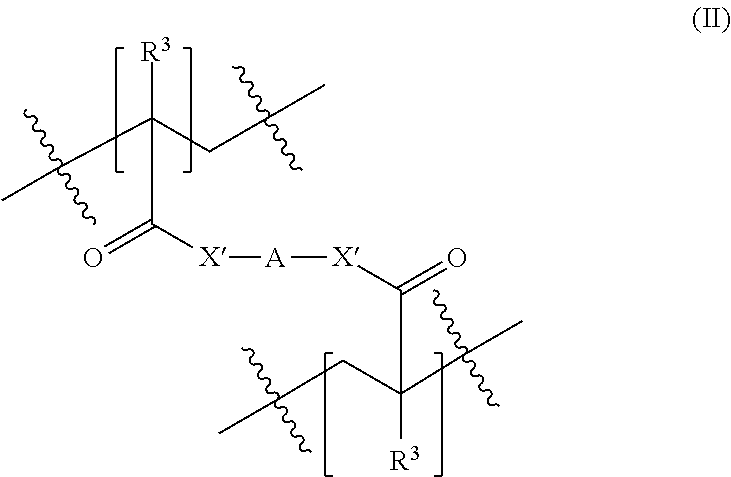
where R3 is independently hydrogen or methyl, X′ is independently —O—, —NR′— or —S—, and A is a hydrophilic group.

where w is 0, 1, 2, 3, 4, 5, 6, 7, 8, 9 or 10.
| TABLE 2 |
| Mn range of the PEG portion of the crosslinks |
| (values are approximate). |
| | High | ||
| 100 | 200 | ||
| 200 | 300 | ||
| 300 | 400 | ||
| 400 | 500 | ||
| 500 | 600 | ||
| 600 | 700 | ||
| 700 | 800 | ||
| 800 | 900 | ||
| 900 | 1,000 | ||
| 1,000 | 2,000 | ||
| 2,000 | 3,000 | ||
| 3,000 | 4,000 | ||
| 4,000 | 5,000 | ||
| 5,000 | 6,000 | ||
| 7,000 | 8,000 | ||
| 8,000 | 9,000 | ||
| 9,000 | 10,000 | ||

where R and R1 are selected to provide the first (meth)acrylate-derived units of the crosslinked, hydrophilic copolymer described herein.

where X, y, R1, R2 and R′ are selected to provide the first (meth)acrylate-derived units of the crosslinked, hydrophilic copolymer described herein. In certain embodiments, the (meth)acrylate monomer is poly(ethylene glycol) methacrylate.

where R3 and w are selected to provide the linker of the second (meth)acrylate-derived units, (i.e., the crosslinks) of the crosslinked, hydrophilic copolymer described herein.

Claims (9)
Priority Applications (2)
| Application Number | Priority Date | Filing Date | Title |
|---|---|---|---|
| US14/585,671 US9439983B1 (en) | 2014-10-24 | 2014-12-30 | Method for integrating nanoparticles as part of a hydrogel matrix |
| US15/210,088 US10188753B1 (en) | 2014-10-24 | 2016-07-14 | Method for integrating nanoparticles as part of a hydrogel matrix |
Applications Claiming Priority (2)
| Application Number | Priority Date | Filing Date | Title |
|---|---|---|---|
| US201462068287P | 2014-10-24 | 2014-10-24 | |
| US14/585,671 US9439983B1 (en) | 2014-10-24 | 2014-12-30 | Method for integrating nanoparticles as part of a hydrogel matrix |
Related Child Applications (1)
| Application Number | Title | Priority Date | Filing Date |
|---|---|---|---|
| US15/210,088 Division US10188753B1 (en) | 2014-10-24 | 2016-07-14 | Method for integrating nanoparticles as part of a hydrogel matrix |
Publications (1)
| Publication Number | Publication Date |
|---|---|
| US9439983B1 true US9439983B1 (en) | 2016-09-13 |
Family
ID=56880798
Family Applications (2)
| Application Number | Title | Priority Date | Filing Date |
|---|---|---|---|
| US14/585,671 Expired - Fee Related US9439983B1 (en) | 2014-10-24 | 2014-12-30 | Method for integrating nanoparticles as part of a hydrogel matrix |
| US15/210,088 Active US10188753B1 (en) | 2014-10-24 | 2016-07-14 | Method for integrating nanoparticles as part of a hydrogel matrix |
Family Applications After (1)
| Application Number | Title | Priority Date | Filing Date |
|---|---|---|---|
| US15/210,088 Active US10188753B1 (en) | 2014-10-24 | 2016-07-14 | Method for integrating nanoparticles as part of a hydrogel matrix |
Country Status (1)
| Country | Link |
|---|---|
| US (2) | US9439983B1 (en) |
Cited By (1)
| Publication number | Priority date | Publication date | Assignee | Title |
|---|---|---|---|---|
| US10845305B1 (en) * | 2015-11-20 | 2020-11-24 | Verily Life Sciences Llc | Method for increasing sensor resolution by spectrally stacking responsive dyes |
Citations (4)
| Publication number | Priority date | Publication date | Assignee | Title |
|---|---|---|---|---|
| US20070212385A1 (en) * | 2006-03-13 | 2007-09-13 | David Nathaniel E | Fluidic Tissue Augmentation Compositions and Methods |
| US20110244029A1 (en) * | 2008-10-07 | 2011-10-06 | Yechezkel Barenholz | Composition of matter comprising liposomes embedded in a polymeric matrix and methods of using same |
| US20110275985A1 (en) * | 2008-07-03 | 2011-11-10 | T2 Biosystems, Inc. | Magnetic nanosensor compositions and bioanalytical assays therefor |
| US20150133752A1 (en) * | 2013-09-16 | 2015-05-14 | Massachusetts Institute Of Technology | Near infrared fluorescent single walled carbon nanotubes as tissue localizable biosensors |
Family Cites Families (2)
| Publication number | Priority date | Publication date | Assignee | Title |
|---|---|---|---|---|
| WO2011130114A1 (en) * | 2010-04-12 | 2011-10-20 | Iowa State University Research Foundation, Inc. | Nanoparticles and nanoparticle compositions |
| CN101890185B (en) * | 2010-05-21 | 2012-12-12 | 天津大学 | ZnO quantum dot vector/DNA composite-containing collagen-based composite cornea substitute, and preparation method and application thereof |
-
2014
- 2014-12-30 US US14/585,671 patent/US9439983B1/en not_active Expired - Fee Related
-
2016
- 2016-07-14 US US15/210,088 patent/US10188753B1/en active Active
Patent Citations (4)
| Publication number | Priority date | Publication date | Assignee | Title |
|---|---|---|---|---|
| US20070212385A1 (en) * | 2006-03-13 | 2007-09-13 | David Nathaniel E | Fluidic Tissue Augmentation Compositions and Methods |
| US20110275985A1 (en) * | 2008-07-03 | 2011-11-10 | T2 Biosystems, Inc. | Magnetic nanosensor compositions and bioanalytical assays therefor |
| US20110244029A1 (en) * | 2008-10-07 | 2011-10-06 | Yechezkel Barenholz | Composition of matter comprising liposomes embedded in a polymeric matrix and methods of using same |
| US20150133752A1 (en) * | 2013-09-16 | 2015-05-14 | Massachusetts Institute Of Technology | Near infrared fluorescent single walled carbon nanotubes as tissue localizable biosensors |
Cited By (2)
| Publication number | Priority date | Publication date | Assignee | Title |
|---|---|---|---|---|
| US10845305B1 (en) * | 2015-11-20 | 2020-11-24 | Verily Life Sciences Llc | Method for increasing sensor resolution by spectrally stacking responsive dyes |
| US11635378B1 (en) | 2015-11-20 | 2023-04-25 | Verily Life Sciences Llc | Method for increasing sensor resolution by spectrally stacking responsive dyes |
Also Published As
| Publication number | Publication date |
|---|---|
| US10188753B1 (en) | 2019-01-29 |
Similar Documents
| Publication | Publication Date | Title |
|---|---|---|
| US20250102832A1 (en) | Accommodating lens with cavity | |
| Costa et al. | Development of therapeutic contact lenses using a supercritical solvent impregnation method | |
| Alvarez-Lorenzo et al. | Soft contact lenses capable of sustained delivery of timolol | |
| White et al. | Extended release of high molecular weight hydroxypropyl methylcellulose from molecularly imprinted, extended wear silicone hydrogel contact lenses | |
| Kapoor et al. | Surfactant-laden soft contact lenses for extended delivery of ophthalmic drugs | |
| US11828913B2 (en) | Silicone hydrogels comprising polyamides | |
| Kim et al. | Extended delivery of ophthalmic drugs by silicone hydrogel contact lenses | |
| US10738145B2 (en) | Silicone hydrogels comprising high levels of polyamides | |
| US10961341B2 (en) | Ophthalmic devices derived from grafted polymeric networks and processes for their preparation and use | |
| Ranjha et al. | Preparation and characterization of hybrid pH-sensitive hydrogels of chitosan-co-acrylic acid for controlled release of verapamil | |
| US20130323295A1 (en) | Monomer systems with dispersed silicone-based engineered particles | |
| WO2009032267A2 (en) | Contact lens based bioactive agent delivery system | |
| Bengani et al. | Lysozyme transport in p-HEMA hydrogel contact lenses | |
| Byrne et al. | Recognitive biomimetic networks with moiety imprinting for intelligent drug delivery | |
| Pardini et al. | Evaluation of pH-sensitive polyurethane/2-diethylaminoethyl methacrylate hybrids potentially useful for drug delivery developments | |
| US10188753B1 (en) | Method for integrating nanoparticles as part of a hydrogel matrix | |
| Zheng et al. | Sustained release of a polymeric wetting agent from a silicone-hydrogel contact lens material | |
| Faccia et al. | Evaluation of pH-sensitive poly (2-hydroxyethyl methacrylate-co-2 (diisopropylamino) ethyl methacrylate) copolymers as drug delivery systems for potential applications in ophthalmic therapies/ocular delivery of drugs | |
| EP3685199B1 (en) | Methods of manufacturing coated contact lenses | |
| Xu et al. | Preparation and evaluation of a contact lens vehicle for puerarin delivery | |
| Boztas et al. | Immobilization and release of the redox mediator ferrocene monocarboxylic acid from within cross-linked p (HEMA-co-PEGMA-co-HMMA) hydrogels | |
| US9498545B1 (en) | Environmentally responsive hydrogels for delivery | |
| US9750445B2 (en) | Porous polymeric formulation prepared using porogens | |
| Gawel et al. | Impregnation of weakly charged anionic microhydrogels with cationic polyelectrolytes and their swelling properties monitored by a high resolution interferometric technique. Transformation from a polyelectrolyte to polyampholyte hydrogel | |
| KR102400716B1 (en) | Hydrogel complex, manufacturing method thereof and transdermal patch using the same |
Legal Events
| Date | Code | Title | Description |
|---|---|---|---|
| AS | Assignment |
Owner name: GOOGLE INC., CALIFORNIA Free format text: ASSIGNMENT OF ASSIGNORS INTEREST;ASSIGNORS:RUCKH, TIMOTHY;KAM, KIMBERLY;REEL/FRAME:034745/0307 Effective date: 20141230 |
|
| AS | Assignment |
Owner name: GOOGLE LIFE SCIENCES LLC, CALIFORNIA Free format text: ASSIGNMENT OF ASSIGNORS INTEREST;ASSIGNOR:GOOGLE INC.;REEL/FRAME:037288/0768 Effective date: 20150805 |
|
| AS | Assignment |
Owner name: VERILY LIFE SCIENCES LLC, CALIFORNIA Free format text: CHANGE OF NAME;ASSIGNOR:GOOGLE LIFE SCIENCES LLC;REEL/FRAME:037317/0139 Effective date: 20151207 |
|
| ZAAA | Notice of allowance and fees due |
Free format text: ORIGINAL CODE: NOA |
|
| ZAAB | Notice of allowance mailed |
Free format text: ORIGINAL CODE: MN/=. |
|
| STCF | Information on status: patent grant |
Free format text: PATENTED CASE |
|
| AS | Assignment |
Owner name: GOOGLE LLC, CALIFORNIA Free format text: CHANGE OF NAME;ASSIGNOR:GOOGLE INC.;REEL/FRAME:044144/0001 Effective date: 20170929 |
|
| AS | Assignment |
Owner name: GOOGLE LLC, CALIFORNIA Free format text: CORRECTIVE ASSIGNMENT TO CORRECT THE CORRECTIVE BY NULLIFICATION TO CORRECT INCORRECTLY RECORDED APPGE OF NAME;ASSIGNOR:GOOGLE INC.;REEL/FRAME:047894/0508 LICATION NUMBERS PREVIOUSLY RECORDED ON REEL 044144 FRAME 0001. ASSIGNOR(S) HEREBY CONFIRMS THE CHAN Effective date: 20170929 Owner name: GOOGLE LLC, CALIFORNIA Free format text: CORRECTIVE ASSIGNMENT TO CORRECT THE CORRECTIVE BY NULLIFICATION TO CORRECT INCORRECTLY RECORDED APPLICATION NUMBERS PREVIOUSLY RECORDED ON REEL 044144 FRAME 0001. ASSIGNOR(S) HEREBY CONFIRMS THE CHANGE OF NAME;ASSIGNOR:GOOGLE INC.;REEL/FRAME:047894/0508 Effective date: 20170929 |
|
| MAFP | Maintenance fee payment |
Free format text: PAYMENT OF MAINTENANCE FEE, 4TH YEAR, LARGE ENTITY (ORIGINAL EVENT CODE: M1551); ENTITY STATUS OF PATENT OWNER: LARGE ENTITY Year of fee payment: 4 |
|
| AS | Assignment |
Owner name: GOOGLE LLC, CALIFORNIA Free format text: CORRECTIVE ASSIGNMENT TO CORRECT THE THE REMOVAL OF THE INCORRECTLY RECORDED APPLICATION NUMBERS 14/149802 AND 15/419313 PREVIOUSLY RECORDED AT REEL: 44144 FRAME: 1. ASSIGNOR(S) HEREBY CONFIRMS THE CHANGE OF NAME;ASSIGNOR:GOOGLE INC.;REEL/FRAME:068092/0502 Effective date: 20170929 |
|
| FEPP | Fee payment procedure |
Free format text: MAINTENANCE FEE REMINDER MAILED (ORIGINAL EVENT CODE: REM.); ENTITY STATUS OF PATENT OWNER: LARGE ENTITY |
|
| LAPS | Lapse for failure to pay maintenance fees |
Free format text: PATENT EXPIRED FOR FAILURE TO PAY MAINTENANCE FEES (ORIGINAL EVENT CODE: EXP.); ENTITY STATUS OF PATENT OWNER: LARGE ENTITY |
|
| STCH | Information on status: patent discontinuation |
Free format text: PATENT EXPIRED DUE TO NONPAYMENT OF MAINTENANCE FEES UNDER 37 CFR 1.362 |
|
| FP | Lapsed due to failure to pay maintenance fee |
Effective date: 20240913 |