US9434666B2 - Catalytic hydrogenation using complexes of base metals with tridentate ligands - Google Patents
Catalytic hydrogenation using complexes of base metals with tridentate ligands Download PDFInfo
- Publication number
- US9434666B2 US9434666B2 US13/587,717 US201213587717A US9434666B2 US 9434666 B2 US9434666 B2 US 9434666B2 US 201213587717 A US201213587717 A US 201213587717A US 9434666 B2 US9434666 B2 US 9434666B2
- Authority
- US
- United States
- Prior art keywords
- complex
- hydrogenation
- cobalt
- nmr
- complexes
- Prior art date
- Legal status (The legal status is an assumption and is not a legal conclusion. Google has not performed a legal analysis and makes no representation as to the accuracy of the status listed.)
- Expired - Fee Related, expires
Links
- 0 [1*][PH]1([1*])CCN2CC[PH]([1*])([1*])C21[2*] Chemical compound [1*][PH]1([1*])CCN2CC[PH]([1*])([1*])C21[2*] 0.000 description 8
- PPBRXRYQALVLMV-UHFFFAOYSA-N C=CC1=CC=CC=C1 Chemical compound C=CC1=CC=CC=C1 PPBRXRYQALVLMV-UHFFFAOYSA-N 0.000 description 3
- YNQLUTRBYVCPMQ-UHFFFAOYSA-N CCC1=CC=CC=C1 Chemical compound CCC1=CC=CC=C1 YNQLUTRBYVCPMQ-UHFFFAOYSA-N 0.000 description 3
- TVMXDCGIABBOFY-UHFFFAOYSA-N CCCCCCCC Chemical compound CCCCCCCC TVMXDCGIABBOFY-UHFFFAOYSA-N 0.000 description 3
- XYLMUPLGERFSHI-UHFFFAOYSA-N C=C(C)C1=CC=CC=C1 Chemical compound C=C(C)C1=CC=CC=C1 XYLMUPLGERFSHI-UHFFFAOYSA-N 0.000 description 2
- PKXHXOTZMFCXSH-UHFFFAOYSA-N C=CC(C)(C)C Chemical compound C=CC(C)(C)C PKXHXOTZMFCXSH-UHFFFAOYSA-N 0.000 description 2
- KWKAKUADMBZCLK-UHFFFAOYSA-N C=CCCCCCC Chemical compound C=CCCCCCC KWKAKUADMBZCLK-UHFFFAOYSA-N 0.000 description 2
- RWGFKTVRMDUZSP-UHFFFAOYSA-N CC(C)C1=CC=CC=C1 Chemical compound CC(C)C1=CC=CC=C1 RWGFKTVRMDUZSP-UHFFFAOYSA-N 0.000 description 2
- RGYZQSCFKFDECZ-UHFFFAOYSA-N CC1=CC=C(C(O)C2=CC=C(C)C=C2)C=C1 Chemical compound CC1=CC=C(C(O)C2=CC=C(C)C=C2)C=C1 RGYZQSCFKFDECZ-UHFFFAOYSA-N 0.000 description 2
- HNRMPXKDFBEGFZ-UHFFFAOYSA-N CCC(C)(C)C Chemical compound CCC(C)(C)C HNRMPXKDFBEGFZ-UHFFFAOYSA-N 0.000 description 2
- QNVRIHYSUZMSGM-UHFFFAOYSA-N CCCCC(C)O Chemical compound CCCCC(C)O QNVRIHYSUZMSGM-UHFFFAOYSA-N 0.000 description 2
- KMGCKSAIIHOKCX-UHFFFAOYSA-N OC1CC2=CC=CC=C2C1 Chemical compound OC1CC2=CC=CC=C2C1 KMGCKSAIIHOKCX-UHFFFAOYSA-N 0.000 description 2
- WVDDGKGOMKODPV-UHFFFAOYSA-N OCC1=CC=CC=C1 Chemical compound OCC1=CC=CC=C1 WVDDGKGOMKODPV-UHFFFAOYSA-N 0.000 description 2
- NDOPHXWIAZIXPR-UHFFFAOYSA-N [H]C(=O)C1=CC=CC=C1Br Chemical compound [H]C(=O)C1=CC=CC=C1Br NDOPHXWIAZIXPR-UHFFFAOYSA-N 0.000 description 2
- SLKRJIXMUDPYLY-UHFFFAOYSA-P Br.C1=CC=C(B(C2=CC=CC=C2)(C2=CC=CC=C2)C2=CC=CC=C2)C=C1.CO.[H]N12CCC[Ni]1(Br)[PH](C1CCCCC1)(C1CCCCC1)CC2.[H]N12CCC[Ni]1([H])[PH](C1CCCCC1)(C1CCCCC1)CC2.[H][Ni]12CCCN1CC[PH]2(C1CCCCC1)C1CCCCC1 Chemical compound Br.C1=CC=C(B(C2=CC=CC=C2)(C2=CC=CC=C2)C2=CC=CC=C2)C=C1.CO.[H]N12CCC[Ni]1(Br)[PH](C1CCCCC1)(C1CCCCC1)CC2.[H]N12CCC[Ni]1([H])[PH](C1CCCCC1)(C1CCCCC1)CC2.[H][Ni]12CCCN1CC[PH]2(C1CCCCC1)C1CCCCC1 SLKRJIXMUDPYLY-UHFFFAOYSA-P 0.000 description 1
- QROGIFZRVHSFLM-QHHAFSJGSA-N C/C=C/C1=CC=CC=C1 Chemical compound C/C=C/C1=CC=CC=C1 QROGIFZRVHSFLM-QHHAFSJGSA-N 0.000 description 1
- RSHOTYJWYRWCTI-WGUCFVLLSA-N C/C=C/CC.C1=CCCCC1.C1=CCCCC1.C=CCCC.CC.CC.CCC.CCC Chemical compound C/C=C/CC.C1=CCCCC1.C1=CCCCC1.C=CCCC.CC.CC.CCC.CCC RSHOTYJWYRWCTI-WGUCFVLLSA-N 0.000 description 1
- ILPBINAXDRFYPL-HWKANZROSA-N C/C=C/CCCCC Chemical compound C/C=C/CCCCC ILPBINAXDRFYPL-HWKANZROSA-N 0.000 description 1
- HXTGGPKOEKKUQO-VQHVLOKHSA-N C/N=C/C1=CC=CC=C1 Chemical compound C/N=C/C1=CC=CC=C1 HXTGGPKOEKKUQO-VQHVLOKHSA-N 0.000 description 1
- JFNLZVQOOSMTJK-UHFFFAOYSA-N C1=CC2CCC1C2 Chemical compound C1=CC2CCC1C2 JFNLZVQOOSMTJK-UHFFFAOYSA-N 0.000 description 1
- UVEWQKMPXAHFST-SDNWHVSQSA-N C1=CC=C(/C=N/C2=CC=CC=C2)C=C1 Chemical compound C1=CC=C(/C=N/C2=CC=CC=C2)C=C1 UVEWQKMPXAHFST-SDNWHVSQSA-N 0.000 description 1
- MIYKHJXFICMPOJ-RVDMUPIBSA-N C1=CC=C(/C=N/CC2=CC=CC=C2)C=C1 Chemical compound C1=CC=C(/C=N/CC2=CC=CC=C2)C=C1 MIYKHJXFICMPOJ-RVDMUPIBSA-N 0.000 description 1
- GTWJETSWSUWSEJ-UHFFFAOYSA-N C1=CC=C(CNC2=CC=CC=C2)C=C1 Chemical compound C1=CC=C(CNC2=CC=CC=C2)C=C1 GTWJETSWSUWSEJ-UHFFFAOYSA-N 0.000 description 1
- BWLUMTFWVZZZND-UHFFFAOYSA-N C1=CC=C(CNCC2=CC=CC=C2)C=C1 Chemical compound C1=CC=C(CNCC2=CC=CC=C2)C=C1 BWLUMTFWVZZZND-UHFFFAOYSA-N 0.000 description 1
- URYYVOIYTNXXBN-UPHRSURJSA-N C1=C\CCCCCC/1 Chemical compound C1=C\CCCCCC/1 URYYVOIYTNXXBN-UPHRSURJSA-N 0.000 description 1
- UMRZSTCPUPJPOJ-UHFFFAOYSA-N C1CC2CCC1C2 Chemical compound C1CC2CCC1C2 UMRZSTCPUPJPOJ-UHFFFAOYSA-N 0.000 description 1
- WJTCGQSWYFHTAC-UHFFFAOYSA-N C1CCCCCCC1 Chemical compound C1CCCCCCC1 WJTCGQSWYFHTAC-UHFFFAOYSA-N 0.000 description 1
- XMGQYMWWDOXHJM-UHFFFAOYSA-N C=C(C)C1CC=C(C)CC1 Chemical compound C=C(C)C1CC=C(C)CC1 XMGQYMWWDOXHJM-UHFFFAOYSA-N 0.000 description 1
- AZOCECCLWFDTAP-UHFFFAOYSA-N C=C(C)C1CCC(C)C(=O)C1 Chemical compound C=C(C)C1CCC(C)C(=O)C1 AZOCECCLWFDTAP-UHFFFAOYSA-N 0.000 description 1
- JWVTWJNGILGLAT-UHFFFAOYSA-N C=CC1=CC=C(F)C=C1 Chemical compound C=CC1=CC=C(F)C=C1 JWVTWJNGILGLAT-UHFFFAOYSA-N 0.000 description 1
- UAJRSHJHFRVGMG-UHFFFAOYSA-N C=CC1=CC=C(OC)C=C1 Chemical compound C=CC1=CC=C(OC)C=C1 UAJRSHJHFRVGMG-UHFFFAOYSA-N 0.000 description 1
- HYPOXSCDVXLVGI-UHFFFAOYSA-O C=CC1=CC=CC=C1.CCC1=CC=CC=C1.[H]N12CCC[Ni]1([H])[PH](C1CCCCC1)(C1CCCCC1)CC2 Chemical compound C=CC1=CC=CC=C1.CCC1=CC=CC=C1.[H]N12CCC[Ni]1([H])[PH](C1CCCCC1)(C1CCCCC1)CC2 HYPOXSCDVXLVGI-UHFFFAOYSA-O 0.000 description 1
- NGASWKRTXGWPNN-UHFFFAOYSA-N C=CCC(=O)OC(C)(C)C Chemical compound C=CCC(=O)OC(C)(C)C NGASWKRTXGWPNN-UHFFFAOYSA-N 0.000 description 1
- HVAMZGADVCBITI-UHFFFAOYSA-N C=CCCC(=O)O Chemical compound C=CCCC(=O)O HVAMZGADVCBITI-UHFFFAOYSA-N 0.000 description 1
- RNDVGJZUHCKENF-UHFFFAOYSA-N C=CCCC(C)=O Chemical compound C=CCCC(C)=O RNDVGJZUHCKENF-UHFFFAOYSA-N 0.000 description 1
- PBGVMIDTGGTBFS-UHFFFAOYSA-N C=CCCC1=CC=CC=C1 Chemical compound C=CCCC1=CC=CC=C1 PBGVMIDTGGTBFS-UHFFFAOYSA-N 0.000 description 1
- KQPKFCBVKOFALQ-UHFFFAOYSA-P C=CCCCCCC.F[PH](F)(F)(F)(F)F.F[PH](F)(F)(F)(F)F.[H]N12CCC[Ni]1(CCCCCCCC)[PH](C1CCCCC1)(C1CCCCC1)CC2.[H]N12CCC[Ni]1([H])[PH](C1CCCCC1)(C1CCCCC1)CC2 Chemical compound C=CCCCCCC.F[PH](F)(F)(F)(F)F.F[PH](F)(F)(F)(F)F.[H]N12CCC[Ni]1(CCCCCCCC)[PH](C1CCCCC1)(C1CCCCC1)CC2.[H]N12CCC[Ni]1([H])[PH](C1CCCCC1)(C1CCCCC1)CC2 KQPKFCBVKOFALQ-UHFFFAOYSA-P 0.000 description 1
- LQAVWYMTUMSFBE-UHFFFAOYSA-N C=CCCCO Chemical compound C=CCCCO LQAVWYMTUMSFBE-UHFFFAOYSA-N 0.000 description 1
- OJPSFJLSZZTSDF-UHFFFAOYSA-N C=CCOCC Chemical compound C=CCOCC OJPSFJLSZZTSDF-UHFFFAOYSA-N 0.000 description 1
- KWOLFJPFCHCOCG-UHFFFAOYSA-N CC(=O)C1=CC=CC=C1 Chemical compound CC(=O)C1=CC=CC=C1 KWOLFJPFCHCOCG-UHFFFAOYSA-N 0.000 description 1
- GJLRRPYIKMUJSR-UHFFFAOYSA-N CC(=O)C1=CC=CC=C1.CC(O)C1=CC=CC=C1.[HH] Chemical compound CC(=O)C1=CC=CC=C1.CC(O)C1=CC=CC=C1.[HH] GJLRRPYIKMUJSR-UHFFFAOYSA-N 0.000 description 1
- PIMNFNXBTGPCIL-UHFFFAOYSA-N CC(=O)C1=CC=CC=C1Br Chemical compound CC(=O)C1=CC=CC=C1Br PIMNFNXBTGPCIL-UHFFFAOYSA-N 0.000 description 1
- OEPJKMBIENPLRL-UHFFFAOYSA-P CC(C)(C)[PH]1(C(C)(C)C)CCN2CCC[Ni]21.[HH].[H]N12CCC[Ni]1([H])[PH](C(C)(C)C)(C(C)(C)C)CC2 Chemical compound CC(C)(C)[PH]1(C(C)(C)C)CCN2CCC[Ni]21.[HH].[H]N12CCC[Ni]1([H])[PH](C(C)(C)C)(C(C)(C)C)CC2 OEPJKMBIENPLRL-UHFFFAOYSA-P 0.000 description 1
- WAPNOHKVXSQRPX-UHFFFAOYSA-N CC(O)C1=CC=CC=C1 Chemical compound CC(O)C1=CC=CC=C1 WAPNOHKVXSQRPX-UHFFFAOYSA-N 0.000 description 1
- DZLZSFZSPIUINR-UHFFFAOYSA-N CC(O)C1=CC=CC=C1Br Chemical compound CC(O)C1=CC=CC=C1Br DZLZSFZSPIUINR-UHFFFAOYSA-N 0.000 description 1
- ZWPWLKXZYNXATK-UHFFFAOYSA-N CC1=CC=C(C(=O)C2=CC=C(C)C=C2)C=C1 Chemical compound CC1=CC=C(C(=O)C2=CC=C(C)C=C2)C=C1 ZWPWLKXZYNXATK-UHFFFAOYSA-N 0.000 description 1
- FAMJUFMHYAFYNU-UHFFFAOYSA-N CC1=CCC(C(C)C)CC1 Chemical compound CC1=CCC(C(C)C)CC1 FAMJUFMHYAFYNU-UHFFFAOYSA-N 0.000 description 1
- GCRTVIUGJCJVDD-UHFFFAOYSA-N CC1CCC(C(C)C)CC1=O Chemical compound CC1CCC(C(C)C)CC1=O GCRTVIUGJCJVDD-UHFFFAOYSA-N 0.000 description 1
- IKYJYGQZHSNDKM-UHFFFAOYSA-P CCC.C[Si](C)(C)C[Co]12CCCN1CC[PH]2(C1CCCCC1)C1CCCCC1.FB(F)(F)(F)[Ar].[H]N12CCC[Co]1(C[Si](C)(C)C)[PH](C1CCCCC1)(C1CCCCC1)CC2 Chemical compound CCC.C[Si](C)(C)C[Co]12CCCN1CC[PH]2(C1CCCCC1)C1CCCCC1.FB(F)(F)(F)[Ar].[H]N12CCC[Co]1(C[Si](C)(C)C)[PH](C1CCCCC1)(C1CCCCC1)CC2 IKYJYGQZHSNDKM-UHFFFAOYSA-P 0.000 description 1
- BLDNWXVISIXWKZ-UHFFFAOYSA-N CCC1=CC=C(F)C=C1 Chemical compound CCC1=CC=C(F)C=C1 BLDNWXVISIXWKZ-UHFFFAOYSA-N 0.000 description 1
- HDNRAPAFJLXKBV-UHFFFAOYSA-N CCC1=CC=C(OC)C=C1 Chemical compound CCC1=CC=C(OC)C=C1 HDNRAPAFJLXKBV-UHFFFAOYSA-N 0.000 description 1
- TWBUVVYSQBFVGZ-UHFFFAOYSA-N CCCC(=O)OC(C)(C)C Chemical compound CCCC(=O)OC(C)(C)C TWBUVVYSQBFVGZ-UHFFFAOYSA-N 0.000 description 1
- ODLMAHJVESYWTB-UHFFFAOYSA-N CCCC1=CC=CC=C1 Chemical compound CCCC1=CC=CC=C1 ODLMAHJVESYWTB-UHFFFAOYSA-N 0.000 description 1
- NQPDZGIKBAWPEJ-UHFFFAOYSA-N CCCCC(=O)O Chemical compound CCCCC(=O)O NQPDZGIKBAWPEJ-UHFFFAOYSA-N 0.000 description 1
- QQZOPKMRPOGIEB-UHFFFAOYSA-N CCCCC(C)=O Chemical compound CCCCC(C)=O QQZOPKMRPOGIEB-UHFFFAOYSA-N 0.000 description 1
- OCKPCBLVNKHBMX-UHFFFAOYSA-N CCCCC1=CC=CC=C1 Chemical compound CCCCC1=CC=CC=C1 OCKPCBLVNKHBMX-UHFFFAOYSA-N 0.000 description 1
- KBPLFHHGFOOTCA-UHFFFAOYSA-N CCCCCCCCO Chemical compound CCCCCCCCO KBPLFHHGFOOTCA-UHFFFAOYSA-N 0.000 description 1
- AMQJEAYHLZJPGS-UHFFFAOYSA-N CCCCCO Chemical compound CCCCCO AMQJEAYHLZJPGS-UHFFFAOYSA-N 0.000 description 1
- NVJUHMXYKCUMQA-UHFFFAOYSA-N CCCOCC Chemical compound CCCOCC NVJUHMXYKCUMQA-UHFFFAOYSA-N 0.000 description 1
- HUUPVABNAQUEJW-UHFFFAOYSA-N CN1CCC(=O)CC1 Chemical compound CN1CCC(=O)CC1 HUUPVABNAQUEJW-UHFFFAOYSA-N 0.000 description 1
- BAUWRHPMUVYFOD-UHFFFAOYSA-N CN1CCC(O)CC1 Chemical compound CN1CCC(O)CC1 BAUWRHPMUVYFOD-UHFFFAOYSA-N 0.000 description 1
- RIWRFSMVIUAEBX-UHFFFAOYSA-N CNCC1=CC=CC=C1 Chemical compound CNCC1=CC=CC=C1 RIWRFSMVIUAEBX-UHFFFAOYSA-N 0.000 description 1
- BAYUSCHCCGXLAY-UHFFFAOYSA-N COC1=CC(C(C)=O)=CC=C1 Chemical compound COC1=CC(C(C)=O)=CC=C1 BAYUSCHCCGXLAY-UHFFFAOYSA-N 0.000 description 1
- ZUBPFBWAXNCEOG-UHFFFAOYSA-N COC1=CC(C(C)O)=CC=C1 Chemical compound COC1=CC(C(C)O)=CC=C1 ZUBPFBWAXNCEOG-UHFFFAOYSA-N 0.000 description 1
- QFWVNEBRTUUHIE-UHFFFAOYSA-N COC1=CC(CO)=CC(CO)=C1 Chemical compound COC1=CC(CO)=CC(CO)=C1 QFWVNEBRTUUHIE-UHFFFAOYSA-N 0.000 description 1
- AUDBREYGQOXIFT-UHFFFAOYSA-N COC1=CC(CO)=CC(OC)=C1 Chemical compound COC1=CC(CO)=CC(OC)=C1 AUDBREYGQOXIFT-UHFFFAOYSA-N 0.000 description 1
- MSHFRERJPWKJFX-UHFFFAOYSA-N COC1=CC=C(CO)C=C1 Chemical compound COC1=CC=C(CO)C=C1 MSHFRERJPWKJFX-UHFFFAOYSA-N 0.000 description 1
- WYLYBQSHRJMURN-UHFFFAOYSA-N COC1=CC=CC=C1CO Chemical compound COC1=CC=CC=C1CO WYLYBQSHRJMURN-UHFFFAOYSA-N 0.000 description 1
- RJNQLZAZKCZPFB-UHFFFAOYSA-P C[Si](C)(C)C.ClC(Cl)Cl.ClCCl.FB(F)(F)(F)[Ar].FB(F)(F)(F)[Ar].FB(F)(F)(F)[Ar].[HH].[H]N12CCC[Co]1(C[Si](C)(C)C)[PH](C1CCCCC1)(C1CCCCC1)CC2.[H]N12CCC[Co]1(Cl)[PH](C1CCCCC1)(C1CCCCC1)CC2.[H]N12CCC[Co]1([H])[PH](C1CCCCC1)(C1CCCCC1)CC2 Chemical compound C[Si](C)(C)C.ClC(Cl)Cl.ClCCl.FB(F)(F)(F)[Ar].FB(F)(F)(F)[Ar].FB(F)(F)(F)[Ar].[HH].[H]N12CCC[Co]1(C[Si](C)(C)C)[PH](C1CCCCC1)(C1CCCCC1)CC2.[H]N12CCC[Co]1(Cl)[PH](C1CCCCC1)(C1CCCCC1)CC2.[H]N12CCC[Co]1([H])[PH](C1CCCCC1)(C1CCCCC1)CC2 RJNQLZAZKCZPFB-UHFFFAOYSA-P 0.000 description 1
- QUDPATOWYGRQPR-FQDAWQAGSA-P F[PH](F)(F)(F)(F)F.F[PH](F)(F)(F)(F)F.[2H]N12CCC[Ni]1([2H])[PH](C1CCCCC1)(C1CCCCC1)CC2.[HH].[HH].[H]N12CCC[Ni]1([H])[PH](C1CCCCC1)(C1CCCCC1)CC2 Chemical compound F[PH](F)(F)(F)(F)F.F[PH](F)(F)(F)(F)F.[2H]N12CCC[Ni]1([2H])[PH](C1CCCCC1)(C1CCCCC1)CC2.[HH].[HH].[H]N12CCC[Ni]1([H])[PH](C1CCCCC1)(C1CCCCC1)CC2 QUDPATOWYGRQPR-FQDAWQAGSA-P 0.000 description 1
- KZJRKRQSDZGHEC-UHFFFAOYSA-N O=C(C1=CC=CC=C1)C(F)(F)F Chemical compound O=C(C1=CC=CC=C1)C(F)(F)F KZJRKRQSDZGHEC-UHFFFAOYSA-N 0.000 description 1
- RWCCWEUUXYIKHB-UHFFFAOYSA-N O=C(C1=CC=CC=C1)C1=CC=CC=C1 Chemical compound O=C(C1=CC=CC=C1)C1=CC=CC=C1 RWCCWEUUXYIKHB-UHFFFAOYSA-N 0.000 description 1
- YLQWCDOCJODRMT-UHFFFAOYSA-N O=C1C2=CC=CC=C2C2=C1C=CC=C2 Chemical compound O=C1C2=CC=CC=C2C2=C1C=CC=C2 YLQWCDOCJODRMT-UHFFFAOYSA-N 0.000 description 1
- UMJJFEIKYGFCAT-UHFFFAOYSA-N O=C1CC2=CC=CC=C2C1 Chemical compound O=C1CC2=CC=CC=C2C1 UMJJFEIKYGFCAT-UHFFFAOYSA-N 0.000 description 1
- VNOMEAQPOMDWSR-UHFFFAOYSA-N OC(C1=CC=CC=C1)C(F)(F)F Chemical compound OC(C1=CC=CC=C1)C(F)(F)F VNOMEAQPOMDWSR-UHFFFAOYSA-N 0.000 description 1
- QILSFLSDHQAZET-UHFFFAOYSA-N OC(C1=CC=CC=C1)C1=CC=CC=C1 Chemical compound OC(C1=CC=CC=C1)C1=CC=CC=C1 QILSFLSDHQAZET-UHFFFAOYSA-N 0.000 description 1
- AFMVESZOYKHDBJ-UHFFFAOYSA-N OC1C2=CC=CC=C2C2=C1C=CC=C2 Chemical compound OC1C2=CC=CC=C2C2=C1C=CC=C2 AFMVESZOYKHDBJ-UHFFFAOYSA-N 0.000 description 1
- IOWGHQGLUMEZKG-UHFFFAOYSA-N OCC1=CC=CC=C1Br Chemical compound OCC1=CC=CC=C1Br IOWGHQGLUMEZKG-UHFFFAOYSA-N 0.000 description 1
- VAJVDSVGBWFCLW-UHFFFAOYSA-N OCCCC1=CC=CC=C1 Chemical compound OCCCC1=CC=CC=C1 VAJVDSVGBWFCLW-UHFFFAOYSA-N 0.000 description 1
- KJPRLNWUNMBNBZ-QPJJXVBHSA-N [H]C(=O)/C=C/C1=CC=CC=C1 Chemical compound [H]C(=O)/C=C/C1=CC=CC=C1 KJPRLNWUNMBNBZ-QPJJXVBHSA-N 0.000 description 1
- FPGQZOVJSZJWDJ-UHFFFAOYSA-N [H]C(=O)C1=CC(OC)=CC(CO)=C1 Chemical compound [H]C(=O)C1=CC(OC)=CC(CO)=C1 FPGQZOVJSZJWDJ-UHFFFAOYSA-N 0.000 description 1
- VFZRZRDOXPRTSC-UHFFFAOYSA-N [H]C(=O)C1=CC(OC)=CC(OC)=C1 Chemical compound [H]C(=O)C1=CC(OC)=CC(OC)=C1 VFZRZRDOXPRTSC-UHFFFAOYSA-N 0.000 description 1
- ZRSNZINYAWTAHE-UHFFFAOYSA-N [H]C(=O)C1=CC=C(OC)C=C1 Chemical compound [H]C(=O)C1=CC=C(OC)C=C1 ZRSNZINYAWTAHE-UHFFFAOYSA-N 0.000 description 1
- HUMNYLRZRPPJDN-UHFFFAOYSA-N [H]C(=O)C1=CC=CC=C1 Chemical compound [H]C(=O)C1=CC=CC=C1 HUMNYLRZRPPJDN-UHFFFAOYSA-N 0.000 description 1
- PKZJLOCLABXVMC-UHFFFAOYSA-N [H]C(=O)C1=CC=CC=C1OC Chemical compound [H]C(=O)C1=CC=CC=C1OC PKZJLOCLABXVMC-UHFFFAOYSA-N 0.000 description 1
- NUJGJRNETVAIRJ-UHFFFAOYSA-N [H]C(=O)CCCCCCC Chemical compound [H]C(=O)CCCCCCC NUJGJRNETVAIRJ-UHFFFAOYSA-N 0.000 description 1
Classifications
-
- B—PERFORMING OPERATIONS; TRANSPORTING
- B01—PHYSICAL OR CHEMICAL PROCESSES OR APPARATUS IN GENERAL
- B01J—CHEMICAL OR PHYSICAL PROCESSES, e.g. CATALYSIS OR COLLOID CHEMISTRY; THEIR RELEVANT APPARATUS
- B01J31/00—Catalysts comprising hydrides, coordination complexes or organic compounds
- B01J31/16—Catalysts comprising hydrides, coordination complexes or organic compounds containing coordination complexes
- B01J31/22—Organic complexes
- B01J31/2282—Unsaturated compounds used as ligands
- B01J31/2295—Cyclic compounds, e.g. cyclopentadienyls
-
- C—CHEMISTRY; METALLURGY
- C07—ORGANIC CHEMISTRY
- C07C—ACYCLIC OR CARBOCYCLIC COMPOUNDS
- C07C29/00—Preparation of compounds having hydroxy or O-metal groups bound to a carbon atom not belonging to a six-membered aromatic ring
- C07C29/17—Preparation of compounds having hydroxy or O-metal groups bound to a carbon atom not belonging to a six-membered aromatic ring by hydrogenation of carbon-to-carbon double or triple bonds
- C07C29/172—Preparation of compounds having hydroxy or O-metal groups bound to a carbon atom not belonging to a six-membered aromatic ring by hydrogenation of carbon-to-carbon double or triple bonds with the obtention of a fully saturated alcohol
-
- B—PERFORMING OPERATIONS; TRANSPORTING
- B01—PHYSICAL OR CHEMICAL PROCESSES OR APPARATUS IN GENERAL
- B01J—CHEMICAL OR PHYSICAL PROCESSES, e.g. CATALYSIS OR COLLOID CHEMISTRY; THEIR RELEVANT APPARATUS
- B01J31/00—Catalysts comprising hydrides, coordination complexes or organic compounds
- B01J31/16—Catalysts comprising hydrides, coordination complexes or organic compounds containing coordination complexes
- B01J31/18—Catalysts comprising hydrides, coordination complexes or organic compounds containing coordination complexes containing nitrogen, phosphorus, arsenic or antimony as complexing atoms, e.g. in pyridine ligands, or in resonance therewith, e.g. in isocyanide ligands C=N-R or as complexed central atoms
- B01J31/189—Catalysts comprising hydrides, coordination complexes or organic compounds containing coordination complexes containing nitrogen, phosphorus, arsenic or antimony as complexing atoms, e.g. in pyridine ligands, or in resonance therewith, e.g. in isocyanide ligands C=N-R or as complexed central atoms containing both nitrogen and phosphorus as complexing atoms, including e.g. phosphino moieties, in one at least bidentate or bridging ligand
-
- B—PERFORMING OPERATIONS; TRANSPORTING
- B01—PHYSICAL OR CHEMICAL PROCESSES OR APPARATUS IN GENERAL
- B01J—CHEMICAL OR PHYSICAL PROCESSES, e.g. CATALYSIS OR COLLOID CHEMISTRY; THEIR RELEVANT APPARATUS
- B01J31/00—Catalysts comprising hydrides, coordination complexes or organic compounds
- B01J31/16—Catalysts comprising hydrides, coordination complexes or organic compounds containing coordination complexes
- B01J31/24—Phosphines, i.e. phosphorus bonded to only carbon atoms, or to both carbon and hydrogen atoms, including e.g. sp2-hybridised phosphorus compounds such as phosphabenzene, phosphole or anionic phospholide ligands
- B01J31/2404—Cyclic ligands, including e.g. non-condensed polycyclic ligands, the phosphine-P atom being a ring member or a substituent on the ring
- B01J31/2442—Cyclic ligands, including e.g. non-condensed polycyclic ligands, the phosphine-P atom being a ring member or a substituent on the ring comprising condensed ring systems
- B01J31/2461—Cyclic ligands, including e.g. non-condensed polycyclic ligands, the phosphine-P atom being a ring member or a substituent on the ring comprising condensed ring systems and phosphine-P atoms as ring members in the condensed ring system or in a further ring
- B01J31/2471—Cyclic ligands, including e.g. non-condensed polycyclic ligands, the phosphine-P atom being a ring member or a substituent on the ring comprising condensed ring systems and phosphine-P atoms as ring members in the condensed ring system or in a further ring with more than one complexing phosphine-P atom
- B01J31/2476—Cyclic ligands, including e.g. non-condensed polycyclic ligands, the phosphine-P atom being a ring member or a substituent on the ring comprising condensed ring systems and phosphine-P atoms as ring members in the condensed ring system or in a further ring with more than one complexing phosphine-P atom comprising aliphatic or saturated rings
-
- C—CHEMISTRY; METALLURGY
- C07—ORGANIC CHEMISTRY
- C07C—ACYCLIC OR CARBOCYCLIC COMPOUNDS
- C07C11/00—Aliphatic unsaturated hydrocarbons
- C07C11/02—Alkenes
-
- C—CHEMISTRY; METALLURGY
- C07—ORGANIC CHEMISTRY
- C07C—ACYCLIC OR CARBOCYCLIC COMPOUNDS
- C07C13/00—Cyclic hydrocarbons containing rings other than, or in addition to, six-membered aromatic rings
- C07C13/02—Monocyclic hydrocarbons or acyclic hydrocarbon derivatives thereof
- C07C13/16—Monocyclic hydrocarbons or acyclic hydrocarbon derivatives thereof with a six-membered ring
- C07C13/20—Monocyclic hydrocarbons or acyclic hydrocarbon derivatives thereof with a six-membered ring with a cyclohexene ring
-
- C—CHEMISTRY; METALLURGY
- C07—ORGANIC CHEMISTRY
- C07C—ACYCLIC OR CARBOCYCLIC COMPOUNDS
- C07C13/00—Cyclic hydrocarbons containing rings other than, or in addition to, six-membered aromatic rings
- C07C13/02—Monocyclic hydrocarbons or acyclic hydrocarbon derivatives thereof
- C07C13/26—Monocyclic hydrocarbons or acyclic hydrocarbon derivatives thereof with an eight-membered ring
-
- C—CHEMISTRY; METALLURGY
- C07—ORGANIC CHEMISTRY
- C07C—ACYCLIC OR CARBOCYCLIC COMPOUNDS
- C07C13/00—Cyclic hydrocarbons containing rings other than, or in addition to, six-membered aromatic rings
- C07C13/28—Polycyclic hydrocarbons or acyclic hydrocarbon derivatives thereof
- C07C13/32—Polycyclic hydrocarbons or acyclic hydrocarbon derivatives thereof with condensed rings
- C07C13/62—Polycyclic hydrocarbons or acyclic hydrocarbon derivatives thereof with condensed rings with more than three condensed rings
- C07C13/64—Polycyclic hydrocarbons or acyclic hydrocarbon derivatives thereof with condensed rings with more than three condensed rings with a bridged ring system
-
- C—CHEMISTRY; METALLURGY
- C07—ORGANIC CHEMISTRY
- C07C—ACYCLIC OR CARBOCYCLIC COMPOUNDS
- C07C15/00—Cyclic hydrocarbons containing only six-membered aromatic rings as cyclic parts
- C07C15/02—Monocyclic hydrocarbons
-
- C—CHEMISTRY; METALLURGY
- C07—ORGANIC CHEMISTRY
- C07C—ACYCLIC OR CARBOCYCLIC COMPOUNDS
- C07C15/00—Cyclic hydrocarbons containing only six-membered aromatic rings as cyclic parts
- C07C15/02—Monocyclic hydrocarbons
- C07C15/067—C8H10 hydrocarbons
- C07C15/073—Ethylbenzene
-
- C—CHEMISTRY; METALLURGY
- C07—ORGANIC CHEMISTRY
- C07C—ACYCLIC OR CARBOCYCLIC COMPOUNDS
- C07C15/00—Cyclic hydrocarbons containing only six-membered aromatic rings as cyclic parts
- C07C15/02—Monocyclic hydrocarbons
- C07C15/085—Isopropylbenzene
-
- C—CHEMISTRY; METALLURGY
- C07—ORGANIC CHEMISTRY
- C07C—ACYCLIC OR CARBOCYCLIC COMPOUNDS
- C07C17/00—Preparation of halogenated hydrocarbons
- C07C17/35—Preparation of halogenated hydrocarbons by reactions not affecting the number of carbon or of halogen atoms in the reaction
- C07C17/354—Preparation of halogenated hydrocarbons by reactions not affecting the number of carbon or of halogen atoms in the reaction by hydrogenation
-
- C—CHEMISTRY; METALLURGY
- C07—ORGANIC CHEMISTRY
- C07C—ACYCLIC OR CARBOCYCLIC COMPOUNDS
- C07C209/00—Preparation of compounds containing amino groups bound to a carbon skeleton
- C07C209/44—Preparation of compounds containing amino groups bound to a carbon skeleton by reduction of carboxylic acids or esters thereof in presence of ammonia or amines, or by reduction of nitriles, carboxylic acid amides, imines or imino-ethers
- C07C209/52—Preparation of compounds containing amino groups bound to a carbon skeleton by reduction of carboxylic acids or esters thereof in presence of ammonia or amines, or by reduction of nitriles, carboxylic acid amides, imines or imino-ethers by reduction of imines or imino-ethers
-
- C—CHEMISTRY; METALLURGY
- C07—ORGANIC CHEMISTRY
- C07C—ACYCLIC OR CARBOCYCLIC COMPOUNDS
- C07C209/00—Preparation of compounds containing amino groups bound to a carbon skeleton
- C07C209/68—Preparation of compounds containing amino groups bound to a carbon skeleton from amines, by reactions not involving amino groups, e.g. reduction of unsaturated amines, aromatisation, or substitution of the carbon skeleton
- C07C209/70—Preparation of compounds containing amino groups bound to a carbon skeleton from amines, by reactions not involving amino groups, e.g. reduction of unsaturated amines, aromatisation, or substitution of the carbon skeleton by reduction of unsaturated amines
-
- C—CHEMISTRY; METALLURGY
- C07—ORGANIC CHEMISTRY
- C07C—ACYCLIC OR CARBOCYCLIC COMPOUNDS
- C07C211/00—Compounds containing amino groups bound to a carbon skeleton
- C07C211/01—Compounds containing amino groups bound to a carbon skeleton having amino groups bound to acyclic carbon atoms
- C07C211/26—Compounds containing amino groups bound to a carbon skeleton having amino groups bound to acyclic carbon atoms of an unsaturated carbon skeleton containing at least one six-membered aromatic ring
- C07C211/27—Compounds containing amino groups bound to a carbon skeleton having amino groups bound to acyclic carbon atoms of an unsaturated carbon skeleton containing at least one six-membered aromatic ring having amino groups linked to the six-membered aromatic ring by saturated carbon chains
-
- C—CHEMISTRY; METALLURGY
- C07—ORGANIC CHEMISTRY
- C07C—ACYCLIC OR CARBOCYCLIC COMPOUNDS
- C07C211/00—Compounds containing amino groups bound to a carbon skeleton
- C07C211/43—Compounds containing amino groups bound to a carbon skeleton having amino groups bound to carbon atoms of six-membered aromatic rings of the carbon skeleton
- C07C211/44—Compounds containing amino groups bound to a carbon skeleton having amino groups bound to carbon atoms of six-membered aromatic rings of the carbon skeleton having amino groups bound to only one six-membered aromatic ring
- C07C211/45—Monoamines
- C07C211/48—N-alkylated amines
-
- C—CHEMISTRY; METALLURGY
- C07—ORGANIC CHEMISTRY
- C07C—ACYCLIC OR CARBOCYCLIC COMPOUNDS
- C07C25/00—Compounds containing at least one halogen atom bound to a six-membered aromatic ring
- C07C25/02—Monocyclic aromatic halogenated hydrocarbons
- C07C25/13—Monocyclic aromatic halogenated hydrocarbons containing fluorine
-
- C—CHEMISTRY; METALLURGY
- C07—ORGANIC CHEMISTRY
- C07C—ACYCLIC OR CARBOCYCLIC COMPOUNDS
- C07C29/00—Preparation of compounds having hydroxy or O-metal groups bound to a carbon atom not belonging to a six-membered aromatic ring
- C07C29/132—Preparation of compounds having hydroxy or O-metal groups bound to a carbon atom not belonging to a six-membered aromatic ring by reduction of an oxygen containing functional group
- C07C29/136—Preparation of compounds having hydroxy or O-metal groups bound to a carbon atom not belonging to a six-membered aromatic ring by reduction of an oxygen containing functional group of >C=O containing groups, e.g. —COOH
- C07C29/14—Preparation of compounds having hydroxy or O-metal groups bound to a carbon atom not belonging to a six-membered aromatic ring by reduction of an oxygen containing functional group of >C=O containing groups, e.g. —COOH of a —CHO group
- C07C29/141—Preparation of compounds having hydroxy or O-metal groups bound to a carbon atom not belonging to a six-membered aromatic ring by reduction of an oxygen containing functional group of >C=O containing groups, e.g. —COOH of a —CHO group with hydrogen or hydrogen-containing gases
-
- C—CHEMISTRY; METALLURGY
- C07—ORGANIC CHEMISTRY
- C07C—ACYCLIC OR CARBOCYCLIC COMPOUNDS
- C07C29/00—Preparation of compounds having hydroxy or O-metal groups bound to a carbon atom not belonging to a six-membered aromatic ring
- C07C29/132—Preparation of compounds having hydroxy or O-metal groups bound to a carbon atom not belonging to a six-membered aromatic ring by reduction of an oxygen containing functional group
- C07C29/136—Preparation of compounds having hydroxy or O-metal groups bound to a carbon atom not belonging to a six-membered aromatic ring by reduction of an oxygen containing functional group of >C=O containing groups, e.g. —COOH
- C07C29/143—Preparation of compounds having hydroxy or O-metal groups bound to a carbon atom not belonging to a six-membered aromatic ring by reduction of an oxygen containing functional group of >C=O containing groups, e.g. —COOH of ketones
- C07C29/145—Preparation of compounds having hydroxy or O-metal groups bound to a carbon atom not belonging to a six-membered aromatic ring by reduction of an oxygen containing functional group of >C=O containing groups, e.g. —COOH of ketones with hydrogen or hydrogen-containing gases
-
- C—CHEMISTRY; METALLURGY
- C07—ORGANIC CHEMISTRY
- C07C—ACYCLIC OR CARBOCYCLIC COMPOUNDS
- C07C29/00—Preparation of compounds having hydroxy or O-metal groups bound to a carbon atom not belonging to a six-membered aromatic ring
- C07C29/17—Preparation of compounds having hydroxy or O-metal groups bound to a carbon atom not belonging to a six-membered aromatic ring by hydrogenation of carbon-to-carbon double or triple bonds
- C07C29/175—Preparation of compounds having hydroxy or O-metal groups bound to a carbon atom not belonging to a six-membered aromatic ring by hydrogenation of carbon-to-carbon double or triple bonds with simultaneous reduction of an oxo group
-
- C—CHEMISTRY; METALLURGY
- C07—ORGANIC CHEMISTRY
- C07C—ACYCLIC OR CARBOCYCLIC COMPOUNDS
- C07C31/00—Saturated compounds having hydroxy or O-metal groups bound to acyclic carbon atoms
- C07C31/02—Monohydroxylic acyclic alcohols
- C07C31/125—Monohydroxylic acyclic alcohols containing five to twenty-two carbon atoms
-
- C—CHEMISTRY; METALLURGY
- C07—ORGANIC CHEMISTRY
- C07C—ACYCLIC OR CARBOCYCLIC COMPOUNDS
- C07C33/00—Unsaturated compounds having hydroxy or O-metal groups bound to acyclic carbon atoms
- C07C33/18—Monohydroxylic alcohols containing only six-membered aromatic rings as cyclic part
- C07C33/20—Monohydroxylic alcohols containing only six-membered aromatic rings as cyclic part monocyclic
- C07C33/22—Benzylalcohol; phenethyl alcohol
-
- C—CHEMISTRY; METALLURGY
- C07—ORGANIC CHEMISTRY
- C07C—ACYCLIC OR CARBOCYCLIC COMPOUNDS
- C07C33/00—Unsaturated compounds having hydroxy or O-metal groups bound to acyclic carbon atoms
- C07C33/18—Monohydroxylic alcohols containing only six-membered aromatic rings as cyclic part
- C07C33/24—Monohydroxylic alcohols containing only six-membered aromatic rings as cyclic part polycyclic without condensed ring systems
-
- C—CHEMISTRY; METALLURGY
- C07—ORGANIC CHEMISTRY
- C07C—ACYCLIC OR CARBOCYCLIC COMPOUNDS
- C07C33/00—Unsaturated compounds having hydroxy or O-metal groups bound to acyclic carbon atoms
- C07C33/40—Halogenated unsaturated alcohols
- C07C33/46—Halogenated unsaturated alcohols containing only six-membered aromatic rings as cyclic parts
-
- C—CHEMISTRY; METALLURGY
- C07—ORGANIC CHEMISTRY
- C07C—ACYCLIC OR CARBOCYCLIC COMPOUNDS
- C07C35/00—Compounds having at least one hydroxy or O-metal group bound to a carbon atom of a ring other than a six-membered aromatic ring
- C07C35/22—Compounds having at least one hydroxy or O-metal group bound to a carbon atom of a ring other than a six-membered aromatic ring polycyclic, at least one hydroxy group bound to a condensed ring system
- C07C35/23—Compounds having at least one hydroxy or O-metal group bound to a carbon atom of a ring other than a six-membered aromatic ring polycyclic, at least one hydroxy group bound to a condensed ring system with hydroxy on a condensed ring system having two rings
- C07C35/32—Compounds having at least one hydroxy or O-metal group bound to a carbon atom of a ring other than a six-membered aromatic ring polycyclic, at least one hydroxy group bound to a condensed ring system with hydroxy on a condensed ring system having two rings the condensed ring system being a (4.3.0) system, e.g. indenols
-
- C—CHEMISTRY; METALLURGY
- C07—ORGANIC CHEMISTRY
- C07C—ACYCLIC OR CARBOCYCLIC COMPOUNDS
- C07C35/00—Compounds having at least one hydroxy or O-metal group bound to a carbon atom of a ring other than a six-membered aromatic ring
- C07C35/22—Compounds having at least one hydroxy or O-metal group bound to a carbon atom of a ring other than a six-membered aromatic ring polycyclic, at least one hydroxy group bound to a condensed ring system
- C07C35/37—Compounds having at least one hydroxy or O-metal group bound to a carbon atom of a ring other than a six-membered aromatic ring polycyclic, at least one hydroxy group bound to a condensed ring system with a hydroxy group on a condensed system having three rings
- C07C35/38—Compounds having at least one hydroxy or O-metal group bound to a carbon atom of a ring other than a six-membered aromatic ring polycyclic, at least one hydroxy group bound to a condensed ring system with a hydroxy group on a condensed system having three rings derived from the fluorene skeleton
-
- C—CHEMISTRY; METALLURGY
- C07—ORGANIC CHEMISTRY
- C07C—ACYCLIC OR CARBOCYCLIC COMPOUNDS
- C07C41/00—Preparation of ethers; Preparation of compounds having groups, groups or groups
- C07C41/01—Preparation of ethers
-
- C—CHEMISTRY; METALLURGY
- C07—ORGANIC CHEMISTRY
- C07C—ACYCLIC OR CARBOCYCLIC COMPOUNDS
- C07C41/00—Preparation of ethers; Preparation of compounds having groups, groups or groups
- C07C41/01—Preparation of ethers
- C07C41/18—Preparation of ethers by reactions not forming ether-oxygen bonds
-
- C—CHEMISTRY; METALLURGY
- C07—ORGANIC CHEMISTRY
- C07C—ACYCLIC OR CARBOCYCLIC COMPOUNDS
- C07C41/00—Preparation of ethers; Preparation of compounds having groups, groups or groups
- C07C41/01—Preparation of ethers
- C07C41/18—Preparation of ethers by reactions not forming ether-oxygen bonds
- C07C41/20—Preparation of ethers by reactions not forming ether-oxygen bonds by hydrogenation of carbon-to-carbon double or triple bonds
-
- C—CHEMISTRY; METALLURGY
- C07—ORGANIC CHEMISTRY
- C07C—ACYCLIC OR CARBOCYCLIC COMPOUNDS
- C07C41/00—Preparation of ethers; Preparation of compounds having groups, groups or groups
- C07C41/01—Preparation of ethers
- C07C41/18—Preparation of ethers by reactions not forming ether-oxygen bonds
- C07C41/26—Preparation of ethers by reactions not forming ether-oxygen bonds by introduction of hydroxy or O-metal groups
-
- C—CHEMISTRY; METALLURGY
- C07—ORGANIC CHEMISTRY
- C07C—ACYCLIC OR CARBOCYCLIC COMPOUNDS
- C07C43/00—Ethers; Compounds having groups, groups or groups
- C07C43/02—Ethers
- C07C43/03—Ethers having all ether-oxygen atoms bound to acyclic carbon atoms
- C07C43/04—Saturated ethers
-
- C—CHEMISTRY; METALLURGY
- C07—ORGANIC CHEMISTRY
- C07C—ACYCLIC OR CARBOCYCLIC COMPOUNDS
- C07C43/00—Ethers; Compounds having groups, groups or groups
- C07C43/02—Ethers
- C07C43/20—Ethers having an ether-oxygen atom bound to a carbon atom of a six-membered aromatic ring
- C07C43/205—Ethers having an ether-oxygen atom bound to a carbon atom of a six-membered aromatic ring the aromatic ring being a non-condensed ring
-
- C—CHEMISTRY; METALLURGY
- C07—ORGANIC CHEMISTRY
- C07C—ACYCLIC OR CARBOCYCLIC COMPOUNDS
- C07C43/00—Ethers; Compounds having groups, groups or groups
- C07C43/02—Ethers
- C07C43/20—Ethers having an ether-oxygen atom bound to a carbon atom of a six-membered aromatic ring
- C07C43/23—Ethers having an ether-oxygen atom bound to a carbon atom of a six-membered aromatic ring containing hydroxy or O-metal groups
-
- C—CHEMISTRY; METALLURGY
- C07—ORGANIC CHEMISTRY
- C07C—ACYCLIC OR CARBOCYCLIC COMPOUNDS
- C07C45/00—Preparation of compounds having >C = O groups bound only to carbon or hydrogen atoms; Preparation of chelates of such compounds
- C07C45/61—Preparation of compounds having >C = O groups bound only to carbon or hydrogen atoms; Preparation of chelates of such compounds by reactions not involving the formation of >C = O groups
- C07C45/62—Preparation of compounds having >C = O groups bound only to carbon or hydrogen atoms; Preparation of chelates of such compounds by reactions not involving the formation of >C = O groups by hydrogenation of carbon-to-carbon double or triple bonds
-
- C—CHEMISTRY; METALLURGY
- C07—ORGANIC CHEMISTRY
- C07C—ACYCLIC OR CARBOCYCLIC COMPOUNDS
- C07C49/00—Ketones; Ketenes; Dimeric ketenes; Ketonic chelates
- C07C49/385—Saturated compounds containing a keto group being part of a ring
- C07C49/403—Saturated compounds containing a keto group being part of a ring of a six-membered ring
-
- C—CHEMISTRY; METALLURGY
- C07—ORGANIC CHEMISTRY
- C07C—ACYCLIC OR CARBOCYCLIC COMPOUNDS
- C07C5/00—Preparation of hydrocarbons from hydrocarbons containing the same number of carbon atoms
- C07C5/02—Preparation of hydrocarbons from hydrocarbons containing the same number of carbon atoms by hydrogenation
- C07C5/03—Preparation of hydrocarbons from hydrocarbons containing the same number of carbon atoms by hydrogenation of non-aromatic carbon-to-carbon double bonds
- C07C5/05—Partial hydrogenation
-
- C—CHEMISTRY; METALLURGY
- C07—ORGANIC CHEMISTRY
- C07C—ACYCLIC OR CARBOCYCLIC COMPOUNDS
- C07C51/00—Preparation of carboxylic acids or their salts, halides or anhydrides
- C07C51/347—Preparation of carboxylic acids or their salts, halides or anhydrides by reactions not involving formation of carboxyl groups
- C07C51/36—Preparation of carboxylic acids or their salts, halides or anhydrides by reactions not involving formation of carboxyl groups by hydrogenation of carbon-to-carbon unsaturated bonds
-
- C—CHEMISTRY; METALLURGY
- C07—ORGANIC CHEMISTRY
- C07C—ACYCLIC OR CARBOCYCLIC COMPOUNDS
- C07C53/00—Saturated compounds having only one carboxyl group bound to an acyclic carbon atom or hydrogen
- C07C53/126—Acids containing more than four carbon atoms
-
- C—CHEMISTRY; METALLURGY
- C07—ORGANIC CHEMISTRY
- C07C—ACYCLIC OR CARBOCYCLIC COMPOUNDS
- C07C67/00—Preparation of carboxylic acid esters
- C07C67/30—Preparation of carboxylic acid esters by modifying the acid moiety of the ester, such modification not being an introduction of an ester group
- C07C67/303—Preparation of carboxylic acid esters by modifying the acid moiety of the ester, such modification not being an introduction of an ester group by hydrogenation of unsaturated carbon-to-carbon bonds
-
- C—CHEMISTRY; METALLURGY
- C07—ORGANIC CHEMISTRY
- C07C—ACYCLIC OR CARBOCYCLIC COMPOUNDS
- C07C69/00—Esters of carboxylic acids; Esters of carbonic or haloformic acids
- C07C69/02—Esters of acyclic saturated monocarboxylic acids having the carboxyl group bound to an acyclic carbon atom or to hydrogen
- C07C69/22—Esters of acyclic saturated monocarboxylic acids having the carboxyl group bound to an acyclic carbon atom or to hydrogen having three or more carbon atoms in the acid moiety
- C07C69/24—Esters of acyclic saturated monocarboxylic acids having the carboxyl group bound to an acyclic carbon atom or to hydrogen having three or more carbon atoms in the acid moiety esterified with monohydroxylic compounds
-
- C—CHEMISTRY; METALLURGY
- C07—ORGANIC CHEMISTRY
- C07D—HETEROCYCLIC COMPOUNDS
- C07D211/00—Heterocyclic compounds containing hydrogenated pyridine rings, not condensed with other rings
- C07D211/02—Preparation by ring-closure or hydrogenation
-
- C—CHEMISTRY; METALLURGY
- C07—ORGANIC CHEMISTRY
- C07D—HETEROCYCLIC COMPOUNDS
- C07D211/00—Heterocyclic compounds containing hydrogenated pyridine rings, not condensed with other rings
- C07D211/04—Heterocyclic compounds containing hydrogenated pyridine rings, not condensed with other rings with only hydrogen or carbon atoms directly attached to the ring nitrogen atom
- C07D211/06—Heterocyclic compounds containing hydrogenated pyridine rings, not condensed with other rings with only hydrogen or carbon atoms directly attached to the ring nitrogen atom having no double bonds between ring members or between ring members and non-ring members
- C07D211/36—Heterocyclic compounds containing hydrogenated pyridine rings, not condensed with other rings with only hydrogen or carbon atoms directly attached to the ring nitrogen atom having no double bonds between ring members or between ring members and non-ring members with hetero atoms or with carbon atoms having three bonds to hetero atoms with at the most one bond to halogen, e.g. ester or nitrile radicals, directly attached to ring carbon atoms
- C07D211/40—Oxygen atoms
- C07D211/44—Oxygen atoms attached in position 4
- C07D211/46—Oxygen atoms attached in position 4 having a hydrogen atom as the second substituent in position 4
-
- C—CHEMISTRY; METALLURGY
- C07—ORGANIC CHEMISTRY
- C07F—ACYCLIC, CARBOCYCLIC OR HETEROCYCLIC COMPOUNDS CONTAINING ELEMENTS OTHER THAN CARBON, HYDROGEN, HALOGEN, OXYGEN, NITROGEN, SULFUR, SELENIUM OR TELLURIUM
- C07F15/00—Compounds containing elements of Groups 8, 9, 10 or 18 of the Periodic Table
- C07F15/04—Nickel compounds
- C07F15/045—Nickel compounds without a metal-carbon linkage
-
- C—CHEMISTRY; METALLURGY
- C07—ORGANIC CHEMISTRY
- C07F—ACYCLIC, CARBOCYCLIC OR HETEROCYCLIC COMPOUNDS CONTAINING ELEMENTS OTHER THAN CARBON, HYDROGEN, HALOGEN, OXYGEN, NITROGEN, SULFUR, SELENIUM OR TELLURIUM
- C07F15/00—Compounds containing elements of Groups 8, 9, 10 or 18 of the Periodic Table
- C07F15/06—Cobalt compounds
- C07F15/065—Cobalt compounds without a metal-carbon linkage
-
- C—CHEMISTRY; METALLURGY
- C07—ORGANIC CHEMISTRY
- C07F—ACYCLIC, CARBOCYCLIC OR HETEROCYCLIC COMPOUNDS CONTAINING ELEMENTS OTHER THAN CARBON, HYDROGEN, HALOGEN, OXYGEN, NITROGEN, SULFUR, SELENIUM OR TELLURIUM
- C07F5/00—Compounds containing elements of Groups 3 or 13 of the Periodic Table
- C07F5/02—Boron compounds
- C07F5/04—Esters of boric acids
-
- B—PERFORMING OPERATIONS; TRANSPORTING
- B01—PHYSICAL OR CHEMICAL PROCESSES OR APPARATUS IN GENERAL
- B01J—CHEMICAL OR PHYSICAL PROCESSES, e.g. CATALYSIS OR COLLOID CHEMISTRY; THEIR RELEVANT APPARATUS
- B01J2231/00—Catalytic reactions performed with catalysts classified in B01J31/00
- B01J2231/60—Reduction reactions, e.g. hydrogenation
- B01J2231/64—Reductions in general of organic substrates, e.g. hydride reductions or hydrogenations
- B01J2231/641—Hydrogenation of organic substrates, i.e. H2 or H-transfer hydrogenations, e.g. Fischer-Tropsch processes
- B01J2231/643—Hydrogenation of organic substrates, i.e. H2 or H-transfer hydrogenations, e.g. Fischer-Tropsch processes of R2C=O or R2C=NR (R= C, H)
-
- B—PERFORMING OPERATIONS; TRANSPORTING
- B01—PHYSICAL OR CHEMICAL PROCESSES OR APPARATUS IN GENERAL
- B01J—CHEMICAL OR PHYSICAL PROCESSES, e.g. CATALYSIS OR COLLOID CHEMISTRY; THEIR RELEVANT APPARATUS
- B01J2231/00—Catalytic reactions performed with catalysts classified in B01J31/00
- B01J2231/60—Reduction reactions, e.g. hydrogenation
- B01J2231/64—Reductions in general of organic substrates, e.g. hydride reductions or hydrogenations
- B01J2231/641—Hydrogenation of organic substrates, i.e. H2 or H-transfer hydrogenations, e.g. Fischer-Tropsch processes
- B01J2231/645—Hydrogenation of organic substrates, i.e. H2 or H-transfer hydrogenations, e.g. Fischer-Tropsch processes of C=C or C-C triple bonds
-
- B—PERFORMING OPERATIONS; TRANSPORTING
- B01—PHYSICAL OR CHEMICAL PROCESSES OR APPARATUS IN GENERAL
- B01J—CHEMICAL OR PHYSICAL PROCESSES, e.g. CATALYSIS OR COLLOID CHEMISTRY; THEIR RELEVANT APPARATUS
- B01J2231/00—Catalytic reactions performed with catalysts classified in B01J31/00
- B01J2231/60—Reduction reactions, e.g. hydrogenation
- B01J2231/64—Reductions in general of organic substrates, e.g. hydride reductions or hydrogenations
- B01J2231/641—Hydrogenation of organic substrates, i.e. H2 or H-transfer hydrogenations, e.g. Fischer-Tropsch processes
- B01J2231/646—Hydrogenation of organic substrates, i.e. H2 or H-transfer hydrogenations, e.g. Fischer-Tropsch processes of aromatic or heteroaromatic rings
-
- B—PERFORMING OPERATIONS; TRANSPORTING
- B01—PHYSICAL OR CHEMICAL PROCESSES OR APPARATUS IN GENERAL
- B01J—CHEMICAL OR PHYSICAL PROCESSES, e.g. CATALYSIS OR COLLOID CHEMISTRY; THEIR RELEVANT APPARATUS
- B01J2531/00—Additional information regarding catalytic systems classified in B01J31/00
- B01J2531/02—Compositional aspects of complexes used, e.g. polynuclearity
- B01J2531/0238—Complexes comprising multidentate ligands, i.e. more than 2 ionic or coordinative bonds from the central metal to the ligand, the latter having at least two donor atoms, e.g. N, O, S, P
- B01J2531/0241—Rigid ligands, e.g. extended sp2-carbon frameworks or geminal di- or trisubstitution
- B01J2531/0244—Pincer-type complexes, i.e. consisting of a tridentate skeleton bound to a metal, e.g. by one to three metal-carbon sigma-bonds
-
- B—PERFORMING OPERATIONS; TRANSPORTING
- B01—PHYSICAL OR CHEMICAL PROCESSES OR APPARATUS IN GENERAL
- B01J—CHEMICAL OR PHYSICAL PROCESSES, e.g. CATALYSIS OR COLLOID CHEMISTRY; THEIR RELEVANT APPARATUS
- B01J2531/00—Additional information regarding catalytic systems classified in B01J31/00
- B01J2531/80—Complexes comprising metals of Group VIII as the central metal
- B01J2531/84—Metals of the iron group
- B01J2531/845—Cobalt
-
- B—PERFORMING OPERATIONS; TRANSPORTING
- B01—PHYSICAL OR CHEMICAL PROCESSES OR APPARATUS IN GENERAL
- B01J—CHEMICAL OR PHYSICAL PROCESSES, e.g. CATALYSIS OR COLLOID CHEMISTRY; THEIR RELEVANT APPARATUS
- B01J2531/00—Additional information regarding catalytic systems classified in B01J31/00
- B01J2531/80—Complexes comprising metals of Group VIII as the central metal
- B01J2531/84—Metals of the iron group
- B01J2531/847—Nickel
-
- C07C2101/14—
-
- C07C2101/16—
-
- C07C2101/18—
-
- C07C2102/08—
-
- C07C2102/42—
-
- C07C2103/18—
-
- C—CHEMISTRY; METALLURGY
- C07—ORGANIC CHEMISTRY
- C07C—ACYCLIC OR CARBOCYCLIC COMPOUNDS
- C07C2531/00—Catalysts comprising hydrides, coordination complexes or organic compounds
- C07C2531/02—Catalysts comprising hydrides, coordination complexes or organic compounds containing organic compounds or metal hydrides
- C07C2531/12—Catalysts comprising hydrides, coordination complexes or organic compounds containing organic compounds or metal hydrides containing organo-metallic compounds or metal hydrides
- C07C2531/14—Catalysts comprising hydrides, coordination complexes or organic compounds containing organic compounds or metal hydrides containing organo-metallic compounds or metal hydrides of aluminium or boron
-
- C—CHEMISTRY; METALLURGY
- C07—ORGANIC CHEMISTRY
- C07C—ACYCLIC OR CARBOCYCLIC COMPOUNDS
- C07C2531/00—Catalysts comprising hydrides, coordination complexes or organic compounds
- C07C2531/16—Catalysts comprising hydrides, coordination complexes or organic compounds containing coordination complexes
- C07C2531/22—Organic complexes
-
- C—CHEMISTRY; METALLURGY
- C07—ORGANIC CHEMISTRY
- C07C—ACYCLIC OR CARBOCYCLIC COMPOUNDS
- C07C2531/00—Catalysts comprising hydrides, coordination complexes or organic compounds
- C07C2531/26—Catalysts comprising hydrides, coordination complexes or organic compounds containing in addition, inorganic metal compounds not provided for in groups C07C2531/02 - C07C2531/24
- C07C2531/28—Catalysts comprising hydrides, coordination complexes or organic compounds containing in addition, inorganic metal compounds not provided for in groups C07C2531/02 - C07C2531/24 of the platinum group metals, iron group metals or copper
-
- C—CHEMISTRY; METALLURGY
- C07—ORGANIC CHEMISTRY
- C07C—ACYCLIC OR CARBOCYCLIC COMPOUNDS
- C07C2601/00—Systems containing only non-condensed rings
- C07C2601/12—Systems containing only non-condensed rings with a six-membered ring
- C07C2601/14—The ring being saturated
-
- C—CHEMISTRY; METALLURGY
- C07—ORGANIC CHEMISTRY
- C07C—ACYCLIC OR CARBOCYCLIC COMPOUNDS
- C07C2601/00—Systems containing only non-condensed rings
- C07C2601/12—Systems containing only non-condensed rings with a six-membered ring
- C07C2601/16—Systems containing only non-condensed rings with a six-membered ring the ring being unsaturated
-
- C—CHEMISTRY; METALLURGY
- C07—ORGANIC CHEMISTRY
- C07C—ACYCLIC OR CARBOCYCLIC COMPOUNDS
- C07C2601/00—Systems containing only non-condensed rings
- C07C2601/18—Systems containing only non-condensed rings with a ring being at least seven-membered
-
- C—CHEMISTRY; METALLURGY
- C07—ORGANIC CHEMISTRY
- C07C—ACYCLIC OR CARBOCYCLIC COMPOUNDS
- C07C2602/00—Systems containing two condensed rings
- C07C2602/02—Systems containing two condensed rings the rings having only two atoms in common
- C07C2602/04—One of the condensed rings being a six-membered aromatic ring
- C07C2602/08—One of the condensed rings being a six-membered aromatic ring the other ring being five-membered, e.g. indane
-
- C—CHEMISTRY; METALLURGY
- C07—ORGANIC CHEMISTRY
- C07C—ACYCLIC OR CARBOCYCLIC COMPOUNDS
- C07C2602/00—Systems containing two condensed rings
- C07C2602/36—Systems containing two condensed rings the rings having more than two atoms in common
- C07C2602/42—Systems containing two condensed rings the rings having more than two atoms in common the bicyclo ring system containing seven carbon atoms
-
- C—CHEMISTRY; METALLURGY
- C07—ORGANIC CHEMISTRY
- C07C—ACYCLIC OR CARBOCYCLIC COMPOUNDS
- C07C2603/00—Systems containing at least three condensed rings
- C07C2603/02—Ortho- or ortho- and peri-condensed systems
- C07C2603/04—Ortho- or ortho- and peri-condensed systems containing three rings
- C07C2603/06—Ortho- or ortho- and peri-condensed systems containing three rings containing at least one ring with less than six ring members
- C07C2603/10—Ortho- or ortho- and peri-condensed systems containing three rings containing at least one ring with less than six ring members containing five-membered rings
- C07C2603/12—Ortho- or ortho- and peri-condensed systems containing three rings containing at least one ring with less than six ring members containing five-membered rings only one five-membered ring
- C07C2603/18—Fluorenes; Hydrogenated fluorenes
-
- Y—GENERAL TAGGING OF NEW TECHNOLOGICAL DEVELOPMENTS; GENERAL TAGGING OF CROSS-SECTIONAL TECHNOLOGIES SPANNING OVER SEVERAL SECTIONS OF THE IPC; TECHNICAL SUBJECTS COVERED BY FORMER USPC CROSS-REFERENCE ART COLLECTIONS [XRACs] AND DIGESTS
- Y02—TECHNOLOGIES OR APPLICATIONS FOR MITIGATION OR ADAPTATION AGAINST CLIMATE CHANGE
- Y02P—CLIMATE CHANGE MITIGATION TECHNOLOGIES IN THE PRODUCTION OR PROCESSING OF GOODS
- Y02P20/00—Technologies relating to chemical industry
- Y02P20/50—Improvements relating to the production of bulk chemicals
- Y02P20/52—Improvements relating to the production of bulk chemicals using catalysts, e.g. selective catalysts
Definitions
- the invention relates to catalytic hydrogenation of unsaturated compounds using complexes of base metals with tridentate ligands.
- Catalytic hydrogenation is used for the production of bio-renewable chemicals, fuels, commodity chemicals, fine chemicals, and pharmaceuticals.
- Complexes of precious metals e.g. Rh, Ir, Ru, Pd, or Pt
- ligands are used for catalytic hydrogenation. They exhibit high functional group tolerance, have long lifetimes and high activities, and may be used for hydrogenating carbonyl (C ⁇ O) groups, alkene (C ⁇ C) groups, alkyne (C ⁇ C) groups, imine (C ⁇ N) groups, nitrile (C ⁇ N) groups, and the like.
- Complexes of the precious metals rhodium, ruthenium, and iridium have been used for asymmetric catalytic hydrogenation.
- base-metal-containing complexes e.g. complexes of Mn, Fe, Co, Ni, Cu, and the like
- base metals tend to engage in one-electron or radical chemistry.
- complexes of iron for example, were reported for catalytic hydrogenation of ketone groups or alkene groups, but the effectiveness of such complexes typically has been restricted to a particular class of substrate, and such complexes are often sensitive to water and also to compounds with oxygen-containing groups and/or nitrogen-containing groups.
- Complexes of cobalt may be used for homogeneous hydrogenation of unsaturated compounds.
- HCo(CO) 4 , Co(H)(CO)(P n Bu 3 ) 3 , and related cobalt(I) complexes, for example, are used for the catalytic hydrogenation of alkenes and arenes at temperatures greater than 120° C. and pressures greater than 30 atm of hydrogen (“H 2 ”).
- Complexes of cobalt with diiminopyridine ligands as well as the dinitrogen complex Co(H)(N 2 )(PPh 3 ) 3 are used for the catalytic hydrogenation of olefins at room temperature, and an asymmetric hydrogenation of substituted styrenes was recently developed.
- the cobalt(I) dihydrogen complex [(P(CH 2 CH 2 PPh 2 ) 3 )Co(H 2 )]BPh 4 was used for the catalytic hydrogenation of carbon dioxide (CO 2 ) and bicarbonates to formic acid derivatives.
- Aldehyde hydrogenation was reported as a side reaction in the catalytic hydroformylation of olefins at 185° C. with Co 2 (CO) 8 and 300 atm of synthesis gas.
- the catalytic hydrogenation of aldehydes using the cobalt complex Co(II)(CO)(P n Bu 3 ) 3 with 30 atm H 2 has been reported, but reaction was complicated by a competing aldehyde decarbonylation reaction.
- a complex of cobalt and dioxime ligand has been used for the catalytic asymmetric hydrogenation of benzil, but the substrate scope was limited to 1,2-dicarbonyl compounds.
- catalytic hydrogenation with complexes of nickel There are some examples of catalytic hydrogenation with complexes of nickel.
- a complex of nickel with a diphosphine-borane ligand was used for styrene hydrogenation at room temperature.
- the hydrogen activation mechanism was suggested to involve a cooperative metal-ligand interaction in which a nickel(0) complex accepts a proton and the boron on the ligand serves as a hydride acceptor.
- An aspect of the invention relates to a composition of the formula
- R 1 is selected independently from cycloalkyl, alkyl, substituted alkyl, phenyl, or substituted phenyl;
- R 2 is selected from —CH 2 Si(CH 3 ) 3 , H, alkyl, substituted alkyl, phenyl, substituted phenyl, amido, alkoxide;
- M is cobalt or nickel
- Another aspect of the invention relates to a composition of the formula
- R 1 is selected independently from cycloalkyl (e.g. cyclohexyl, adamantyl), alkyl, substituted alkyl, phenyl, or substituted phenyl;
- R 2 is —CH 2 Si(CH 3 ) 3 , H, alkyl, substituted alkyl, phenyl, substituted phenyl, alkoxide or amido;
- M is cobalt or nickel
- Another aspect of the invention relates to a process for hydrogenation.
- the process involves combining a composition of the formula
- R 1 is selected independently from cycloalkyl, alkyl, substituted alkyl, phenyl, or substituted phenyl;
- R 2 is —CH 2 Si(CH 3 ) 3 , hydrogen, or alkyl, substituted alkyl, phenyl, substituted phenyl, alkoxide, or amido;
- M is cobalt or nickel
- Embodiment complexes of cobalt and of nickel were synthesized and used for catalytic homogeneous hydrogenation of unsaturated compounds.
- PNHP R tridentate ligands bis[2-(dialkylphosphino)-ethyl]amine
- These bulky ligands are sometimes referred to in the art as “pincer” ligands.
- Embodiment complexes of nickel with the PNHP R ligand were also prepared and used for catalytic homogeneous hydrogenation of unsaturated compounds. Some embodiment complexes that fall within the scope of this invention have the formula
- R 1 is selected independently from cycloalkyl (e.g. cyclohexyl, adamantyl), alkyl, substituted alkyl, phenyl, or substituted phenyl;
- R 2 is —CH 2 Si(CH 3 ) 3 , H, alkyl, substituted alkyl, phenyl, substituted phenyl, alkoxide, or amido;
- M is cobalt or nickel
- X is a counterion.
- counterions X include tetraphenylborate, hexafluorophosphate, B(C 6 F 5 ) 4 , or B(3,5-(CF 3 ) 2 C 6 H 3 ) 4 .
- Other embodiment complexes that also fall within the scope of this invention have the formula
- R 1 is selected independently from cycloalkyl (e.g. cyclohexyl, adamantyl), alkyl, substituted alkyl, phenyl, or substituted phenyl;
- R 2 is —CH 2 Si(CH 3 ) 3 , H, alkyl, substituted alkyl, phenyl, substituted phenyl, alkoxide, or amido;
- M is cobalt or nickel
- complex 1 has a square planar geometry.
- the magnetic moment of complex 1 has a value close to 2.1 ⁇ B , which is the value reported for (N(SiMe 2 CH 2 PPh 2 ) 2 )Co(CH 2 SiMe 3 ), which also has a square planar geometry.
- Complex 2 was detected by 1 H NMR spectroscopy in 90% yield (integration against an internal standard). Complex 2 was isolated in 85% yield and characterized by NMR and IR spectroscopy, X-ray crystallography, and elemental analysis. The 1 H NMR spectrum of complex 2 showed a broad peak at ⁇ 20.88 ppm corresponding to the Si(CH 3 ) 3 protons on the alkyl ligand, and the IR spectrum of 2 showed an N—H stretch at 3147 cm ⁇ 1 .
- R 1 and R 2 are independently selected from hydrogen, alkyl, aryl, substituted alkyl, and substituted aryl groups.
- the hydrogenation reaction conditions included a substrate concentration of 0.5 millimolar in tetrahydrofuran (THF) solvent and 1 atmosphere H 2 at 25° C. Results of the hydrogenation reactions are summarized in Table 1 below.
- R 1 , R 2 , R 3 , and R 4 are independently selected from hydrogen, alkyl, aryl, substituted alkyl, and substituted aryl groups.
- the hydrogenations of the aldehydes and ketones took place under mild conditions, which was unexpected in view of the mild reaction conditions and scarcity of reported cobalt complexes that hydrogenate aldehydes and ketones.
- the results for the aldehyde, ketone, and imine hydrogenations are summarized in Table 2.
- acetophenone (entry 1) was hydrogenated using complex 2 in nearly quantitative yield within 24 hours at room temperature 1 atm of hydrogen.
- Several substituted acetophenone derivatives were hydrogenated at 60° C. (1 atm H 2 ), including 2-bromoacetophenone, 3-methoxyacetophenone, and ⁇ -trifluoromethylacetophenone (86-92% isolated yields, Table 2, entries 2-4).
- Imines were hydrogenated using in situ-generated complex 2. Hydrogenation of N-benzylidene benzylamine proceeded under 4 atm H 2 at 60° C. to afford dibenzylamine in 84% isolated yield using 2 mol % of complex 2 (Table 2, entry 13). N-Benzylidenemethylamine and N-benzylideneaniline were also hydrogenated by the cobalt catalyst, affording N-benzyl methyl amine and N-benzylaniline in good yields (Table 2, entries 14 and 15). Previous examples of cobalt-catalyzed imine hydrogenation are scarce.
- 4-Penten-1-ol was also hydrogenated in quantitative GC yield within 24 h at room temperature (1 atm H 2 , Table 3, entry 3).
- the cobalt catalyst was also active in the presence of a secondary amine, hydrogenating N-methyl-4-piperidone to N-methyl-4-piperidinol in 66% GC yield.
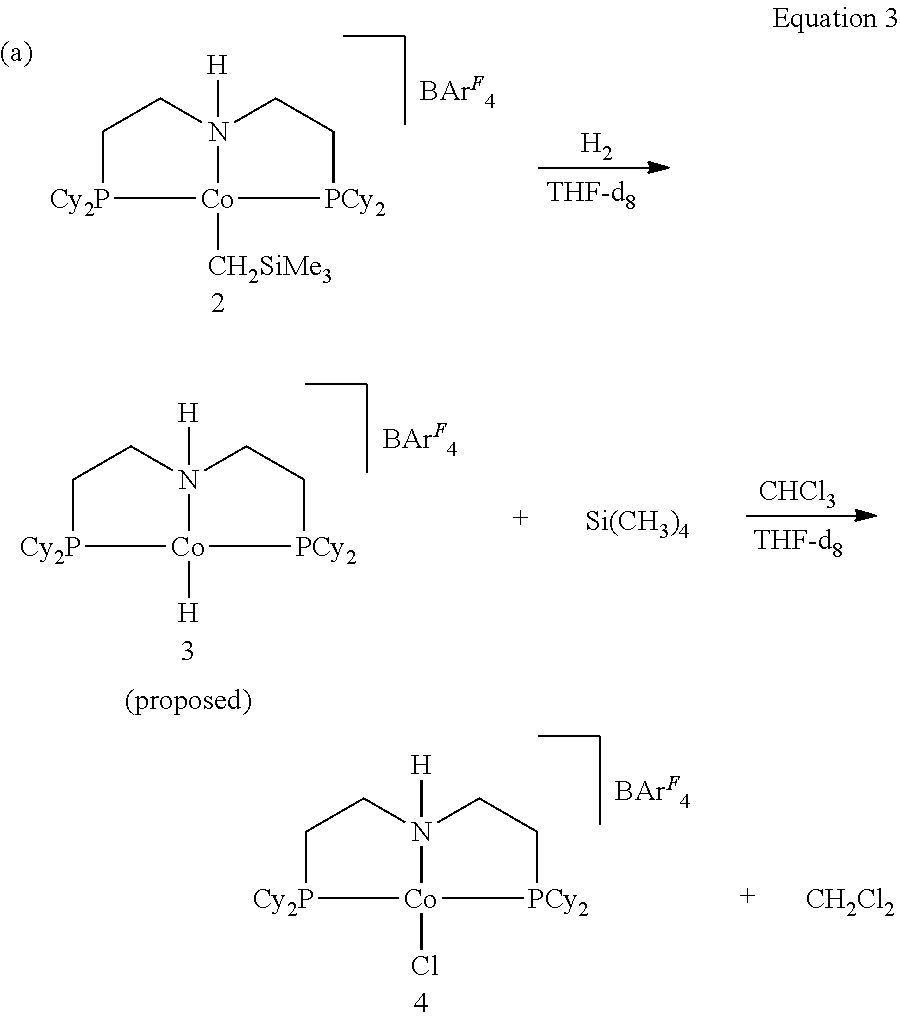
- the cobalt product of this reaction was isolated and identified as the cobalt(II) chloride complex [(PNHP Cy )Co(Cl)]BAr F 4 (4) by X-ray crystallography, IR spectroscopy, and elemental analysis.
- the formation of chloride complex 4 upon trapping with CHCl 3 implies that the hydride complex [(PNHP Cy )Co(H)]BAr F 4 (3) was formed upon the reaction of 2 with hydrogen (see Equation 3 below).
- Hydrogen (H 2 ) was added to a mixture of complex 1 and H[BAr F 4 ].(Et 2 O) 2 in THF-d and allowed to react at room temperature for 1 hour. The hydrogen was removed, and then a 1:1 mixture of cyclohexene-d 10 and 1-pentene was added. Within 30 minutes at room temperature, isomerization of the 1-pentene to 2-pentene was observed by 1 H NMR spectroscopy. In addition, deuterium from the cyclohexene-d 10 was scrambled into the 2-pentene and resonances corresponding to cyclohexene-d 10-n h n grew into the NMR spectrum, consistent with a pathway for isomerization involving a discreet metal-hydride intermediate. No deuterium exchange would be expected for the ⁇ -allyl mechanism.
- the hydrogen was removed by subjecting the solution to three consecutive cycles of freeze-pump-thaw, and then 1-octene (194 ⁇ L, 1.2 mmol) was added under argon. A 1 H NMR spectrum was recorded immediately after adding the 1-octene. After 20 minutes at room temperature, a 1 H NMR spectrum was recorded and the signals from the vinylic hydrogens from 1-octene had disappeared while new signals from the olefinic protons from the internal octene isomers had appeared.
- Table 5 summarizes data from additional reactions that were performed to explore the scope of hydrogenation reactions.
- Embodiment complexes of nickel may be used for catalytic hydrogenation.
- Embodiment complexes of nickel similar to those of the cobalt complexes were prepared and used for catalytic alkene hydrogenation under mild conditions. Experiments were performed to gain insight into the hydrogenation mechanism.
- the hexafluorophosphate derivate [(PNHP Cy )Ni(H)]PF 6 (6-PF 6 ) was prepared by using an analogous procedure (vide infra) and displays very similar NMR features.
- the X-ray structure of complex 6-PF 6 was obtained.
- the distance between the nickel and the central nitrogen of the pincer ligand (1.978(2) ⁇ ) is consistent with the nitrogen being protonated.
- the neutral hydride complex (PNP Cy )Ni(H) (7) was prepared by deprotonation complex 6 with KH (see Scheme 4).
- the IR spectrum of complex 7 shows a Ni—H stretch at 1811 cm 1 .
- Single crystals of complex 7 were grown from a concentrated diethyl ether solution. A single crystal X-ray diffraction structure of complex was also obtained.
- the distance between the nickel and the central nitrogen of the pincer ligand of complex 7 (1.876(2) ⁇ ) is significantly shorter than the Ni—N distance of complex 6 (1.978(2) ⁇ ).
- Cationic complex 6 and neutral complex 7 were evaluated for catalytic hydrogenation.
- complex 7 heating a benzene-d 6 solution of styrene under 4 atm H 2 with complex 7 (10 mol %) resulted in a 30% yield of ethylbenzene after 24 hours at 80° C. A somewhat higher conversion was observed in the hydrogenation of 1-octene using 7 (10 mol %), which afforded a mixture of n-octane (76%) and internal octene isomers (24%) after 24 hours at 80° C. No hydrogenation of 3,5-dimethoxybenzaldehyde or cinnamylaldehyde was observed using complex 7.
- the deuteride complex [(PNDP Cy )Ni(D)]PF 6 (6-d 2 ) was prepared, and a benzene-d 6 solution of 6-d 2 was treated with H 2 (1 atm). H-D gas was detected by 1 H NMR spectroscopy within 10 minutes at room temperature (Scheme 6), and the resonances corresponding to the Ni—H and N—H grew into the 1 H NMR spectrum of complex 6 over the course of 24 hours (25° C.).
- H-D gas suggests a reaction mechanism in which H 2 gas adds to the cationic nickel(II) center of 6-d 2 , as opposed to a mechanism involving elimination of D 2 from 6-d 2 followed by reaction with H 2 , which would not be expected to form H-D.
- Anhydrous grade THF, pentane, benzene, toluene, and diethyl ether were obtained from ALDRICH or ACROS and stored over 4 ⁇ molecular sieves.
- Bis[2-(dicyclohexylphosphino)ethyl]amine was purchased from STREM CHEMICAL, and nickel(II) bromide 2-methoxyethyl ether complex (Ni(diglyme)Br 2 ) was purchased from ALDRICH.
- Crystals suitable for X-ray diffraction were obtained by diffusion of diethyl ether into a toluene solution of 6-PF 6 at ⁇ 20° C.
- the tube was sealed while still cold, and then allowed to warm to room temperature, which resulted in a pressure of approximately 4 atm (the tube headspace was measured to be 2 mL, containing ⁇ 0.34 mmol H 2 ).
- the tube was heated at 80° C. and the reaction monitored by 1 H and 31 P NMR spectroscopy. At the end of the reaction, the product yields were determined by 1 H NMR (integration vs. the internal standard) and verified by GC-MS (comparison of retention time and mass to authentic samples). Hydrogenations with complex 7 were conducted using an analogous procedure in benzene-d 6 solvent.
- transition metal complexes of nickel or cobalt were used with hydrogen for the catalytic hydrogenation of unsaturated compounds.
- the complexes included a pincer ligand that may play a role in promoting the reaction.
Landscapes
- Chemical & Material Sciences (AREA)
- Organic Chemistry (AREA)
- Chemical Kinetics & Catalysis (AREA)
- Engineering & Computer Science (AREA)
- Inorganic Chemistry (AREA)
- Materials Engineering (AREA)
- Oil, Petroleum & Natural Gas (AREA)
- Organic Low-Molecular-Weight Compounds And Preparation Thereof (AREA)
Abstract
Description

These types of interactions between the metal and ligand might also be involved in catalytic hydrogenation of polar multiple bonds using complexes of precious metals.


or of the formula


Complex 2 was detected by 1H NMR spectroscopy in 90% yield (integration against an internal standard). Complex 2 was isolated in 85% yield and characterized by NMR and IR spectroscopy, X-ray crystallography, and elemental analysis. The 1H NMR spectrum of complex 2 showed a broad peak at −20.88 ppm corresponding to the Si(CH3)3 protons on the alkyl ligand, and the IR spectrum of 2 showed an N—H stretch at 3147 cm−1.

In the above equation, R1 and R2 are independently selected from hydrogen, alkyl, aryl, substituted alkyl, and substituted aryl groups. The hydrogenation reaction conditions included a substrate concentration of 0.5 millimolar in tetrahydrofuran (THF) solvent and 1 atmosphere H2 at 25° C. Results of the hydrogenation reactions are summarized in Table 1 below.
| TABLE 1 | ||||
| time | yield | |||
| Entry | substrate | product | (h) | (%) |
| 1 |  |  | 24 | 100 |
| 2 |  |  | 24 | 100 |
| 3 |  |  | 24 | 99 |
| 4 |  |  | 24 | 100 |
| 5 |  |  | 24 | 99 |
| 6 |  |  | 24 | 100 |
| 7 |  |  | 24 | 99 |
| 8 |  |  | 24 | 100 |
| 9 |  |  | 24 | 100 |
| 10 |  |  | 24 | 100 |
| 11 |  |  | 40 | 80 |
| 12 |  |  | 42 | 99 |
The yields of the hydrogenated products were determined by gas chromatography (GC). Hydrogenation of terminal alkenes such as 1-octene and α-methylstyrene proceeded readily within 24 hours at room temperature with excellent yields (see Table 1, entries 5-7). Internal alkenes trans-2-octene, cis-cyclooctene, and norbornylene were also hydrogenated at room temperature (see Table 1, entries 8-10). Hydrogenation of (R)-(+)-limonene occurred selectively at the terminal position; the internal tri-substituted C═C bond was not hydrogenated (see Table 1, entry 11). At room temperature, hydrogenation of (+)-dihydrocarvone occurred only at the C═C bond, affording 5-isopropyl-2-methylcyclohexanone in 99% yield (see Table 1, entry 12).

In the above equation, R1, R2, R3, and R4 are independently selected from hydrogen, alkyl, aryl, substituted alkyl, and substituted aryl groups. The hydrogenations of the aldehydes and ketones took place under mild conditions, which was unexpected in view of the mild reaction conditions and scarcity of reported cobalt complexes that hydrogenate aldehydes and ketones. The results for the aldehyde, ketone, and imine hydrogenations are summarized in Table 2.
| TABLE 2a | ||||
| isolated | ||||
| yield (%) | ||||
| time | (NMR | |||
| Entry | substrate | product | (h) | yield) |
| 1 |  |  | 24 | 89 (98) |
| 2c |  |  | 43 | 86 (94) |
| 3c |  |  | 24 | 92 (98) |
| 4c |  |  | 48 | 91 (99) |
| 5c |  |  | 48 | 97 (99) |
| 6c |  |  | 24 | 100f |
| 7d |  |  | 65 | 99f |
| 8 |  |  | 24 | 86 (92) |
| 9 |  |  | 24 | 96 (100) |
| 10b |  |  | 24 | 92 (98) |
| 11b |  |  | 24 | 91 (99) |
| 12e |  |  | 64 | 92 (100) |
| 13e |  |  | 42 | 84 (89) |
| 14e |  |  | 72 | 88 (98) |
| 15e |  |  | 48 | 65 (70) |
| aConditions: substrate 0.5 mmol in THF (2 mL), 1 atm H2, 25° C. | ||||
| bReactions run at 50° C. | ||||
| cReactions run at 60° C. | ||||
| dReactions run at 25° C. under 4 atm H2 pressure. | ||||
| eReactions run at 60° C. under 4 atm H2 pressure. | ||||
| fyields were determined by GC-MS. | ||||
As Table 2 shows, acetophenone (entry 1) was hydrogenated using complex 2 in nearly quantitative yield within 24 hours at room temperature 1 atm of hydrogen. Several substituted acetophenone derivatives were hydrogenated at 60° C. (1 atm H2), including 2-bromoacetophenone, 3-methoxyacetophenone, and α-trifluoromethylacetophenone (86-92% isolated yields, Table 2, entries 2-4). Aliphatic ketones 2-hexanone and 2-indanone were hydrogenated in high yields when the reaction was run at 60° C. (1 atm H2) for 24 hours and 48 hours, respectively (Table 2, entries 5-6). Aldehydes were also hydrogenated by in situ-generated complex 2 (2 mol %). Benzaldehyde and the substituted benzaldehydes 2-bromobenzaldehyde, 2-methoxybenzaldehyde, and 4-methoxybenzaldehyde were hydrogenated to the corresponding alcohols in excellent yields (86-96% isolated yields) within 24 hours under 1 atm of hydrogen (Table 2, entries 8-11). The unsubstituted aliphatic aldehyde 1-octanal was hydrogenated more slowly, affording 1-octanol in 92% isolated yield after 64 hours at 60° C. under 4 atm H2 (Table 2, entry 12). The effectiveness of cobalt complex 2 in hydrogenation reactions of aldehydes stands in contrast to the effectiveness of the known iron complex (PNPtBu)Fe(H)(CO)(Br) (PNPtBu=2,6-bis(di-tert-butylphosphinomethyl)pyridine). The iron complex was reported to be effective for the hydrogenation of a number of ketones; low conversion (39%) was reported for hydrogenation of benzaldehyde.
| TABLE 3 | ||||
| time | yield | |||
| Entry | substrate | product | (h) | (%) |
| 1 |
 |
 |
24 | 99 |
| 2a |
 |
 |
24 | 82 (99) |
| 3 |
 |
 |
24 | 99 |
| 4a |
 |
 |
65 | 66 |
| 5 |
 |
 |
24 | 99 |
Solutions containing complex 3 catalyzed alkene isomerization rapidly at room temperature. When 1-octene (200 equiv) was added to a degassed THF-d solution containing complex 3, complete isomerization at room temperature occurred within 20 minutes to afford a mixture of internal octenes.

Hydrogen (H2) was added to a mixture of complex 1 and H[BArF 4].(Et2O)2 in THF-d and allowed to react at room temperature for 1 hour. The hydrogen was removed, and then a 1:1 mixture of cyclohexene-d10 and 1-pentene was added. Within 30 minutes at room temperature, isomerization of the 1-pentene to 2-pentene was observed by 1H NMR spectroscopy. In addition, deuterium from the cyclohexene-d10 was scrambled into the 2-pentene and resonances corresponding to cyclohexene-d10-nhn grew into the NMR spectrum, consistent with a pathway for isomerization involving a discreet metal-hydride intermediate. No deuterium exchange would be expected for the π-allyl mechanism.

As Scheme 2 shows, hydrogenolysis of the cobalt(II) complex 2 generates cobalt(II) complex 3 and tetramethylsilane. Alkene insertion into the Co—H bond would afford a cobalt(II) alkyl intermediate, which could then react further with hydrogen to release product and turnover the catalyst.

In each case, the solvent was evaporated and the residue was passed through silica gel in a pipette (CH2Cl2 as an eluent), the crude product was evaporated to dryness and the 1H NMR spectra recorded in CDCl3. The yields of 1-phenylethanol were determined by integration of the 1H NMR spectra against the internal standard. Table 4 below shows results of the parallel experiments.
| TABLE 4 | |||||
| Entry | H2/atm | T/° C. | NMR yield (%) | ||
| 1 | 1 | 25 | 14 | ||
| 2 | 1 | 60 | 25 | ||
| 3 | 4 | 25 | 27 | ||
| TABLE 5 | ||||
| isolated | ||||
| yield (%) | ||||
| time | (NMR | |||
| Entry | substrate | product | (h) | yield) |
| 1b |
 |
 |
22 | (80%) |
| 2b |
 |
 |
24 | (93%) |
| 3 |
 |
 |
48 | 95% (100%) |
| 4c |
 |
 |
45 | 93% (99%) |
| 5c |
 |
 |
45 | 98% (99%) |
| 6c |
 |
 |
48 | 97% (99%) |


| TABLE 6 [a] | ||||
| Entry | Substrate | Product | Time (hours) | Yield (%) [b] |
| 1 |
 |
 |
24 | 100 |
| 2 |
 |
 |
24 | 70 |
| 3 |
 |
 |
48 | 97 |
| 4 |
 |
 |
48 | 48 |
| 5 |
 |
 |
24 | 5 |
| 6 |
 |
 |
24 | 10 |
| [a] Conditions: 80° C., 4 atm H2, THF-d8 solvent. | ||||
| [b] Yields were determined by 1H NMR spectroscopy (integration against an internal standard) and verified by GC-MS. | ||||

Complex 8-PF6 was isolated and characterized by NMR and IR spectroscopy. The 13C{1H} NMR spectrum of 8-PF6 included a triplet (JF—C=21 Hz) at −2.2 ppm for the carbon bound to the Ni center. The DEPT-135 NMR spectrum of 8-PF6 confirmed a 1,2-insertion of 1-octene into the Ni—H bond of 2-PF6. The preference for a 1,2-insertion rather than a 2,1-insertion are likely due to steric interactions between 1-octene with the bulky cyclohexyl-substituted phosphines from the pincer ligand.

Claims (19)


Priority Applications (2)
| Application Number | Priority Date | Filing Date | Title |
|---|---|---|---|
| US13/587,717 US9434666B2 (en) | 2012-08-16 | 2012-08-16 | Catalytic hydrogenation using complexes of base metals with tridentate ligands |
| US15/256,492 US9566577B1 (en) | 2012-08-16 | 2016-09-02 | Catalytic hydrogenation using complexes of base metals with tridentate ligands |
Applications Claiming Priority (1)
| Application Number | Priority Date | Filing Date | Title |
|---|---|---|---|
| US13/587,717 US9434666B2 (en) | 2012-08-16 | 2012-08-16 | Catalytic hydrogenation using complexes of base metals with tridentate ligands |
Related Child Applications (1)
| Application Number | Title | Priority Date | Filing Date |
|---|---|---|---|
| US15/256,492 Division US9566577B1 (en) | 2012-08-16 | 2016-09-02 | Catalytic hydrogenation using complexes of base metals with tridentate ligands |
Publications (2)
| Publication Number | Publication Date |
|---|---|
| US20150336862A1 US20150336862A1 (en) | 2015-11-26 |
| US9434666B2 true US9434666B2 (en) | 2016-09-06 |
Family
ID=54555558
Family Applications (2)
| Application Number | Title | Priority Date | Filing Date |
|---|---|---|---|
| US13/587,717 Expired - Fee Related US9434666B2 (en) | 2012-08-16 | 2012-08-16 | Catalytic hydrogenation using complexes of base metals with tridentate ligands |
| US15/256,492 Expired - Fee Related US9566577B1 (en) | 2012-08-16 | 2016-09-02 | Catalytic hydrogenation using complexes of base metals with tridentate ligands |
Family Applications After (1)
| Application Number | Title | Priority Date | Filing Date |
|---|---|---|---|
| US15/256,492 Expired - Fee Related US9566577B1 (en) | 2012-08-16 | 2016-09-02 | Catalytic hydrogenation using complexes of base metals with tridentate ligands |
Country Status (1)
| Country | Link |
|---|---|
| US (2) | US9434666B2 (en) |
Cited By (1)
| Publication number | Priority date | Publication date | Assignee | Title |
|---|---|---|---|---|
| US10106888B2 (en) * | 2014-08-04 | 2018-10-23 | Basf Se | Process for the generation of thin inorganic films |
-
2012
- 2012-08-16 US US13/587,717 patent/US9434666B2/en not_active Expired - Fee Related
-
2016
- 2016-09-02 US US15/256,492 patent/US9566577B1/en not_active Expired - Fee Related
Non-Patent Citations (97)
Cited By (1)
| Publication number | Priority date | Publication date | Assignee | Title |
|---|---|---|---|---|
| US10106888B2 (en) * | 2014-08-04 | 2018-10-23 | Basf Se | Process for the generation of thin inorganic films |
Also Published As
| Publication number | Publication date |
|---|---|
| US9566577B1 (en) | 2017-02-14 |
| US20150336862A1 (en) | 2015-11-26 |
Similar Documents
| Publication | Publication Date | Title |
|---|---|---|
| Zhang et al. | Electron-rich PNP-and PNN-type ruthenium (II) hydrido borohydride pincer complexes. Synthesis, structure, and catalytic dehydrogenation of alcohols and hydrogenation of esters | |
| Koehne et al. | Synthesis and structure of six-coordinate iron borohydride complexes supported by PNP ligands | |
| Bertoli et al. | PNP pincer osmium polyhydrides for catalytic dehydrogenation of primary alcohols | |
| Kim et al. | Iron complexes of 1, 1′-bis (diphenylphosphino) ferrocene (BPPF) as efficient catalysts in the synthesis of carbamates. X-ray crystal structure of (BPPF) Fe (CO) 3 | |
| Gao et al. | The interconversion of formic acid and hydrogen/carbon dioxide using a binuclear ruthenium complex catalyst | |
| Gruber et al. | Characterization and reactivity studies of dinuclear iridium hydride complexes prepared from iridium catalysts with N, P and C, N ligands under hydrogenation conditions | |
| Hernández‐Juárez et al. | Ruthenium (II) Complexes Containing Lutidine‐Derived Pincer CNC Ligands: Synthesis, Structure, and Catalytic Hydrogenation of C N bonds | |
| Çalık et al. | Ruthenium (II) complexes of NO ligands: Synthesis, characterization and application in transfer hydrogenation of carbonyl compounds | |
| EP2855494B1 (en) | Iron catalysts with unsymmetrical pnn'p ligands | |
| US20160326202A1 (en) | Iron(ii) catalysts containing tridentate pnp ligands, their synthesis, and use thereof | |
| Bianchini et al. | Electron-rich iridium complexes with mixed-donor polydentate ligands. Chemoselective catalysts in hydrogen-transfer reduction of. alpha.,. beta.-unsaturated ketones | |
| Dervisi et al. | Chiral Diphosphine ddppm‐Iridium Complexes: Effective Asymmetric Imine Hydrogenations at Ambient Pressures | |
| US8716507B2 (en) | Iron(II) catalysts containing diimino-diphosphine tetradentate ligands and their synthesis | |
| Ibrahim et al. | Palladium (II) based imines; synthesis, characterization, X-Ray structural analysis; DFT and catalytic hydrogenation study | |
| Patra et al. | Dehydrogenation of Formic Acid Catalyzed by Water‐Soluble Ruthenium Complexes: X‐ray Crystal Structure of a Diruthenium Complex | |
| Bossi et al. | Pincer Ru and Os complexes as efficient catalysts for racemization and deuteration of alcohols | |
| CA2428824C (en) | Process for hydrogenation of carbonyl and iminocarbonyl compounds using ruthenium catalysts comprising tetradentate diimino-diphosphine ligands | |
| Park et al. | Synthesis of new late transition metal P, P-, P, N-, and P, O-complexes using phosphonium dimers as convenient ligand precursors | |
| Colaiezzi et al. | Ruthenium (ii) arene complexes bearing simple dioxime ligands: effective catalysts for the one-pot transfer hydrogenation/N-methylation of nitroarenes with methanol | |
| Padwa et al. | Evidence for electron transfer in the photochemistry of. pi.-. pi.* triplet states | |
| US20020173683A1 (en) | Asymmetric hydrogenation catalysts and processes | |
| US9566577B1 (en) | Catalytic hydrogenation using complexes of base metals with tridentate ligands | |
| Tschan et al. | Highly Selective Hydrogenation of Carbon–Carbon Multiple Bonds Catalyzed by the Cation [(C6Me6) 2Ru2 (PPh2) H2]+: Molecular Structure of [(C6Me6) 2Ru2 (PPh2)(CHCHPh) H]+, a Possible Intermediate in the Case of Phenylacetylene Hydrogenation | |
| Chanerika et al. | Application of new Ru (II) pyridine‐based complexes in the partial oxidation of n‐octane | |
| Fryzuk et al. | Intramolecular C− H and N− H Transfer by Ruthenium (II) Amidophosphine Complexes |
Legal Events
| Date | Code | Title | Description |
|---|---|---|---|
| AS | Assignment |
Owner name: LOS ALAMOS NATIONAL SECURITY, LLC, NEW MEXICO Free format text: ASSIGNMENT OF ASSIGNORS INTEREST;ASSIGNORS:VASUDEVAN, KALYAN V.;ZHANG, GUOQI;HANSON, SUSAN K.;REEL/FRAME:031321/0426 Effective date: 20120816 |
|
| AS | Assignment |
Owner name: U.S. DEPARTMENT OF ENERGY, DISTRICT OF COLUMBIA Free format text: CONFIRMATORY LICENSE;ASSIGNOR:LOS ALAMOS NATIONAL SECURITY;REEL/FRAME:034071/0166 Effective date: 20141029 |
|
| ZAAA | Notice of allowance and fees due |
Free format text: ORIGINAL CODE: NOA |
|
| ZAAB | Notice of allowance mailed |
Free format text: ORIGINAL CODE: MN/=. |
|
| STCF | Information on status: patent grant |
Free format text: PATENTED CASE |
|
| AS | Assignment |
Owner name: TRIAD NATIONAL SECURITY, LLC, NEW MEXICO Free format text: ASSIGNMENT OF ASSIGNORS INTEREST;ASSIGNOR:LOS ALAMOS NATIONAL SECURITY, LLC;REEL/FRAME:047401/0957 Effective date: 20181022 |
|
| FEPP | Fee payment procedure |
Free format text: MAINTENANCE FEE REMINDER MAILED (ORIGINAL EVENT CODE: REM.); ENTITY STATUS OF PATENT OWNER: LARGE ENTITY |
|
| FEPP | Fee payment procedure |
Free format text: SURCHARGE FOR LATE PAYMENT, LARGE ENTITY (ORIGINAL EVENT CODE: M1554); ENTITY STATUS OF PATENT OWNER: LARGE ENTITY |
|
| MAFP | Maintenance fee payment |
Free format text: PAYMENT OF MAINTENANCE FEE, 4TH YEAR, LARGE ENTITY (ORIGINAL EVENT CODE: M1551); ENTITY STATUS OF PATENT OWNER: LARGE ENTITY Year of fee payment: 4 |
|
| FEPP | Fee payment procedure |
Free format text: MAINTENANCE FEE REMINDER MAILED (ORIGINAL EVENT CODE: REM.); ENTITY STATUS OF PATENT OWNER: LARGE ENTITY |
|
| LAPS | Lapse for failure to pay maintenance fees |
Free format text: PATENT EXPIRED FOR FAILURE TO PAY MAINTENANCE FEES (ORIGINAL EVENT CODE: EXP.); ENTITY STATUS OF PATENT OWNER: LARGE ENTITY |
|
| STCH | Information on status: patent discontinuation |
Free format text: PATENT EXPIRED DUE TO NONPAYMENT OF MAINTENANCE FEES UNDER 37 CFR 1.362 |
|
| FP | Lapsed due to failure to pay maintenance fee |
Effective date: 20240906 |