US9425413B2 - Conjugated side-strapped phthalocyanines and methods for producing and using the same - Google Patents
Conjugated side-strapped phthalocyanines and methods for producing and using the same Download PDFInfo
- Publication number
- US9425413B2 US9425413B2 US14/672,124 US201514672124A US9425413B2 US 9425413 B2 US9425413 B2 US 9425413B2 US 201514672124 A US201514672124 A US 201514672124A US 9425413 B2 US9425413 B2 US 9425413B2
- Authority
- US
- United States
- Prior art keywords
- strapped
- group
- formula
- moiety
- conjugated side
- Prior art date
- Legal status (The legal status is an assumption and is not a legal conclusion. Google has not performed a legal analysis and makes no representation as to the accuracy of the status listed.)
- Expired - Fee Related
Links
- 0 CCCC1C2(C(C)CC)*(C3)C3**C12 Chemical compound CCCC1C2(C(C)CC)*(C3)C3**C12 0.000 description 15
- LPZULXBILHUORS-UHFFFAOYSA-N CC(C)(C)C1=C/C2=CC=C3/C=C\C=C4\C=C/C(=C/1)C2=C34.CC(C)(C)C1=C2/C=C\C=C3\C=C/C4=C/C=C\C(=C1)C4=C23.CC(C)(C)C1=C2C=CC=CC2=CC2=C1C=CC=C2.CC(C)(C)C1=C2\C=C/C3=C/C=C\C4=CC=C(\C=C/1)C2=C43.CC(C)(C)C1=CC2=C(C=CC=C2)C=C1.CC(C)(C)C1=CC2=CC3=C(C=CC=C3)C=C2C=C1.CC(C)(C)C1=CC=CC2=C1C=CC=C2.CC(C)(C)C1=CC=CC2=CC3=C(C=CC=C3)C=C21 Chemical compound CC(C)(C)C1=C/C2=CC=C3/C=C\C=C4\C=C/C(=C/1)C2=C34.CC(C)(C)C1=C2/C=C\C=C3\C=C/C4=C/C=C\C(=C1)C4=C23.CC(C)(C)C1=C2C=CC=CC2=CC2=C1C=CC=C2.CC(C)(C)C1=C2\C=C/C3=C/C=C\C4=CC=C(\C=C/1)C2=C43.CC(C)(C)C1=CC2=C(C=CC=C2)C=C1.CC(C)(C)C1=CC2=CC3=C(C=CC=C3)C=C2C=C1.CC(C)(C)C1=CC=CC2=C1C=CC=C2.CC(C)(C)C1=CC=CC2=CC3=C(C=CC=C3)C=C21 LPZULXBILHUORS-UHFFFAOYSA-N 0.000 description 4
Images


Classifications
-
- H01L51/0078—
-
- C—CHEMISTRY; METALLURGY
- C07—ORGANIC CHEMISTRY
- C07D—HETEROCYCLIC COMPOUNDS
- C07D487/00—Heterocyclic compounds containing nitrogen atoms as the only ring hetero atoms in the condensed system, not provided for by groups C07D451/00 - C07D477/00
- C07D487/22—Heterocyclic compounds containing nitrogen atoms as the only ring hetero atoms in the condensed system, not provided for by groups C07D451/00 - C07D477/00 in which the condensed system contains four or more hetero rings
-
- H—ELECTRICITY
- H10—SEMICONDUCTOR DEVICES; ELECTRIC SOLID-STATE DEVICES NOT OTHERWISE PROVIDED FOR
- H10K—ORGANIC ELECTRIC SOLID-STATE DEVICES
- H10K85/00—Organic materials used in the body or electrodes of devices covered by this subclass
- H10K85/30—Coordination compounds
- H10K85/311—Phthalocyanine
-
- H01L51/4253—
-
- H—ELECTRICITY
- H10—SEMICONDUCTOR DEVICES; ELECTRIC SOLID-STATE DEVICES NOT OTHERWISE PROVIDED FOR
- H10K—ORGANIC ELECTRIC SOLID-STATE DEVICES
- H10K30/00—Organic devices sensitive to infrared radiation, light, electromagnetic radiation of shorter wavelength or corpuscular radiation
- H10K30/30—Organic devices sensitive to infrared radiation, light, electromagnetic radiation of shorter wavelength or corpuscular radiation comprising bulk heterojunctions, e.g. interpenetrating networks of donor and acceptor material domains
-
- H—ELECTRICITY
- H10—SEMICONDUCTOR DEVICES; ELECTRIC SOLID-STATE DEVICES NOT OTHERWISE PROVIDED FOR
- H10K—ORGANIC ELECTRIC SOLID-STATE DEVICES
- H10K30/00—Organic devices sensitive to infrared radiation, light, electromagnetic radiation of shorter wavelength or corpuscular radiation
- H10K30/50—Photovoltaic [PV] devices
-
- Y—GENERAL TAGGING OF NEW TECHNOLOGICAL DEVELOPMENTS; GENERAL TAGGING OF CROSS-SECTIONAL TECHNOLOGIES SPANNING OVER SEVERAL SECTIONS OF THE IPC; TECHNICAL SUBJECTS COVERED BY FORMER USPC CROSS-REFERENCE ART COLLECTIONS [XRACs] AND DIGESTS
- Y02—TECHNOLOGIES OR APPLICATIONS FOR MITIGATION OR ADAPTATION AGAINST CLIMATE CHANGE
- Y02E—REDUCTION OF GREENHOUSE GAS [GHG] EMISSIONS, RELATED TO ENERGY GENERATION, TRANSMISSION OR DISTRIBUTION
- Y02E10/00—Energy generation through renewable energy sources
- Y02E10/50—Photovoltaic [PV] energy
- Y02E10/549—Organic PV cells
Definitions
- the present invention relates to conjugated side-strapped phthalocyanines and methods for producing and using the same.
- conjugated side-strapped phthalocyanines of the invention are used in electronic devices such as p-type or n-type organic semiconductors.
- Phthalocyanines are promising organic semiconductors that can achieve high hole mobility due to their tight ⁇ - ⁇ stacking Modification with solubilizing groups increases their solubility in common organic solvents to enable purification, characterization and solvent processing. Unfortunately, however, the solubilizing substituents (usually electronically inert) tend to interfere with ⁇ - ⁇ stacking and thus significantly reduce hole mobility.
- phthalocyanines are used as the electron donating layer material in organic photovoltaic devices (OPV).
- OCV organic photovoltaic devices
- the mobility of free charge carrier (hole) within this layer greatly influences the overall efficiency of OPV.
- Some aspects of the invention provide phthalocyanines that can be readily produced, have a relative high hole mobility, and are solution processable.
- the present invention also provides a method for producing such phthalocyanines as well as electronic devices and compositions comprising such phthalocyanines.
- said method comprising:
- Suitable bases include relatively non-nucleophilic bases including organic amine compounds such as 1,8-diazabicyclo[5.4.0]undec-7-ene (DBU), triethylamine, diisopropylamine, alkylated diisopropylamine, and the like.
- organic amine compounds such as 1,8-diazabicyclo[5.4.0]undec-7-ene (DBU), triethylamine, diisopropylamine, alkylated diisopropylamine, and the like.
- Suitable solvents for the reaction include tetrahydrofuran, ether, dimethylformamide, alcohols (such as isopropanol, pentanol, butanol, etc.), carbon tretrachloride, toluene, xylene, and the like, as well as mixtures thereof.
- FIG. 1 shows one example (Compound 1) of a rigid “side-strapped” trans-A 2 B 2 Pc scaffold.
- X-ray thin film diffraction (see FIG. 3B ) data show monoclinic unit cells, two molecules per cell, with c-axis dimensions comparable to that indicated in the AFM data.
- FIG. 3A is a UV-Vis absorption spectra of thin-film of compound 1 in contrast with the solution spectrum showing the expected enhanced near-IR absorption in the condensed phase.
- FIG. 3B is an XRD of a drop cast thin film of 1 on Si before and after annealing (100° C., 30 min.).
- FIG. 4 shows one possible method of producing compounds of the invention.
- “click chemistry” approach to Class II dyes azides are coupled to acetylenic residues on scaffolds A-C of FIG. 7 (scaffold A shown) under CuAAC conditions to provide periphery moieties on the Pc/Nc.
- Illustrated in this Figure are the thiophene, benzothiadiazole, and fullerene moieties and analogs as active layer compatiblizers.
- FIG. 5 is a graph of frontier molecular orbital energies for scaffolds A-C ( FIG. 7 ) computed at the B3LYP/6-31G* level. A significant increase in IP was observed across the series, modulated by side-chain substituents in A and the imide moiety in B and C.
- FIG. 6 shows various device configurations to characterize the electrical properties of assemblies comprising a compound of the invention.
- Panel (A) shows a hole-only device consisting of high work function top (Au) and bottom (e.g. PEDOT:PSS on ITO) contacts.
- Panel (B) shows type I platforms involving either a PHJ configuration (shown here) or a BHJ configuration, where a compound of the invention is used as the sole donor layer.
- the PHJ configuration is used first, to ascertain degree of aggregation of a compound of the invention and its effect on rectification and OPV performance, moving later to BHJ configurations where optimization of dispersion of the donor/acceptor phases is achieved.
- Panel (C) shows a planar heterojunction configuration where an ultra-thin film of a compound of the invention is sandwiched between solution processed donor and acceptor layers—in this configuration thermal or solvent annealing initiates migration of the Pc/Nc layer into either the donor or acceptor layer, in a fashion that allows monitoring optically and electronically.
- Panel (D) shows the bulk heterojunction configuration where a compound of the invention donor is combined with donor polymer and acceptor.
- FIG. 7 shows one of the reaction schemes used to produce some of the compounds of the invention.
- Class I dyes (and precursors to Class II dyes) are produced by synthesis of trans-A 2 B 2 Pc/Nc scaffolds.
- Compounds A, B and C shows some of the different aromatic ring systems and substituents.
- FIG. 8 shows another reaction scheme that was used to produce various starting materials in preparation of compounds of the invention.
- BHJ Bulk-heterojunction organic solar cells have shown the highest efficiencies to date, using either single donor (D)/acceptor (A) heterojunction, or tandem OPVs with two spectrally complementary DA pairs. Extending their response to the near-IR, without a significant loss of V OC is challenging. Small molecule-based OPVs, using either crystalline, vacuum deposited dyes, or soluble small molecules, have recently shown improved efficiencies. The recent studies on DTS(PTTh 2 ) 2 /PC 70 BM OPVs with PCEs of now approaching 9% show that efficient OPVs are possible using small molecule donors and acceptors, with molecular architectures that ensure good charge mobilities in both the donor and acceptor domains.
- SMBHJ small molecule BHJ
- phthalocyanine compound refers to a compound having phthalocyanine as its core chemical structure, i.e., a compound having the following core structural formula:
- phthalocyanine compound also includes nathphalocyanine (“Nc”) compound in which the phenyl rings A, B, C and D are replaced with naphthyl rings. In some embodiments, compounds of the invention have 2-fold symmetry.
- conjugated side-strapped phthalocyanine compound refers to a phthalocyanine compound as disclosed herein that includes substituents whose ⁇ -electron system is conjugated with the ⁇ -electronic system of the core phthalocyanine moiety and links two adjacent phenyl rings (e.g., A with B, and/or B with C, and/or C with D and/or D with A, etc.) within the core phthalocyanine moiety.
- Titanyl phthalocyanine is one of several non-planar tri- and tetravalent Pcs, such as ClAlPc and ClInPc, that can show extensively red-shifted thin-film Q-band spectra. It would provide an excellent platform for small molecule active materials with extended near-IR response and high charge mobility, and has only recently has been explored in OPVs.
- TiOPc's condensed phase photoconductivity and near-IR absorptivity results from the non-planarity and dipolar character of the chromophore, which also leads to several known crystalline polymorphs (e.g., amorphous TiOPc, Phase I, Phase II, and the Y Phase) some of which significantly extend the Q-band absorbance well into the near-IR region and significantly improve its photoelectrical activity.
- crystalline polymorphs e.g., amorphous TiOPc, Phase I, Phase II, and the Y Phase
- Phase-II TiOPc also has a higher probability for exciton dissociation and higher charge (hole) mobilities necessary for increased OPV efficiency due to the relatively short intermolecular distances between adjacent TiOPc molecules observed in both convex and concave pairs of the triclinic unit cell.
- Theoretical models and photoconductivity studies with TiOPc predict that enhanced exciton diffusion lengths and charge mobilities occur in staggered cofacial geometries of Pc/Nc aggregates in general.
- Crystalline TiOPc is particularly insoluble necessitating relatively expensive and inherently low-throughput vapor deposition techniques to produce near-IR absorbing thin-films for incorporation into devices such as OPVs, precluding its incorporation into solution-processed devices. And while successful efforts have been made to obtain specific TiOPc polymorphs by varying vapor deposition processing conditions, success at polymorph control has not been obtained with soluble versions of TiOPc—all prior efforts towards obtaining near-IR absorbing polymorphs in solution-processed thin films of TiOPc derivatives have not produced the desired near-IR absorbing phases. This lack of control in obtaining the desired polymorphs in thin-films of soluble TiOPc derivatives severely limits use of these materials as active materials in solution processed OPVs and in related molecular electronic device platforms.
- Phthalocyanine compounds of the invention are useful as OPVs with good near-IR responsivity, and high V OC .
- Some phthalocyanine compounds of the invention comprise the phthalocyanine core structure, as described above, which is complexed to TiO or other metal complexing agents (typically tri- or tetravalent metals).
- Phthalocyanine compounds of the invention are based on a rigid, conjugated side-strapped Pc cores that incorporate several modular design elements.
- Class I and II materials require solubilizing groups in two of the four Pc quadrants with peripheral groups that provide (a) for processing into near-IR absorbing active layers (Type I); or (b) for their selective placement at donor host polymer/acceptor interfaces (ternary Type II OPVs).
- peripheral groups i.e., substituents on the phenyl rings A, B, C and/or D placed in opposed quadrants afford the overlap of the non-functionalized rings in adjacent Pc cores, mimicking the overlap in crystalline Phase II TiOPc.
- conjugated side-strapped phthalocyanine compounds of the invention results in aggregates with good near-IR absorptivity, and with molecular architectures with good dispersibility and good charge (hole) mobilities in the microscopic domains. Such properties are needed to ensure efficient photocurrent production (Type I), or nanometer-scale control over their placement at the interface between (host) donor domains and fullerene acceptor domains (Type II).
- the conjugated side-strapped phthalocyanine compounds of the invention provide control of the molecular overlap known to be important to near-IR spectral response and photoactivity while simultaneously providing for nanoscale mixing of the compound of the invention as a donor with fullerene acceptors (Class I dyes), and/or placement of the compound of the invention aggregated at a donor polymer/electron acceptor interface (Class II dyes), without loss of the intermolecular interactions in the host polymer or fullerene domains which are believed to be important for maintaining high charge mobilities and high open-circuit photovoltages (V OC ).
- Class I dyes fullerene acceptors
- Class II dyes donor polymer/electron acceptor interface
- the compounds of the invention provide a new approach to combining the high absorptivities and photochemical stability with a molecular structure that sustains solution processability and provides routes to “tape-like” aggregates with the high charge mobilities attributed to “staggered” Pc-Pc architectures.
- Compounds of the invention can be used, for example, in the creation of unique light absorbing molecular semiconductors, designed to enable two new types of solution processable organic solar cells (OPVs) with extended near-IR response and high open-circuit photovoltages (V OC ).
- Type I platforms combine electron donor dyes (soluble metal phthalocyanine compounds of the invention) with small molecule electron acceptors (two component OPVs).
- Type II platforms combine variants of these dyes as “guest dopants” in mixtures of small molecule electron acceptors and semiconducting host polymers (three component OPVs with “cascaded” energy levels, FIG. 2 ).
- Binary planar (PHJ) and bulk (BHJ) heterojunction OPVs (Type I) can be created using compounds of the invention and fullerene acceptors, enabling correlation of the offsets in frontier orbital energies which determine V OC and photocurrent production (J SC ), with OPV performance.
- Ternary heterojunctions (Type II) are designed to produce energy and charge transport “cascades” (energy transfer from host polymer or electron acceptor ⁇ guest dye, plus vectorial electron and hole transport in all phases).
- a conjugated side-strapped phthalocyanine compound of the invention is of the formula:
- conjugated side-strapped substituent refers to a moiety whose ⁇ -electron system is conjugated with the ⁇ -electronic system of the core phthalocyanine moiety and links two phenyl rings within the core phthalocyanine moiety; thus, forming in many instances a relatively rigid structure.
- alkyl refers to a saturated linear hydrocarbon moiety of one to twenty five, typically one to twelve, and often one to eight carbon atoms or a saturated branched hydrocarbon moiety of three to twenty five, typically three to twelve, and often three to eight carbon atoms.
- Exemplary alkyl group include, but are not limited to, methyl, ethyl, n-propyl, 2-propyl, tert-butyl, pentyl, and the like.
- aryl refers to a mono-, bi-, tri-, tetra-, or pentacyclic aromatic hydrocarbon moiety of 6 to 30 ring atoms which is optionally substituted with one or more, typically one, two, or three substituents within the ring structure. When two or more substituents are present in an aryl group, each substituent is independently selected.
- fused aryl is a subset of aryl group in which two or more aromatic rings are fused together.
- polymerizable group refers to vinyl, allyl, 4-styryl, acryloyl, methacroyl, epoxide (such as cyclohexene oxide), acrylonitrile, which may be polymerized by either a radical, cationic, or anionic polymerization; isocyanate, isothiocyanate, epoxides such that the polymerizable functionality may be copolymerized with difunctional amines or alcohols such as HO(CH 2 ) g OH, H 2 N(CH 2 ) g NH 2 , where g is an integer between 1 and 25; strained ring olefins such as dicyclopentadienyl, norbornenyl, and cyclobutenyl where the chromophore (i.e., phthalocyanine core moiety) is attached to any of the saturated carbon linkages in the strained ring olefins—the monomer may be polymer
- halo means a monocyclic or bicyclic aromatic moiety of 5 to 12 ring atoms containing one, two, or three ring heteroatoms selected from N, O, or S, the remaining ring atoms being C.
- heteroaryl includes, but is not limited to, pyridyl, furanyl, thiophenyl, thiazolyl, isothiazolyl, triazolyl, imidazolyl, isoxazolyl, pyrrolyl, pyrazolyl, pyrimidinyl, benzofuranyl, isobenzofuranyl, benzothiazolyl, benzoisothiazolyl, benzotriazolyl, indolyl, isoindolyl, benzoxazolyl, quinolyl, isoquinolyl, benzimidazolyl, benzisoxazolyl, benzothiophenyl, dibenzofuran, and benzodiazepin-2-one-5-yl, and the like.
- the conjugated side-strapped substituent is a moiety of the formula:
- R 1 and R 2 is independently hydrogen, C 1 -C 25 alkyl and C 1 -C 25 haloalkyl; or R x1 and R x2 together with the carbon atom to which they are attached to form aryl, heteroaryl, or heterocyclyl ring structure, each of which is optionally substituted.
- conjugated side-strapped phthalocyanine compounds of the invention include, but are not limited to, compounds of the formulas:
- M comprises a metal selected from the group consisting of vanadium, indium, gallium, aluminum, titanium, tin, lead, bismuth, manganese, and phosphorus.
- compositions comprising a conjugated side-strapped phthalocyanine compound that is solution processable.
- the conjugated side-strapped phthalocyanine compounds of the invention have a 2-fold symmetry.
- the conjugated side-strapped phthalocyanine compounds of the invention have a solubility in tetrahydrofuran (THF) of at least about 0.5 mole/L, typically at least about 1 mole/L, and often at least 5 mole/L.
- THF tetrahydrofuran
- the term “about” refers to ⁇ 20%, typically ⁇ 10%, and often ⁇ 5% of the numeric value.
- the conjugated side-strapped phthalocyanine compounds of the invention have a solubility in chloroform of at least about 0.5 mole/L, typically at least about 1 mole/L, and often at least 5 mole/L. In other embodiments, the conjugated side-strapped phthalocyanine compounds of the invention have a solubility in pyridine of at least about 0.5 mole/L, typically at least about 1 mole/L, and often at least 5 mole/L.
- conjugated side-strapped phthalocyanine compounds of the invention can be used in a wide variety of electronic devices.
- a thin film of conjugated side-strapped phthalocyanine compounds of the invention can be used in an electronic devices such as, but not limited to, an optoelectronic device, a photovoltaic, a semi-conductor, a solar cell, a field-effect transistor, organic light emitting diode, as well as other electronic devices that utilize a hole mobility.
- the hole mobility within a thin film produced from the conjugated side-strapped phthalocyanine compounds of the invention is at least about 0.10 cm 2 V ⁇ 1 s ⁇ 1 , typically at least about 0.50 cm 2 V ⁇ 1 s ⁇ 1 , often at least about 0.90 cm 2 V ⁇ 1 s ⁇ 1 , and most often at least about 0.95 cm 2 V ⁇ 1 s ⁇ 1 .
- a thin film produced from the conjugated side-strapped phthalocyanine compounds of the invention comprises ABAB stacking.
- the present invention also provides methods for producing and using the same.
- the invention also provides various electronic devices and/or components that comprise a conjugated side-strapped phthalocyanine compound of the invention. While a variety of synthetic methods can be used to produce conjugated side-strapped phthalocyanine compounds of the invention, one particular embodiment utilizes cyclization of alkyne bridged bisphthalonitriles, which were prepared through Sonogashira coupling reactions. Thin film of Pcs can be produced on highly ordered pyrolytic graphite (HOPG), which can be readily monitored using atomic force microscopy (“AFM”).
- HOPG highly ordered pyrolytic graphite
- AFM atomic force microscopy
- the conjugated side-strapped phthalocyanine compounds of the invention result in an ordered “plate-like” architecture of thin film on HOPG. In studies using conductive-AFM showed that a mobility (i.e., electron or hole mobility) within a thin film that is produced using the conjugated side-strapped
- M is a metal or a semi-metal coordinating complex.
- metal or semi-metal coordinating complex refers to a metal or a semi-metal that coordinates to the nitrogen atoms within the phthalocyanine core moiety.
- M is a trivalent or tetravalent metal or semi-metal coordinating complex.
- M comprises a transition metal or a semi-metal.
- si-metal refers to a chemical element that has properties in between those of metals and nonmetals. Specifically, the term “semi-metal” refers to boron, silicon, germanium, arsenic, antimony, tellurium, aluminum, selenium, polonium and astatine.
- M comprises an element selected from the group consisting of vanadium, indium, gallium, aluminum, titanium, tin, lead, bismuth, manganese, and phosphorus.
- the metal or the semi-metal can be an oxide, a halide, or a combination thereof.
- M can be titanium oxide (TiO), indium chloride (InCl), vanadium oxide (VO), gallium chloride (GaCl), and aluminum chloride (AlCl), etc.
- R W1 and R W2 form a conjugated side-strapped substituent.
- R E1 and R E2 form a conjugated side-strapped substituent.
- such a compound has 2-fold symmetry, i.e., the conjugated side-strapped substituents of R W1 and R W2 are identical to the conjugated side-strapped substituents of R E1 and R E2 .
- Such electronic devices comprise an optoelectronic device, a photovoltaic, a semi-conductor, a solar cell, a field-effect transistor, organic light emitting diode, or a combination thereof.
- Some of the advantages of the conjugated side-strapped phthalocyanine compounds of the invention include, but are not limited to, providing for the production of inexpensive, solution processable chromophores that possess strong absorption in the near-IR region of the solar spectrum (where ca. 40% or available current can be harvested) through self-organized aggregation, accompanied by resultant high charge and exciton mobility necessary for efficient solar electric conversion.
- the invention also provides a flexible synthetic and characterization strategy that provides a rapid synthesis of derivatives for structure property relationships to be investigated, and characterization in pure thin-film formats, to quantify near-IR photoelectric activities, segregation of dopant dyes (e.g., conjugated side-strapped phthalocyanine compound of the invention) to photoactive interfaces of host donor and acceptor materials in bulk-heterojunction films.
- dopant dyes e.g., conjugated side-strapped phthalocyanine compound of the invention
- Some of the discoveries by the present inventors that are disclosed herein include methods for producing novel near-IR absorbing conjugated side-strapped phthalocyanine compounds and thin film materials, and new OPV platforms using the same.
- near-IR dopants enhance spectral response.
- a guest, near-IR absorbing compound e.g., TiOPc
- Near-IR spectral response was added to the OPV because of the aggregation of that dye, which is not possible with many small molecule guest dyes.
- the interfaces formed between the donor/guest dye (i.e., molecule or compound) and acceptor/guest dye help to determine both V OC and J SC , and interface dipole effects at these interfaces (changing local vacuum levels) are believed to be critical in attempts to dope organic dyes into BHJ OPV device platforms.
- soluble TiOPc derivatives can be solution processed into near-IR active thin films.
- the present inventors have reported the preparation of soluble TiOPc derivatives, see J. Org. Chem., 2010, 75, 7893-7896, which is incorporated herein by reference in its entirety, and have recently extended this series to other tri- and tetravalent metal Pc/Ncs (e.g. VOPc, ClINc, ClGaPc, ClAlPc and naphthalocyanine (“Nc”) analogues) that have a similar molecular shape and potentially a similar morphology in the condensed phase. See, also, commonly assigned U.S. patent application Ser. No.
- Soluble TiOPc derivatives are active for solar electric conversion in the near-IR. Soluble TiOPc derivatives have been incorporated into both PHJ and BHJ OPVs with C 60 and PCBM as the acceptor materials, respectively. Thus, a similar method can be used to produce OPVs using compounds of the present invention. It should be noted that PHJ OPVs using a compound of the invention and C 60 electron acceptor layers showed good dark (diode) rectification, and reasonable V OC and J SC for the un-optimized OPVs. Successfully fabricated BHJ solar cells used soluble TiOPc a compound of the invention and PCBM as the acceptor.
- the deposition conditions were optimized at a 1:3 a compound of the invention/PCBM ratio that AFM confirmed led to a pattern of phase segregation characteristic of BHJ active layers.
- the V OC is (a) higher than the corresponding solution-processed PHJ device fabricated from a compound of the invention and (b) comparable to the vacuum-deposited PHJ fabricated from Phase-I of crystalline TiOPc.
- these cells showed only modest power conversion efficiencies, likely due to poor mobility of the active materials, they exhibited disproportionate solar electric conversion in the near-IR region as revealed by the absorbed photon to current efficiency (APCE) data.
- the near-IR absorbance band from the Phase II polymorph is low intensity in the absorbance spectrum, yet both the IPCE and the APCE spectrum revealed a significant contribution from this band at ca. 870 nm, indicating that this material is capable of significant solar electric energy conversion further into the near-IR than any known OPV active material to date.
- the compounds of the invention can be used in solar cells and OPVs and other electronic devices as discussed herein. Any of the methods known to one skilled in the art, including those disclosed above, can be used to produce various electronic devices comprising a compound of the invention.
- Compound 1 in FIG. 1 shows one particular example of a rigid “side-strapped” trans-A 2 B 2 phthalocyanine compound. Spectroscopic characterization of this compound revealed a typical Q-band solution spectrum with a bathochromic shift in the drop-cast thin film ( FIG. 3A ). AFM imaging of a drop cast film of 1 on HOPG ( FIG. 2 ) reveal microcrystalline layered structures with layer plane thicknesses of ca. 2.5 nm consistent with the “tape-like” orientations and close to the expected long-axis dimensions of this phthalocyanine compound.
- FIG. 3B suggest comparable c-axis dimensions to the layer-plane dimensions observed in the AFM images.
- Some of the possible variations of Compound 1 to modify the energetics, solubility, crystallinity, and solid state arrangement include (i) component A, where variation in attachment atoms (CH 2 , O, or S) can be used to modify energetics as well as packing geometry; (ii) component B where the benzene ring can be replaced with related structures including, but not limited to, moieties such as imide, phthalimide, thiadiazole, thiophene, etc.
- component C where the variation in valency of metal center (e.g., di-, tri- or tetravalent metal) affects chromophore stacking in condensed phase
- component D where unsubstituted regions ensure close packing of chromophores similar to crystalline TiOPc thereby providing coherent aggregation for high charge mobility
- component E where extended conjugation and non-peripheral substitution on Pc core modifies bandgap
- component F where the length and nature of side-chains can be used to modify or modulate solubility, crystallinity, crystalline morphology, and blending property with other active material phases.
- a modular synthetic strategy can be used to produce compounds of the invention including those having 2-fold symmetry.
- Compounds of the invention are (a) solution processable, (b) near-IR absorbing in aggregated condensed phase polymorphs similar to TiOPc, (c) capable of acting as the primary donor in Type I two-component OPVs (Class I dyes), and/or (d) equipped with electron acceptors and electron donors moieties, providing for selective solubility at donor polymer/electron acceptor interfaces in Type II ternary OPVs (Class II dyes).
- aggregates are designed to provide good near-IR photoactivity and coherence in the aggregate (“tape-like” structures) leading to high charge (hole) mobilities.
- phase separation motifs were characterized using combinations of transmission and reflectance UV-visible spectroscopies, X-ray diffraction, low angle X-ray scattering, and vibrational spectroscopies (IR, Raman).
- IR ultraviolet-visible spectroscopies
- X-ray diffraction X-ray diffraction
- low angle X-ray scattering IR, Raman
- vibrational spectroscopies IR, Raman
- near-IR absorbing refers to ability to absorb light having wavelength of about 700 nm or longer, typically about 800 nm or longer, and often about 1000 nm or longer, and extending to about 2500 nm (2.5 microns).
- compounds of the invention typically absorb wavelength of from about 200 nm to about 1000 nm, often from about 200 nm to about 800 nm, and more often from about 200 nm to about 750 nm.
- the compounds of the invention are used as dopants to produce p-type semiconductors or photovoltaics.
- P-type semiconductors have a larger hole concentration compared to electron concentration. It is believed that these holes are the majority carriers and electrons are the minority carriers.
- the compositions of the invention include intrinsic p-type or n-type semiconductors doped with a compound of the invention. It should be appreciated, however, in some instances, compounds of the invention can also be used to produce n-type semiconductors or photovoltaics.
- solar cells comprising a compound of the invention as dopants.
- Compounds of the invention can be synthesized using inter alia a general procedure disclosed in, for example, FIG. 7 and FIG. 8 . As can be seen, by changing the starting material one can synthesize a wide variety of compounds. Using similar procedures shown in FIG. 7 and FIG. 8 , a wide range of compounds of the invention can be prepared.
- FIG. 7 Three scaffolds of 2-fold symmetry compounds of the invention are illustrated for Class I and Class II dyes ( FIG. 7 ), each having “side-strapping” moieties, a term used to describe substituents that induce selective formation of the trans-A 2 B 2 chromophore architecture.
- Scaffolds A-C were prepared from rigid bisphthalonitriles 4, 6, and 8 (see FIG. 7 ), with the increased conjugation expected to enhance aggregation and lower the bandgap (increasing near-IR absorption).
- a wide range of transport HOMO energies are available through modulation of the R groups in A in combination with the imide bridges in B and C (vide infra, FIG. 4 ).
- Bisphthalonitriles 4, 6 and 8 provided the trans-A 2 B 2 Pc architectures selectively.
- Rigid bisphthalonitriles 4 can be prepared by Pd-catalyzed coupling of o-diethynyl benzene 3 with 3-iodophthalonitrile.
- Imide-containing bisphthalonitriles 6 and 8 can be prepared from 3,4-dibromophthalimide 5 and 3,4-dibromomaleimide 7, respectively, by Pd-catalyzed cross-coupling with trimethylsilylacetylene, followed by deprotection, and then a second Pd-catalyzed cross-coupling with 3-iodophthalonitrile. All bisphthalonitrile precursors can be prepared with several different peripheral R/R′ groups, including acetylene moieties for click chemistry.
- Naphthyl analogs can be prepared using the corresponding iodo- and nitronaphthalonitriles (not shown) which is obtainable from the hydroxyl compound (i.e., 1-hydroxynaphthalene, 2,3-dicarbonitrile).
- a library of compounds of the invention were and can be produced that include variation at the metal center M, e.g., by using metal sources Ti(OR) 4 , V(acac) 2 , AlCl 3 , GaCl 3 , and InCl 3 to produce a library of compounds comprising TiO, VO, ClAl, ClGa, and ClIn derivatives of compounds of the invention.
- a library of compounds of the invention comprising both phenyl or naphthyl ring system compounds can be produced.
- compounds whose substituent side chains R/R′ including alkyl, alkoxy, and perfluoroalkyl, as well as acetylenic moieties for click chemistry can also be produced.
- Class II Dyes Produced by Click Chemistry Modification of Class I Dyes.
- Donor-Pc-Acceptor Class II dyes are designed to act as compatibilizers of the donor and acceptor active materials and isolate at the D/A interface.
- Oligothiophene and thiophenyl benzo-thiodiazole (i.e. TBT) groups were used to determine compatibility with P3HT and PCDTBT donor polymers, respectively, and fullerene derivatives for compatibility with PCBM acceptor phases.
- TBT thiophenyl benzo-thiodiazole
- the copper(I)-catalyzed azide-alkyne cycloaddition (CuAAC) reaction was characterized by extraordinary reliability and functional group tolerance. This process has proven useful for the synthesis of novel materials, and has been demonstrated as a suitable reaction for Pc/Nc modification due to its extremely high yields and fidelity. Chromophores with peripheral acetylenic linkages from scaffolds A-C provided access to many new materials with different substituents on the side-strapped moieties via the corresponding azides. Selective silyl protecting group chemistry for the acetylenic moieties was employed to prepare the mixed “Donor-Pc-Acceptor” Class II dyes shown and related derivatives.
- chromophore scaffolds are substituted in the non-peripheral positions of the Pc/Nc core, which is known to significantly decrease the bandgap of Pc/Nc chromophores relative to peripheral substitution, although the effect on morphology of tetravalent MPc analogs is unknown.
- a non-peripherally substituted TiOPc derivatives were prepared that exhibited both a large bathochromic Q-band shift (850 nm in sol'n; 960 nm in thin-film) as well as crystallographic evidence of chromophore-chromophore interaction in the solid state. DFT calculations (B3YLP/6-31G*) suggested bandgap and FMO energies ( FIG.
- chromophores A were consistent with other TiOPcs (e.g., HOMO ca. 5.1 eV), with modulation provided by the side-chain substitution.
- the imide moieties in B and C modulated the predicted FMO energies to higher IP (HOMO ca. 5.7 and 5.9 eV, respectively), which for Type I OPVs lead to a substantially higher V OC than seen for the crystalline materials, and for Type II platforms, and allowed these guest dyes to be used in conjunction with high IP host polymers (e.g., PCDTBT), while introducing good near-IR response and retention of high V OC in the OPV platform.
- IP host polymers e.g., PCDTBT
- Thin-films were fabricated from all new materials on quartz substrates using spin-coating or casting (doctor-blading) techniques with variations in concentration, spin rate, solvent, and substrate pre-treatment. Visible-near-IR transmission and reflectance spectroscopies were used to characterize Q-band shape and position as a qualitative indicator of aggregation type, and the extent of conversion of these Pcs to Phase II-like polymorphs. Of particular interest are the orientations of these new Pc aggregates at 1-2 monolayer coverages, since these orientations help to determine photoelectrical activity and solution rates of electron transfer that are related to OPV performance.
- Ordered side-chain-modified Pc thin films can be deposited using Langmuir-Blodgett film compression and horizontal transfer which then provides known thickness films with reasonable long range order.
- 1-2 monolayer films of compounds of the invention can be formed on device-relevant hole-collection electrodes, and characterized the average orientation of these films, arising from measurements of absorbance dichroism (A TE /A TM ), as a function of deposition and post-deposition processing conditions (including thermal and solvent annealing treatments), and in the presence of fullerene acceptors in these thin films.
- X-ray reflectivity (XRR) studies are useful in suggesting orientation and packing geometries in Pc thin films whose optical and structural properties are more readily interrogated using both XRD and XRR.
- AFM studies are used to determine the degree of coherence in these thin-films and infer local ordering.
- side-strapped TiOPcs deposited on HOPG and clean Au substrates formed microcrystallites with the requisite layered structures, consistent with the “tape-like” orientations suggested in FIG. 2 , with layer plane separations close to the expected long-axis dimensions of these Pcs.
- X-ray thin film diffraction data showed monoclinic unit cells, two molecules per cell, with comparable c-axis dimensions to those suggested in the AFM data.
- IP ionization potential
- HOPG highly-ordered-pyrolitic-graphite
- UPS capabilities are used to determine the differences in HOMO and IP for these new assembles, relative to their crystalline counterparts, as a function of surface coverage, degree and type of aggregation, and when planar heterojunctions are formed with vacuum deposited C 60 over the Pc/Nc film, or when BHJ films are formed with soluble acceptors such as PCBM.
- UPS system permits spectral acquisition at very high sensitivity, with a dynamic range in cts/sec of at least 10 3 , full removal of satellite peaks, allowing one to characterize the energetic dispersity of the Pc or Nc HOMO peak, and to characterize “band-tailing” and mid-gap state formation as a function of the degree of aggregation and coherence, which can greatly affect the population of states that cause charge trapping and recombination in OPV platforms. Studies to determine the extent to which this band tailing is mitigated, or made worse in vacuum deposited BHJ Pc/C 60 platforms, is extrapolated as well to mixed Pc- or Nc/fullerene films.
- the differences in offsets in frontier orbital energies of these new Pc or Nc dyes are characterized as a function of coverage of a crystalline acceptor such as C 60 (PHJ platforms), or as a function of concentration of a soluble acceptor such as PCBM, where previous experiments have clearly shown that there can be significant interface dipoles formed at the D/A interface, resulting in significant shifts in local vacuum levels, and changes in the transport HOMO and LUMO levels of both D/A components, which ultimately control the probability of photocurrent formation, and open-circuit photovoltage.
- a crystalline acceptor such as C 60 (PHJ platforms)
- concentration of a soluble acceptor such as PCBM
- He(I) UPS is used as a means of estimation of the transport HOMO levels from both the target Pc/Nc systems, and these molecules as ultra-thin films in contact with a polymer host such as P3HT. It is desired to be able to ascertain whether the transport HOMO levels of the Pc/Nc aggregates are well matched to the same levels in the host donor polymer, since if they are not, there may be a substantial risk that a Pc/Nc aggregate located at a donor/acceptor interface will simply act as a charge trap and recombination center.
- the transport HOMO levels for crystalline TiOPc and ClInPc are well matched to those estimated for the donor polymer PCDTBT but higher than those reported for P3HT.
- optical and electrical properties of highest rated films comprising a compound of the invention was examined as isolated thin films on conductive substrates, and incorporated into either planar or bulk-heterojunction device formats.
- “Hole-only” device platforms ( FIG. 6 ) are created where the Class I or Class II Pc/Nc film was sandwiched between high work function contacts (e.g., ITO/PEDOT:PSS/Pc or Nc/MoOx/Ag) where current/voltage (J/V) curves are recorded as these devices are driven from ohmic into space-charge limited regimes (SCLC) providing estimates of hole-mobilities relative to established materials (e.g. P3HT films, vacuum deposited CuPc). These studies are especially desirable for Type I OPV platforms.
- high work function contacts e.g., ITO/PEDOT:PSS/Pc or Nc/MoOx/Ag
- J/V current/voltage
- both exciton dissociation and hole-transport in the Pc/Nc film are important to device performance, and need to be balanced with electron transport mobilities in the acceptor phase.
- Molecular structure, processing solvent, and temperature strongly influence molecular overlap, which impacts on charge mobilities in what is believed to be “tape-like” structures in coherent materials of the present invention.
- conducting (Pt) tip AFM of thin films of the Pc shown in FIG. 2 the J/V properties were mapped out at multiple positions on these thin films.
- OPV platforms include: (i) Type I PHJ configurations (shown in FIG. 6 , Panel B) or a BHJ configuration, where a compound of the invention was used as the sole donor layer. These platforms provide a convenient means to optically characterize the thin film during processing steps, and to optimize aggregation of a compound of the invention as a neat film, and in combination with the small molecule acceptor.
- the PHJ configuration is used to ascertain degree of aggregation of the compound of the invention and its effect on rectification and OPV performance, moving later to BHJ configurations where optimization of dispersion of the donor/acceptor phases is achieved.
- Thin Pc films are sandwiched between hole-selective interlayers, and a solution or vacuum-deposited acceptor layer.
- Compounds of the invention can be used to achieve long range order in these aggregates so as to facilitate both the desired spectral response, and adequate charge mobilities to balance those in the acceptor phase.
- Device platforms are configured to allow for transmission absorbance measurements at any stage of device formation, allowing characterization of the degree and type of aggregation of the compound of the invention.
- hole- and electron-selective interlayers, or interlayers which enhance hole- or electron-collection, is used to remove contact issues as limiters of J/V properties and OPV performance.
- This experiment focused on photocurrent efficiency spectra (incident photon current efficiency—IPCE and absorbed light current efficiency—APCE) in both Type I and II platforms. Structure of the compound of the invention was correlated to degree of aggregation in condensed phases (absorbance data), and efficiency of photocurrent production (IPCE and APCE spectra). Characterization of OPV platforms under simulated AM1.5 illumination conditions often fails to provide mechanistic information available from IPCE and APCE characterization, and it is desirable to quantify the percentage of photocurrent created from each aggregate type (Type I platforms), or the percentage of photocurrent created relative to the host polymer (Type II platforms). IPCE spectra shows how incident light efficiencies were dictated by polymorphic structure.
- APCE spectra provides more mechanistic detail—these spectra show the relative exciton dissociation efficiencies of absorbed light partitioned between different polymorphs, and often show that the highest photocurrent production probabilities belong to the near-IR absorbing polymorphs.
- IPCE and APCE spectra are collected at far reverse bias, where photo-generated charge carriers are harvested with insignificant recombination losses, and near the maximum power point, where photo-current generation competes with both bulk and surface recombination.
- Electron acceptors and contact/interlayer materials are used that maximize V OC , and interlayers on the hole-collection side which are high work function, and which facilitate efficient hole extraction. This experiment allows understanding of the science underpinning limitations to energy conversion efficiency, and V OC specifically, arising from hole- and electron-extracting contact materials.
Landscapes
- Chemical & Material Sciences (AREA)
- Organic Chemistry (AREA)
- Inorganic Chemistry (AREA)
- Engineering & Computer Science (AREA)
- Materials Engineering (AREA)
- Nitrogen Condensed Heterocyclic Rings (AREA)
Abstract

where each of the substituents are defined herein.
Description

said method comprising:
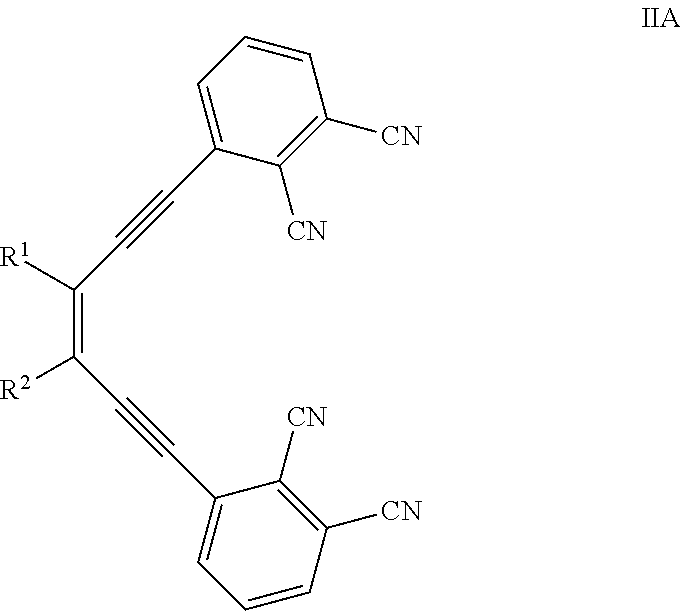
-
- with a metal salt in the presence of a base under conditions sufficient to produce the conjugated side-strapped phthalocyanine compound of Formula II.
wherein - M is a phthalocyanine coordinating moiety derived from said metal salt; and
- each of R1 and R2 is independently hydrogen, C1-C25 alkyl and C1-C25 haloalkyl;
- or R1 and R2 together with the carbon atom to which they are attached to form aryl, heteroaryl, or heterocyclyl ring structure, each of which is optionally substituted.
- with a metal salt in the presence of a base under conditions sufficient to produce the conjugated side-strapped phthalocyanine compound of Formula II.

where M is a metal or hydrogen. It should be appreciated that when M is hydrogen, two of the nitrogen atoms (i.e., ones in “A” and “C” rings) each have a separate hydrogen atom. It should be noted that unless explicitly stated or context requires otherwise, the term “phthalocyanine compound” also includes nathphalocyanine (“Nc”) compound in which the phenyl rings A, B, C and D are replaced with naphthyl rings. In some embodiments, compounds of the invention have 2-fold symmetry. The term “conjugated side-strapped phthalocyanine compound” refers to a phthalocyanine compound as disclosed herein that includes substituents whose π-electron system is conjugated with the π-electronic system of the core phthalocyanine moiety and links two adjacent phenyl rings (e.g., A with B, and/or B with C, and/or C with D and/or D with A, etc.) within the core phthalocyanine moiety.

wherein
-
- M is a phthalocyanine coordinating moiety
- at least one pair of RW1 and RW2, or RN1 and RN2, or RE1 and RE2, or RS1 and RS2 form a conjugated side-strapped substituent and the remaining are independently selected from the group consisting of:
- (i) H;
- (ii) C1-C25 alkyl;
- (iii) a moiety of the formula: —(CH2CH2O)a—(CH2)bORa1, —(CH2CH2O)a—(CH2)bNRa2Ra3, —(CH2CH2O)a—(CH2)bCONRa2Ra3, —(CH2CH2O)a—(CH2)bCN, —(CH2CH2O)a—(CH2)bCl, —(CH2CH2O)a—(CH2)bBr, —(CH2CH2O)a—(CH2)bI, —(CH2CH2O)a—(CH2)b-Phenyl, or —(CH2CH2O)a—(CH2)b-ethynyl;
- (iv) an aryl or a heteroaryl group of the formula

-
-
- wherein E is S, O, or NH, and RF1, RF2, RF3, RF4, RF5, RF6, RF7, and RF8 are independently selected from the group consisting of:
- (a) H;
- (b) C1-C25 alkyl;
- (c) a moiety of the formula: —(CH2CH2O)a—(CH2)bORa1, —(CH2CH2O)a—(CH2)bNRa2Ra3, —(CH2CH2O)a—(CH2)bCONRa2Ra3, —(CH2CH2O)a—(CH2)bCN, —(CH2CH2O)a—(CH2)bCl, —(CH2CH2O)a—(CH2)bBr, —(CH2CH2O)a—(CH2)bI, —(CH2CH2O)a—(CH2)b-Phenyl, or —(CH2CH2O)a—(CH2)b-ethynyl;
- (d) —NRe1Re2, —ORe3, and —SRe4;
- (e) an aryl or heteroaryl group; and
- (f) a polymerizable group;
- (v) a fused aromatic ring of the formula:
- wherein E is S, O, or NH, and RF1, RF2, RF3, RF4, RF5, RF6, RF7, and RF8 are independently selected from the group consisting of:
-

-
-
- (vi) a polymerizable group selected from the group consisting of vinyl, allyl, 4-styryl, acryloyl, methacroyl, epoxide, acrylonitrile, isocyanate, isothiocyanate, strained ring olefins; —(CH2)dSiCl3, —(CH2)dSi(OCH2CH3)3, and —(CH2)dSi(OCH3)3;
- (vii) halide; and
- (viii) —NRe1Re2, —ORe3, or —Re4;
- each of RA1, RA2, RB1, RB2, RC1, RC2, RD1 and RD2 is independently selected from the group consisting of:
- (i) H;
- (ii) C1-C25 alkyl;
- (iii) a moiety of the formula: —(CH2CH2O)a—(CH2)bORa1, —(CH2CH2O)a—(CH2)bNRa2Ra3, —(CH2CH2O)a—(CH2)bCONRa2Ra3, —(CH2CH2O)a—(CH2)bCN, —(CH2CH2O)a—(CH2)bCl, —(CH2CH2O)a—(CH2)bBr, —(CH2CH2O)a—(CH2)bI, —(CH2CH2O)a—(CH2)b-Phenyl, —(CH2CH2O)a—(CH2)b-ethynyl;
- (iv) an aryl or heteroaryl group of the formula
-

-
-
- wherein E is S, O, or NH, and RF1, RF2, RF3, RF4, RF5, RF6, RF7, and RF8 are independently selected from the group consisting of:
- (a) H;
- (b) C1-C25 alkyl;
- (c) a moiety of the formula: —(CH2CH2O)a—(CH2)bORa1, —(CH2CH2O)a—(CH2)bNRa2Ra3, —(CH2CH2O)a—(CH2)bCONRa2Ra3, —(CH2CH2O)a—(CH2)bCN, —(CH2CH2O)a—(CH2)bCl, —(CH2CH2O)a—(CH2)bBr, —(CH2CH2O)a—(CH2)bI, —(CH2CH2O)a—(CH2)b-Phenyl, or —(CH2CH2O)a—(CH2)b-ethynyl;
- (d) —NRe1Re2, —ORe3, and —SRe4;
- (e) an aryl or heteroaryl group; and
- (f) a polymerizable group;
- (v) a fused aromatic ring of the formula:
- wherein E is S, O, or NH, and RF1, RF2, RF3, RF4, RF5, RF6, RF7, and RF8 are independently selected from the group consisting of:
-

-
-
- (vi) a polymerizable group selected from the group consisting of vinyl, allyl, 4-styryl, acryloyl, methacroyl, epoxide, acrylonitrile, isocyanate, isothiocyanate, strained ring olefins; —(CH2)dSiCl3, —(CH2)dSi(OCH2CH3)3, and —(CH2)dSi(OCH3)3;
- (vii) halide;
- (viii) —NRe1Re2, —ORe3, or —SRe4;
- or each pair of RA1 and RA2, RB1 and RB2, RC1 and RC2, and RD1 and RD2 along with the carbon atom to which they are attached to form an optionally substituted phenyl ring moiety;
- a is an integer from 0 to 10;
- b is an integer from 1 to 25;
- d is an integer between 0 and 25;
- each of Re1, Re2, Re3, and Re4 is independently selected from the group consisting of:
- (a) H;
- (b) C1-C25 alkyl;
- (c) a moiety of the formula: —(CH2CH2O)a—(CH2)bORa1, —(CH2CH2O)a—(CH2)bNRa2Ra3, —(CH2CH2O)a—(CH2)bCONRa2Ra3, —(CH2CH2O)a—(CH2)bCN, —(CH2CH2O)a—(CH2)bCl, —(CH2CH2O)a—(CH2)bBr, —(CH2CH2O)a—(CH2)bI, —(CH2CH2O)a—(CH2)b-Phenyl, or —(CH2CH2O)a—(CH2)b-ethynyl;
- (d) an aryl or heteroaryl group; and
- (e) a polymerizable group; and
- each of Ra1, Ra2, and Ra3 is independently selected from the group consisting of H, C1-C25 alkyl and aryl.
-

wherein
-
- each of R1 and R2 is independently selected from the group consisting of:
- (a) H;
- (b) C1-C25 alkyl;
- (c) a moiety of the formula: —(CH2CH2O)a—(CH2)bORa1, —(CH2CH2O)a—(CH2)bNRa2Ra3, —(CH2CH2O)a—(CH2)bCONRa2Ra3, —(CH2CH2O)a—(CH2)bCN, —(CH2CH2O)a—(CH2)bCl, —(CH2CH2O)a—(CH2)bBr, —(CH2CH2O)a—(CH2)bI, —(CH2CH2O)a—(CH2)b-Phenyl, —(CH2CH2O)a—(CH2)b-ethynyl, wherein 0≦a≦10 and 1≦b≦25 and Ra1, Ra2, and Ra3 are independently selected from the group consisting of H, C1-C25 alkyl and aryl;
- (d) —NRe1Re2, —ORe3, and —SRe4, wherein Re1, Re2, Re3, and Re4 are independently selected from the group consisting of H, C1-C25 alkyl, and phenyl;
- (e) an aryl or heteroaryl group; and
- (f) a polymerizable group; or
- R1 and R2 together with the carbon atoms to which they are attached to form an aryl or a heteroaryl, each of which is optionally substituted.
Within these embodiments, in some instances, R1 and R2 together with the carbon atoms to which they are attached to form an optionally substituted phenyl. As used herein, the term “optionally substituted” means a moiety (e.g., phenyl ring) that may or may not be substituted. When the aryl or heteroaryl is substituted, it typically has one or more substituents, typically one, two or three substituents. In some cases, R1 and R2 together with the carbon atoms to which they are attached to form a phenyl group that is substituted with at least one substituent selected from the group consisting of: - (a) C1-C25 alkyl;
- (b) a moiety of the formula: —(CH2CH2O)a—(CH2)bORa1, —(CH2CH2O)a—(CH2)bNRa2Ra3, —(CH2CH2O)a—(CH2)bCONRa2Ra3, —(CH2CH2O)a—(CH2)bCN, —(CH2CH2O)a—(CH2)bCl, —(CH2CH2O)a—(CH2)bBr, —(CH2CH2O)a—(CH2)bI, —(CH2CH2O)a—(CH2)b-Phenyl, —(CH2CH2O)a—(CH2)b-ethynyl, wherein a is an integer from 0 to 10, b is an integer from 1 to 25 and Ra1, Ra2, and Ra3 are independently selected from the group consisting of H, C1-C25 alkyl and aryl;
- (c) —NRe1Re2, —ORe3, and —SRe4, wherein Re1, Re2, Re3, and Re4 are independently selected from the group consisting of H, C1-C25 alkyl, and phenyl;
- (d) an aryl or heteroaryl group; and
- (e) a polymerizable group.
- each of R1 and R2 is independently selected from the group consisting of:

where
-
- M, RN1, RN2, RS1, RS2, RA1, RA2, RB1, RB2, RC1, RC2, RD1 and RD2 are those defined herein;
- each of R1a, R1b, R1c, R1d, R2a, R2b, R2c, R2d, R3a and R4a is independently selected from the group consisting of hydrogen, C1-C25 alkyl and C1-C25 haloalkyl;
- each n is independently 0 or 1; and
- X is O or S.
Claims (13)


Priority Applications (1)
| Application Number | Priority Date | Filing Date | Title |
|---|---|---|---|
| US14/672,124 US9425413B2 (en) | 2014-03-29 | 2015-03-28 | Conjugated side-strapped phthalocyanines and methods for producing and using the same |
Applications Claiming Priority (2)
| Application Number | Priority Date | Filing Date | Title |
|---|---|---|---|
| US201461972230P | 2014-03-29 | 2014-03-29 | |
| US14/672,124 US9425413B2 (en) | 2014-03-29 | 2015-03-28 | Conjugated side-strapped phthalocyanines and methods for producing and using the same |
Publications (2)
| Publication Number | Publication Date |
|---|---|
| US20150280143A1 US20150280143A1 (en) | 2015-10-01 |
| US9425413B2 true US9425413B2 (en) | 2016-08-23 |
Family
ID=54191589
Family Applications (1)
| Application Number | Title | Priority Date | Filing Date |
|---|---|---|---|
| US14/672,124 Expired - Fee Related US9425413B2 (en) | 2014-03-29 | 2015-03-28 | Conjugated side-strapped phthalocyanines and methods for producing and using the same |
Country Status (1)
| Country | Link |
|---|---|
| US (1) | US9425413B2 (en) |
Cited By (1)
| Publication number | Priority date | Publication date | Assignee | Title |
|---|---|---|---|---|
| CN108682742A (en) * | 2018-05-25 | 2018-10-19 | 浙江大学 | A kind of efficient organic photovoltaic cell |
Families Citing this family (2)
| Publication number | Priority date | Publication date | Assignee | Title |
|---|---|---|---|---|
| KR20170114799A (en) * | 2016-04-06 | 2017-10-16 | 현대자동차주식회사 | A hole transporting material having high heat-resisting property, a perovskite solar cell comprising the same and a method of manufacturing the perovskite solar cell |
| WO2023157864A1 (en) * | 2022-02-18 | 2023-08-24 | 三菱ケミカル株式会社 | Organic semiconductor ink, organic film, photoelectric conversion layer, method for producing photoelectric conversion layer, and organic photoelectric conversion element |
-
2015
- 2015-03-28 US US14/672,124 patent/US9425413B2/en not_active Expired - Fee Related
Non-Patent Citations (1)
| Title |
|---|
| Kobayashi, N., "Adjacent versus opposite type di-aromatic ring-fused phthalocyanine derivatives: synthesis, spectroscopy, electrochemistry, and molecular orbital calculations." Journal of the American Chemical Society 124.27 (2002): 8007-8020. * |
Cited By (2)
| Publication number | Priority date | Publication date | Assignee | Title |
|---|---|---|---|---|
| CN108682742A (en) * | 2018-05-25 | 2018-10-19 | 浙江大学 | A kind of efficient organic photovoltaic cell |
| CN108682742B (en) * | 2018-05-25 | 2019-11-26 | 浙江大学 | A kind of efficient organic photovoltaic cell |
Also Published As
| Publication number | Publication date |
|---|---|
| US20150280143A1 (en) | 2015-10-01 |
Similar Documents
| Publication | Publication Date | Title |
|---|---|---|
| US10892421B2 (en) | Organic small molecule semiconducting chromophores for use in organic electronic devices | |
| Walker et al. | Small molecule solution-processed bulk heterojunction solar cells | |
| Li et al. | A simple perylene diimide derivative with a highly twisted geometry as an electron acceptor for efficient organic solar cells | |
| KR101548764B1 (en) | Electron donating organic material, material for photovoltaic element, and photovoltaic element | |
| US10665800B2 (en) | Inverted solar cell and process for producing the same | |
| CN104321894B (en) | Inertia solution processable molecule chromophore for organic electronic device | |
| Li et al. | Thermally stable high performance non-fullerene polymer solar cells with low energy loss by using ladder-type small molecule acceptors | |
| EP2072557A1 (en) | Electron-donating organic material for photovoltaic devices, material for photovoltaic devices, and photovoltaic devices | |
| US12534473B2 (en) | Methods for increasing efficiency and stability of organic perovskite materials | |
| Maddala et al. | Forming a metal-free oxidatively coupled agent, bicarbazole, as a defect passivation for htm and an interfacial layer in ap–i–n perovskite solar cell exhibits nearly 20% efficiency | |
| US9246106B2 (en) | Electron deficient molecules and their use in organic electronic applications | |
| CN101248542A (en) | Photoelectric conversion element | |
| US20130008503A1 (en) | Organic photovoltaic devices comprising solution-processed substituted metal-phthalocyanines and exhibiting near-ir photo-sensitivity | |
| Salunke et al. | N-substituted phenothiazines as environmentally friendly hole-transporting materials for low-cost and highly stable halide perovskite solar cells | |
| Adhikari et al. | Synthesis, characterization and photovoltaic performance of novel glass-forming perylenediimide derivatives | |
| Feng et al. | Carbon-chain length substituent effects on Cu (II) phthalocyanines as dopant-free hole-transport materials for perovskite solar cells | |
| Chiu et al. | Dual-functional enantiomeric compounds as hole-transporting materials and interfacial layers in perovskite solar cells | |
| Wang et al. | Platinum–acetylide polymers with higher dimensionality for organic solar cells | |
| US20150280143A1 (en) | Conjugated Side-Strapped Phthalocyanines and Methods For Producing and Using The Same | |
| Adhikari et al. | Efficiency enhancement of ternary blend organic photovoltaic cells with molecular glasses as guest acceptors | |
| Liang et al. | Donor–acceptor conjugates-functionalized zinc phthalocyanine: Towards broad absorption and application in organic solar cells | |
| US20210320270A1 (en) | Near-infrared ternary tandem solar cells | |
| US10566539B2 (en) | Organic semiconductor compounds and methods of use | |
| CA3157963A1 (en) | Polymeric photovoltaic cell with inverted structure comprising a conjugated polymer comprising an anthradithiophene derivative | |
| Xia et al. | Soluble acetylenic molecular glasses based on dithienyldiketopyrrolopyrrole for organic solar cells |
Legal Events
| Date | Code | Title | Description |
|---|---|---|---|
| AS | Assignment |
Owner name: THE ARIZONA BOARD OF REGENTS ON BEHALF OF THE UNIV Free format text: ASSIGNMENT OF ASSIGNORS INTEREST;ASSIGNORS:MCGRATH, DOMINIC V.;ARMSTRONG, NEAL R.;SIGNING DATES FROM 20150528 TO 20151113;REEL/FRAME:037195/0212 |
|
| STCF | Information on status: patent grant |
Free format text: PATENTED CASE |
|
| MAFP | Maintenance fee payment |
Free format text: PAYMENT OF MAINTENANCE FEE, 4TH YR, SMALL ENTITY (ORIGINAL EVENT CODE: M2551); ENTITY STATUS OF PATENT OWNER: SMALL ENTITY Year of fee payment: 4 |
|
| AS | Assignment |
Owner name: UNITED STATES DEPARTMENT OF ENERGY, DISTRICT OF COLUMBIA Free format text: CONFIRMATORY LICENSE;ASSIGNOR:UNIVERSITY OF ARIZONA;REEL/FRAME:052123/0430 Effective date: 20150420 |
|
| FEPP | Fee payment procedure |
Free format text: MAINTENANCE FEE REMINDER MAILED (ORIGINAL EVENT CODE: REM.); ENTITY STATUS OF PATENT OWNER: SMALL ENTITY |
|
| LAPS | Lapse for failure to pay maintenance fees |
Free format text: PATENT EXPIRED FOR FAILURE TO PAY MAINTENANCE FEES (ORIGINAL EVENT CODE: EXP.); ENTITY STATUS OF PATENT OWNER: SMALL ENTITY |
|
| STCH | Information on status: patent discontinuation |
Free format text: PATENT EXPIRED DUE TO NONPAYMENT OF MAINTENANCE FEES UNDER 37 CFR 1.362 |
|
| FP | Lapsed due to failure to pay maintenance fee |
Effective date: 20240823 |