US9422262B2 - Compounds and methods for treating diseases mediated by protease activated receptors - Google Patents
Compounds and methods for treating diseases mediated by protease activated receptors Download PDFInfo
- Publication number
- US9422262B2 US9422262B2 US13/825,574 US201113825574A US9422262B2 US 9422262 B2 US9422262 B2 US 9422262B2 US 201113825574 A US201113825574 A US 201113825574A US 9422262 B2 US9422262 B2 US 9422262B2
- Authority
- US
- United States
- Prior art keywords
- compound
- radicals
- substituted
- alkyl
- par1
- Prior art date
- Legal status (The legal status is an assumption and is not a legal conclusion. Google has not performed a legal analysis and makes no representation as to the accuracy of the status listed.)
- Active, expires
Links
- 0 CCCC.CCCC1=Cccc1 Chemical compound CCCC.CCCC1=Cccc1 0.000 description 10
- MOFSYUGAGGTVIT-UHFFFAOYSA-N CC(C)CC(=O)NC1=CC=CC(NC(=O)C2=C(Br)C=CC=C2)=C1 Chemical compound CC(C)CC(=O)NC1=CC=CC(NC(=O)C2=C(Br)C=CC=C2)=C1 MOFSYUGAGGTVIT-UHFFFAOYSA-N 0.000 description 5
- LLSVHLKJVSTBGP-UHFFFAOYSA-N CC(C)C(=O)NC1=CC=CC(NC(=O)C2=C(Br)C=CC=C2)=C1 Chemical compound CC(C)C(=O)NC1=CC=CC(NC(=O)C2=C(Br)C=CC=C2)=C1 LLSVHLKJVSTBGP-UHFFFAOYSA-N 0.000 description 4
- DFOVLSMXPWPCFH-UHFFFAOYSA-N CCCC(=O)NC1=CC=CC(NC(=O)C2=C(Br)C=CC=C2)=C1 Chemical compound CCCC(=O)NC1=CC=CC(NC(=O)C2=C(Br)C=CC=C2)=C1 DFOVLSMXPWPCFH-UHFFFAOYSA-N 0.000 description 4
- KFZQOHUNLMXCHS-UHFFFAOYSA-N CCCC(=O)NC1=CC=CC(NC(=O)C2=C(Cl)C=CC=C2)=C1 Chemical compound CCCC(=O)NC1=CC=CC(NC(=O)C2=C(Cl)C=CC=C2)=C1 KFZQOHUNLMXCHS-UHFFFAOYSA-N 0.000 description 4
- LVEKVBAHRHRUIT-UHFFFAOYSA-N CC1=C(C(=O)NC2=CC=CC(NC(=O)CC(C)C)=C2)C=CC=C1 Chemical compound CC1=C(C(=O)NC2=CC=CC(NC(=O)CC(C)C)=C2)C=CC=C1 LVEKVBAHRHRUIT-UHFFFAOYSA-N 0.000 description 3
- MRHAVVLJBCSEMH-UHFFFAOYSA-N CCC(=O)NC1=CC=CC(NC(=O)C2=C(Br)C=CC=C2)=C1 Chemical compound CCC(=O)NC1=CC=CC(NC(=O)C2=C(Br)C=CC=C2)=C1 MRHAVVLJBCSEMH-UHFFFAOYSA-N 0.000 description 3
- MMUAIYMVFBSGJT-UHFFFAOYSA-N CCCC(=O)NC1=CC(NC(=O)C2=CC=CN=C2)=CC=C1 Chemical compound CCCC(=O)NC1=CC(NC(=O)C2=CC=CN=C2)=CC=C1 MMUAIYMVFBSGJT-UHFFFAOYSA-N 0.000 description 3
- RPPUMKCUPRHAMR-UHFFFAOYSA-N CCCC(=O)NC1=CC=CC(NC(=O)C2=C(OC)C=CC=C2)=C1 Chemical compound CCCC(=O)NC1=CC=CC(NC(=O)C2=C(OC)C=CC=C2)=C1 RPPUMKCUPRHAMR-UHFFFAOYSA-N 0.000 description 3
- HEISHYRASLBIDO-UHFFFAOYSA-N CCCC(=O)NC1=CC=CC(NC(=O)C2=CC=C(OC)C=C2)=C1 Chemical compound CCCC(=O)NC1=CC=CC(NC(=O)C2=CC=C(OC)C=C2)=C1 HEISHYRASLBIDO-UHFFFAOYSA-N 0.000 description 3
- MWILORKNFDQMOT-UHFFFAOYSA-N CCCC(=O)NC1=CC=CC(NC(=O)C2=CC=CC(Cl)=C2)=C1 Chemical compound CCCC(=O)NC1=CC=CC(NC(=O)C2=CC=CC(Cl)=C2)=C1 MWILORKNFDQMOT-UHFFFAOYSA-N 0.000 description 3
- HBIOCMGAKWAVMI-UHFFFAOYSA-N CCCC(=O)NC1=CC=CC(NC(=O)C2=CC=CO2)=C1 Chemical compound CCCC(=O)NC1=CC=CC(NC(=O)C2=CC=CO2)=C1 HBIOCMGAKWAVMI-UHFFFAOYSA-N 0.000 description 3
- GSHBQNVGNFDHND-UHFFFAOYSA-N CCCCNC1=CC(NC(=O)C2=CC=CC=C2Br)=CC=C1.[H]Cl Chemical compound CCCCNC1=CC(NC(=O)C2=CC=CC=C2Br)=CC=C1.[H]Cl GSHBQNVGNFDHND-UHFFFAOYSA-N 0.000 description 3
- XQZSGWOACHZMLU-UHFFFAOYSA-N O=C(NC1=CC(NC(=O)C2CCCC2)=CC=C1)C1=C(Br)C=CC=C1 Chemical compound O=C(NC1=CC(NC(=O)C2CCCC2)=CC=C1)C1=C(Br)C=CC=C1 XQZSGWOACHZMLU-UHFFFAOYSA-N 0.000 description 3
- MDKLMYZRDBFPML-UHFFFAOYSA-N CC(=O)CC1=CC(CC(=O)C2=C(Cl)C=CC=C2)=CC=C1 Chemical compound CC(=O)CC1=CC(CC(=O)C2=C(Cl)C=CC=C2)=CC=C1 MDKLMYZRDBFPML-UHFFFAOYSA-N 0.000 description 2
- LCOIQQBRVWJDIX-UHFFFAOYSA-N CC(=O)NC1=CC=C(CC(=O)C2=C(Br)C=CC=C2)C=C1 Chemical compound CC(=O)NC1=CC=C(CC(=O)C2=C(Br)C=CC=C2)C=C1 LCOIQQBRVWJDIX-UHFFFAOYSA-N 0.000 description 2
- UAUZMIVRTXMDGE-UHFFFAOYSA-N CC(=O)NC1=CC=CC(NC(=O)C2=C(Br)C=CC=C2)=C1 Chemical compound CC(=O)NC1=CC=CC(NC(=O)C2=C(Br)C=CC=C2)=C1 UAUZMIVRTXMDGE-UHFFFAOYSA-N 0.000 description 2
- WLFFAEBDQNWOJY-UHFFFAOYSA-N CC(=O)NC1=CC=CC(NC(=O)C2=C(Cl)C=CC=C2)=C1 Chemical compound CC(=O)NC1=CC=CC(NC(=O)C2=C(Cl)C=CC=C2)=C1 WLFFAEBDQNWOJY-UHFFFAOYSA-N 0.000 description 2
- DKBKHUKEQPPZMV-UHFFFAOYSA-N CC(C)(C)C(=O)NC1=CC=CC(NC(=O)C2=C(Br)C=CC=C2)=C1 Chemical compound CC(C)(C)C(=O)NC1=CC=CC(NC(=O)C2=C(Br)C=CC=C2)=C1 DKBKHUKEQPPZMV-UHFFFAOYSA-N 0.000 description 2
- RKWJOISUERRNIK-UHFFFAOYSA-N CC(C)(C)C(=O)NC1=CC=CC(NC(=O)C2=CC=C(Br)C=C2)=C1 Chemical compound CC(C)(C)C(=O)NC1=CC=CC(NC(=O)C2=CC=C(Br)C=C2)=C1 RKWJOISUERRNIK-UHFFFAOYSA-N 0.000 description 2
- AFSMIDMUQZSSJU-UHFFFAOYSA-N CC(C)C(=O)NC1=CC=CC(NC(=O)C2=CC=C(Br)C=C2)=C1 Chemical compound CC(C)C(=O)NC1=CC=CC(NC(=O)C2=CC=C(Br)C=C2)=C1 AFSMIDMUQZSSJU-UHFFFAOYSA-N 0.000 description 2
- VORDYBZUNVJANZ-UHFFFAOYSA-N CC(C)CC(=O)NC1=CC=CC(NC(=O)C2=CC=C(Br)C=C2)=C1 Chemical compound CC(C)CC(=O)NC1=CC=CC(NC(=O)C2=CC=C(Br)C=C2)=C1 VORDYBZUNVJANZ-UHFFFAOYSA-N 0.000 description 2
- ZWCQPWZVVYEWMS-UHFFFAOYSA-N CCC(=O)CC1=CC(CC(=O)C2=C(Br)C=CC=C2)=CC=C1 Chemical compound CCC(=O)CC1=CC(CC(=O)C2=C(Br)C=CC=C2)=CC=C1 ZWCQPWZVVYEWMS-UHFFFAOYSA-N 0.000 description 2
- CERQRMSWDGHERQ-UHFFFAOYSA-N CCC(=O)NC1=CC=CC(NC(=O)C2=CC=C(Br)C=C2)=C1 Chemical compound CCC(=O)NC1=CC=CC(NC(=O)C2=CC=C(Br)C=C2)=C1 CERQRMSWDGHERQ-UHFFFAOYSA-N 0.000 description 2
- RCDPTAMTPYJELR-UHFFFAOYSA-N CCC(=O)Nc1cc(NC(=O)c2ccccc2C)ccc1C Chemical compound CCC(=O)Nc1cc(NC(=O)c2ccccc2C)ccc1C RCDPTAMTPYJELR-UHFFFAOYSA-N 0.000 description 2
- GISQYWWERMJPDT-UHFFFAOYSA-N CCC(C)(C)C(=O)NC1=CC(NC(=O)C2=CC=CC=C2Br)=CC=C1 Chemical compound CCC(C)(C)C(=O)NC1=CC(NC(=O)C2=CC=CC=C2Br)=CC=C1 GISQYWWERMJPDT-UHFFFAOYSA-N 0.000 description 2
- TYRNFFVYVNRRJK-UHFFFAOYSA-N CCC(C)C(=O)NC1=CC=CC(NC(=O)C2=C(Br)C=CC=C2)=C1 Chemical compound CCC(C)C(=O)NC1=CC=CC(NC(=O)C2=C(Br)C=CC=C2)=C1 TYRNFFVYVNRRJK-UHFFFAOYSA-N 0.000 description 2
- JYBVLDOXQGPOIP-UHFFFAOYSA-N CCC(C)C(=O)NC1=CC=CC(NC(=O)C2=CC=C(Br)C=C2)=C1 Chemical compound CCC(C)C(=O)NC1=CC=CC(NC(=O)C2=CC=C(Br)C=C2)=C1 JYBVLDOXQGPOIP-UHFFFAOYSA-N 0.000 description 2
- DZZOWPJIQLZYEX-UHFFFAOYSA-N CCCC(=O)CC1=CC(CC(=O)C2=C(Br)C=CC=C2)=CC=C1 Chemical compound CCCC(=O)CC1=CC(CC(=O)C2=C(Br)C=CC=C2)=CC=C1 DZZOWPJIQLZYEX-UHFFFAOYSA-N 0.000 description 2
- ITMKDHMXXRQLCM-UHFFFAOYSA-N CCCC(=O)CC1=CC(CC(=O)C2=CC3=CC=CC=C3N=C2)=CC=C1 Chemical compound CCCC(=O)CC1=CC(CC(=O)C2=CC3=CC=CC=C3N=C2)=CC=C1 ITMKDHMXXRQLCM-UHFFFAOYSA-N 0.000 description 2
- CLFZZVURFWKQNX-UHFFFAOYSA-N CCCC(=O)CC1=CC=CC(CC(=O)C2=CC=C(C(F)(F)F)C=C2)=C1 Chemical compound CCCC(=O)CC1=CC=CC(CC(=O)C2=CC=C(C(F)(F)F)C=C2)=C1 CLFZZVURFWKQNX-UHFFFAOYSA-N 0.000 description 2
- KMATXNTZJZNTCJ-UHFFFAOYSA-N CCCC(=O)CC1=CC=CC(CC(=O)C2=CC=C(S(C)(=O)=O)C=C2)=C1 Chemical compound CCCC(=O)CC1=CC=CC(CC(=O)C2=CC=C(S(C)(=O)=O)C=C2)=C1 KMATXNTZJZNTCJ-UHFFFAOYSA-N 0.000 description 2
- SPDIVFLWCOQVLB-UHFFFAOYSA-N CCCC(=O)N(C)C1=CC(NC(=O)C2=C(Br)C=CC=C2)=CC=C1 Chemical compound CCCC(=O)N(C)C1=CC(NC(=O)C2=C(Br)C=CC=C2)=CC=C1 SPDIVFLWCOQVLB-UHFFFAOYSA-N 0.000 description 2
- GDVAWBZTUFFZRQ-UHFFFAOYSA-N CCCC(=O)NC1=CC(NC(=O)C2=C(Br)C=CC=C2Cl)=CC=C1 Chemical compound CCCC(=O)NC1=CC(NC(=O)C2=C(Br)C=CC=C2Cl)=CC=C1 GDVAWBZTUFFZRQ-UHFFFAOYSA-N 0.000 description 2
- XHEGGWMBRCKWCR-UHFFFAOYSA-N CCCC(=O)NC1=CC(NC(=O)C2=C(C(=O)N(C)C)C=CC=C2)=CC=C1 Chemical compound CCCC(=O)NC1=CC(NC(=O)C2=C(C(=O)N(C)C)C=CC=C2)=CC=C1 XHEGGWMBRCKWCR-UHFFFAOYSA-N 0.000 description 2
- JXUFSTYXOGXEHR-UHFFFAOYSA-N CCCC(=O)NC1=CC(NC(=O)C2=C(C)C=CC=C2)=C(Cl)C=C1 Chemical compound CCCC(=O)NC1=CC(NC(=O)C2=C(C)C=CC=C2)=C(Cl)C=C1 JXUFSTYXOGXEHR-UHFFFAOYSA-N 0.000 description 2
- HWMWWZZCMNPRHB-UHFFFAOYSA-N CCCC(=O)NC1=CC(NC(=O)C2=C(C)C=CC=C2)=CC=C1.O=S=O Chemical compound CCCC(=O)NC1=CC(NC(=O)C2=C(C)C=CC=C2)=CC=C1.O=S=O HWMWWZZCMNPRHB-UHFFFAOYSA-N 0.000 description 2
- ODVXNNGBBRQYOW-UHFFFAOYSA-N CCCC(=O)NC1=CC(NC(=O)C2=C(C)C=CC=C2C)=CC=C1 Chemical compound CCCC(=O)NC1=CC(NC(=O)C2=C(C)C=CC=C2C)=CC=C1 ODVXNNGBBRQYOW-UHFFFAOYSA-N 0.000 description 2
- JHAWZIFGUYLONA-UHFFFAOYSA-N CCCC(=O)NC1=CC(NC(=O)C2=C(C3=CC=CC=C3)C=CC=C2)=CC=C1 Chemical compound CCCC(=O)NC1=CC(NC(=O)C2=C(C3=CC=CC=C3)C=CC=C2)=CC=C1 JHAWZIFGUYLONA-UHFFFAOYSA-N 0.000 description 2
- DUZNHIWRZJYIJY-UHFFFAOYSA-N CCCC(=O)NC1=CC(NC(=O)C2=C(CC)C=CC=C2)=CC=C1 Chemical compound CCCC(=O)NC1=CC(NC(=O)C2=C(CC)C=CC=C2)=CC=C1 DUZNHIWRZJYIJY-UHFFFAOYSA-N 0.000 description 2
- IPPUYYAQMZPBBL-UHFFFAOYSA-N CCCC(=O)NC1=CC(NC(=O)C2=C(Cl)C(Cl)=CC=C2)=CC=C1 Chemical compound CCCC(=O)NC1=CC(NC(=O)C2=C(Cl)C(Cl)=CC=C2)=CC=C1 IPPUYYAQMZPBBL-UHFFFAOYSA-N 0.000 description 2
- BYKXADYBFGJVQU-UHFFFAOYSA-N CCCC(=O)NC1=CC(NC(=O)C2=CC(C)=CC=C2Br)=CC=C1 Chemical compound CCCC(=O)NC1=CC(NC(=O)C2=CC(C)=CC=C2Br)=CC=C1 BYKXADYBFGJVQU-UHFFFAOYSA-N 0.000 description 2
- WHLLUZPQLKUHKL-UHFFFAOYSA-N CCCC(=O)NC1=CC(NC(=O)C2=CC(Cl)=CC=C2Br)=CC=C1 Chemical compound CCCC(=O)NC1=CC(NC(=O)C2=CC(Cl)=CC=C2Br)=CC=C1 WHLLUZPQLKUHKL-UHFFFAOYSA-N 0.000 description 2
- PSEPCRCESOAYGQ-UHFFFAOYSA-N CCCC(=O)NC1=CC(NC(=O)C2=CC(F)=CC=C2Br)=CC=C1 Chemical compound CCCC(=O)NC1=CC(NC(=O)C2=CC(F)=CC=C2Br)=CC=C1 PSEPCRCESOAYGQ-UHFFFAOYSA-N 0.000 description 2
- FALHMESLGKCEMH-UHFFFAOYSA-N CCCC(=O)NC1=CC(NC(=O)C2=CC=C(F)C=C2Br)=CC=C1 Chemical compound CCCC(=O)NC1=CC(NC(=O)C2=CC=C(F)C=C2Br)=CC=C1 FALHMESLGKCEMH-UHFFFAOYSA-N 0.000 description 2
- OKHYBENMQCYMIA-UHFFFAOYSA-N CCCC(=O)NC1=CC(NC(=O)C2=CC=CC(C3=CC=CC=C3)=C2)=CC=C1 Chemical compound CCCC(=O)NC1=CC(NC(=O)C2=CC=CC(C3=CC=CC=C3)=C2)=CC=C1 OKHYBENMQCYMIA-UHFFFAOYSA-N 0.000 description 2
- NXIVZMJVHPCNEP-UHFFFAOYSA-N CCCC(=O)NC1=CC(NC(=O)C2=CC=CC=C2C(F)(F)F)=CC=C1 Chemical compound CCCC(=O)NC1=CC(NC(=O)C2=CC=CC=C2C(F)(F)F)=CC=C1 NXIVZMJVHPCNEP-UHFFFAOYSA-N 0.000 description 2
- CJZXDTYDWGBOGT-UHFFFAOYSA-N CCCC(=O)NC1=CC(NCC2=CC=CC=C2Br)=CC=C1.[H]Cl Chemical compound CCCC(=O)NC1=CC(NCC2=CC=CC=C2Br)=CC=C1.[H]Cl CJZXDTYDWGBOGT-UHFFFAOYSA-N 0.000 description 2
- HYPODSLYJFELLV-UHFFFAOYSA-N CCCC(=O)NC1=CC=C(NC(=O)C2=CC=CC=C2Br)C=C1 Chemical compound CCCC(=O)NC1=CC=C(NC(=O)C2=CC=CC=C2Br)C=C1 HYPODSLYJFELLV-UHFFFAOYSA-N 0.000 description 2
- RHJDDSOFWLTLKX-UHFFFAOYSA-N CCCC(=O)NC1=CC=CC(N(C)C(=O)C2=CC=CC=C2Br)=C1 Chemical compound CCCC(=O)NC1=CC=CC(N(C)C(=O)C2=CC=CC=C2Br)=C1 RHJDDSOFWLTLKX-UHFFFAOYSA-N 0.000 description 2
- YGBASTQVLPQMPV-UHFFFAOYSA-N CCCC(=O)NC1=CC=CC(NC(=O)C2=C(C)C=CC=C2)=C1 Chemical compound CCCC(=O)NC1=CC=CC(NC(=O)C2=C(C)C=CC=C2)=C1 YGBASTQVLPQMPV-UHFFFAOYSA-N 0.000 description 2
- HFJNMIIIWALJJG-UHFFFAOYSA-N CCCC(=O)NC1=CC=CC(NC(=O)C2=C(F)C=CC=C2)=C1 Chemical compound CCCC(=O)NC1=CC=CC(NC(=O)C2=C(F)C=CC=C2)=C1 HFJNMIIIWALJJG-UHFFFAOYSA-N 0.000 description 2
- CDGDFVMDXZGNRI-UHFFFAOYSA-N CCCC(=O)NC1=CC=CC(NC(=O)C2=CC=C(Br)C=C2)=C1 Chemical compound CCCC(=O)NC1=CC=CC(NC(=O)C2=CC=C(Br)C=C2)=C1 CDGDFVMDXZGNRI-UHFFFAOYSA-N 0.000 description 2
- QTRNRQGVDJGESE-UHFFFAOYSA-N CCCC(=O)NC1=CC=CC(NC(=O)C2=CC=C(C)C=C2)=C1 Chemical compound CCCC(=O)NC1=CC=CC(NC(=O)C2=CC=C(C)C=C2)=C1 QTRNRQGVDJGESE-UHFFFAOYSA-N 0.000 description 2
- GMSICXYOVIHQBT-UHFFFAOYSA-N CCCC(=O)NC1=CC=CC(NC(=O)C2=CC=C(Cl)C=C2)=C1 Chemical compound CCCC(=O)NC1=CC=CC(NC(=O)C2=CC=C(Cl)C=C2)=C1 GMSICXYOVIHQBT-UHFFFAOYSA-N 0.000 description 2
- KHYMAAQGPMRMNW-UHFFFAOYSA-N CCCC(=O)NC1=CC=CC(NC(=O)C2=CC=C(F)C=C2)=C1 Chemical compound CCCC(=O)NC1=CC=CC(NC(=O)C2=CC=C(F)C=C2)=C1 KHYMAAQGPMRMNW-UHFFFAOYSA-N 0.000 description 2
- YRRQYXYXXFSQMP-UHFFFAOYSA-N CCCC(=O)NC1=CC=CC(NC(=O)C2=CC=CC(C#N)=C2)=C1 Chemical compound CCCC(=O)NC1=CC=CC(NC(=O)C2=CC=CC(C#N)=C2)=C1 YRRQYXYXXFSQMP-UHFFFAOYSA-N 0.000 description 2
- RXZXUBFAOKYIRX-UHFFFAOYSA-N CCCC(=O)NC1=CC=CC(NC(=O)C2=CC=CC(OC3=CC=CC=C3)=C2)=C1 Chemical compound CCCC(=O)NC1=CC=CC(NC(=O)C2=CC=CC(OC3=CC=CC=C3)=C2)=C1 RXZXUBFAOKYIRX-UHFFFAOYSA-N 0.000 description 2
- ZNGDDOMUNMUMMW-UHFFFAOYSA-N CCCC(=O)NC1=CC=CC(NC(=O)C2=CC=CC(S(C)(=O)=O)=C2)=C1 Chemical compound CCCC(=O)NC1=CC=CC(NC(=O)C2=CC=CC(S(C)(=O)=O)=C2)=C1 ZNGDDOMUNMUMMW-UHFFFAOYSA-N 0.000 description 2
- OKPZRQQNWQGJRJ-UHFFFAOYSA-N CCCC(=O)NC1=CC=NC(NC(=O)C2=CC=CC=C2Br)=C1 Chemical compound CCCC(=O)NC1=CC=NC(NC(=O)C2=CC=CC=C2Br)=C1 OKPZRQQNWQGJRJ-UHFFFAOYSA-N 0.000 description 2
- WHXVRJHJBFYPOK-UHFFFAOYSA-N CCCC(=O)Nc1ccc(Cl)c(NC(=O)c2ccccc2Br)c1 Chemical compound CCCC(=O)Nc1ccc(Cl)c(NC(=O)c2ccccc2Br)c1 WHXVRJHJBFYPOK-UHFFFAOYSA-N 0.000 description 2
- RXJOSQHGGKTFCL-UHFFFAOYSA-N CCCC(=O)Nc1cccc(C(=O)Cc2ccccc2Cl)c1 Chemical compound CCCC(=O)Nc1cccc(C(=O)Cc2ccccc2Cl)c1 RXJOSQHGGKTFCL-UHFFFAOYSA-N 0.000 description 2
- AKMWGEBAOLJYCR-UHFFFAOYSA-N CCCCC(=O)NC1=CC=CC(NC(=O)C2=C(Br)C=CC=C2)=C1 Chemical compound CCCCC(=O)NC1=CC=CC(NC(=O)C2=C(Br)C=CC=C2)=C1 AKMWGEBAOLJYCR-UHFFFAOYSA-N 0.000 description 2
- TWFUBPNBRYJIMX-UHFFFAOYSA-N CCCCC(=O)NC1=CC=CC(NC(=O)C2=C(Cl)C=CC=C2)=C1 Chemical compound CCCCC(=O)NC1=CC=CC(NC(=O)C2=C(Cl)C=CC=C2)=C1 TWFUBPNBRYJIMX-UHFFFAOYSA-N 0.000 description 2
- JLFAQIPOFDETCK-UHFFFAOYSA-N CCCCC(=O)NC1=CC=CC(NC(=O)C2=CC=C(Br)C=C2)=C1 Chemical compound CCCCC(=O)NC1=CC=CC(NC(=O)C2=CC=C(Br)C=C2)=C1 JLFAQIPOFDETCK-UHFFFAOYSA-N 0.000 description 2
- IDKBUWPDXJXIMJ-UHFFFAOYSA-N CCCCC(=O)c1cccc(NC(=O)c2ccccc2Cl)c1 Chemical compound CCCCC(=O)c1cccc(NC(=O)c2ccccc2Cl)c1 IDKBUWPDXJXIMJ-UHFFFAOYSA-N 0.000 description 2
- PKKFZXCPMFVXGX-UHFFFAOYSA-N CCOC(=O)NC1=CC=CC(NC(=O)C2=CC=CC=C2Br)=C1 Chemical compound CCOC(=O)NC1=CC=CC(NC(=O)C2=CC=CC=C2Br)=C1 PKKFZXCPMFVXGX-UHFFFAOYSA-N 0.000 description 2
- PIDIKIGPLOERQR-UHFFFAOYSA-N CN(C(=O)C1=CC=CC=C1Br)C1=CC(NC(=O)C2CCCC2)=CC=C1 Chemical compound CN(C(=O)C1=CC=CC=C1Br)C1=CC(NC(=O)C2CCCC2)=CC=C1 PIDIKIGPLOERQR-UHFFFAOYSA-N 0.000 description 2
- UUPVXTGPQCTIPT-UHFFFAOYSA-N COC1=CC=C(C(=O)NC2=CC(NC(=O)C3CCCC3)=CC=C2)C=C1 Chemical compound COC1=CC=C(C(=O)NC2=CC(NC(=O)C3CCCC3)=CC=C2)C=C1 UUPVXTGPQCTIPT-UHFFFAOYSA-N 0.000 description 2
- BOFZOFCSIFMCEB-UHFFFAOYSA-N O=C(CC1=CC=CC=C1)C1=C(Br)C=CC=C1 Chemical compound O=C(CC1=CC=CC=C1)C1=C(Br)C=CC=C1 BOFZOFCSIFMCEB-UHFFFAOYSA-N 0.000 description 2
- JIGXCVJIMTUCRT-UHFFFAOYSA-N O=C(NC1=CC(NC(=O)C2=CC=CC=C2Br)=CC=C1)C1=CC=CC=C1 Chemical compound O=C(NC1=CC(NC(=O)C2=CC=CC=C2Br)=CC=C1)C1=CC=CC=C1 JIGXCVJIMTUCRT-UHFFFAOYSA-N 0.000 description 2
- ROFBXPCCQBEMCJ-UHFFFAOYSA-N O=C(NC1=CC(NC(=O)C2CCCC2)=CC=N1)C1=CC=CC=C1Br Chemical compound O=C(NC1=CC(NC(=O)C2CCCC2)=CC=N1)C1=CC=CC=C1Br ROFBXPCCQBEMCJ-UHFFFAOYSA-N 0.000 description 2
- PXPSWEHXAIUUAY-UHFFFAOYSA-N O=C(NC1=CC(NC(=O)C2CCCCC2)=CC=C1)C1=C(Br)C=CC=C1 Chemical compound O=C(NC1=CC(NC(=O)C2CCCCC2)=CC=C1)C1=C(Br)C=CC=C1 PXPSWEHXAIUUAY-UHFFFAOYSA-N 0.000 description 2
- DLEAWMORWKAZPN-UHFFFAOYSA-N O=C(NC1=CC=CC(NC(=O)C2=C(Br)C=CC=C2)=C1)C1=CC=CS1 Chemical compound O=C(NC1=CC=CC(NC(=O)C2=C(Br)C=CC=C2)=C1)C1=CC=CS1 DLEAWMORWKAZPN-UHFFFAOYSA-N 0.000 description 2
- PTNGSFMIODILES-UHFFFAOYSA-N O=C(NC1=CC=NC(NC(=O)C2=CC=CC=C2Br)=C1)C1=CC=CC=C1 Chemical compound O=C(NC1=CC=NC(NC(=O)C2=CC=CC=C2Br)=C1)C1=CC=CC=C1 PTNGSFMIODILES-UHFFFAOYSA-N 0.000 description 2
- BAYUQUMNFQENJU-UHFFFAOYSA-N C.C.CC(C)CC(=O)Cl.CC(C)CC(=O)NC1=CC(NC(=O)C2=C(Br)C=CC=C2)=CC=C1.NC1=CC(NC(=O)C2=C(Br)C=CC=C2)=CC=C1.NC1=CC=CC([N+](=O)[O-])=C1.O=C(NC1=CC=CC([N+](=O)[O-])=C1)C1=C(Br)C=CC=C1.O=C(NC1=CC=CC([N+](=O)[O-])=C1)C1=C(Br)C=CC=C1.O=C(O)C1=C(Br)C=CC=C1.O=S(=O)=S(=O)=O.[Na][Na] Chemical compound C.C.CC(C)CC(=O)Cl.CC(C)CC(=O)NC1=CC(NC(=O)C2=C(Br)C=CC=C2)=CC=C1.NC1=CC(NC(=O)C2=C(Br)C=CC=C2)=CC=C1.NC1=CC=CC([N+](=O)[O-])=C1.O=C(NC1=CC=CC([N+](=O)[O-])=C1)C1=C(Br)C=CC=C1.O=C(NC1=CC=CC([N+](=O)[O-])=C1)C1=C(Br)C=CC=C1.O=C(O)C1=C(Br)C=CC=C1.O=S(=O)=S(=O)=O.[Na][Na] BAYUQUMNFQENJU-UHFFFAOYSA-N 0.000 description 1
- LRDBCHAIDDDMIZ-UHFFFAOYSA-N CBr.CBr.CBr.CBr.CBr.CBr.CC.CC(C)C1=C(Br)C=C(Br)C=C1.CC(C)C1=CC=CC2=C1C=CC=C2.CC(C)C1=CC=CC2=C1C=CC=N2.CC(C)C1=CC=CC2=C1C=CC=N2.CC(C)C1=CC=CC2=C1N=CC=C2.CC(C)C1=CC=CC2=C1N=CC=C2.CC(C)C1=CC=CC=C1.CC(C)C1=CC=CC=C1.CC(C)C1=CC=CC=C1.CC(C)C1=CC=CC=C1.CC(C)C1=CC=CC=C1.CC(C)C1=CC=CC=N1.CCl.CI.COC.COC.COC Chemical compound CBr.CBr.CBr.CBr.CBr.CBr.CC.CC(C)C1=C(Br)C=C(Br)C=C1.CC(C)C1=CC=CC2=C1C=CC=C2.CC(C)C1=CC=CC2=C1C=CC=N2.CC(C)C1=CC=CC2=C1C=CC=N2.CC(C)C1=CC=CC2=C1N=CC=C2.CC(C)C1=CC=CC2=C1N=CC=C2.CC(C)C1=CC=CC=C1.CC(C)C1=CC=CC=C1.CC(C)C1=CC=CC=C1.CC(C)C1=CC=CC=C1.CC(C)C1=CC=CC=C1.CC(C)C1=CC=CC=N1.CCl.CI.COC.COC.COC LRDBCHAIDDDMIZ-UHFFFAOYSA-N 0.000 description 1
- GFHONBIDVKUQJO-UHFFFAOYSA-N CC(C)CC(NC1=CC=CC(NC(=O)C2=C(Br)C=CC(F)=C2)=C1)C(F)(F)F Chemical compound CC(C)CC(NC1=CC=CC(NC(=O)C2=C(Br)C=CC(F)=C2)=C1)C(F)(F)F GFHONBIDVKUQJO-UHFFFAOYSA-N 0.000 description 1
- NTNRZXZCWQIHKZ-UHFFFAOYSA-N CC(C)CC(NC1=CC=CC(NC(=O)C2=C(Br)C=CC=C2)=C1)C(F)(F)F Chemical compound CC(C)CC(NC1=CC=CC(NC(=O)C2=C(Br)C=CC=C2)=C1)C(F)(F)F NTNRZXZCWQIHKZ-UHFFFAOYSA-N 0.000 description 1
- KMWBOEZCROWXNC-UHFFFAOYSA-N CC(C)CC(NC1=CC=CC(NC(=O)C2=C(F)C=CC=C2)=C1)C(F)(F)F Chemical compound CC(C)CC(NC1=CC=CC(NC(=O)C2=C(F)C=CC=C2)=C1)C(F)(F)F KMWBOEZCROWXNC-UHFFFAOYSA-N 0.000 description 1
- YCCCXGSGYTZAMW-UHFFFAOYSA-N CC(NC1=CC=CC(NC(=O)C2=C(OC(F)(F)F)C=CC=C2)=C1)C(F)(F)F Chemical compound CC(NC1=CC=CC(NC(=O)C2=C(OC(F)(F)F)C=CC=C2)=C1)C(F)(F)F YCCCXGSGYTZAMW-UHFFFAOYSA-N 0.000 description 1
- IRZFZPYQMFCAHO-UHFFFAOYSA-N CC.CC.CC(=O)NC1=CC=CC=C1.CNC(=O)C1=C(Br)C=CC=C1 Chemical compound CC.CC.CC(=O)NC1=CC=CC=C1.CNC(=O)C1=C(Br)C=CC=C1 IRZFZPYQMFCAHO-UHFFFAOYSA-N 0.000 description 1
- DFGSMMTVGNNIQB-UHFFFAOYSA-N CC1=C(C(=O)NC2=CC(NC(C3CCCC3)C(F)(F)F)=CC=C2)C=CC=C1 Chemical compound CC1=C(C(=O)NC2=CC(NC(C3CCCC3)C(F)(F)F)=CC=C2)C=CC=C1 DFGSMMTVGNNIQB-UHFFFAOYSA-N 0.000 description 1
- AFZMYSWXOXRTFQ-UHFFFAOYSA-N CC1=C(C(=O)NC2=CC(NC(CC(C)C)C(F)(F)F)=CC=C2)C=CC=C1 Chemical compound CC1=C(C(=O)NC2=CC(NC(CC(C)C)C(F)(F)F)=CC=C2)C=CC=C1 AFZMYSWXOXRTFQ-UHFFFAOYSA-N 0.000 description 1
- ZZFFDYBIXXJJNZ-UHFFFAOYSA-N CC1=CC(C(=O)NC2=CC(NC(CC(C)C)C(F)(F)F)=CC=C2)=C(Br)C=C1 Chemical compound CC1=CC(C(=O)NC2=CC(NC(CC(C)C)C(F)(F)F)=CC=C2)=C(Br)C=C1 ZZFFDYBIXXJJNZ-UHFFFAOYSA-N 0.000 description 1
- TYRPNFOYIDDTAN-UHFFFAOYSA-N CCC(=O)NC1=CC=CC(NC(=O)C2=CC=C(OC)C=C2)=C1 Chemical compound CCC(=O)NC1=CC=CC(NC(=O)C2=CC=C(OC)C=C2)=C1 TYRPNFOYIDDTAN-UHFFFAOYSA-N 0.000 description 1
- XPVPUCSWSVKIAF-UHFFFAOYSA-N CCC1=C(C(=O)NC2=CC(NC(C3CCCC3)C(F)(F)F)=CC=C2)C=CC=C1 Chemical compound CCC1=C(C(=O)NC2=CC(NC(C3CCCC3)C(F)(F)F)=CC=C2)C=CC=C1 XPVPUCSWSVKIAF-UHFFFAOYSA-N 0.000 description 1
- USCGDKICCHSHOL-UHFFFAOYSA-N CCC1=C(C(=O)NC2=CC(NC(CC(C)C)C(F)(F)F)=CC=C2)C=CC=C1 Chemical compound CCC1=C(C(=O)NC2=CC(NC(CC(C)C)C(F)(F)F)=CC=C2)C=CC=C1 USCGDKICCHSHOL-UHFFFAOYSA-N 0.000 description 1
- DRXFARCOYOPZDW-UHFFFAOYSA-N CCCC(=O)NC1=CC(N)=CC=C1 Chemical compound CCCC(=O)NC1=CC(N)=CC=C1 DRXFARCOYOPZDW-UHFFFAOYSA-N 0.000 description 1
- PLMDYLJQGLNCNY-UHFFFAOYSA-N CCCC(=O)NC1=CC=CC(NC(=O)C2=CC=CC=C2)=C1 Chemical compound CCCC(=O)NC1=CC=CC(NC(=O)C2=CC=CC=C2)=C1 PLMDYLJQGLNCNY-UHFFFAOYSA-N 0.000 description 1
- GNOBZRZZHUDKDQ-UHFFFAOYSA-N CCCC(NC1=CC=CC(NC(=O)C2=C(Br)C=CC=C2)=C1)C(F)(F)F Chemical compound CCCC(NC1=CC=CC(NC(=O)C2=C(Br)C=CC=C2)=C1)C(F)(F)F GNOBZRZZHUDKDQ-UHFFFAOYSA-N 0.000 description 1
- IMFBCRGABISVCN-UHFFFAOYSA-N CCCC(NC1=CC=CC(NC(=O)C2=C(C)C=CC=C2)=C1)C(F)(F)F Chemical compound CCCC(NC1=CC=CC(NC(=O)C2=C(C)C=CC=C2)=C1)C(F)(F)F IMFBCRGABISVCN-UHFFFAOYSA-N 0.000 description 1
- BJRKDGFRTLWAIM-UHFFFAOYSA-N CCCC(NC1=CC=CC(NC(=O)C2=C(F)C=CC=C2)=C1)C(F)(F)F Chemical compound CCCC(NC1=CC=CC(NC(=O)C2=C(F)C=CC=C2)=C1)C(F)(F)F BJRKDGFRTLWAIM-UHFFFAOYSA-N 0.000 description 1
- SBGLPXZELWMVGV-UHFFFAOYSA-N CCCC(Nc1cc(NC(c(cccc2)c2OC(F)(F)F)=O)ccc1)=O Chemical compound CCCC(Nc1cc(NC(c(cccc2)c2OC(F)(F)F)=O)ccc1)=O SBGLPXZELWMVGV-UHFFFAOYSA-N 0.000 description 1
- AKQHMZBAMLMVPJ-UHFFFAOYSA-N CCCCC(=O)NC1=CC=CC(NC(=O)C2=C(OC)C=CC=C2)=C1 Chemical compound CCCCC(=O)NC1=CC=CC(NC(=O)C2=C(OC)C=CC=C2)=C1 AKQHMZBAMLMVPJ-UHFFFAOYSA-N 0.000 description 1
- AOWNHAWMBIGDJY-UHFFFAOYSA-N CCCCC(=O)NC1=CC=CC(NC(=O)C2=CC=C(OC)C=C2)=C1 Chemical compound CCCCC(=O)NC1=CC=CC(NC(=O)C2=CC=C(OC)C=C2)=C1 AOWNHAWMBIGDJY-UHFFFAOYSA-N 0.000 description 1
- OQEFDPYWXDFMGT-UHFFFAOYSA-N COC1=CC=C(C(=O)NC2=CC(NC(=O)C(C)(C)C)=CC=C2)C=C1 Chemical compound COC1=CC=C(C(=O)NC2=CC(NC(=O)C(C)(C)C)=CC=C2)C=C1 OQEFDPYWXDFMGT-UHFFFAOYSA-N 0.000 description 1
- XUZQNLDUMVGGMT-UHFFFAOYSA-N COC1=CC=C(C(=O)NC2=CC(NC(=O)C(C)C)=CC=C2)C=C1 Chemical compound COC1=CC=C(C(=O)NC2=CC(NC(=O)C(C)C)=CC=C2)C=C1 XUZQNLDUMVGGMT-UHFFFAOYSA-N 0.000 description 1
- OJQAAFPAPKBWMH-UHFFFAOYSA-N COC1=CC=C(C(=O)NC2=CC(NC(=O)C3=CC=CO3)=CC=C2)C=C1 Chemical compound COC1=CC=C(C(=O)NC2=CC(NC(=O)C3=CC=CO3)=CC=C2)C=C1 OJQAAFPAPKBWMH-UHFFFAOYSA-N 0.000 description 1
- RFFDQRRHGVBOJG-UHFFFAOYSA-N COC1=CC=C(C(=O)NC2=CC(NC(=O)C3CC3)=CC=C2)C=C1 Chemical compound COC1=CC=C(C(=O)NC2=CC(NC(=O)C3CC3)=CC=C2)C=C1 RFFDQRRHGVBOJG-UHFFFAOYSA-N 0.000 description 1
- AKJCAIIKOCXZDR-UHFFFAOYSA-N COC1=CC=C(C(=O)NC2=CC(NC(=O)C3CCC3)=CC=C2)C=C1 Chemical compound COC1=CC=C(C(=O)NC2=CC(NC(=O)C3CCC3)=CC=C2)C=C1 AKJCAIIKOCXZDR-UHFFFAOYSA-N 0.000 description 1
- QKLIYLJSTYIEDI-UHFFFAOYSA-N COC1=CC=C(C(=O)NC2=CC(NC(=O)C3CCCCC3)=CC=C2)C=C1 Chemical compound COC1=CC=C(C(=O)NC2=CC(NC(=O)C3CCCCC3)=CC=C2)C=C1 QKLIYLJSTYIEDI-UHFFFAOYSA-N 0.000 description 1
- IVYWSOWWXLXCLS-UHFFFAOYSA-N COC1=CC=C(C(=O)NC2=CC(NC(C)=O)=CC=C2)C=C1 Chemical compound COC1=CC=C(C(=O)NC2=CC(NC(C)=O)=CC=C2)C=C1 IVYWSOWWXLXCLS-UHFFFAOYSA-N 0.000 description 1
- GTWWHWTYWCJNOY-UHFFFAOYSA-N NC1=CC(NC(=O)C2=C(Br)C=CC=C2)=CC=C1 Chemical compound NC1=CC(NC(=O)C2=C(Br)C=CC=C2)=CC=C1 GTWWHWTYWCJNOY-UHFFFAOYSA-N 0.000 description 1
- KLLMQOJLVAJZTL-UHFFFAOYSA-N O=C(CC1CC1)NC1=CC=CC(NC(=O)C2=C(Br)C=CC=C2)=C1 Chemical compound O=C(CC1CC1)NC1=CC=CC(NC(=O)C2=C(Br)C=CC=C2)=C1 KLLMQOJLVAJZTL-UHFFFAOYSA-N 0.000 description 1
- FUXJXOICERRTKT-UHFFFAOYSA-N O=C(CC1CCC1)NC1=CC=CC(NC(=O)C2=C(Br)C=CC=C2)=C1 Chemical compound O=C(CC1CCC1)NC1=CC=CC(NC(=O)C2=C(Br)C=CC=C2)=C1 FUXJXOICERRTKT-UHFFFAOYSA-N 0.000 description 1
- WFINWWNNTUJNFB-UHFFFAOYSA-N O=C(CC1CCCC1)NC1=CC=CC(NC(=O)C2=C(Br)C=CC=C2)=C1 Chemical compound O=C(CC1CCCC1)NC1=CC=CC(NC(=O)C2=C(Br)C=CC=C2)=C1 WFINWWNNTUJNFB-UHFFFAOYSA-N 0.000 description 1
- CQNWWSQUASKILT-UHFFFAOYSA-N O=C(CC1CCCCC1)NC1=CC=CC(NC(=O)C2=C(Br)C=CC=C2)=C1 Chemical compound O=C(CC1CCCCC1)NC1=CC=CC(NC(=O)C2=C(Br)C=CC=C2)=C1 CQNWWSQUASKILT-UHFFFAOYSA-N 0.000 description 1
- BUKIHGFLIZEZEA-UHFFFAOYSA-N O=C(NC1=CC(NC(=O)C2CC2)=CC=C1)C1=C(Br)C=CC=C1 Chemical compound O=C(NC1=CC(NC(=O)C2CC2)=CC=C1)C1=C(Br)C=CC=C1 BUKIHGFLIZEZEA-UHFFFAOYSA-N 0.000 description 1
- PLRLHXIYFWKPII-UHFFFAOYSA-N O=C(NC1=CC(NC(=O)C2CCC2)=CC=C1)C1=C(Br)C=CC=C1 Chemical compound O=C(NC1=CC(NC(=O)C2CCC2)=CC=C1)C1=C(Br)C=CC=C1 PLRLHXIYFWKPII-UHFFFAOYSA-N 0.000 description 1
- XPBOAJRNVJDYPD-UHFFFAOYSA-N O=C(NC1=CC(NC(C2CCCC2)C(F)(F)F)=CC=C1)C1=C(Br)C=CC=C1 Chemical compound O=C(NC1=CC(NC(C2CCCC2)C(F)(F)F)=CC=C1)C1=C(Br)C=CC=C1 XPBOAJRNVJDYPD-UHFFFAOYSA-N 0.000 description 1
- FWNHNUDMJPPIIO-UHFFFAOYSA-N O=C(NC1=CC=CC(NC(=O)C2=C(Br)C=CC=C2)=C1)C1=CC=CO1 Chemical compound O=C(NC1=CC=CC(NC(=O)C2=C(Br)C=CC=C2)=C1)C1=CC=CO1 FWNHNUDMJPPIIO-UHFFFAOYSA-N 0.000 description 1
- DNNLJAUSBBGVAZ-UHFFFAOYSA-N O=C(NC1=CC=CC(NC(=O)C2=C(Cl)C=CC=C2)=C1)C1=CC=CN1 Chemical compound O=C(NC1=CC=CC(NC(=O)C2=C(Cl)C=CC=C2)=C1)C1=CC=CN1 DNNLJAUSBBGVAZ-UHFFFAOYSA-N 0.000 description 1
- IGJTYECNPMHUEL-UHFFFAOYSA-N O=C(NC1=CC=CC(NC(=O)C2=C(Cl)C=CC=C2)=C1)C1=CC=CO1 Chemical compound O=C(NC1=CC=CC(NC(=O)C2=C(Cl)C=CC=C2)=C1)C1=CC=CO1 IGJTYECNPMHUEL-UHFFFAOYSA-N 0.000 description 1
- GRQYOUXMVUPVTN-UHFFFAOYSA-N O=C(NC1=CC=CC(NC(=O)C2=C(Cl)C=CC=C2)=C1)C1=CC=CS1 Chemical compound O=C(NC1=CC=CC(NC(=O)C2=C(Cl)C=CC=C2)=C1)C1=CC=CS1 GRQYOUXMVUPVTN-UHFFFAOYSA-N 0.000 description 1
Images


Classifications
-
- C—CHEMISTRY; METALLURGY
- C07—ORGANIC CHEMISTRY
- C07D—HETEROCYCLIC COMPOUNDS
- C07D333/00—Heterocyclic compounds containing five-membered rings having one sulfur atom as the only ring hetero atom
- C07D333/02—Heterocyclic compounds containing five-membered rings having one sulfur atom as the only ring hetero atom not condensed with other rings
- C07D333/04—Heterocyclic compounds containing five-membered rings having one sulfur atom as the only ring hetero atom not condensed with other rings not substituted on the ring sulphur atom
- C07D333/26—Heterocyclic compounds containing five-membered rings having one sulfur atom as the only ring hetero atom not condensed with other rings not substituted on the ring sulphur atom with hetero atoms or with carbon atoms having three bonds to hetero atoms with at the most one bond to halogen, e.g. ester or nitrile radicals, directly attached to ring carbon atoms
- C07D333/38—Carbon atoms having three bonds to hetero atoms with at the most one bond to halogen, e.g. ester or nitrile radicals
-
- A—HUMAN NECESSITIES
- A61—MEDICAL OR VETERINARY SCIENCE; HYGIENE
- A61K—PREPARATIONS FOR MEDICAL, DENTAL OR TOILETRY PURPOSES
- A61K31/00—Medicinal preparations containing organic active ingredients
- A61K31/33—Heterocyclic compounds
- A61K31/38—Heterocyclic compounds having sulfur as a ring hetero atom
- A61K31/381—Heterocyclic compounds having sulfur as a ring hetero atom having five-membered rings
-
- C—CHEMISTRY; METALLURGY
- C07—ORGANIC CHEMISTRY
- C07C—ACYCLIC OR CARBOCYCLIC COMPOUNDS
- C07C233/00—Carboxylic acid amides
- C07C233/88—Carboxylic acid amides having nitrogen atoms of carboxamide groups bound to an acyclic carbon atom and to a carbon atom of a six-membered aromatic ring wherein at least one ortho-hydrogen atom has been replaced
-
- C—CHEMISTRY; METALLURGY
- C07—ORGANIC CHEMISTRY
- C07D—HETEROCYCLIC COMPOUNDS
- C07D207/00—Heterocyclic compounds containing five-membered rings not condensed with other rings, with one nitrogen atom as the only ring hetero atom
- C07D207/02—Heterocyclic compounds containing five-membered rings not condensed with other rings, with one nitrogen atom as the only ring hetero atom with only hydrogen or carbon atoms directly attached to the ring nitrogen atom
- C07D207/30—Heterocyclic compounds containing five-membered rings not condensed with other rings, with one nitrogen atom as the only ring hetero atom with only hydrogen or carbon atoms directly attached to the ring nitrogen atom having two double bonds between ring members or between ring members and non-ring members
- C07D207/34—Heterocyclic compounds containing five-membered rings not condensed with other rings, with one nitrogen atom as the only ring hetero atom with only hydrogen or carbon atoms directly attached to the ring nitrogen atom having two double bonds between ring members or between ring members and non-ring members with hetero atoms or with carbon atoms having three bonds to hetero atoms with at the most one bond to halogen, e.g. ester or nitrile radicals, directly attached to ring carbon atoms
-
- C—CHEMISTRY; METALLURGY
- C07—ORGANIC CHEMISTRY
- C07D—HETEROCYCLIC COMPOUNDS
- C07D213/00—Heterocyclic compounds containing six-membered rings, not condensed with other rings, with one nitrogen atom as the only ring hetero atom and three or more double bonds between ring members or between ring members and non-ring members
- C07D213/02—Heterocyclic compounds containing six-membered rings, not condensed with other rings, with one nitrogen atom as the only ring hetero atom and three or more double bonds between ring members or between ring members and non-ring members having three double bonds between ring members or between ring members and non-ring members
- C07D213/04—Heterocyclic compounds containing six-membered rings, not condensed with other rings, with one nitrogen atom as the only ring hetero atom and three or more double bonds between ring members or between ring members and non-ring members having three double bonds between ring members or between ring members and non-ring members having no bond between the ring nitrogen atom and a non-ring member or having only hydrogen or carbon atoms directly attached to the ring nitrogen atom
- C07D213/60—Heterocyclic compounds containing six-membered rings, not condensed with other rings, with one nitrogen atom as the only ring hetero atom and three or more double bonds between ring members or between ring members and non-ring members having three double bonds between ring members or between ring members and non-ring members having no bond between the ring nitrogen atom and a non-ring member or having only hydrogen or carbon atoms directly attached to the ring nitrogen atom with hetero atoms or with carbon atoms having three bonds to hetero atoms with at the most one bond to halogen, e.g. ester or nitrile radicals, directly attached to ring carbon atoms
- C07D213/72—Nitrogen atoms
-
- C—CHEMISTRY; METALLURGY
- C07—ORGANIC CHEMISTRY
- C07D—HETEROCYCLIC COMPOUNDS
- C07D215/00—Heterocyclic compounds containing quinoline or hydrogenated quinoline ring systems
- C07D215/02—Heterocyclic compounds containing quinoline or hydrogenated quinoline ring systems having no bond between the ring nitrogen atom and a non-ring member or having only hydrogen atoms or carbon atoms directly attached to the ring nitrogen atom
- C07D215/16—Heterocyclic compounds containing quinoline or hydrogenated quinoline ring systems having no bond between the ring nitrogen atom and a non-ring member or having only hydrogen atoms or carbon atoms directly attached to the ring nitrogen atom with hetero atoms or with carbon atoms having three bonds to hetero atoms with at the most one bond to halogen, e.g. ester or nitrile radicals, directly attached to ring carbon atoms
- C07D215/48—Carbon atoms having three bonds to hetero atoms with at the most one bond to halogen
- C07D215/54—Carbon atoms having three bonds to hetero atoms with at the most one bond to halogen attached in position 3
-
- C—CHEMISTRY; METALLURGY
- C07—ORGANIC CHEMISTRY
- C07D—HETEROCYCLIC COMPOUNDS
- C07D307/00—Heterocyclic compounds containing five-membered rings having one oxygen atom as the only ring hetero atom
- C07D307/02—Heterocyclic compounds containing five-membered rings having one oxygen atom as the only ring hetero atom not condensed with other rings
- C07D307/34—Heterocyclic compounds containing five-membered rings having one oxygen atom as the only ring hetero atom not condensed with other rings having two or three double bonds between ring members or between ring members and non-ring members
- C07D307/56—Heterocyclic compounds containing five-membered rings having one oxygen atom as the only ring hetero atom not condensed with other rings having two or three double bonds between ring members or between ring members and non-ring members with hetero atoms or with carbon atoms having three bonds to hetero atoms with at the most one bond to halogen, e.g. ester or nitrile radicals, directly attached to ring carbon atoms
- C07D307/68—Carbon atoms having three bonds to hetero atoms with at the most one bond to halogen
Definitions
- This invention relates to the treatment of diseases mediated by protease activated receptors.
- Protease-activated receptors are a family of G protein-coupled receptors activated by the proteolytic cleavage of their N-terminal extracellular domain, exposing a new amino terminal sequence that functions as a tethered ligand to activate the receptors.
- PAR1, PAR2, PAR3 and PAR4 Four different PARs have been identified as PAR1, PAR2, PAR3 and PAR4, responding to a group of serine proteases. Modulation of PAR1-mediated signaling activities has several therapeutic applications. Interest in PAR-1 was initiated from its involvement in thrombin-induced activation of platelets.
- PAR-1 activation was found to mediate several processes in vascular biology, inflammation, malignancy, and tissue remodeling in normal development. Inhibition of PAR1 is helpful for treating thrombotic and vascular proliferative disorders as well as for inhibiting progression of cancers.
- PAR1 has been shown to be involved in a variety of primary human cancers including those of breast, colon, prostate, ovary and melanoma. (Zania et. al., 246-54; Wilson et. al., Cancer Res 2009, 69(7), 3188-3194; Gao et. al., Biol. Chem. 2010, 391, 803-812; Trivedi et.
- Platelets are key mediators of thrombosis. Drugs that interfere with platelet activation substantially improve survival in arterial thrombotic disease. (Dowal et. al., Current Vascular Pharmacology, 2010, 8, 140-154). In the case of thrombus formation, the activation of platelets is initiated through the thrombin receptor pathway. The SFLLRN peptide activates platelets through PAR1. Upon activation, the platelets undergo many changes induced by multiple signaling cascades. One downstream effect of activation is the secretion of granules, which then potentiates platelet functions in controlling bleeding. Granule secretion also contributes to the growth of thrombi.
- antiplatelet agents are presently under development including those directed at platelet adhesion proteins, those directed at signaling proteins, and those directed at ligand binding sites on GPCRs.
- Another strategy for developing improved antiplatelet reagents directed at GPCRs is to develop drugs that act via mechanisms other than competitive antagonism at the ligand binding site. Allosteric modulators can bind GPCRs outside of the ligand binding site and induce a conformational change in the receptor. Pharmacological properties of such modulators suggest that they may have favorable therapeutic indices and increased specificity compared with competitive antagonists.
- reagents that target intracellular loops of GPCRs have been developed and may prove to be useful reagents for modulating GPCR signaling. (Dowal et al.).
- Nishida et al. discloses morpholine compounds as factor IXa inhibitors and for the treatment of blood coagulation.
- Bauer et al. discloses a series of menthol substituted antithrombotic agents.
- Folkes et al. discloses a group of inhibitors of plasminogen activator inhibitor-1 for the treatment of thrombotic disorders.
- Beight et al. discloses dibenzoylbenzediamines as antithrombotic agents. (WO 1999/00127).
- the invention relates to the treatment of protease-activated receptor mediated diseases by the administration of a compound of Formula I or a prodrug or metabolite thereof:
- each X 1 , X 2 and X 3 is independently selected from absent, —[C(R 10 )(R 11 )] v —, —S—, —O—, —C(R 12 ) ⁇ C(R 13 )—, —C(OR 15 )(R 14 )—, —N(R 16 )— and —C(O)—;
- the invention provides a method for treating PAR-mediated diseases by administration of compounds of Formula I.
- the compounds of Formula I inhibit platelet activation.
- FIG. 1 (A) Compound-1 inhibits platelet activation induced through PAR1 selectively without inhibiting activation through PAR4; (B) Compound-1 inhibits PAR1 induced activation of HEK293 cells transfected with rPAR1; (C) Compound-1 inhibits PAR1 mediated, but not GTP- ⁇ -S mediated platelet activation in permeabilized platelets.
- FIG. 2 Compound-1 demonstrates non-competitive inhibition of PAR1-mediated platelet activation.
- FIG. 3 Compound-1 inhibits G ⁇ q, but not G ⁇ 12 , downstream of PAR1 activation.
- A Compound-1 blocks platelet aggregation, but not shape change. Both aggregation and shape change are inhibited in the presence of Compound-1 plus Y27632 (CAS Number: 331752-47-7) or 3,5-difluoro aminoisoxazole.
- Compound 1 fails to inhibit SFLLRN-induced TER in MDCK cells (B), but inhibits SFLLRN-induced Ca2+ flux (C).
- FIG. 4 (A) PAR-4 mediated aggregation of mouse platelets is inhibited by Compound-1. (B) Infusion of 5 mg/kg of Compound-1 blocks platelet accumulation following vascular injury. (C) Infusion of 5 mg/kg of Compound-1 blocks fibrin generation following vascular injury.
- FIG. 5 2-bromo-N-(3-(3-methylbutanamido)phenyl)benzamide is stable in mouse plasma inhibits thrombus formation following a single bolus infusion.
- A Infusion of 5 mg/kg of Compound-1 blocks platelet accumulation following vascular injury.
- B Infusion of 5 mg/kg of 2-bromo-N-(3-(3-methylbutanamido)phenyl)benzamide also blocks fibrin generation following vascular injury.
- the invention relates to the treatment of Protease-activated receptor mediated diseases by the administration of a compound of formula I or a prodrug or metabolite thereof:
- each X 1 , X 2 and X 3 is independently selected from absent, —[C(R 10 )(R 11 )] v —, —S—, —O—C(R 12 ) ⁇ C(R 13 )—, —C(OR 15 )(R 14 )—, —N(R 16 )— and —C(O)—;
- the invention relates to the treatment of Protease-activated receptor mediated diseases by the administration of a compound of Formula II or a prodrug or metabolite thereof:
- each R 1 and R 2 is independently absent, hydrogen, halogen, aliphatic, substituted aliphatic, aryl or substituted aryl; each X 1 , X 2 and X 3 is independently selected from absent, —[C(R 10 )(R 11 )] v —, —S—, —O—, C(R 12 ) ⁇ C(R 13 )—, —C(OR 15 )(R 14 )—, —N(R 16 )— and —C(O)—;
- Cy1 and G 2 are aromatic groups and G 1 is an alkyl group.
- the invention provides a method for the treatment of PAR-mediated diseases by administration of a compound of Formula III:
- G 1 , and R 10 are as defined above; and Each m and y is independently selected from 0, 1, 2, 3 or 4.
- the invention provides a method for the treatment of PAR-mediated diseases by administration of a compound of Formula IIIA:
- R 104 is a halogen, Alkyl, —OAlkyl, —SAlkyl; preferably, —OCH 3 , —OCH 2 CH 3 , —CH 3 , —CH 2 CH 3 .
- the invention provides a method for the treatment of PAR-mediated diseases by administration of a compound of Formula IV, V or VI:
- the invention provides a method for the treatment of PAR-mediated diseases by administration of a compound of Formula VII:
- G 1 is selected from C 2 -C 10 alkyl, C 2 -C 10 flourinated alkyl; preferably, isobutyl, ethyl, propyl, isopropyl, n-butyl, tert-butyl, n-pentyl, neopentyl, n-hexyl, cyclopropyl, cyclobutyl, cyclopentyl or cyclohexy; more preferably, isobutyl.
- ring Cy1 is selected from:
- each R 100 , R 101 and R 102 is selected from hydrogen, C 1 -C 8 alkyl, C 2 -C 8 alkenyl, C 2 -C 8 alkynyl and C 3 -C 8 cycloalkyl.
- G 1 is selected from:
- ring G 2 is selected from:
- a compound of Formula I or II is selected from Table A:
- a compound of Formula I is selected from Table B:
- a compound of Formula I or II is selected from Table C:
- each R 105 is selected from C 1 -C 10 alkyl and C 3 -C 10 cyclo alkyl, preferably methyl, ethyl, propyl, isopropyl, butyl, isobutyl, tert-butyl, cyclopropyl, cyclobutyl, cyclopentyl and cyclohexyl.
- Each R 106 is selected from Br, F, I, Cl, methyl, ethyl, propyl, isopropyl, butyl, isobutyl, tert-butyl, —OCH 3 , —OCF 3 and —OCH 2 CH 3 .
- the invention provides methods for reducing platelet activation, reducing platelet aggregation and reducing thrombosis.
- the invention further provides methods of treating or preventing diseases or disorders in which the pathology of the disease or disorder involves one or more of platelet activation, platelet aggregation and thrombus formation.
- the invention encompasses a method of reducing platelet activation, platelet aggregation or thrombosis, the method comprising administering an effective amount of a compound of Formula I or a pharmaceutically acceptable salt thereof, such that platelet activation, aggregation or thrombosis is reduced.
- the disease or disorder is selected from the group consisting of: acute myocardial infarction; stable angina; unstable angina; transient ischemic attack; cerebrovascular disease; peripheral vascular disease; placental insufficiency; thrombosis subsequent to or associated with a surgical procedure; thrombosis associated with atrial fibrillation; and inflammation.
- the inflammation is inflammation associated with wound healing, atherosclerosis or allergy.
- the surgical procedure is selected from the group consisting of: aortocoronary bypass surgery; coronary angioplasty; stent placement; and insertion of prosthetic heart valves.
- the invention further encompasses a pharmaceutical composition
- a pharmaceutical composition comprising a compound of Formula I or II and a second agent selected from the group consisting of: aspirin, ticlopidine, clopidrogel, Abiximab, c7E3 Fab, Tirofiban, Eptifibatide, an anti-GPIIbIIIa agent, and a phosphodiesterase inhibitor.
- the present invention a method for inhibiting platelet activation, comprising administering a compound of Formula I or II.
- the present invention also provides methods of inhibiting thrombus formation in a mammal, comprising administering to said mammal a composition comprising a compound of Formula I or II.
- the invention provides a therapeutic method for treating or preventing proliferative diseases, in particular proliferative diseases of endothelial cells, fibroblasts, nephrocytes, osteosarcoma cells, muscle cells, cancer cells and/or glia cells, or malignancies such as cancer of the breast, lung, brain, kidney, skin, prostate, ovary or colon, comprising administering to a patient suffering from the disease, comprising administering to a patient suffering from the disease, a therapeutically effective dose of a compound of Formula I or II.
- proliferative diseases in particular proliferative diseases of endothelial cells, fibroblasts, nephrocytes, osteosarcoma cells, muscle cells, cancer cells and/or glia cells, or malignancies such as cancer of the breast, lung, brain, kidney, skin, prostate, ovary or colon.
- composition comprising an allosteric modulator of GPCR selected from a compound of Formula I or II is administered in combination with a competitive antagonist of GPCR.
- a combination of a PAR1 allosteric modulator of Formula I and a competitive antagonist of PAR1 is disclosed.
- the compounds of the current invention act as inhibitors of GPCR signaling where they target the proximal cell-surface receptors. This allows for the selective inhibition of GPCR activation and signaling, which are considered part of the proximal signaling events involved in platelet activation.
- the compounds of Formula I may act as allosteric inhibitors of GPCR activation and signaling. As such, it is postulated that the compounds of Formula I or II bind at a site separate from the ligand binding site and induce a conformational change in the receptor.
- the invention further relates to inhibiting or reducing PAR1-mediated signaling and/or thrombus formation via a non-orthosteric mechanism and inhibits both platelet accumulation and fibrin generation that occurs during thrombus formation at sites of vascular injury.
- a non-orthosteric mechanism inhibits both platelet accumulation and fibrin generation that occurs during thrombus formation at sites of vascular injury.
- the invention further relates to a method of treating a vascular disorder associated with increased PAR-1 by administering a compound of Formula I-VI to a subject in need thereof.
- the increased level of PAR-1 can be determined by any number of methods readily available to one skilled in the art, for example by evaluating Protease ActivatedReceptor (PAR)-1 levels.
- PAR-1 Protease ActivatedReceptor
- the invention further relates to a method of selectively inhibiting PAR-1 related disease wherein PAR-4 activity is not significantly inhibited by bringing a compound of Formula I-VI PAR-1.
- the selectivity of inhibition for PAR-1 over PAR-4 is between about 2 to about 10,000; preferably between about 5 and 100, more preferably between about 10 and 1,000.
- the selectivity for inhibition can be determined by determining the IC 50 value of inhibition for PAR-1 and PAR-4.
- the ratio of IC 50 values (IC 50 for PAR-4/IC 50 for PAR-4) is considered the selectivity where IC 50 is determined using the method described below.
- the invention further relates to a method of treating an inflammatory state involving atherosclerotic disease, allergic inflammation, asthma, inflammation accompanying wound healing, or inflammation accompanying autoimmune disease such as in rheumatoid arthritis, comprising administering to a patient suffering from the disease, a therapeutically effective dose of a compound of Formula I-VI or a compound from Table A or B.
- aliphatic group refers to a non-aromatic moiety that may be saturated (e.g. single bond) or contain one or more units of unsaturation, e.g., double and/or triple bonds.
- An aliphatic group may be straight chained, branched or cyclic, contain carbon, hydrogen or, optionally, one or more heteroatoms and may be substituted or unsubstituted.
- aliphatic groups include, for example, polyalkoxyalkyls, such as polyalkylene glycols, polyamines, and polyimines, for example. Such aliphatic groups may be further substituted.
- aliphatic groups may include alkyl, substituted alkyl, alkenyl, substituted alkenyl, alkynyl, substituted alkynyl, and substituted or unsubstituted cycloalkyl groups as described herein.
- acyl refers to a carbonyl substituted with hydrogen, alkyl, partially saturated or fully saturated cycloalkyl, partially saturated or fully saturated heterocycle, aryl, or heteroaryl.
- acyl includes groups such as (C 1 -C 6 ) alkanoyl (e.g., formyl, acetyl, propionyl, butyryl, valeryl, caproyl, t-butylacetyl, etc.), (C 3 -C 6 )cycloalkylcarbonyl (e.g., cyclopropylcarbonyl, cyclobutylcarbonyl, cyclopentylcarbonyl, cyclohexylcarbonyl, etc.), heterocyclic carbonyl (e.g., pyrrolidinylcarbonyl, pyrrolid-2-one-5-carbonyl, piperidinylcarbonyl, piperazinylcarbonyl, tetrahydrofuranylcarbony
- alkyl, cycloalkyl, heterocycle, aryl and heteroaryl portion of the acyl group may be any one of the groups described in the respective definitions.
- the acyl group may be unsubstituted or optionally substituted with one or more substituents (typically, one to three substituents) independently selected from the group of substituents listed below in the definition for “substituted” or the alkyl, cycloalkyl, heterocycle, aryl and heteroaryl portion of the acyl group may be substituted as described above in the preferred and more preferred list of substituents, respectively.
- alkyl is intended to include branched, straight chain and cyclic, substituted or unsubstituted saturated aliphatic hydrocarbon radicals/groups having the specified number of carbons.
- Preferred alkyl groups comprise about 1 to about 24 carbon atoms (“C 1 -C 24 ”) preferably about 7 to about 24 carbon atoms (“C 7 -C 24 ”), preferably about 8 to about 24 carbon atoms (“C 8 -C 24 ”), preferably about 9 to about 24 carbon atoms (“C 9 -C 24 ”).
- C 1 -C 8 carbon atoms
- C 1 -C 6 carbon atoms
- C 1 -C 3 carbon atoms
- Examples of C 1 -C 6 alkyl radicals include, but are not limited to, methyl, ethyl, propyl, isopropyl, n-butyl, tert-butyl, n-pentyl, neopentyl and n-hexyl radicals.
- alkenyl refers to linear or branched radicals having at least one carbon-carbon double bond. Such radicals preferably contain from about two to about twenty-four carbon atoms (“C 2 -C 24 ”) preferably about 7 to about 24 carbon atoms (“C 7 -C 24 ”), preferably about 8 to about 24 carbon atoms (“C 8 -C 24 ”), and preferably about 9 to about 24 carbon atoms (“C 9 -C 24 ”).
- Other preferred alkenyl radicals are “lower alkenyl” radicals having two to about ten carbon atoms (“C 2 -C 10 ”) such as ethenyl, allyl, propenyl, butenyl and 4-methylbutenyl.
- Preferred lower alkenyl radicals include 2 to about 6 carbon atoms (“C 2 -C 6 ”).
- alkenyl and “lower alkenyl”, embrace radicals having “cis” and “trans” orientations, or alternatively, “E” and “Z” orientations.
- alkynyl refers to linear or branched radicals having at least one carbon-carbon triple bond. Such radicals preferably contain from about two to about twenty-four carbon atoms (“C 2 -C 24 ”) preferably about 7 to about 24 carbon atoms (“C 7 -C 24 ”), preferably about 8 to about 24 carbon atoms (“C 8 -C 24 ”), and preferably about 9 to about 24 carbon atoms (“C 9 -C 24 ”).
- Other preferred alkynyl radicals are “lower alkynyl” radicals having two to about ten carbon atoms such as propargyl, 1-propynyl, 2-propynyl, 1-butyne, 2-butynyl and 1-pentynyl.
- Preferred lower alkynyl radicals include 2 to about 6 carbon atoms (“C 2 -C 6 ”).
- cycloalkyl refers to saturated carbocyclic radicals having three to about twelve carbon atoms (“C 3 -C 12 ”).
- cycloalkyl embraces saturated carbocyclic radicals having three to about twelve carbon atoms. Examples of such radicals include cyclopropyl, cyclobutyl, cyclopentyl and cyclohexyl.
- cycloalkenyl refers to partially unsaturated carbocyclic radicals having three to twelve carbon atoms. Cycloalkenyl radicals that are partially unsaturated carbocyclic radicals that contain two double bonds (that may or may not be conjugated) can be called “cycloalkyldienyl”. More preferred cycloalkenyl radicals are “lower cycloalkenyl” radicals having four to about eight carbon atoms. Examples of such radicals include cyclobutenyl, cyclopentenyl and cyclohexenyl.
- alkylene refers to a divalent group derived from a straight chain or branched saturated hydrocarbon chain having the specified number of carbons atoms.
- alkylene groups include, but are not limited to, ethylene, propylene, butylene, 3-methyl-pentylene, and 5-ethyl-hexylene.
- alkenylene denotes a divalent group derived from a straight chain or branched hydrocarbon moiety containing the specified number of carbon atoms having at least one carbon-carbon double bond.
- Alkenylene groups include, but are not limited to, for example, ethenylene, 2-propenylene, 2-butenylene, 1-methyl-2-buten-1-ylene, and the like.
- alkynylene denotes a divalent group derived from a straight chain or branched hydrocarbon moiety containing the specified number of carbon atoms having at least one carbon-carbon triple bond.
- Representative alkynylene groups include, but are not limited to, for example, propynylene, 1-butynylene, 2-methyl-3-hexynylene, and the like.
- alkoxy refers to linear or branched oxy-containing radicals each having alkyl portions of one to about twenty-four carbon atoms or, preferably, one to about twelve carbon atoms. More preferred alkoxy radicals are “lower alkoxy” radicals having one to about ten carbon atoms and more preferably having one to about eight carbon atoms. Examples of such radicals include methoxy, ethoxy, propoxy, butoxy and tert-butoxy.
- alkoxyalkyl refers to alkyl radicals having one or more alkoxy radicals attached to the alkyl radical, that is, to form monoalkoxyalkyl and dialkoxyalkyl radicals.
- aryl alone or in combination, means a carbocyclic aromatic system containing one, two or three rings wherein such rings may be attached together in a pendent manner or may be fused.
- aryl embraces aromatic radicals such as phenyl, naphthyl, tetrahydronaphthyl, indane and biphenyl.
- heterocyclyl refers to saturated, partially unsaturated and unsaturated heteroatom-containing ring-shaped radicals, which can also be called “heterocyclyl”, “heterocycloalkenyl” and “heteroaryl” correspondingly, where the heteroatoms may be selected from nitrogen, sulfur and oxygen.
- saturated heterocyclyl radicals include saturated 3 to 6-membered heteromonocyclic group containing 1 to 4 nitrogen atoms (e.g.
- pyrrolidinyl imidazolidinyl, piperidino, piperazinyl, etc.
- saturated 3 to 6-membered heteromonocyclic group containing 1 to 2 oxygen atoms and 1 to 3 nitrogen atoms e.g. morpholinyl, etc.
- saturated 3 to 6-membered heteromonocyclic group containing 1 to 2 sulfur atoms and 1 to 3 nitrogen atoms e.g., thiazolidinyl, etc.
- partially unsaturated heterocyclyl radicals include dihydrothiophene, dihydropyran, dihydrofuran and dihydrothiazole.
- Heterocyclyl radicals may include a pentavalent nitrogen, such as in tetrazolium and pyridinium radicals.
- the term “heterocycle” also embraces radicals where heterocyclyl radicals are fused with aryl or cycloalkyl radicals. Examples of such fused bicyclic radicals include benzofuran, benzothiophene, and the like.
- heteroaryl refers to unsaturated aromatic heterocyclyl radicals.
- heteroaryl radicals include unsaturated 3 to 6 membered heteromonocyclic group containing 1 to 4 nitrogen atoms, for example, pyrrolyl, pyrrolinyl, imidazolyl, pyrazolyl, pyridyl, pyrimidyl, pyrazinyl, pyridazinyl, triazolyl (e.g., 4H-1,2,4-triazolyl, 1H-1,2,3-triazolyl, 2H-1,2,3-triazolyl, etc.), tetrazolyl (e.g.
- unsaturated condensed heterocyclyl group containing 1 to 5 nitrogen atoms for example, indolyl, isoindolyl, indolizinyl, benzimidazolyl, quinolyl, isoquinolyl, indazolyl, benzotriazolyl, tetrazolopyridazinyl (e.g., tetrazolo[1,5-b]pyridazinyl, etc.), etc.
- unsaturated 3 to 6-membered heteromonocyclic group containing an oxygen atom for example, pyranyl, furyl, etc.
- unsaturated 3 to 6-membered heteromonocyclic group containing a sulfur atom for example, thienyl, etc.
- unsaturated 3- to 6-membered heteromonocyclic group containing 1 to 2 oxygen atoms and 1 to 3 nitrogen atoms for example,
- benzoxazolyl, benzoxadiazolyl, etc. unsaturated 3 to 6-membered heteromonocyclic group containing 1 to 2 sulfur atoms and 1 to 3 nitrogen atoms, for example, thiazolyl, thiadiazolyl (e.g., 1,2,4-thiadiazolyl, 1,3,4-thiadiazolyl, 1,2,5-thiadiazolyl, etc.) etc.; unsaturated condensed heterocyclyl group containing 1 to 2 sulfur atoms and 1 to 3 nitrogen atoms (e.g., benzothiazolyl, benzothiadiazolyl, etc.) and the like.
- heterocycloalkyl refers to heterocyclo-substituted alkyl radicals. More preferred heterocycloalkyl radicals are “lower heterocycloalkyl” radicals having one to six carbon atoms in the heterocyclo radical.
- alkylthio refers to radicals containing a linear or branched alkyl radical, of one to about ten carbon atoms attached to a divalent sulfur atom.
- Preferred alkylthio radicals have alkyl radicals of one to about twenty-four carbon atoms or, preferably, one to about twelve carbon atoms. More preferred alkylthio radicals have alkyl radicals which are “lower alkylthio” radicals having one to about ten carbon atoms. Most preferred are alkylthio radicals having lower alkyl radicals of one to about eight carbon atoms. Examples of such lower alkylthio radicals include methylthio, ethylthio, propylthio, butylthio and hexylthio.
- aralkyl or “arylalkyl” refer to aryl-substituted alkyl radicals such as benzyl, diphenylmethyl, triphenylmethyl, phenylethyl, and diphenylethyl.
- aryloxy refers to aryl radicals attached through an oxygen atom to other radicals.
- aralkoxy or “arylalkoxy” refer to aralkyl radicals attached through an oxygen atom to other radicals.
- aminoalkyl refers to alkyl radicals substituted with amino radicals.
- Preferred aminoalkyl radicals have alkyl radicals having about one to about twenty-four carbon atoms or, preferably, one to about twelve carbon atoms. More preferred aminoalkyl radicals are “lower aminoalkyl” that have alkyl radicals having one to about ten carbon atoms. Most preferred are aminoalkyl radicals having lower alkyl radicals having one to eight carbon atoms. Examples of such radicals include aminomethyl, aminoethyl, and the like.
- alkylamino denotes amino groups which are substituted with one or two alkyl radicals.
- Preferred alkylamino radicals have alkyl radicals having about one to about twenty carbon atoms or, preferably, one to about twelve carbon atoms. More preferred alkylamino radicals are “lower alkylamino” that have alkyl radicals having one to about ten carbon atoms. Most preferred are alkylamino radicals having lower alkyl radicals having one to about eight carbon atoms.
- Suitable lower alkylamino may be monosubstituted N-alkylamino or disubstituted N,N-alkylamino, such as N-methylamino, N-ethylamino, N,N-dimethylamino, N,N-diethylamino or the like.
- substituted refers to the replacement of one or more hydrogen radicals in a given structure with the radical of a specified substituent including, but not limited to: halo, alkyl, alkenyl, alkynyl, aryl, heterocyclyl, thiol, alkylthio, arylthio, alkylthioalkyl, arylthioalkyl, alkylsulfonyl, alkylsulfonylalkyl, arylsulfonylalkyl, alkoxy, aryloxy, aralkoxy, aminocarbonyl, alkylaminocarbonyl, arylaminocarbonyl, alkoxycarbonyl, aryloxycarbonyl, haloalkyl, amino, trifluoromethyl, cyano, nitro, alkylamino, arylamino, alkylaminoalkyl, arylaminoalkyl, aminoalkylamino, hydroxy
- chemical moieties that are defined and referred to throughout can be univalent chemical moieties (e.g., alkyl, aryl, etc.) or multivalent moieties under the appropriate structural circumstances clear to those skilled in the art.
- an “alkyl” moiety can be referred to a monovalent radical (e.g.
- a bivalent linking moiety can be “alkyl,” in which case those skilled in the art will understand the alkyl to be a divalent radical (e.g., —CH 2 —CH 2 —), which is equivalent to the term “alkylene.”
- divalent moieties are required and are stated as being “alkoxy”, “alkylamino”, “aryloxy”, “alkylthio”, “aryl”, “heteroaryl”, “heterocyclic”, “alkyl” “alkenyl”, “alkynyl”, “aliphatic”, or “cycloalkyl”
- alkoxy”, “alkylamino”, “aryloxy”, “alkylthio”, “aryl”, “heteroaryl”, “heterocyclic”, “alkyl”, “alkenyl”, “alkynyl”, “aliphatic”, or “cycloalkyl” refer to the terms
- halogen refers to an atom selected from fluorine, chlorine, bromine and iodine.
- compound and “drug” as used herein all include pharmaceutically acceptable salts, co-crystals, solvates, hydrates, polymorphs, enantiomers, diastereoisomers, racemates and the like of the compounds and drugs having the formulas as set forth herein.
- Substituents indicated as attached through variable points of attachments can be attached to any available position on the ring structure.
- the term “effective amount of the subject compounds,” with respect to the subject method of treatment, refers to an amount of the subject compound which, when delivered as part of desired dose regimen, brings about management of the disease or disorder to clinically acceptable standards.
- Treatment refers to an approach for obtaining beneficial or desired clinical results in a patient.
- beneficial or desired clinical results include, but are not limited to, one or more of the following: alleviation of symptoms, diminishment of extent of a disease, stabilization (i.e., not worsening) of a state of disease, preventing spread (i.e., metastasis) of disease, preventing occurrence or recurrence of disease, delay or slowing of disease progression, amelioration of the disease state, and remission (whether partial or total).
- compositions of the present invention comprise a therapeutically effective amount of a compound of the present invention formulated together with one or more pharmaceutically acceptable carriers or excipients.
- the term “pharmaceutically acceptable carrier or excipient” means a non-toxic, inert solid, semi-solid, gel or liquid filler, diluent, encapsulating material or formulation auxiliary of any type.
- materials which can serve as pharmaceutically acceptable carriers are sugars such as lactose, glucose and sucrose; cyclodextrins such as alpha- ( ⁇ ), beta- ( ⁇ ) and gamma- ( ⁇ ) cyclodextrins; starches such as corn starch and potato starch; cellulose and its derivatives such as sodium carboxymethyl cellulose, ethyl cellulose and cellulose acetate; powdered tragacanth; malt; gelatin; talc; excipients such as cocoa butter and suppository waxes; oils such as peanut oil, cottonseed oil, safflower oil, sesame oil, olive oil, corn oil and soybean oil; glycols such as propylene glycol; esters such as ethylene glycol; est
- compositions of this invention may be administered orally, parenterally, by inhalation spray, topically, rectally, nasally, buccally, vaginally or via an implanted reservoir.
- compositions of this invention may contain any conventional non-toxic pharmaceutically-acceptable carriers, adjuvants or vehicles.
- pH of the formulation may be adjusted with pharmaceutically acceptable acids, bases or buffers to enhance the stability of the formulated compound or its delivery form.
- parenteral as used herein includes subcutaneous, intracutaneous, intravenous, intramuscular, intraarticular, intraarterial, intrasynovial, intrasternal, intrathecal, intralesional and intracranial injection or infusion techniques.
- Liquid dosage forms for oral administration include pharmaceutically acceptable emulsions, microemulsions, solutions, suspensions, syrups and elixirs.
- the liquid dosage forms may contain inert diluents commonly used in the art such as, for example, water or other solvents, solubilizing agents and emulsifiers such as ethyl alcohol, isopropyl alcohol, ethyl carbonate, ethyl acetate, benzyl alcohol, benzyl benzoate, propylene glycol, 1,3-butylene glycol, dimethylformamide, oils (in particular, cottonseed, groundnut, corn, germ, olive, castor, and sesame oils), glycerol, tetrahydrofurfuryl alcohol, polyethylene glycols and fatty acid esters of sorbitan, and mixtures thereof.
- the oral compositions can also include adjuvants such as wetting agents, e
- Injectable preparations for example, sterile injectable aqueous or oleaginous suspensions, may be formulated according to the known art using suitable dispersing or wetting agents and suspending agents.
- the sterile injectable preparation may also be a sterile injectable suspension or emulsion, such as INTRALIPID®, LIPOSYN® or OMEGAVEN®, or solution, in a nontoxic parenterally acceptable diluent or solvent, for example, as a solution in 1,3-butanediol.
- INTRALIPID® is an intravenous fat emulsion containing 10-30% soybean oil, 1-10% egg yolk phospholipids, 1-10% glycerin and water.
- LIPOSYN® is also an intravenous fat emulsion containing 2-15% safflower oil, 2-15% soybean oil, 0.5-5% egg phosphatides 1-10% glycerin and water.
- OMEGAVEN® is an emulsion for infusion containing about 5-25% fish oil, 0.5-10% egg phosphatides, 1-10% glycerin and water.
- acceptable vehicles and solvents that may be employed are water, Ringer's solution, USP and isotonic sodium chloride solution.
- sterile, fixed oils are conventionally employed as a solvent or suspending medium.
- any bland fixed oil can be employed including synthetic mono- or diglycerides.
- fatty acids such as oleic acid are used in the preparation of injectables.
- the injectable formulations can be sterilized, for example, by filtration through a bacterial-retaining filter, or by incorporating sterilizing agents in the form of sterile solid compositions which can be dissolved or dispersed in sterile water or other sterile injectable medium prior to use.
- compositions for rectal or vaginal administration are preferably suppositories which can be prepared by mixing the compounds of this invention with suitable non-irritating excipients or carriers such as cocoa butter, polyethylene glycol or a suppository wax which are solid at ambient temperature but liquid at body temperature and therefore melt in the rectum or vaginal cavity and release the active compound.
- suitable non-irritating excipients or carriers such as cocoa butter, polyethylene glycol or a suppository wax which are solid at ambient temperature but liquid at body temperature and therefore melt in the rectum or vaginal cavity and release the active compound.
- Solid dosage forms for oral administration include capsules, tablets, pills, powders, and granules.
- the active compound is mixed with at least one inert, pharmaceutically acceptable excipient or carrier such as sodium citrate or dicalcium phosphate and/or: a) fillers or extenders such as starches, lactose, sucrose, glucose, mannitol, and silicic acid, b) binders such as, for example, carboxymethylcellulose, alginates, gelatin, polyvinylpyrrolidinone, sucrose, and acacia, c) humectants such as glycerol, d) disintegrating agents such as agar-agar, calcium carbonate, potato or tapioca starch, alginic acid, certain silicates, and sodium carbonate, e) solution retarding agents such as paraffin, f) absorption accelerators such as quaternary ammonium compounds, g) wetting agents such as, for example, cetyl alcohol and g
- compositions of a similar type may also be employed as fillers in soft and hard-filled gelatin capsules using such excipients as lactose or milk sugar as well as high molecular weight polyethylene glycols and the like.
- the solid dosage forms of tablets, dragees, capsules, pills, and granules can be prepared with coatings and shells such as enteric coatings and other coatings well known in the pharmaceutical formulating art. They may optionally contain opacifying agents and can also be of a composition that they release the active ingredient(s) only, or preferentially, in a certain part of the intestinal tract, optionally, in a delayed manner. Examples of embedding compositions that can be used include polymeric substances and waxes.
- Dosage forms for topical or transdermal administration of a compound of this invention include ointments, pastes, creams, lotions, gels, powders, solutions, sprays, inhalants or patches.
- the active component is admixed under sterile conditions with a pharmaceutically acceptable carrier and any needed preservatives or buffers as may be required.
- Ophthalmic formulation, ear drops, eye ointments, powders and solutions are also contemplated as being within the scope of this invention.
- the ointments, pastes, creams and gels may contain, in addition to an active compound of this invention, excipients such as animal and vegetable fats, oils, waxes, paraffins, starch, tragacanth, cellulose derivatives, polyethylene glycols, silicones, bentonites, silicic acid, talc and zinc oxide, or mixtures thereof.
- excipients such as animal and vegetable fats, oils, waxes, paraffins, starch, tragacanth, cellulose derivatives, polyethylene glycols, silicones, bentonites, silicic acid, talc and zinc oxide, or mixtures thereof.
- Powders and sprays can contain, in addition to the compounds of this invention, excipients such as lactose, talc, silicic acid, aluminum hydroxide, calcium silicates and polyamide powder, or mixtures of these substances.
- Sprays can additionally contain customary propellants such as chlorofluorohydrocarbons.
- Transdermal patches have the added advantage of providing controlled delivery of a compound to the body.
- dosage forms can be made by dissolving or dispensing the compound in the proper medium.
- Absorption enhancers can also be used to increase the flux of the compound across the skin.
- the rate can be controlled by either providing a rate controlling membrane or by dispersing the compound in a polymer matrix or gel.
- a therapeutic composition of the invention is formulated and administered to the patient in solid or liquid particulate form by direct administration e.g., inhalation into the respiratory system.
- Solid or liquid particulate forms of the active compound prepared for practicing the present invention include particles of respirable size: that is, particles of a size sufficiently small to pass through the mouth and larynx upon inhalation and into the bronchi and alveoli of the lungs. Delivery of aerosolized therapeutics, particularly aerosolized antibiotics, is known in the art (see, for example U.S. Pat. No. 5,767,068 to VanDevanter et al., U.S. Pat. No.
- a “therapeutically effective amount” of a compound of the invention is meant an amount of the compound which confers a therapeutic effect on the treated subject, at a reasonable benefit/risk ratio applicable to any medical treatment.
- the therapeutic effect may be objective (i.e., measurable by some test or marker) or subjective (i.e., subject gives an indication of or feels an effect).
- one or more therapeutic agents of the dosage unit may exist in an extended or control release formulation and additional therapeutic agents may not exist in extended release formulation.
- the extended release contemplates the substantially continuous delivery of drug over an extended period of time, such as greater than one, two, three, four or more weeks.
- an agent described herein may exist in a controlled release formulation or extended release formulation in the same dosage unit with another agent that may or may not be in either a controlled release or extended release formulation.
- the rate of delivery may be altered, for example, by varying the lactide/glycolide ratio in a poly(D,L-lactide-co-glycolide) encapsulation.
- Other polymers that may be used include polyacetal polymers, polyorthoesters, polyesteramides, polycaprolactone and copolymers thereof, polycarbonates, polyhydroxybuterate and copolymers thereof, polymaleamides, copolyaxalates and polysaccharides.
- a compound of Formula I is formulated with an extended release component, such as a coated extended release matrix, an extended release matrix, or an extended release bead matrix.
- a compound of Formula I is used in combination with a polymer matrix (e.g., Eudragit), Hydroxypropyl methyl cellulose (HPMC) and/or a polymer coating (e.g., Eudragit).
- a polymer matrix e.g., Eudragit
- HPMC Hydroxypropyl methyl cellulose
- a polymer coating e.g., Eudragit
- Such formulations can, for example, be compressed into solid tablets or granules or formed into pellets for capsules or tablets.
- Extended release oral formulation can be prepared using additional methods known in the art.
- a suitable extended release form of a compound of Formula I may be a matrix tablet composition.
- Suitable matrix forming materials include, for example, waxes (e.g., carnauba, bees wax, paraffin wax, ceresine, shellac wax, fatty acids, and fatty alcohols), oils, hardened oils or fats (e.g., hardened rapeseed oil, castor oil, beef tallow, palm dil, and soya bean oil), and polymers (e.g., hydroxypropyl cellulose, polyvinylpyrrolidone, hydroxypropyl methyl cellulose, and polyethylene glycol).
- suitable matrix tabletting materials are microcrystalline cellulose, powdered cellulose, hydroxypropyl cellulose, ethyl cellulose, with other carriers, and fillers.
- Extended release formulations can be made by spray drying polymer-drug mixtures, emulsion-based technologies, coacervation based technologies, film casting, extrusion based technologies and other processes to manufacture polymer-drug microparticles possessing an extended release profile.
- suitable extended release technologies that can be used to incorporate the compounds of Formula I described herein include, without limitation, the MEDISORB® technology, as described in, for example, U.S. Pat. No. 6,264,987 to Wright, U.S. Pat. No. 5,654,008 and/or U.S. Pat.
- N-(3-Aminophenyl)butyramide (30 mg, 0.168 mmol), 3-chlorobenzoic acid (39.5 mg, 0.252 mmol), HOBt (28.4 mg, 0.185 mmol), and silica-supported DCC (from Silicycle Inc., 362 mg, 0.337 mmol) were added to a 13 ⁇ 100 mm test tube with stir bar. The tube was sealed with a rubber septum and dry DCM (3 mL) was added, then the reaction was stirred for 15 h. 50% CH 3 CN/DCM (4 mL) was then added, followed by silica-supported trimethylammonium carbonate (from Silicycle Inc., 534 mg, 0.337 mmol).
- 2-Bromobenzoic acid (5.02 g, 25.0 mmol) was sealed in a 250 mL flask with stir bar under nitrogen. Dichloromethane (72 mL) was then added and the solution was cooled on ice. Oxalyl chloride (2.19 ml, 25.0 mmol) and N,N-dimethylformamide (17 ⁇ L, 0.22 mmol) were added, and the reaction was removed from the ice bath and the resulting suspension was stirred for 20 h with a vent to an oil bubbler. After this time, the pale yellow solution was cooled on ice, then pyridine (4.04 ml, 50.0 mmol) and 3-nitroaniline (3.00 g, 21.7 mmol) were added.
- N-(3-Aminophenyl)-2-bromobenzamide 50 mg, 0.17 mmol
- dichloromethane 1.7 mL
- pyridine 17.1 mL
- isovaleryl chloride 25 ⁇ L, 0.21 mmol
- the reaction was then diluted with ethyl acetate, then the combined organics were washed with 1 M aqueous HCl, then half-saturated aqueous NaHCO3, then brine.
- N-(3-Aminophenyl)-2-bromobenzamide (100 mg, 0.34 mmol) was added to a 10 mL vial with stir bar and dissolved with 1,2-dichloroethane (1.7 mL). Butyraldehyde (46 ⁇ L, 0.52 mmol) was added by syringe, followed by sodium triacetoxyborohydride (182 mg, 0.86 mmol). The reaction was stirred for 2 h, after which time LC-MS analysis showed a mixture of mono- and dialkylated material, with little or no aniline starting material remaining. The reaction was quenched by adding aqueous NaHCO 3 and stirring well until bubbling ceased.
- the compounds were tested in two independent IC 50 determination experiments using the primary assay measuring SFLLRN-mediated granule secretion.
- platelet-rich plasma is treated with putative inhibitors prior to activation by the SFLLRN peptide, which targets the Par1 (thrombin) receptor.
- SFLLRN peptide targets the Par1 (thrombin) receptor.
- platelets secrete dense granules, which are concentrated with ATP. Platelet activation and possible inhibition are monitored by a luciferin-luciferase assay (CellTiter-Glo without lysis reagent) to measure the ATP secreted from activated platelets.
- Luminescence measurements are made using a plate reader (Envision, PerkinElmer) capable of detecting luminescence.
- the IC 50 values for the two retests of the probe were 4.87 ⁇ M and 5.28 ⁇ M.
- Compound-1 showed 90% inhibition of the expression of P-selectin at 1 ⁇ M of the compound, upon activation with SFLLRN when tested in an assay using washed platelets.
- the probe is incubated with washed platelets obtained from individual donors. Platelets are subsequently stimulated with 5 ⁇ M SFLLRN. After 15 minutes, phycoerythrin-labeled anti-P-selectin antibody (BD Biosciences) is added to the incubation mixture. Following a 20-minute incubation, a sample is analyzed by flow cytometry for staining of P-selectin.
- Compound-1 demonstrated inactivity for the modulation of cAMP production at 10 ⁇ M.
- platelets obtained from individual donors were washed and incubated with the probe. Platelets exposed to PGE1 (which causes elevation of platelet cAMP levels) are used as controls. Following incubation, platelets are lysed and evaluated in a commercially available competitive immunoassay of cAMP. Compounds that raise cAMP levels less than 50% of that of PGE1 are considered negative in this assay.
- the Compound-1 did not show any effect on PMA-induced or Ca2+ ionophore-induced activation of platelets.
- the probe is incubated with washed platelets obtained from individual donors in a 6 point dose curve. Platelets are subsequently stimulated with either PMA or Ca2+ ionophore. After 15 minutes, phycoerythrin-labeled anti-P-selectin antibody (BD Biosciences) is added to the incubation mixture. Following a 20-minute incubation, a sample is analyzed by flow cytometry for staining of P-selectin.
- the measured IC 50 activity of the compounds are categorized as I (0.001 ⁇ M-1 ⁇ M), II (>1 ⁇ M-5 ⁇ M), III (>5 ⁇ M-10 ⁇ M) and IV (>10 ⁇ M).
- Compound-1 demonstrates non-competitive inhibition of PAR1-mediated platelet activation: Platelets were incubated with varying concentrations of Compound-1 and subsequently stimulated with the varying concentrations of (indicated in FIG. 2 ) SFLLRN. The resultant pattern of inhibition is consistent with non-competitive inhibition of PAR1.
- FIG. 3 Evaluation of multiple dose curves using the P-selectin surface expression-based assay ( FIG. 3 ) demonstrates saturable inhibition of platelet activation mediated through PAR1. This pattern of inhibition is consistent with that of an allosteric inhibitor. Compound 1 also inhibited PAR1-mediated platelet aggregation ( FIG. 3A ). However, it failed to inhibit PAR1-mediated platelet shape change. This observation raised the possibility that compound 1 blocks PAR1 signaling through G ⁇ q (which mediates platelet aggregation downstream of PAR1), but not G ⁇ 12/13 (which mediates shape change downstream of PAR1). A previously identified PAR1 inhibitor, 3,5-difluoro aminoisoxazole (3,5-DFAI), inhibited both shape change and aggregation.
- PAR1 is the thrombin receptor on human platelets and serves an important function in mediating thrombus formation.
- the dominant PAR receptor on mouse platelets is PAR4.
- compound 1 acts at a non-orthosteric site and mouse PAR4 differs from human PAR4, we reasoned that compound 1 may be able to block mouse PAR4.
- Aggregation studies using mouse platelets demonstrate that compound 1 inhibits PAR4-mediated aggregation of mouse platelets ( FIG. 4A ). When infused into mice at a concentration of 5 mg/kg, compound 1 inhibited platelet accumulation during thrombus formation by >90% ( FIG. 4B ).
Landscapes
- Chemical & Material Sciences (AREA)
- Organic Chemistry (AREA)
- Health & Medical Sciences (AREA)
- Medicinal Chemistry (AREA)
- Pharmacology & Pharmacy (AREA)
- Epidemiology (AREA)
- Life Sciences & Earth Sciences (AREA)
- Animal Behavior & Ethology (AREA)
- General Health & Medical Sciences (AREA)
- Public Health (AREA)
- Veterinary Medicine (AREA)
- Pharmaceuticals Containing Other Organic And Inorganic Compounds (AREA)
Abstract

Description

wherein,
each X1, X2 and X3 is independently selected from absent, —[C(R10)(R11)]v—, —S—, —O—, —C(R12)═C(R13)—, —C(OR15)(R14)—, —N(R16)— and —C(O)—;
-
- wherein v is 0, 1, 2, or 3;
- each R10, R11, R12, R13, and R14 is independently absent, hydrogen, hydroxy, amino, halogen, alkoxy, substituted alkoxy, alkylamino, substituted alkylamino, dialkylamino, substituted dialkylamino, substituted or unsubstituted alkylthio, substituted or unsubstituted alkylsulfonyl, C(O)OH, C(O)O-alkyl, C(O)NH2, C(O)N(alkyl)alkyl, C(O)N(alkyl)H, CF3, CN, NO2, N3, sulfonyl, acyl, aliphatic, substituted aliphatic, aryl, substituted aryl, heteroaryl, substituted heteroaryl, heterocyclic or substituted heterocyclic;
- Each R15, and R16 is independently selected from absent, hydrogen, halogen, aliphatic, substituted aliphatic, aryl or substituted aryl; alternatively two R10, R11, R12, R13, R14, R15 or R16 together with the atoms to which they are attached and any intervening atoms may form an additional optionally substituted, 3, 4, 5, 6 or 7 membered ring;
X4 is selected from N(R15)—, —C(O)—, —C(OR16)—, —C(R10)—, and —C(R11)═C(R12)—;
each X5 and X6 is independently selected from absent, —NR15, —O— and —CR16R10;
X7 is —N(R1)—C(O)— or NH;
X8 is —N(R2)—C(O)— or NH; - Wherein each R1 and R2 is independently absent, hydrogen, halogen, aliphatic, substituted aliphatic, aryl or substituted aryl;
each G1 and G2 is selected from aliphatic, substituted aliphatic, aryl or substituted aryl, —OR20, —SR20, —NR20R21, —CF3, —CN, —NO2, —N3, —C(O)OR20, —C(O)R20, —C(O)NR20R21, —S(O)R20, —S(O)NR20, —S(O)2R20, acyl, alkoxy, substituted alkoxy, alkylamino, substituted alkylamino, dialkylamino, substituted dialkylamino, substituted or unsubstituted alkylthio, substituted or unsubstituted alkylsulfonyl; - Wherein each R20, and R21 is independently selected from absent, hydrogen, halogen, aliphatic, substituted aliphatic, aryl or substituted aryl; alternatively R20 and R21 together with the atoms to which they are attached and any intervening atoms may form an additional optionally substituted, 3, 4, 5, 6 or 7 membered ring; and,
t is 0, 1, 2 or 3.

wherein,
each X1, X2 and X3 is independently selected from absent, —[C(R10)(R11)]v—, —S—, —O—C(R12)═C(R13)—, —C(OR15)(R14)—, —N(R16)— and —C(O)—;
-
- wherein v is 0, 1, 2, or 3;
- each R10, R11, R12, R13, and R14 is independently absent, hydrogen, hydroxy, amino, halogen, alkoxy, substituted alkoxy, alkylamino, substituted alkylamino, dialkylamino, substituted dialkylamino, substituted or unsubstituted alkylthio, substituted or unsubstituted alkylsulfonyl, C(O)OH, C(O)O-alkyl, C(O)NH2, C(O)N(alkyl)alkyl, C(O)N(alkyl)H, CF3, CN, NO2, N3, sulfonyl, acyl, aliphatic, substituted aliphatic, aryl, substituted aryl, heteroaryl, substituted heteroaryl, heterocyclic or substituted heterocyclic;
- Each R15, and R16 is independently selected from absent, hydrogen, halogen, aliphatic, substituted aliphatic, aryl or substituted aryl; alternatively two R10, R11, R12, R13, R14, R15 or R16 together with the atoms to which they are attached and any intervening atoms may form an additional optionally substituted, 3, 4, 5, 6 or 7 membered ring;
X4 is selected from N(R15)—, —C(O)—, —C(OR16)—, —C(R10)—, and —C(R11)═C(R12)—;
each X5 and X6 is independently selected from absent, —NR15, and —CR16R10;
X7 is —N(R1)—C(O)— or —NH—;
X8 is —N(R2)—C(O)— or —NH—; - Wherein each R1 and R2 is independently absent, hydrogen, halogen, aliphatic, substituted aliphatic, aryl or substituted aryl;
each G1 and G2 is selected from aliphatic, substituted aliphatic, aryl or substituted aryl —OR20, —SR20, —NR20R21, —CF3, —CN, —NO2, —N3, —C(O)OR20, —C(O)R20, —C(O)NR20R21, —S(O)R20, —S(O)NR20, —S(O)2R20, acyl, alkoxy, substituted alkoxy, alkylamino, substituted alkylamino, dialkylamino, substituted dialkylamino, substituted or unsubstituted alkylthio, substituted or unsubstituted alkylsulfonyl; - Wherein each R20, and R21 is independently selected from absent, hydrogen, halogen, aliphatic, substituted aliphatic, aryl or substituted aryl; alternatively R20 and R21 together with the atoms to which they are attached and any intervening atoms may form an additional optionally substituted, 3, 4, 5, 6 or 7 membered ring; and,
t is 0, 1, 2 or 3.

wherein,
each R1 and R2 is independently absent, hydrogen, halogen, aliphatic, substituted aliphatic, aryl or substituted aryl;
each X1, X2 and X3 is independently selected from absent, —[C(R10)(R11)]v—, —S—, —O—, C(R12)═C(R13)—, —C(OR15)(R14)—, —N(R16)— and —C(O)—;
-
- wherein v is 0, 1, 2, or 3;
- each R10, R11, R12, R13, and R14 is independently absent, hydrogen, hydroxy, amino, halogen, alkoxy, substituted alkoxy, alkylamino, substituted alkylamino, dialkylamino, substituted dialkylamino, substituted or unsubstituted alkylthio, substituted or unsubstituted alkylsulfonyl, C(O)OH, C(O)O-alkyl, C(O)NH2, C(O)N(alkyl)alkyl, C(O)N(alkyl)H, CF3, CN, NO2, N3, sulfonyl, acyl, aliphatic, substituted aliphatic, aryl, substituted aryl, heteroaryl, substituted heteroaryl, heterocyclic or substituted heterocyclic;
- Each R15, and R16 is independently selected from hydrogen, halogen, aliphatic, substituted aliphatic, aryl or substituted aryl; alternatively two R10, R11, R12, R13, R14, R15 or R16 together with the atoms to which they are attached and any intervening atoms may form an additional optionally substituted, 3, 4, 5, 6 or 7 membered ring;
X4 is selected from N(R15)—, —C(O)—, —C(OR16)—, —C(R10)—, and —C(R11)═C(R12)—;
each X5 and X6 is independently selected from absent, —NR15, —O— and —CR16R10;
each G1 and G2 is selected from aliphatic, substituted aliphatic, aryl or substituted aryl; and
t is 0, 1, 2 or 3.

wherein G1, and R10 are as defined above; and
Each m and y is independently selected from 0, 1, 2, 3 or 4.

Wherein R104 is a halogen, Alkyl, —OAlkyl, —SAlkyl; preferably, —OCH3, —OCH2CH3, —CH3, —CH2CH3.


wherein each R100, R101 and R102 is selected from hydrogen, C1-C8 alkyl, C2-C8 alkenyl, C2-C8 alkynyl and C3-C8 cycloalkyl.


| |
|
| 1 |
 |
| 2 |
 |
| 3 |
 |
| 4 |
 |
| 5 |
 |
| 6 |
 |
| 7 |
 |
| 8 |
 |
| 9 |
 |
| 10 |
 |
| 11 |
 |
| 12 |
 |
| 13 |
 |
| 14 |
 |
| 15 |
 |
| 16 |
 |
| 17 |
 |
| 18 |
 |
| 19 |
 |
| 20 |
 |
| 21 |
 |
| 22 |
 |
| 23 |
 |
| 24 |
 |
| 25 |
 |
| 26 |
 |
| 27 |
 |
| 28 |
 |
| 29 |
 |
| 29 |
 |
| 30 |
 |
| 31 |
 |
| 32 |
 |
| 33 |
 |
| 34 |
 |
| 35 |
 |
| 36 |
 |
| 37 |
 |
| 38 |
 |
| 39 |
 |
| 40 |
 |
| 41 |
 |
| 42 |
 |
| 43 |
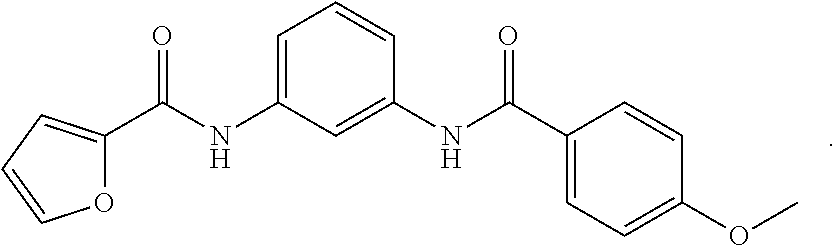 |
| TABLE B | |||
| Compound | |||
 |
 |
||
 |
 |
||
 |
 |
||
 |
 |
||
 |
 |
||
 |
 |
||
 |
 |
||
 |
 |
||
 |
 |
||
 |
 |
||
 |
 |
||
 |
 |
||
 |
 |
||
 |
 |
||
 |
 |
||
 |
 |
||
 |
 |
||
 |
 |
||
 |
 |
||
 |
 |
||
 |
 |
||
 |
 |
||
 |
 |
||
 |
 |
||
 |
 |
||
 |
 |
||
 |
 |
||
 |
 |
||
 |
|||
| |
|
| 1 |
 |
| 2 |
 |
| 3 |
 |
| 4 |
 |
| 5 |
 |
| 6 |
 |
| 7 |
 |
| 8 |
 |
| 9 |
 |
| 10 |
 |
| 11 |
 |
| 12 |
 |
| 13 |
 |
| 14 |
 |


| TABLE D | |
| Activ- | |
| Compound | ity |
 |
I |
 |
II |
 |
II |
 |
IV |
 |
IV |
 |
IV |
 |
|
 |
|
 |
|
 |
|
 |
IV |
 |
IV |
 |
I |
 |
|
 |
I |
 |
II |
 |
IV |
 |
IV |
 |
IV |
 |
IV |
 |
IV |
 |
|
 |
|
 |
I |
 |
IV |
 |
IV |
 |
IV |
 |
IV |
 |
IV |
 |
IV |
 |
|
 |
IV |
 |
II |
 |
I |
 |
IV |
 |
IV |
 |
I |
 |
II |
 |
IV |
 |
I |
 |
II |
 |
II |
 |
IV |
 |
IV |
 |
IV |
 |
|
 |
II |
 |
I |
 |
IV |
 |
IV |
 |
I |
 |
I |
 |
I |
 |
I |
 |
IV |
 |
II |
 |
II. |
Claims (7)


Priority Applications (1)
| Application Number | Priority Date | Filing Date | Title |
|---|---|---|---|
| US13/825,574 US9422262B2 (en) | 2010-09-24 | 2011-09-23 | Compounds and methods for treating diseases mediated by protease activated receptors |
Applications Claiming Priority (3)
| Application Number | Priority Date | Filing Date | Title |
|---|---|---|---|
| US38613110P | 2010-09-24 | 2010-09-24 | |
| US13/825,574 US9422262B2 (en) | 2010-09-24 | 2011-09-23 | Compounds and methods for treating diseases mediated by protease activated receptors |
| PCT/US2011/053105 WO2012040636A2 (en) | 2010-09-24 | 2011-09-23 | Compounds and methods for treating diseases mediated by protease activated receptors |
Publications (2)
| Publication Number | Publication Date |
|---|---|
| US20130331411A1 US20130331411A1 (en) | 2013-12-12 |
| US9422262B2 true US9422262B2 (en) | 2016-08-23 |
Family
ID=45874422
Family Applications (1)
| Application Number | Title | Priority Date | Filing Date |
|---|---|---|---|
| US13/825,574 Active 2031-12-19 US9422262B2 (en) | 2010-09-24 | 2011-09-23 | Compounds and methods for treating diseases mediated by protease activated receptors |
Country Status (2)
| Country | Link |
|---|---|
| US (1) | US9422262B2 (en) |
| WO (1) | WO2012040636A2 (en) |
Cited By (1)
| Publication number | Priority date | Publication date | Assignee | Title |
|---|---|---|---|---|
| US11130743B2 (en) | 2019-02-21 | 2021-09-28 | Marquette University | Heterocyclic ligands of PAR1 and methods of use |
Families Citing this family (13)
| Publication number | Priority date | Publication date | Assignee | Title |
|---|---|---|---|---|
| CN102871961B (en) * | 2012-10-30 | 2014-07-16 | 天津红日药业股份有限公司 | Injection containing tirofiban |
| CN104402785A (en) * | 2014-09-26 | 2015-03-11 | 南开大学 | Novel bisamides derivative and preparation method and application thereof |
| CN104496922B (en) * | 2015-01-13 | 2016-04-06 | 佛山市赛维斯医药科技有限公司 | Nitrile benzenediene tetrazole compound, its preparation method and use |
| CN104496924B (en) * | 2015-01-13 | 2016-04-13 | 佛山市赛维斯医药科技有限公司 | Halobenzene diene tetrazole compound, Preparation Method And The Use |
| CN104529860B (en) * | 2015-01-13 | 2016-06-01 | 佛山市赛维斯医药科技有限公司 | The compound of a kind of nitrobenzene-containing and diene fluoroadamantane structure and preparation method |
| WO2017216726A1 (en) | 2016-06-13 | 2017-12-21 | Glaxosmithkline Intellectual Property Development Limited | Substituted pyridines as inhibitors of dnmt1 |
| PT3624796T (en) | 2017-05-19 | 2025-06-02 | Nflection Therapeutics Inc | Pyrrolopyridine-aniline compounds for treatment of dermal disorders |
| JP7237941B2 (en) | 2017-05-19 | 2023-03-13 | エヌフレクション セラピューティクス インコーポレイテッド | Fused heterocyclic aromatic aniline compounds for the treatment of skin disorders |
| DK3643713T3 (en) * | 2018-10-23 | 2025-11-03 | Iomx Therapeutics Ag | HETEROCYCLIC KINASE INHIBITORS AND THEIR USE |
| WO2020106306A1 (en) | 2018-11-20 | 2020-05-28 | Nflection Therapeutics, Inc. | Cyanoaryl-aniline compounds for treatment of dermal disorders |
| WO2020106305A1 (en) | 2018-11-20 | 2020-05-28 | Nflection Therapeutics, Inc. | Thienyl-aniline compounds for treatment of dermal disorders |
| WO2020106308A1 (en) | 2018-11-20 | 2020-05-28 | Nflection Therapeutics, Inc. | Naphthyridinone-aniline compounds for treatment of dermal disorders |
| WO2020172609A1 (en) * | 2019-02-21 | 2020-08-27 | Marquette University | Heterocyclic ligands of par1 and methods of use |
Citations (3)
| Publication number | Priority date | Publication date | Assignee | Title |
|---|---|---|---|---|
| US3937729A (en) * | 1971-09-15 | 1976-02-10 | Stauffer Chemical Company | Meta-bis anilide derivatives and their utility as herbicides |
| US6455520B1 (en) * | 1998-09-25 | 2002-09-24 | Astra Zeneca Ab | Benzamide derivatives and their use as cytokine inhibitors |
| US20060058365A1 (en) * | 2004-08-06 | 2006-03-16 | Kohn Leonard D | Compositions and methods for treatment of colitis |
-
2011
- 2011-09-23 WO PCT/US2011/053105 patent/WO2012040636A2/en not_active Ceased
- 2011-09-23 US US13/825,574 patent/US9422262B2/en active Active
Patent Citations (3)
| Publication number | Priority date | Publication date | Assignee | Title |
|---|---|---|---|---|
| US3937729A (en) * | 1971-09-15 | 1976-02-10 | Stauffer Chemical Company | Meta-bis anilide derivatives and their utility as herbicides |
| US6455520B1 (en) * | 1998-09-25 | 2002-09-24 | Astra Zeneca Ab | Benzamide derivatives and their use as cytokine inhibitors |
| US20060058365A1 (en) * | 2004-08-06 | 2006-03-16 | Kohn Leonard D | Compositions and methods for treatment of colitis |
Non-Patent Citations (9)
| Title |
|---|
| Aisiku OR, et al., 23 Effects of Biased PAR 1 Ligands on Platelets and Endothelial Cells, Presented at the 55th American Society Hematology Annual Meeting Dec. 8, 2013, New Orleans, LA. |
| Costanzi S. On the applicability of GPCR homology models to computer-aided drug discovery: a comparison between in silico and crystal structures of the beta2-adrenergic receptor. J Med Chem. May 22, 2008;51(10):2907-14. |
| Dockendorff C, et al., Discovery of 1,3-Diaminobenzenes as Selective Inhibitors of Platelet Activation at the PAR1 Receptor. ACS Med Chem Lett. Mar. 8, 2012;3(3):232-237. |
| Dowal L, et al., Identification of an antithrombotic allosteric modulator that acts through helix 8 of PAR1. Proc Natl Acad Sci U S A. 2011, Early Edition pp. 1-6. |
| Gunnink S. Allosteric of protease activated receptor 1: a new antiplatelet therapy, Verslag fellowship, 2012 pp. 1-6. |
| Han et al (Oncology Letters 2: 599-608, 2011). * |
| International Preliminary Report on Patentability and Written Opinion for PCT/US2011/053105, date of mailing Feb. 20, 2014. |
| Melnikova VO, et al., Crosstalk between protease-activated receptor 1 and platelet-activating factor receptor regulates melanoma cell adhesion molecule (MCAM/MUC18) expression and melanoma metastasis. J Biol Chem. Oct. 16, 2009;284(42):28845-55. |
| Ramachandran et al (Nature Reviews: Drug Discovery, vol. 11 (2012)). * |
Cited By (1)
| Publication number | Priority date | Publication date | Assignee | Title |
|---|---|---|---|---|
| US11130743B2 (en) | 2019-02-21 | 2021-09-28 | Marquette University | Heterocyclic ligands of PAR1 and methods of use |
Also Published As
| Publication number | Publication date |
|---|---|
| US20130331411A1 (en) | 2013-12-12 |
| WO2012040636A3 (en) | 2014-03-27 |
| WO2012040636A2 (en) | 2012-03-29 |
Similar Documents
| Publication | Publication Date | Title |
|---|---|---|
| US9422262B2 (en) | Compounds and methods for treating diseases mediated by protease activated receptors | |
| TWI571468B (en) | Inhibitors of protein tyrosine kinase activity | |
| TWI438205B (en) | Inhibitors of protein tyrosine kinase activity | |
| USRE48105E1 (en) | Compounds for the treatment of mycobacterial infections | |
| MD4212529T2 (en) | Heterocyclic compounds as immunomodulators | |
| AU2018282747A1 (en) | Compounds for modulating S1P1 activity and methods of using the same | |
| TWI867287B (en) | Pyridinyl substituted oxoisoindoline compounds | |
| TW200908983A (en) | Heterocyclic compounds and uses thereof | |
| ES2957692T3 (en) | Compounds and compositions for the treatment of conditions associated with NLRP activity | |
| SK285432B6 (en) | Disubstituted bicyclic heterocyclic compounds, processes for their preparation, pharmaceutical compositions containing them and their use | |
| JP2008523072A (en) | Inhibitors of protein kinases | |
| CA2450400A1 (en) | Medicinal compositions | |
| CN101861151A (en) | Combination therapy of cancer using selective inhibitors of histone deacetylases HDAC1, HDAC2 and/or HDAC3 and microtubule stabilizers | |
| SK282116B6 (en) | Imidazopyridine derivative, its preparation method, use and pharmaceutical preparation containing it | |
| WO2014001464A1 (en) | Bifluorodioxalane-amino-benzimidazole kinase inhibitors for the treatment of cancer, autoimmuneinflammation and cns disorders | |
| US20080064718A1 (en) | Inhibitors of protein tyrosine kinase activity | |
| AU2014230583B2 (en) | Guanidinobenzoic acid ester compound | |
| EP4183415A1 (en) | Trpv4 inhibitor as therapeutic drug for eye disease | |
| CN108473496A (en) | heterocyclic compounds and their use | |
| TW201130810A (en) | CRTH2 modulators | |
| EP1973408A2 (en) | Inhibitors of protein kinases | |
| WO2015101265A1 (en) | 1-(3-aminopropyl) substituted cyclic amine compounds, preparation method therefor, and pharmaceutical compositions and uses thereof | |
| CZ2001447A3 (en) | Vitronectin receptor antagonist | |
| US20140045860A1 (en) | Small molecule inhibitors for treating parasitic infections | |
| JPWO2003002558A1 (en) | Antiviral treatment |
Legal Events
| Date | Code | Title | Description |
|---|---|---|---|
| AS | Assignment |
Owner name: NATIONAL INSTITUTES OF HEALTH (NIH), U.S. DEPT. OF Free format text: CONFIRMATORY LICENSE;ASSIGNOR:BROAD INSTITUTE, INC.;REEL/FRAME:027112/0490 Effective date: 20110928 |
|
| AS | Assignment |
Owner name: BETH ISRAEL DEACONESS MEDICAL CENTER, MASSACHUSETT Free format text: ASSIGNMENT OF ASSIGNORS INTEREST;ASSIGNOR:FLAUMENHAFT, ROBERT;REEL/FRAME:027283/0291 Effective date: 20111014 Owner name: THE BROAD INSTITUTE, INC., MASSACHUSETTS Free format text: ASSIGNMENT OF ASSIGNORS INTEREST;ASSIGNORS:DOCKENDORFF, CHRIS;MACPHERSON, LAWRENCE;SIGNING DATES FROM 20111005 TO 20111019;REEL/FRAME:027284/0265 |
|
| AS | Assignment |
Owner name: THE BROAD INSTITUTE, INC., MASSACHUSETTS Free format text: ASSIGNMENT OF ASSIGNORS INTEREST;ASSIGNOR:DOCKENDORFF, CHRIS;REEL/FRAME:030897/0559 Effective date: 20130606 Owner name: BETH ISRAEL DEACONESS MEDICAL CENTER, INC., MASSAC Free format text: ASSIGNMENT OF ASSIGNORS INTEREST;ASSIGNOR:FLAUMENHAFT, ROBERT;REEL/FRAME:030897/0737 Effective date: 20130605 |
|
| AS | Assignment |
Owner name: NATIONAL INSTITUTES OF HEALTH (NIH), U.S. DEPT. OF Free format text: CONFIRMATORY LICENSE;ASSIGNOR:BETH ISRAEL DEACONESS MEDICAL CENTER;REEL/FRAME:039515/0627 Effective date: 20160728 |
|
| STCF | Information on status: patent grant |
Free format text: PATENTED CASE |
|
| CC | Certificate of correction | ||
| CC | Certificate of correction | ||
| MAFP | Maintenance fee payment |
Free format text: PAYMENT OF MAINTENANCE FEE, 4TH YR, SMALL ENTITY (ORIGINAL EVENT CODE: M2551); ENTITY STATUS OF PATENT OWNER: SMALL ENTITY Year of fee payment: 4 |
|
| MAFP | Maintenance fee payment |
Free format text: PAYMENT OF MAINTENANCE FEE, 8TH YR, SMALL ENTITY (ORIGINAL EVENT CODE: M2552); ENTITY STATUS OF PATENT OWNER: SMALL ENTITY Year of fee payment: 8 |