US9413012B2 - Binder for rechargeable lithium battery, electrode for rechargeable lithium battery, method of preparing electrode for rechargeable lithium battery and rechargeable lithium battery including electrode - Google Patents
Binder for rechargeable lithium battery, electrode for rechargeable lithium battery, method of preparing electrode for rechargeable lithium battery and rechargeable lithium battery including electrode Download PDFInfo
- Publication number
- US9413012B2 US9413012B2 US14/152,943 US201414152943A US9413012B2 US 9413012 B2 US9413012 B2 US 9413012B2 US 201414152943 A US201414152943 A US 201414152943A US 9413012 B2 US9413012 B2 US 9413012B2
- Authority
- US
- United States
- Prior art keywords
- group
- substituted
- unsubstituted
- chemical formula
- lithium battery
- Prior art date
- Legal status (The legal status is an assumption and is not a legal conclusion. Google has not performed a legal analysis and makes no representation as to the accuracy of the status listed.)
- Expired - Fee Related, expires
Links
- 0 C.C.C.C.[1*]C([2*])(C)CC([3*])([4*])C.[5*]C(C)(C(=O)O)C([6*])(C)C(=C)N[7*] Chemical compound C.C.C.C.[1*]C([2*])(C)CC([3*])([4*])C.[5*]C(C)(C(=O)O)C([6*])(C)C(=C)N[7*] 0.000 description 26
- DMGJMRIWTGFHLO-UHFFFAOYSA-N C.C.C.C.C.C.C.C.CC(C)CC(N)=O.CCC(C)(C)C(=O)OCCN(C)C.CCC(C)C1=CC=CC=C1.CNC(=O)C(C)C(C)C(=O)O Chemical compound C.C.C.C.C.C.C.C.CC(C)CC(N)=O.CCC(C)(C)C(=O)OCCN(C)C.CCC(C)C1=CC=CC=C1.CNC(=O)C(C)C(C)C(=O)O DMGJMRIWTGFHLO-UHFFFAOYSA-N 0.000 description 1
- LDJBJFKSNYYZPL-UHFFFAOYSA-N C.C.C.C.C.C.C.C.CCC(C)(C)C.CCC(C)C1=CC=CC=C1.CCC=C(C)CC.CCCC Chemical compound C.C.C.C.C.C.C.C.CCC(C)(C)C.CCC(C)C1=CC=CC=C1.CCC=C(C)CC.CCCC LDJBJFKSNYYZPL-UHFFFAOYSA-N 0.000 description 1
- WCBOFIYOVKOFBL-UHFFFAOYSA-N C.C.C.C.C.C.CCC.CCC(C)(C)C(=O)OCCC[Si](OC)(OC)OC.CCC(C)(C)C(=O)OCCN(C)C.N#CN1CCCC1=O Chemical compound C.C.C.C.C.C.CCC.CCC(C)(C)C(=O)OCCC[Si](OC)(OC)OC.CCC(C)(C)C(=O)OCCN(C)C.N#CN1CCCC1=O WCBOFIYOVKOFBL-UHFFFAOYSA-N 0.000 description 1
- IQTQVHJPRSYTEB-UHFFFAOYSA-N C.C.CC1C(=O)N(C)C(=O)C1C Chemical compound C.C.CC1C(=O)N(C)C(=O)C1C IQTQVHJPRSYTEB-UHFFFAOYSA-N 0.000 description 1
- TVUBIVMCDPWXSG-UHFFFAOYSA-N C.C.CCC(C)(C)C Chemical compound C.C.CCC(C)(C)C TVUBIVMCDPWXSG-UHFFFAOYSA-N 0.000 description 1
Images

Classifications
-
- H—ELECTRICITY
- H01—ELECTRIC ELEMENTS
- H01M—PROCESSES OR MEANS, e.g. BATTERIES, FOR THE DIRECT CONVERSION OF CHEMICAL ENERGY INTO ELECTRICAL ENERGY
- H01M4/00—Electrodes
- H01M4/02—Electrodes composed of, or comprising, active material
- H01M4/62—Selection of inactive substances as ingredients for active masses, e.g. binders, fillers
- H01M4/621—Binders
- H01M4/622—Binders being polymers
-
- C—CHEMISTRY; METALLURGY
- C08—ORGANIC MACROMOLECULAR COMPOUNDS; THEIR PREPARATION OR CHEMICAL WORKING-UP; COMPOSITIONS BASED THEREON
- C08F—MACROMOLECULAR COMPOUNDS OBTAINED BY REACTIONS ONLY INVOLVING CARBON-TO-CARBON UNSATURATED BONDS
- C08F216/00—Copolymers of compounds having one or more unsaturated aliphatic radicals, each having only one carbon-to-carbon double bond, and at least one being terminated by an alcohol, ether, aldehydo, ketonic, acetal or ketal radical
- C08F216/36—Copolymers of compounds having one or more unsaturated aliphatic radicals, each having only one carbon-to-carbon double bond, and at least one being terminated by an alcohol, ether, aldehydo, ketonic, acetal or ketal radical by a ketonic radical
-
- C—CHEMISTRY; METALLURGY
- C08—ORGANIC MACROMOLECULAR COMPOUNDS; THEIR PREPARATION OR CHEMICAL WORKING-UP; COMPOSITIONS BASED THEREON
- C08F—MACROMOLECULAR COMPOUNDS OBTAINED BY REACTIONS ONLY INVOLVING CARBON-TO-CARBON UNSATURATED BONDS
- C08F220/00—Copolymers of compounds having one or more unsaturated aliphatic radicals, each having only one carbon-to-carbon double bond, and only one being terminated by only one carboxyl radical or a salt, anhydride ester, amide, imide or nitrile thereof
- C08F220/02—Monocarboxylic acids having less than ten carbon atoms; Derivatives thereof
- C08F220/04—Acids; Metal salts or ammonium salts thereof
- C08F220/06—Acrylic acid; Methacrylic acid; Metal salts or ammonium salts thereof
-
- H—ELECTRICITY
- H01—ELECTRIC ELEMENTS
- H01M—PROCESSES OR MEANS, e.g. BATTERIES, FOR THE DIRECT CONVERSION OF CHEMICAL ENERGY INTO ELECTRICAL ENERGY
- H01M10/00—Secondary cells; Manufacture thereof
- H01M10/05—Accumulators with non-aqueous electrolyte
- H01M10/052—Li-accumulators
- H01M10/0525—Rocking-chair batteries, i.e. batteries with lithium insertion or intercalation in both electrodes; Lithium-ion batteries
-
- H—ELECTRICITY
- H01—ELECTRIC ELEMENTS
- H01M—PROCESSES OR MEANS, e.g. BATTERIES, FOR THE DIRECT CONVERSION OF CHEMICAL ENERGY INTO ELECTRICAL ENERGY
- H01M4/00—Electrodes
- H01M4/02—Electrodes composed of, or comprising, active material
- H01M4/04—Processes of manufacture in general
- H01M4/0402—Methods of deposition of the material
- H01M4/0404—Methods of deposition of the material by coating on electrode collectors
-
- H—ELECTRICITY
- H01—ELECTRIC ELEMENTS
- H01M—PROCESSES OR MEANS, e.g. BATTERIES, FOR THE DIRECT CONVERSION OF CHEMICAL ENERGY INTO ELECTRICAL ENERGY
- H01M4/00—Electrodes
- H01M4/02—Electrodes composed of, or comprising, active material
- H01M4/13—Electrodes for accumulators with non-aqueous electrolyte, e.g. for lithium-accumulators; Processes of manufacture thereof
- H01M4/133—Electrodes based on carbonaceous material, e.g. graphite-intercalation compounds or CFx
-
- H—ELECTRICITY
- H01—ELECTRIC ELEMENTS
- H01M—PROCESSES OR MEANS, e.g. BATTERIES, FOR THE DIRECT CONVERSION OF CHEMICAL ENERGY INTO ELECTRICAL ENERGY
- H01M4/00—Electrodes
- H01M4/02—Electrodes composed of, or comprising, active material
- H01M4/13—Electrodes for accumulators with non-aqueous electrolyte, e.g. for lithium-accumulators; Processes of manufacture thereof
- H01M4/134—Electrodes based on metals, Si or alloys
-
- H—ELECTRICITY
- H01—ELECTRIC ELEMENTS
- H01M—PROCESSES OR MEANS, e.g. BATTERIES, FOR THE DIRECT CONVERSION OF CHEMICAL ENERGY INTO ELECTRICAL ENERGY
- H01M4/00—Electrodes
- H01M4/02—Electrodes composed of, or comprising, active material
- H01M4/13—Electrodes for accumulators with non-aqueous electrolyte, e.g. for lithium-accumulators; Processes of manufacture thereof
- H01M4/139—Processes of manufacture
- H01M4/1393—Processes of manufacture of electrodes based on carbonaceous material, e.g. graphite-intercalation compounds or CFx
-
- H—ELECTRICITY
- H01—ELECTRIC ELEMENTS
- H01M—PROCESSES OR MEANS, e.g. BATTERIES, FOR THE DIRECT CONVERSION OF CHEMICAL ENERGY INTO ELECTRICAL ENERGY
- H01M4/00—Electrodes
- H01M4/02—Electrodes composed of, or comprising, active material
- H01M4/13—Electrodes for accumulators with non-aqueous electrolyte, e.g. for lithium-accumulators; Processes of manufacture thereof
- H01M4/139—Processes of manufacture
- H01M4/1395—Processes of manufacture of electrodes based on metals, Si or alloys
-
- Y—GENERAL TAGGING OF NEW TECHNOLOGICAL DEVELOPMENTS; GENERAL TAGGING OF CROSS-SECTIONAL TECHNOLOGIES SPANNING OVER SEVERAL SECTIONS OF THE IPC; TECHNICAL SUBJECTS COVERED BY FORMER USPC CROSS-REFERENCE ART COLLECTIONS [XRACs] AND DIGESTS
- Y02—TECHNOLOGIES OR APPLICATIONS FOR MITIGATION OR ADAPTATION AGAINST CLIMATE CHANGE
- Y02E—REDUCTION OF GREENHOUSE GAS [GHG] EMISSIONS, RELATED TO ENERGY GENERATION, TRANSMISSION OR DISTRIBUTION
- Y02E60/00—Enabling technologies; Technologies with a potential or indirect contribution to GHG emissions mitigation
- Y02E60/10—Energy storage using batteries
-
- Y02E60/122—
Definitions
- a binder for a rechargeable lithium battery, an electrode for a rechargeable lithium battery, a method of preparing the electrode for the rechargeable lithium battery, and a rechargeable lithium battery including the electrode are disclosed.
- a rechargeable lithium battery includes positive and negative electrodes including a material that can reversibly intercalate/deintercalate lithium ions as positive and negative active materials and an organic electrolyte solution or a polymer electrolyte solution charged between the positive and negative electrodes.
- the positive and negative electrodes intercalate and deintercalate lithium ions and produce electrical energy through oxidation and reduction reactions.
- a lithium-transition metal oxide being capable of intercalating and deintercalating lithium, such as LiCoO 2 , LiMn 2 O 4 , LiNi 1-x Co x O 2 (0 ⁇ x ⁇ 1), and the like, has been used.
- a negative active material for a lithium rechargeable battery various carbon-based materials such as artificial graphite, natural graphite, and hard carbon capable of intercalating and deintercalating lithium ions have been used. Recently, demand of a battery having high energy density has increasingly required a negative active material having high theoretical capacity density. Accordingly, Si, Sn, and Ge alloyed with lithium and an oxide thereof and an alloy thereof have drawn attention. In particular, a Si-based negative active material has very high charge capacity and is widely applied to a high-capacity battery. However, the Si-based negative active material may expand by about 300% to about 400% during charge and discharge. Accordingly, research on a binder capable of effectively suppressing expansion of the Si-based negative active material and/or being more durable with respect to the expansion, is actively performed.
- aspects of embodiments of the present invention are directed to providing a binder for a rechargeable lithium battery which allows active material particles to adhere well to one another and allows the active material to adhere well to a current collector.
- aspects of embodiments of the present invention are also directed to providing a binder for a rechargeable lithium battery, which suppresses expansion of an active material and/or is durable with respect to the expansion of an active material.
- aspects of embodiments of the present invention are also directed to providing an electrode for a rechargeable lithium battery having good stability, rate capability, and cycle-life characteristics.
- aspects of embodiments of the present invention are also directed to providing a method of manufacturing the electrode for a rechargeable lithium battery having good stability, rate capability, and cycle-life characteristics.
- aspects of embodiments of the present invention are also directed to providing a rechargeable lithium battery having good stability, rate capability, and cycle-life characteristics.
- a binder for a rechargeable lithium battery includes a copolymer including a repeating unit represented by Chemical Formula X and a repeating unit represented by Chemical Formula Y-1, and having a weight average molecular weight of about 10,000 to about 500,000:
- R 1 to R 4 are each independently selected from hydrogen, a substituted or unsubstituted C1 to C20 alkyl group, and a substituted or unsubstituted C6 to C30 aryl group, L is a substituted or unsubstituted C2 to C10 alkenylene group, and n is 0 or 1, and wherein in Chemical Formula Y-1: R 5 and R 6 are each independently selected from hydrogen and a substituted or unsubstituted C1 to C20 alkyl group, and R 7 is selected from a substituted or unsubstituted C1 to C20 alkyl group, a substituted or unsubstituted C2 to C10 alkenyl group, a substituted or unsubstituted C2 to C10 alkynyl group, a substituted or unsubstituted C1 to C10 alkoxy group, a substituted or unsubstituted C3 to C10 cycloalkyl group,
- the binder for a rechargeable lithium battery includes the repeating unit represented by Chemical Formula X and the repeating unit represented by Chemical Formula Y-1 in a mole ratio of about 40:60 to about 60:40.
- the binder for a rechargeable lithium battery is aqueous.
- the copolymer in the binder for a rechargeable lithium battery, further includes a repeating unit represented by Chemical Formula Z:
- R 11 is selected from hydrogen and a substituted or unsubstituted C1 to C20 alkyl group
- R 12 and R 13 are independently selected from hydrogen, a substituted or unsubstituted C1 to C20 alkyl group, a substituted or unsubstituted C2 to C10 alkenyl group, a substituted or unsubstituted C2 to C10 alkynyl group, a substituted or unsubstituted C1 to C10 alkoxy group, a substituted or unsubstituted C3 to C10 cycloalkyl group, a substituted or unsubstituted C6 to C30 aryl group, and a substituted or unsubstituted C1 to C30 heteroaryl group.
- the binder for a rechargeable lithium battery includes about 5 mol % to about 35 mol % of the repeating unit represented by Chemical Formula X, about 5 mol % to about 35 mol % of the repeating unit represented by Chemical Formula Y-1, and about 30 mol % to about 90 mol % of the repeating unit represented by Chemical Formula Z.
- the copolymer in the binder for a rechargeable lithium battery, further includes repeating units represented by at least one of the following Chemical Formulas W-1 to W-5:
- R 21 , R 23 , R 25 , R 27 , and R 30 are each independently selected from hydrogen and a substituted or unsubstituted C1 to C20 alkyl group;
- R 22 , R 24 , and R 26 are each independently selected from hydrogen, a substituted or unsubstituted C1 to C20 alkyl group, a substituted or unsubstituted C2 to C20 alkenyl group, a substituted or unsubstituted C2 to C20 alkynyl group, a C3 to C8 cycloalkyl group, a substituted or unsubstituted C6 to C30 aryl group, a substituted or unsubstituted C1 to C30 heteroaryl group, a silane group, a C1 to C20 alkylsilane group, a C1 to C20 alkoxysilane group, a C1 to C20 alkylamine group, a C1 to C20 alkyl group substituted with an
- the copolymer in the binder for a rechargeable lithium battery, includes about 5 mol % to about 35 mol % of the repeating unit represented by Chemical Formula X, about 5 mol % to about 35 mol % of the repeating unit represented by Chemical Formula Y-1, about 20 mol % to about 89 mol % of the repeating unit represented by Chemical Formula Z, and about 1 mol % to about 10 mol % of at least one of repeating units represented by Chemical Formulas W-1 to W-5.
- an electrode for a rechargeable lithium battery includes a current collector and an active material layer on one side or both sides of the current collector, wherein: the active material layer includes an active material and a binder, the binder includes a copolymer having a weight average molecular weight of about 10,000 to about 500,000, and the copolymer includes a repeating unit represented by Chemical Formula X:
- R 1 to R 4 are each independently selected from hydrogen, a substituted or unsubstituted C1 to C20 alkyl group, and a substituted or unsubstituted C6 to C30 aryl group, L is a substituted or unsubstituted C2 to C10 alkenylene group, and n is 0 or 1, and wherein the copolymer comprises a repeating unit represented by Chemical Formula Y-2:
- R 5 and R 6 are each independently selected from hydrogen and a substituted or unsubstituted C1 to C20 alkyl group
- R 7 is selected from a substituted or unsubstituted C1 to C20 alkyl group, a substituted or unsubstituted C2 to C10 alkenyl group, a substituted or unsubstituted C2 to C10 alkynyl group, a substituted or unsubstituted C1 to C10 alkoxy group, a substituted or unsubstituted C3 to C10 cycloalkyl group, a substituted or unsubstituted C6 to C30 aryl group, and a substituted or unsubstituted C1 to C30 heteroaryl group.
- the copolymer in the electrode for a rechargeable lithium battery, includes the repeating unit represented by Chemical Formula X and repeating unit represented by Chemical Formula Y-1 in a mole ratio of about 40:60 to about 60:40.
- the copolymer in the electrode for a rechargeable lithium battery, further includes a repeating unit represented by Chemical Formula Z:
- R 11 is selected from hydrogen and a substituted or unsubstituted C1 to C20 alkyl group
- R 12 and R 13 are independently selected from hydrogen, a substituted or unsubstituted C1 to C20 alkyl group, a substituted or unsubstituted C2 to C10 alkenyl group, a substituted or unsubstituted C2 to C10 alkynyl group, a substituted or unsubstituted C1 to C10 alkoxy group, a substituted or unsubstituted C3 to C10 cycloalkyl group, a substituted or unsubstituted C6 to C30 aryl group, and a substituted or unsubstituted C1 to C30 heteroaryl group.
- the copolymer in the electrode for a rechargeable lithium battery, includes about 5 mol % to about 35 mol % of the repeating unit represented by Chemical Formula X, about 5 mol % to about 35 mol % of the repeating unit represented by Chemical Formula Y-1, and about 30 mol % to about 90 mol % of the repeating unit represented by Chemical Formula Z.
- the copolymer in the electrode for a rechargeable lithium battery, includes about 5 mol % to about 35 mol % of the repeating unit represented by Chemical Formula X, about 5 mol % to about 35 mol % of the repeating unit represented by Chemical Formula Y-1, about 20 mol % to about 89 mol % of the repeating unit represented by Chemical Formula Z, and about 1 mol % to about 10 mol % of repeating units represented by at least one of Chemical Formulas W-1 to W-5:
- R 21 , R 23 , R 25 , R 27 and R 30 are each independently selected from hydrogen and a substituted or unsubstituted C1 to C20 alkyl group
- R 22 , R 24 , and R 26 are each independently selected from hydrogen, a substituted or unsubstituted C1 to C20 alkyl group, a substituted or unsubstituted C2 to C20 alkenyl group, a substituted or unsubstituted C2 to C20 alkynyl group, a C3 to C8 cycloalkyl group, a substituted or unsubstituted C6 to C30 aryl group, a substituted or unsubstituted C1 to C30 heteroaryl group, a silane group, a C1 to C20 alkylsilane group, a C1 to C20 alkoxysilane group, a C1 to C20 alkylamine group, a C1 to C20 alkyl group substituted with an alk
- the binder in the electrode for a rechargeable lithium battery, is included in an amount of 0.01 wt % to 50 wt % by weight based on 100 wt % of the active material layer.
- the active material includes Si, SiO x , a Si—C composite, a Si-Q alloy, graphite, or a combination thereof, and wherein 0 ⁇ x ⁇ 2 and Q is an alkali metal, an alkaline-earth metal, a Group 13 to 16 element (excluding Si), a transition element, a rare earth element, or a combination thereof.
- a method of preparing an electrode for a rechargeable lithium battery includes mixing an active material, a solvent, and a binder to prepare an active material composition, coating the active material composition on a current collector, and heat-treating the current collector coated with the active material composition, wherein: the binder includes a copolymer including a repeating unit represented by Chemical Formula X and a repeating unit represented by Chemical Formula Y-1, and has a weight average molecular weight of about 10,000 to about 500,000 before the heat-treating of the current collector coated with the active material composition, and the binder includes a copolymer including a repeating unit represented by Chemical Formula X and a repeating unit represented by Chemical Formula Y-2, and has a weight average molecular weight of about 10,000 to about 500,000, after the heat-treating of the current collector coated with the active material composition,
- R 1 to R 4 are each independently selected from hydrogen, a substituted or unsubstituted C1 to C20 alkyl group, and a substituted or unsubstituted C6 to C30 aryl group, L is a substituted or unsubstituted C2 to C10 alkenylene group, and n is 0 or 1,
- R 5 and R 6 are independently selected from hydrogen and a substituted or unsubstituted C1 to C20 alkyl group
- R 7 is selected from a substituted or unsubstituted C1 to C20 alkyl group, a substituted or unsubstituted C2 to C10 alkenyl group, a substituted or unsubstituted C2 to C10 alkynyl group, a substituted or unsubstituted C1 to C10 alkoxy group, a substituted or unsubstituted C3 to C10 cycloalkyl group, a substituted or unsubstituted C6 to C30 aryl group, and a substituted or unsubstituted C1 to C30 heteroaryl group,
- R 5 and R 6 are independently selected from hydrogen and a substituted or unsubstituted C1 to C20 alkyl group
- R 7 is selected from a substituted or unsubstituted C1 to C20 alkyl group, a substituted or unsubstituted C2 to C10 alkenyl group, a substituted or unsubstituted C2 to C10 alkynyl group, a substituted or unsubstituted C1 to C10 alkoxy group, a substituted or unsubstituted C3 to C10 cycloalkyl group, a substituted or unsubstituted C6 to C30 aryl group, and a substituted or unsubstituted C1 to C30 heteroaryl group.
- the solvent is selected from one or more of water and an alcohol.
- the heat-treating of the current collector coated with the active material composition is performed at about 120° C. to about 300° C.
- a weight ratio of binder after the heat-treating of the current collector coated with the active material composition relative to the binder before the heat-treating of the current collector coated with the active material composition ranges from about 0.5:1 to about 0.9:1 (weight of the binder after the heat-treating of the current collector:weight of the binder before the heat-treating of the current collector).
- the active material includes Si, SiO x , a Si—C composite, a Si-Q alloy, graphite, or a combination thereof and wherein 0 ⁇ x ⁇ 2, and Q is selected from an alkali metal, an alkaline-earth metal, a Group 13 to 16 element (excluding Si), a transition metal element, a rare earth element, or a combination thereof.
- a rechargeable lithium battery in another embodiment, includes the electrode a rechargeable lithium battery as described above, a separator; and an electrolyte.
- FIG. 1 is a schematic view showing a rechargeable lithium battery according to one embodiment of the present invention.
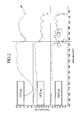
- FIG. 2 is an infrared spectroscopy graph (IR) showing binders produced at varying temperatures of heat-treatment.
- substituted refers to substitution of at least one hydrogen with a C1 to C30 alkyl group, a C2 to C30 alkenyl group, a C2 to C30 alkynyl group, a C1 to C10 alkylsilyl group, a C3 to C30 cycloalkyl group, a C6 to C30 aryl group, a C1 to C30 heteroaryl group, a C1 to C10 alkoxy group; a silane group, an alkylsilane group, an alkoxysilane group, an amine group, an alkylamine group, an arylamine group, or a halogen.
- hetero or “hetero atom” refers to one selected from N, O, S, and P.
- alkyl group refers to “a saturated alkyl group” (that is, without any alkenyl group or alkynyl group) or “an unsaturated alkyl group” (that is, including at least one alkenyl group or alkynyl group).
- alkenyl group refers to a substituent having at least one carbon-carbon double bond
- alkynyl group refers to a substituent having at least one carbon-carbon triple bond.
- the alkyl group includes a branched alkyl group, a linear alkyl group, or cyclic alkyl group.
- the alkyl group includes a C1 to C20 alkyl group, for example, a C1 to C6 lower alkyl group, a C7 to C10 medium-sized alkyl group, or a C11 to C20 higher alkyl group. In another embodiment, the alkyl group includes a C1 to C10 alkyl group.
- a C1 to C4 alkyl group having 1 to 4 carbon atoms in an alkyl chain such as methyl, ethyl, propyl, iso-propyl, n-butyl, iso-butyl, sec-butyl, and t-butyl are included.
- alkyl group examples include a methyl group, an ethyl group, a propyl group, an isopropyl group, a butyl group, an isobutyl group, a t-butyl group, a pentyl group, a hexyl group, an ethenyl group, a propenyl group, a butenyl group, a cyclopropyl group, a cyclobutyl group, a cyclopentyl group, a cyclohexyl group, and the like.
- aromatic group refers to a cyclic substituent in which a p-orbital of each atom in the ring are formed in conjugation.
- aromatic group include an aryl group and a heteroaryl group.
- aryl group refers to a monocyclic or fused ring (e.g., a plurality of rings sharing adjacent pairs of carbon atoms).
- heteroaryl group refers to an aryl group including 1 to 3 hetero atoms selected from the group consisting of N, O, S, and P.
- heteroaryl group is a fused ring, each ring may include 1 to 3 hetero atoms.
- copolymerization includes block copolymerization, random copolymerization, graft copolymerization, or alternating copolymerization
- copolymer includes a block copolymer, a random copolymer, a graft copolymer, or an alternating copolymer.
- a binder for a rechargeable lithium battery according to one embodiment of the present invention includes a copolymer including repeating units represented by the following Chemical Formulas X and Y-1:
- R 1 to R 4 are each independently selected from hydrogen, a substituted or unsubstituted C1 to C20 alkyl group, and a substituted or unsubstituted C6 to C30 aryl group; L is a substituted or unsubstituted C2 to C10 alkenylene group; and n is 0 or 1.
- R 5 and R 6 are each independently selected from hydrogen and a substituted or unsubstituted C1 to C20 alkyl group
- R 7 is selected from a substituted or unsubstituted C1 to C20 alkyl group, a substituted or unsubstituted C2 to C10 alkenyl group, a substituted or unsubstituted C2 to C10 alkynyl group, a substituted or unsubstituted C1 to C10 alkoxy group, a substituted or unsubstituted C3 to C10 cycloalkyl group, a substituted or unsubstituted C6 to C30 aryl group, and a substituted or unsubstituted C1 to C30 heteroaryl group.
- R 7 may be substituted with at least one functional group selected from a halogen, an amino group, a mercapto group, an ether group, an ester group, a C1 to C20 alkoxy group, a sulfone group, a nitro group, a hydroxy group, a cyclobuene group, a carbonyl group, a carboxyl group, an alkyne group, a urethane group, a vinyl group, a nitrile group, and an epoxy group.
- a halogen an amino group, a mercapto group, an ether group, an ester group, a C1 to C20 alkoxy group, a sulfone group, a nitro group, a hydroxy group, a cyclobuene group, a carbonyl group, a carboxyl group, an alkyne group, a urethane group, a vinyl group, a nitrile group, and an epoxy group.
- R 7 may be selected from a methyl group, an ethyl group, a propyl group, a butyl group, a cyclohexyl group, a monoethanol group, a diethanol group, and the like.
- R 7 is a methyl group or an ethyl group.
- the binder for the rechargeable lithium battery dissolves well in water.
- the copolymer is formed by randomly or by alternately copolymerizing the repeating units represented by Chemical Formulas X and Y-1.
- the copolymer has a weight average molecular weight of about 10,000 to about 500,000.
- the copolymer comprises the repeating units represented by Chemical Formula X and Chemical Formula Y-1 in a mole ratio of about 40:60 to about 60:40.
- the binder is used with an organic solvent.
- the binder is used with water or an aqueous solvent, for example an aqueous solvent including one or more alcohols, or the like.
- the binder may be organic but also, aqueous.
- the binder may be environmentally-friendly.
- the repeating unit represented by Chemical Formula X is obtained from an unsaturated monomer, such as an ethylene monomer.
- the repeating unit represented by Chemical Formula Y-1 includes an amic acid group.
- the repeating unit represented by Chemical Formula Y-1 is converted into a repeating unit including an imide group by drying and heat-treating a copolymer including the repeating unit represented by Chemical Formula Y-1.
- a conventional binder for a rechargeable lithium battery such as a styrene-butadiene rubber (SBR), carboxylmethyl cellulose (CMC), and the like may deteriorate cycle-life of a rechargeable lithium battery.
- SBR styrene-butadiene rubber
- CMC carboxylmethyl cellulose
- PAI polyamideimide
- the binder may decrease initial efficiency of a rechargeable lithium battery and thus may be less environmentally-friendly due to use of an organic solvent, such as N-methylpyrrolidone (NMP), which should not be released into the air.
- NMP N-methylpyrrolidone
- the binder for a rechargeable lithium battery according to embodiments of the present invention is durable and/or suppresses volume expansion of an active material during the charge and discharge and thus, works as a buffer layer.
- the binder allows active material particles to adhere to one another and also allows the active material to adhere to a current collector.
- the rechargeable lithium battery including the binder according to embodiments herein described is stable and has good rate capability and cycle-life characteristics.
- the binder in some embodiments, is used with an aqueous solvent and thus, is environmentally-friendly.
- the copolymer has an interpenetrating polymer network (IPN) formed of a blend of more than two cross-linking polymers or a semi-interpenetrating polymer network (semi-IPN) formed of a blend of a cross-linked polymer and a linear polymer.
- IPN interpenetrating polymer network
- si-IPN semi-interpenetrating polymer network
- the repeating units represented by Chemical Formula X and Chemical Formula Y-1 are, respectively, in a mole ratio of about 40:60 to about 60:40, or about 45:55 to about 55:45. In some embodiments, the repeating units represented by Chemical Formulas X and Y-1 are included in the copolymer in approximately a same amount, that is, in about a 50:50 mole ratio.
- the ratio here refers to a relative mole ratio between repeating units represented by Chemical Formula X and Chemical Formula Y-1 based on the sum of the repeating units represented by Chemical Formula X and Chemical Formula Y-1. In embodiments where the mole ratio is within these ranges, the binder is more aqueous and has better adherence.
- the copolymer has a weight average molecular weight of about 10,000 to about 500,000. In some embodiments, the copolymer has a weight average molecular weight of about 100,000 to about 400,000. In some embodiments, viscosity and adherence of the binder for the rechargeable lithium battery vary with molecular weight of the copolymer. When the aqueous binder has a weight average molecular weight within the disclosed ranges, in some embodiments, ease of preparing the active material composition is improved and adherence of the active material composition to a current collector is improved.
- the repeating unit represented by Chemical Formula X is obtained from styrene, ethylene, isobutylene, or isoprene monomers. In some embodiments, the repeating unit represented by Chemical Formula X is a repeating unit represented by one of the following Chemical Formulas X-1 to X-4 but is not limited thereto:
- the binder when the binder includes a repeating unit represented by Chemical Formula X-1 derived from styrene, the binder can effectively suppress volume expansion of an active material and/or be more durable.
- the binder for the rechargeable lithium battery is prepared, for example, by reacting a substituted or unsubstituted ethylene monomer, a substituted or unsubstituted maleic anhydride, and a substituted or unsubstituted amine.
- the copolymer further includes a repeating unit represented by the following Chemical Formula Z:
- R 11 is selected from hydrogen and a substituted or unsubstituted C1 to C20 alkyl group
- R 12 and R 13 are each independently selected from hydrogen, a substituted or unsubstituted C1 to C20 alkyl group, a substituted or unsubstituted C2 to C10 alkenyl group, a substituted or unsubstituted C2 to C10 alkynyl group, a substituted or unsubstituted C1 to C10 alkoxy group, a substituted or unsubstituted C3 to C10 cycloalkyl group, a substituted or unsubstituted C6 to C30 aryl group, and a substituted or unsubstituted C1 to C30 heteroaryl group.
- R 12 and R 13 are linked as a fused ring.
- N, R 12 , and R 13 are linked to provide a 5-membered ring, a 6-membered ring, a 7-membered ring, or the like.
- R 12 and R 13 are independently selected from hydrogen, a methyl group, an ethyl group, an isopropyl group, an N-methylol group, and an N-butoxy group.
- the repeating unit represented by Chemical Formula Z is a repeating unit which can be derived from N-substituted or unsubstituted acrylamide.
- the binder for a rechargeable lithium battery according to some embodiments, has improved adherence by including the repeating unit represented by Chemical Formula Z.
- the copolymer includes about 5 mol % to about 35 mol % of the repeating unit represented by Chemical Formula X, about 5 mol % to about 35 mol % of the repeating unit represented by Chemical Formula Y-1, and about 30 mol % to about 90 mol % of the repeating unit represented by Chemical Formula Z.
- the copolymer further includes a repeating unit represented by Chemical Formula Z and/or repeating units represented by at least one of the following Chemical Formulas W-1 to W-5:
- R 21 , R 23 , R 25 , R 27 , and R 30 are each independently selected from hydrogen and a substituted or unsubstituted C1 to C20 alkyl group.
- R 22 , R 24 , and R 26 are each independently selected from hydrogen, a substituted or unsubstituted C1 to C20 alkyl group, a substituted or unsubstituted C2 to C20 alkenyl group, a C3 to C8 cycloalkyl group, a substituted or unsubstituted C6 to C30 aryl group, a substituted or unsubstituted C1 to C30 heteroaryl group, a silane group, a C1 to C20 alkylsilane group, a C1 to C20 alkoxysilane group, a C1 to C20 alkylamine group, a C1 to C20 alkyl group substituted with an alkoxysilane group, and a C1 to C20 alkyl group substituted with an amine group.
- the C1 to C20 alkyl group substituted with an alkoxysilane group may be an alkoxysilylmethyl group, an alkoxysilylethyl group, an alkoxysilylpropyl group, an alkoxysilylbutyl group, an alkoxysilylpentyl group, or the like.
- alkoxy groups include methoxy, ethoxy, propoxy, butoxy, and the like.
- R 28 , R 29 , R 31 , and R 32 are each independently selected from hydrogen, a substituted or unsubstituted C1 to C20 alkyl group, a substituted or unsubstituted C2 to C20 alkenyl group, a substituted or unsubstituted C2 to C20 alkynyl group, a C3 to C8 cycloalkyl group, a substituted or unsubstituted C6 to C30 aryl group, a substituted or unsubstituted C1 to C30 heteroaryl group, a silane group, a C1 to C20 alkylsilane group, a C1 to C20 alkoxysilane group, and a C2 to C20 carbonyl group, and may include a heteroatom.
- R 28 and R 29 are linked as a fused ring.
- R 31 and R 32 are linked as a fused ring.
- N, R 28 , and R 29 are linked to provide a 5-membered ring, 6-membered ring, 7-membered ring, or the like.
- N, R 31 and R 32 are linked to provide a 5-membered ring, 6-membered ring, 7-membered ring, or the like.
- the copolymer has improved adherence by including the repeating units represented by Chemical Formulas W-1 to W-5.
- the copolymer includes about 5 mol % to about 35 mol % of the repeating unit represented by Chemical Formula X, about 5 mol % to about 35 mol % of the repeating unit represented by Chemical Formula Y-1, about 20 mol % to about 89 mol % of the repeating unit represented by Chemical Formula Z, and about 1 mol % to about 10 mol % of at least one of repeating units represented by Chemical Formulas W-1 to W-5.
- the copolymer further includes a repeating unit represented by Chemical Formula Z and/or repeating units represented by at least one of the following Chemical Formulas V-1 to V-3.
- the following Chemical Formulas V-1 to V-3 are specific examples of the above Chemical Formulas W-1 to W-5.
- the Chemical Formulas V-1 and V-2 are examples of Chemical Formula W-1, and the Chemical Formula V-3 is an example of Chemical Formula W-4.
- the copolymer includes about 5 mol % to about 35 mol % of the repeating unit represented by Chemical Formula X, about 5 mol % to about 35 mol % of the repeating unit represented by Chemical Formula Y-1, about 20 mol % to about 89 mol % of the repeating unit represented by Chemical Formula Z, and about 1 mol % to about 10 mol % of at least one of repeating units represented by Chemical Formulas V-1 to V-3.
- an electrode for a rechargeable lithium battery includes a current collector and an active material layer on one side or both sides of the current collector, wherein the active material layer includes an active material and a binder.
- the binder includes a copolymer including the repeating units represented by Chemical Formulas X and Y-2.
- the copolymer has a weight average molecular weight of about 10,000 to about 500,000 and includes the repeating units represented by Chemical Formula X and Chemical Formula Y-2 in a mole ratio of about 90:10 to about 10:90.
- R 5 and R 6 are independently selected from hydrogen and a substituted or unsubstituted C1 to C20 alkyl group
- R 7 is selected from a substituted or unsubstituted C1 to C20 alkyl group, a substituted or unsubstituted C2 to C10 alkenyl group, a substituted or unsubstituted C2 to C10 alkynyl group, a substituted or unsubstituted C1 to C10 alkoxy group, a substituted or unsubstituted C3 to C10 cycloalkyl group, a substituted or unsubstituted C6 to C30 aryl group, and a substituted or unsubstituted C1 to C30 heteroaryl group.
- the copolymer includes the repeating units represented by Chemical Formulas X and Y-2 are present in a mole ratio of about 90:10 to about 10:90.
- R 7 is substituted with at least one functional group selected from a halogen, an amino group, a mercapto group, an ether group, an ester group, a C1 to C20 alkoxy group, a sulfone group, a nitro group, a hydroxy group, a cyclobutene group, a carbonyl group, a carboxyl group, a alkyne group, a urethane group, a vinyl group, a nitrile group, and an epoxy group.
- a halogen an amino group, a mercapto group, an ether group, an ester group, a C1 to C20 alkoxy group, a sulfone group, a nitro group, a hydroxy group, a cyclobutene group, a carbonyl group, a carboxyl group, a alkyne group, a urethane group, a vinyl group, a nitrile group, and an epoxy group.
- R 7 is selected from a methyl group, an ethyl group, a propyl group, a butyl group, a cyclohexyl group, a monoethanol group, a diethanol group, and the like. In one embodiment, R 7 is a methyl group or an ethyl group. In some embodiments, when R 7 is a methyl group or an ethyl group, the binder dissolves well in water.
- the binder includes a copolymer prepared by randomly or alternately copolymerizing the repeating units represented by Chemical Formulas X and Y-2
- the repeating unit represented by Chemical Formula X is a repeating unit obtained from an unsaturated monomer, such as ethylene.
- the repeating unit represented by Chemical Formula Y-2 includes an imide group and, in some embodiments, is obtained by drying and heat-treating a binder including the repeating unit represented by Chemical Formula Y-1.
- the binder in the electrode for a rechargeable lithium battery is suitable to suppress volume expansion of an active material and/or be more durable during the charge and discharge, and thus can work as a buffer layer.
- the binder allows the active material particles to adhere well to one another and to a current collector. Accordingly, in some embodiments an electrode for a rechargeable lithium battery including the binder is stable and has good rate capability cycle-life characteristics. In addition, in some embodiments, the electrode including the binder is environmentally-friendly.
- the binder in the electrode for a rechargeable lithium battery has an interpenetrating polymer network (IPN) formed of a blend of two or more cross-linking polymers or a semi-interpenetrating polymer network (semi-IPN) formed of a blend of a cross-linking polymer and a linear polymer.
- IPN interpenetrating polymer network
- Si-IPN semi-interpenetrating polymer network
- the binder for a rechargeable lithium battery has a denser and thicker structure and thus is more suitable for suppressing expansion of an active material and/or is more durable with respect to expansion of the active material.
- the copolymer comprises the repeating unit represented by Chemical Formula X and the repeating unit represented by Chemical Formula Y-1, respectively, in a mole ratio of about 40:60 to about 60:40 or about 45:55 to about 55:45.
- the copolymer comprises the repeating units represented by Chemical Formulas X and Y-2 in approximately a same amount, that is, in about a 50:50 mole ratio.
- the ratio here is a relative mole ratio between the repeating units represented by Chemical Formulas X and Y-2 based on the sum of the repeating units represented by Chemical Formula X and Y-2.
- the binder becomes more aqueous (that is, having better solubility in an aqueous solvent) and has better adherence.
- the binder in some embodiments, has a weight average molecular weight of about 10,000 to about 500,000 and in some embodiments, of about 100,000 to about 400,000. In some embodiments, the viscosity and adherence of the binder vary with molecular weight of the copolymer. In some embodiments, when the binder has a weight average molecular weight within the above ranges, workability of the active material composition and adherence of the active material composition to a current collector are improved.
- the repeating unit represented by Chemical Formula X is obtained from styrene, ethylene, isobutylene, or isoprene. In some embodiments, the repeating unit represented by Chemical Formula X is a repeating unit represented by one of Chemical Formulas X-1 to X-4 but is not limited thereto. The Chemical Formulas X-1 to X-4 and descriptions thereof are the same as already described herein (above).
- the copolymer further includes a repeating unit represented by Chemical Formula Z.
- the Chemical Formula Z and descriptions thereof are the same as already described herein (above).
- the copolymer includes about 5 mol % to about 35 mol % of the repeating unit represented by Chemical Formula X, about 5 mol % to about 35 mol % of the repeating unit represented by Chemical Formula Y-2 and about 30 mol % to about 90 mol % of the repeating unit represented by Chemical Formula Z.
- the copolymer further includes a repeating unit represented by Chemical Formula Z and/or repeating units represented by at least one of the following Chemical Formulas W-1 to W-5.
- Chemical Formulas W-1 to W-5 and descriptions thereof are the same as already described herein (above).
- the copolymer includes about 5 mol % to about 35 mol % of the repeating unit represented by Chemical Formula X, about 5 mol % to about 35 mol % of the repeating unit represented by Chemical Formula Y-2, about 20 mol % to about 89 mol % of the repeating unit represented by Chemical Formula Z, and about 1 mol % to about 10 mol % of repeating units represented by at least one of Chemical Formulas W-1 to W-5.
- the copolymer further includes a repeating unit represented by Chemical Formula Z and/or repeating units represented by at least one of the following Chemical Formulas V-1 to V-3.
- the following Chemical Formulas V-1 to V-3 are specific examples of the above Chemical Formula W-1 to Chemical Formula W-5.
- the Chemical Formulas V-1 and V-2 are examples of Chemical Formula W-1, and the Chemical Formula V-3 is an example of Chemical Formula W-4.
- the Chemical Formulas V-1 to V-3 and descriptions thereof are the same as already described herein (above).
- the copolymer includes about 5 mol % to about 35 mol % of the repeating unit represented by Chemical Formula X, about 5 mol % to about 35 mol % of the repeating unit represented by Chemical Formula Y-2, about 20 mol % to about 89 mol % of the repeating unit represented by Chemical Formula Z, and about 1 mol % to about 10 mol % of repeating units represented by at least one of Chemical Formulas V-1 to V-3.
- the binder in some embodiments, is included in an amount of about 0.01 wt % to about 50 wt %, for example, about 1 wt % to about 30 wt %, about 1 wt % to about 20 wt %, about 3 wt % to about 20 wt %, or about 1 wt % to about 10 wt %, based on 100 wt % of the active material layer.
- an electrode for a rechargeable lithium battery including the binder is more durable and/or better suppresses volume expansion of an active material, and has sufficient adherence.
- the active material includes Si, SiO x , a Si—C composite, a Si-Q alloy, graphite, or a combination thereof where 0 ⁇ x ⁇ 2, and Q is selected from an alkali metal, an alkaline-earth metal, a Group 13 to 16 element (excluding Si), a transition element, a rare earth element, or a combination thereof.
- Q examples include Mg, Ca, Sr, Ba, Ra, Sc, Y, Ti, Zr, Hf, Rf, V, Nb, Ta, Db, Cr, Mo, W, Sg, Tc, Re, Bh, Fe, Pb, Ru, Os, Hs, Rh, Ir, Pd, Pt, Cu, Ag, Au, Zn, Cd, B, Al, Ga, Sn, In, Ti, Ge, P, As, Sb, Bi, S, Se, Te, Po, Ni, and combinations thereof.
- the rechargeable lithium battery When an active material is applied to a rechargeable lithium battery, the rechargeable lithium battery may have high-capacity. However, the active material may expand by about 300% to about 400% during charge and discharge and thus stability or cycle-life characteristics of a rechargeable lithium battery may deteriorate.
- the binder when the active material is used with the binder according to embodiments of the present invention, the binder can suppress expansion of the active material and/or be more durable with respect to the expansion of the active material, and thus can work as a buffer layer. Accordingly, a rechargeable lithium battery including the binder according to some embodiments of the present invention is stable and has good cycle-life characteristic.
- a negative active material including greater than or equal to about 5 wt % of Si may not provide optimal performance of a rechargeable lithium battery.
- Si is included in an amount of about 3 wt % or about 1.6 wt %, the negative active material may deteriorate cycle-life characteristics of a rechargeable lithium battery.
- including the binder according to some embodiments of the present invention allows for good cycle-life characteristic and efficiency of a rechargeable lithium battery even when Si is included in an amount of greater than or equal to about 5% as well as in smaller amounts.
- the active material layer further includes a conductive material.
- the conductive material improves electrical conductivity of the negative electrode.
- Any suitable electrically conductive material may be used, except for those which cause a chemical change.
- the conductive material include at least one selected from a carbon-based material of natural graphite, artificial graphite, carbon black, acetylene black, ketjen black, a carbon fiber, and the like; a metal-based material such as a metal powder or a metal fiber including copper, nickel, aluminum, silver, and the like; a conductive a polymer such as a polyphenylene derivative.
- the conductive material is used in an amount of about 0.1 parts to about 50 parts by weight, for example, about 0.1 parts to about 30 parts by weight, about 0.1 parts to about 15 parts by weight, or about 0.1 parts to about 10 parts by weight, based on 100 parts by weight of the active material layer.
- the active material layer further includes a thickener.
- the thickener controls phase separation of an active material in a slurry state and provides stability of an active material composition.
- Exemplary thickeners include polyvinylalcohol, carboxylmethylcellulose, hydroxypropylcellulose, polyvinylchloride, carboxylated polyvinylchloride, polyvinylfluoride, an ethylene oxide-containing polymer, polyvinylpyrrolidone, polyurethane, polytetrafluoroethylene, polyvinylidene fluoride, polyethylene, polypropylene, a styrene-butadiene rubber, an acrylated styrene-butadiene rubber, an epoxy resin, nylon, and the like, but are not limited thereto.
- the thickener is included in an amount of more than about 0, and equal to or less than about 10 parts by weight, for example, more than about 0, and equal to or less than about 3 parts by weight based on 100 parts by weight of the active material layer.
- the electrode for a rechargeable lithium battery is a negative electrode.
- the active material layer is a negative active material layer. In some embodiments, the active material is a negative active material.
- the binder according to embodiments herein described is applied together with a negative active material including silicon (Si) to fabricate a negative electrode
- the negative electrode have improved performance as already described herein.
- the binder may be applied to a positive electrode as well, or both the positive and the negative electrode without any particular limit.
- the current collector may be any suitable current collector, for example, one having high conductivity, except those which cause a chemical change.
- the current collector is about 3 ⁇ m to about 500 ⁇ m thick, but is not limited thereto.
- the current collector applied to a negative electrode is a copper foil, a nickel foil, a stainless steel foil, a titanium foil, a nickel foam, a copper foam, a polymer substrate coated with a conductive metal, or a combination thereof.
- the current collector applied to a positive electrode is a stainless steel, aluminum, nickel, titanium, fired carbon, or aluminum or stainless steel that is surface-treated with carbon, nickel, titanium, silver, or the like.
- a method of manufacturing an electrode for a rechargeable lithium battery includes mixing an active material, a solvent, and a binder to prepare an active material composition, coating the active material composition on a current collector, and heat-treating the current collector coated with the active material composition, that is, the current collector coated with the active material composition is “heat-treated” (herein also referred to as the “heat-treating” or the “heat-treatment”).
- the binder before the heat-treating includes a copolymer including a repeating unit represented by Chemical Formula X and a repeating unit represented by Chemical Formula Y-1.
- the binder for a rechargeable lithium battery is prepared by reacting a substituted or unsubstituted ethylene monomer, a substituted or unsubstituted maleic anhydride, and a substituted or unsubstituted amine.
- the solvent includes any suitable aqueous solvent generally used in the art, for example water, alcohols, or combinations thereof and, in some embodiments, water alone.
- suitable aqueous solvent generally used in the art, for example water, alcohols, or combinations thereof and, in some embodiments, water alone.
- the manufacturing method using the aqueous solvent may be environmentally-friendly.
- the heat-treating of the current collector coated with the active material composition is performed at about 120° C. to about 300° C., for example, about 120° C. to about 250° C., about 120° C. to about 200° C., about 150° C. to about 300° C., about 150° C. to about 250° C., or about 150° C. to about 200° C.
- the heat treatment within these temperature ranges converts a repeating unit represented by Chemical Formula Y-1 into a repeating unit represented by Chemical Formula Y-2.
- an amic acid group is converted into an imide group.
- FIG. 2 provides an infrared spectroscopy graph (IR) of the binder, e.g. styrene-co-maleic anhydride, according one embodiment, with varying temperature of the heat-treating.
- IR infrared spectroscopy graph
- the binder e.g. styrene-co-maleic anhydride
- FIG. 2 when the binder is heat-treated at 110° C., the binder shows no peak at 1700 cm ⁇ 1 , which would correspond to absorption of an imide (that is, an imide is not present according to the IR spectrum). However, when the binder is heat-treated at higher temperatures, a peak at 1700 cm ⁇ 1 (corresponding to absorption of an imide) is clearly observed (that is, an imide is present according to the IR spectrum).
- the heat-treatment is performed for about 10 minutes to about 5 hours, for example, about 30 minutes to about 3 hours or about 30 minutes to about 2 hours, and a repeating unit represented by Chemical Formula Y-1 is converted into a repeating unit represented by Chemical Formula Y-2.
- the heat-treatment is performed in air. In some embodiments, the heat-treatment is performed under an inert gas atmosphere. In some embodiments, the heat-treatment is performed under a vacuum atmosphere.
- the binder loses mass because water molecules are produced when an amic acid group is converted into an imide group, and are evaporated during the heat treatment. Thus, the mass of the binder may decrease.
- the binder has a weight ratio after the heat treatment relative to before the heat treatment, in a range of about 0.5:1 to 0.9:1 (weight of the binder after the heat-treating of the current collector:weight of the binder before the heat-treating of the current collector), for example, about 0.6:1 to 0.9:1 or about 0.7:1 to 0.9:1.
- the active material relative to the binder has an increased ratio.
- the weight ratio of the active material relative to the binder is increased through the heat-treatment.
- the rechargeable lithium battery has an increased capacity.
- the binder has a weight average molecular weight of about 10,000 to about 500,000, for example, a weight average molecular weight of about 100,000 to about 400,000.
- viscosity and adherence of the binder for the rechargeable lithium battery varies with molecular weight of the copolymer.
- workability of the active material composition and adherence to a current collector are improved.
- the copolymer further includes a repeating unit represented by Chemical Formula Z.
- a repeating unit represented by Chemical Formula Z In some embodiments, during preparation of the binder, N-substituted or unsubstituted acrylamide is further added.
- the Chemical Formula Z and descriptions thereof are the same as already described herein (above).
- the copolymer further includes a repeating unit represented by Chemical Formula Z and/or repeating units represented by at least one of the following Chemical Formulas W-1 to W-5.
- a monomer suitable to provide the repeating unit represented by the following Chemical Formulas W-1 to W-5 are further added.
- the Chemical Formulas W-1 to W-5 and descriptions thereof are the same as already described herein.
- the copolymer further includes a repeating unit represented by Chemical Formula Z and/or repeating units represented by at least one of the following Chemical Formulas V-1 to V-3.
- the Chemical Formulas V-1 to V-3 are examples of the above Chemical Formulas W-1 to W-5.
- the Chemical Formulas V-1 and V-2 are specific examples of the Chemical Formula W-1, and Chemical Formula V-3 is a specific example of Chemical Formula W-4.
- the Chemical Formulas V-1 to V-3 and descriptions thereof are the same as already described herein (above).
- the electrode is a positive electrode. In some embodiments, the electrode is a negative electrode.
- the positive electrode when the electrode is a positive electrode, the positive electrode, in some embodiments, includes a positive active material, for example a compound (lithiated intercalation compound) capable of intercalating and deintercalating lithium.
- a positive active material for example a compound (lithiated intercalation compound) capable of intercalating and deintercalating lithium.
- A is Ni, Co, Mn, or a combination thereof;
- R is Al, Ni, Co, Mn, Cr, Fe, Mg, Sr, V, a rare earth element, or a combination thereof;
- D is O, F, S, P, or a combination thereof;
- E is Co, Mn, or a combination thereof;
- Z is F, S, P, or a combination thereof;
- G is Al, Cr, Mn, Fe, Mg, La, Ce, Sr, V, or a combination thereof;
- Q is Ti, Mo, Mn, or a combination thereof;
- the positive electrode further includes a binder or a conductive material.
- the binder include the binder according to embodiments herein described, or, for example, polyvinylalcohol, carboxylmethylcellulose, hydroxypropylcellulose, diacetylcellulose, polyvinylchloride, carboxylated polyvinylchloride, polyvinylfluoride, an ethylene oxide-containing polymer, polyvinylpyrrolidone, polyurethane, polytetrafluoroethylene, polyvinylidene fluoride, polyethylene, polypropylene, a styrene-butadiene rubber, an acrylated styrene-butadiene rubber, an epoxy resin, nylon, or the like, but is not limited thereto.
- the conductive material and current collector are the same as already described here (above).
- the positive electrode is manufactured by a method including mixing an active material, a binder, or the like in a solvent to prepare an active material composition, and coating the active material composition on a current collector. Electrode manufacturing methods are known, and thus are not described in more detail in the present disclosure.
- the separator includes any suitable materials commonly used in a conventional lithium battery, for example any separator suitable for separating a negative electrode from a positive electrode and providing a transportation passage of lithium ions.
- the separator in some embodiments has a low resistance to ion transport and suitable impregnation of the electrolyte.
- the separator may be selected from glass fiber, polyester, TEFLON (polytetrafluoroethylene), polyethylene, polypropylene, polytetrafluoroethylene (PTFE), or a combination thereof.
- the separator may have a form of a non-woven fabric or a woven fabric.
- a polyolefin-based polymer separator such as polyethylene, polypropylene or the like.
- a coated separator including a ceramic component or a polymer material is be used to provide heat resistance and/or mechanical strength.
- the separator can be a single layer or multi-layered structure.
- the electrolyte includes a non-aqueous organic solvent and a lithium salt.
- the non-aqueous organic solvent serves as a medium for transmitting ions taking part in the electrochemical reaction of a battery.
- Non-limiting examples of the non-aqueous organic solvent include a carbonate-based, ester-based, ether-based, ketone-based, alcohol-based, or aprotic solvent.
- Non-limiting examples of the carbonate-based solvent include dimethyl carbonate (DMC), diethyl carbonate (DEC), dipropyl carbonate (DPC), methylpropyl carbonate (MPC), ethylpropyl carbonate (EPC), methylethyl carbonate (MEC), ethylene carbonate (EC), propylene carbonate (PC), butylene carbonate (BC), and the like.
- Non-limiting examples of the ester-based solvent include methyl acetate, ethyl acetate, n-propyl acetate, 1,1-dimethylethyl acetate, methylpropinonate, ethylpropinonate, ⁇ -butyrolactone, decanolide, valerolactone, mevalonolactone, caprolactone, and the like.
- Non-limiting examples of the ether-based solvent include dibutyl ether, tetraglyme, diglyme, dimethoxyethane, 2-methyltetrahydrofuran, tetrahydrofuran and the like.
- Non-limiting examples of the ketone-based solvent include cyclohexanone and the like.
- Non-limiting examples of the alcohol-based solvent include ethanol, isopropyl alcohol, and the like.
- Non-limiting examples of the aprotic solvent include nitriles such as R—CN (wherein R is a C2 to C20 linear, branched, or cyclic hydrocarbon group, and may include a double bond, an aromatic ring, or an ether bond), amides such as dimethylformamide, dioxolanes such as 1,3-dioxolane, sulfolanes, and the like.
- the non-aqueous organic solvent may be used singularly or in a mixture.
- a mixture ratio can be controlled in accordance with desirable performance of a battery.
- the carbonate-based solvent includes a mixture of a cyclic carbonate and a linear carbonate.
- the cyclic carbonate and the linear carbonate are mixed together in a volume ratio of about 1:1 to about 1:9, which in some embodiments, enhances performance of an electrolyte.
- the non-aqueous organic solvent is prepared by further adding an aromatic hydrocarbon-based organic solvent to the carbonate-based solvent.
- the carbonate-based solvent and the aromatic hydrocarbon-based organic solvent are mixed together in a volume ratio of about 1:1 to about 30:1.
- aromatic hydrocarbon-based organic solvent examples include an aromatic hydrocarbon-based compound represented by the following Chemical Formula A:
- R 1 to R 6 are independently hydrogen, a halogen, a C1 to C10 alkyl group, a C1 to C10 haloalkyl group, or a combination thereof.
- aromatic hydrocarbon-based organic solvent examples include benzene, fluorobenzene, 1,2-difluorobenzene, 1,3-difluorobenzene, 1,4-difluorobenzene, 1,2,3-trifluorobenzene, 1,2,4-trifluorobenzene, chlorobenzene, 1,2-dichlorobenzene, 1,3-dichlorobenzene, 1,4-dichlorobenzene, 1,2,3-trichlorobenzene, 1,2,4-trichlorobenzene, iodobenzene, 1,2-diiodobenzene, 1,3-diiodobenzene, 1,4-diiodobenzene, 1,2,3-triiodobenzene, 1,2,4-triiodobenzene, toluene, fluorotoluene, 2,3-difluorotoluene, 2,4-difluoro, to
- the non-aqueous electrolyte further includes vinylene carbonate or an ethylene carbonate-based compound represented by the following Chemical Formula B in order to improve cycle-life of a battery:
- R 7 and R 8 are independently selected from hydrogen, a halogen, a cyano group (CN), a nitro group (NO 2 ) or a C1 to C5 fluoroalkyl group, provided that at least one of R 7 and R 8 is a halogen, a cyano group (CN), a nitro group (NO 2 ) or a C1 to C5 fluoroalkyl group.
- Examples of the ethylene carbonate-based compound include difluoro ethylenecarbonate, chloroethylene carbonate, dichloroethylene carbonate, bromoethylene carbonate, dibromoethylene carbonate, nitroethylene carbonate, cyanoethylene carbonate, fluoroethylene carbonate, and the like.
- An amount of the vinylene carbonate or the ethylene carbonate-based compound for improving cycle life may be adjusted within a suitable range.
- the lithium salt is dissolved in the non-aqueous solvent and supplies lithium ions in a rechargeable lithium battery, operating the rechargeable lithium battery and improving lithium ion transfer between positive and negative electrodes.
- the lithium salt includes at least one supporting salt selected from LiPF 6 , LiBF 4 , LiSbF 6 , LiAsF 6 , LiC 4 F 9 SO 3 , LiClO 4 , LiAlO 2 , LiAlCl 4 , LiN(C x F 2x+1 SO 2 )(C y F 2y+1 SO 2 ) (wherein, x and y are non-zero natural numbers), LiCl, LiI, LiB(C 2 O 4 ) 2 (lithium bis(oxalato) borate, LiBOB), or a combination thereof.
- the lithium salt is used in a concentration of about 0.1 M to about 2.0M.
- electrolyte performance and lithium ion mobility is improved due to optimal electrolyte conductivity and viscosity.
- an aqueous solution prepared by adding 63 g of acrylamide and 7 g of N,N-dimethylaminoethyl methacrylate to 180 g of deionized water was added thereto in a dropwise fashion for 2 hours.
- the obtained mixture was maintained and reacted for one hour, and cooled down to lower than or equal to 40° C., obtaining a copolymer having a solid of 15.0%, pH of 6.1, and viscosity of 1,600 cps, that is, a binder.
- the copolymer includes repeating units represented by the following Chemical Formulas X-1, Y-11, Z-11, and V-2 in a mole ratio of 6.0:6.0:83.8:4.2.
- the copolymer has a weight average molecular weight of 350,000.
- a binder was prepared according to the same method as Preparation Example 1 except that isobutylene-co-maleic anhydride was used instead of the styrene-co-maleic anhydride in the Preparation Example 1.
- the binder included repeating units represented by the following Chemical Formulas X-3, Y-11, Z-11, and V-2 in a mole ratio of 7.2:7.2:81.4:4.2.
- the binder had a weight average molecular weight of 350,000.
- SiNW16 (Nanosys, Inc., U.S.A)
- MAGV4 graphite
- the negative active material, SiNW16 had a structure of growing a silicon nano wire on graphite and included 16 wt % of Si.
- the graphite, MAGV4 included artificial graphite (Showa Denko Co., Ltd.) and natural graphite (Mitsubishi Inc.) in a weight ratio of 60:40.
- the slurry was coated on a copper foil and dried at 110° C. to evaporate water therein and then, compressed, fabricating a 56 ⁇ m-thick negative electrode.
- the negative electrode was vacuum-dried and heat-treated at 200° C. for 1 hour to convert the repeating unit represented by Chemical Formula Y-11 into a repeating unit represented by the following Chemical Formula Y-21. In other words, an amic acid repeating unit was converted into an imide repeating unit.
- FIG. 2 provides an infrared spectroscopy analysis graph at the bottom showing the negative electrode.
- the negative electrode had a strong peak in an imide absorption region of 1700 cm ⁇ 1 . Accordingly, the synthesis of an imide repeating unit in an aqueous system was identified.
- the negative electrode was cut to be a 16 mm disk-shaped electrode. Then, the resulting negative electrode, a lithium metal as a counter electrode, a polypropylene separator, and an electrolyte solution prepared by mixing ethylene carbonate (EC):diethyl carbonate (DEC):fluoro ethylene carbonate (FEC) in a ratio of 5:70:25 and adding LiPF 6 in a concentration of 1.5 mol/L thereto, fabricating a rechargeable lithium battery cell.
- EC ethylene carbonate
- DEC diethyl carbonate
- FEC fluoro ethylene carbonate
- a rechargeable lithium battery cell was fabricated according to the same method as Example 1 except that natural graphite “MC08” (Mitsubishi Inc.) was used instead of “MAGV4” in the negative electrode.
- a rechargeable lithium battery cell was fabricated according to the same method as Example 1 except that artificial graphite “SD13” (Showa Denko Co., Ltd.) was used instead of the graphite “MAGV4” in the negative electrode.
- artificial graphite “SD13” Showa Denko Co., Ltd.
- a rechargeable lithium battery cell was fabricated according to the same method as Example 4 except that natural graphite “MC08” (Mitsubishi Inc.) was used instead of the graphite “MAGV4” in the negative electrode.
- a rechargeable lithium battery cell was fabricated according to the same method as Example 4 except that artificial graphite “SD13” (Showa Denko Co., Ltd.) was used instead of the graphite“MAGV4” in the negative electrode.
- artificial graphite “SD13” Showa Denko Co., Ltd.
- Rechargeable lithium battery cells were fabricated according to the same method as Examples 1 to 6 except that the binder according to Preparation Example 2 was used.
- a weight ratio of binder after the heat-treating of the current collector coated with the active material composition relative to the binder before the heat-treating of the current collector coated with the active material composition ranges from about 0.85:1.
- a rechargeable lithium battery cell was fabricated according to the same method as Example 1 except that a polyamideimide (PAI) binder was used in the negative electrode.
- PAI polyamideimide
- a rechargeable lithium battery cell was fabricated according to the same method as Example 1 except that 5 wt % of a styrene-butadiene rubber (SBR) and 5 wt % of carboxylmethyl cellulose (CMC) were used as a binder in the negative electrode.
- SBR styrene-butadiene rubber
- CMC carboxylmethyl cellulose
- a rechargeable lithium battery cell was fabricated according to the same method as Example 4 except that a polyamideimide (PAI) was used as a binder in the negative electrode.
- PAI polyamideimide
- a rechargeable lithium battery cell was fabricated according to the same method as Example 4 except that 5 wt % of a styrene-butadiene rubber (SBR) and 5 wt % of carboxylmethyl cellulose (CMC) were used as a binder in the negative electrode.
- SBR styrene-butadiene rubber
- CMC carboxylmethyl cellulose
- the rechargeable lithium battery cells according to Examples 1 to 12 and Comparative Examples 1 to 4 were evaluated regarding capacity characteristic, cycle-life characteristic, initial efficiency, and adherence.
- the results as well as composition of each negative active material and binder are provided in the following Table 1.
- Example 7 8 9 10 11 12 Active SiNW16 30 30 30 material STN 30 30 30 30 (wt %) graphite MAGV4 70 70 MC08 70 70 SD13 70 70 Binder Preparation 10 10 10 10 10 (wt %) Example 2 PAI SBR CMC Discharge capacity (mAh/g) 508 498 512 522 525 518 Retention capacity (%) @ 82 80 85 88 87 88 50 cycle Initial efficiency (%) 90 89 89 91 90 91 Adherence (gf/mm) 3.4 2.8 3.0 6.9 7.1 7.5
- the rechargeable lithium battery cells according to Examples 1 to 12 and Comparative Examples 1 to 4 were charged and discharged at 0.1 C in a voltage range of 1.5V to 0.01V and discharge capacity was measured. The results are provided in Table 1.
- the rechargeable lithium battery cells according to Comparative Examples 2 and 4 had discharge capacity near to 0, that is, had almost no battery performance.
- the rechargeable lithium battery cells according to Examples 1 to 12 had a discharge capacity ranging from 495 to 521 mAh/g.
- the rechargeable lithium battery cells according to Comparative Example 2 and 4 had capacity retention near to almost 0, and the ones according to Comparative Examples 1 and 3 also had capacity retention of less than or equal to 70%.
- the rechargeable lithium battery cells according to Examples 1 to 12 maintained capacity retention of greater than or equal to 80% and thus, no sharp capacity decrease. In other words, the rechargeable lithium battery cells had excellent cycle-life characteristic.
- the rechargeable lithium battery cells according to Examples 1 to 12 and Comparative Examples 1 to 4 were charged and discharged at 0.1 C and charge and discharge capacities were measured. Additionally, a ratio of the discharge capacity to the charge capacity was calculated. The results are provided in Tables 1 and 2.
- the rechargeable lithium battery cells according to Comparative Examples 2 and 4 had initial efficiency near to almost 0, and the rechargeable lithium battery cells according to Comparative Examples 1 and 3 also had initial efficiency of less than or equal to 78%.
- the rechargeable lithium battery cells according to Examples 1 to 12 had efficiency of greater than or equal to 88%, that is, excellent initial efficiency.
- the heat-treated negative electrodes according to Examples 1 to 12 and Comparative Examples 1 to 4 were fabricated into 10 mm ⁇ 25 mm-sized samples and adherence was measured by respectively fixing the samples on a glass plate, holding one end with a jig, and then, pulling up the samples to 15 mm at a speed of 100 mm/min in a peeling-off method.
- the results are provided in Tables 1 and 2.
- the negative electrode according to Comparative Example 1 had adherence of 1.1 gf/mm, while the one of Comparative Example 2 had adherence near to almost 0.
- the negative electrodes according to Examples 1 to 3 and 7 to 9 had adherence ranging from 1.5 to 3.4 gf/mm.
- the negative electrode of Comparative Example 3 had adherence of 6.1 gf/mm, and the negative electrode of Comparative Example 4 had adherence near to almost 0.
- the negative electrodes of Examples 4 to 6 and 10 to 12 had adherence ranging from 6.3 to 7.5 gf/mm. Accordingly, the embodiments of the present invention all had excellent adherence compared with Comparative Examples.
Landscapes
- Chemical & Material Sciences (AREA)
- Engineering & Computer Science (AREA)
- Chemical Kinetics & Catalysis (AREA)
- Electrochemistry (AREA)
- General Chemical & Material Sciences (AREA)
- Materials Engineering (AREA)
- Manufacturing & Machinery (AREA)
- Health & Medical Sciences (AREA)
- Medicinal Chemistry (AREA)
- Polymers & Plastics (AREA)
- Organic Chemistry (AREA)
- Battery Electrode And Active Subsutance (AREA)
- Addition Polymer Or Copolymer, Post-Treatments, Or Chemical Modifications (AREA)
Abstract

Description

wherein in Chemical Formula X: R1 to R4 are each independently selected from hydrogen, a substituted or unsubstituted C1 to C20 alkyl group, and a substituted or unsubstituted C6 to C30 aryl group, L is a substituted or unsubstituted C2 to C10 alkenylene group, and n is 0 or 1, and wherein in Chemical Formula Y-1: R5 and R6 are each independently selected from hydrogen and a substituted or unsubstituted C1 to C20 alkyl group, and R7 is selected from a substituted or unsubstituted C1 to C20 alkyl group, a substituted or unsubstituted C2 to C10 alkenyl group, a substituted or unsubstituted C2 to C10 alkynyl group, a substituted or unsubstituted C1 to C10 alkoxy group, a substituted or unsubstituted C3 to C10 cycloalkyl group, a substituted or unsubstituted C6 to C30 aryl group, and a substituted or unsubstituted C1 to C30 heteroaryl group.

wherein in Chemical Formula Z: R11 is selected from hydrogen and a substituted or unsubstituted C1 to C20 alkyl group, and R12 and R13 are independently selected from hydrogen, a substituted or unsubstituted C1 to C20 alkyl group, a substituted or unsubstituted C2 to C10 alkenyl group, a substituted or unsubstituted C2 to C10 alkynyl group, a substituted or unsubstituted C1 to C10 alkoxy group, a substituted or unsubstituted C3 to C10 cycloalkyl group, a substituted or unsubstituted C6 to C30 aryl group, and a substituted or unsubstituted C1 to C30 heteroaryl group.

wherein: R21, R23, R25, R27, and R30 are each independently selected from hydrogen and a substituted or unsubstituted C1 to C20 alkyl group; R22, R24, and R26 are each independently selected from hydrogen, a substituted or unsubstituted C1 to C20 alkyl group, a substituted or unsubstituted C2 to C20 alkenyl group, a substituted or unsubstituted C2 to C20 alkynyl group, a C3 to C8 cycloalkyl group, a substituted or unsubstituted C6 to C30 aryl group, a substituted or unsubstituted C1 to C30 heteroaryl group, a silane group, a C1 to C20 alkylsilane group, a C1 to C20 alkoxysilane group, a C1 to C20 alkylamine group, a C1 to C20 alkyl group substituted with an alkoxysilane group, and a C1 to C20 alkyl group substituted with an amine group; R28 and R29 are each independently selected from hydrogen, a substituted or unsubstituted C1 to C20 alkyl group, a substituted or unsubstituted C2 to C20 alkenyl group, a substituted or unsubstituted C2 to C20 alkynyl group, a C3 to C8 cycloalkyl group, a substituted or unsubstituted C6 to C30 aryl group, a substituted or unsubstituted C1 to C30 heteroaryl group, a silane group, a C1 to C20 alkylsilane group, a C1 to C20 alkoxysilane group, and a C2 to C20 carbonyl group; R28 and R29 are each linear or are linked as a fused ring; R31 and R32 are each independently selected from hydrogen, a substituted or unsubstituted C1 to C20 alkyl group, a substituted or unsubstituted C2 to C20 alkenyl group, a substituted or unsubstituted C2 to C20 alkynyl group, a C3 to C8 cycloalkyl group, a substituted or unsubstituted C6 to C30 aryl group, a substituted or unsubstituted C1 to C30 heteroaryl group, a silane group, a C1 to C20 alkylsilane group, a C1 to C20 alkoxysilane group, and a C2 to C20 carbonyl group; and R31 and R32 are each linear or are linked as a fused ring.

wherein, in Chemical Formula X: R1 to R4 are each independently selected from hydrogen, a substituted or unsubstituted C1 to C20 alkyl group, and a substituted or unsubstituted C6 to C30 aryl group, L is a substituted or unsubstituted C2 to C10 alkenylene group, and n is 0 or 1, and wherein the copolymer comprises a repeating unit represented by Chemical Formula Y-2:

wherein in Chemical Formula Y-2: R5 and R6 are each independently selected from hydrogen and a substituted or unsubstituted C1 to C20 alkyl group, and R7 is selected from a substituted or unsubstituted C1 to C20 alkyl group, a substituted or unsubstituted C2 to C10 alkenyl group, a substituted or unsubstituted C2 to C10 alkynyl group, a substituted or unsubstituted C1 to C10 alkoxy group, a substituted or unsubstituted C3 to C10 cycloalkyl group, a substituted or unsubstituted C6 to C30 aryl group, and a substituted or unsubstituted C1 to C30 heteroaryl group.

wherein, R11 is selected from hydrogen and a substituted or unsubstituted C1 to C20 alkyl group, and R12 and R13 are independently selected from hydrogen, a substituted or unsubstituted C1 to C20 alkyl group, a substituted or unsubstituted C2 to C10 alkenyl group, a substituted or unsubstituted C2 to C10 alkynyl group, a substituted or unsubstituted C1 to C10 alkoxy group, a substituted or unsubstituted C3 to C10 cycloalkyl group, a substituted or unsubstituted C6 to C30 aryl group, and a substituted or unsubstituted C1 to C30 heteroaryl group.

wherein: R21, R23, R25, R27 and R30 are each independently selected from hydrogen and a substituted or unsubstituted C1 to C20 alkyl group, R22, R24, and R26 are each independently selected from hydrogen, a substituted or unsubstituted C1 to C20 alkyl group, a substituted or unsubstituted C2 to C20 alkenyl group, a substituted or unsubstituted C2 to C20 alkynyl group, a C3 to C8 cycloalkyl group, a substituted or unsubstituted C6 to C30 aryl group, a substituted or unsubstituted C1 to C30 heteroaryl group, a silane group, a C1 to C20 alkylsilane group, a C1 to C20 alkoxysilane group, a C1 to C20 alkylamine group, a C1 to C20 alkyl group substituted with an alkoxysilane group, and a C1 to C20 alkyl group substituted with an amine group, R28 and R29 are each independently selected from hydrogen, a substituted or unsubstituted C1 to C20 alkyl group, a substituted or unsubstituted C2 to C20 alkenyl group, a substituted or unsubstituted C2 to C20 alkynyl group, a C3 to C8 cycloalkyl group, a substituted or unsubstituted C6 to C30 aryl group, a substituted or unsubstituted C1 to C30 heteroaryl group, a silane group, a C1 to C20 alkylsilane group, a C1 to C20 alkoxysilane group, and a C2 to C20 carbonyl group, R28 and R29 are linear or are linked as a fused ring, R31 and R32 are each independently selected from hydrogen, a substituted or unsubstituted C1 to C20 alkyl group, a substituted or unsubstituted C2 to C20 alkenyl group, a substituted or unsubstituted C2 to C20 alkynyl group, a C3 to C8 cycloalkyl group, a substituted or unsubstituted C6 to C30 aryl group, a substituted or unsubstituted C1 to C30 heteroaryl group, a silane group, a C1 to C20 alkylsilane group, a C1 to C20 alkoxysilane group, and a C2 to C20 carbonyl group, and R31 and R32 are linear or are linked as a fused ring.

and wherein in Chemical Formula X, R1 to R4 are each independently selected from hydrogen, a substituted or unsubstituted C1 to C20 alkyl group, and a substituted or unsubstituted C6 to C30 aryl group, L is a substituted or unsubstituted C2 to C10 alkenylene group, and n is 0 or 1,

and wherein in Chemical Formula Y-1, R5 and R6 are independently selected from hydrogen and a substituted or unsubstituted C1 to C20 alkyl group, and R7 is selected from a substituted or unsubstituted C1 to C20 alkyl group, a substituted or unsubstituted C2 to C10 alkenyl group, a substituted or unsubstituted C2 to C10 alkynyl group, a substituted or unsubstituted C1 to C10 alkoxy group, a substituted or unsubstituted C3 to C10 cycloalkyl group, a substituted or unsubstituted C6 to C30 aryl group, and a substituted or unsubstituted C1 to C30 heteroaryl group,

and wherein in Chemical Formula Y-2, R5 and R6 are independently selected from hydrogen and a substituted or unsubstituted C1 to C20 alkyl group, and R7 is selected from a substituted or unsubstituted C1 to C20 alkyl group, a substituted or unsubstituted C2 to C10 alkenyl group, a substituted or unsubstituted C2 to C10 alkynyl group, a substituted or unsubstituted C1 to C10 alkoxy group, a substituted or unsubstituted C3 to C10 cycloalkyl group, a substituted or unsubstituted C6 to C30 aryl group, and a substituted or unsubstituted C1 to C30 heteroaryl group.


| TABLE 1 | |||||||||
| Comparative | |||||||||
| Examples | Examples |
| 1 | 2 | 3 | 4 | 5 | 6 | 1 | 2 | 3 | 4 | |||
| Active material | SiNW16 | 27 | 27 | 27 | 27 | 27 | |||||
| (wt %) | |||||||||||
| STN | 27 | 27 | 27 | 27 | 27 |
| graphite | MAGV4 | 63 | 63 | 63 | 63 | 63 | 63 | |||||
| MC08 | 63 | 63 | ||||||||||
| SD13 | 63 | 63 |
| Binder | Preparation | 10 | 10 | 10 | 10 | 10 | 10 | ||||
| (parts by weight) | Example 1 | ||||||||||
| PAI | 10 | 10 | |||||||||
| |
5 | 5 | |||||||||
| |
5 | 5 |
| Discharge capacity (mAh/g) | 507 | 495 | 502 | 517 | 521 | 516 | 491 | — | 508 | — |
| Retention capacity (%) @ | 83 | 81 | 86 | 84 | 86 | 88 | 57 | — | 70 | — |
| 50 cycle | ||||||||||
| Initial efficiency (%) | 89 | 89 | 89 | 89 | 88 | 90 | 78 | — | 76 | — |
| Adherence (gf/mm) | 2.3 | 1.8 | 1.5 | 6.3 | 6.6 | 7.3 | 1.1 | — | 6.1 | — |
| TABLE 2 | |||
| Example | |||
| 7 | 8 | 9 | 10 | 11 | 12 | |||
| Active | SiNW16 | 30 | 30 | 30 | |||
| material | STN | 30 | 30 | 30 |
| (wt %) | | MAGV4 | 70 | 70 | |||||
| MC08 | 70 | 70 | |||||||
| |
70 | 70 |
| Binder | Preparation | 10 | 10 | 10 | 10 | 10 | 10 |
| (wt %) | Example 2 | ||||||
| PAI | |||||||
| SBR | |||||||
| CMC |
| Discharge capacity (mAh/g) | 508 | 498 | 512 | 522 | 525 | 518 |
| Retention capacity (%) @ | 82 | 80 | 85 | 88 | 87 | 88 |
| 50 cycle | ||||||
| Initial efficiency (%) | 90 | 89 | 89 | 91 | 90 | 91 |
| Adherence (gf/mm) | 3.4 | 2.8 | 3.0 | 6.9 | 7.1 | 7.5 |
Claims (7)


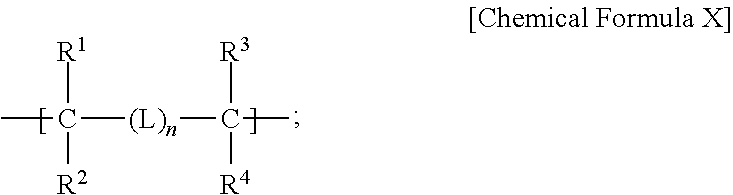


Applications Claiming Priority (2)
| Application Number | Priority Date | Filing Date | Title |
|---|---|---|---|
| KR10-2013-0006660 | 2013-01-21 | ||
| KR1020130006660A KR101736359B1 (en) | 2013-01-21 | 2013-01-21 | Binder for rechargable lithium battery, electrode for rechargable lithium battery, manufacturing method of electrode for rechargable lithium battery and recharable lithium battery including the electrode |
Publications (2)
| Publication Number | Publication Date |
|---|---|
| US20140205899A1 US20140205899A1 (en) | 2014-07-24 |
| US9413012B2 true US9413012B2 (en) | 2016-08-09 |
Family
ID=51207937
Family Applications (1)
| Application Number | Title | Priority Date | Filing Date |
|---|---|---|---|
| US14/152,943 Expired - Fee Related US9413012B2 (en) | 2013-01-21 | 2014-01-10 | Binder for rechargeable lithium battery, electrode for rechargeable lithium battery, method of preparing electrode for rechargeable lithium battery and rechargeable lithium battery including electrode |
Country Status (2)
| Country | Link |
|---|---|
| US (1) | US9413012B2 (en) |
| KR (1) | KR101736359B1 (en) |
Families Citing this family (4)
| Publication number | Priority date | Publication date | Assignee | Title |
|---|---|---|---|---|
| CN104393238B (en) * | 2014-11-27 | 2017-01-11 | 江西先材纳米纤维科技有限公司 | Silicon electrode thermally treated by adopting one-step method |
| KR102058113B1 (en) * | 2015-11-23 | 2019-12-23 | 주식회사 엘지화학 | Electrode with Improved Adhesion Property for Lithium Secondary Battery and Preparing Method therof |
| CN115863639B (en) * | 2021-09-26 | 2025-05-13 | 比亚迪股份有限公司 | Binder for dry electrode and preparation method thereof |
| JP2025500513A (en) * | 2021-12-23 | 2025-01-09 | ワンディー マテリアル、 インコーポレイテッド | Novel composites for anode electrodes |
Citations (7)
| Publication number | Priority date | Publication date | Assignee | Title |
|---|---|---|---|---|
| US2821521A (en) * | 1954-08-25 | 1958-01-28 | American Cyanamid Co | Polymers of n-(dialkylaminopropyl) maleamic acid |
| US20060014856A1 (en) * | 2004-07-14 | 2006-01-19 | Mcgorrin Marlene A | Pigmented ink-jet inks with improved print quality and reliability |
| US20080187838A1 (en) | 2007-02-06 | 2008-08-07 | 3M Innovative Properties Company | Electrodes including polyacrylate binders and methods of making and using the same |
| KR20110021680A (en) | 2009-08-25 | 2011-03-04 | 산요덴키가부시키가이샤 | Lithium Secondary Battery and Manufacturing Method Thereof |
| JP2011204592A (en) | 2010-03-26 | 2011-10-13 | Sanyo Electric Co Ltd | Lithium secondary battery and method for manufacturing the same |
| US20110311871A1 (en) | 2010-06-16 | 2011-12-22 | Sanyo Electric Co., Ltd. | Negative electrode for lithium secondary batteries and lithium secondary battery |
| US20140212728A1 (en) * | 2011-09-08 | 2014-07-31 | Zeon Corporation | Slurry for secondary batteries |
Family Cites Families (1)
| Publication number | Priority date | Publication date | Assignee | Title |
|---|---|---|---|---|
| US6759164B2 (en) | 2000-11-29 | 2004-07-06 | Wilson Greatbatch Ltd. | Use of heat-treated electrodes containing a polyamic acid-PVDF binder mixture |
-
2013
- 2013-01-21 KR KR1020130006660A patent/KR101736359B1/en active Active
-
2014
- 2014-01-10 US US14/152,943 patent/US9413012B2/en not_active Expired - Fee Related
Patent Citations (9)
| Publication number | Priority date | Publication date | Assignee | Title |
|---|---|---|---|---|
| US2821521A (en) * | 1954-08-25 | 1958-01-28 | American Cyanamid Co | Polymers of n-(dialkylaminopropyl) maleamic acid |
| US20060014856A1 (en) * | 2004-07-14 | 2006-01-19 | Mcgorrin Marlene A | Pigmented ink-jet inks with improved print quality and reliability |
| US20080187838A1 (en) | 2007-02-06 | 2008-08-07 | 3M Innovative Properties Company | Electrodes including polyacrylate binders and methods of making and using the same |
| KR20110021680A (en) | 2009-08-25 | 2011-03-04 | 산요덴키가부시키가이샤 | Lithium Secondary Battery and Manufacturing Method Thereof |
| US20110117431A1 (en) | 2009-08-25 | 2011-05-19 | Sanyo Electric Co., Ltd. | Lithium secondary battery and method of manufacturing the same |
| JP2011204592A (en) | 2010-03-26 | 2011-10-13 | Sanyo Electric Co Ltd | Lithium secondary battery and method for manufacturing the same |
| US20110311871A1 (en) | 2010-06-16 | 2011-12-22 | Sanyo Electric Co., Ltd. | Negative electrode for lithium secondary batteries and lithium secondary battery |
| JP2012003918A (en) | 2010-06-16 | 2012-01-05 | Sanyo Electric Co Ltd | Negative electrode for lithium secondary battery and lithium secondary battery |
| US20140212728A1 (en) * | 2011-09-08 | 2014-07-31 | Zeon Corporation | Slurry for secondary batteries |
Also Published As
| Publication number | Publication date |
|---|---|
| KR101736359B1 (en) | 2017-05-18 |
| KR20140094208A (en) | 2014-07-30 |
| US20140205899A1 (en) | 2014-07-24 |
Similar Documents
| Publication | Publication Date | Title |
|---|---|---|
| US11646422B2 (en) | Negative electrode for lithium secondary battery and lithium secondary battery comprising same | |
| US9368797B2 (en) | Binder composition for rechargeable lithium battery, preparing method of same, and rechargeable lithium battery including binder composition | |
| US9406937B2 (en) | Binder composition for rechargeable lithium battery, preparing method of same, and rechargeable lithium battery including binder composition | |
| US20110097629A1 (en) | Negative Active Material for Rechargeable Lithium Battery and Rechargeable Lithium Battery Including Same | |
| US9203108B2 (en) | Electrolyte for rechargeable lithium battery, and rechargeable lithium battery including the same | |
| US9293761B2 (en) | Positive active material layer composition for rechargeable lithium battery and rechargeable lithium battery using the same | |
| US8592083B2 (en) | Negative electrode and negative active material for rechargeable lithium battery, and rechargeable lithium battery including same | |
| US20120231325A1 (en) | Electrolyte for a lithium rechargeable battery, lithium rechargeable battery including the same, and method of manufacturing a lithium rechargeable battery | |
| US20160268591A1 (en) | Negative electrode for rechargeable lithium battery, method of manufacturing same, and rechargeable lithium battery including same | |
| US20140178748A1 (en) | Electrolyte additive and electrolyte including same and lithium rechargeable battery including electrolyte | |
| US9768448B2 (en) | Binder composition for rechargeable lithium battery, method of preparing same, electrode for rechargeable lithium battery and rechargeable lithium battery including same | |
| US9893358B2 (en) | Binder composition for rechargeable lithium battery, method of preparing the same, and rechargeable lithium battery including the same | |
| CN116154158A (en) | Negative electrode active material for rechargeable lithium battery and rechargeable lithium battery | |
| US11355815B2 (en) | Separator for rechargeable lithium battery, and method for preparing the same, and rechargeable lithium battery including the same | |
| US20150140434A1 (en) | Negative electrode active material layer composition for rechargeable lithium battery and method of preparing and using the same | |
| US20110165467A1 (en) | Negative electrode for rechargeable lithium battery and rechargeable lithium battery including the same | |
| US9755239B2 (en) | Composition for positive electrode of lithium secondary battery and lithium secondary battery using same | |
| US8492035B2 (en) | Polymer composition for rechargeable lithium battery, method of preparing same, and rechargeable lithium battery including same | |
| US12021239B2 (en) | Negative electrode for rechargeable lithium battery and rechargeable lithium battery including same | |
| US20140272575A1 (en) | Binder for rechargeable lithium battery, electrode for rechargeable lithium battery including binder, method of preparing electrode for rechargeable lithium battery, and rechargeable lithium battery including electrode | |
| US20140356710A1 (en) | Electrode for rechargeable lithium battery, and rechargeable lithium battery including electrode | |
| US20230268512A1 (en) | Positive electrode for rechargeable lithium battery and rechargeable lithium battery including the same | |
| US9413012B2 (en) | Binder for rechargeable lithium battery, electrode for rechargeable lithium battery, method of preparing electrode for rechargeable lithium battery and rechargeable lithium battery including electrode | |
| US20120308889A1 (en) | Negative electrode and rechargeable lithium battery including same | |
| US9496548B2 (en) | Negative active material for rechargeable lithium battery, method for preparing same, and rechargeable lithium battery including same |
Legal Events
| Date | Code | Title | Description |
|---|---|---|---|
| AS | Assignment |
Owner name: SAMSUNG SDI CO., LTD., KOREA, REPUBLIC OF Free format text: ASSIGNMENT OF ASSIGNORS INTEREST;ASSIGNORS:CHUNG, BYUNG-JOO;LEE, EON-MI;KIM, NAM-SEON;AND OTHERS;REEL/FRAME:031963/0038 Effective date: 20131210 Owner name: AEKYUNG CHEMICAL CO., LTD., KOREA, REPUBLIC OF Free format text: ASSIGNMENT OF ASSIGNORS INTEREST;ASSIGNORS:CHUNG, BYUNG-JOO;LEE, EON-MI;KIM, NAM-SEON;AND OTHERS;REEL/FRAME:031963/0038 Effective date: 20131210 |
|
| AS | Assignment |
Owner name: AEKYUNG CHEMICAL CO., LTD., KOREA, REPUBLIC OF Free format text: ASSIGNMENT OF ASSIGNORS INTEREST;ASSIGNOR:SAMSUNG SDI CO., LTD.;REEL/FRAME:039058/0918 Effective date: 20160630 |
|
| STCF | Information on status: patent grant |
Free format text: PATENTED CASE |
|
| CC | Certificate of correction | ||
| FEPP | Fee payment procedure |
Free format text: MAINTENANCE FEE REMINDER MAILED (ORIGINAL EVENT CODE: REM.); ENTITY STATUS OF PATENT OWNER: SMALL ENTITY |
|
| LAPS | Lapse for failure to pay maintenance fees |
Free format text: PATENT EXPIRED FOR FAILURE TO PAY MAINTENANCE FEES (ORIGINAL EVENT CODE: EXP.); ENTITY STATUS OF PATENT OWNER: SMALL ENTITY |
|
| STCH | Information on status: patent discontinuation |
Free format text: PATENT EXPIRED DUE TO NONPAYMENT OF MAINTENANCE FEES UNDER 37 CFR 1.362 |
|
| STCH | Information on status: patent discontinuation |
Free format text: PATENT EXPIRED DUE TO NONPAYMENT OF MAINTENANCE FEES UNDER 37 CFR 1.362 |