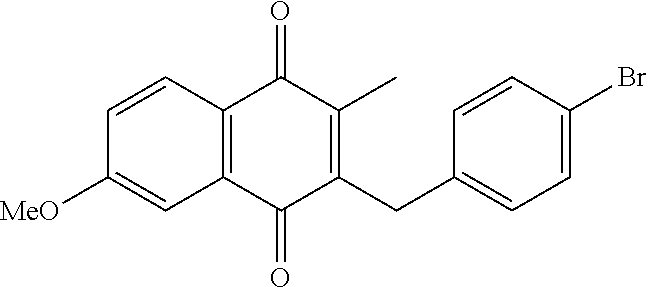
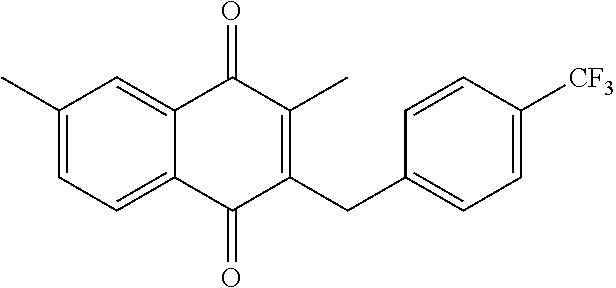
The present invention relates to a new process for synthesizing 1.4-naphthoquinones and their metabolites and to their application in therapeutics.
Plasmodium falciparum and Schistosoma mansoni are blood feeding parasites digesting the host's hemoglobin. and detoxifying the toxic heme into an insoluble polymer called hemozoin.
Plasmodium parasites are exposed to elevated fluxes of reactive oxygen species during the life cycle in the human host and therefore high activities of intracellular antioxidant systems are needed. The most important antioxidative system consists of thiols which are regenerated by disulfide reductases; these include three validated drug targets the glutathione reductases (GR) of the malarial parasite Plasmodium falciparum and of human erythrocytes as well as the thioredoxin reductase of P. falciparum (Schirmer et al. Angew. Chem. Int. Ed. Engl. 1995, 34. 141-54; Krauth-Siegel et al. Angew. Chem. Int. Ed. Engl. 2005, 44, 690-715). One validated target against the malarial parasite Plasmodium falciparum is the enzyme glutathione reductase which reduces glutathione disulfide to its thiol form glutathione on the expense of NADPH. Glutathione is implicated in the development of chloroquine resistance: an elevation of the glutathione content in P. falciparum leads to increased resistance to chloroquine, while glutathione depletion in resistant strains restores sensitivity to chloroquine (Meierjohan et al. Biochem. J. 200, 368, 761-768). High intracellular glutathione levels depend inter alia on the efficient reduction of glutathione disulfide by GR and by reduced thioredoxin (Kanzok et al. Science 2001, 291, 643-646). The contribution to the reversal of drug resistance or to a synergistic effect by GR inhibitors like methylene blue is currently investigated for the commonly used antimalarial drugs chloroquine, amodiaquine, artesunate in clinical trials (Zoungrana et al. PLoS One, 2008. 3:e1630; Meissner et al. Malar J. 2006. 5:84; Akoachere et al. Antimicrob. Agents Chemother. 2005, 49, 4592-7). Derivatives of menadione per se were shown to be potent inhibitors both of human and Plasmodium falciparum glutathione reductases acting in the low micromolar range in parasitic assays with P. falciparum in cultures (Biot et al. J. Med. Chem. 47. 5972-5983; Bauer et al. J. Am. Chem. Soc. 2006. 128. 10784-10794). The dual drugs combining a 4-aminoquinoline and a menadione-based GR inhibitor exhibited high antimalarial potencies in the low nanomolar range in the malarial assays in vitro. (Davioud-Charvet et al. J. Med. Chem. 2001, 44, 4268-4276; Friebolin et al., J. Med. Chem. 2008. 51. 1260-77; Wenzel et al. J. Med. Chem. 2010. 53, 3214-26).
The malarial parasite Plasmodium falciparum digests a large amount of its host cell hemoglobin during its erythrocytic cycle as source of essential nutrients (Zarchin et al. Biochem. Pharmacol. 198, 35, 2435-2442). The digestion is a complex process that involves several proteases and takes place in the food vacuole of the parasite leading to the formation of iron II ferroprotoporphyrin (FPIX) (Goldberg et al. Parasitol. Today. 1992, 8, 280-283) as toxic byproduct for the parasite which is immediately oxidized to FPIX(Fe3+). Due to the toxicity of FPIX the parasites have developed a detoxification process in which FPIX(Fe3+) (hematin) is polymerized forming inert crystals of hemozoin or malaria pigment (Dorn et al. Nature 1995, 374, 269-271). FPIX(Fe2+) is an inhibitor of hematin polymerization (Monti et al. Biochemistry 1999. 38, 8858-8863). Early observations indicated that free FPIX(Fe3+) is able to form complexes with aromatic compounds bearing nitrogen, e.g. pyridines, 4-aminoquinolines (Cohen et al. Nature 1964, 202, 805-806; Egan et al. J. Inorg. Biochem. 2006, 100, 916-926) and it is now well established that 4-aminoquinolines can form μ-oxodimers with FPIX thus preventing the formation of hemozoin. Consequently, an increase of free heme concentration in the food vacuole is responsible for killing the parasite (Vippagunta et al. Biomed. Biochim. Acta 2000, 1475, 133-140). In the presence of reactive oxygen species iron-porphyrin complexes (e.g. free heme) are catalysts for oxidation reactions. Released in large quantities in the food vacuole of the parasite they are thought to strongly influence the activity of a drug under the specific acidic conditions of the malarial food vacuole. Drug metabolites can be more active than its precursor (pro-drug effect) or toxic (Bernadou et al. Adv. Synth. Catal. 2004, 346, 171-184).
The reduction of methemoglobin(Fe3+) into hemoglobin(Fe2+) is of great importance in the treatment of malaria. Since the malarial parasite is much more capable of using methemoglobin as nutrient and digests methemoblobin faster than hemoglobin the reduction of methemoglobin can be used to slow down the parasite's methemoglobin digestion by reducing its concentration. A second reason to target the reduction of methemoglobin is that methemoglobin, the ferric form of hemoglobin, is not capable of oxygen transport. High levels of methemoglobin are found during Plasmodium vivax infections (Anstey et al. Trans. R. Soc. Trop. Med. Hyg. 1996, 90, 147-151). A reduced oxygen carrying capacity of blood due to anaemia is even worsened by reduction in oxygen carrying capacity from even a modest concentration of methemoglobin leading to an impaired supply of oxygen for the tissue; a specific situation observed in cerebral malaria.
The two major antioxidant defense lines in Plasmodium are provided by the glutathione and the thioredoxin systems. Both systems are NADPH-dependent and are driven by homodimeric FAD-dependent oxido-reductases, namely glutathione reductase (PfGR) and thioredoxin reductase (PfTrxR). Both GRs from the human erythrocyte and from the malarial parasite are essential proteins for the survival of the malarial parasite infecting red blood cells and were identified as targets of antimalarial drugs. They maintain the redox equilibrium in the cytosol by catalyzing the physiological reaction: NADPH+H++GSSG→NADP++2 GSH, in particular in the course of the pro-oxidant process of hemoglobin digestion in the intraerythrocytic plasmodial cycle. The parasite evades the toxicity of the released heme by expressing two major detoxification pathways, i.e. hemozoin formation in the food vacuole and an efficient thiol network in the cytosol. Hemozoin formation is inhibited by 4-aminoquinolines such as chloroquine (CQ) and heme FPIX(Fe2+). The thiol network maintained by GR is inhibited by numerous redox-cyclers including 1,4-naphthoquinones disclosed in patent application WO in the name of the inventors, phenothiazinium derivatives as methylene blue (MB) and the natural phenazine pyocyanin (PYO), and nitroaromatics. Methylene blue, an efficient GR subversive substrate, was the first synthetic antimalarial drug used in human medicine at the beginning of the 20th century but was abandoned with the launch of chloroquine in the 40s′. Its reduced form (LMB) is known to reduce Fe3+ to Fe2+ from both methemoglobin (MetHb) and heme (FPIX) species.
Since the malarial parasite Plasmodium falciparum multiplies in human erythrocytes, most drugs are directed against this stage of the life cycle of the parasite.
The most administered drugs are chloroquine and 4-aminoquinoline derivatives, and artemisinin and arthemether derivatives. Present malaria treatment (recommended by WHO) is based on combination therapy: artemisinin combined therapy (ACT). Highly and multi-drug-resistant Plasmodium strains spread all over the world. For instance, very recent studies showed that resistant Plasmodium falciparum strains to artemether (artemisinin analogue) appeared in French Guiana and Senegal (Jambou et al. Lancet. 2005, 366, 1960-3; XX). Also, decreased in vitro susceptibility of Plasmodium falciparum isolates to artesunate, mefloquine, chloroquine, and quinine in Cambodia from 2001 to 2007 were observed (Noranate N et al. PLoS One 2007, 2:e139; Lim et al. Antimicrob. Agents Chemother. 2010, 54, 2135-42).
The chemotherapy of schistosomiasis is currently based on only one drug, Praziquantel (PZQ). Drug resistances developed by both parasites are emerging and there is an urgent need for new antiparasitic drugs. While PZQ is very effective in schistosomiasis treatment and has a very low toxicity, it has limited action against larval parasites. This leads to ineffective cures in areas of high transmission. Furthermore, there is evidence of evolving PZQ-resistant parasites in Egypt, suggesting the urgency for the development of novel schistosomicidal agents. Clinical drug resistance against PZQ has also been noted in Kenya (Melman S D et al. PLoS Negl. Trop. Dis. 2009, 3:e504). Artemisinin-based antischistosomal drugs have good activity against larval parasites, but limited activity against adult parasites. The use of the same molecules (ex: artemisinin) to treat both malaria and schistosomiasis put the antimalarial application at risk if multi-resistant parasites appear.
There is therefore still a need for compounds having efficiency against malaria and schistosomiasis without the usual drawbacks of the existing drugs. Furthermore, there is a need for compounds which are easy to formulate in pharmaceutical compositions.
In international application WO 2009/118327 the inventors disclosed a new series of compounds based on the 2-methyl-1,4-naphthoquinone core (named menadione). These compounds were 3-benzylmenadione derivatives (benzylNQ) and most of them were synthesized in one step with satisfactory yields. The series was tested in in vitro tests against the chloroquine-sensitive strain 3D7, the chloroquine-resistant strain K1, the multidrug-resistant strain Dd2 and against a Pf-GHA parasite strain in vitro. The compounds showed antimalarial effects in the low nM range while displaying moderate cytotoxicity in the μM range and no hemolysis of red blood cells at therapeutic doses. The most active compounds were also tested in a mouse model infected by P. berghei displaying significant decrease in parasitemia at 30 mg/kg (ip and po),
Now the inventors developed new methodologies for total synthesis of polysubstituted 3-benzylmenadione derivatives and aza analogues. They also studied the potential metabolism of these compounds, synthesized the putative metabolites and investigated the mechanism of action. The metabolites, the benz[c]-xanthen-7-ones (benzxanthones), were tested in the hematin polymerization assay.
The inventors also studied new uses of the molecules, described in the present patent application, as antiparasitic agents to target blood-feeding parasites, including the protozoans Plasmodium, Eimeria and Babesia, the helminths including the worm Schistosoma, and more broadly the external blood-feeding parasites like fleas and ticks, to treat humans and animals (cattle, pets), in human and veterinary medicines, as prophylactics or as treatments, respectively.
In the publication Journal of Medicinal Chemistry 1991, Vol. 34, N o 1 p. 270 a product code-named n o 25 belonging to the chemical family of the Pyridylmethyl naphtoquinones is disclosed.
Consequently, a first object of the invention are compounds of formula (I)
wherein:
-
- either X1, X2, X3 and X4 represent all carbon atoms,
- either one of X1, X2, X3 and X4 represents a nitrogen atom and the three others represent carbon atoms,
- either X1 and X4 represent a nitrogen atom and both X2 and X3 represent carbon atoms,
- the bond - - - - - between O in position 17 and X10 represents no bond or a single bond,
- the bond represents either a single bond or a double bond,
- X5 represents CO or CH2 or CHOH,
- X6, X7, X8, X9 and X10 represent all carbon atoms or one of them represents a nitrogen atom and the four others are carbon atoms,
with the proviso that
i) when the bond - - - - - between O17 and X
10 represents a single bond, then the bonds
between atoms in positions C1/O18 and C4/O17 are single bonds, the bonds between carbons in positions C1/C2 and C3/C4 are double bonds, the bond between carbons in positions C2/C3 is a simple bond, and R represents a hydrogen atom or an acetyl group and X
10 is not a nitrogen atom and
ii) when the bond - - - - - between O17 and X
10 represents no bond, then R does not exist and the bonds
between atoms C1/O18 and C4/O17 are double bonds, the bonds between carbons in positions C1/C2 and C3/C4 are simple bonds, the bond between carbons in positions C2/C3 is a double bond, and
X1, X2, X3 and X4 when they are carbon atoms being optionally substituted by:
-
- a hydrogen atom,
- a halogen atom,
- a hydroxy group,
- a triflate group,
- a phosphate group,
- a linear or branched (C1-C4)alkyl group,
- a linear or branched (C1-C4)alkoxy group,
- a thio(C1-C4)alkoxy group,
- a pentafluorosulfanyl group,
- —SCF3
- —SCH2F,
- a trifluoromethyl group,
- a trifluoromethoxy group,
- X6, X7, X8, X9, X10—except when atoms O17 and X10 are bound by a simple bond and X10 is a quarternary carbon atom—being optionally substituted by:
- a hydrogen atom,
- a halogen atom,
- a hydroxy group,
- a linear or branched (C1-C4)alkyl group,
- a linear or branched (C1-C4)alkoxy group,
- a thio(C1-C4)alkoxy group,
- a pentafluorosulfanyl group,
- a trifluoromethyl group,
- a trifluoromethoxy group,
- a difluoromethoxy group,
- a difluoromethyl group,
- —COOH,
- —COO(C1-C4)alkyl group,
- —CONR1(CH2)mCN, with R1 being a hydrogen atom or a linear or branched (C1-C4)alkyl group and m=1, 2 or 3,
- —CSNR1(CH2)mCN, with R1 being a hydrogen atom or a linear or branched (C1-C4)alkyl group m=1, 2 or 3,
- —CONR1Het with R1 being a hydrogen atom or a linear or branched (C1-C4)alkyl group, Het representing a pyridine-2-yl group, said group optionally substituted by an amino group in -6 or by a —CONH2 group in -5,
- —NO2,
- —CN,
- —NR2R3 with R2 and R3 representing each independently a hydrogen atom, an amino protecting group selected from the group comprising Boc group and (C1-C4)alkyl group, or R2 and R3 forming with the nitrogen atom which bears them a cyclic group selected from the group comprising morpholine, piperidine, and piperazine groups, said cyclic groups being optionally substituted,
- an aryl group or an aryl group substituted by one or several substituents selected from the group comprising a (C1-C4)alkyl group, a —NO2 group, a —COOR4 with R4 selected from a hydrogen atom and a linear or branched (C1-C4)alkyl group, a —NR5R6 with R5 and R6 independently selected from the group comprising a hydrogen atom and a linear or branched (C1-C4)alkyl group,
- a heterocyclic group selected from the group comprising morpholinyl group or piperidinyl, or piperazinyl group, each of said group being optionally substituted by one or several substituents selected from the group comprising a linear or branched (C1-C4)alkyl group, —COOCH2CH3, or a group
and the pharmaceutically acceptable derivatives thereof,
for their use as antiparasitic agents to target blood-feeding parasites,
with the proviso that when the blood-feeding parasite is Plasmodium, then when X1, X2, X3 and X4 are all carbon atoms, or when X1 is a nitrogen atom, and X2, X3 and X4 are all carbon atoms, then at least one of X6, X7, X8, X9 and X10 represents a nitrogen atom.
The present invention also deals with compounds of formula (Ip)
wherein:
-
- either X1, X2, X3 and X4 represent all carbon atoms,
- either one of X1, X2, X3 and X4 represents a nitrogen atom and the three others represent carbon atoms,
- either X1 and X4 represent a nitrogen atom and both X2 and X3 represent carbon atoms,
- the bond - - - - - between O in position 17 and X10 represents no bond or a single bond,
- the bond represents either a single bond or a double bond,
- X5 represents CO or CH2 or CHOH,
- X6, X7, X8, X9 and X10 represent all carbon atoms or one of them represents a nitrogen atom and the four others are carbon atoms,
with the proviso that
i) when the bond - - - - - between O17 and X
10 represents a single bond, then the bonds
between atoms in positions C1/O18 and C4/O17 are single bonds, the bonds between carbons in positions C1/C2 and C3/C4 are double bonds, the bond between carbons in positions C2/C3 is a simple bond, and R represents a hydrogen atom or an acetyl group and X
10 is not a nitrogen atom and
ii) when the bond - - - - - between O17 and X
10 represents no bond, then R does not exist and the bonds
between atoms C1/O18 and C4/O17 are double bonds, the bonds between carbons in positions C1/C2 and C3/C4 are simple bonds, the bond between carbons in positions C2/C3 is a double bond, and
X1, X2, X3 and X4 when they are carbon atoms being optionally substituted by:
-
- a hydrogen atom,
- a halogen atom,
- a hydroxy group,
- a linear or branched (C1-C4)alkyl group,
- a linear or branched (C1-C4)alkoxy group,
- a thio(C1-C4)alkoxy group,
- a pentafluorosulfanyl group,
- —SCF3
- —SCH2F,
- a trifluoromethyl group,
- a trifluoromethoxy group,
X6, X7, X8, X9, X10—except when atoms O17 and X10 are bound by a simple bond and X10 is a quarternary carbon atom—being optionally substituted by:
-
- a hydrogen atom,
- a halogen atom,
- a hydroxy group,
- a linear or branched (C1-C4)alkyl group,
- a linear or branched (C1-C4)alkoxy group,
- a thio(C1-C4)alkoxy group,
- a pentafluorosulfanyl group,
- a trifluoromethyl group,
- a trifluoromethoxy group,
- a difluoromethoxy group,
- a difluoromethyl group,
- —COOH,
- —COO(C1-C4)alkyl group,
- —CONR1(CH2)mCN, with R1 being a hydrogen atom or a linear or branched (C1-C4)alkyl group and m=1, 2 or 3,
- —CSNR1(CH2)mCN, with R1 being a hydrogen atom or a linear or branched (C1-C4)alkyl group m=1, 2 or 3,
- —CONR1Het with R1 being a hydrogen atom or a linear or branched (C1-C4)alkyl group, Het representing a pyridine-2-yl group, said group optionally substituted by an amino group in -6 or by a —CONH2 group in -5,
- —NO2,
- —CN,
- —NR2R3 with R2 and R3 representing each independently a hydrogen atom, an amino protecting group selected from the group comprising Boc group and (C1-C4)alkyl group, or R2 and R3 forming with the nitrogen atom which bears them a cyclic group selected from the group comprising morpholine, piperidine, and piperazine groups, said cyclic groups being optionally substituted,
- an aryl group or an aryl group substituted by one or several substituents selected from the group comprising a (C1-C4)alkyl group, a —NO2 group, a —COOR4 with R4 selected from a hydrogen atom and a linear or branched (C1-C4)alkyl group, a —NR5R6 with R5 and R6 independently selected from the group comprising a hydrogen atom and a linear or branched (C1-C4)alkyl group,
- a heterocyclic group selected from the group comprising morpholinyl group or piperidinyl or piperazinyl group, each of said group being optionally substituted by one or several substituents selected from the group comprising a linear or branched (C1-C4)alkyl group, —COOCH2CH3, or a group
and the pharmaceutically acceptable derivatives thereof,
for their use as antiparasitic agents to target blood-feeding parasites,
with the proviso that when the blood-feeding parasite is Plasmodium, then when X1, X2, X3 and X4 are all carbon atoms, or when X1 is a nitrogen atom, and X2, X3 and X4 are all carbon atoms, then at least one of X6, X7, X8, X9 and X10 represents a nitrogen atom.
According to the instant invention, blood-feeding parasites includes the protozoans Plasmodium, Eimeria, and Babesia, the helminths including the worm Schistosoma, and more broadly the external blood-feeding parasites like fleas and ticks. Thus the compounds according to the invention may be used to treat humans and animals (cattle, pets), in human and veterinary medecines, as prophylaxics or as treatments, respectively. The following blood-feeding parasites may be cited Schistosoma mansoni, Schistosoma haematobium, Schistosoma japonicum, Schistosoma mekongi, Schistosoma intercalatum, Schistosoma bovis and Schistosoma nasale, Plasmodium falciparum, Plasmodium vivax, Plasmodium ovale, Plasmodium malariae, Babesia divergens, Babesia microti, and all Eimeria spp. being principal cause of coccidiosis, highly pathogenic, especially in young domesticated mammals, herbivores, and birds.
According to the present invention, a “pharmaceutically acceptable salt” is a pharmaceutically acceptable, organic or inorganic acid or base salt of a compound of the invention, Representative pharmaceutically acceptable salts include, e.g., alkali metal salts, alkali earth salts, ammonium salts, water-soluble and water-insoluble salts, such as the acetate, amsonate (4,4-diaminostilbene-2,2-disulfonate), benzenesulfonate, benzonate, bicarbonate, bisulfate, bitartrate, borate, bromide, butyrate, calcium, calcium edetate, camsylate, carbonate, chloride, citrate, clavulariate, hydrochloride, edetate, edisylate, estolate, esylate, fiunarate, gluceptate, gluconate, glutamate, glycollylarsanilate, hexafluorophosphate, hexylresorcinate, hydrabamine, hydrobromide, hydrochloride, hydroxynaphthoate, iodide, isothionate, lactate, lactobionate, laurate, malate, maleate, mandelate, mesylate, methylbromide, methylnitrate, methylsulfate, mucate, napsylate, nitrate, N-methylglucamine ammonium salt, 3-hydroxy-2-naphthoate, oleate, oxalate, palmitate, pamoate (1,1-methene-bis-2-hydroxy-3-naphthoate, einbonate), pantothenate, phosphate/diphosphate, picrate, polygalacturonate, propionate, p-toluenesulfonate, salicylate, stearate, subacetate, succinate, sulfate, sulfosaliculate, suramate, tannate, tartrate, teoclate, tosylate, triethiodide, and valerate salts. A pharmaceutically acceptable salt can have more than one charged atom in its structure. In this instance the pharmaceutically acceptable salt can have multiple counterions. Thus, a pharmaceutically acceptable salt can have one or more charged atoms and/or one or more counterions.
According to the invention, the term “halogen” refers to bromine atom, chlorine atom, fluorine atom or iodine atom.
According to the invention, the term “alkyl” refers to a straight or branched chain, saturated hydrocarbon having the indicated number of carbon atoms. A (C1-C4) alkyl is meant to include but is not limited to methyl, ethyl, propyl, isopropyl, butyl, sec-butyl, tert-butyl. An alkyl group can be unsubstituted or optionally substituted with one or more substituents selected from halogen atom, hydroxy group or amino group.
The term “alkoxy” refers to a —O-alkyl group having the indicated number of carbon atoms. A (C1-C4)alkoxy group includes —O-methyl, —O-ethyl, —O-propyl, —O-isopropyl, —O-butyl, —O-sec-butyl, —O-tert-butyl.
The term “thioalkoxy” refers to an S—O-alkyl group having the indicated number of carbon atoms. A thio(C1-C4)alkoxy group includes S—O-methyl, S—O-ethyl, S—O-propyl, S—O-isopropyl, S—O-butyl, S—O-sec-butyl, S—O-tert-butyl.
The term “aryl” refers to a 6- to 18-membered monocyclic, bicyclic, tricyclic, or polycyclic aromatic hydrocarbon ring system. Examples of an aryl group include phenyl, naphthyl, pyrenyl, anthracyl, quinolyl, and isoquinolyl.
The term “heteroaryl” refers to small sized heterocycles including di- and tri-azoles, tetrazole, thiophene, furan, imidazole,
In an advantageous embodiment according to the invention, the compounds used as antischistosomal agents are compounds of formula (I) wherein
-
- X1, X2, X3 and X4 represent all carbon atoms, with X2 or X3 optionally substituted by a halogen atom or a linear or branched (C1-C4) alkoxy group,
- the bond - - - - - between O in position 17 and X10 represents no bond and the bonds between atoms C1/O18 and C4/O17 are double bonds, the bonds between carbons in positions C1/C2 and C3/C4 are simple bonds, the bond between carbons in positions C2/C3 is a double bond, then R does not exist and
- X5 represents CO or CH2 or CHOH,
- X6, X7, X8, X9 and X10 represent all carbon atoms with at least one of X6, X7, X8, X9, optionally substituted by a substituent selected from a halogen atom, a linear or branched (C1-C4)alkyl group, a linear or branched (C1-C4)alkoxy group, —a trifluoromethyl group, —a trifluoromethoxy group, —COOH, —CN, —NO2, a —NR2R3 with R2 and R3 representing each independently a hydrogen atom, an amino protecting group selected from the group comprising Boc group and (C1-C4)alkyl group, or R2 and R3 forming with the nitrogen atom which bears them a cyclic group selected from the group comprising morpholine, piperidine, and piperazine groups, said cyclic groups being optionally substituted.
In another advantageous embodiment according to the invention, the compounds used as antischistosomal agents are compounds of formula (I) wherein
X1 represents a nitrogen atom and X2, X3 and X4 carbon atoms, with at least one of X2, X3 and X4 being optionally substituted by a linear or branched (C1-C4)alkyl group,
-
- the bond - - - - - between O in position 17 and X10 represents no bond and the bonds between atoms C1/O18 and C4/O17 are double bonds, the bonds between carbons in positions C1/C2 and C3/C4 are simple bonds,
- X5 represents CH2,
- X6, X7, X8, X9 and X10 represent all carbon atoms with at least one of X6, X7, X8, X9 optionally substituted by a substituent selected from a halogen atom, a linear or branched (C1-C4)alkoxy group and—a trifluoromethyl group.
Some compounds are new and are also part of the invention.
Consequently another object of the invention are new compounds of formula (Ia):
wherein
-
- either X1, X2, X3 and X4 represent all carbon atoms
- either X1 represents a carbon atom and one of X2, X3 and X4 represents a nitrogen atom and the two others represent carbon atoms,
- either X1 and X4 represent each a nitrogen atom and X2 and X3 represent a carbon atom,
- X5 represents CO or CH2 or CHOH,
X6, X7, X8, X9 and X10 represent all carbon atoms or one of them represents a nitrogen atom and the four others are carbon atoms,
X1, X2, X3, X4, X6, X7, X8, X9 and X10 when they are carbon atoms may be substituted as disclosed above,
with the proviso than if X1, X2, X3 and X4 represent all carbon atoms or if X1 represents a nitrogen atom, then at least one of X6, X7, X8, X9 and X10 represents a nitrogen atom.
Another aspect of the invention are new compounds responding to formula (Ia):
wherein
-
- either X1, X2, X3 and X4 represent all carbon atoms
- either X1 represents a carbon atom and one of X2, X3 and X4 represents a nitrogen atom and the two others represent carbon atoms,
- either X1 and X4 represent each a nitrogen atom and X2 and X3 represent a carbon atom,
- X5 represents CO or CH2 or CHOH,
X6, X7, X8, X9 and X10 represent all carbon atoms or one of them represents a nitrogen atom and the four others are carbon atoms,
X1, X2, X3, X4, X6, X7, X8, X9 and X10 when they are carbon atoms may be substituted as defined above,
with the proviso than if X1, X2, X3 and X4 represent all carbon atoms or if X1 represents a nitrogen atom, then at least one of X6, X7, X8, X9 and X10 represents a nitrogen atom and if X1, X2, X3 and X4 all represent unsubstituted carbon atoms and X5 represents CH2 then neither X7 nor X9 represents a nitrogen atom.
-
- The second part of the above disclaimer is intended to exclude the product code-named n o 25 in the publication Journal of Medicinal Chemistry 1991, Vol. 34, N° 1 p. 270.
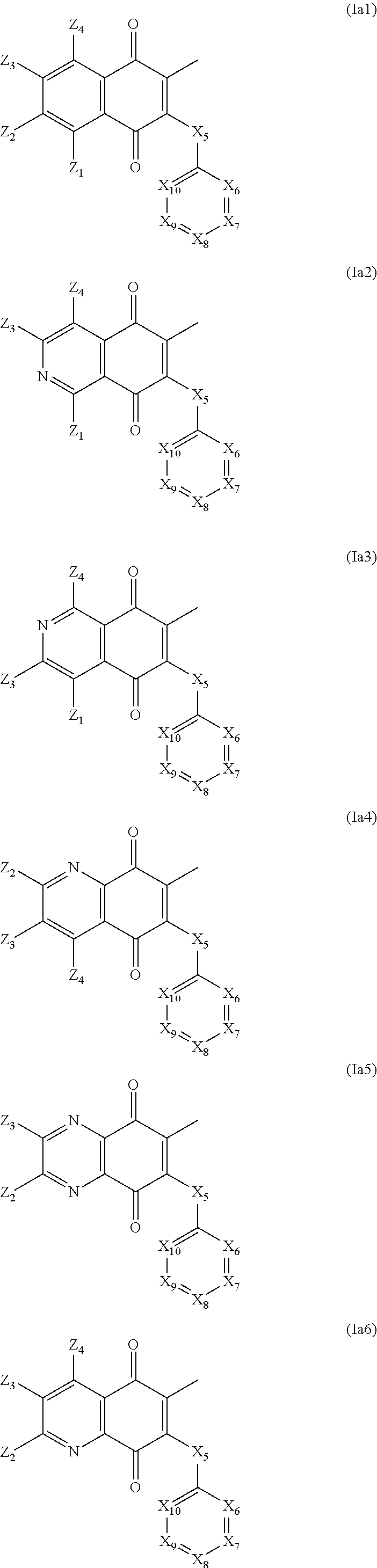
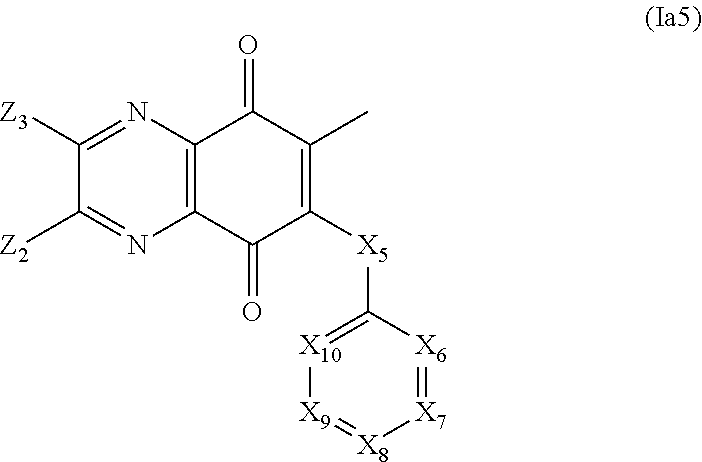
In an advantageous embodiment, the compounds according to the invention are selected from the group comprising:
wherein Z1, Z2, Z3 et Z4 represent each independently of the other,
-
- a hydrogen atom,
- a halogen atom,
- a hydroxy group,
- a triflate group,
- a phosphate group,
- a linear or branched (C1-C4)alkyl group,
- a linear or branched (C1-C4)alkoxy group,
- a thio(C1-C4)alkoxy group,
- a pentafluorosulfanyl group,
- —SCF3
- —SCH2F,
- a trifluoromethyl group,
- a trifluoromethoxy group,
X6, X7, X8, X9 and X10 are as defined above, with the proviso that in the compound of formula (Ia1) or of formula (Ia6) at least one of X6, X7, X8, X9 and X10 represents a nitrogen atom.
In an other advantageous embodiment, the compounds according to the invention are selected from the group comprising:
wherein Z1, Z2, Z3 et Z4 represent each independently of the other,
-
- a hydrogen atom,
- a halogen atom,
- a hydroxy group,
- a linear or branched (C1-C4)alkyl group,
- a linear or branched (C1-C4)alkoxy group,
- a thio(C1-C4)alkoxy group,
- a pentafluorosulfanyl group,
- —SCF3
- —SCH2F,
- a trifluoromethyl group,
- a trifluoromethoxy group,
X6, X7, X8, X9 and X10 are as defined above, with the proviso that in the compound of formula (Ia1) or of formula (Ia6) at least one of X6, X7, X8, X9 and X10 represents a nitrogen atom.
Another object of the invention are compounds of formula (Ib):
wherein
-
- either X1, X2, X3 and X4 represent all carbon atoms,
- or one of X1, X2, X3 and X4 represents a nitrogen atom and the three others represent carbon atoms,
- or X1 and X4 represent a nitrogen atom and X2 and X3 represent carbon atoms,
X5 represents CO or CH2 or CHOH,
X6, X7, X8, X9 and X10 represent all carbon atoms or one of X6, X7, X8, X9 represents a nitrogen atom and the four others are carbon atoms,
R represents a hydrogen atom, or an acetyl group,
X1, X2, X3, X4, X6, X7, X8 and X9 when they are carbon atoms may be substituted as defined above.
Another object of the invention are compounds of formulas (Ia) and (Ib) and the pharmaceutically acceptable salts thereof for their use as drugs, especially as antiparasitic agents to target blood-feeding parasites.
Another object of the invention is the use of compounds of formulas (I) in general and in particular (Ia), (Ia1) to (Ia6) (Ib) and (Ip) and the pharmaceutically acceptable salts thereof in therapy and prophylaxis.
The instant invention also provides a method for the prevention or the treatment of parasitic disease due to blood-feedings parasites of humans, cattles and pets, in particular human diseases like malaria or schistosomasis comprising the administration to a patient in need thereof of a therapeutically effective amount of a compound of formula (I) as defined above.
In accordance with the invention, the compounds of formula (Ia), (Ia1) to (Ia6) (Ib) and (Ip) are useful in pharmaceutically acceptable compositions. Thus another object of the invention are pharmaceutically acceptable composition comprising at least one compound selected from compounds of formula (Ia), (Ia1) to (Ia6), (Ip) and (Ib) and salts thereof in combination with excipients and/or pharmaceutically acceptable diluents or carriers. Any conventional carrier material can be utilized. The carrier material can be an organic or inorganic inert carrier material, for example one that is suitable for oral administration. Suitable carriers include water, gelatin, gum arabic, lactose, starch, magnesium stearate, talc, vegetable oils, polyalkylene-glycols, glycerine and petroleum jelly. Furthermore, the pharmaceutical preparations may also contain other pharmaceutically active agents. Additional additives such as flavoring agents, preservatives, stabilizers, emulsifying agents, buffers and the like may be added in accordance with accepted practices of pharmaceutical compounding. The pharmaceutical preparations can be made up in any conventional form including a solid form for oral administration such as tablets, capsules, pills, powders, granules, and rectal suppositories. The pharmaceutical preparations may be sterilized and/or may contain adjuvants such as preservatives, stabilizers, wetting agents, emulsifiers, salts for varying the osmotic pressure and/or buffers.
The compositions of the invention can also be administered to a patient in accordance with the invention by topical (including transdermal, buccal or sublingual), or parenteral (including intraperitoneal, subcutaneous, intravenous, intradermal or intramuscular injection) routes.
The composition may comprise other active agents which may be one to three other antimalarial agents selected from the group comprising atovaquone, chloroquine, amodiaquine, mefloquine, ferroquine, artemisinin and the related peroxans from the pharmaceutical market like artesunate, arteether and artemether, menadione, methylene blue, proguanil, cycloguanil, chlorproguanil, pyrimethamine, primaquine, piperaquine, fosmidomycin, halofantrine, dapsone, trimethoprim, sulfamethoxazole, sulfadoxine, ascorbate, for a simultaneous, separated or sequential, or administration.
The composition may comprise other active agents which may be one to three other antischistosomal agents selected from the group comprising praziquantel, atovaquone, artemisinin and the related peroxans from the pharmaceutical market like artesunate, arteether and artemether, oxamniquine, dehydroemetine dichlorhydrate, emetine camsilate, emetine chlorhydrate, oltipraz, hycanthone mesilate, lucanthone chlorhydrate, ferroquine, ascorbate, for a simultaneous, separated or sequential, or administration.
A further object of the invention is a process for preparing compounds of formula (I):
wherein:
-
- either X1, X2, X3 and X4 represent all carbon atoms,
- either one of X1, X2, X3 and X4 represents a nitrogen atom and the three others represent carbon atoms,
- either X1 and X4 represent a nitrogen atom and X2 and X3 both represent carbon atoms,
- the bond - - - - - between O in position 17 and X10 represents no bond or a single bond,
- the bond represents either a single bond or a double bond,
X5 represents CO or CH2 or CHOH,
X6, X7, X8, X9 and X10 represent all carbon atoms or one of them represents a nitrogen atom and the four others are carbon atoms,
with the proviso that when the bond - - - - - between O17 and X
10 represents a single bond, then the bonds
between atoms in positions C1/O18 and C4/O17 are single bonds, the bonds between carbons in positions C1/C2 and C3/C4 are double bonds, the bond between carbons in positions C2/C3 is a simple bond, and R represents a hydrogen atom or an acetyl group and X
10 is not a nitrogen atom and
X1, X2, X3 and X4 when they are carbon atoms being optionally substituted by:
-
- a hydrogen atom,
- a halogen atom,
- a hydroxy group,
- a triflate group,
- a phosphate group,
- a linear or branched (C1-C4)alkyl group,
- a linear or branched (C1-C4)alkoxy group,
- a thio(C1-C4)alkoxy group,
- a pentafluorosulfanyl group,
- —SCF3
- —SCH2F,
- a trifluoromethyl group,
- a trifluoromethoxy group,
X6, X7, X8, X9, X10—except when atoms O17 and X10 are bound by a simple bond and X10 is a quarternary carbon atom—being optionally substituted by:
-
- a hydrogen atom,
- a halogen atom,
- a hydroxy group,
- a linear or branched (C1-C4)alkyl group,
- a linear or branched (C1-C4)alkoxy group,
- a thio(C1-C4)alkoxy group,
- a pentafluorosulfanyl group,
- a trifluoromethyl group,
- a trifluoromethoxy group,
- a difluoromethoxy group,
- a difluoromethyl group,
- —COOH,
- —COO(C1-C4)alkyl group,
- —CONR1(CH2)mCN, with R1 being a hydrogen atom or a linear or branched (C1-C4)alkyl group and m=1, 2 or 3,
- —CSNR1(CH2)mCN, with R1 being a hydrogen atom or a linear or branched (C1-C4)alkyl group m=1, 2 or 3,
- —CONR1Het with R1 being a hydrogen atom or a linear or branched (C1-C4)alkyl group, Het representing a pyridine-2-yl group, said group optionally substituted by an amino group in -6 or by a —CONH2 group in -5,
- —NO2,
- —CN,
- —NR2R3 with R2 and R3 representing each independently a hydrogen atom, an amino protecting group selected from the group comprising Boc group and (C1-C4)alkyl group, or R2 and R3 forming with the nitrogen atom which bears them a cyclic group selected from the group comprising morpholine, piperidine, and piperazine groups, said cyclic groups being optionally substituted.
- an aryl group or an aryl group substituted by one or several substituents selected from the group comprising a (C1-C4)alkyl group, a —NO2 group, a —COOR4 with R4 selected from a hydrogen atom and a linear or branched (C1-C4)alkyl group, a —NR5R6 with R5 and R6 independently selected from the group comprising a hydrogen atom and a linear or branched (C1-C4)alkyl group,
- a heterocyclic group selected from the group comprising morpholinyl group or piperazinyl group, each of said group being optionally substituted by one or several substituents selected from the group comprising a linear or branched (C1-C4)alkyl group, —COOCH2CH3, or a group
said process comprising the step of reacting a compound of formula (II)
wherein X1, X2, X3 and X4 are as defined above
with a compound of formula (III)
wherein X5 represents CO or CH2, X6, X7, X8, X9 and X10 are as defined above
in a Kochi-Anderson reaction to give a compound of formula (Ia)
A further object of the invention is a proces further comprising the step of submitting a compound of formula (Ia) as obtained above
wherein X1, X2, X3, X4, X5, X7, X8, X9 are, as defined above and at least one of X6 and X10 bears a leaving group selected from the group comprising F, Cl, Br or OMe, to a reduction into hydronaphthoquinone followed by a intramolecular nucleophilic aromatic substitution to give a compound of formula (Ib)
wherein X1, X2, X3, X4, X5, X6, X7, X8, X9 and X10 are, as defined above.
The invention has also as an object a process for preparing compounds of formula (Ia1)
wherein X5, X6, X7, X8, X9 and X10 are as defined above and Z1, Z2, Z3 and Z4 are selected from the group comprising
-
- a hydrogen atom,
- a halogen atom,
- a hydroxy group,
- a triflate group,
- a phosphate group,
- a linear or branched (C1-C4)alkyl group,
- a linear or branched (C1-C4)alkoxy group,
- a thio(C1-C4)alkoxy group,
- a pentafluorosulfanyl group,
- —SCF3
- —SCH2F,
- a trifluoromethyl group,
- a trifluoromethoxy group,
wherein a compound of formula (IIa1)
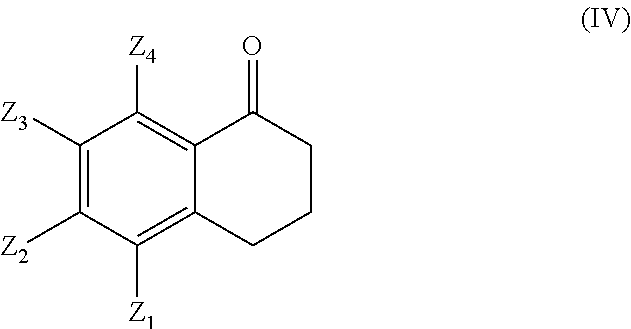
wherein Z1, Z2, Z3 and Z4 are as defined above, is prepared by treating a compound of formula (IV)
with a base in a solvent like for example toluene in the presence of an alkylformate like ethylformate to yield a compound of formula (V)
which is oxidised for example by 2,3-dichloro-5,6-dicyano-1,4-benzoquinone (or DDQ) in a solvent like dioxane to give a compound of formula (VI)
which is treated with ethylchloroformate in a solvent like for example tetrahydrofurane (THF) in the presence of a base like for example triethylamine and of sodium tetrahydroboride to give a compound of formula (VII)
which is treated by oxidation for example with phenyliodonium diacetate (PIDA) or [Bis(trifluoroacetoxy)iodo]benzene (PIFA) or Oxone®, in a solvent to yield a compound of formula (IIa1), said compound of formula (IIa1) being reacted in a Kochi-Anderson reaction with a compound of formula (III) as defined above to yield a compound of formula (Ia1).
The invention has also as an object a process for preparing compounds of formula (Ia1)
wherein X5, X6, X7, X8, X9 and X10 are as defined above and Z1, Z2, Z3 and Z4 are selected from the group comprising
-
- a hydrogen atom,
- a halogen atom,
- a hydroxy group,
- a triflate group,
- a phosphate group,
- a linear or branched (C1-C4)alkyl group,
- a linear or branched (C1-C4)alkoxy group,
- a thio(C1-C4)alkoxy group,
- a pentafluorosulfanyl group,
- —SCF3
- —SCH2F,
- a trifluoromethyl group,
- a trifluoromethoxy group,
wherein a compound of formula (IIa1)
wherein Z1, Z2, Z3 and Z4 are as defined above is prepared by treating a compound of formula (VIII)
with bromine in an acidic medium to yield a compound of formula (IX)
which is submitted to a nucleopilic substitution to yield a compound of formula (X)
with Z5 representing a xanthate group, like S(S)OEt, S(S)OMe or S(S)OPr
which is submitted to a radical reaction to yield a compound of formula (XI)
which is cyclised into a tetralone of formula (XII)
which is deshydrated to give a compound of formula (VII)
which is treated by oxidation for example with phenyliodonium diacetate (PIDA) or [Bis(trifluoroacetoxy)iodo]benzene (PIFA) or Oxone® in a solvent like a mixture of water and acetonitrile to yield a compound of formula (IIa1) said compound of formula (IIa1) being reacted in a Kochi-Anderson reaction with a compound of formula (III) as defined above to yield a compound of formula (Ia1).
The invention has also as an object a process for preparing compounds of formula (Ia2)
wherein X5, X6, X7, X8, X9 and X10 are as defined above and Z1, Z3 and Z4 are selected from the group comprising
-
- a hydrogen atom,
- a halogen atom,
- a hydroxy group,
- a triflate group,
- a phosphate group,
- a linear or branched (C1-C4)alkyl group,
- a linear or branched (C1-C4)alkoxy group,
- a thio(C1-C4)alkoxy group,
- a pentafluorosulfanyl group,
- —SCF3
- —SCH2F,
- a trifluoromethyl group,
- a trifluoromethoxy group,
wherein a compound of formula (IIa2)
wherein Z1, Z3 and Z4 are as defined above, is prepared by reacting a compound of formula (XIII)
with a compound of formula (XVI)
wherein Z1, Z3 and Z4 are as defined above,
to yield a compound of formula (IIa2), said compound of formula (IIa2) being reacted in a Kochi-Anderson reaction with a compound of formula (III) as defined above to yield a compound of formula (Ia2).
The invention has also as an object a process for preparing compounds of formula (Ia3)
wherein X5, X6, X7, X8, X9 and X10 are as defined above and Z1, Z3 and Z4 are selected from the group comprising
-
- a hydrogen atom,
- a halogen atom,
- a hydroxy group,
- a triflate group,
- a phosphate group,
- a linear or branched (C1-C4)alkyl group,
- a linear or branched (C1-C4)alkoxy group,
- a thio(C1-C4)alkoxy group,
- a pentafluorosulfanyl group,
- —SCF3
- —SCH2F,
- a trifluoromethyl group,
- a trifluoromethoxy group,
wherein a compound of formula (IIa3)
wherein Z1, Z2 and Z4 are as defined above is prepared by reacting a compound of formula (XIV)
with a compound of formula (XVII)
wherein Z1, Z3 and Z4 are as defined above,
to yield a compound of formula (IIa3), said compound of formula (IIa3) being reacted in a Kochi-Anderson reaction with a compound of formula (III) as defined above to yield a compound of formula (Ia3).
The invention has also as an object a process for preparing compounds of formula (Ia4)
wherein X5, X6, X7, X8, X9 and X10 are as defined above and Z2, Z3 and Z4 are selected from the group comprising
-
- a hydrogen atom,
- a halogen atom,
- a hydroxy group,
- a triflate group,
- a phosphate group,
- a linear or branched (C1-C4)alkyl group,
- a linear or branched (C1-C4)alkoxy group,
- a thio(C1-C4)alkoxy group,
- a pentafluorosulfanyl group,
- —SCF3
- —SCH2F,
- a trifluoromethyl group,
- a trifluoromethoxy group,
wherein a compound of formula (IIa4)
is prepared by reacting a compound of formula (XIV)
with a compound of formula (XVIII)
wherein Z2, Z3 and Z4 are as defined above, said compound of formula (IIa4) being reacted in a Kochi-Anderson reaction with a compound of formula (III) as defined above to yield a compound of formula (Ia4).
The invention has also as an object a process for preparing compounds of formula (Ia6)
wherein X5, X6, X7, X8, X9 and X10 are as defined above and Z2, Z3 and Z4 are selected from the group comprising
-
- a hydrogen atom,
- a halogen atom,
- a hydroxy group,
- a triflate group,
- a phosphate group,
- a linear or branched (C1-C4)alkyl group,
- a linear or branched (C1-C4)alkoxy group,
- a thio(C1-C4)alkoxy group,
- a pentafluorosulfanyl group,
- —SCF3
- —SCH2F,
- a trifluoromethyl group,
- a trifluoromethoxy group,
wherein a compound of formula (IIa6)
wherein Z2, Z3 and Z4 are as defined above is prepared by reacting a compound of formula (XIII)
with a compound of formula (XVIII)
wherein Z2, Z3 and Z4 are as defined above, said compound of formula (IIa6) being reacted in a Kochi-Anderson reaction with a compound of formula (III) as defined above to yield a compound of formula (Ia6).
The invention has also as an object a process for preparing compounds of formula (Ia5)
wherein X5, X6, X7, X8, X9 and X10 are as defined before and Z2 and Z3 which are the same are selected from the group comprising
-
- a hydrogen atom,
- a halogen atom,
- a hydroxy group,
- a triflate group,
- a phosphate group,
- a linear or branched (C1-C4)alkyl group,
- a linear or branched (C1-C4)alkoxy group,
- a thio(C1-C4)alkoxy group,
- a pentafluorosulfanyl group,
- —SCF3
- —SCH2F,
- a trifluoromethyl group,
- a trifluoromethoxy group,
wherein a compound of formula (IIa5)
wherein Z2 et Z3 which are the same are as defined above,
is prepared by reacting a compound of formula (XIX)
wherein Z2 and Z3 which are the same are as defined above,
with a compound of formula (XX)
said compound of formula (IIa5) being reacted in a Kochi-Anderson reaction with a compound of formula (III) as defined above to yield a compound of formula (Ia5).
The invention has also as an object a process for preparing a compound of formula (Ib1)
wherein
X5 is CO, X6, X7, X8, X9, X10 and R are as defined above
wherein a 2-bromo-1,4-dimethoxy-3-methylnaphtalene of formula (XXI)
is reacted with a compound of formula (XXII)
wherein X5 is CO, X7, X8, X9, are as defined before, X10 and X6 bear a leaving group selected from the group comprising F, Cl, Br and OMe and Z5 represents an halogen atom or an alkoxy group, in particular a methoxy group.
in presence of a lithium base derivative to yield a compound of formula (XXIII)
which is treated with BBr3 and a base like K2CO3 medium to give a compound of
Another object of the invention is a process for preparing compounds of formula (I):
wherein:
-
- either X1, X2, X3 and X4 represent all carbon atoms,
- either one of X1, X2, X3 and X4 represents a nitrogen atom and the three others represent carbon atoms,
- either X1 and X4 represent a nitrogen atom and X2 and X3 both represent carbon atoms,
the bond - - - - - between O in position 17 and X10 represents no bond or a single bond,
the bond
represents either a single bond or a double bond,
X5 represents CO or CH2 or CHOH,
X6, X7, X8, X9 and X10 represent all carbon atoms or one of them represents a nitrogen atom and the four others are carbon atoms,
i) when the bond - - - - - between O17 and X
10 represents a single bond, then the bonds
between atoms in positions C1/O18 and C4/O17 are single bonds, the bonds between carbons in positions C1/C2 and C3/C4 are double bonds, the bond between carbons in positions C2/C3 is a simple bond, and R represents a hydrogen atom or an acetyl group and X
10 is not a nitrogen atom and
ii) when the bond - - - - - between O17 and X
10 represents no bond, then R does not exist and the bonds
between atoms C1/O18 and C4/O17 are double bonds, the bonds between carbons in positions C1/C2 and C3/C4 are simple bonds, the bond between carbons in positions C2/C3 is a double bond, and
X1, X2, X3 and X4 when they are carbon atoms being optionally substituted by:
-
- a hydrogen atom,
- a halogen atom,
- a hydroxy group,
- a linear or branched (C1-C4)alkyl group,
- a linear or branched (C1-C4)alkoxy group,
- a thio(C1-C4)alkoxy group,
- a pentafluorosulfanyl group,
- —SCF3
- —SCH2F,
- a trifluoromethyl group,
- a trifluoromethoxy group,
X6, X7, X8, X9, X10—except when atoms O17 and X10 are bound by a simple bond and X10 is a quarternary carbon atom—being optionally substituted by:
-
- a hydrogen atom,
- a halogen atom,
- a hydroxy group,
- a linear or branched (C1-C4)alkyl group,
- a linear or branched (C1-C4)alkoxy group,
- a thio(C1-C4)alkoxy group,
- a pentafluorosulfanyl group,
- a trifluoromethyl group,
- a trifluoromethoxy group,
- a difluoromethoxy group,
- a difluoromethyl group,
- —COOH,
- —COO(C1-C4)alkyl group,
- —CONR1(CH2)mCN, with R1 being a hydrogen atom or a linear or branched (C1-C4)alkyl group and m=1, 2 or 3,
- —CSNR1(CH2)mCN, with R1 being a hydrogen atom or a linear or branched (C1-C4)alkyl group m=1, 2 or 3,
- —CONR1Het with R1 being a hydrogen atom or a linear or branched (C1-C4)alkyl group, Het representing a pyridine-2-yl group, said group optionally substituted by an amino group in -6 or by a —CONH2 group in -5,
- —NO2,
- —CN,
- —NR2R3 with R2 and R3 representing each independently a hydrogen atom, an amino protecting group selected from the group comprising Boc group and (C1-C4)alkyl group, or R2 and R3 forming with the nitrogen atom which bears them a cyclic group selected from the group comprising morpholine, piperidine and piperazine groups, said cyclic groups being optionally substituted.
- an aryl group or an aryl group substituted by one or several substituents selected from the group comprising a (C1-C4)alkyl group, a —NO2 group, a —COOR4 with R4 selected from a hydrogen atom and a linear or branched (C1-C4)alkyl group, a —NR5R6 with R5 and R6 independently selected from the group comprising a hydrogen atom and a linear or branched (C1-C4)alkyl group,
- a heterocyclic group selected from the group comprising morpholinyl group or piperidinyl or piperazinyl group, each of said group being optionally substituted by one or several substituents selected from the group comprising a linear or branched (C1-C4)alkyl group, —COOCH2CH3, or a group
said process comprising the step of reacting a compound of formula (II)
wherein X1, X2, X3 and X4 are as defined above
with a compound of formula (III)
wherein X5 is CO or CH2, X6, X7, X8, X9 and X10 are as defined above
in a Kochi-Anderson reaction to give a compound of formula (Ia)
The compounds of formula (Ia) are polysubstituted naphthoquinones and are a subgroup of compounds of formula (I).
In an advantageous embodiment according to the invention, the process further comprises the step of submitting a compound of formula (Ia)
wherein X
1, X
2, X
3, X
4, X
5, X
7, X
8, X
9 are as defined above and at least one of X
6 and X
10 bears a leaving group selected from the group comprising F, Cl, Br or OMe, to a reduction into hydronaphthoquinone followed by a intramolecular nucleophilic aromatic substitution to give a compound of formula (Ib)
Compounds of formula (Ib) are called benz[c]xanthen-7-ones (shortened as benzxanthones) and are a subgroup of compounds of formula (I).
In another embodiment of the invention the process is used for preparing compounds of formula (Ia1)
wherein X5, X6, X7, X8, X9 and X10 are as defined above and Z1, Z2, Z3 and Z4 are selected from the group comprising
-
- a hydrogen atom,
- a halogen atom,
- a hydroxy group,
- a linear or branched (C1-C4)alkyl group,
- a linear or branched (C1-C4)alkoxy group,
- a thio(C1-C4)alkoxy group,
- a pentafluorosulfanyl group,
- —SCF3
- —SCH2F,
- a trifluoromethyl group,
- a trifluoromethoxy group,
wherein a compound of formula (IIa1)
wherein Z1, Z2, Z3 and Z4 are as defined above, is prepared by treating a compound of formula (IV)
with a base in a solvent like for example toluene in the presence of an alkylformate like ethylformate to yield a compound of formula (V)
which is oxidised for example by 2,3-dichloro-5,6-dicyano-1,4-benzoquinone (or DDQ) in a solvent like dioxane to give a compound of formula (VI)
which is treated with ethylchloroformate in a solvent like for example tetrahydrofurane (THF) in the presence of a base like for example triethylamine and of sodium tetrahydroboride to give a compound of formula (VII)
which is treated by oxidation for example with phenyliodonium diacetate (PIDA) or [Bis(trifluoroacetoxy)iodo]benzene (PIFA) or Oxone®, in a solvent to yield a compound of formula (IIa1), said compound of formula (IIa1) being reacted in a Kochi-Anderson reaction with a compound of formula (III) as defined above to yield a compound of formula (Ia1).
In another embodiment of the invention the process is used for preparing compounds of formula (Ia1)
wherein X5, X6, X7, X8, X9 and X10 are as defined above and Z1, Z2, Z3 and Z4 are selected from the group comprising
-
- a hydrogen atom,
- a halogen atom,
- a hydroxy group,
- a linear or branched (C1-C4)alkyl group,
- a linear or branched (C1-C4)alkoxy group,
- a thio(C1-C4)alkoxy group,
- a pentafluorosulfanyl group,
- —SCF3
- —SCH2F,
- a trifluoromethyl group,
- a trifluoromethoxy group,
wherein a compound of formula (IIa1)
wherein Z1, Z2, Z3 and Z4 are as defined above is prepared by treating a compound of formula (VIII)
with bromine in an acidic medium to yield a compound of formula (IX)
which is submitted to a nucleopilic substitution to yield a compound of formula (X)
with Z5 representing a xanthate group, like S(S)OEt, S(S)OMe or S(S)OPr
which is submitted to a radical reaction to yield a compound of formula (XI)
which is cyclised into a tetralone of formula (XII)
which is deshydrated to give a compound of formula (VII)
which is treated by oxidation for example with phenyliodonium diacetate (PIDA) or [Bis(trifluoroacetoxy)iodo]benzene (PIFA) or Oxone® in a solvent like a mixture of water and acetonitrile to yield a compound of formula (IIa1), said compound of formula (IIa1) being reacted in a Kochi-Anderson reaction with a compound of formula (III) as defined above to yield a compound of formula (Ia1). This route is called the propiophenone route.
In another embodiment of the invention the process is used for preparing compounds of formula (Ia1)
wherein X5 X6, X7, X8, X9 and X10 are as defined above and Z1, Z2, Z3 and Z4 are selected from the group comprising
-
- a hydrogen atom,
- a halogen atom,
- a hydroxy group,
- a triflate group,
- a phosphate group,
- a linear or branched (C1-C4)alkyl group,
- a linear or branched (C1-C4)alkoxy group,
- a thio(C1-C4)alkoxy group,
- a pentafluorosulfanyl group,
- —SCF3
- —SCH2F,
- a trifluoromethyl group,
- a trifluoromethoxy group,
wherein a compound of formula (IIa1)
wherein Z1, Z2, Z3 and Z4 are as defined above is prepared by treating a compound of formula (XIII)
or a compound of formula (XIV)
with a compound of formula (XV), pyridine and DDQ or SiO2
wherein Z1, Z2, Z3 and Z4 are as defined above,
to yield a compound of formula (IIa1), said compound of formula (IIa1) being reacted in a Kochi-Anderson reaction with a compound of formula (III) as defined above to yield a compound of formula (Ia1). This route is called the Diels-Alder route.
In another embodiment of the invention the process is used for preparing compounds of formula (Ia2)
wherein X5, X6, X7, X8, X9 and X10 are as defined above and Z1, Z3 and Z4 are selected from the group comprising
-
- a hydrogen atom,
- a halogen atom,
- a hydroxy group,
- a triflate group,
- a phosphate group,
- a linear or branched (C1-C4)alkyl group,
- a linear or branched (C1-C4)alkoxy group,
- a thio(C1-C4)alkoxy group,
- a pentafluorosulfanyl group,
- —SCF3
- —SCH2F,
- a trifluoromethyl group,
- a trifluoromethoxy group,
wherein a compound of formula (IIa2)
wherein Z1, Z3 and Z4 are as defined above, is prepared by reacting a compound of formula (XIII)
with a compound of formula (XVI)
wherein Z1, Z3 and Z4 are as defined above,
to yield a compound of formula (IIa2), said compound of formula (IIa2) being reacted in a Kochi-Anderson reaction with a compound of formula (III) as defined above to yield a compound of formula (Ia2).
Another object of the invention is a process for preparing compounds of formula (Ia3)
wherein X5, X6, X7, X8, X9 and X10 are as defined above and Z1, Z3 and Z4 are selected from the group comprising
-
- a hydrogen atom,
- a halogen atom,
- a hydroxy group,
- a triflate group,
- a phosphate group,
- a linear or branched (C1-C4)alkyl group,
- a linear or branched (C1-C4)alkoxy group,
- a thio(C1-C4)alkoxy group,
- a pentafluorosulfanyl group,
- —SCF3
- —SCH2F,
- a trifluoromethyl group,
- a trifluoromethoxy group,
wherein a compound of formula (IIa3)
wherein Z1, Z2 and Z4 are as defined above is prepared by reacting a compound of formula (XIV)
with a compound of formula (XVII)
wherein Z1, Z3 and Z4 are as defined above,
to yield a compound of formula (IIa3), said compound of formula (IIa3) being reacted in a Kochi-Anderson reaction with a compound of formula (III) as defined above to yield a compound of formula (Ia3).
In another embodiment of the invention, the process is used for preparing compounds of formula (Ia4)
wherein X5, X6, X7, X8, X9 and X10 are as defined above and Z2, Z3 and Z4 are selected from the group comprising
-
- a hydrogen atom,
- a halogen atom,
- a hydroxy group,
- a triflate group,
- a phosphate group,
- a linear or branched (C1-C4)alkyl group,
- a linear or branched (C1-C4)alkoxy group,
- a thio(C1-C4)alkoxy group,
- a pentafluorosulfanyl group,
- —SCF3
- —SCH2F,
- a trifluoromethyl group,
- a trifluoromethoxy group,
wherein a compound of formula (IIa4)
is prepared by reacting a compound of formula (XIV)
with a compound of formula (XVIII)
wherein Z2, Z3 and Z4 are as defined above, said compound of formula (IIa4) being reacted in a Kochi-Anderson reaction with a compound of formula (III) as defined above to yield a compound of formula (Ia4).
In another embodiment of the invention, the process is used for preparing compounds of formula (Ia6)
corresponding to a compound of formula (Ia) wherein X1 is a nitrogen atom, X2, X3 and X4 are carbon atoms and
wherein X5, X6, X7, X8, X9 and X10 are as defined above and Z2, Z3 and Z4 are selected from the group comprising
-
- a hydrogen atom,
- a halogen atom,
- a hydroxy group,
- a triflate group,
- a phosphate group,
- a linear or branched (C1-C4)alkyl group,
- a linear or branched (C1-C4)alkoxy group,
- a thio(C1-C4)alkoxy group,
- a pentafluorosulfanyl group,
- —SCF3
- —SCH2F,
- a trifluoromethyl group,
- a trifluoromethoxy group,
wherein a compound of formula (IIa6)
wherein Z2, Z3 and Z4 are as defined above is prepared by reacting a compound of formula (XIII)
with a compound of formula (XVIII)
wherein Z2, Z3 and Z4 are as defined above, said compound of formula (IIa6) being reacted in a Kochi-Anderson reaction with a compound of formula (III) as defined above to yield a compound of formula (Ia6).
In another embodiment of the invention, the process is used for preparing compounds of formula (Ia5)
wherein X5, X6, X7, X8, X9 and X10 are as defined before and Z2 and Z3 which are the same are selected from the group comprising
-
- a hydrogen atom,
- a halogen atom,
- a hydroxy group,
- a triflate group,
- a phosphate group,
- a linear or branched (C1-C4)alkyl group,
- a linear or branched (C1-C4)alkoxy group,
- a thio(C1-C4)alkoxy group,
- a pentafluorosulfanyl group,
- —SCF3
- —SCH2F,
- a trifluoromethyl group,
- a trifluoromethoxy group,
wherein a compound of formula (IIa5)
wherein Z2 et Z3 which are the same are as defined above,
is prepared by reacting a compound of formula (XIXI)
wherein Z2 and Z3 which are the same are as defined above,
with a compound of formula (XIII)
said compound of formula (IIa5) being reacted in a Kochi-Anderson reaction with a compound of formula (III) as defined above to yield a compound of formula (Ia5).
In another embodiment of the invention, the process is used for preparing a compound of formula (Ib1)
wherein
X5 is CO, X6, X7, X8, X9, X10 and R are as defined before
wherein a 2-bromo-1,4-dimethoxy-3-methylnaphtalene of formula (XXI)
is reacted with a compound of formula (XXII)
wherein X5 is CO, X7, X8, X9, are as defined before, X10 and X6 bear a leaving group selected from the group comprising F, Cl, Br and OMe and Z5 represents an halogen atom or an alkoxy group, in particular a methoxy group.
in presence of a lithium base derivative to yield a compound of formula (XXIII)
which is treated with BBr3 and a base like K2CO3 medium to give a compound of formula (Ib1).
The following examples 1 to 20 and the FIGS. 1 to 5 are intended as illustrations of a few embodiments of the invention.
FIG. 1 illustrates the antimalarial activity of polysubstituted-naphthoquinones, azanaphthoquinones, xanthones and benzxanthone derivatives according to the invention measured according to example 19 against P. falciparum Dd2 and 3D7 strains, both in the radioactive 3H hypoxanthine incorporation assay and in the SYBRgreen assay. In the table, the asterisks (*, **, ***, ****) referred to the values determined for antimalarial chloroquine used as key control in three disctinct experiments (*, **, ***, ****). The cells of the table with grey background show structures of compounds disclosed in the international application WO 2009/118327 and used as references in the antimalarial assays.
FIG. 2 illutrates the putative cascade of redox reactions generated in situ in the blood-feeding parasites responsible for the antiparasitic action of compounds (simplified in the structure) described in the present application.
FIG. 3 illutrates profound morphological changes induced by two 3-benzylmenadione derivatives LJ83K (right) and LJ81K despite the weak TGR inhibitory capabilities.
FIG. 4 illustrates the antischistosomal effects of derivatives described in the invention measured according to example 20 against S. mansoni worms in cultures. D=100% dead, except when given with a number (% D) which indicated the percentage of dead worms. Addition of hemoglobin (Hb) was applied in order to favor drug metabolism through heme-catalyzed oxidations. Addition of red blood cells (RBC) was applied in order to favor drug metabolism through hemoglobin digestion and heme-catalyzed oxidations. In the table, the term “50/10/5” means that the compounds were tested at 50 μM, 10 μM and 5 μM.
FIG. 5 illustrates the antischistosomal activity of LJ83K described in the invention measured according to example 20 against S. mansoni worms-infected mice. All injections were ip: the first injection was carried out six weeks post-infection, the second was performed two days later. Perfusion was 7 days after the second injection date. LJ83K (=P_TM58) was injected twice at 33 mg/kg.
EXAMPLE 1
General Procedure for Alpha-Formylation of Tetralone IV into V
It is based on the work disclosed by B. C. Pearce, R. A. Parker, M. E. Deason, D. D. Dischino, E. Gillepsie, A. A. Qureshi, K. Volk, J. J. Kim Wright J. Med. Chem. 1994, 37, 526-541.
A mixture of tetralone IV in toluene (1 eq, 0.45 mmol·mL−1) and ethyl formate (2.0 eq) was prepared. The solution was cooled to −78° C. under Argon and mechanically stirred while potassium tert-butoxide (2.0 eq) was added in portions: the solution became milky and pinky. The solution was warmed to −5° C. until TLC monitoring (petroleumether/Et2O: 3/1) indicated the completion of the reaction. The solution was quenched with 10% HCl (the pink solution disappeared) and the mixture extracted with Et2O. The organic phases were dried (brine, MgSO4) and concentrated in vacuo to yield alpha-formyl tetralone (usually as solid compound).
Note: usually the product does not need to be further purified and can be directly engaged in the next step.
1.1. 2-(hydroxymethylene)-6-methoxy-3,4-dihydronaphthalen-1(2H)-one
Yield: >98% (light brown solid)
1H NMR (200 MHz, CDCl3): δ=2.51 (t, 2H, J=7.3 Hz), 2.82 (t, 2H, J=7.3 Hz), 3.82 (s, 3H), 6.68 (d, 1H, J=2.4 Hz), 6.82 (dd, 1H, J=8.6 Hz, 2.4 Hz), 7.91 (d, 1H, J=8.6 Hz), ppm
The spectroscopic and physical data were identical to those reported in the literature (S. H. Kim, J. R. Gunther, J. A. Katzenellenbogen Org. Lett. 2008, 10, 4931-4934).
1.2. 2-(hydroxymethylene)-7-methoxy-3,4-dihydronaphthalen-1(2H)-one
The compound was prepared in the conditions disclosed in 1.1.
Yield: 87% yellow powder
1H NMR (300 MHz, CDCl3): δ=2.55-2.50 (m, 2H), 2.82-2.78 (m, 2H), 3.82 (s, 3H), 6.99 (dd, J=8.3 Hz, J=2.8 Hz, 1H), 7.12 (d, J=8.3 Hz, 1H), 7.45 (d, J=2.8 Hz, 1H), 8.11 (d, J=5.4 Hz, 1H), ppm
13C NMR (75 MHz, CDCl3): δ=23.2 (CH2), 27.9 (CH2), 55.5 (OCH3), 108.9 (CH), 109.4 (CH), 120.3 (CH), 129.1 (CH), 130.1 (Cquat), 130.1 (Cquat), 132.5 (Cquat), 134.1 (Cquat), 158.7 (Cquat), 175.5 (CH), 183.2 (C═O) ppm
The spectroscopic and physical data were identical to those reported in the literature. (C. Bilger, P. Demerseman, R. Royer Eur. J. Med. Chem. 1987, 22, 363-5).
1.3. 2-(hydroxymethylene)-6,7-dimethoxy-3,4-dihydronaphthalen-1(2H)-one
Yield: >98% (light brown solid)
1H NMR (300 MHz, CDCl3): δ=2.38 (t, J=7.1 Hz, 2H), 2.86 (t, J=7.1 Hz, 2H), 3.95 (s, 3H), 3.96 (s, 3H), 6.68 (s, 1H), 6.82 (s, 1H), 7.78 (d, J=7.0 Hz, 1H), ppm
13C NMR (75 MHz, CDCl3): δ=23.7 (CH2), 28.97 (CH2), 56.1 (2×OCH3), 108.2 (Cquat), 108.3 (CH), 110.3 (CH), 124.9 (Cquat), 137.0 (Cquat), 148.1 (Cquat), 153.24 (Cquat), 169.7 (CH), 186.1 (C═O) ppm
1.4. 2-(hydroxymethylene)-7-fluor-3,4-dihydronaphthalen-1(2H)-one
The compound was prepared in the conditions disclosed in 1.1.
Yield: 99% yellow powder
1H NMR (300 MHz, CDCl3): δ=2.59 (t, J=7.1 Hz, 2H), 2.88 (t, J=7.1 Hz, 2H), 7.11-7.24 (m, 2H), 7.64 (d, J=9.1 Hz, J=2.8 Hz, 1H), 8.27 (d, J=5.4 Hz, 1H) ppm.
13C NMR (75 MHz, CDCl3): δ=22.7 (CH2), 28.0 (CH2), 108.5 (Cquat) 111.7 (d, J=22.8 Hz, CH), 119.7 (d, JC-F=19.4 Hz, CH), 129.5 (d, JC-F=7.3 Hz, CH), 133.2 (d, J=7.2 Hz, Cquat), 137.0 (d, JC-F=3.2 Hz, Cquat), 161.8 (d, JC-F=245.0 Hz, Cquat), 177.6 (CH), 180.8 (C═O) ppm.
EXAMPLE 2
General Procedure for Aromatisation of α-Formyl-Tetralone (V) into (VI)
It is based on the work disclosed by S. H. Kim, et al. (cited above).
To a solution of tetralone (V) in dioxanne (1.0 eq, 0.2 mmol·mL−1) was added 2,3-Dichloro-5,6-dicyano-1,4-benzoquinone (or DDQ) (1.0 eq) at room temperature. A white precipitate appeared rapidly. After completion of the reaction (TLC monitoring), the white precipitate was removed by filtration. The filtrate was concentrated under reduced pressure.
The crude was purified by column chromatography (silica gel, eluant cyclohexane/Et2O:3/1).
2.1. 1-hydroxy-6-methoxy-2-naphthaldehyde
Yield: 72-75%
1H NMR (200 MHz, CDCl3): δ=3.96 (s, 3H), 7.09 (d, 1H, J=2.6 Hz), 7.18 (dd, 1H, J=9.2 Hz, 2.6 Hz), 7.26 (d, 1H, J=8.8 Hz), 7.45 (d, 1H, J=8.8 Hz), 8.35 (d, 1H, J=9.2 Hz), 9.90 (s, 1H), 12.70 (s, 1H) ppm
The spectroscopic and physical data were identical to those reported in the literature. (S. H. Kim, et al. (cited above)
2.2. 1-hydroxy-7-methoxy-2-naphthaldehyde
Yield: 83% yellow powder
1H NMR (300 MHz, CDCl3): δ=12.40 (s, 1H), 9.81 (s, 1H), 7.56-7.51 (m, 2H), 7.20-7.10 (m, 3H), 3.81 (s, 3H) ppm.
13C NMR (75 MHz, CDCl3): δ=55.5 (OCH3), 102.1 (CH), 114.6 (Cquat), 119.3 (CH), 123.3 (CH), 124.3 (CH), 125.5 (Cquat), 129.1 (CH), 132.9 (Cquat), 158.0 (Cquat), 160.5 (Cquat), 190.6 (C═O) ppm.
The spectroscopic and physical data were identical to those reported in the literature (C. Bilger, et al, cited above).
2.3. 1-hydroxy-6,7-methoxy-2-naphthaldehyde
Yield: 73%
1H NMR (300 MHz, CDCl3): δ=3.99 (s, 3H), 4.00 (s, 3H), 7.05 (s, 1H), 7.24 (AB system, J=8.7 Hz, Δν=30.1 Hz, 2H), 7.56 (s, 1H), 9.90 (s, 1H), 12.55 (s, 1H) ppm
13C NMR (75 MHz, CDCl3: δ=56.0 (OCH3), 56.1 (OCH3), 102.7 (CH), 106.4 (CH), 113.5 (Cq), 118.0 (CH), 119.6 (Cq), 125.6 (CH), 134.7 (Cq), 149.4 (Cq), 153.1 (Cq), 160.4 (Cq) 195.9 (C═O) ppm.
2.4. 1-hydroxy-7-fluor-2-naphthaldehyde
Yield: 87% yellow powder
1H NMR (300 MHz, CDCl3): δ=12.54 (s, 1H), 10.01 (s, 1H), 8.04 (dd, J=8.9 Hz J=2.7 Hz) 7.80 (dd, J=8.9 Hz, J=5.4 Hz, 1H), 7.50-7.38 (m, 3H) ppm.
13C NMR (75 MHz, CDCl3): δ=108.2 (d, JC-F=22.9 Hz, CH), 114.6 (Cq), 119.2 (CH) 125.5 (d, JC-F=8.8 Hz, Cquat), 125.8 (d, JC-F=2.6 Hz, CH) 130.0 (CH), 130.1 (CH), 134.3 (d, J=1.5 Hz, Cquat), 160.8 (d, J=247.0 Hz, Cquat), 160.9 (d, J=1.5 Hz, Cquat), 196.4 (C═O) ppm.
EXAMPLE 3
General Procedure for Reduction of 2-formyl-1-naphtols VI into VII
It is based on the work disclosed by N. Minami & S. Kijima Chem. Pharm. Bull. 1979, 27, 1490-1494.
To a solution of 2-formyl-1-naphtol in tetrahydrofuran (1.0 eq, 1 mmol·mL−1) was added triethylamine (1.2 eq). The solution was cooled to 0° C. and then ethyl chloroformate (1.2 eq) was added over a period of 30 min. The solution was left under stirring during 30-60 min (white precipitates formation). The precipitates (triethylamine hydrochloride) were removed by filtration and washed with tetrahydrofuran (twice less than the amount used for the reaction). To the combined filtrates were added, at 5-15° C., an aqueous solution of NaBH4 (4.0 eq, 2.6 M). When the addition was completed, the reaction mixture was stirred at room temperature for 1-2 h, then diluted with water. The solution was cooled to 0° C. and made acidic by the slow addition of aqueous HCl (10%) (FROZING!). The aqueous solution was extracted with Et2O. The organic phases were washed with dilute solution of NaOH (10%), dried (brine, MgSO4) and concentrated in vacuo to yield methylnaphtol (usually as a solid or an oil which crystallized on standing).
Note: usually the product does not need to be further purified and can be directly engaged in the next step.
3.1. 6-methoxy-2-methylnaphthalen-1-ol
Yield: 70%
This compound was reported in literature but was not described: Nowicki, Alexander W.; Turner, Alan B. Chemistry & Industry (London, United Kingdom) 1981, 14, 501-2.
1H NMR (300 MHz, CD2Cl2): δ=2.37 (s, 3H), 3.90 (s, 3H), 5.19 (s, 10H), 7.11 (m, 2H), 7.24 (AB system, J=8.1 Hz, Δν=17.1 Hz, 2H), 8.03 (d, J=9.8 Hz, 1H) ppm
13C NMR (75 MHz, CD2Cl2): δ=15.7 (CH3), 55.8 (OCH3), 106.2 (CH), 114.8 (Cq), 118.3 (CH), 119.5 (CH), 120.1 (Cq), 123.2 (CH), 130.3 (CH), 135.3 (Cq), 149.4 (Cq), 158.1 (Cq) ppm
MS (EI): m/z (%): 188.1 ([M]+, 100), 145.0 (83), 115.0 (62), 189.1 ([M+H]+, 15)
3.2. 7-methoxy-2-methylnaphthalen-1-ol
Yield: 66% yellow powder
1H NMR (300 MHz, CDCl3): δ=7.65 (d, J=9.0 Hz, 1H), 7.42 (d, J=2.6 Hz, 1H), 7.30 (d, J=8.4 Hz, 1H), 7.10-7.06 (m, 1H), 3.93 (s, 3H), 2.38 (s, 3H) ppm.
13C NMR (75 MHz, CDCl3): δ=157.5 (Cq); 147.6 (Cq); 129.2 (CH); 129.0 (Cq) 126.5 (CH); 125.2 (Cq); 120.0 (CH); 118.2 (CH); 116.7 (Cq); 99.5 (CH); 55.4 (—OCH3); 15.75 (CH3) ppm.
3.3. 6,7-dimethoxy-2-methylnaphthalen-1-ol
Yield: 68% (yellow powder)
1H NMR (300 MHz, CDCl3): δ=2.37 (s, 3H), 3.90 (s, 3H), 5.19 (s, 10H), 7.11 (m, 2H), 7.24 (AB system, J=8.1 Hz, Δν=17.1 Hz, 2H), 8.03 (d, J=9.8 Hz, 1H) ppm
13C NMR (75 MHz, CDCl3): δ=15.58 (CH3), 55.8 (OCH3), 55.9 (OCH3), 100.3 (CH), 106.2 (CH), 114.7 (Cq), 118.7 (CH), 119.6 (Cq), 127.2 (CH), 129.3 (Cq), 147.8 (Cq), 149.1 (Cq), 149.2 (Cq) ppm.
3.4. 7-fluor-2-methylnaphthalen-1-ol
Yield: 72% yellow powder
1H NMR (300 MHz, CDCl3): δ=7.90-7.36 (m, 1H), 7.29 (AB system, J=8.5 Hz, Δν=50.7 Hz, 2H) 7.24-7.17 (m, 1H), 2.41 (s, 3H) ppm.
13C NMR (75 MHz, CDCl3): δ=162.2 (Cq), 148.3 (d, JC-F=5.7 Hz, Cq), 130.4 (Cq), 130.0 (d, JC-F=8.9 Hz, CH), 128.2 (d, JC-F=2.7 Hz, CH), 125.2 (d, JC-F=8.6 Hz, Cq), 120.0 (d, JC-F=1.1, CH), 117.3 (Cq), 115.7 (d, JC-F=25.2 Hz, CH), 105.1 (d, JC-F=22.4, CH), 15.7 (CH3) ppm.
EXAMPLE 4
General Procedure for Oxidation of Methylnaphtols VII into Menadiones Ia1
It is based on the work from P. Bachu, J. Sperry, M. A. Brimble Tetrahedron 2008, 64, 3343-3350
To a stirred solution of naphtol (5.8 mmol, 1 eq) in acetonitrile (70 mL) and water (30 mL) at −5° C. was added [bis(trifluoroacetoxy)iodo]benzene (12.1 mmol, 2.1 eq) portionwise over 20-30 nm. After stirring for 30 nm at −5° C., the reaction mixture was stirred at RT for 1 h. Saturated NaHCO3 solution was added to the reaction orange mixture and the reaction mixture extracted with Et2O (3×120 mL). The combined organic extracts were washed with brine and dried over anhydrous MgSO4. The crude was purified by flash chromatography on silica gel (eluant: hexanes/Et2O).
4.1. 6-methoxy-2-methylnaphthalene-1,4-dione
Yield: 60-65%
This compound was shortly described in Sidhu et al. Indian Journal of Chemistry 1968, 6, 681-91
m.p. 146-148° C. (Et2O)
1H NMR (300 MHz, CDCl3): δ=2.17 (d, J=1.6 Hz, 3H), 3.93 (s, 3H), 6.78 (d, J=1.6 Hz, 1H), 7.17 (dd, J=8.6 Hz, J=2.7 Hz, 1H), 7.47 (d, J=2.7 Hz, 1H), 8.02 (d, J=8.6 Hz, 1H) ppm
13C NMR (75 MHz, CDCl3): δ=16.5 (CH3), 55.9 (OCH3), 109.3 (CH), 120.2 (CH), 125.8 (Cquat), 129.0 (CH), 134.3 (Cquat), 135.2 (CH), 148.5 (Cquat), 164.0 (Cquat), 184.6 (C═O), 185.1 (C═O)
MS (EI):m/z (%): 202.1 ([M]+, 100), 174.0 (29), 203.1 ([M+H]+, 13):
elemental analysis calcd for C12H10O3 (%) C, 71.28; H, 4.98. Found: C, 71.16; H, 5.05.
4.2. 6-methyl-2-methylnaphthalene-1,4-dione
Yield: 68% yellow powder
1H NMR (300 MHz, CDCl3): δ=7.99 (d, J=7.9 Hz, 1H), 7.85 (s, 1H), 7.52 (d, J=7.9 Hz, 1H), 6.81 (q, J=1.6 Hz, 1H), 2.49 (s, 3H), 2.19 (d, J=1.6 Hz, 3H) ppm
13C NMR (75 MHz, CDCl3): δ=185.4 (C═O), 185.2 (C═O), 148.2 (Cquat), 144.7 (Cquat), 135.5 (CH), 135.0 (Cquat), 134.3 (CH), 132.2 (Cquat), 126.7 (CH), 126.4 (CH), 21.8 (CH3), 16.5 (CH3) ppm
4.3. 7-methoxy-2-methylnaphthalene-1,4-dione
Yield: 52% yellow powder
1H NMR (300 MHz, CDCl3): δ=8.03 (d, J=2.7 Hz, 1H), 7.56 (d, J=2.7 Hz, 1H), 7.21 (dd, J=8.6 Hz, J=2.7 Hz, 1H), 6.8 (q, J=1.6 Hz, 1H), 3.97 (s, 3H), 2.2 (d, J=1.6 Hz, 3H) ppm
13C NMR (75 MHz, CDCl3): δ=13C NMR (75 MHz, CDCl3): δ=185.7 (C═O), 184.2 (C═O), 163.9 (Cquat), 147.6 (Cquat), 135.9 (CH), 134.1 (Cquat), 128.5 (CH), 125.8 (Cquat), 120.1 (CH), 109.9 (CH), 55.9 (OCH3), 16.4 (CH3) ppm.
MS (EI):m/z (%): 202.1 ([M]+, 100)
elemental analysis calcd for C12H10O3 (%) C, 71.28; H, 4.98. Found: C, 71.35; H, 4.90.
4.4. 6-fluoro-2-methylnaphthalene-1,4-dione
Yield: 65%
1H NMR (200 MHz, CDCl3): δ=2.22 (d, J=1.4 Hz, 3H), 6.88 (d, J=1.4 Hz, 1H), 7.72 (dd, 8.5 Hz, J=2.7 Hz, 1H), 7.40 (ddd, J=8.5 Hz, JH-F=8.1 Hz, J=2.7 Hz, 1H) 8.16 (dd, J=8.5 Hz, JH-F=5.3 Hz, 1H) ppm
13C NMR (75 MHz, CDCl3): δ=184.2 (C═O), 183.7 (C═O), 166.3 (d, JC-F=260.5 Hz, Cq), 148.5 (Cq), 135.6 (CH), 134.9 (d, JC-F=8.0 Hz, Cq), 129.8 (d, JC-F=8.7 Hz, CH), 125.6 (Cq), 120.7 (d, JC-F=22.2 Hz, CH), 112.8 (d, JC-F=23.7 Hz, CH), 16.5 (CH3) ppm.
4.5. 6-chloro-2-methylnaphthalene-1,4-dione
Yield: 44% yellow powder
m.p. (hexane/ethyl acetate): 104-105° C.
1H NMR (400 MHz, CDCl3): δ=8.06 (d, J=8.6 Hz, 1H), 8.04 (d, J=2.2 Hz, 1H), 7.68 (dd, J=8.6 Hz, J=2.2 Hz, 1H), 6.86 (q, J=1.5 Hz, 1H), 2.21 (d, J=1.5 Hz, 3H) ppm
13C NMR (100 MHz, CDCl3) δ=16.5 (CH3), 126.3 (CH), 128.4 (CH), 130.4 (Cquat), 133.4 (Cquat), 133.7 (CH), 135.5 (CH), 140.7 (Cquat), 148.6 (Cquat), 183.8 (C═O), 184.6 (C═O)
MS (EI):m/z (%): 206.0 ([M]+, 100), 207.1 ([M+H]+, 15), 191.0 ([M-CH3]+, 5)
elemental analysis calcd for C11H7O2Cl (%) C, 63.40; H, 3.41. Found C, 63.11; H, 3.49.
4.6. 6,7-dimethoxy-2-methylnaphthalene-1,4-dione
Yield: 60% orange powder
m.p. (hexane/ethyl acetate): 183° C. dec.
1H NMR (300 MHz, CDCl3): δ=2.17 (d, J=1.5 Hz, 3H), 4.02 (s, 3H), 4.04 (s, 3H), 6.74 (q, J=1.5 Hz, 1H), 7.48 (s, 1H), 7.52 (s, 1H).
13C NMR (75 MHz, CDCl3) δ=16.6, 56.7 (2×OCH3) 107.8, 108.2, 127.2, 127.3, 135.4, 147.9, 153.5, 153.6, 184.8, 185.2.
MS (EI):m/z (%): 232 ([M]+, 100), 217 (([M-CH3]+, 8).
elemental analysis calcd for C13H12O4 (%) C, 67.23; H, 5.21. Found: C, 66.99; H, 4.90.
The spectroscopic and physical data were identical to those reported in the literature (Bringmann G. and Al, 2011, 46, 5778-5789)
4.7. 7-fluoro-2-methylnaphthalene-1,4-dione
Yield: 65% yellow powder
m.p (hexane/ethyl acetate):109-110° C.
1H NMR (300 MHz, CDCl3): δ=8.1 (dd, J=8.3 Hz, J=5.3 Hz, 1H), 7.74 (dd, J=8.3 Hz, J=2.7 Hz, 1H), 7.21 (td, J=8.6 Hz, J=2.7 Hz, 1H), 6.8 (q, J=1.7 Hz, 1H), 3.97 (s, 3H), 2.20 (d, J=1.6 Hz, 3H) ppm.
13C NMR (75 MHz, CDCl3): δ=184.5 (C═O), 183.6 (C═O), 167.7 (Cq), 164.3 (Cq), 148.3 (d, JC-F=2.0 Hz, CH), 135.8 (CH), 134.7 (d, JC-F=7.7 Hz, Cq), 129.3 (d, JC-F=8.9 Hz, CH), 128.9 (d, JC-F=3.3, Cq), 120.8 (d, JC-F=22.1, CH), 113.3 (d, JC-F=22.1, CH), 16.4 (CH3) ppm.
MS (EI):m/z (%): (190.0 [M]+, 100), 191.0 ([M+H]+, 13)
elemental analysis calcd for C11H7O2F (%) C, 69.47; H, 3.71. Found C, 69.11; H, 3.49.
EXAMPLE 5
General Procedure for Alpha-Bromination of Propiophenone
It is based on the work from S. Uemura & S.-I. Fukuzawa J. Chem. Soc., Perkin Trans. I, 1986, 1983-1987
To a stirred solution of propiophenone in acetic acid (1 eq, 2.45 mmol·mL−1) was added dropwise bromine/AcOH (1 eq, 20 mmol·mL−1) keeping the temperature below 20° C. The reaction mixture was stirred at R.T. for 1-2 h, during which period the orange/red color of the mixture turned yellowish. The reaction mixture was poured in 10 volumes of water. The precipitated solids was filtered, washed with water and dried and directly used as such in the next step. (Note: sometimes the bromo compounds may not crystallize, the aqueous phase should then be extracted with an organic solvent such as dichloromethane).
5.1. 2-bromo-1-(4-fluorophenyl)propan-1-one
Yield: >98% (colorless oil, LACRYMATORY!!)
1H NMR (200 MHz, CDCl3): δ=1.90 (d, J=6.6 Hz, 3H), 5.25 (q, J=6.6 Hz, 1H), 7.16 (mc, 2H), 8.06 (dd, J=8.7 Hz, JH-F=5.4 Hz, 2H) ppm
Due to its lacrymatory nature the crude was directly engaged in the next step (6.1).
5.2. 2-bromo-1-p-tolylpropan-1-one
Yield: 99% white powder
1H NMR (300 MHz, CDCl3): δ=7.92 (d, J=8.3 Hz, 2H), 7.28 (d, J=8.3 Hz, 2H), 5.28 (q, J=6.6 Hz, 1H), 2.42 (s, 3H), 1.89 (d, J=6.6 Hz, 3H) ppm.
5.3. 2-bromo-1-(4-chlorophenyl)propan-1-one
Yield: 99% white powder
1H NMR (300 MHz, CDCl3): δ=7.99 (d, J=8.6 Hz, 2H), 7.48 (d, J=8.6 Hz, 2H), 5.24 (q, J=6.6 Hz, 1H), 1.92 (d, J=6.6 Hz, 3H) ppm.
Due to its lacrymatory nature the crude was directly engaged in the next step (6.3).
EXAMPLE 6
General Procedure for Nucleophilic Substitution of α-Bromopropiophenone
It is based on the work from A. C. Vargas, B. Quiclet-Sire, S. Z. Zard Org. Lett. 2003, 5, 3717-3719
To a solution of α-bromopropiophenone in acetone (1 eq, 0.51 mmol·mL−1) at 0° C. was added Potassium O-ethyl xanthate (1.1 eq) and the reaction mixture was stirred until disappearance of the starting material. Acetone was then evaporated and the resulting mixture was partitioned between water and dichloromethane. The organic phase was dried with brine and then MgSO4. The crude was purified by flash chromatography on silica gel (cyclohexane/EtOAc).
6.1. O-ethyl S-1-(4-fluorophenyl)-1-oxopropan-2-yl carbonodithioate
Yield: 57% (yellow oil)
This compound was mentioned twice in the literature (Liard et al. Tetrahedron Lett. 1997, 38, 1759-1762. Quiclet-Sire et al. Synlett 2003, 75-78) but without any analytical data.
1H NMR (300 MHz, CDCl3): δ=1.37 (t, J=7.2 Hz, 3H), 1.61 (d, J=7.1 Hz, 3H), 4.63 (q, J=7.2 Hz, 2H), 5.43 (q, J=7.1 Hz, 1H), 7.15 (mc, 2H), 8.05 (dd, J=8.7 Hz, JH-F=5.4 Hz, 2H) ppm
13C NMR (75 MHz, CDCl3): δ=13.7 (CH3), 17.0 (CH3), 49.9 (CH), 70.8 (CH2), 115.9 (d, JC-F=21.7 Hz, 2×CH), 131.3 (d, JC-F″=9.1 Hz, 2×CH), 164.3 (Cquat), 167.7 (Cquat), 195.2 (C═O), 212.9 (C═S) ppm
6.2. O-ethyl S-1-oxo-1-p-tolylpropan-2-yl carbonodithioate
Yield: 90% brown oil
1H NMR (300 MHz, CDCl3): δ=7.92 (d, J=7.1 Hz, 2H), 7.28 (d, J=8.2 Hz, 2H), 5.45 (q, J=7.1 Hz, 1H), 4.62 (q, J=7.2 Hz, 2H), 2.41 (s, 3H), 1.61 (d, J=7.2, 3H), 1.36 (t, J=7.1 Hz, 3H) ppm
6.3. S-1-(4-chlorophenyl)-1-oxopropan-2-yl O-ethyl carbonodithioate
Yield: 75% brown oil
1H NMR (300 MHz, CDCl3): δ=7.88 (d, J=8.5 Hz, 2H), 7.38 (d, J=8.25 Hz, 2H), 5.34 (q, J=7.1 Hz, 1H), 4.52 (q, J=7.2 Hz, 2H), 1.53 (d, J=7.1, 3H), 1.31 (t, J=7.2 Hz, 3H) ppm.
13C NMR (75 MHz, CDCl3): δ=13.7 (CH3), 16.8 (CH3), 49.9 (CH), 70.8 (CH2), 129.1 (2×CH), 130.3 (2×CH), 133.4 (Cquat), 140.1 (Cquat), 195.6 (C═O), 212.8 (C═S) ppm.
EXAMPLE 7
General Procedure for Preparation of α-methyl-γ-O-pivalate-tetralones
It is based on the work from A. C. Vargas et al. cited above.
A solution of xanthate (15 mmol, 1 eq), vinyl pivalate (30 mmol, 2 eq) in 15 mL of dichloroethane was saturated with a stream of Argon for 10-15 min. The solution was refluxed under Argon. Laurolyl peroxide (DLP) was then added (5 mol %) to the refluxing solution followed by additional portions (2-3 mol %, every 1 h-1 h30). When TLC monitoring showed that starting material was consumed (after 6 to 8 additions of DLP), the solution was cooled to room temperature and filtrated through a column of basic alumina (eluant: dicholoromethane). The organic phase was evaporated. The crude was dissolved in dichloroethane (350 mL) and the solution was saturated with a stream of Argon for 10-15 nm. If the aromatic moiety bears an electrowithdrawing substituent then camphorsulfonic acid (CSA, 0.1 eq) is added. The solution was refluxed under Argon. Laurolyl peroxide (DLP) was then added to the refluxing solution followed by additional portions (20 mol %, every 1 h-1 h30). When TLC monitoring showed that starting material was consumed (after 1.2-1.4 eq of DLP), the solution was cooled to room temperature and filtrated through a column of basic alumina (eluant:dicholoromethane). The organic phase was evaporated. The crude was purified by flash chromatography (cyclohexane/EtOAc) on silica gel to obtain an oil which crystallized on standing.
7.1. cis- and trans-7-fluoro-3-methyl-4-oxo-1,2,3,4-tetrahydronaphthalen-1-yl pivalate
Yield: 26% (yellow oil which crystallized upon standing) after flash chromatography (silica gel, solvents:petroleumether/EtOAc 200/10). The title compounds were obtained as a mixture (1/1) of cis and trans diatereoisomers.
1H NMR (300 MHz, CDCl3): DIA1 δ=1.31 (s, 3H), 1.32 (s, 9H), 1.92 (mc, 1H), 2.49 (dt, J=12.5 Hz, J=4.7 Hz, 1H), 2.72 (mc, 1H), 6.15 (dd, J=11.2 Hz, J=4.7 Hz, 1H), 7.00 (ddd, J=9.5 Hz, J=2.7 Hz, J=0.9 Hz, 1H), 7.12 (m, 1H), 8.10 (dd, J=8.8 Hz, J=5.9 Hz, 1H) ppm
1H NMR (300 MHz, CDCl3): DIA2 δ=1.19 (s, 9H), 1.28 (s, 3H), 2.17 (ddd, J=14.3 Hz, J=11.4 Hz, J=3.9 Hz, 1H), 2.35 (dt, J=14.3 Hz, J=4.6 Hz, 1H), 3.00 (mc, 1H), 6.06 (t, J=3.9 Hz, 1H), 7.11 (m, 2H), 8.10 (dd, J=8.8 Hz, J=5.9 Hz, 1H) ppm
13C NMR (75 MHz, CDCl3): DIA1 δ=15.3 (CH3), 27.2 (3×CH3, t-Bu), 37.3 (CH2), 39.0 (Cquat, t-Bu), 40.6 (CH), 68.9 (OCH), 112.3 (d, JC-F=22.8 Hz, CH), 115.7 (d, JC-F=21.7 Hz, CH), 128.2 (d, JC-F=2.2 Hz, Cquat), 130.7 (d, JC-F=9.9 Hz, CH), 145.7 (d, JC-F=8.9 Hz, Cquat), 166.0 (d, JC-F=256 Hz, Cquat), 177.9 (OC═O), 197.3 (C═O) ppm
13C NMR (75 MHz, CDCl3): DIA2 δ=14.1 (CH3), 27.0 (3×CH3, t-Bu), 36.0 (CH2), 37.0 (CH), 67.6 (OCH), 115.8 (d, JC-F″=21.9 Hz, CH), 116.7 (d, JC-F=21.9 Hz, CH), 128.5 (d, JC-F=2.3 Hz, Cquat), 130.5 (d, JC-F=9.6 Hz, CH), 149.9 (d, JC-F=9.0 Hz, Cquat), 165.7 (d, JC-F=256 Hz, Cquat), 177.7 (OC═O), 198.2 (C═O) ppm
7.2. 3,7-dimethyl-4-oxo-1,2,3,4-tetrahydronaphthalen-1-yl pivalate
Yield: 28% brown oil
1H NMR (300 MHz, CDCl3): DIA1 δ=1.18 (s, 3H), 1.32 (s, 9H), 1.85-1.92 (m, 1H), 2.41 (s, 3H) 2.47 (dt, J=12.4 Hz, J=4.7 Hz, 1H), 2.62-2.72 (m, 1H), 6.17 (dd, J=10.9 Hz, J=4.9 Hz, 1H), 7.11 (s, 1H), 7.23 (d, J=8.6, 1H) 8.10 (d, J=8.6, 1H), 1H)
1H NMR (300 MHz, CDCl3): DIA2 δ=1.19 (s, 9H), 1.28 (s, 3H), 2.17 (ddd, J=14.3 Hz, J=11.4 Hz, J=3.9 Hz, 1H), 2.35 (dt, J=14.3 Hz, J=4.6 Hz, 1H), 2.41 (s, 3H), 3.00 (mc, 1H), 6.05 (t, J=3.6 Hz, 1H), 7.11 (s, 1H), 7.23 (d, J=8.6, 1H) 8.10 (d, J=8.6, 1H), 1H).
7.3. cis- and trans-7-chloro-3-methyl-4-oxo-1,2,3,4-tetrahydronaphthalen-1-yl pivalate
Yield: 25% brown oil
1H NMR (300 MHz, CDCl3): DIA1 δ=1.18 (s, 3H), 1.32 (s, 9H), 1.85-1.92 (m, 1H), 2.47 (dt, J=12.4 Hz, J=4.7 Hz, 1H), 2.62-2.72 (m, 1H), 6.17 (dd, J=10.9 Hz, J=4.9 Hz, 1H), 7.11 (s, 1H), 7.23 (d, J=8.6, 1H) 8.10 (d, J=8.6, 1H), 1H) ppm.
1H NMR (300 MHz, CDCl3): DIA2 δ=1.19 (s, 9H), 1.28 (s, 3H), 2.17 (ddd, J=14.3 Hz, J=11.4 Hz, J=3.9 Hz, 1H), 2.35 (dt, J=14.3 Hz, J=4.6 Hz, 1H), 3.00 (mc, 1H), 6.05 (t, J=3.6 Hz, 1H), 7.11 (s, 1H), 7.23 (d, J=8.6, 1H) 8.10 (d, J=8.6, 1H), 1H) ppm.
13C NMR (75 MHz, CDCl3): DIA1 δ=15.4 (CH3), 27.2 (3×CH3, t-Bu), 37.2 (CH2), 39.0 (Cquat, t-Bu), 40.6 (CH), 69.2 (OCH), 113.4 (CH), 116.1 (CH), 127.4 (Cquat), 131.4 (CH), 145.2 (Cquat), 166.2 (Cquat), 178.0 (OC═O), 198.5 (C═O) ppm
13C NMR (75 MHz, CDCl3): DIA2 δ=15.3 (CH3), 27.0 (3×CH3, t-Bu), 36.2 (CH2), 37.5 (CH), 38.9 (Cquat, t-Bu), 68.2 (OCH), 115.8 (CH), 116.7 (d, JC-F=21.9 Hz, CH), 128.5 (Cquat), 130.5 (CH), 149.9 (Cquat), 165.7 (Cquat), 177.9 (OC═O), 199.5 (C═O) ppm.
EXAMPLE 8
General Procedure for 2-methylnaphtol Preparation by Dehydration
It is based on the work from A. C. Vargas et al. (cited above).
A solution of tetralone (2.5 mmol, 1.0 eq) in toluene (75 mL) and p-TsOH—H2O (7.2 mmol, 2.9 eq) was refluxed was 3-4 h with a Dean-stark apparatus. When starting material was totally consumed, the reaction mixture was allowed to cool to room temperature, neutralized with saturated Na2CO3, extracted with CH2Cl2, dried (MgSO4) and evaporated under reduced pressure. The naphtol was directly used as such in the next step.
8.1. 6-fluoro-2-methylnaphthalen-1-ol
Yield: >98%
1H NMR (300 MHz, CD2Cl2): δ=2.07 (s, 3H), 6.91 (td, J=2.6 Hz, J=9.0 Hz, 1H), 6.98 (AB system, J=8.6 Hz, Δν=12.3 Hz, 2H), 7.07 (dd, J=2.6 Hz, JH-F=10.1 Hz, 1H), 7.85 (dd, 5.3 Hz, J=9.3 Hz, 1H) ppm
13C NMR (75 MHz, CD2Cl2): δ=16.0 (CH3), 111.1 (d, JC-F=20.0 Hz, CH), 115.9 (d, JC-F=25.2 Hz, CH), 116.4 (Cq), 120.1 (d, JC-F=5.2 Hz, CH), 122.2 (Cq), 124.7 (d, JC-F=9.2 Hz, CH), 131.2 (CH), 135.0 (d, JC-F=9.2 Hz, Cq), 149.7 (Cq), 161.3 (d, JC-F=246.0 Hz, Cq) ppm
MS (EI): m/z (%): 176.0 ([M]+, 100), 177.1 ([M+H]+, 13), 147.0 (36), 175.0 ([M−H]+, 33).
8.2. 2,6-dimethylnaphthalen-1-ol
Yield: 90% Brown powder
1H NMR (300 MHz, CDCl3): δ=8.01 (d, J=8.6 Hz, 1H), 7.54 (s, 1H), 7.32-7.18 (m, 4H), 2.49 (s, 3H), 2.39 (s, 3H) ppm.
8.3. 7-chloro-2-dimethylnaphthalen-1-ol
Yield: 90% Brown powder
1H NMR (300 MHz, CDCl3): δ=8.01 (d, J=8.6 Hz, 1H), 7.54 (s, 1H), 7.32-7.18 (m, 4H), 2.39 (s, 3H) ppm.
13C NMR (75 MHz, CDCl3): δ=15.6 (CH3), 116.4 (Cq) 119.2 (CH), 122.6 (Cq), 123.1 (CH), 126.1 (CH), 126.2 (CH), 130.3 (CH), 131.3 (Cq), 134.3 (Cq), 148.4 (Cq) ppm.
EXAMPLE 9
General Procedure for Preparation of Menadiones Ia1 by Diels-Alder Reaction
A solution of bromomethylquinone (1.0 eq) in dry CH2Cl2 (0.15 mmol/ml) was added to a suspension of ZnBr2 (1.2 eq) in dry CH2Cl2 (1.5 mmol/ml). The mixture was stirred for 5 minutes and the appropriated diene was added (10 eq). After stirring overnight the reaction mixture was quenched with a solution of saturated NH4Cl. The reaction mixture was extracted with CH2Cl2, and the combined CH2Cl2 layers were washed with brine and dried with MgSO4. Pyridine (2 eq) was added and the mixture was stirred at rt for 4 h. CH2Cl2 was evaporated to yield the hydroquinone as yellow oil. The hydroquinone (1 eq) was solubilized in dioxane (0.3M) and to this solution was added 2,3-Dichloro-5,6-dicyano-1,4-benzoquinone (DDQ) (1.0 eq) at room temperature. After completion of the reaction (TLC monitoring), the white precipitate was removed by filtration. The filtrate was concentrated under reduced pressure.
The crude was purified by column chromatography (silica gel, eluant cyclohexane/EtOAc, 4:1).
9.1. 2,5-dimethylnaphthalene-1,4-dione
Yield: 50% (yellow needles)
Mp (from hexane/ethyl acetate): 93° C.
1H NMR (300 MHz, CDCl3): δ=8.04 (dd, J=7.5 Hz, 1.6 Hz, 1H), 7.61-7.50 (m, 2H), 6.78 (q, J=1.6, 1H), 2.75 (s, 3H), 2.17 (d, J=1.6, 3H) ppm.
13C NMR (75 MHz, CDCl3): δ=187.1 (C═O), 186.0 (C═O), 146.2 (Cq), 141.0 (Cq), 137.6 (CH), 137.4 (CH), 133.6 (Cq), 132.6 (CH), 129.7 (Cq), 125.4 (CH), 22.6 (CH3), 15.9 (CH3) ppm.
MS (EI): m/z (%): 186.0 ([M]+, 100), 171 [M-CH3]+, 12.3)
elemental analysis calcd (%) C12H10O2: C, 77.40; H, 5.41. Found C, 77.03; H, 5.63.
9.2. 2,6-dimethylnaphthalene-1,4-dione
Yield: 70% yellow powder
m.p (from hexane/ethyl acetate): 114-115° C. 1H NMR (300 MHz, CDCl3): δ=7.99 (d, J=7.9 Hz, 1H), 7.85 (s, 1H), 7.52 (d, J=7.9 Hz, 1H), 6.81 (q, J=1.6 Hz, 1H), 2.49 (s, 3H), 2.19 (d, J=1.6 Hz, 3H) ppm.
13C NMR (75 MHz, CDCl3): δ=185.4 (C═O), 185.2 (C═O), 148.2 (Cquat), 144.7 (Cquat), 135.5 (CH), 135.0 (Cquat), 134.3 (CH), 132.2 (Cquat), 126.7 (CH), 126.4 (CH), 21.8 (CH3), 16.5 (CH3) ppm.
MS (EI): m/z (%): 186.0 ([M]+, 100), 171 [M-CH3]+, 10)
elemental analysis calcd (%) for C12H10O2: C, 77.40; H, 5.41. Found C, 77.12; H, 5.59.
9.3. 2,7-dimethylnaphthalene-1,4-dione
Yield: 57% Yellow needles;
m.p. (from hexane/ethyl acetate): 111-112° C.;
1H NMR (300 MHz, CDCl3): δ=7.95 (d, 2H, J=7.5 Hz, 1H),), 7.93 (s, 1H), 7.50 (d, J=7.5 Hz, 1H), 6.81 (q, J=1.5 Hz, 1H), 2.49 (s, 3H), 2.19 (d, J=1.6 Hz, 3H)
13C NMR (75 MHz, CDCl3): d=184.5 (C═O), 184.1 (C═O), 148.2 (Cq), 144.6 (Cq), 135.7 (CH), 134.3 (CH), 132.0 (Cq), 131.1 (Cq), 126.8 (CH), 126.2 (CH), 21.8 (CH3), 16.4 (CH3) ppm.
MS (EI): m/z (%): 186.0 ([M]+, 100), 171 [M-CH3]+, 15.3)
elemental analysis calcd (%) for C12H10O2: C, 77.40; H, 5.41. Found C, 77.77; H, 5.16.
The spectroscopic and physical data were identical to those reported in the literature: Exact Saxena and Al. J. Nat. Prod. 1996, 59, 62-65.
9.4. 2,8-dimethylnaphthalene-1,4-dione
Yield: 70% (yellow needles)
m.p. (hexane/ethyl acetate): 132° C.
1H NMR (300 MHz, CDCl3): δ=8.00 (dd, J=7.3 Hz, 1.8 Hz, 1H), 7.62-7.49 (m, 2H), 6.81 (q, J=1.19, 1H), 2.76 (s, 3H), 2.19 (d, J=1.19, 3H)
13C NMR (75 MHz, CDCl3) 187.5 (C═O), 185.3 (C═O), 149.4 (Cq), 141.3 (Cq), 137.6 (CH), 134.3 (CH), 133.7 (Cq), 132.8 (CH), 129.8 (Cq), 125.0 (CH), 22.9 (CH3), 16.8 (CH3)
MS (EI): m/z (%): (186.0 [M]+, 100), 171 [M-CH3]+, 17)
elemental analysis calcd (%) for C12H10O2: C, 77.40; H, 5.41. Found C, 77.74; H, 5.10.
9.5. 2,6,7-trimethylnaphthalene-1,4-dione
Yield: 40% (yellow needles)
Mp (from hexane/ethyl acetate): 111-112° C.
1H NMR (300 MHz, CDCl3): δ=7.77 (s, 1H), 7.70 (s, 1H), 6.68 (q, J=1.6 Hz, 1H), 2.31 (s, 6H), 2.09 (d, J=1.6 Hz, 3H) ppm.
13C NMR (75 MHz, CDCl3): δ=185.7 (C═O), 185.3 (C═O), 147.8 (Cq), 143.4 (Cq), 143.3 (Cq), 135.5 (CH), 130.3 (Cq), 130.2 (Cq), 127.5 (CH), 127.1 (CH), 20.1 (2×CH3), 16.4 (CH3) ppm.
MS (EI): m/z (%): (200.0 [M]+, 100), 185 ([M-CH3]+, 19)
Elemental analysis calcd (%) for C13H12O2: C, 77.98; H, 6.04. Found C, 77.68; H, 6.42.
EXAMPLE 10
General Procedure for Diels-Alder Reaction with Danishefsky's Diene
1-Methoxy-3-(trimethylsiloxy)-1,3-butadiene (2.0 eq) was added dropwise to a methylbromoquinone (1.0 eq) in CH2Cl2 (0.2M). The solution was stirred at room temperature for 2 h, then pyridine (1.5 eq) and Silica (ca. 1.5 g/mmol) were added and the suspension stirred under air at rt for 6 h. Concentration and flash column chromatography eluting with ethyl acetate/toluene (1:2) gave the hydroxy-2-methylnaphthalene-1,4-dione.
10.1 6-hydroxy-2-methylnaphthalene-1,4-dione
Yield: 70% (Orange solid).
m.p. 175° C. (from hexane/ethyl acetate).
1H NMR (300 MHz, CD3OCD3): δ 7.95 (d, J=8.4 Hz, 1H), 7.39 (d, J=2.5 Hz, 1H), 7.22 (dd, J=8.4, 2.5 Hz, 1H), 6.82 (d, J=1.6 Hz, 1H), 2.13 (d, J=1.6 Hz, 3H) ppm.
13C NMR (75 MHz, CD3OCD3) δ=185.5 (C═O), 184.5 (C═O), 163.4 (Cq), 149.4 (Cq), 135.9 (CH), 135.6 (Cq), 130.0 (CH), 125.9 (Cq), 121.3 (CH), 112.3 (CH), 16.4 (CH3) ppm.
MS (EI) m/z (%): 188 ([M]+, 100), 160 (23).
elemental analysis calcd (%) for C11H8O3: C, 70.21; H, 4.29. Found C, 69.99; H, 4.32.
The spectroscopic and physical data were identical to those reported in the literature (Bringmann G. and Al, 2011, 46, 5778-5789)
10.2 7-hydroxy-2-methylnaphthalene-1,4-dione
Yield: 86% (orange solid).
Mp (from hexane/ethyl acetate): 180° C. dec.
1H NMR (300 MHz, CDCl3): δ=10.86 (s, 1H), 7.81 (d, J=8.5 Hz, 1H), 7.29 (d, J=2.5 Hz, 1H), 7.13 (dd, J=7.9 Hz, 2.5 Hz, 1H), 6.83 (q, J=1.6 Hz, 1H), 2.06 (d, J=1.6 Hz, 3H) ppm
13C NMR (75 MHz, CDCl3): δ=185.2 (C═O), 183.4 (C═O), 162.5 (Cq), 147.2 (Cq), 135.4 (CH), 133.8 (Cq), 128.4 (CH), 123.9 (Cq), 120.5 (CH), 111.8 (CH), 15.7 (CH3) ppm
MS (EI) m/z (%): 188.0 ([M]+, 100), 160, (32)
elemental analysis calcd (%) for C11H8O3: C, 70.21; H, 4.29. Found C, 70.03; H, 4.06.
EXAMPLE 11
General Procedure for the Synthesis of Triflates Menadiones
To a solution of hydroxymenadione (1.0 eq) in CH2Cl2 (0.03M) was added pyridine (2.0 eq) at room temperature under an argon atmosphere. After 10 min, Tf2O (1.5 eq.) was added at 0° C. and the mixture was warmed to room temperature and stirred for 2 h. The reaction mixture was treated with a solution of 5% NaHCO3 (1 ml/mmol). The mixture extracted with CH2Cl2. The organic phases were dried with MgSO4 and concentrated in vacuo to yield menadione triflate.
Note: usually the product does not need to be further purified and can be directly engaged in the next step, the Kochi-Anderson reaction.
11.1 6-methyl-5,8-dioxo-5,8-dihydronaphthalen-2-yl trifluoromethanesulfonate
Yield: 100% (yellow solid).
Mp (petroleumether/ethyl acetate) 82° C.
1H NMR (CDCl3): δ=8.25 (d, J=8.4 Hz, 1H), 7.94 (d, J=2.5 Hz, 1H), 7.61 (dd, J=8.4, 2.5 Hz, 1H), 6.93 (q, J=1.6 Hz, 1H), 2.22 (d, J=1.6 Hz, 3H)
13C NMR (CDCl3) δ=184.0 (C═O), 183.0 (C═O), 153.1 (Cq), 149.0 (Cq), 136.0 (CH), 134.6 (Cq), 131.8 (CH), 129.7 (Cq), 126.5 (CH), 118.8 (q, JC-F=320.9 Hz, CF3), 117.3 (CH), 16.7 (CH3) ppm
MS (EI) m/z (%): 320 (100), 188 (35).
elemental analysis calcd (%) for C12H7F3O5S: C, 65.90; H, 3.78. Found C, 65.58; H, 3.86.
The spectroscopic and physical data were identical to those reported in the literature (Bringmann G. and Al, 2011, 46, 5778-5789)
11.2 7-methyl-5,8-dioxo-5,8-dihydronaphthalen-2-yl trifluoromethanesulfonate
Yield: 100% (yellow solid).
Mp (from hexane/ethyl acetate): 90-91° C.
1H NMR (CDCl3): δ=8.20 (d, J=8.6 Hz, 1H), 7.99 (d, J=2.6 Hz, 1H), 7.63 (dd, J=8.6 Hz, 2.5 Hz, 1H), 6.91 (q, J=1.6 Hz, 1H), 2.24 (d, J=1.6 Hz, 3H) ppm.
13C NMR (CDCl3) δ d=183.6 (C═O), 183.1 (C═O), 152.8 (Cq), 148.7 (Cq), 135.8 (CH), 134.3 (Cq), 131.6 (CH), 129.1 (Cq), 126.4 (CH), 119.3 (CH), 118.7 (q, J=319.9 Hz, CF3), 16.4 (CH3) ppm.
MS (EI) m/z (%): 320.09 ([M]+, 100), 321.09 ([M+H]+, 25).
elemental analysis calcd (%) for C12H7F3O5S: C, 65.90; H, 3.78. Found C, 65.94; H, 3.64.
EXAMPLE 12
General Procedure for the Synthesis of Compounds Ia1
The corresponding menadione derivatives, compounds of formula (IIa1), (1 eq, 0.05 mmol·mL−1) and a phenyl acetic acid derivative (compounds of formula (III)) (2 eq) were added to a stirred solution of MeCN/H2O (3/1) and heated at 85° C. (70° C. in the flask). AgNO3 (0.35 eq) was added first and then (NH4)2S2O8 (1.3 eq, 0.36 mmol·mL−1) in MeCN/H2O (3/1) was added dropwise. The reaction mixture was then heated 2-3 hours at 85° C. MeCN was evaporated and the mixture was extracted with DCM. The crude mixture was purified by flash chromatography on silica gel using a mixture diethyl ether and cyclohexane. When necessary, the compound was recristallised from hexane or a mixture of EtOAc/hexane.
12.1 3-(4-bromobenzyl)-6-methoxy-2-methylnaphthalene-1,4-dione
Yield: 78% (yellow needles)
m.p. (from hexane/EtOAc): 135-137° C.
1H NMR (300 MHz, CDCl3): δ=8.04 (d, J=8.6 Hz, 1H), 7.51 (d, J=2.6 Hz, 1H), 7.25 ((AB)2 system, J=8.0 Hz, Δν=40.9 Hz, 4H), 7.17 (dd, J=8.6 Hz, J=2.6 Hz, 1H), 3.96 (s, 2H), 3.93 (s, 3H), 2.23 (s, 3H) ppm
13C NMR (75 MHz, CDCl3): δ=184.6 (C═O); 184.2 (C═O); 163.9 (Cq); 144.7 (Cq); 144.2 (Cq); 137.1 (Cq); 133.9 (Cq); 131.6 (2×CH); 130.2 (2×CH); 128.8 (CH), 125.6 (Cq); 120.3 (CH); 120.2 (Cq); 109.6 (CH); 55.8 (CH3); 31.9 (CH2); 13.3 (CH3) ppm
MS (EI): m/z (%): 370.0 ([M+], 27), 355.0 ([M-CH3]+, 100)
elemental analysis calcd (%) for C19H15BrO3: C, 61.47; H, 4.07; Br, 21.52. Found C, 61.32; H, 4.14; Br, 21.30.
12.2 6-methoxy-2-methyl-3-(4-trifluoromethyl)benzyl)naphthalene-1,4-dione
Yield: 80% (yellow needles)
m.p. (from hexane/EtOAc): 86-87° C.
1H NMR (300 MHz, CDCl3): δ=8.05 (d, J=8.7 Hz, 1H), 7.51 (d, J=2.8 Hz, 1H), 7.44 ((AB)2 system, J=7.8 Hz, Δν=53.6 Hz, 4H), 7.18 (dd, J=8.7 Hz, J=2.8 Hz, 1H), 4.07 (s, 2H), 3.94 (s, 3H), 2.24 (s, 3H) ppm
13C NMR (75 MHz, CDCl3): δ=184.6 (C═O); 184.1 (C═O); 163.9 (Cq); 145.0 (Cq); 143.9 (Cq); 142.3 (Cq); 133.9 (Cq); 128.9 (CH); 128.8 (CH); 125.7 (Cq); 125.6 (q, J=3.7 Hz, 2×CH); 120.4 (CH); 109.7 (CH); 55.9 (CH3); 32.4 (CH2); 13.3 (CH3) ppm
MS (EI): m/z (%): 360.0 ([M+], 27), 345.0 ([M-CH3]+, 100) elemental analysis calcd (%) for C20H15F3O3: C, 66.67; H, 4.20. Found C, 66.64; H, 4.58.
12.3. 3-(2,5-dimethoxybenzyl)-6-methoxy-2-methylnaphthalene-1,4-dione
Yield: 65% (orange needles)
m.p. (hexane/EtOAc): 109-110° C.
1H NMR (300 MHz, CDCl3): δ=8.04 (d, J=8.0 Hz, 1H), 7.53 (d, J=2.7 Hz, 1H), 7.17 (dd, J=8.0 Hz, J=2.7 Hz, 1H), 6.81-6.63 (m, 3H), 3.99 (s, 2H), 3.94 (s, 3H), 3.82 (s, 3H), 3.71 (s, 3H), 2.23 (s, 3H) ppm.
13C NMR (75 MHz, CDCl3): δ=184.6 (C═O); 184.4 (C═O); 163.8 (Cq); 153.5 (Cq); 151.55 (Cq) 145.2 (Cq); 145.0.2 (Cq); 134.2 (Cq); 128.7 (CH); 127.7 (Cq); 125.9 (Cq); 120.1 (CH), 116.2 (CH); 110.9 (CH); 109.6 (CH); 56.0 (CH3); 55.8 (CH3); 55.6 (CH3); 26.7 (CH2); 13.3 (CH3) ppm.
MS (EI): m/z (%): 352.1 ([M+], 100), 337.2 ([M+-CH3], 93) elemental analysis calcd (%) for C21H20O5: C, 71.58; H, 5.72. Found C, 71.23; H, 5.98.
12.4.: 3-(3,5-dimethoxybenzyl)-6-methoxy-2-methylnaphthalene-1,4-dione
Yield: 71% (yellow needles)
m.p. (hexane/EtOAc): 149° C.
1H NMR (300 MHz, CDCl3): δ=8.03 (d, J=8.6 Hz, 1H), 7.52 (d, J=2.7 Hz, 1H), 7.16 (dd, J=8.6 Hz, J=2.7 Hz, 1H), 6.38 (d, J=2.3 Hz, 2H), 6.30 (t, J=2.3 Hz, 1H), 3.96 (s, 2H), 3.93 (s, 3H), 3.75 (s, 6H), 2.23 (s, 3H) ppm.
13C NMR (75 MHz, CDCl3): δ=184.6 (C═O); 184.3 (C═O); 163.8 (Cq); 160.9 (Cq); 144.8 (Cq) 144.5 (Cq); 140.2 (Cq); 134.1 (Cq); 128.8 (CH); 125.8 (Cq); 120.1 (CH), 109.7 (CH); 106.8 (2×CH); 98.0 (CH); 55.8 (CH3); 55.3 (CH3); 32.5 (CH2); 13.3 (CH3) ppm.
MS (EI): m/z (%): 352.1 ([M+], 100), 337.2 ([M+-CH3], 93)
elemental analysis calcd (%) for C21H20O5: C, 71.58; H, 5.72. Found C, 71.44; H, 5.79.
12.5. 3-(4-bromobenzyl)-6-fluoro-2-methylnaphthalene-1,4-dione
Yield: 85% (yellow needles)
m.p. (from hexane/EtOAc) 127-129° C.
1H NMR (300 MHz, CDCl3): δ=8.15 (dd, J=8.6 Hz, 5.3 Hz, 1H), 7.74 (dd, J=8.6 Hz, 2.7 Hz, 1H), 7.44 ((AB)2 system, J=7.6 Hz, Δν=27.6 Hz, 4H), 7.40 (m, 1H), 3.98 (s, 21H), 2.26 (s, 3H) ppm
13C NMR (75 MHz, CDCl3): δ=183.9 (C═O); 183.5 (C═O); 166.0 (d, J=265.0 Hz, Cq); 144.9 (Cq); 144.8 (Cq); 136.8 (Cq); 134.5 (d, J=8.0 Hz, Cq); 131.8 (2×CH); 130.3 (2×CH); 129.7 (d, J=8.9 Hz, CH); 128.7 (Cq); 120.8 (d, J=23.0 Hz, CH); 120.4 (Cq); 113.2 (d, J=23.2 Hz, CH); 31.9 (CH2); 13.3 (CH3) ppm
MS (EI): m/z (%): 358.0 ([M+], 17), 343.0 ([M-CH3]+, 100) elemental analysis calcd (%) for C18H12BrFO2: C, 60.19; H, 3.37; Br, 22.25. Found C, 60.08; H, 3.58; Br, 22.36.
12.6. 6-fluoro-2-methyl-3-(4-trifluoromethyl)benzyl)naphthalene-1,4-dione
Yield: 41% (yellow needles)
m.p. (from hexane) 106-107° C.
1H NMR (300 MHz, CDCl3): δ=8.15 (dd, J=8.6 Hz, 5.3 Hz, 1H), 7.74 (dd, J=8.6 Hz, 2.7 Hz, 1H), 7.44 ((AB)2 system, J=7.8 Hz, Δν=58.8 Hz, 4H), 7.40 (dd, J=8.6 Hz, 2.7 Hz, 1H), 4.09 (s, 2H), 2.26 (s, 3H) ppm
13C NMR (75 MHz, CDCl3): δ=183.8 (C═O); 183.4 (C═O); 166.0 (d, J=256.0 Hz, Cq); 145.1 (Cq); 144.5 (Cq); 141.9 (Cq); 134.4 (d, J=7.8 Hz, Cq); 129.7 (d, J=8.8 Hz, CH); 129.1 (Cq); 128.8 (2×CH); 125.9 (Cq); 125.6 (q, 3.3 Hz, 2×CH); 120.8 (d, J=22.7 Hz, CH); 113.2 (d, J=23.4 Hz, CH); 32.4 (CH2); 13.4 (CH3) ppm
MS (EI): m/z (%): 349.0 [M+H+], 5), 333.0 ([M-CH3]+, 100)
elemental analysis calcd (%) for C19H12F4O2: C, 65.52; H, 3.47. Found C, 65.39; H, 3.58.
12.7. 3-(4-bromobenzyl)-7-methoxy-2-methylnaphthalene-1,4-dione
Yield: 63% (yellow needles)
m.p. (from hexane/EtOAc) 149-151° C.
1H NMR (300 MHz, CDCl3): δ=8.05 (d, J=8.9 Hz, 1H), 7.55 (d, J=2.7 Hz, 1H), 7.40, (d, J=8.3 Hz, 2H), 7.19 (dd, J=8.7 Hz, 2.7 Hz, 1H), 7.12 (d, J=8.2 Hz, 2H), 3.98 (s, 3H), 3.96 (s, 3H), 2.23 (s, 3H) ppm
13C NMR (75 MHz, CDCl3): δ=185.3 (C═O); 183.6 (C═O); 163.9 (Cq); 144.8 (Cq); 144.0 (Cq); 137.2 (Cq); 134.1 (d, J=8.0 Hz, Cq); 131.7 (2×CH); 130.3 (2×CH); 129.0 (CH); 125.5 (Cq); 120.2 (d, J=31.1 Hz, CH); 120.2 (Cq); 109.3 (d, J=Hz, CH), 56.1 (CH3); 31.9 (CH2); 13.3 (CH3) ppm
MS (EI): m/z (%): 357.1 ([M+-CH3], 65), 372.1 ([M+], 23), 355 (100), 276.1 ([M+-CH3—Br], 46)
elemental analysis calcd (%) for elemental analysis calcd (%) for C19H15BrO3: C, 61.47; H, 4.07; Br, 21.52. Found C, 61.18; H, 4.13.
12.8. 7-methoxy-2-methyl-3-(4-trifluoromethyl)benzyl)naphthalene-1,4-dione
Yield: 70% (yellow needles)
m.p. (from hexane/EtOAc) 137-139° C.
1H NMR (300 MHz, CDCl3): δ=8.03 (d, J=8.6 Hz, 1H), 7.53 (d, J=2.5 Hz, 2H), 7.51, (s, 1H), 7.34 (d, J=8.6 Hz, 2H), 7.18 (dd, J=8.6 Hz, 2.5 Hz, 1H), 3.98 (s, 3H), 3.96 (s, 3H), 2.23 (s, 3H) ppm
13C NMR (75 MHz, CDCl3): δ=185.2 (C═O), 183.5 (C═O), 164.0 (Cq), 144.5 (Cq), 144.3 (Cq), 142.3 (Cq), 134.0 (Cq) 128.7 (q, J=31 Hz, Cq), 125.4 (Cq), 124.1 (q, J=270 Hz, CF3), 123.5 (q, J=3.4 Hz 2×CH), 122.3 (Cq), 120.2 (CH), 109.6 (CH), 55.9 (CH3), 32.3 (CH2), 13.3 (CH3) ppm
MS (EI): m/z (%): 360.1 ([M+], 39), 345.0 ([M+-CH3], 100), 343.1 (50) elemental analysis calcd (%) for C20H15F3O3: C, 66.67; H, 4.2. Found C, 66.64; H, 4.58.
12.9. 3-(3,5-dimethoxybenzyl)-7-methoxy-2-methylnaphthalene-1,4-dione
Yield: 77% (orange needles)
m.p. (from hexane/EtOAc): 151-153° C.
1H NMR (300 MHz, CDCl3): δ=7.95 (d, J=8.6 Hz, 1H), 7.44 (d, J=2.7 Hz, 1H), 7.08 (dd, J=8.6 Hz, J=2.7 Hz, 1H), 6.30 (d, J=2.2 Hz, 2H), 6.22 (t, J=2.2 Hz, 1H), 3.88 (s, 2H), 3.86 (s, 3H), 3.67 (s, 6H), 2.14 (s, 3H) ppm.
13C NMR (75 MHz, CDCl3): δ=185.4 (C═O); 183.7 (C═O); 163.8 (Cq); 160.9 (Cq); 144.8 (Cq) 144.5 (Cq); 140.2 (Cq); 134.1 (Cq); 128.8 (CH); 125.8 (Cq); 120.1 (CH), 109.7 (CH); 106.8 (2×CH); 98.0 (CH); 55.8 (—OCH3); 55.3 (—OCH3×2); 32.5 (CH2); 13.3 (CH3) ppm.
MS (EI): m/z (%): 352.1 ([M+], 86), 337.2 ([M+-CH3], 100)
elemental analysis calcd (%) for C21H20O5: C, 71.58; H, 5.72. Found C, 71.41; H, 5.82.
12.10. 3-(2,5-dimethoxybenzyl)-6-methoxy-2-methylnaphthalene-1,4-dione
Yield: 65% (orange needles)
m.p. (from hexane/EtOAc): 180° C. dec.
1H NMR (300 MHz, CDCl3): δ=8.05 (d, J=8.6 Hz, 1H), 7.55 (d, J=2.7 Hz, 1H), 7.18 (dd, J=8.6 Hz, J=2.7 Hz, 1H), 6.81-6.62 (m, 3H), 4.00 (s, 2H), 3.96 (s, 3H), 3.82 (s, 3H), 3.71 (s, 3H), 2.16 (s, 3H) ppm.
13C NMR (75 MHz, CDCl3): δ=185.5 (C═O); 183.7 (C═O); 163.7 (Cq); 153.5 (Cq); 151.55 (Cq) 145.5 (Cq); 144.0 (Cq); 134.2 (Cq); 128.9 (CH); 127.8 (Cq); 125.8 (Cq); 120.0 (CH), 116.2 (CH); 110.9 (CH); 109.4 (CH); 56.0 (CH3); 55.9 (CH3); 55.6 (CH3); 26.6 (CH2); 13.0 (CH3) ppm.
MS (EI): m/z (%): 352.1 ([M+], 44), 337.2 ([M+-CH3], 53)
elemental analysis calcd (%) for C21H20O5: C, 71.58; H, 5.72. Found C, 71.47; H, 5.76.
12.11. 6,7-dimethoxy-2-methyl-3-(4-(trifluoromethyl)benzyl)naphthalene-1,4-dione
Yield: 80% (orange powder)
m.p. (from hexane/EtOAc): >200° C. dec
1H NMR (300 MHz, CDCl3): δ=7.50 (s, 1H), 7.49 (s, 1H), 7.44 ((AB)2 system, J=7.9 Hz, Δν=52.2 Hz, 4H), 4.05 (s, 2H), 4.01 (s, 3H), 4.00 (s, 3H), 2.22 (s, 3H) ppm.
13C NMR (75 MHz, CDCl3): δ=184.5 (C═O); 184.0 (C═O); 153.4 (Cq); 153.3 (Cq); 144.2 (Cq); 143.8 (Cq); 142.5 (Cq); 128.9 (2×CH); 128.8 (q, J=32.8 Hz, Cq); 126.8 (Cq); 126.6 (Cq); 125.5 (q, J=3.8 Hz, 2×CH); 124.1 (q, J=278.3 Hz, CF3); 107.9 (CH); 107.8 (CH); 56.5 (OMe); 56.4 (OMe); 32.3 (CH2); 13.2 (CH3) ppm.
MS (EI): m/z (%) 390.0 ([M+], 38), 375.10 ([M-CH3]+, 100)
elemental analysis calcd (%) C21H17F3O4: C, 64.61; H, 4.39. Found C, 64.44; H, 4.49.
12.12. 6,7-dimethoxy-2-methyl-3-(4-bromobenzyl)naphthalene-1,4-dione
Yield: 75% (orange powder)
m.p. (from hexane/EtOAc): >200° C. dec 1H NMR (300 MHz, CDCl3): δ=7.51 (s, 1H), 7.50 (s, 1H), 7.25 ((AB)2 system, J=8.6 Hz, Δν=81.2 Hz, 4H), 4.01 (s, 3H), 4.00 (s, 3H), 3.95 (s, 2H), 2.21 (s, 3H) ppm.
13C NMR (75 MHz, CDCl3): δ=184.7 (C═O); 184.1 (C═O); 153.3 (Cq); 153.2 (Cq); 144.1 (Cq); 143.9 (Cq); 137.3 (Cq); 131.7 (2×CH); 130.3 (2×CH); 126.8 (Cq); 126.7 (Cq), 120.2 (Cq); 107.9 (CH); 107.8 (CH); 56.5 (OCH3), 56.4 (OCH3), 31.9 (CH2); 13.2 (CH3) ppm.
MS (EI): m/z (%): (400.0 [M]+, 28), 385.0 ([M-CH3]+, 100)
elemental analysis calcd (%) for C20H17BrO4: C, 59.87; H, 4.27. Found C, 59.62; H, 4.49.
12.13. 2-(3,5-dimethoxybenzyl)-6,7-dimethoxy-3-methylnaphthalene-1,4-dione
Yield: 55% (orange powder)
m.p. (from hexane/EtOAc): 168-169° C.
1H NMR (300 MHz, CDCl3): 7.50 (s, 2H), 6.38 (d, J=2.3 Hz, 2H), 6.30 (t, J=2.3 Hz, 1H), 4.01 (s, 3H), 4.00 (s, 3H), 3.94 (s, 2H), 3.75 (s, 6H), 2.21 (s, 3H) ppm.
13C NMR (75 MHz, CDCl3): δ=184.8 (C═O); 184.1 (C═O); 160.9 (Cq); 153.2 (Cq); 144.3 (Cq) 144.0 (Cq); 140.5 (Cq); 126.9 (Cq); 126.8 (Cq); 108.0 (CH); 107.5 (CH), 106.8 (2×CH); 94.4 (CH); 56.5 (CH3); 56.4 (CH3); 55.3 (2×CH3); 32.5 (CH2); 13.2 (CH3) ppm.
MS (EI): m/z (%): (400.0 [M]+, 42), 385.0 ([M-CH3]+, 100)
elemental analysis calcd (%) for C22H22O6: C, 69.10; H, 5.80. Found C, 68.84; H, 5.74.
12.14. 2-14(2,5-dimethoxybenzyl)-6,7-dimethoxy-3-methylnaphthalene-1,4-dione
Yield: 72% (orange powder)
m.p. (from hexane/EtOAc): 166-167° C.
1H NMR (300 MHz, CDCl3): δ=7.52 (s, 1H), 7.51 (s, 1H), 6.80-6.62 (m, 3H), 4.02 (s, 3H), 4.00 (s, 3H), 3.96 (s, 2H), 3.81 (s, 3H), 3.70 (s, 3H), 2.14 (s, 3H) ppm.
13C NMR (75 MHz, CDCl3): δ=184.9 (C═O); 184.0 (C═O); 153.5 (Cq); 153.2 (Cq); 153.1 (Cq); 151.5 (Cq) 144.7 (Cq); 144.4 (Cq); 127.9 (Cq); 127.0 (Cq); 126.9 (Cq); 116.2 (CH), 111.2 (CH); 110.8 (CH); 108.0 (CH); 107.7 (CH); 56.5 (CH3); 56.4 (CH3); 56.0 (CH3); 55.6 (CH3); 26.6 (CH2); 12.9 (CH3) ppm.
MS (EI): m/z (%): (400.0 [M]+, 78), 385.0 ([M-CH3]+, 100)
elemental analysis calcd (%) for C22H22O6: C, 69.10; H, 5.80. Found C, 69.20; H, 5.81.
12.15. 6-fluoro-3-methyl-2-(4-(trifluoromethyl)benzyl)naphthalene-1,4-dione
Yield: 65% (yellow needles)
m.p. (from hexane/EtOAc): 104-105° C.
1H NMR (300 MHz, CDCl3): δ=8.15 (dd, J=8.6 Hz, 5.3 Hz, 1H), 7.76 (dd, J=8.6 Hz, 2.8 Hz, 1H), 7.44 ((AB)2 system, J=7.6 Hz, Δν=27.6 Hz, 4H), 7.40-7.34 (m, 1H), 4.10 (s, 2H), 2.27 (s, 3H) ppm.
13C NMR (75 MHz, CDCl3): δ=184.0 (C═O); 183.2 (C═O); 166.0 (d, J=244.0 Hz, Cq); 145.0 (Cq); 144.6 (Cq); 142.0 (Cq); 134.6 (d, J=7.4 Hz, Cq); 129.8 (d, J=9.0 Hz, CH); 128.9 (q, J=24.1 Hz Cq); 128.8 (2×CH); 128.4 (Cq); 125.6 (q, J=4.0 Hz, 2×CH); 120.8 (d, J=21.9 Hz, CH); 113.1 (d, J=24.1 Hz, CH); 32.3 (CH2); 13.6 (CH3) ppm.
MS (EI): m/z (%): 349.0 [M+H+], 5), 333.0 [M-CH3]+, 100)
elemental analysis calcd (%) for C19H12F4O2: C, 65.52; H, 3.47. Found C, 65.38; H, 3.68.
12.16. 2-(4-bromobenzyl)-6-fluoro-3-methylnaphthalene-1,4-dione
Yield: 85% (yellow needles)
m.p. (from hexane/EtOAc): 107° C.
1H NMR (300 MHz, CDCl3): δ=8.14 (dd, J=8.6 Hz, 5.2 Hz, 1H), 7.75 (dd, J=8.6 Hz, 2.7 Hz, 1H), 7.35 (m, 1H), 7.26 ((AB)2 system, J=7.6 Hz, Δν=27.6 Hz, 4H), 3.99 (s, 2H), 2.26 (s, 3H) ppm.
13C NMR (75 MHz, CDCl3): δ=184.1 (C═O); 183.2 (C═O); 166.0 (d, J=254.0 Hz, Cq); 145.0 (Cq); 144.7 (Cq); 136.8 (Cq); 134.7 (d, J=8.4 Hz, Cq); 131.8 (2×CH); 130.3 (2×CH); 129.8 (d, J=8.9 Hz, CH); 128.5 (Cq); 120.8 (d, J=24.0 Hz, CH); 120.4 (Cq); 113.0 (d, J=24.0 Hz, CH); 31.9 (CH2); 13.3 (CH3) ppm.
MS (EI): m/z (%): 358.0 ([M+], 17), 343.0 ([M-CH3]+, 100) elemental analysis calcd (%) for C18H12BrFO2: C, 60.19; H, 3.37. Found C, 59.95; H, 3.67.
12.17. 2-(3-chloro-4-fluorobenzyl)-6-fluoro-3-methylnaphthalene-1,4-dione
Yield: 45% yellow powder
m.p. (from hexane/EtOAc): 117-118° C.
1H NMR (300 MHz, CDCl3): δ=8.13 (dd, J=8.6 Hz, 5.3 Hz, 1H), 7.74 (dd, J=8.6 Hz, 2.7 Hz, 1H), 7.38 (td, J=8.3, 2.7 Hz, 1H), 7.10-7.01 (m, 3H), 3.97 (s, 2H), 2.26 (s, 3H) ppm.
13C NMR (75 MHz, CDCl3): δ=184.0 (d, JC-F=1.0 Hz, C═O), 183.2 (C═O), 166.1 (d, JC-F=256.8 Hz, Cq), 156.9 (d, JC-F=249.0 Hz, Cq), 144.8 (d, JC-F=1.7 Hz, Cq), 144.6 (Cq), 134.8 (d, JC-F=3.3 Hz, Cq), 134.6 (d, JC-F=7.5 Hz, Cq), 130.5 (CH), 129.8 (d, JC-F=9.4 Hz, CH), 128.5 (d, JC-F=2.8 Hz, Cq), 128.3 (d, JC-F=6.6 Hz, CH), 121.1 (d, JC-F=18.0 Hz, Cq), 120.9 (d, JC-F=22.4 Hz, CH), 116.7 (d, JC-F=21.6 Hz, CH), 113.1 (d, JC-F=23.4 Hz, CH), 31.5 (CH2), 13.4 (CH3) ppm.
MS (EI): m/z (%): 332.0 ([M+], 14), 317.0 ([M-CH3]+, 100)
elemental analysis calcd (%) for C18H11ClF2O2: C, 64.98; H, 3.33. Found C, 65.30; H, 3.68.
12.18. 6-fluoro-2-(4-fluoro-3-(trifluoromethyl)benzyl)-3-methylnaphthalene-1,4-dione
Yield: 55% yellow powder
m.p. (from hexane/EtOAc): 106-107° C.
1H NMR (300 MHz, CDCl3): δ=8.13 (dd, J=8.6, 5.3 Hz, 1H), 7.74 (dd, J=8.6, 2.7 Hz, 1H), 7.38 (dd, J=6.6, 2.7 Hz, 1H), 7.43-7.35 (m, 2H), 7.11 (t, J=9.2 Hz, 1H), 4.04 (s, 2H), 2.27 (s, 3H) ppm.
13C NMR (75 MHz, CDCl3): δ=184.0 (d, JC-F=1.3 Hz, C═O), 183.2 (C═O), 166.1 (d, JC-F=256.0 Hz, Cq), 158.5 (dq, JC-F=254.8, 1.6 Hz, Cq), 144.9 (d, JC-F=1.7 Hz, Cq), 144.4 (Cq), 134.6 (d, JC-F=8.0 Hz, Cq), 134.1 (d, JC-F=d, JC-F=3.6 Hz, Cq), 133.9 (d, JC-F=7.8 Hz, CH), 129.9 (d, JC-F=8.9, CH), 128.4 (d, JC-F=3.3, Cq), 127.1 (dq, JC-F=4.5, 1.6 Hz, CH), 124.2 (d, JC-F=1.0 Hz, Cq), 120.9 (d, JC-F=22.6 Hz, CH), 117.1 (d, JC-F=20.7, CH), 113.1 (d, JC-F=22.8, CH), 31.6 (CH2), 13.4 (CH3) ppm.
MS (EI): m/z (%): 366.0 ([M+], 26), 351.0 ([M-CH3]+, 100)
elemental analysis calcd (%) for C19H11F5O2: C, 62.30; H, 3.03. Found C, 62.31; H, 3.28.
12.19. 2,5-dimethyl-3-(4-(trifluoromethyl)benzyl)naphthalene-1,4-dione
Yield: 63% (yellow needles)
m.p. (from hexane/EtOAc): 87-88° C.
1H NMR (300 MHz, CDCl3): δ=8.04 (dd, J=7.6 Hz, 1.2 Hz, 1H), 7.60-7.50 (m, 2H), 7.46 ((AB)2 system, J=7.5 Hz, Δν=55.2 Hz, 4H), 4.09 (s, 2H), 2.74 (s, 3H), 2.23 (s, 3H) ppm.
13C NMR (75 MHz, CDCl3): δ=186.3 (C═O); 185.5 (C═O); 145.6 (Cq); 143.2 (Cq); 142.4 (Cq); 141.2 (Cq); 137.6 (CH); 133.5 (Cq); 132.7 (CH); 129.7 (Cq); 128.8 (2×CH); 128.7 (q, J=31 Hz, Cq), 125.5 (q, J=3.8 Hz, 2×CH); 124.2 (q, J=273.0 Hz, CF3); 125.3 (CH); 32.5 (CH2); 22.9 (CH3); 13.1 (CH3) ppm.
MS (EI): m/z (%): 344.2 ([M+], 33), 329.2 ([M+-CH3], 100)
elemental analysis calcd (%) for C20H15F3O2: C, 69.76; H, 4.39. Found C, 69.49; H, 4.54.
12.20. 3-(4-bromobenzyl)-2,5-dimethylnaphthalene-1,4-dione
Yield: 75% (yellow needles)
m.p. (from hexane/EtOAc): 149-150° C.
1H NMR (300 MHz, CDCl3): δ=8.03 (dd, J=7.5 Hz, 1.5 Hz 1H), 7.59-7.49 (m, 2H), 7.27 ((AB)2 system, J=7.4 Hz, Δν=81.3 Hz, 4H), 3.96 (s, 2H), 2.76 (s, 3H), 2.29 (s, 3H)
13C NMR (75 MHz, CDCl3): δ=186.4 (C═O); 185.6 (C═O); 146.0 (Cq); 142.9 (Cq); 141.1 (Cq); 137.6 (CH); 137.3 (Cq); 133.2 (Cq); 132.6 (CH); 131.7 (2×CH); 130.2 (2×CH); 129.7 (Cq); 125.2 (CH); 120.2 (Cq); 32.1 (CH2); 22.9 (CH3); 13.1 (CH3) ppm.
MS (EI): m/z (%) 355.03 ([M+], 100), 356.04 ([M+H+], 18),
elemental analysis calcd (%) for C19H15BrO3: C, 64.24; H, 4.26. Found C, 64.01; H, 4.33.
12.21. 3-(4-bromobenzyl)-2,6-dimethylnaphthalene-1,4-dione
Yield: 50% (yellow needles)
1H NMR (300 MHz, CDCl3): δ=7.98 (d, J=7.9 Hz, 1H), 7.87 (s, 1H), 7.50 (d, J=7.9 Hz, 1H) 7.38, (d, J=8.4 Hz, 2H), 7.11 (d, J=7.4, 2H), 3.96 (s, 2H),), 2.48 (s, 3H) 2.23 (s, 3H) ppm
13C NMR (75 MHz, CDCl3): δ=185.1 (C═O); 184.9 (C═O); 144.7 (Cquat); 144.5 (Cquat); 137.2 (Cquat); 134.3 (CH); 131.8 (Cquat); 131.7 (2×CH); 130.3 (2×CH); 129.9 (Cquat) 126.8 (CH); 126.5 (CH); 120.3 (Cquat); 31.9 (CH2); 21.9 (CH3) 13.3 (CH3) ppm
MS (EI): m/z (%): 354.1 ([M+], 18), 341 (78), 339.1 ([M+-CH3], 100), 260.1 (43),
elemental analysis calcd (%) for C19H15BrO2: C, 64.24; H, 4.26. Found C, 64.15; H, 4.27.
m.p. 103-104° C.
12.22. 2,6-dimethyl-3-(4-(trifluoromethyl)benzyl)naphthalene-1,4-dione
Yield: 65% (yellow needles)
1H NMR (300 MHz, CDCl3): δ=7.98 (d, J=7.4 Hz, 1H), 7.87 (s, 1H), 7.53-7.48 (m, 3H), 7.17 (d, J=7.4, 2H), 4.07 (s, 2H),), 2.48 (s, 3H) 2.23 (s, 3H) ppm
13C NMR (75 MHz, CDCl3): δ=185.0 (C═O); 184.8 (C═O); 144.8 (Cquat); 144.7 (Cquat); 144.2 (Cquat); 144.4 (Cquat); 134.4 (CH); 131.8 (Cquat); 128.9 (2×CH); 126.9 (CH); 129.9 (Cquat) 126.6 (CH); 125.6 (q, J=3.8 Hz 2×CH), 122.3 (Cquat); 32.3 (CH2); 21.8 (CH3) 13.3 (CH3) ppm
MS (EI): m/z (%): 344.2 ([M+], 30), 329.2 ([M+-CH3], 100), 372. 2 (19)
elemental analysis calcd (%) for C20H15F3O2: C, 69.76; H, 4.39. Found C, 69.57; H, 4.44.
m.p. 93-94° C.
12.23. 2,7-dimethyl-3-(4-(trifluoromethyl)benzyl)naphthalene-1,4-dione
Yield: 68% (yellow needles)
m.p. (from hexane/EtOAc): 102° C.
1H NMR (300 MHz, CDCl3): δ=7.98 (d, J=7.1 Hz, 1H), 7.88 (s, 1H), 7.51 (d, J=7.1 Hz, 1H), 7.44 ((AB)2 system, J=7.3 Hz, Δν=52.0 Hz, 4H), 4.08 (s, 2H), 2.49 (s, 3H), 2.24 (s, 3H) ppm.
13C NMR (75 MHz, CDCl3): δ=185.4 (C═O); 184.4 (C═O); 144.8 (Cq); 144.6 (Cq); 144.3 (Cq); 142.3 (Cq); 134.4 (CH); 130.0 (Cq); 129.0 (Cq); 128.7 (q, J=31 Hz, Cq), 126.8 (2×CH) 125.5 (q, J=3.8 Hz, 2×CH); 124.1 (q, J=275.0 Hz, CF3); 32.3 (CH2); 21.8 (CH3); 13.3 (CH3) ppm.
MS (EI): m/z (%): 345.11 ([M+], 100), 346.11 ([M+H+], 25), elemental analysis calcd (%) for C20H15F3O2: C, 69.76; H, 4.39. Found C, 69.42; H, 4.49.
12.24. 2,7-dimethyl-3-(4-bromobenzyl)naphthalene-1,4-dione
Yield: 70% (yellow needles)
m.p. (from hexane/EtOAc): 122-123° C.
1H NMR (300 MHz, CDCl3): δ=7.97 (d, J=7.9 Hz, 1H), 7.88 (s, 1H), 7.50 (d, J=7.9 Hz, 1H), 7.24 ((AB)2 system, J=8.5 Hz, Δν=83.3 Hz, 4H), 4.08 (s, 2H), 2.49 (s, 3H), 2.24 (s, 3H) ppm.
13C NMR (75 MHz, CDCl3): δ=185.5 (C═O); 184.8 (C═O); 144.4 (Cq); 144.2 (Cq); 143.3 (Cq); 137.3 (Cq); 131.6 (2×CH); 130.3 (2×CH); 130.1 (Cq); 129.9 (Cq); 127.5 (CH); 127.3 (CH); 120.2 (Cq); 31.8 (CH2); 20.2 (CH3); 13.2 (CH3) ppm.
MS (EI): m/z (%): 355.03 ([M+], 100), 356.04 ([M+H+], 25),
elemental analysis calcd (%) for C19H15BrO3: C, 64.24; H, 4.26. Found C, 64.05; H, 4.33.
12.25. 2,8-dimethyl-3-(4-(trifluoromethyl)benzyl)naphthalene-1,4-dione
Yield: 75% (yellow needles)
m.p. (from hexane/EtOAc): 98-99° C.
1H NMR (300 MHz, CDCl3): δ=7.99 (dd, J=7.5 Hz, 1.2 Hz, 1H), 7.50-7.41 (m, 2H), 7.35 ((AB)2 system, J=7.5 Hz, Δν=52.3 Hz, 4H), 3.98 (s, 2H), 2.66 (s, 3H), 2.15 (s, 3H) ppm.
13C NMR (75 MHz, CDCl3): δ=187.0 (C═O); 184.9 (C═O); 146.2 (Cq); 142.8 (Cq); 142.4 (Cq); 142.3 (Cq); 137.6 (CH); 133.5 (Cq); 132.7 (CH); 129.7 (Cq); 128.8 (2×CH); 128.7 (q, J=31 Hz, Cq); 125.5 (q, J=3.8 Hz, 2×CH); 124.2 (q, J=273.0 Hz, CF3); 125.3 (CH); 32.5 (CH2); 22.9 (CH3); 13.1 (CH3) ppm.
MS (EI): m/z (%): 344.2 ([M+], 28), 329.2 ([M+-CH3], 100)
elemental analysis calcd (%) for C20H15F3O2: C, 69.76; H, 4.39. Found C, 69.69; H, 4.53.
12.26. 2,8-dimethyl-3-(4-bromobenzyl)naphthalene-1,4-dione
Yield: 67% (yellow needles)
m.p. (from hexane/EtOAc): 116-118° C.
1H NMR (300 MHz, CDCl3): δ=8.03 (dd, J=7.5 Hz, 1.5 Hz 1H), 7.59-7.49 (m, 2H), 7.27 ((AB)2 system, J=8.0 Hz, Δν=40.9 Hz, 4H), 3.98 (s, 2H), 2.74 (s, 3H), 2.22 (s, 3H) ppm.
13C NMR (75 MHz, CDCl3): δ=187.1 (C═O); 185.0 (C═O); 145.9 (Cq); 143.1 (Cq); 141.0 (Cq); 137.5 (CH); 137.2 (Cq); 133.4 (Cq); 132.7 (CH); 131.7 (2×CH); 130.3 (2×CH); 129.8 (Cq); 125.4 (CH); 120.3 (Cq); 32.1 (CH2); 22.9 (CH3); 13.1 (CH3) ppm.
MS (EI): m/z (%) 355.03 ([M+], 100), 356.04 ([M+H+], 27),
elemental analysis calcd (%) for C19H15BrO3: C, 64.24; H, 4.26. Found C, 64.19; H, 4.37.
12.27. 2,6,7-trimethyl-3-(4-(trifluoromethyl)benzyl)naphthalene-1,4-dione
Yield: 87% (yellow needles)
m.p. (from hexane/EtOAc): 143-144° C.
1H NMR (300 MHz, CDCl3): δ=7.84 (s, 3H), 7.86 (s, 3H), 7.44 ((AB)2 system, J=8.5 Hz, Δν=44.0 Hz, 4H), 4.07 (s, 2H), 2.74 (s, 3H), 2.40 (s, 3H), 2.39 (s, 3H) ppm.
13C NMR (75 MHz, CDCl3): δ=185.2 (C═O); 184.7 (C═O); 144.5 (Cq); 144.0 (Cq); 143.5 (Cq); 143.4 (Cq); 142.4 (Cq); 130.1 (Cq); 129.9 (Cq); 128.9 (2×CH); 128.7 (q, J=31.9 Hz, Cq); 127.5 (CH); 127.4 (CH); 125.5 (q, J=3.8 Hz, 2×CH); 124.1 (q, J=270.7 Hz, CF3); 32.3 (CH2); 20.2 (2×CH3); 13.1 (CH3) ppm.
MS (EI): m/z (%): 358.1 ([M+], 26), 343.1 ([M+-CH3], 100)
elemental analysis calcd (%) for C21H17F3O2: C, 70.38; H, 4.78. Found C, 70.32; H, 4.96.
12.28. 2,6,7-trimethyl-3-(4-bromobenzyl)naphthalene-1,4-dione
Yield: 82% (yellow needles)
m.p. (from hexane/EtOAc): 129-130° C.
1H NMR (300 MHz, CDCl3): δ=7.82 (s, 2H), 7.25 ((AB)2 system, J=8.2 Hz, Δν=73.9 Hz, 4H), 3.98 (s, 2H), 2.39 (s, 6H), 2.22 (s, 3H) ppm.
13C NMR (75 MHz, CDCl3): δ=187.1 (C═O); 185.0 (C═O); 145.9 (Cq); 143.1 (Cq); 141.0 (Cq); 137.5 (CH); 137.2 (Cq); 133.4 (Cq); 132.7 (CH); 131.7 (2×CH); 130.3 (2×CH); 129.8 (Cq); 125.4 (CH); 120.3 (Cq); 32.1 (CH2); 22.9 (CH3); 13.1 (CH3) ppm.
MS (EI): m/z (%): 368.1 ([M+], 26), 353.0 ([M+-CH3], 100) elemental analysis calcd (%) for C20H17BrO2: C, 65.05; H, 4.64. Found C, 64.66; H, 4.71.
12.29. 6-methyl-5,8-dioxo-7-(4-(trifluoromethyl)benzyl)-5,8-dihydronaphthalen-2-yl trifluoromethanesulfonate
Yield: 70% (yellow needles)
m.p. (from hexane/EtOAc): 127° C.
1H NMR (300 MHz, CDCl3): δ=8.16 (d, J=8.6 Hz, 1H), 7.90 (d, J=2.7 Hz, 1H) 7.53 (dd, J=8.6 Hz, 2.7 Hz, 1H), 7.38 ((AB)2 system, J=8.2 Hz, Δν=57.0 Hz, 4H), 4.03 (s, 2H), 2.21 (s, 3H) ppm.
13C NMR (75 MHz, CDCl3): δ=183.4 (C═O); 182.6 (C═O); 152.9 (Cq); 145.0 (Cq); 141.6 (Cq); 141.6 (Cq); 134.0 (Cq); 131.4 (Cq); 129.4 (2×CH); 129.1 (q, J=33.1 Hz, Cq), 129.0 (CH); 128.0 (CH); 126.4 (CH), 125.5 (q, J=3.8 Hz, 2×CH); 124.1 (q, J=281.1 Hz, CF3); 119.3 (CH); 118.7 (q, J=315.5 Hz, S—CF3); 32.4 (CH2); 13.4 (CH3) ppm.
MS (EI): m/z (%): 478.0 ([M+], 23), 463.0 ([M+-CH3], 100)
elemental analysis calcd (%) for C20H12F6O5S: C, 50.22; H, 2.83. Found C, 50.13; H, 2.84.
12.30. 7-methyl-5,8-dioxo-6-(4-(trifluoromethyl)benzyl)-5,8-dihydronaphthalen-2-yl trifluoromethanesulfonate
Yield: 75% (yellow needles)
m.p. (from hexane/EtOAc): 87-88° C.
1H NMR (300 MHz, CDCl3): δ=8.15 (d, J=8.6 Hz, 1H), 7.91 (d, J=2.5 Hz, 1H) 7.53 (dd, J=8.6 Hz, 2.5 Hz, 1H), 7.33 ((AB)2 system, J=8.2 Hz, Δν=49.0 Hz, 4H), 4.02 (s, 2H), 2.21 (s, 3H) ppm.
13C NMR (75 MHz, CDCl3): δ=183.2 (C═O); 182.8 (C═O); 152.9 (Cq); 145.2 (Cq); 145.2 (Cq); 144.9 (Cq); 134.2 (Cq); 129.6 (CH); 129.1 (q, J=31.4 Hz, Cq); 128.7 (2×CH); 126.4 (CH); 125.7 (q, J=3.8 Hz, 2×CH), 124.0 (q, J=275.8 Hz, CF3); 119.2 (CH); 118.7 (q, J=319.9 Hz, S—CF3); 32.4 (CH2); 13.5 (CH3) ppm.
MS (EI): m/z (%): 478.0 ([M+], 20), 463.0 ([M+-CH3], 100)
elemental analysis calcd (%) for C20H12F6O5S: C, 50.22; H, 2.83. Found C, 50.27; H, 2.79.
EXAMPLE 13
General Procedure for the Synthesis of Hydroxymenadione Derivatives by Triflate Deprotection
To a solution of trifluoromethanesulfonic ester (1 eq) in THF (0.2M), TBAF×3H2O (3 eq) was added. The mixture was stirred for 3 h, diluted with EtOAc (10 mL) and the THF was evaporated. The mixture was neutralized with 1 N aqueous HCl solution. The organic layer was dried over anhydrous MgSO4, concentrated in vacuo and purified by column chromatography EtOAc/Cyclohexane 4:1 to give the hydroxynaphthoquinone.
13.1 6-hydroxy-3-methyl-2-(4-(trifluoromethyl)benzyl)naphthalene-1,4-dione
Yield: 70% (yellow needles)
m.p. (from hexane/EtOAc): >200° C. dec.
1H NMR (400 MHz, DMSO): δ=10.81 (bs, 1H), 7.85 (d, J=8.5 Hz, 1H), 7.61 ((AB)2 system, J=8.9 Hz, Δν=53.0 Hz, 4H), 7.30 (d, J=2.5 Hz, 1H) 7.13 (dd, J=8.5 Hz, 2.6 Hz, 1H), 4.03 (s, 2H), 2.10 (s, 3H) ppm.
13C NMR (100 MHz, DMSO): δ=184.7 (C═O); 183.8 (C═O); 163.1 (Cq); 145.1 (Cq); 143.8 (Cq); 143.5 (Cq); 134.1 (Cq); 129.5 (2×CH); 129.4 (CH); 127.3 (q, J=31.4 Hz, Cq); 125.8 (q, J=3.9 Hz, 2×CH), 124.8 (q, J=275.6 Hz, Cq); 121.1 (CH); 111.7 (CH); 32.1 (CH2); 13.5 (CH3) ppm.
MS (EI): m/z (%): 346.04 ([M+], 100), 357.04 ([M+H+], 15),
elemental analysis calcd (%) for C19H13F3O3C, 65.90; H, 3.78. Found C, 65.73; H, 3.85.
13.2 7-hydroxy-3-methyl-2-(4-(trifluoromethyl)benzyl)naphthalene-1,4-dione
Yield: 60% (yellow needles)
m.p. (from hexane/EtOAc): >200° C., dec.
1H NMR (300 MHz, DMSO): δ=10.81 (bs, 1H), 7.87 (d, J=8.5 Hz, 1H), 7.44 ((AB)2 system, J=8.9 Hz, Δν=53.0 Hz, 4H), 7.31 (d, J=2.6 Hz, 1H) 7.14 (dd, J=8.5 Hz, 2.6 Hz, 1H), 4.05 (s, 2H), 2.12 (s, 3H) ppm.
13C NMR (75 MHz, DMSO): δ=184.8 (C═O); 182.8 (C═O); 162.6 (Cq); 144.1 (Cq); 143.6 (Cq); 143.4 (Cq); 143.3 (CH); 133.8 (Cq); 129.1 (2×CH); 129.0 (CH); 126.8 (q, J=31.6 Hz, Cq); 125.6 (q, J=3.8 Hz, 2×CH); 124.2 (q, J=275.9 Hz, CF3); 120.3 (CH); 111.6 (CH); 31.5 (CH2); 12.9 (CH3) ppm.
MS (EI): m/z (%): 346.1 ([M+], 32), 331.0 ([M+-CH3], 100)
elemental analysis calcd (%) for C19H13F3O3C, 65.90; H, 3.78. Found C, 66.13; H, 3.67.
EXAMPLE 14
General Procedure for the Synthesis of Compounds Ia4
The corresponding azamenadione derivatives, compounds of formula (II), (1 eq, 0.05 mmol·mL−1) and a phenyl acetic acid derivative (compounds of formula (III)) (2 eq) were added to a stirred solution of MeCN/H2O (3/1) and heated at 85° C. (70° C. in the flask). AgNO3 (0.35 eq) was added first and then (NH4)2S2O8 (1.3 eq, 0.36 mmol·mL−1) in MeCN/H2O (3/1) was added dropwise. The reaction mixture was then heated 2-3 hours at 85° C. MeCN was evaporated and the mixture was extracted with DCM. The crude mixture was purified by flash chromatography on silica gel using a mixture diethyl ether and toluene (70/30). When necessary, the compound was further purified by trituration in diethyl ether.
14.1. 6-(4-bromobenzyl)-7-methylquinoline-5,8-dione
Yield: 33%
m.p. 105-106° C.
1H NMR (300 MHz, CDCl3): δ=9.02 (s, 1H), 8.43 (d, J=7.5 Hz, 1H), 7.64-7.66 (d, J=6.1 Hz, 1H), 7.26 ((AB)2 system, J=8.3 Hz, Δν=72.4 Hz, 4H), 4.05 (s, 2H), 2.27 (s, 3H) ppm
13C NMR (75 MHz, CDCl3): δ=184.7 (C═O), 183.0 (C═O), 154.6 (CH), 147.4 (Cq), 145.9 (Cq), 144.1 (Cq), 136.5 (Cq), 134.5 (CH), 131.8 (2×CH), 130.6 (2×CH), 128.9 (Cq), 127.6 (CH), 120.5 (Cq), 32.0 (CH2), 13.3 (CH3) ppm
EI MS (70 eV, m/z (%)): 341.0 ([M]+, 17), 325.9 ([M-CH3]+, 57),
elemental analysis calcd. for C17H12BrNO2: C, 59.67; H, 3.53; N, 4.09; Br, 23.35. Found: C, 59.57; H, 3.65; N, 4.02; Br, 23.13.
14.2. 6-(2,5-dimethoxybenzyl)-3,7-dimethylquinoline-5,8-dione
Yield: 58%
m.p.: 133-135° C.
1H NMR (300 MHz, CDCl3): δ=8.81 (d, J=2.1 Hz, 1H), 8.18 (d, J=2.1 Hz, 1H), 6.77-6.66 (m, 3H), 4.05 (s, 2H), 3.78 (s, 3H), 3.70 (s, 3H), 2.51 (s, 3H), 2.18 (s, 3H) ppm
13C NMR (75 MHz, CDCl3): δ=184.3 (C═O), 183.7 (C═O), 154.8 (CH), 153.5 (Cq), 151.5 (Cq), 145.8 (Cq), 145.5 (Cq), 144.9 (Cq), 138.3 (Cq), 134.4 (CH), 128.6 (Cq), 127.2 (Cq), 116.3 (CH), 111.2 (CH), 111.1 (CH), 55.9 (CH3), 55.6 (CH3), 26.9 (CH2), 18.9 (CH3), 13.2 (CH3) ppm
EI MS (70 eV, m/z (%)): 337.13 ([M]+, 65), 322.1 ([M-CH3]+, 100);
elemental analysis calcd. for C20H19NO4: C, 71.20; H, 5.68; N, 4.15. Found: C, 71.35; H, 5.75; N, 4.20.
14.3. 6-(4-bromobenzyl)-3,7-dimethylquinoline-5,8-dione
Yield: 50%
m.p.: 146-148° C. (Et2O)
1H NMR (300 MHz, CDCl3): δ=8.83 (d, J=2.0 Hz, 1H), 8.20 (d, J=2.0 Hz, 1H), 7.26 ((AB)2 system, J=8.0 Hz, Δν=72.4 Hz, 4H), 4.04 (s, 2H), 2.52 (s, 3H), 2.26 (s, 3H) ppm
13C NMR (75 MHz, CDCl3): δ=185.0 (C═O), 182.9 (C═O), 155.1 (CH), 145.7 (Cq), 145.3 (Cq), 143.8 (Cq), 138.5 (Cq), 136.6 (Cq), 134.2 (CH), 131.7 (2×CH), 130.5 (2×CH), 128.5 (Cq), 120.4 (Cq), 31.9 (CH2), 18.9 (CH3), 13.2 (CH3) ppm
elemental analysis calcd. for C18H14BrNO2: C, 60.69; H, 3.96; N, 3.93; Br, 22.43. Found: C, 60.92; H, 4.02; N, 3.89; Br, 22.28.
14.4. 6-(3,5-dimethoxybenzyl)-3,7-dimethylquinoline-5,8-dione
3,7-dimethylquinoline-5,8-dione (250 mg, 1.34 mmol, 1 equiv.) and 2-(3,5-dimethoxyphenyl)acetic acid (524.08 mg, 2.67 mmol, 2 equiv) gave a mixture which was purified by column chromatography using diethyl ether and toluene (70/30) to give a yellow solid.
This solid was triturated in diethyl ether, filtrated and dried under vacuum to afford 22 (160 mg, 0.47 mmol, 35%).
m.p.: 106-108° C. (Et2O)
1H NMR (300 MHz, CDCl3): δ=8.83 (d, J=2.1 Hz, 1H), 8.20 (d, J=2.1 Hz, 1H), 6.41-6.29 (m, 3H), 4.03 (s, 2H), 3.74 (s, 6H), 2.52 (s, 3H), 2.27 (s, 3H) ppm
13C NMR (75 MHz, CDCl3): δ=185.1 (C═O), 182.9 (C═O), 160.9 (Cq), 155.0 (CH), 145.9 (Cq), 145.3 (Cq), 143.9 (Cq), 139.8 (Cq), 138.4 (Cq), 134.2 (CH), 128.5 (CH), 107.0 (Cq), 98.3 (Cq), 32.5 (CH2), 18.8 (CH3), 13.2 (CH3) ppm
EI MS (70 eV, m/z (%)): 337.0 ([M]+, 41), 322.0 ([M-CH3]+, 100)
elemental analysis calcd. for C20H19NO4: C, 71.20; H, 5.68; N, 4.15. Found: C, 70.85; H, 5.70; N, 4.15.
analysis calcd. for C20H19NO4: C, 71.20; H, 5.68; N, 4.15. Found: C, 70.85; H, 5.70; N, 4.15.
14.5. 3,7-dimethyl-6-(4-(trifluoromethyl)benzyl)quinoline-5,8-dione
3,7-dimethylquinoline-5,8-dione (250 mg, 1.34 mmol, 1 equiv.) and 2-(4-(trifluoromethyl)phenyl)acetic acid (545.39 mg, 2.67 mmol, 2 equiv.) gave a mixture which was purified by column chromatography using diethyl ether and toluene (80/20) to give a brown solid.
This solid was triturated in diethyl ether, filtrated and dried under vacuum to afford the final compound (230 mg, 0.66 mmol, 50%).
m.p.: 121-123° C. (Et2O)
1H NMR (300 MHz, CDCl3): δ=8.83 (s, 1H), 8.21 (s, 1H), 7.45 ((AB)2 system, J=7.8 Hz, Δν=41.9 Hz), 4.14 (s, 2H), 2.52 (s, 3H), 2.27 (s, 3H) ppm
13C NMR (75 MHz, CDCl3): δ=184.9 (C═O), 182.9 (C═O), 155.2 (CH), 145.3 (Cq), 145.2 (Cq), 141.7 (Cq), 143.2 (CH), 138.6 (Cq), 129.1 (2×CH), 128.9 (q, JC-F=25.6 Hz, Cq), 128.5 (Cq), 125.6 (q, JC-F=3.7 Hz, 2×CH), 124.0 (q, JC-F=272.6 Hz, Cq), 32.3 (CH2), 18.9 (CH3), 13.3 (CH3) ppm
EI MS (70 eV, m/z (%)): 345.0 ([M]+, 41), 330.0 ([M-CH3]+, 100)
elemental analysis calcd. for C19H14F3NO2: C, 66.09; H, 4.09; F, 16.51; N, 4.06. Found: C, 66.15; H, 4.12; N, 4.08.
14.6. 7-methyl-6-(4-(trifluoromethyl)benzyl)quinoline-5,8-dione
Yield: 51%
1H NMR (300 MHz, CDCl3): δ=8.95 (dd, J=4.7 Hz, 1.7 Hz, 1H), 8.36 (dd, J=7.9 Hz, 1.7 Hz, 1H), 7.59 (dd, J=7.9 Hz, 4.7 Hz, 1H), 7.38 ((AB)2 system, J=8.5 Hz, Δν=41.5 Hz, 4H), 4.08 (s, 2H), 2.21 (s, 3H) ppm
13C NMR (75 MHz, CDCl3): δ=184.0 (C═O), 182.9 (C═O), 154.6 (CH), 147.4 (Cq), 145.5 (Cq), 144.3 (Cq), 134.5 (CH), 129.1 (2×CH), 127.6, (CH), 128.7 (Cq), 127.6 (CH), 125.6 (q, J=3.8 Hz, 2×CH); 122.2 (Cq), 32.3 (CH2), 13.7 (CH3) ppm
MS (EI): m/z (%): 331.0 ([M]+, 41), 316.1 ([M-CH3]+, 100)
elemental analysis calcd (%) for C18H12F3NO2: C, 65.26; H, 3.65; N, 4.23. Found C, 65.28; H, 3.71; N, 4.23.
m.p. 107-109° C.
14.7. 6-(2,5-dimethoxybenzyl)-7-methylquinoline-5,8-dione
Yield: 45%
1H NMR (300 MHz, CDCl3): δ=9.02 (dd, J=4.7 Hz, J=1.7 Hz, 1H), 8.44 (dd, J=7.9 Hz, J=1.7 Hz, 1H), 7.66 (dd, J=7.8 Hz, J=4.7 Hz, 1H), 6.80-6.70 (m, 3H), 4.08 (s, 2H), 3.80 (s, 3H), 3.73 (s, 3H), 2.80 (s, 3H) ppm
13C NMR (75 MHz, CDCl3): δ=184.9 (C═O), 183.0 (C═O), 154.3 (CH), 153.6 (Cq), 151.5 (Cq), 147.8 (Cq), 146.6 (Cq), 144.4 (Cq), 134.4 (CH), 129.0 (Cq), 127.3 (CH), 127.1 (Cq), 116.5 (CH), 111.6 (CH), 111.3 (CH), 56.0 (CH3), 55.7 (CH3), 27.1 (CH2), 13.1 (CH3) ppm
EI MS (70 eV, m/z (%)): 323.2 ([M]+, 53), 308.1 ([M-CH3]+, 100), 293.1 (43),
elemental analysis calcd. for C19H17NO4.0.45H2O: C, 68.85; H, 5.44; N, 4.23. Found: C, 68.25; H, 5.30; N, 4.28.
m.p. 135-137° C.
14.8. 6-(3,5-dimethoxybenzyl)-7-methylquinoline-5,8-dione
Yield: 55%
1H NMR (300 MHz, CDCl3): δ=9.02 (dd, J=4.7 Hz, J=1.7 Hz, 1H), 8.44 (dd, J=7.9 Hz, J=1.7 Hz, 1H), 7.66 (dd, J=7.8 Hz, J=4.7 Hz, 1H), 6.41 (d, J=2.2 Hz, 2H), 6.29 (t, J=2.2 Hz, 1H), 4.04 (s, 2H), 3.75 (s, 6H), δ=2.33 (s, 3H) ppm
13C NMR (75 MHz, CDCl3): δ=184.8 (C═O), 183.0 (C═O), 160.9 (Cq), 154.4 (CH), 147.5 (Cq), 146.0 (Cq), 144.1 (Cq), 139.7 (Cq), 134.4 (CH), 128.9 (Cq), 127.5 (CH), 107.4 (2×CH), 98.3 (CH), 55.3 (2×OCH3), 32.6 (CH2), 13.3 (CH3) ppm
EI MS (70 eV, m/z (%)): 323.2 ([M]+, 42), 308.1 ([M-CH3]+, 100), 166.1 (77), 293.1 (58), 173.0 (53), 166.1 (77).
elemental analysis calculated for C19H17NO4: C, 70.58; H, 5.30; N, 4.33. Found: C, 70.30; H, 5.41; N, 4.26.
EXAMPLE 15
Synthesis of Azamenadiones (Compounds IIa4)
7-methylquinoline-5,8-dione (R═H)
3,7-dimethylquinoline-5,8-dione (R=Me)
(E)-1,1-dimethyl-2-(2-methylallylidene)hydrazine (2.18 g, 19.50 mmol, 1.3 equiv.) and acetic anhydride (19.15 mL) were added in 250 mL of MeCN and stirred at room temperature. 2-bromo-5-methylcyclohexa-2,5-diene-1,4-dione (3 g, 14.9 mmol, 1 equiv.) in 125 mL of MeCN was then added dropwise (slowly during 60 min). The reaction mixture was stirred at room temperature during 120 minutes.
The crude was then concentrated and purified by column chromatography using diethyl ether and toluene (80/20) to give a brown solid.
This solid was triturated in diethyl ether, filtrated and dried under vacuum to give 452 mg, 2.41 mmol, 16%)
m.p.: 178-180° C.
1H NMR (300 MHz, CDCl3): δ=8.85 (s, 1H), 8.22 (s, 1H), 6.97-6.98 (d, 4J=1.5 Hz, 1H), 2.53 (s, 3H), 2.22-2.23 (d, 4J=1.5 Hz, 3H) ppm
13C NMR (75 MHz, CDCl3): δ=184.56 (C═O), 183.68 (C═O), 155.09 (CH), 149.04 (Cq), 145.63 (Cq), 138.65 (Cq), 134.86 (CH), 133.94 (CH), 128.67 (Cq), 18.86 (CH3), 16.69 (CH3) ppm
elemental analysis calculated for C11H9NO2: C, 70.58; H, 4.85; N, 7.48. Found: C, 70.27; H, 4.74; N, 7.26.
EXAMPLE 16
Synthesis of Compound of Formula (XXIII)
16.1. Condensation of the 2-bromo-1.4-dimethoxy-3-methylnaphthalene derivative and a starting benzoylchloride derivative
General Procedure:
The 2-bromo-1,4-dimethoxy-3-methylnaphthalene derivative (Bauer H, Fritz-Wolf K, Winzer A, Kühner S, Little S, Yardley V, Vezin H, Palfey B, Schirmer R H, Davioud-Charvet E. J Am Chem. Soc. 2006, 128:10784-94) (1.0 equiv.) was placed in an Argon flushed flask. Dry THF was added and the mixture was cooled to −78° C. BuLi (1.1 equiv.) was added dropwise and the mixture was stirred 10 min at −78° C. Then, the benzoylchloride (1.1 equiv.) was added under stirring and the reaction mixture was stirred at −78° C. for 30 min. The reaction mixture was then allowed to warm to RT. The mixture was poured into a 20 mL 1:1 mixture of diluted HCl:saturated NaCl and it was extracted twice with 20 mL Et2O. The organic phase was dried over MgSO4 and evaporated. The resulting oil was purified through flash chromatography.
16.1.1. (1.4-dimethoxy-3-methylnaphthalen-2-yl)(2-fluorophenyl)methanone LJ103
2-bromo-1,4-dimethoxy-3-methylnaphthalene (500 mg. 1.78 mmol) and commercially available 2-fluorobenzoylchloride (307 mg. 1.96 mmol) were treated according to general procedure 12.1. The resulting orange oil was purified through flash chromatography (Cyclohexane:EtOAc 10:1). The product was obtained as a white powder. Rf(Cyclohexane:EtOAc 10:1)=0.28. Yield=295 mg (51%).
1H NMR (300 MHz, CDCl3): δ=8.03-8.06 (m, 1H), 7.95-7.98 (m, 1H), 7.68 (cm, 1H), 7.39-7.51 (m, 3H), 7.12 (cm, 1H), 7.02 (ddd, 3JHF=11 Hz, 3JHH=8 Hz, 4JHH=1 Hz, 1H), 3.82 (s, 3H), 3.72 (s, 3H, OCH3), 2.22 (s, 3H, OCH3) ppm.
13C NMR (75 MHz, CDCl3): δ=194.34 (C═O), 161.93 (d. 1JCF=260 Hz. Cq-F), 150.50 (Cq-O), 149.31 (Cq-O), 135.05 (CHar), 132.54 (Cq), 131.58 (CHar), 129.50 (Cq), 127.15 (CHar), 126.87 (Cq), 126.75 (Cq), 125.93 (CHar), 124.32 (CHar), 123.41 (Cq), 122.68 (CHar), 122.45 (CHar), 116.97 (CHar-F), 63.48 (OCH3), 61.51 (OCH3), 12.73 (CH3) ppm.
19F NMR (282 MHz, CDCl3): δ=−111.81 (cm, 3JHF=11 Hz, 4JHF=7 Hz)
EA calcd for C20H17O3F (%): C, 74.06; H, 5.28; O, 14.80. Found: C, 73.76; H, 5.40.
Mp=133-135°
16.1.2. (1.4-dimethoxy-3-methylnaphthalen-2-yl)(2-fluoro-3-trifluoromethyl) phenyl)methanone LJ116
2-bromo-1.4-dimethoxy-3-methylnaphthalene (100 mg. 0.356 mmol) and commercially available 2-fluoro-3-trifluoromethyl-benzoylchloride (90 mg. 0.392 mmol) were treated according to general procedure 12.1. The resulting brown oil was purified through flash chromatography (Cyclohexane:EtOAc 10:1). The product was obtained as yellow oil. Rf(Cyclohexane:EtOAc 10:1)=0.35. Yield=45 mg (32%).
1H NMR (300 MHz, CDCl3): δ=8.13-8.15 (m, 1H). 8.03-8.05 (m, 1H). 7.92-7.98 (m, 1H). 7.79-7.83 (m, 1H). 7.50-7.62 (cm, 2H), 7.31-7.36 (m, 1H). 3.92 (s, 3H, OCH3). 3.79 (s, 3H, OCH3). 2.33 (s, 3H, CH3) ppm.
13C NMR (75 MHz, CDCl3): δ=193.18 (C═O), 159.01 (d. 1JCF=269 Hz. Cq-F), 150.69 (Cq-O), 149.83 (Cq-O), 137.21 (CHar), 135.06 (CHar), 133.43 (Cq), 131.64 (Cq), 131.51 (CHar), 128.50 (Cq), 128.43 (q. 1JCF=259 Hz. CF3), 128.38 (Cq), 127.52 (CHar), 126.13 (CHar), 124.40 (Cq), 124.18 (CHar), 123.32 (Cq), 122.62 (CHar), 63.55 (OCH3), 61.57 (OCH3), 12.77 (CH3) ppm.
EI MS (70 eV, m/z (%): 392.0 ([M+], 25)
16.1.3. (1.4-dimethoxy-3-methylnaphthalen-2-yl)(2-fluoro-4-(trifluoromethyl) phenyl)methanone LJ123
2-bromo-1.4-dimethoxy-3-methylnaphthalene (300 mg, 1.07 mmol) and commercially available 2-fluoro-4-trifluoromethyl-benzoylchloride (265 mg. 1.17 mmol) were treated according to general procedure 12.1. The resulting yellow oil was purified through flash chromatography (Cyclohexane:EtOAc 10:1). The product was obtained as a yellow oil. Rf(Cyclohexane:EtOAc 10:1)=0.50. Yield=175 mg (42%).
1H NMR (300 MHz, CDCl3): δ=8.13-8.15 (m, 1H). 8.03-8.05 (m, 1H). 7.92-7.98 (m, 1H). 7.79-7.83 (m, 1H). 7.50-7.62 (cm, 2H), 7.31-7.36 (m, 1H). 3.92 (s, 3H, OCH3). 3.79 (s, 3H, OCH3). 2.33 (s, 3H, CH3) ppm.
13C NMR (75 MHz, CDCl3): δ=193.18 (C═O), 159.01 (d. 1JCF=269 Hz. Cq-F), 150.69 (Cq-O), 149.83 (Cq-O), 137.21 (CHar), 135.06 (CHar), 133.43 (Cq), 131.64 (Cq), 131.51 (CHar), 128.50 (Cq), 128.43 (q. 1JCF=259 Hz. CF3), 128.38 (Cq), 127.52 (CHar), 126.13 (CHar), 124.40 (Cq), 124.18 (CHar), 123.32 (Cq), 122.62 (CHar), 63.55 (OCH3), 61.57 (OCH3), 12.77 (CH3) ppm.
EI MS (70 eV, m/z (%): 392.0 ([M+], 25)
EXAMPLE 17
Synthesis of Compounds of Formula (Ib)
17.1. Selective Demethylation
General Procedure:
A solution of the 1.4-dimethoxy-3-methylnaphthalen-2-yl)(substituted-phenyl)methanone (1.0 equiv.) in dry DCM was cooled to 0° C. and kept stirring for 30 min. Then, BBr3 (1.0 equiv., 1M in DCM) was added dropwise to the solution and the reaction mixture was stirred at 0° C. for 2 h (TLC control). The reaction mixture was quenched with MeOH. Saturated NaCl was added to the mixture which was extracted three times with DCM and twice with EtOAc. The organic layers were combined, dried over MgSO4 and evaporated.
17.1.1. (2-fluorophenyl)(1-hydroxy-4-methoxy-3-methylnaphthalen-2-yl) methanone LJ108
(1,4-dimethoxy-3-methylnaphthalen-2-yl)(2-fluorophenyl)methanone LJ103 (75 mg, 0.231 mmol) was treated according to general procedure 12.1. The product was obtained as a yellow powder. Rf(Cyclohexane:DCM 3:2)=0.29. Yield=68 mg (94%).
13C NMR (75 MHz, CDCl3): δ=197.52 (C═O), 159.33 (d, 1JCF=253 Hz, Cq-F), 158.69 (Cq), 146.71 (Cq), 133.28 (d, 3JCF=8 Hz, CHar), 131.92 (Cq), 130.43 (CHar), 130.20 (d, 2JCF=14 Hz, Cq-F), 129.76 (d, 4JCF=3 Hz, CHar), 125.72 (CHar), 124.92 (CHar), 124.56 (d, 3JCF=6 Hz, CHar-F), 123.38 (Cq), 123.36 (Cq), 121.80 (CHar), 116.42 (d, 2JCF=21 Hz, CHar), 116.44 (Cq), 61.10 (OCH3), 15.43 (CH3) ppm.
EI MS (70 eV, m/z (%): 310.1 ([M+], 21)
17.1.2. 2-fluoro-3-(trifluoromethyl)phenyl)(1-hydroxy-4-methoxy-3-methylnaphthalen-2-yl)methanone LJ118
(1,4-dimethoxy-3-methylnaphthalen-2-yl)(2-fluoro-3-(trifluoromethyl)phenyl)methanone LJ116 (40 mg, 0.102 mmol) was used as a starting material and treated according to general procedure 12.1. The resulting dark yellow oil was purified through flash chromatography (Cyclohexane:EtOAc 10:1). The product was obtained as a bright yellow oil. Rf(Cyclohexane:EtOAc 10:1)=0.23. Yield=15 mg (38%).
13C NMR (75 MHz, CDCl3): δ=195.51 (C═O), 159.51 (Cq-O), 156.48 (dd, 1JCF=262 Hz, 3JCF=6 Hz, Cq-F), 146.99 (Cq-O), 133.47 (CHar), 132.22 (Cq), 131.56 (d, 2JCF=14 Hz, Cq), 130.87 (CHar), 129.92 (CHar), 125.96 (CHar), 125.02 (CHar), 124.89 (Cq), 124.65 (CHar), 122.66 (Cq), 122.21 (q, 1JCF=273 Hz, CF3) 121.90 (CHar), 119.33 (dq, 2JCF=33 Hz, Cq-CF3) 116.08 (Cq), 61.09 (OCH3), 15.51 (CH3) ppm.
19F NMR (282 MHz, CDCl3): δ=−61.49 (d, 4JFF=13 Hz, CF3), −115.91 (4JFF=13 Hz, 4JHF=6 Hz, F) ppm.
EI MS (70 eV, m/z (%): 378.3 ([M+], 48)
17.1.3. (2-fluoro-4-(trifluoromethyl)phenyl)(1-hydroxy-4-methoxy-3-methylnaphthalen-2-yl)methanone LJ130
(1,4-dimethoxy-3-methylnaphthalen-2-yl)(2-fluoro-4-(trifluoromethyl) phenyl)methanone LJ123 (23 mg, 0.060 mmol) was used as a starting material and treated according to general procedure 12.1. The resulting yellow oil was purified through flash chromatography (DCM:Cyclohexane 1:1). The product was obtained as a yellow solid. Rf(DCM:Cyclohexane 1:1)=0.55. Yield=15 mg (68%).
1H NMR (300 MHz, CDCl3): δ=12.87 (OH), 8.48-8.50 (m, 1H), 8.00-8.03 (m, 1H), 7.69-7.74 (m, 1H), 7.52-7.63 (cm, 3H), 7.43-7.46 (m, 1H), 3.82 (s, 3H, OCH3), 1.98 (s, 3H, CH3) ppm.
19F NMR (282 MHz, CDCl3): δ=−63.01 (s, CF3), −111.93 (dd, 3JHF=10 Hz, 4JHF=7 Hz, F) ppm.
EI MS (70 eV, m/z (%): 378.0 ([M+], 100), 363.0 (52), 345.0 (35).
17.2. Double Demethylation
General Procedure:
The general procedure followed the process for preparation of the following compound.
17.2.1. (1,4-dihydroxy-3-methylnaphthalen-2-yl)(2-fluoro-4-(trifluoromethyl) phenyl)methanone LJ139
(1,4-dimethoxy-3-methylnaphthalen-2-yl)(2-fluoro-4-(trifluoromethyl)phenyl)methanone LJ123 (250 mg, 0.64 mmol) dissolved in 40 mL DCM was cooled to 0° C. and kept stirring for 30 min. Pure BBr3 (122 μL, 1.27 mmol, 2.0 equiv.) was added dropwise to the solution and the reaction mixture was stirred at 0° C. for 1 h. The reaction mixture was quenched with 60 mL MeOH. Saturated NaCl was added to the mixture and it was extracted with DCM (2×50 mL). The organic layer wad dried over MgSO4 and evaporated to give 300 mg of a red-orange solid. The red-orange residue was recrystallised in 10 mL of a 10:1 Cyclohexane:EtOAc mixture. The product was obtained as bright orange crystals. Yield=220 mg (94%).
m.p. 104° C. (dec.)
1H NMR (300 MHz, CDCl3): δ=12.55 (s, 1H, OH), 8.46-8.49 (m, 1H), 8.06-8.09 (m, 1H), 7.69-7.74 (cm, 1H), 7.51-7.62 (cm, 3H), 7.42-7.46 (m, 1H), 4.68 (s, 1H, OH), 1.94 (s, 3H, CH3) ppm.
13C NMR (75 MHz, CDCl3): δ=194.45 (C═O), 161.87 (Cq-OH), 159.31 (Cq-OH), 147.61 (d, 1JCF=300 Hz, Cq-F), 144.79 (Cq), 143.80 (Cq), 134.15 (dq, 2JCF=33 Hz, 3JCF=9 Hz, Cq-CF3), 132.68 (CHar), 131.76 (Cq), 127.93 (Cq), 127.19 (CHar), 125.45 (CHar), 124.98 (d, 2JCF=23 Hz, Cq), 122.85 (CHar), 122.71 (CHar), 122.10 (CHar), 116.28 (Cq), 114.89 (dd, 2JCF=25 Hz, 3JCF=4 Hz, CHar), 13.76 (CH3) ppm.
19F NMR (CDCl3, 282 MHz): δ=−63.44 (s, CF3), −111.44 (dd, 3JHF=10 Hz, 4JHF=7 Hz, F) ppm.
EI MS (70 eV, m/z (%): 364.1 ([M+], 100)
EA calcd for C19H12O3F4 (%): C, 62.64; H, 3.32; O, 13.18. Found: C, 62.20; H, 3.08.
17.3. Access to Benzoxanthones by Intramolecular Cyclization
General Procedure: The benzophenone derivative (1.0 equiv.) and K2CO3 (2.0 equiv.) were placed in a round-bottom flask. The flask was sealed under Argon and 10 mL of dry Acetone were added. The reaction mixture was stirred at 50° C. for 2 h. The suspension was then filtered through a pad of celite and washed with 25 mL Et2O. The filtrate was concentrated under vacuo. The resulting product was purified through flash chromatography.
17.3.1. 5-methoxy-6-methyl-7H-benzo[c]xanthen-7-one LJ115
(2-fluorophenyl)(1-hydroxy-4-methoxy-3-methylnaphthalen-2-yl)methanone LJ103 (150 mg. 0.483 mmol) was used as a starting material and treated according to general procedure 12.3. The product was obtained as an orange powder. Rf(Cyclohexane:EtOAc 10:1)=0.36. Yield=96 mg (69%).
1H NMR (300 MHz, CDCl3): δ=8.61-8.64 (m, 1H), 8.31-8.34 (m, 1H), 8.13-8.16 (m, 1H), 7.69-7.75 (m, 2H), 7.58-7.65 (m, 2H), 7.37-7.42 (cm, 1H), 3.91 (s, 3H, OCH3), 2.96 (s, 3H, CH3) ppm.
13C NMR (75 MHz, CDCl3): δ=178.68 (C═O), 154.81 (Cq-O), 151.84 (Cq-O), 149.81 (Cq-O), 133.93 (CHar), 130.99 (Cq), 129.87 (CHar), 126.57 (CHar), 126.29 (CHar), 125.86 (Cq), 124.22 (CHar), 123.79 (Cq), 123.28 (CHar), 123.21 (Cq), 122.17 (CHar), 117.46 (CHar), 117.35 (Cq), 61.45 (OCH3), 14.51 (CH3) ppm.
EI MS (70 eV, m/z (%): 290.1 ([M+], 53)
EA calcd for C19H14O3 (%): C, 78.61; H, 4.86; O, 16.53. Found: C, 78.81; H, 4.92.
Mp=175-177° C.
17.3.2. 5-methoxy-6-methyl-11-(trifluoromethyl)-7H-benzo[c]xanthen-7-one LJ119
(2-fluoro-3-(trifluoromethyl)phenyl)(1-hydroxy-4-methoxy-3-methylnaphthalen-2-yl)methanone LJ118 (15 mg. 0.040 mmol) was used as a starting material and treated according to general procedure 12.3. The product was obtained as a light yellow cotton-like solid.
Yield=12 mg (86%).
1H NMR (300 MHz, CDCl3): δ=8.66-8.68 (m, 1H), 8.54-8.57 (m, 1H), 8.17-8.20 (m, 1H), 8.02-8.05 (m, 1H), 7.76-7.82 (cm, 1H), 7.67-7.73 (cm, 1H), 7.47-7.53 (cm, 1), 3.92 (s. 3H. OCH3), 2.97 (s. 3H. CH3) ppm.
13C NMR (75 MHz, CDCl3): δ=177.39 (C═O), 151.79 (Cq-O), 151.52 (Cq-O), 150.50 (Cq-O), 131.27 (q. 3JCF=4 Hz. CHar), 130.99 (CHar), 130.30 (CHar), 126.92 (CHar), 125.56 (Cq), 124.05 (Cq), 123.70 (Cq), 123.49 (CHar), 123.34 (CHar), 123.13 (q. 1JCF=273 Hz. CF3), 122.15 (CHar), 119.70 (Cq), 119.08 (q. 2JCF=32 Hz. Cq-CF3), 117.32 (Cq), 61.54 (OCH3), 14.46 (CH3) ppm.
19F NMR (282 MHz, CDCl3): δ=−61.31 (s, CF3)
EI MS (70 eV, m/z (%): 358.0 ([M+]. 60), 343.0 (100).
EA calcd for C20H13O3F3 (%): C, 67.04; H, 3.66; O, 13.40. Found: C, 66.95; H, 3.80.
Mp=198-200° C.
17.3.3. 5-methoxy-6-methyl-10-(trifluoromethyl)-7H-benzo[c]xanthen-7-one LJ128
(2-fluoro-4-(trifluoromethyl)phenyl)(1-hydroxy-4-methoxy-3-methylnaphthalen-2-yl)methanone LJ130 (15 mg. 0.040 mmol) was used as a starting material and treated according to general procedure 12.3. The product was obtained as a white cotton-like solid. Rf(DCM:Cyclohexane 1:1)=0.37. Yield=11 mg (79%).
1H NMR (300 MHz, CDCl3): δ=8.66-8.69 (m, 1H), 8.46-8.49 (m, 1H), 8.18-8.21 (m, 1H), 7.96 (s, 1H), 7.77-7.82 (cm, 1H), 7.64-7.72 (m, 2H), 3.93 (s, 3H, OCH3), 2.96 (s, 3H, CH3) ppm.
13C NMR (75 MHz, CDCl3): δ=177.66 (C═O), 154.23 (Cq-O), 152.02 (Cq-O), 150.33 (Cq-O), 135.40 (q. 2JCF=33 Hz. Cq-CF3), 131.25 (Cq), 130.27 (CHar), 127.94 (CHar), 126.64 (CHar), 125.71 (Cq), 125.20 (Cq), 123.53 (Cq), 123.28 (q. 1JCF=273 Hz. CF3), 123.18 (CHar), 122.30 (CHar), 120.53 (q. 3JCF=4 Hz. CHar), 117.53 (Cq), 115.47 (q. 3JCF=4 Hz. CHar), 61.48 (OCH3), 14.46 (CH3) ppm.
19F NMR (CDCl3, 282 MHz): δ=−62.95 (s, CF3)
EI MS (70 eV, m/z (%): 358.0 ([M+], 53)
EA calcd for C20H13O3F3 (%): C, 67.04; H. 3.66; O, 13.40; F, 15.91. Found: C, 66.64; H, 3.81.
Mp=167-169° C.
17.3.4. 5-hydroxy-6-methyl-10-(trifluoromethyl)-7H-benzo[c]xanthen-7-one LJ144
(1,4-dihydroxy-3-methylnaphthalen-2-yl)(2-fluoro-4-(trifluoromethyl)phenyl) methanone LJ139 (100 mg. 0.275 mmol) was used as a starting material and treated according to general procedure 12.3. The resulting red-orange solid (90 mg) was recrystallised in 5 mL of a 10:1:0.1 Cyclohexane:EtOAc:Acetone mixture. The product was obtained as a bright yellow powder. Yield=60 mg (63%).
1H NMR (300 MHz, CDCl3): δ=8.64-8.67 (m, 1H). 8.46-8.48 (m, 1H). 8.28-8.31 (m, 1H). 7.95 (s, 1H). 7.63-7.81 (m, 3H). 5.33 (s, 1H, OH). 2.96 (s, 3H, CH3) ppm.
13C NMR (75 MHz, DMSO-d6): δ=176.89 (C═O), 153.76 (Cq-O), 148.98 (Cq-O), 146.30 (Cq-O), 133.48 (Cq-CF3), 126.87 (q, 1JCF=273 Hz, CF3), 129.68 (CHar), 127.58, (CHar), 126.61 (CHar), 125.20 (Cq), 122.74 (CHar), 122.39 (Cq), 122.32 (CHar), 121.58 (Cq), 120.12 (CHar), 116.94 (Cq), 116.09 (Cq), 115.93 (CHar), 13.76 (CH3) ppm.
19F NMR (CDCl3, 282 MHz): δ=−63.03 (s, CF3) ppm.
EI MS (70 eV, m/z (%): 344.0 ([M+], 100)
EA calcd for C19H11O3F3 (%): C, 66.28%; H, 3.22%; O, 13.94%; F, 16.55%. Found: C, 66.23%; H, 3.58%.
Mp=229-231° C.
EXAMPLE 18
Inhibition of the Hematin Polymerisation
18.1. Material and Method
The antischistosomial effect is measured by the evaluation of the ability of the compounds to inhibit hematin polymerization according to the biochemical assay previously developed by Ncokazi. K. K. Egan. T. J. Anal. Biochem. 2005, 338, 306-319 adapted to the compounds of the present invention. The assays were monitored by UV-Vis absorption spectrophotometry and IC50 values for inhibition of β-hematin formation were determined from the absorbance at 405 nm versus the drug (equiv.)/hematin (equiv.) ratio.
18.2. Results
They are given in the table below:
| |
| |
|
Maximum |
IC50 |
| |
|
inhibition |
drug (equiv.)/ |
| Compound |
Structure |
(%) |
hematin (equiv.) ratio |
| |
| LJ186 |
|
80 |
4.2 |
| |
| LJ144K |
|
75 |
2.5 |
| |
The two compounds LJ83K (=PTM58) and LJ186 are very potent inhibitors of the β-hematin polymerization. Both 3-benzylnaphtoquinone derivatives form 1:2 or 2:1 complexes with hematin displaying apparent association constants at pH 7.5 of about 1011-1013 M−1. Also the benzoxanthone derivative LJ144K form 1:1 charge-transfer complexes with hematin displaying apparent association constants at pH 7.5 of about 105-106 M−1. These thermodynamic values are comparable to those reported in the literature for antiparasitic xanthones targeting hematin polymerization (Monti. D., Vodopivec. B., Basilico. N., Olliaro. P., Taramelli. D. Biochemistry 1999, 38, 8858-8863).
EXAMPLE 19
Effect Against P. falciparum Strains
19.1. Material and Methods
The library of representative compounds was tested for antimalarial effects using the 3H-hypoxanthine incorporation-based assay (FIG. 1). Inhibition of the growth of P. falciparum by the compounds was evaluated by determining the inhibitor concentration required for killing 50% of the parasite (IC50 values). In a screening assay all compounds were tested against the CQ-resistant P. falciparum strain Dd2.
In Vitro Antiparasitic Bioassays.
P. falciparum in vitro culture was carried out using standard protocols (Trager, W.; Jensen, J. B. Science 1976, 193, 673-675) with modifications (Friebolin, W.; Jannack, B.; Wenzel, N.; Furrer, J.; Oeser, T.; Sanchez, C. P.; Lanzer, M.; Yardley, V.; Becker, K.; Davioud-Charvet, E. J. Med. Chem. 2008, 51, 1260-1277). Drug susceptibility of P. falciparum was studied using a modified method (O'Brien, J.; Wilson, I.; Orton, T.; Pognan, F. Eur. J. Biochem. 2000, 267, 5421-5426) of the protocol described previously for the 3H-hypoxanthine incorporation-based assay (Desjardins, R. E.; Canfield, C. J.; Haynes, J. D.; Chulay, J. D. Antimicrob. Agents Chemother. 1979, 16, 710-718). All assays included CQ diphosphate (Sigma, UK) as standard and control wells with untreated infected and uninfected erythrocytes. IC50 values were derived by sigmoidal regression analysis (Microsoft x/fit™)
Determination of IC50 Values Against Dd2 P. falciparum Strain.
The IC50 was tested by standard in vitro antiproliferation assays based on the 3H-hypoxanthine incorporation. Infected erythrocytes in ring stage (0.5% parasitemia, 2.5% hematocrit) in 96-well plates were exposed to the compounds for 48 h and then to radioactive hypoxanthine for 24 h. The amount of radioactivity in precipitable material served as an index of cell proliferation. Chloroquine was added as reference and displayed an IC50 value of 110 nM.
19.2. Results
They are given in FIG. 1. The most effective compounds in killing Plasmodium falciparum are the 6- and 7-substituted naphthoquinones, in particular the 6- and the 7-fluoro menadione analogues, DAL54 and EC060, of the lead compounds P_TM24 or P_TM29, and the pyridinyl-4-methyl-substituted menadione LJ186. These compounds were found more active than chloroquine or as active as P_TM29 in assays using the multi-resistant P. falciparum strain Dd2. Using the Kochi-Anderson reaction from structurally diverse phenyl acetic acids, 4-pyridylacetic acid and polysubstituted menadiones, synthesized according the present processes of preparation, the preparation of various 3-benzyl menadiones derivatives, substituted at 6- and 7- of the menadione core, and pyridinyl-4-methyl-substituted menadione LJ186 analogues was applied.
Also, new azanaphthoquinones were constructed from Diels-Alder reaction and various aza-analogues were prepared and tested as antimalarial agents in assays using the multi-resistant P. falciparum strain Dd2. While various 6-methyl-7-(substituted-benzyl)quinoline-5,8-dione with structures disclosed in the international application WO 2009/118327 were tested and used as references in the antimalarial assays new aza analogues, exemplified by 7-methyl-6-(substituted-benzyl)quinoline-5,8-dione derivatives, were also produced following the two-step sequence—Diels-Alder reaction and then Kochi-Anderson reaction—and tested in the antimalarial assays.
Finally, putative metabolites of the antiparasitic (substituted-benzyl)menadione and (substituted-benzyl)azamenadione derivatives, generated from a cascade of redox reactions (FIG. 2), were synthesized. They are illustrated with the benzoyl-naphthoquinones and benzxanthones. They were tested in assays using the chloroquine-sensitive P. falciparum strain 3D7. The potential metabolite LJ144K was found to display significant antimalarial effects with IC50 values in submicromolar range. The methylated precursors did not show antimalarial effects in the same range.
EXAMPLE 20
Effect Against S. mansoni Worms
20.1. Material and Methods
The compounds were tested to determine whether they could affect the survival of axenically cultured adult S. mansoni worms. Adult S. mansoni worms were cultured in the presence of different concentrations of the inhibitors and mobility and parasite death were monitored. Two groups were used for each compound: one is drug alone, and the other is drug+human RBCs (10 μl/well) or +10 μM hemoglobin (Hb). The final concentrations of compounds were 50 μM.
In Vitro Drug Treatments:
Compounds were dissolved in dimethylsulfoxide (DMSO) and added at concentrations indicated to freshly perfused worms in RPMI1640 containing 25 mM Hepes, pH 7, 150 units/ml penicillin, 125 μg/ml streptomycin, and 10% fetal calf serum (Cell Grow, Fisher). Media were replaced every two days with fresh media with addition of the compounds at the designated concentrations. Control worms were treated with equal amounts of DMSO alone. Worms were subsequently observed for motility and mortality and collected at the indicated times for analysis.
In Vivo Drug Treatments:
Compound LJ83K was dissolved in DMSO and administrated by intraperitoneal injection to S. mansoni infected-mice (NIH-Swiss, National Cancer Institute) at 33 mg/kg once a day for 2 consecutive days following the schedule in FIG. 5. Compound LJ83K at this dosage has been shown to be well tolerated by mice. Control S. mansoni-infected mice were administrated a corresponding amount of the drug carrier on the same timetable. Age-matched uninfected mice were used as reference group.
Enzyme Assays:
Enzyme preparation and assays were as described as described (Kuntz A N, Davioud-Charvet E, Sayed A A, Califf L L, Dessolin J, Arnér E S, Williams D L. Thioredoxin glutathione reductase from Schistosoma mansoni: an essential parasite enzyme and a key drug target. PLoS Med. 2007 June; 4(6):e206) with 15 nM TGR at 25° C. in 0.1 M potassium phosphate, pH 7.4, 10 mM EDTA. Thioredoxin reductase activity of TGR was determined using either 3 mM 5,5′-dithiobis(2-nitrobenzoic acid) (DTNB, Ellman's reagent) or 10 μM recombinant 6-histidine tagged S. mansoni thioredoxin-2 (DLW and al., unpublished). One enzyme unit was defined as the NADPH-dependent production of 2 μmol of 2-nitro-5-thiobenzoic acid per minute using ε412 nm=13.6 mM−1 cm−1 or the consumption of 1 μmol of NADPH (ε340 nm=6.22 mM−1 cm−1) during the first three minutes. Glutathione reductase activity was determined with 100 μM GSH disulfide and 100 μM NADPH by measuring the decrease in A340 nm due to consumption of NADPH (ε340 nm=6.22 mM−1 cm−1) during the first three minutes. Each assay was done in triplicate and each experiment was repeated three times.
20.2. Results
They are given in FIGS. 3 to 5.
Antiparasitic (substituted-benzyl)menadione and (substituted-benzyl)azamenadione derivatives, and their potential metabolites illustrated with the benzoyl-naphthoquinones and benzxanthones, were tested in assays using Schistosoma mansoni worms in culture. To stimulate the drug metabolism in the parasites the tests were carried out in the absence or in the presence of hemoglobin or red blood cells (RBC). In the presence or in the absence of RBCs, the two most active compounds, LJ83K (P_TM58) and LJ81K (P_TM60), exhibited killing effects on the parasites; the parasites developed a “hairy phenotype” with appearance of spicula on the tegument, 4 hours after treatment suggesting an important perturbation in the metabolism of the parasite (see FIG. 3). These schistosomicidal effects might be mediated via a prodrug effect through heme-catalyzed oxidation reactions, responsible for the release of metabolites including the 3-benzoylmenadione derivatives acting as subversive substrates of the disulfide reductases, i.e. both glutathione reductases of the infected red blood cells, and the thioredoxin-glutathione reductase from schistosomes. In the in vivo experiments, all injections were ip: the first injection was carried out six weeks post-infection, the second was performed two days later. Perfusion was 7 days after the second injection date. LJ83K was injected twice at 33 mg/kg (FIG. 5). LJ83K administration resulted in a significant, ca. 60% reduction (P=0.031) in worm burdens.
For azamenadiones designed in order to increase the solubility of the final naphthoquinones and for compounds designed to increase the resistance to oxidative metabolism in the worms the mobility of worms is decreased (data not shown).
Among the polysubstituted P_TM29 analogues, DAL29-I135 and DAL48-I133 could kill the parasites but survival rates were ca 50% after 48 hours no significant difference in the survival rates was found between the presence of and the absence of RBCs. It should be noted however that DAL48-I33 treatment led to the worms to develop a hairy phenotype within 48 hours. DAL50-I137 killed the parasites and RBCs could increase its potency. DAL53-I141 could kill parasites (71% dead worms after 48 h) but no significant difference in the survival rates was found between the presence of and the absence of RBCs (FIG. 4). Furthermore, the 6-chloro analogue of P_TM29, EC050, exhibited the highest antischistosomal action against ex vivo S. mansoni worms with 100% death after 24 h.