US9403753B2 - Dual site catalyst for mild, selective nitrile reduction - Google Patents
Dual site catalyst for mild, selective nitrile reduction Download PDFInfo
- Publication number
- US9403753B2 US9403753B2 US14/948,898 US201514948898A US9403753B2 US 9403753 B2 US9403753 B2 US 9403753B2 US 201514948898 A US201514948898 A US 201514948898A US 9403753 B2 US9403753 B2 US 9403753B2
- Authority
- US
- United States
- Prior art keywords
- butyl
- group
- compound
- alkyl
- ligands
- Prior art date
- Legal status (The legal status is an assumption and is not a legal conclusion. Google has not performed a legal analysis and makes no representation as to the accuracy of the status listed.)
- Active
Links
- 0 CC.CC.[2*]/C=N1/B2([H])N3C=CC=N3C1(C)N1=CC=CN12 Chemical compound CC.CC.[2*]/C=N1/B2([H])N3C=CC=N3C1(C)N1=CC=CN12 0.000 description 7
- PDJZOFLRRJQYBF-UHFFFAOYSA-N CN(C)C1=CC=C(CN)C=C1 Chemical compound CN(C)C1=CC=C(CN)C=C1 PDJZOFLRRJQYBF-UHFFFAOYSA-N 0.000 description 2
- MTKRFOPYDRYLER-BPVWTFFASA-N Cc1ccc(C(C)C)cc1.[H]B12N3C=CC=N3[Ru](C)(N3=CC=CN31)/N2=C\C Chemical compound Cc1ccc(C(C)C)cc1.[H]B12N3C=CC=N3[Ru](C)(N3=CC=CN31)/N2=C\C MTKRFOPYDRYLER-BPVWTFFASA-N 0.000 description 2
- TVFIYRKPCACCNL-UHFFFAOYSA-N NC(=O)C1=CC=CO1 Chemical compound NC(=O)C1=CC=CO1 TVFIYRKPCACCNL-UHFFFAOYSA-N 0.000 description 2
- RIYYBTSTPIEMBD-UHFFFAOYSA-N CC(O)C1=CC=C(CN)C=C1 Chemical compound CC(O)C1=CC=C(CN)C=C1 RIYYBTSTPIEMBD-UHFFFAOYSA-N 0.000 description 1
- BZMAOPCPKFKZNH-UHFFFAOYSA-N CC1=CC=CC([N+](=O)[O-])=C1CN Chemical compound CC1=CC=CC([N+](=O)[O-])=C1CN BZMAOPCPKFKZNH-UHFFFAOYSA-N 0.000 description 1
- DIVNUTGTTIRPQA-UHFFFAOYSA-N COC1=CC=C(CN)C=C1OC Chemical compound COC1=CC=C(CN)C=C1OC DIVNUTGTTIRPQA-UHFFFAOYSA-N 0.000 description 1
- DENPQNAWGQXKCU-UHFFFAOYSA-N NC(=O)C1=CC=CS1 Chemical compound NC(=O)C1=CC=CS1 DENPQNAWGQXKCU-UHFFFAOYSA-N 0.000 description 1
- PRDBLLIPPDOICK-UHFFFAOYSA-N NCC1=CC=C(C(F)(F)F)C=C1 Chemical compound NCC1=CC=C(C(F)(F)F)C=C1 PRDBLLIPPDOICK-UHFFFAOYSA-N 0.000 description 1
- XWHHDBYMEBJMPA-UHFFFAOYSA-N NCC1=CC=C(C(F)(F)F)C=C1.[C-]#[N+]C1=CC=C(C(F)(F)F)C=C1 Chemical compound NCC1=CC=C(C(F)(F)F)C=C1.[C-]#[N+]C1=CC=C(C(F)(F)F)C=C1 XWHHDBYMEBJMPA-UHFFFAOYSA-N 0.000 description 1
- TXQWFIVRZNOPCK-UHFFFAOYSA-N NCC1=CC=NC=C1 Chemical compound NCC1=CC=NC=C1 TXQWFIVRZNOPCK-UHFFFAOYSA-N 0.000 description 1
- ZSZCXAOQVBEPME-UHFFFAOYSA-N NCCC1=CC=C(Br)C=C1 Chemical compound NCCC1=CC=C(Br)C=C1 ZSZCXAOQVBEPME-UHFFFAOYSA-N 0.000 description 1
- LYUQWQRTDLVQGA-UHFFFAOYSA-N NCCCC1=CC=CC=C1 Chemical compound NCCCC1=CC=CC=C1 LYUQWQRTDLVQGA-UHFFFAOYSA-N 0.000 description 1
- FYWDERDSWGLOSI-BQYQJAHWSA-N [C-]#[N+]/C=C/C1=CC=CC=C1 Chemical compound [C-]#[N+]/C=C/C1=CC=CC=C1 FYWDERDSWGLOSI-BQYQJAHWSA-N 0.000 description 1
- OCUOBPVKEAWUJS-UHFFFAOYSA-N [C-]#[N+]C1=C([N+](=O)[O-])C=CC=C1C Chemical compound [C-]#[N+]C1=C([N+](=O)[O-])C=CC=C1C OCUOBPVKEAWUJS-UHFFFAOYSA-N 0.000 description 1
- HFXQIIKTWJEFDJ-UHFFFAOYSA-N [C-]#[N+]C1=CC=C(C(C)=O)C=C1 Chemical compound [C-]#[N+]C1=CC=C(C(C)=O)C=C1 HFXQIIKTWJEFDJ-UHFFFAOYSA-N 0.000 description 1
- MPEHAMDFHFAQLB-UHFFFAOYSA-N [C-]#[N+]C1=CC=C(C(F)(F)F)C=C1 Chemical compound [C-]#[N+]C1=CC=C(C(F)(F)F)C=C1 MPEHAMDFHFAQLB-UHFFFAOYSA-N 0.000 description 1
- RMMGUXKAFURCJX-UHFFFAOYSA-N [C-]#[N+]C1=CC=C(N(C)C)C=C1 Chemical compound [C-]#[N+]C1=CC=C(N(C)C)C=C1 RMMGUXKAFURCJX-UHFFFAOYSA-N 0.000 description 1
- UIWYJZOWWULGKU-UHFFFAOYSA-N [C-]#[N+]C1=CC=C(OC)C(OC)=C1 Chemical compound [C-]#[N+]C1=CC=C(OC)C(OC)=C1 UIWYJZOWWULGKU-UHFFFAOYSA-N 0.000 description 1
- JHHVMQZTMAAYAA-UHFFFAOYSA-N [C-]#[N+]C1=CC=CO1 Chemical compound [C-]#[N+]C1=CC=CO1 JHHVMQZTMAAYAA-UHFFFAOYSA-N 0.000 description 1
- XCOVANCJWYWGIB-UHFFFAOYSA-N [C-]#[N+]C1=CC=CS1 Chemical compound [C-]#[N+]C1=CC=CS1 XCOVANCJWYWGIB-UHFFFAOYSA-N 0.000 description 1
- SSZKKPYAIRMYHZ-UHFFFAOYSA-N [C-]#[N+]C1=CC=NC=C1 Chemical compound [C-]#[N+]C1=CC=NC=C1 SSZKKPYAIRMYHZ-UHFFFAOYSA-N 0.000 description 1
- VFINYUMVPDVXKG-UHFFFAOYSA-N [C-]#[N+]CC1=CC=C(Br)C=C1 Chemical compound [C-]#[N+]CC1=CC=C(Br)C=C1 VFINYUMVPDVXKG-UHFFFAOYSA-N 0.000 description 1
Images


Classifications
-
- C—CHEMISTRY; METALLURGY
- C07—ORGANIC CHEMISTRY
- C07C—ACYCLIC OR CARBOCYCLIC COMPOUNDS
- C07C209/00—Preparation of compounds containing amino groups bound to a carbon skeleton
- C07C209/44—Preparation of compounds containing amino groups bound to a carbon skeleton by reduction of carboxylic acids or esters thereof in presence of ammonia or amines, or by reduction of nitriles, carboxylic acid amides, imines or imino-ethers
- C07C209/48—Preparation of compounds containing amino groups bound to a carbon skeleton by reduction of carboxylic acids or esters thereof in presence of ammonia or amines, or by reduction of nitriles, carboxylic acid amides, imines or imino-ethers by reduction of nitriles
-
- B—PERFORMING OPERATIONS; TRANSPORTING
- B01—PHYSICAL OR CHEMICAL PROCESSES OR APPARATUS IN GENERAL
- B01J—CHEMICAL OR PHYSICAL PROCESSES, e.g. CATALYSIS OR COLLOID CHEMISTRY; THEIR RELEVANT APPARATUS
- B01J31/00—Catalysts comprising hydrides, coordination complexes or organic compounds
- B01J31/16—Catalysts comprising hydrides, coordination complexes or organic compounds containing coordination complexes
- B01J31/18—Catalysts comprising hydrides, coordination complexes or organic compounds containing coordination complexes containing nitrogen, phosphorus, arsenic or antimony as complexing atoms, e.g. in pyridine ligands, or in resonance therewith, e.g. in isocyanide ligands C=N-R or as complexed central atoms
- B01J31/1805—Catalysts comprising hydrides, coordination complexes or organic compounds containing coordination complexes containing nitrogen, phosphorus, arsenic or antimony as complexing atoms, e.g. in pyridine ligands, or in resonance therewith, e.g. in isocyanide ligands C=N-R or as complexed central atoms the ligands containing nitrogen
- B01J31/181—Cyclic ligands, including e.g. non-condensed polycyclic ligands, comprising at least one complexing nitrogen atom as ring member, e.g. pyridine
-
- B—PERFORMING OPERATIONS; TRANSPORTING
- B01—PHYSICAL OR CHEMICAL PROCESSES OR APPARATUS IN GENERAL
- B01J—CHEMICAL OR PHYSICAL PROCESSES, e.g. CATALYSIS OR COLLOID CHEMISTRY; THEIR RELEVANT APPARATUS
- B01J31/00—Catalysts comprising hydrides, coordination complexes or organic compounds
- B01J31/16—Catalysts comprising hydrides, coordination complexes or organic compounds containing coordination complexes
- B01J31/18—Catalysts comprising hydrides, coordination complexes or organic compounds containing coordination complexes containing nitrogen, phosphorus, arsenic or antimony as complexing atoms, e.g. in pyridine ligands, or in resonance therewith, e.g. in isocyanide ligands C=N-R or as complexed central atoms
- B01J31/1805—Catalysts comprising hydrides, coordination complexes or organic compounds containing coordination complexes containing nitrogen, phosphorus, arsenic or antimony as complexing atoms, e.g. in pyridine ligands, or in resonance therewith, e.g. in isocyanide ligands C=N-R or as complexed central atoms the ligands containing nitrogen
- B01J31/181—Cyclic ligands, including e.g. non-condensed polycyclic ligands, comprising at least one complexing nitrogen atom as ring member, e.g. pyridine
- B01J31/1815—Cyclic ligands, including e.g. non-condensed polycyclic ligands, comprising at least one complexing nitrogen atom as ring member, e.g. pyridine with more than one complexing nitrogen atom, e.g. bipyridyl, 2-aminopyridine
-
- C—CHEMISTRY; METALLURGY
- C07—ORGANIC CHEMISTRY
- C07C—ACYCLIC OR CARBOCYCLIC COMPOUNDS
- C07C209/00—Preparation of compounds containing amino groups bound to a carbon skeleton
- C07C209/04—Preparation of compounds containing amino groups bound to a carbon skeleton by substitution of functional groups by amino groups
- C07C209/14—Preparation of compounds containing amino groups bound to a carbon skeleton by substitution of functional groups by amino groups by substitution of hydroxy groups or of etherified or esterified hydroxy groups
- C07C209/16—Preparation of compounds containing amino groups bound to a carbon skeleton by substitution of functional groups by amino groups by substitution of hydroxy groups or of etherified or esterified hydroxy groups with formation of amino groups bound to acyclic carbon atoms or to carbon atoms of rings other than six-membered aromatic rings
-
- C—CHEMISTRY; METALLURGY
- C07—ORGANIC CHEMISTRY
- C07C—ACYCLIC OR CARBOCYCLIC COMPOUNDS
- C07C213/00—Preparation of compounds containing amino and hydroxy, amino and etherified hydroxy or amino and esterified hydroxy groups bound to the same carbon skeleton
- C07C213/02—Preparation of compounds containing amino and hydroxy, amino and etherified hydroxy or amino and esterified hydroxy groups bound to the same carbon skeleton by reactions involving the formation of amino groups from compounds containing hydroxy groups or etherified or esterified hydroxy groups
-
- C—CHEMISTRY; METALLURGY
- C07—ORGANIC CHEMISTRY
- C07C—ACYCLIC OR CARBOCYCLIC COMPOUNDS
- C07C29/00—Preparation of compounds having hydroxy or O-metal groups bound to a carbon atom not belonging to a six-membered aromatic ring
- C07C29/132—Preparation of compounds having hydroxy or O-metal groups bound to a carbon atom not belonging to a six-membered aromatic ring by reduction of an oxygen containing functional group
- C07C29/136—Preparation of compounds having hydroxy or O-metal groups bound to a carbon atom not belonging to a six-membered aromatic ring by reduction of an oxygen containing functional group of >C=O containing groups, e.g. —COOH
- C07C29/143—Preparation of compounds having hydroxy or O-metal groups bound to a carbon atom not belonging to a six-membered aromatic ring by reduction of an oxygen containing functional group of >C=O containing groups, e.g. —COOH of ketones
-
- C—CHEMISTRY; METALLURGY
- C07—ORGANIC CHEMISTRY
- C07C—ACYCLIC OR CARBOCYCLIC COMPOUNDS
- C07C29/00—Preparation of compounds having hydroxy or O-metal groups bound to a carbon atom not belonging to a six-membered aromatic ring
- C07C29/132—Preparation of compounds having hydroxy or O-metal groups bound to a carbon atom not belonging to a six-membered aromatic ring by reduction of an oxygen containing functional group
- C07C29/136—Preparation of compounds having hydroxy or O-metal groups bound to a carbon atom not belonging to a six-membered aromatic ring by reduction of an oxygen containing functional group of >C=O containing groups, e.g. —COOH
- C07C29/147—Preparation of compounds having hydroxy or O-metal groups bound to a carbon atom not belonging to a six-membered aromatic ring by reduction of an oxygen containing functional group of >C=O containing groups, e.g. —COOH of carboxylic acids or derivatives thereof
-
- C—CHEMISTRY; METALLURGY
- C07—ORGANIC CHEMISTRY
- C07D—HETEROCYCLIC COMPOUNDS
- C07D213/00—Heterocyclic compounds containing six-membered rings, not condensed with other rings, with one nitrogen atom as the only ring hetero atom and three or more double bonds between ring members or between ring members and non-ring members
- C07D213/02—Heterocyclic compounds containing six-membered rings, not condensed with other rings, with one nitrogen atom as the only ring hetero atom and three or more double bonds between ring members or between ring members and non-ring members having three double bonds between ring members or between ring members and non-ring members
- C07D213/04—Heterocyclic compounds containing six-membered rings, not condensed with other rings, with one nitrogen atom as the only ring hetero atom and three or more double bonds between ring members or between ring members and non-ring members having three double bonds between ring members or between ring members and non-ring members having no bond between the ring nitrogen atom and a non-ring member or having only hydrogen or carbon atoms directly attached to the ring nitrogen atom
- C07D213/24—Heterocyclic compounds containing six-membered rings, not condensed with other rings, with one nitrogen atom as the only ring hetero atom and three or more double bonds between ring members or between ring members and non-ring members having three double bonds between ring members or between ring members and non-ring members having no bond between the ring nitrogen atom and a non-ring member or having only hydrogen or carbon atoms directly attached to the ring nitrogen atom with substituted hydrocarbon radicals attached to ring carbon atoms
- C07D213/36—Radicals substituted by singly-bound nitrogen atoms
- C07D213/38—Radicals substituted by singly-bound nitrogen atoms having only hydrogen or hydrocarbon radicals attached to the substituent nitrogen atom
-
- C—CHEMISTRY; METALLURGY
- C07—ORGANIC CHEMISTRY
- C07D—HETEROCYCLIC COMPOUNDS
- C07D307/00—Heterocyclic compounds containing five-membered rings having one oxygen atom as the only ring hetero atom
- C07D307/02—Heterocyclic compounds containing five-membered rings having one oxygen atom as the only ring hetero atom not condensed with other rings
- C07D307/34—Heterocyclic compounds containing five-membered rings having one oxygen atom as the only ring hetero atom not condensed with other rings having two or three double bonds between ring members or between ring members and non-ring members
- C07D307/56—Heterocyclic compounds containing five-membered rings having one oxygen atom as the only ring hetero atom not condensed with other rings having two or three double bonds between ring members or between ring members and non-ring members with hetero atoms or with carbon atoms having three bonds to hetero atoms with at the most one bond to halogen, e.g. ester or nitrile radicals, directly attached to ring carbon atoms
- C07D307/68—Carbon atoms having three bonds to hetero atoms with at the most one bond to halogen
-
- C—CHEMISTRY; METALLURGY
- C07—ORGANIC CHEMISTRY
- C07D—HETEROCYCLIC COMPOUNDS
- C07D333/00—Heterocyclic compounds containing five-membered rings having one sulfur atom as the only ring hetero atom
- C07D333/02—Heterocyclic compounds containing five-membered rings having one sulfur atom as the only ring hetero atom not condensed with other rings
- C07D333/04—Heterocyclic compounds containing five-membered rings having one sulfur atom as the only ring hetero atom not condensed with other rings not substituted on the ring sulphur atom
- C07D333/26—Heterocyclic compounds containing five-membered rings having one sulfur atom as the only ring hetero atom not condensed with other rings not substituted on the ring sulphur atom with hetero atoms or with carbon atoms having three bonds to hetero atoms with at the most one bond to halogen, e.g. ester or nitrile radicals, directly attached to ring carbon atoms
- C07D333/38—Carbon atoms having three bonds to hetero atoms with at the most one bond to halogen, e.g. ester or nitrile radicals
-
- C—CHEMISTRY; METALLURGY
- C07—ORGANIC CHEMISTRY
- C07F—ACYCLIC, CARBOCYCLIC OR HETEROCYCLIC COMPOUNDS CONTAINING ELEMENTS OTHER THAN CARBON, HYDROGEN, HALOGEN, OXYGEN, NITROGEN, SULFUR, SELENIUM OR TELLURIUM
- C07F15/00—Compounds containing elements of Groups 8, 9, 10 or 18 of the Periodic Table
- C07F15/0006—Compounds containing elements of Groups 8, 9, 10 or 18 of the Periodic Table compounds of the platinum group
- C07F15/0046—Ruthenium compounds
-
- B—PERFORMING OPERATIONS; TRANSPORTING
- B01—PHYSICAL OR CHEMICAL PROCESSES OR APPARATUS IN GENERAL
- B01J—CHEMICAL OR PHYSICAL PROCESSES, e.g. CATALYSIS OR COLLOID CHEMISTRY; THEIR RELEVANT APPARATUS
- B01J2231/00—Catalytic reactions performed with catalysts classified in B01J31/00
- B01J2231/60—Reduction reactions, e.g. hydrogenation
- B01J2231/64—Reductions in general of organic substrates, e.g. hydride reductions or hydrogenations
-
- B—PERFORMING OPERATIONS; TRANSPORTING
- B01—PHYSICAL OR CHEMICAL PROCESSES OR APPARATUS IN GENERAL
- B01J—CHEMICAL OR PHYSICAL PROCESSES, e.g. CATALYSIS OR COLLOID CHEMISTRY; THEIR RELEVANT APPARATUS
- B01J2231/00—Catalytic reactions performed with catalysts classified in B01J31/00
- B01J2231/60—Reduction reactions, e.g. hydrogenation
- B01J2231/64—Reductions in general of organic substrates, e.g. hydride reductions or hydrogenations
- B01J2231/641—Hydrogenation of organic substrates, i.e. H2 or H-transfer hydrogenations, e.g. Fischer-Tropsch processes
- B01J2231/643—Hydrogenation of organic substrates, i.e. H2 or H-transfer hydrogenations, e.g. Fischer-Tropsch processes of R2C=O or R2C=NR (R= C, H)
-
- B—PERFORMING OPERATIONS; TRANSPORTING
- B01—PHYSICAL OR CHEMICAL PROCESSES OR APPARATUS IN GENERAL
- B01J—CHEMICAL OR PHYSICAL PROCESSES, e.g. CATALYSIS OR COLLOID CHEMISTRY; THEIR RELEVANT APPARATUS
- B01J2531/00—Additional information regarding catalytic systems classified in B01J31/00
- B01J2531/02—Compositional aspects of complexes used, e.g. polynuclearity
- B01J2531/0238—Complexes comprising multidentate ligands, i.e. more than 2 ionic or coordinative bonds from the central metal to the ligand, the latter having at least two donor atoms, e.g. N, O, S, P
- B01J2531/0241—Rigid ligands, e.g. extended sp2-carbon frameworks or geminal di- or trisubstitution
- B01J2531/0244—Pincer-type complexes, i.e. consisting of a tridentate skeleton bound to a metal, e.g. by one to three metal-carbon sigma-bonds
-
- B—PERFORMING OPERATIONS; TRANSPORTING
- B01—PHYSICAL OR CHEMICAL PROCESSES OR APPARATUS IN GENERAL
- B01J—CHEMICAL OR PHYSICAL PROCESSES, e.g. CATALYSIS OR COLLOID CHEMISTRY; THEIR RELEVANT APPARATUS
- B01J2531/00—Additional information regarding catalytic systems classified in B01J31/00
- B01J2531/80—Complexes comprising metals of Group VIII as the central metal
- B01J2531/82—Metals of the platinum group
- B01J2531/821—Ruthenium
Definitions
- the present invention is related to catalysts for reducing nitriles and other functional groups.
- a compound having formula I that functions as a catalyst for reducing organic functional groups and, in particular, for reducing nitriles is provided:
- R 1 are each independently hydrogen, C 1-8 alkyl, chlorine, bromine, fluorine, or OH; x is 0 to 3; R 2 is C 6-12 aryl, C 5-12 heteroaryl or C 1-8 alkyl; L 1 are each independently ligands associated with M, each L 1 are the same or different; and a is an integer from 1 to 6; and M is a transition metal.
- R 1 are each independently hydrogen, C 1-8 alkyl, chlorine, bromine, fluorine, or OH; x is 0 to 3; R 2 is C 6-12 aryl, C 5-12 heteroaryl or C 1-8 alkyl; R 3 are each independently hydrogen, C 1-8 alkyl, chlorine, bromine, fluorine, or OH; z is 0 to 4; and M is a transition metal.
- a method for reducing a reducible group includes a step of contacting a compound having a cyano group (i.e., R—CN) or aldehyde group (i.e., HCO—R) or ketone group (i.e., RCO—R) with the compound having formula I or II and with a reducing agent (e.g., NaBH 4 ).
- a cyano group i.e., R—CN
- aldehyde group i.e., HCO—R
- ketone group i.e., RCO—R
- FIG. 1 provides structures of dual site catalysts for hydride manipulation
- FIG. 2 provides Scheme 1 which illustrates the synthesis of precursor 3 and complex 6, and the molecular structure of 3;
- FIG. 3 provides Scheme 2 which illustrates a mechanistic template for nitrile reductions
- FIG. 4 provides synthetic applications for the catalysts of the invention.
- R groups include H, C 1-10 alkyl, C 2-10 alkenyl, C 6-14 aryl (e.g., phenyl, halo, or C 4-14 heteroaryl; the description of a group or class of materials as suitable or preferred for a given purpose in connection with the invention implies that mixtures of any two or more of the members of the group or class are equally suitable or preferred; description of constituents in chemical terms refers to the constituents at the time of addition to any combination specified in the description, and does not necessarily preclude chemical interactions among the constituents of a mixture once mixed; the first definition of an acronym or other abbreviation applies to all subsequent uses herein of the same abbreviation and applies mutatis mutandis to normal grammatical variations of the initially defined abbreviation; and, unless expressly stated to the contrary, measurement of a property is determined by the same technique as previously or later referenced for the same property.
- a compound that functions as a catalyst for reducing nitriles is provided.
- the compound is generally described by general formula I as follows:
- R 1 are each independently hydrogen, C 1-8 alkyl, chlorine, bromine, fluorine, or OH; x is 0 to 3; R 2 is C 6-12 aryl, C 5-12 heteroaryl or C 1-8 alkyl; L 1 are each independently ligands associated with M, each L 1 are the same or different; and a is an integer from 1 to 6; and M is a transition metal.
- the R 1 are each independently hydrogen, methyl, ethyl, n-propyl, isopropyl, n-butyl, sec-butyl, isobutyl, or t-butyl.
- the R 1 are each independently hydrogen.
- the R 2 are each independently hydrogen, methyl, ethyl, n-propyl, isopropyl, n-butyl, sec-butyl, isobutyl, or t-butyl. In still another refinement, the R 2 are each independently methyl, ethyl, n-propyl, isopropyl, n-butyl, sec-butyl, isobutyl, or t-butyl. It should be appreciated that when multiple R 1 and/or L 1 are present, each one is independently one of the choices set forth above.
- R 1 are each independently hydrogen, C 1-8 alkyl, chlorine, bromine, fluorine, or OH; x is 0 to 3; R 2 is C 6-12 aryl, C 5-12 heteroaryl or C 1-8 alkyl; R 3 are each independently hydrogen, C 1-8 alkyl, chlorine, bromine, fluorine, or OH; z is 0 to 4; and M is a transition metal.
- the R 1 are each independently hydrogen, methyl, ethyl, n-propyl, isopropyl, n-butyl, sec-butyl, isobutyl, or t-butyl.
- the R 1 are each independently hydrogen.
- the R 2 are each independently hydrogen, methyl, ethyl, n-propyl, isopropyl, n-butyl, sec-butyl, isobutyl, or t-butyl.
- the R 2 are each independently methyl, ethyl, n-propyl, isopropyl, n-butyl, sec-butyl, isobutyl, or t-butyl.
- the R 3 are each independently hydrogen, methyl, ethyl, n-propyl, isopropyl, n-butyl, sec-butyl, isobutyl, or t-butyl. It should be appreciated that when multiple R 1 and/or R 3 are present, each one is independently one of the choices set forth above.
- M is a metal selected from the group consisting of beryllium, magnesium, aluminum, scandium, titanium, vanadium, chromium, manganese, iron, cobalt, nickel, copper, zinc, gallium, germanium, yttrium, zirconium, niobium, molybdenum, technetium, ruthenium, rhodium, palladium, silver, cadmium, indium, tin, antimony, lanthanum, cerium, praseodymium, neodymium, promethium, samarium, europium, gadolinium, terbium, dysprosium, holmium, erbium, thulium, ytterbium, lutetium, hafnium, tantalum, tungsten, rhenium, osmium, iridium, gold, platinum, thallium, lead, bismuth
- the L 1 are each independently selected from the group consisting of neutral two electron donor ligands, anionic two electron donor ligands, pi-donor ligands, multidentate ligands, and monodentate ligands.
- the L 1 are each independently selected from the group consisting of substituted or unsubstituted phenyl, carbon dioxide, halide, hydride, nitrate, hydroxide, acetonitrile, pyridine, ammonia, aquo, boryl, and combinations thereof.
- a method for reducing a reducible functional group includes a step of contacting a compound having a cyano group (i.e., R—CN) or aldehyde group (i.e., HCO—R) or ketone group (i.e., RCO—R) with the compound having formula I or II and with a reducing agent (e.g., NaBH 4 ).
- a reducing agent e.g., NaBH 4
- the reducing agent is selected form the group consisting of NaBH 4 , alcohols, and formic acid.
- the reducible functional group is a C 2-12 aldehyde and/or a C 3-12 aldehyde.
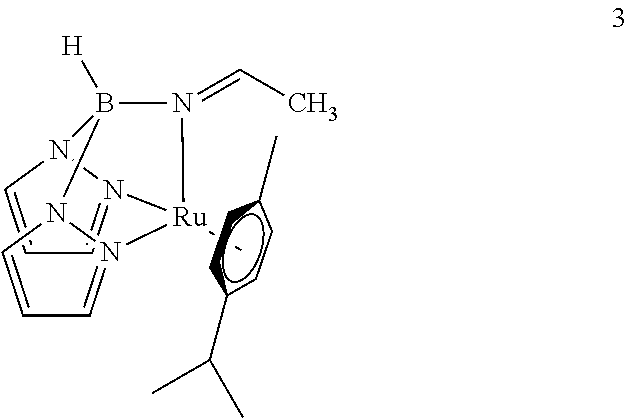
- a particularly useful catalyst is described by formula 3:
- the stoichiometric reduction of acetonitrile observed in the synthesis of 3 can be made catalytic by treating 3 with nitrile and sodium borohydride, 9 thus enabling a mild and selective approach to the synthesis of primary amines from nitriles.
- Known methods for nitrile reduction e.g. use of excess LiAlH 4 , borohydride reduction of a nitrilium salt, 11 use of metal hydride reagents, 12 or high-pressure hydrogenation 13 can be incompatible with important synthetic handles, such as aryl bromide and nitro groups.
- 14 Milder conditions compatible with groups like these require a stoichiometric portion of a borane reagent, 15 which in some cases must be independently prepared.
- the new catalytic mechanism reported here enables high functional group tolerance while incorporating an inexpensive reducing agent.
- Table 1 shows the discovery and optimization of our conditions for nitrile reduction.
- 2.0 equiv. of NaBH 4 can reduce 4-trifluoromethylbenzonitrile (7a) to the corresponding benzylamine (8a) in 50% conversion by NMR in 5 hours (entry 1).
- the analogous reaction reached >90% yield (>95% conversion) in the same time. With no catalyst, the reaction was much slower, reaching completion in 7 days with a 43% overall yield (entry 5).
- Tp-ligated homologue of 3 (6, Scheme 1) is used in this reaction, much of the starting material decomposes under the reaction conditions. This illustrates that the ⁇ -acetimine ligand in 3 plays an essential role in nitrile reduction.
- nitriles that can be reduced under our optimized conditions are broad. As shown in Table 2, aromatic, aliphatic, and heterocyclic nitriles are smoothly reduced to amines under optimized conditions. Both electron-poor and electron-rich substrates can be reduced in high yield. For example, in the presence of 5 mol % 3, 4.0 equiv. of NaBH 4 can reduce 4-trifluorobenzonitrile 7a to the corresponding benzylamine 8a in 82% isolated yield (entry 1). Electron-rich nitrile 7b can be reduced with a similar facility in 87% yield (entry 2). Even more oxidative nitroarene 7c can be reduced with exclusive selectivity for the nitrile over the nitro group (92%, entry 3).
- FIG. 4 Additional applications of the claimed catalyst are illustrated in FIG. 4 .
- Line A shows the application of the claimed catalyst in tandem reduction/intramolecular cyclization reaction, thus to enable a synthetic approach to isoindolinones.
- Line B illustrates an important feature of the catalyst, which is that the sodium borohydride reducing agent can be substituted with an alcohol. This particular example shows tandem nitrile reduction and amine alkylation, both mediated by butanol in the presence of the claimed catalyst.
- Lines C and D of FIG. 4 show the utility of the claimed catalyst in the reduction of ketone and ester (lactone) groups, respectively. Each of these cases illustrate an alcohol as the stoichiometric reducing agent.
- embodiments of the invention provide conveniently prepared homologues of the successful di(pyridyl)borate-ligated ruthenium complexes.
- the new catalytic scaffold shows comparable reactivity to the old one in several key reactions and confers new reactivity to the cooperative ruthenium-boron catalytic motif by enabling selective and high yielding nitrile reduction under mild conditions.
- this platform has yielded new insight into the cooperative reactivity of ruthenium and boron by showing a plausible scenario of how these two centers can work together, respectively, as an activating group (ruthenium) and a hydride donor (boron).
Landscapes
- Chemical & Material Sciences (AREA)
- Organic Chemistry (AREA)
- Chemical Kinetics & Catalysis (AREA)
- Inorganic Chemistry (AREA)
- Engineering & Computer Science (AREA)
- Materials Engineering (AREA)
- Low-Molecular Organic Synthesis Reactions Using Catalysts (AREA)
- Catalysts (AREA)
- Organic Low-Molecular-Weight Compounds And Preparation Thereof (AREA)
- Pyridine Compounds (AREA)
Abstract
Description

wherein:
R1 are each independently hydrogen, C1-8 alkyl, chlorine, bromine, fluorine, or OH;
x is 0 to 3;
R2 is C6-12 aryl, C5-12 heteroaryl or C1-8 alkyl;
L1 are each independently ligands associated with M, each L1 are the same or different; and
a is an integer from 1 to 6; and
M is a transition metal.

wherein:
R1 are each independently hydrogen, C1-8alkyl, chlorine, bromine, fluorine, or OH;
x is 0 to 3;
R2 is C6-12 aryl, C5-12 heteroaryl or C1-8 alkyl;
R3 are each independently hydrogen, C1-8 alkyl, chlorine, bromine, fluorine, or OH;
z is 0 to 4; and
M is a transition metal.

wherein:
R1 are each independently hydrogen, C1-8 alkyl, chlorine, bromine, fluorine, or OH;
x is 0 to 3;
R2 is C6-12 aryl, C5-12 heteroaryl or C1-8 alkyl;
L1 are each independently ligands associated with M, each L1 are the same or different; and
a is an integer from 1 to 6; and
M is a transition metal. In a refinement, the R1 are each independently hydrogen, methyl, ethyl, n-propyl, isopropyl, n-butyl, sec-butyl, isobutyl, or t-butyl. In a further refinement, the R1 are each independently hydrogen. In another refinement, the R2 are each independently hydrogen, methyl, ethyl, n-propyl, isopropyl, n-butyl, sec-butyl, isobutyl, or t-butyl. In still another refinement, the R2 are each independently methyl, ethyl, n-propyl, isopropyl, n-butyl, sec-butyl, isobutyl, or t-butyl. It should be appreciated that when multiple R1 and/or L1 are present, each one is independently one of the choices set forth above.

wherein:
R1 are each independently hydrogen, C1-8 alkyl, chlorine, bromine, fluorine, or OH;
x is 0 to 3;
R2 is C6-12 aryl, C5-12 heteroaryl or C1-8 alkyl;
R3 are each independently hydrogen, C1-8 alkyl, chlorine, bromine, fluorine, or OH;
z is 0 to 4; and
M is a transition metal.
In a refinement, the R1 are each independently hydrogen, methyl, ethyl, n-propyl, isopropyl, n-butyl, sec-butyl, isobutyl, or t-butyl. In a further refinement, the R1 are each independently hydrogen. In another refinement, the R2 are each independently hydrogen, methyl, ethyl, n-propyl, isopropyl, n-butyl, sec-butyl, isobutyl, or t-butyl. In another refinement, the R2 are each independently methyl, ethyl, n-propyl, isopropyl, n-butyl, sec-butyl, isobutyl, or t-butyl. In still another refinement, the R3 are each independently hydrogen, methyl, ethyl, n-propyl, isopropyl, n-butyl, sec-butyl, isobutyl, or t-butyl. It should be appreciated that when multiple R1 and/or R3 are present, each one is independently one of the choices set forth above.
| TABLE 1 |
 |
| Optimization of nitrile reduction conditions |
| Entry | Catalyst | NaOtBu | 5 h conversion a (%) | |
| 1 | 3 | None | 50 | c |
| 2 | 3 | 1 equiv. | >95 | >90%, 5 |
| 3 | 2 | 1 equiv. | 46 | 42%, 245 h |
| 4 | 6 | 1 equiv. | 41 | Trace, 245 |
| 5 | No |
1 equiv. | 38 | 43%, 245 h |
| a Starting material consumption by NMR in 5 hours. | ||||
| bProduct formed upon consumption of nitrile and subsequent addition of water. | ||||
| c Not recorded. | ||||
| TABLE 2 |
| Scope of 3-catalyzed nitrile reduction |
| Yield | ||||
| Entry | Nitrile | Conditions | Product | (%) |
| 1 |
 |
5 |
 |
82 |
| 2 |
 |
5 |
 |
87 |
| 3 |
 |
5 |
 |
92 |
| 4 |
 |
5 |
 |
85 |
| 5 |
 |
5 |
 |
80 |
| 6 |
 |
5 |
 |
84 |
| 7 |
 |
5 |
 |
60 |
| 8 |
 |
5 |
 |
64 |
| 9 |
 |
5 |
 |
56 |
| 10 |
 |
5 |
 |
87 |
- 1. B. L. Conley and T. J. Williams, J. Am. Chem. Soc., 2010, 132, 1764-1765.
- 2. B. L. Conley and T. J. Williams, Comments Inorg. Chem., 2011, 32, 195-218.
- 3. B. L. Conley, D. Guess and T. J. Williams, J. Am. Chem. Soc., 2011, 133, 14212-14215.
- 4. Z. Lu, B. Malinoski, A. V. Flores, D. Guess, B. L. Conley and T. J. Williams, Catalysts, 2012, 2, 412-421.
- 5. Scorpionates: The Coordination of Polypyrazolylborate Ligands, ed. S. Trofimenko, Imperial College Press, London, 1999.
- 6. For recent reviews of organometallic chemistry of poly(pyzalolyl)borate ligated complexes, see: (a) L. M. Caldwell, Adv. Organomet. Chem., 2008, 56, 1-94; (b) M. Lail, K. A. Pittard and T. B. Gunnoe, Adv. Organomet. Chem., 2008, 56, 95-153; (c) E. Becker, S. Pavli and K. Kirchner, Adv. Organomet. Chem., 2008, 56, 155-197; (d) I. R. Crossly, Adv. Organomet. Chem., 2008, 56, 199-321.
- 7. R. J. Abernethy, A. F. Hill, M. K. Smith and A. C. Willis, Organometallics, 2009, 28, 6152-6159.
- 8. S. Bhambri and D. A. Tocher, J. Chem. Soc., Dalton Trans., 1997, 3367-3372.
- 9. A ruthenium-ligated acetonitrile was reduced by NaBH4, however the system produced unidentified products. 13: L. F. Rhodes and L. M. Venanzi, Inorg. Chem., 1987, 26, 2692-2695.
- 10. M. Vogt, A. Nerush, M. A. Iron, G. Leitus, Y. Diskin-Posner, L. J. W. Shimon, Y. Ben-David and D. Milstein, J. Am. Chem. Soc., 2013, 135, 17004-17018.
- 11. R. F. Borch, Chem. Commun., 1968, 442-443.
- 12. For example, stoichiometric portions of NiII, CoII, OsIV, IrIII, PtII, are known to mediate nitrile and nitro group reduction in the presence of excess NaBH4. Y. Suzuki, Y. Miyaji and Z. Imai, Tetrahedron Lett., 1969, 52, 4555-4558.
- 13. For selected examples, see: H. Paul, S. Bhaduri and G. K. Lahiri, Organometallics, 2003, 22, 3019-3021; P. A. Chase, T. Jurca and D. W. Stephan, Chem. Commun., 2008, 1701-1703; R. Reguillo, M. Grellier, N. Vautravers, L. Vendier and S. Sabo-Etienne, J. Am. Chem. Soc., 2010, 132, 7854-7855; X. Miao, C. Fischmeister, C. Bruneau, J.-L. Dubois and J.-L. Couturier, Chem Sus Chem, 2012, 5, 1410-1414.
- 14. P. Magnus, N. Sane, B. P. Fauber and V. Lynch, J. Am. Chem. Soc., 2009, 131, 16045-16047.
- 15. D. Haddenham, L. Pasumansky, J. DeSoto, S. Eagon and B. Singaram, J. Org. Chem., 2009, 74, 1964-1970.
- 16. For selected reviews of utilization of aryl bromides in medicinal synthesis, see: J. Hassan, M. Se'vignon, C. Gozzi, E. Schulz and M. Lemaire, Chem. Rev., 2002, 102, 1359-1470; D. Alberico, M. E. Scott and M. Lautens, Chem. Rev., 2007, 107, 174-238; G. Zeni and R. C. Larock, Chem. Rev., 2006, 106, 4644-4680; J.-P. Corbet and G. Mignani, Chem. Rev., 2006, 106, 2651-2710; F.-S. Han, Chem. Soc. Rev., 2013, 42, 5270-5298; Y. Aubin, C. Fischmeister, C. M. Thomas and J.-L. Renaud, Chem. Soc. Rev., 2010, 39, 694-711; G. P. McGlacken and L. M. Bateman, Chem. Soc. Rev., 2009, 38, 2447-2464; T. R. M. Rauws and B. U. W. Maes, Chem. Soc. Rev., 2012, 41, 2463-2497.
Claims (20)


Priority Applications (1)
| Application Number | Priority Date | Filing Date | Title |
|---|---|---|---|
| US14/948,898 US9403753B2 (en) | 2014-11-21 | 2015-11-23 | Dual site catalyst for mild, selective nitrile reduction |
Applications Claiming Priority (2)
| Application Number | Priority Date | Filing Date | Title |
|---|---|---|---|
| US201462082992P | 2014-11-21 | 2014-11-21 | |
| US14/948,898 US9403753B2 (en) | 2014-11-21 | 2015-11-23 | Dual site catalyst for mild, selective nitrile reduction |
Publications (2)
| Publication Number | Publication Date |
|---|---|
| US20160145193A1 US20160145193A1 (en) | 2016-05-26 |
| US9403753B2 true US9403753B2 (en) | 2016-08-02 |
Family
ID=56009517
Family Applications (1)
| Application Number | Title | Priority Date | Filing Date |
|---|---|---|---|
| US14/948,898 Active US9403753B2 (en) | 2014-11-21 | 2015-11-23 | Dual site catalyst for mild, selective nitrile reduction |
Country Status (1)
| Country | Link |
|---|---|
| US (1) | US9403753B2 (en) |
-
2015
- 2015-11-23 US US14/948,898 patent/US9403753B2/en active Active
Non-Patent Citations (1)
| Title |
|---|
| Lu et al., Chemical Communications, vol. 50, pp. 5391-5393 (Published online Dec. 24, 2013). * |
Also Published As
| Publication number | Publication date |
|---|---|
| US20160145193A1 (en) | 2016-05-26 |
Similar Documents
| Publication | Publication Date | Title |
|---|---|---|
| Lu et al. | A dual site catalyst for mild, selective nitrile reduction | |
| Zheng et al. | C–H functionalization of aromatic amides | |
| Ju et al. | Reactivity of (bi-Oxazoline) organonickel Complexes and Revision of a Catalytic Mechanism | |
| Wang et al. | A highly efficient, recyclable catalyst for C− C coupling reactions in ionic liquids: Pyrazolyl-functionalized N-heterocyclic carbene complex of palladium (II) | |
| Jensen et al. | Highly regioselective nickel-catalyzed cross-coupling of N-tosylaziridines and alkylzinc reagents | |
| Takaya et al. | Synthesis, structure, and catalysis of palladium complexes bearing a group 13 metalloligand: remarkable effect of an aluminum-metalloligand in hydrosilylation of CO2 | |
| Tsukada et al. | Stereoselective cis-addition of aromatic C− H bonds to alkynes catalyzed by dinuclear palladium complexes | |
| MacNair et al. | Iron-catalysed, general and operationally simple formal hydrogenation using Fe (OTf) 3 and NaBH4 | |
| Nattmann et al. | A highly reduced Ni–Li–olefin complex for catalytic Kumada–Corriu cross-couplings | |
| Garduño et al. | Manganese‐Catalyzed Transfer Hydrogenation of Nitriles with 2‐Butanol as the Hydrogen Source | |
| Johnson et al. | A combined experimental and computational study of unexpected C− F bond activation intermediates and selectivity in the reaction of pentafluorobenzene with a (PEt3) 2Ni synthon | |
| El-Zaria et al. | m-Carborane-based chiral NBN pincer-metal complexes: synthesis, structure, and application in asymmetric catalysis | |
| EP3024836B1 (en) | Improved method for the preparation of chlorinated biphenylanilides and biphenylanilines | |
| Gong et al. | A bidentate Ru (II)-NC complex as a catalyst for semihydrogenation of alkynes to (E)-Alkenes with ethanol | |
| Hill et al. | Analogies between Metallaboratranes, Triboronates, and Boron Pincer Ligand Complexes | |
| Fu et al. | Biscarbene palladium (II) complexes. Reactivity of saturated versus unsaturated N-heterocyclic carbenes | |
| Nakamura et al. | Radical-organometallic hybrid reaction system enabling couplings between tertiary-alkyl groups and 1-alkenyl groups | |
| Drouin et al. | Multifunctional ruthenium catalysts: A novel borohydride-stabilized polyhydride complex containing the basic, chelating diphosphine 1, 4-bis (dicyclohexylphosphino) butane and its application to hydrogenation and murai catalysis | |
| Li et al. | Copper-catalyzed 1, 6-conjugate addition of para-quinone methides with diborylmethane | |
| Xiao et al. | Phosphonic acid mediated practical dehalogenation and benzylation with benzyl halides | |
| Weingart et al. | Electronic Fine‐tuning of Ruthenium (II) Transfer Hydrogenation Catalysts with Ethanol as the Hydrogen Source | |
| Zhang et al. | Bis (NHC)–Pd (II) complexes as highly efficient catalysts for allylation of aldehydes with allyltributyltin | |
| Ravn et al. | Regioselective hydroalkylation of vinylarenes by cooperative Cu and Ni catalysis | |
| EP2865446B1 (en) | Process for producing optically active secondary alcohol | |
| Aydemir et al. | Applications of transition metal complexes containing 3, 3′-bis (diphenylphosphinoamine)-2, 2′-bipyridine ligand to transfer hydrogenation of ketones |
Legal Events
| Date | Code | Title | Description |
|---|---|---|---|
| AS | Assignment |
Owner name: UNIVERSITY OF SOUTHERN CALIFORNIA, CALIFORNIA Free format text: ASSIGNMENT OF ASSIGNORS INTEREST;ASSIGNORS:WILLIAMS, TRAVIS J.;LU, ZHIYAO;REEL/FRAME:037478/0826 Effective date: 20160111 |
|
| STCF | Information on status: patent grant |
Free format text: PATENTED CASE |
|
| MAFP | Maintenance fee payment |
Free format text: PAYMENT OF MAINTENANCE FEE, 4TH YEAR, MICRO ENTITY (ORIGINAL EVENT CODE: M3551); ENTITY STATUS OF PATENT OWNER: MICROENTITY Year of fee payment: 4 |
|
| AS | Assignment |
Owner name: NATIONAL SCIENCE FOUNDATION, VIRGINIA Free format text: CONFIRMATORY LICENSE;ASSIGNOR:UNIVERSITY OF SOUTHERN CALIFORNIA;REEL/FRAME:052406/0439 Effective date: 20200330 |
|
| MAFP | Maintenance fee payment |
Free format text: PAYMENT OF MAINTENANCE FEE, 8TH YEAR, MICRO ENTITY (ORIGINAL EVENT CODE: M3552); ENTITY STATUS OF PATENT OWNER: MICROENTITY Year of fee payment: 8 |