US9399652B2 - Synthetic route to pactamycin and pactamycin analogs - Google Patents
Synthetic route to pactamycin and pactamycin analogs Download PDFInfo
- Publication number
- US9399652B2 US9399652B2 US14/758,110 US201414758110A US9399652B2 US 9399652 B2 US9399652 B2 US 9399652B2 US 201414758110 A US201414758110 A US 201414758110A US 9399652 B2 US9399652 B2 US 9399652B2
- Authority
- US
- United States
- Prior art keywords
- compound
- formula
- group
- pactamycin
- equiv
- Prior art date
- Legal status (The legal status is an assumption and is not a legal conclusion. Google has not performed a legal analysis and makes no representation as to the accuracy of the status listed.)
- Expired - Fee Related
Links
- 0 [5*]N[C@H]1[C@H](N)[C@@](NC([9*])=O)([C@@H]([8*])C)[C@@]([7*])(O)[C@@]1(O)CO[6*] Chemical compound [5*]N[C@H]1[C@H](N)[C@@](NC([9*])=O)([C@@H]([8*])C)[C@@]([7*])(O)[C@@]1(O)CO[6*] 0.000 description 31
- DKYDLSCFCXYNTB-KJECVCNWSA-N C.C=CCC1CN2CCC1CC2[C@H](O)C1=C2C=CC=CC2=NC=C1.CC(=O)C(NC(=O)N(C)C)(C(C)=O)[C@@H](/C=C/C1=CC=CC=C1)NC(=O)OCC1=CC=CC=C1.CC(=O)C(NC(=O)N(C)C)C(C)=O.[H]C(/C=C/C1=CC=CC=C1)=N\C(=O)OCC1=CC=CC=C1 Chemical compound C.C=CCC1CN2CCC1CC2[C@H](O)C1=C2C=CC=CC2=NC=C1.CC(=O)C(NC(=O)N(C)C)(C(C)=O)[C@@H](/C=C/C1=CC=CC=C1)NC(=O)OCC1=CC=CC=C1.CC(=O)C(NC(=O)N(C)C)C(C)=O.[H]C(/C=C/C1=CC=CC=C1)=N\C(=O)OCC1=CC=CC=C1 DKYDLSCFCXYNTB-KJECVCNWSA-N 0.000 description 1
- XAYLCXGGUGVNNI-UHFFFAOYSA-N C.CC(=O)C(=[N+]=[N-])C(C)=O.CC(=O)C(NC(=O)N(C)C)C(C)=O.S=S Chemical compound C.CC(=O)C(=[N+]=[N-])C(C)=O.CC(=O)C(NC(=O)N(C)C)C(C)=O.S=S XAYLCXGGUGVNNI-UHFFFAOYSA-N 0.000 description 1
- DFOQDORWNLHNCK-FNORWQNLSA-N C/N=C/C=C(C)C Chemical compound C/N=C/C=C(C)C DFOQDORWNLHNCK-FNORWQNLSA-N 0.000 description 1
- VPRXWGMFVOFPKE-UHFFFAOYSA-N CC(=O)C(=[N+]=[N-])C(C)=O.CC(=O)CC(C)=O.S.S=S Chemical compound CC(=O)C(=[N+]=[N-])C(C)=O.CC(=O)CC(C)=O.S.S=S VPRXWGMFVOFPKE-UHFFFAOYSA-N 0.000 description 1
- AFMFOPKOVULHTF-CTVOVCJKSA-N CC(=O)C(NC(=O)N(C)C)(C(C)=O)[C@@H](/C=C/C1=CC=CC=C1)NC(=O)OCC1=CC=CC=C1.CC(=O)[C@](NC(=O)N(C)C)([C@H](C)O)[C@@H](/C=C/C1=CC=CC=C1)NC(=O)OCC1=CC=CC=C1.CC(C)(C)O.[Li][Al](OC(C)(C)C)OC(C)(C)C Chemical compound CC(=O)C(NC(=O)N(C)C)(C(C)=O)[C@@H](/C=C/C1=CC=CC=C1)NC(=O)OCC1=CC=CC=C1.CC(=O)[C@](NC(=O)N(C)C)([C@H](C)O)[C@@H](/C=C/C1=CC=CC=C1)NC(=O)OCC1=CC=CC=C1.CC(C)(C)O.[Li][Al](OC(C)(C)C)OC(C)(C)C AFMFOPKOVULHTF-CTVOVCJKSA-N 0.000 description 1
- WVIUOSJLUCTGFK-JUJPXXQGSA-N CC(=O)C1=CC(N[C@H]2[C@H](N)[C@@](NC(=O)N(C)C)([C@H](C)O)[C@@](C)(O)[C@@]2(O)COC(=O)C2=C(C)C=CC=C2O)=CC=C1 Chemical compound CC(=O)C1=CC(N[C@H]2[C@H](N)[C@@](NC(=O)N(C)C)([C@H](C)O)[C@@](C)(O)[C@@]2(O)COC(=O)C2=C(C)C=CC=C2O)=CC=C1 WVIUOSJLUCTGFK-JUJPXXQGSA-N 0.000 description 1
- OBSJGRGFDWELNM-FTMPHZSYSA-N CC(=O)C1=CC(N[C@H]2[C@H](N)[C@@](NC(=O)N(C)C)([C@H](C)O)[C@@](C)(O)[C@@]2(O)COC(=O)C2=C(C)C=CC=C2O)=CC=C1.CC(=O)C1=CC(N[C@H]2[C@H](NC(=O)OCC3=CC=CC=C3)[C@@](NC(=O)N(C)C)([C@H](C)O)[C@@](C)(O)[C@@]2(O)COC(=O)C2=C(C)C=CC=C2O)=CC=C1.CO Chemical compound CC(=O)C1=CC(N[C@H]2[C@H](N)[C@@](NC(=O)N(C)C)([C@H](C)O)[C@@](C)(O)[C@@]2(O)COC(=O)C2=C(C)C=CC=C2O)=CC=C1.CC(=O)C1=CC(N[C@H]2[C@H](NC(=O)OCC3=CC=CC=C3)[C@@](NC(=O)N(C)C)([C@H](C)O)[C@@](C)(O)[C@@]2(O)COC(=O)C2=C(C)C=CC=C2O)=CC=C1.CO OBSJGRGFDWELNM-FTMPHZSYSA-N 0.000 description 1
- YNYINIXKDBQMAE-ZBZWFJQJSA-N CC(=O)C1=CC(N[C@H]2[C@H](N)[C@@](NC(=O)N(C)C)([C@H](C)O)[C@@](C)(O)[C@@]2(O)COC(=O)C2=C(C)C=CC=C2O)=CC=C1.CC1=C(C(=O)OC[C@@]2(O)[C@@H](NC3=C(Cl)C=CC=C3)[C@H](N)[C@@](NC(=O)N(C)C)([C@H](C)O)[C@@]2(C)O)C(O)=CC=C1.CC1=C(C(=O)OC[C@@]2(O)[C@@H](NC3=CC=CC(F)=C3)[C@H](N)[C@@](NC(=O)N(C)C)([C@H](C)O)[C@@]2(C)O)C(O)=CC=C1.CC1=C(C(=O)OC[C@@]2(O)[C@@H](NC3=CC=CC(O)=C3)[C@H](N)[C@@](NC(=O)N(C)C)([C@H](C)O)[C@@]2(C)O)C(O)=CC=C1.CC1=C(C(=O)OC[C@@]2(O)[C@@H](NC3=CNC4=C3C=CC=C4)[C@H](N)[C@@](NC(=O)N(C)C)([C@H](C)O)[C@@]2(C)O)C(O)=CC=C1 Chemical compound CC(=O)C1=CC(N[C@H]2[C@H](N)[C@@](NC(=O)N(C)C)([C@H](C)O)[C@@](C)(O)[C@@]2(O)COC(=O)C2=C(C)C=CC=C2O)=CC=C1.CC1=C(C(=O)OC[C@@]2(O)[C@@H](NC3=C(Cl)C=CC=C3)[C@H](N)[C@@](NC(=O)N(C)C)([C@H](C)O)[C@@]2(C)O)C(O)=CC=C1.CC1=C(C(=O)OC[C@@]2(O)[C@@H](NC3=CC=CC(F)=C3)[C@H](N)[C@@](NC(=O)N(C)C)([C@H](C)O)[C@@]2(C)O)C(O)=CC=C1.CC1=C(C(=O)OC[C@@]2(O)[C@@H](NC3=CC=CC(O)=C3)[C@H](N)[C@@](NC(=O)N(C)C)([C@H](C)O)[C@@]2(C)O)C(O)=CC=C1.CC1=C(C(=O)OC[C@@]2(O)[C@@H](NC3=CNC4=C3C=CC=C4)[C@H](N)[C@@](NC(=O)N(C)C)([C@H](C)O)[C@@]2(C)O)C(O)=CC=C1 YNYINIXKDBQMAE-ZBZWFJQJSA-N 0.000 description 1
- QOXMTPWCWSXSLO-SLJBWBGQSA-N CC(=O)C1=CC(N[C@H]2[C@H](NC(=O)OCC3=CC=CC=C3)[C@@](NC(=O)N(C)C)([C@H](C)O)[C@@](C)(O)[C@@]2(O)CO)=CC=C1.CC(=O)C1=CC(N[C@H]2[C@H](NC(=O)OCC3=CC=CC=C3)[C@@](NC(=O)N(C)C)([C@H](C)O)[C@@](C)(O)[C@@]2(O)COC(=O)C2=C(C)C=CC=C2O)=CC=C1.CC[C@@]1(O)[C@@H](NC2=CC=CC(C(C)=O)=C2)[C@H](NC(=O)OCC2=CC=CC=C2)[C@@](NC(=O)N(C)C)([C@H](C)O[Si](C)(C)C(C)(C)C)[C@@]1(C)O.[C-]#[N+]COC(=O)C1=C(C)C=CC=C1O Chemical compound CC(=O)C1=CC(N[C@H]2[C@H](NC(=O)OCC3=CC=CC=C3)[C@@](NC(=O)N(C)C)([C@H](C)O)[C@@](C)(O)[C@@]2(O)CO)=CC=C1.CC(=O)C1=CC(N[C@H]2[C@H](NC(=O)OCC3=CC=CC=C3)[C@@](NC(=O)N(C)C)([C@H](C)O)[C@@](C)(O)[C@@]2(O)COC(=O)C2=C(C)C=CC=C2O)=CC=C1.CC[C@@]1(O)[C@@H](NC2=CC=CC(C(C)=O)=C2)[C@H](NC(=O)OCC2=CC=CC=C2)[C@@](NC(=O)N(C)C)([C@H](C)O[Si](C)(C)C(C)(C)C)[C@@]1(C)O.[C-]#[N+]COC(=O)C1=C(C)C=CC=C1O QOXMTPWCWSXSLO-SLJBWBGQSA-N 0.000 description 1
- RCCRYYMADBIKKU-UNBNRUHFSA-K CC(=O)C1=CC=CC(N)=C1.CC[C@@]1(O)[C@@H](NC2=CC=CC(C(C)=O)=C2)[C@H](NC(=O)OCC2=CC=CC=C2)[C@@](NC(=O)N(C)C)([C@H](C)O[Si](C)(C)C(C)(C)C)[C@@]1(C)O.CC[C@@]12O[C@@H]1[C@H](NC(=O)OCC1=CC=CC=C1)[C@@](NC(=O)N(C)C)([C@H](C)O[Si](C)(C)C(C)(C)C)[C@@]2(C)O.O=S(=O)(O[Sc](OS(=O)(=O)C(F)(F)F)OS(=O)(=O)C(F)(F)F)C(F)(F)F Chemical compound CC(=O)C1=CC=CC(N)=C1.CC[C@@]1(O)[C@@H](NC2=CC=CC(C(C)=O)=C2)[C@H](NC(=O)OCC2=CC=CC=C2)[C@@](NC(=O)N(C)C)([C@H](C)O[Si](C)(C)C(C)(C)C)[C@@]1(C)O.CC[C@@]12O[C@@H]1[C@H](NC(=O)OCC1=CC=CC=C1)[C@@](NC(=O)N(C)C)([C@H](C)O[Si](C)(C)C(C)(C)C)[C@@]2(C)O.O=S(=O)(O[Sc](OS(=O)(=O)C(F)(F)F)OS(=O)(=O)C(F)(F)F)C(F)(F)F RCCRYYMADBIKKU-UNBNRUHFSA-K 0.000 description 1
- PNCUGMWFOIPAIL-FPUDDELISA-N CC(=O)[C@](NC(=O)N(C)C)([C@H](C)O)[C@@H](/C=C/C1=CC=CC=C1)NC(=O)OCC1=CC=CC=C1.CC(=O)[C@](NC(=O)N(C)C)([C@H](C)O[Si](C)(C)C(C)(C)C)[C@@H](/C=C/C1=CC=CC=C1)NC(=O)OCC1=CC=CC=C1 Chemical compound CC(=O)[C@](NC(=O)N(C)C)([C@H](C)O)[C@@H](/C=C/C1=CC=CC=C1)NC(=O)OCC1=CC=CC=C1.CC(=O)[C@](NC(=O)N(C)C)([C@H](C)O[Si](C)(C)C(C)(C)C)[C@@H](/C=C/C1=CC=CC=C1)NC(=O)OCC1=CC=CC=C1 PNCUGMWFOIPAIL-FPUDDELISA-N 0.000 description 1
- QLEIWSDKYDVSSN-OZEZEAEUSA-N CC(=O)[C@](NC(=O)N(C)C)([C@H](C)O[Si](C)(C)C(C)(C)C)[C@@H](/C=C/C1=CC=CC=C1)NC(=O)OCC1=CC=CC=C1.C[C@H](O[Si](C)(C)C(C)(C)C)[C@@](NC(=O)N(C)C)(C(=O)CCO)[C@@H](/C=C/C1=CC=CC=C1)NC(=O)OCC1=CC=CC=C1 Chemical compound CC(=O)[C@](NC(=O)N(C)C)([C@H](C)O[Si](C)(C)C(C)(C)C)[C@@H](/C=C/C1=CC=CC=C1)NC(=O)OCC1=CC=CC=C1.C[C@H](O[Si](C)(C)C(C)(C)C)[C@@](NC(=O)N(C)C)(C(=O)CCO)[C@@H](/C=C/C1=CC=CC=C1)NC(=O)OCC1=CC=CC=C1 QLEIWSDKYDVSSN-OZEZEAEUSA-N 0.000 description 1
- RGKWKPIIFRGCFX-CQBYTFPGSA-N CC(C)[C@]1(O)[C@@](O)(COC(=O)C2=CC=CC=C2)[C@@H](NC2=CC3=C(C=CC=C3)C=C2)[C@H](N)[C@@]1(NC(=O)N(C)C)[C@H](C)O.CCCC[C@]1(O)[C@@](O)(COC(=O)C2=CNC3=C2/C=C\C=C/3)[C@@H](NC2=NC3=C(C=CC=C3)N2)[C@H](N)[C@@]1(NC(=O)N(C)C)[C@H](C)O.C[C@H](O)[C@]1(NC(=O)N(C)C)[C@@H](N)[C@H](N/C2=C/NC3=C2C=CC=C3)[C@](O)(COC(=O)C2=CC=CC=C2)[C@@]1(O)C1=CC=CC=C1.C[C@H](O[Si](C)(C)C(C)(C)C)[C@]1(NC(=O)N(C)C)[C@@H](N)[C@H](N)[C@](O)(COC(=O)C2=CC=CC=C2)[C@]1(C)O.[H][C@]1(O)[C@@](O)(COC(=O)C2=CNC3=C2/C=C\C=C/3)[C@@H](NN2CCNCC2)[C@H](N)[C@@]1(NC(=O)N(C)C)[C@H](C)O Chemical compound CC(C)[C@]1(O)[C@@](O)(COC(=O)C2=CC=CC=C2)[C@@H](NC2=CC3=C(C=CC=C3)C=C2)[C@H](N)[C@@]1(NC(=O)N(C)C)[C@H](C)O.CCCC[C@]1(O)[C@@](O)(COC(=O)C2=CNC3=C2/C=C\C=C/3)[C@@H](NC2=NC3=C(C=CC=C3)N2)[C@H](N)[C@@]1(NC(=O)N(C)C)[C@H](C)O.C[C@H](O)[C@]1(NC(=O)N(C)C)[C@@H](N)[C@H](N/C2=C/NC3=C2C=CC=C3)[C@](O)(COC(=O)C2=CC=CC=C2)[C@@]1(O)C1=CC=CC=C1.C[C@H](O[Si](C)(C)C(C)(C)C)[C@]1(NC(=O)N(C)C)[C@@H](N)[C@H](N)[C@](O)(COC(=O)C2=CC=CC=C2)[C@]1(C)O.[H][C@]1(O)[C@@](O)(COC(=O)C2=CNC3=C2/C=C\C=C/3)[C@@H](NN2CCNCC2)[C@H](N)[C@@]1(NC(=O)N(C)C)[C@H](C)O RGKWKPIIFRGCFX-CQBYTFPGSA-N 0.000 description 1
- OPDYDWIWGSXPKB-SKOCOQFTSA-N CC1=C(C(=O)OC[C@@]2(O)[C@@H](NC3=CC4=C(C=CC=C4)C=C3)[C@H](N)[C@@](NC(=O)N(C)C)([C@H](C)O)[C@@]2(C)O)C(O)=CC=C1.CC1=C(C(=O)OC[C@@]2(O)[C@@H](NC3=NC4=C(C=CC=C4)N3)[C@H](N)[C@@](NC(=O)N(C)C)([C@H](C)O)[C@@]2(C)O)C(O)=CC=C1.CC1=C(C(=O)OC[C@@]2(O)[C@@H](NN3CCNCC3)[C@H](N)[C@@](NC(=O)N(C)C)([C@H](C)O)[C@@]2(C)O)C(O)=CC=C1.CCC[C@]1(O)[C@@](O)(COC(=O)C2=CNC3=C2/C=C\C=C/3)[C@@H](N)[C@H](N)[C@@]1(NC(=O)N(C)C)[C@H](C)O.CCN[C@H]1[C@H](N)[C@@](NC(=O)N(C)C)([C@H](C)O)[C@@](C)(O)[C@@]1(O)COC(=O)C1=CNC2=C1/C=C\C=C/2.C[C@H](O)[C@]1(NC(=O)N(C)C)[C@@H](N)[C@H](N)[C@](O)(COC(=O)C2=CC=CC=C2)[C@]1(C)O Chemical compound CC1=C(C(=O)OC[C@@]2(O)[C@@H](NC3=CC4=C(C=CC=C4)C=C3)[C@H](N)[C@@](NC(=O)N(C)C)([C@H](C)O)[C@@]2(C)O)C(O)=CC=C1.CC1=C(C(=O)OC[C@@]2(O)[C@@H](NC3=NC4=C(C=CC=C4)N3)[C@H](N)[C@@](NC(=O)N(C)C)([C@H](C)O)[C@@]2(C)O)C(O)=CC=C1.CC1=C(C(=O)OC[C@@]2(O)[C@@H](NN3CCNCC3)[C@H](N)[C@@](NC(=O)N(C)C)([C@H](C)O)[C@@]2(C)O)C(O)=CC=C1.CCC[C@]1(O)[C@@](O)(COC(=O)C2=CNC3=C2/C=C\C=C/3)[C@@H](N)[C@H](N)[C@@]1(NC(=O)N(C)C)[C@H](C)O.CCN[C@H]1[C@H](N)[C@@](NC(=O)N(C)C)([C@H](C)O)[C@@](C)(O)[C@@]1(O)COC(=O)C1=CNC2=C1/C=C\C=C/2.C[C@H](O)[C@]1(NC(=O)N(C)C)[C@@H](N)[C@H](N)[C@](O)(COC(=O)C2=CC=CC=C2)[C@]1(C)O OPDYDWIWGSXPKB-SKOCOQFTSA-N 0.000 description 1
- YYUSLFSTNFRMSU-UHFFFAOYSA-N CC1=CC(CN2CCCC2C(C)(C2=CC=CC=C2)C2=CC=CC=C2)=C(O)C(CN2CCCC2C(O)(C2=CC=CC=C2)C2=CC=CC=C2)=C1.C[Zn]C Chemical compound CC1=CC(CN2CCCC2C(C)(C2=CC=CC=C2)C2=CC=CC=C2)=C(O)C(CN2CCCC2C(O)(C2=CC=CC=C2)C2=CC=CC=C2)=C1.C[Zn]C YYUSLFSTNFRMSU-UHFFFAOYSA-N 0.000 description 1
- LDAZKFYVNLSOEW-DDFXEKCISA-N CCCC[C@]1(O)[C@@](O)(COC(=O)C2=CNC3=C2/C=C\C=C/3)[C@@H](NC2=NC3=C(C=CC=C3)N2)[C@H](N)[C@@]1(NC(=O)N(CC)CC)[C@H](C)O.CCC[C@]1(O)[C@@](O)(COC(=O)C2=CNC3=C2/C=C\C=C/3)[C@@H](N)[C@H](N)[C@@]1(NC(=O)N(C)C)[C@H](C)O[Si](C)(C)C(C)(C)C.CCN(CC)C(=O)N[C@@]1([C@H](C)OCC2=CC=CC=C2)[C@@H](N)[C@H](NC2=CC3=C(C=CC=C3)C=C2)[C@](O)(COC(=O)C2=CC=CC=C2)[C@@]1(O)C(C)C.CCN[C@H]1[C@H](N)[C@@](NC(=O)N(C)C)([C@H](C)O)[C@@](C)(O)[C@@]1(O)COC(=O)C1=CNC2=C1/C=C\C=C/2.CCO[C@@H](C)[C@]1(NC(=O)N(C)C)[C@@H](N)[C@H](N/C2=C/NC3=C2C=CC=C3)[C@](O)(COC(=O)C2=CC=CC=C2)[C@@]1(O)C1=CC=CC=C1 Chemical compound CCCC[C@]1(O)[C@@](O)(COC(=O)C2=CNC3=C2/C=C\C=C/3)[C@@H](NC2=NC3=C(C=CC=C3)N2)[C@H](N)[C@@]1(NC(=O)N(CC)CC)[C@H](C)O.CCC[C@]1(O)[C@@](O)(COC(=O)C2=CNC3=C2/C=C\C=C/3)[C@@H](N)[C@H](N)[C@@]1(NC(=O)N(C)C)[C@H](C)O[Si](C)(C)C(C)(C)C.CCN(CC)C(=O)N[C@@]1([C@H](C)OCC2=CC=CC=C2)[C@@H](N)[C@H](NC2=CC3=C(C=CC=C3)C=C2)[C@](O)(COC(=O)C2=CC=CC=C2)[C@@]1(O)C(C)C.CCN[C@H]1[C@H](N)[C@@](NC(=O)N(C)C)([C@H](C)O)[C@@](C)(O)[C@@]1(O)COC(=O)C1=CNC2=C1/C=C\C=C/2.CCO[C@@H](C)[C@]1(NC(=O)N(C)C)[C@@H](N)[C@H](N/C2=C/NC3=C2C=CC=C3)[C@](O)(COC(=O)C2=CC=CC=C2)[C@@]1(O)C1=CC=CC=C1 LDAZKFYVNLSOEW-DDFXEKCISA-N 0.000 description 1
- DPCJVVYFEHWWOI-LMBWMHSSSA-M CC[C@@]12O[C@@H]1[C@H](NC(=O)OCC1=CC=CC=C1)[C@@](NC(=O)N(C)C)([C@H](C)O[Si](C)(C)C(C)(C)C)C2=O.CC[C@@]12O[C@@H]1[C@H](NC(=O)OCC1=CC=CC=C1)[C@@](NC(=O)N(C)C)([C@H](C)O[Si](C)(C)C(C)(C)C)[C@@]2(C)O.C[Mg]Br Chemical compound CC[C@@]12O[C@@H]1[C@H](NC(=O)OCC1=CC=CC=C1)[C@@](NC(=O)N(C)C)([C@H](C)O[Si](C)(C)C(C)(C)C)C2=O.CC[C@@]12O[C@@H]1[C@H](NC(=O)OCC1=CC=CC=C1)[C@@](NC(=O)N(C)C)([C@H](C)O[Si](C)(C)C(C)(C)C)[C@@]2(C)O.C[Mg]Br DPCJVVYFEHWWOI-LMBWMHSSSA-M 0.000 description 1
- BWYCXNXUSOZROX-FJKLQYGRSA-N CC[C@@]12O[C@@H]1[C@H](NC(=O)OCC1=CC=CC=C1)[C@@](NC(=O)N(C)C)([C@H](C)O[Si](C)(C)C(C)(C)C)C2=O.C[C@H](O[Si](C)(C)C(C)(C)C)[C@@]1(NC(=O)N(C)C)C(=O)[C@]2(CO)O[C@@H]2[C@@H]1NC(=O)OCC1=CC=CC=C1 Chemical compound CC[C@@]12O[C@@H]1[C@H](NC(=O)OCC1=CC=CC=C1)[C@@](NC(=O)N(C)C)([C@H](C)O[Si](C)(C)C(C)(C)C)C2=O.C[C@H](O[Si](C)(C)C(C)(C)C)[C@@]1(NC(=O)N(C)C)C(=O)[C@]2(CO)O[C@@H]2[C@@H]1NC(=O)OCC1=CC=CC=C1 BWYCXNXUSOZROX-FJKLQYGRSA-N 0.000 description 1
- MCSCBEJDURGSAI-VQCRMAQZSA-N C[C@H](O[Si](C)(C)C(C)(C)C)[C@@](NC(=O)N(C)C)(C(=O)CCO)[C@@H](/C=C/C1=CC=CC=C1)NC(=O)OCC1=CC=CC=C1.C[C@H](O[Si](C)(C)C(C)(C)C)[C@@]1(NC(=O)N(C)C)C(=O)C(CO)=C[C@@H]1NC(=O)OCC1=CC=CC=C1 Chemical compound C[C@H](O[Si](C)(C)C(C)(C)C)[C@@](NC(=O)N(C)C)(C(=O)CCO)[C@@H](/C=C/C1=CC=CC=C1)NC(=O)OCC1=CC=CC=C1.C[C@H](O[Si](C)(C)C(C)(C)C)[C@@]1(NC(=O)N(C)C)C(=O)C(CO)=C[C@@H]1NC(=O)OCC1=CC=CC=C1 MCSCBEJDURGSAI-VQCRMAQZSA-N 0.000 description 1
- YTCNRIKLKUVZPU-HTYSNTESSA-N C[C@H](O[Si](C)(C)C(C)(C)C)[C@@]1(NC(=O)N(C)C)C(=O)C(CO)=C[C@@H]1NC(=O)OCC1=CC=CC=C1.C[C@H](O[Si](C)(C)C(C)(C)C)[C@@]1(NC(=O)N(C)C)C(=O)[C@]2(CO)O[C@@H]2[C@@H]1NC(=O)OCC1=CC=CC=C1 Chemical compound C[C@H](O[Si](C)(C)C(C)(C)C)[C@@]1(NC(=O)N(C)C)C(=O)C(CO)=C[C@@H]1NC(=O)OCC1=CC=CC=C1.C[C@H](O[Si](C)(C)C(C)(C)C)[C@@]1(NC(=O)N(C)C)C(=O)[C@]2(CO)O[C@@H]2[C@@H]1NC(=O)OCC1=CC=CC=C1 YTCNRIKLKUVZPU-HTYSNTESSA-N 0.000 description 1
- JLADJBFZRQELNY-SRHIXDSCSA-N [H][C@]1(O)[C@@](O)(COC(=O)C2=CNC3=C2/C=C\C=C/3)[C@@H](NN2CCNCC2)[C@H](N)[C@@]1(NC(=O)N1CCCC1)[C@H](C)O Chemical compound [H][C@]1(O)[C@@](O)(COC(=O)C2=CNC3=C2/C=C\C=C/3)[C@@H](NN2CCNCC2)[C@H](N)[C@@]1(NC(=O)N1CCCC1)[C@H](C)O JLADJBFZRQELNY-SRHIXDSCSA-N 0.000 description 1
Classifications
-
- C—CHEMISTRY; METALLURGY
- C07—ORGANIC CHEMISTRY
- C07F—ACYCLIC, CARBOCYCLIC OR HETEROCYCLIC COMPOUNDS CONTAINING ELEMENTS OTHER THAN CARBON, HYDROGEN, HALOGEN, OXYGEN, NITROGEN, SULFUR, SELENIUM OR TELLURIUM
- C07F7/00—Compounds containing elements of Groups 4 or 14 of the Periodic Table
- C07F7/02—Silicon compounds
- C07F7/08—Compounds having one or more C—Si linkages
- C07F7/18—Compounds having one or more C—Si linkages as well as one or more C—O—Si linkages
- C07F7/1804—Compounds having Si-O-C linkages
-
- C—CHEMISTRY; METALLURGY
- C07—ORGANIC CHEMISTRY
- C07C—ACYCLIC OR CARBOCYCLIC COMPOUNDS
- C07C275/00—Derivatives of urea, i.e. compounds containing any of the groups, the nitrogen atoms not being part of nitro or nitroso groups
- C07C275/04—Derivatives of urea, i.e. compounds containing any of the groups, the nitrogen atoms not being part of nitro or nitroso groups having nitrogen atoms of urea groups bound to acyclic carbon atoms
- C07C275/20—Derivatives of urea, i.e. compounds containing any of the groups, the nitrogen atoms not being part of nitro or nitroso groups having nitrogen atoms of urea groups bound to acyclic carbon atoms of an unsaturated carbon skeleton
- C07C275/24—Derivatives of urea, i.e. compounds containing any of the groups, the nitrogen atoms not being part of nitro or nitroso groups having nitrogen atoms of urea groups bound to acyclic carbon atoms of an unsaturated carbon skeleton containing six-membered aromatic rings
-
- C—CHEMISTRY; METALLURGY
- C07—ORGANIC CHEMISTRY
- C07C—ACYCLIC OR CARBOCYCLIC COMPOUNDS
- C07C275/00—Derivatives of urea, i.e. compounds containing any of the groups, the nitrogen atoms not being part of nitro or nitroso groups
- C07C275/26—Derivatives of urea, i.e. compounds containing any of the groups, the nitrogen atoms not being part of nitro or nitroso groups having nitrogen atoms of urea groups bound to carbon atoms of rings other than six-membered aromatic rings
-
- C07F7/1848—
-
- C—CHEMISTRY; METALLURGY
- C07—ORGANIC CHEMISTRY
- C07B—GENERAL METHODS OF ORGANIC CHEMISTRY; APPARATUS THEREFOR
- C07B2200/00—Indexing scheme relating to specific properties of organic compounds
- C07B2200/07—Optical isomers
-
- C07C2101/08—
-
- C—CHEMISTRY; METALLURGY
- C07—ORGANIC CHEMISTRY
- C07C—ACYCLIC OR CARBOCYCLIC COMPOUNDS
- C07C2601/00—Systems containing only non-condensed rings
- C07C2601/06—Systems containing only non-condensed rings with a five-membered ring
- C07C2601/08—Systems containing only non-condensed rings with a five-membered ring the ring being saturated
Definitions
- the present invention concerns methods and intermediates for making pactamycin and analogs thereof, along with compounds, compositions and methods of using the same.
- Pactamycin and certain analogs thereof are known and described in, for example, S. Hannasian et al., J. Org. Chem. 77, 9458-9472 (2012); W. Lu et al., Chemistry and Biology 18, 425-431 (2011), and T. Mahmud, PCT Publication No. WO2012/018854.
- Some prior syntheses of these compounds rely on enzymatic mechanisms, which, among other things, limits the substitutions which can be obtained thereon.
- Other synthetic sequences are lengthy, which limit the analogs that can be created. Accordingly, there is a need for new ways to make pactamycin and analogs thereof which do not rely on enzymatic steps or long synthetic sequences.
- a first aspect of the present invention is compounds of Formula I and methods of making the same:
- R 5 is H, alkyl, aryl or heteroaryl
- R 6 is H or —R a R b , where R a is alkyl or carbonyl, and R b is alkyl, aryl, or heteroaryl;
- R 7 is H, alkyl, aryl, or heteroaryl
- R 8 is H, hydroxy, silyloxy, acyloxy, or alkoxy
- R 9 is —N(R c R d ), —OR c , or —SR c , where R c and R d are each independently selected alkyl, aryl, or heteroaryl, or R c and R d together form an alkylene bridge;
- a second aspect of the present invention is pharmaceutical formulations comprising certain subgroups of compounds of Formula I or Formula II (below) (e.g., excluding pactamycin, pactamycate, and those analogs described in PCT Publication No. WO2012/018854), including pharmaceutically acceptable salts thereof.
- a further aspect of the present invention is methods of treating, and compounds of Formula I or Formula II (below) for use in treating, disorders and diseases such as (for example) malaria, bacterial and viral infections, tumors and cancers.
- a still further aspect of the invention is intermediates useful for making compounds of Formula I above, and methods of making such intermediates.
- the present invention includes a method of making an early intermediate for the synthesis of compounds of Formula I by a Mannich addition of 2-amino-substituted 1,3-dicarbonyls. While Mannich reactions on other reactants are known (see, e.g., S. Lou et al., J. Am. Chem. Soc. 127, 11256 (2005); A Ting et al., Org. Lett. 8, 2003 (2006); S. Lou et al., J. Am. Chem. Soc 129, 15398 (2007)), Mannich additions of 2-amino substituted 1,3-dicarbonyls have not heretofore been suggested or described.
- the present invention generally provides a method of making an alpha,beta-diamino ketone, comprising: reacting an imine with a 2-amino-substituted 1,3-dicarbonyl in a Mannich addition reaction to produce said alpha,beta-diamino ketone.
- the method is useful for making the compounds described herein, or others.
- Alkyl refers to a straight or branched chain hydrocarbon containing from 1 to 10 carbon atoms.
- Representative examples of alkyl include, but are not limited to, methyl, ethyl, n-propyl, iso-propyl, n-butyl, sec-butyl, iso-butyl, tert-butyl, n-pentyl, isopentyl, neopentyl, n-hexyl, 3-methylhexyl, 2,2-dimethylpentyl, 2,3-dimethylpentyl, n-heptyl, n-octyl, n-nonyl, n-decyl, and the like.
- Lower alkyl as used herein, is a subset of alkyl, in some embodiments preferred, and refers to a straight or branched chain hydrocarbon group containing from 1 to 4 carbon atoms.
- Representative examples of lower alkyl include, but are not limited to, methyl, ethyl, n-propyl, iso-propyl, n-butyl, iso-butyl, tert-butyl, and the like.
- alkyl or “loweralkyl” is intended to include both substituted and unsubstituted alkyl or loweralkyl unless otherwise indicated and these groups may be substituted with groups selected from halo (e.g., haloalkyl), alkyl, haloalkyl, alkenyl, alkynyl, cycloalkyl, cycloalkylalkyl, aryl, arylalkyl, heterocyclo, heterocycloalkyl, hydroxyl, alkoxy (thereby creating a polyalkoxy such as polyethylene glycol), alkenyloxy, alkynyloxy, haloalkoxy, cycloalkoxy, cycloalkylalkyloxy, aryloxy, arylalkyloxy, heterocyclooxy, heterocyclolalkyloxy, mercapto, alkyl-S(O) m , haloalkyl-S(O) m , alkenyl-S(O)
- alkenyl refers to a straight or branched chain hydrocarbon containing from 1 to 10 carbon atoms (or in loweralkenyl 1 to 4 carbon atoms) which include 1 to 4 double bonds in the normal chain.
- alkenyl include, but are not limited to, vinyl, 2-propenyl, 3-butenyl, 2-butenyl, 4-pentenyl, 3-pentenyl, 2-hexenyl, 3-hexenyl, 2,4-heptadiene, and the like.
- alkenyl or “loweralkenyl” is intended to include both substituted and unsubstituted alkenyl or loweralkenyl unless otherwise indicated and these groups may be substituted with groups as described in connection with alkyl and loweralkyl above.
- Alkynyl refers to a straight or branched chain hydrocarbon containing from 1 to 10 carbon atoms (or in loweralkynyl 1 to 4 carbon atoms) which include 1 triple bond in the normal chain.
- Representative examples of alkynyl include, but are not limited to, 2-propynyl, 3-butynyl, 2-butynyl, 4-pentynyl, 3-pentynyl, and the like.
- alkynyl or “loweralkynyl” is intended to include both substituted and unsubstituted alkynyl or loweralkynyl unless otherwise indicated and these groups may be substituted with the same groups as set forth in connection with alkyl and loweralkyl above.
- Cycloalkyl refers to a saturated or partially unsaturated cyclic hydrocarbon group containing from 3, 4 or 5 to 6, 7 or 8 carbons (which carbons may be replaced in a heterocyclic group as discussed below).
- Representative examples of cycloalkyl include, cyclopropyl, cyclobutyl, cyclopentyl, cyclohexyl, cycloheptyl, and cyclobutyl. These rings may be optionally substituted with additional substituents as described herein such as halo or loweralkyl.
- the term “cycloalkyl” is generic and intended to include heterocyclic groups as discussed below unless specified otherwise.
- Heterocyclic group or “heterocyclo” as used herein alone or as part of another group, refers to an aliphatic (e.g., fully or partially saturated heterocyclo) or aromatic (e.g., heteroaryl) monocyclic- or a bicyclic-ring system
- Monocyclic ring systems are exemplified by any 5 or 6 membered ring containing 1, 2, 3, or 4 heteroatoms independently selected from oxygen, nitrogen and sulfur.
- the 5 membered ring has from 0-2 double bonds and the 6 membered ring has from 0-3 double bonds.
- monocyclic ring systems include, but are not limited to, azetidine, azepine, aziridine, diazepine, 1,3-dioxolane, dioxane, dithiane, furan, imidazole, imidazoline, imidazolidine, isothiazole, isothiazoline, isothiazolidine, isoxazole, isoxazoline, isoxazolidine, morpholine, oxadiazole, oxadiazoline, oxadiazolidine, oxazole, oxazoline, oxazolidine, piperazine, piperidine, pyran, pyrazine, pyrazole, pyrazoline, pyrazolidine, pyridine, pyrimidine, pyridazine, pyrrole, pyrroline, pyrrolidine, tetrahydrofuran, tetrahydrothiophene, tetrazine,
- Bicyclic ring systems are exemplified by any of the above monocyclic ring systems fused to an aryl group as defined herein, a cycloalkyl group as defined herein, or another monocyclic ring system as defined herein.
- Representative examples of bicyclic ring systems include but are not limited to, for example, benzimidazole, benzothiazole, benzothiadiazole, benzothiophene, benzoxadiazole, benzoxazole, benzofuran, benzopyran, benzothiopyran, benzodioxine, 1,3-benzodioxole, cinnoline, indazole, indole, indoline, indolizine, naphthyridine, isobenzofuran, isobenzothiophene, isoindole, isoindoline, isoquinoline, phthalazine, purine, pyranopyridine, quinoline, quinoliz
- These rings include quaternized derivatives thereof and may be optionally substituted with groups selected from halo, alkyl, haloalkyl, alkenyl, alkynyl, cycloalkyl, cycloalkylalkyl, aryl, arylalkyl, heterocyclo, heterocycloalkyl, hydroxyl, alkoxy, alkenyloxy, alkynyloxy, haloalkoxy, cycloalkoxy, cycloalkylalkyloxy, aryloxy, arylalkyloxy, heterocyclooxy, heterocyclolalkyloxy, mercapto, alkyl-S(O) m , haloalkyl-S(O) m , alkenyl-S(O) m , alkynyl-S(O) m , cycloalkyl-S(O) m , cycloalkylalkyl-S(O) m , aryl
- Aryl refers to a monocyclic carbocyclic ring system or a bicyclic carbocyclic fused ring system having one or more aromatic rings.
- Representative examples of aryl include, azulenyl, indanyl, indenyl, naphthyl, phenyl, tetrahydronaphthyl, and the like.
- aryl is intended to include both substituted and unsubstituted aryl unless otherwise indicated and these groups may be substituted with the same groups as set forth in connection with alkyl and loweralkyl above.
- Arylalkyl refers to an aryl group, as defined herein, appended to the parent molecular moiety through an alkyl group, as defined herein.
- Representative examples of arylalkyl include, but are not limited to, benzyl, 2-phenylethyl, 3-phenylpropyl, 2-naphth-2-ylethyl, and the like.
- Heteroaryl as used herein is as described in connection with heterocyclo above.
- Alkoxy refers to an alkyl or loweralkyl group, as defined herein (and thus including substituted versions such as polyalkoxy), appended to the parent molecular moiety through an oxy group, —O—.
- alkoxy include, but are not limited to, methoxy, ethoxy, propoxy, 2-propoxy, butoxy, tert-butoxy, pentyloxy, hexyloxy and the like.
- Halo refers to any suitable halogen, including —F, —Cl, —Br, and —I.
- Cyano as used herein refers to a —CN group.
- Forml refers to a —C(O)H group.
- Carboxylic acid as used herein refers to a —C(O)OH group.
- Haldroxyl refers to an —OH group.
- Niro refers to an —NO 2 group.
- “Acyl” as used herein alone or as part of another group refers to a —C(O)R radical, where R is any suitable substituent such as aryl, alkyl, alkenyl, alkynyl, cycloalkyl or other suitable substituent as described herein.
- Alkylthio refers to an alkyl group, as defined herein, appended to the parent molecular moiety through a thio moiety, as defined herein.
- Representative examples of alkylthio include, but are not limited, methylthio, ethylthio, tert-butylthio, hexylthio, and the like.
- Amino as used herein means the radical —NH 2 .
- Alkylamino as used herein alone or as part of another group means the radical —NHR, where R is an alkyl group.
- Arylalkylamino as used herein alone or as part of another group means the radical —NHR, where R is an arylalkyl group.
- “Disubstituted-amino” as used herein alone or as part of another group means the radical —NR a R b , where R a and R b are independently selected from the groups alkyl, haloalkyl, alkenyl, alkynyl, cycloalkyl, cycloalkylalkyl, aryl, arylalkyl, heterocyclo, heterocycloalkyl.
- “Acylamino” as used herein alone or as part of another group means the radical —NR a R b , where R a is an acyl group as defined herein and R b is selected from the groups hydrogen, alkyl, haloalkyl, alkenyl, alkynyl, cycloalkyl, cycloalkylalkyl, aryl, arylalkyl, heterocyclo, heterocycloalkyl.
- “Acyloxy” as used herein alone or as part of another group means the radical —OR, where R is an acyl group as defined herein.
- “Ester” as used herein alone or as part of another group refers to a —C(O)OR radical, where R is any suitable substituent such as alkyl, cycloalkyl, alkenyl, alkynyl or aryl.
- “Amide” as used herein alone or as part of another group refers to a —C(O)NR a R b radical, where R a and R b are any suitable substituent such as alkyl, cycloalkyl, alkenyl, alkynyl or aryl.
- “Sulfoxyl” as used herein refers to a compound of the formula —S(O)R, where R is any suitable substituent such as alkyl, cycloalkyl, alkenyl, alkynyl or aryl.
- “Sulfonyl” as used herein refers to a compound of the formula —S(O)(O)R, where R is any suitable substituent such as amino, alkyl, cycloalkyl, alkenyl, alkynyl or aryl.
- “Sulfonate” as used herein refers to a compound of the formula —S(O)(O)OR, where R is any suitable substituent such as alkyl, cycloalkyl, alkenyl, alkynyl or aryl.
- “Sulfonic acid” as used herein refers to a compound of the formula —S(O)(O)OH.
- “Sulfonamide” as used herein alone or as part of another group refers to a —S(O) 2 NR a R b radical, where R a and R b are any suitable substituent such as H, alkyl, cycloalkyl, alkenyl, alkynyl or aryl.
- Rea refers to an —N(ROC(O)NR a R b radical, where R a , R b and R c are any suitable substituent such as H, alkyl, cycloalkyl, alkenyl, alkynyl or aryl.
- Alkoxyacylamino as used herein alone or as part of another group refers to an —N(R a )C(O)OR b radical, where R a , R b are any suitable substituent such as H, alkyl, cycloalkyl, alkenyl, alkynyl or aryl.
- aminoacyloxy as used herein alone or as part of another group refers to an —OC(O)NR a R b radical, where R a and R b are any suitable substituent such as H, alkyl, cycloalkyl, alkenyl, alkynyl or aryl.
- “Polar group” as used herein refers to a group wherein the nuclei of the atoms covalently bound to each other to form the group do not share the electrons of the covalent bond(s) joining them equally; that is the electron cloud is denser about one atom than another. This results in one end of the covalent bond(s) being relatively negative and the other end relatively positive; i.e., there is a negative pole and a positive pole.
- polar groups include, without limitations, halo, hydroxy, alkoxy, carboxy, nitro, cyano, amino (primary, secondary and tertiary), amido, ureido, sulfonamido, sulfinyl, sulfhydryl, silyl, S-sulfonamido, N-sulfonamido, C-carboxy, O-carboxy, C-amido, N-amido, sulfonyl, N-tert-butoxycarbonyl (or “t-BOC”) groups, phosphoric), morpholino, piperazinyl, tetrazolo, and the like. See, e.g., U.S.
- Ionic group as used herein includes anionic and cationic groups, and includes groups (sometimes referred to as “ionogenic” groups) that are uncharged in one form but can be easily converted to ionic groups (for example, by protonation or deprotonation in aqueous solution). Examples include but are not limited to carboxylate, sulfonate, phosphate, amine, N-oxide, and ammonium (including quaternized heterocyclic amines such as imidazolium and pyridinium) groups. See, e.g., U.S. Pat. Nos. 6,478,863; 6,800,276; and 6,896,246.
- Additional examples include uronic acids, carboxylic acid, sulfonic acid, amine, and moieties such as guanidinium, phosphoric acid, phosphonic acid, phosphatidyl choline, phosphonium, borate, sulfate, etc.
- Deuterium as used herein alone or as part of another group, refers to a safe, non-radioactive relative of hydrogen. Any hydrogen in a group or substituent described above may be replaced with deuterium to provide a “deuterated” compound, in some embodiments to modify and/or improve metabolic stability, resulting in better safety, tolerability and/or efficacy.
- linking group as used herein are generally bivalent aromatic, aliphatic, or mixed aromatic and aliphatic groups.
- linking groups include linear or branched, substituted or unsubstituted aryl, alkyl, alkylaryl, or alkylarylalkyl linking groups, where the alkyl groups are saturated or unsaturated, and where the alkyl and aryl groups optionally containing independently selected heteroatoms such as 1, 2, 3 or 4 heteroatoms selected from the group consisting of N, O, and S.
- heteroatoms such as 1, 2, 3 or 4 heteroatoms selected from the group consisting of N, O, and S.
- linking groups containing from 2 to 20 carbon atoms are preferred.
- suitable linking groups are known, including but not limited to those described in, U.S. Pat. Nos. 8,247,572; 8,097,609; 6,624,317; 6,613,345; 6,596,935; and 6,420,377, the disclosures of which are incorporated by reference herein in their entirety
- Leaving group as used herein may be any suitable leaving group. Numerous alternatives are known to those skilled in the art. See, e.g., U.S. Pat. Nos. 8,338,586 and 8,338,620. Examples include, but are not limited to, X 1 is —OCH 2 CN, halo, fluoride, chloride, bromide, iodide, alkylsulfonyl (such as mesylate, tosylate, benzenesulfonate, triflate), N,N,N′,N′-dialkylurea, etc.
- Protecting group as used herein may be any suitable protecting group. See, e.g., A. Isidro-Llobet et al., Amino Acid-Protecting Groups, Chem. Rev. 109, 2455-2504 (2009) and T. Greene and P Wuts, Protective Groups in Organic Synthesis (3d Ed. 1999).
- Non-limiting examples of protecting groups include, but are not limited to: Alkaline-stable amino protecting groups such as: 2-(2-Nitrophenyl)propyloxycarbonyl (NPPOC), Methylenedioxy-6-nitrophenyl)propyloxycarbonyl (MNPPOC), 2-(4-Biphenyl)isopropoxycarbonyl (Bpoc), 2,2,2-Trichloroethyloxycarbonyl (Troc), 2,4-Dinitrobenzenesulfonyl (dNBS), 2-Chlorobenzyloxycarbonyl (Cl-Z), 2-Nitrophenylsulfenyl (Nps), 4-Methyltrityl (Mtt), 9-(4-Bromophenyl)-9-fluorenyl (BrPhF), Allyloxycarbonyl (Alloc), Azidomethoxycarbonyl (Azoc), Benzyloxycarbonyl (Z), o-Nitroben
- Alkaline-labile amino protecting groups such as: (1-(4,4-Dimethyl-2,6-dioxocyclohex-1-ylidene)-3-ethyl) (Dde), (1,1-Dioxobenzo[b]thiophene-2-yl)methyloxycarbonyl (Bsmoc), (1,1-Dioxonaphtho[1,2-b]thiophene-2-yl)methyloxycarbonyl (r-Nsmoc), 1-(4,4-Dimethyl-2,6-dioxocyclohex-1-ylidene)-3-methylbutyl (ivDde), 2-(4-Nitrophenylsulfonyl)ethoxycarbonyl (Nsc), 2-(4-Sulfophenylsulfonyl)ethoxycarbonyl (Sps), 2,7-Di-tert-butyl-Fmoc (Fmoc*), 2-[Phen
- Alkaline-stable carboxylic acid protecting groups such as: (2-Phenyl-2-trimethylsiylyl)ethyl (PTMSE), 1,1-Dimethylallyl (Dma), 2-(Trimethylsilyl)isopropyl (Tmsi), 2,2,2-Trichloroethyl (Tee), 2,4-Dimethoxybenzyl (Dmb), 2-Chlorotrityl (2-Cl-Trt), 2-Phenylisopropyl (2-PhiPr), 2-Phenylisopropyl (2-PhiPr), 2-Trimethylsilylethyl (TMSE), 4-(3,6,9-Trioxadecyl)oxybenzyl (TEGBz or TEGBn), 4,5-Dimethoxy-2-nitrobenzyl (Dmnb), 5-Phenyl-3,4-ethylenedioxythenyl Derivatives (Phenyl-EDOTn), Allyl (Al
- Alkaline-labile carboxylic acid protecting groups 9-Fluorenylmethyl (Fm), Methyl (Me) and Ethyl (Et), Carbamoylmethyl (Cam), and 4-(N-[1-(4,4-dimethyl-2,6-dioxocyclohexylidene)-3-methylbutyl]amino)benzyl (Dmab), etc. Additional examples include but are not limited to those set forth in U.S. Pat. Nos. 8,299,279; 8,129,561; 8,008,500; 7,713,927; and 7,521,529, the disclosures of all of which are incorporated herein by reference.
- Organic nucleophile as used herein has its conventional meaning and may be any suitable organometallic nucleophile, including Grigniard reagents, organolithium compounds, and organocerium compounds such as RMgBr, RMgCl, RLi, RLi, RCeCl 2 , etc., where R is an organic group.
- Treat refers to any type of treatment that imparts a benefit to a patient afflicted with a disease, including improvement in the condition of the patient (e.g., in one or more symptoms), delay in the progression of the disease, delay in onset of the disease, etc.
- “Pharmaceutically acceptable” as used herein means that the compound or composition is suitable for administration to a subject to achieve the treatments described herein, without unduly deleterious side effects in light of the severity of the disease and necessity of the treatment.
- R 5 is H, alkyl, aryl or heteroaryl
- R 6 is H or —R a R b , where R a is alkyl or carbonyl, and R b is alkyl, aryl, or heteroaryl;
- R 7 is H, alkyl, aryl, or heteroaryl
- R 8 is H, hydroxy, silyloxy, acyloxy, or alkoxy
- R 9 is —N(R c R d ), —OR c , or —SR c , where R c and R d are each independently selected alkyl, aryl, or heteroaryl, or R c and R d together form an alkylene bridge.
- R 5 is not aryl. In some embodiments of the foregoing, R 5 is aryl, but not phenyl (e.g., naphthyl, or other fused ring aryl). In some embodiments of the foregoing, R 5 is phenyl, but subject to the proviso that said phenyl is not meta substituted with an acetyl group or a group of the formula is —C( ⁇ O)CH 2 R 77 , where R 77 is H, hydroxyl, halo, lower aliphatic, or amino. In some embodiments of the foregoing, R 5 is a substituent of the formula:
- R 11 , R 12 , R 13 , R 14 , and R 15 are each independently selected from the group consisting of halo, alkyl, haloalkyl, alkenyl, alkynyl, cycloalkyl, cycloalkylalkyl, aryl, arylalkyl, heterocyclo, heterocycloalkyl, hydroxyl, alkoxy, alkenyloxy, alkynyloxy, haloalkoxy, cycloalkoxy, cycloalkylalkyloxy, aryloxy, arylalkyloxy, heterocyclooxy, heterocyclolalkyloxy, mercapto, alkyl-S(O) m , haloalkyl-S(O) m , alkenyl-S(O) m , alkynyl-S(O) m , cycloalkyl-S(O) m , cycloalkylalkyl-S-S
- X is a protecting group to produce said compound of Formula I.
- the deprotecting step may be skipped and compounds of Formula II may themselves be used as active compounds, prepared as pharmaceutical salts and formulations as described herein, and used in the methods of treatment as described herein.
- Compound of Formula V can be made by reacting a compound of Formula VI:
- Compound of Formula VI can be made by reacting a compound of Formula
- R 7 M is an organometallic nucleophile in which R 7 is as given above, to produce said compound of Formula VI.
- the epoxidation reaction can be carried out in accordance with known techniques, such as by reacting with hydrogen peroxide, tert-butyl hydroperoxide, or m-chloroperoxybenzoic acid (MCPBA) in a suitable solvent (typically a polar organic solvent such as methanol, ethanol, etc), in the presence or absence of a base such as sodium hydroxide.
- a suitable solvent typically a polar organic solvent such as methanol, ethanol, etc
- X 3 and X 5 are independently selected leaving groups; in an oxidative cleavage reaction to produce the compound of Formula X.
- Any suitable oxidative cleavage reaction may be employed including but not limited to ozonolysis, or contacting to potassium permanganate or other suitable oxidizing reagent.
- Compounds of Formula XII′ can be made by protecting, etherifying, or deoxygenating the secondary alcohol q in a compound of Formula XII:
- Protection of the —OH group can be achieved with, for example, a trialkylsilyl halide or trialkylsilyl triflate.
- Etherification of the OH group can be achieved with, for example, an alkylating agent under basic or acidic conditions.
- Deoxygenation of the —OH group can be achieved by, for example, conversion to a xanthate and reduction under free radical conditions.
- Mannich reaction in a Mannich reaction to produce the compound of Formula XIII.
- the Mannich reaction can be carried out under reaction conditions and with catalysts known to those skilled in the art.
- suitable catalysts include, but are not limited to, the following, with selectivities as shown:
- R 5 is meta-acetylphenyl, 3-acetyl-5-fluorophenyl, indol-3-yl, pyrazinyl, piperazinyl, 2-naphthyl, or benzimidazolyl;
- R 6 is benzoyl, 2-hydroxy-6-methylbenzoyl, or indol-3-oyl;
- R 7 is H, methyl, ethyl, phenyl, isobutyl, isopropyl, or n-butyl;
- R 8 is H, OH, OSitBuMe 2 , methoxy, ethoxy, or benzyloxy;
- R 9 is dimethylamino, pyrrolidino, diethylamino, ethylmethylamino, or dibenzylamino.
- the active compounds disclosed herein can, as noted above, be provided in the form of their salts, including physiologically and pharmaceutically acceptable salts.
- Pharmaceutically acceptable salts are salts that retain the desired biological activity of the parent compound and do not impart undesired toxicological effects. Examples of such salts are (a) acid addition salts formed with inorganic acids, for example hydrochloric acid, hydrobromic acid, sulfuric acid, phosphoric acid, nitric acid and the like; and salts formed with organic acids such as, for example, acetic acid, oxalic acid, tartaric acid, succinic acid, maleic acid, fumaric acid, gluconic acid, citric acid, malic acid, ascorbic acid, benzoic acid, tannic acid, palmitic acid, alginic acid, polyglutamic acid, naphthalenesulfonic acid, methanesulfonic acid, p-toluenesulfonic acid, naphthalenedisulfonic acid, polygal
- Active compounds as described herein can be prepared in accordance with known procedures, or variations thereof that will be apparent to those skilled in the art.
- the active compounds described above may be formulated for administration in a pharmaceutical carrier in accordance with known techniques. See, e.g., Remington, The Science And Practice of Pharmacy (9 th Ed. 1995).
- the active compound (including the physiologically acceptable salts thereof) is typically admixed with, inter cilia, an acceptable carrier.
- the carrier must, of course, be acceptable in the sense of being compatible with any other ingredients in the formulation and must not be deleterious to the patient.
- the carrier may be a solid or a liquid, or both, and is preferably formulated with the compound as a unit-dose formulation, for example, a tablet, which may contain from 0.01 or 0.5% to 95% or 99% by weight of the active compound.
- One or more active compounds may be incorporated in the formulations of the invention, which may be prepared by any of the well known techniques of pharmacy comprising admixing the components, optionally including one or more accessory ingredients.
- the formulations of the invention include those suitable for oral, rectal, topical, buccal (e.g., sub-lingual), vaginal, parenteral (e.g., subcutaneous, intramuscular, intradermal, or intravenous), topical (i.e., both skin and mucosal surfaces, including airway surfaces), transdermal administration, and intraventricular injection (injection into a ventricle of the brain, e.g., by an implanted catheter or omman reservoir, such as in the case of morbid obesity) and although the most suitable route in any given case will depend on the nature and severity of the condition being treated and on the nature of the particular active compound which is being used.
- Formulations suitable for oral administration may be presented in discrete units, such as capsules, cachets, lozenges, or tablets, each containing a predetermined amount of the active compound; as a powder or granules; as a solution or a suspension in an aqueous or non-aqueous liquid; or as an oil-in-water or water-in-oil emulsion.
- Such formulations may be prepared by any suitable method of pharmacy which includes the step of bringing into association the active compound and a suitable carrier (which may contain one or more accessory ingredients as noted above).
- the formulations of the invention are prepared by uniformly and intimately admixing the active compound with a liquid or finely divided solid carrier, or both, and then, if necessary, shaping the resulting mixture.
- a tablet may be prepared by compressing or molding a powder or granules containing the active compound, optionally with one or more accessory ingredients.
- Compressed tablets may be prepared by compressing, in a suitable machine, the compound in a free-flowing form, such as a powder or granules optionally mixed with a binder, lubricant, inert diluent, and/or surface active/dispersing agent(s).
- Molded tablets may be made by molding, in a suitable machine, the powdered compound moistened with an inert liquid binder.
- Formulations suitable for buccal (sub-lingual) administration include lozenges comprising the active compound in a flavoured base, usually sucrose and acacia or tragacanth; and pastilles comprising the compound in an inert base such as gelatin and glycerin or sucrose and acacia.
- Formulations of the present invention suitable for parenteral administration comprise sterile aqueous and non-aqueous injection solutions of the active compound, which preparations are preferably isotonic with the blood of the intended recipient. These preparations may contain anti-oxidants, buffers, bacteriostats and solutes which render the formulation isotonic with the blood of the intended recipient.
- Aqueous and non-aqueous sterile suspensions may include suspending agents and thickening agents.
- the formulations may be presented in unit ⁇ dose or multi-dose containers, for example sealed ampoules and vials, and may be stored in a freeze-dried (lyophilized) condition requiring only the addition of the sterile liquid carrier, for example, saline or water-for-injection immediately prior to use.
- Extemporaneous injection solutions and suspensions may be prepared from sterile powders, granules and tablets of the kind previously described.
- an injectable, stable, sterile composition comprising a compound of Formula (I), or a salt thereof, in a unit dosage form in a sealed container.
- the compound or salt is provided in the form of a lyophilizate which is capable of being reconstituted with a suitable pharmaceutically acceptable carrier to form a liquid composition suitable for injection thereof into a subject.
- the unit dosage form typically comprises from about 10 mg to about 10 grams of the compound or salt.
- emulsifying agent which is physiologically acceptable may be employed in sufficient quantity to emulsify the compound or salt in an aqueous carrier.
- emulsifying agent is phosphatidyl choline.
- Formulations suitable for rectal administration are preferably presented as unit dose suppositories. These may be prepared by admixing the active compound with one or more conventional solid carriers, for example, cocoa butter, and then shaping the resulting mixture.
- Formulations suitable for topical application to the skin preferably take the form of an ointment, cream, lotion, paste, gel, spray, aerosol, or oil.
- Carriers which may be used include petroleum jelly, lanoline, polyethylene glycols, alcohols, transdermal enhancers, and combinations of two or more thereof.
- Formulations suitable for transdermal administration may be presented as discrete patches adapted to remain in intimate contact with the epidermis of the recipient for a prolonged period of time. Formulations suitable for transdermal administration may also be delivered by iontophoresis (see, for example, Pharmaceutical Research 3 (6):318 (1986)) and typically take the form of an optionally buffered aqueous solution of the active compound. Suitable formulations comprise citrate or bis ⁇ tris buffer (pH 6) or ethanol/water and contain from 0.1 to 0.2M active ingredient.
- the present invention provides liposomal formulations of the compounds disclosed herein and salts thereof.
- the technology for forming liposomal suspensions is well known in the art.
- the compound or salt thereof is an aqueous-soluble salt, using conventional liposome technology, the same may be incorporated into lipid vesicles. In such an instance, due to the water solubility of the compound or salt, the compound or salt will be substantially entrained within the hydrophilic center or core of the liposomes.
- the lipid layer employed may be of any conventional composition and may either contain cholesterol or may be cholesterol-free.
- the salt may be substantially entrained within the hydrophobic lipid bilayer which forms the structure of the liposome.
- the liposomes which are produced may be reduced in size, as through the use of standard sonication and homogenization techniques.
- the liposomal formulations containing the compounds disclosed herein or salts thereof may be lyophilized to produce a lyophilizate which may be reconstituted with a pharmaceutically acceptable carrier, such as water, to regenerate a liposomal suspension.
- a pharmaceutically acceptable carrier such as water
- compositions may be prepared from the water-insoluble compounds disclosed herein, or salts thereof, such as aqueous base emulsions.
- the composition will contain a sufficient amount of pharmaceutically acceptable emulsifying agent to emulsify the desired amount of the compound or salt thereof.
- Particularly useful emulsifying agents include phosphatidyl cholines, and lecithin.
- the pharmaceutical compositions may contain other additives, such as pH-adjusting additives.
- useful pH-adjusting agents include acids, such as hydrochloric acid, bases or buffers, such as sodium lactate, sodium acetate, sodium phosphate, sodium citrate, sodium borate, or sodium gluconate.
- the compositions may contain microbial preservatives.
- Useful microbial preservatives include methylparaben, propylparaben, and benzyl alcohol. The microbial preservative is typically employed when the formulation is placed in a vial designed for multidose use.
- the pharmaceutical compositions of the present invention may be lyophilized using techniques well known in the art.
- the present invention is primarily concerned with the treatment of human subjects, but the invention may also be carried out on animal subjects, particularly mammalian subjects such as mice, rats, dogs, cats, livestock and horses for veterinary purposes, and for drug screening and drug development purposes.
- animal subjects particularly mammalian subjects such as mice, rats, dogs, cats, livestock and horses for veterinary purposes, and for drug screening and drug development purposes.
- Subjects may be of any age, including infant, juvenile, adolescent, adult, and geriatric subjects.
- the active compounds or compositions described above may be administered by any suitable technique, including but not limited to oral, rectal, topical, buccal, parenteral, intramuscular, intradermal, intravenous, and transdermal administration.
- the active compounds may be administered to subjects in need thereof in a treatment effective amount.
- Such subjects include, but are not limited to, subjects afflicted with cancer (e.g., lung, breast, prostate, colorectal, pancreatic, and liver cancer, etc., and leukemia and lymphoma), protozoal or parasitic infections (e.g., Plasmodium falciparum , malaria, Leishmaniasis, and Chagas disease), bacterial infections (including gram negative and gram positive bacterial infections), viral infections (e.g., infections from picornaviruses or enteroviruses such as poliovirus, human rhinovirus, porcine enterovirus, and bovine enterovirus), fungal infections, etc.
- cancer e.g., lung, breast, prostate, colorectal, pancreatic, and liver cancer, etc., and leukemia and lymphoma
- protozoal or parasitic infections e.g., Plasmodium falciparum , malaria, Leishmaniasis,
- the therapeutically effective dosage or treatment effective amount of any specific compound will vary somewhat from compound to compound, and patient to patient, and will depend upon the condition of the patient and the route of delivery. In general, the dosage is from about 0.1 to about 50, 100, or 200 mg/kg of subject body weight, in single or divided dosages.
- the compositions are, for example, provided in the form of a tablet containing from 0.1, 1, 5, or 10 mg of active agent, up to 400, 800, or 1000 mg of the active agent.
- Active compounds may be administered as pharmaceutically acceptable prodrugs, which are those prodrugs of the active compounds of the present invention which are, within the scope of sound medical judgment, suitable for use in contact with the tissues of humans and lower animals without undue toxicity, irritation, allergic response and the like, commensurate with a reasonable risk/benefit ratio, and effective for their intended use, as well as the zwitterionic forms, where possible, of the compounds of the invention.
- prodrug refers to compounds that are rapidly transformed in vivo to yield the parent compound of the above formulae, for example, by hydrolysis in blood.
- Examples include a prodrug that is metabolized in vivo by a subject to an active drug having an activity of active compounds as described herein, wherein the prodrug is an ester of an alcohol or carboxylic acid group, if such a group is present in the compound; an acetal or ketal of an alcohol group, if such a group is present in the compound; an N-Mannich base or an imine of an amine group, if such a group is present in the compound; or a Schiff base, oxime, acetal, enol ester, oxazolidine, or thiazolidine of a carbonyl group, if such a group is present in the compound, such as described in U.S. Pat. No. 6,680,324 and U.S. Pat.
- Pactamycin (1, Scheme 1) was isolated from Streptomyces pactum var pactum in 1961 by researchers at the Upjohn Company (5). The bioactivity profile of this natural product is remarkable as it displays antitumor, antimicrobial, antiviral, and antiprotozoal properties by acting as a universal inhibitor of translocation (6-9). Within the ribosomal subunit in which it interacts, pactamycin mimics an RNA dinucleotide through interactions of its aniline and salicylate moieties with stem loops in the 16S RNA (10), Unfortunately, therapeutic benefits have yet to be realized due to high cytotoxicity (IC 50 95 nM) (11).
- Pactamycin is a prototypical example of a promising bioactive natural product whose complexity hampers investigation of structure/activity relationships (SAR) that might lead to a serviceable therapeutic and/or better understanding of intrinsic bioactivity.
- SAR structure/activity relationships
- Biogenetic engineering studies have reignited promise for medicinal application as 7-deoxy and 8′′-hydroxy derivatives were isolated and displayed diminished cytotoxity (11-14).
- Lu et al. contend that the structural complexity of 1 renders these and related structural modifications “inaccessible by synthetic organic chemistry” (12).
- the nascent C2 stereocenter would then need to direct a site- and diastereoselective diketone mono-reduction, setting the C2/C1/C7 stereotriad (red arrows, FIG. 2B).
- This sequence would provide the entire pactamycin carbon core skeleton from which modular delivery of various functionality (FIG. 2C) could provide 1 and/or its congeners in rapid fashion.
- Pronucleophile 2 was synthesized in two steps (24) from commodity chemical acetylacetone (2.5 kg ⁇ $75) and subjected to adapted Mannich conditions with cinnamaldehyde-derived imine 3 (Scheme 3).
- An evaluation of Lewis bases led to selection of cinchonidine (7) as the catalyst of choice, providing Mannich product 4 in 70% isolated yield and 97:3 enantiomeric ratio (94% yield, 84:16 er before removal of the racemate by trituration).
- An X-ray diffraction study of a derivative revealed formation of the illustrated (R) configuration at C2.
- Nucleophilic epoxidation of enone 10 with basic hydrogen peroxide provided epoxy alcohol 11 with high diastereoselectivity.
- the sterically demanding TBDPS protecting group was imperative to ensure diastereoselective addition in the subsequent C5 methylation and to withstand the aniline epoxide-opening conditions.
- Installation of the silyl group provided ketone 12, which was then treated with methyl Grignard to provide carbinol 13, gratifyingly from the required concave facial trajectory.
- Nucleophile approach from the convex surface of analogous oxobicyclo[3.1.0]hexane systems is well documented (15, 16, 27) and would have provided the wrong stereochemical outcome.
- IR Infrared
- IR Infrared
- 13 C NMR Proton and carbon magnetic resonance spectra ( 1 H NMR and 13 C NMR) were recorded on a Bruker model Avance 500 (′H NMR at 500 MHz and 13 C NMR at 125 MHz) or a Bruker Avance III 600 ( 1 H NMR at 600 MHz and 13 C NMR at 150 MHz) spectrometer with solvent resonance as the internal standard ( 1 H NMR: CDCl 3 at 7.26 ppm; 13 C NMR: CDCl 3 at 77.0 ppm).
- Tetrahydrofuran (THF), diethyl ether (Et 2 O), dichloromethane (CH 2 Cl 2 ), and toluene were dried by passage through a column of neutral alumina under nitrogen prior to use.
- Triethylamine (NEt 3 ) and diisopropylamine were freshly distilled from calcium hydride prior to use. Cinnamaldehyde was distilled under reduced pressure and elevated temperature immediately prior to use.
- Imine 3 and cyanomethyl ester 18 were prepared by known procedures (B. M. Trost, D. W. Lupton, Org. Lett. 9, 2023 (2007); S. Hanessian et al., Angew. Chem., Int. Ed, 50, 3497 (2011).). All other reagents were purchased from commercial sources and were used as received unless otherwise noted.
- the enantiomeric ratio (er) was determined by SFC analysis (Chiralcel, OD, 9.0% MeOH, 1.5 mL/min, 150 bar, 210 nm; t R -minor 12.8 min, t R -major 14.7 min).
- ketone 6 (6.8 g, 11.8 mmol, 1.0 equiv) in THF (25 mL) was added dropwise, and the resulting mixture was stirred for 45 min and warmed to ⁇ 45° C.
- Formaldehyde gas (CH 2 O (g) , prepared by heating paraformaldehyde ((CH 2 O) n , 5.0 g, 166.7 mmol, 14.1 equiv) to 145° C. under a positive pressure of nitrogen) was bubbled through the reaction. The reaction was stirred at ⁇ 45° C. until full conversion to product was indicated by TLC analysis, typically 1 h.
- the crude product was purified via flash chromatography (90:10 to 80:20 hexanes:EtOAc) to afford anilino-alcohol 14 as a yellow, viscous oil (0.16 g, 66%) with recovery of the unreacted epoxide 13 (0.04 g, 18%).
Landscapes
- Chemical & Material Sciences (AREA)
- Organic Chemistry (AREA)
- Pharmaceuticals Containing Other Organic And Inorganic Compounds (AREA)
- Organic Low-Molecular-Weight Compounds And Preparation Thereof (AREA)
Abstract

Description

wherein:

wherein:

wherein: R11, R12, R13, R14, and R15 are each independently selected from the group consisting of halo, alkyl, haloalkyl, alkenyl, alkynyl, cycloalkyl, cycloalkylalkyl, aryl, arylalkyl, heterocyclo, heterocycloalkyl, hydroxyl, alkoxy, alkenyloxy, alkynyloxy, haloalkoxy, cycloalkoxy, cycloalkylalkyloxy, aryloxy, arylalkyloxy, heterocyclooxy, heterocyclolalkyloxy, mercapto, alkyl-S(O)m, haloalkyl-S(O)m, alkenyl-S(O)m, alkynyl-S(O)m, cycloalkyl-S(O)m, cycloalkylalkyl-S(O)m, aryl-S(O)m, arylalkyl-S(O)m, heterocyclo-S(O)m, heterocycloalkyl-S(O)m, amino, carboxy, alkylamino, alkenylamino, alkynylamino, haloalkylamino, cycloalkylamino, cycloalkylalkylamino, arylamino, arylalkylamino, heterocycloamino, heterocycloalkylamino, disubstituted-amino, acylamino, aryloxy, ester, amide, sulfonamide, urea, alkoxyacylamino, aminoacyloxy, nitro or cyano where m=0, 1, 2 or 3, or other electron withdrawing or electron donating group, subject to the proviso that neither R12 nor R14 is —C(═O)CH2R77, where R77 is H, hydroxyl, halo, lower aliphatic, or amino.

where X is a protecting group to produce said compound of Formula I. Those skilled in the art will appreciate that, in some embodiments, the deprotecting step may be skipped and compounds of Formula II may themselves be used as active compounds, prepared as pharmaceutical salts and formulations as described herein, and used in the methods of treatment as described herein.

with a compound of Formula IV:
X1—R6 IV (18)
where X1 is a leaving group and R6 is as given above to produce the compound of Formula II.

where X2 is a protecting group to produce said compound of Formula III.

with a compound of Formula VII:
H2N—R5 VII (e.g., 17)
to produce the compound of Formula V.

with R7M, where R7M is an organometallic nucleophile in which R7 is as given above, to produce said compound of Formula VI.
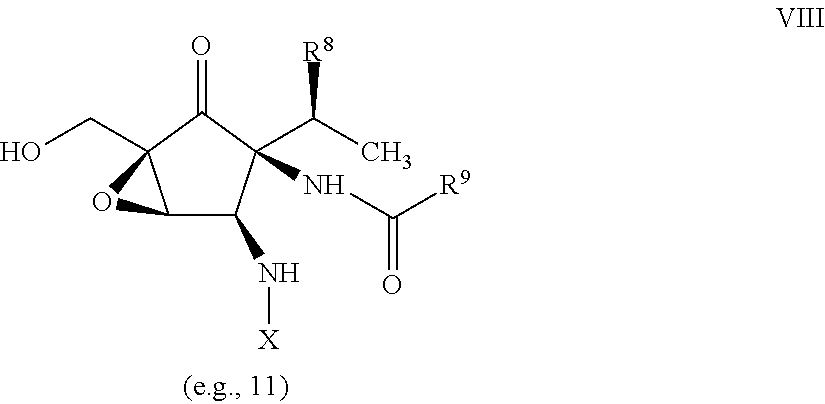
with a compound of the formula X2Z, where X2 is as given above and Z is a leaving group, to produce the compound of Formula VIII′.

in an epoxidation reaction to produce the compound of Formula VIII. The epoxidation reaction can be carried out in accordance with known techniques, such as by reacting with hydrogen peroxide, tert-butyl hydroperoxide, or m-chloroperoxybenzoic acid (MCPBA) in a suitable solvent (typically a polar organic solvent such as methanol, ethanol, etc), in the presence or absence of a base such as sodium hydroxide.

in an aldol condensation reaction to produce the compound of Formula IX.

where X3 and X5 are independently selected leaving groups; in an oxidative cleavage reaction to produce the compound of Formula X. Any suitable oxidative cleavage reaction may be employed including but not limited to ozonolysis, or contacting to potassium permanganate or other suitable oxidizing reagent.

with formaldehyde in an aldol addition to produce said compound of Formula XI.

By techniques familiar to those skilled in the art. Protection of the —OH group can be achieved with, for example, a trialkylsilyl halide or trialkylsilyl triflate. Etherification of the OH group can be achieved with, for example, an alkylating agent under basic or acidic conditions. Deoxygenation of the —OH group can be achieved by, for example, conversion to a xanthate and reduction under free radical conditions.

to produce the compound of Formula XII.

with a compound of Formula XV:

in a Mannich reaction to produce the compound of Formula XIII. The Mannich reaction can be carried out under reaction conditions and with catalysts known to those skilled in the art. For example, suitable catalysts include, but are not limited to, the following, with selectivities as shown:


Pactamycin (1, Scheme 1) was isolated from Streptomyces pactum var pactum in 1961 by researchers at the Upjohn Company (5). The bioactivity profile of this natural product is remarkable as it displays antitumor, antimicrobial, antiviral, and antiprotozoal properties by acting as a universal inhibitor of translocation (6-9). Within the ribosomal subunit in which it interacts, pactamycin mimics an RNA dinucleotide through interactions of its aniline and salicylate moieties with stem loops in the 16S RNA (10), Unfortunately, therapeutic benefits have yet to be realized due to high cytotoxicity (IC50 95 nM) (11). Pactamycin is a prototypical example of a promising bioactive natural product whose complexity hampers investigation of structure/activity relationships (SAR) that might lead to a serviceable therapeutic and/or better understanding of intrinsic bioactivity. Biogenetic engineering studies have reignited promise for medicinal application as 7-deoxy and 8″-hydroxy derivatives were isolated and displayed diminished cytotoxity (11-14). In the context of the work described herein, it is worth noting that Lu et al. contend that the structural complexity of 1 renders these and related structural modifications “inaccessible by synthetic organic chemistry” (12). Conversely, we have proceeded from the hypothesis that the biogenetically engineered approach to pactamycin analogs might be inherently limited by the biosynthetic machinery. A chemical approach could in principle provide far greater opportunity and flexibility for discovering and advancing useful compounds, particularly given the diverse functionality of pactamycin; however, this tactic will only be feasible in the presence of an efficient synthesis platform that rapidly develops the level of structural complexity that is present. In fact, synthetic interest in pactamycin has recently flourished, culminating in the landmark 32-step total synthesis from Hanessian and coworkers (15, 16), as well as numerous partial synthetic studies (17-21). Despite these creative, state-of-the-art approaches, a compelling case can be made that a more practical synthesis solution is needed.


- 1. Y.-W. Chin, M. J. Balanus, H. B. Chai, A. D. Kinghom, AAPS J. 8, E239 (2006).
- 2. F. von Nussbaum, M. Brands, B. Hinzen, S. Weigand, D. Habich, Angew. Chem. Int. Ed. 45, 5072 (2006).
- 3. C. Drahl, B. F. Cravatt, E. J. Sorensen, Angew. Chem. Int. Ed. 44, 5788 (2005).
- 4. K. Nakanishi, in Comprehensive Natural Products Chemistry, D. Barton, K. Nakanishi, O. Meth-Cohn, U. Sankawa, Eds. (Elsevier, New York, 1999), vol. 1, pp. 23.
- 5. A. D. Argoudelis, H. K. Jahnke, J. A. Fox, Antimicrob. Agents. Chemother. 191 (1962).
- 6. G. Dinos, D. N. Wilson, Y. Teraoka, W. Szaflarski, P, Fucini, D. Kalpaxis, K. H. Nierhaus, Mol. Cell 13, 113 (2004).
- 7. D. D. Weller, A. Haber, K. L. Rinehart Jr., P. F. Wiley, J. Antibiot. 31, 997 (1978).
- 8. P. F. Wiley, H. K. Jahnke, F. MacKellar, R. B. Kelly, A. D. Argoudelis, J. Org. Chem. 35, 1420 (1970).
- 9. D. J. Duchamp, Abstracts, American Crystallographic Association Winter Meeting, Albuquerque, N. Mex., 23 (1972).
- 10. D. E. Brodersen, W. M. Clemons, A. P. Carter, R. J. Morgan-Warren, B. T. Wimberly, V. Ramakrishnan, Cell 103, 1143 (2000).
- 11. M. Iwatsuki, et al. J. Antibiot. 65, 169 (2012).
- 12. W. Lu, N. Roongsawang, T. Mahmud, Chem. Biol. 18, 425 (2011).
- 13. K. Otoguro, M. Iwatsuki, A. Ishiyama, M. Namatame, A. Nishihara-Tukashima, S. Shibahara, S. Kondo, H. Yamada, S. Omura, J. Antiobiot. 63, 381 (2010).
- 14. K. Dobashi, K. Isshiki, T. Sawa, T. Obata, M. Hamada, H. Naganawa, T. Takita, T. Takeuchi, H. Urnezawa, J. Antiobiot. 39, 1779 (1986).
- 15. S. Hanessian, R. R. Vakiti, S. Dorich, S. Banerjee, F. Lecomte, J. R. Del Valle, J. Zhang, B. Deschenes-Simard, Angew. Chem., Int. Ed. 50, 3497 (2011).
- 16. S. Hanessian, R. R. Vakiti, A. Dorich, S. Banerjee, B. Deschenes-Simard, J. Org. Chem. 77, 9458 (2012).
- 17. T. Tsujimoto, T. Nishikawa, D. Urabe, M. Isobe, Synlett 433 (2005).
- 18. S. Knapp, Y. Yu, Org. Lett. 9, 1359 (2007).
- 19. J. T. Malinowski, S. J. McCarver, J. S. Johnson, Org. Lett. 14, 2878 (2012).
- 20. T. J. Haussener, R. E. Looper, Org. Lett. 14, 3632 (2012).
- 21. N. Matsumoto, T. Tsujimoto, A. Nakazaki, M. Isobe, T. Nishikawa, RSC Adv. 2, 9448 (2012).
- 22. S. Lou, B. M. Taoka, A. Ting, S. E. Schaus, J. Am. Chem. Soc. 127, 11256 (2005).
- 23. A. Ting, S. Lou, S. E. Schaus, Org. Lett. 8, 2003 (2006).
- 24. Y. Li, J.-P. Feng, W.-H. Wang, J. Chen, X.-P. Cao, J. Org. Chem. 72, 2344 (2007).
- 25. B. M. Trost, C. D. Haffner, D. J. Jebaratnam, M. J. Krische, A. P. Thomas, J. Am. Chem. Soc, 121, 6183 (1999).
- 26. J. M. J. Verlaak, A. J. H. Klunder, B. Zwanenburg, Tetrahedron Lett. 23, 5463 (1982).
- 27. L. Shi, K. Meyer, M. F. Greaney, Angew. Chem. Int. Ed. 49, 9250 (2010).
- 28. P. Serrano, A. Liebaria, A. Delgado, J. Org. Chem. 67, 7165 (2002).
- 29. W. M. Pearlman, Tetrahedron Lett. 8, 1663 (1967).
Claims (3)


Priority Applications (1)
| Application Number | Priority Date | Filing Date | Title |
|---|---|---|---|
| US14/758,110 US9399652B2 (en) | 2013-01-24 | 2014-01-23 | Synthetic route to pactamycin and pactamycin analogs |
Applications Claiming Priority (3)
| Application Number | Priority Date | Filing Date | Title |
|---|---|---|---|
| US201361756113P | 2013-01-24 | 2013-01-24 | |
| US14/758,110 US9399652B2 (en) | 2013-01-24 | 2014-01-23 | Synthetic route to pactamycin and pactamycin analogs |
| PCT/US2014/012685 WO2014116792A1 (en) | 2013-01-24 | 2014-01-23 | Synthetic route to pactamycin and pactamycin analogs |
Publications (2)
| Publication Number | Publication Date |
|---|---|
| US20150329570A1 US20150329570A1 (en) | 2015-11-19 |
| US9399652B2 true US9399652B2 (en) | 2016-07-26 |
Family
ID=51228019
Family Applications (1)
| Application Number | Title | Priority Date | Filing Date |
|---|---|---|---|
| US14/758,110 Expired - Fee Related US9399652B2 (en) | 2013-01-24 | 2014-01-23 | Synthetic route to pactamycin and pactamycin analogs |
Country Status (2)
| Country | Link |
|---|---|
| US (1) | US9399652B2 (en) |
| WO (1) | WO2014116792A1 (en) |
Families Citing this family (2)
| Publication number | Priority date | Publication date | Assignee | Title |
|---|---|---|---|---|
| KR102207267B1 (en) | 2019-04-18 | 2021-01-25 | 한국과학기술연구원 | First total synthesis method of Pactalactam |
| CN117486836B (en) * | 2023-11-02 | 2026-05-29 | 遵义医科大学 | Preparation method of 2-aryl-3-carbonyl substituted tetrahydrofuran and tetrahydropyran compound |
Citations (1)
| Publication number | Priority date | Publication date | Assignee | Title |
|---|---|---|---|---|
| WO2008131258A2 (en) | 2007-04-19 | 2008-10-30 | State Of Oregon Acting By And Through The State Board Of Higher Education On Behalf Of Oregon State University | Pactamycin biosynthetic gene cluster |
-
2014
- 2014-01-23 WO PCT/US2014/012685 patent/WO2014116792A1/en not_active Ceased
- 2014-01-23 US US14/758,110 patent/US9399652B2/en not_active Expired - Fee Related
Patent Citations (1)
| Publication number | Priority date | Publication date | Assignee | Title |
|---|---|---|---|---|
| WO2008131258A2 (en) | 2007-04-19 | 2008-10-30 | State Of Oregon Acting By And Through The State Board Of Higher Education On Behalf Of Oregon State University | Pactamycin biosynthetic gene cluster |
Non-Patent Citations (5)
| Title |
|---|
| Hamashima Y et al. PdII-catalyzed asymmetric addition reactions of 1,3-dicarbonyl compounds: Mannish-type reactions with N-Boc imines and three-component aminomethylation. Chemistry an Asian Journal. 2008; 3: 1443-1455. |
| Hanessian S et al. Total synthesis of pactamycin and pactamycate: a detailed account. Journal of Organic Chemistry. 2012; 77: 9458-9472. |
| Hanessian S et al. Total synthesis of pactamycin. Angewandte Chemie International Edition, 2011; 50: 3497-3500. |
| International Search Report and Written Opinion, PCT/US2014/012685, mailed Apr. 8, 2015. |
| Malinowski et al., Organic Letters (2012), 14(11), 2878-2881. * |
Also Published As
| Publication number | Publication date |
|---|---|
| WO2014116792A1 (en) | 2014-07-31 |
| US20150329570A1 (en) | 2015-11-19 |
Similar Documents
| Publication | Publication Date | Title |
|---|---|---|
| US9795606B2 (en) | Pyrrolopyrimidine compounds for the treatment of cancer | |
| JP7584815B2 (en) | Aromatic compounds and their uses in antitumor drugs | |
| US9744172B2 (en) | Pyrazolopyrimidine compounds for the treatment of cancer | |
| US20240254066A1 (en) | Rescorcinols, methods for their manufacture, and uses thereof | |
| TWI389909B (en) | Cytotoxic agent comprising novel tomaymycin derivative and therapeutic use thereof | |
| EP2019104B1 (en) | Cytotoxic agents comprising new tomaymycin derivatives and their therapeutic use | |
| AU706511B2 (en) | A method of inhibiting tumor growth | |
| US20150038481A1 (en) | Pyrimidine compounds for the treatment of cancer | |
| CN114409653A (en) | Bridged ring pyrimidine-fused ring compound and application thereof | |
| US20210038628A1 (en) | Nanoparticle compositions | |
| US7842687B2 (en) | Cephalotaxane derivatives and their processes of preparation and purification | |
| US10759790B2 (en) | Heterocyclic constrained tricyclic sulfonamides as anti-cancer agents | |
| US20150329530A1 (en) | Antibacterial compunds | |
| US9096550B2 (en) | Bryostatin analogues and methods of making and using thereof | |
| US20240408085A1 (en) | Compound for degradation of bcl-2 family proteins and medical application thereof | |
| US9051288B2 (en) | Method for producing 4′-ethynyl d4T | |
| CN114555607A (en) | Functional molecules of targeting protein hydrolysis pathway and preparation and application thereof | |
| US20150329570A1 (en) | Synthetic route to pactamycin and pactamycin analogs | |
| EP3079686B1 (en) | Sulfamate derivative compound for use in preventing or treating epilepsy | |
| JPS6168489A (en) | Novel hexasubstituted mitomycin analogue | |
| CN117417355A (en) | Condensed heterocyclic compounds and their preparation methods and uses | |
| US20110275707A1 (en) | Substituted afpo (6-aryl-4h-furo[3,2-c]pyran-4-one) derivatives as anti-cancer agents | |
| US8946450B2 (en) | Composition, synthesis, and use of new substituted pyran and pterin compounds | |
| US20110207956A1 (en) | Intramolecular c-h amination with phosphoryl azides | |
| JP2026504054A (en) | Pyrazole derivatives, pharmaceutically acceptable salts, stereoisomers, pharmaceutical compositions and uses thereof |
Legal Events
| Date | Code | Title | Description |
|---|---|---|---|
| STCF | Information on status: patent grant |
Free format text: PATENTED CASE |
|
| CC | Certificate of correction | ||
| MAFP | Maintenance fee payment |
Free format text: PAYMENT OF MAINTENANCE FEE, 4TH YR, SMALL ENTITY (ORIGINAL EVENT CODE: M2551); ENTITY STATUS OF PATENT OWNER: SMALL ENTITY Year of fee payment: 4 |
|
| AS | Assignment |
Owner name: NATIONAL INSTITUTES OF HEALTH (NIH), U.S. DEPT. OF HEALTH AND HUMAN SERVICES (DHHS), U.S. GOVERNMENT, MARYLAND Free format text: CONFIRMATORY LICENSE;ASSIGNOR:UNIVERSITY OF NORTH CAROLINA, CHAPEL HILL;REEL/FRAME:056819/0449 Effective date: 20190930 |
|
| FEPP | Fee payment procedure |
Free format text: MAINTENANCE FEE REMINDER MAILED (ORIGINAL EVENT CODE: REM.); ENTITY STATUS OF PATENT OWNER: SMALL ENTITY |
|
| LAPS | Lapse for failure to pay maintenance fees |
Free format text: PATENT EXPIRED FOR FAILURE TO PAY MAINTENANCE FEES (ORIGINAL EVENT CODE: EXP.); ENTITY STATUS OF PATENT OWNER: SMALL ENTITY |
|
| STCH | Information on status: patent discontinuation |
Free format text: PATENT EXPIRED DUE TO NONPAYMENT OF MAINTENANCE FEES UNDER 37 CFR 1.362 |
|
| FP | Lapsed due to failure to pay maintenance fee |
Effective date: 20240726 |