US9385903B2 - Rhombic-QPSK modulation for improved tolerance to nonlinearity in fiber communication systems - Google Patents
Rhombic-QPSK modulation for improved tolerance to nonlinearity in fiber communication systems Download PDFInfo
- Publication number
- US9385903B2 US9385903B2 US14/456,427 US201414456427A US9385903B2 US 9385903 B2 US9385903 B2 US 9385903B2 US 201414456427 A US201414456427 A US 201414456427A US 9385903 B2 US9385903 B2 US 9385903B2
- Authority
- US
- United States
- Prior art keywords
- phase
- qpsk
- amplitude
- information signal
- qpsk modulation
- Prior art date
- Legal status (The legal status is an assumption and is not a legal conclusion. Google has not performed a legal analysis and makes no representation as to the accuracy of the status listed.)
- Active
Links
- 238000004891 communication Methods 0.000 title claims description 11
- 239000000835 fiber Substances 0.000 title claims description 10
- 230000003993 interaction Effects 0.000 claims abstract description 5
- 238000013507 mapping Methods 0.000 claims description 15
- 238000000034 method Methods 0.000 claims description 11
- 230000010363 phase shift Effects 0.000 claims description 6
- 230000009977 dual effect Effects 0.000 claims 2
- 238000011084 recovery Methods 0.000 claims 2
- 238000010586 diagram Methods 0.000 description 14
- 230000001427 coherent effect Effects 0.000 description 6
- 230000010287 polarization Effects 0.000 description 5
- QNRATNLHPGXHMA-XZHTYLCXSA-N (r)-(6-ethoxyquinolin-4-yl)-[(2s,4s,5r)-5-ethyl-1-azabicyclo[2.2.2]octan-2-yl]methanol;hydrochloride Chemical compound Cl.C([C@H]([C@H](C1)CC)C2)CN1[C@@H]2[C@H](O)C1=CC=NC2=CC=C(OCC)C=C21 QNRATNLHPGXHMA-XZHTYLCXSA-N 0.000 description 4
- 238000012545 processing Methods 0.000 description 4
- 230000005540 biological transmission Effects 0.000 description 3
- 238000004590 computer program Methods 0.000 description 3
- 230000008901 benefit Effects 0.000 description 2
- 238000012937 correction Methods 0.000 description 2
- 238000001514 detection method Methods 0.000 description 2
- 230000003287 optical effect Effects 0.000 description 2
- 238000004088 simulation Methods 0.000 description 2
- 238000013459 approach Methods 0.000 description 1
- 230000002860 competitive effect Effects 0.000 description 1
- 125000004122 cyclic group Chemical group 0.000 description 1
- 238000013500 data storage Methods 0.000 description 1
- 238000013461 design Methods 0.000 description 1
- 239000006185 dispersion Substances 0.000 description 1
- 230000006870 function Effects 0.000 description 1
- 230000001771 impaired effect Effects 0.000 description 1
- 230000006872 improvement Effects 0.000 description 1
- 238000012986 modification Methods 0.000 description 1
- 230000004048 modification Effects 0.000 description 1
- 230000009022 nonlinear effect Effects 0.000 description 1
- 238000005457 optimization Methods 0.000 description 1
- 230000000644 propagated effect Effects 0.000 description 1
- 230000003595 spectral effect Effects 0.000 description 1
- 230000007704 transition Effects 0.000 description 1
Images



Classifications
-
- H—ELECTRICITY
- H04—ELECTRIC COMMUNICATION TECHNIQUE
- H04L—TRANSMISSION OF DIGITAL INFORMATION, e.g. TELEGRAPHIC COMMUNICATION
- H04L27/00—Modulated-carrier systems
- H04L27/18—Phase-modulated carrier systems, i.e. using phase-shift keying
- H04L27/20—Modulator circuits; Transmitter circuits
- H04L27/2032—Modulator circuits; Transmitter circuits for discrete phase modulation, e.g. in which the phase of the carrier is modulated in a nominally instantaneous manner
- H04L27/2053—Modulator circuits; Transmitter circuits for discrete phase modulation, e.g. in which the phase of the carrier is modulated in a nominally instantaneous manner using more than one carrier, e.g. carriers with different phases
- H04L27/206—Modulator circuits; Transmitter circuits for discrete phase modulation, e.g. in which the phase of the carrier is modulated in a nominally instantaneous manner using more than one carrier, e.g. carriers with different phases using a pair of orthogonal carriers, e.g. quadrature carriers
- H04L27/2067—Modulator circuits; Transmitter circuits for discrete phase modulation, e.g. in which the phase of the carrier is modulated in a nominally instantaneous manner using more than one carrier, e.g. carriers with different phases using a pair of orthogonal carriers, e.g. quadrature carriers with more than two phase states
-
- H—ELECTRICITY
- H04—ELECTRIC COMMUNICATION TECHNIQUE
- H04B—TRANSMISSION
- H04B2201/00—Indexing scheme relating to details of transmission systems not covered by a single group of H04B3/00 - H04B13/00
- H04B2201/69—Orthogonal indexing scheme relating to spread spectrum techniques in general
- H04B2201/707—Orthogonal indexing scheme relating to spread spectrum techniques in general relating to direct sequence modulation
- H04B2201/7097—Direct sequence modulation interference
- H04B2201/709709—Methods of preventing interference
-
- H—ELECTRICITY
- H04—ELECTRIC COMMUNICATION TECHNIQUE
- H04L—TRANSMISSION OF DIGITAL INFORMATION, e.g. TELEGRAPHIC COMMUNICATION
- H04L25/00—Baseband systems
- H04L25/02—Details ; arrangements for supplying electrical power along data transmission lines
- H04L25/03—Shaping networks in transmitter or receiver, e.g. adaptive shaping networks
- H04L25/03006—Arrangements for removing intersymbol interference
- H04L25/03343—Arrangements at the transmitter end
Definitions
- the present invention relates generally to optics, and more particularly, to rhombic-QPSK (quadrature phase shift key) modulation for improved tolerance to nonlinearity in fiber communication systems with co-propagating intensity-modulated channel.
- rhombic-QPSK quadrature phase shift key
- Typical solutions to reduce the nonlinear interactions between existing IM channels and new high speed QPSK channels involve adding a frequency guard band between them.
- Other solution is to reduce the modulation order to (for example) BPSK. This has the disadvantage of reducing spectral efficiency.
- the invention is directed a method for
- non-transitory storage medium configured with instructions to be implemented by a computer for carrying out
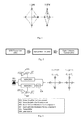
- FIG. 1 is a diagram depicting constellation diagrams for conventional QPSK and the inventive rhombic QPSK.
- FIG. 2 is a diagram showing an optical communication system with QPSK and a digital coherent receiver.
- FIG. 3 is a diagram showing a QPSK modulator using two MZMs.
- FIG. 4 is a diagram of typical digital signal processing stages DSP of a digital coherent receiver.
- FIG. 5 is a diagram showing a constellation of the inventive rhombic-quadrature phase shift keying (R-QPSK).
- FIG. 6 shows a diagram representation of different de-mapping regions for the inventive R-QPSK.
- FIG. 7 is a diagram comparing C-QPSK and R-QPSK performances.
- FIG. 8 shows an exemplary computer to perform the inventive cyclic decoding of cascaded FEC codes.
- the present invention is directed to a an alternative modulation format for 100 G channels that present improved performance when such channels co-propagate with existing IM channels.
- This modulation format is named Rhombic-QPSK (R-QPSK) and it is configured in such a way that it presents more tolerance to phase noise created by the nonlinear interaction with the legacy channels.
- FIG. 1 there shown constellation diagrams for conventional quadrature phase shift key C-QPSK and the inventive rhombic quadrature phase shift key R-QPSK systems.
- C-QPSK Conventional QPSK
- R-QSPK Rhombic QPSK
- FIG. 1 shows C-QPSK and R-QPSK constellations.
- C-QPSK For C-QPSK, data is recovered by making decisions based on the phase of the constellation points. Alternatively, in with the inventive R-QPSK data is recovered by making decisions in both phase and amplitude of the constellation points. This has bit-error-rate advantage in systems with strong phase noise induced by co-propagating IM channels.
- This invention is two-folded. First, the Rhombic-QPSK is implemented by choosing an optimum ratio between A 1 and A 2 . Second, an optimum de-mapping method is proposed to maximize system performance. C-QPSK is the optimum constellation is a communication channel with Gaussian noise. However, by optimizing the decision method together with the amplitudes A 1 , A 2 the performance of R-QPSK can be superior to C-QPSK in links with co-propagating IM channels.
- FIG. 2 there is shown a block diagram of a fiber communication system with coherent detection.
- a system with single polarization and single channel we will consider a system with single polarization and single channel.
- this invention also naturally extends to polarization-division multiplexing and wavelength division multiplexing.
- the QPSK transmitter is typically implemented by using a nested Mach-Zehnder modulators and a phase shifter [2,3].
- the diagram of FIG. 3 shows a typical implementation of the QPSK transmitter 201 .
- C-QPSK is generated when the gain provided to I(t) by amplifier ( 301 ), i.e G I is equal to the gain provided to Q(t) by amplifier ( 302 ), i.e G Q . If the gains are different, then a rhombic constellation can be generated.
- the ratio between diagonals A 1 and A 2 depends on the ratio between G I and G Q .
- FIG. 4 shows the typical stages of digital signal processing corresponding to the coherent detection of a QPSK signal [3]. Again, for simplicity we are assuming single polarization transmission, but this invention applies by simple extension, to polarization multiplexed systems, where two independent R-QPSK signals are generated, and combined using a polarization rotator and polarization beam combiner [4].
- stage ( 407 ) is modified when R-QPSK is used instead of C-QPSK.
- All the remaining stages, 401 - 406 and 408 are assumed to be the conventional DSP operations to recover a QPSK signal.
- This invention includes a new de-mapping method that reduces the bit-error rate (BER) when R-QPSK is used.
- BER bit-error rate
- Each symbol carries two bits of information and the de-mapping stage assigns a pair of bits to each symbol depending on their location in the constellation.
- the decision table ( 501 ) shown in FIG. 5 Such table takes into account not only the phase of the symbols (typical decision in C-QPSK) but also their amplitude.
- each quadrant has an area of HPPO, which depends of the angle ⁇ .
- the point in the constellation within the HPPO boundaries ( 502 ) is de-mapped according to its amplitude.
- the de-mapping table depends on two optimization parameters, namely the angle ⁇ and the amplitude threshold A th . Both parameters are optimized according to the transmission link and the values of the diagonals A 1 and A 2 . Their optimum values are the ones that minimize the BER.
- FIG. 6 illustrates the different decision regions corresponding to the relations shown in the decision table ( 501 ).
- FIG. 7 there is a diagram comparing C-QPSK and R-QPSK performances.
- the simulation graphs of FIG. 7 show the performance improvement obtained by using R-QPSK compared to C-QPSK.
- This simulation considers a legacy high-loss link of 600 km with 29 dB loss per span. The dispersion is 2 ps/km/nm and it is compensated at every span by matching DCF.
- One 100 G (C,R)-QPSK is propagated together with 100 GHz spaced 10.7 Gb/s NRZ-OOK channels with a power/channel of 0 dBm.
- C-QPSK performs because the system is in the linear regime and it is limited by ASE noise.
- the system becomes limited by XPM phase noise and R-QPKS outperform C-QPSK more than 1 dB on the Q-factor (obtained from error counting).
- the invention may be implemented in hardware, firmware or software, or a combination of the three.
- the invention is implemented in a computer program executed on a programmable computer having a processor, a data storage system, volatile and non-volatile memory and/or storage elements, at least one input device and at least one output device. More details are discussed in U.S. Pat. No. 8,380,557, the content of which is incorporated by reference.
- the computer preferably includes a processor, random access memory (RAM), a program memory (preferably a writable read-only memory (ROM) such as a flash ROM) and an input/output (I/O) controller coupled by a CPU bus.
- RAM random access memory
- program memory preferably a writable read-only memory (ROM) such as a flash ROM
- I/O controller coupled by a CPU bus.
- the computer may optionally include a hard drive controller which is coupled to a hard disk and CPU bus. Hard disk may be used for storing application programs, such as the present invention, and data. Alternatively, application programs may be stored in RAM or ROM.
- I/O controller is coupled by means of an I/O bus to an I/O interface.
- I/O interface receives and transmits data in analog or digital form over communication links such as a serial link, local area network, wireless link, and parallel link.
- a display, a keyboard and a pointing device may also be connected to I/O bus.
- separate connections may be used for I/O interface, display, keyboard and pointing device.
- Programmable processing system may be preprogrammed or it may be programmed (and reprogrammed) by downloading a program from another source (e.g., a floppy disk, CD-ROM, or another computer).
- Each computer program is tangibly stored in a machine-readable storage media or device (e.g., program memory or magnetic disk) readable by a general or special purpose programmable computer, for configuring and controlling operation of a computer when the storage media or device is read by the computer to perform the procedures described herein.
- the inventive system may also be considered to be embodied in a computer-readable storage medium, configured with a computer program, where the storage medium so configured causes a computer to operate in a specific and predefined manner to perform the functions described herein.
- the present invention provides the competitive value of iterative decoding among TCM decoder and LDPC decoder would enhance the coding correction performance overall.
- the presence of TCM could also fully re-utilize the existing hardware platform (100 G transponder) without modifying the hardware and optics, thus reducing the cost for re-designing new transponder.
- the LDPC code could be either binary or non-binary, thus making our scheme more generic to flexible system design.
- the TCM decoder could make the transition of “water-fall” of LDPC coding correction faster, thus achieving higher coding gain. Meanwhile, at the “water-fall” regime of the TCM coding performance, the number of iterations in the LDPC decoder could be significantly reduced to have less complexity.
- the presence of IL would help to mitigate the burst errors caused by the channels.
Landscapes
- Engineering & Computer Science (AREA)
- Computer Networks & Wireless Communication (AREA)
- Signal Processing (AREA)
- Optical Communication System (AREA)
- Digital Transmission Methods That Use Modulated Carrier Waves (AREA)
Abstract
Description
Claims (11)
Priority Applications (1)
| Application Number | Priority Date | Filing Date | Title |
|---|---|---|---|
| US14/456,427 US9385903B2 (en) | 2013-08-12 | 2014-08-11 | Rhombic-QPSK modulation for improved tolerance to nonlinearity in fiber communication systems |
Applications Claiming Priority (2)
| Application Number | Priority Date | Filing Date | Title |
|---|---|---|---|
| US201361864728P | 2013-08-12 | 2013-08-12 | |
| US14/456,427 US9385903B2 (en) | 2013-08-12 | 2014-08-11 | Rhombic-QPSK modulation for improved tolerance to nonlinearity in fiber communication systems |
Publications (2)
| Publication Number | Publication Date |
|---|---|
| US20150043680A1 US20150043680A1 (en) | 2015-02-12 |
| US9385903B2 true US9385903B2 (en) | 2016-07-05 |
Family
ID=52448669
Family Applications (1)
| Application Number | Title | Priority Date | Filing Date |
|---|---|---|---|
| US14/456,427 Active US9385903B2 (en) | 2013-08-12 | 2014-08-11 | Rhombic-QPSK modulation for improved tolerance to nonlinearity in fiber communication systems |
Country Status (1)
| Country | Link |
|---|---|
| US (1) | US9385903B2 (en) |
Families Citing this family (2)
| Publication number | Priority date | Publication date | Assignee | Title |
|---|---|---|---|---|
| EP3217575A1 (en) * | 2016-03-08 | 2017-09-13 | Xieon Networks S.à r.l. | Adaptive constellation diagram reducing the impact of phase distortions |
| CN115208735A (en) * | 2021-04-13 | 2022-10-18 | 中兴通讯股份有限公司 | Symbol transmitting method, symbol receiving method, transmitting apparatus, receiving apparatus, and storage medium |
-
2014
- 2014-08-11 US US14/456,427 patent/US9385903B2/en active Active
Non-Patent Citations (5)
| Title |
|---|
| A. Bononi et al., "Cross-Phase Modulation Induced by OOK Channels on Higher-Rate DQPSK and Coherent QPSK Channels" Journal of Lightwave Technology 27:2974-2983 (, 2009). |
| C. Laperle et al., "Wavelength Division Multiplexing (WDM) and Polarization Mode Dispersion (PMD) Performance of a Coherent 40Gbit/s Dual-Polarization Quadrature Phase Shift Keying (DP-QPSK) Transceiver" Optical Fiber Communication Conference and Exposition and the National Fiber Optical Engineers Conference Paper PDP16 (, 2007). |
| C.R.S. Fludger et al., "Coherent Equalization and POLMUX-RZ-DPQSK for Robust 100-GE Transmission" Journal of Lightwave Technology 26:64-72 (, 2008). |
| Lu et al., "Rectangular QPSK for generation of optical eight-ary phase-shift keying" Optics Express, vol. 19, Issue 19, pp. 18479-18485 (2011). * |
| R.A. Griffin et al., "Optical Differential Quadrature Phase-Shift Key (oDOPSK) for High Capacity Optical Transmission" Optical Fiber Communication Conference and Exhibit:367-368 (Mar. 17-22, 2002). |
Also Published As
| Publication number | Publication date |
|---|---|
| US20150043680A1 (en) | 2015-02-12 |
Similar Documents
| Publication | Publication Date | Title |
|---|---|---|
| US11012187B1 (en) | Error correction in optical networks with probabilistic shaping and symbol rate optimization | |
| US10511388B1 (en) | Reducing variance in reach of WDM channels in an optical network | |
| Le et al. | 100 Gbps b-modulated nonlinear frequency division multiplexed transmission | |
| WO2009072099A1 (en) | System and method for generating multilevel coded optical signals | |
| Zhang et al. | 1.6 Tb/s (4× 400G) unrepeatered transmission over 205-km SSMF using 65-GBaud PDM-16QAM with joint LUT pre-distortion and post DBP nonlinearity compensation | |
| US8942573B2 (en) | Blind equalization algorithms for adaptive polarization recovery and PMD compensation | |
| US12431983B2 (en) | Perturbative-based nonlinear compensation for digital subcarrier systems | |
| US9385903B2 (en) | Rhombic-QPSK modulation for improved tolerance to nonlinearity in fiber communication systems | |
| US9077484B2 (en) | Generation of polarization-alternated QPSK format | |
| Sasai et al. | Experimental analysis of laser phase noise tolerance of uniform 256QAM and probabilistically shaped 1024QAM | |
| EP2936707B1 (en) | Communication system for a nonlinear fiber channel | |
| Ishimura et al. | Multi-dimensional permutation modulation aiming at both high spectral efficiency and high power efficiency | |
| Mateo et al. | Electronic phase conjugation for nonlinearity compensation in fiber communication systems | |
| Lavery et al. | Long-haul transmission of PS-QPSK at 100 Gb/s using digital backpropagation | |
| US10116392B1 (en) | Carrier suppressed multi-level pulse amplitude modulation | |
| Rafique et al. | FEC overhead and fiber nonlinearity mitigation: Performance and power consumption tradeoffs | |
| US8548338B2 (en) | Method and system for deploying an optical demodulator arrangement in a communications network | |
| Wang et al. | Conventional DPSK versus symmetrical DPSK: Comparison of dispersion tolerances | |
| Khan et al. | Differential quadrature phase shift keying modulation in optical fiber communication-Modelling, design, case implementation and limitation | |
| Kojima et al. | Nonlinearity-tolerant time domain hybrid modulation for 4-8 bits/symbol based on 2A8PSK | |
| Rios-Müller et al. | Practical approaches to 400G single-carrier submarine transmission | |
| Kojima et al. | Comparison of nonlinearity tolerance of modulation formats for subcarrier modulation | |
| McNicol et al. | Single-carrier versus sub-carrier bandwidth considerations for coherent optical systems | |
| He et al. | Flexible multi-dimensional modulation method for elastic optical networks | |
| Souza et al. | High-Order Modulation Formats for Future Optical Communication Systems |
Legal Events
| Date | Code | Title | Description |
|---|---|---|---|
| AS | Assignment |
Owner name: NEC LABORATORIES AMERICA, INC., NEW JERSEY Free format text: ASSIGNMENT OF ASSIGNORS INTEREST;ASSIGNORS:RODRIQUEZ, EDUARDO MATEO;YAMAN, FATIH;ZHANG, SHAOLIANG;AND OTHERS;SIGNING DATES FROM 20140805 TO 20140818;REEL/FRAME:033769/0240 |
|
| AS | Assignment |
Owner name: NEC CORPORATION, JAPAN Free format text: ASSIGNMENT OF ASSIGNORS INTEREST;ASSIGNOR:NEC LABORATORIES AMERICA, INC.;REEL/FRAME:038556/0206 Effective date: 20160510 |
|
| STCF | Information on status: patent grant |
Free format text: PATENTED CASE |
|
| MAFP | Maintenance fee payment |
Free format text: PAYMENT OF MAINTENANCE FEE, 4TH YEAR, LARGE ENTITY (ORIGINAL EVENT CODE: M1551); ENTITY STATUS OF PATENT OWNER: LARGE ENTITY Year of fee payment: 4 |
|
| MAFP | Maintenance fee payment |
Free format text: PAYMENT OF MAINTENANCE FEE, 8TH YEAR, LARGE ENTITY (ORIGINAL EVENT CODE: M1552); ENTITY STATUS OF PATENT OWNER: LARGE ENTITY Year of fee payment: 8 |