US9382913B2 - Fan, molding die, and fluid feeder - Google Patents
Fan, molding die, and fluid feeder Download PDFInfo
- Publication number
- US9382913B2 US9382913B2 US13/806,922 US201113806922A US9382913B2 US 9382913 B2 US9382913 B2 US 9382913B2 US 201113806922 A US201113806922 A US 201113806922A US 9382913 B2 US9382913 B2 US 9382913B2
- Authority
- US
- United States
- Prior art keywords
- fan
- edge portion
- recess
- cross
- blade
- Prior art date
- Legal status (The legal status is an assumption and is not a legal conclusion. Google has not performed a legal analysis and makes no representation as to the accuracy of the status listed.)
- Expired - Fee Related, expires
Links
- 239000012530 fluid Substances 0.000 title claims description 36
- 238000000465 moulding Methods 0.000 title claims description 22
- 229920005989 resin Polymers 0.000 claims description 13
- 239000011347 resin Substances 0.000 claims description 13
- 230000001965 increasing effect Effects 0.000 claims description 7
- 230000003247 decreasing effect Effects 0.000 claims description 2
- 230000000694 effects Effects 0.000 description 16
- 230000003068 static effect Effects 0.000 description 12
- 238000010276 construction Methods 0.000 description 11
- 230000000052 comparative effect Effects 0.000 description 10
- 239000000428 dust Substances 0.000 description 6
- 238000000926 separation method Methods 0.000 description 6
- 238000000034 method Methods 0.000 description 5
- 230000015572 biosynthetic process Effects 0.000 description 4
- 238000004519 manufacturing process Methods 0.000 description 4
- 239000011295 pitch Substances 0.000 description 4
- 238000007664 blowing Methods 0.000 description 3
- 238000001816 cooling Methods 0.000 description 3
- 238000006073 displacement reaction Methods 0.000 description 3
- 230000006872 improvement Effects 0.000 description 3
- PPBRXRYQALVLMV-UHFFFAOYSA-N Styrene Chemical compound C=CC1=CC=CC=C1 PPBRXRYQALVLMV-UHFFFAOYSA-N 0.000 description 2
- 238000004140 cleaning Methods 0.000 description 2
- 230000007423 decrease Effects 0.000 description 2
- 238000010586 diagram Methods 0.000 description 2
- 238000009826 distribution Methods 0.000 description 2
- 230000001747 exhibiting effect Effects 0.000 description 2
- 230000001788 irregular Effects 0.000 description 2
- 238000011084 recovery Methods 0.000 description 2
- 239000003507 refrigerant Substances 0.000 description 2
- 238000005057 refrigeration Methods 0.000 description 2
- 238000011144 upstream manufacturing Methods 0.000 description 2
- NLHHRLWOUZZQLW-UHFFFAOYSA-N Acrylonitrile Chemical compound C=CC#N NLHHRLWOUZZQLW-UHFFFAOYSA-N 0.000 description 1
- 238000009825 accumulation Methods 0.000 description 1
- 230000005540 biological transmission Effects 0.000 description 1
- 150000001875 compounds Chemical class 0.000 description 1
- 229920001577 copolymer Polymers 0.000 description 1
- 230000008878 coupling Effects 0.000 description 1
- 238000010168 coupling process Methods 0.000 description 1
- 238000005859 coupling reaction Methods 0.000 description 1
- 230000008021 deposition Effects 0.000 description 1
- 238000007599 discharging Methods 0.000 description 1
- 230000002708 enhancing effect Effects 0.000 description 1
- 239000003365 glass fiber Substances 0.000 description 1
- 238000010438 heat treatment Methods 0.000 description 1
- 238000005259 measurement Methods 0.000 description 1
- 238000012986 modification Methods 0.000 description 1
- 230000004048 modification Effects 0.000 description 1
- 230000008569 process Effects 0.000 description 1
- 230000009467 reduction Effects 0.000 description 1
- 230000001629 suppression Effects 0.000 description 1
- 229920003002 synthetic resin Polymers 0.000 description 1
- 239000000057 synthetic resin Substances 0.000 description 1
- 239000013585 weight reducing agent Substances 0.000 description 1
- 238000004804 winding Methods 0.000 description 1
Images




Classifications
-
- F—MECHANICAL ENGINEERING; LIGHTING; HEATING; WEAPONS; BLASTING
- F04—POSITIVE - DISPLACEMENT MACHINES FOR LIQUIDS; PUMPS FOR LIQUIDS OR ELASTIC FLUIDS
- F04D—NON-POSITIVE-DISPLACEMENT PUMPS
- F04D19/00—Axial-flow pumps
- F04D19/002—Axial flow fans
-
- F—MECHANICAL ENGINEERING; LIGHTING; HEATING; WEAPONS; BLASTING
- F04—POSITIVE - DISPLACEMENT MACHINES FOR LIQUIDS; PUMPS FOR LIQUIDS OR ELASTIC FLUIDS
- F04D—NON-POSITIVE-DISPLACEMENT PUMPS
- F04D17/00—Radial-flow pumps, e.g. centrifugal pumps; Helico-centrifugal pumps
- F04D17/02—Radial-flow pumps, e.g. centrifugal pumps; Helico-centrifugal pumps having non-centrifugal stages, e.g. centripetal
- F04D17/04—Radial-flow pumps, e.g. centrifugal pumps; Helico-centrifugal pumps having non-centrifugal stages, e.g. centripetal of transverse-flow type
-
- F—MECHANICAL ENGINEERING; LIGHTING; HEATING; WEAPONS; BLASTING
- F04—POSITIVE - DISPLACEMENT MACHINES FOR LIQUIDS; PUMPS FOR LIQUIDS OR ELASTIC FLUIDS
- F04D—NON-POSITIVE-DISPLACEMENT PUMPS
- F04D29/00—Details, component parts, or accessories
- F04D29/26—Rotors specially for elastic fluids
- F04D29/28—Rotors specially for elastic fluids for centrifugal or helico-centrifugal pumps for radial-flow or helico-centrifugal pumps
- F04D29/281—Rotors specially for elastic fluids for centrifugal or helico-centrifugal pumps for radial-flow or helico-centrifugal pumps for fans or blowers
- F04D29/282—Rotors specially for elastic fluids for centrifugal or helico-centrifugal pumps for radial-flow or helico-centrifugal pumps for fans or blowers the leading edge of each vane being substantially parallel to the rotation axis
- F04D29/283—Rotors specially for elastic fluids for centrifugal or helico-centrifugal pumps for radial-flow or helico-centrifugal pumps for fans or blowers the leading edge of each vane being substantially parallel to the rotation axis rotors of the squirrel-cage type
-
- F—MECHANICAL ENGINEERING; LIGHTING; HEATING; WEAPONS; BLASTING
- F04—POSITIVE - DISPLACEMENT MACHINES FOR LIQUIDS; PUMPS FOR LIQUIDS OR ELASTIC FLUIDS
- F04D—NON-POSITIVE-DISPLACEMENT PUMPS
- F04D29/00—Details, component parts, or accessories
- F04D29/26—Rotors specially for elastic fluids
- F04D29/28—Rotors specially for elastic fluids for centrifugal or helico-centrifugal pumps for radial-flow or helico-centrifugal pumps
- F04D29/30—Vanes
Definitions
- This invention generally relates to a fan, a molding die, and a fluid feeder, and more particularly to such a fan as a cross-flow fan or a centrifugal fan, a molding die used for manufacturing the fan, and a fluid feeder including the fan.
- Japanese Patent Laying-Open No. 2009-293616 (PTL 1) and Japanese Patent Laying-Open No. 2010-14123 (PTL 2) disclose a cross-flow fan aiming to suppress increase in input of a fan drive motor.
- the cross-flow fan disclosed in PTLs 1 and 2 has a blade curved toward a pressure surface side. In an edge portion on an outer circumferential side of the blade, a plurality of cut portions cut in a direction at a right angle from the edge portion on the outer circumferential side are formed at prescribed intervals.
- a cross-flow fan forming a planar blown flow in parallel to a rotation axis of a fan, a centrifugal fan sending air in a radial direction from a center of rotation of a fan, and the like are exemplified as fans used for a blower.
- a fan an approach for increasing the number of fan blades is possible as general measures for improving air blow capability of the fan.
- an effect of increase in transmission of momentum to an air flow owing to viscosity on a blade surface and an effect of suppression of generation of a region where an air flow separates because of decrease in interval between adjacent fan blades are achieved. Consequently, good static pressure characteristics are realized and thus air blow capability of the fan can be improved.
- the aerofoil cross-section refers to such a cross-sectional shape that a large-thickness portion at which a fan blade has a greatest thickness is present closer to any one of an inner edge portion and an outer edge portion of the fan blade.
- a shape of a flow path between adjacent fan blades becomes such an enlarging flow path that it gradually increases in size along a direction of a flow of air.
- a pressure of the air flow is recovered in the downstream. Therefore, by setting the large-thickness portion at an optimal position, good static pressure characteristics can be realized without increase in the number of fan blades.
- an object of this invention is to solve the above-described problems, and to provide a fan achieving excellent air blow capability, a molding die, and a fluid feeder.
- a fan according to this invention includes a plurality of vane portions provided at a distance from one another in a circumferential direction.
- the vane portion has an inner edge portion arranged on an inner circumferential side and an outer edge portion arranged on an outer circumferential side.
- the vane portion has a blade surface formed, which extends between the inner edge portion and the outer edge portion and is constituted of a positive pressure surface and a negative pressure surface.
- the positive pressure surface is arranged on a side of a direction of rotation of the fan and the negative pressure surface is arranged on a back side of the positive pressure surface.
- the vane portion has such a blade cross-sectional shape that a large-thickness portion at which a thickness between the positive pressure surface and the negative pressure surface is greatest is arranged closer to any one of the inner edge portion and the outer edge portion when it is cut in a plane orthogonal to a rotation axis of the fan.
- a recess recessed in the blade surface is formed at a position closer to any one of the inner edge portion and the outer edge portion where the large-thickness portion is arranged, than to any the other of the inner edge portion and the outer edge portion.
- the fan thus constructed, when a fluid flows between adjacent vane portions from any one of the inner edge portion and the outer edge portion where the large-thickness portion is arranged to the other of the inner edge portion and the outer edge portion, a pressure of the fluid flow is recovered and hence good static pressure characteristics can be obtained. Meanwhile, by forming a recess at a position closer to any one of the inner edge portion and the outer edge portion where the large-thickness portion is arranged, weight of the fan can be reduced while strength of the vane portion is ensured.
- a vortex of the fluid flow (a secondary flow) is generated in the recess
- the fluid flow (a main flow) which passes over the blade surface flows along the outside of the vortex generated in the recess. Therefore, in spite of formation of the recess in the vane portion, the fluid can flow along the blade surface in a stable manner. Consequently, a fan realizing high air blow capability can be obtained.
- the recess is formed in the positive pressure surface. According to the fan thus constructed, on the positive pressure surface, a higher pressure is applied to the fluid flow which passes over the blade surface, than on the negative pressure surface. Therefore, in spite of formation of the recess in the positive pressure surface, the fluid can flow along the blade surface in a stable manner.
- the recess is formed such that the vane portion at a position where the recess is formed has a thickness equal to or greater than an average value of a thickness of the vane portion between the inner edge portion and the outer edge portion. According to the fan thus constructed, a thickness of the vane portion at a position where the recess is formed can be prevented from becoming too small and strength of the vane portion can be ensured.
- a plurality of recesses are formed as being aligned in a direction of connection of the inner edge portion and the outer edge portion to each other. According to the fan thus constructed, weight of the fan can significantly be reduced while the fluid flow over the blade surface is stabilized by making a cross-sectional area of each recess recessed in the blade surface smaller.
- the recess is formed to extend from one end to the other end of the vane portion in the direction of the rotation axis of the fan. According to the fan thus constructed, weight of the fan can significantly be reduced while the fluid flow over the blade surface is stabilized by making a cross-sectional area of the recess recessed in the blade surface smaller.
- the vane portion when cut in the plane orthogonal to the rotation axis of the fan, has a cross-sectional area increasing from one end toward the other end.
- the recess is formed such that a cross-sectional area of the recess recessed in the blade surface is greater on a side of the other end than on a side of one end. According to the fan thus constructed, weight of the fan can significantly be reduced while strength of the vane portion is ensured.
- the plurality of vane portions include a first vane portion and a second vane portion different in form of the recess formed in the vane portion.
- a shape, a size, or the number of vortexes of the fluid flow formed in the recess is different between the first vane portion and the second vane portion.
- a direction or a velocity of the fluid flow in the downstream of the recess can be varied between the first vane portion and the second vane portion.
- the vane portion has a thickness increasing from any one of the inner edge portion and the outer edge portion toward the large-thickness portion and decreasing from the large-thickness portion toward any the other of the inner edge portion and the outer edge portion.
- the large-thickness portion is arranged closer to the inner edge portion than to the outer edge portion.
- the recess is formed as being recessed in the positive pressure surface at a position closer to the inner edge portion than to the outer edge portion.
- An additional recess is further formed in the vane portion.
- the additional recess is formed as being recessed in the negative pressure surface at a position closer to the outer edge portion than to the inner edge portion.
- the additional recess recessed in the negative pressure surface is smaller in depth than the recess recessed in the positive pressure surface.
- an inner space is formed, and on the outside thereof, an outer space is formed.
- the fan described in any part above is a cross-flow fan for taking a fluid from the outer space on one side with respect to the rotation axis into the inner space when viewed in the direction of the rotation axis of the fan and sending the taken fluid to the outer space on the other side with respect to the rotation axis. According to the fan thus constructed, a cross-flow fan having light weight and realizing high air blow capability can be obtained.
- an inner space is formed, and on the outside thereof, an outer space is formed.
- the fan described in any part above is a centrifugal fan for sending a fluid from the inner space to the outer space.
- the large-thickness portion is arranged closer to the inner edge portion than to the outer edge portion. According to the fan thus constructed, a centrifugal fan having light weight and realizing high air blow capability can be obtained.
- the fan described in any part above is formed from resin. According to the fan thus constructed, a fan made of resin, which has light weight and exhibits high air blow capability, can be obtained.
- a molding die according to this invention is used for molding the fan described in any part above. According to the molding die thus constructed, a fan made of resin can be manufactured.
- a fluid feeder according to this invention includes a blower constituted of the fan described in any part above and a drive motor coupled to the fan to rotate the plurality of vane portions. According to the fluid feeder thus constructed, power consumption in the drive motor can be reduced while high air blow capability is maintained.
- a fan realizing high air blow capability, a molding die, and a fluid feeder can be provided.
- FIG. 1 is a perspective view showing a cross-flow fan in a first embodiment of this invention.
- FIG. 2 is a perspective view showing one of impellers constituting the cross-flow fan in FIG. 1 .
- FIG. 3 is a cross-sectional view showing the cross-flow fan along the line III-III in FIG. 1 .
- FIG. 4 is a cross-sectional view showing a fan blade included in the cross-flow fan in FIG. 1 .
- FIG. 5 is a cross-sectional view showing an air conditioner in which the cross-flow fan in FIG. 1 is employed.
- FIG. 6 is a cross-sectional view showing in an enlarged view, a portion in the vicinity of an outlet port of the air conditioner in FIG. 5 .
- FIG. 7 is a cross-sectional view showing an air flow generated in the vicinity of the outlet port of the air conditioner in FIG. 5 .
- FIG. 8 is a cross-sectional view showing a molding die used in manufacturing of the cross-flow fan in FIG. 1 .
- FIG. 9 is a cross-sectional view showing in an enlarged view, an area surrounded by a chain double dotted line IX in FIG. 7 .
- FIG. 10 is a diagram schematically representing an air flow path in the area shown in FIG. 9 .
- FIG. 11 is a cross-sectional view schematically representing a phenomenon that takes place on a blade surface of the fan blade in a downstream-side region shown in FIG. 7 .
- FIG. 12 is a cross-sectional view schematically representing a phenomenon that takes place on the blade surface of the fan blade in an upstream-side region shown in FIG. 7 .
- FIG. 13 is a graph showing relation between an air flow rate of the cross-flow fan and power consumption (input) in a drive motor.
- FIG. 14 is a graph showing static pressure characteristics of the cross-flow fan.
- FIG. 15 is a cross-sectional view showing a variation of the fan blade shown in FIG. 11 .
- FIG. 16 is a perspective view showing the fan blade in FIG. 2 .
- FIG. 17 is a cross-sectional view showing the fan blade along the line XVII-XVII in FIG. 16 .
- FIG. 18 is a cross-sectional view showing the fan blade along the line XVIII-XVIII in FIG. 16 .
- FIG. 19 is a perspective view showing a first variation of the cross-flow fan in FIG. 1 .
- FIG. 20 is a cross-sectional view showing a fan blade included in the cross-flow fan in FIG. 19 .
- FIG. 21 is a cross-sectional view showing a downstream-side region in the case where the cross-flow fan in FIG. 19 is applied to an air conditioner.
- FIG. 22 is a perspective view showing a second variation of the cross-flow fan in FIG. 1 .
- FIG. 23 is a cross-sectional view showing a fan blade included in the cross-flow fan in FIG. 22 .
- FIG. 24 is a cross-sectional view showing a first variation of the fan blade shown in FIG. 23 .
- FIG. 25 is a cross-sectional view showing a second variation of the fan blade shown in FIG. 23 .
- FIG. 26 is a cross-sectional view showing a third variation of the fan blade shown in FIG. 23 .
- FIG. 27 is a cross-sectional view showing a fourth variation of the fan blade shown in FIG. 23 .
- FIG. 28 is a cross-sectional view showing a fifth variation of the fan blade shown in FIG. 23 .
- FIG. 29 is a cross-sectional view showing a third variation of the cross-flow fan in FIG. 1 .
- FIG. 30 is a perspective view showing a centrifugal fan in a third embodiment of this invention.
- FIG. 31 is a cross-sectional view showing a blower in which the centrifugal fan in FIG. 30 is employed.
- FIG. 32 is a cross-sectional view showing the blower along the line XXXII-XXXII in FIG. 31 .
- FIG. 33 is a cross-sectional view showing an air cleaner in which the centrifugal fan in FIG. 30 is employed.
- FIG. 1 is a perspective view showing a cross-flow fan in a first embodiment of this invention.
- FIG. 2 is a perspective view showing one of impellers constituting the cross-flow fan in FIG. 1 .
- FIG. 3 is a cross-sectional view showing the cross-flow fan along the line III-III in FIG. 1 .
- a cross-flow fan 100 in the present embodiment has a plurality of fan blades 21 .
- Cross-flow fan 100 has appearance in a substantially cylindrical shape as a whole and the plurality of fan blades 21 are arranged around a circumferential surface of the substantially cylindrical shape.
- Cross-flow fan 100 is integrally formed from resin.
- Cross-flow fan 100 rotates in a direction shown with an arrow 103 around a virtual central axis 101 shown in the figure.
- Cross-flow fan 100 is a fan sending air in a direction orthogonal to central axis 101 which is a rotation axis, by using the plurality of rotating fan blades 21 .
- Cross-flow fan 100 is such a fan that, when viewed in an axial direction of central axis 101 , air is taken into an inner space of the fan from an outer space on one side with respect to central axis 101 and then taken air is sent to the outer space on the other side with respect to central axis 101 .
- Cross-flow fan 100 forms an air flow which flows in a direction intersecting central axis 101 in a plane orthogonal to central axis 101 .
- Cross-flow fan 100 forms a planar blown flow in parallel to central axis 101 .
- Cross-flow fan 100 is used at the number of revolutions in a range of low Reynolds numbers applied to fans in home electric appliances or the like.
- Cross-flow fan 100 is constructed in such a manner that a plurality of impellers 12 aligned in an axial direction of central axis 101 are combined.
- the plurality of fan blades 21 are provided at a distance from one another in a circumferential direction around central axis 101 .
- Cross-flow fan 100 further has an outer circumferential frame 13 serving as a support portion.
- Outer circumferential frame 13 has a ring shape as extending annularly around central axis 101 .
- Outer circumferential frame 13 has an end surface 13 a and an end surface 13 b .
- End surface 13 a is formed to face one direction along the axial direction of central axis 101 .
- End surface 13 b is arranged on a back side of end surface 13 a and formed to face the other direction along the axial direction of central axis 101 .
- Outer circumferential frame 13 is provided to lie between adjacent impellers 12 in the axial direction of central axis 101 .
- the plurality of fan blades 21 provided in impeller 12 A are formed to be erected on end surface 13 a and to extend like a plate along the axial direction of central axis 101 .
- the plurality of fan blades 21 provided in impeller 12 B are formed to be erected on end surface 13 b and to extend like a plate along the axial direction of central axis 101 .
- cross-flow fan 100 In a process for manufacturing cross-flow fan 100 , impeller 12 shown in FIG. 2 is manufactured with resin molding. In addition, a form of cross-flow fan 100 in FIG. 1 is obtained by connecting the plurality of obtained impellers 12 to one another.
- FIG. 3 shows a blade cross-section of fan blades 21 in the case where they are cut in a plane orthogonal to central axis 101 which is the rotation axis of cross-flow fan 100 .
- fan blade 21 has an inner edge portion 27 and an outer edge portion 26 .
- Inner edge portion 27 is arranged on an inner circumferential side of fan blade 21 .
- Outer edge portion 26 is arranged on an outer circumferential side of fan blade 21 .
- Fan blade 21 is formed as being inclined in a circumferential direction around central axis 101 from inner edge portion 27 toward outer edge portion 26 .
- Fan blade 21 is formed as being inclined in a direction of rotation of cross-flow fan 100 from inner edge portion 27 toward outer edge portion 26 .
- Fan blade 21 a blade surface 23 constituted of a positive pressure surface 25 and a negative pressure surface 24 is formed. Positive pressure surface 25 is arranged on a side in a direction of rotation of cross-flow fan 100 and negative pressure surface 24 is arranged on a back side of positive pressure surface 25 . As an air flow is generated over blade surface 23 during rotation of cross-flow fan 100 , such pressure distribution that pressure is relatively high on positive pressure surface 25 and it is relatively low on negative pressure surface 24 is produced.
- Fan blade 21 has a blade cross-section curved as a whole between inner edge portion 27 and outer edge portion 26 such that a positive pressure surface 25 side is concave and a negative pressure surface 24 side is convex. Fan blade 21 is formed to have a thin blade cross-section between inner edge portion 27 and outer edge portion 26 .
- FIG. 4 is a cross-sectional view showing a fan blade included in the cross-flow fan in FIG. 1 .
- the figure shows a centerline 28 with respect to a direction of thickness (a direction connecting positive pressure surface 25 and negative pressure surface 24 to each other) of the blade cross-section of fan blade 21 .
- Centerline 28 extends through the blade cross-section to divide the blade cross-section of fan blade 21 into the positive pressure surface 25 side and the negative pressure surface 24 side. Centerline 28 may be defined by a single arc or by combination of a plurality of arcs different in curvature.
- Fan blade 21 has inner edge portion 27 at a tip end where centerline 28 extends toward the inner circumferential side and outer edge portion 26 at a tip end where centerline 28 extends toward the outer circumferential side. Centerline 28 extends as being curved between inner edge portion 27 and outer edge portion 26 .
- centerline 28 is shown to extend through a central position between positive pressure surface 25 and negative pressure surface 24 in the absence of recess 41 as shown with a dotted line in FIG. 4 .
- Positive pressure surface 25 and negative pressure surface 24 each extend as being curved between inner edge portion 27 and outer edge portion 26 .
- a thickness of fan blade 21 fan blade 21 has a thickness T at an arbitrary position between inner edge portion 27 and outer edge portion 26 .
- thickness T of fan blade 21 is zero at inner edge portion 27 and outer edge portion 26 .
- Thickness T of the fan blade continuously changes between inner edge portion 27 and outer edge portion 26 .
- an inner circumferential side region 51 closer to inner edge portion 27 than to outer edge portion 26 and an outer circumferential side region 52 closer to outer edge portion 26 than to inner edge portion 27 are defined. Namely, in a direction of extension of centerline 28 connecting inner edge portion 27 and outer edge portion 26 to each other, inner circumferential side region 51 is arranged on an inner edge portion 27 side and outer circumferential side region 52 is arranged on an outer edge portion 26 side.
- a length of blade surface 23 (positive pressure surface 25 or negative pressure surface 24 ) between a position of boundary between inner circumferential side region 51 and outer circumferential side region 52 and inner edge portion 27 is equal to a length of blade surface 23 (positive pressure surface 25 or negative pressure surface 24 ) between the position of boundary between inner circumferential side region 51 and outer circumferential side region 52 and outer edge portion 26 .
- Fan blade 21 has a large-thickness portion 40 .
- Fan blade 21 has a greatest thickness T max at large-thickness portion 40 on centerline 28 connecting inner edge portion 27 and outer edge portion 26 to each other.
- Thickness T of fan blade 21 increases from inner edge portion 27 toward large-thickness portion 40 , attains to maximum at large-thickness portion 40 , and then decreases from large-thickness portion 40 toward outer edge portion 26 .
- Large-thickness portion 40 is arranged closer to any one of inner edge portion 27 and outer edge portion 26 .
- large-thickness portion 40 is arranged closer to inner edge portion 27 , of inner edge portion 27 and outer edge portion 26 .
- Large-thickness portion 40 is arranged in inner circumferential side region 51 closer to inner edge portion 27 than to outer edge portion 26 .
- Large-thickness portion 40 is arranged adjacent to inner edge portion 27 .
- Large-thickness portion 40 is arranged at a position where a length of blade surface 23 between inner edge portion 27 and large-thickness portion 40 is smaller than a length of blade surface 23 between large-thickness portion 40 and the position of boundary between inner circumferential side region 51 and outer circumferential side region 52 .
- Fan blade 21 has such a blade cross-section that a thickness is relatively great on the inner circumferential side and relatively small on the outer circumferential side as a whole.
- Fan blade 21 has an aerofoil cross-section having large-thickness portion 40 arranged closer to any one of inner edge portion 27 and outer edge portion 26 when it is cut in a plane orthogonal to central axis 101 .
- recess 41 is formed in fan blade 21 .
- Recess 41 is formed to be recessed in blade surface 23 .
- Recess 41 is formed at a position closer to inner edge portion 27 where large-thickness portion 40 is arranged, than to outer edge portion 26 , that is, in inner circumferential side region 51 .
- No recess is formed at a position closer to outer edge portion 26 than to inner edge portion 27 where large-thickness portion 40 is arranged, that is, in outer circumferential side region 52 .
- recess 41 is formed in positive pressure surface 25 .
- No recess is formed in negative pressure surface 24 .
- Recess 41 is formed in any one of positive pressure surface 25 and negative pressure surface 24 .
- blade surface 23 becomes discontinuous at a position between inner edge portion 27 and outer edge portion 26 , where recess 41 is formed.
- blade surface 23 extends continuously between inner edge portion 27 and outer edge portion 26 .
- fan blade 21 extends between one end 31 and the other end 32 in the axial direction of central axis 101 .
- one end 31 is connected to end surface 13 b of outer circumferential frame 13
- the other end 32 is connected to end surface 13 a of outer circumferential frame 13 .
- Recess 41 is in a shape of a groove extending along the axial direction of central axis 101 . Recess 41 is formed to extend continuously between one end 31 and the other end 32 of fan blade 21 in the axial direction of central axis 101 . Recess 41 is formed to extend linearly between one end 31 and the other end 32 of fan blade 21 in the axial direction of central axis 101 .
- Recess 41 has a triangular cross-section when cut in a plane orthogonal to central axis 101 .
- Recess 41 is not limited to such a shape, and for example, it may have a trapezoidal or arc-shaped cross-section.
- a plurality of recesses 41 ( 41 A, 41 B, 41 C) are formed in fan blade 21 .
- the plurality of recesses 41 are formed in any one surface of positive pressure surface 25 and negative pressure surface 24 , as being aligned in a direction of connection of inner edge portion 27 and outer edge portion 26 to each other.
- the plurality of recesses 41 are formed in positive pressure surface 25 , as being aligned in the direction of connection of inner edge portion 27 and outer edge portion 26 to each other.
- Recess 41 A is arranged closest to inner edge portion 27
- recess 41 C is arranged most distant from inner edge portion 27
- recess 41 B is arranged between recess 41 A and recess 41 C.
- Recess 41 A, recess 41 B, and recess 41 C are different from one another in cross-sectional shape.
- Recess 41 A, recess 41 B, and recess 41 C are different from one another in groove depth.
- the plurality of recesses 41 are formed such that recess 41 arranged more distant from inner edge portion 27 is smaller in groove depth.
- Recess 41 A, recess 41 B, and recess 41 C are different from one another in width of opening in blade surface 23 .
- the plurality of fan blades 21 have an identical blade cross-section.
- blade surfaces 23 of the plurality of fan blades 21 overlap one another.
- the plurality of fan blades 21 are aligned such that a pitch between adjacent fan blades 21 is random. Such a random pitch is realized, for example, by arranging the plurality of fan blades 21 at irregular intervals in accordance with random number normal distribution.
- a plurality of impellers 12 are formed such that alignment of fan blades 21 is the same among them. Namely, an interval at which the plurality of fan blades 21 are aligned in each impeller 12 and an order of fan blades 21 aligned at those intervals are the same among the plurality of impellers 12 .
- the plurality of fan blades 21 may be aligned at regular pitches, without being limited to random pitches.
- the plurality of impellers 12 are stacked such that a displacement angle R is produced between adjacent impellers 12 when viewed in the axial direction of central axis 101 .
- impeller 12 B is stacked such that it is displaced with respect to impeller 12 A by displacement angle R around central axis 101 from a position where all fan blades 21 of impeller 12 A and impeller 12 B overlap in the axial direction of central axis 101 .
- impeller 12 C is stacked such that it is displaced with respect to impeller 12 B by displacement angle R ( 2 R when viewed from impeller 12 A) around central axis 101 from a position where all fan blades 21 of impeller 12 B and impeller 12 C overlap in the axial direction of central axis 101 .
- FIG. 5 is a cross-sectional view showing an air conditioner in which the cross-flow fan in FIG. 1 is employed.
- an air conditioner 210 includes an indoor unit 220 placed in a room and provided with an indoor heat exchanger 229 and a not-shown outdoor unit placed outside the room and provided with an outdoor heat exchanger and a compressor.
- Indoor unit 220 and the outdoor unit are connected to each other by a pipe for circulating a refrigerant gas between indoor heat exchanger 229 and the outdoor heat exchanger.
- Blower 215 has cross-flow fan 100 , a not-shown drive motor for rotating cross-flow fan 100 , and a casing 222 for generating a prescribed air current along with rotation of cross-flow fan 100 .
- Casing 222 has a cabinet 222 A and a front panel 222 B.
- Cabinet 222 A is supported on a wall surface in the room, and front panel 222 B is removably attached to cabinet 222 A.
- An outlet port 225 is formed in a gap between a lower end portion of front panel 222 B and a lower end portion of cabinet 222 A.
- Outlet port 225 is formed in a substantially rectangular shape extending in a width direction of indoor unit 220 and provided to face down forward.
- An upper surface of front panel 222 B has an intake port 224 formed in a lattice shape.
- an air filter 228 is provided to catch and remove dust included in air sucked through intake port 224 .
- a not-shown air filter cleaning apparatus is provided in a space formed between front panel 222 B and air filter 228 . The air filter cleaning apparatus automatically removes dust accumulated in air filter 228 .
- An air-blow passage 226 through which air flows from intake port 224 toward outlet port 225 is formed inside casing 222 .
- Outlet port 225 is provided with a vertical louver 232 capable of changing an angle of blowing in right and left directions and a plurality of lateral louvers 231 capable of changing an angle of vertical blowing in forward and upward, horizontal, forward and downward, and downward directions.
- Indoor heat exchanger 229 is arranged between cross-flow fan 100 and air filter 228 in a path of air-blow passage 226 .
- Indoor heat exchanger 229 has not-shown winding refrigerant pipes arrayed in a plurality of stages in a vertical direction and a plurality of rows in a front-back direction in parallel to one another.
- Indoor heat exchanger 229 is connected to the compressor of the outdoor unit placed outside the room, and a refrigeration cycle is operated by drive of the compressor. As the refrigeration cycle is operated, indoor heat exchanger 229 is cooled to a temperature lower than ambient temperature during cooling operation, and indoor heat exchanger 229 is heated to a temperature higher than ambient temperature during heating operation.
- FIG. 6 is a cross-sectional view showing in an enlarged view, a portion in the vicinity of the outlet port of the air conditioner in FIG. 5 .
- casing 222 has a front wall portion 251 and a rear wall portion 252 .
- Front wall portion 251 and rear wall portion 252 are arranged to face each other at a distance from each other.
- cross-flow fan 100 is arranged to be located between front wall portion 251 and rear wall portion 252 .
- Front wall portion 251 has a projection 253 formed, which projects toward an outer circumferential surface of cross-flow fan 100 to minimize a gap between cross-flow fan 100 and front wall portion 251 .
- Rear wall portion 252 has a projection 254 formed, which projects toward the outer circumferential surface of cross-flow fan 100 to minimize a gap between cross-flow fan 100 and rear wall portion 252 .
- Casing 222 has an upper guide portion 256 and a lower guide portion 257 .
- Air-blow passage 226 is defined by upper guide portion 256 and lower guide portion 257 in the air flow downstream of cross-flow fan 10 .
- Upper guide portion 256 and lower guide portion 257 are continuous from front wall portion 251 and rear wall portion 252 respectively and extend toward outlet port 225 .
- Upper guide portion 256 and lower guide portion 257 are formed such that air sent from cross-flow fan 100 is curved with upper guide portion 256 being located on the inner circumferential side and lower guide portion 257 being located on the outer circumferential side and guided down forward.
- Upper guide portion 256 and lower guide portion 257 are formed such that a cross-sectional area of air-blow passage 226 increases from cross-flow fan 100 toward outlet port 225 .
- front wall portion 251 and upper guide portion 256 are formed to be integral with front panel 222 B.
- Rear wall portion 252 and lower guide portion 257 are formed to be integral with cabinet 222 A.
- FIG. 7 is a cross-sectional view showing an air flow generated in the vicinity of the outlet port of the air conditioner in FIG. 5 .
- an upstream-side outer space 246 is formed in the air flow upstream of cross-flow fan 100
- an inner space 247 is formed in the inside of cross-flow fan 100 (on the inner circumferential side of the plurality of fan blades 21 aligned in the circumferential direction)
- a downstream-side outer space 248 is formed in the air flow downstream of cross-flow fan 100 .
- an air flow 261 passing over blade surface 23 of fan blade 21 from upstream-side outer space 246 toward inner space 247 is formed in an upstream-side region 241 of air-blow passage 226 with projections 253 , 254 serving as a boundary
- air flow 261 passing over blade surface 23 of fan blade 21 from inner space 247 toward downstream-side outer space 248 is formed in a downstream-side region 242 of air-blow passage 226 with projections 253 , 254 serving as a boundary.
- a forced vortex 262 of an air flow is formed at a position adjacent to front wall portion 251 .
- the cross-flow fan according to the present invention is also applicable to such apparatuses for sending a fluid as an air cleaner, a humidifier, a cooling apparatus, and a ventilating apparatus.
- FIG. 8 is a cross-sectional view showing a molding die used in manufacturing of the cross-flow fan in FIG. 1 .
- a molding die 160 has a stationary die 164 and a movable die 162 .
- Stationary die 164 and movable die 162 define a cavity 166 formed in a shape substantially equal to that of cross-flow fan 100 , into which fluid resin is injected.
- Molding die 160 may be provided with a not-shown heater for enhancing fluidity of the resin injected into cavity 166 .
- a not-shown heater for enhancing fluidity of the resin injected into cavity 166 .
- Such placement of the heater is effective particularly when synthetic resins having enhanced strengths such as AS (a copolymer compound of acrylonitrile and styrene) resin filled with glass fibers are employed.
- centrifugal fan 10 in a third embodiment which will be described later is also manufactured with a die similar in structure to molding die 160 in FIG. 8 .
- cross-flow fan 100 In succession, a function and effect achieved by cross-flow fan 100 in the present embodiment will be described assuming a case where cross-flow fan 100 is applied to the air conditioner in FIGS. 5 to 7 .
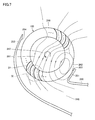
- FIG. 9 is a cross-sectional view showing in an enlarged view, an area surrounded by a chain double dotted line IX in FIG. 7 .
- FIG. 10 is a diagram schematically representing an air flow path in the area shown in FIG. 9 .
- large-thickness portion 40 where thickness of fan blade 21 is greatest is arranged closer to inner edge portion 27 , of inner edge portion 27 and outer edge portion 26 . Therefore, air flow path 55 formed between adjacent fan blades 21 has a flow path area S 1 relatively small on the inner circumferential side and a flow path area S 2 great on the outer circumferential side. According to such a construction, air from inner edge portion 27 toward outer edge portion 26 flows through an enlarging flow path of which flow path cross-section increases from upstream to downstream.
- a pressure and a velocity of an air flow on the inner circumferential side of air flow path 55 are defined as P 1 and V 1 , respectively, a pressure and a velocity of an air flow on the outer circumferential side of air flow path 55 are defined as P 2 and V 2 , respectively, and a pressure in downstream-side outer space 248 is defined as P 3 .
- a velocity of an air flow becomes lower from the inner circumferential side toward the outer circumferential side of air flow path 55 , while a pressure of the air flow increases (V 1 >V 2 , P 1 ⁇ P 2 ).
- pressure P 2 of the air flow sent through air flow path 55 between adjacent fan blades 21 becomes higher than pressure P 3 in downstream-side outer space 248 , and consequently static pressure characteristics of cross-flow fan 100 can be improved.
- FIG. 11 is a cross-sectional view schematically representing a phenomenon that takes place on the blade surface of the fan blade in the downstream-side region shown in FIG. 7 .
- FIG. 11 in downstream-side region 242 , when an air flow from inner space 247 toward downstream-side outer space 248 is formed, an air flow which flows from inner edge portion 27 , passes over blade surface 23 , and flows out of outer edge portion 26 is generated over blade surface 23 of fan blade 21 .
- a clockwise vortex 105 of an air flow (secondary flow) is formed in recess 41 formed in positive pressure surface 25 .
- an air flow 106 main flow which passes over blade surface 23 flows along the outside of vortex 105 generated in recess 41 .
- FIG. 12 is a cross-sectional view schematically representing a phenomenon that takes place on the blade surface of the fan blade in the upstream-side region shown in FIG. 7 .
- FIG. 12 in upstream-side region 241 , when an air flow from upstream-side outer space 246 toward inner space 247 is formed, an air flow which flows from outer edge portion 26 , passes over blade surface 23 , and flows out of inner edge portion 27 is generated over blade surface 23 of fan blade 21 .
- a counterclockwise vortex 107 of an air flow (secondary flow) is formed in recess 41 formed in positive pressure surface 25 .
- an air flow 108 main flow which passes over blade surface 23 flows along the outside of vortex 107 generated in recess 41 .
- vortex 105 , 107 formed in recess 41 is formed in the form of projecting from blade surface 23 as shown in FIGS. 11 and 12 , and air flow 106 , 108 flows along the outside of vortex 105 , 107 . Therefore, fan blade 21 exhibits a behavior like a large-thickness blade of which blade cross-sectional shape is made thick at a position where vortex 105 , 107 is formed. Thus, a function the same as in the case of narrowing an interval between adjacent fan blades 21 by increasing the number of fan blades 21 is substantially achieved and such a phenomenon that a back flow of an air flow takes place between adjacent fan blades 21 can be prevented.
- Cross-flow fan 100 in the present embodiment shown in FIG. 1 and cross-flow fans in Comparative Example 1 and Comparative Example 2 were used to carry out examples described below.
- the cross-flow fan in Comparative Example 1 includes a fan blade having a thickness substantially uniform between inner edge portion 27 and outer edge portion 26 .
- the cross-flow fan in Comparative Example 2 includes a fan blade having a blade cross-sectional shape the same as that of fan blade 21 , however, the fan blade does not have a recess formed.
- Each cross-flow fan has such a size as a diameter of ⁇ 100 mm and a length of 600 mm in the axial direction of central axis 101 , and the form of providing the fan blade is also the same.
- FIG. 13 is a graph showing relation between an air flow rate of the cross-flow fan and power consumption (input) in a drive motor.
- cross-flow fan 100 in the present embodiments shown in FIG. 1 and the cross-flow fans in Comparative Example 1 and Comparative Example 2 were applied to the air conditioner in FIGS. 5 to 7 and power consumption in the drive motor at each air flow rate was measured with the air flow rate being changed.
- cross-flow fan 100 in the present embodiment could achieve reduced power consumption in the motor with the air flow rate being the same, as compared with the cross-flow fans in Comparative Examples 1, 2, by reducing weight and improving air blow capability.
- FIG. 14 is a graph showing static pressure characteristics of the cross-flow fan.
- cross-flow fan 100 in the present embodiment shown in FIG. 1 and the cross-flow fans in Comparative Example 1 and Comparative Example 2 were applied to the air conditioner in FIGS. 5 to 7 and static pressure characteristics of each cross-flow fan (P: static pressure—Q: air flow rate) were determined.
- cross-flow fan 100 in the present embodiment could obtain static pressure characteristics better than those of the cross-flow fans in Comparative Examples 1, 2.
- FIG. 15 is a cross-sectional view showing a variation of the fan blade shown in FIG. 11 .
- a recess 42 recessed in negative pressure surface 24 is formed in fan blade 21 .
- a counterclockwise vortex 111 of an air flow is formed in recess 42 , and an air flow 112 which passes over negative pressure surface 24 flows along the outside of vortex 111 generated in recess 42 .
- fan blade 21 thus constructed as well, by reducing weight of fan blade 21 by forming recesses 41 , 42 and generating vortexes 105 , 111 in recesses 41 , 42 , air flows 106 , 112 over blade surface 23 can be stabilized.
- fan blade 21 exhibits a behavior like a large-thickness blade of which blade cross-sectional shape is made thick at positions where vortexes 105 , 111 are formed.
- air flow 112 over negative pressure surface 24 becomes unstable and there is a concern that separation takes place in the downstream of recess 42 .
- air flow 106 over positive pressure surface 25 receives a higher pressure from air flow path 55 , the concern about occurrence of separation can be lessened in spite of the effect of a larger thickness of fan blade 21 .
- recess 41 is formed such that fan blade 21 at the position where recess 41 is formed has a thickness equal to or greater than an average value of a thickness of fan blade 21 between inner edge portion 27 and outer edge portion 26 .
- thicknesses of fan blade 21 at positions where recess 41 A, recess 41 B, and recess 41 C are formed are defined as T 1 , T 2 , and T 3 , respectively.
- thicknesses T 1 , T 2 , and T 3 are equal to or greater than the average value of the thicknesses of fan blade 21 between inner edge portion 27 and outer edge portion 26 .
- the average value of the thicknesses of fan blade 21 is calculated from measurement values obtained, for example, by measuring a thickness of fan blade 21 at each position set by dividing a distance between inner edge portion 27 and outer edge portion 26 into 10 equal parts (except for the position where recess 41 is formed).
- a thickness of fan blade 21 at each position where recess 41 is formed can be prevented from becoming too small, and strength of fan blade 21 can sufficiently be ensured.
- FIG. 16 is a perspective view showing the fan blade in FIG. 2 .
- FIG. 17 is a cross-sectional view showing the fan blade along the line XVII-XVII in FIG. 16 .
- FIG. 18 is a cross-sectional view showing the fan blade along the line XVIII-XVIII in FIG. 16 .
- FIG. 17 shows a cross-section on a one end 31 side of fan blade 21
- FIG. 18 shows a cross-section on the other end 32 side of fan blade 21 .
- fan blade 21 is formed with resin molding by using molding die 160 shown in FIG. 8 .
- fan blade 21 is formed to have such a tapered shape as being inclined with respect to the axial direction of central axis 101 . More specifically, fan blade 21 is formed such that a cross-sectional area obtained in the case where it is cut in a plane orthogonal to central axis 101 increases from one end 31 toward the other end 32 (S 3 ⁇ S 4 ).
- recess 41 is formed such that its cross-sectional area is greater on the other end 32 side than on the one end 31 side (S 5 ⁇ S 6 ).
- Recess 41 is formed such that a cross-sectional shape continuously changes in the axial direction of central axis 101 .
- Recess 41 is formed such that its groove depth is greater on the other end 32 side than on the one end 31 side (H 1 ⁇ H 2 ).
- Recess 41 is formed such that a width of opening in its blade surface 23 is greater on the other end 32 side than on the one end 31 side (B 1 ⁇ B 2 ).
- a shape of recess 41 is changed such that a cross-sectional area of recess 41 is great on the other end 32 side having a greater cross-sectional area.
- weight of fan blade 21 can significantly be reduced while strength thereof is ensured.
- Cross-flow fan 100 serving as a fan in the present embodiment has fan blades 21 as a plurality of vane portions provided at a distance from one another in a circumferential direction.
- Fan blade 21 has inner edge portion 27 arranged on the inner circumferential side and outer edge portion 26 arranged on the outer circumferential side.
- Blade surface 23 extending between inner edge portion 27 and outer edge portion 26 and constituted of positive pressure surface 25 and negative pressure surface 24 is formed in fan blade 21 .
- Positive pressure surface 25 is arranged on a side of a direction of rotation of the fan and negative pressure surface 24 is arranged on a back side of positive pressure surface 25 .
- Fan blade 21 has such a blade cross-sectional shape that large-thickness portion 40 at which thickness T between positive pressure surface 25 and negative pressure surface 24 is greatest is arranged closer to inner edge portion 27 which is any one of inner edge portion 27 and outer edge portion 26 , when it is cut in a plane orthogonal to central axis 101 serving as a rotation axis of the fan.
- Recess 41 recessed in blade surface 23 is formed at a position closer to inner edge portion 27 as any one of inner edge portion 27 where large-thickness portion 40 is arranged and outer edge portion 26 , than to outer edge portion 26 as any the other of inner edge portion 27 and outer edge portion 26 .
- cross-flow fan 100 in the first embodiment of this invention thus constructed, since fan blade 21 has such an aerofoil cross-section that fan blade 21 has large-thickness portion 40 arranged closer to inner edge portion 27 , good static pressure characteristics can be obtained. Meanwhile, by forming recess 41 at a position closer to inner edge portion 27 where large-thickness portion 40 is formed, weight of fan blade 21 can be reduced while strength thereof is ensured. Here, as vortex 105 , 107 of an air flow is generated in recess 41 , air flow 106 , 108 over blade surface 23 can be stabilized. Therefore, weight of fan blade 21 can be reduced while an effect of improvement in static pressure characteristics is maintained. Consequently, cross-flow fan 100 having light weight and exhibiting excellent air flow capability can be realized.
- air conditioner 210 in the first embodiment of this invention by employing cross-flow fan 100 having light weight and exhibiting excellent air flow capability, power consumption in the drive motor for driving cross-flow fan 100 can be reduced. Thus, air conditioner 210 capable of contributing to energy saving can be realized.
- cross-flow fan 100 in the first embodiment and fan blade 21 included in cross-flow fan 100 will be described in the present embodiment.
- FIG. 19 is a perspective view showing a first variation of the cross-flow fan in FIG. 1 .
- FIG. 20 is a cross-sectional view showing a fan blade included in the cross-flow fan in FIG. 19 .
- a recess 43 as an additional recess is formed in fan blade 21 .
- Recess 43 is formed as being recessed in blade surface 23 .
- Recess 43 is formed at a position closer to outer edge portion 26 than to inner edge portion 27 where large-thickness portion 40 is arranged, that is, in outer circumferential side region 52 .
- Recess 43 is formed in negative pressure surface 24 .
- Recess 43 is in a shape of a groove extending along the axial direction of central axis 101 .
- Recess 43 is formed to extend continuously between one end 31 and the other end 32 of fan blade 21 in the axial direction of central axis 101 .
- Recess 43 is formed to extend linearly between one end 31 and the other end 32 of fan blade 21 in the axial direction of central axis 101 .
- Recess 43 has a triangular cross-section when cut in a plane orthogonal to central axis 101 .
- Recess 43 is not limited to such a shape, and for example, it may have a trapezoidal or arc-shaped cross-section. Though a single recess 43 is formed in negative pressure surface 24 in outer circumferential side region 52 in the present variation, a plurality of recesses 43 may be formed.
- Recess 43 is formed to be smaller in groove depth than recess 41 (H 6 ⁇ H 3 , H 4 , H 5 ).
- FIG. 21 is a cross-sectional view showing a downstream-side region in the case where the cross-flow fan in FIG. 19 is applied to an air conditioner.
- downstream-side region 242 in FIG. 6 is shown, and an air flow from inner space 247 to downstream-side outer space 248 is formed.
- centrifugal force toward a radially outward direction with central axis 101 being defined as the center is applied to air which passes between adjacent fan blades 21 as shown with an arrow 131 .
- positive pressure surface 25 is arranged to face the inner circumferential side, air to which centrifugal force is applied flows as if it strongly impinged on the outer circumferential side of positive pressure surface 25 .
- a recess is provided in positive pressure surface 25 in outer circumferential side region 52 , there is a concern that dust is accumulated in that recess.
- negative pressure surface 24 is arranged to face the outer circumferential side on a rear surface of positive pressure surface 25 , air does not strongly impinge on negative pressure surface 24 . Therefore, an effect of weight reduction of fan blade 21 owing to provision of recess 43 can be obtained without concerns about deposition of dust in recess 43 .
- recess 43 is formed to be smaller in groove depth than recess 41 . According to such a construction, a thickness of fan blade 21 can be prevented from becoming extremely small in outer circumferential side region 52 smaller in thickness than inner circumferential side region 51 . Moreover, in resin molding a cross-flow fan with the use of molding die 160 in FIG. 8 , fluidity of the resin in outer circumferential side region 52 small in thickness can be ensured.
- FIG. 22 is a perspective view showing a second variation of the cross-flow fan in FIG. 1 .
- FIG. 23 is a cross-sectional view showing a fan blade included in the cross-flow fan in FIG. 22 .
- large-thickness portion 40 is arranged closer to outer edge portion 26 , of inner edge portion 27 and outer edge portion 26 .
- Large-thickness portion 40 is arranged in outer circumferential side region 52 closer to outer edge portion 26 than to inner edge portion 27 .
- Large-thickness portion 40 is arranged adjacent to outer edge portion 26 .
- Large-thickness portion 40 is arranged at a position where a length of blade surface 23 between outer edge portion 26 and large-thickness portion 40 is smaller than a length of blade surface 23 between large-thickness portion 40 and the position of boundary between inner circumferential side region 51 and outer circumferential side region 52 .
- Fan blade 21 has such a blade cross-section that a thickness is relatively great on the outer circumferential side and relatively small on the inner circumferential side as a whole.
- a recess 46 is formed in fan blade 21 .
- Recess 46 is formed as being recessed in blade surface 23 .
- Recess 46 is formed at a position closer to outer edge portion 26 where large-thickness portion 40 is formed than to inner edge portion 27 , that is, in outer circumferential side region 52 .
- No recess is formed at a position closer to inner edge portion 27 than to outer edge portion 26 where large-thickness portion 40 is arranged, that is, in inner circumferential side region 51 .
- Recess 46 is formed in positive pressure surface 25 .
- No recess is formed in negative pressure surface 24 .
- a plurality of recesses 46 are formed in fan blade 21 .
- FIG. 24 is a cross-sectional view showing a first variation of the fan blade shown in FIG. 23 .
- a recess 47 is formed in fan blade 21 .
- Recess 47 is formed at a position closer to outer edge portion 26 where large-thickness portion 40 is arranged, than to inner edge portion 27 , that is, in outer circumferential side region 52 .
- Recess 47 is formed in negative pressure surface 24 .
- Recess 46 and recess 47 are formed at positions opposed to each other with centerline 28 lying therebetween.
- a plurality of recesses 47 are formed in fan blade 21 .
- an effect of reduction in weight of fan blade 21 can more effectively be obtained by recess 47 formed in negative pressure surface 24 .
- FIG. 25 is a cross-sectional view showing a second variation of the fan blade shown in FIG. 23 .
- fan blade 21 in the present variation is different from fan blade 21 shown in FIG. 24 in position where recess 47 is formed.
- recess 46 and recess 47 are formed at positions displaced from each other with centerline 28 lying therebetween. Recess 46 and recess 47 are arranged to be staggered along centerline 28 .
- a thickness of fan blade 21 can be prevented from becoming extremely small at positions where recess 46 and recess 47 are formed, and an effect of sufficiently ensuring strength of fan blade 21 can further be achieved.
- FIG. 26 is a cross-sectional view showing a third variation of the fan blade shown in FIG. 23 .
- fan blade 21 in the present variation is different from fan blade 21 shown in FIG. 25 in the number of recesses 47 formed.
- a single recess 47 is formed in fan blade 21 .
- FIG. 27 is a cross-sectional view showing a fourth variation of the fan blade shown in FIG. 23 .
- recess 46 is not formed but only recess 47 recessed in negative pressure surface 24 is formed.
- FIG. 28 is a cross-sectional view showing a fifth variation of the fan blade shown in FIG. 23 .
- fan blade 21 in the present variation is different from fan blade 21 shown in FIG. 23 in the number of recesses 46 formed.
- a single recess 46 is formed in fan blade 21 .
- Recess 46 is arranged at a position where a length of blade surface 23 between recess 46 and the position of boundary between inner circumferential side region 51 and outer circumferential side region 52 is smaller than a length of blade surface 23 between outer edge portion 26 and recess 46 .
- no recess is provided at a position close to outer edge portion 26 originally having a large-thickness shape but recess 46 is provided at a position where a thickness is small, which is distant from outer edge portion 26 .
- an effect of improvement in static pressure characteristics owing to a large-thickness blade is achieved by fan blade 21 itself at a position close to outer edge portion 26 and by a vortex flow formed in recess 46 at a position where recess 46 is formed.
- FIGS. 24 to 28 are also applicable to fan blade 21 in which large-thickness portion 40 is arranged closer to inner edge portion 27 .
- FIG. 29 is a cross-sectional view showing a third variation of the cross-flow fan in FIG. 1 .
- the plurality of fan blades 21 are constituted of a plurality of types of fan blades 21 A, 21 B, 21 C, 21 D, 21 E, 21 F.
- recesses 41 are formed in forms different from one another.
- a form of providing recess 41 means a shape of recess 41 (a cross-sectional shape, a groove depth, a width of opening, and the like), a position where recess 41 is formed, and the number of recesses 41 .
- three recesses 41 are formed in each of fan blades 21 A, 21 C, two recesses 41 are formed in each of fan blades 21 B, 21 D, and a single recess 41 is formed in each of fan blades 21 E, 21 F.
- recess 41 relatively great in groove depth is formed, and in fan blades 21 A, 21 D, 21 F, recess 41 relatively small in groove depth is formed.
- Fan blades 21 A, 21 B, 21 C, 21 D, 21 E, 21 F are aligned in an irregular (random) order in the circumferential direction around central axis 101 .
- fan blades 21 A to 21 F are aligned such that they are not repeatedly aligned in a regular order (for example, such an order as fan blade 21 A ⁇ 21 B ⁇ 21 C ⁇ 21 D ⁇ 21 E ⁇ 21 F ⁇ 21 A ⁇ 21 B ⁇ 21 C ⁇ 21 D ⁇ 21 E ⁇ 21 F ⁇ 21 A ⁇ 21 B . . . ).
- fan blades 21 A, 21 B, 21 C, 21 D, 21 E, 21 F, 21 C, 21 B, 21 F, 21 A, 21 D, 21 E, 21 B, 21 F, 21 E, 21 C, 21 A, 21 D are sequentially aligned.
- a method of sequentially arranging a plurality of sets different in sequence of fan blades 21 A to 21 F with six types of fan blades 21 A to 21 F being defined as one set is adopted as a method of randomly arranging fan blades 21 A to 21 F.
- a method of preparing a plurality of fan blades 21 A to a plurality of fan blades 21 F and selecting an appropriate fan blade among them and aligning them sequentially may be employed. If fan blades 21 A to 21 F are aligned without regularity as a whole, a specific type of fan blades may successively be aligned.
- Recesses 41 different in form from one another may be provided in all of fan blades 21 employed in the cross-flow fan.
- the number of types of fan blades 21 used is preferably three or more and more preferably four or more.
- a shape, a size, or the number of vortexes of an air flow formed in recess 41 is different in fan blades 21 A to 21 F.
- a direction or a velocity of an air flow in the downstream of recess 41 can vary among fan blades 21 A to 21 F.
- centrifugal fan in the present embodiment, includes a structure partially similar to that of cross-flow fan 100 in the first embodiment. Description of a redundant structure will not be repeated below.
- FIG. 30 is a perspective view showing a centrifugal fan in a third embodiment of this invention.
- centrifugal fan 10 in the present embodiment has a plurality of fan blades 21 .
- Centrifugal fan 10 has appearance in a substantially cylindrical shape as a whole, and the plurality of fan blades 21 are arranged around a circumferential surface of the substantially cylindrical shape.
- Centrifugal fan 10 is integrally formed from resin. Centrifugal fan 10 rotates in a direction shown with arrow 103 around virtual central axis 101 shown in FIG. 30 .
- Centrifugal fan 10 is a fan for sending air taken from the inner circumferential side toward the outer circumferential side by using the plurality of rotating fan blades 21 .
- Centrifugal fan 10 is a fan sending air in a radial direction from a central side of rotation of the fan by making use of centrifugal force.
- Centrifugal fan 10 is a sirocco fan. Centrifugal fan 10 is used at the number of revolutions in a range of low Reynolds numbers applied to fans in home electric appliances or the like.
- Centrifugal fan 10 further has an outer circumferential frame 13 p and an outer circumferential frame 13 q each serving as a support portion.
- Outer circumferential frame 13 p and outer circumferential frame 13 q are formed to annularly extend around central axis 101 .
- Outer circumferential frame 13 p and outer circumferential frame 13 q are arranged at positions distant from each other in the axial direction of central axis 101 .
- a boss portion 16 for coupling centrifugal fan 10 to the drive motor with a disk portion 14 being interposed is integrally formed.
- the plurality of fan blades 21 are aligned at a distance from one another in the circumferential direction around central axis 101 .
- the plurality of fan blades 21 are supported by outer circumferential frame 13 p and outer circumferential frame 13 q at opposing ends in the axial direction of central axis 101 .
- Fan blade 21 is formed to be erected on outer circumferential frame 13 p and to extend along the axial direction of central axis 101 toward outer circumferential frame 13 q.
- Fan blade 21 has a blade cross-sectional shape the same as that of fan blade 21 in FIG. 4 in the first embodiment. Namely, large-thickness portion 40 at which a thickness of fan blade 21 is greatest is arranged closer to inner edge portion 27 , of inner edge portion 27 and outer edge portion 26 . Recess 41 is formed at a position of fan blade 21 , closer to inner edge portion 27 where large-thickness portion 40 is arranged, than to outer edge portion 26 .
- Centrifugal fan 10 in the present embodiment is different from cross-flow fan 100 in the first embodiment in that the plurality of fan blades 21 are aligned at regular intervals.
- FIG. 31 is a cross-sectional view showing a blower in which the centrifugal fan in FIG. 30 is employed.
- FIG. 32 is a cross-sectional view showing the blower along the line XXXII-XXXII in FIG. 31 .
- a blower 320 has a drive motor 328 , centrifugal fan 10 , and a casing 329 in an outer casing 326 .
- Casing 329 has a guide wall 329 a .
- Guide wall 329 a is formed substantially from a 3 ⁇ 4 arc arranged around the outer circumference of centrifugal fan 10 .
- Guide wall 329 a increases a velocity of an air current while guiding an air current generated as a result of rotation of fan blade 21 in a direction of rotation of fan blade 21 .
- An intake portion 330 and an outlet portion 327 are formed in casing 329 .
- Intake portion 330 is formed as being located on an extension of central axis 101 .
- Outlet portion 327 is formed to open in a part of guide wall 329 a into one tangential direction of guide wall 329 a .
- Outlet portion 327 forms a prismatic shape protruding from a part of guide wall 329 a to one tangential direction of guide wall 329 a.
- centrifugal fan 10 rotates in the direction shown with arrow 103 .
- air is taken from intake portion 330 into casing 329 and sent from an inner circumferential side space 331 to an outer circumferential side space 332 of centrifugal fan 10 .
- Air sent to outer circumferential side space 332 flows in the circumferential direction along a direction shown with an arrow 304 and sent to the outside through outlet portion 327 .
- FIG. 33 is a cross-sectional view showing an air cleaner in which the centrifugal fan in FIG. 30 is employed.
- an air cleaner 340 has a housing 344 , a blower 350 , a duct 345 , and an (HEPA: High Efficiency Particulate Air Filter) filter 341 .
- Housing 344 has a rear wall 344 a and a top wall 344 b .
- Housing 344 has an intake port 342 formed, for taking in air in a room in which air cleaner 340 is installed.
- Intake port 342 is formed in rear wall 344 a .
- Housing 344 further has an outlet port 343 formed, for discharging cleaned air into the room.
- Outlet port 343 is formed in top wall 344 b .
- Air cleaner 340 is generally installed against a wall such that rear wall 344 a is opposed to a wall in the room.
- Filter 341 is arranged to face intake port 342 in the inside of housing 344 .
- the air introduced into housing 344 through intake port 342 passes through filter 341 .
- foreign matters in air are removed.
- Blower 350 is provided for taking air in the room to the inside of housing 344 and sending the air cleaned by filter 341 into the room through outlet port 343 .
- Blower 350 has centrifugal fan 10 , a casing 352 , and a drive motor 351 .
- Casing 352 has a guide wall 352 a .
- Casing 352 has an intake portion 353 and an outlet portion 354 .
- Duct 345 is provided above blower 350 and is provided as an air channel for guiding the cleaned air from casing 352 to outlet port 343 .
- Duct 345 has a prismatic shape with its lower end connecting to outlet portion 354 and with its upper end open. Duct 345 is formed to guide the cleaned air blown from outlet portion 354 to a laminar flow toward outlet port 343 .
- air cleaner 340 having such a construction, as blower 350 is driven, fan blade 21 rotates to cause air in the room to be taken in from intake port 342 to the inside of housing 344 .
- an air flow is generated between intake port 342 and outlet port 343 , and foreign matters such as dust included in the intake air are removed by filter 341 .
- the cleaned air obtained by passage through filter 341 is taken into the inside of casing 352 .
- the cleaned air taken into the inside of casing 352 forms a laminar flow through guide wall 352 a around fan blade 21 .
- the air in the form of a laminar flow is guided to outlet portion 354 along guide wall 352 a and blown from outlet portion 354 to the inside of duct 345 .
- the air is discharged from outlet port 343 toward an outer space.
- the centrifugal fan according to the present invention can be applied to such an apparatus for sending a fluid as an air conditioner, a humidifier, a cooling apparatus, and a ventilating apparatus.
- centrifugal fan 10 and air cleaner 340 in the third embodiment of this invention thus constructed, an effect described in the first embodiment can similarly be obtained.
- a new fan may be constructed by combining as appropriate structures of the fans described in the first to third embodiments described above.
- the various fan blades described in the second embodiment may be employed to construct centrifugal fan 10 in the third embodiment.
- This invention is mainly applied to home electric appliances having an air blowing function, such as an air cleaner and an air conditioner.
Landscapes
- Engineering & Computer Science (AREA)
- Mechanical Engineering (AREA)
- General Engineering & Computer Science (AREA)
- Structures Of Non-Positive Displacement Pumps (AREA)
Abstract
Description
Claims (12)
Applications Claiming Priority (3)
| Application Number | Priority Date | Filing Date | Title |
|---|---|---|---|
| JP2010-146055 | 2010-06-28 | ||
| JP2010146055A JP4993792B2 (en) | 2010-06-28 | 2010-06-28 | Fan, molding die and fluid feeder |
| PCT/JP2011/061986 WO2012002081A1 (en) | 2010-06-28 | 2011-05-25 | Fan, mold for molding, and fluid feeding device |
Publications (2)
| Publication Number | Publication Date |
|---|---|
| US20130101405A1 US20130101405A1 (en) | 2013-04-25 |
| US9382913B2 true US9382913B2 (en) | 2016-07-05 |
Family
ID=45357774
Family Applications (1)
| Application Number | Title | Priority Date | Filing Date |
|---|---|---|---|
| US13/806,922 Expired - Fee Related US9382913B2 (en) | 2010-06-28 | 2011-05-25 | Fan, molding die, and fluid feeder |
Country Status (4)
| Country | Link |
|---|---|
| US (1) | US9382913B2 (en) |
| JP (1) | JP4993792B2 (en) |
| CN (2) | CN202251076U (en) |
| WO (1) | WO2012002081A1 (en) |
Cited By (2)
| Publication number | Priority date | Publication date | Assignee | Title |
|---|---|---|---|---|
| US20150056910A1 (en) * | 2012-04-06 | 2015-02-26 | Mitsubishi Electric Corporation | Indoor unit for air-conditioning apparatus |
| US20240426314A1 (en) * | 2022-06-27 | 2024-12-26 | Gree Electric Appliances, Inc. Of Zhuhai | Cross-flow fan and air conditioner |
Families Citing this family (13)
| Publication number | Priority date | Publication date | Assignee | Title |
|---|---|---|---|---|
| JP4993792B2 (en) | 2010-06-28 | 2012-08-08 | シャープ株式会社 | Fan, molding die and fluid feeder |
| JP6071394B2 (en) * | 2012-10-03 | 2017-02-01 | ミネベア株式会社 | Centrifugal fan |
| JP5705945B1 (en) * | 2013-10-28 | 2015-04-22 | ミネベア株式会社 | Centrifugal fan |
| USD767112S1 (en) * | 2015-04-15 | 2016-09-20 | K&N Engineering, Inc. | Vent breather |
| TWI667417B (en) * | 2016-09-05 | 2019-08-01 | 瑞展動能股份有限公司 | Multi-wing fan |
| EP3505766B1 (en) * | 2016-09-30 | 2021-05-19 | Daikin Industries, Ltd. | Cross-flow blower and indoor unit of air-conditioning device equipped with same |
| CN106762816A (en) * | 2016-12-16 | 2017-05-31 | 珠海格力电器股份有限公司 | Centrifugal fan blade and centrifugal fan |
| CN110494654B (en) * | 2017-04-10 | 2021-09-14 | 夏普株式会社 | Telecentric fan, molding die and fluid delivery device |
| CN207673612U (en) * | 2017-05-27 | 2018-07-31 | 莱克电气股份有限公司 | A kind of wind turbine and air purifier for air purifier |
| CN110686386B (en) * | 2019-10-12 | 2021-09-14 | 珠海格力电器股份有限公司 | Regional control method, device and system and air conditioning system |
| KR102782040B1 (en) | 2020-02-25 | 2025-03-13 | 엘지전자 주식회사 | A Cross Fan |
| CN214660989U (en) * | 2021-04-30 | 2021-11-09 | 中强光电股份有限公司 | Fan structure |
| CN120367858B (en) * | 2025-06-30 | 2025-08-15 | 佛山市南海九洲普惠风机有限公司 | Multi-blade centrifugal fan impeller with arc-shaped front disc and multi-blade centrifugal fan |
Citations (16)
| Publication number | Priority date | Publication date | Assignee | Title |
|---|---|---|---|---|
| US3536416A (en) * | 1968-05-14 | 1970-10-27 | Dov Z Glucksman | Squirrel-cage rotor for fluid moving devices |
| US5114657A (en) * | 1989-03-20 | 1992-05-19 | Sanko Plastics Co., Ltd. | Integrally molded cross-flow fan and method of making the same by radially withdrawing gap-forming molds |
| US5169290A (en) * | 1991-11-07 | 1992-12-08 | Carrier Corporation | Blade for centrifugal flow fan |
| JPH074388A (en) | 1993-06-15 | 1995-01-10 | Matsushita Refrig Co Ltd | Impeller for centrifugal blower |
| CN1813134A (en) | 2003-06-23 | 2006-08-02 | 松下电器产业株式会社 | Centrifugal fan and device using same |
| US20060177304A1 (en) * | 2003-06-23 | 2006-08-10 | Kazuya Omori | Centrifugal fan and apparatus using the same |
| CN1840313A (en) | 2005-03-29 | 2006-10-04 | 三菱电机株式会社 | Formed mould |
| US20060263223A1 (en) * | 2005-05-18 | 2006-11-23 | Hartzell Fan, Inc. | Fan blade with ridges |
| JP2007010259A (en) | 2005-07-01 | 2007-01-18 | Hitachi Appliances Inc | Air conditioner |
| US20070253834A1 (en) * | 2004-09-13 | 2007-11-01 | Kazuo Ogino | Multiblade Fan |
| JP2009293616A (en) | 2008-05-09 | 2009-12-17 | Daikin Ind Ltd | Cross-flow fan and air conditioner equipped with the same |
| JP2010014123A (en) | 2008-05-09 | 2010-01-21 | Daikin Ind Ltd | Cross-flow fan, and air conditioner provided with the same |
| US20100115983A1 (en) * | 2007-03-14 | 2010-05-13 | Mitsubishi Electric Corporation | Centrifugal fan, air conditioner |
| JP2010106853A (en) | 2010-02-16 | 2010-05-13 | Sharp Corp | Cross-flow fan, blower, and impeller forming machine |
| US20100158689A1 (en) * | 2005-08-05 | 2010-06-24 | Daikin Industries, Ltd. | Cross-flow fan made of resin and method of manufacturing the same |
| CN202251076U (en) | 2010-06-28 | 2012-05-30 | 夏普株式会社 | Fan, forming die, and fluid conveying device |
-
2010
- 2010-06-28 JP JP2010146055A patent/JP4993792B2/en active Active
-
2011
- 2011-05-25 US US13/806,922 patent/US9382913B2/en not_active Expired - Fee Related
- 2011-05-25 WO PCT/JP2011/061986 patent/WO2012002081A1/en not_active Ceased
- 2011-06-24 CN CN2011202209615U patent/CN202251076U/en not_active Expired - Fee Related
- 2011-06-24 CN CN201110175603.1A patent/CN102297156B/en active Active
Patent Citations (19)
| Publication number | Priority date | Publication date | Assignee | Title |
|---|---|---|---|---|
| US3536416A (en) * | 1968-05-14 | 1970-10-27 | Dov Z Glucksman | Squirrel-cage rotor for fluid moving devices |
| US5114657A (en) * | 1989-03-20 | 1992-05-19 | Sanko Plastics Co., Ltd. | Integrally molded cross-flow fan and method of making the same by radially withdrawing gap-forming molds |
| US5169290A (en) * | 1991-11-07 | 1992-12-08 | Carrier Corporation | Blade for centrifugal flow fan |
| JPH074388A (en) | 1993-06-15 | 1995-01-10 | Matsushita Refrig Co Ltd | Impeller for centrifugal blower |
| JP2669448B2 (en) | 1993-06-15 | 1997-10-27 | 松下冷機株式会社 | Centrifugal blower impeller |
| CN1813134A (en) | 2003-06-23 | 2006-08-02 | 松下电器产业株式会社 | Centrifugal fan and device using same |
| US20060177304A1 (en) * | 2003-06-23 | 2006-08-10 | Kazuya Omori | Centrifugal fan and apparatus using the same |
| US20070253834A1 (en) * | 2004-09-13 | 2007-11-01 | Kazuo Ogino | Multiblade Fan |
| CN1840313A (en) | 2005-03-29 | 2006-10-04 | 三菱电机株式会社 | Formed mould |
| US20060263223A1 (en) * | 2005-05-18 | 2006-11-23 | Hartzell Fan, Inc. | Fan blade with ridges |
| JP2007010259A (en) | 2005-07-01 | 2007-01-18 | Hitachi Appliances Inc | Air conditioner |
| US20100158689A1 (en) * | 2005-08-05 | 2010-06-24 | Daikin Industries, Ltd. | Cross-flow fan made of resin and method of manufacturing the same |
| US20100115983A1 (en) * | 2007-03-14 | 2010-05-13 | Mitsubishi Electric Corporation | Centrifugal fan, air conditioner |
| JP2009293616A (en) | 2008-05-09 | 2009-12-17 | Daikin Ind Ltd | Cross-flow fan and air conditioner equipped with the same |
| JP2010014123A (en) | 2008-05-09 | 2010-01-21 | Daikin Ind Ltd | Cross-flow fan, and air conditioner provided with the same |
| US20110033307A1 (en) | 2008-05-09 | 2011-02-10 | Daikin Industries, Ltd. | Cross-flow fan and air conditioner equipped with same |
| JP2010106853A (en) | 2010-02-16 | 2010-05-13 | Sharp Corp | Cross-flow fan, blower, and impeller forming machine |
| CN202251076U (en) | 2010-06-28 | 2012-05-30 | 夏普株式会社 | Fan, forming die, and fluid conveying device |
| US20130101405A1 (en) | 2010-06-28 | 2013-04-25 | Sharp Kabushiki Kaisha | Fan, molding die, and fluid feeder |
Non-Patent Citations (1)
| Title |
|---|
| Official Communication issued in International Patent Application No. PCT/JP2011/061986, mailed on Aug. 23, 2011. |
Cited By (4)
| Publication number | Priority date | Publication date | Assignee | Title |
|---|---|---|---|---|
| US20150056910A1 (en) * | 2012-04-06 | 2015-02-26 | Mitsubishi Electric Corporation | Indoor unit for air-conditioning apparatus |
| US10436496B2 (en) * | 2012-04-06 | 2019-10-08 | Mitsubishi Electric Corporation | Indoor unit for air-conditioning apparatus |
| US20240426314A1 (en) * | 2022-06-27 | 2024-12-26 | Gree Electric Appliances, Inc. Of Zhuhai | Cross-flow fan and air conditioner |
| US12410811B2 (en) * | 2022-06-27 | 2025-09-09 | Gree Electric Appliances, Inc. Of Zhuhai | Cross-flow fan and air conditioner |
Also Published As
| Publication number | Publication date |
|---|---|
| JP4993792B2 (en) | 2012-08-08 |
| US20130101405A1 (en) | 2013-04-25 |
| CN102297156B (en) | 2016-08-17 |
| CN102297156A (en) | 2011-12-28 |
| WO2012002081A1 (en) | 2012-01-05 |
| CN202251076U (en) | 2012-05-30 |
| JP2012007586A (en) | 2012-01-12 |
Similar Documents
| Publication | Publication Date | Title |
|---|---|---|
| US9382912B2 (en) | Fan, molding die, and fluid feeder | |
| US20130101405A1 (en) | Fan, molding die, and fluid feeder | |
| US9885364B2 (en) | Fan, molding die, and fluid feeder | |
| JP5203478B2 (en) | Cross-flow fan, molding die and fluid feeder | |
| JP4831707B2 (en) | Cross-flow fan, molding die and fluid feeder | |
| US9127681B2 (en) | Cross-flow fan, molding die, and fluid feeder | |
| US9388823B2 (en) | Centrifugal fan, molding die, and fluid feeder | |
| JP5744209B2 (en) | Air conditioner | |
| JP5179638B2 (en) | Fan, molding die and fluid feeder | |
| JP5320435B2 (en) | Cross-flow fan, molding die and fluid feeder | |
| JP4775867B1 (en) | Fan, molding die and fluid feeder | |
| WO2025200714A1 (en) | Cross-flow impeller, indoor unit, and heating and ventilation system | |
| JP4906010B2 (en) | Fan, molding die and fluid feeder | |
| JP4906011B2 (en) | Fan, molding die and fluid feeder |
Legal Events
| Date | Code | Title | Description |
|---|---|---|---|
| AS | Assignment |
Owner name: SHARP KABUSHIKI KAISHA, JAPAN Free format text: ASSIGNMENT OF ASSIGNORS INTEREST;ASSIGNORS:SHIRAICHI, YUKISHIGE;OHTSUKA, MASAKI;TAKAHASHI, MASAYA;REEL/FRAME:029527/0320 Effective date: 20121214 |
|
| ZAAA | Notice of allowance and fees due |
Free format text: ORIGINAL CODE: NOA |
|
| ZAAB | Notice of allowance mailed |
Free format text: ORIGINAL CODE: MN/=. |
|
| STCF | Information on status: patent grant |
Free format text: PATENTED CASE |
|
| FEPP | Fee payment procedure |
Free format text: PAYOR NUMBER ASSIGNED (ORIGINAL EVENT CODE: ASPN); ENTITY STATUS OF PATENT OWNER: LARGE ENTITY |
|
| MAFP | Maintenance fee payment |
Free format text: PAYMENT OF MAINTENANCE FEE, 4TH YEAR, LARGE ENTITY (ORIGINAL EVENT CODE: M1551); ENTITY STATUS OF PATENT OWNER: LARGE ENTITY Year of fee payment: 4 |
|
| FEPP | Fee payment procedure |
Free format text: MAINTENANCE FEE REMINDER MAILED (ORIGINAL EVENT CODE: REM.); ENTITY STATUS OF PATENT OWNER: LARGE ENTITY |
|
| LAPS | Lapse for failure to pay maintenance fees |
Free format text: PATENT EXPIRED FOR FAILURE TO PAY MAINTENANCE FEES (ORIGINAL EVENT CODE: EXP.); ENTITY STATUS OF PATENT OWNER: LARGE ENTITY |
|
| STCH | Information on status: patent discontinuation |
Free format text: PATENT EXPIRED DUE TO NONPAYMENT OF MAINTENANCE FEES UNDER 37 CFR 1.362 |
|
| FP | Lapsed due to failure to pay maintenance fee |
Effective date: 20240705 |