US9365561B2 - C5 benzothiazolyl sulfone compound, method of preparing preparing the same, method of preparing polyene dialdehyde compound using the same, and method of synthesizing lycopene using the same - Google Patents
C5 benzothiazolyl sulfone compound, method of preparing preparing the same, method of preparing polyene dialdehyde compound using the same, and method of synthesizing lycopene using the same Download PDFInfo
- Publication number
- US9365561B2 US9365561B2 US14/751,294 US201514751294A US9365561B2 US 9365561 B2 US9365561 B2 US 9365561B2 US 201514751294 A US201514751294 A US 201514751294A US 9365561 B2 US9365561 B2 US 9365561B2
- Authority
- US
- United States
- Prior art keywords
- chemical formula
- represented
- benzothiazolyl
- preparing
- dialdehyde
- Prior art date
- Legal status (The legal status is an assumption and is not a legal conclusion. Google has not performed a legal analysis and makes no representation as to the accuracy of the status listed.)
- Expired - Fee Related
Links
- 0 CC1(C)COC(C(C)=CCNC2=Nc3ccccc3*2)OC1 Chemical compound CC1(C)COC(C(C)=CCNC2=Nc3ccccc3*2)OC1 0.000 description 3
- MPQFRUKTRZTLPA-MXZHIVQLSA-N C.C/C(=C\CS(=O)(=O)C1=NC2=C(C=CC=C2)S1)C1OCC(C)(C)CO1 Chemical compound C.C/C(=C\CS(=O)(=O)C1=NC2=C(C=CC=C2)S1)C1OCC(C)(C)CO1 MPQFRUKTRZTLPA-MXZHIVQLSA-N 0.000 description 2
- FNVAUCZBESXFJV-XYOKQWHBSA-N C/C(=C\CS(=O)(=O)/C1=N/C2=C(C=CC=C2)S1)C1OCC(C)(C)CO1 Chemical compound C/C(=C\CS(=O)(=O)/C1=N/C2=C(C=CC=C2)S1)C1OCC(C)(C)CO1 FNVAUCZBESXFJV-XYOKQWHBSA-N 0.000 description 2
- SNITXYFQZQOYSK-FHUJGKMTSA-N C/C(=C\CSC1=NC2=C(/C=C\C=C/2)S1)C1OCC(C)(C)CO1.C/C(=C\CSC1=NC2=C(/C=C\C=C/2)S1)CO.C/C(C=O)=C\CSC1=NC2=C(/C=C\C=C/2)S1.C=CC1(C)CO1 Chemical compound C/C(=C\CSC1=NC2=C(/C=C\C=C/2)S1)C1OCC(C)(C)CO1.C/C(=C\CSC1=NC2=C(/C=C\C=C/2)S1)CO.C/C(C=O)=C\CSC1=NC2=C(/C=C\C=C/2)S1.C=CC1(C)CO1 SNITXYFQZQOYSK-FHUJGKMTSA-N 0.000 description 2
- JGLWPMNAOKXMTO-PMYZQDGESA-N C/C(=C\CP(Br)(C1=CC=CC=C1)(C1=CC=CC=C1)C1=CC=CC=C1)C1OCC(C)(C)CO1.C/C(C=O)=C\C=C\C(C)=C\C=C\C=C(C)\C=C\C=C(/C)C=O.C/C(C=O)=C\C=C\C(C)=C\C=C\C=C(C)\C=C\C=C(/C)C=O.O=P(C1=CC=CC=C1)(C1=CC=CC=C1)C1=CC=CC=C1 Chemical compound C/C(=C\CP(Br)(C1=CC=CC=C1)(C1=CC=CC=C1)C1=CC=CC=C1)C1OCC(C)(C)CO1.C/C(C=O)=C\C=C\C(C)=C\C=C\C=C(C)\C=C\C=C(/C)C=O.C/C(C=O)=C\C=C\C(C)=C\C=C\C=C(C)\C=C\C=C(/C)C=O.O=P(C1=CC=CC=C1)(C1=CC=CC=C1)C1=CC=CC=C1 JGLWPMNAOKXMTO-PMYZQDGESA-N 0.000 description 1
- JSINYVURRBCWJC-IBXMPAKESA-N C/C(C=O)=C\C=C\C(C)=C\C=C\C(C)=C\C=C\C(C)=C\C=C\C=C(C)\C=C\C=C(C)\C=C\C=C(C)\C=C\C=C(/C)C=O Chemical compound C/C(C=O)=C\C=C\C(C)=C\C=C\C(C)=C\C=C\C(C)=C\C=C\C=C(C)\C=C\C=C(C)\C=C\C=C(C)\C=C\C=C(/C)C=O JSINYVURRBCWJC-IBXMPAKESA-N 0.000 description 1
- OBHXTIIHLYSQRY-RAGRHNDSSA-N C/C(C=O)=C\C=C\C(C)=C\C=C\C(C)=C\C=C\C=C(C)\C=C\C=C(C)\C=C\C=C(/C)C=O Chemical compound C/C(C=O)=C\C=C\C(C)=C\C=C\C(C)=C\C=C\C=C(C)\C=C\C=C(C)\C=C\C=C(/C)C=O OBHXTIIHLYSQRY-RAGRHNDSSA-N 0.000 description 1
- IYHNSFNKBWPJPY-VCUPLDHLSA-N C/C(C=O)=C\C=C\C(C)=C\C=C\C=C(C)\C=C\C=C(/C)C=O.C/C(C=O)=C\C=C\C(C)=C\C=C\C=C(C)\C=C\C=C(/C)C=O Chemical compound C/C(C=O)=C\C=C\C(C)=C\C=C\C=C(C)\C=C\C=C(/C)C=O.C/C(C=O)=C\C=C\C(C)=C\C=C\C=C(C)\C=C\C=C(/C)C=O IYHNSFNKBWPJPY-VCUPLDHLSA-N 0.000 description 1
- UZJYFXLJRWBBCP-MXYSYTEBSA-N C/C(C=O)=C\C=C\C(C)=C\C=C\C=C(C)\C=C\C=C(/C)C=O.C/C(C=O)=C\C=C\C=C(/C)C=O Chemical compound C/C(C=O)=C\C=C\C(C)=C\C=C\C=C(C)\C=C\C=C(/C)C=O.C/C(C=O)=C\C=C\C=C(/C)C=O UZJYFXLJRWBBCP-MXYSYTEBSA-N 0.000 description 1
- DKKLGTKBASGMLF-YCTANXCWSA-N C/C(C=O)=C\C=C\C(C)=C\C=C\C=C(C)\C=C\C=C(/C)C=O.CC(C)=CCC/C(C)=C/C=C/C(C)=C/C=C/C(C)=C/C=C/C=C(C)/C=C/C=C(C)/C=C/C=C(\C)CCC=C(C)C.CC(C)=CCC/C(C)=C/CS(=O)(=O)/C1=N/C2=C(C=CC=C2)S1 Chemical compound C/C(C=O)=C\C=C\C(C)=C\C=C\C=C(C)\C=C\C=C(/C)C=O.CC(C)=CCC/C(C)=C/C=C/C(C)=C/C=C/C(C)=C/C=C/C=C(C)/C=C/C=C(C)/C=C/C=C(\C)CCC=C(C)C.CC(C)=CCC/C(C)=C/CS(=O)(=O)/C1=N/C2=C(C=CC=C2)S1 DKKLGTKBASGMLF-YCTANXCWSA-N 0.000 description 1
- DZADFYUEYWNSIO-AQJHIELCSA-N C=C/C(C)=C/C=C/C(C)=C/C=C/C=C(C)/C=C/C=C(\C)C=O.C=C/C(C)=C/C=C/C(C)=C/C=C/C=C(C)/C=C/C=C(\C)C=O Chemical compound C=C/C(C)=C/C=C/C(C)=C/C=C/C=C(C)/C=C/C=C(\C)C=O.C=C/C(C)=C/C=C/C(C)=C/C=C/C=C(C)/C=C/C=C(\C)C=O DZADFYUEYWNSIO-AQJHIELCSA-N 0.000 description 1
- JRWDZPDLINOBGU-RLIJNAAWSA-N C=C/C(C)=C/C=C/C(C)=C/C=C/C=C(C)/C=C/C=C(\C)C=O.C=C/C(C)=C/C=C/C=C(\C)C=O.CC(C)=CCC/C(C)=C/C=C/C(C)=C/C=C/C(C)=C/C=C/C=C(C)/C=C/C=C(C)/C=C/C=C(\C)CCC=C(C)C.CC(C)=CCC/C(C)=C/CS(=O)(=O)C1=NC2=C(C=CC=C2)S1 Chemical compound C=C/C(C)=C/C=C/C(C)=C/C=C/C=C(C)/C=C/C=C(\C)C=O.C=C/C(C)=C/C=C/C=C(\C)C=O.CC(C)=CCC/C(C)=C/C=C/C(C)=C/C=C/C(C)=C/C=C/C=C(C)/C=C/C=C(C)/C=C/C=C(\C)CCC=C(C)C.CC(C)=CCC/C(C)=C/CS(=O)(=O)C1=NC2=C(C=CC=C2)S1 JRWDZPDLINOBGU-RLIJNAAWSA-N 0.000 description 1
Classifications
-
- C—CHEMISTRY; METALLURGY
- C07—ORGANIC CHEMISTRY
- C07D—HETEROCYCLIC COMPOUNDS
- C07D417/00—Heterocyclic compounds containing two or more hetero rings, at least one ring having nitrogen and sulfur atoms as the only ring hetero atoms, not provided for by group C07D415/00
- C07D417/02—Heterocyclic compounds containing two or more hetero rings, at least one ring having nitrogen and sulfur atoms as the only ring hetero atoms, not provided for by group C07D415/00 containing two hetero rings
- C07D417/12—Heterocyclic compounds containing two or more hetero rings, at least one ring having nitrogen and sulfur atoms as the only ring hetero atoms, not provided for by group C07D415/00 containing two hetero rings linked by a chain containing hetero atoms as chain links
-
- C—CHEMISTRY; METALLURGY
- C07—ORGANIC CHEMISTRY
- C07C—ACYCLIC OR CARBOCYCLIC COMPOUNDS
- C07C1/00—Preparation of hydrocarbons from one or more compounds, none of them being a hydrocarbon
- C07C1/32—Preparation of hydrocarbons from one or more compounds, none of them being a hydrocarbon starting from compounds containing hetero-atoms other than or in addition to oxygen or halogen
- C07C1/321—Preparation of hydrocarbons from one or more compounds, none of them being a hydrocarbon starting from compounds containing hetero-atoms other than or in addition to oxygen or halogen the hetero-atom being a non-metal atom
- C07C1/322—Preparation of hydrocarbons from one or more compounds, none of them being a hydrocarbon starting from compounds containing hetero-atoms other than or in addition to oxygen or halogen the hetero-atom being a non-metal atom the hetero-atom being a sulfur atom
-
- C—CHEMISTRY; METALLURGY
- C07—ORGANIC CHEMISTRY
- C07C—ACYCLIC OR CARBOCYCLIC COMPOUNDS
- C07C1/00—Preparation of hydrocarbons from one or more compounds, none of them being a hydrocarbon
- C07C1/32—Preparation of hydrocarbons from one or more compounds, none of them being a hydrocarbon starting from compounds containing hetero-atoms other than or in addition to oxygen or halogen
- C07C1/321—Preparation of hydrocarbons from one or more compounds, none of them being a hydrocarbon starting from compounds containing hetero-atoms other than or in addition to oxygen or halogen the hetero-atom being a non-metal atom
- C07C1/323—Preparation of hydrocarbons from one or more compounds, none of them being a hydrocarbon starting from compounds containing hetero-atoms other than or in addition to oxygen or halogen the hetero-atom being a non-metal atom the hetero-atom being a nitrogen atom
-
- C—CHEMISTRY; METALLURGY
- C07—ORGANIC CHEMISTRY
- C07C—ACYCLIC OR CARBOCYCLIC COMPOUNDS
- C07C11/00—Aliphatic unsaturated hydrocarbons
- C07C11/21—Alkatrienes; Alkatetraenes; Other alkapolyenes
-
- C—CHEMISTRY; METALLURGY
- C07—ORGANIC CHEMISTRY
- C07C—ACYCLIC OR CARBOCYCLIC COMPOUNDS
- C07C45/00—Preparation of compounds having >C = O groups bound only to carbon or hydrogen atoms; Preparation of chelates of such compounds
- C07C45/56—Preparation of compounds having >C = O groups bound only to carbon or hydrogen atoms; Preparation of chelates of such compounds from heterocyclic compounds
- C07C45/57—Preparation of compounds having >C = O groups bound only to carbon or hydrogen atoms; Preparation of chelates of such compounds from heterocyclic compounds with oxygen as the only heteroatom
- C07C45/60—Preparation of compounds having >C = O groups bound only to carbon or hydrogen atoms; Preparation of chelates of such compounds from heterocyclic compounds with oxygen as the only heteroatom in six-membered rings
-
- C—CHEMISTRY; METALLURGY
- C07—ORGANIC CHEMISTRY
- C07C—ACYCLIC OR CARBOCYCLIC COMPOUNDS
- C07C47/00—Compounds having —CHO groups
- C07C47/20—Unsaturated compounds having —CHO groups bound to acyclic carbon atoms
- C07C47/21—Unsaturated compounds having —CHO groups bound to acyclic carbon atoms with only carbon-to-carbon double bonds as unsaturation
-
- C—CHEMISTRY; METALLURGY
- C07—ORGANIC CHEMISTRY
- C07D—HETEROCYCLIC COMPOUNDS
- C07D277/00—Heterocyclic compounds containing 1,3-thiazole or hydrogenated 1,3-thiazole rings
- C07D277/60—Heterocyclic compounds containing 1,3-thiazole or hydrogenated 1,3-thiazole rings condensed with carbocyclic rings or ring systems
- C07D277/62—Benzothiazoles
-
- C—CHEMISTRY; METALLURGY
- C07—ORGANIC CHEMISTRY
- C07D—HETEROCYCLIC COMPOUNDS
- C07D277/00—Heterocyclic compounds containing 1,3-thiazole or hydrogenated 1,3-thiazole rings
- C07D277/60—Heterocyclic compounds containing 1,3-thiazole or hydrogenated 1,3-thiazole rings condensed with carbocyclic rings or ring systems
- C07D277/62—Benzothiazoles
- C07D277/68—Benzothiazoles with hetero atoms or with carbon atoms having three bonds to hetero atoms with at the most one bond to halogen, e.g. ester or nitrile radicals, directly attached in position 2
- C07D277/70—Sulfur atoms
- C07D277/74—Sulfur atoms substituted by carbon atoms
-
- C—CHEMISTRY; METALLURGY
- C07—ORGANIC CHEMISTRY
- C07D—HETEROCYCLIC COMPOUNDS
- C07D301/00—Preparation of oxiranes
- C07D301/02—Synthesis of the oxirane ring
- C07D301/03—Synthesis of the oxirane ring by oxidation of unsaturated compounds, or of mixtures of unsaturated and saturated compounds
-
- C—CHEMISTRY; METALLURGY
- C07—ORGANIC CHEMISTRY
- C07D—HETEROCYCLIC COMPOUNDS
- C07D417/00—Heterocyclic compounds containing two or more hetero rings, at least one ring having nitrogen and sulfur atoms as the only ring hetero atoms, not provided for by group C07D415/00
- C07D417/02—Heterocyclic compounds containing two or more hetero rings, at least one ring having nitrogen and sulfur atoms as the only ring hetero atoms, not provided for by group C07D415/00 containing two hetero rings
- C07D417/06—Heterocyclic compounds containing two or more hetero rings, at least one ring having nitrogen and sulfur atoms as the only ring hetero atoms, not provided for by group C07D415/00 containing two hetero rings linked by a carbon chain containing only aliphatic carbon atoms
-
- Y—GENERAL TAGGING OF NEW TECHNOLOGICAL DEVELOPMENTS; GENERAL TAGGING OF CROSS-SECTIONAL TECHNOLOGIES SPANNING OVER SEVERAL SECTIONS OF THE IPC; TECHNICAL SUBJECTS COVERED BY FORMER USPC CROSS-REFERENCE ART COLLECTIONS [XRACs] AND DIGESTS
- Y02—TECHNOLOGIES OR APPLICATIONS FOR MITIGATION OR ADAPTATION AGAINST CLIMATE CHANGE
- Y02P—CLIMATE CHANGE MITIGATION TECHNOLOGIES IN THE PRODUCTION OR PROCESSING OF GOODS
- Y02P20/00—Technologies relating to chemical industry
- Y02P20/50—Improvements relating to the production of bulk chemicals
- Y02P20/55—Design of synthesis routes, e.g. reducing the use of auxiliary or protecting groups
Definitions
- the present invention relates to a C5 benzothiazolyl sulfone compound, a method of preparing the same, a method of preparing a polyene dialdehyde compound using the same, and a method of synthesizing lycopene using the same.
- the present invention relates to a C5 benzothiazolyl sulfone compound, a preparation method thereof, a method of efficiently preparing crocetin dialdehyde (C 20 H 24 O 2 ) having a polyene dialdehyde structure using the sulfone compound and C30 and C40 apo-carotene dialdehydes homologous thereto, and a method of synthesizing lycopene using the sulfone compound.
- the present invention relates to a novel C5 benzothiazolyl sulfone compound having an acetal protecting group derived from neopentyl glycol, a preparation method thereof, a method of efficiently preparing crocetin dialdehyde and homologous C30 (C 30 H 36 O 2 ) and C40 (C 40 H 48 O 2 ) apo-carotene dialdehyde compounds using the sulfone compound, and a method synthesizing lycopene via a double-bond formation reaction using the sulfone compound.
- the present invention pertains to a C5 benzothiazolyl sulfone compound having an acetal protecting group, a method of preparing the same, a method of efficiently preparing C20 crocetin dialdehyde having a polyene dialdehyde structure using the same and C30 and C40 apo-carotene dialdehyde compounds homologous thereto, and a method of synthesizing lycopene using sulfone synthesis.
- a C5 Wittig salt having an acetal protecting group derived from neopentyl glycol is prepared, and then subjected to a Wittig reaction with crocetin dialdehyde, yielding a polyene dialdehyde compound homologous thereto (Cited Reference).
- crocetin dialdehyde crocetin dialdehyde
- this case is problematic because the reaction has to be carried out for about 20 min at high temperature using microwaves, the Z-double bond configuration is mainly formed due to the use of the Wittig salt that is difficult to purify, and phosphine oxide that is difficult to remove is generated as a byproduct.
- the present invention is intended to provide a novel C5 benzothiazolyl sulfone compound having an acetal protecting group derived from neopentyl glycol and a method of preparing the same. Also, the present invention is intended to provide a method of efficiently preparing homologous apo-carotene dialdehyde compounds by repetitively reacting the sulfone compound with polyene dialdehyde. Also, the present invention is intended to provide a method of efficiently preparing lycopene by subjecting crocetin dialdehyde to a double-bond formation reaction using benzothiazolyl geranyl sulfone.
- the present invention provides a C5 benzothiazolyl sulfone compound represented by Chemical Formula 1 below.
- the present invention provides a method of preparing the C5 benzothiazolyl sulfone compound represented by Chemical Formula 1.
- This method comprises: (a) oxidizing isoprene (C 5 H 8 ), thus synthesizing isoprene monoxide represented by Chemical Formula 2 below; (b) subjecting isoprene monoxide to a ring opening reaction using 2-mercaptobenzothiazole, thus synthesizing hydroxyallylic benzothiazolyl sulfide represented by Chemical Formula 3 below; (c) oxidizing allylic alcohol contained in hydroxyallylic benzothiazolyl sulfide, thus synthesizing an unsaturated aldehyde containing benzothiazolyl sulfide represented by Chemical Formula 4 below; (d) subjecting the aldehyde to an acetal formation reaction using neopentyl glycol, thus synthesizing an acetal containing benzothiazolyl sulfide represented by Chemical Formula 5 below; and (e) oxidizing benzothiazolyl sulfide of the acetal, thus synthesizing C5 benzothi
- oxidizing in (a) may be performed in a single step using isoprene and peroxycarboxylic acid but position selectivity of oxidation for isoprene is poor, and thus N-bromosuccinimide (NBS) may be reacted in water, thus position-selectively forming a bromohydrine compound, which is then reacted with an alkaline aqueous solution such as NaOH (Korean Patent No. 10-0398652).
- NBS N-bromosuccinimide
- the epoxide ring opening reaction in (b) may be performed by dissolving 2-mercaptobenzothiazole in a dimethylformamide (DMF) solvent and using a monovalent copper salt (CuCl, CuBr, CuI, or CuCN) as a catalyst (0.01 ⁇ 0.05 equivalents) (Korean Patent No. 10-0398652).
- DMF dimethylformamide
- CuCl, CuBr, CuI, or CuCN monovalent copper salt
- the sulfide represented by Chemical Formula 3 is selectively obtained, and E:Z selectivity of the double bond is 5:1 or higher.
- Oxidizing the alcohol in (c) is performed in the absence of water, and PDC (pyridinium dichromate), PCC (pyridinium chlorochromate), MnO 2 or the like may be used by being dispersed in a CH 2 Cl 2 solvent. To facilitate work-up of the reaction, silica gel may be added.
- the acetal formation reaction in (d) may be performed using ethylene glycol, propylene glycol, and neopentyl glycol. Taking into consideration the stability of the compound, neopentyl glycol is preferably useful.
- the acetal formation reaction is implemented by adding p-TsOH in a catalytic amount (0.05 equivalents or less) in the presence of a benzene or toluene solvent and removing the produced water using a Dean-Stark column.
- Selective oxidation of the sulfide into sulfone in (e) may be performed under known reaction conditions, including using hydrogen peroxide (H 2 O 2 ) in the presence of any metal oxide catalyst, or using oxone, peroxycarboxylic acid, etc.
- hydrogen peroxide is adsorbed to urea and then reacted with phthalic anhydride to give mono-perphthalic acid that is then reacted in the presence of an acetonitrile solvent.
- These steps may further include dilution with an organic solvent, washing with water, drying over anhydrous Na 2 SO 4 , filtration, and concentration under reduced pressure.
- purifying using column chromatography may be further carried out.
- the column chromatography may be silica gel flash column chromatography.
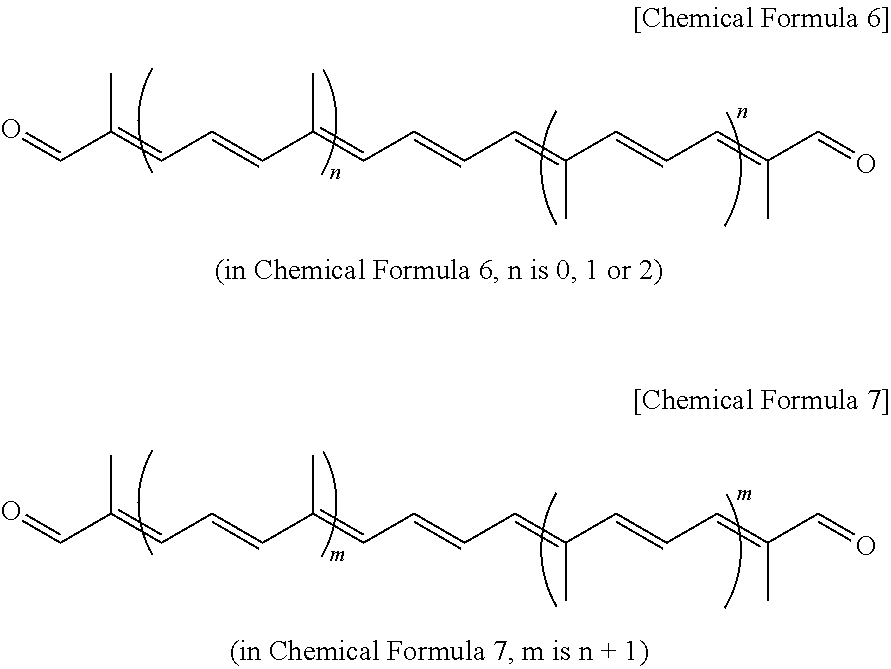
- the present invention provides a method of preparing polyene dialdehyde represented by Chemical Formula 7 below, comprising: binding the C5 benzothiazolyl sulfone compound represented by Chemical Formula 1 with polyene dialdehyde represented by Chemical Formula 6 below at a molar ratio of 2:1, and then performing acid treatment, thus removing an acetal protecting group.
- the compound represented by Chemical Formula 7 is configured such that the compound represented by Chemical Formula 6 is extended by 10 carbon chains.
- Binding benzothiazolyl sulfone represented by Chemical Formula 1 with C10 dialdehyde represented by Chemical Formula 6a, which is known as Julia-Kocienski olefination, is carried out at a low temperature of ⁇ 78° C. for about 1 ⁇ 2 hr.
- Smiles rearrangement and removal of SO 2 and 2-hydroxybenzothiazole may occur simultaneously, thus directly forming a double bond (Baudin, J. B.; Hareau, G.; Julia, S. A.; Ruel, O. Tetrahedron Lett. 1991, 32, 1175-1178).
- the binding reaction is performed using a base such as NaHMDS, KHMDS, or LiHMDS in THF solvent and the use of metal ion such as Na or K is preferable in terms of forming a trans-double bond compared to the use of Li (Pospisil, J. Tetrahedron Lett. 2011, 52, 2348-2352).
- 2,7-dimethyl-2,4,6-octatrienedial represented by Chemical Formula 6a is a material widely used for synthesis of a carotene compound using a Wittig reaction, and preparation thereof is reported in many reports ( J. Org. Chem. 1999, 64, 8051; WO 2000027810 A1; U.S. Pat. No. 5,471,005 A; DE 102004006579 A1).
- the acetal protecting group formed from neopentyl glycol may be easily removed in the presence of a solvent mixture of a 1 M HCl aqueous solution and THF, and the addition of oxalic acid enables more efficient reaction.
- the reaction between the C5 benzothiazolyl sulfone compound represented by Chemical Formula 1 and C10 octatriene dialdehyde represented by Chemical Formula 6a may be equally applied to homologous polyene dialdehyde compounds, thus providing polyene dialdehyde increased by 10 carbon atoms per reaction. This may be regarded as a general chain extension method for synthesis of apo-carotene dialdehyde.
- Binding benzothiazolyl sulfone represented by Chemical Formula 1 with C20 crocetin dialdehyde represented by Chemical Formula 6b may be performed at a low temperature of ⁇ 78° C. for about 1 ⁇ 2 hr, and Smiles rearrangement and removal of SO 2 and 2-hydroxybenzothiazole may occur simultaneously, thus directly forming a double bond.
- the binding reaction is conducted using a base such as NaHMDS, KHMDS, or LiHMDS in the presence of THF solvent, and the use of metal ion such as Na or K is preferable in terms of forming a trans-double bond compared to the use of Li.
- the acetal protecting group formed from neopentyl glycol may be easily removed in the presence of a solvent mixture of a 1 M HCl aqueous solution and THF, and the addition of oxalic acid enables more efficient reaction.
- Binding benzothiazolyl sulfone represented by Chemical Formula 1 with C30 tetracosaundecaene dialdehyde represented by Chemical Formula 6c may be performed at a low temperature of ⁇ 78° C. for about 1 ⁇ 2 hr, and Smiles rearrangement and removal of SO 2 and 2-hydroxybenzothiazole may take place simultaneously, thus directly forming a double bond.
- the binding reaction is performed using a base such as NaHMDS, KHMDS, or LiHMDS in the presence of THF solvent, and the use of metal ion such as Na or K is preferable in terms of forming a trans-double bond compared to the use of Li.
- the acetal protecting group formed from neopentyl glycol may be easily removed in the presence of a solvent mixture of a 1 M HCl aqueous solution and THF, and the addition of oxalic acid enables more efficient reaction.
- the present invention provides a method of preparing lycopene represented by Chemical Formula 9 below, comprising reacting C20 crocetin dialdehyde represented by Chemical Formula 7a below with a C10 benzothiazolyl geranyl sulfone compound represented by Chemical Formula 8 below at a molar ratio of 1:2.
- C20 crocetin dialdehyde represented by Chemical Formula 7a may be obtained by reacting the C5 benzothiazolyl sulfone compound represented by Chemical Formula 1 with C10 octatriene dialdehyde represented by Chemical Formula 6a and then performing acid treatment to remove an acetal protecting group.
- reacting the C5 benzothiazolyl sulfone compound represented by Chemical Formula 1 with C10 octatriene dialdehyde represented by Chemical Formula 6a may be carried out at a molar ratio of 2:1.
- Binding C10 benzothiazolyl geranyl sulfone represented by Chemical Formula 8 with C20 crocetin dialdehyde represented by Chemical Formula 7a may be performed at a low temperature of ⁇ 78° C. for about 1 ⁇ 2 hr, and Smiles rearrangement and removal of SO 2 and 2-hydroxybenzothiazole may take place simultaneously, thus directly forming a double bond, yielding lycopene represented by Chemical Formula 9.
- the binding reaction is performed using a base such as NaHMDS, KHMDS, or LiHMDS in the presence of THF solvent, and the use of metal ion such as Na or K is preferable in terms of forming a trans-double bond compared to the use of Li.
- the C10 benzothiazolyl geranyl sulfone compound represented by Chemical Formula 8 may be prepared by forming geraniol into methane sulfonate that is then reacted with 2-mercaptobenzothiazole, followed by oxidation of the sulfide into sulfone, based on the method known in literature (Charette, A. B.; Berthelette, C.; St-Martin, D. Tetrahedron Lett. 2001, 42, 5149-5153).
- olefination between a benzothiazolyl sulfone compound and polyene dialdehyde can be efficiently carried out at a low temperature of ⁇ 78° C. for about 1 ⁇ 2 hr, compared to a Wittig reaction using a Wittig salt at a high temperature through microwave application, and also it is easy to form the E-double bond configuration.
- the sulfone compound necessary for the reaction can be easily prepared and has high stability and high crystallinity, thus facilitating the separation and purification thereof.
- polyene dialdehyde compounds are apo-carotene compounds produced in the course of oxidizing a carotene compound, and possess biochemical activities and are useful for the synthesis of natural carotene compounds.
- polyene dialdehyde when polyene dialdehyde is introduced with a proper functional group at both terminals thereof, it can be utilized in electrical and electronic materials such as organic molecular wires, etc.
- the unreacted yellow starting material was removed using a porous glass funnel filter, and the filtrate was washed with a 1 M NaOH solution and H 2 O, dried over anhydrous Na 2 SO 4 , filtered, and concentrated under reduced pressure, thus obtaining a crude product.
- crocetin dialdehyde (Chemical Formula 7a, 785 mg, 2.65 mmol) was obtained as a red solid (yield 60%). This was further purified by trituration with MeOH to give an analytical sample.
- C 30 dial (0.93 g, 1.55 mmol) having a neopentyl glycol (diacetal) protecting group was dissolved in THF (30 mL) and stirred, and the resulting stirred solution was added with a 1 M HCl solution (30 mL) and oxalic acid (0.28 g, 3.09 mmol).
- the reaction mixture was stirred for 3 hr at room temperature in a dark room, diluted with CH 2 Cl 2 , washed with 1 M HCl, dried over anhydrous Na 2 SO 4 , filtered, and concentrated under reduced pressure, thus obtaining a crude product.
- C40 dial (40 mg, 0.050 mmol) having a neopentyl glycol (diacetal) protecting group was dissolved in THF (15 mL) and stirred, and the resulting stirred solution was added with a 1 M HCl solution (15 mL) and oxalic acid (10 mg, 0.11 mmol).
- the reaction mixture was stirred for 2 hr at room temperature in a dark room, diluted with CH 2 Cl 2 , washed with 1 M HCl, dried over anhydrous Na 2 SO 4 , filtered, and concentrated under reduced pressure, thus obtaining a crude product.
- Benzothiazol-2-yl geranyl sulfone (90 mg, 0.27 mmol) of Chemical Formula 8 was dissolved in THF (5 mL) and stirred at ⁇ 78° C., and the resulting stirred solution was added with a 1 M THF solution of NaHMDS (0.3 mL, 0.30 mmol), thus obtaining an orange mixture.
- This mixture was stirred for 15 min, and mixed with C20 crocetin dial (40 mg, 0.13 mmol in THF 5 mL) of Chemical Formula 7a. The reaction mixture was stirred at ⁇ 78° C. for 1.5 hr.
Landscapes
- Chemical & Material Sciences (AREA)
- Organic Chemistry (AREA)
- Organic Low-Molecular-Weight Compounds And Preparation Thereof (AREA)
Abstract
Description

- Zeeshan, M.; Sliwka, H.-R.; Partali, V.; Martinez, A. Org. Lett. 2012, 14, 5496-5498.




Claims (5)


Applications Claiming Priority (2)
| Application Number | Priority Date | Filing Date | Title |
|---|---|---|---|
| KR1020140080647A KR101566159B1 (en) | 2014-06-30 | 2014-06-30 | C5 benzothiazolyl sulfone compound, method for preparing the same, method for preparing apocarotene dialdehyde compounds and method for synthesizing lycopene using the same |
| KR10-2014-0080647 | 2014-06-30 |
Publications (2)
| Publication Number | Publication Date |
|---|---|
| US20150376175A1 US20150376175A1 (en) | 2015-12-31 |
| US9365561B2 true US9365561B2 (en) | 2016-06-14 |
Family
ID=54600711
Family Applications (1)
| Application Number | Title | Priority Date | Filing Date |
|---|---|---|---|
| US14/751,294 Expired - Fee Related US9365561B2 (en) | 2014-06-30 | 2015-06-26 | C5 benzothiazolyl sulfone compound, method of preparing preparing the same, method of preparing polyene dialdehyde compound using the same, and method of synthesizing lycopene using the same |
Country Status (2)
| Country | Link |
|---|---|
| US (1) | US9365561B2 (en) |
| KR (1) | KR101566159B1 (en) |
Families Citing this family (4)
| Publication number | Priority date | Publication date | Assignee | Title |
|---|---|---|---|---|
| KR101937960B1 (en) * | 2017-06-28 | 2019-01-11 | 명지대학교 산학협력단 | 2,7-diphenylocta-2,4,6-trienedial, method for preparing the same and method for preparing carotenoids containing phenyl substituents using the same |
| CN107698580A (en) * | 2017-09-28 | 2018-02-16 | 上海彩迩文生化科技有限公司 | A kind of benzothiazole sulfone compound, its preparation method and application |
| KR102133791B1 (en) | 2019-02-20 | 2020-07-14 | 명지대학교 산학협력단 | Novel intermediates for preparing norbixin or bixin ethyl ester and methods thereof |
| KR102887346B1 (en) * | 2023-10-20 | 2025-11-17 | 명지대학교 산학협력단 | Novel polyene precursor containing sulfur and preparing method thereof |
-
2014
- 2014-06-30 KR KR1020140080647A patent/KR101566159B1/en not_active Expired - Fee Related
-
2015
- 2015-06-26 US US14/751,294 patent/US9365561B2/en not_active Expired - Fee Related
Non-Patent Citations (4)
| Title |
|---|
| "Efficient Total Synthesis of Lycophyll"; Org. Process Res. Dev., Sep. 2005., vol. 6, (pp. 830-836); 7 pages, Jackson et al. |
| "Synthesis of Symmetrical Carotenoids by a Two-Fold Stille Reaction"; Org. Chem. Jul. 2002. vol. 67, No. 14, (pp. 5040-5043); 4 pages, Vaz et al., J. Org. Chem., 2002. |
| Korean application No. 10-2014-0080647; Jun. 30, 2014 (34 pages). |
| The Longest Polyene; Muhammad Zeeshan et al; Org. Lett., 2012,14 (21), pp. 5496-5498 (1 page). |
Also Published As
| Publication number | Publication date |
|---|---|
| US20150376175A1 (en) | 2015-12-31 |
| KR101566159B1 (en) | 2015-11-05 |
Similar Documents
| Publication | Publication Date | Title |
|---|---|---|
| AU2012317415B2 (en) | Production method for 4, 4-difluoro-3,4-dihydroisoquinoline derivative | |
| US9365561B2 (en) | C5 benzothiazolyl sulfone compound, method of preparing preparing the same, method of preparing polyene dialdehyde compound using the same, and method of synthesizing lycopene using the same | |
| JP7021559B2 (en) | Method for manufacturing bisphenol and method for manufacturing polycarbonate resin | |
| KR102264639B1 (en) | Method for producing (r)-1,1,3-trimethyl-4-aminoindane | |
| WO2007125736A1 (en) | Process for production of methylene disulfonate compound | |
| CN105585540B (en) | Preparation and application of Swern reagent | |
| WO2007117027A1 (en) | Process for the production of organic oxides | |
| JP2009155280A (en) | Method for producing γ-butyrolactone compound | |
| RU2744834C2 (en) | Method for producing 4-alkoxy-3-hydroxypicolinic acids | |
| JP4738345B2 (en) | Method for producing 2,2'-bis (trifluoromethyl) -4,4'-diaminobiphenyl | |
| TWI846912B (en) | Method for producing cyclic disulfonate compounds | |
| JP4294997B2 (en) | Method for producing bicyclic diketone salt | |
| KR20230074728A (en) | Method for producing a tetrakisphenol compound having a biphenyl skeleton | |
| JP2013032336A (en) | Method for producing 3-trifluoromethylpyridine n-oxide | |
| JP2023006817A (en) | Method for producing bisphenol and method for producing polycarbonate resin | |
| AU2009283076B2 (en) | Improved process for the addition of thiolates to alfa, beta-unsaturated carbonyl or sulfonyl compounds | |
| CN101384564A (en) | Process for the preparation of 2-(4-hydroxy-3-morpholinyl)-2-cyclohexenone | |
| JP4045795B2 (en) | Method for producing 2,6-dichlorophenol compound | |
| JP7803356B2 (en) | Bisphenol composition and polycarbonate resin | |
| US10807962B2 (en) | Process for the synthesis of firocoxib | |
| JP4967401B2 (en) | Oxoquazepam production method | |
| CN102766077B (en) | Novel method for preparing 1-phenyl-2-benzene sulfonyl acetophenone | |
| WO2010122793A1 (en) | Process for production of pyrazine derivative, and intermediate for the production | |
| JP2004323376A (en) | Porphyrin compound and method for producing the same | |
| JP7287019B2 (en) | Method for producing bisphenol composition and polycarbonate resin |
Legal Events
| Date | Code | Title | Description |
|---|---|---|---|
| AS | Assignment |
Owner name: MYONGJI UNIVERSITY INDUSTRY AND ACADEMIA COOPERATI Free format text: ASSIGNMENT OF ASSIGNORS INTEREST;ASSIGNORS:KOO, SANGHO;CHOI, JUNG AE;OH, EUN-TAEK;REEL/FRAME:035994/0111 Effective date: 20150608 |
|
| STCF | Information on status: patent grant |
Free format text: PATENTED CASE |
|
| MAFP | Maintenance fee payment |
Free format text: PAYMENT OF MAINTENANCE FEE, 4TH YR, SMALL ENTITY (ORIGINAL EVENT CODE: M2551); ENTITY STATUS OF PATENT OWNER: SMALL ENTITY Year of fee payment: 4 |
|
| FEPP | Fee payment procedure |
Free format text: MAINTENANCE FEE REMINDER MAILED (ORIGINAL EVENT CODE: REM.); ENTITY STATUS OF PATENT OWNER: SMALL ENTITY |
|
| LAPS | Lapse for failure to pay maintenance fees |
Free format text: PATENT EXPIRED FOR FAILURE TO PAY MAINTENANCE FEES (ORIGINAL EVENT CODE: EXP.); ENTITY STATUS OF PATENT OWNER: SMALL ENTITY |
|
| STCH | Information on status: patent discontinuation |
Free format text: PATENT EXPIRED DUE TO NONPAYMENT OF MAINTENANCE FEES UNDER 37 CFR 1.362 |
|
| FP | Lapsed due to failure to pay maintenance fee |
Effective date: 20240614 |