US935897A - Microphone. - Google Patents
Microphone. Download PDFInfo
- Publication number
- US935897A US935897A US42398008A US1908423980A US935897A US 935897 A US935897 A US 935897A US 42398008 A US42398008 A US 42398008A US 1908423980 A US1908423980 A US 1908423980A US 935897 A US935897 A US 935897A
- Authority
- US
- United States
- Prior art keywords
- microphone
- hydrogen
- pieces
- casing
- contact
- Prior art date
- Legal status (The legal status is an assumption and is not a legal conclusion. Google has not performed a legal analysis and makes no representation as to the accuracy of the status listed.)
- Expired - Lifetime
Links
Images
Classifications
-
- H—ELECTRICITY
- H04—ELECTRIC COMMUNICATION TECHNIQUE
- H04R—LOUDSPEAKERS, MICROPHONES, GRAMOPHONE PICK-UPS OR LIKE ACOUSTIC ELECTROMECHANICAL TRANSDUCERS; ELECTRIC HEARING AIDS; PUBLIC ADDRESS SYSTEMS
- H04R1/00—Details of transducers, loudspeakers or microphones
- H04R1/08—Mouthpieces; Microphones; Attachments therefor
- H04R1/083—Special constructions of mouthpieces
Definitions
- a microphone comprises a diaphmagrn'and one or more free contact pieces or electrodes, mounted inside the diaphragm, through which contact-pieces an electric current is led: and the resistance of which to the said current is changed, when the contact -pieces. are displaced "by some means or other, in practice, by air vibrations caught by theear as sounds.
- the energy, changed by the micro hone into variationsof the current must e as great as possible, i. e. the amplitude of the oscillations must be great without discontinuity being effected.
- one, at least, of the contact-- pie-'ies is made of carbon, the contact-pieces freely bearing against each other consisting of particles of granulesl
- the continuous variations are effected by the said particles being separated by the vibrations for a greater or less distance, a bridge in the insulating layer being formed, most nearly resemblin an electric arc or spark, and it is the resistance of the said bridge, microscopical it is true, which varies and results in the action of the microphone. Under such circumstances the insulating layer and not the conducting parts, evidently, is of the greatest importance for the action of the microphone.
- the object of'this invention is'to essentially increase the effect of the microphone by providing, between the free contact-pieces of the microphone and around the same, an insulating substance, which permits an easy generation of crossing bridges but at the same timeefi'ects great variations in the resistance of the said bridges when shortened and elongated by the vibrations.
- an insulating liquid would be for the purpose, the thought of the same must be rejected, owing to the forcible mechanical deadening effect upon the vibratingpieces which should be caused by the liquid.
- This invention relates to the increasing of the effect of a microphone in a simple manner through an arrangement founded on the said observations. This is effected by placing the contact pieces of the microphone in a chamber hermetically sealed, from which the air has been exhausted and-in which hydrogen or hydrogen containing gas. has been completely or partially substituted for hydrogen and gases containing hythe air.
- the -tension of the current, the nature of the contact pieces, the possibility of sealing the chambers etc. are in each case determlning factors for the choice of the gas to be used as to richness in hydrogen.
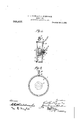
- Figure 1 is a cross section
- Fig. 2 a front elevation of a microphone, provided with means for the introduction of hydrogen or a gas containing hydrogen.
- 1 is the casing of metal, 2 the diaphragm held by the ring 3, which is in screw-threaded engagement with the casing; 4 is a tighteningring of caoutchouc or the like between the iaphragm and the casing; and 5 is a desired richness.
- the joint of the screw bolt 6 and the plates 7, S can be tightened by means of paraffin or the like.
- Hydrogen or other containing hydrogen is introduced into the casing 1 by first pumping out the air through the pipe 16, then admitting the through the said pipe. This operation is repeated until one is sure, that the casing contains the gas in A cook 17 mounted in the pipe is then shut.
- a sealed casing having one Wall formed by the vibratory diaphragm and containing the sound transmitting mechanism in an atmosphere consisting largely of hydrogen.
- a sealed casing having one Wall formed by the vibratory diaphragm and containing the sound transmitin an atmosphere of hydrogen.
- a sealed casing having' one well formed by the vibratory diaphragm and containing the sound transmit ting mechanism, and means to charge the casing with a gas consisting largely of hydrogen.
Landscapes
- Physics & Mathematics (AREA)
- Engineering & Computer Science (AREA)
- Acoustics & Sound (AREA)
- Signal Processing (AREA)
- Electrostatic, Electromagnetic, Magneto- Strictive, And Variable-Resistance Transducers (AREA)
Description
0. E. EGNER & J. G. HOLMSTRUM.
MICROPHONE;
APPLICATION FILED MAR. 27, 1908.
Patented Oct. 5, 1909.
' CARL EMIL EGNER, OF STOGKI-IOLM, AND JOHAN GUNNAR HOLMSTRfiM, OF SALTSJU UNITED STATES PATENT OFFICE.
s'roaanenn, swnnnn.
MICROPHONE.
Application filed March 27, 1908. Serial No. 423,980.
in the Kingdom of Sweden,'have invented;
i certain new and useful Improvements in Microphones,.of which the following is a 7 specification.
As is well known, a microphone comprises a diaphmagrn'and one or more free contact pieces or electrodes, mounted inside the diaphragm, through which contact-pieces an electric current is led: and the resistance of which to the said current is changed, when the contact -pieces. are displaced "by some means or other, in practice, by air vibrations caught by theear as sounds. In order that the microphone may be effective, the energy, changed by the micro hone into variationsof the current, must e as great as possible, i. e. the amplitude of the oscillations must be great without discontinuity being effected. [In microphones, now generally used, one, at least, of the contact-- pie-'ies is made of carbon, the contact-pieces freely bearing against each other consisting of particles of granulesl The continuous variations are effected by the said particles being separated by the vibrations for a greater or less distance, a bridge in the insulating layer being formed, most nearly resemblin an electric arc or spark, and it is the resistance of the said bridge, microscopical it is true, which varies and results in the action of the microphone. Under such circumstances the insulating layer and not the conducting parts, evidently, is of the greatest importance for the action of the microphone. I p
The object of'this invention is'to essentially increase the effect of the microphone by providing, between the free contact-pieces of the microphone and around the same, an insulating substance, which permits an easy generation of crossing bridges but at the same timeefi'ects great variations in the resistance of the said bridges when shortened and elongated by the vibrations. However suitable an insulating liquid would be for the purpose, the thought of the same must be rejected, owing to the forcible mechanical deadening effect upon the vibratingpieces which should be caused by the liquid. On experiments for ascertaining if another gas used as an insulating layer between the contact pieces of the microphones, would be more advantageous than air, the remarkable fact has been ascertained that ordinary air perhaps is the most unsuitable, as it effects lesser variations of the resistance than almost any other gas. 'The greatest varia tions of the current were, on the other hand,
caused by. hydro en or gases containing hydrogen. plain the reasons, but the said fact seems It is difficult theoretically to 8X5 Specification of Letters Patent. Patei1ted Oct. 5, 1909, l
to be connected in a certain manner with the capacity of' conducting heat and the velocity of formation of ions, which qualities' are great in drogen.
This invention relates to the increasing of the effect of a microphone in a simple manner through an arrangement founded on the said observations. This is effected by placing the contact pieces of the microphone in a chamber hermetically sealed, from which the air has been exhausted and-in which hydrogen or hydrogen containing gas. has been completely or partially substituted for hydrogen and gases containing hythe air. The -tension of the current, the nature of the contact pieces, the possibility of sealing the chambers etc. are in each case determlning factors for the choice of the gas to be used as to richness in hydrogen.
WVhen the contact pieces of the microphone are inclosed in the hermetically sealed chamber, care must be taken that such inclosing is notefiected at the expense of the action of the vibrating diaphragm upon the contact-pieces, but the contact-pieces must be so inclosed that the vibrations, effected by the person speaking in front of the diaphragm, strike the diaphragm directly, and that the contact-pieces of the microphone are located behind the diaphragm and directly acted upon by the same, hermetically inclosed andsurrounded by the said gas.
In the accompanying drawing, Figure 1 is a cross section, and Fig. 2 a front elevation of a microphone, provided with means for the introduction of hydrogen or a gas containing hydrogen.
1 is the casing of metal, 2 the diaphragm held by the ring 3, which is in screw-threaded engagement with the casing; 4 is a tighteningring of caoutchouc or the like between the iaphragm and the casing; and 5 is a desired richness.
carbon disk fixed by a screw 6, which is isolated from the casing 1 by means of a sleeve disk 7 of ebonite or the like, While a plate 8 of ebonite islocated about'the outer end of the screw. 4 i
9 is a metal disk, between Which and the nut 10, one end of the conducting Wire 11 is jammed. The other conducting Wire 12 is fixed to the casing 1 by means of a nut 13.
14: are the carbon granules, held in position by a ring 15 of felt.
The current passes through 11, 6, 5, 1. 1, 2, 3, 1 and 12. 1G is a pipecommunicating with the caslng.
The joint of the screw bolt 6 and the plates 7, S can be tightened by means of paraffin or the like.
Hydrogen or other containing hydrogen, is introduced into the casing 1 by first pumping out the air through the pipe 16, then admitting the through the said pipe. This operation is repeated until one is sure, that the casing contains the gas in A cook 17 mounted in the pipe is then shut.
ting mechanism Having thus fully described our invention, what We claim is:
1. In a microphone, a sealed casing having one Wall formed by the vibratory diaphragm and containing the sound transmitting mechanism in an atmosphere consisting largely of hydrogen. v
2. In a microphone, a sealed casing having one Wall formed by the vibratory diaphragm and containing the sound transmitin an atmosphere of hydrogen.
3. In a microphone, a sealed casing having' one well formed by the vibratory diaphragm and containing the sound transmit ting mechanism, and means to charge the casing with a gas consisting largely of hydrogen.
In Witness whereof, We have hereunto signed our names in presence of two subscribing Witnesses.
CARL EMIL EGNER. 4 JOHAN GUNNAR HOLMSTRGM'. \Vitnesses: v
I-IJALMA'R ZE'r'rEnsTnoM, ROBERT APELGREN.
Priority Applications (1)
| Application Number | Priority Date | Filing Date | Title |
|---|---|---|---|
| US42398008A US935897A (en) | 1908-03-27 | 1908-03-27 | Microphone. |
Applications Claiming Priority (1)
| Application Number | Priority Date | Filing Date | Title |
|---|---|---|---|
| US42398008A US935897A (en) | 1908-03-27 | 1908-03-27 | Microphone. |
Publications (1)
| Publication Number | Publication Date |
|---|---|
| US935897A true US935897A (en) | 1909-10-05 |
Family
ID=3004319
Family Applications (1)
| Application Number | Title | Priority Date | Filing Date |
|---|---|---|---|
| US42398008A Expired - Lifetime US935897A (en) | 1908-03-27 | 1908-03-27 | Microphone. |
Country Status (1)
| Country | Link |
|---|---|
| US (1) | US935897A (en) |
Cited By (1)
| Publication number | Priority date | Publication date | Assignee | Title |
|---|---|---|---|---|
| US2697136A (en) * | 1951-04-28 | 1954-12-14 | Bell Telephone Labor Inc | Microphone and microphone granules |
-
1908
- 1908-03-27 US US42398008A patent/US935897A/en not_active Expired - Lifetime
Cited By (1)
| Publication number | Priority date | Publication date | Assignee | Title |
|---|---|---|---|---|
| US2697136A (en) * | 1951-04-28 | 1954-12-14 | Bell Telephone Labor Inc | Microphone and microphone granules |
Similar Documents
| Publication | Publication Date | Title |
|---|---|---|
| US3539980A (en) | Underwater electroacoustic transducer which resists intense pressure | |
| US789716A (en) | Telephone-transmitter. | |
| US1730531A (en) | Acoustic transformer | |
| US1412080A (en) | Telephone transmitter | |
| US809831A (en) | Telephone-transmitter. | |
| US1109940A (en) | Electrical apparatus. | |
| US669644A (en) | Signal or alarm. | |
| US575887A (en) | Paul haedegen | |
| US1405849A (en) | Vibration detector | |
| US643993A (en) | Telephone-transmitter. | |
| US651198A (en) | Telephone-transmitter. | |
| US1446544A (en) | Electrical sound-detecting apparatus | |
| US955685A (en) | Telephone-transmitter. | |
| US999019A (en) | Cooling device for telephone-transmitters. | |
| US558354A (en) | Telephone-transmitter | |
| US318907A (en) | Telephone | |
| US920613A (en) | Electric safety-fuse. | |
| US1330391A (en) | Telephone-transmitter | |
| US1931669A (en) | Means for converting acoustic into electric energy | |
| US791657A (en) | Telephone-transmitter. | |
| US492789A (en) | Thomas a | |
| US219446A (en) | Improvement in electric telephones | |
| US641484A (en) | Apparatus for measuring velocity of sound-waves. | |
| US1045968A (en) | Telephone-transmitter. | |
| US246512A (en) | Heney huntings |