US9353442B2 - Apparatus for forming silicon-containing thin film - Google Patents

Apparatus for forming silicon-containing thin film Download PDF

Info

Publication number
US9353442B2
US9353442B2 US14/576,410 US201414576410A US9353442B2 US 9353442 B2 US9353442 B2 US 9353442B2 US 201414576410 A US201414576410 A US 201414576410A US 9353442 B2 US9353442 B2 US 9353442B2
Authority
US
United States
Prior art keywords
silicon
seed layer
order
based gas
forming
Prior art date
Legal status (The legal status is an assumption and is not a legal conclusion. Google has not performed a legal analysis and makes no representation as to the accuracy of the status listed.)
Active, expires
Application number
US14/576,410
Other versions
US20150101532A1 (en
Inventor
Mitsuhiro Okada
Akinobu Kakimoto
Kazuhide Hasebe
Current Assignee (The listed assignees may be inaccurate. Google has not performed a legal analysis and makes no representation or warranty as to the accuracy of the list.)
Tokyo Electron Ltd
Original Assignee
Tokyo Electron Ltd
Priority date (The priority date is an assumption and is not a legal conclusion. Google has not performed a legal analysis and makes no representation as to the accuracy of the date listed.)
Filing date
Publication date
Priority claimed from JP2011237987A external-priority patent/JP5793398B2/en
Application filed by Tokyo Electron Ltd filed Critical Tokyo Electron Ltd
Priority to US14/576,410 priority Critical patent/US9353442B2/en
Assigned to TOKYO ELECTRON LIMITED reassignment TOKYO ELECTRON LIMITED ASSIGNMENT OF ASSIGNORS INTEREST (SEE DOCUMENT FOR DETAILS). Assignors: HASEBE, KAZUHIDE, KAKIMOTO, AKINOBU, OKADA, MITSUHIRO
Publication of US20150101532A1 publication Critical patent/US20150101532A1/en
Application granted granted Critical
Publication of US9353442B2 publication Critical patent/US9353442B2/en
Active legal-status Critical Current
Adjusted expiration legal-status Critical

Links

Images

Classifications

    • CCHEMISTRY; METALLURGY
    • C23COATING METALLIC MATERIAL; COATING MATERIAL WITH METALLIC MATERIAL; CHEMICAL SURFACE TREATMENT; DIFFUSION TREATMENT OF METALLIC MATERIAL; COATING BY VACUUM EVAPORATION, BY SPUTTERING, BY ION IMPLANTATION OR BY CHEMICAL VAPOUR DEPOSITION, IN GENERAL; INHIBITING CORROSION OF METALLIC MATERIAL OR INCRUSTATION IN GENERAL
    • C23CCOATING METALLIC MATERIAL; COATING MATERIAL WITH METALLIC MATERIAL; SURFACE TREATMENT OF METALLIC MATERIAL BY DIFFUSION INTO THE SURFACE, BY CHEMICAL CONVERSION OR SUBSTITUTION; COATING BY VACUUM EVAPORATION, BY SPUTTERING, BY ION IMPLANTATION OR BY CHEMICAL VAPOUR DEPOSITION, IN GENERAL
    • C23C16/00Chemical coating by decomposition of gaseous compounds, without leaving reaction products of surface material in the coating, i.e. chemical vapour deposition [CVD] processes
    • C23C16/44Chemical coating by decomposition of gaseous compounds, without leaving reaction products of surface material in the coating, i.e. chemical vapour deposition [CVD] processes characterised by the method of coating
    • C23C16/52Controlling or regulating the coating process
    • CCHEMISTRY; METALLURGY
    • C23COATING METALLIC MATERIAL; COATING MATERIAL WITH METALLIC MATERIAL; CHEMICAL SURFACE TREATMENT; DIFFUSION TREATMENT OF METALLIC MATERIAL; COATING BY VACUUM EVAPORATION, BY SPUTTERING, BY ION IMPLANTATION OR BY CHEMICAL VAPOUR DEPOSITION, IN GENERAL; INHIBITING CORROSION OF METALLIC MATERIAL OR INCRUSTATION IN GENERAL
    • C23CCOATING METALLIC MATERIAL; COATING MATERIAL WITH METALLIC MATERIAL; SURFACE TREATMENT OF METALLIC MATERIAL BY DIFFUSION INTO THE SURFACE, BY CHEMICAL CONVERSION OR SUBSTITUTION; COATING BY VACUUM EVAPORATION, BY SPUTTERING, BY ION IMPLANTATION OR BY CHEMICAL VAPOUR DEPOSITION, IN GENERAL
    • C23C16/00Chemical coating by decomposition of gaseous compounds, without leaving reaction products of surface material in the coating, i.e. chemical vapour deposition [CVD] processes
    • C23C16/02Pretreatment of the material to be coated
    • C23C16/0272Deposition of sub-layers, e.g. to promote the adhesion of the main coating
    • CCHEMISTRY; METALLURGY
    • C23COATING METALLIC MATERIAL; COATING MATERIAL WITH METALLIC MATERIAL; CHEMICAL SURFACE TREATMENT; DIFFUSION TREATMENT OF METALLIC MATERIAL; COATING BY VACUUM EVAPORATION, BY SPUTTERING, BY ION IMPLANTATION OR BY CHEMICAL VAPOUR DEPOSITION, IN GENERAL; INHIBITING CORROSION OF METALLIC MATERIAL OR INCRUSTATION IN GENERAL
    • C23CCOATING METALLIC MATERIAL; COATING MATERIAL WITH METALLIC MATERIAL; SURFACE TREATMENT OF METALLIC MATERIAL BY DIFFUSION INTO THE SURFACE, BY CHEMICAL CONVERSION OR SUBSTITUTION; COATING BY VACUUM EVAPORATION, BY SPUTTERING, BY ION IMPLANTATION OR BY CHEMICAL VAPOUR DEPOSITION, IN GENERAL
    • C23C16/00Chemical coating by decomposition of gaseous compounds, without leaving reaction products of surface material in the coating, i.e. chemical vapour deposition [CVD] processes
    • C23C16/22Chemical coating by decomposition of gaseous compounds, without leaving reaction products of surface material in the coating, i.e. chemical vapour deposition [CVD] processes characterised by the deposition of inorganic material, other than metallic material
    • C23C16/24Deposition of silicon only
    • CCHEMISTRY; METALLURGY
    • C30CRYSTAL GROWTH
    • C30BSINGLE-CRYSTAL GROWTH; UNIDIRECTIONAL SOLIDIFICATION OF EUTECTIC MATERIAL OR UNIDIRECTIONAL DEMIXING OF EUTECTOID MATERIAL; REFINING BY ZONE-MELTING OF MATERIAL; PRODUCTION OF A HOMOGENEOUS POLYCRYSTALLINE MATERIAL WITH DEFINED STRUCTURE; SINGLE CRYSTALS OR HOMOGENEOUS POLYCRYSTALLINE MATERIAL WITH DEFINED STRUCTURE; AFTER-TREATMENT OF SINGLE CRYSTALS OR A HOMOGENEOUS POLYCRYSTALLINE MATERIAL WITH DEFINED STRUCTURE; APPARATUS THEREFOR
    • C30B25/00Single-crystal growth by chemical reaction of reactive gases, e.g. chemical vapour-deposition growth
    • C30B25/02Epitaxial-layer growth
    • C30B25/18Epitaxial-layer growth characterised by the substrate
    • C30B25/183Epitaxial-layer growth characterised by the substrate being provided with a buffer layer, e.g. a lattice matching layer
    • CCHEMISTRY; METALLURGY
    • C30CRYSTAL GROWTH
    • C30BSINGLE-CRYSTAL GROWTH; UNIDIRECTIONAL SOLIDIFICATION OF EUTECTIC MATERIAL OR UNIDIRECTIONAL DEMIXING OF EUTECTOID MATERIAL; REFINING BY ZONE-MELTING OF MATERIAL; PRODUCTION OF A HOMOGENEOUS POLYCRYSTALLINE MATERIAL WITH DEFINED STRUCTURE; SINGLE CRYSTALS OR HOMOGENEOUS POLYCRYSTALLINE MATERIAL WITH DEFINED STRUCTURE; AFTER-TREATMENT OF SINGLE CRYSTALS OR A HOMOGENEOUS POLYCRYSTALLINE MATERIAL WITH DEFINED STRUCTURE; APPARATUS THEREFOR
    • C30B29/00Single crystals or homogeneous polycrystalline material with defined structure characterised by the material or by their shape
    • C30B29/02Elements
    • C30B29/06Silicon
    • HELECTRICITY
    • H01ELECTRIC ELEMENTS
    • H01LSEMICONDUCTOR DEVICES NOT COVERED BY CLASS H10
    • H01L21/00Processes or apparatus adapted for the manufacture or treatment of semiconductor or solid state devices or of parts thereof
    • H01L21/02Manufacture or treatment of semiconductor devices or of parts thereof
    • H01L21/02104Forming layers
    • H01L21/02365Forming inorganic semiconducting materials on a substrate
    • H01L21/02367Substrates
    • H01L21/0237Materials
    • H01L21/02373Group 14 semiconducting materials
    • H01L21/02381Silicon, silicon germanium, germanium
    • HELECTRICITY
    • H01ELECTRIC ELEMENTS
    • H01LSEMICONDUCTOR DEVICES NOT COVERED BY CLASS H10
    • H01L21/00Processes or apparatus adapted for the manufacture or treatment of semiconductor or solid state devices or of parts thereof
    • H01L21/02Manufacture or treatment of semiconductor devices or of parts thereof
    • H01L21/02104Forming layers
    • H01L21/02365Forming inorganic semiconducting materials on a substrate
    • H01L21/02436Intermediate layers between substrates and deposited layers
    • H01L21/02439Materials
    • H01L21/02441Group 14 semiconducting materials
    • H01L21/0245Silicon, silicon germanium, germanium
    • HELECTRICITY
    • H01ELECTRIC ELEMENTS
    • H01LSEMICONDUCTOR DEVICES NOT COVERED BY CLASS H10
    • H01L21/00Processes or apparatus adapted for the manufacture or treatment of semiconductor or solid state devices or of parts thereof
    • H01L21/02Manufacture or treatment of semiconductor devices or of parts thereof
    • H01L21/02104Forming layers
    • H01L21/02365Forming inorganic semiconducting materials on a substrate
    • H01L21/02436Intermediate layers between substrates and deposited layers
    • H01L21/02439Materials
    • H01L21/02488Insulating materials
    • HELECTRICITY
    • H01ELECTRIC ELEMENTS
    • H01LSEMICONDUCTOR DEVICES NOT COVERED BY CLASS H10
    • H01L21/00Processes or apparatus adapted for the manufacture or treatment of semiconductor or solid state devices or of parts thereof
    • H01L21/02Manufacture or treatment of semiconductor devices or of parts thereof
    • H01L21/02104Forming layers
    • H01L21/02365Forming inorganic semiconducting materials on a substrate
    • H01L21/02436Intermediate layers between substrates and deposited layers
    • H01L21/02494Structure
    • H01L21/02496Layer structure
    • H01L21/02505Layer structure consisting of more than two layers
    • HELECTRICITY
    • H01ELECTRIC ELEMENTS
    • H01LSEMICONDUCTOR DEVICES NOT COVERED BY CLASS H10
    • H01L21/00Processes or apparatus adapted for the manufacture or treatment of semiconductor or solid state devices or of parts thereof
    • H01L21/02Manufacture or treatment of semiconductor devices or of parts thereof
    • H01L21/02104Forming layers
    • H01L21/02365Forming inorganic semiconducting materials on a substrate
    • H01L21/02518Deposited layers
    • H01L21/02521Materials
    • H01L21/02524Group 14 semiconducting materials
    • H01L21/02532Silicon, silicon germanium, germanium
    • HELECTRICITY
    • H01ELECTRIC ELEMENTS
    • H01LSEMICONDUCTOR DEVICES NOT COVERED BY CLASS H10
    • H01L21/00Processes or apparatus adapted for the manufacture or treatment of semiconductor or solid state devices or of parts thereof
    • H01L21/02Manufacture or treatment of semiconductor devices or of parts thereof
    • H01L21/02104Forming layers
    • H01L21/02365Forming inorganic semiconducting materials on a substrate
    • H01L21/02518Deposited layers
    • H01L21/0257Doping during depositing
    • H01L21/02573Conductivity type
    • HELECTRICITY
    • H01ELECTRIC ELEMENTS
    • H01LSEMICONDUCTOR DEVICES NOT COVERED BY CLASS H10
    • H01L21/00Processes or apparatus adapted for the manufacture or treatment of semiconductor or solid state devices or of parts thereof
    • H01L21/02Manufacture or treatment of semiconductor devices or of parts thereof
    • H01L21/02104Forming layers
    • H01L21/02365Forming inorganic semiconducting materials on a substrate
    • H01L21/02612Formation types
    • H01L21/02617Deposition types
    • H01L21/0262Reduction or decomposition of gaseous compounds, e.g. CVD
    • H10P14/24
    • H10P14/2905
    • H10P14/3211
    • H10P14/3238
    • H10P14/3251
    • H10P14/3411
    • H10P14/3441

Definitions

  • the present invention relates to a method of forming a seed layer, a method of forming a silicon-containing thin film and an apparatus for forming a silicon-containing thin film.
  • Patent Reference 1 discloses a film forming method for forming an amorphous silicon film by using a disilane gas.
  • One of the indexes for evaluating “quality of a film” is a uniformity of a film thickness within a wafer surface (thickness uniformity).
  • Patent Reference 1 when forming an amorphous silicon film, a film forming temperature is set to be 530° C. or lower, and a flow rate of the disilane gas is set as 300 cc or higher per minute. Accordingly, an amorphous silicon film having excellent thickness uniformity is obtained.
  • the flow rate of the disilane gas ranges from 1000 cc to 2000 cc, and the film forming temperature ranges from 450° C. to 475° C., and accordingly, the amorphous silicon film having the thickness uniformity of about ⁇ 3.0 to 7.0%, which is very excellent, has been obtained.
  • the present invention provides a method of forming a seed layer for forming a thin film, a method of forming a silicon-containing thin film using the seed layer and an apparatus for forming a silicon-containing thin film, which are capable of improving a thickness uniformity of a thin film.
  • an apparatus for forming a silicon-containing thin film comprising: a processing chamber in which a substrate having a base is disposed; a process gas supply mechanism which supplies gas used for a process into the processing chamber; a heating device which heats the substrate; an exhauster which evacuates the interior of the processing chamber; and a controller which is configured to control the process gas supplying mechanism, the heating device, and the exhauster to perform: forming a first seed layer on the base by adsorbing at least silicon included in an aminosilane-based gas on the base, using the aminosilane-based gas; forming a second seed layer on the first seed layer by depositing at least silicon included in a higher-order silane-based gas having an order that is equal to or higher than disilane, using the higher-order silane-based gas having an order that is equal to or higher than the disilane, wherein the first seed layer and the second seed layer form a dual seed layer; and forming the silicon-containing thin film
  • an apparatus for forming a silicon-containing thin film comprising: a processing chamber in which a substrate having a base is disposed; a process gas supply mechanism which supplies gas used for a process into the processing chamber; a heating device which heats the substrate; an exhauster which evacuates the interior of the processing chamber; and a controller which is configured to control the process gas supplying mechanism, the heating device, and the exhauster to perform: forming a mixed seed layer on the base, using both of an aminosilane-based gas and a higher-order silane-based gas having an order that is equal to or higher than the disilane, by adsorbing at least silicon included in the aminosilane-based gas on the base, filling sites, where at least the silicon included in the aminosilane-based gas is not adsorbed, with at least silicon included in the higher-order silane-based gas having an order that is equal to or higher than disilane, and depositing at least the silicon included in the higher-order si
  • FIG. 1 is a flowchart describing an example of a method of forming a seed layer and a method of forming a silicon-containing thin film, according to an embodiment of the present invention
  • FIGS. 2A through 2C are cross-sectional views showing principal processes of the method of forming a seed layer and the method of forming a silicon-containing thin film, according to the first embodiment of the present invention
  • FIG. 3 is a graph showing film thickness versus thickness uniformity
  • FIG. 4 is a flowchart describing a method of forming a seed layer and a method of forming a silicon-containing thin film, according to a second embodiment of the present invention
  • FIGS. 5A through 5C are cross-sectional views showing principal processes of the method of forming a seed layer and the method of forming a silicon-containing thin film, according to the second embodiment of the present invention.
  • FIG. 6 is a flowchart describing a method of forming a seed layer and a method of forming a silicon-containing thin film, according to a third embodiment of the present invention.
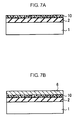
  • FIGS. 7A and 7B are cross-sectional views showing principal processes of the method of forming a seed layer and the method of forming a silicon-containing thin film, according to the third embodiment of the present invention.
  • FIG. 8 is a sectional view schematically showing an example of a film formation apparatus capable of implementing a silicon-containing thin film formation method according to the fourth embodiment of the present invention.
  • FIG. 1 is a flowchart describing an example of a method of forming a seed layer and a method of forming a silicon-containing thin film, according to a first embodiment of the present invention
  • FIGS. 2A through 2C are cross-sectional views showing principal processes of the method of forming a seed layer and the method of forming a silicon-containing thin film according to the first embodiment.
  • SiO 2 silicon oxide
  • An example of the method of forming a seed layer according to the first embodiment is as follows.
  • step 11 of FIG. 1 and in FIG. 2A by using an aminosilane-based gas, at least silicon* 1 included in the aminosilane-based gas is adsorbed to a silicon oxide film 2 formed on a silicon substrate 1 .
  • the silicon substrate 1 is heated, and the aminosilane-based gas flows onto a main surface of the silicon oxide film 2 as a raw material gas for forming a first seed layer.
  • a component including at least silicon, which is included in the aminosilane-based gas is adsorbed to the main surface of the silicon oxide film 2 , and a first seed layer 3 adsorbed at an atomic layer level, for example, a layer level of atoms (monatomic layer order), is formed.
  • the first seed layer 3 is a very thin layer.
  • FIG. 2A shows the first seed layer 3 , in which silicon atoms are adsorbed as grains.
  • the first seed layer 3 may be formed by, for example, an atomic layer deposition (ALD) method, in which a material of a thin film is stacked by a monatomic layer order.
  • ALD atomic layer deposition
  • aminosilane-based gas may be a gas including at least one of:
  • BTBAS Bis(tertiary-butylamino)silane
  • TDMAS tris(dimethylamino)silane
  • DIPAS diisopropyl aminosilane
  • DIPAS is used.
  • Processing temperature 400° C.
  • step 12 of FIG. 1 and FIG. 2B by using a silane-based gas having an order higher than disilane, at least silicon included in the higher-order silane-based gas having an order equal to or higher than disilane is deposited on the silicon oxide film 2 , on which the at least silicon* 1 included in the aminosilane-based gas is adsorbed, that is, the first seed layer 3 is formed.
  • the silicon substrate 1 is heated, and the higher-order silane-based gas, that is, having an order that is equal to or higher than disilane, is flown on the main surface of the silicon substrate 1 , on which the first seed layer 3 is formed, as a raw material gas for forming a second seed layer.
  • the second seed layer 4 may be formed on the first seed layer 3 while, for example, filling between grains of the first seed layer 3 , in a case where the first seed layer 3 is configured to include the grains.
  • the second seed layer 4 may be formed by using, for example, a chemical vapor deposition (CVD) method, in which a raw material of the thin film is deposited by a CVD reaction.
  • CVD chemical vapor deposition
  • An example of the higher-order silane-based gas having an order that is equal to or higher than disilane may include at least one of:
  • a silicon hydride expressed as Si m H 2m+2 , where m is a natural number that is greater than or equal to 3, and
  • n H 2n a silicon hydride expressed as Si n H 2n , where n is a natural number that is greater than or equal to 3.
  • the silicon hydride expressed as Si m H 2m+2 is selected from at least one of:
  • the silicon hydride expressed as Si n H 2n , where n is a natural number that is greater than or equal to 3, is selected from at least one of:
  • disilane is used as the higher-order silane-based gas having an order that is equal to or higher than disilane.
  • Examples of processing conditions when forming the second seed layer 4 are:
  • Processing temperature 400° C.
  • a dual seed layer 5 including the first seed layer 3 and the second seed layer 4 formed on the first seed layer 3 , is formed.
  • the dual seed layer 5 is in, for example, an amorphous state.
  • a thickness of the dual seed layer 5 may be, for example, greater than 0 nm and equal to or less than 2 nm, in consideration of a film thickness including the thickness of the dual seed layer 5 and a thickness of the main film of the thin film.
  • the second seed layer 4 in the dual seed layer 5 may be doped with a dopant.
  • a gas containing the dopant may be supplied with the higher-order silane-based gas having an order that is equal to or higher than disilane.
  • Examples of the dopant may be:
  • the above dopants may be mixed. That is, the gas including at least one dopant selected from the above six kinds of dopants may be supplied with the higher-order silane-based gas having an order that is equal to or higher than disilane to form the second seed layer 4 .
  • the silicon included in the higher-order silane-based gas having an order that is equal to or higher than disilane is deposited on the silicon substrate 1 , on which at least the silicon included in the aminosilane-based gas is adsorbed, wherein the silicon included in the higher-order silane-based gas having an order that is equal to or higher than disilane contains at least one of the above six kinds of dopants.
  • a silicon-containing thin film 6 is formed on the silicon substrate 1 , on which the dual seed layer 5 is formed, as the main film of the thin film.
  • silicon-containing thin film 6 may be a silicon (Si) film or a silicon germanium (SiGe) film.
  • the silicon-containing thin film 6 may be formed as follows.
  • a lower-order silane-based gas having an order that is lower than the above higher-order silane-based gas having an order that is equal to or higher than disilane is used as a raw material gas for forming the silicon film.
  • a disilane gas is used to form the second seed layer 4
  • a monosilane gas may be used as the raw material gas for forming the silicon film.
  • Examples of processing conditions when the silicon-containing thin film 6 is the silicon film and the monosilane gas is used as the raw material gas are:
  • Processing pressure 53.3 Pa (0.4 Torr). Under the above processing conditions, a silicon film having a thickness of about 3 nm is formed as the main film of the thin film.
  • a lower-order silane-based gas having an order that is lower than the higher-order silane-based gas having an order that is equal to or higher than disilane and a monogermane (GeH 4 ) gas are used as a raw material gas of the silicon germanium film.
  • a monosilane gas and the monogermane gas may be used as the raw material gas of the silicon germanium film.
  • Examples of processing conditions when the silicon-containing thin film 6 is the silicon germanium film and the monosilane gas and the monogermane gas are used as the raw material gas are:
  • Processing temperature 400° C.
  • Processing pressure 533 Pa (4 Torr). Under the above processing conditions, a silicon germanium film having a thickness of about 4 nm is formed as the main film of the thin film.
  • the silicon-containing thin film 6 which is composed of the silicon film or the silicon germanium film is formed on the dual seed layer 5 .
  • the silicon-containing thin film 6 may be in one of:
  • the state of the silicon-containing thin film 6 after the film formation may be determined during the forming of the silicon-containing thin film 6 , or according to a process after the formation of the silicon-containing thin film 6 . For example, if the state is determined during the formation of the silicon-containing thin film 6 , the processing temperature, the processing pressure, and the flow of the raw material gas may be adjusted. In addition, if the state is determined after the formation of the silicon-containing thin film 6 , the silicon substrate 1 on which the silicon-containing thin film 6 is formed may be annealed. The state of the silicon-containing thin film 6 may be controlled to one of the above four states by adjusting a processing temperature, a processing pressure, and a processing time of the annealing.
  • the silicon-containing thin film 6 is a main film of the thin film.
  • the thickness of the thin film to be formed is almost dependent upon the thickness of the silicon-containing thin film 6 .
  • the thickness of the silicon-containing thin film 6 is determined according to demands of a user. However, in consideration of practical use, the thickness of the silicon-containing thin film 6 may be greater than 0 nm and equal to or less than 100 nm.
  • the silicon-containing thin film 6 may be doped with a dopant.
  • Examples of the dopant may be:
  • the above dopants may be mixed, like the dopant with which the second seed layer 4 is doped.
  • the dopant may be doped during the formation of the silicon-containing thin film 6 or after the formation of the silicon-containing thin film 6 . If the dopant is doped during the formation of the silicon-containing thin film 6 , in the process shown in step 1 of FIG. 1 and FIG. 2C , a gas containing the dopant may be supplied with, for example, the raw material gas. If the dopant is doped after the formation of the silicon-containing thin film 6 , the dopant may be diffused in the silicon-containing thin film 6 through a vapor deposition process.
  • FIG. 3 is a graph showing a relationship between film thickness and thickness uniformity.
  • FIG. 3 shows a relationship between the film thickness and the thickness uniformity of the silicon-containing thin film 6 formed on the dual seed layer 5 by using the monosilane gas (the embodiment), a silicon-containing thin film formed on a single seed layer that is formed by using an aminosilane-based gas by using a disilane gas (comparative example 1), and a silicon-containing thin film formed on a base (SiO 2 ) by using a disilane gas without forming a seed layer (comparative example 2).
  • the film thickness is a sum of the thickness of the seed layer and the thickness of the silicon-containing thin film, in a case where there is a seed layer.
  • the best thickness uniformity value is about ⁇ 2 to 4%.
  • the best thickness uniformity value is about ⁇ 1%.
  • an excellent thickness uniformity of about ⁇ 1% is also maintained when the film thickness is around 10 nm. That is, according to the embodiment of the present invention, the excellent thickness uniformity may be maintained even when the film thickness increases.
  • the thickness uniformity of the comparative example 1 is superior to that of the embodiment of the present invention when the thickness is less than 3.5 nm.
  • the thickness may be 3.5 nm or greater.
  • the silicon-containing thin film 6 (including the thickness of the dual seed layer 5 ) having a thickness less than 3.5 nm cannot be adopted. Even when the thickness uniformity is about ⁇ 4 to 15%, which satisfies the needs of a user, the silicon-containing thin film 6 having a thickness less than 3.5 nm may be used. Additionally, when the silicon-containing thin film 6 is formed to have a thickness of 3.5 nm or greater (including the thickness of the dual seed layer 5 ), the excellent thickness uniformity of about ⁇ 1% can be obtained.
  • the seed layer is the dual seed layer 5 , including the first seed layer 3 formed by using the aminosilane-based gas and the second seed layer 4 formed by using the higher-order silane-based gas having an order that is equal to or higher than disilane, and thus, the thickness uniformity of the thin film may be further improved.
  • FIG. 4 is a flowchart describing an example of a method of forming a seed layer and a method of forming a silicon-containing thin film according to a second embodiment of the present invention
  • FIGS. 5A through 5C are cross-sectional views showing principal processes of the method of forming a seed layer and the method of forming a silicon-containing thin film, according to the second embodiment.
  • the second embodiment is different from the first embodiment in that a multi-layered seed layer is formed by stacking a plurality of seed layers formed by using the aminosilane-based gas and seed layers formed by using the higher-order silane-based gas having an order that is equal to or higher than disilane, while the dual seed layer 5 is formed according to the first embodiment.
  • a third seed layer 7 is formed by re-adsorbing at least the silicon* 1 included in the aminosilane-based gas on a base, on which at least the silicon* 2 included in the higher-order silane-based gas having an order that is equal to or higher than the disilane is deposited, that is, on the second seed layer 4 .
  • the third seed layer 7 may be formed by using, for example, an ALD method, like the first seed layer 3 .
  • aminosilane-based gas used to form the third seed layer 7 is the same as the example of the aminosilane-based gas described in the above first embodiment.
  • the aminosilane-based gas used to form the first seed layer 3 may be used to form the third seed layer 7 , of course.
  • DIPAS used to form the first seed layer 3 is used.
  • processing conditions when forming the third seed layer 7 are:
  • Processing temperature 400° C.
  • a fourth seed layer 8 is formed by re-depositing at least the silicon* 2 included in the higher-order silane-based gas having an order that is equal to or higher than the disilane on the base, on which at least the silicon* 1 included in the aminosilane-based gas is re-adsorbed, that is, on the third seed layer 7 .
  • the fourth seed layer 8 may be formed by using, for example, the CVD method, like the second seed layer 4 .
  • An example of the higher-order silane-based gas having an order that is equal to or higher than disilane used to form the fourth seed layer 8 is the same as the example of the higher-order silane-based gas described in the above first embodiment.
  • the higher-order silane-based gas having an order that is equal to or higher than the disilane used to form the second seed layer 4 may be used to form the fourth seed layer 8 .
  • the disilane used to form the second seed layer 4 is used.
  • processing conditions when forming the fourth seed layer 8 are:
  • Processing temperature 400° C.
  • step 15 of FIG. 4 it is determined whether the number of stacked seed layers reaches a predetermined number. If the number of stacked seed layers has not reached the predetermined number (No), the process goes to step 13 , and then, operations of step 13 and step 14 are repeatedly performed. If the number of stacked seed layers has reached the predetermined number (Yes), the process goes to step 2 , and as shown in FIG. 5C , the silicon-containing thin film 6 is formed on the multi-layered seed layer 9 including at least four layers, that is, first through fourth seed layers 3 , 4 , 7 , and 8 .
  • the silicon-containing thin film 6 may be formed by the same method as that described in the first embodiment.
  • the seed layer may be the multi-layered seed layer 9 including at least four layers, that is, first through fourth seed layers 3 , 4 , 7 , and 8 . If the seed layer is formed as the multi-layered seed layer 9 , the same advantages as those of the first embodiment may be obtained.
  • third and fourth seed layers 7 and 8 may be modified like the first and second seed layers 3 and 4 described in the above first embodiment.
  • the fourth seed layer 8 like in the first embodiment may be doped with a dopant, and the multi-layered seed layer 9 may be in an amorphous state.
  • the silicon-containing thin film 6 may be modified as described in the first embodiment.
  • FIG. 6 is a flowchart describing an example of a method of forming a seed layer and a method of forming a silicon-containing thin film, according to a third embodiment of the present invention
  • FIGS. 7A and 7B are cross-sectional views showing principal processes of the method of forming a seed layer and the method of forming a silicon-containing thin film, according to the third embodiment.
  • the third embodiment of the present invention is different from the first embodiment in that a mixed seed layer is formed by using both of an aminosilane-based gas and a higher-order silane-based gas having an order that is equal to or higher than disilane, while the dual seed layer 5 is formed in the first embodiment.
  • a mixed seed layer 10 is formed on a base, that is, on the silicon oxide film 2 in the present embodiment, by using the aminosilane-based gas and the higher-order silane-based gas having an order that is equal to or higher than disilane.
  • the mixed seed layer 10 is formed by, for example, adsorbing at least the silicon* 1 included in the aminosilane-based gas on the base, that is, the silicon oxide film 2 in the present embodiment, and by filling sites, where the silicon* 1 is not adsorbed, with at least the silicon* 2 included in the higher-order silane-based gas and depositing the silicon* 2 .
  • Examples of processing conditions when forming the mixed seed layer 10 are:
  • Processing temperature 400° C.
  • the silicon-containing thin film 6 is formed on the mixed seed layer 10 .
  • the silicon-containing thin film 6 may be formed by the same method as that described in the first embodiment.
  • the seed layer may be the mixed seed layer 10 formed by using the aminosilane-based gas and the higher-order silane-based gas having an order that is equal to or higher than the disilane, for example, by flowing the gases at the same time. Even when the seed layer is the mixed seed layer 10 , the same advantages as those of the first embodiment may be obtained.
  • the silicon-containing thin film 6 may be modified as described in the first embodiment.
  • FIG. 8 is a sectional view schematically showing an example of a film formation apparatus for implementing a silicon-containing thin film formation method according to the fourth embodiment of the present invention.
  • a film formation apparatus 100 includes a processing chamber 101 having a shape of a bottom-open cylinder with a ceiling.
  • the entire processing chamber 101 is formed of quartz, for example.
  • a quartz ceiling plate 102 is provided on the ceiling of the processing chamber 101 .
  • a manifold 103 which is molded of a stainless steel, for example, and has a cylindrical shape, is connected to a bottom opening of the processing chamber 101 via a sealing member 104 , such as an O-ring.
  • the manifold 103 supports the bottom of the processing chamber 101 .
  • a quartz wafer boat 105 on which a plurality of, for example, 50 to 100, semiconductor substrates (the silicon substrates 1 in the present embodiment) as objects to be processed can be held in multiple layers, may be inserted from below the manifold 103 into the processing chamber 101 . Accordingly, an object to be processed, e.g., a semiconductor substrate (the silicon substrate 1 on which a SiO 2 film is deposited as a base in advance in the present embodiment), is housed in the processing chamber 101 .
  • the wafer boat 105 has a plurality of pillars 106 , so that a plurality of the silicon substrates 1 are supported by grooves formed on the pillars 106 .
  • the wafer boat 105 is disposed on a table 108 via a quartz thermos vessel 107 .
  • the table 108 is supported by a rotation shaft 110 , which penetrates, for example, a stainless steel cover unit 109 for opening and closing the bottom opening of the manifold 103 .
  • a magnetic fluid seal 111 for example, is provided on a portion of the rotation shaft 110 penetrating the cover unit 109 so as to tightly seal the rotation shaft 110 and to rotatably support the rotation shaft 110 .
  • a sealing member 112 e.g., an O-ring, is installed between the peripheral portion of the cover unit 109 and the bottom of the manifold 103 . Accordingly, sealing of the processing chamber 101 is held.
  • the rotation shaft 110 is attached to the leading end of an arm 113 supported by an elevating mechanism (not shown), such as a boat elevator, or the like. Therefore, the wafer boat 105 , the cover unit 109 , and the like are elevated together and are inserted to and pulled out from the processing chamber 101 .
  • an elevating mechanism such as a boat elevator, or the like. Therefore, the wafer boat 105 , the cover unit 109 , and the like are elevated together and are inserted to and pulled out from the processing chamber 101 .
  • the film formation apparatus 100 includes a process gas supply mechanism 114 , which supplies a gas for using in process into the processing chamber 101 .
  • the process gas supply mechanism 114 includes an aminosilane-based gas supply source 117 and a source 118 for supplying a higher-order silane-based gas having an order that is equal to or higher than disilane.
  • the source 118 for supplying a higher-order silane-based gas having an order that is equal to or higher than disilane is connected to a distribution nozzle 125 via a flow controller 121 b and an opening/closing valve 122 b .
  • the distribution nozzle 125 is a quartz pipe and penetrates a sidewall of the manifold 103 inwardly, is bent upward and vertically extends.
  • a plurality of gas ejecting holes 126 are formed apart from each other at intervals of a predetermined distance in the vertically extending portion of the distribution nozzle 125 .
  • the higher-order silane-based gas having an order that is equal to or higher than disilane is ejected from each of the gas ejecting holes 126 almost uniformly in a horizontal direction toward the interior of the processing chamber 101 .
  • An exhaust port 129 for evacuating the interior of the processing chamber 101 is provided on a portion of the processing chamber 101 , the portion opposite to the distribution nozzles 123 and 125 .
  • the exhaust port 129 is provided to be long and narrow by vertically cutting the sidewall of the processing chamber 101 .
  • An exhaust port cover member 130 having a U-shaped cross-section to cover the exhaust port 129 is weld-attached to a portion of the processing chamber 101 corresponding to the exhaust port 129 .
  • the exhaust port covering member 130 extends upward along the sidewall of the processing chamber 101 , so that a gas outlet 131 is defined on the top of the processing chamber 101 .
  • An exhauster 132 including a vacuum pump or the like is connected to the gas outlet 131 .
  • the exhauster 132 evacuates the interior of the processing chamber 101 to evacuate process gas used for a film formation process and to set the pressure inside the processing chamber 101 to a process pressure according to a process.
  • a barrel-shaped heating device 133 is disposed to surround the outer perimeter of the processing chamber 101 .
  • the heating device 133 activates gas supplied into the processing chamber 101 and heats objects to be processed housed in the processing chamber 101 , e.g., semiconductor substrates (the silicon substrates 1 in the present embodiment).
  • a controller 150 which includes, for example, a microprocessor (computer), controls each component of the film formation apparatus 100 .
  • a user interface 151 such as a keyboard by which an operator performs command input and the like to manage the film formation apparatus 100 , a display to visually display an operational status of the film formation apparatus 100 , or the like, is connected to the controller 150 .
  • a memory unit 152 is connected to the controller 150 .
  • the memory unit 152 contains a control program for accomplishing various processes executed in the film formation apparatus 100 under the control of the controller 150 , or a program, that is, a recipe, for instructing each component of the film formation apparatus 100 to execute a process according to process conditions.
  • the recipe is stored in a storage medium in the memory unit 152 , for example.
  • the storage medium may be a hard disk or a semiconductor memory, or may be a portable type medium such as a CD-ROM, a DVD, a flash memory, or the like.
  • the recipe may be suitably transmitted from another device, for example, via a dedicated line. If required, processes desired by the film formation apparatus 100 are performed under the control of the controller 150 by invoking a recipe from the memory unit 152 according to instructions or the like from the user interface 151 and performing a process based on the recipe in the controller 150 .
  • the film formation method according to the above embodiment may be performed by the film formation apparatus 100 as shown in FIG. 8 .
  • a film formation apparatus according to the present invention is not limited to a batch type film formation apparatus as shown in FIG. 8 , and a single wafer type film formation apparatus may also be utilized.
  • processing conditions are described in the above embodiments; however, the processing conditions are not limited to the above examples.
  • the silicon oxide film 2 is used as the base; however, the base is not limited to the silicon oxide film 2 .
  • the base may be a silicon nitride film, a polycrystalline silicon film, or the silicon substrate 1 .
  • a metal film, including an internal wiring layer such as tungsten or copper, may be used as the base.
  • a dielectric film having a relative dielectric constant that is higher than that of a silicon oxide film, for example, a tantalum oxide film used as a dielectric film of a capacitor may be used as the base.
  • aminosilane-based gas is not limited to the gases above, molecular formulas of which include one Si, but may be a gas, a molecular formula of which includes two Si, for example, hexakisethylaminodisilane (C 12 H 36 N 6 Si 2 ).
  • R1, R2, R3 CH 3 , C 2 H 5 , C 3 H 7 ,
  • n an integer ranging from 1 to 6
  • n an integer of 0, and 1 to 5.
  • R1, R2 CH 3 , C 2 H 5 , C 3 H 7
  • R1 R2, or may not be the same as each other.
  • n an integer ranging from 1 to 6
  • n an integer of 0, and 1 to 5.
  • the method of forming a seed layer for forming a thin film and the method of forming a silicon-containing thin film by using the seed layer, which are capable of further improving the thickness uniformity of the thin film, may be provided.

Landscapes

  • Chemical & Material Sciences (AREA)
  • Engineering & Computer Science (AREA)
  • Materials Engineering (AREA)
  • Organic Chemistry (AREA)
  • Metallurgy (AREA)
  • Chemical Kinetics & Catalysis (AREA)
  • General Chemical & Material Sciences (AREA)
  • Mechanical Engineering (AREA)
  • Crystallography & Structural Chemistry (AREA)
  • Condensed Matter Physics & Semiconductors (AREA)
  • Manufacturing & Machinery (AREA)
  • General Physics & Mathematics (AREA)
  • Physics & Mathematics (AREA)
  • Power Engineering (AREA)
  • Microelectronics & Electronic Packaging (AREA)
  • Computer Hardware Design (AREA)
  • Inorganic Chemistry (AREA)
  • Chemical Vapour Deposition (AREA)

Abstract

Provided is an apparatus for forming a silicon-containing thin film, the apparatus including a controller which is configured to control a process gas supplying mechanism, a heating device, and an exhauster to perform: forming a first seed layer on a base by adsorbing at least silicon included in an aminosilane-based gas on the base, using the aminosilane-based gas; forming a second seed layer on the first seed layer by depositing at least silicon included in a higher-order silane-based gas having an order that is equal to or higher than disilane, using the higher-order silane-based gas having an order that is equal to or higher than the disilane, wherein the first seed layer and the second seed layer form a dual seed layer; and forming the silicon-containing thin film on the dual seed layer.

Description

CROSS-REFERENCE TO RELATED PATENT APPLICATIONS
This application is a continuation in part of prior U.S. application Ser. No. 13/661,153, filed on Oct. 26, 2012, the entire contents of which are incorporated herein by reference, and this application claims the benefit of Japanese Patent Application No. 2011-237987, filed on Oct. 28, 2011, in the Japanese Patent Office, the disclosure of which is incorporated herein in its entirety by reference.
BACKGROUND OF THE INVENTION
1. Field of the Invention
The present invention relates to a method of forming a seed layer, a method of forming a silicon-containing thin film and an apparatus for forming a silicon-containing thin film.
2. Description of the Related Art
Recently, semiconductor integrated circuit devices have been miniaturized. Due to the miniaturization, various thin films used in a semiconductor integrated circuit device are required to be much thinner and to have much higher film quality.
For example, Patent Reference 1 discloses a film forming method for forming an amorphous silicon film by using a disilane gas.
One of the indexes for evaluating “quality of a film” is a uniformity of a film thickness within a wafer surface (thickness uniformity).
In Patent Reference 1, when forming an amorphous silicon film, a film forming temperature is set to be 530° C. or lower, and a flow rate of the disilane gas is set as 300 cc or higher per minute. Accordingly, an amorphous silicon film having excellent thickness uniformity is obtained.
For example, in Patent Reference 1, the flow rate of the disilane gas ranges from 1000 cc to 2000 cc, and the film forming temperature ranges from 450° C. to 475° C., and accordingly, the amorphous silicon film having the thickness uniformity of about ±3.0 to 7.0%, which is very excellent, has been obtained.
However, as miniaturization of the semiconductor integrated circuit devices has further proceeded, a thickness uniformity of the thin film needs to be further improved.
3. Prior Art Reference
  • (Patent Reference 1) Japanese Laid-open Patent Publication No. hei 7-86173
SUMMARY OF THE INVENTION
The present invention provides a method of forming a seed layer for forming a thin film, a method of forming a silicon-containing thin film using the seed layer and an apparatus for forming a silicon-containing thin film, which are capable of improving a thickness uniformity of a thin film.
According to an aspect of the present invention, there is provided an apparatus for forming a silicon-containing thin film, the apparatus comprising: a processing chamber in which a substrate having a base is disposed; a process gas supply mechanism which supplies gas used for a process into the processing chamber; a heating device which heats the substrate; an exhauster which evacuates the interior of the processing chamber; and a controller which is configured to control the process gas supplying mechanism, the heating device, and the exhauster to perform: forming a first seed layer on the base by adsorbing at least silicon included in an aminosilane-based gas on the base, using the aminosilane-based gas; forming a second seed layer on the first seed layer by depositing at least silicon included in a higher-order silane-based gas having an order that is equal to or higher than disilane, using the higher-order silane-based gas having an order that is equal to or higher than the disilane, wherein the first seed layer and the second seed layer form a dual seed layer; and forming the silicon-containing thin film on the dual seed layer.
According to another aspect of the present invention, there is provided an apparatus for forming a silicon-containing thin film, the apparatus comprising: a processing chamber in which a substrate having a base is disposed; a process gas supply mechanism which supplies gas used for a process into the processing chamber; a heating device which heats the substrate; an exhauster which evacuates the interior of the processing chamber; and a controller which is configured to control the process gas supplying mechanism, the heating device, and the exhauster to perform: forming a mixed seed layer on the base, using both of an aminosilane-based gas and a higher-order silane-based gas having an order that is equal to or higher than the disilane, by adsorbing at least silicon included in the aminosilane-based gas on the base, filling sites, where at least the silicon included in the aminosilane-based gas is not adsorbed, with at least silicon included in the higher-order silane-based gas having an order that is equal to or higher than disilane, and depositing at least the silicon included in the higher-order silane-based gas having an order that is equal to or higher than the disilane on the base; and forming the silicon-containing thin film on the mixed seed layer.
Additional object and advantages of the invention will be set forth in the description which follows, and in part will be obvious from the description, or may be learned by practice of the invention.
The objects and advantages of the invention may be realized and obtained by means of the instrumentalities and combinations particularly pointed out hereinafter.
BRIEF DESCRIPTION OF THE DRAWINGS
The accompanying drawings, which are incorporated in and constitute a part of the specification, illustrate embodiments of the invention, and together with the general description given above and the detailed description of the embodiments given below, serve to explain the principles of the invention.
FIG. 1 is a flowchart describing an example of a method of forming a seed layer and a method of forming a silicon-containing thin film, according to an embodiment of the present invention;
FIGS. 2A through 2C are cross-sectional views showing principal processes of the method of forming a seed layer and the method of forming a silicon-containing thin film, according to the first embodiment of the present invention;
FIG. 3 is a graph showing film thickness versus thickness uniformity;
FIG. 4 is a flowchart describing a method of forming a seed layer and a method of forming a silicon-containing thin film, according to a second embodiment of the present invention;
FIGS. 5A through 5C are cross-sectional views showing principal processes of the method of forming a seed layer and the method of forming a silicon-containing thin film, according to the second embodiment of the present invention;
FIG. 6 is a flowchart describing a method of forming a seed layer and a method of forming a silicon-containing thin film, according to a third embodiment of the present invention;
FIGS. 7A and 7B are cross-sectional views showing principal processes of the method of forming a seed layer and the method of forming a silicon-containing thin film, according to the third embodiment of the present invention; and
FIG. 8 is a sectional view schematically showing an example of a film formation apparatus capable of implementing a silicon-containing thin film formation method according to the fourth embodiment of the present invention.
DETAILED DESCRIPTION OF THE INVENTION
An embodiment of the present invention achieved on the basis of the findings given above will now be described with reference to the accompanying drawings. In the following description, the constitute elements having substantially the same function and arrangement are denoted by the same reference numerals, and a repetitive description will be made only when necessary.
Hereinafter, the present invention will be described in detail by explaining exemplary embodiments of the invention with reference to the attached drawings. Like reference numerals in the drawings denote like elements.
First Embodiment
FIG. 1 is a flowchart describing an example of a method of forming a seed layer and a method of forming a silicon-containing thin film, according to a first embodiment of the present invention, and FIGS. 2A through 2C are cross-sectional views showing principal processes of the method of forming a seed layer and the method of forming a silicon-containing thin film according to the first embodiment.
As shown in step 1 of FIG. 1, a seed layer is formed on a base, in the present embodiment, on a silicon oxide (SiO2) film formed on a silicon substrate (silicon wafer=silicon single crystalline). An example of the method of forming a seed layer according to the first embodiment is as follows.
As shown in step 11 of FIG. 1 and in FIG. 2A, by using an aminosilane-based gas, at least silicon*1 included in the aminosilane-based gas is adsorbed to a silicon oxide film 2 formed on a silicon substrate 1. In more detail, the silicon substrate 1 is heated, and the aminosilane-based gas flows onto a main surface of the silicon oxide film 2 as a raw material gas for forming a first seed layer. Accordingly, a component including at least silicon, which is included in the aminosilane-based gas, is adsorbed to the main surface of the silicon oxide film 2, and a first seed layer 3 adsorbed at an atomic layer level, for example, a layer level of atoms (monatomic layer order), is formed. The first seed layer 3 is a very thin layer. FIG. 2A shows the first seed layer 3, in which silicon atoms are adsorbed as grains. The first seed layer 3 may be formed by, for example, an atomic layer deposition (ALD) method, in which a material of a thin film is stacked by a monatomic layer order.
An example of the aminosilane-based gas may be a gas including at least one of:
BAS (butylamino silane);
BTBAS (Bis(tertiary-butylamino)silane);
DMAS (dimethylaminosilane);
BDMAS (bis(dimethyl aminosilane));
TDMAS (tris(dimethylamino)silane);
DEAS (diethyl aminosilane);
BDEAS (bis(diethyl aminosilane));
DPAS (dipropyl aminosilane); and
DIPAS (diisopropyl aminosilane). In the present embodiment, DIPAS is used.
Examples of process conditions when forming the first seed layer 3 are as follows:
DIPAS flow: 200 sccm
Processing time: 1 min
Processing temperature: 400° C.
Processing pressure: 133.3 Pa (1 Torr).
Next, as shown in step 12 of FIG. 1 and FIG. 2B, by using a silane-based gas having an order higher than disilane, at least silicon included in the higher-order silane-based gas having an order equal to or higher than disilane is deposited on the silicon oxide film 2, on which the at least silicon*1 included in the aminosilane-based gas is adsorbed, that is, the first seed layer 3 is formed. In more detail, the silicon substrate 1 is heated, and the higher-order silane-based gas, that is, having an order that is equal to or higher than disilane, is flown on the main surface of the silicon substrate 1, on which the first seed layer 3 is formed, as a raw material gas for forming a second seed layer. Accordingly, at least silicon*2 included in the silane-based gas having an order that is equal to or higher than disilane is deposited on the first seed layer 3, thereby forming a second seed layer 4. The second seed layer 4 may be formed on the first seed layer 3 while, for example, filling between grains of the first seed layer 3, in a case where the first seed layer 3 is configured to include the grains. The second seed layer 4 may be formed by using, for example, a chemical vapor deposition (CVD) method, in which a raw material of the thin film is deposited by a CVD reaction.
An example of the higher-order silane-based gas having an order that is equal to or higher than disilane may include at least one of:
Si2H6,
a silicon hydride expressed as SimH2m+2, where m is a natural number that is greater than or equal to 3, and
a silicon hydride expressed as SinH2n, where n is a natural number that is greater than or equal to 3.
It is preferable that the silicon hydride expressed as SimH2m+2, where m is a natural number that is greater than or equal to 3, is selected from at least one of:
trisilane (Si3H8);
tetrasilane (Si4H10);
pentasilane (Si5H12);
hexasilane (Si6H14); and
heptasilane (Si7H16).
Also, it is preferable that the silicon hydride expressed as SinH2n, where n is a natural number that is greater than or equal to 3, is selected from at least one of:
cyclotrisilane (Si3H6);
cyclotetrasilane (Si4H8);
cyclopentasilane (Si5H10);
cyclohexasilane (Si6H12); and
cycloheptasilane (Si7H14).
In the present embodiment, disilane is used as the higher-order silane-based gas having an order that is equal to or higher than disilane.
Examples of processing conditions when forming the second seed layer 4 are:
Disilane flow: 200 sccm
Processing time: 4.3 min
Processing temperature: 400° C.
Processing pressure: 133.3 Pa (1 Torr).
As described above, according to the present embodiment, a dual seed layer 5, including the first seed layer 3 and the second seed layer 4 formed on the first seed layer 3, is formed. The dual seed layer 5 is in, for example, an amorphous state.
A main film of the thin film is formed on the dual seed layer 5. Thus, a thickness of the dual seed layer 5 may be, for example, greater than 0 nm and equal to or less than 2 nm, in consideration of a film thickness including the thickness of the dual seed layer 5 and a thickness of the main film of the thin film.
Also, the second seed layer 4 in the dual seed layer 5 may be doped with a dopant. When the second seed layer 4 is doped with the dopant, in the process shown in step 12 of FIG. 1 and FIG. 2B, a gas containing the dopant may be supplied with the higher-order silane-based gas having an order that is equal to or higher than disilane.
Examples of the dopant may be:
boron (B);
phosphor (P);
arsenic (As);
oxygen (O);
carbon (C); and
nitrogen (N).
The above dopants may be mixed. That is, the gas including at least one dopant selected from the above six kinds of dopants may be supplied with the higher-order silane-based gas having an order that is equal to or higher than disilane to form the second seed layer 4. In this case, at least the silicon included in the higher-order silane-based gas having an order that is equal to or higher than disilane is deposited on the silicon substrate 1, on which at least the silicon included in the aminosilane-based gas is adsorbed, wherein the silicon included in the higher-order silane-based gas having an order that is equal to or higher than disilane contains at least one of the above six kinds of dopants.
Next, as shown in step 2 of FIG. 1 and FIG. 2C, a silicon-containing thin film 6 is formed on the silicon substrate 1, on which the dual seed layer 5 is formed, as the main film of the thin film.
An example of the silicon-containing thin film 6 may be a silicon (Si) film or a silicon germanium (SiGe) film. The silicon-containing thin film 6 may be formed as follows.
(Example of Si Film)
In a case where the silicon-containing thin film 6 is the silicon film, a lower-order silane-based gas having an order that is lower than the above higher-order silane-based gas having an order that is equal to or higher than disilane is used as a raw material gas for forming the silicon film. For example, if a disilane gas is used to form the second seed layer 4, a monosilane gas may be used as the raw material gas for forming the silicon film.
Examples of processing conditions when the silicon-containing thin film 6 is the silicon film and the monosilane gas is used as the raw material gas are:
Monosilane flow: 200 sccm
Processing time: 3.8 min
Processing temperature: 490° C.
Processing pressure: 53.3 Pa (0.4 Torr). Under the above processing conditions, a silicon film having a thickness of about 3 nm is formed as the main film of the thin film.
(Example of Silicon Germanium Film)
In a case where the silicon-containing thin film 6 is the silicon germanium film, a lower-order silane-based gas having an order that is lower than the higher-order silane-based gas having an order that is equal to or higher than disilane and a monogermane (GeH4) gas are used as a raw material gas of the silicon germanium film. For example, if the disilane gas is used to form the second seed layer 4, a monosilane gas and the monogermane gas may be used as the raw material gas of the silicon germanium film.
Examples of processing conditions when the silicon-containing thin film 6 is the silicon germanium film and the monosilane gas and the monogermane gas are used as the raw material gas are:
Monosilane flow: 1200 sccm
Monogermane flow: 500 sccm
Processing time: 5 min
Processing temperature: 400° C.
Processing pressure: 533 Pa (4 Torr). Under the above processing conditions, a silicon germanium film having a thickness of about 4 nm is formed as the main film of the thin film.
As such, in the present embodiment, the silicon-containing thin film 6 which is composed of the silicon film or the silicon germanium film is formed on the dual seed layer 5.
The silicon-containing thin film 6 may be in one of:
an amorphous state;
a mixed state of an amorphous state and a nanocrystalline state;
a nanocrystalline state; and
a polycrystalline state after the film formation.
The state of the silicon-containing thin film 6 after the film formation may be determined during the forming of the silicon-containing thin film 6, or according to a process after the formation of the silicon-containing thin film 6. For example, if the state is determined during the formation of the silicon-containing thin film 6, the processing temperature, the processing pressure, and the flow of the raw material gas may be adjusted. In addition, if the state is determined after the formation of the silicon-containing thin film 6, the silicon substrate 1 on which the silicon-containing thin film 6 is formed may be annealed. The state of the silicon-containing thin film 6 may be controlled to one of the above four states by adjusting a processing temperature, a processing pressure, and a processing time of the annealing.
The silicon-containing thin film 6 is a main film of the thin film. Thus, the thickness of the thin film to be formed is almost dependent upon the thickness of the silicon-containing thin film 6. The thickness of the silicon-containing thin film 6 is determined according to demands of a user. However, in consideration of practical use, the thickness of the silicon-containing thin film 6 may be greater than 0 nm and equal to or less than 100 nm.
Also, like the second seed layer 4, the silicon-containing thin film 6 may be doped with a dopant.
Examples of the dopant may be:
boron (B);
phosphor (P);
arsenic (As);
oxygen (O);
carbon (C); and
nitrogen (N). In addition, the above dopants may be mixed, like the dopant with which the second seed layer 4 is doped.
Also, the dopant may be doped during the formation of the silicon-containing thin film 6 or after the formation of the silicon-containing thin film 6. If the dopant is doped during the formation of the silicon-containing thin film 6, in the process shown in step 1 of FIG. 1 and FIG. 2C, a gas containing the dopant may be supplied with, for example, the raw material gas. If the dopant is doped after the formation of the silicon-containing thin film 6, the dopant may be diffused in the silicon-containing thin film 6 through a vapor deposition process.
According to the method of forming a seed layer and the method of forming a silicon-containing thin film of the first embodiment, the following advantages may be obtained.
FIG. 3 is a graph showing a relationship between film thickness and thickness uniformity.
FIG. 3 shows a relationship between the film thickness and the thickness uniformity of the silicon-containing thin film 6 formed on the dual seed layer 5 by using the monosilane gas (the embodiment), a silicon-containing thin film formed on a single seed layer that is formed by using an aminosilane-based gas by using a disilane gas (comparative example 1), and a silicon-containing thin film formed on a base (SiO2) by using a disilane gas without forming a seed layer (comparative example 2). Also, the film thickness is a sum of the thickness of the seed layer and the thickness of the silicon-containing thin film, in a case where there is a seed layer.
As shown in FIG. 3, according to comparative examples 1 and 2, the best thickness uniformity value is about ±2 to 4%. On the other hand, according to the embodiment of the present invention, the best thickness uniformity value is about ±1%. Moreover, an excellent thickness uniformity of about ±1% is also maintained when the film thickness is around 10 nm. That is, according to the embodiment of the present invention, the excellent thickness uniformity may be maintained even when the film thickness increases.
Also, in a case where the film thickness is thin, the thickness uniformity of the comparative example 1 is superior to that of the embodiment of the present invention when the thickness is less than 3.5 nm. Thus, in order to obtain the excellent thickness uniformity of about ±1% in the silicon-containing thin film 6 formed on the dual seed layer 5 by using the monosilane gas, the thickness may be 3.5 nm or greater.
Also, it does not mean that the silicon-containing thin film 6 (including the thickness of the dual seed layer 5) having a thickness less than 3.5 nm cannot be adopted. Even when the thickness uniformity is about ±4 to 15%, which satisfies the needs of a user, the silicon-containing thin film 6 having a thickness less than 3.5 nm may be used. Additionally, when the silicon-containing thin film 6 is formed to have a thickness of 3.5 nm or greater (including the thickness of the dual seed layer 5), the excellent thickness uniformity of about ±1% can be obtained.
As described above, according to the method of forming a seed layer and the method of forming a silicon-containing thin film of the first embodiment of the present invention, the seed layer is the dual seed layer 5, including the first seed layer 3 formed by using the aminosilane-based gas and the second seed layer 4 formed by using the higher-order silane-based gas having an order that is equal to or higher than disilane, and thus, the thickness uniformity of the thin film may be further improved.
Second Embodiment
FIG. 4 is a flowchart describing an example of a method of forming a seed layer and a method of forming a silicon-containing thin film according to a second embodiment of the present invention, and FIGS. 5A through 5C are cross-sectional views showing principal processes of the method of forming a seed layer and the method of forming a silicon-containing thin film, according to the second embodiment.
The second embodiment is different from the first embodiment in that a multi-layered seed layer is formed by stacking a plurality of seed layers formed by using the aminosilane-based gas and seed layers formed by using the higher-order silane-based gas having an order that is equal to or higher than disilane, while the dual seed layer 5 is formed according to the first embodiment.
That is, as shown in step 13 of FIG. 4 and FIG. 5A, after performing the operation of step 12 described in the first embodiment, by using the aminosilane-based gas, a third seed layer 7 is formed by re-adsorbing at least the silicon*1 included in the aminosilane-based gas on a base, on which at least the silicon*2 included in the higher-order silane-based gas having an order that is equal to or higher than the disilane is deposited, that is, on the second seed layer 4. The third seed layer 7 may be formed by using, for example, an ALD method, like the first seed layer 3.
An example of the aminosilane-based gas used to form the third seed layer 7 is the same as the example of the aminosilane-based gas described in the above first embodiment. The aminosilane-based gas used to form the first seed layer 3 may be used to form the third seed layer 7, of course. In the present embodiment, DIPAS used to form the first seed layer 3 is used.
Examples of processing conditions when forming the third seed layer 7 are:
DIPAS flow: 200 sccm
Processing time: 10 sec
Processing temperature: 400° C.
Processing pressure: 133.3 Pa (1 Torr).
Next, as shown in step 14 of FIG. 4 and FIG. 5B, by using the higher-order silane-based gas having an order that is equal to or higher than the disilane, a fourth seed layer 8 is formed by re-depositing at least the silicon*2 included in the higher-order silane-based gas having an order that is equal to or higher than the disilane on the base, on which at least the silicon*1 included in the aminosilane-based gas is re-adsorbed, that is, on the third seed layer 7. The fourth seed layer 8 may be formed by using, for example, the CVD method, like the second seed layer 4.
An example of the higher-order silane-based gas having an order that is equal to or higher than disilane used to form the fourth seed layer 8 is the same as the example of the higher-order silane-based gas described in the above first embodiment. The higher-order silane-based gas having an order that is equal to or higher than the disilane used to form the second seed layer 4 may be used to form the fourth seed layer 8. In the present embodiment, the disilane used to form the second seed layer 4 is used.
Examples of processing conditions when forming the fourth seed layer 8 are:
Disilane flow: 200 sccm
Processing time: 1 min
Processing temperature: 400° C.
Processing pressure: 133.3 Pa (1 Torr).
Next, as shown in step 15 of FIG. 4, it is determined whether the number of stacked seed layers reaches a predetermined number. If the number of stacked seed layers has not reached the predetermined number (No), the process goes to step 13, and then, operations of step 13 and step 14 are repeatedly performed. If the number of stacked seed layers has reached the predetermined number (Yes), the process goes to step 2, and as shown in FIG. 5C, the silicon-containing thin film 6 is formed on the multi-layered seed layer 9 including at least four layers, that is, first through fourth seed layers 3, 4, 7, and 8. The silicon-containing thin film 6 may be formed by the same method as that described in the first embodiment.
As described above, the seed layer may be the multi-layered seed layer 9 including at least four layers, that is, first through fourth seed layers 3, 4, 7, and 8. If the seed layer is formed as the multi-layered seed layer 9, the same advantages as those of the first embodiment may be obtained.
Also, the third and fourth seed layers 7 and 8 may be modified like the first and second seed layers 3 and 4 described in the above first embodiment.
For example, the fourth seed layer 8 like in the first embodiment may be doped with a dopant, and the multi-layered seed layer 9 may be in an amorphous state.
Likewise, the silicon-containing thin film 6 may be modified as described in the first embodiment.
Third Embodiment
FIG. 6 is a flowchart describing an example of a method of forming a seed layer and a method of forming a silicon-containing thin film, according to a third embodiment of the present invention, and FIGS. 7A and 7B are cross-sectional views showing principal processes of the method of forming a seed layer and the method of forming a silicon-containing thin film, according to the third embodiment.
The third embodiment of the present invention is different from the first embodiment in that a mixed seed layer is formed by using both of an aminosilane-based gas and a higher-order silane-based gas having an order that is equal to or higher than disilane, while the dual seed layer 5 is formed in the first embodiment.
That is, as shown in step 16 of FIG. 6 and FIG. 7A, a mixed seed layer 10 is formed on a base, that is, on the silicon oxide film 2 in the present embodiment, by using the aminosilane-based gas and the higher-order silane-based gas having an order that is equal to or higher than disilane. The mixed seed layer 10 is formed by, for example, adsorbing at least the silicon*1 included in the aminosilane-based gas on the base, that is, the silicon oxide film 2 in the present embodiment, and by filling sites, where the silicon*1 is not adsorbed, with at least the silicon*2 included in the higher-order silane-based gas and depositing the silicon*2.
Examples of processing conditions when forming the mixed seed layer 10 are:
DIPAS flow: 200 sccm
Disilane flow: 200 sccm
Processing time: 15.4 min
Processing temperature: 400° C.
Processing pressure: 133.3 Pa (1 Torr).
Next, as shown in step 2 of FIG. 6 and FIG. 7B, the silicon-containing thin film 6 is formed on the mixed seed layer 10. The silicon-containing thin film 6 may be formed by the same method as that described in the first embodiment.
As described above, the seed layer may be the mixed seed layer 10 formed by using the aminosilane-based gas and the higher-order silane-based gas having an order that is equal to or higher than the disilane, for example, by flowing the gases at the same time. Even when the seed layer is the mixed seed layer 10, the same advantages as those of the first embodiment may be obtained.
Also, the silicon-containing thin film 6 may be modified as described in the first embodiment.
Fourth Embodiment
An example of film formation apparatuses for implementing the silicon-containing thin film formation method according to the above embodiments will be described.
FIG. 8 is a sectional view schematically showing an example of a film formation apparatus for implementing a silicon-containing thin film formation method according to the fourth embodiment of the present invention.
As shown in FIG. 8, a film formation apparatus 100 includes a processing chamber 101 having a shape of a bottom-open cylinder with a ceiling. The entire processing chamber 101 is formed of quartz, for example. A quartz ceiling plate 102 is provided on the ceiling of the processing chamber 101. A manifold 103, which is molded of a stainless steel, for example, and has a cylindrical shape, is connected to a bottom opening of the processing chamber 101 via a sealing member 104, such as an O-ring.
The manifold 103 supports the bottom of the processing chamber 101. A quartz wafer boat 105, on which a plurality of, for example, 50 to 100, semiconductor substrates (the silicon substrates 1 in the present embodiment) as objects to be processed can be held in multiple layers, may be inserted from below the manifold 103 into the processing chamber 101. Accordingly, an object to be processed, e.g., a semiconductor substrate (the silicon substrate 1 on which a SiO2 film is deposited as a base in advance in the present embodiment), is housed in the processing chamber 101. The wafer boat 105 has a plurality of pillars 106, so that a plurality of the silicon substrates 1 are supported by grooves formed on the pillars 106.
The wafer boat 105 is disposed on a table 108 via a quartz thermos vessel 107. The table 108 is supported by a rotation shaft 110, which penetrates, for example, a stainless steel cover unit 109 for opening and closing the bottom opening of the manifold 103. A magnetic fluid seal 111, for example, is provided on a portion of the rotation shaft 110 penetrating the cover unit 109 so as to tightly seal the rotation shaft 110 and to rotatably support the rotation shaft 110. A sealing member 112, e.g., an O-ring, is installed between the peripheral portion of the cover unit 109 and the bottom of the manifold 103. Accordingly, sealing of the processing chamber 101 is held. The rotation shaft 110 is attached to the leading end of an arm 113 supported by an elevating mechanism (not shown), such as a boat elevator, or the like. Therefore, the wafer boat 105, the cover unit 109, and the like are elevated together and are inserted to and pulled out from the processing chamber 101.
The film formation apparatus 100 includes a process gas supply mechanism 114, which supplies a gas for using in process into the processing chamber 101.
The process gas supply mechanism 114 includes an aminosilane-based gas supply source 117 and a source 118 for supplying a higher-order silane-based gas having an order that is equal to or higher than disilane.
The aminosilane-based gas supply source 117 is connected to a distribution nozzle 123 via a flow controller 121 a and an opening/closing valve 122 a. The distribution nozzle 123 is a quartz pipe and penetrates a sidewall of the manifold 103 inwardly, is bent upward and vertically extends. A plurality of gas ejecting holes 124 are formed apart from each other at intervals of a predetermined distance in the vertically extending portion of the distribution nozzle 123. The aminosilane-based gas is ejected from each of the gas ejecting holes 124 almost uniformly in a horizontal direction toward the interior of the processing chamber 101.
The source 118 for supplying a higher-order silane-based gas having an order that is equal to or higher than disilane is connected to a distribution nozzle 125 via a flow controller 121 b and an opening/closing valve 122 b. The distribution nozzle 125 is a quartz pipe and penetrates a sidewall of the manifold 103 inwardly, is bent upward and vertically extends. A plurality of gas ejecting holes 126 are formed apart from each other at intervals of a predetermined distance in the vertically extending portion of the distribution nozzle 125. The higher-order silane-based gas having an order that is equal to or higher than disilane is ejected from each of the gas ejecting holes 126 almost uniformly in a horizontal direction toward the interior of the processing chamber 101.
An exhaust port 129 for evacuating the interior of the processing chamber 101 is provided on a portion of the processing chamber 101, the portion opposite to the distribution nozzles 123 and 125. The exhaust port 129 is provided to be long and narrow by vertically cutting the sidewall of the processing chamber 101. An exhaust port cover member 130 having a U-shaped cross-section to cover the exhaust port 129 is weld-attached to a portion of the processing chamber 101 corresponding to the exhaust port 129. The exhaust port covering member 130 extends upward along the sidewall of the processing chamber 101, so that a gas outlet 131 is defined on the top of the processing chamber 101. An exhauster 132 including a vacuum pump or the like is connected to the gas outlet 131. The exhauster 132 evacuates the interior of the processing chamber 101 to evacuate process gas used for a film formation process and to set the pressure inside the processing chamber 101 to a process pressure according to a process.
A barrel-shaped heating device 133 is disposed to surround the outer perimeter of the processing chamber 101. The heating device 133 activates gas supplied into the processing chamber 101 and heats objects to be processed housed in the processing chamber 101, e.g., semiconductor substrates (the silicon substrates 1 in the present embodiment).
A controller 150, which includes, for example, a microprocessor (computer), controls each component of the film formation apparatus 100. A user interface 151, such as a keyboard by which an operator performs command input and the like to manage the film formation apparatus 100, a display to visually display an operational status of the film formation apparatus 100, or the like, is connected to the controller 150.
A memory unit 152 is connected to the controller 150. The memory unit 152 contains a control program for accomplishing various processes executed in the film formation apparatus 100 under the control of the controller 150, or a program, that is, a recipe, for instructing each component of the film formation apparatus 100 to execute a process according to process conditions. The recipe is stored in a storage medium in the memory unit 152, for example. The storage medium may be a hard disk or a semiconductor memory, or may be a portable type medium such as a CD-ROM, a DVD, a flash memory, or the like. Alternatively, the recipe may be suitably transmitted from another device, for example, via a dedicated line. If required, processes desired by the film formation apparatus 100 are performed under the control of the controller 150 by invoking a recipe from the memory unit 152 according to instructions or the like from the user interface 151 and performing a process based on the recipe in the controller 150.
In the present embodiment, processes of the film formation method according to the above embodiment are sequentially performed under the control of the controller 150.
The film formation method according to the above embodiment may be performed by the film formation apparatus 100 as shown in FIG. 8. However, a film formation apparatus according to the present invention is not limited to a batch type film formation apparatus as shown in FIG. 8, and a single wafer type film formation apparatus may also be utilized.
While this invention has been particularly shown and described with reference to exemplary embodiments thereof, it will be understood by those skilled in the art that various changes in form and details may be made therein without departing from the spirit and scope of the invention as defined by the appended claims.
For example, detailed examples of the processing conditions are described in the above embodiments; however, the processing conditions are not limited to the above examples.
Also, the silicon oxide film 2 is used as the base; however, the base is not limited to the silicon oxide film 2. For example, the base may be a silicon nitride film, a polycrystalline silicon film, or the silicon substrate 1. In addition, a metal film, including an internal wiring layer such as tungsten or copper, may be used as the base. Moreover, a dielectric film having a relative dielectric constant that is higher than that of a silicon oxide film, for example, a tantalum oxide film used as a dielectric film of a capacitor may be used as the base.
Also, the aminosilane-based gas is not limited to the gases above, molecular formulas of which include one Si, but may be a gas, a molecular formula of which includes two Si, for example, hexakisethylaminodisilane (C12H36N6Si2).
Also, besides the hexakisethylaminodisilane, materials expressed as the following formulas (1) through (4) may be used.
((R1R2)N)nSi2H6-n-m(R3)m . . . n:the number of amino groups,m:the number of alkyl groups  (1)
((R1)NH)nSi2H6-n-m(R3)m . . . n:the number of amino groups,m:the number of alkyl groups  (2)
In formulas (1) and (2),
R1, R2, R3=CH3, C2H5, C3H7,
R1=R2=R3, or may not be the same as each other.
n=an integer ranging from 1 to 6
m=an integer of 0, and 1 to 5.
((R1R2)N)nSi2H6-n-m(Cl)m . . . n:the number of amino groups,m:the number of chlorine  (3)
((R1)NH)nSi2H6-n-m(Cl)m . . . n:the number of amino groups,m:the number of chlorine  (4)
where in formulas (3) and (4),
R1, R2=CH3, C2H5, C3H7
R1=R2, or may not be the same as each other.
n=an integer ranging from 1 to 6
m=an integer of 0, and 1 to 5.
Otherwise, the present invention may be modified variously within a scope of the invention.
According to the present invention, the method of forming a seed layer for forming a thin film and the method of forming a silicon-containing thin film by using the seed layer, which are capable of further improving the thickness uniformity of the thin film, may be provided.

Claims (21)

What is claimed is:
1. An apparatus for forming a silicon-containing thin film, the apparatus comprising:
a processing chamber in which a substrate having a base is disposed;
a process gas supply mechanism which supplies gas used for a process into the processing chamber;
a heating device which heats the substrate;
an exhauster which evacuates the interior of the processing chamber; and
a controller which is configured to control the process gas supplying mechanism, the heating device, and the exhauster to perform:
forming a first seed layer on the base by adsorbing at least silicon included in an aminosilane-based gas on the base, using the aminosilane-based gas;
forming a second seed layer on the first seed layer by depositing at least silicon included in a higher-order silane-based gas having an order that is equal to or higher than disilane, using the higher-order silane-based gas having an order that is equal to or higher than the disilane, wherein the first seed layer and the second seed layer form a dual seed layer; and
forming the silicon-containing thin film on the dual seed layer.
2. The apparatus of claim 1, wherein the controller is configured to perform the adsorption of the silicon in the forming of the first seed layer by adsorbing silicon having a monatomic layer order by using an atomic layer deposition (ALD) method, and the deposition of the silicon in the forming of the second seed layer by using a chemical vapor deposition (CVD) method that silicon is deposited due to CVD reaction.
3. The apparatus of claim 1, wherein the controller is configured to perform, after the forming of the second seed layer and before the forming of the silicon-containing thin film:
forming the third seed layer by re-adsorbing at least the silicon included in the aminosilane-based gas on the base, on which at least the silicon included in the higher-order silane-based gas having an order that is equal to or higher than the disilane is deposited, using the aminosilane-based gas; and
forming the fourth seed layer by re-depositing at least the silicon included in the higher-order silane-based gas having an order that is equal to or higher than the disilane on the base, on which at least the silicon included in the aminosilane-based gas is re-adsorbed, using the higher-order silane-based gas having an order that is equal to or higher than the disilane,
wherein the forming of the third seed layer and the forming of the fourth seed layer are performed once or more, and the first seed layer, the second seed layer, one or more third seed layers and one or more fourth seed layers form a multi-layered seed layer.
4. The apparatus of claim 3, wherein the controller is configured to perform, in the forming of the third seed layer, the adsorption of the silicon by adsorbing the silicon having the monatomic layer order using the atomic layer deposition (ALD) method, and in the forming of the fourth seed layer, the deposition of the silicon by using the chemical vapor deposition (CVD) method that silicon is deposited due to CVD reaction.
5. The apparatus of claim 3, wherein the controller is configured to control the process gas supply mechanism to supply, in the forming of the fourth seed layer, a gas including at least one dopant selected from boron (B), phosphor (P), arsenic (As), oxygen (O), carbon (C), and nitrogen (N) with the higher-order silane-based gas having an order that is equal to or higher than the disilane such that at least the silicon included in the higher-order silane-based gas having an order that is equal to or higher than the disilane is deposited on the base, on which at least the silicon included in the aminosilane-based gas is adsorbed, while including the dopant on the base.
6. The apparatus of claim 1, wherein the controller is configured to control the process gas supply mechanism to supply, in the forming the second seed layer, a gas including at least one dopant selected from boron (B), phosphor (P), arsenic (As), oxygen (O), carbon (C), and nitrogen (N) with the higher-order silane-based gas having an order that is equal to or higher than the disilane such that at least the silicon included in the higher-order silane-based gas having an order that is equal to or higher than the disilane is deposited on the base, on which at least the silicon included in the aminosilane-based gas is adsorbed, while including the dopant on the base.
7. The apparatus of claim 1, wherein the aminosilane-based gas is selected from gases including at least one of:
BAS (butylamino silane);
BTBAS (Bis(tertiary-butylamino)silane);
DMAS (dimethylaminosilane);
BDMAS (bis(dimethyl aminosilane));
TDMAS (tris(dimethylamino)silane);
DEAS (diethyl aminosilane);
BDEAS (bis(diethyl aminosilane));
DPAS (dipropyl aminosilane);
DIPAS (diisopropyl aminosilane);
hexakisethylaminodisilane;

((R1R2)N)nSi2H6-n-m(R3)m;  (1)

((R1)NH)nSi2H6-n-m(R3)m;  (2)

((R1R2)N)nSi2H6-n-m(Cl)m; and  (3)

((R1)NH)nSi2H6-n-m(Cl)m,  (4)
wherein, in formulas (1) and (2), n: the number of amino groups m: the number of alkyl groups, in formulas (3) and (4), n: the number of amino groups m: the number of chlorine, and in formulas (1) through (4), n=an integer ranging from 1 to 6, m=an integer of 0, and 1 to 5, R1, R2, R3=CH3, C2H5, C3H7, and R1=R2=R3 or may not be the same.
8. The apparatus of claim 1, wherein the higher-order silane-based gas having an order that is equal to or higher than the disilane is selected from gases including at least one of:
Si2H6,
a silicon hydride expressed as SimH2m+2, wherein m is a natural number that is greater than or equal to 3, and
a silicon hydride expressed as SinH2n, wherein n is a natural number that is greater than or equal to 3.
9. The apparatus of claim 8, wherein the silicon hydride expressed as SimH2m+2, wherein m is a natural number that is greater than or equal to 3, is selected from at least one of:
trisilane (Si3H8);
tetrasilane (Si4H10);
pentasilane (Si5H12);
hexasilane (Si6H14); and
heptasilane (Si7H16), and
the silicon hydride expressed as SinH2n, wherein n is a natural number that is greater than or equal to 3, is selected from at least one of:
cyclotrisilane (Si3H6);
cyclotetrasilane (Si4H8);
cyclopentasilane (Si5H10);
cyclohexasilane (Si6H12); and
cycloheptasilane (Si7H14).
10. The apparatus of claim 1, wherein the controller is configured such that a thickness of the dual seed layer is greater than 0 nm and equal to or less than 2 nm.
11. The apparatus of claim 1, wherein the controller is configured such that the dual seed layer is an amorphous layer.
12. The apparatus of claim 1, wherein the controller is configured to control the process gas supplying mechanism to supply a lower-order silane-based gas having an order that is lower than the higher-order silane-based gas having an order that is equal to or higher than the disilane as a raw material gas of the silicon film when the silicon-containing thin film is a silicon film.
13. The apparatus of claim 12, wherein the controller is configured to control the process gas supplying mechanism to supply a monosilane gas as the raw material gas of the silicon film if the higher-order silane-based gas having an order that is equal to or higher than the disilane is a disilane gas.
14. The apparatus of claim 1, wherein the controller is configured to control the process gas supplying mechanism to supply a lower-order silane-based gas having an order that is lower than the higher-order silane-based gas having an order that is equal to or higher than disilane and a monogermane gas as raw material gases of the silicon germanium film when the silicon-containing thin film is a silicon germanium film.
15. The apparatus of claim 14, wherein the controller is configured to control the process gas supplying mechanism to supply a monosilane gas and the monogermane gas as the raw material gases of the silicon germanium film if the higher-order silane-based gas having an order that is equal to or higher than the disilane is a disilane gas.
16. The apparatus of claim 1, wherein the controller is configured such that the silicon-containing thin film is doped with a dopant that is selected from boron (B), phosphor (P), arsenic (As), oxygen (O), carbon (C); and nitrogen (N).
17. The apparatus of claim 16, wherein the controller is configured such that the dopant is doped during the forming of the silicon-containing thin film, or after forming the silicon-containing thin film.
18. The apparatus of claim 1, wherein the controller is configured such that the silicon-containing thin film after the forming of the silicon-containing thin film is in one of an amorphous state, a mixed state of an amorphous state and a nanocrystalline state, a nanocrystalline state, and a polycrystalline state.
19. The apparatus of claim 18, wherein the state of the silicon-containing thin film after the forming of the silicon-containing thin film is determined during the formation of the silicon-containing thin film, or determined according to a process performed after the formation of the silicon-containing thin film.
20. The apparatus of claim 1, wherein the controller is configured such that a thickness of the silicon-containing thin film is greater than 0 nm and equal to or less than 100 nm.
21. An apparatus for forming a silicon-containing thin film, the apparatus comprising:
a processing chamber in which a substrate having a base is disposed;
a process gas supply mechanism which supplies gas used for a process into the processing chamber;
a heating device which heats the substrate;
an exhauster which evacuates the interior of the processing chamber; and
a controller which is configured to control the process gas supplying mechanism, the heating device, and the exhauster to perform:
forming a mixed seed layer on the base, using both of an aminosilane-based gas and a higher-order silane-based gas having an order that is equal to or higher than the disilane, by
adsorbing at least silicon included in the aminosilane-based gas on the base,
filling sites, where at least the silicon included in the aminosilane-based gas is not adsorbed, with at least silicon included in the higher-order silane-based gas having an order that is equal to or higher than disilane, and
depositing at least the silicon included in the higher-order silane-based gas having an order that is equal to or higher than the disilane on the base; and
forming the silicon-containing thin film on the mixed seed layer.
US14/576,410 2011-10-28 2014-12-19 Apparatus for forming silicon-containing thin film Active 2032-12-26 US9353442B2 (en)

Priority Applications (1)

Application Number Priority Date Filing Date Title
US14/576,410 US9353442B2 (en) 2011-10-28 2014-12-19 Apparatus for forming silicon-containing thin film

Applications Claiming Priority (4)

Application Number Priority Date Filing Date Title
JP2011-237987 2011-10-28
JP2011237987A JP5793398B2 (en) 2011-10-28 2011-10-28 Method for forming seed layer and method for forming silicon-containing thin film
US13/661,153 US8946065B2 (en) 2011-10-28 2012-10-26 Method of forming seed layer and method of forming silicon-containing thin film
US14/576,410 US9353442B2 (en) 2011-10-28 2014-12-19 Apparatus for forming silicon-containing thin film

Related Parent Applications (1)

Application Number Title Priority Date Filing Date
US13/661,153 Continuation-In-Part US8946065B2 (en) 2011-10-28 2012-10-26 Method of forming seed layer and method of forming silicon-containing thin film

Publications (2)

Publication Number Publication Date
US20150101532A1 US20150101532A1 (en) 2015-04-16
US9353442B2 true US9353442B2 (en) 2016-05-31

Family

ID=52808555

Family Applications (1)

Application Number Title Priority Date Filing Date
US14/576,410 Active 2032-12-26 US9353442B2 (en) 2011-10-28 2014-12-19 Apparatus for forming silicon-containing thin film

Country Status (1)

Country Link
US (1) US9353442B2 (en)

Families Citing this family (5)

* Cited by examiner, † Cited by third party
Publication number Priority date Publication date Assignee Title
JP5947710B2 (en) * 2012-12-27 2016-07-06 東京エレクトロン株式会社 Seed layer forming method, silicon film forming method and film forming apparatus
JP5925673B2 (en) * 2012-12-27 2016-05-25 東京エレクトロン株式会社 Silicon film forming method and film forming apparatus
JP6082712B2 (en) * 2013-07-31 2017-02-15 東京エレクトロン株式会社 Silicon film forming method and thin film forming method
JP6456185B2 (en) * 2015-02-26 2019-01-23 東京エレクトロン株式会社 Method for forming silicon-containing film
JP6902958B2 (en) * 2017-08-02 2021-07-14 東京エレクトロン株式会社 Silicon film forming method and forming device

Citations (6)

* Cited by examiner, † Cited by third party
Publication number Priority date Publication date Assignee Title
JPH0786173A (en) 1993-09-16 1995-03-31 Tokyo Electron Ltd Deposition method
JP2011249764A (en) 2010-04-27 2011-12-08 Tokyo Electron Ltd Method and device for forming amorphous silicon film
US20110312192A1 (en) 2010-06-22 2011-12-22 Tokyo Electron Limited Film formation method and film formation apparatus
JP2012004542A (en) 2010-05-20 2012-01-05 Tokyo Electron Ltd Method and apparatus for forming silicon film
JP2012049509A (en) 2010-07-29 2012-03-08 Tokyo Electron Ltd Method for filling trench and film-deposition system
US20130084693A1 (en) 2011-09-30 2013-04-04 Tokyo Electron Limited Thin film forming method and film forming apparatus

Patent Citations (6)

* Cited by examiner, † Cited by third party
Publication number Priority date Publication date Assignee Title
JPH0786173A (en) 1993-09-16 1995-03-31 Tokyo Electron Ltd Deposition method
JP2011249764A (en) 2010-04-27 2011-12-08 Tokyo Electron Ltd Method and device for forming amorphous silicon film
JP2012004542A (en) 2010-05-20 2012-01-05 Tokyo Electron Ltd Method and apparatus for forming silicon film
US20110312192A1 (en) 2010-06-22 2011-12-22 Tokyo Electron Limited Film formation method and film formation apparatus
JP2012049509A (en) 2010-07-29 2012-03-08 Tokyo Electron Ltd Method for filling trench and film-deposition system
US20130084693A1 (en) 2011-09-30 2013-04-04 Tokyo Electron Limited Thin film forming method and film forming apparatus

Also Published As

Publication number Publication date
US20150101532A1 (en) 2015-04-16

Similar Documents

Publication Publication Date Title
US9006021B2 (en) Amorphous silicon film formation method and amorphous silicon film formation apparatus
US8753984B2 (en) Method and apparatus for forming silicon nitride film
KR101611680B1 (en) Method of manufacturing semiconductor device, substrate processing apparatus, and recording medium
KR101813312B1 (en) Silicon film forming method, thin film forming method and cross-sectional shape control method
KR101682747B1 (en) Seed layer forming method, silicon film forming method and film forming apparatus
US9607827B2 (en) Method of manufacturing semiconductor device, and recording medium
US9786570B2 (en) Methods for depositing films on sensitive substrates
KR101527465B1 (en) Method of manufacturing semiconductor device, substrate processing apparatus and non-transitory computer-readable recording medium
US20110312192A1 (en) Film formation method and film formation apparatus
US20120103518A1 (en) Film formation apparatus
US20140199839A1 (en) Film-forming method for forming silicon oxide film on tungsten film or tungsten oxide film
US20160329206A1 (en) Methods of modulating residual stress in thin films
KR101822238B1 (en) Method of manufacturing semiconductor device, substrate processing apparatus, gas supply system, program, three-dimensional flash memory, dynamic random access memory, and semiconductor device
JP2020155452A (en) Semiconductor device manufacturing methods, substrate processing devices, and programs
US9353442B2 (en) Apparatus for forming silicon-containing thin film
US9293323B2 (en) Method of forming silicon film
KR20130047580A (en) Formation method of seed layer and film formation method of a silicon containing thin film
KR20170091049A (en) Method of manufacturing semiconductor device, substrate processing apparatus, gas supply system and program
JP5792101B2 (en) Method for forming laminated semiconductor film
KR20250107950A (en) Processing method, production method for semiconductor device, processing apparatus, and program
JP6175541B2 (en) Seed layer forming method, silicon film forming method and film forming apparatus
US9460913B2 (en) Film-forming method for forming silicon oxide film on tungsten film or tungsten oxide film
US9466476B2 (en) Film-forming method for forming silicon oxide film on tungsten film or tungsten oxide film

Legal Events

Date Code Title Description
AS Assignment

Owner name: TOKYO ELECTRON LIMITED, JAPAN

Free format text: ASSIGNMENT OF ASSIGNORS INTEREST;ASSIGNORS:OKADA, MITSUHIRO;KAKIMOTO, AKINOBU;HASEBE, KAZUHIDE;SIGNING DATES FROM 20141212 TO 20141218;REEL/FRAME:034577/0577

STCF Information on status: patent grant

Free format text: PATENTED CASE

MAFP Maintenance fee payment

Free format text: PAYMENT OF MAINTENANCE FEE, 4TH YEAR, LARGE ENTITY (ORIGINAL EVENT CODE: M1551); ENTITY STATUS OF PATENT OWNER: LARGE ENTITY

Year of fee payment: 4

MAFP Maintenance fee payment

Free format text: PAYMENT OF MAINTENANCE FEE, 8TH YEAR, LARGE ENTITY (ORIGINAL EVENT CODE: M1552); ENTITY STATUS OF PATENT OWNER: LARGE ENTITY

Year of fee payment: 8