US9342738B2 - Image processing to improve physique of imaged subject - Google Patents
Image processing to improve physique of imaged subject Download PDFInfo
- Publication number
- US9342738B2 US9342738B2 US14/575,073 US201414575073A US9342738B2 US 9342738 B2 US9342738 B2 US 9342738B2 US 201414575073 A US201414575073 A US 201414575073A US 9342738 B2 US9342738 B2 US 9342738B2
- Authority
- US
- United States
- Prior art keywords
- region
- subject
- regions
- control unit
- torso
- Prior art date
- Legal status (The legal status is an assumption and is not a legal conclusion. Google has not performed a legal analysis and makes no representation as to the accuracy of the status listed.)
- Expired - Fee Related
Links
Images



Classifications
-
- G06K9/00362—
-
- G—PHYSICS
- G06—COMPUTING OR CALCULATING; COUNTING
- G06T—IMAGE DATA PROCESSING OR GENERATION, IN GENERAL
- G06T11/00—2D [Two Dimensional] image generation
-
- G06K9/52—
-
- G—PHYSICS
- G06—COMPUTING OR CALCULATING; COUNTING
- G06V—IMAGE OR VIDEO RECOGNITION OR UNDERSTANDING
- G06V10/00—Arrangements for image or video recognition or understanding
- G06V10/40—Extraction of image or video features
- G06V10/42—Global feature extraction by analysis of the whole pattern, e.g. using frequency domain transformations or autocorrelation
-
- G—PHYSICS
- G06—COMPUTING OR CALCULATING; COUNTING
- G06V—IMAGE OR VIDEO RECOGNITION OR UNDERSTANDING
- G06V40/00—Recognition of biometric, human-related or animal-related patterns in image or video data
- G06V40/10—Human or animal bodies, e.g. vehicle occupants or pedestrians; Body parts, e.g. hands
-
- G—PHYSICS
- G06—COMPUTING OR CALCULATING; COUNTING
- G06T—IMAGE DATA PROCESSING OR GENERATION, IN GENERAL
- G06T2210/00—Indexing scheme for image generation or computer graphics
- G06T2210/16—Cloth
Definitions
- the present invention relates to an image processing device, a method of processing an image, and a program.
- Patent Document 1 discloses a technique in which the degree of shine on a face in a photographed image is detected and corrected, for example.
- Patent Document 1 Japanese Patent Application Laid-Open Publication No. 2011-44132.
- the physique of the subject in the photographed image was unchanged, despite the face being corrected, which made it impossible to achieve an image showing an ideal physique of the subject, such as the physique of a model, for example.
- An aim of the present invention is to be able to provide an image in which the physique of the subject in the photographed image is an ideal physique.
- the present disclosure provides an image processing device, including a control unit configured to: receive a photographed image; divide a subject in the photographed image into a plurality of regions; correct a size of each of the divided regions such that a ratio of vertical width to horizontal width in each of the regions and ratios of areas between the divided regions respectively match corresponding prescribed target ratios; and connect the divided regions, the sizes of which have been corrected.
- the present disclosure provides a method of processing an image, including: dividing a subject in a photographed image into a plurality of regions; correcting a size of each of the divided regions such that a ratio of vertical width to horizontal width in each of the regions and ratios of areas between the divided regions respectively match corresponding prescribed target ratios; and connecting the corrected regions, the sizes of which have been corrected.
- the present disclosure provides a non-transitory storage medium that stores instructions executable by a computer, the instructions causing the computer to perform the following: divide a subject in a photographed image into a plurality of regions; correct a size of each of the divided regions such that a ratio of vertical width to horizontal width in each of the regions and ratios of areas between the divided regions respectively match corresponding prescribed target ratios; and connect the corrected regions, the sizes of which have been corrected.
- the present invention makes it possible to provide an image in which the physique of the subject in the photographed image has become an ideal physique.
- FIG. 1 is a view of the entire configuration of an imaging device in the present embodiment.
- FIG. 2A is a view of data storage rows in the target ratio storage unit in FIG. 1 .
- FIG. 2B is a view of data storage rows in the target ratio storage unit in FIG. 1 .
- FIG. 3 is a flow chart of a region-optimized image generation process executed by the control unit in FIG. 1 .
- FIG. 4 is a flow chart of a region division process executed in step S 2 in FIG. 3 .
- FIG. 5 is a view of threshold ranges of the bottom of the face region, the upper body region, the lower body region, and the boundaries of the upper body region and the lower body region.
- FIG. 6 is a flow chart of the region optimization process executed in step S 3 in FIG. 3 .
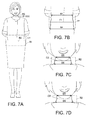
- FIG. 7A is a view for explaining the connecting of the regions.
- FIG. 7B is a view for explaining the connecting of the regions.
- FIG. 7C is a view for explaining the connecting of the regions.
- FIG. 7D is a view for explaining the connecting of the regions.
- FIG. 8 is one example of an image in which the respective regions of the subject have been optimized.
- FIG. 1 is a block view of the primary control configuration of an imaging device 1 , which is an image processing device of the present embodiment.
- the imaging device 1 includes a control unit 11 , an operation unit 12 , a display unit 13 , an image-capture unit 14 , a storage unit 15 , a communication unit 16 , and the like.
- the operation unit 12 , the display unit 13 , the image-capture unit 14 , the storage unit 15 , and the communication unit 16 are connected to the control unit 11 .
- the control unit 11 has a CPU (central processing unit) that runs various types of programs stored in the storage unit 15 for controlling prescribed computations and units, and a memory that serves as the work area when the programs are being run (neither is shown).
- the control unit 11 functions as a region dividing unit, a correcting unit, a connecting unit, a processing level calculation unit, a compositing unit, and an interpolating unit, in cooperation with programs stored in a program storage unit 151 of the storage unit 15 .
- the operation unit 12 is constituted of a power source, shutter key, various types of function keys, various types of mode keys, and the like, and outputs operational signals corresponding to respective operation of the keys to the control unit 11 .
- the respective mode keys include a model mode key for instructing a transition to model mode, in which the region-optimized image generation process is executed, as described later.
- the model mode is a mode for correcting the respective regions of the subject in the photographed image to achieve an ideal physique, such as that of a model.
- the display unit 13 is constituted of a display panel such as a liquid crystal display panel or an EL display panel and displays various types of screens such as live-view screens for displaying operating screens and images that are being photographed.
- the display unit 13 displays these screens in accordance with instructions from the control unit 11 .
- the image-capture unit 14 is an imaging device constituted of an optical lens unit, an image sensor or the like such as a CCD (charge coupled device) or CMOS (complementary metal-oxide semiconductor), an A/D converter circuit substrate, and the like.
- the image-capture unit converts optical images that have passed through the optical system into two-dimensional image signals in order to obtain image data from a photographic image.
- the storage unit 15 is constituted of an HDD (hard drive disk), non-volatile semiconductor memory, or the like. As shown in FIG. 1 , the storage unit 15 has the program storage unit 151 and a target ratio storage unit 152 .
- the program storage unit 151 stores various types of programs executed by the control unit 11 and the necessary data and the like for executing these programs.
- the target ratio storage unit 152 stores a ratio of vertical width to horizontal width for each region of a target physique (an ideally balanced physique, such as that of a model, for example) and ratios of sizes between these regions.
- a target physique an ideally balanced physique, such as that of a model, for example
- the target ratio storage unit 152 stores a ratio for the ideal horizontal width for the face region, the ideal vertical width to horizontal width for the upper body region, and the ideal vertical width to horizontal width for the lower body region, for example.
- FIG. 2A under the assumption that the human body has been divided into a face region, an upper body region, and a lower body region, and that the vertical width of the face region is 1, the target ratio storage unit 152 stores a ratio for the ideal horizontal width for the face region, the ideal vertical width to horizontal width for the upper body region, and the ideal vertical width to horizontal width for the lower body region, for example.
- the target ratio storage unit 152 stores a ratio for the ideal horizontal width for the face region, the ideal vertical width to horizontal width for the upper body region, and the ideal vertical width to horizontal width for the lower body region, for example.
- the horizontal width of the face region is the horizontal width at the center of the face
- the horizontal width of the upper body is the shoulder width
- the horizontal width of the lower body is the width of the boundary with the upper body
- the horizontal width of the torso region is the shoulder width.
- the vertical width is the length of a vertical line in the center of the respective extracted regions.
- the communication unit 16 communicates with an external device and sends/receives data.
- the connection with the external device may be a wireless connection using LAN (local area network), Bluetooth (registered trademark), or the like, for example, or may be a wired connection using a USB (universal serial bus) cable or the like, for example; however, there are no particular limitations to the communication mode.
- FIG. 3 shows a flow chart of the region-optimized image generation process executed by the imaging device 1 .
- the region-optimized image generation process is executed in cooperation with the control unit 11 and a program stored in the program storage unit 151 when the model mode key of the operation unit 12 has been pressed.
- control unit 11 performs imaging in accordance with operation of the operation unit 12 (step S 1 ).
- pressing the shutter key of the operation unit 12 causes the image data of the subject captured by the imaging unit 14 to be stored in a photographed image storage region in the memory.
- control unit 11 runs a region dividing process on the photographed image that has been obtained by the imaging (step S 2 ).
- FIG. 4 shows a flow chart of the region dividing process executed in step S 2 in FIG. 3 .
- the region dividing process is run through cooperation with the control unit 11 and the programs stored in the program storage section 151 .
- the control unit 11 runs a facial recognition process on the photographed image that has been obtained by the imaging (step S 201 ).
- a well-known image processing technique based on facial traits such as the eyes, nose, and mouth is used to recognize a face in the photographed image, for example.
- the control unit 11 determines whether or not a face can be recognized in the photographed image (step S 202 ). If it is determined that a face cannot be recognized in the photographed image (NO in step S 202 ), the control unit 11 causes an error message to be displayed on the display unit 13 (step S 203 ) and returns to step S 1 in FIG. 3 .
- step S 203 the control unit 11 causes an error message, such as “No face could be recognized. Please retake the picture of the person,” for example, to be displayed on the display unit 13 .
- step S 202 if it is determined that a face can be recognized in the photographed image (YES in step S 202 ), the control unit 11 chooses and extracts a face region in the photographed image (step S 204 ). Specifically, as shown in FIG. 5 , the region above a tangent line B 1 on the bottom end of the recognized face region is chosen as the face region.
- the control unit 11 performs a torso region recognition process on the photographed image (step S 205 ).
- the recognition of the torso region may be performed using a well-known technique or any well-known image processing technique. Edge detection or the like, for example, is performed on the bottom of the face region that has been recognized in the photographed image, and recognition of the entire torso region is performed on the basis of a ratio or the like of the obtained outline or shape to the vertical length of the face region.
- the control unit 11 determines whether or not a torso region has been recognized (step S 206 ). If it is determined that a torso region cannot be recognized in the photographed image (NO in step S 206 ), the control unit 11 causes an error message to be displayed on the display unit 13 (step S 207 ) and returns to the process in step S 1 in FIG. 3 .
- step S 207 the control unit 11 causes an error message, such as “No body could be recognized. Please retake the picture of the body,” for example, to be displayed on the display unit 13 .
- the control unit 11 sets a threshold range TH that is presumed to include a boundary B 2 of the upper body region and the lower body region (step S 208 ). If the length (vertical width) of a face is 1 (i.e., the reference), the length (vertical width) of a normal upper body differs depending on the person, but is approximately 1.8 to 2.8, for example.
- the threshold range TH that is presumed to include the boundary of the upper body and the lower body is set on the basis of this range that includes the boundary of a normal upper body and lower body. As shown in FIG. 5 , a range within 1.8 ⁇ to 2.8 ⁇ the length of the face in the vertical direction from the top of the torso region is set as the threshold range TH, for example.
- control unit 11 performs edge detection in the set threshold range TH to detect the boundary line of clothes dividing the torso region into top and bottom (step S 209 ).
- the location of the boundary line of these clothes is set as the boundary B 2 of the upper body region and the lower body region of the torso region in the photographed image. Dividing the upper body region and lower body region on the basis of a boundary of clothes ensures that a particular region having different clothes is not divided when the region optimization process is performed for each region, as described later.
- the line that is connecting these edges is detected as the boundary line of clothes dividing the torso region into top and bottom.
- a boundary line is not detected if the subject is wearing clothes where top and bottom are connected to each other, such as a dress, for example.
- step S 209 If the processing results of step S 209 indicate that the boundary B 2 was able to be detected (YES in step S 210 ), the control unit 11 sets the region above the detected boundary B 2 as the upper body region and the region below the boundary B 2 as the lower body region, and then individually extracts these (step S 211 ). The control unit 11 then transitions to the process in step S 3 in FIG. 3 .
- the subject is divided into three regions: a face region, an upper body region, and a lower body region.
- the top of the upper body region is the tangent line B 1 described above.
- step S 209 determines whether the boundary B 2 was unable to be detected (NO in step S 210 ). If the processing results of step S 209 indicate that the boundary B 2 was unable to be detected (NO in step S 210 ), then the control unit 11 extracts the torso region as a whole (step S 212 ) and transitions to the process in step S 3 in FIG. 3 .
- the subject is divided into two regions: a face region, and a torso region.
- the top of the upper body region is the tangent line B 1 described above.
- step S 3 in FIG. 3 the control unit 11 runs the region optimization process (step S 3 ).
- FIG. 6 shows a flow chart of the region optimization process executed in step S 3 in FIG. 3 .
- the region optimization process is run through cooperation with the control unit 11 and the programs stored in the program storage section 151 .
- the control unit 11 first calculates a vertical width and a horizontal width for the face region, the upper body region and the lower body region (or the torso region), respectively (step S 301 ).
- the horizontal width of the face region is the horizontal width at the center of the face
- the horizontal width of the upper body is the shoulder width
- the horizontal width of the lower body is the width of the boundary with the upper body
- the horizontal width of the torso region is the shoulder width.
- the vertical width is the length of a vertical line in the center of the respective extracted regions.
- control unit 11 reads out the target ratios stored in the target ratio storage unit 152 of the storage unit 15 indicating the vertical width to horizontal width of the respective regions when the vertical width of the face is set as 1 (i.e., the reference), and corrects the size of the respective regions such that the ratio of the vertical width to horizontal width in these respective regions and the ratio of the sizes between the respective regions become the corresponding target ratios (step S 302 ). Specifically, the vertical width and/or horizontal width of the respective regions are enlarged or shrunk in accordance with the corresponding target ratios.
- control unit 11 determines whether or not the upper body region and the lower body region have been divided (step S 303 ). If it is determined that the upper body region and the lower body region have not been divided (NO in step S 303 ), then the control unit 11 transitions to the process in step S 305 .
- control unit 11 connects the upper body region to the lower body region (step S 304 ), and then transitions to the process in step S 305 .
- step S 304 the control unit 11 connects the bottom of the upper body region to the top of the lower body region.
- the control unit 11 sets a connected region R 1 (first connected region) as a region within a prescribed vertical range from a reference location of the connecting area (boundary B 2 ) of the upper body region and the lower body region, and as shown in FIG. 7B , corrects the profile shape of the connected region R 1 such that the length of a center C 1 (substantially coinciding with B 2 in FIG. 7A ) in the vertical direction of the connected region R 1 becomes an average value of a length B 3 of the top of the connected region R 1 and a length B 4 of the bottom of the connected region R 1 .
- the reference location of the connecting area (boundary B 2 ) of the upper body region and the lower body region is located in the center of the vertical direction of the boundary B 2 , for example. If the boundary B 2 is a linear line or the like in a purely horizontal direction with no deviations in the vertical direction, then the boundary B 2 itself is the reference location.
- the reference characters R 1 and R 2 are added onto rectangles having the respective connected regions R 1 and R 2 in order to make it easier to understand the configuration of the connected regions R 1 and R 2 , but the actual connected regions R 1 and R 2 are within the range of the respective regions of the subject and do not include regions outside of the subject.
- the control unit 11 sets the horizontal length of the center C 1 of the connected region R 1 as the average value of the length B 3 on top of the connected region R 1 and the length B 4 on the bottom, and sets both left-right ends of the center C 1 as reference points. Under these parameters, the control unit 11 corrects the outline shape of the left-right sides of the connected region R 1 such that respective quadratic curves are drawn from the reference points to the top on the corresponding left-right sides (the same sides as the respective reference points) of the connected region R 1 and to the bottom on the corresponding left-right sides (the same sides as the respective reference points) of the connected region R 1 . The ends of the center C 1 are also corrected so as to be smooth.
- the length of the center C 1 is corrected so as to be the average value of B 3 and B 4 , but the present invention is not limited to this, and the length of the center C 1 may be a value in-between the length of B 3 and the length of B 4 .
- control unit 11 connects the face region to the upper body region (or the torso region) (step S 305 ).
- the control unit connects the bottom of the face region to the top of the upper body region (or torso region).
- the control unit 11 sets a connected region R 2 (second connected region) as a region within a prescribed vertical range from a reference location (the top of the vertical range being the length from the reference location to the neck joints, the bottom being the same length as the top from the reference location) of the connecting area (boundary B 1 ) of the face region and the upper body region (or torso region).
- a connected region R 2 second connected region
- the control unit 11 corrects the outline shape of the connected region R 2 such that the length of a center C 2 (substantially coinciding with B 1 in the drawing) in the vertical direction of the connected region R 2 becomes an average value of a length B 5 of the top of the connected region R 2 and a length B 6 of the bottom of the connected region R 2 .
- the boundary B 1 is a linear line or the like in a purely horizontal direction with no deviations in the vertical direction, and thus the boundary B 2 itself is the reference location.
- control unit 11 sets the horizontal length of the center C 2 of the connected region R 2 as the average value of the length B 5 on top of the connected region R 2 and the length B 6 on the bottom, and sets both left-right ends of the center C 2 as reference points. Under these parameters, the control unit 11 corrects the outline shape of the left-right sides of the connected region R 2 such that respective quadratic curves are drawn from the reference points to the neck joints on the corresponding left-right sides (the same sides as the respective reference points) of the face region and to the bottom on the corresponding left-right sides (the same sides as the respective reference points) of the connected region R 2 . The ends of the center C 2 are also corrected so as to be smooth.
- the length of the center C 2 is corrected so as to be the average value of B 5 and B 6 , but the present invention is not limited to this, and the length of the center C 2 may be a value in-between the length of B 5 and the length of B 6 .
- the face region may remain unchanged, and only the outline of the upper body region (or torso region) of the connected region R 2 may be corrected.
- the control unit 11 corrects both left-right sides of the connected region R 2 , for example, such that respective quadratic curves are drawn from the left-right ends of a bottom side C 3 of the face region to the bottom of the corresponding left-right sides of the connected region R 2 .
- connection between the neck and the head in a normal human body is substantially linear, whereas the connection of the neck and torso is smooth such that respective quadratic curves are drawn between the torso and shoulders; thus, in this manner, there is no correction by quadratic curves on the neck portion of the face region, thereby making it possible to connect the face region to the upper body region more naturally.
- FIG. 8 shows one example of an image in which the vertical to horizontal ratio of the respective regions of the subject in FIG. 5 and the ratios between regions have been optimized.
- control unit 11 composites a human image, in which the face region, the upper body region and the lower body region (or the torso region) have been connected, onto a background of the photographed image (step S 306 ).
- the composite image from the completed region optimization is called a region-optimized image.
- the control unit 11 determines whether or not blank areas exist between the background and the human image in the composite image (step S 307 ). If there are regions of the body that have become smaller than those in the originally photographed human image, there will be blank areas between these regions and the background image in the composite image. If it is determined that these blank areas exist (YES in step S 307 ), then the control unit 11 interpolates the blank areas with pixel values of the pixels in the background adjacent to the blank areas in (step S 308 ), and then transitions to step S 4 in FIG. 3 . If it is determined that these blank areas do not exist (NO in step S 307 ), then the control unit 11 transitions to step S 4 in FIG. 3 .
- step S 4 in FIG. 3 the control unit 11 calculates a processing level for the region optimization process (step S 4 ).
- the processing level is a value indicating how much respective regions are enlarged or shrunk to reach the corresponding target ratio thereof, or namely, how far the respective regions are from their corresponding target ratio.
- the control unit 11 calculates the vertical length of the respective regions when the target vertical length of the respective regions is 1 (the target vertical length of the respective regions when the vertical width of the face region is 1), and then calculates the difference (absolute value) between the calculated value and 1 (the target vertical width of the respective regions).
- control unit 11 calculates the horizontal length of the respective regions when the target horizontal length of the respective regions is 1 (the target horizontal length of the respective parts when the vertical length of the face region is 1), and then calculates the difference between the respective calculated values and 1 (the target horizontal width of the respective regions). The differences between the vertical width and the horizontal width of the respective regions and the targets are added together, and the processing level is calculated on the basis of this sum.
- the vertical widths of the face region, the upper body region, and the lower body region are respectively 1, 0.8, and 1.3 when the ideal vertical width is 1, for example, then the differences of these with respect to the ideal would be 0, 0.2, and 0.3, respectively, for a total of 0.5.
- the horizontal widths of the face region, the upper body region, and the lower body region are respectively 1.1, 1.0, and 0.9 when the ideal horizontal width is 1, for example, then the differences of these with respect to the ideal would be 0.1, 0, and 0.1, respectively, for a total of 0.2.
- the sum of the differences between vertical width and horizontal width with respect to the ideal would be 0.7.
- the processing level is calculated by multiplying this difference by 10, for example.
- the region-optimized image is an image in which a subject obtained by photography has been divided into a face region, an upper body region and a lower body region (or a face region and a torso region), and these respective regions have been corrected by the enlarging or shrinking thereof such that the vertical to horizontal ratio of the respective regions and the ratios of the size between the respective regions match ideal target ratios. Accordingly, it is possible to provide an image in which the physique of the subject has become an ideal balance, thereby allowing the user to enjoy an image that now shows an ideal physique.
- the processing level is displayed along with the region-optimized image, and thus the user can also enjoy being able to know how close (or far) the physique of the subject is from the target.
- the present invention is also applicable to a scenario in which an image of a person to be projected onto a screen is created in a digital signage device that projects human images onto human-shaped screens using a projector.
- the screen is formed in the shape of a human, but there is a problem that the image of the photographed subject does not fit the shape of the screen due to the physique of the subject when projected onto the screen.
- a signage mode or the like that creates an image for projection to the digital signage device may be provided in an imaging device 1 , for example, and a signage mode key may be provided on the operation unit 12 , and a projection image generation process may be executed by the control unit 11 when the operation unit 12 instructs a transition to the signage mode.
- the flow of the projection image generation process is the same as the region-optimization process described in the embodiment above.
- the target ratio storage unit 152 of the storage unit 15 needs to store vertical width to horizontal width ratios and ratios of the sizes between the regions, as target ratios of the respective regions, for each region of the screen to be used for projection.
- the ratios of vertical width to horizontal width in the respective regions and the ratios of the sizes between the regions of the subject in the photographed image are corrected in accordance with the ratios of the respective regions on the screen.
- the vertical to horizontal ratio of the respective regions and the ratios of the sizes between the regions can be found by: illuminating a screen used for projection from behind, or capturing a screen using the imaging unit 14 in a state in which an image for screen recognition (a prescribed color or gradation image, for example) is projected; recognizing the shape of the screen through an imaging process in the control unit 11 on the basis of the obtained photograph image; and, on the basis of the recognized image, calculating (measuring) the vertical width and horizontal width of the respective regions on the screen to find a ratio in which the vertical width of the face region is 1.
- the vertical width ratio of when there is a single torso region is inferred from the calculated values (measured values) of the vertical width and horizontal width of the upper body region and the lower body region, If there is no distinction between upper body and lower body of the torso region on the screen, then this information is stored in the storage unit 15 and the region-optimization process is performed on the torso region without dividing this torso region of the subject in the photographed image into an upper body region and a lower body region in the region dividing process.
- the boundary of the face region, torso region, upper body region, and lower body region of the subject in a photographed image are recognized by analyzing the photographed image and then dividing the subject in the photographed image into a face region, upper body region and lower body region (or a face region and torso region), but a touch panel that detects operation on a display panel of the display unit 13 may be provided, and frames corresponding to the face region, upper body region, and lower body region (or frames corresponding to the face region and torso region) acquired by the imaging unit 14 during half shutter may be displayed on the display unit 13 , and the user may then operate these frames on the touch panel to designate the boundaries of the respective regions, for example.
- the control unit 11 may divide the photographed image into respective regions on the basis of the boundaries of the respective regions that have been designated on the touch panel. In this manner, it is possible for the user to perform region division at desired locations.
- the control unit 11 divides a subject in a photographed image into a plurality of regions, corrects the sizes of the respective regions such that a ratio of vertical width to horizontal width of the respective divided regions and ratios of sizes between the respective reaches match prescribed target ratios.
- the control unit 11 then generates a region-optimized image by connecting the plurality of corrected regions.
- the present invention makes it possible to provide an image in which the physique of the subject in the photographed image has become an ideal physique.
- the user can enjoy viewing a physique that is now a target physique.
- the control unit 11 When the face region and the torso region of the subject have been recognized in a photographed image, and a boundary line of clothes that vertically divide the recognized torso region within a prescribed range are detected, the control unit 11 recognizes the region above this boundary line on this torso region as the upper body region, and the region below this boundary line as the lower body region, and the control unit 11 then divides the subject in the photographed image into a face region, an upper body region, and a lower body region, for example. If a boundary line of clothes is not detected within a prescribed range on the recognized torso region, the control unit 11 divides the subject in the photographed image into a face region and a torso region, for example. Accordingly, it is possible to prevent the same regions having different clothes from being divided and thus producing an unnatural image.
- the control unit 11 divides the subject in the photographed image into a face region, an upper body region, and a lower body region, or a face region and a torso region, in accordance with designated operation by the operation unit 12 , for example. Accordingly, the user can perform region division at described locations.
- the control unit 11 connects the upper body region to the lower body region, and sets the horizontal length of the center of a first connected region within a prescribed vertical range from a reference location of the connected portion of the upper body region and the lower body region as a prescribed value determined on the basis of the length of the top of the first connecting region and the length of the bottom, or an average value thereof, for example.
- the outline shape of both left-right sides of the first connecting region are corrected such that respective quadratic curves are drawn from the corresponding left-right ends of the center to the top of the corresponding left-right sides of the first connecting region and to the bottom of the corresponding left-right sides of the first connecting region and to the bottom. Accordingly, it is possible to connect the upper body region and the lower body region without any deviations in size.
- the control unit 11 connects the face region to the upper body region or torso region, and sets the horizontal length of the center of a second connected region within a prescribed vertical range from a reference location of the connected portion of the face region and upper body region or torso region as a prescribed value determined on the basis of the length of the top of the second connecting region and the length of the bottom, or an average value thereof, for example.
- the outline shape of both left-right sides of the second connecting region are corrected such that quadratic curves are drawn from the both left-right ends of the center to the top of the same left-right sides of the second connecting region and to the bottom of the same left-right sides of the second connecting region and to the bottom, for example. Accordingly, it is possible to connect the face region to the upper body region or the torso region without any deviations in size.
- the control unit 11 connects the face region to the upper body region or the torso region, and sets the second connecting region as a region that is within a prescribed vertical range from a reference location on the connected area of the face region and the upper body region or the torso region.
- the control unit 11 corrects the outline shape of both left-side sides of the second connecting region such that quadratic curves are drawn from the left-right ends below the face region to the bottom of the same left-right sides below the second connecting region, thereby making it possible for the face region and the upper body region or the torso region to be connected more naturally, for example.
- the content described in the embodiment above is one preferable example of an imaging processing device of the present invention, but the present invention is not limited to this.
- the target ratio is a ratio of an ideal physique, such as that of a model, but the present invention is not limited to this, and a middle-aged mode or the like may be provided, for example, and the target ratio may be that of a middle-aged slightly plump physique, such that the physique of the subject is corrected so as to be slightly plump.
- the user can obtain images in which the subject has a variety of physiques, thereby making it possible to provide the user with even more enjoyment.
- target ratios may be provided based on age and gender.
- a method of recognizing age or gender of the subject in the photographic image may be provided, and a region-optimization process may be performed on the basis of target values in accordance with the age or gender of the subject recognized in the photographed image.
- the recognition of age or gender of the subject in the photographed image can be performed using a well-known image processing technique.
- the imaging processing device of the present invention is applied to the imaging device 1 , but the present invention is not limited to this.
- the image processing device of the present invention may be applied to a personal computer, smartphone, mobile terminal, or the like, for example.
- the method of outputting the region-optimized image is not limited to this, and may be a printer or the like, for example.
- the subject of the photographed image was described as a human, but the present invention is not limited to this, and the subject may be a character or the like, for example.
Landscapes
- Engineering & Computer Science (AREA)
- Physics & Mathematics (AREA)
- General Physics & Mathematics (AREA)
- Theoretical Computer Science (AREA)
- Multimedia (AREA)
- Human Computer Interaction (AREA)
- Computer Vision & Pattern Recognition (AREA)
- Image Processing (AREA)
- Image Analysis (AREA)
Abstract
Description
Claims (18)
Applications Claiming Priority (2)
| Application Number | Priority Date | Filing Date | Title |
|---|---|---|---|
| JP2013-268220 | 2013-12-26 | ||
| JP2013268220A JP5954310B2 (en) | 2013-12-26 | 2013-12-26 | Image processing apparatus, image processing method, and program |
Publications (2)
| Publication Number | Publication Date |
|---|---|
| US20150186741A1 US20150186741A1 (en) | 2015-07-02 |
| US9342738B2 true US9342738B2 (en) | 2016-05-17 |
Family
ID=53482161
Family Applications (1)
| Application Number | Title | Priority Date | Filing Date |
|---|---|---|---|
| US14/575,073 Expired - Fee Related US9342738B2 (en) | 2013-12-26 | 2014-12-18 | Image processing to improve physique of imaged subject |
Country Status (3)
| Country | Link |
|---|---|
| US (1) | US9342738B2 (en) |
| JP (1) | JP5954310B2 (en) |
| CN (1) | CN104754211B (en) |
Families Citing this family (11)
| Publication number | Priority date | Publication date | Assignee | Title |
|---|---|---|---|---|
| JP6416734B2 (en) * | 2015-11-02 | 2018-10-31 | 日本電信電話株式会社 | Image processing apparatus, image processing method, and computer program |
| JP6608719B2 (en) * | 2016-02-02 | 2019-11-20 | 日本電信電話株式会社 | Screen difference extraction apparatus, screen difference extraction method, and program |
| CN105761203B (en) * | 2016-02-04 | 2019-06-25 | 联想(北京)有限公司 | A kind of information processing method and electronic equipment |
| CN109729257B (en) * | 2017-10-31 | 2020-09-29 | 华为终端有限公司 | Photographing prompting method and device |
| CN110555806B (en) * | 2018-05-31 | 2022-09-27 | 北京市商汤科技开发有限公司 | Image processing method and device, electronic device and storage medium |
| US11410268B2 (en) | 2018-05-31 | 2022-08-09 | Beijing Sensetime Technology Development Co., Ltd | Image processing methods and apparatuses, electronic devices, and storage media |
| JP6606242B2 (en) * | 2018-09-11 | 2019-11-13 | 日本電信電話株式会社 | Image processing apparatus, image processing method, and computer program |
| JP6972043B2 (en) * | 2019-01-11 | 2021-11-24 | 株式会社東芝 | Information processing equipment, information processing methods and programs |
| CN112116590B (en) * | 2020-10-09 | 2024-04-02 | 北方工业大学 | Method for identifying machining boundary of out-of-tolerance region of complex curved surface part |
| US11436865B1 (en) | 2021-03-19 | 2022-09-06 | Adobe Inc. | Finding similar persons in images |
| CN115409767B (en) * | 2021-05-10 | 2025-12-19 | 北京芙睿特无限科技发展有限公司 | Method and device for determining parcel volume |
Citations (9)
| Publication number | Priority date | Publication date | Assignee | Title |
|---|---|---|---|---|
| US20080112648A1 (en) * | 2006-11-09 | 2008-05-15 | Toshinobu Hatano | Image processor and image processing method |
| US20090316022A1 (en) | 2008-06-23 | 2009-12-24 | Panasonic Corporation | Image resizing device and image resizing method |
| JP2010056726A (en) | 2008-08-27 | 2010-03-11 | Seiko Epson Corp | Image processor, image processing method and image processing program |
| US20110019029A1 (en) | 2009-07-23 | 2011-01-27 | Casio Computer Co., Ltd. | Image processing apparatus, image processing method, and storage medium thereof |
| JP2011076596A (en) | 2009-09-01 | 2011-04-14 | Neu Musik Kk | Fashion check system using portable terminal |
| JP2012191641A (en) | 2012-05-14 | 2012-10-04 | Seiko Epson Corp | Image processing apparatus and image processing program |
| JP2013162451A (en) | 2012-02-08 | 2013-08-19 | Tatsumi Denshi Kogyo Kk | Game photographing apparatus, game photographing method, and program |
| US20130329985A1 (en) * | 2012-06-07 | 2013-12-12 | Microsoft Corporation | Generating a three-dimensional image |
| US20150003690A1 (en) * | 2012-01-30 | 2015-01-01 | Rakuten, Inc. | Clothing image processing system, control method for clothing image processing system, clothing image processing device, control method for clothing image processing device, program, and information recording medium |
-
2013
- 2013-12-26 JP JP2013268220A patent/JP5954310B2/en not_active Expired - Fee Related
-
2014
- 2014-12-18 US US14/575,073 patent/US9342738B2/en not_active Expired - Fee Related
- 2014-12-26 CN CN201410830274.3A patent/CN104754211B/en not_active Expired - Fee Related
Patent Citations (12)
| Publication number | Priority date | Publication date | Assignee | Title |
|---|---|---|---|---|
| US20080112648A1 (en) * | 2006-11-09 | 2008-05-15 | Toshinobu Hatano | Image processor and image processing method |
| JP2008123086A (en) | 2006-11-09 | 2008-05-29 | Matsushita Electric Ind Co Ltd | Image processing apparatus and image processing method |
| US20090316022A1 (en) | 2008-06-23 | 2009-12-24 | Panasonic Corporation | Image resizing device and image resizing method |
| JP2010003251A (en) | 2008-06-23 | 2010-01-07 | Panasonic Corp | Image resizing device and image resizing method |
| JP2010056726A (en) | 2008-08-27 | 2010-03-11 | Seiko Epson Corp | Image processor, image processing method and image processing program |
| US20110019029A1 (en) | 2009-07-23 | 2011-01-27 | Casio Computer Co., Ltd. | Image processing apparatus, image processing method, and storage medium thereof |
| JP2011044132A (en) | 2009-07-23 | 2011-03-03 | Casio Computer Co Ltd | Image processing apparatus, image processing method and image processing program |
| JP2011076596A (en) | 2009-09-01 | 2011-04-14 | Neu Musik Kk | Fashion check system using portable terminal |
| US20150003690A1 (en) * | 2012-01-30 | 2015-01-01 | Rakuten, Inc. | Clothing image processing system, control method for clothing image processing system, clothing image processing device, control method for clothing image processing device, program, and information recording medium |
| JP2013162451A (en) | 2012-02-08 | 2013-08-19 | Tatsumi Denshi Kogyo Kk | Game photographing apparatus, game photographing method, and program |
| JP2012191641A (en) | 2012-05-14 | 2012-10-04 | Seiko Epson Corp | Image processing apparatus and image processing program |
| US20130329985A1 (en) * | 2012-06-07 | 2013-12-12 | Microsoft Corporation | Generating a three-dimensional image |
Non-Patent Citations (1)
| Title |
|---|
| Japanese Office Action dated Nov. 4, 2015, in a counterpart Japanese patent application No. 2013-268220. |
Also Published As
| Publication number | Publication date |
|---|---|
| JP2015125519A (en) | 2015-07-06 |
| JP5954310B2 (en) | 2016-07-20 |
| US20150186741A1 (en) | 2015-07-02 |
| CN104754211A (en) | 2015-07-01 |
| CN104754211B (en) | 2018-09-04 |
Similar Documents
| Publication | Publication Date | Title |
|---|---|---|
| US9342738B2 (en) | Image processing to improve physique of imaged subject | |
| US8355602B2 (en) | Image processing apparatus, image processing method and image processing program | |
| US8150205B2 (en) | Image processing apparatus, image processing method, program, and data configuration | |
| KR101977638B1 (en) | Method for correcting user’s gaze direction in image, machine-readable storage medium and communication terminal | |
| KR101036858B1 (en) | A storage medium storing an image processing apparatus, an image processing method and a program | |
| JP3935500B2 (en) | Motion vector calculation method and camera shake correction device, imaging device, and moving image generation device using this method | |
| JP5553141B2 (en) | Image processing system, image processing apparatus, image processing method, and program | |
| TWI707302B (en) | Method, device, and camera for blending a first and a second image having overlapping fields of view | |
| US10602077B2 (en) | Image processing method and system for eye-gaze correction | |
| US20110187829A1 (en) | Image capture apparatus, image capture method and computer readable medium | |
| US8503738B2 (en) | Image processing apparatus, image processing method, and computer program for processing images | |
| KR20200023651A (en) | Preview photo blurring method and apparatus and storage medium | |
| US20140064617A1 (en) | Image generation apparatus, image generation method, and recording medium | |
| US10726814B2 (en) | Image display apparatus, image processing apparatus, image display method, image processing method, and storage medium | |
| US10547832B2 (en) | Image processing apparatus, method, and storage medium for executing gradation on stereoscopic images | |
| US9600735B2 (en) | Image processing device, image processing method, program recording medium | |
| EP3068123A1 (en) | Image generator and image generation method | |
| US9323981B2 (en) | Face component extraction apparatus, face component extraction method and recording medium in which program for face component extraction method is stored | |
| US8971636B2 (en) | Image creating device, image creating method and recording medium | |
| US20090231627A1 (en) | Image Processing Apparatus, Image Processing Method, Computer Program for Image Processing | |
| JP2009231879A (en) | Image processing unit and image processing method | |
| US12462344B2 (en) | Information processing method and information processing apparatus | |
| JP4702534B2 (en) | Image processing apparatus, image processing method, and image processing program | |
| US11509797B2 (en) | Image processing apparatus, image processing method, and storage medium | |
| JP2012113244A (en) | Image processor, image processing method and program |
Legal Events
| Date | Code | Title | Description |
|---|---|---|---|
| AS | Assignment |
Owner name: CASIO COMPUTER CO., LTD., JAPAN Free format text: ASSIGNMENT OF ASSIGNORS INTEREST;ASSIGNORS:HONJO, TAICHI;MURAYAMA, TAIGA;REEL/FRAME:034549/0198 Effective date: 20141215 |
|
| ZAAA | Notice of allowance and fees due |
Free format text: ORIGINAL CODE: NOA |
|
| ZAAB | Notice of allowance mailed |
Free format text: ORIGINAL CODE: MN/=. |
|
| STCF | Information on status: patent grant |
Free format text: PATENTED CASE |
|
| MAFP | Maintenance fee payment |
Free format text: PAYMENT OF MAINTENANCE FEE, 4TH YEAR, LARGE ENTITY (ORIGINAL EVENT CODE: M1551); ENTITY STATUS OF PATENT OWNER: LARGE ENTITY Year of fee payment: 4 |
|
| FEPP | Fee payment procedure |
Free format text: MAINTENANCE FEE REMINDER MAILED (ORIGINAL EVENT CODE: REM.); ENTITY STATUS OF PATENT OWNER: LARGE ENTITY |
|
| LAPS | Lapse for failure to pay maintenance fees |
Free format text: PATENT EXPIRED FOR FAILURE TO PAY MAINTENANCE FEES (ORIGINAL EVENT CODE: EXP.); ENTITY STATUS OF PATENT OWNER: LARGE ENTITY |
|
| STCH | Information on status: patent discontinuation |
Free format text: PATENT EXPIRED DUE TO NONPAYMENT OF MAINTENANCE FEES UNDER 37 CFR 1.362 |
|
| FP | Lapsed due to failure to pay maintenance fee |
Effective date: 20240517 |