US9324490B2 - Apparatus and methods for vector inductors - Google Patents
Apparatus and methods for vector inductors Download PDFInfo
- Publication number
- US9324490B2 US9324490B2 US14/288,127 US201414288127A US9324490B2 US 9324490 B2 US9324490 B2 US 9324490B2 US 201414288127 A US201414288127 A US 201414288127A US 9324490 B2 US9324490 B2 US 9324490B2
- Authority
- US
- United States
- Prior art keywords
- conductor
- terminal
- electrically connected
- conductive
- stack
- Prior art date
- Legal status (The legal status is an assumption and is not a legal conclusion. Google has not performed a legal analysis and makes no representation as to the accuracy of the status listed.)
- Expired - Fee Related, expires
Links
Images




Classifications
-
- H—ELECTRICITY
- H01—ELECTRIC ELEMENTS
- H01F—MAGNETS; INDUCTANCES; TRANSFORMERS; SELECTION OF MATERIALS FOR THEIR MAGNETIC PROPERTIES
- H01F27/00—Details of transformers or inductances, in general
- H01F27/28—Coils; Windings; Conductive connections
- H01F27/29—Terminals; Tapping arrangements for signal inductances
-
- H—ELECTRICITY
- H01—ELECTRIC ELEMENTS
- H01F—MAGNETS; INDUCTANCES; TRANSFORMERS; SELECTION OF MATERIALS FOR THEIR MAGNETIC PROPERTIES
- H01F17/00—Fixed inductances of the signal type
- H01F17/0006—Printed inductances
- H01F17/0013—Printed inductances with stacked layers
-
- H—ELECTRICITY
- H03—ELECTRONIC CIRCUITRY
- H03H—IMPEDANCE NETWORKS, e.g. RESONANT CIRCUITS; RESONATORS
- H03H7/00—Multiple-port networks comprising only passive electrical elements as network components
- H03H7/01—Frequency selective two-port networks
- H03H7/0115—Frequency selective two-port networks comprising only inductors and capacitors
-
- H—ELECTRICITY
- H03—ELECTRONIC CIRCUITRY
- H03H—IMPEDANCE NETWORKS, e.g. RESONANT CIRCUITS; RESONATORS
- H03H7/00—Multiple-port networks comprising only passive electrical elements as network components
- H03H7/01—Frequency selective two-port networks
- H03H7/17—Structural details of sub-circuits of frequency selective networks
- H03H7/1741—Comprising typical LC combinations, irrespective of presence and location of additional resistors
- H03H7/175—Series LC in series path
-
- H—ELECTRICITY
- H03—ELECTRONIC CIRCUITRY
- H03H—IMPEDANCE NETWORKS, e.g. RESONANT CIRCUITS; RESONATORS
- H03H7/00—Multiple-port networks comprising only passive electrical elements as network components
- H03H7/01—Frequency selective two-port networks
- H03H7/17—Structural details of sub-circuits of frequency selective networks
- H03H7/1741—Comprising typical LC combinations, irrespective of presence and location of additional resistors
- H03H7/1758—Series LC in shunt or branch path
-
- H—ELECTRICITY
- H01—ELECTRIC ELEMENTS
- H01F—MAGNETS; INDUCTANCES; TRANSFORMERS; SELECTION OF MATERIALS FOR THEIR MAGNETIC PROPERTIES
- H01F5/00—Coils
- H01F5/003—Printed circuit coils
-
- H01L23/645—
-
- H—ELECTRICITY
- H03—ELECTRONIC CIRCUITRY
- H03H—IMPEDANCE NETWORKS, e.g. RESONANT CIRCUITS; RESONATORS
- H03H2210/00—Indexing scheme relating to details of tunable filters
- H03H2210/02—Variable filter component
- H03H2210/025—Capacitor
-
- H—ELECTRICITY
- H03—ELECTRONIC CIRCUITRY
- H03H—IMPEDANCE NETWORKS, e.g. RESONANT CIRCUITS; RESONATORS
- H03H7/00—Multiple-port networks comprising only passive electrical elements as network components
- H03H7/46—Networks for connecting several sources or loads, working on different frequencies or frequency bands, to a common load or source
- H03H7/463—Duplexers
-
- H—ELECTRICITY
- H03—ELECTRONIC CIRCUITRY
- H03H—IMPEDANCE NETWORKS, e.g. RESONANT CIRCUITS; RESONATORS
- H03H7/00—Multiple-port networks comprising only passive electrical elements as network components
- H03H7/48—Networks for connecting several sources or loads, working on the same frequency or frequency band, to a common load or source
-
- H—ELECTRICITY
- H10—SEMICONDUCTOR DEVICES; ELECTRIC SOLID-STATE DEVICES NOT OTHERWISE PROVIDED FOR
- H10W—GENERIC PACKAGES, INTERCONNECTIONS, CONNECTORS OR OTHER CONSTRUCTIONAL DETAILS OF DEVICES COVERED BY CLASS H10
- H10W44/00—Electrical arrangements for controlling or matching impedance
- H10W44/501—Inductive arrangements
Definitions
- Embodiments of the invention relate to electronic systems and, in particular, to inductors for use in radio frequency (RF) electronics.
- RF radio frequency
- An inductance of an inductor corresponds to a ratio of a voltage across the inductor's terminals to a rate of change of current flowing through the inductor.
- other inductor parameters such as quality factor (Q-factor), frequency response, and/or linearity, can also be important in selecting an inductor that is suitable for a particular application.
- Inductors can be used in a variety of types of analog and radio frequency (RF) circuits.
- inductors can be included in filters, duplexers, resonators, tuners, and/or other circuitry.
- an apparatus including a vector inductor includes two or more terminals comprising a first terminal and a second terminal, and a stack of conductors including three or more conductors arranged on different conductive layers. Each of the different conductive layers is separated by a dielectric.
- the three or more conductors include a first conductor, a second conductor, and a third conductor.
- the first conductor, the second conductor, and the third conductor each include a first end and a second end opposite the first end. The first end of the first conductor, the first end of the second conductor, and the first end of the third conductor are electrically connected to one another along a first side of the stack.
- the second end of the first conductor, the second end of the second conductor, and the second end of the third conductor are electrically connected to one another along a second side of the stack. Furthermore, the first end of the first conductor is electrically connected to the first terminal, and the second end of the first conductor is electrically connected to the second terminal.
- an apparatus including a vector inductor includes a stack of conductors comprising three or more conductors arranged on different conductive layers. Each of the different conductive layers is separated by a dielectric.
- the three or more conductors comprise a first conductor, a second conductor, and a third conductor.
- the first conductor, the second conductor, and the third conductor each comprise a conductive base, a first conductive arm extending from the conductive base, and a second conductive arm extending from the conductive base.
- the conductive base of the first conductor, the conductive base of the second conductor, and the conductive base of the third conductor are electrically connected to one another along a first side of the stack.
- an end of the first conductive arm of the first conductor, an end of the first conductive arm of the second conductor, and an end of the first conductive arm of the third conductor are electrically connected to one another along a second side of the stack. Furthermore, an end of the second conductive arm of the first conductor, an end of the second conductive arm of the second conductor, and an end of the second conductive arm of the third conductor are electrically connected to one another along a third side of the stack.
- an apparatus in another aspect, includes a vector inductor including three or more inductive elements.
- the three or more inductive elements include a first inductive element arranged on a first conductive layer, a second inductive element arranged on a second conductive layer, and a third inductive element arranged on a third conductive layer.
- Each of the first conductive layer, the second conductive layer, and the third conductive layer are separated by one or more dielectric layers.
- the three or more inductive elements are electrically connected in parallel. Additionally, the three or more inductive elements are arranged such that an overall inductance of the vector inductor is not reduced by the parallel combination due to mutual coupling between the three or more inductive elements.
- FIG. 1 is a schematic diagram of one embodiment of a radio frequency (RF) system.
- RF radio frequency
- FIG. 2 is a schematic diagram of a programmable filter according to one embodiment.
- FIG. 3A is a schematic diagram of one embodiment of an RF signal processing circuit.
- FIG. 3B is a schematic diagram of another embodiment of an RF signal processing circuit.
- FIG. 4A is a cross section of a portion of a vector inductor according to one embodiment.
- FIG. 4B is a cross section of a vector inductor according to one embodiment.
- FIG. 5A is a perspective view of a vector inductor according to one embodiment.
- FIG. 5B is a plan view of a conductor of the vector inductor of FIG. 5A .
- FIG. 6 is a plan view of a conductor of a vector inductor according to another embodiment.
- FIG. 7A is a cross section of a printed circuit board (PCB) according to one embodiment.
- FIG. 7B is a cross section of a PCB according to another embodiment.
- FIG. 8A is a perspective view of a vector inductor according to another embodiment.
- FIG. 8B is a plan view of a conductor of the vector inductor of FIG. 8A .
- FIG. 8C is a circuit diagram of the vector inductor of FIG. 8A .
- FIG. 9 is a plan view of a conductor of a vector inductor according to another embodiment.
- FIG. 10A is a plan view of a conductor of a vector inductor according to another embodiment.
- FIG. 10B is a plan view of a conductor of a vector inductor according to another embodiment.
- FIG. 11 is a cross section of a vector inductor according to another embodiment.
- FIG. 12A is a schematic diagram of top and bottom perspective views of a PCB according to another embodiment.
- FIG. 12B is a cross section of the PCB of FIG. 12A taken along the lines 12 B- 12 B according to one embodiment.
- FIG. 12C is a cross section of the PCB of FIG. 12A taken along the lines 12 C- 12 C according to one embodiment.
- FIG. 13 is a cross section of a PCB according to another embodiment.
- FIGS. 14A and 14B are schematic diagrams of resonant circuits according to various embodiments.
- FIG. 15 is a schematic diagram of a filter according to one embodiment.
- An inductor with high quality factor can be desirable in a variety of applications, including, for example, certain radio frequency (RF) applications.
- RF radio frequency
- the programmable filter can exhibit greater frequency selectivity.
- the programmable filter can provide finer frequency tuning and/or enhanced rejection of out-of-band signals.
- Certain conventional inductors are implemented in a coil or spiral shape. However, a path for current flow in such structures can be curved or angled. Thus, electrons associated with currents flowing through such inductors may tend to localize along the innermost edge of the coil or spiral at high frequencies, which can degrade the inductor's Q-factor.
- an inductor's conductor may increase Q-factor, such an approach can undesirably increase the inductor's area. Additionally, an ability to increase Q-factor by increasing conductor size may be limited by the skin effect. As persons having ordinary skill in the art will appreciate, the skin effect is a tendency of a radio frequency signal propagating via a conductor to have a current density near the surface of the conductor, rather than through an entire thickness of the conductor.
- an apparatus includes a vector inductor comprising a plurality of conductors arranged in a stack and separated from one another by dielectric.
- the conductors are inductive coupling to one another with a relatively high amount of mutual inductance.
- adjacent conductors are mutually coupled with a coupling coefficient k that is at least 0.5, or more particularly, 0.9 or greater.
- the conductors are electrically connected in parallel with one another to provide the vector inductor with low resistance.
- a number of conductors in the vector inductor's stack may not affect the overall inductance of the vector inductor.
- a vector inductor with a large number of conductors in a stack can have a lower resistance and higher Q-factor relative to a vector inductor with a fewer number of conductors in the stack.
- the conductors can have a substantially rectangular shape when viewed from above the vector inductor's stack.
- the conductors can comprise elongated strips of metal. Configuring the conductors in this manner can provide a relatively straight conductive path through the conductors, which can provide high Q-factor.
- the conductors can have a substantially U-shape or V-shape when viewed from above the vector inductor's stack.
- the vector inductor can operate as the circuit equivalent of three inductors.
- the vector inductor can include a first inductor associated with a self-inductance of a first conductive leg of the U-shaped or V-shaped conductor, a second inductor associated with a self-inductance of a second conductive leg of the U-shaped or V-shaped conductor, and a third inductor associated with a mutual inductance between the first and second conductive legs. While sharp angles for corners and straight lines are illustrated in the figures, those of ordinary skill in the art will appreciate that in actual embodiments, particularly with miniaturized embodiments, corners can be rounded and the “lines” can be other than straight.
- the vector inductors herein can have a relatively high Q-factor, a relatively high linearity, and/or a relatively low insertion loss. Additionally, the vector inductors can have a relatively high inductance per unit area, and thus can occupy a relatively small physical space or area.
- a vector inductor can be integrated into a substrate, such as a printed circuit board (PCB).
- PCB printed circuit board
- other configurations are possible, including configurations in which the vector inductor is implemented as a discrete component, such as a surface mount component (SMC).
- SMC surface mount component
- the vector inductor can be configured to operate in an inductor-capacitor (LC) resonant circuit with one or more capacitors.
- the capacitors can be variable, and the LC resonant circuit can be used to provide frequency tuning in a wide range of RF electronics, including, for example, programmable filters, programmable resonators, programmable antenna tuners, programmable impedance matching networks, programmable phase shifters, and/or programmable duplexers.
- FIG. 1 is a schematic diagram of one embodiment of a radio frequency (RF) system 10 .
- the RF system 10 includes a programmable duplexer 1 , an antenna 2 , a receive terminal RX, and a transmit terminal TX.
- the RF system 10 can represent a portion of a wireless device, such as a smart phone. Accordingly, although not illustrated in FIG. 1 for clarity, the RF system 10 can include additional components and/or circuitry.
- the programmable duplexer 1 includes a first programmable filter 3 and a second programmable filter 4 .
- the first programmable filter 3 includes an input electrically connected to the antenna 2 and an output electrically connected to the receive terminal RX.
- the first programmable filter 3 further includes a first variable capacitor structure 5 , which can be used to control a filtering characteristic of the first programmable filter 3 , such as the location in frequency of a passband.
- the second programmable filter 4 includes an input electrically connected to the transmit terminal TX and an output electrically connected to the antenna 2 .
- the second programmable filter 4 further includes a second variable capacitor structure 6 , which can be used to control a filtering characteristic of the second programmable filter 4 .
- a wireless device such as a smart phone, tablet, or laptop computer can communicate over multiple frequency bands using one or more common or shared antennas.
- a desire to transmit at wider bandwidth and/or over different communications networks has increased a demand for the number of bands that a wireless device can communicate over.
- a wireless device may be specified to operate using one or more of a variety of communications standards including, for example, GSM/EDGE, IMT-2000 (3G), 4G, Long Term Evolution (LTE), Advanced LTE, IEEE 802.11 (Wi-Fi), Mobile WiMAX, Near Field Communication (NFC), Global Positioning System (GPS), GLONASS, Galileo, Bluetooth, and the like.
- Proprietary standards can also be applicable.
- the complexities of multi-band communication can be further exacerbated in configurations in which the wireless device is specified to use carrier aggregation.
- Certain conventional wireless devices can include a multi-throw switch and a duplexer associated with each of the frequency bands, and the multi-throw switch can be used to selectively couple an antenna to a duplexer associated with a particular band.
- the duplexers can provide band filtering using, for example, passive filtering structures, such as a surface acoustic wave (SAW) filters and/or thin film bulk acoustic resonators (FBARs).
- SAW surface acoustic wave
- FBARs thin film bulk acoustic resonators
- the multi-throw switch can be used to electrically couple the antenna to a duplexer associated with a frequency band that the wireless device is transmitting and/or receiving over at a particular time instance.
- the programmable duplexer 1 can be configured to filter a particular frequency band by programming the first and second programmable filters 3 , 4 using a control signal CNTL.
- the capacitance value of the first variable capacitor structure 5 can be controlled using the control signal CNTL to control a frequency location of a passband of the first programmable filter 3
- the capacitance value of the second variable capacitor structure 6 can be controlled using the control signal CNTL to control a frequency location of a passband of the second programmable filter 4 .
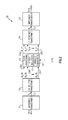
- the programmable duplexer 1 can be used to provide the RF system 10 with multi-band capability, while avoiding a need for using a multi-throw switch and a duplexer for each frequency band. Including the programmable duplexer 1 in the RF system 10 can reduce insertion loss in transmit and/or receive paths by eliminating a need for a multi-throw switch. Furthermore, the programmable duplexer 1 can have smaller area relative to a configuration including a multi-throw switch and multiple duplexers. Thus, a wireless device that includes the programmable duplexer 1 can have a smaller form factor and/or lower cost.
- the capacitance values of the first and second variable capacitor structures 5 , 6 can be controlled using the control signal CNTL.
- the control signal CNTL is received by the programmable duplexer 1 over an interface, such as a serial peripheral interface (SPI) or Mobile Industry Processor Interface radio frequency front end (MIPI RFFE) interface.
- SPI serial peripheral interface
- MIPI RFFE Mobile Industry Processor Interface radio frequency front end
- FIG. 1 illustrates the first and second variable capacitor structures 5 , 6 as receiving a common control signal CNTL, other configurations are possible, such as implementations in which the first and second variable capacitor structures 5 , 6 are controlled using separate control signals.
- the first variable capacitor structure 5 and/or the second variable capacitor structure 6 are implemented using one or more ICs that include variable capacitor arrays.
- the first and second inductor structures 7 , 8 are implemented using vector inductors, which can provide higher Q-factor and/or smaller area relative to certain other inductive structures, such as spiral or coil inductors.
- the RF system 10 illustrates one example of a system that can include one or more vector inductors
- the vector inductors described herein can be used in other systems.
- FIG. 2 is a schematic diagram of a programmable filter 20 according to one embodiment.
- the programmable filter 20 includes an input impedance transformer 11 , a splitter transformer 12 , an RF signal processing circuit 13 , a combiner transformer 14 , and an output impedance transformer 15 .
- the programmable filter 20 further includes an RF input IN and an RF output OUT.
- the programmable filter 20 illustrates one embodiment of a programmable filter suitable for implementing the first and/or second programmable filters 3 , 4 shown in FIG. 1 .
- the programmable filter 20 can be used in other systems and/or the first and/or second programmable filters 3 , 4 can be implemented in other ways.
- the input impedance transformer 11 can receive an RF input signal on the RF input IN, and can generate an impedance transformed signal 21 .
- the input impedance transformer 11 can provide an impedance transformation from input to output.
- the input impedance transformer 11 transforms an input impedance of about 50 ⁇ to an output impedance of about R L , where R L is less than 50 ⁇ , for example, 8 ⁇ .
- Transforming the input impedance of the programmable filter 20 in this manner can result in the impedance transformed signal 21 having a smaller voltage level relative to a voltage level of the RF input signal received at the RF input IN.
- the voltage level of the impedance transformed signal 21 can be smaller than the voltage level of the RF input signal by a factor of about ⁇ square root over (50/R L ) ⁇ .
- Splitting the impedance transformed signal 21 into N split signals can further decrease a voltage level of the RF input signal by a factor of N.
- Including the splitter transformer 12 can also reduce the impedance by a factor of N. For example, when the output impedance of the input impedance transformer 11 has a value of R L , the output impedance of each output of the splitter transformer 12 can have a value of R L /N.
- the RF signal processing circuit 13 can receive the first, second, and third split signals 22 a - 22 c , and can generate first, second, and third processed RF signals 23 a - 23 c , respectively.
- the RF signal processing circuit 13 includes variable capacitors 16 , which can capacitances that can be controlled using a control signal CNTL.
- the RF signal processing circuit 13 further includes vector inductors 17 . The vector inductors 17 and the variable capacitors 16 can determine a filtering characteristic of the RF signal processing circuit 13 .
- the combiner transformer 14 receives the processed signals 23 a - 23 c , which the combiner transformer 14 can combine to generate a combined signal 24 .
- the combiner transformer 14 can also provide an impedance transformation. For example, in a configuration in which each output of the RF signal processing circuit 13 has an output impedance of about R L /N, the combiner transformer 14 can have an output impedance of about R L .
- the output impedance transformer 15 receives the combined signal 24 from the combiner transformer 14 , and generates the RF output signal on the RF output OUT.
- the combiner transformer 14 can have an output impedance R L that is less than 50 ⁇ , and the output impedance transformer 15 can be used to provide the RF output signal at an output impedance of about 50 ⁇ .
- the illustrated programmable filter 20 provides filtering using the RF signal processing circuit 13 , which processes the split signals 22 a - 22 c at lower impedance relative to the programmable filter's input impedance. Thereafter, the processed signals 23 a - 23 c are combined and transformed up in impedance.
- the programmable filter's output impedance is about equal to the programmable filter's input impedance.
- Configuring the programmable filter 20 to process an RF input signal in this manner can increase the programmable filter's voltage handling capability.
- the voltage level of the RF input signal can be decreased by a factor of about N ⁇ square root over (50/R L ) ⁇ before it is provided to the RF signal processing circuit 13 , which may include circuitry that is sensitive to high voltage conditions.
- the illustrated programmable filter 20 can be used to process high voltage RF input signals and/or can have enhanced robustness to variations in voltage standing wave ratio (VWSR).
- VWSR voltage standing wave ratio
- the illustrated configuration can reduce the third order intermodulation distortion (IMD3) by a factor of about 40 log 10 N ⁇ square root over (50/R L ) ⁇ relative to a configuration in which an RF input signal is provided directly to an RF signal processing circuit without impedance transformation or splitting.
- IMD3 third order intermodulation distortion
- N can be selected to be equal to 8 and R L can be selected to be about equal to about 8 ⁇ , and the programmable filter can provide a linearity improvement of about 52 dB.
- other configurations are possible.
- FIG. 3A is a schematic diagram of one embodiment of an RF signal processing circuit 30 .
- the RF signal processing circuit 30 includes a first inductor-capacitor (LC) circuit 31 a , a second LC circuit 31 b , a third LC circuit 31 c , a fourth LC circuit 31 d , a fifth LC circuit 31 e , a sixth LC circuit 31 f , a seventh LC circuit 31 g , an eighth LC circuit 31 h , and a ninth LC circuit 31 i .
- the RF signal processing circuit 30 illustrates one embodiment of the RF signal processing circuit 13 of FIG. 2 .
- FIG. 3A illustrates a configuration including three RF inputs and three RF outputs
- the RF signal processing circuit 30 can be adapted to include more or fewer inputs and outputs.
- the RF signal processing circuit 30 can be used to process RF input signals received on the first to third RF inputs I 1 -I 3 to generate RF output signals on the first to third RF outputs O 1 -O 3 .
- the RF signal processing circuit 30 receives a control signal CNTL, which can be used to control a variable capacitance associated with the first to ninth LC circuits 31 a - 31 i .
- the control signal CNTL can be used to tune a frequency response of the RF signal processing circuit 30 .
- the RF signal processing circuit 30 is configured to operate as a band pass filter, and the control signal CNTL can be used to control a location in frequency of the band pass filter's passband.
- the control signal CNTL can be used to control a location in frequency of the band pass filter's passband.
- other configurations are possible.
- FIG. 3A illustrates a configuration including three LC circuits arranged in a cascade between each input and output, more or fewer LC circuits and/or other processing circuitry can be included.
- the RF signal processing circuit 30 illustrates one embodiment of the RF signal processing circuit 13 of FIG. 2 .
- the first to third input RF inputs I 1 -I 3 can receive the first to third RF split signals 22 a - 22 c , respectively, and the first to third RF outputs O 1 -O 3 can generate the first to third processed signals 23 a - 23 c , respectively.
- the RF signal processing circuit 30 includes a first signal path between the first RF input I 1 and the first RF output O 1 , a second signal path between the second RF input I 2 and the second RF output O 2 , and a third signal path between the third RF input I 3 and the third RF output O 3 .
- one or more electrical connections can be provided between corresponding positions along the first to third signals paths.
- the RF signal processing circuit 30 is used to process substantially identical RF input signals received on the first to third RF inputs I 1 -I 3 , respectively, to generate substantially identical RF output signals on the first to third RF outputs O 1 -O 3 .
- electrical connections can be provided along corresponding positions of signal paths, since the corresponding positions should have substantially the same voltage level. Examples of such electrical connections are illustrated in FIG. 3A with dashed lines.
- all or part of the inductors of an RF signal processing circuit are implemented using vector inductors.
- all or part of the inductors used in the first to ninth LC circuits 31 a - 31 i can be implemented using vector inductors.
- FIG. 3B is a schematic diagram of another embodiment of an RF signal processing circuit 40 .
- the RF signal processing circuit 40 includes a first LC circuit 41 a , a second LC circuit 41 b , a third LC circuit 41 c , a fourth LC circuit 41 d , a fifth LC circuit 41 e , a sixth LC circuit 41 f , a seventh LC circuit 41 g , an eighth LC circuit 41 h , and a ninth LC circuit 41 i.
- the first to ninth LC circuits 41 a - 41 i each include an input and an output.
- the first, second, and third LC circuits 41 a - 41 c are arranged in a cascade between the first RF input I 1 and the first RF output O 1 .
- the fourth, fifth, and sixth LC circuits 41 d - 41 f are arranged in a cascade between the second RF input I 2 and second RF output O 2 .
- the seventh, eighth, and ninth LC circuits are arranged in a cascade between the third RF input I 3 and the third RF output O 3 .
- the first LC circuit 41 a includes a first variable capacitor 43 a , a second variable capacitor 44 a , a first inductor 45 a , a second inductor 46 a , and a third inductor 47 a .
- the first variable capacitor 43 a includes a first end electrically connected to the input of the first LC circuit 41 a , and a second end electrically connected to a first end of the first inductor 45 a .
- the first inductor 45 a further includes a second end electrically connected to a first end of the second inductor 46 a and to a first end of the third inductor 47 a .
- the second variable capacitor 44 a includes a first end electrically connected to a second end of the second inductor 46 a and a second end electrically connected to a first voltage V 1 , which can be, for example, a ground or power low supply.
- the third inductor 47 a further includes a second end electrically connected to an output of the first LC circuit 41 a.
- the second to ninth LC circuits 41 b - 41 i include first variable capacitors 43 b - 43 i , second variable capacitors 44 b - 44 i , first inductors 45 b - 45 i , second inductors 46 b - 46 i , and third inductors 47 b - 47 i , respectively. Additional details of the second to ninth LC circuits 41 b - 41 i can be similar to those described above with respect to the first LC circuit 41 a.
- the control signal CNTL can be used to control variable capacitances of the variable capacitors of the first to ninth LC circuits 41 a - 41 i , thereby controlling a passband of the RF signal processing circuit 40 .
- an inductance of the first to ninth LC circuits 41 a - 41 i is substantially fixed or constant.
- a first terminal A is electrically connected to a first end of the first conductor 102 a and to a first end of the second conductor 102 b .
- a second terminal B is electrically connected to a second end of the first conductor 102 a and to a second end of the second conductor 102 b.
- the inductive structure 80 has been annotated to include a voltage V AB between the first terminal A and the second terminal B and to illustrate a current i flowing therethrough. As shown in FIG. 4A , a first current having a magnitude about equal to i/2 can flow through the first conductor 102 a , and a second current having a magnitude about equal to i/2 can flow through the second conductor 102 b.
- the voltage V AB across the inductive structure 80 can be given by Equation 1 below, where L is equal to the self-inductance of the first conductor 102 a and of the second conductor 102 b , and M is equal to the mutual inductance between the first and second conductors 102 a , 102 b .
- the mutual inductance M between a first inductor of self-inductance L 1 and a second inductor of self-inductance L 2 can be about equal to k ⁇ square root over (L 1 *L 2 ) ⁇ , where k is the coupling coefficient between the inductors.
- the first and second conductors 102 a , 102 b have about equal self-inductance L, and thus the mutual inductance M can be about equal to k*L, where k is equal to the coupling coefficient between the first and second conductors 102 a , 102 b .
- the voltage V AB across the inductive structure 80 can be given by Equation 2 below.
- V AB ( L 2 + kL 2 ) ⁇ d i d t ⁇ L ⁇ d i d t ⁇ ⁇ for ⁇ ⁇ k ⁇ 1 Equation ⁇ ⁇ 2
- a pair of conductors each having a self-inductance L can have an overall inductance that is also about equal to L when the conductors are tightly coupled, such as when the conductors are mutually coupled with a relatively high coupling coefficient, for example, a coupling coefficient of at least 0.9.
- the dielectric regions between adjacent conductors can be relatively thin, such that adjacent conductors exhibit a high degree of mutual coupling.
- a thickness t 1 of the first dielectric region 104 a is selected to be in the range of about 8 ⁇ m to about 50 ⁇ m.
- the dielectric regions between conductors have a thickness that is less a thickness of the conductors.
- the conductors have a thickness t 2 that is in the range of about 16 ⁇ m to about 32 ⁇ m.
- an overall inductance of the pair of conductors can be about equal to a self-inductance of an individual one of the conductors
- the resistance of the inductive structure 80 can be smaller than a resistance of an individual conductor.
- an overall resistance between the first terminal A and the second terminal B can be about equal to R/2.
- FIG. 4B is a cross section of a vector inductor 90 according to one embodiment.
- the vector inductor 90 is illustrated as including a first conductor 102 a , a second conductor 102 b , and a third conductor 102 c , with the first and second conductors 102 a , 102 b separated by a first dielectric region 104 a and with the second and third conductors 102 b , 102 c separated by a second dielectric region 104 b .
- the vector inductor 90 can include N conductors. N can vary in a very broad range.
- a vector inductor includes a stack of N conductors, where N is selected to be in the range of about 4 conductors and about 16 conductors.
- N is selected to be in the range of about 4 conductors and about 16 conductors.
- a first conductor in a stack of N conductors can be referred to as a lowermost conductor in the stack, while the last or Nth conductor in the stack can be referred to as an uppermost conductor in the stack.
- the conductors 102 a - 102 c can be arranged vertically in a stack. Additionally, adjacent conductors in the stack can be tightly coupled to one another via inductive coupling to achieve a high amount of mutual inductance. In one embodiment, adjacent conductors in a vector inductor's stack are configured to have a coupling coefficient k that is at least 0.5, or more particularly, 0.9 or greater.
- Tightly coupling the conductors via inductive coupling can result in the vector inductor 90 having an overall inductance that is similar to a self-inductance of an individual conductor in the stack.
- the conductors can be electrically connected in parallel, and thus an Ohmic loss of the vector inductor 90 can decrease with an increase in the number of conductors in the stack. Accordingly, the Q-factor of a vector inductor can be increased by including additional conductors in the stack.
- a configuration including multiple conductors arranged in a stack can also provide higher conductivity for radio frequency (RF) signals relative to a configuration including a single solid conductor of similar dimension.
- RF radio frequency
- implementing the conductors in a stack can provide a greater amount of conductor surface area relative to a single solid conductor, and thus the vector inductor can provide high conductivity in the presence of skin effect.
- the vector inductor 90 can also be implemented in a relatively small area relative to certain inductors of similar inductance and/or resistivity.
- the vector inductor 90 includes N conductors of self-inductance L.
- an overall inductance of the vector inductor 90 can be about equal to L.
- an inductor that operates without mutual coupling can have an overall size that is a factor of about N times greater to achieve a similar inductance.
- the conductors are arranged in a vertical stack, the conductors can occupy an area that is about a factor of 1/N smaller relative to a planar configuration. The net result of mutual coupling and vertical integration can result in a reduction of size by a factor of about N 2 relative to an inductor that is implemented without layering and without mutual coupling.
- the vector inductor 90 can be configured to have high mutual inductance between adjacent conductors in part by using a dielectric material between the conductors that has a relatively high permittivity.
- relative permittivity ⁇ r can correspond to a ratio of the permittivity of a specific medium relative to the permittivity of free space ⁇ 0 .
- the dielectric is implemented using a dielectric material having a relative permittivity ⁇ r that is in the range of about 2.7 to about 10. However, other configurations are possible.
- the dielectric regions of the vector inductor 90 can include any suitable dielectric material.
- one or more of the vector inductor's dielectric regions can include an adhesive, such as epoxy.
- the vector inductor 90 is constructed of two or more subassemblies that are attached to one another using adhesive.
- the dielectric regions comprise FR-4 board.
- the conductors are mechanically suspended from one another, and the dielectric can include air.
- the dielectric is a solid.
- the conductors of the vector inductor 90 can include any suitable conductive material.
- the conductors comprise at least one of copper or silver.
- the dielectric regions disposed between adjacent conductors can have low dielectric loss.
- the dielectric loss tangent (tan ⁇ ) of the dielectric regions can be selected to be much less than 1, for instance, 0.00002 or less.
- an electromagnetic field in a dielectric can include a reactive or lossless component and a resistive or lossy component, and a dielectric with low dielectric loss tangent can have a reactive component that is much greater in magnitude than the resistive component.
- a dielectric with low dielectric loss tangent can also be associated with a relatively small amount of heat dissipation.
- selecting a dielectric with low dielectric loss tangent can aid in integrating a vector inductor in applications having stringent heat dissipation specifications, such as in certain wireless device applications.
- a thickness of the vector inductor's dielectric regions is substantially the same. Additionally, in certain configurations, a thickness of the vector inductor's conductors is substantially the same. However, other configurations are possible, including, for example, configurations in which the thicknesses of dielectric regions are different and/or configurations in which the thicknesses of conductors are different.
- the vector inductor's conductors can be implemented as individual strips or patches of conductive material, such as elongated strips of metal.
- the vector inductor's conductors can be implemented to have a substantially rectangular shape when from viewed from above the conductor stack. Configuring the conductors in a substantially rectangular shape can reduce or eliminate curves and angles to provide a relatively straight path for electron flow, which in turn can provide high Q-factor.
- other configuration are possible, including, for example, configurations in which the vector inductor's conductors are substantially U-shaped or V-shaped when viewed from above the stack.
- FIG. 5A is a perspective view of a vector inductor 100 according to one embodiment.
- the vector inductor 100 includes first to sixteenth conductors 102 a - 102 p , respectively.
- the vector inductor 100 further includes first to fifteenth dielectric regions 104 a - 104 o , respectively.
- the vector inductor 100 further includes conductive sidewalls 108 , a first terminal 118 , and a second terminal 119 .
- vector inductor 100 is illustrated as including sixteen conductors, the teachings herein are applicable to vector inductors including more or fewer conductors.
- the vector inductor 100 is implemented as a discrete component.
- the vector inductor 100 comprises a discrete component that can be attached to a surface of a substrate using surface mount technology (SMT).
- SMT surface mount technology
- the vector inductor 100 is implemented within a printed circuit board (PCB).
- the first to sixteenth conductors 102 a - 102 p can correspond to conductive layers of the PCB.
- FIG. 5B is a plan view of a conductor 102 of the vector inductor 100 of FIG. 5A .
- the conductor 102 can correspond to an overhead view of any of the conductors 102 a - 102 p of FIG. 5A .
- the conductor 102 has a substantially rectangular shape when viewed from above the vector inductor's stack. Configuring the conductor 102 in this manner can enhance conductivity at high frequencies by providing a relatively straight path for current flow, which in turn can increase Q-factor.
- the conductor 102 has a height X 1 in the range of about 250 ⁇ m to about 2,000 ⁇ m, and a width X 2 in the range of about 2,500 ⁇ m to about 10,000 ⁇ m.
- X 1 in the range of about 250 ⁇ m to about 2,000 ⁇ m
- width X 2 in the range of about 2,500 ⁇ m to about 10,000 ⁇ m.
- other configurations are possible.
- FIG. 6 is a plan view of a conductor 112 of a vector inductor according to another embodiment.
- the conductor 112 of FIG. 6 is similar to the conductor 102 of FIG. 5B , except that the conductor 112 of FIG. 6 further includes a first stub 113 a and a second stub 113 b , which are located on opposite ends of a conductive body 111 .
- the first and second stubs 113 a , 113 b can aid in providing impedance matching to components and/or other circuitry that is electrically connected to a vector inductor.
- the conductor 112 includes the conductive body 111 , which can have a height X 1 and a width X 2 similar to that of conductor 112 of FIG. 5B . Additionally, the conductor 112 can have a stub height X 3 and a stub width X 4 . In one embodiment, the stub height X 3 is in the range of about 100 ⁇ m to about 1,000 ⁇ m, and the stub width X 4 is in the range of 100 ⁇ m to about 1,000 ⁇ m. However, other configurations are possible.
- FIG. 7A is a cross section of a printed circuit board (PCB) 150 according to one embodiment.
- the PCB 150 includes dielectric 154 and first to eighth conductors 152 a - 152 h , which have been implemented as a vector inductor 160 .
- the PCB 150 further includes vias 158 , which operate as conductive sidewalls of the vector inductor 160 to electrically connect adjacent conductors to one another along the ends of the conductors.
- PCB 150 illustrates a vector inductor that includes eight conductors in the vector inductor's conductor stack
- teachings herein are applicable to configurations including more or fewer conductors in a stack.
- the illustrated PCB 150 includes a top surface 151 a , which includes a first top surface inductor terminal 168 a and a second top surface inductor terminal 169 a . Additionally, the illustrated PCB 150 includes a bottom surface 151 b , which includes a first bottom surface inductor terminal 168 b and a second bottom surface inductor terminal 169 b.
- a first component 161 has been electrically connected to the first top surface inductor terminal 168 a
- a second component 162 has been electrically connected to the second top surface inductor terminal 169 a
- a third component 163 has been electrically connected to the first bottom surface inductor terminal 168 b
- a fourth component 164 has been electrically connected to the second bottom surface inductor terminal 169 b.
- the first to fourth components 161 - 164 can be implemented in a variety of ways, including, for example, as surface mount components (SMCs), integrated circuits (ICs), or a combination thereof. Furthermore, all or part of the first to fourth components 161 - 164 can be omitted in favor of connecting the vector inductor 160 in other ways.
- the first to fourth components 161 - 164 comprise surface mount capacitors, and the vector inductor 160 and the surface mount capacitors operate in a LC resonant circuit.
- the first to fourth components 161 - 164 comprise ICs including one or more variable capacitors that have a controllable capacitance.
- the illustrated PCB 150 includes a vector inductor that can be electrically connected to other circuitry on the top and/or bottom surfaces of the PCB 150 .
- Configuring the PCB 150 in this manner can facilitate providing electrical connections between the vector inductor 160 and other components or circuitry.
- integrated circuits (ICs) and/or surface mount components can be attached to the PCB's top and bottom surfaces, and can be electrically connected to the vector inductor 160 using traces or other electrical connections.
- providing both top and bottom terminals for a vector inductor can reduce an electrical length between the vector inductor's terminals and an innermost conductor in the vector inductor's stack.
- the PCB comprises alternating layers of conductor, such as copper, and a dielectric, such as FR-4 board.
- the PCB comprises a low temperature co-fired ceramic (LTCC) multi-layer PCB including alternating layers of conductor, such as copper and/or silver, and a ceramic dielectric, such as alumina.
- LTCC low temperature co-fired ceramic
- FIG. 7B is a cross section of a PCB 170 according to another embodiment.
- the PCB 170 of FIG. 7B is similar to the PCB 150 of FIG. 7A , except that the PCB 170 includes a vector inductor 180 that includes a conductor stack with tapered sides 175 a , 175 b .
- the illustrated configuration includes a stack of conductors that are tapered in width with the uppermost and bottommost conductors having a longer width relative to conductors in the middle of the stack.
- Configuring the conductors 152 a - 152 h in this manner can help balance differences in mutual coupling between conductors in the stack and/or to balance a flow of current through the conductors relative to one another.
- the innermost conductor of the stack may have a larger amount of mutual coupling relative to the stack's outermost conductors, and thus the innermost conductor may have a larger overall inductance and smaller current flow relative to the outermost conductors.
- the conductors in the stack can be tapered to compensate for differences in mutual coupling between conductors to provide substantially the same amount of current flow in each of the conductors in the vector inductor's stack.
- tapering is also used to compensate for differences in electrical length between the vector inductor's terminals and a particular conductor in the stack.
- the illustrated configuration includes conductors that are tapered to balance a flow of current through the conductors relative to one another.
- FIG. 8A is a perspective view of a vector inductor 200 according to another embodiment.
- the vector inductor 200 includes first to sixteenth conductors 202 a - 202 p , respectively.
- the vector inductor 200 further includes first to fifteenth dielectric regions 204 a - 204 o , respectively.
- the vector inductor 200 further includes conductive sidewalls 208 , a first terminal 218 , a second terminal 219 , a third terminal 220 , and a dielectric region 207 .
- vector inductor 200 is illustrated as including sixteen conductors, the teachings herein are applicable to vector inductors including more or fewer conductors.
- the vector inductor 200 illustrates a configuration including a stack of conductors that are substantially U-shaped when viewed from above.
- Each of the U-shaped conductors includes a conductive base, a first conductive arm, and a second conductive arm.
- the conductive sidewalls 208 electrically connect the conductive bases of the first to sixteenth conductors 202 a - 202 p to one another along a first side 213 a of the conductor stack.
- the conductive sidewalls 208 electrically connect the first to sixteenth conductors 202 a - 202 p to one another along a second side 213 b of the conductor stack associated with ends of the conductors' first conductive arms.
- the conductive sidewalls 208 electrically connect the first to sixteenth conductors 202 a - 202 p to one another along a third side 213 c of the conductor stack associated with ends of the conductors' second conductive arms.
- the vector inductor 200 is implemented as a discrete component.
- the vector inductor 200 comprises a discrete component that can be attached to a surface of a substrate using surface mount technology (SMT).
- SMT surface mount technology
- the vector inductor 200 is implemented within a printed circuit board (PCB).
- the first to sixteenth conductors 202 a - 202 p can correspond to conductive layers of the PCB.
- FIG. 8B is a plan view of a conductor 202 of the vector inductor 200 of FIG. 8A .
- the conductor 202 can represent a shape of any of the first to sixteenth conductors 202 a - 202 p of FIG. 8A when viewed from above.
- the conductor 202 includes a first conductive arm 221 , a second conductive arm 222 , and a conductive base 223 .
- the first and second conductive arms 221 , 222 extend out from the conductive base 223 , which physically and electrically connects the first and second conductive arms 221 , 222 to one another.
- the first terminal 218 can be connected to the conductive base 223
- the second terminal 219 can be connected to an end of the first conductive arm 221
- the third terminal 220 can be connected to an end of the second conductive arm 222 .
- the vector inductor 200 of FIG. 8A can provide the equivalent circuit functionality of three inductor components.
- FIG. 8C illustrates a circuit diagram 240 of the vector inductor 200 of FIG. 8A .
- the vector inductor 200 can have a circuit functionality represented by a first inductor 231 , a second inductor 232 , and a third inductor 233 .
- the first inductor 231 can be associated with a self-inductance of the first conductive arm 221
- the second inductor 232 can be associated with a self-inductance of the second conductive arm 222
- the third inductor 233 can be associated with a mutual inductance between the first and second conductive arms 221 , 222 .
- the conductor 202 has conductive arm lengths selected to control an inductance of the first and second inductors 231 , 232 .
- the self-inductance of an arm can be increased by implementing the arm to have a longer length.
- the first and second conductive arms 221 , 222 can have similar lengths such that the first and second conductive arms 221 , 222 have about the same self-inductance.
- the conductive arms 221 , 222 can have different lengths to provide different self-inductance values.
- a length Y 1 of the first conductive arm 221 is selected to be in the range of about 500 ⁇ m to about 2,500 ⁇ m, and a length Y 2 is in the range of about 500 ⁇ m to about 2,500 ⁇ m.
- a length Y 1 of the first conductive arm 221 is selected to be in the range of about 500 ⁇ m to about 2,500 ⁇ m, and a length Y 2 is in the range of about 500 ⁇ m to about 2,500 ⁇ m.
- other configurations are possible.
- a separation between the first conductive arm 221 and the second conductive arm 222 can be used to control a mutual inductance between the first and second conductive arms 221 , 222 , thereby controlling an inductance of the third inductor 233 shown in FIG. 8C .
- a separation Y 3 between the first and second conductive arms 221 , 222 at the conductive base 223 is selected to be in the range of about 200 ⁇ m to about 1,000 ⁇ m.
- the mutual inductance between the first and second conductive arms 221 , 222 can also be controlled in part by selection of a dielectric material between the first and second conductive arms 221 , 222 .
- the first and second conductive arms 221 , 222 can be separated by the dielectric region 207 .
- the dielectric region 207 can be implemented using a similar dielectric as the first to fifteenth dielectric regions 204 a - 204 o .
- the dielectric region 207 can comprise air.
- a tap point used to connect the first terminal 218 to the conductive base 223 can be used to control self-inductances of the first and second conductive arms 221 , 222 and/or a mutual inductance between the first and second conductive arms 221 , 222 .
- the selection of the tap point can be used in part to control the inductances of the first, second, and third inductors 231 - 233 shown in FIG. 8C .
- FIG. 8B has been annotated to include a first electrical connection 224 from the first terminal 218 to a first tap point of the conductive base 223 , a second electrical connection 225 from the first terminal 218 to a second tap point of the conductive base 223 , and a third electrical connection 226 from the first terminal 218 to a third tap point of the conductive base 223 .
- a mutual inductance between the first and second conductive arms 221 , 222 can change.
- a self-inductance of the first and second conductive arms 221 , 222 can also change with varying tap point, as an electrical length between the first terminal 218 and the second terminal 219 and an electrical length between the first terminal 218 and the third terminal 220 can change with tap point.
- a selection of the tap point of the first terminal 218 to the conductive base 223 can be used to control inductance values of the first to third inductors 231 - 233 .
- a tap point of the first terminal 218 to the conductive base 223 is provided in a center of the conductive base 223 .
- a tap point of the first terminal 218 to the conductive base 223 is offset from the center of the conductive base 223 .
- an angle ⁇ between the first conductive arm 251 and the conductive base 223 is in the range of about 90° to about 120°
- an angle ⁇ between the first conductive arm 251 and the conductive base 223 is in the range of about 90° to about 120°.
- the angle ⁇ and the angle ⁇ are the same. In other configurations, the angle ⁇ and the angle ⁇ are different.
- FIG. 9 is a plan view of a conductor 252 of a vector inductor according to another embodiment.
- the conductor 252 of FIG. 9 is similar to the conductor 202 of FIG. 8B , except that the conductor 252 is implemented in a V-shape rather than in a U-shape.
- the conductor 252 includes a first conductive arm 241 , a second conductive arm 242 , and a conductive base 243 .
- the conductive base 243 is electrically connected to the first terminal 218 .
- the first conductive arm 241 extends from the conductive base 243 , and includes an end electrically connected to the second terminal 219 .
- the second conductive arm 242 extends from the conductive base 243 , and includes an end electrically connected to the third terminal 220 .
- the vector inductor 200 of FIG. 8A can be modified to include conductors shaped similarly to the conductor 252 of FIG. 9 .
- the vector inductor can be represented by a circuit diagram similar to the circuit diagram 240 of FIG. 8C , and the inductances of the first, second, and third inductors 231 - 233 shown in FIG. 8C can be controlled in part by geometrical characteristics of the conductor 252 .
- a self-inductance of the first conductive arm 241 can be based on a length Z 1 of the first conductive arm 241 .
- a self-inductance of the second conductive arm 242 can be based on a length Z 2 of the second conductive arm 242 .
- the length Z 1 is selected to be in the range of about 500 ⁇ m to about 2,500 ⁇ m
- the length Z 2 is in the range of about 500 ⁇ m to about 2,500 ⁇ m.
- a mutual inductance between the first and second conductive arms 241 , 242 can be based on an angle between ⁇ between the first and second conductive arms 241 , 242 .
- the angle ⁇ is selected to be in the range of about 30° to about 90°.
- FIG. 10A is a plan view of a conductor 262 of a vector inductor according to another embodiment.
- the conductor 262 of FIG. 10A is similar to the conductor 202 of FIG. 8B , except that the conductor 262 of FIG. 10A further includes a first stub 253 a , a second stub 253 b , and a third stub 253 c .
- the stubs 253 a - 253 c can aid in providing electrical termination between a vector inductor that includes the conductor 262 and other circuitry and/or components. Additional details of the conductor 262 can be similar to those described earlier.
- FIG. 10B is a plan view of a conductor 272 of a vector inductor according to another embodiment.
- the conductor 272 of FIG. 10B is similar to the conductor 252 of FIG. 9 , except that the conductor 272 of FIG. 10B further includes a first stub 263 a , a second stub 263 b , and a third stub 263 c , which can aid in providing impedance termination. Additional details of the conductor 272 can be similar to those described earlier.
- FIG. 11 is a cross section of a vector inductor 300 according to another embodiment.
- the vector inductor 300 includes a first subassembly 312 a , a second subassembly 312 b , a third subassembly 312 c , a fourth subassembly 312 d , a fifth subassembly 312 e , a sixth subassembly 312 f , a seventh subassembly 312 g , and an eighth subassembly 312 h .
- FIG. 11 illustrates a configuration including eight subassemblies, the teachings herein are applicable to configurations using more or fewer subassemblies.
- the first subassembly 312 a includes a first conductor 302 a and a second conductor 302 b separated by a first dielectric region 304 a .
- the second subassembly 312 b includes a third conductor 302 c and a fourth conductor 302 d separated by a second dielectric region 304 b .
- the third subassembly 312 c includes a fifth conductor 302 e and a sixth conductor 302 f separated by a third dielectric region 304 c .
- the fourth subassembly 312 d includes a seventh conductor 302 g and an eighth conductor 302 h separated by a fourth dielectric region 304 d .
- the fifth subassembly 312 e includes a ninth conductor 302 i and a tenth conductor 302 j separated by a fifth dielectric region 304 e .
- the sixth subassembly 312 f includes an eleventh conductor 302 k and a twelfth conductor 3021 separated by a sixth dielectric region 304 f .
- the seventh subassembly 312 g includes a thirteenth conductor 302 m and a fourteenth conductor 302 n separated by a seventh dielectric region 304 g .
- the eighth subassembly 312 h includes a fifteenth conductor 302 o and a sixteenth conductor 302 p separated by an eighth dielectric region 304 h.
- the first to eighth subassemblies 312 a - 312 h are physically connected to one another using adhesive layers.
- the first subassembly 312 a is physically connected to the second subassembly 312 b using a first adhesive layer 305 a
- the second subassembly 312 b is physically connected to the third subassembly 312 c using a second adhesive layer 305 b
- the third subassembly 312 c is physically connected to the fourth subassembly 312 d using a third adhesive layer 305 c .
- the fourth subassembly 312 d is physically connected to the fifth subassembly 312 e using a fourth adhesive layer 305 d
- the fifth subassembly 312 e is physically connected to the sixth subassembly 312 f using a fifth adhesive layer 305 e
- the sixth subassembly 312 f is physically connected to the seventh subassembly 312 g using a sixth adhesive layer 305 f
- the seventh subassembly 312 g is physically connected to the eighth subassembly 312 h using a seventh adhesive layer 305 g.
- the illustrated vector inductor 300 includes multiple subassemblies attached to one another by adhesive layers.
- each individual subassemblies can be associated with a printed circuit board substrate, and multiple subassemblies can be physically connected to one another to form a vector inductor.
- the illustrated configuration can be suitable, for example, in a configuration in which the vector inductor is used as a discrete component.
- the dielectric regions 304 a - 304 h have a relative permittivity ⁇ r that is in the range of about 2.7 to about 10
- the adhesive layers 305 a - 305 g have a relative permittivity ⁇ r that is in the range of about 2.7 to about 10.
- other configurations are possible.
- the adhesive layers 305 a - 305 g can comprise any suitable adhesive.
- the adhesive layers 305 a - 305 g can comprise at least one of FastRise27, Megtron-6, Bismaleimide Triazine (BT) MGC 972 LD, 83 NSLC, 832 NS or NX.
- BT Bismaleimide Triazine
- the dielectric regions 304 a - 304 h have a thickness t 1 as described earlier
- the conductors 302 a - 302 p have a thickness t 2 as described earlier
- the adhesive layers 305 a - 305 g have a thickness in the range of about 8 ⁇ m to about 50 ⁇ m. Although one example of thickness dimensions have been provided, other configurations are possible.
- the vector inductor's conductors have about the same size and shape as one another.
- other configurations are possible, such as tapered configurations.
- the vector inductor 300 can be configured to include conductive sidewalls for electrically connecting the vector inductor's conductors in parallel with one another. Additionally, the vector inductor 300 can be adapted to include two or more electrical terminals for providing electrical connectivity to external components or circuitry.
- FIG. 12A is a schematic diagram of top and bottom perspective views of a PCB 280 according to another embodiment.
- the PCB includes a U-shaped vector inductor 285 fabricated therein.
- the PCB 280 includes a top surface 281 a and a bottom surface 281 b .
- a first component 291 , a second component 292 , and a third component 293 have been attached to the top surface 281 a of the PCB 280 .
- the first component 291 is electrically connected to a first top surface terminal of the U-shaped vector inductor 285
- the second component 292 is electrically connected to a second top surface terminal of the U-shaped vector inductor 285
- the third component 293 is electrically connected to a third top surface terminal of the U-shaped vector inductor 285 .
- a fourth component 294 , a fifth component 295 , and a sixth component 296 have been attached to the bottom surface 281 b of the PCB 280 . Additionally, the fourth component 294 is electrically connected to a first bottom surface terminal of the U-shaped vector inductor 285 , the fifth component 295 is electrically connected to a second bottom surface terminal of the U-shaped vector inductor 285 , and the sixth component 296 is electrically connected to a third bottom surface terminal of the U-shaped vector inductor 285 .
- the first to sixth components 291 - 296 can be implemented in a variety of ways, including, for example, as SMCs, ICs, or a combination thereof. Furthermore, all or part of the first to sixth components 291 - 296 can be omitted in favor of connecting the U-shaped vector inductor 285 in other ways.
- the first to sixth components 291 - 296 comprise surface mount capacitors, and the U-shaped vector inductor 285 and the surface mount capacitors operate as a LC resonant circuit.
- the first to sixth components 291 - 296 comprise ICs including one or more variable capacitors that have a controllable capacitance.
- the illustrated PCB 280 comprises a portion of a bridged-T filter. In another embodiment, the illustrated PCB 280 comprises a portion of the RF signal processing circuit 40 of FIG. 3B .
- the PCB 280 is illustrated as including a U-shaped vector inductor, in one embodiment, the U-shaped vector inductor is omitted in favor of including a V-shaped vector inductor.
- FIG. 12B is a cross section of the PCB 280 of FIG. 12A taken along the lines 12 B- 12 B according to one embodiment.
- FIG. 12C is a cross section of the PCB 280 of FIG. 12A taken along the lines 12 C- 12 C according to one embodiment.
- the vector inductor 285 includes first to eighth conductors 152 a - 152 h arranged in a stack and separated by dielectric 154 .
- the PCB 280 further includes vias 158 , which operate as conductive sidewalls of the vector inductor 285 to electrically connect adjacent conductors to one another along a first side 299 a of the stack, along a second side 299 b of the stack, and along a third side 299 c of the stack.
- PCB 280 illustrates a vector inductor that includes eight conductors in the vector inductor's conductor stack, the teachings herein are applicable to configurations including more or fewer conductors in a stack.
- the first, second, and third sides 299 a - 299 c of the conductor stack have been tapered to compensate for differences in mutual coupling between conductors.
- FIGS. 12B and 12C illustrated a configuration in which sides of the vector inductor 285 are tapered
- the teachings herein are also applicable to configurations in which the vector inductor 285 includes a conductor stack with sides that are substantially straight.
- the teachings herein are also applicable to a conductor stack includes a combination of tapered sides and substantially straight sides.
- the first side 299 a of the vector inductor 285 is tapered
- the second and third sides 299 b , 299 c of the vector inductor 285 are substantially straight.
- FIG. 13 is a cross section of a PCB 400 according to another embodiment.
- the PCB 400 has been implemented to include a splitter transformer 412 , an RF signal processing circuit 413 , and a combiner transformer 414 .
- the PCB 400 includes a top surface 401 a and a bottom surface 401 b.
- the illustrated portion of the RF signal processing circuit 413 includes a first vector inductor 421 a , a second vector inductor 421 b , a first capacitor component 422 a , a second capacitor component 422 b , a third capacitor component 422 c , and a fourth capacitor component 422 d .
- the RF signal processing circuit 413 can include additional vector inductors, capacitors and/or other circuitry that is not visible in the cross-section shown in FIG. 13 .
- the RF signal processing circuit 413 can include circuitry for processing each of N split signals outputted from the splitter transformer 412 to generate N processed signals for combiner transformer 414 , where N is an integer.
- the first and second vector inductors 421 a , 421 b are implemented within the PCB 400 using stacks of six conductors.
- the first and second capacitor ICs 422 a , 422 b are attached to the top surface 401 a of the PCB 400
- the third and fourth capacitor ICs 422 c , 422 d are attached to the bottom surface 401 b of the PCB 400 .
- the splitter transformer 412 can be used to generate 6 split outputs, and can include 12 transformer windings.
- the splitter transformer 412 has been implemented in the PCB 400 in a folded configuration, in which a first 6 transformer windings have been implemented adjacent to a second 6 transformer windings of the splitter transformer 412 .
- the splitter transformer 412 can be implemented using three sections of 4 transformer windings, using four sections of 3 transformer windings, or using six sections of 2 transformer windings.
- the splitter transformer 412 can be implemented without folding.
- a splitter transformer includes P transformer windings, and the splitter transformer is implemented in a folded configuration including Q sections of P/Q transformer windings, where P is an integer greater than or equal to 4, Q is an integer greater than or equal to 2, and P/Q is an integer greater than or equal to 2.
- P is an integer greater than or equal to 4
- Q is an integer greater than or equal to 2
- P/Q is an integer greater than or equal to 2.
- other configurations are possible, including, for example, configurations without folding.
- the combiner transformer 414 can receive 6 processed signals as inputs, and can include 12 windings. In certain configurations, the combiner transformer 414 has a similar structure as the splitter transformer 412 .
- a splitter transformer can be operated as a combiner transformer by reversing a direction of signal flow.
- the PCB 400 comprises alternating layers of conductor, such as copper, and a dielectric, such as FR-4 board.
- the PCB 400 comprises a low temperature co-fired ceramic (LTCC) multi-layer PCB including alternating layers of conductor, such as copper and/or silver, and a ceramic dielectric, such as alumina. Additional details of the PCB 400 can be similar to those described earlier.
- LTCC low temperature co-fired ceramic
- FIGS. 14A and 14B are schematic diagrams of resonant circuits according to various embodiments.
- FIG. 14A is a schematic diagram of a parallel resonant LC circuit 710 .
- the parallel resonant LC circuit 710 includes a first terminal 721 , a second terminal 722 , a first capacitor 711 a , a second capacitor 711 b , and a vector inductor 712 .
- the first and second capacitors 711 a , 711 b have a capacitance value of C/ 2 .
- the vector inductor 712 includes a stack of conductors 700 electrically connected to one another at their ends using conductive sidewalls 708 .
- the first capacitor 711 a is electrically connected in parallel with an uppermost conductor 702 of the stack 700
- the second capacitor 711 b is electrically connected in parallel with a bottommost conductor 701 of the stack 700 .
- the stack of conductors 700 includes conductors implemented in a substantially rectangular shape when viewed from above the stack.
- FIG. 14B is a schematic diagram of a series resonant LC circuit 720 .
- the series resonant LC circuit 720 includes a first top terminal 721 a , a second top terminal 722 a , a first bottom terminal 721 b , a second bottom terminal 722 b , the first capacitor 711 a , the second capacitor 711 b , and the vector inductor 712 .
- the first capacitor 711 a is electrically connected in series between the first top terminal 721 a and a first end of the uppermost conductor 702 of the stack 700 .
- the second end of the uppermost conductor 702 of the stack 700 is electrically connected to the second top terminal 722 a .
- the second capacitor 711 b is electrically connected in series between the first bottom terminal 721 b and a first end of the bottommost conductor 701 of the stack 700 .
- the second end of the bottommost conductor 701 of the stack 700 is electrically connected to the second bottom terminal 722 b.
- the parallel resonant LC circuit 710 of FIG. 14A and the series resonant LC circuit 720 of FIG. 14B illustrate two examples of resonant circuits that can include a vector inductor. However, vector inductors can be included in other configurations of resonant circuits.
- FIG. 15 is a schematic diagram of a filter 800 according to one embodiment.
- the filter 800 includes a filter input terminal 821 and a filter output terminal 822 .
- the filter 800 includes a first capacitor 811 , a second capacitor 812 , a third capacitor 813 , a fourth capacitor 814 , a fifth capacitor 815 , a sixth capacitor 816 , a first vector inductor 801 , a second vector inductor 802 , a third vector inductor 803 , and a fourth vector inductor 804 .
- the first capacitor 811 includes a first end electrically connected to the filter input terminal 821 and a second end electrically connected to a first terminal of the first vector inductor 801 .
- the second capacitor 812 includes a first end electrically connected to a second terminal of the first vector inductor 801 and a second end electrically connected to a first end of the fifth capacitor 815 , to a first terminal of the second vector inductor 802 , and to a first terminal of the third vector inductor 803 .
- the third capacitor 813 includes a first end electrically connected to a second terminal of the third vector inductor 803 and a second end electrically connected to the first voltage V 1 .
- the fourth capacitor 814 includes a first end electrically connected to a second terminal of the second vector inductor 802 and a second end electrically connected to the first voltage V 1 .
- the fifth capacitor 815 further includes a second end electrically connected to a first end of the fourth vector inductor 804 .
- the sixth capacitor 816 includes a first end electrically connected to a second terminal of the fourth vector inductor 804 and a second end electrically connected to the filter output terminal 822 .
- the illustrated filter 800 is implemented as a Chebyshev filter.
- the first to sixth capacitors 811 - 816 are implemented using variable capacitors disposed on one or more ICs, using discrete components, or a combination thereof.
- the filter 800 illustrates one example of a filter that can include vector inductors, vector inductors can be included in other configurations of filters and/or in other circuitry.
- the words “comprise,” “comprising,” and the like are to be construed in an inclusive sense, as opposed to an exclusive or exhaustive sense; that is to say, in the sense of “including, but not limited to.”
- the word “coupled”, as generally used herein, refers to two or more elements that may be either directly connected, or connected by way of one or more intermediate elements.
- the word “connected”, as generally used herein, refers to two or more elements that may be either directly connected, or connected by way of one or more intermediate elements.
- the words “herein,” “above,” “below,” and words of similar import when used in this application, shall refer to this application as a whole and not to any particular portions of this application.
- words in the above Detailed Description using the singular or plural number may also include the plural or singular number respectively.
- conditional language used herein such as, among others, “can,” “could,” “might,” “can,” “e.g.,” “for example,” “such as” and the like, unless specifically stated otherwise, or otherwise understood within the context as used, is generally intended to convey that certain embodiments include, while other embodiments do not include, certain features, elements and/or states.
- conditional language is not generally intended to imply that features, elements and/or states are in any way required for one or more embodiments or that one or more embodiments necessarily include logic for deciding, with or without author input or prompting, whether these features, elements and/or states are included or are to be performed in any particular embodiment.
Landscapes
- Engineering & Computer Science (AREA)
- Power Engineering (AREA)
- Microelectronics & Electronic Packaging (AREA)
- Filters And Equalizers (AREA)
Abstract
Description
Claims (26)
Priority Applications (1)
| Application Number | Priority Date | Filing Date | Title |
|---|---|---|---|
| US14/288,127 US9324490B2 (en) | 2013-05-28 | 2014-05-27 | Apparatus and methods for vector inductors |
Applications Claiming Priority (4)
| Application Number | Priority Date | Filing Date | Title |
|---|---|---|---|
| US201361828107P | 2013-05-28 | 2013-05-28 | |
| US201361857446P | 2013-07-23 | 2013-07-23 | |
| US13/955,617 US9570222B2 (en) | 2013-05-28 | 2013-07-31 | Vector inductor having multiple mutually coupled metalization layers providing high quality factor |
| US14/288,127 US9324490B2 (en) | 2013-05-28 | 2014-05-27 | Apparatus and methods for vector inductors |
Related Parent Applications (1)
| Application Number | Title | Priority Date | Filing Date |
|---|---|---|---|
| US13/955,617 Continuation-In-Part US9570222B2 (en) | 2013-05-28 | 2013-07-31 | Vector inductor having multiple mutually coupled metalization layers providing high quality factor |
Publications (2)
| Publication Number | Publication Date |
|---|---|
| US20140355171A1 US20140355171A1 (en) | 2014-12-04 |
| US9324490B2 true US9324490B2 (en) | 2016-04-26 |
Family
ID=51984857
Family Applications (1)
| Application Number | Title | Priority Date | Filing Date |
|---|---|---|---|
| US14/288,127 Expired - Fee Related US9324490B2 (en) | 2013-05-28 | 2014-05-27 | Apparatus and methods for vector inductors |
Country Status (1)
| Country | Link |
|---|---|
| US (1) | US9324490B2 (en) |
Families Citing this family (8)
| Publication number | Priority date | Publication date | Assignee | Title |
|---|---|---|---|---|
| US9570222B2 (en) | 2013-05-28 | 2017-02-14 | Tdk Corporation | Vector inductor having multiple mutually coupled metalization layers providing high quality factor |
| US9735752B2 (en) | 2014-12-03 | 2017-08-15 | Tdk Corporation | Apparatus and methods for tunable filters |
| US10541713B2 (en) | 2015-06-29 | 2020-01-21 | Skyworks Solutions, Inc. | Multiplexers having hybrid circuits with resonators |
| CN105628716B (en) * | 2016-01-01 | 2018-12-04 | 广州兴森快捷电路科技有限公司 | Printed circuit board is layered abatement detecting method |
| EP3588784B1 (en) * | 2018-06-29 | 2021-08-04 | Socionext Inc. | Interface circuits |
| CN110993626B (en) | 2019-12-20 | 2022-09-30 | 京东方科技集团股份有限公司 | Array substrate, display panel, display device and wearable equipment |
| JP7437275B2 (en) * | 2020-09-09 | 2024-02-22 | 株式会社東芝 | electronic device |
| US12131863B2 (en) * | 2021-04-20 | 2024-10-29 | Macronix International Co., Ltd. | Inductor structure and manufacturing method for the same |
Citations (46)
| Publication number | Priority date | Publication date | Assignee | Title |
|---|---|---|---|---|
| US4423396A (en) | 1980-09-30 | 1983-12-27 | Matsushita Electric Industrial Company, Limited | Bandpass filter for UHF band |
| US4456895A (en) | 1982-05-25 | 1984-06-26 | Rockwell International Corporation | Band selectable tunable bandpass filter |
| US4754242A (en) | 1986-03-04 | 1988-06-28 | Murata Manufacturing Co., Ltd. | Resonator |
| US5227746A (en) | 1991-01-23 | 1993-07-13 | Mitsubishi Denki Kabushiki Kaisha | Laminate lc filter having combined condenser and coil functions |
| US5530415A (en) | 1989-08-01 | 1996-06-25 | Tdk Corporation | Composite winding type stacked-layer inductors including self inductive inductors and manual-inductive inductors |
| US5621366A (en) | 1994-08-15 | 1997-04-15 | Motorola, Inc. | High-Q multi-layer ceramic RF transmission line resonator |
| US6124624A (en) | 1997-02-28 | 2000-09-26 | Telefonaktiebolaget Lm Ericsson | Q inductor with multiple metallization levels |
| US6198374B1 (en) | 1999-04-01 | 2001-03-06 | Midcom, Inc. | Multi-layer transformer apparatus and method |
| US6293001B1 (en) | 1994-09-12 | 2001-09-25 | Matsushita Electric Industrial Co., Ltd. | Method for producing an inductor |
| EP0716468B1 (en) | 1993-08-27 | 2001-10-24 | Murata Manufacturing Co., Ltd. | Thin-film multilayer electrode of high frequency electromagnetic field coupling |
| US6438000B1 (en) | 1999-04-27 | 2002-08-20 | Fuji Electric Co., Ltd. | Noise-cut filter |
| US6437677B1 (en) | 1999-09-28 | 2002-08-20 | Murata Manufacturing Co., Ltd. | Multi-layered inductor array |
| EP0780853B1 (en) | 1995-12-21 | 2002-09-04 | Agilent Technologies, Inc. (a Delaware corporation) | Inductor structure |
| US6472960B1 (en) | 1998-09-11 | 2002-10-29 | Murata Manufacturing Co., Ltd. | Complex circuit board with an electrode and air gap between dielectric and magnetic substrates |
| US20020158305A1 (en) | 2001-01-05 | 2002-10-31 | Sidharth Dalmia | Organic substrate having integrated passive components |
| EP1260998A1 (en) | 2000-11-16 | 2002-11-27 | TDK Corporation | Electronic component-use substrate and electronic component |
| US6608538B2 (en) | 2001-02-22 | 2003-08-19 | Industrial Technology Research Institute | Small size cross-coupled trisection filter |
| US6664882B2 (en) | 1998-12-11 | 2003-12-16 | Matsushita Electric Industrial Co., Ltd. | High-Q inductor for high frequency |
| US20040070468A1 (en) | 2002-08-21 | 2004-04-15 | Toru Harada | Noise filter |
| US20040140528A1 (en) * | 2002-11-13 | 2004-07-22 | Kim Cheon Soo | Stacked variable inductor |
| US20040164836A1 (en) | 2001-12-11 | 2004-08-26 | Intersil Americas Inc. | Magnetic thin film inductors |
| US20050012567A1 (en) | 2003-07-18 | 2005-01-20 | Chien-Chang Liu | Lowpass filter formed in multi-layer ceramic |
| US20050030116A1 (en) | 2003-08-08 | 2005-02-10 | Sony Ericsson Mobile Communications Japan, Inc. | Resonant circuit and a voltage-controlled oscillator |
| US6882548B1 (en) | 2003-02-24 | 2005-04-19 | Tyco Electronics Power Systems, Inc. | Auxiliary active clamp circuit, a method of clamping a voltage of a rectifier switch and a power converter employing the circuit or method |
| US20050162234A1 (en) | 2003-09-22 | 2005-07-28 | Osamu Kobayashi | Signal discriminator |
| US6940386B2 (en) | 2003-11-19 | 2005-09-06 | Scintera Networks, Inc | Multi-layer symmetric inductor |
| US20050237131A1 (en) | 2004-04-26 | 2005-10-27 | Sheng-Fuh Chang | Filter using multilayer ceramic technology and structure thereof |
| US20060077020A1 (en) | 2004-10-13 | 2006-04-13 | Cyntec Company | Circuits and manufacturing configurations of compact band-pass filter |
| US7255801B2 (en) | 2004-04-08 | 2007-08-14 | Taiwan Semiconductor Manufacturing Company, Ltd. | Deep submicron CMOS compatible suspending inductor |
| US20090179713A1 (en) | 2008-01-15 | 2009-07-16 | Wenjiang Zeng | Low pass filter incorporating coupled inductors to enhance stop band attenuation |
| US20090179722A1 (en) | 2008-01-11 | 2009-07-16 | Goyette William R | Multilayer Passive Circuit Topology |
| US7692527B2 (en) | 2007-05-21 | 2010-04-06 | Tdk Corporation | Common mode choke coil |
| US7719083B2 (en) | 1998-11-12 | 2010-05-18 | Broadcomm Corporation | Integrated spiral inductor |
| US7728427B2 (en) | 2007-12-07 | 2010-06-01 | Lctank Llc | Assembling stacked substrates that can form cylindrical inductors and adjustable transformers |
| US20110187487A1 (en) | 2006-08-31 | 2011-08-04 | United Microelectronics Corp. | Inductor formed on a semiconductor substrate |
| EP2392382A1 (en) | 2005-11-11 | 2011-12-07 | Greatbatch Ltd. | Tank filters placed in series with the lead wires or circuits of active medical devices to enhance MRI compatibility |
| US20110309994A1 (en) * | 2010-01-19 | 2011-12-22 | Murata Manufacturing Co., Ltd. | Antenna device and communication terminal apparatus |
| US8203419B2 (en) | 2009-12-21 | 2012-06-19 | Nxp B.V. | Inductor |
| US8289118B2 (en) | 2009-12-08 | 2012-10-16 | Shanghai Hua Hong Nec Electronics Co., Ltd. | Stacked inductor |
| US8289103B2 (en) | 2006-11-20 | 2012-10-16 | Panasonic Corporation | Filter device having attenuation poles |
| US8324692B2 (en) | 2009-12-04 | 2012-12-04 | Semiconductor Manufacturing International (Shanghai) Corporation | Integrated inductor |
| US20130200980A1 (en) | 2012-02-08 | 2013-08-08 | Taiyo Yuden Co., Ltd. | Laminated inductor |
| US20130257558A1 (en) | 2012-04-03 | 2013-10-03 | Hideep Inc | Tunable capacitor |
| US20140285299A1 (en) | 2013-03-15 | 2014-09-25 | Wispry, Inc. | Tuning systems, devices and methods |
| US20140354370A1 (en) | 2013-05-28 | 2014-12-04 | Newlans, Inc. | Signal handling apparatus for radio frequency circuits |
| US20150236014A1 (en) | 2014-02-14 | 2015-08-20 | Qualcomm Incorporated | Stacked metal oxide semiconductor (mos) and metal oxide metal (mom) capacitor architecture |
-
2014
- 2014-05-27 US US14/288,127 patent/US9324490B2/en not_active Expired - Fee Related
Patent Citations (46)
| Publication number | Priority date | Publication date | Assignee | Title |
|---|---|---|---|---|
| US4423396A (en) | 1980-09-30 | 1983-12-27 | Matsushita Electric Industrial Company, Limited | Bandpass filter for UHF band |
| US4456895A (en) | 1982-05-25 | 1984-06-26 | Rockwell International Corporation | Band selectable tunable bandpass filter |
| US4754242A (en) | 1986-03-04 | 1988-06-28 | Murata Manufacturing Co., Ltd. | Resonator |
| US5530415A (en) | 1989-08-01 | 1996-06-25 | Tdk Corporation | Composite winding type stacked-layer inductors including self inductive inductors and manual-inductive inductors |
| US5227746A (en) | 1991-01-23 | 1993-07-13 | Mitsubishi Denki Kabushiki Kaisha | Laminate lc filter having combined condenser and coil functions |
| EP0716468B1 (en) | 1993-08-27 | 2001-10-24 | Murata Manufacturing Co., Ltd. | Thin-film multilayer electrode of high frequency electromagnetic field coupling |
| US5621366A (en) | 1994-08-15 | 1997-04-15 | Motorola, Inc. | High-Q multi-layer ceramic RF transmission line resonator |
| US6293001B1 (en) | 1994-09-12 | 2001-09-25 | Matsushita Electric Industrial Co., Ltd. | Method for producing an inductor |
| EP0780853B1 (en) | 1995-12-21 | 2002-09-04 | Agilent Technologies, Inc. (a Delaware corporation) | Inductor structure |
| US6124624A (en) | 1997-02-28 | 2000-09-26 | Telefonaktiebolaget Lm Ericsson | Q inductor with multiple metallization levels |
| US6472960B1 (en) | 1998-09-11 | 2002-10-29 | Murata Manufacturing Co., Ltd. | Complex circuit board with an electrode and air gap between dielectric and magnetic substrates |
| US7719083B2 (en) | 1998-11-12 | 2010-05-18 | Broadcomm Corporation | Integrated spiral inductor |
| US6664882B2 (en) | 1998-12-11 | 2003-12-16 | Matsushita Electric Industrial Co., Ltd. | High-Q inductor for high frequency |
| US6198374B1 (en) | 1999-04-01 | 2001-03-06 | Midcom, Inc. | Multi-layer transformer apparatus and method |
| US6438000B1 (en) | 1999-04-27 | 2002-08-20 | Fuji Electric Co., Ltd. | Noise-cut filter |
| US6437677B1 (en) | 1999-09-28 | 2002-08-20 | Murata Manufacturing Co., Ltd. | Multi-layered inductor array |
| EP1260998A1 (en) | 2000-11-16 | 2002-11-27 | TDK Corporation | Electronic component-use substrate and electronic component |
| US20020158305A1 (en) | 2001-01-05 | 2002-10-31 | Sidharth Dalmia | Organic substrate having integrated passive components |
| US6608538B2 (en) | 2001-02-22 | 2003-08-19 | Industrial Technology Research Institute | Small size cross-coupled trisection filter |
| US20040164836A1 (en) | 2001-12-11 | 2004-08-26 | Intersil Americas Inc. | Magnetic thin film inductors |
| US20040070468A1 (en) | 2002-08-21 | 2004-04-15 | Toru Harada | Noise filter |
| US20040140528A1 (en) * | 2002-11-13 | 2004-07-22 | Kim Cheon Soo | Stacked variable inductor |
| US6882548B1 (en) | 2003-02-24 | 2005-04-19 | Tyco Electronics Power Systems, Inc. | Auxiliary active clamp circuit, a method of clamping a voltage of a rectifier switch and a power converter employing the circuit or method |
| US20050012567A1 (en) | 2003-07-18 | 2005-01-20 | Chien-Chang Liu | Lowpass filter formed in multi-layer ceramic |
| US20050030116A1 (en) | 2003-08-08 | 2005-02-10 | Sony Ericsson Mobile Communications Japan, Inc. | Resonant circuit and a voltage-controlled oscillator |
| US20050162234A1 (en) | 2003-09-22 | 2005-07-28 | Osamu Kobayashi | Signal discriminator |
| US6940386B2 (en) | 2003-11-19 | 2005-09-06 | Scintera Networks, Inc | Multi-layer symmetric inductor |
| US7255801B2 (en) | 2004-04-08 | 2007-08-14 | Taiwan Semiconductor Manufacturing Company, Ltd. | Deep submicron CMOS compatible suspending inductor |
| US20050237131A1 (en) | 2004-04-26 | 2005-10-27 | Sheng-Fuh Chang | Filter using multilayer ceramic technology and structure thereof |
| US20060077020A1 (en) | 2004-10-13 | 2006-04-13 | Cyntec Company | Circuits and manufacturing configurations of compact band-pass filter |
| EP2392382A1 (en) | 2005-11-11 | 2011-12-07 | Greatbatch Ltd. | Tank filters placed in series with the lead wires or circuits of active medical devices to enhance MRI compatibility |
| US20110187487A1 (en) | 2006-08-31 | 2011-08-04 | United Microelectronics Corp. | Inductor formed on a semiconductor substrate |
| US8289103B2 (en) | 2006-11-20 | 2012-10-16 | Panasonic Corporation | Filter device having attenuation poles |
| US7692527B2 (en) | 2007-05-21 | 2010-04-06 | Tdk Corporation | Common mode choke coil |
| US7728427B2 (en) | 2007-12-07 | 2010-06-01 | Lctank Llc | Assembling stacked substrates that can form cylindrical inductors and adjustable transformers |
| US20090179722A1 (en) | 2008-01-11 | 2009-07-16 | Goyette William R | Multilayer Passive Circuit Topology |
| US20090179713A1 (en) | 2008-01-15 | 2009-07-16 | Wenjiang Zeng | Low pass filter incorporating coupled inductors to enhance stop band attenuation |
| US8324692B2 (en) | 2009-12-04 | 2012-12-04 | Semiconductor Manufacturing International (Shanghai) Corporation | Integrated inductor |
| US8289118B2 (en) | 2009-12-08 | 2012-10-16 | Shanghai Hua Hong Nec Electronics Co., Ltd. | Stacked inductor |
| US8203419B2 (en) | 2009-12-21 | 2012-06-19 | Nxp B.V. | Inductor |
| US20110309994A1 (en) * | 2010-01-19 | 2011-12-22 | Murata Manufacturing Co., Ltd. | Antenna device and communication terminal apparatus |
| US20130200980A1 (en) | 2012-02-08 | 2013-08-08 | Taiyo Yuden Co., Ltd. | Laminated inductor |
| US20130257558A1 (en) | 2012-04-03 | 2013-10-03 | Hideep Inc | Tunable capacitor |
| US20140285299A1 (en) | 2013-03-15 | 2014-09-25 | Wispry, Inc. | Tuning systems, devices and methods |
| US20140354370A1 (en) | 2013-05-28 | 2014-12-04 | Newlans, Inc. | Signal handling apparatus for radio frequency circuits |
| US20150236014A1 (en) | 2014-02-14 | 2015-08-20 | Qualcomm Incorporated | Stacked metal oxide semiconductor (mos) and metal oxide metal (mom) capacitor architecture |
Non-Patent Citations (5)
| Title |
|---|
| International Search Report and Written Opinion dated Aug. 26, 2014 for International Application No. PCT/US2014/018611, filed on Feb. 26, 2014. 20 pages. |
| Invitation to Pay Additional Fees with Communication Relating to the Results of the Partial International Search mailed Jun. 10, 2014 in International Application No. PCT/US2014/018611 in 6 pages. |
| Invitation to Pay Additional Fees with Communication Relating to the Results of the Partial International Search mailed Nov. 6, 2014 in International Application No. PCT/US2014/039595 in 9 pages. |
| Leifso et al., "A Fully Integrated Active Inductor with Independent Voltage Tunable Inductance and Series-Loss Resistance," IEEE Transaction on Microwave Theory and Techniques, vol. 49, No. 4, Apr. 2001, 7 Pages. |
| PCT Search Report and Written Opinion of Jan. 20, 2015 for International Application No. PCT/US2014/039595 filed on May 27, 2014. 24 pages. |
Also Published As
| Publication number | Publication date |
|---|---|
| US20140355171A1 (en) | 2014-12-04 |
Similar Documents
| Publication | Publication Date | Title |
|---|---|---|
| US20140355171A1 (en) | Apparatus and methods for vector inductors | |
| US9735752B2 (en) | Apparatus and methods for tunable filters | |
| WO2014193845A2 (en) | Apparatus and methods for vector inductors | |
| US10050597B2 (en) | Time delay filters | |
| US8564382B2 (en) | Miniaturized wide-band baluns for RF applications | |
| US9837976B2 (en) | Impedance converting circuit and communication terminal apparatus | |
| CN106716634B (en) | High-frequency component | |
| US10340877B2 (en) | Antenna matching circuit, antenna device, and communication terminal apparatus | |
| US10277192B2 (en) | Phase shifter, impedance matching circuit, and communication terminal apparatus | |
| US10181644B2 (en) | Antenna circuit and communication device | |
| US6911890B2 (en) | High frequency laminated device | |
| CN215342185U (en) | Matching circuit, matching circuit element, and communication device | |
| KR101482954B1 (en) | LC diplexer and access point apparatus | |
| JP2011166755A (en) | Band pass filter and composite component employing the same | |
| CN120415473A (en) | Radio frequency systems and electronic equipment |
Legal Events
| Date | Code | Title | Description |
|---|---|---|---|
| AS | Assignment |
Owner name: NEWLANS, INC., MASSACHUSETTS Free format text: ASSIGNMENT OF ASSIGNORS INTEREST;ASSIGNORS:GUPTA, DEV V.;SI MOUSSA, MEHDI;LAI, ZHIGUO;REEL/FRAME:033187/0315 Effective date: 20140527 |
|
| AS | Assignment |
Owner name: TDK CORPORATION, JAPAN Free format text: ASSIGNMENT OF ASSIGNORS INTEREST;ASSIGNOR:NEWLANS, INC.;REEL/FRAME:037450/0063 Effective date: 20151228 |
|
| STCF | Information on status: patent grant |
Free format text: PATENTED CASE |
|
| MAFP | Maintenance fee payment |
Free format text: PAYMENT OF MAINTENANCE FEE, 4TH YEAR, LARGE ENTITY (ORIGINAL EVENT CODE: M1551); ENTITY STATUS OF PATENT OWNER: LARGE ENTITY Year of fee payment: 4 |
|
| FEPP | Fee payment procedure |
Free format text: MAINTENANCE FEE REMINDER MAILED (ORIGINAL EVENT CODE: REM.); ENTITY STATUS OF PATENT OWNER: LARGE ENTITY |
|
| LAPS | Lapse for failure to pay maintenance fees |
Free format text: PATENT EXPIRED FOR FAILURE TO PAY MAINTENANCE FEES (ORIGINAL EVENT CODE: EXP.); ENTITY STATUS OF PATENT OWNER: LARGE ENTITY |
|
| STCH | Information on status: patent discontinuation |
Free format text: PATENT EXPIRED DUE TO NONPAYMENT OF MAINTENANCE FEES UNDER 37 CFR 1.362 |
|
| FP | Lapsed due to failure to pay maintenance fee |
Effective date: 20240426 |