US9317480B2 - Method and apparatus for reduced memory footprint fast fourier transforms - Google Patents
Method and apparatus for reduced memory footprint fast fourier transforms Download PDFInfo
- Publication number
- US9317480B2 US9317480B2 US13/994,828 US201213994828A US9317480B2 US 9317480 B2 US9317480 B2 US 9317480B2 US 201213994828 A US201213994828 A US 201213994828A US 9317480 B2 US9317480 B2 US 9317480B2
- Authority
- US
- United States
- Prior art keywords
- factors
- subset
- nonunity
- input data
- vector
- Prior art date
- Legal status (The legal status is an assumption and is not a legal conclusion. Google has not performed a legal analysis and makes no representation as to the accuracy of the status listed.)
- Expired - Fee Related, expires
Links
Images


Classifications
-
- G—PHYSICS
- G06—COMPUTING OR CALCULATING; COUNTING
- G06F—ELECTRIC DIGITAL DATA PROCESSING
- G06F17/00—Digital computing or data processing equipment or methods, specially adapted for specific functions
- G06F17/10—Complex mathematical operations
- G06F17/14—Fourier, Walsh or analogous domain transformations, e.g. Laplace, Hilbert, Karhunen-Loeve, transforms
- G06F17/141—Discrete Fourier transforms
- G06F17/142—Fast Fourier transforms, e.g. using a Cooley-Tukey type algorithm
Definitions
- This disclosure relates to Fast Fourier Transforms (FFTs), more particularly reduced memory footprint FFTs.
- FFTs Fast Fourier Transforms
- a Fourier transform may be used to determine a spectrum (frequency content) of an input waveform.
- a discrete Fourier transform (DFT) may be applied to a sampled version of the input waveform.
- FFT Fast Fourier Transform
- DFT discrete Fourier transform
- FFT Fast Fourier Transform
- Determining the FFT includes complex multiplications by complex roots of unity called twiddle factors, with the number of the twiddle factors depending on a number of samples of the input waveform. If the number of samples is relatively large, the number of the twiddle factors and the number of points in the output spectrum are also relatively large.
- the samples of the input waveform, the twiddle factors and the output spectrum may be stored in the system memory.
- the memory footprint (amount of memory used) depends on the number of samples and the number of twiddle factors. For example, the memory footprint may correspond to three times the number of samples in order to accommodate the samples of input waveform, the twiddle factors and the output spectrum. This memory footprint may exceed the capacity of the system memory in some situations. It may therefore be desirable to reduce this memory footprint.
- FIG. 1 illustrates a system consistent with various embodiments of the present disclosure
- FIG. 2 illustrates a flowchart of exemplary operations for determining a discrete Fourier transform of a one-dimensional array of input data consistent with various embodiments of the present disclosure
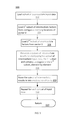
- FIG. 3 illustrates a flowchart of exemplary operations consistent with an embodiment of the present disclosure.
- Cooley-Tukey One rather well-known FFT technique is the Cooley-Tukey algorithm.
- the Cooley-Tukey algorithm reduces the number of operations for an N-point input data set from N 2 for a na ⁇ ve computation to on the order of N log 2 N using a Cooley-Tukey FFT. For relatively large N, this reduction in operations can be significant.
- the Cooley-Tukey technique is considered a “divide and conquer” technique that is limited to composite input data sets. Composite means that the number of samples is not prime. In other words, the number of samples, N, is the product of at least two non-unity integers.
- FFT techniques that utilize twiddle factors.
- examples of other techniques that utilize twiddle factors in determining an FFT of an N-point input data set, N composite include, but are not limited to, the Pease algorithm, the Stockham algorithm, the transposed Stockham algorithm, and variations of recursive applications of the Cooley-Tukey technique.
- the twiddle factors depend on the number (N) of data points but do not depend on values of input data.
- the twiddle factors may be precomputed and stored for example in a table in memory.
- Reduced memory footprint techniques may be configured to reduce the number of the precomputed twiddle factors, for example to on the order ⁇ N for N 1 ⁇ N 2 ⁇ N. Such techniques are not without cost.
- a vector scaling method may reduce memory footprint but at a cost of accumulated round-off error.
- an index splitting method may reduce memory footprint but at a cost of both irregular memory access pattern and additional index computation overhead.
- this disclosure describes an apparatus and method related to determination of a fast Fourier transform (FFT) of a relatively large one-dimensional set of input data.
- the method and apparatus are configured to reduce the memory footprint associated with storing the complex roots of unity (“twiddle factors”). While the apparatus and method may be utilized with relatively smaller input data sets, a benefit is greater for relatively large data sets.
- “Relatively large” corresponds to N (the number of points of the input data set) on the order of at least one thousand with an upper limit that may be related to the storage capacity of the apparatus configured to determine the FFT.
- Relatively large data sets may include, but are not limited to, seismic data, radio astronomy data, data sets associated with high resolution spectrum estimation and multiplication of large multiple-precision integers. Such data sets may include on the order of millions of data points.
- the method and apparatus are further configured to enhance memory locality and facilitate vectorization of operations associated with determining an FFT of an N-point one-dimensional array of input data.
- the method and apparatus are configured to reduce the memory footprint without accumulating round-off error and without the index computation overhead associated with the index splitting method.
- the method and apparatus are configured to determine and store a plurality of intermediate factors in an intermediate factors vector V (one-dimensional array of contiguous memory locations). Similar to the twiddle factors, the intermediate factors may be precomputed. The intermediate factors may then be used to reconstruct the twiddle factors that are used in an intermediate stage of the FFT determination.
- V one-dimensional array of contiguous memory locations
- a size of the intermediate factors vector may be related to a sum of the plurality of factors of N.
- the size of the intermediate factors vector is less than N.
- the intermediate factors vector is configured to have a size on the order of O(sqrt(N)).
- the intermediate factors vector V is configured to store, in contiguous memory, blocks (subvectors) of intermediate factors as described herein.
- a first subset (subvector) and a second subset (subvector) of intermediate factors may be loaded from contiguous memory locations (per subset) and a subset of twiddle factors may be reconstructed based on the first subset and second subset of intermediate factors.
- the subset of intermediate input data, first subset of intermediate factors and second subset of intermediate factors may be operated on and results stored in a subset of intermediate output data.
- a subset of intermediate results may be determined by multiplying, element by element, the subset of intermediate input data, the first subvector and a complex conjugate of the second subvector.
- a size of the subsets may be based on at least one nonunity factor of N.
- the size of the subsets may be based, at least in part, on circuitry configured to perform the operations.
- the size of the subsets may correspond to a register size.
- the subset size may correspond to a cache line size.
- the operations may be repeated for each subset of intermediate input data.
- operations associated with generating an FFT result may include mapping the one-dimensional input data into a multidimensional array. This mapping is configured to facilitate operations associated with generating the FFT result.
- a one-dimensional data set may be viewed as a multidimensional array based on this mapping.
- the multidimensional view provides a convenient technique for describing blocks (e.g., subsets) of data where a number of blocks and a size of the blocks are related to the factors of N.
- the dimension of the input data set itself remains one.
- the N-point input data set may be mapped into an N 1 by N 2 input data array that may be viewed as having N 1 rows and N 2 columns.
- the mapping may result in column-major order where elements of each column are in contiguous memory locations or in row-major order where elements of each row are in contiguous memory locations.
- a subset may include N 1 elements corresponding to a column of the input data array and for row-major order, a subset may include N 2 elements corresponding to a row of the two-dimensional view of the input data set.
- multidimensional data arrays correspond to this mapping (view) of one-dimensional data.
- a number of dimensions is related to a number of nonunity integer factors of N, the number of points in the input data set.
- a size of a block (subset) of data is related to a factor of N.
- the apparatus and method are configured to reduce memory footprint while enhancing vectorization, reducing index computational overhead and reducing irregular memory access pattern without increased error accumulation.
- intermediate results may be determined using SIMD instructions, with improved data locality and improved (i.e., more efficient) cache utilization.
- each subset may be loaded from a block of contiguous memory locations.
- Such loads are more efficient than loading a plurality of intermediate factors from noncontiguous and possibly non-local memory locations.
- operations on such blocks may exploit vector processor architecture (e.g., parallel processing) to enhance efficiency.
- a method and apparatus consistent with the present disclosure are configured to reduce memory footprint and to enhance operational efficiency when determining an FFT of a relatively large set of input data.
- the method and apparatus may be utilized for performing an inverse FFT of an input data set.
- an inverse FFT utilizes twiddle factors with a change in sign on the exponent.
- both row-major and column-major layouts of the two-dimensional view of intermediate results remain within the scope of this disclosure.
- a method and apparatus consistent with the present disclosure may be utilized for input data viewed as array of more than two dimensions where the number of points N is equal to a product of more than two nonunity integer factors.
- the discrete Fourier transform may generally be written as:
- each T[n] corresponds to an element in an FFT input data vector T of length N
- each F[j] corresponds to an element in a transformed output data vector F
- F the transform result
- the one-dimensional FFT input data vector T may be mapped into (viewed as) a two-dimensional FFT input data array R that has, for example, N 2 rows and N, columns of elements R[n 2 , n 1 ].
- the FFT of T may then be generated by first transposing the input data array R into an N 1 -by-N 2 array P, then determining N 2 DFTs of length N 1 on the columns of array P (to generate intermediate input data array X), then a point by point multiplication with the twiddle factors (array W) and the intermediate input data array X, then determining N 1 DFTs on the rows of the results (intermediate results array Y) of the point by point multiplication, and then storing the result in the FFT output data F.
- the first example corresponds to a Cooley-Tukey technique.
- the one-dimensional FFT input data vector T may be mapped into (viewed as) a two-dimensional FFT input data array R that has, for example, N 2 rows and N, columns of elements R[n 2 , n 1 ].
- the FFT of T may then be generated by determining N 2 DFTs of length N 1 on the rows of array R (to generate intermediate input data array X), then a point by point multiplication with the twiddle factors (transposed array W T in this example) and the intermediate input data array X, then transposing this result into intermediate results array Y, and then determining N 1 DFTs on the rows of the results (intermediate results array Y) of the point by point multiplication, and then storing the result in the FFT output data F.
- the intermediate input data array X may be transposed rather than the input data array R as was transposed in the first example.
- a point by point multiplication of the intermediate input data array X with a transposed twiddle factor array W T and transposing the result of the multiplication upon storage into intermediate results array Y is equivalent to transposing X on loading, performing the point by point multiplication with W (not transposed) and storing the result to Y.
- the one-dimensional FFT input data vector T may be mapped into a three-dimensional FFT input data array R that has, for example, a first dimension with N 3 elements, a second dimension with N 2 elements and a third dimension with N, elements R[n 3 , n 2 , n 1 ].
- the FFT may be generated in this example by a plurality of transposes and intermediate FFT operations. The operations of this example include two point by point multiplication stages.
- various techniques for determining the FFT of an N-point input data set, with composite N include at least one point by point multiplication stage of twiddle factors with an intermediate input data array.
- an apparatus and method consistent with the present disclosure may be utilized to reduce the memory footprint associated with the twiddle factors with the addition of a multiplication in order to reconstruct the twiddle factors in the multiplication stage.
- the intermediate factors vector V is configured to be utilized in the point by point multiplication stage.
- the point by point multiplication of the intermediate input data with the twiddle factors may be understood as an element by element multiplication of two matrices (arrays).
- Each Y[n 1 , n 2 ] is an intermediate result
- each X[n 1 , n 2 ] is an intermediate input
- each W[n 1 , n 2 ] is a complex root of unity (twiddle factor).
- Y corresponds to an array of intermediate results
- X corresponds to an array of intermediate inputs
- W corresponds to an array of twiddle factors.
- the intermediate inputs may be based on at least a portion of the FFT input data.
- the intermediate inputs may be results of a DFT applied to the portion of the FFT input data.
- the DFT may be generated using an FFT technique.
- each twiddle factor in the array W is a complex root of unity that may be generated based on a first index, n 1 , associated with the first factor of N, N 1 , and a second index, n 2 , associated with the second factor of N, N 2 .
- the product of n 1 and n 2 may be written as:
- n 1 ⁇ n 2 1 4 ⁇ ( ( n 1 + n 2 ) 2 - ( n 1 - n 2 ) 2 ) .
- a complex exponential, v may then be defined as:
- each intermediate output equals a corresponding intermediate input multiplied by a first intermediate factor and a complex conjugate of a second intermediate factor.
- the first intermediate factor corresponds to the complex exponential v raised to a square of a sum of the first index n 1 associated with the first nonunity integer factor of N (N 1 ) and the second index n 2 associated with the second nonunity integer factor of N (N 2 ).
- the second intermediate factor corresponds to the complex exponential v raised to a square of a difference of the first index n, and the second index n 2 .
- a maximum value and a minimum value of intermediate factors index k are related to the first factor N 1 and the second factor N 2 .
- Intermediate factors vector V is configured to include N 1 +2N 2 ⁇ 2 elements.
- N may have more than two nonunity integer factors (e.g., the third example, described herein).
- the intermediate factors vector V may include a plurality of subsets (subvectors) of intermediate factors.
- each subset of intermediate factors may be configured to include N 1 contiguous elements corresponding to a column, n 2 , of intermediate input array X and related to column n 2 of twiddle factor array W.
- the symbol ⁇ corresponds to element-wise multiplication and V is the complex conjugate of V.
- the first subset (V[n 2 :n 2 +N 1 ⁇ 1]) and the second subset (V[ ⁇ n 2 : ⁇ n 2 +N 1 ⁇ 1]) each include N 1 contiguous elements of vector V.
- the first subset and the second subset may each thus be accessed and/or loaded by, for example, a vector processor.
- the intermediate output column Y[:,n 2 ] may be determined using SIMD (single instruction-multiple data) instructions.
- a size of the intermediate factors vector is related to a plurality of nonunity integer factors of N, the number of points in the input data set.
- the size of the intermediate factors vector is related to a sum of at least a portion of the factors of N. For N relatively large, the size of the intermediate factors vector is less than N, resulting in a reduced memory footprint.
- FIG. 1 illustrates a system 100 consistent with various embodiments of the present disclosure.
- the system 100 generally includes processor circuitry 102 and memory circuitry 104 .
- Memory circuitry 104 may be configured to store FFT input data 120 , intermediate input data 122 , intermediate factors vector 124 , intermediate results 126 , and/or output data 128 .
- intermediate input data 122 may include N data points and intermediate factors vector 124 may be configured to include N 1 +2N 2 ⁇ 2 contiguous memory locations, as described herein.
- FFT input data 120 , intermediate input data 122 , intermediate results 126 , and/or output data 128 may be included in local memory.
- Processor circuitry 102 includes FFT circuitry 106 .
- Processor circuitry 102 may include digital signal processing (DSP) circuitry 108 and/or a processor cache 110 .
- DSP digital signal processing
- the DSP circuitry 108 may be configured to generate filtered output data based at least in part on input data and user-defined filter characteristics, as is known to those skilled in the art.
- the processor cache 110 is configured to store recently and/or often used data for generally faster access by other processor circuitry, as is known to those skilled in the art.
- processor circuitry 102 may include a vector processor configured to perform operations on a plurality of data in parallel.
- processor circuitry 102 may include a multiplier configured to multiply complex numbers.
- processor circuitry 102 may include an application specific integrated circuit (ASIC) and/or a system on a chip (SoC) configured to perform operations on a plurality of data in parallel and/or to multiply complex numbers.
- ASIC application specific integrated circuit
- SoC system on a chip
- the FFT circuitry 106 may include intermediate factor circuitry 112 and intermediate result circuitry 114 .
- the FFT circuitry 106 is configured to receive FFT input data 120 and to generate corresponding FFT output data 128 based on the FFT input data 120 .
- the intermediate factor circuitry 112 is configured to determine intermediate factors and to provide the intermediate factors to memory circuitry 104 .
- the intermediate result circuitry 114 is configured to determine intermediate output (results) 126 based on intermediate input data 122 and the intermediate factors 124 and to provide the intermediate output results 126 to memory circuitry 104 .
- the FFT input data 120 may correspond to a one-dimensional array of size N data points.
- the FFT circuitry 106 is configured to generate a two-dimensional array of intermediate input data 122 based on the FFT input data 120 and to generate an FFT output 128 based on intermediate output data 126 .
- the intermediate factor circuitry 112 is configured to generate a plurality of intermediate factors v k 2 and to provide the intermediate factors to memory circuitry 104 for storage in the intermediate factors vector 124 .
- the intermediate factors may be generated based on N 1 and N 2 as described herein.
- Intermediate result circuitry 114 is configured to reconstruct a column of N, twiddle factors by multiplying, element by element, the first subvector of intermediate factors by a complex conjugate of the second subvector of intermediate factors.
- Intermediate result circuitry 114 is configured to generate intermediate results 126 by multiplying, element by element, the reconstructed twiddle factors and an associated column of intermediate input data.
- the intermediate result circuitry 114 may then provide the intermediate results 126 to memory circuitry 104 .
- the FFT circuitry 106 is configured to generate FFT output data 128 based, at least in part, on the intermediate results 126 .
- system 100 is configured to determine a fast Fourier transform of FFT input data 120 .
- Intermediate factor circuitry 112 is configured to generate the intermediate factors and to store the intermediate factors in intermediate factors vector 124 .
- the intermediate factors are configured to be utilized to reconstruct N twiddle factors while occupying a reduced memory footprint (N 1 +2N 2 ⁇ 2).
- the intermediate factors vector 124 is configured to provide memory locality for the first subset and the second subset of the intermediate factors. This memory locality may improve transforming the input data by reducing memory accesses and facilitating a load-multiply-store sequence configured to process a plurality of intermediate input data in parallel.
- FIG. 2 illustrates a flowchart 200 of exemplary operations for determining a discrete Fourier transform of a one-dimensional array of input data consistent with various embodiments of the present disclosure.
- the operations may be performed, for example, by the processor circuitry 102 , including FFT circuitry 106 , intermediate factor circuitry 112 and/or intermediate result circuitry 114 .
- flowchart 200 depicts exemplary operations configured to generate a Fast Fourier Transform of a one-dimensional array of input data of size N points where N is composite and may be relatively large.
- the operations of flowchart 200 may be initiated 202 in response to receiving a request to perform a discrete Fourier transform on an identified one-dimensional array of input data of size N points.
- N 1 and N 2 may be selected so that N 1 ⁇ N 2 ⁇ sqrt(N) so that the size of the intermediate factors vector is approximately 3*sqrt(N).
- 3*sqrt(N) is much less than N resulting in a reduced memory footprint associated with the twiddle factors.
- Operation 212 includes generating intermediate input data.
- the N-point input data set may be converted to a two-dimensional view (for example, by mapping plus transposing) to yield the two-dimensional (N 1 by N 2 ) input data array.
- N 2 DFTs of length N 1 may then be performed on the columns of the input data array to generate the intermediate input data array X having dimension N 1 by N 2 .
- the intermediate input data array X may then be stored, for example, in memory circuitry 104 .
- Intermediate results array Y may be generated at operation 214 based on the intermediate input data array X and intermediate factors vector V.
- the intermediate results Y may then be stored, for example, in memory circuitry 104 .
- the operations associated with operation 214 are described in more detail below ( FIG. 3 ).
- Operation 216 includes generating an FFT output based on the intermediate results. For example, for a two-dimensional intermediate input data array, N 1 DFTs of length N 2 may then be performed on the rows of the intermediate results array to generate the FFT output.
- the FIT output may then be stored, for example, in memory circuitry 104 . Program flow may then return at operation 218 .
- operations 206 , 208 and 210 may be performed between operations 204 and 212 .
- operations 206 , 208 and 210 may be performed between operations 212 and 214 , within the scope of the present disclosure.
- FIG. 3 illustrates a flowchart 300 of exemplary operations consistent with an embodiment of the present disclosure.
- the operations may be performed, for example, by the processor circuitry 102 , including intermediate factor circuitry 112 and/or intermediate result circuitry 114 .
- Flowchart 300 relates to operation 214 of flowchart 200 .
- Operation 302 includes loading a subset of intermediate input data, for example, column X[:,n 2 ].
- Operation 304 includes loading a first subset (for example, V[n 2 :n 2 +N 1 ⁇ 1]) of intermediate factors from contiguous memory locations of intermediate factors vector V.
- Operation 306 includes loading a second subset (for example, V[ ⁇ n 2 : ⁇ n 2 +N 1 ⁇ 1]) of intermediate factors from contiguous memory locations of intermediate factors vector V.
- Operation 308 includes generating a subset of intermediate results for the subset of intermediate input data.
- the subset of intermediate results may be generated by multiplying, element by element, the subset of intermediate input data, the first subset of the intermediate factors vector V and a complex conjugate of the second subset of the intermediate factors vector V.
- the subset of intermediate input data may correspond to a column of intermediate input data and the subset of intermediate results may correspond to a column of intermediate results.
- Each subset of intermediate results may be stored in an intermediate result array at operation 310 .
- Program flow may return at operation 314 .
- intermediate results may be generated for an N-point FFT of an N-point data set where N is composite, by reconstructing N twiddle factors based on a vector of intermediate factors.
- N may be relatively large.
- the vector of intermediate factors may have a memory footprint on the order of N 1 +2N 2 .
- the operations include an additional multiplication to generate the twiddle factors.
- the intermediate factors vector is configured to enhance vectorization, for example, to facilitate loading subvectors of intermediate factors and SIMD processing to obtain the twiddle factors.
- FIGS. 2 and 3 illustrate various operations according to various embodiments, it is to be understood that not all of the operations depicted in FIGS. 2 and 3 are necessary for other embodiments. Indeed, it is fully contemplated herein that in other embodiments of the present disclosure, the operations depicted in FIGS. 2 and 3 and/or other operations described herein may be combined in a manner not specifically shown in any of the drawings, but still fully consistent with the present disclosure. Thus, claims directed to features and/or operations that are not exactly shown in one drawing are deemed within the scope and content of the present disclosure.
- Table 1 illustrates operations configured to generate an FFT of an N-point input data set T consistent with an embodiment of the present disclosure.
- the operations of Table 1 correspond to the first example described above where N is the product of a first factor N 1 and a second factor N 2 .
- the N-point input data set is mapped into a two-dimensional input data array that is transposed (line 2) prior to the multiplication stage (lines 4 and 5).
- lines 4 and 5 illustrate vectorization of the multiplication stage.
- the intermediate factors vector V has been generated prior to the operations illustrated in Table 1.
- Underlined dimensions e.g., N 1 in line three
- X1(N2,N1) view_as_N2_by_N1_array( T(N) ) 2.
- X2(N1,N2) transpose( X1(N2,N1) ) 3.
- X4(0:N1 ⁇ 1,n2) X3(0:N1 ⁇ 1,n2) * V(n2:n2+N1 ⁇ 1) * conj( V( ⁇ n2: ⁇ n2+N1 ⁇ 1) ) 6.
- X5(N1,N2) perform_N1_FFT_N2( X4(N1, N2 ) ) 7.
- F(N) view_as_N_array( X5(N1,N2) )
- Table 2 illustrates operations configured to generate an FFT of an N-point input data set consistent with an embodiment of the present disclosure.
- the operations of Table 2 correspond to the second example described above where N is the product of a first factor N 1 and a second factor N 2 and transposing occurs in the multiplication stage. Similar to the operations illustrated in Table 1, the intermediate factors vector V has been generated prior to the operations illustrated in Table 2. Underlined dimensions (e.g., N 1 in line two) correspond to the dimensions along which the FFT may be computed.
- the N-point input data set is mapped into a two-dimensional input data array that is transposed in the multiplication stage (corresponding to lines 3 and 4 of Table 2).
- X1(N2,N1) view_as_N2_by_N1_array( T(N) ) 2.
- X3(n1,0:N2 ⁇ 1) X2(0:N2 ⁇ 1,n1) * V(n1:n1+N2 ⁇ 1) * conj(V(n1 ⁇ N2+1:n1) 5.
- X4(N1,N2) perform_N1_FFT_N2( X3(N1, N2 ) ) 6.
- F(N) view_as_N_array( X4(N1,N2) )
- Table 3 illustrates operations configured to generate an FFT of an N-point input data set consistent with an embodiment of the present disclosure.
- the operations of Table 3 correspond to the third example described above where N is the product of a first factor N 1 , a second factor N 2 and a third factor N 3 .
- the N-point input data set is mapped into a three-dimensional input data array.
- the operations of this example include two multiplication stages, a first multiplication stage corresponding to lines 4 and 5 and a second multiplication stage corresponding to lines 8 and 9.
- the number of twiddle factors associated with the first multiplication stage is greater than the number of twiddle factors associated with the second multiplication stage. Utilizing an intermediate factors vector consistent with various embodiments of the present disclosure to reconstruct the twiddle factors may thus confer a greater benefit to the first multiplication stage than may be conferred to the second multiplication stage.
- X1(N3,N2,N1) view_as_3D_array( T(N) ) 2.
- X2(N1,N3,N2) transpose( X1(N3,N2,N1) ) 3.
- X4(n1,n3,n2) X3(n1,n3,n2) * V(n1+n3+N3*n2) * conj( V(n1 ⁇ n3 ⁇ N3*n2) ) 6.
- X5(N1,N2,N3) transpose( X4(N1,N3,N2) ) 7.
- X7(n1,n2,n3) X6(n1,n2,n3) * V(N1*n2+n3) * conj( V(N1*n2 ⁇ n3) ) 10.
- X8(N1,N2,N3) perform_N1 ⁇ N2_FFT_N3( X7(N1,N2, N3 ) ) 11.
- F(N) view_as_N_array( X8(N1,N2,N3) )
- Tables 1 through 3 illustrate various techniques for generating an FFT of an N-point input data set, N composite, i.e., N is a product of a plurality of nonunity integer factors.
- An intermediate factors vector V may be generated and stored in contiguous memory locations prior to performing the FFT operations.
- a number of intermediate factors included in the intermediate factors vector V i.e., size of the intermediate factors vector
- the intermediate factors vector may be generated once and used in a plurality of N-point FFT determinations.
- An intermediate factors vector V consistent with various embodiments of the present disclosure is configured to facilitate vectorizing the multiplication stage of an FFT determination while reducing the memory footprint associated with storing the twiddle factors. Further, reconstructing the twiddle factors based, at least in part, on subsets of the intermediate factors vector is not restricted to one particular FFT technique.
- any of the operations described herein may be implemented in a system that includes one or more storage mediums having stored thereon, individually or in combination, instructions that when executed by one or more processors perform the methods.
- the processor may include, for example, a server CPU, a mobile device CPU, and/or other programmable circuitry. Also, it is intended that operations described herein may be distributed across a plurality of physical devices, such as processing structures at more than one different physical locations.
- the storage medium may include any type of tangible medium, for example, any type of disk including floppy disks, optical disks, compact disk read-only memories (CD-ROMs), compact disk rewritables (CD-RWs), and magneto-optical disks, semiconductor devices such as read-only memories (ROMs), random access memories (RAMs) such as dynamic and static RAMs, erasable programmable read-only memories (EPROMs), electrically erasable programmable read-only memories (EEPROMs), flash memories, Solid State Disks (SSDs), magnetic or optical cards, or any type of media suitable for storing electronic instructions.
- ROMs read-only memories
- RAMs random access memories
- EPROMs erasable programmable read-only memories
- EEPROMs electrically erasable programmable read-only memories
- flash memories Solid State Disks (SSDs)
- SSDs Solid State Disks
- magnetic or optical cards or any type of media suitable for storing electronic instructions.
- Other embodiments
- Circuitry may comprise, for example, singly or in any combination, hardwired circuitry, programmable circuitry, state machine circuitry, and/or firmware that stores instructions executed by programmable circuitry.
- the circuitry may be embodied as an integrated circuit, such as an integrated circuit chip.
- the set of input data may be relatively large.
- the method and apparatus are configured to reduce the memory footprint associated with the complex roots of unity (“twiddle factors”), to enhance memory locality and facilitate vectorization of operations associated with determining an FFT of an N-point one-dimensional array of input data.
- the method and apparatus are configured to reduce the memory footprint without accumulating round-off error with the addition of a complex multiplication.
- the apparatus may include intermediate factor circuitry configured to generate an intermediate factors vector including a number of intermediate factors in response to a request to FFT circuitry to generate a fast Fourier transform (FFT) of an N-point input data set, N composite, wherein N is equal to a product of a number of nonunity integer factors, the number of intermediate factors is related to the nonunity integer factors of N and the number of intermediate factors is less than N.
- the apparatus may further include memory circuitry configured to store the intermediate factors vector in contiguous memory locations.
- the apparatus may further include intermediate result circuitry configured to reconstruct a subset of twiddle factors based at least in part on an element by element product of a first subset of the intermediate factors vector and a complex conjugate of a second subset of the intermediate factors vector, each of the first subset and the second subset loaded from contiguous memory locations in the memory circuitry, wherein the twiddle factors are complex roots of unity configured to be used in generating the FFT.
- the method may include generating an intermediate factors vector comprising a number of intermediate factors in response to a request to FFT circuitry to generate a fast Fourier transform (FFT) of an N-point input data set, N composite, wherein N is equal to a product of a number of nonunity integer factors, the number of intermediate factors is related to the nonunity integer factors of N and the number of intermediate factors is less than N; storing the intermediate factors vector in contiguous memory locations in memory circuitry; and reconstructing a subset of twiddle factors based at least in part on an element by element product of a first subset of the intermediate factors vector and a complex conjugate of a second subset of the intermediate factors vector, each of the first subset and the second subset loaded from the contiguous memory locations in the memory circuitry, wherein the twiddle factors are complex roots of unity configured to be used in generating the FFT.
- FFT fast Fourier transform
- the system may include one or more storage mediums having stored thereon, individually or in combination, instructions that when executed by one or more processors result in the following operations comprising: generating an intermediate factors vector comprising a number of intermediate factors in response to a request to FFT circuitry to generate a fast Fourier transform (FFT) of an N-point input data set, N composite, wherein N is equal to a product of a number of nonunity integer factors, the number of intermediate factors is related to the nonunity integer factors of N and the number of intermediate factors is less than N; storing the intermediate factors vector in contiguous memory locations in memory circuitry; and reconstructing a subset of twiddle factors based at least in part on an element by element product of a first subset of the intermediate factors vector and a complex conjugate of a second subset of the intermediate factors vector, each of the first subset and the second subset loaded from the contiguous memory locations in the memory circuitry, wherein the twiddle factors are complex roots of
Landscapes
- Physics & Mathematics (AREA)
- Mathematical Physics (AREA)
- Engineering & Computer Science (AREA)
- General Physics & Mathematics (AREA)
- Computational Mathematics (AREA)
- Mathematical Analysis (AREA)
- Mathematical Optimization (AREA)
- Pure & Applied Mathematics (AREA)
- Data Mining & Analysis (AREA)
- Theoretical Computer Science (AREA)
- Discrete Mathematics (AREA)
- Algebra (AREA)
- Databases & Information Systems (AREA)
- Software Systems (AREA)
- General Engineering & Computer Science (AREA)
- Complex Calculations (AREA)
Abstract
Description
which corresponds to a complex root of unity. F (the transform result) may be generated utilizing an FFT technique, consistent with the present disclosure.
Y[n 1 ,n 2 ]=X[n 1 ,n 2 ]·W[n 1 ,n 2]
where n1=0, . . . , N1−1, n2=0, . . . , N2−1.
In other words, each twiddle factor in the array W is a complex root of unity that may be generated based on a first index, n1, associated with the first factor of N, N1, and a second index, n2, associated with the second factor of N, N2. The product of n1 and n2 may be written as:
A complex exponential, v, may then be defined as:
so that
Y[n 1 ,n 2 ]=X[n 1 ,n 2 ]·v (n
In other words, each intermediate output equals a corresponding intermediate input multiplied by a first intermediate factor and a complex conjugate of a second intermediate factor. The first intermediate factor corresponds to the complex exponential v raised to a square of a sum of the first index n1 associated with the first nonunity integer factor of N (N1) and the second index n2 associated with the second nonunity integer factor of N (N2). The second intermediate factor corresponds to the complex exponential v raised to a square of a difference of the first index n, and the second index n2.
V[k]=v k
where N1 is the first nonunity integer factor of N, N2 is the second nonunity integer factor of N and each element V[k]=vk
Y[:,n 2 ]=X[:,n 2 ]⊙V[n 2 :n 2 +N 1−1]⊙
where [:,n2] corresponds to column n2 of the intermediate output array and column n2 of the intermediate input array. In other words. [:,n2] includes all row indices, n1=0, . . . , N1−1 of column n2. The symbol ⊙ corresponds to element-wise multiplication and
| TABLE 1 | ||
| 1. X1(N2,N1) := view_as_N2_by_N1_array( T(N) ) | ||
| 2. X2(N1,N2) := transpose( X1(N2,N1) ) | ||
| 3. X3(N1,N2) := perform_N2_FFT_N1( X2(N1,N2) ) | ||
| 4. for n2=0:N2−1 | ||
| 5. X4(0:N1−1,n2) := X3(0:N1−1,n2) * V(n2:n2+N1−1) * | ||
| conj( V(−n2:−n2+N1−1) ) | ||
| 6. X5(N1,N2) := perform_N1_FFT_N2( X4(N1,N2) ) | ||
| 7. F(N) :=view_as_N_array( X5(N1,N2) ) | ||
| TABLE 2 | ||
| 1. X1(N2,N1) :=view_as_N2_by_N1_array( T(N) ) | ||
| 2. X2(N2,N1) := perform_N2_FFT_N1( X1(N2,N1) ) | ||
| 3. for n1=0:N1−1 do: | ||
| 4. X3(n1,0:N2−1) := X2(0:N2−1,n1) * V(n1:n1+N2−1) * | ||
| conj(V(n1−N2+1:n1) | ||
| 5. X4(N1,N2) := perform_N1_FFT_N2( X3(N1,N2) ) | ||
| 6. F(N) :=view_as_N_array( X4(N1,N2) ) | ||
| TABLE 3 |
| 1. X1(N3,N2,N1) :=view_as_3D_array( T(N) ) |
| 2. X2(N1,N3,N2) := transpose( X1(N3,N2,N1) ) |
| 3. X3(N1,N3,N2) := perform_N3×N2_FFT_N1( X2(N1,N3,N2) ) |
| 4. for n1=0:N1−1, n3=0:N3−1, n2=0:N2−1 do: |
| 5. X4(n1,n3,n2) := X3(n1,n3,n2) * V(n1+n3+N3*n2) * |
| conj( V(n1−n3−N3*n2) ) |
| 6. X5(N1,N2,N3) :=transpose( X4(N1,N3,N2) ) |
| 7. X6(N1,N2,N3) := perform_N1×N3_FFT_N2( X5(N1,N2,N3) ) |
| 8. for n1=0:N1−1, n2=0:N2−1, n3=0:N3−1 do: |
| 9. X7(n1,n2,n3) := X6(n1,n2,n3) * V(N1*n2+n3) * conj( V(N1*n2−n3) ) |
| 10. X8(N1,N2,N3) := perform_N1×N2_FFT_N3( X7(N1,N2,N3) ) |
| 11. F(N) :=view_as_N_array( X8(N1,N2,N3) ) |
Claims (27)
Applications Claiming Priority (1)
| Application Number | Priority Date | Filing Date | Title |
|---|---|---|---|
| PCT/RU2012/000170 WO2013137759A1 (en) | 2012-03-12 | 2012-03-12 | Method and apparatus for reduced memory footprint fast fourier transforms |
Publications (2)
| Publication Number | Publication Date |
|---|---|
| US20140181168A1 US20140181168A1 (en) | 2014-06-26 |
| US9317480B2 true US9317480B2 (en) | 2016-04-19 |
Family
ID=46981063
Family Applications (1)
| Application Number | Title | Priority Date | Filing Date |
|---|---|---|---|
| US13/994,828 Expired - Fee Related US9317480B2 (en) | 2012-03-12 | 2012-03-12 | Method and apparatus for reduced memory footprint fast fourier transforms |
Country Status (2)
| Country | Link |
|---|---|
| US (1) | US9317480B2 (en) |
| WO (1) | WO2013137759A1 (en) |
Cited By (2)
| Publication number | Priority date | Publication date | Assignee | Title |
|---|---|---|---|---|
| US9529539B1 (en) * | 2015-06-09 | 2016-12-27 | Winbond Electronics Corp. | Data allocating apparatus, signal processing apparatus, and data allocating method |
| US20170103503A1 (en) * | 2015-10-13 | 2017-04-13 | Samsung Electronics Co., Ltd. | Apparatus and method for performing fourier transform |
Families Citing this family (3)
| Publication number | Priority date | Publication date | Assignee | Title |
|---|---|---|---|---|
| US9934153B2 (en) * | 2015-06-30 | 2018-04-03 | Nvidia Corporation | Patch memory system |
| US11474232B2 (en) * | 2021-03-19 | 2022-10-18 | KaiKuTek Inc. | Range doppler angle detection method and range doppler angle detection device |
| CN118981593B (en) * | 2024-08-06 | 2026-03-24 | 华中科技大学 | A Fourier transform in-memory computing system and its computing method |
Citations (4)
| Publication number | Priority date | Publication date | Assignee | Title |
|---|---|---|---|---|
| US6098088A (en) * | 1995-11-17 | 2000-08-01 | Teracom Ab | Real-time pipeline fast fourier transform processors |
| EP1076296A2 (en) | 1999-08-11 | 2001-02-14 | State Of Israel Ministry Of Defense Rafael - Armament Development Authority | Data storage for fast fourier transforms |
| US20080126462A1 (en) * | 2006-06-27 | 2008-05-29 | Nokia Corporation | Optimized multi-mode DFT implementation |
| US20090160576A1 (en) * | 2007-12-24 | 2009-06-25 | Telefonaktiebolaget Lm Ericsson (Publ) | Passive Fourier Transform Circuits and Butler Matrices |
-
2012
- 2012-03-12 US US13/994,828 patent/US9317480B2/en not_active Expired - Fee Related
- 2012-03-12 WO PCT/RU2012/000170 patent/WO2013137759A1/en not_active Ceased
Patent Citations (4)
| Publication number | Priority date | Publication date | Assignee | Title |
|---|---|---|---|---|
| US6098088A (en) * | 1995-11-17 | 2000-08-01 | Teracom Ab | Real-time pipeline fast fourier transform processors |
| EP1076296A2 (en) | 1999-08-11 | 2001-02-14 | State Of Israel Ministry Of Defense Rafael - Armament Development Authority | Data storage for fast fourier transforms |
| US20080126462A1 (en) * | 2006-06-27 | 2008-05-29 | Nokia Corporation | Optimized multi-mode DFT implementation |
| US20090160576A1 (en) * | 2007-12-24 | 2009-06-25 | Telefonaktiebolaget Lm Ericsson (Publ) | Passive Fourier Transform Circuits and Butler Matrices |
Non-Patent Citations (8)
| Title |
|---|
| Bailey, David H., "FFTs in External or Hierarchical Memory", Journal of Supercomputing, vol. 4, Issue 1, Dordrecht, NL, Mar. 1990, pp. 23-35. |
| Conte et al.,"Optimal Chip-Package Codesign for High-Performance DSP", IEEE Transactions on Advanced Packaging, vol. 28, Issue 2, Piscataway, NJ, USA, May 2005, pp. 288-297. |
| Franchetti et al.,"FFT Algorithms for Multiply-Add Architecture", 2nd International Conference APLIMAT 2003, Jan. 2003, pp. 333-339. |
| International Search Report and Written Opinion received for PCT application No. PCT/RU2012/000170, mailed on Jan. 17, 2013, 16 Pages. |
| J.W. Cooley et al., "An algorithm for machine calculation of complex Fourier series", 1965, pp. 297-310. |
| Johnson et al., "A Modified Split-Radix FFT With Fewer Arithmetic Operations", IEEE Transactions on Signal Processing, IEEE Service Center, vol. 54, Issue 1, NY, US, Jan. 2007, pp. 111-119. |
| P. Duhamel et al. "Fast Fourier Transforms: A tutorial review and a state of the art", Signal Processing, vol. 19, 1990. |
| Tasche et al., "Improved Roundoff Error Analysis for Precomputed Twiddle Factors", Journal of Computational Analysis and Applications, vol. 4, Jan. 1, 2002, pp. 1-18. |
Cited By (3)
| Publication number | Priority date | Publication date | Assignee | Title |
|---|---|---|---|---|
| US9529539B1 (en) * | 2015-06-09 | 2016-12-27 | Winbond Electronics Corp. | Data allocating apparatus, signal processing apparatus, and data allocating method |
| US20170103503A1 (en) * | 2015-10-13 | 2017-04-13 | Samsung Electronics Co., Ltd. | Apparatus and method for performing fourier transform |
| US10026161B2 (en) * | 2015-10-13 | 2018-07-17 | Samsung Electronics Co., Ltd. | Apparatus and method for performing fourier transform |
Also Published As
| Publication number | Publication date |
|---|---|
| US20140181168A1 (en) | 2014-06-26 |
| WO2013137759A1 (en) | 2013-09-19 |
Similar Documents
| Publication | Publication Date | Title |
|---|---|---|
| US7702712B2 (en) | FFT architecture and method | |
| EP2408158B1 (en) | Circuit and method for implementing fft/ifft transform | |
| US20100106758A1 (en) | Computing discrete fourier transforms | |
| US20010032227A1 (en) | Butterfly-processing element for efficient fast fourier transform method and apparatus | |
| US20140181168A1 (en) | Method and apparatus for reduced memory footprint fast fourier transforms | |
| Wang et al. | Recursive computation of Tchebichef moment and its inverse transform | |
| US11899741B2 (en) | Memory device and method | |
| US20180373677A1 (en) | Apparatus and Methods of Providing Efficient Data Parallelization for Multi-Dimensional FFTs | |
| CN117633418A (en) | Multidimensional Fast Fourier Transform Acceleration Method Based on Matrix Operation | |
| EP3370161B1 (en) | Adapting the processing of decomposed ffts to match the number of data points processed in parallel | |
| Huang et al. | A refined fast 2-D discrete cosine transform algorithm | |
| KR102376492B1 (en) | Fast Fourier transform device and method using real valued as input | |
| Chen et al. | Big prime field FFT on the GPU | |
| US20100179978A1 (en) | Fft-based parallel system with memory reuse scheme | |
| US7761495B2 (en) | Fourier transform processor | |
| US20080228845A1 (en) | Apparatus for calculating an n-point discrete fourier transform by utilizing cooley-tukey algorithm | |
| US20200142670A1 (en) | Radix-23 Fast Fourier Transform for an Embedded Digital Signal Processor | |
| US6728742B1 (en) | Data storage patterns for fast fourier transforms | |
| Yu et al. | FPGA architecture for 2D Discrete Fourier Transform based on 2D decomposition for large-sized data | |
| US8706794B1 (en) | No-multiply digital signal processing method | |
| US8601045B2 (en) | Apparatus and method for split-radix-2/8 fast fourier transform | |
| US20180373676A1 (en) | Apparatus and Methods of Providing an Efficient Radix-R Fast Fourier Transform | |
| US9311274B2 (en) | Approach for significant improvement of FFT performance in microcontrollers | |
| US20050278404A1 (en) | Method and apparatus for single iteration fast Fourier transform | |
| Khimich et al. | Algorithms of parallel computations for linear algebra problems with irregularly structured matrices |
Legal Events
| Date | Code | Title | Description |
|---|---|---|---|
| AS | Assignment |
Owner name: INTEL CORPORATION, CALIFORNIA Free format text: ASSIGNMENT OF ASSIGNORS INTEREST;ASSIGNORS:BAKSHEEV, DMITRY G.;PETROV, EVGUENI S.;PETROV, VLADIMIR S.;SIGNING DATES FROM 20130913 TO 20130920;REEL/FRAME:031308/0316 |
|
| AS | Assignment |
Owner name: INTEL CORPORATION, CALIFORNIA Free format text: ASSIGNMENT OF ASSIGNORS INTEREST;ASSIGNORS:BAKSHEEV, DMITRY G.;PETROV, EVGUENI S.;PETROV, VLADIMIR S.;SIGNING DATES FROM 20130913 TO 20130920;REEL/FRAME:032732/0349 |
|
| STCF | Information on status: patent grant |
Free format text: PATENTED CASE |
|
| FEPP | Fee payment procedure |
Free format text: MAINTENANCE FEE REMINDER MAILED (ORIGINAL EVENT CODE: REM.); ENTITY STATUS OF PATENT OWNER: LARGE ENTITY |
|
| LAPS | Lapse for failure to pay maintenance fees |
Free format text: PATENT EXPIRED FOR FAILURE TO PAY MAINTENANCE FEES (ORIGINAL EVENT CODE: EXP.); ENTITY STATUS OF PATENT OWNER: LARGE ENTITY |
|
| STCH | Information on status: patent discontinuation |
Free format text: PATENT EXPIRED DUE TO NONPAYMENT OF MAINTENANCE FEES UNDER 37 CFR 1.362 |
|
| FP | Lapsed due to failure to pay maintenance fee |
Effective date: 20200419 |