US9315715B2 - Method of reducing the viscosity of hydrocarbons - Google Patents
Method of reducing the viscosity of hydrocarbons Download PDFInfo
- Publication number
- US9315715B2 US9315715B2 US12/582,329 US58232909A US9315715B2 US 9315715 B2 US9315715 B2 US 9315715B2 US 58232909 A US58232909 A US 58232909A US 9315715 B2 US9315715 B2 US 9315715B2
- Authority
- US
- United States
- Prior art keywords
- group
- hydrophobically modified
- general formula
- water
- emulsion
- Prior art date
- Legal status (The legal status is an assumption and is not a legal conclusion. Google has not performed a legal analysis and makes no representation as to the accuracy of the status listed.)
- Active, expires
Links
- 0 *OCC1OC(OC2C(CO*)OC(O[H])C(O*)C2*O)C(O*)C(*O)C1O[H] Chemical compound *OCC1OC(OC2C(CO*)OC(O[H])C(O*)C2*O)C(O*)C(*O)C1O[H] 0.000 description 6
- VIUZAMJKSQANKO-PYTIBAHVSA-N [HH].[HH].[HH].[HH].[HH].[HH].[HH].[HH].[HH].[HH].[HH].[HH].[HH].[HH].[HH].[HH].[H]O[C@@H]1C(COC#CC#CC#C)O[C@@H](O[C@H]2C(O)C(O)[C@H](O[C@@H]3C(COCCO)O[C@@H](O[C@H]4C(O)C(O)[C@H](C)O[C@H]4CO)C(OCCO)[C@H]3O)O[C@H]2COCCOCCCCCCCCCCCCCCCC)C(O)[C@H]1O Chemical compound [HH].[HH].[HH].[HH].[HH].[HH].[HH].[HH].[HH].[HH].[HH].[HH].[HH].[HH].[HH].[HH].[H]O[C@@H]1C(COC#CC#CC#C)O[C@@H](O[C@H]2C(O)C(O)[C@H](O[C@@H]3C(COCCO)O[C@@H](O[C@H]4C(O)C(O)[C@H](C)O[C@H]4CO)C(OCCO)[C@H]3O)O[C@H]2COCCOCCCCCCCCCCCCCCCC)C(O)[C@H]1O VIUZAMJKSQANKO-PYTIBAHVSA-N 0.000 description 1
- PNRLZNSWDRVHQR-KHSLQWQMSA-N [HH].[HH].[HH].[HH].[HH].[HH].[HH].[HH].[HH].[HH].[HH].[HH].[HH].[HH].[HH].[HH].[H]O[C@@H]1C(COC#CC#CC#C)O[C@@H](O[C@H]2C(O)C(O)[C@H](O[C@@H]3C(COCCO)O[C@@H](O[C@H]4C(O)C(O)[C@H](O)O[C@H]4CO)C(OCCO)[C@H]3O)O[C@H]2COCCOCCCCCCCCCCCCCCCC)C(O)[C@H]1O Chemical compound [HH].[HH].[HH].[HH].[HH].[HH].[HH].[HH].[HH].[HH].[HH].[HH].[HH].[HH].[HH].[HH].[H]O[C@@H]1C(COC#CC#CC#C)O[C@@H](O[C@H]2C(O)C(O)[C@H](O[C@@H]3C(COCCO)O[C@@H](O[C@H]4C(O)C(O)[C@H](O)O[C@H]4CO)C(OCCO)[C@H]3O)O[C@H]2COCCOCCCCCCCCCCCCCCCC)C(O)[C@H]1O PNRLZNSWDRVHQR-KHSLQWQMSA-N 0.000 description 1
- HPDIADDNLCAZLT-UHFFFAOYSA-N [H]OC1OC(COCCO)C(OC2OC(COCCO)C(O[H])C(O)C2O)C(OCCO)C1O Chemical compound [H]OC1OC(COCCO)C(OC2OC(COCCO)C(O[H])C(O)C2O)C(OCCO)C1O HPDIADDNLCAZLT-UHFFFAOYSA-N 0.000 description 1
- URSAPFKENLIMLE-UHFFFAOYSA-N [H]OC1OC(COCCOCCCCCCCCCCCCCCCC)C(OC2OC(CO)C(O[H])C(O)C2O)C(O)C1O Chemical compound [H]OC1OC(COCCOCCCCCCCCCCCCCCCC)C(OC2OC(CO)C(O[H])C(O)C2O)C(O)C1O URSAPFKENLIMLE-UHFFFAOYSA-N 0.000 description 1
- AVEIWKVMEGUZIV-CLAMFRDFSA-N [H]OC1OC(COCCOCCCCCCCCCCCCCCCC)[C@@H](OC2OC(COCCCOCCO)[C@@H](OC3OC(COCCOCCCCCCCCCCCCCCCC)[C@@H](O[H])[C@H](O)[C@@H]3OCCO)[C@H](O)[C@@H]2O)[C@H](OCCO)[C@@H]1O Chemical compound [H]OC1OC(COCCOCCCCCCCCCCCCCCCC)[C@@H](OC2OC(COCCCOCCO)[C@@H](OC3OC(COCCOCCCCCCCCCCCCCCCC)[C@@H](O[H])[C@H](O)[C@@H]3OCCO)[C@H](O)[C@@H]2O)[C@H](OCCO)[C@@H]1O AVEIWKVMEGUZIV-CLAMFRDFSA-N 0.000 description 1
- PDGIXHMAUONGGX-UHFFFAOYSA-N [H]OCCOCC1OC(OC2C(CO)OC(O[H])C(O)C2O)C(O)C(O)C1O[H].[H]OCCOCC1OC(OC2C(COCCOCCCCCCCCCCCCCCCC)OC(O[H])C(O)C2O)C(O)C(O)C1O[H] Chemical compound [H]OCCOCC1OC(OC2C(CO)OC(O[H])C(O)C2O)C(O)C(O)C1O[H].[H]OCCOCC1OC(OC2C(COCCOCCCCCCCCCCCCCCCC)OC(O[H])C(O)C2O)C(O)C(O)C1O[H] PDGIXHMAUONGGX-UHFFFAOYSA-N 0.000 description 1
- WWOWVNNOENWIJN-VBSWPWJJSA-N [H]O[C@@H]1C(COCC(C)O)O[C@@H](O[C@H]2C(O)C(O)[C@H](O)O[C@H]2COCC(C)OC)C(O)[C@H]1O.[H]O[C@@H]1C(CO[C@H]2CC(CO)[C@H](O)[C@H](O)C2O)O[C@@H](O[C@H]2C(O)C(O)[C@H](O)O[C@H]2COCC(O)CCCCCCCC)C(OCCO)[C@H]1O.[H]O[C@H]1O[C@@H](CO)[C@@H](O[C@H]2OC(COCCCC)[C@@H](O[H])[C@H](O)C2OCCO)C(O)C1OCCO Chemical compound [H]O[C@@H]1C(COCC(C)O)O[C@@H](O[C@H]2C(O)C(O)[C@H](O)O[C@H]2COCC(C)OC)C(O)[C@H]1O.[H]O[C@@H]1C(CO[C@H]2CC(CO)[C@H](O)[C@H](O)C2O)O[C@@H](O[C@H]2C(O)C(O)[C@H](O)O[C@H]2COCC(O)CCCCCCCC)C(OCCO)[C@H]1O.[H]O[C@H]1O[C@@H](CO)[C@@H](O[C@H]2OC(COCCCC)[C@@H](O[H])[C@H](O)C2OCCO)C(O)C1OCCO WWOWVNNOENWIJN-VBSWPWJJSA-N 0.000 description 1
Images


Classifications
-
- C—CHEMISTRY; METALLURGY
- C09—DYES; PAINTS; POLISHES; NATURAL RESINS; ADHESIVES; COMPOSITIONS NOT OTHERWISE PROVIDED FOR; APPLICATIONS OF MATERIALS NOT OTHERWISE PROVIDED FOR
- C09K—MATERIALS FOR MISCELLANEOUS APPLICATIONS, NOT PROVIDED FOR ELSEWHERE
- C09K8/00—Compositions for drilling of boreholes or wells; Compositions for treating boreholes or wells, e.g. for completion or for remedial operations
- C09K8/58—Compositions for enhanced recovery methods for obtaining hydrocarbons, i.e. for improving the mobility of the oil, e.g. displacing fluids
- C09K8/584—Compositions for enhanced recovery methods for obtaining hydrocarbons, i.e. for improving the mobility of the oil, e.g. displacing fluids characterised by the use of specific surfactants
-
- C—CHEMISTRY; METALLURGY
- C09—DYES; PAINTS; POLISHES; NATURAL RESINS; ADHESIVES; COMPOSITIONS NOT OTHERWISE PROVIDED FOR; APPLICATIONS OF MATERIALS NOT OTHERWISE PROVIDED FOR
- C09K—MATERIALS FOR MISCELLANEOUS APPLICATIONS, NOT PROVIDED FOR ELSEWHERE
- C09K8/00—Compositions for drilling of boreholes or wells; Compositions for treating boreholes or wells, e.g. for completion or for remedial operations
- C09K8/52—Compositions for preventing, limiting or eliminating depositions, e.g. for cleaning
-
- C—CHEMISTRY; METALLURGY
- C09—DYES; PAINTS; POLISHES; NATURAL RESINS; ADHESIVES; COMPOSITIONS NOT OTHERWISE PROVIDED FOR; APPLICATIONS OF MATERIALS NOT OTHERWISE PROVIDED FOR
- C09K—MATERIALS FOR MISCELLANEOUS APPLICATIONS, NOT PROVIDED FOR ELSEWHERE
- C09K8/00—Compositions for drilling of boreholes or wells; Compositions for treating boreholes or wells, e.g. for completion or for remedial operations
- C09K8/60—Compositions for stimulating production by acting on the underground formation
- C09K8/602—Compositions for stimulating production by acting on the underground formation containing surfactants
- C09K8/604—Polymeric surfactants
-
- C—CHEMISTRY; METALLURGY
- C09—DYES; PAINTS; POLISHES; NATURAL RESINS; ADHESIVES; COMPOSITIONS NOT OTHERWISE PROVIDED FOR; APPLICATIONS OF MATERIALS NOT OTHERWISE PROVIDED FOR
- C09K—MATERIALS FOR MISCELLANEOUS APPLICATIONS, NOT PROVIDED FOR ELSEWHERE
- C09K8/00—Compositions for drilling of boreholes or wells; Compositions for treating boreholes or wells, e.g. for completion or for remedial operations
- C09K8/60—Compositions for stimulating production by acting on the underground formation
- C09K8/84—Compositions based on water or polar solvents
- C09K8/86—Compositions based on water or polar solvents containing organic compounds
- C09K8/88—Compositions based on water or polar solvents containing organic compounds macromolecular compounds
- C09K8/90—Compositions based on water or polar solvents containing organic compounds macromolecular compounds of natural origin, e.g. polysaccharides, cellulose
-
- F—MECHANICAL ENGINEERING; LIGHTING; HEATING; WEAPONS; BLASTING
- F17—STORING OR DISTRIBUTING GASES OR LIQUIDS
- F17D—PIPE-LINE SYSTEMS; PIPE-LINES
- F17D1/00—Pipe-line systems
- F17D1/08—Pipe-line systems for liquids or viscous products
- F17D1/16—Facilitating the conveyance of liquids or effecting the conveyance of viscous products by modification of their viscosity
Definitions
- This invention relates generally to methods of reducing viscosity of hydrocarbons encountered in petroleum operations. More specifically, the invention relates to methods of enhancing the recovery and transport of heavy petroleum oils. These methods include using hydrophobically modified non-ionic polysaccharide materials as viscosity reducers in petroleum applications. The invention has particular relevance to contacting such materials in heavy crude oil applications to create simple or complex emulsions thereby reducing the apparent viscosity of the hydrocarbons to increase transport efficiency.
- viscous oil When extracted from the subterranean formation, viscous oil must be transported from the field to a refinery or shipping terminal.
- Various techniques are known for aiding in the recovery of viscous petroleum and facilitating its transport to a refinery, storage site, or other location. These techniques include, for example, mechanical pumping, mechanical pumping combined with steam injection, mining, heating, and addition of low viscosity diluents (e.g., heavy aromatic naptha distillates, sometimes referred to as “HAN”).
- Pumping unit limitations have a negative impact on the economics of producing viscous, oil from pumped wells found in many parts of the world. The high viscosity of these crude oils results in low pump volumetric efficiency, reduced flow rates, and high flow pressure drop. Heat and steam have additional costs associated with energy input and diluents have transport and recycling costs.
- Heavy oils exhibit a viscosity generally from 10,000 to 500,000 cP at room temperature.
- pumping and heating stations are used to maintain a low viscosity for transport along pipelines.
- prolonged pumping interruptions often occur resulting in cold crude oil with concomitant plugging of pipes and pumps. Insulating hundreds of miles of pipe to reduce heat loss is usually cost prohibitive. Heating the crude oil likewise consumes a large amount of energy and is cost ineffective.
- Diluents e.g., HAN, fuel oil, and kerosene
- the large amount of diluent required is not always readily available in the production area and, furthermore, in existing practices the diluent has to be recovered at the fluid delivery site and pumped back to the field over great distances.
- the invention accordingly relates to improved methods of reducing the apparent viscosity of hydrocarbon fluids encountered in petroleum operations to facilitate the flow of such fluids between two locations.
- the invention relates to reducing the viscosity of petroleum products, such as heavy oil and crude oils, to facilitate its transport out of the subterranean formation or between the site of recovery (e.g., oil well) and a refinery or storage facility.
- the present invention is a method for the preparation of low-viscosity oil in water emulsions from viscous oils. These emulsions, in turn, will increase the oil production and provide a cost-effective alternative to heated pipelines or diluents for transportation of heavy oil.
- This invention provides methods of application for hydrophobically modified polymers capable of creating a water external emulsion to reduce the apparent viscosity of the hydrocarbon fluids.
- Such polymers are preferably derived from polysaccharides and are non-ionic. They are added with an amount of water to a hydrocarbon fluid to create the emulsion.
- the invention utilizes hydrophobically modified non-ionic polysaccharides in a method for reducing the apparent viscosity of a hydrocarbon fluid encountered in petroleum operations.
- the method comprises contacting said hydrocarbon fluid with an effective emulsifying amount of a composition having at least one hydrophobically modified non-ionic polysaccharides with the general formula below.
- Each R is independently selected from the group consisting of hydrogen (H), alkyls, aryls, hydroxyalkyls, moieties having alkoxy groups, and combinations thereof; and n is from about 5 to about 5,000.
- Another advantage of the invention is to provide well clean-up and removal of heavy deposits in the well bore to further enhance production.
- An additional advantage of the invention is to provide a method for the formation of low apparent viscosity water external emulsions that can be separated into dry oil and water upon exposure to emulsion breaking chemical and/or heat.
- An additional advantage of the invention is to provide a novel method that obviates the need for diluents and heated pipelines in the transport of hydrocarbon fluids encountered in petroleum operations.
- Another advantage of the invention is to reduce equipment wear, increase oil production, extend reservoir production lifetime, and generally increase production efficiency and oil quality.
- An additional advantage of the invention is to provide a method of reducing deposits within a well annulus or a pipeline.
- a further advantage of the invention is to provide enhanced separation of oil and water based upon a synergistic effect resulting from lower water content emulsions and reduced emulsion breaker chemical usage.
- FIG. 1 shows comparative flow loop fluid pump rates.
- FIG. 2 shows test results for surface tension of Polymer A using two different sources of crude oil.
- FIG. 3 shows test results for interfacial tension measurements of Polymer A.
- Alkyl refers to a monovalent group derived from a straight/linear or branched chain saturated hydrocarbon by the removal of a single hydrogen atom.
- Representative alkyl groups include methyl; ethyl; n- and iso-propyl; n-, sec-, iso-, and tert-butyl; C 5 to C 12 groups; 2-ethyl-hexyl; myristyl (C 14 ); palmityl (C 16 ); stearyl (C 18 ); oleiyl (C 18 mono-unsaturated); eicosanyl (C 20 ); heneicosanyl (C 21 ); docosyl (behenyl, C 22 ); tricosanyl (C 23 ); tetracosanyl (C 24 ); pentacosyl (C 25 ), 3-, 7-, and 13-methylhexadecanyl; and the like.
- Preferred alkyls include n-butyl, hexyl, heptyl, octyl, decyl, dodecyl, (C 4 to C 12 ), lauryl, myristyl, palmyl, stearyl, oleyl, and behenyl.
- Alkoxy refers to an alkyl-O— group where alkyl is defined herein. Representative alkoxy groups include methoxy, ethoxy, propoxy, butoxy, and the like.
- Aryl means an aromatic monocyclic or multicyclic ring system of about 6 to about 20 carbon atoms, preferably of about 6 to about 10 carbon atoms.
- the aryl is optionally substituted with one or more alkyl, alkoxy, halogen or haloalkyl groups.
- Representative aryl groups include phenyl, naphthyl, substituted phenyl, substituted naphthyl, and the like.
- “Hydroxyalkyl” refers to an alkoxy group with an additional pendant hydroxyl group of the alkyl group (e.g., 2-hydroxy ethyloxy) where alkoxy is defined herein.
- Representative hydroxyalkyl groups include 2-hydroxyethyl, 2-hydroxypropyl, 2-hydroxybutyl, 2-hydroxypentyl, 2-hydroxyhexyl, 2-hydroxyheptyl, 2-hydroxyoctyl, 2-hydroxynonyl, 2-hydroxydecyl, 2-hydroxyundecyl, 2-hydroxydodecyl, 2-hydroxytetradecyl, 2-hydroxyhexadecyl, 2-hydroxyoctadecyl, 2-hydroxyoleyl, 2-hydroxyeicosanyl, 2-hydroxydocosyl, 3-hydroxypropyl, 4-hydroxybutyl, 5-hydroxypentyl, 6-hydroxyhexyl, 7-hydroxyheptyl, 8-hydroxyoctyl, 10-hydroxydecyl, 12-hydroxydodecyl
- Preferred hydroxyalkyl groups include 2-hydroxybutyl, 2-hydroxypentyl, 2-hydroxyhexyl, 2-hydroxyheptyl, 2-hydroxyoctyl, 2-hydroxynonyl, 2-hydroxydecyl, 2-hydroxyundecyl, 2-hydroxydodecyl, 2-hydroxytetradecyl, 2-hydroxyhexadecyl, 2-hydroxyoctadecyl, 2-hydroxyoleyl, 2-hydroxyeicosanyl, and 2-hydroxydocosyl.
- the method of the invention includes contacting the hydrocarbon fluid with one or more of the described polymers to facilitate transport of the fluid along a fluid flow path to a refinery or other storage site.
- the invention includes a method of reducing deposits within a well annulus or a pipeline.
- the invention relates to an enhanced process for reducing the apparent viscosity of hydrocarbons such as heavy oil and crude oils.
- the present invention involves contacting the polymers herein described with a hydrocarbon fluid to convert the hydrocarbon fluid from high viscosity oil or water-in-oil emulsions to low viscosity oil-in-water emulsions or complex water external emulsions, resulting in increased productivity.
- the method of this invention has the capability to reduce the pressure drop observed in transporting heavy viscous crude oil by reducing the apparent viscosity of the production fluids.
- a concomitant increase in production is typically observed with such decreases in viscosity and pressure.
- levels of at least 20 percent and in some cases greater than 50 percent production have been observed.
- the invention provides a transport mechanism where the production fluid is emulsified into the internal phase of an oil-in-water emulsion by adding water and a polymeric surfactant to the production fluid followed by mixing of all components.
- the resulting emulsion has an apparent viscosity much closer to water and as such has greatly reduced drag coefficient, which in turn reduces the pressure drop as fluids are pumped to, for example, processing facilities.
- This invention provides novel methods of applying aqueous solutions of the described polymers to a hydrocarbon solution to create a water external emulsion to reduce the apparent viscosity of the fluid.
- the emulsion can be broken and emulsified fluids can be separated into aqueous and hydrocarbon fractions, for example, by heating the emulsion to a temperature at which the acetal linkages in the non-ionic polymer hydrolyze in the presence of water to modify the polymer interaction at the oil/water interface.
- Other emulsion breaker chemicals and/or specialized oxidizers or enzymes may also be used to break the emulsion, as well combinations of the disclosed and other suitable methods.
- Adding water and a polymeric surfactant to production fluid with low shear mixing emulsifies the production fluid into the internal phase of an oil-in-water emulsion.
- the resulting emulsion has an apparent viscosity much closer to water and as such has a greatly reduced drag coefficient, reducing the pressure drop as fluids are pumped to the processing facilities.
- hydrocarbons are present in a subterranean formation and the polymers of the invention are delivered into the subterranean formation to create the lower apparent viscosity hydrocarbon.
- delivery may take place via injection through an injection well or any other suitable delivery method, and may also be accompanied by other treating agents, such as permeability-modifiers like those disclosed in U.S. Pat. No. 6,454,003 B1, “Composition and Method for Recovering Hydrocarbon Fluids from a Subterranean Reservoir.”
- Emulsification of the produced fluids with the hydrophobically modified polymers of the invention and water in the wellbore generally requires an amount of shear force.
- the shear force can result from a mechanical force such as mixed fluids going through a downhole pumping system or from a static influence such as the intrinsic shear created by flow through the pipe of the production string or a dynamic shear force, such as gas bubbles from gas injection or reduced pressure transitioning through the gas bubble point.
- the shearing forces present will influence the amount of fluid mixing as well as droplet formation and droplet size.
- emulsion e.g., water-in-oil or oil-in-water
- the type of emulsion can also be influenced by the amount of shear and is well documented in the literature (see Salager, J.-L.; Briceno, M. I.; Bracho, C. L. Heavy hydrocarbon Emulsions: Making Use of the State of the Art in Formulation Engineering in Encyclopedic Handbook of Emulsion Technology J. Sjöblom ed., Marcel Dekker, New York, 2001).
- the more favorable conditions are those with lower shear, though there is a minimum amount of shear required for fluid mixing.
- any suitable method may be chosen and utilized by a skilled artisan in applying the invention.
- delivery of the hydrophobically modified polymer of the invention is most effective as a fully hydrated solution.
- the polymer solution can be freezing point depressed using high salt brines without affecting the performance of the chemical if delivered as the salt precipitated version of the polymer, which is a slurry that is rapidly re-hydrated with fresh water and some shear force in the liquid.
- a large number of salts are envisioned to be acceptable for use in this application.
- the particular salt used will be chosen by the skilled artisan. Representative salts include ferrate, ferrite, magnesium, calcium, sodium, potassium and ammonium cations in combinations with formate, carbonate, chloride, bromide, hydroxide, sulfide, and the like.
- a dry powder version may also be used, but generally requires a pre-treatment system that creates sufficient shear force and provides sufficient time in water to hydrate the polymer prior to its delivery to the oil/water interface.
- Chemical delivery to crude oil production may be through a batch or continuous treatment of the chemical down the back side of the production tubing or through a capillary tubing string.
- An alternate delivery method is to use a slip-stream method to send produced water with some residual oil and non-ionic surfactant back down-hole. This slip-stream method has the benefit of reducing overall chemical usage as some of the chemical would be recycled in the system with the recycled water from the slip-stream.
- An alternate delivery system would be top-side delivery, wherein the chemical and water are added to the production fluid downstream of the production wellhead at a point that would create emulsion for the flow transfer lines between satellite wells and the central fluid processing station. This alternate would also work for emulsification of fluids that have been processed and are to be shipped to refineries.
- treatment of the formed emulsion and separation of the water from the oil typically goes through a multiple stage separation that has a free water knock-out (FWKO) followed by a heat treating vessel.
- This heat treatment vessel and the FWKO can both be heated and as such either can trigger the inversion of a non-ionic polymer, resulting in destabilization of the emulsion.
- the chemically induced emulsion may be treated with enzymes or oxidative chemicals to cleave cellulosic materials at the ether linkage of the sugars, thus destabilizing the emulsion.
- the use of enzymatic or oxidative treatments to break down polysaccharides is well documented for fracture fluids using, for example, guar gums, xanthan gums, and other polysaccharides.
- the polymer of the invention has an inversion temperature of about 40° C.
- the disclosed polymer has constrained hydrophobic motifs that upon heating uncoil from intramolecular interactions to be hydrophobic domains in water. The hydrophobes can then re-associate with other molecules to create intramolecular interactions. The resulting behavior typically creates a hazy or cloudy solution.
- the adjustment of inversion temperature is readily accomplished by adjusting the polymer content of specific moieties such as 2-hydroxypropyl groups derived from propylene oxide.
- the polymer of the invention does not have an inversion temperature at atmospheric pressure.
- the emulsion produced by addition of the disclosed polymer to the hydrocarbon fluid has a water content percentage of about 1 to about 95 water, based on total volume of the emulsion.
- Preferred water content is from about 5 to about 50, about 5 to about 30, or from about 10 to about 20 percent water, based on total volume of emulsion.
- the invention is a method for reducing the apparent viscosity of a hydrocarbon fluid encountered in petroleum operations.
- the method includes contacting the hydrocarbon fluid with an effective emulsifying amount of a composition comprising at least one hydrophobically modified non-ionic polymer having the general formula below.
- the general formula above has three main components.
- the first component is the main carbohydrate backbone.
- Representative carbohydrates include poly- ⁇ -glucose, poly- ⁇ -glucose, amylose or starch, poly- ⁇ -mannose, guar gums, xanthan gums, dextrans, the like, and combinations thereof.
- Carbohydrate acetal linkages may be of either alpha ( ⁇ ) or beta ( ⁇ ) type and backbone carbohydrates may be any hexose sugar (e.g., glucose, mannose, galactose, the like, and combinations thereof) and may also have varying linkages such as the 4 C 1 linkage of cellulose or the 6 C 1 linkage found in the branches of amylose.
- the second component includes the hydrophilic functionalities (e.g., free hydroxyls from the carbohydrate or alkoxylates such as ethoxylate or propyloxylate).
- the third component includes the hydrophobic modifiers (e.g., alkyl chains, such as cetyl chains, terminating some of the hydroxyl groups).
- This third component typically is of at least 4 carbons in length to provide sufficient hydrophobicity relative the degree of substitution on the molecule.
- the second and third functionalities may also be combined into a single unit such as 2-hydroxyoctyl groups that have both a hydrophilic hydroxide and a hydrophobic octyl chain or amphophilic materials such as polyethers derived from propylene oxide, ethylene oxide, and the like which typically are terminated with a free hydroxyl group.
- Each R in the above general formula is independently selected from the group consisting of H, alkyls, aryls, moieties having alkoxy groups, and combinations thereof, where n is from 5 to 10,000.
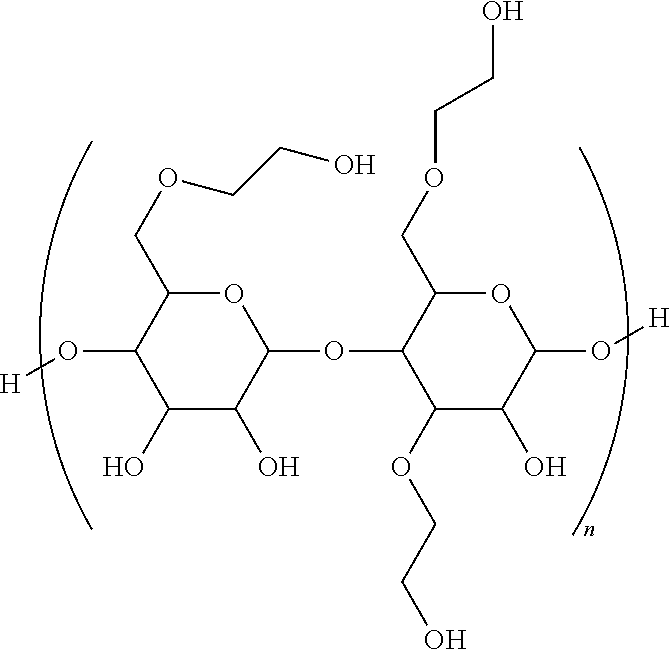
- a possible structure for the polymer of the invention could be represented by the following.
- R has the general formula (C 2 H 4 O) m H, where m is from 1 to about 25.
- R has the general formula C x H 2x+1 and is branched or linear, where x is from about 4 to about 24, or preferably from 8 to 22 or from 12 to 18.
- R is a branched alkyl and has the general formula C x H 2x+1 , where x is from about 4 to about 24 or preferably from 8 to 24 or from 14 to 18 in the main chain of the branched alkyl.
- the one or more branches may include, for example, methyl, ethyl, n-propyl, iso-propyl, n-butyl, sec-butyl, dimethyl, and/or diethyl.
- R has the general formula C x H 2x+1 O and is branched or linear, where x is from about 4 to about 24, or preferably from 8 to 22 and the oxygen present is a free hydroxyl (OH) that replaces a hydrogen somewhere on the alkyl chain.
- x 2 (i.e., R ⁇ C 2 H 5 O)
- a possible structure for the polymer of the invention could be represented by the following.
- R has the general formula (C 2 H 4 O) m C x H 2x+1 , where m is from 1 to 5 and x from about 4 to about 24.
- R has the general formula (C 2 H 4 O) m C x H 2x+1 O and is branched or linear, where m is from 1 to 5 and x is from about 4 to about 24, or preferably from 8 to 22 and the oxygen present is a free hydroxyl (OH) that replaces a hydrogen somewhere on the alkyl chain.
- R is branched and has the general formula (C 2 H 4 O) m C x H 2x+1 , and wherein m is from 1 to 5 and x from about 4 to about 24 in its main chain.
- the one or more branches may include, for example, methyl, ethyl, n-propyl, iso-propyl, n-butyl, sec-butyl, dimethyl, and/or diethyl.
- the hydrophobically modified non-ionic polymer is derived from a polysaccharide.
- Representative polysaccharides include, for example, poly- ⁇ -glucose, poly- ⁇ -glucose, amylose, starch, poly- ⁇ -mannose, guar gums, xanthan gums, dextrans, and/or chitins.
- the hydrophobically modified non-ionic polymer is selected from the group consisting of: hydrophobically modified hydroxyethyl cellulose; hydrophobically modified hydroxyethyl guar; hydrophobically modified hydroxyethyl xanthan; hydrophobically modified hydroxyethyl dextran; hydrophobically modified hydroxypropyl cellulose; hydrophobically modified hydroxypropyl guar; hydrophobically modified hydroxypropyl dextran; hydrophobically modified hydroxypropyl xanthan; and combinations thereof.
- the hydrophobically modified non-ionic polymer having the following general formula, and wherein n is from 3 to about 300.
- hydrophobically modified non-ionic polymer of the invention include, for example, different backbones, such as poly- ⁇ -glucose, different saccharides, such as poly- ⁇ -mannose, and different hydroxy capped functionalities, such as 2-hydroxypropyl, butyl, and dodecyl.
- an emulsifying amount of the disclosed polymer up to about 200 ppm actives, based on total volume of emulsion, may be used. In another embodiment, a range of actives from about 200 ppm to about 1,000 ppm, based on total volume of emulsion is used. Variation of the dosage may affect emulsion stability over time and would be applicable to the need for both an emulsified fluid and the need for separation at a point downstream.
- the invention is envisioned to operate in all applications as related to the oil field (e.g., subterranean reservoir, pipeline, production facility, crude oil mixtures).
- petroleum operations refer generally to any primary, secondary, and tertiary oil recovery system.
- the treated hydrocarbon fluid may be any fluid encountered in a petroleum operation.
- Preferred fluids are oil, gas condensates (e.g., fluids with low boiling at ambient pressure and temperature), or gas.
- the method of the invention may be employed by contacting the described polymers with or adding the polymers to the hydrocarbon fluids in a manner known per se.
- the polymers of the invention are added at any point in the flow line upstream from the point at which reduced viscosity is desired.
- An exemplary technique in primary oil recovery where the method of the invention may employed is the squeeze treating technique, whereby the polymers are injected under pressure into the producing formation, are adsorbed on the strata, and desorbed as the fluids are produced. They can further be added in the water flooding operations of secondary oil recovery as well as be added to pipelines, transmission lines, and refinery units.
- the disclosed composition is injected down the annular space of the well, where polymers contact the produced fluids at the base of the production tubing. In another embodiment, the disclosed composition is added to the produced fluid via slip-stream.
- the described polymers may also be formulated with other materials commonly used for treating hydrocarbon fluids and oil in water emulsion encountered in petroleum operations.
- Such other materials include, but are not limited to corrosion inhibitors, scale inhibitors, surfactants, wax inhibitors, hydrate inhibitors, foamers, defoamers, other treatment formulations, combinations, and the like.
- Polymer A had the following structure and is the same for each of the below Examples. Polymer A was comprised of (a) hydrophobically capped hydroxyls, (b) hydrophobically capped ethoxylated hydroxyls, (c) ethoxylated hydroxyls, and (d) unmodified sugars in random repeating units.
- Polymer A (62.5 mg) was dispersed into water (3.75 g) and shaken until it appeared homogenous. The water and polymer solution was then added in one aliquot to a sample of the crude oil (15.0 g) and the resulting mixture was mixed with a shear mixer at 3,000 rpm for 3 minutes. The resulting emulsion was evaluated on a Brookfield viscometer with a #34 spindle for viscosity at 80° F.
- Polymer A of the instant invention demonstrated significantly reduced viscosity at a range of chemical dosages (Table 1). Results suggest that Polymer A is effective as a viscosity reducer in a range of 200 ppm to 1,000 ppm.
- Table 2 contains additional comparative data from testing two different commercially available cellulose polymers. Using a second crude oil sample obtained from a second well in the same oil field and having slightly varied composition, the viscosity reduction of the emulsified fluid was compared against chemical dosage (Table 2). Commercial A was common commercially available cellulose polymers, and Commercial B was a common commercially available polyvinyl alcohol (these comparative products are the same for each of the below Examples).
- the inversion temperature is the temperature above which the polymer hydrophobic domains begin to interact to form a cross-linked network of polymers that is a viscous gel and has a greatly reduced solubility in water.
- the produced fluids from a well are heated in a separation vessel to speed the separation of water from oil.
- These vessels routinely attain temperatures greater than 50° C. and can be heated to over 120° C., which is often hot enough to trigger the polymer inversion process and cause the inverted polymer to settle to the bottom of the vessel as a precipitate and impede future operation of the separation vessel.
- Thermal stability testing found Polymer A did not have a detectable inversion temperature in tests up to 95° C. in a laboratory setting, and as such did not form a precipitate, which is imperative for oil field operations.
- tr trace
- Water Drop visible water separated in 100 mL of fluid
- Heat is 150° F.
- Thief 10 ml fluid drawn at 55% from top of fluid
- Water is free water after centrifuge
- BS emulsion layer
- Slug water volume after using slugging chemical to drop all residual emulsified water.
- the test results described in Table 3 represent a set of standard bottle tests in which oil was mixed with a solution of the prescribed chemical and twenty percent water (100 ml total), heated to 130° F. and shaken 100 times. The bottles were left to rest at ambient temperature for twenty minutes, and water drop was measured. After this time, the samples were dosed with 300 ppm of an emulsion breaker chemical and heated to 150° F. for 90 minutes. At the prescribed time intervals the amount of free water in the bottom of the bottles was quantified visually. At the completion of the water drop test all bottles were thiefed at the 55 mL mark of the bottle by drawing 10 mL of fluid into a syringe with a thiefing needle. The thiefed fluids were then treated by a standard grind-out procedure to determine the residual water and residual emulsion in the oil.
- a viscosity reducer The ultimate goals of a viscosity reducer are to enhance oil production and minimize equipment requirements as well as wear on the equipment.
- an amount of water has to be added to create the water external emulsion.
- the amount of water required can impact the performance of the separation equipment at the process units.
- large volumes of water can be difficult to deliver to the site needed for a viscosity reduction application. It is of great advantage to minimize the amount of water required for viscosity reduction.
- Polymer A was evaluated for emulsification of oil with different amounts of water and varying chemical dosage and showed the ability to create oil-in-water emulsions at a range of water cuts (Table 4).
- test results in Table 4 represent a bottle test without emulsion breaker chemistry and evaluation of free water break-out over time.
- the bottles were mixed, shaken 100 times, allowed to stand for sixty minutes, shaken an additional 100 times, and allowed to stand for an additional thirty minutes. Results show that the amount of water can range between twenty and ten percent and still obtain a stable emulsion with minimal free water.
- the mode of action for Polymer A to work as an emulsifier can be indirectly detected by surface tension and interfacial tension measurements.
- the reduction of a water droplet's surface tension by addition of Polymer A indicates that the chemical is migrating to the water/air interface and disrupting the hydrogen bonding forces of the water droplet at the interface.
- Test results for such surface tension using two different sources of crude oil are shown in FIG. 2 .
- Surface tension is essentially saturated very quickly at a low dosage of chemical as indicated by minimal change in the surface tension while raising the concentration of chemical two orders of magnitude.
Landscapes
- Chemical & Material Sciences (AREA)
- Engineering & Computer Science (AREA)
- Life Sciences & Earth Sciences (AREA)
- General Life Sciences & Earth Sciences (AREA)
- Materials Engineering (AREA)
- Organic Chemistry (AREA)
- Health & Medical Sciences (AREA)
- Public Health (AREA)
- Water Supply & Treatment (AREA)
- Mechanical Engineering (AREA)
- General Engineering & Computer Science (AREA)
- Oil, Petroleum & Natural Gas (AREA)
- Liquid Carbonaceous Fuels (AREA)
- Production Of Liquid Hydrocarbon Mixture For Refining Petroleum (AREA)
- Polysaccharides And Polysaccharide Derivatives (AREA)
Abstract
Description




| TABLE 1 |
| Chemical Performance Versus Chemical Dosage |
| Polymer A |
| Dosage, active (ppm) | 1000 | 500 | 200 | 0 |
| Viscosity (cP) | 2,120 | 3,259 | 6,159 | 39,112 |
| TABLE 2 |
| Chemical Comparison of Viscosity Reducers |
| Crude | Commer- | Commer- | Commer- | ||
| Chemical | Only | cial A | cial A | cial B | Polymer A |
| Dosage, | 0 | 1000 | 200 | 1000 | 1000 |
| active (ppm) | |||||
| Water (%) | 0 | 20 | 20 | 20 | 20 |
| Viscosity - (cP) | 10408 | 1404 | 10738 | 260 | 1866 |
| TABLE 3 |
| Bottle test results for VR field tests |
| Water Drop (mL) |
| 15 | 90 | ||||
| Dosage | min. | min | Thief @ 55% |
| Chemical | (ppm) | 20 min. | heat | heat | Water | BS | |
| Commercial A |
| 1000 | 8 | 20 | 34 | 6 | tr | 6 | |
| 600 | 8 | 20 | 33 | 4.6 | tr | 4.8 | |
| 200 | 8 | 15 | 34 | 2.8 | 0 | 2.8 | |
| Quat A | 1000 | 0 | 8 | 30 | 2.4 | 0 | 2.4 |
| 600 | 8 | 18 | 29 | 6.4 | 0.2 | 7.6 | |
| 200 | 10 | 20 | 29 | 6.4 | tr | 7 | |
| Polymer A | 1000 | |
10 | 32 | 1.6 | 0 | 1.6 |
| 600 | tr | 18 | 34 | 1.8 | 0 | 1.8 | |
| 200 | tr | 18 | 31 | 1.8 | |
2 | |
| |
0 | 0 | 1 | 10 | 21.5 | 0 | 22 |
| TABLE 4 |
| Water External Emulsions with Polymer A |
| Water Drop (mL) |
| Chemical Dosage (ppm) | Water Cut (%) | 20 min. | 60 min. | 90 min. |
| 1000 | 20 | 2 | 3 | 0 | |
| 15 | | trace | trace | ||
| 10 | 0 | 0 | 0 | ||
| 600 | 20 | 8 | 10 | 5 | |
| 15 | 1 | 3 | 3 | ||
| 10 | 0 | | trace | ||
| 200 | 20 | 19 | 20 | 15 | |
| 15 | 2 | 8 | |
||
| 10 | 0 | trace | trace | ||
Claims (20)


Priority Applications (8)
| Application Number | Priority Date | Filing Date | Title |
|---|---|---|---|
| US12/582,329 US9315715B2 (en) | 2009-10-20 | 2009-10-20 | Method of reducing the viscosity of hydrocarbons |
| ARP100103793A AR078666A1 (en) | 2009-10-20 | 2010-10-18 | METHODS TO REDUCE THE VISCOSITY OF HYDROCARBONS |
| EP10825504.3A EP2491091B1 (en) | 2009-10-20 | 2010-10-19 | Method of reducing the viscosity of hydrocarbons |
| RU2012112656/03A RU2528344C2 (en) | 2009-10-20 | 2010-10-19 | Method for reduction of hydrocarbon viscosity |
| CA2775964A CA2775964C (en) | 2009-10-20 | 2010-10-19 | Method of reducing the viscosity of hydrocarbons |
| PCT/US2010/053149 WO2011049923A2 (en) | 2009-10-20 | 2010-10-19 | Method of reducing the viscosity of hydrocarbons |
| BR112012009507-2A BR112012009507B1 (en) | 2009-10-20 | 2010-10-19 | METHOD FOR REDUCING THE VISCOSITY OF HYDROCARBONS |
| MX2012004305A MX345154B (en) | 2009-10-20 | 2010-10-19 | Method of reducing the viscosity of hydrocarbons. |
Applications Claiming Priority (1)
| Application Number | Priority Date | Filing Date | Title |
|---|---|---|---|
| US12/582,329 US9315715B2 (en) | 2009-10-20 | 2009-10-20 | Method of reducing the viscosity of hydrocarbons |
Publications (2)
| Publication Number | Publication Date |
|---|---|
| US20110092393A1 US20110092393A1 (en) | 2011-04-21 |
| US9315715B2 true US9315715B2 (en) | 2016-04-19 |
Family
ID=43879758
Family Applications (1)
| Application Number | Title | Priority Date | Filing Date |
|---|---|---|---|
| US12/582,329 Active 2030-06-11 US9315715B2 (en) | 2009-10-20 | 2009-10-20 | Method of reducing the viscosity of hydrocarbons |
Country Status (7)
| Country | Link |
|---|---|
| US (1) | US9315715B2 (en) |
| EP (1) | EP2491091B1 (en) |
| AR (1) | AR078666A1 (en) |
| CA (1) | CA2775964C (en) |
| MX (1) | MX345154B (en) |
| RU (1) | RU2528344C2 (en) |
| WO (1) | WO2011049923A2 (en) |
Cited By (1)
| Publication number | Priority date | Publication date | Assignee | Title |
|---|---|---|---|---|
| US20150354332A1 (en) * | 2013-02-04 | 2015-12-10 | Basf Se | Process for treating subterranean oil-bearing formations comprising carbonate rocks |
Families Citing this family (22)
| Publication number | Priority date | Publication date | Assignee | Title |
|---|---|---|---|---|
| WO2013096218A1 (en) | 2011-12-21 | 2013-06-27 | Shell Oil Company | Method and composition for inhibiting asphaltene deposition in a hydrocarbon mixture |
| US9416307B2 (en) | 2011-12-21 | 2016-08-16 | Shell Oil Company | Method and composition for inhibiting wax in a hydrocarbon mixture |
| AU2012355430B2 (en) | 2011-12-21 | 2015-08-20 | Shell Internationale Research Maatschappij B.V. | Method and composition for inhibiting foam in a hydrocarbon mixture |
| AU2012355429B8 (en) * | 2011-12-21 | 2015-03-26 | Shell Internationale Research Maatschappij B.V. | Method and composition for reducing viscosity of a hydrocarbon mixture |
| AR095937A1 (en) * | 2013-04-05 | 2015-11-25 | Acraf | POTENTIAL OF SOLUBILITY IN GLUCOGEN BASED WATER |
| US10155897B2 (en) | 2013-08-16 | 2018-12-18 | Hilliburton Energy Services, Inc. | Hydrophobically and hydrophilically modified polysaccharides and methods of using the same for treatment of a subterranean formation |
| US20160032700A1 (en) * | 2014-08-01 | 2016-02-04 | Schlumberger Technology Corporation | Compositions and methods for treating subterranean formations |
| US10253249B2 (en) * | 2014-08-01 | 2019-04-09 | Schlumberger Technology Corporation | Compositions and methods for treating subterranean formations |
| CA2960780C (en) | 2014-10-02 | 2020-12-01 | Croda, Inc. | Asphaltene inhibition |
| EP3475384B1 (en) | 2016-06-24 | 2024-12-25 | Cargill Bioindustrial UK Limited | Method and compositon for asphaltene dispersion |
| WO2018085177A1 (en) | 2016-11-01 | 2018-05-11 | Biocapital Holdings, Llc | Methods for producing carbo sugars and applications thereof |
| CN108624313A (en) * | 2017-03-15 | 2018-10-09 | 中国石油化工股份有限公司 | For reducing the composition and heavy crude thinner and preparation method and viscosity reduction method and heavy crude reservoir recovery method of viscosity of thickened oil |
| BR112019018875A2 (en) * | 2017-05-11 | 2020-04-14 | Halliburton Energy Services Inc | methods for treating a well and adjusting a drilling fluid viscosity |
| CN107142096B (en) * | 2017-06-14 | 2020-01-14 | 西南石油大学 | Biomass-assisted thickened oil autocatalytic modification viscosity reduction method |
| US10407624B2 (en) * | 2017-11-16 | 2019-09-10 | Dpd Chemical, Inc. | Methods to deconstruct asphaltene in petroleum products |
| CN110272727B (en) * | 2018-03-14 | 2022-02-01 | 中国石油天然气股份有限公司 | Viscosity reducer and preparation method thereof |
| US11149294B2 (en) | 2018-05-01 | 2021-10-19 | Biocapital Holdings, Llc | DNA constructs and biological devices for producing carbo sugars |
| US12012546B2 (en) * | 2018-06-13 | 2024-06-18 | Cameron International Corporation | Asphaltene inhibition and/or dispersion in petroleum fluids |
| CN109897620A (en) * | 2019-03-27 | 2019-06-18 | 广州市天河区车陂亚贝思烘焙店 | A kind of efficient cryogenic pour point depressant for crude oil |
| CN110358516A (en) * | 2019-07-19 | 2019-10-22 | 新疆肯迪能源科技有限公司 | Based on constant temperature catalyzing chain rupture viscous crude pitch prill colloid de-plugging thinner and preparation method thereof |
| CN110746944B (en) * | 2019-11-15 | 2021-11-09 | 中国石油集团渤海钻探工程有限公司 | Flow pattern regulator for synthetic base drilling fluid and preparation method thereof |
| CN114133487A (en) * | 2021-11-29 | 2022-03-04 | 宁波锋成先进能源材料研究院有限公司 | Modified cellulose-based polymerization surface agent, emulsification viscosity reducer, preparation method of emulsification viscosity reducer and application of emulsification viscosity reducer in viscosity reduction of thick oil |
Citations (16)
| Publication number | Priority date | Publication date | Assignee | Title |
|---|---|---|---|---|
| US2582323A (en) | 1948-02-13 | 1952-01-15 | Union Oil Co | Rotary drilling fluids |
| US3378074A (en) * | 1967-05-25 | 1968-04-16 | Exxon Production Research Co | Method for fracturing subterranean formations |
| GB1188781A (en) | 1967-01-11 | 1970-04-22 | Chevron Res | Method of Moving Viscous Crude Oil through a Pipeline |
| US3679582A (en) * | 1969-10-08 | 1972-07-25 | Shell Oil Co | Flow improvement of waxy hydrocarbon with the aid of polysaccharide derivatives |
| US3893510A (en) * | 1974-08-12 | 1975-07-08 | Halliburton Co | Emulsion method of introducing polymers into a subterranean formation |
| US4228277A (en) | 1979-02-12 | 1980-10-14 | Hercules Incorporated | Modified nonionic cellulose ethers |
| US4529523A (en) | 1982-06-08 | 1985-07-16 | Hercules Incorporated | Hydrophobically modified polymers |
| US4744865A (en) | 1986-06-03 | 1988-05-17 | Betz Laboratories, Inc. | Process for controlling pitch deposition from pulp in papermaking systems |
| US4788001A (en) | 1985-04-02 | 1988-11-29 | Dow Corning Corporation | Oil-in-water emulsion |
| US5669456A (en) | 1994-03-03 | 1997-09-23 | Institut Francais Du Petrole | Process and water-base fluid utilizing hydrophobically modified cellulose derivatives as filtrate reducers |
| EP1033471A1 (en) | 1999-03-02 | 2000-09-06 | Rohm And Haas Company | Improved recovery and transportation of heavy crude oils |
| US20040072946A1 (en) | 1996-09-18 | 2004-04-15 | Advanced Gel Technology Limited | Polymeric material |
| WO2005040669A1 (en) | 2003-10-02 | 2005-05-06 | Proflux Systems Llp | Method for reducing the viscosity of viscous fluids |
| US7041707B2 (en) | 2003-01-24 | 2006-05-09 | Nalco Company | Polyether polyesters having anionic functionality |
| EP1961799A1 (en) | 2007-02-20 | 2008-08-27 | BIOeCON International Holding N.V. | Process for reducing the viscosity of highly viscous hydrocarbon mixtures |
| US20090186796A1 (en) | 2008-01-22 | 2009-07-23 | The Procter & Gamble Company | Liquid detergent composition |
Family Cites Families (3)
| Publication number | Priority date | Publication date | Assignee | Title |
|---|---|---|---|---|
| GB1465704A (en) * | 1973-12-04 | 1977-03-02 | Allied Colloids Ltd | Secondary recovery of oil and polymers useful for this |
| US6454003B1 (en) * | 2000-06-14 | 2002-09-24 | Ondeo Nalco Energy Services, L.P. | Composition and method for recovering hydrocarbon fluids from a subterranean reservoir |
| US20040229756A1 (en) * | 2003-05-16 | 2004-11-18 | Eoff Larry S. | Method for stimulating hydrocarbon production and reducing the production of water from a subterranean formation |
-
2009
- 2009-10-20 US US12/582,329 patent/US9315715B2/en active Active
-
2010
- 2010-10-18 AR ARP100103793A patent/AR078666A1/en active IP Right Grant
- 2010-10-19 MX MX2012004305A patent/MX345154B/en active IP Right Grant
- 2010-10-19 EP EP10825504.3A patent/EP2491091B1/en active Active
- 2010-10-19 CA CA2775964A patent/CA2775964C/en active Active
- 2010-10-19 WO PCT/US2010/053149 patent/WO2011049923A2/en not_active Ceased
- 2010-10-19 RU RU2012112656/03A patent/RU2528344C2/en active
Patent Citations (17)
| Publication number | Priority date | Publication date | Assignee | Title |
|---|---|---|---|---|
| US2582323A (en) | 1948-02-13 | 1952-01-15 | Union Oil Co | Rotary drilling fluids |
| GB1188781A (en) | 1967-01-11 | 1970-04-22 | Chevron Res | Method of Moving Viscous Crude Oil through a Pipeline |
| US3378074A (en) * | 1967-05-25 | 1968-04-16 | Exxon Production Research Co | Method for fracturing subterranean formations |
| US3679582A (en) * | 1969-10-08 | 1972-07-25 | Shell Oil Co | Flow improvement of waxy hydrocarbon with the aid of polysaccharide derivatives |
| US3893510A (en) * | 1974-08-12 | 1975-07-08 | Halliburton Co | Emulsion method of introducing polymers into a subterranean formation |
| US4228277A (en) | 1979-02-12 | 1980-10-14 | Hercules Incorporated | Modified nonionic cellulose ethers |
| US4228277B1 (en) | 1979-02-12 | 1992-10-20 | Aqualon Co | |
| US4529523A (en) | 1982-06-08 | 1985-07-16 | Hercules Incorporated | Hydrophobically modified polymers |
| US4788001A (en) | 1985-04-02 | 1988-11-29 | Dow Corning Corporation | Oil-in-water emulsion |
| US4744865A (en) | 1986-06-03 | 1988-05-17 | Betz Laboratories, Inc. | Process for controlling pitch deposition from pulp in papermaking systems |
| US5669456A (en) | 1994-03-03 | 1997-09-23 | Institut Francais Du Petrole | Process and water-base fluid utilizing hydrophobically modified cellulose derivatives as filtrate reducers |
| US20040072946A1 (en) | 1996-09-18 | 2004-04-15 | Advanced Gel Technology Limited | Polymeric material |
| EP1033471A1 (en) | 1999-03-02 | 2000-09-06 | Rohm And Haas Company | Improved recovery and transportation of heavy crude oils |
| US7041707B2 (en) | 2003-01-24 | 2006-05-09 | Nalco Company | Polyether polyesters having anionic functionality |
| WO2005040669A1 (en) | 2003-10-02 | 2005-05-06 | Proflux Systems Llp | Method for reducing the viscosity of viscous fluids |
| EP1961799A1 (en) | 2007-02-20 | 2008-08-27 | BIOeCON International Holding N.V. | Process for reducing the viscosity of highly viscous hydrocarbon mixtures |
| US20090186796A1 (en) | 2008-01-22 | 2009-07-23 | The Procter & Gamble Company | Liquid detergent composition |
Non-Patent Citations (7)
| Title |
|---|
| B.M. Yaghi, A. Al-Bemani, Heavy Crude Oil Viscosity Reduction for Pipeline Transportation, Energy Sources, 2002, . 93-102, 24. |
| C.M. Des Brisay, D.W. Mudie, F.M. Mourits, L. Kurucz, Pumping heavy oils with the aid of downhole oil-in-water emulsifications, The Journal of Canadian Petroleum Technology, Mar.-Apr. 1989, pp. 80-84. vol. 28. No. 2. |
| C.Viebke, J. Meadows, J.C. Kennedy, P.A. Williams, Effect of Soluble Polymers on the Shear and Extensional Viscolsity Characteristics of a Concentrated Latex Dispersion, Langmuir, 1998, pp. 1548-1553, 14. |
| G.G.McClaflin, C.R. Clark, T.R. Sifferman, The Replacement of Hydrocarbon Diluent With Surfactant and Water for the Production of Heavy, Viscous Crude Oil, Journal of Petroleum Technology, Oct. 1982, pp. 2258-2264. |
| L.E. Sanchez, J.L. Zakin, Transport of Viscous Crudes as Concentrated Oil-in-Water Emulsions, Ind. Eng. Chem Res., 1994, pp. 3256-3261, vol. 33, No. 12. |
| R. Simon, W.G. Poynter, Down-Hole Emulsification for Improving Viscous Crude Production, Journal of Petroleum Technology, Dec. 1968, pp. 1849-1853. |
| S.S.K. Sim, E.O. Udegbunam, D.J. Haggerty, J.J. Baroni, M. Baroni, Laboratory Experiments and Reservoir Simulation Studies in Support of Co2 Injection Project in Mattoon Field, Illinois, USA, The Journal of Canadian Petroleum Technology, Feb. 1996, pp. 25-32, vol. 35. |
Cited By (2)
| Publication number | Priority date | Publication date | Assignee | Title |
|---|---|---|---|---|
| US20150354332A1 (en) * | 2013-02-04 | 2015-12-10 | Basf Se | Process for treating subterranean oil-bearing formations comprising carbonate rocks |
| US10494907B2 (en) * | 2013-02-04 | 2019-12-03 | Basf Se | Process for treating subterranean oil-bearing formations comprising carbonate rocks |
Also Published As
| Publication number | Publication date |
|---|---|
| CA2775964A1 (en) | 2011-04-28 |
| EP2491091A4 (en) | 2013-04-03 |
| RU2528344C2 (en) | 2014-09-10 |
| WO2011049923A3 (en) | 2011-08-18 |
| EP2491091B1 (en) | 2019-12-04 |
| US20110092393A1 (en) | 2011-04-21 |
| AR078666A1 (en) | 2011-11-23 |
| MX2012004305A (en) | 2012-05-08 |
| MX345154B (en) | 2017-01-18 |
| EP2491091A2 (en) | 2012-08-29 |
| CA2775964C (en) | 2018-04-24 |
| RU2012112656A (en) | 2013-11-27 |
| BR112012009507A2 (en) | 2016-05-17 |
| WO2011049923A2 (en) | 2011-04-28 |
Similar Documents
| Publication | Publication Date | Title |
|---|---|---|
| US9315715B2 (en) | Method of reducing the viscosity of hydrocarbons | |
| US9012376B2 (en) | Inulin as corrosion inhibitor | |
| US20100200239A1 (en) | Friction reducing compositions for well treatment fluids and methods of use | |
| US9903169B2 (en) | Polymer gels as flow improvers in water injection systems | |
| Zadymova et al. | Heavy oil as an emulsion: composition, structure, and rheological properties | |
| CN102482567B (en) | Method of reducing the viscosity of hydrocarbon fluids | |
| US20080217012A1 (en) | Gelled emulsions and methods of using the same | |
| CN113646381B (en) | Inverse emulsions for hydraulic fracturing | |
| NO155898B (en) | PROCEDURE FOR EXTRACING OIL FROM UNDERGRADUATE RESERVES WITH EMULSION FLOW. | |
| WO2019094167A1 (en) | Pre-flush for oil foamers | |
| WO2009067362A2 (en) | Treatment fluids that increase in viscosity at or above a threshold temperature and methods of formulating and using such fluids | |
| Simon et al. | Down-hole emulsification for improving viscous crude production | |
| RU2569384C2 (en) | Alkaline persulphate for fluidifying at low temperature by process liquid thickened with branched polymer | |
| US20160289544A1 (en) | Method for treating a subterranean formation | |
| US7923416B2 (en) | Method of reducing the viscosity of hydrocarbon fluids | |
| WO2017155524A1 (en) | Exothermic reactants for use in subterranean formation treatment fluids | |
| BR112012009507B1 (en) | METHOD FOR REDUCING THE VISCOSITY OF HYDROCARBONS | |
| US11447705B2 (en) | Means and methods for managing ammonia, amine and normal salt fouling in oil production and refining | |
| MX2014006402A (en) | BREAKING DIUTAN WITH OXALIC ACID AT 180 °F to 220 °F. | |
| CN107109202A (en) | Composition and method for reducing furol viscosity | |
| Xiaodong et al. | Study and application of a weak gel micro foam drilling fluid in horizontal wells through loose sand in Venezuela | |
| US20250388804A1 (en) | Acidizing Fluid with Foam Stabilizing Agent Comprising Antimony Compound | |
| Ramana Murthy et al. | Development of Instant Linear Gel for Coal Bed Methane Gas Operations | |
| Udie et al. | Formulation of de-emulsifier for crude oil emulsion treatment using non-polymer de-emulsifying additives | |
| Seright et al. | Petroleum Science |
Legal Events
| Date | Code | Title | Description |
|---|---|---|---|
| AS | Assignment |
Owner name: NALCO COMPANY, ILLINOIS Free format text: ASSIGNMENT OF ASSIGNORS INTEREST;ASSIGNORS:FAUST, MARCUS D., JR;WEATHERS, THOMAS M., JR.;NGUYEN, DUY T.;REEL/FRAME:023397/0186 Effective date: 20091016 |
|
| STCF | Information on status: patent grant |
Free format text: PATENTED CASE |
|
| AS | Assignment |
Owner name: ECOLAB USA INC., MINNESOTA Free format text: ASSIGNMENT OF ASSIGNORS INTEREST;ASSIGNOR:NALCO COMPANY LLC;REEL/FRAME:043357/0541 Effective date: 20170227 Owner name: NALCO COMPANY LLC, ILLINOIS Free format text: CHANGE OF NAME;ASSIGNOR:NALCO COMPANY;REEL/FRAME:043633/0992 Effective date: 20151221 |
|
| MAFP | Maintenance fee payment |
Free format text: PAYMENT OF MAINTENANCE FEE, 4TH YEAR, LARGE ENTITY (ORIGINAL EVENT CODE: M1551); ENTITY STATUS OF PATENT OWNER: LARGE ENTITY Year of fee payment: 4 |
|
| AS | Assignment |
Owner name: BANK OF AMERICA, N.A., NORTH CAROLINA Free format text: SECURITY INTEREST;ASSIGNOR:CHAMPIONX USA INC.;REEL/FRAME:052848/0368 Effective date: 20200603 Owner name: JPMORGAN CHASE BANK, N.A., NEW YORK Free format text: SECURITY INTEREST;ASSIGNOR:CHAMPIONX USA INC.;REEL/FRAME:053250/0001 Effective date: 20200603 |
|
| AS | Assignment |
Owner name: CHAMPIONX USA INC., TEXAS Free format text: ASSIGNMENT OF ASSIGNORS INTEREST;ASSIGNOR:ECOLAB USA INC.;REEL/FRAME:053849/0537 Effective date: 20200603 |
|
| AS | Assignment |
Owner name: CHAMPIONX USA INC., TEXAS Free format text: RELEASE BY SECURED PARTY;ASSIGNOR:BANK OF AMERICA, N.A.;REEL/FRAME:060304/0267 Effective date: 20220607 Owner name: CHAMPIONX USA INC., TEXAS Free format text: RELEASE OF SECURITY INTEREST;ASSIGNOR:BANK OF AMERICA, N.A.;REEL/FRAME:060304/0267 Effective date: 20220607 |
|
| MAFP | Maintenance fee payment |
Free format text: PAYMENT OF MAINTENANCE FEE, 8TH YEAR, LARGE ENTITY (ORIGINAL EVENT CODE: M1552); ENTITY STATUS OF PATENT OWNER: LARGE ENTITY Year of fee payment: 8 |
|
| AS | Assignment |
Owner name: CHAMPIONX LLC, TEXAS Free format text: RELEASE OF SECURITY INTEREST IN PATENTS;ASSIGNOR:JPMORGAN CHASE BANK, N.A.;REEL/FRAME:072004/0019 Effective date: 20250716 Owner name: APERGY ESP SYSTEMS, LLC, TEXAS Free format text: RELEASE OF SECURITY INTEREST IN PATENTS;ASSIGNOR:JPMORGAN CHASE BANK, N.A.;REEL/FRAME:072004/0019 Effective date: 20250716 Owner name: APERGY BMCS ACQUISITION CORP, TEXAS Free format text: RELEASE OF SECURITY INTEREST IN PATENTS;ASSIGNOR:JPMORGAN CHASE BANK, N.A.;REEL/FRAME:072004/0019 Effective date: 20250716 Owner name: HARBISON-FISCHER, INC., TEXAS Free format text: RELEASE OF SECURITY INTEREST IN PATENTS;ASSIGNOR:JPMORGAN CHASE BANK, N.A.;REEL/FRAME:072004/0019 Effective date: 20250716 Owner name: NORRIS RODS, INC.,, TEXAS Free format text: RELEASE OF SECURITY INTEREST IN PATENTS;ASSIGNOR:JPMORGAN CHASE BANK, N.A.;REEL/FRAME:072004/0019 Effective date: 20250716 Owner name: NORRISEAL-WELLMARK, INC., TEXAS Free format text: RELEASE OF SECURITY INTEREST IN PATENTS;ASSIGNOR:JPMORGAN CHASE BANK, N.A.;REEL/FRAME:072004/0019 Effective date: 20250716 Owner name: PCS FERGUSON, INC., TEXAS Free format text: RELEASE OF SECURITY INTEREST IN PATENTS;ASSIGNOR:JPMORGAN CHASE BANK, N.A.;REEL/FRAME:072004/0019 Effective date: 20250716 Owner name: QUARTZDYNE, INC., TEXAS Free format text: RELEASE OF SECURITY INTEREST IN PATENTS;ASSIGNOR:JPMORGAN CHASE BANK, N.A.;REEL/FRAME:072004/0019 Effective date: 20250716 Owner name: US SYNTHETIC CORPORATION, TEXAS Free format text: RELEASE OF SECURITY INTEREST IN PATENTS;ASSIGNOR:JPMORGAN CHASE BANK, N.A.;REEL/FRAME:072004/0019 Effective date: 20250716 |