US9312002B2 - Methods for programming ReRAM devices - Google Patents
Methods for programming ReRAM devices Download PDFInfo
- Publication number
- US9312002B2 US9312002B2 US14/245,194 US201414245194A US9312002B2 US 9312002 B2 US9312002 B2 US 9312002B2 US 201414245194 A US201414245194 A US 201414245194A US 9312002 B2 US9312002 B2 US 9312002B2
- Authority
- US
- United States
- Prior art keywords
- memory cells
- memory
- subset
- cells
- programming
- Prior art date
- Legal status (The legal status is an assumption and is not a legal conclusion. Google has not performed a legal analysis and makes no representation as to the accuracy of the status listed.)
- Active, expires
Links
Images




Classifications
-
- G—PHYSICS
- G11—INFORMATION STORAGE
- G11C—STATIC STORES
- G11C13/00—Digital stores characterised by the use of storage elements not covered by groups G11C11/00, G11C23/00, or G11C25/00
- G11C13/0002—Digital stores characterised by the use of storage elements not covered by groups G11C11/00, G11C23/00, or G11C25/00 using resistive RAM [RRAM] elements
- G11C13/0021—Auxiliary circuits
- G11C13/0069—Writing or programming circuits or methods
-
- G—PHYSICS
- G11—INFORMATION STORAGE
- G11C—STATIC STORES
- G11C13/00—Digital stores characterised by the use of storage elements not covered by groups G11C11/00, G11C23/00, or G11C25/00
- G11C13/0002—Digital stores characterised by the use of storage elements not covered by groups G11C11/00, G11C23/00, or G11C25/00 using resistive RAM [RRAM] elements
-
- G—PHYSICS
- G11—INFORMATION STORAGE
- G11C—STATIC STORES
- G11C13/00—Digital stores characterised by the use of storage elements not covered by groups G11C11/00, G11C23/00, or G11C25/00
- G11C13/0002—Digital stores characterised by the use of storage elements not covered by groups G11C11/00, G11C23/00, or G11C25/00 using resistive RAM [RRAM] elements
- G11C13/0007—Digital stores characterised by the use of storage elements not covered by groups G11C11/00, G11C23/00, or G11C25/00 using resistive RAM [RRAM] elements comprising metal oxide memory material, e.g. perovskites
-
- G—PHYSICS
- G11—INFORMATION STORAGE
- G11C—STATIC STORES
- G11C13/00—Digital stores characterised by the use of storage elements not covered by groups G11C11/00, G11C23/00, or G11C25/00
- G11C13/0002—Digital stores characterised by the use of storage elements not covered by groups G11C11/00, G11C23/00, or G11C25/00 using resistive RAM [RRAM] elements
- G11C13/0021—Auxiliary circuits
- G11C13/0069—Writing or programming circuits or methods
- G11C2013/0076—Write operation performed depending on read result
-
- G—PHYSICS
- G11—INFORMATION STORAGE
- G11C—STATIC STORES
- G11C13/00—Digital stores characterised by the use of storage elements not covered by groups G11C11/00, G11C23/00, or G11C25/00
- G11C13/0002—Digital stores characterised by the use of storage elements not covered by groups G11C11/00, G11C23/00, or G11C25/00 using resistive RAM [RRAM] elements
- G11C13/0021—Auxiliary circuits
- G11C13/0069—Writing or programming circuits or methods
- G11C2013/0078—Write using current through the cell
-
- G—PHYSICS
- G11—INFORMATION STORAGE
- G11C—STATIC STORES
- G11C13/00—Digital stores characterised by the use of storage elements not covered by groups G11C11/00, G11C23/00, or G11C25/00
- G11C13/0002—Digital stores characterised by the use of storage elements not covered by groups G11C11/00, G11C23/00, or G11C25/00 using resistive RAM [RRAM] elements
- G11C13/0021—Auxiliary circuits
- G11C13/0069—Writing or programming circuits or methods
- G11C2013/0088—Write with the simultaneous writing of a plurality of cells
-
- G—PHYSICS
- G11—INFORMATION STORAGE
- G11C—STATIC STORES
- G11C2213/00—Indexing scheme relating to G11C13/00 for features not covered by this group
- G11C2213/70—Resistive array aspects
- G11C2213/71—Three dimensional array
-
- G—PHYSICS
- G11—INFORMATION STORAGE
- G11C—STATIC STORES
- G11C2213/00—Indexing scheme relating to G11C13/00 for features not covered by this group
- G11C2213/70—Resistive array aspects
- G11C2213/78—Array wherein the memory cells of a group share an access device, all the memory cells of the group having a common electrode and the access device being not part of a word line or a bit line driver
-
- G—PHYSICS
- G11—INFORMATION STORAGE
- G11C—STATIC STORES
- G11C2213/00—Indexing scheme relating to G11C13/00 for features not covered by this group
- G11C2213/70—Resistive array aspects
- G11C2213/79—Array wherein the access device being a transistor
Definitions
- the present technology relates to techniques for programming in a resistance-change memory device.
- a variety of materials show reversible resistance-change or resistance-switching behavior in which the resistance of the material is a function of the history of the current through, and/or voltage across, the material.
- a resistance-switching element comprising one of these materials may be formed in an initial state, for example, a relatively low-resistance state. Upon application of sufficient voltage, the material switches to a stable high-resistance state which is maintained even after the voltage is removed. This resistance switching is reversible such that subsequent application of an appropriate current or voltage switches the resistance-switching element to a stable low-resistance state which is maintained even after the voltage or current is removed. This conversion can be repeated many times.
- the initial state is high-resistance rather than low-resistance.
- a set process may refer to switching the material from high to low resistance, while a reset process may refer to switching the material from low to high resistance.
- a resistance-switching memory cell can include a resistance-switching element positioned between first and second electrodes.
- Reversible resistance-change materials also referred to as read-write (RW) materials
- RW read-write
- One resistance state may correspond to a data “0,” for example, while the other resistance state corresponds to a data “1.”
- Some of these materials may have more than two stable resistance states.
- FIG. 1 is a block diagram of a re-programmable non-volatile memory device connected to a host system.
- FIG. 2A depicts a three-dimensional array 200 as an example of the memory cell array 103 of FIG. 1 .
- FIG. 2B depicts a cross-sectional view in the x-z plane of FIG. 2A , where split-gate select transistors are provided.
- FIG. 3A depicts a three-dimensional memory array 300 as another example of the memory cell array 103 of FIG. 1 , where comb shaped word line portions are used.
- FIG. 3B depicts a set of memory cells 350 consistent with WLL 31 of the three-dimensional memory array 300 of FIG. 3A .
- FIG. 4 is a graph depicting I-V characteristics of an example bipolar resistance-switching material which sets using a positive voltage.
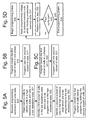
- FIG. 5A depicts a process for programming data in a set of memory cells.
- FIG. 5B depicts an example process for performing step 504 of FIG. 5A .
- FIG. 5C depicts another example process for performing step 504 of FIG. 5A .
- FIG. 5D depicts an example programming phase consistent with FIGS. 5B and 5C .
- FIG. 6A depicts a table showing current consumption for the set of memory cells 350 of FIG. 3B in a programming operation which includes a set process in one programming phase followed by a reset process in another programming phase, where the current consumption is for the set process.
- FIG. 6B depicts a table showing current consumption for a reset process which follows the set process of FIG. 6A .
- FIG. 7A depicts a table showing current consumption for the set of memory cells 350 of FIG. 3B in a programming operation consistent with FIG. 5B which includes a reset process in one programming phase followed by a set process in another programming phase, where the current consumption is for the reset process.
- FIG. 7B depicts a table showing current consumption for a set process which follows the reset process of FIG. 7A .
- FIG. 8A depicts a table showing current consumption for the set of memory cells 350 of FIG. 3B in a programming operation consistent with FIG. 5B which includes a reset process in two programming phases followed by a set process in another programming phase, where the current consumption is for the reset process in a first programming phase.
- FIG. 8B depicts a table showing current consumption for a reset process in a second programming phase which follows the reset process in the first programming phase of FIG. 8A .
- FIG. 9 depicts current consumption for a set-then-reset programming operation consistent with FIGS. 6A and 6B compared to current consumption for a reset-then-set programming operation consistent with of FIGS. 7A and 7B .
- the present technology relates to techniques for programming in a resistance-change memory device and, in particular, to minimizing leakage currents in resistance-change memory cells.
- Resistive RAM (ReRAM) based memories suffer from parasitic leakage currents-mainly during programming.
- Leakage currents also referred to as sneak currents, are unwanted currents which flow through memory cells which are not currently being programmed while other memory cells are being programmed.
- Leakage currents occur when a voltage is applied to a conductive path such as a word line which is connected to both the programmed memory cells and the non-programmed memory cells.
- a high leakage current has a number of negative effects, including increasing power consumption, reducing the accuracy of read operations, and limiting programming rate and the type of programming sequence.
- Leakage currents are caused by the resistive nature of the memory cells.
- a voltage difference that is provided on a conductive path for programming a selected cell causes unwanted currents over all of the cells which are connected to the conductive path. All of those per-cell leakage currents are combined into a dominant total leakage current referred to as a bias current.
- the total leakage current can be many times larger than the programming current of a cell, e.g., by a factor of about 100-200 in some cases.
- Techniques provided herein include programming methods that significantly reduce the bias current for resistive cell based memories.
- the data pattern of surrounding cells will affect the programmability (e.g., how many cells can be programmed in parallel) and power consumption. Both will impact the write performance.
- the surrounding cells e.g., cells not currently being programming
- the surrounding cells can be in a high or low resistance state.
- the 0 state is a high resistance state, also referred to as an off state
- the 1 state is a low resistance state, also referred to as an on state.
- a set process is a type of programming which involves a transition from 0 to 1, or off to on, or high resistance to low resistance.
- a reset process is a type of programming which involves a transition from 1 to 0, or on to off, or low resistance to high resistance.
- I current
- V voltage
- R resistance
- a programming operation involves identifying a first subset of memory cells which are in the low resistance state and which are to be programmed to the high resistance state based on a unit of data, identifying a second subset of memory cells which are in the high resistance state and which are to be programmed to the low resistance state based on the unit of data, and programming the first subset of memory cells before the second subset of memory cells. This is a reset-then-set process.
- the programming of the first subset of memory cells can occur in one or more phases. In some cases, the number of cells which are programmed together is based on a current limit.
- FIG. 1 is a block diagram of a re-programmable non-volatile memory device 100 connected to a host system 150 .
- Data input-output circuits 101 are connected to provide and receive analog electrical signals in parallel over global bit lines (GBLs) 102 , also referred to as metal lines herein.
- the signals represent data stored in addressed memory elements in a memory cell array 103 .
- the data input-output circuits may include sense amplifiers for converting these electrical signals into digital data values during reading.
- the digital values are then sent over data input-output lines 104 to a controller 105 .
- data to be programmed into the memory array is sent by the controller to the data input-output circuits, which program the data into the addressed memory elements by placing appropriate voltages on the global bit lines.
- one voltage level is typically placed on a global bit line to represent a binary “1” and another voltage level to represent a binary “0”.
- the memory elements are addressed for reading or programming by voltages placed on the word lines (WLLs) 106 and row select lines 107 by respective word line select circuits 108 and local bit line select circuits 109 .
- WLLs word lines
- the memory elements between a selected word line and any of the local bit lines connected through select transistors to the global bit lines may be addressed for programming or reading by appropriate voltages being applied through the select circuits 108 and 109 .
- the select transistors may be provided as vertical channel transistors as described further below.
- the controller 105 receives data from and sends data to the host system 150 .
- the controller can include a random access memory (RAM) 113 for temporarily storing this data and associated information. Commands, status signals and addresses of data being read or programmed are also exchanged between the controller and the host.
- the memory device can operate with various host systems such as personal computers (PCs), laptops and other portable computers, cellular telephones, personal digital assistants (PDAs), digital still cameras, digital movie cameras and portable audio players.
- the host typically connects to the memory device using a built-in receptacle (for receiving a memory card or flash drive that comprises the memory device) or by a wired or wireless path. Alternatively, the memory device may be built into the host system.
- the controller conveys commands received from the host to decoder/driver circuits 110 via lines 111 . Similarly, status signals are communicated to the controller the from decoder/driver circuits.
- the decoder/driver circuits 110 can be simple logic circuits, where the controller controls nearly all of the memory operations, or the circuits can include a state machine to control at least some of the repetitive memory operations necessary to carry out given commands. Control signals resulting from decoding commands are applied from the decoder/driver circuits to the word line select circuits 108 , local bit line select circuits 109 and data input-output circuits 101 .
- address lines 112 from the controller that carry physical addresses of memory elements to be accessed within the array 103 in order to carry out a command from the host.
- the physical addresses correspond to logical addresses received from the host system, where the conversion is made by the controller and/or the decoder/driver circuits.
- the local bit line select circuits partially address the designated storage elements within the array by placing appropriate voltages on the control gates of the select transistors to connect selected local bit lines with the global bit lines.
- the addressing is completed by the decoder/driver circuits applying appropriate voltages to the word lines of the array.
- each of the memory elements in the memory array may be individually addressed to be programmed or read, it is also possible to program or read sets of memory cells in parallel. For example, one row of memory elements on one plane may be programmed and read in parallel. The number of memory elements programmed or read in parallel depends on the number of memory elements connected to the selected word line. In some arrays, the word lines may be segmented so that only a portion of the total number of memory elements connected along their length may be addressed for parallel operation, namely the memory elements connected to a selected one of the segments. In some arrays, the number of memory elements programmed in one operation may be less than the total number of memory elements connected to the selected word line.
- Previously programmed memory elements whose data have become obsolete may be addressed and re-programmed from the states in which they were previously programmed.
- the starting states can differ among the memory elements being re-programmed in parallel.
- a group of memory elements is reset to a common state before they are re-programmed.
- the memory elements may be grouped into blocks, where the memory elements of each block are simultaneously reset to a common state, e.g., an erased state, in preparation for subsequently programming them.
- the individual blocks of memory elements may be further divided into a plurality of pages of storage elements, wherein the memory elements of a page are programmed or read together.
- FIG. 2A depicts a three-dimensional array 200 as an example of the memory cell array 103 of FIG. 1 .
- the array includes stacked and alternating layers of an insulating material (insulation layers INL 0 , INL 1 , INL 2 and INL 3 ) and a conductive material (word line layers WLL 0 , WLL 1 , WLL 2 and WLL 3 ).
- INL 0 includes insulation portions IN 0 a , IN 0 b and IN 0 c .
- WLL 0 includes word line portions WL 0 a , WL 0 b and WL 0 c .
- INL 1 includes insulation portions IN 1 a , IN 1 b and IN 1 c .
- WLL 1 includes word line portions WL 1 a , WL 1 b and WL 1 c .
- INL 2 includes insulation portions IN 2 a , IN 2 b and IN 12 .
- WLL 2 includes word line portions WL 2 a , WL 2 b and WL 2 c .
- INL 3 includes insulation portions IN 3 a , IN 3 b and IN 3 c .
- WLL 3 includes word line portions WL 3 a , WL 3 b and WL 3 c .
- Memory films are provided between the stacked layers and the vertical bit lines.
- the memory films include MF 0 a and MF 0 b on either side of a vertical bit line VBL 0 a , MF 0 c and MF 0 d on either side of VBL 0 b , MF 0 e and MF 0 f on either side of VBL 0 c , MF 1 a and MF 1 b on either side of VBL 1 a , MF 1 c and MF 1 d on either side of VBL 1 b , and MF 1 e and MF 1 f on either side of VBL 1 c.
- a Cartesian coordinate system indicates a vertical direction (z) and lateral directions x and y.
- every other word line portion in the x direction is connected to one another.
- a path 210 indicates that WL 3 a and WL 3 c are connected via a common conductive path.
- WLL 2 WL 2 a and WL 2 c are connected.
- WLL 1 WL 1 a and WL 1 c are connected via a common conductive path.
- WLL 0 WL 0 a and WL 0 c are connected via a common conductive path. This is consistent with the use of a comb pattern as discussed in connection with FIGS. 3A and 3B .
- Each vertical bit line can be selectively connected at its bottom to a global bit line via a select transistor.
- VBL 0 a , VBL 0 b and VBL 0 c can be connected to GBL 0 via a select transistors ST 0 a , ST 0 b and ST 0 c , respectively, which are controlled by select gates SG 0 a , SG 0 b and SG 0 c , respectively.
- VBL 1 c can be connected to GBL 1 via a select transistor ST 1 c (which has the select gate SG 0 c ).
- the select transistors for VBL 1 a and VBL 1 b are not depicted.
- Memory cells are formed by regions in which the word lines layers and vertical bit lines intersect.
- the memory film can be of various types.
- Example memory films include chalcogenides, carbon polymers, perovskites, and certain metal oxides (MeOx) and metal nitrides (MeN).
- metal oxides and nitrides which include only one metal and exhibit reliable resistance switching behavior.
- This group includes, for example, Nickel Oxide (NiO), Niobium Oxide (Nb2O5), Titanium Dioxide (TiO2), Hafnium Oxide (HfO2) Aluminum Oxide (Al2O3), Magnesium Oxide (MgOx), Chromium Dioxide (CrO2), Vanadium Oxide (VO), Boron Nitride (BN), and Aluminum Nitride (AlN).
- the material may be formed in an initial state, for example, a relatively low-resistance state. Upon application of sufficient voltage, the material switches to a stable high-resistance state which is maintained after the voltage is removed. In some cases, the resistance switching is reversible such that subsequent application of an appropriate current or voltage can serve to return the material to a stable low-resistance state which is maintained after the voltage or current is removed. This conversion can be repeated many times.
- the initial state is high-resistance rather than low-resistance.
- a set process may refer to switching the material from high to low resistance, while a reset process may refer to switching the material from low to high resistance. The set and reset processes can be considered to be programming processes which change the resistance state. In other cases, the resistance switching is irreversible.
- the global bit lines may extend in a silicon substrate parallel to one another and directly under the select transistors and vertical bit lines. See FIG. 2B for further details.
- Each select transistor may be a pillar shaped Thin Film Transistor (TFT) FET or JFET, for instance.
- a select transistor can have one or two select gates, as discussed below.
- FIG. 2B depicts a cross-sectional view in the x-z plane of FIG. 2A , where split-gate select transistors are provided.
- the word line portions, memory films and VBLs from FIG. 2A are repeated.
- the word line portions, memory films and VBLs from FIG. 2A are repeated.
- the select transistors ST 0 a , ST 0 b and ST 0 c of FIG. 2A are configured as split-gate select transistors ST 0 a 1 , ST 0 b 1 and ST 0 a 1 , respectively.
- a split-gate select transistor has two select gates, one on each side of a pillar shaped body.
- ST 0 a 1 has select gates 220 and 224 on either side of a body comprising a source region 221 , middle region 222 and drain region 223 .
- ST 0 b 1 has select gates 225 and 229 on either side of a body comprising a source region 226 , middle region 227 and drain region 228 .
- ST 0 c 1 has a select gate 230 and another select gate, not shown, on either side of a body comprising a source region 231 , middle region 232 and drain region 233 .
- Adjacent select gates such as 224 and 225 , and 229 and 230 , are separated by an insulator.
- the select gate may be spaced apart from the body by a gate insulator material, not shown.
- the body and select gate can be polysilicon, for instance.
- the source and drain regions are p+ type and the middle region is intrinsic.
- the source and drain regions are n+ type and the middle region is p ⁇ type.
- Other variations are possible.
- a memory cell 240 adjacent to WL 0 a is selected for programming via VBL 0 a .
- the current is provided due to a voltage difference between the GBL and WL 0 a .
- the voltage applied to WL 0 s is also applied to WL 0 c in this example due to a connection between them, as discussed.
- Is sneak current
- a path 243 from the GBL to a memory cell 241 which is adjacent to WL 0 c This is the sneak current of the memory cell.
- This current can exist even if ST 0 c 1 is supposed to be in the non-conductive state due to leakage of the transistor.
- the memory cell 241 is considered to be half-selected.
- a split-gate approach allows each transistor to be controlled separately.
- One option to the split-gate transistor is the shared-gate select transistor.
- Other select devices could be used as well.
- other memory configurations besides the VBL configuration can be used.
- any type of memory device can have a leakage current through cells which are not currently being programmed when these cells are connected to a same conductive path as cells which are currently being programmed, such that all of the cells are subject to a same bias on the conductive path.
- the vertical bit lines e.g., VBL 0 b
- unselected word line layer portions e.g., WL 1 a to WL 3 a , WL 0 b to WL 3 b and WL 1 c to WL 3 c
- VBL 0 b vertical bit lines
- unselected word line layer portions e.g., WL 1 a to WL 3 a , WL 0 b to WL 3 b and WL 1 c to WL 3 c
- FIG. 3A depicts a three-dimensional memory array 300 as another example of the memory cell array 103 of FIG. 1 , where comb shaped word line portions are used.
- each word line layer includes multiple combs.
- a comb 320 includes a central portion 321 , lateral portions 302 and 304 (or fingers) on one side, and lateral portions 303 and 305 on the other side.
- a comb 330 includes a central portion 310 , lateral portions 311 and 312 on one side, and lateral portions 313 and 314 on the other side.
- Memory cells are represented as resistors which extend between a vertical bit line (VBL) and a word line portion.
- An example select transistor (ST), select gate (SG) and global bit line (GBL) are also depicted.
- Additional example transistors T 1 and T 2 are provided between a voltage source and the word line portions. These transistors are used to provide a bias on a comb. As mentioned, select transistors are used to provide a bias on one or more VBLs. The difference between the bias on the comb and the bias on the VBL is a programming or read voltage.
- the word line portions therefore extend like fingers of a comb. Further, the fingers of different combs are interdigitated. As a result, during a programming operation, a voltage can be applied to one comb but not to another, if desired. Other configurations are possible as well which do not include a comb layout.
- a comb is a conductive path connected to a set of cells.
- FIG. 3B depicts a set of memory cells 350 consistent with WLL 31 of the three-dimensional memory array 300 of FIG. 3A .
- Each cell is controlled by one of three different combs 320 , 330 and 340 .
- Each comb is a common conductive path for a respective portion of the cells.
- the comb 330 includes central portion 310 and lateral portions 311 and 312 .
- the comb 320 includes central portion 321 and lateral portions 302 , 303 , 304 and 305 .
- the comb 341 includes central portion 341 and lateral portions 323 and 324 .
- the vertical bit lines are depicted as squares and the memory cells are depicted as resistors.
- VBLs are labelled as VBL 0 _ 0 to VBL 7 _ 0 , VBL 0 _ 1 to VBL 7 _ 1 , VBL 0 _ 2 to VBL 7 _ 2 , VBL 0 _ 3 to VBL 7 _ 3 and VBL 0 _ 4 to VBL 7 _ 4 .
- a current flowing through the memory cells which are controlled by the comb 320 is depicted by arrows.
- the memory cells are: MC 0 _ 0 to MC 7 _ 0 , MC 0 _ 1 to MC 7 _ 1 , MC 0 _ 4 to MC 7 _ 4 and MC 0 _ 5 to MC 7 _ 5 .
- These cells can include a mixture of selected and unselected cells, in one example where the comb 320 is a selected to write data.
- the memory cells which are connected to the comb 330 are: MC 4 _ 2 to MC 7 _ 2 , MC 4 _ 3 to MC 7 _ 3 , MC 4 _ 6 to MC 7 _ 6 and MC 4 _ 7 to MC 7 _ 7 .
- These cells include unselected cells in an example where the comb 330 is a not selected to write data.
- the memory cells which are connected to the comb 340 are: MC 0 _ 2 to MC 3 _ 2 , MC 0 _ 3 to MC 3 _ 3 , MC 0 _ 6 to MC 3 _ 6 and MC 0 _ 7 to MC 3 _ 7 .
- These cells include unselected cells in an example where the comb 340 is a not selected to write data.
- the memory cells MC 4 _ 0 to MC 7 _ 0 and MC 4 _ 4 to MC 7 _ 4 are selected to be set (transition from Rhigh to Rlow) and MC 4 _ 1 to MC 7 _ 1 and MC 4 _ 5 to MC 7 _ 5 are selected to be reset (transition from Rlow to Rhigh).
- MC 4 _ 1 to MC 7 _ 1 and MC 4 _ 5 to MC 7 _ 5 are thus in a first subset of memory cells in the low resistance state which are to be programmed into the high resistance state
- MC 4 _ 0 to MC 7 _ 0 and MC 4 _ 4 to MC 7 _ 4 are in a second subset of memory cells in the high resistance state which are to be programmed into the low resistance state.
- biases are applied to the comb 320 and to VBL 4 _ 0 to VBL 7 _ 0 and VBL 4 _ 2 to VBL 7 _ 2 , which are distinguished by a diagonal line pattern.
- the programming voltage for the set process is the difference between these biases.
- biases are applied to the comb 320 and to VBL 4 _ 1 to VBL 7 _ 1 , and VBL 4 _ 3 to VBL 7 _ 3 which are distinguished by a cross hatched pattern.
- the programming voltage for the reset process is the difference between these biases.
- a bias of the remaining VBLs is allowed to float or is set at a level which prevents programming, during the set and reset processes.
- a programming operation stores a unit of data using all of the cells which are connected to one conductive path such as the comb 320 .
- a programming operation it is also possible for a programming operation to store a unit of data using fewer than all of the cells which are connected to one conductive path, or using cells which are connected to multiple conductive paths.
- FIG. 4 is a graph depicting I-V characteristics of an example bipolar resistance-switching material which sets using a positive voltage.
- a memory cell can be programmed to store data in a high resistance state (having a resistance Rhigh, which is relatively higher than a resistance Rlow of a low resistance state) or a low resistance state (having a resistance of Rlow which relatively lower than Rhigh).
- a programming operation can involve applying a voltage across a memory cell which results in a current through the memory cell.
- a memory cell uses a bipolar resistance-switching material which sets using a positive voltage.
- the set process (a transition from Rhigh to Rlow) occurs when a positive voltage is applied
- the reset process (a transition from Rlow to Rhigh) occurs when a negative voltage is applied.
- Line 402 represents the I-V characteristic when in the high-resistivity (Rhigh) state and line 400 represents a transition to the low-resistivity (Rlow) state.
- Line 401 represents the set process and line 403 represents the reset process.
- a read voltage Vread is also depicted.
- Vread is applied across the resistance-switching material while the resulting current is measured and compared to a reference or trip current Iread.
- a higher or lower measured current indicates that the resistance-switching material is in the low or high resistance state, respectively. For example, if Ioff ⁇ Iread is measured, the material is in the high resistance state. If Ion>Iread is measured, the material is in the low resistance state.
- a forming voltage Vf is also depicted.
- the state of a memory cell may be determined in connection with a programming operation to determine if the state is consistent with write data in which case the cell is not programmed, or if the state is inconsistent with write data in which case the cell is programmed (see step 501 of FIG. 5A ).
- a current limit Iset_limit for a current through the memory cell can be enforced during a set process.
- the memory cell has a bipolar resistance-switching material which sets using a negative voltage.
- the memory cell has a unipolar resistance-switching material.
- FIG. 5A depicts a process for programming data in a set of memory cells.
- Step 500 includes receiving a programming command and a unit of write data, such as a page of data which is to be written into a set of memory cells.
- Step 501 includes reading the memory cells to identify cells in a high resistance state and cells in a low resistance state. For example, circuits for reading were discussed in connection with FIG. 1 and a reading process was discussed in connection with FIG. 4 .
- Step 502 includes identifying a first subset of cells among the cells in the low resistance state which are to be programmed into the high resistance state.
- the circuitry of FIG. 1 such as the controller can compare a sequence of bits of the write data to a current sequence of bits in the memory cells. For instance, a sequence of the memory cells associated with comb 350 of FIG.
- MC 0 _ 0 to MC 7 _ 0 may store a bit sequence of: 00000000 11111111 00000000 11111111
- the sequence of write data (a unit of data) may be 00001111 11110000 00001111 11110000. This unit of data is four bytes or 32 bits. A comparison of these two sequences indicates that MC 4 _ 1 to MC 7 _ 1 and MC 4 _ 5 to MC 7 _ 5 are to be programmed into the high resistance state.
- a memory cell with a 1 which corresponds to a data bit of 0 is to be programmed from 1 ⁇ 0.
- Step 503 includes identifying a second subset of cells among the cells in the high resistance state which are to be programmed into the low resistance state. A comparison of the two sequences above indicates that MC 4 _ 0 to MC 7 _ 0 and MC 4 _ 4 to MC 7 _ 4 are to be programmed into the low resistance state. Thus, a memory cell with a 0 which corresponds to a data bit of 1 is to be programmed from 0 ⁇ 1.
- Step 504 includes programming (resetting) the first subset of cells before programming (setting) the second subset of cells, as described further below.
- FIG. 5B depicts an example process for performing step 504 of FIG. 5A .
- Step 510 includes programming (resetting) the first subset of cells in one phase, e.g., concurrently.
- Step 511 includes programming (setting) the second subset of cells. This can also occur in one phase so that the second subset of cells are programmed concurrently. Or, the second subset of cells can be programmed in more than one phase such that a first group of the second subset of cells is programmed, then a second group of the second subset of cells is programmed, and so forth, until programming is completed for the second subset of cells.
- FIG. 5C depicts another example process for performing step 504 of FIG. 5A .
- Step 520 includes programming (resetting) the first subset of cells in a number n phases, where n is an integer greater than one. For example, a first group of the first subset of cells is programmed in a first phase, then a second group of the first subset of cells is programmed in a second phase, and so forth, until programming is completed for the first subset of cells.
- first subset of memory cells can occur in n sequential phases, where n is a number of two or more, and a different portion of the first subset of memory cells is programmed in each of the phases.
- the different portions can include different numbers of memory cells in the first subset of memory cells.
- Another approach includes setting n according to a current limit of the memory device so that an amount of current used in the programming of the first subset of memory cells in each of the phases does not exceed the current limit.
- Another approach includes providing a count of a number of memory cells in the first subset of memory cells, wherein n is based on the count.
- Step 521 includes programming (setting) the second subset of cells such as discussed in connection with step 511 of FIG. 5B .
- the programming of the second subset of memory cells can occur in one phase, where all memory cells in the second subset of memory cells are programmed concurrently. Or, the programming of the second subset of memory cells occurs in fewer than n sequential phases.
- FIG. 5D depicts an example programming phase consistent with FIGS. 5B and 5C .
- a program operation comprises a number of program-verify iterations. For each iteration, a programming voltage is applied and followed by a verify (read) operation which determines if programming is completed. Other programming approaches are possible as well.
- a programming phase begins at step 530 .
- Step 531 includes applying a programming voltage to selected memory cells while inhibiting unselected memory cells. For example, as mentioned, a programming voltage can be applied to selected memory cells by applying a bias to the vertical bit lines which are adjacent to the selected memory cells and to the word line portions which are in contact with the set of memory cells.
- the cells which are not to be programmed in the current phase can be inhibited by applying a suitable bias or allowing the bias to float on the vertical bit lines which are adjacent to these memory cells.
- a suitable bias for inhibiting a cell may be similar to the bias on the word line portions so that there is no voltage, or only a small voltage which is insufficient for programming, across the unselected memory cells.
- the cells which are not to be programmed in the current phase can include unselected cells, which are not programmed in any phase of the current programming operation, and selected cells, which are not programmed in the current phase but either have been programmed in an earlier phase of the programming operation, or will be programmed in a subsequent phase of the programming operation.
- Step 532 performs a verify test. This can involve, e.g., a read operation such as discussed in connection with FIG. 4 .
- a verify test for a cell which is to be programmed to the low resistance state determines if the cell is in the low resistance state. If the cell is in the low resistance state, programming is completed for this cell and the cell is inhibited from being programmed during any subsequent programming voltage.
- a verify test for a cell which is to be programmed to the high resistance state determines if the cell is in the high resistance state.
- One cell can be verified at a time, or multiple cells can be verified concurrently.
- a decision step 533 determines if the verify test has been passed for the group of cells being programmed. If the verify test has been passed, the programming phase ends at step 534 . If the verify test has not been passed, an additional programming voltage is applied at step 531 . Generally, the verify test is passed if all, or nearly all, of the cells being programmed have reaches the intended resistance state. In one option, the programming voltage steps up in magnitude for each pass through step 531 in a programming phase, after the first pass.
- FIG. 6A to 8B are based on the set of memory cells of FIG. 3B where MC 4 _ 1 to MC 7 _ 1 and MC 4 _ 5 to MC 7 _ 5 are in a first subset of memory cells in the low resistance state which are to be programmed into the high resistance state, and MC 4 _ 0 to MC 7 _ 0 and MC 4 _ 4 to MC 7 _ 4 are in a second subset of memory cells in the high resistance state which are to be programmed into the low resistance state.
- FIG. 6A depicts a table showing current consumption for the set of memory cells 350 of FIG. 3B in a programming operation which includes a set process in one programming phase followed by a reset process in another programming phase, where the current consumption is for the set process.
- the programming operation includes two phases. A first phase is the set process and the second phase is the reset process.
- the cells which are selected to be programmed in the programming operation include the notation “s.” These are cells which will be set or reset.
- the cells which are unselected during the programming operation include the notation “u.”
- the first column identifies the memory cell, and the second column identifies the state of the cell. A state of “0 ⁇ 1” indicates the cell is being set in the current programming phase.
- a state of “1 ⁇ 0” FIG.
- a state of “0” indicates the cell is in the high resistance state and is not set or reset in the current programming phase (this is a cell that is unselected).
- a state of “1” indicates the cell is in the low resistance state and is not set or reset in the current programming phase (this can be a cell that is unselected, or a cell that is selected to be reset in the second programming phase).
- the third column indicates a programming current (Iprog) of the cells.
- Iprog is either Iset or Ireset.
- Iset is a current used for setting a cell.
- Ireset (see FIG. 6B ) is a current used for resetting a cell.
- Iset>Ireset such as by a factor of two or more.
- the fourth column indicates a sneak current (Is) of a cell.
- Is_off is a sneak current of a cell in the off, “0” or high resistance state.
- Is_on is a sneak current of a cell in the on, “1” or low resistance state.
- Is_on>>Is_off such as by a factor of 10-20. In some cases, Is_off can be assumed to be negligible.
- the total current consumption for a program operation is the sum of the current consumptions in the reset and set processes.
- the current consumption includes a programming current and a leakage current.
- j cells are initially in the on state and m ( ⁇ j) of these are to be reset to the off state.
- k cells are initially in the off state and n ( ⁇ k) of these are to be set to the on state.
- Ireset is the current used to reset a cell
- Iset is the current used to set a cell
- Is_on is the leakage current of an on (1) cell
- Is_off is the leakage current of an off (0) cell.
- Iset_total (Iset ⁇ 8)+(Is_on ⁇ 16)+(Is_off ⁇ 8).
- the total program current is Iset ⁇ 8.
- the total current consumption for the set of cells is 17.6 ⁇ A.
- FIG. 6B depicts a table showing current consumption for a reset process which follows the set process of FIG. 6A .
- Ireset_total (Ireset ⁇ 8)+(Is_on ⁇ 16)+(Is_off ⁇ 8).
- the total program current is Ireset ⁇ 8.
- FIG. 7A depicts a table showing current consumption for the set of memory cells 350 of FIG. 3B in a programming operation consistent with FIG. 5B which includes a reset process in one programming phase followed by a set process in another programming phase, where the current consumption is for the reset process.
- Ireset_total (Ireset ⁇ 8)+(Is_on ⁇ 8)+(Is_off ⁇ 16).
- the leakage current is (Is_on ⁇ 8)+(Is_off ⁇ 16).
- the leakage current is 0.8 ⁇ A, which is less than the 1.6 ⁇ A of the reset process of FIG. 6B .
- the leakage current is significantly lower during reset when the reset is performed before the set than when the reset is performed after the set.
- the total current consumption for the reset is 8.8 ⁇ A.
- FIG. 7B depicts a table showing current consumption for a set process which follows the reset process of FIG. 7A .
- Iset_total (Iset ⁇ 8)+(Is_on ⁇ 8)+(Is_off ⁇ 16).
- the leakage current is (Is_on ⁇ 8)+(Is_off ⁇ 16).
- the leakage current is 0.8 ⁇ A, which is less than the 1.6 ⁇ A of the set process of FIG. 6A .
- leakage current is significantly lower during set when the set is performed after the reset than when the reset performed before the reset.
- the total current consumption for the set of cells is 16.8 ⁇ A.
- FIG. 8A depicts a table showing current consumption for the set of memory cells 350 of FIG. 3B in a programming operation consistent with FIG. 5B which includes a reset process in two programming phases followed by a set process in another programming phase, where the current consumption is for the reset process in a first programming phase.
- a different portion of the first subset of cells is programmed in each phase. For example, one portion comprises MC 7 _ 1 s , MC 6 _ 1 s , MC 7 _ 5 s and MC 6 _ 5 s , which are reset in this phase.
- FIG. 8B depicts a table showing current consumption for a reset process in a second programming phase which follows the reset process in the first programming phase of FIG. 8A .
- the portion of the first subset of cells which is reset in this phase comprises MC 4 _ 1 s , MC 5 _ 1 s , and MC 4 _ 5 s and MC 5 _ 5 s .
- the leakage current is (Is_off ⁇ 20)+(Is_on ⁇ 8).
- the leakage current is 0.8 ⁇ A which is less than the 1.6 ⁇ A of the reset process of FIG. 6B and the same as the 0.8 ⁇ A of the reset process of FIG. 7A .
- a set process can be performed such as described in connection with FIG. 7B .
- the total current consumption for the reset in this phase is 4.8 ⁇ A.
- the total current consumption for both reset phases is 10 ⁇ A.
- a multi-phase set process may be performed when the program current is limited to an amount which does not allow setting of all of the cells in one phase.
- FIGS. 3B and 6A to 9B are simplified since the number of cells is small and the proportion of the cells which are programmed in a phase is relatively high. In practice, there can be a much large number of cells, such as thousands of cells, and the number of cells which can be programmed together is typically a small percentage of the total number of cells due to constraints such as the amount of current which can be provided. As a result, the leakage current can significantly exceed the programming current, contrary to the examples of FIG. 6A to 8B .
- Leakage current can be modelled using different approaches.
- One approach assumes the leakage current of a cell is the same when one other cell is being set (or reset) or multiple other cells are being set (or reset).
- Another approach assumes the leakage current for a cell is higher when programming multiple other cells concurrently.
- the leakage current may be a function of the number of cells being set (or reset). In any case, a reset before set consumes less current, and operating in small groups of cells can help in meeting current limitations
- FIG. 9 depicts current consumption for a set-then-reset programming operation consistent with FIGS. 6A and 6B compared to current consumption for a reset-then-set programming operation consistent with of FIGS. 7A and 7B .
- the horizontal axis denotes a number m of cells which are to be programmed from on to off (reset) and the vertical axis denotes a current.
- Line 900 represents Iset when reset is performed before set, consistent with FIG. 7B .
- Line 901 represents Iset when set is performed before reset, consistent with FIG. 6A .
- Line 902 represents Ireset when reset is performed before set, consistent with FIG. 7A .
- Line 903 represents Ireset when set is performed before reset, consistent with FIG. 6B .
- Line 904 represents a total current Itotal when reset is performed before set, as the sum of lines 900 and 902 .
- Line 905 represents a total current Itotal when set is performed before reset, as the sum of lines 901 and 903 .
- the programming sequence will be such that the logical 0's (high resistance representation)—are first programmed, and the logical 1's (low resistance) are programmed later.
- the bias current is derived from the leakage current that goes through all cells at the relevant comb. In this way, the average bias current is reduced. This technique assumes the cells are not erased between successive programming operations.
- Another embodiment involves dividing the programming sequence of the cells to be reset into n phases, where n>2.
- This approach involves determining which of the cells which are to be reset and which are to be set. A group of 1/n of these cells are then reset in a programming phase. This programming is repeated n ⁇ 1 additional times, once for each successive group of 1/n cells. A lower current is consumed in each phase since a growing portion of the cells are in the high resistance state.
- the cells which are to be set are programmed.
- the cells which are to be set can be identified after programming of the cells to be reset. At this point, the maximal number of cells are in the high resistance state so that leakage is minimized during the set process, which can occur in one or more phases.
- Another embodiment may be implemented in a case where there is a preset current limit and the programming occurs in phases.
- the number of cells which can be programmed in each phase is limited by the current limit.
- Each phase may include a different number of cells which are in the 0 or 1 state as long as the total current is kept under the current limit.
- the number of steps is not fixed and may depend on the number of cells that need to be reset from 1 to 0 and set from 0 to 1.
- each 1 ⁇ 0 (set) transition consumes 1 ⁇ A (Iset)
- each 0 ⁇ 1 (reset) transition consumes 2 ⁇ A (Ireset)
- each cell which remains at 0 while other cells are programmed does not consume current
- each cell which remains at 1 while other cells are programmed consumes 0.1 ⁇ A as a leakage current.
- a total current limit is 260 ⁇ A in a programming phase.
- the programming current for resetting 400 cells from 1 ⁇ 0 is 400 ⁇ A
- the programming current for setting 50 cells from 0 ⁇ 1 is 100 ⁇ A
- the leakage current for keeping 500 cells (900 ⁇ 400) at 1 is 50 ⁇ A.
- the total current is 550 ⁇ A, which exceeds the limit of 260 ⁇ A.
- One alternative approach involves a first programming phase in which 150 cells are reset from 1 ⁇ 0 using a current of 150 ⁇ A and 750 cells (900 ⁇ 150) are kept at 1, resulting in a leakage current of 75 ⁇ A and a total current of 225 ⁇ A, which is less than the limit of 260 ⁇ A.
- 200 cells are reset from 1 ⁇ 0 using a current of 200 ⁇ A and 550 cells (750 ⁇ 200) at kept at 1, resulting in a leakage current of 55 ⁇ A and a total current of 255 ⁇ A, which is less than the limit of 260 ⁇ A.
- 50 cells are reset from 1 ⁇ 0 using a current of 50 ⁇ A, 500 cells (550 ⁇ 50) are kept at 1, resulting in a leakage current of 50 ⁇ A, and 50 cells are set from 0 ⁇ 1 using 100 ⁇ A, for a total current of 200 ⁇ A, which is less than the limit of 260 ⁇ A.
- a different current limit is imposed in the different programming phases.
- a method for programming in a memory device comprises: for each memory cell of a set of memory cells in the memory device, determining whether the memory cell is in a high resistance state or a low resistance state, wherein each memory cell of the set of memory cells is connected to a common conductive path, each memory cell of the set of memory cells is a resistance change memory cell which is able to change its resistance to store information as a function of its resistance, the set of memory cells is arranged in array and each memory cell is subject to a programming voltage on the common conductive path; identifying from the set of memory cells, a first subset of memory cells, the first subset of memory cells comprises memory cells which are in the low resistance state and which are to be programmed to the high resistance state based on a unit of data; identifying from the set of memory cells, a second subset of memory cells, the second subset of memory cells comprises memory cells which are in the high resistance state and which are to be programmed to the low resistance state based on the unit of data;
- a memory device comprises: a set of memory cells; a conductive path connected to the set of memory cells; and a control circuit.
- the control circuit to program a unit of data into the set of memory cells: determines, for each memory cell of the set of memory cells, whether the memory cell is in a high resistance state or a low resistance state; identifies from the set of memory cells, a first subset of memory cells, the first subset of memory cells comprises memory cells which are in the low resistance state and which are to be programmed to the high resistance state based on the unit of data; identifies from the set of memory cells, a second subset of memory cells, the second subset of memory cells comprises memory cells which are in the high resistance state and which are to be programmed to the low resistance state based on the unit of data; and programs the first subset of memory cells before the second subset of memory cells.
- a memory device comprises: a set of memory cells; a conductive path connected to the set of memory cells; and a control circuit.
- the control circuit to program a unit of data into the set of memory cells: identifies from the set of memory cells, based on the unit of data, a first subset of memory cells which are to be reset and a second subset of memory cells which are to be set, and determines a programming sequence for the unit of data in which a priority with which the first subset of memory cells is programmed is higher than a priority with which the second subset of memory cells is programmed.
Landscapes
- Semiconductor Memories (AREA)
Abstract
Description
Claims (16)
Priority Applications (1)
| Application Number | Priority Date | Filing Date | Title |
|---|---|---|---|
| US14/245,194 US9312002B2 (en) | 2014-04-04 | 2014-04-04 | Methods for programming ReRAM devices |
Applications Claiming Priority (1)
| Application Number | Priority Date | Filing Date | Title |
|---|---|---|---|
| US14/245,194 US9312002B2 (en) | 2014-04-04 | 2014-04-04 | Methods for programming ReRAM devices |
Publications (2)
| Publication Number | Publication Date |
|---|---|
| US20150287459A1 US20150287459A1 (en) | 2015-10-08 |
| US9312002B2 true US9312002B2 (en) | 2016-04-12 |
Family
ID=54210324
Family Applications (1)
| Application Number | Title | Priority Date | Filing Date |
|---|---|---|---|
| US14/245,194 Active 2034-07-20 US9312002B2 (en) | 2014-04-04 | 2014-04-04 | Methods for programming ReRAM devices |
Country Status (1)
| Country | Link |
|---|---|
| US (1) | US9312002B2 (en) |
Cited By (14)
| Publication number | Priority date | Publication date | Assignee | Title |
|---|---|---|---|---|
| US9691479B1 (en) * | 2016-04-29 | 2017-06-27 | Hewlett Packard Enterprise Development Lp | Method of operating and apparatus of memristor arrays with diagonal lines interconnect between memristor cells |
| US9947401B1 (en) | 2016-12-22 | 2018-04-17 | Sandisk Technologies Llc | Peak current management in non-volatile storage |
| US10740435B2 (en) * | 2015-05-29 | 2020-08-11 | Nec Corporation | Programmable logic integrated circuit, design support system, and configuration method |
| US10903424B2 (en) | 2019-05-07 | 2021-01-26 | International Business Machines Corporation | Resistive RAM cell structure for gradual set programming |
| US11099784B2 (en) | 2019-12-17 | 2021-08-24 | Sandisk Technologies Llc | Crosspoint memory architecture for high bandwidth operation with small page buffer |
| US20220335997A1 (en) * | 2021-04-15 | 2022-10-20 | Micron Technology, Inc. | Decoding architecture for word line tiles |
| US12040017B2 (en) | 2021-01-28 | 2024-07-16 | Weebit Nano Ltd. | Current and voltage limit circuitry for resistive random access memory programming |
| US12068028B2 (en) | 2021-03-03 | 2024-08-20 | Weebit Nano Ltd. | Circuitry for parallel set and reset of resistive random-access memory (ReRAM) cells |
| US20240321353A1 (en) * | 2023-03-21 | 2024-09-26 | Board Of Regents, The University Of Texas System | Non-Volatile Memory Circuit with Self-Terminating Read Current |
| US12131777B2 (en) | 2021-09-30 | 2024-10-29 | Weebit Nano Ltd. | Resistive random-access memory (ReRAM) cell optimized for reset and set currents |
| US20240371439A1 (en) * | 2023-05-04 | 2024-11-07 | Taiwan Semiconductor Manufacturing Company Ltd. | Random access memory apparatus, memory system, and method for operating the same |
| US20250239300A1 (en) * | 2024-01-24 | 2025-07-24 | Macronix International Co., Ltd. | Method for operating memory device |
| US20250322899A1 (en) * | 2024-04-10 | 2025-10-16 | Sandisk Technologies Llc | Nonvolatile memory cell tracking using bloom filters |
| US12688879B2 (en) | 2023-12-20 | 2026-07-21 | SanDisk Technologies, Inc. | Apparatus and methods for managing selector device threshold voltage drift |
Families Citing this family (6)
| Publication number | Priority date | Publication date | Assignee | Title |
|---|---|---|---|---|
| US20160019957A1 (en) * | 2014-05-20 | 2016-01-21 | Sandisk 3D Llc | Reducing disturb with adjustable resistance bit line structures |
| KR102151183B1 (en) * | 2014-06-30 | 2020-09-02 | 삼성전자주식회사 | Resistive Memory Device and Operating Method thereof |
| US9852800B2 (en) | 2016-03-07 | 2017-12-26 | Sandisk Technologies Llc | Adaptive determination of program parameter using program of erase rate |
| US10157650B1 (en) | 2017-07-26 | 2018-12-18 | Micron Technology, Inc. | Program operations in memory |
| US10453529B2 (en) * | 2017-12-04 | 2019-10-22 | Winbond Electronics Corp. | Resistive random access memory (RRAM) device, write verify method and reverse write verify method thereof |
| KR102664403B1 (en) | 2019-02-18 | 2024-05-09 | 삼성전자주식회사 | Semiconductor device and method of fabricating the same |
Citations (46)
| Publication number | Priority date | Publication date | Assignee | Title |
|---|---|---|---|---|
| US5579261A (en) | 1995-04-21 | 1996-11-26 | Advanced Micro Devices, Inc. | Reduced column leakage during programming for a flash memory array |
| US5650966A (en) | 1995-11-01 | 1997-07-22 | Advanced Micro Devices, Inc. | Temperature compensated reference for overerase correction circuitry in a flash memory |
| US5706228A (en) | 1996-02-20 | 1998-01-06 | Motorola, Inc. | Method for operating a memory array |
| US5889702A (en) | 1997-03-11 | 1999-03-30 | Sgs-Thomson Microelectronics, S.A. | Read circuit for memory adapted to the measurement of leakage currents |
| US6046932A (en) | 1999-08-13 | 2000-04-04 | Advanced Micro Devices, Inc. | Circuit implementation to quench bit line leakage current in programming and over-erase correction modes in flash EEPROM |
| US6240023B1 (en) | 1998-02-27 | 2001-05-29 | Micron Technology, Inc. | Method for efficiently executing soft programming of a memory block |
| US6275415B1 (en) | 1999-10-12 | 2001-08-14 | Advanced Micro Devices, Inc. | Multiple byte channel hot electron programming using ramped gate and source bias voltage |
| US6385090B1 (en) | 2001-02-26 | 2002-05-07 | Fujitsu Limited | Semiconductor nonvolatile memory using floating gate |
| US6469939B1 (en) | 2001-05-18 | 2002-10-22 | Advanced Micro Devices, Inc. | Flash memory device with increase of efficiency during an APDE (automatic program disturb after erase) process |
| US6574145B2 (en) | 2001-03-21 | 2003-06-03 | Matrix Semiconductor, Inc. | Memory device and method for sensing while programming a non-volatile memory cell |
| US6628545B1 (en) | 2002-11-26 | 2003-09-30 | Advanced Micro Devices, Inc. | Memory circuit for suppressing bit line current leakage |
| US6639839B1 (en) | 2002-05-21 | 2003-10-28 | Macronix International Co., Ltd. | Sensing method for EEPROM refresh scheme |
| US6909638B2 (en) | 2003-04-30 | 2005-06-21 | Freescale Semiconductor, Inc. | Non-volatile memory having a bias on the source electrode for HCI programming |
| US7110300B2 (en) | 2003-02-20 | 2006-09-19 | Stmicroelectronics S.R.L. | Method of programming a multi-level, electrically programmable non-volatile semiconductor memory |
| US7161844B2 (en) | 2004-03-30 | 2007-01-09 | Silicon Storage Technology, Inc. | Method and apparatus for compensating for bitline leakage current |
| US7215583B2 (en) | 2005-08-16 | 2007-05-08 | Taiwan Semiconductor Manufacturing Co., Ltd. | Circuit for inhibition of program disturbance in memory devices |
| US20070140029A1 (en) | 2005-12-15 | 2007-06-21 | Hyun-Jo Kim | Resistive memory devices including selected reference memory cells |
| US7283398B1 (en) | 2004-05-04 | 2007-10-16 | Spansion Llc | Method for minimizing false detection of states in flash memory devices |
| US7295471B2 (en) | 2004-11-12 | 2007-11-13 | Macronix International Co., Ltd. | Memory device having a virtual ground array and methods using program algorithm to improve read margin loss |
| US7304888B2 (en) | 2005-07-01 | 2007-12-04 | Sandisk 3D Llc | Reverse-bias method for writing memory cells in a memory array |
| US20070285057A1 (en) | 2006-06-08 | 2007-12-13 | Jyunya Yano | Leakage detection circuit for electric vehicle |
| US20080056024A1 (en) | 2006-08-30 | 2008-03-06 | Infineon Technologies Ag | Device and method for reading out memory information |
| US20080117676A1 (en) | 2006-11-16 | 2008-05-22 | Macronix International Co., Ltd. | Method for preventing memory from generating leakage current and memory thereof |
| US20080165571A1 (en) * | 2007-01-09 | 2008-07-10 | Macronix International Co., Ltd. | Method, Apparatus and Computer Program Product for Read Before Programming Process on Multiple Programmable Resistive Memory Cell |
| US20080219061A1 (en) | 2007-03-05 | 2008-09-11 | Hynix Semiconductor Inc. | Apparatus and method for detecting leakage current of semiconductor memory device, and internal voltage generating circuit using the same |
| US7451413B1 (en) | 2003-01-03 | 2008-11-11 | Marvell International Ltd. | Methods of minimizing leakage current by analyzing post layout information and associated threshold voltage and leakage current |
| US7504695B2 (en) | 2002-11-26 | 2009-03-17 | Infineon Technologies Ag | SRAM memory cell and method for compensating a leakage current flowing into the SRAM memory cell |
| US7573748B2 (en) | 2007-01-12 | 2009-08-11 | Atmel Corporation | Column leakage compensation in a sensing circuit |
| US7586787B2 (en) | 2007-09-20 | 2009-09-08 | Kilopass Technology Inc. | Reducing bit line leakage current in non-volatile memories |
| US7630253B2 (en) | 2006-04-05 | 2009-12-08 | Spansion Llc | Flash memory programming and verification with reduced leakage current |
| US7633797B2 (en) | 2007-01-25 | 2009-12-15 | Macronix International Co., Ltd. | Flash memory and method for determining logic states thereof |
| US7672155B2 (en) | 2005-11-09 | 2010-03-02 | Samsung Electronics Co., Ltd. | Resistive memory devices including selected reference memory cells |
| US20100073994A1 (en) | 2008-09-23 | 2010-03-25 | Khalil Diaaeldin S | Leakage compensation circuit for dynamic random access memory (dram) cells |
| US7800949B2 (en) | 2008-09-25 | 2010-09-21 | Macronix International Co., Ltd | Memory and method for programming the same |
| US7830717B2 (en) | 2007-11-29 | 2010-11-09 | Hynix Semiconductor Inc. | Method for performing erasing operation in nonvolatile memory device |
| US7848146B2 (en) | 2009-03-19 | 2010-12-07 | Spansion Llc | Partial local self-boosting of a memory cell channel |
| US7924601B2 (en) | 2007-03-28 | 2011-04-12 | Fujitsu Limited | Resistive memory and data write-in method |
| US20110149671A1 (en) | 2009-12-21 | 2011-06-23 | Macronix International Co., Ltd. | Operation Method and Leakage Controller for a Memory and a Memory Applying the Same |
| US20120026779A1 (en) | 2009-03-19 | 2012-02-02 | Kabushiki Kaisha Toshiba | Nonvolatile memories and reconfigurable circuits |
| US20120147648A1 (en) | 2010-12-14 | 2012-06-14 | Scheuerlein Roy E | Three dimensional non-volatile storage with dual gate selection of vertical bit lines |
| US20120187995A1 (en) | 2011-01-25 | 2012-07-26 | Ricoh Company, Ltd. | Error amplification circuit, control method for error amplification circuit, and switching regulator employing error amplification circuit |
| US20120230126A1 (en) | 2011-03-10 | 2012-09-13 | Ravindraraj Ramaraju | Memory voltage regulator with leakage current voltage control |
| US8270240B2 (en) | 2009-07-30 | 2012-09-18 | Taiwan Semiconductor Manufacturing Company, Ltd. | Current leakage reduction |
| US8289751B2 (en) | 2008-10-30 | 2012-10-16 | Seagate Technology Llc | Non-volatile memory cell with programmable unipolar switching element |
| US8344346B2 (en) | 2010-12-15 | 2013-01-01 | Hynix Semiconductor Inc. | Semiconductor device having resistive device |
| US8392770B2 (en) | 2009-03-13 | 2013-03-05 | Kabushiki Kaisha Toshiba | Resistance change memory device having high-speed two-step write mode |
-
2014
- 2014-04-04 US US14/245,194 patent/US9312002B2/en active Active
Patent Citations (55)
| Publication number | Priority date | Publication date | Assignee | Title |
|---|---|---|---|---|
| US5579261A (en) | 1995-04-21 | 1996-11-26 | Advanced Micro Devices, Inc. | Reduced column leakage during programming for a flash memory array |
| US5650966A (en) | 1995-11-01 | 1997-07-22 | Advanced Micro Devices, Inc. | Temperature compensated reference for overerase correction circuitry in a flash memory |
| US5706228A (en) | 1996-02-20 | 1998-01-06 | Motorola, Inc. | Method for operating a memory array |
| US5889702A (en) | 1997-03-11 | 1999-03-30 | Sgs-Thomson Microelectronics, S.A. | Read circuit for memory adapted to the measurement of leakage currents |
| US6240023B1 (en) | 1998-02-27 | 2001-05-29 | Micron Technology, Inc. | Method for efficiently executing soft programming of a memory block |
| US6046932A (en) | 1999-08-13 | 2000-04-04 | Advanced Micro Devices, Inc. | Circuit implementation to quench bit line leakage current in programming and over-erase correction modes in flash EEPROM |
| US6275415B1 (en) | 1999-10-12 | 2001-08-14 | Advanced Micro Devices, Inc. | Multiple byte channel hot electron programming using ramped gate and source bias voltage |
| US6385090B1 (en) | 2001-02-26 | 2002-05-07 | Fujitsu Limited | Semiconductor nonvolatile memory using floating gate |
| US6574145B2 (en) | 2001-03-21 | 2003-06-03 | Matrix Semiconductor, Inc. | Memory device and method for sensing while programming a non-volatile memory cell |
| US6469939B1 (en) | 2001-05-18 | 2002-10-22 | Advanced Micro Devices, Inc. | Flash memory device with increase of efficiency during an APDE (automatic program disturb after erase) process |
| US6639839B1 (en) | 2002-05-21 | 2003-10-28 | Macronix International Co., Ltd. | Sensing method for EEPROM refresh scheme |
| US6628545B1 (en) | 2002-11-26 | 2003-09-30 | Advanced Micro Devices, Inc. | Memory circuit for suppressing bit line current leakage |
| US7504695B2 (en) | 2002-11-26 | 2009-03-17 | Infineon Technologies Ag | SRAM memory cell and method for compensating a leakage current flowing into the SRAM memory cell |
| US7451413B1 (en) | 2003-01-03 | 2008-11-11 | Marvell International Ltd. | Methods of minimizing leakage current by analyzing post layout information and associated threshold voltage and leakage current |
| US7110300B2 (en) | 2003-02-20 | 2006-09-19 | Stmicroelectronics S.R.L. | Method of programming a multi-level, electrically programmable non-volatile semiconductor memory |
| US6909638B2 (en) | 2003-04-30 | 2005-06-21 | Freescale Semiconductor, Inc. | Non-volatile memory having a bias on the source electrode for HCI programming |
| US7161844B2 (en) | 2004-03-30 | 2007-01-09 | Silicon Storage Technology, Inc. | Method and apparatus for compensating for bitline leakage current |
| US7283398B1 (en) | 2004-05-04 | 2007-10-16 | Spansion Llc | Method for minimizing false detection of states in flash memory devices |
| US7295471B2 (en) | 2004-11-12 | 2007-11-13 | Macronix International Co., Ltd. | Memory device having a virtual ground array and methods using program algorithm to improve read margin loss |
| US7304888B2 (en) | 2005-07-01 | 2007-12-04 | Sandisk 3D Llc | Reverse-bias method for writing memory cells in a memory array |
| US7215583B2 (en) | 2005-08-16 | 2007-05-08 | Taiwan Semiconductor Manufacturing Co., Ltd. | Circuit for inhibition of program disturbance in memory devices |
| US7672155B2 (en) | 2005-11-09 | 2010-03-02 | Samsung Electronics Co., Ltd. | Resistive memory devices including selected reference memory cells |
| US7495984B2 (en) | 2005-12-15 | 2009-02-24 | Samsung Electronics Co., Ltd. | Resistive memory devices including selected reference memory cells |
| US20070140029A1 (en) | 2005-12-15 | 2007-06-21 | Hyun-Jo Kim | Resistive memory devices including selected reference memory cells |
| US7630253B2 (en) | 2006-04-05 | 2009-12-08 | Spansion Llc | Flash memory programming and verification with reduced leakage current |
| US20070285057A1 (en) | 2006-06-08 | 2007-12-13 | Jyunya Yano | Leakage detection circuit for electric vehicle |
| US20080056024A1 (en) | 2006-08-30 | 2008-03-06 | Infineon Technologies Ag | Device and method for reading out memory information |
| US7619924B2 (en) | 2006-08-30 | 2009-11-17 | Infineon Technologies Ag | Device and method for reading out memory information |
| US20090059663A1 (en) | 2006-11-16 | 2009-03-05 | Macronix International Co., Ltd. | Method for preventing memory from generating leakage current and memory thereof |
| US7471561B2 (en) | 2006-11-16 | 2008-12-30 | Macronix International Co., Ltd. | Method for preventing memory from generating leakage current and memory thereof |
| US20080117676A1 (en) | 2006-11-16 | 2008-05-22 | Macronix International Co., Ltd. | Method for preventing memory from generating leakage current and memory thereof |
| US7787298B2 (en) | 2006-11-16 | 2010-08-31 | Macronix International Co., Ltd. | Method for preventing memory from generating leakage current and memory thereof |
| US20080165571A1 (en) * | 2007-01-09 | 2008-07-10 | Macronix International Co., Ltd. | Method, Apparatus and Computer Program Product for Read Before Programming Process on Multiple Programmable Resistive Memory Cell |
| US7573748B2 (en) | 2007-01-12 | 2009-08-11 | Atmel Corporation | Column leakage compensation in a sensing circuit |
| US7633797B2 (en) | 2007-01-25 | 2009-12-15 | Macronix International Co., Ltd. | Flash memory and method for determining logic states thereof |
| US20080219061A1 (en) | 2007-03-05 | 2008-09-11 | Hynix Semiconductor Inc. | Apparatus and method for detecting leakage current of semiconductor memory device, and internal voltage generating circuit using the same |
| US7835198B2 (en) | 2007-03-05 | 2010-11-16 | Hynix Semiconductor Inc. | Apparatus and method for detecting leakage current of semiconductor memory device, and internal voltage generating circuit using the same |
| US7924601B2 (en) | 2007-03-28 | 2011-04-12 | Fujitsu Limited | Resistive memory and data write-in method |
| US7586787B2 (en) | 2007-09-20 | 2009-09-08 | Kilopass Technology Inc. | Reducing bit line leakage current in non-volatile memories |
| US7830717B2 (en) | 2007-11-29 | 2010-11-09 | Hynix Semiconductor Inc. | Method for performing erasing operation in nonvolatile memory device |
| US20100073994A1 (en) | 2008-09-23 | 2010-03-25 | Khalil Diaaeldin S | Leakage compensation circuit for dynamic random access memory (dram) cells |
| US7961498B2 (en) | 2008-09-23 | 2011-06-14 | Intel Corporation | Leakage compensation circuit for Dynamic Random Access Memory (DRAM) cells |
| US7800949B2 (en) | 2008-09-25 | 2010-09-21 | Macronix International Co., Ltd | Memory and method for programming the same |
| US8289751B2 (en) | 2008-10-30 | 2012-10-16 | Seagate Technology Llc | Non-volatile memory cell with programmable unipolar switching element |
| US8392770B2 (en) | 2009-03-13 | 2013-03-05 | Kabushiki Kaisha Toshiba | Resistance change memory device having high-speed two-step write mode |
| US7848146B2 (en) | 2009-03-19 | 2010-12-07 | Spansion Llc | Partial local self-boosting of a memory cell channel |
| US20120026779A1 (en) | 2009-03-19 | 2012-02-02 | Kabushiki Kaisha Toshiba | Nonvolatile memories and reconfigurable circuits |
| US20120320700A1 (en) | 2009-07-30 | 2012-12-20 | Taiwan Semiconductor Manufacturing Company, Ltd. | Current leakage reduction |
| US8270240B2 (en) | 2009-07-30 | 2012-09-18 | Taiwan Semiconductor Manufacturing Company, Ltd. | Current leakage reduction |
| US20110149671A1 (en) | 2009-12-21 | 2011-06-23 | Macronix International Co., Ltd. | Operation Method and Leakage Controller for a Memory and a Memory Applying the Same |
| US8208337B2 (en) | 2009-12-21 | 2012-06-26 | Macronix International Co., Ltd. | Operation method and leakage controller for a memory and a memory applying the same |
| US20120147648A1 (en) | 2010-12-14 | 2012-06-14 | Scheuerlein Roy E | Three dimensional non-volatile storage with dual gate selection of vertical bit lines |
| US8344346B2 (en) | 2010-12-15 | 2013-01-01 | Hynix Semiconductor Inc. | Semiconductor device having resistive device |
| US20120187995A1 (en) | 2011-01-25 | 2012-07-26 | Ricoh Company, Ltd. | Error amplification circuit, control method for error amplification circuit, and switching regulator employing error amplification circuit |
| US20120230126A1 (en) | 2011-03-10 | 2012-09-13 | Ravindraraj Ramaraju | Memory voltage regulator with leakage current voltage control |
Non-Patent Citations (3)
| Title |
|---|
| Cong Xu et al., "Design implications of memristor-based RRAM cross-point structures," Design, Automation & Test in Europe Conference & Exhibition (DATE), 2011 , vol., no., pp. 1,6, Mar. 14-18, 2011. |
| Dimin Niu et al., "Design Trade-Offs for Low-Power, High-Density Cross-Point Resistive Memory", International Symposium on Low Power Electronics and Design (ISLPED), Jul.-Aug. 2012, Redondo Beach, USA. |
| H. Hajimiri et al., "Content-aware encoding for improving energy efficiency in multi-level cell resistive random access memory," Nanoscale Architectures (NANOARCH), 2013 IEEE/ACM International Symposium on , vol., no., pp. 76,81, Jul. 15-17, 2013. |
Cited By (16)
| Publication number | Priority date | Publication date | Assignee | Title |
|---|---|---|---|---|
| US10740435B2 (en) * | 2015-05-29 | 2020-08-11 | Nec Corporation | Programmable logic integrated circuit, design support system, and configuration method |
| US9691479B1 (en) * | 2016-04-29 | 2017-06-27 | Hewlett Packard Enterprise Development Lp | Method of operating and apparatus of memristor arrays with diagonal lines interconnect between memristor cells |
| US9947401B1 (en) | 2016-12-22 | 2018-04-17 | Sandisk Technologies Llc | Peak current management in non-volatile storage |
| US10903424B2 (en) | 2019-05-07 | 2021-01-26 | International Business Machines Corporation | Resistive RAM cell structure for gradual set programming |
| US11099784B2 (en) | 2019-12-17 | 2021-08-24 | Sandisk Technologies Llc | Crosspoint memory architecture for high bandwidth operation with small page buffer |
| US12347487B2 (en) | 2021-01-28 | 2025-07-01 | Weebit Nano Ltd. | Current and voltage limit circuitry for resistive random access memory programming |
| US12040017B2 (en) | 2021-01-28 | 2024-07-16 | Weebit Nano Ltd. | Current and voltage limit circuitry for resistive random access memory programming |
| US12068028B2 (en) | 2021-03-03 | 2024-08-20 | Weebit Nano Ltd. | Circuitry for parallel set and reset of resistive random-access memory (ReRAM) cells |
| US11894103B2 (en) * | 2021-04-15 | 2024-02-06 | Micron Technology, Inc. | Decoding architecture for word line tiles |
| US20220335997A1 (en) * | 2021-04-15 | 2022-10-20 | Micron Technology, Inc. | Decoding architecture for word line tiles |
| US12131777B2 (en) | 2021-09-30 | 2024-10-29 | Weebit Nano Ltd. | Resistive random-access memory (ReRAM) cell optimized for reset and set currents |
| US20240321353A1 (en) * | 2023-03-21 | 2024-09-26 | Board Of Regents, The University Of Texas System | Non-Volatile Memory Circuit with Self-Terminating Read Current |
| US20240371439A1 (en) * | 2023-05-04 | 2024-11-07 | Taiwan Semiconductor Manufacturing Company Ltd. | Random access memory apparatus, memory system, and method for operating the same |
| US12688879B2 (en) | 2023-12-20 | 2026-07-21 | SanDisk Technologies, Inc. | Apparatus and methods for managing selector device threshold voltage drift |
| US20250239300A1 (en) * | 2024-01-24 | 2025-07-24 | Macronix International Co., Ltd. | Method for operating memory device |
| US20250322899A1 (en) * | 2024-04-10 | 2025-10-16 | Sandisk Technologies Llc | Nonvolatile memory cell tracking using bloom filters |
Also Published As
| Publication number | Publication date |
|---|---|
| US20150287459A1 (en) | 2015-10-08 |
Similar Documents
| Publication | Publication Date | Title |
|---|---|---|
| US20150287459A1 (en) | Methods For Programming ReRAM Devices | |
| US11101326B2 (en) | Methods of forming a phase change memory with vertical cross-point structure | |
| US9601194B2 (en) | NAND array comprising parallel transistor and two-terminal switching device | |
| KR101460954B1 (en) | Stabilization of resistive memory | |
| US9633726B2 (en) | Resistive memory device, resistive memory system, and method of operating resistive memory device | |
| US8908413B2 (en) | Programmable resistance memory | |
| US8947972B2 (en) | Dynamic address grouping for parallel programming in non-volatile memory | |
| JP2012531004A (en) | Write reversible resistance switching element | |
| US10026478B1 (en) | Biasing scheme for multi-layer cross-point ReRAM | |
| US9442663B2 (en) | Independent set/reset programming scheme | |
| US9443586B2 (en) | Nonvolatile memory device, memory system including the same and method for driving nonvolatile memory device | |
| JP5948667B2 (en) | Nonvolatile semiconductor memory device | |
| US8947944B2 (en) | Program cycle skip evaluation before write operations in non-volatile memory | |
| JP6457792B2 (en) | Semiconductor memory device | |
| CN116114022A (en) | Memory cell programming to eliminate threshold voltage drift | |
| CN116114021A (en) | Programming memory cells using asymmetric current pulses | |
| CN113287172B (en) | Cross-point memory architecture with small page buffers for high bandwidth operation | |
| US10269444B2 (en) | Memory with bit line short circuit detection and masking of groups of bad bit lines | |
| CN105637588A (en) | Regrouping and skipping cycles in non-volatile memory | |
| US9837152B2 (en) | Independent sense amplifier addressing and quota sharing in non-volatile memory | |
| JP2023035085A (en) | Resistance change type non-volatile memory | |
| JPWO2013128854A1 (en) | Nonvolatile semiconductor memory device | |
| CN104769677B (en) | Nonvolatile semiconductor memory device | |
| US11756645B2 (en) | Control circuit, memory system and control method |
Legal Events
| Date | Code | Title | Description |
|---|---|---|---|
| AS | Assignment |
Owner name: SANDISK TECHNOLOGIES INC., TEXAS Free format text: ASSIGNMENT OF ASSIGNORS INTEREST;ASSIGNORS:NAVON, ARIEL;ALROD, IDAN;SHARON, ERAN;AND OTHERS;SIGNING DATES FROM 20140324 TO 20140403;REEL/FRAME:032610/0383 |
|
| STCF | Information on status: patent grant |
Free format text: PATENTED CASE |
|
| AS | Assignment |
Owner name: SANDISK TECHNOLOGIES LLC, TEXAS Free format text: CHANGE OF NAME;ASSIGNOR:SANDISK TECHNOLOGIES INC;REEL/FRAME:038807/0948 Effective date: 20160516 |
|
| MAFP | Maintenance fee payment |
Free format text: PAYMENT OF MAINTENANCE FEE, 4TH YEAR, LARGE ENTITY (ORIGINAL EVENT CODE: M1551); ENTITY STATUS OF PATENT OWNER: LARGE ENTITY Year of fee payment: 4 |
|
| MAFP | Maintenance fee payment |
Free format text: PAYMENT OF MAINTENANCE FEE, 8TH YEAR, LARGE ENTITY (ORIGINAL EVENT CODE: M1552); ENTITY STATUS OF PATENT OWNER: LARGE ENTITY Year of fee payment: 8 |
|
| AS | Assignment |
Owner name: SANDISK TECHNOLOGIES, INC., CALIFORNIA Free format text: ASSIGNMENT OF ASSIGNORS INTEREST;ASSIGNOR:SANDISK TECHNOLOGIES LLC;REEL/FRAME:069796/0423 Effective date: 20241227 |
|
| AS | Assignment |
Owner name: SANDISK TECHNOLOGIES, INC., CALIFORNIA Free format text: PARTIAL RELEASE OF SECURITY INTERESTS;ASSIGNOR:JPMORGAN CHASE BANK, N.A., AS AGENT;REEL/FRAME:071382/0001 Effective date: 20250424 Owner name: JPMORGAN CHASE BANK, N.A., AS COLLATERAL AGENT, ILLINOIS Free format text: SECURITY AGREEMENT;ASSIGNOR:SANDISK TECHNOLOGIES, INC.;REEL/FRAME:071050/0001 Effective date: 20250424 |